Category: Uncategorized

  • How to Land Winsome Trading Woodinville as a Client

    How to Land Winsome Trading Woodinville as a Client

    If all you know about Winsome Trading Woodinville is the address, the phone number, and that they sell furniture, what exactly are you going to say that earns a meeting?

    That's where most logistics prospecting breaks down. Reps collect directory data, paste it into a sequence, and send a generic note about rates, service, or capacity. The target sees it for what it is. Another message from someone who knows the company name but not the supply chain.

    Winsome Trading is a better account than that kind of outreach deserves. The company was established in 1977 and has maintained continuous operations for over 35 years according to its Better Business Bureau profile for Winsome Trading Inc.. That kind of operating history matters to a freight seller. You're not looking at a casual reseller with a thin footprint. You're looking at a long-standing furniture manufacturer with enough staying power to justify careful account work.

    Going Beyond Basic Data on Winsome Trading

    Most reps start with map listings and stop there. That's the mistake.

    For Winsome Trading Woodinville, the primary qualifying question isn't where the office is. It's this: what are their actual shipment patterns, lanes, and frequencies? Public listings don't answer that. In fact, MapQuest's listing context explicitly reflects the gap around Winsome Trading's primary import/export lanes and monthly shipment frequencies.

    A person holds a coffee mug while viewing an email inbox on a laptop screen.

    That gap is where good prospecting starts. A map entry tells you who exists. It doesn't tell you who's buying capacity, who's dealing with customs friction, who may be consolidating inbound freight, or who's running a warehouse operation that creates follow-on domestic moves.

    Why generic outreach fails here

    A furniture shipper usually has moving parts that don't show up in a business directory:

    • Inbound complexity: raw materials, components, or finished goods may move on different lanes with different urgency.
    • Handling sensitivity: wood, glass, iron, and finished surfaces don't move like palletized commodity freight.
    • Multi-leg coordination: import, deconsolidation, warehousing, and final distribution often sit with different vendors.

    If your email says only “we handle ocean and air freight,” you've told them nothing useful.

    Practical rule: Don't prospect the company record. Prospect the operating model behind the company record.

    That means building an account view before writing a single subject line. Start with corporate age, product categories, facility hints, and location footprint. Then use that profile to form a lane hypothesis you can test.

    A lot of reps skip that because it feels slower. It isn't. Blind outreach creates more wasted activity than research ever will. If you need a clean framework for that research stack, this guide on sales intelligence tools for prospecting workflows is a useful reference point.

    The account lens that changes the conversation

    For Winsome Trading Woodinville, the shift is simple:

    Weak approach Better approach
    “Furniture company in Washington” “Established manufacturer with likely recurring inbound and outbound freight needs”
    “Need a contact” “Need lane evidence, shipment signals, and the right owner”
    “Send capabilities deck” “Lead with a specific logistics observation”

    That's the difference between being ignored and sounding relevant.

    Profiling the Shipper What Matters for Logistics

    A shipper becomes interesting when the physical footprint starts telling you how freight probably moves.

    Winsome Trading Inc. operates a consolidated 200,000-square-foot facility in Woodinville, Washington that unifies its USA office, assembly operation, and distribution warehouse, according to its LinkedIn company profile. For a logistics seller, that single fact is more useful than ten generic company descriptions.
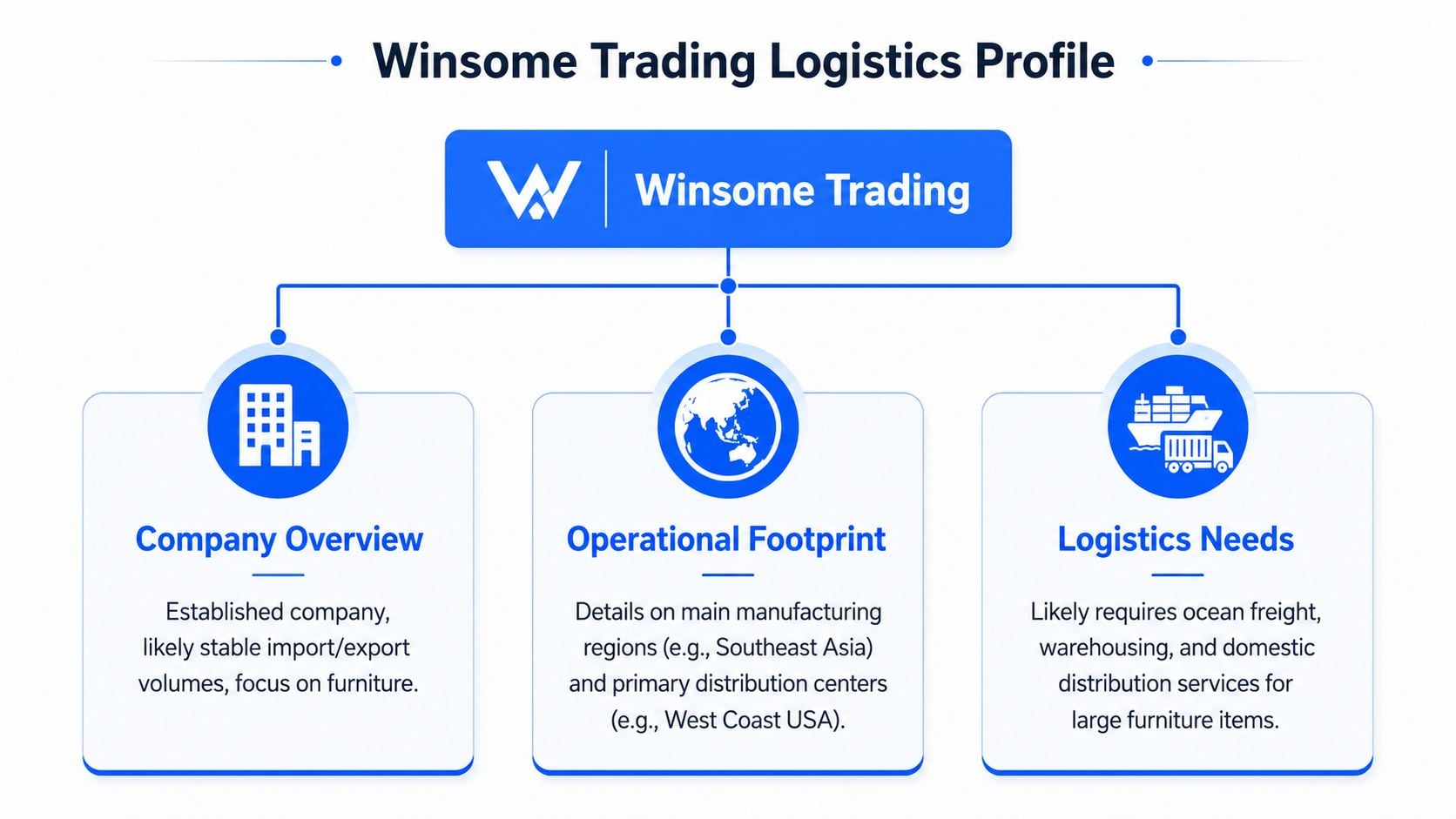
    A corporate profile infographic for Winsome Trading, detailing their furniture business operations, manufacturing regions, and logistics requirements.

    What a consolidated facility usually signals

    When office, assembly, and distribution sit together, a few practical implications follow:

    • Inbound scheduling matters more. Delays don't just affect receiving. They can disrupt assembly timing and outbound fulfillment.
    • Warehouse flow matters. If one site is handling multiple functions, congestion at receiving docks can spill into order release.
    • A forwarder can sell coordination, not just transport. The pitch becomes smoother handoffs, cleaner visibility, and fewer surprises across modes.

    That changes how you qualify the account. You're not asking only whether they import or export. You're asking whether their operation benefits from tighter alignment between customs, drayage, warehousing support, and domestic distribution.

    Product mix tells you where service risk lives

    The company's Better Business Bureau profile describes a product range that includes accent tables, bed trays, TV tables, occasion tables, stools, and shelving, with materials including wood, wrought iron, aluminum, steel, marble, and glass. That mix creates real trade-offs.

    Wood and finished furniture surfaces raise packaging and damage-prevention questions. Glass adds breakage exposure. Metal and stone components can change weight distribution, container loading plans, and final-mile handling. A rep who understands that won't lead with “best rates.” They'll ask better questions.

    If the shipment can be damaged by poor loading, poor packaging advice is a sales problem, not just an operations problem.

    How to rank this account internally

    New reps often treat every manufacturer the same. Don't. Build a short qualification view around operational fit. If you want a simple framework for building a lead scoring model, adapt it to logistics-specific variables like facility type, product fragility, cross-border indicators, and likely modal mix.

    A practical scorecard for Winsome Trading Woodinville would weigh:

    1. Facility structure
      Consolidated operations often create coordination pain points worth solving.

    2. Product handling demands
      Mixed materials usually increase the value of specialized execution.

    3. Operational maturity
      Long-standing manufacturers tend to have established processes, which means you need a sharper entry angle.

    For reps learning account breakdowns, I like comparing one target against another known manufacturer profile to sharpen pattern recognition. This review of Marathon Sales Inc and account qualification signals is useful for that exercise.

    Uncovering Potential Trade Lanes and Shipment Patterns

    The useful question isn't “Does Winsome ship?” It's “What route logic would make sense for this shipper, and how do we verify it fast?”

    Winsome Trading Inc. generates annual revenue of approximately $39,033,867 and maintains a secondary location at 8116 Alexander Rd, Delta, BC, Canada, according to its Manta company profile. The number matters because it suggests a meaningful operating scale. The Delta location matters because it gives you a real cross-border clue.
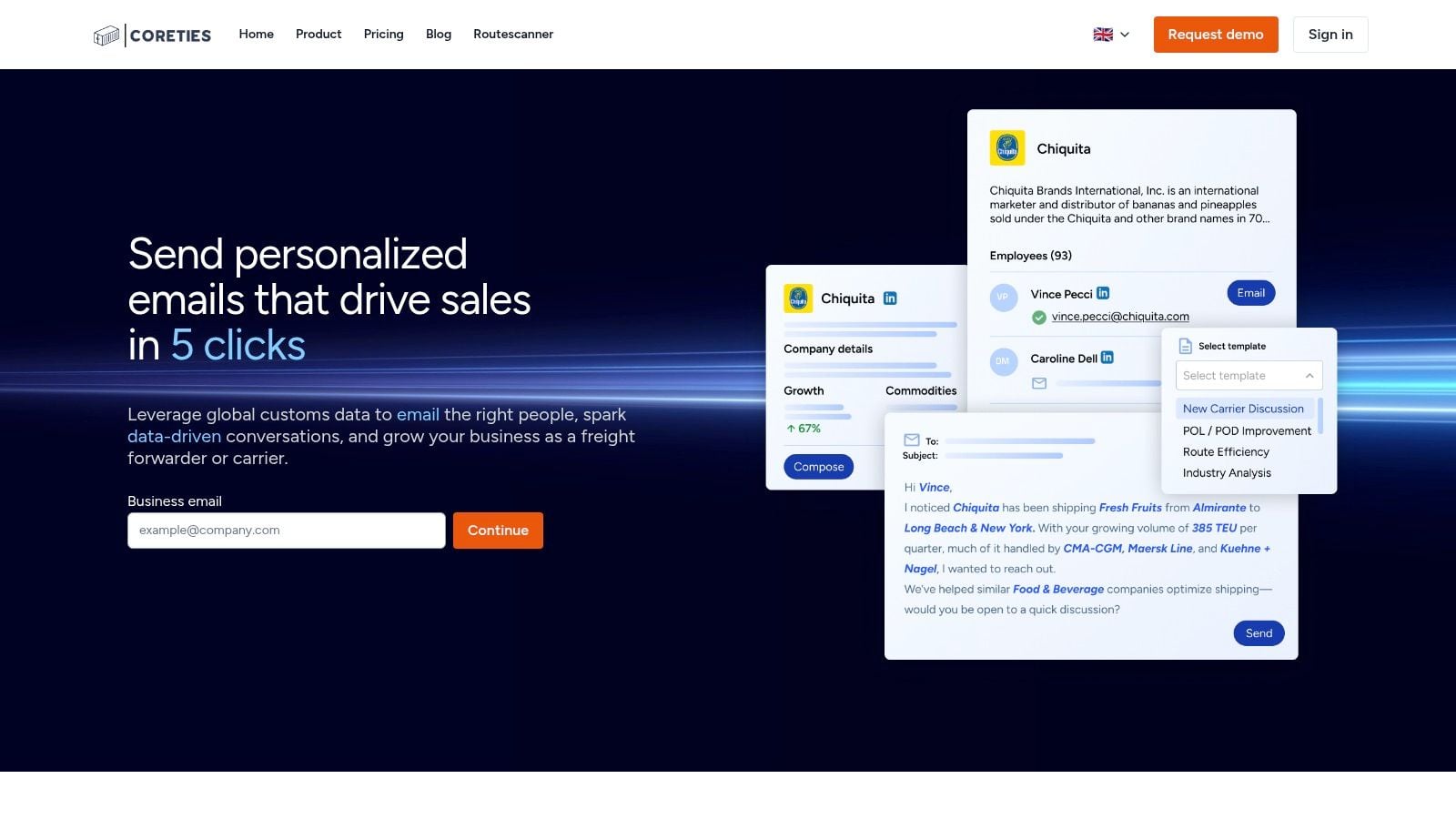
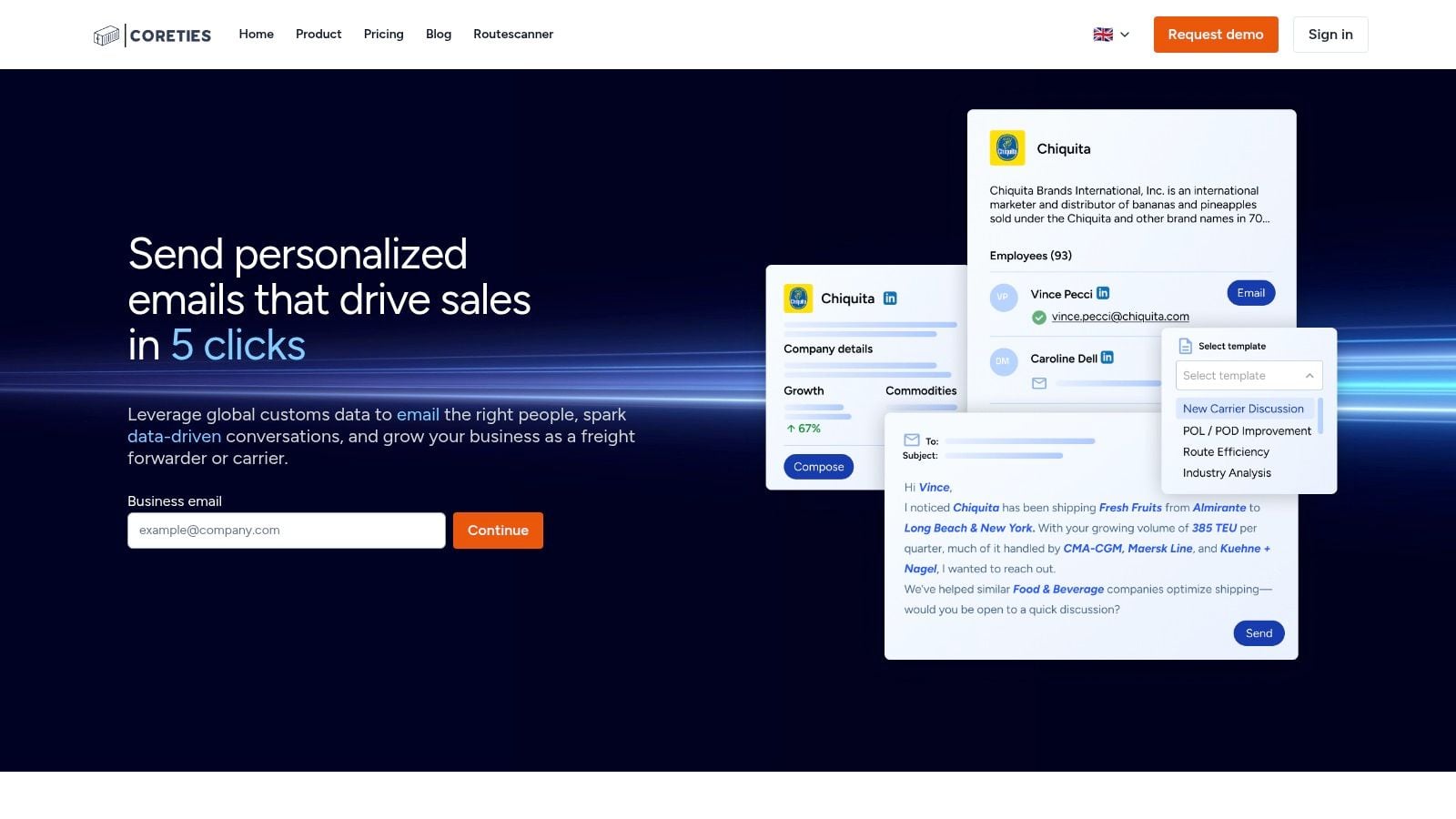
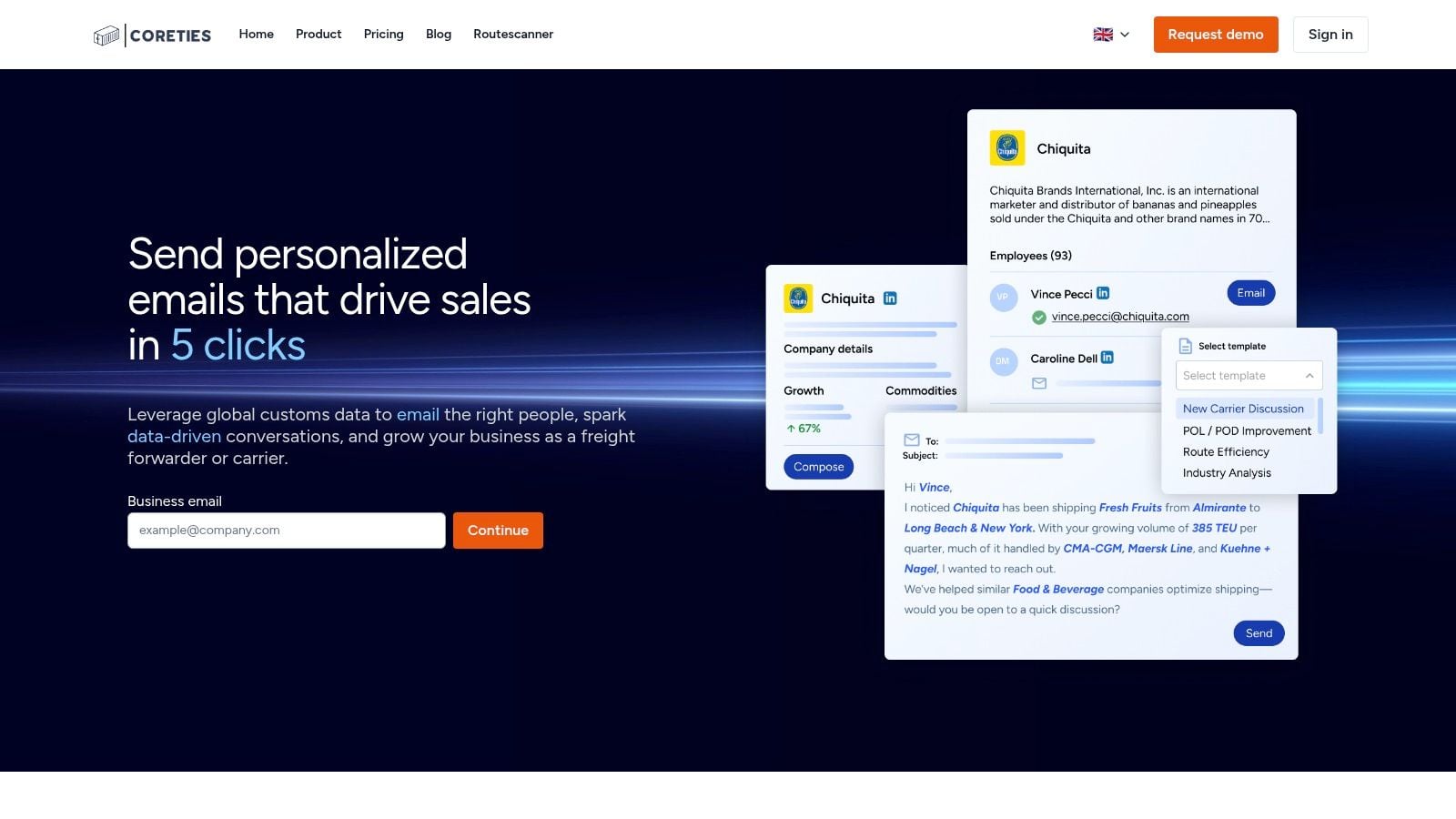
    Screenshot from https://coreties.com

    Start with hypotheses, not assumptions

    You don't need to invent facts to form a prospecting plan. You need disciplined hypotheses.

    For Winsome Trading Woodinville, I'd test these possibilities first:

    • Cross-border movement between Washington and British Columbia
      The Delta facility creates a plausible lane for inventory balancing, supplier coordination, or distribution support.

    • West Coast port dependency
      A Woodinville furniture operation with mixed-material products may rely on Pacific Northwest import flows, even if the exact port mix still needs verification.

    • Container-level handling complexity
      Furniture and pantryware often create cube, stacking, and breakage considerations that influence carrier and warehouse choices.

    None of those statements claims a shipment history. They tell you where to look first.

    What to pull from customs and commercial signals

    In this critical phase, new reps either become dangerous in a good way or stay stuck in list-building mode. You want records and signals that answer a narrow set of questions:

    Signal to verify Why it matters
    Port of entry patterns Tells you which gateway problems are worth discussing
    Carrier names Helps frame switch-risk and incumbent strength
    Commodity descriptions Reveals whether the lane fit matches your service strengths
    Consignee and shipper naming variants Prevents missing records due to entity mismatch
    Recurring origin locations Turns a one-off shipment into a lane strategy

    You should also widen the net beyond customs records alone. Teams that know how to integrate social data with scraping APIs can enrich lane research with job changes, facility mentions, hiring trends, and partner references. The point isn't to scrape for volume claims. It's to improve context before outreach.

    A short walkthrough helps when training reps to think in this sequence:

    The pattern you're trying to surface

    You're looking for a practical narrative, not a spreadsheet dump. For example:

    “This account appears to have a cross-border footprint, a consolidated warehouse operation, and products that likely require careful inbound planning and handling discipline.”

    That's enough to shape outreach. Once you verify specific shipments, you can narrow the message to one lane, one issue, and one likely stakeholder.

    How to Verify Shipping Data and Find Contacts

    An account doesn't become workable until you've confirmed two things. First, the freight pattern is real. Second, a specific person owns part of the problem.
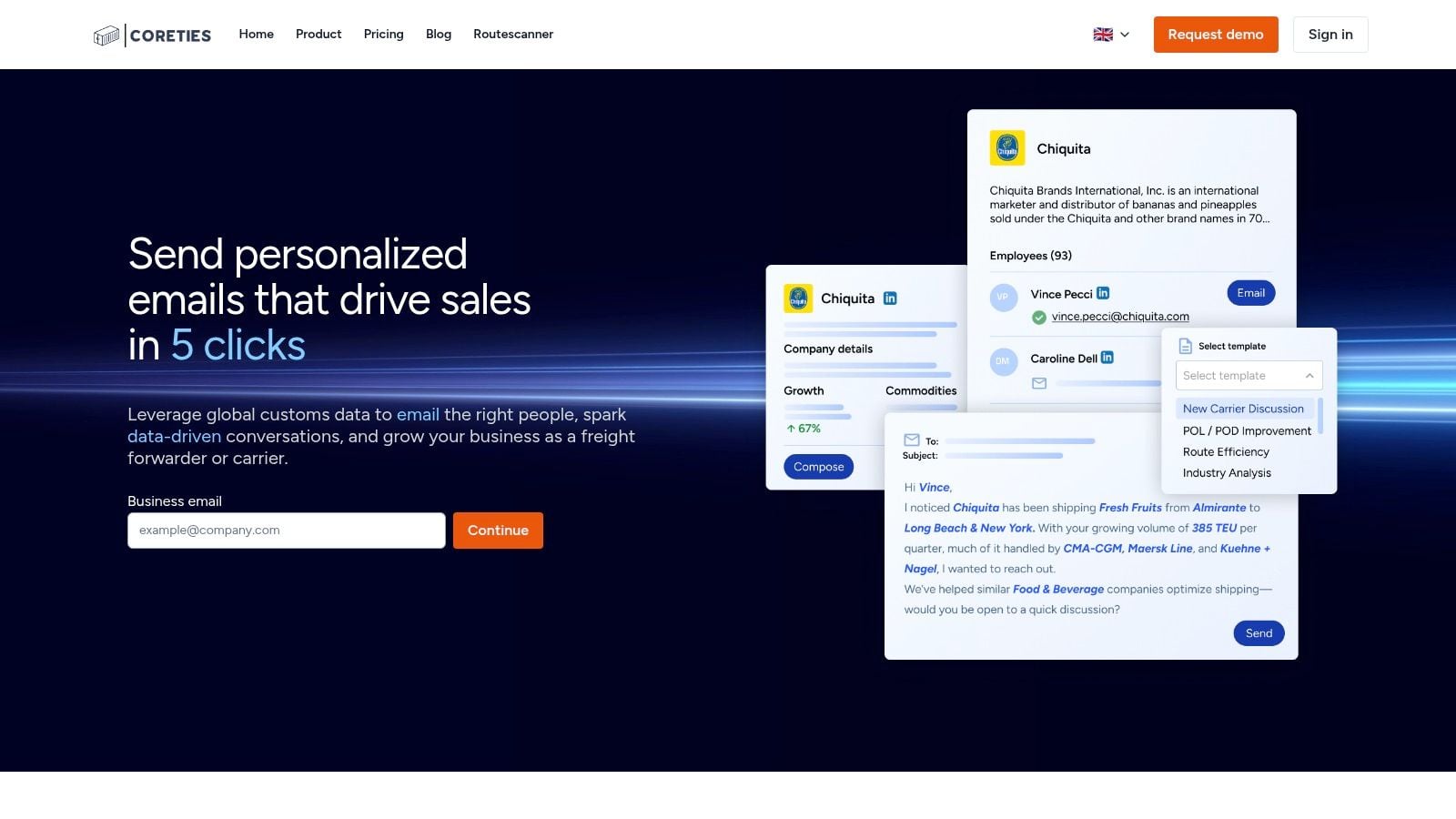
    Screenshot from https://coreties.com

    Verify the freight before you write

    Use shipment records, bills of lading, and consignee variations to test your lane hypotheses. Don't stop at a company-name search. Check likely abbreviations, entity suffixes, and address-linked records. A lot of reps miss good data because they search one exact legal name and assume the file is complete.

    What you're trying to confirm is straightforward:

    1. Recurring port activity
      One shipment is interesting. Repetition is what gives you a prospecting angle.

    2. Mode and routing clues
      You want to know whether the account looks like a fit for your strongest service lines.

    3. Operational friction points
      Late pickups, split handling requirements, customs complexity, or warehouse timing issues all create better opening messages than a broad capability statement.

    Verify first, personalize second. Reversing that order produces polished nonsense.

    Find the owner, not the mailbox

    Once the freight pattern is credible, move to role mapping. For a shipper like Winsome Trading Woodinville, the right contact usually isn't the generic corporate inbox. The useful targets are people tied to logistics execution, supply chain planning, operations leadership, or procurement.

    Build a contact slate by role, then prioritize by likely pain ownership:

    • Logistics or transportation manager for day-to-day lane execution
    • Supply chain director if the issue touches network design or vendor performance
    • Operations leader when warehousing and inbound flow affect fulfillment
    • Procurement stakeholder if the conversation is likely to turn into rate benchmarking

    You also need a clean process for decision-maker research. This guide on how to find decision-makers in B2B accounts is a good checklist for moving from company-level interest to person-level outreach.

    Keep your contact list tight

    Don't build a bloated list of every manager with a LinkedIn profile. For one target account, I'd rather have three well-matched contacts with clear role logic than fifteen names with no ownership theory behind them.

    That discipline improves message quality and follow-up quality. It also keeps you from sending the same half-relevant note across departments that don't share the same KPI.

    Crafting Your Data-Driven Outreach Message

    Most freight outreach fails in the first sentence. The rep talks about their company before proving they understand the shipper.

    That approach is especially weak with a long-standing manufacturer like Winsome Trading, which was established in 1977 and has maintained continuous operations for over 35 years, as noted earlier from the BBB profile. Stable companies tend to attract constant vendor outreach. They don't need another “just checking if you handle imports” email.

    Generic email versus account-specific email

    Here's the bad version:

    Hi, we're a global logistics provider that supports importers and exporters with competitive rates and reliable service. I'd love to schedule time to learn about your shipping needs.

    There's no account insight, no reason for timing, and no indication that the sender understands the operation.

    A stronger version sounds like this:

    Hi [Name], I'm reaching out because Winsome Trading's Woodinville operation appears to combine assembly and distribution, which usually makes inbound timing and warehouse flow more sensitive than standard receiving-only sites. If your team is reviewing any Pacific Northwest import or cross-border routing options, I can share a few ideas on where forwarders usually reduce handoff issues for furniture programs.

    That message doesn't overclaim. It shows enough understanding to earn a reply.

    Match the angle to the role

    Use the same account, but shift the message based on who's reading it.

    Target Role Key Concern Messaging Angle Example
    Logistics Manager Shipment execution “We help reduce missed handoffs and receiving friction on recurring inbound lanes.”
    Supply Chain Director Network reliability “We can review routing and vendor coordination where assembly and distribution sit in one operation.”
    Operations Leader Warehouse flow “Inbound timing issues often create downstream pressure on fulfillment. That's where we usually start.”
    Finance or Procurement Cost control “We can benchmark where avoidable accessorials and handling inefficiencies may be hiding.”

    Keep the message clean enough to land

    Don't bury the insight under a long intro. Don't attach a deck. Don't ask for half an hour. Ask for a short conversation tied to one practical issue.

    A few rules I use with new reps:

    • Lead with the account observation.
    • Mention one likely pain point, not five.
    • Ask for a brief call with a narrow purpose.
    • Use a domain that's set up correctly before sending. If your team needs a refresher on sender setup, this guide on How do I authenticate my email is worth reviewing before any outbound push.

    The best cold email sounds like it came from someone who already thinks in the prospect's workflow.

    That's the standard. Not clever. Not long. Relevant.

    Effective Follow-Up Tactics That Secure the Meeting

    Most meetings are booked in follow-up, not on the first email. The problem is that reps often follow up by repeating themselves.

    Don't send “just bumping this up” messages. Add something each time.
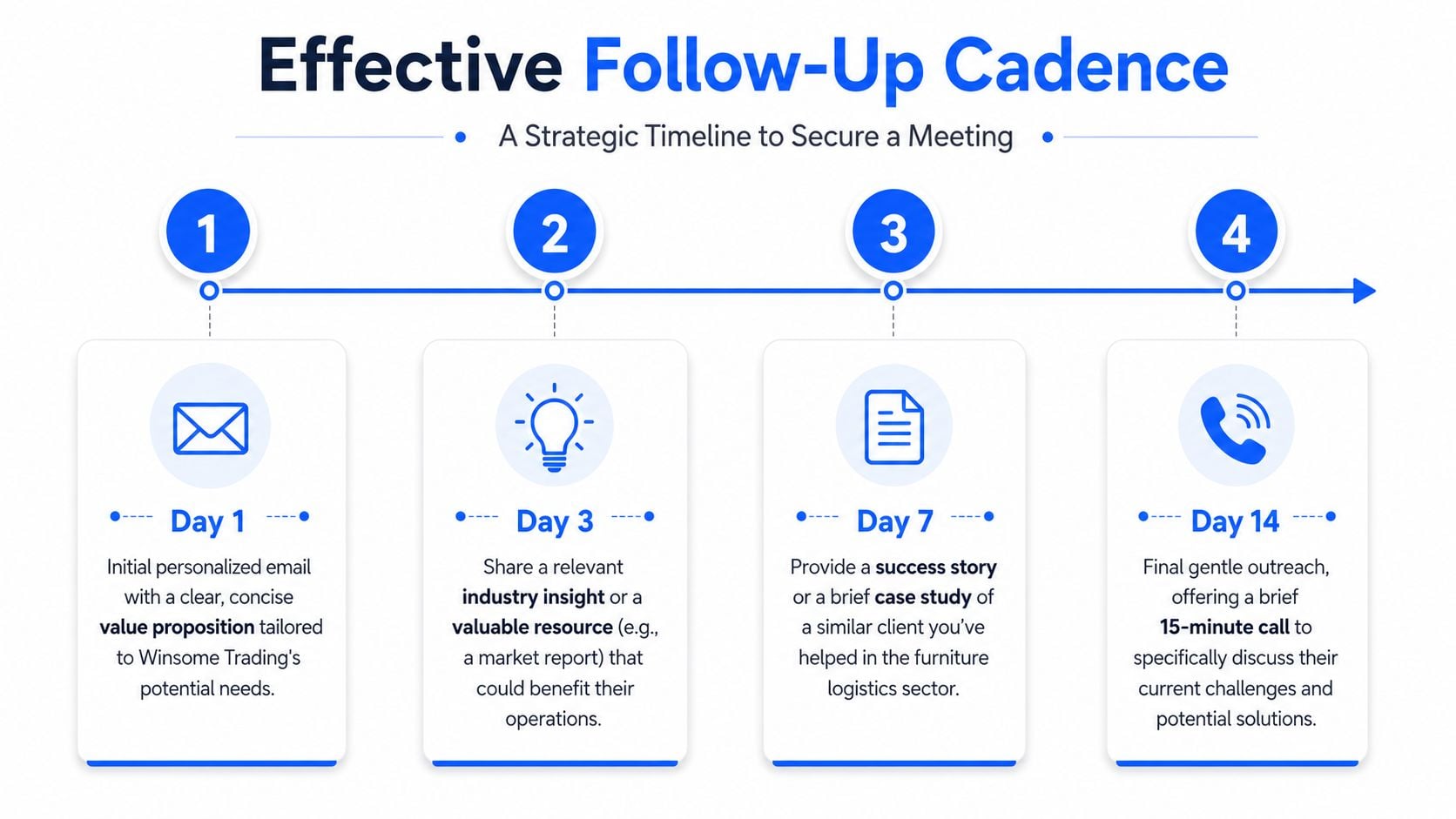
    A strategic four-step follow-up timeline to secure meetings with prospects, displayed as a business workflow graphic.

    A simple cadence that works

    • Day 1
      Send the personalized note tied to one operational observation.

    • Day 3
      Add a useful follow-up. This could be a short comment about a likely lane issue, a packaging concern common in furniture moves, or a question about cross-border coordination.

    • Day 7
      Narrow the ask. Offer a short discussion around one issue only, such as inbound scheduling, customs handoff, or warehouse flow.

    • Day 14
      Close politely. Let them know you'll step back if timing isn't right, but leave a specific reason to reconnect later.

    What not to do

    A few follow-up habits kill response rates:

    Avoid this Do this instead
    Repeating the same email Add one new observation or question
    Sending long reminders Keep each touch short and specific
    Pitching every service Focus on the one issue most likely to matter
    Chasing everyone at once Stay coordinated across a small contact group

    Persistence helps only when each touch gives the buyer a new reason to care.

    For Winsome Trading Woodinville, the meeting usually comes from disciplined relevance. You identify the account correctly, verify the freight pattern, pick the right owner, and follow up with context instead of noise. That's how booked meetings happen in logistics sales.


    If you want a faster way to turn customs signals into qualified shipper lists, find the right contacts, and launch account-specific outreach, Coreties is built for that workflow. It helps freight teams move from raw trade data to targeted conversations without wasting time on generic prospecting.
  • Boost Freight: Performance Benchmarking Guide

    Boost Freight: Performance Benchmarking Guide

    Your team is probably already benchmarking performance. You just may not be calling it that.

    A sales manager looks at reply rates from last month and says a lane campaign underperformed. An operations lead sees margin tightening on a port pair and assumes carrier costs are the reason. A commercial director compares one rep against another without checking account mix, shipment complexity, or timing. Those are performance checks, but they aren't yet performance benchmarking.

    The problem is that informal checks usually mix too many variables. They compare the wrong periods, use inconsistent data, and stop at surface-level numbers. In freight, that gets expensive fast. You can push budget into a lane that only looked strong because of a short-term spike, or judge a rep unfairly because one book of business had cleaner data and easier targets.

    Good benchmarking gives commercial and operations teams a shared way to answer one question: where are we underperforming, why, and what should we change next? In logistics, that means moving past one-off scorecards and building a rhythm of trend analysis, fair comparisons, and follow-through.

    Setting the Stage for Meaningful Benchmarks

    Most failed benchmarking efforts start with a fuzzy target. “Improve sales productivity” sounds fine in a meeting, but nobody can benchmark against it. You need a definition of good performance that can survive contact with real freight data.

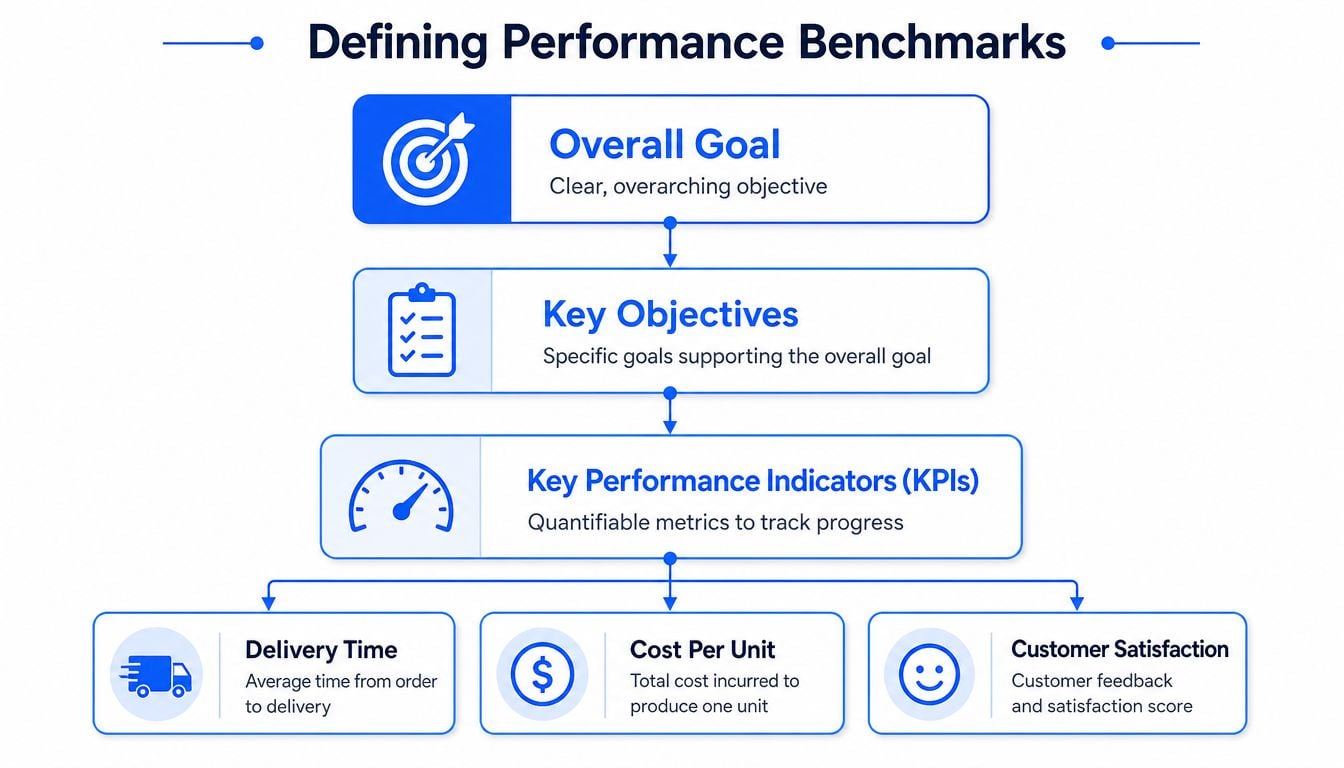
    Industry-standard benchmarking treats this as a structured process, not a casual review. Performance benchmarking is a systematic 5-step cycle: Plan, Set-Up, Collect, Analyze, and Act. Organizations that stick to the full cycle turn benchmarking into a repeatable improvement habit rather than a one-time report, as outlined by APQC's benchmarking framework.

    A hierarchical diagram explaining the process of defining performance benchmarks for business objectives and KPIs.

    Why informal performance checks break down

    In freight sales, teams often track whatever is easy to pull from the CRM. Email volume. Calls made. Meetings booked. Quotes sent. Those metrics aren't useless, but on their own they don't tell you whether the business is getting healthier.

    A rep can send a high volume of emails into the wrong accounts. A branch can book more meetings while winning lower-quality freight. A lane can show volume growth while margin weakens. If the KPI doesn't connect to commercial or operational outcomes, it becomes a vanity metric.

    Practical rule: If a KPI can't change a decision on pricing, account targeting, lane focus, or rep coaching, it shouldn't sit at the center of your benchmark.

    The five-step cycle fixes that by forcing discipline. Plan defines the business question. Set-Up chooses the measures. Collect builds a reliable dataset. Analyze explains the gap. Act turns the finding into a change with ownership.

    Skip Analyze and you only get scorekeeping. Skip Act and the dashboard becomes decoration.

    KPIs that matter in freight

    A useful benchmark set combines sales activity, commercial quality, and operational follow-through. That mix matters because logistics teams win business in sales conversations but keep it through execution.

    A practical starter set for freight forwarders, carriers, and 3PL teams usually includes:

    • Prospecting quality such as outreach-to-meeting conversion rate by shipper segment, lane, or territory
    • Pipeline quality such as quote-to-win rate, win reasons, and time from first contact to qualified opportunity
    • Lane economics such as lane profitability, yield consistency, and account concentration by trade lane
    • Customer retention signals such as repeat booking patterns, complaint themes, and service recovery cycles
    • Execution measures such as delivery time consistency, exception rates, and handoff speed between sales and operations

    A simple benchmark design

    Start with one commercial objective and one operational outcome tied to it.

    For example, if your goal is to grow import business on a port pair, your benchmark should not stop at outbound email response. It should connect prospecting activity to qualified meetings, quoted opportunities, won shipments, and lane performance after go-live. That creates a chain of evidence instead of a shallow snapshot.

    A simple setup often looks like this:

    1. Define the business goal such as improving performance on a target lane or shipper segment.
    2. Choose a small KPI set that reflects both selling and execution.
    3. Assign owners so sales, pricing, and operations agree on definitions.
    4. Decide the review rhythm weekly for activity, monthly or quarterly for outcome trends.
    5. Predefine action triggers so the team knows what happens when a metric moves off target.

    That's the difference between reporting and management. Reporting tells you what happened. Benchmarking tells you what to do next.

    Sourcing and Normalizing Your Logistics Data

    More data doesn't automatically produce better benchmarking. In freight, it often does the opposite.

    Teams pull customs records, CRM logs, TMS activity, quoting history, finance data, and rep notes into one spreadsheet and assume the size of the dataset makes it reliable. It doesn't. If company names vary, shipment records are duplicated, and one lane has deep history while another is brand new, your benchmark can look precise while being badly distorted.

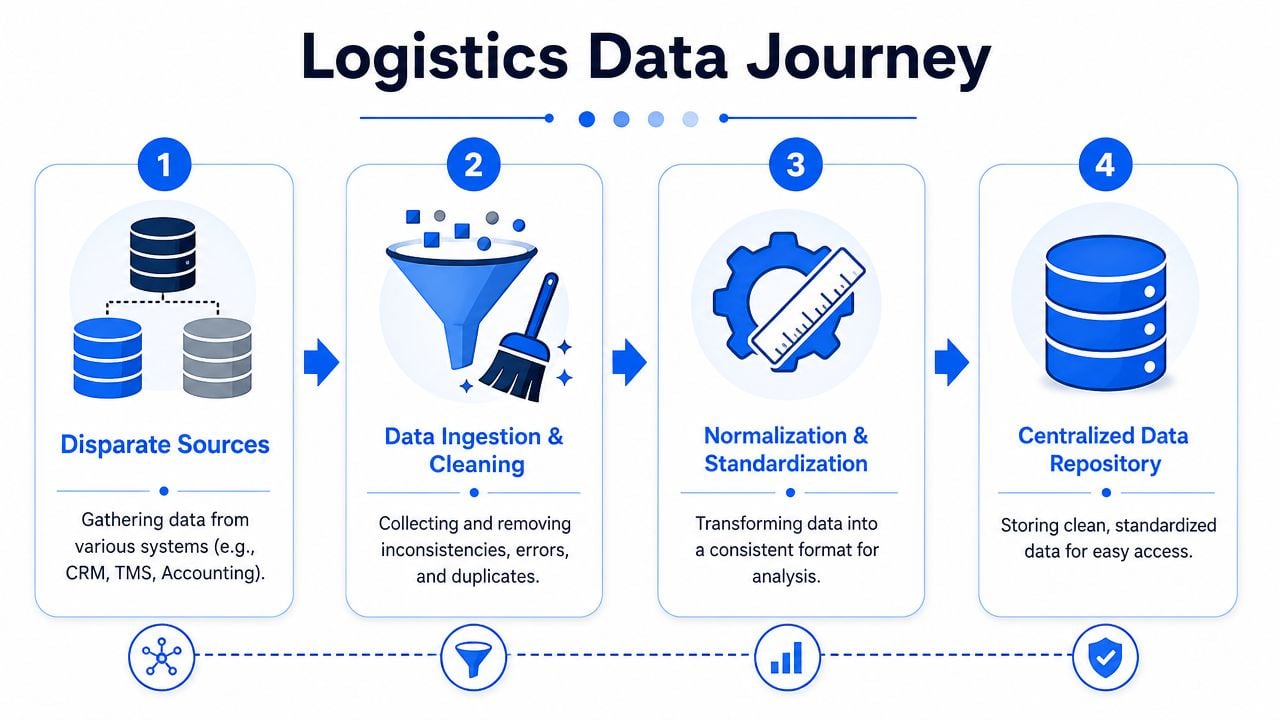
    A four-step infographic illustrating the logistics data journey from disparate sources to a centralized repository.

    Start with source discipline

    For logistics teams, the core source groups are usually straightforward:

    • Commercial systems including CRM stages, outreach logs, meeting outcomes, and account ownership
    • Operational systems including TMS milestones, routing choices, exceptions, and shipment completion data
    • Financial systems including quoted rates, invoiced revenue, and margin by customer or lane
    • Market intelligence sources including customs-derived shipment visibility and trade lane activity

    What trips teams up isn't access. It's consistency.

    One shipper may appear under multiple names across customs records and CRM entries. A lane may be tagged by port pair in one system and by country pair in another. A rep may log meetings carefully while another leaves half the activity in email. If you compare those records without cleaning them first, you aren't benchmarking performance. You're benchmarking documentation habits.

    Clean before you compare

    Use a standard cleaning pass before any benchmark review.

    • Resolve entity names by mapping parent companies, subsidiaries, spelling variations, and acquired brands into one record structure.
    • Standardize lane definitions so everyone means the same thing when they talk about a trade lane, corridor, or service scope.
    • Remove duplicate events especially where the same shipment or outreach touch appears across multiple tools.
    • Separate missing from zero because “no activity recorded” and “activity happened with zero outcome” are not the same operational reality.

    A strong primer on structuring supply chain data sources is this guide to supply chain databases, which is useful when you're combining commercial and operational records.

    Later in the workflow, route context matters too. If you're benchmarking drayage and container handoff performance around congested gateways, practical operational examples such as optimizing Felixstowe with Haulier.AI help teams understand why local conditions can distort raw comparisons.

    Normalize for fair comparisons

    This is the part many teams skip, and it's where weak benchmarking usually falls apart.

    Research on benchmarking performance indices warns that methods often fail when they “ignore sample size effects or use aggregate data”, which leads to misleading comparisons, especially in logistics where reporting standards and data volumes vary widely. That caution is highlighted in this analysis of benchmarking pitfalls.

    A lane with a long booking history and a lane you're just developing should not be judged by the same raw output logic.

    If one rep works a mature vertical with dense customs visibility and another works newer accounts with sparse records, raw response rates or win counts can mislead. You need normalization rules that account for uneven exposure and uneven data quality.

    Practical normalization options include:

    • Cohort-based comparison where you compare similar lanes, customer segments, or account maturity groups instead of the whole book at once
    • Rate-based metrics rather than raw counts, provided the denominator is clean and consistent
    • Minimum observation thresholds before you treat any pattern as benchmark-worthy
    • Weighted interpretation where results from thin datasets are treated more cautiously than results from well-established activity streams

    A short technical explainer can help teams visualize this data-handling step before they build dashboards.

    The main lesson is simple. Clean data beats big data. Fair comparison beats fast comparison.

    Building Your Comparison Cohorts and Dashboard

    Once the data is clean, the next job is grouping it properly. Most freight teams don't need a bigger dashboard. They need better comparison cohorts.

    A cohort is the peer group you use for comparison. If that group is wrong, every conclusion after it is shaky. Comparing a new trade lane against a mature one, or a specialist rep against a broad-market rep, usually creates noise disguised as insight.

    Cohorts that actually help decisions

    Use internal and external cohorts for different questions.

    Internal benchmarking works best when you're trying to improve execution consistency. Compare one period against another, one branch against another, or one rep's performance against peers handling similar account types. Such comparisons make quarter-over-quarter lane performance, response rate by segment, or quote turnaround by office especially useful.

    External benchmarking helps when the question is market position. That could mean comparing your activity and results against visible trade patterns in customs data, or against a competitor set operating in the same corridor and customer profile.

    Useful logistics cohorts often include:

    • Lane cohorts by port pair, country pair, or service mode
    • Customer cohorts by industry, shipment frequency, or import/export profile
    • Sales cohorts by territory, tenure, or account mix
    • Operational cohorts by branch, carrier partner set, or handoff model

    What the dashboard should show

    The dashboard's job is to shorten the time between signal and action. It should let a sales manager or commercial director answer three questions quickly: where are we off track, where are we improving, and where should we intervene first?

    Screenshot from https://coreties.com

    A useful logistics dashboard usually includes a mix of commercial and operational views, such as:

    • target lanes with increasing or weakening engagement
    • outreach response rate by rep or territory
    • quote conversion by shipper segment
    • new-customer shipment quality after onboarding
    • margin direction by lane or customer cohort

    Don't overload the screen. If every KPI is “critical,” nothing is.

    Category KPI What It Measures
    Sales Activity Outreach-to-meeting conversion How effectively outbound prospecting creates qualified conversations
    Pipeline Quality Quote-to-win rate How often pricing activity turns into booked business
    Lane Performance Lane profitability Commercial health of a specific trade lane or corridor
    Customer Health Repeat booking rate Whether new and existing customers continue to place freight
    Service Execution Delivery time consistency Reliability of shipment execution against expected transit performance
    Account Economics Customer acquisition cost The effort and spend required to win a new shipper account
    Team Performance Outreach response rate by sales rep Relative effectiveness of targeting, messaging, and follow-up

    Keep one source of truth

    Dashboards fail when teams export data into side spreadsheets and start redefining terms by department. A quote in sales shouldn't mean one thing to the rep and another thing to finance. A qualified opportunity shouldn't shift definition by branch.

    Operator's view: A benchmark only works when the room agrees on the denominator.

    If your team debates the meaning of the KPI every month, the dashboard isn't ready for management use.

    Analyzing Performance to Uncover Growth Opportunities

    A dashboard tells you where to look. Analysis tells you where money is leaking.

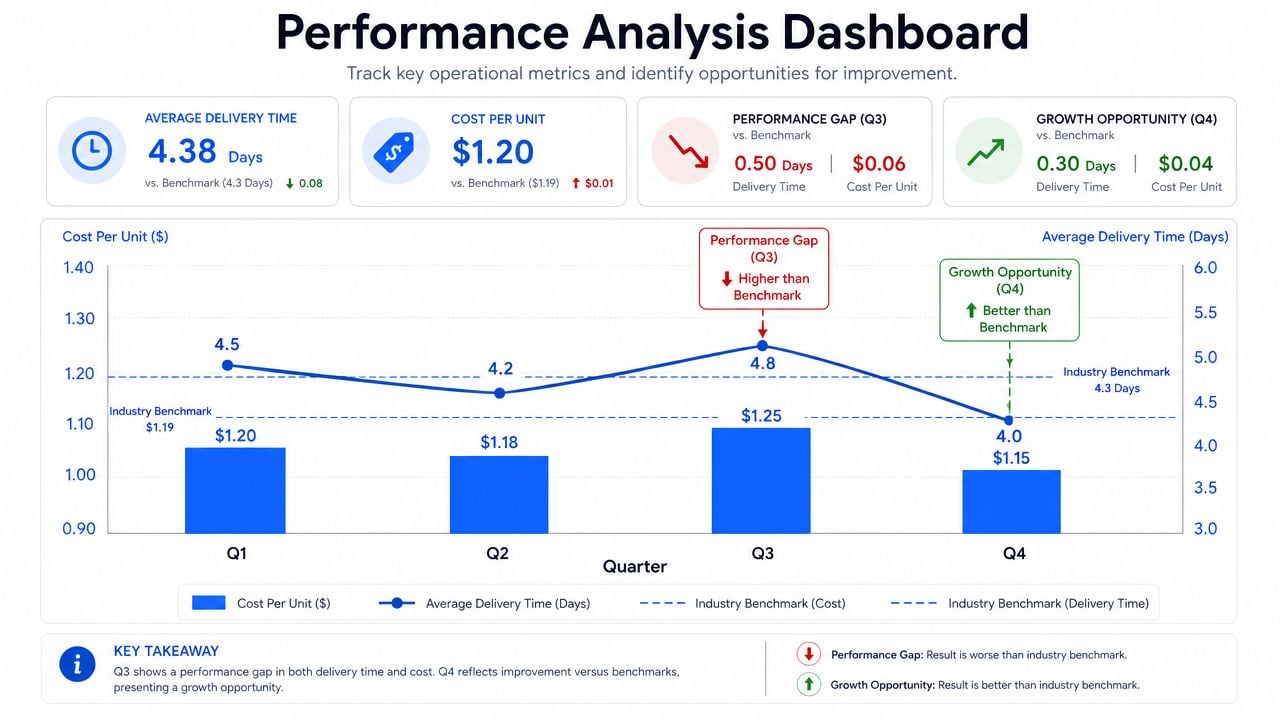
    That's why strong performance benchmarking focuses on the performance gap, which is the measurable difference between your current state and the best realistic benchmark for that process. Effective gap analysis also requires senior management involvement and a concrete action plan with responsibilities and deadlines, as described in this guidance on KPIs and benchmarking.

    A performance analysis dashboard showing quarterly operational metrics for cost per unit and average delivery time.

    When response rates differ by rep

    Say one rep gets more replies from importers on a target corridor than another. The weak analysis says the better rep writes stronger emails. Sometimes that's true. Often it isn't the full story.

    Check the comparison in layers:

    1. Account mix. Are both reps targeting the same shipper size, commodity type, and lane density?
    2. Data quality. Does one rep have cleaner contact coverage and better decision-maker matches?
    3. Follow-up rhythm. Are touches spread consistently, or does one rep stop too early?
    4. Offer quality. Is one rep using stronger operational proof points such as routing options, port alternatives, or service detail?

    That last point matters more than many teams admit. Logistics sales is not just copywriting. It's commercial relevance. If a rep can speak clearly to route options, handoff risks, or likely bottlenecks, the message usually lands better because it sounds operationally credible.

    A useful supporting read here is predictive analytics for sales, especially for teams trying to connect prospecting patterns with likely pipeline outcomes.

    When volume rises but profit softens

    This is a classic freight problem. A lane looks healthy on paper because shipment count is up, but margin quality starts slipping. If you only benchmark volume, you'll call that growth. If you benchmark commercial performance properly, you'll see deterioration early.

    Review the lane through multiple lenses:

    • Pricing behavior to see whether win rates improved because the team discounted too aggressively
    • Customer mix changes to identify whether lower-quality freight replaced better freight
    • Operational cost pressure such as extra handling, poor routing, or recurring exception management
    • Service promise mismatch where sales committed to a service pattern operations can't maintain profitably

    If finance is part of that review, ratio thinking helps. Teams that want a cleaner way to assess the financial side of operational performance often benefit from broader guides such as Understanding SME cash flow ratios, especially when margin discussions drift into working-capital strain and collection timing.

    Turn findings into action

    Analysis isn't complete until it changes behavior. If the gap is poor response quality on a lane, the action may be tighter account selection, better routing intelligence in outreach, or clearer rep playbooks. If the gap is profitable growth, the action may be pricing guardrails, customer-tier rules, or stricter lane qualification.

    Benchmarking earns trust when it identifies a gap, names the likely cause, and assigns the next move to a person, not a department.

    That last point matters. “Sales and ops should align better” is not an action. “Pricing manager reviews low-yield wins on the corridor every Friday and rep leads adjust targeting by shipper type” is an action.

    From Static Reports to Trend-Based Improvements

    The biggest mistake in performance benchmarking is treating the report as the finish line.

    One monthly scorecard can tell you whether a metric moved. It can't tell you whether the change is durable, seasonal, or misleading. In freight, that distinction matters because shipment flows rise and fall with tender cycles, port conditions, holidays, commodity timing, and customer buying patterns.

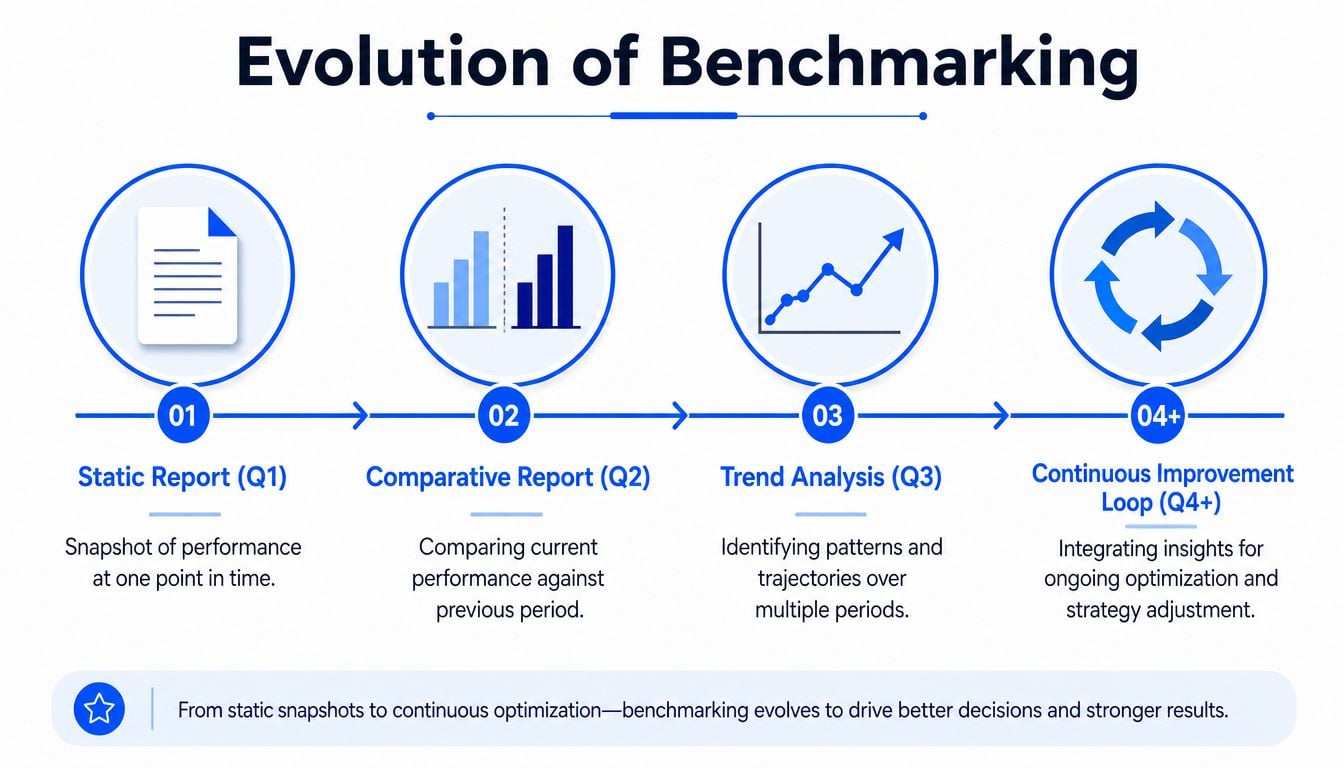
    Experts in benchmarking stress the need to “look at a trend rather than just episodical or instantaneous numbers”. They also emphasize that rigorous benchmarking includes implementing targeted improvements and then re-testing to confirm the issue is resolved, as discussed in this benchmarking discussion.

    A diagram illustrating the evolution of benchmarking, moving from static reports to continuous improvement loops over four stages.

    Why trend lines beat snapshots

    A rep's response rate can jump after a strong week of highly targeted outreach. A lane can look stronger in a short window because one large shipper moved unusual volume. A branch can appear more efficient because it handled fewer exceptions during that period.

    None of those signals are useless. But they need trend context.

    Use trend-based benchmarking to ask:

    • Is the improvement repeating across review periods?
    • Did performance improve in one cohort only, or across comparable groups?
    • Was the move tied to a specific intervention such as a new pitch, account filter, routing option, or pricing change?
    • Did the gain hold after conditions normalized?

    Don't reward a spike until it survives a second review cycle.

    That mindset saves teams from overreacting. It also keeps budget and leadership attention focused on changes that compound.

    Build the improvement loop

    A strong loop has four motions: measure, interpret, change, and verify. The verification step is where many commercial teams go quiet. They launch a new talk track, update a target list, or add route alternatives to outreach, but they don't isolate whether the change improved results.

    In logistics sales, one practical improvement might be giving reps stronger shipment visibility and route context before outreach. Another might be improving movement tracking so customer-facing teams can speak more confidently about service reliability. Broader operational visibility resources such as air and ground logistics tracking are useful when teams need better language and better evidence in customer conversations.

    Handle seasonality and lag like an operator

    Trend analysis in freight needs common-sense normalization. Compare like-for-like periods where possible. Treat short windows cautiously on low-volume lanes. Watch for lag between commercial activity and operational outcomes. A meeting booked now may not show up as a shipment pattern until later.

    That means your review rhythm should separate leading and lagging measures.

    A practical operating cadence often looks like this:

    • Weekly for outreach quality, meetings, and quote flow
    • Monthly for win quality, onboarding stability, and early margin behavior
    • Quarterly for lane development, customer retention patterns, and account quality trends

    When teams work this way, benchmarking stops being a reporting exercise. It becomes a management system.

    Key Takeaways and Common Benchmarking Pitfalls

    Performance benchmarking works when it helps your team make better decisions under real operating conditions. That's the standard. Not prettier reports. Not more tabs in a spreadsheet. Better decisions.

    The strongest freight teams treat benchmarking as a commercial discipline tied directly to account selection, pricing behavior, lane focus, and service execution. They define what good looks like, clean the data before comparing it, build fair cohorts, analyze the gap, and keep reviewing trends after they make changes.

    The weakest teams do the opposite. They compare raw totals across unequal books of business. They mix missing data with true zeroes. They celebrate activity that doesn't turn into profitable freight. Then they act surprised when the dashboard says one thing and the P&L says another.

    Common pitfalls show up fast:

    • Using vanity metrics like volume of outreach without checking whether it creates qualified, profitable opportunities
    • Comparing unmatched cohorts such as mature lanes against developing ones, or clean datasets against messy ones
    • Ignoring data quality especially entity matching, duplicate records, and inconsistent lane definitions
    • Stopping at the report instead of assigning actions and checking whether the intervention worked
    • Overreacting to short-term movement without enough trend context to separate signal from noise

    There's also a leadership pitfall. Teams often delegate benchmarking downward and then expect transformation upward. That rarely works. Commercial managers, operations leads, and senior decision-makers need to agree on definitions, priorities, and action thresholds. If they don't, the process turns political instead of practical.

    The payoff is simple. When you benchmark well, sales stops chasing the wrong accounts. Pricing spots weak wins sooner. Operations gets cleaner feedback on which promises are helping retention and which are hurting margin. The business learns faster.

    That is why benchmarking isn't an admin task. It's a growth system for logistics teams that want repeatable decisions instead of guesswork.


    If your team wants a faster way to turn customs data into qualified freight prospects, targeted outreach, and lane-specific commercial insight, take a look at Coreties. It helps freight forwarders, carriers, and logistics sales teams find the right accounts, reach the right decision-makers, and build more relevant conversations around real trade flows.

  • What Is a Cold Call in Sales: Guide for 3PLs & Freight

    What Is a Cold Call in Sales: Guide for 3PLs & Freight

    A cold call in sales is an unsolicited call to a potential customer who has had no prior contact with you, and the average meeting-booked rate still sits around 2% to 3%. In logistics, though, that first call no longer has to feel random. In 2026, better data turns it from a blind interruption into a strategic first touch with the right shipper, on the right lane, with a reason to listen.

    If you're in freight sales right now, you probably know the feeling. You have a list, half the contacts are stale, the companies are broad matches at best, and your team is expected to produce pipeline anyway. That old version of cold calling burns time and morale.

    The modern version is different. A good logistics rep doesn't call everyone who might move freight. They call the accounts that fit capacity, geography, service model, and timing. They call with context. They ask better questions. And they judge success by whether the call advances the deal, not whether someone says yes on the spot.

    The Modern Definition of a Cold Call in Sales

    A new logistics rep often starts with the wrong picture of cold calling. They think it means picking up the phone, dialing down a huge list, and hoping somebody has an urgent shipment problem that day. That's not a sales process. That's activity without control.

    What is a cold call in sales? It's a first phone conversation with a prospect who hasn't engaged with your company before. The prospect doesn't know you yet, but they should still fit your target account profile. In freight, that usually means the shipper matches the lanes you serve, the mode you sell, the shipment profile you handle well, or the industries where your operations team can win.

    What changed in practice

    The old stereotype was random dialing. The current reality is targeted outbound. A rep may still be making a cold call because there was no prior relationship, but the call shouldn't be uninformed.

    If a shipper imports consumer goods through specific ports, or regularly moves air freight into a market where your team has capacity, that call is still technically cold. It just isn't blind. That distinction matters, because relevance is what keeps the first 20 seconds alive.

    Teams that want tighter prospect discipline usually benefit from a stronger qualification process before outreach ever starts. A practical reference on that is this guide to B2B lead management, especially if your sales list keeps mixing real prospects with companies that will never buy.

    You can also see how this fits into broader freight prospecting workflows in this sales in logistics overview.

    Cold call, warm call, and cold email are not the same

    A lot of reps blur these together. They shouldn't.

    Outreach Method Comparison
    Method Prospect Awareness Typical Goal Key Advantage
    Cold calling No prior contact Start a live conversation and qualify fit Immediate feedback
    Warm calling Some prior awareness or interaction Re-engage and move toward a meeting Lower friction
    Cold emailing Usually no prior contact Earn a reply or create recognition before a call Scales personalization asynchronously

    Practical rule: If the account fits your freight offering but hasn't interacted with you yet, the call is cold. If the person recognizes your company from a referral, event, reply, or prior touch, it isn't.

    That sounds simple, but it changes how you coach a team. Cold calling isn't the same as "calling." It sits in a larger outbound cadence, and it does one job well. It creates a live opening where a shipper can confirm a problem, dismiss a fit, or point you to the decision-maker.

    For logistics sellers, that live feedback is the point. Email can be ignored. A call tells you whether the lane matters, whether the incumbent is vulnerable, and whether the contact owns transportation.

    Why Cold Calling Is a Superpower for Logistics Growth

    A rep calls a shipper on Tuesday morning with one useful piece of context. Imports from Southeast Asia are rising, the company just opened a new distribution point, and carriers on one of its likely inland lanes are tightening. That call feels very different from dialing down a generic list and asking who handles freight.

    In logistics, that difference is everything.

    A cold call still gives you information no database captures cleanly. A shipper may be testing a new vendor before bid season, shifting an origin, fighting rollover issues, or trying to fix service failures that procurement has not documented anywhere public.

    A professional man talks on the phone while working on his laptop in a warehouse office.

    The advantage now is that strong reps do not start fully cold. Tools like Coreties help teams narrow the field before they pick up the phone. You can prioritize accounts by shipment patterns, mode fit, geography, and likely buying triggers, then call with a reason that matches the account. The conversation starts warmer because the targeting is better.

    That is why cold calling keeps producing growth in freight. It creates access to live operating truth. You find out whether the lane matters, whether the incumbent is slipping, whether the prospect is adding volume, and whether you are even talking to the right person. If you are not, use a process for finding the right transportation decision-makers instead of burning more dials on the wrong contact.

    Where calls create real freight opportunities

    A strong freight call uncovers timing, constraints, and commercial fit.

    For a carrier sales rep, that can mean spotting backhaul freight that improves network balance and margin. For a forwarder, it can mean learning that a shipper is tired of poor milestone visibility, inconsistent transit times, or weak exception handling on a trade lane you know well. For a broker, it can mean hearing that a plant is adding volume next quarter and current coverage is already thin.

    Those openings rarely show up in a purchased list.

    Good outbound work in freight is less about reading a script and more about calling with a point of view. If you want a simple framework for structuring an opener, this outbound call script for founders is useful as a reference, but freight reps still need to adapt the message to lane pressure, mode needs, and service risk.

    Why persistence beats random volume

    Outbound in logistics rewards organized follow-up. Transportation managers are busy. Procurement teams screen aggressively. Operations leaders answer when the issue feels immediate.

    So the job is not to repeat the same pitch five times. The job is to vary the contact around a credible reason to talk.

    • Change the business angle: Lead with import congestion on one touch, capacity risk on another, and service failures or missed appointments on the next.
    • Use account-specific signals: If your data shows likely drayage exposure, port activity, regional expansion, or recurring lane fit, bring that into the conversation.
    • Redirect fast: If the contact does not own transportation, ask who handles routing guides, carrier selection, forwarding, or spot coverage.

    The best reps stay persistent without sounding repetitive.

    Cold calling works in logistics because freight buying is still operational and personal. Buyers trust people who understand detention, appointment failures, mode shifts, tender rejections, and the cost of a late delivery. Email helps. A live call gives you a chance to prove you understand the work.

    The Blueprint for a High-Converting Logistics Cold Call

    A rep calls a shipper at 10:07 a.m. and opens with, "Just checking if you handle freight." That call is dead on arrival. A logistics cold call converts when the rep already knows enough to make the conversation relevant in the first 15 seconds.

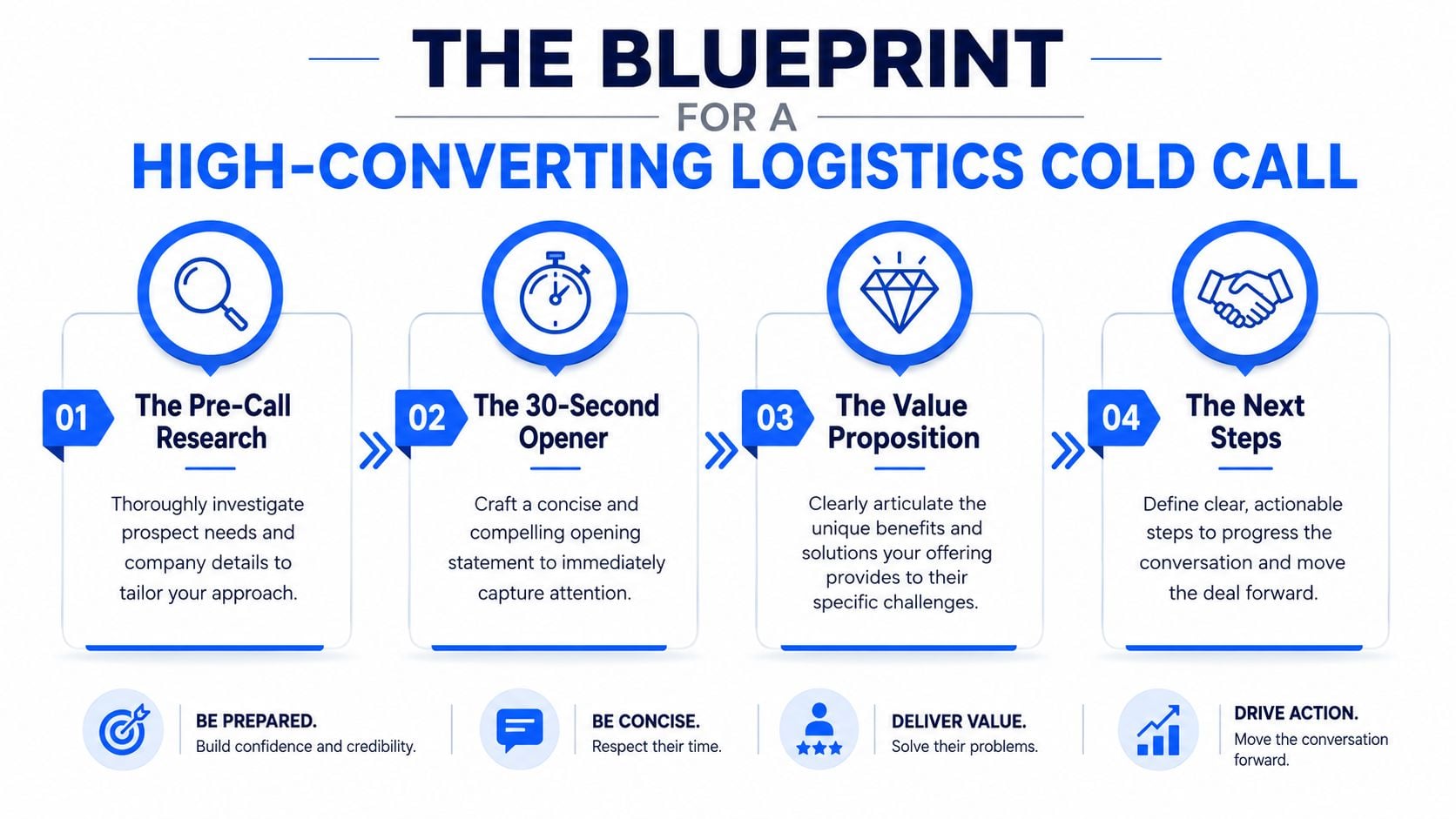
    A four-step infographic showing the blueprint for conducting a high-converting logistics sales cold call.

    Start with account context

    Freight buyers do not reward generic outreach. They respond when the caller sounds like someone who understands how transportation works inside their business.

    That means preparing around account facts, not memorizing a script. Know the likely mode mix, the shipping pattern, the pressure point, and who probably owns the decision. If your tools show import activity, port exposure, regional distribution, or a lane fit your team serves well, use that. Platforms like Coreties help reps turn a cold list into a prioritized call sheet with enough context to ask a smart question on the first attempt.

    The goal is simple. Reduce uncertainty for the prospect. If they can tell in one sentence why you called, resistance drops.

    Open with a reason, then ask one useful question

    A strong opener sounds specific and easy to answer. It does not sound polished for the sake of sounding polished.

    A practical freight opener sounds like this:

    "Hi Sarah, how are you doing? I'm calling because your team looks active on inbound container freight through Savannah, and I wanted to ask who reviews forwarding options when schedules slip or costs move."

    That opener works because it does three jobs fast:

    1. It sounds human: The rep talks like a person.
    2. It establishes relevance: The call references a real shipping context.
    3. It gives the prospect an easy path: They can confirm, redirect, or correct.

    For teams tightening language, this outbound call script for founders is a useful reference for structure. Freight teams still need to adapt the wording to mode, lane pressure, and service risk. If the rep is not sure who owns transportation decisions, this guide on how to find decision-makers at shipper accounts helps before the first dial.

    A short training clip can help reps hear pacing and delivery, not just read a script.

    Talk in operating terms

    Once the buyer engages, keep the conversation tied to work they already manage. Freight prospects do not need a broad capability speech. They need a clear reason to believe your team can improve part of their operation.

    Use language that matches the account:

    • For shippers: Focus on service consistency, appointment performance, lane coverage, and fewer exceptions.
    • For importers: Focus on routing options, trade lane familiarity, and response speed when plans change.
    • For carrier-side conversations: Focus on network fit, volume alignment, and where your capacity solves a known need.

    Specific beats broad. "We handle international freight" is forgettable. "We help importers with time-sensitive Asia to U.S. moves when schedule changes start affecting downstream appointments" gives the buyer something concrete to react to.

    Ask for the next meeting the call has earned

    Cold calls in freight rarely close business on the spot. They create the next serious conversation. That may be a lane review, a pricing discussion, an introduction to procurement, or a call with the transportation manager.

    Keep the close direct and low pressure:

    "If this lane is active for your team, would a short call next week make sense with whoever reviews forwarding options?"

    That works because it respects the buyer's process. It also gives your rep a clean outcome to track. In practice, the best cold calls do not feel cold at all. They feel like timely conversations backed by real account context.

    Supercharge Your Calls with Data Driven Insights

    The biggest mistake in freight outbound is calling with generic assumptions. "Do you ship internationally?" "Are you reviewing providers?" "Can I tell you about our services?" Those questions waste the small window you get on a live connect.

    Modern sales teams fix that by replacing guesswork with account intelligence.

    Screenshot from https://coreties.com

    What a smart call sounds like

    A generic call sounds cold because the rep doesn't know enough to be relevant. A smart call still reaches out first, but it opens with evidence the rep understands the account.

    That changes the conversation.

    Instead of asking whether a company imports, the rep references known trade activity. Instead of asking who handles logistics, the rep calls the most likely decision-maker. Instead of talking about broad capabilities, the rep speaks to the lane, mode, or routing pressure most likely to matter.

    Here is the difference in practice:

    Call Style Opening Approach Prospect Reaction
    Generic cold call Broad introduction and company pitch Low patience
    Data-informed call Specific business context and relevant question Higher credibility
    Warm follow-up call Builds on prior interaction or signal Easier progression

    What to prepare before the dial

    For logistics teams, useful call prep usually comes from a combination of shipment visibility, account fit, contact quality, and outreach workflow discipline.

    • Shipment context: Look for lane patterns, origin-destination relevance, and signs that your service model fits the account.
    • Contact precision: Call the person most likely to own transportation, procurement, forwarding, or supply chain decisions.
    • Message tailoring: Match your reason for calling to the account's likely shipping reality, not your internal product list.
    • Follow-up system: If a live conversation doesn't happen, queue an email and next touch while the details are fresh.

    Teams that want stronger process around sequencing and rep coordination can learn from examples of sales team outreach automation. For broader workflow planning, this guide to sales intelligence tools helps frame what data improves outreach quality.

    Better data doesn't replace selling skill. It gives selling skill something accurate to work with.

    Why this matters in freight

    Freight buyers hear the same claims all day. Good service. Competitive rates. End-to-end solutions. Those phrases are too broad to create trust.

    Specificity does. If the rep knows the account likely moves on a lane where their company has a real operational advantage, the conversation becomes useful faster. That's how a cold call starts to feel warm. Not because the prospect knows you, but because the call sounds informed enough to deserve a response.

    That shift also improves rep discipline. When each call starts with actual context, managers can coach quality. They can inspect whether the rep chose the right account, reached the right person, framed the lane correctly, and asked a real qualification question.

    Measuring Success and Ensuring Compliance

    Many freight teams still measure cold calling the wrong way. They celebrate dials, talk time, or how busy the rep sounded that day. Those numbers can describe effort, but they don't tell you whether outbound is creating pipeline.

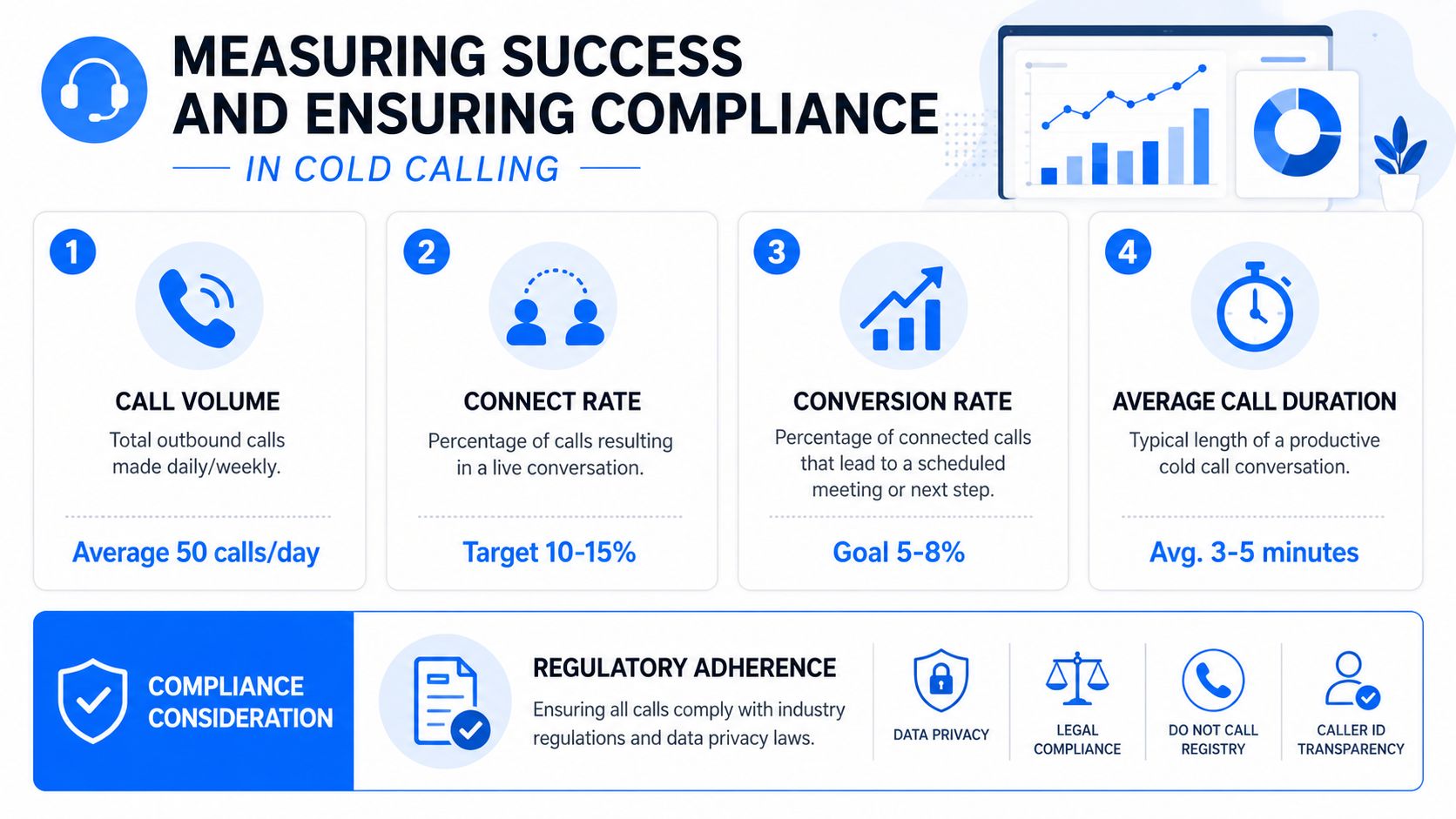
    An infographic detailing key performance metrics and regulatory compliance considerations for successful cold calling in sales teams.

    Track what moves the deal

    The cleanest way to measure cold calling is to treat it like a pipeline advancement system.

    According to RingCentral's definition of cold calling, calls must be made between 8 a.m. and 9 p.m. in the prospect's local time, callers must identify themselves and their organization, and the main success metric should be advancing the prospect to the next pipeline stage rather than trying to force an immediate sale.

    That standard fits freight sales well. A productive call might result in a follow-up meeting, a referral to the transportation lead, a lane review, or permission to quote. Those are real outcomes. They move the account forward.

    A practical scorecard should include:

    • Connect quality: Did the rep reach a real stakeholder or just complete a dial?
    • Conversation relevance: Did the call uncover lane, provider, timing, or ownership information?
    • Next-step rate: Did the rep earn a meeting, introduction, or agreed follow-up?
    • Data improvement: Did the rep leave the account record cleaner than they found it?

    Compliance is part of professionalism

    Compliance isn't separate from good sales. In outbound freight prospecting, it protects reputation and keeps your team disciplined.

    At minimum, reps should follow a few essential rules:

    • Call during allowed hours: Use the prospect's local time, not the rep's.
    • Identify yourself clearly: State your name and company early.
    • Avoid deception: Be direct about why you're calling and what your business does.
    • Document outcomes: Record requests, objections, next steps, and any opt-out signals accurately.

    Professional outbound teams don't just sound organized on the phone. They prove it in their records.

    One more management point matters here. If your team is chasing vanity metrics, they will take bad shortcuts. If they are measured on clean qualification and next-step creation, call quality improves and compliance gets easier to maintain.

    Conclusion From Cold Contact to Valued Partner

    A cold call continues to be what it always was. It's a first conversation with someone who hasn't engaged with you before. What changed is how good teams prepare for it.

    In logistics, the difference between a useless cold call and a productive one comes down to relevance. Random dialing produces random outcomes. Focused account selection, better contact targeting, and a clear lane-based reason for calling produce conversations worth having.

    The reps who win freight business don't rely on volume alone. They call the right accounts, ask sharp questions, and treat the phone as a tool for qualification and trust building. They don't try to close everything on the first touch. They move the deal forward one credible step at a time.

    That's the answer to what is a cold call in sales today. It's not a relic. It's a disciplined first move. When logistics teams use data to narrow who they call and why, the "cold" part starts disappearing. What remains is a direct, useful conversation that can turn a stranger into a qualified opportunity, and eventually into a long-term shipper relationship.


    Coreties helps freight teams make cold outreach far less cold. If you want to find qualified shippers, identify the right decision-makers, and start sales conversations with lane-specific context instead of generic guesswork, Coreties gives your team a practical way to do it.

  • Marathon Sales Inc a Prospecting Guide for Forwarders

    Marathon Sales Inc a Prospecting Guide for Forwarders

    You're scanning a lead list, trying to separate real shipping opportunities from noise. Then Marathon Sales Inc. shows up.

    At first glance, the name looks like a dead end. It sounds like a sales coaching firm, a motivational blog, or another company built around the “sales is a marathon” cliché. For a freight forwarder or carrier rep, that kind of ambiguity usually means wasted research time.

    This one is different.

    If you qualify Marathon Sales Inc. like a logistics prospect instead of a branding puzzle, the opportunity gets clearer. This is an industrial distributor tied to spring supply, specialty components, and customer expectations that leave little room for shipping mistakes. That matters because the strongest leads often hide behind generic names. The reps who win them are the ones who dig past the surface and figure out what moves, what can go wrong in transit, and where a forwarding partner can reduce risk.

    Is Marathon Sales Inc a Good Freight Lead

    A name like Marathon Sales Inc. can send you in the wrong direction fast. Search results around “marathon sales” often drift into general selling advice, unrelated commerce commentary, or other uses of the word Marathon. That creates a basic prospecting problem. You can waste an hour chasing a company that isn't a shipper, or you can dismiss a legitimate industrial account because the name sounds too broad.

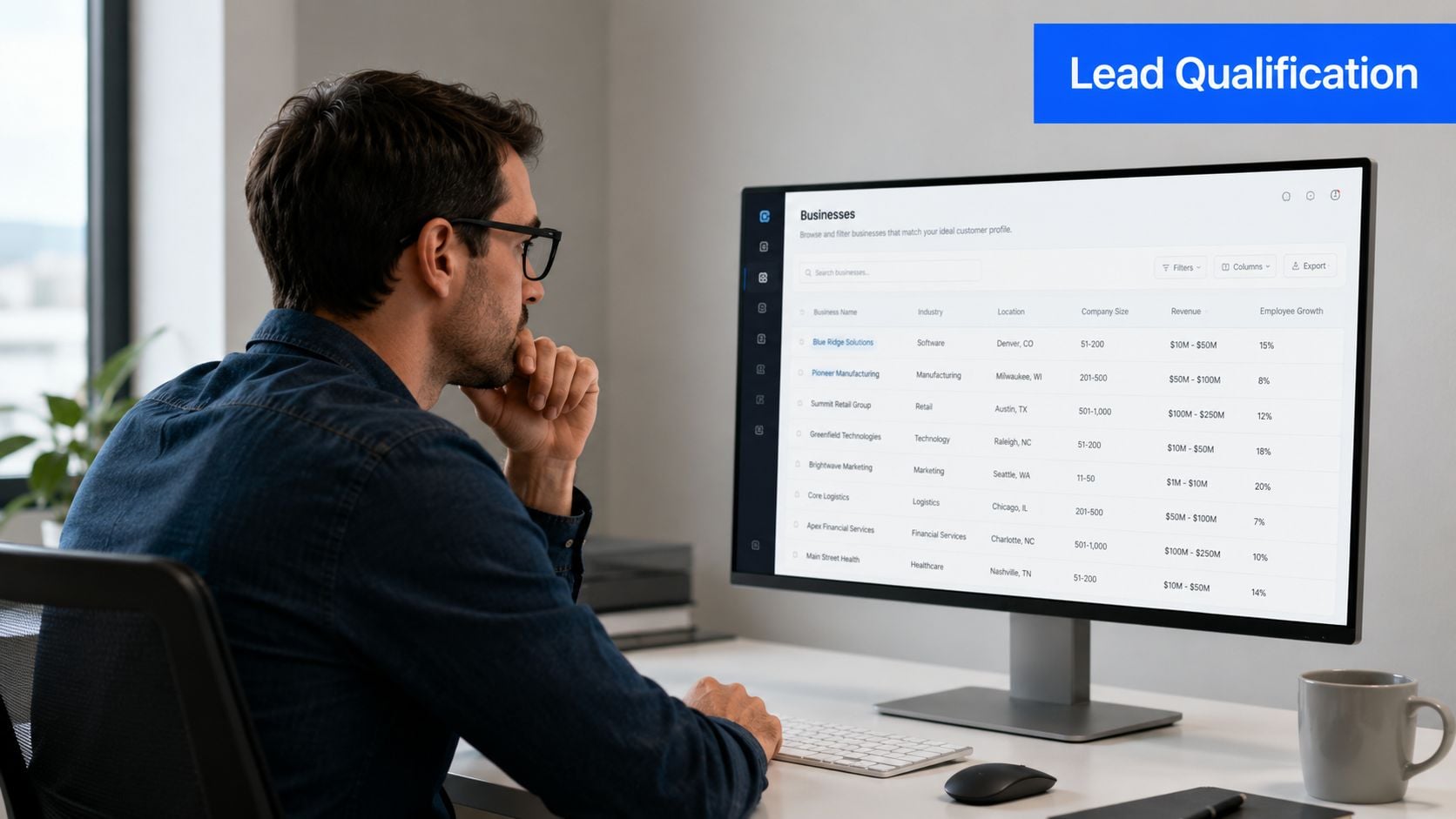
    A professional man sitting at a desk looking at a lead qualification dashboard on a computer monitor.

    Marathon Sales Inc. deserves the second look. Public content around the company often misses its actual role in reliable spring distribution within supply chains, even though that's the relevant lens for a freight seller. The same background also notes that supply chain disruptions cost the U.S. economy over $1.2 trillion in 2023 according to the company's industry framing on the Marathon Sales Inc. author page. For a forwarder, that's the point. You're not evaluating a slogan. You're evaluating a distributor whose customers may feel the cost of delay quickly.

    What makes it worth qualification

    A freight lead is good when three things line up:

    • The company moves real product that supports downstream operations.
    • Service failure hurts their customer, not just their shipment.
    • You can speak to the business model in plain terms instead of sending a generic capacity pitch.

    Marathon Sales Inc. fits that profile. If you build outbound around industrial distributors, this is the kind of account that can respond well to a message tied to continuity, replenishment, and exception handling.

    Practical rule: If the lead name is vague but the company sells niche industrial components, qualify the product risk before you judge the account.

    A lot of reps struggle here because they start with lane questions too early. Start with function. Then move to freight.

    If your team wants a cleaner process for sorting names like this out before outreach, this guide on how to generate leads in logistics is a useful reference point.

    Decoding What Marathon Sales Actually Does

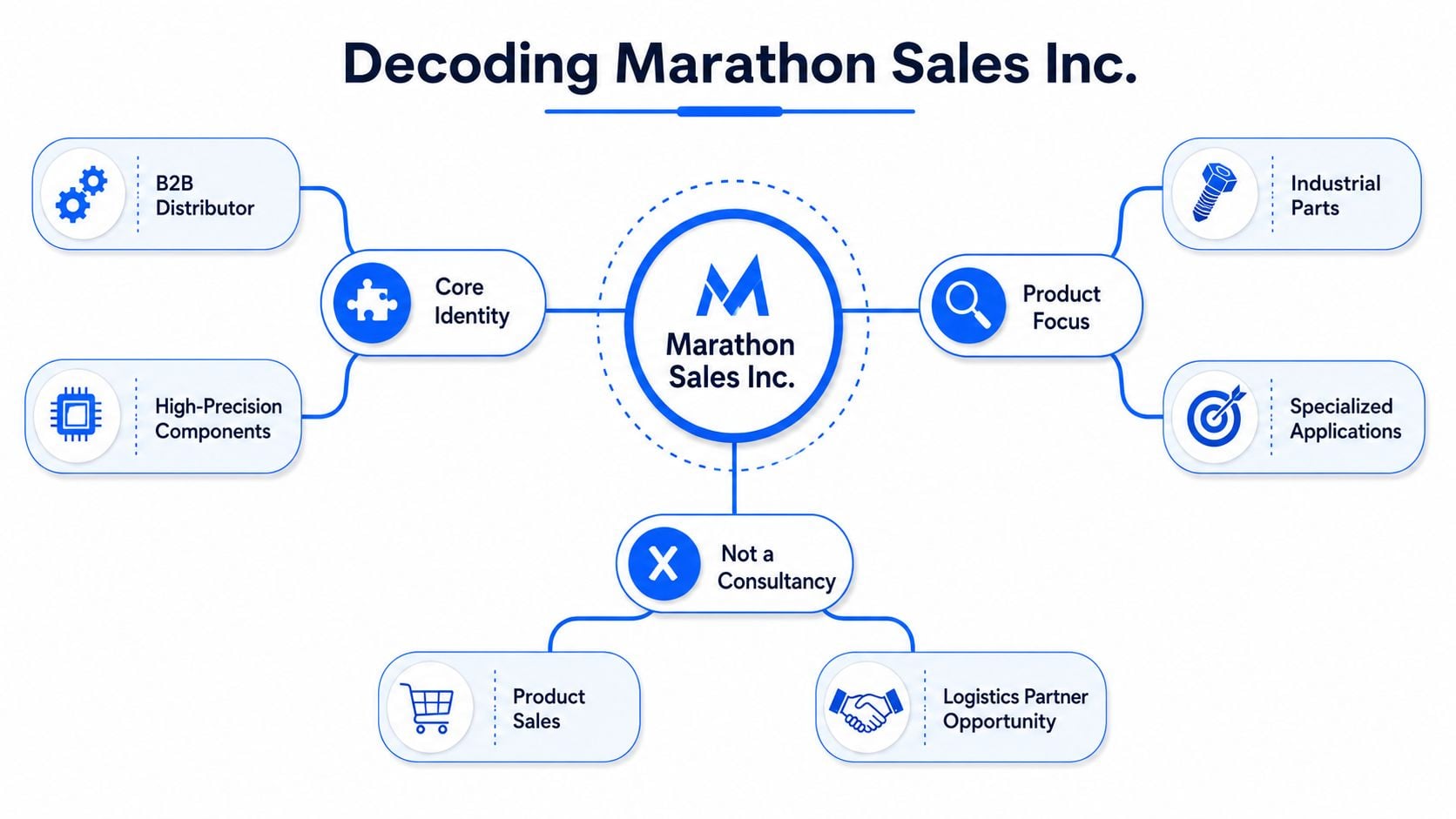
    Marathon Sales Inc. is not a consulting brand built around sales advice. It operates in industrial component distribution, with a clear emphasis on precision die springs and related specialty products.

    That distinction changes the freight conversation immediately. You're not pitching a generic B2B office account. You're looking at a company connected to manufacturing support, replacement cycles, and customers who buy parts because equipment has to keep running.

    A diagram titled Decoding Marathon Sales Inc. detailing their core identity, product focus, and business model.

    The product tells you the freight stakes

    One concrete example matters here. Marathon Sales Inc. offers die springs engineered for extended cycle life, and a listed product, the MHC53 Red Die Spring (Part No. 14716), is priced at $606.75 in the Raymond die spring catalog. That single fact does two things for a freight rep.

    First, it signals that this isn't low-concern commodity freight. Second, it suggests buyers may care more about getting the right part on time and in good condition than chasing the absolute cheapest transportation option.

    What that means in plain language

    Industrial spring distribution usually creates a different shipping profile than bulk consumer goods. The shipment may not be huge, but the operational importance can be. A delayed spring, incorrect SKU, or damaged package can create disproportionate pain if the receiving customer needs that component for toolroom, maintenance, or production support.

    Use that logic when you frame the account.

    Business reality Freight implication
    Specialized die springs Accuracy matters more than broad generic service promises
    Engineered industrial parts Packaging, labeling, and shipment integrity matter
    Buyers supporting equipment uptime Expedited recovery options can become part of the sale

    Don't sell trucks first. Sell protection against preventable downtime, mispicks, and ugly delivery surprises.

    What works and what doesn't

    What works is talking about shipment control. That includes shipment visibility, careful handling, and a plan for urgent replenishment.

    What doesn't work is treating Marathon Sales Inc. like a high-volume retail shipper. A message about “low-cost nationwide freight” is too broad. A message about moving high-value industrial parts with fewer exceptions is closer to the mark.

    For a freight forwarder, this is the opening. The product itself gives you the value proposition.

    Analyzing Their Likely Shipping Profile

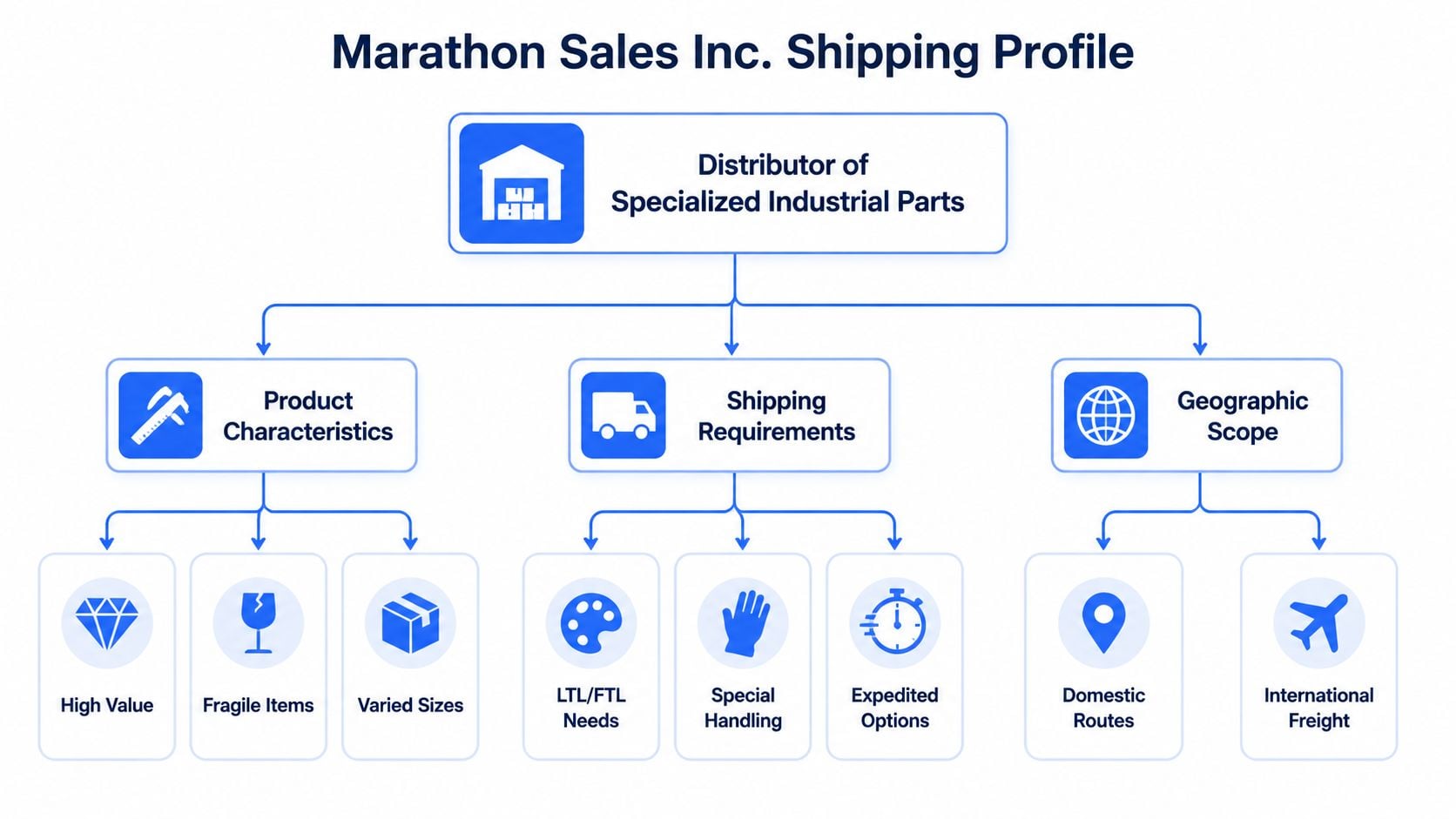
    Once you strip away the misleading name, the shipping picture starts to form. Marathon Sales Inc. operates as a distributor under the Marathon Worldwide Inc. umbrella and offers products such as die springs, air tools, and abrasives through its catalog ecosystem. Their associated partner materials also reference ISO 9001:2000 quality standards, which points to a supply environment where consistency matters, as shown in the Marathon Sales Inc. catalogs page.

    A flow chart outlining the shipping profile for Marathon Sales Inc including product, shipping, and geographic details.

    A distributor in that position usually creates a mixed freight profile. Not flashy. Not random. Steady, exception-sensitive, and operationally important.

    The domestic profile a forwarder should expect

    For a company handling specialized industrial components, domestic shipping likely centers on dependable replenishment. That usually points toward:

    • LTL for routine outbound orders going to manufacturers, maintenance buyers, and industrial customers.
    • Small parcel or courier-style moves for urgent parts where speed beats consolidation.
    • FTL or dedicated moves when bundled orders, supplier transfers, or regional stock repositioning justify it.

    The important trade-off is simple. Cheap linehaul with poor exception management usually costs more when the consignee is waiting on a part tied to production.

    Here's the video context worth reviewing before you pitch service options:

    Where international support may matter

    A distributor tied to specialized product lines can also create import or cross-border opportunities, even when the visible business looks local. If product sourcing or supplier coordination extends beyond one domestic region, your offer should include more than pickup and delivery.

    Consider these likely needs:

    • Supplier-side coordination when origin readiness is uneven.
    • Customs and document support if components move internationally.
    • Airfreight fallback for line-down or short-notice replenishment.
    • Shipment segmentation so urgent parts aren't trapped inside slower consolidated moves.

    The shipper may not ask for “supply chain design.” They'll ask why a needed part still isn't on the dock.

    What to pitch first

    Lead with service architecture, not mode jargon. For Marathon Sales Inc., the strongest opening usually sounds like this:

    1. Reliable regional LTL execution
    2. Expedite options for urgent industrial orders
    3. Import and supplier coordination where product sourcing requires it
    4. Clear escalation when a shipment misses plan

    That's a better fit than a generic capacity blast. Industrial distributors don't need more emails about trucks. They need fewer freight problems.

    Verifying Credibility and Stability

    Some leads look interesting on paper but fall apart once you check the basics. Marathon Sales Inc. doesn't have that problem.

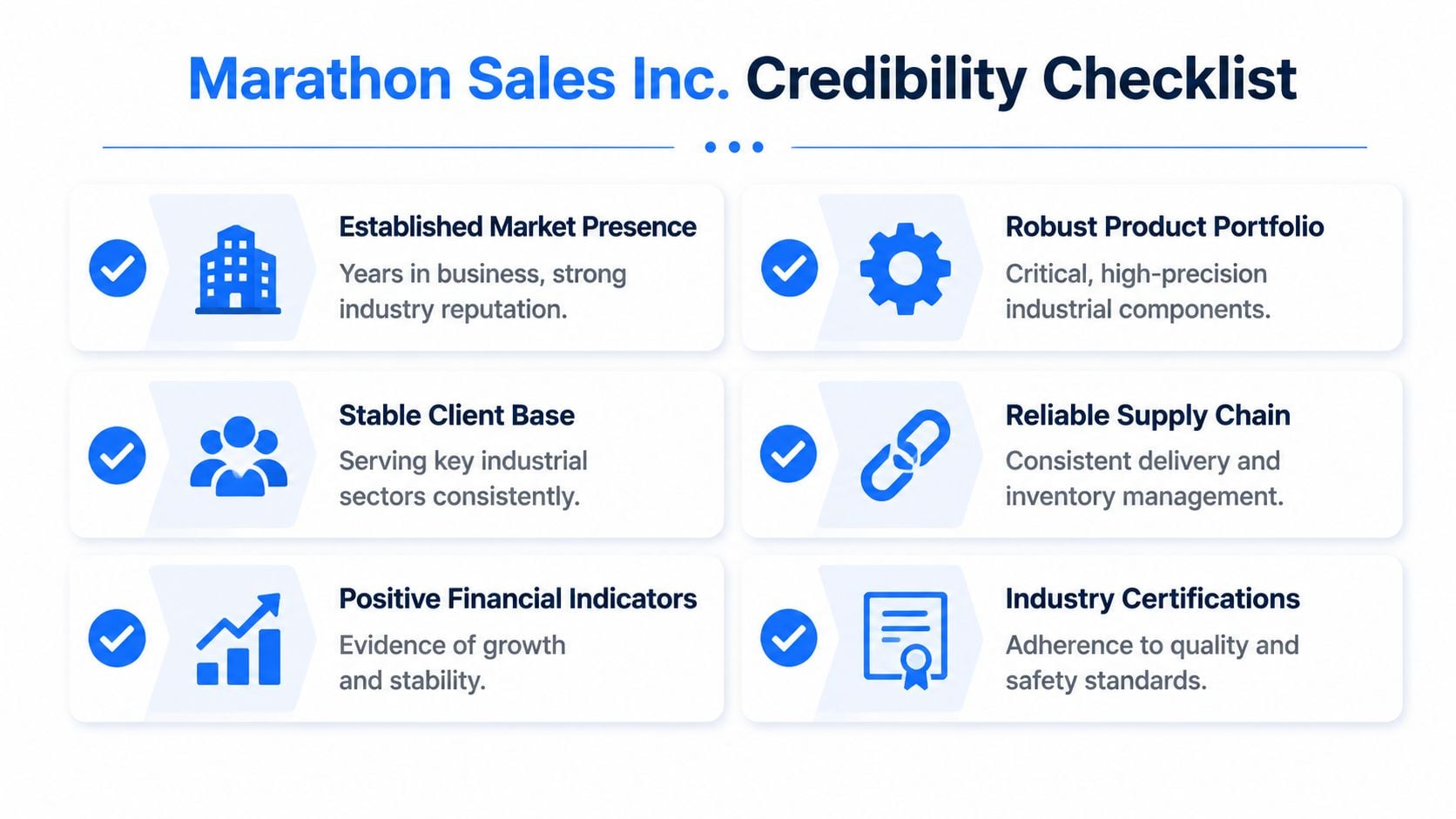
    The company was founded in August 1996 and has been continuously operated by its President and Owner, Joe Misiura, for exactly 30 years as of 2026, according to the available company profile information on Joe Misiura's LinkedIn reference. It also operates from a dedicated commercial facility at 9100 Louisiana Street, Merrillville, IN 46410, with stable weekday business hours listed there. For freight qualification, that's a strong set of signals.

    A checklist graphic for Marathon Sales Inc. displaying six key indicators of business credibility and reliability.

    Why this matters to a sales rep

    Longevity under one owner usually changes the sales approach. You're not dealing with a brand-new operation still improvising suppliers and shipping habits. You're dealing with a business that has likely built routines, vendor preferences, and expectations around responsiveness.

    That creates two realities:

    • The account is more credible, so the effort to research and personalize outreach is justified.
    • The account may be harder to displace, because stable firms often stay with providers until someone shows a clear operational improvement.

    A practical qualification screen

    Use this quick screen before you reach out:

    Signal What it means for freight sales
    Long operating history Lower chance you're chasing a temporary or thin account
    Named owner leadership Easier to map decision influence
    Dedicated facility Real pickup and delivery relevance
    Stable business hours Better alignment for routine operations and follow-up

    If international sourcing or export support becomes part of the discussion, compliance readiness matters early. For non-EU companies shipping into Europe, this overview of an EORI application for non-EU businesses is a practical reference to keep in your toolkit.

    Stable companies rarely switch providers because of a cold pitch alone. They switch when a rep shows they understand the operational consequence of failure.

    One more useful frame is how reliability gets communicated. This article on reliable shipping services is relevant because it mirrors the kind of service language industrial distributors tend to respond to. They care less about broad marketing claims and more about whether you can execute under normal pressure.

    Actionable Prospecting Tactics and Messaging

    If you call Marathon Sales Inc. with a generic “we handle all your freight needs” pitch, you'll sound like everyone else. The better move is to speak to the account the way an operations-minded distributor would evaluate a forwarding partner.

    Start with the likely decision map. In a company with long-term ownership and a specialized catalog, primary influence may sit with the owner, a sales operations contact, or whoever manages order flow and vendor coordination. Don't overcomplicate that. Your first objective is to send a message that proves you understand what they sell and why delivery reliability matters.

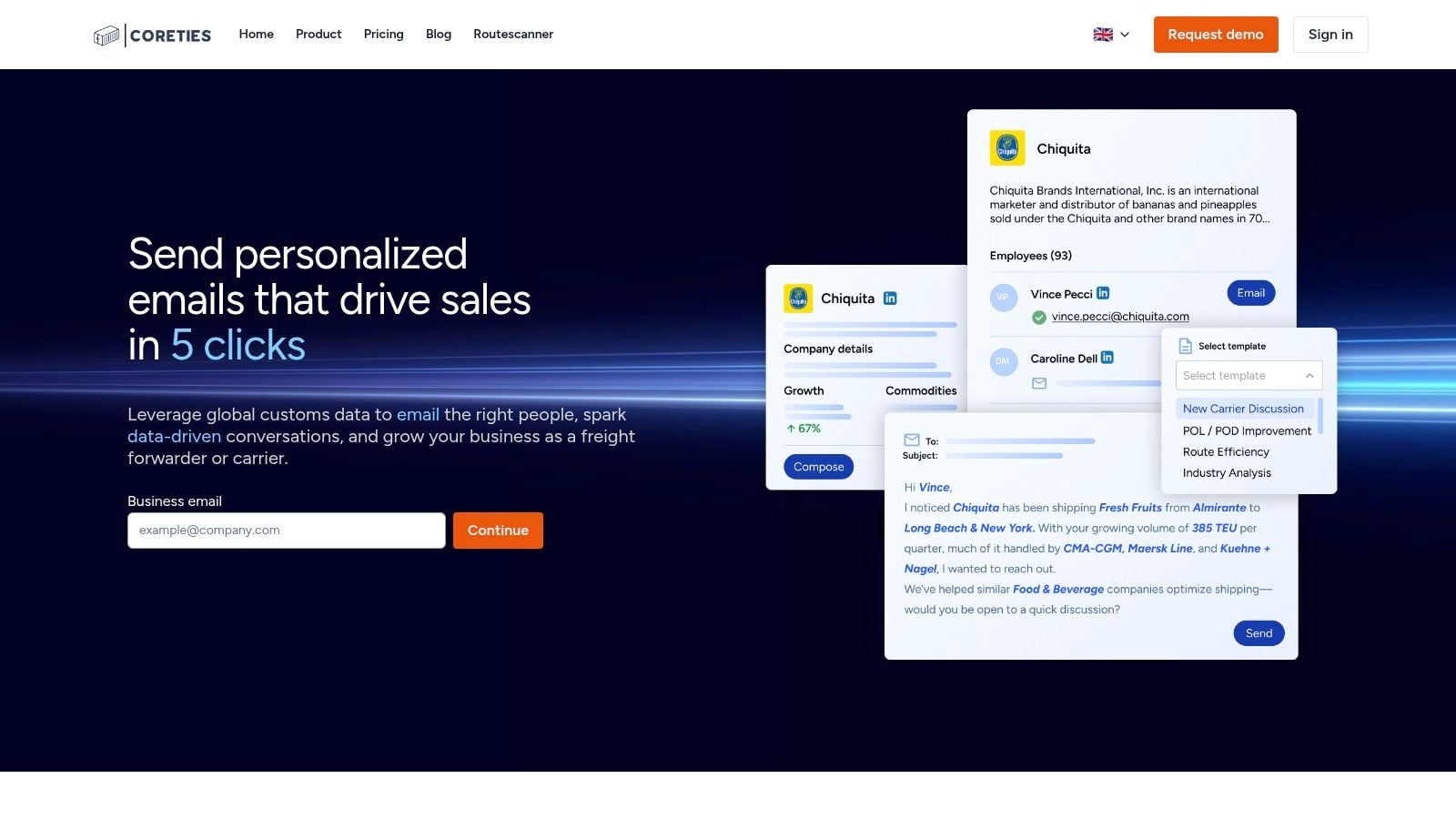
    Screenshot from https://coreties.com

    Messaging that matches the business

    This is a better opening than the average freight intro:

    We work with industrial shippers that can't afford delivery errors on specialized components. If your team is shipping die springs, tools, or related parts to manufacturing customers, we can compare where tighter exception handling or expedited backup would reduce service risk.

    That works because it connects freight performance to customer outcomes. It also avoids pretending you know their full network before a conversation.

    A weak version sounds like this: “We offer competitive rates across all modes.” That doesn't separate you from anyone.

    Four angles that usually get traction

    • Protect the consignee experience
      Talk about on-time delivery, shipment accuracy, and escalation when an order goes off plan.

    • Support urgent replenishment
      Industrial distributors often need a fallback when standard transit won't do the job.

    • Reduce friction in mixed-mode shipping
      If some orders fit parcel, others need LTL, and a few need urgent air, say that plainly.

    • Bring structure to visibility
      If you use tools that improve execution discipline, mention the process, not the hype. This overview of the advantages of transport management systems is useful context for how TMS-driven workflows can help with shipment visibility, exception handling, and carrier coordination.

    Keep the first outreach tight

    Use short emails. Ask for a narrow conversation. Don't attach a rate sheet.

    A workable sequence looks like this:

    1. First email
      Reference their role in industrial component distribution and ask whether they review options for outbound LTL, expedites, or supplier-side freight coordination.

    2. Follow-up call
      Mention a specific shipping risk, such as urgent replacement orders or delivery exceptions to manufacturing customers.

    3. Second email
      Offer one operational idea, not a brochure. For example, propose a review of where standard routing is enough and where backup service should exist.

    If you need a framework for sharpening that message, this guide to value proposition development is a practical way to tighten your wording around customer risk instead of freight features.

    One tool-based option

    For teams prospecting similar industrial accounts at scale, Coreties is one option because it uses customs data to help identify shipper activity, relevant contacts, and outreach angles tied to trade lanes and buyer-supplier relationships. Used correctly, that helps you avoid blasting the wrong message to the right company.

    The account doesn't need a flashy pitch. It needs a rep who can make freight sound useful.

    Turning Insight into Your Next Opportunity

    Marathon Sales Inc. is a good example of why surface-level prospecting fails. The name looks generic. The actual business is not. It points to industrial distribution, specialized components, and customers who likely care about reliability more than freight theater.

    For a forwarder, that changes the playbook. You don't chase this lead with broad promises about capacity. You qualify the product role, map the likely shipping pressure points, and lead with service control. That's the repeatable part.

    Use the same process on every ambiguous lead in your pipeline:

    • Check what the company really sells
    • Figure out what shipping failure would cost their customer
    • Look for stability signals before spending outreach effort
    • Write the message around risk reduction, not mode availability

    That approach gets better results because it matches how industrial shippers think. They don't buy freight in the abstract. They buy confidence that the right product will arrive without creating downstream problems.


    If you want to apply this prospecting method across more industrial shippers, Coreties helps freight teams turn customs data into qualified lead lists, find decision-makers, and build customized outreach around actual shipping activity instead of guesswork.

  • Secure Business with Pacific Blends Ltd: 2026 Logistics

    Secure Business with Pacific Blends Ltd: 2026 Logistics

    You open a company record expecting another small regional food manufacturer. Then one detail changes the whole account. The shipper is relatively small by headcount, but it sits inside a supply chain that reaches the Bering Sea, Vancouver-area port infrastructure, and food manufacturers across North America and the Pacific Rim.

    That's the kind of prospect many logistics teams miss. They sort by size, not by position in the network.

    Pacific Blends Ltd deserves the opposite treatment. It's the kind of account where niche market control, product complexity, and acquisition-led expansion can create freight opportunities that are larger than the company's public profile suggests. If you sell forwarding, carrier capacity, customs-adjacent visibility, or multimodal planning, this isn't a company to file under “too small to matter.” It's one to study carefully and approach with a point of view.

    From Niche Player to High-Value Prospect

    Most sales teams spend too much time on obvious targets. They chase large food manufacturers with crowded vendor rosters and entrenched transportation partners. Meanwhile, a company like Pacific Blends can sit in plain sight.

    Publicly, it looks compact. Operationally, it's far more consequential. Pacific Blends is a family-owned custom-blending provider founded in 2002 and headquartered in Port Coquitlam, British Columbia, with over 40 years of experience noted through its industry background and membership references. It serves customers across North America and the Pacific Rim in seafood, meat, poultry, dairy, processed foods, and snack foods, while holding a particularly strong position in surimi cryoprotectants and custom dry ingredient blends, according to Pacific Blends company information.

    That combination matters for freight sales because network importance beats company size when the shipper handles products that are operationally sensitive and tied to industrial production schedules. Pacific Blends isn't just moving finished pouches. It's supporting manufacturers that use outsourced dry blending to remove blending steps from their own plants.

    Practical rule: When a shipper helps manufacturers remove production steps, transportation reliability becomes part of the shipper's value proposition.

    That's why this account is better understood through benchmarking logic than through standard prospect scoring. A useful lens comes from industry benchmarking methods for supply-chain prospecting. The right comparison set isn't “Canadian SME manufacturers.” It's “specialty ingredient suppliers with concentrated category influence, export exposure, and workflow-critical products.”

    For a logistics seller, that changes the playbook. You're not pitching generic capacity. You're diagnosing where a specialized ingredient producer may need tighter inbound coordination, cleaner outbound execution, and better support when new product lines are folded into the operation.

    Who Is Pacific Blends Ltd Really

    A standard company summary misses the point. Pacific Blends should be read like an internal account brief, where every business fact implies a logistics consequence.

    An organizational infographic for Pacific Blends Ltd showing history, leadership, products, market presence, and company values.

    The company profile that matters to sales

    Pacific Blends Ltd was founded in 2002 and is headquartered in Port Coquitlam, British Columbia. Public importer data describes it as one of the world's largest producers of surimi cryoprotectants, supplying nearly all factory fishing vessels processing Alaskan Pollock in the Bering Sea. The same source reports revenue of under $5 million and an employee count of 11 to 50, which makes it a compact organization with outsized category relevance, as shown in this Pacific Blends importer profile.

    That's the first signal logistics teams should pay attention to. A company doesn't need a huge payroll to create meaningful freight demand if it occupies a bottleneck position in a specialized supply chain.

    Its core business is custom dry ingredient blending. Pacific Blends serves seafood, meat, poultry, dairy, processed food, and snack food customers. The commercial logic behind that offering is straightforward. Manufacturers can buy a single unitized blend rather than stage, measure, and combine multiple dry inputs in-house.

    Why the business model raises logistics stakes

    This isn't just a food ingredients company. It's a workflow simplifier for downstream manufacturers. When a supplier takes complexity out of a customer's production line, that supplier's own execution has to be tight.

    If Pacific Blends ships late, the customer doesn't just receive ingredients late. The customer loses the time savings and process simplification they outsourced to Pacific Blends in the first place. That creates a very different service expectation than standard commodity freight.

    Here's the account profile in a sales-friendly format:

    Attribute Detail
    Company Pacific Blends Ltd
    Ownership model Family-owned private manufacturer
    Founded 2002
    Headquarters Port Coquitlam, British Columbia
    Primary specialization Custom dry ingredient blends
    Notable market position One of the world's largest producers of surimi cryoprotectants
    Supply relevance Supplies nearly all factory fishing vessels processing Alaskan Pollock in the Bering Sea
    Reported scale Revenue under $5 million
    Reported workforce 11 to 50 employees
    Served sectors Seafood, meat, poultry, dairy, processed foods, snack foods
    Commercial value proposition Unitized custom blends that remove dry blending steps for manufacturers

    What their history suggests about account behavior

    Pacific Blends didn't stay static. The company expanded its presence through acquisitions, including the November 2011 acquisition of Renaissance Blends' business assets, which brought Renaissance's product line into the Pacific Blends brand. It later acquired the Vegelatum® brand, extending its position into cosmetic ingredients, according to Pacific Blends growth news.

    That history tells you something useful before you ever contact the company. This is a business that grows by adding lines, integrating products, and broadening the commercial footprint without abandoning its custom-blending core.

    A shipper that grows through acquisition usually inherits complexity faster than it redesigns transportation around it.

    For freight providers, that means the primary opportunity may not be “move current orders.” It may be “support integration.” New SKUs, altered sourcing needs, changed customer mixes, and fresh packaging or handling requirements often appear before transportation processes are fully harmonized.

    Mapping Their Global Supply Chain Footprint

    If you want to build a lane strategy around Pacific Blends, start with what the company makes, where it sits, and who it serves. That gives you a working map of its supply chain before you touch shipment data.

    An infographic showing the global supply chain process of Pacific Blends Ltd, from sourcing to export.

    Start with the product and work backward

    Pacific Blends' unitized custom blending technology consolidates multiple dry ingredients into a single pouch. The company says this reduces storage volumes and shortens storage time for customers, while its location near major Vancouver ports and a sugar refinery supports cost-effective delivery to North American and Pacific Rim clients through its company overview.

    That statement gives a logistics seller three immediate hypotheses.

    1. Inbound ingredient complexity is real. A company that combines multiple dry ingredients into one pouch needs coordinated inbound material availability.
    2. Outbound service is broader than local distribution. Pacific Rim and North American reach implies a mix of domestic and international flows.
    3. Facility location is strategic, not incidental. Port proximity usually means ocean connectivity matters to the operating model.

    Build the likely lane map

    A practical lane map for Pacific Blends probably includes several distinct flow types.

    • Inbound raw materials: Dry ingredients arriving for blending, potentially from domestic and international suppliers.
    • Marine-linked seafood ingredient support: Commercial relationships tied to the Alaskan Pollock and Bering Sea ecosystem.
    • Outbound finished blends to food manufacturers: Likely shipment patterns into production hubs where customers need ingredients on predictable schedules.
    • Pacific Rim export flows: Ocean-linked movement where transit planning and documentation discipline matter more than simple truck dispatch.

    If you work in forwarding or NVOCC sales, broader reading on mastering global supply chain strategies helps sharpen your pitch. The point isn't theory. It's knowing how port access, supplier concentration, and customer production timing interact inside a specialized ingredient business.

    What to look for operationally

    The key isn't just that Pacific Blends moves goods globally. It's that its product format shifts complexity from the customer to Pacific Blends.

    That means a logistics partner should examine:

    Supply chain question Why it matters for Pacific Blends
    Are ingredients sourced from multiple origins? Multi-origin inputs raise coordination risk before blending begins
    Are customer orders tied to plant schedules? Delays can interrupt manufacturing workflows downstream
    Do export orders move through Vancouver-area gateways? Port choice affects lead time, drayage planning, and carrier options
    Are there mixed product requirements across sectors? Food-sector diversity can produce different service expectations by customer type

    A useful companion lens is studying how to identify a company that imports. Even before you validate exact entries, the import-export logic around Pacific Blends is already visible from its product design, geography, and customer base.

    The best freight opportunities often sit where a shipper promises simplicity to its customers but carries hidden complexity inside its own operation.

    How to Verify Their Shipping Activity

    Smart prospecting starts with inference, but it can't end there. Before your team writes the first outreach email, it needs evidence that Pacific Blends is moving freight in the patterns you suspect.

    That verification step changes the conversation. Instead of saying, “We help food ingredient companies,” you can say, “We noticed your shipping pattern suggests recurring pressure around specific ports, handoffs, or lane structures.” That's a different level of credibility.

    What verification should actually answer

    For an account like Pacific Blends, shipment verification isn't about collecting trivia. It's about proving whether the commercial story matches the physical network.

    Use customs and trade-activity tools to answer questions such as:

    • Which ports appear repeatedly: Repetition usually points to habitual trade lanes rather than one-off transactions.
    • What shipment descriptions reveal: Product language can help separate ingredient inflows from blended outbound goods.
    • How frequently shipments occur: Consistency tells you whether to frame the account as project-based or recurring.
    • Which parties appear around the shipment: Related entities, consignees, or suppliers can reveal where decisions may be influenced.

    Here's the kind of workflow many sales teams benefit from seeing visually:

    Screenshot from https://coreties.com

    What to pull from the records

    For a company with Pacific Blends' profile, customs records and related shipment tools can help your team isolate:

    1. Port pairs that show likely core international lanes.
    2. Consistent routing patterns that may indicate incumbent forwarder relationships.
    3. Packaging and shipment format clues that suggest whether cargo moves as palletized dry ingredients, packaged blends, or broader industrial food components.
    4. Seasonality signals, if they exist, that might tie back to customer production cycles or seafood-related timing.

    This is also where shipment visibility language matters. If your prospect asks why your team is focused on operational transparency, it helps to ground that in practical tools rather than buzzwords. A concise explainer on what is a freight tracking system is useful background because specialized ingredient shippers often care less about flashy dashboards and more about dependable milestone visibility.

    Why verification changes the sales motion

    Without data, reps tend to send feature-based outreach. They promise good service, flexible capacity, or competitive pricing. Every carrier and forwarder says the same thing.

    With validated shipping activity, you can do something more specific:

    Don't lead with your network. Lead with what their shipment pattern suggests they need fixed, protected, or simplified.

    That's especially important for a company that supports customer manufacturing workflows. If you can confirm recurring gateways, likely import dependencies, or export routines, your message can focus on schedule protection, supplier coordination, and lane resilience instead of commodity transport language.

    Actionable Outreach Angles That Win Business

    Most logistics outreach to food manufacturers is forgettable because it's too broad. Pacific Blends won't respond to generic claims about “excellent service” or “global reach.” The account calls for a sharper angle tied to hidden commercial pressure.

    A strategic business chart comparing supply chain optimization and product innovation partnership strategies for Pacific Blends.

    Angle one, position logistics as cost protection

    A frequently overlooked sales angle sits inside Pacific Blends' role in surimi. Public export-catalogue commentary notes that surimi prices rose 18% in 2024 due to supply constraints, while Pacific Blends' role as a top cryoprotectant manufacturer creates supply-chain stability that can buffer food manufacturers against inflation, according to the BC agrifood export catalogue entry on Pacific Blends.

    That matters because it reframes the logistics sale. You're not offering transportation as a back-end service. You're offering transportation as a support system for a supplier whose value includes helping customers manage instability.

    A weak outreach message says, “We can handle your imports and exports.”

    A stronger one says, “Your position in cryoprotectants makes continuity part of your customer promise. We help specialized suppliers protect inbound ingredient flow and outbound fulfillment when volatility hits upstream protein markets.”

    That's a very different conversation.

    How to frame the message

    Use language that connects transport execution to commercial protection:

    • Mention continuity: Pacific Blends supports a mission-critical product category.
    • Talk about inventory timing, not just rates: Ingredient businesses lose value when timing breaks.
    • Offer lane review: Propose a review of where disruptions could compromise customer delivery promises.

    Sales insight: When a supplier helps its buyers manage inflation pressure, transportation reliability becomes part of the buyer's cost-control story.

    Angle two, treat Vegelatum as a network expansion problem

    Pacific Blends' acquisition of the Vegelatum® brand opened a second strategic angle. The move expanded the company into cosmetic ingredients, as noted in the earlier acquisition coverage. Public commentary around that acquisition also points to a broader transparency trend in beauty products and states that 32% of global beauty consumers seek food-derived ingredients, according to the Vegelatum acquisition announcement.

    Don't oversell the statistic. Use it to support one simple conclusion. Pacific Blends now touches a category with a different buyer profile, potentially different packaging expectations, and potentially different distribution rhythms than its food-manufacturing base.

    That creates a freight discussion most providers won't raise. The issue isn't only “Can you ship cosmetic ingredients?” The issue is whether Pacific Blends now needs a transportation setup that can support two commercial motions at once.

    One side of the business serves industrial food manufacturing. The other may require a different cadence, different consignee base, or different compliance-adjacent handling expectations.

    Outreach idea by persona

    If you reach operations leadership, stress integration risk.

    If you reach commercial leadership, stress market expansion readiness.

    If you reach procurement or logistics, stress handoff clarity across mixed product lines.

    You can also tighten the writing itself by borrowing principles from guides on crafting effective cold emails. The best note to Pacific Blends won't be long. It will show that you understand the pressure created when a blending business adds a new brand and category.

    A practical internal prep step is identifying who owns these conversations. Teams that need help locating the right contacts can use guidance on how to find decision-makers before launching outreach.

    What not to say

    Avoid these common mistakes:

    Weak pitch Why it fails
    “We work with many food companies” Too broad. Pacific Blends isn't a generic food shipper
    “We offer cost savings” Unprovable without lane context
    “We can support your growth” Vague and interchangeable
    “We saw you acquired a brand” Observational, but not insightful

    Better language ties your service to one of two real issues: protecting a volatility-sensitive supply role or integrating a newly expanded product portfolio without creating logistics friction.

    Your Go-to-Market Checklist for Pacific Blends

    The account is attractive, but it won't close on interest alone. Your team needs a disciplined plan that turns company intelligence into a contact strategy, a lane hypothesis, and a first conversation worth taking.

    A Pacific Blends seven-step go-to-market checklist infographic illustrating a strategic sales and business outreach process.

    The working checklist

    1. Assign one account owner
      Pacific Blends is specialized enough that scattered outreach will dilute the effort. One owner should control research, messaging, and follow-up.

    2. Confirm live shipping patterns
      Validate whether your lane assumptions hold up in actual trade records. Don't brief sales leadership on theory alone.

    3. Segment the likely buying centers
      The relevant stakeholders may not sit in one department. Operations, logistics, procurement, and commercial leadership could all influence the decision.

    4. Choose one outreach angle first
      Don't stack both major narratives into the first email. Lead either with surimi-related continuity and cost protection or with post-acquisition network integration.

    5. Map likely objections in advance
      Expect some version of: “We already have providers,” “volumes are stable,” or “we only review partners when something changes.” Your answer should focus on resilience, integration, or lane-specific insight.

    6. Watch for acquisition-related freight openings
      Pacific Blends' 2011 Renaissance Blends acquisition and later Vegelatum® acquisition show a clear growth-by-acquisition pattern, creating recurring opportunities for logistics providers that can support product-line integration, according to Pacific Blends growth news.

    7. Build a follow-up sequence with a point of view
      Follow-up should add intelligence, not just ask for time again. Bring a routing idea, a handoff risk observation, or a category-specific operational question.

    The standard to hold your team to

    A good campaign against Pacific Blends should leave the prospect feeling understood, not processed.

    If your message could be sent unchanged to any food manufacturer in British Columbia, it's not ready for Pacific Blends.

    This account is strongest for logistics teams that can connect a niche ingredient position to real network demands. The company's public footprint is small enough to be overlooked and specialized enough to reward careful sellers. That's a favorable combination if your team is willing to do the homework.


    Coreties helps freight forwarders, carriers, and logistics sales teams turn trade data into real prospecting action. If you want to identify shippers like Pacific Blends, validate their likely lanes, surface decision-makers, and launch targeted outreach faster, explore Coreties.

  • DuBose Strapping Inc: A Complete Company Profile for 2026

    DuBose Strapping Inc: A Complete Company Profile for 2026

    A load leaves the mill looking stable. By the time it reaches the consignee, the pallet has shifted, the outer packaging is torn, and everyone in the chain starts asking the same question: who was responsible for securement?

    Freight forwarders live in that gap between dispatch and delivery. You may not have packed the shipment yourself, but you still have to answer for delays, claims, and customer frustration when cargo arrives compromised. That's why strapping suppliers matter more than many teams admit. They sit upstream of freight execution, yet their materials influence downstream outcomes like handling reliability, transload efficiency, and whether a shipment survives multiple touchpoints.

    For forwarders and shippers evaluating DuBose Strapping Inc., the useful question isn't just what the company sells. It's whether its position in the market, product mix, and operating profile make it a dependable packaging partner for freight that can't afford movement inside the load.

    The High Cost of Unsecured Cargo

    You know the scenario. A booked shipment moves on schedule, documents are in order, and the truck arrives on time. Then the receiver opens the trailer and finds leaning units, broken edges, or bands that didn't hold under normal transit stress. What looked like a routine move turns into a claim review, customer call, and internal debate over whether the problem started at the dock, in transit, or with the packaging itself.

    A warehouse worker in a high-visibility vest inspects damaged cardboard boxes on a pallet.

    For freight forwarders, unsecured cargo creates two problems at once. The first is physical damage. The second is ambiguity. Once a shipment changes hands across truckers, warehouses, ports, and final delivery providers, poor securement can be hard to isolate after the fact. Even basic paperwork like the bill of lading in shipping helps document condition and custody, but it doesn't fix a load that was never properly unitized.

    Practical rule: If a load depends on every downstream handler being unusually careful, the packaging strategy was weak from the start.

    This is why industrial strapping isn't a small procurement line item. It's part of risk control. Good strapping and edge protection help keep units intact during forklift handling, trailer vibration, storage, and reloading. Weak or mismatched materials raise the odds that a shipment will arrive as multiple problems instead of one delivered order.

    That operating reality is the right context for evaluating DuBose Strapping Inc. The company matters because it sits close to the point where cargo security either holds or fails.

    The DuBose Strapping Story and Market Position

    A forwarder choosing a strapping supplier is not just buying consumables. The choice affects lead times, packaging consistency, claims exposure, and how quickly a shipper can correct a securement problem before it spreads across multiple loads.

    DuBose Strapping Inc. stands out because it appears to sit closer to the manufacturing side of that decision than many packaging intermediaries. The company traces its roots to 1954 under founder Charles DuBose, Sr., first in steel services and later in steel strapping and international manufacturing, according to its LinkedIn company profile.

    A timeline graphic showing the history of DuBose Strapping from its 1987 founding to present day industry leadership.

    That history matters less as a branding detail than as a signal about operating model. DuBose describes itself as North Carolina's sole manufacturer of steel strapping and says it serves every state east of the Rockies. For freight partners, that suggests a supplier with a defined production base and a regional footprint large enough to support repeat industrial demand, not just spot purchases of packaging seals and strapping through resale channels.

    Scale should still be tested rather than assumed. Even so, the available profile points to a manufacturer with enough organizational depth to matter to shippers running regular outbound volume. That changes the conversation. A forwarder evaluating DuBose would likely focus less on whether the company can fill a single order and more on whether it can support standardization across lanes, facilities, and recurring load types.

    The company's age also changes how buyers should read risk.

    • Longevity can indicate process discipline: A manufacturer that has operated since 1954 has likely adjusted through shifts in materials markets, freight handling, and customer requirements.
    • Production capability can improve control: A manufacturer usually has more direct influence over product consistency and availability than a distributor that relies mainly on third-party supply.
    • Leadership continuity can reduce supplier volatility: DuBose presents family involvement over multiple decades, which may appeal to buyers trying to avoid frequent changes in account ownership or operating priorities.

    The useful takeaway isn't that an older company is automatically better. A long-lived manufacturer with a defined territory often behaves differently from a generalist packaging middleman.

    For freight forwarders, that difference has practical consequences. If a shipper moves metal, lumber, or other heavy palletized freight, supplier stability affects replenishment planning, packaging standardization, and response speed when securement failures start showing up in the field.

    Core Products for Cargo Security

    The strongest signal in DuBose's offering is breadth. The company provides customized packaging solutions that include plastic and steel strapping, automated equipment, hand application tools, and edge protection systems for a wide range of industries, according to its ZoomInfo company profile. It also manufactures plastic strapping and systems for diverse product lines.

    A pallet stacked with various rolls of plastic and metal industrial strapping bands near a strapping machine.

    That combination matters because freight securement isn't solved by strapping alone. Material choice, tensioning method, tool reliability, and edge protection all affect whether the load stays unitized through handling and transit.

    Matching the product to the freight

    A forwarder advising a shipper should think in terms of load behavior, not catalog categories.

    Product area Best-fit logistics question
    Steel strapping Does the load have high mass, rigid edges, or a need for strong compression?
    Plastic strapping Does the shipment need a lighter, more flexible unitizing method across varied product lines?
    Automated equipment Is the shipper running enough volume that consistency matters more than manual variability?
    Hand tools Does the operation need adaptable securement at smaller scale or in mixed loading environments?
    Edge protection Are package corners, surfaces, or stacked units vulnerable to band pressure?

    Steel strapping is often the logical fit when the cargo is dense, heavy, or difficult to restrain with lighter materials. That's why DuBose's role in steel matters to lumber and industrial users. Plastic strapping, by contrast, tends to fit operations that need versatility across many SKUs and packaging configurations.

    Why system thinking beats product shopping

    Forwarders often inherit the consequences of partial decisions. A shipper buys the banding material, but not the right tools. Or it automates the line without upgrading edge protection. Or it uses a hand setup for freight that really needs repeatable tensioning.

    That's where DuBose's broader line becomes operationally relevant. The presence of tools, equipment, and protective accessories suggests the company can support a securement system, not just sell rolls of material.

    If you're comparing solutions more broadly, this overview of packaging seals and strapping is a useful reference point for understanding how seals, tools, and strapping supplies fit together in real handling environments.

    Here's a visual look at industrial strapping in practice:

    Questions buyers should ask at the product level

    Not every shipper needs the same answer. The right evaluation starts with freight realities.

    • For heavy outbound loads: Ask which strapping systems fit dense products that face repeated forklift handling.
    • For mixed-SKU palletization: Ask how plastic strapping options perform across inconsistent carton shapes or shifting stack heights.
    • For warehouse throughput: Ask whether automated equipment improves consistency for the shipper's packaging line.
    • For damage-sensitive goods: Ask how edge protection integrates with the selected banding method.

    A supplier with multiple product categories can simplify this process, but only if the recommendation is tied to the actual freight profile. That's the difference between buying supplies and solving a cargo security problem.

    Key Industries Served and Use Cases

    The company's roots are closely tied to the lumber industry, but its packaging systems extend into a wider set of industrial applications. That range is useful for freight forwarders because it means one supplier may align with several shipper types in a regional or vertical portfolio.

    An infographic showing the industries and applications for DuBose Strapping including lumber, manufacturing, agriculture, and logistics.

    Lumber and wood products

    Start with the most obvious use case. A lumber shipper moving bundles of finished boards, panel products, or mill output needs more than basic containment. The load has weight, edge pressure, and a tendency to shift if the bundle loosens. In that context, strong strapping and edge protection support both cargo integrity and handling efficiency.

    A forwarder serving mills or building-products exporters should read DuBose's positioning here as a sign of application familiarity, not just product availability.

    Loads like lumber don't forgive weak packaging decisions. If the bundle opens, the freight plan changes immediately.

    Manufacturing and industrial freight

    The next use case is less visible but equally important. Industrial manufacturers often ship awkward, dense, or high-value units that don't fit neatly into standard cartonized workflows. Pipes, fabricated parts, bundled components, and irregular pallet loads all create securement challenges.

    In those environments, the value of a supplier like DuBose is its ability to support different combinations of strapping material, tools, and protective systems. A forwarder working with these customers doesn't need a packaging vendor that only serves one commodity. It needs one that understands load stability across varied industrial formats.

    Warehousing, agriculture, and recycling

    Other sectors fit the same logic, even if the load profile differs.

    • Warehousing and distribution: Unitizing outbound pallets so they survive storage, picking, and final-mile transfers.
    • Agriculture: Securing bagged inputs, baled goods, or stacked products that may be handled in less controlled environments.
    • Recycling: Holding compressed or irregular material together for movement and processing.

    These are different industries, but they share a common operational need. The shipment has to remain one manageable unit from origin through handling. Forwarders who advise customers on packaging readiness can use that lens to identify where DuBose may be a fit.

    How to Evaluate DuBose as a Supplier

    A delayed export load often exposes packaging decisions before anyone reviews the invoice. The strap fails, the unit shifts, the forwarder has to rework the shipment at the dock, and a low-cost supply item suddenly affects labor, transit time, and claim risk. That is the right context for evaluating DuBose. The question is not only whether the company can supply strapping. It is whether its products and support model reduce avoidable disruption across a shipper's network.

    An infographic detailing six essential criteria for evaluating DuBose Strapping as a reliable business partner.

    Start with operating fit

    The first test is operational compatibility. A supplier may look strong on paper and still create friction if its lead times, technical support, or product range do not match the cargo profile a forwarder manages.

    Buyers should examine four areas early:

    • Manufacturing footprint: Domestic production can shorten replenishment cycles and make communication easier when shipments require fast packaging adjustments.
    • Application range: A supplier that covers steel strapping, plastic strapping, tools, and protective accessories can support multiple load types without forcing procurement to manage several vendors.
    • Support model: Technical input matters when shippers are choosing between manual, semi-automatic, and automated setups, or deciding how to secure difficult loads.
    • Trade awareness: DuBose's import and export activity, noted earlier, suggests familiarity with the handling realities that affect internationally moving freight.

    Forwarders that advise clients on vendor selection will recognize the same logic used in evaluating how to choose a freight forwarder. Procurement discipline should apply on both sides of the shipment. Service claims matter less than evidence that a supplier can perform under routine pressure.

    The sustainability question buyers should press harder

    DuBose introduced a sustainability program in 2024, but public materials still leave a gap for logistics buyers who need measurable business impact. On DuBose's sustainability program page, the company outlines its initiative, yet the public case is still light on quantified freight outcomes such as lower packaging waste, reduced handling burden, or clearer landed-cost effects.

    That gap matters for forwarders. Shippers increasingly ask suppliers to support environmental goals, but procurement decisions usually move faster when sustainability claims connect to operating results. If DuBose can show that a material choice improves load consistency, reduces disposal volume, or lowers packaging-related rework, the conversation changes from branding to supply chain performance.

    A similar standard applies in adjacent logistics services, including San Diego logistics support. Buyers need proof that a partner reduces operational risk, not just a broad statement of intent.

    Buyer warning: Environmental positioning has more procurement value when a supplier can tie it to damage prevention, labor efficiency, or waste reduction.

    Questions worth asking before onboarding

    A serious evaluation should move past catalog breadth and into execution. These questions help separate a known industrial supplier from one that can support a forwarder's customers consistently.

    1. How does DuBose recommend matching steel and plastic systems to the actual weight, shape, and handling profile of our cargo?
    2. What implementation support is available for shippers shifting from manual tools to automated equipment?
    3. What lead times and reorder patterns should buyers expect for recurring supply?
    4. Can the company document outcomes related to damage reduction, handling consistency, or packaging waste?
    5. What measurable sustainability results can it show beyond high-level commitments?

    Those questions matter because packaging suppliers influence freight performance indirectly but materially. DuBose appears to have the product depth and industrial profile buyers look for. The stronger procurement case depends on whether the company can document results with enough clarity to support a shipper, a forwarder, and a finance team at the same table.

    Securing Your Supply Chain with the Right Partner

    DuBose Strapping Inc. stands out because it combines manufacturing depth, a long operating history, and a product line that fits the practical demands of industrial cargo securement. For freight forwarders, that makes the company more than a packaging vendor. It makes it part of the upstream risk picture that shapes whether cargo arrives intact, is handled smoothly, and stays claim-free.

    The strongest case for DuBose isn't just that it sells steel and plastic strapping. It's that the company appears positioned to support shippers with recurring, physical freight problems, especially where load stability matters as much as transport planning. That's relevant for lumber, manufacturing, warehousing, and other sectors where one weak packaging choice can disrupt an otherwise well-run move.

    The final decision still depends on evidence. Buyers should weigh DuBose's market position against service responsiveness, product fit, and the depth of measurable performance support. That same discipline applies across logistics partnerships generally, whether you're reviewing security resources such as San Diego logistics support or strengthening compliance processes like denied party screening. The pattern is the same. Reliable supply chains come from choosing partners that reduce uncertainty, not just vendors that fill a purchase order.

    For shippers and forwarders, cargo securement is a strategic decision wearing a procurement label. Treat it that way.


    Coreties helps freight forwarders, carriers, and logistics sales teams turn customs data into qualified shipper leads, verified contacts, and personalized outreach. If you want sharper prospecting and more targeted conversations with companies that move freight, explore Coreties.

  • Axys Logistics Inc: A Profile for Freight Forwarders

    Axys Logistics Inc: A Profile for Freight Forwarders

    You're probably doing what most logistics sales teams do when a border-lane target lands on the list. You pull up the company site, scan for warehouse capacity, note any customs or security certifications, and decide within a few minutes whether the account belongs in partner development, shipper prospecting, or competitive monitoring.

    That shortcut works until it doesn't.

    On the U.S.-Mexico lane, surface facts can hide the operational detail that determines whether a company is easy to work with, hard to displace, or vulnerable to a smarter approach. Axys Logistics Inc is a good example. At first glance, it presents the right signals for cross-border freight: a Laredo footprint, CTPAT certification, and a positioning around international door-to-door service. For a freight forwarder or carrier sales team, that makes it look immediately relevant.

    The harder question is whether those public signals translate into a clear commercial angle. That's where disciplined company profiling matters more than generic list building. If your team is cleaning target data before outreach, it also helps to understand how email verification works, because bad contacts waste time faster in logistics than in almost any other outbound workflow.

    A second problem sits underneath the company profile itself. In cross-border freight, certifications tell you something. They don't tell you everything. Publicly visible trust markers often coexist with major information gaps around actual handling procedures, especially when hazardous cargo enters the conversation. That gap is where sales intelligence gets interesting.

    If your team also tracks adjacent border operators and broker ecosystems, reviewing profiles such as Loera Customs Brokerage in Laredo helps put Axys into a broader local operating context rather than treating it as an isolated lead.

    Introduction Decoding a Key Player on the US-Mexico Border

    A business development manager targeting the U.S.-Mexico corridor usually starts in Laredo for a reason. It's where warehouse capacity, drayage coordination, customs timing, and handoff discipline all collide. Companies based there can influence not only linehaul execution but also customer confidence in cross-border freight planning.

    Axys Logistics Inc deserves attention because its public profile points to a company built around those handoff moments. The strongest visible marker is its role as a certified distribution center in Laredo, tied to cross-border cargo movement and international door-to-door freight. For sales teams, that combination suggests more than simple storage. It suggests a node where operational decisions get made.

    Why this company shows up on serious prospect lists

    Teams looking for partner-fit or account-fit usually want to know three things quickly:

    • Physical relevance: Does the company control meaningful infrastructure in a border market?
    • Compliance relevance: Does it hold certifications that affect customs treatment or security expectations?
    • Commercial relevance: Does its operating model create a reason for you to call?

    Axys checks those boxes at a high level. That doesn't automatically make it a good partner, a good prospect, or a weak competitor. It does mean the account is worth deeper analysis.

    The useful question isn't whether a company looks credible online. It's whether its public operating signals reveal a practical opening for your team.

    What matters more than the marketing layer

    For a sales analyst, a company profile becomes valuable when it moves from descriptors to implications. “CTPAT certified” matters because it points to a security regime. “Laredo warehouse” matters because it changes how freight can be staged, re-expedited, and transferred across a border supply chain. “Door-to-door” matters because it usually implies coordination complexity rather than one isolated transport leg.

    That's why Axys is worth decoding carefully. The public profile gives enough evidence to identify a real border-lane operator with infrastructure, credentials, and an intermodal posture. It also leaves enough unsaid to create strategic questions. Those questions are often more valuable than the headline facts.

    Axys Logistics Inc Business Overview

    A sales rep looking at Axys from a border-freight angle would see a familiar setup first: a Laredo operator with warehouse capacity, cross-border touchpoints, and a security credential that signals customs relevance. The more useful read is narrower. Axys appears to market itself as a controlled border transfer node, yet the public record is far more specific on CTPAT than on hazardous materials handling protocols. For forwarders moving regulated freight, that gap is not a throwaway detail. It is a concrete qualification question and, in the right outreach sequence, a reason to start the conversation.

    The company profile published on ZoomInfo for Axys Logistics Inc lists a certified distribution center in Laredo, Texas, with 65,000 square feet of warehouse space, service positioning around cargo re-expedition and international door-to-door freight, a Laredo address at 4108 Trade Center Blvd, a Querétaro presence at Agustín Melgar #34, and a freight forwarder listing under USDOT 2858369 with active status and MCS-150 mileage reporting of 601,890 miles per year.

    A flowchart showing the business structure of Axys Logistics Inc with core operations and strategic assets.

    Those facts point to a company with real operating substance in a high-value geography. In Laredo, warehouse square footage matters less as a vanity metric than as evidence of what the site can absorb during border friction. A facility of that size can support staging, transfer recovery, consolidation, and short-dwell re-expedition work. That fits the company's public service framing better than a pure storage model.

    CTPAT is the other headline signal, and it deserves a more careful reading than it usually gets. The certification supports the view that Axys has documented security controls tied to cross-border customs expectations. That matters for shippers that care about chain-of-custody discipline and partner screening. What is missing from public materials is equally useful. There is no comparable level of visible detail around HAZMAT procedures, dangerous goods segregation, or regulated-freight handling standards. That does not prove a compliance weakness, but it does create uncertainty for any prospect evaluating Axys for shipments where security certification alone is not enough.

    That uncertainty can become sales intelligence.

    If your team sells cross-border forwarding, transload support, warehousing, or compliance services, Axys sits in a category where a targeted question can qualify the account fast. Ask how the operation separates CTPAT-driven security controls from hazardous materials operating procedures. Ask whether the Laredo site supports regulated freight by class, whether documentation review is handled in-house, and whether emergency response and storage rules are standardized across the U.S. and Mexico footprint. Operators with mature answers are often strong partners. Operators without clear public documentation may still buy outside support.

    Key company facts at a glance

    Attribute Detail
    Company Axys Logistics Inc
    Laredo function Certified distribution center
    Warehouse footprint 65,000 square feet
    Laredo address 4108 Trade Center Blvd
    Querétaro address Agustín Melgar #34
    Certification CTPAT
    USDOT designation Freight Forwarder
    USDOT number 2858369
    MCS-150 mileage reporting 601,890 miles/year
    Service framing Cargo re-expedition and international door-to-door freight

    For account mapping, Axys looks like a border-centered logistics operator with enough infrastructure and regulatory positioning to merit serious attention. The stronger conclusion is more specific. Its public profile supports outreach built around compliance depth, not just capacity. That makes it a useful contrast case against other cross-border operators, including profiles such as Import Logistics Inc in logistics sales research, where the distinction between visible credentials and visible operating protocols can shape the pitch.

    Core Services and Strategic Operating Lanes

    The simplest way to read Axys's service model is this. It sits where freight changes state. Freight arrives, gets staged, gets reassigned, gets documented, and then continues under a different handling context. That's a more strategic role than basic transport execution.

    An aerial view of a busy logistics yard with shipping containers, semi-trucks, and workers loading freight.

    The company's publicly described services include import and export movement across land, sea, and air, plus infrastructure designed for cargo re-expedition and international door-to-door freight, based on the earlier company profile reference. That mix matters because it suggests Axys isn't selling one isolated leg. It's selling continuity across disruptions, mode changes, and border checkpoints.

    Why re-expedition is the key clue

    Cargo re-expedition is the phrase worth circling. In ordinary marketing copy, broad service claims can be vague. Re-expedition is different. It usually points to operational involvement when freight needs to be redirected, transferred, accelerated, or reconstructed for onward movement.

    That has real sales implications:

    • For partner teams: Axys may be useful when your network needs a controlled border transfer point.
    • For carrier reps: The account may buy capacity around timing-sensitive reloads and onward delivery coordination.
    • For customs-adjacent providers: The company likely values process reliability more than low-cost generic support.

    A cross-border operator built around re-expedition often becomes important when shipments can't easily roll through unchanged. Documentation, physical transfer, or timing can force a handoff. That's where warehouse design and compliance discipline start influencing service quality.

    The likely lane logic behind Laredo and Querétaro

    A Laredo and Querétaro pairing points to a recognizable commercial lane structure. Querétaro connects to a major industrial region in central Mexico. Laredo functions as the U.S. border-side transfer and processing point. Put those together and you get a corridor that can support recurring shipper flows, mixed modal planning, and controlled northbound or southbound distribution.

    This is why Axys's “door-to-door” claim matters more than it first appears. Door-to-door in cross-border freight isn't a branding flourish. It usually requires coordination among origin handling, linehaul, customs steps, border transfer, and destination delivery. Companies that can manage that chain tend to become sticky with customers.

    Practical rule: When a border operator combines warehousing, re-expedition, and door-to-door positioning, don't treat it like a simple drayage or forwarding lead. Treat it like a network-control lead.

    A comparable border-market profile such as Laser Forwarding in Laredo can be useful when you're pressure-testing how local operators define service scope.

    HAZMAT capability changes the conversation

    Axys's public profile also indicates the ability to process hazardous materials with UN number documentation and Material Safety Data Sheets (MSDS). That changes the risk profile of the business. It suggests the company handles freight categories where documentation precision and liability management are central, not optional.

    Here's a short explainer that helps frame the complexity of cross-border freight execution:

    For a sales team, HAZMAT capability is less about pitching “we also handle hazmat” and more about identifying where execution can break. Hazardous freight creates more dependencies around notice windows, document readiness, carrier eligibility, and border compliance. If Axys is active in that space, the strongest outreach won't be broad. It will be procedural.

    What this service mix implies commercially

    A company operating across land, sea, and air while emphasizing border warehousing and re-expedition usually sits in one of two strategic positions. It either coordinates fragmented shipper requirements, or it absorbs complexity that the shipper doesn't want to manage directly.

    Both are useful. Both also create openings for specialized providers.

    If you're approaching Axys as a partner, the account may value service extensions that protect continuity around handoffs. If you're approaching it as a prospect, the best message won't be “we move freight.” It will be “we reduce operational uncertainty at the points where your model depends on precision.”

    Analyzing Performance Signals and Reputation

    A sales rep reviewing Axys after a shipper requests cross border HAZMAT support faces a familiar problem. The company shows public security credibility through CTPAT positioning, yet public detail on HAZMAT operating controls is thin. That mismatch matters more than a polished company description because border freight risk usually appears in the gap between certification and procedure.

    Public reputation in logistics is most useful when it signals operating discipline, partner standards, and possible blind spots. For Axys, the visible signal is security-minded cross-border capability. The less visible issue is whether that discipline extends into publicly documented hazardous materials workflows, such as carrier qualification, segregation standards, incident response, or shipment-specific documentation controls.

    A comparison chart outlining the pros and cons of CTPAT certification for Axys Logistics Inc operations.

    What the visible credentials do signal

    CBP's CTPAT program is a supply chain security framework, not a blanket proxy for end-to-end freight compliance. According to U.S. Customs and Border Protection's CTPAT program overview, participants are expected to maintain documented security practices across areas such as business partner requirements, cargo security, conveyance security, physical access controls, and personnel security. For a cross-border operator, that usually implies a controlled operating environment and higher expectations for counterparties.

    That reading is useful for sales teams because it changes the qualification test. Axys is unlikely to respond well to generic “we can help with overflow freight” messaging. A more credible approach is to show that your team can match a documented operating cadence, maintain chain-of-custody discipline, and reduce exceptions at the border.

    CTPAT signals process maturity. It does not answer every compliance question.

    The real reputation question is what is not public

    That distinction is where the account gets interesting. A company can be credible on supply chain security and still leave buyers, partners, and intermediaries with limited public visibility into HAZMAT-specific controls. For freight forwarders, that is not just a risk marker. It is a sales opening.

    The public record supports that narrower reading. The FMCSA SAFER company snapshot for Axys Logistics Inc is useful for entity verification and carrier registration context, but it does not provide the procedural depth a hazardous materials buyer would want. In parallel, Panjiva's profile and analysis of Axys Logistics points to commercial activity and market presence, yet it does not close the gap on public HAZMAT execution detail either. That leaves a practical question unanswered: how does Axys operationalize hazardous freight controls at the shipment level across border handoffs?

    For a sales analyst, that gap changes the outreach angle from capability selling to protocol selling.

    What to infer without overstating the case

    Two conclusions are reasonable.

    First, Axys appears serious enough about cross-border operations to align itself with recognized security standards. That supports a higher baseline of procedural discipline than many smaller freight intermediaries communicate publicly.

    Second, the absence of detailed public HAZMAT protocols creates uncertainty exactly where specialized providers can be useful. If your company offers hazmat documentation review, vetted carrier capacity, bilingual exception management, SDS handling support, or border transfer controls, your message can be framed as risk reduction inside an already structured operation.

    That is a stronger position than arguing price or broad capacity.

    A practical reputation read on Axys is this: the company presents as credible and organized, but the public record leaves room for questions about hazardous freight execution depth. For savvy forwarders, that is less a reason to avoid the account than a reason to approach it with a precise compliance conversation.

    Strategic Implications for Your Logistics Business

    Axys becomes more interesting when you stop asking “Who are they?” and start asking “How should we classify them in our pipeline?” For most logistics businesses, the answer is that Axys can sit in two buckets at once. It's a potential partner in border execution, and it's a potential prospect for highly specific support.

    A professional business team having a productive meeting at a conference table in a modern office.

    The partner case is easy to understand. A company with a Laredo distribution footprint, a Mexico-side presence, and a compliance-heavy operating posture can be useful when your own network needs a dependable cross-border handoff point. If your customers need deconsolidation, transfer coordination, or managed continuation into Mexico, Axys fits the shape of a company worth evaluating.

    The real opening sits in what isn't public

    The more valuable angle is the gap between visible certification and visible procedural guidance. Publicly, Axys highlights serious cross-border capability. Less visible is a detailed explanation of how it handles HAZMAT-specific compliance in live operating conditions.

    That gap is documented in Panjiva's profile and analysis of Axys Logistics, which notes the lack of publicly detailed, actionable protocols for HAZMAT compliance during cross-border U.S.-Mexico shipments. The same source notes that 11% of Mexican carriers face bond delays and frames the resulting ambiguity as a 30x outreach inefficiency for sales teams targeting HAZMAT shippers.

    That's not a trivial insight. It means the market problem isn't just “hazmat is complex.” The problem is that buyers and partners may struggle to validate who manages the complexity well before a shipment is already at risk.

    How to use that gap without overreaching

    A smart sales team shouldn't frame this as proof that Axys has a compliance weakness. The evidence doesn't support that. What it supports is a lack of public procedural transparency around a category where precision matters.

    That creates several practical opportunities:

    • Target procedural buyers: Reach out to operations leaders, compliance managers, and cross-border coordinators instead of generic procurement contacts.
    • Lead with edge cases: Ask about bond triggers, notification timing, and document handling rather than opening with broad transportation capacity.
    • Offer validation, not criticism: Position your service as a way to strengthen certainty around HAZMAT moves, not as a fix for assumed failure.

    Commercial insight: Information gaps create sales openings when your message helps the prospect reduce uncertainty they already live with.

    The best classification for Axys in a sales system

    If you're organizing account strategy, classify Axys as a high-context border account. That means your team shouldn't use generic freight templates, generic broker intros, or volume-first language.

    Instead, route the account to reps who can handle conversations about customs timing, bonded exposure, and hazardous documentation logic. On the U.S.-Mexico lane, the accounts that look most established are often the ones where subtle operational questions produce the strongest commercial entry points.

    Data-Driven Outreach Angles Using Coreties

    The difference between average outreach and effective outreach is specificity. A generic message to Axys will sound like every other freight email in their inbox. A precise message tied to their operating profile has a chance to start a useful conversation.

    Screenshot from https://coreties.com

    If your team is building outbound systems, it's worth reviewing resources like LinkedFuse's B2B lead generation guide. Not for freight-specific tactics, but for sharpening how you segment accounts and tailor first-touch messaging before a rep ever sends the email.

    Outreach angle one for border partnership

    This angle works if you want to position your company as a complementary operator.

    Subject: Cross-border support around your Laredo handoffs
    Hi [Name], I'm reaching out because Axys appears to operate a substantial cross-border setup through Laredo, with warehousing and re-expedition built into the model. We work with teams that need dependable support around border transfer points, especially when freight continuity matters more than lowest-cost execution. If your team is reviewing partners for overflow coordination or handoff coverage, I'd be glad to compare where we can support without disrupting your current process.

    Why it works: it reflects their border role without pretending to know internal pain points. It also respects the account's likely operational maturity.

    Outreach angle two for HAZMAT compliance discussion

    This is the highest-value angle when your offer touches customs-sensitive freight or hazardous cargo support.

    • Start with observed complexity: “Your public profile suggests Axys handles compliance-heavy cross-border freight.”
    • Move to the gap carefully: “What isn't always visible from the outside is how teams structure bond readiness and shipment notice workflows for HAZMAT.”
    • Offer a focused conversation: “We help logistics teams tighten those handoffs so documentation and timing don't become the weak point.”

    A full email could read like this:

    Subject: HAZMAT border workflow question
    Hi [Name], I noticed Axys is positioned around international freight and secure cross-border handling. We've been speaking with logistics teams that want tighter control over HAZMAT-related handoffs, especially where bond requirements and shipment notice timing can create avoidable delays. If that's an active area for your operation, I'd welcome a short discussion on how your team currently manages those edge cases and whether outside support would be useful.

    This message works because it invites expertise instead of challenging credibility.

    Outreach angle three for routing and service design

    This version is best for teams selling multimodal, cross-border, or network optimization support.

    Approach Best contact type Opening idea
    Partnership support Operations or branch leadership Emphasize border handoff strength
    HAZMAT process support Compliance or cross-border specialists Focus on procedural certainty
    Routing improvement Network planning or commercial leadership Discuss alternative lane design

    A sample version:

    Hi [Name], Axys's presence across Laredo and Querétaro suggests a structured corridor strategy rather than one-off shipment handling. We work with logistics teams that periodically review route design and partner alignment on cross-border freight where timing, customs steps, and onward mode selection all affect service quality. If your team is evaluating where existing lane setups can be tightened, I'd be glad to share a few ideas.

    What not to send

    The wrong outreach to Axys usually falls into one of three traps:

    • Overclaiming familiarity: Don't pretend you know their internal HAZMAT process if you don't.
    • Using commodity language: “We offer reliable shipping solutions” won't get traction.
    • Pitching too broadly: This account calls for a narrow first message, not a menu of services.

    The strongest first touch to Axys should sound like it came from someone who understands border operations, not someone blasting a list.


    If your team wants to turn customs data and company signals into practical outreach, Coreties gives freight forwarders, carriers, and logistics sales teams a faster way to identify relevant accounts, find the right contacts, and send customized messages built around real trade-lane context instead of generic prospecting.
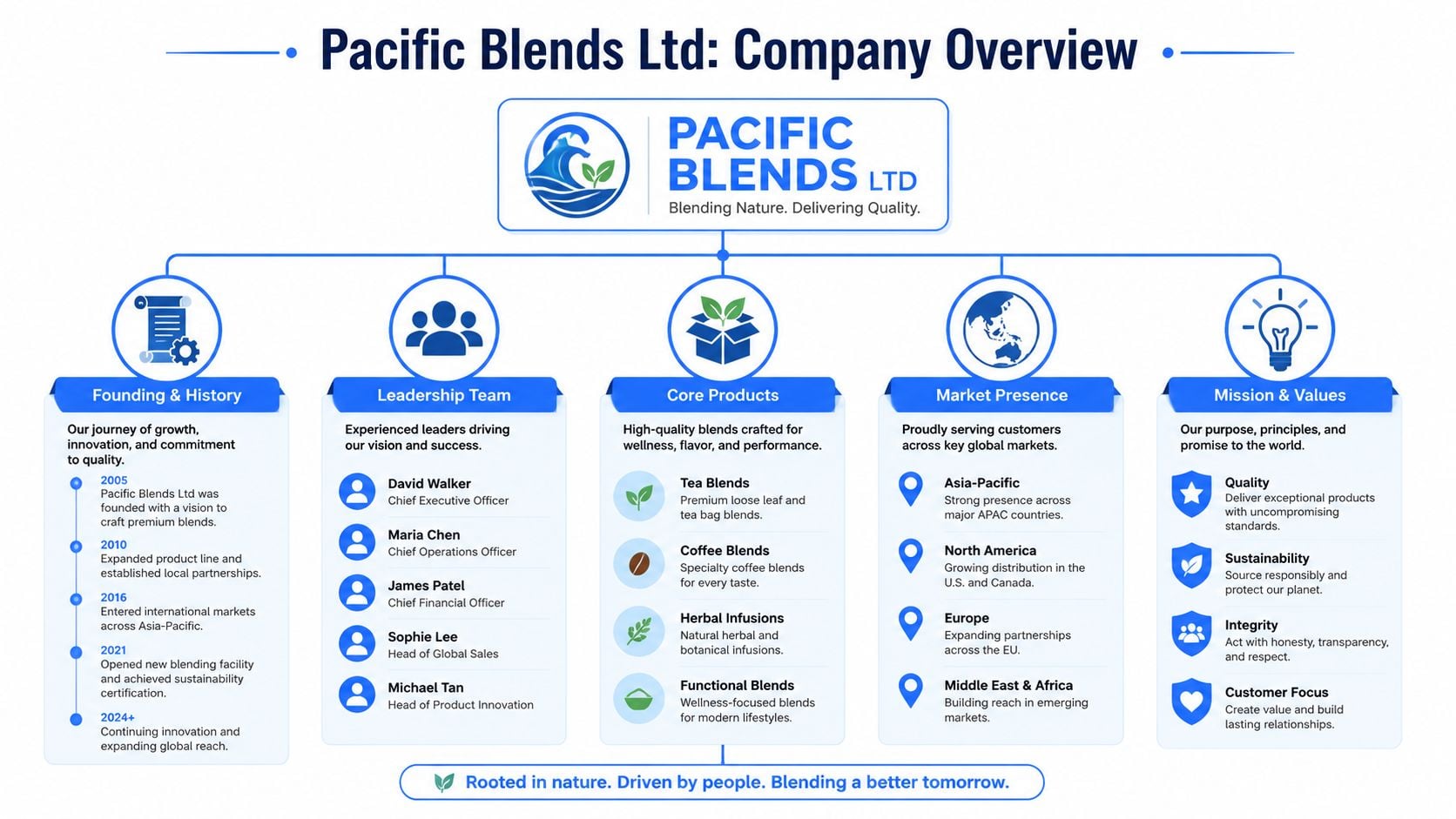
  • Plastic Zone Tarzana: A B2B Investigator’s Guide for 2026

    Plastic Zone Tarzana: A B2B Investigator’s Guide for 2026

    You've found a supplier name, a city reference, and just enough conflicting business data to make a routine sourcing task turn into a risk review. The RFQ draft is open. Your operations team wants lead times confirmed. Sales wants alternatives ready. But when you look up Plastic Zone Tarzana, the record doesn't resolve into one clear supplier profile.

    That's the key issue. Plastic Zone Tarzana isn't just a company lookup problem. It's a supplier verification problem. For procurement and logistics teams, that distinction matters because bad entity data doesn't stay in a spreadsheet. It spills into freight planning, compliance checks, and vendor onboarding.

    Tarzana itself is a real place, a Los Angeles neighborhood in the San Fernando Valley with a documented population of 38,184 as of November 2025, according to Tarzana's public profile. But a real location doesn't guarantee a clear supplier identity. With Plastic Zone Tarzana, the public record points in different directions, and that's exactly where disciplined procurement work begins.

    The Tarzana Supplier Puzzle

    A buyer searching for an acrylic fabricator usually expects a familiar pattern. You confirm the legal name, match the operating address, review capabilities, and move into qualification. With Plastic Zone Tarzana, that sequence breaks down early.

    One trail suggests a legacy operation associated with custom plastic fabrication. Another suggests a different classification altogether. That sounds minor until you remember how procurement teams work. Category fit drives outreach. Outreach drives RFQs. RFQs drive scheduling, routing, and customer commitments.

    A person using a laptop to search for supplier information on a clean wooden office desk.

    When a simple supplier search becomes an investigation

    A plastics buyer may search “Plastic Zone Tarzana” expecting to verify whether the company can supply acrylic sheets, handle custom cuts, or support fabrication work tied to a downstream manufacturing schedule. Instead, the data forces a different set of questions.

    • Is this the same business entity listed across multiple directories, or a stale branch reference that remained online after operations changed?
    • Is the Tarzana site active in any meaningful operating sense, or is it part of an older business footprint still circulating in public listings?
    • Does the classification reflect actual capability, or is the directory taxonomy inaccurate enough to mislead a purchasing team?

    Those aren't academic concerns. If your team sends a specification package to the wrong type of supplier, you lose time twice. First during initial outreach, then again when your team has to replace the vendor and rebuild internal confidence in the shortlist.

    Practical rule: If a supplier's identity is unclear at the search stage, treat capability claims as unverified until primary records and direct responses line up.

    Why this case matters beyond one Tarzana listing

    Plastic Zone Tarzana is useful because it exposes a common procurement blind spot. Teams often assume that repeated directory references equal validation. They don't. Repetition can merely mean one bad record has been copied into several places.

    That's why this case deserves a closer look. Not because every ambiguous vendor is risky by default, but because ambiguity changes the burden of proof. The supplier may be legitimate, capable, and responsive. Procurement still has to prove that before volume, timelines, or customer expectations are attached to the relationship.

    The Official Story vs The Public Record

    The most important fact in this case is the conflict itself. According to a ZoomInfo company profile reference, some sources cite Tarzana as a legacy site established in 1985 specializing in custom fabrication, while Manta.com reportedly lists the entity as established in 2005 and categorized under “Mold Makers.” That creates a 15-year gap and a direct clash in industry classification.

    That's not a minor profile discrepancy. It creates two different supplier narratives.

    An infographic titled Plastic Zone Tarzana showing a comparison between official business profiles and public reality records.

    Two incompatible business identities

    One version presents Plastic Zone Tarzana as a legacy plastic fabrication operation. In procurement terms, that implies familiarity with fabricated plastic components, custom work, and possibly materials handling tied to acrylic and related production needs.

    The competing version labels the business under mold making. That points buyers toward a very different capability set, different quoting assumptions, and potentially a different production model. A mold maker and a plastic fabricator can overlap in the broader manufacturing world, but they are not interchangeable categories for sourcing.

    Here's the conflict in a side-by-side format.

    Attribute Legacy Profile (Fabricator) Directory Profile (Mold Maker)
    Business history Established in 1985 Established in 2005
    Apparent focus Custom fabrication Mold makers classification
    Procurement implication Material and fabrication sourcing candidate Tooling or mold-related sourcing candidate

    Why classification conflict matters more than it seems

    Procurement teams rely on categorization to narrow options fast. If the label is wrong, your process gets distorted before anyone makes contact.

    Consider what each classification tells your team:

    • Plastic fabricator suggests the supplier may process sheets, components, or custom fabricated parts.
    • Mold maker suggests tooling expertise, mold production, or an adjacent manufacturing role.
    • Legacy site language hints at historical continuity, but doesn't confirm current operations.

    A buyer reading those records may assume the difference is clerical. That assumption is dangerous. The category affects what drawings you send, which stakeholders join the review, and whether logistics starts planning around inbound material, custom parts, or tooling.

    The risk isn't only that one record is wrong. The risk is that no public source clearly resolves which record reflects present reality.

    What procurement should do with conflicting records

    At this stage, don't force certainty where the record doesn't support it. Label the supplier as unresolved inside your sourcing workflow until you verify legal identity, current operating status, and actual service scope.

    This is also where document comparison matters. If your team is reviewing vendor forms, certificates, onboarding paperwork, or contradictory profile screenshots, tools such as LegesGPT's AI document review platform can help organize discrepancies before legal or compliance teams spend time on manual review.

    For logistics teams, the same discipline applies to trade documentation and reporting workflows. If you're building a stronger intake process around vendor and shipment data, this port import export reporting service guide is a useful operational reference because it frames how reporting gaps can distort downstream decisions.

    Why Supplier Ambiguity Cripples Your Supply Chain

    Most supplier ambiguity doesn't announce itself as a crisis. It enters through a vendor list, a copied directory entry, or an old branch reference that nobody challenged. Then your team builds a plan on top of it.

    A concerned warehouse manager reviewing supply chain data on a digital tablet and computer screen.

    The verified record for this topic includes a stark warning. It states that 30% of procurement delays stem from vendor misclassification, but the provided citation for that figure is not available in the source set given here. Because that claim isn't fully supported by a verifiable linked source in this brief, it shouldn't be used as a planning fact. Even without that number, the logic still holds. Misclassified vendors waste buying cycles and create preventable delay.

    Where the damage actually shows up

    The first failure point is the RFQ. If your team thinks it's contacting a fabricator but the company operates in a different category, your inquiry won't match the supplier's workflow. The reply may be delayed, redirected, or ignored because the request doesn't fit the business.

    The second failure point is internal alignment. Engineering, procurement, and logistics may each interpret the supplier differently. That produces mismatched assumptions on packaging, production readiness, and shipment timing.

    Then freight planning gets pulled into a problem it didn't create. If sourcing expected fabricated acrylic output and the supplier relationship turns out to involve a different capability, your transportation assumptions are suddenly detached from reality.

    Why ambiguity spreads operational risk

    A confusing supplier profile can trigger several downstream problems at once:

    • Wasted qualification effort because your team reviews insurance, tax, or onboarding paperwork for an entity that may not fit the category.
    • Weak backup planning because the vendor remains on the shortlist longer than it should.
    • Poor customer communication because sales or operations speaks with confidence before supplier status is confirmed.

    Teams that audit these failure points systematically often use checklists similar to a UK supply chain audit guide, especially when the issue is less about pricing and more about traceability, role clarity, and documentary consistency.

    A related discipline is regulatory exposure review. If supplier records don't align, your risk isn't limited to service disruption. It can spill into onboarding controls and documentation standards, which is why a structured regulatory risk management process belongs in vendor qualification, not only in compliance remediation.

    A short briefing on supply chain verification helps frame the issue from an operations angle:

    The procurement takeaway

    A supplier with unclear identity shouldn't be treated as a normal sourcing candidate. It should be treated as an exception case. Exception cases need tighter documentation, narrower assumptions, and a faster escalation path when answers don't come back clean.

    A Framework for Vetting Ambiguous B2B Suppliers

    When public records conflict, speed matters less than sequence. Teams that move carefully at the start usually lose less time overall because they avoid rebuilding the supplier file later.

    A 5-step framework infographic for vetting ambiguous B2B suppliers, displayed as a numbered list with icons.

    Start with source hierarchy

    Not all records deserve equal weight. A government filing, signed certificate, or direct company response should outrank a scraped directory listing every time.

    Build your review order like this:

    1. Primary records first. Legal registration, permits, tax documentation, and current certificates.
    2. Direct supplier statements second. Capability decks, signed emails, line cards, and onboarding forms.
    3. Secondary records last. Directories, list aggregators, and copied profile pages.

    That hierarchy stops your team from treating broad web visibility as proof.

    Field note: A supplier with five matching directory listings may still have only one original error behind all five.

    Compare identity, capability, and operating status separately

    Many teams bundle these into one question. That's a mistake. A supplier can be legally real, commercially reachable, and still misrepresented in capability.

    Use three separate checks:

    • Identity check. Confirm the legal entity name, address, and who is authorized to represent the business.
    • Capability check. Ask what the site currently produces or services, not what older listings say it once did.
    • Operating status check. Verify whether the location is active, administrative, legacy, or part of a larger entity structure.

    This separation makes outreach sharper. It also reduces the chance that a polite but vague sales reply gets mistaken for full qualification.

    Run a digital footprint review

    Public contradictions usually leave traces. Look for inconsistency across websites, archived pages, professional profiles, and business listings. You're not looking for perfection. You're looking for coherence.

    A practical review includes:

    • Website consistency. Does the company describe one business model consistently across pages?
    • Professional presence. Do employee profiles align with the claimed services?
    • Directory drift. Do category labels vary depending on the platform?

    If your team wants a broader due diligence checklist beyond basic procurement review, Sentry Private Investigators' due diligence offers a useful framework for thinking about verification layers and contradiction handling.

    Use controlled outreach

    Don't begin with a broad request like “Tell us about your services.” Ask narrow questions that force clear answers.

    A strong first email asks for:

    • current operating location,
    • primary product or service category,
    • whether the Tarzana reference is an active site,
    • the right contact for technical qualification.

    That kind of outreach reveals a lot from the response itself. Fast, precise answers usually indicate operational clarity. Vague responses often signal either weak internal controls or a mismatch between public identity and current operations.

    Build a decision gate before onboarding

    Your team needs a simple threshold for moving a supplier from ambiguous to qualified. Without that, unclear vendors linger in the pipeline.

    Use a gate such as:

    Review area Minimum evidence to proceed
    Legal identity Matching business records and contact confirmation
    Capability Direct statement of current services with supporting documents
    Location status Confirmation that the referenced site is active or clearly defined
    Risk ownership Internal sign-off from procurement or compliance

    For teams that source by trade lane or commodity history, one option is a platform like Coreties' supply chain databases resource, which describes how company-level shipping and importer data can support qualification research when directory data alone is thin.

    The Unique History of Tarzana California

    Tarzana's name carries more history than many buyers realize. The neighborhood's identity is tied to 1912, when Edgar Rice Burroughs' Tarzan of the Apes appeared in All-Story Magazine, as noted by the Tarzana Neighborhood Council history page.

    That literary connection later became geographic. Local history records note that Burroughs purchased the former estate of General Harrison Gray Otis and called it the Tarzana Ranch. Over time, the surrounding area took on that name.

    Why the location context matters

    For procurement teams, local history won't qualify a supplier. But it does sharpen one useful distinction. Tarzana is a place with a defined identity, not just a keyword attached to a business listing. That matters when you're testing whether a location reference in a supplier profile reflects a real operating footprint or borrowed geographic familiarity.
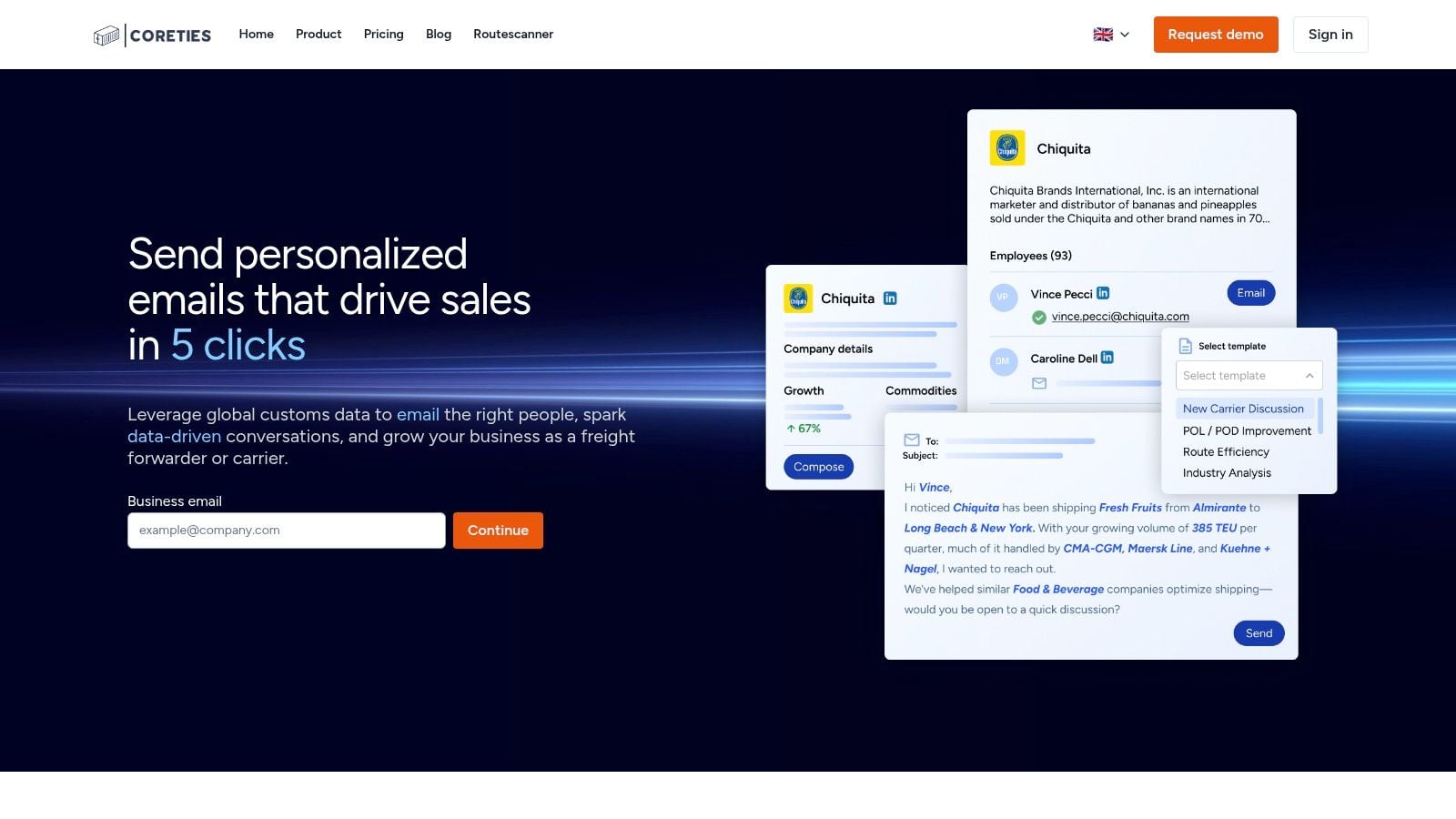
    A neighborhood with a distinctive historical identity can produce many stale or derivative references over time. Buyers should resist the assumption that a recognizable place name adds credibility to a business record. It only confirms that the place exists.

    A real neighborhood can still contain an unclear supplier record. Location legitimacy and supplier legitimacy are separate questions.

    Frequently Asked Questions for Procurement Teams

    Is Plastic Zone Tarzana a fabricator or a mold maker

    Current public records do not support a firm classification. The available evidence points in two directions, with one profile indicating fabrication activity and another suggesting mold-making. Procurement should treat capability as unconfirmed until the supplier ties its current services to a specific legal entity, operating address, and recent customer or production evidence.

    Should procurement contact the company anyway

    Yes, with controls.

    Use first contact to verify identity, not to start quoting. Ask for the legal business name, active operating location, current service scope, and the right contact for technical review. If the reply is partial, inconsistent, or routed through a generic sales response that avoids specifics, stop the process until those gaps are resolved.

    What is the biggest practical risk in cases like this

    False fit is the main risk. A team may place the supplier into a sourcing lane before basic facts are settled, then build timelines, RFQ assumptions, and customer commitments around an unproven match.

    The cost shows up later in avoidable ways. Engineering may review the wrong capability set. Procurement may request pricing from an entity that cannot perform the work. Logistics may hold space in a production schedule for a supplier that was never operationally qualified.

    How should a buyer classify this supplier internally right now

    Use a status that signals uncertainty clearly. Good options include unverified, entity conflict, capability unresolved, or location unconfirmed.

    That labeling matters because internal systems often create implied approval. Once a supplier is entered loosely, sales, engineering, and operations may treat it as usable even when the file still contains unresolved conflicts.

    Does the Tarzana location itself tell us anything useful

    Yes, but only at the geographic level. Tarzana is a real Los Angeles neighborhood with its own civic identity, as described in the Tarzana community overview. That helps confirm the place name is not fabricated.

    It does not confirm that a specific supplier at that location is active, reachable, or capable of doing the work your team needs.

    What should buyers ask in the first outreach email

    Keep the message narrow and verifiable. Request the current legal business name, whether the Tarzana site is active, the primary service category, the manufacturing or tooling processes offered today, and the contact responsible for technical qualification.

    Do not send drawings, annual volumes, or target pricing in the first exchange. Release those details only after the supplier clears the identity and capability check.

    When should the supplier be removed from consideration

    Remove or deprioritize the supplier when contradictions remain after direct outreach, or when provided documents do not match the claimed entity, address, or service line.

    A reasonable response delay is not the issue. Persistent mismatch is. If a supplier cannot establish who it is and what it does, it should not stay in an active sourcing pipeline.

    If your team needs a cleaner way to research shippers, verify trade activity, and build more reliable outreach lists before supplier ambiguity turns into pipeline waste, Coreties provides logistics-focused lead discovery and customs-data workflows that can support earlier, better-informed qualification.

  • Industry Benchmarking in Logistics: A Practical Guide

    Industry Benchmarking in Logistics: A Practical Guide

    A freight forwarder calls a prospect and leads with the usual line. We have strong carrier relationships. We can offer competitive rates. We'd love a chance to quote your business.

    The shipper ends the call in under a minute.

    That conversation fails because it gives the buyer nothing specific to react to. In logistics, generic claims sound interchangeable. Every forwarder says they have capacity. Every carrier says they have service. Every sales rep says they can save money. Without evidence tied to the shipper's lanes, suppliers, timing, or routing pain points, the pitch lands as noise.

    The calls that work sound different. They start with something concrete. You're importing this commodity through this gateway. Your current pattern suggests dependence on one carrier group or one origin cluster. Your lane mix creates avoidable exposure when schedules slip. We can see where routing flexibility or service design may matter more than a lower base rate. That changes the discussion from “give us a try” to “we understand your network.”

    That's where industry benchmarking becomes useful. Not as a slide for a quarterly strategy meeting. Not as a vague promise to be data-driven. It becomes a working tool for prospecting, routing, pricing conversations, account retention, and territory planning.
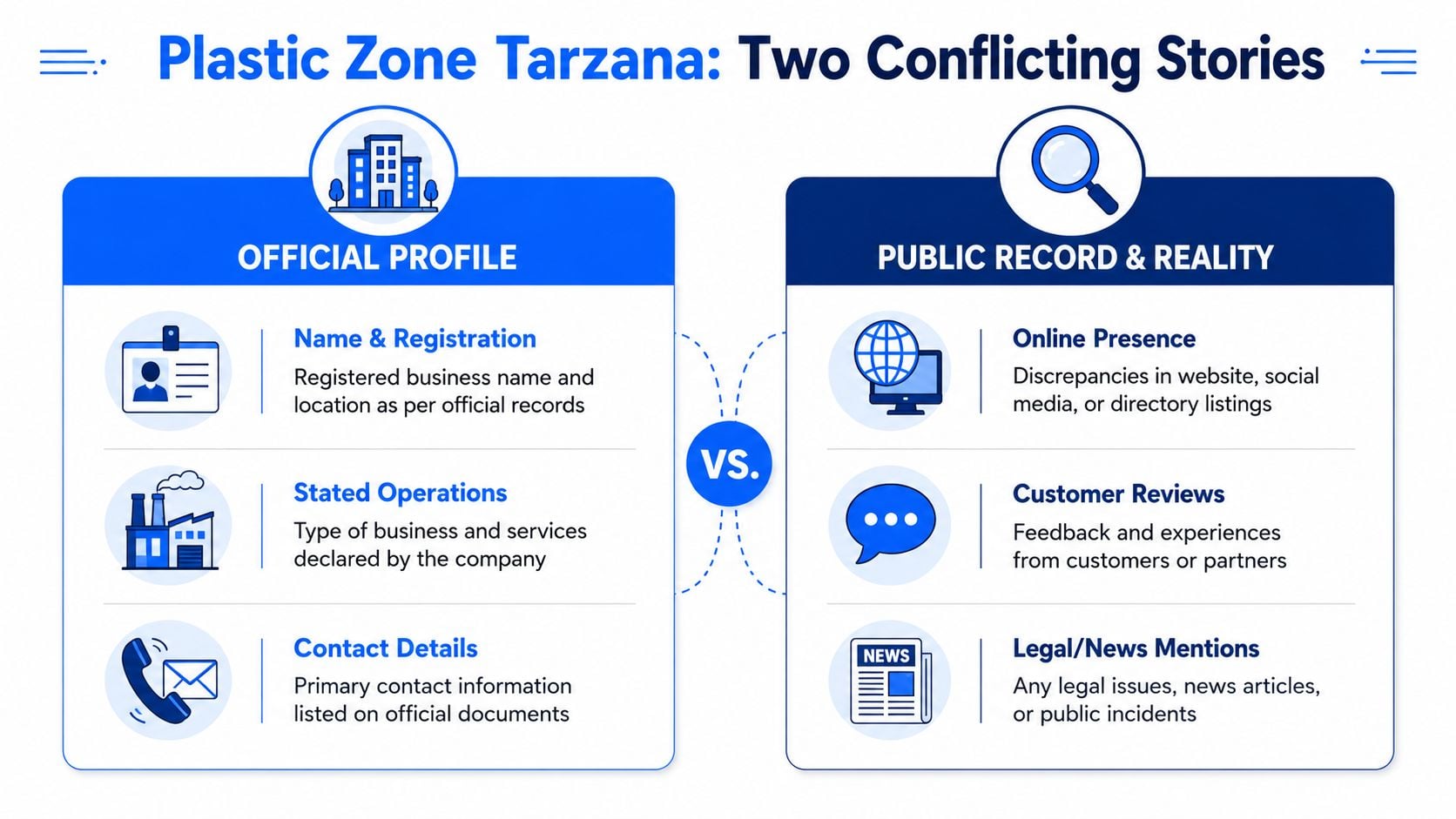

    For logistics teams, the practical question isn't whether benchmarking sounds smart. It's whether it helps a rep write a better email today, helps an operations manager defend a routing decision this week, or helps leadership decide which trade lanes deserve attention this quarter. Used well, it does all three.

    The End of Generic Sales Pitches

    Most logistics sales teams have lived through the same pattern. A rep gets a list of target shippers, opens a spreadsheet, and starts sending outreach based on broad claims. Better service. Better rates. Better coverage. The response rate is weak because the message could have gone to anyone.

    A shipper doesn't buy because a forwarder says the right adjectives. They buy when the seller shows a clear understanding of the shipper's operating reality. If a prospect imports regularly on a lane with recurring schedule friction, they care about routing resilience. If their inbound flow is concentrated with a small group of suppliers, they care about continuity and exceptions. If they're splitting freight across modes, they care about handoff reliability and response speed when something goes wrong.

    Why broad claims fail in freight

    Generic outreach breaks for three reasons.

    • It ignores lane context. A shipper moving ocean freight from one origin pattern has very different concerns than a shipper relying on mixed air and ocean replenishment.
    • It doesn't show commercial relevance. Buyers want to know why switching or adding a provider improves a real business outcome.
    • It treats all prospects the same. In logistics, the account list may look broad, but the selling motion should be narrow.

    Practical rule: If your first message could be copied into an email for fifty unrelated shippers, it probably won't open a serious conversation.

    The stronger alternative is to benchmark before outreach. Look at the prospect's shipping activity, the likely carrier mix, the commodity pattern, and the trade lanes that matter most. Then compare that picture against what you know about your own service strengths and the market's common service patterns. The result is a sharper point of view.

    What a useful pitch sounds like

    A useful sales conversation doesn't start with “we'd like an opportunity.” It starts with an observation.

    You might note that the shipper appears concentrated in a port pair where schedule variability has consequences for distribution planning. You might see that they depend on a narrow carrier set and could benefit from more optionality. You might find that your network aligns better with the shipper's origin geography than the providers they seem to use now.

    That's not theory. It's a better use of available logistics data.

    What Is Logistics Industry Benchmarking Really

    In logistics, industry benchmarking is the disciplined act of comparing your performance, network position, or account assumptions against a reliable point of reference. That reference might be your own historical performance, a competitor pattern, a lane-level market norm, or the practices of firms that operate especially well on a given trade.

    A sports analogy works here. Good teams don't watch game film to admire their own highlights. They study opponents, tendencies, spacing, and execution. They want to know where they're losing ground and where they can exploit an opening. Logistics teams should think the same way. Benchmark your transit patterns, carrier mix, quote responsiveness, lane density, and exception handling against a standard that means something.

    An infographic titled What Is Logistics Benchmarking showing five key benefits of the practice.

    It's more rigorous than most teams treat it

    A formal benchmark is not just a rough comparison. The U.S. Bureau of Labor Statistics describes benchmarking as using a standard or point of reference to compare performance, and notes that its Current Employment Statistics program benchmarks the March employment level to the first-quarter employment level from the Quarterly Census of Employment and Wages every year in an annual calibration process designed to align sample-based estimates with a broader universe estimate, as explained in the BLS overview of benchmarking.

    That example matters because it strips away the buzzword. Benchmarking is a correction discipline. It's a way to test whether your current read of the market, your sales narrative, or your operating assumptions match a broader reality.

    What that looks like in freight

    For a freight forwarder, benchmarking often means asking questions like these:

    • Lane position. Are we strong on the lanes we claim to target, or are we spreading sales effort too thin?
    • Service reliability. Are our actual operating results holding up against what the market expects on those routes?
    • Commercial fit. Are we pursuing shippers whose shipping patterns match our strengths?
    • Pricing posture. Are we discounting where service quality should carry the conversation?

    For a pricing or revenue team, the logic is similar to how teams use Market Edge's pricing platform to anchor pricing decisions against external signals rather than instinct alone. In logistics, the same mindset applies to lanes, routing options, and account targeting.

    Benchmarking only becomes useful when it changes a decision. Which account to pursue. Which lane to defend. Which routing option to put in front of the customer.

    The daily version of benchmarking

    A lot of people hear the term and think of annual planning decks. In reality, the daily version is simpler. A rep uses customs activity to compare a target shipper with similar importers. An operations manager compares scheduled versus actual lane performance. A branch leader reviews whether the team's strongest commodity flows match the accounts they're spending time on.

    That's logistics benchmarking in its most practical form. It turns broad market noise into a smaller set of decisions that can win business.

    The Most Valuable KPIs for Freight Forwarders

    The most useful freight KPIs are the ones that help a team answer a commercial or operating question fast. Which accounts fit our network. Which lanes are vulnerable. Which customers are drifting. Which service failures are hurting renewals. Good benchmarking starts with metrics that support action.

    A foundational rule matters here. Effective benchmarking requires consistent definitions, timeframes, and quantitative KPIs such as costs, margins, satisfaction scores, or response times, and benchmarks can come from internal historical data, competitor analysis, public reports, and survey data. That means a benchmark only has value when the numbers are comparable over the same period, as described in this benchmarking data guide.

    Customs and shipment intelligence KPIs

    For logistics sales teams, customs-derived signals are often the first layer because they reveal actual movement patterns, not survey opinions.

    KPI Data Source What It Reveals
    Shipper-carrier relationship pattern Customs filings Which providers appear to handle the shipper's freight and how concentrated those relationships look
    Shipment volume by lane Customs filings Where the shipper's trade activity is concentrated and which lanes deserve tailored outreach
    Origin and supplier concentration Customs filings Whether the account depends on a narrow supplier base or a wider sourcing mix
    Commodity movement trend Customs filings Which product categories matter most and whether your specialization is relevant
    Port and gateway pattern Customs filings Which entry points shape inland planning, congestion exposure, and drayage complexity

    These KPIs are especially valuable in prospecting because they help a rep stop guessing. Instead of saying “we serve Asia to North America,” the rep can focus on the actual origin clusters and gateway habits visible in the prospect's traffic pattern.

    Service and schedule KPIs

    Operations teams need another category. They need metrics tied to execution.

    • Scheduled versus actual transit time. This shows whether the marketed service profile matches lived experience on the lane.
    • On-time performance by route. Useful for account reviews and routing redesign.
    • Port dwell pattern. Helpful when a lane looks stable on paper but customers experience recurring delays.
    • Exception response speed. A quiet but important differentiator in account retention.

    If you're refining the service side of your benchmark stack, resources on tracking customer service metrics for 2025 can help teams think more clearly about response handling, resolution flow, and service consistency. Those ideas matter in logistics because service quality often determines whether a shipper tolerates a rate premium.

    Internal commercial KPIs

    Internal metrics matter just as much because external data alone won't tell you whether your team is converting opportunity into business.

    Consider these:

    • Quote-to-booking ratio. A weak ratio can mean poor qualification, weak follow-up, or a mismatch between target accounts and network strength.
    • Customer churn pattern. If customers leave on specific lanes or modes, the root cause may be structural rather than account-specific.
    • Gross margin by lane or account type. Useful when the sales team is winning business that operations can't serve profitably.
    • Sales response time. Often overlooked, but it shapes whether you're even in the deal.

    The KPI itself isn't the insight. The comparison is the insight. A response time means little until you compare it against your own standard, your team's historical pattern, or the expectation of the shipper you're trying to win.

    What not to benchmark

    Teams waste time when they benchmark numbers that aren't normalized. If one branch counts a quote one way and another branch counts it differently, the comparison won't help. If lane performance is measured across mismatched periods, you'll draw the wrong conclusion. In freight, bad definitions can look precise while hiding operational reality.

    The fix is simple. Pick fewer KPIs, define them tightly, and track them consistently.

    A Repeatable Benchmarking Methodology for Logistics

    Most benchmarking efforts break down because teams collect too much data before they decide what problem they're solving. A repeatable process keeps the work useful. In logistics, the strongest methodology is usually the one a sales manager, pricing analyst, and operations lead can all use without turning it into a research project.

    An infographic showing a four-step repeatable benchmarking methodology process for logistics management and continuous business improvement.

    Step 1 define the business objective

    Start with a real decision. Don't start with the data source.

    A good objective might be winning a specific importer account, improving service credibility on a trade lane, defending a vulnerable customer, or deciding whether to commit more sales effort to a geography. The objective determines what benchmark matters. If the goal is prospecting, shipment and lane intelligence take priority. If the goal is account retention, service and response metrics become more important.

    Write the objective in operational terms. “Increase visibility in retail imports” is too broad. “Build a targeted list of retail importers whose lane mix fits our network and whose current routing pattern appears exposed” is workable.

    Step 2 gather comparable data

    Teams tend to either overbuild or oversimplify. Pull from a small number of sources that fit the objective:

    • Internal systems such as TMS, CRM, and quote history for service and conversion data
    • Public and commercial shipment intelligence for shipper patterns, commodities, and trade lanes
    • Carrier schedules and route information for service design and routing alternatives
    • Account notes and exception records for context that raw movement data can't explain

    If your team needs more structured shipment visibility, services such as a port import export reporting service can help standardize how lane and account activity are reviewed before outreach or network decisions are made.

    Step 3 analyze and normalize before comparing

    This is the step that separates useful benchmarking from misleading dashboards. JANA notes that benchmarking compares business processes and performance metrics against industry bests, but it also stresses agreement on which metrics matter and a defined methodology for collection, aggregation, and distribution. Without normalization and common data definitions, cross-company comparisons can produce misleading conclusions instead of actionable gaps, as explained in JANA's discussion of technical information metrics and benchmarking methodology.

    In logistics terms, normalization means asking basic but essential questions.

    1. Are we comparing the same trade lane over the same period?
    2. Are transit times defined the same way across the data set?
    3. Are we mixing bookings, shipments, and quotes as if they were interchangeable?
    4. Are account categories broad enough to distort the result?

    A rep who compares a shipper's peak-season pattern to a quiet off-season period may think there's an opportunity where there isn't one. An operations leader who compares all Asia-origin freight as one bucket may miss a severe problem isolated to a specific gateway pair.

    Standardize first. Compare second. Any other order creates false confidence.

    Step 4 turn the gap into action

    The final step is practical. If the benchmark shows a gap, assign a move.

    • If a prospect appears overconcentrated with a provider set that doesn't match your strongest lane, craft outreach around network fit.
    • If your actual service underperforms on a lane you sell aggressively, fix the routing before increasing pipeline pressure.
    • If a branch wins a lot of quotes but books poorly, review qualification criteria and pricing discipline.
    • If a key customer's traffic pattern shifts, adjust account strategy before renewal pressure surfaces.

    The benchmark is not the output. The output is the decision memo, routing change, prospect list, pricing stance, or account review plan that comes from it.

    Practical Use Cases for Sales and Routing

    The easiest way to understand benchmarking is to watch it change a real conversation. In logistics, the value shows up when a rep stops sending broad outreach and when an operations manager stops defending a route because it's familiar.

    A professional man pointing at a logistics dashboard screen displaying real-time vehicle tracking and performance data.

    Use case one prospecting a shipper with a lane-specific point of view

    A sales development rep gets a target account in the consumer goods space. The old approach would be simple. Find the logistics manager, send a note about rate competitiveness, and ask for a quote opportunity.

    Instead, the rep reviews customs activity first. The shipper appears to import repeatedly on a narrow set of origin points. The movement pattern suggests dependence on one carrier mix and a small number of gateways. The rep also compares that pattern with the forwarder's own strengths and sees a better fit on an alternative routing design the prospect doesn't appear to be using much.

    Now the outreach changes. It doesn't claim universal superiority. It says, in effect, your inbound profile suggests heavy reliance on a limited lane structure, and there may be room to reduce exposure through a routing design that better matches your supplier geography. That's a much better reason to take a meeting.

    The rep can push this further by combining shipping intelligence with account research and predictive analytics for sales to prioritize the shippers most likely to respond to a lane-specific message rather than a broad introductory one.

    A shipper rarely replies because a forwarder asks for a chance. They reply when the forwarder shows they've already done part of the shipper's homework.

    What the rep is really benchmarking

    The rep is not benchmarking the prospect against an abstract “industry average.” The benchmark is more targeted.

    • Current shipper pattern versus your network fit
    • Observed routing concentration versus available alternatives
    • Prospect's likely provider setup versus your commercial opening

    That creates a usable sales narrative. The rep is no longer selling logistics in general. The rep is selling a more relevant option for that shipper's actual flow.

    A short demonstration helps teams visualize the shift from generic market data to practical selling.

    Use case two defending and improving a trade lane

    Now switch to operations. A carrier or forwarding operations manager is reviewing a key account on a competitive trade lane. The account isn't lost, but it feels unstable. Service complaints are increasing, and the customer has started asking more detailed questions during review calls.

    The manager benchmarks internal execution against the lane's market expectations and against what the company has been promising commercially. Scheduled transit looks acceptable, but actual handoffs and dwell points show friction. The lane isn't failing everywhere. It's failing at specific nodes where routing choices create avoidable delay and poor exception visibility.

    That matters because the response changes from defensive to constructive. Instead of saying “conditions are challenging for everyone,” the manager can say, “We identified where this lane is weakening for your shipments, and we're proposing a routing adjustment with clearer handoff control and better exception management.” The customer hears ownership rather than excuses.

    Why these use cases work

    Both examples use the same principle. Benchmarking works when it narrows action.

    The sales rep uses it to sharpen outreach around a shipper's real traffic pattern. The operations manager uses it to isolate a service gap instead of treating the lane as one undifferentiated problem. In both cases, the benchmark gives the team a specific basis for a decision.

    That's the difference between data as decoration and data for impact.

    Operationalizing Insights with the Right Tools

    Manual benchmarking works at small scale. A rep can study a handful of accounts. An operations manager can review one lane in detail. But once a team wants repeatability across branches, modes, territories, and account segments, manual work starts to break down.

    The bottlenecks are predictable.

    Where manual benchmarking stalls

    • Data aggregation slows down. Shipment intelligence, CRM records, schedules, and internal performance data sit in different places.
    • Definitions drift. One team's lane view doesn't match another team's reporting logic.
    • Action gets delayed. Even when the insight is clear, turning it into outreach lists or account plans takes too long.

    Here, automation proves its worth. A practical overview like this guide to business intelligence automation is useful because it shows why teams need systems that connect collection, interpretation, and action rather than stopping at dashboard creation.

    What a scalable workflow looks like

    A scalable benchmarking workflow should let a team do four things without excessive manual stitching:

    1. Aggregate external and internal logistics signals
    2. Filter by shipper, lane, commodity, geography, and mode
    3. Surface account-level opportunities or service risks quickly
    4. Push insights into outreach or review workflows

    For logistics-specific teams, Coreties fits that model by turning customs data into prospecting and account research workflows, helping users identify relevant companies, contacts, and lane patterns, while also supporting routing conversations through linked market and schedule context. If implementation discipline is the concern, a structured implementation timeline for logistics teams helps keep the rollout tied to clear sales and operations use cases instead of tool sprawl.

    Screenshot from https://coreties.com

    The point isn't to automate for its own sake. The point is to reduce the gap between noticing an opportunity and acting on it. In logistics, that gap matters. By the time a team manually assembles the shipper view, lane analysis, and outreach plan, the prospect may already be deep into a tender cycle or the account may already be speaking with competitors.

    Industry benchmarking stops being a buzzword once it enters the daily rhythm of sales calls, account reviews, and routing decisions. Teams that use it well don't just know more. They approach the market with a clearer argument, a tighter target list, and a stronger operational case.


    If your team wants to turn shipping data into practical prospecting, routing, and account intelligence, take a look at Coreties. It's built for logistics teams that need to move from raw customs activity to targeted outreach and sharper commercial decisions without relying on generic sales pitches.

  • Mastering Sales Intelligence Tools for Logistics

    Mastering Sales Intelligence Tools for Logistics

    You can feel the old logistics sales routine wearing your team down. A rep gets a spreadsheet of importers, searches LinkedIn, calls the main switchboard, reaches the wrong contact, leaves a voicemail, sends a generic email, and repeats it all afternoon. By Friday, there's activity everywhere and very little pipeline that deserves a forecast discussion.

    That approach breaks down fast in freight. Shippers don't buy because you called first. They buy because you understood their lane, recognized a service gap, reached the right person, and made a relevant offer before another forwarder did. In logistics, timing and context beat volume.

    That's why sales intelligence tools matter. Used well, they replace blind prospecting with a working view of who ships what, where they move it, who likely owns the decision, and when outreach has a real reason behind it.

    The End of Cold Calls in Logistics

    A freight rep once could get away with persistence alone. Buy a list, call through the front desk, ask for the transportation manager, and hope the account had a tender coming up. Today that method burns hours and creates noise. Most logistics teams already know the pain. The problem isn't effort. It's weak targeting.

    In freight forwarding and carrier sales, the bad version of prospecting looks familiar:

    • Wrong company fit: Reps chase businesses that don't move the modes, origins, or volumes the team serves well.
    • Wrong contact level: They find a CEO or founder when the conversation belongs with procurement, transportation, import operations, or supply chain.
    • Wrong timing: Outreach lands after a routing decision is already made, after a contract is locked, or during a period when the shipper isn't reviewing providers.
    • Wrong message: Emails talk about “end-to-end logistics solutions” instead of a concrete lane, customs pattern, or service issue the prospect already feels.

    That's why the old playbook produces motion, not momentum.

    A better workflow starts before the first email. Reps build a target list from actual shipping behavior, narrow by trade lane or product movement, identify decision-makers, and then tailor outreach around the account's logistics reality. If your team still struggles with contact discovery, this guide on how to find decision-makers in target accounts is a practical place to tighten the front end of the process.

    Practical rule: In logistics sales, a smaller list with real lane relevance usually beats a larger list built from generic industry filters.

    Cold calling isn't dead because calls stopped working. It's ending because random calls stopped working. The teams winning freight contracts aren't just working harder. They're entering conversations with better data.

    What Sales Intelligence Means for Freight and Shipping

    For logistics teams, sales intelligence is the difference between a paper road atlas and a live satellite navigation system. The atlas tells you where roads exist. The live system shows traffic, weather, detours, and which route still makes sense right now. Freight sales works the same way.

    Traditional prospecting gives you names and company records. Modern sales intelligence tools give you operating context.

    According to Outreach's explanation of what sales intelligence is, the category evolved from simple databases into platforms that combine contact data, firmographics, intent signals, and CRM integrations. IBM describes it as the systematic collection of data to improve sales. In practical terms, that means a logistics seller can stop treating prospecting as list building and start treating it as account selection.

    An infographic comparing traditional sales to modern sales intelligence in the logistics industry using navigation metaphors.

    From records to operating insight

    A generic contact database might tell you a company is an importer in the consumer goods space. That's not enough to win freight. A logistics-focused intelligence workflow should help your team answer better questions:

    • What does this shipper move?
    • Which origin-destination patterns matter most to them?
    • Who likely owns forwarding, carrier procurement, or customs coordination?
    • What changed recently that makes outreach relevant now?

    That last point is where average prospecting falls apart. Reps often know who the company is, but not why the account deserves attention this week.

    Why the definition matters in logistics

    In freight, relevance comes from operational context. If you know a shipper's likely lanes, mode preferences, geography, and internal buyer roles, you don't send a vague introduction. You lead with a useful point of view. That could be a consolidation opportunity, a service alternative, a routing idea, or a faster way to cover a problematic lane.

    Sales intelligence in logistics isn't about owning more records. It's about turning fragmented market information into a reason to contact a shipper.

    That's also why generic B2B advice often misses the mark for freight teams. Logistics sellers need more than titles and email addresses. They need a current view of trade flow, account fit, and buying context. Without that, prospecting stays reactive.

    Must-Have Features and Data Sources for Logistics Sales

    A logistics sales team shouldn't buy a general database and assume it becomes industry-specific because a vendor added “transportation” as a filter. Freight sales needs deeper operating data. If the platform can't help your reps understand lanes, shipment patterns, and supply chain ownership, it won't change performance in a meaningful way.

    The strongest sales intelligence tools work because they join multiple data layers. IBM's overview of sales intelligence notes that contact, firmographic, intent, and deal signals become more useful when fused into one view, and that machine learning can use historical sales data to rank accounts by fit and buying likelihood. For logistics teams, that matters because no single dataset explains whether an account is worth pursuing.

    A diagram illustrating essential sales intelligence features and critical data sources for logistics industry teams.

    What logistics teams actually need

    Here are the capabilities that move the needle in freight sales.

    • Customs and shipment visibility: This is the anchor dataset for many forwarding and carrier teams. Customs data helps reps identify who is importing, what categories they move, and which trade flows deserve attention. It's one of the clearest ways to move from abstract industry targeting to actual shipper discovery. If you want a broader view of how these datasets support prospecting, this overview of supply chain databases for sales teams is worth reviewing.

    • Lane-level filtering: “Retail” or “manufacturing” isn't precise enough. Reps need to isolate accounts by origin, destination, mode, region, and shipment pattern so they can build a service offer around actual movement.

    • Decision-maker coverage below the C-suite: In logistics, the useful contact is often the person managing transportation procurement, import operations, sourcing logistics, or distribution planning. A tool that only surfaces executive leadership will slow the sales cycle down.

    • CRM integration: If reps must export CSV files, manually enrich records, and copy activity back into the CRM, adoption drops. The tool needs to fit the daily sales motion, not sit beside it.

    Nice features versus useful features

    Some features look impressive in a demo but don't matter much in freight unless the underlying data is relevant.

    Feature type Useful in logistics when Weak in logistics when
    Lead scoring It reflects lane fit, shipment profile, and buyer role It scores generic industry fit only
    Predictive signals They help reps prioritize active accounts They produce rankings with no operational explanation
    Competitor monitoring It reveals service gaps or disruption opportunities It offers broad market alerts with no account tie-in
    Activity tracking It shows whether outreach is moving the account It becomes a dashboard of rep busyness

    Why customs data changes the conversation

    Customs data is a real differentiator because it grounds sales activity in trade behavior, not assumptions. If you can see who imports from a specific origin, or which companies appear active on a lane your team already serves well, you can build a prospecting strategy around actual freight movement.

    That's what many tools still miss. They tell you who fits your ideal customer profile in theory. Logistics teams need to know who resembles a customer in motion.

    From Data to Deals Logistics Use Cases

    The shift from research to revenue happens when reps use data to create a specific offer. In freight, that usually starts with a lane, a service problem, or a buyer already showing activity.

    One practical example is building a target list around a new trade lane push. Say your team wants more inbound business from Southeast Asia into the US Midwest. Instead of buying a broad importer list, you filter for shippers with relevant origin patterns, narrow by commodity or product group, and then route outreach to transportation or import contacts. The message is no longer “We're a global forwarder.” It becomes “We've identified your Vietnam-origin flow and have a stronger option for this lane.”

    Screenshot from https://coreties.com

    Three use cases that actually fit freight sales

    Use case one. Build an LCL or consolidation prospect list
    A forwarder launching a focused service can identify importers with shared origin markets and build outreach around consolidation, transit control, or destination handling support. This works best when the rep knows the traffic pattern before the first touch.

    Use case two. Target accounts during service disruption
    If a shipper's current provider is struggling with consistency on a lane, a rep can move quickly with a credible alternative. In freight, timing matters as much as price. A relevant message during disruption gets read. A generic capability deck usually doesn't.

    Use case three. Plan a territory visit around account quality
    A field seller heading into Chicago, Rotterdam, or Singapore shouldn't book meetings based on whichever accounts happen to be nearby. Geo-search and account mapping let the rep build a route around high-fit shippers, current opportunities, and adjacent targets worth dropping in on.

    When timing becomes the advantage

    Intent signals matter most when they help reps act faster. Crunchbase's guide to sales intelligence and intent-driven prospecting explains that intent systems track research behavior across large web footprints and can surface accounts actively evaluating a category. In logistics, that doesn't replace customs or lane data. It complements it.

    A shipper may match your lane strategy, but still not be ready for a conversation. Intent data adds a timing layer. If an account starts showing signs of active evaluation, reps can move from static prospecting to event-triggered outreach.

    If your team can explain both the shipper's freight pattern and the reason for reaching out now, the conversation feels informed instead of intrusive.

    That's where deals start. Not with more names. With better reasons.

    An Evaluation Checklist for Your Next Sales Tool

    Most sales intelligence tools look strong in a demo. Filters are smooth. Maps move fast. The dashboard is clean. None of that tells you whether the platform will help your team win freight contracts.

    A better evaluation process starts with one question. Does this tool improve a bottleneck your logistics team already feels?

    The market leaders have built serious data infrastructure. ZoomInfo says its platform is built on 500 million contacts, 100 million companies, and 1.5 billion+ data points processed daily in its GTM Context Graph, as noted in this review of top sales intelligence tools. That scale matters. But for a freight team, scale alone doesn't guarantee useful lane targeting, cleaner account selection, or better contact relevance.

    A checklist infographic titled Sales Tool Evaluation Checklist featuring seven key criteria for evaluating new software tools.

    A practical buying scorecard

    Use a simple red-yellow-green score across these areas:

    • Data fit: Does the platform understand logistics entities, shipper behavior, and trade-lane targeting well enough to support real prospecting?
    • Contact relevance: Can reps find supply chain, transportation, procurement, and import/export contacts, not just senior executives?
    • Workflow speed: Can the team go from account discovery to outreach without bouncing across multiple tools?
    • Territory usefulness: Does it support geographic planning, lane clustering, or field-sales routing in a way that reflects how your team sells?
    • Integration quality: Will it sync with your CRM and existing process without creating manual cleanup?
    • Signal trust: Can your reps tell why an account was prioritized, or does the system just produce opaque rankings?
    • Adoption risk: Will your team use it after the first month?

    Questions to ask in the demo

    Don't ask vendors for a generic walkthrough. Make them prove fit.

    Ask this Why it matters
    Show me how to find importers on a specific lane Reveals whether the product supports logistics targeting or just broad firmographics
    Show me the buyer roles available for an account Confirms contact depth where freight decisions really sit
    Show me how records stay current Exposes refresh discipline and practical usability
    Show me the CRM handoff Tells you whether the workflow will stick after launch

    A useful outside perspective can also help your team compare prospecting categories before you buy. This roundup from Fypion Marketing on best sales prospecting tools is a solid reference for framing the broader context.

    Buyer test: If a vendor can't demonstrate a real freight workflow in the demo, assume your reps will have to build that workflow themselves.

    That usually means slower adoption and a weaker return.

    Implementation and Measuring Your ROI

    Teams often lose the value of a good tool in the first month. Not because the software is bad. Because rollout is vague, ownership is unclear, and nobody defines what “working” means for the sales floor.

    The fastest path to ROI is to connect the tool to one concrete bottleneck. Avoma's guidance on how to evaluate sales intelligence tools makes this point well: the actual buying question isn't “which tool is best,” but whether the tool improves a specific constraint such as account prioritization or outreach personalization. In logistics, that usually means better lane targeting, faster account research, or more relevant outreach to shipper-side decision-makers.

    Start narrow or adoption will stall

    Don't launch with every mode, every region, and every rep at once. Start with one use case your team already understands.

    Examples that work well:

    • A lane-based pilot: Assign one trade lane or shipper segment to a small team and compare the quality of conversations against the old process.
    • A territory planning pilot: Give field reps a defined geography and require account selection through the new tool before trips are booked.
    • A contact-quality pilot: Focus only on improving access to the right buyer roles for a set of named accounts.

    If your team needs a planning model for rollout, this guide to an implementation timeline for sales adoption can help map ownership and sequencing.

    Measure business movement, not just rep activity

    A weak rollout measures emails sent. A strong rollout measures whether the team is producing better opportunities.

    Track outcomes such as:

    • Qualified accounts created: Are reps identifying more accounts that fit your service strengths?
    • Time to first meaningful meeting: Are sellers reaching a relevant buyer faster?
    • Message relevance: Are outreach notes and emails tied to lanes, origins, or supply chain context?
    • Pipeline quality: Are opportunities entering the CRM with a clear freight problem to solve?

    Coreties says customers report up to 30x gains in outreach efficiency, with teams spending about an hour to send 30+ customized emails versus a single message with traditional methods, according to the publisher information provided for this article. The number matters less than the lesson. Efficiency improves when the workflow reduces research time and makes personalization easier at the moment of outreach.

    Here's a useful way to pressure-test adoption internally.

    If the tool saves clicks but doesn't improve targeting, it won't last. If it improves targeting but creates extra admin, reps will route around it. The tool has to make the right action faster.

    Build Your Future-Proof Logistics Sales Engine

    The logistics teams that keep chasing generic lead lists will stay busy and frustrated. The teams that win consistently are building a sales engine around better account selection, sharper timing, and outreach grounded in actual freight movement.

    That's the fundamental shift behind sales intelligence tools. They move the job from contact hunting to opportunity design. A rep stops asking, “Who can I call today?” and starts asking, “Which shippers fit our network, where is the service gap, and who owns the decision?” That's a stronger commercial posture for any forwarder, carrier, NVOCC, or 3PL.

    What durable teams do differently

    • They target by lane, not just industry
    • They look for operational relevance before writing outreach
    • They build workflows that sales reps will use every day
    • They treat data quality and signal confidence as commercial issues, not just technical ones

    For leaders trying to improve output without forcing more activity onto already stretched teams, this startup guide on sales productivity offers a useful outside lens on productivity discipline and workflow design.

    The future-proof logistics sales organization won't be the one with the biggest list. It will be the one that can spot the right shipper sooner, understand the freight context faster, and start a better conversation before competitors do.


    Coreties helps freight forwarders, carriers, and logistics sales teams turn customs data into qualified prospect lists and personalized outreach. If you want a faster way to find shippers by lane, identify the right decision-makers, and contact them with messages tied to real shipping patterns, explore Coreties.