You're scanning a lead list, trying to separate real shipping opportunities from noise. Then Marathon Sales Inc. shows up.
At first glance, the name looks like a dead end. It sounds like a sales coaching firm, a motivational blog, or another company built around the “sales is a marathon” cliché. For a freight forwarder or carrier rep, that kind of ambiguity usually means wasted research time.
This one is different.
If you qualify Marathon Sales Inc. like a logistics prospect instead of a branding puzzle, the opportunity gets clearer. This is an industrial distributor tied to spring supply, specialty components, and customer expectations that leave little room for shipping mistakes. That matters because the strongest leads often hide behind generic names. The reps who win them are the ones who dig past the surface and figure out what moves, what can go wrong in transit, and where a forwarding partner can reduce risk.
Is Marathon Sales Inc a Good Freight Lead
A name like Marathon Sales Inc. can send you in the wrong direction fast. Search results around “marathon sales” often drift into general selling advice, unrelated commerce commentary, or other uses of the word Marathon. That creates a basic prospecting problem. You can waste an hour chasing a company that isn't a shipper, or you can dismiss a legitimate industrial account because the name sounds too broad.
Marathon Sales Inc. deserves the second look. Public content around the company often misses its actual role in reliable spring distribution within supply chains, even though that's the relevant lens for a freight seller. The same background also notes that supply chain disruptions cost the U.S. economy over $1.2 trillion in 2023 according to the company's industry framing on the Marathon Sales Inc. author page. For a forwarder, that's the point. You're not evaluating a slogan. You're evaluating a distributor whose customers may feel the cost of delay quickly.
What makes it worth qualification
A freight lead is good when three things line up:
The company moves real product that supports downstream operations.
Service failure hurts their customer, not just their shipment.
You can speak to the business model in plain terms instead of sending a generic capacity pitch.
Marathon Sales Inc. fits that profile. If you build outbound around industrial distributors, this is the kind of account that can respond well to a message tied to continuity, replenishment, and exception handling.
Practical rule: If the lead name is vague but the company sells niche industrial components, qualify the product risk before you judge the account.
A lot of reps struggle here because they start with lane questions too early. Start with function. Then move to freight.
If your team wants a cleaner process for sorting names like this out before outreach, this guide on how to generate leads in logistics is a useful reference point.
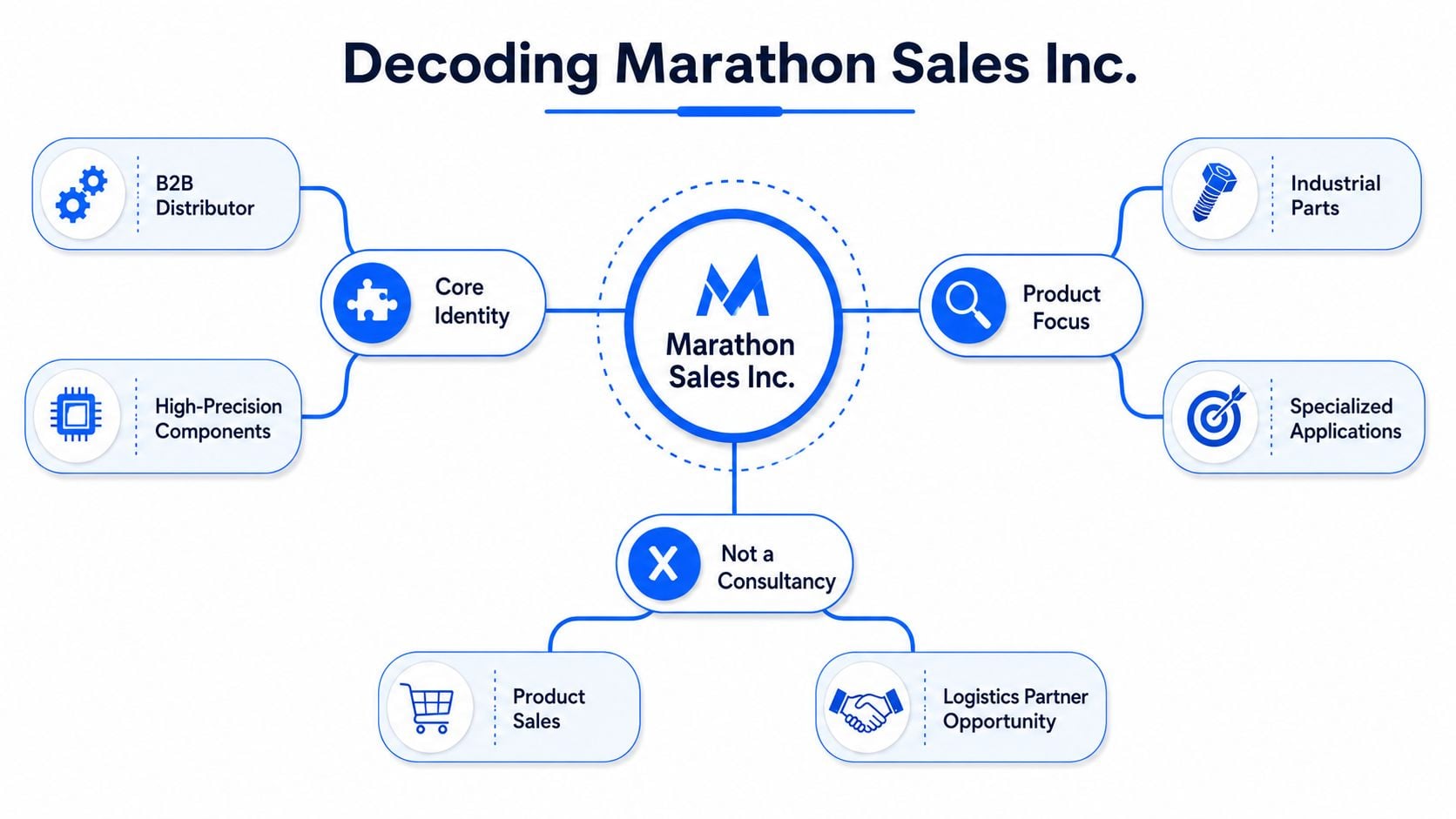
Decoding What Marathon Sales Actually Does
Marathon Sales Inc. is not a consulting brand built around sales advice. It operates in industrial component distribution, with a clear emphasis on precision die springs and related specialty products.
That distinction changes the freight conversation immediately. You're not pitching a generic B2B office account. You're looking at a company connected to manufacturing support, replacement cycles, and customers who buy parts because equipment has to keep running.
The product tells you the freight stakes
One concrete example matters here. Marathon Sales Inc. offers die springs engineered for extended cycle life, and a listed product, the MHC53 Red Die Spring (Part No. 14716), is priced at $606.75 in the Raymond die spring catalog. That single fact does two things for a freight rep.
First, it signals that this isn't low-concern commodity freight. Second, it suggests buyers may care more about getting the right part on time and in good condition than chasing the absolute cheapest transportation option.
What that means in plain language
Industrial spring distribution usually creates a different shipping profile than bulk consumer goods. The shipment may not be huge, but the operational importance can be. A delayed spring, incorrect SKU, or damaged package can create disproportionate pain if the receiving customer needs that component for toolroom, maintenance, or production support.
Use that logic when you frame the account.
Business reality
Freight implication
Specialized die springs
Accuracy matters more than broad generic service promises
Engineered industrial parts
Packaging, labeling, and shipment integrity matter
Buyers supporting equipment uptime
Expedited recovery options can become part of the sale
Don't sell trucks first. Sell protection against preventable downtime, mispicks, and ugly delivery surprises.
What works and what doesn't
What works is talking about shipment control. That includes shipment visibility, careful handling, and a plan for urgent replenishment.
What doesn't work is treating Marathon Sales Inc. like a high-volume retail shipper. A message about “low-cost nationwide freight” is too broad. A message about moving high-value industrial parts with fewer exceptions is closer to the mark.
For a freight forwarder, this is the opening. The product itself gives you the value proposition.
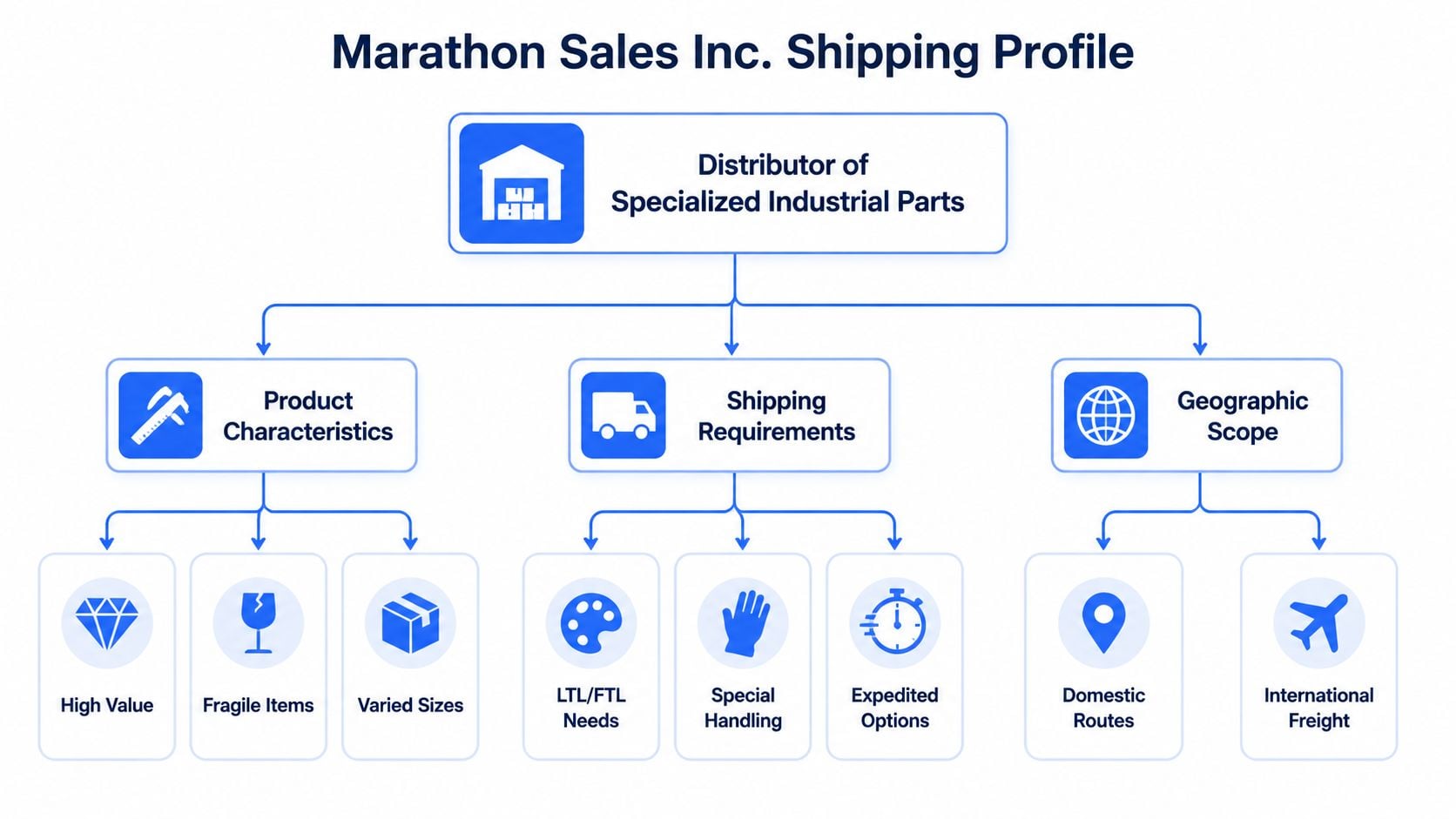
Analyzing Their Likely Shipping Profile
Once you strip away the misleading name, the shipping picture starts to form. Marathon Sales Inc. operates as a distributor under the Marathon Worldwide Inc. umbrella and offers products such as die springs, air tools, and abrasives through its catalog ecosystem. Their associated partner materials also reference ISO 9001:2000 quality standards, which points to a supply environment where consistency matters, as shown in the Marathon Sales Inc. catalogs page.
A distributor in that position usually creates a mixed freight profile. Not flashy. Not random. Steady, exception-sensitive, and operationally important.
The domestic profile a forwarder should expect
For a company handling specialized industrial components, domestic shipping likely centers on dependable replenishment. That usually points toward:
LTL for routine outbound orders going to manufacturers, maintenance buyers, and industrial customers.
Small parcel or courier-style moves for urgent parts where speed beats consolidation.
FTL or dedicated moves when bundled orders, supplier transfers, or regional stock repositioning justify it.
The important trade-off is simple. Cheap linehaul with poor exception management usually costs more when the consignee is waiting on a part tied to production.
Here's the video context worth reviewing before you pitch service options:
Where international support may matter
A distributor tied to specialized product lines can also create import or cross-border opportunities, even when the visible business looks local. If product sourcing or supplier coordination extends beyond one domestic region, your offer should include more than pickup and delivery.
Consider these likely needs:
Supplier-side coordination when origin readiness is uneven.
Customs and document support if components move internationally.
Airfreight fallback for line-down or short-notice replenishment.
Shipment segmentation so urgent parts aren't trapped inside slower consolidated moves.
The shipper may not ask for “supply chain design.” They'll ask why a needed part still isn't on the dock.
What to pitch first
Lead with service architecture, not mode jargon. For Marathon Sales Inc., the strongest opening usually sounds like this:
Reliable regional LTL execution
Expedite options for urgent industrial orders
Import and supplier coordination where product sourcing requires it
Clear escalation when a shipment misses plan
That's a better fit than a generic capacity blast. Industrial distributors don't need more emails about trucks. They need fewer freight problems.
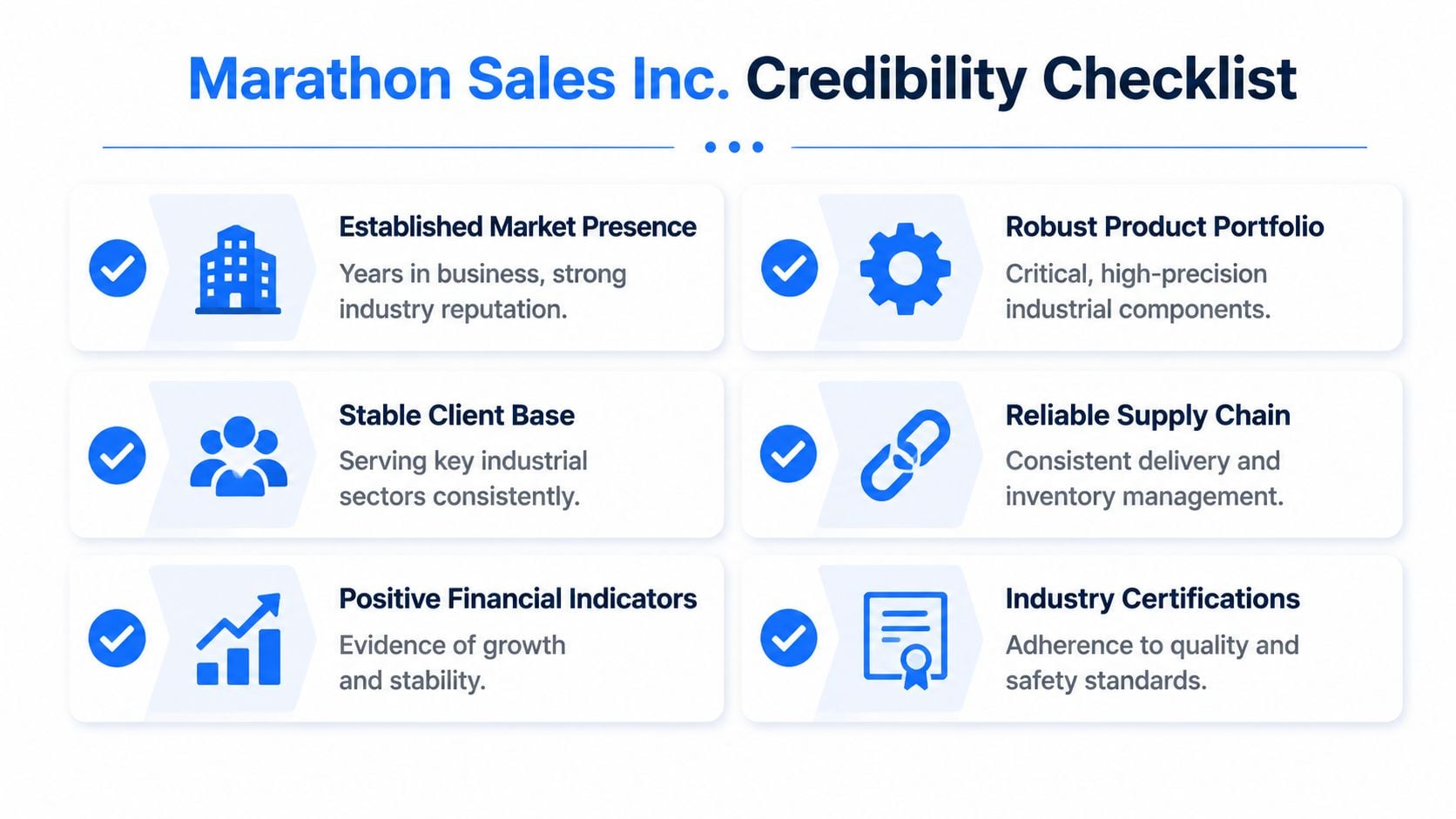
Verifying Credibility and Stability
Some leads look interesting on paper but fall apart once you check the basics. Marathon Sales Inc. doesn't have that problem.
The company was founded in August 1996 and has been continuously operated by its President and Owner, Joe Misiura, for exactly 30 years as of 2026, according to the available company profile information on Joe Misiura's LinkedIn reference. It also operates from a dedicated commercial facility at 9100 Louisiana Street, Merrillville, IN 46410, with stable weekday business hours listed there. For freight qualification, that's a strong set of signals.
Why this matters to a sales rep
Longevity under one owner usually changes the sales approach. You're not dealing with a brand-new operation still improvising suppliers and shipping habits. You're dealing with a business that has likely built routines, vendor preferences, and expectations around responsiveness.
That creates two realities:
The account is more credible, so the effort to research and personalize outreach is justified.
The account may be harder to displace, because stable firms often stay with providers until someone shows a clear operational improvement.
A practical qualification screen
Use this quick screen before you reach out:
Signal
What it means for freight sales
Long operating history
Lower chance you're chasing a temporary or thin account
Named owner leadership
Easier to map decision influence
Dedicated facility
Real pickup and delivery relevance
Stable business hours
Better alignment for routine operations and follow-up
If international sourcing or export support becomes part of the discussion, compliance readiness matters early. For non-EU companies shipping into Europe, this overview of an EORI application for non-EU businesses is a practical reference to keep in your toolkit.
Stable companies rarely switch providers because of a cold pitch alone. They switch when a rep shows they understand the operational consequence of failure.
One more useful frame is how reliability gets communicated. This article on reliable shipping services is relevant because it mirrors the kind of service language industrial distributors tend to respond to. They care less about broad marketing claims and more about whether you can execute under normal pressure.
Actionable Prospecting Tactics and Messaging
If you call Marathon Sales Inc. with a generic “we handle all your freight needs” pitch, you'll sound like everyone else. The better move is to speak to the account the way an operations-minded distributor would evaluate a forwarding partner.
Start with the likely decision map. In a company with long-term ownership and a specialized catalog, primary influence may sit with the owner, a sales operations contact, or whoever manages order flow and vendor coordination. Don't overcomplicate that. Your first objective is to send a message that proves you understand what they sell and why delivery reliability matters.
Messaging that matches the business
This is a better opening than the average freight intro:
We work with industrial shippers that can't afford delivery errors on specialized components. If your team is shipping die springs, tools, or related parts to manufacturing customers, we can compare where tighter exception handling or expedited backup would reduce service risk.
That works because it connects freight performance to customer outcomes. It also avoids pretending you know their full network before a conversation.
A weak version sounds like this: “We offer competitive rates across all modes.” That doesn't separate you from anyone.
Four angles that usually get traction
Protect the consignee experience Talk about on-time delivery, shipment accuracy, and escalation when an order goes off plan.
Support urgent replenishment Industrial distributors often need a fallback when standard transit won't do the job.
Reduce friction in mixed-mode shipping If some orders fit parcel, others need LTL, and a few need urgent air, say that plainly.
Bring structure to visibility If you use tools that improve execution discipline, mention the process, not the hype. This overview of the advantages of transport management systems is useful context for how TMS-driven workflows can help with shipment visibility, exception handling, and carrier coordination.
Keep the first outreach tight
Use short emails. Ask for a narrow conversation. Don't attach a rate sheet.
A workable sequence looks like this:
First email Reference their role in industrial component distribution and ask whether they review options for outbound LTL, expedites, or supplier-side freight coordination.
Follow-up call Mention a specific shipping risk, such as urgent replacement orders or delivery exceptions to manufacturing customers.
Second email Offer one operational idea, not a brochure. For example, propose a review of where standard routing is enough and where backup service should exist.
If you need a framework for sharpening that message, this guide to value proposition development is a practical way to tighten your wording around customer risk instead of freight features.
One tool-based option
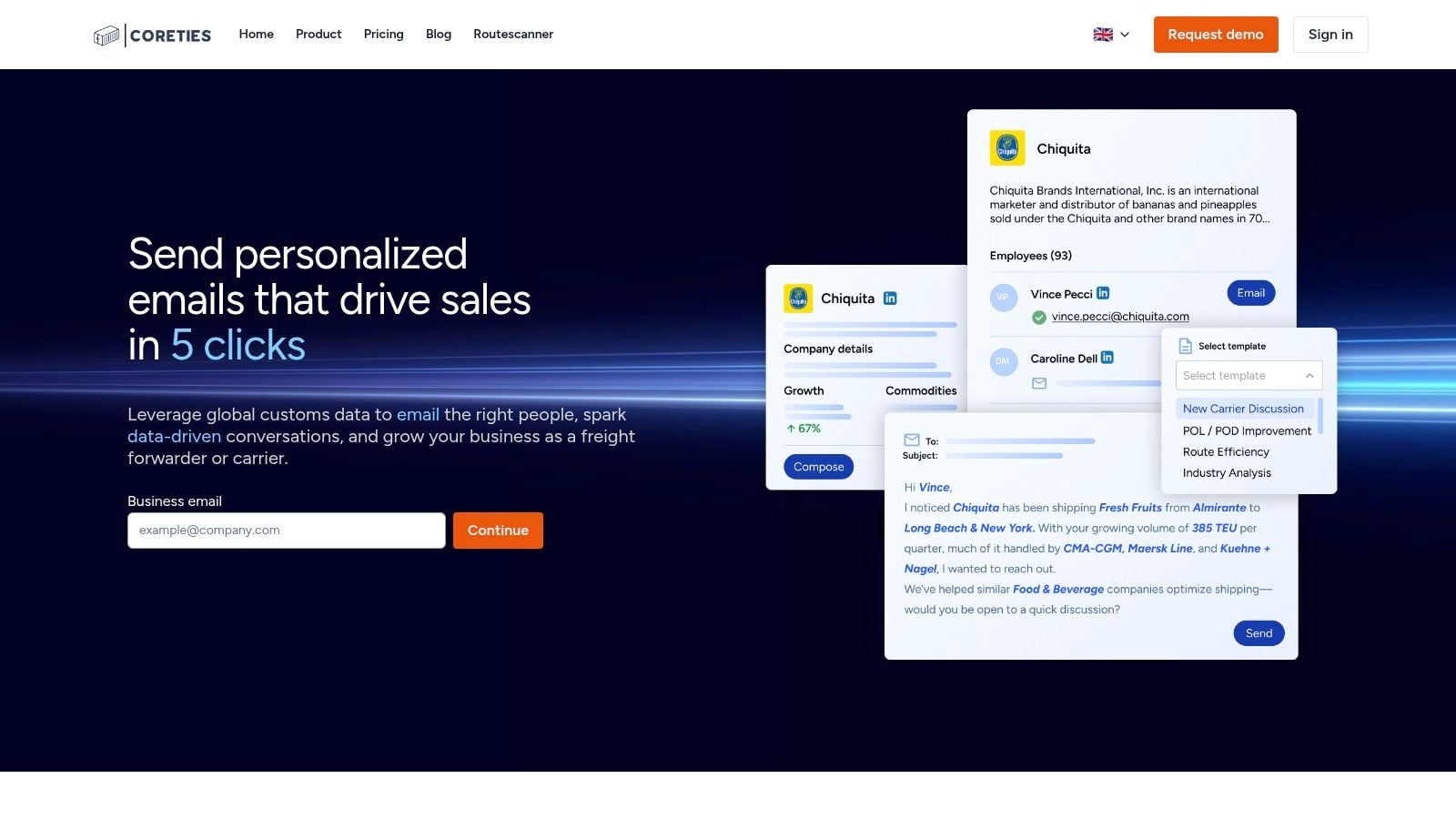
For teams prospecting similar industrial accounts at scale, Coreties is one option because it uses customs data to help identify shipper activity, relevant contacts, and outreach angles tied to trade lanes and buyer-supplier relationships. Used correctly, that helps you avoid blasting the wrong message to the right company.
The account doesn't need a flashy pitch. It needs a rep who can make freight sound useful.
Turning Insight into Your Next Opportunity
Marathon Sales Inc. is a good example of why surface-level prospecting fails. The name looks generic. The actual business is not. It points to industrial distribution, specialized components, and customers who likely care about reliability more than freight theater.
For a forwarder, that changes the playbook. You don't chase this lead with broad promises about capacity. You qualify the product role, map the likely shipping pressure points, and lead with service control. That's the repeatable part.
Use the same process on every ambiguous lead in your pipeline:
Check what the company really sells
Figure out what shipping failure would cost their customer
Look for stability signals before spending outreach effort
Write the message around risk reduction, not mode availability
That approach gets better results because it matches how industrial shippers think. They don't buy freight in the abstract. They buy confidence that the right product will arrive without creating downstream problems.
If you want to apply this prospecting method across more industrial shippers, Coreties helps freight teams turn customs data into qualified lead lists, find decision-makers, and build customized outreach around actual shipping activity instead of guesswork.
Monday starts with a full pipeline review. By Wednesday, half the “promising” accounts have stopped replying, one rep insists a stalled importer is still alive, and leadership wants a forecast that won't collapse by month-end. In logistics sales, that cycle gets worse when rates move, carrier capacity changes, or a shipper shifts lanes before your team notices.
Most freight sales teams still run on a mix of CRM notes, rep judgment, and whatever market context happens to be top of mind that week. That works until it doesn't. The result is familiar: too much time spent on low-fit leads, not enough focus on active shippers, and forecasts that feel more like educated guesswork than operating tools.
Predictive analytics for sales changes that. It takes the signals already flowing through your business and turns them into probabilities you can use. Not just “which deals might close,” but “which shippers are active now,” “which lanes matter most,” and “which accounts deserve attention before a competitor gets there first.” In logistics, that gets more powerful when you add data most general sales teams don't have, especially customs activity, trade lane movement, and routing options.
Beyond the Sales Pipeline Guesswork
A freight forwarder I've seen this with had plenty of leads on paper. The CRM looked healthy. Reps were busy. Management still had no clean answer to a basic question: which accounts were worth chasing this quarter?
The problem wasn't effort. It was signal quality.
One rep was calling manufacturers that hadn't shipped internationally in months. Another was working an account with real volume, but no one noticed the company had already shifted traffic toward a different port pairing. A third was forecasting a large opportunity based on one good meeting, even though the deal had gone quiet. The team wasn't short on activity. It was short on reliable direction.
That's where the shift starts. Predictive analytics doesn't ask sales to stop selling and become data scientists. It gives sales teams a better operating system for deciding where to spend time. Instead of treating every open deal and every inbound name as roughly equal, it helps rank opportunities by likely value, urgency, and fit.
What changes in day-to-day sales work
The practical difference shows up fast:
Lead reviews get tighter: Reps stop chasing every shipper that matches a broad industry filter.
Forecast calls get less theatrical: Managers can challenge optimism with evidence, not just instinct.
Territory planning gets sharper: Teams can see where activity is building instead of relying on old account lists.
If you're also thinking about workflow and execution, in that context, process matters as much as data. A good primer on AI sales automation implementation is useful because predictive insight only matters if your team can act on it consistently.
Practical rule: If your reps still need to manually guess which accounts deserve attention first, you don't have a sales intelligence process. You have a hope-based prioritization process.
Logistics sales is too volatile for that. The teams that win more often usually aren't working harder across the board. They're focusing harder on the right accounts at the right time.
What Predictive Sales Analytics Really Means for Logistics
Think of predictive sales analytics like a weather forecast for your book of business. A basic report tells you what the weather was yesterday. A predictive system tells you what's likely to happen next, where risk is building, and where conditions are favorable if you move early.
That distinction matters in freight. Historical reporting tells you which shipper closed, which rep hit target, and which region lagged. Useful, but late. Predictive analytics for sales shifts the question from “what happened?” to “what is likely to happen if current patterns continue?”
According to Varicent's explanation of predictive sales forecasting, predictive analytics for sales became mainstream because it converts historical pipeline and customer data into probabilistic forecasts rather than simple rep roll-ups. Modern setups commonly combine CRM records, territory data, rep activity, and customer engagement signals to assign confidence scores to deals. That's the difference between a static estimate and an operating view that changes as conditions change.
Why logistics teams need a different lens
In logistics, “sales data” isn't only what lives in the CRM. It also includes operational clues that signal intent and fit:
Shipment activity: Whether a prospect is actively importing or exporting.
Lane concentration: Which origins, destinations, and modes define the account.
Routing complexity: Whether the shipper's movement pattern fits your network strengths.
Buying urgency: Whether recent activity suggests a near-term opening.
A generic B2B sales model might score an account based on email opens and meeting history. A logistics-focused model should also ask whether the shipper is moving freight on lanes you can serve competitively, whether volume is stable enough to matter, and whether timing suggests an opportunity to displace an incumbent provider.
From reactive selling to proactive targeting
This is the strategic gain. Predictive systems let teams prioritize deals with the highest close probability and spot at-risk opportunities earlier. In practice, that means a sales manager can stop treating every late-stage deal as equally solid, and a rep can stop building a week around accounts that look attractive but show weak buying signals.
A forwarder doesn't need more names in the CRM. It needs a defensible reason to call one importer before another.
That's why the weather forecast analogy works. The point isn't certainty. The point is better preparation. If your data shows a shipper's lane profile, shipping cadence, and engagement pattern are lining up, that account deserves action now. If the signals are weak, you don't ignore the lead forever. You just stop pretending it belongs at the top of the list.
Unlocking Insights with the Right Data and Models
Most sales teams don't fail with predictive analytics because the math is weak. They fail because the inputs are ordinary.
If your model only sees CRM stage, deal size, and last-touch activity, it can improve basic forecasting, but it won't give a logistics seller much edge. The teams that get real value feed the model with data that reflects how freight moves and how buying decisions really happen.
Start with the core commercial signals
Every predictive setup still needs the standard foundation:
CRM history: Won and lost opportunities, stage movement, close timing, and account type.
Rep activity: Calls, meetings, follow-up cadence, and response gaps.
Customer engagement: Email interaction, meeting attendance, and quote requests.
Territory context: Region, vertical, product focus, and account ownership.
That foundation matters because predictive sales analytics is built to be measurable. Scoop Analytics notes that models commonly analyze 50+ variables at once and are often described as delivering 85% to 95% forecast accuracy. The same source also points to methods such as time-series analysis, regression, and machine learning techniques like random forests, which support both revenue forecasting and lead scoring.
Those methods sound technical, but the sales use is straightforward. One model estimates likely revenue by looking at pipeline patterns. Another scores which leads resemble accounts that historically convert. A third can flag retention risk or stalled opportunity behavior.
The logistics edge comes from external trade data
Most freight teams can separate themselves here.
Customs data changes lead generation from broad prospecting to evidence-based targeting. Instead of asking, “Which manufacturers should we call in Germany or Texas?” you can ask better questions:
Which companies are actively importing from a lane we know well?
Which shippers show repeated movements that fit our service mix?
Which accounts appear large enough to matter, but specialized enough to need a better forwarding partner?
Routing data adds another layer. If you know how a shipper is moving and what route options are realistically available, you can move from generic outreach to a more credible commercial conversation.
For teams building a better data foundation, this overview of supply chain databases is a useful reference because it shows how fragmented market intelligence can be stitched into a more usable prospecting system.
Use simple model categories, not abstract jargon
Logistics teams don't need to obsess over algorithm names first. They need clarity on what each model is supposed to do.
Model type
Practical use in logistics sales
Lead scoring
Rank shippers by likely fit and sales potential
Opportunity scoring
Re-rank open deals as activity and conditions change
Churn or attrition modeling
Flag customers whose shipping behavior or engagement is weakening
Forecasting models
Estimate likely revenue from the current pipeline
Next-best-action logic
Suggest whether a rep should call, quote, revisit a lane, or deprioritize
Better models don't rescue weak commercial thinking. They amplify it. If your team can't define what a high-value shipper looks like, the model won't define it for you.
The strongest predictive programs in logistics usually start with one sharp question, not a giant analytics project. Which accounts should we call first? Which lanes should we build around? Which deals are getting softer than the rep thinks? Once the data answers those questions reliably, everything downstream gets easier.
Your Roadmap to Implementing Predictive Analytics
The biggest objection I hear is simple: our data is messy. That's usually true. It also isn't a reason to wait.
Predictive analytics works best when teams treat implementation as a business discipline, not a one-time software install. Park University's overview of predictive analytics makes this point clearly. Successful implementation depends on collecting, cleaning, validating, deploying, and refining data and models over time. Without that pipeline, forecast quality degrades. The same source highlights a practical use case that matters in sales leadership: earlier intervention, including identifying missed-quota risk weeks in advance.
A phased rollout works better than a grand launch.
Clean the few fields that actually matter
Don't begin by trying to perfect every record in your stack. Start with the fields that shape sales decisions.
The minimum set usually includes:
Opportunity stage integrity If reps use stages inconsistently, your model will learn noise. Define what each stage means in operational terms.
Close date discipline Deals with endlessly rolled dates distort forecast timing and rep behavior.
Account segmentation Separate strategic shippers, transactional accounts, and speculative targets. A model should not evaluate them the same way.
Lane and service tagging For logistics teams, this is critical. If your system can't distinguish key trade lanes or mode preferences, it can't prioritize accurately.
Pick one business use case first
At this stage, many teams overcomplicate the project. They try to predict everything at once.
Choose one of these first:
Best-fit shipper identification
Open opportunity scoring
Quarterly revenue forecasting
At-risk customer detection
If you're a freight forwarder growing new business, the first two are usually the highest-impact starting points. They affect who gets called, which deals get management attention, and how much wasted effort stays in the funnel.
For companies reviewing their wider tech stack, this guide to software for freight forwarding companies helps frame where predictive tools fit alongside operational and commercial systems.
Test against real seller judgment
Don't hide the model in a dashboard and declare success. Put it next to rep judgment and compare outcomes in live workflows.
A useful review cadence looks like this:
Weekly: Compare model-ranked priorities with rep-selected priorities.
Biweekly: Review whether flagged deals advanced, stalled, or slipped.
Monthly: Check whether lead quality improved at the opportunity level.
Here's a practical explainer on the broader implementation flow:
The point of testing isn't to “beat” your salespeople. It's to find where human pattern recognition is strong and where bias keeps creeping in. Experienced reps often know things the system doesn't. They also overestimate familiar accounts, cling to old relationships, and defend weak deals longer than they should.
Build adoption into daily work
A model no one trusts becomes reporting furniture.
To avoid that, sales leaders should make predictive output operational:
Use scores in pipeline reviews: Don't discuss opportunity health without them.
Tie account prioritization to workflow: Reps should see ranked accounts inside the rhythm of prospecting.
Explain why scores move: If confidence drops because deal age rises and activity stalls, the rep needs to see that logic.
If a seller can't tell why a score changed, they won't use it. They'll go back to instinct at the first sign of friction.
Adoption gets easier when the system produces a few obvious wins early. A rep rescues a deal the model flagged as deteriorating. A manager reassigns attention to a lane with better fit. A low-drama account becomes a strong opportunity because external shipment data revealed actual urgency. Those moments create trust faster than any training deck.
From Prediction to Action with Coreties
Most predictive analytics projects stop one step too early. They identify a pattern, assign a score, and leave the rep to figure out what to do next. That's useful, but incomplete.
The stronger commercial model is prescriptive. Bain describes this shift in its discussion of prescriptive analytics in sales and marketing. The direction is moving from prediction toward machine learning that recommends who to target, when to engage, and what price or discount to offer. For freight sales teams, that translates into lane-specific and account-specific decision support, not just generic lead ranking.
What this looks like in logistics selling
A logistics rep usually needs four things before outreach is worth the time:
Need
Why it matters
Evidence the shipper is active
Avoid dead or irrelevant accounts
Visibility into lane behavior
Match your strengths to real trade flows
Access to the right contact
Turn intelligence into conversation
A credible offer angle
Give the buyer a reason to respond
That's where a platform like Coreties fits in practical terms. It turns global customs data into prospect lists for freight forwarders, carriers, and logistics teams, then helps users identify decision-makers and personalize outreach by location, department, and lane focus. Through its Routescanner partnership, it also supports end-to-end routing suggestions based on customs activity plus intermodal and carrier schedules.
That combination matters because it closes the gap between signal and action. Instead of saying, “This importer looks interesting,” a rep can work from a tighter brief: this shipper is active on a relevant lane, these are the likely stakeholders, and here is a routing angle worth discussing.
Why prescription beats raw prediction
A plain predictive model might tell you that a shipper has high potential. A prescriptive workflow goes further:
It narrows the target list to accounts with active and relevant freight behavior.
It helps shape the message around actual lanes, origin points, or modal patterns.
It gives the rep a sales opening that sounds informed instead of generic.
It supports faster follow-up because the account research is already structured.
This is especially important in logistics because buyers can spot shallow prospecting immediately. If your email says you “support global shipping needs,” you sound like everyone else. If your outreach reflects an understanding of the shipper's trade lane or routing reality, the conversation starts at a different level.
In freight sales, prediction creates focus. Prescription creates momentum.
That's the competitive edge. Not analytics for the sake of dashboards, but analytics that tells the rep where to go, what to say, and how to frame value in a way the shipper recognizes as credible.
Measuring Success and Avoiding Common Pitfalls
The easiest way to kill a predictive sales initiative is to judge it only by whether the final quarter number came in. That's too blunt. You need indicators that show whether the model is improving commercial decisions before revenue closes.
Weflow's guidance on predictive sales forecasting is useful here because it frames predictive analytics as a probability-weighted forecasting system rather than a simple roll-up. It also recommends tracking KPIs such as forecast accuracy, win rate by segment, average deal age versus baseline, pipeline coverage ratio, and slipped-deals percentage to separate signal from noise.
Key performance indicators for predictive sales analytics in logistics
KPI
What It Measures
Why It Matters
Forecast accuracy
How closely projected revenue matches actual outcomes
Shows whether your forecasting model is becoming more reliable
Win rate by segment
Conversion performance across account types, industries, or lanes
Reveals where the model is helping the team focus better
Average deal age versus baseline
How long opportunities stay open compared with normal patterns
Flags stalled deals earlier and improves coaching decisions
Pipeline coverage ratio
The relationship between pipeline and expected bookings
Helps managers judge whether coverage is healthy or inflated
Slipped-deals percentage
The share of deals that move out of the expected close window
Exposes optimism bias and weak pipeline hygiene
Lead-to-qualified-opportunity conversion rate
How often targeted leads become real sales opportunities
Tests whether predictive targeting is improving prospect quality
Win rate by trade lane
Close performance on specific origin-destination patterns
Matters in logistics, where lane fit often drives competitiveness
Sales cycle length
The time it takes to move from first contact to closed business
Helps teams see whether better prioritization is reducing wasted motion
For teams working on the front end of funnel quality, this guide on how to improve conversion rates is relevant because better targeting only matters if it improves progression into qualified opportunities.
The mistakes that show up most often
Three problems derail these projects more than any algorithm issue.
Treating it like an IT rollout Predictive analytics for sales has to change rep behavior, manager reviews, and account prioritization. If it lives only with ops or data teams, it won't stick.
Assuming more data automatically means better output More fields don't help if stage definitions are loose, lane tags are missing, or customer records are fragmented.
Forgetting ongoing governance Models drift when the business changes. New trade lanes, service changes, market disruptions, and sales process shifts all affect signal quality.
The companies that get value from predictive analytics don't chase perfect certainty. They build a system that helps sellers make better choices, earlier and more consistently, than they could with instinct alone.
If your team wants a more practical way to find active shippers, focus on the right lanes, and turn market data into outreach that sales can use immediately, Coreties is worth evaluating. It's built for logistics teams that need lead discovery and action in the same workflow, not another disconnected dashboard.
Your team is probably doing more activity than ever. More outbound emails. More quote requests. More follow-ups. More website traffic reports in the weekly meeting.
And still, the pipeline feels thin.
That's the trap in logistics sales. Teams think they have a conversion problem because the website form isn't converting, or because outbound reply rates feel soft, or because prospects ghost after the first call. Usually the underlying issue sits earlier and deeper. The wrong accounts enter the funnel. The message is generic. The offer asks for too much too soon. The website adds friction right when a shipper is ready to engage.
In freight forwarding, knowing how to improve conversion rates isn't about squeezing a few more clicks out of a landing page. It's about building a path from first signal to first conversation, then from conversation to quote, then from quote to a real commercial relationship.
Rethinking Conversions Beyond the Quote Button
A common scene in logistics sales looks like this. A rep sends a large batch of emails to importers and exporters, gets a handful of opens, almost no replies, and one vague quote request from a company that was never a fit to begin with. Marketing says traffic is up. Sales says lead quality is down. Nobody trusts the numbers.
The mistake is defining conversion too narrowly.
In logistics, a conversion isn't just a completed website form. In many cases, the highest-value conversion is a qualified meeting, a lane-specific inquiry, a first meaningful reply from the right decision-maker, or a shipper agreeing to review a routing option. Broader B2B guidance makes the same point. Teams should optimize the entire customer journey, not just landing pages, and use lower-friction offers earlier in the funnel when the buyer isn't ready for a hard commitment yet, as noted in WordStream's guidance on improving conversion rates.
What logistics teams often get wrong
Most underperforming sales motions focus on volume before fit.
They ask for a quote request before earning attention. They send traffic to a generic homepage. They measure raw lead count instead of whether the account matches target trade lanes, shipment profile, or buying role. If that's your process, you don't have a conversion optimization problem at the end of the funnel. You have a qualification and sequencing problem from the start.
Practical rule: In freight, the first conversion should match the buyer's intent. If they're early, offer insight. If they're active on a lane, offer relevance. If they're comparing providers, offer proof.
That's why many outbound teams get more useful ideas from specialized resources like EmailScout conversion strategies than from generic ecommerce CRO playbooks. The sales motion is different. You're not selling a low-risk impulse purchase. You're trying to start a credible commercial conversation.
The conversion path that actually matters
A freight buyer rarely moves from cold click to closed business in one step. The path usually looks more like this:
Discovery: The shipper becomes aware of your company through outreach, referral, search, or market visibility.
Validation: They decide whether you understand their lane, commodity, timing, and service expectations.
Engagement: They reply, book a meeting, or ask a practical question.
Commercial review: They compare you against incumbents and alternatives.
Commitment: They send an opportunity, test shipment, or formal RFQ.
This is why logistics teams benefit from aligning sales and marketing around the same funnel language. A useful starting point is to map what counts as a real conversion at each stage, then build messaging and pages around those steps. Coreties has a strong overview of that alignment in its article on logistics sales.
If you treat every visitor and every prospect as if they're ready to request a quote today, you'll lose the ones who needed a smaller next step first.
Build Your Baseline with Data Driven Prospecting
If you can't see where deals stall, you can't fix the funnel. Most logistics teams track activity. Fewer track conversion.
The baseline shouldn't start with website visits. It should start with commercial movement through the funnel you run.
Track the stages that lead to revenue
Use a simple operating view. You need to know how many target accounts enter the funnel, how many engage, how many become meetings or quote opportunities, and where they fall out.
A clean baseline usually includes metrics like these:
Funnel stage
What to watch
Why it matters
Lead identified
Fit by shipper type, lane, geography, and buying role
Bad inputs distort every later metric
Outreach engaged
Replies, meaningful responses, and conversation starts
Shows whether the message earns attention
Meeting created
Qualified calls or discovery meetings booked
Confirms real sales traction
Proposal or quote sent
Commercial opportunities opened
Separates interest from actual evaluation
Closed business
New account wins or test shipments
Ties conversion work to revenue
A lot of teams skip the first line and start measuring from outreach. That hides the biggest problem. If your list is weak, your reply rate and close rate will always look worse than they should.
Better prospecting improves conversion before outreach starts
The way logistics differs from generic lead generation advice is clear. The strongest lift often comes from selecting prospects based on verified shipping relevance, not guessing who might need a forwarder.
A shipper active on your target trade lane is a different prospect from a company that merely fits your ICP on paper. One has real operational context. The other is just a logo.
The easiest conversion gains often come before the first email. Better targeting removes wasted outreach, improves message relevance, and makes every later stage easier to win.
That's also why broad advice on optimizing conversion rates only gets you part of the way. Measurement matters. But in freight, the commercial quality of the account list matters just as much.
Build the baseline in the right order
Here's the order I'd use with any freight sales team:
Define the target account profile. Start with lane focus, shipment mode, geography, and company type. Don't let the list become “any importer.”
Tag current funnel stages. Every prospect should sit in one stage only. If your CRM says everything is “open,” your data is useless.
Review message-to-market fit. Compare replies from lane-specific outreach versus generic service-led outreach.
Separate soft conversions from hard conversions. A click is not a meeting. A meeting is not a quote. A quote is not a shipper testing your service.
Audit source quality. If one source produces conversations and another produces silence, stop pretending all leads are equal.
For teams working in freight, customs-based lead discovery can make that first stage far more practical because it helps narrow the market to companies with visible trade activity. One example is Coreties' guide to generating leads in logistics, which focuses on identifying shippers with clearer commercial relevance instead of building outbound lists from broad firmographic filters alone.
Once that baseline is in place, you stop asking, “How do we get more leads?” and start asking the better question. “Where exactly are qualified shippers dropping out, and why?”
Craft Outreach That Actually Gets a Reply
Most freight outreach fails in the first sentence.
It sounds like every other forwarding email in the inbox. “We offer reliable logistics solutions.” “We'd love to support your imports.” “Can we quote your shipments?” None of that proves you understand the shipper's operation, and none of it lowers risk.
The generic version versus the useful version
Here's the kind of message buyers ignore:
Hi, we are a freight forwarder offering competitive rates and reliable service for sea and air freight. Please let us know if you have any shipments we can quote.
There's no context. No buyer-specific relevance. No reason to trust the sender.
Now compare that to a message built around actual shipping context:
Hi Sarah, I saw your team is active on transpacific imports into the U.S. We've been helping shippers review routing options where consistency and response time matter more than chasing the cheapest spot rate. If your team is reviewing alternatives on that lane, I can share a practical comparison based on your current flow.
That second message works better because it matches the buyer's likely intent. In high-consideration B2B sales like freight, conversion gains come from matching the offer to intent and reducing perceived risk. Prospects need enough information to convince themselves, and proof of routing competitiveness, responsiveness, and domain expertise often matters more than generic persuasion, as explained in Unbounce's conversion rate guidance.
What good logistics outreach includes
A strong first-touch email usually has four traits:
Operational relevance: Mention the lane, mode, geography, or shipment pattern that makes the outreach credible.
A modest ask: Don't jump straight to “send me your freight.” Ask for a short review, a comparison, or a quick conversation.
A risk reducer: Show what the buyer will learn or gain without committing to a supplier switch.
Commercial maturity: Write like someone who understands service execution, not just sales scripts.
That's the difference between cold outreach and informed outreach. One interrupts. The other starts a business conversation.
Personalization that scales without sounding fake
Personalization in freight doesn't mean dropping in a first name and company name. It means writing from a real signal.
Signals can include:
Weak personalization
Strong personalization
“Saw your website”
“Your team appears active on the Rotterdam to U.S. East Coast flow”
“We help importers”
“We support shippers who need tighter communication on time-sensitive imports”
“Can we quote?”
“Would it help if we reviewed routing options before your next tender cycle?”
The key is restraint. Don't pretend you know everything about the account. Use enough context to prove relevance, then make a next step easy.
If you want to operationalize this, platforms that combine contact data with shipping context are more useful than generic sequencing tools alone. A practical example is personalization at scale for logistics outreach, where the emphasis is on pairing account insight with message variables that sales teams can use.
Good outreach doesn't sound more polished. It sounds more informed.
Optimize Your Digital Front Door for Shippers
A freight website often loses conversions for a simple reason. It asks the buyer to do too much.
Too many form fields. Too many menu options. Too many competing buttons. Too much copy about the company, not enough clarity about the next step.
Simplicity converts better than completeness
One of the clearest lessons in conversion work is that fewer options often outperform more options. In a well-known experiment cited by Invesp, shoppers who saw fewer jam choices were ten times more likely to buy than shoppers who saw the larger assortment, according to Invesp's summary of the jam study.
That lesson applies directly to logistics websites.
A shipper landing on your reefer page, customs page, or quote page should not have to choose between five service paths, a newsletter signup, three case studies, and a chatbot prompt. They should see one clear next action.
Remove options until the path feels obvious. Most logistics sites don't need more persuasion. They need less friction.
What to remove first
If you want to know how to improve conversion rates on quote pages, start by subtracting.
Extra form fields: If the first interaction is exploratory, ask only for what sales needs to respond.
Competing calls to action: A page should push one main action, not three equal ones.
Navigation leaks: On campaign landing pages, broad site navigation often pulls attention away from the conversion goal.
Generalized copy: If the page targets a specific lane or shipment type, the headline and body copy should reflect that.
What to add carefully
Simplicity doesn't mean emptiness. It means every element has a job.
A strong logistics landing page usually benefits from:
Intent match If someone clicked from an email about reefer exports or a lane-specific ad, the page should continue that exact conversation.
Trust proof tied to risk Generic “we are reliable” copy is weak. More useful proof answers the buyer's hesitation. Can you handle this lane? Will you respond quickly? Do you understand the cargo and routing constraints?
A practical next step “Request a quote” works later in the journey. Earlier on, “Discuss your current lane setup” or “Review routing options” can feel lower-friction.
Here's a simple comparison:
Page element
High-friction version
Better version
Hero section
Multiple services and offers
One lane-specific or buyer-specific message
CTA
Several buttons with equal weight
One primary next step
Form
Full qualification on first touch
Short intake with room for sales follow-up
Proof
Generic company claims
Buyer-relevant examples and reassurance
Shippers already deal with complexity in procurement, service levels, and internal approvals. Your website shouldn't add another layer.
Implement a Smart Testing and Follow-Up Plan
Most logistics teams change messaging based on opinion. Sales likes one subject line. Marketing prefers another. Leadership wants a stronger value proposition. Nobody can prove what works.
Testing fixes that.
Test one meaningful variable at a time
A/B testing is useful because it turns preference into evidence. Best practice is to split traffic 50%/50% between two versions and guide users toward one primary next step, as outlined by CXL's A/B testing guidance. CXL also recommends running at least one, preferably several tests at a time so teams can keep learning instead of waiting on a single idea.
For freight teams, that doesn't have to mean complex software experiments. Start with the points where buyers make decisions.
Test areas like:
Subject lines: One version focused on lane relevance, another on the buyer's likely problem.
Opening lines: One that leads with shipping context, another that leads with an operational outcome.
Primary CTA text: “Request a quote” versus “Review routing options.”
Landing page headline: One focused on capability, another on the buyer's current pain point.
Form structure: Shorter versus longer first-touch intake.
A simple testing framework for sales teams
Use this sequence:
Pick one conversion point. Reply, meeting booked, form completion, or another stage that matters.
Write one clear hypothesis.
Change one thing only.
Send or publish both versions under similar conditions.
Keep notes on what changed, when, and why.
Roll the winner forward, then test the next issue.
Field rule: Don't redesign the whole system when one sentence, one form field, or one CTA is the real problem.
Follow-up that adds value
Testing gets you the first lift. Follow-up wins the deal.
The worst follow-up in freight is “just checking in.” It creates work for the buyer and adds no information. Better follow-up gives the prospect a reason to re-engage.
A useful cadence often looks like this:
Touch
What to send
Why it works
First follow-up
Short reminder tied to original context
Keeps continuity without restarting the pitch
Second follow-up
Relevant market update or lane observation
Adds value and shows commercial awareness
Third follow-up
Routing option or service angle worth reviewing
Makes the conversation concrete
Fourth follow-up
Simple close-the-loop note
Respects the buyer's time
This is one place where tools can make the process less manual. For example, Coreties can surface shipper activity, contact details, and routing context in one workflow, which makes it easier to build follow-ups around actual relevance instead of generic persistence.
Putting It All Together with the Coreties Playbook
Strong conversion performance in logistics doesn't come from one trick. It comes from a system.
The system starts with better account selection. Then it moves into outreach that reflects real shipping context. Then it sends the buyer to a page that matches the conversation and makes the next step easy. After that, the team tests the weak points and follows up with substance instead of noise.
That sounds straightforward, but most sales teams run those steps in separate tools and disconnected workflows. Prospecting happens in one place. Contact research happens in another. Messaging lives in rep-specific templates. Routing ideas sit with operations. Landing pages sit with marketing. The result is friction inside your own sales motion.
That's where the operating model matters more than any one tactic.
A practical freight conversion playbook usually looks like this:
The pieces that need to connect
Discovery based on real shipper relevance Start with companies that fit your lane and market focus, not broad lists built from generic databases.
Contact access tied to commercial context A name and email address are only useful if the rep also knows why the account is worth contacting now.
Personalized outreach built from signals The first message should reflect activity, geography, or service context that the buyer recognizes.
A dedicated next step If the outreach is specific, the landing page or reply path should be specific too.
Testing discipline across the funnel Teams need a repeatable way to improve subject lines, CTAs, forms, and follow-up sequences over time.
Teams looking at optimizing outbound campaign conversions often focus on the messaging layer alone. That matters, but outbound only converts consistently when the list quality, context, offer, and next step are aligned.
Coreties fits this workflow because it combines customs-based lead discovery, decision-maker contact data, personalized outreach support, and routing context in one process. In practice, that helps logistics teams turn scattered sales activity into a more repeatable conversion engine.
If you're serious about how to improve conversion rates, don't start with cosmetic changes. Start by tightening the path from market signal to sales conversation.
If you want a cleaner way to identify qualified shippers, reach the right contacts, and run more relevant outbound campaigns, take a look at Coreties. It's built for freight forwarders, carriers, and logistics sales teams that want a more systematic route from prospecting to conversion.
You can feel the problem in a freight sales team before you even open the CRM. Reps are sending outreach every day, the activity log looks busy, and almost none of it turns into a real conversation. The emails are polite, the subject lines are passable, and the pitch says all the usual things about reliability, coverage, and service. Buyers still ignore it.
That happens because most logistics outreach is written from the seller's point of view. It talks about the forwarder, not the shipment. It names the service, not the lane. It asks for time before it gives a reason.
Personalization at scale fixes that, but only when it's built on actual trade signals. In freight, that means using customs activity, routing context, and contact-level decision-maker data to send outreach that sounds like it came from someone who understands the account. Not someone blasting a list.
Why Generic Outreach Is Costing You Deals
A rep pulls a list of importers. They load a sequence. They send a batch of emails that says some version of, “We help shippers optimize supply chains and reduce costs.” Then they wait.
Nothing happens because that message could have gone to anyone.
A shipper moving regular containers from Asia to the U.S. has different concerns than a company testing a new Europe lane. An importer with recurring customs entries needs a different conversation than a buyer with occasional project freight. When the message ignores those differences, the prospect has to do the work of figuring out whether you're relevant. Most won't bother.
Relevance beats volume
The case for changing your approach isn't theoretical. Companies that excel at personalization generate 40% more revenue from those activities than average players. Personalization can also deliver 5–8 times the ROI on marketing spend and lift sales by 10% or more, according to McKinsey research summarized by Contentful.
That matters in logistics sales because the margin for boring outreach is gone. Buyers already get flooded by generic freight pitches. If your email doesn't connect to a lane, a shipment pattern, a sourcing shift, or a routing problem, it gets treated like the rest.
What generic freight emails usually get wrong
Most underperforming outreach has one or more of these flaws:
It starts with the seller: “We are a global freight forwarder…” doesn't answer the buyer's first question, which is why you're contacting them now.
It uses weak segmentation: “Importers in manufacturing” is too broad to drive a sharp message.
It hides the commercial point: The rep knows they want a meeting, but the prospect can't see what insight earned that ask.
It sounds automated in the wrong way: Inserted first names don't count as personalization at scale.
Practical rule: If you can swap the company name and send the same email to a cosmetics importer, an auto parts buyer, and a furniture shipper, the message is still generic.
The strongest logistics outreach feels specific without being invasive. It says, in plain language, “I noticed your business is active on this lane or in this trade pattern, and there may be a routing or coverage conversation worth having.” That's a very different email from a standard sales blast.
Building Your Data Foundation for Smarter Outreach
Personalization at scale became feasible when companies moved from fragmented records to unified profiles. Industry guidance described that shift as combining purchase, browsing, app, and preference data in one profile, and the market for customer experience personalization software was expected to surpass $9 billion by 2023, reflecting how fast companies invested in systems that can act across large profile sets, as noted in Bloomreach's guide to personalization at scale.
In freight sales, that same principle applies. You need one prospect view that combines shipment activity, lane context, and who owns the buying conversation.
The three data layers that matter in logistics
Teams don't typically have a lead problem. They have a data-shape problem. The records are scattered, stale, or disconnected from how freight is sold.
Here's the base stack that supports smarter outreach:
Customs data: This tells you what the company is moving, where it's moving, how often activity shows up, and whether the pattern is regular or opportunistic.
Professional data: This connects the account to a real buyer or operator. Job title, department, geography, and seniority change the angle of the message.
Routing data: This makes sales interesting. It lets you move from “we offer forwarding” to “there may be a better option for this lane structure or service requirement.”
A lot of teams handle these in separate tools. Customs in one place. Contacts in another. Notes in the CRM. Routing knowledge in the head of one experienced rep. That setup slows everything down.
What a unified record should let you do
A useful account record should answer these questions fast:
Is this shipper active enough to prioritize?
Which lanes define the account right now?
Who likely owns freight decisions or supplier review?
What angle gives the rep a credible reason to reach out?
That's where enrichment matters. If your CRM still relies on half-complete records, it's worth reviewing Distribute.you's CRM data guide, which is a practical read on cleaning and enriching account data before automations amplify the mess.
One platform approach in this category is Coreties' article on generating leads in logistics, which reflects the same operational point. Raw customs records become more useful when the sales team can turn them into filtered prospect groups tied to actual contacts and outreach workflows.
Good freight prospecting data doesn't just tell you who exists. It tells you why the account belongs in your pipeline this month.
What not to collect first
Teams get stuck when they try to capture everything upfront. They enrich too many fields, build overcomplicated scoring, and delay outreach until the CRM looks perfect. That usually ends with stale lists and no learning.
A better approach is narrower:
Start with activity you can act on: lane movement, shipment recurrence, and responsible contacts.
Ignore trivia: if a field won't change your message or your prioritization, it doesn't belong in the first build.
Unify before expanding: one clean view beats five disconnected “sources of truth.”
That's the foundation of personalization at scale in freight. Not more data. Better sales context.
Intelligent Segmentation Beyond Firmographics
Most logistics teams still segment the old way. Industry. Revenue band. Employee size. Country. Those fields are fine for territory planning, but they're weak for outreach because they don't explain shipping behavior.
A sales rep doesn't win attention because the account has a certain headcount. They win attention because they can connect their message to a lane, a flow, or a timing issue the prospect already cares about.
McKinsey's guidance on personalization recommends building a unified data layer and then using behavioral data to create microsegments, with a small cross-functional team iterating quickly through agile processes, as outlined in McKinsey's explainer on personalization. In logistics, behavioral data means shipment patterns.
What a useful logistics segment looks like
A useful microsegment is narrow enough that one message angle fits the group without sounding canned.
Examples:
Importers with repeated customs activity on a specific Asia to U.S. lane
Shippers that recently appeared on a new trade lane
Accounts with recurring imports but no obvious inland optimization angle in the current setup
Logistics managers or procurement contacts inside companies moving a product category your team handles well
That's very different from “mid-market manufacturers in North America.” The old segment may help assign ownership. It won't help a rep write a better first line.
Logistics segmentation strategies
Dimension
Traditional (Low-Impact) Approach
Intelligent (High-Impact) Approach
Account selection
Segment by company size or broad vertical
Segment by active lane, shipment recurrence, or trade direction
Buyer targeting
Use generic decision-maker titles
Filter for logistics, procurement, supply chain, or import ownership roles
Timing
Contact on a fixed cadence
Contact when shipment patterns or lane changes create a reason
Value proposition
Pitch full-service forwarding
Lead with a lane-specific issue, route option, or service fit
Territory planning
Assign by geography only
Blend geography with actual shipper concentration and trade density
If you're building this from scratch, Coreties' overview of supply chain databases is a useful reference for understanding what kinds of logistics datasets are practical for segmentation versus what's just informational noise.
Filters that create commercial angles
The point of segmentation isn't prettier lists. It's better sales angles.
Here are the filters that tend to produce stronger messaging in freight:
Lane specificity: A shipper moving from Shanghai to Los Angeles should not get the same outreach as one moving from Hamburg to Chicago.
Frequency signals: Recurring activity often supports a different conversation than one-off shipments.
Role alignment: A logistics manager may care about execution stability. A procurement lead may respond better to service structure and supplier comparison.
Underserved patterns: New or less obvious lanes often open the door to a more consultative email.
Segment for the conversation you want to have, not for the report you want to export.
The mistake is over-segmentation without action. If a segment doesn't clearly tell the rep what to say, it's not a sales segment yet. It's just a filtered list.
Designing Dynamic Templates That Actually Convert
Once the data and segments are in place, the message has to carry its weight. At this point, many teams lose the plot. They gather rich account signals, then pour them into a stiff template that still reads like marketing copy.
A dynamic template should do one thing well. It should give the rep a repeatable structure while leaving room for lane-specific relevance. The placeholders matter, but the logic matters more. You're not trying to prove you know everything about the prospect. You're trying to show you know enough to be worth a reply.
A bad freight email and a better one
Bad
Subject: Freight forwarding support for your business
Hi Sarah, We are a global logistics provider offering ocean, air, and customs brokerage solutions. We help companies streamline supply chains and reduce costs.
I'd love to schedule a quick call to introduce our services.
Best, James
This email fails because it's generic, seller-led, and detached from any operational reality.
Better
Subject: Question on your Asia to U.S. import flow
Hi Sarah, I'm reaching out because your team appears active on Asia to U.S. imports, and that usually means routing, handoff points, and consistency matter more than broad promises from forwarders.
We've been using lane-level shipment context to spot accounts where an alternative route structure or service setup may be worth reviewing, especially when a shipper is balancing transit reliability with inland coordination.
If that's relevant on your side, would a short conversation next week be useful?
This version does three things right. It starts with the shipper's reality. It suggests a reason for contact. It asks for a conversation without forcing a hard sell.
The template structure that works
A practical freight template usually follows this flow:
A lane-aware opening Mention the shipment context in plain language. Don't dump data.
A business reason for the outreach Explain why that pattern made the account relevant.
A plausible value angle Routing option, service fit, port pairing, modal flexibility, inland coordination, or customs support.
A low-friction CTA Ask whether a short conversation would be useful. Don't demand a demo on email one.
Use data without sounding invasive
This is where discipline matters. Good personalization at scale feels informed. Bad personalization feels like surveillance.
Reference patterns, not private detail: “active on this lane” is better than listing exact shipment minutiae.
Keep the copy human: if the sentence sounds machine-assembled, simplify it.
Match value to role: operators, procurement leads, and executives don't read the same way.
Resist overfilling placeholders: more inserted fields doesn't make the email stronger.
A useful example in freight is when a rep uses a lane signal plus a routing alternative to shape the value proposition. Instead of saying, “We can handle your shipments,” they say, in effect, “There may be a more competitive or more reliable way to structure this move.” That's a sales message. The rest is brochure copy.
Automating Outreach with Smart Sequencing
Automation is where organizations either scale intelligently or wreck their sender reputation with polished spam. The difference is whether the sequence is built around decision points or around a calendar.
A freight sequence should feel like a rep following up with context, not software repeating itself. That means every touch needs its own job.
A simple three-touch structure
First email Lead with the lane or shipment context and one clear reason the account stood out. Keep the CTA easy to answer.
Second email Change the angle. Don't just say “following up.” Add something useful, such as a brief observation about route structure, service coverage, or how similar shippers evaluate options on that lane.
Third email Make it short. Acknowledge that timing may not be right, and leave the door open without sounding defeated.
That's enough for most cold freight outreach. More touches can work in some environments, but if the message quality is weak, extra sequence steps just multiply bad impressions.
What automation should control and what reps should still own
The system should handle enrollment, sending windows, placeholders, task triggers, and stop rules. The rep should still own segment selection, message angle, and reply handling.
That division keeps automation useful without letting it flatten the nuance out of the outreach.
A practical workflow often looks like this:
Build the segment: active lane, target role, and territory fit
Attach the right template: message matched to that segment's shipping reality
Set progression rules: pause on replies, remove bounced contacts, flag engaged accounts
Review responses manually: freight sales still closes through conversation, not sequence logic
This is the point where a logistics-specific system can help. Coreties is built to turn customs-based prospecting into contactable lists and personalized email workflows, with routing context available through its Routescanner partnership. Used correctly, that lets reps enroll targeted shipper groups into outreach without reverting to generic copy.
Here's the embedded walkthrough for teams that prefer to see workflow design in action.
Automation should save rep time on repetition. It shouldn't replace judgment on who to contact and why.
Measuring What Matters and Optimizing for Revenue
A lot of sales teams still judge outreach by the easiest numbers to pull. Opens. Clicks. Sequence completion. Those metrics can tell you whether a message was seen. They do not tell you whether the outreach created commercial movement.
The common breakdown in personalization at scale is fragmented data paired with weak measurement. Guidance for practitioners recommends defining 3-5 key KPIs and using a pilot-first approach on a high-impact use case so mistakes don't get amplified across the whole program, as described in Bannerflow's overview of personalization challenges.
The KPI set that actually helps a freight team
If I'm reviewing outreach performance with sales leadership, I care about measures tied to pipeline quality, not email theater.
Track a tight set:
Reply rate: the first sign that the message was relevant enough to prompt action
Positive reply quality: not every response is progress, so separate genuine interest from polite deflection
Meetings booked: outreach begins proving its sales value
Opportunities created: now you're connecting messaging to pipeline
Closed revenue from sourced outreach: the final check on whether the motion deserves more investment
Open rates can still sit in the dashboard, but they shouldn't run the strategy. A subject line can attract attention and still bring in poor-fit conversations.
How to test without fooling yourself
Teams often “optimize” by changing five things at once. Then they can't tell what caused the result.
A cleaner testing approach looks like this:
Pick one high-impact segment Don't test across every account type at once.
Hold one variable steady Change the subject line, or the CTA, or the value angle. Not all three.
Keep a holdout group Leave part of the segment on the current approach so you can compare lift more accurately.
Measure downstream, not just inbox events A reply matters more than a click. A qualified meeting matters more than a reply.
If your personalized sequence gets more opens but fewer qualified conversations, the test didn't win. It just got noisier.
The failure modes worth watching
Weak measurement usually shows up alongside workflow issues:
Dirty source data: reps personalize against stale or mismatched account signals
No stop rules: prospects keep getting emails after they reply or get disqualified
No segment discipline: teams blend unlike accounts and then wonder why performance is erratic
No pilot stage: unproven messaging gets pushed to the full database
The fix is boring, which is why it works. Clean the data. Define the KPI set. Pilot one segment. Run controlled tests. Review not just who replied, but which message logic created pipeline.
That's how personalization at scale becomes a revenue system instead of a copywriting exercise.
If your team sells freight with lane knowledge, customs visibility, and real shipper context, your outreach should reflect that. Coreties helps logistics teams turn customs data into targeted prospect lists, identify the right decision-makers, and send personalized outreach based on actual trade patterns instead of generic list blasts.
You’re reviewing a potential partner, and the profile doesn’t line up at first glance. The shipment history looks substantial. The company footprint looks tiny. That mismatch is common in freight, especially when you’re screening overseas agents, boutique forwarders, and niche intermediaries that don’t fit the usual scale signals.
That’s why reliable shipping services inc is worth a closer look. Public records suggest a company with long market presence and significant bill of lading activity, but also a very lean operating structure. For a freight forwarder, NVOCC, carrier, or 3PL, that combination can signal either a highly specialized partner or an avoidable concentration risk.
A good review doesn’t stop at directory listings or raw shipment counts. You need to ask what the business model likely is, where the company may be strong, where the blind spots are, and what evidence is still missing before you trust them with a customer relationship.
Evaluating a New Shipping Partner
A business development manager often finds prospects like this while building a lane-specific partner list. The company name appears in customs data. The activity looks real. Then you pull business profile data and see a very small team. That’s the moment when a quick lead check needs to become a structured partner review.
The mistake is assuming one data point answers the whole question. High shipping activity doesn’t automatically mean broad operational capacity. A long history doesn’t automatically mean standardized execution. A small headcount doesn’t automatically mean weakness either. In forwarding, some firms stay intentionally lean because they specialize, outsource heavily, or focus on documentation and coordination rather than asset ownership.
What a smart review should answer
Before you move forward, you need to answer a few practical questions:
Business model: Is this company acting as a full-service freight forwarder, a lane specialist, a documentation coordinator, or a consolidator?
Operational depth: If a shipment exception occurs, who handles it and how quickly can they react?
Compliance visibility: Can you independently verify the licenses, registrations, and service responsibility you’d be relying on?
Commercial fit: Does their structure match your customer mix, or would they strain under your account requirements?
One useful operational habit is to compare your internal approval process against a documented onboarding standard such as a carrier setup packet checklist. It helps separate “interesting lead” from “approved operating partner.”
A partner review should test failure handling, not just normal-case capability.
That matters with RSSI because the public picture suggests a company that may work well in a narrow use case, while raising questions if you need scalable, process-heavy support across many customers or lanes.
The Official Profile of Reliable Shipping Services Inc
You are reviewing a forwarder that has been in business for decades, then you notice a public profile that points to a very small organization. That combination deserves a closer read, because longevity and operating depth are not the same thing.
Reliable Shipping Services Inc presents itself as an import and export freight forwarder with long-standing experience in international moves tied to U.S. ports, rail ramps, and airports. Read plainly, that positions RSSI as a coordinator of freight flows rather than an asset-heavy transportation provider. For a shipper, that distinction matters. A forwarding model can work well if partner management, documentation control, and exception handling are disciplined. It creates risk if too much execution depends on a narrow group of people and outside counterparties.
What the official profile actually indicates
Public business-profile information associated with RSSI describes a small employee base and modest reported revenue. Taken together, those signals fit a boutique forwarding structure. That does not weaken the company by default. In freight forwarding, a compact team can still manage meaningful shipment volume if the firm is selective about lanes, relies on overseas agents, and keeps its internal role focused on booking, coordination, and document flow.
The practical question is different: how much operating slack exists when something goes wrong?
A micro-team usually means concentrated knowledge. The same person may handle quoting, booking, customer communication, and issue resolution. That can produce fast decisions in stable conditions. It can also create single-point dependency if an account needs after-hours support, multi-party escalation, or backup coverage during disruptions.
How to read RSSI's stated positioning
Three elements in the public profile are worth separating rather than treating as one broad credibility signal:
Signal
Analyst reading
Long operating history
The company has remained active over time, which supports basic legitimacy and market survival.
International routing language tied to U.S. gateways
RSSI appears oriented toward forwarding and coordination across ocean, inland, and air interfaces.
Very small organizational footprint
Service quality may depend heavily on a limited internal team and external service partners.
That mix is the article's central tension in miniature. A company can show market persistence and still operate with limited bench strength. For importers, exporters, and intermediaries evaluating RSSI, the main issue is not whether the company exists or has experience. The issue is whether its organizational size matches the complexity, reporting demands, and exception volume your freight program creates.
Survival in forwarding shows commercial viability. It does not confirm standardized execution across every account type.
This profile supports a narrow but plausible conclusion. RSSI appears established, specialized, and structured more like a boutique coordinator than a scaled logistics platform. If your freight needs are relationship-driven and lane-specific, that can be a fit. If you need redundancy, formal process layers, and broad operational coverage, the small-team profile should push you to verify who handles execution before treating shipment volume as proof of internal scale.
A Deep Dive into RSSI's Shipping Activity
You are vetting a forwarder for a lane that cannot tolerate missed filings, slow exception handling, or vague ownership. Public shipment records show RSSI appears regularly in import documentation. The analytical question is narrower than simple volume: how much operating capacity sits behind that activity?
Public import records also show recurring associations with companies such as C.D.C. SPA and CARGO COMPASS S.P.A. on the ImportInfo profile for Reliable Shipping Services Inc. That matters because repeated counterparties usually point to established trade flows, not one-off spot shipments. For buyers, that is a better signal than raw shipment count alone.
The core issue is the gap between visible shipment activity and a micro-team profile. A company can appear frequently on Bills of Lading while still running a narrow operating model built around a few lanes, a few customers, and a network of outside agents. That setup can work well for the right account. It can also create hidden dependency risk if the buyer assumes broad execution depth that is not housed internally.
What shipment activity does, and does not, prove
Bills of Lading are evidence of commercial involvement. They are not a map of internal staffing, control towers, after-hours coverage, or issue resolution paths.
That distinction changes how RSSI should be evaluated.
A high-activity profile tied to a small organization usually points to one or more of these operating models:
Coordinator model: RSSI may manage booking, documentation, communication, and customer contact while carriers, overseas agents, or partner stations handle major execution steps.
Lane specialist model: Repeated counterparties can indicate concentrated experience in a limited set of origins, suppliers, or commodity flows.
Intermediary model: The company may sit in the middle of recurring traffic, adding value through relationships and process control rather than asset ownership or large internal headcount.
Account concentration model: A few steady commercial relationships may account for a meaningful share of visible shipment activity.
None of those models is fundamentally weak. In forwarding, specialization often improves document accuracy and handoff discipline. The risk comes from category error. A shipper looking for specialized handling on familiar lanes may get good results from a compact intermediary. A shipper expecting redundant staffing, broad SOP coverage, and multi-branch escalation may find a mismatch.
Reading the recurring names correctly
The recurring shipper and partner names suggest RSSI may be strongest where process repetition exists. Repetition usually reduces avoidable errors because the parties already know the document set, routing pattern, and contact chain. That is a practical strength.
It also raises a useful diligence question. Are those strengths portable to your freight, or are they specific to a small number of established relationships?
Buyers should test operating reality, not marketing language. They should ask who files key documents, who owns exception management after cutoff, who covers absences, and whether denied party and sanctions reviews are handled internally or through a partner workflow. If your freight has increased compliance exposure, include a review of denied party screening requirements for international shipments in your vendor assessment.
A disciplined reading of RSSI's shipment activity leads to a balanced conclusion. The public record supports credibility and repeat market participation. It does not, by itself, prove scaled internal infrastructure. For some shippers, that combination is efficient and sufficient. For others, especially those with volatile volumes or strict escalation requirements, it is a prompt to verify exactly who touches the freight at each step.
A Framework for Verifying Any Logistics Partner
Most partner reviews fail because they stop when the story sounds plausible. A better approach is to verify the commercial narrative against operating evidence. RSSI is a good example of why that matters. Public business data presents a compact specialist. Public shipment data suggests meaningful activity. That can be a workable combination, but only if the service delivery model is documented and testable.
One business profile states that RSSI maintains a compact operational footprint with 1-4 employees and achieves revenue under $500K annually, a model that can be efficient but requires careful verification of service delivery capabilities (ZoomInfo company profile for RSSI).
Five checks that matter more than a sales pitch
Confirm legal and regulatory status Verify the operating entity name, address consistency, registration details, and any transportation identifiers the company uses in the course of business. If a company holds a USDOT number, that’s a starting point, not an endpoint. You still need to determine what that registration covers in practice.
Test operational ownership Ask who manages booking, documentation, customs coordination, exception handling, and final customer communication. Don’t accept a generic answer. You need names, roles, and escalation paths.
Request proof of service controls Ask for sample SOPs, claims handling procedures, insurance documents, and escalation workflows. A lean operator can still be excellent if the process is disciplined and documented.
The video below gives a useful visual reminder of what structured logistics evaluation should look like before you sign anything.
How to interpret data gaps
A weak review ignores missing information. A strong review treats missing information as a decision variable.
For example, if a company appears active in trade data but public compliance detail is sparse, you shouldn’t automatically reject it. You should narrow the use case and increase verification demands. That may mean limiting the first engagement to a controlled lane, a specific customer profile, or a lower-risk shipment type.
Use a checklist like this when reviewing a small forwarder:
Insurance clarity: Ask for current certificates and confirm the named insured matches the operating entity.
Claims path: Find out who receives claims, who investigates them, and what timeline the company commits to.
Counterparty model: Determine whether the company executes directly or through a network of agents and subcontractors.
Exception coverage: Ask what happens after hours, during port disruption, or when customs documents fail.
Trade compliance discipline: If your cargo creates screening exposure, review procedures such as denied party screening controls.
A practical decision rule
Here’s a simple way to use the evidence:
If you find
Treat it as
Long tenure plus documented process ownership
A potentially strong niche partner
High shipment activity plus unclear responsibility lines
A partner that needs controlled pilot testing
Inconsistent entity data or unresolved compliance questions
A hold until verification is complete
Missing data isn’t always a red flag. But it is always a reason to narrow trust until evidence catches up.
That rule keeps you from making two common mistakes: dismissing a capable specialist because they’re small, or overestimating a visible shipper because the records look busy.
Understanding Where RSSI Fits in the Market
RSSI makes the most sense when you place it beside the main logistics business models rather than judging it against a single ideal. Many buyers compare every provider to a global 3PL and end up asking the wrong questions.
RSSI versus larger logistics models
Here’s the practical comparison:
Provider type
Strength
Weakness
Likely fit for RSSI comparison
Large asset-based carrier
Direct control over equipment or linehaul
Less flexible for niche forwarding needs
RSSI likely isn’t competing here
Global 3PL or multinational forwarder
Broad service menu, standardization, network depth
More layers, less personal handling on smaller accounts
RSSI may appeal to shippers who want direct attention
Digital forwarder platform
Fast quoting, tech-led workflows, centralized visibility
Can be less tailored on unusual trade lanes
RSSI may compete better where relationships and exceptions matter
Micro-forwarder or boutique specialist
Focus, responsiveness, lane familiarity
Key-person risk, limited redundancy
This is where RSSI appears to sit
That framing matters because “small” is not the same as “weak.” In some lanes, a micro-forwarder can outperform a large platform because the staff knows the counterparties, the paperwork rhythm, and the recurring failure points.
When a micro-forwarder makes sense
RSSI could be attractive if you need:
Specialized lane knowledge rather than broad geographic coverage
Closer operator access instead of ticket-based service layers
A relationship-based partner for recurring flows into US gateways
It could be a weaker fit if your customers demand:
Formalized global SOPs across many countries
Redundant account coverage across shifts and teams
Enterprise procurement standards with extensive compliance documentation
If you’re mapping these fit scenarios internally, it helps to use structured demand segmentation rather than intuition alone. A practical primer on market research types can help logistics teams separate lane opportunity, customer expectation, and supplier suitability before they approach a new partner.
The right question isn’t whether RSSI is big enough. It’s whether RSSI’s operating model matches the job you need done.
That’s the market lens most reviews miss. RSSI doesn’t need to look like a global 3PL to be useful. It does need to be matched to the right commercial situation.
How to Target High-Value Shippers with Coreties
A key lesson from RSSI isn’t just about one company. It’s about how niche operators appear in trade data before they become obvious in the market. If you know how to read those signals, you can build a better target list than teams that only chase the biggest names.
A useful prospecting pattern is to look for companies that show three traits at once: recurring customs activity, identifiable shipper or partner associations, and a business footprint that suggests specialization rather than scale. Those companies often have sharper needs, clearer lane focus, and fewer generic vendor pitches in their inbox.
What to look for in customs-based prospecting
Start with trade behavior, not company slogans. Screen for:
Consistent shipment filing activity over time rather than one-off appearances
Repeat counterparties that suggest a stable lane or commodity relationship
US gateway relevance if your service is port, air, customs, or inland focused
Operational narrowness that may indicate reliance on external partners
Then move from company-level visibility to contact-level relevance. A prospect isn’t useful until your team knows who owns forwarding decisions, carrier procurement, overseas agent management, or import operations.
Turn raw records into outreach angles
The strongest outreach doesn’t say, “We help logistics companies grow.” It says, in effect, “We noticed your trade pattern, understand the lane, and have a reason to be relevant.”
A customs-informed message can reference:
Observed lane concentration
Recurring shipper patterns
Likely operational pressure points
A specific service gap your company can cover
If your team wants broader visibility into where those signals come from, review how different supply chain databases organize customs, company, and contact intelligence. That context helps sales teams avoid treating every import record as equally actionable.
Why this method works better
Most logistics outreach fails because it starts with the seller’s service menu. Better outreach starts with the buyer’s operating reality. A company like RSSI shows why. The visible opportunity isn’t just “they move freight.” The opportunity is that their profile hints at specialization, concentration, and possible capacity boundaries.
That gives you a smarter outbound angle. You can approach similar companies with a message tied to lane support, overflow help, customer coverage, trade compliance support, or network reinforcement. That’s far more credible than a generic introduction.
Frequently Asked Questions about RSSI
Is reliable shipping services inc a freight forwarder or an NVOCC
Publicly available company descriptions identify RSSI as an import/export freight forwarder in the maritime shipping industry. The available data in this review doesn’t conclusively establish a broader classification beyond that, so treat “freight forwarder” as the supported description unless you verify additional licensing directly.
Does a high bill of lading count prove strong operational capacity
No. It proves shipment-linked activity is visible in public records. It does not prove how much execution the company controls directly, how many processes are outsourced, or how resilient the service model is during disruptions.
Is RSSI automatically risky because the team appears small
Not automatically. Small logistics firms can perform very well in narrow lanes or specialized workflows. The issue isn’t size alone. The issue is whether the operating model, escalation structure, and compliance documentation match your risk tolerance.
Are they related to other companies with similar names
You shouldn’t assume that. Similar names are common in logistics. Verify the exact legal entity, location, and registrations before linking RSSI to any other “Reliable Shipping” business.
What should a first engagement look like
Use a controlled test. Start with a lane, customer, or shipment type where the operational scope is clear and the downside is manageable. Judge them on responsiveness, document quality, issue ownership, and communication discipline, not just booking acceptance.
What’s the best overall conclusion
RSSI looks like a real, established, and specialized operator with meaningful shipment visibility. It does not look like a partner you should approve on volume history alone. The right posture is cautious interest: promising enough to investigate, but not yet transparent enough to treat as self-evidently low risk.
If your team wants to find more companies like RSSI, then qualify them with customs activity, trade lane patterns, and the right decision-maker contacts, Coreties is built for that job. It helps freight forwarders, carriers, and logistics sales teams turn raw trade data into usable prospect lists and personalized outreach, so you can spend less time guessing and more time talking to relevant shippers and partners.
You’re often handed the same vague task from two directions. A shipper asks whether a regional provider can really handle a cross-border program. A sales manager asks whether a target account is worth calling on. In both cases, the website alone won’t get you far.
That’s where a company like import logistics inc becomes useful as a case study. It sits in the middle of the market. Not a global giant, not a brand-new local broker. The interesting question isn’t whether it exists. The question is what the available operating data says about its role, fit, and risk.
Introducing Import Logistics Inc
Mid-sized logistics providers are where most real buying decisions happen. They often have enough reach to manage international freight, but not enough public detail for an easy assessment. Import Logistics Inc. fits that pattern.
According to its company profile, Import Logistics Inc. was established in 1992, operates from Aurora, Illinois, near the United States’ largest inland port, reports annual revenue of $6.7 million as of 2025, employs 23 people, and focuses on freight forwarding, customhouse brokerage, and distribution (TradeIndia company profile).
That profile tells you three things quickly.
First, this is a company with staying power. A provider founded in the early 1990s has operated through multiple freight cycles, customs changes, and shifts in shipper expectations. Second, its Aurora location places it in a part of the Midwest where import distribution decisions often hinge on intermodal access rather than pure port proximity. Third, its service mix suggests it isn’t just booking transport. It’s positioned around coordination and execution across several functions.
If you’re comparing Midwest operators, it belongs in the same broader vetting conversation as other regional logistics firms discussed in profiles such as this review of Imperial CFS Inc. The useful takeaway isn’t that import logistics inc is unusually large or unusually visible. It’s that it appears built to serve a specific layer of the market: importers that need a hands-on partner with forwarding, brokerage, and distribution capabilities under one roof.
Core Services and Operational Model
Operationally, import logistics inc presents itself less like a single-service vendor and more like a coordinator of moving parts.
What the 4PL label implies
The company describes itself as a 4PL Lead Logistics Provider, which means the value proposition goes beyond arranging freight. In practice, a 4PL acts more like a control tower for the customer’s supply chain than a standalone carrier or warehouse operator.
That matters because shippers don’t just buy transportation. They buy continuity between transportation, customs clearance, warehousing, and delivery. The more fragmented those handoffs are, the more room there is for delay, billing friction, and accountability gaps.
For readers who want a simpler baseline before evaluating that model, this breakdown of what does a freight forwarder do is a useful contrast. A freight forwarder typically manages shipment execution. A 4PL usually sits one layer higher, integrating providers and processes.
Why Aurora matters
Import Logistics states that its location near Chicago’s intermodal hubs can reduce drayage times by 3-5 days and cut demurrage fees by 15-25% compared to relying solely on coastal ports (Import Logistics homepage).
That claim is important because it defines the business logic of the company. Import logistics inc is not selling glamour. It’s selling inland coordination.
Practical rule: When a logistics provider emphasizes intermodal geography, ask whether its value comes from assets, orchestration, or both. The answer changes how you price risk.
A Midwest importer with regular inbound freight may care less about having the biggest ocean contract and more about whether containers get evacuated, cleared, and redistributed without avoidable dwell.
Service stack and systems
Public descriptions also point to freight forwarding, customhouse brokerage, warehousing, distribution, and a customer service platform for order, invoicing, and receivables management. That combination suggests a company trying to own the administrative side of logistics as much as the physical side.
Technology becomes the next question. Many providers claim visibility, but buyers need to know what kind of visibility. Are they talking about shipment milestones, inventory status, document flow, or billing workflow? If you’re benchmarking providers, it helps to compare these claims against broader standards for IT solutions in transport and logistics, especially around system integration and operational visibility.
A quick visual overview helps frame the model before the lane-level data.
The strategic insight here is straightforward. Import logistics inc appears designed for importers that need a partner to connect ocean freight, customs, inland movement, and distribution in the Midwest. That’s different from a provider competing on one isolated function.
Analyzing Global Trade Lanes and Key Partners
Web copy can say almost anything. Customs activity is where the profile becomes concrete.
According to the company’s published background, between 2012 and 2025, Import Logistics Inc. was involved in 1,991 U.S. import bills of lading, with top trade lanes connecting the U.S. with the United Kingdom, Japan, and India, and key shippers including Daido Metal Co Ltd and Daido Industrial Bearings Europe Ltd (Import Logistics about page).
What the lane mix suggests
This isn’t a random assortment of imports. The named lanes and shipper relationships suggest repeat traffic tied to established industrial sourcing patterns.
A sales team should read that in two ways:
Signal
What it suggests
United Kingdom lane activity
Experience with European-origin freight and supplier coordination
Japan lane activity
Exposure to precision or engineered supply chains where reliability often matters more than one-off spot pricing
India lane activity
Capability in managing longer, more administratively involved inbound flows
The named shippers are especially revealing. Publicly visible shipper names are often better indicators of market fit than broad service claims. They tell you which supplier ecosystems a provider touches.
What partners can infer
If your company sells complementary services, import logistics inc may be relevant when your own target list overlaps with those sourcing regions. If you compete with them, those same records help you infer where they may already have entrenched relationships.
The lane map matters less as a bragging point than as a clue to account strategy. Repeated country and shipper patterns usually indicate a workflow that someone inside the customer doesn’t want to disrupt.
That’s why customs data beats generic “global reach” language. It shows behavior, not branding.
How a buyer should interpret this footprint
For a shipper, the key question isn’t whether import logistics inc handles freight internationally. The records show that it does. The better question is whether your own supply chain looks similar to the ones already moving through its network.
A buyer importing from Japan or the United Kingdom may see relevant operating familiarity. A buyer with a completely different origin mix, cargo profile, or inland delivery pattern should ask for examples tied to that exact need, rather than assuming broad logistics competence transfers cleanly across lanes.
A Shipper's View Strengths and Potential Red Flags
Most provider evaluations fail because buyers stop at strengths. They note the location, the service list, the company age, and then move straight to pricing. That’s not enough.
Where the company looks strong
Import logistics inc has a credible operating posture for the Midwest. Its long market presence suggests institutional memory. Its service mix points to integrated handling rather than a narrow brokerage role. Its lane history indicates sustained exposure to international freight rather than occasional import activity.
Those are real positives. They matter most for shippers that want one provider coordinating multiple handoffs.
The compliance detail that needs clarification
There is also a due diligence point that shouldn’t be ignored. The company’s FMCSA profile shows its US DOT number as active, while the entity is listed as INACTIVE for failing to complete its biennial update under 49 CFR 390.19(b)(4) (FMCSA SAFER snapshot).
That doesn’t automatically tell you the company can’t perform the services you need. It does tell you that a buyer should ask direct questions before moving forward.
Ask compliance questions early, not after rates are negotiated. Late-stage surprises usually mean your internal vetting process is too shallow.
Questions a careful shipper should ask
Use the compliance flag as a starting point, not as a verdict.
Clarify operating authority: Ask which services are performed directly and which are handled through partner carriers or affiliates.
Request updated compliance documentation: Don’t rely on old certificates in a sales deck.
Map responsibility by mode: The legal and operational party responsible for trucking may not be the same entity selling you the full solution.
Confirm escalation ownership: If a shipment stalls, you need to know who has authority to solve the issue.
The quieter risk
The larger concern may be transparency, not compliance alone. Public materials describe capabilities, but they appear lighter on current proof points around recent performance, throughput, customer references, and technology detail. For a buyer, that creates an information gap. For a competitor, it reveals where a sharper, more documented sales story could win.
A seasoned procurement team won’t reject a provider because some information is missing. But they also won’t fill in the blanks with optimism.
Vetting Checklist for a Logistics Partner
A good vetting process should turn vague confidence into documented confidence. Import logistics inc is a useful example because it shows both what public data can reveal and what it still leaves unanswered.
The five checks that matter most
When reviewing distribution capability, ask about the company’s 140,000 sq ft warehouse, recent throughput volumes, tech integrations for real-time inventory, and how it handles peak-season surges (Import Logistics distribution page). That’s a strong template for vetting any provider, not just this one.
Verify legal and compliance standing Start with broker, carrier, and customs-related credentials. If your internal team needs a refresher on what to examine, this overview of DOT compliance is a practical reference.
Test operational specificity Don’t accept “we handle warehousing” at face value. Ask what the facility supports for your freight profile, your seasonality, and your service windows.
Push on systems, not slogans “Visibility” is too broad to be meaningful. Ask what users can see, how often data updates, and whether inventory and shipment status can be shared in a usable format.
Match lane history to your business A provider can be competent and still be a poor fit for your sourcing footprint. Ask for examples tied to your origin countries, your ports, and your inland destinations.
Screen for trade-related risk controls Cross-border programs often require more than transportation management. If your cargo or counterparties create screening obligations, your process should include controls such as denied party screening.
A short buyer worksheet
Question
Why it matters
Who is legally responsible for each leg?
It exposes gaps between the sales promise and the operating entity
What happens during peak weeks?
Surge handling separates stable providers from reactive ones
Which systems do customer teams actually use?
Portal quality often affects service more than rate sheets do
Can they show current customer references?
Recent references are a reality check on execution
Buyer filter: If a provider can explain its process clearly but can’t document it, treat that as incomplete diligence, not reassurance.
The larger lesson is simple. Marketing tells you what a company wants to be known for. Vetting tells you what it can prove.
Finding and Pursuing Accounts Like ILI with Coreties
A rep is assigned a Midwest territory and asked to find freight prospects that buy, not companies that merely sound relevant. Import Logistics Inc is useful because it shows what a qualified target looks like in the records: recurring import involvement, a defined geography, and a service position tied to active freight decisions. That is a better starting point than a directory category or a purchased list built on SIC codes.
The practical move is to turn one vetted account into a repeatable screening model. Start with companies that show ongoing customs activity rather than one-off shipments. Then narrow by operating footprint, lane relevance, and shipment role. A consignee, notify party, or coordinating intermediary can indicate different levels of influence, and that distinction matters for outreach. Sales teams waste time when they treat every company appearing on a shipment the same way.
For a team selling into the Chicago market, the screen might include:
A Chicago-area or Aurora-area operating presence
Recurring import activity over time, not isolated entries
Exposure to origin countries your network already handles well
A shipment role consistent with transportation, brokerage, warehousing, or coordination decisions
Service adjacency to your offer, such as drayage, customs support, transloading, or overflow storage
That process produces a smaller list, but a far better one.
Coreties fits this workflow as a research tool. The platform is described as using customs data to help freight teams identify target accounts, map shipment patterns, find contacts, and organize outreach. The useful point is not the software pitch. It is that the same method used to assess ILI can be applied across a region or vertical without rebuilding the analysis from scratch each time.
That changes the message a rep sends. A generic note about competitive pricing gives the buyer no reason to respond. A better email refers to a lane the account appears to support, a shipment role that suggests operational responsibility, or a likely service gap between port arrival and inland execution. The difference is specificity. Data-backed outreach shows the rep has done enough work to discuss an actual operating problem.
For sales teams, the broader lesson is simple. Customs records are not just a vetting tool for buyers. They are also a prospecting filter for sellers who want accounts that resemble proven operators like ILI.
Final Takeaways for Evaluating Logistics Partners
Import logistics inc looks like a credible mid-market logistics provider with real import activity, an established Midwest base, and an integrated service posture. That’s the surface-level conclusion.
The more useful conclusion is narrower. Public data supports the view that the company has operating history and trade-lane relevance. Public data also shows why a careful buyer should still press on compliance clarity, current execution proof, and warehouse operating detail.
For shippers, the lesson is to vet providers through customs data, operating role, and compliance records before treating them as interchangeable options. For sales teams, the lesson is that the same research discipline reveals fit, timing, and messaging angles that generic prospecting misses.
Good logistics decisions rarely come from broad claims. They come from specific, verifiable facts.
If your team wants to find and qualify more accounts like import logistics inc, Coreties gives freight sales teams a way to work from customs data instead of guesswork. You can identify companies by lane, geography, shipment role, and decision-maker profile, then build outreach around what those accounts are doing in the market.
U.S. textile imports reached $107.72 billion in 2024, with apparel imports at $83.7 billion, showing just how much cargo still moves through this category despite supply chain shifts and tariff pressure (USA apparel importer data and OTEXA summary). That’s why importers of garments stay at the center of every serious freight sales plan.
Generic prospecting fails in this market. Large apparel shippers already hear from forwarders every week. If your outreach sounds like “we handle Asia to USA” or “we’d love to quote your business,” it gets ignored. These companies buy on timing, lane fit, compliance confidence, and your ability to show that you understand how their freight moves.
The better approach is simple. Build your target list from shipment behavior, not brand recognition alone. Start with apparel-focused customs activity under HS Chapters 61 and 62, then look for trade lanes, shipment rhythm, and whether the importer’s profile fits your network. A forwarder strong in Vietnam to U.S. FCL shouldn’t chase the same accounts as a team built around India consolidations or faster-turn replenishment freight.
That’s where a data-first workflow matters. Customs data helps you identify who is importing regularly, which origins matter, and where a company may be vulnerable to delays, cost swings, or capacity mismatches. From there, a platform like Coreties can help narrow the list fast, surface the right people inside logistics and procurement, and support outreach tied to real shipping activity instead of generic claims.
The names below are worth targeting because they combine import scale with practical forwarding opportunities. Some are off-price retailers with mixed-SKU flow and fast inventory turns. Others are brand groups with structured sourcing calendars and stricter compliance gates. The playbook changes by account. That’s the point.
1. The TJX Companies (T.J. Maxx, Marshalls, HomeGoods)
TJX Companies deserves a different sales motion than a typical apparel brand or department store account. Its off-price model creates irregular buying windows, fast turns, and a freight profile that can shift by origin, season, and available deal flow. Forwarders that treat TJX like a standard retail shipper usually miss the account.
The opportunity is real, but the entry point is narrow.
TJX tends to reward operators who can handle short booking lead times, mixed vendor activity, and frequent execution changes without creating noise for the customer. That means your prospecting should start with lane fit and shipment behavior. If customs activity under Chapters 61 and 62 shows consistent knit and woven garment imports from origins where your partners are strong, that is the signal to build around. If your team needs sharper product mapping before outreach, keep this guide to the HS code for garments close during account qualification.
A second filter is control. Large retail programs care about who holds responsibility at each handoff, especially when routing, customs, and final delivery sit across multiple parties. If you plan to pitch a model that shifts responsibilities between vendors, buyers, and service providers, make sure your team is clear on importer of record responsibilities in apparel freight.
Where forwarders usually win with TJX
The strongest opening is specific. Lead with one origin cluster, one operating advantage, and one recurring problem you can reduce.
Use points like these:
Lead with lane evidence: Name the origin countries where you already control bookings, vendor communication, and document collection.
Speak to buying variability: Show that you can handle mixed loads, partials, and last-minute booking adjustments without losing visibility.
Focus on execution at destination: Mention transload coordination, appointment management, and exception follow-up tied to retail delivery requirements.
TJX buyers hear broad claims every week. “Global reach” and “competitive rates” do not separate you. Operational detail does.
What to avoid in outreach
TJX is price conscious, but cheap-first messaging usually weakens your position. It signals that your service will break under pressure.
Avoid these mistakes:
Rate-only outreach: Cost matters, but the first conversation usually comes from control, speed, and reliability in the right lane.
Generic fashion language: “We support apparel brands worldwide” is too vague to earn attention.
Loose compliance language: If your pitch ignores documentation accuracy, routing discipline, or vendor coordination, you sound risky.
My rule for accounts like TJX is simple. Sell the first workable wedge, not the whole network. One lane. One service gap. One shipment pattern you can improve with less friction for the customer. That approach gets meetings.
2. Ross Stores (Ross Dress for Less, dd’s DISCOUNTS)
Ross Stores belongs on a freight forwarder’s target list for one reason. Process discipline decides who gets in and who gets cut.
Ross runs an off-price model, but the sales angle is not “high apparel volume.” The better angle is repeatable execution inside a formal vendor and routing structure. Forwarders who win here usually handle booking control, document accuracy, and exception management with very little noise. Teams that improvise their way through retail imports usually struggle.
Why Ross is a good target
Ross is attractive because the account can support steady import activity across a broad supplier base while holding carriers and service partners to a tight standard. That creates a clear filter for prospecting. If your operation is strong in origin coordination, routing compliance, and retail delivery follow-through, Ross is worth serious attention.
The opportunity gets sharper when you look at shipment detail instead of broad market talking points. Review the HS codes used for imported clothing and apparel programs before outreach, then map those codes to Ross shipment patterns, origin clusters, and seasonality. That gives your sales team a practical way to spot where volume concentrates and where your network fits.
Ross is usually a strong prospect if your team can support:
Origin-side control across multiple vendors
Mixed-load planning for off-price buying patterns
Clean documentation and routing guide execution
Port-to-DC coordination with fast exception follow-up
Best entry angle for sales teams
Lead with proof that you can operate inside an established import process. Ross does not need a forwarder to explain retail logistics. The buyer needs confidence that your team can take instructions, manage vendor communication, and keep shipment milestones visible without creating extra work internally.
That is also why account selection matters. A sales team may get a meeting with a good rate sheet, but Ross keeps providers that hand off cleanly to operations. If your branch has weak SOP control, inconsistent milestone updates, or frequent document corrections, this is a poor pilot account.
Use Coreties to keep the outreach specific. Pull the likely logistics and transportation contacts, tie your message to a lane or shipment pattern you already run well, and show where your team reduces exceptions. A note about “supporting apparel brands” is too vague. A note about improving vendor booking compliance from a named origin set is much stronger.
Ross rewards consistency. That is the trade-off and the opportunity. The freight can be recurring, but only for forwarders that treat compliance and execution as part of the sale, not as an operations problem to solve later.
3. Burlington Stores
Burlington Stores belongs high on a target list for one reason. It creates repeat freight demand across a wide apparel mix, and that demand only converts into revenue for forwarders that can control execution beyond the port.
The account is appealing because the freight problem is layered. Burlington needs steady inbound flow, broad supplier coordination, and domestic handoff that does not break once the container lands. A forwarder that only sells ocean space will struggle here. A forwarder that can manage booking discipline, transload timing, customs accuracy, and delivery visibility has a real angle.
Where Burlington fits in a target list
Burlington makes sense for sales teams that already know how to handle retail freight at a branch level. The buying model creates recurring shipment activity, but the true test is whether your operation can hold together when vendor quality varies, documents arrive late, and delivery timing starts slipping.
That is why Burlington is not just a volume play. It is a process play.
The forwarders that tend to fit Burlington well usually bring strength in a few specific areas:
Frequent inbound shipment management
Coordination from port arrival through DC delivery
Vendor follow-up across several origin countries
Exception reporting that helps the customer act quickly
The sales wedge that tends to work
Lead with a freight problem Burlington experiences. Inventory freshness is one. If purchase orders move through many vendors and origins, even small booking delays can push receipts back and create pressure downstream in transload, appointments, and store allocation.
That gives sales teams a practical opening. Speak to PO flow, sailing protection, and exception control. If your team is strong in a specific origin cluster, say which one. If you have a better handoff model for transload and final delivery, explain how it reduces missed milestones. If your customs team catches classification issues early, connect that to fewer avoidable entry delays.
Reps also need category context before they write outreach. This guide to clothes HS code helps tie garment classifications to likely shipment patterns, which makes prospecting sharper and more credible.
A Burlington sequence should stay narrow and operational:
First message: Mention a lane, origin set, or apparel program your team already runs well.
Second message: Show one measurable operational improvement, such as better vendor booking compliance or faster issue escalation after cutoff risk appears.
Third message: Offer a review of a defined import flow, not a generic intro call.
Coreties matters here because contact accuracy changes the quality of the pitch. Use it to identify the logistics, transportation, and import decision-makers tied to apparel flow, then build outreach around the shipment patterns your team can effectively support.
Burlington can become a durable account. It is rarely an easy first close. Procurement discipline is tight, and execution mistakes show up fast in chargebacks, missed receipts, and internal friction.
“Fresh inventory” sounds like a merchandising concern. For a retailer like Burlington, it is also a transportation and compliance issue. Repeated misses on booking, classification, or handoff timing create downstream cost long before anyone argues about rates.
4. PVH Corp. (Calvin Klein, Tommy Hilfiger)
PVH Corp. deserves a different sales motion than the off-price accounts above. You are not chasing spot-volume gaps or opportunistic lane wins. You are trying to earn a place inside a brand organization that already runs on calendars, approvals, vendor standards, and internal reporting.
That changes the pitch.
PVH is attractive because the freight problem is layered. Multiple brands create overlapping but distinct shipping rhythms. Product launches, wholesale commitments, retail delivery dates, and e-commerce replenishment put pressure on origin planning and exception handling in different ways. A forwarder that can keep those moving without creating noise has a real opening.
Why PVH deserves attention
PVH’s value to a freight forwarder is not just shipment count. It is the quality of the account if you fit their operating model.
Expect a buying team that looks closely at process control:
Multi-brand import schedules
Broad sourcing coverage across overseas factories
Higher expectations for compliance and milestone reporting
Decision-makers who already work inside structured systems and vendor requirements
That last point matters. PVH does not need a tutorial on basic forwarding. They need proof that your team can fit into an established import program and make it run better.
What a serious pitch sounds like
Start with predictability. Brand groups care about product timing, handoff discipline, and clean exception management. If your team can protect launch windows, reduce avoidable expedite decisions, or improve origin coordination across fragmented suppliers, say that early and back it with a specific example.
The strongest outreach usually centers on three points:
Calendar control: Show that you understand booking cutoffs, seasonal peaks, and the cost of missing a delivery window tied to a brand launch or retail set date.
Mode judgment: Explain how you decide what should stay on ocean, what deserves deferred air, and what needs premium rescue capacity based on margin and timing.
Systems fit: Speak clearly about milestone visibility, EDI capability, vendor communication, and escalation discipline.
Such situations quickly expose weak sales language. “We handle apparel” is forgettable. “We helped a brand importer reduce late origin handoffs by tightening supplier booking follow-up and exception escalation” sounds like a team that understands the job.
There is also a real trade-off in the account. PVH can produce stable volume and long tenure. The cost of entry is higher. Approval cycles are longer, credibility matters more, and internal alignment usually matters as much as rates.
Use Coreties here with precision. Find the logistics, transportation, import, and sourcing leaders connected to apparel flows, then map your message to actual shipment behavior, likely origin clusters, and the HS code families your team handles well. That turns outreach from generic capability claims into a point of view a brand-led importer will respect.
One field lesson stands out. PVH teams are often less interested in hearing that freight can move from A to B. They pay attention when a forwarder can reduce planning friction, protect key dates, and communicate exceptions before those exceptions become internal problems.
5. Gap Inc. (Gap, Old Navy, Banana Republic, Athleta)
Gap Inc. rewards forwarders who can sell a lane plan, not just a company pitch. The business spans multiple brands, supplier bases, and demand profiles, so generic outreach usually gets ignored. A sharper entry point is a specific origin program, a consolidation fix, or a mode strategy tied to one part of the portfolio.
Sourcing diversification matters here because it changes the sales conversation. The question is no longer whether a shipper buys across several countries. The question is whether your team can support the countries, handoff points, and service expectations that come with that sourcing mix.
That is the genuine opening.
If your strength sits in Vietnam, India, Indonesia, Bangladesh, or Cambodia, Gap deserves attention. If you can pair those origins with disciplined consolidation, vendor coordination, and dependable transit planning, you have a case to make. If you only have coverage in one pocket of Asia and need workarounds everywhere else, this account gets harder fast.
Gap also forces better segmentation than many forwarders use. Old Navy freight does not deserve the same message as Athleta or Banana Republic freight. Margin tolerance, speed requirements, and SKU volatility differ by brand, and your outreach should reflect that.
A practical prospecting framework looks like this:
Start with HS code families you handle well: Use customs data to isolate apparel categories where your team already has strong origin control and booking discipline.
Study recurring shipment patterns: Look for repeat origins, seasonality, and consolidation opportunities instead of sending a broad capability deck.
Match your pitch to the brand model: Value retail needs cost control and consistency. Premium or assortment-sensitive flows may justify faster recovery options and tighter exception handling.
Target the right operators: Use Coreties to identify logistics, transportation, sourcing, and import leaders tied to those shipment patterns, then tailor the message to the lanes they likely manage.
Many freight sales efforts lose credibility at this point. The rep says the company can handle apparel from Asia to the U.S. That tells Gap nothing useful. A better message is specific: you spotted repeated movement in a lane your team runs well, you see room to tighten consolidation or vendor booking compliance, and you can explain how that would reduce friction for the people managing the flow.
Gap can be a strong account for forwarders that run multi-country origin programs with discipline. It can also expose weak execution quickly. If your operation depends on constant heroics, inconsistent origin follow-up, or loose communication between overseas offices and the U.S. team, a multi-brand importer like this will surface those gaps early.
6. G-III Apparel Group (DKNY, Donna Karan, Karl Lagerfeld)
G-III Apparel Group is a smart prospect for forwarders that want meaningful apparel volume without walking straight into the complexity of a massive big-box retailer. The company’s mix of owned and licensed brands creates steady import activity, but it also creates operating pressure that weak forwarders struggle to handle.
The opportunity is straightforward. G-III needs partners that can support fashion-driven replenishment, wholesale delivery windows, and the occasional recovery shipment when a launch date or retailer commitment gets tight. That combination gives good sales teams room to stand out, especially if they bring shipment-level insight instead of a generic apparel pitch.
Why G-III is worth targeting
G-III works best for forwarders that already know which apparel categories and origin lanes they run well. Start with customs activity tied to the HS code families you can service consistently, then look for recurring supplier countries, booking cadence, and signs of deadline-sensitive movement. That gives you a sharper account plan and a better reason to reach out.
This is also a strong Coreties account. Once you identify the product categories and lanes that matter, use Coreties to find the logistics, transportation, sourcing, and import leaders connected to those flows. Outreach gets stronger when it references a likely operating reality, such as repeated movement from a key origin or patterns that suggest seasonal pressure, instead of broad claims about global coverage.
What to emphasize in outreach
G-III is not just buying container space. The company is managing brand commitments, delivery timing, and retailer expectations across multiple labels. Your message should reflect that.
Focus on points like these:
Calendar protection: Show that your team can keep purchase order timing, origin coordination, and milestone visibility under control when vendor execution gets uneven.
Selective air support: Position air freight as a recovery option for specific launch or wholesale commitments, not as an expensive substitute for weak planning.
Multi-brand account discipline: Explain how your team handles different service needs across brands without letting communication break down.
Exception handling: Be clear about escalation paths, response times, and who owns decisions when cargo misses plan.
One mistake reps make with G-III is pitching the company as if every brand behaves the same way. They do not. Licensed brands can shift faster than expected. Priorities change by season, by customer, and by product category. A forwarder that only sells a fixed routing guide and a rate sheet will sound replaceable.
The better pitch is operational. Show that you can support unstable parts of the apparel cycle without creating more noise for the customer. If you can point to a lane pattern, a category fit, and a clear exception process, you will have a stronger conversation with this account than a rep who leads with capacity claims alone.
7. Centric Brands
Centric Brands is a strong target for forwarders that sell process control, not just freight rates. The company operates across licensed, owned, and private-label brands, which usually means mixed shipment profiles, changing production calendars, and stricter supplier coordination than a single-brand importer.
That sourcing mix matters. Centric can shift volume across countries, product categories, and vendor groups faster than a simpler apparel account. For a sales rep, that creates an opening. The pitch should show that you can stabilize origin planning, booking discipline, and shipment visibility when the supplier base is spread across multiple programs.
Why Centric is worth pursuing
Centric is attractive because the account has real operating complexity without being a pure one-off spot buyer. A contract manufacturing model puts pressure on vendor follow-through, document accuracy, and handoff timing at origin. If your team is good at consolidation planning, milestone management, and exception follow-up, that capability is easier to prove here than at a shipper with a narrower model.
This is also the kind of account where trade data becomes useful in outreach. Review HS code activity, origin concentration, and seasonal shipment patterns before the first email. Then use Coreties to identify the likely owners across logistics, transportation, imports, or supply chain and tailor the message by function. A VP of logistics cares about service consistency and escalation control. An imports manager usually cares about vendor compliance, booking accuracy, and avoiding preventable delays.
What works in outreach
Start with one lane, one category, or one recurring execution problem. Broad claims about global coverage are easy to ignore.
A better message sounds like this:
Show origin control: Explain how your team manages booking discipline, factory follow-up, and cut-off compliance across vendors that perform at different levels.
Use shipment signals: Reference a likely sourcing corridor, category flow, or seasonality pattern tied to apparel programs, not a generic statement about garment imports.
Address compliance risk: Speak to document accuracy, carton visibility, and milestone reporting. Those points matter more than a broad promise to save money.
Define exception ownership: Say who responds when cargo slips plan, how fast updates are issued, and how decisions get escalated.
One trade-off is worth stating clearly. A forwarder can help Centric create a more stable freight plan, but only if the operating model supports supplier accountability. That is part of why responsible sourcing and supplier treatment matter in apparel, as discussed in this analysis of broken apparel sourcing partnerships. Forwarders do not set buying terms, but they do influence whether shipments move with control or with constant last-minute recovery work.
Centric is a good fit for teams that know how to turn shipment data into a sales plan. If you can connect HS codes, lane behavior, and the right decision-maker inside the account, you will sound more credible than a rep who leads with price and waits for an RFQ.
Top 7 Garment Importers Comparison
Company
Implementation complexity
Resource requirements
Expected outcomes
Ideal use cases
Key advantages
Key challenges
The TJX Companies (T.J. Maxx, Marshalls, HomeGoods)
High: large scale, frequent POs, strict compliance
Large LCL/FCL capacity, near-port transload, strong audit support
Licensing cycles and decentralized decision making
Turn Apparel Insights Into Lasting Revenue
Knowing the biggest importers of garments is useful. It’s not enough.
Many freight teams lose in this segment for a simple reason. They prospect at the company level, but apparel buys and ships at the lane, calendar, and compliance level. A logo on a target list doesn’t tell you whether the account fits your network, your operating model, or your sales motion. Shipment behavior does.
That’s the core playbook.
Start with customs activity under the apparel chapters that matter. Look for frequency, lane concentration, and whether the importer behaves like a retailer with replenishment flow or a brand group with planned seasonal peaks. Then qualify hard. If your team is strong in Vietnam FCL, don’t burn hours on accounts dominated by origins where your network is thin. If your operation is built for flexible consolidation, lean into off-price retail accounts where mixed-SKU flow is normal. If your team handles exception-sensitive, calendar-driven freight well, target brand groups that care about launch timing and structured vendor execution.
The second step is contact strategy. Large importers rarely respond because the wrong person gets the wrong message. A generic email to a corporate inbox won’t create movement. You need the logistics manager, transportation lead, sourcing operations contact, or procurement stakeholder who can connect your offer to active freight. Then you need a reason for them to care now. Recent shipment activity, origin changes, tariff pressure, or recurring lane concentration are all better opening hooks than “just introducing ourselves.”
This is also where teams often waste the most time. They pull data from one place, contacts from another, then spend hours trying to turn raw shipment information into a usable message. The process breaks because it’s too manual. Reps either skip the research or over-research and never send the email.
A workable system compresses all of that. Build the list. Filter by lane and product relevance. Find the right person. Write the outreach around a real shipping signal. Then send enough volume to learn which angles are landing. If your reps can’t do that consistently, the issue usually isn’t effort. It’s workflow design.
Coreties fits naturally into that kind of process because it’s built around customs-driven lead discovery and logistics outreach. For teams selling to importers of garments, that means less time hunting and more time talking to accounts that match the network you already have.
The long-term win isn’t one converted shipper. It’s a repeatable revenue engine. Apparel is still one of the most commercially important cargo categories in the market, but it’s crowded and unforgiving. The forwarders who win aren’t the ones sending the most messages. They’re the ones showing up with the clearest evidence that they understand the importer’s freight.
The teams that treat garment prospecting like account-based logistics sales will keep winning. The teams that rely on generic cold outreach will keep getting ignored.
If you want a faster way to find importers of garments, identify verified logistics contacts, and build outreach around real shipment data, take a look at Coreties. It’s designed for freight forwarders, carriers, and logistics sales teams that need a practical workflow for turning customs data into qualified conversations.