Tag: customs data analysis

  • Boost Freight: Performance Benchmarking Guide

    Boost Freight: Performance Benchmarking Guide

    Your team is probably already benchmarking performance. You just may not be calling it that.

    A sales manager looks at reply rates from last month and says a lane campaign underperformed. An operations lead sees margin tightening on a port pair and assumes carrier costs are the reason. A commercial director compares one rep against another without checking account mix, shipment complexity, or timing. Those are performance checks, but they aren't yet performance benchmarking.

    The problem is that informal checks usually mix too many variables. They compare the wrong periods, use inconsistent data, and stop at surface-level numbers. In freight, that gets expensive fast. You can push budget into a lane that only looked strong because of a short-term spike, or judge a rep unfairly because one book of business had cleaner data and easier targets.

    Good benchmarking gives commercial and operations teams a shared way to answer one question: where are we underperforming, why, and what should we change next? In logistics, that means moving past one-off scorecards and building a rhythm of trend analysis, fair comparisons, and follow-through.

    Setting the Stage for Meaningful Benchmarks

    Most failed benchmarking efforts start with a fuzzy target. “Improve sales productivity” sounds fine in a meeting, but nobody can benchmark against it. You need a definition of good performance that can survive contact with real freight data.

    Industry-standard benchmarking treats this as a structured process, not a casual review. Performance benchmarking is a systematic 5-step cycle: Plan, Set-Up, Collect, Analyze, and Act. Organizations that stick to the full cycle turn benchmarking into a repeatable improvement habit rather than a one-time report, as outlined by APQC's benchmarking framework.
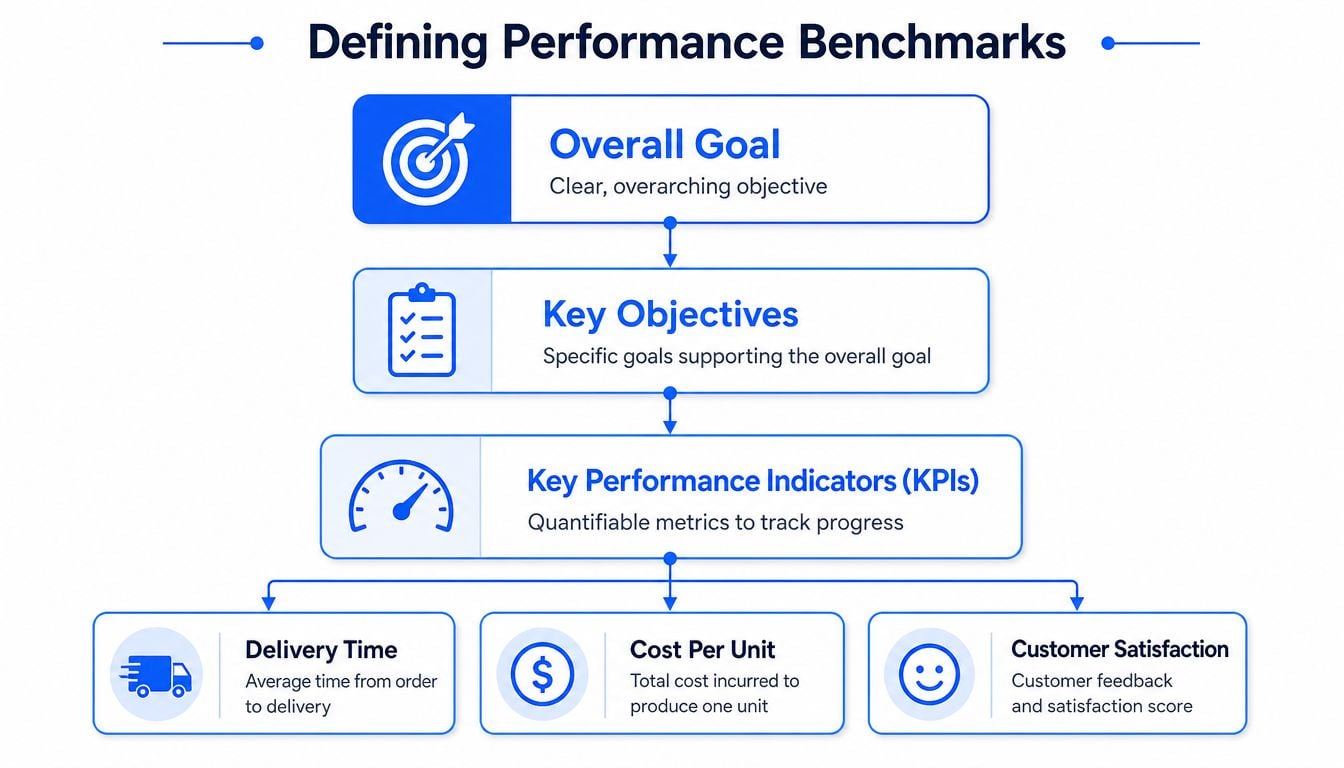
    A hierarchical diagram explaining the process of defining performance benchmarks for business objectives and KPIs.

    Why informal performance checks break down

    In freight sales, teams often track whatever is easy to pull from the CRM. Email volume. Calls made. Meetings booked. Quotes sent. Those metrics aren't useless, but on their own they don't tell you whether the business is getting healthier.

    A rep can send a high volume of emails into the wrong accounts. A branch can book more meetings while winning lower-quality freight. A lane can show volume growth while margin weakens. If the KPI doesn't connect to commercial or operational outcomes, it becomes a vanity metric.

    Practical rule: If a KPI can't change a decision on pricing, account targeting, lane focus, or rep coaching, it shouldn't sit at the center of your benchmark.

    The five-step cycle fixes that by forcing discipline. Plan defines the business question. Set-Up chooses the measures. Collect builds a reliable dataset. Analyze explains the gap. Act turns the finding into a change with ownership.

    Skip Analyze and you only get scorekeeping. Skip Act and the dashboard becomes decoration.

    KPIs that matter in freight

    A useful benchmark set combines sales activity, commercial quality, and operational follow-through. That mix matters because logistics teams win business in sales conversations but keep it through execution.

    A practical starter set for freight forwarders, carriers, and 3PL teams usually includes:

    • Prospecting quality such as outreach-to-meeting conversion rate by shipper segment, lane, or territory
    • Pipeline quality such as quote-to-win rate, win reasons, and time from first contact to qualified opportunity
    • Lane economics such as lane profitability, yield consistency, and account concentration by trade lane
    • Customer retention signals such as repeat booking patterns, complaint themes, and service recovery cycles
    • Execution measures such as delivery time consistency, exception rates, and handoff speed between sales and operations

    A simple benchmark design

    Start with one commercial objective and one operational outcome tied to it.

    For example, if your goal is to grow import business on a port pair, your benchmark should not stop at outbound email response. It should connect prospecting activity to qualified meetings, quoted opportunities, won shipments, and lane performance after go-live. That creates a chain of evidence instead of a shallow snapshot.

    A simple setup often looks like this:

    1. Define the business goal such as improving performance on a target lane or shipper segment.
    2. Choose a small KPI set that reflects both selling and execution.
    3. Assign owners so sales, pricing, and operations agree on definitions.
    4. Decide the review rhythm weekly for activity, monthly or quarterly for outcome trends.
    5. Predefine action triggers so the team knows what happens when a metric moves off target.

    That's the difference between reporting and management. Reporting tells you what happened. Benchmarking tells you what to do next.

    Sourcing and Normalizing Your Logistics Data

    More data doesn't automatically produce better benchmarking. In freight, it often does the opposite.

    Teams pull customs records, CRM logs, TMS activity, quoting history, finance data, and rep notes into one spreadsheet and assume the size of the dataset makes it reliable. It doesn't. If company names vary, shipment records are duplicated, and one lane has deep history while another is brand new, your benchmark can look precise while being badly distorted.
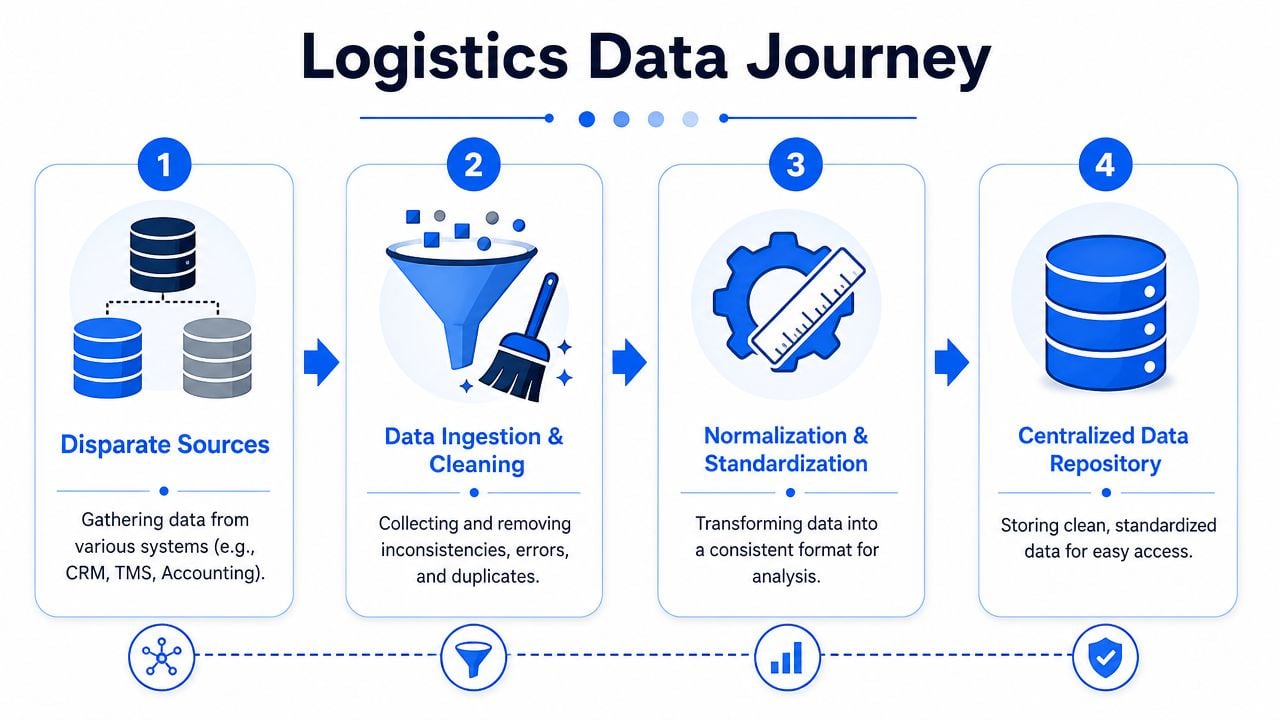
    A four-step infographic illustrating the logistics data journey from disparate sources to a centralized repository.

    Start with source discipline

    For logistics teams, the core source groups are usually straightforward:

    • Commercial systems including CRM stages, outreach logs, meeting outcomes, and account ownership
    • Operational systems including TMS milestones, routing choices, exceptions, and shipment completion data
    • Financial systems including quoted rates, invoiced revenue, and margin by customer or lane
    • Market intelligence sources including customs-derived shipment visibility and trade lane activity

    What trips teams up isn't access. It's consistency.

    One shipper may appear under multiple names across customs records and CRM entries. A lane may be tagged by port pair in one system and by country pair in another. A rep may log meetings carefully while another leaves half the activity in email. If you compare those records without cleaning them first, you aren't benchmarking performance. You're benchmarking documentation habits.

    Clean before you compare

    Use a standard cleaning pass before any benchmark review.

    • Resolve entity names by mapping parent companies, subsidiaries, spelling variations, and acquired brands into one record structure.
    • Standardize lane definitions so everyone means the same thing when they talk about a trade lane, corridor, or service scope.
    • Remove duplicate events especially where the same shipment or outreach touch appears across multiple tools.
    • Separate missing from zero because “no activity recorded” and “activity happened with zero outcome” are not the same operational reality.

    A strong primer on structuring supply chain data sources is this guide to supply chain databases, which is useful when you're combining commercial and operational records.

    Later in the workflow, route context matters too. If you're benchmarking drayage and container handoff performance around congested gateways, practical operational examples such as optimizing Felixstowe with Haulier.AI help teams understand why local conditions can distort raw comparisons.

    Normalize for fair comparisons

    This is the part many teams skip, and it's where weak benchmarking usually falls apart.

    Research on benchmarking performance indices warns that methods often fail when they “ignore sample size effects or use aggregate data”, which leads to misleading comparisons, especially in logistics where reporting standards and data volumes vary widely. That caution is highlighted in this analysis of benchmarking pitfalls.

    A lane with a long booking history and a lane you're just developing should not be judged by the same raw output logic.

    If one rep works a mature vertical with dense customs visibility and another works newer accounts with sparse records, raw response rates or win counts can mislead. You need normalization rules that account for uneven exposure and uneven data quality.

    Practical normalization options include:

    • Cohort-based comparison where you compare similar lanes, customer segments, or account maturity groups instead of the whole book at once
    • Rate-based metrics rather than raw counts, provided the denominator is clean and consistent
    • Minimum observation thresholds before you treat any pattern as benchmark-worthy
    • Weighted interpretation where results from thin datasets are treated more cautiously than results from well-established activity streams

    A short technical explainer can help teams visualize this data-handling step before they build dashboards.

    The main lesson is simple. Clean data beats big data. Fair comparison beats fast comparison.

    Building Your Comparison Cohorts and Dashboard

    Once the data is clean, the next job is grouping it properly. Most freight teams don't need a bigger dashboard. They need better comparison cohorts.

    A cohort is the peer group you use for comparison. If that group is wrong, every conclusion after it is shaky. Comparing a new trade lane against a mature one, or a specialist rep against a broad-market rep, usually creates noise disguised as insight.

    Cohorts that actually help decisions

    Use internal and external cohorts for different questions.

    Internal benchmarking works best when you're trying to improve execution consistency. Compare one period against another, one branch against another, or one rep's performance against peers handling similar account types. Such comparisons make quarter-over-quarter lane performance, response rate by segment, or quote turnaround by office especially useful.

    External benchmarking helps when the question is market position. That could mean comparing your activity and results against visible trade patterns in customs data, or against a competitor set operating in the same corridor and customer profile.

    Useful logistics cohorts often include:

    • Lane cohorts by port pair, country pair, or service mode
    • Customer cohorts by industry, shipment frequency, or import/export profile
    • Sales cohorts by territory, tenure, or account mix
    • Operational cohorts by branch, carrier partner set, or handoff model

    What the dashboard should show

    The dashboard's job is to shorten the time between signal and action. It should let a sales manager or commercial director answer three questions quickly: where are we off track, where are we improving, and where should we intervene first?
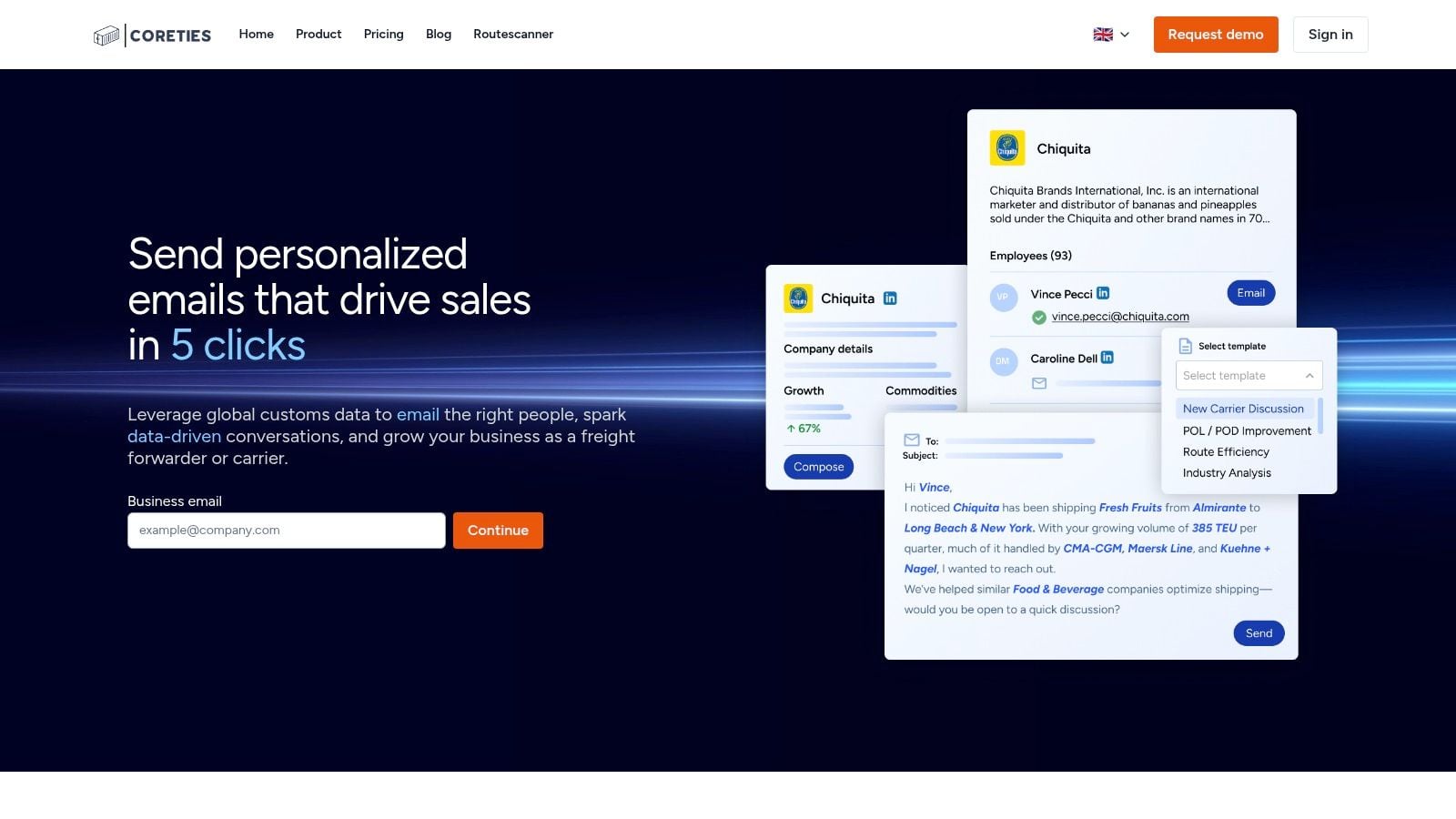
    Screenshot from https://coreties.com

    A useful logistics dashboard usually includes a mix of commercial and operational views, such as:

    • target lanes with increasing or weakening engagement
    • outreach response rate by rep or territory
    • quote conversion by shipper segment
    • new-customer shipment quality after onboarding
    • margin direction by lane or customer cohort

    Don't overload the screen. If every KPI is “critical,” nothing is.

    Category KPI What It Measures
    Sales Activity Outreach-to-meeting conversion How effectively outbound prospecting creates qualified conversations
    Pipeline Quality Quote-to-win rate How often pricing activity turns into booked business
    Lane Performance Lane profitability Commercial health of a specific trade lane or corridor
    Customer Health Repeat booking rate Whether new and existing customers continue to place freight
    Service Execution Delivery time consistency Reliability of shipment execution against expected transit performance
    Account Economics Customer acquisition cost The effort and spend required to win a new shipper account
    Team Performance Outreach response rate by sales rep Relative effectiveness of targeting, messaging, and follow-up

    Keep one source of truth

    Dashboards fail when teams export data into side spreadsheets and start redefining terms by department. A quote in sales shouldn't mean one thing to the rep and another thing to finance. A qualified opportunity shouldn't shift definition by branch.

    Operator's view: A benchmark only works when the room agrees on the denominator.

    If your team debates the meaning of the KPI every month, the dashboard isn't ready for management use.

    Analyzing Performance to Uncover Growth Opportunities

    A dashboard tells you where to look. Analysis tells you where money is leaking.

    That's why strong performance benchmarking focuses on the performance gap, which is the measurable difference between your current state and the best realistic benchmark for that process. Effective gap analysis also requires senior management involvement and a concrete action plan with responsibilities and deadlines, as described in this guidance on KPIs and benchmarking.
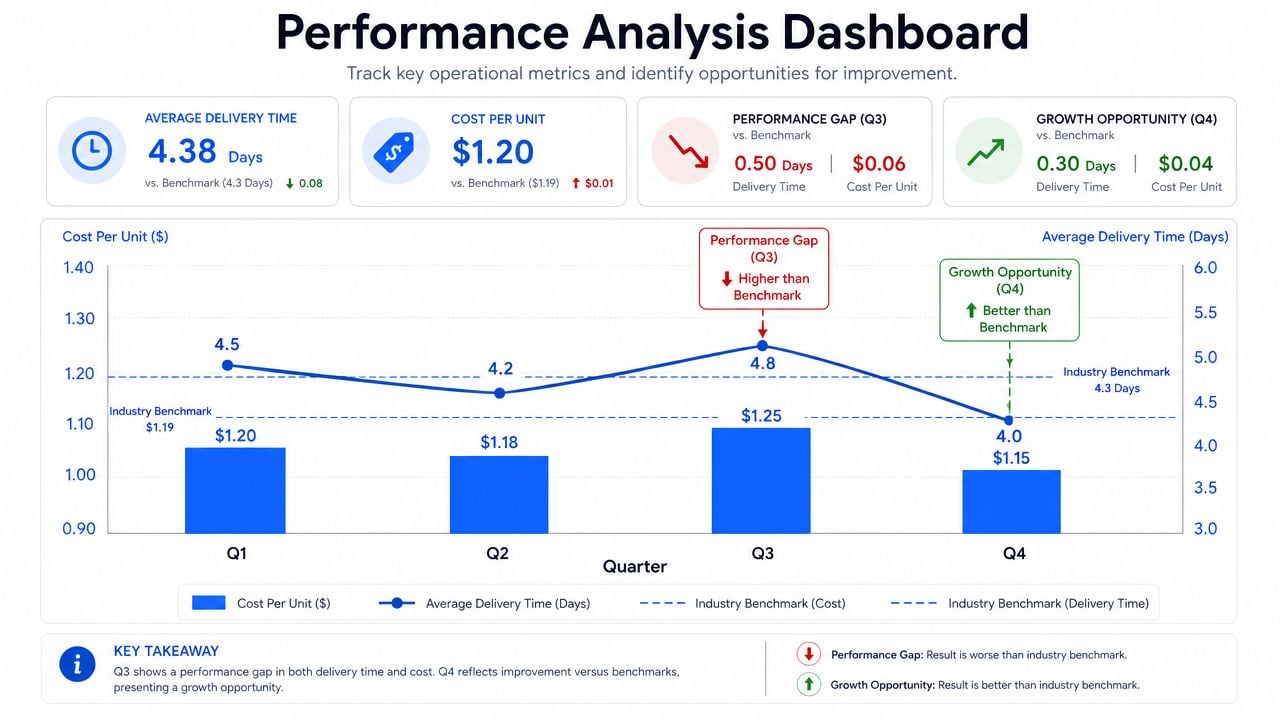
    A performance analysis dashboard showing quarterly operational metrics for cost per unit and average delivery time.

    When response rates differ by rep

    Say one rep gets more replies from importers on a target corridor than another. The weak analysis says the better rep writes stronger emails. Sometimes that's true. Often it isn't the full story.

    Check the comparison in layers:

    1. Account mix. Are both reps targeting the same shipper size, commodity type, and lane density?
    2. Data quality. Does one rep have cleaner contact coverage and better decision-maker matches?
    3. Follow-up rhythm. Are touches spread consistently, or does one rep stop too early?
    4. Offer quality. Is one rep using stronger operational proof points such as routing options, port alternatives, or service detail?

    That last point matters more than many teams admit. Logistics sales is not just copywriting. It's commercial relevance. If a rep can speak clearly to route options, handoff risks, or likely bottlenecks, the message usually lands better because it sounds operationally credible.

    A useful supporting read here is predictive analytics for sales, especially for teams trying to connect prospecting patterns with likely pipeline outcomes.

    When volume rises but profit softens

    This is a classic freight problem. A lane looks healthy on paper because shipment count is up, but margin quality starts slipping. If you only benchmark volume, you'll call that growth. If you benchmark commercial performance properly, you'll see deterioration early.

    Review the lane through multiple lenses:

    • Pricing behavior to see whether win rates improved because the team discounted too aggressively
    • Customer mix changes to identify whether lower-quality freight replaced better freight
    • Operational cost pressure such as extra handling, poor routing, or recurring exception management
    • Service promise mismatch where sales committed to a service pattern operations can't maintain profitably

    If finance is part of that review, ratio thinking helps. Teams that want a cleaner way to assess the financial side of operational performance often benefit from broader guides such as Understanding SME cash flow ratios, especially when margin discussions drift into working-capital strain and collection timing.

    Turn findings into action

    Analysis isn't complete until it changes behavior. If the gap is poor response quality on a lane, the action may be tighter account selection, better routing intelligence in outreach, or clearer rep playbooks. If the gap is profitable growth, the action may be pricing guardrails, customer-tier rules, or stricter lane qualification.

    Benchmarking earns trust when it identifies a gap, names the likely cause, and assigns the next move to a person, not a department.

    That last point matters. “Sales and ops should align better” is not an action. “Pricing manager reviews low-yield wins on the corridor every Friday and rep leads adjust targeting by shipper type” is an action.

    From Static Reports to Trend-Based Improvements

    The biggest mistake in performance benchmarking is treating the report as the finish line.

    One monthly scorecard can tell you whether a metric moved. It can't tell you whether the change is durable, seasonal, or misleading. In freight, that distinction matters because shipment flows rise and fall with tender cycles, port conditions, holidays, commodity timing, and customer buying patterns.

    Experts in benchmarking stress the need to “look at a trend rather than just episodical or instantaneous numbers”. They also emphasize that rigorous benchmarking includes implementing targeted improvements and then re-testing to confirm the issue is resolved, as discussed in this benchmarking discussion.
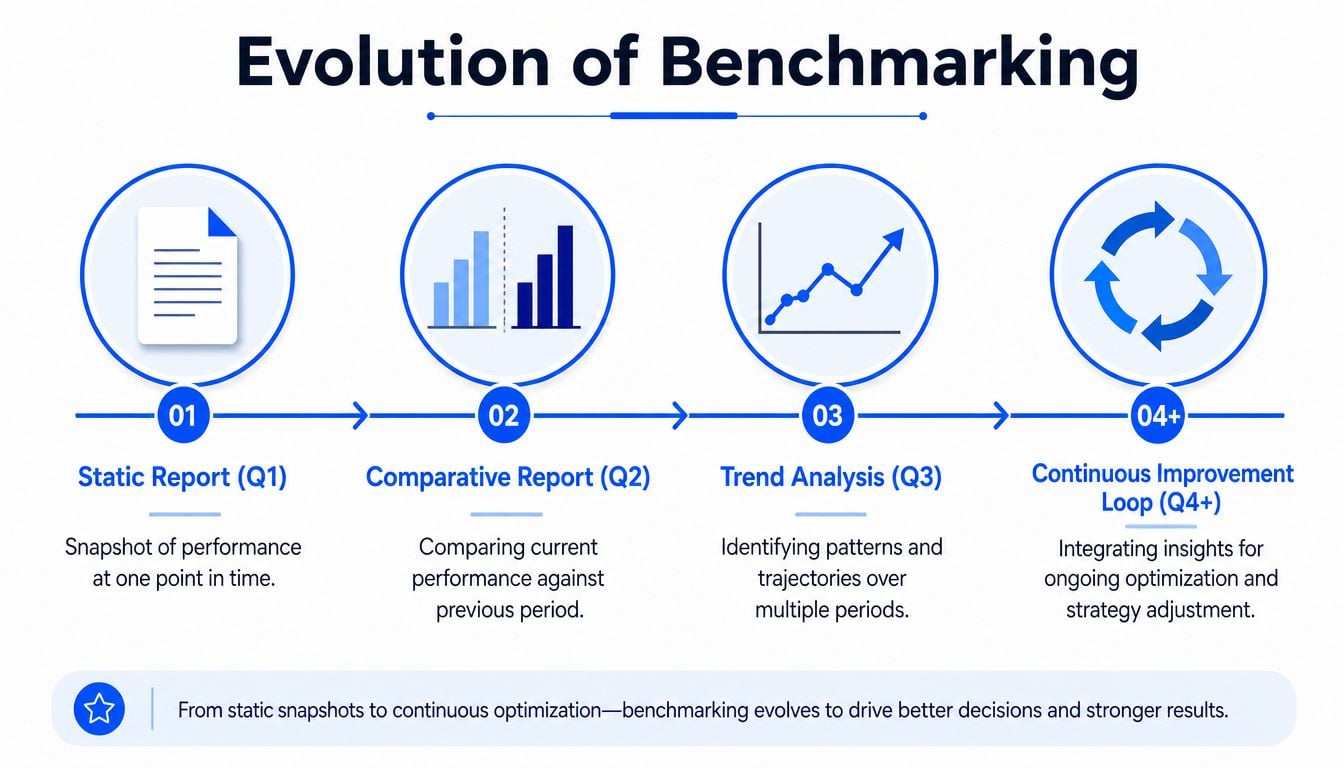
    A diagram illustrating the evolution of benchmarking, moving from static reports to continuous improvement loops over four stages.

    Why trend lines beat snapshots

    A rep's response rate can jump after a strong week of highly targeted outreach. A lane can look stronger in a short window because one large shipper moved unusual volume. A branch can appear more efficient because it handled fewer exceptions during that period.

    None of those signals are useless. But they need trend context.

    Use trend-based benchmarking to ask:

    • Is the improvement repeating across review periods?
    • Did performance improve in one cohort only, or across comparable groups?
    • Was the move tied to a specific intervention such as a new pitch, account filter, routing option, or pricing change?
    • Did the gain hold after conditions normalized?

    Don't reward a spike until it survives a second review cycle.

    That mindset saves teams from overreacting. It also keeps budget and leadership attention focused on changes that compound.

    Build the improvement loop

    A strong loop has four motions: measure, interpret, change, and verify. The verification step is where many commercial teams go quiet. They launch a new talk track, update a target list, or add route alternatives to outreach, but they don't isolate whether the change improved results.

    In logistics sales, one practical improvement might be giving reps stronger shipment visibility and route context before outreach. Another might be improving movement tracking so customer-facing teams can speak more confidently about service reliability. Broader operational visibility resources such as air and ground logistics tracking are useful when teams need better language and better evidence in customer conversations.

    Handle seasonality and lag like an operator

    Trend analysis in freight needs common-sense normalization. Compare like-for-like periods where possible. Treat short windows cautiously on low-volume lanes. Watch for lag between commercial activity and operational outcomes. A meeting booked now may not show up as a shipment pattern until later.

    That means your review rhythm should separate leading and lagging measures.

    A practical operating cadence often looks like this:

    • Weekly for outreach quality, meetings, and quote flow
    • Monthly for win quality, onboarding stability, and early margin behavior
    • Quarterly for lane development, customer retention patterns, and account quality trends

    When teams work this way, benchmarking stops being a reporting exercise. It becomes a management system.

    Key Takeaways and Common Benchmarking Pitfalls

    Performance benchmarking works when it helps your team make better decisions under real operating conditions. That's the standard. Not prettier reports. Not more tabs in a spreadsheet. Better decisions.

    The strongest freight teams treat benchmarking as a commercial discipline tied directly to account selection, pricing behavior, lane focus, and service execution. They define what good looks like, clean the data before comparing it, build fair cohorts, analyze the gap, and keep reviewing trends after they make changes.

    The weakest teams do the opposite. They compare raw totals across unequal books of business. They mix missing data with true zeroes. They celebrate activity that doesn't turn into profitable freight. Then they act surprised when the dashboard says one thing and the P&L says another.

    Common pitfalls show up fast:

    • Using vanity metrics like volume of outreach without checking whether it creates qualified, profitable opportunities
    • Comparing unmatched cohorts such as mature lanes against developing ones, or clean datasets against messy ones
    • Ignoring data quality especially entity matching, duplicate records, and inconsistent lane definitions
    • Stopping at the report instead of assigning actions and checking whether the intervention worked
    • Overreacting to short-term movement without enough trend context to separate signal from noise

    There's also a leadership pitfall. Teams often delegate benchmarking downward and then expect transformation upward. That rarely works. Commercial managers, operations leads, and senior decision-makers need to agree on definitions, priorities, and action thresholds. If they don't, the process turns political instead of practical.

    The payoff is simple. When you benchmark well, sales stops chasing the wrong accounts. Pricing spots weak wins sooner. Operations gets cleaner feedback on which promises are helping retention and which are hurting margin. The business learns faster.

    That is why benchmarking isn't an admin task. It's a growth system for logistics teams that want repeatable decisions instead of guesswork.


    If your team wants a faster way to turn customs data into qualified freight prospects, targeted outreach, and lane-specific commercial insight, take a look at Coreties. It helps freight forwarders, carriers, and logistics sales teams find the right accounts, reach the right decision-makers, and build more relevant conversations around real trade flows.

  • Greenfield Produce Imports: 2026 Playbook to win greenfield produce imports

    Greenfield Produce Imports: 2026 Playbook to win greenfield produce imports

    In the world of produce logistics, everyone wants to land the big, established accounts. But what if you could find the next big account before they even know they're big? That's the idea behind a greenfield produce import.

    Think of it like finding a patch of fertile, unplowed farmland in a valley where every other plot has been claimed for years. These are companies just starting to import produce, meaning their supply chains are brand new and their loyalties haven't been locked down yet.

    What is a Greenfield Produce Import?

    Two wooden crates of fresh avocados and tomatoes at a shipping port with blue and white containers.

    For a freight forwarder or carrier, spotting a greenfield importer is like getting a call from a client before they even realize they need your help. These businesses are building their logistics from scratch, making them incredibly open to new partners. They haven't signed any long-term contracts or settled into comfortable routines with the major players.

    This opens up a golden opportunity. You can get in on the ground floor and become their go-to logistics partner, helping to design a supply chain that will support their growth for years to come.

    Who Qualifies as a Greenfield Importer?

    The "greenfield" label isn't just for brand-new startups. It applies to several situations that all point to fresh business potential. If you know what to look for in customs data, you can cast a much wider net and find more of these valuable prospects.

    Greenfield produce importers generally fit into one of three profiles:

    • The New Venture: This is a classic startup—a new company formed specifically to import fresh produce. They have zero shipping history, so their first few bills of lading are a massive signal.

    • The Diversifying Business: Picture an established company, maybe one that has imported apparel or electronics for years, suddenly deciding to get into perishables. A large retailer that only ever handled dry goods might start importing fresh avocados to keep up with customer demand. That's a greenfield opportunity.

    • The New Lane Explorer: This is an experienced produce importer who decides to branch out. For example, a company that has exclusively imported limes from Mexico for a decade might suddenly start a new shipping lane for grapes from Peru. Their expertise is in produce, but their logistics for that new lane are brand new.

    The common thread with any greenfield opportunity is change. It's an importer whose shipping needs have just been born or have fundamentally shifted. This cracks their supply chain wide open for a proactive logistics partner to come in and prove their value.

    This isn't a niche market, either. It’s growing fast, fueled by consumer habits. Shoppers expect to find their favorite fruits and vegetables on the shelves year-round and are always curious to try exotic produce from across the globe. This pressure forces importers to constantly find new suppliers and build new shipping routes.

    By learning how to identify these up-and-coming players, you can stop fighting over the same saturated accounts. Instead, you can focus on building solid, lasting relationships with the next wave of major produce shippers. The next sections will show you exactly how to find them.

    Spotting Greenfield Importers in Customs Data

    A professional's hand points to a 'Data Detective' binder on a desk with a laptop displaying data visualization.

    Finding a greenfield produce importer in a sea of customs data is like being a detective at a crime scene. These high-potential prospects are hiding in plain sight, and you just need to know which clues to look for. Instead of cold-calling a random list, you can pinpoint companies that are just starting to dip their toes into the produce market.

    Think of it as tracking footprints. A big, established importer leaves deep, obvious tracks that everyone can see. A new, greenfield prospect leaves faint but fresh prints. Your job is to spot those early signs before your competitors even know there's a new path to follow.

    Signals of a New Importer

    The most obvious sign of a new player is a sudden, unexpected change in their shipping activity. You might see a company that has never touched produce before suddenly file a bill of lading with a produce-specific HS code. That's your "aha!" moment—a new importer is born.

    These first shipments are almost always small. We’re talking a few pallets or a single Less-than-Container Load (LCL) shipment. Don't mistake this for a low-value account; it's a test run. They're testing the waters, checking market demand, and figuring out the cold chain. This is the absolute best time to reach out. To effectively spot greenfield importers in customs data, some sales teams use methods similar to those in this practical guide to B2B lead scraping.

    A common mistake is writing off these low-volume shippers. A consistent pattern of small, regular shipments often means a serious business is methodically scaling up. These are the accounts that blossom into long-term, high-volume partnerships.

    Another tell-tale sign is the appearance of a new trade lane. Keep a close eye on shipments from countries famous for certain products, like avocados from Mexico or grapes from Chile. When a company with no shipping history from that region suddenly starts importing, it’s a massive flag that they're diversifying their product line.

    Greenfield Signals vs Established Importer Patterns

    To zero in on these opportunities, it helps to understand what makes a greenfield importer’s data footprint look different from a mature company’s. The table below breaks down the key contrasts you’ll see when analyzing shipment data.

    Data Indicator Greenfield Importer Signal Established Importer Signal
    Shipment History No prior shipments, or sudden appearance after a long gap. Long, consistent history of regular shipments.
    Volume & Frequency Low initial volume (pallets, LCL), infrequent but may become regular. High, predictable volume (multiple FCLs), frequent and seasonal.
    HS Code Usage New produce-related HS codes appear for the first time. Consistent use of the same set of produce HS codes.
    Trade Lanes A new, specific lane opens up (e.g., Peru to Miami). Established, diversified lanes from multiple origins.
    Supplier Mix Often a single, new supplier for the initial shipments. Multiple, long-term supplier relationships are visible.

    Seeing these greenfield signals is your cue to act. These companies are actively solving new logistics puzzles and are far more likely to be open to a new freight partner than an established importer with deeply entrenched relationships.

    Key Data Points to Monitor

    To turn a simple data alert into a qualified lead, you need to connect the dots. Looking at these data points together helps you build a story about a company's ambitions.

    • HS Code Activity: The sudden appearance of a new Harmonized System (HS) code is your number one clue. For instance, a company known for importing electronics (HS Chapter 85) that suddenly logs a shipment under Chapter 08 (Fruits and Nuts) is a can't-miss target. You can get more specific strategies for this in our guide on the HS code filter.

    • Shipment Volume and Frequency: Look for low but consistent initial volumes. One shipment could be an anomaly, but two or three over consecutive months points to a deliberate business plan taking shape.

    • Trade Lane Analysis: A US-based snack company that has only ever imported from Europe suddenly opening a lane from Peru is a huge greenfield signal. It tells you they’re launching a new product and have an untested supply chain that you can help them perfect.

    By piecing together these digital clues, you can see a company's strategy unfolding right in the data. This allows you to approach them with a relevant, timely offer long before they ever put out a public request for quotes.

    How to Turn Customs Data Into Qualified Leads

    Getting your hands on customs data is one thing, but knowing what to do with it is where the real money is made. A raw list of companies is just noise. The goal is to sift through that noise and pinpoint the businesses with a real, immediate need for your logistics services.

    Think of it like this: raw customs data is the ore, and your job is to refine it into pure gold. This isn't about guesswork; it's a methodical process that focuses your sales team on leads that are actually ready to talk. With a platform like Coreties, you can build a repeatable workflow instead of getting buried in manual searches.

    Applying Strategic Filters to Isolate Opportunities

    The first cut is all about smart filtering. You start by getting specific with produce HS codes. For instance, if you filter for shipments under code 080440 (avocados), you'll instantly see every company just starting to bring them into the country. It’s a direct signal of new business.

    Then, you can layer on another crucial filter: the trade lanes. Let's say your bread and butter is moving freight from Mexico to the USA. You can set up an alert that flags any new importer using that specific MEX-USA lane for produce. Combining the commodity with the route is a dead giveaway that a company is launching a new initiative that fits your services perfectly.

    This approach quickly cuts a massive, overwhelming list down to a handful of high-potential targets whose recent moves align exactly with what you offer.

    Qualifying Your Shortlist of Importers

    With a focused list in hand, it's time to separate the serious players from the tire-kickers. This is where you learn how to find sales leads that actually convert by looking at their behavior, not just a single data point.

    Here’s what that looks like in practice:

    • Analyze Shipment Frequency: One test shipment is interesting. But two or three shipments over a few months? That’s a real sign of commitment. You’re looking for a pattern of low but steady volume, which often signals a new importer is carefully ramping up their supply chain.
    • Cross-Reference Company Details: Do a quick background check. Does the company's website or LinkedIn profile back up what you're seeing in the data? If a snack company suddenly starts talking about "globally sourced ingredients" on their site, you've just validated your lead.
    • Identify Decision-Makers: The final piece is finding the right person. Forget blasting generic inboxes. You need to find titles like Logistics Manager, Supply Chain Director, or Head of Procurement. On a platform like Coreties, this information is often tied directly to the company profile, giving you verified emails and LinkedIn profiles to start a meaningful conversation.

    This detailed qualification is essential, especially with how fast the market is growing. U.S. agricultural imports are projected to climb to $220 billion by 2026, with suppliers like Mexico accounting for almost a third of all produce. Finding the right newcomers in such a massive field is everything.

    The screenshot below shows how a data platform can lay all this out for you, making the qualification process fast and almost intuitive.

    This view gives you an at-a-glance confirmation of whether you're looking at a legitimate greenfield produce imports prospect by showing their recent shipments, top products, and volumes.

    For more powerful strategies on lead generation, take a look at our complete guide on finding shippers for freight brokers.

    How to Craft an Outreach Email That Actually Gets a Reply

    A laptop on a desk displays a map of South America with location pins and contact profiles for targeted outreach.

    Okay, you’ve done the hard work of digging through customs data and found a promising greenfield importer. Now comes the moment of truth: the first contact. Let’s be honest, a generic "we move freight" email is a one-way ticket to their trash folder. To stand a chance with these new shippers, your outreach needs to be sharp, specific, and show your value right out of the gate.

    The secret is to lead with what the data told you. You’re not just another salesperson—you’re a logistics expert who has already spotted a way to improve their brand-new supply chain. This completely changes the conversation from a cold pitch into a genuine consultation.

    When you mention the exact trade lane, the specific commodity, and the shipment patterns you noticed, you prove you've done your homework. An email that starts with, "I noticed you recently began importing Hass avocados from Peru," immediately tells them you understand their world. It builds instant credibility and cuts through all the noise from your competitors.

    Lead With Real, Tangible Value

    Just showing them you've been paying attention is good, but it's not enough. The best approach is to offer them something genuinely useful in that very first message. And I'm not talking about vague promises of "better rates." I mean demonstrating your expertise in a way they can't ignore.

    If you’re using a platform that combines customs data with real-world routing tools, like the Coreties integration with Routescanner, you can do this brilliantly. You can actually map out a more efficient or faster route for their shipments before you even speak to them. This shows the prospect you aren’t just asking for their business—you’re already bringing ideas to the table to improve it.

    Think of it this way: You're not just showing up to a new restaurant and asking to be their produce supplier. You're showing up with a better recipe for their signature dish. By offering a solution before they’ve even asked, you position yourself as an essential partner from day one.

    Email Framework for a Brand-New Importing Company

    When you're reaching out to a company that's completely new to the import game, your job is to be their guide. They're likely feeling overwhelmed by this new, complex world and will welcome a partner who can make things simpler. Your tone should be supportive, insightful, and proactive.

    Subject: Your New Produce Imports from [Country of Origin]

    Body:
    Hi [Prospect Name],

    My name is [Your Name] from [Your Company]. I specialize in cold chain logistics for fresh produce importers.

    Our data shows you’ve recently started bringing in [Commodity, e.g., mangoes] from [Country of Origin] into [Port of Arrival]. Congratulations on getting this new lane up and running.

    As you start to scale, keeping your routes efficient and your product fresh is everything. We took a look at your current shipping lane and, using real-time carrier data, found a potential alternative that could cut your transit time by up to 2 days.

    I’ve attached a quick comparison. Would you be open to a 15-minute call next week to walk through it? My only goal is to show you how the right logistics partner can help you grow this new venture profitably, right from the start.

    Best,
    [Your Name]

    Why does this email work? It's not a template; it's a conversation starter. You're showing them their own business from a new angle, offering a concrete benefit (less transit time), and asking for a very small, low-pressure commitment to learn more.

    Email Framework for an Established Business Branching Into Produce

    Now, what if your prospect is an established business just diversifying into greenfield produce? They get logistics, but the cold chain might be a whole new beast. Here, your outreach needs to acknowledge their expertise while positioning yourself as the perishables specialist they now need.

    Subject: Question about your new [Commodity] shipments

    Body:
    Hi [Prospect Name],

    My name is [Your Name], and I head up the perishables team at [Your Company]. I saw that [Prospect's Company]—which I know for its work in [Their Established Industry, e.g., electronics]—has recently started importing [Commodity, e.g., berries].

    That's an exciting expansion. We know from experience that moving into a temperature-controlled supply chain brings a lot of new challenges, from agricultural customs compliance to maximizing shelf life on arrival.

    We've helped other companies make this exact shift, and I believe we can help you avoid some of the common, costly mistakes. For example, we helped a similar client optimize their packaging and routing out of [Country of Origin], which extended their product's shelf life by 3-4 days.

    Would you have a few minutes next week for me to share a couple of key insights specific to the [Country of Origin] to [Destination] lane?

    Regards,
    [Your Name]

    This approach connects because it’s built on respect. You’re acknowledging their success, focusing on the unique pain points of perishables, and using a short, powerful case study to prove you know what you’re talking about.

    By customizing your outreach like this, you’re not just sending another email. You’re starting a valuable relationship founded on expertise and real data.

    Why the Market for High-Value Produce Is Exploding

    Knowing how to find greenfield prospects is one thing, but understanding the sheer size of the prize is what makes this strategy so powerful. The global appetite for fresh, high-value produce isn't just growing—it's exploding. We're not talking about a minor market shift; this is a fundamental change in how the world eats, and it's creating a massive opening for logistics providers who know where to look.

    This boom is all about major consumer trends. Shoppers now expect to find their favorite fruits and vegetables on the shelves year-round, regardless of local seasons. At the same time, the push toward healthier eating has sent demand for fresh, exotic, and nutritious foods through the roof. People want Peruvian blueberries in December and Mexican avocados in April, which depends on complex, high-value supply chains that barely existed a decade ago.

    The Numbers Behind the Boom

    This isn't just a gut feeling; the data tells a clear story. While demand for staple crops like wheat and corn tends to fluctuate, the real action is in high-value horticultural products. These are the very items that demand sophisticated cold chain logistics—exactly the kind of specialized service freight forwarders excel at.

    This means the biggest growth opportunities aren't in bulk commodity shipping anymore. They're in the specialized, high-margin world of fresh produce, where reliability and speed are everything.

    And this trend is only getting stronger. In 2026, global food imports are projected to smash records, hitting $2.22 trillion—an 8% jump from the previous year. This growth is almost entirely driven by high-value fresh goods. While the costs for staple crops are expected to drop, categories like beverages and spices are forecast to climb by a staggering 34.5%, with dairy not far behind at 16.4%. You can dig into the specifics of this forecast in this detailed Tridge report.

    This data is the ultimate validation for focusing on greenfield produce imports. When you target these new and emerging players, you’re not just chasing small accounts; you’re planting your flag in the fastest-growing segment of global food trade.

    Your Role in a Growing Market

    For freight forwarders and carriers, this market explosion translates directly into opportunity. Every new importer bringing in exotic fruits or out-of-season vegetables is a brand-new supply chain waiting to be built. These companies are looking for partners who get the complexities of perishables, from tricky customs clearance to precise temperature control.

    Think about the forces at play:

    • Year-Round Demand: Consumers no longer accept seasonal limits, which forces retailers and their importers to source from all over the world.
    • Health and Wellness: The global focus on healthy living is a primary engine for fruit and vegetable consumption.
    • Exotic Tastes: A growing curiosity for new flavors is driving imports of items like dragon fruit, mangosteens, and specialty avocados.

    Each of these trends creates a direct need for expert logistics. By finding the greenfield importers who are tapping into these demands, you can lock in high-margin business before the competition even knows it exists. This is especially true in markets with strict import rules, a topic we explore in our guide to Singapore food imports. This proactive approach shifts your sales process from just quoting rates to building strategic partnerships, securing your place in a market that's set for incredible growth.

    Knowing the theory is one thing, but actually turning data into a repeatable sales process is what separates the top performers from the rest. This is where the right tools, like a dedicated platform such as Coreties, can make all the difference, moving your prospecting from a manual chore to a strategic advantage.

    Let's walk through a real-world scenario. Imagine your goal is to find new avocado importers moving product across the busy US-Mexico border. Instead of starting from scratch, you can zero in on this high-value lane with surgical precision.

    Step 1: Set Your Search Area

    First things first, you need to define your hunting ground. Using a geo-search function is like drawing a virtual fence around a critical area—say, the bustling border crossing at Laredo, Texas.

    This simple action immediately filters out all the noise. You’re no longer sifting through irrelevant shipments; your focus is now squarely on companies active in your key operational zone. This step alone can save you hours of work by cutting out companies and trade lanes that just aren't a fit for your services.

    Step 2: Filter by High-Value Produce

    With your territory defined, it's time to get specific. This is where you layer on a commodity filter. By plugging in the specific HS code for avocados, 080440, you're telling the system to show you only the companies importing that exact product.

    Suddenly, you're not just looking at produce in general. You're now targeting the greenfield produce imports market for one of the most popular items on the planet. This sharpens your focus down to a handful of highly relevant prospects.

    The numbers don't lie; this is a market you want to be in.

    Infographic showing global produce growth with 2.22 trillion in imports, 34.5% overall growth, and 16.4% in dairy.

    As the data shows, global demand is surging, with $2.22 trillion in imports and overall growth hitting 34.5%. High-value segments like produce and dairy (with 16.4% growth) are right at the heart of this expansion.

    Step 3: Pinpoint the Newest Importers

    Here’s the secret sauce. Instead of getting a list of every avocado importer under the sun, you sort the results by "First Shipment Date." Just like that, all the brand-new, greenfield prospects pop right to the top of your list.

    This gives you a powerful first-mover advantage. You can instantly see which companies just started their importing journey, meaning they are almost certainly in the process of building out their supply chains and looking for reliable partners right now. They haven't been locked in by your competitors for years.

    Step 4: Find the Decision-Makers

    Okay, you’ve found a promising new company. Now what? The next step is finding the right person to talk to.

    By clicking into the company’s profile, you can typically find a goldmine of information: a list of key employees, their job titles, and often, verified email addresses and links to their LinkedIn profiles. This lets you bypass the gatekeepers and connect directly with the Logistics Manager or Head of Procurement—the very people who make the decisions about freight partners.

    Step 5: Craft Your Data-Driven Outreach

    Now it's time to put it all together. With your target identified, you can use a customizable email framework. Good platforms can even auto-populate the email with the specific data you just uncovered.

    For example, the system can draft an email that starts with, "Hi [Prospect Name], I saw your company recently began importing avocados from Mexico into Laredo…"

    This personalized approach does more than just get their attention; it proves you’ve done your homework.

    To really seal the deal, you can add a competitive route option from a tool like Routescanner. By suggesting a faster or more cost-effective shipping solution in your very first email, you’re offering tangible value from the get-go. This entire workflow connects the dots, turning raw data into a qualified conversation and giving your sales team a powerful, repeatable engine for growth.

    Answering Your Questions About Greenfield Prospecting

    Jumping into a data-driven strategy like greenfield prospecting always brings up a few practical questions. Let's walk through some of the most common ones we hear from freight professionals.

    Is Customs Data Really Reliable for Finding New Importers?

    Yes, it’s one of the most solid sources you can get your hands on. Think about it: this data comes directly from official shipment manifests, the documents every company must file with government agencies to move goods across borders. It’s not speculation; it’s a record of what actually happened.

    For finding greenfield importers, this is where the magic happens. You’re not just seeing old, established patterns. You’re spotting the first blip on the radar—a company's first-ever shipment of avocados, for instance. That's a hard fact, a signal of a new opportunity before anyone else knows it exists.

    The key is to treat the data as the starting point for your investigation. A single data point is a clue; a pattern of data points is a qualified lead. It tells you exactly where to focus your sales efforts for maximum impact.

    What’s the Point of Chasing an Importer with Tiny Volumes?

    This is a common hang-up, but it’s where you have to shift your mindset. Those initial small volumes for greenfield produce imports are rarely the end goal for the importer. They're almost always test shipments to check product quality or dip a toe in the water to gauge market demand.

    Seeing small shipments isn't a red flag; it's an invitation. Your goal is to get in the door right then and there, build a relationship, and prove your value. When they're ready to scale from one pallet to multiple containers, you’ll already be their go-to logistics partner. A good data platform helps you watch this growth, turning a small, nurtured seed into a massive, long-term account.

    Can This Greenfield Strategy Work for Other Industries?

    Absolutely. The term 'greenfield' might have its roots in produce, but the core principle is universal. A greenfield prospect is simply any company that’s new to importing a specific product or shipping on a new trade lane.

    You can apply this exact same playbook to uncover new importers of just about anything:

    • Electronics
    • Apparel
    • Automotive parts
    • Medical supplies

    The strategy doesn't change. You just swap out the HS codes for the industry you're targeting, monitor for companies starting new lanes or diversifying their imports, and get in front of them early. It’s a powerful approach that works across the entire freight market.


    Ready to stop guessing and start targeting the most promising greenfield shippers with precision? Coreties transforms raw customs data into a list of qualified, high-potential leads, complete with decision-maker contacts and data-driven outreach tools. Discover how you can find and win your next big account by booking a demo.