Tag: electronics logistics

  • A Freight Forwarder’s Guide to Avnet Asia Pte Ltd

    A Freight Forwarder’s Guide to Avnet Asia Pte Ltd

    Avnet Asia Pte Ltd serves as the Asia Pacific headquarters for Avnet, a global giant in technology distribution and solutions. Think of them as a crucial artery in the worldwide electronics supply chain, connecting the makers of tiny components with the world’s biggest technology and manufacturing brands.

    Understanding Avnet Asia’s Role In Global Electronics

    To really get a handle on Avnet Asia Pte Ltd, you need to see them as more than just a distributor. They are the central nervous system of the tech industry across the entire region. They expertly manage the intricate flow of electronic parts—from semiconductors and microchips all the way to finished goods—making sure the gears of technology manufacturing are always in motion.

    Let’s trace the journey of a single smartphone. Its internal components come from dozens of specialized suppliers in countries like Taiwan, South Korea, and Japan. Avnet is the one that orchestrates getting all those parts consolidated and delivered to massive assembly plants in places like Vietnam or China. This is a true "just-in-time" operation, where a delay of just a few hours could bring a multi-million-dollar production line to a grinding halt.

    A Pillar of The Asia Pacific Tech Scene

    This operational mastery isn't new; it's been built over decades. Since its establishment in 1995, Avnet Asia Pacific has solidified its place as a cornerstone of technology distribution in the region. With over 30 years of experience, they've forged deep connections with the world's most forward-thinking tech companies.

    They act as an essential middleman, helping customers minimize risks and slash costs through first-class supply chain and logistics management. This makes them a vital partner for any business trying to navigate Asia's notoriously complex markets, a point you can explore further on Avnet's APAC overview page.

    Modern global supply hub office with workers, packaged goods, and a large digital world map.

    This image captures the sheer scale and intricacy of Avnet's operations, painting a clear picture of their central role within a vast global network.

    The Scale of Their Logistical Needs

    The volume of high-value goods moving through Avnet’s network is simply staggering. This constant, high-stakes movement generates significant and highly specialized logistics needs that are a world away from standard shipping.

    At its core, Avnet’s business is all about managing the time-sensitive movement of expensive technology. For a freight forwarder, this is a prime opportunity to offer specialized services that directly address their biggest worries: security, speed, and absolute reliability.

    Their demands consistently include:

    • Time-Critical Air Freight: Essential for shipping lightweight, high-value components like processors and memory chips where every second counts.
    • Secure Warehousing: They require climate-controlled, high-security facilities to guard sensitive electronics against environmental damage and theft.
    • Expert Customs Brokerage: Getting through the diverse and often complicated customs rules of multiple Asian countries is a daily operational hurdle.

    Getting to know this operational DNA is the first, most important step for any logistics provider looking to work with Avnet Asia Pte Ltd. It shows you exactly where your services can solve their biggest headaches and provide real, measurable value.

    Here’s a look at how to map out Avnet’s logistics network across the Asia Pacific region. To really get a handle on Avnet Asia Pte Ltd, you have to see their supply chain for what it is: a highly coordinated ballet of high-value electronic components. This isn't just about moving parts; it's about fueling the entire tech manufacturing engine of Asia.

    For a sharp logistics provider, understanding this flow is like having a map to new business opportunities.

    Avnet’s entire operation is a classic hub-and-spoke model. Think of their massive distribution centers in places like Singapore and Hong Kong as the core hubs. From there, spokes reach out to every corner of the region, ensuring critical components land on factory floors precisely when they're needed.

    The Inbound Journey of Critical Components

    It all starts with the inbound flow of essential goods. Raw materials and tiny, powerful semiconductor components make their way from manufacturing hotspots into Avnet's main distribution hubs. These shipments are the absolute lifeblood of their business, dominated by high-value, time-sensitive products.

    You can trace the main arteries of their inbound logistics on a map:

    • Taiwan & South Korea to Singapore/Hong Kong: This is a major pipeline for semiconductors, processors, and memory chips. Given the high value and urgency, air freight is the only real option here.
    • Japan to Regional Hubs: Specialized sensors, precision components, and other high-grade parts often come from Japan. Again, the need for speed makes air freight the go-to service.
    • Mainland China to various APAC locations: While China is a huge end-market, it's also a powerhouse for producing a wide array of electronic components that feed Avnet's distribution network across Asia.

    For freight forwarders, these inbound lanes are where the action is. The key to winning this business is proving you can handle secure, time-critical air freight with zero drama. Flawless customs clearance is non-negotiable—any delay can throw a wrench into the "just-in-time" manufacturing schedules that rely on these deliveries.

    Outbound Distribution to Manufacturing Centers

    Once those components are sorted and stored at hubs like the one Avnet Asia Pte Ltd operates in Singapore, the outbound leg of the journey begins. This is all about getting the right parts to original equipment manufacturers (OEMs) and contract manufacturers (CMs) throughout the region.

    The major outbound lanes point directly toward Asia's manufacturing giants:

    • Singapore/Hong Kong to Vietnam & Malaysia: These routes feed the massive electronics assembly plants that build everything from our smartphones to industrial robotics.
    • Distribution Hubs to India: As India’s electronics manufacturing sector continues to explode, it’s become a crucial destination. You can see how embedded Avnet is there through initiatives like their collaboration with NITK Surathkal, which signals a deep commitment to the country’s tech growth.
    • Hubs to Japan & South Korea: It's a two-way street. While these countries are sources for inbound parts, they are also destinations for finished and semi-finished goods that Avnet distributes.

    If you're looking to dive deeper into the dynamics of the broader region, our guide to succeeding in the Pan-Asia logistics market offers some valuable wider context.

    To put it all together, here is a breakdown of Avnet's key trade lanes and what they require from a logistics standpoint.

    Avnet's Primary APAC Trade Lanes and Logistics Needs

    Trade Lane (Origin-Destination) Primary Commodity Type Dominant Freight Mode Key Logistics Service Needs
    Taiwan/South Korea → Singapore/Hong Kong Semiconductors, Memory Chips, Processors Air Freight Time-critical delivery, high-security transport, seamless customs brokerage, temperature/humidity control.
    Japan → Singapore/Hong Kong Specialized Sensors, Precision Components Air Freight Expedited services, careful handling for fragile components, real-time tracking, reliable customs clearance.
    Singapore/Hong Kong → Vietnam/Malaysia Assorted Electronic Components Air & Road Freight Just-in-time (JIT) delivery, cross-border trucking (where applicable), local warehousing, final-mile logistics.
    Singapore/Hong Kong → India Component Kits for Assembly, AI/IoT Modules Air Freight Strong local delivery network, compliance with Indian customs, support for a rapidly growing manufacturing base.
    Mainland China → Pan-Asia Network General Electronic Components, PCBs Air & Sea Freight Multi-modal flexibility, consolidation services, export compliance, managing diverse supplier pickups.

    This table clearly illustrates the intricate logistical demands Avnet Asia Pte Ltd juggles every single day. Each lane presents a unique set of challenges and, for the right logistics partner, a clear opportunity to provide measurable value.

    Pinpointing Critical Logistics and Freight Needs

    For a company like Avnet Asia Pte Ltd, logistics isn’t just a cost center—it’s the lifeblood of their entire operation. You have to appreciate the immense pressure on their supply chain managers. A single delayed pallet of microchips could halt a multi-million-dollar production line. In the high-stakes, "just-in-time" world of electronics manufacturing, speed and precision aren't just goals; they're the absolute minimum for survival.

    This pressure cooker environment creates a specific and incredibly demanding set of freight requirements. We're talking about shipments that are high-value, time-sensitive, and physically delicate. This is a far cry from standard cargo.

    Non-Negotiable Service Requirements

    To even get a foot in the door with Avnet, any logistics provider has to prove they’ve mastered a few key specialties. These aren't "value-adds"—they are the table stakes.

    • Secure Transport: Let's be blunt: a crate of semiconductors can be worth more than its weight in gold. Avnet needs partners who can guarantee high-security transport. This means vetted drivers, a rock-solid chain of custody, and proven theft-prevention measures from the factory floor to the final destination.
    • Climate-Controlled Environments: Electronic components are fragile. They need climate-controlled warehousing and transport to protect them from humidity, temperature swings, and electrostatic discharge. One slip-up here and an entire shipment can be rendered worthless.
    • Expert Customs Brokerage: Navigating the labyrinth of customs regulations across Asia is a massive headache. For Avnet, a delay at the border is just as costly as a delayed flight. This makes expert, proactive customs brokerage non-negotiable. Our guide on classifying items like a PCB board HS code gives you a sense of just how intricate this can get.

    This simple diagram shows the journey of components through Avnet's key trade lanes.

    Avnet Trade Lanes process flow diagram: 1. Origin, 2. Freight, 3. Destination, with icons.

    As you can see, every stage—origin, freight, and destination—demands specialized handling and perfect coordination to keep the supply chain moving without a hitch.

    Specialized Solutions That Capture Attention

    Just ticking the boxes won't be enough to win business here. The logistics partners who truly succeed with Avnet Asia Pte Ltd are the ones who can solve their biggest headaches with smart, targeted solutions.

    Think of it this way: their biggest fears are production stoppages and compromised inventory. If you can position your services as the ultimate insurance policy against those fears, you have their attention.

    This means you need to lead with services that directly address those pain points. Offering expedited air charters for when things go wrong and they need an urgent recovery shipment is a powerful move. Providing real-time visibility platforms that offer minute-by-minute tracking and predictive ETAs can be a complete game-changer for them.

    These kinds of solutions show you've done your homework. They prove you understand their world and are ready to be a problem-solver, not just another vendor.

    Finding the Right Decision Makers at Avnet

    Let's be blunt: even the most compelling, data-backed proposal is dead on arrival if it lands in the wrong inbox. When you’re trying to partner with a global heavyweight like Avnet Asia Pte Ltd, sending a message to a generic "contact us" address is a waste of time. Your pitch will simply get deleted or lost in the shuffle.

    The real challenge—and where most people fail—is bypassing the gatekeepers. You need to connect directly with the people who actually hold the purse strings for freight and logistics. Think of it less like blindly knocking on doors and more like a targeted strike. You need the exact coordinates of the person who can say "yes."

    Identifying Key Logistics and Procurement Roles

    Inside a massive organization like Avnet, logistics and freight responsibilities aren't siloed in one tidy department. They're spread across a few key areas. Your job is to find the people whose titles scream "supply chain."

    Start by zeroing in on roles like these, especially within major hubs like Singapore:

    • Supply Chain Director or VP of Supply Chain
    • Head of Logistics or Logistics Manager
    • Regional Procurement Manager
    • Global Freight Manager

    These are the professionals on the front lines. They’re the ones managing carrier relationships, planning shipping routes, and feeling the heat when a shipment of high-value electronics gets stuck in customs. Because they live and breathe these challenges, they’re the most likely to listen to a solution that can make their lives easier.

    Of course, once you’ve pinpointed a few potential decision-makers, you still need to reach them. Knowing how to find a business email address is the next practical step to opening a direct line of communication with your Avnet contacts.

    Using Modern Tools for Targeted Prospecting

    Not too long ago, this kind of detective work involved hours of manual searching and a lot of guesswork. Today, you can cut right through the noise. Modern prospecting platforms act like an organizational chart on steroids, mapping out who does what and where.

    The goal isn't just to find a name. It's to understand their specific role and responsibilities within the Avnet ecosystem. That context is what allows you to craft a message that proves you’ve done your homework.

    For instance, a good platform lets you slice and dice contact data by department, seniority, and location. This means you can build a laser-focused list of logistics leaders at Avnet Asia Pte Ltd in Singapore or another key APAC market.

    Take a look at how you can use a platform like Coreties to filter and pinpoint the right people inside a target company.

    By applying filters for "Logistics" or "Supply Chain," you instantly get a list of relevant contacts, often complete with verified emails and professional profiles. This shifts your prospecting from a shot in the dark to a precise, data-driven strategy, massively boosting your odds of starting a real conversation.

    Crafting Outreach That Actually Gets a Response

    A laptop displaying a map and information, with a notebook, pen, and 'Targeted Outreach' text on a desk.

    If you want to get your foot in the door with a global powerhouse like Avnet Asia Pte Ltd, you have to stop thinking like a salesperson. Your first email needs to position you as a strategic partner, not just another vendor with a price list. Let’s be honest, generic messages are dead on arrival.

    The only way to cut through the noise is with sharp, data-driven outreach that shows you’ve done your homework. A well-researched message proves you understand their world and can solve a real problem right now.

    Lead With Insight, Not a Sales Pitch

    Want to grab a busy logistics director's attention? Don't lead with what you sell. Lead with what you know about them. Instead of a generic line like, "We offer competitive air freight rates," you need to get specific.

    This is where your research pays off. Mentioning a specific, high-volume trade lane shows you're not just blasting out emails to a list. An opening like, "I was looking at your frequent shipments from Taiwan to Vietnam…" is worlds away from a generic "Hello." It immediately tells them this message is for them and only them.

    Once you have their attention, the next step is to offer a tangible insight. Maybe you've spotted a more efficient routing option, a multi-modal solution they could be using, or a potential cost-saving based on your market intelligence. Give them a reason to keep reading.

    A Framework for Your First Email

    Putting together this kind of email isn't as hard as it sounds. The goal is to be concise, respect their time, and focus on delivering immediate value.

    Here's a simple structure that works:

    1. A Specific Subject Line: Ditch the clickbait. Try something professional and direct, like: "An idea for Avnet's Taiwan-Vietnam logistics."
    2. An Informed Opening: Reference a specific data point about their operations right away. This proves you’ve done the work.
    3. A Clear Value Proposition: Offer a concrete suggestion. This could be an insight into port congestion or a new, more efficient service on that lane.
    4. A Low-Friction Ask: Don’t ask for a 30-minute call. Instead, offer to share a one-page summary of your idea. It’s an easy "yes" for a busy manager.

    The big idea here is simple: your outreach should feel more like a free consultation than a cold call. When you align your message with the known shipping patterns of Avnet Asia Pte Ltd, you instantly establish yourself as a credible expert who can solve problems.

    This level of preparation is what separates the pros from the amateurs. To really sharpen your approach, it’s worth exploring different email outreach strategies that can help you stand out. For a deeper dive into this process, check out our guide on improving sales in logistics.

    Why This Approach Works With Avnet

    A company like Avnet wasn't built on guesswork. Founded back in 1921 by Charles Avnet, the company has survived and thrived for over a century by constantly adapting and optimizing its operations.

    Especially in a complex theater like the Asia Pacific, their entire culture is built around finding smarter, more efficient ways of doing business. You can see how their model has proven resilient for over 105+ years in this detailed company history. When you approach them with a data-backed suggestion for improvement, you’re not just selling a service—you’re speaking their language and tapping into a core part of their philosophy.

    Your Top Prospecting Questions for Avnet, Answered

    Going after a massive global player like Avnet Asia Pte Ltd can feel like you're trying to find a needle in a haystack. It’s a huge organization, so where do you even start? Let's break it down and tackle the common questions that pop up when you're trying to land an enterprise-level logistics account. This is your playbook for getting your foot in the door.

    We'll skip the fluff and get right to the practical answers you need to approach Avnet with a solid, effective plan.

    What's the Smartest Way to Make First Contact?

    First, let's be clear: generic contact forms and templated cold emails are a waste of time. Your "we sell freight services" message will get deleted before the second sentence is even read.

    The only way to get a response is to show them you’ve already done the legwork. Use professional networking platforms to find a specific Logistics or Supply Chain Manager. Then, in your very first message, mention something tangible about their business. A simple line like, "I was looking at your shipments from South Korea to Singapore…" immediately proves you're not just guessing.

    Instead of asking for their business, offer them something of value right away. You could suggest a more direct routing option for that specific lane or point out a potential cost-saving you've identified. This small shift changes their perception of you from just another salesperson to a potential partner who solves problems.

    By leading with a helpful insight, you turn a cold pitch into a warm, strategic conversation. You're showing them you can improve their operations, not just ask for a quote.

    Who Actually Controls the Freight Budget?

    You can have the best pitch in the world, but it’s useless if you're talking to someone in marketing or sales. You need to focus your efforts exclusively on the people who manage and pay for the movement of products.

    At a company the size of Avnet Asia Pte Ltd, the budget holders will have titles that are all about operations and procurement. Your hit list should include people in these roles:

    • Logistics Manager: This person is in the trenches, dealing with carriers and day-to-day shipments.
    • Supply Chain Director: They're looking at the bigger picture—the overall strategy and efficiency of the entire supply chain.
    • Global Freight Manager: Their world revolves around international shipping contracts and carrier performance.
    • Procurement Specialist: This person is focused on sourcing and negotiating contracts with all vendors, including freight providers.

    These are the people who feel the direct impact of shipping delays and rising costs. They're the ones who will be most open to a solution that genuinely makes their lives easier and their operations smoother.

    How Can We Stand Out from the Crowd?

    In a market this crowded, just listing your services on a slide deck won't cut it. To really separate yourself from the competition, you have to bring data to the table and think like a consultant.

    Use market intelligence to get a clear picture of Avnet’s shipping patterns. Know their key trade lanes and start looking for potential weak spots or inefficiencies you could help them solve.

    Don't just say you offer sea-air service; propose it as a specific solution. For example, you could show them how a sea-air combo on one of their regular routes from China could give them a much better balance of cost and speed than they're getting now. When you present a well-researched idea, the conversation immediately shifts from "what's your rate?" to a strategic discussion about improving their business. That's how you become a valued partner, not just another name on a vendor list.


    At Coreties, we turn global customs data into your best prospecting asset. Our platform helps you pinpoint the right decision-makers at companies like Avnet, see their real shipping activity, and craft intelligent outreach that gets a response. Discover qualified shipper leads and grow your business faster with Coreties.

  • Your Essential Guide to PCB HS Code Classification

    Your Essential Guide to PCB HS Code Classification

    When you’re staring at a customs form, it can feel like you’re trying to crack a secret code. For circuit boards, the key to that code is the Harmonized System (HS) code.

    Think of it as a universal passport for your product. This number ensures that every customs officer, from Singapore to San Francisco, knows exactly what’s inside your shipment. It’s the common language of global trade.

    Managed by the World Customs Organisation (WCO), the HS system is a massive catalogue that classifies over 5,000 different product groups into a logical, hierarchical structure.

    For Printed Circuit Boards (PCBs), the foundational number is 8534. This is the starting point that anchors your product within this global system. The most common international code you’ll encounter is 8534.00, which specifically covers printed circuits—meaning bare, unpopulated boards.

    However, things get more specific from there. The code will change once you add components or if the board has special features, which we’ll dive into later.

    Why Nailing Your HS Code Is Non-Negotiable

    Getting this code right is the first step to smooth, compliant global shipping. An accurate PCB HS code ensures the correct duties and taxes are applied, helping you steer clear of costly delays, unexpected fees, or even having your goods seized at the border.

    Let’s be blunt: a wrong code can wreck your logistics.

    • Crippling Customs Delays: A mismatched code is a red flag. It can trigger a manual inspection, leaving your shipment stuck in customs for days or even weeks.
    • Costly Tariff Errors: You could easily overpay on duties. Even worse, if you underpay, you risk facing hefty penalties and audits down the road.
    • Supply Chain Chaos: Every delay at the border sends a ripple effect through your entire operation, messing with production schedules and disappointing customers.

    Take a major electronics hub like Singapore, for example. While PCBs fall under HS code 8534, they are closely linked to the broader 8542 category for electronic integrated circuits. In 2023, exports under HS 8542 accounted for a staggering 21% of Singapore’s total exports—worth around $100 billion. This just goes to show how critical correct classification is in a high-stakes electronics market. You can explore Singapore’s extensive export data to see how these codes shape global trade flows.

    Ultimately, the HS code is more than just a number. It’s a declaration of your product’s identity to the world. A correct PCB HS code signals professionalism and ensures your electronics supply chain runs like a well-oiled machine. It’s your starting point for mastering PCB logistics and building a reputation for reliable, compliant shipping.

    Classifying Different Types of PCBs Under Code 8534

    When it comes to customs, not all circuit boards are created equal. This is where the finer details of HS code 8534 really come into play. While 8534 is the main address for printed circuits, the specific type of PCB you’re shipping determines which “room” it belongs to. Getting this right is absolutely crucial for avoiding classification errors that lead to frustrating delays and costly penalties.

    The single biggest distinction customs officials look for is whether a board is unpopulated (bare) or populated (assembled). This one detail can fundamentally change its classification and, in many cases, its HS code altogether.

    Think of it this way: an unpopulated PCB is like a blank map—it shows the roads and key locations but has no buildings on it yet. A populated PCB, known as a Printed Circuit Board Assembly (PCBA), is a fully developed city, complete with buildings, a power grid, and functional districts. A blank map and a bustling city are two entirely different things, and global trade regulations treat them as such.

    The Critical Divide: Bare Boards vs. Assembled Boards

    An unpopulated, or bare, PCB falls squarely under heading 8534. This category is reserved for circuits that consist only of the patterned conductive elements and contacts on an insulating base. Nothing else. They have zero active or passive components soldered onto them.

    But the moment you add components—resistors, capacitors, integrated circuits—the product becomes a PCBA. At that point, it usually moves out of the 8534 heading entirely. Instead, it gets classified under a code that reflects its main function or the primary component it houses. This could be HS code 8542 for integrated circuits or another code within Chapter 85 that best describes the final electronic device.

    This is a classic stumbling block that causes major headaches at the border.

    Declaring a fully populated board under the generic 8534 code for bare circuits is one of the most frequent and costly mistakes in electronics shipping. It’s like trying to ship a complete car under the HS code for a car chassis—the description is fundamentally inaccurate and will immediately raise red flags.

    This decision tree helps simplify the thought process for correctly identifying and classifying your PCB shipment.

    A decision tree flowchart for PCB HS code classification, guiding from product to compliant or non-compliant outcomes.

    The key takeaway is that getting from a bare product to a compliant shipment depends on asking the right questions about what it’s made of and what it’s designed to do.

    Layer Count and Flexibility Matter

    Beyond the populated vs. unpopulated split, other physical traits of the PCB influence its specific classification within the 8534 heading. Customs authorities need these details to apply the correct subheadings and, ultimately, the right duties.

    Two of the most important attributes are the number of layers and the material’s flexibility.

    • Multilayer vs. Single-Sided/Double-Sided: The board’s complexity is a key differentiator. The 6-digit HS code 8534.00 covers printed circuits generally, but national HTS codes often break this down further based on layer count. For instance, you might see separate codes for boards with “not more than four layers” and those with “more than four layers.”
    • Rigid vs. Flexible PCBs: The material is another deciding factor. Most boards are rigid, but flexible printed circuits (FPCs) made from materials like polyimide have their own considerations. They still get classified under 8534, but you must clearly state their flexible nature in the product description on the commercial invoice to prevent any confusion.

    For example, if you’re shipping a bare, eight-layer rigid PCB, your description needs to be precise: “Unpopulated 8-layer rigid printed circuit board.” This level of detail helps customs officers quickly verify the classification and keep the shipment moving. You can dive deeper into these distinctions by exploring resources that detail the specifics of HS code 853400 and its various applications.

    Ultimately, providing a clear, accurate, and detailed description of your PCB isn’t just good practice—it’s essential for smooth and compliant global trade. It ensures you’re not only using the correct heading but also the precise subheading that matches your product’s unique characteristics.

    Navigating Global HTS Code Variations for PCBs

    While the first six digits of an HS code are recognised worldwide, the story doesn’t end there. Think of those six digits as the international dialling code for your product. To actually connect the call, you need the local number—and that’s where country-specific tariff codes come in.

    This is the point where the globally standard Harmonised System (HS) code gets a local flavour, becoming a Harmonised Tariff Schedule (HTS) code. Individual countries or economic blocs tack on their own two-to-six-digit suffix to that base HS code. These extra numbers are what they use to apply specific tariffs, taxes, and unique import rules.

    Getting this right isn’t just about neat paperwork; it has a direct impact on your bottom line. Those final digits are precisely what customs officials use to figure out the exact duties owed on your PCB shipment.

    From Universal HS to National HTS

    This two-tiered system means that while a bare PCB is universally classified under HS code 8534.00, its full tariff code will change depending on where it’s headed. This is a crucial detail for anyone managing shipments across multiple regions.

    A few examples make this clear:

    • Shipping to the United States? You’ll be working with the Harmonised Tariff Schedule of the United States (HTSUS), which requires a full 10-digit code.
    • Shipping to the European Union? You’ll need the TARIC (Integrated Tariff of the European Union) code, also typically 10 digits long.
    • Shipping to China? Get ready to use a 10-digit code from China’s own Customs Tariff Schedule.
    • Shipping to India? India uses an 8-digit system called the Indian Tariff Code (ITC-HS).

    Just one wrong digit at the end of an HTSUS code for a PCB coming into the US from China could be the difference between a standard duty rate and a much higher one under specific trade policies. These details are absolutely vital for accurate cost forecasting and avoiding nasty surprises at the border.

    The first six digits of an HS code tell customs what the product is. The final digits of a country-specific HTS code tell them how to tax it. Confusing the two is a common and expensive mistake in international logistics.

    HTS Code Examples for Unpopulated PCBs

    Let’s walk through a practical example. Imagine you’re shipping the exact same unpopulated, multilayer PCB to several key markets. The base HS code, 8534.00, is your starting point, but the full HTS code needed for the customs declaration in each country will be quite different.

    The table below gives you a glimpse into these variations. It shows why a one-size-fits-all approach to the pcb hs code simply doesn’t work for global logistics.

    Sample HTS Codes for Unpopulated Multilayer PCBs

    A comparative look at how different major economies classify the same type of PCB, highlighting the national-level variations beyond the 6-digit HS code.

    Country/Region HTS Code Example Description Snippet
    United States 8534.00.0040 Printed circuits: Plastics impregnated, multilayered
    European Union 8534.00.19.00 Printed circuits: Multilayer circuits
    China 8534.00.90.00 Other printed circuits
    India 8534.00.00 Printed Circuits (general code for all types)

    As you can see, the classification gets very specific. The US and EU have distinct subheadings for multilayer boards. China, on the other hand, lumps them into a broader “other” category, while India keeps things simple with a general 8-digit code.

    Crucially, each of these codes links to a different duty rate and its own set of import regulations.

    This level of detail is non-negotiable for any logistics professional who wants to provide accurate quotes and ensure smooth customs clearance. Understanding these regional nuances turns the pcb hs code from a simple number into a powerful tool for strategic shipping. For a deeper look into the broader categories these codes fall under, you can find more information about HS codes in Chapter 85, which covers a wide range of electrical machinery and equipment.

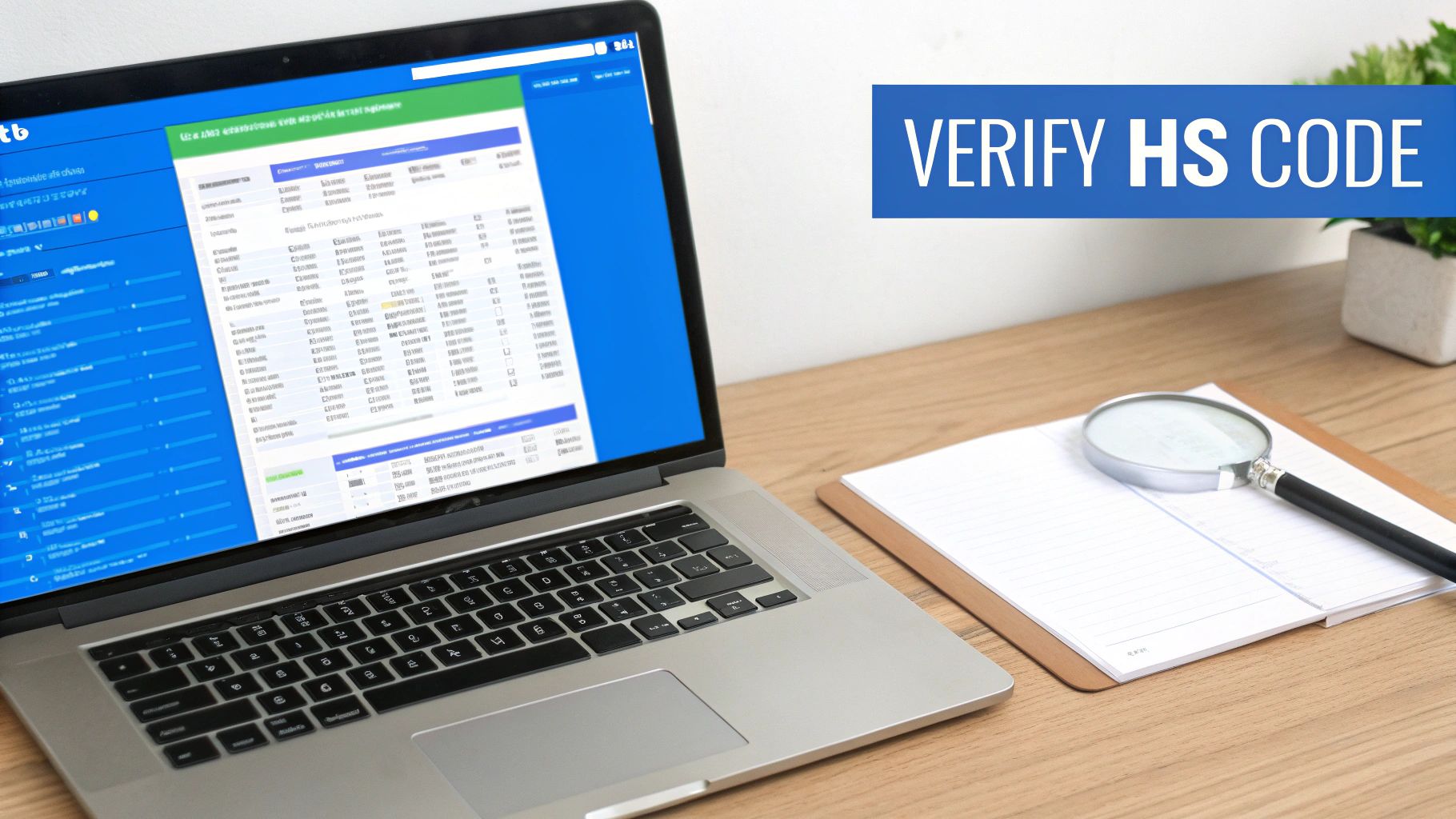
    A Practical Guide to Verifying Your PCB HS Code

    A laptop displays data on a blue screen next to a magnifying glass and notebook, with 'VERIFY HS CODE' text.

    Guesswork has no place in customs. Let’s be clear: getting the pcb hs code wrong isn’t a minor clerical error. It’s a direct ticket to shipment delays, surprise duties, and the kind of painful compliance audits nobody wants. To sidestep these headaches, you need a solid, repeatable process for finding and confirming the right code every single time.

    Think of it like forensic accounting for your product. You wouldn’t just estimate your taxes, and you absolutely shouldn’t guess your HS code. The aim is to build an undeniable case for your classification, backed by solid evidence from official sources. This simple shift in mindset turns customs clearance from a constant source of anxiety into a smooth, predictable part of your logistics flow.

    Gather Your Product Specifications

    Before you even dream of looking up a code, you need to know your product inside and out. A customs officer only has the information you provide, so your first job is to collect every last technical detail about the PCB you’re shipping. This is the bedrock of an accurate classification.

    Your product dossier should answer these questions at a minimum:

    • Component Status: Is it a bare, unpopulated board, or is it a populated Printed Circuit Board Assembly (PCBA)? This is the single most important distinction.
    • Layer Count: How complex is it? Be specific—is it single-sided, double-sided, or multilayer (e.g., “4-layer,” “8-layer”)?
    • Material Composition: What’s it made of? A standard rigid FR-4 board or a flexible circuit (FPC)?
    • Primary Function (for PCBAs): If it’s populated, what does the board actually do? Is it a computer motherboard, a controller for an industrial machine, or something else entirely?

    Once you have these details nailed down, you’re ready to take what you know and verify it against official sources.

    A vague product description is an open invitation for a customs inspection. A detailed one is a pass to the front of the line. Your goal is to provide so much clarity that the customs officer has no questions left to ask.

    Leverage Official Tariff Databases

    Your next move is to head straight to the source: the official tariff databases of the destination country. These online portals aren’t just helpful guides; they are the law. They are the definitive source for HTS codes and their corresponding duty rates.

    Here are the primary tools for the big players:

    1. United States: Use the Harmonised Tariff Schedule of the United States (HTSUS) search tool. It’s run by the U.S. International Trade Commission (USITC), and you can search by keyword (“printed circuit”) or jump straight to the heading number 8534.
    2. European Union: The TARIC (Integrated Tariff of the European Union) portal is your go-to. It provides the detailed codes plus a wealth of information on trade policies, tariffs, and other measures for any goods entering the EU.
    3. Other Regions: Most countries have a similar online customs tariff database. A quick search for “[Country Name] customs tariff schedule” will almost always point you to the correct government portal.

    These databases are where you drill down from the general 6-digit HS code to the specific 8- or 10-digit national code, ensuring your classification is as precise as possible.

    Cross-Reference with Customs Rulings

    Want another layer of confidence? Check for binding rulings. Customs agencies around the world often publish their official decisions on how specific products should be classified. These rulings are a goldmine of insight, showing you exactly how authorities have classified products very similar to yours in the past.

    For instance, U.S. Customs and Border Protection (CBP) has the Customs Rulings Online Search System (CROSS). By searching for terms like “multilayer printed circuit board,” you can pull up official letters that break down the logic for assigning a particular HTSUS code. This helps you confirm that your thinking aligns with established precedent.

    Finally, pull all this information together to craft a crystal-clear goods description for your commercial invoice. Instead of just writing “PCB,” be precise: “Unpopulated 8-layer rigid printed circuit boards, FR-4 material.” This simple habit gives customs officers exactly what they need to verify your pcb hs code in seconds, keeping your shipments moving without a hitch.

    Avoiding Common Pitfalls in PCB Customs Documentation

    A circuit board and components on a blue mat, alongside a clipboard with a document and pencil, with text 'Avoid Mistakes'.

    Getting customs classification right isn’t just about ticking a box. A seemingly minor error can set off a chain reaction, causing shipment delays, unexpected fines, and frustrated clients. Think of this as your pre-flight checklist for navigating the tricky world of PCB customs.

    Getting your documentation perfect is more than just compliance—it’s about building a reputation for getting things done right the first time. Even a small slip-up, like using an old HS code or writing a lazy product description, is enough to get your shipment flagged for inspection. Mastering these details is the key to smooth, predictable shipping.

    The Populated vs. Unpopulated Board Trap

    This is, without a doubt, the most common and costly mistake we see. People often confuse a bare, unpopulated printed circuit board with a fully populated Printed Circuit Board Assembly (PCBA). A bare board is essentially just the “road map”—the conductive pathways on an insulating base. It correctly falls under HS code 8534.

    But the moment you solder on the first component, its entire identity changes. It’s no longer just a “printed circuit.” Its classification now hinges on what it does, meaning it will likely fall under a completely different heading, such as HS code 8542 for integrated circuits. Declaring a fully assembled board under 8534 is a huge red flag for any customs officer and practically guarantees your shipment will be pulled aside.

    Vague Descriptions That Invite Trouble

    Your commercial invoice and packing list need to paint a crystal-clear picture for customs officials. Simply writing “circuit boards” is asking for trouble—it’s far too ambiguous and immediately raises suspicions. Customs agents need specifics to confirm your pcb hs code is correct.

    Your description should always be detailed and consistent across all documents. Be sure to include:

    • Component Status: Is it “Unpopulated” or “Populated“? State it clearly.
    • Layer Count: Specify if it’s a “4-layer,” “8-layer,” or another multilayer configuration.
    • Material and Type: Note if it is a “Rigid PCB” or a “Flexible Circuit.”

    This level of detail gives an officer the confidence to clear your shipment quickly, often without a physical inspection. A lack of clarity, on the other hand, suggests you might not know what you’re doing, which slows everything down.

    Expert Tip: Create a master classification list for every PCB product you ship. This internal document should lock in the correct HTS code, a precise technical description, and a brief justification for why that code was chosen. It’s the single best way to ensure everyone in your organisation is on the same page.

    Forgetting to Declare the Full Value

    Another critical error is undervaluing a populated board. The customs value of a PCBA isn’t just the cost of the bare board; it’s the board plus the value of every single component mounted on it, especially high-value integrated circuits (ICs).

    Attempting to lower duties by under-declaring the value is a serious compliance breach that can lead to hefty fines, black marks against your company, and future audits. Your commercial invoice must reflect the total, accurate value of the finished assembly.

    The sheer volume of this trade in major hubs highlights why precision is so crucial. For example, the PCB trade under codes like 8534 and 8542 is a cornerstone of Singapore’s merchandise trade statistics. Official data shows Singapore handled 2,156 shipments of these boards in recent years alone, a figure that underscores the scale and importance of getting the details right every time.

    By treating your customs paperwork with the same care and precision as the electronics you’re shipping, you lay the groundwork for a reliable and efficient global supply chain.

    Using HS Codes to Find High-Value PCB Shippers

    For a freight forwarder, a PCB HS code is more than just a customs requirement—it’s a key that unlocks a treasure trove of business opportunities. Think of it as a secret map. These simple numbers allow you to see exactly which companies are actively shipping electronics around the world, turning routine customs data into your most powerful lead generation tool.

    Every time a pallet of PCBs crosses a border, the shipment is logged in a customs database and tagged with its specific HS code. This creates an incredibly detailed, searchable ledger of global trade. Instead of casting a wide, inefficient net, you can pinpoint active shippers with surgical precision. You’ll know who is moving PCBs, where they’re coming from, and where they’re going.

    Transforming Data into Actionable Leads

    Raw customs data on its own can be overwhelming. The real magic happens when it’s organised and made searchable. Platforms built specifically for freight forwarders sift through millions of these data points, transforming them into clean, actionable sales intelligence. You can instantly find high-value prospects, get key contact information, and build an outreach plan that shows you’ve done your homework.

    Let’s say you want to find new clients among electronics manufacturers shipping from Singapore to the United States. A generic approach is a waste of time. A data-driven one, however, lets you zero in on the best opportunities.

    • Filter by HS Code: Start your search with HS code 8534 to isolate all companies shipping printed circuit boards.
    • Identify Key Players: Look at shipment volumes. Who are the biggest players moving products along that specific trade lane?
    • Find Contact Details: The best platforms will give you verified email addresses and professional profiles for decision-makers in logistics, procurement, or supply chain roles.
    • Craft Your Message: Armed with this information, your outreach is no longer a cold call. It’s a warm introduction from an expert.

    This focused strategy means you spend less time guessing and more time talking to qualified leads who have a clear, proven need for your services.

    A Real-World Scenario

    Let’s bring this to life. Singapore is a powerhouse in the global electronics trade, and its activity—all tracked by PCB HS code data—reveals a bustling ecosystem ripe for prospecting. You can learn exactly how to find and engage qualified shippers and build a pipeline of solid leads.

    Imagine filtering for HS code 8534 and instantly finding a Singaporean company that moves 50 TEUs of multilayer PCBs to Los Angeles every single month. Your pitch is no longer a generic shot in the dark. It becomes a specific, value-packed proposal: “I see you’re a major shipper of multilayer PCBs from Singapore to the US West Coast. We specialise in this lane and believe we can offer a more competitive solution.”

    This data-driven approach makes your sales efforts incredibly efficient. The market is huge; Volza, for example, reports 2,156 PCB board export shipments from Singapore alone, involving 290 exporters and 248 buyers. That’s a clear map of a thriving trade network just waiting for you. Discover more insights about Singapore’s PCB trade on OEC.world.

    When you use the PCB HS code as your guide, you stop being just another service provider and become a strategic partner who truly understands the market.

    Answering the Tricky Questions: Common PCB Classification Puzzles

    Even with a good grasp of the basics, some scenarios can still make you second-guess a classification. Grey areas are just part of the customs landscape, but you can navigate them by sticking to the core principles we’ve covered. Let’s walk through some of the most common head-scratchers that pop up when shipping PCBs.

    Think of this as a field guide for those “what if” moments. We’ll break down the nuances that can trip up even seasoned pros, helping you keep every shipment compliant.

    How Do I Classify Prototype PCBs?

    This question comes up all the time. What do you do with prototypes that are just for testing and aren’t meant to be sold?

    It’s simple: customs cares about the condition of the goods at the moment they cross the border, not their ultimate purpose or sale price.

    A prototype PCB is classified just like any other. If it’s a bare, unpopulated board, it belongs under HS code 8534. If it has components on it (making it a PCBA), its classification shifts away from 8534 and depends on its primary function. You also have to declare its fair market value, even if you have no plans to sell it.

    What About Boards with Integrated Connectors?

    Here’s a specific but important one: what happens when a bare PCB has connectors but no other electronic components soldered on?

    Connectors are seen as passive elements. Customs practice generally allows a board with only passive components like connectors to still be classified as a printed circuit under HS code 8534.

    The key, however, is to be painstakingly clear in your product description. Vague language is your enemy here.

    For instance, describe it as: “Unpopulated 4-layer rigid PCB with integrated pin-header connectors, no active or passive electronic components.” This level of detail stops a customs agent from mistaking it for a partially populated board and causing a needless delay.

    Declaring Scrap PCBs vs. New Units

    Finally, let’s talk about scrap. Shipping defective or obsolete PCBs for recycling is a completely different ball game than shipping new, functional units.

    You absolutely must declare them as “Scrap Printed Circuit Boards for recycling/destruction” on your commercial invoice. Their declared value should reflect their worth as raw material, not the price of a working board.

    Failing to make this distinction is a costly mistake. If you use the standard pcb hs code without clarifying they are scrap, you could end up paying duties and taxes on the full value of a new product, which is essentially just throwing money away on waste material.


    Ready to stop guessing and start targeting the most valuable shippers? Coreties transforms customs data into your ultimate lead-generation tool. Find, verify, and connect with high-volume PCB shippers in just a few clicks. Discover your next big opportunity at https://coreties.com.