
At its most basic level, an exporter is the party selling and sending goods out of a country, while an importer is the one buying and bringing those goods in. Think of it like a global handshake: the exporter extends their hand by shipping the product, and the importer completes the deal by receiving it.
Understanding the World of Exporters and Importers
While the definitions seem simple, the roles of exporters and importers are packed with legal and financial responsibilities that can make or break a shipment. They're not just passive senders and receivers; they are the key players in any international trade transaction.
For freight forwarders, who are the organisers and problem-solvers of global logistics, mastering the nuances of these roles is non-negotiable.
The Role of the Exporter
The exporter is the seller, producer, or shipper who kicks off the entire logistics journey. Their job is to prepare the goods for their international voyage and ensure every local regulation is met before the cargo even thinks about leaving the country.
Their main duties typically include:
- Packaging and Labelling: Properly packing goods to survive a long journey and labelling everything to meet international standards.
- Export Documentation: Getting all the critical paperwork in order, from the commercial invoice and packing list to any special export licences.
- Export Customs Clearance: Officially declaring the goods to their own country's customs authority and settling any export-related fees or taxes.
Imagine a furniture maker in Malaysia sending a container of handcrafted tables to a buyer in Australia. That Malaysian company is the exporter. They're on the hook for everything from securely packing the tables to clearing them with Malaysian customs and getting them loaded onto the ship at Port Klang.
The exporter’s fundamental task is to get the product packed, documented, and legally cleared to leave its home country. A single mistake here can create a bottleneck that delays the entire shipment from the very start.
If you're thinking about starting your own trading operation, it pays to understand the full scope of what's involved in running a successful import-export business.
The Role of the Importer
On the other side of the transaction is the importer, the buyer who takes the baton once the goods arrive in the destination country. Their responsibility is to navigate all the local entry requirements to get the cargo released and delivered.
The importer's key responsibilities usually are:
- Import Customs Clearance: Filing the correct entry declarations with the customs agency in their country.
- Paying Duties and Taxes: Handling all import duties, tariffs, and taxes (like VAT or GST) needed to clear the goods.
- Final Delivery: Organising the final leg of the journey—transporting the goods from the port to their warehouse, distribution centre, or storefront.
Exporter vs Importer Key Responsibilities at a Glance
To make it even clearer, here's a simple breakdown of who typically does what in an international shipment.
| Responsibility | Exporter Role | Importer Role |
|---|---|---|
| Origin Logistics | Arranges transport from factory to the port/airport of departure. | Not typically involved. |
| Export Documentation | Prepares commercial invoice, packing list, export licences. | Receives and verifies copies of documents. |
| Export Customs | Files export declaration and pays any origin duties/fees. | Not involved. |
| Main Freight | Arranges and pays for shipping (depending on Incoterms). | Arranges and pays for shipping (depending on Incoterms). |
| Import Customs | Not involved. | Files import declaration and works with a customs broker. |
| Duties & Taxes | Not involved. | Pays all applicable import duties, tariffs, and taxes. |
| Destination Logistics | Not typically involved. | Arranges transport from the arrival port/airport to the final destination. |
This table shows how the responsibilities are split, with the handover often happening somewhere in the middle of the journey. Understanding this division of labour is crucial for anticipating needs and providing value as a logistics partner.
Decoding the Language of Global Trade and Compliance
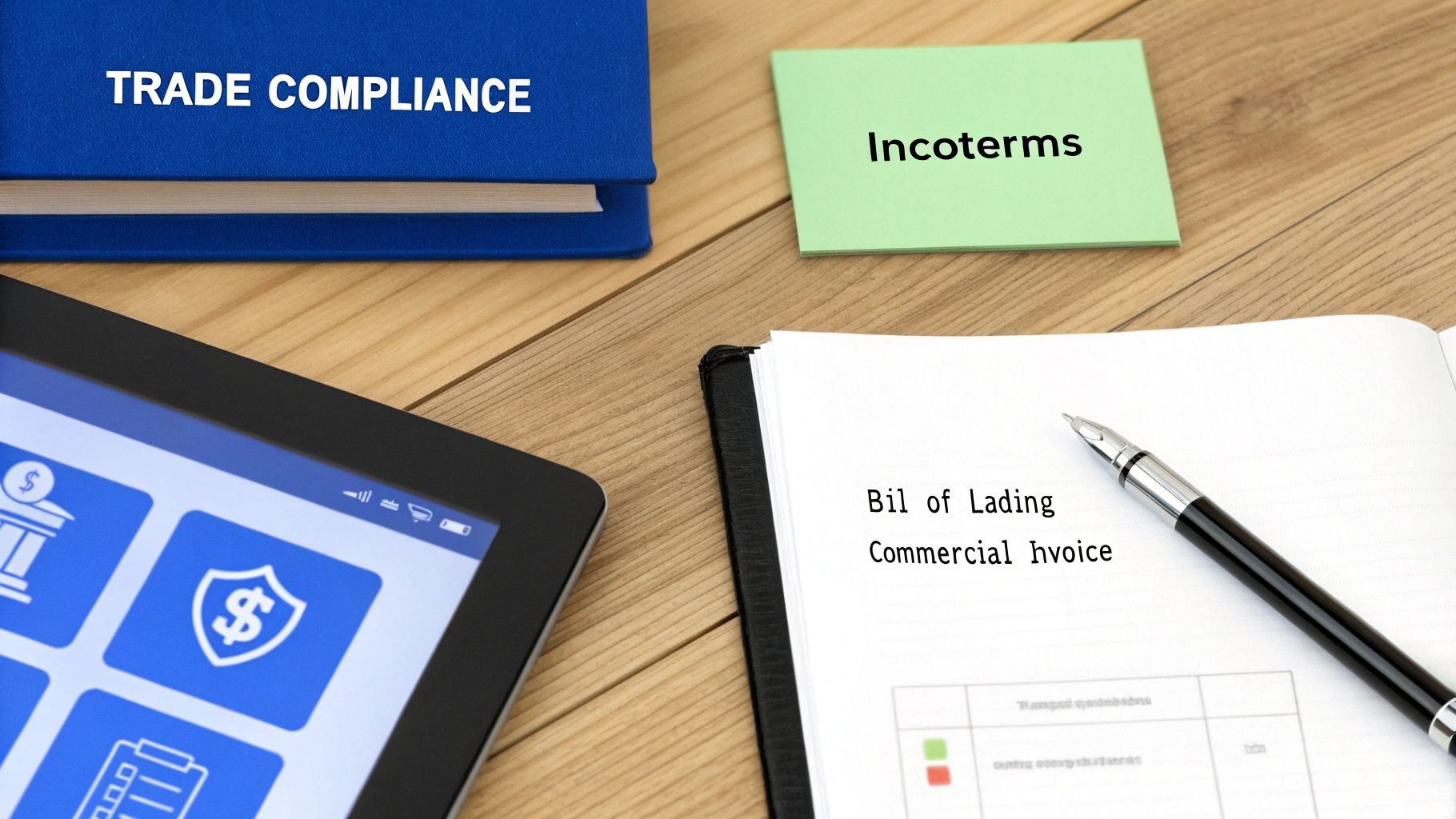
For any exporter and importer, compliance isn't just about paperwork. It's the entire rulebook that keeps international trade moving. When a freight forwarder speaks this language fluently, they stop being just a service provider and become a strategic partner—one who can spot trouble before it starts and offer real guidance.
This all comes down to mastering the documents and terms that are the bedrock of every shipment. Get it wrong, and you're looking at delays, fines, and very unhappy clients.
The Essential Paper Trail
Think of shipping documents as a passport for your cargo. Each piece of paper serves a critical purpose, proving ownership, value, and compliance from the moment it leaves the warehouse to the moment it arrives. Together, they tell a story that customs officials worldwide need to understand instantly.
Two documents stand above the rest in importance:
- Commercial Invoice: This is the core bill of sale between the exporter and the importer. It breaks down what's being sold, how much it's worth, and the payment terms. For customs, this is the go-to document for calculating duties and taxes, so any inaccuracy can cause major problems.
- Bill of Lading (B/L): For sea freight, this is the holy grail. It’s a contract, a receipt for the goods, and, most importantly, a document of title. Whoever holds the original B/L physically owns the cargo and has the right to claim it at the destination.
A simple typo on either of these can bring a shipment to a dead stop. An undervalued commercial invoice might trigger a customs audit and heavy fines. A lost Bill of Lading? That’s a logistical nightmare where the importer can't legally touch their own goods. You can learn more about the crucial legal role of the Importer of Record and their documentation duties in our detailed guide.
Understanding Incoterms: The Rules of the Game
Beyond the paper trail, you have Incoterms (International Commercial Terms). These are the universally accepted rules that spell out exactly who is responsible for what between the seller and the buyer. Published by the International Chamber of Commerce, they remove ambiguity by defining who pays for each step and, crucially, who bears the risk if something goes wrong.
Let’s say an exporter in Singapore is selling electronics to an importer in Germany. The Incoterm they agree on will settle key questions upfront:
- Who is paying for the main sea freight from Singapore to Hamburg?
- When exactly does the risk of loss or damage transfer from the seller to the buyer?
- Is the exporter on the hook for handling German import customs clearance?
Think of Incoterms as the pre-nuptial agreement for an international sale. They set clear boundaries for cost, risk, and responsibility, preventing expensive arguments long before a container is even booked.
Nailing these terms is fundamental. For instance, a common term like FOB (Free On Board) means the exporter's job is done once the goods are safely loaded onto the ship at the origin port. But under DDP (Delivered Duty Paid), the exporter handles almost everything—right up to paying import duties and arranging final delivery. For a freight forwarder, the Incoterm is a cheat sheet that instantly tells you who your client is for each part of the journey.
Tuning into Your Prospect's Pain Points
Talk to any seasoned exporter or importer, and they'll have a catalogue of horror stories. They can tell you about the shipment that disappeared off the grid for three days, the surprise invoice that ate their entire profit margin, or the customs hold that torpedoed a critical deadline. As a freight forwarder, your superpower is learning how to listen for these stories.
When you truly understand these frustrations, you stop selling freight services and start offering genuine solutions. The language of logistical pain is universal, and once you’re fluent, you can connect with potential clients on a level your competitors simply can't reach.
These aren't just gripes; they are massive buying signals. A prospect who mentions constant documentation errors isn't just venting—they're practically shouting about a weakness in their current setup. That’s your cue to show them how your expertise prevents those exact mistakes from happening in the first place.
Common Shipper Frustrations
While every business has its own quirks, the core anxieties for an exporter and importer usually circle back to the same few problems. If you can spot these patterns, you can anticipate their needs and build a pitch that solves the problems keeping them up at night.
When you hear these, you know you're onto something:
- The Black Hole of Visibility: Shippers absolutely hate feeling powerless. Not knowing where their cargo is or if it’s cleared customs creates a huge amount of stress and makes it impossible to keep their own customers in the loop.
- The Sting of Surprise Costs: Nothing kills trust faster than a bill full of hidden fees. Demurrage, detention, and random administrative charges can flip a profitable shipment into a loss, instantly souring them on their current provider.
- Radio Silence: Having to wait hours, or even days, for a simple update is a major red flag for any shipper. Poor communication makes them feel unimportant and leaves them scrambling to manage their supply chain blind.
A recent study found that 73% of shippers would jump to a new provider for better customer service alone. A massive part of that service is clear communication and transparency. When a prospect complains about their forwarder’s response times, they’re really asking for a partner they can actually rely on.
Turning Pain into Opportunity
Your job is to draw a straight line from their specific frustration to a tangible solution you offer. This isn’t about a hard sell; it's about active listening and a consultative approach. Don't lead with a price list. Lead with questions that get them talking about their operational headaches.
Think of yourself as a doctor. You need to understand the symptoms before you can even think about prescribing a cure. For an exporter and importer, the symptoms are their day-to-day logistical nightmares.
Here’s how to translate their complaints into real opportunities:
| Shipper Says… | This Is a Signal Of… | Your Solution Is… |
|---|---|---|
| "My last shipment was stuck in customs for a week." | Compliance & Documentation Issues: Their current partner is likely dropping the ball on paperwork, causing delays and risking fines. | Your team's deep expertise in getting documentation right the first time, ensuring a smooth path through customs. |
| "I never know where my container is." | Poor Technology & Visibility: They’re stuck with a forwarder who either lacks a modern tracking platform or just doesn't bother providing updates. | Your easy-to-use, real-time tracking portal that gives them end-to-end visibility and automated alerts. No more guessing games. |
| "We got hammered with unexpected charges at the port." | Lack of Transparency & Poor Planning: Their forwarder either gave them a fuzzy quote or completely failed to manage the shipment's timeline. | Your commitment to clear, all-in pricing and meticulous planning that dodges costly demurrage and detention fees. |
When you frame your services this way, the conversation shifts from cost to value. You’re no longer just another option in a long list of forwarders. You become the specific solution to a costly, painful problem.
Finding High-Value Shippers with Customs Data
Let's be honest, old-school prospecting is a grind. For freight forwarders, it often feels like you're just throwing darts in the dark—endless cold calls to long company lists, hoping you eventually hit an exporter or importer who might actually need your services. It's a massive drain on time, energy, and resources.
But what if you had a map? That’s exactly what global customs data is. It's a live, daily treasure map detailing who is shipping what, where they're shipping it, and how often. Instead of guessing, you get a crystal-clear look at the real-world shipping activities of thousands of companies.
This data allows you to see the entire playing field. You can pinpoint businesses moving serious volume along the exact trade lanes you excel in, letting you instantly separate the high-value prospects from the tyre-kickers.
Turning Raw Data into Sales Intelligence
Raw customs data is incredibly powerful, but on its own, it’s just a sea of numbers. To make it work for you, you need a way to sift through it, make sense of it, and turn it into something you can act on. This is where a proper data platform becomes non-negotiable for a modern sales team.
Tools like Coreties are built for this very purpose. They take that mountain of information and refine it into sharp, actionable sales intelligence. They don't just give you shipment records; they connect those records to the right companies and, crucially, to the decision-makers you need to talk to.
Here’s what that looks like in practice:
- Pinpoint Your Ideal Customer: You can filter companies by the specific commodities they move, their shipping volumes, and the trade lanes they frequent to build a laser-focused lead list.
- Qualify Before You Call: You can see a prospect’s shipping history and their current partners, so you know they’re a solid fit before you even pick up the phone.
- Know Their Business Inside-Out: Seeing what an exporter and importer ships lets you craft a pitch that speaks directly to their world, not yours.
Just look at Singapore's trade data for a real-world example. In December 2025, the country's non-oil domestic exports (NODX) grew by 6.1%, and non-oil re-exports (NORX) shot up by a massive 15.0%. This kind of growth, particularly in sectors like electronics, signals a clear and growing demand for dependable logistics partners. You can dive deeper into Singapore's robust trade performance on enterprisesg.gov.sg.
The process for turning this insight into a solution is actually quite simple.
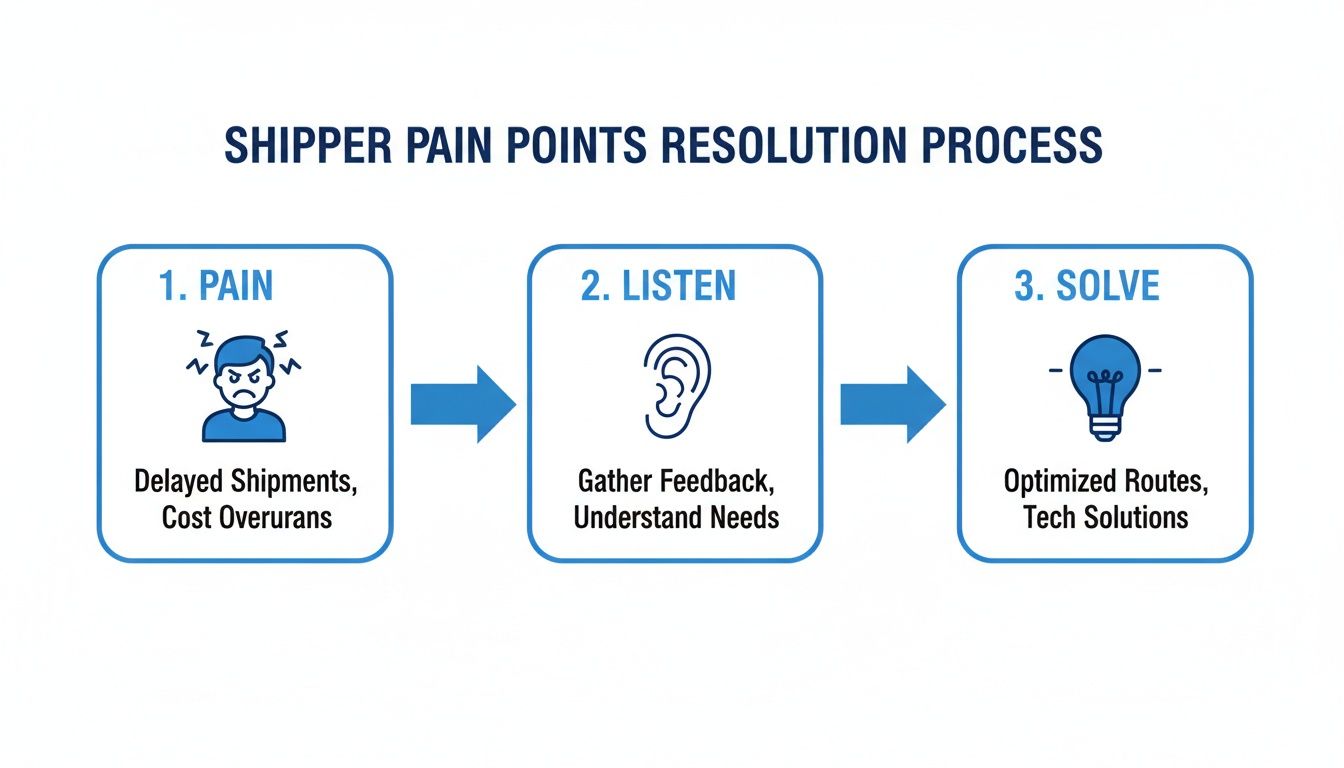
It starts by using data to spot a shipper's pain point. From there, you listen to their challenges and present a tailored solution. This simple shift turns a generic sales pitch into a genuine, problem-solving conversation.
From Identification to Outreach
Okay, so you’ve found a promising exporter or importer. What's next? This is where a data platform really shows its value by linking those customs records directly to verified contact details for logistics and supply chain managers.
The entire goal is to stop making generic sales pitches and start having relevant conversations. Instead of "Let me tell you about my freight company," you can open with, "I see you're regularly shipping automotive parts to Mexico." That's a completely different and far more powerful conversation.
This targeted approach works because it's grounded in their actual, recent business activities. You're no longer just another salesperson. You're a well-informed expert who understands their needs and can offer a specific, valuable solution. Suddenly, every outreach email and every call has a much better chance of landing.
Crafting Outreach That Actually Gets a Reply
Having a list of high-value leads is a great start, but it's just that—a start. The real magic happens when you turn that raw data into a real conversation. The line between an email that gets deleted instantly and one that gets a thoughtful reply is razor-thin, and it all comes down to one thing: relevance.
Let's be honest, we can all spot a generic, copy-pasted email from a mile away. An experienced exporter and importer certainly can. The secret is to show you've done your homework and actually understand their business, right from the first sentence.
Forget the tired old "Let me introduce our freight services" opener. Instead, imagine leading with something that makes them stop and think: "I saw your company's recent shipments of electronic components from Vietnam to the EU, and I have an idea that could optimise that specific lane." Instantly, you've gone from being just another salesperson to a potential expert who understands their world.
Moving From Generic to Data-Driven
This is the big shift—from spraying and praying with mass emails to targeted, intelligent outreach. It shows you respect their time and signals that you're here to add genuine value to their supply chain, not just sell a service. Your entire message should be built on the foundation of their actual shipping activity.
This approach works because it connects directly with their day-to-day reality. You can use concrete details from customs data to show you've put in the effort:
- Trade Lanes: Mention the specific routes they're running cargo on.
- Commodities: Refer to the exact types of goods they move.
- Partners: Note their known trading partners or destinations.
This kind of personalisation turns a cold call into a warm, consultative conversation starter. It tells them you’re prepared to talk specifics and solve their real-world logistical headaches. For more insights on how manufacturers and exporters can connect with the right business partners, check out our guide on connecting EXIM, MFR, and enterprise sectors.
For many, this is a significant change from the old way of doing things. The difference in approach—and results—is stark.
Traditional vs Data-Driven Outreach
| Element | Traditional Approach | Coreties' Data-Driven Approach |
|---|---|---|
| Lead Source | Purchased lists, industry directories, cold calls. | Verified customs data, identifying active shippers. |
| Opening Line | "Hi, I'm from XYZ Logistics…" | "I noticed your recent shipment of [Commodity] from [Origin]…" |
| Value Proposition | Generic: "We offer great rates and service." | Specific: "We can help you navigate customs delays on the [Trade Lane] route." |
| Follow-Up | Standard "Just checking in…" emails. | Value-add: "Here's an article on new regulations affecting [Commodity] imports." |
| Success Metric | Volume of calls/emails sent. | Quality of conversations started. |
Ultimately, the data-driven method is about quality over quantity. It's a more strategic, respectful, and frankly, more effective way to build a pipeline of high-value clients.
Finding Opportunities in Economic Trends
The best outreach doesn't just happen in a vacuum; it uses context. By understanding the bigger economic picture, you can frame your solutions in a way that resonates deeply.
Take Singapore's trade data, for example. In December 2025, the country posted a trade surplus of 2,205.64 SGD million, right after a massive 7,669.08 SGD million surplus in November. These aren't just numbers; they're a clear signal of booming export activity. This means more Singapore-based companies are actively seeking reliable, efficient shipping partners to handle their growing volume. You can dig into the specifics in this report on Singapore's balance of trade from tradingeconomics.com.
When your outreach combines specific company data with wider market intelligence, you create a powerful narrative. You're not just offering a service; you're offering a timely solution perfectly aligned with their business needs and the current economic landscape.
By connecting the dots between customs data and real-world trade flows, your message becomes almost impossible for the right exporter and importer to ignore. It positions you as a strategic partner from the very first email.
Uncovering Opportunities Beyond Merchandise Trade
When we think about global trade, it's easy to picture massive container ships filled with consumer goods. But that's only part of the story. Some of the most valuable opportunities for freight forwarders are hiding in plain sight, within the services sector.
Take industries like tech, finance, or engineering. They aren't shipping t-shirts or toys, but their logistics needs are incredibly critical. Imagine a tech company setting up a new data centre overseas and needing to ship highly specialised servers. Or think about a renewable energy firm that has to transport fragile, multi-million dollar turbine components for a new wind farm.
These are high-stakes, project-defining shipments. The companies acting as both the exporter and importer of this kind of equipment can't afford mistakes. They absolutely need a logistics partner they can trust, which is where a savvy forwarder comes in. It’s a call to look beyond the usual cargo and tap into these lucrative, and often less crowded, market segments.
The numbers back this up, too. In the first quarter of 2025 alone, Singapore's trade in services shot up by 3.8% compared to the previous year, hitting a value of around SGD 249 billion. This isn't just abstract data; it represents a booming market that needs physical, high-value goods to make those services happen. You can dig deeper into Singapore's recent trade performance and its economic impact to see the trends for yourself.
By homing in on companies in these growing service industries, you can get a real leg up on the competition. These clients are often looking for reliability and specialised care, not just the lowest price, making them perfect for building profitable, long-term partnerships.
This is where a tool like Coreties becomes so powerful. It helps you follow these economic shifts and pinpoint the key players in these parallel sectors—the very ones your competitors are likely ignoring.
Your Questions, Answered
Let's dig into some of the common questions freight forwarders ask when they're on the hunt for a new exporter and importer to work with.
How Can I Find High-Value Importers Instead of Low-Volume Shippers?
This is the classic quality-over-quantity problem. The best way to solve it is by getting your hands on global customs data. A solid platform like Coreties lets you slice and dice that data, filtering leads by how much they ship, how often, the value of their goods, and the specific trade lanes they use.
Instead of casting a wide, hopeful net, this lets you zero in on companies that perfectly match your ideal customer profile. You can spend your time on the big fish, not the small, one-off shippers.
What's the Best Way to Start a Conversation with an Exporter Lead?
Whatever you do, don't send a generic "Hello, we're a freight forwarder" email. That's a one-way ticket to the trash folder. You need to show them you've done your homework.
Use the insights you've gathered from customs data to craft a message they can't ignore. For example, you could say something like, "I noticed you're regularly exporting electronic components to Germany. We've just secured a great rate on that air freight lane and I think we could save you a fair bit." See the difference? You're immediately showing value and proving you understand their specific business needs.
What Information Is Crucial for Qualifying a Lead Besides Customs Data?
Customs data is your foundation, but it’s just the start. You need to build on it by finding out more about the company and, crucially, who to talk to. Look for things like the company's size, what industry they're in, and any recent news that might signal a change in their shipping patterns.
But the real game-changer is finding the right person. You need to get past the gatekeepers and connect with the Logistics Managers, Supply Chain Directors, or Heads of Procurement.
A fantastic lead is worthless if you can't get your pitch in front of the person who actually makes the decisions. That's why platforms that combine verified contact details with customs data are so powerful—they connect you directly to the people who can say "yes".
Ready to find your next high-value exporter and importer? Coreties turns raw customs data into real sales intelligence, helping you create outreach that actually gets replies and wins business. Discover qualified shippers today at coreties.com.