Tag: freight prospecting

  • How to Land Winsome Trading Woodinville as a Client

    How to Land Winsome Trading Woodinville as a Client

    If all you know about Winsome Trading Woodinville is the address, the phone number, and that they sell furniture, what exactly are you going to say that earns a meeting?

    That's where most logistics prospecting breaks down. Reps collect directory data, paste it into a sequence, and send a generic note about rates, service, or capacity. The target sees it for what it is. Another message from someone who knows the company name but not the supply chain.

    Winsome Trading is a better account than that kind of outreach deserves. The company was established in 1977 and has maintained continuous operations for over 35 years according to its Better Business Bureau profile for Winsome Trading Inc.. That kind of operating history matters to a freight seller. You're not looking at a casual reseller with a thin footprint. You're looking at a long-standing furniture manufacturer with enough staying power to justify careful account work.

    Going Beyond Basic Data on Winsome Trading

    Most reps start with map listings and stop there. That's the mistake.

    For Winsome Trading Woodinville, the primary qualifying question isn't where the office is. It's this: what are their actual shipment patterns, lanes, and frequencies? Public listings don't answer that. In fact, MapQuest's listing context explicitly reflects the gap around Winsome Trading's primary import/export lanes and monthly shipment frequencies.

    A person holds a coffee mug while viewing an email inbox on a laptop screen.

    That gap is where good prospecting starts. A map entry tells you who exists. It doesn't tell you who's buying capacity, who's dealing with customs friction, who may be consolidating inbound freight, or who's running a warehouse operation that creates follow-on domestic moves.

    Why generic outreach fails here

    A furniture shipper usually has moving parts that don't show up in a business directory:

    • Inbound complexity: raw materials, components, or finished goods may move on different lanes with different urgency.
    • Handling sensitivity: wood, glass, iron, and finished surfaces don't move like palletized commodity freight.
    • Multi-leg coordination: import, deconsolidation, warehousing, and final distribution often sit with different vendors.

    If your email says only “we handle ocean and air freight,” you've told them nothing useful.

    Practical rule: Don't prospect the company record. Prospect the operating model behind the company record.

    That means building an account view before writing a single subject line. Start with corporate age, product categories, facility hints, and location footprint. Then use that profile to form a lane hypothesis you can test.

    A lot of reps skip that because it feels slower. It isn't. Blind outreach creates more wasted activity than research ever will. If you need a clean framework for that research stack, this guide on sales intelligence tools for prospecting workflows is a useful reference point.

    The account lens that changes the conversation

    For Winsome Trading Woodinville, the shift is simple:

    Weak approach Better approach
    “Furniture company in Washington” “Established manufacturer with likely recurring inbound and outbound freight needs”
    “Need a contact” “Need lane evidence, shipment signals, and the right owner”
    “Send capabilities deck” “Lead with a specific logistics observation”

    That's the difference between being ignored and sounding relevant.

    Profiling the Shipper What Matters for Logistics

    A shipper becomes interesting when the physical footprint starts telling you how freight probably moves.

    Winsome Trading Inc. operates a consolidated 200,000-square-foot facility in Woodinville, Washington that unifies its USA office, assembly operation, and distribution warehouse, according to its LinkedIn company profile. For a logistics seller, that single fact is more useful than ten generic company descriptions.
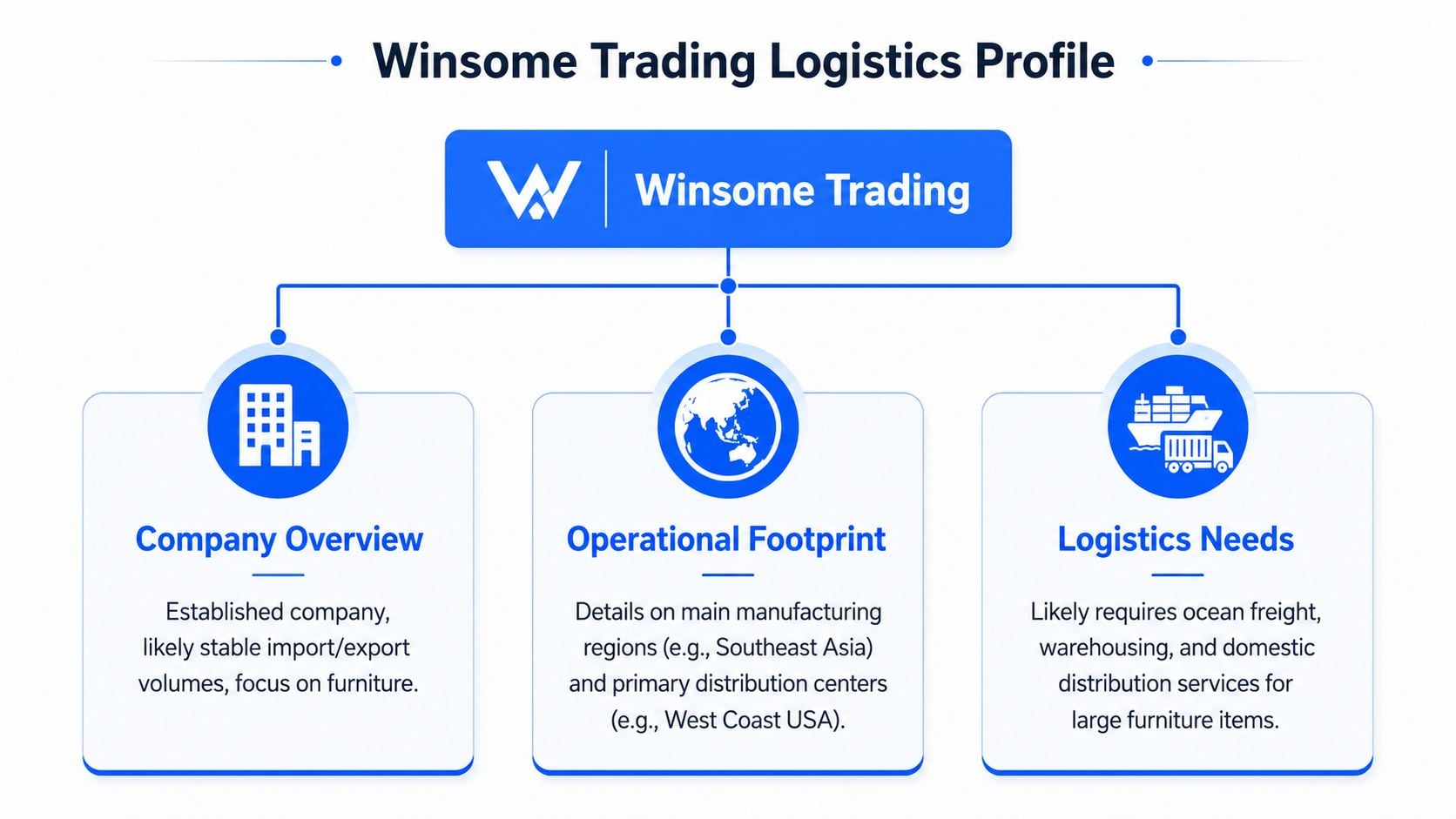
    A corporate profile infographic for Winsome Trading, detailing their furniture business operations, manufacturing regions, and logistics requirements.

    What a consolidated facility usually signals

    When office, assembly, and distribution sit together, a few practical implications follow:

    • Inbound scheduling matters more. Delays don't just affect receiving. They can disrupt assembly timing and outbound fulfillment.
    • Warehouse flow matters. If one site is handling multiple functions, congestion at receiving docks can spill into order release.
    • A forwarder can sell coordination, not just transport. The pitch becomes smoother handoffs, cleaner visibility, and fewer surprises across modes.

    That changes how you qualify the account. You're not asking only whether they import or export. You're asking whether their operation benefits from tighter alignment between customs, drayage, warehousing support, and domestic distribution.

    Product mix tells you where service risk lives

    The company's Better Business Bureau profile describes a product range that includes accent tables, bed trays, TV tables, occasion tables, stools, and shelving, with materials including wood, wrought iron, aluminum, steel, marble, and glass. That mix creates real trade-offs.

    Wood and finished furniture surfaces raise packaging and damage-prevention questions. Glass adds breakage exposure. Metal and stone components can change weight distribution, container loading plans, and final-mile handling. A rep who understands that won't lead with “best rates.” They'll ask better questions.

    If the shipment can be damaged by poor loading, poor packaging advice is a sales problem, not just an operations problem.

    How to rank this account internally

    New reps often treat every manufacturer the same. Don't. Build a short qualification view around operational fit. If you want a simple framework for building a lead scoring model, adapt it to logistics-specific variables like facility type, product fragility, cross-border indicators, and likely modal mix.

    A practical scorecard for Winsome Trading Woodinville would weigh:

    1. Facility structure
      Consolidated operations often create coordination pain points worth solving.

    2. Product handling demands
      Mixed materials usually increase the value of specialized execution.

    3. Operational maturity
      Long-standing manufacturers tend to have established processes, which means you need a sharper entry angle.

    For reps learning account breakdowns, I like comparing one target against another known manufacturer profile to sharpen pattern recognition. This review of Marathon Sales Inc and account qualification signals is useful for that exercise.

    Uncovering Potential Trade Lanes and Shipment Patterns

    The useful question isn't “Does Winsome ship?” It's “What route logic would make sense for this shipper, and how do we verify it fast?”

    Winsome Trading Inc. generates annual revenue of approximately $39,033,867 and maintains a secondary location at 8116 Alexander Rd, Delta, BC, Canada, according to its Manta company profile. The number matters because it suggests a meaningful operating scale. The Delta location matters because it gives you a real cross-border clue.
    Screenshot from https://coreties.com

    Start with hypotheses, not assumptions

    You don't need to invent facts to form a prospecting plan. You need disciplined hypotheses.

    For Winsome Trading Woodinville, I'd test these possibilities first:

    • Cross-border movement between Washington and British Columbia
      The Delta facility creates a plausible lane for inventory balancing, supplier coordination, or distribution support.

    • West Coast port dependency
      A Woodinville furniture operation with mixed-material products may rely on Pacific Northwest import flows, even if the exact port mix still needs verification.

    • Container-level handling complexity
      Furniture and pantryware often create cube, stacking, and breakage considerations that influence carrier and warehouse choices.

    None of those statements claims a shipment history. They tell you where to look first.

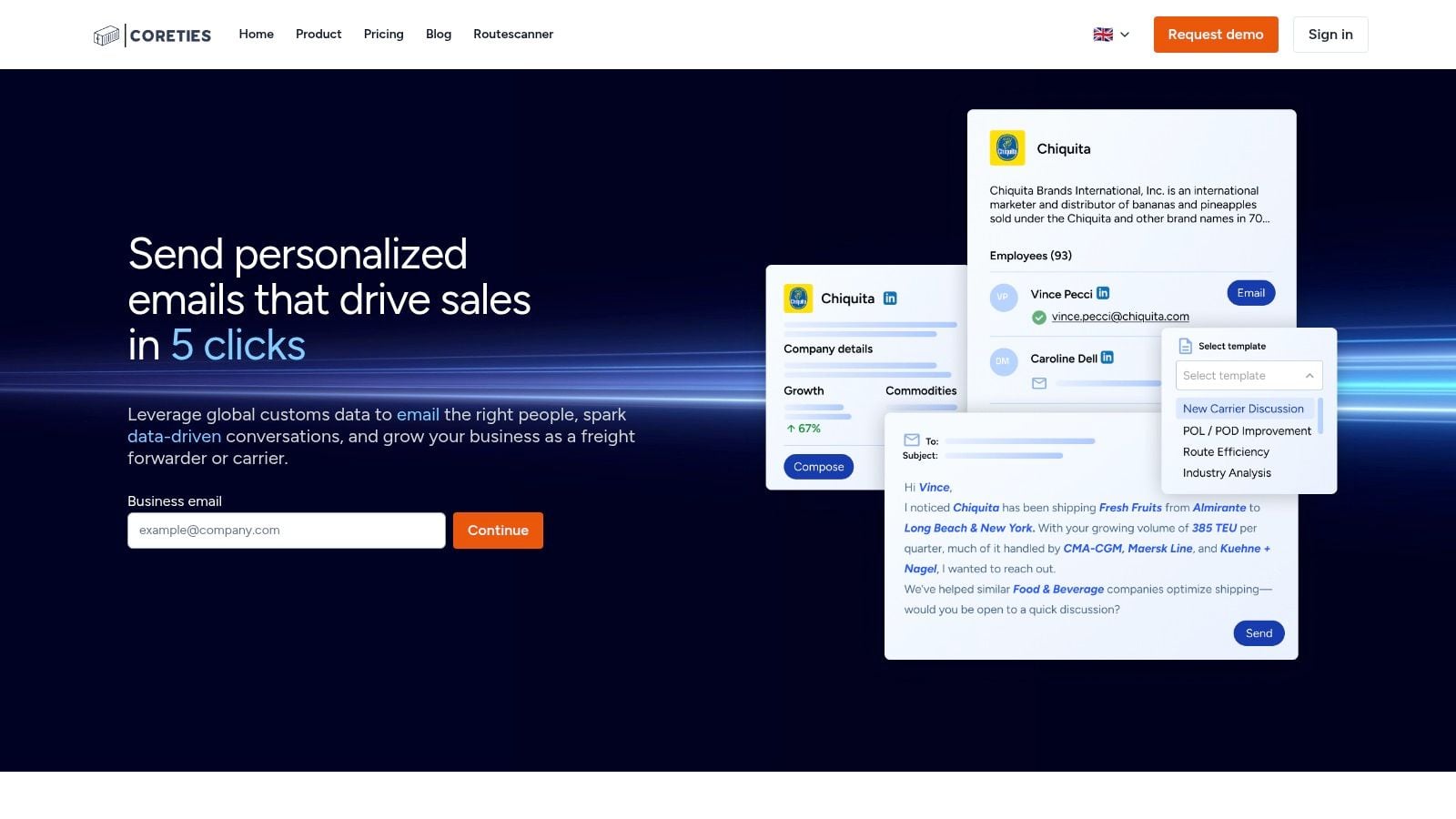
    What to pull from customs and commercial signals

    In this critical phase, new reps either become dangerous in a good way or stay stuck in list-building mode. You want records and signals that answer a narrow set of questions:

    Signal to verify Why it matters
    Port of entry patterns Tells you which gateway problems are worth discussing
    Carrier names Helps frame switch-risk and incumbent strength
    Commodity descriptions Reveals whether the lane fit matches your service strengths
    Consignee and shipper naming variants Prevents missing records due to entity mismatch
    Recurring origin locations Turns a one-off shipment into a lane strategy

    You should also widen the net beyond customs records alone. Teams that know how to integrate social data with scraping APIs can enrich lane research with job changes, facility mentions, hiring trends, and partner references. The point isn't to scrape for volume claims. It's to improve context before outreach.

    A short walkthrough helps when training reps to think in this sequence:

    The pattern you're trying to surface

    You're looking for a practical narrative, not a spreadsheet dump. For example:

    “This account appears to have a cross-border footprint, a consolidated warehouse operation, and products that likely require careful inbound planning and handling discipline.”

    That's enough to shape outreach. Once you verify specific shipments, you can narrow the message to one lane, one issue, and one likely stakeholder.

    How to Verify Shipping Data and Find Contacts

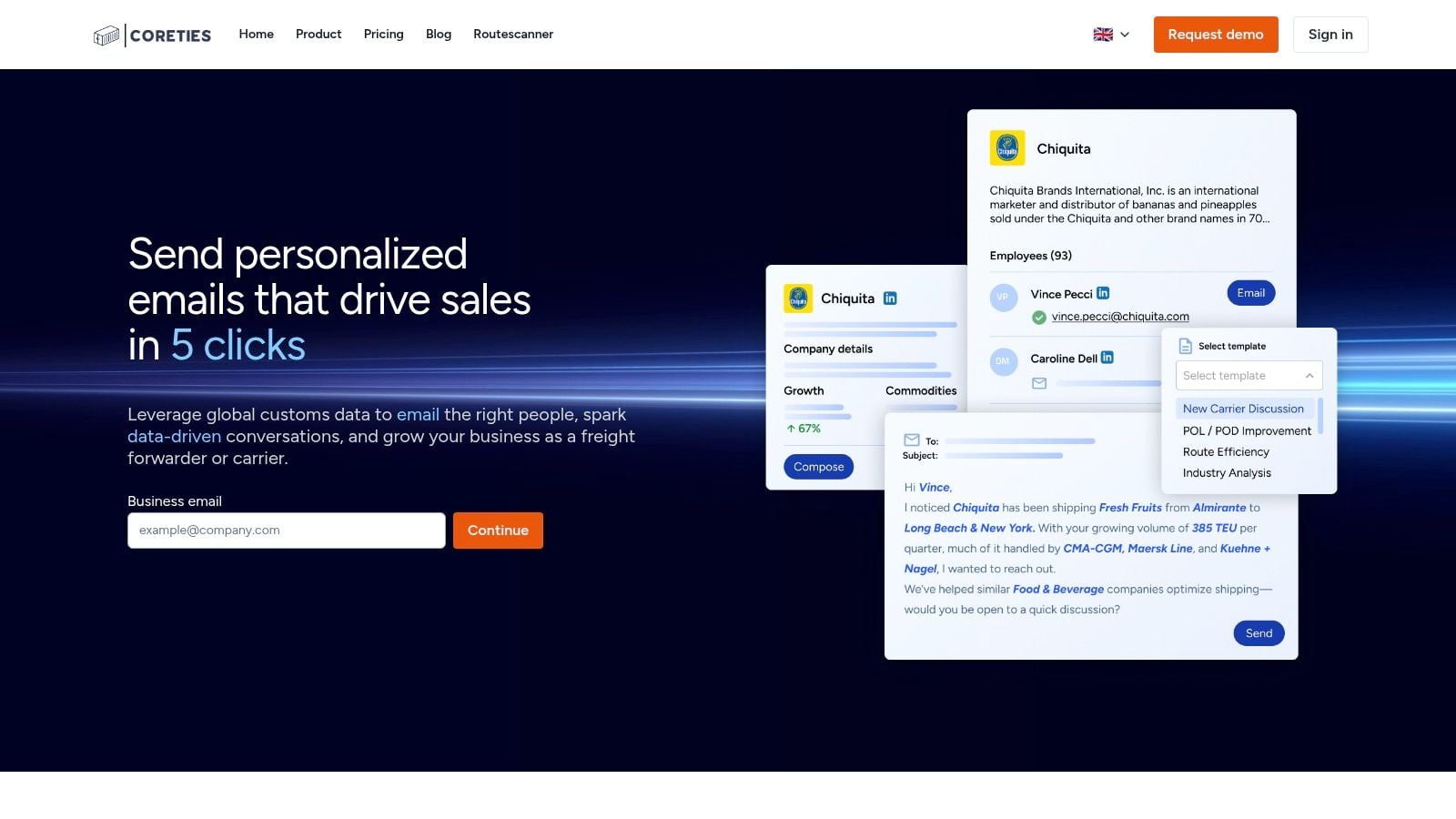
    An account doesn't become workable until you've confirmed two things. First, the freight pattern is real. Second, a specific person owns part of the problem.
    Screenshot from https://coreties.com

    Verify the freight before you write

    Use shipment records, bills of lading, and consignee variations to test your lane hypotheses. Don't stop at a company-name search. Check likely abbreviations, entity suffixes, and address-linked records. A lot of reps miss good data because they search one exact legal name and assume the file is complete.

    What you're trying to confirm is straightforward:

    1. Recurring port activity
      One shipment is interesting. Repetition is what gives you a prospecting angle.

    2. Mode and routing clues
      You want to know whether the account looks like a fit for your strongest service lines.

    3. Operational friction points
      Late pickups, split handling requirements, customs complexity, or warehouse timing issues all create better opening messages than a broad capability statement.

    Verify first, personalize second. Reversing that order produces polished nonsense.

    Find the owner, not the mailbox

    Once the freight pattern is credible, move to role mapping. For a shipper like Winsome Trading Woodinville, the right contact usually isn't the generic corporate inbox. The useful targets are people tied to logistics execution, supply chain planning, operations leadership, or procurement.

    Build a contact slate by role, then prioritize by likely pain ownership:

    • Logistics or transportation manager for day-to-day lane execution
    • Supply chain director if the issue touches network design or vendor performance
    • Operations leader when warehousing and inbound flow affect fulfillment
    • Procurement stakeholder if the conversation is likely to turn into rate benchmarking

    You also need a clean process for decision-maker research. This guide on how to find decision-makers in B2B accounts is a good checklist for moving from company-level interest to person-level outreach.

    Keep your contact list tight

    Don't build a bloated list of every manager with a LinkedIn profile. For one target account, I'd rather have three well-matched contacts with clear role logic than fifteen names with no ownership theory behind them.

    That discipline improves message quality and follow-up quality. It also keeps you from sending the same half-relevant note across departments that don't share the same KPI.

    Crafting Your Data-Driven Outreach Message

    Most freight outreach fails in the first sentence. The rep talks about their company before proving they understand the shipper.

    That approach is especially weak with a long-standing manufacturer like Winsome Trading, which was established in 1977 and has maintained continuous operations for over 35 years, as noted earlier from the BBB profile. Stable companies tend to attract constant vendor outreach. They don't need another “just checking if you handle imports” email.

    Generic email versus account-specific email

    Here's the bad version:

    Hi, we're a global logistics provider that supports importers and exporters with competitive rates and reliable service. I'd love to schedule time to learn about your shipping needs.

    There's no account insight, no reason for timing, and no indication that the sender understands the operation.

    A stronger version sounds like this:

    Hi [Name], I'm reaching out because Winsome Trading's Woodinville operation appears to combine assembly and distribution, which usually makes inbound timing and warehouse flow more sensitive than standard receiving-only sites. If your team is reviewing any Pacific Northwest import or cross-border routing options, I can share a few ideas on where forwarders usually reduce handoff issues for furniture programs.

    That message doesn't overclaim. It shows enough understanding to earn a reply.

    Match the angle to the role

    Use the same account, but shift the message based on who's reading it.

    Target Role Key Concern Messaging Angle Example
    Logistics Manager Shipment execution “We help reduce missed handoffs and receiving friction on recurring inbound lanes.”
    Supply Chain Director Network reliability “We can review routing and vendor coordination where assembly and distribution sit in one operation.”
    Operations Leader Warehouse flow “Inbound timing issues often create downstream pressure on fulfillment. That's where we usually start.”
    Finance or Procurement Cost control “We can benchmark where avoidable accessorials and handling inefficiencies may be hiding.”

    Keep the message clean enough to land

    Don't bury the insight under a long intro. Don't attach a deck. Don't ask for half an hour. Ask for a short conversation tied to one practical issue.

    A few rules I use with new reps:

    • Lead with the account observation.
    • Mention one likely pain point, not five.
    • Ask for a brief call with a narrow purpose.
    • Use a domain that's set up correctly before sending. If your team needs a refresher on sender setup, this guide on How do I authenticate my email is worth reviewing before any outbound push.

    The best cold email sounds like it came from someone who already thinks in the prospect's workflow.

    That's the standard. Not clever. Not long. Relevant.

    Effective Follow-Up Tactics That Secure the Meeting

    Most meetings are booked in follow-up, not on the first email. The problem is that reps often follow up by repeating themselves.

    Don't send “just bumping this up” messages. Add something each time.
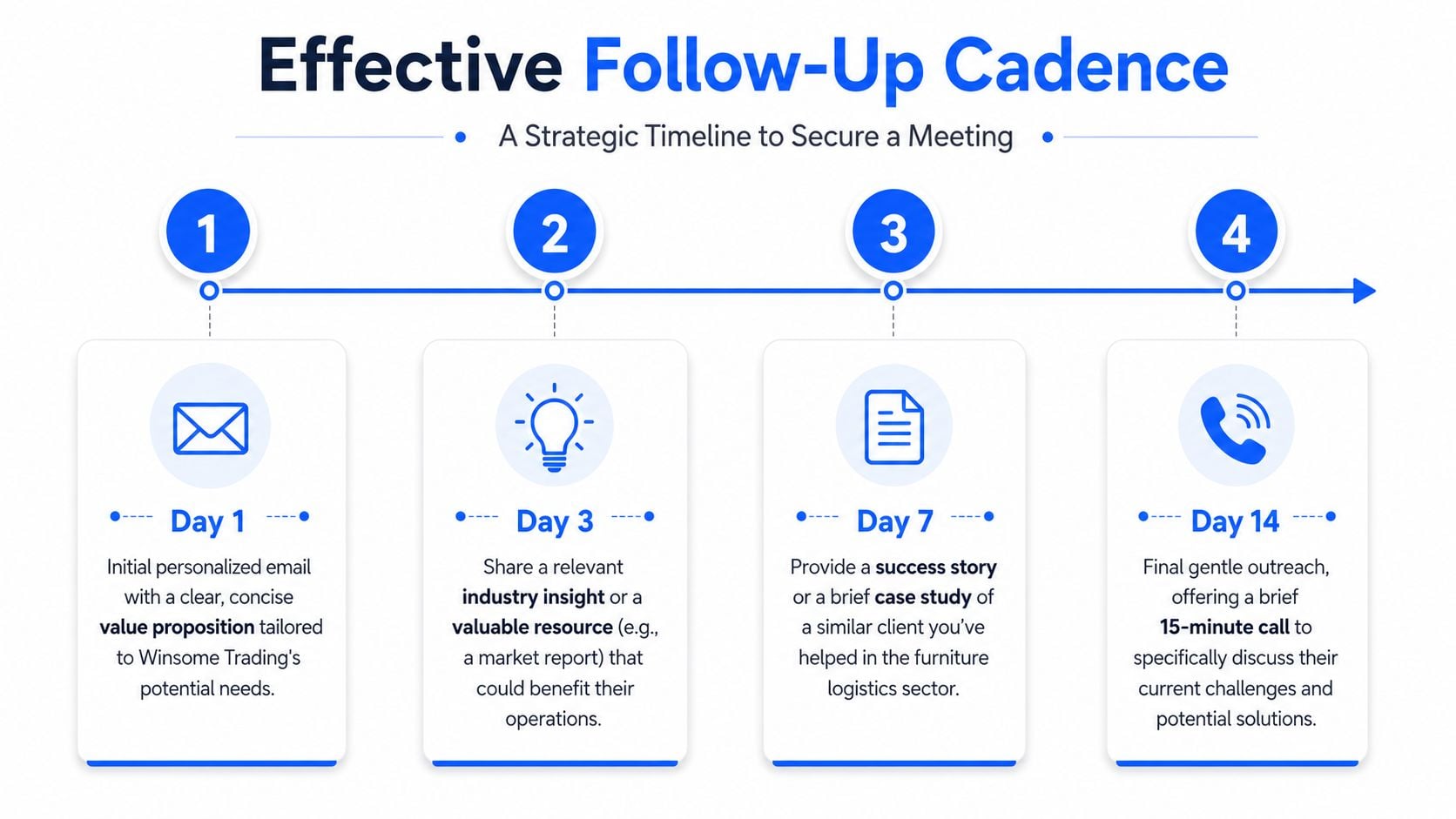
    A strategic four-step follow-up timeline to secure meetings with prospects, displayed as a business workflow graphic.

    A simple cadence that works

    • Day 1
      Send the personalized note tied to one operational observation.

    • Day 3
      Add a useful follow-up. This could be a short comment about a likely lane issue, a packaging concern common in furniture moves, or a question about cross-border coordination.

    • Day 7
      Narrow the ask. Offer a short discussion around one issue only, such as inbound scheduling, customs handoff, or warehouse flow.

    • Day 14
      Close politely. Let them know you'll step back if timing isn't right, but leave a specific reason to reconnect later.

    What not to do

    A few follow-up habits kill response rates:

    Avoid this Do this instead
    Repeating the same email Add one new observation or question
    Sending long reminders Keep each touch short and specific
    Pitching every service Focus on the one issue most likely to matter
    Chasing everyone at once Stay coordinated across a small contact group

    Persistence helps only when each touch gives the buyer a new reason to care.

    For Winsome Trading Woodinville, the meeting usually comes from disciplined relevance. You identify the account correctly, verify the freight pattern, pick the right owner, and follow up with context instead of noise. That's how booked meetings happen in logistics sales.


    If you want a faster way to turn customs signals into qualified shipper lists, find the right contacts, and launch account-specific outreach, Coreties is built for that workflow. It helps freight teams move from raw trade data to targeted conversations without wasting time on generic prospecting.
  • Secure Business with Pacific Blends Ltd: 2026 Logistics

    Secure Business with Pacific Blends Ltd: 2026 Logistics

    You open a company record expecting another small regional food manufacturer. Then one detail changes the whole account. The shipper is relatively small by headcount, but it sits inside a supply chain that reaches the Bering Sea, Vancouver-area port infrastructure, and food manufacturers across North America and the Pacific Rim.

    That's the kind of prospect many logistics teams miss. They sort by size, not by position in the network.

    Pacific Blends Ltd deserves the opposite treatment. It's the kind of account where niche market control, product complexity, and acquisition-led expansion can create freight opportunities that are larger than the company's public profile suggests. If you sell forwarding, carrier capacity, customs-adjacent visibility, or multimodal planning, this isn't a company to file under “too small to matter.” It's one to study carefully and approach with a point of view.

    From Niche Player to High-Value Prospect

    Most sales teams spend too much time on obvious targets. They chase large food manufacturers with crowded vendor rosters and entrenched transportation partners. Meanwhile, a company like Pacific Blends can sit in plain sight.

    Publicly, it looks compact. Operationally, it's far more consequential. Pacific Blends is a family-owned custom-blending provider founded in 2002 and headquartered in Port Coquitlam, British Columbia, with over 40 years of experience noted through its industry background and membership references. It serves customers across North America and the Pacific Rim in seafood, meat, poultry, dairy, processed foods, and snack foods, while holding a particularly strong position in surimi cryoprotectants and custom dry ingredient blends, according to Pacific Blends company information.

    That combination matters for freight sales because network importance beats company size when the shipper handles products that are operationally sensitive and tied to industrial production schedules. Pacific Blends isn't just moving finished pouches. It's supporting manufacturers that use outsourced dry blending to remove blending steps from their own plants.

    Practical rule: When a shipper helps manufacturers remove production steps, transportation reliability becomes part of the shipper's value proposition.

    That's why this account is better understood through benchmarking logic than through standard prospect scoring. A useful lens comes from industry benchmarking methods for supply-chain prospecting. The right comparison set isn't “Canadian SME manufacturers.” It's “specialty ingredient suppliers with concentrated category influence, export exposure, and workflow-critical products.”

    For a logistics seller, that changes the playbook. You're not pitching generic capacity. You're diagnosing where a specialized ingredient producer may need tighter inbound coordination, cleaner outbound execution, and better support when new product lines are folded into the operation.

    Who Is Pacific Blends Ltd Really

    A standard company summary misses the point. Pacific Blends should be read like an internal account brief, where every business fact implies a logistics consequence.

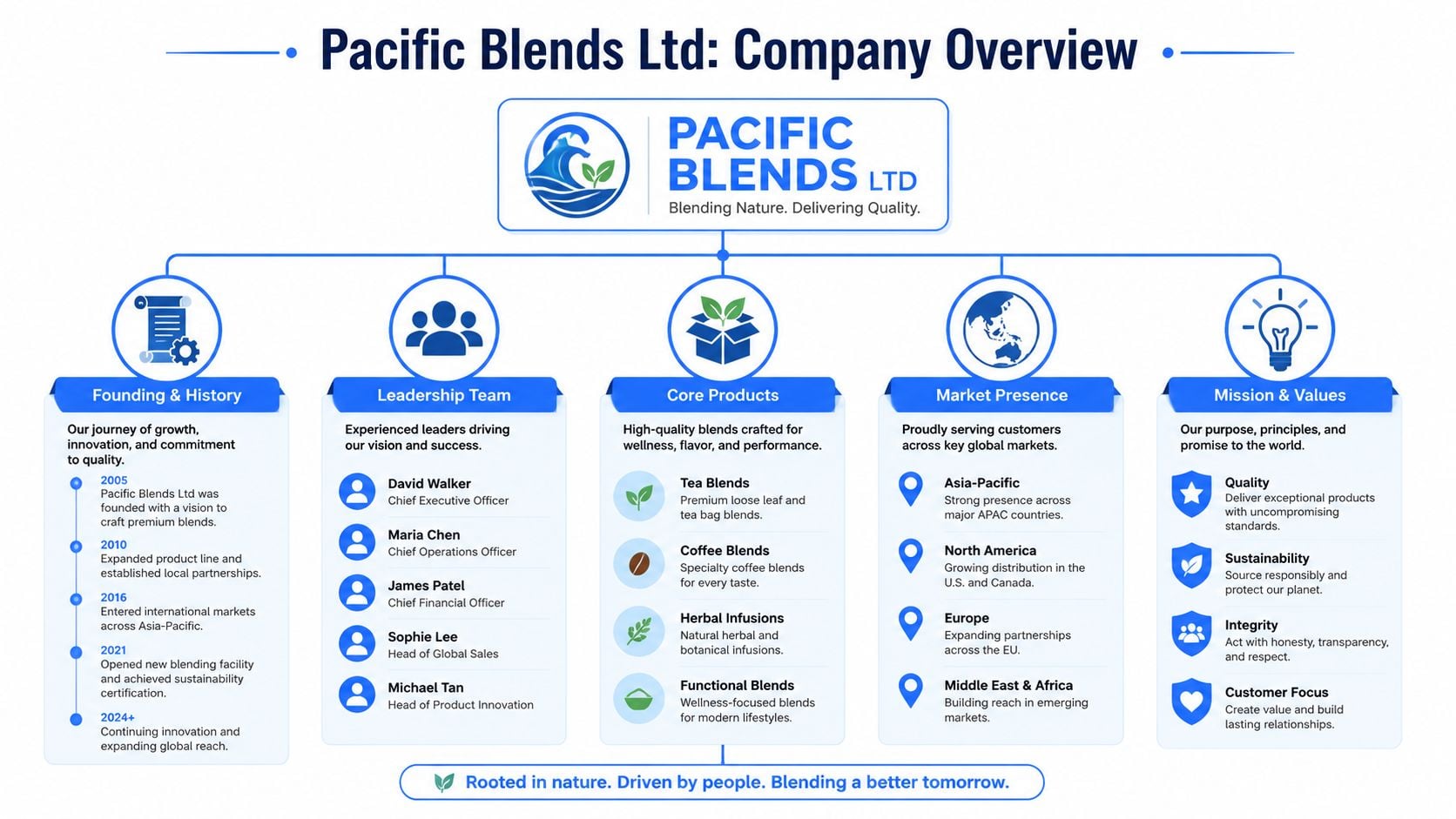
    An organizational infographic for Pacific Blends Ltd showing history, leadership, products, market presence, and company values.

    The company profile that matters to sales

    Pacific Blends Ltd was founded in 2002 and is headquartered in Port Coquitlam, British Columbia. Public importer data describes it as one of the world's largest producers of surimi cryoprotectants, supplying nearly all factory fishing vessels processing Alaskan Pollock in the Bering Sea. The same source reports revenue of under $5 million and an employee count of 11 to 50, which makes it a compact organization with outsized category relevance, as shown in this Pacific Blends importer profile.

    That's the first signal logistics teams should pay attention to. A company doesn't need a huge payroll to create meaningful freight demand if it occupies a bottleneck position in a specialized supply chain.

    Its core business is custom dry ingredient blending. Pacific Blends serves seafood, meat, poultry, dairy, processed food, and snack food customers. The commercial logic behind that offering is straightforward. Manufacturers can buy a single unitized blend rather than stage, measure, and combine multiple dry inputs in-house.

    Why the business model raises logistics stakes

    This isn't just a food ingredients company. It's a workflow simplifier for downstream manufacturers. When a supplier takes complexity out of a customer's production line, that supplier's own execution has to be tight.

    If Pacific Blends ships late, the customer doesn't just receive ingredients late. The customer loses the time savings and process simplification they outsourced to Pacific Blends in the first place. That creates a very different service expectation than standard commodity freight.

    Here's the account profile in a sales-friendly format:

    Attribute Detail
    Company Pacific Blends Ltd
    Ownership model Family-owned private manufacturer
    Founded 2002
    Headquarters Port Coquitlam, British Columbia
    Primary specialization Custom dry ingredient blends
    Notable market position One of the world's largest producers of surimi cryoprotectants
    Supply relevance Supplies nearly all factory fishing vessels processing Alaskan Pollock in the Bering Sea
    Reported scale Revenue under $5 million
    Reported workforce 11 to 50 employees
    Served sectors Seafood, meat, poultry, dairy, processed foods, snack foods
    Commercial value proposition Unitized custom blends that remove dry blending steps for manufacturers

    What their history suggests about account behavior

    Pacific Blends didn't stay static. The company expanded its presence through acquisitions, including the November 2011 acquisition of Renaissance Blends' business assets, which brought Renaissance's product line into the Pacific Blends brand. It later acquired the Vegelatum® brand, extending its position into cosmetic ingredients, according to Pacific Blends growth news.

    That history tells you something useful before you ever contact the company. This is a business that grows by adding lines, integrating products, and broadening the commercial footprint without abandoning its custom-blending core.

    A shipper that grows through acquisition usually inherits complexity faster than it redesigns transportation around it.

    For freight providers, that means the primary opportunity may not be “move current orders.” It may be “support integration.” New SKUs, altered sourcing needs, changed customer mixes, and fresh packaging or handling requirements often appear before transportation processes are fully harmonized.

    Mapping Their Global Supply Chain Footprint

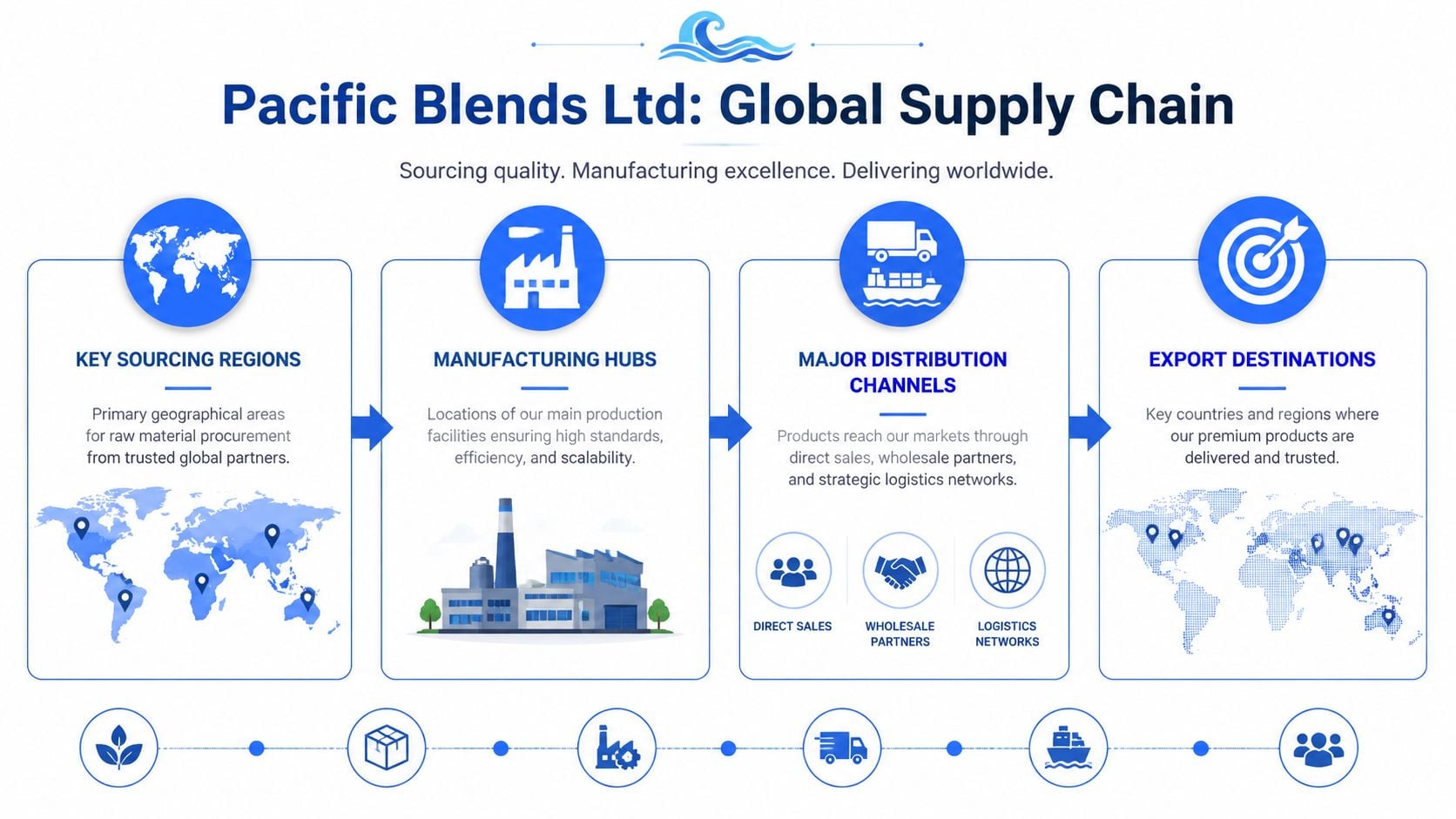
    If you want to build a lane strategy around Pacific Blends, start with what the company makes, where it sits, and who it serves. That gives you a working map of its supply chain before you touch shipment data.

    An infographic showing the global supply chain process of Pacific Blends Ltd, from sourcing to export.

    Start with the product and work backward

    Pacific Blends' unitized custom blending technology consolidates multiple dry ingredients into a single pouch. The company says this reduces storage volumes and shortens storage time for customers, while its location near major Vancouver ports and a sugar refinery supports cost-effective delivery to North American and Pacific Rim clients through its company overview.

    That statement gives a logistics seller three immediate hypotheses.

    1. Inbound ingredient complexity is real. A company that combines multiple dry ingredients into one pouch needs coordinated inbound material availability.
    2. Outbound service is broader than local distribution. Pacific Rim and North American reach implies a mix of domestic and international flows.
    3. Facility location is strategic, not incidental. Port proximity usually means ocean connectivity matters to the operating model.

    Build the likely lane map

    A practical lane map for Pacific Blends probably includes several distinct flow types.

    • Inbound raw materials: Dry ingredients arriving for blending, potentially from domestic and international suppliers.
    • Marine-linked seafood ingredient support: Commercial relationships tied to the Alaskan Pollock and Bering Sea ecosystem.
    • Outbound finished blends to food manufacturers: Likely shipment patterns into production hubs where customers need ingredients on predictable schedules.
    • Pacific Rim export flows: Ocean-linked movement where transit planning and documentation discipline matter more than simple truck dispatch.

    If you work in forwarding or NVOCC sales, broader reading on mastering global supply chain strategies helps sharpen your pitch. The point isn't theory. It's knowing how port access, supplier concentration, and customer production timing interact inside a specialized ingredient business.

    What to look for operationally

    The key isn't just that Pacific Blends moves goods globally. It's that its product format shifts complexity from the customer to Pacific Blends.

    That means a logistics partner should examine:

    Supply chain question Why it matters for Pacific Blends
    Are ingredients sourced from multiple origins? Multi-origin inputs raise coordination risk before blending begins
    Are customer orders tied to plant schedules? Delays can interrupt manufacturing workflows downstream
    Do export orders move through Vancouver-area gateways? Port choice affects lead time, drayage planning, and carrier options
    Are there mixed product requirements across sectors? Food-sector diversity can produce different service expectations by customer type

    A useful companion lens is studying how to identify a company that imports. Even before you validate exact entries, the import-export logic around Pacific Blends is already visible from its product design, geography, and customer base.

    The best freight opportunities often sit where a shipper promises simplicity to its customers but carries hidden complexity inside its own operation.

    How to Verify Their Shipping Activity

    Smart prospecting starts with inference, but it can't end there. Before your team writes the first outreach email, it needs evidence that Pacific Blends is moving freight in the patterns you suspect.

    That verification step changes the conversation. Instead of saying, “We help food ingredient companies,” you can say, “We noticed your shipping pattern suggests recurring pressure around specific ports, handoffs, or lane structures.” That's a different level of credibility.

    What verification should actually answer

    For an account like Pacific Blends, shipment verification isn't about collecting trivia. It's about proving whether the commercial story matches the physical network.

    Use customs and trade-activity tools to answer questions such as:

    • Which ports appear repeatedly: Repetition usually points to habitual trade lanes rather than one-off transactions.
    • What shipment descriptions reveal: Product language can help separate ingredient inflows from blended outbound goods.
    • How frequently shipments occur: Consistency tells you whether to frame the account as project-based or recurring.
    • Which parties appear around the shipment: Related entities, consignees, or suppliers can reveal where decisions may be influenced.

    Here's the kind of workflow many sales teams benefit from seeing visually:

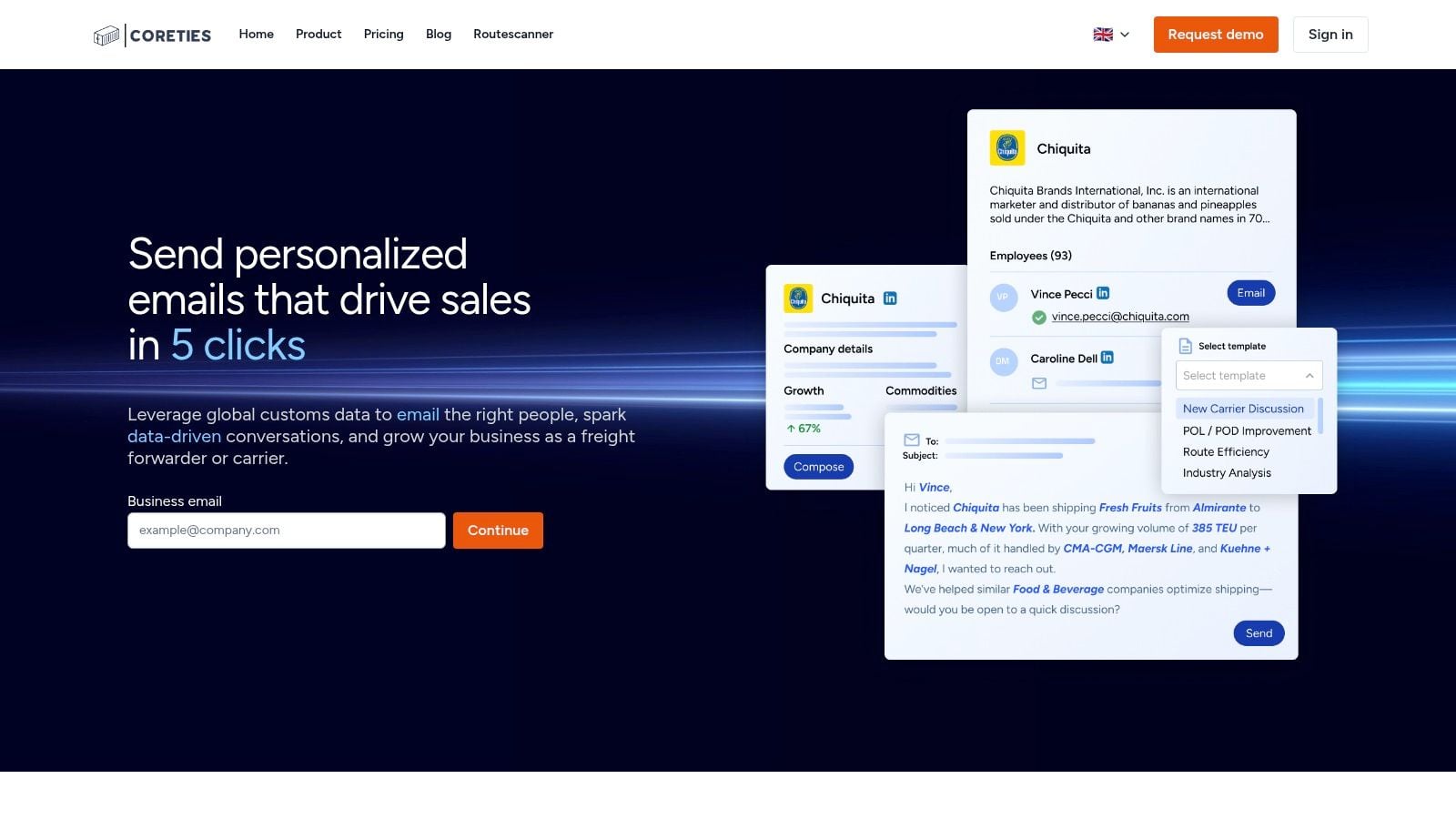
    Screenshot from https://coreties.com

    What to pull from the records

    For a company with Pacific Blends' profile, customs records and related shipment tools can help your team isolate:

    1. Port pairs that show likely core international lanes.
    2. Consistent routing patterns that may indicate incumbent forwarder relationships.
    3. Packaging and shipment format clues that suggest whether cargo moves as palletized dry ingredients, packaged blends, or broader industrial food components.
    4. Seasonality signals, if they exist, that might tie back to customer production cycles or seafood-related timing.

    This is also where shipment visibility language matters. If your prospect asks why your team is focused on operational transparency, it helps to ground that in practical tools rather than buzzwords. A concise explainer on what is a freight tracking system is useful background because specialized ingredient shippers often care less about flashy dashboards and more about dependable milestone visibility.

    Why verification changes the sales motion

    Without data, reps tend to send feature-based outreach. They promise good service, flexible capacity, or competitive pricing. Every carrier and forwarder says the same thing.

    With validated shipping activity, you can do something more specific:

    Don't lead with your network. Lead with what their shipment pattern suggests they need fixed, protected, or simplified.

    That's especially important for a company that supports customer manufacturing workflows. If you can confirm recurring gateways, likely import dependencies, or export routines, your message can focus on schedule protection, supplier coordination, and lane resilience instead of commodity transport language.

    Actionable Outreach Angles That Win Business

    Most logistics outreach to food manufacturers is forgettable because it's too broad. Pacific Blends won't respond to generic claims about “excellent service” or “global reach.” The account calls for a sharper angle tied to hidden commercial pressure.

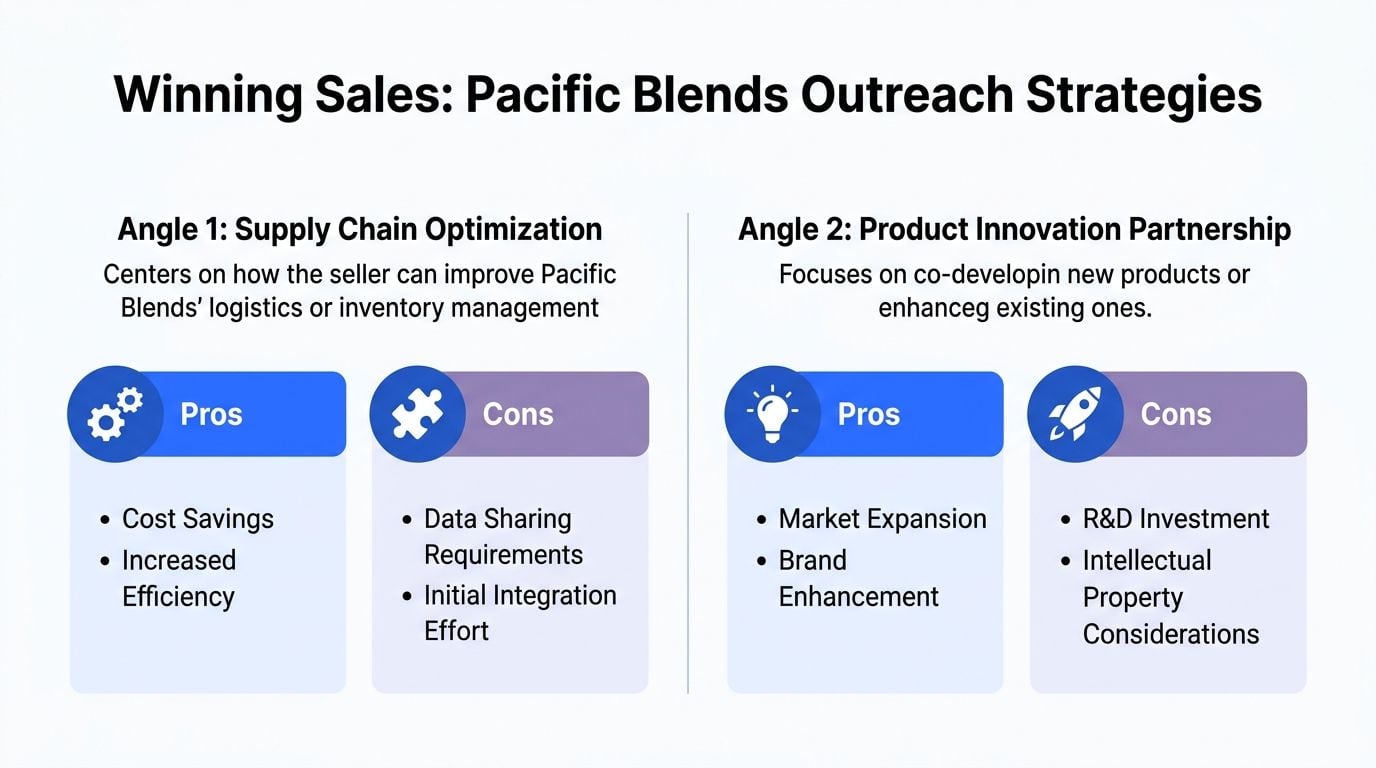
    A strategic business chart comparing supply chain optimization and product innovation partnership strategies for Pacific Blends.

    Angle one, position logistics as cost protection

    A frequently overlooked sales angle sits inside Pacific Blends' role in surimi. Public export-catalogue commentary notes that surimi prices rose 18% in 2024 due to supply constraints, while Pacific Blends' role as a top cryoprotectant manufacturer creates supply-chain stability that can buffer food manufacturers against inflation, according to the BC agrifood export catalogue entry on Pacific Blends.

    That matters because it reframes the logistics sale. You're not offering transportation as a back-end service. You're offering transportation as a support system for a supplier whose value includes helping customers manage instability.

    A weak outreach message says, “We can handle your imports and exports.”

    A stronger one says, “Your position in cryoprotectants makes continuity part of your customer promise. We help specialized suppliers protect inbound ingredient flow and outbound fulfillment when volatility hits upstream protein markets.”

    That's a very different conversation.

    How to frame the message

    Use language that connects transport execution to commercial protection:

    • Mention continuity: Pacific Blends supports a mission-critical product category.
    • Talk about inventory timing, not just rates: Ingredient businesses lose value when timing breaks.
    • Offer lane review: Propose a review of where disruptions could compromise customer delivery promises.

    Sales insight: When a supplier helps its buyers manage inflation pressure, transportation reliability becomes part of the buyer's cost-control story.

    Angle two, treat Vegelatum as a network expansion problem

    Pacific Blends' acquisition of the Vegelatum® brand opened a second strategic angle. The move expanded the company into cosmetic ingredients, as noted in the earlier acquisition coverage. Public commentary around that acquisition also points to a broader transparency trend in beauty products and states that 32% of global beauty consumers seek food-derived ingredients, according to the Vegelatum acquisition announcement.

    Don't oversell the statistic. Use it to support one simple conclusion. Pacific Blends now touches a category with a different buyer profile, potentially different packaging expectations, and potentially different distribution rhythms than its food-manufacturing base.

    That creates a freight discussion most providers won't raise. The issue isn't only “Can you ship cosmetic ingredients?” The issue is whether Pacific Blends now needs a transportation setup that can support two commercial motions at once.

    One side of the business serves industrial food manufacturing. The other may require a different cadence, different consignee base, or different compliance-adjacent handling expectations.

    Outreach idea by persona

    If you reach operations leadership, stress integration risk.

    If you reach commercial leadership, stress market expansion readiness.

    If you reach procurement or logistics, stress handoff clarity across mixed product lines.

    You can also tighten the writing itself by borrowing principles from guides on crafting effective cold emails. The best note to Pacific Blends won't be long. It will show that you understand the pressure created when a blending business adds a new brand and category.

    A practical internal prep step is identifying who owns these conversations. Teams that need help locating the right contacts can use guidance on how to find decision-makers before launching outreach.

    What not to say

    Avoid these common mistakes:

    Weak pitch Why it fails
    “We work with many food companies” Too broad. Pacific Blends isn't a generic food shipper
    “We offer cost savings” Unprovable without lane context
    “We can support your growth” Vague and interchangeable
    “We saw you acquired a brand” Observational, but not insightful

    Better language ties your service to one of two real issues: protecting a volatility-sensitive supply role or integrating a newly expanded product portfolio without creating logistics friction.

    Your Go-to-Market Checklist for Pacific Blends

    The account is attractive, but it won't close on interest alone. Your team needs a disciplined plan that turns company intelligence into a contact strategy, a lane hypothesis, and a first conversation worth taking.

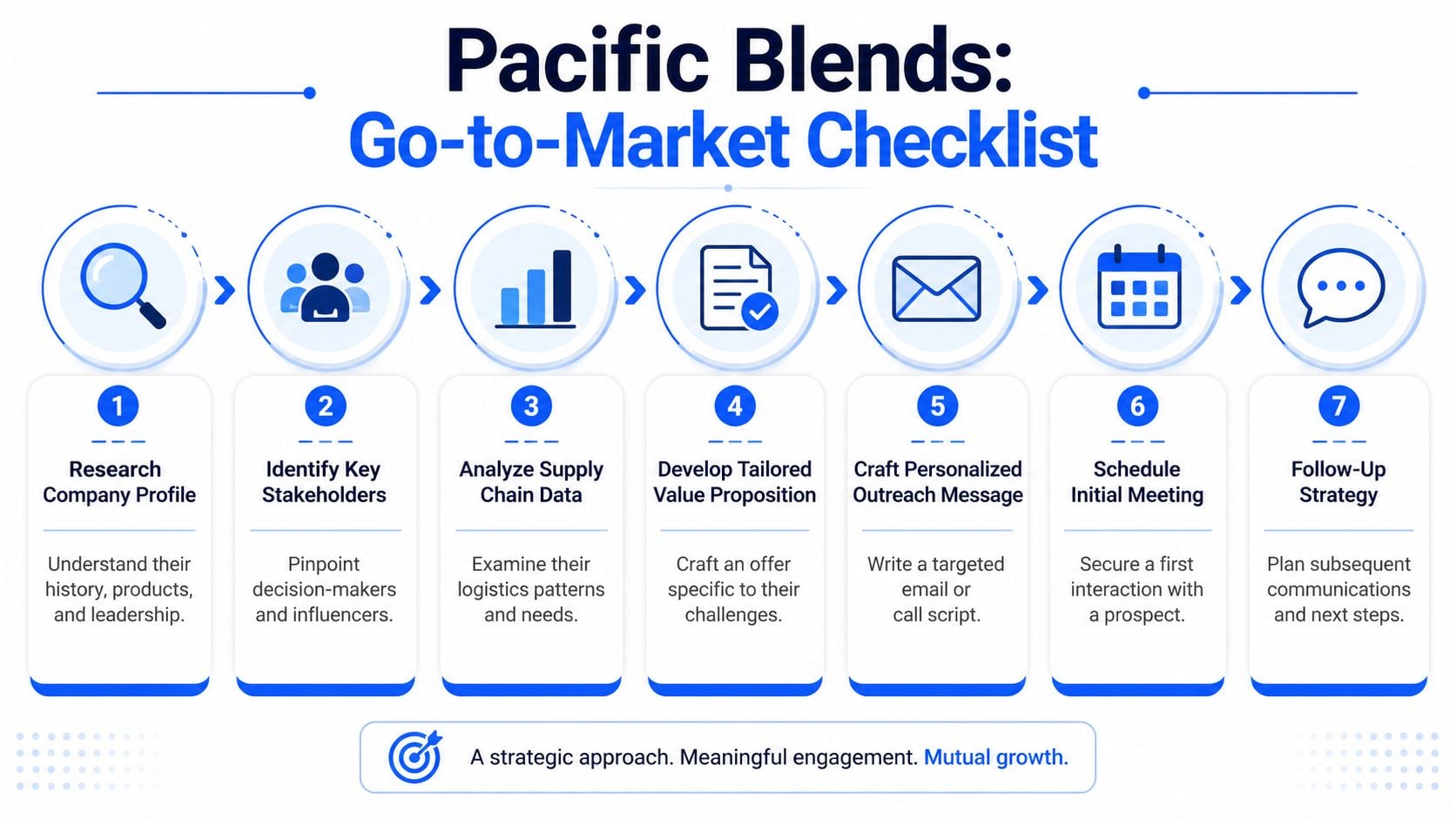
    A Pacific Blends seven-step go-to-market checklist infographic illustrating a strategic sales and business outreach process.

    The working checklist

    1. Assign one account owner
      Pacific Blends is specialized enough that scattered outreach will dilute the effort. One owner should control research, messaging, and follow-up.

    2. Confirm live shipping patterns
      Validate whether your lane assumptions hold up in actual trade records. Don't brief sales leadership on theory alone.

    3. Segment the likely buying centers
      The relevant stakeholders may not sit in one department. Operations, logistics, procurement, and commercial leadership could all influence the decision.

    4. Choose one outreach angle first
      Don't stack both major narratives into the first email. Lead either with surimi-related continuity and cost protection or with post-acquisition network integration.

    5. Map likely objections in advance
      Expect some version of: “We already have providers,” “volumes are stable,” or “we only review partners when something changes.” Your answer should focus on resilience, integration, or lane-specific insight.

    6. Watch for acquisition-related freight openings
      Pacific Blends' 2011 Renaissance Blends acquisition and later Vegelatum® acquisition show a clear growth-by-acquisition pattern, creating recurring opportunities for logistics providers that can support product-line integration, according to Pacific Blends growth news.

    7. Build a follow-up sequence with a point of view
      Follow-up should add intelligence, not just ask for time again. Bring a routing idea, a handoff risk observation, or a category-specific operational question.

    The standard to hold your team to

    A good campaign against Pacific Blends should leave the prospect feeling understood, not processed.

    If your message could be sent unchanged to any food manufacturer in British Columbia, it's not ready for Pacific Blends.

    This account is strongest for logistics teams that can connect a niche ingredient position to real network demands. The company's public footprint is small enough to be overlooked and specialized enough to reward careful sellers. That's a favorable combination if your team is willing to do the homework.


    Coreties helps freight forwarders, carriers, and logistics sales teams turn trade data into real prospecting action. If you want to identify shippers like Pacific Blends, validate their likely lanes, surface decision-makers, and launch targeted outreach faster, explore Coreties.

  • Caribtrans Logistics LLC: A Sales Prospecting Guide

    Caribtrans Logistics LLC: A Sales Prospecting Guide

    You've got a live prospect in front of you. The website looks credible, the network looks broad, and the brand has been around long enough that nobody on your team can dismiss it as a lightweight forwarder. But when you sit down to build outreach, the usual shortcuts fail. There isn't enough lane-level detail to pitch blindly, and there's just enough public information to tell you this account deserves a serious plan.

    That's where disciplined prospecting separates productive reps from noisy ones. With Caribtrans Logistics LLC, the opportunity isn't in reciting that they ship freight around the Caribbean. The opportunity is in reading their public footprint like an operator would, spotting where complexity likely sits, and turning those observations into precise questions that earn a reply.

    Caribtrans Logistics at a Glance

    Caribtrans Logistics LLC is best viewed as an established mid-sized regional logistics operator with meaningful Caribbean specialization, not a small local brokerage. Public company information traces its operating history to 1985, when Caribtrans began serving the Caribbean market with less-than-container-load cargo by ocean and air. The same profile says the company ships to more than 30 locations and has over 100 professionals across the U.S. and Caribbean. Independent business directory data also estimates about $6.3 million in annual revenue, lists around 95 employees, and places the headquarters at 11401 NW 107th St, Suite 300, Miami, FL 33178 according to Caribtrans company data on ZoomInfo.

    What the profile says to a sales team

    A company that's been active since 1985 has likely survived carrier shifts, customs changes, margin pressure, and the digitization of forwarding. That matters in prospecting because mature logistics firms usually don't buy on novelty. They buy when a seller can tie a solution to branch coordination, lane control, documentation flow, or sales productivity.

    The employee and revenue signals point to a business large enough to have role separation, but still compact enough that process gaps can remain visible. That's a good target profile for outreach. Very large operators often bury pain points under layers of procurement and IT. Very small operators often lack budget or urgency. Caribtrans sits in a more workable middle.

    How to classify the account

    Use this quick lens internally:

    Prospect factor Public signal Sales implication
    Longevity Operating history goes back to 1985 Expect experienced buyers and practical objections
    Geographic reach More than 30 locations Multi-branch coordination likely matters
    Team size Over 100 professionals, with directory estimate around 95 employees Several potential stakeholder groups, not just one owner-operator
    Headquarters base Miami HQ Strong probability of Caribbean gateway management from South Florida

    Practical rule: Don't approach Caribtrans like a cold SMB freight shop. Approach them like a regional network business that may need tighter visibility, sharper lane messaging, or better prospect segmentation.

    For a rep, that changes the tone of outreach. Lead with operating complexity and commercial advantage, not generic promises about “streamlining logistics.”

    Mapping Core Services and Key Trade Lanes

    Caribtrans becomes more interesting when you stop looking at it as a brand and start looking at it as a network. A recent public milestone helps. On July 15, 2024, the company announced that Maduro Logistics Services and Caribtrans Logistics would become mutually branded agencies, making Aruba an official destination in its network, according to Caribtrans' Aruba expansion announcement.

    A professional infographic detailing the core services and key trade lanes provided by Caribtrans Logistics LLC.

    That single update tells a sales team several things at once. First, Caribtrans is still expanding branded coverage rather than maintaining a static legacy footprint. Second, Aruba is being treated as an operationally meaningful destination, not a passive referral relationship. Third, the company is comfortable presenting a network identity across partner or agency structures, which usually means consistency of handoff and local representation matters commercially.

    The likely service mix

    Public materials support a multimodal offering centered on Caribbean freight movement. The company's footprint includes locations such as Barbados, St. Maarten, St. Vincent, Los Angeles, New Jersey, Florida, and New York. That points to a business built around U.S. gateway to Caribbean destination flows, with both origin consolidation and destination agency coordination in play.

    A sales rep should assume these service conversations are most relevant:

    • Ocean freight into island markets where consolidation and scheduled departures matter.
    • Air freight for time-sensitive cargo where branch responsiveness can win business.
    • Cross-network coordination between U.S. receiving points and Caribbean endpoints.
    • Local agency execution in destination markets where the customer experience is shaped by the final handoff, not just the linehaul.

    For context on how these lanes typically behave, this primer on standard Caribbean shipping patterns is useful because it frames the operational realities behind island-focused freight networks.

    A short visual reference helps when you're briefing reps before outreach:

    What trade lane logic you should infer

    The practical takeaway isn't just “they serve the Caribbean.” It's that Caribtrans appears to sit in the middle of several corridor types:

    1. South Florida to Caribbean islands, likely a core operating spine.
    2. Secondary U.S. origin points to Caribbean destinations, supported through East Coast and West Coast nodes.
    3. Inter-island or agency-driven handoff lanes, especially where branded local presence matters.

    Aruba matters because it signals active network shaping. When a logistics company adds a branded destination, it's usually responding to demand concentration, service control needs, or a competitive lane opportunity.

    That creates strong prospecting angles. If you sell software, you can speak to branch coordination. If you sell carrier capacity, you can discuss lane resilience. If you sell lead generation or market intelligence, you can focus on identifying shippers that fit these corridor patterns.

    Gauging Operational Performance and Reliability

    A distributed network can be a strength or a headache. With Caribtrans, public location data points to a multi-node model spanning Caribbean markets and U.S. facilities, with listed destinations including Barbados, St. Kitts, St. Vincent, New Jersey, Los Angeles, and Jamaica. The same locations material states the company ships to over 30 locations globally and lists Miami office hours of 8:30am to 5:30pm and warehouse receiving hours of 8:00am to 4:00pm, as shown on the Caribtrans locations page.

    A forklift moving palletized goods in a busy shipping yard with large stacked cargo containers nearby.

    Those details seem mundane until you read them like an operator. Receiving windows and office hours suggest a cutoff-driven freight workflow. In this kind of model, shipment quality depends heavily on pre-alert timing, document completeness, warehouse intake discipline, and branch coordination before cargo ever reaches a vessel or flight.

    Signals of operating maturity

    A multi-location Caribbean network usually offers flexibility. If one gateway faces issues, another node or local handoff structure may absorb some pressure. That's useful.

    But it also creates coordination burdens:

    • Booking synchronization has to happen across origin, consolidation, and destination points.
    • Customs documentation quality becomes a frontline issue, not a back-office issue.
    • Milestone visibility matters more because customers are often dealing with multiple handoffs.
    • Local cutoff compliance can affect whether freight rolls smoothly or misses a planned movement.

    In other words, reliability here likely comes less from raw transport capacity and more from process discipline.

    What to probe during discovery

    If you're prospecting Caribtrans, don't ask broad questions like “How do you handle operations?” Ask questions that test where friction may live.

    Discovery theme Strong question
    Cutoff management How do your branches handle same-day receiving against sailing or flight cutoffs?
    Exception handling When freight misses a local cutoff, who owns customer communication and rebooking?
    Visibility How are milestones shared across U.S. origins and island destinations today?
    Documentation flow Where do document delays tend to show up most often, at origin intake or destination release?

    The seller who understands cutoff discipline sounds credible. The seller who talks only about “better shipping solutions” sounds like they haven't worked the lane.

    Sales implication

    Many representatives often miss the account. They pitch rates, generic tracking, or vague service improvement. A stronger approach is to frame your offer around one operational failure point. That could be intake-to-cutoff coordination, branch-level visibility, destination communication, or sales enablement around lane promises.

    If Caribtrans runs a classic multi-branch freight workflow, then any product or service that reduces handoff ambiguity is immediately relevant. Your message should sound like you understand what happens between warehouse receiving and final destination release. That's where operational credibility starts.

    Understanding Their Regulatory and Compliance Footprint

    Caribtrans raises an important diligence question that many sales teams skip until too late. What exactly is the company's operating role across different legs of a shipment?

    Public information makes one part of the answer visible. A SAFER Company Snapshot shows CARIBTRANS LOGISTICS LLC with USDOT number 2473987, which confirms a U.S. regulated trucking presence. But the public-facing website doesn't clearly explain how that authority connects to international forwarding services, cargo insurance, or local Caribbean agencies, as reflected in the company's cargo insurance and service information.

    Why this matters in sales conversations

    Carrier status changes the risk conversation. If a company acts as a property carrier on one leg and an intermediary on another, liability, claims handling, and shipment control may shift across the move. That affects how buyers evaluate service partners, especially when freight moves across borders and local agencies are involved.

    For a sales rep, this isn't a legal trivia point. It's a positioning opportunity.

    If you sell into compliance, insurance, documentation, visibility, or workflow software, you can ask sharper questions than competitors who only talk about cost. For example:

    1. Who owns the customer relationship when a shipment crosses from U.S. trucking activity into forwarding or agency handling?
    2. How are claims responsibilities explained to customers across jurisdictions?
    3. Where does documentation ownership sit when a local agency executes the destination handoff?

    What the insurance signal does and doesn't tell you

    Caribtrans offers cargo insurance via Seven Seas Insurance. That shows the company recognizes shipment risk and gives customers a coverage option. It doesn't, by itself, resolve the bigger commercial question of who controls what when a shipment issue occurs.

    That distinction matters because many buyers assume insurance and operational responsibility are the same thing. They aren't.

    A rep who can separate insurance availability from claims responsibility will sound more sophisticated than a rep who treats them as interchangeable.

    Best way to use this in outreach

    Keep the tone consultative. Don't imply something is wrong. Instead, show that you understand cross-border forwarding often creates gray zones in customer communication.

    A good opener sounds like this in substance: you work with logistics companies that need cleaner visibility around handoffs, documentation ownership, and claims communication when multiple operating roles are involved. That's a credible angle because it ties directly to an ambiguity visible in public materials.

    Finding Your In Strategic Gaps and Open Questions

    The easiest mistake with Caribtrans is to assume network breadth tells you everything you need to know. It doesn't. Public materials emphasize that the company ships “by air, land, and sea,” serves “over 30 locations,” and has “over 100 professionals,” but they offer limited practical detail on service levels, transit-time commitments, customs brokerage scope, or who owns the handoff at origin and destination, according to the Caribtrans services overview.

    That gap is where your opening sits.

    Don't sell to the brand story

    The brand story says Caribbean reach, multimodal capability, and long operating presence. Buyers and partners care about something narrower. They want to know whether execution is consistent by lane, by cargo type, and by local destination. Publicly, that's not easy to see.

    So your prospecting angle shouldn't be, “I saw you have a broad network.” That just repeats what they already know.

    Your angle should be built around one of these questions:

    • Where is execution strongest? Some lanes are likely tightly managed. Others may rely more heavily on local agency consistency.
    • How much of the service is truly end to end? Public materials don't fully clarify where Caribtrans owns the experience versus coordinates it.
    • What does consistency look like across islands? In Caribbean logistics, lane reliability often differs market by market.
    • How do they communicate service boundaries to customers? That's especially relevant if handoffs vary by origin or destination.

    A useful supporting resource for building these account maps is this guide to supply chain databases for logistics prospecting, particularly when you need to connect public positioning with actual trade activity.

    Turn unknowns into outreach hooks

    Here's the key sales move. Don't treat missing public detail as a weakness to attack. Treat it as an area where you can bring clarity.

    Public gap Outreach angle
    Limited lane-level detail Offer insight or tools that help compare lane performance and customer fit
    Unclear handoff ownership Position around visibility, communication workflows, or service design
    Broad multimodal language Ask which shipment profiles matter most today instead of assuming
    Island-by-island variability Speak to destination-specific execution, not generic Caribbean coverage

    Network breadth isn't operational depth. The rep who recognizes that can ask better questions than the rep who chases logos.

    The strongest strategic entry points

    If your team sells services into logistics providers, the best “in” with Caribtrans is likely one of three themes:

    First, lane visibility. Not generic tracking, but visibility that helps commercial teams sell with confidence and operations teams manage exceptions cleanly.

    Second, service clarity. If public content leaves room for interpretation, customers may be asking the same questions privately. That opens room for solutions tied to quoting, customer messaging, or workflow design.

    Third, growth support. A network that's adding destinations may need better ways to target shippers, segment opportunities, and support sales outreach by corridor.

    Those are strategic gaps, not criticisms. Framed correctly, they create productive conversations.

    Your Tactical Outreach and Engagement Playbook

    Once you've identified the likely friction points, outreach needs structure. Random personalization won't cut it. You need a sequence built around role, likely responsibility, and one operational hypothesis.

    A diagram illustrating the seven-step tactical outreach and engagement process for Caribtrans Logistics business development strategies.

    Start with stakeholder mapping

    Don't target “info@” behavior. Build a contact map around likely functions:

    1. Operations leadership if your value ties to handoffs, cutoffs, or visibility.
    2. Commercial or branch leadership if your value ties to lane growth or customer retention.
    3. Compliance or administrative stakeholders if your value touches documentation, claims communication, or shipment ownership.
    4. Executive leadership only after you can summarize the commercial impact in one sentence.

    If your team relies heavily on LinkedIn for account mapping, this guide on B2B prospecting on LinkedIn effectively is worth reviewing because the challenge here isn't just finding profiles. It's identifying who likely owns branch coordination versus sales growth.

    Build one message per hypothesis

    Don't send one catch-all pitch. Build separate outreach threads based on the problem you think matters most.

    For example:

    • Visibility hypothesis
      “We work with logistics teams that need cleaner milestone communication across origin, consolidation, and destination handoffs.”

    • Sales growth hypothesis
      “We help freight teams identify shipper demand by lane so reps can prospect with trade-lane context instead of generic outbound.”

    • Service clarity hypothesis
      “We support operators that need customer-facing clarity around multi-branch execution and destination ownership.”

    Each message should reference something public, but not in a lazy way. Mention network expansion, distributed branch coverage, or multi-market operations only when it supports the point you're making.

    Use tools that shorten research time

    Your reps shouldn't manually stitch together every account from scratch. If you need a system for finding logistics leads, enriching contacts, and tailoring outreach by location or lane focus, how to generate leads in logistics gives a practical framework. One option in this category is Coreties, which uses customs data to surface trading companies and supports outreach with contact and lane context.

    A workable outreach cadence

    Use a cadence that escalates insight, not pressure:

    Touch Focus Goal
    Email one Observation about network complexity Earn relevance
    LinkedIn touch Role-aware comment or connection Build familiarity
    Email two Specific question about lane, handoff, or visibility Start dialogue
    Call Reference the operational issue directly Qualify urgency
    Follow-up Share a concise use case or workflow idea Move toward meeting

    Keep every touch narrow. One message about lane coordination will outperform a long note that mentions analytics, automation, visibility, and growth all at once.

    The best outreach to Caribtrans will sound informed, calm, and specific. That's how you earn a response from a logistics operator that has probably ignored a lot of generic sales email.

    Turning Prospect Intelligence into Revenue

    Good prospecting isn't about collecting company facts. It's about converting public signals into a point of view. With Caribtrans Logistics LLC, the most useful signals aren't just its established history or its broad regional footprint. They're the operational and commercial questions hidden underneath that footprint.

    That's what your team should take forward. A company with a distributed Caribbean network likely cares about lane execution, branch coordination, customer communication, and growth support in ways that generic freight outreach never addresses. If your reps can identify those themes early, they'll stop sending messages that sound interchangeable.

    This is also where qualification improves. Teams that want a stronger framework for evaluating fit can borrow ideas from these AI strategies for qualified leads, especially around separating broad interest from real buying conditions. The same principle applies here. Don't chase the account because the logo looks relevant. Chase it because you can name the likely business issue.

    The broader lesson is simple. Revenue comes from precision. Public data gives you enough to form a hypothesis. Strong reps test that hypothesis with targeted questions. Weak reps send the same pitch to every forwarder in the region and hope one replies.


    If your team wants a faster way to turn logistics market data into prospect lists, contact maps, and personalized outreach, take a look at Coreties. It gives freight-focused sales teams a structured way to find targets, understand trade activity, and reach the right decision-makers with messages that reflect how logistics businesses operate.

  • How to Find Any Company That Imports

    How to Find Any Company That Imports

    Your CRM is full, but your pipeline is thin. That's the daily problem for most freight sales teams.

    You call a prospect that looked promising on paper. They don't import anymore. Or they import on a lane you don't serve well. Or you reached the wrong department. By noon, you've burned through a list and learned nothing useful except that bad data wastes selling time fast.

    The fix isn't finding more companies. It's learning how to identify a company that imports in a way that tells you whether the account is winnable. The reps who book meetings consistently don't just hunt for importer names. They read customs activity, route behavior, port choices, and contact signals, then use that intelligence to start a conversation the shipper cares about.

    The End of Bad Leads Starts with Better Data

    Most bad leads aren't bad companies. They're bad assumptions.

    A rep sees a manufacturer, distributor, or retailer and assumes they move international freight. That used to be enough to justify a call list. It isn't anymore. If you can't tell what they import, where it comes from, how often it moves, and whether the lane fits your network, you're guessing.

    A person looking stressed while working with data management and business analytics on their computer screens.

    Scale matters

    Importing isn't a niche corner of the economy. In 2023, the U.S. imported roughly $3.2 trillion in goods and services overall, and Mexico became the largest import source at about $480.05 billion, equal to 15.1% of total U.S. imports according to U.S. foreign trade data from the Census Bureau. That tells you two things right away.

    First, there are more potential importer accounts than a typical sales team can work properly. Second, trade lanes are concentrated enough that shifts in sourcing create immediate openings for freight providers that understand what changed.

    A company that imports isn't just buying overseas product. It's managing supplier reliability, booking capacity, customs exposure, drayage timing, inland routing, and landed cost. If your prospecting method doesn't reflect that complexity, your outreach sounds generic because it is generic.

    What good data changes

    The old model was list building. Buy a database, sort by industry, and start dialing.

    The better model is signal building. You start with shipment activity, then layer company fit, lane fit, and contact fit. That's how a sales team stops treating every importer like the same account type.

    A practical workflow usually includes:

    • Trade activity first: Confirm the company is importing and identify the lane.
    • Routing context next: Look at origin, destination, and likely pressure points.
    • Contact enrichment after that: Match the account to the person who owns freight, sourcing, or compliance.
    • Message last: Write only after you know what problem you're calling about.

    If your records are incomplete before outreach starts, it helps to enhance B2B customer data so your team isn't chasing switchboard numbers, stale titles, and generic inboxes.

    Practical rule: A prospect list should answer “why now?” before a rep sends the first email.

    That's the shift. You're no longer asking, “Who might need freight?” You're asking, “Which importer is showing a lane-specific reason to talk right now?”

    How to Uncover Importers with Customs Data

    Customs data is where modern freight prospecting starts because it shows behavior, not just firmographics.

    A static company list can tell you the business exists. Customs records can tell you whether that business is active in import trade, what it's bringing in, which ports are involved, and whether volume looks steady or opportunistic. That difference matters because reliable freight opportunities usually sit inside repeat behavior.

    What to look for in the record

    When reps first start using customs data, they often focus only on the company name. That's too shallow. The true value sits in the fields around the shipment.

    Look closely at:

    • Consignee and shipper names: This helps confirm who is buying and who is supplying.
    • Product descriptions and HS-related clues: You don't need perfect classification detail to understand the category and whether it fits your vertical.
    • Ports of loading and discharge: This gives you the lane, and the lane tells you where your service story might matter.
    • Shipment pattern: Repetition is usually more useful than one-off activity.
    • Timing: Recent movement creates a much better reason to call than old activity.

    The point isn't to become a customs broker overnight. The point is to know enough to spot commercial relevance.

    Why visibility changes the sales motion

    Importer activity can reach serious scale. A ranking of U.S. importers reported that Walmart, Target, The Home Depot, Lowe's, and Ashley Furniture collectively imported over 2.47 million TEU in a single year, showing how visible company-level importing can be in trade data according to the Top 100 U.S. importer rankings for 2019.

    You're probably not starting with accounts that size. But the lesson still applies. If large importers leave a visible trail, mid-market importers do too. That gives a rep something better than a purchased list: it gives context.

    For teams learning how these datasets are structured and used in day-to-day prospecting, this guide to supply chain databases is a useful reference point.

    Don't buy names when you can study movement.

    Old list logic versus current search logic

    Here's the comparison that matters in practice:

    Approach What you get What goes wrong
    Static lead list Company names, broad industry tags No clear lane, no urgency, weak personalization
    Customs-driven search Real shipment behavior, routing clues, supplier links Requires analysis, but produces far stronger outreach
    Combined workflow Import activity plus contact research Best fit for teams that want meeting quality, not just volume

    The reps who improve fastest stop asking, “Can I find any company that imports?” They start asking better operational questions. Which accounts import repeatedly? Which lanes line up with our carrier relationships? Which port patterns suggest inefficiency? That's when prospecting becomes useful to the shipper instead of interruptive.

    Filtering for High-Value Importing Companies

    A raw importer list is noise. The job is to reduce it until only commercial fit remains.

    Many teams fail here because they confuse abundance with pipeline quality. If your search returns thousands of importers, you haven't found opportunity yet. You've found workload. The value appears when you narrow the pool to accounts that fit your network, your margin profile, and your team's ability to win.

    A funnel diagram illustrating the process of narrowing 10,000 potential importing companies down to 50 targeted prospects.

    Start with lane fit

    The strongest buying signal isn't merely that a company imports. It's import behavior by lane and product. The sharper question is not “which company imports?” but “which company is importing more on this specific lane right now?” That's the useful distinction highlighted in this piece on import behavior by lane and product.

    Sales teams develop greater discipline. If your strength is Southeast Asia to the U.S. East Coast, don't fill the funnel with transatlantic importers just because they look active. If your inland solution is strongest through a certain port pair, rank accounts that use those gateways or nearby alternatives.

    A practical filter set often includes:

    • Lane relevance: Prioritize origin and destination combinations your operation can support cleanly.
    • Product relevance: Focus on cargo categories your team already understands.
    • Frequency: Repeated importers usually give you a more stable path to recurring business.
    • Port behavior: Port changes can indicate service issues, cost pressure, or network redesign.

    Then look for change

    Stable volume is useful. Change is better.

    If an importer adds a new origin country, starts using a different discharge port, or appears to split shipments differently than before, that's often where the sales opening lives. Those moves can reflect supplier diversification, service issues, transit concerns, or a push to control landed cost more tightly.

    The best leads usually come from movement, not size.

    This is also why generic “top importer” lists have limited value in day-to-day sales. They show who is active. They rarely show who is in transition. For prospecting, transition is usually the more valuable signal.

    Build a short list that sales can actually work

    A rep doesn't need a giant market map to book meetings this month. They need a shortlist that supports direct outreach with a clear point of view.

    Use a qualification lens like this:

    Filter question Why it matters
    Does the account import on a lane we can serve well? Prevents wasted outreach to poor operational fits
    Is the import pattern recurring? Suggests repeat freight potential
    Has the network changed recently? Creates a timely reason to contact
    Do the products align with our experience? Improves credibility in first conversations
    Can we explain a likely pain point? Turns outreach into a value-led message

    For teams trying to tighten this workflow, this article on how to generate leads in logistics offers a useful framework for turning broad market data into workable prospect lists.

    The practical target isn't “more names.” It's fewer names with better reasons to call.

    Verifying Contacts and Qualifying Decision-Makers

    A company can be perfectly qualified and still go nowhere if you aim at the wrong person.

    Newer reps often lose momentum. They do the hard work of identifying a real importer, then send outreach to info@, call the main line, or guess at titles. That creates delay, weakens the message, and usually hands control to a gatekeeper who has no reason to help.

    A professional person interacting with a digital network visualization of business contacts on a touchscreen interface.

    Match the contact to the problem

    The right contact depends on the issue you're raising.

    If the signal is route inefficiency, the buyer may sit in logistics, transportation, or import operations. If the signal is supplier movement or country-of-origin change, sourcing or procurement may have more influence. If the pain point involves exams, document quality, or entry risk, trade compliance or customs management may matter more than transportation.

    Start with role logic, not title vanity. A junior transportation manager with lane ownership is often a better first conversation than a VP with no daily control over bookings.

    Useful contact targets often include:

    • Logistics or transportation managers: Good fit when your angle is service, routing, or carrier performance.
    • Supply chain directors: Strong option when the account appears to be redesigning part of its network.
    • Global sourcing or procurement leaders: Relevant when supplier change is part of the story.
    • Trade compliance specialists: Important when customs friction is visible or likely.

    Use compliance risk carefully

    Compliance is one of the few outreach angles that can open a serious business conversation fast, but only if you handle it professionally.

    Guidance for evaluating importers notes that compliant importers average CBP examination rates of 2–3%, while companies with violation histories average 15–20% according to this manual on evaluating importers and compliance risk. That gap matters because exams create cost, delay, and internal pressure.

    The mistake is turning that into a scare tactic. Don't email someone and imply they're noncompliant because you saw import activity. Instead, use it as an intelligent conversation opener if there are signs that documentation quality, supplier vetting, or process discipline may be a concern.

    A useful supporting topic here is denied party screening, especially when your outreach touches compliance readiness and supplier controls.

    Field note: Decision-maker quality matters more than list size. Ten verified contacts with role clarity will outperform a hundred guessed names.

    A simple qualification test for the person

    Before outreach, answer three questions:

    1. Do they influence the lane or problem you identified?
    2. Can they act on a forwarding, carrier, or routing change?
    3. Will your message make sense in the context of their job?

    If you can't answer yes to all three, keep researching. The right company that imports still won't convert if the message lands with the wrong owner.

    Crafting Data-Driven Outreach That Gets a Reply

    Most freight outreach fails for one reason. It asks for time before it creates value.

    A generic message tells the shipper who you are, what your company offers, and that you'd like a meeting. None of that gives the buyer a reason to respond. A useful message starts with something the shipper is already dealing with, then points to a practical next step.

    A person using a laptop to draft smart outreach emails for business communication and professional marketing outreach.

    What bad outreach sounds like

    You've seen versions of this:

    We're a global freight forwarder supporting ocean, air, and customs solutions. I'd love to set up a quick call to discuss your shipping needs.

    There's nothing offensive about that message. It's just empty. It doesn't prove you understand the account, and it forces the buyer to do the work of figuring out relevance.

    What useful outreach sounds like

    A stronger message connects customs visibility to a likely operational problem:

    • You noticed a lane change: mention the shift and ask if capacity, cost, or reliability drove it.
    • You noticed a new discharge port: suggest there may be a routing or inland planning issue worth reviewing.
    • You noticed fragmented shipment behavior: raise consolidation or schedule design as a possible lever.

    A key signal is whether an importer is actively reworking its network. Customs data can reveal changes in origin countries or discharge ports, which creates an evidence-based reason to start a transportation conversation, as noted in this article on network changes as a shipper signal.

    That's the point where cold outreach starts sounding like account intelligence.

    A practical message framework

    Use this sequence:

    1. Observation
      State the shipment or routing pattern you noticed.

    2. Implication
      Tie that pattern to a plausible business issue such as service stability, inland cost, transit consistency, or compliance pressure.

    3. Specific offer
      Suggest one concrete way to review or improve the move.

    4. Low-friction ask
      Ask for a short conversation around that issue, not a generic intro call.

    Here's a basic contrast:

    Generic email Data-led email
    “We handle international shipping. Can we talk?” “I noticed your import flow appears to be using a different discharge pattern. If that change was driven by reliability or inland cost, I can share routing options worth comparing.”
    Focuses on seller Focuses on shipper
    No timing signal Has a reason now
    Easy to ignore Harder to dismiss because it's specific

    For teams that want to see how routing context strengthens the message, this walkthrough is worth a look:

    Why routing intelligence changes the conversation

    Many sales representatives leave money on the table right here. They stop at “I saw you import.” That's only half the job.

    The stronger move is to pair customs data with routing intelligence so your outreach includes a transportation hypothesis. Not a pitch deck. A hypothesis. If the importer changed origin points, discharge ports, or shipment structure, there may be a route design issue underneath it. That gives you something commercial to discuss on the first call.

    One option logistics teams use for this is Coreties, which combines customs-based prospecting with contact discovery and routing suggestions through its Routescanner partnership. In practice, that means a rep can move from identifying an importer to proposing a more relevant lane conversation without jumping between disconnected tools.

    “Good outreach doesn't ask a shipper to imagine value. It points to where value might already be leaking.”

    The best replies usually come from messages that feel informed, restrained, and operationally credible. Not flashy. Not overwritten. Just specific enough that the buyer thinks, “They may have looked at our network.”

    From Prospecting to Strategic Partnership

    Freight sales gets easier when you stop acting like a list manager and start acting like an operator.

    The workflow is straightforward when done well. Identify a company that imports through customs activity. Narrow the field by lane, product, and recent change. Find the person tied to that issue. Then reach out with a real point of view about the movement, not a generic request for time.

    What this approach changes

    It changes the first conversation.

    Instead of saying, “We'd love to support your freight,” you're saying, “We noticed a shift in how this freight is moving, and there may be a better way to handle it.” That creates credibility fast because you're speaking to a live operating reality.

    It also changes how sales leaders manage the team. Reps stop measuring progress only by dials and sends. They start measuring whether each target account has a valid signal, a route hypothesis, and a reachable decision-maker. If your team is working on streamlining pipeline inefficiencies for sales leaders, that mindset shift matters because cleaner qualification upstream usually improves everything downstream.

    What actually works over time

    The best freight relationships rarely start with a broad capability pitch. They start with one useful observation handled well.

    Use lane intelligence to earn the meeting. Use routing insight to earn the second call. Use execution to earn the business. That's how a cold prospect becomes an account, and how an account becomes a partner.

    A modern sales team doesn't need more noise. It needs better reasons to talk to the right importers at the right moment.


    If you want a practical way to turn customs data into targeted importer lists, verified contacts, and personalized outreach, take a look at Coreties. It's built for logistics teams that need to find the right shippers faster and start better sales conversations around real lane activity.

  • How to Generate Leads in Logistics: Proven Strategies

    How to Generate Leads in Logistics: Proven Strategies

    You’re probably staring at the same problem most logistics sales teams hit sooner or later. The CRM is full, the activity report looks busy, and quota still feels too far away. Reps are buying lists, sending broad emails, calling anyone with “import” in their company description, and hoping a few conversations turn into freight.

    That approach creates motion, not momentum.

    In logistics, random prospecting breaks down fast because buyers are easy to spot when you know where to look. Shippers leave clues in customs records, trade lanes, routing patterns, hiring activity, warehouse moves, and carrier mix. If you can read those signals, you stop asking, “Who might need us?” and start asking, “Who is already moving freight on lanes we can win?”

    That’s the shift that matters in how to generate leads in logistics. The job isn’t to collect names. The job is to build a repeatable system that turns shipping activity into relevant conversations with the right people.

    The End of Guesswork in Logistics Sales

    The old playbook usually looks the same. Someone buys a contact list. A sales rep sorts by industry, filters for importers or manufacturers, and starts dialing. After a week, the team has high call volume, weak reply rates, and very little pipeline anyone trusts.

    The problem isn’t effort. The problem is the starting point.

    A generic list tells you almost nothing that helps close freight. It doesn’t tell you whether the company is active on your core lane. It doesn’t tell you whether they move FCL, LCL, air, or multimodal. It doesn’t tell you whether they’ve recently opened a new DC, changed markets, or started hiring for warehouse systems. Without that context, most outreach sounds interchangeable.

    A better workflow starts with evidence. You identify companies that are already shipping in lanes you serve, then you learn enough about their movements to make your first message useful. That’s the difference between “checking in to introduce our services” and “we noticed your regular traffic on a lane where capacity and routing options are changing.”

    Practical rule: If your first message could be sent to a thousand companies without changing a word, it probably won’t open a real sales conversation.

    That doesn’t mean broad prospecting has no place. It means broad prospecting should sit behind a stronger qualification layer. Plenty of teams benefit from reviewing general effective lead generation tactics, but logistics has one extra requirement. Your outreach has to be tied to actual freight behavior, not just a company category.

    The fastest teams I’ve seen don’t talk about “lead generation” as a marketing task. They run it like lane planning. They define where they can win, pull data that proves movement, rank opportunities by fit, and contact decision-makers with a reason that makes sense in their world.

    That produces fewer dead-end conversations and more meetings where the shipper already understands why you called.

    Define Your Ideal Shipper Profile and Lanes

    Most sales teams say they know their target customer. Very few have it written tightly enough to guide daily prospecting.

    “Importers in retail” is not a usable profile. “Mid-market home goods importers moving regular FCL from Southeast Asia into East Coast distribution centers, with seasonal spikes and a need for booking consistency” is usable. One gives you a vague market. The other gives you filters.

    Start by putting your Ideal Shipper Profile on paper. If you need a framework for defining your ideal customer profile, use it, but adapt it to logistics realities rather than generic B2B language.

    A professional infographic titled Define Your Ideal Shipper Profile and Lanes, featuring a large container ship.

    Build the profile around freight behavior

    The best shipper profiles are operational, not demographic. Focus on what the company moves and how they move it.

    Write down:

    • Commodity type: Apparel, electronics, chemicals, perishables, machinery, automotive parts, consumer goods.
    • Mode fit: Airfreight, FCL, LCL, drayage, customs brokerage, warehousing, project cargo.
    • Core trade lanes: Specific origins and destinations your team knows well.
    • Shipment pattern: Steady weekly volume, seasonal bursts, urgent replenishment, launch-driven demand.
    • Service pain points: Delays, poor visibility, inconsistent space, weak inland planning, customs friction.
    • Buying center: Logistics manager, supply chain director, procurement lead, import manager, or operations leader.

    This keeps your team from chasing freight you don’t want.

    Different services need different profiles

    A shipper profile for an airfreight forwarder should look nothing like one for an NVOCC focused on long-haul ocean.

    For example:

    1. Airfreight forwarder
      Prioritize high-value or time-sensitive goods, shorter order cycles, and shippers that likely care about recovery options when schedules slip.

    2. NVOCC with strong Asia-Europe or transpacific coverage
      Look for regular containerized movements, lane density, repeat bookings, and evidence the shipper values routing options over one-off spot pricing.

    3. 3PL with warehousing capability
      Target businesses where transport and storage decisions connect. Product launches, multi-node distribution, and inventory swings often matter more than freight rate alone.

    The strongest profile doesn’t describe who could buy from you. It describes who should.

    Define the lanes before you define the account list

    Sales teams often make this backward. They collect accounts first and ask lane questions later. That creates a bloated pipeline full of poor fit.

    A tighter sequence is:

    • Pick the lanes you can sell confidently
    • Choose the shipper types active on those lanes
    • List the operational problems you can solve there
    • Identify who owns those decisions inside the customer

    If your team is good at Rotterdam inbound, don’t spend half the quarter chasing random domestic warehousing leads. If you have strong airline access for urgent electronics, don’t flood the CRM with bulk commodity exporters who buy on a different logic.

    A clear profile makes prospecting faster because reps stop debating every account. The account either fits the written criteria or it doesn’t.

    Discover Prospects with Customs and Routing Data

    Once your ideal shipper profile is clear, discovery gets simpler. You’re no longer searching for “companies that ship.” You’re searching for companies whose trade activity matches the business you want.

    That’s where customs and routing data become your prospecting engine.

    A five-step infographic showing how to find logistics sales prospects using customs and shipping routing data.

    Read the records like a salesperson, not an analyst

    A customs record or bill of lading is useful because it shows evidence of movement. It gives you more than a company name. It gives you clues about the shipment pattern behind the company.

    Look for these elements first:

    • Shipper and consignee names: Confirm who is moving product and who is receiving it.
    • Commodity descriptions: Even imperfect descriptions can tell you if the cargo fits your service model.
    • Origin and destination pattern: One shipment means little. Repeated lane activity means there may be a real sales opportunity.
    • Frequency: A regular mover deserves attention before a one-time importer.
    • Carrier or forwarder clues: If you can infer an existing provider, your outreach can position around service gaps rather than generic introduction.

    A lot of teams over-focus on single shipments. That’s a mistake. One record can be noise. A repeated pattern suggests an account worth working.

    Use routing context to find leverage

    Customs data tells you that freight moved. Routing data helps you understand how the movement was likely structured.

    That matters because logistics buyers rarely switch providers for abstract reasons. They switch because something operational can improve. Better schedule fit. Better inland options. Better control on a lane that keeps causing problems.

    If you’re new to working from trade records, this guide to supply chain databases is a useful reference point for how these datasets support prospecting and lane analysis.

    Here’s how routing context changes the conversation:

    Data clue What it may signal Better sales angle
    Repeated shipments on one lane Stable flow Offer consistency and planning support
    Mixed origins into one destination network Consolidation complexity Discuss coordination and routing control
    Time-sensitive commodity Low tolerance for delay Lead with recovery options and visibility
    Broad destination spread Inland execution matters Talk about end-to-end handling, not just port-to-port
    Irregular shipment timing Volatile demand Position flexible capacity and responsiveness

    Build a list from evidence, not assumptions

    A practical workflow looks like this:

    1. Pull companies active on your target lanes.
    2. Filter out names that don’t match your commodity or mode fit.
    3. Group prospects by recurring movement pattern.
    4. Add notes on likely logistics pressure points.
    5. Move only the strongest accounts into contact enrichment.

    Good logistics prospecting starts with proof. If you can’t point to a shipment pattern, you’re still guessing.

    This is also the right place to use platforms that turn customs data into usable account lists. Tools vary, but the key requirement is the same. They should let you filter by lane, geography, company activity, and decision-maker relevance instead of dumping raw data on your desk. Coreties is one example built around that workflow, combining customs-based discovery with contact and outreach features for freight teams.

    The main discipline is simple. Don’t contact a company just because it exists in your market. Contact it because the data says it belongs in your patch.

    Build and Prioritize Your Prospect List

    Raw prospect data feels productive because it’s tangible. You have names, shipment records, maybe even a few contact points. But a raw list is not a sales plan. Until you rank it, it’s just inventory.

    Many logistics teams lose momentum at this stage. They do the hard work of discovery, then treat every prospect as equal. That usually produces the same outcome as generic list buying. Reps work the easiest names first, not the best ones.

    Why prioritization beats volume

    A tighter list wins in logistics because relevance matters more than activity count. Quality-focused logistics lead generation delivers 10-20% conversion rates versus 2-3% from high-volume tactics, and 74% of transportation businesses suffer project failures from poor strategies according to JCI Marketing’s analysis of quality over quantity in freight lead generation.

    Those numbers line up with what most experienced teams already know. A rep with 50 strong accounts, each tied to a lane and a reason to call, will usually outperform a rep sitting on 5,000 mixed contacts.

    Score the account before you enrich the contact

    Before you pay for enrichment, LinkedIn research, or outbound sequencing, rank the company itself.

    Use a basic tiering model:

    • Tier 1
      High fit on lane, commodity, frequency, and service match. These should move to outreach fast.

    • Tier 2
      Good fit, but one variable is weaker. Maybe the movement is less frequent, or the commodity fit is broader.

    • Tier 3
      Possible future fit. Keep them visible, but don’t let them crowd the active pipeline.

    A simple scoring model works well if reps can apply it consistently. Score for lane relevance, recurring movement, likely shipping complexity, and whether your team has a strong offer for that account.

    Manager’s note: If a rep can’t explain why an account is in the top tier, it isn’t really prioritized.

    Add the buyer layer after account fit is clear

    Once an account earns its rank, then identify who to contact. In logistics, titles vary by company, so don’t get rigid. The right person might be a logistics manager at one importer and a supply chain director at another.

    Focus on roles that influence carrier or forwarder decisions:

    • Operations-centered roles: Logistics Manager, Transportation Manager, Import Manager
    • Strategic roles: Director of Supply Chain, VP of Operations
    • Commercial or procurement roles: Procurement Manager, Sourcing Lead, Category Buyer
    • Facility-level operators: DC manager or warehouse leader when the pain is site-specific

    Keep notes short and useful. What lane do they appear to own? What operational issue is likely relevant? What service line should the rep lead with?

    If your team needs a cleaner handoff from discovery into nurture, it helps to discover systems for nurturing leads so Tier 2 and Tier 3 accounts don’t disappear while reps focus on live opportunities.

    For freight brokers and forwarders, a practical resource on finding shippers for freight brokers can also help sharpen how you qualify and sort accounts before outreach starts.

    The point isn’t to build a massive prospect universe. The point is to create a calling sheet your best reps would trust.

    Craft Data-Driven Personalized Outreach

    Most lead generation programs fail at this specific stage. The prospecting is solid. The data is clean. Then the outreach sounds like every other freight email in the inbox.

    If you want to learn how to generate leads in logistics that result in meetings, your message has to prove two things quickly. First, you understand the shipper’s world. Second, you have a credible reason to be contacting them now.

    Speed matters, but relevance closes

    In logistics, timing matters because buyers often engage the first credible vendor who responds. Responding to logistics leads within 5 minutes increases conversion likelihood by 21 times compared to contacting them after 30 minutes, and 35-50% of sales go to the first responder vendor according to Launch Leads’ logistics lead generation research.

    That doesn’t mean you should fire off a generic template the second a lead appears. It means your team needs a fast process for turning account data into a message that sounds informed.

    The ideal outbound message doesn’t feel cold. It feels timely.

    Use the data as your reason to call

    Most weak outreach asks for time before it earns attention.

    Bad example:
    “Hi, we’re a freight forwarder helping companies optimize shipping costs. Would you be open to a quick call?”

    Better example:
    “Hi Sarah, I noticed your company has regular import activity into the Midwest tied to one main origin region. We work with shippers that need more routing flexibility and tighter coordination when inbound patterns shift. If that lane is under review, I can share a few options.”

    The second version works better because it signals context. You don’t need to dump every data point into the message. You just need enough specificity to show the contact that this wasn’t a mass send.

    Match the channel to the stage

    Cold calling still matters in logistics because operations leaders will often pick up if the reason for the call is specific enough. Email helps frame the message. LinkedIn helps create familiarity. The best results usually come from using all three in sequence.

    Here’s a practical comparison:

    Method Personalization Level Typical Response Rate Best For
    Email High when tied to lane or shipment context Varies by list quality and relevance Opening a targeted conversation with specifics
    Cold call High when the rep has a real business reason Varies by call quality and timing Fast qualification and direct access to operations
    LinkedIn message Moderate to high Varies by profile strength and context Supporting awareness before or after email
    Voicemail Low to moderate unless highly specific Varies widely Reinforcing a focused call attempt

    A simple outreach sequence that works

    Use a short sequence built around one idea, not a string of unrelated touches.

    1. Email first
      Lead with the shipping context, lane relevance, or operational trigger. Keep it short.

    2. Call next
      Reference the same idea. Don’t reset the conversation.

    3. LinkedIn touch
      Use a concise note tied to the account, not a generic connect request.

    4. Follow-up email
      Add one useful angle. Capacity option, routing alternative, or lane-specific observation.

    Messaging frameworks reps can use

    When you see recurring lane activity

    “Hi [Name], I’m reaching out because your team appears active on [lane/region]. We work with shippers that need stronger routing control and more reliable planning on that flow. If [origin/destination] is a focus for you this quarter, I can send a few relevant options.”

    When a shipper likely has a service gap

    “Hi [Name], I noticed a shipping pattern that usually creates pressure around coordination and handoffs. We help teams tighten execution when freight moves across multiple nodes or modes. Worth a conversation if that’s been a challenge on your side.”

    When you’re calling after inbound interest

    “Hi [Name], you requested information recently, so I wanted to respond quickly. Rather than give you a broad overview, I’d rather understand which lane or mode is most important right now and keep this relevant.”

    What not to do

    • Don’t overshare data: If your message reads like surveillance, it gets uncomfortable fast.
    • Don’t lead with your company story: Buyers care about their freight first.
    • Don’t ask broad questions: “Any current logistics needs?” invites an easy no.
    • Don’t stack too many claims: One credible angle beats five generic promises.

    A good logistics outreach message should sound like a rep who did the homework, understands the lane, and knows why the account belongs on the list.

    Measure Success and Troubleshoot Common Pitfalls

    Lead generation systems break when teams measure the wrong things. “Emails sent” and “calls made” can tell you whether reps were active, but they won’t tell you whether the workflow is producing winnable opportunities.

    The useful metrics sit closer to sales reality. Track reply quality, positive response rate, meetings booked, show rate, and lead-to-opportunity movement. If those are healthy, activity usually follows. If activity is high and those numbers are weak, the issue is upstream.

    A comparative infographic showing metrics for business success and failure with cocktail glass illustrations.

    Diagnose the problem by where the drop happens

    A clean way to troubleshoot is to look at the first point where performance breaks.

    • You’re finding prospects but getting no replies
      The likely problem is message quality, account relevance, or poor contact selection.

    • You’re getting replies but not booking meetings
      Your outreach may be interesting enough to earn attention but too vague to drive action.

    • You’re booking meetings that don’t progress
      The issue often sits in qualification. The account looked active, but the fit wasn’t strong enough.

    • You’re progressing opportunities slowly
      The sales conversation may not be tied tightly enough to a real operational issue.

    Run a weekly review with pattern questions

    Use a short review rhythm instead of waiting for the quarter to explain what went wrong.

    Ask:

    1. Which lane-based messages got positive replies?
    2. Which titles engaged most often?
    3. Which Tier 1 accounts stalled and why?
    4. Are reps spending time on too many low-priority names?
    5. Which objections show that the shipper profile needs tightening?

    Strong sales teams don’t just work leads. They audit the system that created them.

    If you want a broader view of how commercial teams and operations teams align around better prospecting and follow-through, this piece on sales and logistics is worth reviewing.

    The biggest mistake is treating lead generation as a campaign. In logistics, it works better as an operating system. You define the lanes, read the data, rank the accounts, contact the right people, and improve the process every week. That’s how the pipeline gets more predictable.


    Coreties helps freight forwarders, carriers, and logistics sales teams turn customs data into targeted prospect lists, surface relevant decision-makers, and send personalized outreach based on real trade activity. If you want a more structured way to build a data-first prospecting engine instead of relying on stale lists and generic outbound, take a look at Coreties.

  • Top 10 Exporters of Handicrafts for 2026 Sales Teams

    Top 10 Exporters of Handicrafts for 2026 Sales Teams

    Your team already knows the obvious shipper lists. Those accounts get hammered by every forwarder with a rate sheet and a generic intro email. The harder wins sit in narrower categories, and exporters of handicrafts are one of the best examples. They move repeat volumes, they care about packaging, timing, compliance, and destination handling, and they often stay with the logistics partner that understands the product.

    That’s the gap. Most sales teams see handicrafts as “small artisan cargo” and move on. In practice, this sector spans mixed LCL cartons, fragile airfreight jewelry, woven home décor, brassware, woodcraft, and full container programs. India alone exported ₹33,122.79 crore in handicrafts in fiscal year 2024-25, up from ₹20,082.53 crore in 2014-15, according to the Press Information Bureau release on India’s handicraft exports. That’s not a hobby market. It’s a serious origin ecosystem with real lane density.

    The practical problem is prospecting. Handicraft shippers often don’t rank for the obvious search terms, and broad customs searches pull in too much noise. So the play is to start with known exporters, verify shipment activity by product family and lane, then approach with something more useful than “we handle global freight.”

    If you're working importer-side sourcing as well, this guide to sourcing handmade jewelry for businesses is a useful companion read because it shows how buyers think about craftsmanship, assortment, and supplier fit.

    Below is the shortlist I’d hand to a logistics sales team. These are companies worth checking, and each one comes with a different sales angle.

    1. Viet Trang Handicraft

    Viet Trang Handicraft (Vietnam)

    Viet Trang Handicraft is the kind of exporter that fits neatly into a forwarder’s book if you understand woven cargo. Their catalog centers on natural-fiber baskets, rugs, lampshades, and home décor. That matters because these shipments usually aren’t difficult from a customs standpoint, but they do create cube, packaging, and damage-prevention conversations early.

    This is a solid target when your team wants repeatable North America and Europe outreach without jumping straight into highly fragmented cottage suppliers. Viet Trang presents itself as export-oriented, private-label capable, and familiar with overseas buyer requirements. That usually means cleaner communication, more predictable booking patterns, and less education needed on the shipper side.

    Why this account is worth calling

    The product mix gives you immediate lane and service talking points. Woven baskets and seagrass décor often suit both FCL and LCL, depending on seasonality and buyer concentration. If you’re validating them in customs records, start with the assigned product family and use a clean HS code lookup workflow before you build outreach.

    • Best fit service: LCL consolidation for smaller wholesale programs, plus FCL once a buyer lineup stabilizes.
    • Useful conversation opener: Packaging density, carton optimization, and destination delivery reliability.
    • What works: Leading with buyer-facing concerns such as crush risk, moisture protection, and arrival condition.

    Practical rule: Don’t pitch woven-goods exporters on “lowest ocean rate.” Pitch them on how you reduce avoidable damage and stop awkward retailer claims.

    The trade-off is focus. Viet Trang is attractive because it’s specialized, but that same specialization means a narrower product range. If your office only wins by cross-selling broad multimaterial programs, this isn’t the first account I’d prioritize. If you’re good at home décor and natural-material shippers, it’s a very workable lead.

    2. Ha Linh Rattan & Bamboo Co., Ltd.

    Ha Linh Rattan & Bamboo Co., Ltd. sits in a category that logistics sales teams often underrate until they see the shipment pattern. Rattan and bamboo exporters can become very steady accounts because buyers reorder proven SKUs, and replenishment tends to follow seasonal retail calendars rather than one-off project freight.

    This supplier is a fit for teams selling capacity and consistency, not just spot quotes. The catalog concentration is useful because it lets your reps build a sharper message around a narrow commodity set. That’s usually more persuasive than a generic “we move all kinds of cargo” email.

    Where the sales angle is strongest

    Rattan and bamboo products create a simple but effective prospecting approach. Check shipment recurrence, port of loading, consignee names, and whether volume clusters around a few importers or is spread across many. If the importer base is concentrated, account-based selling works better. If it’s dispersed, your opening should focus on consolidation and schedule discipline.

    A few practical notes stand out:

    • Good fit for: Forwarders with Asia to EU and Asia to US home décor experience.
    • Likely need: Booking reliability during peak retail cycles.
    • Watch-out: Lead times can stretch when woven-goods production bottlenecks hit.

    The downside is the same one you’ll see with many specialist exporters of handicrafts. Category concentration can make them more vulnerable to demand swings inside one retail segment. That doesn’t make them a weak target. It just means your rep should verify whether shipments are steady across seasons or heavily concentrated.

    If customs data shows repeated consignee names on similar products, don’t open with rates. Open with schedule control and exception handling.

    3. Allpa Perú

    Allpa Perú (Peru)

    Allpa Perú is a different conversation entirely. This isn’t bulky natural-fiber décor. It’s a fair-trade exporter with alpaca textiles, jewelry, and home accents that need more care, tighter handoff control, and better communication around value and presentation.

    For a forwarder, that matters because high-value handcrafted cargo creates room for service differentiation. You can talk about airfreight for urgent launches, secure handling for jewelry lines, and mixed-mode planning for buyers carrying both textile and accessory assortments. A shipper like this usually doesn’t want the cheapest vendor. They want the one that won’t create claims, stockouts, or ugly retailer conversations.

    Best play for outreach

    I’d segment Allpa by product family before doing anything else. Alpaca garments and jewelry shouldn’t be approached with the same logistics message. If your team offers both ocean and air, then a blended export and import service strategy becomes useful in the pitch.

    Use the practical strengths of the exporter in your messaging:

    • Strong opener: Reliable handling for premium textiles and accessories.
    • Why they reply: Ethical retail buyers care about presentation, timing, and consistency.
    • Where you can stand out: Shipment visibility, exception escalation, and destination coordination.

    The trade-off is margin pressure from the shipper side. Fair-trade and premium alpaca goods can come with tighter sourcing economics and seasonal availability. That means reps should avoid making the sale about pure freight cost. Position around product integrity and retailer readiness instead.

    I also like this account for airfreight teams because it bridges artisan products and premium retail expectations. That combination usually creates better conversations than commodity freight does.

    4. Kazuri Beads

    Kazuri Beads is one of those accounts that looks small from a distance and gets more interesting the closer you get. Hand-shaped ceramic beads and finished jewelry don’t generate the same profile as furniture or brassware, but they can create repeatable export flows with very clear logistics pain points.

    The biggest one is fragility. The second is product value relative to shipment size. That pushes the conversation away from generic forwarding and toward packaging discipline, airport handling, and delivery reliability. If your team handles airfreight from East Africa or specializes in delicate cargo, this is a strong prospect.

    What to sell here

    A lot of reps make the mistake of pitching jewelry and bead exporters as if they were simple parcel accounts. That misses the operational reality. Ceramic beads can break, cartons can shift, and small-value shipments can still become expensive if a retail replenishment cycle gets disrupted.

    Here’s the better angle:

    • Lead with: Protective packing review, airport-to-door visibility, and escalation ownership.
    • Position your value around: Fragile-product handling, not just transit.
    • Keep the email sharp: One sentence on product type, one on likely lane, one on the issue you solve.

    This exporter also has a strong ethical and social-enterprise identity, which often means the buyer side is sensitive to supplier reliability and reputation. That can work in your favor. Shippers serving ethical retail channels usually appreciate partners who communicate clearly and don’t create avoidable surprises.

    The limitation is obvious. It’s a narrow category account. If your branch only pursues larger ocean volumes, Kazuri may not fit the quota math. But for an airfreight desk or a team building a niche book of handcrafted accessories, it’s exactly the kind of shipper competitors skip too quickly.

    5. Sana Hastakala

    Sana Hastakala (Nepal)

    A buyer places a mixed handicraft order from Nepal. The shipment includes felt items, ceramics, textiles, and paper goods. That kind of booking creates work fast. Packing specs shift by product, carton labeling gets tighter, and one documentation mistake can hold up the whole lot.

    Sana Hastakala is the kind of exporter I would keep on a handicraft prospect list because it sits in that mixed-cargo category. It works well for sales teams that know how to sell consolidation discipline, not just freight rates. A single-material shipper is easier to quote. A multi-category exporter is often better for building repeat business if your operation can handle the complexity.

    That is the trade-off.

    With Sana, the opportunity is broader SKU coverage under one account. The challenge is coordination across product types, production timelines, and packaging needs. For an LCL team, that can be profitable. For a forwarder with weak origin control, it can turn into rework, short shipments, and preventable exceptions.

    Customs data earns its place in the sales process. Before outreach, use shipment intelligence tools such as Coreties to verify whether Sana is shipping in regular cycles or around seasonal peaks, and which destination countries show up most often. If your team sells regional routing support, a Pan-Asia logistics strategy for mixed-origin freight helps frame the conversation around lane control and consolidation planning, not a generic introduction.

    How to sell to this account

    Sana fits teams that can speak clearly about execution.

    • Best fit: LCL providers, NVOCCs, and forwarders that handle mixed cartons, buyer-specific marks, and export document accuracy.
    • Best message: Better control over multi-product bookings, fewer packing and handoff errors, and clearer milestone visibility.
    • What to verify first: Shipment frequency, main export lanes, and whether orders move as replenishment freight or seasonal project cargo.

    The outreach should stay specific. Reference the product mix. Mention the lane you believe matters based on shipment records. Then offer one operational fix, such as carton planning, consolidation scheduling, or tighter origin document checks.

    That approach gets more replies because it reflects how this exporter ships.

    6. Asha Handicrafts Association

    Asha Handicrafts Association (India)

    Asha Handicrafts Association belongs on a logistics prospect list for a practical reason. It appears built for repeat export work across multiple handcrafted categories, not a single narrow product line. That usually creates steady quoting opportunities for teams that know how to manage assortment complexity without letting execution slip.

    The sales opportunity is clear, but this account needs qualification before outreach. Use customs data platforms such as Coreties to check whether Asha ships in regular monthly patterns or around collection launches, which ports and destination countries appear most often, and whether volumes support direct bookings or fit better in consolidation programs. That step turns a generic target into a workable sales plan.

    Asha is a better fit for forwarders that can coordinate across Indian sourcing points and still keep buyer instructions clean at shipment level. If your network covers inland handoffs, export documentation, and carton-level controls, say that plainly. If it does not, this account will expose the gap fast.

    A useful way to frame the offer is through regional routing and consolidation planning across Asia, especially if your team already handles mixed-origin freight and buyer-specific booking windows.

    How to sell to this account

    Start with lane research, not a broad introduction. Verify the trade lanes first, then write to the lane. Mention the destination market, likely shipment pattern, and one operating issue you can improve, such as origin coordination, packing accuracy, or fewer document revisions.

    • Best fit: Forwarders, NVOCCs, and consolidators with strong India origin control.
    • Best message: Better coordination across craft clusters, tighter document handling, and more reliable consolidation planning.
    • What to verify first: Shipment cadence, top destination countries, booking size, and whether orders move as replenishment stock or seasonal collections.

    The trade-off is straightforward. A broad artisan catalog gives sales teams more entry points, but it also means more SKU variation, more exceptions, and more room for costly details to go wrong. Reps who understand that tend to get replies. Reps who pitch only transit time and rate usually do not.

    7. Sasha Association for Craft Producers

    Sasha Association for Craft Producers (India)

    Sasha Association for Craft Producers sits in a part of the market many large forwarders overlook. Smaller production runs, design-led assortments, and fair-trade retail channels don’t always produce giant shipment volumes, but they often produce better sales conversations because the shipper requires flexibility.

    That’s the key here. If your team is strong at boutique logistics, LCL planning, and attentive account handling, Sasha is the better fit than a mass-volume exporter. The company’s profile suggests contemporary product development supported by traditional craft techniques, which usually means more SKU variation and more buyer-specific requirements.

    The right fit for a more consultative sale

    This is a good account for reps who know how to ask smart questions. Are they shipping fixed collections or rolling assortments? Are they using air for launch windows and LCL for replenishment? Do they need support on small-to-mid MOQ flows to multiple retail customers?

    Smaller craft exporters reply when the email sounds like you’ve handled their exact shipping headache before.

    The upside is clear. Exporters like Sasha value responsiveness and clarity more than a rock-bottom market rate. The downside is also clear. If your branch depends on large, repeat FCLs to justify acquisition time, this won’t be your first target.

    Still, for sales teams building a book around design retailers and ethical importers, Sasha is one of the more realistic and winnable exporters of handicrafts on this list.

    8. Tara Projects

    Tara Projects (India)

    A rep gets one shot at a fair-trade exporter like Tara Projects. Open with a generic rate pitch and you sound like every other forwarder. Open with evidence on shipment cadence, likely lanes, and product mix, and the conversation changes fast.

    Tara is a strong prospect because the catalog spans jewelry, textiles, and home décor. That usually creates multiple shipping profiles inside one account. Small accessory orders may move differently from textile replenishment or home décor programs, which gives your team room to sell consolidation planning, buyer-specific routing discipline, and exception handling instead of a commodity price sheet.

    The broader export base is why India-linked artisan exporters deserve real sales attention. India’s handicraft exports reached over 149 billion Indian rupees in FY2025, up from 135 billion rupees in FY2024, according to Statista’s series on India’s handicraft export value.

    What to verify before outreach

    I would not send a long introduction until customs data confirms movement. Use a platform like Coreties to check whether Tara is shipping consistently, which ports show up most often, and whether the account behaves like a steady exporter or a catalog-heavy supplier with irregular dispatches.

    Start with three checks:

    • Lane priority: Confirm whether the freight is moving mainly to Europe, North America, or a narrower buyer base.
    • Shipment pattern: Look for recurring monthly or quarterly movement instead of isolated bookings.
    • Product-driven service fit: Separate jewelry, textiles, and décor flows if the records suggest different buyers or transport modes.

    That prep work matters because Tara is not a simple factory sale. The trade-off is attractive but real. A diversified artisan exporter can produce better-margin, stickier business for a forwarder that manages detail well, but the cargo may involve variable packing profiles, tighter coordination with buying cycles, and more hands-on communication than a standardized manufacturing account.

    For a logistics sales team, this is the play. Verify the volume first, identify the lane second, then write outreach that reflects the shipper’s actual movement, not the website catalog. That is how this kind of account starts replying.

    9. Nature’s Legacy

    Nature’s Legacy (Philippines)

    A buyer asks for sustainable home décor from the Philippines, but the shipment profile looks closer to a structured manufacturing account than a small artisan program. That is the reason Nature’s Legacy belongs on a logistics prospect list.

    Nature’s Legacy sells home and garden products built around proprietary natural materials and export-ready design. For a sales team, that changes the conversation. The account can fit handcrafted and sustainability-focused portfolios, but the operating model is closer to a disciplined décor exporter with repeatable production, broader assortments, and clearer container planning potential than many cooperative-style suppliers on this list.

    That distinction matters in prospecting. A catalog full of sustainable products can attract attention, but I would not pitch this shipper as a fair-trade story first. I would verify whether the business is moving as a steady replenishment account.

    How to qualify the account before outreach

    Use customs data before writing the email. In Coreties or a similar shipment-intelligence platform, check whether Nature’s Legacy is showing recurring export activity, which destination markets appear most often, and whether the cargo pattern supports regular ocean programs instead of occasional project freight.

    Three checks usually tell you enough:

    • Shipment cadence: Look for repeat departures that suggest replenishment business, not one-off seasonal bookings.
    • Lane concentration: Identify whether volume clusters into the US, Europe, or a narrower distributor network.
    • Cargo profile: Review packaging clues and shipment descriptions for lightweight natural materials, mixed SKUs, or home décor assortments that may need tighter load planning.

    The sales angle is practical. If the records show consistency, pitch origin coordination, packaging discipline, and FCL planning for buyers that reorder. If the records look sporadic, shorten the ask and focus on handling irregular export programs without overcommitting capacity.

    The trade-off is clear. Nature’s Legacy can be a better target for teams selling structured container business in the sustainable décor segment, but it may be less responsive to messaging built around artisan narrative alone. Treat it like a manufacturer-exporter with a handcrafted product identity, verify the lanes first, and write outreach around the movement you can prove.

    10. Noah’s Ark International Exports

    Noah’s Ark International Exports (India)

    A buyer books two containers of decorative assortments out of Moradabad. One lot is metalware, one is mixed wood and glass, and the packing list looks clean until the shipment starts getting built. That is the kind of account Noah’s Ark International Exports can turn into for a forwarder that knows how to sell origin control.

    Noah’s Ark International Exports stands out because the product mix creates real operational work. Metal, wood, and glass do not move like a single-category commodity program. They need tighter carton planning, better inner-pack discipline, and realistic booking windows if the buyer expects retail-ready arrivals instead of claims and rework.

    The commercial case is strong too. As noted earlier, Indian handicraft demand remains concentrated in categories such as woodwares and metal articles. Noah’s Ark fits that sourcing pattern, which makes it a practical name for sales teams building a handicraft prospect list with actual shipment potential instead of artisan branding alone.

    How to work the account

    Do the qualification work before outreach. In Coreties or a similar customs data platform, check whether Noah’s Ark shows repeat export activity, which ports appear most often, and whether the consignee mix points to steady retail programs or scattered distributor orders.

    Three angles usually matter most here:

    • Shipment structure: Look for recurring mixed-SKU exports that suggest container planning problems you can solve.
    • Lane visibility: Confirm whether volumes cluster into the US, Europe, or a smaller set of buyer markets.
    • Handling risk: Review descriptions for glass décor, metal handicrafts, or wooden home accessories that may need stricter packing and loading controls.

    The outreach should sound operational, not generic. Reference the lane you can verify. Mention carton mix, breakage exposure, and booking coordination between factory readiness and vessel cutoffs. That gets more replies than broad claims about India coverage.

    One caution. This kind of exporter can be attractive on paper but harder to convert if purchase orders are irregular or buyer forecasting is weak. The upside is clear if customs records show steady movement. If the records are thin, keep the first ask narrow and sell problem-solving at origin rather than long-term rate commitments.

    Top 10 Handicraft Exporters Comparison

    Supplier Location & Typical Lanes Product Focus & HS Codes Best Logistics Solution Unique Selling Points Challenges / Considerations
    Viet Trang Handicraft (Vietnam) Haiphong → Long Beach, Rotterdam Natural-fiber baskets, rugs, lampshades, HS 4601, 4602 FCL / LCL to North America & Europe SMETA audit; private-label & custom dev; export-experienced Narrow product focus; B2B MOQs
    Ha Linh Rattan & Bamboo (Vietnam) Haiphong / Hanoi → EU, US Rattan & bamboo goods, HS 4602, 9403 High-volume FCL capacity; bulk exports Factory transparency; scalable OEM/ODM Category concentration; peak-season lead times
    Allpa Perú (Peru) Callao (Lima) → North America & Europe Alpaca textiles, jewelry, HS 6110, 7117 Air freight & secure LCL for high-value goods Fair-trade positioning; high craftsmanship Premium pricing; seasonal supply limits
    Kazuri Beads (Kenya) Nairobi (NBO) → JFK & major airports Ceramic beads & jewelry, HS 7117, 6913 Air / small parcel solutions; fragile handling Strong ethical brand; repeatable SKUs Fragility; narrow product category
    Sana Hastakala (Nepal) Kolkata (India) consolidation → global Felt, textiles, paper goods, HS 5602, 4823 LCL / mixed-container consolidation WFTO fair-trade; one-stop mixed assortments Variable co-op lead times; traditional designs
    Asha Handicrafts Association (India) Nhava Sheva (Mumbai) → 40+ countries Diverse crafts (brass, wood, etc.), HS 7419, 4420 FCL consolidation for retail importers Large artisan base; export maturity & compliance Long custom timelines; catalog requires curation
    Sasha Association for Craft Producers (India) Kolkata → EU & US design retailers Textiles, festive articles, HS 6304, 9505 LCL & air for small-to-mid runs; boutique logistics Small/mid MOQs; design-led sourcing Limited scale for big programs; artisan lead times
    Tara Projects (India) Delhi ICD / Nhava Sheva → Western markets Jewelry, textiles, home décor, HS 7117, 6302 Multi-origin consolidation; FCL/LCL with export compliance Regional coordination; fair-trade credentials Slower development cycles; artisan variability
    Nature’s Legacy (Philippines) Cebu → global distributors Engineered composite décor & components, HS 3926, 6810 High-volume FCL; weight-optimized shipments B‑Corp; materials innovation reduces damage & weight Higher MOQs; less cottage-scale focus
    Noah’s Ark International Exports (India) Moradabad → Nhava Sheva → US & EU Metalware, wood, glass, HS 7419, 7013, 4421 FCL consolidation; bulk container shipping Brass-cluster expertise; end-to-end export readiness Peak-season metal cluster bottlenecks; needs forecasted POs

    Secure Your Niche in Handicraft Logistics

    A rep pulls a customs record for a handicraft exporter and assumes it is a small artisan account with occasional LCL freight. Two minutes later, the shipment history shows repeated loads on a core lane, a narrow buyer set, and enough consistency to justify a focused sales plan. That is how this niche usually works. The opportunity goes to teams that verify first and pitch second.

    Handicraft exporters do not move freight in one standard pattern. Some buy across artisan groups and consolidate mixed containers. Some run repeat programs in décor, furniture accents, or tableware. Others ship lighter, faster categories such as jewelry and textiles that can justify air at the right margin point. A sales team that treats all of them the same will miss the account or win low-value spot work.

    The list above is useful only if it becomes a prospecting system. Start with the company name, then use customs data to confirm whether the exporter is active, which HS codes show up most often, which ports they favor, and whether volume is tied to one buyer or spread across several consignees. Coreties is built for that kind of account work. It helps reps verify shipment activity, isolate the main lanes, and write outreach around actual movement instead of generic promises about rates and service.

    That changes the sales conversation. If Viet Trang is moving woven home décor on a steady cadence, the pitch should center on consolidation discipline, packaging protection, and destination handling for retail programs. If Noah’s Ark is shipping metalware out of Moradabad, the better angle is forecast discipline before peak periods, container planning, and customs accuracy on product mix. If Allpa Perú shows smaller but consistent exports, the account may call for a different service model with tighter coordination and more buyer-specific execution.

    Geography still matters. As noted earlier, Asia Pacific remains the center of gravity for handicraft production and export activity, and Western demand markets continue to absorb a large share of that flow. For a logistics team, that supports a practical strategy. Pick a lane where your network is already strong, then go deep on one product family and one exporter type.

    India deserves special attention because it gives sales teams both scale and lane focus. The exporter base is broad, but the buying markets are concentrated enough to support targeted outreach by corridor. That makes it easier to build a repeatable book if the team can speak credibly about booking windows, packaging variation, customs classification, and consignee requirements. Teams selling into Canada should also understand importer setup options. This expert guide for foreign businesses is a useful reference when a prospect asks about cross-border structuring.

    There are trade-offs. Handicraft accounts can be attractive, but they are rarely simple. Lead times shift with artisan production. Product dimensions vary. Packaging may need work before cargo is ready for predictable handling. Seasonal retail deadlines leave little room for avoidable mistakes. Reps who win here usually sound more like operators than marketers.

    That homework still gives a sales team an edge.

    Use this list as the top of funnel, not the finish line. Verify each exporter in customs data. Check shipment rhythm over time, not just one recent move. Identify the buyers that matter. Then write emails that prove you understand the account, the lane, and the likely pain points before you ask for a meeting.

    If your team wants to turn handicraft exporters into qualified sales conversations, Coreties gives you a practical way to do it. You can filter customs data by product, geography, and lane, surface the right contacts, and build outreach that references real shipment patterns instead of generic freight claims.

  • Uncover High-Volume Moringa Leaves Buyers

    Uncover High-Volume Moringa Leaves Buyers

    You already know the feeling. A niche commodity starts showing up in conversations, on importer lists, and in customer requests, but when you try to build a target account list, you hit the same wall every time. Directory sites give you anonymous inquiries, marketplace postings go stale, and the “buyers” you find often have no visible shipping pattern behind them.

    That’s where moringa leaves buyers become a useful test case for disciplined logistics prospecting. This isn’t a fringe product moving in tiny pockets. The global moringa products market was valued at about USD 8.15 billion in 2023-2024 and is projected to reach as much as USD 17.07 billion by 2030-2034, with North America holding about 45% of global share according to Custom Market Insights on the moringa products market. If you sell freight, customs support, or lane-specific forwarding, that should change how you look at the category.

    The mistake junior reps make is treating moringa like a wellness keyword. Experienced logistics sellers treat it like a repeat-import commodity with identifiable lanes, recurring buyers, and qualification signals hidden inside customs data. That shift matters. Once you stop searching for “companies that might buy moringa” and start searching for “companies that are already importing it,” the sales process gets faster and cleaner.

    The Untapped Opportunity in the Moringa Market

    Most freight sales teams ignore moringa because the product sounds small, specialized, or too fragmented to matter. That’s usually a sign they’re looking at the wrong layer of the market. The useful lens isn’t consumer branding. It’s shipment behavior.

    The trade opportunity sits inside the leaf segment, especially in processed forms that move into supplement, food, and wellness supply chains. Buyers aren’t only health-food boutiques. They can be ingredient importers, private-label packers, nutraceutical blenders, tea companies, and distributors serving multiple downstream brands.

    Why moringa matters to logistics sellers

    The first practical point is scale. This category already has enough demand to support organized import activity. A multi-billion-dollar market with strong demand in large importing regions gives you a better chance of finding repeat buyers with stable procurement patterns than one-off specialty trades.

    The second point is lane clarity. When a product is tied to routine imports, documentation, supplier relationships, and port habits start to become visible. That’s exactly what a forwarder needs to build a useful sales angle.

    Practical rule: Don’t judge a commodity by how consumer-facing it looks. Judge it by whether importers buy it repeatedly, through traceable lanes, with enough consistency to justify account-based outreach.

    What junior reps usually get wrong

    They search broad terms, collect names from marketplaces, and pitch everyone the same way. That creates three problems:

    • Weak targeting: You end up mixing actual importers with brokers, content sites, and opportunistic traders.
    • No proof of movement: A company may appear interested in moringa without importing enough to justify your time.
    • Poor outreach relevance: If you can’t reference a lane, origin, or shipment pattern, your message sounds like every other generic sales email.

    A better approach starts with the assumption that moringa leaves buyers already leave a paper trail. The job isn’t to guess who they are. The job is to identify active importers, verify that they ship repeatedly, and approach them with something concrete.

    That’s why moringa is a strong niche for a sales strategist teaching someone new. It forces good habits. You have to think in terms of import ecosystems, not website lists. You have to separate curiosity from actual buying behavior. And you have to qualify buyers before you spend time chasing them.

    Pinpointing High-Value Moringa Import Markets

    A rep can waste two weeks chasing moringa leads across ten countries and still come back with nothing usable. A better start is tighter. Pick the markets where import activity is concentrated, consignee data is visible, and buyers are likely to reorder on a schedule.

    A globe showing the eastern United States highlighted in green representing target markets for business expansion.

    That sounds obvious, but junior reps usually sort markets by surface demand alone. For freight sales, that is incomplete. The better filter is demand plus traceability. If a country buys moringa leaves but gives you poor visibility into actual importers, you end up back in directory hunting, guessing who really moves cargo.

    Start with import markets where three conditions line up. The buyer base is active enough to support account-based outreach. The compliance environment is formal enough that forwarding problems hurt the importer. Customs records are detailed enough to help you verify who is shipping, from where, and how often. That combination is what makes a market commercially useful.

    Choose markets that are easy to validate

    The United States usually ranks near the top for a practical reason. It is large, structured, and easier to research than many smaller markets with fragmented trade patterns. If I am teaching a new seller how to build a niche book, I would rather have them work one visible import market well than spread across five low-visibility markets and call it coverage.

    That same logic often applies to parts of Western Europe. Buyers there tend to care about documentation discipline, product specifications, and supplier consistency. Those are good conditions for a forwarder because service failures are expensive, and buyers notice the difference between a rate sender and a partner who can handle recurring imports cleanly.

    If you need a framework for comparing countries, use one built around sales utility, not just macro demand. A good primer on the underlying data sources is this guide to supply chain databases for importer and shipment research.

    How to rank countries inside a target region

    Use a simple scoring model. It keeps reps from chasing the loudest market instead of the most workable one.

    Market filter What to check Why it matters for sales
    Import visibility Can you identify consignees, origins, and ports from trade data? You can qualify before outreach
    Reorder potential Does the market support repeat buying for wellness, food ingredient, tea, or nutraceutical use? Repeat importers are worth prospecting
    Compliance pressure Are documentation, labeling, or product standards taken seriously? Buyers have stronger reasons to value execution
    Lane consistency Do shipments appear to move through repeat origins and predictable ports? Patterned lanes are easier to pitch against
    Account density Are there enough likely buyers in one market to justify focused coverage? More qualified prospects per research hour

    A market can have healthy consumer interest in moringa and still be a poor target for outbound logistics sales. If consignee names are hard to verify, shipment activity is sporadic, or volumes look too thin, the market belongs lower on the list.

    What a strong target market looks like in practice

    The best markets produce names you can validate quickly. You should be able to see repeat consignee activity, common supplier countries, and a small set of ports that show how the trade moves. That gives you a lane-based sales angle.

    For example, if moringa imports into a country cluster through a few ports and arrive from the same origin countries, your outreach gets sharper. You can speak to transit risk, paperwork issues, booking reliability, consolidation options, and supplier coordination with specifics. That is a stronger starting point than emailing every company that mentions moringa on its website.

    Keep the first market narrow

    New reps often want broad coverage because it feels productive. In commodity prospecting, broad coverage usually means weak qualification. A narrow first market gives you a repeatable process. You learn which buyer types import regularly, which ports matter, which shipment sizes are worth pursuing, and which lane problems show up often enough to build a real pitch around.

    That discipline matters more than chasing geographic breadth. Once one market produces verified buyers and useful outreach patterns, expansion gets much easier.

    Using Customs Data to Uncover Real Buyers

    Once you’ve chosen the right import market, stop searching the open web for “moringa leaves buyers.” That route produces a lot of names and not much proof. Customs data is different because it starts from shipment activity.

    A five-step infographic showing how to find real moringa leaves buyers using customs data platforms.

    The core advantage is verification by movement. If a company appears in import manifests tied to moringa leaves, that company has done more than post interest online. It has participated in actual trade.

    US import records are especially useful here. Seair’s US moringa leaves import data shows detailed manifests that include importer names, suppliers, shipment quantities, and ports of entry. That matters because North America commands 45% of the global moringa market share, which makes the US a practical place to mine active buyer signals.

    What customs data gives you that directories don’t

    Online directories mostly tell you who wants to be found. Customs data tells you who is moving cargo.

    That distinction is everything in niche commodity sales.

    A marketplace listing can be old, inflated, or purely exploratory. A customs record gives you harder signals:

    • Consignee identity: Who received the cargo.
    • Supplier relationship: Who shipped it.
    • Port behavior: Where it entered.
    • Shipment pattern: Whether this is recurring or isolated.
    • Commodity context: Whether the product aligns with moringa leaves, powder, or adjacent forms.

    If you’re still building target lists from generic directories, read this guide to supply chain databases for a clearer view of how structured trade data differs from surface-level prospecting.

    The practical workflow

    Here’s the method I’d hand to a new sales rep.

    1. Search by product terms and likely classification paths

    Start broad enough to catch variation. Commodity names can appear differently across manifests. Some records will list “moringa leaves,” others may use wording tied to botanical ingredients or dried plant material.

    At this stage, your goal isn’t perfection. It’s collecting a first pass of importers tied to the commodity.

    2. Pull consignee names, not just suppliers

    Many beginners focus on exporters because exporters are easier to spot in trade chatter. But if you sell forwarding into the import side, the buyer account is usually the more useful sales target.

    Build your first list around the consignee or importer of record. That gives you a better starting point for account mapping and decision-maker research.

    3. Check frequency before you check fit

    One shipment doesn’t make a good account.

    A buyer importing moringa leaves repeatedly is more attractive than a company with a single visible movement. Frequency signals process maturity. It often means they already have internal stakeholders, replenishment rhythm, and enough operational complexity to care about service levels.

    If an importer shows repeat behavior, you’re not creating demand. You’re trying to win a slice of an existing logistics process.

    4. Map origins and entry ports

    At this stage, your sales message gets teeth. If a buyer tends to source from a particular exporting country and enters through the same few ports, you can start thinking like an operator, not just a prospector.

    Look for patterns such as:

    • Stable origin country pairs that suggest long-term supplier relationships
    • Repeated port usage that may reveal preferred routing habits
    • Mixed-origin purchasing that could signal room for consolidation or service redesign
    • Seasonal clustering that can shape outreach timing

    5. Separate high-volume-looking names from noise

    Not every importer on the list deserves immediate outreach. Some will be too sporadic. Some may be tiny. Some may import multiple niche ingredients and have little strategic value for your current coverage.

    Tag accounts by confidence level. A simple system works:

    Tier Signal Action
    A Repeat imports, clear lane pattern, defined ports Immediate account research and tailored outreach
    B Visible imports, but limited history or mixed commodity profile Monitor and qualify further
    C One-off or unclear activity Hold for later review

    A short product walkthrough can help if your team is new to customs-led prospecting:

    What works and what doesn’t

    What works is using customs data to establish a factual reason to contact a company. What doesn’t work is assuming every company that mentions moringa is a qualified shipper lead.

    I’ve seen teams burn weeks building pretty spreadsheets from search results that had no trade reality behind them. Customs-led research is less glamorous, but it produces a better first call. You can say, in substance, “You already import this commodity and I understand the lane,” instead of “I noticed your website might be relevant.”

    That difference is why customs data is the backbone of serious niche commodity prospecting.

    Building Your Verified Prospect List

    A raw importer list isn’t a pipeline. It’s only a starting point. The list becomes valuable when you remove the accounts that are risky, inactive, too small to matter, or structurally difficult to win.

    A hand holds a magnifying glass over a tablet screen showing a list of verified names.

    This step matters even more in moringa because supplier-side risk is real. Research on moringa growers in southern Kenya highlights a hard truth: unvetted buyers can fail to follow through, creating financial losses for producers. For logistics sellers, the lesson is direct. Don’t confuse “appears in trade chatter” with “reliable account.”

    Verification beats list size

    A junior rep often feels productive after collecting a hundred names. That usually hides a deeper problem. If the names aren’t validated, assigned, and enriched with contact intelligence, most of them won’t turn into meetings.

    I’d take a short list of verified moringa leaves buyers over a giant sheet of speculative leads every time.

    Your verification process should answer four questions:

    • Is this company actively importing the product category?
    • Is the import behavior repeatable enough to justify outreach?
    • Can you identify the people responsible for logistics, procurement, or supply chain?
    • Does the account show signs of operational seriousness rather than opportunistic buying?

    How to enrich the list properly

    Research discipline is critical. After confirming shipment activity, you need to turn company names into reachable accounts.

    Use a layered approach:

    1. Find the right function first
      Don’t default to the CEO. For moringa imports, better entry points are often logistics managers, procurement leads, supply chain managers, or operations heads.

    2. Cross-check the business model
      Is the importer a brand owner, ingredient distributor, wholesaler, contract packer, or trading house? That changes your message.

    3. Look for evidence of continuity
      Stable websites, clear product pages, current staff profiles, and coherent company positioning all help. You’re looking for signals that the business is real, operating, and organized.

    4. Prioritize outreach readiness
      A verified company without a usable contact path still isn’t ready for sales action.

    If your team is building a repeatable outbound engine, predictable B2B lead generation principles prove helpful. Not because moringa is special, but because niche commodity selling still depends on accurate persona targeting, message sequencing, and contact reliability.

    Field note: The fastest way to ruin a niche campaign is to treat account identification and contact identification as the same job. They’re not.

    A practical qualification scorecard

    Use a lightweight scorecard so reps don’t qualify by gut feel alone.

    Qualification area What good looks like Warning sign
    Trade activity Clear evidence of recent or recurring imports One isolated movement
    Account type Buyer profile matches your service offering Unclear role in the chain
    Contact path Relevant logistics or procurement contact exists Only generic inboxes
    Commercial fit Routing, compliance, or service complexity is visible Pure rate-shopping behavior

    A related example outside moringa is worth studying. This article on finding coffee buyers online shows the same broader principle. Commodity prospecting gets much stronger when you verify who buys and who is only visible online.

    What to remove from the list

    Cut hard. Remove accounts when:

    • The import activity looks one-off
    • The company role in the chain is too unclear
    • No credible decision-maker can be found
    • The firm appears to exist mainly as a marketplace presence
    • The buyer profile doesn’t match your lane or service strengths

    This discipline feels slower at first. It isn’t. It saves your best sales time for accounts that can move.

    Crafting Outreach That Converts

    Most outreach to moringa leaves buyers fails for one reason. It sounds interchangeable.

    Two 3D stone envelope icons representing business communication and growth strategies on a modern blue background.

    A generic message usually reads like this in spirit: “We offer competitive freight rates and end-to-end logistics support for importers. Let us know if you’d like a quote.” That email tells the buyer nothing. It doesn’t show lane knowledge, commodity familiarity, or a reason you chose them.

    The better version uses what you learned during research. It proves relevance without sounding creepy or over-scripted.

    The bad email

    A junior rep sends:

    Hi, we support importers with ocean and air freight solutions for agricultural products. We’d love to discuss how we can help your moringa business with better rates and service.

    This misses on every level. It’s broad, self-focused, and easy to ignore. The buyer has no reason to think the sender understands their actual operation.

    The strong email

    A better message sounds more like this:

    Hi [Name],
    I’m reaching out because your company appears active in moringa leaf imports into the US market. We work with import-focused teams that need tighter coordination across origin handling, documentation, and final routing. If you’re reviewing options on that lane, I can share a few practical ideas based on how buyers typically structure these shipments.

    Notice what changed. The message is narrower. It respects what’s known and avoids inventing details. It speaks to operational issues the buyer likely recognizes.

    Why this approach works

    It does three things generic outreach doesn’t do.

    • It shows selection logic
      The buyer can tell you didn’t scrape a random list.

    • It signals lane awareness
      Even without overloading the email with data, your wording implies that you understand import behavior.

    • It opens a business conversation instead of a rate request
      That matters because pure pricing discussions are easier to ignore and harder to win.

    Buyers reply when the message sounds like it came from someone who understands their cargo, not someone running a sequence against a keyword list.

    A useful outreach structure

    Keep the email tight. Four parts are enough.

    1. Reason for reaching out
      Tie it to observed import relevance.

    2. Operational angle
      Mention the type of challenge you solve, such as origin coordination, routing stability, or paperwork friction.

    3. Specific offer
      Offer a short exchange, not a giant pitch deck.

    4. Easy reply path
      Ask a simple question the buyer can answer quickly.

    Here’s a compact format:

    • Opening line: You appear active in moringa leaf imports, so I thought it made sense to reach out directly.
    • Middle line: We help import teams reduce friction around supplier coordination, routing decisions, and shipment execution.
    • Close: If moringa is still an active lane for you, would it be useful to compare notes on where delays or handoff issues tend to show up?

    Follow-up without becoming noise

    Most qualified buyers won’t reply to the first message. That doesn’t mean the account is bad. It usually means timing, inbox load, or internal priorities.

    Use a short follow-up pattern:

    Touch Focus Example angle
    First email Relevance Why you selected them
    Follow-up one Operational value A common pain point in the lane
    Follow-up two Simplicity Offer a brief call or email exchange
    Final touch Low-pressure exit Ask whether the lane is still active

    Keep each follow-up fresh. Don’t resend the same email with “just checking in.” Add a reason to respond.

    What not to do

    Avoid these common mistakes:

    • Don’t overstate what you know
    • Don’t cite shipment details you can’t verify cleanly
    • Don’t make the first email a brochure
    • Don’t pitch every service you offer
    • Don’t ask for a long meeting right away

    The best outreach to moringa leaves buyers feels informed, restrained, and operationally literate. That’s the standard.

    Navigating Moringa Logistics and Compliance

    Once a buyer replies, your role changes. You’re no longer just prospecting. You’re proving you can handle the cargo responsibly.

    Moringa leaves and leaf-derived products sit in a category where handling quality, documentation discipline, and routing choices all affect the buyer’s risk. If you want to win these accounts, you need to speak clearly about execution.

    The operational issues buyers care about

    Start with product protection. Moringa leaves and powders can be sensitive to moisture, odor transfer, and poor storage conditions. Buyers usually want confidence that the product will arrive in saleable condition, not just that it will arrive.

    That shapes the forwarding conversation. Packaging quality, loading discipline, transit exposure, and handoff control all matter. If you can’t discuss those details, you’ll sound like a booking agent instead of a logistics partner.

    A practical checklist for moringa shipments

    Use this checklist when reviewing a shipment setup with a prospect or customer:

    • Packaging integrity: Ask whether the product is packed in moisture-resistant, well-sealed inner and outer layers suitable for the transit environment.
    • Commodity description accuracy: Make sure the shipping and customs paperwork describes the goods consistently across documents.
    • Origin paperwork: Confirm that required origin-side documents are available before departure, especially where plant-based goods need formal certification.
    • Phytosanitary readiness: Check early whether the destination requires phytosanitary documentation or related plant health paperwork.
    • Storage and transit conditions: Review whether the route and handoffs expose the cargo to humidity, contamination, or unnecessary delay.
    • Receiving expectations: Ask how the buyer checks incoming quality, because that can affect packing, labeling, and document requirements.

    A moringa buyer doesn’t just buy transport. They buy confidence that the cargo will clear, arrive cleanly, and match the documents.

    HS code discipline matters

    Commodity confusion creates avoidable problems. Moringa can move in different forms, and the right classification depends on the product presentation and jurisdiction. If your team gets lazy here, you can undermine trust quickly.

    For a useful refresher on classification workflow, review this explanation of the booklet HS code and product classification process. The product example is different, but the discipline carries over. Identify the form of the goods correctly, confirm how the customer and broker classify them, and align documentation before cargo moves.

    How to add value beyond freight

    The stronger forwarders in this niche don’t stop at quoting transport. They help the buyer think through execution.

    That can include:

    1. Pre-shipment document checks so problems surface before handoff.
    2. Routing comparisons when transit stability matters more than the lowest rate.
    3. Supplier coordination if the exporter needs help meeting cutoffs or packing standards.
    4. Port and handoff planning to reduce avoidable dwell and confusion at arrival.

    You win deals that aren’t purely price-driven when buyers remember the provider who spotted a documentation gap before sailing. They remember the team that understood the cargo’s handling risks. And they remember who made the lane feel controlled.

    Frequently Asked Questions About Moringa Buyers

    How do I find moringa leaves buyers without relying on directory sites?

    Start with customs records and import manifests, then validate the consignee as an operating company. Directories can still help with enrichment, but they shouldn’t be your first source of truth. Shipment activity is a stronger signal than a company listing.

    What kind of companies usually buy moringa leaves?

    You’ll usually find a mix of ingredient importers, supplement companies, tea businesses, food distributors, wellness brands, and traders. The exact buyer type matters because each one cares about different things. A distributor may care most about continuity and paperwork. A consumer brand may care more about packaging consistency and supplier coordination.

    Are moringa leaves buyers the same as moringa powder buyers?

    Sometimes yes, often no. Some companies import both raw leaves and processed forms. Others specialize in one format because their production process or customer base is specific. Don’t assume a powder importer automatically buys leaf shipments in the same way.

    How should I think about HS codes for moringa products?

    Treat HS coding as a classification task tied to the product form, not a keyword shortcut. The same “moringa” category can include leaves, powders, oils, or extracts, and those forms may be classified differently depending on the jurisdiction and product description.

    Here’s a simple working table you can use during account research.

    Product Typical HS Code Description
    Moringa leaves Varies by jurisdiction Dried or plant-based moringa leaf product, classified based on form and customs treatment
    Moringa powder Varies by jurisdiction Ground or processed moringa leaf product, often treated differently from whole leaves
    Moringa oil Varies by jurisdiction Oil-based moringa product, usually classified separately from leaf products
    Moringa extract Varies by jurisdiction Extract or concentrate form used in specialized applications

    What makes a moringa buyer worth pursuing?

    Look for recurring import activity, a clear operating role, reachable logistics or procurement contacts, and enough execution complexity that your service matters. A buyer who imports repeatedly through visible lanes is almost always more attractive than one with a vague marketplace footprint.

    Should I lead with price when contacting moringa leaves buyers?

    Usually no. Lead with relevance and operational understanding. Price matters later, but the first hurdle is convincing the buyer that you understand the commodity and the lane well enough to be taken seriously.


    If you want a faster way to turn customs data into qualified moringa leaves buyers, Coreties is built for that job. It helps logistics teams find active shippers, surface the right decision-makers, and send personalized outreach based on real trade activity instead of guesswork.

  • Your Guide to Winning West Coast Ship Supply Business

    Your Guide to Winning West Coast Ship Supply Business

    Trying to find new West Coast ship supply partners can feel like staring at a massive, churning ocean of data and not knowing where to cast your net. This playbook is my attempt to change that. It’s not about generic port stats; it’s about the specific, actionable strategies I've used to turn overwhelming trade volumes into solid, qualified leads.

    The Playbook for West Coast Ship Supply Prospecting

    Let's be honest: the biggest challenge on the West Coast isn't a lack of opportunity—it's the sheer noise. Everyone knows the ports are busy. The real trick is sifting through thousands of potential shippers to find the ones that are a perfect fit for your services. This is where having a smart, data-driven process becomes your competitive edge.

    My goal here is to give you a field-tested method for taking raw customs data, finding high-value importers, and crafting outreach that actually gets a response. It’s about building a predictable pipeline for your freight business, starting right now.

    To make this simple, I’ve broken the entire workflow down into three core phases: Identify, Pinpoint, and Secure.

    West Coast Prospecting Process flow chart shows three stages: Identify, Pinpoint, Secure, for faster conversion.

    Think of this as your roadmap. It’s how you systematically move from the big picture of market data to a signed contract, all by being more targeted and strategic in your approach.

    Grasping the Market's True Scale

    Before diving in, it’s crucial to understand just how significant the West Coast market is. These ports aren't just dots on a map; they are enduring gateways for an immense flow of global trade.

    To put this in perspective, let’s look at a recent snapshot. This table breaks down the import tonnage for major USWC ports, showing you exactly where the volume is concentrated.

    West Coast Port Market Share (July 2026)

    Port/Region Share of U.S. Import Tonnage
    Los Angeles/Long Beach 28.8%
    All Other West Coast Ports 8.4%
    Total USWC 37.2%

    These numbers tell a clear story. The Ports of Los Angeles and Long Beach are the undisputed giants, handling nearly a third of all U.S. import tonnage alone. Despite all the talk of shifting trade lanes, the West Coast’s market share has proven remarkably resilient. You can dig into more historical trends and data over at PMSAShip.com.

    The takeaway here isn't to be overwhelmed by the numbers, but to see them as your guide. This data shows you exactly where to focus your initial efforts to find the most promising opportunities.

    Turning Raw Data Into Real Leads

    So, how do you translate that massive volume into a focused list of prospects? It’s all about a repeatable process that saves time and gets better results. It means leaving generic company lists behind and zeroing in on shippers whose specific needs match your services.

    When you follow a structured playbook like this one, you’ll find that you can:

    • Stop guessing: Pinpoint shippers based on their actual import history, commodities, and shipping partners.
    • Work smarter, not harder: Slash the hours spent on manual research and dead-end cold calls.
    • Close more deals: Approach prospects with personalized, data-backed insights that immediately show you’ve done your homework.

    Ultimately, this is a framework for transforming how you approach every import and export firm. It’s about building a stronger, more qualified sales pipeline, one targeted prospect at a time.

    How to Pinpoint High-Value Shippers with Precision

    Forget about casting a wide, hopeful net into the ocean of West Coast trade. That’s a fast track to a bloated pipeline and wasted hours. The real secret to winning west coast ship supply business is knowing exactly who you’re looking for before you even start your search. It’s a shift from chasing volume to targeting value—finding companies whose shipping DNA is a perfect match for your services.

    Laptop displaying logistics software, with toy cargo ship, containers, and boxes in a modern office.

    This all comes down to filtering a massive universe of customs data into a short, high-potential list. The goal isn't just to find companies that are active; it’s to find the right kind of active.

    Let's dig into the filtering strategies I’ve seen work time and again, turning raw data into a goldmine of qualified leads. This isn't just about knowing who is shipping, but getting the full picture of what, how often, and from where.

    Decoding Commodities with HS Codes

    Your first and most powerful filter is the Harmonized System (HS) code. These are the universal product codes that give you an x-ray view into exactly what a company is moving across the border. This is where you start aligning prospects with your specific expertise.

    If your team excels at handling sensitive electronics, you can immediately filter for companies importing goods under Chapter 85 (Electrical machinery and equipment). Just like that, you’ve cut out all the noise from businesses shipping furniture or food products that aren't a good fit.

    You’re no longer looking for any company that ships. You’re looking for companies that ship the exact commodities you move best. That simple shift is a game-changer.

    Knowing this detail makes your first touchpoint incredibly relevant. If you see a prospect is importing high-value automotive parts from Japan, you can speak directly to the challenges and opportunities of that specific lane.

    Analyzing Shipment Volume and Frequency

    Once you know what they’re shipping, the next question is: how much and how often? This is where you separate the big, consistent players from the one-off importers. Shipment volume—whether you measure it in TEUs or by weight—and frequency are the best indicators of a company's scale.

    A good data platform like Coreties lets you ask very specific questions and get answers in seconds:

    • Who are the top 20 importers of consumer electronics by TEU volume into the Port of Long Beach?
    • Which companies have consistently brought in at least 10 shipments per month from Vietnam over the last year?
    • Has anyone's volume spiked in the last 90 days? A sudden increase could mean they’re launching a new product or, even better, are unhappy with their current forwarder.

    This kind of analysis helps you create smart, tiered prospect lists. You can have a "whale" list for the high-volume enterprise shippers and a "growth potential" list for the smaller but consistent importers who could become your next big account.

    A Real-World Scenario: Finding Electronics Importers

    Let’s say your team wants to land new clients importing consumer electronics from Asia. Instead of spending days on manual research, you can use a data platform to run a quick, surgical search.

    You’d start by defining the trade lane—say, from the ports of Shanghai and Shenzhen to Los Angeles, Long Beach, and Oakland. Then, you’d layer on the commodity filters using HS codes like 8517 (phones) or 8471 (computers). To weed out the small-time players, you might set a minimum threshold of 50 TEUs annually.

    The result? A clean, qualified list of companies that fit your ideal customer profile, generated in minutes. This gives your sales team a massive head start. For an even more focused search, you can apply other powerful techniques like those outlined in this guide on how to generate leads from LinkedIn.

    Adding Another Layer with NAICS Codes

    Here’s a final pro-tip: use North American Industry Classification System (NAICS) codes to add another layer of context. While HS codes tell you what a company ships, NAICS codes tell you what kind of business they are.

    This helps you understand their place in the supply chain. Are they a manufacturer (NAICS 31-33), a wholesaler (NAICS 42), or a retailer (NAICS 44-45)? Each one has completely different pain points. A manufacturer worries about production line inputs, while a big-box retailer is focused on stocking shelves.

    You can learn more about combining these data points in our guide to finding the right company import export data. Stacking these filters—HS codes, shipment volume, and NAICS codes—is how you build a truly three-dimensional view of a prospect, making sure every call and email you send is smart, informed, and impossible to ignore.

    Turning a Prospect List into Real Opportunities

    So, you've built your list of companies. That's a solid first step, but let's be honest—a list of names is just a starting point. It’s potential, not a pipeline. The real work is turning that raw data into actual conversations with the right people. This is where you graduate from having a list to having legitimate prospects.

    Hands interacting with a tablet displaying contact profiles, a person writing, with coffee on a wooden desk.

    The next move is to look past the company name and zero in on the key players who manage the supply chain day-to-day. You’re hunting for titles like Logistics Manager, Supply Chain Director, or VP of Operations. These are the people who feel the sting of a delayed container or an unexpected rate hike.

    Pinpointing the Right People

    Finding the right person—and their contact info—is the bridge between your spreadsheet and your first phone call. Modern tools like Coreties build this discovery right into your workflow, letting you pull up LinkedIn profiles and verified emails directly from your prospect list. This alone can save you hours of mind-numbing manual searches.

    But the real art isn't just snagging one name. To really succeed in the west coast ship supply market, you need to map out the entire logistics department.

    Think of it from a strategic perspective:

    • A Logistics Coordinator is in the trenches. They can give you the ground-level truth about operational bottlenecks and carrier issues.
    • A Supply Chain Manager is thinking bigger picture. They're focused on carrier performance, network efficiency, and cost control.
    • A VP of Operations cares about the bottom line. Their world revolves around budget, risk mitigation, and long-term strategic partnerships.

    When you understand this hierarchy, you can tailor your message perfectly. You can hit up a manager with a specific solution for their primary trade lane while approaching the VP with a broader, more strategic value proposition about de-risking their supply chain.

    An Example of Practical Data Enrichment

    Let’s run through a quick, real-world scenario. You’ve flagged a mid-sized electronics importer in Irvine, California, that consistently ships from Taiwan into the Port of Long Beach. Now, it's time to bring this lead to life.

    First, you use an integrated tool to find people with logistics and supply chain titles at the company. Your search turns up three great contacts: a Senior Logistics Specialist, a Director of Global Sourcing, and a VP of Supply Chain.

    Next, you do a quick gut check on their LinkedIn profiles. The Director of Global Sourcing just posted about port congestion headaches. The VP of Supply Chain’s experience is all about scaling operations for high-growth companies. Interesting.

    Then you toggle back to their shipping data and spot something huge: their import volume jumped by 30% three months ago and has stayed there. That’s a critical piece of intel.

    By layering personnel data on top of shipping activity, you’ve created a rich, three-dimensional view. You're no longer just calling a company; you're reaching out to a specific person with a compelling, data-backed reason to connect.

    This completely changes the game. Instead of a cold, "Can I help with your shipping?" you can open with an informed, "I noticed your import volume from Taiwan has spiked recently, and I have a few ideas for managing the landed costs that come with that kind of growth." Now that is a conversation starter. This strategy is also essential when you're prospecting for very specific roles, a topic we cover in our guide to finding the right exim mfr enterprise partners.

    Connecting Data to Market Realities

    This level of detail is incredibly powerful, especially with the container volumes currently hitting the West Coast. In August 2026 alone, the San Pedro Bay ports handled a massive 944,832 inbound loaded TEUs, a 24.3% jump from pre-pandemic figures in 2019. This isn't a fluke; it's a trend. Long Beach processed 4,729,552 inbound TEUs in 2024, a 24.3% year-over-year gain, as shippers pivot from East Coast uncertainty.

    For anyone in logistics sales, those numbers should make your ears perk up. You can dig into more of this data on the Pacific Merchant Shipping Association website.

    Having enriched contact data lets you tie these huge market trends directly to an individual prospect. You can see exactly which companies are part of this volume surge and reach out with a message that proves you understand the pressure they’re under right now. It’s the difference between being another vendor and becoming a true strategic partner.

    How to Craft Outreach That Actually Gets a Response

    So you’ve built a fantastic, perfectly curated list of prospects. That’s a huge win, but the job's not done. Now comes the part where most sales efforts stall out: actually starting a conversation. All that rich data is useless if your outreach gets lost in the flood of generic emails that are deleted in less than three seconds.

    To make a dent in the competitive west coast ship supply market, your message can't just be sent. It has to be seen, opened, and valued. The decision-makers you're trying to reach are absolutely bombarded. They have a built-in, expert-level filter for spam and lazy sales pitches. The only way you’re breaking through is with a message that shows you’ve done your homework and can offer immediate value.

    From Generic to Granular

    Let's look at the night-and-day difference between a standard, forgettable email and one that uses data to make an instant connection. The first one is easy to write, but it's even easier for your prospect to ignore.

    The Generic Approach (and a quick trip to the trash folder):
    Subject: Your West Coast Shipping Needs

    Hi [Prospect Name],
    I'm with ABC Forwarding, and we offer competitive rates for ocean freight to the West Coast. I'd love to learn more about your shipping challenges and see how we can help. Are you free for a quick call next week?

    This email screams "mass blast." It shows zero understanding of the prospect’s business and offers nothing but a request for their time. Now, watch what happens when we weave in the data we worked so hard to gather.

    The Data-Informed Approach:
    Subject: Idea for your shipments from Taiwan to Long Beach

    Hi [Prospect Name],
    I noticed your company has been consistently importing industrial machinery from Kaohsiung, with a significant volume increase over the past quarter. With transpacific rates fluctuating—prices jumped 22% just last month—managing landed costs on that lane must be a key focus.

    I have an idea for an alternative routing through Oakland that could offer more predictability. Are you open to a 15-minute chat next Tuesday to walk through it?

    See the difference? The second email is specific, insightful, and completely changes the dynamic. You're not just another salesperson asking for a meeting; you’re a knowledgeable expert offering a targeted solution to a problem they are very likely thinking about right now.

    Pro Tip: Your most powerful opening line is never about you or your company. It's about your prospect's world—their shipments, their trade lanes, and their challenges. Lead with an observation that proves you get it.

    Lead with Value, Not Just Price

    While everyone appreciates a good rate, leading with price is a race to the bottom. A far more durable strategy is to lead with value and insight, and your data is the perfect fuel for this. For instance, think about ongoing market volatility. The disruptions in the Red Sea have had ripple effects across the globe.

    Even though most Asia-Europe services have adapted by routing around the Cape of Good Hope, this has tied up vessel capacity. The result is occasional tightness on other lanes, like the transpacific. Mentioning this kind of context shows you have a deep, real-time understanding of the market. You could suggest strategies to build in buffer time or secure capacity ahead of peak seasons, like the annual rush before Lunar New Year.

    Build a Multi-Touch Cadence That Works

    One email, no matter how well-crafted, is rarely enough. The key is professional persistence. A simple, effective outreach cadence keeps you on your prospect's radar without turning into a pest.

    Day 1: The Value-Led Opener
    This is your data-informed email we just crafted. It’s all about a specific insight into their business, like a spike in volume from a certain port or a notoriously challenging trade lane they operate on.

    Day 3: The LinkedIn Connection
    Two days later, send a personalized connection request. Don't pitch here. Just reference your email with a quick, professional note: "Hi [Name], I sent you an email a couple of days ago with an idea for your shipments from Taiwan. Hope to connect."

    Day 5: The Follow-Up Bump
    A few days after that, reply directly to your original email with a short, polite follow-up. Keep it simple: "Just wanted to gently bump this up your inbox. Is managing transpacific costs a priority for you right now?"

    Day 8: The Value-Add Message
    If they’ve accepted your LinkedIn request, send a brief message. This is another chance to add value, not to sell. Share a relevant article about port congestion or market trends that could impact their business.

    Day 12: The Professional Break-Up
    If you still haven’t heard back, it’s time for a polite closing email. This shows respect for their time and keeps the door open for the future. "Looks like now might not be the right time. I’ll stop reaching out, but please feel free to get in touch if your logistics needs change."

    This structured approach balances persistence with professionalism. It gives your prospect multiple chances to engage on their preferred channel while showing that you're an organized and respectful partner—a proven way to turn a cold name on a list into a warm conversation.

    Carving Up the West Coast: A Modern Territory Plan for Freight Sales

    I’ve seen too many sales teams treat the West Coast as one giant, messy territory. They’ll give one rep Southern California and another the Pacific Northwest, draw a line on a map, and call it a day. That’s not a strategy; it’s a recipe for burnout and missed opportunities.

    A smart territory plan isn't about geography—it's about opportunity. It transforms the vast expanse of the West Coast from an intimidating map into a series of manageable, high-potential sales zones. This is how you shift from reactive selling to proactively owning your market.

    A man interacts with a large digital territory map showing marked locations for strategic planning.

    The secret is ditching the outdated, zip-code-based approach and building your plan around real-time trade data. Doing so aligns your sales efforts with actual shipping activity, ensuring every call and email is aimed at a real, active importer.

    Find the Hotspots: Visualizing Your Prospecting Universe

    Before you can divide the pie, you need to see how big it is and where the richest slices are. The first step is to get a visual lay of the land. Using a geo-search tool, like the one inside Coreties, lets you instantly map out prospect density around the West Coast's major economic engines.

    Right away, you’ll see clusters light up around these critical zones:

    • The LA/Long Beach Nexus: This is the heavyweight champion. You’ll find an incredible density of importers here, touching nearly every industry imaginable.
    • The Bay Area Hub: Centered on the Port of Oakland, this region is packed with high-value shippers in tech, retail, and agriculture.
    • The Pacific Northwest Gateway: The Seattle-Tacoma corridor is a crucial link for Asian trade, home to massive aerospace and retail companies.

    Just seeing these clusters on a map is an eye-opener. It helps you decide where to focus your resources instead of trying to be everywhere at once. This visual overview is the foundation of your entire strategy.

    It's Time to Move Beyond Zip Codes

    Top-performing sales managers stopped carving up territories with zip codes and county lines years ago. In a market this complex, that’s a one-dimensional approach that just doesn't work anymore. The best plans today segment the market based on criteria that actually matter.

    This modern approach means you divide territories by factors like:

    • Industry Verticals: Assign one rep to go after automotive parts importers while another becomes the go-to expert for consumer electronics. They'll quickly develop deep industry knowledge and learn to speak their prospects' language.
    • Import Volume Tiers: You can have a senior team dedicated to "whale hunting"—pursuing the top 1% of importers by TEU volume—while another team focuses on nurturing those high-growth, mid-market accounts that are the bedrock of your business.
    • Trade Lane Specialization: If you have a killer LCL service from Southeast Asia, why not have a specialist own every prospect shipping from that region? They become the undisputed expert, regardless of where the prospect is located in the U.S.

    A data-driven territory plan isn't about drawing lines on a map; it's about aligning your sales firepower with the most lucrative segments of the market to ensure maximum impact.

    This strategic division fosters true expertise. Your reps become specialists, their outreach becomes more relevant, and your win rate naturally climbs.

    Territory Planning Approaches

    The difference between a traditional plan and a data-driven one is stark. When you see them side-by-side, it becomes obvious why modern logistics teams have made the switch. The old way feels like guessing, while the new way feels like a calculated, strategic assault.

    Planning Element Traditional Approach Data-Driven Approach
    Segmentation Based on zip codes or states. Based on import volume, HS codes, or industry verticals.
    Prioritization Reps chase any lead in their area. Reps focus on high-fit accounts matching ideal profiles.
    Goal Setting Generic KPIs like "number of calls." KPIs tied to qualified leads and meetings booked in a segment.
    Adaptability Slow to react to market shifts. Quickly reallocates resources based on real-time data.

    Ultimately, a data-driven plan replaces guesswork with certainty and empowers your team to focus on what they do best: selling.

    Setting KPIs That Actually Make Sense

    Finally, a solid territory plan needs clear, achievable goals. When your plan is built on real data, you can stop pulling numbers out of thin air and set Key Performance Indicators (KPIs) based on the actual number of qualified leads in each rep's territory.

    For example, if your data shows that the "Automotive – LA Basin" territory contains 150 high-potential prospects, you can set a realistic and motivating goal for your rep to secure meetings with 10% of them this quarter.

    This is worlds better than a vague target like "make 50 calls a day." It gives your team a clear finish line to run towards and makes performance reviews objective, data-backed, and far more productive.

    Measuring What Matters to Optimize Your Strategy

    Here’s where great prospecting pulls away from just good prospecting: you have to track what’s working. To consistently win west coast ship supply business, you need to know your numbers and use them to sharpen your approach, not just admire them. It's time to stop chasing vanity metrics like "emails sent" and start focusing on what actually puts money in the bank.

    This means looking at the entire sales journey. You need a clear line of sight from your open and reply rates all the way through to the meetings you book and the new business you close. This feedback is your most valuable asset for getting better, campaign after campaign.

    Focusing on Actionable Analytics

    Think of your analytics dashboard as a treasure map. The data tells you exactly where your strategy is hitting the mark and where you're wasting time. If you dig in, the numbers will show you the way.

    Start by asking the right questions—the ones that point toward performance:

    • Which email templates actually get replies? Open rates are nice, but reply rates are what lead to conversations.
    • Which trade lanes are sparking the most interest? If your emails mentioning the Oakland-to-Shanghai lane get twice the response rate, you know where to focus your next round of calls.
    • What subject lines are people actually clicking? This is the perfect place to run a simple A/B test and find a winner.

    The real magic happens with small, data-backed improvements. A/B testing one subject line might only bump your open rate by 5%, but when you apply that learning to every single campaign going forward, the gains really start to stack up.

    Learning how to measure marketing campaign effectiveness is non-negotiable. It’s how you methodically fine-tune your strategy, making sure every ounce of effort you put into the competitive West Coast market gets smarter and more efficient over time.

    From Measurement to Optimization

    Once you've identified what's working—a specific email opening, a compelling subject line, or a value prop that resonates—make it the standard. Build a playbook for your team filled with the templates and talking points that are proven to get results right now.

    This process is the core theme of this entire guide. A data-driven approach isn't just a buzzword; it's your key to sustainable growth. It turns prospecting from a guessing game into a strategic science, giving you a powerful, repeatable edge for 2026 and beyond.

    Answering Your Top Prospecting Questions

    As you start digging into the west coast ship supply market, a few key questions always pop up. Let's tackle some of the most common ones we hear from sales teams trying to gain an edge.

    How Fresh Does My Customs Data Really Need to Be?

    You need it as close to real-time as you can get, ideally updated daily. Anything less and you’re flying blind.

    The West Coast shipping scene changes fast. A prospect’s shipping needs can pivot in a few weeks because of a new supplier, a shift in the market, or just seasonal demand. If you're working with data that’s even a month old, you’re already behind, basing your entire approach on history that's no longer relevant.

    Platforms that refresh their customs data daily are non-negotiable. They let you reference a prospect's most recent shipments, which makes your outreach feel immediate and incredibly specific. It's the difference between saying "I see you ship things" and "I noticed your shipment of HS Code X that landed in Long Beach last Tuesday."

    Should I Go After the Big Importers or Focus on Smaller Shippers?

    This isn't an either/or question. The smartest play is to build a balanced portfolio of both. Don't fall for the idea that you have to choose one lane.

    • Large-Volume Importers: We all love chasing these "whales." They represent huge potential revenue and can quickly build your baseline volume. The downside? Every other forwarder is chasing them, too, so the competition is fierce.

    • Smaller, Niche Shippers: These are often your most profitable accounts. They typically offer better margins, have far less competition vying for their business, and are more receptive to building a real partnership.

    A modern, data-first approach means you can target both at the same time. In one sitting, you can pull a "whale" list of the top 10 importers by TEU volume. Then, you can immediately create a second, separate list of companies importing under 50 TEUs a year in a high-value niche. That's how you build a resilient pipeline.

    The absolute worst thing you can do is send a generic email. A message that just says, "We're a freight forwarder, can we help you?" gets deleted instantly. It screams amateur and burns your credibility.

    If you want to get a reply, you have to prove you’ve done your homework. Mentioning their specific commodities, the ports they use, or a recent change in their shipping volume shows you understand their world. This single step—using data to inform your outreach—is what separates the pros from the people who get ignored.


    Stop guessing and start selling with precision. With Coreties, you get daily-updated customs data, direct access to decision-makers, and the tools to build outreach campaigns that actually get responses. Find your next high-value shipper by visiting Coreties today.