Tag: freight sales

  • Find Top Importers in UK: 2026 Sales Playbook

    Find Top Importers in UK: 2026 Sales Playbook

    You can feel the wasted motion in most freight sales teams. Someone exports a directory list, someone else cleans company names in a spreadsheet, and then reps start emailing businesses that may not have imported anything in months, or ever on the lanes you serve.

    That approach breaks because the market doesn't sit still. Buyers change suppliers, shift origin countries, test new commodities, and react to customs friction faster than most sales teams update their CRM. If you're still prospecting from generic databases, you're working from a picture of the past.

    The better question isn't "who are importers in uk?" It's "which UK companies are actively importing the products, from the origins, with the customs complexity that match our network right now?" Once you work from that question, customs data stops being a research exercise and becomes your sales operating system.

    Beyond Directories Finding UK Importers with Real Intent

    Most directories tell you what a company says it does. Customs data tells you what it moves.

    That's the shift. Sales teams don't need more names. They need evidence of buying behavior. A company tagged as "wholesale" or "manufacturing" might look relevant in Companies House or a broad B2B database, but that doesn't tell you whether it's importing on your target lane, whether it's active this quarter, or whether its shipment profile fits your service model.

    The UK import market is active enough that guessing is expensive. UK goods imports peaked at £81.3 billion in December 2025 and then rebounded to £80.9 billion in February 2026, according to UK overseas trade in goods statistics. That kind of movement matters because importers don't experience volatility as an abstract chart. Their teams feel it in stock planning, routing changes, supplier switches, and customs pressure.

    A businesswoman observing digital holographic trade data and an interactive map showing UK import export statistics.

    Why directories underperform

    A generic list usually fails in three ways:

    • It misses timing: A company may fit your ICP on paper but have no recent import activity.
    • It hides lane relevance: "Importer" isn't enough if your margins depend on a specific origin, mode, or commodity.
    • It creates weak outreach: Reps end up sending broad emails because they don't know what the prospect is moving.

    That last point is the killer. Weak data produces vague messaging, and vague messaging gets ignored.

    Practical rule: If your first email could be sent to any shipper, it shouldn't be sent to this one.

    What real intent looks like

    In logistics sales, intent isn't a form fill or a webinar signup. It's customs-declared activity. A business importing from non-EU origins has already shown budget, operational need, and exposure to compliance. That's far more useful than a directory category.

    The teams that consistently win don't start with "all UK importers." They start narrower:

    Prospecting approach What you know What you still have to guess
    Generic directory Industry, size, website Active importer status, lane, commodity, customs complexity
    Customs-led targeting Recent import activity, likely lane focus, commodity patterns Current provider, internal decision-maker, contract timing

    That difference changes your whole pipeline. Instead of chasing a giant list, you build a smaller one with higher sales relevance.

    A lot of reps still think more volume solves poor targeting. It doesn't. If the list is stale, all you've done is automate waste. For importers in uk, shipping activity is the filter that separates curiosity from commercial reality.

    Unlocking a Goldmine of UK Importer Data

    The raw material for better prospecting is already out there. The problem isn't access. It's knowing which sources tell you something useful for sales and which ones only help with background checks.

    In 2025, the number of UK businesses actively importing grew to 334,294, with 236,963 classified as import-only, and firms sourcing exclusively from non-EU countries rose by 12%, according to HMRC customs importer and exporter population data. For a freight sales team, that means the opportunity isn't hidden. It's dispersed, and you need a better way to isolate the right slice of it.

    An infographic showing five key sources for finding UK importer data, including government records and databases.

    What each source is good for

    Some sources help you verify a company. Others help you decide whether it's worth contacting at all.

    • HMRC and UK trade datasets: These are the foundation for market direction. They show where importer growth is happening and which trade patterns deserve attention.
    • Companies House: Useful for legal entity checks, directors, filing history, and whether a business looks operationally healthy.
    • LinkedIn and company websites: Good for finding people, departments, and signs of supply chain maturity.
    • Industry associations: Helpful when you need sector context, especially in regulated or niche verticals.
    • Commercial trade databases: These save time by aggregating, cleaning, and structuring customs-related signals into something reps can act on.

    Raw data versus usable sales data

    A lot of teams confuse access to data with readiness for outreach. They're not the same thing.

    Raw data is messy. Entity names vary. Subsidiaries create duplicates. Product descriptions can be inconsistent. If a rep has to clean the data manually before every campaign, the team won't stay disciplined. That's when people drift back to cheap list buys.

    A better stack combines trade signals with contact enrichment. Tools such as the DMpro platform for qualified leads can help with lead finding workflows once you've defined your target criteria. For teams that want customs activity stitched directly into logistics prospecting, Coreties' guide to supply chain databases is useful reading because it frames the difference between broad company data and shipment-driven filtering.

    The winning workflow isn't "find companies, then hope they're relevant." It's "find import activity, then attach the right company and person."

    What to pull into your prospect record

    Before a company enters outreach, your record should answer a few practical questions:

    1. Is this business actively importing?
    2. Does its apparent lane profile match where we have carrier strength or routing options?
    3. Does the commodity suggest customs, documentation, or service complexity we can solve?
    4. Can we identify the trading entity clearly enough to avoid bad data and bounced outreach?

    If you can't answer those, the record isn't sales-ready.

    A customs-led list is smaller than a bought database, but that's the point. Your reps should spend time on evidence-backed opportunities, not on companies that merely look import-adjacent.

    Filtering Your Data to Find Ideal Importers

    A big importer dataset is still just noise until you force it through a commercial lens. Filtering is where targeting starts.

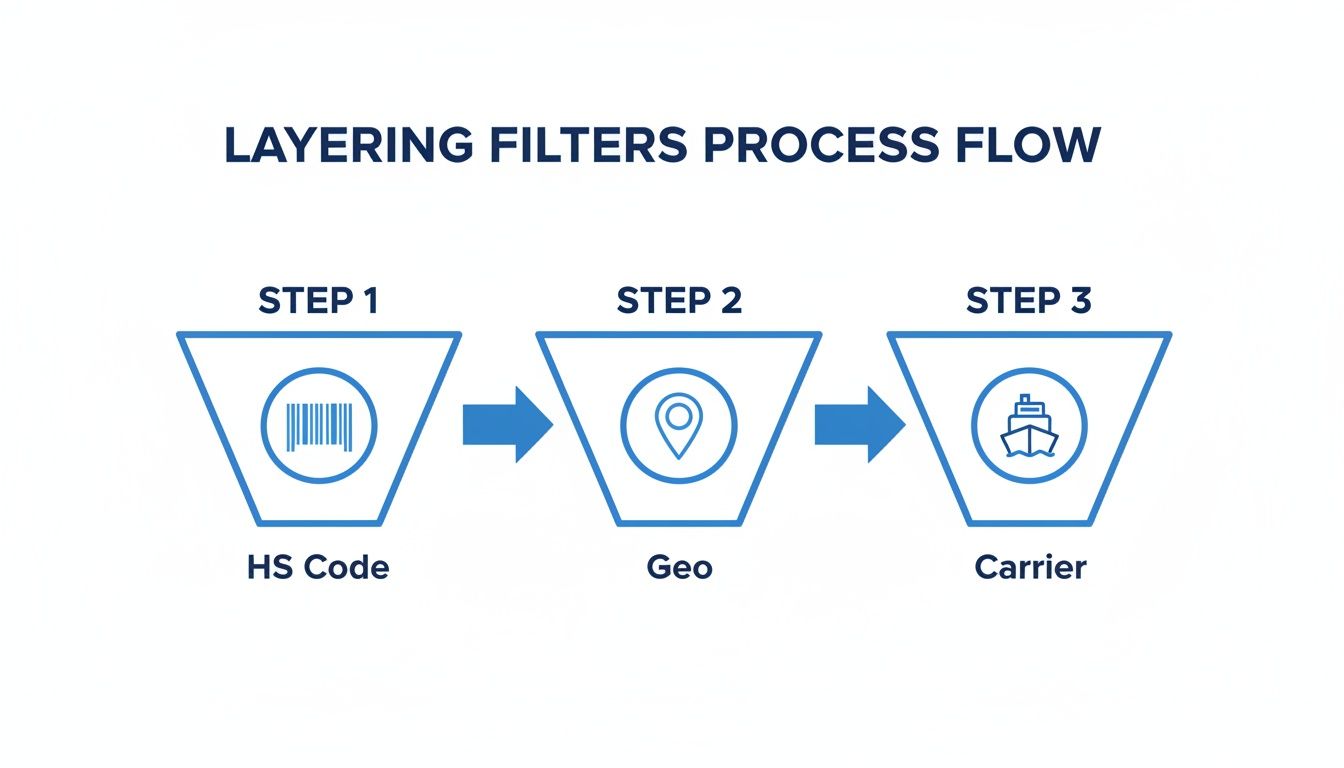
    The mistake I see most often is reps applying only one filter. They search by country, or by commodity, or by company type, and then call it a target list. That produces a lot of names and very little fit. The better method is layered filtering.

    A hand interacting with a digital interface that transforms chaotic scribbles into organized, structured data rows.

    Start with the lane, not the logo

    If your team is strongest on South Asia to the UK, or North America to the UK, begin there. Don't begin with famous brands. Begin with flows you can serve profitably.

    The lane filter matters because it sharpens every conversation after it. A shipper importing from a region where you already know transit options, cut-off realities, and customs pinch points is easier to qualify and easier to pitch with confidence.

    A practical filter stack often looks like this:

    • Trade lane first: Origin country or region tied to your buying power or routing strength.
    • Commodity second: Focus on goods your ops team handles cleanly and your sales team understands.
    • Importer profile third: Separate likely one-off buyers from repeat importers and structured procurement teams.
    • Complexity flag fourth: Highlight shipments where documentation, valuation, or compliance create real pain.

    Use policy shifts as a targeting filter

    The best targeting lists aren't just operational. They're contextual.

    With the 2025 Developing Countries Trading Scheme upgrades, importers can gain tariff-free access for goods from countries such as Nigeria and Bangladesh. The same government update notes potential 30%+ cost savings in sectors like garments or electronics, alongside an £1.2bn drop in EU imports, which creates a strong filter for lane-diversification outreach through the UK government DCTS announcement.

    That gives you a useful sales angle. If you already serve emerging non-EU lanes, look for UK importers whose current sourcing pattern suggests they may be evaluating alternatives to EU-heavy procurement.

    What works: contacting a shipper with a lane hypothesis tied to its sourcing category.
    What doesn't: sending "we offer global freight solutions" to every importer in a vertical.

    For importers managing cross-border responsibility questions, Snappycrate's IOR compliance resources are a practical reference because importer-of-record issues often sit close to expansion into unfamiliar lanes.

    Build a shortlist, not a monument

    Your filtered list should become uncomfortable in a good way. Small enough that every account feels chosen. Specific enough that a rep can explain in one sentence why it's on the list.

    Ask your team to document each account using this quick grid:

    Filter Example of a useful note
    Lane fit Imports appear aligned with a region where we already quote competitively
    Commodity fit Product category matches our customs and handling experience
    Service angle Potential need for consolidation, brokerage coordination, or routing support
    Trigger Shift in sourcing geography or entry into a new lane

    A short explainer can help reps visualize the difference between broad search and tactical filtering:

    When a rep finishes filtering, the outcome shouldn't be "I found hundreds of companies." It should be "I found a focused set of importers in uk that match our lane, our service model, and a timely commercial angle."

    Connecting Data to People Who Make Decisions

    Company-level targeting gets you to the right account. Revenue only moves when you reach the right person inside it.

    Misdirected outreach often causes many solid prospecting efforts to stall. The team identifies a valid importer, then sends outreach to a generic inbox or the wrong department. Operations might care about freight execution, but procurement may own the provider relationship. In another business, the supply chain manager runs the review and finance signs off later. You need a workflow, not guesswork.

    Job titles worth chasing

    Titles vary, but the pattern is consistent. You're looking for people with responsibility over inbound movement, supplier coordination, customs friction, or logistics spend.

    Start with titles like these:

    • Logistics Manager when the company seems execution-heavy.
    • Head of Supply Chain when the business has broader planning maturity.
    • Procurement Manager if sourcing and transport decisions appear linked.
    • Import Manager or Customs Manager in firms with heavier compliance exposure.
    • Operations Director in smaller companies where one person owns multiple functions.

    Don't assume the highest-ranking person is the best first contact. In many mid-sized import businesses, a practical manager with a budget problem is more responsive than a director with a crowded inbox.

    A repeatable contact workflow

    This process is simple and it works when reps stick to it.

    1. Confirm the legal entity so you don't map contacts to the wrong subsidiary.
    2. Review LinkedIn company headcount and department structure to see whether logistics is centralized or shared.
    3. Pull two to three likely contacts, not one. A primary, a secondary, and a fallback.
    4. Verify email before launch so your campaign quality doesn't degrade.
    5. Write to the person closest to the pain, then copy seniority into follow-up only if needed.

    The useful thing about shipment-led targeting is that it makes people research easier. Once you know why the account matters, finding the right contact becomes purposeful. You're not hunting names blindly. You're matching a trade pattern to an accountable role.

    For teams building this bridge between shipment data and contact discovery, Coreties' article on logistics and sales is a practical reference because it ties commercial research to who should receive the message.

    A customs record tells you where the company acts. LinkedIn tells you who inside the company has to live with that decision.

    What reps should log before first contact

    A rep should be able to answer these points without opening six browser tabs during a call:

    • Why this company now
    • Which person is most likely to care
    • What operational issue or lane shift we believe exists
    • What we can discuss that isn't generic

    That last point matters. "Can we quote your freight?" is weak. "We noticed a likely sourcing pattern that may need a different routing and customs setup" is a conversation starter.

    The handoff between targeting and outreach is where discipline shows. If your SDR or sales rep can't explain why a specific contact was chosen, the account wasn't qualified enough.

    Strategic Prioritization of Your Importer Pipeline

    Once you have a good list, don't work it top to bottom. That's a warehouse picking method, not a sales strategy.

    A first-in, first-out pipeline treats every importer as equal. They aren't. Some accounts fit your network cleanly and can move fast. Others are real opportunities but come with slower timelines, harder compliance needs, or weak internal ownership. Prioritization is where you stop acting busy and start allocating effort.

    Score for fit and speed

    You already have the ingredients for a simple lead score. You don't need a complicated model. You need a commercial one.

    A practical score can combine:

    Scoring factor Why it matters
    Lane alignment Accounts on lanes where you can quote credibly should move first
    Commodity suitability Familiar cargo types reduce sales friction and onboarding pain
    Contact quality A verified decision-maker beats a generic inbox every time
    Operational complexity Some complexity creates urgency, too much can slow early wins
    Likely buying readiness Clear activity and change signals deserve faster follow-up

    This gives the team a common language. Instead of saying "this feels like a good account," reps can say "high lane fit, strong contact, moderate complexity."

    Use compliance posture as a prioritization signal

    Risk profile matters more than many sales teams admit. Under the UK's Border Target Operating Model, low-risk importers can clear in 24-48 hours, while high-risk categories can take 5-7 business days. The same source notes that forwarders can prioritize low-risk prospects because they tend to represent 60-70% faster revenue cycles, based on the UK customs and importing guide.

    That doesn't mean you ignore high-risk importers. It means you classify them differently.

    • Low-risk prospects: Good candidates for fast outbound, standard discovery calls, and quicker quoting.
    • Higher-risk prospects: Better suited for consultative outreach where brokerage support or compliance advisory is part of the sale.
    • Unclear-risk prospects: Hold until you learn enough to avoid dragging the team into long, unqualified cycles.

    Watch for trigger events, not just fit

    The best accounts are rarely just a good match. They also have a reason to engage now.

    A useful trigger might be a visible shift in sourcing geography, a change in the type of goods being imported, or signs that the importer is entering a lane where you already know the routing and documentation pitfalls. You don't need to overstate what you know. You just need a credible hypothesis.

    Field note: Priority goes to the importer where you can explain both fit and timing. Fit without timing goes cold. Timing without fit wastes margin.

    Sales managers earn their keep. They should force reps to rank accounts before outreach begins. If every target is marked high priority, the scoring model is decorative. The list should tighten, and some accounts should wait.

    A lean, prioritized pipeline also improves follow-up quality. Reps spend more time preparing account-specific messaging and less time spraying generic emails across a bloated queue.

    Sample Outreach Sequences That Cut Through the Noise

    Most cold outreach to importers fails because it sounds like it was written before the sender knew anything about the account.

    Bad message:

    Hi, we are a global freight forwarding company offering competitive rates for sea and air freight. We would love to support your shipping needs. Are you available for a quick call this week?

    Nothing in that email proves relevance. It asks for time before earning interest.

    A prominent blue and yellow envelope icon stands out against a blurred background of various pastel envelopes.

    A better first email

    A stronger email uses one trade signal, one operational angle, and one narrow ask.

    Subject: Question on your inbound lane setup

    Hi [Name],

    Reaching out because your team appears active on inbound trade that may involve a non-EU sourcing pattern. We work with UK import teams when a lane starts creating pressure around routing choices, customs coordination, or consolidation.

    If that lane is currently under review, I can share a short view on routing options and where forwarders usually see friction first.

    Worth a brief exchange next week?

    Best,
    [Sender]

    That email works better because it doesn't pretend you know everything. It shows enough context to sound informed and gives the buyer a reason to respond.

    A simple three-touch sequence

    Use restraint. The goal is to start a conversation, not perform a sequence.

    1. Email one
      Lead with the lane or sourcing pattern and a likely pain point.

    2. LinkedIn connection request
      Keep it short. Mention that you sent a note tied to their inbound shipping setup.

    3. Follow-up email
      Add one useful angle. For example, a customs documentation issue, a lane diversification question, or a routing consideration relevant to their profile.

    For teams refining tone and structure, Truelist.io's email writing guide is worth reviewing because it helps tighten weak cold email habits without pushing templates that sound robotic. If you want examples specific to freight sales, Coreties' guide on how to generate leads in logistics gives a useful commercial frame for turning research into outreach.

    What good follow-up sounds like

    The second message should add value, not guilt.

    Try this:

    Hi [Name],

    Following up on my earlier note. The reason I reached out is simple. When UK importers adjust sourcing or expand on less familiar lanes, the first issues usually show up in routing consistency, document quality, and handoffs between suppliers and customs-facing teams.

    If that's relevant, happy to send a few observations tailored to your inbound setup.

    Best,
    [Sender]

    That's enough. Short, specific, and easy to answer.


    If your team is still building importer lists from directories and broad company databases, it's leaving too much to chance. Coreties helps freight forwarders and logistics sales teams turn customs data into targeted prospect lists, identify the right decision-makers, and send relevant outreach built around actual trade activity instead of guesswork.

  • Everbright Trading Inc: Master Logistics Outreach Now

    Everbright Trading Inc: Master Logistics Outreach Now

    You’re scanning customs records, looking for the next importer worth a personalized pitch. Most names blur together. Then one account stands out because the data is specific enough to act on.

    everbright trading inc is that kind of account.

    It’s not just a wholesale importer in Brooklyn. It’s a prospect with a visible operating model, a clearly defined product niche, a concentrated port strategy, and a documented compliance history that changes how a freight forwarder should approach the sale. That combination matters because generic outreach won’t land well here. A strong first message has to show that you understand what they move, where their freight flows, and where friction is likely to appear.

    Your Next Prospect Everbright Trading Inc

    A lot of freight sales reps find a target the same way. They pull a customs record, see repeat activity, and ask one question: is this shipper active enough to justify account research?

    With everbright trading inc, the answer is yes. The company shows the traits that make a small importer commercially interesting. It has a defined commodity focus, a long enough import footprint to analyze, and enough public operating data to build a sharp outreach angle instead of sending another vague “can we quote your shipments” email.

    That’s the difference between list building and account strategy. A customs entry tells you a company imports. A good seller turns that into a point of view about how the company buys logistics, where delays hurt them, and which internal stakeholder is most likely to care.

    If you’re building a prospecting process from shipment intelligence rather than from purchased lead lists, this guide on finding shippers for freight brokers is useful background. The practical lesson applies here. Start with observed trade activity, then narrow toward message-market fit.

    Practical rule: If a prospect’s shipping pattern is visible, your outreach should reflect that visibility. Don’t ask broad questions when public data already shows the lane, commodity type, and operating constraints.

    Everbright is a strong case study because it sits in a category where logistics service quality matters more than many sellers realize. Toys, dolls, gifts, and novelty products sound simple until you factor in seasonal buying, import timing, inspection risk, and the pressure to keep landed cost under control for price-sensitive downstream buyers.

    That makes this account worth more than a name in a spreadsheet. It’s a target you can qualify, prioritize, and approach with intent.

    Decoding Everbright's Business Model and Market Niche

    A Brooklyn wholesaler selling low-to-mid-ticket discretionary goods behaves very differently from a branded consumer company or a large retail importer. That distinction matters before a freight forwarder writes a single email.

    A woman in a bright green shirt looking at a computer screen displaying market data charts.

    Everbright sits in the imported gift, toy, and novelty category. Public business records place the company at 1177B Flushing Ave, Brooklyn, New York 11237. The commercial profile matters more than the office address. This is the kind of account where landed cost, reorder timing, and shipment exception handling can directly affect resale margin on a broad catalog of relatively low-value items.

    That product mix creates a specific operating model. A wholesaler in dolls, toys, gifts, and fantasy-themed merchandise usually wins on assortment, availability, and price discipline rather than on deep brand loyalty. If inbound freight costs jump, if customs exams hold a container, or if replenishment slips into the wrong selling window, the pain shows up quickly in inventory turns and customer fill rates.

    For a logistics seller, the practical takeaway is simple. Everbright is more likely to buy logistics as an operating safeguard than as a strategic transformation project.

    Public company information also points to a broad merchandise range and an import-oriented sourcing model, which fits the shipment patterns discussed later in this article. That combination often means demand is uneven across SKUs. Some items move steadily. Others are seasonal, trend-driven, or promotion-sensitive. Sellers who use supply chain databases to qualify importer behavior can turn that pattern into sharper messaging than a generic rate pitch.

    What this niche suggests about buying behavior

    Small and midsize import distributors usually have compressed decision paths. The person reviewing freight invoices may also care about stock availability, customs delays, and warehouse timing. In practice, that changes who should receive the message and what the message should promise.

    A strong pitch to this kind of account should focus on concrete outcomes:

    • Fewer arrival surprises on replenishment orders
    • Tighter control of accessorial and drayage-related cost creep
    • Faster response when customs or port issues interrupt sellable inventory
    • Clear visibility for a team that likely does not have specialized logistics staff in every function

    There is also a customer-mix implication here. Wholesalers serving smaller retailers, discount channels, and independent resellers often face fragmented ordering behavior. Orders are smaller, timing can be less predictable, and inventory availability matters more than polished enterprise reporting. That makes service reliability and exception handling commercially relevant, even if total spend is modest.

    Why Everbright is a workable target account

    Everbright does not need a seller to explain freight forwarding in abstract terms. It needs a provider that can reduce friction in an import-dependent resale business. That is a better sales position than many prospect lists offer.

    The non-obvious opportunity is that smaller import wholesalers often generate faster sales cycles than larger accounts because operational authority is concentrated. The constraint is trust. A forwarder has to show familiarity with the account’s business model, not just its import activity. Referencing category-specific risk, such as timing sensitivity in toys and giftables or margin pressure on mixed-SKU shipments, is more persuasive than broad claims about service.

    For teams refining that account-based approach, Fame's supply chain shows are a useful example of how operators discuss sourcing risk, inventory timing, and logistics decisions in commercial terms rather than carrier jargon.

    Analyzing Their Core Supply Chain and Trade Lanes

    The most actionable data point in this account is simple. Everbright’s import pattern is heavily concentrated through one gateway.

    An infographic showing Everbright Trading Inc. supply chain data including import ports, origin countries, and shipping trends.

    Bills of lading analysis shows Newark, New Jersey handled 891 of 995 shipments, or 89.6%, between October 2012 and March 2026, with the most recent shipment recorded on March 5, 2026, according to ImportInfo’s shipment profile. For a sales strategist, that isn’t just historical trivia. It’s the operating center of gravity.

    What Newark concentration tells you

    A prospect with this level of port concentration is usually optimized around a familiar lane. It may have stable customs routines, established drayage habits, and internal expectations built around one main route into the Northeast. That makes the account easier to model than a shipper spreading freight across many gateways.

    It also creates exposure. If Newark gets congested, if a labor issue emerges, or if local handling conditions change, this importer has less natural flexibility than a more diversified account. A forwarder who understands that can speak to resilience without sounding theoretical.

    Here’s the direct sales value of that insight:

    • Lane-specific outreach works better: Reference Asia to U.S. East Coast coordination, not broad “global shipping support.”
    • Contingency planning is relevant: A conversation about backup routing is grounded in observed behavior.
    • Carrier and drayage performance matter more: Local execution around Newark likely shapes Everbright’s experience of freight quality.

    For reps trying to sharpen this type of lane analysis across more accounts, a good companion resource is this overview of supply chain databases. The key habit is learning to turn shipment records into selling hypotheses, not just lead lists.

    Where the opportunity sits for forwarders

    A concentrated importer is often more winnable than a scattered one because the service conversation is narrower. You don’t need to prove strength everywhere. You need to prove that you can support the lane they already trust, while reducing friction when that lane is under pressure.

    That could mean better coordination at the port, stronger communication around arrival exceptions, or a more credible alternative routing discussion when needed. The opportunity isn’t to re-educate the shipper on its business. It’s to show that you understand the lane well enough to improve outcomes inside the business it already runs.

    A lot of logistics operators get better at this kind of pattern recognition by listening to specialized industry conversations. Fame's supply chain shows are useful because they surface how operators think about bottlenecks, timing, and network choices across real supply chains, even outside the toy category.

    Later in the sales process, that kind of context helps you ask smarter follow-up questions. Not “Do you import from Asia?” The data already answers that. Ask what service gap they’re still tolerating on their primary lane.

    A short explainer adds context before the next point.

    Reading the Signals from Customs and Historical Data

    A sales rep pulls Everbright into a prospecting queue and sees a familiar trap. The company is easy to label as a generic small importer. Customs history is what separates a low-value lead from an account with a usable sales plan.

    A person holding a digital tablet displaying stock market trading charts and technical analysis graphs.

    Public shipment intelligence points to supplier relationships with Yiwu Juliang Daily Necessities Co., Ltd. and Qibao Toys Co., Ltd. Those names fit Everbright’s toy and novelty assortment. More important, they suggest repeat procurement rather than opportunistic buying. For a forwarder, that changes the account strategy. Repeat suppliers usually mean repeat booking patterns, recurring documentation habits, and a buyer that already feels the cost of delays in a very practical way.

    The useful signal is continuity.

    If the same importer appears across multiple shipment periods with product categories that stay close to its wholesale profile, the account is usually still operating in a defined sourcing model. That matters more than broad company-description copy on a directory page. A shipper with stable vendor ties often has entrenched operating routines, but it may still be dissatisfied with response speed, booking visibility, document accuracy, or port-side exception handling.

    That gives outbound teams a sharper way to qualify the opportunity. Instead of opening with price, lead with control points inside the current workflow.

    A practical screen looks like this:

    1. Check for recurring suppliers and origin clusters. That indicates a lane the buyer likely depends on.
    2. Review shipment recency. Recent customs activity makes the account more relevant than a stale importer record.
    3. Compare declared product types with likely clearance friction. Toys and children’s goods can create tighter documentation and inspection expectations than low-scrutiny general merchandise.
    4. Use shipment history to frame one operational hypothesis. For Everbright, that hypothesis could be: “You already have China bookings covered, but exception handling and release coordination may still be inconsistent.”

    For teams building account lists from shipment activity, a practical guide to port import export reporting service workflows can help standardize that research. The value is not the report alone. The value is turning raw import visibility into a message tied to a specific operating risk.

    There is also a prospecting discipline point here. The name “Everbright” can easily push a seller toward the wrong mental model if they rely on brand association instead of account evidence. Public business records and shipment patterns support a much narrower conclusion. This is a Brooklyn-based wholesale importer with visible China sourcing activity, not a large institutional buying organization.

    That distinction affects outreach quality. A forwarder selling into this account should assume a smaller decision circle, limited tolerance for vague claims, and a stronger response to concrete fixes tied to current import routines. Customs history does more than confirm that Everbright buys overseas. It shows where a logistics seller can enter the conversation with a credible point of view.

    Assessing Critical Trust and Compliance Risks

    The biggest non-commercial signal in this account is its regulatory history. That history matters because it shapes how customs friction, inspection exposure, and service expectations may show up in the relationship.

    A magnifying glass inspecting a regulatory compliance checklist focused on data privacy on a wooden desk.

    According to FreightWaves’ report on CPSC enforcement, Everbright Trading Inc. had 97 non-compliant product samples collected since March 2013, received 41 letters of advice, and was subject to an injunction against the company, owner Yuan Xiang Gao, and manager Rong Qing Xu for federal standard violations in children’s product categories, as detailed in the enforcement coverage.

    Why this matters in a sales conversation

    A lot of reps avoid compliance history because they think it’s too sensitive for outreach. Usually, they’re right if they handle it bluntly. But ignoring it is also a mistake. For an importer in toys and children’s products, compliance isn’t separate from logistics. It affects release timing, document discipline, broker communication, and how quickly problems escalate.

    That creates a real opening for the right logistics partner. Not because you can solve product compliance for the shipper, but because you can reduce avoidable operational chaos around compliance-heavy freight.

    A forwarder can credibly discuss:

    • Shipment preparation discipline: Clean documentation and pre-arrival coordination matter more when regulators pay close attention.
    • Broker alignment: Importers under scrutiny need providers who won’t treat entries as routine.
    • Exception handling: When a hold, exam, or documentation question appears, the speed and clarity of communication matter.

    How to address risk without sounding accusatory

    Don’t build your opening email around the injunction. That turns a useful insight into a confrontational message. Instead, position yourself around import control and predictability.

    For example, a strong conversation starter is that you work with importers whose freight needs tighter coordination because product categories attract more oversight. That’s factual, respectful, and commercially relevant.

    Sellers win trust when they speak to the operating burden, not when they recite the prospect’s problems back to them.

    This account’s compliance history should change your qualification standard, too. If your team doesn’t handle customs-sensitive freight well, this isn’t the right target. If you do, the risk profile becomes part of your differentiation.

    Identifying and Reaching Key Logistics Decision Makers

    Small companies rarely buy logistics the way large enterprises do. The org chart is flatter, titles overlap, and the person answering strategic questions may also be dealing with supplier communication, payment approvals, or warehouse issues that same day.

    That’s likely true for everbright trading inc given its small headcount profile discussed earlier. In a company of that size, don’t assume there’s a dedicated transportation director waiting for your pitch. The most relevant contacts are probably ownership or general management.

    Who to target first

    Public records tied to the CPSC matter identify Yuan Xiang Gao as owner and Rong Qing Xu as manager. Those names matter because they give you a realistic starting point for contact research and title matching. In a compact importer, those roles are often close to operational decisions even if they don’t carry classic logistics titles.

    Use a simple priority model:

    • Start with owner-level leadership: Owners in small import businesses often care directly about landed cost and shipment disruption.
    • Include manager-level contacts: Managers may be closer to day-to-day vendor or import coordination.
    • Avoid over-filtering for logistics titles: You may miss the key decision-maker if you search only for “supply chain manager” or “director of transportation.”

    How to verify before outreach

    Don’t rely on one source. Build a contact file by checking business directories, LinkedIn, company website details, and any public references that connect names to roles. Your goal is not volume. It’s confidence.

    A good workflow looks like this:

    1. Confirm the company website and headquarters details.
    2. Search LinkedIn for company name variants and likely title combinations.
    3. Match known public names against current professional profiles where possible.
    4. Prepare one message for an owner and a slightly more operational version for a manager.

    What your email should reflect

    If you’re emailing a likely owner, talk about reliability, landed cost control, and avoiding avoidable disruption. If you’re emailing a manager, make the message more operational. Mention visibility, handoff quality, and issue resolution speed.

    Don’t overcomplicate the personalization. A small importer will spot fake familiarity instantly. Keep it grounded in what a real operator would care about: inbound timing, port friction, and whether their current partners create more work than they remove.

    The Outreach Playbook Three Angles to Win Their Business

    The best outreach to everbright trading inc should feel narrow, specific, and useful. Don’t stack every insight into one message. Pick one angle and develop it well.

    If your team is refining prospecting process more broadly, this piece on strategies to fill your B2B pipeline is worth a read because it reinforces the same principle. Focused outreach beats generic activity.

    Comparison of winning angles

    Outreach Angle Key Data Signal Your Value Proposition
    Newark resilience Heavy reliance on Newark as primary import gateway Better support for the existing lane, plus contingency planning when local conditions tighten
    Compliance-sensitive handling Public CPSC enforcement history in regulated product categories More disciplined shipment coordination, broker communication, and exception response
    China-to-NYC operating fit Repeat sourcing from Chinese suppliers for a Brooklyn wholesale model Tighter coordination from supplier origin to Northeast delivery for recurring inbound freight

    Angle one: Newark resilience

    This angle works because it speaks to the importer’s likely daily reality, not a hypothetical future state.

    Subject line: Support for your Newark inbound lane

    Message core:

    • You understand they appear to move repeat imports through the New York and New Jersey gateway.
    • Your team helps importers maintain flow when their main port experiences pressure.
    • You’d like to compare how they currently handle visibility, drayage coordination, and backup routing.

    This angle is strongest for a forwarder with real East Coast execution strength. If you can’t support that with substance, skip it.

    Angle two: Compliance-sensitive freight support

    This approach should be calm and professional. Don’t mention enforcement in the subject line. Keep the value proposition centered on control.

    Subject line: Tighter coordination for inspection-sensitive imports

    Suggested body direction:

    You work with importers in product categories where customs and agency scrutiny can create more operational touchpoints. Your team focuses on clean handoffs, proactive communication, and faster exception escalation when issues arise. If Everbright is reviewing any forwarding or brokerage support for children’s product imports, you’d welcome a conversation.

    Short, credible, and tied to a burden they likely understand from experience.

    Angle three: Origin-to-Brooklyn coordination

    This is the most commercial of the three. It leans into the company’s role as a wholesaler serving a varied customer base.

    Subject line: Support from China suppliers into Brooklyn distribution

    Keep this one practical. Reference your experience coordinating supplier-origin freight into Northeast import programs and ask whether they’re satisfied with current transit visibility and delivery coordination after arrival.

    This message works well when the contact seems closer to operations than to ownership.

    The common rule across all three angles is simple. Lead with what the data suggests they already care about. Don’t introduce a service menu. Introduce a relevant fix.


    If you want to turn customs records into shipper-specific outreach like this at scale, Coreties is built for that job. It helps freight forwarders and logistics teams identify active importers, find the right decision-makers, and send personalized outreach grounded in real trade data instead of guesswork.

  • Find & Win PVC Pipe Buyers: A Logistics Sales Playbook

    Find & Win PVC Pipe Buyers: A Logistics Sales Playbook

    You’re probably staring at a list of “building materials” importers right now and already know what happens next. Half the companies don’t move pipe at all. A chunk buy through distributors. The rest may import once, disappear for months, and waste your sequence.

    That’s the trap with generic prospecting. It treats pvc pipe buyers like any other industrial lead, even though this category leaves a much clearer shipping trail than most freight targets.

    The opportunity is large and structured. The North American PVC pipes market reached 4.7 million tons in 2025 and is projected to reach 7.3 million tons by 2034, with the region accounting for 38.1% of global market share in 2026 according to IMARC’s North America PVC pipes market analysis. The United States accounts for the bulk of demand, tied to construction activity and pipeline infrastructure investment in that same analysis. For a logistics sales team, that matters because this isn’t random cargo. It’s repeatable, specification-driven freight tied to durable end markets.

    The reps who win pvc pipe buyers don’t start with company size or vague industry labels. They start with shipment evidence, lane behavior, product clues, and buyer pain. They know which accounts import repeatedly, which ones buy pressure-rated product, which ones are exposed to volatile sourcing, and which contacts own the forwarding decision.

    If your inbound capture is weak, even strong outbound work leaks revenue. Teams tightening that side of the funnel often pair prospecting with AI-powered lead capture tools so buyer conversations from chat and web forms reach the CRM with context instead of getting dumped into a generic inbox.

    Beyond Generic Leads in the PVC Market

    Most freight teams lose time before they ever send the first email. They pull importer lists by broad construction terms, maybe sort by container volume, then push the same pitch to everyone. That process creates activity, not pipeline.

    PVC is different because the buyer base is easier to separate if you work from trade behavior instead of category labels. Municipal supply, plumbing distribution, irrigation, industrial systems, and project cargo all buy pipe differently. Their shipment patterns, spec language, and lane needs aren’t the same. Treat them the same, and your message sounds generic from line one.

    What weak pvc pipe buyer lists look like

    A bad list usually has one of three problems:

    • The company isn’t really a pipe buyer. It may handle mixed construction imports with pipe buried inside a broad purchasing profile.
    • The volume is too thin to matter. One or two opportunistic shipments rarely justify a customized sales cycle.
    • The contact path is wrong. You reach a branch purchaser or office admin instead of the person who owns routing, tendering, or import planning.

    That’s why generic “top importers” lists underperform. They tell you who exists. They don’t tell you who buys repeatedly, by lane, with enough consistency to support a forwarding relationship.

    Practical rule: If a lead can’t be tied to repeat import behavior and a recognizable PVC product profile, it’s still research, not a sales target.

    Why this market deserves specialized attention

    The prize is worth the extra work because pvc pipe buyers often operate with recurring replenishment cycles, project-based surges, and product constraints that affect freight planning. That gives a good sales team more angles than price alone.

    A buyer moving municipal water pipe cares about damage prevention, fit, handling, and dependable scheduling. A distributor balancing imports across regions cares about stable routing and quick visibility when supply gets tight. A prospect who buys mixed fittings and pipe may care more about consolidation and documentation quality than transit speed.

    The playbook works when you stop asking, “Who imports construction products?” and start asking better questions:

    1. Which companies import under the right product code?
    2. Which ones move enough freight to justify focused pursuit?
    3. What pipe type are they buying?
    4. Who inside the account owns the freight decision?
    5. What operational risk can we solve better than the next forwarder?

    That shift is what turns pvc pipe buyers from a cold list into a targeted sales motion.

    Locating High-Volume Importers with Customs Data

    High-value pvc pipe prospecting starts with customs records, not directories. Directories tell you what a company says it does. Bills of lading show what it moved.

    The baseline workflow is straightforward. Parse customs data, filter for the right product family, remove low-signal importers, and then rank by recurring lane activity. The verified methodology for this niche uses HS code 3917, volume thresholds above 10 TEUs per month, and recurring orders on lanes such as Asia-EU. That process can reach an 85% match rate to verified buyers according to the methodology cited in this PVC pipe and fittings dimensions resource.

    An infographic outlining five strategic steps for identifying high-volume global importers of PVC pipe products.

    Start with the code, not the keyword

    Keywords help, but they’re messy. Importers describe pipe in different ways across shipments. Some list pressure pipe, conduit, fittings, or plastic tubing language that won’t show up in a simple search.

    HS code 3917 gives you a cleaner starting point because it covers tubes, pipes, and hoses of plastics. If your team needs a refresher on product code structure before building searches, this short guide to understanding HS code classification is useful.

    Once you pull 3917 traffic, narrow the field by shipment descriptions that suggest PVC rather than unrelated plastic tube products. Don’t rely on one field. Read product lines, suppliers, origins, consignee names, and repeated commodity wording together.

    The filtering sequence that saves time

    Reps often make the mistake of sorting by total shipment count first. That creates a bloated list full of importers with occasional or mixed cargo. A better sequence is to filter in layers.

    1. Product filter first
      Pull import activity under HS 3917, then keep records that reference PVC pipe, PVC fittings, sewer pipe, DWV, pressure pipe, conduit, or related wording.

    2. Consistency second
      Remove one-off importers. Recurring orders matter more than isolated spikes because they indicate a buyer with an established import habit.

    3. Volume third
      Apply the greater than 10 TEUs per month benchmark from the verified methodology. That won’t fit every target market, but it’s a strong screen for teams that want commercially meaningful accounts.

    4. Trade lane fourth
      Group prospects by active lanes. Asia-Europe may matter for one desk. Asia-US or Latin America-North America may matter for another. The lane should fit your network and carrier relationships, not just the buyer’s size.

    5. Supplier concentration last
      Accounts with very concentrated sourcing often have a different sales angle than buyers splitting purchases across multiple origins. One signals stability. The other may signal active risk management or supplier experimentation.

    Buyers with recurring imports are usually easier to convert than companies that look large on paper but move pipe sporadically.

    What to look for inside the shipment history

    Once a company survives your filters, inspect the shipment rhythm. Don’t just count bookings. Read them.

    Useful signs include:

    • Repeated supplier names that suggest a stable procurement channel
    • Regular seasonality tied to project schedules or inventory replenishment
    • Port pairs that align with your strong routing options
    • Mixed line items showing the buyer may also need fittings, valves, or bundled accessories
    • Consignee variations that reveal branch-level delivery patterns or regional distribution

    Those details shape the first message. “We help with PVC shipments” is forgettable. “I noticed your recurring imports on a specific lane and saw a pattern that may be creating avoidable routing exposure” gets attention because it sounds like you did real work.

    Build a target list that sales can actually use

    A prospect list should be short enough to work and rich enough to personalize. If the list is too broad, reps default to templates and lose the advantage customs data gave them.

    A practical target sheet for pvc pipe buyers should include:

    Field Why it matters
    Company name Basic account identification
    Import lane Tells you whether your network fits
    Shipment frequency Separates repeat buyers from noise
    Approximate volume band Helps prioritize effort
    Product wording Indicates likely pipe category
    Supplier country Supports routing and diversification angle
    Last shipment timing Helps sequence outreach
    Likely decision function Guides contact research

    That’s enough to drive action without burying the rep in analysis.

    Common mistakes when mining customs data

    The biggest issue isn’t lack of data. It’s sloppy interpretation.

    • Over-trusting broad descriptors
      “Plastic pipe” doesn’t always mean the buyer fits your lane or service model.

    • Ignoring recency
      A strong importer from an old period may not be active now.

    • Ranking only by size
      Large accounts can be harder to displace than mid-market buyers with changing sourcing patterns.

    • Skipping lane fit
      If your network isn’t competitive on the buyer’s active corridor, the lead isn’t ready no matter how attractive the shipment volume looks.

    The reps who find strong pvc pipe buyers don’t chase the largest spreadsheet. They build a ranked list of importers whose freight profile matches what their operation can win.

    Qualifying Prospects Beyond Shipment Volume

    Volume gets you a company. Technical context gets you a sales angle.

    A lot of reps stop once they’ve confirmed recurring imports. That’s where they flatten every pvc pipe buyer into the same message. The smarter move is to read the freight through the product itself. Pipe specifications tell you what kind of buyer you’re dealing with, what service risks matter, and how informed your outreach needs to be.

    A professional analyzing customer growth data on a digital tablet while sitting by white PVC pipes.

    The spec details that change the conversation

    Verified qualification guidance for this niche includes analyzing bill-of-lading data and technical references for specs such as tensile strength of 7,500 PSI and schedule ratings. It also highlights a common credibility point: Schedule 40 PVC is often underspecced for applications above 140°F. That comes from Spears manufacturing technical data, and it matters because it helps you speak to risk, not just freight.

    If your note to a prospect shows you understand the difference between basic pipe movement and spec-sensitive cargo, you sound like a logistics partner instead of a rate sender.

    Read the shipment like an operator

    When qualifying pvc pipe buyers, look for clues that separate commodity movement from higher-stakes freight:

    • Schedule references
      Sch 40 and Sch 80 signal different use cases and handling expectations.

    • Application terms
      Municipal water, sewer, DWV, irrigation, conduit, and chemical service all imply different buyer concerns.

    • Fittings compatibility language
      If shipments reference fittings or molded components, dimensional consistency and handling become more important.

    • Pressure or performance wording
      These buyers are usually less tolerant of substitutions, transit damage, and poor documentation.

    A buyer moving standard stock pipe for broad distribution may respond to reliability and inventory support. A buyer tied to engineered applications may respond better when you show awareness of specification risk and routing control.

    Field note: Technical fluency doesn’t mean pretending to be an engineer. It means knowing enough to ask the right freight questions and avoid saying the wrong thing.

    Segment the account before you contact it

    Don’t send one message to every importer on your list. Segment first.

    A simple segmentation model works well:

    Buyer segment Typical clue in trade data Stronger sales angle
    Distribution-focused buyer Repeated mixed SKUs, branch consignees Shipment consistency, consolidation, delivery coordination
    Municipal or infrastructure buyer Pressure-rated or project-specific wording Damage prevention, documentation discipline, lane stability
    Industrial or technical buyer High-spec references, fittings detail Spec awareness, controlled handling, exception management
    Price-sensitive sourcing team Supplier shifts across origins Routing options, sourcing diversification, volatility mitigation

    Many teams also sharpen their internal qualification process. If your reps need a framework for that discipline, this guide on how to qualify sales leads effectively is a practical companion.

    Find the person who can move the opportunity

    The right company with the wrong contact is still a stalled deal.

    In this niche, the decision-maker isn’t always the procurement head. Depending on the account, freight influence may sit with:

    • Procurement directors who own overseas vendor terms
    • Logistics managers who control forwarding relationships
    • Import managers who care about execution and visibility
    • Operations leaders who feel the cost of delays, claims, and poor delivery coordination

    Start with the function closest to the observed problem. If the account appears to have volatile sourcing and lane complexity, procurement may care most. If the buyer imports steadily but across several facilities, logistics or operations may be the better door.

    What doesn’t work in qualification

    Three mistakes show up constantly.

    First, reps confuse product category with customer need. Two buyers can both import PVC pipe and care about completely different outcomes.

    Second, they overuse technical terms without connecting them to freight consequences. Mentioning Schedule 40 means nothing unless you tie it to handling, application sensitivity, or credibility.

    Third, they skip contact verification and spray branch-level staff. That creates internal noise and makes the account harder to approach later with a serious point of view.

    A qualified pvc pipe buyer isn’t just a company that imports pipe. It’s a company whose product profile, routing pattern, and decision ownership line up with a specific service proposition you can defend.

    Crafting Your Value Proposition for PVC Shipments

    Most pitches to pvc pipe buyers sound interchangeable. Better transit times. Better rates. Better service. Every forwarder says some version of that, and buyers tune it out.

    The stronger pitch starts with the buyer’s real exposure. PVC pipe prices surged 500% after 2020 amid supply chain disruption and alleged price-fixing, leading to settlements for purchasers, according to coverage of the antitrust litigation involving PVC pipe buyers. Whether your prospect followed that litigation closely or just lived through the volatility, the takeaway is the same. Buyers in this market are highly sensitive to supply stability, sourcing options, and freight reliability.

    A young professional in a white shirt working on a laptop with industrial PVC pipe fittings behind him.

    Sell stability, not just transportation

    If your opening message leads with “Can we quote your next shipment,” you’ve already narrowed your value to price.

    A stronger value proposition sounds more like this:

    • You understand the buyer’s active origin and destination pattern.
    • You can discuss alternate routing if one supplier region gets tight.
    • You know rigid pipe shipments create fit, handling, and claim exposure.
    • You can support decisions with current trade and lane evidence, not broad promises.

    That turns the conversation from rates into risk control.

    Tie your message to specific buyer pain

    The most effective logistics pitch for pvc pipe buyers usually connects to one of four problems:

    Buyer concern Weak pitch Better pitch
    Supply volatility “We can move your cargo.” “We can help evaluate routing and sourcing flexibility when one origin becomes unstable.”
    Damage and handling “We’re careful with freight.” “We look at packaging, loading pattern, and handoff points because rigid pipe claims often start before final delivery.”
    Visibility gaps “We provide updates.” “We build the lane view around recurring shipments so your team sees delays early, not after a missed handoff.”
    Procurement pressure “We’re competitive on price.” “We support procurement with lane-specific alternatives so they’re not forced into one routing assumption.”

    That’s why logistics sales teams benefit from sales frameworks designed for freight instead of generic B2B scripts. This article on sales in logistics is useful if you’re tightening how your team positions operational knowledge during prospecting.

    The buyer doesn’t need another vendor claiming service quality. The buyer needs evidence that you understand where disruption hits their margin and schedule.

    Language that earns a reply

    A few examples of message angles that work better than broad capability statements:

    • For a recurring importer on one lane
      “I noticed repeated PVC movements on the same corridor. If that lane tightens, do you already have alternate routing options mapped?”

    • For a buyer shifting suppliers
      “Your recent import pattern suggests sourcing diversification. That usually creates routing and handoff friction before it creates savings.”

    • For a spec-sensitive account
      “When the product has stricter application requirements, the forwarding issue isn’t speed alone. It’s avoiding preventable handling and documentation mistakes.”

    What fails is generic confidence without proof. “We provide end-to-end solutions” says nothing. “We reviewed your lane pattern and saw an avoidable concentration point” says you did the homework.

    Position yourself as a decision aid

    The best value proposition in this category doesn’t try to outshout incumbents. It gives the buyer a sharper operating lens.

    That can mean helping the prospect think through alternate gateways, handoff risk, supplier concentration, loading implications, or the impact of project-tied delivery windows. Even if the first conversation doesn’t produce an immediate quote, it can reposition you from outsider to useful commercial contact.

    That’s a better long game with pvc pipe buyers because many don’t switch forwarders from one email. They switch when a buyer remembers who showed understanding before a lane problem became urgent.

    Executing a Data-Driven Outreach Sequence

    Once the account is found and qualified, outreach should feel like a continuation of the analysis. Too many reps do the hard work of research and then send a message that could have gone to any importer.

    The sequence should prove three things fast. You know the buyer’s freight pattern. You understand enough about the product to ask intelligent questions. You can tie both points to a commercial benefit.

    A useful reference point for this kind of targeting is the broader discipline of working from supply chain databases for sales prospecting, where the goal is to convert trade records into account-specific messaging rather than generic outreach.

    The sequence structure

    A short three-touch sequence works well for pvc pipe buyers because the product is operationally specific and buyers tend to respond better to concise, informed outreach than to long nurture campaigns.

    Touchpoint Channel Core Message & Personalization Hook
    Touch 1 Email Mention the observed import lane, recent PVC product wording, and one likely pain point tied to routing, sourcing concentration, or handling. Ask for a short discussion, not a broad capability review.
    Touch 2 Email follow-up Add a useful observation such as alternate routing logic, shipment pattern consistency, or a question tied to product type such as pressure-rated versus general distribution stock.
    Touch 3 LinkedIn Send a brief connection request referencing the account’s PVC import activity and the specific operational issue you raised by email. Keep it conversational and low pressure.

    First email template

    The first touch should sound like it came from someone who read the trade data.

    Subject: [Importer Company] PVC imports on [lane]

    Hi [First Name],
    I’ve been reviewing companies importing PVC pipe on the [observed lane], and [Importer Company] stood out because the shipment pattern looks consistent rather than project-only.

    I also noticed wording that suggests [specific PVC type or application]. That usually changes the freight conversation because routing stability and handling matter more than a generic lowest-cost move.

    If you’re reviewing options for that lane, I can share a few observations on where teams typically see friction across origin handoff, transit reliability, or final delivery coordination.

    Worth a short call next week?

    [Name]

    This works because it’s narrow. It doesn’t ask for a bid. It offers a point of view.

    Follow-up that adds value

    The second touch should not say “just bumping this up.” Add one new insight.

    Practical follow-up: Reference a specific issue that logically fits the account. For example, if the buyer appears concentrated in one sourcing region, mention the benefit of pressure-testing alternate routing before the next disruption forces a rushed decision.

    A simple version:

    Hi [First Name],
    One follow-up on my earlier note. For PVC buyers importing repeatedly on [lane], the biggest weakness is often dependency on one routing pattern until congestion or supplier changes expose it.

    If useful, I can share how I’d assess backup options for [origin] into [destination] without changing your whole procurement setup.

    Best,
    [Name]

    LinkedIn touch that supports the email

    The LinkedIn note should be short enough to read in the preview pane.

    Hi [First Name], I emailed because your team appears active in PVC pipe imports on [lane]. Reaching out with one idea around routing stability and handling for that flow. Thought it made sense to connect here as well.

    That’s enough. Don’t restate the full pitch.

    Personalization hooks that actually matter

    When reps hear “personalization,” they often add trivia. That doesn’t help. Personalization should come from operational relevance.

    Strong hooks include:

    • Observed lane dependence and whether that lane matches your network strength
    • Apparent supplier shifts, which may indicate sourcing diversification or instability
    • Product wording suggesting municipal, sewer, conduit, or pressure-rated applications
    • Consignee spread, which may point to branch distribution complexity
    • Recurring timing, which can hint at project cycles or inventory replenishment patterns

    Emerging use cases can also sharpen the note. PVC demand is tied to infrastructure modernization and adjacent applications such as water systems, conduit, and rural utility-related needs. You don’t need to force a trend story into every email, but if the shipment pattern aligns with those markets, it can help your message sound timely instead of generic.

    What to measure without overcomplicating it

    You don’t need a complex dashboard to improve this motion. Track a few practical signals:

    • Replies by segment
      Which buyer type engages most often?

    • Meetings by lane
      Where does your network support conversion?

    • Positive response by message angle
      Do buyers respond more to sourcing stability, handling knowledge, or lane alternatives?

    • Sales-cycle quality
      Are you getting quote requests, discovery calls, or dead-end “send rates” responses?

    These metrics matter because they tell you whether your positioning is landing with the right buyer profile. If one segment only asks for spot rates and never books serious discovery, the issue may be targeting, not rep performance.

    Sequence mistakes that kill momentum

    Three problems show up repeatedly:

    • Overwriting the first email
      If the prospect has to dig for the point, the email loses.

    • Using technical language as decoration
      Mention specs only when they support a freight or risk point.

    • Asking for too much too early
      Don’t request shipment files, lane awards, or a full network review in the opening exchange.

    Keep the first conversation narrow. A buyer is more likely to take a short call about one lane problem than a broad meeting about your entire service portfolio.

    With pvc pipe buyers, good outreach feels informed and restrained. It shows enough homework to earn a reply, then leaves room for the buyer to confirm where the actual issue sits.

    Building a Sustainable PVC Shipper Pipeline

    Winning pvc pipe buyers consistently isn’t about finding one great list. It’s about building a repeatable commercial system.

    The system is simple to describe and harder to execute with discipline. Start with customs evidence. Layer in technical product clues. Segment the account by likely need. Reach the right decision-maker with a lane-specific point of view. Then keep refining based on who replies, who takes meetings, and who moves into quoting and live opportunities.

    What the strongest teams repeat

    Teams that build durable pipeline tend to repeat the same habits:

    • They rank accounts by fit, not noise. A smaller importer with recurring shipments and a clear lane problem often deserves more focus than a famous name with locked-in forwarding.
    • They use product knowledge selectively. Enough detail to build credibility. Not so much that the outreach reads like an engineering memo.
    • They keep message discipline. One email, one issue, one reason to talk.
    • They review lost opportunities for pattern, not excuses. If buyers engage but stall, the handoff from prospecting to commercial development may be weak.

    Why this niche keeps getting more important

    The market backdrop supports long-term focus. The global PVC pipes market was valued at USD 79.1 billion in 2025 and is projected to reach USD 131.1 billion by 2034 at a 5.77% CAGR, while Asia Pacific is expected to hold 52% revenue share by 2035 according to this global PVC pipes market outlook. For logistics teams, that means pvc pipe buyers won’t remain a narrow side category. They’re part of a growing global trade flow with regional sourcing complexity and recurring project demand.

    If you’re building rep process around that kind of market, resources like Outrank's sales representative guide can help tighten execution discipline around targeting, messaging, and follow-through.

    The durable advantage isn’t access to more leads. It’s knowing which leads deserve a specialized conversation and having a workflow your team can repeat every week.

    The teams that dominate this niche won’t be the ones sending the most emails. They’ll be the ones that understand pvc pipe buyers well enough to sound relevant before the buyer has to explain the business.


    If you want to put this playbook into practice, Coreties gives logistics teams a way to turn customs data into targeted pvc pipe buyer lists, identify relevant contacts, and build outreach around real lanes and shipment history instead of guesswork. It’s a practical starting point if your team wants a repeatable system for finding and engaging pipe importers with more precision.

  • Connect with Top Exporters in Italy | 2026 Strategic Guide

    Connect with Top Exporters in Italy | 2026 Strategic Guide

    If you want to find and win business with exporters in Italy, you can't just pull a generic company list and start dialing. The real money is made by understanding the shifts happening on the ground—which industries are booming, where they're shipping, and what's driving their logistics decisions.

    Reading the Tea Leaves of Italy's Export Market

    Your sales strategy has to be plugged into the current market reality. A surface-level glance won't cut it. You need to dig into the forces shaping Italian trade and pinpoint where the most urgent logistics needs are popping up. This is about finding the right exporter at the right time.

    The Italian export scene is anything but a monolith. It’s a complex mix of traditional powerhouses like machinery and fashion, alongside new, fast-growing sectors that are ripe with opportunity for savvy logistics providers. By looking at real trade data, you can get past the headlines and zero in on the specific industries truly driving growth.

    The Big Picture: What the Numbers Tell Us

    The latest data paints a picture of a resilient and expanding export economy. Italy isn't just bouncing back; it's actively growing its global reach.

    Recent analysis shows Italian exports jumped by about 3.3% in value in 2025, hitting an estimated total between €590–€600 billion. That performance helped build a solid trade surplus of roughly €50.7 billion for the year, proving the country's growing competitive muscle. You can dive deeper into these export trends in recent government trade reports.

    But these high-level numbers only tell part of the story. The real action is in the details.

    Take the pharmaceutical industry. It has become an absolute standout, with exports rocketing up by an incredible 38.8% in just the first half of 2025. For a logistics team, that's a massive signal for high-value, specialized demand, including cold chain solutions and secure, compliant shipping.

    Pinpointing the Hottest Growth Sectors

    While pharma is a huge story, it's not the only one. Several key industries form the backbone of Italy's export machine, each with its own set of logistics challenges and needs.

    • Machinery and Equipment: Italy is a world leader here, producing everything from industrial packaging lines to advanced agricultural tools. These shipments are often high-value, oversized, and require real project cargo expertise.

    • Fashion and Luxury Goods: The "Made in Italy" tag is as strong as ever. Exporters of clothing, leather, and jewelry can't afford mistakes. They need partners who deliver on security, speed, and white-glove handling to protect their premium brand.

    • Food and Beverage: Italy is the world's largest exporter of pasta and a major player in processed tomatoes, wine, and cheese. This translates to consistent volume for freight forwarders who understand reefer containers, food-grade handling, and the specific customs hurdles for perishables.

    A great starting point for this top-level data is the official portal for the Italian National Institute of Statistics (ISTAT), which is the primary source for this kind of macroeconomic information.

    Getting comfortable with data from institutions like ISTAT gives you the 30,000-foot view of which sectors are fueling Italy's trade balance. This is your first filter. Combining this macro view with the more granular data we’ll cover next is how you start building a powerful, targeted list of the most promising exporters in Italy.

    How to Find High-Value Exporters Using Customs Data

    Alright, let's move past the big-picture economic reports and get our hands dirty. To build a killer prospect list, you have to stop guessing and start following the cargo. This is where customs data becomes your most valuable asset.

    Think of it as a live map of Italy's supply chain. Platforms that crunch this data show you exactly who is shipping what, where it's going, and how often. It’s not a static directory of companies; it’s a real-time feed of actual shipments.

    This data is especially powerful when you look at the recent trends in Italian exports. We're seeing major growth, a push into new markets, and a focus on high-value goods—all things that spell opportunity for savvy logistics teams.

    A process flow diagram illustrating Italian export growth to 595 billion, diversification into non-EU markets, and key sectors like pharmaceuticals and machinery.

    This shift towards non-EU markets and specialized products is exactly what we're looking for. It means new lanes are opening up and established shippers are looking for partners who can handle more complex logistics.

    Applying Strategic Filters to Uncover Opportunities

    Raw customs data can be a firehose of information. The real magic happens when you start applying smart filters to cut through the noise and find companies whose shipping patterns perfectly match your services.

    This is how you turn a massive dataset into a focused, high-potential prospect list. Start by zeroing in on these key details:

    • HS Codes: Don't just search for "machinery." Get granular. Are you a pro at shipping delicate textile machinery (HS Code 8448) or do you specialize in heavy-duty pumps for liquids (HS Code 8413)? Drilling down to the specific HS Code instantly isolates the most relevant shippers.
    • Trade Lanes: If your best rates and services are on the transatlantic route from Genoa to New York, then that’s your first filter. Look for every shipment on that lane. This ensures you're only talking to companies whose business you can directly support and improve.
    • Shipment Volume & Frequency: A company shipping ten containers a month has wildly different needs than one shipping two containers a year. Filter by TEU volume or bill of lading frequency to find prospects that fit your ideal customer profile, whether you're targeting high-volume accounts or smaller, growing businesses.

    When you take this approach, your first call is never truly "cold." You’re walking into a conversation already knowing who they are, what they ship, and where they ship it. We dive deeper into this methodology in our guide on using a https://www.coreties.com/blog/port-import-export-reporting-service.

    Ride the Wave of Italy's Export Momentum

    Right now is a fantastic time to be prospecting for Italian exporters. The market is hot, and Italian companies are actively looking for reliable logistics partners to support their growth.

    In fact, Italy hit a major milestone in 2025, even outperforming Japan in quarterly exports during Q3 with growth hitting a solid +4.5%. This wasn't just a fluke. It was driven by a smart diversification strategy, with the non-EU share of exports climbing past 55%. Data from December 2025 confirmed the trend, showing a 4.9% year-on-year surge, including a staggering +47.8% jump in shipments to ASEAN countries in that month alone.

    What this really means for your sales team is simple: Italian manufacturers are pushing hard into new, high-growth markets. This signals a fresh wave of demand for freight forwarding on routes to the Asia-Pacific region and other emerging economies.

    From Data Points to a Strategic Prospect List

    Let’s bring this all together. Once you’ve applied your filters, you’ll have a curated list of companies that are a perfect fit. But a company name is just the start.

    To help you get from a company to a contact, here's a quick look at the kind of information you can pull from different sources.

    Key Data Sources for Italian Exporter Research

    Data Source Information Provided How to Use for Prospecting
    Customs Data Platforms Shipper/Consignee names, HS codes, volume, frequency, ports of loading/discharge. The core of your search. Use it to identify active shippers on your key lanes with relevant cargo.
    Italian Business Registries Company vitals, registered address, VAT number (Partita IVA), key executives. Excellent for verifying company details and finding official corporate contacts.
    LinkedIn Sales Navigator Employee lists, job titles (e.g., Export Manager), company news, professional background. The best tool for finding the right person to talk to within a target company once you've identified it.
    Industry Association Directories Member lists, often categorized by product or specialty. A good supplementary source for discovering companies within a niche you're targeting.

    By cross-referencing these sources, you can build a rich profile for each prospect. Modern logistics sales platforms often automate much of this, pulling in contact details for roles like "Export Manager" or "Responsabile Logistica" right alongside the shipping data.

    If you're more of a DIY type and want to gather public data yourself, a practical guide to web scraping can show you the ropes.

    Ultimately, your goal isn't just a spreadsheet of names. It's a verified list of active exporters in Italy who are verifiably shipping products on lanes you serve. That list is the bedrock of an efficient and highly effective sales campaign.

    Turning a Company List into Qualified Leads

    A person reviews 'Qualified Leads' information on a laptop and blue documents on a wooden desk.

    So, you’ve put in the legwork, sifted through customs data, and now you have a list of Italian companies. That’s a great start, but let's be honest—a company name on a spreadsheet is just potential. It’s not a qualified lead.

    The real magic happens during enrichment. This is where you transform that raw data into a genuine sales opportunity by finding the right people and making sure the company is a good fit.

    Too many sales reps stumble here. They fire off a message to a generic "info@" address or a junior employee and wonder why they never hear back. To cut through the noise, you have to connect with the decision-makers who actually own the supply chain and control the logistics budget.

    From Company Name to Key Contact

    Your first mission is to identify the people who live and breathe logistics. We're talking about titles like Export Manager, Logistics Coordinator, Supply Chain Director, or the Italian equivalent, Responsabile Logistica. These are the professionals who feel the pain of a delayed shipment or an inefficient trade lane—the ones whose problems you can solve.

    This is where LinkedIn Sales Navigator becomes your most valuable tool. Think of it less as a social network and more as a high-powered prospecting engine. Start by plugging in the company names from your list. From there, you can zero in on your targets by filtering for location (like the "Milan Area") and those key job titles.

    For example, a quick search for contacts at a known Italian machinery exporter might look something like this on LinkedIn.

    A person reviews 'Qualified Leads' information on a laptop and blue documents on a wooden desk.

    Just like that, you've narrowed your focus from an entire organization down to a handful of relevant individuals. Now you can dig into their profiles to see if they’re truly the right people to talk to.

    This enrichment process is all about connecting the dots between a company's shipping activity and the person who manages it. If you want to go even deeper on this, check out our guide on company import and export analysis.

    Verifying Company Details and Spotting Red Flags

    As you hunt for contacts, you also need to do a little detective work on the company itself. Cross-reference what you found in the customs data with the company’s official website and Italian business directories like the Registro delle Imprese.

    This quick verification step helps you answer a few critical questions:

    • Is this company actively trading? A modern website and recent press releases are good signs. A site that looks like it was built in 2005 is a red flag.
    • Do their products match the HS codes? If customs data shows they ship wine but their website is all about olive oil, you need to figure out why before you reach out.
    • What's their real-world scale? The size of their facility, employee count, and global footprint help you qualify them against your ideal customer profile.

    This isn't just about finding an email. It's about building a mini-dossier on each prospect. When you finally reach out, your message will be packed with relevance. You're no longer just another salesperson—you're a well-informed expert who has done their homework.

    Understanding the Broader Economic Context

    Your qualification process gets a serious boost when you understand the economic currents shaping the market. The latest trade data for exporters in Italy paints a complex but promising picture. For instance, in the first half of 2025, Italian exports reached a massive €322.6 billion, marking 2.1% growth over the previous year. That momentum even picked up steam, with December 2025 showing 4.9% year-on-year growth.

    These aren't just numbers; they're signals. You can read the full ISTAT research on these foreign trade dynamics. They tell us that Italian businesses are actively expanding their global reach and likely need more robust logistics support.

    Knowing specific trends, like the 10.3% dip in capital goods imports while overall exports are climbing, helps you sharpen your pitch. It suggests companies are being cautious with some spending but are doubling down on their export operations—a perfect opening for a logistics provider who can deliver clear value and efficiency.

    Once you have a verified company profile and a short list of key decision-makers, you’ve officially turned a simple name into a high-quality lead. This enriched list is the fuel for the next stage: crafting outreach that actually gets a reply.

    Crafting Outreach That Actually Gets Replies

    Overhead view of a laptop showing emails, coffee, and a notebook on a desk, with 'GET REPLIES' text.

    You've done the hard work and built a solid list of qualified leads. Now for the moment of truth: making contact. Let's be honest, the inbox of an Export Manager at a successful Italian company is a war zone. It's overflowing with generic pitches that get deleted without a second thought.

    To stand out, your outreach needs to be more than just personalized; it must deliver genuine value from the very first line.

    Your real weapon here is the data you've already gathered. You know their commodities, their key trade lanes, and you have a good idea of their shipment volume. This isn't just background information—it’s the ammunition for a message that proves you understand their world better than the competition. You're not just another forwarder; you're a potential partner who's already done their homework.

    Moving Beyond "Hello, My Name Is"

    That first email is your one shot to make a great impression. It has to be sharp, concise, and immediately relevant. Forget the long-winded introductions about your company’s founding story. Lead with what you know about them.

    The goal is to instantly show you're not just spamming a generic template to hundreds of exporters in Italy. That immediate recognition of their business is what earns you their time.

    Here's a simple framework I've seen work time and again:

    1. A specific subject line that mentions their cargo or a trade lane.
    2. An opening line that drops a specific data point you uncovered.
    3. A clear value proposition that ties your service directly to their operation.
    4. A low-friction call to action that makes replying easy.

    The biggest mistake I see sales reps make is asking for a 15-minute call in the first email. Your initial goal isn't to book a meeting. It's to start a conversation. Ask a smart question or offer a piece of insight that invites a simple, one-line reply.

    Real-World Email Examples That Cut Through

    Let's see what this looks like in practice. Say you've found a producer of high-end ceramic tiles (HS Code 6907) in Sassuolo that ships from the Port of La Spezia to distributors across the United States.

    The Bad (Generic & Self-Centered)
    Subject: Logistics Services for Your Company

    Hi [Name],
    My name is Alex from a global freight forwarder. We help companies like yours ship products around the world and I'd love to schedule a 15-minute call to discuss your logistics needs.

    This email is all about the sender and gives the recipient zero reason to care. It's destined for the trash folder.

    The Good (Specific & Value-Led)
    Subject: Optimizing your ceramic tile shipments from La Spezia to the US

    Hi [Name],
    I saw your company is actively shipping ceramic tiles from La Spezia to US ports. Given the recent port congestion on the East Coast, have you explored routing through Gulf ports to speed up inland distribution?

    We have available capacity and solid rates on that lane right now. I have a feeling we could trim your transit time significantly. Worth a brief chat?

    The difference is night and day. It proves you understand their specific product and trade lane, touches on a real industry pain point (congestion), and proposes a concrete idea. For busy logistics professionals, this kind of insight-driven communication is a core part of building a successful career in logistics sales.

    A Multi-Touch Sequence for Italian Prospects

    A single email rarely does the trick. You need a persistent, value-driven sequence. And remember, business in Italy slows to a crawl in August because of the Ferragosto holiday period, so time your follow-ups with that in mind.

    Here’s a simple three-touch sequence that gets results:

    • Touch 1 (Day 1 – Email): Send the specific, value-led email we just crafted.
    • Touch 2 (Day 4 – LinkedIn): Send a connection request with a short, professional note. "Hi [Name], following up on my email about your US-bound tile shipments. Your company's work in the Sassuolo district is impressive. Would be great to connect."
    • Touch 3 (Day 7 – Phone Call): Pick up the phone for a brief, professional call. "Hi [Name], Alex here. I sent a quick email last week about your freight from La Spezia. Just wanted to follow up and see if optimizing that lane was on your radar at all."

    Don't be shy about picking up the phone; direct calls are often well-received in the Italian business world if done professionally. Having a practical guide on how to call Italy is a huge help for the team, making sure you get the country codes and dialing etiquette right. This multi-channel approach demonstrates professional persistence without being a pest, and it dramatically increases your chances of getting a response.

    Measuring What Matters in Your Sales Funnel

    Prospecting without a scorecard is just a guessing game. You might feel busy, but you have no real idea if your efforts are actually paying off. For sales teams trying to win business from exporters in Italy, you need to look past the easy-to-track vanity metrics and focus on what truly drives revenue.

    The whole point is to build a sales engine that's both predictable and repeatable. To do that, you have to know which parts of your process are firing on all cylinders and which ones are sputtering out. This is what separates the top-performing sales reps from everyone else—they know their numbers.

    It all boils down to tracking a few key performance indicators (KPIs) that paint an honest picture of your sales funnel's health. Think of these metrics as your diagnostic tools; they tell a story, helping you spot problems and fine-tune your strategy.

    Core Metrics for Logistics Prospecting

    Forget about drowning in a sea of data. When you’re focused on winning freight from Italian shippers, only a handful of numbers really move the needle. These are the KPIs that have a direct line to booking new business.

    I recommend focusing your energy on these three critical areas:

    • Email Reply Rate: This is infinitely more valuable than open rates. A reply—even a "no, thank you"—tells you your message was compelling enough to cut through the noise. It’s the first sign that your targeting and value proposition are on the right track.
    • Meetings Booked: This is where a cold prospect becomes a warm lead. It's the most reliable indicator that your outreach has genuinely sparked interest and created a real sales opportunity.
    • Quote-to-Close Ratio: Of all the proposals you send out, how many are actually turning into shipments? This number measures the effectiveness of everything from your pricing and solution design to your team's ability to seal the deal.

    Tracking these figures gives you a clear, objective view of your entire sales motion, from that first cold email to a signed contract.

    Don't get lost chasing "vanity metrics" like LinkedIn profile views or email opens. While they might feel good, they don't put money in the bank. A high open rate with a zero reply rate just means you wrote a great subject line for a bad email.

    Setting Realistic Benchmarks and Taking Action

    Knowing your numbers is step one. Knowing what to do with them is step two. While benchmarks can shift based on the specific trade lane or industry, you can set some solid starting targets for prospecting exporters in Italy. From there, it's all about analyzing your performance and making smart adjustments.

    This isn't just about tracking data for the sake of it; it's about turning those numbers into a concrete action plan.

    The table below provides some essential metrics to track, what good looks like, and what to do when your numbers are falling short.

    Key Performance Indicators for Logistics Prospecting

    Metric What It Measures Good Benchmark Optimization Tip
    Email Reply Rate The percentage of prospects who reply to your initial outreach sequence. 2-5% If your rate is low, rework your value proposition. Make your email less about you and more about a specific problem you can solve, like "congestion at Genoa" or "finding capacity on Milan-JFK routes."
    Meetings Booked The percentage of replied-to prospects who agree to a discovery call or meeting. 20-30% of replies Getting replies but no meetings? Your call to action is likely too big of an ask. Instead of requesting 30 minutes, try asking a simple, open-ended question to keep the conversation going first.
    Quote-to-Close Ratio The percentage of quotes or proposals that convert into won business. 15-25% A low close rate often points to a qualification problem. Make sure you're only quoting deals where you're a strong competitive fit and have a crystal-clear understanding of the client's decision-making process.

    Think of each metric as a checkpoint. A low reply rate points to a problem at the top of your funnel—your messaging isn't resonating. A low quote-to-close ratio, on the other hand, signals an issue at the bottom of the funnel, likely with your pricing, solution, or qualification.

    By isolating the weak link in the chain, you can focus your energy where it will have the biggest impact. This methodical process of tracking, analyzing, and optimizing is how you build a system that consistently delivers results and helps you win more freight from Italian exporters.

    Answering the Tough Questions About Italian Exporters

    Alright, let's get into the nitty-gritty. Once you start moving from theory to practice, you'll inevitably hit some real-world hurdles. Here are the common questions I hear from sales teams trying to crack the Italian market, along with some straight-ahead answers based on what actually works.

    How Good Is the Public Data, Really?

    Let’s be honest: publicly available customs data is a fantastic starting point, but it's never the full picture. Think of official sources like ISTAT as giving you a high-level map of the territory—great for spotting trends, but not for finding a specific address.

    The best strategy is to blend different sources. Start with a commercial data platform that cleans up the raw numbers, then double-check your most promising leads. I always cross-reference a company against the official Italian business registry (Registro delle Imprese) and, just as importantly, their own website. This simple, two-step verification process ensures you're chasing active exporters, not ghosts in a database.

    Where Are the Small and Medium-Sized Shippers Hiding?

    Finding the SMEs—the companies that aren't on everyone's radar but have huge growth potential—requires a bit of detective work. You have to go where they gather.

    Here are a few goldmines I've used to uncover these gems:

    • Industry Associations: In Italy, these are called associazioni di categoria. Groups for key sectors like furniture, food, or textiles are packed with ambitious companies. Their member lists are often your first and best stop.
    • Trade Fair Lists: Don't just attend the big trade fairs (fiere); study them. The exhibitor lists for events like Milan's 'Salone del Mobile' (furniture) or Parma's 'Cibus' (food) are a public directory of companies actively trying to sell abroad.
    • Smart LinkedIn Searches: This is where you can get really targeted. For example, Italy’s ceramic tile industry is clustered around a town called Sassuolo. A quick LinkedIn search for "Export Manager" with "Sassuolo" as the location will instantly give you a list of key people your competitors have probably never heard of.

    A critical point for 2026: new EU sanctions rules are a game-changer for Italian exporters. As of January, violations can lead to criminal charges and fines up to 5% of global turnover. This massive risk makes logistics compliance a top priority. Forwarders who can provide genuine expertise and a safe pair of hands have a powerful advantage right now.

    Is It Possible to Personalize Outreach at Scale?

    Absolutely. The key isn't to spend an hour handcrafting every single email. The real work is done before you even start writing. It's all about smart segmentation.

    Instead of a giant, generic list, break it down. For instance, pull a list of every company shipping pharmaceuticals from Milan to New York. Now you can write one fantastic, super-relevant email template for that entire group. By using fields for {{TradeLane}} and {{Commodity}}, you can mention their specific activity. This approach lets you send dozens of emails that feel personal in the time it would take to write one from scratch. You get both impact and efficiency.

    What Are the Hottest Trade Lanes to Watch in 2026?

    The classic routes to Germany, France, and the US are still the backbone of Italian exports, but the real excitement—and growth—is happening elsewhere. The latest data shows a huge surge in trade with non-EU partners.

    Keep a very close eye on lanes connecting Italy with the ASEAN bloc, especially Vietnam and Singapore. We're seeing explosive growth there. At the same time, high-value goods like pharmaceuticals and specialized machinery are finding strong new markets in the Middle East and East Asia. If you want to ride the next wave, focus your efforts on these high-growth lanes, not just the ones that were popular last year.


    Ready to stop guessing and start winning business? Coreties transforms global trade data into a verified list of high-potential exporters in just a few clicks. Find decision-makers, get verified contact info, and craft data-driven outreach that gets replies. Discover qualified leads faster at coreties.com.

  • A Freight Forwarder’s Guide to Avnet Asia Pte Ltd

    A Freight Forwarder’s Guide to Avnet Asia Pte Ltd

    Avnet Asia Pte Ltd serves as the Asia Pacific headquarters for Avnet, a global giant in technology distribution and solutions. Think of them as a crucial artery in the worldwide electronics supply chain, connecting the makers of tiny components with the world’s biggest technology and manufacturing brands.

    Understanding Avnet Asia’s Role In Global Electronics

    To really get a handle on Avnet Asia Pte Ltd, you need to see them as more than just a distributor. They are the central nervous system of the tech industry across the entire region. They expertly manage the intricate flow of electronic parts—from semiconductors and microchips all the way to finished goods—making sure the gears of technology manufacturing are always in motion.

    Let’s trace the journey of a single smartphone. Its internal components come from dozens of specialized suppliers in countries like Taiwan, South Korea, and Japan. Avnet is the one that orchestrates getting all those parts consolidated and delivered to massive assembly plants in places like Vietnam or China. This is a true "just-in-time" operation, where a delay of just a few hours could bring a multi-million-dollar production line to a grinding halt.

    A Pillar of The Asia Pacific Tech Scene

    This operational mastery isn't new; it's been built over decades. Since its establishment in 1995, Avnet Asia Pacific has solidified its place as a cornerstone of technology distribution in the region. With over 30 years of experience, they've forged deep connections with the world's most forward-thinking tech companies.

    They act as an essential middleman, helping customers minimize risks and slash costs through first-class supply chain and logistics management. This makes them a vital partner for any business trying to navigate Asia's notoriously complex markets, a point you can explore further on Avnet's APAC overview page.

    Modern global supply hub office with workers, packaged goods, and a large digital world map.

    This image captures the sheer scale and intricacy of Avnet's operations, painting a clear picture of their central role within a vast global network.

    The Scale of Their Logistical Needs

    The volume of high-value goods moving through Avnet’s network is simply staggering. This constant, high-stakes movement generates significant and highly specialized logistics needs that are a world away from standard shipping.

    At its core, Avnet’s business is all about managing the time-sensitive movement of expensive technology. For a freight forwarder, this is a prime opportunity to offer specialized services that directly address their biggest worries: security, speed, and absolute reliability.

    Their demands consistently include:

    • Time-Critical Air Freight: Essential for shipping lightweight, high-value components like processors and memory chips where every second counts.
    • Secure Warehousing: They require climate-controlled, high-security facilities to guard sensitive electronics against environmental damage and theft.
    • Expert Customs Brokerage: Getting through the diverse and often complicated customs rules of multiple Asian countries is a daily operational hurdle.

    Getting to know this operational DNA is the first, most important step for any logistics provider looking to work with Avnet Asia Pte Ltd. It shows you exactly where your services can solve their biggest headaches and provide real, measurable value.

    Here’s a look at how to map out Avnet’s logistics network across the Asia Pacific region. To really get a handle on Avnet Asia Pte Ltd, you have to see their supply chain for what it is: a highly coordinated ballet of high-value electronic components. This isn't just about moving parts; it's about fueling the entire tech manufacturing engine of Asia.

    For a sharp logistics provider, understanding this flow is like having a map to new business opportunities.

    Avnet’s entire operation is a classic hub-and-spoke model. Think of their massive distribution centers in places like Singapore and Hong Kong as the core hubs. From there, spokes reach out to every corner of the region, ensuring critical components land on factory floors precisely when they're needed.

    The Inbound Journey of Critical Components

    It all starts with the inbound flow of essential goods. Raw materials and tiny, powerful semiconductor components make their way from manufacturing hotspots into Avnet's main distribution hubs. These shipments are the absolute lifeblood of their business, dominated by high-value, time-sensitive products.

    You can trace the main arteries of their inbound logistics on a map:

    • Taiwan & South Korea to Singapore/Hong Kong: This is a major pipeline for semiconductors, processors, and memory chips. Given the high value and urgency, air freight is the only real option here.
    • Japan to Regional Hubs: Specialized sensors, precision components, and other high-grade parts often come from Japan. Again, the need for speed makes air freight the go-to service.
    • Mainland China to various APAC locations: While China is a huge end-market, it's also a powerhouse for producing a wide array of electronic components that feed Avnet's distribution network across Asia.

    For freight forwarders, these inbound lanes are where the action is. The key to winning this business is proving you can handle secure, time-critical air freight with zero drama. Flawless customs clearance is non-negotiable—any delay can throw a wrench into the "just-in-time" manufacturing schedules that rely on these deliveries.

    Outbound Distribution to Manufacturing Centers

    Once those components are sorted and stored at hubs like the one Avnet Asia Pte Ltd operates in Singapore, the outbound leg of the journey begins. This is all about getting the right parts to original equipment manufacturers (OEMs) and contract manufacturers (CMs) throughout the region.

    The major outbound lanes point directly toward Asia's manufacturing giants:

    • Singapore/Hong Kong to Vietnam & Malaysia: These routes feed the massive electronics assembly plants that build everything from our smartphones to industrial robotics.
    • Distribution Hubs to India: As India’s electronics manufacturing sector continues to explode, it’s become a crucial destination. You can see how embedded Avnet is there through initiatives like their collaboration with NITK Surathkal, which signals a deep commitment to the country’s tech growth.
    • Hubs to Japan & South Korea: It's a two-way street. While these countries are sources for inbound parts, they are also destinations for finished and semi-finished goods that Avnet distributes.

    If you're looking to dive deeper into the dynamics of the broader region, our guide to succeeding in the Pan-Asia logistics market offers some valuable wider context.

    To put it all together, here is a breakdown of Avnet's key trade lanes and what they require from a logistics standpoint.

    Avnet's Primary APAC Trade Lanes and Logistics Needs

    Trade Lane (Origin-Destination) Primary Commodity Type Dominant Freight Mode Key Logistics Service Needs
    Taiwan/South Korea → Singapore/Hong Kong Semiconductors, Memory Chips, Processors Air Freight Time-critical delivery, high-security transport, seamless customs brokerage, temperature/humidity control.
    Japan → Singapore/Hong Kong Specialized Sensors, Precision Components Air Freight Expedited services, careful handling for fragile components, real-time tracking, reliable customs clearance.
    Singapore/Hong Kong → Vietnam/Malaysia Assorted Electronic Components Air & Road Freight Just-in-time (JIT) delivery, cross-border trucking (where applicable), local warehousing, final-mile logistics.
    Singapore/Hong Kong → India Component Kits for Assembly, AI/IoT Modules Air Freight Strong local delivery network, compliance with Indian customs, support for a rapidly growing manufacturing base.
    Mainland China → Pan-Asia Network General Electronic Components, PCBs Air & Sea Freight Multi-modal flexibility, consolidation services, export compliance, managing diverse supplier pickups.

    This table clearly illustrates the intricate logistical demands Avnet Asia Pte Ltd juggles every single day. Each lane presents a unique set of challenges and, for the right logistics partner, a clear opportunity to provide measurable value.

    Pinpointing Critical Logistics and Freight Needs

    For a company like Avnet Asia Pte Ltd, logistics isn’t just a cost center—it’s the lifeblood of their entire operation. You have to appreciate the immense pressure on their supply chain managers. A single delayed pallet of microchips could halt a multi-million-dollar production line. In the high-stakes, "just-in-time" world of electronics manufacturing, speed and precision aren't just goals; they're the absolute minimum for survival.

    This pressure cooker environment creates a specific and incredibly demanding set of freight requirements. We're talking about shipments that are high-value, time-sensitive, and physically delicate. This is a far cry from standard cargo.

    Non-Negotiable Service Requirements

    To even get a foot in the door with Avnet, any logistics provider has to prove they’ve mastered a few key specialties. These aren't "value-adds"—they are the table stakes.

    • Secure Transport: Let's be blunt: a crate of semiconductors can be worth more than its weight in gold. Avnet needs partners who can guarantee high-security transport. This means vetted drivers, a rock-solid chain of custody, and proven theft-prevention measures from the factory floor to the final destination.
    • Climate-Controlled Environments: Electronic components are fragile. They need climate-controlled warehousing and transport to protect them from humidity, temperature swings, and electrostatic discharge. One slip-up here and an entire shipment can be rendered worthless.
    • Expert Customs Brokerage: Navigating the labyrinth of customs regulations across Asia is a massive headache. For Avnet, a delay at the border is just as costly as a delayed flight. This makes expert, proactive customs brokerage non-negotiable. Our guide on classifying items like a PCB board HS code gives you a sense of just how intricate this can get.

    This simple diagram shows the journey of components through Avnet's key trade lanes.

    Avnet Trade Lanes process flow diagram: 1. Origin, 2. Freight, 3. Destination, with icons.

    As you can see, every stage—origin, freight, and destination—demands specialized handling and perfect coordination to keep the supply chain moving without a hitch.

    Specialized Solutions That Capture Attention

    Just ticking the boxes won't be enough to win business here. The logistics partners who truly succeed with Avnet Asia Pte Ltd are the ones who can solve their biggest headaches with smart, targeted solutions.

    Think of it this way: their biggest fears are production stoppages and compromised inventory. If you can position your services as the ultimate insurance policy against those fears, you have their attention.

    This means you need to lead with services that directly address those pain points. Offering expedited air charters for when things go wrong and they need an urgent recovery shipment is a powerful move. Providing real-time visibility platforms that offer minute-by-minute tracking and predictive ETAs can be a complete game-changer for them.

    These kinds of solutions show you've done your homework. They prove you understand their world and are ready to be a problem-solver, not just another vendor.

    Finding the Right Decision Makers at Avnet

    Let's be blunt: even the most compelling, data-backed proposal is dead on arrival if it lands in the wrong inbox. When you’re trying to partner with a global heavyweight like Avnet Asia Pte Ltd, sending a message to a generic "contact us" address is a waste of time. Your pitch will simply get deleted or lost in the shuffle.

    The real challenge—and where most people fail—is bypassing the gatekeepers. You need to connect directly with the people who actually hold the purse strings for freight and logistics. Think of it less like blindly knocking on doors and more like a targeted strike. You need the exact coordinates of the person who can say "yes."

    Identifying Key Logistics and Procurement Roles

    Inside a massive organization like Avnet, logistics and freight responsibilities aren't siloed in one tidy department. They're spread across a few key areas. Your job is to find the people whose titles scream "supply chain."

    Start by zeroing in on roles like these, especially within major hubs like Singapore:

    • Supply Chain Director or VP of Supply Chain
    • Head of Logistics or Logistics Manager
    • Regional Procurement Manager
    • Global Freight Manager

    These are the professionals on the front lines. They’re the ones managing carrier relationships, planning shipping routes, and feeling the heat when a shipment of high-value electronics gets stuck in customs. Because they live and breathe these challenges, they’re the most likely to listen to a solution that can make their lives easier.

    Of course, once you’ve pinpointed a few potential decision-makers, you still need to reach them. Knowing how to find a business email address is the next practical step to opening a direct line of communication with your Avnet contacts.

    Using Modern Tools for Targeted Prospecting

    Not too long ago, this kind of detective work involved hours of manual searching and a lot of guesswork. Today, you can cut right through the noise. Modern prospecting platforms act like an organizational chart on steroids, mapping out who does what and where.

    The goal isn't just to find a name. It's to understand their specific role and responsibilities within the Avnet ecosystem. That context is what allows you to craft a message that proves you’ve done your homework.

    For instance, a good platform lets you slice and dice contact data by department, seniority, and location. This means you can build a laser-focused list of logistics leaders at Avnet Asia Pte Ltd in Singapore or another key APAC market.

    Take a look at how you can use a platform like Coreties to filter and pinpoint the right people inside a target company.

    By applying filters for "Logistics" or "Supply Chain," you instantly get a list of relevant contacts, often complete with verified emails and professional profiles. This shifts your prospecting from a shot in the dark to a precise, data-driven strategy, massively boosting your odds of starting a real conversation.

    Crafting Outreach That Actually Gets a Response

    A laptop displaying a map and information, with a notebook, pen, and 'Targeted Outreach' text on a desk.

    If you want to get your foot in the door with a global powerhouse like Avnet Asia Pte Ltd, you have to stop thinking like a salesperson. Your first email needs to position you as a strategic partner, not just another vendor with a price list. Let’s be honest, generic messages are dead on arrival.

    The only way to cut through the noise is with sharp, data-driven outreach that shows you’ve done your homework. A well-researched message proves you understand their world and can solve a real problem right now.

    Lead With Insight, Not a Sales Pitch

    Want to grab a busy logistics director's attention? Don't lead with what you sell. Lead with what you know about them. Instead of a generic line like, "We offer competitive air freight rates," you need to get specific.

    This is where your research pays off. Mentioning a specific, high-volume trade lane shows you're not just blasting out emails to a list. An opening like, "I was looking at your frequent shipments from Taiwan to Vietnam…" is worlds away from a generic "Hello." It immediately tells them this message is for them and only them.

    Once you have their attention, the next step is to offer a tangible insight. Maybe you've spotted a more efficient routing option, a multi-modal solution they could be using, or a potential cost-saving based on your market intelligence. Give them a reason to keep reading.

    A Framework for Your First Email

    Putting together this kind of email isn't as hard as it sounds. The goal is to be concise, respect their time, and focus on delivering immediate value.

    Here's a simple structure that works:

    1. A Specific Subject Line: Ditch the clickbait. Try something professional and direct, like: "An idea for Avnet's Taiwan-Vietnam logistics."
    2. An Informed Opening: Reference a specific data point about their operations right away. This proves you’ve done the work.
    3. A Clear Value Proposition: Offer a concrete suggestion. This could be an insight into port congestion or a new, more efficient service on that lane.
    4. A Low-Friction Ask: Don’t ask for a 30-minute call. Instead, offer to share a one-page summary of your idea. It’s an easy "yes" for a busy manager.

    The big idea here is simple: your outreach should feel more like a free consultation than a cold call. When you align your message with the known shipping patterns of Avnet Asia Pte Ltd, you instantly establish yourself as a credible expert who can solve problems.

    This level of preparation is what separates the pros from the amateurs. To really sharpen your approach, it’s worth exploring different email outreach strategies that can help you stand out. For a deeper dive into this process, check out our guide on improving sales in logistics.

    Why This Approach Works With Avnet

    A company like Avnet wasn't built on guesswork. Founded back in 1921 by Charles Avnet, the company has survived and thrived for over a century by constantly adapting and optimizing its operations.

    Especially in a complex theater like the Asia Pacific, their entire culture is built around finding smarter, more efficient ways of doing business. You can see how their model has proven resilient for over 105+ years in this detailed company history. When you approach them with a data-backed suggestion for improvement, you’re not just selling a service—you’re speaking their language and tapping into a core part of their philosophy.

    Your Top Prospecting Questions for Avnet, Answered

    Going after a massive global player like Avnet Asia Pte Ltd can feel like you're trying to find a needle in a haystack. It’s a huge organization, so where do you even start? Let's break it down and tackle the common questions that pop up when you're trying to land an enterprise-level logistics account. This is your playbook for getting your foot in the door.

    We'll skip the fluff and get right to the practical answers you need to approach Avnet with a solid, effective plan.

    What's the Smartest Way to Make First Contact?

    First, let's be clear: generic contact forms and templated cold emails are a waste of time. Your "we sell freight services" message will get deleted before the second sentence is even read.

    The only way to get a response is to show them you’ve already done the legwork. Use professional networking platforms to find a specific Logistics or Supply Chain Manager. Then, in your very first message, mention something tangible about their business. A simple line like, "I was looking at your shipments from South Korea to Singapore…" immediately proves you're not just guessing.

    Instead of asking for their business, offer them something of value right away. You could suggest a more direct routing option for that specific lane or point out a potential cost-saving you've identified. This small shift changes their perception of you from just another salesperson to a potential partner who solves problems.

    By leading with a helpful insight, you turn a cold pitch into a warm, strategic conversation. You're showing them you can improve their operations, not just ask for a quote.

    Who Actually Controls the Freight Budget?

    You can have the best pitch in the world, but it’s useless if you're talking to someone in marketing or sales. You need to focus your efforts exclusively on the people who manage and pay for the movement of products.

    At a company the size of Avnet Asia Pte Ltd, the budget holders will have titles that are all about operations and procurement. Your hit list should include people in these roles:

    • Logistics Manager: This person is in the trenches, dealing with carriers and day-to-day shipments.
    • Supply Chain Director: They're looking at the bigger picture—the overall strategy and efficiency of the entire supply chain.
    • Global Freight Manager: Their world revolves around international shipping contracts and carrier performance.
    • Procurement Specialist: This person is focused on sourcing and negotiating contracts with all vendors, including freight providers.

    These are the people who feel the direct impact of shipping delays and rising costs. They're the ones who will be most open to a solution that genuinely makes their lives easier and their operations smoother.

    How Can We Stand Out from the Crowd?

    In a market this crowded, just listing your services on a slide deck won't cut it. To really separate yourself from the competition, you have to bring data to the table and think like a consultant.

    Use market intelligence to get a clear picture of Avnet’s shipping patterns. Know their key trade lanes and start looking for potential weak spots or inefficiencies you could help them solve.

    Don't just say you offer sea-air service; propose it as a specific solution. For example, you could show them how a sea-air combo on one of their regular routes from China could give them a much better balance of cost and speed than they're getting now. When you present a well-researched idea, the conversation immediately shifts from "what's your rate?" to a strategic discussion about improving their business. That's how you become a valued partner, not just another name on a vendor list.


    At Coreties, we turn global customs data into your best prospecting asset. Our platform helps you pinpoint the right decision-makers at companies like Avnet, see their real shipping activity, and craft intelligent outreach that gets a response. Discover qualified shipper leads and grow your business faster with Coreties.

  • Top 7 Soybean Importers in China for Logistics Sales Teams (2026 Guide)

    Top 7 Soybean Importers in China for Logistics Sales Teams (2026 Guide)

    China's immense appetite for soybeans is a cornerstone of global agricultural trade. In 2025 alone, the nation brought in over 99 million metric tons, with the bulk arriving from Brazil and the United States to support its massive feed and food processing sectors. For logistics sales teams, these figures represent a colossal freight market ripe with opportunity. However, capitalizing on this demand requires moving beyond general port statistics for hubs like Dalian or Qingdao. Success hinges on a precise understanding of the major players driving these shipments.

    This guide provides an actionable profile of the most significant soybean importers in China, from state-owned enterprises to private crushers. We cut through the noise to deliver the critical details your sales team needs:

    • Company Profiles: Who are the key importers and what is their operational scale?
    • Trade Lane Patterns: Which ports do they use and what are their typical import origins?
    • Logistics Needs: What are their specific requirements for shipping and handling?

    This resource is designed to be more than just a list. We will detail the operational footprints of each major importer, including giants like COFCO Group and Wilmar China (Yihai Kerry), alongside regional powerhouses such as Shandong Bohi. Furthermore, we will equip you with specific outreach strategies and templates, drawing on data from platforms like Coreties, to connect with the decision-makers who control this cargo. This direct approach will help you convert market intelligence into qualified leads and secure your position in one of the world's most consistent commodity trade lanes.

    1. COFCO Oils & Oilseeds (COFCO Group)

    As China's largest state-owned agricultural and food enterprise, COFCO Group is a foundational pillar in the country's food security strategy. Its Oils & Oilseeds division, COFCO Oils & Oilseeds, is arguably the most significant single entity among soybean importers in China. This division's operations are deeply integrated, spanning global procurement, port logistics, domestic storage, and massive-scale crushing activities. For logistics providers, engaging with COFCO means tapping into a consistent, high-volume flow of bulk agricultural commodities.

    Their business model combines long-term contracts with spot market purchases, creating a steady cadence of shipping demand. This ensures a reliable stream of freight business, particularly on the heavily-trafficked Brazil-China and U.S.-China trade lanes. Due to its government-backed status and sheer scale, COFCO operates with a level of volume and consistency that few private importers can match.

    Actionable Insights for Logistics Sales Teams

    Engaging with a state-owned enterprise (SOE) like COFCO requires a specific approach. Decision-making is often centralized and follows formal procurement protocols. New logistics vendors should prepare for a structured and potentially lengthy onboarding process. Initial contact should focus on showcasing reliability, scale, and a deep understanding of bulk agricultural shipping requirements.

    Pro Tip: Instead of a generic capabilities deck, create a custom presentation that maps your company's service offerings directly to COFCO's key import gateways. Highlight your operational presence and past performance at ports like Dalian, Tianjin, and in the Shandong province, which are central to COFCO's network.

    Here is a breakdown of key operational data and outreach strategies:

    Operational Area Details & Sales Angle
    Typical Import Volume In excess of 15 million metric tons annually.
    Key Sourcing Regions Brazil, United States, Argentina.
    Primary Ports of Entry Dalian, Tianjin, Rizhao, Dongguan, and various ports along the Yangtze River.
    Decision-Makers Procurement and Logistics Managers within COFCO Oils & Oilseeds and related subsidiaries.
    Outreach Strategy Focus on demonstrating value in port-to-crusher logistics. Emphasize your ability to manage demurrage, optimize discharge times, and provide reliable inland transport from their coastal terminals to their crushing facilities. Demonstrate a strong track record in handling Panamax and Capesize vessels.

    Ultimately, succeeding with COFCO is a game of demonstrating scale, reliability, and patience. Their centralized structure means fewer, but much larger, contracts. Proving your company can handle their immense volume with precision is the key to becoming a long-term logistics partner.

    Website: https://www.cofco.com/en/brandproduct/cofcooils/

    2. Jiusan Group (Beidahuang Group)

    A subsidiary of the state-owned agricultural giant Beidahuang Group, Jiusan Group is a major force among soybean importers in China, with a strong focus on processing. Headquartered in Heilongjiang province, a key domestic soybean-growing region, Jiusan has strategically expanded its crushing operations to coastal areas to handle massive volumes of imported soybeans. This dual focus on both domestic and imported supply chains makes them a complex and valuable target for logistics providers.

    Jiusan's business model is centered on large-scale soybean crushing to produce soybean oil and meal. Their import program is designed to feed a network of advanced processing plants located near major ports. For logistics sales teams, this means Jiusan represents a consistent source of demand for port-to-plant services, including discharge, storage, and inland transportation. They are a significant player on the Brazil-China and U.S.-China trade routes, often securing large shipments to ensure their coastal crushing facilities run at high capacity.

    Actionable Insights for Logistics Sales Teams

    Engaging with Jiusan Group requires an understanding of their operational footprint, which extends from the northern agricultural heartland to the southern coastal import hubs. Their logistics needs are not just about ocean freight; they are deeply concerned with the efficiency of the entire supply chain from the vessel's arrival to the crushing plant's silo. Your sales approach should demonstrate a clear grasp of these integrated needs.

    Pro Tip: Differentiate your proposal by offering value-added services beyond standard ocean freight. Develop a "Port-to-Crusher" logistics package that details your capabilities in managing customs clearance, port handling, short-term warehousing, and dedicated trucking or rail services directly to their key processing plants in areas like Dalian, Tianjin, and Guangxi.

    Here is a breakdown of key operational data and outreach strategies:

    Operational Area Details & Sales Angle
    Typical Import Volume Imports often exceed 10 million metric tons annually.
    Key Sourcing Regions Primarily Brazil and the United States.
    Primary Ports of Entry Dalian, Tianjin, Rizhao, Fangchenggang.
    Decision-Makers Look for roles like Logistics Director, Supply Chain Manager, and Procurement Manager within Jiusan Group and its key coastal subsidiaries.
    Outreach Strategy Focus your pitch on cost-saving and efficiency gains in the last mile. Highlight your ability to minimize port dwell times and ensure a predictable, just-in-time flow of soybeans to their crushing facilities. Case studies demonstrating successful management of high-volume, bulk agricultural commodities for other large processors will be highly effective.

    Successfully partnering with Jiusan involves proving you can be a reliable link in their high-stakes processing chain. They prioritize partners who can deliver efficiency and predictability, as any disruption directly impacts their production output. Demonstrating expertise in managing the complex logistics at their primary port gateways is the most direct path to winning their business.

    Website: http://www.93.com.cn/

    3. China Grain Reserves Group (Sinograin)

    As the manager of China's central grain reserves, China Grain Reserves Group (Sinograin) plays a critical, policy-driven role among soybean importers in China. Unlike purely commercial importers, Sinograin's primary mandate is to manage the national stockpile for food security. Its import activities are directly tied to replenishing or rotating these reserves, often executed through structured tenders and auctions rather than continuous market participation.

    Sinograin's import patterns are less about seasonal demand and more about strategic state objectives. This creates large, time-sensitive shipping opportunities when the government decides to build its reserves. Logistics providers who can meet the stringent requirements of a state-backed entity gain access to substantial, albeit periodic, freight volumes. Partnering with Sinograin means aligning with national food policy, offering high counterparty security and predictable execution once a contract is secured.

    Actionable Insights for Logistics Sales Teams

    Engaging with Sinograin is fundamentally different from dealing with commercial crushers. Access is formal, highly structured, and driven by public tenders. Success requires constant monitoring of official announcements and a deep understanding of government procurement processes. New partners must be prepared for rigorous compliance checks and a focus on reliability above all else. Understanding these dynamics is a cornerstone of a successful Pan-Asia logistics strategy.

    Pro Tip: Sinograin's tenders are often announced with short lead times. Pre-position your value proposition with their key logistics and trading subsidiaries. Your pitch should emphasize rapid mobilization, adherence to strict quality control (QC) protocols during discharge, and experience with government or state-owned enterprise contracts.

    Here is a breakdown of key operational data and outreach strategies:

    Operational Area Details & Sales Angle
    Typical Import Volume Highly variable, but can involve multi-million ton tenders in a single year depending on reserve policy.
    Key Sourcing Regions Primarily Brazil and the United States, with procurement decisions influenced by geopolitical and policy factors.
    Primary Ports of Entry Nationwide network aligned with its storage depots. Key ports include Dalian, Tianjin, Qingdao, and various facilities in southern China.
    Decision-Makers Bidding and procurement departments within Sinograin and its specialized oils and trading subsidiaries. Decisions are made through formal tender evaluation committees.
    Outreach Strategy Monitor official tender websites and government procurement portals. Focus on building a reputation for reliability. Showcase your ability to manage large-volume bulk shipments under tight schedules and meet precise delivery windows for both port discharge and subsequent inland transport to their designated storage facilities.

    Winning business with Sinograin is about being prepared, compliant, and responsive. While the opportunities are not constant, their scale is immense. Logistics firms that demonstrate an ability to navigate the formal procurement process and execute flawlessly will be well-positioned to secure these high-value, state-directed shipments.

    Website: http://www.sinograin.com.cn/

    4. Yihai Kerry Arawana Holdings (Wilmar China)

    Operating as the China-based arm of the global agribusiness giant Wilmar International, Yihai Kerry Arawana Holdings is a dominant force among soybean importers in China. Its business model is built on a vertically integrated "crush-to-consumer" supply chain. The company imports enormous quantities of soybeans to feed its network of crushing plants, which in turn supply its well-known consumer brands like Arawana cooking oil.

    Yihai Kerry Arawana Holdings (Wilmar China)

    This structure generates frequent and predictable inbound shipping demand, making Yihai Kerry a prime target for logistics providers. With over 80 strategic locations, their operation requires seamless coordination from port discharge to final distribution. Their adherence to multinational corporate standards also means that procurement and logistics processes are professional and clearly defined, a key differentiator from some smaller, regional importers. Logistics sales teams who understand the complexities of the import and export business will find their structured approach beneficial.

    Actionable Insights for Logistics Sales Teams

    Engaging with Yihai Kerry means aligning with a highly professional, multinational organization. Their procurement teams expect documented performance, clear communication, and partners who can operate within their established compliance frameworks. While they may have a preference for existing relationships, demonstrating superior efficiency or cost savings on their key trade lanes can open doors.

    Pro Tip: Focus proposals on end-to-end efficiency. Since Yihai Kerry manages the entire chain from import to retail, they are highly sensitive to disruptions. Showcase your ability to provide real-time tracking from port-of-loading to their crushing facility, and highlight any digital tools that improve visibility and reduce administrative burdens for their logistics teams.

    Here is a breakdown of key operational data and outreach strategies:

    Operational Area Details & Sales Angle
    Typical Import Volume Estimated to be over 10 million metric tons annually, driven by continuous demand from their consumer brands.
    Key Sourcing Regions Brazil, United States, Argentina.
    Primary Ports of Entry Major coastal hubs including Tianjin, Qinhuangdao, Lianyungang, and ports in the Pearl River Delta to serve their widespread network of processing plants.
    Decision-Makers Logistics and Supply Chain Managers within Yihai Kerry's Oils & Grains division. Procurement decisions are often made at a corporate or regional level.
    Outreach Strategy Demonstrate a strong understanding of their integrated model. Offer solutions that connect ocean freight with reliable domestic logistics, such as barging or rail transport to inland facilities. Emphasize your company’s quality control and safety records, as these are critical for a food-grade supply chain.

    Winning business with Yihai Kerry requires a professional, data-driven approach. Their frequent and predictable shipping schedules offer a stable source of volume for logistics partners who can meet their high operational standards and integrate smoothly into their sophisticated supply chain.

    Website: https://www.yihaikerry.net/

    5. Jiusan Grain & Oil Industry Group

    Jiusan Grain & Oil Industry Group is a major force in China's soybean processing sector, particularly well-known for its deep roots in the country's northeast agricultural heartland. As one of the more prominent soybean importers in China, Jiusan maintains a steady flow of imports to feed its network of crushing plants located in both coastal and inland regions. Their business is vertically integrated, covering crushing, refining, and marketing of soybean oil and meal, which creates consistent demand for ocean freight volumes.

    Jiusan Grain & Oil Industry Group

    The group's multi-plant footprint offers notable flexibility for logistics providers. Cargo can be routed to different ports depending on freight rates, port congestion, and inland transport costs. This structure means Jiusan's logistics teams are constantly evaluating the most efficient port-to-plant pathways, creating opportunities for forwarders who can offer competitive and reliable services across multiple coastal gateways. While historically focused on the northeast, their expansion into coastal areas like Tianjin and Guangdong has broadened their import logistics needs.

    Actionable Insights for Logistics Sales Teams

    Engaging with Jiusan requires a balanced approach that respects their established operations in the northeast while highlighting capabilities in newer coastal locations. Their logistics and procurement teams are experienced and focused on total landed cost. A successful sales pitch will go beyond ocean freight and demonstrate a clear understanding of their inland supply chain challenges.

    Pro Tip: Your value proposition should center on optimizing their multi-port strategy. Develop a comparative analysis showing the total logistics cost (ocean freight, port handling, inland transport) for delivering soybeans from origin to one of their key inland plants via different ports of entry, such as Dalian versus Tianjin.

    Here is a breakdown of key operational data and outreach strategies:

    Operational Area Details & Sales Angle
    Typical Import Volume Estimated 7-10 million metric tons annually.
    Key Sourcing Regions Brazil, United States, Argentina.
    Primary Ports of Entry Dalian, Tianjin, Guangzhou, Fangchenggang.
    Decision-Makers Procurement Managers, Logistics Directors, and Supply Chain personnel within the main group and its regional plant subsidiaries.
    Outreach Strategy Focus on providing flexible, multi-port logistics solutions. Emphasize your network's ability to handle inland transportation, especially rail and truck, from ports like Dalian to their crushing facilities in Heilongjiang. Highlight expertise in managing seasonal challenges, such as winter conditions affecting rail transport in the northeast.

    Ultimately, winning business with Jiusan involves demonstrating deep knowledge of their operational network. They are less of a monolithic entity than a collection of powerful regional operations. Logistics partners who can provide tailored, cost-effective solutions for specific plant locations, while also offering strategic flexibility at the corporate level, will be best positioned for success.

    Website: https://www.93.com.cn/

    6. Shandong Bohi Industry Group

    Based in the agricultural heartland of Shandong province, Shandong Bohi Industry Group is a prominent private grain and oil processor. While not a state-owned enterprise, Bohi's scale and strategic coastal location make it a key player among private soybean importers in China. Its business is built around large-scale soybean crushing, with integrated facilities that produce both food-grade oils for domestic consumption and soymeal for the region's massive animal feed industry.

    Shandong Bohi Industry Group

    The group's proximity to major ports like Qingdao is a significant logistical advantage, enabling efficient vessel turnaround and direct pipelines from berth to crushing plant. For logistics providers, Bohi represents a steady, crush-driven import demand that is less influenced by state policy and more by market fundamentals. Their operational focus across both food and feed channels ensures consistent plant utilization and a reliable need for inbound soybean shipments.

    Actionable Insights for Logistics Sales Teams

    Engaging with a large private entity like Bohi requires a different approach than with SOEs. The decision-making process is often more agile and relationship-driven. While formal tenders exist, building trust with the procurement and logistics teams can open doors more quickly. A key challenge is that much of their corporate communication and public information is in Chinese, requiring bilingual capabilities within your sales or support teams.

    Pro Tip: Don't just focus on the ocean freight segment. Bohi's business includes domestic distribution of refined oils and soymeal, as well as some export of finished products to nearby Asian markets. Propose an integrated solution that includes not only port services but also domestic trucking or coastal shipping to their distribution hubs.

    Here is a breakdown of key operational data and outreach strategies:

    Operational Area Details & Sales Angle
    Typical Import Volume Estimated 3-5 million metric tons annually.
    Key Sourcing Regions Brazil, United States, Canada.
    Primary Ports of Entry Qingdao, Rizhao, Yantai.
    Decision-Makers Sourcing Directors, Logistics Department Managers, and key personnel within their International Trade division.
    Outreach Strategy Demonstrate specific expertise at the Port of Qingdao. Highlight your ability to minimize port costs and accelerate cargo clearance. Since their import schedule is less public, focus on building a relationship to gain visibility into their shipping needs. Offer value-added services like real-time cargo tracking and customs brokerage support.

    Success with Bohi hinges on demonstrating efficiency and building direct relationships. Unlike the massive, infrequent contracts of SOEs, opportunities with private importers like Bohi may be more frequent but smaller in individual size. Proving your value in optimizing their port-to-plant supply chain is the most effective way to become a trusted logistics partner.

    Website: http://www.bohi.com.cn/

    7. Cargill Investments (China) Ltd. — Grain & Oilseeds

    As a dominant global agricultural trading house, Cargill has a deeply entrenched presence in China's agribusiness sector. Its Grain & Oilseeds division is a vital player among soybean importers in China, operating multiple large-scale crushing facilities in key coastal areas. Cargill’s business model is a powerful combination of global commodity trading prowess and localized operational assets, making them a sophisticated and high-volume partner for logistics providers.

    Cargill Investments (China) Ltd. — Grain & Oilseeds

    Unlike state-owned enterprises, Cargill’s operations are driven by global market dynamics, with its trading desks and risk management teams playing a central role in procurement. They manage their own ocean freight and hedging, presenting an opportunity for logistics firms that can offer competitive, reliable execution on port services and inland distribution. Their well-established facilities in locations like Nantong, Dongguan, and Yangjiang are designed to efficiently handle Panamax cargoes, primarily from Brazil and the U.S.

    Actionable Insights for Logistics Sales Teams

    Engaging with a multinational corporation like Cargill requires a different strategy than approaching an SOE. While they have standardized vendor onboarding and strict compliance protocols, decision-making can be more distributed between global trading desks and local plant-level logistics teams. New vendors must demonstrate a clear value proposition rooted in efficiency and reliability.

    Pro Tip: Cargill values data-driven performance. When approaching their teams, lead with concrete metrics from your past performance on similar trade lanes. Showcase your average vessel discharge times, demurrage/despatch records, and truck turnaround times at their key ports of entry. This data-first approach aligns with their internal culture of operational excellence.

    Here is a breakdown of key operational data and outreach strategies:

    Operational Area Details & Sales Angle
    Typical Import Volume Estimated 10-14 million metric tons annually across their China facilities.
    Key Sourcing Regions Brazil, United States, with some sourcing from Argentina.
    Primary Ports of Entry Nantong (Jiangsu), Dongguan (Guangdong), Yangjiang (Guangdong), Tianjin, and Rizhao (Shandong).
    Decision-Makers A mix of Plant Logistics Managers, Regional Supply Chain Managers, and Procurement leads within their Grain & Oilseeds division. Ocean freight decisions are often made at a regional or global trading level.
    Outreach Strategy Focus on post-discharge value. Highlight your capabilities in managing port storage, providing real-time inventory visibility, and ensuring a seamless, just-in-time flow of soybeans from port silos to their crushing plants. Emphasize strong safety records and compliance frameworks, as this is a non-negotiable for Cargill.

    Winning business with Cargill involves proving you can integrate smoothly into their sophisticated, high-stakes supply chain. While their existing supplier network is competitive, consistent performance and a focus on reducing their operational risks, such as vessel delays or stock-outs at the crusher, can create a strong opening for a long-term partnership.

    Website: https://www.cargill.com.cn/

    Top 7 Soybean Importers in China — Quick Comparison

    Item Implementation complexity Resource requirements Expected outcomes Ideal use cases Key advantages
    Soybeans Trade Data — Coreties Low — subscribe and use web tools Subscription fee, user time for outreach Faster prospecting; route-aware leads Sales outreach; market intelligence; targeted campaigns Large indexed importer/exporter lists; contact discovery; routing context
    COFCO Oils & Oilseeds (COFCO Group) High — formal SOE engagement and contracts Significant capacity, compliance, long‑term contracts Reliable large-volume shipments and steady tenders Long-term bulk shipping partners; major lane capacity planning Massive scale, deep port access, procurement consistency
    China Grain Reserves Group (Sinograin) High — policy-driven tender processes High compliance, tender capability, documentary rigor Time-bound, sizable state-backed shipments Tender bidding; macro-driven capacity allocation Counterparty security; clear policy-driven demand signals
    Yihai Kerry Arawana (Wilmar China) Medium–High — established vendor requirements Proven performance, documentation, steady execution Frequent, predictable import programs Continuous crush flows; regular port calls Predictable volumes; professional procurement; downstream distribution
    Jiusan Grain & Oil Industry Group Medium — regional multi-plant coordination Regional logistics flexibility; port routing options Stable offtake and flexible port routing Northeast/coastal routes; feed-market shipments Multi‑plant footprint; port flexibility; stable demand
    Shandong Bohi Industry Group Medium — relationship-based engagement Local language coordination; relationship management Steady crush-driven imports; efficient port turnaround Qingdao/coastal lanes; relationship sales Coastal proximity; integrated crush/refining; feed & food focus
    Cargill Investments (China) Ltd. Medium — standardized multinational onboarding High service-levels, compliance, integrated trading support Reliable execution; aligned freight and commodity risk Integrated freight+commodity solutions; scalable logistics Global risk management; standardized vendor processes; broad China presence

    From Intelligence to Action: Winning Your Next Logistics Contract

    This guide has provided a detailed roadmap into the operational world of China's most significant soybean importers. We've moved beyond simple company names to dissect their import volumes, preferred trade lanes, key decision-maker roles, and specific operational priorities. Understanding the differences between a state-owned enterprise like COFCO and a private-sector giant like Shandong Bohi is the foundational step. The real competitive edge, however, comes from converting this intelligence into targeted, value-driven action.

    A generic sales pitch offering "reliable shipping" will not capture the attention of a procurement manager at Yihai Kerry or a logistics director at Sinograin. Their challenges are far more specific. They are concerned with demurrage costs at Qingdao, supply chain visibility for shipments from Brazil, and finding partners who understand the complexities of China's quarantine and inspection protocols. Success in this market depends on your ability to speak directly to these pain points.

    From Data to Deals: Key Takeaways for Your Sales Strategy

    To truly make an impact, your sales process must be as refined as the supply chains you hope to manage. The information on each of the major soybean importers in China is not just trivia; it's a blueprint for your outreach.

    • Customization is King: A one-size-fits-all approach is a recipe for failure. Your pitch to Jiusan Group, a regional powerhouse focused on the Northeast, should be fundamentally different from your proposal for Cargill, a multinational with a global, standardized procurement process. Highlight your capabilities in specific ports like Dalian for Jiusan, while emphasizing global data integration and compliance for Cargill.

    • Demonstrate Niche Expertise: Your team must be fluent in the language of agribusiness logistics. This means understanding seasonality, the specific requirements for handling food-grade commodities, and the typical documentation needed for customs clearance in China. When you can discuss the nuances between a shipment from the U.S. Pacific Northwest versus one from Santos, Brazil, you instantly build credibility.

    • Target the Right Decision-Maker: Sending a brilliant proposal to the wrong person is a common mistake. As detailed in each company profile, the key contact could be a Logistics Manager, a Procurement Director, or a Supply Chain Specialist. Use the contact signals and role descriptions provided to ensure your message lands on the desk of someone with the authority to act.

    • Focus on Value, Not Just Price: While cost is always a factor, the most sophisticated soybean importers in China prioritize value. This includes on-time performance, real-time tracking, risk mitigation, and proactive communication. Frame your service as a solution that protects their bottom line by preventing costly delays and disruptions, not just as a cheaper option.

    Implementing Your Outreach Program

    Armed with this detailed intelligence, your next step is to build a systematic and effective outreach plan. A strong sales strategy is built on consistent and well-informed prospecting. For those looking to refine their approach to finding and engaging high-value clients, understanding modern techniques is critical. To effectively win new logistics contracts with soybean importers, sales teams need robust prospecting strategies. Explore this guide for actionable insights on identifying and engaging potential clients: 10 Sales Prospecting Best Practices for SaaS Founders.

    The Chinese soybean market is a colossal opportunity, representing billions of dollars in logistics spend annually. The importers detailed in this article are the gatekeepers to that opportunity. They are not looking for another faceless vendor; they are searching for strategic partners who can bring efficiency, reliability, and predictability to their complex international supply chains. By using the data, templates, and insights from this guide, you can position your organization as that indispensable partner. The market is competitive, but it rewards those who are the most prepared, targeted, and persistent in their efforts. Your next major contract is waiting.


    Ready to stop guessing and start targeting the right soybean importers in China with precision? Coreties provides the live trade data and verified contact intelligence you need to identify active buyers and craft compelling outreach. Transform your sales process from manual research to data-driven action by visiting Coreties today.

  • Your Guide to the Harmonized Code for Books

    Your Guide to the Harmonized Code for Books

    A book shipment stuck at customs is a nightmare for any logistics team. The culprit is often a simple mistake—a miskeyed digit in the Harmonized System (HS) code. For books, you're generally looking at Chapter 49, with specific codes like HS 4901 covering most printed books and brochures. Getting this right from the start is the key to sailing through customs.

    Man in a safety vest checking documents next to stacked boxes in a warehouse, with 'HS CODES GUIDE' text.

    Why the Harmonized Code for Books Matters

    Think of the Harmonized System as a universal language for global trade. It's like a library's Dewey Decimal System, but for every physical product crossing a border. Every item, from a children's picture book to a university textbook, is assigned a specific numerical code. This code tells customs officers in any country exactly what’s inside the box, ensuring everyone speaks the same language when it comes to tariffs, taxes, and regulations.

    For anyone managing freight, this isn't just about ticking a box for compliance. It’s about keeping shipments moving. The wrong harmonized code for books can trigger a cascade of problems: red flags, physical inspections, outright rejections, and hefty financial penalties. That little string of numbers has a direct impact on your schedule, your budget, and your client's happiness.

    The Cost of Inaccuracy

    Getting the code wrong isn't a minor slip-up; it has real, measurable consequences. Here in Singapore, we use the 8-digit ASEAN Harmonised Tariff Nomenclature (AHTN). According to Singapore Customs, in 2022 alone, errors in declarations under HS Chapter 49 resulted in over 5,000 audit interventions.

    Those weren't just friendly corrections. These mistakes led to a staggering SG$12.5 million in penalties and caused more than 150,000 hours of extra processing delays. The accuracy of this single code is critical, and you can get a better sense of how these codes are structured by reviewing our guide to Singapore Customs HS codes.

    A Tool for Growth

    But let's look beyond the risks. A solid grasp of the harmonized code for books can actually become a competitive edge. When you know how to navigate customs data, you can spot high-volume shippers in the publishing and education industries.

    Suddenly, a regulatory hurdle transforms into a powerful tool for lead generation. Accurate classification isn't just about avoiding problems—it’s the first step towards smarter logistics and sharper business development.

    How to Pinpoint the Right HS Code in Chapter 49

    Think of the Harmonized System's Chapter 49 as a massive library for everything printed that crosses a border. But instead of organising books by author or genre, it sorts them by their physical form and ultimate purpose. Getting this right is what separates a shipment that sails through customs from one that gets stuck in a costly, time-consuming inspection.

    This entire chapter is built on a single, crucial distinction: the value must come from the information printed on the item, not the raw material itself. A blank notebook is just paper, so it belongs in Chapter 48. But once it's printed with a story, it becomes a novel—and that's a job for Chapter 49. This simple logic is the key to every classification decision you'll make here.

    The Core Categories for Printed Matter

    Within Chapter 49, a few key headings handle the vast majority of printed goods. If you can get your head around these, you're halfway to mastering the classification process for books.

    Here are the three most important headings you'll need to know:

    • HS Heading 4901: This is the go-to category for most books. It covers everything from novels and textbooks to brochures and leaflets, whether they're single sheets or properly bound.
    • HS Heading 4903: This heading is carved out specifically for children's picture, drawing, or colouring books. The rule of thumb is simple: if illustrations are the main event and any text is just a supporting act, it belongs here.
    • HS Heading 4911: Think of this as the "miscellaneous" shelf for printed items that don't fit neatly elsewhere. This is where you'll find trade advertising materials, commercial catalogues, calendars, and printed pictures or photographs.

    So, while a university textbook and a slick marketing brochure are both made of bound paper, customs officials see two very different things. The textbook's purpose is educational reading, which puts it squarely in HS 4901. The brochure, however, is designed to sell something, which often lands it under HS 4911.

    Putting Classification into Practice

    Let's make this real. Say you're shipping a palette of hardback fantasy novels. Their entire reason for existing is to be read, so you’d start your search under HS 4901. Now, what if the next shipment is a batch of colouring books for kids? The main activity is drawing and colouring, not reading, which makes HS 4903 the obvious choice.

    To get it right, you have to determine the "essential character" of the product. Just ask yourself: why was this item made? Is it for reading? For a child to draw in? Or is it for advertising? Your answer will almost always point you to the correct HS heading.

    This level of detail is what makes global trade run smoothly. For example, Singapore uses the 8-digit ASEAN Harmonised Tariff Nomenclature (AHTN), which provides even more specific codes under the broader HS 4901 umbrella, simplifying commerce across the region. The impact is clear: HS 49 imports grew to a 4.1% share of cultural goods trade in 2023, and airfreight volumes shot up by 35% to 28,000 tonnes.

    You can dig deeper into these classifications on the official Singapore Customs website. When you correctly classify your goods within these frameworks, you're not just ticking a box for compliance—you're helping your shipments move faster and more efficiently through the global supply chain.

    A Practical Guide to Finding the Correct HS Code

    Figuring out the right harmonized code for books can feel like solving a puzzle, but with a structured approach, it becomes a straightforward, repeatable skill. The key is having a clear, step-by-step process. This isn't just about ticking boxes; it's about creating a solid workflow that cuts down on risks and gets your shipments through customs without a hitch.

    A repeatable process takes the guesswork out of the equation and gives you confidence in every declaration.

    Step 1: Start with the Item's Core Purpose

    Before you even glance at a tariff schedule, ask yourself a simple question: What is this item for? Your answer is the compass that guides the entire classification. Is it a novel meant for reading? A colouring book for a child? A promotional brochure for a business? The whole Harmonized System is built on this idea of an item's "essential character."

    For instance, a hardback dictionary’s job is to provide definitions, making its primary function informational. That simple fact points you straight towards HS Heading 4901 (Printed books, brochures, leaflets and similar printed matter). This first step instantly weeds out irrelevant categories and gives your search a clear direction.

    Step 2: Use the General Interpretative Rules

    The General Interpretative Rules (GIRs) are basically the official instruction manual for the HS tariff schedule. Think of them as the grammar of customs classification, ensuring everyone, everywhere, applies the codes the same way.

    The most important one to know is GIR 1. It states that classification is determined by the wording of the headings and any related section or chapter notes. This means you always have to start by reading the official descriptions for Chapter 49 and its headings. To get a better handle on this, it's worth taking a moment to learn more about the HS code for books and see how these rules work in the real world.

    The following infographic gives you a bird's-eye view of how Chapter 49 is structured, from the broad chapter down to specific headings.

    Hierarchy of Book HS Codes for Chapter 49, including Printed Books, Children's Picture Books, and Other Printed Matter.

    This visual helps you see how an item is classified, starting from the general (Chapter 49) and drilling down to the specific (like HS 4901 for textbooks or HS 4903 for children's books).

    Step 3: Verify with Official Search Tools

    Once you think you've landed on the right HS code, your next move is to double-check it against an official source. Never just trust a third-party website or reuse a code from an old shipment. Customs authorities have their own online databases for this very reason.

    Always cross-reference your findings with the official customs portal for the destination country. This is the only way to confirm the national-level subheading (the 8 to 12-digit code) and check for any specific regulations or tariff updates.

    For goods arriving in Singapore, for example, the Singapore Customs' HS/CA Product Code Search Engine is the ultimate source of truth. Using these official tools isn't just a good idea—it's essential for compliance.

    Step 4: Check Precedent Cases for Complex Goods

    So, what do you do with unusual items? Say, a book that comes packaged with a toy, or a multimedia learning kit? For these more complex goods, looking up binding rulings or precedent cases can be a lifesaver. Customs agencies frequently publish their decisions on how they've classified tricky products in the past.

    Digging into these precedents helps you understand the official line of thinking when a product’s "essential character" isn't so clear-cut. This final check ensures your logic is sound and matches how customs authorities have handled similar shipments before, massively reducing the risk of a costly dispute or reclassification down the line.

    Common Classification Mistakes and How to Avoid Them

    The line between the right Harmonized System code and a costly mistake can be razor-thin. It’s the kind of simple error that seems small at first—like confusing a printed diary with a blank notebook—but can quickly escalate into thousands of dollars in fines, shipment delays, and painful customs audits.

    Mastering the nuances of the harmonized code for books isn't just about ticking a compliance box; it’s about protecting your timeline and your bottom line.

    Navigating these rules demands real attention to detail. You'd be surprised how often incorrect HS classifications pop up. In fact, a Declarators analysis found they were behind 7.2% of all import disputes in Singapore during 2023. These aren't just minor clerical errors; they led to a staggering SG$8.9 million in overpaid GST and duties.

    Understanding the common pitfalls is the first step to avoiding them. Let's break down the most frequent classification blunders and give you clear, actionable steps to keep your shipments moving smoothly. For a closer look at Singapore's specific code structure, the official HS/CA Product Code Search Engine is your best resource.

    Two labeled books, a blank notebook and a printed diary, with a magnifying glass.

    Mistake 1: Confusing Printed Matter with Paper Products

    This is the classic, number-one error we see all the time. A logistics manager sees a bound paper product and instinctively defaults to Chapter 49. It’s an easy assumption to make, but it can be a costly one.

    The defining question you need to ask is: where does the item's primary value come from?

    • The Pitfall: Classifying a blank journal or a pack of ruled notebooks under HS Chapter 49.
    • What to do instead: Stick to the core principle. Chapter 49 is reserved for goods where the printed content is the main event—think novels, textbooks, or manuals. Items that are blank or only minimally printed, like notebooks, diaries with mostly empty pages, and stationery, belong in HS Chapter 48 (Paper and Paperboard). The simplest gut check is to ask: is it for reading, or is it for writing on?

    Mistake 2: Mishandling Educational Kits and Sets

    Shipments heading to the education sector are often more complex than just a box of books. A language learning kit, for example, might bundle textbooks with workbooks, flashcards, or even a supplementary CD-ROM. Trying to classify the whole lot under a single book code is a common shortcut that practically invites customs scrutiny.

    • The Pitfall: Using HS 4901 for a complete set that contains a book alongside other educational materials.
    • What to do instead: This is where you need to apply the General Interpretative Rules (GIRs) for "goods put up in sets for retail sale." The key is to identify which item gives the set its essential character. If the book is clearly the principal component, the entire kit can often take on the book’s HS code. But if the components have more or less equal importance, you may have to classify them separately.

    Pro Tip: When in doubt, document your reasoning for choosing the "essential character." This simple step demonstrates due diligence to customs authorities if your shipment is ever flagged for review, showing you’ve taken a proactive and thoughtful approach to compliance.

    Mistake 3: Classifying Digital and Physical Books the Same Way

    In the modern publishing world, the line between physical and digital media feels pretty blurry. For customs, though, it’s a hard border. E-books and audiobooks aren't physical goods, which means they fall completely outside the Harmonized System.

    • The Pitfall: Attempting to assign an HS code from Chapter 49 to a shipment of e-book access codes or a hard drive loaded with digital audiobooks.
    • What to do instead: You have to recognise that digital products are treated as services or intellectual property. Their import and export are governed by rules on digital trade, not the HS tariff schedule. If an e-book is delivered on a physical medium (like a USB drive), the HS code applies to the physical item itself (e.g., heading 8523 for the drive), not the digital book it contains.

    How to Turn HS Code Data Into Qualified Sales Leads

    What if every customs declaration was a breadcrumb leading straight to your next big client? It’s time to stop thinking of the harmonized code for books as just a compliance headache. When you see it as a business growth tool, the entire game changes.

    This data, which most people see as purely operational, is actually a goldmine of qualified sales leads just waiting to be tapped.

    For freight forwarders and logistics carriers, customs data is the ultimate treasure map. Every single time a company imports goods, they create a detailed record. This isn't just a vague product description; it’s a direct window into a prospect's entire shipping operation, revealing who is shipping, what they’re shipping, how much, and how often.

    From Raw Data to Actionable Insights

    The real magic happens when you turn all that raw data into genuine business intelligence. By filtering customs declarations for a specific HS code, like 4901 for printed books, you can instantly pull a list of companies that are actively importing those exact products.

    This isn't some generic business directory you bought online. It’s a highly curated list of active shippers with a proven, current need for your logistics services.

    The HS code for books, especially HS 4901 within Singapore's AHTN framework, is incredibly revealing. Data from SingStat, for example, shows a 28% jump in imports under HS Chapter 49 between 2020 and 2024, hitting a total value of SG$1.2 billion. For any logistics professional, this is solid gold. It points you directly to growing importers in the education and publishing sectors who desperately need reliable partners. You can explore more about these trade classifications on SingStat's official site.

    This screenshot from Coreties gives you a glimpse of how modern platforms organise customs data to highlight high-value shipping prospects.

    What was once a mess of complex trade records becomes a clean, sortable list, making it easy for sales teams to pinpoint top importers by shipping volume and frequency.

    Crafting a Hyper-Personalised Outreach

    Armed with this level of detail, you can finally ditch the generic cold calls. Instead, you can craft a hyper-personalised pitch that lands with real impact. Imagine calling a potential client and starting the conversation with, "I noticed you regularly import educational textbooks from Vietnam into Singapore. We specialise in that exact trade lane and have a solution that could streamline your process."

    That kind of opener immediately establishes your relevance and shows you've done your homework. You're no longer just selling a generic service; you're offering a specific solution to a problem you already know they have. You can learn more about how to filter customs data using an HS code filter to build these kinds of targeted lists.

    Let's look at how a raw HS code can become a qualified sales lead. This simple, three-step workflow shows the process from data to conversation.

    From HS Code to Qualified Lead in 3 Steps

    Step Action Business Outcome
    1. Target Filter customs data for HS Code 4901 to find companies importing books. Get a focused list of active, relevant prospects.
    2. Analyse Review their shipping volumes, frequency, and trade routes. Understand their specific logistics needs and pain points.
    3. Engage Craft an outreach message that directly references their shipping activity. Start a warm conversation that shows expertise and relevance.

    As you can see, this data-driven approach completely transforms your sales process into something far more intelligent and effective.

    Instead of guessing who might need your services, you're engaging with companies based on their actual, verified shipping behaviour. It’s the difference between casting a wide net and fishing with a spear.

    This method isn’t just about finding leads; it’s about creating a sustainable engine for growth by turning compliance data into your most powerful sales asset. And for those looking to get even more advanced, exploring strategies like AI-powered lead generation can add another powerful layer to converting this data into real business.

    Your Blueprint for Customs Mastery and Business Growth

    Getting the harmonised code for books right delivers a powerful one-two punch. First, you shield your operations from expensive delays and compliance headaches. Second, you unlock a hidden pipeline of high-value sales opportunities. Think of this guide as your complete playbook—giving you the practical skills to classify any book shipment and the strategic know-how to turn that data into your next big client.

    When you put these principles into practice, you're doing more than just ticking a compliance box. You're showing clients that you're a true partner, someone who understands the nuances of their supply chain. This is how you move past one-off transactions and start building relationships that last.

    The real work starts now. Dive into customs data, pinpoint the shippers who clearly need your expertise, and reach out with solutions that genuinely solve their problems.

    Of course, customs expertise is just one piece of the puzzle. Lasting business growth also depends on solid strategic planning for sales to create a clear, data-informed path forward.

    When you blend precise logistics knowledge with a sharp sales framework, you build an unstoppable engine for growth. This is your blueprint for turning a regulatory necessity into a real competitive edge, fuelling your company's success for years to come.

    Frequently Asked Questions

    When you're dealing with the HS code for books, a few common questions always seem to pop up. Let's tackle some of the most frequent ones we hear from logistics pros and shippers.

    What Is The Main Difference Between HS Codes In Chapter 48 And Chapter 49?

    The simplest way to think about it is this: it all comes down to the printing.

    Chapter 48 is all about the paper itself. It covers paper and paperboard items that are either completely blank or have just a little bit of printing that doesn't add much value, like headed stationery or empty notebooks. The product's main value is the paper.

    On the other hand, Chapter 49 is where the printed content is the star of the show. This is the home for books, newspapers, and brochures. Here, the value isn't in the paper but in the story, the information, or the pictures printed on it.

    How Are E-books Classified Under The Harmonized System?

    This one's a bit of a curveball. E-books aren't classified under the Harmonized System at all because they aren't physical goods. Since they are digital products, they're typically handled as services or software and don't get an HS code the way a printed book does.

    The rules that govern their import and export fall under regulations for digital services and intellectual property, which is a completely different ballpark from the tariff schedule for physical items.

    Think of it this way: HS codes are designed to track tangible things you can physically hold as they cross a border. An e-book is just a file, so it completely sidesteps that system.

    Does A Book With An Included CD-ROM Change Its HS Code?

    This is a classic "it depends" situation, and it hinges on the product's "essential character."

    If the CD-ROM is just a bonus feature—like an audiobook version or a few extra practice exercises—the whole package is almost always classified under the book's HS code, which would likely be in heading 4901. The book is clearly the main event.

    However, if the book and CD are marketed together as a multimedia kit where both parts feel equally important, customs might see it differently. They could classify it as a "set," which follows a different set of rules and could very well land it a different code. It's something that needs a careful look.


    Discover, analyse, and connect with high-volume book shippers today. With Coreties, you can turn customs data into qualified leads and start meaningful conversations with prospects who need your expertise. Find your next client with Coreties.

  • Unlock the hs code filter to refine searches and boost qualified leads

    Unlock the hs code filter to refine searches and boost qualified leads

    If you're in logistics sales, you know the grind of sifting through endless company lists, making cold calls, and hoping for a lucky break. It's a numbers game, but it's often inefficient. What if you could skip the guesswork and go straight to shippers who definitely need your specific services?

    That’s where an HS code filter comes in. Think of it as your secret weapon. This search function, found in good trade intelligence platforms, lets you pinpoint companies based on the exact goods they're importing or exporting. It turns a compliance headache—those standardized commodity codes—into a goldmine of pre-qualified leads.

    Why an HS Code Filter Is Your Secret Weapon for Logistics Sales

    A woman points at a large digital screen showing a world map with business icons and 'Precision Prospecting'.

    In this business, timing and relevance are everything. The old way of prospecting just doesn't cut it anymore. An HS code filter flips the script entirely. It takes raw customs data and turns it into a strategic roadmap, showing you exactly who your ideal customers are. You stop guessing and start building hyper-targeted lists based on the real products companies are moving right now.

    Moving from Broad Searches to Precision Targeting

    Let's get practical. Say your specialty is temperature-controlled logistics for pharmaceuticals. A generic search for "healthcare companies" is a waste of time—it's far too broad.

    But what if you filter for shippers who actively move goods under HS Chapter 30 (Pharmaceutical products)? Suddenly, you have a list of pre-qualified prospects. You know, without a doubt, that they handle sensitive cargo. You can confidently assume they need specialised handling, cold chain integrity, and someone who understands compliance.

    This level of precision is a game-changer. It lets you:

    • Pinpoint Lucrative Niches: Uncover shippers dealing in high-value or highly regulated goods, like electronics (HS Chapter 85) or specialised chemicals (HS Chapter 29).
    • Align with Your Expertise: Stop chasing every lead and focus only on companies whose freight profile is a perfect match for your core services, whether that's oversized machinery, perishable foods, or hazardous materials.
    • Get Ahead of Market Trends: By analysing shipment volumes for specific HS codes, you can spot emerging trends and identify companies whose logistics needs are growing.

    The real power here is the context. You're not just finding a company name. You're getting a snapshot of their supply chain before you even pick up the phone.

    A Practical Advantage in a Global Hub

    This strategy is especially powerful in major trading hubs like Singapore. Here, HS code filtering is the backbone of how savvy sales teams identify profitable trade lanes. Singapore uses 8-digit HS codes under the ASEAN Harmonised Tariff Nomenclature (AHTN), adding a layer of national-level detail to the global 6-digit standard.

    Those extra two digits are crucial. They distinguish subtle product variations that can have massive duty implications, which is vital for qualifying leads in verticals like electronics or medical devices. If you want to dive deeper, it's worth checking out the specifics of Singapore's HS classification system.

    By making this shift, you stop throwing everything at the wall to see what sticks. Instead, you focus your time and energy on high-potential shippers who are already moving the exact type of cargo you were born to handle. It's smarter, not harder.

    Choosing the Right HS Code Granularity for Your Search

    A hand uses a magnifying glass to examine a document with data, on a blue folder labeled "HS Granularity".

    Using an HS code filter effectively is a lot like using a microscope. You can pull back for a wide, general overview or zoom right in for a super-detailed look. It's not just about plugging in a number; it's about strategically choosing the right level of detail.

    Each layer of the Harmonized System—Chapter, Heading, and Subheading—serves a different purpose. Go too broad, and you'll be swimming in irrelevant leads. Go too narrow, and you might miss a golden opportunity sitting just next door. The trick is to match the code’s precision to what you’re trying to achieve.

    The Wide-Angle View With 2-Digit Chapters

    The broadest search you can run is at the 2-digit HS Chapter level. Think of this as your 30,000-foot view of an entire industry.

    For instance, searching for Chapter 39 (Plastics and articles thereof) will pull up a massive list of companies. You'll see everyone from raw material suppliers shipping polymer pellets to manufacturers of finished plastic toys.

    This high-level approach is fantastic for:

    • Market Analysis: Getting a quick read on the major players and trade volumes in a sector.
    • Finding the Big Fish: Identifying large corporations that ship a diverse range of products within that category.
    • Initial Territory Planning: Understanding the dominant industries in a specific region or trade lane.

    For day-to-day lead generation, though, a Chapter-level search is usually just the first step. It shows you who’s in the game, but not what specific game they’re playing.

    Gaining Focus With 4-Digit Headings

    Ready to zoom in a bit? The 4-digit Heading level gives you a much clearer picture. This is where you start separating distinct product types within that broad chapter.

    Let's stick with our plastics example. Inside Chapter 39, you could refine your search to Heading 39.26 (Other articles of plastics). This simple move instantly cuts out the bulk polymer suppliers and sharpens your focus on companies dealing in finished plastic goods—a far more relevant list for a forwarder not equipped to handle bulk raw materials.

    A 4-digit search often hits the sweet spot. It’s specific enough to cut through the noise but broad enough to give you a healthy list of prospects without getting bogged down in tiny details.

    Pinpoint Precision With 6-Digit Subheadings

    When you need to be surgical with your prospecting, the 6-digit Subheading is the tool for the job. This is the most detailed level recognised worldwide, letting you zero in on highly specific products. If you specialise in a particular niche, this is where your HS code filter truly shines.

    Imagine you're a freight forwarder who has expertise in handling delicate, high-value electronics. A search for Chapter 85 (Electrical machinery and equipment) is way too general. But targeting Subheading 8507.60 (Lithium-ion accumulators)? Now you’re talking.

    This search instantly flags companies importing or exporting high-value, regulated batteries—a perfect match for your specialised services.

    It’s also worth remembering that many countries, including Singapore, add their own layers of detail with 8 or 10-digit codes for national customs purposes. Getting familiar with these local variations is crucial. For more on this, our guide on the Singapore Customs HS Code is a great resource.

    Mastering these different levels turns a simple search into a powerful business development strategy.

    How to Build Smart Queries That Uncover Hidden Opportunities

    A person types on a laptop, with the screen displaying an HS code query: 'HS: 85: OR 8507.60'.

    Once you’ve got a handle on HS code granularity, the real fun starts. This is where you graduate from basic lookups and start building smart queries that turn your search tool into a proper lead-generation engine.

    The goal is to construct searches that answer specific business questions, revealing pockets of opportunity you’d otherwise never find. Think of it like giving the database more intelligent instructions—you're not just asking for one file, you're telling it to bring you all the files in a certain category that also meet your specific criteria.

    Expanding Your Reach With Wildcards

    Your best friend for capturing an entire product category without typing out dozens of codes is the wildcard—usually an asterisk (*). It’s a simple placeholder that tells your hs code filter to find anything beginning with the numbers you’ve entered.

    For example, a query for HS: 85* is incredibly powerful. This one search will pull up every shipper dealing in goods from Chapter 85 (Electrical machinery and equipment). In a single click, you get a bird's-eye view of the entire electronics sector, from microchips to industrial generators.

    Combining Forces With Boolean Operators

    This is where you can start to pinpoint really niche shipper profiles. Boolean operators—mainly AND, OR, and NOT—let you layer multiple criteria into a single, highly specific search.

    • OR is for when you want to broaden your net. A search like (HS: 2905*) OR (HS: 3824*) will find companies shipping either alcohols and their derivatives or prepared binders and chemical products. It’s perfect for targeting a wider segment of the chemical industry.
    • AND is for narrowing your focus. You'll typically use this with other filters like geography, but it's also great for finding shippers who deal in complementary products.

    This kind of tactical search is vital in a diverse trading hub like Singapore. As one of the world’s most diversified trading centres, using HS-code filtering directly influences where freight forwarders can find the densest clusters of potential customers. Singapore is a high-variety trader, a status measured by the huge number of products imported at the HS 6-digit level.

    This data integration means a sales rep can now ask, "Which HS codes saw the biggest import growth into Singapore recently?" Insights like these help you identify not just individual companies but entire booming verticals—essential knowledge for any modern EXIM enterprise focused on strategic growth.

    Complex Query Breakdown: Finding Footwear Exporters

    Let's build a query to answer a real business question: 'Show me all companies in Vietnam exporting footwear to the United States.'

    The Query: (HS: 64*) AND (Origin: Vietnam) AND (Destination: USA)

    • HS: 64* targets all products in Chapter 64 (Footwear).
    • AND (Origin: Vietnam) layers on the first geographic filter.
    • AND (Destination: USA) adds the final layer, creating a precise, actionable list.

    Layering Filters to Create Hyper-Targeted Lead Lists

    Using an HS code filter by itself is a great start, but the real magic happens when you start layering it with other data points. It’s the difference between looking at a flat photograph and having a detailed, 3D model of your ideal customer. When you combine product data with specific logistics information, a broad list of potential shippers suddenly becomes a curated group of perfect-fit leads.

    This approach goes way beyond just knowing what a company ships. It gives you the full story of their supply chain—where their goods come from, where they’re headed, and who they’re working with right now. That kind of insight is exactly what you need to build a sales pitch that isn’t just personalised, but genuinely relevant to their day-to-day operations.

    Building a Precise Lead Profile

    Let's walk through a practical example to see how this works. Say you’re looking for German coffee importers who frequently ship with a major carrier.

    Here’s how you’d build your search:

    • Start with the Product: First, you’d filter by the HS code for coffee, 0901*. This immediately isolates all companies trading coffee from the entire global database.
    • Add the Origin: Next, you layer on an origin filter for Brazil. Now your list only contains companies bringing coffee in from one of the world's biggest producers.
    • Pinpoint the Destination: Then, apply a destination filter for Germany to focus squarely on your target market.
    • Identify the Carrier: Lastly, you filter by a specific carrier, for instance, Maersk.

    What you’re left with is an incredibly specific list: German companies that import coffee from Brazil and already use Maersk. You know their exact product, their key trade lane, and one of their current logistics providers.

    This isn't just another lead; it's a strategic opening. Your first email can now be laser-focused, referencing their Brazil-to-Germany lane and showing you’ve done your homework on their supply chain.

    Sample Filter Layering for Prospecting Scenarios

    Combining filters allows you to build highly specific lead lists tailored to your team's sales goals. Whether you're focusing on a new trade lane, a specific commodity, or trying to win business from a competitor, the right filter combination is key.

    Here’s a table showing a few different scenarios to give you an idea of how this plays out in the real world.

    Sales Goal HS Code Filter Layered Filter 1 Layered Filter 2 Resulting Lead Profile
    Expand Perishables Air Freight 0804* (Dates, figs, avocados) Origin: Mexico Mode: Air US food importers flying fresh produce from Mexico.
    Target Competitor Accounts 8517* (Smartphones) Destination: Vietnam Carrier: [Competitor Name] Tech companies shipping phones to Vietnam using your competitor's service.
    Promote New Reefer Capacity 0303* (Frozen fish) Origin: Norway Destination: Japan Japanese seafood distributors importing frozen fish on the Norway-Japan lane.
    Win LCL E-commerce Business 9503* (Toys) Origin: China Shipment Size: < 10 tonnes Small to medium-sized toy importers with frequent, smaller LCL shipments from China.

    As you can see, a few simple layers can take you from a massive, generic dataset to a small, actionable list of high-potential prospects who fit your exact service offering.

    Using Regional Data to Sharpen Your Focus

    This technique is especially powerful when you apply it to a major trade hub like Singapore. For sales and routing teams, layering HS-code filters on top of Singapore’s detailed merchandise trade data is a game-changer. The country's official statistics report annual import and export flows for every HS chapter. This historical data lets you build filtered lead lists around high-growth commodities—like electronics or pharmaceuticals—and then add destination markets and routing options to create hyper-targeted, lane-specific outreach campaigns. You can dig into these datasets yourself over at ASEANStats trade data.

    By layering filters, you build a compelling story. You're no longer approaching a prospect with a generic, "We can ship your goods." Instead, you can lead with a confident, value-packed proposition: "We see you're moving significant volumes of coffee from Brazil to Germany and can offer a competitive solution for that specific lane." That kind of specific insight shows real expertise and immediately makes you stand out.

    Turning Search Results into Actionable Daily Outreach

    Finding that perfect-fit shipper with an HS code filter feels like a win, but it's really just the starting whistle. A list of names is just raw data. The real magic happens when you turn those results into actual conversations. This is where you pivot from researcher to relationship-builder, creating a daily outreach habit that actually moves the needle.

    Before you even think about picking up the phone or typing an email, you need to validate your findings. Take a quick look at the company’s recent shipment data. Are their shipping patterns, volumes, and preferred trade lanes consistent? This sanity check confirms you're looking at their current reality, not just old, dusty data.

    From Company Name to Decision-Maker

    Once you've confirmed a company is a solid prospect, the next puzzle is finding the right person. This used to be a huge time-sink, but modern tools with integrated LinkedIn profiles and verified emails make it much easier. You can often filter contacts by department—like “Logistics” or “Supply Chain”—to zero in on the exact decision-maker responsible for freight.

    This step is critical. It takes the guesswork out of the equation and makes sure your well-researched message doesn't just get lost in a general info@ inbox.

    This entire filtering process can be visualised as a funnel, narrowing down from a broad market to a specific, high-value lead.

    A process flow diagram illustrating layering filters for data, including HS Code, Geo, and Carrier.

    Starting with the product, then layering on geography and carrier details, is the foundation for creating a hyper-targeted list that powers your personalised outreach efforts.

    Crafting Outreach That Actually Gets a Reply

    Okay, time for the outreach. Let's be honest: generic sales emails are dead on arrival. The powerful advantage you have is the specific data you’ve uncovered. When you reference the exact commodity and trade lane, you instantly prove you've done your homework.

    The goal is to show you understand their business, not just that you want their business. A quick mention of their specific shipments demonstrates you’ve found a real pain point you can help solve.

    Here’s a simple, effective framework you can adapt:

    • Subject: Question about your automotive parts (HS: 8708*) shipments from Germany
    • Body: "Hi [Contact Name], I noticed your company regularly imports automotive components from Germany to Singapore. We specialise in this lane and have helped similar importers optimise their transit times. Would you be open to a brief chat next week to discuss how we might be able to support your supply chain?"

    This approach is direct, respectful, and loaded with relevance. It’s worlds apart from the lazy "Can I introduce my company?" emails that flood everyone's inbox. You're leading with value and showing your expertise from the very first sentence.

    Taking the time to understand who is ultimately responsible for the shipment, such as the importer of record, can sharpen your targeting even further. By consistently turning raw data into these kinds of sharp insights, you build a repeatable daily process that fills your pipeline with genuinely qualified leads.

    Here’s the rewritten section, crafted to sound human-written and natural, following all your requirements.


    Common Pitfalls to Avoid When Using an HS Code Filter

    Using an HS code filter can be a game-changer for finding leads, but it's easy to get tripped up. I've seen a few common mistakes derail even the most well-intentioned prospecting efforts, leading to messy lead lists and a lot of wasted time. If you can steer clear of these traps, you'll build a much more reliable and efficient process.

    The biggest mistake people make is not accounting for country-specific code variations. While the first six digits of an HS code are standardised globally, individual countries often tack on extra digits for more granular detail. For instance, Singapore uses an 8-digit system, but the United States uses a 10-digit Harmonized Tariff Schedule (HTS).

    If you're just searching with a 6-digit code when targeting a country that uses a more detailed system, you're absolutely going to miss out on some of your best, most specific leads. Always take a moment to adapt your search to the destination country's code structure.

    Misinterpreting Broad Chapter-Level Data

    Another classic pitfall is running a search at the 2-digit Chapter level and thinking you've struck gold. Sure, filtering for Chapter 84 (Machinery) will pull up thousands of companies. The problem? It won’t tell you if you're looking at an exporter of massive industrial boilers or an importer of small household coffee makers.

    This kind of broad search is fantastic for getting a high-level view of a market, but it’s completely useless for targeted outreach. You’ll just end up spamming companies that have zero interest in what you offer.

    • The Problem: Your outreach will feel irrelevant, leading to terrible response rates.
    • The Fix: Always go deeper. Drill down to at least the 4-digit Heading, but I'd strongly recommend getting to the 6-digit Subheading to make sure you're hitting the right targets.

    Finally, don't ever take the code at face value. You have to cross-reference the HS code with the actual product descriptions in the shipment data. A simple typo by a shipper or a lazy, overly broad classification can stick a product under a completely misleading code. A quick scan of the description is all it takes to confirm you’re actually looking at the cargo you think you are, ensuring your entire prospecting campaign is built on a solid foundation of clean data.

    Common Questions Answered

    How Often Is HS Code Shipment Data Updated?

    It's a common misconception that since the official Harmonized System codes are updated globally by the WCO only every five years, the data is stale. Nothing could be further from the truth.

    The codes themselves are stable, but the actual shipment data—the bills of lading tied to those codes—is incredibly dynamic. Depending on the trade intelligence platform you're using, this data can be refreshed as often as daily or weekly. This is crucial because it ensures your HS code filter searches reflect what shippers are doing right now.

    Can I Use This Filter for Both Importers and Exporters?

    Yes, absolutely. Any robust trade data platform will let you segment your search by the direction of trade. You can easily specify whether you're hunting for companies importing goods under a specific HS code or those on the other side, exporting them.

    This feature is fundamental for targeting the right players in the supply chain for whatever you're selling.

    What if a Company Ships Under Multiple HS Codes?

    This is the norm, not the exception, especially for larger or more diversified shippers. Don't let it throw you off.

    The best strategy is to start by filtering for the HS codes that represent your ideal type of cargo. Once you've identified a promising lead, dive deeper. A good platform will let you analyse their complete shipping profile to see the full spectrum of commodities they're moving. This holistic view often reveals their broader operational needs and can uncover entirely new sales opportunities you hadn't even considered.


    Ready to stop guessing and start targeting the right shippers? Coreties transforms global trade data into your next customer list. Find, verify, and contact decision-makers in minutes, not days. Discover your next lead at https://coreties.com.