Tag: global trade data

  • Your Guide to Harmonized Code Books and Global Trade

    Your Guide to Harmonized Code Books and Global Trade

    If you've ever had a shipment get stuck in customs, you know the headache of a wrong classification code. At the heart of that process is the Harmonized System (HS), the universal language countries use to classify every product imaginable. To speak that language fluently, you need the right dictionary—and that's where harmonized code "books" come in.

    Think of it like this: the HS is the grammar and vocabulary of global trade. It ensures a pallet of smartphones is categorized the same way whether it's leaving China, entering the European Union, or arriving in Mexico.

    What Are Harmonized Code Books and Why They Matter

    harmonized code books

    When people in logistics talk about a "harmonized code book," they usually don't mean a dusty, thousand-page tome anymore. That image is decades out of date. Today, the term refers to the whole collection of resources we use to find and verify HS codes.

    These resources are the foundation for everything that follows in a shipment's journey. Get the code right, and you get the correct duties, tariffs, and regulatory requirements. Get it wrong, and you're looking at delays, fines, and a very unhappy client. For freight forwarders and logistics sales teams, mastering these tools isn't just about compliance—it's a competitive advantage.

    From Physical Books to Digital Tools

    The way we access HS codes has completely changed. What was once a manual lookup process has split into several distinct formats, each with its own job. Understanding which tool to use, and when, is what separates the pros from the amateurs.

    • The Official Tariff Schedule: This is the government's official, legally-binding document. For imports into the U.S., it's the Harmonized Tariff Schedule of the United States (HTSUS). Think of it as the ultimate source of truth for a specific country. It's not always user-friendly, but it is always correct.

    • Digital Databases & Lookup Tools: This is where most of us live day-to-day. Commercial providers and organizations like the World Customs Organization (WCO) offer powerful online platforms. These tools are built for speed, allowing for quick searches, cross-referencing between countries, and trade data analysis.

    • Physical Books: Printed code books still exist, but their role has shifted. They're now mostly used in training seminars, for academic study, or as a reference to see how the system is structured from a bird's-eye view. You wouldn't use one to clear a shipment tomorrow, but you might use it to train a new team member.

    Here's a quick breakdown of how these formats compare.

    Harmonized Code Book Formats at a Glance

    Format Type Primary Publisher or Source Best Use Case
    Official Tariff Schedule National governments (e.g., USITC, European Commission) Verifying the final, legally binding code and duty rate for a specific country.
    Digital Databases Commercial providers & the WCO Quick daily lookups, product classification, and market research.
    Physical Books Academic publishers, government printing offices Training, historical reference, and understanding the HS structure conceptually.

    Ultimately, whether you're digging through a government PDF or using a sophisticated search platform, your goal is the same: find the right code, fast, and with total confidence.

    The Modern Advantage of HS Code Data

    This shift from static pages to dynamic data has created huge opportunities. Instead of just looking up a code for a bill of lading, you can now integrate these lookups directly into your workflow.

    More importantly, this data is a goldmine for business development. By analyzing customs data tied to specific HS codes, sales teams can identify companies importing products on lanes they serve. A platform like Coreties is built on this very principle, transforming raw customs filings into actionable sales intelligence for freight forwarders.

    Knowing your way around the different "harmonized code books" is a fundamental skill. It helps you operate with precision, manage client expectations, and turn a simple compliance task into a powerful tool for growth.

    How to Read an HS Code: Breaking Down the Numbers

    harmonized code books

    To the untrained eye, an HS code is just a string of numbers. But for those of us in the business, we know that inside that code is a remarkably logical, hierarchical system. Learning to read these numbers is what separates the novices from the pros—it's the key to truly understanding a product's global identity.

    Think of the Harmonized System as a massive, universal library for every product imaginable. Each HS code is like a call number, guiding you with precision to a specific item. This system, overseen by the World Customs Organization (WCO), isn't random; it's designed to be a universal language.

    The genius of the system is that over 200 countries have agreed to use the same "first six chapters" of this library. These first six digits are the foundation, creating a common language for global trade.

    The First Six Digits: A Universal Standard

    Every international HS code starts with a six-digit number, where each pair of digits drills down to a more specific classification. It’s a beautifully simple filing system, moving from the general to the specific.

    Let's walk through an example with men's leather dress shoes.

    • Digits 1-2 (The Chapter): This is the broadest category, like an entire aisle in our library. Our shoes belong to Chapter 64: "Footwear, gaiters and the like; parts of such articles." Perfect, we're in the right section.

    • Digits 3-4 (The Heading): Now we need to find the right shelf. The next two digits narrow it down. We land at Heading 6403, which covers "Footwear with outer soles of rubber, plastics, leather or composition leather and uppers of leather."

    • Digits 5-6 (The Subheading): This pinpoints the exact product. Subheading 6403.51 gets even more specific: "Other footwear with outer soles of leather: Covering the ankle."

    And there you have it. The six-digit code 6403.51 is the universal identifier. It means the same thing to a customs agent in Japan, Germany, or Brazil. This common ground is what makes international trade flow smoothly.

    A Word from the Wise: The first six digits are your global North Star. They are the universal truth of the product. Everything else is just local commentary. Get these right, and you've won half the battle.

    Beyond Six Digits: Country-Specific Codes

    So if six digits are the global standard, why are we always dealing with 8, 10, or even 12-digit codes? Those extra numbers are where individual countries add their own specific rules for tariffs and data collection. Think of them as local notes scribbled in the margins of the universal catalog.

    • Digits 7-8 (Tariff Item): This is where countries get specific about taxes. A country might use these digits to apply a different duty rate to men's dress shoes versus women's, even if they share the same six-digit root.

    • Digits 9-10 (Statistical Suffix): These are all about data. The U.S. uses a 10-digit code in its Harmonized Tariff Schedule (HTSUS) to collect incredibly detailed import statistics for economic analysis.

    • Extra Digits: Some countries tack on even more numbers for their own regulatory needs, like tracking items that require special import licenses or are subject to quotas.

    This is a make-or-break concept. While the core six digits from a harmonized code book define the product, the full code needed to clear customs will always be longer and unique to the destination country.

    Navigating Updates and Country-Specific Variations

    The Harmonized System isn’t some dusty rulebook set in stone. It’s a living, breathing system that has to keep up with the relentless pace of global innovation. To manage this, the World Customs Organization (WCO) rolls out major updates every five years, with the latest edition taking effect in 2022. This regular refresh is absolutely essential for keeping global trade rules relevant.

    Think about it. Products like commercial drones, plant-based meats, or sophisticated 3D printing materials barely existed a decade ago. The WCO’s updates create specific classifications for these new items, ensuring they’re treated consistently no matter where they go. Without these changes, customs officials would be stuck trying to jam new technology into old, ill-fitting categories, which is a recipe for confusion and disputes.

    Why Your Product's Code Can Change at the Border

    Here’s where things get tricky—and expensive. A shipper classifies a product with a 10-digit code in their country. But when it lands at the destination, customs slaps it with a completely different 10-digit code. Why?

    It happens because only the first six digits of an HS code are universal. The last two to four digits are left for individual countries to customize for their own tariff and statistical needs. This is a massive point of confusion for anyone who thinks a domestic code is an international passport. The exporter’s code is correct for their country, but the importer’s code is the only one that matters for clearing customs.

    A product doesn't have one single, 10-digit HS code. It has a universal 6-digit root and a different 10-digit code for every country it enters. Forgetting this distinction is a recipe for customs delays and unexpected duty bills.

    Let's walk through a quick example to see exactly how this plays out in the real world.

    A Real-World Example of Code Variation

    Imagine a tech company in South Korea is exporting a batch of high-end LED display panels. Using their national classification system, they land on a 10-digit code for their export paperwork.

    • Korean Code: 8528.52.1010

    This code is perfectly valid for getting the goods out of Korea. The first six digits, 8528.52, identify the product as a specific type of monitor. The final four digits, "1010," are unique to South Korea’s tariff and statistical rules.

    Now, that same shipment arrives at the Port of Los Angeles. U.S. Customs and Border Protection (CBP) won't even look at the Korean code. They’ll turn to their own official source, the Harmonized Tariff Schedule of the United States (HTSUS), to classify the import.

    • U.S. Code: 8528.52.0000

    See how the core six digits, 8528.52, are identical? That’s the universal HS language at work. But the U.S. uses "0000" for its final digits on this item, which happens to carry a duty rate of zero. If the U.S. wanted to apply different tariffs to different types of these displays, it would use other numbers in those last four slots.

    This is a critical lesson. As a freight forwarder, you must always classify goods based on the destination country’s official tariff schedule, not the origin country's. This foresight prevents compliance nightmares and lets you give your clients accurate cost estimates upfront. You can dive deeper into this foundational concept in our complete guide to HS codes. Getting this simple rule wrong is one of the fastest ways to lose a client's trust.

    A Practical Classification Workflow for Logistics Professionals

    Getting a product's classification wrong is one of the easiest—and most expensive—mistakes you can make in logistics. It’s a fast track to customs delays, surprise duties, and seriously unhappy clients. The solution isn't to memorize every code in every harmonized code book, but to develop a solid, repeatable workflow that gets you to the right answer, every single time.

    This whole process starts not with a code, but with a conversation. The first, and most important, step is to get a ridiculously detailed product description from your client. Vague terms like “electronics” or “machine parts” are just asking for trouble. You need to know exactly what the product does, what it's made of, and how it's packaged. For anything complex, always ask for spec sheets, material safety data sheets (MSDS), or even a few photos.

    Start with the General Rules of Interpretation

    Once you have a crystal-clear picture of the product, your next move is to apply the General Rules of Interpretation (GRIs). Think of the GRIs as the official rulebook for navigating the Harmonized System. They provide a step-by-step logic for classifying goods, especially when a product seems like it could fit into more than one category.

    • GRI 1: This is your starting line. It says that classification is primarily determined by the words used in the Headings and any associated Section or Chapter Notes. Always begin here.
    • GRI 2: This rule helps you handle incomplete goods or mixtures. It's how you classify an unassembled bicycle or a t-shirt made from a cotton/polyester blend.
    • GRI 3: This is your tie-breaker for items that could logically fall under two or more headings. It gives you a hierarchy: the most specific description wins, followed by the item's "essential character," and finally, the heading that appears last in numerical order. For a promotional kit with a t-shirt, a pen, and a mug, you'd likely classify it by its essential character—the t-shirt.
    • GRIs 4, 5, and 6: These later rules cover classifying by similarity to other goods, how to handle packaging, and the process for classifying at the more detailed subheading levels.

    Simply put, the GRIs are your compass. Without them, you’re just lost in a forest of codes. With them, you have a clear path forward.

    This visual shows how a product’s HS code can change as it moves from the origin country to the United States, all while revolving around the stable 6-digit WCO standard.

    Process flow diagram showing HS code variations across origin country, WCO standard, and US customs.

    The key takeaway here is that while the final 8 or 10-digit codes vary by country, those first six digits are the universal language of global trade.

    Consult the Official Tariff and Document Your Work

    After using the GRIs to narrow down your options, your next stop is the official tariff schedule of the importing country. For any goods coming into the United States, that means the Harmonized Tariff Schedule of the United States (HTSUS). This is the only source that is legally binding. Never, ever rely on a shipper’s code from another country or a generic online search for your final classification.

    The last, and arguably most important, step is to document your rationale. Write down exactly how you landed on your chosen HS code. Reference the specific GRIs, Chapter and Section Notes, and tariff headings that led you to your conclusion. This paper trail is your professional shield; if customs ever questions your work, you have a clear, logical record of your due diligence.

    Following this workflow turns classification from a risky guess into a professional, defensible process. For a deeper dive, check out our guide on how to find a harmonized code for any product. By making these steps a habit, you not only guarantee compliance but also build a reputation as the sharp, reliable expert clients trust.

    Using Harmonized Codes for Sales Prospecting and Growth

    While getting product classification right is a must for compliance, it also unlocks a huge opportunity for growth that most freight forwarders completely miss. The same data used to clear shipments—the bill of lading records tied to specific Harmonized System codes—is a goldmine for finding your next best customer. It lets you flip the script from just solving problems to actively hunting for new business.

    Think about it. Instead of cold-calling a generic list of manufacturers, what if you could pinpoint companies importing the exact products you specialize in moving? It’s a game-changer, turning your sales process from a shot in the dark into a surgical strike.

    Turning Trade Data into Targeted Leads

    The concept is simple but incredibly powerful. Every single import that comes into the United States is logged with its HTSUS code, creating a massive, public database of trade activity. If you know how to tap into it, you can see who is importing what, where it’s coming from, and in what volumes.

    This is basically a playbook for your sales team. If your company is a rockstar at handling automotive parts, you can zero in on businesses importing goods under Chapter 87 (Vehicles Other Than Railway or Tramway Rolling Stock, and Parts and Accessories Thereof). This isn't just theory; it's a concrete way to build a pipeline of prospects who are already playing in your sandbox.

    This approach gets your sales team to stop asking, "Who might need our services?" and start asking a much better question: "Who is already shipping the products we move best, and how can we offer them a better deal?"

    Of course, the raw data from government sources can be a nightmare to work with. Just look at this screenshot from the U.S. International Trade Administration's website. It shows how incredibly dense the information can be.

    While official sites like this are the final word for classification, they were never built for sales prospecting. Trying to sift through these endless lists to find potential customers is a manual, soul-crushing task. This is exactly where modern data platforms give you a serious competitive advantage.

    Automating Prospecting with HS Code Filters

    Specialized platforms designed for logistics sales teams take all that raw customs data and make it searchable and easy to understand. They turn what would be hours of painful data mining into just a few clicks. Your sales team can set filters and instantly pull up lead lists based on incredibly specific criteria.

    Here’s what that workflow actually looks like on a modern platform:

    1. Filter by HS Code: You start by plugging in the HS codes for the products your ideal customers ship. For example, if you specialize in furniture, you could filter for codes in Chapter 94, like 9403.60 for wooden furniture.
    2. Identify Active Shippers: The platform immediately shows you a list of companies that have recently imported goods under those codes. You can see their names, how much they're shipping, and how often.
    3. Uncover Key Contacts: Instead of just getting a company name, these tools often dig up contact details for the actual decision-makers in logistics or supply chain, frequently pulling info straight from sources like LinkedIn.
    4. Analyze Trade Lanes: You can see where the shipments originated, which lets you focus on shippers using the exact lanes where you have the strongest carrier relationships and the most competitive rates.

    This whole process transforms the data from those old harmonized code books from a compliance headache into a strategic sales weapon. To see just how powerful this is, check out our guide on how to find a company’s import and export records and turn that intel into qualified leads.

    Platforms like Coreties are built to do exactly this. They handle the heavy lifting of data analysis and serve up a ready-made list of high-potential prospects. This frees up your sales reps to spend less time digging and more time building relationships and closing deals—giving your business a direct path to real, sustainable growth.

    Your Top Questions About Harmonized Codes, Answered

    If you’ve spent any time in logistics, you know the Harmonized System can be tricky. Let's clear up some of the most common questions we hear from professionals trying to master global trade compliance.

    Where Can I Find the Official US Harmonized Code Book?

    First things first: there isn't really a physical "book" anymore. For any goods you’re importing into the United States, the one and only official source is the Harmonized Tariff Schedule of the United States (HTSUS).

    This is a massive digital document published by the US International Trade Commission (USITC). It's the definitive legal reference for classifying goods and determining duties. No other list matters for US imports.

    When you're exporting from the U.S., you'll use a different system called Schedule B. This is managed by the US Census Bureau for statistical purposes. While the codes are similar, they serve different functions, so it's crucial to use the right one for the job.

    What Is the Difference Between an HS Code and an HTS Code?

    This is easily the most frequent point of confusion, but it's simple once you grasp the structure.

    • An HS Code is the universal, 6-digit code created by the World Customs Organization (WCO). Think of it as the global standard, recognized by more than 200 countries to identify a product category.

    • An HTS Code is the US-specific code for imports. It takes the 6-digit HS code and adds four more digits for a total of 10. These extra digits allow US Customs to fine-tune tariff rates and track specific products.

    A good analogy is a family name. The 6-digit HS code is the product's global "family name." The 10-digit HTS code adds a specific "first and middle name" that only the United States uses for its own import purposes. Other countries have their own 8, 10, or 12-digit versions, but they all start with that same 6-digit HS foundation.

    Key Takeaway: The HS code is the 6-digit global foundation. The HTS code is the 10-digit US implementation. A product's HTS code is only valid for US imports.

    How Often Are Harmonized Codes Updated?

    The global Harmonized System, overseen by the WCO, gets a major overhaul every five years. This is done to account for new technologies and evolving product lines. The last major update was in 2022, and the next one is already scheduled for 2027.

    But here’s the critical part: individual countries update their national tariff schedules far more often. The United States can, and does, revise the HTSUS multiple times per year to reflect new trade agreements, policy changes, or statistical requirements.

    This is why you can never get complacent. Relying on an old PDF or a saved list of codes is one of the fastest ways to run into costly compliance problems and shipment delays. Always, always check the current official version.


    Ready to turn HS code data into your most powerful sales tool? Coreties transforms billions of customs records into targeted lead lists, helping you find and connect with high-value shippers in just a few clicks. Stop digging for leads and start building relationships that grow your business. Discover your next best customer with Coreties today.
  • Your Guide to Winning Business in the SG Logistics Hub

    Your Guide to Winning Business in the SG Logistics Hub

    Singapore's standing as the world's top logistics hub isn't by chance. It’s the result of a powerful combination: a prime strategic geography, truly world-class infrastructure, and a remarkably efficient, business-first regulatory framework. This mix has turned the nation into the central nervous system for global trade, connecting East and West like nowhere else on Earth.

    Why Singapore Is a Global Logistics Powerhouse

    Aerial view of a bustling container port with ships, cranes, a cityscape, and an airplane.

    Singapore’s climb to the top of the logistics world was a deliberate, decades-long project. It was a masterclass in turning a small island into the indispensable linchpin of global supply chains. The best way to think of it is as the world's most sophisticated interchange for goods, where location, technology, and smart policy meet to create near-perfect efficiency.

    Of course, a bit of geographical luck helps. Sitting right at the crossroads of major East-West shipping routes, the SG logistics hub provides a straight shot to key markets in Asia, Europe, and the Americas. It's the natural stopover, but what truly sets it apart is how it has relentlessly built on that advantage.

    The Pillars of Dominance

    Location gets you in the game, but it doesn't guarantee a win. Singapore's dominance comes from an obsessive focus on three core strengths:

    • Unrivalled Infrastructure: The Port of Singapore and Changi Airport aren't just places where things arrive and depart. They are hyper-efficient, tech-driven ecosystems built for one thing: speed. Every process is engineered to slash dwell times and minimise costly delays.
    • Forward-Thinking Governance: A stable, pro-business government has cultivated a regulatory environment that champions trade. This means simplified customs procedures, attractive financial incentives, and a deep commitment to digital platforms that cut through red tape for logistics players.
    • A Culture of Innovation: From fully automated port terminals to blockchain-based trade documentation, Singapore is always investing in what's next. This keeps it ahead of the curve and gives businesses operating there a genuine competitive edge.

    Singapore has built an environment where efficiency is the baseline. It's not just about getting a container off a ship and onto a truck; it’s about conducting a complex ballet of data, machinery, and policy to make sure goods flow almost without friction.

    More Than Just a Transshipment Point

    It's easy to look at the sheer volume of containers and think of Singapore as just a massive transshipment hub. But that's only scratching the surface. It has deliberately evolved into a comprehensive value-adding centre where goods are not just moved, but also stored, processed, and strategically redistributed. This allows companies to design far more agile and responsive supply chains.

    Think about it this way: a freight forwarder can use Singapore's advanced facilities to consolidate smaller shipments from across Southeast Asia into a single, cost-effective consignment bound for Europe. Or, a company can store high-value electronics in one of its Free Trade Zones, only paying duties and taxes when the products are shipped to their final customer.

    This strategic depth makes Singapore more than just a dot on the map—it's a powerful tool for optimising your entire supply chain. For any forwarder, carrier, or NVOCC looking to thrive in Asia, understanding this value is the first, most crucial step.

    A Look Inside Singapore’s World-Class Logistics Infrastructure

    A truck carrying shipping containers at a bustling port with multiple gantry cranes and an airplane in the sky.

    Singapore's reputation as a powerhouse sg logistics hub isn't an accident. It's the result of decades of deliberate planning, building a world-class physical and digital architecture from the ground up. This isn’t just about having a massive port and a busy airport; it's about engineering a deeply connected system where sea, air, and land operations work in perfect harmony, all guided by real-time data.

    This fusion of top-tier hardware and intelligent software is what gives logistics professionals a serious competitive edge here. At the heart of it all is the Port of Singapore, but the real story is what's coming next: the new Tuas Port, a mega-project set to completely redefine what a port can be.

    The Maritime Powerhouse: Tuas Port

    Tuas Port is more than just a simple expansion—it’s a ground-up reimagining of how a port should run. With automation at its very core, it’s a bold statement of Singapore’s commitment to staying ahead of the curve. The facility runs on a fleet of automated guided vehicles (AGVs) and massive rail-mounted gantry cranes that operate around the clock with incredible precision.

    For freight forwarders on the ground, this high-tech approach delivers real, tangible benefits:

    • Faster Vessel Turnaround: Automation slashes the time it takes to load and unload containers, which means less costly time spent sitting at the berth.
    • Rock-Solid Reliability: With fewer manual touchpoints, the risk of human error plummets. This translates to more predictable and dependable cargo handling you can count on.
    • Massive Capacity: Built in phases, Tuas Port will eventually handle 65 million TEUs annually. This ensures it can absorb future growth in global trade without creating the bottlenecks that plague other major ports.

    This forward-thinking investment is a major reason for the market's explosive growth. Singapore's freight and logistics sector, valued at USD 26.11 billion in 2026, is on track to hit USD 35.37 billion by 2031. This isn't just a coincidence; it's a direct result of projects like Tuas Port, which is already cutting vessel berth times by an impressive 20% thanks to its automated systems. You can dig into the complete analysis of Singapore's market growth and infrastructure investments to see the full picture.

    The Air Cargo Command Centre: Changi Airport

    Matching the sea freight muscle is Changi Airport, the undisputed air cargo command centre for Asia. Its cargo complex is a marvel of speed and precision, designed to handle millions of tonnes of goods every year. But Changi's real strength isn't just about volume; it's about its specialised handling capabilities.

    The airport boasts dedicated cold-chain facilities like the Coolport, which provides precise temperature-controlled environments. This is absolutely critical for shipping high-value goods like pharmaceuticals and fresh produce, ensuring their integrity from the moment they leave the plane to the second they're loaded onto a truck.

    A logistics hub’s true strength is measured by its weakest link. In Singapore, the seamless connection between its port, airport, and road networks ensures there are no weak links—only a continuous, high-speed flow of goods.

    The Magic of Seamless Intermodal Connectivity

    The real genius of Singapore’s infrastructure is how effortlessly cargo moves between sea, air, and land. Think of it like a championship relay team executing a flawless baton pass—that’s how smoothly goods flow from ship to truck to plane. This seamless intermodal connectivity is the true backbone of the sg logistics hub. For a hub like this, everything depends on solid infrastructure, including highly efficient modern warehouse loading docks.

    To give this a quick overview, here's how the key pieces fit together:

    Singapore's Logistics Infrastructure at a Glance

    Infrastructure Component Key Feature Significance for Forwarders
    Tuas Port Fully automated with AGVs and smart cranes Faster turnaround times, increased reliability, and a massive 65 million TEU capacity.
    Changi Air Hub Specialised facilities like the Coolport Secure handling for high-value, temperature-sensitive cargo like pharma and perishables.
    Intermodal Links Tightly integrated road and rail networks Effortless, quick transfers between sea and air ports, minimising transit time.
    Digital Layer Data-sharing platforms like SGTraDex Real-time visibility across the supply chain, enabling proactive problem-solving.

    As the table shows, it's the sum of these parts that makes the system so powerful.

    This physical efficiency is supercharged by a powerful digital layer. Platforms like SGTraDex create a secure data-sharing ecosystem where everyone involved—from shippers and carriers to customs officials—can access a single, trusted source of information. This real-time visibility breaks down information silos, allowing for proactive decisions that can stop delays before they even start. For any business operating here, this digital backbone turns logistics from a series of clunky steps into a fluid, intelligent process.

    Navigating Singapore's Customs and Regulations

    Man using a tablet in a warehouse, surrounded by stacked boxes, simplifying customs.

    World-class infrastructure is just one part of Singapore’s logistics success story. The other, equally crucial piece is a regulatory environment deliberately built for speed and simplicity. In many countries, customs procedures are a maze of red tape—a guaranteed source of friction and delays. But in Singapore, the system itself is a powerful competitive advantage.

    The government has intentionally crafted a process that feels less like a gatekeeper and more like a partner in trade. This pro-business mindset transforms complex procedures into a predictable, fast-moving pipeline. For freight forwarders and 3PLs, this allows them to offer clients something incredibly valuable: certainty.

    This incredible efficiency didn't just happen overnight; it’s the result of decades of foresight. Back in 1989, Singapore launched the world’s first National Single Window, a ground-breaking initiative to digitise and unify trade permit approvals from over 35 government agencies. A process that once took days now takes mere minutes with a single electronic submission. The economic impact speaks for itself—the logistics sector contributed over SGD 31 billion to Singapore's GDP in 2018, proving its immense value.

    The Single Window Advantage

    At the heart of this efficiency is the single window for trade clearance. Instead of juggling dozens of forms for separate agencies—customs, port authorities, food safety boards—traders submit just one consolidated digital application.

    Think of it as a VIP express lane for your cargo. You present your credentials once, and all the necessary checks and approvals are seamlessly coordinated in the background. This single point of contact slashes administrative work and dramatically reduces the risk of human error.

    Strategic Use of Free Trade Zones

    Beyond fast clearances, Singapore provides powerful tools for building more agile supply chains, especially through its Free Trade Zones (FTZs). These are designated areas within the country's ports and airports that are, for legal purposes, considered outside of customs territory.

    By mastering Singapore's regulatory tools, you're not just moving boxes more efficiently. You're designing smarter, more resilient supply chains that give your clients a measurable advantage in a competitive global market.

    When goods enter an FTZ, they can be stored, consolidated, or even undergo light processing without incurring Goods and Services Tax (GST) or customs duties. This creates a few game-changing advantages:

    • Duty Deferral: You only pay duties and taxes when goods leave the FTZ and enter the Singaporean domestic market. This is a huge boost to an importer's cash flow.
    • Simplified Re-Exporting: Cargo meant for transshipment can be brought into an FTZ and sent to another country without any local tax burden, cementing Singapore’s role as an ideal redistribution hub.
    • Enhanced Flexibility: Companies can use FTZs to hold inventory closer to end markets across Southeast Asia, letting them react to shifts in demand with incredible speed.

    Of course, ensuring smooth customs processing relies on properly classifying your goods with the correct Harmonised System (HS) codes. For anyone looking to get this right, our in-depth guide on using HS codes in Singapore is an essential read. This knowledge is fundamental to unlocking the full benefits of Singapore's trade-friendly environment and avoiding costly hold-ups. By mastering these rules, forwarders can deliver smarter, more cost-effective solutions for their clients.

    Mapping Singapore’s Key Trade Lanes and Commodity Flows

    Knowing about Singapore's world-class ports and smooth customs processes is a great start, but it's only half the story. For freight forwarders and carriers, the real money is made by understanding which commercial currents flow the strongest through the sg logistics hub.

    Think of Singapore as the central pump in a massive, global circulatory system. Goods don't just wash through here randomly; they follow well-defined arteries of trade. These routes are carved out by manufacturing trends, consumer demand, and what different regions are good at making. If you can trace these arteries, you can place your services right where the commercial pulse is strongest.

    This kind of insight shifts your sales approach from reactive to proactive. You stop just waiting for the phone to ring and start strategically targeting shippers who operate on the busiest, most valuable pathways.

    The Intra-Asia Superhighway

    While the big routes to the US and Europe get a lot of attention, the most frenetic and high-volume trade lanes are often right here within Asia. Singapore is the main consolidation and distribution point for the booming economies across Southeast Asia, which means a constant, high-speed churn of goods.

    • From Regional Factories: Think high-value electronics, semiconductors, and car parts pouring in from manufacturing powerhouses like Malaysia, Vietnam, and Thailand. These goods are funnelled through Singapore for final checks, bundled together, and then shipped off to the rest of the world.
    • To Growing Consumer Markets: At the same time, as the middle class expands in places like Indonesia and the Philippines, so does their appetite for consumer goods, medicines, and processed foods. Singapore acts as the region's central warehouse, feeding these markets with incredible speed and reliability.

    This intra-Asia network is just buzzing with opportunity. A smart forwarder, for instance, could build a niche service handling time-sensitive microchips from Penang, Malaysia, getting them through Singapore, and on to assembly plants in Vietnam. That's a specific, high-value service that clients will pay a premium for.

    The Critical Bridge Between East and West

    Singapore’s location makes it the essential link between Asian factories and the massive consumer markets in Europe and North America. These trade lanes are like well-worn highways, carrying a predictable mix of goods back and forth.

    A Look at the Main East-West Flows:

    Trade Lane Main Exports from Asia (via Singapore) Main Imports to Asia (via Singapore)
    Asia to Europe Consumer electronics, textiles, machinery, pharmaceutical ingredients. Luxury goods, European car parts, specialised industrial machines, high-end chemicals.
    Asia to North America Finished electronics, furniture, clothing, medical devices. Agricultural products (like grain), aerospace components, raw materials like scrap metal.

    This constant two-way traffic creates a really balanced and stable trade environment. A carrier with good capacity on the Asia-Europe lane isn't just shipping TVs to Rotterdam; they're bringing back the precision German machinery needed to build those TVs in Asian factories. Seeing both sides of this equation is the key to keeping containers full and profits healthy.

    The Growing Demand for Specialised Cargo

    It's not all about standard boxes. Singapore truly shines as a hub for specialised cargo that demands expert handling. This is where forwarders can really set themselves apart and grab higher-margin business.

    In the Singapore logistics world, the most profitable niches are always found where complexity and value meet. Moving from handling standard containers to specialising in temperature-sensitive pharmaceuticals or oversized industrial parts turns you from a simple service provider into a vital strategic partner.

    One of the biggest growth areas right now is in pharmaceuticals and life sciences. Changi Airport’s advanced cold-chain facilities and Singapore's strict quality control have made it the go-to hub for distributing high-value, temperature-sensitive biologics and medical devices all across the Asia-Pacific.

    Similarly, the city-state is a crucial node for the oil and gas industry. It manages the flow of heavy machinery, rig components, and specialised equipment for major energy projects throughout Southeast Asia and Australia. For any logistics provider, building up real expertise in these tricky verticals is a clear path to growth in a very competitive market. By plugging your business into these powerful trade currents, you're tapping directly into the economic engine of the sg logistics hub.

    How to Find and Engage Your Ideal Shippers

    Knowing all about Singapore’s world-class ports and smooth regulations is one thing, but turning that knowledge into actual business means connecting with the right shippers. In a market as competitive as the sg logistics hub, old-school tactics like cold calling and pure guesswork just don't cut it anymore. You need a smarter, data-driven way to find your prospects.

    The real key is to target companies based on what they actually ship, not just who you think might need your services. This approach takes raw customs data and turns it into a goldmine of high-potential clients. Instead of just hoping for the best, you can pinpoint shippers based on the specific trade lanes they use, the exact commodities they move, and even their shipment frequency. Your sales team can then focus their energy on prospects that are already a perfect match.

    From Raw Data to Qualified Leads

    So, how does it work? It all starts with customs data. Every single shipment that passes through a port or airport leaves a digital footprint, creating a massive trail of valuable information. When you gather and analyse this data, you start to see clear patterns of commercial activity—it’s like having a live map of market opportunities right at your fingertips.

    A good data platform can take all this complex information and make it simple and searchable. Imagine being able to pull up a list of every company that shipped electronics from Singapore to the United States in the last three months. Just like that, you have a ready-made list of active, relevant shippers to contact.

    This process highlights the direct flow of goods, like electronics, from Asian manufacturing centres through Singapore and on to major markets in the Americas.

    Diagram showing Singapore's global trade flow connecting Asia (shipping) to Americas (technology).

    The image above really shows Singapore's crucial role as the interchange connecting regional production with global consumer demand.

    Crafting Outreach That Actually Gets a Response

    Okay, you’ve got your list of qualified leads. Now what? The next hurdle is starting a real conversation. Let's be honest, generic sales emails are deleted in seconds. But a message that shows you genuinely understand the prospect’s business? That’s much harder to ignore.

    This is where data-driven outreach shines. Instead of a vague "Hi, we're a freight forwarder," you can lead with something specific and relevant. Mention a recent shipment they made or point out a potential cost-saving on one of their regular trade lanes. You immediately establish credibility and show you’ve done your homework. If you want to refine your search even further, check out this list of top importers in Singapore.

    The most effective outreach is never about you; it's about them. By leading with an insight that speaks directly to a shipper's recent activity or a potential challenge they face, you shift the conversation from a sales pitch to a strategic discussion.

    A Proven Template for Engagement

    Here’s a straightforward, effective way to structure your data-driven emails. This framework is designed to be personalised quickly, so you can maintain quality while reaching out to more prospects.

    1. The Specific Opener:
    Start by referencing their actual shipping activity.

    • "Hi [Prospect Name], I saw your company recently shipped a container of medical devices from Singapore to Hamburg."

    2. The Value Proposition:
    Immediately connect their activity to how you can help.

    • "We specialise in this lane and have helped similar life sciences companies reduce transit times by an average of 15%."

    3. The Call to Action:
    Suggest a clear, easy-to-accept next step.

    • "Would you be open to a brief 10-minute call next week to discuss how we could optimise this route for you?"

    This targeted approach respects the prospect's time and demonstrates immediate value. It turns your outreach from a cold interruption into a welcome, relevant business proposal, dramatically increasing your chances of winning new business in the bustling sg logistics hub.

    Building Your Singapore Growth Strategy

    Knowing about Singapore's strengths as a logistics hub is one thing. Actually using them to your advantage is another game entirely. To win in a market this competitive, you need a solid plan—one that turns Singapore's world-class ports, slick regulations, and prime location into a real competitive edge for your business.

    We've walked through how Singapore is far more than just a stopover for cargo. It’s a finely-tuned ecosystem built for speed. Think about the incredible automation at Tuas Port or the lightning-fast customs clearance through its single-window system. Every piece of the puzzle is designed to cut down on delays and get goods moving.

    It All Starts with Better Data

    Trying to compete here with outdated methods is like showing up to a Grand Prix in a horse-drawn carriage. In a market this advanced, you can't afford to guess. Using modern data tools for prospecting and analysis isn't just a "nice-to-have"—it's a must.

    The freight forwarders and carriers who are really winning are the ones who spot opportunities before anyone else. This means getting out of a reactive mindset and becoming proactive. By digging into real-time customs data, for instance, you can find shippers whose needs perfectly align with what you do best, right now.

    In the Singapore logistics market, information is your most valuable asset. If you know who is shipping what, where they're sending it, and how often, you can stop making cold calls and start having strategic conversations. You're no longer just selling a service; you're solving a specific problem.

    This approach doesn't just make your sales team more efficient; it instantly makes your outreach more relevant. You can read more about building a modern import-export firm that puts these data-driven strategies at its core.

    Your Blueprint for Success

    Crafting a winning strategy doesn't need to be overly complex. It really comes down to a simple but powerful three-step process.

    1. Identify High-Value Lanes: Zero in on the trade routes and specific commodities where your services truly shine. Don't try to be everything to everyone.
    2. Pinpoint Ideal Shippers: Use a data platform to build a list of companies that are already active on those lanes. This transforms a sea of data into a targeted list of warm leads.
    3. Engage with Insight: Reach out with a message that shows you've done your homework. Reference their actual shipping activity to start a real conversation and build immediate credibility.

    This isn't just a recap; it's your starting line. By adopting this forward-thinking, data-first approach, you can move from just participating in the sg logistics hub to actively dominating your niche. The information is out there. It’s time to use it to fuel your growth.

    Your Questions Answered

    Here, we tackle some of the most common questions logistics pros ask when sizing up Singapore as a strategic hub.

    What's the Secret Sauce Behind the Port of Singapore's Efficiency?

    It really comes down to a forward-thinking, aggressive adoption of technology. Long before it was fashionable, Singapore was investing in automation. Today, its terminals are orchestrated by AI-driven systems and a fleet of automated guided vehicles (AGVs) that shuffle containers with mind-boggling precision.

    This level of automation is what slashes vessel turnaround times and helps the port manage staggering volumes without the gridlock you see in other major hubs. Add to that its perfect placement on the world's busiest shipping lanes, and you have a port that's not just a stopover, but a time-saving, efficiency-boosting machine.

    How Does Changi Airport Handle Delicate, High-Value Freight?

    Changi Airport was designed from the ground up to be more than just a cargo mover; it’s a specialist in handling sensitive and high-value goods. Take the Coolport at the Changi Airfreight Centre, for instance. It’s a state-of-the-art facility that guarantees an unbroken cold chain for things like pharmaceuticals and fresh produce.

    These dedicated, temperature-controlled zones, working in concert with fast-track customs and tight security, give shippers peace of mind. It’s why the life sciences and electronics industries trust Changi to protect their most delicate products from touchdown to final handover.

    The real magic of the sg logistics hub isn't just a world-class port or a top-tier airport. It's how seamlessly the two are integrated with a pro-business regulatory environment, creating a truly frictionless flow for goods.

    Is Singapore a Solid Choice for a Regional Distribution Centre?

    It's not just a solid choice; it's arguably the best in the region. Singapore’s Free Trade Zones (FTZs) are a game-changer. They let you bring in goods, store them, consolidate shipments, and even do light assembly work, all without paying local duties or Goods and Services Tax (GST).

    This means you can use Singapore as a central stockpile for Southeast Asia. Hold your inventory here, and when an order comes in from Indonesia, Malaysia, or Vietnam, you can dispatch it immediately. This "hub-and-spoke" approach makes your supply chain incredibly nimble and frees up cash by letting you pay taxes only when the goods enter their final market. It turns Singapore from a simple transit point into a strategic command centre for your entire regional operation.


    Stop guessing and start winning in the Singapore logistics market with Coreties. Our platform transforms complex trade data into a clear roadmap, pointing you directly to the ideal shippers who need your services. Find and connect with qualified prospects faster than ever before. Visit https://coreties.com to see how you can build a stronger pipeline today.

  • A Modern Playbook to Win Any Import Export Firm

    A Modern Playbook to Win Any Import Export Firm

    Let's be honest: the days of winning over an import export firm with cold calls and generic email blasts are long gone. In today's freight forwarding world, if you want to get ahead, you need a much smarter, data-backed strategy. This guide is all about that new approach—using global customs and shipment data to find and connect with the shippers who truly need your services.

    A New Playbook for Winning Import-Export Business

    A person's hands point at a laptop displaying a colorful data analytics world map, with a coffee cup.

    It’s time to stop prospecting blindly. The freight forwarders and carriers who are really succeeding have traded guesswork for certainty. The core idea is simple but powerful: shift your focus from who you can sell to, to how you can offer immediate, tangible value based on a company's real-world shipping patterns.

    This means you can finally stop pushing generic service packages. Instead, you can build proposals that directly address an import-export firm's day-to-day operations. When you analyse their shipment data, you can see their active trade lanes, the exact commodities they're moving, and how often they're shipping.

    Pinpointing Real, Actionable Opportunities

    The sheer amount of global trade data can feel like trying to drink from a firehose, but hidden within it are incredible opportunities. Just look at a major hub like Singapore. In 2022, its exports of goods and services were a massive 186.55% of its GDP, while imports came in at 150.31%. Think about that—it shows the colossal volume of shipments moving through its ports every single day, creating a goldmine for finding new partners. You can dig deeper into these kinds of trade dynamics over at globaledge.msu.edu.

    Adopting this data-first mindset completely changes your sales game. You're no longer asking a prospect what they need; you're approaching them with a solution for a need you've already identified.

    This strategic shift turns you from just another vendor into a proactive partner who brings valuable insights to their supply chain. It’s the difference between knocking on a door and being invited inside.

    The real strength here is precision. When you work with these insights, you can:

    • Zero in on high-value shippers: Spend your time on companies whose shipping volumes and routes are a perfect match for what you do best.
    • Grasp their specific needs: You'll know the HS codes, ports, and carriers they’re already using before you even pick up the phone.
    • Create hyper-personalised outreach: Your messages will actually connect because they mention real operational details, not just a vague sales pitch.

    This guide lays out a proven framework to turn that raw data into qualified leads and, ultimately, into loyal, long-term clients. For a broader overview, take a look at our guide on the intricacies of the import and export business.

    Pinpointing High-Value Shippers with Customs Data

    Close-up of a laptop displaying a world map with shipping locations, with 'HIGH-VALUE SHIPPERS' overlay.

    It's time to stop casting a wide, inefficient net and switch to precision targeting. With global trade data platforms, you can get a clear view into exactly how your ideal import export firm operates. This isn't about just finding any company that moves cargo; it's about identifying the ones whose needs are a perfect match for your specialised services.

    The trick is to learn the signals that flag a prospect as high-value. These aren't just hunches; they're hard data points pulled directly from customs records and bills of lading. Consistent, data-backed insights empower your sales team to stop chasing poor-fit leads and concentrate on companies they can truly help.

    Moving Beyond Basic Company Searches

    Generic searches will only ever give you generic results. If you want to build a list of A-tier prospects, you need to apply advanced filters that get into the real nitty-gritty of global logistics. This approach lets you slice through the noise and surface companies whose shipping behaviour tells a compelling story.

    Think about the detailed filters you can find in a platform like Coreties. You can layer multiple criteria to paint a super-specific picture of your ideal customer. For example, you could pinpoint a company that consistently ships automotive parts from Germany to Singapore. That single piece of data tells you they have a recurring need on a trade lane you specialise in.

    Here are the key data points to start with:

    • Shipment Frequency: Are they shipping daily, weekly, or just once a month? High frequency signals a steady, reliable revenue stream for any logistics partner lucky enough to win their business.
    • Commodity Types: What exactly are they moving? If you have expertise in perishables or hazardous materials, finding shippers of those goods makes you an instant, high-value match.
    • Trade Lane Consistency: Do they use the same routes over and over? A consistent lane suggests a stable supply chain and a fantastic long-term opportunity for partnership.

    By zeroing in on these signals, you shift from a reactive sales process to a proactive one. You're not just finding leads; you're uncovering strategic opportunities where your unique value is impossible to ignore.

    Using Filters to Build Your Target List

    Let's walk through a real-world scenario. Imagine your firm has a killer rate on the Vietnam-to-US lane, especially for electronics. Using a trade data platform, you could filter for every import export firm that has shipped goods with specific electronics HS codes from the Port of Hai Phong to the Port of Long Beach in the past six months.

    If you want to get deeper into this, our guide on the power of using an HS code filter is a great resource.

    That one search immediately generates a list of pre-qualified leads. You already know their product, their origin port, and their destination port. This is no longer a cold list. It’s a warm list of companies with a proven, ongoing need for the exact services you excel at. This data-driven precision makes your outreach relevant from the very first sentence, massively boosting your chances of starting a real conversation.

    Finding the Right Decision-Makers

    Spotting a promising import export firm in a pile of shipment data is a great first step, but it’s really only half the job. Let’s be honest, a perfectly tailored proposal sent to a generic info@ email address is going straight to the digital graveyard. If you actually want to close deals, you have to get in front of the right person—the one whose daily headache is solving the very logistics puzzles you're an expert in.

    This is where data enrichment becomes your secret weapon. The whole point is to turn a company name from a bill of lading into the verified email and phone number of a key decision-maker. Getting this step right means your message actually lands in the inbox of someone who has the authority to say "yes."

    From Company Name to Key Contact

    Once you've got a solid list of target shippers, the real detective work begins: finding the key players inside those companies. You need to connect with the people whose job titles scream "logistics."

    This used to be a manual, time-consuming slog, but a platform like Coreties can now do the heavy lifting for you, pulling up LinkedIn profiles and verified emails for contacts at your target company almost instantly. This lets you slice and dice the contact list to find the exact person you're looking for.

    Keep your eyes peeled for titles like these:

    • Logistics Manager or Director: This is your front-line pro, the person dealing with the day-to-day chaos of shipping.
    • Supply Chain Director or VP: Think bigger picture. This person is focused on the overall efficiency and strategy of the entire supply chain.
    • Procurement Manager: They're the ones holding the purse strings for services, including the freight contracts you want to win.
    • Operations Manager: This role often has a wide remit, and logistics is almost always a major piece of their operational puzzle.

    Targeting these specific roles means you sidestep the gatekeepers and get straight to the person who feels the pain of a missed delivery or a customs delay. You’re not just another cold email—you’re a potential solution arriving directly to the problem-solver.

    Refining Your Search for Maximum Impact

    To really stand out, you need to drill down even further. A massive import export firm isn't a monolith; it might have several logistics managers, each responsible for different regions or product lines. This is where getting granular with your filters for location and department makes all the difference, especially when you're exploring leads within enterprise-level exim organisations.

    Imagine you've found a shipper moving a lot of cargo into Singapore. It makes no sense to email their North American logistics head. Instead, you'd filter for contacts based right there in Singapore or, at the very least, in the wider APAC region. This simple move immediately shows you’ve done your homework and aren't just spamming a list. It signals that you have local knowledge and are a serious potential partner, not just another vendor blasting out emails.

    This level of detail helps you build a complete picture of your ideal contact. You can see their exact role, how senior they are, and even glance at their career history on LinkedIn. All of this is gold when it comes to personalising your outreach. You can reference their specific responsibilities or mention their company’s recent shipping patterns. This transforms your prospecting from a shot-in-the-dark numbers game into a targeted, strategic sales effort, massively boosting your odds of getting a reply and starting a real conversation.

    Crafting Outreach That Actually Gets a Response

    You’ve done the hard work. You have a solid list of ideal prospects and you know who the key decision-makers are. But here's the reality: that list is worthless if your outreach falls flat. A generic sales email to an import–export firm is a guaranteed one-way ticket to the trash folder.

    To actually start a conversation, your message needs to cut through the noise. It has to show, not just tell, that you've done your homework and have something genuinely valuable to offer. This is where you put all that rich shipment data to work, transforming it from a spreadsheet row into a conversation starter they can’t ignore. Forget vague claims like "we offer competitive freight services." It’s time to get specific.

    The Anatomy of a Hyper-Personalised Email

    A killer email isn't about flowery language; it's about razor-sharp relevance. Every single sentence should be built around what you know about the prospect's real-world operations. This immediately changes their perception of you. You're no longer just another salesperson; you're a potential partner who already gets it.

    Let's break down what makes these emails work.

    • The Data-Driven Subject Line: Your subject line is everything. It’s the gatekeeper. Ditch the generic stuff. Instead of "Freight Forwarding Solutions," try something that feels like an internal memo: "A question re your apparel shipments from Shanghai." It's specific, intriguing, and signals that this email is actually for them.

    • The Insightful Opening: Your first sentence has one job: prove you're not guessing. It needs to hook directly into their recent shipping activity, showing you've looked beyond their company name.

    A truly effective outreach starts by referencing a specific, verifiable detail from a prospect's recent shipping data. This simple act instantly elevates your message from a cold pitch to a relevant business inquiry.

    For example, you could open with: "I noticed your company’s recent TEU shipments of apparel (HS Code 6204.42) from Shanghai to Felixstowe." That one line does so much heavy lifting—it proves you understand their cargo, their volumes, and their lanes.

    From Insight to Actionable Value

    Okay, you've got their attention. Now, you need to pivot from observation to value. This is the crucial step where you connect their current shipping patterns to a tangible improvement you can provide. Your goal is to plant a seed—an idea for a better way of doing things they might not have considered.

    Let’s say the import–export firm you’re targeting has been running the same lane for years. Your own analysis, maybe pulled from a platform like Coreties, shows there’s a smarter route.

    Here’s how you could frame that insight:

    "While the Shanghai-Felixstowe lane is a classic, have you considered routing through Rotterdam to take advantage of the new rail connections into the UK? For a shipment of your size, this could potentially shave up to 48 hours off your inland transit times."

    See the difference? You’re not just pitching a service. You’re offering free, expert consultation that could directly benefit their supply chain.

    Structuring Your Call to Action

    The final piece is a clear and compelling call to action (CTA). Vague requests like, "Let me know if you're interested," put all the work on the prospect. You need to make it incredibly easy for them to say yes.

    Your CTA should propose a low-friction next step. Don't ask for a 30-minute demo right out of the gate. Try something much lighter:

    • "Would you be open to a brief 10-minute call next week to walk through what this alternative route could look like for your Q4 shipments?"
    • "If it's helpful, I can send over a one-page comparison of the transit times and cost estimates for both routes. What's the best email for that?"

    This approach feels less like a sales commitment and more like the start of a helpful discussion. When you ground every part of your outreach in the prospect’s real shipping data, you don't just increase your chance of getting a reply. You set the stage for turning a well-researched lead into a long-term client.

    Building a Repeatable Sales Workflow for Growth

    One-off wins feel great, but they don't build a business. Real, sustainable growth in logistics sales comes from having a scalable, repeatable process. Once you've got the tools to pinpoint a promising import export firm and its key decision-makers, the real work begins: turning that process into a well-oiled machine. This is how you create a steady flow of qualified opportunities, making business development a consistent, optimised activity instead of a mad scramble.

    The aim here is simple but powerful: create a system where a single sales rep can spend just one focused hour sending over 30 highly personalised, data-driven emails. That kind of efficiency is a game-changer. It frees your team from the drudgery of manual prospecting so they can focus on what they do best—building relationships and closing deals.

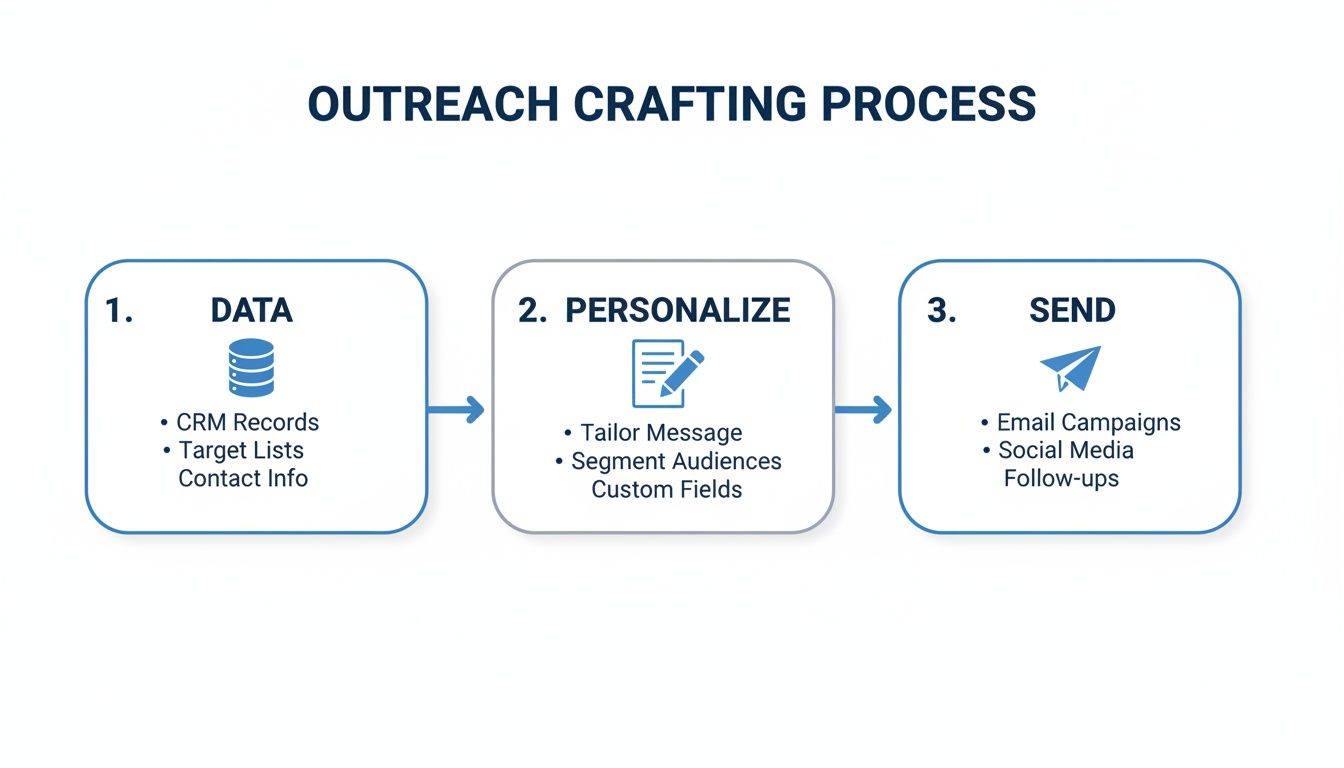
    This all boils down to a straightforward, three-part motion: gather the right data, use it to personalise your message, and then send it out.

    A flow chart illustrating the three-step outreach crafting process: Data, Personalize, and Send.

    This is the foundation of a system that turns raw shipment data into actual, meaningful conversations.

    Structuring Your Daily Prospecting Hour

    To hit that level of productivity, you need structure. Forget starting from scratch every single day. The secret is to build your workflow around saved searches and meticulously organised lists. This transforms a daunting task into a simple, repeatable routine that just plain works.

    Here’s a practical workflow you can put into action right away:

    • Create and Save Your Go-To Searches: For every territory or trade lane you cover, build a specific search query in a platform like Coreties and save it. Think along the lines of "Shippers of automotive parts from Japan to Singapore" or "Companies importing consumer electronics into the UK." Running these saved searches daily takes mere seconds and immediately brings fresh, qualified leads to your screen.

    • Map Out Your Territory with Geo-Search: Get visual with your market. A geo-search tool lets you literally draw a circle on a map to see all the relevant shipper activity in that zone. It's incredibly useful for planning regional sales trips or uncovering clusters of high-potential clients you might have otherwise missed.

    • Sort Prospects into Actionable Lists: When you find a good lead, don't let it get lost in a massive search result. Move it into a dedicated list. Name them something useful, like "Q4 Singapore Follow-Up" or "High-Volume Vietnam Shippers." This kind of segmentation is what allows you to run truly targeted campaigns.

    Systematising the discovery phase removes the friction that slows down most sales teams. Your goal should be to spend less time hunting for information and more time acting on the insights it gives you.

    Activating Your Lists with Sequences

    With your prospects neatly organised, the final piece of the puzzle is engaging them at scale without sounding like a robot. This is where automated follow-up sequences shine.

    You can enrol an entire list of similar companies into a pre-written email sequence. By using data points you've already gathered—like their company name or a specific trade lane they use—each email feels personal.

    This approach lets you nurture dozens of potential relationships at once. A thoughtfully crafted sequence keeps you on their radar, delivering value over a series of touchpoints until that import export firm is ready to talk business. This repeatable system is the engine that drives sustainable growth and makes sure your pipeline never runs dry.

    Your Top Questions About Shipper Prospecting Answered

    Switching to data-driven prospecting is a big move. It’s a completely different way of finding clients, so it’s only natural to have questions about how it all works in practice. We've heard a lot of the same queries from freight forwarders and carriers making the jump, so let's tackle them head-on.

    Think of this as your practical guide to clearing up the common hurdles so you can start using tools like Coreties with total confidence.

    How Current Is the Shipment Data?

    This one comes up all the time, and for good reason—timing is everything in logistics. The great news is that global customs data is typically updated daily. You can often see a bill of lading online within 24 to 48 hours after it’s been filed.

    This isn’t about looking at what a company shipped six months ago; it’s about seeing what’s happening right now. Imagine spotting a new shipper moving cargo on a lane you specialise in. With this kind of speed, you can get in touch while their shipping needs are still fresh in their minds, giving you a huge leg up on competitors who are still working from old directories.

    The freshness of customs data is your edge. It turns prospecting from a historical review into a live, actionable intelligence operation, allowing you to engage with an import export firm at the perfect moment.

    Can I Find Contact Information for Small Businesses?

    Definitely. It's a common misconception that data tools only work for big corporations. Modern data enrichment platforms are surprisingly good at digging up the right contacts at small and medium-sized businesses (SMEs). They scan everything from public records and company websites to professional networks like LinkedIn to pinpoint the person in charge.

    The trick is to think about who wears the logistics hat in a smaller company. You might not find a "VP of Supply Chain," but you'll almost certainly find someone with a title like:

    • Owner or Founder
    • Operations Manager
    • General Manager

    Someone is responsible for getting those goods moving. Good data enrichment helps you figure out exactly who that person is, so your pitch lands in the right inbox instead of a generic "info@" address.

    What If My Target Company Uses a Freight Forwarder?

    Seeing a freight forwarder’s name on a bill of lading can feel like hitting a brick wall, but it's really a detour, not a dead end. In fact, it’s a very common scenario. The best data platforms are designed to see past this.

    They can often identify the actual shipper or consignee listed on the documentation, even when a forwarder is the primary name. This is a game-changer. It means you can go straight to the source—the business that owns the cargo. When you know who the end customer is, you can speak directly to their pain points, whether it’s shipping car parts or coffee beans, making your outreach far more relevant and powerful.


    Ready to stop prospecting with guesswork and start using a precise, data-driven system? Coreties provides the tools you need to find high-value shippers, connect with the right decision-makers, and send messages that actually get a response. Stop searching and start connecting by visiting https://coreties.com.