Tag: global trade

  • Your Guide to Selecting an R P Forwarding Partner in 2026

    Your Guide to Selecting an R P Forwarding Partner in 2026

    Ever feel like you need a Ph.D. in logistics just to ship your products? If you've ever found yourself tangled in the web of international shipping, you've probably wished for a guide. That's where R P forwarding comes into play.

    At its core, think of a freight forwarder as a travel agent, but for your cargo. They're the experts who handle all the planning, booking, and troubleshooting to get your goods from the factory floor to your customer's doorstep.

    What Exactly Is R P Forwarding?

    A hand points at a laptop screen displaying a world map and 'R P Forwarding' next to toy logistics vehicles.

    While the 'R P' part likely points to a specific company or service model, the fundamental job of forwarding is universal. A forwarder is the logistical architect who navigates the maze of carriers, customs, and endless paperwork on your behalf, making sure your products move seamlessly across borders.

    But their role today has grown far beyond that of a simple coordinator. A modern R P forwarding partner acts as a strategic extension of your own business. Their duties typically include:

    • Logistics Planning: Crafting the smartest, most efficient route and transport mode for your shipment.
    • Carrier Negotiation: Leveraging their relationships to secure competitive rates and reliable space on ships, planes, and trucks.
    • Documentation Management: Taking care of the critical paperwork like bills of lading and customs declarations that can stop a shipment in its tracks.

    The Digital Shift in Forwarding

    The forwarding industry has changed dramatically with technology. What used to be a world of phone calls and faxes is now driven by data. Digital platforms are no longer a luxury; they're the standard. By 2026, things like AI-powered routing, real-time tracking, and automated booking portals are expected to be baseline features, giving a serious edge to forwarders who invest in them. You can find more great predictions on how these trends are shaping the industry over at morethanshipping.com.

    This embrace of technology is what separates a good forwarder from a great one. For a closer look at the day-to-day tasks, our guide on what a freight forwarder does breaks it all down.

    In a volatile market, a dependable R P Forwarding partner isn’t just a vendor; they’re an extension of your team, turning logistical headaches into a competitive advantage. This partnership turns complex shipping challenges into streamlined, predictable operations.

    The Core Services That Drive Your Supply Chain

    An airplane, container ship, and truck on a coastal road representing end-to-end logistics services.

    A genuine R P forwarding partner does so much more than just book space on a ship or plane. Think of them as the master architect of your supply chain, offering a bundle of services that turns a series of complicated, disconnected steps into one fluid journey for your goods.

    Understanding what these core services are—and how they connect—is the key to finding a partner who can truly manage the entire process from end to end.

    Multimodal and Intermodal Transportation

    At its core, freight forwarding is about skillfully combining different modes of transport. This is called multimodal transportation, and it's about piecing together the right puzzle of air, ocean, rail, and road services to meet your specific goals for speed, cost, and cargo safety.

    Imagine you're shipping high-value electronics from a factory in Asia to a retailer in Europe. An experienced forwarder might arrange for the long-haul portion via secure air freight, then manage the seamless handoff to a dedicated truck for the final-mile delivery. The goal is to minimize handling and eliminate delays.

    The real magic of an R P forwarding partner is their ability to issue what is essentially a "single ticket" for your cargo's entire journey, even when it crosses multiple carriers and countries. This streamlines everything from billing and tracking to accountability.

    This integrated approach is what makes navigating today's complex global trade routes possible.

    Essential Supporting Services

    Moving freight is only half the battle. The best forwarders also provide a safety net of crucial support services that protect your business and keep you compliant. These aren’t optional extras; they're fundamental to a logistics operation you can count on.

    Some of the most critical services include:

    • Customs Brokerage: Let's be honest—navigating the web of international duties, taxes, and regulations can be a nightmare. A forwarder with in-house customs expertise ensures your declarations are accurate and complete, preventing shipments from getting stuck at the border over paperwork.
    • Warehousing and Distribution: Many forwarders offer strategic storage options. This might be short-term warehousing near a port to consolidate goods or a full-blown distribution center to manage inventory and fulfill orders closer to your customers.
    • Cargo Insurance: Even the most well-planned shipment can face unforeseen problems. Cargo insurance is your financial backstop, providing protection against loss or damage while your goods are in transit and giving you essential peace of mind.
    • Real-Time Tracking: Modern forwarding isn’t a black box. You should have access to technology that provides clear visibility into your shipment's status from start to finish. This transparency allows you to solve problems proactively and keep your own customers informed.

    How to Navigate the 2026 Freight Market

    The current shipping world is a strange beast. On the one hand, base rates have hit historic lows, looking like a dream come true for shippers. On the other hand, you're wrestling with wild volatility where schedules are torn up without warning and reliability feels like a thing of the past. Welcome to the reality of the 2026 freight market.

    So, what's behind this chaos? A massive influx of new vessels. After a 7% growth spurt in 2025, the global container fleet is expected to swell by another 5% in 2026, flooding the market with capacity. To keep from sinking, carriers are fighting back with aggressive tactics like blank sailings and slow steaming to prop up their rates. You can get a much deeper look at these market dynamics in the 2026 shipping industry report.

    In an environment this unpredictable, a stable R P forwarding partner becomes more critical than ever. When things are this shaky, you quickly learn that the cheapest rate is almost never the best value.

    Why Stability Outweighs Price

    In a turbulent market, that rock-bottom price often hides a mountain of expensive problems. We’re talking about rolled cargo, crippling delays that throw production schedules into disarray, and radio silence from your partner when you need answers most. A truly reliable forwarding partner acts as a much-needed buffer against all this uncertainty.

    They draw on their deep carrier relationships to lock down dependable space on vessels. Even better, they give you proactive updates and have contingency plans ready to go, turning a potential disaster into a minor hiccup. This is especially vital on complex routes, which you can read more about in our guide to the intricacies of Pan-Asia logistics.

    For logistics sales teams, this isn't a threat; it's a massive opportunity. Shippers are actively seeking partners who offer stability and proactive solutions, not just a low price.

    This market instability is a clear signal to go win new business. Shippers are feeling the burn from unreliability, making them more open than ever to forwarders who can prove their worth beyond a simple spot rate.

    If you can focus your pitch on consistency, transparent communication, and real problem-solving, you'll immediately stand apart. The conversation shifts from, "Can you beat this price?" to, "Can you make sure my cargo actually gets there?" This is the moment to show them why an expert R P forwarding partner is the key to surviving—and even thriving in—the turbulence of 2026.

    How to Choose a Forwarding Partner You Can Actually Trust

    Picking the right logistics partner can make or break your supply chain. When you’re vetting an R P forwarding company, it’s easy to get fixated on the price tag, but the real value lies in finding a partner with verifiable strengths that can handle today's chaotic market.

    Frankly, generic advice won't cut it. A truly great partner in 2026 isn't just about moving boxes; they bring a powerful mix of smart technology, a solid global network, and real-world experience in your specific industry. What that actually means is moving beyond basic tracking updates and demanding access to real-time portals and direct API connections.

    This flowchart breaks down how to approach choosing a partner, whether the freight market is calm or completely volatile.

    Flowchart illustrating strategies for navigating the 2026 freight market, addressing volatility and stable conditions.

    As you can see, when the market gets unpredictable, having a dependable partner who provides stability isn't just a nice-to-have—it's essential.

    Vetting a Potential Partner

    So, what does a top-tier R P forwarding partner look like on the ground? It comes down to a few critical areas. First, their global network needs to be more than just dots on a map. Look for proven strength in the trade lanes that matter most to you, especially key hubs in Southeast Asia and Mexico, to ensure your cargo moves without getting stuck.

    Next, do they really know your industry? A forwarder who has spent years handling the specific demands of automotive parts will be infinitely more valuable than a generalist who mostly ships produce. They'll anticipate the challenges before they become problems.

    The best forwarding relationships are built on open communication and proactive problem-solving. A true partner uses data to give you insights that help you make smarter decisions, not just send a tracking update after your container has already missed its connection.

    A good way to gauge a potential partner’s commitment to efficiency is to look at their back-office operations. Are they still buried in paperwork? Modern solutions like AP automation in logistics are a strong signal that they've invested in running a tight, reliable ship.

    Compliance is another area where you simply cannot compromise. Your forwarder has to be on top of every regulation to prevent fines and crippling delays. If you're new to this, our guide on denied party screening is a great place to start understanding the stakes.

    At the end of the day, you're not just hiring a vendor; you're looking for a team that will function as a genuine extension of your own.

    Forwarding Partner Evaluation Checklist

    To help you compare apples to apples, use this checklist when evaluating potential R P forwarding partners. It focuses on the attributes that are most critical for success in the current and near-future market.

    Attribute What to Look For Why It Matters in 2026
    Technology & Visibility Real-time tracking portals, API integration capabilities, and data analytics. Basic tracking is no longer enough. You need predictive insights and seamless data flow to stay agile.
    Network Strength Proven capacity and strong relationships in your key trade lanes (not just a large global footprint). Market volatility means you need a partner who can secure space and navigate port congestion where it counts.
    Industry Expertise A documented history of working with companies in your specific vertical. They will understand your product's unique requirements, from handling to customs, preventing costly mistakes.
    Financial & Operational Health Use of modern systems (like AP automation) and positive financial standing. A financially healthy and efficient partner is less likely to cut corners or fail during a downturn.
    Compliance Record Flawless compliance history, knowledgeable staff, and robust screening processes. With regulations constantly changing, a single compliance slip-up can halt your entire supply chain.

    Using a structured approach like this helps you move beyond the sales pitch and identify a partner who is truly equipped to support your business for the long haul.

    Finding Shipper Leads with Modern Prospecting Tools

    If you're in logistics sales, you know the market is chaotic right now. The old playbook of cold-calling stale lists just doesn't cut it anymore. It's a massive time sink with little to show for it. The real secret is to stop shouting into the void and start having targeted conversations.

    This is where modern prospecting tools come in. Instead of casting a wide, ineffective net, they let you zero in on shippers based on what they're actually doing.

    Moving from Guessing to Knowing

    Think about it: what if you could filter through thousands of companies and instantly pull up a list of perfect-fit prospects? That's exactly what global trade data allows you to do. Platforms like Coreties are designed to sift through this mountain of raw data and hand you actionable sales intelligence on a silver platter.

    For an R P forwarding sales rep, this means you can immediately find:

    • Companies that ship the exact commodities you specialize in, like automotive parts or consumer electronics.
    • Businesses with heavy shipping volumes on the trade lanes you serve best, such as from Vietnam to the United States.
    • Shippers whose logistics patterns have recently changed, which often signals they're open to new partners.

    This completely changes the game. You're no longer guessing who might need your services—you know who does. Your outreach becomes incredibly relevant because you're talking about their specific, current shipping needs, which is the fastest way to get their attention and book a meeting.

    Sales teams that use data-driven prospecting tools can see huge efficiency gains. We're talking about sending 30+ highly customized emails in the time it used to take to research and write just one.

    Accelerating Outreach and Engagement

    Once you have your list of ideal companies, the next hurdle is finding the right person to talk to. Good prospecting tools don't just give you company names; they provide verified contact info and LinkedIn profiles for the actual decision-makers in logistics, procurement, and supply chain. This alone can save you hours of digging around.

    To round out your strategy, consider adding a lead generation chatbot to your website. It works 24/7 to capture and qualify anyone who comes to you, so you never miss an inbound opportunity. By pairing smart, data-driven outbound prospecting with an automated way to handle inbound interest, you build a powerful lead-gen machine that keeps your R P forwarding business growing.

    Common Questions About R P Forwarding and Logistics

    Whether you're a shipper looking for a reliable partner or a sales professional in the logistics space, a few key questions always seem to come up. Getting straight answers is the first step toward building a supply chain that actually works for you. Let’s clear up some of the most common points of confusion.

    What’s the Real Difference Between a Freight Forwarder and a Carrier?

    It’s a simple but crucial distinction. Think of it this way: a carrier owns the vehicle, but a forwarder owns the entire journey.

    A carrier is the company that physically owns and operates the ships, planes, and trucks that move your freight. Think of a major shipping line like Maersk or an air cargo operator like FedEx. They are responsible for the direct transport of your goods from one port or airport to another.

    An R P forwarding partner, on the other hand, is your logistics architect. They don’t own the heavy assets, but they act as your single point of contact to orchestrate the whole trip. They book space with various carriers, manage all the complex documentation, and coordinate every single step to create a seamless, door-to-door solution. The carrier is the airline; the forwarder is the expert travel agent who designs your entire itinerary, complete with transfers, paperwork, and contingency plans.

    How Has Technology Changed a Forwarding Partner's Role?

    Technology has completely reshaped the job. It’s no longer about just coordinating pickups and drop-offs; it's about providing strategic insight.

    In 2026, digital booking platforms and real-time tracking are table stakes—not special features. Any forwarder who isn't offering this level of visibility is already falling behind the curve.

    The real advantage today comes from data analytics. A modern R P forwarding partner uses global trade data to give you proactive advice. They can help you optimize shipping routes to avoid congestion, navigate market volatility, and uncover hidden costs you didn't even know you were paying. This shifts the relationship from a simple service provider to a true strategic partner.

    A great forwarder will respond to a quote request with more than just a price; they'll ask smart questions to understand your business and propose a solution tailored to your specific goals.

    As a Shipper, How Do I Begin Working with a Forwarder?

    Getting started is actually pretty straightforward. Just follow a few practical steps to find the right fit.

    1. Define Your Needs: First, get clear on your own requirements. What are you shipping? What are your typical origins and destinations? What are your expected volumes and ideal timelines? The more detail you have, the better.
    2. Research and Shortlist: Use the evaluation checklist from the previous section to find a handful of potential partners who seem well-suited to handle your specific type of cargo and trade lanes.
    3. Submit a Detailed RFQ: When you ask for a quote (Request for Quotation), don’t hold back. Provide all the information you gathered in step one. This gives a quality forwarder the details they need to propose a solution that will actually work for you.

    You'll know you've found a top-tier partner when their response shows they’ve genuinely understood your business and are already thinking about how to solve your unique challenges.


    Ready to find the perfect shippers for your logistics services? Coreties transforms global trade data into a powerful prospecting tool, helping you find and connect with ideal clients in minutes, not days. Stop guessing and start having data-driven conversations that win business. Discover your next lead at Coreties.com.

  • Find Harmonized Code Numbers Quickly and Accurately

    Find Harmonized Code Numbers Quickly and Accurately

    Finding the right harmonized code starts long before you touch a search bar. The real work begins with understanding your product inside and out. You need to break it down by its core attributes: what it does, what it's made of, and its physical form. Once you have that detailed picture, you can start querying official databases like the U.S. Harmonized Tariff Schedule (HTS) with keywords that truly describe your item.

    More Than Just a Number: Why Harmonized Codes Are the Bedrock of Global Trade

    Before you can find the right code, you need to appreciate what it represents. Think of the Harmonized System (HS) code as the universal language for physical goods moving across borders. For anyone in logistics—whether you’re a freight forwarder, carrier, or NVOCC—getting this right isn't just about ticking a box for compliance. It's a fundamental skill that underpins your entire operation.

    The HS code system is what brings a shared logic to the otherwise chaotic world of global commerce. For those of us in the trenches of logistics, this system is everything because it dictates:

    • Universal Standardization: It ensures a "leather office chair" means the exact same thing to customs agents in Tokyo, Hamburg, and Los Angeles. No ambiguity, no confusion.
    • Duty and Tax Collection: This is how governments determine the specific tariffs, taxes, and fees owed on every single item that crosses their borders.
    • Trade Data and Statistics: These codes are the source of truth for the data that governments use to track trade volume, shape economic policy, and analyze market trends.
    • Regulatory Compliance: HS codes are directly linked to enforcing safety standards, import quotas, and other critical regulations tied to specific products.

    Why Accuracy Is Non-Negotiable

    Getting the code wrong isn't a small mistake—it's a costly one. An incorrect classification can trigger frustrating shipment delays, painful customs audits, and steep financial penalties.

    Consider this: over 98% of all merchandise in international trade is classified using the Harmonized System. This global framework is managed by the World Customs Organization (WCO) and used by more than 200 countries. A misclassification in a major market can lead to fines up to 100% of the shipment's value, instantly turning a profitable job into a significant financial loss. To get a better feel for the official classification structure, you can start with our guide on the HS code book.

    The legal responsibility for an accurate HS code almost always rests with the importer of record. You can't just blindly trust a code from a supplier. If customs flags an error, you're the one on the hook.

    Ultimately, mastering HS codes gives you a serious competitive edge. It slashes risks, ensures smooth customs clearance, and builds a reputation for reliability with clients and regulators alike. Understanding how to standardize your product information through effective data harmonization is another key piece of this puzzle, helping to create a seamless flow for your global operations.

    Finding the right HS code isn't guesswork—it's a systematic process. If you want to get it right every time and avoid customs headaches, you need a reliable method that starts long before you even touch a tariff schedule. Think of it like building a case file for your product. The more evidence you gather upfront, the stronger your classification will be.

    This infographic lays out the fundamentals of the Harmonized System, showing what it is, why it's the backbone of global trade, and how it impacts everyone in the supply chain.

    An infographic explaining the Harmonized System Basics: its definition, importance for trade, and global users.

    With that big picture in mind, let's get into the nitty-gritty of how you can turn these concepts into a practical, repeatable workflow.

    Break Down Your Product with the 4-Step Method

    You can't classify a product you don't fully understand. The first and most critical part of the process is to deconstruct your item into its most basic, objective attributes. Vague descriptions are the fast track to incorrect classifications and costly delays.

    To do this effectively, I use a simple 4-step method to create a detailed "product profile." This structured approach ensures I never miss a critical detail that could change the classification entirely.

    The 4-Step Product Breakdown Method

    Step Action Required Example (For a leather office chair with steel frame) Why It Matters
    1. Identify Primary Function What is the one thing this product is designed to do? Be specific. Primary Function: Seating for an office environment. This almost always points you to the correct HS Chapter (e.g., Chapter 94 for Furniture).
    2. List All Materials Document every component material, from the main body to the smallest screw. Materials: Bovine leather (upholstery), polyurethane foam (padding), steel (frame/base), plastic (casters). The "essential character" of the product is often determined by its material composition, which is a key factor in GRI 3.
    3. Define Form & Condition How is it presented at the time of import? Assembled, unassembled, kit? Form: Unassembled. All parts are included in a single box for final assembly by the customer. This directly impacts which General Rule of Interpretation applies (e.g., GRI 2a for unassembled goods).
    4. State Intended Use How will the end-user actually use the product? Think about the context. Intended Use: For use in a commercial or home office setting. Not for vehicles or medical facilities. End-use can be a deciding factor between two similar headings. An "office chair" is classified differently than an "aircraft seat."

    By following this breakdown, you create a solid foundation for your search. For instance, just calling something a "promotional kit" is a recipe for trouble. A proper breakdown would be: "a cardboard box containing one 100% cotton t-shirt, one plastic ballpoint pen, and three paper marketing brochures." That level of detail is exactly what customs officials need.

    Follow the Rules: Navigating the GRIs

    With your detailed product profile in hand, it's time to apply the General Rules of Interpretation (GRIs). These six rules are the legal framework for HS classification. They can look intimidating, but they’re just a logical decision-making process.

    Think of the GRIs as a waterfall. You always start at GRI 1 and only move to the next rule if the one before it doesn't resolve the classification. In my experience, over 80% of products are classified using GRI 1 alone.

    GRI 1 is simple: classification is determined by the text of the headings and any related section or chapter notes. Your first move is always to find the heading that most specifically describes your product. If that doesn't work, you move down the list. GRI 2a, for example, tells us to classify an incomplete or unassembled product as if it were complete. GRI 3 helps us classify goods made of multiple materials by finding the one that provides the "essential character."

    Let's Walk Through a Real-World Example

    Here’s a common scenario we see in freight forwarding: importing an unassembled leather office chair with a steel frame.

    • Product Breakdown: We already did this. Function is seating. Materials are leather and steel. Condition is unassembled.

    • Applying GRI 1: We start by looking for a heading. Chapter 94 covers "Furniture." Within that, heading 9401 covers "Seats." This looks like a direct hit.

    • Applying GRI 2a: Since our chair is unassembled, this rule confirms we should classify it as a complete chair, not as a pile of parts. This is a critical step that prevents misclassification.

    • Applying GRI 3b: The chair is a mix of materials (leather and steel). Which one defines its "essential character?" The purpose of the product is to be a comfortable seat. The leather upholstery is central to that function, more so than the steel frame that supports it. Therefore, we'll look for a subheading under 9401 that specifies upholstered seats.

    This structured method takes the art of classification and turns it into a repeatable science. When you meticulously document your product's attributes and follow the GRI framework, you're not just finding a code—you're building a logical, defensible case for your classification every single time.

    Getting Your Hands Dirty with Tariff Tools and Databases

    Alright, you've got your product's DNA mapped out. Now it's time to take that detailed breakdown and dive into the official databases that govern global trade. This is where the real detective work begins, and while these tools are incredibly powerful, they can feel a bit clunky and intimidating at first.

    Your go-to resources will be the official tariff schedules for the countries you’re shipping to and from. If you're importing into the U.S., your bible is the Harmonized Tariff Schedule of the United States (HTSUS), which is run by the U.S. International Trade Commission. For exports out of the U.S., you'll be living in the Schedule B search tool from the U.S. Census Bureau. And for anything heading into the European Union, the TARIC database is your port of call.

    Here's a classic mistake I see all the time: assuming an HS code that works for one country is good for another. The first six digits are the universal "Harmonized System" part, but the final digits—the ones that actually dictate duty rates and specific rules—are country-specific. Always, always use the destination country’s official database.

    How to Think Like a Tariff Search Engine

    The trick to these databases is learning how to "speak their language." Your search success comes down to your technique. You need to start broad and then methodically drill down using the product attributes you've already identified.

    Let's say you're trying to classify a "pine wood dining table." Punching that whole phrase into the search bar will likely get you nowhere fast. It's just too specific for the way these systems are structured.

    Instead, think in layers. Here’s how I’d approach it:

    • Start with the general category: My first search would just be "furniture" or maybe "table." Simple.
    • Add the material: Next, I'd refine that to something like "wooden table" or "wood furniture."
    • Use your chapter knowledge: Once you get the hang of it, you’ll know that most furniture lives in Chapter 94. You can often skip the keyword search and go straight to the chapter, then browse the headings until you find the one for "Tables" (which is 9403).

    This step-by-step process keeps you from getting bogged down in thousands of irrelevant results. It’s a much more efficient way to zero in on the right classification. For those dealing with specific Asian trade lanes, we've also put together a more targeted guide on HS code search for Singapore that you might find helpful.

    A laptop on a wooden desk displays a map for tariff search, with a coffee cup and smartphone.

    This is the kind of interface you'll be working with. That search bar is your gateway, so learning what to feed it is half the battle.

    Making Sense of the Results

    Finding a potential code is one thing; understanding what it all means is another. The tariff schedule gives you a wealth of information, and it's all critical for a smooth customs clearance.

    When you land on a promising HTS code, here’s what you need to scrutinize:

    • Article Description: Read this carefully. Does the official description precisely match your product? The difference between "Of wood" and "Of metal" is obvious, but it can get much more granular. Every word matters.
    • Unit of Quantity (UoQ): This tells you how to declare your goods. Is it by the piece (No.), by weight (kg), or by the dozen (doz)? Getting this wrong is a common cause of customs delays.
    • Rates of Duty: You’ll see a few columns for duties. The "General" rate applies to goods from most countries. The "Special" rate is where you find preferential, lower duties for countries that have a free trade agreement with the import country.

    Let’s circle back to that leather office chair. I'd navigate to Chapter 94, find heading 9401 ("Seats"), and then start looking through the subheadings. I might land on something like 9401.30.80, which could have a description like "Other swivel seats with variable height adjustment." By cross-referencing that description and the chapter notes with my product specs, I can confirm it's a match.

    This final verification step is what separates a guess from a compliant classification. It ensures you've not only found a number but also understand all the obligations that come with it.

    Verification and Avoiding Common Classification Pitfalls

    Finding a potential HS code in a tariff schedule is a great start, but it's not the end of the road. Let's be clear: simply trusting a code you found—or one your supplier gave you—is a major gamble. As the importer or exporter, the legal responsibility for getting that code right rests squarely on your shoulders.

    So, how do you move from a "best guess" to a classification you can stand behind? You need to see how customs has ruled on similar products in the past.

    For any goods heading to the U.S., the Customs Rulings Online Search System (CROSS) is your best friend. This is a massive, searchable database of legally binding decisions made by U.S. Customs and Border Protection (CBP). It shows you exactly how they've classified specific products, and more importantly, why.

    Searching CROSS with a few keywords for your product can instantly show you how officials interpret the nuances of classification. When you find a ruling that perfectly describes your item, you've found a powerful piece of evidence to support your choice.

    Cross-Referencing with Customs Rulings

    Think about a product like a "smartwatch" that tracks fitness and shows phone notifications. You could make a case for it being a watch under Chapter 91, but it also feels like a data processing machine from Chapter 84. It’s a classic classification dilemma.

    This is where a quick search in CROSS for "smartwatch" becomes a lifesaver. You’ll find multiple rulings where you can read the logic CBP applied. They often focus on the "principal function" of the device, and seeing their thought process helps you build a much more defensible case for your own classification.

    Your goal is to build a "classification file" for every single product. This file should tell the whole story: your product breakdown, which GRIs you used, your tariff schedule research, and any CROSS rulings you found. If customs ever comes knocking with an audit, this documentation is your best defense.

    Sidestepping Common Classification Traps

    Even with the best tools, it's surprisingly easy to fall into a few common traps. I’ve seen these same mistakes trip up logistics teams for years, often leading to delays, fines, and a lot of headaches.

    Here are the top pitfalls to watch out for:

    • Relying on Supplier Codes: A supplier's HS code is a helpful starting point, nothing more. They might not understand the specific rules for your country of import, or they could have just made a mistake. You must always verify it yourself.
    • Misinterpreting "Parts and Accessories": This one gets people all the time. An item is only a "part" or "accessory" if it meets very strict definitions in the chapter notes. A car engine is clearly a part of a car, but a generic electric motor that could be used in hundreds of different machines is not.
    • Classifying Kits or Sets Incorrectly: When you have goods packaged together for retail, like a gift set, you don't classify each item individually. You classify the whole set under the one item that gives it its "essential character," per GRI 3b.
    • Using Outdated Information: Tariff schedules change. There are updates all the time, with major revisions happening every five years. The code that was correct last year might be wrong today. Always, always use the most current version of the official tariff schedule.

    By actively checking your work and keeping these common errors in mind, you shift from just finding a harmonized code to confidently defending it. That diligence is what separates smooth, compliant shippers from those who are constantly putting out fires at the border.

    Using HS Codes to Fuel Your Sales Pipeline

    Two people collaborating at a table with a laptop showing charts and 'HS CODE LEADS' text.

    For the sharpest logistics companies, knowing how to find a harmonized code goes way beyond simple compliance. It's about turning what most see as a customs formality into a powerful source of business intelligence. When your sales team stops seeing HS codes as just a number and starts seeing them as a direct link to market insights, you create a real engine for growth.

    This data is what lets you graduate from cold calling to having truly informed, value-driven conversations. You no longer have to guess who might need your freight services; you can see exactly which companies are importing or exporting specific products.

    Turn Compliance Data Into Qualified Leads

    Let's get practical. Imagine your company is fantastic at handling high-value electronics. By digging into customs data, you can build a list of every business importing goods under HS code 8507.60—that’s lithium-ion batteries. Suddenly, you don't just have a list of names. You have a qualified pipeline of ideal customers who are verifiably shipping the exact cargo you specialize in.

    You can get even more granular by layering on trade lane specifics. Looking to build up your EU-US airfreight business? Filter the data to find who is shipping pharmaceuticals (HS Chapter 30) from Frankfurt to Chicago. This kind of hyper-targeted approach means your sales team can craft an outreach message that speaks directly to a prospect’s actual shipping activity.

    HS codes aren't just numbers—they're the backbone of trade intelligence for logistics sales teams worldwide. For importers and exporters, pinpointing HS codes unlocks duties and statistics for partner scouting. Platforms like Coreties can transform HS-rich customs data into actionable lead lists with LinkedIn profiles and email intelligence, plus geo-filters for high-growth lanes like EU-US pharma (HS 3004), which has seen 12% growth. Users report sending over 30 personalized emails hourly, a massive efficiency gain compared to manual methods. Discover more about how the system works at the World Customs Organization.

    Uncover New Markets and Spot Opportunities

    Diving into HS code trends is also a fantastic way to spot emerging markets and new customer segments you might have otherwise completely missed. A sudden spike in import volumes for a specific code can be a huge signal of a growing industry or a major shift in consumer demand.

    For instance, a steady climb in imports of solar panel components could be your cue to develop specialized logistics services for renewable energy companies. This data-first strategy allows you to get ahead of market needs and position your business for what's next. By using an HS code filter, you turn raw trade data into a strategic asset, making sure your sales team is always chasing the most promising opportunities.

    Clearing Up Common Questions About Harmonized Codes

    Even the most seasoned logistics pros run into questions when classifying freight. Let's tackle a few of the most common ones we hear from teams on the ground, so you can classify with more confidence.

    HS, HTS, and Schedule B—What's the Difference?

    This alphabet soup trips up a lot of people, but the distinction is pretty straightforward once you get the hang of it.

    Think of the HS (Harmonized System) code as the universal foundation. It's a 6-digit number recognized globally, the common language of trade classification.

    From there, countries add their own digits for more detail.

    • An HTS (Harmonized Tariff Schedule) code is what a country uses for imports. The U.S. uses a 10-digit HTS code—the first six are the base HS code, and the last four are specific to the U.S. for duty and statistical purposes.
    • A Schedule B code is also a 10-digit number used in the U.S., but it's exclusively for classifying goods for export.

    What Happens If I Use the Wrong Harmonized Code?

    Getting the HS code wrong can throw a serious wrench in your operations. You’re not just looking at shipment delays at customs; the fallout can include surprise audits, steep financial penalties, and even demands for retroactive duty payments on past shipments. It's a costly mistake.

    A wrong code also damages your company's reputation with customs authorities. This can lead to increased scrutiny and more frequent inspections of your future shipments, creating a cycle of delays and operational headaches.

    How Often Do Harmonized Codes Change?

    The global Harmonized System gets a major overhaul from the World Customs Organization (WCO) every five years to keep pace with technology and trade. The last big update was in 2022.

    But don't get too comfortable. Individual countries can and do update their own tariff schedules—like the HTSUS—much more frequently. It is absolutely essential to check the official tariff websites for your origin and destination countries regularly. Assume nothing; always verify.

    Can I Just Use the HS Code My Supplier Gave Me?

    This is a big one, and the short answer is no. While your supplier's code is a decent starting point, never, ever rely on it blindly.

    As the importer of record, you are the one legally on the hook for the classification's accuracy, not your supplier. They might not know the destination country's specific rules, or they could have just made a mistake. Always do your own due diligence. Your name is on the paperwork, so the responsibility is yours.


    Ready to turn customs data into your best source of qualified leads? Coreties transforms global trade information into actionable prospect lists, helping logistics sales teams find and connect with ideal shippers faster. Discover how Coreties can grow your business.

  • Your Guide to a Modern Import and Export Business

    Your Guide to a Modern Import and Export Business

    At its heart, an import and export business is all about connecting the dots on a global map. It’s the essential link that gets products from a manufacturer in one country into the hands of a customer in another. This line of work is far more than just moving boxes; it's a dynamic field that involves managing complex logistics, navigating a maze of regulations, and strategically building profitable trade routes.

    Understanding the Global Trade Ecosystem

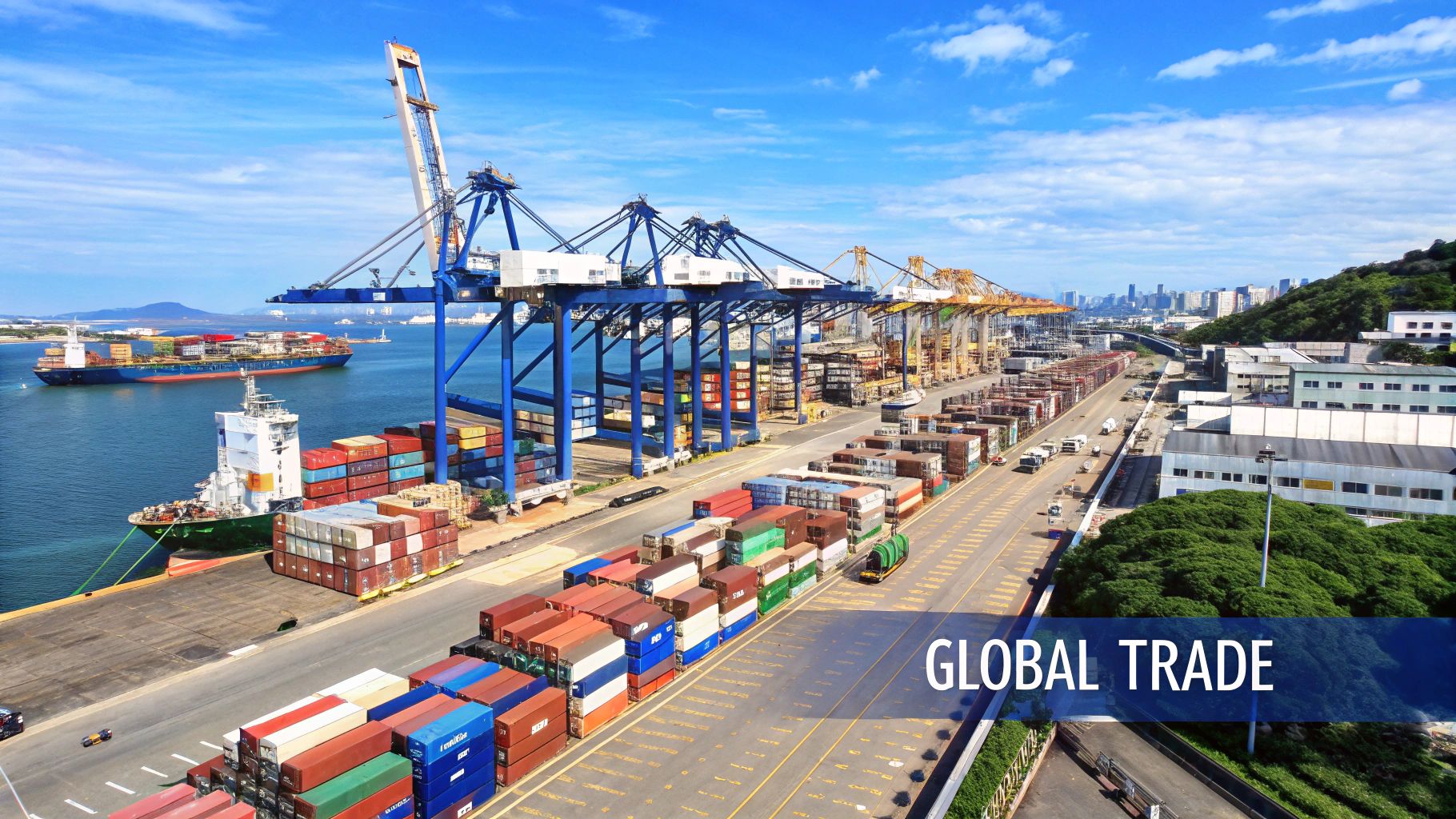
    Aerial view of a busy container port with cargo ships, cranes, and stacks of colorful containers.

    Think of the global economy as a sprawling, bustling marketplace. The import-export business acts as the network of roads, shipping lanes, and flight paths that allows this marketplace to thrive. It ensures that the electronics assembled in one part of the world can reach a store shelf thousands of miles away.

    This whole system is driven by the timeless principles of supply and demand. One country might have a surplus of coffee beans, while another is a leader in producing high-tech machinery. The job of an import-export professional is to spot these opportunities and create value by bridging the gap between supply and demand across borders.

    The Key Players and Their Roles

    To succeed in this industry, you have to understand who does what. The global supply chain is a finely-tuned machine, and if one part fails, the entire process can grind to a halt, leading to costly delays and unhappy clients.

    The entire process hinges on a handful of key players, each with a specific job to do. Without this clear division of labour, getting a product from Point A to Point B would be nearly impossible. Let’s look at who’s who in this ecosystem.

    Key Players in the Import and Export Ecosystem

    Player Core Function Primary Responsibility
    Exporter Seller/Producer Finds international markets and ships goods out of their home country.
    Importer Buyer/Distributor Brings foreign goods into their country for resale or manufacturing.
    Freight Forwarder Logistics Coordinator Arranges the entire shipping process, from booking cargo space to managing documentation.
    Customs Broker Compliance Specialist Ensures shipments clear customs by preparing and submitting required declarations and paying duties.
    Carrier Transportation Provider Physically moves the goods via sea, air, rail, or road (e.g., shipping lines, airlines).

    As you can see, each player has a critical role that keeps the gears of global trade turning. It's a team sport. While these roles are distinct, a single company can sometimes wear multiple hats, acting as both an importer and an exporter. For a closer look at their specific functions, you can learn more about the differences between an exporter and importer in our detailed guide.

    Let's quickly unpack the three most central roles:

    • Exporters: These are the sellers. They could be manufacturers or producers looking to expand their reach beyond their own country's borders and tap into new international markets.
    • Importers: These are the buyers. They might be retailers sourcing products to sell in their stores, or a factory that needs raw materials from abroad to make their own goods.
    • Freight Forwarders: Think of them as the travel agents for cargo. They don't own the ships or planes, but they are the logistics experts who orchestrate the entire journey, finding the best routes and rates to get goods from origin to destination smoothly.

    At its heart, global trade is about connection and coordination. A successful import and export business excels not just at buying and selling, but at managing the intricate web of relationships between suppliers, buyers, and logistics partners to deliver goods efficiently and reliably across the globe.

    This collaboration is what fuels international commerce. It's not just for massive corporations, either. In 2022, small and medium-sized businesses were responsible for an incredible 43% of the United States' exported goods. Every one of those businesses relied on this ecosystem of importers, exporters, and forwarders to connect with their customers. Understanding how these pieces fit together is the first step to navigating this exciting industry.

    Choosing the Right Business Model for You

    Starting an import and export business isn't a case of just picking a product and finding a buyer. The way you structure your business—your model—is the bedrock of your entire operation. It dictates how much money you need to start, the risks you’ll face, and how you'll make your profits.

    Think of it as choosing your role in the global supply chain. Are you the hands-on owner of the goods, a strategic sales partner, or a well-connected dealmaker? Each path has its own challenges and rewards. Let's dig into the three main models to see which one lines up with your resources and ambition.

    The Export Management Company (EMC)

    Imagine you're the outsourced international sales team for a local company. That’s essentially what an Export Management Company (EMC) does. You don't buy the products yourself. Instead, you represent domestic businesses that want to go global but don't have the know-how or the people to pull it off.

    Your job is to do the heavy lifting: find overseas buyers, craft the marketing strategy, handle the tangled web of logistics, and manage all the export paperwork. Your income comes from a commission on the sales you close. For example, an EMC in Singapore might team up with local snack makers to get their products onto shelves in Australia and the Middle East, managing everything from brand positioning to the final shipment.

    The EMC model is a fantastic starting point if you're a natural salesperson with a flair for international marketing. It’s a lower-risk way to get your foot in the door because you’re not shelling out cash for inventory.

    Your main investment here is time, effort, and building a solid network. It’s an excellent way to learn the ropes of international trade without the financial headache of holding stock.

    The Import/Export Merchant

    This is what most people picture when they think of an import/export business. As a merchant, you're a direct player, buying goods from a manufacturer in one country and selling them in another. You take full ownership of the products, from the factory floor to the customer's hands.

    This means you're on the hook for everything—paying for the goods upfront, arranging and insuring the freight, and, most importantly, finding someone to buy it all. It’s a high-stakes game. But with that higher risk comes the potential for a much bigger payoff. Since you own the inventory, you set the price and keep the entire profit margin.

    A perfect example is a merchant who spots a growing trend for sustainable bamboo furniture in Europe. They’d buy a container load directly from a supplier in Vietnam, handle the import process into Germany, and then sell the furniture to retail chains or even directly to shoppers online.

    • Pros: High profit potential and total control over your products and pricing.
    • Cons: Needs a serious amount of starting capital and carries a high risk if the products don't move.
    • Best For: Entrepreneurs with solid financial backing and a very strong belief in their chosen product and market.

    The Agent or Broker

    The agent or broker is the ultimate matchmaker. In this model, you never touch or own the goods. Your entire business is built on connecting a buyer who needs something with a seller who has it. Once the deal is done, you collect a commission or a flat fee for making the introduction.

    Financially, this is the leanest and lowest-risk way to operate. Your greatest assets are your contact list and your reputation for being reliable. For instance, a broker might find out a large construction firm in Singapore needs a specific grade of steel beams. They then use their network to connect the firm with a manufacturer in South Korea that can produce them. Once the contract is signed, the broker gets paid their agreed-upon fee.

    So, which path is yours? It all comes down to your personal circumstances. A broker can get started with little more than a phone and a solid network. A merchant, on the other hand, needs a detailed business plan and deep pockets. Take a hard look at your capital, your contacts, and your appetite for risk to choose the model that gives your new import and export business the best shot at success.

    Getting to Grips with International Compliance and Paperwork

    Diving into the world of import/export means you’ve got to learn the language of global trade. This isn't about speaking French or Mandarin; it's about mastering the language of documents, codes, and very specific rules. It might look like a mountain of paperwork at first, but every single document has a vital job to do. Think of them as passports for your products, letting them move smoothly from one country to another.

    Nailing this part of the business isn't just about ticking off boxes on a checklist. It's about keeping your shipments moving, dodging hefty fines, and building a solid reputation for being a reliable operator. Get it wrong, and your cargo could be stuck in a customs warehouse for weeks, racking up storage fees and leaving your customers seriously unhappy. Get it right, and you turn a massive potential headache into a real competitive edge.

    The Must-Have Documents for Any Shipment

    Every international shipment, no matter how big or small, relies on a core set of documents. These papers tell the complete story of your goods: who sent them, what they are, where they're headed, and what they're worth. They are the absolute foundation of trade compliance.

    Let’s break down the big three:

    • Commercial Invoice: This is your main bill of sale. It lays out the products, their value, and the payment terms agreed between you and the buyer. Customs officials use this to figure out exactly how much duty and tax is owed.
    • Bill of Lading (B/L) or Air Waybill (AWB): Essentially, this is the contract between you (the owner of the goods) and the shipping company. It does three things: acts as a receipt for the cargo, confirms the transport agreement, and serves as the document of title—meaning whoever has the original B/L owns the goods.
    • Packing List: This is a detailed inventory of everything inside your shipment. It breaks down the contents of each carton, including weights and dimensions. This helps customs officers check your cargo quickly without having to rip everything open.

    While these three are the bedrock, you might need extra paperwork like a Certificate of Origin or special import licences, depending on what you're shipping and where it's going.

    Your paperwork is basically the shipment's DNA. The Commercial Invoice is its financial identity, the Bill of Lading is its travel history, and the Packing List is its physical makeup. Together, they create a clear, verifiable story that keeps customs happy and your goods on the move.

    Speaking the Universal Language of Trade

    Once you've got the basic documents down, there are two universal systems you need to understand to trade effectively: Harmonized System (HS) codes and Incoterms. Knowing how these work is non-negotiable for accurate customs declarations and crystal-clear contracts. They prevent the kind of simple misunderstandings that can completely derail a shipment.

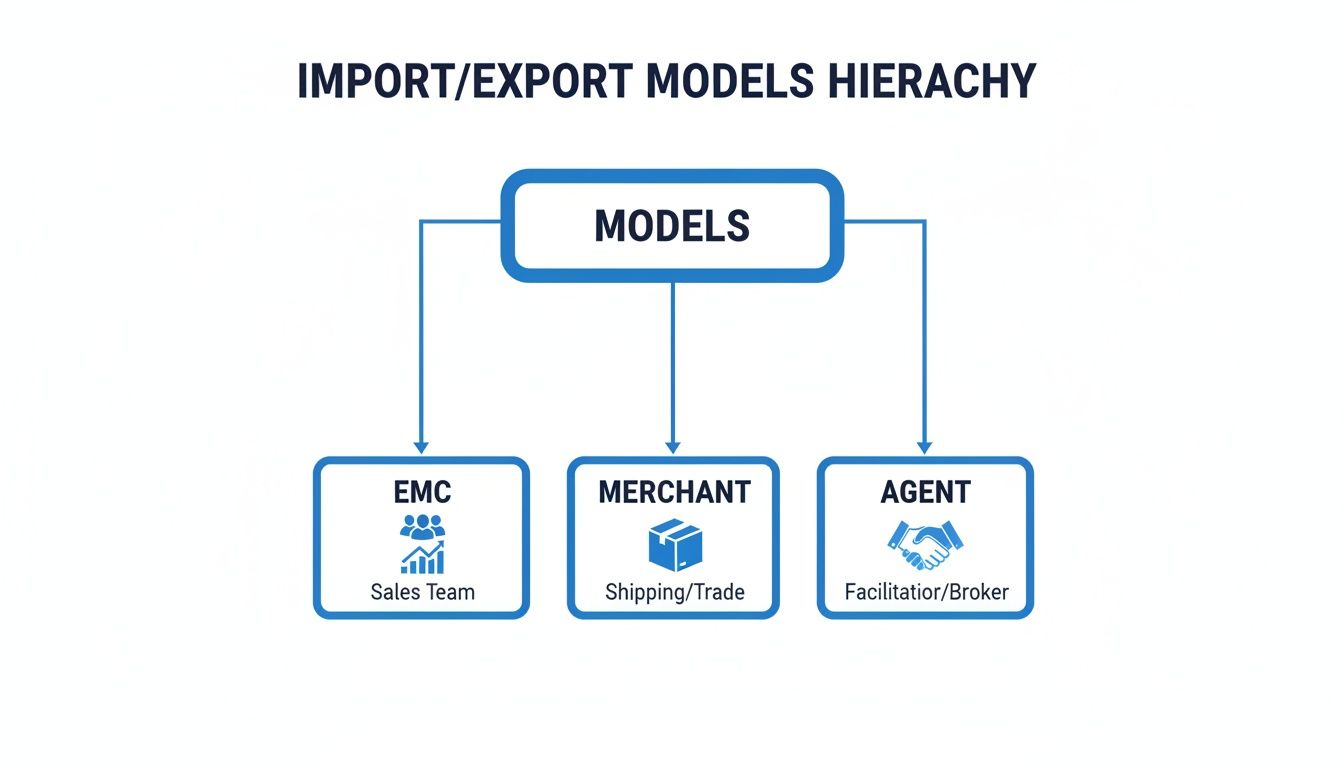
    A hierarchy chart illustrating import/export business models: EMC (Sales Team), Merchant (Shipping/Trade), and Agent (Facilitator/Broker).

    This image helps to visualise the different hats you can wear in this industry, which we touched on earlier. Each role, from the hands-off Agent to the all-in Merchant, comes with its own set of responsibilities when it comes to logistics and compliance.

    What Are HS Codes?

    Think of the Harmonized System (HS) Code as a universal barcode for every product on the planet. It's a global standard that customs authorities use to classify goods and apply the correct duties and taxes. Getting this code right is absolutely critical. One wrong digit can get your shipment flagged, re-inspected, and slapped with surprise fees.

    Demystifying Incoterms

    Incoterms are a set of official commercial terms that define the responsibilities of sellers and buyers. Published by the International Chamber of Commerce (ICC), these simple three-letter codes (like FOB, CIF, or EXW) spell out exactly who is responsible for the goods at every step of the journey. They clarify who pays for shipping, insurance, and customs clearance, and precisely when the risk transfers from one party to the other. Agreeing on the right Incoterm from the start is key to avoiding arguments and financial headaches down the line.

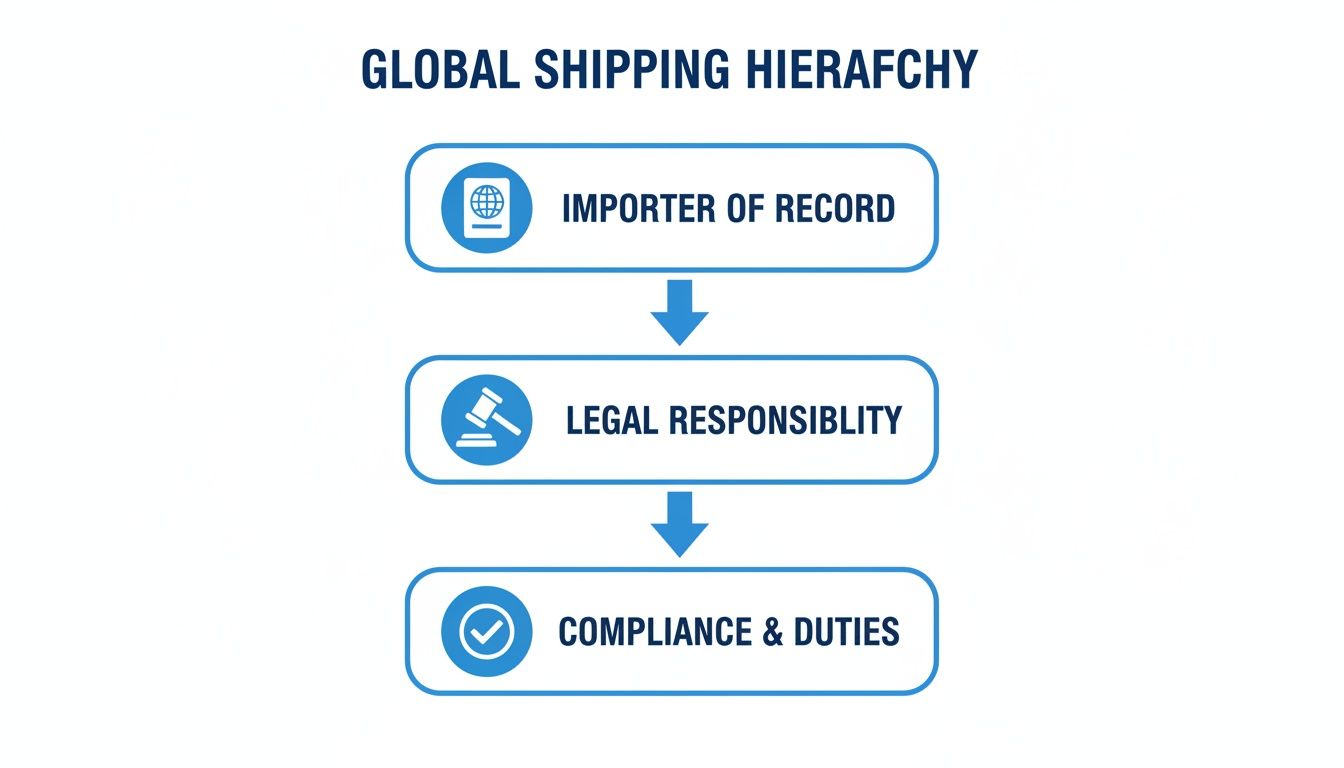
    Mastering these systems gives you the confidence to navigate the often-choppy waters of global trade. For a deeper dive into who holds the legal liability at the border, it’s also useful to understand the Importer of Record and its compliance duties.

    Mastering Logistics and Choosing Your Partners

    A man working on a laptop with toy logistics vehicles and a world map, representing global shipping.

    Once your paperwork is in order, the next mountain to climb is the physical journey of your goods. Logistics is the real engine of your import and export business—the incredibly complex art of moving products across oceans, continents, and borders.

    Figuring out the right way to ship and picking the best partners to handle it is one of the most critical decisions you'll make. It’s a constant balancing act between speed, cost, and the nature of your cargo. Get it wrong, and you could see your profit margins vanish or face reputation-damaging delays.

    Selecting Your Mode of Transport

    At its core, there are three main ways to move goods around the world: by sea, air, and land. Understanding the trade-offs of each is the key to building a supply chain that's both cost-effective and reliable enough to keep your customers happy.

    • Ocean Freight: This is the undisputed workhorse of global trade, responsible for moving over 80% of all international goods by volume. It's by far the cheapest option for large, heavy, or non-urgent shipments, but you pay for that with time—it’s also the slowest.
    • Air Freight: When speed is everything, you turn to air freight. It’s the go-to for high-value, perishable, or time-sensitive goods. Just be prepared for the price tag, as this premium service comes at a significantly higher cost.
    • Land Freight: Using trucks and trains, land freight is essential for moving goods within a continent or across the border to a neighbouring country. It offers a great mix of flexibility and decent speed for regional trade.

    Often, the smartest solution isn't just one of these but a combination, a strategy known as intermodal transport. A classic example is having goods arrive at a port via a container ship and then finish their journey to an inland warehouse by truck.

    The Critical Role of a Freight Forwarder

    Think of a freight forwarder as the travel agent for your cargo. They are the logistics experts who take on the headache of managing the entire shipping process for you, navigating the maze of international transport so you don’t have to.

    A great freight forwarder does much more than just book space on a ship or plane. They are the orchestrator of the entire journey. They’ll negotiate freight rates, arrange the transport, prepare documentation, and track your shipment from start to finish. For any serious import and export business, this partnership is absolutely vital.

    A reliable logistics partner is more than a vendor; they are an extension of your business. Their expertise can save you money, prevent costly delays, and provide the operational backbone needed to scale your global trade activities effectively.

    Choosing the right one isn't about chasing the lowest price. You need a true ally with a solid global network, modern tracking technology, and genuine expertise in the specific trade lanes you'll be using.

    Vetting Your Logistics Partners

    A strong supply chain is built on carefully chosen partners. When you’re evaluating freight forwarders or carriers, you need to dig deeper than just the price on the quote. You're assessing their capability, their reliability, and the quality of their service to ensure your goods are in safe hands.

    Here’s what to look for during your selection process:

    1. Experience and Specialisation: Have they handled your type of product before? Do they have a proven track record in the countries you’re shipping to and from? A forwarder that excels with perishable goods will have a completely different skillset than one that focuses on heavy machinery.
    2. Network and Reach: A strong global network of agents and partners isn’t just a nice-to-have; it’s essential. This ensures they can manage your shipment smoothly from door to door, even when things go wrong.
    3. Technology and Visibility: Can they give you real-time tracking and clear updates? Modern logistics runs on data, and you need a partner whose systems give you a clear window into where your shipment is at all times.
    4. Customer Service and Communication: When a problem pops up—and it will—you need a partner who is responsive and proactive. Check their reviews and ask for references to see how they handle pressure.

    This vetting process helps you build a resilient business. This is especially true in a major hub like Singapore, a nation whose economy lives and breathes global trade. In 2022, Singapore's exports of goods and services hit an astonishing 186.55% of its GDP, a figure that speaks volumes about the logistics expertise required to manage that flow. You can find more about Singapore's powerful trade ecosystem on Statista. By choosing partners with a proven track record in such demanding environments, you're setting your own business up for success.

    Finding Profitable Products and Untapped Markets

    Any successful import and export business is built on a foundation of smart choices. While passion for a product certainly helps, the businesses that last are launched with solid, verifiable data, not just a gut feeling. Guesswork is an expensive habit in this industry; making calculated decisions from day one is what sets you up for real growth.

    The trick is to start thinking less like a speculator and more like a market analyst. Instead of asking, "What products do I like?" the better question is, "Where is there proven demand that isn't being properly met?" The answers are hiding in plain sight, buried within global trade statistics and customs data. This information is essentially a map of the global marketplace, showing you exactly what’s moving, where it’s going, and who is moving it.

    Using Data to Spot Opportunities

    Global customs data gives you a surprisingly transparent look into the supply chains of businesses all over the world. By digging into this information, you can essentially reverse-engineer successful trade routes. You can see which companies are importing specific goods over and over, pinpoint high-volume shipping lanes, and uncover niches your competitors have completely overlooked.

    Think of it this way: instead of trying to find a needle in a haystack, you get a magnet that pulls the needle right to you. This kind of intelligence points you towards genuine market needs, helping you avoid sinking cash into products with weak demand or trying to muscle into markets that are already saturated.

    This data-driven approach lets you:

    • Identify High-Demand Products: See which commodities are being imported or exported in huge volumes to specific countries.
    • Analyse Competitor Activity: Uncover who your competitors are shipping to and from, giving you a peek into their core markets.
    • Find Underserved Niches: Discover products with growing demand but only a handful of established suppliers in a particular region.
    • Validate Business Ideas: Confirm there’s a real, existing market for a product before you invest a single dollar.

    From Raw Data to Actionable Insights

    Of course, just having the data isn't enough; you need to know what to do with it. Let's say a freight forwarder analyses customs records and finds a company that imports large quantities of electronic components from Taiwan to Singapore every month. This isn't just a random fact—it's a qualified lead. Armed with this knowledge, the forwarder can approach that importer with a very specific, value-driven proposal.

    The most powerful move you can make in the import and export business is replacing "I think" with "I know." Data intelligence transforms your strategy from hopeful guesses into targeted actions based on real-world shipping activities.

    This level of detail makes your outreach immediately relevant. You can reference their exact shipping needs in your first conversation, which makes your business sound well-informed and genuinely capable of solving their specific logistics challenges.

    This approach works especially well in sophisticated trade hubs. Take Singapore, for example. Its merchandise trade landscape reveals a clear structure that creates specific opportunities for freight forwarders. In 2021, Singapore's total imports were valued at over $406 billion USD. The commodity data shows that electrical machinery made up the lion's share of these imports at $137.87 billion, with industrial machinery following at $59.91 billion.

    These categories create consistent, high-volume shipping demand, meaning steady business for forwarders who specialise in machinery and high-tech logistics. You can explore more of Singapore's trade statistics on globalEDGE to see for yourself.

    By diving into these numbers, you get to skip the generic sales pitches. You can start conversations based on a clear understanding of a potential client’s business, which is how you build the foundation for a strong, long-term partnership. This is how a modern import and export business thrives.

    Using Trade Data to Generate High-Quality Leads

    For any logistics pro, global trade data isn't just for market research—it's a goldmine brimming with qualified leads. An import and export business is built on relationships, and this data is basically a treasure map pointing you straight to the most valuable connections. It lets you ditch the cold calls and start having strategic, informed conversations that build real trust and, ultimately, win business.

    Think about it. This completely flips the script from guessing who might need your services to knowing exactly who does. By digging into customs data, a freight forwarder can spot a company that's consistently importing goods on a specific lane, find the right person to talk to, and craft a message that actually resonates.

    Imagine knowing precisely what a potential client ships, how often they ship it, and from which port. That knowledge allows you to approach them not with a generic "we move freight" pitch, but with a highly specific solution. You can point out a more efficient route or a cost-saving opportunity in your very first email, showing your value right from the get-go.

    Turning Data into Actionable Opportunities

    The whole process kicks off when you start spotting patterns in shipping manifests and bills of lading. For instance, a sharp freight forwarder might notice a huge volume of automotive parts flowing into Singapore from Germany. That single insight is a powerful jumping-off point for prospecting.

    From there, they can use a platform like Coreties to dive deeper, filtering these shipments to pinpoint the exact companies involved. Instead of casting a wide, inefficient net, they can zoom in on businesses that match their ideal customer profile—maybe those shipping at a certain frequency or volume.

    Person analyzes business data and qualified leads on a laptop with charts and graphs.

    This is what turning raw data into an organised prospect list looks like. With just a few clicks, a sales professional gets a clear view of who's shipping what, and from where, transforming a sea of information into a clear list of potential clients.

    Crafting a Data-Driven Outreach

    Once you’ve zeroed in on a promising prospect, it’s time for targeted outreach. The data you’ve gathered gives you all the context you need to make your message personal and genuinely relevant. It even helps you find verified contact details for the actual decision-makers, like a logistics manager or supply chain director.

    So, instead of a generic email, your outreach could look something like this:

    "Hi [Contact Name], I noticed your company regularly imports automotive components from Hamburg to Singapore. We specialise in this trade lane and have helped similar businesses reduce their transit times by up to two days. Would you be open to a brief chat about optimising this route?"

    This approach works so well because it’s grounded in the prospect's real, day-to-day business activities. It shows you've done your homework.

    This method is especially powerful in major trading hubs. Take Singapore, for example—it's a massive player, with exports hitting S$60.95 billion in a single recent month. That trend is set to continue, which means there are huge opportunities for forwarders who can pinpoint the right clients within this massive market.

    By using data, you’re swapping speculation for certainty. If you want to dig deeper into finding and verifying a company's shipping activities, check out our guide on how to look up a company's import and export history.

    Frequently Asked Questions

    Jumping into global trade for the first time? It's natural to have a few questions. Let's break down some of the most common ones that come up when people are looking to start their own import and export business.

    How Much Money Do I Need to Start?

    This is the big question, and the honest answer is: it depends entirely on the path you choose. Your starting capital will land in one of three buckets.

    • Low Capital (Agent/Broker): This is the most accessible route. Since you're not buying any stock yourself, your main costs are for setting up the business, a bit of marketing, and building your network.
    • Moderate Capital (EMC): As an Export Management Company, you'll need a bit more cash. Think marketing campaigns, travel to meet clients, and general running costs. The good news is you still don't have the huge expense of purchasing goods.
    • High Capital (Merchant): Taking the merchant path requires the most significant investment, by far. You’ll need a healthy bankroll to buy inventory upfront, pay for international shipping, cover customs duties and taxes, and possibly handle warehousing.

    To get a real number, you absolutely need to create a detailed business plan. Map out every single cost you can think of, from sourcing your first product to getting it into the customer's hands.

    How Do I Find Reliable Suppliers and Buyers?

    Your entire business is built on the quality of your partners. Finding trustworthy suppliers and buyers is everything, and it takes a bit of legwork and smart vetting.

    A fantastic place to start is by visiting international trade shows for your specific industry. Nothing beats a face-to-face meeting. Online B2B platforms like Alibaba and Global Sources are also incredibly useful, but you have to do your homework. Always ask for references, dig into their business history, and—this is non-negotiable—order samples before you even think about a large order.

    Finding the right partner isn't just a transaction; it's a strategic alliance. A reliable supplier ensures product quality, while a dependable buyer ensures steady cash flow. Both are critical for long-term stability and growth in the competitive world of global trade.

    What Are the Biggest Risks in This Business?

    The biggest headaches in global trade usually come from three areas: logistics, money, and red tape. Supply chain meltdowns, like a backed-up port or a delayed ship, can cost you a fortune. On the finance side, currency exchange rates can swing wildly and take a surprise bite out of your profits.

    Another major risk is simply not getting paid. To avoid this, insist on secure payment methods like a Letter of Credit (L/C). This is essentially a guarantee from a bank that you'll get paid once you've held up your end of the deal. And always, always get comprehensive cargo insurance to cover your goods if they get lost or damaged on their journey.

    Finally, you have to be meticulous about customs rules. One tiny mistake on a form can lead to hefty fines and your shipment being stuck for weeks. The best way to sidestep these issues is to work with experienced freight forwarders and customs brokers. They know how to navigate the system and keep your business moving smoothly.


    Ready to turn global trade data into high-quality leads? Coreties helps you find and connect with the right shippers, turning market intelligence into real business opportunities. Discover your next customer today at https://coreties.com.

  • HS Code for Clothing A Guide to Accurate Classification

    HS Code for Clothing A Guide to Accurate Classification

    Think of the HS code for clothing as a universal passport for every garment crossing a border. This simple six-to-ten-digit number tells customs officers worldwide exactly what's in the box—what an item is, what it's made of, and who it's for—making sure it gets classified correctly for duties and taxes.

    Decoding the Language of Global Apparel Trade

    A stack of folded clothes, a brown passport booklet, and papers on a table with 'HS Code Passport' text.

    For anyone in freight forwarding, getting a handle on the Harmonized System (HS) code isn't just about ticking a compliance box; it's a real strategic advantage. The right code paves a smooth path from the factory floor to the customer's hands, sidestepping costly delays, surprise fines, and the kind of friction that can sour a client relationship. Get one digit wrong, and a profitable shipment can quickly become a logistical nightmare.

    It helps to think of the HS code as a highly specific GPS coordinate for your apparel shipment. Each pair of digits zooms in, refining the product's identity until there's a clear, universal description that leaves no room for guesswork at customs.

    The Building Blocks of a Clothing HS Code

    The whole system is built on a simple, logical hierarchy. It starts broad and gets more specific with each number, allowing customs officials to pinpoint a garment's exact nature in seconds. This structure is absolutely essential for applying the correct tariffs and trade rules.

    Here's a quick look at how it works:

    • Chapter: The first two digits sort the item into a general category. For clothing, you'll almost always be in Chapter 61 (knitted or crocheted apparel) or Chapter 62 (woven apparel).
    • Heading: The next two digits define the type of product, like "jerseys and pullovers" or "trousers and shorts."
    • Subheading: The final two digits of the international code add the crucial details, such as the material (e.g., cotton, synthetic fibres) or the intended wearer (men's, women's, etc.).

    In global trade, the HS code is the single source of truth for product classification. Getting it right from the start eliminates downstream complications, ensuring that tariffs are calculated correctly and shipments clear customs without friction.

    This six-digit foundation is the bedrock of international apparel shipping. Take Singapore, for example. The local HS code framework, which centres on Chapters 61 and 62, is crucial for accurate trade analytics. A simple misclassification can lead to serious hold-ups, which is why Singapore Customs provides tools like their ruling database to help businesses stay compliant. You can see just how much these classifications matter to the economy in official trade publications.

    Ultimately, understanding this system is your key to navigating the complex world of global logistics. It turns the daunting task of classification into a manageable process, giving you the confidence to handle any apparel shipment that comes your way.

    How HS Codes for Clothing Are Structured

    Think of an HS code for clothing like a postcode. It tells customs officials exactly what's in the box, starting from a broad region and zooming right down to a specific street address. Getting this code right isn't just a technicality—it's what determines how quickly your shipment clears and how much duty you'll pay.

    The entire universe of clothing is split into two massive categories, known as Chapters. These first two digits are the most important decision you'll make when classifying a garment. The distinction is simple but absolutely fundamental.

    The First Big Decision: Knitted or Woven?

    Right at the start, the path splits based on how the fabric was made. Every single piece of clothing falls into one of two Chapters:

    • Chapter 61 is for all apparel that is knitted or crocheted.
    • Chapter 62 is for all apparel that is woven.

    What's the difference in real life? A classic cotton t-shirt has that familiar stretch because its fabric is made from a single thread looped over and over—that's knitted (Chapter 61). On the other hand, a formal dress shirt feels crisp and holds its shape because its fabric is made by weaving threads over and under each other, like a basket. That's woven (Chapter 62).

    This isn't a minor detail; it's the foundation of the entire code. A knitted garment's HS code must start with "61". A woven one must start with "62". No exceptions.

    An incorrect Chapter is one of the most common and costly mistakes in apparel shipping. It instantly invalidates the rest of the code, leading to customs rejections, surprise duties, and major delays for your clients.

    Narrowing It Down with Headings

    Once you've picked the right Chapter, the next two digits—the Heading—get more specific about the type of garment. This is where you go from a broad category like "knitted apparel" to identifying the actual item.

    For instance, within Chapter 61 (Knitted), you'll find different Headings for different products:

    • 6105: Men's or boys' shirts, knitted or crocheted.
    • 6109: T-shirts, singlets, and other vests, knitted or crocheted.
    • 6110: Jerseys, pullovers, and cardigans, knitted or crocheted.

    Chapter 62 (Woven) works the same way, with Headings like 6203 for men's suits or 6205 for men's shirts. The Heading adds that second layer of detail, confirming what the product is. While the global standard is six digits, many countries, including Singapore, add extra digits for more local detail. You can dive deeper into this in our guide on the HS code system in Singapore.

    Adding Critical Details with Subheadings

    The last two digits of the international HS code are the Subheading. This is where things get really granular—and it's often where classification disputes happen. The Subheading locks in the final details that determine the exact tariff rate.

    These crucial details almost always include:

    • Material Composition: Is it cotton, wool, silk, or a synthetic fibre like polyester? A cotton t-shirt has a different code from a polyester one.
    • Intended Wearer: Is it for men, women, boys, girls, or infants? This distinction is non-negotiable and can completely change the code.

    Let's walk through an example: a men's cotton t-shirt.

    1. Chapter: It’s a t-shirt, so it's knitted. We start with 61.
    2. Heading: It’s a t-shirt, so we use Heading 09.
    3. Subheading: It’s made of cotton, which is assigned Subheading 10.

    Put it all together, and the correct 6-digit HS code for a men's cotton t-shirt is 6109.10. This logical, step-by-step process is designed to remove guesswork, so customs officials anywhere in the world can understand exactly what they're looking at.

    Key Classification Rules You Need to Know

    Once you’ve got a handle on the basic structure of an HS code, the real work begins. Getting the classification right is what separates a smooth customs clearance from a shipment stuck in limbo. It’s all about a process of elimination—you start with the most critical distinction and work your way down through the details until only one correct code remains.

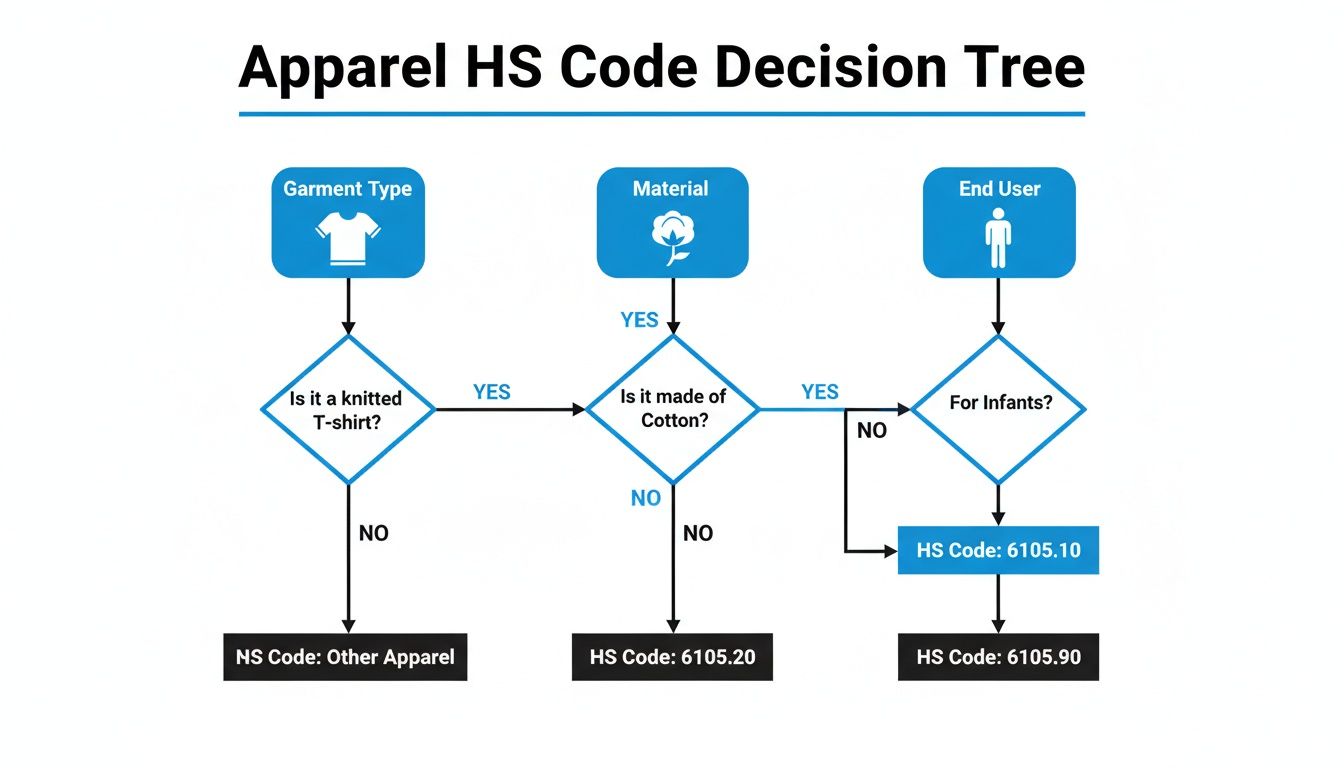
    The whole system essentially asks you a series of questions. The first one is the big one: is the garment knitted or woven? This single detail decides whether you start in Chapter 61 or Chapter 62, and getting it wrong from the get-go throws off everything else.

    The Critical Knitted Versus Woven Divide

    Think of a garment’s fabric construction as its fundamental DNA. Knitted fabric is made from a single, continuous thread looped together, kind of like a chain-link fence. This structure gives it natural stretch, which is why your t-shirts, jumpers, and gym wear are almost always knitted. These items all belong in Chapter 61.

    Woven fabric, on the other hand, is created by interlacing two or more threads at right angles, much like a basket weave. This grid-like structure makes the material more rigid and durable—perfect for things like formal shirts, denim jeans, and structured blazers. These garments fall under Chapter 62.

    A word of warning: Getting the knitted vs. woven distinction right is non-negotiable. An experienced customs inspector can tell the difference in seconds, and classifying under the wrong Chapter is an immediate red flag that often triggers inspections and costly re-classifications.

    To make it easier to tell them apart at a glance, here’s a quick reference table.

    Knitted (Chapter 61) vs Woven (Chapter 62) At a Glance

    Characteristic Knitted Apparel (Chapter 61) Woven Apparel (Chapter 62)
    Fabric Construction Made from a single, continuous yarn looped together. Made by interlacing two or more sets of yarn at right angles.
    Feel & Stretch Stretchy, flexible, and comfortable. Returns to shape easily. More rigid, structured, and holds its shape. Limited stretch.
    Look Up Close You'll see tiny, braided loops, similar to knitting. You'll see a distinct grid-like or criss-cross pattern.
    Common Garments T-shirts, jumpers, polo shirts, hoodies, leggings, underwear. Dress shirts, blouses, trousers, jeans, suits, blazers, jackets.

    Remembering these key differences is the first and most important step in correctly classifying any piece of clothing.

    What About Blended Fabrics?

    It’s rare to find clothing made from just one material. So what happens when you have a t-shirt that’s 60% cotton and 40% polyester? This is where the "principal character" rule comes into play. You classify the garment based on the material that gives it its primary identity.

    For blended fabrics, the rule is thankfully straightforward: you classify the garment based on the material with the highest percentage by weight. In our example, since cotton makes up 60% of the fabric, you’d classify the t-shirt under the subheading for cotton, not polyester.

    This simple decision tree shows the logical flow for classifying a garment, starting from its type and drilling down to the end-user.

    Apparel HS Code decision tree flowchart for classifying garments by type, material, and end user.

    As you can see, each decision you make narrows down the possibilities, guiding you systematically to the right HS code.

    The Importance of Gender and Age

    After fabric and material, the next hurdle is the intended wearer. The HS code system makes very clear distinctions between apparel for different demographics, and this isn’t a suggestion—it’s a hard-and-fast rule with separate codes for each group.

    You absolutely must classify garments into one of these categories:

    • Men's or boys'
    • Women's or girls'
    • Infants'

    A men’s cotton shirt will have a different HS code than a women’s cotton shirt, even if they look practically identical. The "infants" category is also very specific, usually covering clothing for babies up to a certain size (for instance, up to size 86 cm in many regions). Mistaking a unisex-style hoodie as "men's" when the shipment is for a women's retailer is a classic mistake that can cause major compliance headaches.

    When Small Details Change Everything

    Finally, never underestimate the power of design features. Seemingly minor details can completely change an HS code because the system is designed to be incredibly specific. A simple collar, a pocket, or a particular type of fastening can easily bump a garment from one heading to another.

    For example, a knitted pullover with no pockets or openings might fall under heading 6110. But add a partial opening at the neck with a few buttons, and it could suddenly be classified as a shirt under an entirely different heading. Always examine the garment’s physical traits closely—the smallest details often hold the key to an accurate classification.

    Common HS Codes for Major Clothing Categories

    Now that we’ve got the ground rules down, let's put theory into practice. Knowing the right HS code for clothing is only useful when you can apply it quickly to the garments you handle every single day.

    Think of this section as your classification cheat sheet. We're going to walk through some of the most common apparel categories—from t-shirts to jeans—and show you exactly how the logic of Chapter, Heading, and Subheading comes together to form the correct 6-digit code.

    T-Shirts, Singlets, and Other Vests

    This category is easily one of the most frequently shipped worldwide, and a standard t-shirt is a perfect, clear-cut example of how the HS system works.

    Let’s classify a basic men's 100% cotton t-shirt:

    • Chapter: T-shirts are almost always made from that familiar stretchy, looped fabric, which means they are knitted. This puts them squarely in Chapter 61.
    • Heading: Within Chapter 61, the specific heading for "T-shirts, singlets and other vests" is 09.
    • Subheading: The material is cotton, which corresponds to subheading 10.

    Put it all together, and you get the 6-digit HS code: 6109.10.

    In Singapore, the HS code 6109.10 covers these exact items. For customs declarations, this is often broken down even further for men/boys (6109.10.10) or women/girls (6109.10.20). While duties are generally zero under Singapore’s trade-friendly policies, getting the code right is non-negotiable for smooth clearance. A quick look at trade data shows that basic crew necks, V-necks, and graphic tees make up the bulk of shipments under this code.

    Trousers and Jeans

    Trousers and jeans are another massive category in global apparel, but their classification takes a different path because they are usually made from woven fabric.

    Picture a pair of classic men's blue denim jeans. Here’s how you'd classify them:

    • Chapter: Denim is a tough, woven twill fabric, which immediately sends us over to Chapter 62.
    • Heading: The heading for "Trousers, bib and brace overalls, breeches and shorts" for men or boys is 03.
    • Subheading: There's a specific subheading just for denim, which is 42.

    The result is the HS code 6203.42. If those same trousers were made from synthetic fibres instead of denim, the subheading would change (to .43), but the Chapter and Heading would stay the same.

    The same principles of material and construction apply across all apparel. If you’re curious about how this works for accessories, you can dive into our guide on the HS code for shoes.

    Jumpers, Pullovers, and Cardigans

    When we start talking about colder-weather clothing, we usually find ourselves back in the world of knitted goods. Jumpers, pullovers, and cardigans are all about that comfortable, stretchy construction.

    Let's break down a women's jumper made from a 55% wool, 45% acrylic blend.

    • Chapter: Its construction is knitted, so we begin again in Chapter 61.
    • Heading: The correct heading for "Jerseys, pullovers, cardigans, waistcoats and similar articles" is 10.
    • Subheading: This is where the material blend rule is crucial. Since wool is the dominant fibre by weight (55%), we use the subheading for wool, which is 11.

    The final HS code is 6110.11. If the blend had been flipped and acrylic was the dominant material, the code would have shifted to reflect that.

    A common pitfall is classifying a hoodie under heading 6110. Hoodies often have features like pockets, linings, or a full-zip front that can push them into a completely different classification. Always examine the garment’s specific features, not just its general description.

    Example HS Codes for Popular Apparel Items

    To help you get a feel for the patterns, here’s a quick-reference table for some of the most common clothing items you'll run into.

    Apparel Item Example Description Key Classification Factors HS Code (6-Digit)
    Polo Shirt Men's, 100% cotton, knitted Knitted, Men's, Cotton 6105.10
    Dress Shirt Men's, 100% cotton, woven Woven, Men's, Cotton 6205.20
    Women's Blouse 100% silk, woven Woven, Women's, Silk 6206.10
    Jacket / Blazer Men's, woven wool Woven, Men's, Wool 6203.31
    Women's Skirt 100% polyester, woven Woven, Women's, Synthetic 6204.53
    Underwear Men's cotton briefs, knitted Knitted, Men's, Cotton 6107.11

    By using these examples as a guide, you can start building the confidence needed to classify any garment accurately. Getting this right from the start is the key to ensuring your shipments move across borders efficiently and without any costly compliance headaches.

    How to Avoid Costly Classification Mistakes

    Getting an HS code for clothing wrong by even a single digit can set off a chain reaction of problems. A shipment gets flagged, customs officials start asking questions, and suddenly you're facing unexpected fines, storage fees, and an unhappy client. Shifting from guesswork to confident verification isn’t just about ticking a compliance box; it’s about protecting your profit margin and your reputation.

    The key is to treat classification as a systematic process, not an assumption. It's tempting to rely on a supplier's code or reuse one from a similar-looking shipment, but that's a risky shortcut. At the end of the day, the responsibility for accuracy falls on the importer and, by extension, the forwarder guiding them.

    A solid verification process is your best defence against these expensive errors. It’s all about cross-referencing information and never taking a single source as gospel.

    Your Three-Step Verification Process

    To nail the classification every time, it helps to have a simple but effective checklist. This methodical approach cuts through the ambiguity and creates a defensible record for every shipment you handle.

    1. Start with the Source Document: Always begin with the commercial invoice and packing list. Really scrutinise the product descriptions. Are they detailed enough? A description like "women's tops" is far too vague. You need specifics, like "women's 100% cotton woven long-sleeve blouse."

    2. Consult Official Tariff Databases: Armed with a detailed description, look up the code in an official government database. For shipments into Singapore, the Singapore Customs HS/CA Product Code Search is your ultimate source of truth. This step is crucial for validating your initial assessment against the country's specific legal framework.

    3. Cross-Reference with WCO Resources: When you're dealing with a tricky case, turn to the World Customs Organization (WCO) Explanatory Notes. These documents provide the official interpretation of HS headings, offering detailed guidance on what is—and isn't—included in a particular category.

    Following these steps turns classification from a quick guess into a documented, evidence-based decision. It's the kind of diligence that protects both you and your client from potential disputes down the line.

    Common Classification Pitfalls to Sidestep

    Even with a good process, some common mistakes still trip up seasoned forwarders. Just being aware of these traps is half the battle.

    One of the biggest errors is misidentifying fabric blends. The rule is simple but often missed: classify the garment based on the material with the highest percentage by weight. So, a shirt that's 55% polyester and 45% cotton is classified as a polyester shirt, period.

    Never assume a garment's material just by its look or feel. Always insist on a detailed material composition breakdown from the shipper. This single piece of data is one of the most critical factors in finding the correct HS code.

    Another frequent slip-up is overlooking small but significant design details. A simple drawstring, a hood, or even the type of waistband can be enough to shift a garment from one HS code to a completely different one.

    Finally, watch out for outdated codes. The WCO updates the Harmonized System every five years to keep up with new products and technologies. Using a code from 2021 for a shipment today might mean you're using a classification that doesn't even exist anymore. Always, always confirm you're working with the most current version of the tariff schedule.

    Find New Business Using HS Code Data

    A laptop on a wooden desk displays an e-commerce website showing various clothing items for selection.

    So far, we've treated the HS code for clothing as a necessary tool for compliance. But what if these codes could do more than just get your shipments cleared? What if they could actually point you directly to your next big client? The truth is, the data tied to every single shipment—all neatly organised by HS code—is a goldmine for business development.

    Think about it. Every time a container of apparel crosses a border, it leaves a data trail. This customs record shows exactly who is shipping what, how much they’re shipping, and where it’s all going. This isn't just logistical noise; it’s a detailed map of your entire potential client base.

    By tapping into this trade data, you can finally ditch the cold calls and start having conversations based on real, relevant insights. Your sales approach transforms from a shot in the dark to a data-backed strategy.

    Turning Data into Qualified Leads

    Let's say you're a specialist in shipping knitted apparel. Instead of guessing which companies might need your services, you could simply search customs data for businesses importing goods under Chapter 61. Right away, you've filtered out all the noise and are left with a targeted list of active importers.

    You can even drill down further. A quick filter for HS code 6109.10, for example, will show you every company in Singapore that’s importing cotton t-shirts. This kind of detail helps you zero in on high-potential clients whose shipping needs are a perfect match for your expertise.

    This method gives you some incredibly powerful market intelligence:

    • Pinpoint Active Importers: You'll find companies currently shipping the exact types of clothing you handle.
    • Gauge Shipping Volumes: See which businesses are importing at a scale that makes them a valuable partner for you.
    • Map Out Trade Routes: Discover the specific lanes your prospects are using, which allows you to pitch more competitive alternatives.

    By using customs data, you aren’t just finding leads; you’re uncovering a company’s entire supply chain story. This lets you craft an outreach that speaks directly to their real-world operational needs and challenges.

    Crafting a Winning Outreach Strategy

    Once you have your list of high-potential companies, the next step is reaching the right person. Modern trade intelligence platforms can help you find contact details for the key decision-makers, like logistics managers or supply chain directors, within these target businesses.

    Armed with this information, you can finally stop sending those generic "hope you're well" emails. Instead, you can build a personalised message based on actual data. Imagine mentioning their recent shipment volumes from Vietnam or highlighting how your services on a particular trade lane could offer them a better deal. To see exactly how to set up these searches, our guide on using an HS code filter offers a detailed walkthrough.

    This data-driven approach immediately shows you've done your homework. It proves to prospects that you understand their business and can offer genuine value, which dramatically increases your chances of getting a response and starting a real conversation. It’s the key to building a robust and sustainable sales pipeline.

    Frequently Asked Questions

    When you're dealing with apparel shipments day in and day out, a few questions tend to pop up again and again. Let's tackle some of the most common ones that freight forwarders and shippers run into with the HS code for clothing.

    What Is the Difference Between an HS Code and an HTS Code?

    Think of the HS code as the global "first name" for a product. It’s a six-digit code that’s the same pretty much everywhere, from Singapore to Spain, thanks to the World Customs Organization (WCO). It’s the universal standard.

    An HTS (Harmonized Tariff Schedule) code is more like a product's full name, specific to the country it's entering. The United States, for instance, tacks on four extra digits to that base HS code. This creates a 10-digit HTS code that lets them get super specific for calculating duties and gathering trade data.

    The bottom line: The first six digits are your universal key. Anything after that is country-specific. Always, always use the full HTS code required by the destination country for your customs paperwork.

    Do All Countries Use the Same HS Codes for Clothing?

    Yes, but also no. It's a bit of a trick question. The core six-digit HS code is used by over 200 countries, which is fantastic because it creates a common language for global trade. The code for a men's woven cotton shirt (6205.20) is recognised worldwide.

    The "no" part comes in after those first six digits. Many countries add their own numbers to get more detailed. This is why a shipment heading to the US needs a 10-digit code, while another going to Japan might only require a 9-digit one.

    How Often Do HS Codes Change?

    The Harmonized System isn't set in stone. The WCO gives it a major review about every five years to keep up with new products and technology. The last big update was in 2022, and the next one is already on the calendar for 2027.

    Staying on top of these changes is non-negotiable. Using an old, deleted code is one of the fastest ways to get a shipment stuck in customs, creating delays and potential fines for your clients.


    Ready to turn all this customs data into your next big client? With a tool like Coreties, you can filter through active shippers using specific clothing HS codes, pinpoint the right decision-makers, and build a targeted outreach list that actually converts. Discover qualified leads faster with Coreties.

  • The Importer of Record Explained A Complete Logistics Guide

    The Importer of Record Explained A Complete Logistics Guide

    Think of the Importer of Record (IOR) as the legal guardian for goods crossing a border. This is the person or company that officially takes responsibility for a shipment, making sure it legally enters the country. They are the ones who vouch for the cargo, ensuring all duties, taxes, and import laws are followed to the letter.

    What Is an Importer of Record in Global Shipping?

    At its heart, the Importer of Record is the most crucial player in any import deal. This isn’t just a name on a document; it’s a role that carries serious legal and financial weight. The IOR is the entity ultimately on the hook for making sure a shipment complies with every single one of the destination country’s customs regulations.

    This accountability covers a lot of ground, including:

    • Accurate Classification: Making sure every product is categorised with the correct Harmonised System (HS) code.
    • Correct Valuation: Declaring the true value of the goods, which is what customs uses to calculate duties and taxes.
    • Duty and Tax Payment: Handling the timely payment of all tariffs, duties, and fees owed to customs authorities.
    • Regulatory Compliance: Getting all the necessary permits, licences, and certificates needed for the specific products being imported.

    For freight forwarders and carriers, figuring out who the real IOR is can make or break a shipment. It’s not always the consignee or the final buyer. The IOR is the one calling the shots, controlling the freight, and shouldering the risk. Getting this right is the first step in avoiding compliance nightmares and, just as importantly, spotting valuable sales opportunities.

    The Importer of Record is the legally recognised party responsible for ensuring that imported goods meet all customs and legal requirements of the destination country. Any slip-ups can lead to hefty fines, seized shipments, and major supply chain headaches.

    The IOR in a Major Trade Hub

    In a major trade hub like Singapore, the IOR’s role becomes even more critical. With total imports reaching a record $45.9 billion USD and growing by 20.3% year-over-year, the IOR acts as the gatekeeper for this enormous volume of goods.

    These entities are tasked with navigating compliance and duties for an eye-watering $567.3 billion USD in annual trade, making them ideal prospects for any logistics provider. You can dig deeper into Singapore’s import growth trends on CEICdata.com.

    This legal responsibility makes the IOR a central figure in international logistics. Identifying these key shippers and their specific trade lanes gives you a direct line to the people who make the most important logistics decisions.

    IOR vs Consignee vs Customs Broker: Unpacking Each Role

    In the complex world of global trade, it’s easy to get the players confused. The lines between the Importer of Record, the consignee, and the customs broker can seem blurry, but mixing them up can lead to some seriously expensive compliance headaches. Knowing who’s responsible for what isn’t just good practice—it’s essential for getting goods through customs smoothly and for figuring out who holds the real power in a supply chain.

    Let’s break it down using a simple analogy: think of an international shipment as a major theatre production. Each role is distinct, and if one person messes up their lines, the whole show can grind to a halt.

    The Producer: The Importer of Record (IOR)

    The Importer of Record (IOR) is the show’s Producer. This is the person or company putting up the money and taking all the risk. They are the ultimate financial and legal backstop for the entire venture. If the production breaks any laws or fails to pay its bills, the producer is the one on the hook.

    In shipping terms, the IOR is the entity legally responsible for making sure the imported goods meet all local laws and regulations. They’re in charge of paying the correct import duties and taxes and ensuring every piece of paperwork is filed accurately. When the goods arrive at the border, customs authorities see the IOR as the official owner at that exact moment.

    The Star Actor: The Consignee

    The Consignee is the Star Actor of our play. This is the party whose name is on the ticket—they’re the one who will physically receive the goods when they arrive at their final destination. They’re a crucial player and the public face of the delivery, but they don’t automatically carry the legal or financial burden for the import process itself.

    Now, it’s common for the consignee to also be the IOR, but it’s a mistake to assume they are always one and the same. For example, a third-party logistics (3PL) warehouse might be listed as the consignee, but the actual brand that owns the inventory is the IOR. Understanding this distinction is critical. For a deeper dive into this, check out our guide on how to identify consignees in global shipping data.

    The hierarchy is crystal clear, with the IOR sitting at the very top of the responsibility pyramid.

    Diagram illustrating the global shipping hierarchy: Importer of Record, Legal Responsibility, and Compliance & Duties.

    As you can see, the IOR’s role is foundational. They bear the full weight of both legal responsibility and the obligation for all compliance and duties.

    The Talent Agent: The Customs Broker

    Finally, we have the Customs Broker, who acts as the expert Talent Agent. They’re brought in for their specialised knowledge and industry connections. The agent is the one who navigates the complex paperwork, manages the schedules, and handles the nitty-gritty details to ensure the star actor gets to the stage without a hitch.

    But here’s the key part: the agent doesn’t finance the show or take legal responsibility if it flops. In the same way, a customs broker is a licensed specialist hired to manage the customs clearance process on behalf of the IOR. They prepare and submit all the necessary documentation, but they never take on the IOR’s core legal liability.

    A customs broker might handle the technical filings, but the Importer of Record always retains the ultimate legal and financial responsibility for the shipment’s compliance. In the eyes of customs agencies, this distinction is absolute.

    To make these differences even clearer, here’s a side-by-side comparison of what each party is—and isn’t—responsible for.

    IOR vs Consignee vs Customs Broker Role Comparison

    Responsibility Importer of Record (IOR) Consignee Customs Broker
    Legal & Financial Liability Yes. Ultimate responsibility for all compliance, duties, taxes, and penalties. No. Not legally liable unless they are also the IOR. No. Acts as an agent; liability rests with the IOR.
    Ownership at Import Yes. Considered the official owner by customs at the time of entry. Sometimes. Becomes the owner upon delivery, but not necessarily at import. No. Never takes ownership of the goods.
    Customs Documentation Yes. Ultimately responsible for the accuracy of all declarations. No. May provide information, but not legally responsible for the filing. Yes. Prepares and submits documentation on behalf of the IOR.
    Payment of Duties & Taxes Yes. Legally obligated to pay all assessed import duties and taxes. No. Typically does not pay these directly, unless also serving as the IOR. No. Facilitates payment but uses the IOR’s funds or line of credit.
    Physical Receipt of Goods Sometimes. May or may not be the final destination for the goods. Yes. The designated recipient of the shipment at the destination. No. Does not physically handle or receive the cargo.

    This table shows just how distinct these roles are. The IOR is the undisputed lynchpin, holding all the legal and financial cards for a successful import.

    The Legal Weight: Understanding an IOR’s Duties and Liabilities

    Taking on the role of an Importer of Record (IOR) is a lot more than just putting a name on a shipping form. It’s a serious legal commitment, one that comes with heavy financial and regulatory weight. Think of the IOR as the single point of contact customs authorities hold accountable for everything related to an import.

    That responsibility is absolute. When a shipment hits the border, the IOR is legally guaranteeing that it meets every single local law and regulation. It doesn’t matter who packed the boxes or filled out the initial paperwork; if something is wrong, the buck stops with the IOR.

    What Does an Importer of Record Actually Do?

    The IOR’s to-do list is long and demands a sharp eye for detail. Getting any of these core duties wrong can bring on some painful penalties.

    Here’s what the role boils down to:

    • Accurate Product Classification: Every single item must be classified with the right Harmonised System (HS) code. A simple mistake here can mean you pay the wrong duty rate—either overpaying and losing money, or worse, underpaying and getting hit with fines.
    • Correct Valuation: You have to declare the exact commercial value of the goods. There’s no room for negotiation on this. Customs agencies use this number to figure out duties and taxes, and undervaluing a shipment is a massive red flag for them.
    • Payment of All Duties and Taxes: The IOR is on the hook for paying all tariffs, duties, and taxes. This is a direct financial liability, and it has to be paid on time and in full.
    • Securing Permits and Licences: A huge range of products—from food and electronics to medical devices—needs special import permits or licences. The IOR is responsible for making sure all of this is sorted before the goods even reach the port.

    These aren’t just items on a checklist; they’re legally binding obligations. A good importer of record is the backbone of a compliant and efficient supply chain.

    The High Cost of Getting It Wrong

    When an IOR drops the ball, the consequences come fast and they hit hard. Customs authorities have a lot of power to enforce trade laws, and the penalties are designed to make you think twice about cutting corners.

    A simple mistake, like using the wrong HS code, might not seem like a big deal. But to a customs officer, it can look like you’re trying to dodge higher tariffs. That can trigger financial penalties that dwarf the original amount of duty you owed.

    The liabilities of an Importer of Record aren’t just financial. Repeated compliance failures can get your importing privileges suspended, essentially blacklisting your company from international trade.

    The potential fallout is serious:

    • Hefty Fines and Penalties: These can range from a percentage of the shipment’s value to massive fixed fines for every single violation.
    • Shipment Seizures: Customs can hold your goods indefinitely while they investigate, racking up huge delays and storage fees.
    • Audits and Investigations: One mistake can put your company’s entire import history under a microscope, creating a huge administrative headache.
    • Criminal Charges: In clear cases of fraud—like deliberately lying about what’s in a container to evade duties—the people responsible can even face criminal prosecution.

    All these risks underscore why you can’t afford to be casual about the legal side of importing. For a deeper dive into navigating this world, check out our guide on running a successful import-export business. Choosing a knowledgeable and reliable IOR is easily one of the most important decisions you’ll make in global logistics.

    How to Pinpoint the Importer of Record in Shipment Data

    A laptop displaying a business application and documents on a wooden desk, with the 'identify IOR' logo.

    Shipment data is a goldmine, but only if you know how to read it. Finding the true Importer of Record (IOR) isn’t as straightforward as looking for the “Consignee” on a Bill of Lading. The consignee is often just the delivery address—a warehouse or a third-party logistics (3PL) facility. The IOR, on the other hand, is the real power player holding all the legal and financial cards.

    Learning to cut through this noise is what separates good sales teams from great ones. By understanding the tell-tale signs in air and ocean freight documents, you can spot the actual decision-maker who controls the logistics, carries the risk, and ultimately signs the freight contracts. It’s a game-changer for effective sales outreach and smart risk management.

    Key Clues in Customs Data

    Think of it like being a detective. You’re looking for clues in the paperwork that point you to the real IOR, helping you see past the obvious but often misleading details.

    Here are the signals you should be watching for:

    • DDP vs. Other Incoterms: If you see Delivered Duty Paid (DDP) on the documents, it’s a strong hint that the seller is acting as the IOR. On the flip side, terms like Ex Works (EXW) or Free on Board (FOB) almost always shift that responsibility onto the buyer.
    • The “Notify Party” Field: This little box can be a dead giveaway. If the Notify Party is a different entity from the Consignee—especially if it’s a major corporation or a known logistics player—they are very likely the true IOR or at least a major influencer in the decision.
    • Consistent Shipper-Consignee Pairs: Ever notice the same company importing goods over and over again, but the consignee address keeps changing between different 3PLs or warehouses? That importing company is almost certainly the IOR. They’re the ones orchestrating the entire logistics network from behind the curtain.

    At the end of the day, the most reliable clue is figuring out who has a direct financial stake in the goods. Follow the money. The one paying the duties and guaranteeing compliance is the one calling the shots.

    Using Modern Platforms to Find the IOR

    Let’s be realistic—nobody has time to manually sift through thousands of shipping records. That’s where modern data platforms come in. They do the heavy lifting for you, automating the discovery process and delivering verified IOR contacts right to your screen.

    These tools are built to connect the dots. They analyse massive volumes of trade data to spot the patterns that unmask the true IOR, linking corporate parents to their import activities, no matter what consignee name is on the paperwork. For a sales team, this is a massive head start.

    Take Singapore’s massive import market, for example. The country’s top 10 import partners account for a staggering 94.95% of its total import value, with China leading the pack at $70.7 billion USD. This puts immense pressure on the importer of record to manage compliance on these incredibly busy trade lanes, making them high-value targets for any freight forwarder. The right data platform can pinpoint exactly who these IORs are. You can get a sense of these trends by exploring Singapore’s import trade data on Volza.com.

    Your Actionable Checklist for Vetting an IOR

    A 'Vetting Checklist' document on a blue clipboard with a pen, notebook, and passport on a wooden desk.

    Choosing an Importer of Record is a high-stakes decision. Get it right, and you get smooth customs clearance. Get it wrong, and you’re staring down the barrel of costly delays, seized goods, and some serious legal headaches.

    Think of it like a background check before you hand over the keys to a very valuable asset—because that’s precisely what’s happening.

    For freight forwarders and carriers, this vetting process isn’t just a suggestion; it’s fundamental risk management. A weak IOR doesn’t just put one shipment at risk; it can poison client relationships and tarnish your company’s reputation. This checklist gives you a solid framework for doing your due diligence and making sure your partner is up to the task.

    Foundational Legal and Tax Verification

    First things first: you have to confirm the company actually exists and is recognised by the government in the destination country. This part is completely non-negotiable.

    • Legal Business Registration: Is the proposed importer of record a legitimate, active business? You need to verify they are properly registered with the relevant government authorities in the country of import.
    • Tax Identification Number: They must have a valid tax ID. This could be an Employer Identification Number (EIN) in the United States or an EORI number in the European Union. Without this, they can’t legally pay duties or clear goods. Simple as that.

    Licensing and Commodity Expertise

    Not all cargo is the same, and customs authorities know it. Different products demand specific permits and expertise, so you have to be sure the IOR is equipped to handle your specific goods.

    An IOR that’s a pro at importing textiles likely doesn’t have the permits or know-how to handle sensitive electronics or perishable foods. This kind of mismatch is a classic, and easily avoidable, reason for customs holds.

    Make sure they hold the right commodity-specific licences. Better yet, ask for proof they’ve successfully imported similar goods before. Case studies or references from your industry are a great way to confirm their experience and sidestep predictable problems at the border.

    Financial Stability and Formal Agreements

    Finally, you need to check their financial health and get everything down in writing with the proper legal documents.

    1. Financial Solvency: The IOR needs the cash or credit to cover all duties, taxes, and any unexpected fees that might pop up. Customs authorities often require a customs bond, which acts like an insurance policy for them. You’ll want to confirm this bond is in place and sufficient for the value of the goods.
    2. Power of Attorney (POA): This is the critical piece of paper. A formal, legally binding POA must be signed. This document is what officially gives the IOR (or their customs broker) the authority to act on the importer’s behalf. Without it, none of their actions have any legal weight.

    Turning IOR Data Into a Powerful Sales Advantage

    Figuring out the true importer of record from shipment data isn’t just about ticking a compliance box. It’s a game-changer for sales, giving you the key to unlock genuinely productive conversations. We all know that generic, cold outreach is a dead end. What really works are discussions built on value, the kind that open doors and forge lasting partnerships.

    When you know exactly who the IOR is and what they’re moving, you can skip the tired old “can I get you a quote?” routine. Instead, you can lead with insights that immediately prove you understand their world and have real expertise on their specific trade lanes.

    From Cold Calls to Strategic Conversations

    Using IOR data completely flips your sales pitch on its head. You’re no longer just pushing a generic service; you’re offering a specific, targeted solution. That means your email actually gets read because it speaks directly to the recipient’s business and their day-to-day challenges.

    This data-first approach lets you zero in on genuinely qualified leads with incredible accuracy. You can filter for companies importing specific goods from particular regions, making sure every prospect you contact is a solid match for what you do best. It’s about focusing on quality, not just blasting out a high volume of emails.

    Think about the difference between asking, “Can I quote your next shipment?” versus a hook backed by data: “I noticed you’re the Importer of Record for electronics coming in from Malaysia. On that lane, we’ve helped similar importers cut their customs clearance times by 20%.”

    See the difference? That second approach immediately positions you as a strategic partner who’s done their homework, not just another salesperson. You’re showing them you get their supply chain and have concrete solutions for the problems they’re likely facing.

    Crafting the Perfect Outreach

    Armed with insights from customs data, you can build a story that hits on specific pain points. Here’s a simple but effective way to structure your outreach:

    1. Show You Know Them: Start by referencing their role as an importer of record and mention a specific trade lane or commodity they handle. It instantly proves your message isn’t a random blast.
    2. Offer a Relevant Solution: Connect their import activity directly to your value proposition. If they’re sourcing from a notoriously congested region, talk about your expertise in navigating those specific delays.
    3. Use Social Proof: Casually mention how you’ve helped similar importers get real results, whether it’s reducing transit times or cutting down on painful demurrage costs.
    4. End with a Clear Next Step: Don’t be vague. Suggest a brief, specific chat to explore how you could bring that same value to their business.

    This approach changes the entire conversation. You stop selling freight and start selling intelligence, efficiency, and a supply chain that just works better.

    FAQs: Clearing Up Common IOR Confusion

    To wrap things up, let’s tackle some of the most frequent questions we hear about the importer of record (IOR). These are the common sticking points where a simple misunderstanding can lead to some very expensive problems.

    Can a Freight Forwarder Be the Importer of Record?

    In most cases, the answer is a hard no. Freight forwarders and NVOCCs almost always steer clear of acting as the IOR, and for a good reason: they have no direct ownership or financial interest in the actual goods.

    Taking on the IOR role means accepting full legal and financial liability for everything in that container. That’s a massive risk most logistics providers simply won’t take on. Their job is to arrange the transport, not to own the compliance headache that comes with the cargo.

    What Happens If You Name the Wrong IOR?

    Listing the wrong party as the importer of record on your customs entry is a major compliance foul-up. The fallout isn’t just a slap on the wrist; it can halt your entire supply chain.

    The most immediate consequence is that your shipment gets seized. Customs will impound the goods until the correct, legally registered IOR is sorted out and all the paperwork is redone. This means racking up painful delays and even more painful demurrage charges.

    But the trouble doesn’t stop there. This kind of mistake can also lead to:

    • Serious Fines: Customs agencies will often levy penalties against whoever filed the incorrect declaration.
    • Deeper Scrutiny: One slip-up can flag your company for intensive audits, putting all your past and future shipments under a microscope.

    How Does DDP Change the IOR Game?

    When you’re dealing with Delivered Duty Paid (DDP) shipments, especially in e-commerce, the whole IOR responsibility gets flipped on its head. Under DDP Incoterms, the seller takes on the full burden.

    This means the seller must act as the importer of record in the destination country. They are on the hook for handling the entire customs clearance process and paying all duties and taxes before the package ever reaches the customer’s door.


    Ready to turn IOR data into your strongest sales tool? Coreties transforms complex customs data into verified lead lists, complete with direct contact information and LinkedIn profiles. Find qualified shippers, understand their specific needs, and craft outreach that gets replies. Discover your next customer at https://coreties.com.

  • Mastering the Import Export Business in Singapore

    Mastering the Import Export Business in Singapore

    At its core, an import-export business is all about moving goods between countries. It’s the critical link that connects manufacturers, suppliers, and consumers across the globe. The entire process involves buying products from one nation (imports) and selling them to another (exports), all orchestrated by logistics experts like you—the freight forwarders and carriers who make it all happen.

    Understanding the Modern Import Export Business

    Aerial view of a bustling container port with cranes, ships, stacked containers, and a city skyline.

    Think of the global economy as a massive, intricate machine. The import-export business is its engine, constantly humming as it moves parts, raw materials, and finished goods exactly where they need to be.

    This is what allows a smartphone designed in California, built in China with parts from South Korea, to land on a shelf in a Singaporean electronics shop.

    At the heart of this complex dance are freight forwarders and carriers. You’re the architects who organise and execute the physical journey of goods across oceans and continents. Without your expertise in logistics, documentation, and customs clearance, global trade would simply grind to a halt.

    Singapore: The Global Trade Hub

    For professionals in this game, location is everything. Singapore stands out as a premier global hub, not just because it’s strategically located, but because its infrastructure is world-class and the environment is built for business. The Port of Singapore is one of the world’s busiest, connecting to over 600 ports in more than 120 countries.

    This creates a massive field of opportunity for anyone in the freight industry. The sheer volume and variety of goods flowing through Singapore means there’s a constant demand for skilled:

    • Ocean Freight Managers who can find the best shipping routes and juggle complex cargo movements.
    • Account Executives who know how to build solid relationships with importers and exporters.
    • General Managers of freight forwarding firms who steer the ship, overseeing operations and driving growth.

    The numbers back it up. In the first quarter of 2025, Singapore’s total merchandise trade jumped by 4.9% compared to the previous year. This was driven by a 6.4% rise in total imports, a clear sign of strong demand fuelling the country’s huge re-export market. You can dig into the complete trade performance review for a closer look at these trends.

    In this competitive arena, success is no longer just about moving boxes from Point A to Point B. It’s about leveraging information to make smarter, faster, and more profitable decisions.

    Ultimately, a deep, practical understanding of this ecosystem is what separates the best from the rest. It’s about looking past the container ships and customs forms to see the underlying patterns of supply and demand. By harnessing the power of global shipping and customs data, you can gain a real edge, spot new opportunities, and serve your clients more effectively in a market that never stops moving.

    Understanding the Building Blocks of Global Trade

    Any solid import-export business is built on a few fundamental pillars. For those of us in the freight world, getting a grip on these isn’t just some textbook exercise—it’s how you anticipate what a client needs, spot potential disasters before they happen, and offer real value that goes way beyond just booking a container.

    When you master these basics, you stop being just another vendor. You become a strategic partner.

    It all kicks off with thorough market research. Think of it as the intel-gathering phase before the main event. Before a client even thinks about sourcing a product, they have to know if there’s a market for it. This means getting clear answers to some tough questions: Does anyone in the target country actually want this product? Who’s already selling it? And what’s the sweet spot for pricing?

    As an account executive, when you see a client has this groundwork covered, it’s a green light. It tells you they’re serious, they’ve done their homework, and they’re worth your best logistical effort.

    Finding and Vetting Suppliers

    Once a viable market is locked in, the next pillar is sourcing the product and vetting the supplier. Anyone can find a manufacturer online; finding one you can actually trust is the real challenge. The whole game is about building confidence from thousands of miles away.

    A solid vetting process usually involves a few non-negotiables:

    • Getting samples to check the product quality with your own hands.
    • Checking business licences and certifications to make sure they’re legitimate.
    • Doing a site visit or hiring a third-party inspector, especially for big-ticket orders.
    • Digging into their trade history to see their real shipping volumes and who they work with.

    This is the stage where a lot of deals simply fall apart, often due to bad communication or mismatched expectations. From a forwarder’s perspective, the clients who nail this part are almost always the most organised and reliable to work with.

    Making Sense of Customs and Trade Deals

    The third pillar, and easily the most tangled, is navigating the maze of customs regulations, tariffs, and trade agreements. This is where your expertise as a logistics pro truly comes into its own. Every country has its own set of rules dictating what can come in, how it needs to be declared, and what duties are due.

    Think of customs as a series of locked gates, each requiring a different key. Your paperwork—the Commercial Invoice, Bill of Lading, or Certificate of Origin—these are your keys. A tiny mistake, like a single wrong digit in an HS code, can leave a shipment worth millions sitting at the port for weeks. It’s a massive headache your clients are desperate to avoid.

    This is where a great freight forwarder becomes a guide. You help your clients find the right keys for the right gates, making sure their cargo glides through smoothly instead of getting tangled up in red tape.

    On top of that, trade agreements like the Comprehensive and Progressive Agreement for Trans-Pacific Partnership (CPTPP) can slash or even wipe out tariffs on certain goods. Being able to advise a client on how to properly document their cargo to take advantage of a deal like that is a game-changer. It’s a high-value service that builds incredible loyalty.

    The constant ebb and flow of trade volumes highlight just how critical it is to stay on top of things. Just look at Singapore, where external trade shot up by 14.9% in September 2025, powered by a huge rebound in electronics like integrated circuits and PCs. That kind of surge is a clear signal of growing demand and a golden opportunity for forward-thinking freight forwarders to grab more ocean cargo business. You can dive deeper into Singapore’s recent trade performance to see the numbers for yourself.

    By truly understanding these pillars—market viability, supplier reliability, and regulatory compliance—you can size up opportunities and serve your clients on a whole new level. And when you also know which business model your prospect is running, you get an even deeper layer of insight, letting you craft logistics solutions that fit their specific needs and operational headaches perfectly.

    Mastering Logistics and Critical Documentation

    Hands filling out shipping paperwork on a clipboard, with a laptop, files, and a package on a white desk.

    Once the deal is signed, the theory ends and the real work begins: moving the actual goods. This is the operational heart of global trade, a complex dance of physical movements and digital handshakes where getting it right isn’t just important—it’s everything. Honestly, this is the stage that separates the pros from the amateurs.

    The very first strategic decision is a classic one: ocean freight or air freight? Each has its place, and as a freight professional, your job is to guide clients to the right choice for their specific needs.

    • Ocean Freight is the reliable workhorse of global trade. It’s perfect for large, heavy, or non-urgent shipments and offers unbeatable cost-effectiveness. The obvious trade-off? Time.
    • Air Freight is the express courier service for the world. It’s the only real option for high-value, perishable, or time-critical goods. You slash transit times, but your client pays a premium for the speed.

    For any account executive, this conversation is about more than just quoting prices. It’s about digging into your client’s inventory cycles, production schedules, and market pressures to find the genuinely optimal path.

    The Paperwork That Powers Global Trade

    Logistics might seem like it’s all about trucks, ships, and cranes, but it truly runs on a river of precise documentation. In the import-export business, paperwork isn’t a tedious formality; it’s the legal and financial backbone of every single shipment. A tiny error here can trigger delays costing thousands, torching both your client’s budget and your hard-won reputation.

    Think of these documents as the cargo’s passport. Each one serves a critical purpose, telling a specific part of the shipment’s story to customs officials, banks, and buyers along the way.

    A shipment with flawed paperwork is like a traveller showing up at the border without a visa—it’s going absolutely nowhere. Nailing the documentation is non-negotiable for smooth customs clearance.

    Let’s break down the essential trio of documents that you’ll see on nearly every shipment. Understanding these inside and out is fundamental to demonstrating true supply chain expertise.

    Unpacking the Critical Document Trio

    These three documents work together as a system of checks and balances. They ensure everyone—the seller, the buyer, and the carrier—is perfectly aligned.

    1. Commercial Invoice: This is much more than a simple bill. It’s the detailed record of the transaction, giving customs the core information they need to assess duties and taxes. Common mistakes like an incorrect value or a vague product description are massive red flags for customs and a fast track to getting your shipment stuck.
    2. Bill of Lading (B/L) or Air Waybill (AWB): This is arguably the most powerful piece of paper in the entire shipping process. It wears three hats: it’s a receipt for the goods, a contract between the shipper and the carrier, and—most importantly—a document of title. The person holding the original B/L can claim the cargo, which makes its accuracy absolutely critical.
    3. Packing List: This document gives a granular breakdown of what’s inside each package—weights, dimensions, and item counts. It works hand-in-hand with the commercial invoice and allows customs to verify the cargo without having to physically rip open every single box.

    Beyond these big three, you’ll often need a Certificate of Origin to prove where the goods were made. This is essential for qualifying for preferential tariffs under free trade agreements. Getting comfortable with this paperwork is a core skill, and if you want to go deeper, our guide on how to ship your cargo overseas is a fantastic place to start.

    Ultimately, navigating logistics and documentation comes down to proactive management. When you understand the why behind each step and each document, you can spot problems before they happen, advise clients with real confidence, and keep their cargo flowing seamlessly across borders. That’s how you become an indispensable partner.

    Managing Financial Transactions and Mitigating Risks

    In the import-export game, logistics gets the cargo moving, but it’s finance that really makes the world go ‘round. As a freight forwarder, getting a handle on the financial pressures your clients are under is more than just good service—it’s how you become a strategic partner. It’s how you go from being just another service provider to someone who actively protects their bottom line.

    How money changes hands across borders is a massive point of stress for both importers and exporters. The seller wants to know they’ll get paid, and the buyer wants to be damn sure they’ll get the goods they ordered. The payment method your client chooses says a lot about their appetite for risk and their cash flow strategy.

    Navigating International Payment Methods

    Two main methods really dominate international trade finance, and each one strikes a different balance between security and cost.

    1. Telegraphic Transfer (TT): This is basically a wire transfer, sending money directly from the buyer’s bank to the seller’s. It’s quick and clean, but it offers almost zero security. A seller might push for a TT in advance, which is fantastic for them but leaves the buyer completely exposed until the shipment shows up.
    2. Letter of Credit (LC): Think of an LC as a guarantee from the buyer’s bank. It promises the seller they’ll get their money, but only after they provide specific, compliant shipping documents. It’s like putting the payment in a secure escrow, offering solid protection for both sides. The catch? LCs are notoriously complex, slow, and expensive to set up.

    Here’s a simple way to look at it: A Telegraphic Transfer is like paying with cash—it’s fast, but risky. A Letter of Credit is like using a lawyer-managed escrow account—it’s way safer for everyone involved, but it comes with a mountain of paperwork and higher fees.

    Knowing which method a client prefers gives you a real window into their business. A client who always uses LCs is probably risk-averse or dealing with new, unproven suppliers. On the other hand, a client who’s comfortable with TT payments likely has solid, long-standing relationships with their partners.

    Proactive Risk Management Strategies

    Beyond just getting paid, a successful import-export operation needs a sharp focus on managing the countless risks baked into global trade. And these risks go way beyond a simple late payment.

    First up, currency volatility is a constant headache. A sudden swing in exchange rates can wipe out profit margins literally overnight. Smart traders often use financial tools like forward contracts to lock in an exchange rate, which brings some much-needed predictability to their costs.

    Second, cargo insurance is absolutely non-negotiable. From a fire in the warehouse to a storm on the high seas, the potential for loss or damage is always there. As a freight professional, advising clients on the right level of insurance coverage is a massive value-add. It shows you know your stuff and genuinely care about protecting their investment.

    Finally, you’ve got geopolitical flare-ups and market swings that can throw a wrench in even the most carefully laid plans. This is where staying informed isn’t just a good idea—it’s a competitive advantage. For instance, recent data shows Singapore’s imports dipped to 58,268.79 SGD million in November 2025 after a hectic October. This highlights the constant flux that keeps us on our toes. You can dig into the details on Singapore’s import trends and forecasts to get a better feel for these market dynamics.

    Juggling all these financial and operational variables is a serious challenge. To go deeper, check out our guide on how to save costs and manage risks during market volatility. By truly understanding these pressures, you can anticipate your clients’ needs and position your services as a crucial part of their risk strategy, building much stronger, more resilient business relationships.

    Using Customs Data to Find and Win New Business

    Theory is one thing, but action is what closes deals.

    The sharpest people in the import-export business don’t just react to the market; they use data to find opportunities before their competitors even know they exist. This is where raw customs and shipping data becomes your most powerful tool for hunting down leads and growing your business.

    For freight forwarders, carriers, and their sales teams, this isn’t about becoming a data scientist. It’s about becoming a data detective—sifting through clues hidden in global trade flows to pinpoint prospects with serious potential. It means ditching the cold calls and generic emails for a highly targeted, insight-driven approach that actually gets a response.

    This whole process is about turning raw numbers into real-world intelligence. When you know who is shipping what, where they’re shipping it from, and how often, you’ve got a massive advantage. You can craft a pitch that speaks directly to a prospect’s current, real-life shipping needs.

    From Raw Data to High-Potential Leads

    First things first, you need to know what you’re looking for. Customs data is a goldmine, but without a map, it’s easy to get lost. As an Ocean Freight Manager or Account Executive, your job is to cut through the noise and isolate the signals that say, “this company might need my services.”

    You’re looking for patterns and, more importantly, changes. A sudden jump in shipment volume, a new trade lane opening up, or a switch in commodity type—these are all flashing green lights.

    Here are the key data points to zoom in on:

    • Company Name: Obvious, but essential. Find the active importers and exporters.
    • Shipment Volume & Frequency: See who the big players are and, more importantly, spot the up-and-comers with growing trade activity.
    • Commodity Type (HS Codes): Understand exactly what a company is moving. This allows you to tailor your pitch around your specific expertise.
    • Trade Lanes: Map out their main shipping routes (e.g., Shanghai to Singapore) to see if they match up with your strongest service areas.
    • Current Carrier/Forwarder: Know who you’re up against. This gives you a clear picture of the competition.

    Think of customs data as a live X-ray of the global supply chain. It lets you see beneath the surface, revealing the operational heartbeat of potential clients. It shows you exactly where you can step in with a better, faster, or more cost-effective solution.

    Platforms like Coreties are built to make this detective work easier. They organise mountains of information with filters that let you quickly zero in on the most promising leads based on what you’re looking for.

    Finding the Right Person to Contact

    Okay, so you’ve identified a target company. The next—and absolutely critical—step is finding the right person to talk to.

    Sending a brilliant, data-driven pitch to a generic “info@” email address is like shouting into the void. You need to connect with the decision-maker who actually controls the logistics budget.

    This is where you need to enrich your data. After finding a company through its shipping activity, you need to dig up the contact details for people in roles like:

    • Logistics Manager
    • Supply Chain Director
    • Procurement Manager
    • VP of Operations

    This is how you turn a company name into a real conversation. Without this step, even the best data is just trivia.

    This diagram breaks down the essential parts of a global trade transaction, from payment all the way to delivery.

    Diagram illustrating a global payment process with steps: Payment (98% success), Insurance ($50M+ covered), and Delivery (3-5 days).

    Each step is a point where efficiency and trust are everything, showing why having reliable partners is so important.

    Crafting a Data-Driven Outreach That Works

    You have your target company. You have the right contact. Now it’s time to craft a message that actually gets read.

    Generic sales emails are deleted in seconds. Your message has to show, right from the first line, that you’ve done your homework and you understand their business. The trick is to lead with a specific insight you found in the data.

    Let’s walk through how to build an email that gets opened, read, and—most importantly—replied to.

    Data-Driven Outreach Email Template

    Here’s a practical template for turning a data point into a compelling conversation starter.

    Email Section Content Example Why It Works
    Specific Subject Line “Question about your recent electronics shipments from Vietnam” It’s immediately relevant and proves you’ve done your research. This isn’t just another sales blast.
    Opening Hook “Hi [Name], I noticed your company has increased its container volume of electronic components from Ho Chi Minh City by 35% over the last quarter.” You’re leading with a precise data point, showing you understand their specific business activity.
    Value Proposition “We specialise in the HCMC to Singapore lane and have helped similar electronics importers reduce their average transit time by 2 days.” This connects their activity directly to your solution and offers a concrete, measurable benefit.
    Call to Action “Would you be open to a brief 15-minute call next week to discuss how we might offer a more efficient solution for your growing volume?” It’s clear, low-commitment, and focuses on providing value, not just on making a sale.

    This approach completely flips the script. You’re no longer just another salesperson asking for their business; you’re a knowledgeable consultant offering a specific solution to a challenge they’re facing right now.

    This data-informed strategy is the future of sales in the import-export world. It empowers Account Executives and Freight Forwarder GMs to work smarter, not harder. By focusing your efforts on prospects who have a clear and present need for your services, you dramatically increase your conversion rates, build a healthier pipeline, and drive sustainable growth.

    It’s about turning global trade data into your own competitive advantage.

    Future-Proofing Your Import-Export Operations

    Look, anyone can close today’s deals. But real success in this business isn’t just about the here and now—it’s about setting yourself up to win tomorrow’s game. The world of global trade is always in motion, and if you’re a freight leader worth your salt, you know you need to be ready for what’s next. It’s time to stop just reacting to problems and start building a business that’s designed to grow, no matter what the market throws at it.

    The first move? Building a resilient operation. That means stop putting all your eggs in one basket. Diversify your network of partners so you’re not overly dependent on a single carrier or a single trade lane. When the inevitable disruption hits—whether it’s geopolitical drama, a weather disaster, or an economic slump—a flexible network is your lifeline. It lets you reroute cargo and keep your promises to clients without breaking a sweat.

    Riding the Waves of Change

    Beyond just having a solid network, you’ve got to keep your eyes on the horizon. There are some massive shifts happening right now that are completely changing how goods move around the planet. Getting ahead of these trends isn’t just smart; it’s essential for survival.

    Right now, three big transformations are rewriting the rulebook:

    1. Greener Supply Chains: The pressure for sustainable logistics is mounting. It’s not just a nice-to-have anymore. Clients and regulators are demanding lower carbon emissions, which opens up a huge opportunity for forwarders who can deliver eco-friendly shipping options and prove it with clear data.
    2. The E-commerce Juggernaut: The explosion of online shopping has turned traditional shipping models on their head. This isn’t about massive bulk shipments anymore; it’s about handling a flood of smaller, direct-to-consumer parcels that need to get there fast. It’s a whole new logistics puzzle.
    3. The Digital Takeover: From automated documents to instant digital payments, technology is sinking its teeth into every part of the trade process. If you’re not adopting these tools, you’re already falling behind. This isn’t a choice anymore—it’s a necessity to stay efficient and competitive.

    Here’s the bottom line for any freight forwarding leader: being able to adapt isn’t just a skill, it’s the competitive advantage. The companies that don’t just react to these trends but weave them into their very fabric are the ones that will own the market in the years ahead.

    Using Tech to Get Smarter, Not Just Busier

    Technology is the engine powering all of this change. Take Artificial Intelligence (AI). It’s finally moving beyond a buzzword and becoming a genuinely practical tool for us. AI systems can chew through historical shipping data, weather forecasts, and real-time port congestion reports to actually predict delays before they happen. Imagine being able to offer smarter routes and delivery times you can actually stand by.

    This is the kind of forward-thinking, grounded in smart tech and a bit of foresight, that separates the good from the great in the import-export world. By building a tough, resilient network and embracing the big shifts remaking our industry, you’re not just preparing to survive the future—you’re setting yourself up to profit from it.

    Frequently Asked Questions

    Even the most experienced pros have questions about the finer points of the import-export game. Here are some straight answers to the most common queries we hear from leaders in freight forwarding.

    What Is the Most Important Document in Shipping?

    This is a classic question. While every piece of paper matters, the Bill of Lading (B/L) or its air freight equivalent, the Air Waybill (AWB), is the undisputed heavyweight champion. Think of it as a receipt for the goods, a contract for their journey, and the title deed all rolled into one. The person holding it can claim the cargo. A single mistake on the B/L can bring an entire shipment to a screeching halt.

    How Do I Choose Between a Freight Forwarder and a Customs Broker?

    It’s a common point of confusion, but the distinction is actually quite simple.

    A freight forwarder is like a travel agent for your cargo. They map out and manage the entire journey, from the factory door to the final destination. A customs broker, on the other hand, is the specialised immigration lawyer for your goods, focusing entirely on getting them legally cleared through customs.

    The easiest way to remember it: forwarders manage the movement (logistics), while brokers manage the legal entry (compliance). Any successful import-export business needs to master both.

    What Is the Biggest Mistake New Importers Make?

    We see this one all the time, and it’s a costly one. The most frequent error is failing to classify their goods correctly using the proper Harmonized System (HS) code. This one slip-up can cascade into a whole world of pain: paying the wrong duties, facing massive delays at the border, and even getting hit with hefty fines. It completely torpedoes the financial planning for a shipment.

    Can I Start an Import-Export Business with Little Money?

    Absolutely. You just have to start with a lower-risk business model. Becoming an export agent or a sourcing agent is a fantastic way to get your foot in the door without needing a lot of capital. You aren’t buying the goods yourself; you’re just the matchmaker, connecting a buyer and a seller and taking a commission. It’s one of the most accessible entry points into this business.


    Stop guessing and start winning. Coreties uses global customs data to find your ideal clients and drafts personalised, data-driven emails that get responses. Get 5 targeted leads delivered to you daily—all you have to do is press send. Learn more at https://coreties.com.