Tag: harmonized system

  • Booklet HS Code: Your 2026 Guide to Classification

    Booklet HS Code: Your 2026 Guide to Classification

    The booklet hs code commonly needed starts with 4901.10, which covers pamphlets, booklets, brochures, leaflets, and similar printed matter in single sheets. That small number decides how customs reads your shipment, and getting it wrong can mean delays, wrong duty treatment, and an uncomfortable call from your client asking why their cargo is stuck.

    If you work in forwarding or logistics sales, you’ve probably seen the situation already. A shipper says, “It’s just marketing material.” The supplier sends a code. Someone copies it into the paperwork. Then customs looks closer and decides the item isn’t a simple folded leaflet at all, but a bound printed product that belongs somewhere else in Chapter 49.

    That’s where people get tripped up. “Booklet” sounds simple in everyday language, but customs doesn’t classify by casual wording. Customs looks at form, presentation, and product details. Is it a single folded sheet? Is it stitched? Is it more like a brochure, a bound publication, or another kind of printed matter?

    For a new logistics sales team, this matters for two reasons. First, correct classification protects the shipment. Second, correct classification helps you understand trade flows, spot active importers, and identify prospects by commodity and lane. The same code that clears freight can also help you find companies that regularly move printed materials.

    Why Your Booklet HS Code Is Crucial for Global Trade

    A wrong code often starts with a shortcut. Someone trusts the factory’s description, the commercial invoice says “booklets,” and the shipment moves with a code that sounds close enough. Then customs asks for clarification because the physical product doesn’t match the declaration.

    That’s not a paperwork nuisance. It affects clearance, landed cost, and your client’s confidence in your team.

    The Harmonized System, managed by the World Customs Organization, is used to classify over 98% of merchandise in global trade across 206 countries, supporting $28.5 trillion in world merchandise trade in 2021 according to the U.S. Department of Commerce overview of HS codes. In practical terms, HS classification is the shared language customs authorities use to decide what a product is before they decide what happens next.

    What the code actually does

    For printed materials, the booklet hs code does more than label the item. It influences:

    • Customs acceptance: Officers compare the declared code to the product description and the physical goods.
    • Duty treatment: A small classification shift can change how tariff treatment is applied.
    • Document consistency: Your invoice, packing list, customs entry, and product description all need to line up.
    • Client trust: Shippers remember the forwarder who prevented a customs problem, and they remember the one who missed it.

    Practical rule: If a customer says “booklet,” your next question shouldn’t be “what code did the supplier use?” It should be “how is it physically made?”

    Many newer teams treat HS codes as a back-office issue. That’s a mistake. Sales people, operations staff, and customs specialists all benefit when they understand the basics. If your customer moves printed catalogs, promotional inserts, training manuals, or folded event guides, you need enough classification knowledge to spot risk before the shipment is booked.

    Why logistics teams should care early

    This matters before the cargo departs, not after customs flags it. A short pre-shipment review can save a lot of friction later. Ask for a sample image, page count, and binding method. Those details often tell you whether 4901.10 is a good fit or whether the product belongs elsewhere in Chapter 49.

    If you want a broader foundation before drilling into printed matter, this guide to harmonized code books is a useful starting point.

    The key point is simple. A booklet hs code is not a guess, not a supplier habit, and not a generic admin field. It’s a legal product classification that affects how the shipment is treated from the first customs review onward.

    Decoding the Harmonized System for Printed Materials

    Most confusion disappears once you understand how HS codes are built. Think of the system like a library. You start with a large shelf category, then narrow down to a specific section, then to a very specific item.

    For printed goods, the broad shelf is Chapter 49, which covers printed books, newspapers, pictures, and other products of the printing industry. Within that chapter, customs narrows the product by heading and subheading until the classification becomes precise enough for international use.

    A diagram explaining the breakdown of Harmonized System codes for classifying printed books and materials.

    Reading 4901.10 step by step

    Take 4901.10.

    • 49 identifies the chapter for printed materials.
    • 4901 narrows it to printed books, brochures, leaflets, and similar printed matter.
    • 4901.10 narrows further to items in single sheets, whether or not folded.

    That last part is where many people make the wrong call. They hear “booklet” and assume any small printed publication fits. Customs cares about the physical format. A folded promotional handout and a stitched multi-page booklet may not land in the same subheading.

    Why Chapter 49 matters beyond compliance

    Chapter 49 isn’t just useful for customs clearance. It also makes printed goods trackable in trade data. According to the U.S. trade dataset referenced through Data.gov, global exports of printed books under HS 4901 totaled $15.7 billion in 2021, with the UK, US, and Germany as major exporters. That level of granularity is what lets logistics professionals see where printed goods move, who trades them, and which lanes are active.

    That’s why a code like 4901.10 has business value beyond customs. It creates a usable filter for trade intelligence.

    Customs doesn’t classify “marketing collateral” as a category. It classifies the physical article you can hold in your hand.

    If your team sells freight services, this is useful language to adopt with clients. Instead of asking for broad descriptions like “printed media,” ask for specifics that match Chapter 49 logic. Is it a leaflet? A brochure? A printed book? A map? A child-focused picture book? The better your product description, the better your classification.

    A practical way to think about code hierarchy

    Use this quick mental model:

    Level Example What it tells you
    Chapter 49 Printed materials broadly
    Heading 4901 Printed books, brochures, leaflets, similar matter
    Subheading 4901.10 Single sheets, whether or not folded
    National extension varies by country The tariff line used for local duty treatment

    This is also where teams confuse HS with local tariff codes. The first six digits are the global language. After that, countries can add more digits for local tariff and statistical purposes.

    If you want another plain-language overview of how document-related printed matter fits into classification logic, this article on the harmonized code for documents helps bridge the gap between customs terminology and day-to-day shipping work.

    How to Classify Your Booklets Correctly

    Classification gets easier when you stop asking “what do we call it?” and start asking “what exactly is it?” For booklets, the decision usually turns on format.

    The first hard line is this: 4901.10 applies to pamphlets, booklets, brochures, and similar printed matter in single sheets, whether or not folded, according to the Cybex HS reference for heading 4901. The same source notes that misclassification between this line and bound printed matter can trigger customs delays averaging 5 to 10 days and penalties of up to 100% of shipment value.

    That’s why you should classify with a checklist, not instinct.

    A professional analyzing a digital flowchart on a computer screen related to classifying various booklets.

    Start with the physical form

    Ask these questions in order:

    1. Is it a single sheet, even if folded?
      If yes, 4901.10 is often the starting point.

    2. Is it bound or stitched into multiple pages?
      If yes, don’t assume 4901.10 still works.

    3. Is it clearly another printed category?
      Some items in Chapter 49 belong under different headings altogether, such as children’s picture books or maps.

    4. How is it presented in commerce?
      A customs officer will look at the actual article, not the marketing name used by the supplier.

    Use examples, not labels

    Here’s where new teams usually need help.

    • A folded event handout printed on one large sheet is often closer to 4901.10.
    • A saddle-stitched training booklet with multiple pages may point away from 4901.10 and toward another printed-book subheading.
    • A perfect-bound book usually belongs with other printed books, not single-sheet matter.
    • A children’s picture book may belong in a different line from general printed booklets.

    People get confused because all of these can be called “booklets” in normal conversation. Customs won’t use everyday language that loosely.

    The comparison that saves time

    HS Code Comparison for Common Printed Matter

    HS Code (First 6 Digits) Product Description Key Differentiating Feature
    4901.10 Pamphlets, booklets, brochures, leaflets, and similar printed matter in single sheets Single sheet, whether or not folded
    4901.91 Dictionaries and encyclopedias, and serial installments thereof Bound printed works in this specific subheading category
    4901.99 Other printed books Printed books that don’t fit the more specific subheadings
    4905.91 Brochures, leaflets, and similar printed matter Used where the printed matter aligns with this narrower map or brochure-related line from Chapter 49 context

    That table doesn’t replace a tariff review, but it gives your team a practical screening tool.

    If you can’t answer “single sheet or bound?” you’re not ready to finalize the code.

    A simple review routine for your team

    Before you submit documentation, check five things:

    • Request a sample image: A product photo often reveals more than the description.
    • Confirm binding method: Folded, stapled, stitched, glued, or perfect bound can change the analysis.
    • Ask for page construction: One folded sheet is not the same as a multi-page item.
    • Match wording across documents: Invoice description and declared code should support each other.
    • Escalate borderline cases: If the product sits between brochure and bound publication, get broker input before filing.

    This discipline matters even if your role is sales. A salesperson who spots a likely classification issue before pickup protects margin, transit time, and the customer relationship.

    For teams handling broader printed-book shipments, this resource on the harmonized code for books can help sharpen the distinction between booklet-type goods and standard book classifications.

    Avoiding Common and Costly Classification Mistakes

    Most booklet classification errors are preventable. They happen because people rush, reuse an old code, or rely on a supplier description that isn’t precise enough for customs.

    The biggest trap is assuming the product name decides the code. It doesn’t. “Booklet,” “brochure,” and “catalog” are commercial words. Customs classification depends on the physical article and the tariff logic behind it.

    A custom declaration form on a wooden desk next to a pen, smartphone, and a small plant.

    The mistake that shows up most often

    A common problem is the line between 4901.10 for single-sheet matter and 4901.91 for certain bound printed products. According to the Datamyne HTS reference for 4901100000, this distinction is poorly understood, and errors are estimated to inflate landed costs by 5% to 10% on 15% of printed material imports.

    That should get your attention. Not because every shipment will be audited, but because the error pattern is common enough to affect routine freight.

    Four habits that create trouble

    • Copying the supplier’s code: Suppliers may know the product, but they don’t carry your customs liability.
    • Ignoring binding details: A steel staple, stitched spine, or glued binding can change the analysis.
    • Using old shipment history: Last year’s code may not fit this year’s revised product format.
    • Writing vague invoice descriptions: “Printed matter” tells customs almost nothing useful.

    A lot of teams also underplay the effect of small physical changes. Someone switches from a folded leaflet to a stapled booklet and thinks the old code still works. That’s exactly how misclassification sneaks in.

    What better practice looks like

    The best operators don’t trust shorthand. They verify. They ask the shipper for dimensions, page layout, and binding details. If the item is promotional, educational, or informational, they still classify the physical goods rather than the business purpose.

    The safest phrase in customs work is “send me a photo and the exact format.”

    That’s the mindset to build inside a logistics team. Not fear, but disciplined skepticism. If the shipment contains printed goods under Chapter 49, someone should confirm whether it’s single-sheet matter or a bound publication dressed up with casual wording.

    Navigating Country-Specific Tariff Nuances

    The six-digit HS code is global. The tariff treatment isn’t. Once you move beyond those first six digits, each country can extend the code for its own customs purposes.

    That matters because a shipment that seems straightforward at the HS level can become more complicated when national tariff schedules, trade remedies, or reporting requirements come into play. For booklets, this often shows up when the physical item includes materials beyond paper and ink.

    Why the local tariff line matters

    A U.S. importer doesn’t stop at the six-digit HS subheading. The product must fit the U.S. tariff schedule at the longer national line. The same logic applies in other markets that extend the global code with their own subdivisions.

    At this point, many teams fall into a false sense of security. They identify Chapter 49 correctly and assume the work is done. It isn’t always.

    The steel staple issue logistics teams can’t ignore

    Recent 2025 and 2026 updates mean logistics teams need to watch for booklet products with steel staples or similar components. According to the CBP bulletin on these trade-rule updates, such products could, under certain rules, be treated as steel derivative products, potentially triggering duties of up to 50% on the steel content value.

    That catches people off guard because the product still looks like ordinary printed matter. But customs treatment can turn on a non-paper component if the applicable trade rule says it should.

    A booklet is never “just paper” if another material changes the tariff outcome.

    For teams estimating landed cost, a tool like this Import Tax Calculator can help frame the bigger duty conversation for clients, especially when you need to explain why local tariff treatment can differ from the simple six-digit classification discussion.

    A practical screening question

    Before filing, ask one more question beyond the paper classification: does the product include a component that could trigger a separate tariff issue?

    Examples include:

    • Steel staples or wire binding
    • Mixed-material presentation components
    • Packaging features that may need separate review
    • Country-specific reporting requirements beyond the base HS line

    The operational lesson is clear. Start with the booklet hs code, but don’t stop there. In country-specific tariff work, the physical details around the printed item can matter almost as much as the printed item itself.

    From Classification to Lead Generation with Customs Data

    HS codes are often treated as a compliance field. That’s too narrow. In logistics sales, classification can also be a practical signal for market activity.

    When an importer regularly declares printed materials under Chapter 49, that tells you something useful. It tells you what they move, where they source it, and which trade lanes may matter to them. That’s not abstract market research. It’s shipment-level evidence that a company is active in a commodity class your team may be able to serve.

    A diverse group of professionals collaborating while looking at a data dashboard on a computer monitor.

    Why HS-filtered customs data is useful for sales

    Customs data becomes commercially powerful when you can search it by product code, origin, destination, and shipper. If your team specializes in printed products, promotional materials, retail inserts, or publishing-related freight, Chapter 49 is a natural filter.

    That creates several practical sales uses:

    • Prospecting by commodity: Find shippers that regularly import printed matter.
    • Prospecting by lane: Narrow the search to the trade lanes your network handles well.
    • Timing outreach: Reach out when the company is clearly active, not when you’re guessing.
    • Tailoring the message: Reference the shipment type, lane, and likely pain points.

    This is also where sales teams benefit from understanding the basics of what lead generation entails. In logistics, the strongest leads usually come from observable shipping behavior, not broad firmographic lists.

    A practical use case for booklet-related freight

    Say your team wants to win more business from importers of printed promotional materials. You can start with HS lines in Chapter 49 that fit booklet-like goods, then narrow by route and shipment pattern.

    A useful workflow looks like this:

    1. Choose the relevant printed-goods code set
      Start with the code family most aligned to booklet-type shipments.

    2. Filter by trade lane
      Focus on origins and destinations where your team already has strong carrier or forwarding coverage.

    3. Review recurring importers
      Repetition matters more than one-off shipments because recurring trade suggests ongoing logistics needs.

    4. Check the wider shipping profile
      If the same shipper also imports display materials, retail packaging, or related goods, your potential conversation becomes broader.

    5. Write outreach around operational relevance
      Mention documentation discipline, printed-goods handling, and lane-specific service options rather than sending a generic “we offer freight” email.

    Why this angle works

    A lot of logistics prospecting fails because the message isn’t tied to a real shipping pattern. The seller knows the industry, but not the account. HS-based customs data changes that. It gives you context before the first message.

    The strongest outreach starts with “we noticed you move this product on this lane,” not “just checking if you need freight support.”

    That’s the business-development value of classification. The same code that helps customs understand a product also helps your sales team understand a market.

    If you train your team to read Chapter 49 properly, they won’t just avoid coding mistakes. They’ll also get better at spotting active shippers, segmenting opportunities, and opening conversations that feel informed instead of generic.

    Frequently Asked Questions About Booklet HS Codes

    A few questions come up repeatedly once teams start using the booklet hs code in real shipments. These are the ones worth answering clearly.

    Short answers teams can use immediately

    Common Questions about HS Codes

    Question Answer
    What is the booklet hs code? The main starting point is 4901.10 for pamphlets, booklets, brochures, leaflets, and similar printed matter in single sheets.
    Is every item called a booklet classified under 4901.10? No. Everyday product names don’t control customs classification. Binding and physical format matter.
    What’s the difference between HS and HTS? HS is the international six-digit structure. HTS is a country-specific extension used in the United States for tariff treatment.
    Why do teams confuse booklet classifications so often? Because commercial language is loose, while customs classification depends on exact physical characteristics.
    How often does the HS system change? The Harmonized System is updated every five years.
    Where should I verify a code before shipping? Check the importing country’s tariff schedule and, for borderline items, confirm with a licensed customs professional or broker.

    The update cycle matters more than people think

    The HS system isn’t static. The World Customs Organization updates it every five years, which means an old internal reference sheet can become outdated. That’s one reason strong teams don’t rely on memory alone. They verify classifications against current tariff schedules.

    The best internal rule for sales and operations

    If the product is printed matter and the description says “booklet,” your team should pause long enough to ask for the format details. That one habit catches a large share of preventable errors.

    You don’t need every salesperson to become a classifier. You do need them to know when a shipment deserves a second look.


    If your team wants to turn product codes and trade lanes into real prospect lists, Coreties helps logistics businesses work from customs-backed shipper activity instead of guesswork. That means you can identify companies moving printed goods, find the right contacts, and start more relevant freight conversations with less manual research.

  • Your Complete Guide to Clothes HS Code Classification

    Your Complete Guide to Clothes HS Code Classification

    If you're shipping apparel internationally, you've probably come across the term clothes HS code. Think of it as a universal passport for every textile product that crosses a border. This standardised numerical system, officially the Harmonized System (HS), is how customs authorities worldwide classify and identify garments.

    It's this code that ensures a cotton t-shirt is recognised as a cotton t-shirt everywhere, which in turn determines the correct tariffs and duties. For clothing, the most critical distinction to get right from the start is whether your item belongs in Chapter 61 (knitted or crocheted apparel) or Chapter 62 (woven or non-knitted apparel).

    What Is the Clothes HS Code System

    A desk with a laptop, folded blue clothes, a passport, and 'HS CODE Basics' text on a banner.

    Managed by the World Customs Organization (WCO), the Harmonized System is essentially the global language of trade. For anyone in logistics—especially freight forwarders and shippers—getting the clothes HS code right isn't just a box-ticking exercise; it's fundamental to your operations. A wrong code can trigger costly delays, customs audits, and even hefty financial penalties.

    Proper classification is also a cornerstone of efficient e-commerce supply chain management, influencing everything from how quickly your goods clear customs to when they land on your customer's doorstep. But once you understand how the codes are structured, the whole system becomes much less intimidating.

    Breaking Down the Code Structure

    Every HS code for clothing is built on a logical, hierarchical structure that gets more specific with each pair of digits. The first six digits are the same globally, which guarantees that a t-shirt is classified consistently whether it's arriving in Singapore or being exported to Spain.

    Here’s a simple breakdown of what those numbers mean:

    • Chapter (First 2 digits): This is the highest-level category. For apparel, you'll almost always be looking at Chapter 61 for knitted goods or Chapter 62 for woven ones.
    • Heading (Digits 3-4): This narrows it down to the type of garment. For example, within Chapter 61, the heading 05 creates the code 6105, which specifically means "Men's or boys' shirts, knitted or crocheted."
    • Subheading (Digits 5-6): This layer adds more detail, usually about the material. The code 6105.10, for instance, tells customs that the knitted men's shirts are specifically "of cotton."

    Countries then add their own digits (from the 7th to the 10th) for national tariff lines and statistical tracking. Our guide on the https://www.coreties.com/blog/hs-code-singapore offers a closer look at these local variations. This level of precision is vital, as duty rates can change dramatically based on just one of these final numbers.

    Quick Reference for Common Clothes HS Codes

    If you're in logistics, you know that finding the right HS code for clothing fast is crucial for getting shipments through customs without a hitch. Think of this section as your go-to cheat sheet, organising common apparel by what it is and what it's made of. It's designed to help you quickly find what you need for everyday shipments, saving you from digging through dense classification rules every time.

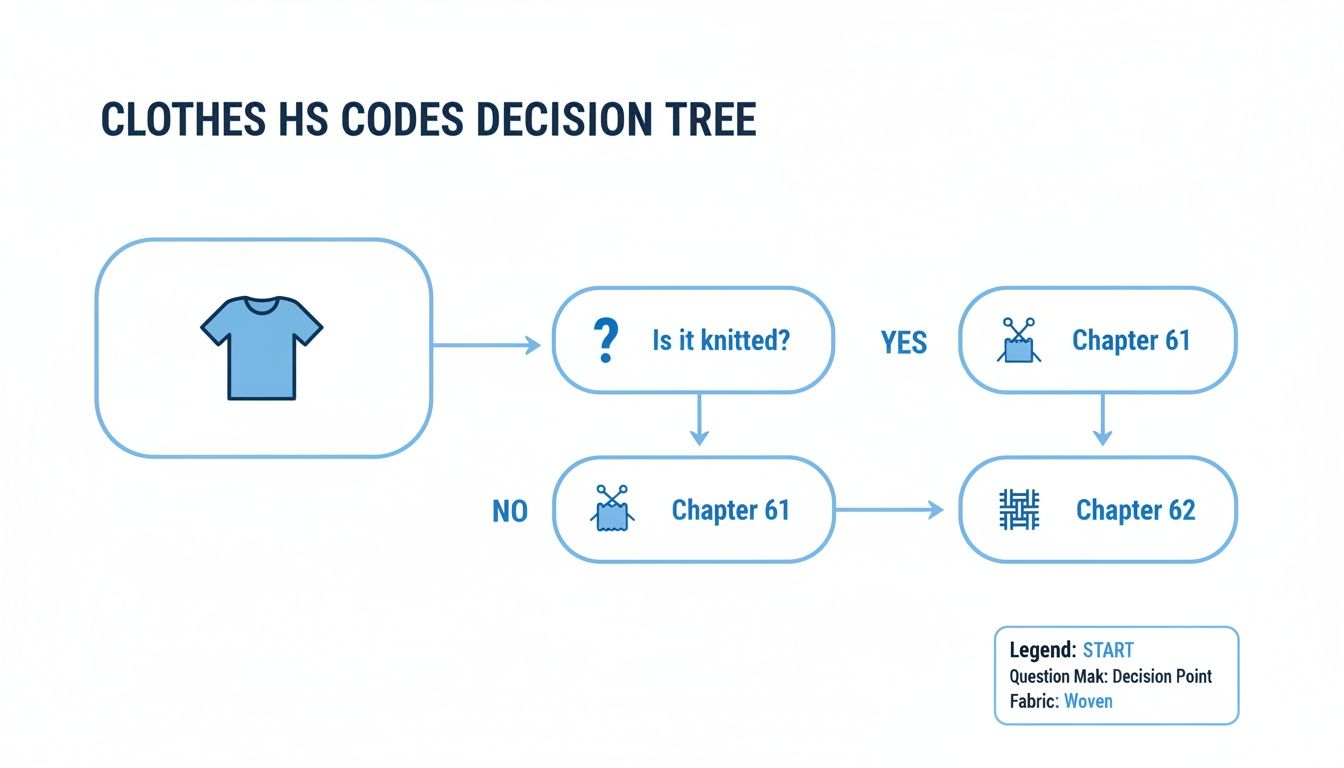
    The first and most important distinction in apparel classification is the fabric's construction. Everything boils down to two chapters: Chapter 61 for knitted or crocheted items and Chapter 62 for woven items. Is the fabric made of interlocking loops (knitted), or is it a grid of intersecting threads (woven)? That single decision is your starting point.

    You can see this structure laid out in the Harmonized System itself, as shown on the WCO Trade Tools website.

    This official breakdown into Sections, Chapters, and Headings is the blueprint for every single clothes HS code.

    Common HS Codes for Garments

    To speed things up, I’ve put together a table with the 6-digit HS codes for some of the most common clothing items we see moving across borders. Just keep in mind that these first six digits are the universal part; the importing country will add its own digits to get more specific.

    Here’s a quick lookup table that gets straight to the point, highlighting the all-important split between knitted (Chapter 61) and woven (Chapter 62) goods.

    Common Clothes HS Codes at a Glance

    Garment Type Primary Material HS Code (Chapter 61 – Knitted) HS Code (Chapter 62 – Woven)
    T-Shirts & Vests Cotton 6109.10 N/A (Typically knitted)
    Trousers & Shorts Cotton 6103.42 (Men's) / 6104.62 (Women's) 6203.42 (Men's) / 6204.62 (Women's)
    Blouses & Shirts Synthetic Fibres 6106.20 (Women's) 6205.30 (Men's) / 6206.40 (Women's)
    Sweaters & Pullovers Man-Made Fibres 6110.30 N/A (Typically knitted)
    Jackets & Blazers Wool or Fine Animal Hair 6103.31 (Men's) / 6104.31 (Women's) 6203.31 (Men's) / 6204.31 (Women's)
    Underpants & Briefs Cotton 6107.11 (Men's) / 6108.21 (Women's) 6207.11 (Men's) / 6208.91 (Women's)

    This table covers many of the basics, giving you a solid starting point for classification.

    How to Use This Table Effectively

    When you use this table, the golden rule is to always confirm the primary material by weight. That single factor often determines the final subheading. For example, a men's woven blazer made mostly of wool falls under HS code 6203.31. But if that same jacket were made from cotton, its code would change to 6203.32.

    A common pitfall I see is misclassifying unisex items. Customs authorities often have very specific rules based on the garment's cut, sizing, or even how it buttons (e.g., left-over-right for menswear) to determine whether it’s for men or women. This directly changes the HS code heading, so it pays to be precise.

    This quick reference is a fantastic shortcut, but don't forget to cross-check your final code against the official tariff schedule of the destination country. This is especially true for garments with mixed materials or unusual features. Getting it right not only keeps you compliant but also helps you avoid costly delays and penalties that can easily throw your entire supply chain off schedule.

    How Material Composition Impacts Your HS Code

    Once you've figured out if a garment is knitted (Chapter 61) or woven (Chapter 62), your next task is to pinpoint its material composition. This is a huge factor in getting the HS code right, as customs officials rely on it to apply the correct tariffs and trade regulations.

    It all starts with identifying the single fibre that has the greatest weight. A shirt made of 100% cotton is simple enough, but most modern clothing is made from blends to improve feel and performance. Getting the material right is one piece of the puzzle; another is managing the physical goods, where efficient textile storage systems play a vital role in any smooth supply chain operation.

    This flowchart shows that first, crucial decision point every classifier has to make: knitted or woven?

    HS codes decision tree flowchart for classifying clothes as knitted or woven.

    Making the right choice here gets you into the correct chapter. From there, the material composition guides you to the exact heading and subheading for your product.

    The Predominant Weight Rule

    When dealing with blended fabrics, customs classification hinges on the predominant weight rule. The idea is straightforward: the garment is classified under the heading for whichever single textile material outweighs any other.

    Let's look at a sweater made from a blend:

    • 45% Cotton
    • 35% Polyester
    • 20% Wool

    In this case, no single material hits the 50% mark. However, cotton is the heaviest component, so you would classify this sweater under the HS code for cotton sweaters. In Singapore's dynamic textile and garment market, cotton is king, making up US$7.86 billion—roughly half the market—and is forecast to grow by 5.45% through 2032.

    Key Takeaway: The Predominant Weight Rule isn't about a majority. It's about plurality. The single heaviest fibre dictates the classification, even if it's less than 50% of the total weight.

    Classifying Common Materials

    Different materials point to different subheadings within the HS code framework. Knowing these distinctions is absolutely essential for accurate classification.

    Cotton (e.g., Subheading .20): Garments where cotton is the main material, like a men's woven shirt (6205.20), are some of the most frequently classified items.

    Man-Made Fibres (e.g., Subheading .30, .40): This is a wide-ranging category that covers synthetic fibres like polyester and artificial ones like viscose. A women's woven polyester blouse, for instance, would be classified under HS code 6206.40.

    Wool or Fine Animal Hair (e.g., Subheading .10, .31): This is where you'd classify items like a men's woven wool suit jacket (6203.31).

    Getting the material right isn't just a box-ticking exercise for compliance; it has a direct effect on the duties you'll pay and your access to certain markets. If you want to go deeper into material classification, have a look at our guide on the fabric HS code.

    Classifying Clothes by Gender and Age Group

    Once you’ve nailed down the material and construction, the next step in pinpointing the right HS code for clothing is figuring out who it's made for. The Harmonized System draws a hard line between clothes for men and women, and for adults and children. This isn't just a minor detail; it determines the four-digit heading and is fundamental to getting your tariffs and stats right.

    Take, for example, HS Heading 6203, which covers "Men's or boys' suits, ensembles, jackets…". Right next to it, you'll find Heading 6204 for "Women's or girls' suits, ensembles, jackets…". This parallel setup runs through both Chapter 61 (knitted) and Chapter 62 (woven), making it a core principle of apparel classification. Confusing these two is a surprisingly common mistake, and it can be a costly one.

    Differentiating Men's and Women's Apparel

    So, what happens with unisex-style items? Customs officials don't just guess. If there's no clear label, they rely on objective, physical characteristics to decide if a garment is for men or women.

    Here’s what they typically look for:

    • Cut and Styling: Garments with a shaped waistline or darts meant to fit a bust are almost always classified as womenswear.
    • Sizing: The sizing system itself is a huge clue. A UK women's size 12 is a world away from a men's medium, and customs knows the difference.
    • Closure: It's an old-school rule, but it still holds: men's garments traditionally button on the right and fasten left-over-right. Women's clothing is the opposite.

    Getting this right has real commercial impact. In Singapore's apparel market, which is heavily reliant on imports under HS chapters 61 and 62, womenswear accounted for a massive 56.3% of the market share, worth US$2.0 billion in 2023. You can dig into data on Singapore's apparel market trends to see exactly why logistics teams are so meticulous about classifying this high-value segment correctly.

    Classifying Infant and Children's Wear

    Infants' clothing gets its own dedicated HS headings, like 6111 for knitted items and 6209 for woven ones. The rule of thumb here is size. A garment is generally considered infants' wear if it's designed for a baby with a body height not exceeding 86 cm.

    Anything larger than that moves into the "boys'" or "girls'" categories, which are nested within the main men's and women's headings. Properly classifying by age and gender isn't just about ticking a compliance box—it's about making sure your shipments sail through customs without getting flagged for unnecessary inspections or delays.

    Using Clothes HS Codes for Lead Generation

    For freight forwarders and logistics sales teams, a clothes HS code is far more than a customs formality. It's a powerful key that unlocks a goldmine of global trade data, turning a simple compliance number into a direct route for finding high-value shippers.

    Instead of casting a wide net for "apparel companies," you can use customs data platforms to get surgically precise. Filtering import and export records by a specific HS code lets you find exactly who is shipping the products you're best equipped to handle.

    Pinpointing High-Value Prospects

    Let's say your sales team has deep expertise in managing high-volume, fast-fashion imports. You can pinpoint this exact market by filtering trade data for the right codes.

    • Filter by garment type: A quick search for HS code 6109.10 will instantly pull up a list of every company importing cotton T-shirts.
    • Identify volume shippers: Dive into the bill of lading data tied to these codes. You can see which importers are moving the most containers or have the highest shipment values, separating the big players from the small fry.
    • Analyse trade lanes: See which businesses are consistently shipping from manufacturing hubs like Vietnam or Bangladesh into key markets like Singapore. This reveals active, lucrative supply chains ready for your services.

    This transforms your prospecting from educated guesswork into a data-backed strategy. You end up focusing your energy on companies with proven, current shipping needs. Platforms like Coreties are built specifically to turn these raw data points into clean, actionable lead lists.

    As the screenshot shows, the right platform can translate messy customs data into a neat prospect list, complete with contact information and detailed shipping history.

    Crafting Data-Driven Outreach

    Once you've built a target list, the HS code data gives you everything you need for outreach that actually works. You can stop sending generic "we can move your freight" emails and start conversations that show you've done your homework.

    Example Outreach Angle: "I noticed your company's recent shipments of women's woven trousers (HS code 6204.62) from China. We have extensive capacity on that lane and have helped similar apparel importers reduce their transit times by an average of two days."

    This level of specific detail immediately establishes your credibility and proves you understand their business, making a response far more likely. It pays to focus on growing markets. For instance, Singapore's fashion apparel imports under HS Chapters 61 and 62 grew by an impressive 11.47% from 2023 to 2024, confirming why this trade lane should be a priority. You can dig deeper into these trends by exploring research on Singapore's apparel market.

    The table below outlines a few practical strategies to get you started.

    Actionable Lead Generation Strategies Using Clothes HS Codes

    Strategy Required HS Code Filter Business Outcome
    Target High-Volume Importers Filter by a specific code (e.g., 6109.10 for T-shirts) and sort by shipment volume or value. Identify the largest, most consistent shippers in a niche, ensuring sales efforts are focused on high-potential accounts.
    Find New Trade Lane Opportunities Search for companies importing apparel (Chapters 61 & 62) from a specific country of origin (e.g., Bangladesh). Uncover active supply chains and prospects who are already shipping on lanes where your company has a competitive advantage.
    Identify Competitor's Clients Filter for shipments handled by a rival freight forwarder, then analyse the HS codes of the goods they are moving. Pinpoint dissatisfied clients or opportunities where you can offer better service or rates for specific product types.

    Ultimately, this strategic use of clothes HS codes connects your team's technical knowledge directly to revenue growth. It's an indispensable tool for any modern logistics sales professional. For a more detailed walkthrough of this technique, check out our guide on how to find qualified leads with an HS Code filter.

    Common Classification Mistakes to Avoid

    Auditing classification errors of clothing and goods with a magnifying glass and checklist on a wooden desk.

    Getting a clothes HS code wrong isn't just a simple paperwork slip-up. It can snowball into hefty fines, frustrating shipping delays, and even seizures by customs. If you look at customs data year after year, you'll see that textiles and apparel consistently rank among the most frequently misclassified product categories. This isn't an area where you can afford to guess.

    One of the most common and easily avoidable mistakes we see is mixing up knitted and woven fabrics. It sounds basic, but classifying a woven shirt from Chapter 62 under the knitted apparel Chapter 61 is an immediate red flag for customs officials. This kind of error often triggers a full inspection, leaving your shipment stuck in port for days or even weeks.

    Misclassifying Garment Sets and Mixed Fibres

    Another tricky area is how to handle clothing sets. For instance, a men's suit that's sold together as a single retail product needs to be classified under a single HS code. The correct approach is to classify the entire set under the heading for the jacket or blazer (usually HS Heading 6203). You can't code the trousers separately; that’s a direct violation of classification rules and will cause problems.

    Mixed-fibre garments also trip people up all the time. The rule here is about identifying the material with the predominant weight. It's not about which fibre makes up more than 50% of the garment, but which single fibre is the heaviest.

    A perfect example: a jumper made of 45% cotton, 35% polyester, and 20% wool. Even though no single fibre makes up half the weight, you must classify it as a cotton jumper because cotton is the single heaviest component.

    Overlooking National Code Variations

    Relying on the international six-digit HS code and stopping there is a critical mistake. Every importer must use the full eight- or ten-digit code that’s specific to the country of destination. Those last few digits are what determine the actual tariff rate. Get them wrong, and you could be facing a bill for underpaid duties or, conversely, overpaying and losing money.

    Here are a few practical tips to keep your classifications accurate and avoid these common pitfalls:

    • Always Verify Fabric Construction: Don't just rely on a spec sheet. If you can, get your hands on a fabric sample to confirm whether it's knitted (Chapter 61) or woven (Chapter 62) before you assign any code.
    • Consult Set Classification Rules: When you're dealing with goods sold as a set, get familiar with the General Rules of Interpretation (GRI 3). It provides the official guidance for these specific situations.
    • Obtain Full Material Specs: Always ask your manufacturer for a detailed bill of materials. You need this breakdown to accurately determine the predominant fibre by weight.
    • Use Destination Country Tariff Schedules: Before finalising anything, cross-reference your classification against the official tariff database of the importing country. This is the only way to be certain you're using the correct and complete national-level code.

    Your Top Questions About Clothes HS Codes, Answered

    When you're dealing with international clothing shipments day in and day out, you're bound to run into some tricky questions about HS codes. Let's clear up some of the most common ones that pop up.

    Getting these details right from the start is the key to getting your apparel through customs without a hitch.

    How Do I Find the Full 10-Digit HS Code?

    This is a big one. The first six digits of an HS code are the same everywhere—they're part of a global standard managed by the World Customs Organisation. But for customs duties and trade statistics, countries add their own digits to the end, creating a full code that’s usually 8 or 10 digits long.

    To get the complete, country-specific code for your clothing, you have to check the official customs tariff database for the country you're shipping to. There's no way around this. Using the right code is essential because those final digits dictate the exact duty rate you'll pay.

    What's the Difference Between an HS Code and an HTS Code?

    People often use these terms as if they mean the same thing, but there's a crucial difference. An HS code is the universal 6-digit international standard.

    An HTS code, which stands for Harmonized Tariff Schedule code, is the 10-digit system used specifically by the United States for imports. It starts with the standard 6-digit HS code and adds four more digits for U.S.-specific tariff and data collection. Other places have their own versions, like the EU's 8-digit Combined Nomenclature (CN) code.

    Key Insight: Think of the 6-digit HS code as the global foundation. The HTS or CN code is the country-specific extension built on top of it. Always use the full, correct code for your destination country to stay compliant and avoid overpaying duties.

    Are Accessories Like Belts and Scarves Classified with Apparel?

    This is a classic trap. As a rule, accessories don't get lumped in with the clothing in Chapters 61 and 62. You need to classify each item on its own, unless it officially qualifies as part of a set under customs rules.

    Here's a quick look at where some common accessories land:

    • Belts: Usually found in Chapter 42 (leather) or Chapter 39 (plastic). If they're mostly textile, they might end up in Chapter 62.
    • Scarves and Shawls: These are classified by how they're made—Chapter 61 if they're knitted or crocheted, and Chapter 62 if they're woven.
    • Hats and Headgear: These get their own dedicated chapter, Chapter 65.

    It's absolutely vital to classify every item in a shipment separately. Trying to bundle a belt with a pair of trousers under a single clothes HS code is a surefire way to trigger customs delays and potential fines.


    Stop chasing leads and start using data to find them. With Coreties, you can filter global trade data by specific clothes HS codes to pinpoint your ideal shipping prospects in seconds. Uncover high-volume importers, map out trade routes, and build outreach lists that actually convert. Learn more and book your demo with Coreties today.