
When you're moving goods in and out of Singapore, everything needs a label, a specific code that tells customs exactly what it is. That universal language is the Harmonized System (HS) code, and Singapore's specific version is laid out in the Singapore Trade Classification, Customs & Excise Duties (STCCED). Think of it as the definitive local guide for classifying every conceivable product.
This isn't just bureaucratic box-ticking. Getting the HS code right is fundamental to smooth and cost-effective shipping. It's the key to calculating duties and the Goods and Services Tax (GST), which directly impacts your bottom line. A simple mistake here can spiral into expensive delays, hefty fines, or even having your shipment impounded. For anyone in logistics, mastering this system is non-negotiable.
Understanding the 8-Digit Singapore HS Code
So, how does Singapore's system work? It starts with the globally recognised 6-digit Harmonized System code set by the World Customs Organization. Singapore then adds two more digits, creating a more detailed 8-digit code. This expansion is based on the ASEAN Harmonised Tariff Nomenclature (AHTN), which helps standardise trade language across Southeast Asia.
These extra two digits are crucial because they specify local requirements, like duty and GST rates or whether the item is controlled by a specific government body. This alignment with the AHTN means an 8-digit code used in Singapore is structurally understood by customs authorities throughout the region, creating a consistent framework for trade. For the most current classifications, the official Singapore Customs website is your primary source.
To make it clearer, let's break down what each part of the code signifies.
Breaking Down the 8-Digit Singapore HS Code
The table below deconstructs the 8-digit Singapore HS code, showing how each component builds upon the last to create a highly specific product identifier.
| Digits | Component Name | What It Represents |
|---|---|---|
| First 2 | Chapter | The broad category of the product. For example, Chapter 09 covers coffee, tea, and spices. |
| First 4 | Heading | A more specific grouping within the chapter. For instance, 09.01 refers to coffee. |
| First 6 | Subheading | A detailed product description under the heading. For example, 09.01.11 covers non-decaffeinated, unroasted coffee. |
| Last 2 | AHTN/National | The local classification for ASEAN and Singapore-specific duty, tax, and control purposes. |
As you can see, the code becomes more granular with each pair of digits, moving from a general product category to a very specific item definition.
Why Singapore HS Codes Matter
These codes do more than just identify products; they are the operational backbone of customs procedures. Here are their primary functions:
- Duty and Tax Calculation: The code is the direct input for determining the exact import duties and GST payable on any given shipment.
- Regulatory Compliance: It flags goods that fall under the control of Competent Authorities (CAs), like the Health Sciences Authority (HSA) for medical devices or the Singapore Food Agency (SFA) for food products.
- Trade Data Collection: The government relies on HS code data to compile precise statistics on Singapore's import and export volumes, which informs national trade policy.
How to Interpret the HS Code Structure
Getting a grip on the Harmonized System (HS) is a bit like learning the language of global trade. It’s not just a random string of numbers; it's a logical, hierarchical system where each digit drills down to a more specific product description. Think of it as a precise address for any product in a colossal global catalogue, ensuring everyone from Singapore to San Francisco classifies goods the same way.
The entire framework is underpinned by a set of principles called the General Interpretative Rules (GIRs). These six rules are the legal backbone of classification, spelling out the exact process customs officials must follow. Getting these rules right is absolutely fundamental to avoiding expensive classification mistakes down the line.
The Building Blocks of an HS Code
Imagine an inverted pyramid. That’s an HS code. It starts broad at the top and gets progressively more specific as you go down. The first six digits are the international standard, set by the World Customs Organization (WCO) and used as a common language by over 200 countries.
Here’s how it breaks down:
- Chapter (First 2 digits): This is the highest, most general level. For instance, Chapter 85 covers "Electrical machinery and equipment and parts thereof."
- Heading (First 4 digits): This narrows it down. Within Chapter 85, Heading 85.17 points specifically to "Telephone sets, including telephones for cellular networks or for other wireless networks."
- Subheading (First 6 digits): This adds another layer of detail. Subheading 8517.12 pins it down to "Telephones for cellular networks or for other wireless networks."
This chart neatly visualises how the system flows from the global WCO standard all the way down to Singapore's national level.
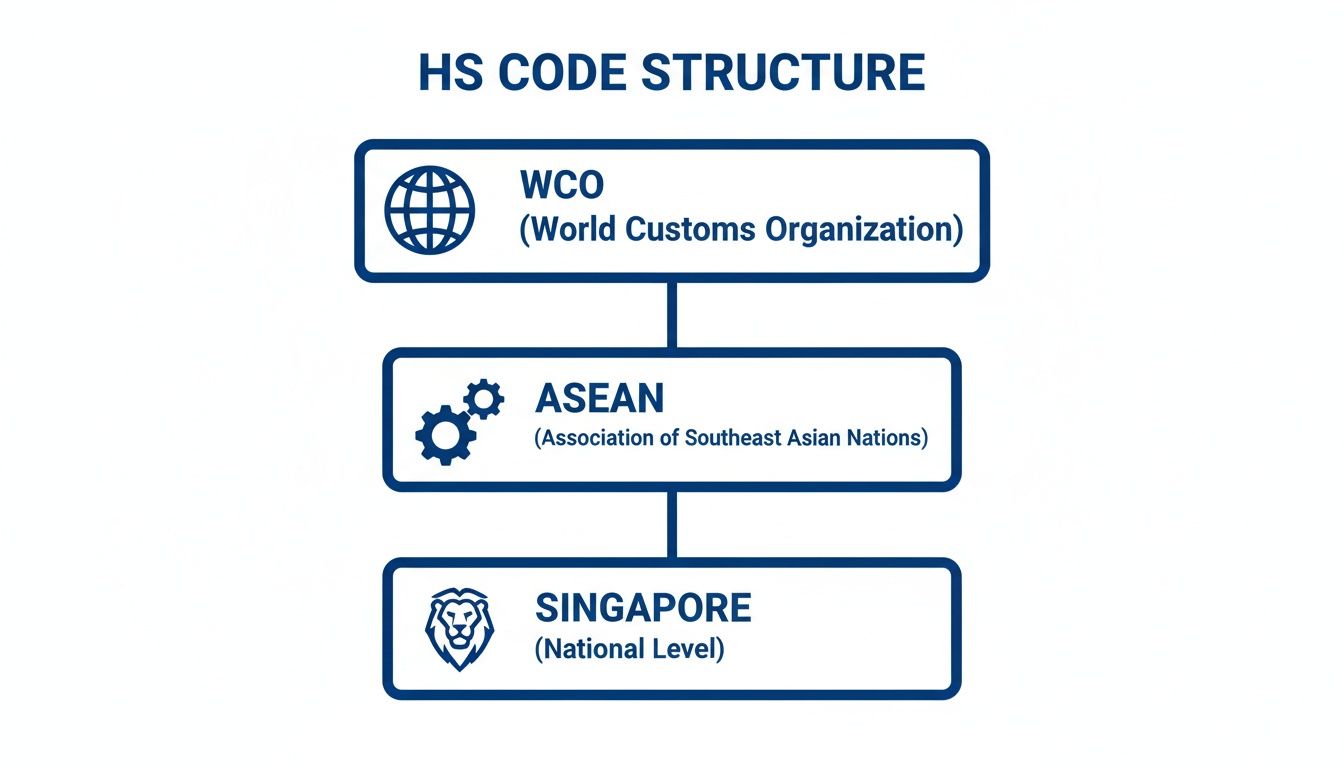
As you can see, Singapore doesn’t just adopt the global standard; it builds on it, adding layers for regional and local customs requirements.
National and Regional Specificity
While the first six digits provide a global baseline, countries often need more detail for their own purposes. This is where extra digits come into play.
Here in Singapore, we use an eight-digit system based on the ASEAN Harmonised Tariff Nomenclature (AHTN). These last two digits are critically important. They determine local duties, GST, and flag whether a product needs a license from a Competent Authority (CA). For anyone involved in Singaporean trade, correctly interpreting the full eight-digit code isn't just good practice—it's essential for compliance.
Your Searchable Guide to Major Commodity HS Codes
For any professional in logistics, especially here in Singapore, having common HS codes at your fingertips is a game-changer. Think of this section as your quick-reference cheat sheet, organised by the major commodity groups that drive our trade. It's the digital equivalent of having a well-worn HS code book on your desk, perfect for those initial client calls or for quickly classifying a shipment.
Instead of getting bogged down in dense tariff schedules, you can use the information here to zero in on the right Chapter and Heading for commonly shipped goods. This is all about speeding up the classification process, so you can deliver faster quotes and prepare more accurate paperwork right from the get-go.
To make things even easier, here's a quick lookup table covering some of the most frequently moved commodities in and out of Singapore.
Common HS Codes for Top Singapore Commodities
| Commodity Group | HS Chapter | Example Product | Example HS Code (Heading) |
|---|---|---|---|
| Electronics | Chapter 85 | Smartphone | 8517 |
| Machinery | Chapter 84 | Laptop Computer | 8471 |
| Pharmaceuticals | Chapter 30 | Packaged Medication | 3004 |
| Chemicals | Chapter 29 | Organic Chemicals (e.g., Acetic Acid) | 2915 |
| Mineral Fuels & Oils | Chapter 27 | Refined Petroleum Oils | 2710 |
This table is a great starting point, but let's dive into some of these key sectors for a more detailed look.
Electronics and Electrical Machinery
Singapore is a massive global hub for electronics, so it’s no surprise that goods under Chapter 85 are constantly moving through our ports. This chapter is incredibly broad, covering everything from tiny microchips to the latest consumer gadgets. You'll find yourself referencing it often.
For example, a smartphone slots neatly under Heading 8517. But what about all the individual parts inside it? They each have their own specific codes. Integrated circuits, the brains of the device, are classified under Heading 8542, while the various insulated wires and cables are found in Heading 8544. If you need to get even more granular with wiring, you can learn more about finding the correct cable HS code in our detailed article.
A crucial tip to remember: an item's main purpose is what usually determines its classification. Take a smartwatch—it does many things, but according to the General Interpretative Rules (GIRs), it must be classified based on its principal function.
Industrial Machinery and Mechanical Appliances
Another pillar of Singapore's trade is industrial machinery, which mostly falls under Chapter 84. This is a massive category, covering everything from nuclear reactors and printing presses to the computers we use every day.
Here are a few common examples you’ll likely encounter:
- Automatic Data Processing Machines (Laptops/Computers): Heading 8471
- Pumps for Liquids: Heading 8413
- Air Conditioning Machines: Heading 8415
- Printing Machinery: Heading 8443
Getting the classification right here is absolutely vital. Different machines can face very different duty rates, and some may require special import permits based on their technology or intended use.
Chemicals and Pharmaceutical Products
The chemical and pharmaceutical industries are also major players in Singapore's trade ecosystem. Goods from these sectors are mostly classified between Chapters 28 and 38.
For instance, Chapter 29 is all about organic chemicals, while Chapter 30 is specifically for pharmaceutical products. A shipment of medication packaged for retail sale would be classified under Heading 3004. However, the bulk active ingredients used to make that medicine would be classified somewhere else, most likely back in Chapter 29. This distinction is a perfect example of why precision is so critical when working with the HS system.
Finding Your Way Around the Official Singapore Customs HS Code Search
While having a physical HS code book on your desk can be handy, the absolute gold standard for getting the most accurate and current classifications is the official Singapore Customs HS/CA Product Code Search engine. This free online tool is your definitive source for making sure a shipment’s code is fully compliant with Singapore’s regulations, including any specific rules from Competent Authorities (CAs).
Getting comfortable with this portal turns the theoretical knowledge of classification into a practical, everyday skill. Forget flipping through pages; you can get a solid answer in seconds. This lets you confirm duties, GST, and any potential licensing needs well before a shipment is even on the water, which is crucial for sidestepping expensive customs delays.
How to Use the HS Code Search Portal
The search engine itself is quite user-friendly. You can search by a specific HS code if you already have one in mind, or you can search by a product description, which is what you'll likely be doing most of the time to classify a new item.
Here’s a look at the main search interface on the TradeNet portal.
The trick to getting good results is using clear and specific keywords in the "Product Description" field. This really helps to narrow down the possibilities and get you to the right code faster.
Making Sense of Your Search Results
Once you've entered your search term, the portal will show you a list of potential HS codes. Each result comes with a detailed description and notes on any associated CA controls. It's so important to read these descriptions carefully to find the one that most accurately describes your product.
A search for "coffee," for instance, will bring up several results—roasted, unroasted, decaffeinated, even coffee substitutes. Picking the right one is everything. The results will also tell you if an authority like the Singapore Food Agency (SFA) controls the import, which is your cue that you’ll need additional permits.
For a more detailed walkthrough, our guide to the Singapore Customs HS code digs deeper into this process.
Avoiding Common HS Classification Mistakes
Getting the HS classification right is absolutely critical. One small mistake can snowball into expensive delays, customs fines, and a serious dent in your client relationships. Even those of us who have been in the game for years can get tripped up by the complexities of the official hs code book. Knowing where the common traps lie is the best way to protect your shipments.
One of the biggest trip-ups is getting a product's main function wrong. The General Interpretative Rules (GIRs) are clear on this: if a product does several things, you have to classify it based on its principal purpose. Think about a smartwatch. Sure, it tells time, but its primary job is processing data and connecting you to your network. That's why it belongs under Heading 8517 (telephones for cellular networks), not somewhere in Chapter 91 with traditional clocks and watches.
Another classic headache is figuring out how to classify kits or sets.
Correctly Classifying Sets and Kits
When you're dealing with goods packaged together as a set for retail, it's a special case. A common mistake is to classify each item inside the box separately, but that’s not how it works. The entire set gets classified under a single HS code—the one that represents the item giving the set its essential character.
Let's take a grooming kit as an example. Inside, you've got an electric razor, some shaving cream, and a brush.
- Electric Razor: Heading 8510
- Shaving Cream: Heading 3307
- Brush: Heading 9603
Here, the electric razor is obviously the main event. So, the whole kit and caboodle gets classified under Heading 8510. You don't need to list out three different codes. This approach keeps your customs declarations clean and compliant.
If there's one piece of advice to take away, it's this: always, always read the Section and Chapter notes in the STCCED. These notes are legally binding and often contain specific rules—inclusions or exclusions—that will override what seems like the obvious general classification. Ignoring them is probably one of the most frequent causes of misclassification.
Overlooking these finer points can lead to customs rejecting your declaration outright. That means major hold-ups and potential penalties for your client. By taking the time to pinpoint a product's true function, handle sets correctly, and comb through all the relevant notes, you'll steer clear of these common errors and prove your worth as a logistics pro.
How to Use HS Codes for Strategic Lead Generation
Most freight professionals see the hs code book as a necessary tool for customs and compliance. But if that's all you're using it for, you're missing out on a massive opportunity. For the savvy freight forwarder, HS codes are the key to unlocking a highly targeted pipeline of shipper leads. It's about speaking the language of commodities to turn broad trade data into real, actionable sales intelligence.
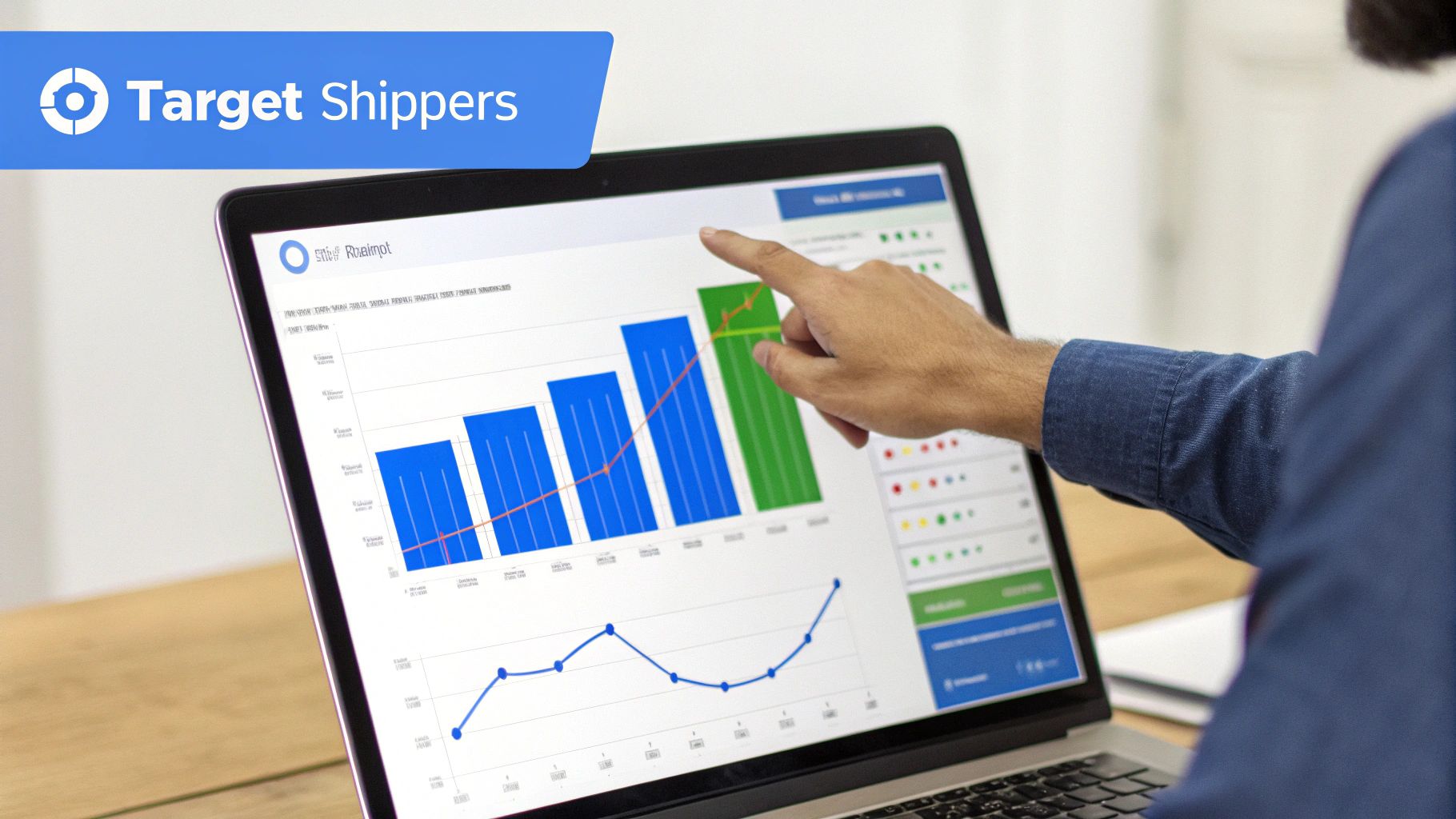
Think of it this way: instead of casting a wide, generic net, you can zero in on specific markets. Platforms like Coreties are built for exactly this. You can filter the entire shipping landscape to find every company in Singapore that regularly exports electronics under HS Chapter 85 or machinery under Chapter 84. This lets you focus your sales team's energy where it counts most—on industries you already understand and where you have a competitive edge.
Turning Data into Actionable Insights
The real magic happens when you start layering HS code data with other business metrics. Just knowing what a company ships isn't enough; you need to know if they're a growing business or a shrinking one.
A truly strategic approach means identifying companies whose shipment volumes for a specific HS code are on the rise, month after month. A steady increase is a clear signal of growing demand, which often means they'll soon need more sophisticated logistics support.
This data-driven approach makes your outreach incredibly relevant. Your pitch transforms from a generic "we can ship your goods" to a compelling, value-packed opener like, "We noticed your export volume for laptops under HS 8471.30 has jumped by 20% this quarter. Our specialised solutions for handling sensitive electronics could really help optimise your supply chain." To dive deeper, check out our detailed guide on using an HS code filter to find your next best customer.
Identifying High-Value Opportunities
Because Singapore's HS code system is directly linked to customs pricing and controls, any shifts in tariffs or price indices have a direct financial impact on shippers. A prospecting tool that combines HS-based price trends with customs data can pinpoint shippers who are not just growing in volume but are also dealing with price index increases of 5–10 points. This often signals higher-value shipments and a bigger budget for premium logistics. You can learn more about how these indicators are calculated on the Singapore Department of Statistics website.
With this level of insight, you're no longer just talking about shipping costs. You're having a strategic conversation about value and market dynamics, positioning yourself as a knowledgeable partner. By truly mastering the HS code book, you can transform a simple compliance task into your most powerful lead generation machine.
Your Top Questions About HS Codes Answered
Even for those of us who live and breathe logistics, navigating the finer points of Singapore's HS code system can throw up a few curveballs. Here are straightforward answers to some of the questions we hear most often, designed to give you clarity and confidence in any classification scenario.
What Is Singapore's Official HS Code Book?
The definitive guide is the Singapore Trade Classification, Customs & Excise Duties (STCCED). While you might still see physical copies around, the single source of truth is the digital HS/CA Product Code Search engine on the Singapore Customs website. This online tool is always current, reflecting the very latest tariff changes and regulatory tweaks. It's the one you should always rely on.
How Often Does the HS Code System Change?
The global Harmonized System, which is managed by the World Customs Organization (WCO), gets a major overhaul roughly every five years. This keeps the system in step with new technologies and product innovations. The last big update was in 2022.
However, that's not the whole story. Singapore can and does make national-level adjustments to its 8-digit codes more frequently. These changes often align with new local policies or ASEAN trade agreements. That’s why you can't just rely on a saved list; you have to verify the codes on the official customs portal every time.
It’s a common misconception that HS codes are static. In reality, the system is a living document that evolves with global trade, making continuous verification a non-negotiable part of the job for freight forwarders.
How Do I Classify a Brand-New Product?
When you're dealing with a product so new it doesn't have an obvious home in the tariff book, you need to turn to the General Interpretative Rules (GIRs). They provide a logical framework for classifying just about anything.
Here's a practical approach:
- Look for Close Relatives: Start by identifying headings for products that are similar in function, material, or construction.
- Apply GIR 3: If your product could reasonably fit into more than one category, GIR 3 is your guide. It helps you pinpoint the product's "essential character" – the component or material that truly defines what it is.
- Check the Fine Print: Don't skip the Section and Chapter Notes. They are full of specific inclusions and exclusions that can be the key to classifying a novel item correctly.
- Get an Official Ruling: If you're still stuck and the stakes are high, the best move is to apply to Singapore Customs for an official classification ruling. This gives you certainty and protects you from future compliance issues.
What if I Disagree with a Customs Classification?
It happens. If a customs officer reclassifies your shipment and you're convinced your original code was correct, you have a right to appeal.
The first step is to build your case. Prepare a detailed written justification explaining why you chose your HS code. You'll need to reference the specific GIRs, section notes, and product specifications that back up your argument. In these situations, solid documentation isn't just helpful—it's everything.
Ready to turn compliance into a powerful sales tool? Coreties turns global customs data into a targeted lead-generation engine. Filter prospects by HS code, identify growing shippers, and craft data-driven outreach that closes deals faster. Discover your next best customer with Coreties.