Tag: hs code classification

  • Booklet HS Code: Your 2026 Guide to Classification

    Booklet HS Code: Your 2026 Guide to Classification

    The booklet hs code commonly needed starts with 4901.10, which covers pamphlets, booklets, brochures, leaflets, and similar printed matter in single sheets. That small number decides how customs reads your shipment, and getting it wrong can mean delays, wrong duty treatment, and an uncomfortable call from your client asking why their cargo is stuck.

    If you work in forwarding or logistics sales, you’ve probably seen the situation already. A shipper says, “It’s just marketing material.” The supplier sends a code. Someone copies it into the paperwork. Then customs looks closer and decides the item isn’t a simple folded leaflet at all, but a bound printed product that belongs somewhere else in Chapter 49.

    That’s where people get tripped up. “Booklet” sounds simple in everyday language, but customs doesn’t classify by casual wording. Customs looks at form, presentation, and product details. Is it a single folded sheet? Is it stitched? Is it more like a brochure, a bound publication, or another kind of printed matter?

    For a new logistics sales team, this matters for two reasons. First, correct classification protects the shipment. Second, correct classification helps you understand trade flows, spot active importers, and identify prospects by commodity and lane. The same code that clears freight can also help you find companies that regularly move printed materials.

    Why Your Booklet HS Code Is Crucial for Global Trade

    A wrong code often starts with a shortcut. Someone trusts the factory’s description, the commercial invoice says “booklets,” and the shipment moves with a code that sounds close enough. Then customs asks for clarification because the physical product doesn’t match the declaration.

    That’s not a paperwork nuisance. It affects clearance, landed cost, and your client’s confidence in your team.

    The Harmonized System, managed by the World Customs Organization, is used to classify over 98% of merchandise in global trade across 206 countries, supporting $28.5 trillion in world merchandise trade in 2021 according to the U.S. Department of Commerce overview of HS codes. In practical terms, HS classification is the shared language customs authorities use to decide what a product is before they decide what happens next.

    What the code actually does

    For printed materials, the booklet hs code does more than label the item. It influences:

    • Customs acceptance: Officers compare the declared code to the product description and the physical goods.
    • Duty treatment: A small classification shift can change how tariff treatment is applied.
    • Document consistency: Your invoice, packing list, customs entry, and product description all need to line up.
    • Client trust: Shippers remember the forwarder who prevented a customs problem, and they remember the one who missed it.

    Practical rule: If a customer says “booklet,” your next question shouldn’t be “what code did the supplier use?” It should be “how is it physically made?”

    Many newer teams treat HS codes as a back-office issue. That’s a mistake. Sales people, operations staff, and customs specialists all benefit when they understand the basics. If your customer moves printed catalogs, promotional inserts, training manuals, or folded event guides, you need enough classification knowledge to spot risk before the shipment is booked.

    Why logistics teams should care early

    This matters before the cargo departs, not after customs flags it. A short pre-shipment review can save a lot of friction later. Ask for a sample image, page count, and binding method. Those details often tell you whether 4901.10 is a good fit or whether the product belongs elsewhere in Chapter 49.

    If you want a broader foundation before drilling into printed matter, this guide to harmonized code books is a useful starting point.

    The key point is simple. A booklet hs code is not a guess, not a supplier habit, and not a generic admin field. It’s a legal product classification that affects how the shipment is treated from the first customs review onward.

    Decoding the Harmonized System for Printed Materials

    Most confusion disappears once you understand how HS codes are built. Think of the system like a library. You start with a large shelf category, then narrow down to a specific section, then to a very specific item.

    For printed goods, the broad shelf is Chapter 49, which covers printed books, newspapers, pictures, and other products of the printing industry. Within that chapter, customs narrows the product by heading and subheading until the classification becomes precise enough for international use.

    A diagram explaining the breakdown of Harmonized System codes for classifying printed books and materials.

    Reading 4901.10 step by step

    Take 4901.10.

    • 49 identifies the chapter for printed materials.
    • 4901 narrows it to printed books, brochures, leaflets, and similar printed matter.
    • 4901.10 narrows further to items in single sheets, whether or not folded.

    That last part is where many people make the wrong call. They hear “booklet” and assume any small printed publication fits. Customs cares about the physical format. A folded promotional handout and a stitched multi-page booklet may not land in the same subheading.

    Why Chapter 49 matters beyond compliance

    Chapter 49 isn’t just useful for customs clearance. It also makes printed goods trackable in trade data. According to the U.S. trade dataset referenced through Data.gov, global exports of printed books under HS 4901 totaled $15.7 billion in 2021, with the UK, US, and Germany as major exporters. That level of granularity is what lets logistics professionals see where printed goods move, who trades them, and which lanes are active.

    That’s why a code like 4901.10 has business value beyond customs. It creates a usable filter for trade intelligence.

    Customs doesn’t classify “marketing collateral” as a category. It classifies the physical article you can hold in your hand.

    If your team sells freight services, this is useful language to adopt with clients. Instead of asking for broad descriptions like “printed media,” ask for specifics that match Chapter 49 logic. Is it a leaflet? A brochure? A printed book? A map? A child-focused picture book? The better your product description, the better your classification.

    A practical way to think about code hierarchy

    Use this quick mental model:

    Level Example What it tells you
    Chapter 49 Printed materials broadly
    Heading 4901 Printed books, brochures, leaflets, similar matter
    Subheading 4901.10 Single sheets, whether or not folded
    National extension varies by country The tariff line used for local duty treatment

    This is also where teams confuse HS with local tariff codes. The first six digits are the global language. After that, countries can add more digits for local tariff and statistical purposes.

    If you want another plain-language overview of how document-related printed matter fits into classification logic, this article on the harmonized code for documents helps bridge the gap between customs terminology and day-to-day shipping work.

    How to Classify Your Booklets Correctly

    Classification gets easier when you stop asking “what do we call it?” and start asking “what exactly is it?” For booklets, the decision usually turns on format.

    The first hard line is this: 4901.10 applies to pamphlets, booklets, brochures, and similar printed matter in single sheets, whether or not folded, according to the Cybex HS reference for heading 4901. The same source notes that misclassification between this line and bound printed matter can trigger customs delays averaging 5 to 10 days and penalties of up to 100% of shipment value.

    That’s why you should classify with a checklist, not instinct.

    A professional analyzing a digital flowchart on a computer screen related to classifying various booklets.

    Start with the physical form

    Ask these questions in order:

    1. Is it a single sheet, even if folded?
      If yes, 4901.10 is often the starting point.

    2. Is it bound or stitched into multiple pages?
      If yes, don’t assume 4901.10 still works.

    3. Is it clearly another printed category?
      Some items in Chapter 49 belong under different headings altogether, such as children’s picture books or maps.

    4. How is it presented in commerce?
      A customs officer will look at the actual article, not the marketing name used by the supplier.

    Use examples, not labels

    Here’s where new teams usually need help.

    • A folded event handout printed on one large sheet is often closer to 4901.10.
    • A saddle-stitched training booklet with multiple pages may point away from 4901.10 and toward another printed-book subheading.
    • A perfect-bound book usually belongs with other printed books, not single-sheet matter.
    • A children’s picture book may belong in a different line from general printed booklets.

    People get confused because all of these can be called “booklets” in normal conversation. Customs won’t use everyday language that loosely.

    The comparison that saves time

    HS Code Comparison for Common Printed Matter

    HS Code (First 6 Digits) Product Description Key Differentiating Feature
    4901.10 Pamphlets, booklets, brochures, leaflets, and similar printed matter in single sheets Single sheet, whether or not folded
    4901.91 Dictionaries and encyclopedias, and serial installments thereof Bound printed works in this specific subheading category
    4901.99 Other printed books Printed books that don’t fit the more specific subheadings
    4905.91 Brochures, leaflets, and similar printed matter Used where the printed matter aligns with this narrower map or brochure-related line from Chapter 49 context

    That table doesn’t replace a tariff review, but it gives your team a practical screening tool.

    If you can’t answer “single sheet or bound?” you’re not ready to finalize the code.

    A simple review routine for your team

    Before you submit documentation, check five things:

    • Request a sample image: A product photo often reveals more than the description.
    • Confirm binding method: Folded, stapled, stitched, glued, or perfect bound can change the analysis.
    • Ask for page construction: One folded sheet is not the same as a multi-page item.
    • Match wording across documents: Invoice description and declared code should support each other.
    • Escalate borderline cases: If the product sits between brochure and bound publication, get broker input before filing.

    This discipline matters even if your role is sales. A salesperson who spots a likely classification issue before pickup protects margin, transit time, and the customer relationship.

    For teams handling broader printed-book shipments, this resource on the harmonized code for books can help sharpen the distinction between booklet-type goods and standard book classifications.

    Avoiding Common and Costly Classification Mistakes

    Most booklet classification errors are preventable. They happen because people rush, reuse an old code, or rely on a supplier description that isn’t precise enough for customs.

    The biggest trap is assuming the product name decides the code. It doesn’t. “Booklet,” “brochure,” and “catalog” are commercial words. Customs classification depends on the physical article and the tariff logic behind it.

    A custom declaration form on a wooden desk next to a pen, smartphone, and a small plant.

    The mistake that shows up most often

    A common problem is the line between 4901.10 for single-sheet matter and 4901.91 for certain bound printed products. According to the Datamyne HTS reference for 4901100000, this distinction is poorly understood, and errors are estimated to inflate landed costs by 5% to 10% on 15% of printed material imports.

    That should get your attention. Not because every shipment will be audited, but because the error pattern is common enough to affect routine freight.

    Four habits that create trouble

    • Copying the supplier’s code: Suppliers may know the product, but they don’t carry your customs liability.
    • Ignoring binding details: A steel staple, stitched spine, or glued binding can change the analysis.
    • Using old shipment history: Last year’s code may not fit this year’s revised product format.
    • Writing vague invoice descriptions: “Printed matter” tells customs almost nothing useful.

    A lot of teams also underplay the effect of small physical changes. Someone switches from a folded leaflet to a stapled booklet and thinks the old code still works. That’s exactly how misclassification sneaks in.

    What better practice looks like

    The best operators don’t trust shorthand. They verify. They ask the shipper for dimensions, page layout, and binding details. If the item is promotional, educational, or informational, they still classify the physical goods rather than the business purpose.

    The safest phrase in customs work is “send me a photo and the exact format.”

    That’s the mindset to build inside a logistics team. Not fear, but disciplined skepticism. If the shipment contains printed goods under Chapter 49, someone should confirm whether it’s single-sheet matter or a bound publication dressed up with casual wording.

    Navigating Country-Specific Tariff Nuances

    The six-digit HS code is global. The tariff treatment isn’t. Once you move beyond those first six digits, each country can extend the code for its own customs purposes.

    That matters because a shipment that seems straightforward at the HS level can become more complicated when national tariff schedules, trade remedies, or reporting requirements come into play. For booklets, this often shows up when the physical item includes materials beyond paper and ink.

    Why the local tariff line matters

    A U.S. importer doesn’t stop at the six-digit HS subheading. The product must fit the U.S. tariff schedule at the longer national line. The same logic applies in other markets that extend the global code with their own subdivisions.

    At this point, many teams fall into a false sense of security. They identify Chapter 49 correctly and assume the work is done. It isn’t always.

    The steel staple issue logistics teams can’t ignore

    Recent 2025 and 2026 updates mean logistics teams need to watch for booklet products with steel staples or similar components. According to the CBP bulletin on these trade-rule updates, such products could, under certain rules, be treated as steel derivative products, potentially triggering duties of up to 50% on the steel content value.

    That catches people off guard because the product still looks like ordinary printed matter. But customs treatment can turn on a non-paper component if the applicable trade rule says it should.

    A booklet is never “just paper” if another material changes the tariff outcome.

    For teams estimating landed cost, a tool like this Import Tax Calculator can help frame the bigger duty conversation for clients, especially when you need to explain why local tariff treatment can differ from the simple six-digit classification discussion.

    A practical screening question

    Before filing, ask one more question beyond the paper classification: does the product include a component that could trigger a separate tariff issue?

    Examples include:

    • Steel staples or wire binding
    • Mixed-material presentation components
    • Packaging features that may need separate review
    • Country-specific reporting requirements beyond the base HS line

    The operational lesson is clear. Start with the booklet hs code, but don’t stop there. In country-specific tariff work, the physical details around the printed item can matter almost as much as the printed item itself.

    From Classification to Lead Generation with Customs Data

    HS codes are often treated as a compliance field. That’s too narrow. In logistics sales, classification can also be a practical signal for market activity.

    When an importer regularly declares printed materials under Chapter 49, that tells you something useful. It tells you what they move, where they source it, and which trade lanes may matter to them. That’s not abstract market research. It’s shipment-level evidence that a company is active in a commodity class your team may be able to serve.

    A diverse group of professionals collaborating while looking at a data dashboard on a computer monitor.

    Why HS-filtered customs data is useful for sales

    Customs data becomes commercially powerful when you can search it by product code, origin, destination, and shipper. If your team specializes in printed products, promotional materials, retail inserts, or publishing-related freight, Chapter 49 is a natural filter.

    That creates several practical sales uses:

    • Prospecting by commodity: Find shippers that regularly import printed matter.
    • Prospecting by lane: Narrow the search to the trade lanes your network handles well.
    • Timing outreach: Reach out when the company is clearly active, not when you’re guessing.
    • Tailoring the message: Reference the shipment type, lane, and likely pain points.

    This is also where sales teams benefit from understanding the basics of what lead generation entails. In logistics, the strongest leads usually come from observable shipping behavior, not broad firmographic lists.

    A practical use case for booklet-related freight

    Say your team wants to win more business from importers of printed promotional materials. You can start with HS lines in Chapter 49 that fit booklet-like goods, then narrow by route and shipment pattern.

    A useful workflow looks like this:

    1. Choose the relevant printed-goods code set
      Start with the code family most aligned to booklet-type shipments.

    2. Filter by trade lane
      Focus on origins and destinations where your team already has strong carrier or forwarding coverage.

    3. Review recurring importers
      Repetition matters more than one-off shipments because recurring trade suggests ongoing logistics needs.

    4. Check the wider shipping profile
      If the same shipper also imports display materials, retail packaging, or related goods, your potential conversation becomes broader.

    5. Write outreach around operational relevance
      Mention documentation discipline, printed-goods handling, and lane-specific service options rather than sending a generic “we offer freight” email.

    Why this angle works

    A lot of logistics prospecting fails because the message isn’t tied to a real shipping pattern. The seller knows the industry, but not the account. HS-based customs data changes that. It gives you context before the first message.

    The strongest outreach starts with “we noticed you move this product on this lane,” not “just checking if you need freight support.”

    That’s the business-development value of classification. The same code that helps customs understand a product also helps your sales team understand a market.

    If you train your team to read Chapter 49 properly, they won’t just avoid coding mistakes. They’ll also get better at spotting active shippers, segmenting opportunities, and opening conversations that feel informed instead of generic.

    Frequently Asked Questions About Booklet HS Codes

    A few questions come up repeatedly once teams start using the booklet hs code in real shipments. These are the ones worth answering clearly.

    Short answers teams can use immediately

    Common Questions about HS Codes

    Question Answer
    What is the booklet hs code? The main starting point is 4901.10 for pamphlets, booklets, brochures, leaflets, and similar printed matter in single sheets.
    Is every item called a booklet classified under 4901.10? No. Everyday product names don’t control customs classification. Binding and physical format matter.
    What’s the difference between HS and HTS? HS is the international six-digit structure. HTS is a country-specific extension used in the United States for tariff treatment.
    Why do teams confuse booklet classifications so often? Because commercial language is loose, while customs classification depends on exact physical characteristics.
    How often does the HS system change? The Harmonized System is updated every five years.
    Where should I verify a code before shipping? Check the importing country’s tariff schedule and, for borderline items, confirm with a licensed customs professional or broker.

    The update cycle matters more than people think

    The HS system isn’t static. The World Customs Organization updates it every five years, which means an old internal reference sheet can become outdated. That’s one reason strong teams don’t rely on memory alone. They verify classifications against current tariff schedules.

    The best internal rule for sales and operations

    If the product is printed matter and the description says “booklet,” your team should pause long enough to ask for the format details. That one habit catches a large share of preventable errors.

    You don’t need every salesperson to become a classifier. You do need them to know when a shipment deserves a second look.


    If your team wants to turn product codes and trade lanes into real prospect lists, Coreties helps logistics businesses work from customs-backed shipper activity instead of guesswork. That means you can identify companies moving printed goods, find the right contacts, and start more relevant freight conversations with less manual research.
  • A Freight Forwarder’s Guide to Harmonized Code for Documents

    A Freight Forwarder’s Guide to Harmonized Code for Documents

    You might think classifying a pallet of brochures is a world away from classifying a complex piece of machinery. In a way, you're right. But when it comes to customs, the rules are just as rigid. Every item, no matter how simple it seems, needs a harmonized code for documents. This code is part of the global Harmonized System (HS), which acts as a universal translator, telling customs officers in any country exactly what’s in the box. Nailing this code is fundamental to getting shipments across borders without a hitch.

    Why Harmonized Codes for Documents Matter

    Man in safety vest reviewing documents next to a "CLASSIFY RIGHT" display in a warehouse.

    It’s all too easy to brush off the classification for printed materials. A stack of annual reports just doesn't feel as significant as a container full of electronics, right? The thing is, customs officials see things differently. For them, every single item that crosses a border needs a precise classification. This is how they calculate duties, track trade statistics, and screen for security risks.

    The Risks of Misclassification

    Getting the harmonized code wrong for documents can set off a chain reaction of problems. An incorrect code on the commercial invoice is an instant red flag, often leading to shipment holds and time-consuming inspections. Those delays don't just frustrate clients; they can cause a shipper to miss a critical deadline for a trade show or an important investor meeting.

    On top of that, mistakes get expensive. Customs authorities can levy hefty fines for incorrect declarations. If duties were underpaid because of the error, the importer of record is on the hook for the difference, plus interest. For a freight forwarder, these slip-ups are more than just a financial headache—they erode credibility and can cost you clients.

    Think of HS codes as a passport for your goods. A passport with the wrong information will get you stopped at the border every time. The same is true for shipments with incorrect classifications—they get stuck in customs, creating problems for everyone involved.

    A Competitive Edge for Forwarders

    When you get this right, though, it’s a game-changer. Mastering the classification of printed matter turns a compliance chore into a powerful way to build trust and operate more efficiently. When you consistently classify documents correctly, you’re not just moving boxes; you’re demonstrating a level of expertise and reliability that shippers desperately need. That becomes a huge selling point.

    This expertise also creates new business opportunities. Once you understand the specific HS codes for high-volume printed materials, you can start to spot companies that would be perfect prospects for your services. If you learn how to find a harmonized code effectively, you can turn this specialized knowledge into a real strategy for winning new clients.

    Navigating HS Codes for Printed Matter

    When you’re trying to find the right harmonized code for documents, the Harmonized System’s chapter structure is your map. The best way to think about it is like walking into a massive library. Chapter 49 is the "Printed Matter" section, while Chapter 48 is the "Paper & Paperboard" section. Knowing which aisle to head down first is everything.

    Most of the time, finished printed goods—think books, company brochures, or newspapers—are going to fall squarely into Chapter 49. This chapter is specifically for products where the real value lies in the information printed on them, not just the paper they’re made of. On the other hand, Chapter 48 is for the raw material: blank stationery, reams of printing paper, or rolls of newsprint.

    The Core Chapters for Documents

    Getting the distinction between these two chapters right from the start is critical. If you're shipping a pallet of finished user manuals for a new product, you’ll be working within Chapter 49. But if you're shipping the blank, unbound paper that will become those manuals, your search begins in Chapter 48. This single decision sets the course for your entire classification process.

    This system isn't some new bureaucratic hurdle; it's been the global standard for decades. The Harmonized System was established back in 1988 by the World Customs Organization (WCO). Today, it's used by over 200 countries and territories, covering over 98% of all merchandise in global trade. Getting these codes right can speed up customs processing by as much as 30%, while a simple mistake is one of the top reasons for costly fines and delays. You can read more about this global trade language on gofreight.com.

    The core logic is simple: a book is not just paper, and a blank envelope is not yet a letter. The HS code reflects this difference in purpose and value, guiding customs officials on how to treat the shipment.

    To make things even clearer, let's look at some of the most common codes for documents and printed materials.

    Here’s a quick-reference table to help you find the right starting point for your shipment.

    Common HS Codes for Documents and Printed Matter

    HS Heading Description Examples
    4901 Printed books, brochures, leaflets, and similar printed matter Novels, textbooks, corporate annual reports, instruction manuals
    4902 Newspapers, journals, and periodicals Daily newspapers, weekly magazines, academic journals
    4905 Maps and hydrographic or similar charts of all kinds Road atlases, geographical wall maps, nautical charts
    4908 Transfers (decalcomanias) Temporary tattoos, iron-on transfers, decorative decals
    4911 Other printed matter Posters, calendars, commercial catalogs, printed pictures

    This table covers the most frequent classifications, but remember to always drill down to the full 6- to 10-digit code for your specific country of import.

    Common Headings in Chapter 49

    Within Chapter 49, the headings get even more specific. Think of these as the individual shelves in our library analogy, each holding a very particular type of printed item. Nailing the right heading is how you pinpoint the final, correct HS code.

    Here’s a closer look at a few of the most common headings you'll run into:

    • HS 4901: This is your go-to for printed books, brochures, and leaflets. It’s one of the most widely used codes for document shipments, covering everything from novels to technical manuals and company reports.

    • HS 4902: This heading is reserved for newspapers, journals, and periodicals. It doesn't matter if they are filled with illustrations or advertising—if it's a serial publication, it likely belongs here.

    • HS 4911: This is a bit of a catch-all category for "other" printed matter. Think trade show flyers, commercial catalogues, calendars, and printed art reproductions. If your document doesn't neatly fit into a more specific heading, it often ends up here.

    Understanding these subtle differences is what prevents costly classification mistakes. For instance, a marketing brochure (HS 4911) is classified differently from a detailed technical book (HS 4901). For a much deeper look into classifying books, be sure to check out our guide on the harmonized code for books.

    Applying the Rules for Correct Classification

    Knowing the right HS chapters is a great start, but the real expertise shines through in how you apply the rules. This is where your decisions directly impact whether a shipment sails through customs or gets stuck in costly delays. Think of the General Interpretative Rules (GIRs) as the official rulebook for the Harmonized System—they provide the framework for classifying goods consistently, especially for tricky items that don't fit neatly into one box.

    When dealing with a harmonized code for documents that are bundled with other products, the single most important concept to master is essential character. This principle helps you pinpoint the main identity of a product made of multiple parts.

    For instance, a user manual shipped with a new laptop doesn't get its own classification. The "essential character" of the shipment is the laptop itself. So, the whole package, including the manual, falls under the laptop's HS code in Chapter 84, not as a printed book under Chapter 49.

    A Practical Process for Document Classification

    To keep things clear and accurate, it helps to follow a consistent process every time you classify printed materials. This gives you a defensible logic for your choice, which is your best defense against customs disputes.

    1. Analyze the Item's Core Purpose: First, what is the document for? Is it a novel meant for reading (HS 4901)? Is it a brochure designed to promote a service (HS 4911)? Or is it a technical guide that's useless without the machine it comes with (classified with the machine)?

    2. Identify the 'Essential Character': If documents are just one part of a larger kit, you have to decide what gives the entire shipment its identity. A board game that comes with a rulebook, playing cards, and plastic tokens is classified as a game (HS 9504), not as printed matter. The book is just an accessory to the main event: playing the game.

    3. Consult the Chapter and Section Notes: Before you lock in a code, always read the legal notes at the start of the relevant chapters (especially 48 and 49). These notes are non-negotiable and contain specific inclusions, exclusions, and definitions that can override any general assumptions you might have.

    This decision path offers a simple way to approach the initial classification for standalone printed items.

    Flowchart showing the HS Code decision path for printed items, including books, ads, and other paper products.

    As you can see, asking a few basic questions—Is it a book? Is it advertising material?—can quickly point you in the right direction.

    Verifying Your Classification

    Once you've landed on a potential code, there’s one final, crucial step: verification. Check your work against official customs rulings databases. These resources contain thousands of binding decisions on how specific products were classified in the past, giving you solid ground to stand on.

    A well-documented classification isn't just about being right; it's about being able to prove you are right. Always keep a record of your research, the GIRs you applied, and any specific rulings you used to make your decision.

    For teams struggling with the sheer volume and complexity of this work, modern AI Document Processing services can make a world of difference. These tools can help automate the analysis of shipping manifests and commercial invoices, flagging potential issues and suggesting the correct harmonized code for documents with far greater consistency and less human error.

    Real-World Document Classification Scenarios

    A blue notebook labeled 'Classification Examples' with a pen, surrounded by open books on a wooden desk.

    Knowing the rules is one thing. Applying them correctly when a shipment is on the line is a completely different ballgame. Let's make the harmonized code for documents less abstract by working through some common situations you'll face every day. These examples show just how much the little details matter in avoiding big, costly mistakes.

    First up: a pallet of 5,000 high-quality marketing brochures is headed to a major trade show in Germany. These glossies are packed with product photos, specs, and pricing. They aren't bound like books and are meant to be handed out for free to drum up business.

    The key factor here is their purpose. These are undeniably advertising materials. That immediately steers us away from the general book code (4901) and points us directly to HS Heading 4911, which is the go-to for "Other printed matter." More specifically, they belong under the subheading for trade advertising material and catalogues.

    Architectural Plans and Annual Reports

    Here's another one I see all the time: a tube containing rolled-up architectural blueprints. An engineering firm is sending these plans to an overseas partner for a new construction project. They aren't for sale; they are essential technical documents.

    While the primary value is the information printed on them, they don't look or feel like books or brochures. Just like the marketing materials, these plans find their home in the versatile HS Heading 4911 as a form of "other printed matter." A rookie mistake is to classify them under Chapter 48 with other paper products, but that's wrong—the printed design gives them their essential character, not the paper itself.

    Now, let's shift to a shipment of 1,000 case-bound annual reports for a corporation's international investors. These are professionally printed, hard-bound books filled with financial statements and company data.

    Unlike flyers or posters, these reports are bound and structured like books. This detail is crucial. Their format and content clearly align with HS Heading 4901, which covers printed books, brochures, and similar printed matter.

    These scenarios highlight how the physical form and intended use completely dictate the correct HS code. In the middle of all this, forwarders are often dealing with dozens of other documents, like commercial invoices. Using tools for automating the processing of invoices can be a lifesaver, helping pull the necessary data for an accurate classification without manual entry.

    The Critical "With" or "Without" Distinction

    This next part is arguably the most important distinction to master. It all comes down to context. Let's take a simple user manual.

    • Scenario A: A single user manual is packed inside a box with the lawnmower it explains how to use. Without the mower, the manual is just paper. In this case, the manual is considered an accessory. The entire shipment is classified under the lawnmower's HS code (likely in Chapter 84).

    • Scenario B: A separate shipment contains 10,000 user manuals being sent to a warehouse for future use with new products. Shipped in bulk and by themselves, the manuals are now the main product. They must be classified as printed books under HS 4901.

    Grasping this "with or without" logic is fundamental. It's what separates a good freight forwarder from a truly great one who acts as a trusted advisor to their clients. Get this right, and you'll prevent countless headaches and customs delays.

    Turning HS Code Data Into Shipper Leads

    Getting the harmonized code for documents right does a lot more than just keep customs happy—it’s a powerful tool for growing your business. As a freight forwarder, this knowledge isn't just about smooth operations; it’s your key to uncovering a goldmine of high-quality shipper leads. It lets you switch from simply reacting to quote requests to proactively finding your next best clients.

    The logic is straightforward. Companies that consistently import or export large volumes of printed materials are your ideal customers. Think about publishers moving books (HS 4901), big brands distributing marketing collateral (HS 4911), or public companies sending out stacks of annual reports. These businesses have predictable, ongoing shipping needs. The real trick is figuring out who they are.

    Finding Prospects in Trade Data

    This is where customs data platforms become one of your most valuable sales tools. Instead of making cold calls or guessing which companies might need you, you can pinpoint businesses based on what they’re actually shipping. It completely changes the game, moving your sales efforts from speculation to precision.

    The World Customs Organization's framework catalogs over 5,000 commodity groups, covering 98% of global trade. In the US alone, imports under HS Chapter 49 are worth billions each year. Freight professionals find that mastering these codes can speed up clearance by 25%. For a forwarder, filtering this massive dataset by HS code turns raw information into a list of verified leads. You can see more about how HS codes work on oec.world.

    By focusing your search on the specific HS codes for documents, you're essentially creating a pre-qualified list of prospects. These aren't just names pulled from a directory; they are active businesses with a proven, consistent need for a logistics partner who gets the nuances of shipping printed goods.

    From Data to Deals

    Modern platforms like Coreties take this process a giant step further. They don't just tell you which companies are shipping; they help you find and connect with the right decision-makers inside those companies. You can turn that raw customs data into a targeted outreach list, complete with verified contacts and email addresses. For a deeper dive into this strategy, check out our guide on using an HS Code Filter for lead generation.

    Take a look at the kind of high-level data you can access, which shows the top global importers of printed materials.

    This snapshot shows you the biggest markets for printed books, newspapers, and pictures, instantly highlighting where the major trade flows are. A smart forwarder can use this to identify high-potential regions and then zero in on the companies driving that volume.

    With this kind of data in hand, your sales pitch becomes incredibly compelling. Imagine approaching a potential client and saying, "I see your company regularly imports materials under HS code 4911. We specialize in handling these shipments and can guarantee a smooth customs process." You immediately show your value and position yourself as an expert, not just another vendor. It’s simply a smarter way to build your pipeline and drive real, sustainable growth.

    Frequently Asked Questions About Document Classification

    Even when you know the rules inside and out, classifying documents can throw some real curveballs. The world of shipping is filled with one-off scenarios that just don't fit the textbook examples. We've put together this FAQ to tackle those common but confusing situations, giving you straight answers so you can handle any harmonized code for documents with confidence.

    Let's clear up the questions that can trip up even the most seasoned freight forwarders and cause unnecessary delays.

    What Is the HS Code for Documents with No Commercial Value?

    This one comes up all the time. A shipper might send a box of internal training manuals or personal letters and mark it "No Commercial Value" (NCV). But that label doesn't mean it gets a free pass on classification. Every single physical item that crosses a border needs an HS code, no matter its monetary worth.

    The trick is to classify the item for what it is, not what it’s worth. A stack of internal company newsletters, for example, is still printed matter. You’d classify it as such, likely under HS Heading 4911. The NCV declaration simply tells customs how to approach duties and taxes—which are often zero for these items—but you still have to classify it correctly.

    Think of it this way: your passport has no resale value, but it still has a classification as a travel document. Customs needs to know what the item is, even if they aren't going to tax it. It’s standard practice to declare a nominal value like $1, but the HS code must be accurate.

    How Do I Classify Digital Documents on Physical Media?

    What about when you ship a USB drive loaded with software or a hard drive full of massive PDF catalogs? This is where the "essential character" rule really comes into play. You have to ask: is the value in the physical flash drive, or in the data it’s carrying?

    While the data is obviously the valuable part, the Harmonized System classifies goods based on their physical, tangible form.

    • A USB drive full of marketing videos gets classified as a USB drive under HS Heading 8523, which covers discs, tapes, and other storage media.
    • The software or data itself is considered intangible. It doesn't get an HS code, but its value is declared separately for customs valuation.

    You're classifying the physical object that's crossing the border, not the bits and bytes on it. A common mistake is trying to classify the digital files under Chapter 49 as if they were printed documents. That's a surefire way to get it wrong. Always focus on the tangible medium.

    What Should I Do When HS Codes Change?

    The Harmonized System isn't set in stone. The World Customs Organization (WCO) updates it every five years to keep pace with new technology and global trade, with the next major revision coming in 2028. On top of that, individual countries can—and do—update their own tariff schedules more frequently, often once a year.

    When a code you use all the time gets changed or even deleted, you need to be on top of it.

    1. Stay in the loop: Subscribe to updates from your national customs authority and the WCO.
    2. Audit your codes: At least once a year, run through the HS codes for your most common shipments. Double-check that they're all still valid.
    3. Update your tools: If you rely on software or a database for your classifications, make sure it’s running on the latest tariff schedule. A code that worked perfectly last December could get a shipment rejected in January.

    Using an outdated code isn't a small mistake; customs authorities see it as a compliance failure. As a forwarder, being the one who flags a necessary update for your client shows you're not just moving boxes—you're a true expert and a valuable partner.


    Ready to turn customs data into your best source of qualified leads? Coreties transforms billions of global trade records into actionable prospect lists, complete with verified contacts. Find companies shipping documents, machinery, or anything in between, and connect with the right decision-makers in just a few clicks. Stop cold calling and start having data-driven conversations that win business. Discover your next best client at https://coreties.com.

  • A Complete Guide to PCB Board HS Code Classification

    A Complete Guide to PCB Board HS Code Classification

    The main HS code for a printed circuit board is 8534, which covers bare, unpopulated printed circuits. But that simple number is just the beginning. The correct code changes dramatically the moment you add components, turning that bare board into a Printed Circuit Board Assembly (PCBA). Getting this distinction right is the single most important step to avoiding expensive shipping delays and customs fines.

    Cracking the Code: Understanding PCB HS Codes

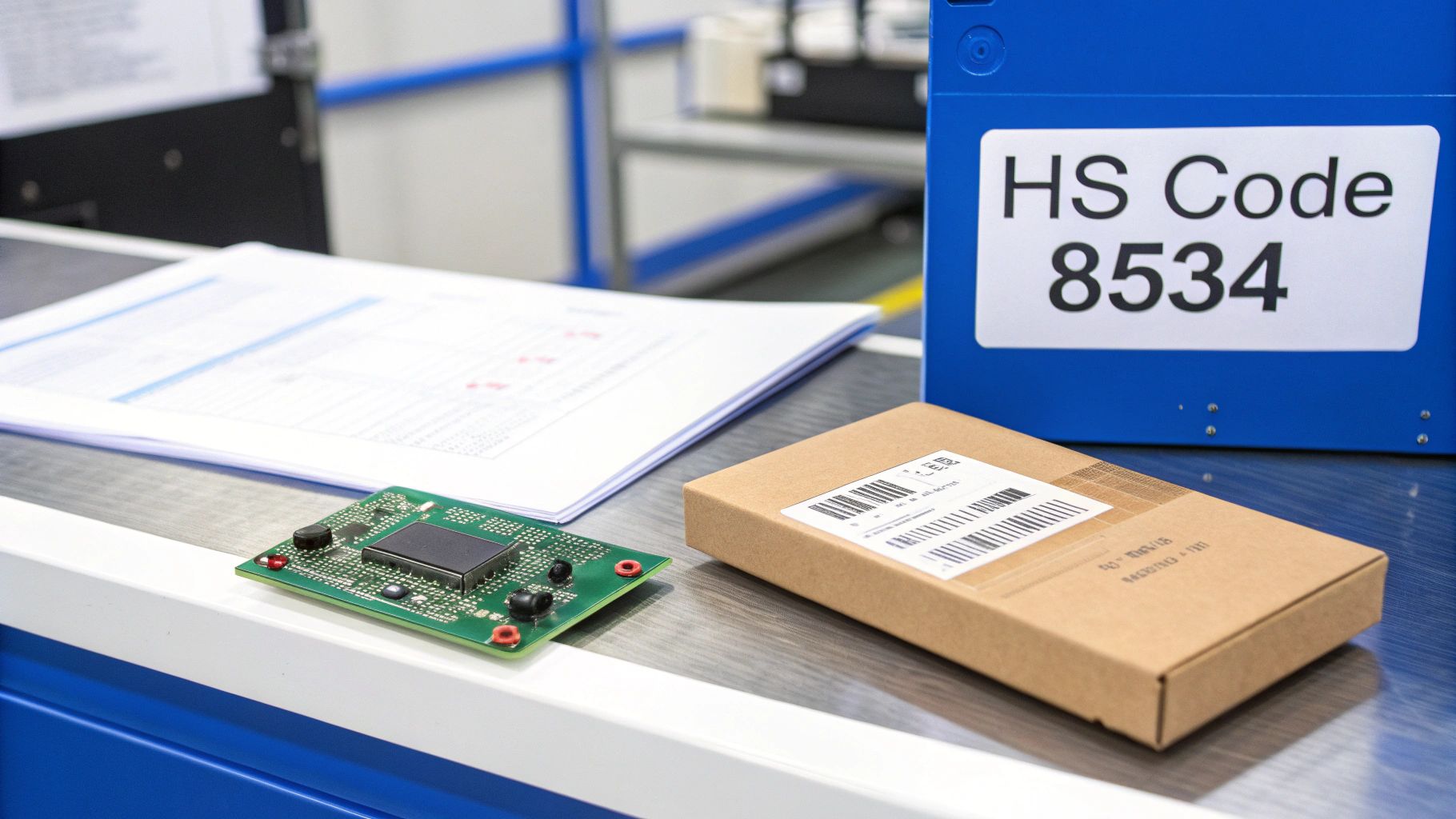
    A green printed circuit board, a brown package, and an 'HS Code 8534' label on a workbench.

    Trying to ship electronic components internationally can often feel like speaking a different language. The Harmonized System (HS) code is that language—a universal classification system that customs authorities all over the world use to identify products, calculate duties, and gather trade data. Think of it as a global passport for your goods; it makes sure every country knows exactly what's inside the box.

    For anyone working in electronics logistics, knowing your PCB HS codes isn't just about ticking a box. It's a core skill. The wrong code can flag your shipment for inspection, slap you with surprise tariffs, and even damage your relationship with your customers. Nail it, and your shipments will glide through customs, saving you a world of time and money.

    Why This Code Matters So Much

    The HS code is built like a pyramid, breaking products down from broad categories into very specific items. It starts with a general Chapter, gets more specific with a Heading, and then drills down even further with a Subheading. The first six digits are the same everywhere, creating a universal standard for global trade.

    It’s this shared system that lets a customs officer in Singapore understand a shipment from Germany without needing to read a complex technical manual. It makes the whole process predictable.

    The most crucial factor in determining the correct HS code is the board's state: is it bare or populated? This single distinction changes everything, from the primary heading used to the potential duties owed.

    Bare vs. Populated Boards: A Critical First Step

    The heart of PCB classification comes down to one question: is it a bare board or an assembly?

    A bare Printed Circuit Board (PCB) is just the foundation. It's the flat board etched with conductive pathways, but with no electronic components soldered onto it yet. These fall cleanly under HS Heading 8534.

    But the second you solder on components like microchips, resistors, or capacitors, it becomes a Printed Circuit Board Assembly (PCBA). This completely changes its "essential character" in the eyes of customs. It's no longer just a circuit; it's now a functioning electronic module.

    As a result, its classification shifts to entirely different headings. It might fall under HS 8542 for integrated circuits, or even be classified under the chapter for the final product it's designed to be part of. We’ll walk through how to make this call with confidence, paving the way for smooth, accurate customs declarations.

    Decoding HS Code 8534: The Language of Printed Circuits

    Think of a product’s HS code not as a random set of numbers, but as a universal language that tells customs officials its story. For bare, unpopulated printed circuit boards, that story begins with Chapter 8534. This is the specific identifier that tells everyone, from a customs agent in Singapore to one in Germany, that you’re shipping a bare printed circuit.

    The whole system works on a simple idea: getting more specific with each set of numbers. Every two digits you add drills down further into the product's details, like filtering search results. The first six digits are the most important, as they are standardised across the globe, creating a common ground for international trade.

    This global standard is what makes trade work smoothly. It means an agent doesn't need to be a circuit board engineer to understand what they're looking at. The code does the talking, classifying a complex component into a clear category for assessing duties and taxes.

    The First 6 Digits: A Universal Standard

    Let's break down the most common code for bare PCBs, 8534.00, to see how this hierarchy works in practice.

    • Chapter 85: This is the top-level category. It covers all "Electrical machinery and equipment and parts thereof," placing your PCB squarely in the electronics family.
    • Heading 8534: This narrows it down significantly to just "Printed circuits." Now, customs knows it’s a board designed for mounting components, not a finished product.
    • Subheading 8534.00: This final pair of digits, at the international level, often simply confirms the item is a printed circuit, with no other bells and whistles.

    This screenshot from the World Customs Organisation's Trade Tools shows how the system funnels down from a broad section to a very specific product heading.

    As you can see, it’s a logical path from a massive category of goods down to the precise item you’re shipping.

    Getting Specific: Subheadings for Different PCB Types

    While 8534.00 is a great starting point, the real world of PCBs is far more diverse. At the 8- or 10-digit national level, customs codes get much more granular to account for this. This is where the physical characteristics of the board come into play, and knowing them helps you get the classification right every time.

    Two of the most common differentiators are:

    • Layer Count: Is it a simple single-sided board, a double-sided one, or a complex multilayer PCB? Often, boards with more than four layers get a different national code (like one ending in .10) compared to those with four or fewer (which might end in .90).
    • Flexibility: Is the board rigid, made from a material like FR-4, or is it a flexible circuit (FPC) designed to bend and fit into compact devices? This is a critical distinction in modern electronics and has its own classification path.

    The trade volumes tell the story of how important these distinctions are. For example, Singapore's imports under HS Code 85340090, which often covers simpler multilayer PCBs, hit USD 98.50 million. This came from 3,330 shipments and 397 suppliers, showing just how much activity falls under one specific national code. You can explore more insights on Singapore's PCB import data and its supply chain.

    By getting a handle on this logic, you stop guessing. You can confidently ask your clients for the specific details—layer count, material, flexibility—that you need to nail the customs declaration. This precision is what prevents costly delays and rejections at the border.

    Classifying Populated PCBs and Assemblies Correctly

    One of the most frequent—and costly—mistakes in electronics logistics is misclassifying a populated printed circuit board. As soon as you add components, a bare board's identity completely changes in the eyes of customs, and so must its pcb board hs code. Getting this wrong can trigger major delays, hefty fines, and incorrect duty payments.

    Think of a bare PCB under HS Code 8534 as an empty street grid. It has potential, with roads and plots laid out, but it doesn't do anything specific just yet. The moment you start adding buildings (microchips), traffic lights (capacitors), and power lines (resistors), it’s no longer just a grid. It has become a functional city, a living system with a distinct purpose.

    This transformation is what customs officials call a change in "essential character." The board is no longer just a "printed circuit"; it's now a functional electronic module. This critical shift means it can no longer be classified under the generic heading 8534.

    The Shift Away from HS Code 8534

    Once a PCB is populated, it becomes a Printed Circuit Board Assembly (PCBA). Its classification now hinges on its primary function or the main component that gives it its purpose. This is where precision becomes everything, as the new HS code could land in a completely different chapter.

    Here are some of the most common destinations for a PCBA's HS code:

    • HS Code 8542: This heading covers "Electronic integrated circuits." If your assembly's principal function comes from a powerful microchip, microcontroller, or memory module, it will almost certainly be classified here.
    • HS Code 8517: This is for "Telephone sets… and other apparatus for the transmission or reception of voice, images or other data." A PCBA designed for a router or a mobile communication device would fall squarely under this heading.
    • Chapter 90: This chapter is for "Optical, photographic, cinematographic, measuring, checking, precision, medical or surgical instruments and apparatus." A PCBA built specifically as the brain of a medical scanner would be classified as a part of that device.

    The logic is simple: the final function dictates the classification. The board is no longer defined by what it is (a circuit) but by what it does.

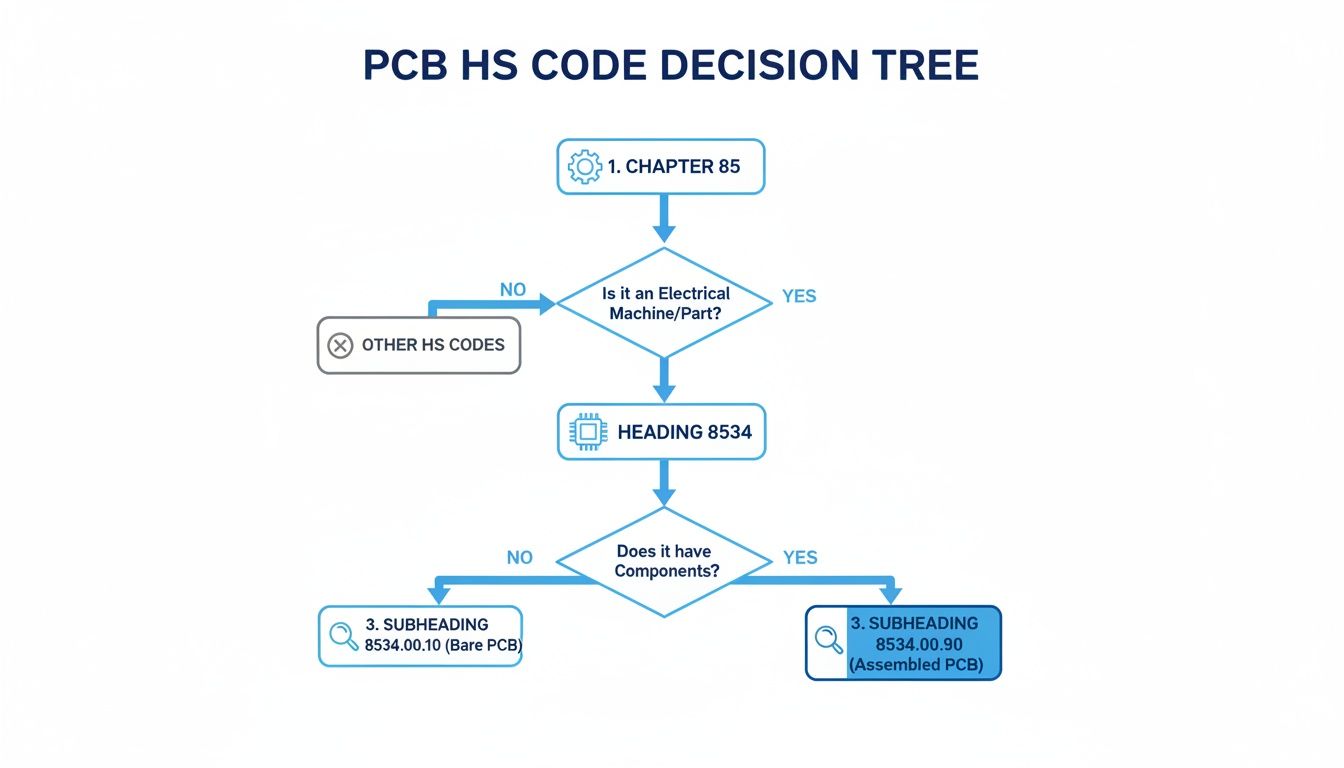
    This decision tree infographic helps visualise the classification journey, starting from the broad Chapter 85 and drilling down based on whether the board has components.

    A flowchart illustrates the PCB HS code decision tree, guiding classification based on electrical parts and components.

    The key takeaway here is that the presence of populated components is the main fork in the road. It sends you down a completely different classification path than a bare board.

    Practical Checklist for Populated Boards

    To sidestep the common pitfalls, run through these questions before assigning a pcb board hs code to your assembly. This simple checklist helps you think like a customs official and cover all the bases they use to determine the correct classification.

    1. What is the principal function of the assembly?

      • Does it process data like a computer motherboard? (Could be 8473)
      • Does it manage power like a voltage regulator? (Could be 8504)
      • Is it an integrated circuit that acts as the "brain" of a device? (Likely 8542)
    2. Is the assembly a "part" of a larger machine?

      • If the PCBA is exclusively designed for one specific product—like a car's engine control unit—it should be classified as a part of that product under its chapter.
      • This requires clear documentation proving its dedicated use.
    3. What component gives the board its essential character?

      • Pinpoint the most significant or highest-value component on the board. A PCBA with a powerful central processing unit (CPU) is fundamentally different from one whose main job is to light up a few simple LEDs.

    The golden rule for PCBAs is to classify the assembly based on its primary function, not its physical form. A board populated with a GPS module is a GPS device, not just a circuit board.

    By adopting this function-first mindset, you align your declarations with customs logic. This proactive approach not only ensures compliance but also minimises the risk of your shipments getting stuck, protecting both your timeline and your bottom line.

    Navigating Country-Specific Tariff Codes

    The first six digits of a PCB HS code are like a universal language for customs officials, a shared standard that works the same way from Singapore to Spain. But that’s where the global harmony stops. After the sixth digit, each country or trading bloc tacks on its own suffix—usually two to four more numbers—creating a national tariff code. This is where global trade gets local, and it’s these last digits that actually determine duties and taxes.

    Think of it like a global phone number. The first part (the country and area code) gets you to the right city, but you need the final, unique digits to reach a specific house. For a freight forwarder, mastering these local variations is the secret to giving clients accurate landed-cost estimates and preventing nasty surprises at the border. An identical 4-layer PCB can face completely different duty rates depending on whether it's landing in the US, the EU, or right here in Singapore.

    This divergence means that relying solely on the 6-digit HS code is a recipe for disaster. You have to dig deeper and use the destination country's specific tariff system to find the full 8 to 10-digit code.

    Comparing Major Trading Blocs

    Different economic regions have their own systems for extending the HS code. Getting a handle on how these national codes are structured is absolutely vital for anyone managing an international electronics supply chain.

    • United States (HTSUS): The US uses the Harmonized Tariff Schedule of the United States, which extends the code to 10 digits. These last four digits provide incredible specificity, differentiating products to apply various trade agreement benefits or, in some cases, punitive tariffs.
    • European Union (TARIC): The EU uses the Integrated Tariff of the European Communities (TARIC), another 10-digit system. The first eight digits (known as the CN code) are used for export declarations and stats, while the full 10 digits are mandatory for import declarations to apply duties, quotas, and other regulations.
    • Asian Markets: Many major players in Asia, like China, Japan, and South Korea, typically use 8 to 10-digit codes. Each nation tailors its system to reflect its own industrial policies and trade agreements.

    The key takeaway is simple: a single product needs multiple, distinct tariff codes depending on where it’s going. This is a crucial detail that can make or break shipping costs and customs clearance times.

    For freight forwarders, the difference between a 6-digit and a 10-digit code is the difference between a rough guess and a professional, accurate quote. It demonstrates expertise and protects your client from unforeseen expenses.

    This becomes especially important in markets with their own complex regulations. For instance, navigating the specific tariff requirements for Indonesia involves understanding local nuances that go well beyond the global standard. You can explore a detailed breakdown in our guide on the Indonesia HS code system.

    A Practical Example of Code Variation

    To see how this plays out in the real world, let's look at how a standard, 4-layer rigid PCB gets classified across different regions. It’s the perfect way to see how the same product is treated differently from a customs perspective.

    This table shows just how much the final code can change for the very same item.

    Example of HS Code Variation for a 4-Layer Rigid PCB

    Region/Country Example Tariff Code Structure Explanation
    Global Standard 8534.00 The 6-digit international heading for all printed circuits.
    United States 8534.00.0040 The HTSUS code specifies "Plastics impregnated, multilayered" with 4 layers or less.
    European Union 8534.00.19 The 8-digit CN code for multilayered printed circuits.
    Singapore 8534.00.90 This local code covers many multilayered circuits, reflecting its trade focus.

    As you can see, what starts as a simple 8534.00 branches out into highly specific national codes that determine the final landed cost. It's a small detail with a big financial impact.

    Drilling down into Singapore's trade dynamics under HS Code 8534.00.90 reveals a thriving import scene valued at USD 98.50 million. This comes from 3,330 shipments to 357 importers from 397 suppliers—a testament to the island's status as a logistics nerve centre in SG. For forwarders looking to find high-potential electronics clients, these figures are pure gold. You can discover more insights about Singapore's import landscape on OEC.world.

    Best Practices for Customs Documentation

    Nailing the right pcb board hs code is a huge step, but it's only half the battle. That code needs to be backed up by airtight customs documentation. Think of your HS code as the headline and your documents as the full story. If they don't tell the same tale, customs officials will hit the pause button, and that means delays and inspections. Getting your paperwork in order from the get-go is the secret to a smooth, predictable supply chain.

    The commercial invoice is ground zero for this process. It needs a clear, straightforward, and non-technical description of your goods. This is where so many shipments go wrong.

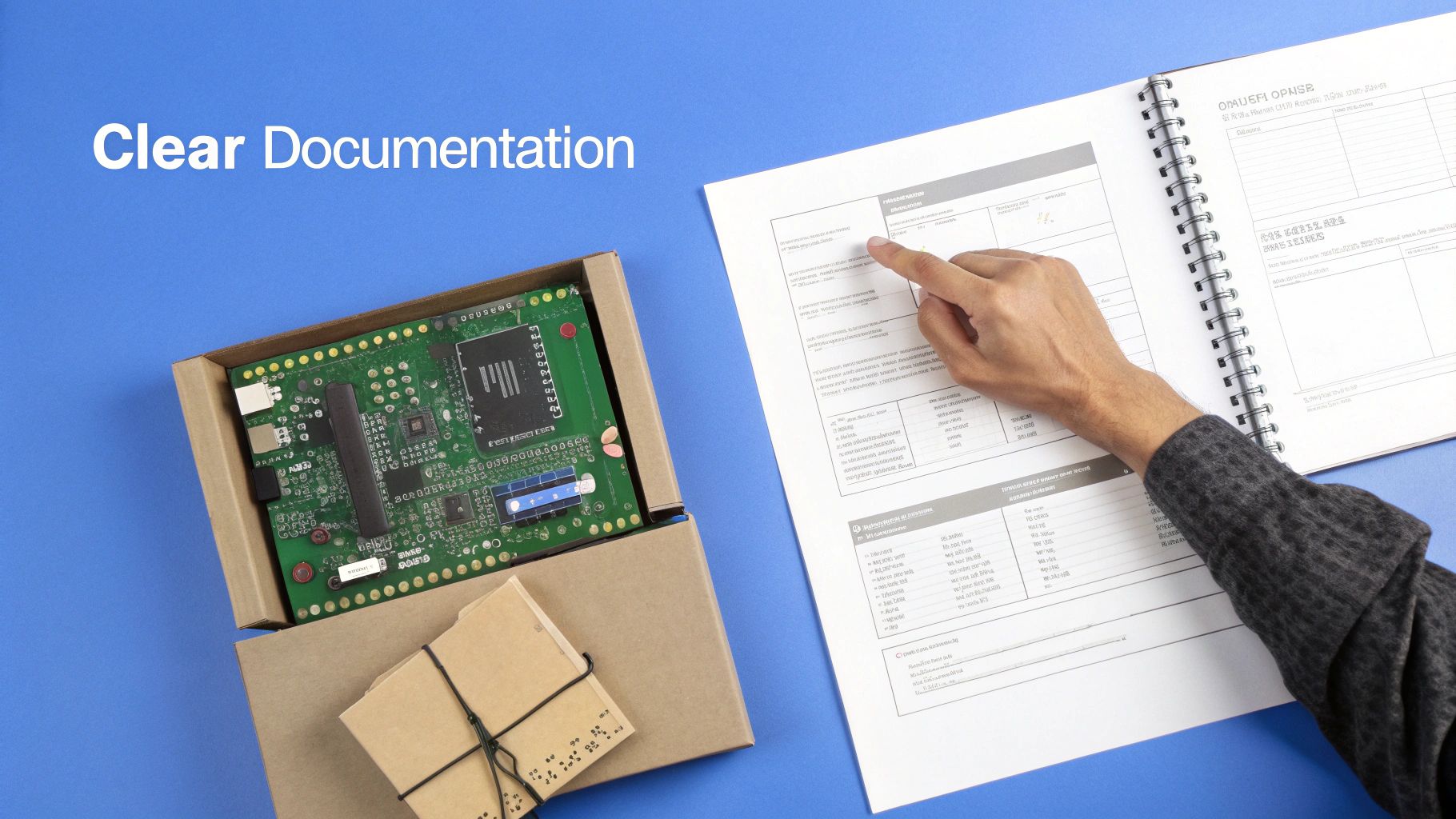
    A person's hand points at a detailed document in a notebook, next to a PCB board in a box.

    Crafting a Clear Product Description

    Vague descriptions are a massive red flag for customs. Using lazy terms like "electronic parts" or "circuit components" is asking for trouble. An inspector’s job is to make sure your declared HS code actually matches what’s in the box, and a generic description gives them zero confidence. It pretty much forces them to open up your shipment, costing you precious time and money.

    Instead, your description needs to be specific enough that someone who isn't an electrical engineer can understand it. Most importantly, it must line up perfectly with the HS code you’ve chosen.

    • Weak Description: "Electronic Parts for Machine"
    • Strong Description: "Bare, 4-Layer Rigid Printed Circuit Boards (Unpopulated)"

    See the difference? The strong example instantly justifies a classification under HS code 8534. It tells the officer the board's state (bare), its layer count (4-layer), and its physical type (rigid). There's no room for guessing.

    The whole point of your product description is to make the customs officer's job easy. Give them enough detail to justify your HS code at a glance, and your odds of a lengthy inspection drop dramatically.

    Knowing When to Include Supporting Documents

    For a simple shipment of bare boards, a perfectly crafted commercial invoice will usually do the trick. But as the complexity of your shipment grows, so does the need for extra paperwork. This is particularly true for populated boards (PCBAs) or any item classified as a component of a larger machine.

    For these more complex shipments, you should consider including:

    • Technical Datasheets: For a PCBA, a datasheet clearly explains the board’s function. This helps justify a more specific classification, like under heading 8542 for integrated circuits.
    • Bill of Materials (BOM): A BOM is a complete list of every single component on a PCBA. It’s powerful proof that helps determine the "essential character" of the assembly, a critical factor for correct classification.
    • Engineering Drawings: If your circuit is clearly a part of a larger piece of equipment (like a medical device), engineering drawings prove it was designed for that specific purpose.

    These documents are your evidence. They show customs you’ve done your homework and build trust over time. This level of detail is especially critical for anyone acting as the Importer of Record, since they carry the legal responsibility for the shipment's accuracy. To understand more, check out our guide on the role of an Importer of Record. A little extra effort on your paperwork upfront can save you from major logistical nightmares down the road.

    Using Customs Data to Verify Codes and Win Clients

    Getting the right pcb board hs code is one thing, but what if you could use that knowledge to actively grow your business? This is where things get interesting. Knowing your HS codes isn't just about avoiding customs headaches; it's a powerful tool for finding and winning new clients. It's time to stop thinking of compliance as a chore and start seeing it as a competitive edge.

    Imagine having a direct line of sight into the supply chains of your ideal customers. You could see exactly which companies are importing printed circuit boards, where they're getting them from, and in what volumes. This isn't a far-fetched idea—it's precisely what modern customs data platforms make possible.

    Turning Data into Actionable Leads

    The whole process starts with the HS code itself. You can flip the script: instead of just verifying a code for a current shipment, you use it as a search filter to hunt for new business. By searching for shipments classified under key PCB codes, like 8534.00.90, you instantly get a list of active importers. These are your prime prospects.

    This isn't just a list of names, either. You can dig deeper to analyse their shipping volumes, trade partners, and frequency. This kind of intel helps you zero in on high-value targets who are already moving the exact kind of freight you handle best.

    By mastering HS code classification, you’re not just ensuring smooth customs clearance; you’re building a targeted list of the most valuable shipper leads in the electronics sector. It’s a direct path to smarter, more effective sales prospecting.

    For freight forwarders, this data is pure gold. Take Singapore's PCB sector. It's a perfect example of Southeast Asia's manufacturing boom. The country has a mature ecosystem that holds its own against regional powerhouses like Thailand and Malaysia. In a recent period, Singapore imported USD 98.50 million worth of goods under HS 85340090 across 3,330 shipments. This activity involved 357 importers sourcing from 397 international suppliers, showing just how much opportunity there is for savvy logistics providers. You can read more about Southeast Asia's growing PCB industry on Businesswire.com.

    From Prospecting to Winning Business

    Once you’ve pinpointed a promising lead, your expert knowledge of the pcb board hs code is your best opening line. Forget the generic sales pitch. You can approach a potential client with specific, valuable insights about their own operations.

    For instance, you could open with: "I noticed you're regularly importing multilayer PCBs from Taiwan under code 8534.00.90. We specialise in this classification and have a great track record of clearing these shipments without a hitch, which could save you from potential delays." This immediately shows your value and establishes you as an expert, not just another sales rep.

    The best part is that modern logistics sales platforms now integrate customs data directly into their prospecting tools. They let you apply an HS code filter to find ideal shippers and then help you connect with the key decision-makers. Check out our guide on how to use an HS code filter for lead generation to see this strategy in action. It’s a seamless way to turn your regulatory know-how into your most effective sales tool.

    Common Questions About PCB Board HS Codes

    When you're dealing with the nitty-gritty of shipping electronics, the same questions about PCB board HS codes tend to pop up again and again. Getting these right isn't just about theory; it's about practical, on-the-ground expertise that saves you from expensive mistakes and keeps your cargo from getting stuck at the border.

    Let's walk through some of the most common issues that freight forwarders and shippers run into. Think of these as quick, actionable answers you can use right away.

    What Is the Biggest Mistake Shippers Make?

    Hands down, the most common and costly error is classifying a populated Printed Circuit Board Assembly (PCBA) as a bare board under HS 8534. This one slip-up is responsible for a huge number of customs holds and fines.

    The moment you solder components like chips, resistors, or capacitors onto that board, its entire nature changes. In the eyes of customs, its "essential character" is no longer just a circuit. It’s now a functional electronic module.

    This shift means you have to change its classification. The new HS code needs to reflect its new function, which might be HS 8542 for integrated circuits or another code entirely, depending on what the final product does. Sticking with the old code leads to paying the wrong duties and facing serious delays.

    How Do I Classify a Flexible Printed Circuit?

    Flexible Printed Circuits (FPCs) start under the same main heading as their rigid cousins: HS 8534. They share the same initial six digits, but the final classification will hinge on the specific tariff schedule of the country it's headed to.

    At the national level, customs systems have more detailed subheadings to tell different board types apart.

    The best practice here is to be crystal clear. On your commercial invoice, describe the item specifically as a "flexible printed circuit". This simple detail helps guide customs officials to the correct 8- or 10-digit code and ensures you’re paying the right duties.

    My PCB Is a Part for a Medical Device

    This is a classic "it depends" situation, and it really shows how important context is in HS classification. The right code comes down to how the item is shipped and described.

    • Shipped Alone: If you're shipping the PCBA by itself, you classify it based on its own electronic function. That will likely land it under a heading like 8542.
    • Identifiable as a Part: But, if the board is clearly a part designed only for a specific medical device (found in Chapter 90), then you should classify it as a "part" of that device.

    As a general rule, customs classifies parts designed exclusively for a particular machine along with that machine. To go this route, you'll need solid proof, like technical drawings, to show its specific use. For these kinds of shipments, talking to a customs broker is always a smart move.


    At Coreties, we turn complex customs data into your most powerful sales tool. Our platform helps you filter shipper leads by HS code, trade volume, and location, so you can find and connect with high-value clients in the electronics sector faster than ever. Discover qualified leads and streamline your outreach with Coreties today.