Think of the HS code for clothing as a universal passport for every garment crossing a border. This simple six-to-ten-digit number tells customs officers worldwide exactly what's in the box—what an item is, what it's made of, and who it's for—making sure it gets classified correctly for duties and taxes.
Decoding the Language of Global Apparel Trade
For anyone in freight forwarding, getting a handle on the Harmonized System (HS) code isn't just about ticking a compliance box; it's a real strategic advantage. The right code paves a smooth path from the factory floor to the customer's hands, sidestepping costly delays, surprise fines, and the kind of friction that can sour a client relationship. Get one digit wrong, and a profitable shipment can quickly become a logistical nightmare.
It helps to think of the HS code as a highly specific GPS coordinate for your apparel shipment. Each pair of digits zooms in, refining the product's identity until there's a clear, universal description that leaves no room for guesswork at customs.
The Building Blocks of a Clothing HS Code
The whole system is built on a simple, logical hierarchy. It starts broad and gets more specific with each number, allowing customs officials to pinpoint a garment's exact nature in seconds. This structure is absolutely essential for applying the correct tariffs and trade rules.
Here's a quick look at how it works:
- Chapter: The first two digits sort the item into a general category. For clothing, you'll almost always be in Chapter 61 (knitted or crocheted apparel) or Chapter 62 (woven apparel).
- Heading: The next two digits define the type of product, like "jerseys and pullovers" or "trousers and shorts."
- Subheading: The final two digits of the international code add the crucial details, such as the material (e.g., cotton, synthetic fibres) or the intended wearer (men's, women's, etc.).
In global trade, the HS code is the single source of truth for product classification. Getting it right from the start eliminates downstream complications, ensuring that tariffs are calculated correctly and shipments clear customs without friction.
This six-digit foundation is the bedrock of international apparel shipping. Take Singapore, for example. The local HS code framework, which centres on Chapters 61 and 62, is crucial for accurate trade analytics. A simple misclassification can lead to serious hold-ups, which is why Singapore Customs provides tools like their ruling database to help businesses stay compliant. You can see just how much these classifications matter to the economy in official trade publications.
Ultimately, understanding this system is your key to navigating the complex world of global logistics. It turns the daunting task of classification into a manageable process, giving you the confidence to handle any apparel shipment that comes your way.
How HS Codes for Clothing Are Structured
Think of an HS code for clothing like a postcode. It tells customs officials exactly what's in the box, starting from a broad region and zooming right down to a specific street address. Getting this code right isn't just a technicality—it's what determines how quickly your shipment clears and how much duty you'll pay.
The entire universe of clothing is split into two massive categories, known as Chapters. These first two digits are the most important decision you'll make when classifying a garment. The distinction is simple but absolutely fundamental.
The First Big Decision: Knitted or Woven?
Right at the start, the path splits based on how the fabric was made. Every single piece of clothing falls into one of two Chapters:
- Chapter 61 is for all apparel that is knitted or crocheted.
- Chapter 62 is for all apparel that is woven.
What's the difference in real life? A classic cotton t-shirt has that familiar stretch because its fabric is made from a single thread looped over and over—that's knitted (Chapter 61). On the other hand, a formal dress shirt feels crisp and holds its shape because its fabric is made by weaving threads over and under each other, like a basket. That's woven (Chapter 62).
This isn't a minor detail; it's the foundation of the entire code. A knitted garment's HS code must start with "61". A woven one must start with "62". No exceptions.
An incorrect Chapter is one of the most common and costly mistakes in apparel shipping. It instantly invalidates the rest of the code, leading to customs rejections, surprise duties, and major delays for your clients.
Narrowing It Down with Headings
Once you've picked the right Chapter, the next two digits—the Heading—get more specific about the type of garment. This is where you go from a broad category like "knitted apparel" to identifying the actual item.
For instance, within Chapter 61 (Knitted), you'll find different Headings for different products:
- 6105: Men's or boys' shirts, knitted or crocheted.
- 6109: T-shirts, singlets, and other vests, knitted or crocheted.
- 6110: Jerseys, pullovers, and cardigans, knitted or crocheted.
Chapter 62 (Woven) works the same way, with Headings like 6203 for men's suits or 6205 for men's shirts. The Heading adds that second layer of detail, confirming what the product is. While the global standard is six digits, many countries, including Singapore, add extra digits for more local detail. You can dive deeper into this in our guide on the HS code system in Singapore.
Adding Critical Details with Subheadings
The last two digits of the international HS code are the Subheading. This is where things get really granular—and it's often where classification disputes happen. The Subheading locks in the final details that determine the exact tariff rate.
These crucial details almost always include:
- Material Composition: Is it cotton, wool, silk, or a synthetic fibre like polyester? A cotton t-shirt has a different code from a polyester one.
- Intended Wearer: Is it for men, women, boys, girls, or infants? This distinction is non-negotiable and can completely change the code.
Let's walk through an example: a men's cotton t-shirt.
- Chapter: It’s a t-shirt, so it's knitted. We start with 61.
- Heading: It’s a t-shirt, so we use Heading 09.
- Subheading: It’s made of cotton, which is assigned Subheading 10.
Put it all together, and the correct 6-digit HS code for a men's cotton t-shirt is 6109.10. This logical, step-by-step process is designed to remove guesswork, so customs officials anywhere in the world can understand exactly what they're looking at.
Key Classification Rules You Need to Know
Once you’ve got a handle on the basic structure of an HS code, the real work begins. Getting the classification right is what separates a smooth customs clearance from a shipment stuck in limbo. It’s all about a process of elimination—you start with the most critical distinction and work your way down through the details until only one correct code remains.
The whole system essentially asks you a series of questions. The first one is the big one: is the garment knitted or woven? This single detail decides whether you start in Chapter 61 or Chapter 62, and getting it wrong from the get-go throws off everything else.
The Critical Knitted Versus Woven Divide
Think of a garment’s fabric construction as its fundamental DNA. Knitted fabric is made from a single, continuous thread looped together, kind of like a chain-link fence. This structure gives it natural stretch, which is why your t-shirts, jumpers, and gym wear are almost always knitted. These items all belong in Chapter 61.
Woven fabric, on the other hand, is created by interlacing two or more threads at right angles, much like a basket weave. This grid-like structure makes the material more rigid and durable—perfect for things like formal shirts, denim jeans, and structured blazers. These garments fall under Chapter 62.
A word of warning: Getting the knitted vs. woven distinction right is non-negotiable. An experienced customs inspector can tell the difference in seconds, and classifying under the wrong Chapter is an immediate red flag that often triggers inspections and costly re-classifications.
To make it easier to tell them apart at a glance, here’s a quick reference table.
Knitted (Chapter 61) vs Woven (Chapter 62) At a Glance
| Characteristic | Knitted Apparel (Chapter 61) | Woven Apparel (Chapter 62) |
|---|---|---|
| Fabric Construction | Made from a single, continuous yarn looped together. | Made by interlacing two or more sets of yarn at right angles. |
| Feel & Stretch | Stretchy, flexible, and comfortable. Returns to shape easily. | More rigid, structured, and holds its shape. Limited stretch. |
| Look Up Close | You'll see tiny, braided loops, similar to knitting. | You'll see a distinct grid-like or criss-cross pattern. |
| Common Garments | T-shirts, jumpers, polo shirts, hoodies, leggings, underwear. | Dress shirts, blouses, trousers, jeans, suits, blazers, jackets. |
Remembering these key differences is the first and most important step in correctly classifying any piece of clothing.
What About Blended Fabrics?
It’s rare to find clothing made from just one material. So what happens when you have a t-shirt that’s 60% cotton and 40% polyester? This is where the "principal character" rule comes into play. You classify the garment based on the material that gives it its primary identity.
For blended fabrics, the rule is thankfully straightforward: you classify the garment based on the material with the highest percentage by weight. In our example, since cotton makes up 60% of the fabric, you’d classify the t-shirt under the subheading for cotton, not polyester.
This simple decision tree shows the logical flow for classifying a garment, starting from its type and drilling down to the end-user.
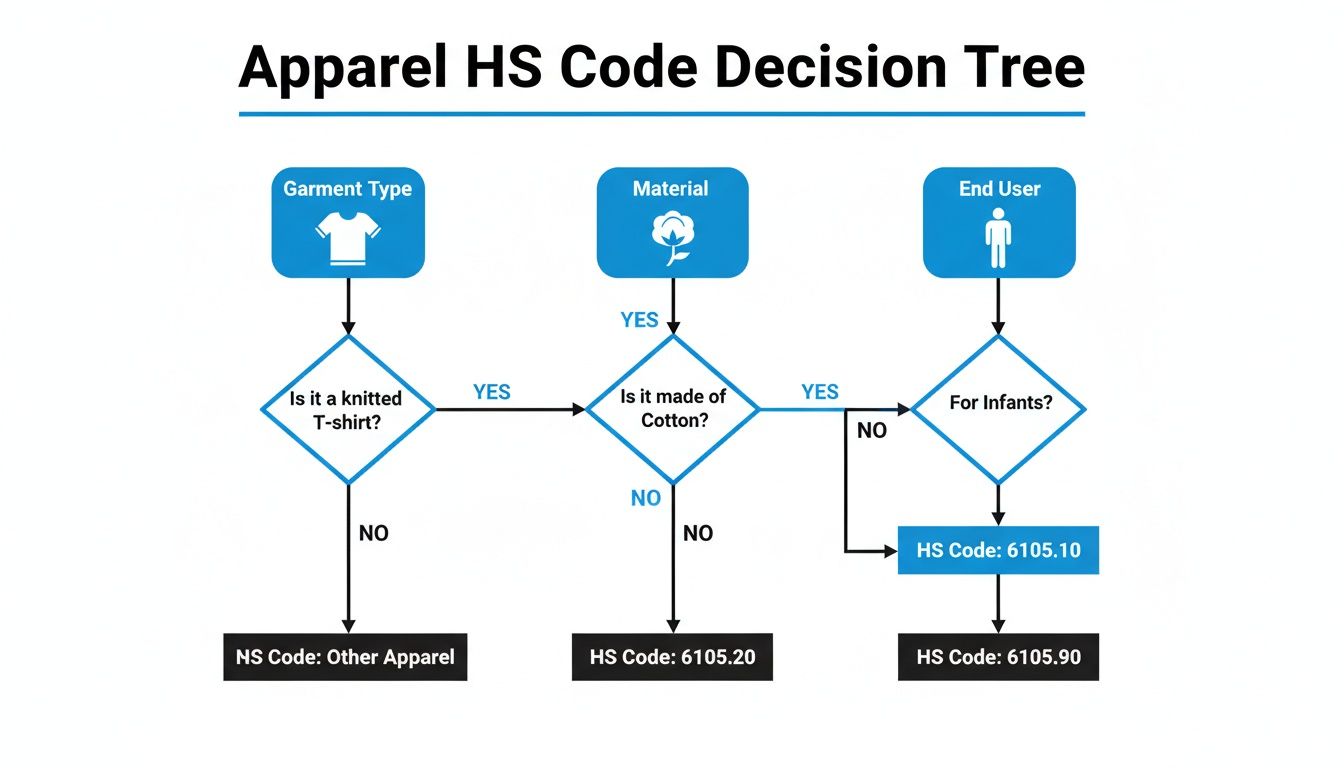
As you can see, each decision you make narrows down the possibilities, guiding you systematically to the right HS code.
The Importance of Gender and Age
After fabric and material, the next hurdle is the intended wearer. The HS code system makes very clear distinctions between apparel for different demographics, and this isn’t a suggestion—it’s a hard-and-fast rule with separate codes for each group.
You absolutely must classify garments into one of these categories:
- Men's or boys'
- Women's or girls'
- Infants'
A men’s cotton shirt will have a different HS code than a women’s cotton shirt, even if they look practically identical. The "infants" category is also very specific, usually covering clothing for babies up to a certain size (for instance, up to size 86 cm in many regions). Mistaking a unisex-style hoodie as "men's" when the shipment is for a women's retailer is a classic mistake that can cause major compliance headaches.
When Small Details Change Everything
Finally, never underestimate the power of design features. Seemingly minor details can completely change an HS code because the system is designed to be incredibly specific. A simple collar, a pocket, or a particular type of fastening can easily bump a garment from one heading to another.
For example, a knitted pullover with no pockets or openings might fall under heading 6110. But add a partial opening at the neck with a few buttons, and it could suddenly be classified as a shirt under an entirely different heading. Always examine the garment’s physical traits closely—the smallest details often hold the key to an accurate classification.
Common HS Codes for Major Clothing Categories
Now that we’ve got the ground rules down, let's put theory into practice. Knowing the right HS code for clothing is only useful when you can apply it quickly to the garments you handle every single day.
Think of this section as your classification cheat sheet. We're going to walk through some of the most common apparel categories—from t-shirts to jeans—and show you exactly how the logic of Chapter, Heading, and Subheading comes together to form the correct 6-digit code.
T-Shirts, Singlets, and Other Vests
This category is easily one of the most frequently shipped worldwide, and a standard t-shirt is a perfect, clear-cut example of how the HS system works.
Let’s classify a basic men's 100% cotton t-shirt:
- Chapter: T-shirts are almost always made from that familiar stretchy, looped fabric, which means they are knitted. This puts them squarely in Chapter 61.
- Heading: Within Chapter 61, the specific heading for "T-shirts, singlets and other vests" is 09.
- Subheading: The material is cotton, which corresponds to subheading 10.
Put it all together, and you get the 6-digit HS code: 6109.10.
In Singapore, the HS code 6109.10 covers these exact items. For customs declarations, this is often broken down even further for men/boys (6109.10.10) or women/girls (6109.10.20). While duties are generally zero under Singapore’s trade-friendly policies, getting the code right is non-negotiable for smooth clearance. A quick look at trade data shows that basic crew necks, V-necks, and graphic tees make up the bulk of shipments under this code.
Trousers and Jeans
Trousers and jeans are another massive category in global apparel, but their classification takes a different path because they are usually made from woven fabric.
Picture a pair of classic men's blue denim jeans. Here’s how you'd classify them:
- Chapter: Denim is a tough, woven twill fabric, which immediately sends us over to Chapter 62.
- Heading: The heading for "Trousers, bib and brace overalls, breeches and shorts" for men or boys is 03.
- Subheading: There's a specific subheading just for denim, which is 42.
The result is the HS code 6203.42. If those same trousers were made from synthetic fibres instead of denim, the subheading would change (to .43), but the Chapter and Heading would stay the same.
The same principles of material and construction apply across all apparel. If you’re curious about how this works for accessories, you can dive into our guide on the HS code for shoes.
Jumpers, Pullovers, and Cardigans
When we start talking about colder-weather clothing, we usually find ourselves back in the world of knitted goods. Jumpers, pullovers, and cardigans are all about that comfortable, stretchy construction.
Let's break down a women's jumper made from a 55% wool, 45% acrylic blend.
- Chapter: Its construction is knitted, so we begin again in Chapter 61.
- Heading: The correct heading for "Jerseys, pullovers, cardigans, waistcoats and similar articles" is 10.
- Subheading: This is where the material blend rule is crucial. Since wool is the dominant fibre by weight (55%), we use the subheading for wool, which is 11.
The final HS code is 6110.11. If the blend had been flipped and acrylic was the dominant material, the code would have shifted to reflect that.
A common pitfall is classifying a hoodie under heading 6110. Hoodies often have features like pockets, linings, or a full-zip front that can push them into a completely different classification. Always examine the garment’s specific features, not just its general description.
Example HS Codes for Popular Apparel Items
To help you get a feel for the patterns, here’s a quick-reference table for some of the most common clothing items you'll run into.
| Apparel Item | Example Description | Key Classification Factors | HS Code (6-Digit) |
|---|---|---|---|
| Polo Shirt | Men's, 100% cotton, knitted | Knitted, Men's, Cotton | 6105.10 |
| Dress Shirt | Men's, 100% cotton, woven | Woven, Men's, Cotton | 6205.20 |
| Women's Blouse | 100% silk, woven | Woven, Women's, Silk | 6206.10 |
| Jacket / Blazer | Men's, woven wool | Woven, Men's, Wool | 6203.31 |
| Women's Skirt | 100% polyester, woven | Woven, Women's, Synthetic | 6204.53 |
| Underwear | Men's cotton briefs, knitted | Knitted, Men's, Cotton | 6107.11 |
By using these examples as a guide, you can start building the confidence needed to classify any garment accurately. Getting this right from the start is the key to ensuring your shipments move across borders efficiently and without any costly compliance headaches.
How to Avoid Costly Classification Mistakes
Getting an HS code for clothing wrong by even a single digit can set off a chain reaction of problems. A shipment gets flagged, customs officials start asking questions, and suddenly you're facing unexpected fines, storage fees, and an unhappy client. Shifting from guesswork to confident verification isn’t just about ticking a compliance box; it’s about protecting your profit margin and your reputation.
The key is to treat classification as a systematic process, not an assumption. It's tempting to rely on a supplier's code or reuse one from a similar-looking shipment, but that's a risky shortcut. At the end of the day, the responsibility for accuracy falls on the importer and, by extension, the forwarder guiding them.
A solid verification process is your best defence against these expensive errors. It’s all about cross-referencing information and never taking a single source as gospel.
Your Three-Step Verification Process
To nail the classification every time, it helps to have a simple but effective checklist. This methodical approach cuts through the ambiguity and creates a defensible record for every shipment you handle.
-
Start with the Source Document: Always begin with the commercial invoice and packing list. Really scrutinise the product descriptions. Are they detailed enough? A description like "women's tops" is far too vague. You need specifics, like "women's 100% cotton woven long-sleeve blouse."
-
Consult Official Tariff Databases: Armed with a detailed description, look up the code in an official government database. For shipments into Singapore, the Singapore Customs HS/CA Product Code Search is your ultimate source of truth. This step is crucial for validating your initial assessment against the country's specific legal framework.
-
Cross-Reference with WCO Resources: When you're dealing with a tricky case, turn to the World Customs Organization (WCO) Explanatory Notes. These documents provide the official interpretation of HS headings, offering detailed guidance on what is—and isn't—included in a particular category.
Following these steps turns classification from a quick guess into a documented, evidence-based decision. It's the kind of diligence that protects both you and your client from potential disputes down the line.
Common Classification Pitfalls to Sidestep
Even with a good process, some common mistakes still trip up seasoned forwarders. Just being aware of these traps is half the battle.
One of the biggest errors is misidentifying fabric blends. The rule is simple but often missed: classify the garment based on the material with the highest percentage by weight. So, a shirt that's 55% polyester and 45% cotton is classified as a polyester shirt, period.
Never assume a garment's material just by its look or feel. Always insist on a detailed material composition breakdown from the shipper. This single piece of data is one of the most critical factors in finding the correct HS code.
Another frequent slip-up is overlooking small but significant design details. A simple drawstring, a hood, or even the type of waistband can be enough to shift a garment from one HS code to a completely different one.
Finally, watch out for outdated codes. The WCO updates the Harmonized System every five years to keep up with new products and technologies. Using a code from 2021 for a shipment today might mean you're using a classification that doesn't even exist anymore. Always, always confirm you're working with the most current version of the tariff schedule.
Find New Business Using HS Code Data
So far, we've treated the HS code for clothing as a necessary tool for compliance. But what if these codes could do more than just get your shipments cleared? What if they could actually point you directly to your next big client? The truth is, the data tied to every single shipment—all neatly organised by HS code—is a goldmine for business development.
Think about it. Every time a container of apparel crosses a border, it leaves a data trail. This customs record shows exactly who is shipping what, how much they’re shipping, and where it’s all going. This isn't just logistical noise; it’s a detailed map of your entire potential client base.
By tapping into this trade data, you can finally ditch the cold calls and start having conversations based on real, relevant insights. Your sales approach transforms from a shot in the dark to a data-backed strategy.
Turning Data into Qualified Leads
Let's say you're a specialist in shipping knitted apparel. Instead of guessing which companies might need your services, you could simply search customs data for businesses importing goods under Chapter 61. Right away, you've filtered out all the noise and are left with a targeted list of active importers.
You can even drill down further. A quick filter for HS code 6109.10, for example, will show you every company in Singapore that’s importing cotton t-shirts. This kind of detail helps you zero in on high-potential clients whose shipping needs are a perfect match for your expertise.
This method gives you some incredibly powerful market intelligence:
- Pinpoint Active Importers: You'll find companies currently shipping the exact types of clothing you handle.
- Gauge Shipping Volumes: See which businesses are importing at a scale that makes them a valuable partner for you.
- Map Out Trade Routes: Discover the specific lanes your prospects are using, which allows you to pitch more competitive alternatives.
By using customs data, you aren’t just finding leads; you’re uncovering a company’s entire supply chain story. This lets you craft an outreach that speaks directly to their real-world operational needs and challenges.
Crafting a Winning Outreach Strategy
Once you have your list of high-potential companies, the next step is reaching the right person. Modern trade intelligence platforms can help you find contact details for the key decision-makers, like logistics managers or supply chain directors, within these target businesses.
Armed with this information, you can finally stop sending those generic "hope you're well" emails. Instead, you can build a personalised message based on actual data. Imagine mentioning their recent shipment volumes from Vietnam or highlighting how your services on a particular trade lane could offer them a better deal. To see exactly how to set up these searches, our guide on using an HS code filter offers a detailed walkthrough.
This data-driven approach immediately shows you've done your homework. It proves to prospects that you understand their business and can offer genuine value, which dramatically increases your chances of getting a response and starting a real conversation. It’s the key to building a robust and sustainable sales pipeline.
Frequently Asked Questions
When you're dealing with apparel shipments day in and day out, a few questions tend to pop up again and again. Let's tackle some of the most common ones that freight forwarders and shippers run into with the HS code for clothing.
What Is the Difference Between an HS Code and an HTS Code?
Think of the HS code as the global "first name" for a product. It’s a six-digit code that’s the same pretty much everywhere, from Singapore to Spain, thanks to the World Customs Organization (WCO). It’s the universal standard.
An HTS (Harmonized Tariff Schedule) code is more like a product's full name, specific to the country it's entering. The United States, for instance, tacks on four extra digits to that base HS code. This creates a 10-digit HTS code that lets them get super specific for calculating duties and gathering trade data.
The bottom line: The first six digits are your universal key. Anything after that is country-specific. Always, always use the full HTS code required by the destination country for your customs paperwork.
Do All Countries Use the Same HS Codes for Clothing?
Yes, but also no. It's a bit of a trick question. The core six-digit HS code is used by over 200 countries, which is fantastic because it creates a common language for global trade. The code for a men's woven cotton shirt (6205.20) is recognised worldwide.
The "no" part comes in after those first six digits. Many countries add their own numbers to get more detailed. This is why a shipment heading to the US needs a 10-digit code, while another going to Japan might only require a 9-digit one.
How Often Do HS Codes Change?
The Harmonized System isn't set in stone. The WCO gives it a major review about every five years to keep up with new products and technology. The last big update was in 2022, and the next one is already on the calendar for 2027.
Staying on top of these changes is non-negotiable. Using an old, deleted code is one of the fastest ways to get a shipment stuck in customs, creating delays and potential fines for your clients.
Ready to turn all this customs data into your next big client? With a tool like Coreties, you can filter through active shippers using specific clothing HS codes, pinpoint the right decision-makers, and build a targeted outreach list that actually converts. Discover qualified leads faster with Coreties.