
Welcome to your practical guide for mastering Indonesia's Harmonized System (HS) codes. In global trade, getting a single digit wrong can trigger costly delays, fines, or even the seizure of a shipment. This guide is built for freight forwarders and logistics professionals who need to navigate Indonesian customs with confidence and precision.
Why Mastering the Indonesian HS Code System Matters
In the world of international shipping, the Indonesian HS code is far more than just a number you plug into a customs form—it's the universal language of trade. Getting this code right is the absolute foundation of a smooth, predictable, and profitable supply chain.
A correct code ensures you pay the right duties and taxes. Simple as that. An incorrect one? That can lead to a cascade of problems, from steep penalties to damaged client relationships.
For freight forwarders and their teams, mastering this system isn't just about ticking a compliance box. It's a real strategic advantage. It means you can provide accurate landed-cost estimates, advise clients on regulatory hurdles before they become problems, and build a reputation for flawless execution in one of Southeast Asia's most dynamic—and complex—markets.
The BTKI and Its Global Connection
At the heart of Indonesia's system is the Buku Tarif Kepabeanan Indonesia (BTKI), which is the country's official customs tariff book. This isn't some isolated, homegrown system. It builds directly upon globally recognised standards, which is good news for anyone familiar with international trade.
Here’s a quick breakdown of how an Indonesian HS code is structured:
-
Global Standard (First 6 Digits): The first six digits are set by the World Customs Organisation's (WCO) Harmonized System. This is the international gold standard used by over 200 countries, ensuring a baseline consistency for classifying goods no matter where they're from.
-
ASEAN Standard (Digits 7-8): The next two digits come from the ASEAN Harmonised Tariff Nomenclature (AHTN). This layer harmonises classification among the ten ASEAN member states, which is crucial for simplifying regional trade.
-
National Specifics (Digits 9-10): Finally, Indonesia can add two more digits for its own needs, like granular statistical tracking or specific regulatory controls on certain goods.
Understanding this layered structure is key. It shows that while the final 10-digit code is specific to Indonesia, its foundation is rooted in international agreements. This makes the classification process logical and, most importantly, traceable.
The economic implications of getting this right are immense. For instance, Singaporean freight forwarders often use their deep expertise with the AHTN to manage trade intelligence for Indonesia-bound shipments. A huge portion of this trade flows through key entry points like the Port of Tanjung Priok in Jakarta, which single-handedly processes a massive 39% of all Indonesian imports.
The BTKI provides a clear map of the country's economic demands, categorising everything from Chapter 88 aircraft parts to Chapter 72 iron and steel. The data reveals a healthy trade surplus, underscoring the opportunities for those who can navigate its customs framework effectively. If you're interested in a deeper dive, you can explore more insights on Indonesia's import-export data.
Indonesia's Top Imported Product Chapters by HS Code
To give you a clearer picture of what's moving into the country, here’s a look at the top imported product categories based on their HS code chapters. This data offers a snapshot of Indonesia's key industrial and consumer demands.
| HS Chapter | Product Category | Share of Total Imports |
|---|---|---|
| Chapter 27 | Mineral Fuels, Oils, Distillation Products | 18.2% |
| Chapter 85 | Electrical Machinery and Equipment | 11.9% |
| Chapter 84 | Machinery, Mechanical Appliances, Reactors | 11.5% |
| Chapter 72 | Iron and Steel | 4.6% |
| Chapter 39 | Plastics and Articles Thereof | 4.4% |
This table highlights the dominance of industrial inputs—machinery, fuel, and raw materials—which are essential for powering Indonesia's manufacturing and infrastructure sectors. For logistics professionals, understanding these major trade flows is vital for identifying potential clients and market opportunities.
How to Find and Verify Any Indonesia HS Code
Finding the right HS code for your shipment to Indonesia isn’t a guessing game. It's a methodical process where precision is everything. Get it wrong, even by a single digit, and you're looking at frustrating customs delays, unexpected fines, and a damaged relationship with your client. The goal here is to move from a simple product description to a specific, legally sound 8- or 10-digit code.
This all starts with knowing your product inside and out. Forget the marketing jargon. What is its primary function? What materials is it made from? Is it a raw material, a component, or a finished good? These fundamental details are your map for navigating Indonesia's official tariff system.
Your Primary Tool: The INSW Portal
Your first and most reliable stop should always be the official Indonesia National Single Window (INSW) portal. This government website is the single source of truth for HS codes and all related import regulations. Think of it as the central nervous system for Indonesian customs.
Here’s what you’ll see when you land on the portal. It’s the gateway to classifying your products correctly.
The search bar on the homepage is where the work begins.
To use the portal effectively, you need to think like a customs officer. Don't search for a long, complicated product name like "lithium-ion battery pack for a handheld drill." Instead, start with a broad, simple term. In this case, just "battery" will do.
The portal will then show you a list of chapters and headings related to batteries. Now, the real work starts. You'll need to apply the General Interpretative Rules (GIR)—the official guidelines for classification—to narrow down the options based on your product’s specific traits.
Navigating the BTKI for Precise Classification
Working alongside the INSW portal is the Buku Tarif Kepabeanan Indonesia (BTKI). If the INSW portal is your interactive search engine, the BTKI is the master encyclopaedia. It’s the complete, detailed directory of HS codes, their corresponding duties, and any special import rules or restrictions.
Here’s a practical workflow I use that combines both resources:
- Start Broad on INSW: Kick off your search with a general term. Think "leather shoes," "plastic toy," or "coffee beans."
- Identify the Chapter: The results will guide you to the right 2-digit chapter. For example, coffee beans belong in Chapter 09 ("Coffee, Tea, Maté and Spices").
- Drill Down to the Heading: From there, find the 4-digit heading that best describes your product. Heading 09.01 covers coffee, whether it's roasted or not.
- Refine to the Subheading: Next, you’ll narrow it down to the 6-digit subheading. Subheading 0901.21 specifically covers "Coffee, roasted, not decaffeinated." This 6-digit code is the international standard.
- Pinpoint the AHTN Code: Finally, you arrive at the 8-digit ASEAN Harmonised Tariff Nomenclature (AHTN) code. This is absolutely crucial for regional trade, especially for goods moving between ASEAN countries like Singapore and Indonesia.
That 8-digit AHTN code is the common language that ensures customs on both sides are aligned. To learn how you can leverage these codes for more than just customs clearance, check out our guide on using an HS Code filter to find new business opportunities.
Cross-Verification and Final Checks
You should never, ever rely on a single search result. Once you think you’ve found the right HS code, the final and most critical step is verification. One of the best ways to do this is to check historical shipping data. See what codes other companies have successfully used for similar products imported into Indonesia.
Pro Tip: Always document your classification process. Keep a record of which GIR rules you applied and a short note explaining why you chose one subheading over another. If Indonesian customs ever questions your classification, this documentation will be your best defence.
The scale of trade into Indonesia is immense. The country imported $221,886 million USD worth of goods from 215 partners, covering 4,023 distinct product categories. With so much at stake, there's no room for error. Major ports like Tanjung Priok, which handles 39% of all imports, see a massive flow of goods under HS 84 (machinery), HS 27 (oils), and HS 39 (plastics)—all categories that demand precise classification. You can dig deeper into this trade data in this comprehensive overview.
Common HS Code Mistakes and How to Avoid Them
Getting HS codes wrong for Indonesian shipments can cause serious headaches. I've seen simple mistakes lead to costly delays, surprise duties, and seriously unhappy clients. It's not just about finding a code; it's about finding the right one and being able to defend your choice.
Let's walk through the most common pitfalls I see time and time again, and more importantly, how you can sidestep them.
One of the easiest traps to fall into is using an outdated code. The Indonesian Harmonized System Tariff Book, or BTKI, isn't a "set it and forget it" document. It gets updated to reflect new trade policies and global standards. Pulling a code from last year's schedule is a surefire way to get your shipment flagged by Indonesian customs (Bea Cukai).
Another frequent slip-up happens with multi-function products. Take a high-tech printer that also scans, copies, and faxes. Is it a printer (HS 8443.31) or a photocopier (HS 8443.39)? The General Interpretative Rules (GIR) say you must classify it by its principal function. This can be a judgement call, so if you can't back up your reasoning with solid documentation, you're inviting a dispute.
Overlooking Product Composition and Form
The physical state and makeup of your product are details you absolutely cannot ignore. This is where a small oversight can completely blow up your profit margin.
Think about the difference between raw materials and finished goods. Plastic pellets intended for manufacturing fall under Chapter 39. But a finished plastic chair made from those very pellets? That’s in Chapter 94. The duty rates between the two can be worlds apart. A mistake here isn't just about a penalty; it completely changes your landed cost calculations.
To keep things straight, many experienced forwarders think of the process in three distinct stages: identify, search, and verify.
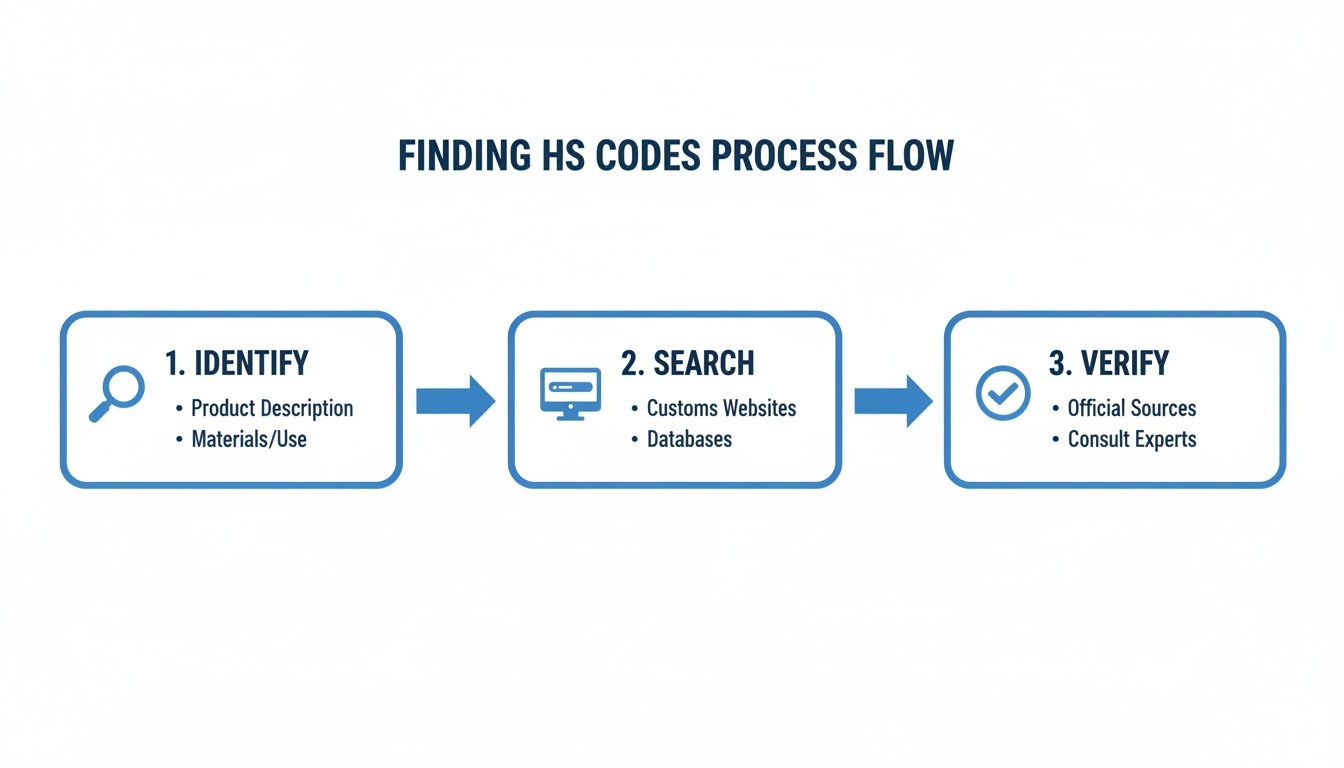
This simple flow is a great reminder that classification is a careful procedure, not a quick keyword search. That final verification step is your last line of defence against expensive errors.
Electronics are a notoriously tricky area. For instance, misclassifying individual printed circuit boards versus a fully assembled device can result in huge duty differences. If you're dealing with components like these, our guide on the printed circuit board HS code breaks down the specific logic and examples you'll need.
The Challenge of Kits and Goods in Sets
Goods sold together as a kit are another classic classification headache. When you have multiple items packaged for retail sale, each with its own potential HS code, which one do you choose?
The official guidance comes from GIR, specifically Rule 3(b). It says you should classify the set based on the component that gives it its essential character.
Here’s how that plays out in the real world:
- A pasta-making kit: It might have flour (Chapter 11), a wooden rolling pin (Chapter 44), and a jar of tomato sauce (Chapter 21). Since the whole point is making pasta, you’d classify it under the heading for pasta itself, which is 19.02.
- A bicycle repair kit: This could contain a wrench (HS 8204), patches (HS 4016), and rubber cement (HS 3506). The essential function is bike repair, so it's typically classified under parts and accessories for bicycles, 87.14.
Key Takeaway: Always ask yourself, "What is the main purpose of this set?" The answer is your guide to the right HS code. And be sure to document your reasoning—you'll be glad you did if customs ever asks for justification.
By getting ahead of these common mistakes, you can build a much smoother customs process. This proactive thinking doesn't just save you from penalties; it solidifies your reputation as a sharp, reliable partner for anyone doing business in Indonesia.
Using HS Code Data to Win High-Value Shipper Leads
For years, many in the logistics world have viewed the Indonesia HS code as just another box to tick—a tedious bit of compliance paperwork. But looking at it that way misses the forest for the trees. Customs data, which is built entirely around these codes, is a goldmine of market intelligence. It's a live-action map showing you exactly what’s being shipped, where it’s going, and who’s moving it.
If you can shift your mindset from pure compliance to strategic intelligence, you can completely overhaul your business development. Forget about cold calls and generic email blasts. Instead, you can dive into real-world shipping data to pinpoint high-value prospects who are actively moving the exact kind of freight you specialise in. This isn't just a theory; it's a practical, data-driven sales strategy that cuts straight through the noise.
Transforming Data into Actionable Insights
It all starts with getting your hands on Indonesian import data, which is all neatly organised by HS code. Let's say your expertise is in handling heavy machinery. Instead of just guessing which companies in Jakarta might need your services, you can run a targeted search for imports under HS Chapter 84 (Machinery and Mechanical Appliances).
That simple filter instantly produces a list of every company that has recently imported those goods. Suddenly, you can see their shipment frequency, the volumes they're dealing with, and even the specific ports they favour. For a sales team, this is pure gold.
This is how you can break down the data to spot prime opportunities:
- High-Volume Shippers: Look for companies that consistently import large quantities of goods under specific HS codes. These are your ideal long-term clients.
- Growing Industries: See a sudden surge in imports under a particular HS chapter? That’s a clear signal of a booming sector in Indonesia, telling you exactly where to focus your sales efforts.
- Specific Trade Lanes: Filter by the country of origin to uncover active shipping routes. If your network is particularly strong in a certain region, you can zero in on Indonesian companies importing from there.
In a major trade hub like Singapore, freight forwarders who lean on HS code data have seen incredible efficiency gains when targeting Indonesian import lanes, especially under the ASEAN Harmonized Tariff Nomenclature (AHTN). For logistics pros, filtering customs data by AHTN codes reveals high-volume Indonesian imports that route through Singapore, often destined for key hubs like Tanjung Priok, which alone handles 39% of Indonesia's imports.
Back in 2022, Indonesia’s Ministry of Finance rolled out Regulation No. 26/PMK.010/2022, which adjusted tariffs and improved AHTN compliance. This move smoothed out Singapore-Indonesia trade flows, cutting clearance times by up to 20% for compliant shipments. One freight forwarder even reported a 30x boost in their outreach effectiveness by targeting AHTN-filtered leads, turning raw customs stats into highly relevant pitches. You can learn more about the basics of HS codes for international shipping.
Crafting a Hyper-Personalised Outreach
Once you have this data in hand, your outreach becomes infinitely more powerful. The days of sending a generic "We offer freight services" email are over. Now, you can approach a potential client with a message that is specific, timely, and genuinely compelling.
Instead of a cold introduction, you're starting a conversation based on their actual business activity. This immediately positions you as a knowledgeable consultant, not just another salesperson.
Your outreach can sound more like this: "Good morning, [Prospect Name]. I noticed your company has been consistently importing industrial pumps under HS code 8413.70 through the Port of Surabaya. We have a specialised routing solution for this specific commodity from Germany that could reduce your transit time. Would you be open to a brief chat about it next week?"
This kind of data-driven approach proves you’ve done your homework. It shows you understand their business and have a concrete value proposition that speaks directly to their needs. It’s a world away from a generic sales pitch and dramatically increases your chances of getting a positive response. To see how this data can fuel your growth, you might be interested in our guide on how Exim data helps manufacturing enterprises.
From Data to Deal: A Sample Outreach Workflow
Of course, translating raw data into actual business requires a clear process. The table below lays out a practical workflow for turning customs intelligence into a successful client outreach campaign, showing exactly how a sales team can put these steps into action.
| Step | Action | Tool/Resource | Example Outcome |
|---|---|---|---|
| 1. Identify Target Market | Define the ideal commodity you want to handle (e.g., electronic components). | Internal business strategy, market research reports. | Focus on companies importing goods under HS Chapter 85. |
| 2. Filter Customs Data | Use a trade intelligence platform to filter Indonesian import data for HS Chapter 85. | Customs data platform (like Coreties), INSW portal. | A list of 50 companies in the Jakarta area is generated. |
| 3. Qualify Leads | Analyse the list to identify companies with consistent, high-volume shipments. | Platform analytics, company websites, LinkedIn. | Shortlist of 10 high-potential leads is created. |
| 4. Personalise Outreach | Craft a specific email referencing their import activity and offering a targeted solution. | Email outreach tool, CRM with data integration. | A custom email is sent to the logistics manager of each lead. |
By following a structured workflow like this, you transform the Indonesia HS code from a simple number into a powerful engine for business growth. You move your sales process from guesswork to strategic, informed consultation.
Connecting HS Codes to Tariffs and Regulations
Finding the right Indonesian HS code is a huge step, but it’s really only half the job. Think of the code as a key. On its own, it’s just a string of numbers. But when you use that key to unlock the Indonesian customs system, you suddenly see the full financial and regulatory picture for your shipment. This is where we move from basic classification to figuring out the true landed cost.
A verified HS code is your direct line to the specific import duties, taxes, and rules that will hit your goods on arrival. Without it, you're shipping blind. You can't give clients accurate quotes or see potential roadblocks coming. Getting this part right is what separates a reliable logistics partner from one who’s always apologising for costly surprises at the border.
Unpacking the Financial Implications
Once you have your 8- or 10-digit HS code in hand, your next move is to check the Buku Tarif Kepabeanan Indonesia (BTKI). This is the official tariff book, and it lays out exactly what you’ll need to pay.
The costs usually break down into three main buckets:
-
Import Duty (Bea Masuk): This is the main tariff, typically a percentage of your goods' value (ad valorem). The rate can be all over the place. For example, essential raw materials might get a 0% duty, while some finished consumer goods could get slapped with a tariff of 15% or more.
-
Value Added Tax (PPN): Most goods coming into Indonesia are hit with a standard VAT, which is currently 11%. This is calculated on the total value of the goods plus the import duty you just paid.
-
Luxury Goods Sales Tax (PPnBM): For certain categories of goods that are considered "luxurious," there's an extra tax. This can be anything from 10% to over 100% for things like high-end cars, yachts, and premium electronics. This tax is tied directly to specific HS codes, so getting the classification right is absolutely critical.
Let’s put this into perspective. Importing a batch of standard cotton t-shirts (HS Code 6109.10) will mean paying a specific import duty plus the standard VAT. But if you’re importing a luxury sports car (HS Chapter 87), you’re looking at a much higher import duty, the same VAT, and a massive PPnBM on top of it all. It’s a perfect example of how the HS code directly drives the final cost.
Beyond Tariffs: Navigating Non-Tariff Barriers
The money side of things is just one piece of the puzzle. Many HS codes in Indonesia are also tied to non-tariff barriers—basically, regulatory hoops you have to jump through before your goods can be cleared. If you ignore these, your shipment can get seized just as easily as if you hadn't paid your duties.
In Indonesia, these non-tariff measures are known as peraturan larangan dan pembatasan, or "prohibitions and restrictions." They're enforced by different government agencies, but they all link back to the product's HS code.
Common Regulatory Hurdles to Check For
When you look up an HS code in the BTKI or on the INSW portal, keep a sharp eye out for any regulatory flags attached to it. These often include:
- Import Licences: Certain goods, like steel products or specific electronics, might require the importer to have a special import licence (Persetujuan Impor) from the Ministry of Trade. No licence, no entry.
- Pre-Shipment Inspection: Some commodities, especially things like scrap metal or certain used goods, have to be inspected by a surveyor in the country of origin before they even get on the boat.
- Product Registration and Standards (SNI): A huge range of consumer products, from toys to tyres, must be tested and certified to meet Indonesian National Standards (Standar Nasional Indonesia). If you don't have that SNI certificate, the goods will be rejected flat out.
- Health and Quarantine Permits: If you're dealing with agricultural products, food items, or live animals, you'll need health certificates and will be subject to a thorough inspection by the quarantine agency.
Imagine you’re bringing in a container of children's toys classified under HS Chapter 95. You'll have to budget for the import duty and VAT, sure, but you also must confirm that the manufacturer has a valid SNI certificate for every single toy model in that container.
This regulatory check is just as crucial as the financial one. Building this step into your standard verification process is how you prevent devastating delays and show your clients that you're a thorough, trustworthy partner.
Your Top Questions on Indonesian HS Codes, Answered
Working with Indonesian HS codes will inevitably throw up some tricky questions. It happens to everyone, from seasoned freight forwarders to those just getting to grips with the ASEAN Harmonised Tariff Nomenclature (AHTN). Getting the right answers is the key to keeping your shipments moving smoothly.
Here, we'll tackle some of the most common queries we see from logistics professionals day in and day out. Think of this as your go-to reference for navigating those grey areas and making your classification decisions with more confidence.
How Often Does the Indonesia HS Code System Change?
The Indonesian HS code system, officially the Buku Tarif Kepabeanan Indonesia (BTKI), isn't something you can just learn once and forget. It's constantly evolving. The World Customs Organisation (WCO) overhauls the global Harmonized System every five years, and those changes trickle down to a national level.
Indonesia then takes these updates and folds them into the BTKI, often adding its own adjustments based on ASEAN agreements or national policy shifts. This means that a code you used successfully last year could be wrong today. It's a classic, and entirely preventable, mistake that we see lead to customs rejections all the time.
A Pro's Tip: Get your team into the habit of checking the official Indonesia National Single Window (INSW) portal or the Bea Cukai website before every single new shipment. It’s a simple five-minute check that ensures you’re always working with the most current tariff rates and regulations.
What If My Product Isn't Clearly Listed?
This is probably the most common challenge, especially with new, innovative, or hybrid products. You've scoured the BTKI, and your item just doesn't seem to have a perfect home. When this happens, you need to turn to the General Interpretative Rules (GIR). These are the official tie-breaker rules for classifying goods that don’t fit neatly into a single category.
Here’s how to approach it in the real world:
- Find the "Essential Character": If you're shipping a kit or a product with multiple components, what gives it its primary identity? For example, a first-aid kit is classified under medical supplies, not as individual bandages or antiseptics.
- Go for the "Most Specific Description": The GIRs are clear on this: a specific heading always beats a general one. A specialised camera designed for medical imaging belongs under medical instruments, not with general-purpose cameras.
- When in Doubt, Use the "Last in Numerical Order" Rule: This is your last resort. If a product could genuinely fall under two or more headings and you've exhausted all other rules, the GIR tells you to classify it under the heading that comes last numerically. It provides a definitive answer when a product is truly ambiguous.
Can I Just Use the HS Code My Supplier Gave Me?
While your supplier's HS code is a decent starting point, never, ever take it as gospel. The crucial thing to remember is that the legal responsibility for the correct classification falls on the importer of record in Indonesia. A supplier in China or Germany might provide a code that’s perfectly fine for their export laws, but it might not be specific enough for Indonesian customs.
Different countries can interpret classifications differently, especially once you get past the first six universal digits. You absolutely have to do your own due diligence using official Indonesian sources. This simple verification step protects you and your client from the fines and delays that a third-party error can cause.
What's the Difference Between a 6-Digit and an 8-Digit Code?
Getting this right is fundamental. The HS code system is layered, with each pair of digits adding a new level of detail.
- The first 6 digits are the universal standard. This is the HS code recognised by all WCO member countries, identifying a product's general category.
- Digits 7 and 8 are the ASEAN layer, known as the AHTN. All ten ASEAN member states use this 8-digit system to harmonise trade within the region. It ensures a product is classified the same way whether it's entering Indonesia, Singapore, or Thailand.
For any shipment into or within ASEAN, the 8-digit code is the absolute minimum you need for your customs declaration. Simply using the international 6-digit code won't cut it and will definitely cause clearance problems.
At Coreties, we know that customs data is more than a compliance headache—it's a goldmine for business development. Our platform is built to help freight forwarders and logistics teams transform complex trade information into qualified, high-value leads. Find out how you can connect with your ideal shippers faster and more effectively by visiting https://coreties.com.