Tag: Logistics Compliance

  • Effective Carrier Setup Packets: Your 2026 Guide

    Effective Carrier Setup Packets: Your 2026 Guide

    A load is ready to move. The shipper is pressing for pickup. Your team found a carrier that looks like a fit, but the setup packet comes back half-complete, the insurance certificate is outdated, and nobody can confirm whether the authority details match the legal entity signing the agreement. The load doesn't wait while paperwork gets cleaned up.

    That situation is common because carrier setup packets sit at the intersection of sales, compliance, operations, and risk. When the packet is sloppy, the carrier looks risky even if the service is good. When the packet is tight, approval moves faster because the broker or forwarder isn't forced to guess.

    For freight forwarders and NVOCCs, the problem gets bigger once truck, ocean, and air partners are all in play. Most guidance stops at MC and DOT numbers. Real-world onboarding doesn't. Multimodal teams need packets that prove legal status, insurance, authority, and document readiness by mode, not just by habit.

    Why Your Carrier Setup Packet Is Your Business Card

    A messy carrier setup packet usually tells the reviewer one thing: this carrier will probably be messy after the first load too. That's why packets get judged before anyone talks about service quality, lane strength, or relationship potential.

    I've seen carriers lose good opportunities because their packet felt like a scavenger hunt. A W-9 attached in one email, an insurance certificate in another, an unsigned agreement somewhere later, and no clean summary of who they are or what they do well. In a busy brokerage or forwarding environment, nobody has time to assemble your credibility for you.

    A person holding a clear plastic pouch containing several office supplies including notebooks and yellow markers.

    Approval starts before anyone reads the fine print

    The packet is your first operational handshake. It shows whether you track your business, understand compliance, and make life easier for the people assigning freight.

    That matters in a crowded market. FreightWaves notes that 90% of carriers fail to stand out due to poor data tracking, and that carriers can build trust by including KPIs such as on-time delivery percentage in the packet. The same report explains why vetting became so central as active carriers grew from about 20,000 in 1980 to more than 500,000 by 2023 after deregulation increased competition and forced more standardized screening (FreightWaves on building a carrier packet that wins freight).

    A strong packet does something simple but important. It moves the conversation from "Are you compliant enough to take a load?" to "You look organized enough to trust."

    Practical rule: If a reviewer has to ask for basic documents twice, your packet isn't helping you sell.

    New authorities need proof, not promises

    Newer carriers often think they have a disadvantage because they don't have years of history. That's only partly true. What they really need is a packet that replaces missing longevity with clarity.

    That means including concise performance context, clean operating details, and a packet structure that answers questions before they're asked. Even if you're running under a newer authority, a professional packet can still signal discipline. Brokers and forwarders don't just review paperwork. They review whether your operation looks manageable.

    A packet is a business card in the practical sense. It doesn't need marketing fluff. It needs clean facts, current documents, and evidence that your team knows how to run freight without creating avoidable problems.

    Assembling the Essential Documents and Data

    Carrier setup packets fail most often for boring reasons. Documents are missing. Names don't match. Insurance is expired. Authority details are outdated. Someone forgets to sign the agreement. None of that is complicated, but all of it slows approval.

    The operational fix is simple. Build one standard packet, keep it current, and treat every document as part of a risk story. The reviewer wants to know who you are, whether you can legally move the load, whether you're insured correctly, and whether your records are consistent.

    The core packet every team should maintain

    The basic packet should live in one controlled folder and one digital form. Don't rely on a desktop scan folder or a chain of forwarded emails. That creates version confusion fast.

    Here is a practical checklist.

    Document Purpose Pro Tip
    W-9 Confirms legal business name, tax classification, and taxpayer information for payment setup. Match the legal name and EIN details to the carrier agreement and insurance records.
    Certificate of Insurance Verifies active coverage and policy limits required before dispatch. Check effective and expiration dates before sending. Make sure the certificate holder information is correct when requested.
    MC or DOT authority details Confirms legal operating status and authority to haul. Verify the authority is active and the entity name matches every other document in the packet.
    Broker-carrier agreement Sets the legal and operational terms for the relationship. Sign it with the same legal entity listed on the W-9 and authority records.
    EIN confirmation Supports tax and entity verification where required by the onboarding team. Keep the entity information consistent across forms to avoid manual review.
    SCAC code Identifies the carrier for systems, visibility, and interchange where relevant. Include it only when applicable, and confirm it matches the operating entity being onboarded.
    Banking or ACH setup form Enables payment processing after freight moves. Route this through a secure process, not a casual email chain.
    Operational contact sheet Gives dispatch, billing, claims, and after-hours contacts in one place. Separate roles clearly so urgent issues don't go to a generic inbox.
    Equipment and service profile Shows what freight you can handle and where you operate best. Keep it concise. List actual capabilities, not every lane you'd like to win.
    Performance snapshot Gives brokers or forwarders confidence through tracked service data. Include only metrics you actually monitor and can discuss if asked.

    Why each document matters

    A W-9 isn't just an accounting form. It tells the other side which legal entity they're paying and contracting with. When the W-9 name doesn't line up with the signature block or insurance, approval stalls because the reviewer can't tell who is responsible.

    The Certificate of Insurance is where many packets fall apart. According to DAT's onboarding guide, incomplete documentation is a primary reason for failure, including a 35% rejection rate for insurance issues and a 20% delay rate for outdated authority. The same guide notes that digital tools improve application completion from 40-60% manually to 85-95% digitally by helping carriers submit documents such as W-9s, COIs, $1M auto liability, $100K cargo coverage, and MC or DOT numbers correctly (DAT carrier onboarding guide).

    Those insurance values matter because they often serve as baseline requirements in onboarding. But the bigger issue isn't the number on the page. It's whether the policy is active, the insured name is correct, and the certificate reflects the operation that's hauling the load.

    Authority details matter for the same reason. The packet reviewer is checking whether the carrier has current legal operating status. If the authority document is old, mismatched, or tied to a different entity, the setup goes into exception handling instead of approval.

    A rejected packet is usually a data hygiene problem before it's a relationship problem.

    What gets packets rejected in practice

    Most rejected packets don't fail because the carrier is unqualified. They fail because the packet creates extra work.

    Common examples include:

    • Expired insurance dates that were never refreshed after renewal.
    • Mismatched company names across the W-9, insurance, and signature page.
    • Unsigned agreements returned as "complete."
    • Unreadable scans from phone photos or low-quality PDFs.
    • Incomplete contact details that leave billing or claims contacts undefined.
    • Loose attachments sent across several emails with no naming standard.

    If your team still sends documents by regular email, at least tighten the process around sensitive files. For teams reviewing options, this guide on the best way to send sensitive documents securely is a useful reference because payment forms, tax records, and signed agreements shouldn't move through casual workflows.

    Add document context, not just attachments

    A packet works better when each file comes with a short summary page or a clean online intake form. Reviewers shouldn't have to infer your operating profile from scattered PDFs.

    Include:

    • Legal entity summary with DBA if applicable
    • Primary services such as drayage, FTL, LTL, air cargo transfer, or port pickup
    • Coverage areas or trade lanes
    • Equipment profile
    • Claims contact and billing contact
    • Document index so the reviewer knows what's attached

    For freight that crosses modes, document discipline matters even more because commercial paperwork has to line up with transportation paperwork. If your team needs a refresher on shipping document fundamentals, this explanation of what is a bill of lading in shipping is worth keeping close. The packet and the shipment file shouldn't contradict each other.

    Build once, maintain weekly

    The best carrier setup packets aren't rebuilt every time a broker asks for one. They're maintained as a controlled operating asset.

    A practical maintenance routine looks like this:

    1. Review expiration-driven documents weekly. Insurance and authority issues shouldn't be discovered by the customer.
    2. Store one approved current version. Archive old versions separately so nobody sends the wrong file.
    3. Use consistent file names. Clear naming reduces manual review time.
    4. Assign one owner. Shared responsibility usually means no responsibility.
    5. Test the packet from the outside. Open every file, confirm signatures, and read it as if you're onboarding a stranger.

    Carriers that do this well don't look flashy. They look easy to work with. In operations, that's what gets approved faster.

    Navigating Compliance for Different Freight Modes

    A multimodal packet can't be built with a trucking checklist alone. That's where many freight forwarders and NVOCCs get stuck. The universal documents may be familiar, but the mode-specific requirements change what "complete" means.

    A conceptual image showing a toy ship, truck, and airplane representing various modes of international logistics transportation.

    The risk is real when teams assume every carrier packet should look the same. A source focused on this gap notes that 40% of air and ocean carrier onboarding failures stem from mismatched documentation, and that non-compliant packets can face a 25% rejection rate in major Asia-Europe trade lanes when maritime-specific requirements aren't handled correctly (video discussion on multimodal onboarding gaps).

    Start with the universal layer

    Every mode still needs a common foundation. You need entity verification, insurance, contact structure, signed commercial terms, and operating profile details. Without that base, the packet won't survive first review no matter how good the lane fit is.

    The mistake is stopping there.

    Motor carriers and trucking partners

    For trucking, the packet is usually built around MC or DOT authority, insurance, tax records, agreement execution, and dispatch readiness. That's familiar territory for most brokers.

    What separates a useful trucking packet from a weak one is precision:

    • Authority details must be current
    • Insurance must align with the legal hauling entity
    • Equipment profile should reflect what the carrier runs
    • Contacts must include dispatch, safety, billing, and claims

    Trucking packets often become bloated because teams keep adding pages instead of tightening the data. If your packet buries the key operating facts, approval slows down because the reviewer has to hunt.

    Ocean carriers and NVOCC partners

    Ocean onboarding needs a different lens. A freight forwarder or NVOCC may need to verify documents and identifiers that don't appear in standard motor carrier packets at all.

    Examples include:

    • IMO registration
    • ISF-related document readiness
    • AMS-related identifiers where relevant
    • FMC tariff filings or related ocean compliance records
    • Bill of lading proof and schedule-related operational details

    Multimodal businesses lose time. Someone sends a trucking-style packet to an ocean partner, then wonders why customs-facing and maritime-facing requirements are still unresolved.

    Operational note: If the load touches customs, security screening and document matching need to be considered before the first booking, not after cargo is cut.

    That also means onboarding should align with your trade compliance workflow. If your team manages restricted party checks alongside partner setup, this primer on denied party screening fits naturally into the same review process. Carrier qualification and compliance screening shouldn't live in separate universes.

    A quick visual breakdown helps when training staff across modes:

    Air carriers and airfreight partners

    Air carrier packets need to reflect airline and airport reality, not road transport habits. The packet should account for the certifications, security expectations, and handling procedures tied to air cargo movement.

    In practice, air onboarding often requires attention to items such as:

    • IATA-related certification or participation details
    • Known shipper and security-aligned process documentation where applicable
    • Airport handling contacts
    • Cargo acceptance procedures
    • Escalation paths for offload, delay, and exception handling

    Air teams also need cleaner communication inside the packet. If cutoff handling, document transmission, or handoff responsibility isn't clear, you'll feel it immediately in missed departures and status confusion.

    One packet framework, three compliance paths

    The right approach isn't three completely different packet systems. It's one master framework with mode-specific modules.

    A practical structure looks like this:

    Mode Universal packet items Mode-specific focus
    Trucking W-9, insurance, signed agreement, contacts, operating profile MC or DOT authority, equipment, dispatch and safety readiness
    Ocean Entity verification, insurance, agreement, billing and claims contacts IMO registration, ISF or AMS readiness, FMC-related records, schedule and BOL support
    Air Entity verification, insurance, agreement, operational contacts IATA-related documentation, cargo security processes, airport handling and exception procedures

    This approach keeps your onboarding team consistent without pretending the modes are interchangeable. That's the mistake most generic guides make.

    Crafting the Broker-Carrier Agreement and Rate Confirmation

    Most packet problems that turn into disputes don't start with fraud or bad intent. They start with vague contracts. A broker-carrier agreement that says too little, or says it loosely, creates friction later when a shipment is late, an accessorial is disputed, or a claims process gets messy.

    The agreement should protect both sides and still be readable by the people who run loads. If only legal can understand it, operations will improvise, and that's where avoidable conflict starts.

    Clarity beats toughness

    Some teams think a stronger contract is the one with the harshest language. In practice, a stronger contract is the one people can follow consistently.

    Focus on plain terms for the issues that repeatedly create noise:

    • Payment timing and what triggers invoice approval
    • Accessorial charges and the documentation required to bill them
    • Cargo liability expectations
    • Communication requirements for delays, incidents, and missed appointments
    • Claims handling procedures
    • Load tender acceptance and service expectations
    • No double-brokering or subcontracting terms, if applicable to your model

    If the agreement says "reasonable notice" or "customary charges," you're inviting an argument. Replace vague words with process language. State what must happen, who must send it, and what documents support it.

    If a dispatcher and an AP clerk would read the same sentence differently, rewrite the sentence.

    Fix the common weak spots

    A few examples show the difference.

    Instead of writing that detention will be paid when "appropriate," define the event and the backup required. Instead of saying rate disputes must be raised "promptly," state when and through which contact channel. Instead of a broad statement that freight must be delivered "on time," tie service expectations to the load tender or rate confirmation.

    That discipline matters because the rate confirmation is where the operational details become binding for a specific move. The agreement sets the rules of the relationship. The rate confirmation applies them to the actual load.

    What a clean rate confirmation should do

    A useful rate confirmation removes interpretation. It should identify the shipment, the parties, the dates, the locations, the financial terms, and the service instructions in one place.

    Good rate confirmations are built around a short set of checks:

    1. Names match the contracted entity
    2. Pickup and delivery details are complete
    3. Rate and approved accessorial terms are explicit
    4. Special handling instructions are visible
    5. Reference numbers are accurate
    6. Return signature or digital acceptance is captured

    If your rate confirmations regularly trigger back-and-forth before dispatch, the form isn't doing its job.

    For teams tightening contract language, this overview of the essential elements of a contract is a helpful grounding reference. It won't replace legal review, but it does reinforce the basics that too many logistics agreements skip in everyday practice.

    Fair contracts build better carrier behavior

    Carriers notice when contract language is one-sided, sloppy, or disconnected from how freight moves. So do forwarders and brokers when carriers push back, delay signatures, or escalate billing after delivery.

    Fair doesn't mean soft. It means specific, enforceable, and commercially realistic. If you want long-term carrier relationships, the agreement should reduce uncertainty, not create an advantage through ambiguity.

    That's what works in practice. The best packet agreements aren't just enforceable. They're usable.

    Streamlining Onboarding with Automation and Workflows

    Manual carrier setup packets burn time in small chunks. One missing field here, one unsigned page there, one follow-up email tomorrow, one re-upload next week. Teams get used to the drag and start treating it as normal.

    It isn't normal anymore. Digital onboarding tools have changed the pace carriers and logistics teams should expect.

    The speed gain is operational, not cosmetic

    Digital carrier setup packets cut onboarding time from 30-45 minutes per carrier to 2-3 minutes, according to a guide on My Carrier Packet. That same source notes that automation through platforms such as DAT OnBoard, with access to more than 50,000 carriers, can reduce onboarding costs by 40-50% in workflows that used to rely on manual packet handling (Revenue Vessel guide to My Carrier Packet).

    A five-step flowchart illustrating how automation streamlines the onboarding process for new transportation carriers.

    That time savings matters because onboarding isn't an isolated admin task. It affects load coverage, carrier sales, customer response times, and how many partners your team can realistically manage without adding headcount.

    A practical workflow that actually moves fast

    The fastest workflows use a sequence, not just a portal.

    Request and intake

    Start with a digital form or packet link. Tools like DAT OnBoard, Truckstop RMIS, and My Carrier Packet help standardize collection so every carrier submits against the same requirements.

    Your first request should be short and specific. Don't send a long email with scattered requirements. Ask for one action: complete the packet at the link and upload the listed documents.

    A useful request message includes:

    • Who is requesting setup
    • Why the carrier is being onboarded
    • Which documents are required
    • Where to upload or sign
    • Who to contact for exceptions

    Validation and exception handling

    Automation works best when it stops incomplete packets before they reach your staff. Required fields, date validation, file-type controls, and e-signature prompts remove a lot of preventable cleanup.

    Then route only exceptions to a human. That's where the team should spend time.

    Examples of valid exception cases include:

    • Entity mismatch between tax and authority records
    • Insurance certificate problems
    • Mode-specific compliance gaps
    • TMS onboarding issues
    • Payment setup irregularities

    Connect onboarding to the systems that run freight

    A packet isn't complete when the PDF is signed. It's complete when the carrier can operate inside your workflow.

    That usually means connecting onboarding to:

    Workflow area What needs to happen
    TMS access Carrier record creation, status settings, contact assignment
    Contract execution Signed agreement stored against the carrier profile
    Compliance review Approval status recorded and auditable
    Load communication Dispatch or tender contacts ready for use
    Billing setup ACH or remittance workflow aligned with AP
    Visibility tools Tracking or milestone process prepared if required

    This is also where freight tech stack decisions start to matter. If your team is re-entering the same carrier data into multiple systems, the process isn't efficient. It's just digitized. Teams evaluating a broader operations stack should look at how carrier onboarding connects with the rest of their workflow, not as a standalone form project. This roundup of software for freight forwarding companies is useful for that bigger systems view.

    The best onboarding workflow doesn't just collect documents. It creates an approved carrier record that dispatch, billing, and compliance can all trust.

    Standardize the follow-up, not just the form

    Automation fails when the communication around it stays ad hoc. Build two templates and use them every time:

    1. Initial packet request
    2. Incomplete packet reminder

    Keep both short. State what's missing. Set the next action. Avoid long compliance lectures.

    A strong reminder sounds like this in practice: your packet is under review, these items are still missing, and approval will continue once they're uploaded through the same link. That's enough.

    Keep human review where judgment matters

    Not everything should be automated. Mode-specific exceptions, unusual entity structures, and trade-compliance-sensitive moves still need experienced review.

    But the baseline packet process should not depend on memory, inbox searches, or who happens to be on shift. Automation handles repetition well. Humans should handle judgment calls.

    Conclusion Turning Packets into Partnerships

    Many teams still treat carrier setup packets as a gate. Get the forms in, get the approval done, move on. That mindset leaves value on the table because the packet should become the baseline record for how the relationship performs after the first load.

    The packet tells you what the carrier promised operationally. Post-onboarding review tells you whether the carrier delivered against that promise.

    The packet should feed your scorecard

    Structured packet processes don't just help with setup. They support better retention and cleaner performance tracking. Ready2Xecute reports that structured packet processes lead to 90% carrier retention at 90 days, and that teams can use the packet data to monitor 30-day metrics such as on-time delivery with a target above 82% and claims frequency below 2%. The same source notes that poor vetting is associated with 25% higher claims rates (Ready2Xecute on freight carrier onboarding).

    That changes how you should think about the packet. It isn't an intake folder. It's the first dataset in your carrier management process.

    What to track after approval

    Once a carrier is active, review performance against the profile established during onboarding.

    Use the packet to anchor questions like:

    • Did the carrier perform in the lanes and services they said they handled well
    • Were contacts responsive when exceptions happened
    • Did claims behavior match the risk signals in the setup
    • Did documentation quality improve or deteriorate after activation
    • Does this partner deserve more freight, limited freight, or re-review

    Disciplined operations teams distinguish themselves. They don't just approve carriers. They learn from them.

    Good carrier setup packets don't end the evaluation process. They make the evaluation process possible.

    The challenge for freight teams

    If your packet is still just a checklist, you're underusing it. The better approach is to treat carrier setup packets as the starting point for partner selection, compliance control, service measurement, and network planning.

    That matters even more in multimodal environments. Truck, ocean, and air partners create different risks, and those risks show up first in the quality of the packet. Teams that capture the right information early spend less time fixing preventable issues later.

    Tight packets lead to faster approvals. Better approvals lead to cleaner execution. Cleaner execution gives you a carrier base you can confidently trust.


    Coreties helps freight forwarders, carriers, and logistics sales teams turn customs data into qualified prospect lists, find the right decision-makers, and run targeted outreach without wasting hours on manual research. If you're building a stronger carrier or shipper network, Coreties gives you a practical way to identify opportunities, personalize outreach, and grow with better data.
  • Your Guide to Denied Party Screening in Global Logistics

    Your Guide to Denied Party Screening in Global Logistics

    At its core, denied party screening is about one thing: making sure you aren't doing business with anyone on an official government watchlist. Think of it as a mandatory background check for every single partner in your global trade network. It's the process that keeps your business safe from crippling fines and serious legal repercussions.

    Why Denied Party Screening Is Your First Line of Defense

    Businessman using a tablet at a bustling shipping port with containers and workers.

    Imagine a nightclub bouncer, checking every ID at the door to keep trouble out. That’s what denied party screening does for your logistics business, just on a much larger, global scale. In a world with increasingly complex trade rules and ever-harsher penalties, this process has become your most essential line of defense.

    This isn’t just some compliance box to tick off. It's a fundamental shield for your entire operation. Proper screening protects you from devastating disruptions like seized shipments, frozen assets, and transaction holds that can bring your supply chain grinding to a halt.

    The Staggering Financial Risks of Non-Compliance

    With the current geopolitical climate, governments are enforcing trade sanctions more aggressively than ever before. A single oversight in your screening process can lead to financial penalties so large they could put you out of business.

    The numbers speak for themselves. In 2025, the U.S. Office of Foreign Assets Control (OFAC) alone issued civil penalties topping $265 million. In one of the most eye-opening cases, a major bank was hit with a $1.3 billion fine because its weak due diligence processes allowed illicit transactions to slip through. The message from regulators is crystal clear: ignorance is no excuse, and the price for non-compliance is severe. Discover more insights about 2025 trade compliance trends to understand the full scope of these risks.

    A single violation can trigger not only enormous fines but also the loss of export privileges, effectively putting a stop to your international business operations.

    More Than Just Avoiding Penalties

    While sidestepping financial ruin is a huge motivator, the real value of solid denied party screening goes much deeper. It’s a cornerstone of modern supply chain security and overall business resilience. As a freight forwarder, your reputation hinges on trust and reliability. You can learn more about the role of a freight forwarder in our detailed guide.

    When you have a strong screening process in place, you send a clear signal to partners, customers, and regulators that you are a serious, trustworthy operator. It actively helps you:

    • Protect Your Brand: You avoid the reputational nightmare of being linked to sanctioned groups involved in terrorism, trafficking, or other criminal activities.
    • Build a Resilient Business: By weeding out high-risk parties from the start, you create a more stable and predictable supply chain that can weather global volatility.
    • Gain a Competitive Edge: In 2026 and beyond, companies with proven, documented compliance programs will be the partners of choice for international shippers.

    Ultimately, making denied party screening a priority isn't just a bureaucratic chore. It's a strategic investment in the long-term health, security, and success of your logistics business.

    So, What Exactly Is Denied Party Screening?

    At its core, denied party screening is a simple but critical idea. It’s the process of checking every single business you work with—from customers and suppliers to agents and end-users—against official government watchlists. For any company moving goods across borders, this isn't just good practice; it's a non-negotiable legal duty.

    Think of it as a mandatory background check for your entire supply chain. You wouldn’t hire a new employee without checking their references, right? In the same way, you can’t risk shipping goods without first vetting all the parties involved. This screening ensures you aren't accidentally doing business with sanctioned individuals or companies linked to terrorism, weapons proliferation, or other illegal activities.

    Think of It as a Credit Check for Global Trade

    A great way to wrap your head around this is to compare it to a financial credit check. Before a bank approves a loan, it pulls a detailed credit report to understand the risk involved. Denied party screening serves the exact same purpose in the world of logistics.

    Denied party screening is to international trade what a credit check is to a financial loan. It's the essential due diligence that confirms the integrity and legal standing of your partners before you commit resources, capital, and your company’s reputation to a transaction.

    And just like a person's credit score can change overnight, so can a company's legal status. This isn’t a one-and-done task. Smart screening happens at multiple points: when you onboard a new client, before you process an order, and right before the final shipment goes out. This process is a key part of the broader compliance puzzle, which you can read about in our overview of export and import services on our blog.

    Why Is This So Complicated Now?

    The pressure for airtight screening has intensified because the world of global sanctions has become incredibly complex, incredibly fast. The number of sanctioned individuals and entities has exploded, reaching nearly 80,000 worldwide as of March 2025. That's a staggering 446% increase in the Global Sanctions Index (GSI) since early 2017.

    With over 1,400 different sanctions lists to monitor globally—and new names being added all the time—trying to keep up manually is a fool's errand. A missed screening isn't a small clerical error. The consequences for freight forwarders and carriers are immediate and severe:

    • Seized Shipments: Customs can hold your goods indefinitely, killing your timeline and your customer's trust.
    • Frozen Assets: The value of your shipment and any payments can be frozen by authorities.
    • Crippling Delays: Your entire supply chain can grind to a halt during a lengthy investigation.
    • Massive Fines: As we’ve mentioned, financial penalties can easily run into the millions.

    Key US Denied Party Lists for Logistics Professionals

    While there are hundreds of lists, US-based logistics teams must pay special attention to a core group of watchlists. These are the ones that carry the most weight and the biggest penalties. Below is a quick summary of the lists you absolutely need to know.

    List Name Governing Agency Primary Reason for Listing
    Consolidated Screening List (CSL) International Trade Administration A "master list" that combines data from the Departments of Commerce, State, and Treasury.
    Denied Persons List (DPL) Bureau of Industry and Security (BIS) Individuals and companies denied export privileges for violating the Export Administration Regulations (EAR).
    Entity List Bureau of Industry and Security (BIS) Parties believed to pose a national security or foreign policy threat to the US.
    Specially Designated Nationals (SDN) List Office of Foreign Assets Control (OFAC) Individuals and companies owned or controlled by, or acting for, targeted countries. Also lists terrorists and narcotics traffickers.

    This table is just a starting point, but screening against these lists is the foundation of a solid compliance program. Failing to check even one of them can put your entire operation at risk.

    Understanding where denied party screening fits into the bigger picture is the first step toward building a resilient business. For a broader look at this field, you can explore some general compliance topics. Getting this foundational knowledge right protects your company from the very real dangers of a rapidly shifting global landscape.

    Navigating the Maze of Global Sanctions Lists

    If you think you’re covered just by checking US sanctions lists, you’re only seeing a fraction of the risk. While essential lists from OFAC and BIS are a starting point, global freight forwarding demands a much wider net. You have to navigate a complex web of international sanctions from the European Union, the United Nations, the UK, and other major trade hubs.

    There's no single, universal master list to check. Each country or economic bloc has its own rules, restrictions, and designated parties. A partner who looks perfectly fine under US law might be a red flag under EU regulations. This makes a multi-layered screening process absolutely non-negotiable for any international shipment.

    Not All Lists Carry the Same Weight

    A common mistake is to treat every sanctions list hit with the same level of panic. The reality is, they function very differently. Some lists mean a hard stop—a complete, total trade ban. Others might just require you to apply for a special license to move certain types of goods.

    Understanding this difference is the key to managing risk without grinding your operations to a halt. A match on a list that requires a license is an operational problem to solve, but a hit on a full-embargo list is a full stop. No exceptions.

    Think of it like a risk heat map. A match on the US Specially Designated Nationals (SDN) List is a five-alarm fire—a critical, high-heat alert that means all business must cease immediately. A match on a different country's list might be a yellow or orange warning, signaling the need for more digging and possibly a license, but not an immediate dead end.

    Your screening process has to be smart enough to tell the difference. Prioritizing alerts based on the list's severity is how you focus your compliance team’s valuable time on the threats that truly matter.

    The Ever-Expanding Scope of Sanctions

    The complexity here keeps growing, and it's not just about more names being added. It’s a huge mistake to think you’re only screening for people and company names. Sanctions lists are increasingly targeting a whole network of associated assets and entities.

    Your denied party screening has to be looking for:

    • Vessels: Specific ships known to be involved in smuggling or sanctions evasion.
    • Aircraft: Planes tied to sanctioned governments or individuals.
    • Front Companies: Businesses that look legitimate on the surface but are secretly owned or controlled by a restricted party.
    • Aliases and Name Variations: Known nicknames, alternate spellings, and different transliterations for designated people.

    This layered complexity means a simple name search just doesn't cut it anymore. You need robust tools to uncover the deep and often hidden risks buried in global trade networks.

    The sheer scale is staggering. In 2025 alone, 1,764 persons were added to the SDN List. Even more telling, the US government went after transnational criminal organizations (TCOs) like never before, sanctioning a record 226 individuals and targeting everyone from Mexican cartels to Southeast Asian cyber-scam rings. You can see the full breakdown of these numbers in the 2025 year-in-review from CNAS.

    Making Sense of the Chaos

    The goal isn't to memorize every single global sanctions list—that's impossible. The real goal is to build a practical system for navigating this regulatory maze. This almost always means working with a screening provider that gathers, cleans, and constantly updates these thousands of lists into a single, searchable database.

    When you do that, you transform an overwhelming and confusing landscape into a clear, manageable process. It ensures that no matter where your freight is going, you have the visibility you need to make compliant decisions, move with confidence, and protect your business from a very costly mistake.

    Building Your Denied Party Screening Playbook

    A solid compliance program doesn’t just happen—it’s built on a clear, well-documented playbook. Think of it like a pilot’s pre-flight checklist. Your team needs a Standard Operating Procedure (SOP) for denied party screening that leaves nothing to chance. This document becomes your single source of truth and your best defense if an auditor ever comes knocking.

    An effective SOP is all about turning vague ideas into concrete actions. It needs to spell out exactly when to screen, who on the team is responsible, and what to do the moment a potential red flag pops up. A process this well-defined removes the guesswork and ensures every shipment is handled the same way, no matter who’s on duty.

    Define Your Screening Triggers

    First things first: your playbook must define the precise moments when a screening is mandatory. These are your non-negotiable compliance checkpoints. A smart, risk-based approach means screening isn’t a one-and-done event but something that happens at multiple points as you work with a client.

    Your SOP should require screening at several key stages:

    • Initial Client Onboarding: Before you spend any time or money on a new customer, partner, or agent, run a screening. It’s far easier to turn away a restricted party from the get-go than to untangle a business relationship later on.
    • Before Each Shipment: Sanctions lists can and do change daily. A partner who was clear last month could be on a list today. Screening before every single shipment is the gold standard for staying compliant.
    • Prior to Releasing Funds: Always screen everyone involved, including intermediary and destination banks, before you process payments. This simple step can prevent a nightmare scenario involving frozen assets.

    This flow, starting with US lists and expanding to cover international sanctions, is a fundamental part of modern logistics compliance.

    Global sanctions process flow diagram showing steps for US, EU/UK, and other lists.

    The diagram above shows the layered approach you need to take. You start with the high-priority US lists and then broaden your search to cover regulations in the EU, UK, and other jurisdictions. This tiered process ensures your screening is thorough and covers risks across the board.

    Assign Clear Roles and Responsibilities

    Your SOP has to be crystal clear about who does what. When it comes to compliance, ambiguity is the enemy; it’s where mistakes happen. A well-designed playbook assigns specific duties so nothing ever falls through the cracks.

    Consider setting up roles like these:

    1. Screening Operator: This is the person on the front lines—often in operations or sales—who runs the initial screens on every party involved in a transaction.
    2. Compliance Officer: When the system flags a potential match, or a "hit," it goes to this person. They need more in-depth training to investigate and figure out if it’s a false positive or a real risk.
    3. Escalation Point: This is a senior manager or legal counsel who gets the final say on confirmed matches. They handle the tough calls and manage any reporting that needs to go to government agencies.

    Establish a Protocol for Handling Hits

    When your screening software flags a potential match, the last thing you want is for your team to panic. They need a clear, step-by-step protocol to follow. This is, without a doubt, the most important part of your entire denied party screening playbook.

    A "hit" is not a verdict; it's a starting point for investigation. Your SOP must guide the team on how to perform due diligence, separating common false positives (e.g., a similar name) from genuine threats.

    Your hit resolution workflow should require documenting every single step taken to clear or confirm a match. This documentation creates an audit-proof trail that shows you have a systematic, defensible process. For parties like an importer of record, whose compliance is essential for a shipment’s success, this documented process is invaluable.

    Finally, your SOP must include one unbreakable rule for any confirmed match: all activity stops. No goods move, no payments are made, nothing happens until the escalation point has fully resolved the situation. This hard stop is your ultimate safety net against a devastating compliance failure.

    How to Automate Screening for Maximum Efficiency

    Digital screen showing API 'AUTOMATED Screening' software interface with icons in an office.

    If you're still relying on manual checks for denied party screening, you're not just being inefficient—you're taking a massive gamble. In the world of logistics, manually cross-referencing names against ever-changing global watchlists is an operational bottleneck waiting to happen. It's slow, prone to human error, and simply doesn't scale.

    The only practical way to build a compliance program that holds up under pressure is through automation.

    Modern denied party screening software doesn't just give you a search bar. It integrates directly into the tools your team already lives in, like your Transportation Management System (TMS) or Customer Relationship Management (CRM). This is where you see the real shift—screening stops being a separate, disruptive task and becomes an invisible, automatic part of your daily workflow.

    The Power of Real-Time API Integrations

    So, how does this actually work? The magic happens through an Application Programming Interface, or API. Think of an API as a secure, digital messenger that connects your internal software directly to a live, constantly updated sanctions database. It allows your systems to "talk" to the watchlist data in real-time, without a human needing to act as the middleman.

    For example, when a salesperson adds a new prospect to your CRM, an API call can instantly screen the company's name behind the scenes. This simple, automated check tells you right away if you’re clear to proceed or if you need to hit the brakes.

    By embedding screening directly into your sales and operational workflows, you catch potential issues at the source. This stops you from investing time, energy, and resources into a client relationship that is doomed from the start.

    Why Fuzzy Logic and AI Are Essential

    One of the biggest headaches with manual screening is dealing with name variations. A simple typo, a cultural naming convention, or even a deliberate alias can cause you to miss a sanctioned entity. On the flip side, it can also generate a mountain of "false positives" that your team has to waste time sorting through.

    This is where sophisticated algorithms make all the difference.

    • Fuzzy Logic: This technology is built to find near-matches, not just exact ones. It intelligently accounts for misspellings, abbreviations, phonetic similarities, and different word orders, so you don't miss a restricted party trying to hide behind a minor name change.
    • Artificial Intelligence (AI): AI takes this even further. It learns from vast amounts of data to better distinguish between a likely false alarm and a genuine hit. Some platforms use AI to reduce false positives by up to 60%. This lets your compliance experts focus on investigating real risks instead of chasing ghosts.

    Manual vs. Automated Screening: A Comparison for Logistics Teams

    The operational gap between manual and automated screening is enormous. It's not just about moving faster; it's about improving accuracy, maintaining a defensible audit trail, and being able to grow your business without compliance becoming a drag on resources.

    This table breaks down the core differences:

    Feature Manual Screening Automated Screening
    Speed Slow and labor-intensive; can take minutes per check. Instantaneous; thousands of checks can run in the background.
    Accuracy High risk of human error (typos, missed lists). High accuracy with fuzzy logic and AI reducing errors.
    Record-Keeping Inconsistent; relies on manual logs or spreadsheets. Creates an automatic, time-stamped audit trail for every search.
    Scalability Extremely difficult to scale as business grows. Easily scales to handle any volume of transactions.

    Ultimately, moving to an automated system builds a far more resilient and reliable compliance posture for any logistics operation.

    For those looking to take this concept even further, exploring hyperautomation offers a glimpse into the future. This approach weaves screening and other compliance tasks so deeply into your operations that they become a self-correcting, intelligent part of the business fabric, protecting you while you focus on growth.

    Managing Hits, Audits, and Continuous Improvement

    So, the screening software flashes an alert. That sudden "hit" can make your heart skip a beat, but it's rarely a reason to sound the alarm. Most of the time, what you're seeing is a false positive. The key is having a rock-solid process to calmly and quickly figure out what's what.

    Think of it this way: your screening process is your first line of defense. A well-oiled workflow for handling hits, preparing for audits, and constantly getting better is what separates a truly compliant operation from one that's just going through the motions.

    The Due Diligence Workflow for Hits

    When a potential match pops up, the first instinct might be to dismiss it and move on, especially when you're busy. That's a mistake. Instead, your team needs to kick off a documented due diligence process immediately. This isn't about making a snap decision; it's about building a defensible record of your investigation for every single alert.

    A practical workflow looks something like this:

    1. Isolate and Review: The person who first spots the hit shouldn't be the one to clear it. The alert needs to be flagged for a designated compliance officer or manager who has the training to properly investigate.
    2. Gather More Information: This is where the real detective work begins. Compare the flagged name to other details you have. Do the addresses line up? What about the country? Do you have a secondary identifier like a company registration number or even a date of birth to cross-reference?
    3. Document Everything: I can't stress this enough. Every single step, every database you check, and every conclusion you draw needs to be logged. This documentation is your get-out-of-jail-free card if a regulator ever questions that shipment down the road.

    If you can confidently prove the flagged entity isn't the one on the watchlist, you document your findings, clear the alert, and get the shipment moving again. But if you can't rule it out, or worse, you confirm it is a match, you have to hit the brakes. Hard.

    A confirmed hit means one thing: all activity stops. Your standard operating procedure must be crystal clear on this. No goods are loaded, no payments are made, and no documents are finalized until senior management or your legal team gives the all-clear. There are no exceptions.

    Preparing for a Government Audit

    Government audits aren't a matter of "if," but "when." When an agency like the Office of Export Enforcement (OEE) comes knocking, your ability to pull up clean, organized records is everything. Keeping a detailed audit trail isn’t just good practice—it's a legal mandate.

    Most export rules require you to hold onto screening records for five years. For OFAC, that requirement was recently bumped up to a minimum of 10 years. This is where an automated system really pays for itself by creating a time-stamped, unchangeable log of every single search. It proves you're doing your homework and can act as a "strong mitigating factor" that could save you from massive fines if a violation ever does happen.

    KPIs for Continuous Program Improvement

    You can't fix what you can't see. A strong denied party screening program isn't static; it evolves. And the best way to drive that evolution is by tracking a few key performance indicators (KPIs).

    Here are the metrics that really matter:

    • False Positive Rate: What percentage of your hits are just noise? If this number is sky-high, your screening software might be set too sensitively, and you're wasting time on dead ends.
    • Time to Resolve a Hit: How many hours or days does it take your team to investigate and close an alert? Tracking this average will shine a light on any bottlenecks in your workflow.
    • Number of Confirmed Hits: This number gives you a real-world look at the risk profile of your business, showing you which customers or trade lanes might need closer scrutiny.

    By keeping an eye on these KPIs, you can make smart adjustments to your screening rules, train your team more effectively, and confidently prove to anyone who asks that your compliance program isn't just for show—it actually works.

    Your Top Questions About Denied Party Screening, Answered

    Even with a solid plan in place, a few practical questions always seem to pop up when you're in the thick of it. Let's clear up some of the most common things logistics professionals ask about the day-to-day realities of denied party screening.

    How Often Should We Screen Our Partners?

    The golden rule is to screen every new party right at the start, during onboarding. But screening isn't a one-and-done task. Watchlists change constantly—sometimes daily—meaning a partner who was perfectly fine yesterday could appear on a list today.

    Because of this constant flux, you need to re-screen your entire database of customers, vendors, and agents on a regular basis. The safest approach is using an automated system that runs continuous checks. For any transaction you consider high-risk or involving partners in volatile regions, you absolutely must screen them before every single shipment. No exceptions.

    What Is the Difference Between a Denied Party and a Sanctioned Party?

    You’ll often hear these terms used interchangeably, but there's a key distinction that matters for compliance.

    Think of "sanctioned party" as the most severe category. This usually refers to an individual, company, or even an entire country under a comprehensive trade embargo, like those on OFAC’s SDN List. Doing business with them is almost always a complete non-starter.

    "Denied party" is a much broader umbrella. It includes all sanctioned parties, but it also covers entities on other lists for different reasons, like export control violations. For example, a company on the BIS Entity List might not be totally off-limits; you might just need a specific license to transact with them.

    Do Small Companies Really Need to Worry About This?

    Yes, absolutely. Regulatory bodies like OFAC and the BIS don't give you a pass just because you're a small operation. If you're involved in international trade, the legal responsibility to perform due diligence falls on you, regardless of your company's size or revenue.

    In fact, smaller companies can be even more vulnerable. They often don't have a dedicated compliance department, which can make them an easy target for bad actors looking to exploit a loophole. A single violation can trigger penalties that could be financially devastating for a small business.

    What Is a False Positive and How Can We Reduce Them?

    A "false positive" is a major headache. It happens when your screening tool flags a legitimate partner because their name is similar to an actual entity on a watchlist. It’s not the right person, but the system flags it just in case, forcing your team to stop and investigate.

    The best way to cut down on these is to use modern screening software. Look for tools that use “fuzzy logic” to intelligently account for nicknames, spelling variations, and cultural naming conventions. You can also fine-tune the sensitivity settings on your software and maintain an internal "good guy" list of cleared partners to stop them from being flagged over and over.


    Finding and vetting qualified shipper leads is a constant challenge. Coreties transforms this process by turning global customs data into targeted prospect lists. Our platform helps you identify the right decision-makers, provides their verified contact information, and enables you to send personalized outreach in a fraction of the time. Book a demo with Coreties today and see how you can build your pipeline faster.

  • Your Guide to the Harmonized Code for Books

    Your Guide to the Harmonized Code for Books

    A book shipment stuck at customs is a nightmare for any logistics team. The culprit is often a simple mistake—a miskeyed digit in the Harmonized System (HS) code. For books, you're generally looking at Chapter 49, with specific codes like HS 4901 covering most printed books and brochures. Getting this right from the start is the key to sailing through customs.

    Man in a safety vest checking documents next to stacked boxes in a warehouse, with 'HS CODES GUIDE' text.

    Why the Harmonized Code for Books Matters

    Think of the Harmonized System as a universal language for global trade. It's like a library's Dewey Decimal System, but for every physical product crossing a border. Every item, from a children's picture book to a university textbook, is assigned a specific numerical code. This code tells customs officers in any country exactly what’s inside the box, ensuring everyone speaks the same language when it comes to tariffs, taxes, and regulations.

    For anyone managing freight, this isn't just about ticking a box for compliance. It’s about keeping shipments moving. The wrong harmonized code for books can trigger a cascade of problems: red flags, physical inspections, outright rejections, and hefty financial penalties. That little string of numbers has a direct impact on your schedule, your budget, and your client's happiness.

    The Cost of Inaccuracy

    Getting the code wrong isn't a minor slip-up; it has real, measurable consequences. Here in Singapore, we use the 8-digit ASEAN Harmonised Tariff Nomenclature (AHTN). According to Singapore Customs, in 2022 alone, errors in declarations under HS Chapter 49 resulted in over 5,000 audit interventions.

    Those weren't just friendly corrections. These mistakes led to a staggering SG$12.5 million in penalties and caused more than 150,000 hours of extra processing delays. The accuracy of this single code is critical, and you can get a better sense of how these codes are structured by reviewing our guide to Singapore Customs HS codes.

    A Tool for Growth

    But let's look beyond the risks. A solid grasp of the harmonized code for books can actually become a competitive edge. When you know how to navigate customs data, you can spot high-volume shippers in the publishing and education industries.

    Suddenly, a regulatory hurdle transforms into a powerful tool for lead generation. Accurate classification isn't just about avoiding problems—it’s the first step towards smarter logistics and sharper business development.

    How to Pinpoint the Right HS Code in Chapter 49

    Think of the Harmonized System's Chapter 49 as a massive library for everything printed that crosses a border. But instead of organising books by author or genre, it sorts them by their physical form and ultimate purpose. Getting this right is what separates a shipment that sails through customs from one that gets stuck in a costly, time-consuming inspection.

    This entire chapter is built on a single, crucial distinction: the value must come from the information printed on the item, not the raw material itself. A blank notebook is just paper, so it belongs in Chapter 48. But once it's printed with a story, it becomes a novel—and that's a job for Chapter 49. This simple logic is the key to every classification decision you'll make here.

    The Core Categories for Printed Matter

    Within Chapter 49, a few key headings handle the vast majority of printed goods. If you can get your head around these, you're halfway to mastering the classification process for books.

    Here are the three most important headings you'll need to know:

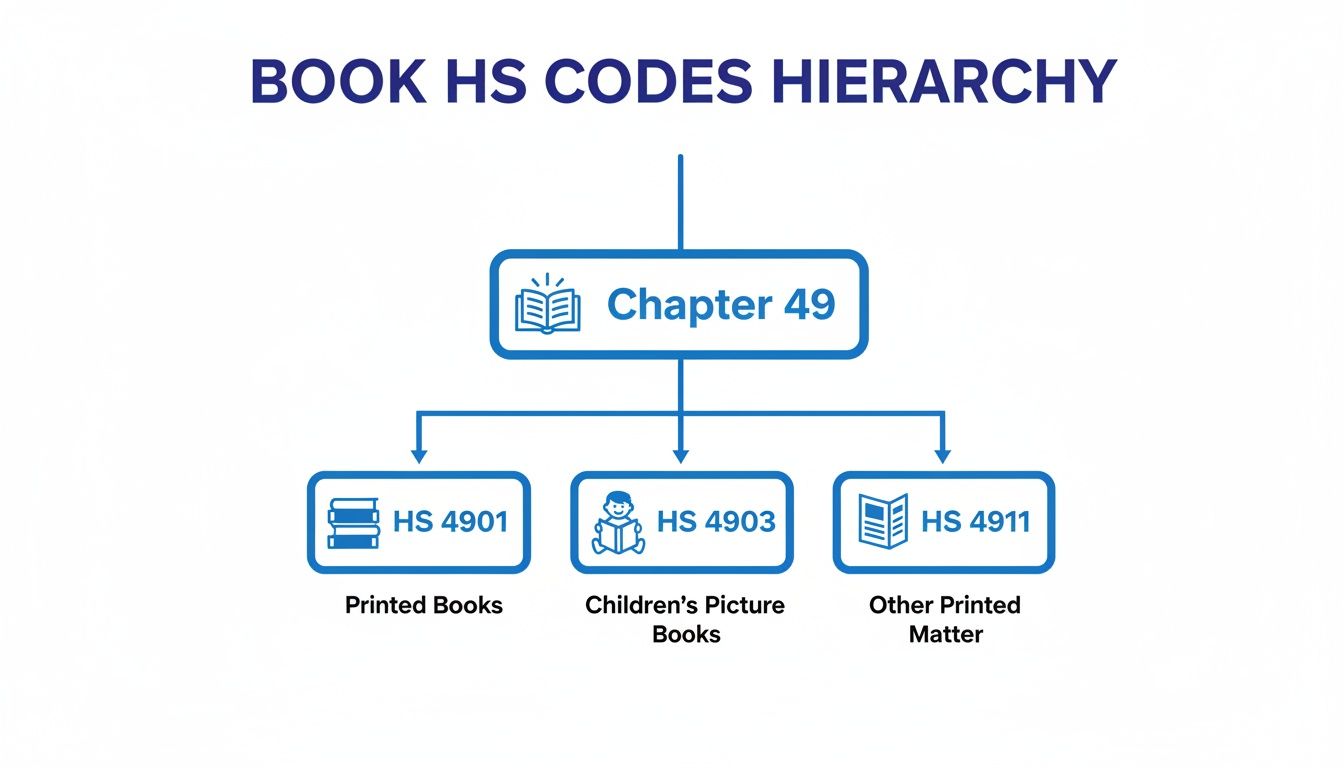
    • HS Heading 4901: This is the go-to category for most books. It covers everything from novels and textbooks to brochures and leaflets, whether they're single sheets or properly bound.
    • HS Heading 4903: This heading is carved out specifically for children's picture, drawing, or colouring books. The rule of thumb is simple: if illustrations are the main event and any text is just a supporting act, it belongs here.
    • HS Heading 4911: Think of this as the "miscellaneous" shelf for printed items that don't fit neatly elsewhere. This is where you'll find trade advertising materials, commercial catalogues, calendars, and printed pictures or photographs.

    So, while a university textbook and a slick marketing brochure are both made of bound paper, customs officials see two very different things. The textbook's purpose is educational reading, which puts it squarely in HS 4901. The brochure, however, is designed to sell something, which often lands it under HS 4911.

    Putting Classification into Practice

    Let's make this real. Say you're shipping a palette of hardback fantasy novels. Their entire reason for existing is to be read, so you’d start your search under HS 4901. Now, what if the next shipment is a batch of colouring books for kids? The main activity is drawing and colouring, not reading, which makes HS 4903 the obvious choice.

    To get it right, you have to determine the "essential character" of the product. Just ask yourself: why was this item made? Is it for reading? For a child to draw in? Or is it for advertising? Your answer will almost always point you to the correct HS heading.

    This level of detail is what makes global trade run smoothly. For example, Singapore uses the 8-digit ASEAN Harmonised Tariff Nomenclature (AHTN), which provides even more specific codes under the broader HS 4901 umbrella, simplifying commerce across the region. The impact is clear: HS 49 imports grew to a 4.1% share of cultural goods trade in 2023, and airfreight volumes shot up by 35% to 28,000 tonnes.

    You can dig deeper into these classifications on the official Singapore Customs website. When you correctly classify your goods within these frameworks, you're not just ticking a box for compliance—you're helping your shipments move faster and more efficiently through the global supply chain.

    A Practical Guide to Finding the Correct HS Code

    Figuring out the right harmonized code for books can feel like solving a puzzle, but with a structured approach, it becomes a straightforward, repeatable skill. The key is having a clear, step-by-step process. This isn't just about ticking boxes; it's about creating a solid workflow that cuts down on risks and gets your shipments through customs without a hitch.

    A repeatable process takes the guesswork out of the equation and gives you confidence in every declaration.

    Step 1: Start with the Item's Core Purpose

    Before you even glance at a tariff schedule, ask yourself a simple question: What is this item for? Your answer is the compass that guides the entire classification. Is it a novel meant for reading? A colouring book for a child? A promotional brochure for a business? The whole Harmonized System is built on this idea of an item's "essential character."

    For instance, a hardback dictionary’s job is to provide definitions, making its primary function informational. That simple fact points you straight towards HS Heading 4901 (Printed books, brochures, leaflets and similar printed matter). This first step instantly weeds out irrelevant categories and gives your search a clear direction.

    Step 2: Use the General Interpretative Rules

    The General Interpretative Rules (GIRs) are basically the official instruction manual for the HS tariff schedule. Think of them as the grammar of customs classification, ensuring everyone, everywhere, applies the codes the same way.

    The most important one to know is GIR 1. It states that classification is determined by the wording of the headings and any related section or chapter notes. This means you always have to start by reading the official descriptions for Chapter 49 and its headings. To get a better handle on this, it's worth taking a moment to learn more about the HS code for books and see how these rules work in the real world.

    The following infographic gives you a bird's-eye view of how Chapter 49 is structured, from the broad chapter down to specific headings.

    Hierarchy of Book HS Codes for Chapter 49, including Printed Books, Children's Picture Books, and Other Printed Matter.

    This visual helps you see how an item is classified, starting from the general (Chapter 49) and drilling down to the specific (like HS 4901 for textbooks or HS 4903 for children's books).

    Step 3: Verify with Official Search Tools

    Once you think you've landed on the right HS code, your next move is to double-check it against an official source. Never just trust a third-party website or reuse a code from an old shipment. Customs authorities have their own online databases for this very reason.

    Always cross-reference your findings with the official customs portal for the destination country. This is the only way to confirm the national-level subheading (the 8 to 12-digit code) and check for any specific regulations or tariff updates.

    For goods arriving in Singapore, for example, the Singapore Customs' HS/CA Product Code Search Engine is the ultimate source of truth. Using these official tools isn't just a good idea—it's essential for compliance.

    Step 4: Check Precedent Cases for Complex Goods

    So, what do you do with unusual items? Say, a book that comes packaged with a toy, or a multimedia learning kit? For these more complex goods, looking up binding rulings or precedent cases can be a lifesaver. Customs agencies frequently publish their decisions on how they've classified tricky products in the past.

    Digging into these precedents helps you understand the official line of thinking when a product’s "essential character" isn't so clear-cut. This final check ensures your logic is sound and matches how customs authorities have handled similar shipments before, massively reducing the risk of a costly dispute or reclassification down the line.

    Common Classification Mistakes and How to Avoid Them

    The line between the right Harmonized System code and a costly mistake can be razor-thin. It’s the kind of simple error that seems small at first—like confusing a printed diary with a blank notebook—but can quickly escalate into thousands of dollars in fines, shipment delays, and painful customs audits.

    Mastering the nuances of the harmonized code for books isn't just about ticking a compliance box; it’s about protecting your timeline and your bottom line.

    Navigating these rules demands real attention to detail. You'd be surprised how often incorrect HS classifications pop up. In fact, a Declarators analysis found they were behind 7.2% of all import disputes in Singapore during 2023. These aren't just minor clerical errors; they led to a staggering SG$8.9 million in overpaid GST and duties.

    Understanding the common pitfalls is the first step to avoiding them. Let's break down the most frequent classification blunders and give you clear, actionable steps to keep your shipments moving smoothly. For a closer look at Singapore's specific code structure, the official HS/CA Product Code Search Engine is your best resource.

    Two labeled books, a blank notebook and a printed diary, with a magnifying glass.

    Mistake 1: Confusing Printed Matter with Paper Products

    This is the classic, number-one error we see all the time. A logistics manager sees a bound paper product and instinctively defaults to Chapter 49. It’s an easy assumption to make, but it can be a costly one.

    The defining question you need to ask is: where does the item's primary value come from?

    • The Pitfall: Classifying a blank journal or a pack of ruled notebooks under HS Chapter 49.
    • What to do instead: Stick to the core principle. Chapter 49 is reserved for goods where the printed content is the main event—think novels, textbooks, or manuals. Items that are blank or only minimally printed, like notebooks, diaries with mostly empty pages, and stationery, belong in HS Chapter 48 (Paper and Paperboard). The simplest gut check is to ask: is it for reading, or is it for writing on?

    Mistake 2: Mishandling Educational Kits and Sets

    Shipments heading to the education sector are often more complex than just a box of books. A language learning kit, for example, might bundle textbooks with workbooks, flashcards, or even a supplementary CD-ROM. Trying to classify the whole lot under a single book code is a common shortcut that practically invites customs scrutiny.

    • The Pitfall: Using HS 4901 for a complete set that contains a book alongside other educational materials.
    • What to do instead: This is where you need to apply the General Interpretative Rules (GIRs) for "goods put up in sets for retail sale." The key is to identify which item gives the set its essential character. If the book is clearly the principal component, the entire kit can often take on the book’s HS code. But if the components have more or less equal importance, you may have to classify them separately.

    Pro Tip: When in doubt, document your reasoning for choosing the "essential character." This simple step demonstrates due diligence to customs authorities if your shipment is ever flagged for review, showing you’ve taken a proactive and thoughtful approach to compliance.

    Mistake 3: Classifying Digital and Physical Books the Same Way

    In the modern publishing world, the line between physical and digital media feels pretty blurry. For customs, though, it’s a hard border. E-books and audiobooks aren't physical goods, which means they fall completely outside the Harmonized System.

    • The Pitfall: Attempting to assign an HS code from Chapter 49 to a shipment of e-book access codes or a hard drive loaded with digital audiobooks.
    • What to do instead: You have to recognise that digital products are treated as services or intellectual property. Their import and export are governed by rules on digital trade, not the HS tariff schedule. If an e-book is delivered on a physical medium (like a USB drive), the HS code applies to the physical item itself (e.g., heading 8523 for the drive), not the digital book it contains.

    How to Turn HS Code Data Into Qualified Sales Leads

    What if every customs declaration was a breadcrumb leading straight to your next big client? It’s time to stop thinking of the harmonized code for books as just a compliance headache. When you see it as a business growth tool, the entire game changes.

    This data, which most people see as purely operational, is actually a goldmine of qualified sales leads just waiting to be tapped.

    For freight forwarders and logistics carriers, customs data is the ultimate treasure map. Every single time a company imports goods, they create a detailed record. This isn't just a vague product description; it’s a direct window into a prospect's entire shipping operation, revealing who is shipping, what they’re shipping, how much, and how often.

    From Raw Data to Actionable Insights

    The real magic happens when you turn all that raw data into genuine business intelligence. By filtering customs declarations for a specific HS code, like 4901 for printed books, you can instantly pull a list of companies that are actively importing those exact products.

    This isn't some generic business directory you bought online. It’s a highly curated list of active shippers with a proven, current need for your logistics services.

    The HS code for books, especially HS 4901 within Singapore's AHTN framework, is incredibly revealing. Data from SingStat, for example, shows a 28% jump in imports under HS Chapter 49 between 2020 and 2024, hitting a total value of SG$1.2 billion. For any logistics professional, this is solid gold. It points you directly to growing importers in the education and publishing sectors who desperately need reliable partners. You can explore more about these trade classifications on SingStat's official site.

    This screenshot from Coreties gives you a glimpse of how modern platforms organise customs data to highlight high-value shipping prospects.

    What was once a mess of complex trade records becomes a clean, sortable list, making it easy for sales teams to pinpoint top importers by shipping volume and frequency.

    Crafting a Hyper-Personalised Outreach

    Armed with this level of detail, you can finally ditch the generic cold calls. Instead, you can craft a hyper-personalised pitch that lands with real impact. Imagine calling a potential client and starting the conversation with, "I noticed you regularly import educational textbooks from Vietnam into Singapore. We specialise in that exact trade lane and have a solution that could streamline your process."

    That kind of opener immediately establishes your relevance and shows you've done your homework. You're no longer just selling a generic service; you're offering a specific solution to a problem you already know they have. You can learn more about how to filter customs data using an HS code filter to build these kinds of targeted lists.

    Let's look at how a raw HS code can become a qualified sales lead. This simple, three-step workflow shows the process from data to conversation.

    From HS Code to Qualified Lead in 3 Steps

    Step Action Business Outcome
    1. Target Filter customs data for HS Code 4901 to find companies importing books. Get a focused list of active, relevant prospects.
    2. Analyse Review their shipping volumes, frequency, and trade routes. Understand their specific logistics needs and pain points.
    3. Engage Craft an outreach message that directly references their shipping activity. Start a warm conversation that shows expertise and relevance.

    As you can see, this data-driven approach completely transforms your sales process into something far more intelligent and effective.

    Instead of guessing who might need your services, you're engaging with companies based on their actual, verified shipping behaviour. It’s the difference between casting a wide net and fishing with a spear.

    This method isn’t just about finding leads; it’s about creating a sustainable engine for growth by turning compliance data into your most powerful sales asset. And for those looking to get even more advanced, exploring strategies like AI-powered lead generation can add another powerful layer to converting this data into real business.

    Your Blueprint for Customs Mastery and Business Growth

    Getting the harmonised code for books right delivers a powerful one-two punch. First, you shield your operations from expensive delays and compliance headaches. Second, you unlock a hidden pipeline of high-value sales opportunities. Think of this guide as your complete playbook—giving you the practical skills to classify any book shipment and the strategic know-how to turn that data into your next big client.

    When you put these principles into practice, you're doing more than just ticking a compliance box. You're showing clients that you're a true partner, someone who understands the nuances of their supply chain. This is how you move past one-off transactions and start building relationships that last.

    The real work starts now. Dive into customs data, pinpoint the shippers who clearly need your expertise, and reach out with solutions that genuinely solve their problems.

    Of course, customs expertise is just one piece of the puzzle. Lasting business growth also depends on solid strategic planning for sales to create a clear, data-informed path forward.

    When you blend precise logistics knowledge with a sharp sales framework, you build an unstoppable engine for growth. This is your blueprint for turning a regulatory necessity into a real competitive edge, fuelling your company's success for years to come.

    Frequently Asked Questions

    When you're dealing with the HS code for books, a few common questions always seem to pop up. Let's tackle some of the most frequent ones we hear from logistics pros and shippers.

    What Is The Main Difference Between HS Codes In Chapter 48 And Chapter 49?

    The simplest way to think about it is this: it all comes down to the printing.

    Chapter 48 is all about the paper itself. It covers paper and paperboard items that are either completely blank or have just a little bit of printing that doesn't add much value, like headed stationery or empty notebooks. The product's main value is the paper.

    On the other hand, Chapter 49 is where the printed content is the star of the show. This is the home for books, newspapers, and brochures. Here, the value isn't in the paper but in the story, the information, or the pictures printed on it.

    How Are E-books Classified Under The Harmonized System?

    This one's a bit of a curveball. E-books aren't classified under the Harmonized System at all because they aren't physical goods. Since they are digital products, they're typically handled as services or software and don't get an HS code the way a printed book does.

    The rules that govern their import and export fall under regulations for digital services and intellectual property, which is a completely different ballpark from the tariff schedule for physical items.

    Think of it this way: HS codes are designed to track tangible things you can physically hold as they cross a border. An e-book is just a file, so it completely sidesteps that system.

    Does A Book With An Included CD-ROM Change Its HS Code?

    This is a classic "it depends" situation, and it hinges on the product's "essential character."

    If the CD-ROM is just a bonus feature—like an audiobook version or a few extra practice exercises—the whole package is almost always classified under the book's HS code, which would likely be in heading 4901. The book is clearly the main event.

    However, if the book and CD are marketed together as a multimedia kit where both parts feel equally important, customs might see it differently. They could classify it as a "set," which follows a different set of rules and could very well land it a different code. It's something that needs a careful look.


    Discover, analyse, and connect with high-volume book shippers today. With Coreties, you can turn customs data into qualified leads and start meaningful conversations with prospects who need your expertise. Find your next client with Coreties.