
If you're a sales team trying to make headway in Southeast Asia's logistics scene, Nippon Express Singapore is more than just another competitor—it’s the benchmark. Really getting to grips with how this giant got to the top, and stays there, is your first step toward landing the same kind of high-value clients. Think of this guide as your playbook for breaking down their success and sharpening your own sales approach.
Decoding a Logistics Titan in Southeast Asia
To compete, you have to know the field. In Singapore's dynamic trade ecosystem, Nippon Express is a cornerstone, with a history that goes back fifty years. Their success wasn't a fluke; it's the result of smart positioning, deep integration into key industries, and a massive local footprint.
When you pull apart their operations, you get a powerful lens to view the entire market. This isn't just about watching a rival from the sidelines; it's about spotting patterns you can actually use. Once you know the industries they focus on, the trade lanes they own, and the infrastructure they've built, you start to see exactly what their ideal customers need.
The Foundation of Regional Dominance
Nippon Express Singapore's story starts at a pivotal time for global trade. The company set up shop in 1973, catching the wave of Singapore's meteoric rise as a central trade hub. As the Port of Singapore’s throughput blew past 100 million tons and container traffic jumped by 15-20% annually in the late 1970s, Nippon Express was right there, building its foundation. For a deeper dive, you can explore the company's long history.
For sales teams, this history is more than just a fun fact. It points to deep, long-standing relationships with multinational corporations and an innate grasp of regional supply chain challenges that newer competitors simply don't have.
This entrenched presence is a roadmap for your own prospecting. By studying their client list and service menu, you can pinpoint shippers with similar needs who might just be looking for a more nimble or specialised logistics partner. This guide will walk you through turning that analysis into outreach that works. For more background, you might find our guide on navigating the import-export business helpful.
Mapping Their Core Services and Key Trade Lanes
To get under the hood of Nippon Express Singapore, you need to see them as more than just a list of services. Their real power comes from how they weave together air, ocean, and warehousing into a seamless, integrated machine, especially for high-value industries. This isn’t about just moving boxes from A to B; it's about engineering precise, reliable supply chains.
For any sales team looking to compete, this integration is a blueprint. When you understand how they bundle these services, you start to see the exact pain points and priorities of their top clients. This insight is your opening to position your own offerings as a smarter alternative—maybe one with more flexibility, deeper specialisation, or a fresh approach.
Where They Dominate: High-Value Verticals
Nippon Express Singapore has staked its claim in sectors where there's zero room for error. Their entire operation is fine-tuned for industries with notoriously complex logistics—the kind that demand Fort Knox-level security, breakneck speed, and airtight compliance.
You can see this focus baked into their infrastructure and service design. They don't just offer generic freight; they provide highly specialised solutions built for the unique headaches of specific cargo.
To illustrate how Nippon Express Singapore has positioned itself, let's look at their core service offerings and the markets they're built to serve.
Nippon Express Singapore Key Service Offerings
| Service Category | Description | Primary Industries Served | Key Trade Lanes |
|---|---|---|---|
| Air Freight | Specialised handling for time-sensitive, high-value cargo, including temperature-controlled and secure transport options. | Electronics & Semiconductors, Pharmaceuticals, Automotive Components | Intra-Asia, Asia-Europe, Asia-North America |
| Ocean Freight | Full container load (FCL) and less-than-container load (LCL) services, with a focus on reliability and network reach. | Retail & Consumer Goods, Industrial Manufacturing, Automotive | Trans-Pacific, Asia-Europe |
| Warehousing & Distribution | Secure, compliant storage solutions, including bonded warehousing, climate-controlled facilities, and value-added services. | Pharmaceuticals, High-Tech Electronics, Luxury Goods | Domestic Singapore, Regional hub for Southeast Asia |
| Cross-Border Trucking | An extensive road network connecting Singapore with Malaysia, Thailand, and the broader ASEAN region for seamless land transport. | Automotive, Electronics, Fast-Moving Consumer Goods (FMCG) | Singapore-Malaysia, Singapore-Thailand |
| Specialised Logistics | Custom solutions for heavy-lift projects, fine art transportation, and supply chain consulting. | Energy, Arts & Exhibitions, Project Cargo | Global, project-specific |
This table shows a clear pattern: a deep focus on industries that can't afford mistakes and the infrastructure to back it up.
The Power of Key Trade Corridors
Since setting up shop here in 1973, Nippon Express Singapore has grown in lockstep with Singapore Changi Airport, which has since become one of the world's most critical cargo hubs. To put that in perspective, the airport handled a massive 2.01 million tonnes in 2022, a notable jump from pre-pandemic levels. Nippon Express's own global air cargo volume hit 870,000 tons that same year, with Singapore acting as a vital linchpin. You can dig into more details in their materiality report from Nippon Express Holdings.
The airport is a powerhouse for high-value goods like electronics and pharmaceuticals, which make up a staggering 40% of its total throughput. It's on these critical trade lanes, particularly the intra-Asia and Asia-Europe routes, where Nippon Express’s network really flexes its muscle.
For sales professionals, customs data from these specific corridors is a goldmine. It lets you find shippers moving the exact same types of goods along the same routes. Suddenly, you have a hyper-targeted prospect list whose logistics challenges are a mirror image of Nippon Express's current clients.
This kind of data-driven approach turns a cold call into a warm, relevant conversation. By knowing the cargo and corridors they own, you can identify shippers with an identical logistics profile and present a solution that speaks directly to what they need.
Taking a Closer Look at Their Local Infrastructure Advantage
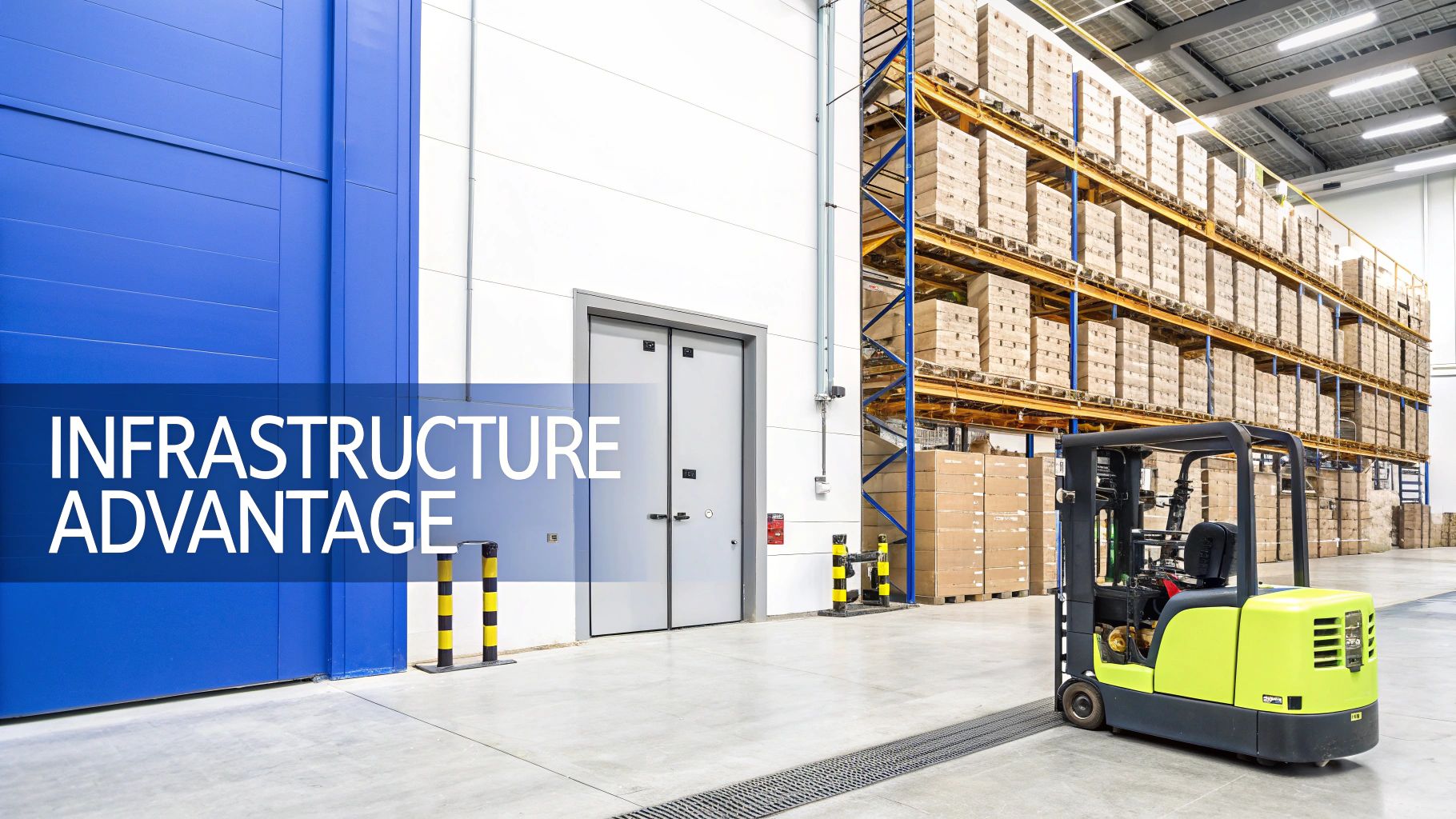
The services you see from Nippon Express Singapore are all built on a massive physical foundation. Their real strength isn't just about having space; it's about having the right space in the right places. They’ve turned prime real estate into a serious strategic weapon.
This network of advanced warehouses and logistics hubs is the engine driving their entire Singapore operation.
Don't think of their facilities as simple storage sheds. They're highly specialised centres, deliberately placed within key economic zones to cut down on friction and boost speed. This gives them a clear competitive edge, paving the way for faster customs clearance and smoother handling for cargo where every minute counts.
For any sales team trying to compete, getting a handle on this physical footprint is non-negotiable. It shows you exactly where the high-stakes logistics decisions are being made and gives you a map for smart prospecting.
The Power of Being in the Right Place
Nippon Express Singapore has poured serious money into facilities inside Singapore’s Free Trade Zones (FTZs). These secure areas are gold for transshipment, letting goods be stored, bundled, or processed without formal customs entry. That means fewer duties and far less administrative headache for their clients.
Their spot at the Changi Airfreight Centre is another ace up their sleeve. Having direct airside access is absolutely essential for the high-value electronics and pharmaceutical industries they cater to.
This strategic infrastructure isn't just concrete and steel; it's what makes their complex, value-added services possible. It gives them capabilities that smaller players simply can't replicate.
Specialised Facilities for High-Stakes Cargo
It’s not just where the facilities are, but what they can do that sets Nippon Express Singapore apart. Many of their warehouses are custom-built for very specific, demanding supply chains.
- Temperature-Controlled Logistics: They run GDP-certified facilities for pharmaceuticals, maintaining strict temperature and humidity controls to protect drug integrity all the way to the final delivery.
- Secure Storage: For the semiconductor and electronics crowd, they offer TAPA-certified warehouses with beefed-up security protocols to guard valuable components against theft or damage.
- Value-Added Services: These aren't just holding bays. They act as hubs for kitting, light assembly, quality checks, and custom packaging, embedding themselves deep into their clients' production and distribution cycles.
This infrastructure is a huge selling point for them. If you’re looking to win business from them, the challenge isn’t just about offering a lower price. It's about proving you have a credible alternative that can handle these complex requirements. By zeroing in on shippers located in these industrial hubs, you can focus your energy where the most valuable logistics contracts are up for grabs.
Finding the Right People to Talk To
Let's be honest, in logistics sales, a great service only gets you so far. The real challenge is getting that message to the right person at the right time. When you're going after clients like the ones Nippon Express Singapore serves, you're usually dealing with big, complex companies. Firing off a generic email to their main inbox is the quickest way to get deleted.
To actually make an impression, you need to understand how these companies are structured. Think of their org chart less as a rigid ladder and more as a map of influence. Your mission is to find the people whose daily headaches and career goals line up perfectly with the solutions you're selling.
Who Actually Makes the Logistics Decisions?
Inside any large shipper, a few key roles pull the levers on logistics and supply chain decisions. The job titles might change from one company to another, but the responsibilities are pretty consistent. Nailing down who these players are is your first, most important step.
These roles don't operate in a vacuum; they work together on the big calls. The Head of Procurement will be laser-focused on the cost, while the Supply Chain Director is thinking about resilience and keeping things moving on schedule.
- Supply Chain Director or VP of Supply Chain: This is your strategic thinker. They’re obsessed with the big picture—making the supply chain more efficient, less risky, and a driver of business growth.
- Logistics Manager: This person lives in the trenches. Their world is all about carrier performance, tracking shipments, clearing customs, and putting out fires when delays pop up.
- Procurement Manager or Head of Procurement: Their job is all about the numbers. They negotiate contracts, manage suppliers, and are always looking for partners who deliver serious value for money. They live and breathe SLAs.
- Operations Manager: Often coming from the manufacturing or production floor, their main worry is keeping the factory running. They need a smooth, predictable flow of raw materials coming in and finished goods going out. Any hiccup hits their KPIs directly.
When you understand what makes each of these roles tick, you can shape your message to hit home. A pitch about cost savings will get a Procurement Manager’s attention, while a conversation about better supply chain visibility will have a Logistics Manager leaning in.
How to Find and Connect With These Contacts
Once you know the type of person you’re looking for, the hunt begins. This is where modern sales intelligence tools become your best friend. Platforms that crunch customs data can show you exactly which companies are shipping what, where—letting you build a list that mirrors the Nippon Express Singapore client profile.
From there, you can jump onto professional networking sites and use data tools to pinpoint the actual people in those target roles. If you really want to get into the weeds on this, you can learn more about how to find the right contacts at EXIM and manufacturing enterprises in our detailed guide.
When it's time to reach out, you have to do more than just sell. Your message needs to show you've done your homework. Mentioning their company's shipping routes or the specific products they move shows you get their business. This data-first approach proves you’re not just another salesperson—you’re a problem-solver with a relevant solution, which massively boosts your chances of starting a real conversation.
Finding Your Edge in a Crowded Market
Trying to take on a logistics powerhouse like Nippon Express Singapore with a better price list alone is a losing game. You need a sharper strategy, one that’s built on knowing what they do exceptionally well and, more importantly, spotting the gaps they leave behind. They’re a dominant force, for sure, but they’re not unbeatable.
So, what’s their secret sauce? A couple of things, really. First, they have incredibly strong, long-standing ties with Japanese multinational corporations (MNCs). These relationships have been cultivated for decades and act as a powerful defensive wall. Second, their entire brand is built on precision and reliability, especially for high-value industries like pharmaceuticals and electronics where a single mistake can be catastrophic. This makes them the go-to provider for any shipper who can't afford to take risks.
Pinpointing Your Competitive Angle
The trick is to stop trying to be a smaller version of them. Instead of fighting on every front, pick your battles and focus on areas where you can offer something genuinely different and better. It’s all about finding your sweet spot and owning it.
Your value proposition has to be crystal clear and solve a real problem for the shipper. Think about where smaller, more agile players often have the upper hand:
- Real Flexibility: Big companies often mean rigid systems. You can offer more adaptable pricing, create bespoke service packages, or say "yes" to the kind of non-standard cargo that just doesn't fit into their highly optimised operations.
- Deep Niche Expertise: While Nippon Express is strong in several major sectors, there are always emerging industries or highly specialised verticals. This is your chance to become the undisputed expert and provide a service that truly understands the nuances of that field.
- A Human Touch: It’s easy to feel like just another account number when dealing with a global corporation. You can position yourself as a true partner, offering a dedicated contact person who actually picks up the phone and has the authority to solve problems quickly.
The goal isn't to be cheaper than Nippon Express on every single lane. It's to find the customers who are quietly getting frustrated with inflexible contracts, generic service, or a 'one-size-fits-all' mindset and show them a better way.
Crafting Your Value Proposition
Once you know where you can win, you need to turn that advantage into a simple, compelling message. For instance, if you hear a shipper complaining about rigid pickup times from their current provider, your entire pitch should revolve around your customised scheduling. If they feel lost in a sea of compliance paperwork their provider doesn't understand, your outreach should lead with your specific industry certifications and success stories.
By seeing the strengths of Nippon Express Singapore clearly, you can carve out your own space and become the obvious choice for shippers who are looking for a different kind of logistics partner.
Crafting Your Data-Driven Outreach Playbook
So, you've got all this great intel on Nippon Express. Now what? The real magic happens when you turn that market analysis into actual sales meetings. This isn't about firing off generic emails and hoping for the best; it’s about building a repeatable process that works.
We're going to walk through how to use these insights on Nippon Express Singapore to build a concrete, data-driven strategy. The goal is simple: stop making cold calls and start having intelligent conversations that prove your value from the very first sentence.
By understanding what a typical Nippon Express client looks like, you can approach similar companies with a message that speaks directly to their most pressing logistics challenges.
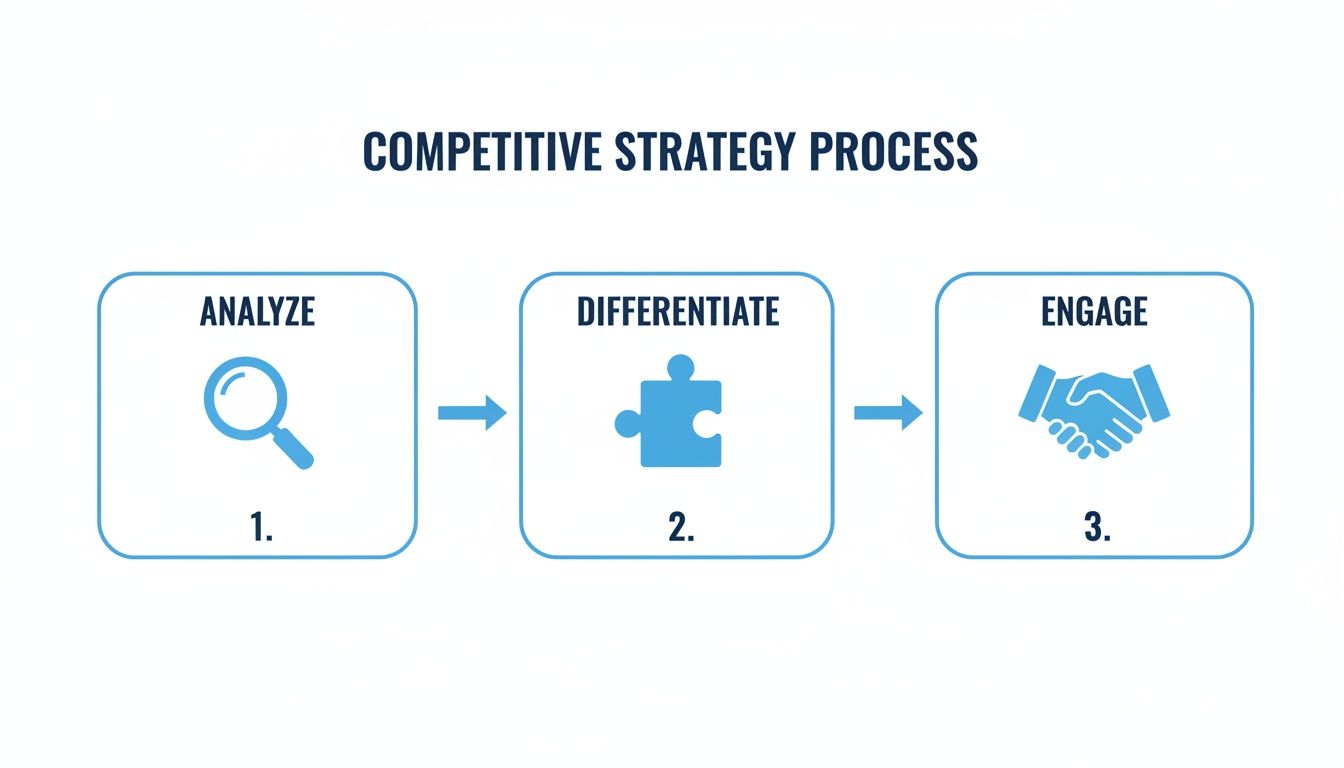
This simple flow—Analyse, Differentiate, and Engage—is your roadmap for turning competitor intelligence into real opportunities.
Step 1: Pinpoint High-Potential Prospects
First things first: you need a hit list. But not just any list. We're talking about a highly targeted group of prospects whose shipping behaviour looks a lot like that of Nippon Express's customers. Think specific commodities, key trade routes, and consistent volumes.
The smart way to do this is with a logistics intelligence platform. You can filter the entire market based on the exact signals you uncovered in your analysis of Nippon Express.
- Commodity Focus: Search for companies shipping electronics, pharmaceuticals, or automotive parts using specific HS codes.
- Trade Lane Activity: Hone in on shippers who are frequently moving goods along the busy intra-Asia and Asia-Europe corridors.
- Volume and Frequency: Identify businesses with steady, predictable shipping volumes. This is a dead giveaway that they need a reliable logistics partner.
This approach cuts through the noise and makes sure you’re only talking to companies that are a natural fit. For a more detailed breakdown of this technique, take a look at our guide on finding company import-export data.
Step 2: Uncover the Right People and Their Pain Points
Once you have your target companies, you need to find the right person to talk to. Your targets are the Supply Chain Directors, Logistics Managers, and Procurement Heads—the people who lie awake at night worrying about logistics performance.
Modern sales tools are brilliant for this. They can help you identify these key contacts and even give you a peek into their specific roles and recent company activities. A little digging here helps you understand what's on their mind. Are they under pressure to cut costs? Struggling with on-time delivery? Or are they searching for more flexible shipping solutions?
The Key Shift: When you align your outreach with a decision-maker's actual pain points, you're no longer making a sales pitch. You're starting a problem-solving conversation. That’s how you get their attention.
Step 3: Write an Outreach Message They Can’t Ignore
This is where all your hard work pays off. It's time to put together a message so relevant that it's practically impossible to ignore. Instead of the usual "Hi, I'm from X company…" lead with a specific, data-backed insight.
For instance, you could open with: "I noticed your company regularly ships electronic components from Singapore to Frankfurt. That's a lane where we specialise in secure, temperature-controlled air freight, often beating standard transit times."
An opening like that does two things instantly: it proves you've done your homework and establishes your credibility. You're not just another vendor anymore; you're a potential strategic partner who genuinely understands their business. This data-informed approach is your ticket to higher response rates and a much more productive conversation about why you’re a better alternative to their current setup.
Data-Driven Outreach Strategy Comparison
The difference between the old way of doing sales and this new, data-driven approach is night and day. One is about volume and luck; the other is about precision and value.
The table below illustrates this contrast clearly.
| Outreach Step | Traditional Method | Coreties-Powered Method |
|---|---|---|
| 1. Prospecting | Buying generic lists or manually searching for companies in a target industry. | Filtering for companies with specific shipping volumes, commodities, and trade lanes that match your ideal customer profile. |
| 2. Finding Contacts | Guessing job titles (e.g., "[email protected]") or using broad LinkedIn searches. | Pinpointing specific Supply Chain Directors or Procurement Heads using sales intelligence tools. |
| 3. Initial Outreach | Sending a generic email or making a cold call with a standard company pitch. | Leading with a highly specific insight about their shipping activity, instantly demonstrating relevance. |
| 4. Value Proposition | "We offer great rates and service." | "We can improve your on-time delivery on the Singapore-Frankfurt lane, where you ship frequently." |
| 5. Follow-Up | "Just following up on my last email…" | Sharing a relevant case study or market update related to their specific trade lanes or products. |
| 6. Overall Outcome | Low response rates, conversations focused on price, and long sales cycles. | Higher engagement, value-driven conversations, and a faster path to building trust and closing deals. |
As you can see, the Coreties-powered method transforms every step of the outreach process. It replaces guesswork with certainty, allowing your sales team to act as informed consultants rather than just another voice in a crowded inbox. This is how you win in a competitive market.
Answering Your Key Questions
When you're squaring up against a giant like Nippon Express Singapore, a few key questions always come to mind. Getting straight answers is the first step to building a sales strategy that actually has a chance of working. Let's tackle the big ones.
Think of this as the strategic cheat sheet. It’s not just trivia; it’s a quick summary of the critical points you can use to find your opening and start making inroads.
What Are the Main Industries Served by Nippon Express Singapore?
Nippon Express Singapore doesn't try to be everything to everyone. They’ve zeroed in on high-value, high-stakes sectors. You’ll find their core client base is heavily concentrated in electronics, semiconductors, pharmaceuticals, and automotive parts.
It’s no accident. Their whole setup—from secure, temperature-controlled warehouses to their compliance protocols—is built to handle the delicate, time-sensitive nature of these goods. This specialisation is where they really shine.
How Can I Find Shippers with Similar Needs?
This is where the data comes in. The best way to find companies with the same logistics DNA is to dive into global customs data using a solid intelligence platform. The trick is to filter your search using the same playbook they do.
By looking for the specific commodity codes (HS codes) and trade routes that Nippon Express dominates, you can build an incredibly focused prospect list. This method lets you pinpoint shippers with identical needs and get right to the logistics contacts who make the decisions.
What Is Their Strategic Advantage in Singapore?
Their biggest trump card is their use of Singapore's port and airport as a strategic command centre for the entire South Asia and Oceania region. This isn't just about location; it's about integration.
This position allows them to offer sophisticated multi-modal transport solutions, like seamless sea-to-air transhipments, that are a huge draw for customers with urgent, high-value cargo. They've turned Singapore into a powerful, flexible hub that smaller players find almost impossible to match.
Ready to stop guessing and start targeting the right shippers? Coreties transforms global trade data into your next sales opportunity. Find qualified leads that match your ideal customer profile, identify key decision-makers, and craft data-driven outreach that gets results. Learn more at https://coreties.com.