Tag: ocean freight

  • Guide to International Frieght Shipping: 2026 Expert Advice

    Guide to International Frieght Shipping: 2026 Expert Advice

    Your supplier says the cargo is packed. Your customer wants a delivery date. Finance wants a landed-cost estimate. Then the first forwarder asks for the commercial invoice, packing list, product descriptions, consignee details, and shipping terms, and suddenly a shipment that looked simple turns into a chain of handoffs, approvals, and documents.

    That feeling is normal. A first international move usually looks harder than it is. The problem isn't that global freight is impossible to manage. The problem is that perspectives often reveal only one slice of it at a time. Production sees pickup. Sales sees promised delivery. Customs sees declarations. The forwarder sees the full chain.

    Your Guide to International Freight Shipping

    If you're new to international frieght shipping, the fastest way to get comfortable is to stop treating it like a single event. It isn't one event. It's a managed sequence: booking capacity, preparing documents, clearing export formalities, moving cargo across one or more modes, clearing import customs, and delivering to the consignee.

    That sequence matters because global trade still runs on physical freight at massive scale. Maritime transport moves over 80% of goods traded worldwide by volume, according to UNCTAD's seaborne trade statistics. That's why ocean freight remains the default choice for long-haul international cargo, even when it feels slower and less predictable than air.

    A new import or export manager usually runs into the same set of questions:

    • Which mode fits this shipment? Ocean, air, or a hybrid route.
    • Which party does what? Carrier, forwarder, broker, terminal, warehouse, consignee.
    • Which documents are essential? The answer is more than "send the invoice."
    • Why does the quote have so many charges? Base freight is only one line.
    • Where does risk sit? Delay, customs holds, cargo damage, rerouting, missed handoffs.

    Practical rule: Most shipment problems don't start on the water or in the air. They start before departure, when the booking data, documents, and commercial terms don't line up.

    The good news is that the process becomes manageable once you understand the logic behind it. Shippers need that logic to buy freight services intelligently. Forwarders need it to solve the right problems for those shippers. Both sides work better when they see the same map.

    The Players in the Global Shipping Ecosystem

    A shipment works like a production crew. One party owns the goods, one arranges the movement, one physically transports them, one checks regulatory compliance, and several others control the handoff points. Trouble starts when a shipper assumes one player is handling a task that is another's responsibility.

    A diagram illustrating the global freight ecosystem and the key entities involved in an international shipment journey.

    The core roles you deal with

    The shipper is the party sending the goods. In practice, that usually means the exporter, manufacturer, seller, or origin warehouse managing dispatch instructions and commercial paperwork.

    The consignee is the receiving party. Sometimes that's the end customer. Sometimes it's a distribution center, branch office, or buyer's warehouse. The consignee name matters because customs documents, release instructions, and delivery orders have to match it exactly.

    The freight forwarder is the organizer. Forwarders don't always own the trucks, aircraft, or vessels. They coordinate the move, book with carriers, align documents, manage exceptions, and often act as the main communication layer between shipper and transport network.

    The carrier performs the physical transport. That could be an ocean line, airline, trucking company, or rail operator. Carriers move the cargo, but they usually don't clean up weak booking data or fix inconsistent paperwork for you.

    The players that control the handoffs

    Customs authorities don't move cargo, but they can stop it. They assess declarations, review supporting documents, and may inspect shipments before release.

    Port and terminal operators control loading, unloading, container handling, and yard movement. A ship can arrive on time and still leave your cargo waiting if terminal congestion or handling constraints slow the next step.

    Warehouse operators store, stage, cross-dock, label, and consolidate cargo. For many importers, the warehouse is where freight becomes inventory. That's why warehouse cutoffs, receiving hours, and pallet rules matter just as much as vessel schedules.

    Where responsibility gets blurry

    The easiest mistake is assuming "my forwarder is handling everything" without defining what "everything" includes. Some forwarders manage customs brokerage, cargo insurance, and final-mile coordination. Others only arrange port-to-port freight.

    Use this quick check before you book:

    Party Usually responsible for
    Shipper Cargo readiness, commercial details, accurate product data
    Forwarder Booking, coordination, document review, exception management
    Carrier Main transport leg and equipment operation
    Customs broker or customs team Filing declarations and handling clearance interactions
    Consignee Receiving cargo, import-side coordination, final delivery readiness

    If nobody has clearly accepted a task in writing, assume it still belongs to you.

    Choosing Your Shipping Mode Ocean Air and Intermodal

    Mode selection isn't a speed-versus-cost slogan. It's a service design decision. You aren't only buying transit. You're buying capacity, handoff complexity, schedule resilience, and recovery options when something changes after departure.

    A comparison chart showing the differences between ocean, air, and multimodal freight shipping methods.

    The basic trade-off still matters

    Ocean freight usually fits cargo that is bulky, less time-sensitive, or planned well in advance. Air freight fits cargo with high urgency, tighter replenishment windows, or higher value relative to transport cost. Intermodal and hybrid options sit between those two poles.

    The mistake is choosing too early based on habit. Many shippers say, "This always goes ocean," when the key question is whether this specific shipment can tolerate the current lane conditions, handling pattern, and customer deadline.

    Here is the quick comparison typically needed first.

    Factor Air Freight Ocean Freight
    Transit speed Fastest option for long-distance moves Slower, especially on long-haul lanes
    Cost profile Higher transport cost Usually more economical for larger volumes
    Cargo suitability Time-sensitive, high-value, urgent replenishment Heavy, bulky, routine, and forecastable cargo
    Capacity style Strong for smaller and urgent shipments Better for large-volume and containerized cargo
    Schedule risk Can still face rollovers and space pressure More exposed to port disruption and vessel schedule shifts
    Handling pattern Fewer days in transit, but strict cutoffs Longer end-to-end timeline with more node exposure

    What works in the real world

    Choose ocean when planning discipline is strong. It rewards forecasting, consolidation, and stable replenishment cycles.

    Choose air when the cost of being late is worse than the freight premium. That often happens with stockouts, launch windows, replacement parts, or cargo tied to contractual delivery dates.

    Choose intermodal or sea-air when the lane has become unstable. That's where many teams can improve. The choice is not always a clean sea-versus-air decision. FreightWaves reported that sea-air routes are gaining attention as carriers bypass the Red Sea, which shows how route choice has become lane-specific and dynamic.

    A better mode decision framework

    Don't ask only, "What's cheaper?" Ask these questions first:

    • How expensive is delay for this shipment? Lost sales, idle production, customer penalties, or shelf gaps.
    • Can the cargo handle extra handoffs? Some products tolerate transshipment and reconsolidation better than others.
    • Is the lane stable right now? A route that worked last quarter may be poor this month.
    • Can you split the shipment? Sending a critical portion by air and the balance by ocean often works better than forcing the whole order into one mode.
    • Does the receiving site have strict timing needs? Some warehouses care more about appointment reliability than raw transit speed.

    The best mode is the one that protects the commercial objective of the shipment, not the one that looks cheapest on the first quote.

    Navigating Customs and Required Documentation

    A shipment can leave the factory on schedule, make the port cutoff, and still miss its delivery window because the paperwork does not hold together. That is the part many new import and export managers learn the hard way. Customs release depends less on how fast the cargo moves than on whether the shipment file tells one clear, consistent story.

    A step-by-step infographic illustrating the international customs clearance process for goods being shipped between countries.

    Customs authorities, carriers, brokers, and forwarders all work from declared data. If the invoice says one thing, the packing list suggests another, and the transport document names a different party, the shipment draws attention. The result is usually a document hold, a request for clarification, an exam, or a delayed release. For shippers, that means lost time and added cost. For forwarders, it is also a service opportunity. The firms that win repeat business are often the ones that catch these issues before filing, then use those patterns to help similar shippers avoid them in the first place.

    The documents that move the file through customs

    The commercial invoice is the anchor document. It tells customs what the goods are, who is selling and buying them, what currency applies, and what value is being declared. If the product description is vague or the value does not line up with the transaction, the rest of the file becomes harder to defend.

    The packing list describes the physical shipment. It should match how the cargo was packed, down to carton counts, pallet counts, weights, and dimensions. Warehouse teams use it. Customs may use it. So do inspectors when they need to reconcile what was declared against what is in front of them.

    The Bill of Lading or Air Waybill covers the transport side. In ocean freight, the Bill of Lading can also affect release control and title handling, which is why consignee details and cargo descriptions need close review before issuance.

    Depending on the product and country pair, teams may also need permits, certificates, import declarations, export filings, or product-specific compliance records. Classification usually sits underneath all of it. If your team is still sorting that out, this guide to HTS codes and product classification gives a practical starting point before anything is filed.

    Where customs files break down

    The common failures are rarely dramatic. They are usually small mismatches that signal uncertainty.

    • Party mismatch: The importer, consignee, or notify party is listed differently across documents.
    • Product description mismatch: One document says "parts" and another gives a specific commercial name.
    • Quantity mismatch: Unit counts, carton totals, or net and gross weights do not align.
    • Classification weakness: The description is too broad to support the tariff code being used.
    • Value questions: The declared value looks inconsistent with the goods, terms, or related-party arrangement.

    A broker can file only what the shipper and supplier provide. A forwarder can coordinate only what has been declared clearly. That is why strong operators build a pre-clearance review into the process instead of treating documentation as a last-minute admin task.

    A practical document check before cargo departs

    Use a four-part review.

    1. Confirm the parties. Legal names, addresses, tax IDs, and contact details should match the commercial setup and the transport documents.
    2. Confirm the goods. Descriptions, quantities, packaging details, and weights should tell the same story across the invoice, packing list, and booking data.
    3. Confirm classification and use. Customs needs enough detail to understand what the item is, what it is made of, and how it will be used.
    4. Confirm filing responsibility. Make it explicit who is handling the customs entry, export declaration, permit collection, and any product-specific compliance checks.

    This review matters even more when a shipment involves a new supplier, a first-time lane, or a product with regulatory exposure.

    For forwarders, this is also where commercial advantage starts. If a shipper repeatedly struggles with one commodity group, one origin, or one customs requirement, that pattern can be tracked and turned into a better SOP, better onboarding, and better prospect targeting. Data on shipment volume, commodity type, and lane activity helps forwarders identify which shippers are likely to need hands-on customs support, then approach them with a specific fix instead of a generic freight pitch. That is the bridge between shipper needs and forwarder solutions, and it is where tools such as Coreties fit naturally into the workflow.

    A short walkthrough can help if you're training a new team member on the clearance flow.

    Clean documents protect release timing, reduce avoidable exams, and give both shippers and forwarders more control over the shipment.

    How International Freight Costs Are Calculated

    A new import manager gets a quote for one container from Shenzhen to Houston, compares it to a quote from last month, and assumes the carrier raised the price. Then finance asks why the invoice includes terminal fees, fuel surcharges, and a destination charge no one budgeted for. That confusion is common because international freight is priced in layers, and the headline rate is only one part of the shipment cost.

    The first layer is the base freight rate, applying to the main international move. Around it sit charges tied to fuel, currency movement, terminal operations, equipment availability, peak season demand, security rules, and local handling. As noted in Freightos' explanation of ocean freight cost components, common line items include Bunker Adjustment Factor, Currency Adjustment Factor, and Terminal Handling Charges.

    A practical quote review starts by separating costs you can influence from costs you mostly have to absorb.

    Cost bucket What it usually includes
    Market-driven charges Base rate changes, fuel-related surcharges, currency-related surcharges, congestion-related costs
    More controllable charges Packaging choices, consolidation decisions, equipment selection, origin planning, delivery setup

    That distinction matters because procurement teams often push on the wrong line item. If a surcharge is driven by market conditions, there may be little room to negotiate it away. If the cost comes from poor carton dimensions, low container utilization, avoidable LCL shipments, or a difficult delivery setup, the shipper has real room to improve the total landed transport cost.

    The same lane can also price differently from one booking to the next. Fuel shifts. Port congestion changes terminal handling patterns. Carriers adjust capacity. Cargo that is heavy, oversized, hazardous, or awkward to load creates extra handling costs even when the origin and destination stay the same.

    Timing changes pricing too. A shipment booked early with flexible sailings usually gives the forwarder more options than cargo that is handed over late with a fixed delivery deadline. The same applies at the terminal. If pickup windows are missed or container handoffs are poorly timed, detention, storage, or extra handling can erase any savings won on the freight rate. Operational teams that reserve marine terminal appointments in advance usually have better control over those downstream costs.

    For shippers, the working rule is simple. Ask for visibility, not just a lower number.

    In practice, that means:

    • Benchmark by lane, mode, and service level. Comparing port-to-port pricing with door delivery or standard transit with expedited service leads to bad decisions.
    • Improve packaging efficiency. Better load plans reduce wasted cube and help avoid unnecessary equipment or extra moves.
    • Consolidate with intent. Combining shipments can reduce cost, but only if it does not create stockout risk or expensive delays.
    • Request a line-by-line quote. Forwarders should be able to explain which charges are market-based and which come from shipment setup.
    • Check destination assumptions early. Final delivery location, access limits, and terminal selection often change the last part of the invoice.

    For forwarders, this cost analysis is more than an operations task. It is a sales and account-growth tool. If shipment data shows a prospect repeatedly importing low-density cargo, booking urgent airfreight because ocean planning failed, or paying recurring terminal and accessorial charges, that pattern points to a fix. Forwarders that use lane data, commodity patterns, and booking behavior can approach the shipper with a specific cost-reduction plan instead of a generic rate offer. That is the practical link between shipper pain points and forwarder solutions, and it is why data-led workflows fit naturally with tools like Coreties.

    A shipper who understands cost structure asks better questions. Start with, "Which charges are driven by the market, and which ones change if we improve how we plan, pack, book, or receive this freight?"

    Planning Transit and Managing Shipping Risks

    The teams that handle international freight well don't avoid risk. They assign it clearly, insure it appropriately, and plan for disruption before the shipment leaves origin.

    Risk starts with commercial terms

    Incoterms matter because they define who pays for which segment and where responsibility transfers between seller and buyer. If your operations team doesn't understand the chosen term, people make dangerous assumptions. One side thinks the other arranged insurance. One side thinks customs filing belongs elsewhere. The problem often appears only when a delay or claim happens.

    That is why Incoterms should be reviewed by sales, procurement, logistics, and finance together. They aren't just trade shorthand. They define operational exposure.

    Carrier liability isn't cargo protection

    Many shippers discover too late that carrier liability and cargo insurance are not the same thing. Carrier liability has limits and conditions. A cargo policy is meant to protect the shipment itself under the agreed coverage terms.

    If the cargo matters to revenue, continuity, or customer commitments, insurance should be discussed before booking, not after an incident.

    A shipment can arrive late, damaged, or stuck in a handoff point. If the cost of that outcome hurts the business, treat risk planning as part of procurement, not as an afterthought.

    Disruption planning is now part of normal operations

    The largest cost shock in modern freight often comes from disruption rather than the baseline rate. UNCTAD's analysis of recent freight volatility points to canal and geopolitical disruptions that force rerouting, increase congestion, and raise operating costs. It specifically recommends diversifying routes and monitoring market trends to manage volatility.

    For importers, that translates into concrete actions:

    • Diversify routing options. Don't depend on one corridor if your product line is time-sensitive.
    • Use alternative ports when needed. Sometimes the best answer is to avoid a clogged handoff point.
    • Split carrier exposure. Multi-carrier allocation can reduce dependence on a single service pattern.
    • Build time buffers selectively. Not every SKU needs extra stock, but critical items often do.
    • Track terminal readiness. Import delays don't always come from the vessel. Gate appointments and terminal access matter too. Teams that need better visibility into that side of the move often benefit from understanding how to reserve marine terminal access and coordinate handoffs.

    The broader lesson is simple. Resilience isn't abstract. It's a series of advance decisions that give you options when the original plan breaks.

    A Forwarders Guide to Winning More Shipper Business

    Freight forwarding is a large market, and it's still growing. GM Insights reports that the global freight forwarding market was valued at USD 112.1 billion in 2023 and is projected to reach USD 167.2 billion by 2032. That creates opportunity, but it doesn't reward generic outreach.

    Most shippers don't need another sales email saying, "We offer competitive rates and excellent service." They need someone who understands where their freight process is vulnerable and can talk about that clearly.

    A freight forwarder funnel graphic showing five steps to win and retain shipper business in logistics.

    Sell diagnosis before you sell transport

    The strongest forwarders don't open with capacity. They open with relevance.

    If a shipper imports on a lane that has become unstable, start there. If its documents appear inconsistent, start there. If its routing suggests long dwell exposure or poor handoff design, show that you noticed.

    A practical outreach message should answer three questions fast:

    1. Why are you contacting this shipper specifically?
    2. What problem do you believe they may have?
    3. What would you change first?

    That is a much better opening than sending a rate request template to every importer in a database.

    Use shipment data to narrow the target list

    Data-driven prospecting works because it lets you target active traders instead of broad industry categories. A forwarder can look for companies by commodity, geography, lane pattern, consignee activity, or shipment history, then shape outreach around a real operating context.

    Tools in this category help different parts of the process. Customs data platforms identify active importers and exporters. LinkedIn helps validate decision-makers. Route planning tools help test alternative paths before you pitch them. Coreties is one option in that stack. It uses customs data to build prospect lists, surface company and contact details, and, through its Routescanner partnership, suggest routing options that a sales team can use in a more consultative conversation.

    If your team is building that motion now, this playbook on how to generate leads in logistics covers the mechanics in more detail.

    What tailored outreach looks like

    A useful forwarder email doesn't need hype. It needs specificity.

    • Lane-based opening: Mention the trade lane you believe the shipper is using and why that lane deserves review.
    • Operational hypothesis: Point to a likely issue such as schedule instability, customs friction, or poor mode fit.
    • Actionable suggestion: Propose one concrete change, such as a split shipment, alternate port pair, or sea-air option.
    • Low-friction next step: Offer a short review of one recent shipment pattern instead of pushing for a full sales call.

    The shipper doesn't need proof that you can move freight. They need proof that you understand their freight.

    What actually wins the account

    Winning the first meeting comes from relevance. Winning the business comes from execution.

    Shippers stay with forwarders that do a few things consistently well:

    What shippers notice What the forwarder must do
    Fewer surprises Flag document or routing risks early
    Better communication Give clear updates and explain implications
    Stronger cost control Separate market changes from preventable waste
    Credible advice Recommend mode and route changes for real reasons
    Easier internal reporting Provide information the shipper can take to finance, procurement, and operations

    The full-circle lesson is straightforward. Shippers want clarity, control, and fewer preventable problems. Forwarders grow when they show those outcomes before the first booking.


    If your team wants a faster way to identify active shippers, understand their trade lanes, and tailor outreach with real shipment context, Coreties is built for that workflow. It helps freight forwarders, carriers, and logistics sales teams turn customs data into targeted prospect lists and personalized outreach, with routing insight that can support more relevant first conversations.
  • Your Guide to the Maersk SCAC Code MAEU

    Your Guide to the Maersk SCAC Code MAEU

    The official Maersk SCAC code is MAEU. This is the primary four-letter identifier you'll need for Maersk Line on virtually all your shipping documents, from the Bill of Lading to customs manifests.

    A white Maersk SCAC shipping container sits by a port with cranes and a cargo ship under a clear blue sky.

    Maersk SCAC Code and Its Affiliates

    Every carrier in the logistics world has a Standard Carrier Alpha Code (SCAC), a unique identifier that keeps the global supply chain moving. For a massive player like Maersk, its MAEU code is essential for ensuring millions of containers are tracked accurately.

    These codes, first introduced back in the 1960s, were a game-changer for computerizing carrier data. Today, they are the backbone of electronic data interchange (EDI) and freight tracking. The National Motor Freight Traffic Association (NMFTA) still manages these codes, and you can learn more about their history and function through their official resources.

    Things can get tricky, though. Maersk operates as a large family of brands, and each one often has its own unique SCAC code. Using the wrong one can lead to documentation errors, delays, and headaches you just don't need.

    Maersk and Affiliated SCAC Codes Quick Reference

    To avoid confusion, here’s a quick-reference table for Maersk and its most common affiliated entities. Always double-check your booking confirmation to ensure you're using the correct code for your specific shipment.

    Entity Name SCAC Code Primary Use Case
    Maersk Line MAEU The main code for A.P. Moller-Maersk ocean freight.
    Hamburg Süd SUDU For shipments booked specifically with Hamburg Süd.
    Sealand SNAU Used for cargo moving under the Sealand brand.
    Maersk (Domestic) MAEK Often used for Maersk's US domestic trucking/intermodal.

    Getting the SCAC right is a small but critical step. If you're ever in doubt, the carrier listed on your booking confirmation is your best source of truth for which code to use on your paperwork.

    Why SCAC Codes Are Critical in Modern Logistics

    Logistics concept with a shipping box, a laptop displaying 'SCAC CODES MATTER', and a checklist.

    In logistics, everything comes down to clear communication. That's where Standard Carrier Alpha Codes, or SCACs, come in. Think of a SCAC as a unique, four-letter nickname assigned to every carrier, whether they move freight by ocean, rail, or truck.

    These codes are issued by the National Motor Freight Traffic Association (NMFTA) and they aren't just for show—they're the essential ingredient for digital communication across the supply chain. Without a universal identifier, our systems would be speaking different languages.

    Fueling Automation and Compliance

    At its core, a SCAC code is what makes Electronic Data Interchange (EDI) work. When your system sends out a load tender (an EDI 204 transaction), it uses the SCAC to tell the receiving system exactly who the carrier is. This simple code is what ensures a booking request is sent to Maersk and not a regional trucking company by mistake.

    This standardized ID is absolutely vital for customs and regulatory filings. For instance, the primary Maersk SCAC code MAEU must be accurate on documents filed with the US Automated Manifest System (AMS). Using the wrong code isn't a small mistake; it can get your filings rejected, trap your cargo at the port, and lead to some pretty hefty fines.

    A simple four-letter code is the linchpin connecting a shipper's purchase order, the carrier's invoice, and the government's customs manifest. It ensures data consistency from origin to destination, preventing errors that could halt a shipment in its tracks.

    Understanding how these codes function in real-world scenarios is key. You can explore a variety of logistics use cases to see just how deeply they are integrated into daily operations. Ultimately, SCAC codes are all about making sure cargo moves efficiently, transparently, and in full compliance with global trade rules.

    How and Where to Use the Maersk SCAC Code

    Think of the Maersk SCAC code MAEU as more than just a simple identifier. It’s the specific code you need to make sure your freight is officially tied to Maersk Line on all your documentation. Without it, you're looking at incomplete paperwork, which can lead to frustrating delays and rejections.

    So, where does this code actually go? Getting the placement right is critical for a smooth shipping process. You’ll find it’s required on three main documents:

    • Bill of Lading (BOL): The SCAC must be listed clearly in the carrier section of your BOL. This is what legally assigns Maersk as the responsible party for your shipment. If you want to dive deeper into this crucial document, check out our guide on what a Bill of Lading is in shipping.

    • Customs Manifests: When importing into the U.S., this code is non-negotiable for your Automated Manifest System (AMS) and Importer Security Filing (ISF) declarations. Using the wrong SCAC here will get your filing kicked back by Customs and Border Protection (CBP) almost instantly.

    • Electronic Data Interchange (EDI) Messages: In the world of automated logistics, the SCAC is the key that directs information. For instance, when you send an EDI 204 (a Motor Carrier Load Tender), the MAEU code is what tells the system to route that booking request straight to Maersk.

    Maersk's Affiliated Carriers: Which Code to Use?

    While MAEU is the main SCAC for Maersk Line, it's a common trap to assume it covers all Maersk-owned brands. Maersk's global network includes several distinct operating carriers, and using the wrong code is a surefire way to get your documentation rejected and your cargo stuck at the port.

    The bottom line is that your paperwork must reflect the carrier physically handling the shipment. Even though Hamburg Süd and Sealand are part of the Maersk family, they operate as separate entities for documentation purposes.

    Don't Default to MAEU: Check Your Booking

    The only way to be certain is to check your booking confirmation. It will always specify the operating carrier. That’s the code you need to use.

    • Hamburg Süd: If your booking is with this German-based carrier, you must use the SCAC SUDU.
    • Sealand (A Maersk Company): For shipments on Sealand's intra-regional network, the correct code is SNAU.
    • Other Affiliates: When in doubt, your booking confirmation or freight contract is the ultimate source of truth. Always verify the carrier name listed there.

    The diagram below shows how a single SCAC code like MAEU is the lynchpin connecting your most critical shipping documents.

    Diagram illustrating the MAEU SCAC Code use hierarchy for Bill of Lading, Customs Manifest, and EDI.

    This illustrates why getting the carrier right is so important—the SCAC ties together the Bill of Lading, customs manifest, and all EDI messages. As Maersk's primary identifier, MAEU appears in over 99% of their electronic documents. This system of unique codes isn't exclusive to Maersk; other major lines like Ocean Network Express have their own unique identifiers that function in the exact same way.

    How to Verify Any SCAC Code for Accuracy

    In logistics, you never want to assume. Even when a code seems as straightforward as the Maersk SCAC code MAEU, it's a good habit to double-check. A quick verification can save you from the massive headaches and costs of rejected Bills of Lading or customs manifests, a lesson many freight forwarders and NVOCCs learn the hard way.

    The gold standard for this is going straight to the source: the National Motor Freight Traffic Association (NMFTA). They're the organization that actually issues and manages every official SCAC.

    Using the Official NMFTA Directory

    The good news is that the NMFTA provides a free, public search tool right on their website. You can just plug in the four-letter code, and it will instantly tell you the carrier's registered name, location, and whether the code is active.

    A person types on a laptop, with a 'VERIFY SCAC' banner and a floating search bar icon.

    Think of it as a two-second task that confirms your paperwork is right from the start, taking all the guesswork out of the equation. Getting this simple step down is fundamental to smooth operations and is a core principle behind efficient port import and export reporting services.

    Troubleshooting Common SCAC Code Errors

    Even the most seasoned logistics professionals can run into a Maersk SCAC code issue. A simple typo or using an old code can throw a wrench in the works, but the most frequent headache comes from Maersk's large family of brands. It's surprisingly easy to get them mixed up.

    A classic example we see all the time is booking a shipment with a Maersk subsidiary like Sealand but slapping the main MAEU code on the Bill of Lading. This creates an instant mismatch because the system is looking for Sealand’s SNAU code, leading to frustrating delays and documentation rejections.

    Immediate Fixes for Common Problems

    When a SCAC code error pops up, time is of the essence. Here’s the game plan for tackling the most frequent problems head-on.

    • Rejected Customs Filing: If customs rejects your filing due to an incorrect SCAC, you have to amend and resubmit it with the right code immediately. Get your customs broker on the line right away to make sure the correction is filed before the vessel arrives, or you risk significant delays.

    • Incorrect Bill of Lading: Spotted the wrong SCAC on a BOL? You need to contact the carrier’s documentation department now and request an amendment. Getting this fixed before the container is loaded is absolutely critical to prevent headaches at the destination port.

    The single best way to prevent these issues is to double-check your booking confirmation. That document is your source of truth. The carrier name printed on it dictates the correct SCAC code to use, whether it’s MAEU, SUDU, or SNAU. This one simple step can prevent nearly all carrier-related documentation errors.

    Frequently Asked Questions About SCAC Codes

    When you're dealing with Maersk shipments, a few common questions about carrier codes always pop up. Here are some quick answers to help you navigate the paperwork and ensure your cargo moves smoothly.

    What Is the SCAC Code for Maersk Air Cargo?

    This is a common point of confusion. Maersk's air freight division, Maersk Air Cargo, operates using airline-specific identifiers, not the ocean SCAC code. You'll need to use its IATA code, 'DJ', or its ICAO code, 'SRR'.

    The MAEU SCAC code is strictly for Maersk's ocean freight division and will be rejected if used for an air shipment.

    Is MAEU Used for All Maersk Shipments Globally?

    No, it's crucial to check which carrier is actually operating the vessel. The MAEU code is assigned to Maersk Line, but Maersk often moves cargo on vessels operated by its other brands.

    For example, if your container is sailing with Hamburg Süd, you must use their distinct SCAC code, SUDU, on the Bill of Lading and other documents. Always verify the operating carrier.

    What Is the Difference Between a SCAC and a BIC Code?

    Think of it this way: a SCAC code identifies the company moving the freight, while a BIC code identifies the owner of the container itself.

    The SCAC (Standard Carrier Alpha Code) is for documentation like the Bill of Lading and customs filings. The BIC (Bureau International des Containers) code, also called an ISO Alpha code, is the four-letter prefix painted on the actual container (e.g., MAEU 123456-7). While Maersk's SCAC and BIC prefix are both MAEU, they serve completely different functions.

  • Unlock Success with Standard Caribbean Shipping

    Unlock Success with Standard Caribbean Shipping

    When you hear “standard Caribbean shipping,” it’s easy to picture a container ship sailing through turquoise waters. While that’s part of it, the reality is far more complex. This isn't just about moving boxes; it's the logistical lifeblood for an entire region that depends heavily on imports.

    At its core, standard Caribbean shipping is the established network of ocean freight services that keeps the islands supplied with everything from food and medicine to construction materials and consumer goods. It primarily involves containerized cargo, whether it’s a Full Container Load (FCL) or a Less-than-Container-Load (LCL) shipment.

    The Engine Room of Caribbean Commerce

    Think of this shipping network as the region's circulatory system. It’s what moves essential goods from major hubs in the U.S., Europe, and Latin America to every island port, ensuring economic stability and supporting daily life.

    But this system isn’t run by a single entity. It’s a carefully coordinated dance between several key players:

    • Ocean Carriers: These are the companies that own and operate the vessels, the heavy lifters physically moving containers across the sea.
    • NVOCCs (Non-Vessel Owning Common Carriers): They act like wholesalers, leasing container space in bulk from carriers and selling it to shippers, often under their own bill of lading.
    • Freight Forwarders: Think of them as the travel agents for your cargo. They manage the entire shipping process, from booking space and handling customs paperwork to troubleshooting any issues that pop up along the way.

    Getting a grip on who does what is fundamental. A good freight forwarder, for example, is your best asset for navigating the notoriously tricky customs processes in the Caribbean. We dive deeper into their role in our guide on what a freight forwarder does.

    To make these concepts even clearer, here’s a quick breakdown of the core components.

    Key Components of Standard Caribbean Shipping at a Glance

    This table provides a snapshot of the essential elements that define standard shipping services in the Caribbean.

    Component Description Primary Challenge
    Service Types Dominated by FCL (Full Container Load) and LCL (Less-than-Container-Load) ocean freight. Balancing cost-effectiveness of LCL with the security of FCL.
    Key Players A mix of Ocean Carriers, NVOCCs, and Freight Forwarders managing the logistics. Coordinating between multiple parties to ensure a smooth transit.
    Trade Routes Primarily connects the Caribbean to hubs in the U.S. (especially South Florida), Europe, and Asia. Port congestion and limited direct sailings to smaller islands.
    Documentation Requires precise Bills of Lading, commercial invoices, and island-specific customs forms. Strict and varied customs regulations that can cause costly delays.
    Operational Factors Subject to seasonality (hurricane season), port capacity limitations, and fluctuating demand. Unpredictable capacity and rate volatility.

    Understanding these individual pieces helps you see the bigger picture of how goods actually make their way to the islands.

    Thriving in a Volatile Market

    The Caribbean shipping trade is a high-stakes environment marked by constant change. For both carriers and forwarders, the biggest headache is often dealing with unpredictable pricing, tight capacity, and ever-shifting sailing schedules. This market is especially reactive to global economic shifts.

    Consider that over 80% of world trade by volume moves by sea. When global maritime trade growth slows—as it did from 2.2% in 2024 to a projected 0.5% in 2025—the ripple effects hit Caribbean lanes hard, impacting the flow of essential imports.

    This is where having the right data becomes your unfair advantage. Success today isn’t just about having a ship or booking a container; it's about reading the market correctly. Knowing exactly which companies are shipping to which islands turns a cold call into a conversation about solving a real, existing need.

    This is the gap that platforms like Coreties fill. By providing clear, actionable data on trade lanes and identifying active shippers, they allow freight forwarders and carriers to stop reacting and start planning. You can move from just quoting rates to proactively offering smarter, more resilient shipping strategies—and win more business in one of the world's most demanding trade regions.

    Choosing Between LCL and FCL Shipments

    One of the first conversations you'll have about any standard Caribbean shipment boils down to a simple choice: Less than Container Load (LCL) or Full Container Load (FCL). It’s a fundamental decision. Getting it right is the first step in giving your clients a solution that’s both efficient and on-budget.

    Think of it like this: FCL (Full Container Load) is like chartering your own private jet. You book the entire thing, it’s all yours. A shipper pays for the exclusive use of a 20-foot or 40-foot container. It gets sealed at the starting point and isn't touched again until it reaches its final destination. This offers the best security and the least amount of handling.

    On the flip side, LCL (Less than Container Load) is the "fly commercial" option. It's the perfect choice when your client's cargo just won't fill a whole container. Your shipment gets grouped with cargo from other shippers into one shared container. This whole process is orchestrated by a consolidator, which is usually a freight forwarder acting as the ringmaster for the group.

    The Private Truck vs. The Shared Ride

    I find the best way to explain this to clients is by using a simple ground-shipping analogy. It clicks almost instantly.

    FCL is the private moving truck:

    • You get the whole truck. No one else’s stuff is in there.
    • It’s a direct shot from the pickup point to the destination.
    • Your goods are only handled when you load them and when you unload them, which drastically cuts the risk of damage.

    LCL is the shared delivery service:

    • You’re only paying for the corner of the truck your boxes are in. It’s incredibly cost-effective for smaller loads.
    • But, that truck is going to make other stops to pick up and drop off freight.
    • Your goods will be handled a few more times as they're moved into the consolidated container and then sorted back out at the destination.

    This simple distinction is at the heart of the cost, timing, and security of a shipment. These are the three levers you’ll constantly be adjusting when advising a client on their cargo heading to the Caribbean.

    When to Choose FCL Shipments

    There are a few clear-cut scenarios where FCL is the only way to go. The most obvious one is pure volume. Once a client's shipment hits about 10 cubic meters or more, you're getting close to the tipping point where a dedicated 20-foot container is often cheaper than paying the higher per-cubic-meter LCL rate.

    Security is another huge driver. If you're shipping high-value electronics, fragile artwork, or anything sensitive, the sealed, dedicated space of an FCL container is a massive selling point. The shipper loads and seals it, and the consignee breaks that seal. Period. It nearly eliminates the risk of theft or damage in transit.

    FCL is also your best bet for speed. Think about it: the container completely skips the LCL consolidation and de-consolidation steps at the ports. This means transit times are not only faster but also far more predictable. For any shipment with a tight deadline, FCL is the clear winner.

    When to Choose LCL Shipments

    LCL is the engine that powers small and medium-sized businesses shipping to the Caribbean. It’s also fantastic for companies just dipping their toes into a new island market. Its main draw is being incredibly cost-effective for small volumes. You pay for the space you use, not for a whole container, which opens up international trade without needing a huge capital outlay.

    The other big plus is flexibility. LCL lets businesses ship smaller amounts more often, which is a game-changer for inventory control and cash flow. For example, a retailer in Barbados might find it much smarter to get small weekly LCL top-ups of a hot-selling item rather than a massive FCL shipment every two months that ties up capital and warehouse space.

    Of course, there's a trade-off for that flexibility. LCL shipments are handled more, and they're cozying up with other people’s cargo, so the risk of delays or damage is naturally a bit higher. The consolidation and de-consolidation steps add time on both ends, which means you have to plan for longer total transit times compared to a direct FCL shipment.

    Navigating the Key Trade Routes and Hubs

    To get a real handle on standard Caribbean shipping, you have to stop thinking about a bunch of separate islands and start seeing the network of sea lanes and hubs that connect them. This isn't just a random collection of ports—it's a carefully structured system of maritime highways and central sorting stations that keeps the entire region supplied.

    The main trade lanes are the superhighways, bringing goods into the Caribbean from their primary sources around the globe. Most of the action comes from three key areas:

    • The U.S. East Coast: South Florida, in particular, is the launching point for an enormous volume of everything from cars and groceries to construction materials headed for the islands.
    • Europe: Major ports like Antwerp and Rotterdam are the origin for European machinery, luxury items, and other specialized equipment.
    • Latin America and Asia: Raw materials and finished goods flow from manufacturing centers in Asia and commodity exporters like Brazil and Colombia, feeding into the regional supply chain.

    But here's the thing: a container leaving a massive port in Asia rarely sails directly to a smaller island like St. Kitts. Instead, it gets routed through a massive transshipment hub.

    The Role of Caribbean Transshipment Hubs

    The best way to think about a transshipment hub is like a major airport's sorting facility. The giant container ships—the equivalent of a long-haul international flight—dock there. Cargo is then unloaded, sorted, and re-loaded onto smaller "feeder" vessels for the final, shorter journey to individual islands.

    These hubs are the absolute linchpins of Caribbean logistics. The biggest players in the game are:

    • Kingston, Jamaica: Perfectly located to handle cargo moving between the Americas, Europe, and Asia.
    • Freeport, Bahamas: A critical hub for freight coming off the U.S. East Coast.
    • Cartagena, Colombia: The primary gateway for South American goods moving into the Caribbean basin.

    The performance of these hubs sets the pace for the entire region's commerce. If a hub like Kingston gets jammed up with high volume, labor issues, or bad weather, it doesn't just delay freight for Jamaica. It sends a ripple effect across the network, holding up cargo on feeder ships destined for dozens of smaller islands.

    This flowchart breaks down the two main container shipping strategies used within these routes.

    A flowchart detailing Caribbean container shipping solutions, comparing Shared (LCL) and Private (FCL) options based on cost, volume, and control.

    It really comes down to a choice between sharing space with LCL or getting a dedicated container with FCL, a decision that directly affects how your cargo gets processed at these critical hubs.

    How Global Events Shake Up Caribbean Routes

    The Caribbean shipping lanes are deeply connected to what's happening in the rest of the world. A factory shutdown in China or a commodity boom in Brazil has a direct impact on vessel space and schedules for cargo heading to Barbados. For instance, if South American exports surge, ships get filled up quickly, making it tougher and more expensive to find a spot for your Caribbean-bound freight.

    We can see this playing out right now. The Port of Santos in Brazil, a major launchpad for cargo that feeds into Caribbean routes, handled a record-breaking 460.8 thousand TEUs in January 2025. That’s a staggering 12.1% jump from the year before. That commodity-driven volume clogs the arteries of the system, creating backlogs at hubs like Cartagena and Kingston and pushing rates up. You can explore additional Caribbean logistics insights to get a better feel for these market dynamics.

    For freight forwarders and carriers, this proves that offering a "standard" service is anything but simple. It demands a constant, expert read on global trade flows. If you can see these shifts coming, you can offer clients smarter routes that bypass the bottlenecks—turning a major headache into a real competitive edge.

    Cracking the Code on Caribbean Shipping Costs and Customs

    A clipboard with a document and a pen on a shipping container, illustrating shipping costs.

    When a client asks for the price of standard Caribbean shipping, they’re rarely looking for just one number. The truth is, the final invoice is a collection of different costs, each tied to a specific step in the journey. If you want to build trust and provide accurate quotes, you have to know how to break these down for your customers.

    It all starts with the base ocean freight—the fundamental charge for moving a container from its origin port to its destination. But that's just the starting line. A handful of surcharges are almost always layered on top, covering the very real, and very fluid, costs of running a shipping line.

    What's Really in a Shipping Quote?

    Think of these extra fees like the taxes and service charges on a plane ticket. They allow carriers to account for fluctuating operational expenses without constantly overhauling their main pricing structure. On Caribbean routes, you'll see a few of these pop up time and time again.

    • Bunker Adjustment Factor (BAF): This is all about fuel. Because marine fuel prices can be incredibly volatile, the BAF gives carriers a way to adjust for those swings.
    • Peak Season Surcharge (PSS): From late summer through November, everyone is trying to ship to the Caribbean. This surge in demand puts a strain on vessel capacity, and the PSS is an extra fee carriers apply to manage the rush.
    • Terminal Handling Charges (THC): These are straightforward fees charged by the port terminals for the physical work of loading your container onto the ship and taking it off at the other end.

    This is also where a solid grasp of trade rules like Incoterms becomes critical. They spell out exactly who is responsible for paying which part of the bill, including many of these surcharges.

    It's a classic rookie mistake for a shipper to get a quote, focus only on the base freight, and then get hit with sticker shock on the final bill. Your real value as a logistics partner is in pulling back the curtain and showing them exactly what each line item means.

    The Customs Gauntlet: Why Paperwork is Everything

    Once you’ve got the costs figured out, you run straight into the next major challenge: customs clearance. A miscalculation on cost can ding a budget, but a documentation mistake can bring a shipment to a screeching halt for weeks, racking up huge storage fees and even bigger client headaches.

    Every single shipment needs a core set of documents. But the real trick is knowing that what works for one island nation might get your cargo flagged for inspection in another.

    The two non-negotiable documents you'll always need are:

    1. The Commercial Invoice: This is the master list for customs. It breaks down what’s in the shipment, how much it’s worth, and who is buying and selling it. Customs officials use this to calculate duties and taxes.
    2. The Bill of Lading (B/L): This is the official contract between the shipper and the carrier. It acts as a receipt for the goods and, crucially, as the document of title—whoever holds the B/L owns the cargo.

    From there, things get very specific, very fast. The Dominican Republic, for instance, has a notoriously strict customs process, often demanding that documents be legalized in ways that aren't required for, say, Barbados. Trinidad and Tobago has its own unique set of import forms and rules. Making one small mistake on a commodity classification can trigger major fines—our guide on Harmonized Code books is a great resource for getting those details right.

    Mastering these different regulatory hurdles is what separates a true expert in standard Caribbean shipping from the rest. You’re not just moving a container; you're guiding your client's cargo through a maze of red tape, ensuring it arrives safely and without the kind of delays that can cripple a supply chain.

    Winning More Business With Data-Driven Strategies

    In the world of standard Caribbean shipping, just having a good service isn't enough to stand out. To really grow your business, you have to move past casting a wide net and hoping for a bite. The real secret is connecting with the right shippers at the right time, and that means swapping guesswork for a smart, data-driven strategy.

    Think about the old-school approach: cold-calling every manufacturer or distributor you can find in a region. It’s like fishing in the open ocean with no sonar. You know the fish are out there somewhere, but you’re wasting a ton of time and energy on empty water.

    Building Hyper-Targeted Prospect Lists

    Precision is the name of the game in modern freight sales. Instead of just searching for company types, a data-focused approach uses global customs data to pinpoint businesses that are already moving freight on the very Caribbean trade lanes you specialize in. This completely flips the script, letting you get ahead of the market instead of just reacting to it.

    A platform like Coreties lets you slice and dice this mountain of information to build incredibly targeted lead lists. It’s surprisingly straightforward.

    • Filter by Commodity: Zero in on companies shipping specific goods, like fresh produce to Barbados or construction equipment to the Dominican Republic.
    • Filter by Volume: Target the big players who need your FCL services or, conversely, find smaller shippers who are perfect candidates for your LCL consolidation.
    • Filter by Geography: Concentrate your sales efforts on companies shipping from a particular U.S. port to a specific Caribbean island, lining up perfectly with your strongest routes.

    This isn't just a list; it's a pipeline of pre-qualified leads who have a proven need for what you offer. You’re no longer making assumptions—you're engaging prospects based on their actual shipping patterns. You can see a deeper dive into how this works by checking out our port import-export reporting service.

    From Data to Deals: Crafting Personalized Outreach

    Identifying the right company is just the first step. The real challenge is getting your message to the right person—the decision-maker who actually manages their freight. We’ve all been there, spending hours on LinkedIn trying to track down a logistics manager, only to find an old email or hit a dead end.

    This is where a data platform becomes your most valuable player. Coreties doesn’t just show you who’s shipping; it provides verified contact information and direct LinkedIn profiles for the key people in those organizations. This lets you skip the gatekeepers and start a real conversation.

    The real power comes from using that data to make your outreach personal. Instead of a generic "we ship to the Caribbean" email, you can send a message that proves you’ve done your homework.

    For instance, you could reach out with: "I noticed your company is regularly shipping automotive parts from Miami to Kingston. Our direct service on that lane could cut your transit time by two days." An email like that instantly shows your value and turns a cold outreach into a warm, consultative opening.

    This focused approach is a massive productivity booster. But just how much more effective is it? Here’s a quick comparison.

    Traditional Prospecting vs. Data-Driven Outreach

    Metric Traditional Method Coreties Method
    Lead Source General business directories, manual searches, cold calls Verified global customs data, active shipper records
    Lead Quality Low; based on assumptions and broad categories High; based on actual, recent shipping activity
    Time to Find a Lead Hours of manual research for a single potential lead Minutes to generate a list of hundreds of qualified leads
    Outreach Personalization Generic, "one-size-fits-all" templates Hyper-personalized based on commodity, lane, and volume
    Conversion Rate Very low; often less than 1% Significantly higher due to relevance and timing

    As you can see, the difference is stark. In the time it takes to manually research and craft one customized email, you could be sending over 30 highly personalized messages using a data-driven workflow. This isn’t just about working harder; it’s about working smarter.

    With global container demand projected to grow 3-4% in 2025 against a 4.8% fleet expansion, competition will only get tougher. January 2025 already saw volumes climb 5.8% year-over-year to 15.4 million TEUs. In this environment, using customs data to find and engage shippers isn’t just an advantage—it’s essential.

    For more on where the market is headed, check out these global ocean freight market trends on Bertling.com. And if you're ready to dig even deeper into using data to gain a competitive edge, exploring topics like Enhancing Logistics with Python Data Analytics can unlock a whole new level of efficiency.

    Your Questions on Caribbean Shipping Answered

    Even the most seasoned pros have questions when it comes to the nitty-gritty of Caribbean logistics. Let's get into some of the common ones we hear all the time, breaking down the practical answers you need to plan your shipments with confidence.

    How Far in Advance Should I Book Shipments?

    The golden rule? Don't wait until the last minute. For a full container load (FCL) coming out of a major hub like the U.S. East Coast or Europe, booking 3-4 weeks in advance is your sweet spot during normal times. This gives you enough runway to lock in a good rate and secure your space on the vessel.

    But when peak season hits—think late summer through November—you need to add a couple of weeks to that buffer. Aim for 5-6 weeks out. For less-than-container-load (LCL) shipments, the most important deadline is the warehouse cut-off. You'll want to be in touch with your freight forwarder at least 2-3 weeks before the ship is set to sail to make sure your cargo gets consolidated on time.

    What Are the Most Common Causes of Delays?

    When a shipment gets held up, it almost always comes down to one of three usual suspects: customs, congestion, or weather.

    • Customs Issues: Paperwork. It's the number one killer of schedules. A single missing form or an incorrect tariff code can leave your container sitting for weeks, racking up fees. Your best defense is being absolutely meticulous with your documentation.
    • Port Congestion: Major transshipment hubs like Kingston or Cartagena are the arteries of the Caribbean, and sometimes they get clogged. When these ports are swamped, ships can end up anchored offshore waiting for a berth, which causes a domino effect of delays across the entire region.
    • Weather Events: Hurricane season, which runs from June to November, is a fact of life in the Caribbean. A major storm can shut down ports entirely or force vessels to take long, costly detours. A good forwarder is always watching the weather and has backup plans ready to go.

    The key is to understand these risks so you can set realistic expectations with your clients. You can't always prevent a delay, but you can manage the fallout with clear communication and by having alternate routes in your back pocket.

    Can I Ship Hazardous Materials?

    Yes, but this is a whole different ballgame. Shipping hazardous materials (HAZMAT) isn't something you can just wing; it requires total compliance with a maze of international and local rules.

    First, you'll need to provide a Material Safety Data Sheet (MSDS). This is non-negotiable. Then, your cargo must be packaged, labeled, and placarded exactly as required by the International Maritime Dangerous Goods (IMDG) Code.

    Keep in mind that not every carrier will handle all nine classes of HAZMAT cargo, and every island has its own list of what it will and won't allow in. You absolutely must declare any hazardous goods to your freight forwarder from the very start. Hiding it or getting it wrong can lead to massive fines, rejected shipments, and serious legal trouble. When it comes to HAZMAT, there's no room for assumptions—full transparency is the only way.


    Ready to stop guessing and start winning more Caribbean business? Coreties transforms global customs data into a powerful lead generation engine. Find qualified shippers, connect with decision-makers, and craft personalized outreach that gets results. Discover how our platform can supercharge your sales pipeline by visiting https://coreties.com.

  • Your Guide to the Mediterranean Shipping Line Network

    Your Guide to the Mediterranean Shipping Line Network

    A Mediterranean shipping line is essentially any carrier running sea freight services that touch the Mediterranean Sea, connecting this historic body of water to the rest of the world. Think of the Med not just as a sea, but as a crucial maritime superhighway linking the economic powerhouses of Asia, Europe, and Africa. For any freight forwarder, getting a firm handle on this region isn't just useful—it's key to unlocking some serious commercial opportunities.

    Understanding the Mediterranean Shipping Ecosystem

    The Mediterranean is far more than just a picturesque body of water; it's a dynamic, high-stakes arena for global trade. Picture it as a massive roundabout for international shipping. Huge container vessels steaming in from Asia meet a web of regional ships crisscrossing between Europe and North Africa.

    This convergence creates a complex, yet incredibly rewarding, market. For logistics pros, mapping out this ecosystem is the first step to building a solid business development strategy.

    At its heart, this shipping ecosystem is shaped by a few core traits:

    • A Strategic Crossroads: Its geography puts it right at the intersection of major East-West and North-South trade routes, with the Suez Canal corridor acting as the main artery.
    • Diverse Players: You have the global giants like MSC and Maersk dominating the major lanes. At the same time, a whole host of specialised regional carriers provide the vital feeder services that connect to smaller, niche ports.
    • High-Volume Hubs: A network of enormous transhipment ports—think Valencia, Algeciras, and Piraeus—function as the nerve centres, sorting and redirecting millions of containers every year.

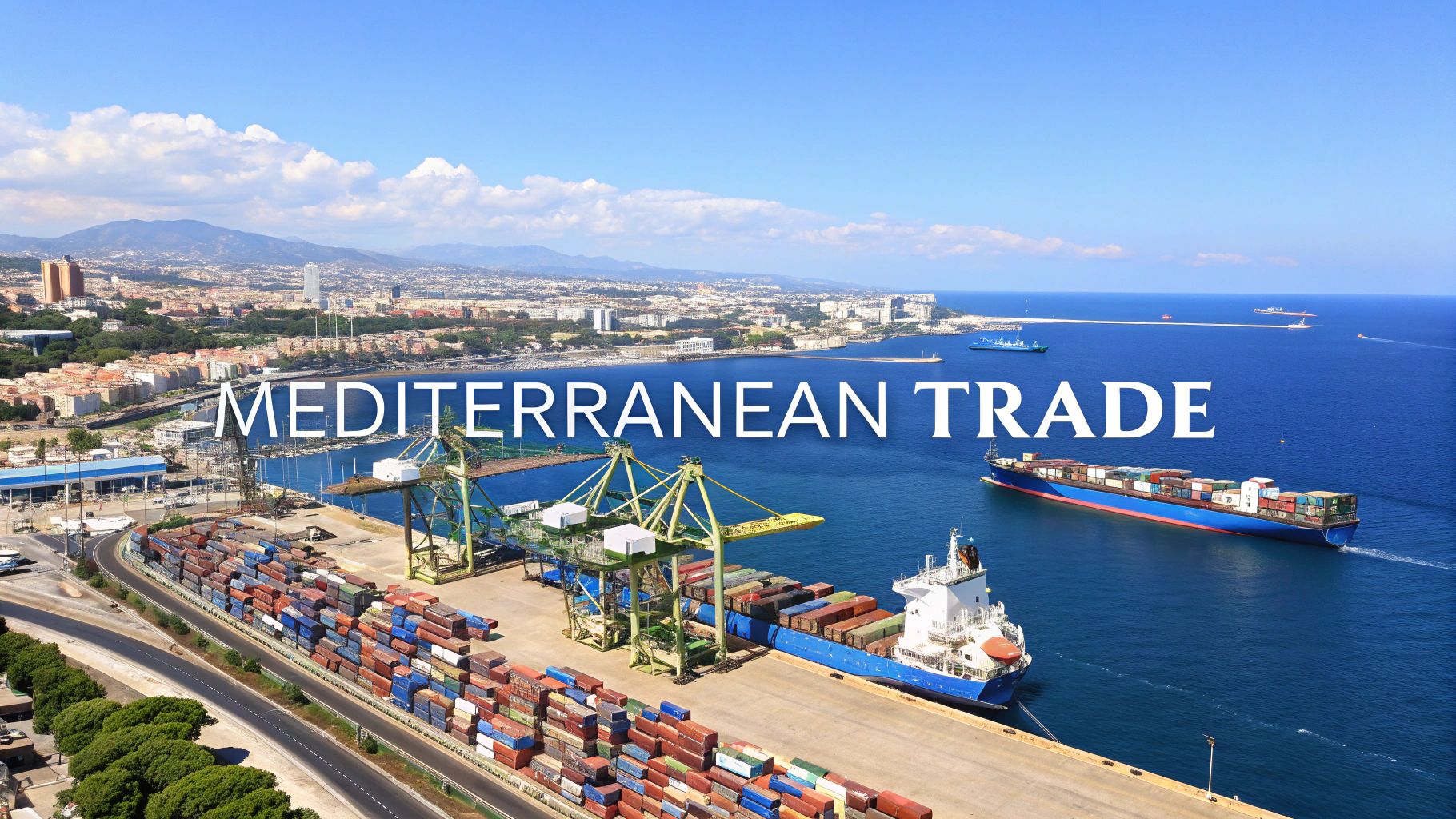
    Aerial view of a bustling Mediterranean port with cargo ships, cranes, and containers.

    The Mix of Global Power and Local Expertise

    What really makes this region fascinating is the interplay between global scale and local specialisation. On one side, you have the behemoth carriers orchestrating massive, intercontinental voyages with clockwork precision. Their operations are a masterclass in efficiency and scale.

    Take MSC’s expansion in Asia, for example. It’s a perfect case study of how a global player strategically builds a regional stronghold to feed its major trade lanes. When MSC set up its regional headquarters in Singapore back in April 1996, it was a pivotal move. By 2021, it had grown to over 50 offices across 10 Asian markets, creating a powerful network that channels cargo directly into its vital Asia-Mediterranean-Europe services.

    On the other side of the coin, you have smaller, more agile carriers. These guys thrive by offering tailored services that the giants might overlook, connecting the major hubs to hundreds of smaller ports scattered across Italy, Greece, Turkey, and North Africa.

    For freight forwarders, this dual structure presents a clear opportunity. You can partner with global lines for long-haul reliability and leverage regional specialists for last-mile connectivity, creating a truly comprehensive service offering for your clients.

    A Vibrant Territory for Business Growth

    At the end of the day, the Mediterranean is a living, breathing landscape of moving cargo, bustling ports, and non-stop commercial activity. Every single container is a potential client, and every trade lane is a new business opportunity.

    For anyone in the import and export business, learning to spot the patterns within this ecosystem is the bedrock of successful prospecting. That constant flow of goods is a goldmine of data for pinpointing companies that desperately need reliable logistics partners. By getting to know the key players and the dominant trade flows, you can strategically position yourself to capture a piece of this thriving market.

    Getting to Know the Major Players on Mediterranean Routes

    The Mediterranean shipping network isn’t some chaotic free-for-all; it’s a highly organised, competitive space where a handful of global titans call the shots. These carriers don't just pass through the region—they set its commercial rhythm. They invest heavily in ports, deploy their largest vessels, and ultimately shape the flow of global trade. For any freight forwarder, understanding who these players are and what they do best is day-one knowledge.

    Think of companies like the Mediterranean Shipping Company (MSC), Maersk, and CMA CGM as the architects of the Med's maritime highways. They are the undisputed leaders. Their massive fleets and sprawling global networks mean they can connect the Mediterranean to pretty much any major market on the planet. They form the backbone of the critical East-West trade lanes that act as a conveyor belt for goods moving between Asia and Europe.

    But it’s not a complete monopoly. A second, dynamic tier of regional and specialised carriers thrives by filling the gaps left by the mega-carriers. These smaller, more agile lines are the lifeblood of the intra-Med network, providing essential feeder services that link major transhipment hubs like Valencia and Piraeus with hundreds of smaller ports across Italy, Greece, North Africa, and the Black Sea.

    The Global Titans of the Med

    When you start digging into the major container routes, three names pop up again and again. Their strategic moves send ripples across the entire supply chain, affecting everything from freight rates to port congestion.

    • Mediterranean Shipping Company (MSC): With deep roots in the Mediterranean, MSC has a natural home-field advantage. It runs one of the world's largest container fleets and offers unmatched port coverage throughout the region. MSC is famous for its aggressive growth and massive investments in terminal infrastructure, which gives it incredible control over its operations.

    • Maersk: The Danish giant is a force in global logistics, and its Mediterranean presence is no different. Maersk’s game is all about reliability and integrated, door-to-door solutions that go far beyond the port gates. You can see their proactive mindset in action when they strategically reroute services away from congested hubs like Rotterdam to protect their schedules.

    • CMA CGM: This French carrier has a long history in the Mediterranean. It uses its strategic hub in Marseille-Fos as a powerful springboard into key European and African markets. CMA CGM is particularly dominant on the Asia-Europe trade lane and has earned a reputation for its vast network and customer-focused service options.

    These three carriers, along with their alliance partners, own a huge slice of the market. And their scale matters. Recent data shows that during peak season, a vessel delay at a major hub like Antwerp can balloon from 32 hours to 44 hours—a 37% jump. How these titans handle such disruptions directly impacts whether you can deliver on your promises to your clients.

    Specialised Services and Regional Experts

    Beyond the big three, a whole ecosystem of other carriers has carved out important niches. For example, some lines are known for their superior reefer (refrigerated container) capacity, making them the automatic choice for shipping perishable goods like fruit and pharmaceuticals from Spain or Italy. Others might offer the best, most reliable connections to less-frequented ports in the Eastern Mediterranean or North Africa.

    This is a forwarder’s secret weapon. Understanding these specialisations lets you move beyond a one-size-fits-all approach and build truly optimised shipping solutions that perfectly match a client's cargo and destination.

    Knowing which carrier excels with hazardous materials, or which one has the most dependable feeder link to a small Greek island, can be the difference between a happy client and a logistical nightmare. This kind of deep market knowledge is what elevates you from a simple booking agent to a truly valuable logistics partner.

    Top Carriers on Mediterranean Shipping Lanes At a Glance

    To make smart partnership decisions, it helps to see how the major players stack up side-by-side. Each carrier brings a unique set of strengths to the table, and the best choice nearly always depends on the specific demands of your shipment.

    This table offers a quick comparison of their key attributes.

    Carrier Name Primary Mediterranean Trade Lanes Key Regional Hubs Noteworthy Specialisations
    MSC Asia-Europe, Intra-Med, Transatlantic Gioia Tauro, Valencia Extensive feeder network, large vessel capacity
    Maersk Global (all major lanes), North-South Algeciras, Tangier Med Integrated logistics, schedule reliability, digital solutions
    CMA CGM Asia-Europe, Europe-Africa Marseille-Fos, Malta Strong reefer services, extensive African network
    Regional Carriers Intra-Mediterranean, Black Sea connections Piraeus, Istanbul, Genoa Niche port access, flexible scheduling, specialised cargo types

    Ultimately, having a clear picture of each carrier's strengths, weaknesses, and specialities is crucial. It empowers you to select the right partner not just for one shipment, but to build a resilient and effective strategy for all your Mediterranean business.

    Mapping Key Trade Lanes and Strategic Ports

    Think of the Mediterranean Sea not as a single body of water, but as a complex web of commercial arteries. For a freight forwarder, knowing these routes is like a taxi driver knowing a city's main roads and back alleys. It’s fundamental to building supply chains that are not just cheap, but also smart and resilient.

    These trade lanes are carved out by the forces of global economics, connecting continents and channelling trillions of dollars in goods. They're the invisible conduits that bring your smartphone from Asia to a shop in Europe or move Spanish olives to markets across the world.

    When you trace these paths, you start to see the logic behind why certain ports have become so powerful. The entire system is built for efficiency, speed, and connectivity, with each route serving a very specific purpose.

    The Dominant East-West Corridor

    The most important artery by far is the East-West trade lane. This is the maritime superhighway linking Asia with Europe, and the Suez Canal is its main gateway.

    Vessels stream in from the Red Sea and head west, making strategic stops at massive transhipment hubs along the way. This route carries an incredible volume of finished goods—everything from electronics and clothing to car parts—all originating from manufacturing hubs in China, Vietnam, and Southeast Asia.

    For any Mediterranean shipping line, mastering this corridor is non-negotiable. It's the highest-volume, highest-value route and the absolute focus for global giants like MSC, Maersk, and CMA CGM.

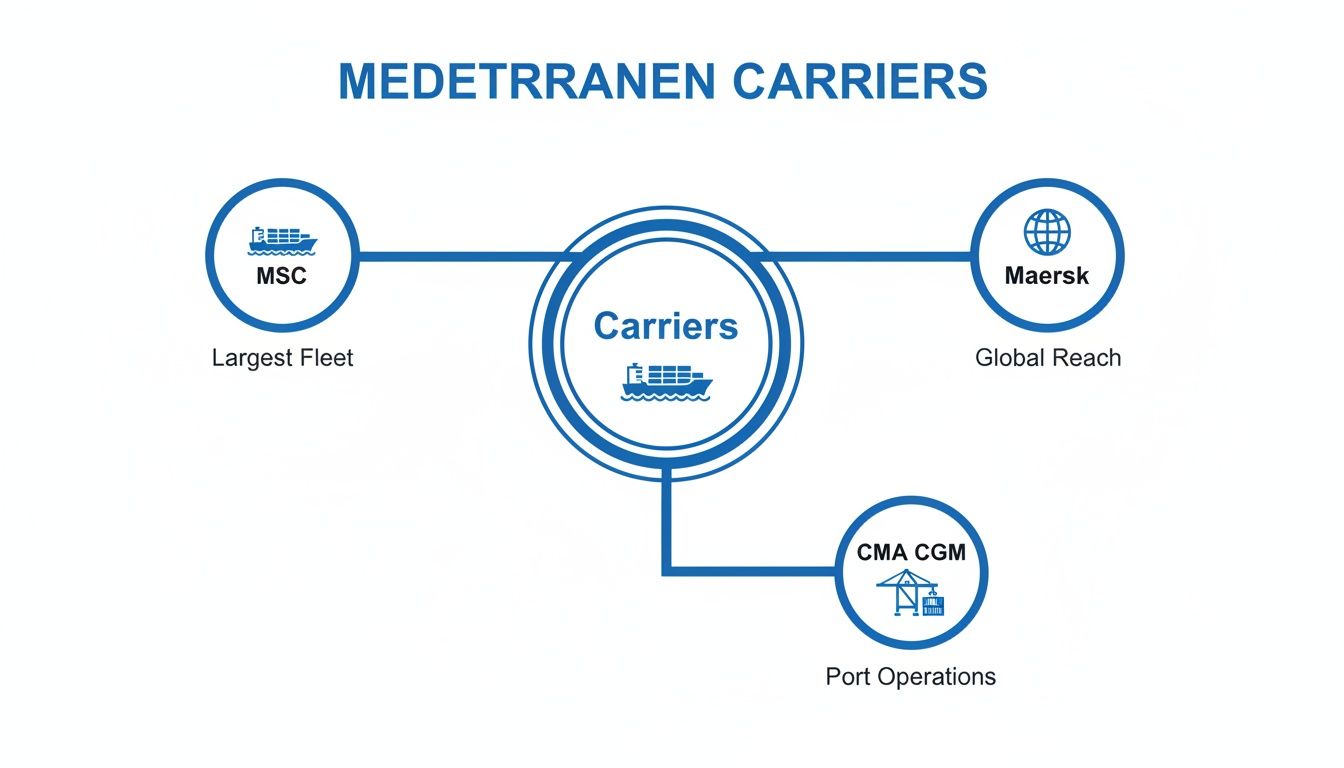
    The diagram below highlights the major carriers that command these vital trade lanes.

    Diagram illustrating three major Mediterranean shipping carriers: MSC, Maersk, and CMA CGM, highlighting their strengths.

    This just goes to show how a few key players anchor the region's shipping network, each playing to their own unique strengths and port strategies.

    Crucial North-South and Intra-Med Routes

    While the East-West lane grabs the headlines, the North-South corridors are the workhorses of regional trade. These routes connect the industrialised nations of Europe with the booming markets and resource-rich economies of North Africa.

    The traffic here flows both ways. Northbound, you'll see a steady stream of commodities and raw materials. Southbound, the ships are filled with machinery, vehicles, and consumer goods, fuelling development across the African continent.

    On top of that, a dense web of intra-Mediterranean routes acts as the region's local delivery network. These services, often run by specialised regional carriers, connect smaller ports and islands, making sure cargo from the big hubs gets to its final destination. This network is absolutely essential for getting goods distributed efficiently across all the different economies lining the sea.

    Spotlighting the Nerve Centre Ports

    Over time, a few ports have emerged as the undisputed nerve centres of the Mediterranean. These aren't just stops; they are highly sophisticated logistics hubs engineered for maximum efficiency. Their importance comes from a perfect mix of geography, world-class infrastructure, and seamless inland connections.

    Three ports, in particular, stand out as the region’s premier transhipment hubs:

    • Port of Algeciras (Spain): Sitting right at the mouth of the Med near the Strait of Gibraltar, Algeciras is the first and last major European call for ships on the East-West lane. Its location makes it a natural sorting centre for cargo moving between Europe, the Americas, and West Africa.

    • Port of Valencia (Spain): Another Spanish powerhouse, Valencia offers incredible container handling capacity and fantastic road and rail links deep into the Iberian Peninsula and the rest of Europe. It's a critical gateway for imports heading to European consumers.

    • Port of Piraeus (Greece): Perfectly positioned in the Eastern Med, Piraeus has become the primary entry point for Asian goods destined for Central and Eastern Europe. Its modern infrastructure allows for the lightning-fast transfer of containers from huge ocean liners to smaller feeder vessels.

    These hubs act like giant sorting machines. A single massive vessel might drop off thousands of containers, which are then rapidly reloaded onto dozens of smaller ships, each heading to a different final destination. This model squeezes every bit of efficiency out of the primary Mediterranean shipping line services.

    Understanding what each port does best is critical. If a client needs to get goods into Central Europe, knowing that Piraeus has strong rail connections can shave days off the transit time. Likewise, for shipments involving Africa, Algeciras often offers the most direct route. This kind of granular knowledge is vital, especially when navigating complex setups like those managed by an importer of record.

    Navigating Operational Challenges and Opportunities

    Knowing the key players and trade lanes is one thing, but thriving in the Mediterranean shipping market is a whole different ball game. It’s about getting ahead of the real-world operational and commercial curveballs that can derail even the most carefully laid plans. We’re talking about everything from port logjams to the ripple effects of regional instability.

    Mastering these factors is what separates a good freight forwarder from a truly great one. It’s about shifting from a reactive "firefighting" mode to a proactive, strategic mindset. That's how you advise clients with confidence and protect your margins in a market famous for its volatility. This practical knowledge is your best defence against the unexpected.

    Tackling Port Congestion and Delays

    Port congestion is a constant headache across the major Mediterranean hubs. When peak season hits, delays can snowball in a heartbeat. Just look at recent data from European ports, where wait times in hubs like Antwerp shot up from 32 hours to 44 hours in a matter of weeks—that’s a 37% jump. Delays like that create a domino effect, throwing vessel schedules, inland transport, and final delivery dates into chaos.

    And this isn't just a local problem. The global transhipment hubs feeding into the Mediterranean are just as critical. Take the MSC-PSA Asia Terminal (MPAT) in Singapore, a massive cornerstone of MSC's Asian operations. Since growing from three berths in 2006 to seven by 2021, MPAT has become a mega-hub cranking through millions of TEUs a year. Its incredible efficiency, which keeps vessel dwell times under 1.5 days, is what keeps the vital Asia-Med trade lane moving. Any bottleneck there would send shockwaves across the entire network.

    For forwarders, staying ahead of these logjams means you have to:

    • Monitor Port Performance: Keep a close eye on turnaround times and be aware of any potential labour disputes at key hubs like Valencia, Algeciras, and Piraeus.
    • Build Route Flexibility: Always have a Plan B. If Valencia is jammed, could a smaller Spanish port or even Marseille work as a temporary fix?
    • Communicate Proactively: Tell your clients about potential delays before they become a problem. Better yet, come to them with a solution already in hand.

    Managing Commercial Volatility

    The commercial side of Mediterranean shipping is just as turbulent. Freight rates can swing wildly depending on seasonal demand, vessel capacity, and what's happening in the global economy. For example, the summer peak for agricultural exports out of Spain and Italy can make reefer containers scarce and send prices through the roof.

    Managing this volatility requires a sharp commercial focus. It’s not just about finding the lowest price today, but about securing stable, reliable service for your clients over the long term.

    What’s more, the moves made by major carrier alliances (like 2M or Ocean Alliance) have a huge impact. A decision by an alliance to skip a port call to get back on schedule can leave your client's cargo high and dry. Staying on top of these service changes is absolutely crucial for managing risk and giving your customers accurate transit times.

    A smart approach mixes a few key strategies:

    • Diversify Your Carrier Relationships: Never put all your eggs in one basket. Working with a mix of global giants and smaller, niche regional lines gives you far more options when capacity gets tight.
    • Use Rate Management Tools: Platforms that provide real-time rate data are essential. They help you quote competitively while making sure you aren't sacrificing your own margins.
    • Understand the Seasonal Rhythms: Know the market's pulse. For those agricultural exports, you need to be booking reefer space well in advance to dodge last-minute price shocks and equipment shortages.

    How to Find Shipper Leads on Mediterranean Lanes

    Knowing the carriers and trade lanes crisscrossing the Mediterranean is a great start, but how do you turn that market intelligence into actual business? For a freight forwarder, the constant hum of activity at ports like Valencia, Piraeus, and Algeciras is more than just commerce—it’s a live, flowing database of potential clients. The trick is knowing how to tap into it.

    This is where a modern approach to prospecting makes all the difference. Forget cold calls and dusty contact lists. Today’s savvy logistics teams use customs data to see exactly which companies are moving goods along specific Mediterranean routes. It transforms lead generation from a guessing game into a precise, data-backed strategy, letting you focus only on prospects who have a proven need for your services.

    From Data to Deals: A Modern Playbook

    The old way of finding leads was a grind. You'd spend hours manually searching for companies, guessing who the right contact might be, and firing off generic emails that mostly went unanswered. Now, platforms built for logistics prospecting can do the heavy lifting, turning raw trade data into qualified, ready-to-contact leads in a fraction of the time.

    This technology allows you to sift through the entire universe of shippers and zero in on your ideal clients. You can filter for companies based on criteria that actually matter to your business.

    • By Port of Call: Instantly pull up a list of every company that has recently moved cargo through key Med hubs like Genoa or Marseille.
    • By Commodity Type: Hone in on businesses shipping specific products, whether it's automotive parts out of Turkey or agricultural goods from Spain.
    • By Shipping Line: Find companies that frequently use a particular Mediterranean shipping line, giving you a perfect, informed way to start a conversation.

    This is what it looks like in practice—filtering a massive database of customs records to surface highly relevant shipper leads based on their real-world shipping patterns.

    A laptop displaying business analytics, a notebook, and pen on a wooden desk with a 'FIND SHIPPER LEADS' search bar.

    By using filters like these, you’re no longer just finding random companies. You're discovering businesses with a clear, active need for freight forwarding on the very lanes you specialise in.

    Pinpointing the Right Decision-Makers

    Of course, finding the right company is only half the battle. The next, crucial step is getting in front of the right person—the logistics manager, supply chain director, or procurement head who actually signs the contracts. A powerful prospecting platform takes the guesswork out of this by integrating contact data directly with the customs information.

    This means once you’ve identified a promising shipper, you can instantly find the names, job titles, LinkedIn profiles, and verified email addresses of the key decision-makers. It’s a game-changer, saving you countless hours of manual research and ensuring your pitch actually lands in the right inbox.

    The goal is to shift from broad, impersonal outreach to sharp, data-backed conversations. Mentioning a specific trade lane they use or a recent shipment shows you've done your homework and immediately signals that you understand their business.

    This targeted approach dramatically boosts your chances of getting a response. If you're looking to build out your operation, you can learn more in our guide to starting an import-export firm.

    Crafting Outreach That Converts

    With a list of qualified leads and their direct contact info, the final piece is writing a message that actually gets read. This is where your market knowledge and data insights truly shine. Instead of a generic "we can handle your shipping" email, you can lead with undeniable value.

    For example, since Mediterranean Shipping Company opened its Singapore office in 1996, it has become a cornerstone of Southeast Asia's logistics network. As the port handled a record 39.9 million TEU in 2024, Singapore's customs data has become a goldmine. Forwarders can see that MSC-handled shipments are up 15% year-over-year and then filter for leads on high-growth lanes like SG-Mediterranean (which makes up 12% of MSC's local traffic). Armed with this insight, you can send hyper-targeted emails to decision-makers in booming trade corridors. You can read more about MSC's data and its potential on Datalastic.com.

    Here’s a simple, three-step framework for your outreach:

    1. Reference a Specific Data Point: Kick things off by mentioning their activity on a Mediterranean lane (e.g., "I noticed your company recently shipped from Valencia…").
    2. Offer a Clear Value Proposition: Connect their activity to a solution you provide (e.g., "…we specialise in that lane and have helped similar companies cut transit times by 15%.").
    3. End with a Simple Call to Action: Make it easy for them to say yes (e.g., "Would you be open to a brief chat next week to discuss your current setup?").

    By combining powerful data tools with smart, personalised communication, you can transform your prospecting efforts on every Mediterranean shipping line and build a predictable pipeline of new business.

    Your Top Questions About Mediterranean Shipping, Answered

    Jumping into any major trade region will always stir up a few questions. The Mediterranean, with its unique mix of global superhighways and complex local networks, is certainly no different. If you're a freight forwarder looking to really get a handle on this market, getting clear, straightforward answers is the first step to building a winning strategy and advising your clients like a pro.

    This section gets right to the point, tackling some of the most common questions about operating on a Mediterranean shipping line. We'll cover everything from the key ports to the commercial realities on the ground, giving you practical insights you can use immediately. Think of it as your quick-reference guide for sharpening your focus and making smarter decisions.

    Which Are the Biggest Transhipment Hubs in the Mediterranean?

    When it comes to transhipment, three ports stand out as the undisputed heavyweights and strategic nerve centres of the Mediterranean: the Port of Valencia and the Port of Algeciras in Spain, and the Port of Piraeus in Greece. These three hubs truly form the backbone of the region's container logistics.

    It's no accident they're on top. The major carriers all favour them for a few critical reasons: they have deep-water berths that can handle the biggest vessels on the water, they're kitted out with advanced cargo-handling tech, and they run massive feeder networks. These networks are the real secret sauce, acting like spokes on a wheel to connect the hubs with hundreds of smaller ports all over the Med, North Africa, and the Black Sea.

    Their geographic locations are also perfect, acting as natural pivot points for cargo flowing between Asia, Europe, and the Americas. For a freight forwarder, tapping into these hubs unlocks a huge number of routing options. But be warned—it also means you need to plan carefully to get ahead of potential congestion, which can snarl things up fast during peak season.

    How Do Carrier Alliances Affect My Options on Mediterranean Shipping Lines?

    Carrier alliances like 2M, Ocean Alliance, and THE Alliance have a massive impact on services across every Mediterranean route. By letting carriers pool their resources and share vessel space, these partnerships offer some serious upsides, like much broader port coverage and more frequent sailings than any single line could ever manage on its own.

    For you as a freight forwarder, that translates directly into more choices and, often, better rates for your clients. You get to tap into a combined network with incredible reach. The flip side, however, is that this consolidation can water down the service differences between carriers in the same alliance. The vessel might be operated by one line, but it’s probably carrying boxes for all its alliance partners.

    This tight integration also creates a shared risk. A major disruption hitting one member—say, a port strike or a big vessel delay—can trigger a domino effect, throwing off the schedules of every partner on that service loop. It's crucial to know who's allied with whom when you're quoting options to a shipper so you can manage their expectations.

    What Are the Primary Commodities Shipped on Mediterranean Routes?

    The cargo mix flowing through the Mediterranean is incredibly diverse, which makes sense given the varied economies it connects. You can generally break down the commodity flows by direction, which is a great way to understand what the market needs.

    • Eastbound traffic leaving Europe for Asia and beyond is often packed with high-value manufactured goods, chemicals, pharmaceuticals, and specialised machinery.
    • Westbound traffic coming in from Asia is dominated by consumer electronics, clothing, furniture, toys, and all sorts of other finished goods heading for European shelves.
    • Intra-Mediterranean trade is full of agricultural products. We're talking olive oil from Greece, wine from Italy, and fresh produce from Spain, plus a lot of automotive parts moving between different manufacturing plants.
    • North-South trade between Europe and Africa typically sees commodities like cocoa, oil, and minerals heading north, with vehicles, industrial equipment, and consumer goods flowing south.

    Knowing these cargo flows is more than just trivia. For a forwarder, it's a prospecting roadmap. It helps you target specific industries and companies that you know have a real need for logistics services on these lanes.

    How Can I Find Reliable Routing Information for Mediterranean Services?

    Let's be honest: manually checking every carrier's website for schedules and routes is a slow, painful, and outdated way of doing things. In a market where speed and accuracy give you the edge, you need a much better solution to stay in the game.

    The most effective way forward is using logistics platforms that pull in multi-carrier routing insights. For example, tools that plug into services like Routescanner give you a complete picture of the market on a single screen. This lets you compare end-to-end routing options—including transit times, service frequencies, and intermodal connections—across different shipping lines all at once.

    A tool like this gives you the power to build competitive and solid quotes for shippers using real-time, consolidated data. It's worlds better than trying to piece everything together from ten different sources, helping you answer client requests faster and with a lot more confidence.


    Ready to transform your prospecting strategy on Mediterranean shipping lines? With Coreties, you can access verified customs data to find high-value shippers, identify key decision-makers, and craft data-driven outreach that gets results. Stop guessing and start connecting with qualified leads today. Discover your next opportunity at Coreties.