Getting your hands on high-quality Sinopec products is one thing. But for anyone doing business in the Sinopec lubricant Singapore market, the real work starts when you have to actually move the stuff. Mastering the logistics—from the initial sourcing and customs headaches to final delivery—is where you either win or lose in one of the planet's busiest shipping hubs.
Why Sinopec Lubricants Are So Crucial in Singapore
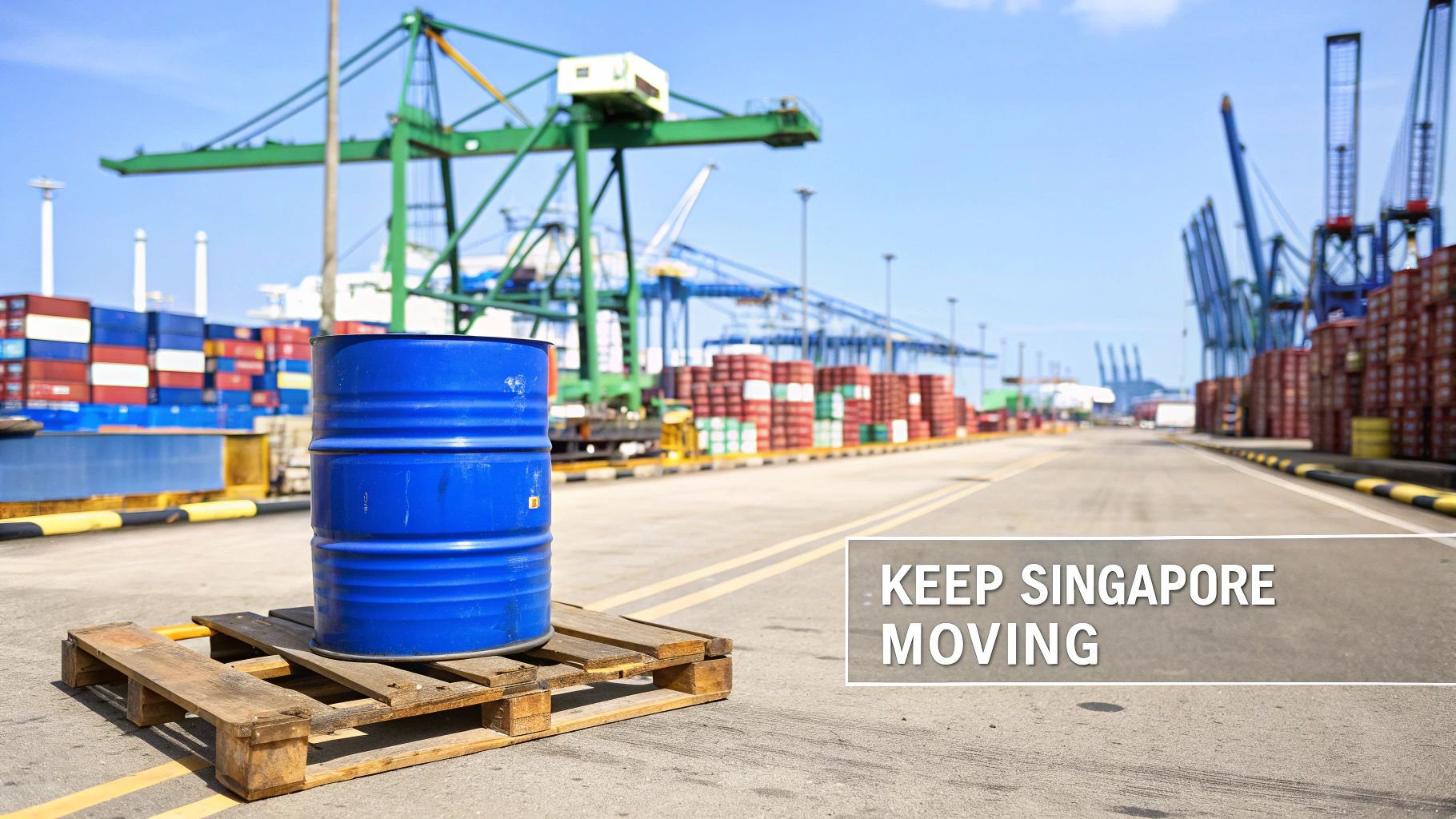
Singapore didn't become a global maritime and logistics powerhouse by accident. It's all built on relentless operational efficiency. Think about it: every single container ship, cargo plane, and piece of machinery at the port needs top-tier lubricants to keep running smoothly. This is exactly where Sinopec products fit in—they're not just an option; they're essential.
We're not talking about your standard engine oil here. These are highly specialised fluids, engineered to perform under incredible pressure and heat, protecting equipment worth millions from breaking down. If the supply chain for these lubricants gets disrupted, it causes a domino effect of costly downtime, missed shipping deadlines, and serious financial pain.
A Key Player in Maritime and Aviation
The Port of Singapore handles an astonishing 37 million TEUs (twenty-foot equivalent units) a year. That sheer volume creates a massive, constant demand for marine lubricants. Sinopec offers a whole range of products built for everything from huge two-stroke and four-stroke marine engines to the hydraulic systems on cranes and deck gear.
It's the same story over at Changi Airport, a major air cargo hub. The entire operation, from the aircraft themselves to the ground support equipment, depends on a reliable pipeline of specialised aviation lubricants.
For freight forwarders, this presents a huge business opportunity, but it comes with a unique set of headaches:
- Complex Supply Chains: You need to find and vet official distributors to ensure you’re not dealing with counterfeit products.
- Strict Regulations: Getting through customs requires perfect paperwork, including the right Material Safety Data Sheets (MSDS) and accurate Harmonized System (HS) codes.
- Specialised Handling: These aren't just boxes. Storage and transport have to meet strict safety and environmental rules, especially for any lubricants classified as dangerous goods.
The bottom line is this: if you can master the logistics of moving Sinopec lubricants in Singapore, you become an indispensable partner to clients in the maritime, aviation, and industrial sectors. It’s how you carve out your niche.
This guide is your roadmap. We're going to walk through the practical, on-the-ground steps you need to take to source, import, store, and ship these products successfully. From finding the right suppliers to getting your customs declarations spot-on, you'll get the know-how to compete and win.
How to Vet and Secure Reliable Sinopec Suppliers
Finding a supplier for Sinopec lubricant in Singapore isn't the hard part; a quick search will turn up plenty of options. The real work lies in finding a genuine partner who delivers authentic products on time, every time. If you skip this critical vetting step, you're rolling the dice. You could end up with counterfeit lubricants that cause catastrophic equipment failure for your clients—and destroy your reputation.
Your first move? Always confirm they are an official distributor. Don't just take their word for it. Ask for documentation that proves their direct link to Sinopec. Fake products are a huge problem in this industry, and using them can instantly void equipment warranties. An official distributor will have zero issues providing you with this proof.
Looking Beyond the Brochure
Once you've confirmed a supplier is legitimate, it's time to dig deeper into how they actually operate. This is where you shift from basic due diligence to smart supply chain management. You need to get a clear picture of their real-world capacity and reliability, not just the polished version their sales team presents.
A great way to do this is by looking at their shipping history through trade data platforms. These tools give you an unvarnished view of a supplier's import and export activities. For instance, public records show Sinopec Lubricant Singapore Private Limited is a major player in Singapore’s trade, which makes sense when you look at the market.
The Singapore lubricants market was valued at USD 125 million in 2024 and is expected to hit USD 184.38 million by 2032. This kind of growth underscores why it's so important to partner with established, high-volume entities.
Key Questions to Ask Potential Suppliers
Before you even think about signing a contract, get straight answers to a few critical questions. This isn't about being difficult; it's about protecting your business and your clients.
- What's your typical lead time for bulk orders? Ask for specifics on different product lines, like marine versus automotive lubricants.
- Can you provide batch traceability certificates? This is non-negotiable. It’s your only way to guarantee product authenticity and quality.
- How do you handle urgent or out-of-stock orders? Their response will tell you everything you need to know about their contingency planning and customer service.
- Do you offer technical support for product selection? A true partner is also a resource, helping you match the right lubricant to a specific application.
A supplier who hesitates or can't give you a straight answer to these questions is a massive red flag. Real partners are transparent and confident because their systems are solid.
This foundational step is where a resilient supply chain begins. By thoroughly vetting your suppliers, you're not just buying a product. You're building a partnership that shields you from quality issues, delays, and reputational damage. Taking the time to build a list of reliable contacts, such as an experienced importer in Singapore, is a crucial part of this process.
Mastering Customs and Documentation for Lubricant Shipments
In logistics, speed is everything. But I've seen a single paperwork error bring a multi-million dollar lubricant shipment to a grinding halt at the Port of Singapore. When you're dealing with Sinopec products, mastering the documentation isn't just about ticking boxes for compliance; it's about keeping your entire operation moving and your clients happy.
Think of customs clearance as a very strict checkpoint where consistency is king. Officers meticulously cross-reference every piece of paper. They expect the product described on the Commercial Invoice to perfectly match the Bill of Lading, which in turn must align with the technical specs on the Material Safety Data Sheet (MSDS). Any little mismatch—a typo, a different unit of measure—is an immediate red flag.
Your Essential Document Checklist
The MSDS, now more commonly called a Safety Data Sheet (SDS), is your cornerstone document. It’s the technical blueprint of the lubricant, detailing its chemical makeup, physical properties, and crucial handling instructions. This is what customs and port authorities rely on to classify the product and determine if it falls under dangerous goods regulations.
Getting your documentation in order is a non-negotiable part of the process. Here’s a quick rundown of what you’ll need and what to watch out for.
| Key Documents for Sinopec Lubricant Shipments |
| :— | :— | :— |
| Document | Purpose | Key Information to Verify |
| Material Safety Data Sheet (MSDS/SDS) | Provides technical details for safety, handling, and customs classification. | Ensure the product name is exact, and all chemical composition data is present and up-to-date. Check that it matches the product being shipped. |
| Commercial Invoice | Acts as the bill of sale for customs valuation and duty calculation. | Must list the full product name (e.g., "Sinopec Tulux T500 15W-40"), not just "engine oil." Incoterms and value must be accurate. |
| Bill of Lading (B/L) or Air Waybill (AWB) | The contract between you and the carrier, acting as a receipt of goods. | Product descriptions, quantities, and consignee details must mirror the Commercial Invoice exactly. |
| Packing List | Details the contents, weight, and dimensions of each package in the shipment. | Verify that the gross and net weights match other documents and that the number of drums/pails is correct. |
Double-checking these details before the shipment even leaves the port of origin will save you a world of pain later.
The golden rule is absolute consistency. If your B/L lists 100 drums of "Sinopec Tulux T500" but the invoice just says "engine oil," you’re practically asking for an inspection. Every document must tell the same precise story.
This all starts with having the right partners. A reliable supplier is the foundation for smooth documentation down the line.
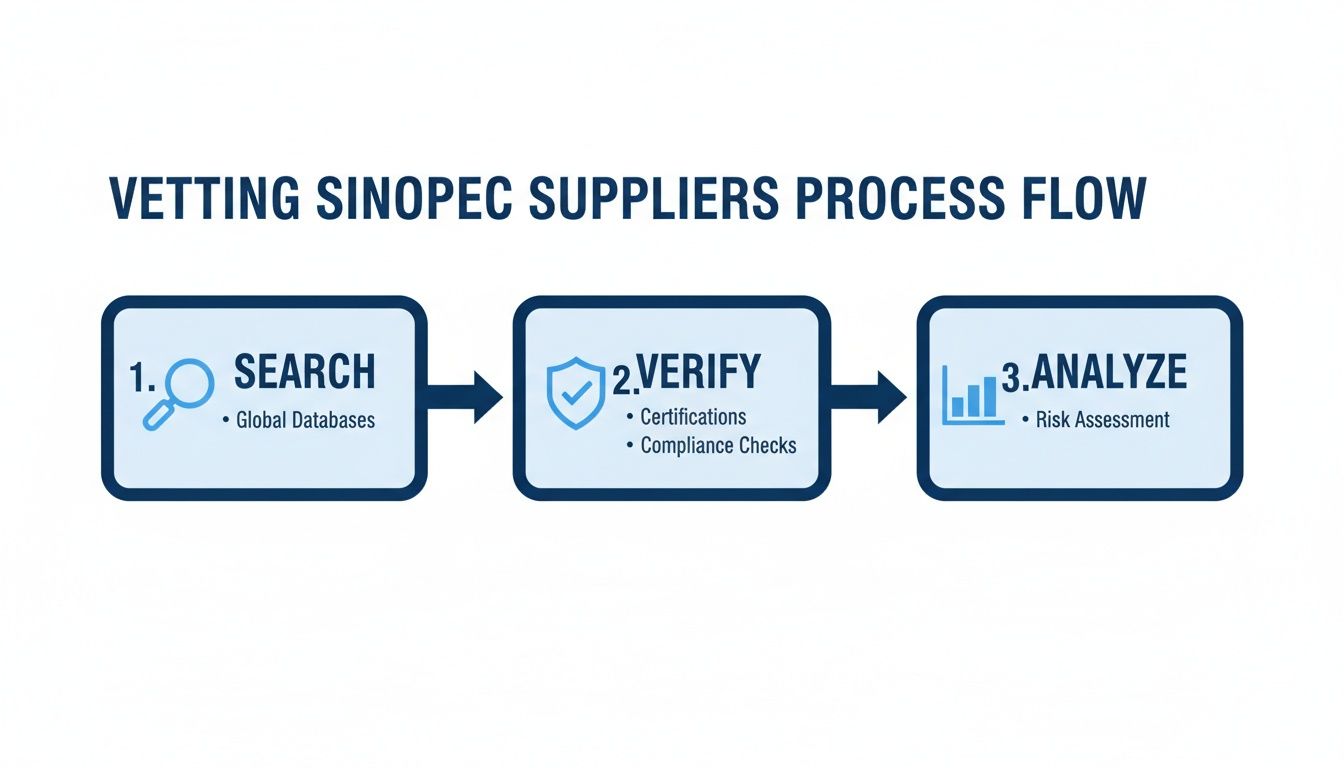
Following this simple flow—searching, verifying, and analysing your suppliers—ensures you're working with professionals who can provide accurate and timely paperwork from the get-go.
The Million-Dollar Mistake: Getting HS Codes Wrong
One of the most frequent—and costly—errors I see is the incorrect use of a Harmonized System (HS) code. This multi-digit number is a universal language that tells customs officials exactly what you’re importing, which directly determines the duties and taxes owed.
Lubricating oils typically fall under Chapter 27 of the HS code system. However, the exact code depends on specifics like whether they are petroleum-based, their viscosity index, and their intended use. A synthetic gear oil has a different code than a basic hydraulic fluid.
Using the wrong code can lead to hefty financial penalties, shipment seizures, and a permanent black mark against your company's name. For instance, trying to classify a high-value synthetic lubricant under a code for basic mineral oil to shave a few points off the duty is a surefire way to get flagged by Singapore Customs. They’ve seen it all before.
If you’re ever in doubt, don't guess. It’s always better to consult a seasoned customs broker or familiarise yourself with the nuances of the Singapore customs HS code system.
Nailing the documentation isn't just administrative work; it's a core competency for any serious logistics professional handling Sinopec lubricant in Singapore. It’s the critical difference between a smooth, predictable supply chain and a logistical nightmare.
Safe Storage and Handling Practices for Lubricants
Once your Sinopec lubricant shipment has cleared customs in Singapore, the real work begins. The focus shifts from navigating paperwork to protecting your physical assets. Think about it: the integrity of these lubricants is everything. If they get contaminated or degrade, you’re not just looking at a lost sale—you could be responsible for serious equipment damage for your end client.
Proper storage isn’t just a nice-to-have; it's a critical step in preserving the product's value and, just as importantly, ensuring safety on-site.
The warehouse environment itself is a huge factor. Lubricants are surprisingly sensitive to extreme temperatures, which can mess with their viscosity and chemical stability. Just imagine storing drums of hydraulic oil in a stuffy, non-ventilated corner of a warehouse under the relentless Singapore sun. That heat will speed up oxidation and can render the product completely useless.
Setting Up a Secure Storage Environment
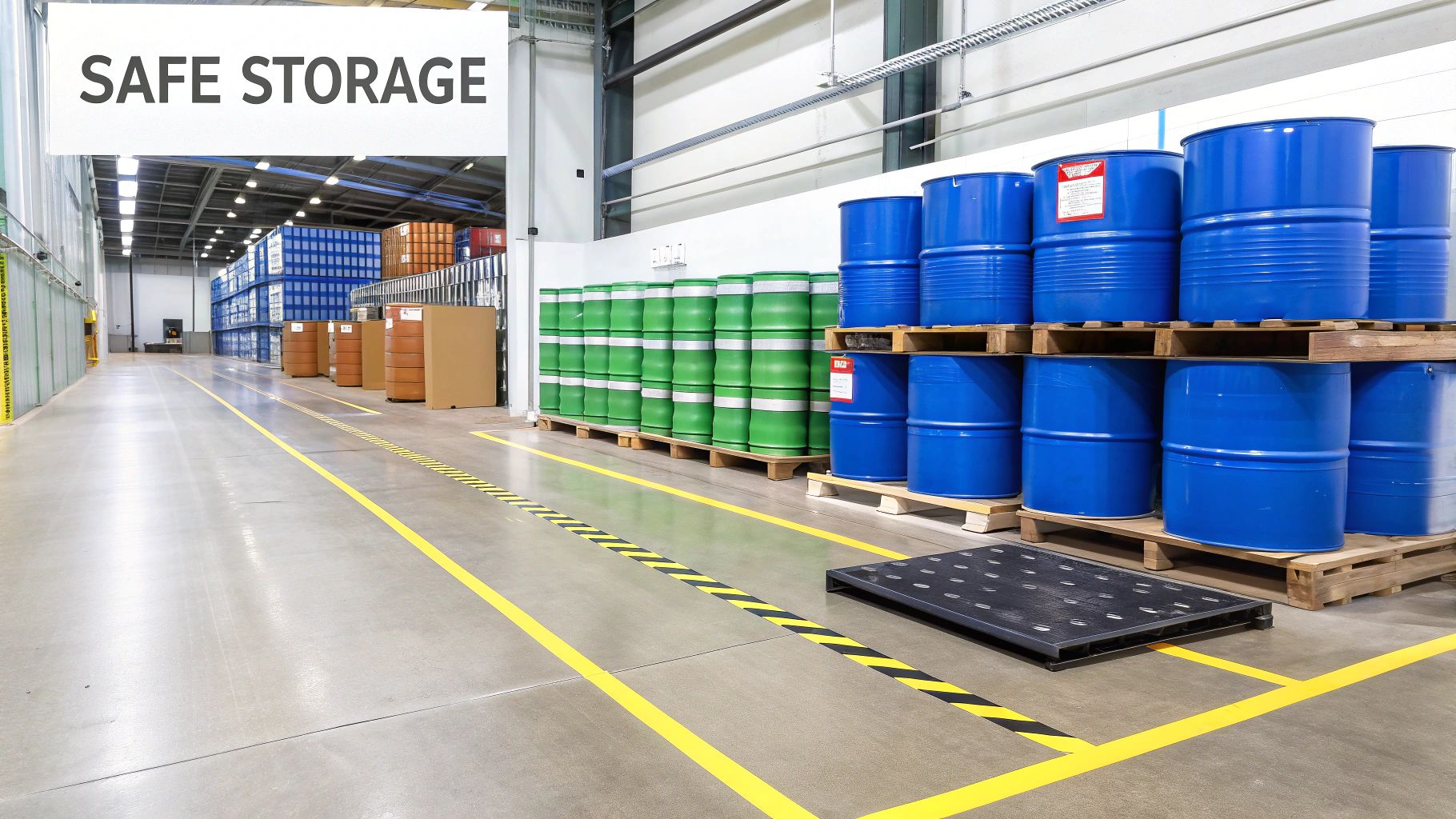
Your main goal is to create a clean, dry, and temperature-controlled space. Now, "temperature-controlled" doesn't necessarily mean you need to install a full-blown air-conditioning system, but it does mean you need a solid plan to handle the local climate.
Here are a few core principles I always drill into my teams:
- Keep it Stable: Find a spot away from direct sunlight and areas where the temperature fluctuates wildly. The sweet spot for most lubricants is between 5°C and 40°C.
- Zero Contamination: Always keep drums and containers sealed tight. Store them indoors on pallets or racking systems—never, ever directly on a concrete floor where moisture can creep in.
- Get Organised: A simple "first-in, first-out" (FIFO) system is your best friend. It ensures older stock gets used before its shelf life becomes an issue. Also, clearly label your storage zones by product type (e.g., marine, automotive, industrial) to prevent costly mix-ups.
This attention to detail really matters. Sinopec themselves are heavily invested in quality, which is why they set up an advanced lubricant technology centre right here in Singapore Science Park in September 2023. Their focus is on developing next-gen synthetics for demanding sectors like marine and aviation. You can get more context on the local market and its key players from reports on sites like Verified Market Research.
Managing Different Product Types and Safety
A typical Singapore warehouse might be holding everything from marine engine oils to automotive coolants under one roof. These products have very different chemical properties and must be kept separate. For instance, you absolutely cannot store flammable lubricants next to oxidising agents.
Your labelling system is your first line of defence. Ensure every drum, pail, and container is marked according to the Globally Harmonized System (GHS). This includes the product identifier, signal word, hazard statements, and pictograms. It’s a universal language that keeps your team safe and ensures compliance.
Spill containment is another area where you can't cut corners. A single leaking drum can cause major environmental damage and lead to hefty fines from the authorities.
Every area where you store liquid lubricants needs secondary containment. This could be bunded pallets or a dedicated bunded floor area designed to hold at least 110% of the volume of your largest container. Make sure spill kits are easy to find and that your team is actually trained to use them. These practical steps protect your products, your people, and your business.
Picking the Right Carriers and Routes for Your Lubricant Freight
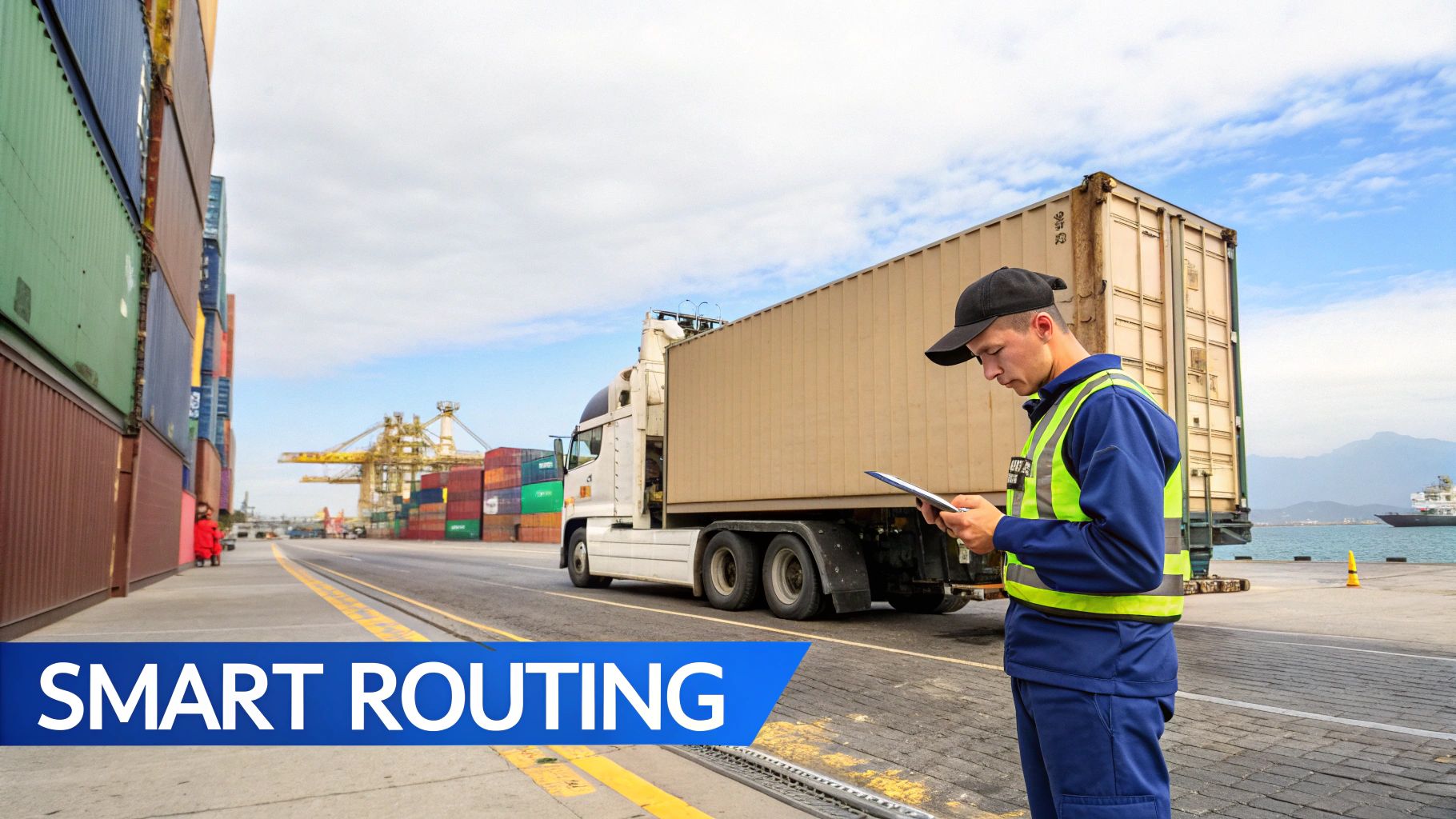
Once you've sorted out your documentation and warehousing, the next piece of the puzzle is getting your Sinopec lubricants from point A to point B. This isn't just about moving boxes; it’s a strategic decision that hits your bottom line and shapes your reputation with clients. A smart logistics plan for lubricants in Singapore is all about striking the right balance between cost, speed, and safety.
Your choice of transport mode really sets the tone for the entire journey. Every option—sea, air, and road—has its own set of pros and cons, especially when dealing with industrial lubricants. The best choice almost always comes down to what your client actually needs.
Comparing Your Freight Options
For big, non-urgent bulk shipments, ocean freight is pretty much unbeatable on price. Loading drums or IBCs onto a container ship lets you move huge quantities for a very low cost per unit. This is the go-to for clients who are good at forecasting their inventory and can afford to wait.
On the flip side, air freight is your emergency lever. It's for those urgent, high-value, or smaller orders where speed is everything. Yes, it's a lot more expensive, but it’s a lifesaver when you need to rush a resupply to a vessel in port or get specialised aviation lubricants to a grounded aircraft.
Finally, there’s road freight. This is the essential last leg of the journey, connecting the Port of Singapore or Changi Airport to your warehouse and then to your customer's doorstep. Getting this right is all about smart route planning and partnering with drivers who know Singapore's traffic and delivery site protocols inside and out.
I once saw a client save nearly 20% on their annual freight spend just by shifting their less-critical stock replenishment from a just-in-time air model to a planned ocean freight schedule. It all comes down to aligning the transport method with the actual urgency of the demand.
And this isn't a static game. The Singapore lubricants market was valued at USD 125 million in 2024 and is expected to climb to USD 184.38 million by 2032. With industrial and automotive sectors driving this growth, getting your freight strategy right is more critical than ever.
What to Look for in a Carrier
Choosing a transport partner is about more than just finding the cheapest quote. When you're shipping chemical products like lubricants, you absolutely need a carrier who knows what they're doing. You're looking for a partner, not just a haulier.
Start by digging into their experience.
- Safety Credentials: Do they have certifications like ISO 9001 for quality management or BizSAFE? This signals a serious commitment to doing things properly and safely.
- Dangerous Goods (DG) Handling: If any of your lubricants are classified as hazardous, you must confirm they have the trained personnel and licensed vehicles for the job. Ask to see their DG handling procedures.
- Proven Track Record: Don't hesitate to ask for case studies or to speak with some of their existing clients who also ship industrial chemicals.
Doing this due diligence is non-negotiable. A cut-price carrier with zero experience in chemical logistics can turn into a very costly mistake if an incident occurs. For a look at some of the reliable logistics players in the region, our guide on leading supply chain solutions in Singapore can offer some valuable insights.
At the end of the day, the right carrier feels like an extension of your own team—someone you can trust to get every single shipment of Sinopec lubricant delivered safely and on time.
When you're dealing with shipments of Sinopec lubricants in Singapore, a handful of questions tend to pop up again and again. Getting clear, accurate answers isn't just helpful—it’s absolutely critical for avoiding costly delays, keeping everyone safe, and even uncovering new business opportunities.
Let’s get straight into the most common queries freight forwarders and logistics pros face with these products.
What Are the Right HS Codes for Sinopec Lubricants?
This is probably the most important question of the lot. Your choice of Harmonized System (HS) code directly impacts customs duties and taxes, and a simple mistake can lead to hefty fines and your shipment getting stuck at the port.
While the exact code can vary depending on the specific product, most lubricating oils fall under HS Chapter 27. But you need to drill down further for an accurate declaration. The final digits of the code are determined by the lubricant's base material and its end-use.
Here are a few common examples to give you a clearer picture:
- Petroleum-Based Engine Oils: A typical starting point for standard automotive and industrial lubricants is HS Code 2710.19.41.
- Hydraulic Oils: For petroleum-based hydraulic fluids, you'll often be looking at a code like 2710.19.42.
- Synthetic Lubricants: High-performance synthetic products are a different story. If they contain less than 70% petroleum oils, they often need to be classified under Chapter 34, with a code like 3403.19.90.
The golden rule here is to never, ever guess. Always check the product’s technical data sheet. When you're still not 100% sure, get a customs broker involved. The difference between
2710.19and3403.19is not a small detail—it's a completely different classification.
Are Sinopec Lubricants Classified as Dangerous Goods?
The answer is "it depends," and the Material Safety Data Sheet (MSDS) is your single source of truth.
The good news is that most standard Sinopec lubricants, like your everyday engine or hydraulic oils, are not classified as dangerous goods (DG) for transport. Their flashpoints are usually high enough to keep them in the non-hazardous category.
But you can't get complacent and assume this is always true. Some specialised products, like certain industrial greases or fluids with specific chemical additives, might have lower flashpoints or other properties that push them into a DG class.
For the final word, turn straight to Section 14 (Transport Information) on the MSDS. This part of the document will explicitly state if the product is regulated under IATA (air), IMDG (sea), or ADR (road) codes. If it's not regulated, it will say so clearly. No ambiguity.
How Can I Find New Clients Who Ship Lubricants?
Alright, let's switch gears from operations to growing your business. The most powerful tactic here is to use customs data to your advantage. By digging into import and export records for the HS codes we just talked about, you can build a laser-focused list of companies that are actively shipping lubricants right now.
This lets you identify who is importing Sinopec lubricant into Singapore, see their shipment volumes, and track how frequently they ship. This isn't just a list of random company names; it's genuine, actionable intelligence. You can pinpoint the major players and spot smaller companies that might be underserved by their current logistics providers.
Armed with this kind of data, your sales team can craft an outreach message that speaks directly to a prospect’s known shipping activity. This makes your pitch incredibly relevant and far more effective than any generic cold call ever could be.
At Coreties, we turn this exact process into a simple, powerful workflow. Our platform transforms global customs data into qualified lead lists, complete with verified contacts and routing insights, helping you connect with high-potential shippers in just a few clicks. Find your next client with us.