Tag: us-mexico logistics

  • Axys Logistics Inc: A Profile for Freight Forwarders

    Axys Logistics Inc: A Profile for Freight Forwarders

    You're probably doing what most logistics sales teams do when a border-lane target lands on the list. You pull up the company site, scan for warehouse capacity, note any customs or security certifications, and decide within a few minutes whether the account belongs in partner development, shipper prospecting, or competitive monitoring.

    That shortcut works until it doesn't.

    On the U.S.-Mexico lane, surface facts can hide the operational detail that determines whether a company is easy to work with, hard to displace, or vulnerable to a smarter approach. Axys Logistics Inc is a good example. At first glance, it presents the right signals for cross-border freight: a Laredo footprint, CTPAT certification, and a positioning around international door-to-door service. For a freight forwarder or carrier sales team, that makes it look immediately relevant.

    The harder question is whether those public signals translate into a clear commercial angle. That's where disciplined company profiling matters more than generic list building. If your team is cleaning target data before outreach, it also helps to understand how email verification works, because bad contacts waste time faster in logistics than in almost any other outbound workflow.

    A second problem sits underneath the company profile itself. In cross-border freight, certifications tell you something. They don't tell you everything. Publicly visible trust markers often coexist with major information gaps around actual handling procedures, especially when hazardous cargo enters the conversation. That gap is where sales intelligence gets interesting.

    If your team also tracks adjacent border operators and broker ecosystems, reviewing profiles such as Loera Customs Brokerage in Laredo helps put Axys into a broader local operating context rather than treating it as an isolated lead.

    Introduction Decoding a Key Player on the US-Mexico Border

    A business development manager targeting the U.S.-Mexico corridor usually starts in Laredo for a reason. It's where warehouse capacity, drayage coordination, customs timing, and handoff discipline all collide. Companies based there can influence not only linehaul execution but also customer confidence in cross-border freight planning.

    Axys Logistics Inc deserves attention because its public profile points to a company built around those handoff moments. The strongest visible marker is its role as a certified distribution center in Laredo, tied to cross-border cargo movement and international door-to-door freight. For sales teams, that combination suggests more than simple storage. It suggests a node where operational decisions get made.

    Why this company shows up on serious prospect lists

    Teams looking for partner-fit or account-fit usually want to know three things quickly:

    • Physical relevance: Does the company control meaningful infrastructure in a border market?
    • Compliance relevance: Does it hold certifications that affect customs treatment or security expectations?
    • Commercial relevance: Does its operating model create a reason for you to call?

    Axys checks those boxes at a high level. That doesn't automatically make it a good partner, a good prospect, or a weak competitor. It does mean the account is worth deeper analysis.

    The useful question isn't whether a company looks credible online. It's whether its public operating signals reveal a practical opening for your team.

    What matters more than the marketing layer

    For a sales analyst, a company profile becomes valuable when it moves from descriptors to implications. “CTPAT certified” matters because it points to a security regime. “Laredo warehouse” matters because it changes how freight can be staged, re-expedited, and transferred across a border supply chain. “Door-to-door” matters because it usually implies coordination complexity rather than one isolated transport leg.

    That's why Axys is worth decoding carefully. The public profile gives enough evidence to identify a real border-lane operator with infrastructure, credentials, and an intermodal posture. It also leaves enough unsaid to create strategic questions. Those questions are often more valuable than the headline facts.

    Axys Logistics Inc Business Overview

    A sales rep looking at Axys from a border-freight angle would see a familiar setup first: a Laredo operator with warehouse capacity, cross-border touchpoints, and a security credential that signals customs relevance. The more useful read is narrower. Axys appears to market itself as a controlled border transfer node, yet the public record is far more specific on CTPAT than on hazardous materials handling protocols. For forwarders moving regulated freight, that gap is not a throwaway detail. It is a concrete qualification question and, in the right outreach sequence, a reason to start the conversation.

    The company profile published on ZoomInfo for Axys Logistics Inc lists a certified distribution center in Laredo, Texas, with 65,000 square feet of warehouse space, service positioning around cargo re-expedition and international door-to-door freight, a Laredo address at 4108 Trade Center Blvd, a Querétaro presence at Agustín Melgar #34, and a freight forwarder listing under USDOT 2858369 with active status and MCS-150 mileage reporting of 601,890 miles per year.
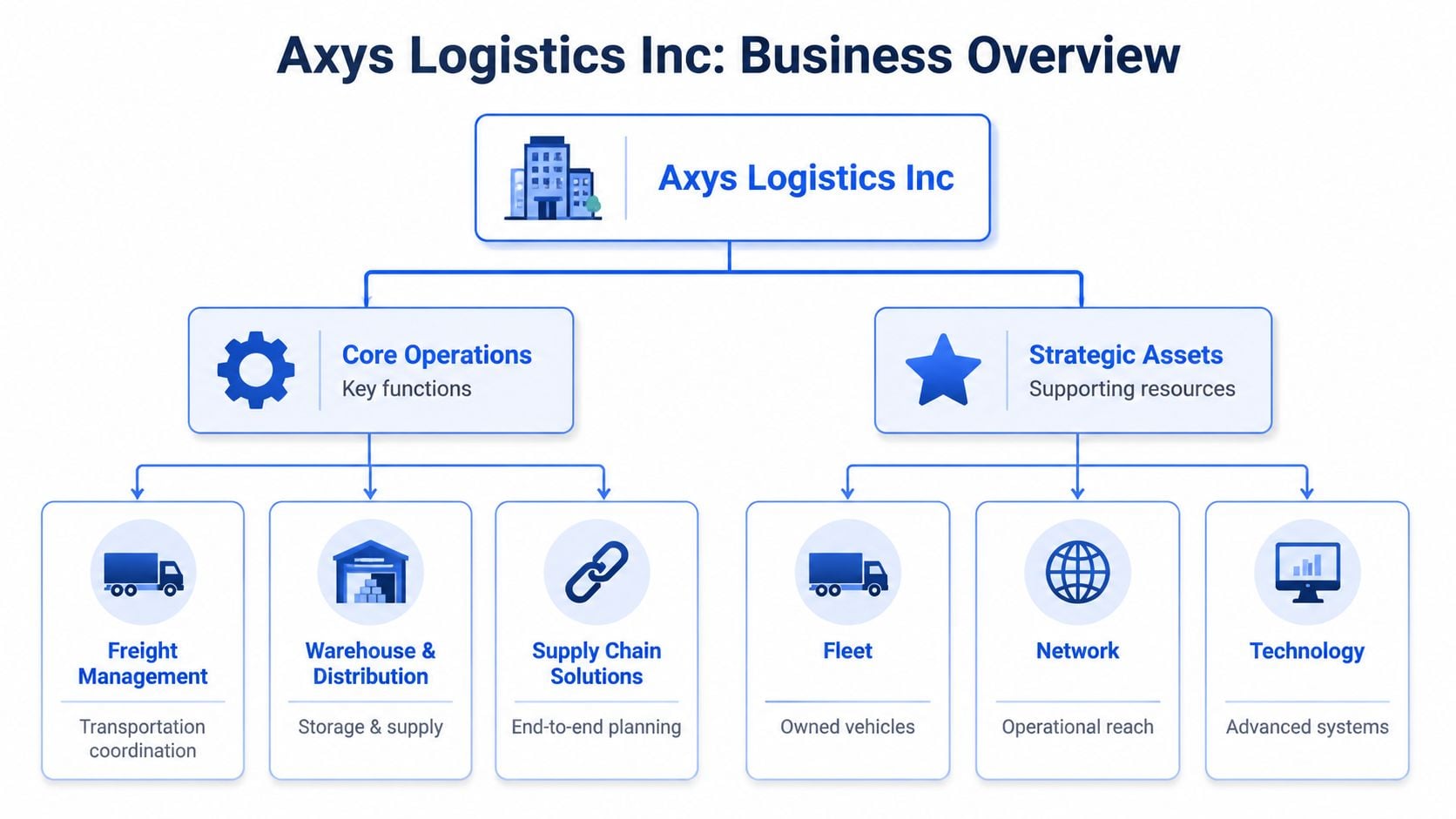
    A flowchart showing the business structure of Axys Logistics Inc with core operations and strategic assets.

    Those facts point to a company with real operating substance in a high-value geography. In Laredo, warehouse square footage matters less as a vanity metric than as evidence of what the site can absorb during border friction. A facility of that size can support staging, transfer recovery, consolidation, and short-dwell re-expedition work. That fits the company's public service framing better than a pure storage model.

    CTPAT is the other headline signal, and it deserves a more careful reading than it usually gets. The certification supports the view that Axys has documented security controls tied to cross-border customs expectations. That matters for shippers that care about chain-of-custody discipline and partner screening. What is missing from public materials is equally useful. There is no comparable level of visible detail around HAZMAT procedures, dangerous goods segregation, or regulated-freight handling standards. That does not prove a compliance weakness, but it does create uncertainty for any prospect evaluating Axys for shipments where security certification alone is not enough.

    That uncertainty can become sales intelligence.

    If your team sells cross-border forwarding, transload support, warehousing, or compliance services, Axys sits in a category where a targeted question can qualify the account fast. Ask how the operation separates CTPAT-driven security controls from hazardous materials operating procedures. Ask whether the Laredo site supports regulated freight by class, whether documentation review is handled in-house, and whether emergency response and storage rules are standardized across the U.S. and Mexico footprint. Operators with mature answers are often strong partners. Operators without clear public documentation may still buy outside support.

    Key company facts at a glance

    Attribute Detail
    Company Axys Logistics Inc
    Laredo function Certified distribution center
    Warehouse footprint 65,000 square feet
    Laredo address 4108 Trade Center Blvd
    Querétaro address Agustín Melgar #34
    Certification CTPAT
    USDOT designation Freight Forwarder
    USDOT number 2858369
    MCS-150 mileage reporting 601,890 miles/year
    Service framing Cargo re-expedition and international door-to-door freight

    For account mapping, Axys looks like a border-centered logistics operator with enough infrastructure and regulatory positioning to merit serious attention. The stronger conclusion is more specific. Its public profile supports outreach built around compliance depth, not just capacity. That makes it a useful contrast case against other cross-border operators, including profiles such as Import Logistics Inc in logistics sales research, where the distinction between visible credentials and visible operating protocols can shape the pitch.

    Core Services and Strategic Operating Lanes

    The simplest way to read Axys's service model is this. It sits where freight changes state. Freight arrives, gets staged, gets reassigned, gets documented, and then continues under a different handling context. That's a more strategic role than basic transport execution.
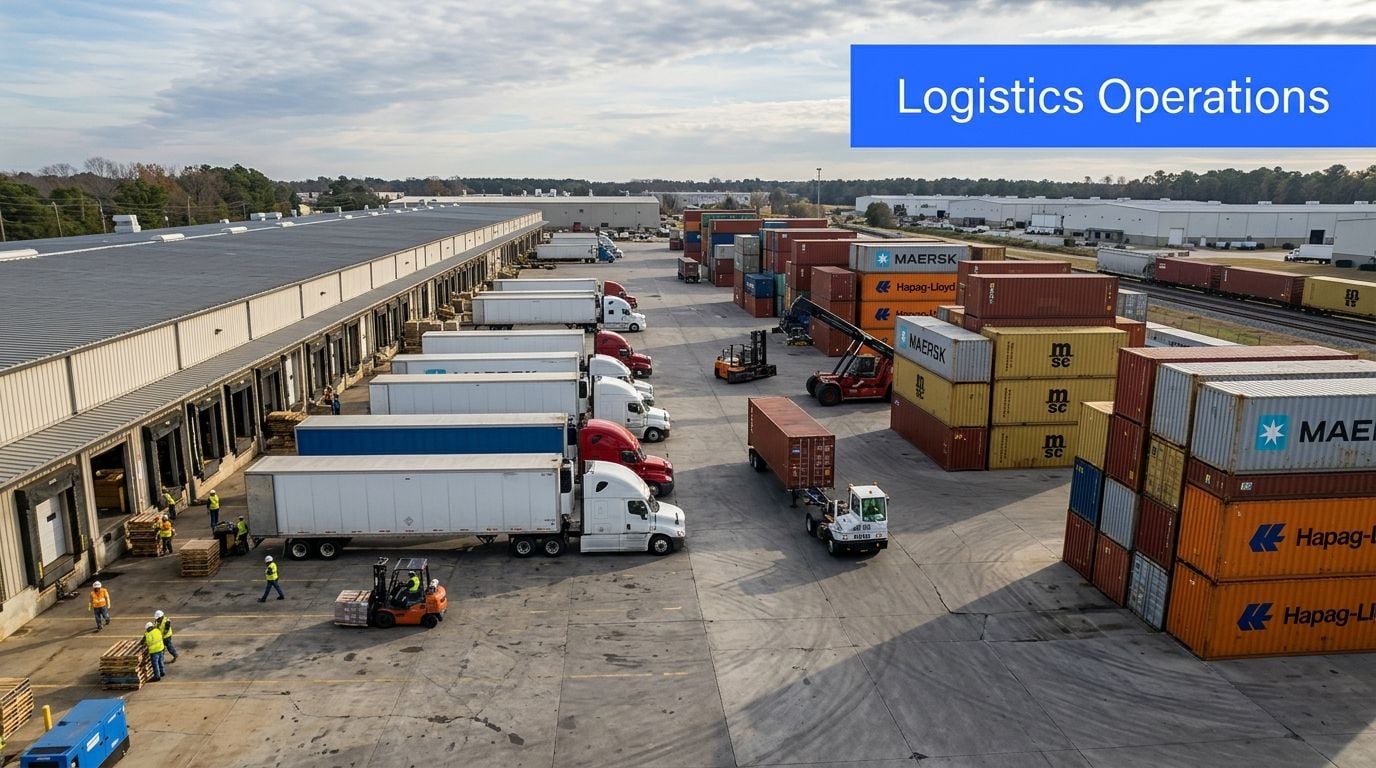
    An aerial view of a busy logistics yard with shipping containers, semi-trucks, and workers loading freight.

    The company's publicly described services include import and export movement across land, sea, and air, plus infrastructure designed for cargo re-expedition and international door-to-door freight, based on the earlier company profile reference. That mix matters because it suggests Axys isn't selling one isolated leg. It's selling continuity across disruptions, mode changes, and border checkpoints.

    Why re-expedition is the key clue

    Cargo re-expedition is the phrase worth circling. In ordinary marketing copy, broad service claims can be vague. Re-expedition is different. It usually points to operational involvement when freight needs to be redirected, transferred, accelerated, or reconstructed for onward movement.

    That has real sales implications:

    • For partner teams: Axys may be useful when your network needs a controlled border transfer point.
    • For carrier reps: The account may buy capacity around timing-sensitive reloads and onward delivery coordination.
    • For customs-adjacent providers: The company likely values process reliability more than low-cost generic support.

    A cross-border operator built around re-expedition often becomes important when shipments can't easily roll through unchanged. Documentation, physical transfer, or timing can force a handoff. That's where warehouse design and compliance discipline start influencing service quality.

    The likely lane logic behind Laredo and Querétaro

    A Laredo and Querétaro pairing points to a recognizable commercial lane structure. Querétaro connects to a major industrial region in central Mexico. Laredo functions as the U.S. border-side transfer and processing point. Put those together and you get a corridor that can support recurring shipper flows, mixed modal planning, and controlled northbound or southbound distribution.

    This is why Axys's “door-to-door” claim matters more than it first appears. Door-to-door in cross-border freight isn't a branding flourish. It usually requires coordination among origin handling, linehaul, customs steps, border transfer, and destination delivery. Companies that can manage that chain tend to become sticky with customers.

    Practical rule: When a border operator combines warehousing, re-expedition, and door-to-door positioning, don't treat it like a simple drayage or forwarding lead. Treat it like a network-control lead.

    A comparable border-market profile such as Laser Forwarding in Laredo can be useful when you're pressure-testing how local operators define service scope.

    HAZMAT capability changes the conversation

    Axys's public profile also indicates the ability to process hazardous materials with UN number documentation and Material Safety Data Sheets (MSDS). That changes the risk profile of the business. It suggests the company handles freight categories where documentation precision and liability management are central, not optional.

    Here's a short explainer that helps frame the complexity of cross-border freight execution:

    For a sales team, HAZMAT capability is less about pitching “we also handle hazmat” and more about identifying where execution can break. Hazardous freight creates more dependencies around notice windows, document readiness, carrier eligibility, and border compliance. If Axys is active in that space, the strongest outreach won't be broad. It will be procedural.

    What this service mix implies commercially

    A company operating across land, sea, and air while emphasizing border warehousing and re-expedition usually sits in one of two strategic positions. It either coordinates fragmented shipper requirements, or it absorbs complexity that the shipper doesn't want to manage directly.

    Both are useful. Both also create openings for specialized providers.

    If you're approaching Axys as a partner, the account may value service extensions that protect continuity around handoffs. If you're approaching it as a prospect, the best message won't be “we move freight.” It will be “we reduce operational uncertainty at the points where your model depends on precision.”

    Analyzing Performance Signals and Reputation

    A sales rep reviewing Axys after a shipper requests cross border HAZMAT support faces a familiar problem. The company shows public security credibility through CTPAT positioning, yet public detail on HAZMAT operating controls is thin. That mismatch matters more than a polished company description because border freight risk usually appears in the gap between certification and procedure.

    Public reputation in logistics is most useful when it signals operating discipline, partner standards, and possible blind spots. For Axys, the visible signal is security-minded cross-border capability. The less visible issue is whether that discipline extends into publicly documented hazardous materials workflows, such as carrier qualification, segregation standards, incident response, or shipment-specific documentation controls.
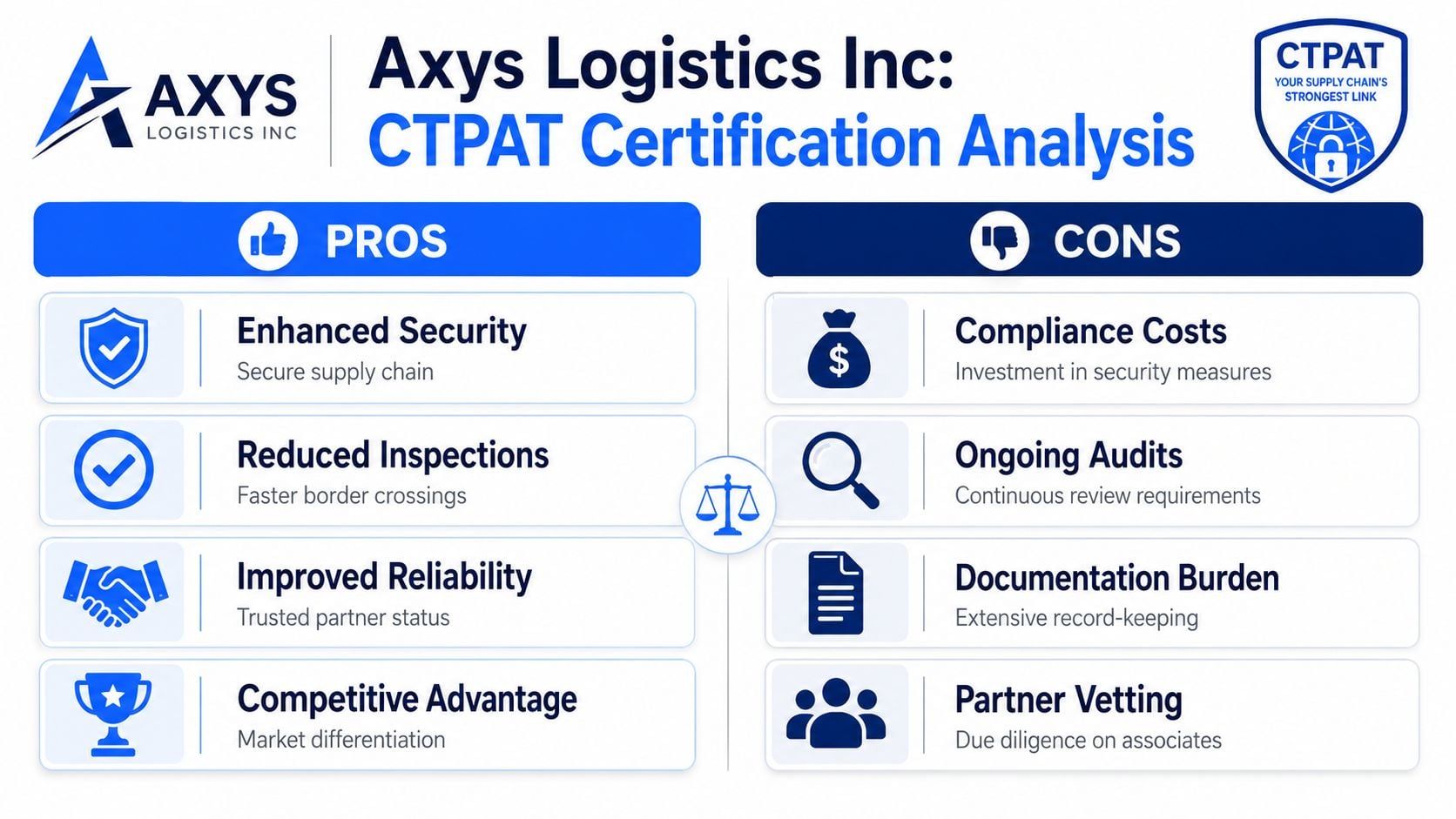
    A comparison chart outlining the pros and cons of CTPAT certification for Axys Logistics Inc operations.

    What the visible credentials do signal

    CBP's CTPAT program is a supply chain security framework, not a blanket proxy for end-to-end freight compliance. According to U.S. Customs and Border Protection's CTPAT program overview, participants are expected to maintain documented security practices across areas such as business partner requirements, cargo security, conveyance security, physical access controls, and personnel security. For a cross-border operator, that usually implies a controlled operating environment and higher expectations for counterparties.

    That reading is useful for sales teams because it changes the qualification test. Axys is unlikely to respond well to generic “we can help with overflow freight” messaging. A more credible approach is to show that your team can match a documented operating cadence, maintain chain-of-custody discipline, and reduce exceptions at the border.

    CTPAT signals process maturity. It does not answer every compliance question.

    The real reputation question is what is not public

    That distinction is where the account gets interesting. A company can be credible on supply chain security and still leave buyers, partners, and intermediaries with limited public visibility into HAZMAT-specific controls. For freight forwarders, that is not just a risk marker. It is a sales opening.

    The public record supports that narrower reading. The FMCSA SAFER company snapshot for Axys Logistics Inc is useful for entity verification and carrier registration context, but it does not provide the procedural depth a hazardous materials buyer would want. In parallel, Panjiva's profile and analysis of Axys Logistics points to commercial activity and market presence, yet it does not close the gap on public HAZMAT execution detail either. That leaves a practical question unanswered: how does Axys operationalize hazardous freight controls at the shipment level across border handoffs?

    For a sales analyst, that gap changes the outreach angle from capability selling to protocol selling.

    What to infer without overstating the case

    Two conclusions are reasonable.

    First, Axys appears serious enough about cross-border operations to align itself with recognized security standards. That supports a higher baseline of procedural discipline than many smaller freight intermediaries communicate publicly.

    Second, the absence of detailed public HAZMAT protocols creates uncertainty exactly where specialized providers can be useful. If your company offers hazmat documentation review, vetted carrier capacity, bilingual exception management, SDS handling support, or border transfer controls, your message can be framed as risk reduction inside an already structured operation.

    That is a stronger position than arguing price or broad capacity.

    A practical reputation read on Axys is this: the company presents as credible and organized, but the public record leaves room for questions about hazardous freight execution depth. For savvy forwarders, that is less a reason to avoid the account than a reason to approach it with a precise compliance conversation.

    Strategic Implications for Your Logistics Business

    Axys becomes more interesting when you stop asking “Who are they?” and start asking “How should we classify them in our pipeline?” For most logistics businesses, the answer is that Axys can sit in two buckets at once. It's a potential partner in border execution, and it's a potential prospect for highly specific support.

    A professional business team having a productive meeting at a conference table in a modern office.

    The partner case is easy to understand. A company with a Laredo distribution footprint, a Mexico-side presence, and a compliance-heavy operating posture can be useful when your own network needs a dependable cross-border handoff point. If your customers need deconsolidation, transfer coordination, or managed continuation into Mexico, Axys fits the shape of a company worth evaluating.

    The real opening sits in what isn't public

    The more valuable angle is the gap between visible certification and visible procedural guidance. Publicly, Axys highlights serious cross-border capability. Less visible is a detailed explanation of how it handles HAZMAT-specific compliance in live operating conditions.

    That gap is documented in Panjiva's profile and analysis of Axys Logistics, which notes the lack of publicly detailed, actionable protocols for HAZMAT compliance during cross-border U.S.-Mexico shipments. The same source notes that 11% of Mexican carriers face bond delays and frames the resulting ambiguity as a 30x outreach inefficiency for sales teams targeting HAZMAT shippers.

    That's not a trivial insight. It means the market problem isn't just “hazmat is complex.” The problem is that buyers and partners may struggle to validate who manages the complexity well before a shipment is already at risk.

    How to use that gap without overreaching

    A smart sales team shouldn't frame this as proof that Axys has a compliance weakness. The evidence doesn't support that. What it supports is a lack of public procedural transparency around a category where precision matters.

    That creates several practical opportunities:

    • Target procedural buyers: Reach out to operations leaders, compliance managers, and cross-border coordinators instead of generic procurement contacts.
    • Lead with edge cases: Ask about bond triggers, notification timing, and document handling rather than opening with broad transportation capacity.
    • Offer validation, not criticism: Position your service as a way to strengthen certainty around HAZMAT moves, not as a fix for assumed failure.

    Commercial insight: Information gaps create sales openings when your message helps the prospect reduce uncertainty they already live with.

    The best classification for Axys in a sales system

    If you're organizing account strategy, classify Axys as a high-context border account. That means your team shouldn't use generic freight templates, generic broker intros, or volume-first language.

    Instead, route the account to reps who can handle conversations about customs timing, bonded exposure, and hazardous documentation logic. On the U.S.-Mexico lane, the accounts that look most established are often the ones where subtle operational questions produce the strongest commercial entry points.

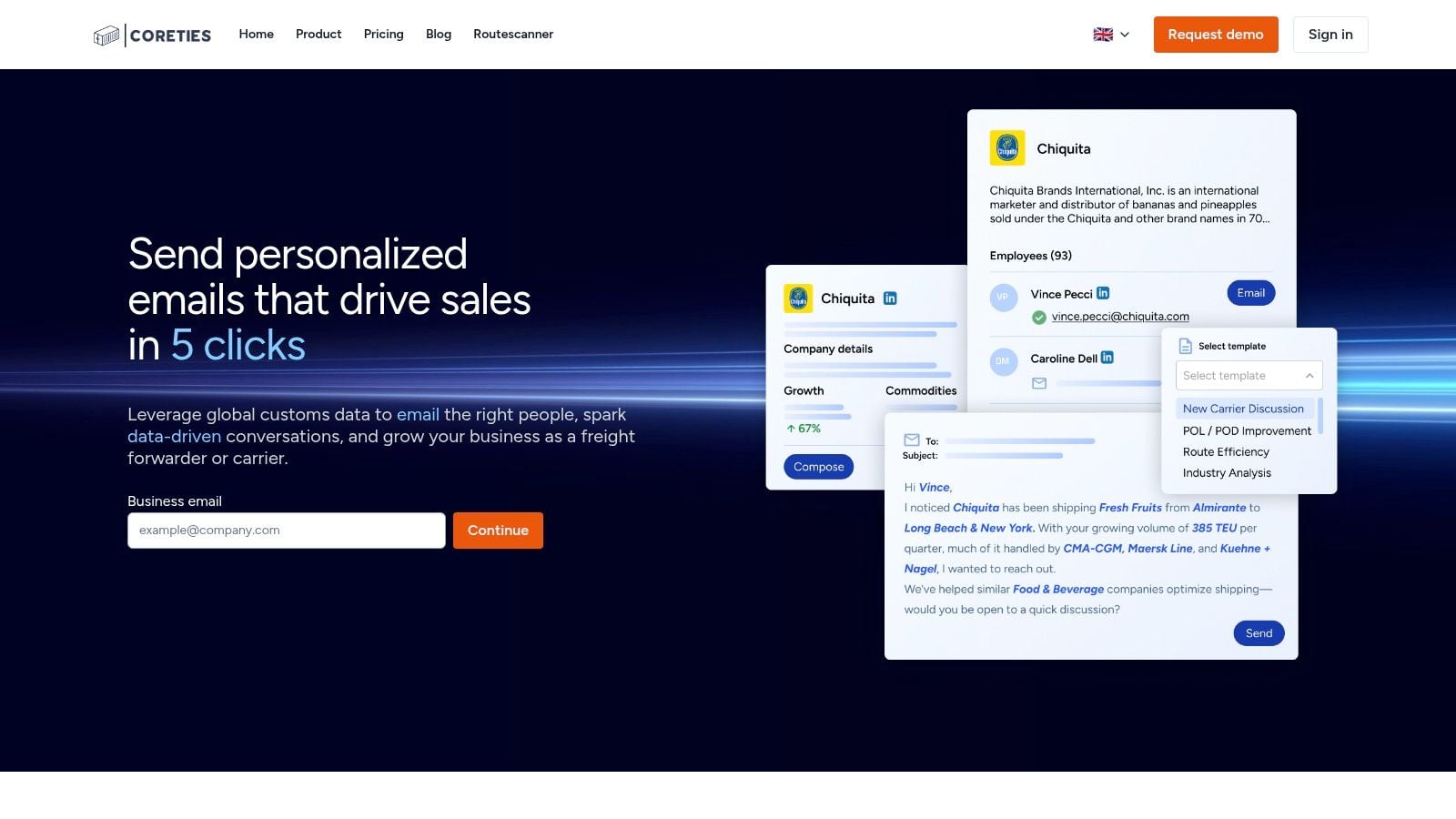
    Data-Driven Outreach Angles Using Coreties

    The difference between average outreach and effective outreach is specificity. A generic message to Axys will sound like every other freight email in their inbox. A precise message tied to their operating profile has a chance to start a useful conversation.
    Screenshot from https://coreties.com

    If your team is building outbound systems, it's worth reviewing resources like LinkedFuse's B2B lead generation guide. Not for freight-specific tactics, but for sharpening how you segment accounts and tailor first-touch messaging before a rep ever sends the email.

    Outreach angle one for border partnership

    This angle works if you want to position your company as a complementary operator.

    Subject: Cross-border support around your Laredo handoffs
    Hi [Name], I'm reaching out because Axys appears to operate a substantial cross-border setup through Laredo, with warehousing and re-expedition built into the model. We work with teams that need dependable support around border transfer points, especially when freight continuity matters more than lowest-cost execution. If your team is reviewing partners for overflow coordination or handoff coverage, I'd be glad to compare where we can support without disrupting your current process.

    Why it works: it reflects their border role without pretending to know internal pain points. It also respects the account's likely operational maturity.

    Outreach angle two for HAZMAT compliance discussion

    This is the highest-value angle when your offer touches customs-sensitive freight or hazardous cargo support.

    • Start with observed complexity: “Your public profile suggests Axys handles compliance-heavy cross-border freight.”
    • Move to the gap carefully: “What isn't always visible from the outside is how teams structure bond readiness and shipment notice workflows for HAZMAT.”
    • Offer a focused conversation: “We help logistics teams tighten those handoffs so documentation and timing don't become the weak point.”

    A full email could read like this:

    Subject: HAZMAT border workflow question
    Hi [Name], I noticed Axys is positioned around international freight and secure cross-border handling. We've been speaking with logistics teams that want tighter control over HAZMAT-related handoffs, especially where bond requirements and shipment notice timing can create avoidable delays. If that's an active area for your operation, I'd welcome a short discussion on how your team currently manages those edge cases and whether outside support would be useful.

    This message works because it invites expertise instead of challenging credibility.

    Outreach angle three for routing and service design

    This version is best for teams selling multimodal, cross-border, or network optimization support.

    Approach Best contact type Opening idea
    Partnership support Operations or branch leadership Emphasize border handoff strength
    HAZMAT process support Compliance or cross-border specialists Focus on procedural certainty
    Routing improvement Network planning or commercial leadership Discuss alternative lane design

    A sample version:

    Hi [Name], Axys's presence across Laredo and Querétaro suggests a structured corridor strategy rather than one-off shipment handling. We work with logistics teams that periodically review route design and partner alignment on cross-border freight where timing, customs steps, and onward mode selection all affect service quality. If your team is evaluating where existing lane setups can be tightened, I'd be glad to share a few ideas.

    What not to send

    The wrong outreach to Axys usually falls into one of three traps:

    • Overclaiming familiarity: Don't pretend you know their internal HAZMAT process if you don't.
    • Using commodity language: “We offer reliable shipping solutions” won't get traction.
    • Pitching too broadly: This account calls for a narrow first message, not a menu of services.

    The strongest first touch to Axys should sound like it came from someone who understands border operations, not someone blasting a list.


    If your team wants to turn customs data and company signals into practical outreach, Coreties gives freight forwarders, carriers, and logistics sales teams a faster way to identify relevant accounts, find the right contacts, and send customized messages built around real trade-lane context instead of generic prospecting.
  • Loera Customs Brokerage: A Shipper’s Guide (2026)

    Loera Customs Brokerage: A Shipper’s Guide (2026)

    You’re usually evaluating a customs broker under pressure, not in a calm procurement vacuum. A shipper needs a backup broker on the Texas border. A forwarder wants tighter handoff control for Mexico-bound freight. Or your team has seen too many “full-service” providers fall apart when the shipment involves in-bond movements, maquila documentation, and after-hours exceptions.

    That’s where loera customs brokerage becomes worth a closer look.

    Most public writeups on brokers in this space are thin. They tell you the company exists, list a few services, and leave out the details that matter when freight is live. What matters is whether a broker is built for the U.S.-Mexico corridor, whether they can operate cleanly inside maquiladora workflows, and whether they fit your operating model as a forwarder, carrier, NVOCC, or importer.

    This analysis is written from the standpoint of someone assessing a brokerage partner for real operational use. The goal isn’t to repeat marketing language. It’s to synthesize public information into a practical working profile you can use to qualify, challenge, or compare Loera.

    Understanding Your Partner at the Border Loera Customs Brokerage

    The first question to ask of any border broker is simple. Are they a generalist with a Mexico offering, or are they structurally tied to the corridor they claim to serve?

    Loera Customs Brokerage appears to belong in the second category. Public company information states that the firm was established in 1988 in Brownsville, Texas, and grew from a single employee and 10,000 square feet of warehousing to over 80 employees and more than 1 million square feet of space, with $13.1 million in annual revenue, which points to long-term operating presence in a key U.S.-Mexico gateway according to ZoomInfo’s company profile for Loera Customs Brokerage.

    Multiple semi-trucks driving through a US border crossing facility during a clear sunny day.

    For a freight forwarder, that history matters because border execution is usually where theoretical service capability gets exposed. If a broker has lived through multiple trade agreement cycles, customer mix changes, and customs process shifts, there’s a better chance their procedures are built for continuity instead of sales presentation.

    What to pay attention to first

    Start with three filters:

    • Operating longevity: Brokers that have stayed active for decades in Brownsville have likely built durable carrier, warehouse, and customs-facing routines.
    • Physical footprint: Large warehouse capacity suggests the broker isn’t just filing entries. They may also support staging, exceptions, and distribution workflows.
    • Trade lane fit: Brownsville is not interchangeable with every other border crossing. The fit depends on your commodity, plant location, and downstream delivery model.

    If your team is also comparing neighboring border providers, it helps to contrast Loera’s profile with a separate lane-specific operation like Laser Forwarding in Laredo. Brownsville and Laredo can solve very different problems even when both sit inside the same broad U.S.-Mexico trade narrative.

    Practical rule: Don’t evaluate a border broker by service list alone. Evaluate them by corridor discipline, exception handling, and how well their footprint matches your shipment flow.

    What Loera Customs Brokerage Offers Your Supply Chain

    The clearest public signal in Loera’s profile is specialization around the maquiladora industry. That matters because maquila freight isn’t just standard cross-border shipping with extra paperwork. It’s a workflow where customs status, temporary import rules, manufacturing timelines, and data accuracy all sit close together.

    An organizational chart showing services offered by Loera Customs Brokerage including clearance, compliance, consulting, logistics, and visibility.

    When a broker says they serve maquiladoras, I look for whether they can manage the chain, not just one filing event. Loera publicly references NAFTA compliance, ocean forwarding, in-bond material processing, and EDI integration. Taken together, that suggests a broker positioned around recurring industrial traffic rather than occasional one-off imports.

    The core service logic

    A practical way to read Loera’s offer is to sort it into five operating functions.

    • Customs entry execution: The baseline task. Entries need to be accurate, timely, and coordinated with the actual movement.
    • Trade compliance support: USMCA-era documentation discipline and rules handling begin to matter.
    • In-bond processing: Important for manufacturers moving material into Mexico for assembly before re-export or final disposition.
    • Ocean-linked coordination: Useful if your freight isn’t just truckload border traffic and the shipment starts farther upstream.
    • EDI-based connectivity: A sign that the broker is trying to reduce manual rekeying between systems.

    The most concrete public capability here is Loera’s full ABI certification. According to the STMA profile of Loera Customs Brokerage, that certification supports automated electronic submissions and can reduce customs processing to under an hour for many entries, which is especially relevant for maquiladora operations using deferred-duty structures and cash-flow-sensitive import programs.

    Why maquila specialization changes the evaluation

    In practical terms, maquila logistics is less forgiving than ordinary import brokerage. Material often needs to cross under a defined customs treatment, match internal production plans, and preserve records that support later reconciliation.

    Think of in-bond processing like a controlled bridge instead of a final arrival. The freight is moving with a specific customs purpose attached to it. If the broker mishandles the data or sequence, the problem doesn’t stay at the border. It hits inventory, plant scheduling, and finance.

    A broker can be very competent in standard commercial entries and still be the wrong choice for maquiladora traffic.

    What works and what doesn’t

    What usually works in this environment:

    1. Pre-file discipline that catches documentation mismatches before dispatch.
    2. A broker that understands temporary import logic, not just final consumption entries.
    3. Hands-on communication with carriers and plant-side contacts when timing changes.

    What usually doesn’t:

    • A broker that relies on email chains with no structured data flow.
    • A provider that treats Mexico movements as an extension of domestic drayage.
    • A commercial team that can explain services broadly but can’t map your actual shipment path.

    The main takeaway is straightforward. Loera’s public profile suggests the company is best evaluated as a specialist border broker with maquiladora relevance, not as a generic customs house.

    How Imports and Exports Move Through Loera

    The best way to assess loera customs brokerage is to think through a shipment, not a brochure.

    A typical movement starts before the truck reaches the border. The useful question isn’t whether the broker can file an entry. Most licensed brokers can. The critical question is whether they can absorb shipment data early enough to prevent a border-side scramble.

    A professional man in a green sweater analyzing complex data and digital charts on multiple computer monitors.

    A practical shipment flow

    A forwarder tenders freight moving into a U.S.-Mexico manufacturing lane. Commercial documents arrive. Product details need to line up with the customs treatment. Internal references need to match what the shipper, carrier, and plant expect to see. If any of that is off, the truck may physically arrive before the data is ready.

    That’s where Loera’s public emphasis on EDI and automated submissions becomes meaningful. According to Loera’s public website, the company uses EDI integration with Mexico’s VUCEM system, achieves 98% on-time clearance rates, and reduces filing errors to less than 1%, helping avoid CBP holds that can cost $500 to $2,000 per day.

    For an operations team, those numbers point to one thing. Loera’s value is likely strongest when the shipment is repetitive, rule-bound, and sensitive to small filing mistakes.

    What the workflow likely looks like on the ground

    A workable border process generally includes:

    • Data intake before truck dispatch: Commodity details, consignee data, shipment references, and supporting trade documents need to be aligned early.
    • Electronic transmission into customs-facing systems: That’s where ABI on the U.S. side and VUCEM-linked workflows on the Mexico side matter.
    • Exception review: If the data flags a mismatch, someone needs to stop the filing sequence before customs does it for them.
    • Release coordination: Clearance only matters if the carrier, warehouse, and consignee all receive the handoff cleanly.
    • Post-entry records control: This matters more in industrial and in-bond contexts than many shippers expect.

    If your team needs a refresher on one of the most basic but commonly mishandled shipment records, this short guide on what a bill of lading means in shipping operations is worth reviewing before broker onboarding.

    Why after-hours capability matters

    Loera publicly promotes 24/7/365 client support in earlier-cited public material. Operationally, that matters less as a slogan and more as a risk control. Border freight doesn’t fail on a neat office schedule. It fails when the plant changes a receiving plan late, the carrier arrives early, the paperwork version is wrong, or customs kicks back a discrepancy after normal desk hours.

    That’s also why video explainers can be useful when training internal teams on customs flow and timing dependencies:

    If a broker’s operating strength is real, you’ll see it in exception recovery, not in routine shipments.

    Where the trade-offs sit

    There is still a practical limitation. Public information gives a strong view of Loera’s systems orientation and corridor specialization, but it doesn’t provide a full public breakdown of commodity-specific workflows, pricing mechanics, or customer-facing SLA language. That means any serious evaluation should include live operational questioning, not just a website review.

    For repetitive freight with maquila logic, electronic filing discipline, and cross-border timing sensitivity, Loera’s process profile looks credible. For highly unusual commodities or custom workflow design, you’d want to probe more thoroughly before committing volume.

    Key Trade Corridors and Ports Loera Covers

    Loera’s geographic value sits in the Brownsville and Pharr border environment, not in a broad claim of “nationwide customs support.” That distinction matters. The right broker in this market is often the one that knows specific lanes, bridge behavior, warehouse positioning, and handoff routines better than competitors who market a larger footprint.

    Public shipment activity cited in the STMA material shows Loera handled bills of lading predominantly via Brownsville and Pharr gateways. That aligns with the broker’s Brownsville base and with a practical operating focus on Texas-Mexico manufacturing flows.

    Why Brownsville matters

    Brownsville serves shippers who want a border solution tied closely to Gulf-facing trade patterns, local warehousing, and manufacturing-related cross-border movement. A broker based there can be valuable when your freight plan depends on local coordination instead of remote entry filing.

    Loera’s warehouse scale, as cited earlier from public company information, also matters strategically. Large warehousing capacity near a major border trade zone can support more than storage. It can support staging, transload decisions, exception handling, and downstream distribution.

    Why Pharr changes the picture

    Pharr is often relevant when a shipper or forwarder needs reach into dense industrial traffic moving between Mexico and Texas. A broker active there may be useful even if your primary relationship starts elsewhere on the border.

    For logistics teams, this creates a simple corridor test:

    Corridor question Why it matters with Loera
    Is the freight tied to northeast Mexico manufacturing? Loera’s profile appears strongest in maquila-linked movements.
    Do you need border warehousing support? Their large Brownsville-area footprint suggests this may be part of the value.
    Are your shipments repetitive and compliance-sensitive? Loera’s publicly described model appears built for recurring process discipline.
    Do you need a broker for broad inland U.S. customs coverage? Public information points more clearly to border specialization than to a national generalist model.

    Brownsville and Pharr aren’t interchangeable procurement choices. They shape transit options, operational rhythm, and who the best brokerage partner actually is.

    What this means for partnership planning

    For a forwarder, Loera looks most relevant when you’re building around specific border lanes, not when you just need another broker on a vendor roster. For a shipper, the question is whether your plant locations, carrier network, and customs exposure line up with the Brownsville-Pharr operating pattern.

    That’s the right lens. Not “can they broker customs,” but “are they already structured for the exact corridor where my freight tends to break.”

    How to Evaluate and Engage with Loera Customs Brokerage

    A serious broker review should end in a yes, no, or pilot. It shouldn’t end in “they seem solid.”

    The challenge with loera customs brokerage is that public data gives you enough to identify a plausible fit, but not enough to skip direct diligence. Their profile suggests specialization, operational maturity, and strong border-process capability. It doesn’t tell you exactly how they price, how they assign account ownership, or how they escalate failures. You have to ask.

    The questions that actually matter

    Start with operating fit, not price.

    Ask how they handle your specific commodities, your expected shipment cadence, your hours of activity, and your exception profile. If your loads move on a plant-driven schedule, ask who answers after hours and how those handoffs are documented. If your traffic includes in-bond or maquila logic, ask who reviews those files before submission.

    Then ask commercial questions:

    • What’s the pricing model for routine entries versus exception-heavy entries?
    • Is warehousing billed separately from brokerage and coordination?
    • Who owns communication with carriers, consignees, and plant contacts?
    • What records will they require during onboarding?
    • How do they handle claims, holds, or documentation disputes?

    Good answers are specific. Weak answers stay abstract.

    Customs Broker Evaluation Checklist

    Evaluation Criterion Key Questions to Ask Loera's Profile Highlights
    Border specialization Which border crossings do you handle best, and for what shipment types? Public information points to Brownsville roots and activity through Brownsville and Pharr.
    Maquiladora capability How do you handle in-bond material processing and manufacturing-related customs workflows? Public sources consistently position Loera around maquiladora service.
    Systems integration Do you work through ABI and Mexico-facing EDI processes, and how are discrepancies caught? Publicly described as ABI-certified with EDI and VUCEM integration.
    Service responsiveness Who handles urgent issues outside normal office hours? Public materials emphasize round-the-clock availability.
    Operational proof Can you show lane-specific examples, references, or SLA language for our freight pattern? Publicly available information is thinner here, so direct validation is important.
    Warehouse relevance How does your warehouse network support border exceptions, staging, or distribution? Public profile indicates a large warehousing footprint near Brownsville.
    Communication discipline How are updates documented, and who owns the customer conversation? This should be tested directly in meetings and trial shipments.

    Where public information is strong, and where it isn’t

    One of the more useful public observations about Loera is that there’s still a gap in detailed public service differentiation. The Clutch profile noting limited public detail on service specialization and competitive differentiation is important because it reflects what many evaluators will notice quickly. The company is visible enough to establish credibility, but not transparent enough publicly to replace a structured vetting process.

    That means your evaluation should include communication process as a formal criterion. If your internal team wants a clean framework for this, these client communication best practices are useful because customs work often fails at the communication layer before it fails at the compliance layer.

    A practical engagement model

    If I were qualifying Loera for a forwarder, I’d use a three-step approach:

    1. Run a capability call focused on lanes, commodities, and after-hours ownership.
    2. Test with a narrow pilot rather than moving broad volume immediately.
    3. Audit the communication trail after each live movement.

    If your team is comparing alternative providers at the same time, a separate profile like Import Logistics Inc. can be useful as a contrast point when you want to distinguish border specialists from more general forwarding or logistics operators.

    The best brokerage relationship usually starts with a constrained test. Not with a full migration.

    Actionable Next Steps for Forwarders and Shippers

    The public picture on loera customs brokerage is fairly clear in one respect. This looks like a broker worth shortlisting when your freight lives in the U.S.-Mexico manufacturing corridor and your operation depends on disciplined border execution.

    For freight forwarders, the first move is to decide whether Loera is a partner prospect, a competitive benchmark, or both. If you handle customers with Mexico-bound industrial freight, review where your current broker setup creates friction. Then identify which accounts would benefit from a Brownsville or Pharr-aligned customs partner with maquila familiarity.

    A useful internal exercise is to separate accounts into three groups:

    • Current accounts with border pain: Delays, weak communication, poor exception handling.
    • Strategic targets in manufacturing lanes: Especially those that likely need recurring customs coordination.
    • Accounts where your value is broader than customs: In these cases, Loera may be a tactical broker partner rather than a relationship lead.

    For shippers and importers, the next step is narrower. Build a broker qualification brief before the first meeting. Include commodity mix, origin and destination pattern, shipment timing, expected exceptions, and required document flow. That forces the conversation into operations quickly.

    What to request up front

    Ask for:

    • A lane-specific discussion tied to your actual border crossings.
    • An explanation of onboarding requirements for your shipment type.
    • A communication map showing who handles routine files, escalations, and after-hours issues.
    • A warehousing discussion if your freight may need staging or short-term storage.

    Don’t ask only for a quote. Ask how the quote maps to the work.

    The practical takeaway

    Loera appears strongest where reliability depends on corridor knowledge, electronic customs integration, and comfort with maquiladora processes. If that sounds like your freight, the right next move isn’t broad commitment. It’s a controlled evaluation with real shipments, clear escalation paths, and strict review of how the broker communicates when something changes.

    That’s how you learn whether a border specialist is credible on paper or truly useful in your network.

    Common Questions About Loera Customs Brokerage

    Is Loera only relevant for maquiladora freight

    No. Public information suggests maquiladora logistics is a central strength, but that doesn’t mean the broker is limited to one shipment type. The practical question is whether your freight shares the same traits: recurring border movement, compliance sensitivity, and need for coordinated customs handling.

    Does Loera look more like a customs house or a broader logistics partner

    Based on public information, Loera looks like a customs-focused operator with adjacent logistics capability, especially where warehousing and border coordination matter. That can be a strong fit if you want a specialist in one critical segment instead of a single provider trying to control every logistics function.

    What should a forwarder verify before onboarding

    Verify three things first. Commodity familiarity, communication ownership, and escalation speed. Public information supports their technical and corridor credibility, but your team still needs live confirmation on who handles your account and how issues move internally.

    Is there enough public information to compare Loera cleanly against competitors

    Not completely. There’s enough to justify a serious review, but not enough to make a final decision without direct diligence. That’s especially true if your freight includes unusual commodities, nonstandard billing requirements, or custom reporting expectations.

    What’s the smartest way to start

    Start with a pilot shipment group, not a full rollout. Use it to test documentation flow, responsiveness, release coordination, and post-shipment follow-up. If those basics work well, expansion is much easier and less risky.


    If you want to turn customs and shipment data into qualified shipper targets, Coreties helps freight forwarders, carriers, and logistics teams identify the right companies, find decision-makers, and run personalized outreach built around real trade activity.

  • Laser Forwarding Laredo A Complete 2026 Comparison Guide

    Laser Forwarding Laredo A Complete 2026 Comparison Guide

    Before you can properly size up a freight partner like Laser Forwarding Laredo, you need to understand the world they operate in. Laredo isn't just another border crossing; its sheer scale and complexity set the stage for what makes a forwarder successful here. This context is everything.

    Laredo: The Undisputed Epicenter of U.S.-Mexico Trade

    An aerial view of a bustling Laredo trade hub with shipping containers, trucks, and cranes by the sea.

    To put it simply, Laredo is the heavyweight champion of land-based trade in the Western Hemisphere. It's the main artery pumping goods between the U.S. and Mexico, a role that’s only gotten more critical with the rise of nearshoring and the boom in cross-border manufacturing. When you pick a logistics partner here, you’re trusting them to navigate one of the busiest, most demanding commercial choke points on the globe.

    The numbers speak for themselves. The Port of Laredo has become a trade juggernaut, handling a staggering $353.94 billion in total trade volume in 2025. That’s a 4.4% leap from the $339 billion seen in 2024, adding more than $14.9 billion in goods flowing across its bridges in just one year. You can dig into the trends behind Laredo's incredible trade growth on National Today.

    What Laredo’s Market Dynamics Mean for Shippers

    To really get what’s expected of a company like Laser Forwarding Laredo, you have to look at the forces shaping this hub. The immense volume of freight creates both opportunity and constant operational headaches.

    Success in Laredo isn't just about having trucks and a warehouse. It’s about deep customs expertise, real-time visibility for high-value freight, and the flexibility to handle unpredictable border traffic and rule changes.

    The stats below provide a clear snapshot of why Laredo is such a vital, and often challenging, piece of the supply chain puzzle.

    Port of Laredo Key Trade Metrics (2025 Data)

    The following table breaks down the core numbers that define Laredo's market. For shippers, these figures highlight exactly what capabilities are non-negotiable in a local forwarding partner.

    Metric Value Significance for Shippers
    Total Trade Value (2025) $353.94 Billion This massive value demands financially stable, experienced forwarders who can handle high-stakes cargo.
    Key Industries Automotive, Electronics, Produce Shows the need for specialized handling, including Just-in-Time (JIT) delivery and reliable cold chain logistics.
    Operational Challenge Border Congestion & Wait Times Your forwarder must have rock-solid customs clearance processes and strong relationships with border agencies.
    Market Driver Nearshoring & Maquiladoras Points to a growing need for expert transloading, warehousing, and cross-docking services right at the border.

    These metrics aren't just trivia; they are the daily realities that a competent Laredo forwarder must master. From managing the flow of automotive parts to keeping produce fresh, the right partner turns these challenges into a competitive advantage for your business.

    Getting to Know Laser Forwarding Laredo

    To really understand the Laredo forwarding landscape, you need a solid benchmark. For our purposes, Laser Forwarding Laredo is the perfect starting point. They're a major player on the scene, and taking a close look at how they operate gives us a great baseline for comparison.

    First things first, what do they actually do? Laser Forwarding provides a full package of services built for the unique challenges of US-Mexico trade. This isn't just about moving boxes; it covers the critical stuff like customs brokerage, compliance, warehousing, and final-mile transport.

    Core Services and Specializations

    A lot of forwarders offer the same basic menu of services. The real difference comes down to what they're truly good at. Laser Forwarding has made a name for itself by zeroing in on industries where timing and accuracy are everything.

    You'll see their expertise shine in a few key areas:

    • Automotive Components: They have a long track record supporting the auto industry's supply chain, especially with the tight just-in-time (JIT) delivery schedules required by maquiladora plants.
    • Electronics and High-Value Goods: If you're moving sensitive or expensive electronics, their secure facilities and solid tracking systems are built to give you peace of mind.
    • Maquiladora Support: A huge piece of their business is dedicated to supporting manufacturing in Mexico. They handle everything from transloading and cross-docking to managing inventory for these operations.

    The real game-changer for Laser Forwarding Laredo is their in-house customs clearance software. It often lets them pre-clear shipments before they even hit the border, which can shave significant time off a crossing—a huge plus when things get backed up.

    If you're new to this side of the business, our guide on what a freight forwarder does is a great primer to get you up to speed.

    This chart breaks down the typical timeline you can expect when working with Laser Forwarding.

    A bar chart outlining the Laser Forwarding Process, showing average durations for Customs (7 days), Warehouse (14 days), and Transport (21 days).

    As you can see, their process is built on three pillars—Customs, Warehouse, and Transport—which they bundle together to provide a complete solution.

    Strengths and Potential Limitations

    No single forwarder is the right answer for everyone, so it's important to look at both sides of the coin. One of Laser Forwarding Laredo's biggest advantages is their physical infrastructure. They've invested in dedicated transloading bays designed specifically for turning freight around quickly, which is absolutely essential in a high-volume port like Laredo.

    But there are also a few things to keep in mind. On the flip side, their deep focus, while great for some, means they might not be the best fit for other types of cargo. For example, if you're shipping produce that needs a strict, unbroken cold chain, you might need a more specialized provider.

    Like many established forwarders, they can also hit capacity limits during peak season, which typically runs from October through December. Knowing these details is key to figuring out if they’re the right partner for your freight. This honest look at their capabilities gives us a clear picture to work from as we compare them to other options.

    Comparing Laredo Forwarders Side by Side

    Warehouse comparison: a modern logistics center exterior with a forklift, and an interior with stacked pallets and a truck.

    Choosing the right forwarder in Laredo isn't about finding the biggest name or the lowest price. It’s about finding a partner whose operational model is a perfect fit for your specific supply chain. To get past the glossy brochures, we’re putting Laser Forwarding Laredo in a head-to-head comparison with two other major players: the nimble 'Cross-Border Pro' and the highly specialized 'Maquila-Link Logistics'.

    This isn't just a list of pros and cons. We're going to dig into the details that actually impact your freight—customs performance, physical infrastructure, technology, and their niche expertise.

    The scale of this operation is staggering. In 2025, Laredo managed a massive 35% of all U.S.-Mexico trade, with an average of 20,000 commercial trucks crossing the border every day. That activity represents an estimated $800 billion in annual trade, making this port the undisputed nerve center for North American logistics. You can get a deeper dive into Laredo's massive trade volume on Pro Texas Industry.

    Customs and Transloading Capabilities

    When it comes to the border, speed and accuracy are everything. This is where Laser Forwarding's proprietary customs software really pays off, enabling pre-clearance that can shave off critical hours, especially during peak congestion. They’ve also invested in dedicated transloading bays, a huge advantage for getting cargo off a Mexican carrier and onto a U.S. truck without delay.

    On the flip side, Cross-Border Pro built its reputation on flexibility. They might not have the same in-house tech, but their deep relationships with a wide network of customs brokers mean they can find solutions for unusual or complex cargo that might stump other forwarders.

    Maquila-Link Logistics plays a different game altogether. Their process isn't about raw speed; it's about precision. They specialize in highly synchronized movements that align with the production schedules of manufacturing plants, mastering the intricate documentation needed for maquiladora programs.

    Infrastructure and Specialization

    A forwarder's physical footprint tells you what they're truly built to handle. Laser Forwarding’s main strength is its massive, high-security warehousing, which is geared toward high-value automotive and electronics parts. Their facilities are C-TPAT certified, which translates to a lower risk of inspections and smoother crossings.

    While Laser Forwarding Laredo offers exceptional just-in-time services for automotive parts, Cross-Border Pro’s cold-chain integrity is the gold standard for produce shippers. This highlights the critical importance of matching a forwarder's specialty to your product.

    Cross-Border Pro, in contrast, has poured its resources into advanced refrigerated and temperature-controlled facilities. For anyone moving perishable goods, their expertise in maintaining an unbroken cold chain from the farm in Mexico to a U.S. distribution center is second to none. Maquila-Link’s warehouses function more like extensions of their clients' factories, offering value-add services like kitting and light sub-assembly right at the border.

    Feature Comparison Laser Forwarding vs. Laredo Alternatives

    To help you see how these forwarders stack up, here’s a direct comparison across the services that matter most. This table offers a clear, at-a-glance breakdown to guide your decision-making.

    Service Feature Laser Forwarding Laredo Alternative A 'Cross-Border Pro' Alternative B 'Maquila-Link'
    Primary Industry Focus Automotive & Electronics Produce & Perishables Maquiladora & Manufacturing
    Customs Strength Proprietary Pre-Clearance Software Broker Network & Flexibility In-Depth Maquiladora Compliance
    Warehouse Infrastructure High-Security, High-Turnover Advanced Cold-Chain Facilities Integrated, Value-Add Services
    Technology Platform Real-Time Track & Trace Portal Temperature Monitoring & Alerts ERP and Production Schedule Sync
    Best For JIT automotive suppliers needing speed and security. Importers of fresh produce or pharmaceuticals. Manufacturers needing synchronized cross-border flows.

    As you can see, there’s no single "best" forwarder in Laredo. The right choice is entirely dependent on your cargo, your customers' requirements, and your overall business model. It's about finding the partner whose strengths directly solve your biggest cross-border challenges.

    Putting It All Together: Which Forwarder Is Right for Your Business?

    All the feature lists in the world don't mean much until you apply them to a real-world shipping situation. The best forwarder for your business is the one whose strengths directly solve your biggest headaches.

    Let's walk through three common scenarios we see every day in Laredo. By looking at the unique pressures of an automotive supplier, a produce importer, and an electronics maquiladora, we can see exactly where a forwarder like Laser shines—and where a different specialist might be a better fit.

    Scenario 1: The Automotive Parts Supplier

    The Situation: A Tier 1 supplier in Michigan ships high-value components to an assembly plant in Nuevo León. Their entire operation is built on a just-in-time (JIT) model. If a shipment is even a few hours late, the production line can grind to a halt, triggering massive financial penalties.

    The Right Fit: This is Laser Forwarding Laredo's home turf. Their entire system is practically engineered for the demands of the automotive industry. It's not just about moving a box from Point A to Point B; it's about predictability. Their proprietary pre-clearance software and deep-seated relationships at the border are all designed to strip out delays and uncertainty.

    When your business lives and dies by JIT, shaving hours off a border crossing isn’t a nice-to-have; it's the core of your risk management strategy. Laser Forwarding’s operational DNA is built for this.

    Their C-TPAT certified, high-security yards are another critical piece of the puzzle, giving you peace of mind that your valuable components are secure. For this kind of high-stakes, time-sensitive freight, Laser is the obvious choice.

    Scenario 2: The Perishable Produce Importer

    The Situation: A Texas-based importer brings in avocados and berries from Michoacán. The product is incredibly sensitive to temperature fluctuations. A broken cold chain doesn't just mean a delayed shipment; it means a total loss of high-value, perishable cargo.

    The Right Fit: Here, a specialist like 'Cross-Border Pro' pulls ahead. While Laser can certainly handle refrigerated freight, Cross-Border Pro lives and breathes perishables. Their advantage lies in their dedicated infrastructure—we're talking state-of-the-art, temperature-controlled facilities with real-time monitoring and redundant systems.

    They also have teams who are experts in the specific agricultural inspections and documentation required for produce. This isn't just a side business for them; it's their entire focus, and that specialized knowledge is invaluable when a few degrees can wipe out your profit margin.

    Scenario 3: The Complex Electronics Maquiladora

    The Situation: An electronics maquiladora in Tijuana has a complex, bi-directional supply chain. They need to bring in components from all over the world, consolidate them in Laredo, and then manage the outbound flow of finished products to U.S. retailers. It's a symphony of moving parts.

    The Right Fit: In this case, 'Maquila-Link Logistics' is the clear winner. Their model is designed to act as a seamless extension of the manufacturing plant. They don't just move freight; they orchestrate it. They excel at synchronizing inbound materials with outbound finished goods and even provide value-added services like kitting or light assembly right in their Laredo warehouse.

    This level of integration is crucial in a port as hectic as Laredo, which saw daily traffic peak at 10,465 commercial trucks on a single day in March 2025—an 8.4% jump. You can see more data on Laredo's incredible trade volume at PortLaredo.com. For a maquiladora, having a partner that can manage that complexity is far more important than raw speed alone.

    Your Checklist for Choosing a Laredo Freight Forwarder

    Overhead view of a freight checklist on a clipboard with a laptop, plant, and magnifying glass on a white desk.

    Picking the right partner for the Laredo trade corridor involves a lot more than just shopping for the lowest rate. Anyone with experience at the border knows you have to dig deeper. It’s the operational details that make or break a shipment, and this checklist is built around the tough questions we've learned to ask when vetting a new forwarder.

    Don't just take their word for it. Promises on a sales call mean nothing without the infrastructure and credentials to back them up. Use these points as your guide to make sure you’re choosing a truly competent partner, whether that’s Laser Forwarding Laredo or another provider on your shortlist.

    Vetting Credentials and Security

    First things first, you need to confirm the basics. Any legitimate forwarder will have this information ready and won't hesitate to share it.

    • Customs Brokerage License: Get their U.S. Customs Broker license number. You can and should verify it’s active with U.S. Customs and Border Protection.
    • C-TPAT Certification: Ask if they are a validated member of the Customs-Trade Partnership Against Terrorism (C-TPAT). This isn't just a nice-to-have; C-TPAT certification can mean fewer inspections and quicker clearance times for your freight.
    • Warehouse Security: How secure is their facility? You should ask about 24/7 surveillance, controlled yard and warehouse access, and if they have specific protocols for high-value cargo.

    Assessing Operational Fitness

    Once their paperwork checks out, it’s time to see how they actually operate. This is where a forwarder’s real value becomes clear. For a deep dive into another Laredo forwarder’s operations, check out our guide on R+P Forwarding.

    A forwarder’s technology stack is a direct reflection of their commitment to transparency. Always ask for a live demo of their client portal to test its shipment visibility and reporting functions before you commit.

    Finally, don’t be afraid to ask about worst-case scenarios. A great question is: "What is your specific protocol for a customs hold or an unexpected border closure?" Their response will tell you volumes about their experience and how prepared they are for the chaos that inevitably hits Laredo. And always, always ask for at least three current references from shippers with needs similar to yours.

    Finding and Connecting with Key Logistics Partners

    Knowing what makes a partner like Laser Forwarding Laredo tick is just the first step. The real work for any logistics sales professional begins when you have to find the right shippers who actually need their specific services and then turn that insight into a real business relationship. This is where good market intelligence separates the pros from the amateurs.

    You can stop casting a wide, hopeful net. Instead, modern tools let you dive into global customs data to build a highly specific list of importers and exporters already working the Laredo trade corridor. It’s all about filtering opportunities by what actually matters to your bottom line.

    From Data to Deals

    Good outreach isn't about volume; it's about relevance. Using a platform like Coreties, you can immediately spot companies shipping the exact commodities that play to a forwarder’s strengths, whether it's automotive parts or consumer electronics.

    But this goes way beyond just finding company names. The critical piece is getting verified contact information for the people who actually sign the checks—the VPs of Supply Chain or the Logistics Managers. This lets you skip the gatekeepers and get your message directly to the right person. And when you do reach out, remember that following solid email deliverability best practices is non-negotiable if you want your hard-earned insights to be seen.

    The best sales calls aren't about your company. They're about your prospect's business. When you lead with specific data about their trade lanes, you prove you've done the work and aren't just another generic pitch.

    Turning Intelligence into Actionable Sales

    All this detailed analysis on Laser Forwarding Laredo becomes your secret weapon when you pair it with smart tech. For instance, a simple geo-search can map out your entire territory, showing you exactly where clusters of high-value importers and exporters are located around a hub like Laredo.

    Even better, you can integrate this with routing tools like Routescanner. This allows you to build and propose an optimized, end-to-end shipping solution in your very first email. By showing up with a competitive, data-backed route from day one, you change the entire dynamic. The conversation shifts from a sales pitch to a strategic discussion about partnership, turning market knowledge directly into new revenue.

    Frequently Asked Questions About Laredo Logistics

    If you're shipping through the Laredo corridor, you’re bound to have questions. It’s a complex environment, and getting clear answers is the first step toward choosing the right partner and avoiding costly headaches. Here are some of the most common concerns we hear from shippers.

    Key Operational Concerns

    What are the main causes of delays at the Laredo border?

    Honestly, most delays boil down to three things: overwhelming traffic volume, unexpected customs inspections, and paperwork errors. A good forwarder gets ahead of this. They use pre-clearance programs whenever possible, lean on their relationships with customs personnel to smooth things over, and are absolutely meticulous about documentation to avoid raising any red flags.

    How do Laredo freight rates compare to other US-Mexico ports?

    Laredo is usually very competitive on rates, mainly because of the sheer volume and efficiency of the operation. That said, prices can swing wildly depending on the season, truck capacity, and what's happening with fuel costs. Any forwarder worth their salt will give you transparent pricing that directly reflects what's happening in the market.

    The single most critical element for a smooth crossing is having 100% accurate and complete documentation. A simple mistake on a commercial invoice or bill of lading can lead to days of delays and costly fees.

    What are the essential documents for a typical shipment?

    For just about any standard commercial shipment coming north through Laredo, you'll need a core set of documents. Don't even think about crossing without them.

    • A Commercial Invoice that clearly details the goods, their value, and origin.
    • The Bill of Lading (BOL), which serves as your contract with the carrier.
    • A detailed Packing List.
    • Any special permits or certificates your specific commodity requires.

    Compliance also means making sure you aren't doing business with anyone on a restricted list. Understanding this is non-negotiable, and you can learn more by reading our guide on what is denied party screening.


    Finding the right decision-makers at Laredo-based companies can feel like searching for a needle in a haystack. Coreties turns global trade data into targeted lead lists, putting you in direct contact with the logistics managers and supply chain directors you need to reach. See how it works at https://coreties.com.