Tag: apparel logistics

  • 7 Top Importers of Garments to Target in 2026

    7 Top Importers of Garments to Target in 2026

    U.S. textile imports reached $107.72 billion in 2024, with apparel imports at $83.7 billion, showing just how much cargo still moves through this category despite supply chain shifts and tariff pressure (USA apparel importer data and OTEXA summary). That’s why importers of garments stay at the center of every serious freight sales plan.

    Generic prospecting fails in this market. Large apparel shippers already hear from forwarders every week. If your outreach sounds like “we handle Asia to USA” or “we’d love to quote your business,” it gets ignored. These companies buy on timing, lane fit, compliance confidence, and your ability to show that you understand how their freight moves.

    The better approach is simple. Build your target list from shipment behavior, not brand recognition alone. Start with apparel-focused customs activity under HS Chapters 61 and 62, then look for trade lanes, shipment rhythm, and whether the importer’s profile fits your network. A forwarder strong in Vietnam to U.S. FCL shouldn’t chase the same accounts as a team built around India consolidations or faster-turn replenishment freight.

    That’s where a data-first workflow matters. Customs data helps you identify who is importing regularly, which origins matter, and where a company may be vulnerable to delays, cost swings, or capacity mismatches. From there, a platform like Coreties can help narrow the list fast, surface the right people inside logistics and procurement, and support outreach tied to real shipping activity instead of generic claims.

    If you’re also building supplier-side intelligence, this guide on how to find wholesale suppliers is a useful complement.

    The names below are worth targeting because they combine import scale with practical forwarding opportunities. Some are off-price retailers with mixed-SKU flow and fast inventory turns. Others are brand groups with structured sourcing calendars and stricter compliance gates. The playbook changes by account. That’s the point.

    1. The TJX Companies (T.J. Maxx, Marshalls, HomeGoods)

    TJX Companies deserves a different sales motion than a typical apparel brand or department store account. Its off-price model creates irregular buying windows, fast turns, and a freight profile that can shift by origin, season, and available deal flow. Forwarders that treat TJX like a standard retail shipper usually miss the account.

    The opportunity is real, but the entry point is narrow.

    TJX tends to reward operators who can handle short booking lead times, mixed vendor activity, and frequent execution changes without creating noise for the customer. That means your prospecting should start with lane fit and shipment behavior. If customs activity under Chapters 61 and 62 shows consistent knit and woven garment imports from origins where your partners are strong, that is the signal to build around. If your team needs sharper product mapping before outreach, keep this guide to the HS code for garments close during account qualification.

    A second filter is control. Large retail programs care about who holds responsibility at each handoff, especially when routing, customs, and final delivery sit across multiple parties. If you plan to pitch a model that shifts responsibilities between vendors, buyers, and service providers, make sure your team is clear on importer of record responsibilities in apparel freight.

    Where forwarders usually win with TJX

    The strongest opening is specific. Lead with one origin cluster, one operating advantage, and one recurring problem you can reduce.

    Use points like these:

    • Lead with lane evidence: Name the origin countries where you already control bookings, vendor communication, and document collection.
    • Speak to buying variability: Show that you can handle mixed loads, partials, and last-minute booking adjustments without losing visibility.
    • Focus on execution at destination: Mention transload coordination, appointment management, and exception follow-up tied to retail delivery requirements.

    TJX buyers hear broad claims every week. “Global reach” and “competitive rates” do not separate you. Operational detail does.

    What to avoid in outreach

    TJX is price conscious, but cheap-first messaging usually weakens your position. It signals that your service will break under pressure.

    Avoid these mistakes:

    • Rate-only outreach: Cost matters, but the first conversation usually comes from control, speed, and reliability in the right lane.
    • Generic fashion language: “We support apparel brands worldwide” is too vague to earn attention.
    • Loose compliance language: If your pitch ignores documentation accuracy, routing discipline, or vendor coordination, you sound risky.

    My rule for accounts like TJX is simple. Sell the first workable wedge, not the whole network. One lane. One service gap. One shipment pattern you can improve with less friction for the customer. That approach gets meetings.

    2. Ross Stores (Ross Dress for Less, dd’s DISCOUNTS)

    Ross Stores (Ross Dress for Less, dd’s DISCOUNTS)

    Ross Stores belongs on a freight forwarder’s target list for one reason. Process discipline decides who gets in and who gets cut.

    Ross runs an off-price model, but the sales angle is not “high apparel volume.” The better angle is repeatable execution inside a formal vendor and routing structure. Forwarders who win here usually handle booking control, document accuracy, and exception management with very little noise. Teams that improvise their way through retail imports usually struggle.

    Why Ross is a good target

    Ross is attractive because the account can support steady import activity across a broad supplier base while holding carriers and service partners to a tight standard. That creates a clear filter for prospecting. If your operation is strong in origin coordination, routing compliance, and retail delivery follow-through, Ross is worth serious attention.

    The opportunity gets sharper when you look at shipment detail instead of broad market talking points. Review the HS codes used for imported clothing and apparel programs before outreach, then map those codes to Ross shipment patterns, origin clusters, and seasonality. That gives your sales team a practical way to spot where volume concentrates and where your network fits.

    Ross is usually a strong prospect if your team can support:

    • Origin-side control across multiple vendors
    • Mixed-load planning for off-price buying patterns
    • Clean documentation and routing guide execution
    • Port-to-DC coordination with fast exception follow-up

    Best entry angle for sales teams

    Lead with proof that you can operate inside an established import process. Ross does not need a forwarder to explain retail logistics. The buyer needs confidence that your team can take instructions, manage vendor communication, and keep shipment milestones visible without creating extra work internally.

    That is also why account selection matters. A sales team may get a meeting with a good rate sheet, but Ross keeps providers that hand off cleanly to operations. If your branch has weak SOP control, inconsistent milestone updates, or frequent document corrections, this is a poor pilot account.

    Use Coreties to keep the outreach specific. Pull the likely logistics and transportation contacts, tie your message to a lane or shipment pattern you already run well, and show where your team reduces exceptions. A note about “supporting apparel brands” is too vague. A note about improving vendor booking compliance from a named origin set is much stronger.

    Ross rewards consistency. That is the trade-off and the opportunity. The freight can be recurring, but only for forwarders that treat compliance and execution as part of the sale, not as an operations problem to solve later.

    3. Burlington Stores

    Burlington Stores

    Burlington Stores belongs high on a target list for one reason. It creates repeat freight demand across a wide apparel mix, and that demand only converts into revenue for forwarders that can control execution beyond the port.

    The account is appealing because the freight problem is layered. Burlington needs steady inbound flow, broad supplier coordination, and domestic handoff that does not break once the container lands. A forwarder that only sells ocean space will struggle here. A forwarder that can manage booking discipline, transload timing, customs accuracy, and delivery visibility has a real angle.

    Where Burlington fits in a target list

    Burlington makes sense for sales teams that already know how to handle retail freight at a branch level. The buying model creates recurring shipment activity, but the true test is whether your operation can hold together when vendor quality varies, documents arrive late, and delivery timing starts slipping.

    That is why Burlington is not just a volume play. It is a process play.

    The forwarders that tend to fit Burlington well usually bring strength in a few specific areas:

    • Frequent inbound shipment management
    • Coordination from port arrival through DC delivery
    • Vendor follow-up across several origin countries
    • Exception reporting that helps the customer act quickly

    The sales wedge that tends to work

    Lead with a freight problem Burlington experiences. Inventory freshness is one. If purchase orders move through many vendors and origins, even small booking delays can push receipts back and create pressure downstream in transload, appointments, and store allocation.

    That gives sales teams a practical opening. Speak to PO flow, sailing protection, and exception control. If your team is strong in a specific origin cluster, say which one. If you have a better handoff model for transload and final delivery, explain how it reduces missed milestones. If your customs team catches classification issues early, connect that to fewer avoidable entry delays.

    Reps also need category context before they write outreach. This guide to clothes HS code helps tie garment classifications to likely shipment patterns, which makes prospecting sharper and more credible.

    A Burlington sequence should stay narrow and operational:

    • First message: Mention a lane, origin set, or apparel program your team already runs well.
    • Second message: Show one measurable operational improvement, such as better vendor booking compliance or faster issue escalation after cutoff risk appears.
    • Third message: Offer a review of a defined import flow, not a generic intro call.

    Coreties matters here because contact accuracy changes the quality of the pitch. Use it to identify the logistics, transportation, and import decision-makers tied to apparel flow, then build outreach around the shipment patterns your team can effectively support.

    Burlington can become a durable account. It is rarely an easy first close. Procurement discipline is tight, and execution mistakes show up fast in chargebacks, missed receipts, and internal friction.

    “Fresh inventory” sounds like a merchandising concern. For a retailer like Burlington, it is also a transportation and compliance issue. Repeated misses on booking, classification, or handoff timing create downstream cost long before anyone argues about rates.

    4. PVH Corp. (Calvin Klein, Tommy Hilfiger)

    PVH Corp. deserves a different sales motion than the off-price accounts above. You are not chasing spot-volume gaps or opportunistic lane wins. You are trying to earn a place inside a brand organization that already runs on calendars, approvals, vendor standards, and internal reporting.

    That changes the pitch.

    PVH is attractive because the freight problem is layered. Multiple brands create overlapping but distinct shipping rhythms. Product launches, wholesale commitments, retail delivery dates, and e-commerce replenishment put pressure on origin planning and exception handling in different ways. A forwarder that can keep those moving without creating noise has a real opening.

    Why PVH deserves attention

    PVH’s value to a freight forwarder is not just shipment count. It is the quality of the account if you fit their operating model.

    Expect a buying team that looks closely at process control:

    • Multi-brand import schedules
    • Broad sourcing coverage across overseas factories
    • Higher expectations for compliance and milestone reporting
    • Decision-makers who already work inside structured systems and vendor requirements

    That last point matters. PVH does not need a tutorial on basic forwarding. They need proof that your team can fit into an established import program and make it run better.

    What a serious pitch sounds like

    Start with predictability. Brand groups care about product timing, handoff discipline, and clean exception management. If your team can protect launch windows, reduce avoidable expedite decisions, or improve origin coordination across fragmented suppliers, say that early and back it with a specific example.

    The strongest outreach usually centers on three points:

    • Calendar control: Show that you understand booking cutoffs, seasonal peaks, and the cost of missing a delivery window tied to a brand launch or retail set date.
    • Mode judgment: Explain how you decide what should stay on ocean, what deserves deferred air, and what needs premium rescue capacity based on margin and timing.
    • Systems fit: Speak clearly about milestone visibility, EDI capability, vendor communication, and escalation discipline.

    Such situations quickly expose weak sales language. “We handle apparel” is forgettable. “We helped a brand importer reduce late origin handoffs by tightening supplier booking follow-up and exception escalation” sounds like a team that understands the job.

    There is also a real trade-off in the account. PVH can produce stable volume and long tenure. The cost of entry is higher. Approval cycles are longer, credibility matters more, and internal alignment usually matters as much as rates.

    Use Coreties here with precision. Find the logistics, transportation, import, and sourcing leaders connected to apparel flows, then map your message to actual shipment behavior, likely origin clusters, and the HS code families your team handles well. That turns outreach from generic capability claims into a point of view a brand-led importer will respect.

    One field lesson stands out. PVH teams are often less interested in hearing that freight can move from A to B. They pay attention when a forwarder can reduce planning friction, protect key dates, and communicate exceptions before those exceptions become internal problems.

    5. Gap Inc. (Gap, Old Navy, Banana Republic, Athleta)

    Gap Inc. (Gap, Old Navy, Banana Republic, Athleta)

    Gap Inc. rewards forwarders who can sell a lane plan, not just a company pitch. The business spans multiple brands, supplier bases, and demand profiles, so generic outreach usually gets ignored. A sharper entry point is a specific origin program, a consolidation fix, or a mode strategy tied to one part of the portfolio.

    Sourcing diversification matters here because it changes the sales conversation. The question is no longer whether a shipper buys across several countries. The question is whether your team can support the countries, handoff points, and service expectations that come with that sourcing mix.

    That is the genuine opening.

    If your strength sits in Vietnam, India, Indonesia, Bangladesh, or Cambodia, Gap deserves attention. If you can pair those origins with disciplined consolidation, vendor coordination, and dependable transit planning, you have a case to make. If you only have coverage in one pocket of Asia and need workarounds everywhere else, this account gets harder fast.

    Gap also forces better segmentation than many forwarders use. Old Navy freight does not deserve the same message as Athleta or Banana Republic freight. Margin tolerance, speed requirements, and SKU volatility differ by brand, and your outreach should reflect that.

    A practical prospecting framework looks like this:

    • Start with HS code families you handle well: Use customs data to isolate apparel categories where your team already has strong origin control and booking discipline.
    • Study recurring shipment patterns: Look for repeat origins, seasonality, and consolidation opportunities instead of sending a broad capability deck.
    • Match your pitch to the brand model: Value retail needs cost control and consistency. Premium or assortment-sensitive flows may justify faster recovery options and tighter exception handling.
    • Target the right operators: Use Coreties to identify logistics, transportation, sourcing, and import leaders tied to those shipment patterns, then tailor the message to the lanes they likely manage.

    Many freight sales efforts lose credibility at this point. The rep says the company can handle apparel from Asia to the U.S. That tells Gap nothing useful. A better message is specific: you spotted repeated movement in a lane your team runs well, you see room to tighten consolidation or vendor booking compliance, and you can explain how that would reduce friction for the people managing the flow.

    Gap can be a strong account for forwarders that run multi-country origin programs with discipline. It can also expose weak execution quickly. If your operation depends on constant heroics, inconsistent origin follow-up, or loose communication between overseas offices and the U.S. team, a multi-brand importer like this will surface those gaps early.

    6. G-III Apparel Group (DKNY, Donna Karan, Karl Lagerfeld)

    G-III Apparel Group (DKNY, Donna Karan, Karl Lagerfeld)

    G-III Apparel Group is a smart prospect for forwarders that want meaningful apparel volume without walking straight into the complexity of a massive big-box retailer. The company’s mix of owned and licensed brands creates steady import activity, but it also creates operating pressure that weak forwarders struggle to handle.

    The opportunity is straightforward. G-III needs partners that can support fashion-driven replenishment, wholesale delivery windows, and the occasional recovery shipment when a launch date or retailer commitment gets tight. That combination gives good sales teams room to stand out, especially if they bring shipment-level insight instead of a generic apparel pitch.

    Why G-III is worth targeting

    G-III works best for forwarders that already know which apparel categories and origin lanes they run well. Start with customs activity tied to the HS code families you can service consistently, then look for recurring supplier countries, booking cadence, and signs of deadline-sensitive movement. That gives you a sharper account plan and a better reason to reach out.

    This is also a strong Coreties account. Once you identify the product categories and lanes that matter, use Coreties to find the logistics, transportation, sourcing, and import leaders connected to those flows. Outreach gets stronger when it references a likely operating reality, such as repeated movement from a key origin or patterns that suggest seasonal pressure, instead of broad claims about global coverage.

    What to emphasize in outreach

    G-III is not just buying container space. The company is managing brand commitments, delivery timing, and retailer expectations across multiple labels. Your message should reflect that.

    Focus on points like these:

    • Calendar protection: Show that your team can keep purchase order timing, origin coordination, and milestone visibility under control when vendor execution gets uneven.
    • Selective air support: Position air freight as a recovery option for specific launch or wholesale commitments, not as an expensive substitute for weak planning.
    • Multi-brand account discipline: Explain how your team handles different service needs across brands without letting communication break down.
    • Exception handling: Be clear about escalation paths, response times, and who owns decisions when cargo misses plan.

    One mistake reps make with G-III is pitching the company as if every brand behaves the same way. They do not. Licensed brands can shift faster than expected. Priorities change by season, by customer, and by product category. A forwarder that only sells a fixed routing guide and a rate sheet will sound replaceable.

    The better pitch is operational. Show that you can support unstable parts of the apparel cycle without creating more noise for the customer. If you can point to a lane pattern, a category fit, and a clear exception process, you will have a stronger conversation with this account than a rep who leads with capacity claims alone.

    7. Centric Brands

    Centric Brands is a strong target for forwarders that sell process control, not just freight rates. The company operates across licensed, owned, and private-label brands, which usually means mixed shipment profiles, changing production calendars, and stricter supplier coordination than a single-brand importer.

    That sourcing mix matters. Centric can shift volume across countries, product categories, and vendor groups faster than a simpler apparel account. For a sales rep, that creates an opening. The pitch should show that you can stabilize origin planning, booking discipline, and shipment visibility when the supplier base is spread across multiple programs.

    Why Centric is worth pursuing

    Centric is attractive because the account has real operating complexity without being a pure one-off spot buyer. A contract manufacturing model puts pressure on vendor follow-through, document accuracy, and handoff timing at origin. If your team is good at consolidation planning, milestone management, and exception follow-up, that capability is easier to prove here than at a shipper with a narrower model.

    This is also the kind of account where trade data becomes useful in outreach. Review HS code activity, origin concentration, and seasonal shipment patterns before the first email. Then use Coreties to identify the likely owners across logistics, transportation, imports, or supply chain and tailor the message by function. A VP of logistics cares about service consistency and escalation control. An imports manager usually cares about vendor compliance, booking accuracy, and avoiding preventable delays.

    What works in outreach

    Start with one lane, one category, or one recurring execution problem. Broad claims about global coverage are easy to ignore.

    A better message sounds like this:

    • Show origin control: Explain how your team manages booking discipline, factory follow-up, and cut-off compliance across vendors that perform at different levels.
    • Use shipment signals: Reference a likely sourcing corridor, category flow, or seasonality pattern tied to apparel programs, not a generic statement about garment imports.
    • Address compliance risk: Speak to document accuracy, carton visibility, and milestone reporting. Those points matter more than a broad promise to save money.
    • Define exception ownership: Say who responds when cargo slips plan, how fast updates are issued, and how decisions get escalated.

    One trade-off is worth stating clearly. A forwarder can help Centric create a more stable freight plan, but only if the operating model supports supplier accountability. That is part of why responsible sourcing and supplier treatment matter in apparel, as discussed in this analysis of broken apparel sourcing partnerships. Forwarders do not set buying terms, but they do influence whether shipments move with control or with constant last-minute recovery work.

    Centric is a good fit for teams that know how to turn shipment data into a sales plan. If you can connect HS codes, lane behavior, and the right decision-maker inside the account, you will sound more credible than a rep who leads with price and waits for an RFQ.

    Top 7 Garment Importers Comparison

    Company Implementation complexity Resource requirements Expected outcomes Ideal use cases Key advantages Key challenges
    The TJX Companies (T.J. Maxx, Marshalls, HomeGoods) High: large scale, frequent POs, strict compliance Large LCL/FCL capacity, near-port transload, strong audit support Steady year-round volumes with rapid turn cycles Asia–US lanes, consolidation, near-port transload providers Continuous replenishment, clear compliance standards Very price sensitive; stringent vendor approval
    Ross Stores (Ross Dress for Less, dd’s DISCOUNTS) Moderate-high: mixed SKUs, tight routing guides Flexible mixed-SKU handling, DC appointmenting, audit cadence Regular programmatic volumes with repeat business Forwarders with DC integration and cost-efficient routing Consistent replenishment cycles, clear compliance manual Aggressive cost focus, selective onboarding
    Burlington Stores Moderate: focus on freshness and turnover Ocean consolidation, transload, reliable domestic linehaul Consistent inbound flows across store network Ocean + transload + domestic linehaul operators Vendor portal and supply-chain transparency ease onboarding Cost-driven procurement; limited trials for new providers
    PVH Corp. (Calvin Klein, Tommy Hilfiger) High: multi-brand, multi-channel planning and peaks High-capacity ocean/air, EDI/DC systems, advanced KPIs Stable high-volume programs with predictable seasonal peaks Expert logistics partners for brand programs Operational sophistication enables fast process adoption Tight SLAs and relationship-led approval cycles
    Gap Inc. (Gap, Old Navy, Banana Republic, Athleta) High: multi-brand routing and multi-origin sourcing Multi-lane origin consolidation, modal flexibility, VAS Predictable seasonal flows and consolidation opportunities Origin consolidation, VAS providers, multimodal lanes Diverse country mix creates multiple lane options Complex routing/compliance and pricing pressure in value segments
    G-III Apparel Group (DKNY, Donna Karan, Karl Lagerfeld) Moderate: brand/season variability, wholesale demands Ocean and time-sensitive air capacity, wholesale distribution links Year-round import demand with fashion drop peaks Time-sensitive air freight and wholesale distribution support Familiar operations teams, multi-brand import volume Licenses or brand shifts can abruptly change volumes
    Centric Brands Moderate: predictable seasonality but licensing variability Origin consolidation, compliance programs, seasonal planning Optimized PO/sailing with seasonal predictability Kidswear seasonality optimization, origin consolidation Clear supplier compliance playbook, predictable seasons Licensing cycles and decentralized decision making

    Turn Apparel Insights Into Lasting Revenue

    Knowing the biggest importers of garments is useful. It’s not enough.

    Many freight teams lose in this segment for a simple reason. They prospect at the company level, but apparel buys and ships at the lane, calendar, and compliance level. A logo on a target list doesn’t tell you whether the account fits your network, your operating model, or your sales motion. Shipment behavior does.

    That’s the core playbook.

    Start with customs activity under the apparel chapters that matter. Look for frequency, lane concentration, and whether the importer behaves like a retailer with replenishment flow or a brand group with planned seasonal peaks. Then qualify hard. If your team is strong in Vietnam FCL, don’t burn hours on accounts dominated by origins where your network is thin. If your operation is built for flexible consolidation, lean into off-price retail accounts where mixed-SKU flow is normal. If your team handles exception-sensitive, calendar-driven freight well, target brand groups that care about launch timing and structured vendor execution.

    The second step is contact strategy. Large importers rarely respond because the wrong person gets the wrong message. A generic email to a corporate inbox won’t create movement. You need the logistics manager, transportation lead, sourcing operations contact, or procurement stakeholder who can connect your offer to active freight. Then you need a reason for them to care now. Recent shipment activity, origin changes, tariff pressure, or recurring lane concentration are all better opening hooks than “just introducing ourselves.”

    This is also where teams often waste the most time. They pull data from one place, contacts from another, then spend hours trying to turn raw shipment information into a usable message. The process breaks because it’s too manual. Reps either skip the research or over-research and never send the email.

    A workable system compresses all of that. Build the list. Filter by lane and product relevance. Find the right person. Write the outreach around a real shipping signal. Then send enough volume to learn which angles are landing. If your reps can’t do that consistently, the issue usually isn’t effort. It’s workflow design.

    Coreties fits naturally into that kind of process because it’s built around customs-driven lead discovery and logistics outreach. For teams selling to importers of garments, that means less time hunting and more time talking to accounts that match the network you already have.

    The long-term win isn’t one converted shipper. It’s a repeatable revenue engine. Apparel is still one of the most commercially important cargo categories in the market, but it’s crowded and unforgiving. The forwarders who win aren’t the ones sending the most messages. They’re the ones showing up with the clearest evidence that they understand the importer’s freight.

    If you want another practical example of turning messy information into usable business intelligence, this piece on Mastering Data Parsing to Transform Unstructured Data Into Business Insights is worth reading.

    The teams that treat garment prospecting like account-based logistics sales will keep winning. The teams that rely on generic cold outreach will keep getting ignored.


    If you want a faster way to find importers of garments, identify verified logistics contacts, and build outreach around real shipment data, take a look at Coreties. It’s designed for freight forwarders, carriers, and logistics sales teams that need a practical workflow for turning customs data into qualified conversations.

  • Your Guide to T Shirt HS Code for Global Logistics

    Your Guide to T Shirt HS Code for Global Logistics

    The go-to t shirt hs code is almost always found under heading 6109. This heading is specifically for knitted or crocheted garments, which covers the vast majority of T-shirts on the market.

    From there, the classification gets more specific. Subheading 6109.10 is designated for cotton T-shirts, while 6109.90 is a catch-all for those made from other textiles, like polyester or rayon blends.

    Quick Guide to T Shirt HS Codes

    A neatly folded brown t-shirt displayed with its HS Code 6109 on a sign next to a laptop.

    Getting apparel classification right is absolutely critical for avoiding customs delays and fines. The first, and most important, step is understanding the fabric's construction. The Harmonized System makes a clear distinction right away: is the garment knitted (Chapter 61) or woven (Chapter 62)?

    Think about your average T-shirt. It's stretchy and made of interlocking loops of yarn—that's a knit. This is why their classification journey starts in Chapter 61.

    The primary heading you'll be working with is 6109, which covers "T-shirts, singlets and other vests, knitted or crocheted." The final digits of the code are then determined by the material. To make things easier for shippers and forwarders, we've put together a quick reference for the most common codes you'll encounter.

    If you want a more thorough breakdown of the entire classification process, you can learn more about how to find any harmonized code in our detailed guide.

    T Shirt HS Code Quick Reference (Chapter 61 – Knitted/Crocheted)

    Here’s a quick-reference table that breaks down the most frequently used 6-digit HS codes for T-shirts. Remember, these codes are based on the primary material composition.

    HS Code Subheading Material Type Description
    6109.10 Cotton T-shirts, singlets, and other vests made predominantly of cotton. This is the most common code for standard T-shirts.
    6109.90 Man-Made Fibers Covers items made from synthetic or artificial fibers like polyester, nylon, rayon, or acrylic.
    6109.90 Other Textile Materials A catch-all for T-shirts made from other materials, such as wool, silk, or linen, which are less common.

    Using the correct code from the start saves a massive amount of time and prevents costly errors. Always double-check the material breakdown before finalizing your customs declaration.

    Understanding the Harmonized System for Apparel

    Document 'Harmonized System' with pen and magnifying glass next to 'HS' blue notebook.

    Before you can assign the right HS code to a T-shirt, you have to understand the logic behind the entire Harmonized System (HS). At its core, the HS is the universal language of international trade, organizing every conceivable product into a logical hierarchy, from broad Chapters down to specific 6-digit Subheadings.

    Think of it as a library's card catalog, but for everything that crosses a border.

    This system is built on a foundation known as the General Interpretative Rules (GIRs). These rules are the official playbook for classifying goods, and they become absolutely critical when you're dealing with items that aren't straightforward. For instance, GIR 3(b) is the rule you'd turn to when deciding the "essential character" of a T-shirt made from a cotton-polyester blend.

    For any logistics pro, getting this right isn't just about accuracy—it's about avoiding steep fines and delays. A firm grasp of these rules means you can classify apparel with confidence and even use customs data to find new sales leads. If you want to go deeper, you can find the official texts in various online harmonized code books.

    Detailed Breakdown of HS Code 6109 for T-Shirts

    When you're classifying T-shirts, your journey almost always starts with one critical number: Heading 6109. This is the go-to heading for "T-shirts, singlets and other vests, knitted or crocheted."

    Pay close attention to the phrase knitted or crocheted. This describes the stretchy, interlocking loop construction found in virtually every T-shirt you've ever worn. Getting this right is the first step, as this single heading covers the vast majority of T-shirt shipments worldwide.

    But that's just the start. The Harmonized System requires you to get more specific about the material composition. This is where importers and carriers need to be precise, as the next set of digits determines customs compliance and the final duty bill.

    Cotton vs. Other Materials

    From Heading 6109, the classification splits down two primary paths based on the fabric:

    • HS Code 6109.10 is reserved for T-shirts made predominantly of cotton.
    • HS Code 6109.90 is the catch-all for T-shirts made from any other textile. This includes polyester, rayon, or even blends where another fiber's weight percentage is higher than cotton.

    Navigating Other Common Apparel HS Codes

    While the vast majority of T-shirts are knitted, getting this seemingly small detail right is absolutely vital for accurate classification. One wrong move can lead to costly customs errors. For instance, a woven shirt looks a lot like a T-shirt, but from a customs perspective, it's an entirely different product.

    This is where the fabric's construction becomes the deciding factor. Woven fabrics use a grid-like pattern of interlaced threads, giving them a rigid structure with minimal stretch. Knits, on the other hand, are made from looped yarn, which is why your typical T-shirt is so stretchy and comfortable. This single distinction sends woven shirts to a completely different section of the Harmonized System—Chapter 62.

    Under this chapter, men's or boys' woven shirts are found under heading 6205, while women's or girls' versions fall under 6206. It doesn't stop there. Other similar garments, like sweatshirts, also have their own unique codes. Even though they are knitted, they belong under heading 6110, not with T-shirts.

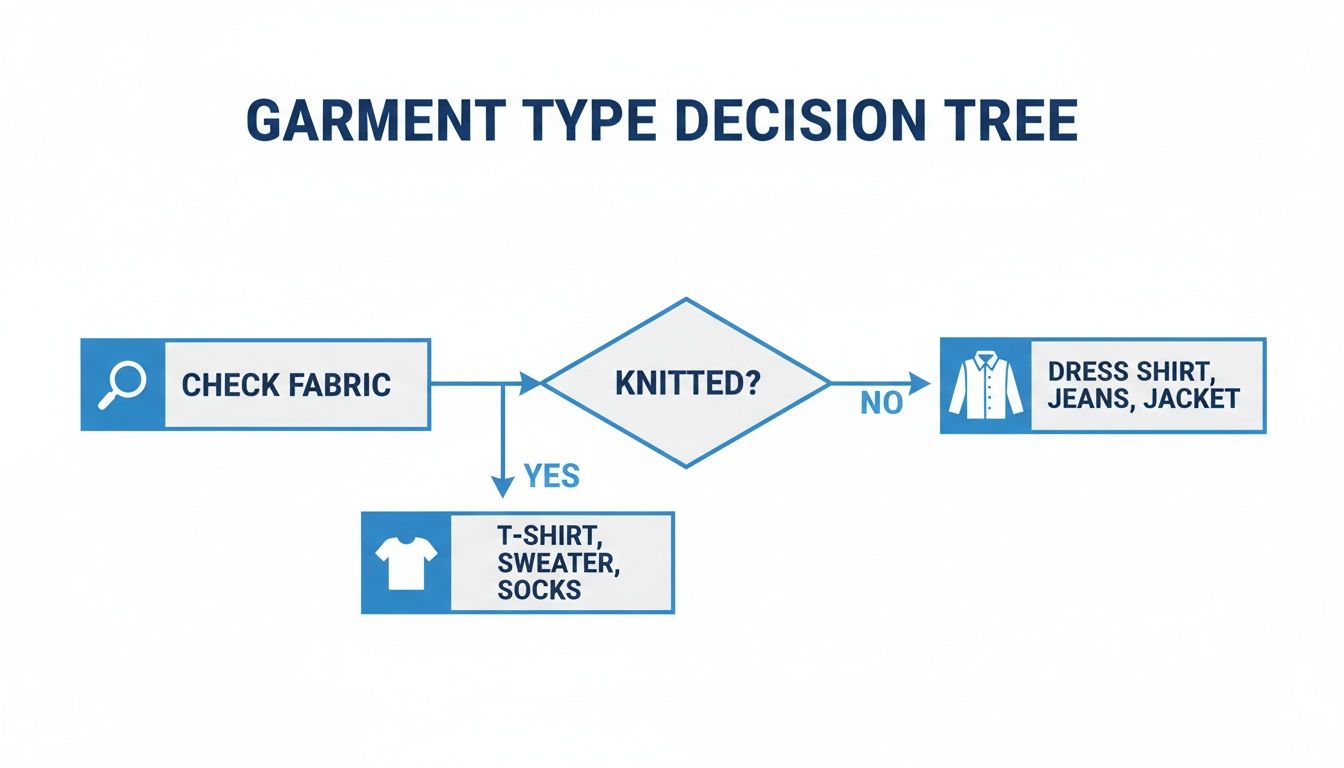
    This simple decision tree helps visualize that first critical step for classifying any T-shirt correctly under its primary heading, 6109.

    Flowchart guiding T-shirt HS code determination based on fabric type, differentiating cotton and other materials.

    As you can see, once you've confirmed the garment is a knit T-shirt, the next question is always about the material. This directs you to either 6109.10 for cotton or 6109.90 for all other textile materials. For any logistics professional mining customs data, having a firm grasp of these adjacent codes isn't just helpful—it's essential for accurate analysis and finding real opportunities.

    Analyzing Global T-Shirt Logistics Opportunities

    It might just be a T-shirt, but for savvy freight forwarders and carriers, this simple garment is a goldmine of opportunity. The key is understanding that the t shirt hs code is far more than a customs formality. It’s a powerful tool that helps uncover high-volume, predictable trade lanes just waiting for the right logistics partner.

    By digging into this data, you can see the true scale of the market and pinpoint exactly which countries are the major players in exporting and importing. In 2023 alone, global T-shirt exports hit a staggering $51.8 billion. This isn't just an abstract number; it's a direct indicator of consistent, high-volume freight.

    For sales teams, this kind of insight changes the game. You can stop making cold calls and start having informed conversations backed by real numbers. For instance, knowing that Asia drives 55.4% of T-shirt exports, with giants like China and Bangladesh leading the charge, tells you exactly where to focus your business development efforts. You can learn more by exploring these T-shirt export trends.

    Ultimately, this data turns prospecting from a shot in the dark into a precision-guided strategy.

    How Country-Specific Variations Impact Duties

    Think of the first six digits of an HS code as a global standard. It’s the language everyone agrees on. But once a shipment reaches a specific country's border, that's where the conversation gets a lot more detailed.

    Individual countries take that 6-digit foundation and tack on their own numbers—creating longer, more specific national tariff codes. For instance, the United States uses a 10-digit Harmonized Tariff Schedule of the United States (HTSUS) code, while the European Union uses an 8-digit Combined Nomenclature (CN) code. It’s how their customs authorities drill down into the finer points of a product.

    Let's stick with our men's cotton T-shirt example. Globally, it starts as HS code 6109.10. But depending on where you're sending it, that's not the full story. Is it for men or boys? Is it 100% cotton or a blend? Does it have a pocket? These subtle differences are captured by the additional digits, and each variation can trigger a completely different duty rate.

    To give you a clearer picture, here’s how the code and duty rate can change for the exact same T-shirt depending on its destination.

    HTS Code and Duty Rate Comparison for a Men's Cotton T-Shirt

    Country/Region Full Commodity Code Description Detail Standard Duty Rate
    United States 6109.10.00.04 T-shirts, singlets, tank tops and similar garments, knitted or crocheted: Of cotton: Men's or boys': T-shirts 16.5%
    European Union 6109.10.00.10 T-shirts, singlets and other vests, knitted or crocheted: Of cotton: Men's or boys' 12%
    Canada 6109.10.00.10 T-shirts, singlets and other vests, knitted or crocheted: Of cotton: For men or boys 18%
    United Kingdom 6109.10.00.10 T-shirts, singlets and other vests, knitted or crocheted: Of cotton: Men's or boys' 12%
    Australia 6109.10.00.23 T-shirts, singlets and other vests, knitted or crocheted: Of cotton: Men's and boys' T-shirts 5%

    As you can see, a simple men's cotton T-shirt can have a duty rate as low as 5% or as high as 18%, all depending on the destination market's specific commodity code.

    This is precisely why you can't just estimate your import taxes. Getting the final, country-specific code right is non-negotiable if you want to accurately calculate your landed cost and avoid nasty financial surprises.

    Using HS Codes to Generate Freight Sales Leads

    For any logistics sales team, understanding the T-shirt HS code is more than just a customs formality; it’s a direct line to new business. By mining global customs data, freight forwarders can transform what looks like a simple trade statistic into a list of qualified sales leads.

    The process is surprisingly straightforward. It all starts with filtering shipment data for HS Code 6109, which immediately surfaces active T-shirt shippers and importers. From there, you can zero in on specific trade lanes or export hubs. For example, China’s garment exports hit a staggering $38.1 billion in just the first half of 2026, making it a prime hunting ground for new logistics partners. You can see more on these global apparel export dynamics.

    Of course, finding a list of potential clients is only half the battle. The next step is effective outreach. It’s well worth the time to learn how to write a cold mail that actually gets replies and turn that raw data into a solid sales pipeline. If you want to dive deeper into this prospecting method, you can learn more about using an HS code filter to get highly targeted results.

    Common Questions on T-Shirt HS Codes

    Even seasoned shippers run into the same questions when classifying T-shirts. Getting the HS code right is non-negotiable, so let's clear up a few of the most frequent sticking points.

    What Is the Main HS Code for T-Shirts?

    Your starting point will almost always be heading 6109. This is the designated code for "T-shirts, singlets and other vests, knitted or crocheted."

    Most standard T-shirts are made from knitted fabric. From there, you just need to identify the material:

    • 6109.10 is the subheading for T-shirts made of cotton.
    • 6109.90 is for T-shirts made from other textiles, like polyester, viscose, or blends.

    How Do I Classify a Blended Fabric T-Shirt?

    This is where many people get tripped up. For blended fabrics, classification is determined by what's known as the "essential character." In simple terms, this usually comes down to the material that has the predominant weight.

    For example, a T-shirt made of 60% cotton and 40% polyester is classified as a cotton garment under 6109.10. If that blend were flipped to 60% polyester and 40% cotton, it would fall under 6109.90 as a garment of other textile materials.

    The T-shirt market is a huge piece of the global apparel trade. With the entire industry projected to reach $1.84 trillion in 2026, the volume of goods moving under HS code 6109 is massive. Discover more about global apparel industry statistics.


    With Coreties, you can transform complex trade data into a simple, powerful tool for finding your next customer. Stop guessing and start targeting qualified shipper leads with precision.

  • Your Ultimate Guide to the HS Code for Garments

    Your Ultimate Guide to the HS Code for Garments

    When you're dealing with garments, the Harmonized System (HS) code will almost always land in one of two places: Chapter 61 for knitted or crocheted apparel, or Chapter 62 for woven apparel. The final, specific code depends on the type of clothing, what it’s made of, and who it’s for, but these two chapters are your non-negotiable starting point.

    What Are HS Codes for Garments

    A laptop displays a Garment HS Guide on a wooden table with a blue t-shirt and shipping boxes.

    Think of an HS code as a universal language for customs officials. It’s a standardised numerical system that classifies every product traded internationally. For anyone in freight forwarding who handles apparel, getting the HS code right isn't just about paperwork; it's a critical step for calculating tariffs, clearing customs smoothly, and avoiding expensive hold-ups at the border.

    Every single item of clothing, whether it's a basic cotton tee or a structured wool blazer, has a unique code. This code tells customs officers exactly what's inside the box without them ever having to open it.

    The entire system is logically structured, and for clothing, the first and most important decision you'll make is based on how the fabric was made. This one distinction splits everything into two distinct chapters.

    Chapter 61: Knitted or Crocheted Apparel

    This chapter is your home for any garment or accessory made from knitted or crocheted fabric. These textiles are created with a single yarn (or set of yarns) looped together, which gives the final material its characteristic stretch.

    • Common Examples: T-shirts, jumpers, sweatshirts, leggings, and most types of sportswear.
    • Key Feature: Natural elasticity and a looped fabric structure.

    Chapter 62: Woven Apparel

    Conversely, Chapter 62 covers all clothing made from woven fabrics. Woven materials are constructed by interlacing two separate sets of yarn (the warp and the weft) at right angles. This creates a more rigid and stable fabric.

    • Common Examples: Denim jeans, button-down dress shirts, tailored suits, and formal trousers.
    • Key Feature: A grid-like structure with limited natural stretch.

    Getting this initial choice right—Chapter 61 vs. Chapter 62—is the foundation of accurate garment classification. It directly influences the duties owed and how quickly your shipment will clear customs.

    To make this even clearer, here's a quick reference table to help you distinguish between the two.

    Quick Reference Knitted vs Woven Garments

    Garment Type Fabric Characteristic Primary HS Chapter
    T-Shirts & Polos Stretchy, made of interlocking loops Chapter 61
    Dress Shirts & Blouses Rigid, grid-like weave, crisper feel Chapter 62
    Jumpers & Sweatshirts Knitted for warmth and flexibility Chapter 61
    Blazers & Suits Structured, woven for shape retention Chapter 62
    Leggings & Hosiery Highly elastic, knit construction Chapter 61
    Denim Jeans Woven twill fabric, durable & firm Chapter 62

    This table serves as a handy starting point. Always physically examine the fabric if you're unsure—the difference between a knit and a weave is usually clear once you know what you're looking for.

    Understanding the Harmonized System for Apparel

    The Harmonized System (HS) isn't just a list of numbers; it's a logical, structured language for classifying goods. When it comes to the HS code for garments, this precision is everything. Think of each code as a product's passport, where every pair of digits tells a crucial part of its story. Getting this story right is fundamental to clearing every apparel shipment without a hitch.

    Globally, the first six digits of an HS code are standardised. But for local customs, like in Singapore, things get more detailed. We use the eight-digit ASEAN Harmonised Tariff Nomenclature (AHTN), which adds extra layers for better accuracy in regional trade.

    Breaking Down the Code Structure

    To classify garments correctly, you first have to understand the anatomy of the code. It’s a funnel, moving from the very general to the highly specific with each set of numbers.

    • Digits 1-2 (Chapter): For apparel, this is the first and most critical fork in the road. It all comes down to the fabric. Is it knitted or crocheted? That’s Chapter 61. Is it made from woven fabric? That’s Chapter 62.
    • Digits 3-4 (Heading): These two digits identify the actual garment type. For example, within Chapter 61, the heading 09 points directly to "T-shirts, singlets and other vests."
    • Digits 5-6 (Subheading): This level refines the description, usually by the material. Sticking with our example, subheading 10 under 6109 specifies that the T-shirts are made "of cotton."

    Put it all together, and you get the universal six-digit code 6109.10 for cotton T-shirts. In Singapore, we then add two more digits for our own tariff and statistical tracking.

    For those of us in freight forwarding, getting this system right isn't just part of the job—it's essential. A wrong code is more than a simple mistake; it triggers a domino effect of customs queries, delays, and unhappy clients. On the flip side, if you know how to read HS data, you can spot high-volume importers for specific garments, turning customs knowledge into real shipping leads.

    Even a tiny difference in a code can mean a big change in duties and regulations. It’s the same level of precision needed for classifying complex electronics; you can see how these principles work in other industries by looking at the details of a PCB HS code. For any logistics professional, being able to navigate this system fluently is a core skill.

    Decoding Chapter 61 for Knitted and Crocheted Garments

    Neatly folded blue, green, and red garments with a 'Chapter 61 Guide' sign in a warehouse.

    When you're classifying apparel, Chapter 61 of the Harmonized System is your go-to for anything made from knitted or crocheted fabrics. This chapter covers a huge slice of the global clothing market, from everyday casual wear to high-performance sportswear, so getting it right is crucial for freight forwarders.

    The defining characteristic here is how the fabric is made. Think of interlocking loops of yarn—this construction gives the material its natural stretch and flexibility. It’s this inherent elasticity that separates these garments from the woven goods found in Chapter 62. Mistaking one for the other is one of the most common classification errors, frequently causing shipment delays and incorrect duty payments.

    Primary Classification Criteria in Chapter 61

    To find the right code within this chapter, you need to work through a clear hierarchy of characteristics. This methodical process ensures your classifications are accurate and can stand up to scrutiny during customs checks.

    The main factors you'll consider are:

    • Garment Type: The first four digits, known as the heading, identify the item. For example, 6105 is for men's or boys' shirts, while 6110 covers jumpers and pullovers.
    • Material Composition: The next two digits, the subheading, get more specific by identifying the dominant fibre, like cotton, wool, or man-made fibres.
    • Intended Wearer: Many codes also make a distinction between garments for men/boys and those for women/girls.

    Let's take a man's cotton polo shirt as an example. It would start under heading 6105 (Shirts, knitted or crocheted). The subheading would then specify "of cotton," leading you to the correct six-digit international code.

    Getting a handle on this chapter means you've effectively mastered the classification for a massive portion of the world's apparel trade. For freight forwarders, this isn't just about compliance; it's a valuable tool for spotting trade trends and identifying high-volume importers of specific goods like T-shirts or athletic wear.

    A Closer Look at Common Headings

    Within Chapter 61, some headings see more action than others. The most frequently used include 6109 (T-shirts, singlets, and other vests) and 6110 (Jerseys, pullovers, cardigans, and waistcoats). These two categories alone represent an enormous volume of global garment shipments.

    Take Singapore's busy port, for instance. The HS code 610910 is the standard identifier for cotton T-shirts, singlets, and vests. Following the ASEAN Harmonised Tariff Nomenclature (AHTN) that Singapore uses, this code is broken down even further: 61091010 for men's or boys' items and 61091020 for women's or girls' items. You can dive deeper into these specific Singapore HS codes on Trademo.com.

    Neatly folded blue, green, and red garments with a 'Chapter 61 Guide' sign in a warehouse.

    Understanding this level of detail helps logistics professionals do more than just ensure compliance. It allows you to analyse specific market data, offering strategic insights for business development.

    Right then, let's get into the specifics of Chapter 62. If Chapter 61 is all about the stretch and comfort of knitwear, Chapter 62 is its more structured, formal cousin. This chapter is exclusively for garments made from woven fabrics, and for any freight forwarder, it's the home of everything from sharp business suits and formal wear to the everyday workhorses like denim jeans.

    Woven fabrics are pretty easy to spot once you know what you're looking for. They're created by interlacing two sets of yarn at right angles, which results in a stable, grid-like structure with very little give. This inherent lack of stretch is your best clue when trying to decide between Chapter 61 and 62. A woven dress shirt feels crisp and holds its shape, whereas a knitted t-shirt is all about flexibility. It might seem like a small detail, but getting it wrong—like classifying a woven shirt under Chapter 61—is a rookie mistake that almost guarantees a second look from customs, leading to frustrating and expensive delays.

    Nailing this fundamental difference is half the battle.

    Key Classification Factors in Chapter 62

    Just like with knitwear, there’s a clear hierarchy to follow when classifying items in Chapter 62. To pinpoint the correct HS code for garments here, you need to break down the product's main features.

    The process always starts with the big picture and drills down to the details:

    • Garment Type: The heading, which is the first four digits of the HS code, tells you what the item is. For instance, 6203 is the heading for men's or boys' suits and ensembles, while 6204 covers the same items for women or girls.
    • Fabric Composition: After the heading, the subheading gets specific about the material. A pair of men's trousers made from cotton will have a different code than an identical pair made from wool or a synthetic blend.
    • Intended Wearer: As you can see from the examples above, the distinction between men's/boys' and women's/girls' clothing is a crucial factor right from the heading level.

    Let’s take a simple example. A man’s woven cotton dress shirt falls under heading 6205, which is for "Men's or boys' shirts." From there, the subheading specifies the material, landing you at 6205.20 for shirts "of cotton." It’s a logical flow from general to specific.

    A Look at Common Chapter 62 Headings

    To help you get comfortable with this chapter, here’s a quick-reference table of some of the most common headings you'll be dealing with. These cover the bulk of formal and durable clothing shipments.

    Common HS Headings for Garments Chapters 61 & 62

    This table provides a side-by-side look at some of the most frequently used headings for both knitted (Chapter 61) and woven (Chapter 62) garments, making it easier to see the parallels and distinctions.

    HS Heading Description (Knitted/Crocheted – Chapter 61) HS Heading Description (Woven – Chapter 62)
    6103 Men's/Boys' Suits, Ensembles, Jackets, Trousers 6203 Men's/Boys' Suits, Ensembles, Jackets, Trousers
    6104 Women's/Girls' Suits, Ensembles, Jackets, Dresses 6204 Women's/Girls' Suits, Ensembles, Jackets, Dresses
    6105 Men's/Boys' Shirts 6205 Men's/Boys' Shirts
    6106 Women's/Girls' Blouses, Shirts 6206 Women's/Girls' Blouses, Shirts
    6109 T-shirts, Singlets, and other Vests N/A Woven equivalents are classified as shirts (6205/6206)
    6110 Sweaters, Pullovers, Sweatshirts, Waistcoats N/A Woven equivalents are typically jackets or vests (6203/6204/6211)

    Getting a firm grasp of these headings is essential for any forwarder managing apparel. When you can confidently classify a container of business suits just as easily as a shipment of casual blouses, you ensure accurate duty calculations, minimise delays, and ultimately build a reputation for reliability with your clients and with customs authorities.

    Applying Interpretative Rules for Accurate Classification

    Just knowing that garments fall into Chapters 61 and 62 won't get you through every shipment. What about a jacket made from multiple fabrics, or a two-piece suit sold as a set? This is where the General Interpretative Rules (GIRs) come into play. They are the official framework for tackling tricky classifications, turning what could be a guess into a logical, defensible process.

    The GIRs aren't just suggestions; they provide a strict, step-by-step hierarchy for classifying any product. For apparel, this means you can't just pick the HS code that seems right. You have to follow a structured path to land on the single correct code, which is your best defence against customs disputes and painful penalties.

    This decision tree shows the very first, most critical question you need to answer for any garment.

    A flowchart illustrates a Garment Type Decision Tree, classifying garments based on whether the fabric is knitted.

    As the chart makes clear, the fundamental split between knitted fabric (leading to Chapter 61) and woven fabric (leading to Chapter 62) is the non-negotiable starting point for every single garment classification.

    Applying Key Rules to Garments

    When it comes to clothing, a few of the GIRs pop up again and again. Getting a firm grip on them will help you solve the most common classification puzzles you'll see in your day-to-day work.

    • GIR 2a (Incomplete or Unfinished Articles): This rule is straightforward. An unfinished jacket that's just missing its buttons is still classified as a finished jacket, provided it has the "essential character" of one. This stops importers from trying to ship nearly-finished goods under a lower-duty code for "parts."

    • GIR 3a (Specificity): If a code provides a very specific description, it wins over a more general one. A decorated cotton t-shirt, for example, must be classified under the specific heading for "T-shirts," not a vague, catch-all category like "other cotton garments."

    • GIR 3b (Essential Character): This is crucial for items made of mixed materials or sold in sets. The product is classified according to the material or component that gives it its essential character. With a man's suit set, for instance, the jacket is almost always the component that dictates the final HS code.

    By systematically applying these rules, you're not just finding a code; you're building a clear audit trail for your decision. This ensures accuracy and gives you solid justification if customs authorities ever challenge your chosen hs code for garments.

    Ultimately, the responsibility for correct classification rests with the party legally handling the import. To learn more about this role, see our guide on the Importer of Record. Following the GIRs is a fundamental part of that duty.

    How to Verify HS Codes with Singapore Customs

    Close-up of hands typing on a laptop screen displaying 'VERIFY HS CODE', with documents nearby.

    Once you've worked through the classification rules and landed on what you believe is the correct HS code for garments, there's one last crucial check. You need to validate it against the official national tariff schedule. For any goods coming into Singapore, your single source of truth is the Singapore Customs’ HS/CA Product Code Search Engine.

    This free online tool is an absolute must-use for anyone handling local imports. It does more than just confirm if a code is valid; it gives you the full picture. You'll see the exact duties, the applicable Goods and Services Tax (GST), and any special permits or controls tied to that specific garment. Think of it as the final, non-negotiable step that connects your classification work to real-world, compliant customs clearance. Skipping it is a recipe for delays and penalties.

    Using the Official Search Tool

    The Singapore Customs database is refreshingly straightforward. You can search either by a keyword, like "cotton t-shirt," or by an HS code you already have to see how it’s applied locally. This takes all the guesswork out of the equation, ensuring your declarations are based on the most current and accurate data.

    Let's take a common example. The trade data for garments under Chapters 61 and 62 shows a very active sector in Singapore. A staple item like a cotton T-shirt falls under HS 610910. A quick search in the HS/CA Product Code Search Engine will confirm it's duty-free but subject to GST, and it will list any other controls. This is the kind of practical detail that ensures a smooth clearance.

    The search results will give you the complete 8-digit ASEAN Harmonised Tariff Nomenclature (AHTN) code, along with duty rates and other specific import requirements for Singapore. For a deeper dive into the local system, have a look at our detailed guide on the Singapore Customs HS code system. This final check is your guarantee that the shipment's paperwork is perfectly aligned with local customs requirements, paving the way for a hassle-free import.

    Your Top Questions About Garment HS Codes Answered

    When you're dealing with HS codes for garments, the same questions pop up time and time again. Shippers and forwarders often get stuck on the small details that make a big difference between a smooth clearance and a costly delay. Let's tackle some of the most common sticking points to clear up any confusion.

    Getting these classifications right from the start is non-negotiable for keeping shipments moving.

    What’s the Real Difference Between Chapter 61 and Chapter 62?

    This is easily the most frequent question, and the answer lies in how the fabric is made. It’s all about knit versus woven.

    Chapter 61 is exclusively for garments made from ‘knitted or crocheted’ fabrics. Think of the interlocking loops of yarn that give T-shirts, jumpers, and most activewear their signature stretch. This construction method creates a naturally flexible material.

    On the other hand, Chapter 62 covers garments made from ‘woven’ fabrics. Here, two sets of yarn are interlaced at right angles, creating a more structured and stable material. This is the fabric you’ll find in classic dress shirts, denim jeans, and tailored suits.

    Still not sure? Just do a quick stretch test. Knitted fabrics have a noticeable give in multiple directions. Woven fabrics? They’ll have very little stretch, if any, unless it's on the diagonal (the bias). That physical test is often your most reliable first clue.

    How Do I Classify a Garment Made from a Fabric Blend?

    It's rare to find a garment made from a single fibre anymore. So what do you do with a shirt that's 60% cotton and 40% polyester? The rules point you to whatever gives the item its 'essential character'.

    Under General Interpretative Rule 3b, this almost always comes down to weight. For that 60/40 blend, cotton is the dominant fibre by weight, so the garment gets classified as a cotton item. Simple enough.

    But what if no single fibre makes up the majority? Then you have to dig a bit deeper and consider other factors like the value of the materials or which fibre plays the most critical role in the garment’s function.

    A word of caution: always double-check the specific section and chapter notes. In some cases, a particular fibre is given priority regardless of its weight. Don't skip this step when dealing with blended fabrics; it's your safety net.

    This rule exists to create a uniform standard, ensuring that a cotton-poly blend is treated the same way by customs officials everywhere.

    What Happens If I Use the Wrong HS Code?

    Using an incorrect HS code isn't just a minor clerical error—it can cause a cascade of serious problems. These aren't just administrative headaches; they have very real financial and operational impacts that can snarl up a supply chain.

    Here's what you're typically up against:

    • Customs Delays: Your shipment will be flagged and held for inspection and re-classification. Suddenly, your entire delivery schedule is thrown off.
    • Financial Penalties: If the correct code carries a higher tariff, you'll be on the hook for back-duties. On top of that, expect fines for non-compliance.
    • Increased Scrutiny: Make the same mistake too many times, and customs will flag you or your client as high-risk. That means more frequent, time-consuming inspections on all future shipments.

    For a freight forwarder, these issues can do serious damage to your reputation and erode the trust you've built with your shippers. Meticulous verification of every garment HS code isn’t just good practice—it's essential for protecting your business and your clients.


    Finding and reaching out to qualified shippers shouldn't be a guessing game. Coreties transforms global customs data into actionable prospect lists, helping you connect with the right decision-makers in just a few clicks. Discover how our platform can help you find leads faster and grow your business.