
For any freight forwarder in Singapore, a single 8-digit number can make or break a shipment. That number is the Singapore Customs HS code, and it governs everything from import duties to how quickly your cargo clears customs. Getting this right isn't just about ticking a compliance box; it's a strategic move that turns customs know-how into a real advantage for your business.
Getting to Grips with the Singapore HS Code System
If you're moving goods in and out of Southeast Asia, the Singapore Harmonized System (HS) code is your starting point for every single shipment. Think of it less as a random string of numbers and more as a universal language for classifying products. It’s what ensures a pallet of running shoes is identified the same way in Singapore as it is in Spain or South Africa. It’s the logistics world’s equivalent of the Dewey Decimal System—a logical framework for the chaos of global trade.
While it’s built on a global standard, Singapore adds its own layer of detail, which is something every forwarder needs to master.
The Code's Layered Structure
The HS code is built like a pyramid, starting broad at the top and getting much more specific as you go down. Singapore Customs uses an 8-digit framework known as the ASEAN Harmonised Tariff Nomenclature (AHTN). The first six digits are the global standard set by the World Customs Organization, but Singapore adds two more to provide greater detail for regional trade.
This 8-digit system is what you’ll use for all trade declarations through TradeNet. Nailing the correct code is what helps Singapore process an incredible 99% of permits within just 10 minutes.
Let's break down what those numbers actually mean.
Breaking Down the Singapore HS Code Structure
This table shows how each part of the 8-digit code adds another layer of detail, using a motor car as an example.
| Code Digits | Level of Specificity | Example (Motor Car) |
|---|---|---|
| 87 | Chapter: Vehicles other than railway or tramway rolling-stock | Vehicles |
| 8703 | Heading: Motor cars and other motor vehicles | Motor Cars |
| 8703.23 | Subheading: Of a cylinder capacity exceeding 1,500 cc but not exceeding 3,000 cc | Car > 1,500 cc |
| 8703.23.90 | AHTN Code: Other | Other cars > 1,500 cc |
As you can see, the code drills down from a general category (vehicles) to a very specific classification.
A classic rookie mistake is just using the 6-digit code a supplier sends over from overseas. For any shipment coming into Singapore, you absolutely must use the full 8-digit AHTN code. Anything less is a surefire way to get your shipment flagged for inspection.
Why Freight Forwarders Must Master This
For a freight forwarder, fluency in the Singapore Customs HS code isn't optional—it's central to your job. It directly impacts your bottom line and your client relationships, shifting your role from a simple carrier to a strategic partner.
Here’s where it makes a tangible difference:
- Spot-On Costing: The right code lets you calculate the exact duties and Goods and Services Tax (GST). This means you can give clients airtight quotes without any nasty surprises when the invoice arrives.
- Quicker Clearances: When your declarations are accurate from the start, shipments fly through customs. This keeps your delivery schedules on track and your clients happy.
- Avoiding Penalties: Let’s be blunt: misclassification can lead to hefty fines, seized goods, and a damaged reputation. Getting the code right protects your business and your client from serious financial and operational headaches.
Ultimately, becoming an expert in the Singapore Customs HS code is what separates a good freight forwarder from a great one. This skill doesn't just keep operations running smoothly; it gives you valuable insights into trade patterns that can help you find new customers. If you want to learn more, you can dive deeper into the strategies for growing your import-export business with our detailed guide.
How to Find and Verify the Correct HS Code
Nailing the right Singapore Customs HS code from the get-go is non-negotiable. Get it wrong, and you’re looking at costly delays, surprise inspections, and fines—a conversation no freight forwarder wants to have with a client. Luckily, Singapore Customs gives you some solid tools to find and double-check the right 8-digit code for just about any product.
Your first stop should always be the official Singapore Customs HS/CA Product Code Search Engine. This free portal is the single source of truth for classifying goods in Singapore. Getting comfortable with this tool is the difference between guesswork and confident declarations.
Navigating the TradeNet Search Portal
The search engine lets you hunt for codes using keywords or by drilling down through the tariff schedule. The trick is to think like a customs officer. Use precise, technical terms, not brand names or marketing fluff.
For example, searching for "smartphone" is okay, but you'll get much closer to the official terminology with "mobile telephone." Always consider the product's main function and what it's made of.
This is what the TradeNet portal looks like—it’s built for speed, letting you plug in keywords or browse by chapter to zero in on the right classification.
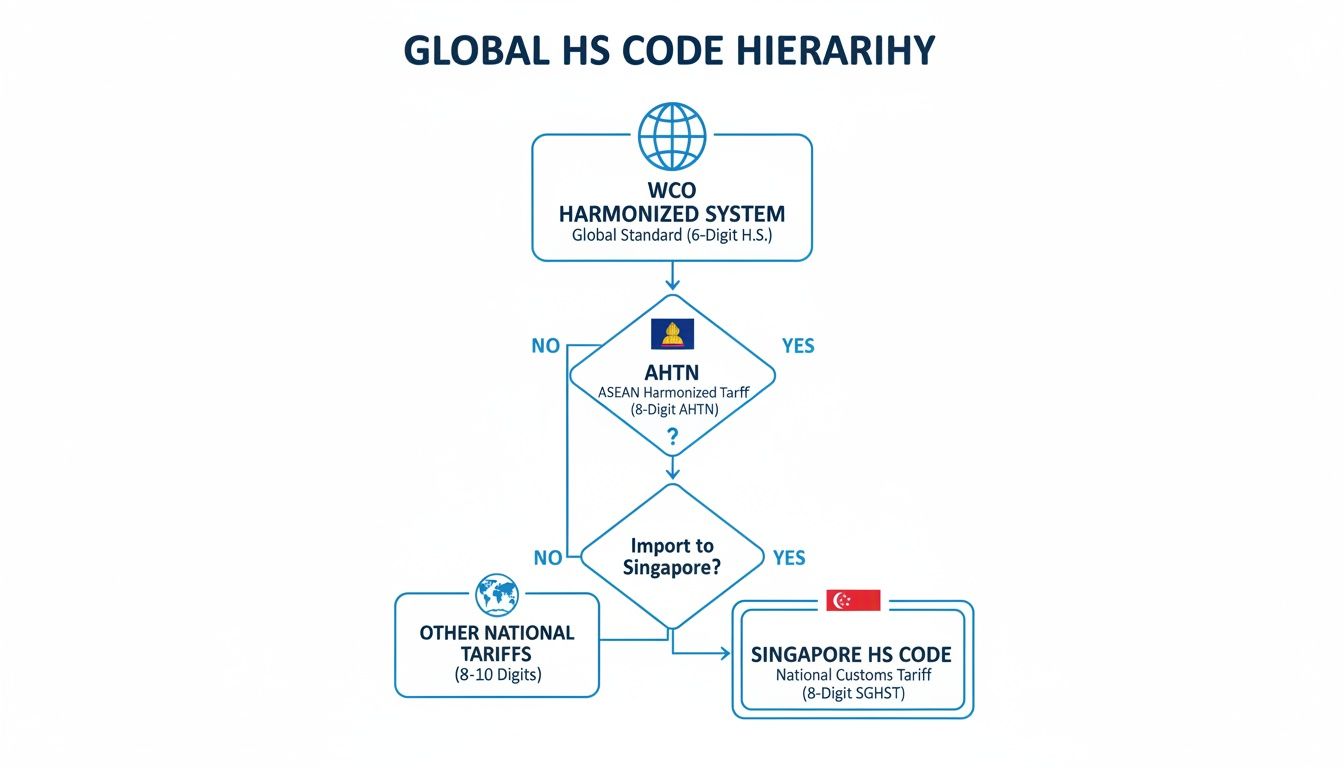
As you can see, the HS code structure is hierarchical. It starts with the global WCO standard and gets more specific for Singapore's AHTN code, with each digit adding another layer of detail.
Tips for an Effective Search
What happens when a product could plausibly fit into a few different categories? It’s a common problem. Here’s how to cut through the confusion and find the correct HS code.
- Get Specific: Instead of a generic term like "plastic bottle," try "polyethylene bottle for cosmetics." Adding details about the material and its intended use makes a huge difference.
- Read the Chapter Notes: Every HS chapter comes with legal notes that define terms and lay out classification rules. These notes are your best friend when you're stuck.
- Think Function First: The General Interpretative Rules (GIRs) are clear: a product's main purpose or "essential character" is what usually determines its classification. What does the item do?
A classic pitfall is classifying product 'sets' or 'kits'. Take a grooming kit with scissors, a comb, and electric clippers. You don't classify each item separately. Instead, you have to decide which item gives the kit its essential character. In this case, customs rules would almost certainly point to the electric clippers (HS 8510).
Verifying Your Code with Classification Rulings
Once you think you've found the right HS code, your job isn't done. The next step is verification. Never assume the first code you land on is correct, especially for complex or new-to-market products.
This is where you turn to Singapore Customs’ Classification Rulings database. It’s a public library of legally binding decisions that customs has already made on specific products. If someone has imported something similar before, a search here can give you a definitive answer.
The TradeNet HS/CA Search Engine is a workhorse, processing over 2 million lookups a year and flagging controls for roughly 15% of goods. To back this up, the Classification Rulings database is growing by 20% annually and is on track to exceed 10,000 entries, making it an indispensable tool for tricky classifications.
Still not 100% sure after checking the search engine and the rulings database? Your safest move is to apply for an official Classification Ruling from Singapore Customs. This gives you a legally binding HS code for your product, offering total certainty and protecting you from compliance headaches. It takes time, but for high-value or unusual shipments, it's the smartest way to manage risk.
For an extra layer of research, you can also explore our extensive database of Singapore HS codes to cross-reference what you've found.
Calculating Tariffs, Duties and GST
Once you’ve locked in the correct 8-digit Singapore Customs HS code, you can finally translate that string of numbers into its real-world financial impact. This code is the key to figuring out the exact tariffs, customs duties, and Goods and Services Tax (GST) your shipment will attract when it lands.
Getting this calculation right is non-negotiable for freight forwarders. It’s the foundation for providing accurate quotes and, frankly, for building trust with your clients.
The very first question to answer is whether the goods are dutiable. Singapore is famous for its pro-trade policies, which means the vast majority of imported goods aren't subject to customs duties at all. Only four very specific categories are.
Identifying Dutiable Goods
In Singapore, duties are only charged on a small, select group of products, mostly for social or environmental reasons. The list is short and sweet:
- Intoxicating liquors (like beer, wine, and spirits)
- Tobacco products (cigarettes, cigars, etc.)
- Motor vehicles (including cars and motorcycles)
- Petroleum products and biodiesel blends
For literally everything else—from electronics and apparel to heavy machinery—you only need to worry about GST. This simplifies things for most shipments, but it also raises the stakes for getting it right when you are handling one of these dutiable items.
Calculating the Total Landed Cost
To give a client a quote they can count on, you need to calculate the total landed cost. This isn’t just the price of the goods; it’s everything combined—logistics fees, insurance, and taxes. The two main components from Singapore Customs are customs duty (if it applies) and GST.
As of 1 January 2024, the GST is set at 9%. It’s a broad-based tax that applies to nearly every single thing imported into Singapore.
Here's the detail that trips people up: GST is calculated on the CIF value (Cost, Insurance, and Freight) plus any customs duty you’ve already paid. You don't just take 9% of the invoice value; you have to add the duty to the base amount first.
Let's walk through a real-world example. Imagine you're importing a consignment of French wine.
Scenario A: Dutiable Goods (Wine)
- CIF Value of Goods: S$15,000
- Customs Duty Rate (Example): S$88 per litre of alcohol
- GST Rate: 9%
The Calculation Breakdown
- Calculate Customs Duty: Let’s say the shipment has 100 litres of alcohol. The duty is 100 L x S$88/L = S$8,800.
- Calculate GST: Now, you add the duty to the CIF value before calculating GST. (S$15,000 + S$8,800) x 0.09 = S$2,142.
- Total Taxes Payable: S$8,800 (Duty) + S$2,142 (GST) = S$10,942.
Now, let's look at a much more common scenario: importing non-dutiable goods like laptops.
Scenario B: Non-Dutiable Goods (Laptops)
- CIF Value of Goods: S$15,000
- Customs Duty Rate: 0%
- GST Rate: 9%
The Calculation Breakdown
- Calculate Customs Duty: Simple—it’s S$0.
- Calculate GST: With no duty to add, the GST is calculated on the CIF value alone. S$15,000 x 0.09 = S$1,350.
- Total Taxes Payable: S$1,350.
The huge difference between these two outcomes shows exactly why correctly identifying a product's dutiable status with the right HS code is the first, and most critical, step. It's also worth remembering that someone has to be responsible for these payments; for a closer look at that role, check out our guide on the Importer of Record and their responsibilities.
The Role of Free Trade Agreements
Don’t forget about Free Trade Agreements (FTAs). These agreements can seriously reduce or even completely eliminate customs duties on certain goods. Singapore has an impressive network of FTAs with major trading partners around the world.
To get the benefit of an FTA, the shipment needs a Certificate of Origin (CO) to prove the goods were made in a partner country and meet specific "Rules of Origin." Always check if an FTA might apply to your shipment—it can be a massive competitive advantage for your client.
Avoiding Common HS Code Classification Mistakes
Getting the Singapore Customs HS code wrong is an expensive lesson. I've seen even seasoned logistics pros make small mistakes that spiral into hefty fines, seized shipments, and seriously strained client relationships. A simple oversight in classification can quickly become a major operational headache, with penalties climbing as high as S$10,000.
The truth is, product classification is rarely a straightforward lookup. It’s an art that demands careful interpretation of complex rules, especially for modern goods that don't fit neatly into old categories. Knowing where others trip up is the first step to building a bulletproof compliance process for your team.
So many errors start with vague or incomplete product details from the shipper. A customs officer has to make a judgement call based on the paperwork, and ambiguity is your enemy. This is why a painfully detailed product description is always your best defence.
The Tricky Business of Product Sets and Kits
One of the most common classification traps involves goods sold together as a set. Picture a DIY electronics kit with a circuit board, wires, sensors, and a plastic casing. Do you classify each tiny piece separately? Absolutely not.
The Harmonized System's General Interpretative Rules (GIRs) are clear on this: you must classify the entire set under the single HS code that represents the item giving the kit its "essential character." In our example, the circuit board is the heart of the kit, so its HS code applies to the whole package. Getting this wrong can lead to huge duty discrepancies if the individual components have wildly different tariff rates.
A lazy description like "tech repair kit" is a huge red flag for customs. Be specific. Something like "Smartphone Repair Kit, comprising miniature screwdrivers, prying tools, and suction cup (essential character: hand tools under HS heading 8205)" is what they want to see.
The Fine Line Between Parts and Accessories
Another classic mix-up is the distinction between a "part" and an "accessory." It’s a crucial difference because they often fall under completely different HS chapters, which means different duty rates. A part is essential for the main product to function. An accessory, on the other hand, just makes it better or more convenient.
Let's use a professional camera as an example:
- A replacement lens mount is a part. The camera is useless without it.
- A camera bag is an accessory. It protects the camera, but you can still take a picture without it.
Trying to classify a non-essential accessory as a "part" to lump it in with the main item's HS code is a surprisingly common mistake. We see this all the time with things like phone cases or laptop stands. It’s an easy error to avoid with a bit of diligence.
Classifying New and Emerging Technology
Let's be honest, the global trade system moves much slower than technological innovation. New gadgets—from advanced wearables to highly specialised drones—often don't have a perfect, ready-made HS code waiting for them. This ambiguity is a massive compliance risk.
When you're faced with a brand-new piece of tech, you have to classify it under the code for the product it is most like in function and materials. This means digging deep into the chapter notes and truly understanding the GIRs. For instance, a smart ring that tracks health metrics could potentially fall under heading 8517 (telecommunications apparatus) or 9029 (measuring instruments), all depending on what you argue its primary function is.
In these grey areas, never just trust the overseas supplier's classification. The safest bet is to seek a formal Classification Ruling from Singapore Customs. This gives you a definitive, legally binding decision before the goods even ship, eliminating the guesswork and saving your business from a world of trouble.
To keep your team sharp, it helps to see these common issues and their solutions side-by-side.
Common HS Code Errors and Proactive Solutions
| Common Pitfall | Potential Consequence | Proactive Solution |
|---|---|---|
| Vague Product Descriptions | Delays, inspections, incorrect duties, and potential fines. | Always request and provide detailed descriptions, including material composition, function, and intended use. |
| Misclassifying "Sets" | Incorrect duty calculation based on the wrong "essential character" component. | Identify the main component that defines the set's purpose and use its HS code. Document your reasoning clearly. |
| Confusing "Parts" vs. "Accessories" | Applying the wrong HS code and duty rate, leading to compliance penalties. | Determine if the item is essential for the main product's function (part) or just enhances it (accessory). Classify separately. |
| Classifying New Tech | High risk of misclassification due to no specific code existing. | Research codes for similar products. When in doubt, apply for an official Classification Ruling from Singapore Customs for certainty. |
Ultimately, being proactive is the key. By training your team to spot these red flags, you turn a potential liability into a smooth, compliant shipping process.
Using HS Codes to Drive Business Growth
So far, we’ve mostly talked about the Singapore Customs HS code as a compliance hurdle—a detail you have to get right for smooth clearances and accurate costing. But what if that same 8-digit code could be your best business development tool? It’s time to flip the script from defence to offence.
Your team's expertise in HS codes is a serious strategic asset. When you pair that knowledge with the right data, you can stop prospecting blindly and start targeting high-value shippers with surgical precision. This is where customs data platforms, like Coreties, completely change the game for freight forwarders and logistics sales teams.
Instead of just waiting for the phone to ring, you can proactively find the exact companies that need your specific skills.
Pinpoint High-Value Shippers by Product Niche
Let’s say your company is brilliant at handling sensitive electronics. You know the ins and outs of packaging, handling, and customs for goods under HS Chapter 85 (Electrical machinery and equipment). With the old way of doing things, finding companies that import these specific products is a slow, painful grind.
This is where a data-driven approach makes all the difference. Using a tool like Coreties, you can filter the entire market by the exact HS codes companies are trading. You can build a targeted list of every single business in Singapore importing semiconductors (HS 8542), exporting lithium-ion batteries (HS 8507), or dealing in industrial robots (HS 8543).
This lets you focus your sales team's energy where you already have a massive competitive edge. Your outreach is no longer a generic pitch; it’s a specific, value-packed conversation about their products.
By focusing on specific HS codes, you move from "We're a great freight forwarder" to "We are the experts in shipping the exact high-value electronic components your business depends on." That simple shift in messaging will dramatically boost your credibility and get you more replies.
Uncover Growth Opportunities in Trade Lanes
HS code data doesn't just tell you what companies are shipping—it shows you where they're shipping to and from. Think of it like this: analysing trade lane data tied to specific products is like getting a map of untapped market potential.
Imagine you notice a big spike in the volume of medical devices (HS Chapter 90) being imported into Singapore from Germany. This isn’t just an interesting fact for a report; it’s a green light for your business development team.
You can use this insight to:
- Target German exporters who are already shipping to Singapore but might be unhappy with their current logistics partner.
- Develop specialised services for this trade lane, like temperature-controlled logistics or expedited customs clearance for medical gear.
- Craft data-backed outreach that proves you understand their specific market and its unique supply chain headaches.
This kind of insight allows your team to get ahead of the curve, spotting trends and positioning your company as the perfect partner before your competitors even know what’s happening.
Crafting Data-Driven Outreach That Actually Converts
The final piece of the puzzle is turning these insights into real conversations that lead to new business. Knowing a prospect's HS codes is the ultimate icebreaker because it instantly proves you've done your homework.
Let's walk through a quick scenario. Your team uses Coreties to find a company that regularly imports machinery parts under HS Chapter 84 from Vietnam. Your first email or call can now be incredibly personalised.
Traditional Outreach (Generic and forgettable):
"Hi, I'm with ABC Logistics. We offer competitive rates for shipping from Asia. Can we talk about your freight needs?"
Data-Driven Outreach (Specific and compelling):
"Hi, I saw your company is a key importer of machinery parts under HS 8479 from Vietnam. We have deep experience clearing this exact commodity at Jurong Port and recently helped similar importers cut their landed costs by optimising duty calculations. Do you have 15 minutes to see if we could do the same for you?"
The second approach is on a completely different level. It immediately establishes your expertise, shows you understand their business, and leads with a clear, tangible benefit. By using the Singapore Customs HS code as a strategic intelligence tool, you turn your sales process from a numbers game into a targeted, high-conversion strategy. This is how modern forwarders build lasting revenue and become true partners to their clients.
Got Questions About Singapore HS Codes? We've Got Answers.
When you're dealing with shipments day in and day out, you run into the same practical questions about Singapore Customs HS codes over and over. Getting straight answers is crucial for keeping everything on track. Here’s a rundown of the most common queries we hear, with the kind of direct advice you can actually use.
What’s the Deal with 6-Digit vs. 8-Digit HS Codes?
This one trips a lot of people up, but it's pretty simple once you break it down. Think of it like a global standard with a local twist.
The first six digits of any HS code are universal. They're set by the World Customs Organization (WCO), so a product like a smartphone has the same initial six digits whether it's headed for Singapore, Spain, or South Africa. It's a common language for global trade.
But Singapore, being part of ASEAN, takes it a step further using the ASEAN Harmonised Tariff Nomenclature (AHTN). This system tacks on two extra digits, creating a more detailed 8-digit code. Those last two digits give a much more specific, regional classification that's unique to ASEAN countries.
Bottom line: For any import or export declaration you file in Singapore via the TradeNet system, you absolutely must use the full 8-digit HS code. A 6-digit code is an incomplete declaration and will get your shipment stuck in customs.
How Often Do Singapore HS Codes Actually Change?
The global HS system—the foundation for Singapore's codes—gets a major refresh every five years. The WCO does this to keep pace with new technology and evolving trade patterns. The last big overhaul was in 2022.
Singapore Customs aligns its 8-digit AHTN codes with these global updates. But don't get too comfortable—smaller, specific amendments can happen far more frequently. A new type of electronic device might get its own code, or the description for an existing one could be tweaked for clarity.
Your only safe bet is to treat the official Singapore Customs HS/CA Product Code Search Engine on TradeNet as your single source of truth. Relying on an old list or a saved spreadsheet is just asking for compliance trouble.
My Product Fits Two Different HS Codes. Now What?
This is easily one of the most common headaches in customs classification. When your product seems to fall into two different categories, just picking one and hoping for the best is a terrible idea.
The right way to solve this is by using the General Interpretative Rules (GIRs). These are the official, legally-backed principles that govern classification worldwide. They provide a clear pecking order for making a decision:
- Be specific. A code that describes your product precisely will always trump a general, catch-all "other" category.
- Find the "essential character." If you're shipping a kit or a composite item, you classify it based on the component that gives the whole thing its primary purpose. Think of a first-aid kit; you'd classify it under medical supplies, not as a plastic box.
If you’ve gone through the GIRs and you're still scratching your head, the smartest move is to apply for an official Classification Ruling from Singapore Customs. This gives you a legally binding decision for your product, offering total peace of mind and protecting you from future penalties.
Can I Just Use the HS Code My Supplier Gave Me?
Using your supplier’s HS code is a fine place to start, but never accept it as final without checking it yourself. In Singapore, the legal responsibility for the correct HS code declaration rests squarely on the importer of record—that’s you, not your supplier.
A supplier's code can be wrong for a few key reasons:
- They often only provide the universal 6-digit code, which won’t cut it for Singapore's 8-digit requirement.
- Their country might interpret the classification rules differently for that specific product.
- The code they're using could simply be outdated and no longer valid.
Always take the information from your supplier and run it through the Singapore Customs HS/CA Product Code Search Engine. It’s a quick verification step that confirms the code is accurate, current, and meets the 8-digit requirement needed for a smooth customs clearance. It's five minutes of work that can save you days of delay.
Ready to turn customs data into your most powerful sales tool? With Coreties, you can stop prospecting in the dark and start targeting high-value shippers based on the exact HS codes they trade. Find qualified leads, craft data-driven outreach, and build your pipeline faster than ever before. Discover your next best customer on Coreties today.
Leave a Reply