Tag: automotive logistics

  • Your Guide to Winning US Auto Exports

    Your Guide to Winning US Auto Exports

    For freight forwarders looking for a high-value, high-volume market, it’s tough to beat US auto exports. It’s a space where deep expertise pays off, and the logistics puzzles are as complex as the potential revenue is significant. This isn't just about moving cars; it’s about mastering a specialized corner of global trade.

    Cracking the Code on US Auto Exports

    Worker inspecting rows of new cars at a bustling port, ready for US auto exports.

    Let's get right to it. The United States is a global automotive powerhouse, with vehicles constantly rolling off assembly lines and heading to nearly every country imaginable. For a logistics pro, orchestrating this flow is a high-stakes game of timing, compliance, and international coordination.

    This guide is your playbook. We're going to break down the US auto export market piece by piece, giving you the practical intelligence needed to do more than just quote rates—you'll learn how to become an indispensable partner to automotive shippers.

    To win in this sector, you have to know:

    • The most profitable trade lanes and what’s driving demand in those destinations.
    • The critical documentation and regulations that can stop a shipment in its tracks.
    • How to use modern data tools to find and connect with the right auto shippers.

    A Market of Big Swings and Bigger Opportunities

    The US auto export market is known for two things: impressive volume and wild fluctuations. These ups and downs are tied to everything from global parts shortages and shifting consumer tastes to new trade deals. For forwarders, this volatility is actually a major opening.

    Just look at the recent numbers. In December 2025, new vehicle exports hit around 116.07 thousand units. While that was down 23.46% from the month before, it was a staggering 83% jump from the same time the previous year. You can dig into the historical trends yourself with this detailed export data on ycharts.com.

    That kind of volatility is where you prove your worth. When the market gets shaky, shippers don't want a rate-bot—they want an expert who can give them clarity, solve problems, and keep their cargo moving.

    Here's a quick snapshot of the key market characteristics every forwarder should know.

    US Auto Exports at a Glance

    This table summarizes the core metrics of the US auto export market, offering a quick reference for understanding the landscape and identifying where the opportunities lie for freight forwarders.

    Metric Recent Data (2025-2026) Key Takeaway for Forwarders
    Annual Export Value ~$65 Billion+ High-value cargo translates to higher revenue per shipment and greater potential for service-based margins.
    Key Export Destinations Canada, Mexico, Germany, China, UAE Focus prospecting and marketing efforts on shippers active in these high-volume lanes.
    Primary Export HS Code 8703 (Motor cars and other motor vehicles) This is the core commodity code. Knowing its variations for new, used, and EVs is critical for compliance and targeting.
    Market Volatility ~83% YoY increase (as of Dec 2025) Shippers need reliable partners to manage uncertainty. Offer stability, flexible solutions, and expert advice.
    Emerging Trend Electric Vehicles (EVs) A new, complex, and high-value stream. Build expertise in handling EV batteries (DG) to gain a competitive edge.

    As you can see, the numbers point to a robust but demanding market. Success here means moving beyond basic freight services and positioning yourself as a specialist.

    Why Auto Exports Should Be on Your Radar

    If you're a forwarder looking to grow, the auto export sector offers a direct path. The scale is massive, so even a small slice of the pie can make a huge impact on your business. More importantly, the complexity lets you shine.

    From handling hazardous materials like EV batteries to navigating the tricky customs rules for salvaged vehicles, these shipments demand real expertise. That’s your chance to move beyond price and compete on value, which naturally leads to better margins.

    The boom in electric vehicles (EVs) is opening up a whole new frontier. As US factories increase EV production for export, they're creating a specialized, high-value freight stream. If you get ahead of the curve and build out your capabilities for handling EV logistics, you'll be one of the go-to forwarders in a rapidly growing niche.

    Where the Rubber Meets the Road: Your Top Revenue Lanes

    If you're a freight forwarder looking to grow your automotive business, you have to know where the big money is flowing. Following these major trade lanes is the surest way to find consistent, high-volume business. These aren't just lines on a map—they're rivers of revenue, and your sales team needs to know them inside and out.

    It’s not enough to just know that cars are being exported. To really make an impact, your team has to pinpoint the high-density routes where vehicles and parts are moving by the thousands. This means getting specific: what kind of cargo is moving, and how is it getting from Point A to Point B?

    The North American Superhighway

    Let's start close to home. The single largest flow of US auto exports happens right in our own backyard, across the borders with Canada and Mexico. The supply chains here are so tightly woven that they essentially form a single logistical superhighway.

    The US is a true automotive powerhouse for its neighbors. Canada, for instance, consistently snaps up about 45% of all US auto exports. We're talking roughly 500,000 vehicles heading north every year as of 2026, a direct result of the deep integration under the USMCA. Mexico isn't far behind, claiming around 25% of the market. With nearshoring trends in full swing, it's common to see monthly volumes top 30,000 units as of 2025. You can dig into the specifics yourself by checking out the latest automotive trade data on trade.gov.

    The best way to think about the USMCA region is not as three separate countries, but as one massive, interconnected factory floor. A car might be assembled in the US with parts from Mexico, then shipped to Canada to be sold. Getting a handle on this three-way dance is the first step to winning more business here.

    This tight-knit relationship creates very specific logistics needs—and big opportunities for forwarders:

    • Finished Vehicles to Canada: This is a classic Roll-On/Roll-Off (Ro-Ro) game. Thousands of brand-new cars are constantly moving from major US production hubs by sea or by rail. It's all about volume and efficiency.
    • Parts to Mexico: As manufacturers ramp up assembly south of the border, the demand for US-made parts has gone through the roof. This is a container-driven business, with everything from engines to electronics being shipped FCL and LCL. If you excel at container logistics, this is a market you can't ignore.

    Looking Beyond Our Borders

    While the action in North America is massive, don't sleep on the lucrative streams flowing to Europe and Asia. These markets often have a taste for different kinds of American vehicles, which opens up specialized niches for forwarders who know where to look.

    High-Value Hubs in Europe

    Germany and Belgium are the two big players here. They serve as both final destinations and critical gateways to the rest of the continent.

    1. Germany: This is a prime market for American-made luxury SUVs and, more and more, electric vehicles. Shippers sending cargo here expect absolute precision. They need a forwarder who is a master of EU import regulations and can guarantee a smooth process.
    2. Belgium (Port of Antwerp-Bruges): This port is an absolute giant. It's a major entry point for vehicles that will eventually be sold all over Europe. If you can prove you have solid expertise in transshipment and intra-European trucking or rail, you'll have a serious advantage.

    Key Markets in Asia

    From high-performance muscle cars to reliable family haulers, Asia's demand for US vehicles is incredibly diverse. Understanding what each market wants is the key to unlocking it.

    • China: Even with trade headwinds, China is still a massive market for premium US brands and specialty vehicles. The regulations can be a minefield, which makes a forwarder with real-world experience there an invaluable partner.
    • South Korea: There's a strong appetite here for American trucks and large SUVs, which are often seen as status symbols. Shippers targeting this market are looking for partners who can deliver fast transit times and perfect documentation.
    • Middle East (UAE and Saudi Arabia): This region loves American luxury, power, and size. High-end sedans, powerful trucks, and performance cars are always in demand. For the most valuable and urgent shipments, air freight is a very common and profitable option.

    Once you have these key revenue lanes mapped out, you can stop casting a wide, generic net. Instead, you can zero in on the shippers who are active on these routes and approach them with a solution that speaks directly to the challenges and opportunities they face every day.

    Capitalizing on the Electric Vehicle Boom

    Worker loads a white EV SUV into a blue shipping container on a truck for export.

    The future of U.S. auto exports is undeniably electric. For freight forwarders who get ahead of the curve, this shift is creating a massive wave of opportunity. As the world pivots toward sustainability, demand for American-made electric vehicles from giants like Tesla and GM is absolutely exploding in Europe and Asia.

    This isn't just another model year change; it's a fundamental reshaping of the entire auto export market. The growth is already redrawing trade lanes. In fact, U.S. EV exports skyrocketed over 200% between 2020 and 2025, with tens of thousands of units now heading to markets like Germany and Japan each year. You can dig into the numbers yourself on the EV export dashboard from Autos Drive America.

    For forwarders, this boom represents a high-value, high-complexity niche. Success here means moving beyond standard RoRo and mastering the unique logistical puzzle of shipping what is essentially high-voltage cargo.

    The Unique Challenges of EV Logistics

    Shipping an electric vehicle is a completely different ballgame than shipping a traditional car with an internal combustion engine (ICE). The large lithium-ion battery at its core introduces a whole new layer of complexity, demanding specialized knowledge and handling. Think of it less like moving a car and more like managing sensitive, high-value, hazardous freight.

    To win this business, you have to prove you can navigate three critical areas:

    • HAZMAT Compliance: That lithium-ion battery classifies the entire vehicle as a Dangerous Good (DG). This isn't optional—it means you must adhere to strict international regulations for documentation and handling.
    • Specialized Handling: These aren't just cars; they're rolling computers. EVs often need specific crating and bracing to protect sensitive electronics and the battery pack from the shocks and vibrations of transit.
    • Climate Control: Extreme heat or cold can seriously degrade battery life and performance. For high-value models or certain trade lanes, a climate-controlled container becomes a necessity, not a luxury.

    Shippers of these high-tech vehicles aren't just shopping for the lowest rate. They're looking for a logistics partner who can guarantee safety, compliance, and a flawless arrival. This is where you can stand out and command better margins.

    Positioning Yourself as an EV Export Expert

    To become the go-to forwarder for EV shippers, you can't just react—you need to proactively build and showcase your expertise. This goes way beyond simply reading the rulebook; it's about having your operations buttoned up and ready to go.

    Actionable Steps to Build Your EV Capabilities

    1. Get Certified: This is the absolute baseline. Make sure your team members handling DG documentation have current training and certifications. It's a non-negotiable and a powerful selling point.
    2. Develop Standard Operating Procedures (SOPs): Create detailed, step-by-step internal guides for handling every EV shipment. Cover everything from initial vehicle inspection and verifying the battery's state-of-charge to correct labeling and container securing.
    3. Partner with Specialists: You don't have to do it all alone. Build a network of trusted drayage and warehousing partners who have proven, hands-on experience with EVs and their unique requirements.
    4. Educate Your Sales Team: Your sales and customer-facing staff need to speak the language of EV logistics. They should be able to confidently explain HAZMAT regulations and walk a potential client through your company’s specific, safety-focused procedures.

    By mastering the intricacies of EV logistics, you transform your company from a simple service provider into an essential risk-management partner. That shift elevates your value and makes you an indispensable link in the booming electric vehicle supply chain.

    Navigating Export Compliance and Documentation

    When it comes to US auto exports, getting compliance wrong isn't an option. Think of it less like paperwork and more like the difference between a smooth sailing and a shipment that's dead in the water—stuck, fined, or even seized. For a freight forwarder, mastering these rules is what makes you an indispensable partner, not just another vendor.

    Export documentation is essentially the vehicle's passport. Without the right stamps and details, it’s not going anywhere. This entire process is built to give U.S. Customs and Border Protection (CBP) a clear, legal record of what's leaving the country and where it's headed.

    Mastering the AES and EEI Filing

    The first hurdle for any U.S. vehicle export is filing the Electronic Export Information (EEI) through the Automated Export System (AES). This is a non-negotiable electronic report submitted to the Census Bureau that outlines the specifics of your export. It's the primary way the government tracks trade statistics and enforces export laws.

    Don't mistake this for a simple formality. An EEI filing is mandatory for any single commodity valued over $2,500, and for any self-propelled vehicle, regardless of its value. Failing to file—or filing with sloppy, inaccurate information—can bring on some serious financial penalties.

    A classic mistake is a document mismatch. The Vehicle Identification Number (VIN) on the EEI absolutely must be a perfect match to the VIN on the vehicle's title and the one stamped on the vehicle itself. Even a one-digit error can flag the entire shipment, triggering an inspection and causing delays that will frustrate your client and damage your reputation.

    The 72-Hour Rule Explained

    One of the most critical and often misunderstood regulations is the 72-hour rule. This CBP mandate is simple: all documentation and the vehicle itself must be presented to customs at the port of export at least 72 hours before the ship is scheduled to leave.

    This isn't a suggestion—it's a hard deadline. Miss that window, and your vehicle is not getting on that vessel. The rule gives CBP the time they need to review paperwork and, if they choose, physically inspect vehicles.

    Smart planning is the only way to manage this. The best forwarders build a buffer into their schedules. They get documents from the shipper far in advance and coordinate tightly with trucking partners to hit that deadline without breaking a sweat. This proactive approach eliminates last-minute panic and ensures a clean, on-time loading process.

    Common Documentation Pitfalls to Avoid

    Beyond the EEI and the 72-hour window, a few other common documentation snags frequently trip up unprepared forwarders. Getting these details right is what separates a smooth export from a logistical nightmare.

    First, let's look at what's required for new versus used vehicles. The paperwork isn't the same, and knowing the difference is crucial.

    Essential Documents for US Auto Exports

    Document/Requirement New Vehicle Export Used/Salvage Vehicle Export
    Certificate of Title Not Applicable Required (Original, clean)
    Manufacturer's Statement of Origin (MSO) Required (Original) Not Applicable
    Bill of Sale Required Required
    Power of Attorney Required Required
    EEI Filing (AES) Required Required

    As you can see, the core difference lies in the proof of ownership—the MSO for a brand-new vehicle and the original Title for a used one. Any liens must be cleared, and all information must be accurate.

    Here are a few other common issues to keep on your radar:

    • HS Code Classification: Giving a vehicle the wrong Harmonized System (HS) code is an easy way to cause problems. A sedan, an SUV, and an electric truck all have unique codes. The logic for classifying finished vehicles is similar to parts, which you can learn more about in our guide on HS codes for auto parts.

    • Specialized Cargo Regulations: As we've touched on, electric vehicles aren't just cars—they're hazardous cargo because of their batteries. You must follow strict rules for shipping them. That means understanding complex guidelines like the Lithium Battery Shipping Requirements to ensure safety during transit.

    When you become an expert in these compliance details, you change the conversation with your clients. It's no longer just about price. You become the partner who sees problems before they happen, protects them from risk, and makes a complicated process feel simple. That expertise is your most powerful selling tool.

    Choosing the Right Ports and Shipping Methods

    Think of it this way: choosing a port is like picking the right tool for a delicate job. Picking the wrong one doesn't just slow you down; it can mess up the entire project. For every US auto exports shipment you handle, your choice of port and shipping method directly hits the bottom line, influencing everything from transit time to final cost.

    Getting this wrong can be painful. Imagine trying to ship a car through a port that barely handles Roll-On/Roll-Off (Ro-Ro) traffic—it's a recipe for delays and ballooning costs. Your real value as a forwarder is steering your client away from these logistical dead-ends before they even become a problem.

    Top US Auto Export Hubs

    When it comes to shipping cars, not just any port will do. The U.S. has a few heavy hitters, massive hubs purpose-built for vehicle logistics. Each has its own personality and strategic advantages.

    • The Port of Baltimore: A true powerhouse on the East Coast. If you're sourcing cars from the Midwest and shipping to Europe or the Middle East, Baltimore is often your best bet. It’s famous for its sprawling Ro-Ro terminals and deep-water access that can handle the largest vehicle carriers.

    • The Port of Jacksonville (JAXPORT): Further down the coast, JAXPORT has carved out a niche as a specialist in auto processing. It's a go-to hub for shipments heading to the Caribbean, Central, and South America, known for its frequent sailings and strong carrier relationships.

    • The Ports of Los Angeles/Long Beach: This West Coast behemoth is the undisputed gateway to Asia and Oceania. The sheer scale is staggering, offering incredible flexibility with its countless carrier services. The trade-off? Navigating this complex requires an expert hand and tight coordination.

    The best port isn't always the closest one. It's the one that offers the optimal blend of specialized infrastructure, frequent carrier service on your target trade lane, and efficient inland connections.

    Selecting the Right Transport Method

    Once you've zeroed in on a port, the next question is how the vehicle will travel. The choice between Ro-Ro, container, and air freight depends entirely on the car's value, condition, and the client's urgency.

    Ro-Ro: The Workhorse of Auto Shipping

    For most standard, running vehicles, Roll-On/Roll-Off is the default and for good reason. It’s the bread and butter of the industry. Cars are simply driven onto the vessel, secured below deck like in a massive floating garage, and driven off at the destination. It’s straightforward, efficient, and cost-effective.

    Container Shipping: The Secure Option

    When you’re dealing with a high-value classic, an exotic sports car, or a non-running vehicle, security becomes the top priority. That’s where container shipping shines. The vehicle is carefully loaded, braced, and locked inside a dedicated 20-foot or 40-foot container, protecting it from the elements and any bumps along the way. This is also the perfect method for shipping parts along with a vehicle.

    To get a closer look at the entire process, from documentation to delivery, our guide on the complete process of exporting cars from the USA breaks it all down.

    Air Freight: The Express Lane

    Sometimes, the client just needs it there now. Whether it's a race car needed for an event or a luxury vehicle for a waiting customer, air freight is the answer when speed trumps cost. It is significantly more expensive, but it's the ultimate solution for time-critical shipments.

    Ultimately, mastering these options isn't just about moving metal; it’s about providing smart, cost-effective solutions that build trust. Great logistics and shipping efficiency turns you from a simple service provider into an indispensable strategic partner.

    How to Find and Win Auto Shipper Leads

    Knowing the ins and outs of US auto exports is one thing. Finding a steady stream of clients who need that expertise? That's a completely different ballgame. This is where your knowledge translates directly into revenue.

    Forget about mind-numbing cold calls. The modern, and frankly much smarter, way to prospect is to use data to find high-value auto shippers. You can then walk in the door with a solution that's already a perfect fit for their business.

    Let’s walk through a proven playbook for turning raw export data into profitable client relationships. This is how you stop prospecting in the dark and start engaging leads with laser precision.

    Step 1: Mine Customs Data for Shipper Intelligence

    At the heart of smart prospecting lies customs data. Every single time a vehicle is shipped overseas, it creates a digital footprint. Your job is to become a detective and follow that trail. Start by digging into raw export data to see which companies are actively shipping vehicles and parts.

    Here’s what that looks like in practice:

    • Filter by HS Code: Your first move is to zero in on codes like Chapter 87 (Vehicles other than railway or tramway rolling stock, and parts and accessories thereof). This immediately narrows your search to companies in the auto export business.
    • Segment by Destination: Next, cross-reference those HS codes with the destination countries. This is how you spot shippers who are already moving freight on the exact trade lanes where you have great partners and competitive rates.
    • Analyze Volume and Frequency: Look for consistency. A company shipping 50 cars a month to Germany is a much better prospect than one shipping a single vehicle once a year. The goal is to find shippers with regular, high-volume business.

    This data-first approach completely changes the game. You're no longer just asking, "Who ships cars?" Instead, you're asking, "Which companies are shipping 100+ SUVs to the UAE from the Port of Baltimore every quarter?" That’s a question you can act on.

    Step 2: Transform Data into an Actionable Prospect List

    Okay, so you've got a list of promising companies. Now what? Sending a fantastic proposal to a generic "info@" email is like throwing it in the trash. You need to get in front of the actual decision-makers who manage the company's logistics.

    This is where a good data platform really proves its worth. These tools take that raw company data and enrich it, helping you pinpoint the right people to contact.

    1. Identify Decision-Makers: Look for job titles like Logistics Manager, Supply Chain Director, or Export Coordinator. These are the people who hire and fire freight partners.
    2. Find Verified Contact Information: A quality platform will give you verified email addresses and direct phone numbers, making sure your message actually gets to the right person.
    3. Gather Context: Many of these tools now integrate with LinkedIn, giving you a quick snapshot of a prospect's professional history and day-to-day responsibilities.

    This infographic shows the typical process your prospects are navigating—and all the points where your expertise can make a difference.

    Flowchart illustrating the US auto export shipping process including port, RO-RO, and container steps.

    From handling everything at the port to deciding between Ro-Ro and container shipping, this is their world. Your job is to show them you can make it run more smoothly.

    Step 3: Craft a Data-Driven Outreach Message

    Now for the final piece. You have your target company, the right person's name, and their contact info. It's time to write an email that gets opened, read, and answered. The secret is to show you've done your homework and can offer immediate value.

    Keep your message short, sharp, and relevant. Ditch the generic, "My name is…" intro and lead with a specific insight you pulled from the data.

    Here's a quick example:

    "Hi [Prospect Name],

    I noticed your company has been consistently shipping vehicles under HS code 8703 to Belgium out of Jacksonville. We have a lot of experience on that specific lane and I think we could help you cut down on transit times and trim your drayage costs."

    An approach like this proves you understand their business before you even ask for it. It immediately sets you apart from the dozens of other forwarders clogging their inbox with generic pitches. For more tips on this, our guide on finding shippers for freight brokers has a ton of other proven techniques.

    When you combine customs data with a sharp, targeted outreach, you build a powerful system for winning more US auto exports business. You stop sounding like a salesperson and start acting like a problem-solver.

    Frequently Asked Questions About US Auto Exports

    If you're looking to get into auto exports, you probably have a few questions. It’s a profitable niche, but the details can make or break a shipment. Let's tackle some of the most common questions forwarders have when they start moving vehicles.

    What Is The Difference Between Ro-Ro And Container Shipping?

    Think of Ro-Ro (Roll-on/Roll-off) shipping as a massive, floating parking garage. It’s the most common and cost-effective way to ship standard, working vehicles. The cars are simply driven onto the vessel, secured in place, and driven off at the destination. Simple and efficient.

    Container shipping, on the other hand, is like getting a private room for the car. The vehicle is loaded, braced, and sealed inside a dedicated steel container. This method offers far more protection from the elements and handling.

    It’s the best choice for:

    • High-end luxury or classic cars needing extra security.
    • Non-running or salvaged vehicles that can't be driven.
    • Shipments where you need to include spare parts with the car.

    How Do I Handle Exporting A Salvaged Vehicle?

    Shipping a car with a salvaged title requires extra attention to detail. Just like with a standard vehicle, you absolutely must present the original salvage title to U.S. Customs at the port at least 72 hours before the ship is set to depart.

    The real difference is the level of scrutiny. Customs officers will often inspect salvaged vehicles much more closely. They're on the lookout for stolen cars or parts being disguised for export. You need to make sure every VIN on your paperwork perfectly matches the VINs on the vehicle.

    Key Takeaway: When shipping a salvaged car, your documentation has to be perfect. Any inconsistency between the title, the bill of sale, and the car itself is a huge red flag for customs and will stop your shipment in its tracks.

    What Are The Biggest Mistakes To Avoid In Auto Export Logistics?

    In this business, the costliest mistakes usually come from simple oversights. Here are the top three pitfalls we see time and again:

    1. Incorrect Documentation: This is the number one cause of delays. Mismatched VINs, a missing title, or using the wrong HS code will get your shipment flagged instantly.
    2. Ignoring the 72-Hour Rule: If you miss the customs deadline for presenting your documents and the vehicle, the car simply won’t be loaded. There are no exceptions.
    3. Underestimating Port Congestion: Assuming everything will run on schedule at busy ports like Los Angeles or Baltimore is a rookie mistake. Always build in a buffer for potential delays that can throw off your entire timeline.

    Ready to stop guessing and start winning more auto shipper clients? Coreties transforms raw customs data into an actionable prospecting machine. Find high-volume shippers on your key lanes, connect with the right decision-makers, and send data-driven outreach in minutes, not hours. Discover your next client with Coreties.

  • A Modern Guide to the Global Export of Cars for Logistics Teams

    A Modern Guide to the Global Export of Cars for Logistics Teams

    Success in the global export of cars isn't just about moving metal—it’s about knowing where the market is headed. For any logistics team looking to grow, spotting high-demand trade lanes before they become common knowledge is where the real money is made.

    The Global Car Export Landscape in 2026

    A large blue and white cargo ship at a port, surrounded by rows of new cars awaiting global export.

    The automotive export market is in the middle of a major shake-up. Traditional powerhouses are seeing new competition, and the kinds of cars being shipped are changing fast. This isn't a threat; it's a huge opportunity for freight forwarders who can read the tea leaves and adapt quickly.

    The biggest story right now? China. Its auto industry has exploded, largely thanks to its dominance in new-energy vehicles (NEVs), and it has firmly planted its flag as a global leader.

    Recent data shows just how staggering this growth is. In 2025, China's auto sales hit 30.103 million units, a massive 9.2% jump from the previous year. This wasn't just a small bump—it was a surge driven by NEV giants like BYD and Geely.

    To give you a clearer picture of where the opportunities lie, here’s a snapshot of the key global markets for 2026.

    2026 Automotive Export Market Snapshot

    This table breaks down the major regional trends, what’s driving them, and most importantly, where your logistics team can find an opening.

    Region Key Performance Metric Primary Driver/Trend Logistics Opportunity
    China Continued dominance in NEV exports Government support for NEV production and global brand expansion. High-volume RoRo and container services for brands like BYD, Geely, and NIO.
    South Korea Rapid growth in used car exports Favorable exchange rates and strong brand reputation for Kia/Hyundai. Specialized services for high-volume used vehicle shipments to developing markets.
    Japan Consistent niche demand for classic cars The "25-Year Rule" in the USA and Australia creating a collector's market. Niche logistics for classic JDM cars, requiring careful handling and documentation.
    Europe Mixed performance; some declines Economic headwinds and supply chain disruptions affecting major brands. Offer optimized, cost-effective routing to help exporters stay competitive.

    As the table shows, the landscape is diverse. While China presents a massive volume opportunity, don't overlook the profitable niches emerging from Japan or the high-demand used car market out of South Korea.

    Key Market Trends to Watch

    Beyond China's headline-grabbing numbers, a few other critical trends are carving out new trade lanes. These are the shifts that savvy logistics teams can jump on.

    • South Korea's Used Car Boom: The world has caught on to the quality of South Korean cars. A favorable exchange rate has made their used vehicles a bargain, causing exports to spike. This is a golden opportunity for carriers with solid RoRo and container capacity.
    • The "25-Year Rule" Phenomenon: This is a fascinating and consistent niche. Once Japanese Domestic Market (JDM) cars turn 25, they become much easier to import into countries like the USA and Australia. This creates a dedicated, passionate market for classics like the Nissan Skyline, Toyota Supra, and Mazda RX-7.
    • European Market Headwinds: It's true that the EU's export numbers have seen some dips, but demand for European cars isn't going away. Forwarders who can find and offer smarter, cheaper routing solutions will win business here by helping manufacturers navigate the pressure.

    The most successful logistics teams don't just wait for quote requests. They proactively track these trends to find the companies shipping the volume before their competitors even know what's happening.

    From Market Intelligence to Actionable Leads

    Knowing about these trends is one thing. Turning that knowledge into paying customers is another game entirely. This is where you need to get smart with your data.

    Instead of cold-calling or waiting for inbound leads, the top players are using customs data platforms to get a real-time view of the market. Imagine seeing exactly which companies are exporting cars, where they're sending them, and how often.

    This is how you turn a generic sales pitch into a real conversation. You can find more ideas on this in our guide on how to provide top-tier export import services.

    With this data, you can approach a potential shipper and say, "I see you're regularly moving vehicles to the Middle East. We have a direct routing option that could cut your transit time by three days." That kind of targeted, value-first approach immediately sets you apart and proves you're a strategic partner, not just another vendor.

    Mastering Documentation and Customs Compliance

    Let's be blunt: paperwork mistakes are the single biggest reason car exports go wrong. They cause delays that are not just frustrating, but incredibly expensive. If you want to avoid a vehicle getting stuck at the port while demurrage fees pile up, you have to get this part right. It’s less about just filling out forms and more about understanding why each document exists and how to prevent problems before they even start.

    Think of your documentation as the car’s passport for its journey. Any little inconsistency—a VIN on the title that doesn't perfectly match the one on the dashboard, or a questionable value on the commercial invoice—can trigger a full-blown customs inspection or even get the car rejected at its destination. The details have to be perfect.

    The Core Documents You Cannot Get Wrong

    While rules change from one country to another, a few key documents are the bedrock of any vehicle export. There’s no room for error with these.

    • Vehicle Title (or Certificate of Origin for new cars): This is your proof of ownership, period. The name on the title absolutely must match the seller's name on the Bill of Sale. A classic mistake we see is forgetting the lien release from the bank on a used car—that’s a guaranteed way to have U.S. Customs reject the export on the spot.
    • Bill of Sale: This piece of paper confirms the deal between the buyer and seller. Customs officials will often cross-reference the price on here with your Commercial Invoice, so make sure they match. Any discrepancy raises immediate questions about the vehicle's valuation.
    • Bill of Lading (B/L): This is your contract with the carrier. Once issued, it acts as a receipt for the car and contains all the critical shipment details. The person receiving the car (the consignee) will need the original B/L to claim it. An error here could literally prevent the rightful owner from getting their hands on their vehicle.

    I remember a colleague telling me about a classic Porsche shipment that was held up for two weeks. The problem? The original title listed the owner as "Robert Jones," but the Bill of Sale was signed "Bob Jones." That tiny slip-up cost the client thousands in storage fees and almost killed the whole deal.

    The U.S. Customs and Border Protection (CBP) website has a great foundational checklist of the documents you'll need for exporting a vehicle. It's a solid starting point for any shipment leaving the States.

    As you can see, customs authorities don't just ask for the title—they demand the original plus two complete copies. And you need to submit them at least 72 hours before export. This isn’t a friendly suggestion; it’s a hard deadline. Miss it, and your car isn’t getting on that boat.

    Navigating Complex Customs Procedures

    Once you have the core paperwork down, you'll run into specific customs procedures. For instance, in the United States, you're required to file through the Automated Export System (AES) for any vehicle valued over $2,500. This is the electronic declaration that feeds the U.S. government trade data and helps them enforce the law.

    Another common hurdle is classifying the vehicle correctly. Every product has a Harmonized System (HS) code, and cars are no exception. Using the wrong code can lead to incorrect duty calculations and stiff penalties. If you're ever in doubt, our guide on how to find a harmonized code is an incredibly useful resource to have on hand.

    Let's look at how this plays out in the real world with two different scenarios:

    1. Shipping a New Car for a Dealer: This is usually more straightforward. Instead of a title, you’ll be working with a Manufacturer's Certificate of Origin (MCO). The paperwork is typically clean and standardized. The most important thing here is making sure the MCO is properly assigned to the foreign buyer and the Commercial Invoice shows the correct dealer price.
    2. Shipping a Classic Car for a Collector: Now this is where things can get tricky. Imagine you're shipping a 1965 Ford Mustang. You might be dealing with a fragile, 50-year-old title with faded ink. There could be a long chain of ownership documented across multiple bills of sale. Your job is to build a paper trail so clear and logical that a customs officer can follow it without a single question. That means verifying every name, date, and VIN along the entire chain of ownership.

    In the end, succeeding in customs compliance comes down to being proactive. Treat every document as if it's the most important one, double-check every detail, and truly understand the rules for both the country of origin and the destination. Doing that work upfront is what prevents costly fires later and builds the kind of reputation that keeps clients coming back.

    Getting Vehicles Ready for Their Journey Overseas

    A mechanic inspects the underside of a lifted car, holding a tablet for a pre-shipment check.

    Once the paperwork is squared away, the real hands-on work begins. Getting a vehicle physically ready for export is more than just a checklist; it's a critical process that protects the car, prevents costly customs fines, and ensures your client has a good experience on the other side. This is where your operational expertise in the export of cars really shines.

    Think about it from the receiver's perspective. A car that shows up filthy, with a dead battery, or full of random personal items immediately signals a lack of professionalism and can create massive headaches. Getting the prep work right is non-negotiable.

    The Pre-Shipment Inspection: Your Best Defense

    Before a vehicle moves an inch, a meticulous pre-shipment inspection is your single best tool against damage claims. This isn't a casual walk-around. It’s about creating a bulletproof record of the car’s condition the moment it enters your care.

    Grab a good camera and document everything. Take dozens of high-resolution photos from every angle, making sure to capture any and all existing dings, scuffs, or scratches. This isn't about finding fault; it's about establishing a baseline. When you share this detailed report with your client upfront, it eliminates any arguments about when a particular dent might have appeared.

    A solid inspection should always cover:

    • The Exterior: Get shots of every panel, bumper, light, and wheel. Zoom in on any scratches or chips you find.
    • The Interior: Photograph the dashboard to log the mileage, and be sure to capture the condition of the seats, door panels, and headliner.
    • The Undercarriage: Don't skip this. For many destinations, it's a critical inspection point. Get photos of the chassis to show its condition and note any significant rust or damage.
    • The Engine Bay: A quick photo of the engine confirms its general state upon receipt.

    This process gives you a clear, time-stamped condition report. If a claim pops up later, you have undeniable proof of the vehicle's state before it ever hit the road or the water.

    Cleaning and Biosecurity: More Than Just a Car Wash

    A clean car is a compliant car. For many countries, especially places like Australia and New Zealand, cleanliness isn’t about looks—it’s a strict biosecurity measure to keep out foreign soil, pests, and plant materials.

    The exterior wash is the easy part. The real focus needs to be on the undercarriage, wheel wells, and suspension. Every bit of caked-on mud and dirt has to go. If customs finds organic material, the vehicle will be flagged for quarantine, racking up expensive cleaning fees and frustrating delays for your customer.

    I once saw a shipment of several cars bound for Australia get held for over a week because one vehicle had a small amount of dried mud caked onto its subframe. The entire container was flagged, and the importer faced a bill for thousands in cleaning and inspection fees. It was a costly lesson in the importance of a spotless undercarriage.

    Rules for Fuel, Batteries, and Personal Items

    Managing what's inside the car is just as important as managing what's on the outside. Carriers and customs are incredibly strict about these rules for safety and compliance.

    Fuel Level
    This is a big one for fire safety. The fuel tank must be nearly empty. The industry-standard rule is no more than 1/4 of a tank. A car that arrives at the port with a full tank will be rejected on the spot. No exceptions.

    Personal Belongings
    Make it clear to your clients: the car must be empty. All personal items have to be removed. Carriers won’t take responsibility for anything lost or stolen, and customs agents might see a car full of personal effects as an attempt to ship undeclared goods. The only things that should be left are standard equipment like a spare tire and a jack.

    Battery Handling
    How you handle the battery depends entirely on the type of car you’re shipping.

    • Standard Cars: The battery must be disconnected. You’ll then want to securely tape the cable ends to prevent any contact or sparks. This is standard procedure for both RoRo and container shipping.
    • Electric Vehicles (EVs): Shipping an EV is a different ballgame. Their large lithium-ion batteries are classified as dangerous goods (DG). You have to follow a strict protocol: the battery’s state of charge must be below 30%, the vehicle must be declared under the correct DG classification (usually UN 3171), and it needs the proper DG labels. Only work with carriers who can prove they have experience shipping EVs.

    Choosing the Right Shipping Method and Insurance

    One of the biggest decisions you'll guide a client through is how to actually get their car on a ship. This choice hits everything: the final price, the vehicle's safety, and how long it takes to arrive. Getting this right is a huge part of your job as a logistics pro.

    When it comes to the export of cars, you're really looking at two main ways to do it: Roll-on/Roll-off (RoRo) or putting the vehicle in a container. They both get the job done, but they're built for very different situations and budgets. Knowing the real-world pros and cons is how you provide real value.

    Roll-on/Roll-off (RoRo) Shipping

    Think of a RoRo vessel as a giant, floating parking garage. It’s the most common and cheapest way to ship a standard car. Workers literally drive the car onto the ship at the port of origin and drive it off at the destination. It’s efficient and straightforward.

    This is the go-to method for new car manufacturers and for clients shipping their daily driver—an everyday sedan, SUV, or truck. But that lower cost comes with a trade-off. The vehicles are exposed to the salty air and weather on the deck. They're also handled by multiple port workers, which slightly bumps up the risk of a minor ding or scratch.

    Container Shipping

    For anything high-value, classic, or even a non-runner, container shipping is the way to go. Here, the car is carefully loaded and braced inside a dedicated steel container. This shields it completely from weather, debris, and any bumps and scrapes during loading.

    This method gives you far more security and is the only realistic option if your client wants to ship personal belongings with the car. For a classic 1965 Porsche or a brand-new Lamborghini, the peace of mind a container offers is easily worth the higher price tag.

    Before any car starts its journey, a solid pre-transit inspection is a must. You need to document every detail of its condition. Using a detailed ultimate used car inspection checklist is a great way to make sure nothing gets missed, which helps protect everyone involved if a damage claim arises later.

    Making the right shipping choice is even more critical in tricky markets. For example, the EU's car export market hit some bumps in 2025, with export values dropping by 3.3%. Even so, more than a third of all cars made in the EU were still sold overseas. The results were mixed, though—exports to the U.S. fell 13.6% to €17.3 billion, while exports to the U.K. actually climbed 8.1% to €18.5 billion. In a market like that, choosing the most cost-effective and secure shipping method helps your clients protect their bottom line. You can dig deeper into these global and EU auto industry trends.

    RoRo vs Container Shipping for Car Exports

    Deciding between RoRo and container shipping often comes down to balancing cost, security, and the type of vehicle. Here’s a quick breakdown to help you and your client make the best call.

    Feature RoRo (Roll-on/Roll-off) Container Shipping
    Cost Generally the most affordable option. More expensive due to container, handling, and drayage fees.
    Security Lower security; vehicle is exposed to elements and accessible to staff. High security; vehicle is locked inside a steel container.
    Vehicle Condition Best for operational, standard vehicles. Ideal for high-value, classic, luxury, or non-running cars.
    Personal Items Not allowed. The car must be completely empty. Allowed. Clients can load personal effects in the car or container.
    Destination Availability Widely available, but not all ports can handle RoRo vessels. Available at virtually any major port worldwide.

    Ultimately, RoRo is for volume and economy, while container shipping is for protection and peace of mind. Your job is to lay out these facts so the client can choose with confidence.

    Marine Cargo Insurance The Right Way

    No matter which shipping method is chosen, marine cargo insurance is absolutely non-negotiable. Letting a client ship a car overseas without it is just asking for trouble. Your role is to help them understand the different types of coverage and why one might be better than another for their specific car.

    Here’s where I see a lot of people make a mistake: they only insure the car for what they paid for it. The right way is to insure it for the purchase price + freight costs + 10%. This formula covers the full replacement value at the destination, including the money it would cost to ship another one if the first is lost or damaged beyond repair.

    You'll generally come across two main types of policies:

    • All-Risk Coverage: This is the best and most comprehensive policy you can get. It covers just about any physical loss or damage from any external cause. For any car of value, especially one in a container, this is the policy I recommend.
    • Total Loss Only (TLO): This is a bare-bones policy. It only pays out if the vehicle is completely destroyed or lost (e.g., the ship sinks). It’s cheaper, but it offers zero protection for partial damage like a smashed window or a big dent in the door.

    By walking your clients through these options and explaining the logic behind the insurance calculation, you’re doing more than just booking freight. You're acting as a true advisor, helping them manage risk and protect their investment across thousands of miles of ocean.

    How to Find and Win Car Shipper Clients

    Knowing the market and the customs rules is your ticket to the game. But turning that knowledge into paying clients? That’s how you win. Finding and signing new car exporters is where the real growth happens, blending smart data work with even smarter outreach. This is the part where you stop just reacting to quote requests and start building a real pipeline.

    Forget the old days of cold calling or just waiting for the phone to ring. That approach is slow, painful, and frankly, inefficient. The modern playbook is all about data. By using customs data platforms, you can get a clear picture of which companies are actually involved in the export of cars, what they’re moving, and where it’s all headed. It’s a complete game-changer for your sales process.

    Unlocking Leads with Customs Data

    Imagine having a live map of the entire vehicle export industry. That’s essentially what a platform like Coreties gives you. Instead of just guessing who might need your help, you can pinpoint active shippers and get to know their business before you ever send that first email.

    With this kind of data, you can:

    • Find Active Exporters: See exactly who is shipping cars right now, from the high-volume dealers to the niche guys handling classic car exports.
    • Discover Their Trade Lanes: Identify the specific origin and destination ports they use. This is gold for tailoring your pitch.
    • Analyze Their Volume: Get a feel for the size of the opportunity. Are they a small outfit shipping a few cars a month, or a major player you need to be talking to?
    • Identify the Right People: Skip the generic "info@" email address. Good data helps you find the logistics managers and supply chain directors who actually sign the contracts.

    This approach lets you spot trends as they happen. For example, South Korea's used car exports recently shot up by 75% to a record $8.9 billion, a surge driven by a strong brand reputation and favorable currency rates. With customs data, you could have seen which exporters were riding that wave and proactively offered them capacity. You can see the full breakdown in the report on South Korea's record vehicle exports.

    Crafting Outreach That Actually Works

    Once you have the data, the real work begins. A generic sales pitch is just spam. Your advantage is the specific, helpful insight you can offer right from the start. The goal isn't to ask for their business; it's to start a real conversation.

    The best outreach email isn't a sales pitch at all. It’s a sharp observation followed by a genuinely helpful suggestion. You’re not just selling a service—you’re solving a problem they might not even realize they have.

    Let's say you've found a prospect shipping cars from Los Angeles to Dubai. Here’s the difference between the old way and the right way.

    • The Old Way: "Hi, we are a leading freight forwarder with competitive rates for car exports. Can we schedule a call?"
    • The Data-Driven Way: "Hi [Prospect Name], I saw you're consistently moving vehicles from LA to Jebel Ali. We actually have a direct sailing that leaves every Friday and can often cut two days off the transit time. Would you be open to seeing a comparison?"

    The second email proves you did your homework. It’s specific, relevant, and offers immediate value. That’s how you get a reply instead of being ignored.

    This whole process can seem complex, but for the shipper, it boils down to a few key decisions.

    Infographic showing a three-step car shipping process: choose method, secure insurance, and ship vehicle.

    While this visual simplifies the journey, your real value is in guiding them through the tricky details of each step—like choosing between RoRo and a container or getting the right marine insurance.

    Building a Targeted Prospecting Workflow

    To make this sustainable, you need a repeatable process. For instance, if you want to find new business in a specific country, you can focus your entire search there. Our guide on finding car exporters in Singapore shows exactly how to execute this kind of targeted search.

    A solid workflow usually involves a few key activities:

    • Define Your Ideal Client: First, get specific. Are you hunting for classic car shippers in Japan or used car dealers in the UAE?
    • Filter with Data: Next, use your platform to filter companies by commodity (vehicles), origin, and destination to build a prospect list.
    • Do Some Quick Homework: Before reaching out, spend five minutes on their website and the LinkedIn profiles of their logistics team.
    • Find Your Angle: What makes you the right choice for this specific company? Is it faster transit? Better rates on a new lane they're testing? Or your expertise in handling EV battery regulations?
    • Send a Personalized Message: Start with a proven template but always customize it with what you found. Keep an eye on your open and response rates to see what’s working.

    When you put data at the front of your process, business development stops being a guessing game. You'll spend far less time chasing dead-end leads and more time having valuable conversations with companies you already know you can help.

    Common Questions About Car Exports

    When you're in the trenches of vehicle logistics, the same questions pop up time and again. Getting these right is the difference between a car sailing through customs and one collecting dust (and fees) at the port. Here are the straight-up answers to the most common queries we see from clients and partners.

    What Are the Most Common Mistakes in Car Exports?

    Honestly, the most frequent screw-ups are almost always preventable. The biggest culprit? Paperwork. A tiny mismatch between the name on the title and the Bill of Sale can bring the entire process to a screeching halt. Right behind that is simply not checking the destination country's rules—things like age limits or emissions standards can kill a deal if you're not paying attention.

    A few other classic blunders we see all the time include:

    • Improper Vehicle Prep: People try to ship cars with personal belongings inside, or with more than a quarter tank of gas. These are rookie mistakes that get a vehicle instantly rejected by the port authorities.
    • Under-Insuring the Shipment: Skimping on insurance is a massive gamble. You have to insure the vehicle for its full replacement value at its destination, not just what you paid for it. A total loss could be financially devastating otherwise.

    My best advice? Triple-check every document against the VIN. Then, have your team confirm the destination's latest import regulations with a local agent on the ground. It’s the only way to sidestep these headaches.

    How Do I Handle the Export of Electric Vehicles?

    Exporting an electric vehicle (EV) is a whole different ballgame. You can't just treat it like a regular car because those big lithium-ion batteries are classified as dangerous goods (DG).

    First, you have to verify the battery is in good condition. More importantly, its state of charge must be under the carrier’s specified limit, which is typically 30%. The EV has to be declared with the correct UN number (it's usually UN 3171 for a battery-powered vehicle) on all shipping docs, and the car itself needs to be placarded with the right DG labels.

    Look, you absolutely must work with a carrier who knows how to handle EVs. They have specific stowage plans to mitigate fire risk, and trying to ship one with a carrier that isn't experienced is just asking for a disaster. These regulations, especially in the International Maritime Dangerous Goods (IMDG) code, change often, so always check the latest version.

    Can I Export a Car That Has an Outstanding Loan?

    In nearly every situation, the answer is a hard no. To get customs clearance in the U.S. and most other countries, you need to show a clean title with zero liens. The lienholder—the bank or finance company—has a legal claim to that car until the loan is paid off.

    Before that car goes anywhere, the loan has to be paid in full. Once it is, the lender will issue a lien-free title or a formal lien release letter. Only then can you present the paperwork to customs. While it’s technically possible to get a permission letter from the lienholder, it’s incredibly rare and so complicated that it's a non-starter for almost every shipment.

    What Is the 25-Year Rule for Importing Cars?

    You've probably heard about the "25-Year Rule," especially if you deal with cars coming from Japan. This is a U.S. federal regulation that creates a huge opportunity for exporters. It allows cars that are 25 years old or older to be imported into the States without having to meet today's stringent safety and emissions standards.

    This rule is why a massive, passionate market for classic Japanese Domestic Market (JDM) vehicles exists. Every year, a new batch of iconic cars like the Nissan Skyline, Toyota Supra, and Mazda RX-7 hits that 25-year mark, becoming legal for import. For logistics providers, this creates a predictable and highly lucrative niche, with demand surging for specific models from a particular production year.


    Ready to turn market insights into paying clients? Coreties transforms global customs data into a powerful lead-generation tool, helping you find and connect with active car shippers faster than ever before. Discover your next big opportunity at https://coreties.com.

  • Top 7 Car Exporters in Singapore for Logistics Partners in 2026

    Top 7 Car Exporters in Singapore for Logistics Partners in 2026

    Singapore's robust Certificate of Entitlement (COE) system fuels a consistent and high-volume market for used vehicle exports. When cars approach the end of their 10-year COE cycle, they are often deregistered and channelled into the export pipeline, creating a significant and predictable stream of cargo for logistics providers. For freight forwarders, NVOCCs, and carrier sales teams, tapping into this specialised sector represents a valuable opportunity to secure consistent business on key trade lanes. However, identifying the most active car exporters in Singapore and connecting with the right operational decision-makers can be a significant hurdle.

    This guide is designed to solve that problem. We provide a detailed, actionable breakdown of the key players in Singapore's automotive export industry, moving beyond simple company names. This roundup is built for logistics sales professionals seeking qualified shipper leads and aims to be your primary resource for prospecting in this niche.

    Inside, you will find comprehensive profiles for each major exporter, including their operational scale, primary export destinations, and vehicle specialisations. We have gathered verified contact information, insights into their shipping processes, and practical notes on customs and documentation to help you tailor your outreach effectively. Forget generic lists; this resource offers the specific intelligence needed to engage prospects, understand their logistics requirements, and ultimately win new business. We will explore companies like Prestige Auto Export, Paragon Motors, and UsedCarExport.sg, providing direct links and the data required to build your sales pipeline.

    1. Prestige Auto Export

    As one of Singapore’s most established car exporters in singapore, Prestige Auto Export has built a strong reputation for reliability and extensive market reach. Their platform is a primary resource for international buyers, particularly in Africa, Oceania, and the Caribbean, making them a high-value target for logistics providers specialising in these trade lanes. The company's longevity translates into deep institutional knowledge of complex customs procedures and documentation requirements for their core markets.

    Key Offerings and Platform Features

    Prestige Auto Export’s website serves as a direct portal to their services, designed to facilitate international transactions. While not a fully automated e-commerce platform, it provides critical tools for buyers and valuable insights for logistics partners.

    • Live Vehicle Stocklist: The site features a regularly updated inventory of available used vehicles, including popular Japanese and Continental brands. This gives a clear indication of the types and volume of cars they typically handle.
    • Comprehensive Export Services: They manage the entire export process, from sourcing and in-house inspections to reconditioning and storage in an Excise-In-Bond (EPZ) facility. This integrated approach means they control the cargo from procurement to handover.
    • Flexible Shipping Options: Prestige Auto explicitly offers both Roll-On/Roll-Off (RORO) and containerised shipping. This flexibility indicates they can handle single-unit orders as well as multi-car container shipments, presenting diverse opportunities for both RORO carriers and NVOCCs.
    • 24/7 Sales Support: A standout feature is their always-on sales support via WhatsApp and live chat. This commitment to accessibility for international time zones signals a high-volume, responsive operation that values efficient communication.

    Outreach Strategy for Logistics Partners

    Engaging with Prestige Auto requires a value-driven approach that acknowledges their established processes. Since they manage a consistent flow of exports, your pitch should focus on enhancing their existing operations rather than overhauling them.

    Key Personnel to Target Recommended Outreach Angle
    Sales Manager Propose preferred rates for their key export destinations (e.g., Durban, Kingston, Auckland) to help them offer more competitive C&F pricing to their buyers.
    Logistics Coordinator Offer a streamlined documentation management system or real-time tracking solution that integrates with their current workflow to reduce administrative burdens.
    Director / Owner Present a strategic partnership proposal focusing on cost savings for high-volume lanes or introducing service to an emerging market they may be exploring.

    Actionable Tip: Reference their deep experience in the industry during your outreach. Acknowledge their position as a veteran among car exporters in singapore and frame your services as a tool to optimise their already successful model. You can find more strategies for engaging with exporters on platforms like this by exploring a detailed guide on exporters in Singapore. This shows you've done your homework and respect their established market presence.

    Website: https://www.prestigeautos.com.sg

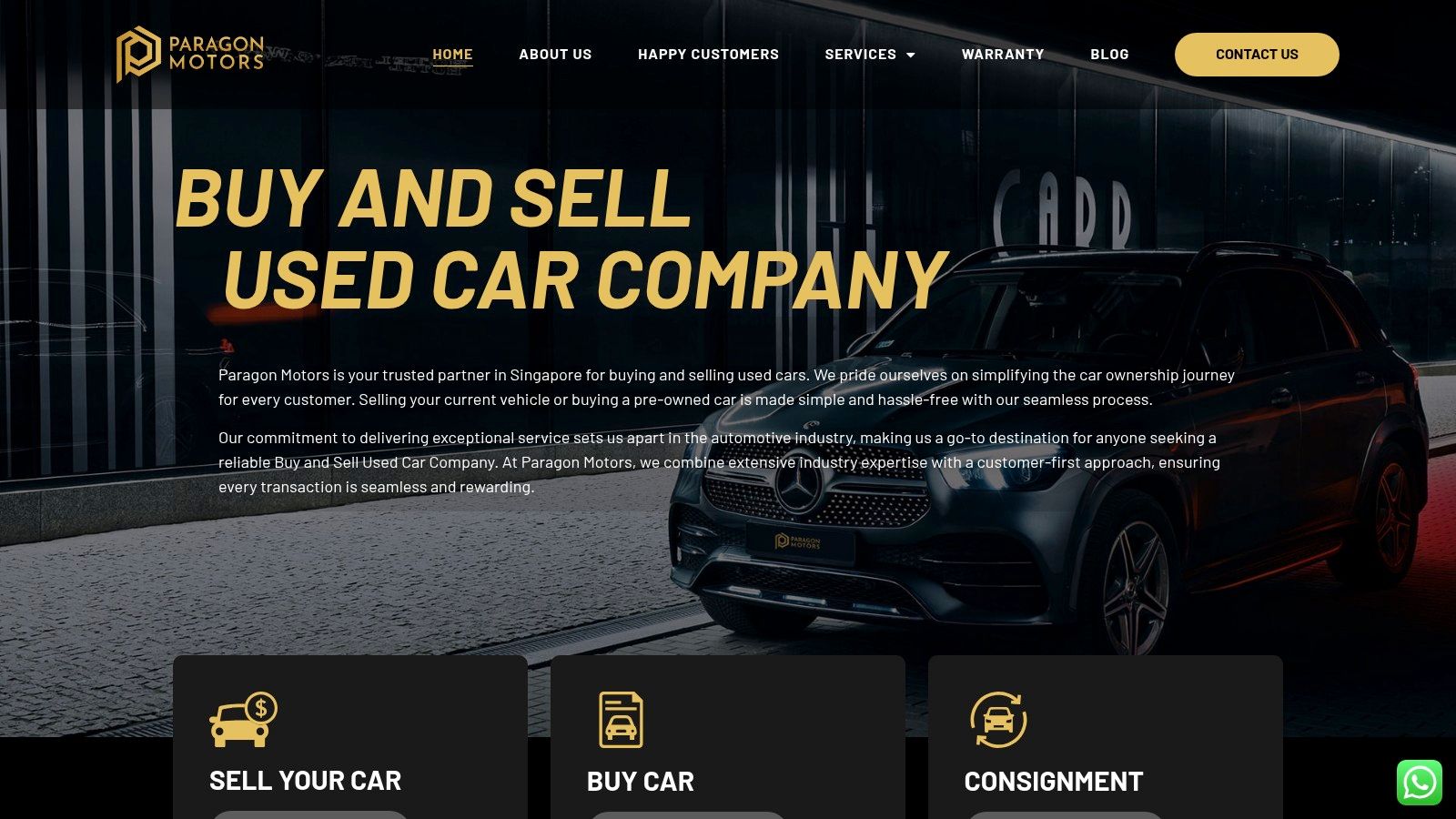
    2. Paragon Motors (Car Export Singapore)

    Paragon Motors positions itself as a full-service export partner, focusing on guiding Singaporean car owners and international buyers through the entire deregistration and shipping process. Their platform is less of a vehicle marketplace and more of an educational, service-led portal. This makes them an ideal target for logistics providers who can offer a seamless, all-in-one logistics solution that complements their hands-on, consultative approach with clients.

    Paragon Motors (Car Export Singapore)

    Key Offerings and Platform Features

    Paragon Motors' website is built to demystify the export process for sellers and buyers, providing clarity from valuation to final delivery. This focus on process and education highlights their role as a facilitator, which is a key insight for potential logistics partners.

    • End-to-End Export Management: The company handles everything from vehicle valuation and LTA deregistration paperwork to final international shipping. This integrated model means they are the single point of contact and decision-maker for the entire logistics chain.
    • Educational Content: A key differentiator is their clear explanation of the economics of exporting versus scrapping a car, including guidance on COE timing. This content attracts serious sellers who have done their research and are ready to transact.
    • Flexible Shipping Options: Like other major car exporters in singapore, they offer both Roll-On/Roll-Off (RORO) and containerised shipping. Their consultative process means they advise clients on the best mode, creating opportunities for both NVOCCs and RORO carriers to provide tailored quotes.
    • Process-Driven Approach: The site outlines a clear 6-step export process, reinforcing their role as a structured, reliable partner for what can be a complex transaction for vehicle owners.

    Outreach Strategy for Logistics Partners

    Engaging with Paragon Motors requires a partnership-oriented approach. Your pitch should align with their service-led model, positioning your company as a reliable logistics extension of their brand that can enhance their customer experience.

    Key Personnel to Target Recommended Outreach Angle
    Export Manager Offer competitive, all-in rates for door-to-port or door-to-door services to popular destinations. This allows them to provide clear, final quotes to their clients without hidden fees.
    Operations Coordinator Present a simplified booking and tracking platform that gives them and their clients full visibility, reinforcing their brand promise of a transparent and managed process.
    Business Owner Propose a volume-based discount structure or a co-branded marketing initiative targeting specific overseas buyer communities to generate mutual business growth.

    Actionable Tip: Frame your services as a way to enhance their customer journey. During outreach, mention that you appreciate their focus on educating clients and offer logistics solutions that mirror their commitment to transparency. For complex shipments, showing expertise in areas like correct HS code classification can be a major value-add. You can learn more about the nuances of auto parts HS codes to demonstrate specialised knowledge.

    Website: https://paragonmotors.com.sg

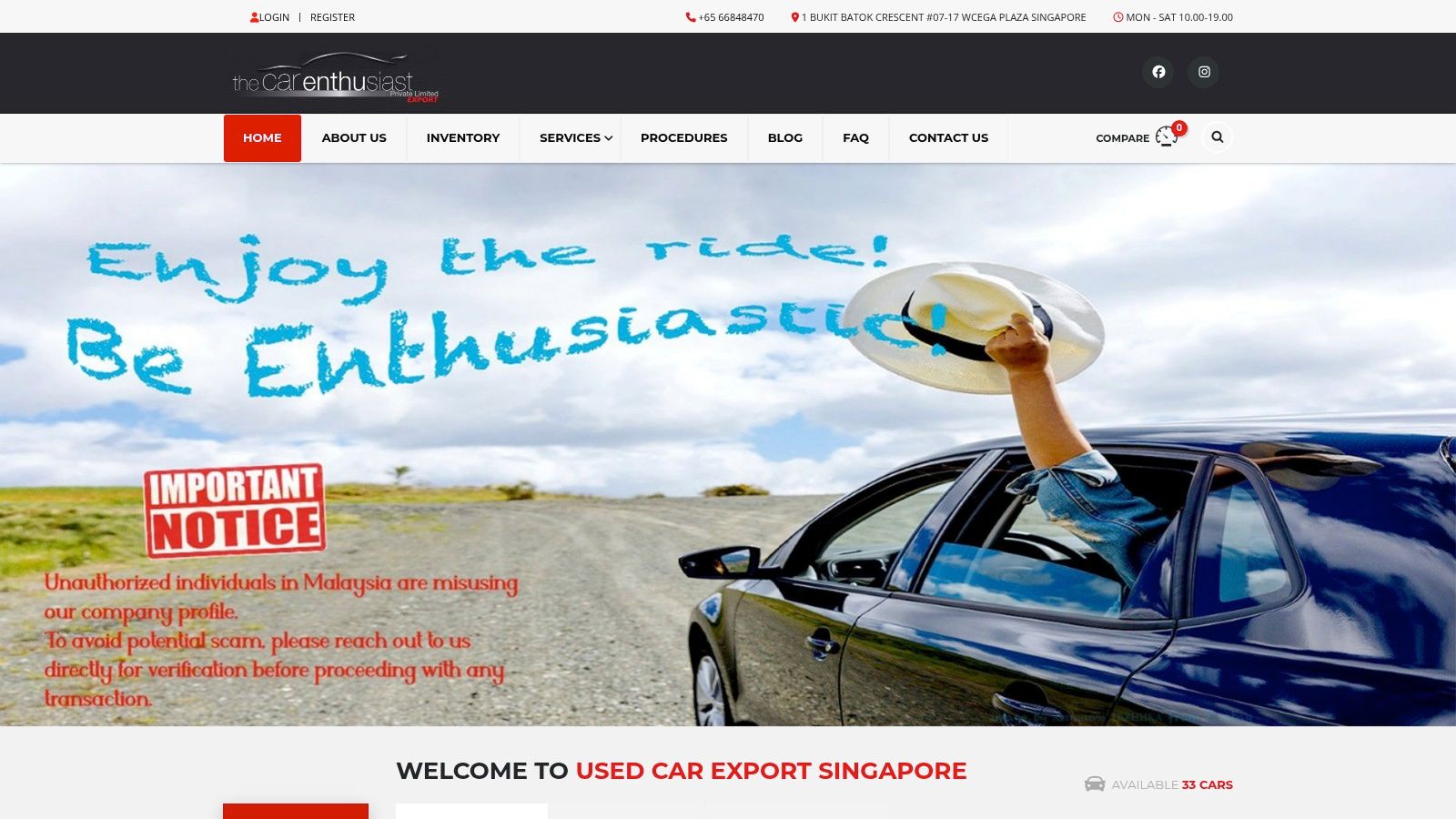
    3. UsedCarExport.sg (The Car Enthusiast Pte Ltd)

    Operating under the name The Car Enthusiast Pte Ltd, UsedCarExport.sg positions itself as a versatile player among car exporters in singapore. Their platform uniquely caters not only to buyers seeking whole vehicles but also to those in need of specific automotive parts. This dual focus on complete units and components like "half-cuts" broadens their operational scope and presents varied logistics opportunities, particularly for LCL (Less than Container Load) and specialised packing services.

    UsedCarExport.sg (The Car Enthusiast Pte Ltd)

    Key Offerings and Platform Features

    UsedCarExport.sg provides a straightforward and functional website that serves as both a stock catalogue and a service portal. It clearly outlines their capabilities for both vehicle and parts exportation, making it a valuable target for logistics firms that can handle diverse cargo types.

    • Live and Promo Stock: The website features distinct sections for the "Latest" and "Promo" stock, allowing buyers to quickly identify new arrivals and special deals. This dynamic inventory indicates a consistent turnover of vehicles.
    • Specialised Parts Export: A key differentiator is their explicit offering of parts export, including "half-cuts" (the front half of a car including engine and dashboard). They also manage the specialised packing and shipping for these items, requiring precise handling.
    • On-site Vehicle Valuation: The company offers valuation services for car owners in Singapore looking to export their vehicles. This suggests they have a strong local sourcing network and a steady pipeline of potential export units.
    • Clearly Defined Markets: They transparently list their common export corridors, which include Africa, the Caribbean, New Zealand, and the UK. This gives logistics providers immediate insight into their primary trade lanes.

    Outreach Strategy for Logistics Partners

    Approaching UsedCarExport.sg should involve a strategy that highlights your ability to handle their unique mix of cargo. Their combined vehicle and parts business creates specific logistical challenges that a well-prepared partner can solve.

    Key Personnel to Target Recommended Outreach Angle
    Export Manager Offer competitive LCL consolidation rates for their parts exports to their key markets. Propose a solution that simplifies the shipping of irregularly shaped cargo like half-cuts.
    Operations Coordinator Present a streamlined booking process for both RORO and containerised shipments. Emphasise reliability and timely documentation turnaround to support their customer service promises.
    Managing Director Showcase a comprehensive logistics partnership that provides cost-effective solutions for both their whole vehicle and parts export divisions, potentially offering volume-based discounts.

    Actionable Tip: During your outreach, highlight your expertise in handling both vehicles and auto parts. Frame your services as a one-stop solution that can manage their entire export portfolio, from single RORO shipments to consolidated containers of half-cuts. Understanding the nuances of a successful import-export business will allow you to position your logistics services as a strategic advantage for their unique business model.

    Website: https://www.usedcarexport.sg

    4. SY Car Export

    SY Car Export operates on a different model compared to traditional showrooms, positioning itself primarily as a high-velocity sourcing agent for the export market. Their platform is geared towards Singapore-based car owners looking for a quick and seamless way to sell their vehicles for scrap or export. For logistics providers, SY Car Export represents a consistent source of deregistered vehicles ready for shipment, making them a key consolidator among car exporters in singapore.

    Key Offerings and Platform Features

    The SY Car Export website is a lead-generation tool designed for efficiency, focusing on acquiring vehicle stock from local sellers. While it doesn't feature an online inventory for international buyers, it provides clear insights into their operational model and volume.

    • Instant Quotation via WhatsApp: The primary feature is a direct-to-WhatsApp quote system, promising sellers a quick valuation. This indicates a rapid, high-turnover operation that prioritises speed, suggesting a steady pipeline of vehicles for export.
    • Full-Service Deregistration: As an LTA electronic service agent, they handle all administrative tasks, including vehicle deregistration and loan settlement. This in-house capability means they have full control over the paperwork required for export clearance.
    • Doorstep Collection and On-the-Spot Payment: They offer island-wide vehicle collection and provide cash on handover. This service model is designed to acquire stock quickly, especially from owners facing expiring COEs, ensuring a constant flow of units.
    • Focus on Sourcing, Not Selling: The platform is a supply-side tool. This means their core business is consolidating vehicles, which are then likely sold in bulk to overseas buyers or other larger exporters.

    Outreach Strategy for Logistics Partners

    Engaging with SY Car Export requires a focus on operational efficiency and cost-effectiveness. Since their business model hinges on slim margins and high volume, your logistics solutions must directly address these priorities.

    Key Personnel to Target Recommended Outreach Angle
    Owner / General Manager Offer competitive, bundled pricing for container stuffing and freight for common destinations. Highlight cost savings on high-volume, multi-car shipments.
    Operations Coordinator Propose a simplified booking process or a dedicated account manager to handle their frequent export declarations and shipping arrangements, saving them time.
    Acquisition Specialist While not a direct logistics target, understanding their acquisition process helps tailor your pitch. Offer flexible yard storage or quick container turnaround.

    Actionable Tip: Frame your services as a back-end solution that makes their high-volume acquisition model more profitable. Instead of pitching a single shipment, propose a partnership that offers predictable, low-cost logistics for a steady stream of 10-20 vehicles per month. This aligns with their role as a key supplier among car exporters in singapore and demonstrates you understand their operational needs.

    Website: https://sycarexport.com.sg

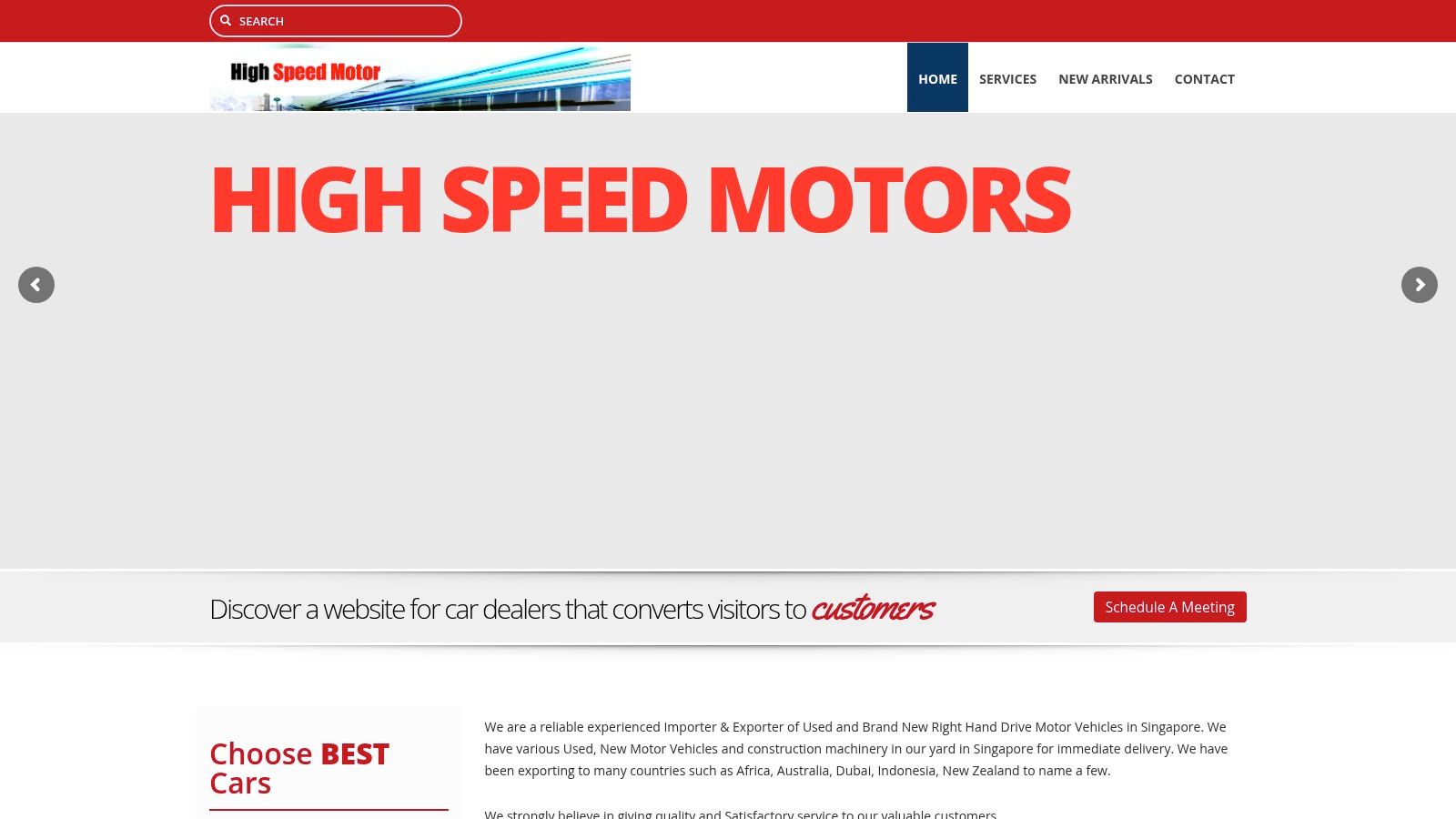
    5. SingCars (High Speed Motor Pte Ltd)

    Operating as High Speed Motor Pte Ltd, SingCars presents a diversified business model that combines local car sales and rentals with a dedicated export division. This mixed portfolio makes them an interesting partner for logistics providers, as their operations are not solely dependent on the volatility of the export market. They serve as a practical one-stop shop for buyers looking for export-ready, right-hand-drive vehicles, with a notable focus on destinations like Africa, Australia, Dubai, Indonesia, and New Zealand.

    SingCars (High Speed Motor Pte Ltd)

    As a key player among car exporters in singapore, their primary appeal lies in the availability of ready stock, allowing for immediate delivery and shipping arrangements. This suggests a consistent, though perhaps not high-volume, flow of units that require reliable and timely freight services.

    Key Offerings and Platform Features

    The SingCars website acts as a digital showroom, segmenting their inventory for different customer types. For logistics partners, the "Export Cars" section provides direct insight into the types of vehicles they frequently ship overseas.

    • Dedicated Export Inventory: The site features a specific "Export Cars" section showcasing a range of SUVs and commercial vehicles. This clear segmentation helps logistics providers quickly assess the typical cargo profile.
    • Mixed Business Model: Their involvement in local sales and rentals means they have a constant turnover of vehicles. This can lead to a steady supply of ex-rental or trade-in vehicles being channelled into their export stock.
    • Yard Availability: SingCars emphasises its physical yard with ready stock for immediate delivery. This is a crucial detail for freight forwarders, as it signals that the cargo is tangible and ready for booking, reducing lead times.
    • Right-Hand-Drive Focus: The company specialises in right-hand-drive (RHD) vehicles, aligning their inventory perfectly with key import markets like Australia, New Zealand, and parts of Africa. Pricing is generally provided upon enquiry, a common practice in the industry.

    Outreach Strategy for Logistics Partners

    Engaging with SingCars requires an approach that caters to their multi-faceted business. Your proposal should offer clear value that supports both their immediate export needs and their broader operational efficiency.

    Key Personnel to Target Recommended Outreach Angle
    Export Manager / Sales Lead Offer competitive, all-in freight quotes (including local handling and haulage) for their key destinations like Australia and New Zealand. Highlighting streamlined booking processes will be a strong selling point.
    Operations Manager Propose a consolidated service package that covers collection from their yard, port handling, and documentation. Emphasise reliability and a single point of contact to simplify their workflow.
    Business Owner / Director Present a cost-benefit analysis comparing your proposed freight rates and services against industry benchmarks for their target markets. Focus on long-term partnership benefits like volume discounts.

    Actionable Tip: Use their website's "Export Cars" section as a reference point in your initial outreach. Mentioning a specific vehicle they have listed (e.g., "I noticed you have a Toyota Land Cruiser ready for export") shows you have done your research and understand their product. Frame your logistics solution as the most efficient way to get that specific vehicle to a buyer in one of their target countries.

    Website: https://www.singcars.com

    6. Auto Asia Pte Ltd

    Auto Asia positions itself as a meticulous, process-driven partner for international vehicle buyers, distinguishing itself among car exporters in singapore with a strong emphasis on pre-purchase quality control. Their model is less about a high-volume public marketplace and more about providing a curated sourcing and procurement service. This focus on appraisal and inspection makes them an attractive partner for logistics providers who value cargo quality and streamlined handovers.

    Auto Asia Pte Ltd

    Key Offerings and Platform Features

    Auto Asia's website functions as a corporate gateway rather than a direct sales portal, highlighting their service-oriented approach. For logistics partners, the site offers crucial insights into their operational philosophy, which is built on precision and client trust.

    • Sourcing and Inspection Focus: Their core service is the end-to-end management of sourcing, professional appraisal, and export coordination. This implies they handle high-value units where pre-shipment condition is paramount.
    • Global Market Experience: The company explicitly notes experience with key right-hand-drive markets like New Zealand, South Africa, and the Caribbean. This provides clear target lanes for freight forwarders to propose services for.
    • Automotive Specialist Team: By promoting their team of trained automotive specialists, Auto Asia signals a commitment to quality control. This reduces the risk of last-minute issues at the port, a key selling point for a logistics partner.
    • Flexible Order Handling: They are equipped to manage both individual vehicle purchases and larger, multi-unit orders. This flexibility is ideal for NVOCCs who can offer solutions for both single-car LCL (less than container load) and multi-car FCL shipments.

    Outreach Strategy for Logistics Partners

    Engaging with Auto Asia should centre on complementing their quality-focused, bespoke service model. Your proposal must demonstrate how your logistics solutions can enhance their reputation for reliability and attention to detail.

    Key Personnel to Target Recommended Outreach Angle
    Director / Business Development Manager Present a "white-glove" logistics service package that includes premium insurance, detailed pre-loading condition reports, and real-time tracking to align with their quality-first brand promise.
    Operations Coordinator Offer a simplified booking and documentation process with a dedicated point of contact. Emphasise how this reduces their administrative workload, allowing them to focus on vehicle sourcing and inspection.
    Procurement Specialist Propose competitive, all-in freight rates for their primary export markets (e.g., Auckland, Durban). This helps them provide more attractive and transparent final pricing to their international clients.

    Actionable Tip: Frame your outreach around risk mitigation. Since Auto Asia's value proposition is built on trust and quality assurance, highlight how your secure handling, comprehensive insurance, and transparent tracking can protect their high-value cargo and, by extension, their client relationships. This shows you understand their core business drivers beyond just moving units.

    Website: https://autoasia.com.sg

    7. SGCarMart Quotz – Dealer List

    While not a direct exporter itself, the Quotz dealer list from SGCarMart is an indispensable prospecting tool for any logistics provider targeting car exporters in singapore. This platform acts as a comprehensive, continuously updated directory of over 500 used car dealers, scrapyards, and dedicated exporters. For logistics sales teams, it functions as a high-value lead generation database, offering a direct line to a broad spectrum of potential clients, from small family-run operations to larger, established export houses. Its connection to the trusted SGCarMart ecosystem lends it significant credibility within the local automotive industry.

    Key Offerings and Platform Features

    The Quotz dealer list is less about direct vehicle sales and more about market access and intelligence. It provides the raw material for building a robust and diverse pipeline of shipper leads.

    • Centralised Dealer Directory: Its primary function is providing a searchable list of hundreds of automotive businesses in Singapore. This saves immense time on market research and list-building.
    • Broad Industry Coverage: The directory includes not just direct exporters but also used car dealers and scrapyards, many of which engage in opportunistic or regular exporting of vehicles and parts.
    • Easy Shortlisting for Outreach: The platform’s structure allows sales teams to efficiently identify and segment potential partners for targeted Request for Quotations (RFQs) and outreach campaigns.
    • Gateway to Bidding: The platform's core function is to help sellers get multiple bids for their vehicles. This indicates that the listed dealers are active, transactional, and accustomed to competitive pricing, a mindset that can be leveraged in freight negotiations.

    Outreach Strategy for Logistics Partners

    Engaging with businesses found on Quotz requires a high-volume, yet personalised, approach. Since you are dealing with a mix of business types, your strategy must be adaptable.

    Key Personnel to Target Recommended Outreach Angle
    Business Owners (for smaller dealers) Offer a simple, all-in freight pricing package for popular export destinations. Emphasise ease of use and a single point of contact to handle all shipping complexities.
    Sales/Export Managers For dealers who are clearly marked as exporters, propose competitive rates for specific trade lanes (e.g., Singapore to New Zealand, Malaysia, or UAE) to help them win more C&F deals.
    Scrapyard Operators Propose cost-effective solutions for shipping dismantled car parts or scrap metal in 20ft/40ft containers, highlighting expertise in handling such cargo.

    Actionable Tip: Use the Quotz directory not just for outreach but for market intelligence. Analyse the list to identify clusters of dealers specialising in certain vehicle makes or those located in specific industrial areas. This allows you to create highly targeted, geographically-focused sales campaigns. Mentioning you found them via SGCarMart adds credibility, as it is the go-to platform for the local industry.

    Website: https://www.quotz.com.sg/dealer-list

    Top 7 Singapore Car Exporters Comparison

    Provider Service scope Implementation complexity Resource requirements Expected outcomes Ideal use cases Key advantages
    Prestige Auto Export Global used-car exporter with live stocklist, in-house inspection, RORO/container shipping Medium — browse online but quotes require enquiry Moderate — request quote, choose shipping/payment; EPZ available Inspected, export‑ready vehicles coordinated to destination International buyers seeking curated stock and export support Deep export experience; 24/7 support; visible buyer reviews
    Paragon Motors (Car Export Singapore) Full-service export handling: valuation, LTA deregistration, paperwork, shipping Medium — end-to-end handled but consultation required Low–moderate — single contact handles documentation and logistics Complete export processing from valuation through delivery Owners wanting managed export; buyers needing guided process Educational content; single point of contact; flexible shipping modes
    UsedCarExport.sg (The Car Enthusiast) Live vehicle inventory plus parts export (half-cuts), packing and shipping Low–medium — searchable stock simplifies selection; quotes on enquiry Moderate — specify vehicle/parts, arrange payment and shipping Vehicles or parts packed and shipped with published contact support Buyers needing both vehicles and spare parts for common corridors Combined vehicle & parts export; transparent contact and hours
    SY Car Export Seller-focused quick scrap/export service with instant WhatsApp quotes and collection Low — instant quote and cash-on-handover streamline process Low — minimal seller effort; deregistration and loan settlement handled Fast sale or export handover with deregistration completed Sellers on tight COE timelines or needing fast disposal Fast turnaround; instant WhatsApp quoting; cash-on-handover
    SingCars (High Speed Motor) Importer/exporter with dedicated "Export Cars" inventory, local sales and rentals Medium — yard availability for immediate delivery; pricing by enquiry Moderate — onsite pickup possible; buyer to request quotes Export-ready SUVs/commercial units available for delivery Buyers seeking commercial/SUV export stock or combined rental/sale Practical selection for commercial buyers; multi-market coverage
    Auto Asia Pte Ltd Process-driven sourcing, appraisal, inspection and export coordination Medium — quality-focused workflows; quotes by enquiry Moderate — inspection/spec support; can handle bulk orders Quality-controlled exports with pre-purchase appraisal Buyers requiring vetted vehicles or bulk procurement Strong quality control; trained specialists; handles small & large orders
    SGCarMart Quotz – Dealer List Centralized directory of 500+ dealers, exporters and scrapyards for RFQs Low to access / higher to vet — easy shortlist but requires follow-up High in time investment — outreach and due diligence across dealers Multiple supplier contacts and comparative quotes for benchmarking Price discovery, sourcing multiple bids, building prospect lists Broad coverage; speeds shortlist building; credible high-traffic platform

    Turning Insights into Action: Your Next Steps

    Navigating the dynamic landscape of vehicle logistics requires more than just a list of names; it demands a strategic, informed approach. This comprehensive guide has equipped you with detailed profiles of seven key car exporters in Singapore, from the high-volume operations of Prestige Auto Export and Paragon Motors to the specialised services offered by SY Car Export and the dealer-centric model of SGCarMart Quotz. We have dissected their operational nuances, identified key export markets, and provided actionable templates to initiate meaningful conversations.

    The primary takeaway is that a one-size-fits-all sales pitch will not suffice. Each exporter presents a unique set of challenges and opportunities. For instance, a logistics provider excelling in RoRo services to East Africa would find a strong potential partner in a company like Auto Asia Pte Ltd, whereas a freight forwarder with competitive LCL (Less than Container Load) rates for the Caribbean might be better suited to approach an exporter dealing in smaller, more frequent shipments. Understanding these distinctions is the first step towards transforming this information into a tangible business pipeline.

    From Research to Relationship Building

    Your immediate task is to move from passive research to active engagement. The profiles and contact information provided are your entry point, but genuine connection requires personalisation and demonstrated value. Do not simply send a generic capabilities deck. Instead, reference a specific aspect of their business mentioned in this article.

    For example, when contacting UsedCarExport.sg, you might mention their strong presence in markets like New Zealand and the Pacific Islands and propose a streamlined customs clearance process you have successfully implemented for other clients in that region. This level of tailored communication demonstrates diligence and immediately positions you as a potential strategic partner rather than just another vendor.

    Key Insight: The most successful logistics partnerships are built on a foundation of mutual understanding. Prove you understand the specific operational pressures and market focus of each car exporter in Singapore before you even ask for their business.

    Selecting Your Tools and Strategy

    Implementing the outreach strategies outlined requires organisation and precision. Before you begin, consider the following tactical steps to maximise your efforts:

    • Segment Your Target List: Categorise the exporters based on their alignment with your core services. Create a "Tier 1" list of best-fit prospects (e.g., their primary trade lanes are your strongest) and a "Tier 2" list for secondary targets.
    • Customise Your Value Proposition: For each segment, refine your outreach template. What is your single most compelling advantage for that specific exporter? Is it faster transit times to their key destinations, superior vehicle handling protocols, or more competitive insurance rates? Lead with that specific point.
    • Prepare Your Follow-up Cadence: A single email is rarely enough. Plan a multi-touchpoint strategy that might include a follow-up email a week later, a LinkedIn connection request with a personalised note, and a phone call. Track all interactions in a CRM to ensure consistency.

    By systematically applying these steps, you elevate your prospecting from a simple numbers game to a calculated, strategic campaign. The goal is not just to win a single shipment but to become the go-to logistics provider for Singapore's premier vehicle exporters. This journey begins with the detailed insights you now possess and is realised through deliberate, intelligent action.


    Ready to supercharge your outreach to car exporters in Singapore? Stop guessing and start connecting with the right decision-makers using Coreties. Our platform provides the verified contact data and deep company insights you need to bypass gatekeepers and build a high-value sales pipeline. Explore Coreties today and turn your strategic planning into profitable partnerships.

  • A Guide to Auto Parts HS Code Classification

    A Guide to Auto Parts HS Code Classification

    Think of an auto parts HS code as a universal passport for car components. It's a specific number used by customs authorities everywhere to identify and categorise automotive parts when they cross borders. This simple code is what tells them if they're looking at a shipment of engines, brake pads, or wing mirrors, ensuring everything gets taxed and processed correctly.

    The Universal Language of Automotive Shipping

    Warehouse worker inspecting auto parts and paperwork, with a clear sign advising to avoid customs delays.

    Picture a shipping container packed with thousands of different auto parts pulling into port. Without a common system, customs officials would be completely overwhelmed. The result? Gridlock, incorrect duty payments, and seriously unhappy importers. This is exactly why the Harmonized System (HS) code is so critical. It’s the shared language that keeps the global automotive supply chain running smoothly.

    For anyone in freight forwarding, getting a handle on the auto parts HS code system isn't just about ticking a box. It's a genuine competitive edge. When you can classify a client's shipment with confidence—be it a pallet of spark plugs or an entire transmission—you're preventing a logistical nightmare before it even begins.

    Turning Compliance into Opportunity

    Getting the classification wrong is one of the most common pitfalls in international shipping. A tiny mistake can snowball into big problems.

    • Costly Delays: A shipment can get stuck in customs for weeks while officials inspect and re-classify it, throwing a major spanner in just-in-time production schedules.
    • Unexpected Fines: Customs agencies don't take kindly to inaccurate declarations. They hit you with hefty penalties that eat into profits for everyone involved.
    • Damaged Client Trust: Nothing kills a business relationship faster than a surprise customs bill or a production line grinding to a halt because a container is held up. The forwarder is expected to get this right. To dig deeper, you can learn about the crucial role of the Importer of Record and how it shapes these responsibilities.

    When you truly understand the logic behind HS codes, you stop being just a paper-pusher and become a strategic advisor. You're the expert who guides clients through the regulatory maze, making their supply chain reliable and predictable.

    A Strategic Tool for Growth

    It's not just about avoiding trouble, either. A solid grasp of the auto parts HS code system is a powerful tool for growing your business. The automotive industry is a huge, valuable market, but it’s notoriously complex. Freight forwarders who can prove they know this niche inside and out are the ones who land the best accounts.

    By looking at customs data, you can see which companies are moving specific auto components and map out their trade flows. This gives you the intel to approach potential clients with solutions that actually solve their problems, demonstrating your value before you even talk about a contract. In a crowded market, that’s the kind of insight that separates a basic logistics provider from a true supply chain partner.

    How an Auto Parts HS Code Is Structured

    Man examining auto parts HS Code structure on a tablet, with '8708-40' and '87 8708' displayed.

    An auto parts HS code isn't just a string of random numbers. It’s more like a product's postal code, guiding it through the global trade system. Each pair of digits adds another layer of detail, starting broad and getting more specific. This clever system is what allows customs officers in Singapore, the United States, and over 200 other countries to understand exactly what’s inside a shipment.

    The foundation of the entire system is a globally standardised six-digit code. This ensures that a set of brake pads is identified as brake pads, no matter where it's coming from or going to. Many countries, including Singapore, then append extra digits—creating an eight, ten, or even twelve-digit code—to get more granular data for their own tariff and statistical needs.

    Breaking Down the Code Anatomy

    Think of an HS code as a top-down hierarchy. You start with a huge category and progressively narrow it down until you pinpoint the exact product. It’s a logical flow from the general to the very specific.

    • The First Two Digits (Chapter): This is the broadest category. For almost any vehicle or part you can think of, you'll start with Chapter 87: "Vehicles other than railway or tramway rolling-stock, and parts and accessories thereof."
    • The Next Two Digits (Heading): These digits zoom in on a specific group within that chapter. For instance, Heading 87.08 is designated for "Parts and accessories of the motor vehicles of headings 87.01 to 87.05."
    • The Final Two Digits (Subheading): This is where we get the most specific detail recognised internationally. Subheading 8708.40, for example, clearly identifies "Gear boxes and parts thereof."

    So, the code 8708.40 is the universal language for gearboxes. Any digits that follow are country-specific modifications for local customs and tax purposes.

    The Guiding Principles of Classification

    This whole structure is held together by a crucial set of rules that ensure everyone applies the codes consistently. These are the General Interpretative Rules (GIRs), and they are the ultimate referee when a product could potentially fit into more than one category.

    The General Interpretative Rules (GIRs) are the legal backbone of the Harmonized System. They provide a clear, step-by-step process for classifying goods, making sure the HS code is applied uniformly everywhere. This consistency is vital for preventing customs disputes and keeping global trade moving smoothly.

    Getting to grips with the GIRs is non-negotiable for anyone serious about customs compliance. They provide the "why" behind every classification, explaining how to handle everything from a simple gasket to a sophisticated electronic control unit.

    The World Customs Organization (WCO) is the international body that maintains and updates the Harmonized System. Their work ensures the system stays relevant, adapting to new technologies and changes in global trade patterns.

    A Practical Example: Brake Pads

    Let's see how this works in practice with a common part: a set of brake pads.

    1. Chapter: We know brake pads are for vehicles, so we start at the broadest level: Chapter 87.
    2. Heading: We then look for the right group, which is parts and accessories. That leads us to 87.08.
    3. Subheading: Finally, we drill down to the specific entry for braking systems. Subheading 8708.30 covers "Brakes and servo-brakes; and parts thereof."

    And there you have it. The universal HS code for brake pads is 8708.30. This simple, logical progression is what makes classifying any auto parts HS code a straightforward process once you understand the structure.

    A Practical Guide to Common HS Codes for Auto Parts

    Trying to make sense of the giant Harmonized System catalogue can feel like a losing battle. But here's a secret from the pros: for most car part shipments, you'll be using the same core set of codes over and over again.

    The trick isn't to memorise a long, random list. Instead, think like an engineer and group parts by their vehicle system. This simple mental shift helps you anticipate the right classification and find the correct auto parts HS code much faster. When you start categorising parts by powertrain, chassis, or electrical systems, you’ll begin to see the underlying logic of the HS system.

    Engine and Powertrain Components

    The engine is the heart of the vehicle, and these valuable components have very specific HS headings. It's absolutely crucial to know the difference between the engine itself and the parts that help it deliver power, as customs authorities classify them in completely different chapters.

    For instance, a complete spark-ignition (petrol) engine is classified under heading 8407. A compression-ignition (diesel) engine? That goes under heading 8408. Notice these are in Chapter 84, which is for machinery, not Chapter 87 for vehicles. This is a classic stumbling block that catches a lot of people out.

    Once you move to the parts that transmit power from the engine to the wheels, you're generally back in Chapter 87. Here are the heavy hitters for powertrain systems:

    • 8708.40: This is your go-to for gearboxes (transmissions) and all their internal bits.
    • 8708.50: Covers drive-axles with differentials, the components that actually make the wheels turn.
    • 8708.93: A specific code just for clutches and their related parts.

    Getting this split right—Chapter 84 for the engine, Chapter 87 for the drivetrain—is one of the most fundamental rules for accurate auto part classification.

    Chassis and Suspension Systems

    The chassis and suspension are the vehicle's skeleton, giving it structure, steering, and a smooth ride. Almost all of these parts live under the main heading 8708, but they are broken down into very specific subheadings based on what they do.

    Road wheels, whether they're fancy alloy rims or basic steelies, are classified under subheading 8708.70. The suspension system, which includes vital parts like shock absorbers and struts, gets its own dedicated code: 8708.80.

    One of the most common and easily identified categories is the braking system. Brake pads, callipers, rotors, and servo-brakes all fall neatly under a single, specific subheading: 8708.30. If you're in the auto logistics game, you'll be seeing this number a lot.

    Pinpointing the correct code here is vital. A simple mix-up between a steering part and a suspension part could lead to paying the wrong duties and flagging your shipment for a customs inspection.

    Body and Exterior Parts

    This category is for everything that gives a car its distinctive shape and protects the people inside, from large body panels down to the smallest fittings. Unsurprisingly, most of these parts are also found within the broad heading 8708.

    The specific code you use often depends on the part's function and where it sits on the vehicle.

    • 8708.10: Reserved specifically for bumpers and their parts.
    • 8708.29: This is a broader category for other body parts and accessories, covering things like doors, bonnets (hoods), and mudguards.
    • 7007.11 / 7007.21: Here’s a major exception. Windscreens and other safety glass are classified under Chapter 70 (glassware), not Chapter 87.

    This last point drives home a critical rule in HS classification: sometimes, what a part is made of is more important than what it's used for. Always double-check the chapter notes to be sure.

    Electrical Systems and Lighting

    Modern cars are rolling computers, packed with complex electronics. This is an area where you have to be precise with your classification. The HS system draws a clear line between lighting, ignition systems, and other electronic bits.

    Lighting and visual signalling equipment, like headlamps, tail lights, and indicators, fall under subheading 8708.91.

    However, electrical ignition and starting equipment—think alternators, starter motors, spark plugs, and ignition coils—are classified under heading 8511. Just like engines, these parts belong to a different chapter (Chapter 85 for electrical machinery) because their primary identity is electrical, not just automotive.

    To help you keep track, here is a quick reference table summarising some of the most common classifications.

    HS Code Quick Reference for Common Auto Parts

    This table provides a snapshot of key HS headings and subheadings for frequently shipped automotive components, organised by the vehicle system they belong to.

    Vehicle System Component Example HS Heading/Subheading Description
    Powertrain Petrol Engine 8407 Spark-ignition reciprocating or rotary internal combustion piston engines.
    Powertrain Diesel Engine 8408 Compression-ignition internal combustion piston engines (diesel or semi-diesel engines).
    Powertrain Gearbox / Transmission 8708.40 Gearboxes and parts thereof.
    Chassis Brakes 8708.30 Brakes and servo-brakes and parts thereof.
    Chassis Wheels & Rims 8708.70 Road wheels and parts and accessories thereof.
    Chassis Suspension 8708.80 Suspension systems and parts thereof (including shock absorbers).
    Body/Exterior Bumpers 8708.10 Bumpers and parts thereof.
    Body/Exterior Doors, Bonnets 8708.29 Other parts and accessories of bodies (including cabs).
    Electrical Headlamps, Tail Lights 8708.91 Radiators and parts thereof.
    Electrical Alternators, Starter Motors 8511 Electrical ignition or starting equipment, generators (dynamos, alternators).
    Miscellaneous Exhaust Pipes, Brackets 8708.99 Other parts and accessories of the motor vehicles of headings 8701 to 8705.

    Think of this table as a starting point, not a substitute for proper research. It’s a great way to familiarise yourself with the key codes you'll encounter day-to-day.

    The Critical Catch-All Code: 8708.99

    So, what happens when you have a part that doesn't seem to fit anywhere? This is where the infamous "other" category comes in: 8708.99. It's easily one of the most widely used—and misused—codes in the entire auto parts sector.

    This code is the designated home for a huge range of miscellaneous parts that don't have their own specific subheading. This could be anything from exhaust pipes to simple mounting brackets that are clearly for automotive use.

    While it’s a necessary code, leaning on 8708.99 too often is a major red flag for customs. It can look like the classifier didn't bother to find the correct, more specific code. Before you ever settle on this catch-all number, make absolutely sure you’ve ruled out every other possibility, and be ready to show detailed product information to defend your choice.

    A Step-by-Step Method for Classifying Auto Parts

    Knowing the common codes is a great start, but real expertise comes from mastering the classification process itself. This isn't just about looking up a number in a book; it's about methodically building a defensible case for your chosen auto parts HS code. When you have a logical, repeatable process, what seems like a confusing task becomes a straightforward quality check.

    The whole journey begins long before you even glance at a tariff schedule. First, you need to become an expert on the specific part in front of you. This means gathering much more than just a name or a part number.

    Gather Your Essential Product Intel

    Think like a detective. Your first job is to build a complete file on the auto part. This documentation is your evidence, proving why a specific HS code is the right one. Without it, you’re essentially just guessing.

    You'll need to lock down a few key pieces of information:

    • Primary Function: What does the part actually do in the vehicle? Is it for braking, steering, or maybe engine timing? Its core purpose is a massive clue.
    • Material Composition: Is it made of steel, aluminium, rubber, or a specialised composite? Sometimes, the material can be the deciding factor, even over its function.
    • Technical Specifications: Get your hands on datasheets, blueprints, or engineering diagrams. These documents often hold the granular details that customs officials need to see.

    This decision tree gives you a bird's-eye view of where to start, helping you narrow down your search from the major vehicle system.

    A decision tree flowchart for diagnosing auto part systems, covering powertrain, chassis, and body issues.

    Think of this as a way to filter your options. By starting at the broadest level—like Powertrain or Chassis—you can quickly drill down into specific components and streamline your initial research.

    The Classification Journey: A Real-World Example

    Let's walk through the process with a common item: a set of four 18-inch aluminium alloy road wheels for a passenger car.

    1. Identify the Correct Chapter: We know the wheels are for a vehicle, so our immediate starting point is Chapter 87, which covers vehicles and their parts. Simple enough.
    2. Select the Right Heading: Within Chapter 87, we need to find the specific heading for parts and accessories. A quick scan leads us directly to Heading 87.08, which is for "Parts and accessories of the motor vehicles…"
    3. Narrow to the Precise Subheading: Now for the final detail. We skim the subheadings under 87.08 until we find 8708.70, which is explicitly for "Road wheels and parts and accessories thereof." It’s a perfect match.

    The final six-digit international HS code is 8708.70. This logical progression, backed by what we know about the product's function (a road wheel) and material (alloy), gives us a high degree of confidence.

    Of course, this was a straightforward example. More complex components, especially in electrical systems, often require a much deeper analysis. You can see a similar detailed breakdown in our guide to classifying the cable HS code.

    The most important habit you can build is documenting your rationale. Write down why you chose Chapter 87, then Heading 87.08, and finally Subheading 8708.70. This "classification justification" is invaluable if a customs authority ever questions your decision.

    Leveraging Online Tools and Databases

    Thankfully, you don't have to do this with a dusty, printed manual anymore. Modern classification relies on powerful online tools that speed up the process and boost accuracy.

    National customs websites, like those from Singapore Customs, offer searchable tariff databases. These are your ultimate source of truth for country-specific codes and duty rates.

    Using these tools effectively is key. Start by searching with broad terms ("wheel," "brake pad") and then use the technical details you gathered earlier to refine your search. This data-driven approach not only helps find the right code but also prepares you for validation. This is particularly relevant in major trade hubs; for instance, Singapore's motor vehicle parts exports hit S$400 million in 2023, with a huge portion classified under the general HS code 8708.99 for non-specified parts. This shows just how critical precise classification is to avoid falling back on generic codes.

    Documenting your choices clearly is the best way to ensure compliance and avoid costly shipping delays.

    Using Shipment Data to Find and Validate HS Codes

    Getting the theory right is one thing, but the best freight forwarders I know always back up their classifications with real-world data. Digging into global customs and shipment records is what takes you from simply following the rules to making truly confident, data-driven decisions about the right auto parts HS code.

    This is your ultimate reality check. Instead of relying solely on your own interpretation of the tariff book, you can see exactly which HS codes major car manufacturers and their top suppliers are using for the same components, day in and day out. It’s an incredibly powerful way to build confidence in your own work.

    Turning Data into Commercial Intelligence

    This goes way beyond just checking your work. Shipment data is a goldmine for business development. It can transform a routine compliance task into a powerful source of real, actionable intelligence. By slicing and dicing trade data, you can instantly see who’s exporting or importing the specific auto parts you handle.

    For instance, you could run a quick search for shipments under HS code 8708.40 (gearboxes) or 8511 (electrical starting equipment). In minutes, you’ll have a targeted list of high-potential leads. Your sales team can stop making cold calls and start having meaningful conversations with companies that are already moving the exact products you specialise in.

    Think of it as a strategic map of the automotive supply chain. By tracking the flow of goods under specific HS codes, you can identify key players, understand trade lane volumes, and pinpoint exactly where your logistics services are most needed.

    This method gives you a serious competitive edge. You can walk into a conversation with a potential client already knowing what they ship, where they ship it, and how often they do it. For a closer look at the local rules that govern this data, check out our complete guide on Singapore customs HS codes.

    A Practical Example of Data-Driven Prospecting

    You can see how powerful this gets when you look at actual market trends. Singapore's auto parts exports, for example, have seen incredible growth, expanding by 51% in a recent 12-month period with over 3,100 recorded shipments. This boom underscores the city-state's role as a key automotive hub, with major shipments heading to Peru, Indonesia, and the United States. You can see more on this booming trade on cypherexim.com.

    So, what does a smart freight forwarder do with that information?

    1. Isolate the Data: Filter Singapore’s export records to focus on high-demand parts like batteries and electronics, which have their own specific HS codes.
    2. Identify Key Shippers: Pull a list of the top companies exporting these components out of Singapore.
    3. Craft a Targeted Pitch: Reach out with a compelling offer, referencing their specific trade lanes and highlighting your expertise in handling sensitive, high-value electronics.

    This data-driven approach completely changes the conversation. It’s no longer, "Can we ship for you?" It becomes, "We see you're moving a lot of electronics to the US, and we have a specialised solution that could make that process a lot smoother for you."

    How to Leverage Data Tools Effectively

    To put this all into practice, you'll need access to a good trade intelligence platform. These tools pull together millions of customs records from around the world into a single, searchable database.

    When you’re using one of these platforms, here are a few practical steps to find and validate any auto parts HS code:

    • Search by Product Description: This is the most straightforward method. Type in a component like "shock absorber" or "alternator" and see which HS codes are most commonly used by other shippers.
    • Analyse a Specific Company: Pick a major automotive brand you trust and pull up their bill of lading records. See how they classify their parts—it’s a great way to benchmark your own decisions.
    • Prospect by HS Code: Flip the process around. Search for a specific HS code to generate a prospect list of companies that are actively trading those goods.

    By weaving shipment data into your everyday workflow, you build a classification process that is not only more accurate but also commercially valuable. It's the difference between guessing and knowing.

    How to Avoid Common Classification Mistakes

    Even the most experienced logistics pros can get tangled up in the finer points of the auto parts HS code system. What seems like a tiny oversight can quickly snowball into hefty customs fines, infuriating shipping delays, and unhappy clients. Getting a handle on the most common slip-ups is the first real step toward building a supply chain that's both efficient and compliant.

    These aren’t just obscure technicalities; they're everyday mistakes that happen because modern vehicles are just so complex. By learning to spot these potential problems ahead of time, you can guide your clients and help them sidestep expensive disruptions before they even start.

    Misclassifying Kits and Sets

    One of the most common mistakes I see is lumping a 'kit' of parts into one classification. Think of a standard maintenance kit that comes with an oil filter, an air filter, and a few spark plugs. It's not a single item in the eyes of customs. Each of those components has its own specific HS code and needs to be declared individually.

    As a rule of thumb, if the parts can be sold and used on their own, they almost always need their own HS code. Trying to bundle them under one generic code is a huge red flag for customs officials and often leads to re-classification and penalties.

    The only real exception is a true 'set put up for retail sale', which has a very strict definition under the General Interpretative Rules. If you're ever in doubt, it’s always safer to break the kit down and classify each part separately.

    Confusing General Use vs. Specific Use

    Another easy trap to fall into is mixing up a general-use part with one made specifically for a vehicle. Take a standard M8 bolt. Even if it's headed straight for a car engine assembly line, it's still just a bolt. It gets classified under Chapter 73 (Articles of Iron or Steel) as a generic fastener.

    Its primary identity, according to the Harmonized System, is simply as a bolt, not an automotive part. The classification only shifts if the part has been designed, moulded, or engineered in a way that it can only be used on a motor vehicle. It's a subtle difference, but a critical one that often requires technical drawings to prove.

    • General Use: A standard-issue bolt that happens to be used in a car. It’s classified as a bolt.
    • Specific Use: A custom-moulded engine bracket that only fits one specific car model. It’s classified as an auto part.

    This distinction really drives home why you need to understand a part’s design and function—not just its name—to nail down the correct auto parts HS code.

    Frequently Asked Questions

    When you're dealing with auto parts HS codes day in and day out, a lot of practical questions pop up. Getting the right answers can be the difference between a shipment that sails through customs and one that gets stuck in a costly delay. Let’s tackle some of the most common questions we hear.

    How Often Do Auto Parts HS Codes Change?

    Think of the Harmonized System as a living document. The World Customs Organization (WCO) does a major overhaul every five years to keep up with new technologies and global trade shifts. That's the big one.

    But here’s the tricky part: individual countries can tweak their own tariff schedules much more often. To avoid getting caught out, you need to keep a close eye on the official customs websites for your destination countries. A good practice is to subscribe to their updates or use a solid trade intelligence platform that automatically keeps its code database current.

    What Should I Do If Customs Disputes My HS Code?

    It happens. If a customs agent flags your chosen auto parts HS code, don't panic. Your first move is to back up your classification with solid proof. Pull together everything you have: product spec sheets, technical diagrams, and a clear, written explanation of how you arrived at that code using the General Interpretative Rules (GIRs).

    If they still don't agree, you can file a formal appeal. For a more permanent solution, consider applying for a binding ruling from the importing country's customs authority. This gives you a legally-backed confirmation of the correct code for that specific part, which is invaluable for future shipments.

    A binding ruling is the ultimate safety net. It provides legal assurance from customs that your classification is correct, effectively ending any potential for future disputes on that specific item.

    How Do I Classify a Used or Remanufactured Auto Part?

    This is a common point of confusion, but the rule is actually quite simple. Used and remanufactured parts are almost always classified under the same HS code as the brand-new version. The code is based on what the part is and what it does, not its age or condition.

    That said, you must be transparent about the part's condition and value on your commercial invoice and other documents. This is critical for customs to assess the right duties and taxes. Always double-check the rules for your destination country, as some have specific import regulations or licensing requirements for used goods.


    Finding and reaching out to qualified shippers is simpler with the right tools. Coreties transforms global trade data into targeted lead lists, helping you connect with the right decision-makers in just a few clicks. Discover your next customer.