
Think of an auto parts HS code as a universal passport for car components. It's a specific number used by customs authorities everywhere to identify and categorise automotive parts when they cross borders. This simple code is what tells them if they're looking at a shipment of engines, brake pads, or wing mirrors, ensuring everything gets taxed and processed correctly.
The Universal Language of Automotive Shipping
Picture a shipping container packed with thousands of different auto parts pulling into port. Without a common system, customs officials would be completely overwhelmed. The result? Gridlock, incorrect duty payments, and seriously unhappy importers. This is exactly why the Harmonized System (HS) code is so critical. It’s the shared language that keeps the global automotive supply chain running smoothly.
For anyone in freight forwarding, getting a handle on the auto parts HS code system isn't just about ticking a box. It's a genuine competitive edge. When you can classify a client's shipment with confidence—be it a pallet of spark plugs or an entire transmission—you're preventing a logistical nightmare before it even begins.
Turning Compliance into Opportunity
Getting the classification wrong is one of the most common pitfalls in international shipping. A tiny mistake can snowball into big problems.
- Costly Delays: A shipment can get stuck in customs for weeks while officials inspect and re-classify it, throwing a major spanner in just-in-time production schedules.
- Unexpected Fines: Customs agencies don't take kindly to inaccurate declarations. They hit you with hefty penalties that eat into profits for everyone involved.
- Damaged Client Trust: Nothing kills a business relationship faster than a surprise customs bill or a production line grinding to a halt because a container is held up. The forwarder is expected to get this right. To dig deeper, you can learn about the crucial role of the Importer of Record and how it shapes these responsibilities.
When you truly understand the logic behind HS codes, you stop being just a paper-pusher and become a strategic advisor. You're the expert who guides clients through the regulatory maze, making their supply chain reliable and predictable.
A Strategic Tool for Growth
It's not just about avoiding trouble, either. A solid grasp of the auto parts HS code system is a powerful tool for growing your business. The automotive industry is a huge, valuable market, but it’s notoriously complex. Freight forwarders who can prove they know this niche inside and out are the ones who land the best accounts.
By looking at customs data, you can see which companies are moving specific auto components and map out their trade flows. This gives you the intel to approach potential clients with solutions that actually solve their problems, demonstrating your value before you even talk about a contract. In a crowded market, that’s the kind of insight that separates a basic logistics provider from a true supply chain partner.
How an Auto Parts HS Code Is Structured

An auto parts HS code isn't just a string of random numbers. It’s more like a product's postal code, guiding it through the global trade system. Each pair of digits adds another layer of detail, starting broad and getting more specific. This clever system is what allows customs officers in Singapore, the United States, and over 200 other countries to understand exactly what’s inside a shipment.
The foundation of the entire system is a globally standardised six-digit code. This ensures that a set of brake pads is identified as brake pads, no matter where it's coming from or going to. Many countries, including Singapore, then append extra digits—creating an eight, ten, or even twelve-digit code—to get more granular data for their own tariff and statistical needs.
Breaking Down the Code Anatomy
Think of an HS code as a top-down hierarchy. You start with a huge category and progressively narrow it down until you pinpoint the exact product. It’s a logical flow from the general to the very specific.
- The First Two Digits (Chapter): This is the broadest category. For almost any vehicle or part you can think of, you'll start with Chapter 87: "Vehicles other than railway or tramway rolling-stock, and parts and accessories thereof."
- The Next Two Digits (Heading): These digits zoom in on a specific group within that chapter. For instance, Heading 87.08 is designated for "Parts and accessories of the motor vehicles of headings 87.01 to 87.05."
- The Final Two Digits (Subheading): This is where we get the most specific detail recognised internationally. Subheading 8708.40, for example, clearly identifies "Gear boxes and parts thereof."
So, the code 8708.40 is the universal language for gearboxes. Any digits that follow are country-specific modifications for local customs and tax purposes.
The Guiding Principles of Classification
This whole structure is held together by a crucial set of rules that ensure everyone applies the codes consistently. These are the General Interpretative Rules (GIRs), and they are the ultimate referee when a product could potentially fit into more than one category.
The General Interpretative Rules (GIRs) are the legal backbone of the Harmonized System. They provide a clear, step-by-step process for classifying goods, making sure the HS code is applied uniformly everywhere. This consistency is vital for preventing customs disputes and keeping global trade moving smoothly.
Getting to grips with the GIRs is non-negotiable for anyone serious about customs compliance. They provide the "why" behind every classification, explaining how to handle everything from a simple gasket to a sophisticated electronic control unit.
The World Customs Organization (WCO) is the international body that maintains and updates the Harmonized System. Their work ensures the system stays relevant, adapting to new technologies and changes in global trade patterns.
A Practical Example: Brake Pads
Let's see how this works in practice with a common part: a set of brake pads.
- Chapter: We know brake pads are for vehicles, so we start at the broadest level: Chapter 87.
- Heading: We then look for the right group, which is parts and accessories. That leads us to 87.08.
- Subheading: Finally, we drill down to the specific entry for braking systems. Subheading 8708.30 covers "Brakes and servo-brakes; and parts thereof."
And there you have it. The universal HS code for brake pads is 8708.30. This simple, logical progression is what makes classifying any auto parts HS code a straightforward process once you understand the structure.
A Practical Guide to Common HS Codes for Auto Parts
Trying to make sense of the giant Harmonized System catalogue can feel like a losing battle. But here's a secret from the pros: for most car part shipments, you'll be using the same core set of codes over and over again.
The trick isn't to memorise a long, random list. Instead, think like an engineer and group parts by their vehicle system. This simple mental shift helps you anticipate the right classification and find the correct auto parts HS code much faster. When you start categorising parts by powertrain, chassis, or electrical systems, you’ll begin to see the underlying logic of the HS system.
Engine and Powertrain Components
The engine is the heart of the vehicle, and these valuable components have very specific HS headings. It's absolutely crucial to know the difference between the engine itself and the parts that help it deliver power, as customs authorities classify them in completely different chapters.
For instance, a complete spark-ignition (petrol) engine is classified under heading 8407. A compression-ignition (diesel) engine? That goes under heading 8408. Notice these are in Chapter 84, which is for machinery, not Chapter 87 for vehicles. This is a classic stumbling block that catches a lot of people out.
Once you move to the parts that transmit power from the engine to the wheels, you're generally back in Chapter 87. Here are the heavy hitters for powertrain systems:
- 8708.40: This is your go-to for gearboxes (transmissions) and all their internal bits.
- 8708.50: Covers drive-axles with differentials, the components that actually make the wheels turn.
- 8708.93: A specific code just for clutches and their related parts.
Getting this split right—Chapter 84 for the engine, Chapter 87 for the drivetrain—is one of the most fundamental rules for accurate auto part classification.
Chassis and Suspension Systems
The chassis and suspension are the vehicle's skeleton, giving it structure, steering, and a smooth ride. Almost all of these parts live under the main heading 8708, but they are broken down into very specific subheadings based on what they do.
Road wheels, whether they're fancy alloy rims or basic steelies, are classified under subheading 8708.70. The suspension system, which includes vital parts like shock absorbers and struts, gets its own dedicated code: 8708.80.
One of the most common and easily identified categories is the braking system. Brake pads, callipers, rotors, and servo-brakes all fall neatly under a single, specific subheading: 8708.30. If you're in the auto logistics game, you'll be seeing this number a lot.
Pinpointing the correct code here is vital. A simple mix-up between a steering part and a suspension part could lead to paying the wrong duties and flagging your shipment for a customs inspection.
Body and Exterior Parts
This category is for everything that gives a car its distinctive shape and protects the people inside, from large body panels down to the smallest fittings. Unsurprisingly, most of these parts are also found within the broad heading 8708.
The specific code you use often depends on the part's function and where it sits on the vehicle.
- 8708.10: Reserved specifically for bumpers and their parts.
- 8708.29: This is a broader category for other body parts and accessories, covering things like doors, bonnets (hoods), and mudguards.
- 7007.11 / 7007.21: Here’s a major exception. Windscreens and other safety glass are classified under Chapter 70 (glassware), not Chapter 87.
This last point drives home a critical rule in HS classification: sometimes, what a part is made of is more important than what it's used for. Always double-check the chapter notes to be sure.
Electrical Systems and Lighting
Modern cars are rolling computers, packed with complex electronics. This is an area where you have to be precise with your classification. The HS system draws a clear line between lighting, ignition systems, and other electronic bits.
Lighting and visual signalling equipment, like headlamps, tail lights, and indicators, fall under subheading 8708.91.
However, electrical ignition and starting equipment—think alternators, starter motors, spark plugs, and ignition coils—are classified under heading 8511. Just like engines, these parts belong to a different chapter (Chapter 85 for electrical machinery) because their primary identity is electrical, not just automotive.
To help you keep track, here is a quick reference table summarising some of the most common classifications.
HS Code Quick Reference for Common Auto Parts
This table provides a snapshot of key HS headings and subheadings for frequently shipped automotive components, organised by the vehicle system they belong to.
| Vehicle System | Component Example | HS Heading/Subheading | Description |
|---|---|---|---|
| Powertrain | Petrol Engine | 8407 | Spark-ignition reciprocating or rotary internal combustion piston engines. |
| Powertrain | Diesel Engine | 8408 | Compression-ignition internal combustion piston engines (diesel or semi-diesel engines). |
| Powertrain | Gearbox / Transmission | 8708.40 | Gearboxes and parts thereof. |
| Chassis | Brakes | 8708.30 | Brakes and servo-brakes and parts thereof. |
| Chassis | Wheels & Rims | 8708.70 | Road wheels and parts and accessories thereof. |
| Chassis | Suspension | 8708.80 | Suspension systems and parts thereof (including shock absorbers). |
| Body/Exterior | Bumpers | 8708.10 | Bumpers and parts thereof. |
| Body/Exterior | Doors, Bonnets | 8708.29 | Other parts and accessories of bodies (including cabs). |
| Electrical | Headlamps, Tail Lights | 8708.91 | Radiators and parts thereof. |
| Electrical | Alternators, Starter Motors | 8511 | Electrical ignition or starting equipment, generators (dynamos, alternators). |
| Miscellaneous | Exhaust Pipes, Brackets | 8708.99 | Other parts and accessories of the motor vehicles of headings 8701 to 8705. |
Think of this table as a starting point, not a substitute for proper research. It’s a great way to familiarise yourself with the key codes you'll encounter day-to-day.
The Critical Catch-All Code: 8708.99
So, what happens when you have a part that doesn't seem to fit anywhere? This is where the infamous "other" category comes in: 8708.99. It's easily one of the most widely used—and misused—codes in the entire auto parts sector.
This code is the designated home for a huge range of miscellaneous parts that don't have their own specific subheading. This could be anything from exhaust pipes to simple mounting brackets that are clearly for automotive use.
While it’s a necessary code, leaning on 8708.99 too often is a major red flag for customs. It can look like the classifier didn't bother to find the correct, more specific code. Before you ever settle on this catch-all number, make absolutely sure you’ve ruled out every other possibility, and be ready to show detailed product information to defend your choice.
A Step-by-Step Method for Classifying Auto Parts
Knowing the common codes is a great start, but real expertise comes from mastering the classification process itself. This isn't just about looking up a number in a book; it's about methodically building a defensible case for your chosen auto parts HS code. When you have a logical, repeatable process, what seems like a confusing task becomes a straightforward quality check.
The whole journey begins long before you even glance at a tariff schedule. First, you need to become an expert on the specific part in front of you. This means gathering much more than just a name or a part number.
Gather Your Essential Product Intel
Think like a detective. Your first job is to build a complete file on the auto part. This documentation is your evidence, proving why a specific HS code is the right one. Without it, you’re essentially just guessing.
You'll need to lock down a few key pieces of information:
- Primary Function: What does the part actually do in the vehicle? Is it for braking, steering, or maybe engine timing? Its core purpose is a massive clue.
- Material Composition: Is it made of steel, aluminium, rubber, or a specialised composite? Sometimes, the material can be the deciding factor, even over its function.
- Technical Specifications: Get your hands on datasheets, blueprints, or engineering diagrams. These documents often hold the granular details that customs officials need to see.
This decision tree gives you a bird's-eye view of where to start, helping you narrow down your search from the major vehicle system.
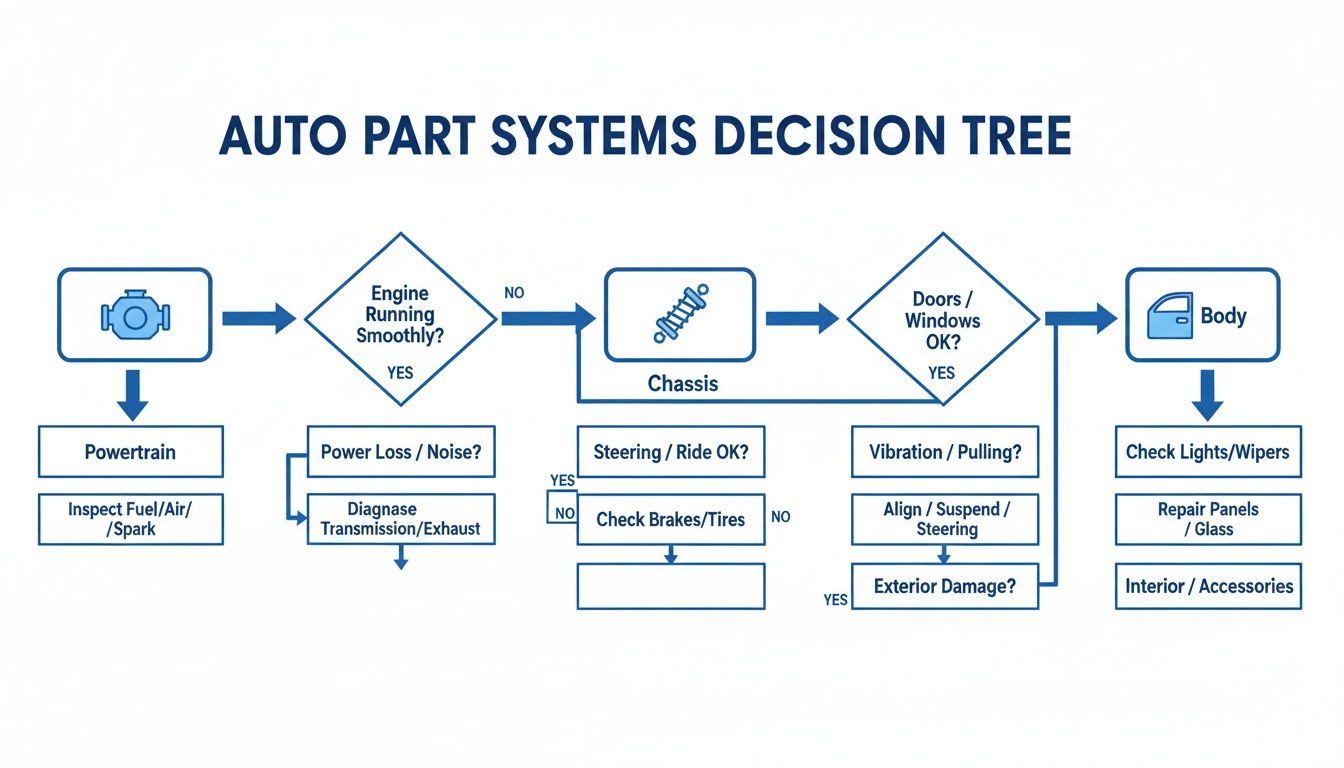
Think of this as a way to filter your options. By starting at the broadest level—like Powertrain or Chassis—you can quickly drill down into specific components and streamline your initial research.
The Classification Journey: A Real-World Example
Let's walk through the process with a common item: a set of four 18-inch aluminium alloy road wheels for a passenger car.
- Identify the Correct Chapter: We know the wheels are for a vehicle, so our immediate starting point is Chapter 87, which covers vehicles and their parts. Simple enough.
- Select the Right Heading: Within Chapter 87, we need to find the specific heading for parts and accessories. A quick scan leads us directly to Heading 87.08, which is for "Parts and accessories of the motor vehicles…"
- Narrow to the Precise Subheading: Now for the final detail. We skim the subheadings under 87.08 until we find 8708.70, which is explicitly for "Road wheels and parts and accessories thereof." It’s a perfect match.
The final six-digit international HS code is 8708.70. This logical progression, backed by what we know about the product's function (a road wheel) and material (alloy), gives us a high degree of confidence.
Of course, this was a straightforward example. More complex components, especially in electrical systems, often require a much deeper analysis. You can see a similar detailed breakdown in our guide to classifying the cable HS code.
The most important habit you can build is documenting your rationale. Write down why you chose Chapter 87, then Heading 87.08, and finally Subheading 8708.70. This "classification justification" is invaluable if a customs authority ever questions your decision.
Leveraging Online Tools and Databases
Thankfully, you don't have to do this with a dusty, printed manual anymore. Modern classification relies on powerful online tools that speed up the process and boost accuracy.
National customs websites, like those from Singapore Customs, offer searchable tariff databases. These are your ultimate source of truth for country-specific codes and duty rates.
Using these tools effectively is key. Start by searching with broad terms ("wheel," "brake pad") and then use the technical details you gathered earlier to refine your search. This data-driven approach not only helps find the right code but also prepares you for validation. This is particularly relevant in major trade hubs; for instance, Singapore's motor vehicle parts exports hit S$400 million in 2023, with a huge portion classified under the general HS code 8708.99 for non-specified parts. This shows just how critical precise classification is to avoid falling back on generic codes.
Documenting your choices clearly is the best way to ensure compliance and avoid costly shipping delays.
Using Shipment Data to Find and Validate HS Codes
Getting the theory right is one thing, but the best freight forwarders I know always back up their classifications with real-world data. Digging into global customs and shipment records is what takes you from simply following the rules to making truly confident, data-driven decisions about the right auto parts HS code.
This is your ultimate reality check. Instead of relying solely on your own interpretation of the tariff book, you can see exactly which HS codes major car manufacturers and their top suppliers are using for the same components, day in and day out. It’s an incredibly powerful way to build confidence in your own work.
Turning Data into Commercial Intelligence
This goes way beyond just checking your work. Shipment data is a goldmine for business development. It can transform a routine compliance task into a powerful source of real, actionable intelligence. By slicing and dicing trade data, you can instantly see who’s exporting or importing the specific auto parts you handle.
For instance, you could run a quick search for shipments under HS code 8708.40 (gearboxes) or 8511 (electrical starting equipment). In minutes, you’ll have a targeted list of high-potential leads. Your sales team can stop making cold calls and start having meaningful conversations with companies that are already moving the exact products you specialise in.
Think of it as a strategic map of the automotive supply chain. By tracking the flow of goods under specific HS codes, you can identify key players, understand trade lane volumes, and pinpoint exactly where your logistics services are most needed.
This method gives you a serious competitive edge. You can walk into a conversation with a potential client already knowing what they ship, where they ship it, and how often they do it. For a closer look at the local rules that govern this data, check out our complete guide on Singapore customs HS codes.
A Practical Example of Data-Driven Prospecting
You can see how powerful this gets when you look at actual market trends. Singapore's auto parts exports, for example, have seen incredible growth, expanding by 51% in a recent 12-month period with over 3,100 recorded shipments. This boom underscores the city-state's role as a key automotive hub, with major shipments heading to Peru, Indonesia, and the United States. You can see more on this booming trade on cypherexim.com.
So, what does a smart freight forwarder do with that information?
- Isolate the Data: Filter Singapore’s export records to focus on high-demand parts like batteries and electronics, which have their own specific HS codes.
- Identify Key Shippers: Pull a list of the top companies exporting these components out of Singapore.
- Craft a Targeted Pitch: Reach out with a compelling offer, referencing their specific trade lanes and highlighting your expertise in handling sensitive, high-value electronics.
This data-driven approach completely changes the conversation. It’s no longer, "Can we ship for you?" It becomes, "We see you're moving a lot of electronics to the US, and we have a specialised solution that could make that process a lot smoother for you."
How to Leverage Data Tools Effectively
To put this all into practice, you'll need access to a good trade intelligence platform. These tools pull together millions of customs records from around the world into a single, searchable database.
When you’re using one of these platforms, here are a few practical steps to find and validate any auto parts HS code:
- Search by Product Description: This is the most straightforward method. Type in a component like "shock absorber" or "alternator" and see which HS codes are most commonly used by other shippers.
- Analyse a Specific Company: Pick a major automotive brand you trust and pull up their bill of lading records. See how they classify their parts—it’s a great way to benchmark your own decisions.
- Prospect by HS Code: Flip the process around. Search for a specific HS code to generate a prospect list of companies that are actively trading those goods.
By weaving shipment data into your everyday workflow, you build a classification process that is not only more accurate but also commercially valuable. It's the difference between guessing and knowing.
How to Avoid Common Classification Mistakes
Even the most experienced logistics pros can get tangled up in the finer points of the auto parts HS code system. What seems like a tiny oversight can quickly snowball into hefty customs fines, infuriating shipping delays, and unhappy clients. Getting a handle on the most common slip-ups is the first real step toward building a supply chain that's both efficient and compliant.
These aren’t just obscure technicalities; they're everyday mistakes that happen because modern vehicles are just so complex. By learning to spot these potential problems ahead of time, you can guide your clients and help them sidestep expensive disruptions before they even start.
Misclassifying Kits and Sets
One of the most common mistakes I see is lumping a 'kit' of parts into one classification. Think of a standard maintenance kit that comes with an oil filter, an air filter, and a few spark plugs. It's not a single item in the eyes of customs. Each of those components has its own specific HS code and needs to be declared individually.
As a rule of thumb, if the parts can be sold and used on their own, they almost always need their own HS code. Trying to bundle them under one generic code is a huge red flag for customs officials and often leads to re-classification and penalties.
The only real exception is a true 'set put up for retail sale', which has a very strict definition under the General Interpretative Rules. If you're ever in doubt, it’s always safer to break the kit down and classify each part separately.
Confusing General Use vs. Specific Use
Another easy trap to fall into is mixing up a general-use part with one made specifically for a vehicle. Take a standard M8 bolt. Even if it's headed straight for a car engine assembly line, it's still just a bolt. It gets classified under Chapter 73 (Articles of Iron or Steel) as a generic fastener.
Its primary identity, according to the Harmonized System, is simply as a bolt, not an automotive part. The classification only shifts if the part has been designed, moulded, or engineered in a way that it can only be used on a motor vehicle. It's a subtle difference, but a critical one that often requires technical drawings to prove.
- General Use: A standard-issue bolt that happens to be used in a car. It’s classified as a bolt.
- Specific Use: A custom-moulded engine bracket that only fits one specific car model. It’s classified as an auto part.
This distinction really drives home why you need to understand a part’s design and function—not just its name—to nail down the correct auto parts HS code.
Frequently Asked Questions
When you're dealing with auto parts HS codes day in and day out, a lot of practical questions pop up. Getting the right answers can be the difference between a shipment that sails through customs and one that gets stuck in a costly delay. Let’s tackle some of the most common questions we hear.
How Often Do Auto Parts HS Codes Change?
Think of the Harmonized System as a living document. The World Customs Organization (WCO) does a major overhaul every five years to keep up with new technologies and global trade shifts. That's the big one.
But here’s the tricky part: individual countries can tweak their own tariff schedules much more often. To avoid getting caught out, you need to keep a close eye on the official customs websites for your destination countries. A good practice is to subscribe to their updates or use a solid trade intelligence platform that automatically keeps its code database current.
What Should I Do If Customs Disputes My HS Code?
It happens. If a customs agent flags your chosen auto parts HS code, don't panic. Your first move is to back up your classification with solid proof. Pull together everything you have: product spec sheets, technical diagrams, and a clear, written explanation of how you arrived at that code using the General Interpretative Rules (GIRs).
If they still don't agree, you can file a formal appeal. For a more permanent solution, consider applying for a binding ruling from the importing country's customs authority. This gives you a legally-backed confirmation of the correct code for that specific part, which is invaluable for future shipments.
A binding ruling is the ultimate safety net. It provides legal assurance from customs that your classification is correct, effectively ending any potential for future disputes on that specific item.
How Do I Classify a Used or Remanufactured Auto Part?
This is a common point of confusion, but the rule is actually quite simple. Used and remanufactured parts are almost always classified under the same HS code as the brand-new version. The code is based on what the part is and what it does, not its age or condition.
That said, you must be transparent about the part's condition and value on your commercial invoice and other documents. This is critical for customs to assess the right duties and taxes. Always double-check the rules for your destination country, as some have specific import regulations or licensing requirements for used goods.
Finding and reaching out to qualified shippers is simpler with the right tools. Coreties transforms global trade data into targeted lead lists, helping you connect with the right decision-makers in just a few clicks. Discover your next customer.
Leave a Reply