Tag: customs classification

  • Your Guide to T Shirt HS Code for Global Logistics

    Your Guide to T Shirt HS Code for Global Logistics

    The go-to t shirt hs code is almost always found under heading 6109. This heading is specifically for knitted or crocheted garments, which covers the vast majority of T-shirts on the market.

    From there, the classification gets more specific. Subheading 6109.10 is designated for cotton T-shirts, while 6109.90 is a catch-all for those made from other textiles, like polyester or rayon blends.

    Quick Guide to T Shirt HS Codes

    A neatly folded brown t-shirt displayed with its HS Code 6109 on a sign next to a laptop.

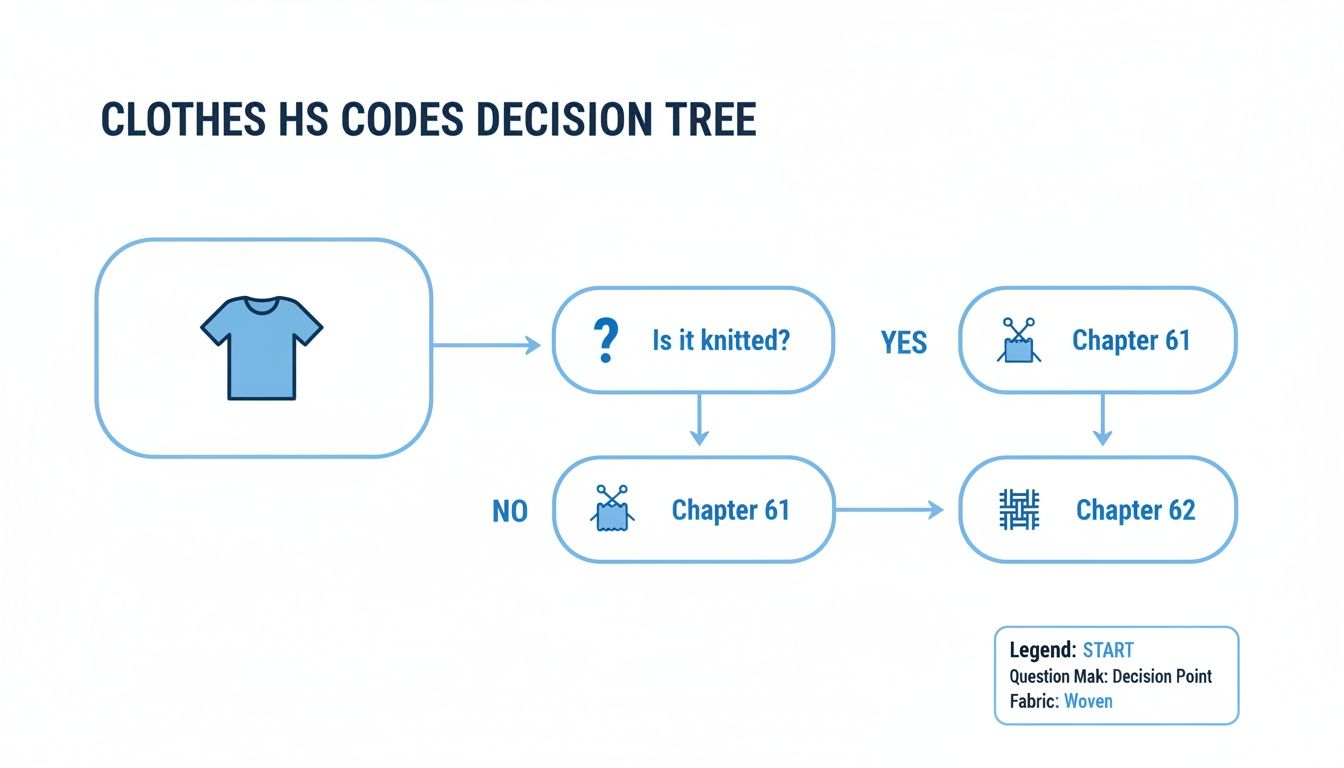
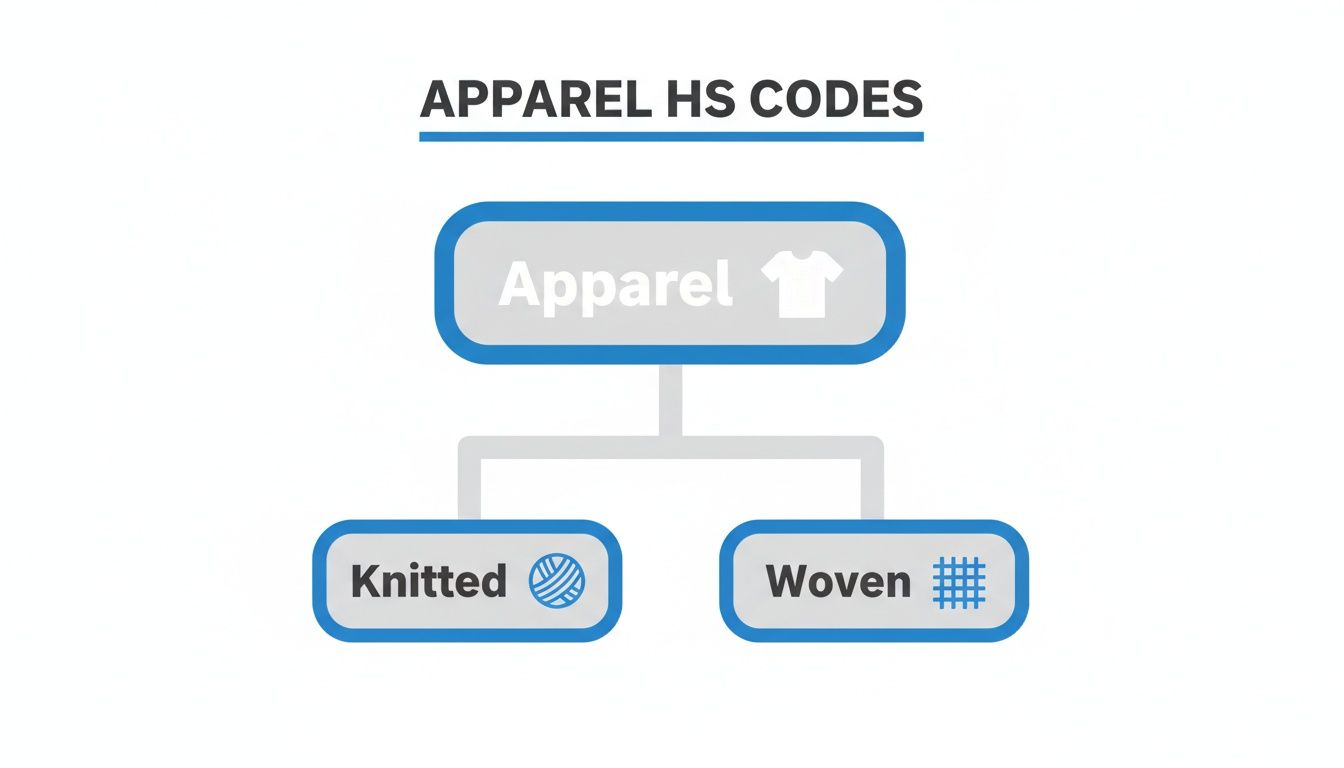
    Getting apparel classification right is absolutely critical for avoiding customs delays and fines. The first, and most important, step is understanding the fabric's construction. The Harmonized System makes a clear distinction right away: is the garment knitted (Chapter 61) or woven (Chapter 62)?

    Think about your average T-shirt. It's stretchy and made of interlocking loops of yarn—that's a knit. This is why their classification journey starts in Chapter 61.

    The primary heading you'll be working with is 6109, which covers "T-shirts, singlets and other vests, knitted or crocheted." The final digits of the code are then determined by the material. To make things easier for shippers and forwarders, we've put together a quick reference for the most common codes you'll encounter.

    If you want a more thorough breakdown of the entire classification process, you can learn more about how to find any harmonized code in our detailed guide.

    T Shirt HS Code Quick Reference (Chapter 61 – Knitted/Crocheted)

    Here’s a quick-reference table that breaks down the most frequently used 6-digit HS codes for T-shirts. Remember, these codes are based on the primary material composition.

    HS Code Subheading Material Type Description
    6109.10 Cotton T-shirts, singlets, and other vests made predominantly of cotton. This is the most common code for standard T-shirts.
    6109.90 Man-Made Fibers Covers items made from synthetic or artificial fibers like polyester, nylon, rayon, or acrylic.
    6109.90 Other Textile Materials A catch-all for T-shirts made from other materials, such as wool, silk, or linen, which are less common.

    Using the correct code from the start saves a massive amount of time and prevents costly errors. Always double-check the material breakdown before finalizing your customs declaration.

    Understanding the Harmonized System for Apparel

    Document 'Harmonized System' with pen and magnifying glass next to 'HS' blue notebook.

    Before you can assign the right HS code to a T-shirt, you have to understand the logic behind the entire Harmonized System (HS). At its core, the HS is the universal language of international trade, organizing every conceivable product into a logical hierarchy, from broad Chapters down to specific 6-digit Subheadings.

    Think of it as a library's card catalog, but for everything that crosses a border.

    This system is built on a foundation known as the General Interpretative Rules (GIRs). These rules are the official playbook for classifying goods, and they become absolutely critical when you're dealing with items that aren't straightforward. For instance, GIR 3(b) is the rule you'd turn to when deciding the "essential character" of a T-shirt made from a cotton-polyester blend.

    For any logistics pro, getting this right isn't just about accuracy—it's about avoiding steep fines and delays. A firm grasp of these rules means you can classify apparel with confidence and even use customs data to find new sales leads. If you want to go deeper, you can find the official texts in various online harmonized code books.

    Detailed Breakdown of HS Code 6109 for T-Shirts

    When you're classifying T-shirts, your journey almost always starts with one critical number: Heading 6109. This is the go-to heading for "T-shirts, singlets and other vests, knitted or crocheted."

    Pay close attention to the phrase knitted or crocheted. This describes the stretchy, interlocking loop construction found in virtually every T-shirt you've ever worn. Getting this right is the first step, as this single heading covers the vast majority of T-shirt shipments worldwide.

    But that's just the start. The Harmonized System requires you to get more specific about the material composition. This is where importers and carriers need to be precise, as the next set of digits determines customs compliance and the final duty bill.

    Cotton vs. Other Materials

    From Heading 6109, the classification splits down two primary paths based on the fabric:

    • HS Code 6109.10 is reserved for T-shirts made predominantly of cotton.
    • HS Code 6109.90 is the catch-all for T-shirts made from any other textile. This includes polyester, rayon, or even blends where another fiber's weight percentage is higher than cotton.

    Navigating Other Common Apparel HS Codes

    While the vast majority of T-shirts are knitted, getting this seemingly small detail right is absolutely vital for accurate classification. One wrong move can lead to costly customs errors. For instance, a woven shirt looks a lot like a T-shirt, but from a customs perspective, it's an entirely different product.

    This is where the fabric's construction becomes the deciding factor. Woven fabrics use a grid-like pattern of interlaced threads, giving them a rigid structure with minimal stretch. Knits, on the other hand, are made from looped yarn, which is why your typical T-shirt is so stretchy and comfortable. This single distinction sends woven shirts to a completely different section of the Harmonized System—Chapter 62.

    Under this chapter, men's or boys' woven shirts are found under heading 6205, while women's or girls' versions fall under 6206. It doesn't stop there. Other similar garments, like sweatshirts, also have their own unique codes. Even though they are knitted, they belong under heading 6110, not with T-shirts.

    This simple decision tree helps visualize that first critical step for classifying any T-shirt correctly under its primary heading, 6109.

    Flowchart guiding T-shirt HS code determination based on fabric type, differentiating cotton and other materials.

    As you can see, once you've confirmed the garment is a knit T-shirt, the next question is always about the material. This directs you to either 6109.10 for cotton or 6109.90 for all other textile materials. For any logistics professional mining customs data, having a firm grasp of these adjacent codes isn't just helpful—it's essential for accurate analysis and finding real opportunities.

    Analyzing Global T-Shirt Logistics Opportunities

    It might just be a T-shirt, but for savvy freight forwarders and carriers, this simple garment is a goldmine of opportunity. The key is understanding that the t shirt hs code is far more than a customs formality. It’s a powerful tool that helps uncover high-volume, predictable trade lanes just waiting for the right logistics partner.

    By digging into this data, you can see the true scale of the market and pinpoint exactly which countries are the major players in exporting and importing. In 2023 alone, global T-shirt exports hit a staggering $51.8 billion. This isn't just an abstract number; it's a direct indicator of consistent, high-volume freight.

    For sales teams, this kind of insight changes the game. You can stop making cold calls and start having informed conversations backed by real numbers. For instance, knowing that Asia drives 55.4% of T-shirt exports, with giants like China and Bangladesh leading the charge, tells you exactly where to focus your business development efforts. You can learn more by exploring these T-shirt export trends.

    Ultimately, this data turns prospecting from a shot in the dark into a precision-guided strategy.

    How Country-Specific Variations Impact Duties

    Think of the first six digits of an HS code as a global standard. It’s the language everyone agrees on. But once a shipment reaches a specific country's border, that's where the conversation gets a lot more detailed.

    Individual countries take that 6-digit foundation and tack on their own numbers—creating longer, more specific national tariff codes. For instance, the United States uses a 10-digit Harmonized Tariff Schedule of the United States (HTSUS) code, while the European Union uses an 8-digit Combined Nomenclature (CN) code. It’s how their customs authorities drill down into the finer points of a product.

    Let's stick with our men's cotton T-shirt example. Globally, it starts as HS code 6109.10. But depending on where you're sending it, that's not the full story. Is it for men or boys? Is it 100% cotton or a blend? Does it have a pocket? These subtle differences are captured by the additional digits, and each variation can trigger a completely different duty rate.

    To give you a clearer picture, here’s how the code and duty rate can change for the exact same T-shirt depending on its destination.

    HTS Code and Duty Rate Comparison for a Men's Cotton T-Shirt

    Country/Region Full Commodity Code Description Detail Standard Duty Rate
    United States 6109.10.00.04 T-shirts, singlets, tank tops and similar garments, knitted or crocheted: Of cotton: Men's or boys': T-shirts 16.5%
    European Union 6109.10.00.10 T-shirts, singlets and other vests, knitted or crocheted: Of cotton: Men's or boys' 12%
    Canada 6109.10.00.10 T-shirts, singlets and other vests, knitted or crocheted: Of cotton: For men or boys 18%
    United Kingdom 6109.10.00.10 T-shirts, singlets and other vests, knitted or crocheted: Of cotton: Men's or boys' 12%
    Australia 6109.10.00.23 T-shirts, singlets and other vests, knitted or crocheted: Of cotton: Men's and boys' T-shirts 5%

    As you can see, a simple men's cotton T-shirt can have a duty rate as low as 5% or as high as 18%, all depending on the destination market's specific commodity code.

    This is precisely why you can't just estimate your import taxes. Getting the final, country-specific code right is non-negotiable if you want to accurately calculate your landed cost and avoid nasty financial surprises.

    Using HS Codes to Generate Freight Sales Leads

    For any logistics sales team, understanding the T-shirt HS code is more than just a customs formality; it’s a direct line to new business. By mining global customs data, freight forwarders can transform what looks like a simple trade statistic into a list of qualified sales leads.

    The process is surprisingly straightforward. It all starts with filtering shipment data for HS Code 6109, which immediately surfaces active T-shirt shippers and importers. From there, you can zero in on specific trade lanes or export hubs. For example, China’s garment exports hit a staggering $38.1 billion in just the first half of 2026, making it a prime hunting ground for new logistics partners. You can see more on these global apparel export dynamics.

    Of course, finding a list of potential clients is only half the battle. The next step is effective outreach. It’s well worth the time to learn how to write a cold mail that actually gets replies and turn that raw data into a solid sales pipeline. If you want to dive deeper into this prospecting method, you can learn more about using an HS code filter to get highly targeted results.

    Common Questions on T-Shirt HS Codes

    Even seasoned shippers run into the same questions when classifying T-shirts. Getting the HS code right is non-negotiable, so let's clear up a few of the most frequent sticking points.

    What Is the Main HS Code for T-Shirts?

    Your starting point will almost always be heading 6109. This is the designated code for "T-shirts, singlets and other vests, knitted or crocheted."

    Most standard T-shirts are made from knitted fabric. From there, you just need to identify the material:

    • 6109.10 is the subheading for T-shirts made of cotton.
    • 6109.90 is for T-shirts made from other textiles, like polyester, viscose, or blends.

    How Do I Classify a Blended Fabric T-Shirt?

    This is where many people get tripped up. For blended fabrics, classification is determined by what's known as the "essential character." In simple terms, this usually comes down to the material that has the predominant weight.

    For example, a T-shirt made of 60% cotton and 40% polyester is classified as a cotton garment under 6109.10. If that blend were flipped to 60% polyester and 40% cotton, it would fall under 6109.90 as a garment of other textile materials.

    The T-shirt market is a huge piece of the global apparel trade. With the entire industry projected to reach $1.84 trillion in 2026, the volume of goods moving under HS code 6109 is massive. Discover more about global apparel industry statistics.


    With Coreties, you can transform complex trade data into a simple, powerful tool for finding your next customer. Stop guessing and start targeting qualified shipper leads with precision.

  • Your Complete Guide to the Sticker HS Code in Singapore

    Your Complete Guide to the Sticker HS Code in Singapore

    Finding the right HS code for stickers might seem like a small detail, but when you're shipping to Singapore, it's one of those things that can make or break your timeline and budget. Getting it wrong can lead to customs delays and unexpected fines, all because the code hinges on one primary factor: what the sticker is made of.

    Why Your Sticker's HS Code Is So Important for Singapore Shipments

    Think of the Harmonized System (HS) code as a universal passport for your products. It's a standardised numerical code that tells customs officials everywhere exactly what you're shipping without them ever needing to open the box. For an item as common as a sticker, you'd be surprised how much nuance there is—and how much that little number matters.

    A professional man reviewing paperwork near cardboard boxes with a "Correct HS Code" sign, related to international shipping.

    Nailing the sticker HS code is your ticket to a smooth clearance process with Singapore Customs. A wrong code can stop your shipment in its tracks, triggering a cascade of frustrating and costly problems.

    The Real Risks of Getting It Wrong

    Classifying a sticker incorrectly isn’t just a simple typo; it's a formal declaration that can have serious repercussions. The main things that determine a sticker's classification are its material—is it paper or plastic?—and whether it's self-adhesive. This distinction is critical because paper and plastic fall into completely different chapters of the HS tariff, each with its own set of rules for duties and taxes.

    Here’s what can happen if you make a mistake:

    • Painful Delays: Customs will flag a shipment with a mismatched HS code for inspection. This doesn't just hold up your stickers; it can stall an entire container's worth of goods.
    • Surprise Fines: Singapore Customs doesn't take inaccurate declarations lightly and can impose penalties that eat into your profit margins.
    • Paying Too Much in Duties: You could easily classify a duty-free sticker under a code that attracts tax, meaning you’re paying more than you need to.
    • Unhappy Clients: If you're a freight forwarder, these kinds of delays and unexpected costs are a fast way to lose a client's trust and damage your reputation.

    A correct HS code is more than just a number on a form. It’s a signal to customs that you know your products and are serious about complying with trade regulations.

    In the end, taking the time to understand the logic behind sticker HS codes gives you a real operational edge. It means your shipments move predictably, your costs are kept in check, and your clients remain happy. For a broader look at how these codes work for all sorts of products, our general guide on using the HS code in Singapore is a great place to build your foundational knowledge and avoid common mistakes.

    Paper or Plastic? Your First Big Decision

    When you’re staring at a box of stickers and need to find its HS code, the first question you have to ask is surprisingly simple: what’s it made of? Is it paper or plastic?

    This single detail is the most critical factor in your entire classification process. It’s the fork in the road that sends your shipment down one of two completely different paths in the Harmonized System. Get it right, and you’re on your way to a smooth clearance. Get it wrong, and you’re setting yourself up for customs headaches.

    Think of it this way: paper stickers are handled under HS Chapter 48, while their plastic or vinyl counterparts belong in HS Chapter 39. These two chapters have entirely separate rules and headings, so mixing them up is a recipe for delays.

    The Paper Trail: Classifying Under Chapter 48

    Let’s start with the most common type: paper-based stickers. We’re talking about everyday items like shipping labels, basic branding stickers for packaging, or the price tags you see in a retail store. They’re functional but not built to last against the elements.

    Because their soul is paper, they fall squarely within Chapter 48. The primary heading you’ll be looking at is 4821, which covers “Paper or paperboard labels of all kinds, whether or not printed.” This heading acts as a broad umbrella for most standard paper stickers.

    • A roll of printed address labels for an e-commerce business.
    • Sheets of discount price stickers for a supermarket.
    • Simple, non-laminated logo stickers stuck on cardboard boxes.

    The Plastic Path: Navigating Chapter 39

    Now, let’s talk about the tough stuff. Plastic stickers are all about durability. This is where you’ll find vinyl decals for cars, weatherproof warning labels for industrial equipment, or glossy, decorative stickers for laptops. Their defining feature is the plastic material, which is often a form of polyvinyl chloride (PVC).

    These resilient products are classified under HS Chapter 39, the chapter for plastics. The heading you’ll almost always land on is 3919, which covers “Self-adhesive plates, sheets, film, foil, tape, strip and other flat shapes, of plastics.” If the sticker is designed to withstand sun, rain, or general wear and tear, it’s a Chapter 39 item.

    The difference is all about purpose and resilience. A paper label is just printed matter, but a vinyl decal is a durable plastic article.

    In the eyes of customs, the material isn't just a physical trait—it's the sticker's entire identity. This distinction directly affects duties, taxes, and any other regulations that might apply.

    To give you a clearer picture, here’s a simple breakdown of where different stickers typically land.

    Common HS Codes for Paper and Plastic Stickers

    Sticker Type Governing HS Chapter Common HS Heading (6-Digit) Typical Products
    Paper Stickers Chapter 48 (Paper and Paperboard) 4821.10 or 4821.90 Shipping labels, address labels, price tags, simple product stickers for indoor use.
    Plastic/Vinyl Stickers Chapter 39 (Plastics and articles thereof) 3919.10 or 3919.90 Car decals, bumper stickers, weatherproof industrial labels, durable branding decals.

    In Singapore, these classifications are drilled down to an 8-digit level. For example, self-adhesive plastic shapes often fall under 3919.10.00, while many paper labels are classified under a code like 4821.90.90. You can always verify the exact national tariff by using official resources like the Singapore Customs HS classification portal.

    By starting with this simple paper-versus-plastic question, you lay the groundwork for an accurate declaration. It’s the first and most important step to getting your classification right.

    Refining Your HS Code with Secondary Factors

    Once you’ve settled on the primary material—paper or plastic—you're not quite at the finish line. Think of it like this: you've found the right neighbourhood (Chapter 48 or 39), but now you need to find the exact street address. Several secondary factors come into play to help you pinpoint the most precise HS code for your stickers.

    Customs officials look at these finer details to understand the sticker's specific form and function. It's their way of making sure products with different commercial uses end up in the right categories. Getting this next layer right is crucial, especially when you're dealing with shipments that are a bit more complex than just a simple label.

    Printed vs. Unprinted

    A big fork in the road is whether your stickers are printed or blank. This distinction is all about separating raw materials from finished goods. After all, a roll of blank thermal labels waiting to be used in a warehouse printer serves a very different purpose than a sheet of colourful, branded logo stickers ready to be slapped on a product.

    For instance, within HS heading 3919 (plastic stickers), you'll often find that national tariffs have specific subheadings for printed versus unprinted rolls or sheets. A blank roll might be classified as a base material, while a printed one is clearly a finished article.

    This decision guide is a great starting point for that first, most important sorting factor: the material.

    A flowchart decision guide for selecting sticker material, differentiating between paper and plastic based on use cases.

    As the flowchart shows, you always have to start by identifying the core material. That single decision determines which chapter of the HS tariff you’ll be digging into.

    Rolls vs. Sheets

    The format of the stickers—how they're supplied—also makes a difference. Are they wound onto a massive roll for a labelling machine, or are they cut into individual sheets for someone to peel off by hand? This detail is often a strong clue about the sticker's intended market, whether it's industrial or consumer.

    • Rolls: Usually point to a commercial or industrial application. Picture a 5,000-count roll of barcode labels destined for a factory floor. These often have their own subheadings for goods supplied "in rolls."
    • Sheets: Tend to suggest consumer or office use. Think of decorative sticker sheets for a scrapbook or A4-sized labels you can run through a desktop printer.

    Even if the stickers are made from the exact same material, this simple difference in format can push them into different 8-digit or 10-digit national HS codes.

    The Harmonized System is built on the idea of classifying goods by their "essential character." Secondary factors like printing and format help define this character. They move beyond just what the product is made of to what it is and how it's used in trade.

    By taking a closer look at these extra details—whether it’s printed, how it’s formatted, or even the type of adhesive—you can classify with much greater accuracy. This careful approach ensures your customs declaration is a true reflection of the product, which means fewer questions from customs and a smoother shipping process.

    How to Verify Your Sticker HS Code for Singapore

    So, you’ve done your homework. You’ve analysed the sticker’s material, considered its use, and landed on what you believe is the right HS code. But in the world of customs, a good guess isn't good enough. You need to be sure.

    Verifying your code is the last, and arguably most important, step. It's what separates a smooth clearance from a costly delay. Thankfully, Singapore Customs offers some excellent, user-friendly tools to help you cross the finish line with confidence. Taking a few minutes to confirm your code proactively can save you a world of headaches later on.

    Using the Singapore Customs Search Engine

    Your first port of call should always be the official HS/CA Product Code Search Engine on the Singapore Customs website. This is the definitive source for confirming the 8-digit code you’ll need for your declaration. It's a simple-to-use database where you can search by keyword or browse the tariff chapters yourself.

    Here’s what the search portal looks like:

    This is where theory meets practice. You can plug in terms like "self-adhesive paper label" or "vinyl decal" to see how Singapore Customs officially categorises these items.

    A few tips for getting the best results:

    1. Start broad. Use general keywords like "self-adhesive plastic" or "paper label" first.
    2. Read the descriptions carefully. Sift through the results and find the heading that truly matches your product's specifics.
    3. Focus on the full 8-digit codes. These are the ones required for Singapore, so don't stop at the 6-digit international heading.

    Getting comfortable with this tool is a key skill for anyone in logistics. If you're just starting out, our detailed guide on how to perform an HS code search in Singapore offers more in-depth, step-by-step advice.

    Applying for an Official Classification Ruling

    What if your stickers are unusual, part of a massive shipment, or you just can’t shake the feeling of uncertainty? For those high-stakes situations, you can seek absolute legal certainty by applying for a Classification Ruling from Singapore Customs.

    Think of it as the ultimate safety net. A Classification Ruling is a formal, legally binding decision on the HS code for your specific product.

    A Classification Ruling removes every bit of guesswork. It’s a definitive answer straight from the authorities, protecting you from any future disputes over that product's classification.

    Of course, this is a more formal process. It takes time and requires you to submit a detailed application with product specs, samples, and your own proposed HS code. But when you get that ruling back, you have a rock-solid foundation for every future shipment of that item, guaranteeing consistency and compliance every single time.

    Find More Leads with HS Code Data

    Knowing your way around sticker HS codes isn't just for clearing customs. For smart freight forwarders, it's a powerful tool for finding your next best customers. Most see HS codes as just another compliance headache, but they’re actually a map that can lead you directly to new business.

    Think about it. When you organise this data correctly, it becomes a pipeline of qualified leads.

    A person in a blue shirt pointing at a laptop screen displaying data, with 'HS Code Leads' banner.

    What if you could pull a list of every single company in Singapore that consistently imports goods under HS code 4821 (paper labels) or 3919 (plastic stickers)? That’s not just a random contact list. It’s a pre-vetted roster of businesses you know have a regular need for the exact shipping services you offer.

    Turning Data into Deals

    Modern data platforms can take raw customs information and turn it into real sales intelligence. Instead of your team making endless cold calls, they can filter potential clients by the specific sticker HS codes they already handle. This allows for a much more personalised—and effective—first contact.

    Let's say you find a company bringing in large quantities of vinyl decals from Vietnam under HS code 3919. Armed with that knowledge, you can craft a targeted email that speaks their language, offering a specialised shipping solution for their specific Vietnam-to-Singapore route. You're immediately showing them you understand their business and have a direct solution for their needs.

    This completely flips the script on traditional sales. You stop selling a generic service and start presenting a solution to a problem you already know the prospect has, all backed by solid data.

    Of course, to get started, you'll often need to gather a good amount of data from various online sources. Learning how to scrape data from websites into Excel can give you the raw material you need for a deeper analysis.

    The Scale of the Opportunity

    The potential market here is massive. For logistics teams focused on packaging material importers, commodities under HS 39 and 48 make up about 5-7% of Singapore’s total imports. In recent years, that's translated to a value of roughly S$15-20 billion annually.

    This level of detail allows sales teams to zero in on high-value trade lanes, like specific Southeast Asian packaging routes. The right platforms can supercharge this process, using HS-specific customs insights to help you craft dozens of targeted, personalised emails every hour. It’s a huge efficiency gain.

    If you want to dive deeper into this strategy, check out our guide on how to use an HS code filter to find qualified leads.

    This entire approach connects a technical detail—the humble sticker HS code—to a very real business outcome: faster sales growth. It’s how you move your business development from a game of chance to a data-driven science.

    Common Questions About Sticker HS Codes

    Even after you've got the basics down, classifying stickers can throw some real curveballs. We often see experienced shippers and freight forwarders get tripped up by the same tricky scenarios. Let's walk through some of the most common questions that pop up, so you can handle those grey areas and finalise your customs declarations with confidence.

    What Happens If I Use the Wrong HS Code?

    Using the wrong sticker HS code for a shipment heading to Singapore is more than just a paperwork mistake—it can trigger a cascade of expensive problems. The most immediate issue is that Singapore Customs will likely flag your shipment for inspection. That means serious delays at the port, which throws a wrench in your supply chain and can hurt your reputation for being a reliable partner.

    But the headaches don't stop at logistics. The financial sting can be sharp, too. Customs authorities will hit you with penalties for incorrect declarations. If the wrong code led to you underpaying the Goods and Services Tax (GST), you're on the hook for the difference, plus any fines they tack on. Make this mistake too often, and you can expect much closer scrutiny on all your future shipments, turning every import into a potential hassle.

    Are Samples of Stickers Classified Differently?

    This is a classic point of confusion. The short answer is no; the core classification doesn't change. A sample of a vinyl decal is still a vinyl decal, so it belongs under Chapter 39. A paper label sample still falls under Chapter 48. The material is what drives the HS code, not whether it's a sample or a full commercial order.

    Where things get different is in the declaration process and the potential tax relief. If you clearly declare them as "trade samples" and assign a nominal value (or "no commercial value") on your invoice, you might be eligible for GST relief or duty exemption under certain schemes.

    The core HS code for a sample stays the same. What changes is how you declare it and whether you can get tax relief. Always check the latest Singapore Customs guidelines on importing trade samples to make sure you qualify for any breaks.

    Getting this right is key. It helps you avoid unexpected tax bills while staying fully compliant with the fundamental classification rules.

    How Do I Classify a Sticker Pack with Both Paper and Vinyl?

    What happens when you’re importing a retail pack that mixes different materials, like a set with both paper and vinyl sticker sheets? This is where the customs rulebook gives us a specific guideline: General Interpretative Rule (GIR) 3(b), which covers "goods put up in sets for retail sale."

    The rule says the entire set should be classified under the single material or component that gives it its essential character. So, you have to figure out which sticker type is the star of the show. Ask yourself:

    • What’s it worth? Are the vinyl stickers significantly more expensive to produce than the paper ones?
    • How much is there? Is there a much larger quantity or weight of one material compared to the other?
    • What’s the main point? Which sticker type is the main attraction or the primary reason someone would buy the pack?

    If the vinyl stickers are clearly the main event, you’d classify the whole pack under the right heading in Chapter 39.

    What If the Essential Character Is Unclear?

    Once in a while, you’ll come across a sticker pack that’s perfectly balanced. Maybe it's a 50/50 split in value and quantity, with no obvious "main" component. When you can't determine the essential character, you move on to the next rule in the playbook, GIR 3(c).

    This rule is a straightforward tie-breaker: classify the entire set under the heading that appears last in numerical order among those you're considering.

    Since plastic (Chapter 39) comes before paper (Chapter 48) in the Harmonized System, a mixed pack with no clear essential character would be classified under the relevant heading in Chapter 48.


    Finding and engaging with businesses that import stickers shouldn't be a game of chance. With Coreties, you can transform customs data into a powerful lead generation engine. Our platform helps you filter companies by specific HS codes, identify key decision-makers, and craft personalised outreach that speaks directly to their shipping needs. Stop guessing and start connecting with qualified prospects today. Discover your next best customer at Coreties.

  • Laptop HS Code Guide: Classify Laptops for Smooth Customs

    Laptop HS Code Guide: Classify Laptops for Smooth Customs

    When you're shipping laptops, one number is more important than almost any other: HS code 8471.30. This is the six-digit code that customs agencies around the world use to identify portable computers, making it the universal starting point for any laptop shipment.

    What Is the HS Code for Laptops

    Think of the Harmonized System (HS) as an international language for trade. It’s like a postal code for products, telling customs exactly what’s inside a box without them having to open it. Just like a wrong address can send a package to the wrong city, the wrong HS code can send your shipment into a black hole of customs delays and fines.

    Getting the laptop HS code wrong can set off a domino effect of expensive problems. Your shipment could get flagged for a physical inspection, racking up storage and demurrage fees while it sits at the port. Worse, customs might slap you with a penalty for a misdeclaration, which hurts your bottom line and damages your reputation with both the authorities and your client. In the world of logistics, where timing is everything, these kinds of mistakes can quickly turn a profitable shipment into a costly headache.

    Why This Code Matters in Singapore

    For anyone in logistics working in or out of Southeast Asia, knowing your way around laptop HS codes is a real competitive edge. Singapore isn't just a major port; it's a global nerve centre for electronics, acting as a critical hub for both importing and re-exporting high-tech goods.

    The numbers speak for themselves. In 2022, information and communication technology (ICT) goods—a category that includes laptops under HS code 8471—made up a massive 31.12% of Singapore’s total goods imports.

    This incredible volume means Singapore Customs is extremely thorough when it comes to classification. As a freight forwarder, proving you have this expertise means you can offer a smoother, faster, and more reliable service.

    This knowledge isn't just about avoiding problems, either. Understanding key trade data like this helps you spot high-volume shippers and market trends, turning customs compliance into a powerful tool for growing your business. You can dive deeper into these figures with the World Bank data on Singapore's ICT imports.

    Decoding the Numbers in HS Code 8471.30

    Think of a laptop's HS code less like a random number and more like a postal address for your goods. Each pair of digits narrows down the location, telling customs officials exactly what’s inside the box. Getting this "address" right is fundamental for smooth clearance.

    The journey starts at the broadest level with the first two digits, the Chapter. For any laptop, this is Chapter 84: Nuclear reactors, boilers, machinery and mechanical appliances; parts thereof. It’s a huge category, but it immediately tells customs we’re dealing with a machine, not a t-shirt or a piece of fruit.

    Next, we zoom in with the following two digits, the Heading. The code 71 specifies Automatic data-processing machines and units thereof. This is a critical step that separates laptops and computers from all the other machinery in Chapter 84, like industrial pumps or engines. Just stopping at the four-digit code 8471 is a surprisingly common mistake, but it leaves the declaration far too vague for customs.

    Pinpointing the Product with Subheading 30

    The final two digits are where we get to the point. The Subheading 30 nails the classification down to a Portable automatic data-processing machine, weighing not more than 10 kg, consisting of at least a central processing unit, a keyboard and a display. This is the minimum level of detail that customs authorities, particularly in diligent hubs like Singapore, demand.

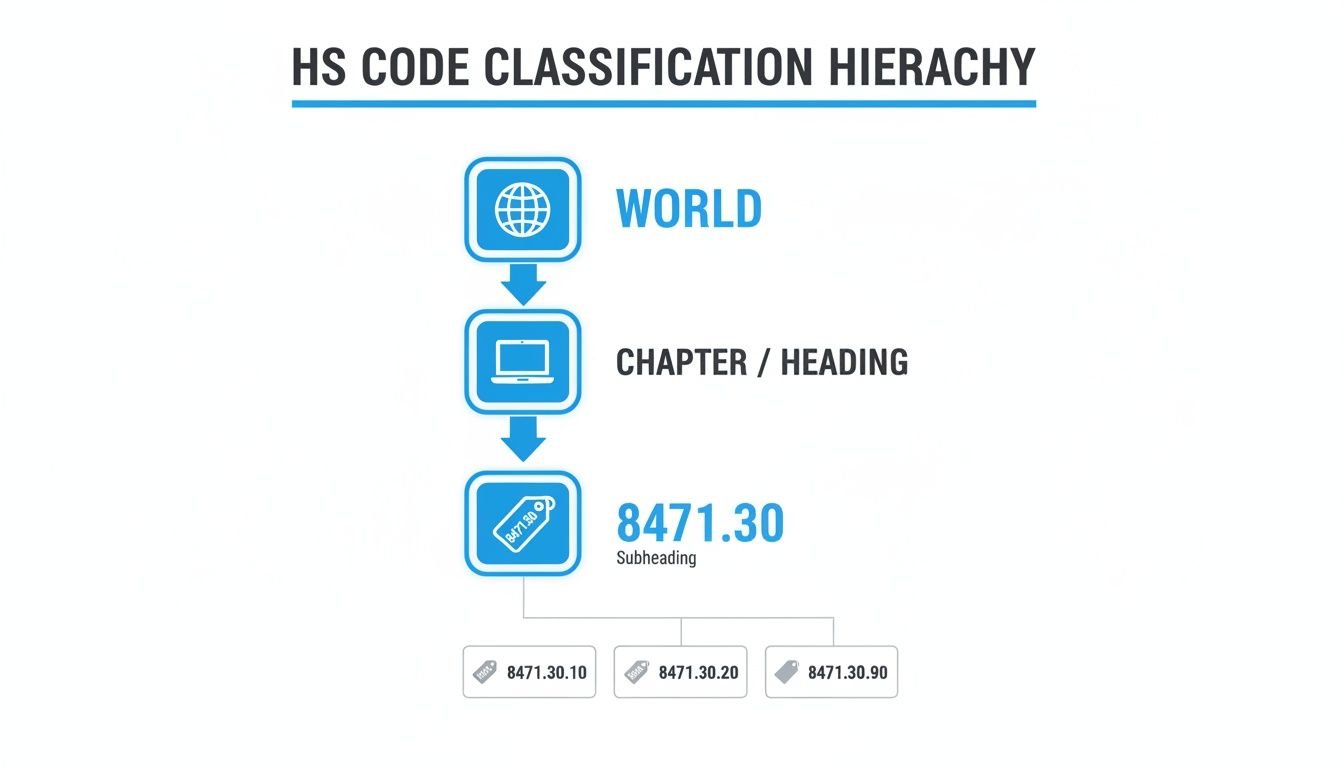
    This visual shows exactly how the classification system funnels from a massive global category right down to a specific product.

    HS Code classification hierarchy explaining the breakdown from world level to specific product subheadings.

    As you can see, the code logically progresses from the general (Machinery) to the highly specific (Portable Computer), with each number adding vital information.

    To really see how it all fits together, let’s lay it out in a table.

    Breaking Down the Laptop HS Code 8471.30

    This table shows the clear, hierarchical structure of the Harmonized System code for portable computers. Each segment builds upon the last, providing an increasingly precise product definition.

    Code Segment Designation Description
    84 Chapter Machinery and mechanical appliances
    71 Heading Automatic data-processing machines
    30 Subheading Portable, weighing not more than 10 kg

    Grasping this simple structure is your best defence against shipment rejections. It ensures your duty and tax calculations are spot-on from the very beginning, preventing costly delays and rework down the line.

    Classifying Laptop Accessories, Batteries, and Parts

    A laptop rarely travels alone. It’s almost always boxed up with a power adapter, maybe a mouse, and sometimes a spare battery. This creates one of the most common puzzles in customs classification: are you shipping one product, or several? Getting this wrong is a surefire way to cause delays and rack up penalties.

    The secret lies in figuring out if the items qualify as a "set" in the eyes of customs. If all the accessories are packaged and sold together with the laptop in a single retail box, you can usually classify the whole lot under the laptop's primary HS code, 8471.30. But if you’re shipping them separately—as spare parts or standalone items—each one needs its own specific HS code.

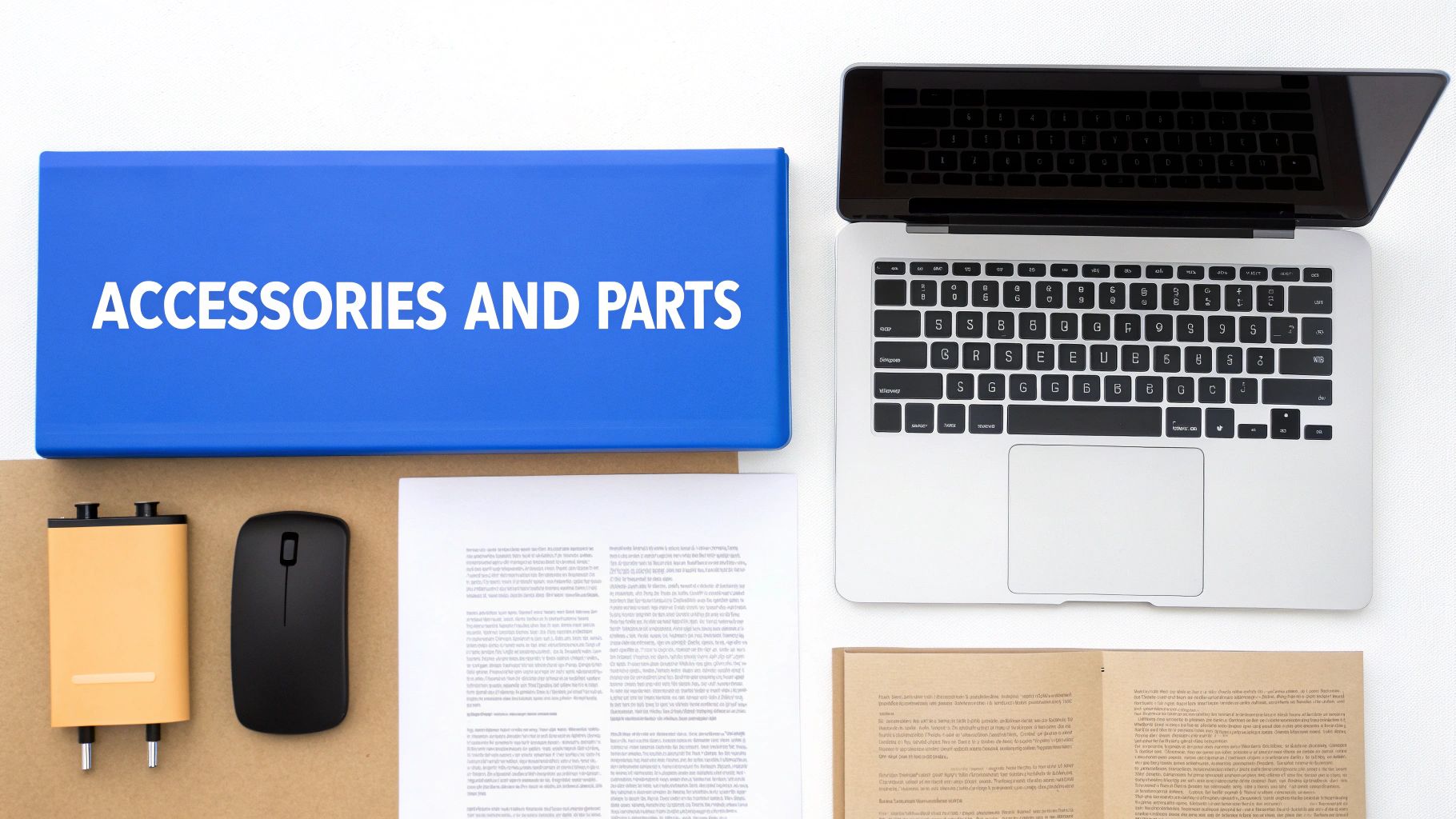
    A flat lay image displaying laptop, mouse, power adapter, and 'ACCESSORIES AND PARTS' box.

    Common Accessory HS Codes

    When accessories and parts have to be declared on their own, you need to know their individual codes. Each component has a specific HS code based on what it does.

    Here are some of the most frequent codes you'll run into:

    • Lithium-Ion Batteries: You’ll almost always find these under HS code 8507.60. Given their hazardous nature, batteries get a lot of attention from customs officials.
    • Power Adapters (AC/DC Converters): These belong under HS code 8504.40.
    • External Mice or Keyboards: As input devices, these are typically classified under 8471.60.
    • Carrying Cases: This one is tricky. A textile bag might fall under Chapter 42, but if it's specifically shaped and fitted for the laptop, it might be classified along with the computer.

    A good rule of thumb is this: if an accessory has its own job to do and could easily be sold and used on its own, it probably needs its own HS code. Don't take the risky shortcut of lumping everything under one code.

    Beyond just the codes, making sure these items are physically secure is vital. Using strong tamper-evident packaging helps protect these valuable goods from theft or damage while they're on the move. And since you're dealing with electronics, you might find yourself shipping internal components, too. If that's the case, our guide on the PCB board HS code can be a huge help.

    Declaring every item correctly from the start stops customs from reclassifying your goods and hitting you with unexpected duties, making sure your shipment gets where it's going without a hitch.

    Common HS Code Mistakes to Avoid

    When it comes to customs, precision is everything. A tiny error in a laptop's HS code can snowball into a massive headache, but it's rarely a simple typo that causes the biggest problems. The most expensive mistakes usually come from a subtle misunderstanding of the product itself.

    These aren't just clerical slip-ups. They're misinterpretations that can trigger incorrect duty payments, shipment seizures, and seriously strain your relationships with clients. Knowing where the common traps lie is the first step to building a classification process that's not just accurate, but bulletproof.

    Misclassifying Hybrid and Speciality Laptops

    One of the most common pitfalls is getting hybrid devices wrong. Take a 2-in-1 laptop with a detachable keyboard. It's easy to see why someone might classify it as a tablet under HS code 8471.41, which could have entirely different duty rates. The deciding factor is its main purpose. If it's designed and sold primarily as a portable computer, 8471.30 is almost always the right call.

    A good rule of thumb from customs is to classify a product based on its principal function. If that 2-in-1 device relies on its keyboard for its main jobs, it’s a laptop.

    A few other tricky scenarios pop up all the time:

    • Refurbished vs. New Units: You can't just declare a refurbished laptop as "new." While the HS code itself might be the same, the customs valuation will be different, which directly affects the duties and taxes owed.
    • Pre-loaded Enterprise Software: A laptop shipping with expensive, specialised software needs a second look. The value of that software can drastically change the item's total declared value. In some countries, it might even influence the classification itself.

    Getting these details wrong doesn't just mean delays. It chips away at your reputation for being a careful, compliant forwarder—and in logistics, that reputation is everything.

    Using HS Code Data to Find New Clients

    A laptop's HS code is far more than just a number for getting through customs. For a sharp freight forwarder or carrier, it's the key to unlocking a goldmine of business intelligence. This simple code can transform a routine compliance task into a powerful engine for growth.

    Think about it. By using global trade data platforms, you can filter shipments by HS code 8471.30. This instantly shows you who is importing laptops, where they're coming from, and in what quantities. Your sales process shifts from hopeful guesswork to a precise, data-backed strategy.

    Instead of shooting in the dark with cold calls, your team can pinpoint a company importing thousands of laptops from China into Singapore every month. Armed with this knowledge, you can craft a pitch that’s immediately relevant, referencing the exact trade lanes they’re already active on.

    Pinpoint High-Value Opportunities

    Using HS code data means you can focus your energy where it counts. You’re no longer relying on stale contact lists or broad market research; you’re targeting companies based on their actual, current shipping activity.

    This data-first approach gives you a serious edge:

    • Identify Active Shippers: Find businesses that are moving large volumes of laptops right now.
    • Understand Their Trade Lanes: See the specific origin and destination countries they work with.
    • Estimate Potential Value: Get a solid idea of an account's size from their import history.

    The laptop trade under HS code 8471 is a massive part of Singapore’s economy, which means there's a huge amount of customs data available. In a benchmark year, computer imports reached a staggering $19.1 billion. The biggest flows came from Chinese Taipei ($6.46 billion), China ($3.86 billion), and Malaysia ($2.25 billion), giving you a clear map of where the biggest opportunities lie.

    When you analyse this data, you stop being just another service provider. You become a strategic partner who can start a conversation by showing you already understand a prospect's supply chain.

    This level of insight makes your outreach incredibly compelling. You're not just selling a service; you're offering a solution that fits right into their existing operations. You can learn more about how to apply these principles by exploring our guide on using an HS Code filter for lead generation. It’s all about turning a simple customs code into your most effective tool for finding new business.

    A Step-by-Step Guide to Verifying Laptop HS Codes

    When it comes to customs classification, guesswork is a recipe for disaster. Confidence comes from a solid, repeatable process. Think of a verification checklist as your best defence against the expensive delays and penalties that a wrong HS code can trigger.

    Let's walk through a straightforward framework to get it right every time.

    First things first, you need to gather detailed product specifications. "Laptop" is far too vague for customs. You need the nitty-gritty details that officials use to classify the goods.

    This means getting specific about:

    • Screen Size: Are we talking about a standard 13-inch notebook or a hefty 17-inch mobile workstation?
    • Weight: This is crucial. The subheading 8471.30 specifically covers machines weighing no more than 10 kg.
    • Included Accessories: Make a list of everything in the box. Power adapters, detachable keyboards, a mouse—document it all.
    • Primary Function: Is it a classic laptop, or a more complex hybrid 2-in-1 device?

    A person's hand with a pen over a laptop, next to a tablet displaying a verification checklist.

    Consulting Official Sources

    Once you have your product’s profile, it’s time to check it against official tariff databases. Never, ever rely solely on a shipper's declaration or a random code you found online. Always go straight to the source.

    For any shipment touching Singapore, your go-to resource should be the official Singapore Customs HS Code lookup tool. It’s the only way to get the most current and accurate information for the region. For a broader, international perspective, the World Customs Organization (WCO) Trade Tools is an invaluable resource.

    Verifying a laptop HS code isn’t just about looking up a number; it’s about building a case. You're documenting your product's specific features and meticulously aligning them with official tariff descriptions. This creates a clear, defensible classification that can stand up to scrutiny.

    Now, what about those tricky cases? If you're dealing with something highly specialised like a ruggedised industrial laptop or a medical-grade portable computer, the risk of getting it wrong goes way up.

    In these complex situations, the safest move is to seek a Binding Tariff Information (BTI) ruling from the relevant customs authority. A BTI gives you a legally binding classification for your specific product, providing total certainty and heading off any potential disputes before they start.

    Answering Your Top Laptop Classification Questions

    Even with a solid process, some scenarios just aren't straightforward. Let's tackle a few of the most common head-scratchers that trip up freight forwarders and shippers when classifying laptops.

    What if the Laptop Has a High-End Graphics Card?

    A beast of a GPU doesn't change the fundamental nature of the product. The laptop's main job is still to be a portable computer, so it almost always stays under the HS code 8471.30.

    The real impact of a powerful graphics card is on the laptop's value. You must declare this higher value accurately on the customs forms to ensure you’re paying the correct duties and taxes.

    Do Refurbished Laptops Use a Different HS Code?

    Nope, a refurbished laptop still falls under HS code 8471.30. The HS code itself doesn't change, but the customs valuation absolutely does.

    It's crucial to declare that the unit is refurbished and report its lower market value. Listing a refurbished machine at the price of a brand-new one is a classic compliance mistake that will have you overpaying on duties.

    Here's a simple way to think about it: the HS code tells customs what the product is, while the customs value tells them what it's worth. Both have to be spot-on.

    Getting this right is especially important in major electronics hubs like Singapore. With the boom in remote work, the demand for portable computers has exploded, and so has customs scrutiny. To give you an idea of the scale, total imports for Singapore's computer and electronics sector hit a staggering $120.822 billion USD by December 2020. That's a massive volume of laptops for customs authorities to keep an eye on. You can find more on Singapore's trade statistics from CEIC.

    How Are Laptops Shipped for Repair Classified?

    When a laptop is brought into a country just for a tune-up and not for sale, you can often use special customs procedures. Regimes like Inward Processing Relief (IPR) might let you suspend duties and taxes for the temporary import.

    The key is meticulous paperwork. You have to prove the laptop isn't being sold and will be shipped back out (re-exported) once the repair work is done.


    Ready to stop guessing and start targeting the right shippers? Coreties transforms customs data into your most powerful sales tool. Find high-volume importers, identify their trade lanes, and connect with decision-makers in just a few clicks. Discover qualified leads and grow your business today.

  • Your Complete Guide to Clothes HS Code Classification

    Your Complete Guide to Clothes HS Code Classification

    If you're shipping apparel internationally, you've probably come across the term clothes HS code. Think of it as a universal passport for every textile product that crosses a border. This standardised numerical system, officially the Harmonized System (HS), is how customs authorities worldwide classify and identify garments.

    It's this code that ensures a cotton t-shirt is recognised as a cotton t-shirt everywhere, which in turn determines the correct tariffs and duties. For clothing, the most critical distinction to get right from the start is whether your item belongs in Chapter 61 (knitted or crocheted apparel) or Chapter 62 (woven or non-knitted apparel).

    What Is the Clothes HS Code System

    A desk with a laptop, folded blue clothes, a passport, and 'HS CODE Basics' text on a banner.

    Managed by the World Customs Organization (WCO), the Harmonized System is essentially the global language of trade. For anyone in logistics—especially freight forwarders and shippers—getting the clothes HS code right isn't just a box-ticking exercise; it's fundamental to your operations. A wrong code can trigger costly delays, customs audits, and even hefty financial penalties.

    Proper classification is also a cornerstone of efficient e-commerce supply chain management, influencing everything from how quickly your goods clear customs to when they land on your customer's doorstep. But once you understand how the codes are structured, the whole system becomes much less intimidating.

    Breaking Down the Code Structure

    Every HS code for clothing is built on a logical, hierarchical structure that gets more specific with each pair of digits. The first six digits are the same globally, which guarantees that a t-shirt is classified consistently whether it's arriving in Singapore or being exported to Spain.

    Here’s a simple breakdown of what those numbers mean:

    • Chapter (First 2 digits): This is the highest-level category. For apparel, you'll almost always be looking at Chapter 61 for knitted goods or Chapter 62 for woven ones.
    • Heading (Digits 3-4): This narrows it down to the type of garment. For example, within Chapter 61, the heading 05 creates the code 6105, which specifically means "Men's or boys' shirts, knitted or crocheted."
    • Subheading (Digits 5-6): This layer adds more detail, usually about the material. The code 6105.10, for instance, tells customs that the knitted men's shirts are specifically "of cotton."

    Countries then add their own digits (from the 7th to the 10th) for national tariff lines and statistical tracking. Our guide on the https://www.coreties.com/blog/hs-code-singapore offers a closer look at these local variations. This level of precision is vital, as duty rates can change dramatically based on just one of these final numbers.

    Quick Reference for Common Clothes HS Codes

    If you're in logistics, you know that finding the right HS code for clothing fast is crucial for getting shipments through customs without a hitch. Think of this section as your go-to cheat sheet, organising common apparel by what it is and what it's made of. It's designed to help you quickly find what you need for everyday shipments, saving you from digging through dense classification rules every time.

    The first and most important distinction in apparel classification is the fabric's construction. Everything boils down to two chapters: Chapter 61 for knitted or crocheted items and Chapter 62 for woven items. Is the fabric made of interlocking loops (knitted), or is it a grid of intersecting threads (woven)? That single decision is your starting point.

    You can see this structure laid out in the Harmonized System itself, as shown on the WCO Trade Tools website.

    This official breakdown into Sections, Chapters, and Headings is the blueprint for every single clothes HS code.

    Common HS Codes for Garments

    To speed things up, I’ve put together a table with the 6-digit HS codes for some of the most common clothing items we see moving across borders. Just keep in mind that these first six digits are the universal part; the importing country will add its own digits to get more specific.

    Here’s a quick lookup table that gets straight to the point, highlighting the all-important split between knitted (Chapter 61) and woven (Chapter 62) goods.

    Common Clothes HS Codes at a Glance

    Garment Type Primary Material HS Code (Chapter 61 – Knitted) HS Code (Chapter 62 – Woven)
    T-Shirts & Vests Cotton 6109.10 N/A (Typically knitted)
    Trousers & Shorts Cotton 6103.42 (Men's) / 6104.62 (Women's) 6203.42 (Men's) / 6204.62 (Women's)
    Blouses & Shirts Synthetic Fibres 6106.20 (Women's) 6205.30 (Men's) / 6206.40 (Women's)
    Sweaters & Pullovers Man-Made Fibres 6110.30 N/A (Typically knitted)
    Jackets & Blazers Wool or Fine Animal Hair 6103.31 (Men's) / 6104.31 (Women's) 6203.31 (Men's) / 6204.31 (Women's)
    Underpants & Briefs Cotton 6107.11 (Men's) / 6108.21 (Women's) 6207.11 (Men's) / 6208.91 (Women's)

    This table covers many of the basics, giving you a solid starting point for classification.

    How to Use This Table Effectively

    When you use this table, the golden rule is to always confirm the primary material by weight. That single factor often determines the final subheading. For example, a men's woven blazer made mostly of wool falls under HS code 6203.31. But if that same jacket were made from cotton, its code would change to 6203.32.

    A common pitfall I see is misclassifying unisex items. Customs authorities often have very specific rules based on the garment's cut, sizing, or even how it buttons (e.g., left-over-right for menswear) to determine whether it’s for men or women. This directly changes the HS code heading, so it pays to be precise.

    This quick reference is a fantastic shortcut, but don't forget to cross-check your final code against the official tariff schedule of the destination country. This is especially true for garments with mixed materials or unusual features. Getting it right not only keeps you compliant but also helps you avoid costly delays and penalties that can easily throw your entire supply chain off schedule.

    How Material Composition Impacts Your HS Code

    Once you've figured out if a garment is knitted (Chapter 61) or woven (Chapter 62), your next task is to pinpoint its material composition. This is a huge factor in getting the HS code right, as customs officials rely on it to apply the correct tariffs and trade regulations.

    It all starts with identifying the single fibre that has the greatest weight. A shirt made of 100% cotton is simple enough, but most modern clothing is made from blends to improve feel and performance. Getting the material right is one piece of the puzzle; another is managing the physical goods, where efficient textile storage systems play a vital role in any smooth supply chain operation.

    This flowchart shows that first, crucial decision point every classifier has to make: knitted or woven?

    HS codes decision tree flowchart for classifying clothes as knitted or woven.

    Making the right choice here gets you into the correct chapter. From there, the material composition guides you to the exact heading and subheading for your product.

    The Predominant Weight Rule

    When dealing with blended fabrics, customs classification hinges on the predominant weight rule. The idea is straightforward: the garment is classified under the heading for whichever single textile material outweighs any other.

    Let's look at a sweater made from a blend:

    • 45% Cotton
    • 35% Polyester
    • 20% Wool

    In this case, no single material hits the 50% mark. However, cotton is the heaviest component, so you would classify this sweater under the HS code for cotton sweaters. In Singapore's dynamic textile and garment market, cotton is king, making up US$7.86 billion—roughly half the market—and is forecast to grow by 5.45% through 2032.

    Key Takeaway: The Predominant Weight Rule isn't about a majority. It's about plurality. The single heaviest fibre dictates the classification, even if it's less than 50% of the total weight.

    Classifying Common Materials

    Different materials point to different subheadings within the HS code framework. Knowing these distinctions is absolutely essential for accurate classification.

    Cotton (e.g., Subheading .20): Garments where cotton is the main material, like a men's woven shirt (6205.20), are some of the most frequently classified items.

    Man-Made Fibres (e.g., Subheading .30, .40): This is a wide-ranging category that covers synthetic fibres like polyester and artificial ones like viscose. A women's woven polyester blouse, for instance, would be classified under HS code 6206.40.

    Wool or Fine Animal Hair (e.g., Subheading .10, .31): This is where you'd classify items like a men's woven wool suit jacket (6203.31).

    Getting the material right isn't just a box-ticking exercise for compliance; it has a direct effect on the duties you'll pay and your access to certain markets. If you want to go deeper into material classification, have a look at our guide on the fabric HS code.

    Classifying Clothes by Gender and Age Group

    Once you’ve nailed down the material and construction, the next step in pinpointing the right HS code for clothing is figuring out who it's made for. The Harmonized System draws a hard line between clothes for men and women, and for adults and children. This isn't just a minor detail; it determines the four-digit heading and is fundamental to getting your tariffs and stats right.

    Take, for example, HS Heading 6203, which covers "Men's or boys' suits, ensembles, jackets…". Right next to it, you'll find Heading 6204 for "Women's or girls' suits, ensembles, jackets…". This parallel setup runs through both Chapter 61 (knitted) and Chapter 62 (woven), making it a core principle of apparel classification. Confusing these two is a surprisingly common mistake, and it can be a costly one.

    Differentiating Men's and Women's Apparel

    So, what happens with unisex-style items? Customs officials don't just guess. If there's no clear label, they rely on objective, physical characteristics to decide if a garment is for men or women.

    Here’s what they typically look for:

    • Cut and Styling: Garments with a shaped waistline or darts meant to fit a bust are almost always classified as womenswear.
    • Sizing: The sizing system itself is a huge clue. A UK women's size 12 is a world away from a men's medium, and customs knows the difference.
    • Closure: It's an old-school rule, but it still holds: men's garments traditionally button on the right and fasten left-over-right. Women's clothing is the opposite.

    Getting this right has real commercial impact. In Singapore's apparel market, which is heavily reliant on imports under HS chapters 61 and 62, womenswear accounted for a massive 56.3% of the market share, worth US$2.0 billion in 2023. You can dig into data on Singapore's apparel market trends to see exactly why logistics teams are so meticulous about classifying this high-value segment correctly.

    Classifying Infant and Children's Wear

    Infants' clothing gets its own dedicated HS headings, like 6111 for knitted items and 6209 for woven ones. The rule of thumb here is size. A garment is generally considered infants' wear if it's designed for a baby with a body height not exceeding 86 cm.

    Anything larger than that moves into the "boys'" or "girls'" categories, which are nested within the main men's and women's headings. Properly classifying by age and gender isn't just about ticking a compliance box—it's about making sure your shipments sail through customs without getting flagged for unnecessary inspections or delays.

    Using Clothes HS Codes for Lead Generation

    For freight forwarders and logistics sales teams, a clothes HS code is far more than a customs formality. It's a powerful key that unlocks a goldmine of global trade data, turning a simple compliance number into a direct route for finding high-value shippers.

    Instead of casting a wide net for "apparel companies," you can use customs data platforms to get surgically precise. Filtering import and export records by a specific HS code lets you find exactly who is shipping the products you're best equipped to handle.

    Pinpointing High-Value Prospects

    Let's say your sales team has deep expertise in managing high-volume, fast-fashion imports. You can pinpoint this exact market by filtering trade data for the right codes.

    • Filter by garment type: A quick search for HS code 6109.10 will instantly pull up a list of every company importing cotton T-shirts.
    • Identify volume shippers: Dive into the bill of lading data tied to these codes. You can see which importers are moving the most containers or have the highest shipment values, separating the big players from the small fry.
    • Analyse trade lanes: See which businesses are consistently shipping from manufacturing hubs like Vietnam or Bangladesh into key markets like Singapore. This reveals active, lucrative supply chains ready for your services.

    This transforms your prospecting from educated guesswork into a data-backed strategy. You end up focusing your energy on companies with proven, current shipping needs. Platforms like Coreties are built specifically to turn these raw data points into clean, actionable lead lists.

    As the screenshot shows, the right platform can translate messy customs data into a neat prospect list, complete with contact information and detailed shipping history.

    Crafting Data-Driven Outreach

    Once you've built a target list, the HS code data gives you everything you need for outreach that actually works. You can stop sending generic "we can move your freight" emails and start conversations that show you've done your homework.

    Example Outreach Angle: "I noticed your company's recent shipments of women's woven trousers (HS code 6204.62) from China. We have extensive capacity on that lane and have helped similar apparel importers reduce their transit times by an average of two days."

    This level of specific detail immediately establishes your credibility and proves you understand their business, making a response far more likely. It pays to focus on growing markets. For instance, Singapore's fashion apparel imports under HS Chapters 61 and 62 grew by an impressive 11.47% from 2023 to 2024, confirming why this trade lane should be a priority. You can dig deeper into these trends by exploring research on Singapore's apparel market.

    The table below outlines a few practical strategies to get you started.

    Actionable Lead Generation Strategies Using Clothes HS Codes

    Strategy Required HS Code Filter Business Outcome
    Target High-Volume Importers Filter by a specific code (e.g., 6109.10 for T-shirts) and sort by shipment volume or value. Identify the largest, most consistent shippers in a niche, ensuring sales efforts are focused on high-potential accounts.
    Find New Trade Lane Opportunities Search for companies importing apparel (Chapters 61 & 62) from a specific country of origin (e.g., Bangladesh). Uncover active supply chains and prospects who are already shipping on lanes where your company has a competitive advantage.
    Identify Competitor's Clients Filter for shipments handled by a rival freight forwarder, then analyse the HS codes of the goods they are moving. Pinpoint dissatisfied clients or opportunities where you can offer better service or rates for specific product types.

    Ultimately, this strategic use of clothes HS codes connects your team's technical knowledge directly to revenue growth. It's an indispensable tool for any modern logistics sales professional. For a more detailed walkthrough of this technique, check out our guide on how to find qualified leads with an HS Code filter.

    Common Classification Mistakes to Avoid

    Auditing classification errors of clothing and goods with a magnifying glass and checklist on a wooden desk.

    Getting a clothes HS code wrong isn't just a simple paperwork slip-up. It can snowball into hefty fines, frustrating shipping delays, and even seizures by customs. If you look at customs data year after year, you'll see that textiles and apparel consistently rank among the most frequently misclassified product categories. This isn't an area where you can afford to guess.

    One of the most common and easily avoidable mistakes we see is mixing up knitted and woven fabrics. It sounds basic, but classifying a woven shirt from Chapter 62 under the knitted apparel Chapter 61 is an immediate red flag for customs officials. This kind of error often triggers a full inspection, leaving your shipment stuck in port for days or even weeks.

    Misclassifying Garment Sets and Mixed Fibres

    Another tricky area is how to handle clothing sets. For instance, a men's suit that's sold together as a single retail product needs to be classified under a single HS code. The correct approach is to classify the entire set under the heading for the jacket or blazer (usually HS Heading 6203). You can't code the trousers separately; that’s a direct violation of classification rules and will cause problems.

    Mixed-fibre garments also trip people up all the time. The rule here is about identifying the material with the predominant weight. It's not about which fibre makes up more than 50% of the garment, but which single fibre is the heaviest.

    A perfect example: a jumper made of 45% cotton, 35% polyester, and 20% wool. Even though no single fibre makes up half the weight, you must classify it as a cotton jumper because cotton is the single heaviest component.

    Overlooking National Code Variations

    Relying on the international six-digit HS code and stopping there is a critical mistake. Every importer must use the full eight- or ten-digit code that’s specific to the country of destination. Those last few digits are what determine the actual tariff rate. Get them wrong, and you could be facing a bill for underpaid duties or, conversely, overpaying and losing money.

    Here are a few practical tips to keep your classifications accurate and avoid these common pitfalls:

    • Always Verify Fabric Construction: Don't just rely on a spec sheet. If you can, get your hands on a fabric sample to confirm whether it's knitted (Chapter 61) or woven (Chapter 62) before you assign any code.
    • Consult Set Classification Rules: When you're dealing with goods sold as a set, get familiar with the General Rules of Interpretation (GRI 3). It provides the official guidance for these specific situations.
    • Obtain Full Material Specs: Always ask your manufacturer for a detailed bill of materials. You need this breakdown to accurately determine the predominant fibre by weight.
    • Use Destination Country Tariff Schedules: Before finalising anything, cross-reference your classification against the official tariff database of the importing country. This is the only way to be certain you're using the correct and complete national-level code.

    Your Top Questions About Clothes HS Codes, Answered

    When you're dealing with international clothing shipments day in and day out, you're bound to run into some tricky questions about HS codes. Let's clear up some of the most common ones that pop up.

    Getting these details right from the start is the key to getting your apparel through customs without a hitch.

    How Do I Find the Full 10-Digit HS Code?

    This is a big one. The first six digits of an HS code are the same everywhere—they're part of a global standard managed by the World Customs Organisation. But for customs duties and trade statistics, countries add their own digits to the end, creating a full code that’s usually 8 or 10 digits long.

    To get the complete, country-specific code for your clothing, you have to check the official customs tariff database for the country you're shipping to. There's no way around this. Using the right code is essential because those final digits dictate the exact duty rate you'll pay.

    What's the Difference Between an HS Code and an HTS Code?

    People often use these terms as if they mean the same thing, but there's a crucial difference. An HS code is the universal 6-digit international standard.

    An HTS code, which stands for Harmonized Tariff Schedule code, is the 10-digit system used specifically by the United States for imports. It starts with the standard 6-digit HS code and adds four more digits for U.S.-specific tariff and data collection. Other places have their own versions, like the EU's 8-digit Combined Nomenclature (CN) code.

    Key Insight: Think of the 6-digit HS code as the global foundation. The HTS or CN code is the country-specific extension built on top of it. Always use the full, correct code for your destination country to stay compliant and avoid overpaying duties.

    Are Accessories Like Belts and Scarves Classified with Apparel?

    This is a classic trap. As a rule, accessories don't get lumped in with the clothing in Chapters 61 and 62. You need to classify each item on its own, unless it officially qualifies as part of a set under customs rules.

    Here's a quick look at where some common accessories land:

    • Belts: Usually found in Chapter 42 (leather) or Chapter 39 (plastic). If they're mostly textile, they might end up in Chapter 62.
    • Scarves and Shawls: These are classified by how they're made—Chapter 61 if they're knitted or crocheted, and Chapter 62 if they're woven.
    • Hats and Headgear: These get their own dedicated chapter, Chapter 65.

    It's absolutely vital to classify every item in a shipment separately. Trying to bundle a belt with a pair of trousers under a single clothes HS code is a surefire way to trigger customs delays and potential fines.


    Stop chasing leads and start using data to find them. With Coreties, you can filter global trade data by specific clothes HS codes to pinpoint your ideal shipping prospects in seconds. Uncover high-volume importers, map out trade routes, and build outreach lists that actually convert. Learn more and book your demo with Coreties today.

  • Your Guide to the Harmonized Code for Books

    Your Guide to the Harmonized Code for Books

    A book shipment stuck at customs is a nightmare for any logistics team. The culprit is often a simple mistake—a miskeyed digit in the Harmonized System (HS) code. For books, you're generally looking at Chapter 49, with specific codes like HS 4901 covering most printed books and brochures. Getting this right from the start is the key to sailing through customs.

    Man in a safety vest checking documents next to stacked boxes in a warehouse, with 'HS CODES GUIDE' text.

    Why the Harmonized Code for Books Matters

    Think of the Harmonized System as a universal language for global trade. It's like a library's Dewey Decimal System, but for every physical product crossing a border. Every item, from a children's picture book to a university textbook, is assigned a specific numerical code. This code tells customs officers in any country exactly what’s inside the box, ensuring everyone speaks the same language when it comes to tariffs, taxes, and regulations.

    For anyone managing freight, this isn't just about ticking a box for compliance. It’s about keeping shipments moving. The wrong harmonized code for books can trigger a cascade of problems: red flags, physical inspections, outright rejections, and hefty financial penalties. That little string of numbers has a direct impact on your schedule, your budget, and your client's happiness.

    The Cost of Inaccuracy

    Getting the code wrong isn't a minor slip-up; it has real, measurable consequences. Here in Singapore, we use the 8-digit ASEAN Harmonised Tariff Nomenclature (AHTN). According to Singapore Customs, in 2022 alone, errors in declarations under HS Chapter 49 resulted in over 5,000 audit interventions.

    Those weren't just friendly corrections. These mistakes led to a staggering SG$12.5 million in penalties and caused more than 150,000 hours of extra processing delays. The accuracy of this single code is critical, and you can get a better sense of how these codes are structured by reviewing our guide to Singapore Customs HS codes.

    A Tool for Growth

    But let's look beyond the risks. A solid grasp of the harmonized code for books can actually become a competitive edge. When you know how to navigate customs data, you can spot high-volume shippers in the publishing and education industries.

    Suddenly, a regulatory hurdle transforms into a powerful tool for lead generation. Accurate classification isn't just about avoiding problems—it’s the first step towards smarter logistics and sharper business development.

    How to Pinpoint the Right HS Code in Chapter 49

    Think of the Harmonized System's Chapter 49 as a massive library for everything printed that crosses a border. But instead of organising books by author or genre, it sorts them by their physical form and ultimate purpose. Getting this right is what separates a shipment that sails through customs from one that gets stuck in a costly, time-consuming inspection.

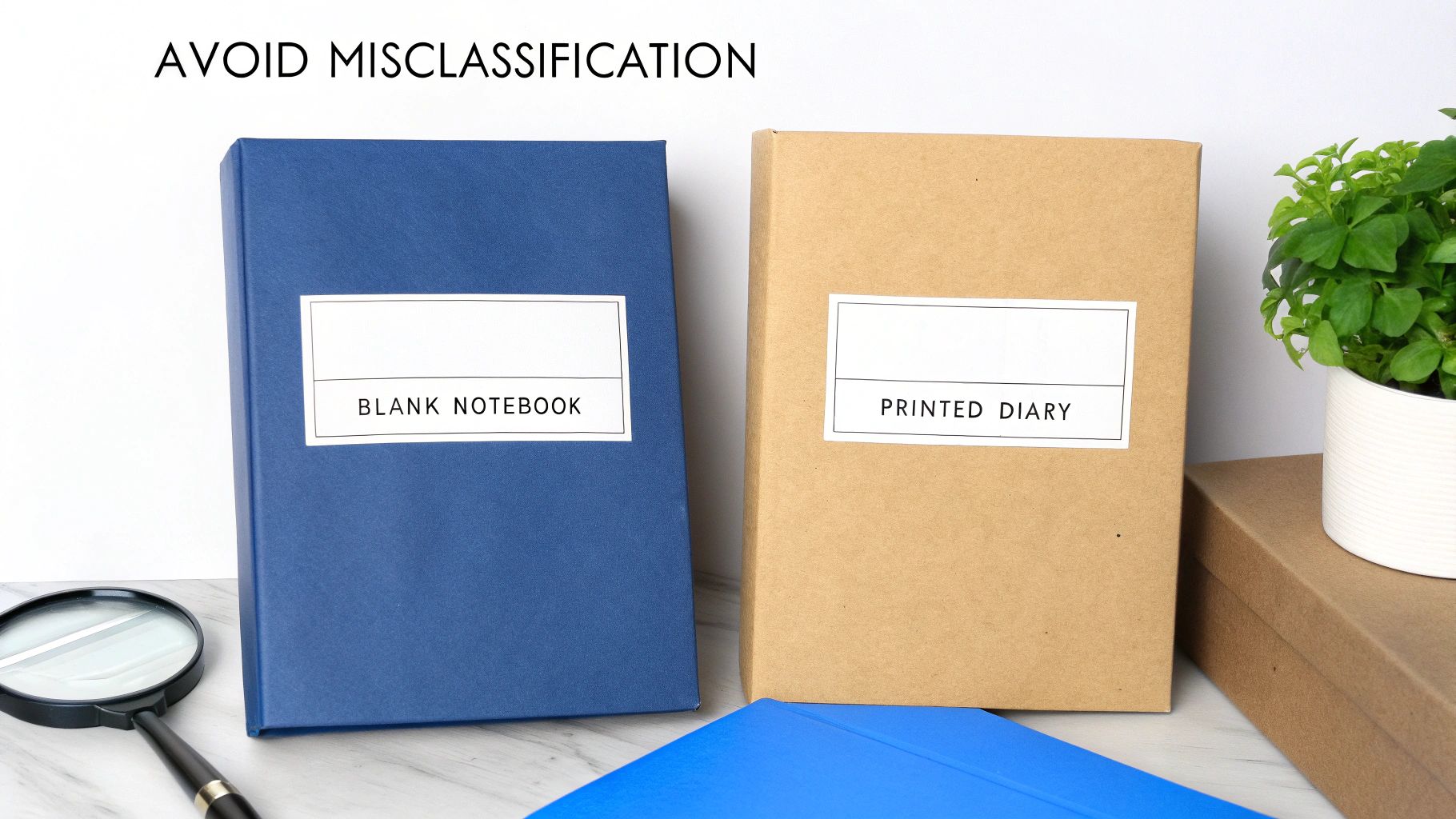
    This entire chapter is built on a single, crucial distinction: the value must come from the information printed on the item, not the raw material itself. A blank notebook is just paper, so it belongs in Chapter 48. But once it's printed with a story, it becomes a novel—and that's a job for Chapter 49. This simple logic is the key to every classification decision you'll make here.

    The Core Categories for Printed Matter

    Within Chapter 49, a few key headings handle the vast majority of printed goods. If you can get your head around these, you're halfway to mastering the classification process for books.

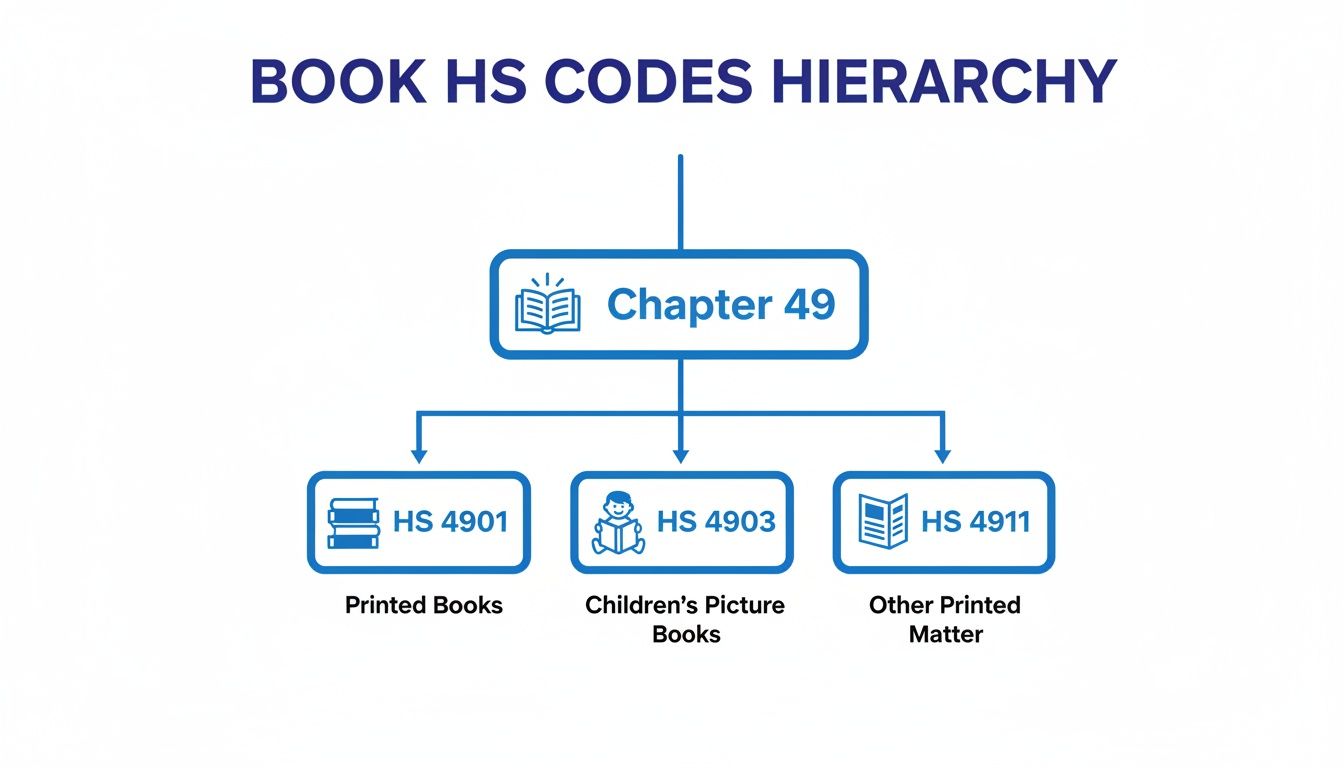
    Here are the three most important headings you'll need to know:

    • HS Heading 4901: This is the go-to category for most books. It covers everything from novels and textbooks to brochures and leaflets, whether they're single sheets or properly bound.
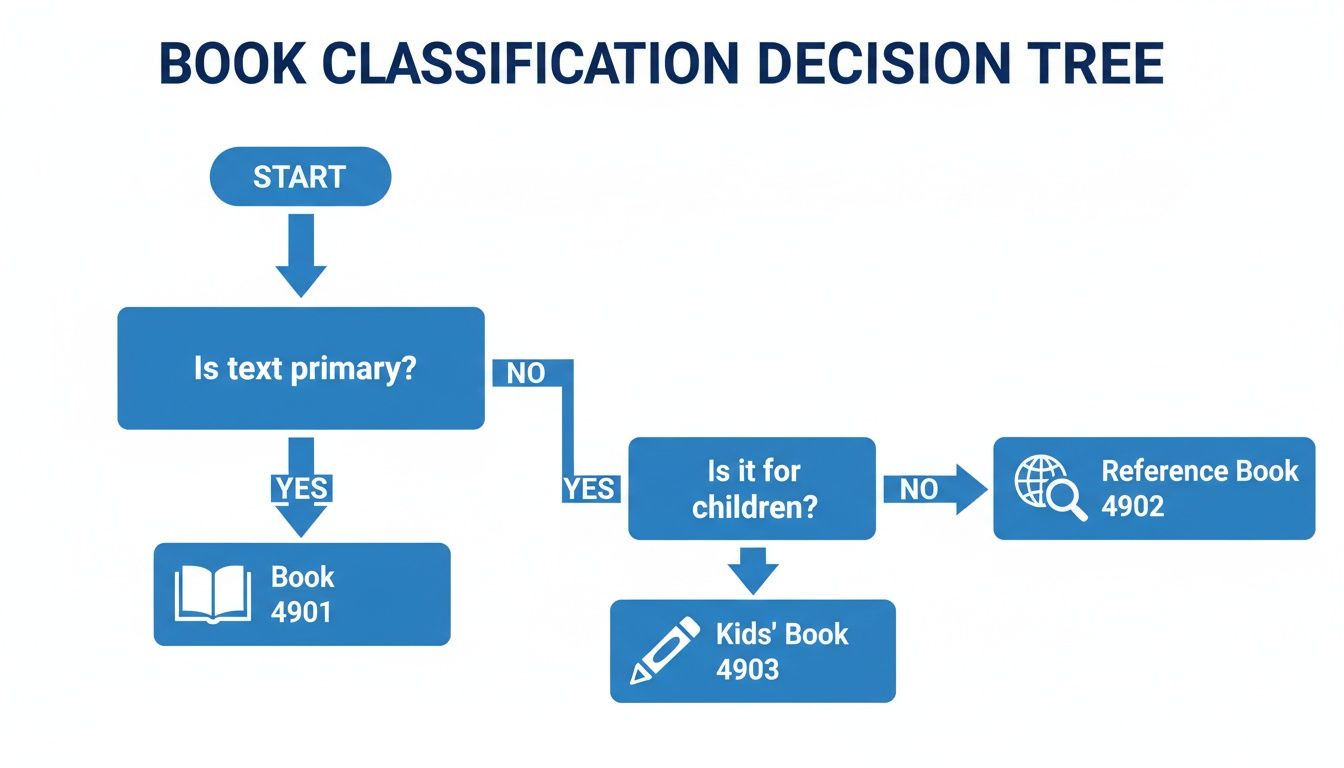
    • HS Heading 4903: This heading is carved out specifically for children's picture, drawing, or colouring books. The rule of thumb is simple: if illustrations are the main event and any text is just a supporting act, it belongs here.
    • HS Heading 4911: Think of this as the "miscellaneous" shelf for printed items that don't fit neatly elsewhere. This is where you'll find trade advertising materials, commercial catalogues, calendars, and printed pictures or photographs.

    So, while a university textbook and a slick marketing brochure are both made of bound paper, customs officials see two very different things. The textbook's purpose is educational reading, which puts it squarely in HS 4901. The brochure, however, is designed to sell something, which often lands it under HS 4911.

    Putting Classification into Practice

    Let's make this real. Say you're shipping a palette of hardback fantasy novels. Their entire reason for existing is to be read, so you’d start your search under HS 4901. Now, what if the next shipment is a batch of colouring books for kids? The main activity is drawing and colouring, not reading, which makes HS 4903 the obvious choice.

    To get it right, you have to determine the "essential character" of the product. Just ask yourself: why was this item made? Is it for reading? For a child to draw in? Or is it for advertising? Your answer will almost always point you to the correct HS heading.

    This level of detail is what makes global trade run smoothly. For example, Singapore uses the 8-digit ASEAN Harmonised Tariff Nomenclature (AHTN), which provides even more specific codes under the broader HS 4901 umbrella, simplifying commerce across the region. The impact is clear: HS 49 imports grew to a 4.1% share of cultural goods trade in 2023, and airfreight volumes shot up by 35% to 28,000 tonnes.

    You can dig deeper into these classifications on the official Singapore Customs website. When you correctly classify your goods within these frameworks, you're not just ticking a box for compliance—you're helping your shipments move faster and more efficiently through the global supply chain.

    A Practical Guide to Finding the Correct HS Code

    Figuring out the right harmonized code for books can feel like solving a puzzle, but with a structured approach, it becomes a straightforward, repeatable skill. The key is having a clear, step-by-step process. This isn't just about ticking boxes; it's about creating a solid workflow that cuts down on risks and gets your shipments through customs without a hitch.

    A repeatable process takes the guesswork out of the equation and gives you confidence in every declaration.

    Step 1: Start with the Item's Core Purpose

    Before you even glance at a tariff schedule, ask yourself a simple question: What is this item for? Your answer is the compass that guides the entire classification. Is it a novel meant for reading? A colouring book for a child? A promotional brochure for a business? The whole Harmonized System is built on this idea of an item's "essential character."

    For instance, a hardback dictionary’s job is to provide definitions, making its primary function informational. That simple fact points you straight towards HS Heading 4901 (Printed books, brochures, leaflets and similar printed matter). This first step instantly weeds out irrelevant categories and gives your search a clear direction.

    Step 2: Use the General Interpretative Rules

    The General Interpretative Rules (GIRs) are basically the official instruction manual for the HS tariff schedule. Think of them as the grammar of customs classification, ensuring everyone, everywhere, applies the codes the same way.

    The most important one to know is GIR 1. It states that classification is determined by the wording of the headings and any related section or chapter notes. This means you always have to start by reading the official descriptions for Chapter 49 and its headings. To get a better handle on this, it's worth taking a moment to learn more about the HS code for books and see how these rules work in the real world.

    The following infographic gives you a bird's-eye view of how Chapter 49 is structured, from the broad chapter down to specific headings.

    Hierarchy of Book HS Codes for Chapter 49, including Printed Books, Children's Picture Books, and Other Printed Matter.

    This visual helps you see how an item is classified, starting from the general (Chapter 49) and drilling down to the specific (like HS 4901 for textbooks or HS 4903 for children's books).

    Step 3: Verify with Official Search Tools

    Once you think you've landed on the right HS code, your next move is to double-check it against an official source. Never just trust a third-party website or reuse a code from an old shipment. Customs authorities have their own online databases for this very reason.

    Always cross-reference your findings with the official customs portal for the destination country. This is the only way to confirm the national-level subheading (the 8 to 12-digit code) and check for any specific regulations or tariff updates.

    For goods arriving in Singapore, for example, the Singapore Customs' HS/CA Product Code Search Engine is the ultimate source of truth. Using these official tools isn't just a good idea—it's essential for compliance.

    Step 4: Check Precedent Cases for Complex Goods

    So, what do you do with unusual items? Say, a book that comes packaged with a toy, or a multimedia learning kit? For these more complex goods, looking up binding rulings or precedent cases can be a lifesaver. Customs agencies frequently publish their decisions on how they've classified tricky products in the past.

    Digging into these precedents helps you understand the official line of thinking when a product’s "essential character" isn't so clear-cut. This final check ensures your logic is sound and matches how customs authorities have handled similar shipments before, massively reducing the risk of a costly dispute or reclassification down the line.

    Common Classification Mistakes and How to Avoid Them

    The line between the right Harmonized System code and a costly mistake can be razor-thin. It’s the kind of simple error that seems small at first—like confusing a printed diary with a blank notebook—but can quickly escalate into thousands of dollars in fines, shipment delays, and painful customs audits.

    Mastering the nuances of the harmonized code for books isn't just about ticking a compliance box; it’s about protecting your timeline and your bottom line.

    Navigating these rules demands real attention to detail. You'd be surprised how often incorrect HS classifications pop up. In fact, a Declarators analysis found they were behind 7.2% of all import disputes in Singapore during 2023. These aren't just minor clerical errors; they led to a staggering SG$8.9 million in overpaid GST and duties.

    Understanding the common pitfalls is the first step to avoiding them. Let's break down the most frequent classification blunders and give you clear, actionable steps to keep your shipments moving smoothly. For a closer look at Singapore's specific code structure, the official HS/CA Product Code Search Engine is your best resource.

    Two labeled books, a blank notebook and a printed diary, with a magnifying glass.

    Mistake 1: Confusing Printed Matter with Paper Products

    This is the classic, number-one error we see all the time. A logistics manager sees a bound paper product and instinctively defaults to Chapter 49. It’s an easy assumption to make, but it can be a costly one.

    The defining question you need to ask is: where does the item's primary value come from?

    • The Pitfall: Classifying a blank journal or a pack of ruled notebooks under HS Chapter 49.
    • What to do instead: Stick to the core principle. Chapter 49 is reserved for goods where the printed content is the main event—think novels, textbooks, or manuals. Items that are blank or only minimally printed, like notebooks, diaries with mostly empty pages, and stationery, belong in HS Chapter 48 (Paper and Paperboard). The simplest gut check is to ask: is it for reading, or is it for writing on?

    Mistake 2: Mishandling Educational Kits and Sets

    Shipments heading to the education sector are often more complex than just a box of books. A language learning kit, for example, might bundle textbooks with workbooks, flashcards, or even a supplementary CD-ROM. Trying to classify the whole lot under a single book code is a common shortcut that practically invites customs scrutiny.

    • The Pitfall: Using HS 4901 for a complete set that contains a book alongside other educational materials.
    • What to do instead: This is where you need to apply the General Interpretative Rules (GIRs) for "goods put up in sets for retail sale." The key is to identify which item gives the set its essential character. If the book is clearly the principal component, the entire kit can often take on the book’s HS code. But if the components have more or less equal importance, you may have to classify them separately.

    Pro Tip: When in doubt, document your reasoning for choosing the "essential character." This simple step demonstrates due diligence to customs authorities if your shipment is ever flagged for review, showing you’ve taken a proactive and thoughtful approach to compliance.

    Mistake 3: Classifying Digital and Physical Books the Same Way

    In the modern publishing world, the line between physical and digital media feels pretty blurry. For customs, though, it’s a hard border. E-books and audiobooks aren't physical goods, which means they fall completely outside the Harmonized System.

    • The Pitfall: Attempting to assign an HS code from Chapter 49 to a shipment of e-book access codes or a hard drive loaded with digital audiobooks.
    • What to do instead: You have to recognise that digital products are treated as services or intellectual property. Their import and export are governed by rules on digital trade, not the HS tariff schedule. If an e-book is delivered on a physical medium (like a USB drive), the HS code applies to the physical item itself (e.g., heading 8523 for the drive), not the digital book it contains.

    How to Turn HS Code Data Into Qualified Sales Leads

    What if every customs declaration was a breadcrumb leading straight to your next big client? It’s time to stop thinking of the harmonized code for books as just a compliance headache. When you see it as a business growth tool, the entire game changes.

    This data, which most people see as purely operational, is actually a goldmine of qualified sales leads just waiting to be tapped.

    For freight forwarders and logistics carriers, customs data is the ultimate treasure map. Every single time a company imports goods, they create a detailed record. This isn't just a vague product description; it’s a direct window into a prospect's entire shipping operation, revealing who is shipping, what they’re shipping, how much, and how often.

    From Raw Data to Actionable Insights

    The real magic happens when you turn all that raw data into genuine business intelligence. By filtering customs declarations for a specific HS code, like 4901 for printed books, you can instantly pull a list of companies that are actively importing those exact products.

    This isn't some generic business directory you bought online. It’s a highly curated list of active shippers with a proven, current need for your logistics services.

    The HS code for books, especially HS 4901 within Singapore's AHTN framework, is incredibly revealing. Data from SingStat, for example, shows a 28% jump in imports under HS Chapter 49 between 2020 and 2024, hitting a total value of SG$1.2 billion. For any logistics professional, this is solid gold. It points you directly to growing importers in the education and publishing sectors who desperately need reliable partners. You can explore more about these trade classifications on SingStat's official site.

    This screenshot from Coreties gives you a glimpse of how modern platforms organise customs data to highlight high-value shipping prospects.

    What was once a mess of complex trade records becomes a clean, sortable list, making it easy for sales teams to pinpoint top importers by shipping volume and frequency.

    Crafting a Hyper-Personalised Outreach

    Armed with this level of detail, you can finally ditch the generic cold calls. Instead, you can craft a hyper-personalised pitch that lands with real impact. Imagine calling a potential client and starting the conversation with, "I noticed you regularly import educational textbooks from Vietnam into Singapore. We specialise in that exact trade lane and have a solution that could streamline your process."

    That kind of opener immediately establishes your relevance and shows you've done your homework. You're no longer just selling a generic service; you're offering a specific solution to a problem you already know they have. You can learn more about how to filter customs data using an HS code filter to build these kinds of targeted lists.

    Let's look at how a raw HS code can become a qualified sales lead. This simple, three-step workflow shows the process from data to conversation.

    From HS Code to Qualified Lead in 3 Steps

    Step Action Business Outcome
    1. Target Filter customs data for HS Code 4901 to find companies importing books. Get a focused list of active, relevant prospects.
    2. Analyse Review their shipping volumes, frequency, and trade routes. Understand their specific logistics needs and pain points.
    3. Engage Craft an outreach message that directly references their shipping activity. Start a warm conversation that shows expertise and relevance.

    As you can see, this data-driven approach completely transforms your sales process into something far more intelligent and effective.

    Instead of guessing who might need your services, you're engaging with companies based on their actual, verified shipping behaviour. It’s the difference between casting a wide net and fishing with a spear.

    This method isn’t just about finding leads; it’s about creating a sustainable engine for growth by turning compliance data into your most powerful sales asset. And for those looking to get even more advanced, exploring strategies like AI-powered lead generation can add another powerful layer to converting this data into real business.

    Your Blueprint for Customs Mastery and Business Growth

    Getting the harmonised code for books right delivers a powerful one-two punch. First, you shield your operations from expensive delays and compliance headaches. Second, you unlock a hidden pipeline of high-value sales opportunities. Think of this guide as your complete playbook—giving you the practical skills to classify any book shipment and the strategic know-how to turn that data into your next big client.

    When you put these principles into practice, you're doing more than just ticking a compliance box. You're showing clients that you're a true partner, someone who understands the nuances of their supply chain. This is how you move past one-off transactions and start building relationships that last.

    The real work starts now. Dive into customs data, pinpoint the shippers who clearly need your expertise, and reach out with solutions that genuinely solve their problems.

    Of course, customs expertise is just one piece of the puzzle. Lasting business growth also depends on solid strategic planning for sales to create a clear, data-informed path forward.

    When you blend precise logistics knowledge with a sharp sales framework, you build an unstoppable engine for growth. This is your blueprint for turning a regulatory necessity into a real competitive edge, fuelling your company's success for years to come.

    Frequently Asked Questions

    When you're dealing with the HS code for books, a few common questions always seem to pop up. Let's tackle some of the most frequent ones we hear from logistics pros and shippers.

    What Is The Main Difference Between HS Codes In Chapter 48 And Chapter 49?

    The simplest way to think about it is this: it all comes down to the printing.

    Chapter 48 is all about the paper itself. It covers paper and paperboard items that are either completely blank or have just a little bit of printing that doesn't add much value, like headed stationery or empty notebooks. The product's main value is the paper.

    On the other hand, Chapter 49 is where the printed content is the star of the show. This is the home for books, newspapers, and brochures. Here, the value isn't in the paper but in the story, the information, or the pictures printed on it.

    How Are E-books Classified Under The Harmonized System?

    This one's a bit of a curveball. E-books aren't classified under the Harmonized System at all because they aren't physical goods. Since they are digital products, they're typically handled as services or software and don't get an HS code the way a printed book does.

    The rules that govern their import and export fall under regulations for digital services and intellectual property, which is a completely different ballpark from the tariff schedule for physical items.

    Think of it this way: HS codes are designed to track tangible things you can physically hold as they cross a border. An e-book is just a file, so it completely sidesteps that system.

    Does A Book With An Included CD-ROM Change Its HS Code?

    This is a classic "it depends" situation, and it hinges on the product's "essential character."

    If the CD-ROM is just a bonus feature—like an audiobook version or a few extra practice exercises—the whole package is almost always classified under the book's HS code, which would likely be in heading 4901. The book is clearly the main event.

    However, if the book and CD are marketed together as a multimedia kit where both parts feel equally important, customs might see it differently. They could classify it as a "set," which follows a different set of rules and could very well land it a different code. It's something that needs a careful look.


    Discover, analyse, and connect with high-volume book shippers today. With Coreties, you can turn customs data into qualified leads and start meaningful conversations with prospects who need your expertise. Find your next client with Coreties.

  • A Freight Forwarder’s Guide to Harmonized Code for Clothing

    A Freight Forwarder’s Guide to Harmonized Code for Clothing

    If you’ve ever wondered how customs officers worldwide can tell a container full of t-shirts from one packed with dress shirts, the answer is the Harmonized System (HS) code. For clothing, this universal numeric code is the key to smooth international shipping.

    The most important thing to get right from the start is the difference between Chapter 61, which covers knitted or crocheted garments, and Chapter 62, for woven garments. Think t-shirts versus jeans. Nailing this basic distinction is your first line of defence against expensive shipping headaches.

    What Are Harmonized Codes for Clothing?

    Imagine an HS code as a product's universal passport. It's a standardised language that lets a customs officer in Singapore and another in the United States know exactly what's inside a box without ever having to open it. For freight forwarders dealing with apparel, getting the harmonized code for clothing right isn't just a technicality—it’s absolutely central to your business.

    Getting it wrong kicks off a nasty domino effect.

    • Shipment Delays: The wrong code immediately raises a red flag, often leading to manual inspections that leave cargo sitting at the port.
    • Incorrect Duty/Tax Calculation: The code is what determines the Goods and Services Tax (GST) and any other duties owed.
    • Financial Penalties: Customs can, and will, issue fines for non-compliance, which directly eats into your profits.
    • Damaged Client Trust: Shippers count on your expertise for a seamless process. A simple coding error can quickly break that trust.

    Here in Singapore, the global 6-digit codes are expanded into the 8-digit ASEAN Harmonised Tariff Nomenclature (AHTN). This system, managed by Singapore Customs, adds an extra layer of detail for trade within the region. For instance, a simple cotton T-shirt falls under HS code 6109.10, while a pair of women's woven jeans is classified under 6204.62.

    This level of precision is vital for clearing the immense volume of goods moving through hubs like PSA Singapore Terminals, which saw over 37 million TEUs in 2023. Understanding these codes is also crucial for calculating GST liability, currently set at 9% for most clothing imports. You can learn more about how Singapore applies these codes to manage its imports and exports.

    At its core, the entire HS code system for clothing hinges on one fundamental question: Is the fabric knitted or woven? That single detail decides which chapter—and which set of rules—applies to your garment.

    To make this crystal clear, here’s a quick guide to the two main chapters for apparel.

    Quick Guide to Clothing HS Code Chapters

    The table below breaks down the primary distinction between the two main HS chapters for clothing. Use it as a quick reference to guide your initial classification.

    HS Chapter Type of Clothing Common Examples
    Chapter 61 Knitted or Crocheted T-shirts, sweaters, sweatshirts, polo shirts, leggings
    Chapter 62 Woven (Not Knitted) Jeans, dress shirts, suits, blouses, trousers, jackets

    Knowing the difference between these two chapters is the foundation of accurate apparel classification. It’s the starting point from which all other details, like material and garment type, follow.

    How to Read an HS Code Like a Pro

    At first glance, a harmonized code for clothing can look like a random string of numbers. But it’s not random at all. Each digit tells a detailed story about the garment, much like how a postal address can guide a letter from a broad region right down to a specific doorstep. Learning to read this structure is the key to classifying apparel with confidence.

    The entire system is built on a global standard from the World Customs Organization (WCO). This foundation is a 6-digit code that’s recognised by customs authorities worldwide, giving everyone a consistent starting point.

    Of course, countries often need more detail. In Singapore, that 6-digit base is extended to an 8-digit ASEAN Harmonised Tariff Nomenclature (AHTN) code. Those extra two digits provide more regional specificity, which helps fine-tune duty calculations and trade analysis right here in Southeast Asia.

    Breaking Down the Code Structure

    Think of an HS code as a family tree. It starts with a broad ancestor (the Chapter) and gets more specific with each new generation (the Heading and Subheading). Every pair of digits adds another layer of crucial detail.

    Here’s how the first six digits break down:

    • First two digits (Chapter): This is the highest level, identifying the broad category. For clothing, this will almost always be Chapter 61 (knitted) or Chapter 62 (woven).
    • Next two digits (Heading): This narrows it down to the type of product within that chapter, like "T-shirts" (6109) or "Trousers" (6204).
    • Final two digits (Subheading): This provides the final layer of detail, often specifying the material or intended wearer, such as "of cotton" (6109.10).

    This simple flowchart shows how apparel classification branches out from that very first decision point.

    A flowchart diagram illustrating Apparel HS Codes, categorizing apparel into knitted and woven types.

    As you can see, the fundamental split between knitted (Chapter 61) and woven (Chapter 62) is the most critical first step in finding the right harmonized code for any piece of clothing.

    Putting It All Together: An Example

    Let's decode 6109.10.00, the AHTN code for a simple cotton t-shirt, and see how this works in practice.

    1. 61: The garment is from Chapter 61, telling us it’s knitted or crocheted.
    2. 09: Within that chapter, it falls under Heading 09, which is for "T-shirts, singlets and other vests."
    3. 10: The Subheading specifies the material is "of cotton."
    4. 00: These are the final two digits specific to the AHTN, adding another layer for regional classification.

    By reading the numbers in pairs, you can deconstruct any code and understand the exact characteristics of the garment it represents. This skill transforms a confusing number into a clear and precise product description.

    The Golden Rules of Clothing Classification

    Knowing the difference between Chapters 61 and 62 is a great start, but real-world apparel shipments are rarely that simple. What happens when a hoodie is made of a cotton-polyester blend? Or when a two-piece suit is shipped as a single unit? These are the kinds of details where costly mistakes happen.

    To really master the harmonised code for clothing, you have to move beyond basic definitions and start applying a set of "golden rules." These principles, laid out by customs authorities, give us a consistent framework for classifying even the most ambiguous garments. Getting them right isn't just good practice; it's a legal requirement.

    Rule 1: The Predominant Material by Weight

    So many garments these days are made from blended fabrics to get the right mix of comfort, durability, or style. When you’re faced with a blend, classification comes down to a simple but strict rule: the material that makes up the greatest percentage of the garment's weight dictates its classification.

    Take a t-shirt that's 60% cotton and 40% polyester. Since cotton is the heaviest component, the t-shirt gets classified under a subheading for cotton garments within Chapter 61. If you flip that ratio—60% polyester and 40% cotton—it would fall under a man-made fibre subheading instead.

    This rule is a massive compliance checkpoint. Getting HS codes right under Chapters 61-62 is legally mandated, and errors can easily trigger audits, delays at Tuas or Changi Cargo, and hefty fines. With upcoming WCO updates hinting at significant penalties for misclassification, this is especially true for blends. The final code, like 6109.90 for man-made fibre T-shirts, all comes down to what material weighs the most. You can dig deeper into how to find the correct code for your goods on the Singapore Customs website.

    Rule 2: Classifying Clothing Sets

    Apparel is often sold and shipped in sets, like suits or tracksuits. When items are packaged together for retail sale as a single unit, they are generally classified under a single HS code. That code usually corresponds to the set's primary or most defining garment.

    Think of a men's two-piece suit with a jacket and trousers made from the same woven fabric. The entire set gets classified under the heading for suits, such as 6203.11 (of wool or fine animal hair). You wouldn't classify the jacket and trousers separately.

    But, of course, there are conditions to meet:

    • The items have to be put up together for retail sale.
    • They must be made of the same fabric and style.
    • The set must contain a specific number and type of garments as defined in the tariff notes.

    When classifying a set, think of it as a single product. The HS code should reflect the complete unit as the consumer would buy it, not its individual components.

    Rule 3: When Specific Features Change Everything

    Sometimes, a seemingly minor detail can completely change a garment's classification. Features like zippers, pockets, or even the type of waistband can push an item from one subheading to another, often with very different duty implications.

    A classic example is the line between trousers and shorts. A standard pair of men’s woven cotton shorts might fall under 6203.42. But, if those same shorts have specific features that officially qualify them as swimwear, they’d get reclassified under a completely different heading, 6211.11.

    This is precisely why a detailed commercial invoice is your best friend. It’s not enough to list "trousers." You need specifics like "men's woven cotton trousers with a zipper fly." This level of detail gives you the power to verify the shipper's code, prevent compliance headaches, and ultimately prove your expertise and build trust with your clients.

    Common HS Codes for Apparel and How to Find Them

    Knowing the classification rules is half the battle. The other half is applying them quickly and accurately to the dozens of shipments that come across your desk every day. This is where having a reliable list of common codes and knowing where to verify them becomes essential.

    While every garment has its own specifics, most fall into predictable patterns. You don't need to memorise every single harmonised code for clothing, but getting familiar with the most common ones gives you a massive head start. It's the kind of experience that helps you spot a potential error on a shipper's declaration from a mile away.

    A desk with a laptop, open book, plant, and a blue folder labeled 'COMMON HS CODES'.

    A Practical Reference Guide

    To help you get started, we've put together a quick reference table. These aren't just theoretical codes; they are the practical, 8-digit AHTN codes used in Singapore for some of the most frequently shipped apparel items your team will actually see.

    Common Clothing Items and Their Singapore HS Codes (AHTN)

    Clothing Item Material Construction Example AHTN Code
    T-Shirt Cotton Knitted 6109.10.00
    Women's Blouse Polyester Woven 6206.40.00
    Men's Trousers Cotton (Jeans) Woven 6203.42.00
    Sweater/Pullover Man-made fibres Knitted 6110.30.00
    Men's Suit Jacket Wool Woven 6203.31.00
    Women's Dress Silk Woven 6204.41.00

    Think of this table as a handy cheat sheet. It's a great starting point, but always remember it's no substitute for proper verification using official resources, especially when dealing with a new or unusual product.

    How to Verify Any HS Code

    Just taking the shipper's provided code at face value is a risky game. The best approach is to equip your team with the tools to verify codes themselves. This transforms a simple administrative task into a proactive service that adds real value for your clients and protects your business from compliance headaches.

    Thankfully, Singapore Customs offers some excellent, free-to-use tools for this.

    • HS/CA Product Code Search Engine: This should be your go-to resource. You can search by a keyword like "t-shirt" or pop in a known HS code to pull up its official description, duty rates, and any other relevant controls.
    • Customs Rulings Database: For those trickier items, this database is a goldmine. It contains past classification decisions made by Singapore Customs, giving you clear examples of how they’ve handled unusual or complex garments before.

    Using these official tools is like having a direct line to the customs authority. It takes the guesswork out of the equation and gives you a documented, defensible reason for your classification choice—something that's invaluable if a shipment is ever questioned.

    By teaching your team how to find and verify this information themselves, you build genuine expertise within your organisation. It reduces your reliance on third-party data that could be outdated or just plain wrong. This proactive stance not only leads to smoother customs clearance but also cements your reputation as a knowledgeable and trustworthy logistics partner.

    You can dive deeper in our complete guide covering every aspect of the HS code for garments.

    The Real Business Cost of Incorrect Classification

    Getting the harmonised code for clothing right is so much more than a box-ticking exercise. Think of it less as paperwork and more as a direct threat to your profitability, client relationships, and operational flow. It's one of those small details that can quietly unleash a cascade of expensive, time-consuming problems.

    In a fast-paced hub like Singapore, the consequences are swift and serious. A simple misclassification can trigger a full customs audit, leading to significant shipment delays at the port. Instead of clearing customs smoothly, your client's cargo is suddenly stuck, racking up demurrage fees while you scramble for answers. This hits your bottom line and your reputation at the same time.

    The Financial Domino Effect

    Beyond the delays, the financial penalties can be steep. An incorrect code often leads to errors in calculating the 9% Goods and Services Tax (GST), which can mean underpayment and subsequent fines from IRAS. A seemingly minor mistake can have a painful financial sting, quickly turning a profitable shipment into a loss-making headache.

    Let's look at a real-world example. Imagine mixing up knitted trousers (Chapter 61) with woven ones (Chapter 62). Classifying knitted trousers (6104.62) as woven (6204.62) doesn't just risk a GST miscalculation at 9%. It could also lead to customs holds or even fines from the World Customs Organization.

    An error like this can easily delay an ocean shipment by 2-5 days in Singapore. For any importer or forwarder, that's a major disruption. You can find more insights on how HS code accuracy impacts apparel importers on Commenda.io.

    A single wrong digit doesn't just create a compliance issue; it erodes client trust. When a shipment is delayed and fined, the shipper looks to their forwarder for accountability.

    This is where the responsibility of the freight forwarder becomes critical, often blurring the lines with the duties of the Importer of Record. We dive deeper into the complexities of this role in our guide on what it means to be the Importer of Record.

    Ultimately, accurate classification is the bedrock of efficient and reliable logistics. It protects your revenue, strengthens client confidence, and prevents you from constantly putting out avoidable operational fires. It solidifies your status as an expert partner, not just a service provider.

    Turning HS Code Data Into High-Value Shipper Leads

    Hands holding a tablet displaying a business application designed to find shipper leads.

    Getting the harmonized code for clothing right is obviously crucial for customs compliance. But for a freight forwarder, that’s just scratching the surface. The real opportunity is hidden in the data itself.

    Every import declaration filed is public information, and it tells a detailed story: who is shipping what, where it's coming from, and how much of it they’re moving. This isn’t just noise; it's a treasure map for anyone in logistics. By tapping into this data, you can stop waiting for quotes and start actively pursuing the clients who are a perfect fit for your services.

    From Data Points to Qualified Prospects

    Let's say your speciality is handling large apparel shipments. Instead of cold-calling a long list of companies, imagine you could pull up a list of every business in Singapore that imported over 10,000 kg of women's blouses last month. That’s the power of transforming raw customs data into genuine business intelligence.

    Platforms like Coreties are built to do exactly this. They comb through millions of customs records and organise them into a simple, searchable database. This lets you filter for new business opportunities with pinpoint accuracy.

    You can zero in on shippers based on what actually matters to your operations:

    • Specific HS Codes: Target companies that import the exact products you handle best, whether it's knitted sweaters (HS 6110) or woven jackets (HS 6202).
    • Shipment Volume: Forget small-time shipments. Filter for importers moving goods above a certain weight or value to focus on high-value accounts.
    • Trade Lanes: Find prospects importing from countries or regions where you have the strongest network and most competitive rates.
    • Consistency: Track import frequency to identify businesses with steady, reliable shipping needs.

    This focused approach means your sales team isn't wasting time on dead ends. They’re engaging with prospects who are already qualified.

    Turning Insights Into Conversations

    Of course, finding the right company is only half the battle. You still need to talk to the right person. Modern data platforms bridge this gap, linking shipment records to verified contact details for decision-makers in logistics and supply chain roles.

    When you use customs data, you’re no longer just another forwarder asking for their business. You walk into the conversation as a strategic partner who already understands their shipping patterns and pain points.

    This approach gives you a massive advantage before you even pick up the phone.

    You can see just how straightforward it is to pinpoint companies importing specific types of apparel, turning a sea of data into a clean, actionable prospect list. To dig deeper, you can explore how to find high-value prospects using an HS code filter and see how it can sharpen your lead generation. It’s a smart way to build a stronger, more sustainable sales pipeline.

    Got Questions About Clothing HS Codes? We’ve Got Answers.

    When you're dealing with international shipping for clothing, the same questions about harmonised codes pop up time and time again. Let's tackle some of the most common ones that freight forwarders and shippers run into, clearing up any confusion so you can classify with confidence.

    What's the Real Difference Between an HS Code and an HTS Code?

    Think of it like a global language versus a local dialect.

    The HS (Harmonised System) code is the universal foundation—a 6-digit standard from the World Customs Organisation (WCO) that's understood everywhere. It’s the reason a cotton t-shirt is fundamentally classified the same way whether it's heading to Tokyo or Toronto.

    An HTS (Harmonised Tariff Schedule) code is what individual countries build on top of that foundation. For example, Singapore uses the 8-digit AHTN. It takes the first six universal HS digits and adds its own two for more granular detail, which helps in calculating precise duties and gathering specific trade data.

    Who's Actually on the Hook for the Right HS Code?

    Legally, the buck stops with the importer of record. They are the ones who are ultimately responsible for the accuracy of everything on that customs declaration, including the HS code. If duties, taxes, or penalties are due, they're the ones who have to pay up.

    But that’s where you, as a freight forwarder or customs broker, come in. Your role is much more than just moving boxes; you're a trusted advisor. Verifying codes isn't just a box to tick—it's a critical service that protects your clients from expensive hold-ups and fines. Getting it right proves your value and builds the kind of trust that keeps clients coming back.

    While the importer holds the legal liability, the forwarder’s expertise is the first line of defence against compliance issues. Proactive verification protects both your client and your reputation.

    How Often Do These Clothing Codes Actually Change?

    The HS system isn't set in stone. The WCO overhauls the entire framework roughly every five years to keep up with new products, materials, and global trade shifts. The last major updates, for instance, were in 2017 and 2022.

    On top of that, individual countries or trading blocs can tweak their own tariff schedules, like Singapore’s AHTN, even more often. This is why it's absolutely crucial to work with the most current version of the tariff schedule for any country you're shipping to. Using outdated information is a surefire way to run into compliance headaches.


    Stop guessing and start targeting the right shippers. Coreties transforms complex customs data into a simple, powerful tool for finding qualified leads. Discover high-value importers, access decision-maker contacts, and grow your business faster. Learn more at Coreties.

  • Your Guide to Fabric HS Code for Singapore Freight Forwarders

    Your Guide to Fabric HS Code for Singapore Freight Forwarders

    So, what exactly is a fabric HS code? Think of it as a universal product passport for textiles. It's a specific number from the global Harmonised System that customs officers around the world use to identify exactly what kind of fabric is being shipped.

    This single code tells them everything they need to know—from raw silk to coated polyester—ensuring every textile is classified the same way, no matter where it's going. Getting this number right from the start is the key to seamless global trade.

    Why Mastering Fabric HS Codes Matters for Your Business

    Let's be honest, staring at a customs form packed with long, complicated codes can feel like a chore. But for freight forwarders in Singapore, those numbers are more than just a compliance headache. They're a hidden opportunity to get a serious edge over the competition.

    The HS code is the common language of international trade. It lets you describe a shipment’s contents to a customs official on the other side of the world without them ever needing to open the box. When you and your team are fluent in this language, your business gains some very real advantages:

    • Smoother Operations: The right code is like a green light at customs. Shipments fly through, clearance times shrink, and your clients' supply chains stay on schedule.
    • Happier Clients: Quick, reliable customs processing isn't just a service—it's peace of mind. It builds incredible trust and positions you as an indispensable partner, which is exactly how you build lasting relationships.
    • Fewer Costly Delays: A wrong code is one of the fastest ways to get hit with unexpected fines, extra fees, and expensive storage charges. Nailing the classification protects your profit margins and your customer’s budget.

    Mastering fabric HS codes isn't just about dodging penalties. It's about turning a complex regulatory task into a powerful business development tool. It lets you solve problems before they happen and shows a level of expertise that truly makes your service stand out.

    Ultimately, this guide won't just teach you how to classify any textile with confidence. It will show you how to turn that knowledge into a secret weapon for business growth. By seeing who is shipping what kind of fabric, you can pinpoint high-value prospects and tailor your outreach. This is about more than just moving boxes; it's about moving your business forward.

    Decoding the Structure of Textile HS Codes

    Ever felt like HS codes are just a random string of numbers? Think of the Harmonised System for textiles less like a code and more like a story. Each number tells a piece of a product's tale, guiding it through customs. It’s a bit like a library's filing system—you don't need to memorise every number, but understanding the logic behind the organisation is key.

    The system is built on a hierarchy, starting broad and getting progressively more specific. With every pair of digits added, you're narrowing down the product's identity, much like adding a street name and then a house number to an address. For fabrics, this journey begins with the raw material and drills down to the final, finished product.

    Globally, the Harmonised System is organised into Sections, Chapters, Headings, and Subheadings. You'll find most textiles and textile articles hanging out in Section XI, which covers Chapters 50 through 63. Think of this section as the "Textiles" wing of our global trade library.

    From Chapter to Subheading

    Let's unpack how a fabric HS code is built, layer by layer.

    The first two digits point to the Chapter, which tells you the broad material category. For example, Chapter 52 is all about cotton, while Chapter 54 deals with man-made filaments. Simple enough.

    The next two digits give you the Heading, which gets a bit more specific about the product’s form. A heading within Chapter 52 might tell you if you're dealing with raw cotton, yarn, or a woven fabric.

    Finally, the last two digits form the Subheading, providing the fine-print details. This is where you'll find information about the fabric's weight, weave pattern (like twill or plain weave), or how it's finished (dyed, printed, or bleached). So, a code like 5208.32 instantly tells a customs officer they’re looking at a very specific type of dyed, plain-weave cotton fabric. If you want a complete overview of the system, our deep dive into the HS Code book is a great place to start.

    Let’s look at that example, 5208.32, more closely to see how it all fits together.

    Breaking Down a Fabric HS Code Example 5208.32

    Code Digits Level Description
    52 Chapter Identifies the material as Cotton.
    5208 Heading Specifies it's a woven fabric of cotton, containing at least 85% cotton by weight.
    5208.3 5-Digit Subheading Narrows it down to dyed fabrics.
    5208.32 6-Digit Subheading Provides the final detail: it's a plain weave fabric.

    As you can see, each set of digits adds a crucial layer of information, leaving no room for ambiguity at the border.

    A diagram illustrating the advantages of mastering HS codes, showing benefits like smoother customs, cost savings, and compliance.

    The real takeaway here is that getting this classification right isn't just about paperwork. It directly impacts how smoothly your shipments clear customs and can even unlock new ways to identify potential business leads.

    This structured approach removes the guesswork from customs classification. By progressively identifying the material, construction, and finish, you follow a clear path to the correct code, ensuring compliance and preventing costly delays at the border.

    Each number tells part of the story, and when you put them all together, they create a complete, universally understood profile for customs authorities around the world.

    Navigating Common Fabric HS Code Categories

    Okay, now that we've got the theory down, let's put it into practice. Think of this as your cheat sheet for the fabric HS code categories you'll see most often as a freight forwarder in Singapore. Getting familiar with these key chapters will make classifying shipments a whole lot faster and give you more confidence in your decisions.

    The Harmonised System is actually quite logical. It organises textiles by following their journey from raw fibre all the way to a finished product. For anyone in freight, the most critical chapters live in Section XI, which is the comprehensive guide to pretty much every textile you can imagine.

    A display of various fabric categories, including colorful and textured swatches, laid out on a table.

    Natural Fibres: Chapters 50 to 53

    The classification journey almost always starts with natural fibres. Each one gets its own chapter, and these are the essential building blocks for countless textile and apparel items.

    • Chapter 50 – Silk: This covers the entire silk lifecycle, from the raw silkworm cocoons right up to woven silk fabrics. If you're handling a shipment of pure silk fabric destined for luxury scarves, its home is under heading 5007.
    • Chapter 51 – Wool and Animal Hair: Here’s where you’ll find codes for wool, cashmere, and mohair, whether they’re raw, spun into yarn, or woven into fabric.
    • Chapter 52 – Cotton: Cotton is one of the world's most traded commodities, so its chapter is incredibly detailed. A very common fabric HS code you'll encounter is 5208, which is for woven cotton fabrics that are at least 85% cotton by weight.
    • Chapter 53 – Other Vegetable Fibres: This chapter is the catch-all for plant-based materials like linen (from flax), jute, and hemp.

    Nailing these foundational chapters is the first real step to correctly identifying the source material of any textile product you're clearing.

    Man-Made Fibres and Specialised Fabrics

    Once we move past the natural stuff, the HS system has several chapters dedicated to synthetic and specialised textiles. This is where all the modern fabric innovations get classified.

    Singapore's textile industry is a major player in its trade economy, and HS codes from Chapters 50-63 cover everything from raw silk to finished clothing. This makes accurate coding absolutely essential. In fact, the Textile Fibres price index recently jumped by 5.6% in just one month. For businesses using Coreties, this is valuable intel. You can geo-search for prospects using these specific HS codes and match them with Routescanner options to create compelling bids, boosting your outreach efficiency by up to 30x.

    One of the most critical distinctions you’ll have to make is between 'woven' and 'knitted' materials. A woven fabric, like denim, has threads that interlace at right angles. A knitted fabric, like a t-shirt, is made from interlocking loops. Getting this small detail wrong can throw off your entire classification and cause real headaches at customs.

    Here are the key chapters to keep on your radar:

    • Chapter 54 – Man-Made Filaments: This includes materials like nylon and polyester when they exist as long, continuous threads (filaments). Picture a huge spool of polyester thread ready for a sewing factory.
    • Chapter 55 – Man-Made Staple Fibres: When those same synthetic materials are chopped into short, staple lengths to be spun like cotton, they move over to this chapter.
    • Chapter 60 – Knitted or Crocheted Fabrics: This chapter is exclusively for fabrics made through knitting. A big roll of jersey fabric that will be cut and sewn into t-shirts belongs right here. For a deeper look into how these fabrics become finished products, check out our guide on the HS code for garments.

    This overview should give you a solid map for navigating the most common textile categories, helping you find the right fabric HS code with much more precision.
    Your Step-By-Step Process for Accurate Classification

    Figuring out the right fabric HS code can feel a bit like cracking a code, but once you have a solid method, it becomes a logical and repeatable process. This guide breaks down the classification into clear, practical steps, giving you the confidence to handle any textile shipment precisely.

    Think of yourself as a textile detective. Your job is to uncover three key pieces of information: the material it's made from, how it was constructed, and any special treatments it has received. Armed with these facts, you can confidently navigate the Harmonised System and sidestep the costly delays that come from simple guesswork.

    Person's hands reviewing classification steps on a clipboard and a laptop showing checklists.

    Step 1: Identify the Material Composition

    First things first: what is the fabric actually made of? The entire Harmonised System is built on material type, so this is always your starting point. You need to identify the main fibre that gives the fabric its essential character.

    For a single-material fabric, like 100% cotton, this part is easy. But what about blends, like a common 60/40 cotton-polyester mix? The rules here are just as straightforward: classification is based on whichever material has the highest percentage by weight.

    • Example: A fabric that is 60% cotton and 40% polyester is treated as a cotton fabric and classified under Chapter 52.
    • Example: If that blend were flipped to 60% polyester and 40% cotton, it would be classified as a man-made staple fibre fabric under Chapter 55.

    Always insist on getting the exact percentages from the shipper's documentation. It's the only way to be sure.
    Step 2: Determine the Construction Method

    Once you know the what, you need to figure out the how. The way a fabric is constructed is the second critical piece of the puzzle, as the HS system draws a hard line between different manufacturing methods.

    The two main construction types you’ll run into are woven and knitted.

    1. Woven Fabrics: These are made by interlacing two sets of yarns (the warp and weft) at right angles. Think of denim, twill, or a classic poplin shirt. Woven fabrics are generally found in Chapters 50-55.
    2. Knitted or Crocheted Fabrics: These are produced from a single yarn that's looped together, creating a more flexible material. T-shirt jersey and fleece are perfect examples. Knitted fabrics get their very own chapter: Chapter 60.

    This distinction is crucial. Mistaking a knitted fabric for a woven one (or vice versa) is a common but completely avoidable error that almost guarantees a customs headache.

    Step 3: Account for Special Finishes or Treatments

    The final step is to look for any special finishes or treatments that have been applied to the fabric. These details often determine the final, more specific digits of the HS code at the subheading level.

    Keep an eye out for these common finishes:

    • Dyed: Is the fabric coloured in a single, solid shade?
    • Printed: Does it have a multi-coloured pattern or design on its surface?
    • Coated or Laminated: Has a substance like PVC or polyurethane been applied to make it water-resistant or give it other properties?

    A great real-world example is a water-resistant jacket. If it's made from a polyester fabric coated with plastic, it would likely be classified under Heading 5903. This is a world away from an uncoated polyester fabric, showing just how much a simple finish can change everything.

    By working through these three steps—composition, construction, and finish—you build a reliable system for pinpointing the correct HS code every single time. This diligence is what separates a shipment that sails through customs from one that gets stuck in costly limbo.

    Turning HS Code Data into High-Value Shipper Leads

    So far, we've mostly talked about fabric HS codes as a customs hurdle—something you have to get right to avoid delays and fines. But what if that same code could be your most potent sales weapon? For logistics providers willing to think a little differently, customs data is a goldmine of market intelligence.

    This is where you can flip the script from a reactive chore to a proactive growth strategy. Instead of just classifying fabrics for customs, you can use those very codes to find companies that are shipping those exact products right now. It's about turning public data into a private pipeline of opportunities.

    Platforms like Coreties are built around this idea. They let you take a specific fabric HS code—say, 5903.90 for coated fabrics—and instantly see a list of every Singaporean company importing or exporting those goods. Suddenly, you're not making cold calls anymore. You're making informed calls.

    From Data Points to Client Conversations

    This simple shift completely changes how you build a prospect list. Forget generic company directories. You're now working with a hyper-targeted list of active shippers. You know who is shipping, what they are shipping, and you can even get a sense of their volumes.

    This kind of insight allows for incredibly personalised outreach. Imagine identifying all the top synthetic yarn exporters in Singapore. You could then approach them with a proposal that doesn't just talk about logistics in general, but specifically mentions your expertise with their product and offers better routing options for their main trade lanes.

    Here’s a glimpse of how you might find and engage prospects using the search function in a tool like Coreties.

    The screenshot shows just how fast this works—a quick search based on specific criteria turns into a list of qualified leads. A data-driven approach like this means you waste less time guessing and spend more time talking to potential clients who actually need what you offer.

    Filtering shipment data with a specific fabric HS code turns a compliance number into a direct line to a potential client. It’s the difference between casting a wide net and using a spear.

    Capitalising on Market Trends

    This strategy also positions you to ride the wave of market trends. For example, Singapore's exports of textile fabrics coated with plastics (HS 5903.90) recently hit over $5.2 million in value. That number tells you there’s real strength in specialised textiles here.

    As you can find out in our deeper look into the HS Code Filter, a statistic like that is pure gold for Coreties users. A savvy freight forwarder can filter customs data by that exact code to find these high-volume shippers, then set up automated, personalised outreach to their key decision-makers on LinkedIn. To dive deeper into these figures, you can explore more about Singapore's textile trade data on wits.worldbank.org.

    This is how you get ahead of the competition—by using data to connect with the right people at exactly the right time.

    Here's the rewritten section, designed to sound like it was written by an experienced logistics professional:


    Side-Stepping Costly Mistakes and Compliance Headaches

    Getting fabric HS codes right isn't just a box-ticking exercise. It's about actively dodging the expensive mess that happens when you get it wrong. One little slip-up on a fabric code can spark a domino effect of problems, hitting your bottom line and shaking your client’s confidence in you.

    We're not just talking about extra paperwork, either. The fallout is real. Think shipments stuck in customs for days or weeks, racking up painful demurrage and detention fees. A misclassification can even trigger a full-blown customs audit, pulling your team into a time-consuming investigation when they should be moving freight.

    The usual suspects: Where classifications go wrong

    From what I’ve seen, the same mistakes pop up time and time again. Knowing where the landmines are is the best way to avoid stepping on one.

    • Woven vs. Knitted Confusion: This is the big one we've talked about. Classifying a roll of jersey fabric (which is knitted, Chapter 60) under a woven category (like Chapter 52 for cotton) is an instant red flag for a customs inspector.
    • Getting Blends Wrong: The rule for mixed-fibre fabrics is simple: the material with the highest percentage by weight dictates the code. If you're just guessing or don't have the exact breakdown from the supplier, you're setting yourself up for trouble.
    • Forgetting Finishes and Treatments: Did you overlook that special coating, lamination, or dye? That detail can shunt the fabric into a completely different subheading, throwing off your duty calculations and leading straight to penalties.

    These aren't just hypothetical problems. A misclassified shipment can mean unexpected duties and tariffs are slapped on, sometimes months after the goods have been delivered. Nothing sours a client relationship faster than a surprise bill showing up out of the blue.

    Your best defence is just being thorough. Look at niche trade flows, like Indonesia importing fabric labels from Singapore—the data gets that specific. Even as the WCO keeps updating HS codes, a simple mistake on common textiles like cotton (Chapter 52) or knits (Chapter 60) is a massive, avoidable risk.

    For any freight forwarder, double-checking classifications with reliable data isn’t just good practice; it’s essential self-preservation. You can dig into these kinds of SG-Indo trade insights on eximtradedata.com to see just how detailed this information can get.

    Answering Your Top Fabric HS Code Questions

    Even with a solid process, you're bound to run into some tricky situations with fabric HS codes. Let's tackle some of the most common questions we hear from logistics pros, giving you clear, practical answers to navigate these challenges with confidence.

    What Happens If a Shipper Provides the Wrong Fabric HS Code?

    This is a big one. If a shipper gives you the wrong HS code, customs authorities often hold the freight forwarder responsible. The fallout can be immediate and painful: shipment delays, surprise inspections, paying the wrong duties, and even fines that eat into your profits.

    That’s why it's absolutely critical to verify the information you receive. You can use a trade data platform to see how similar products have been classified by other shippers in the past. This simple cross-check helps you spot potential errors before they snowball into costly problems at the border, protecting both your business and your client.

    How Do I Classify a Garment Made from a Cotton and Polyester Blend?

    When you’re dealing with mixed-material fabrics, the General Interpretative Rules (GIRs) are your guide. The key rule here says you classify the product based on the material that gives it its "essential character"—which, for fabrics, almost always means the material with the highest percentage by weight.

    So, if you have a shirt that’s 60% cotton and 40% polyester, it gets classified under the cotton apparel headings in Chapter 52. Flip those numbers, and it would fall under a polyester category instead. Always get the exact weight percentages from the shipper’s documentation before deciding.

    Think of it this way: the dominant fibre gets to tell the story. Whichever material makes up the majority of the fabric dictates its identity for customs purposes, leaving no room for ambiguity.

    How Often Do Fabric HS Codes Change?

    The Harmonised System isn't set in stone. The World Customs Organisation (WCO) reviews and updates the entire system every five years to keep up with new technologies and changing trade patterns. The next major global overhaul is scheduled for 2027.

    But don't wait until then. Individual countries can—and do—make smaller tweaks to their own national tariffs much more frequently. For forwarders in Singapore, it’s vital to monitor updates from Singapore Customs and the authorities in your key destination markets. Staying current is the only way to prevent your shipments from being held up or rejected for using an outdated code.


    Ready to turn customs data into your next big client? Coreties transforms complex shipment information into a powerful lead-generation engine, helping you find and connect with high-value shippers in just a few clicks. Discover your next opportunity at https://coreties.com.

  • Your Guide to the Books HS Code for Global Shipping

    Your Guide to the Books HS Code for Global Shipping

    When it comes to shipping books internationally, the most important number you'll ever need to know is tucked away in Chapter 49 of the Harmonized System (HS) tariff schedule. For most standard printed books, you'll be looking at HS 4901, but if you're shipping children's picture books, that changes to HS 4903. Nailing the right code from the start is the difference between a smooth delivery and a shipment stuck in customs.

    Your Quick Guide to Books HS Codes

    Woman working on a laptop with an open binder, books, and a 'BOOKS HS Codes' sign.

    Think of a book's HS code as its universal product passport. This multi-digit number tells customs officers across the globe exactly what’s inside the box, no questions asked. For anyone working in logistics, getting these codes right isn't just a box-ticking exercise; it’s fundamental to avoiding costly delays, frustrating fines, and compliance headaches.

    The entire world of printed materials, from best-selling novels to daily newspapers, is neatly organised under one roof: Chapter 49 of the Harmonized System. This chapter works like a library, with each heading acting as a specific shelf for a different type of publication. Once you understand its layout, you can classify any shipment with confidence.

    Navigating the Basics of Chapter 49

    While Chapter 49 covers a huge range of printed goods, a handful of key headings pop up time and time again for book-related shipments. For freight forwarders and logistics sales teams, knowing these core codes off the top of your head is a game-changer. It means you can give quick, accurate answers to clients and build trust right from the first conversation.

    An HS code is more than just a number. It’s a shared language between exporters, importers, and customs authorities that keeps global trade moving efficiently. Misclassifying an item is like giving your cargo the wrong travel documents—it's bound to get stopped at the border.

    Printed books under HS 4901 are a massive category, but it’s fascinating to see the sheer diversity of other items within Chapter 49. For instance, a look at Singapore's imports from September 2019 to September 2020 revealed that printed books made up 18% ($1.56 million) of the chapter's total trade value.

    But what was the top import? Surprisingly, it was unused postage stamps under HS 4907, which clocked in at $2.8 million. You can dig into more of Singapore's import trends at Export Genius. This data just goes to show why precision is everything—every single item has its own specific code.

    Navigating Chapter 49: The Library of Book Classification

    Think of Chapter 49 of the Harmonized System as a massive, perfectly organised library. Each heading represents a specific aisle, and every subheading is a shelf dedicated to a particular type of printed material. For anyone in logistics, getting the layout of this "library" right is the key to declaring goods correctly and keeping shipments moving.

    This system isn’t just a random collection of numbers; there’s a clear logic behind it. The main distinction often boils down to the item's core purpose and format. It’s why a hefty university textbook and a colourful children’s picture book, while both technically "books," end up on completely different shelves.

    The Core Principle: Text Versus Pictures

    When classifying a book, the first and most critical question you need to ask is: what tells the story? Is it the words, or is it the pictures? This single distinction is the dividing line between two of the most common headings you'll ever use.

    If the text is the star of the show and any illustrations are just playing a supporting role, the item will almost always fall under HS Heading 4901. This is your go-to "aisle" for the vast majority of printed books, from paperback novels and technical manuals to corporate brochures.

    But, if the pictures are the main attraction and the text is minimal or just there to add a little context, the classification shifts. This is where HS Heading 4903 comes in, a heading specifically for children's picture, drawing, or colouring books. A good rule of thumb: if a child can follow the story just by looking at the images, it belongs in 4903.

    For customs purposes, a book isn't just a book. Its classification hinges on its "essential character." Getting the difference between HS Code 4901 (text-driven) and 4903 (picture-driven) wrong can change duty rates and jam up clearance, so this is one detail you absolutely have to get right.

    Exploring Other Aisles in the Library

    While 4901 and 4903 will cover the bulk of book shipments you see, Chapter 49 has plenty of other important classifications that freight forwarders run into all the time. Knowing these other "aisles" is crucial for avoiding misclassification, especially when you’re dealing with mixed shipments.

    Here are a few other key headings to keep on your radar:

    • HS Heading 4904: This one is exclusively for music, whether it's printed or in manuscript form. It doesn't matter if it's bound or illustrated; if it's sheet music, it goes here.
    • HS Heading 4905: This covers all maps and hydrographic charts. Think atlases, wall maps, and even printed globes.
    • HS Heading 4911: This is a broad but vital category for other printed items. It acts as a catch-all for things like trade advertising materials, commercial catalogues, and calendars.

    Picture a single shipment that contains educational textbooks (4901), a case of colouring books for a school (4903), and a stack of promotional flyers for a book fair (4911). Each of these items needs its own specific HS code on the commercial invoice. Trying to group them all under one generic code is a surefire way to trigger customs delays and maybe even fines. When it comes to customs, precision is everything.

    How to Classify Every Type of Book

    Getting the HS code right means going beyond the general 4-digit heading and drilling down to the specific 6, 8, or 10-digit code that customs authorities demand. Think of it this way: the 4-digit heading tells you it's a "car," but the full code specifies it's a "2024 Toyota Camry XSE in Supersonic Red." That level of detail is exactly what's needed to avoid delays at the border.

    Let's walk through a few real-world examples. Your standard paperback or hardcover novel, where the text is the star of the show, fits neatly under HS Heading 4901. Depending on the country-specific rules, its full code might end up as 4901.99.00, which basically means it's an "other" type of printed book in that category.

    But what about a children’s colouring book? That’s a different story. Since the illustrations for colouring in are the main attraction, it jumps over to a completely different category: HS Heading 4903. The full code is typically 4903.00.00. Simple, right?

    Navigating Tricky Classifications

    It gets interesting when products start to blur the lines. What do you do with an activity book that’s shrink-wrapped with a small packet of crayons? Is it a book from Chapter 49 or a toy from Chapter 95? This is where customs officials rely on a key principle called "essential character."

    You have to ask: what gives the product its primary purpose? If the book itself is the main item and the crayons are just a little extra, it stays a book under Chapter 49. But if the whole package is really about the activity and the crayons are just as important, it could easily be classified as a toy set.

    This simple decision tree can help you visualise how to approach the most common types of books you'll encounter.

    Flowchart illustrating a book classification decision tree for categorizing books into types with HS codes.

    As the flowchart shows, the first question is always the same: is the book primarily about the text, or do pictures tell the main story?

    A Note on Digital Products

    One of the biggest tripwires in modern logistics is how to classify digital publications. The rule here is simple but absolutely critical: e-books, PDFs, and any other digital files are not covered by Chapter 49.

    Chapter 49 is for physical, printed goods only. Digital products are classified completely differently, usually as software or electronic services. Confusing a PDF with a paperback is a fundamental mistake that will get your shipment flagged immediately.

    Understanding these details has real financial implications. In Singapore, for instance, the trade in physical printed materials is substantial. Imports under HS Code 4901.10 (printed books and brochures in single sheets) were valued at roughly $15.2 million USD, primarily sourced from China, Indonesia, and Malaysia. You can dig into more of these trade flows on the World Bank WITS platform.

    Having this hands-on knowledge is what separates an average forwarder from a great one. For a more comprehensive look, check out our complete guide to the HS code for books. When you get the classification right every time, you build trust and make sure your clients' shipments glide through customs without a problem.

    Common Classification Mistakes and How to Avoid Them

    Even the sharpest logistics pros can get tripped up on HS codes. When it comes to books, what seems like a minor slip-up can quickly snowball into customs delays, surprise fees, and unhappy clients. Knowing where others go wrong is the best way to make sure you get it right every time.

    One of the most common stumbles is with children’s books. The mistake usually happens when someone classifies a book based on its story rather than its physical makeup. A novel written for a ten-year-old might feel like a children's book, but if it's mostly text, it still falls under HS Heading 4901. The rule of thumb is simple: if pictures are the star of the show and dominate the pages, it’s a 4903. If text does the heavy lifting, it's a 4901.

    Another classic mix-up is between books and promotional material. That glossy, beautifully bound catalogue might look and feel like a book, but if its main job is to sell something, it belongs under HS Heading 4911, not 4901. Getting this wrong can lead to serious miscalculations on duties and taxes.

    Overlooking National-Level Codes

    A huge and potentially costly mistake is stopping at the 6-digit HS code. While those first six digits are the universal language of global trade, many countries—especially major hubs—use more specific 8 or 10-digit codes for their own national tariffs.

    Trying to clear customs with a 6-digit code when the destination country demands a 10-digit one is a surefire way to get your shipment flagged and rejected. This oversight often happens because we assume the system is uniform all the way down. It isn't.

    The Solution: Always, always check the full HS code against the destination country’s official customs tariff schedule. Never assume the 6-digit code is enough. Taking this one extra step can save you from hours of headaches and steep non-compliance penalties.

    This level of detail is crucial for keeping things moving. Take Singapore, for example. In 2023, the country exported $954,000 USD in school and exercise books, all classified under a very specific national code derived from HS Heading 4901. You can dig deeper into Singapore's export data on the OEC website.

    Common Pitfalls Checklist

    To keep your shipments sailing smoothly, keep an eye out for these frequent errors:

    • Content vs. Format: Don't classify a children's book based on the story. Focus on the picture-to-text ratio.
    • Promotional vs. Informational: Is it a sales catalogue (4911) or a general printed book (4901)? The purpose matters.
    • The 6-Digit Trap: Always find the full 8 or 10-digit code required by the destination country. Don't stop short.
    • Ignoring 'Essential Character': For sets (like a book with a toy), you have to correctly identify the main item that gives the set its character. Don't just default to the book.

    By getting ahead of these issues, you can ensure every declaration is spot-on. That's how you build a reputation for reliability and expertise that clients truly value.

    Documentation and Customs Procedures for Shipping Books

    A pen rests on a document titled 'Shipping Documents' on a wooden desk, with other papers and a box.

    Getting the right HS code for a book shipment is a massive first step, but it’s really only half the battle. If your paperwork isn’t spot-on to back that code up, you’re setting yourself up for a customs headache. This is where theory meets reality, and where a smooth clearance process is won or lost.

    At the heart of any international book shipment are three core documents. They each have a different job to do, but they must all tell the same, consistent story to customs agents.

    Core Shipping Documents

    Think of your shipping paperwork like a three-legged stool. If one leg is wobbly or missing entirely, the whole thing comes crashing down.

    • Commercial Invoice: This is the master document of the sale. It spells out who sold what to whom, for how much. Crucially, it must list the precise books HS code for every type of book in the shipment.
    • Packing List: This document details the physical contents of the shipment—how many books, their weights, and box dimensions. It’s the proof that what’s on the commercial invoice is actually what’s packed in the cartons.
    • Bill of Lading (B/L) or Air Waybill (AWB): This is your contract with the shipping company. It’s the receipt for your goods and it, too, needs to reference the correct HS codes.

    There's absolutely no room for error here. If the HS code on the invoice doesn't match the one on the bill of lading, alarm bells will ring at customs. That kind of mistake almost guarantees an inspection, leading to frustrating and expensive delays.

    The golden rule of customs clearance is simple: your paperwork must be a perfect mirror of your cargo. Any discrepancy, no matter how small, creates doubt and invites scrutiny.

    Navigating Duties and Taxes

    There's a common misconception that all books are exempt from duties and taxes. While it’s true that many countries grant preferential treatment to educational materials, it's by no means a universal rule. The final duties and taxes owed always come down to the specific HS code and the import country's local laws.

    For instance, a container of novels classified under HS 4901 might sail through customs duty-free. But a shipment of glossy advertising brochures under HS 4911 could easily be hit with import duties. On top of that, Value Added Tax (VAT) or Goods and Services Tax (GST) often applies even when an item is duty-free. For a closer look at these local details, our guide on the HS code in Singapore offers some great regional examples.

    This is precisely where a good freight forwarder proves their worth. By providing your clients with an accurate, all-in cost estimate—including duties and local taxes—you prevent nasty surprises when the shipment arrives. This kind of transparency doesn't just prevent disputes; it builds trust and cements your reputation as a knowledgeable logistics partner.

    Turn HS Code Knowledge Into Shipper Leads

    Knowing the ins and outs of HS codes for books isn't just about smooth customs clearance—it's a seriously effective tool for winning new business. For any logistics sales team, this technical expertise can be your secret weapon, turning a cold outreach process into a warm, data-driven conversation.

    Forget guessing which companies might be importing books. You can use actual customs data to find out for sure. This completely shifts your approach from prospecting in the dark to surgically targeting ideal customers with information they genuinely care about.

    A Practical Lead Generation Scenario

    Let's walk through a real-world example of how this works. Say your goal is to find new clients who regularly import children's books into the United States. You already know from our discussion that the specific code for these products is HS Code 4903.

    With just that one piece of information, you can tap into a trade data platform and pull up a list of every company that has recently declared a shipment under that exact code.

    This strategy transforms your sales pitch. You're no longer just another forwarder asking for a chance to quote; you're a specialist who understands a prospect's specific supply chain needs before you even pick up the phone.

    The process itself is surprisingly straightforward:

    1. Identify the Niche: You decide to focus on importers of children's picture books. Simple enough.
    2. Pinpoint the Code: You know their shipments fall under HS Code 4903.
    3. Search Trade Data: Using a platform with an HS code filter, you run a search for all U.S. import records matching that code. Instantly, you have a list of active importers.
    4. Analyse and Qualify: The data doesn't just give you names. You can see their shipping volumes, their main trade lanes, and maybe even who their current forwarders are.
    5. Find the Decision-Maker: The last step is to connect the dots and find the right person—the supply chain or logistics manager—at these target companies.

    This method lets you craft a pitch that is incredibly relevant. You're not just another service provider; you're positioning yourself as an expert partner who's already done their homework. You can learn more about how to apply a powerful HS code filter for lead generation in our detailed guide.

    Your Top Questions About Book HS Codes, Answered

    Even when you feel you've got a handle on the basics, the world of customs classification always has a few curveballs. Let's tackle some of the most common questions that pop up when classifying books, so you can handle these shipments with complete confidence.

    What’s the Real Difference Between HS Code 4901 and 4903?

    This is a classic one, and it all boils down to what makes the book a book. Is it the words or the pictures?

    HS Code 4901 is your go-to for most printed material where the text does the heavy lifting. We’re talking about novels, non-fiction, textbooks, and even technical manuals. The words are the main event.

    On the other hand, HS Code 4903 is specifically carved out for children's picture, drawing, or colouring books. Here, the illustrations are the star of the show. If a child can follow the story or the main idea just by flipping through the pictures, it almost certainly belongs under 4903. The text is just there for support.

    Do E-books and Digital Downloads Use Chapter 49?

    Absolutely not. This is a critical distinction that can cause major headaches if you get it wrong. Chapter 49 is strictly for tangible, physical, printed goods.

    Digital products are a completely different beast. E-books, audiobooks, and downloadable PDFs aren't considered "goods" in the same way. They are typically classified as software or digital services, which often fall under different chapters (like Chapter 85) or are sometimes treated as intangible services with no HS code required at all.

    How Do I Find the Full 8 or 10-Digit HS Code?

    The first six digits of an HS code are the universal standard set by the World Customs Organisation. But for actual customs clearance, you need the full story. Countries add their own two to four digits to get more specific for their own tariff and statistical needs.

    To lock in the correct, full-length code, you have to check the official tariff database for the country of import. For instance, you'd use the Harmonized Tariff Schedule (HTS) for shipments to the USA or the TARIC system for the European Union. Never just stop at the 6-digit code; it’s rarely enough for the final declaration.


    Finding and reaching out to shippers in specific niches like children's books is easier with the right tools. Coreties uses customs data to help you identify active importers by their exact HS code, find their decision-makers, and craft data-driven outreach that gets results. Discover your next lead at https://coreties.com.

  • A Freight Forwarder’s Guide to HS Code Malaysia

    A Freight Forwarder’s Guide to HS Code Malaysia

    Think of an HS Code as a universal passport for your products. It’s a simple, standardized language that tells customs authorities worldwide exactly what you’re shipping, no matter the local dialect.

    For anyone in freight forwarding or logistics dealing with Malaysia, getting this code right isn't just a box-ticking exercise. It's the difference between a smooth delivery and a shipment getting bogged down in costly delays.

    A desk with a laptop showing 'HS CODE GUIDE', shipping boxes, documents, and a bottle.

    Why HS Codes Are a Cornerstone of Malaysian Trade

    In logistics, the term "HS code" is more than just customs jargon; it’s the bedrock of global trade. An HS code is a globally recognised system that classifies every product imaginable with a specific number. This allows customs officers to instantly identify goods, assess the right duties and taxes, and collect trade data.

    Without the correct code, your shipment is essentially a mystery box. Imagine trying to clear customs with a manifest that just says "electronics." Is it a smartphone? A batch of microchips? A kid's toy? Each one is treated differently, with its own taxes and regulations. The HS code cuts through that confusion with a precise, universally understood classification.

    Malaysia takes this a step further by using the ASEAN Harmonised Tariff Nomenclature (AHTN). It’s an eight-digit system built on top of the international six-digit standard. This regional layer ensures consistent tariff and trade rules across all ASEAN member countries, which is a massive help for streamlining trade within this bustling economic bloc.

    For freight forwarders, mastering the Malaysian HS code system isn't just about compliance. It's a strategic advantage that lets you give clients accurate cost estimates, sidestep delays, and ultimately deliver a much better service.

    When you nail the classification with the correct hs code malaysia, you unlock some major benefits:

    • Precise Duty and Tax Calculation: You ensure that you and your clients are paying the exact amount required—no costly overpayments or nasty penalties for under-declaring.
    • Faster Customs Clearance: A correct code lets customs officials quickly process your shipment, dramatically lowering the risk of it being pulled aside for inspection.
    • Access to Trade Agreements: Proper classification is your ticket to benefiting from preferential tariffs under agreements like the ASEAN Trade in Goods Agreement (ATIGA).
    • Better Business Analytics: All that trade data, neatly organised by HS codes, gives you powerful insights into market trends and your own shipping volumes.

    How to Find the Right HS Code in Malaysia

    Figuring out the correct HS code for a shipment in Malaysia isn’t a guessing game; it’s a methodical process. Your go-to resource should always be the official HS Explorer portal, which is managed by the Royal Malaysian Customs Department (JKDM). This is the single source of truth for classifying any goods moving in or out of the country.

    Think of the HS Explorer as the ultimate product encyclopaedia for customs. Instead of leafing through a massive, dusty book, you can search digitally to find the exact 8-digit AHTN code your shipment needs. For anyone in logistics dealing with Malaysian trade, getting comfortable with this tool is non-negotiable.

    Starting Your Search on the JKDM Portal

    First things first, head over to the HS Explorer website. The portal is built around a keyword search function, so you’ll need a good description of your product to get started. My advice? Don't just stick to one term.

    For instance, if you're shipping rubber gloves, try searching for "rubber gloves," but also "nitrile gloves" or even "surgical gloves." Using a mix of common and technical terms gives you the best shot at landing in the right section of the tariff schedule. Your initial goal is just to find the right chapter—the broad category—before you start digging deeper.

    Here’s what the HS Explorer's main search page looks like. This is where your journey begins.

    As you can see, it’s a straightforward search bar where you pop in your product description to kick off the lookup.

    Navigating the Chapters and Headings

    Once you’ve put in a keyword, the portal will present a list of potential chapters and headings. This is where your own product knowledge really comes into play. You have to read the descriptions for each one and decide which category fits your goods best.

    Let’s stick with the rubber glove example to see how this works in practice:

    1. Initial Search: A search for "rubber gloves" will likely point you towards Chapter 40, which covers "Rubber and articles thereof."
    2. Narrowing Down: Within Chapter 40, you’ll scan the headings for something more specific. You'd quickly find heading 4015, which is for "Articles of apparel and clothing accessories (including gloves, mittens and mitts), for all purposes, of vulcanised rubber other than hard rubber."
    3. Pinpointing the Subheading: From there, it's about drilling down even further. You’d look at the subheadings under 4015 until you find the perfect match, like 4015.11.00, which specifically covers "Surgical gloves."

    This step-by-step filtering is how you move from a very general category to a precise product code, ensuring your classification is accurate. The system is designed to be logical. If you're handling regional trade, you'll notice the process is quite similar elsewhere; our guide on Singapore Customs HS codes breaks down the same logic for another key ASEAN hub.

    Final Verification and Confirmation

    After navigating through the subheadings, you'll land on a specific 8-digit AHTN code. The portal will show you this final code along with a detailed product description.

    Crucial Tip: Never skip this final check. Read the official description and compare it meticulously against your product's actual specifications—its material, function, and form. Does it match perfectly? A single digit off in the HS code can trigger customs inspections, fines, or serious delays. This final verification is your last line of defence against expensive mistakes.

    Decoding the Structure of a Malaysian HS Code

    An HS code isn't just a random string of numbers. Think of it as a product's universal passport, telling customs officials its entire story, from its general family down to its specific identity. For anyone moving goods in and out of Malaysia, getting this code right is non-negotiable. It’s the key to smooth clearance and avoiding costly, frustrating delays.

    The entire system is built on a global foundation: the Harmonized System (HS). This is a six-digit code maintained by the World Customs Organization (WCO) and used by over 200 countries. It creates a common language for trade, ensuring a product is understood in the same basic way whether it's arriving in Port Klang or Rotterdam.

    But Malaysia, being part of ASEAN, takes it a step further. We use an eight-digit system called the ASEAN Harmonised Tariff Nomenclature (AHTN). This system simply adds two more digits to the global six-digit code, providing a layer of detail specific to our region. This extra precision is vital for managing trade agreements and tariffs among ASEAN member states.

    Breaking Down the Digits

    Each pair of digits in an AHTN code acts like a funnel, narrowing down the classification from broad to incredibly specific. It’s a bit like finding an address: you start with the state, then the city, the street, and finally the exact house number.

    HS code discovery process flow showing three steps: search, navigate, and classify.

    This logical flow—searching, navigating, and then classifying—is the fundamental process every forwarder and shipper needs to master.

    To really get a feel for this, let's look at an example for an electronic integrated circuit. The code for this item is HS 8542.31.

    Here's how that number is constructed, piece by piece.

    Breakdown of an 8-Digit Malaysian AHTN Code

    Code Segment Example (HS 8542.31) Description
    Chapter 85 The first two digits. This places the item in a very broad category, like "Electrical machinery and equipment."
    Heading 8542 The next two digits. This narrows it down to "Electronic integrated circuits."
    Subheading 8542.31 The final two digits of the global code. This specifies "Processors and controllers." This is the standard 6-digit WCO code.

    This six-digit code, 8542.31, is the universal identifier. But for entry into Malaysia, we need the full eight-digit AHTN code.

    The Final ASEAN Layer

    The last two digits are what make the code specific to our region. For this particular integrated circuit, the full AHTN code might be 8542.31.00. These final digits are the ASEAN subheading, providing the granularity needed for regional trade rules.

    This layered structure means a customs officer in Malaysia, Thailand, or Vietnam can instantly understand a product's classification with the same clarity. For those of us in logistics, mastering this hierarchy isn't just about compliance; it's about turning a simple code into a tool that makes trade faster, smoother, and more predictable.

    HS Code Examples for Malaysia's Top Exports

    Theory is one thing, but seeing how the classification process works in the real world is where it all starts to click. To really get a handle on the HS code Malaysia system, let's walk through the classification for three of the country's export powerhouses: palm oil, semiconductors, and wooden furniture. These are the kinds of goods that freight forwarders see every single day, and the logic behind their codes reveals the core principles you can apply to almost any product.

    Items for export classification: CPU, liquid, sponge, and miniature chair on an 'Export HS Codes' box.

    These examples aren't just about finding a code; they're about understanding the why. Once you grasp the reasoning, you go from being someone who just looks up codes to an expert who can advise clients with real confidence.

    Classifying Palm Oil

    Palm oil is a massive part of the Malaysian economy, but how you classify it completely depends on its state. Are you shipping it crude, refined, or as a fractionated product? Each one gets a different HS code.

    Let’s take a common export: refined palm oil.

    • Chapter 15: This is our starting point, covering "Animal or vegetable fats and oils and their cleavage products." Makes sense.
    • Heading 1511: This zooms in on "Palm oil and its fractions, whether or not refined, but not chemically modified." We're getting closer.
    • Subheading 1511.90: This final step identifies the product as "Other," which in this context means it's refined (since crude oil is specifically listed under 1511.10).

    So, the full AHTN code for refined palm oil will be built on the 1511.90 heading. This distinction is absolutely critical, as crude and refined oils often face different export duties and government regulations.

    Classifying Semiconductors

    As a global hub for semiconductor assembly and testing, Malaysia ships a staggering volume of electronic components. These tiny, incredibly complex products need pinpoint-accurate classification.

    Let's look at a standard integrated circuit, or microchip.

    • Chapter 85: This is the go-to chapter for "Electrical machinery and equipment and parts thereof."
    • Heading 8542: This heading is specifically for "Electronic integrated circuits."
    • Subheading 8542.31: Now we're drilling down to the specific type: "Processors and controllers, whether or not combined with memories, converters, logic circuits, amplifiers, clock and timing circuits, or other circuits."

    The resulting international six-digit code is 8542.31. For Malaysia, the full AHTN code would add two more digits for regional detail, like 8542.31.00. If you handle a lot of electronics, our guide on the printed circuit board HS code is a great resource for getting into the nitty-gritty of this vital category.

    The key takeaway here is specificity. A vague description like "computer parts" on your customs declaration is a recipe for delays. The HS system forces you to classify a product based on exactly what it is and what it does—is it a processor, a memory chip, or a simple diode?

    Classifying Wooden Furniture

    Wooden furniture is another major Malaysian export, and its classification really drives home the importance of a product's final form. A shipment of raw timber, processed planks, and a finished dining table are all classified differently.

    Let's classify a finished wooden dining table.

    • Chapter 94: This is the chapter for "Furniture; bedding, mattresses… and similar furnishings."
    • Heading 9403: This covers "Other furniture and parts thereof."
    • Subheading 9403.60: This one narrows it down to "Other wooden furniture."

    So, a wooden dining table gets classified under 9403.60. But if you were shipping the raw timber needed to make that table, you’d be looking at Chapter 44 ("Wood and articles of wood"). This perfectly illustrates a core principle of HS classification: the degree of processing and the product's final use are what determine its code.

    How HS Codes Impact Malaysian Tariffs and Duties

    The HS code you assign to a shipment is so much more than a number on a form. It's the key that unlocks the financial side of customs clearance in Malaysia, directly determining the taxes and duties your goods will face upon arrival.

    Think of it this way: the moment your shipment hits the border, that code tells customs officials exactly what import or export duty rate to apply. It also dictates the Sales and Service Tax (SST) and whether any special anti-dumping duties are triggered. Get it wrong—even by a single digit—and you could be looking at a cascade of problems, from surprise tax bills and heavy fines to painful shipment delays that can derail your entire schedule.

    Turning Classification Into a Competitive Advantage

    Getting your HS codes right isn't just about playing defence and avoiding penalties. It's a strategic move. When you truly get the hang of the Malaysian HS code system, you can offer clients advice that genuinely impacts their costs, turning your service from a simple transport solution into a financial one.

    For example, a deep understanding of the code nuances might reveal opportunities for serious savings. Certain goods could qualify for lower duty rates or even complete exemption if they fall under one of the Free Trade Agreements (FTAs) Malaysia has signed.

    By proactively guiding your clients to the most favourable—and still 100% compliant—HS code, you're not just moving a box. You're demonstrating expertise that builds trust and makes you an essential partner in their business.

    The Role of HS Codes in Regional Trade

    The financial weight of HS codes becomes crystal clear when you look at high-volume trade routes. Take the bustling corridor between Malaysia and its top export partner, Singapore. These codes are the backbone for classifying billions of dollars worth of goods flowing between the two nations.

    Singapore accounts for 16.03% of Malaysia's total exports, a figure valued at a staggering $50.45 billion. This highlights just how intertwined their economies are within ASEAN. Electrical and electronic products, typically found in HS chapters 84 and 85, are the main event here, making up over 40% of these shipments. You can explore comprehensive export data for a closer look at these trade dynamics.

    For these goods, proper classification is the ticket to leveraging powerful agreements like the ASEAN Trade in Goods Agreement (ATIGA), which can often bring tariffs down to zero. This is a massive responsibility, usually handled by a specific entity. To understand who that is, check out our guide on the Importer of Record.

    Common HS Code Mistakes and How to Avoid Them

    Getting an HS code wrong, even by a single digit, can snowball into a world of logistical pain. We're talking about costly fines, frustrating shipment delays, and a lot of time wasted sorting things out. Knowing where people usually trip up is the best way to make sure your declarations are spot on every time.

    One of the biggest culprits is a lazy product description. A shipper might jot down "machine parts" or "electronics," but to a customs officer, that's practically meaningless. What kind of part? What does the electronic device do? Each possibility has its own unique HS code, and a vague description is an open invitation for a customs inspection.

    Another classic mistake is getting the primary function wrong, which is especially tricky when you're dealing with products that do more than one thing.

    The Challenge of Multi-Function Devices

    Think about something like a modern smartwatch. It tells the time, yes, but it also tracks your heart rate, sends messages, and plays music. So, is it a watch (Chapter 91), a medical device (Chapter 90), or a communication device (Chapter 85)?

    This is where the Harmonized System's General Rules of Interpretation (GRIs) come in. They're the official rulebook, and they tell us to classify a product based on its principal function—the core feature that gives the item its essential character. For the smartwatch, its data processing and communication features are arguably more central than its simple time-telling ability, pointing you towards Chapter 85. Classifying it purely as a timepiece would be a major misstep.

    To sidestep these common pitfalls, here are a few solid practices to build into your process:

    • Get Granular with Descriptions: Forget generic labels. Be specific. What's it made of? What’s its main job? What are its secondary functions? Who is the end-user? The more detail, the better.
    • Lean on the GRIs: The General Rules of Interpretation aren't just suggestions; they are the framework for correct classification. Getting familiar with them is non-negotiable for tackling complex items.
    • Check for Updates: The AHTN isn't set in stone. The tariff codes and classifications are updated every few years. Always make sure you're referencing the most current version from the Royal Malaysian Customs Department's portal.

    Pro Tip: When in doubt, provide more documentation than you think you need. Attaching technical spec sheets, product manuals, or detailed invoices can give a customs officer everything they need to confirm your classification on the spot. This simple, proactive step can save you from a world of delays and position you as a credible, expert partner.

    Common Questions About Malaysian HS Codes

    When you're dealing with customs clearance day in and day out, a few key questions always pop up. Here are the straightforward answers to what freight forwarders and shippers most frequently ask about the Malaysian HS code system.

    What’s the Deal with 6-Digit vs. 8-Digit Codes?

    Think of it like a global language with a local dialect. The first 6 digits of an HS code are universal, set by the World Customs Organization. This means a product's 6-digit code is recognised pretty much everywhere, from Singapore to Spain.

    But Malaysia, as part of ASEAN, takes it a step further. We use the 8-digit ASEAN Harmonised Tariff Nomenclature (AHTN). The first six digits are the standard global code, but the last two digits add a layer of detail specific to the ASEAN region. This extra detail helps ensure everyone in the trading bloc is on the same page, applying the same tariffs consistently.

    Where’s the Best Place to Check Malaysian Import Duties?

    Don't rely on third-party sites or outdated charts. Your single source of truth should always be the Royal Malaysian Customs Department's (JKDM) HS Explorer portal.

    Once you've nailed down the correct 8-digit AHTN code for your shipment, just pop it into the portal. It will show you the latest import duties, Sales & Service Tax (SST), and any other taxes that apply. Customs rates change, so make checking the official portal a non-negotiable step in your process.

    Getting the HS code wrong isn't just a simple mistake. It can snowball into major headaches like frustrating customs delays, paying the wrong amount of duty (which can lead to fines), or, in the worst-case scenario, having your goods seized. Nailing the classification is the bedrock of smooth customs clearance in Malaysia.

    So, What Actually Happens If I Mess Up the HS Code?

    Using the wrong HS code is one of the most common—and costly—mistakes in logistics. At best, you’re looking at shipment delays while customs officials sort out the discrepancy.

    More often, it leads to financial pain. If you’ve underpaid duty, you’ll face fines and back-payments. If you’ve overpaid, good luck trying to claim that money back. In serious cases, customs can seize the entire shipment. It’s a compliance issue that can damage your reputation and your bottom line, so there's simply no room for error.


    Finding and engaging the right shippers in Malaysia is essential for growth. Coreties transforms global customs data into targeted prospect lists, helping your sales team connect with qualified decision-makers in just a few clicks. Streamline your outreach and build your pipeline faster at https://coreties.com.

  • The Ultimate HS Code Book for Singapore Shippers

    The Ultimate HS Code Book for Singapore Shippers

    When you're moving goods in and out of Singapore, everything needs a label, a specific code that tells customs exactly what it is. That universal language is the Harmonized System (HS) code, and Singapore's specific version is laid out in the Singapore Trade Classification, Customs & Excise Duties (STCCED). Think of it as the definitive local guide for classifying every conceivable product.

    This isn't just bureaucratic box-ticking. Getting the HS code right is fundamental to smooth and cost-effective shipping. It's the key to calculating duties and the Goods and Services Tax (GST), which directly impacts your bottom line. A simple mistake here can spiral into expensive delays, hefty fines, or even having your shipment impounded. For anyone in logistics, mastering this system is non-negotiable.

    Understanding the 8-Digit Singapore HS Code

    So, how does Singapore's system work? It starts with the globally recognised 6-digit Harmonized System code set by the World Customs Organization. Singapore then adds two more digits, creating a more detailed 8-digit code. This expansion is based on the ASEAN Harmonised Tariff Nomenclature (AHTN), which helps standardise trade language across Southeast Asia.

    These extra two digits are crucial because they specify local requirements, like duty and GST rates or whether the item is controlled by a specific government body. This alignment with the AHTN means an 8-digit code used in Singapore is structurally understood by customs authorities throughout the region, creating a consistent framework for trade. For the most current classifications, the official Singapore Customs website is your primary source.

    To make it clearer, let's break down what each part of the code signifies.

    Breaking Down the 8-Digit Singapore HS Code

    The table below deconstructs the 8-digit Singapore HS code, showing how each component builds upon the last to create a highly specific product identifier.

    Digits Component Name What It Represents
    First 2 Chapter The broad category of the product. For example, Chapter 09 covers coffee, tea, and spices.
    First 4 Heading A more specific grouping within the chapter. For instance, 09.01 refers to coffee.
    First 6 Subheading A detailed product description under the heading. For example, 09.01.11 covers non-decaffeinated, unroasted coffee.
    Last 2 AHTN/National The local classification for ASEAN and Singapore-specific duty, tax, and control purposes.

    As you can see, the code becomes more granular with each pair of digits, moving from a general product category to a very specific item definition.

    Why Singapore HS Codes Matter

    These codes do more than just identify products; they are the operational backbone of customs procedures. Here are their primary functions:

    • Duty and Tax Calculation: The code is the direct input for determining the exact import duties and GST payable on any given shipment.
    • Regulatory Compliance: It flags goods that fall under the control of Competent Authorities (CAs), like the Health Sciences Authority (HSA) for medical devices or the Singapore Food Agency (SFA) for food products.
    • Trade Data Collection: The government relies on HS code data to compile precise statistics on Singapore's import and export volumes, which informs national trade policy.

    How to Interpret the HS Code Structure

    Getting a grip on the Harmonized System (HS) is a bit like learning the language of global trade. It’s not just a random string of numbers; it's a logical, hierarchical system where each digit drills down to a more specific product description. Think of it as a precise address for any product in a colossal global catalogue, ensuring everyone from Singapore to San Francisco classifies goods the same way.

    The entire framework is underpinned by a set of principles called the General Interpretative Rules (GIRs). These six rules are the legal backbone of classification, spelling out the exact process customs officials must follow. Getting these rules right is absolutely fundamental to avoiding expensive classification mistakes down the line.

    The Building Blocks of an HS Code

    Imagine an inverted pyramid. That’s an HS code. It starts broad at the top and gets progressively more specific as you go down. The first six digits are the international standard, set by the World Customs Organization (WCO) and used as a common language by over 200 countries.

    Here’s how it breaks down:

    • Chapter (First 2 digits): This is the highest, most general level. For instance, Chapter 85 covers "Electrical machinery and equipment and parts thereof."
    • Heading (First 4 digits): This narrows it down. Within Chapter 85, Heading 85.17 points specifically to "Telephone sets, including telephones for cellular networks or for other wireless networks."
    • Subheading (First 6 digits): This adds another layer of detail. Subheading 8517.12 pins it down to "Telephones for cellular networks or for other wireless networks."

    This chart neatly visualises how the system flows from the global WCO standard all the way down to Singapore's national level.

    Hierarchical structure of HS Codes showing WCO, ASEAN, and Singapore national levels.

    As you can see, Singapore doesn’t just adopt the global standard; it builds on it, adding layers for regional and local customs requirements.

    National and Regional Specificity

    While the first six digits provide a global baseline, countries often need more detail for their own purposes. This is where extra digits come into play.

    Here in Singapore, we use an eight-digit system based on the ASEAN Harmonised Tariff Nomenclature (AHTN). These last two digits are critically important. They determine local duties, GST, and flag whether a product needs a license from a Competent Authority (CA). For anyone involved in Singaporean trade, correctly interpreting the full eight-digit code isn't just good practice—it's essential for compliance.

    Your Searchable Guide to Major Commodity HS Codes

    For any professional in logistics, especially here in Singapore, having common HS codes at your fingertips is a game-changer. Think of this section as your quick-reference cheat sheet, organised by the major commodity groups that drive our trade. It's the digital equivalent of having a well-worn HS code book on your desk, perfect for those initial client calls or for quickly classifying a shipment.

    Instead of getting bogged down in dense tariff schedules, you can use the information here to zero in on the right Chapter and Heading for commonly shipped goods. This is all about speeding up the classification process, so you can deliver faster quotes and prepare more accurate paperwork right from the get-go.

    A tablet on a wooden desk displays a spreadsheet for data, next to office supplies and a 'QUICK CODE LOOKUP' banner.

    To make things even easier, here's a quick lookup table covering some of the most frequently moved commodities in and out of Singapore.

    Common HS Codes for Top Singapore Commodities

    Commodity Group HS Chapter Example Product Example HS Code (Heading)
    Electronics Chapter 85 Smartphone 8517
    Machinery Chapter 84 Laptop Computer 8471
    Pharmaceuticals Chapter 30 Packaged Medication 3004
    Chemicals Chapter 29 Organic Chemicals (e.g., Acetic Acid) 2915
    Mineral Fuels & Oils Chapter 27 Refined Petroleum Oils 2710

    This table is a great starting point, but let's dive into some of these key sectors for a more detailed look.

    Electronics and Electrical Machinery

    Singapore is a massive global hub for electronics, so it’s no surprise that goods under Chapter 85 are constantly moving through our ports. This chapter is incredibly broad, covering everything from tiny microchips to the latest consumer gadgets. You'll find yourself referencing it often.

    For example, a smartphone slots neatly under Heading 8517. But what about all the individual parts inside it? They each have their own specific codes. Integrated circuits, the brains of the device, are classified under Heading 8542, while the various insulated wires and cables are found in Heading 8544. If you need to get even more granular with wiring, you can learn more about finding the correct cable HS code in our detailed article.

    A crucial tip to remember: an item's main purpose is what usually determines its classification. Take a smartwatch—it does many things, but according to the General Interpretative Rules (GIRs), it must be classified based on its principal function.

    Industrial Machinery and Mechanical Appliances

    Another pillar of Singapore's trade is industrial machinery, which mostly falls under Chapter 84. This is a massive category, covering everything from nuclear reactors and printing presses to the computers we use every day.

    Here are a few common examples you’ll likely encounter:

    • Automatic Data Processing Machines (Laptops/Computers): Heading 8471
    • Pumps for Liquids: Heading 8413
    • Air Conditioning Machines: Heading 8415
    • Printing Machinery: Heading 8443

    Getting the classification right here is absolutely vital. Different machines can face very different duty rates, and some may require special import permits based on their technology or intended use.

    Chemicals and Pharmaceutical Products

    The chemical and pharmaceutical industries are also major players in Singapore's trade ecosystem. Goods from these sectors are mostly classified between Chapters 28 and 38.

    For instance, Chapter 29 is all about organic chemicals, while Chapter 30 is specifically for pharmaceutical products. A shipment of medication packaged for retail sale would be classified under Heading 3004. However, the bulk active ingredients used to make that medicine would be classified somewhere else, most likely back in Chapter 29. This distinction is a perfect example of why precision is so critical when working with the HS system.

    Finding Your Way Around the Official Singapore Customs HS Code Search

    While having a physical HS code book on your desk can be handy, the absolute gold standard for getting the most accurate and current classifications is the official Singapore Customs HS/CA Product Code Search engine. This free online tool is your definitive source for making sure a shipment’s code is fully compliant with Singapore’s regulations, including any specific rules from Competent Authorities (CAs).

    Getting comfortable with this portal turns the theoretical knowledge of classification into a practical, everyday skill. Forget flipping through pages; you can get a solid answer in seconds. This lets you confirm duties, GST, and any potential licensing needs well before a shipment is even on the water, which is crucial for sidestepping expensive customs delays.

    How to Use the HS Code Search Portal

    The search engine itself is quite user-friendly. You can search by a specific HS code if you already have one in mind, or you can search by a product description, which is what you'll likely be doing most of the time to classify a new item.

    Here’s a look at the main search interface on the TradeNet portal.

    The trick to getting good results is using clear and specific keywords in the "Product Description" field. This really helps to narrow down the possibilities and get you to the right code faster.

    Making Sense of Your Search Results

    Once you've entered your search term, the portal will show you a list of potential HS codes. Each result comes with a detailed description and notes on any associated CA controls. It's so important to read these descriptions carefully to find the one that most accurately describes your product.

    A search for "coffee," for instance, will bring up several results—roasted, unroasted, decaffeinated, even coffee substitutes. Picking the right one is everything. The results will also tell you if an authority like the Singapore Food Agency (SFA) controls the import, which is your cue that you’ll need additional permits.

    For a more detailed walkthrough, our guide to the Singapore Customs HS code digs deeper into this process.

    Avoiding Common HS Classification Mistakes

    Getting the HS classification right is absolutely critical. One small mistake can snowball into expensive delays, customs fines, and a serious dent in your client relationships. Even those of us who have been in the game for years can get tripped up by the complexities of the official hs code book. Knowing where the common traps lie is the best way to protect your shipments.

    One of the biggest trip-ups is getting a product's main function wrong. The General Interpretative Rules (GIRs) are clear on this: if a product does several things, you have to classify it based on its principal purpose. Think about a smartwatch. Sure, it tells time, but its primary job is processing data and connecting you to your network. That's why it belongs under Heading 8517 (telephones for cellular networks), not somewhere in Chapter 91 with traditional clocks and watches.

    Another classic headache is figuring out how to classify kits or sets.

    Correctly Classifying Sets and Kits

    When you're dealing with goods packaged together as a set for retail, it's a special case. A common mistake is to classify each item inside the box separately, but that’s not how it works. The entire set gets classified under a single HS code—the one that represents the item giving the set its essential character.

    Let's take a grooming kit as an example. Inside, you've got an electric razor, some shaving cream, and a brush.

    • Electric Razor: Heading 8510
    • Shaving Cream: Heading 3307
    • Brush: Heading 9603

    Here, the electric razor is obviously the main event. So, the whole kit and caboodle gets classified under Heading 8510. You don't need to list out three different codes. This approach keeps your customs declarations clean and compliant.

    If there's one piece of advice to take away, it's this: always, always read the Section and Chapter notes in the STCCED. These notes are legally binding and often contain specific rules—inclusions or exclusions—that will override what seems like the obvious general classification. Ignoring them is probably one of the most frequent causes of misclassification.

    Overlooking these finer points can lead to customs rejecting your declaration outright. That means major hold-ups and potential penalties for your client. By taking the time to pinpoint a product's true function, handle sets correctly, and comb through all the relevant notes, you'll steer clear of these common errors and prove your worth as a logistics pro.

    How to Use HS Codes for Strategic Lead Generation

    Most freight professionals see the hs code book as a necessary tool for customs and compliance. But if that's all you're using it for, you're missing out on a massive opportunity. For the savvy freight forwarder, HS codes are the key to unlocking a highly targeted pipeline of shipper leads. It's about speaking the language of commodities to turn broad trade data into real, actionable sales intelligence.

    Think of it this way: instead of casting a wide, generic net, you can zero in on specific markets. Platforms like Coreties are built for exactly this. You can filter the entire shipping landscape to find every company in Singapore that regularly exports electronics under HS Chapter 85 or machinery under Chapter 84. This lets you focus your sales team's energy where it counts most—on industries you already understand and where you have a competitive edge.

    A person's hand points at a laptop screen displaying business analytics charts and graphs with a 'Target Shippers' banner.

    Turning Data into Actionable Insights

    The real magic happens when you start layering HS code data with other business metrics. Just knowing what a company ships isn't enough; you need to know if they're a growing business or a shrinking one.

    A truly strategic approach means identifying companies whose shipment volumes for a specific HS code are on the rise, month after month. A steady increase is a clear signal of growing demand, which often means they'll soon need more sophisticated logistics support.

    This data-driven approach makes your outreach incredibly relevant. Your pitch transforms from a generic "we can ship your goods" to a compelling, value-packed opener like, "We noticed your export volume for laptops under HS 8471.30 has jumped by 20% this quarter. Our specialised solutions for handling sensitive electronics could really help optimise your supply chain." To dive deeper, check out our detailed guide on using an HS code filter to find your next best customer.

    Identifying High-Value Opportunities

    Because Singapore's HS code system is directly linked to customs pricing and controls, any shifts in tariffs or price indices have a direct financial impact on shippers. A prospecting tool that combines HS-based price trends with customs data can pinpoint shippers who are not just growing in volume but are also dealing with price index increases of 5–10 points. This often signals higher-value shipments and a bigger budget for premium logistics. You can learn more about how these indicators are calculated on the Singapore Department of Statistics website.

    With this level of insight, you're no longer just talking about shipping costs. You're having a strategic conversation about value and market dynamics, positioning yourself as a knowledgeable partner. By truly mastering the HS code book, you can transform a simple compliance task into your most powerful lead generation machine.

    Your Top Questions About HS Codes Answered

    Even for those of us who live and breathe logistics, navigating the finer points of Singapore's HS code system can throw up a few curveballs. Here are straightforward answers to some of the questions we hear most often, designed to give you clarity and confidence in any classification scenario.

    What Is Singapore's Official HS Code Book?

    The definitive guide is the Singapore Trade Classification, Customs & Excise Duties (STCCED). While you might still see physical copies around, the single source of truth is the digital HS/CA Product Code Search engine on the Singapore Customs website. This online tool is always current, reflecting the very latest tariff changes and regulatory tweaks. It's the one you should always rely on.

    How Often Does the HS Code System Change?

    The global Harmonized System, which is managed by the World Customs Organization (WCO), gets a major overhaul roughly every five years. This keeps the system in step with new technologies and product innovations. The last big update was in 2022.

    However, that's not the whole story. Singapore can and does make national-level adjustments to its 8-digit codes more frequently. These changes often align with new local policies or ASEAN trade agreements. That’s why you can't just rely on a saved list; you have to verify the codes on the official customs portal every time.

    It’s a common misconception that HS codes are static. In reality, the system is a living document that evolves with global trade, making continuous verification a non-negotiable part of the job for freight forwarders.

    How Do I Classify a Brand-New Product?

    When you're dealing with a product so new it doesn't have an obvious home in the tariff book, you need to turn to the General Interpretative Rules (GIRs). They provide a logical framework for classifying just about anything.

    Here's a practical approach:

    • Look for Close Relatives: Start by identifying headings for products that are similar in function, material, or construction.
    • Apply GIR 3: If your product could reasonably fit into more than one category, GIR 3 is your guide. It helps you pinpoint the product's "essential character" – the component or material that truly defines what it is.
    • Check the Fine Print: Don't skip the Section and Chapter Notes. They are full of specific inclusions and exclusions that can be the key to classifying a novel item correctly.
    • Get an Official Ruling: If you're still stuck and the stakes are high, the best move is to apply to Singapore Customs for an official classification ruling. This gives you certainty and protects you from future compliance issues.

    What if I Disagree with a Customs Classification?

    It happens. If a customs officer reclassifies your shipment and you're convinced your original code was correct, you have a right to appeal.

    The first step is to build your case. Prepare a detailed written justification explaining why you chose your HS code. You'll need to reference the specific GIRs, section notes, and product specifications that back up your argument. In these situations, solid documentation isn't just helpful—it's everything.


    Ready to turn compliance into a powerful sales tool? Coreties turns global customs data into a targeted lead-generation engine. Filter prospects by HS code, identify growing shippers, and craft data-driven outreach that closes deals faster. Discover your next best customer with Coreties.