When it comes to shipping books internationally, the most important number you'll ever need to know is tucked away in Chapter 49 of the Harmonized System (HS) tariff schedule. For most standard printed books, you'll be looking at HS 4901, but if you're shipping children's picture books, that changes to HS 4903. Nailing the right code from the start is the difference between a smooth delivery and a shipment stuck in customs.
Your Quick Guide to Books HS Codes
Think of a book's HS code as its universal product passport. This multi-digit number tells customs officers across the globe exactly what’s inside the box, no questions asked. For anyone working in logistics, getting these codes right isn't just a box-ticking exercise; it’s fundamental to avoiding costly delays, frustrating fines, and compliance headaches.
The entire world of printed materials, from best-selling novels to daily newspapers, is neatly organised under one roof: Chapter 49 of the Harmonized System. This chapter works like a library, with each heading acting as a specific shelf for a different type of publication. Once you understand its layout, you can classify any shipment with confidence.
Navigating the Basics of Chapter 49
While Chapter 49 covers a huge range of printed goods, a handful of key headings pop up time and time again for book-related shipments. For freight forwarders and logistics sales teams, knowing these core codes off the top of your head is a game-changer. It means you can give quick, accurate answers to clients and build trust right from the first conversation.
An HS code is more than just a number. It’s a shared language between exporters, importers, and customs authorities that keeps global trade moving efficiently. Misclassifying an item is like giving your cargo the wrong travel documents—it's bound to get stopped at the border.
Printed books under HS 4901 are a massive category, but it’s fascinating to see the sheer diversity of other items within Chapter 49. For instance, a look at Singapore's imports from September 2019 to September 2020 revealed that printed books made up 18% ($1.56 million) of the chapter's total trade value.
But what was the top import? Surprisingly, it was unused postage stamps under HS 4907, which clocked in at $2.8 million. You can dig into more of Singapore's import trends at Export Genius. This data just goes to show why precision is everything—every single item has its own specific code.
Navigating Chapter 49: The Library of Book Classification
Think of Chapter 49 of the Harmonized System as a massive, perfectly organised library. Each heading represents a specific aisle, and every subheading is a shelf dedicated to a particular type of printed material. For anyone in logistics, getting the layout of this "library" right is the key to declaring goods correctly and keeping shipments moving.
This system isn’t just a random collection of numbers; there’s a clear logic behind it. The main distinction often boils down to the item's core purpose and format. It’s why a hefty university textbook and a colourful children’s picture book, while both technically "books," end up on completely different shelves.
The Core Principle: Text Versus Pictures
When classifying a book, the first and most critical question you need to ask is: what tells the story? Is it the words, or is it the pictures? This single distinction is the dividing line between two of the most common headings you'll ever use.
If the text is the star of the show and any illustrations are just playing a supporting role, the item will almost always fall under HS Heading 4901. This is your go-to "aisle" for the vast majority of printed books, from paperback novels and technical manuals to corporate brochures.
But, if the pictures are the main attraction and the text is minimal or just there to add a little context, the classification shifts. This is where HS Heading 4903 comes in, a heading specifically for children's picture, drawing, or colouring books. A good rule of thumb: if a child can follow the story just by looking at the images, it belongs in 4903.
For customs purposes, a book isn't just a book. Its classification hinges on its "essential character." Getting the difference between HS Code 4901 (text-driven) and 4903 (picture-driven) wrong can change duty rates and jam up clearance, so this is one detail you absolutely have to get right.
Exploring Other Aisles in the Library
While 4901 and 4903 will cover the bulk of book shipments you see, Chapter 49 has plenty of other important classifications that freight forwarders run into all the time. Knowing these other "aisles" is crucial for avoiding misclassification, especially when you’re dealing with mixed shipments.
Here are a few other key headings to keep on your radar:
- HS Heading 4904: This one is exclusively for music, whether it's printed or in manuscript form. It doesn't matter if it's bound or illustrated; if it's sheet music, it goes here.
- HS Heading 4905: This covers all maps and hydrographic charts. Think atlases, wall maps, and even printed globes.
- HS Heading 4911: This is a broad but vital category for other printed items. It acts as a catch-all for things like trade advertising materials, commercial catalogues, and calendars.
Picture a single shipment that contains educational textbooks (4901), a case of colouring books for a school (4903), and a stack of promotional flyers for a book fair (4911). Each of these items needs its own specific HS code on the commercial invoice. Trying to group them all under one generic code is a surefire way to trigger customs delays and maybe even fines. When it comes to customs, precision is everything.
How to Classify Every Type of Book
Getting the HS code right means going beyond the general 4-digit heading and drilling down to the specific 6, 8, or 10-digit code that customs authorities demand. Think of it this way: the 4-digit heading tells you it's a "car," but the full code specifies it's a "2024 Toyota Camry XSE in Supersonic Red." That level of detail is exactly what's needed to avoid delays at the border.
Let's walk through a few real-world examples. Your standard paperback or hardcover novel, where the text is the star of the show, fits neatly under HS Heading 4901. Depending on the country-specific rules, its full code might end up as 4901.99.00, which basically means it's an "other" type of printed book in that category.
But what about a children’s colouring book? That’s a different story. Since the illustrations for colouring in are the main attraction, it jumps over to a completely different category: HS Heading 4903. The full code is typically 4903.00.00. Simple, right?
Navigating Tricky Classifications
It gets interesting when products start to blur the lines. What do you do with an activity book that’s shrink-wrapped with a small packet of crayons? Is it a book from Chapter 49 or a toy from Chapter 95? This is where customs officials rely on a key principle called "essential character."
You have to ask: what gives the product its primary purpose? If the book itself is the main item and the crayons are just a little extra, it stays a book under Chapter 49. But if the whole package is really about the activity and the crayons are just as important, it could easily be classified as a toy set.
This simple decision tree can help you visualise how to approach the most common types of books you'll encounter.
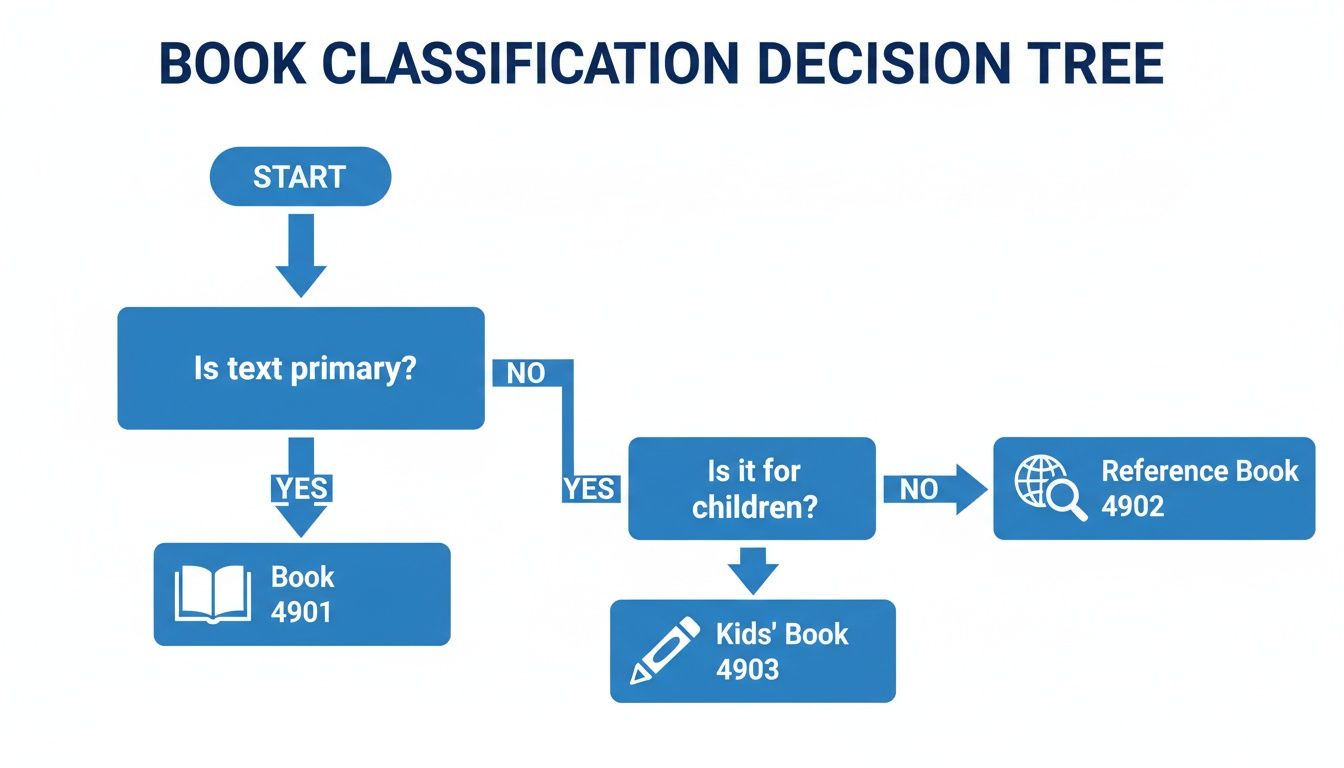
As the flowchart shows, the first question is always the same: is the book primarily about the text, or do pictures tell the main story?
A Note on Digital Products
One of the biggest tripwires in modern logistics is how to classify digital publications. The rule here is simple but absolutely critical: e-books, PDFs, and any other digital files are not covered by Chapter 49.
Chapter 49 is for physical, printed goods only. Digital products are classified completely differently, usually as software or electronic services. Confusing a PDF with a paperback is a fundamental mistake that will get your shipment flagged immediately.
Understanding these details has real financial implications. In Singapore, for instance, the trade in physical printed materials is substantial. Imports under HS Code 4901.10 (printed books and brochures in single sheets) were valued at roughly $15.2 million USD, primarily sourced from China, Indonesia, and Malaysia. You can dig into more of these trade flows on the World Bank WITS platform.
Having this hands-on knowledge is what separates an average forwarder from a great one. For a more comprehensive look, check out our complete guide to the HS code for books. When you get the classification right every time, you build trust and make sure your clients' shipments glide through customs without a problem.
Common Classification Mistakes and How to Avoid Them
Even the sharpest logistics pros can get tripped up on HS codes. When it comes to books, what seems like a minor slip-up can quickly snowball into customs delays, surprise fees, and unhappy clients. Knowing where others go wrong is the best way to make sure you get it right every time.
One of the most common stumbles is with children’s books. The mistake usually happens when someone classifies a book based on its story rather than its physical makeup. A novel written for a ten-year-old might feel like a children's book, but if it's mostly text, it still falls under HS Heading 4901. The rule of thumb is simple: if pictures are the star of the show and dominate the pages, it’s a 4903. If text does the heavy lifting, it's a 4901.
Another classic mix-up is between books and promotional material. That glossy, beautifully bound catalogue might look and feel like a book, but if its main job is to sell something, it belongs under HS Heading 4911, not 4901. Getting this wrong can lead to serious miscalculations on duties and taxes.
Overlooking National-Level Codes
A huge and potentially costly mistake is stopping at the 6-digit HS code. While those first six digits are the universal language of global trade, many countries—especially major hubs—use more specific 8 or 10-digit codes for their own national tariffs.
Trying to clear customs with a 6-digit code when the destination country demands a 10-digit one is a surefire way to get your shipment flagged and rejected. This oversight often happens because we assume the system is uniform all the way down. It isn't.
The Solution: Always, always check the full HS code against the destination country’s official customs tariff schedule. Never assume the 6-digit code is enough. Taking this one extra step can save you from hours of headaches and steep non-compliance penalties.
This level of detail is crucial for keeping things moving. Take Singapore, for example. In 2023, the country exported $954,000 USD in school and exercise books, all classified under a very specific national code derived from HS Heading 4901. You can dig deeper into Singapore's export data on the OEC website.
Common Pitfalls Checklist
To keep your shipments sailing smoothly, keep an eye out for these frequent errors:
- Content vs. Format: Don't classify a children's book based on the story. Focus on the picture-to-text ratio.
- Promotional vs. Informational: Is it a sales catalogue (4911) or a general printed book (4901)? The purpose matters.
- The 6-Digit Trap: Always find the full 8 or 10-digit code required by the destination country. Don't stop short.
- Ignoring 'Essential Character': For sets (like a book with a toy), you have to correctly identify the main item that gives the set its character. Don't just default to the book.
By getting ahead of these issues, you can ensure every declaration is spot-on. That's how you build a reputation for reliability and expertise that clients truly value.
Documentation and Customs Procedures for Shipping Books
Getting the right HS code for a book shipment is a massive first step, but it’s really only half the battle. If your paperwork isn’t spot-on to back that code up, you’re setting yourself up for a customs headache. This is where theory meets reality, and where a smooth clearance process is won or lost.
At the heart of any international book shipment are three core documents. They each have a different job to do, but they must all tell the same, consistent story to customs agents.
Core Shipping Documents
Think of your shipping paperwork like a three-legged stool. If one leg is wobbly or missing entirely, the whole thing comes crashing down.
- Commercial Invoice: This is the master document of the sale. It spells out who sold what to whom, for how much. Crucially, it must list the precise books HS code for every type of book in the shipment.
- Packing List: This document details the physical contents of the shipment—how many books, their weights, and box dimensions. It’s the proof that what’s on the commercial invoice is actually what’s packed in the cartons.
- Bill of Lading (B/L) or Air Waybill (AWB): This is your contract with the shipping company. It’s the receipt for your goods and it, too, needs to reference the correct HS codes.
There's absolutely no room for error here. If the HS code on the invoice doesn't match the one on the bill of lading, alarm bells will ring at customs. That kind of mistake almost guarantees an inspection, leading to frustrating and expensive delays.
The golden rule of customs clearance is simple: your paperwork must be a perfect mirror of your cargo. Any discrepancy, no matter how small, creates doubt and invites scrutiny.
Navigating Duties and Taxes
There's a common misconception that all books are exempt from duties and taxes. While it’s true that many countries grant preferential treatment to educational materials, it's by no means a universal rule. The final duties and taxes owed always come down to the specific HS code and the import country's local laws.
For instance, a container of novels classified under HS 4901 might sail through customs duty-free. But a shipment of glossy advertising brochures under HS 4911 could easily be hit with import duties. On top of that, Value Added Tax (VAT) or Goods and Services Tax (GST) often applies even when an item is duty-free. For a closer look at these local details, our guide on the HS code in Singapore offers some great regional examples.
This is precisely where a good freight forwarder proves their worth. By providing your clients with an accurate, all-in cost estimate—including duties and local taxes—you prevent nasty surprises when the shipment arrives. This kind of transparency doesn't just prevent disputes; it builds trust and cements your reputation as a knowledgeable logistics partner.
Turn HS Code Knowledge Into Shipper Leads
Knowing the ins and outs of HS codes for books isn't just about smooth customs clearance—it's a seriously effective tool for winning new business. For any logistics sales team, this technical expertise can be your secret weapon, turning a cold outreach process into a warm, data-driven conversation.
Forget guessing which companies might be importing books. You can use actual customs data to find out for sure. This completely shifts your approach from prospecting in the dark to surgically targeting ideal customers with information they genuinely care about.
A Practical Lead Generation Scenario
Let's walk through a real-world example of how this works. Say your goal is to find new clients who regularly import children's books into the United States. You already know from our discussion that the specific code for these products is HS Code 4903.
With just that one piece of information, you can tap into a trade data platform and pull up a list of every company that has recently declared a shipment under that exact code.
This strategy transforms your sales pitch. You're no longer just another forwarder asking for a chance to quote; you're a specialist who understands a prospect's specific supply chain needs before you even pick up the phone.
The process itself is surprisingly straightforward:
- Identify the Niche: You decide to focus on importers of children's picture books. Simple enough.
- Pinpoint the Code: You know their shipments fall under HS Code 4903.
- Search Trade Data: Using a platform with an HS code filter, you run a search for all U.S. import records matching that code. Instantly, you have a list of active importers.
- Analyse and Qualify: The data doesn't just give you names. You can see their shipping volumes, their main trade lanes, and maybe even who their current forwarders are.
- Find the Decision-Maker: The last step is to connect the dots and find the right person—the supply chain or logistics manager—at these target companies.
This method lets you craft a pitch that is incredibly relevant. You're not just another service provider; you're positioning yourself as an expert partner who's already done their homework. You can learn more about how to apply a powerful HS code filter for lead generation in our detailed guide.
Your Top Questions About Book HS Codes, Answered
Even when you feel you've got a handle on the basics, the world of customs classification always has a few curveballs. Let's tackle some of the most common questions that pop up when classifying books, so you can handle these shipments with complete confidence.
What’s the Real Difference Between HS Code 4901 and 4903?
This is a classic one, and it all boils down to what makes the book a book. Is it the words or the pictures?
HS Code 4901 is your go-to for most printed material where the text does the heavy lifting. We’re talking about novels, non-fiction, textbooks, and even technical manuals. The words are the main event.
On the other hand, HS Code 4903 is specifically carved out for children's picture, drawing, or colouring books. Here, the illustrations are the star of the show. If a child can follow the story or the main idea just by flipping through the pictures, it almost certainly belongs under 4903. The text is just there for support.
Do E-books and Digital Downloads Use Chapter 49?
Absolutely not. This is a critical distinction that can cause major headaches if you get it wrong. Chapter 49 is strictly for tangible, physical, printed goods.
Digital products are a completely different beast. E-books, audiobooks, and downloadable PDFs aren't considered "goods" in the same way. They are typically classified as software or digital services, which often fall under different chapters (like Chapter 85) or are sometimes treated as intangible services with no HS code required at all.
How Do I Find the Full 8 or 10-Digit HS Code?
The first six digits of an HS code are the universal standard set by the World Customs Organisation. But for actual customs clearance, you need the full story. Countries add their own two to four digits to get more specific for their own tariff and statistical needs.
To lock in the correct, full-length code, you have to check the official tariff database for the country of import. For instance, you'd use the Harmonized Tariff Schedule (HTS) for shipments to the USA or the TARIC system for the European Union. Never just stop at the 6-digit code; it’s rarely enough for the final declaration.
Finding and reaching out to shippers in specific niches like children's books is easier with the right tools. Coreties uses customs data to help you identify active importers by their exact HS code, find their decision-makers, and craft data-driven outreach that gets results. Discover your next lead at https://coreties.com.
Leave a Reply