Tag: freight forwarding leads

  • What Is a Cold Call in Sales: Guide for 3PLs & Freight

    What Is a Cold Call in Sales: Guide for 3PLs & Freight

    A cold call in sales is an unsolicited call to a potential customer who has had no prior contact with you, and the average meeting-booked rate still sits around 2% to 3%. In logistics, though, that first call no longer has to feel random. In 2026, better data turns it from a blind interruption into a strategic first touch with the right shipper, on the right lane, with a reason to listen.

    If you're in freight sales right now, you probably know the feeling. You have a list, half the contacts are stale, the companies are broad matches at best, and your team is expected to produce pipeline anyway. That old version of cold calling burns time and morale.

    The modern version is different. A good logistics rep doesn't call everyone who might move freight. They call the accounts that fit capacity, geography, service model, and timing. They call with context. They ask better questions. And they judge success by whether the call advances the deal, not whether someone says yes on the spot.

    The Modern Definition of a Cold Call in Sales

    A new logistics rep often starts with the wrong picture of cold calling. They think it means picking up the phone, dialing down a huge list, and hoping somebody has an urgent shipment problem that day. That's not a sales process. That's activity without control.

    What is a cold call in sales? It's a first phone conversation with a prospect who hasn't engaged with your company before. The prospect doesn't know you yet, but they should still fit your target account profile. In freight, that usually means the shipper matches the lanes you serve, the mode you sell, the shipment profile you handle well, or the industries where your operations team can win.

    What changed in practice

    The old stereotype was random dialing. The current reality is targeted outbound. A rep may still be making a cold call because there was no prior relationship, but the call shouldn't be uninformed.

    If a shipper imports consumer goods through specific ports, or regularly moves air freight into a market where your team has capacity, that call is still technically cold. It just isn't blind. That distinction matters, because relevance is what keeps the first 20 seconds alive.

    Teams that want tighter prospect discipline usually benefit from a stronger qualification process before outreach ever starts. A practical reference on that is this guide to B2B lead management, especially if your sales list keeps mixing real prospects with companies that will never buy.

    You can also see how this fits into broader freight prospecting workflows in this sales in logistics overview.

    Cold call, warm call, and cold email are not the same

    A lot of reps blur these together. They shouldn't.

    Outreach Method Comparison
    Method Prospect Awareness Typical Goal Key Advantage
    Cold calling No prior contact Start a live conversation and qualify fit Immediate feedback
    Warm calling Some prior awareness or interaction Re-engage and move toward a meeting Lower friction
    Cold emailing Usually no prior contact Earn a reply or create recognition before a call Scales personalization asynchronously

    Practical rule: If the account fits your freight offering but hasn't interacted with you yet, the call is cold. If the person recognizes your company from a referral, event, reply, or prior touch, it isn't.

    That sounds simple, but it changes how you coach a team. Cold calling isn't the same as "calling." It sits in a larger outbound cadence, and it does one job well. It creates a live opening where a shipper can confirm a problem, dismiss a fit, or point you to the decision-maker.

    For logistics sellers, that live feedback is the point. Email can be ignored. A call tells you whether the lane matters, whether the incumbent is vulnerable, and whether the contact owns transportation.

    Why Cold Calling Is a Superpower for Logistics Growth

    A rep calls a shipper on Tuesday morning with one useful piece of context. Imports from Southeast Asia are rising, the company just opened a new distribution point, and carriers on one of its likely inland lanes are tightening. That call feels very different from dialing down a generic list and asking who handles freight.

    In logistics, that difference is everything.

    A cold call still gives you information no database captures cleanly. A shipper may be testing a new vendor before bid season, shifting an origin, fighting rollover issues, or trying to fix service failures that procurement has not documented anywhere public.

    A professional man talks on the phone while working on his laptop in a warehouse office.

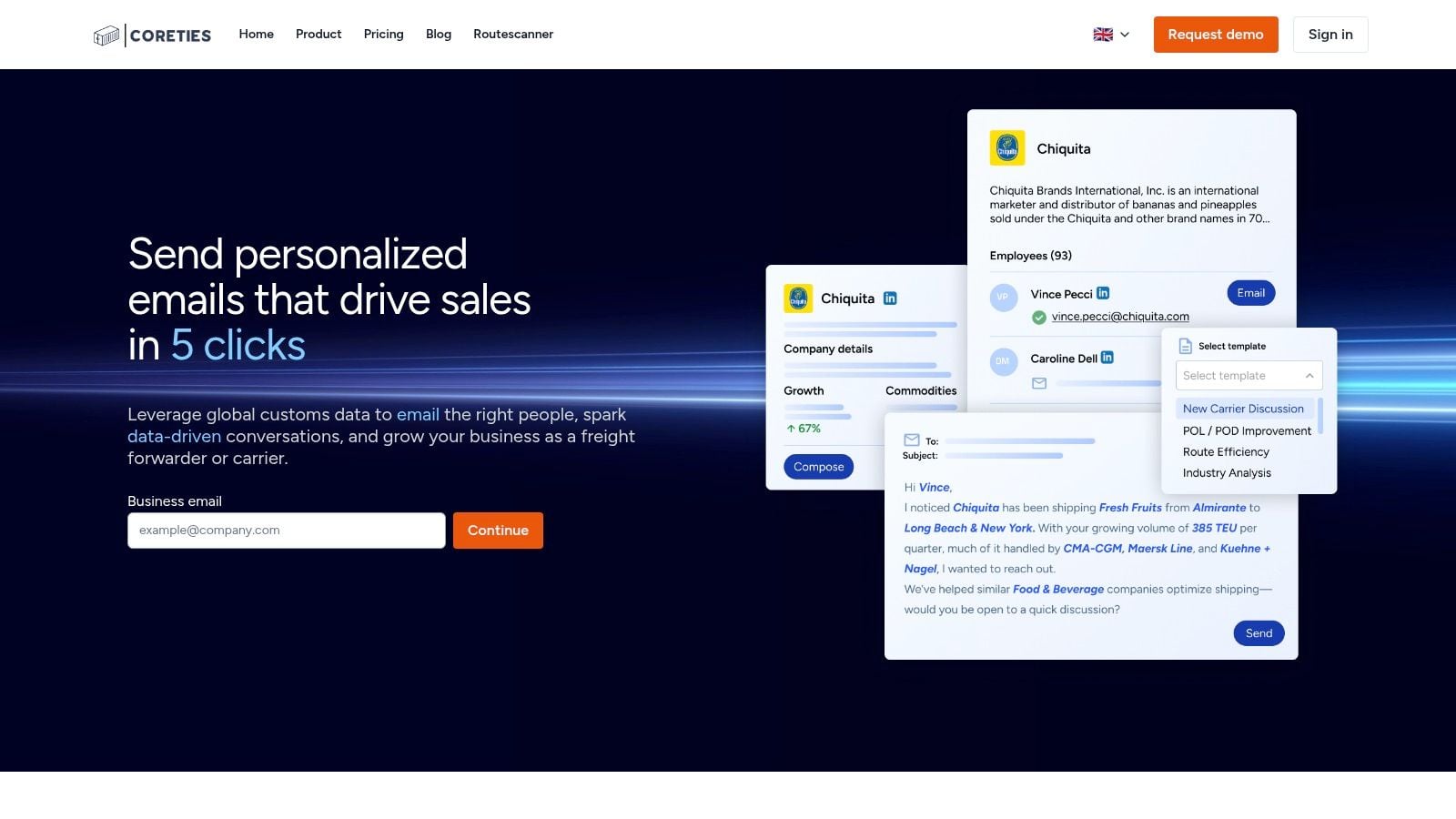
    The advantage now is that strong reps do not start fully cold. Tools like Coreties help teams narrow the field before they pick up the phone. You can prioritize accounts by shipment patterns, mode fit, geography, and likely buying triggers, then call with a reason that matches the account. The conversation starts warmer because the targeting is better.

    That is why cold calling keeps producing growth in freight. It creates access to live operating truth. You find out whether the lane matters, whether the incumbent is slipping, whether the prospect is adding volume, and whether you are even talking to the right person. If you are not, use a process for finding the right transportation decision-makers instead of burning more dials on the wrong contact.

    Where calls create real freight opportunities

    A strong freight call uncovers timing, constraints, and commercial fit.

    For a carrier sales rep, that can mean spotting backhaul freight that improves network balance and margin. For a forwarder, it can mean learning that a shipper is tired of poor milestone visibility, inconsistent transit times, or weak exception handling on a trade lane you know well. For a broker, it can mean hearing that a plant is adding volume next quarter and current coverage is already thin.

    Those openings rarely show up in a purchased list.

    Good outbound work in freight is less about reading a script and more about calling with a point of view. If you want a simple framework for structuring an opener, this outbound call script for founders is useful as a reference, but freight reps still need to adapt the message to lane pressure, mode needs, and service risk.

    Why persistence beats random volume

    Outbound in logistics rewards organized follow-up. Transportation managers are busy. Procurement teams screen aggressively. Operations leaders answer when the issue feels immediate.

    So the job is not to repeat the same pitch five times. The job is to vary the contact around a credible reason to talk.

    • Change the business angle: Lead with import congestion on one touch, capacity risk on another, and service failures or missed appointments on the next.
    • Use account-specific signals: If your data shows likely drayage exposure, port activity, regional expansion, or recurring lane fit, bring that into the conversation.
    • Redirect fast: If the contact does not own transportation, ask who handles routing guides, carrier selection, forwarding, or spot coverage.

    The best reps stay persistent without sounding repetitive.

    Cold calling works in logistics because freight buying is still operational and personal. Buyers trust people who understand detention, appointment failures, mode shifts, tender rejections, and the cost of a late delivery. Email helps. A live call gives you a chance to prove you understand the work.

    The Blueprint for a High-Converting Logistics Cold Call

    A rep calls a shipper at 10:07 a.m. and opens with, "Just checking if you handle freight." That call is dead on arrival. A logistics cold call converts when the rep already knows enough to make the conversation relevant in the first 15 seconds.
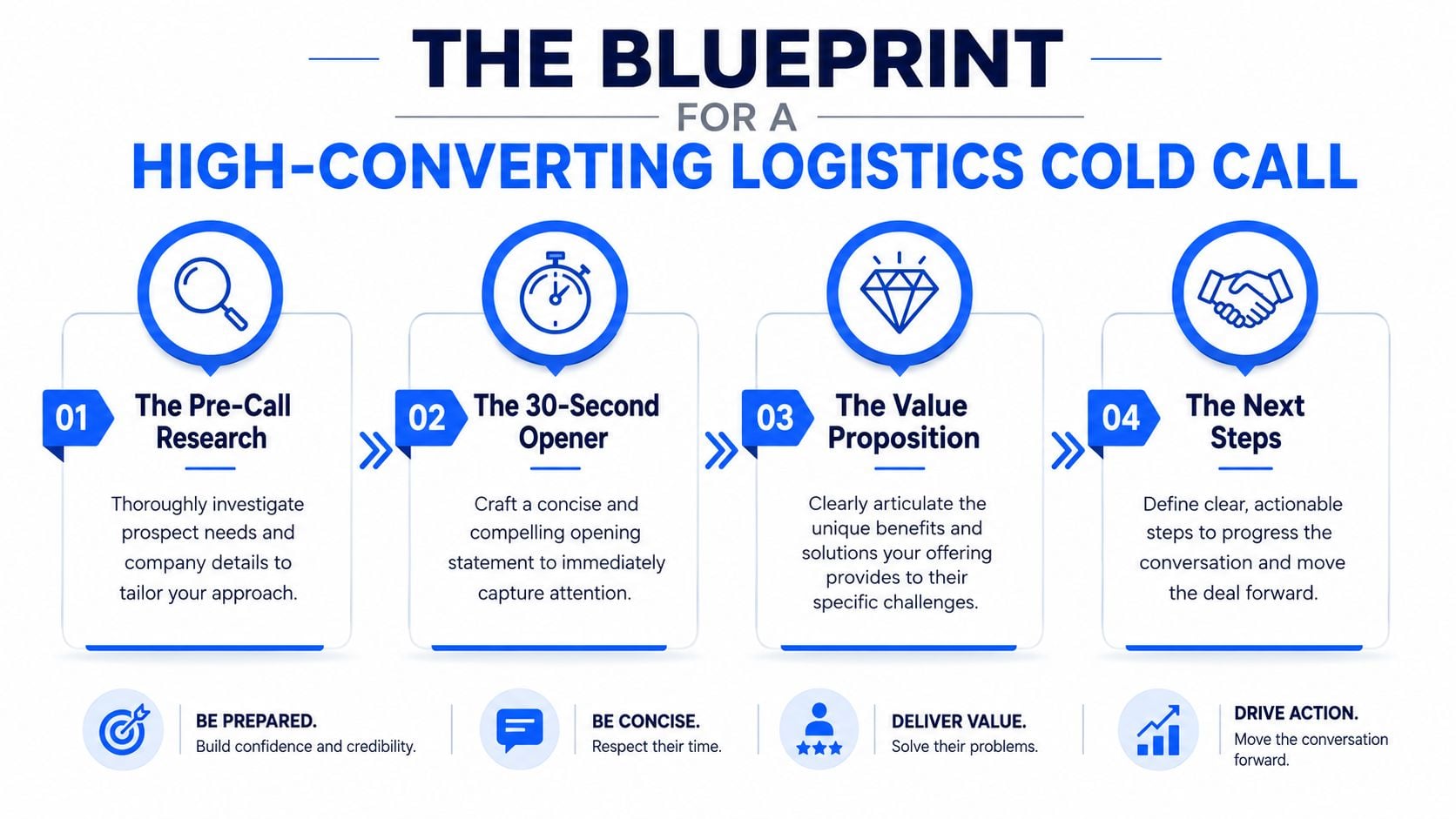
    A four-step infographic showing the blueprint for conducting a high-converting logistics sales cold call.

    Start with account context

    Freight buyers do not reward generic outreach. They respond when the caller sounds like someone who understands how transportation works inside their business.

    That means preparing around account facts, not memorizing a script. Know the likely mode mix, the shipping pattern, the pressure point, and who probably owns the decision. If your tools show import activity, port exposure, regional distribution, or a lane fit your team serves well, use that. Platforms like Coreties help reps turn a cold list into a prioritized call sheet with enough context to ask a smart question on the first attempt.

    The goal is simple. Reduce uncertainty for the prospect. If they can tell in one sentence why you called, resistance drops.

    Open with a reason, then ask one useful question

    A strong opener sounds specific and easy to answer. It does not sound polished for the sake of sounding polished.

    A practical freight opener sounds like this:

    "Hi Sarah, how are you doing? I'm calling because your team looks active on inbound container freight through Savannah, and I wanted to ask who reviews forwarding options when schedules slip or costs move."

    That opener works because it does three jobs fast:

    1. It sounds human: The rep talks like a person.
    2. It establishes relevance: The call references a real shipping context.
    3. It gives the prospect an easy path: They can confirm, redirect, or correct.

    For teams tightening language, this outbound call script for founders is a useful reference for structure. Freight teams still need to adapt the wording to mode, lane pressure, and service risk. If the rep is not sure who owns transportation decisions, this guide on how to find decision-makers at shipper accounts helps before the first dial.

    A short training clip can help reps hear pacing and delivery, not just read a script.

    Talk in operating terms

    Once the buyer engages, keep the conversation tied to work they already manage. Freight prospects do not need a broad capability speech. They need a clear reason to believe your team can improve part of their operation.

    Use language that matches the account:

    • For shippers: Focus on service consistency, appointment performance, lane coverage, and fewer exceptions.
    • For importers: Focus on routing options, trade lane familiarity, and response speed when plans change.
    • For carrier-side conversations: Focus on network fit, volume alignment, and where your capacity solves a known need.

    Specific beats broad. "We handle international freight" is forgettable. "We help importers with time-sensitive Asia to U.S. moves when schedule changes start affecting downstream appointments" gives the buyer something concrete to react to.

    Ask for the next meeting the call has earned

    Cold calls in freight rarely close business on the spot. They create the next serious conversation. That may be a lane review, a pricing discussion, an introduction to procurement, or a call with the transportation manager.

    Keep the close direct and low pressure:

    "If this lane is active for your team, would a short call next week make sense with whoever reviews forwarding options?"

    That works because it respects the buyer's process. It also gives your rep a clean outcome to track. In practice, the best cold calls do not feel cold at all. They feel like timely conversations backed by real account context.

    Supercharge Your Calls with Data Driven Insights

    The biggest mistake in freight outbound is calling with generic assumptions. "Do you ship internationally?" "Are you reviewing providers?" "Can I tell you about our services?" Those questions waste the small window you get on a live connect.

    Modern sales teams fix that by replacing guesswork with account intelligence.
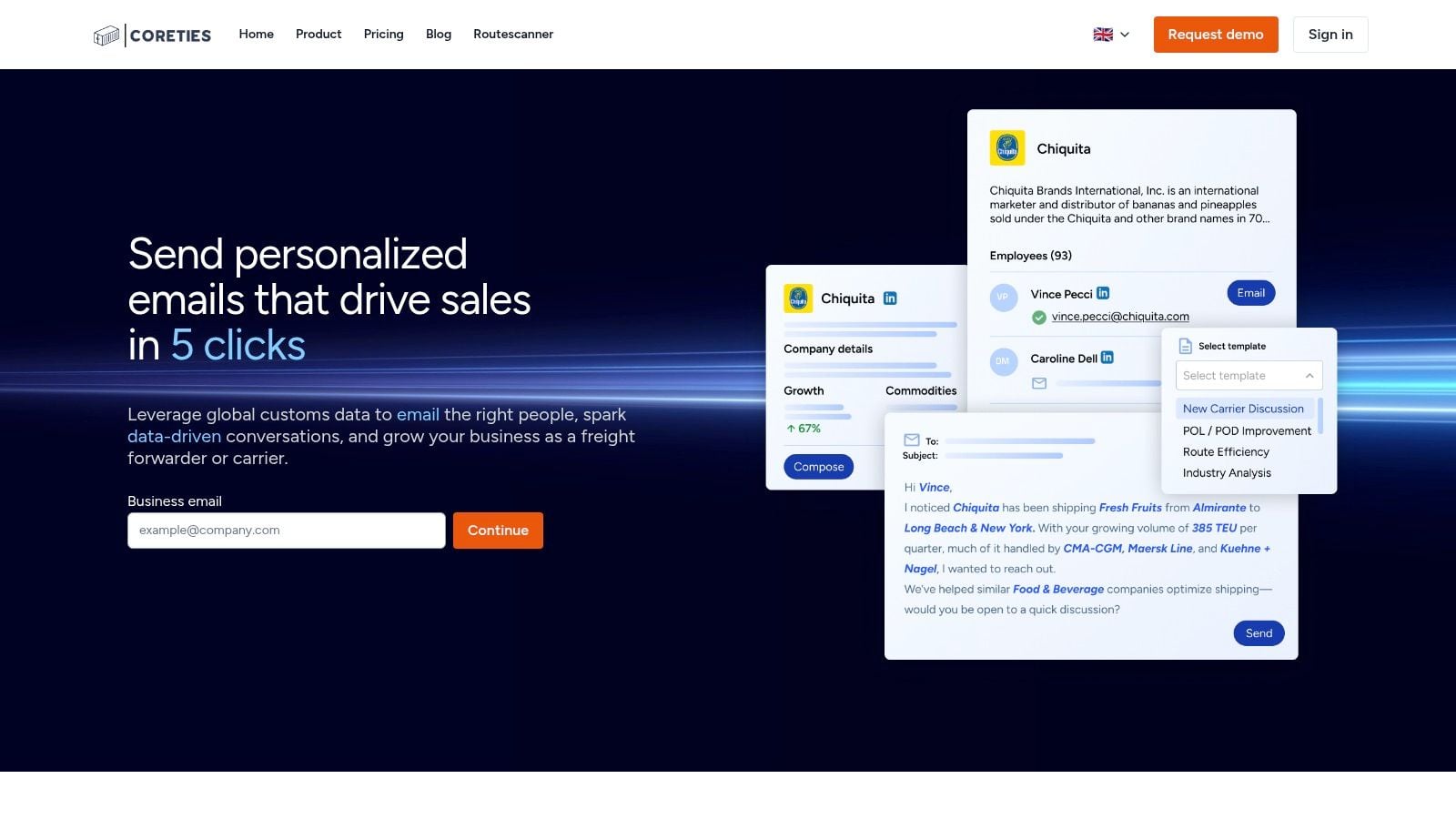
    Screenshot from https://coreties.com

    What a smart call sounds like

    A generic call sounds cold because the rep doesn't know enough to be relevant. A smart call still reaches out first, but it opens with evidence the rep understands the account.

    That changes the conversation.

    Instead of asking whether a company imports, the rep references known trade activity. Instead of asking who handles logistics, the rep calls the most likely decision-maker. Instead of talking about broad capabilities, the rep speaks to the lane, mode, or routing pressure most likely to matter.

    Here is the difference in practice:

    Call Style Opening Approach Prospect Reaction
    Generic cold call Broad introduction and company pitch Low patience
    Data-informed call Specific business context and relevant question Higher credibility
    Warm follow-up call Builds on prior interaction or signal Easier progression

    What to prepare before the dial

    For logistics teams, useful call prep usually comes from a combination of shipment visibility, account fit, contact quality, and outreach workflow discipline.

    • Shipment context: Look for lane patterns, origin-destination relevance, and signs that your service model fits the account.
    • Contact precision: Call the person most likely to own transportation, procurement, forwarding, or supply chain decisions.
    • Message tailoring: Match your reason for calling to the account's likely shipping reality, not your internal product list.
    • Follow-up system: If a live conversation doesn't happen, queue an email and next touch while the details are fresh.

    Teams that want stronger process around sequencing and rep coordination can learn from examples of sales team outreach automation. For broader workflow planning, this guide to sales intelligence tools helps frame what data improves outreach quality.

    Better data doesn't replace selling skill. It gives selling skill something accurate to work with.

    Why this matters in freight

    Freight buyers hear the same claims all day. Good service. Competitive rates. End-to-end solutions. Those phrases are too broad to create trust.

    Specificity does. If the rep knows the account likely moves on a lane where their company has a real operational advantage, the conversation becomes useful faster. That's how a cold call starts to feel warm. Not because the prospect knows you, but because the call sounds informed enough to deserve a response.

    That shift also improves rep discipline. When each call starts with actual context, managers can coach quality. They can inspect whether the rep chose the right account, reached the right person, framed the lane correctly, and asked a real qualification question.

    Measuring Success and Ensuring Compliance

    Many freight teams still measure cold calling the wrong way. They celebrate dials, talk time, or how busy the rep sounded that day. Those numbers can describe effort, but they don't tell you whether outbound is creating pipeline.
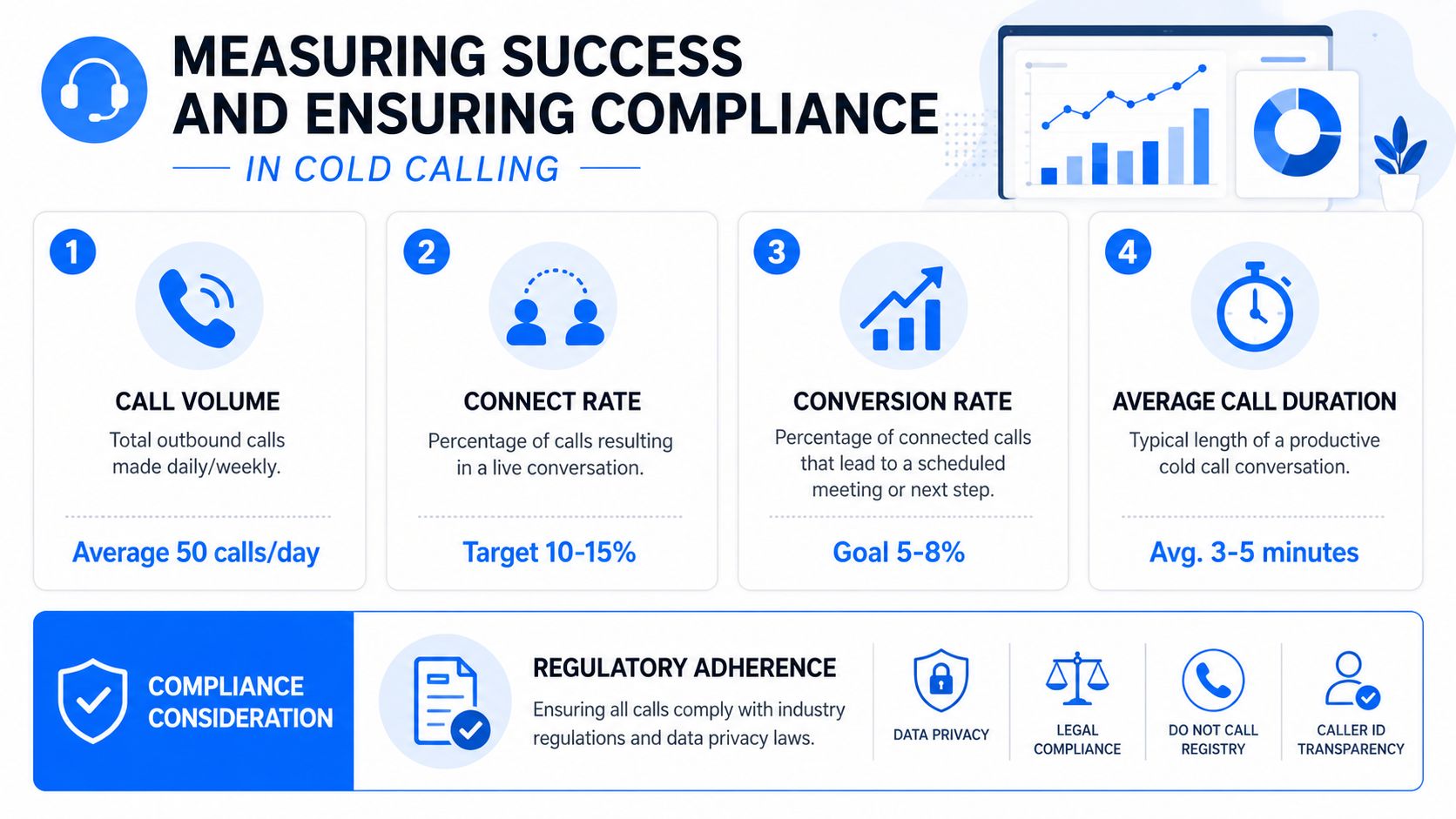
    An infographic detailing key performance metrics and regulatory compliance considerations for successful cold calling in sales teams.

    Track what moves the deal

    The cleanest way to measure cold calling is to treat it like a pipeline advancement system.

    According to RingCentral's definition of cold calling, calls must be made between 8 a.m. and 9 p.m. in the prospect's local time, callers must identify themselves and their organization, and the main success metric should be advancing the prospect to the next pipeline stage rather than trying to force an immediate sale.

    That standard fits freight sales well. A productive call might result in a follow-up meeting, a referral to the transportation lead, a lane review, or permission to quote. Those are real outcomes. They move the account forward.

    A practical scorecard should include:

    • Connect quality: Did the rep reach a real stakeholder or just complete a dial?
    • Conversation relevance: Did the call uncover lane, provider, timing, or ownership information?
    • Next-step rate: Did the rep earn a meeting, introduction, or agreed follow-up?
    • Data improvement: Did the rep leave the account record cleaner than they found it?

    Compliance is part of professionalism

    Compliance isn't separate from good sales. In outbound freight prospecting, it protects reputation and keeps your team disciplined.

    At minimum, reps should follow a few essential rules:

    • Call during allowed hours: Use the prospect's local time, not the rep's.
    • Identify yourself clearly: State your name and company early.
    • Avoid deception: Be direct about why you're calling and what your business does.
    • Document outcomes: Record requests, objections, next steps, and any opt-out signals accurately.

    Professional outbound teams don't just sound organized on the phone. They prove it in their records.

    One more management point matters here. If your team is chasing vanity metrics, they will take bad shortcuts. If they are measured on clean qualification and next-step creation, call quality improves and compliance gets easier to maintain.

    Conclusion From Cold Contact to Valued Partner

    A cold call continues to be what it always was. It's a first conversation with someone who hasn't engaged with you before. What changed is how good teams prepare for it.

    In logistics, the difference between a useless cold call and a productive one comes down to relevance. Random dialing produces random outcomes. Focused account selection, better contact targeting, and a clear lane-based reason for calling produce conversations worth having.

    The reps who win freight business don't rely on volume alone. They call the right accounts, ask sharp questions, and treat the phone as a tool for qualification and trust building. They don't try to close everything on the first touch. They move the deal forward one credible step at a time.

    That's the answer to what is a cold call in sales today. It's not a relic. It's a disciplined first move. When logistics teams use data to narrow who they call and why, the "cold" part starts disappearing. What remains is a direct, useful conversation that can turn a stranger into a qualified opportunity, and eventually into a long-term shipper relationship.


    Coreties helps freight teams make cold outreach far less cold. If you want to find qualified shippers, identify the right decision-makers, and start sales conversations with lane-specific context instead of generic guesswork, Coreties gives your team a practical way to do it.

  • Mastering Sales Intelligence Tools for Logistics

    Mastering Sales Intelligence Tools for Logistics

    You can feel the old logistics sales routine wearing your team down. A rep gets a spreadsheet of importers, searches LinkedIn, calls the main switchboard, reaches the wrong contact, leaves a voicemail, sends a generic email, and repeats it all afternoon. By Friday, there's activity everywhere and very little pipeline that deserves a forecast discussion.

    That approach breaks down fast in freight. Shippers don't buy because you called first. They buy because you understood their lane, recognized a service gap, reached the right person, and made a relevant offer before another forwarder did. In logistics, timing and context beat volume.

    That's why sales intelligence tools matter. Used well, they replace blind prospecting with a working view of who ships what, where they move it, who likely owns the decision, and when outreach has a real reason behind it.

    The End of Cold Calls in Logistics

    A freight rep once could get away with persistence alone. Buy a list, call through the front desk, ask for the transportation manager, and hope the account had a tender coming up. Today that method burns hours and creates noise. Most logistics teams already know the pain. The problem isn't effort. It's weak targeting.

    In freight forwarding and carrier sales, the bad version of prospecting looks familiar:

    • Wrong company fit: Reps chase businesses that don't move the modes, origins, or volumes the team serves well.
    • Wrong contact level: They find a CEO or founder when the conversation belongs with procurement, transportation, import operations, or supply chain.
    • Wrong timing: Outreach lands after a routing decision is already made, after a contract is locked, or during a period when the shipper isn't reviewing providers.
    • Wrong message: Emails talk about “end-to-end logistics solutions” instead of a concrete lane, customs pattern, or service issue the prospect already feels.

    That's why the old playbook produces motion, not momentum.

    A better workflow starts before the first email. Reps build a target list from actual shipping behavior, narrow by trade lane or product movement, identify decision-makers, and then tailor outreach around the account's logistics reality. If your team still struggles with contact discovery, this guide on how to find decision-makers in target accounts is a practical place to tighten the front end of the process.

    Practical rule: In logistics sales, a smaller list with real lane relevance usually beats a larger list built from generic industry filters.

    Cold calling isn't dead because calls stopped working. It's ending because random calls stopped working. The teams winning freight contracts aren't just working harder. They're entering conversations with better data.

    What Sales Intelligence Means for Freight and Shipping

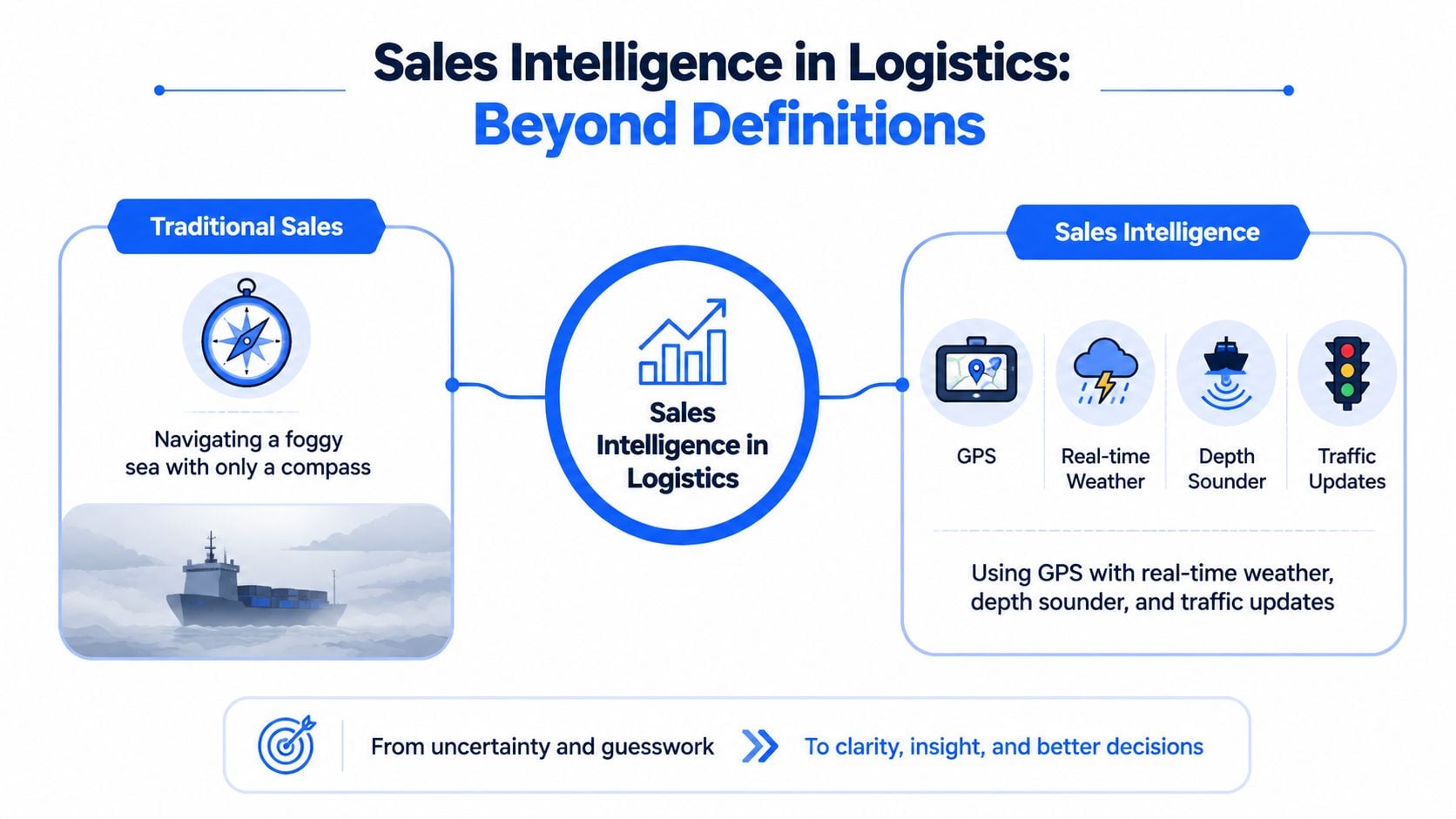
    For logistics teams, sales intelligence is the difference between a paper road atlas and a live satellite navigation system. The atlas tells you where roads exist. The live system shows traffic, weather, detours, and which route still makes sense right now. Freight sales works the same way.

    Traditional prospecting gives you names and company records. Modern sales intelligence tools give you operating context.

    According to Outreach's explanation of what sales intelligence is, the category evolved from simple databases into platforms that combine contact data, firmographics, intent signals, and CRM integrations. IBM describes it as the systematic collection of data to improve sales. In practical terms, that means a logistics seller can stop treating prospecting as list building and start treating it as account selection.

    An infographic comparing traditional sales to modern sales intelligence in the logistics industry using navigation metaphors.

    From records to operating insight

    A generic contact database might tell you a company is an importer in the consumer goods space. That's not enough to win freight. A logistics-focused intelligence workflow should help your team answer better questions:

    • What does this shipper move?
    • Which origin-destination patterns matter most to them?
    • Who likely owns forwarding, carrier procurement, or customs coordination?
    • What changed recently that makes outreach relevant now?

    That last point is where average prospecting falls apart. Reps often know who the company is, but not why the account deserves attention this week.

    Why the definition matters in logistics

    In freight, relevance comes from operational context. If you know a shipper's likely lanes, mode preferences, geography, and internal buyer roles, you don't send a vague introduction. You lead with a useful point of view. That could be a consolidation opportunity, a service alternative, a routing idea, or a faster way to cover a problematic lane.

    Sales intelligence in logistics isn't about owning more records. It's about turning fragmented market information into a reason to contact a shipper.

    That's also why generic B2B advice often misses the mark for freight teams. Logistics sellers need more than titles and email addresses. They need a current view of trade flow, account fit, and buying context. Without that, prospecting stays reactive.

    Must-Have Features and Data Sources for Logistics Sales

    A logistics sales team shouldn't buy a general database and assume it becomes industry-specific because a vendor added “transportation” as a filter. Freight sales needs deeper operating data. If the platform can't help your reps understand lanes, shipment patterns, and supply chain ownership, it won't change performance in a meaningful way.

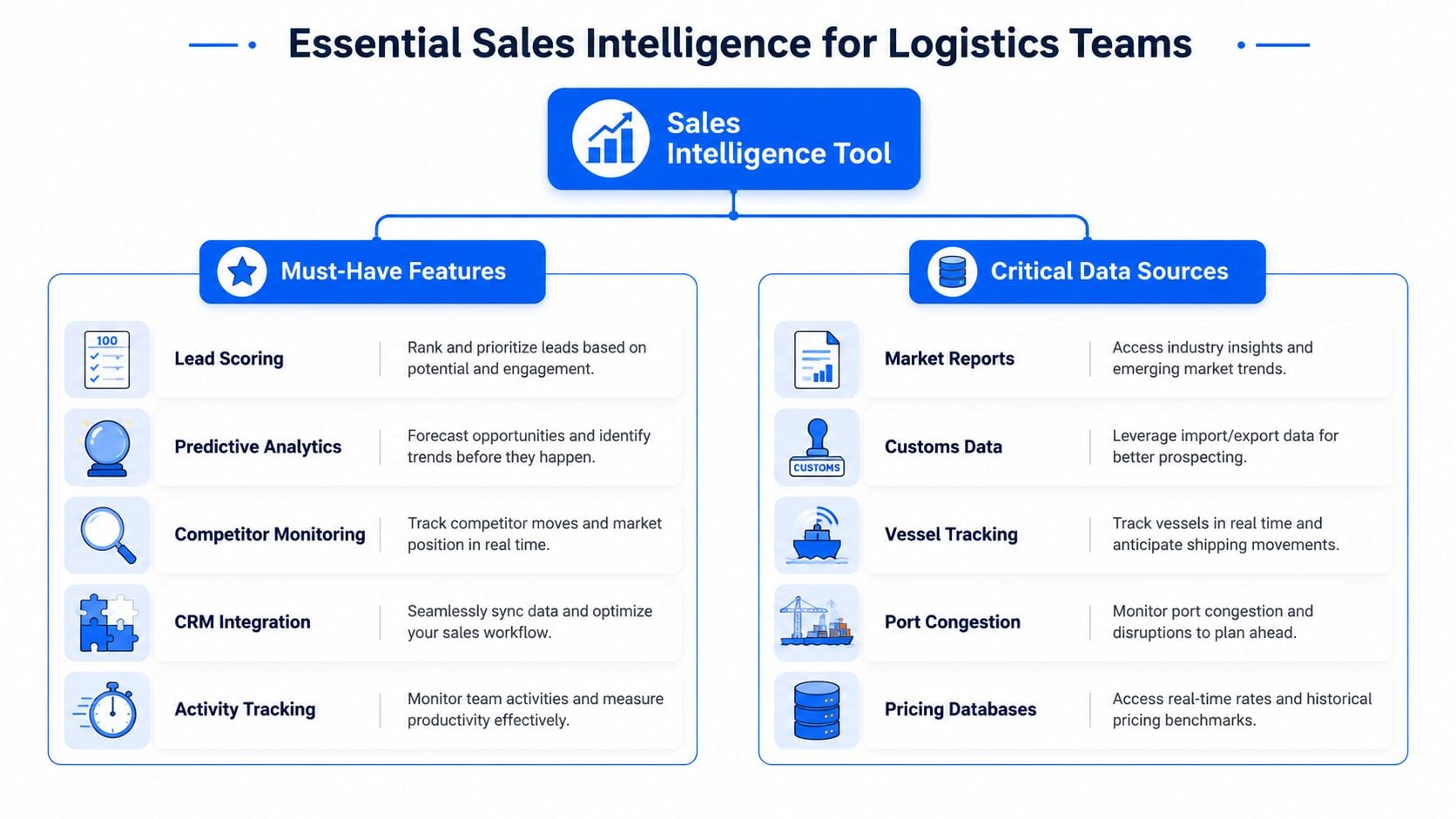
    The strongest sales intelligence tools work because they join multiple data layers. IBM's overview of sales intelligence notes that contact, firmographic, intent, and deal signals become more useful when fused into one view, and that machine learning can use historical sales data to rank accounts by fit and buying likelihood. For logistics teams, that matters because no single dataset explains whether an account is worth pursuing.

    A diagram illustrating essential sales intelligence features and critical data sources for logistics industry teams.

    What logistics teams actually need

    Here are the capabilities that move the needle in freight sales.

    • Customs and shipment visibility: This is the anchor dataset for many forwarding and carrier teams. Customs data helps reps identify who is importing, what categories they move, and which trade flows deserve attention. It's one of the clearest ways to move from abstract industry targeting to actual shipper discovery. If you want a broader view of how these datasets support prospecting, this overview of supply chain databases for sales teams is worth reviewing.

    • Lane-level filtering: “Retail” or “manufacturing” isn't precise enough. Reps need to isolate accounts by origin, destination, mode, region, and shipment pattern so they can build a service offer around actual movement.

    • Decision-maker coverage below the C-suite: In logistics, the useful contact is often the person managing transportation procurement, import operations, sourcing logistics, or distribution planning. A tool that only surfaces executive leadership will slow the sales cycle down.

    • CRM integration: If reps must export CSV files, manually enrich records, and copy activity back into the CRM, adoption drops. The tool needs to fit the daily sales motion, not sit beside it.

    Nice features versus useful features

    Some features look impressive in a demo but don't matter much in freight unless the underlying data is relevant.

    Feature type Useful in logistics when Weak in logistics when
    Lead scoring It reflects lane fit, shipment profile, and buyer role It scores generic industry fit only
    Predictive signals They help reps prioritize active accounts They produce rankings with no operational explanation
    Competitor monitoring It reveals service gaps or disruption opportunities It offers broad market alerts with no account tie-in
    Activity tracking It shows whether outreach is moving the account It becomes a dashboard of rep busyness

    Why customs data changes the conversation

    Customs data is a real differentiator because it grounds sales activity in trade behavior, not assumptions. If you can see who imports from a specific origin, or which companies appear active on a lane your team already serves well, you can build a prospecting strategy around actual freight movement.

    That's what many tools still miss. They tell you who fits your ideal customer profile in theory. Logistics teams need to know who resembles a customer in motion.

    From Data to Deals Logistics Use Cases

    The shift from research to revenue happens when reps use data to create a specific offer. In freight, that usually starts with a lane, a service problem, or a buyer already showing activity.

    One practical example is building a target list around a new trade lane push. Say your team wants more inbound business from Southeast Asia into the US Midwest. Instead of buying a broad importer list, you filter for shippers with relevant origin patterns, narrow by commodity or product group, and then route outreach to transportation or import contacts. The message is no longer “We're a global forwarder.” It becomes “We've identified your Vietnam-origin flow and have a stronger option for this lane.”

    Screenshot from https://coreties.com

    Three use cases that actually fit freight sales

    Use case one. Build an LCL or consolidation prospect list
    A forwarder launching a focused service can identify importers with shared origin markets and build outreach around consolidation, transit control, or destination handling support. This works best when the rep knows the traffic pattern before the first touch.

    Use case two. Target accounts during service disruption
    If a shipper's current provider is struggling with consistency on a lane, a rep can move quickly with a credible alternative. In freight, timing matters as much as price. A relevant message during disruption gets read. A generic capability deck usually doesn't.

    Use case three. Plan a territory visit around account quality
    A field seller heading into Chicago, Rotterdam, or Singapore shouldn't book meetings based on whichever accounts happen to be nearby. Geo-search and account mapping let the rep build a route around high-fit shippers, current opportunities, and adjacent targets worth dropping in on.

    When timing becomes the advantage

    Intent signals matter most when they help reps act faster. Crunchbase's guide to sales intelligence and intent-driven prospecting explains that intent systems track research behavior across large web footprints and can surface accounts actively evaluating a category. In logistics, that doesn't replace customs or lane data. It complements it.

    A shipper may match your lane strategy, but still not be ready for a conversation. Intent data adds a timing layer. If an account starts showing signs of active evaluation, reps can move from static prospecting to event-triggered outreach.

    If your team can explain both the shipper's freight pattern and the reason for reaching out now, the conversation feels informed instead of intrusive.

    That's where deals start. Not with more names. With better reasons.

    An Evaluation Checklist for Your Next Sales Tool

    Most sales intelligence tools look strong in a demo. Filters are smooth. Maps move fast. The dashboard is clean. None of that tells you whether the platform will help your team win freight contracts.

    A better evaluation process starts with one question. Does this tool improve a bottleneck your logistics team already feels?

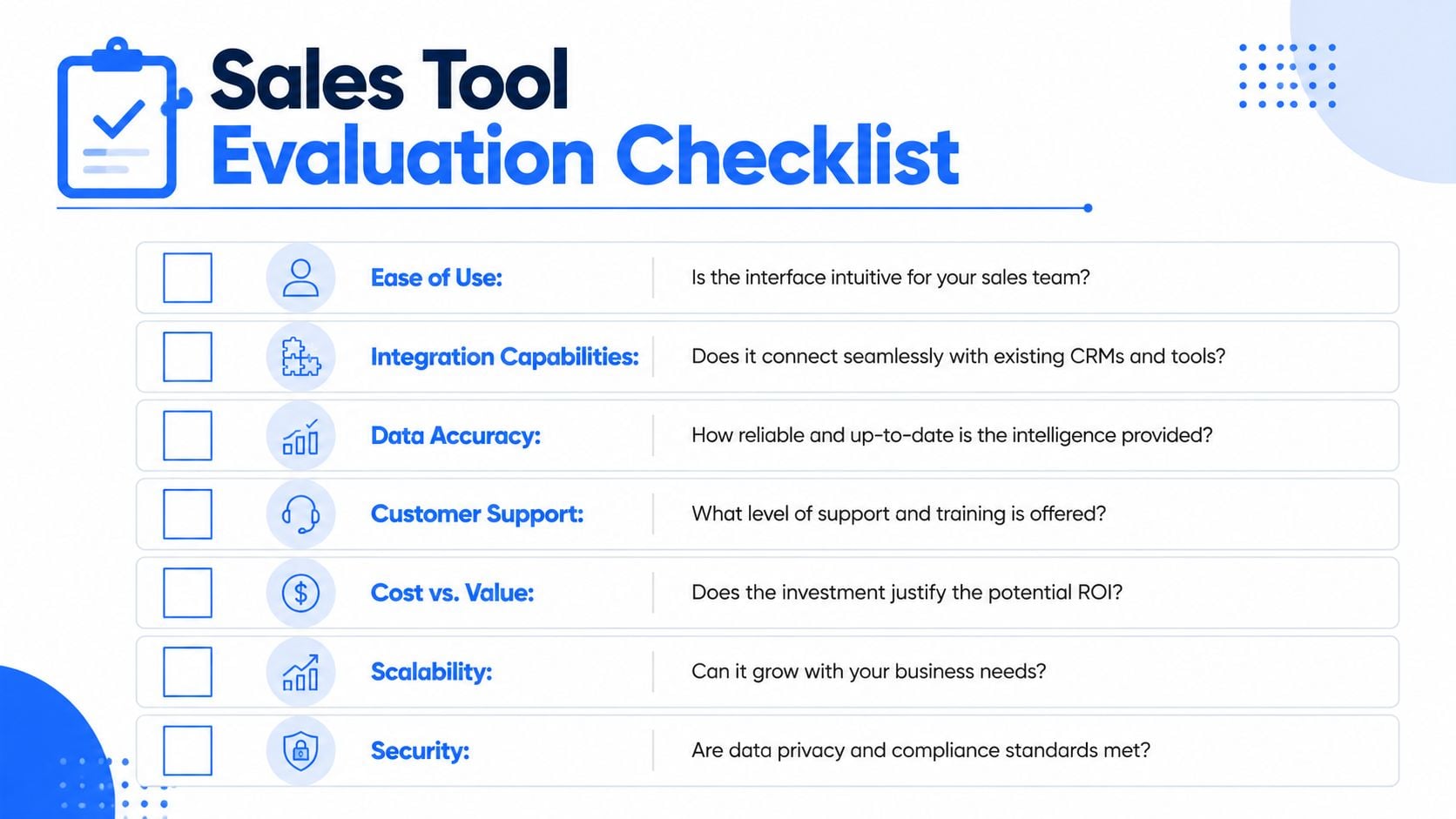
    The market leaders have built serious data infrastructure. ZoomInfo says its platform is built on 500 million contacts, 100 million companies, and 1.5 billion+ data points processed daily in its GTM Context Graph, as noted in this review of top sales intelligence tools. That scale matters. But for a freight team, scale alone doesn't guarantee useful lane targeting, cleaner account selection, or better contact relevance.

    A checklist infographic titled Sales Tool Evaluation Checklist featuring seven key criteria for evaluating new software tools.

    A practical buying scorecard

    Use a simple red-yellow-green score across these areas:

    • Data fit: Does the platform understand logistics entities, shipper behavior, and trade-lane targeting well enough to support real prospecting?
    • Contact relevance: Can reps find supply chain, transportation, procurement, and import/export contacts, not just senior executives?
    • Workflow speed: Can the team go from account discovery to outreach without bouncing across multiple tools?
    • Territory usefulness: Does it support geographic planning, lane clustering, or field-sales routing in a way that reflects how your team sells?
    • Integration quality: Will it sync with your CRM and existing process without creating manual cleanup?
    • Signal trust: Can your reps tell why an account was prioritized, or does the system just produce opaque rankings?
    • Adoption risk: Will your team use it after the first month?

    Questions to ask in the demo

    Don't ask vendors for a generic walkthrough. Make them prove fit.

    Ask this Why it matters
    Show me how to find importers on a specific lane Reveals whether the product supports logistics targeting or just broad firmographics
    Show me the buyer roles available for an account Confirms contact depth where freight decisions really sit
    Show me how records stay current Exposes refresh discipline and practical usability
    Show me the CRM handoff Tells you whether the workflow will stick after launch

    A useful outside perspective can also help your team compare prospecting categories before you buy. This roundup from Fypion Marketing on best sales prospecting tools is a solid reference for framing the broader context.

    Buyer test: If a vendor can't demonstrate a real freight workflow in the demo, assume your reps will have to build that workflow themselves.

    That usually means slower adoption and a weaker return.

    Implementation and Measuring Your ROI

    Teams often lose the value of a good tool in the first month. Not because the software is bad. Because rollout is vague, ownership is unclear, and nobody defines what “working” means for the sales floor.

    The fastest path to ROI is to connect the tool to one concrete bottleneck. Avoma's guidance on how to evaluate sales intelligence tools makes this point well: the actual buying question isn't “which tool is best,” but whether the tool improves a specific constraint such as account prioritization or outreach personalization. In logistics, that usually means better lane targeting, faster account research, or more relevant outreach to shipper-side decision-makers.

    Start narrow or adoption will stall

    Don't launch with every mode, every region, and every rep at once. Start with one use case your team already understands.

    Examples that work well:

    • A lane-based pilot: Assign one trade lane or shipper segment to a small team and compare the quality of conversations against the old process.
    • A territory planning pilot: Give field reps a defined geography and require account selection through the new tool before trips are booked.
    • A contact-quality pilot: Focus only on improving access to the right buyer roles for a set of named accounts.

    If your team needs a planning model for rollout, this guide to an implementation timeline for sales adoption can help map ownership and sequencing.

    Measure business movement, not just rep activity

    A weak rollout measures emails sent. A strong rollout measures whether the team is producing better opportunities.

    Track outcomes such as:

    • Qualified accounts created: Are reps identifying more accounts that fit your service strengths?
    • Time to first meaningful meeting: Are sellers reaching a relevant buyer faster?
    • Message relevance: Are outreach notes and emails tied to lanes, origins, or supply chain context?
    • Pipeline quality: Are opportunities entering the CRM with a clear freight problem to solve?

    Coreties says customers report up to 30x gains in outreach efficiency, with teams spending about an hour to send 30+ customized emails versus a single message with traditional methods, according to the publisher information provided for this article. The number matters less than the lesson. Efficiency improves when the workflow reduces research time and makes personalization easier at the moment of outreach.

    Here's a useful way to pressure-test adoption internally.

    If the tool saves clicks but doesn't improve targeting, it won't last. If it improves targeting but creates extra admin, reps will route around it. The tool has to make the right action faster.

    Build Your Future-Proof Logistics Sales Engine

    The logistics teams that keep chasing generic lead lists will stay busy and frustrated. The teams that win consistently are building a sales engine around better account selection, sharper timing, and outreach grounded in actual freight movement.

    That's the fundamental shift behind sales intelligence tools. They move the job from contact hunting to opportunity design. A rep stops asking, “Who can I call today?” and starts asking, “Which shippers fit our network, where is the service gap, and who owns the decision?” That's a stronger commercial posture for any forwarder, carrier, NVOCC, or 3PL.

    What durable teams do differently

    • They target by lane, not just industry
    • They look for operational relevance before writing outreach
    • They build workflows that sales reps will use every day
    • They treat data quality and signal confidence as commercial issues, not just technical ones

    For leaders trying to improve output without forcing more activity onto already stretched teams, this startup guide on sales productivity offers a useful outside lens on productivity discipline and workflow design.

    The future-proof logistics sales organization won't be the one with the biggest list. It will be the one that can spot the right shipper sooner, understand the freight context faster, and start a better conversation before competitors do.


    Coreties helps freight forwarders, carriers, and logistics sales teams turn customs data into qualified prospect lists and personalized outreach. If you want a faster way to find shippers by lane, identify the right decision-makers, and contact them with messages tied to real shipping patterns, explore Coreties.

  • How to Improve Conversion Rates in Logistics Sales

    How to Improve Conversion Rates in Logistics Sales

    Your team is probably doing more activity than ever. More outbound emails. More quote requests. More follow-ups. More website traffic reports in the weekly meeting.

    And still, the pipeline feels thin.

    That's the trap in logistics sales. Teams think they have a conversion problem because the website form isn't converting, or because outbound reply rates feel soft, or because prospects ghost after the first call. Usually the underlying issue sits earlier and deeper. The wrong accounts enter the funnel. The message is generic. The offer asks for too much too soon. The website adds friction right when a shipper is ready to engage.

    In freight forwarding, knowing how to improve conversion rates isn't about squeezing a few more clicks out of a landing page. It's about building a path from first signal to first conversation, then from conversation to quote, then from quote to a real commercial relationship.

    Rethinking Conversions Beyond the Quote Button

    A common scene in logistics sales looks like this. A rep sends a large batch of emails to importers and exporters, gets a handful of opens, almost no replies, and one vague quote request from a company that was never a fit to begin with. Marketing says traffic is up. Sales says lead quality is down. Nobody trusts the numbers.

    The mistake is defining conversion too narrowly.

    In logistics, a conversion isn't just a completed website form. In many cases, the highest-value conversion is a qualified meeting, a lane-specific inquiry, a first meaningful reply from the right decision-maker, or a shipper agreeing to review a routing option. Broader B2B guidance makes the same point. Teams should optimize the entire customer journey, not just landing pages, and use lower-friction offers earlier in the funnel when the buyer isn't ready for a hard commitment yet, as noted in WordStream's guidance on improving conversion rates.

    What logistics teams often get wrong

    Most underperforming sales motions focus on volume before fit.

    They ask for a quote request before earning attention. They send traffic to a generic homepage. They measure raw lead count instead of whether the account matches target trade lanes, shipment profile, or buying role. If that's your process, you don't have a conversion optimization problem at the end of the funnel. You have a qualification and sequencing problem from the start.

    Practical rule: In freight, the first conversion should match the buyer's intent. If they're early, offer insight. If they're active on a lane, offer relevance. If they're comparing providers, offer proof.

    That's why many outbound teams get more useful ideas from specialized resources like EmailScout conversion strategies than from generic ecommerce CRO playbooks. The sales motion is different. You're not selling a low-risk impulse purchase. You're trying to start a credible commercial conversation.

    The conversion path that actually matters

    A freight buyer rarely moves from cold click to closed business in one step. The path usually looks more like this:

    • Discovery: The shipper becomes aware of your company through outreach, referral, search, or market visibility.
    • Validation: They decide whether you understand their lane, commodity, timing, and service expectations.
    • Engagement: They reply, book a meeting, or ask a practical question.
    • Commercial review: They compare you against incumbents and alternatives.
    • Commitment: They send an opportunity, test shipment, or formal RFQ.

    This is why logistics teams benefit from aligning sales and marketing around the same funnel language. A useful starting point is to map what counts as a real conversion at each stage, then build messaging and pages around those steps. Coreties has a strong overview of that alignment in its article on logistics sales.

    If you treat every visitor and every prospect as if they're ready to request a quote today, you'll lose the ones who needed a smaller next step first.

    Build Your Baseline with Data Driven Prospecting

    If you can't see where deals stall, you can't fix the funnel. Most logistics teams track activity. Fewer track conversion.

    The baseline shouldn't start with website visits. It should start with commercial movement through the funnel you run.

    Track the stages that lead to revenue

    Use a simple operating view. You need to know how many target accounts enter the funnel, how many engage, how many become meetings or quote opportunities, and where they fall out.

    A diagram of a five-step data-driven prospecting funnel illustrating the journey from lead identification to customer conversion.

    A clean baseline usually includes metrics like these:

    Funnel stage What to watch Why it matters
    Lead identified Fit by shipper type, lane, geography, and buying role Bad inputs distort every later metric
    Outreach engaged Replies, meaningful responses, and conversation starts Shows whether the message earns attention
    Meeting created Qualified calls or discovery meetings booked Confirms real sales traction
    Proposal or quote sent Commercial opportunities opened Separates interest from actual evaluation
    Closed business New account wins or test shipments Ties conversion work to revenue

    A lot of teams skip the first line and start measuring from outreach. That hides the biggest problem. If your list is weak, your reply rate and close rate will always look worse than they should.

    Better prospecting improves conversion before outreach starts

    The way logistics differs from generic lead generation advice is clear. The strongest lift often comes from selecting prospects based on verified shipping relevance, not guessing who might need a forwarder.

    A shipper active on your target trade lane is a different prospect from a company that merely fits your ICP on paper. One has real operational context. The other is just a logo.

    The easiest conversion gains often come before the first email. Better targeting removes wasted outreach, improves message relevance, and makes every later stage easier to win.

    That's also why broad advice on optimizing conversion rates only gets you part of the way. Measurement matters. But in freight, the commercial quality of the account list matters just as much.

    Build the baseline in the right order

    Here's the order I'd use with any freight sales team:

    1. Define the target account profile. Start with lane focus, shipment mode, geography, and company type. Don't let the list become “any importer.”
    2. Tag current funnel stages. Every prospect should sit in one stage only. If your CRM says everything is “open,” your data is useless.
    3. Review message-to-market fit. Compare replies from lane-specific outreach versus generic service-led outreach.
    4. Separate soft conversions from hard conversions. A click is not a meeting. A meeting is not a quote. A quote is not a shipper testing your service.
    5. Audit source quality. If one source produces conversations and another produces silence, stop pretending all leads are equal.

    For teams working in freight, customs-based lead discovery can make that first stage far more practical because it helps narrow the market to companies with visible trade activity. One example is Coreties' guide to generating leads in logistics, which focuses on identifying shippers with clearer commercial relevance instead of building outbound lists from broad firmographic filters alone.

    Once that baseline is in place, you stop asking, “How do we get more leads?” and start asking the better question. “Where exactly are qualified shippers dropping out, and why?”

    Craft Outreach That Actually Gets a Reply

    Most freight outreach fails in the first sentence.

    It sounds like every other forwarding email in the inbox. “We offer reliable logistics solutions.” “We'd love to support your imports.” “Can we quote your shipments?” None of that proves you understand the shipper's operation, and none of it lowers risk.

    A professional woman working on her laptop in a bright office environment to improve conversion rates.

    The generic version versus the useful version

    Here's the kind of message buyers ignore:

    Hi, we are a freight forwarder offering competitive rates and reliable service for sea and air freight. Please let us know if you have any shipments we can quote.

    There's no context. No buyer-specific relevance. No reason to trust the sender.

    Now compare that to a message built around actual shipping context:

    Hi Sarah, I saw your team is active on transpacific imports into the U.S. We've been helping shippers review routing options where consistency and response time matter more than chasing the cheapest spot rate. If your team is reviewing alternatives on that lane, I can share a practical comparison based on your current flow.

    That second message works better because it matches the buyer's likely intent. In high-consideration B2B sales like freight, conversion gains come from matching the offer to intent and reducing perceived risk. Prospects need enough information to convince themselves, and proof of routing competitiveness, responsiveness, and domain expertise often matters more than generic persuasion, as explained in Unbounce's conversion rate guidance.

    What good logistics outreach includes

    A strong first-touch email usually has four traits:

    • Operational relevance: Mention the lane, mode, geography, or shipment pattern that makes the outreach credible.
    • A modest ask: Don't jump straight to “send me your freight.” Ask for a short review, a comparison, or a quick conversation.
    • A risk reducer: Show what the buyer will learn or gain without committing to a supplier switch.
    • Commercial maturity: Write like someone who understands service execution, not just sales scripts.

    That's the difference between cold outreach and informed outreach. One interrupts. The other starts a business conversation.

    Personalization that scales without sounding fake

    Personalization in freight doesn't mean dropping in a first name and company name. It means writing from a real signal.

    Signals can include:

    Weak personalization Strong personalization
    “Saw your website” “Your team appears active on the Rotterdam to U.S. East Coast flow”
    “We help importers” “We support shippers who need tighter communication on time-sensitive imports”
    “Can we quote?” “Would it help if we reviewed routing options before your next tender cycle?”

    The key is restraint. Don't pretend you know everything about the account. Use enough context to prove relevance, then make a next step easy.

    If you want to operationalize this, platforms that combine contact data with shipping context are more useful than generic sequencing tools alone. A practical example is personalization at scale for logistics outreach, where the emphasis is on pairing account insight with message variables that sales teams can use.

    Good outreach doesn't sound more polished. It sounds more informed.

    Optimize Your Digital Front Door for Shippers

    A freight website often loses conversions for a simple reason. It asks the buyer to do too much.

    Too many form fields. Too many menu options. Too many competing buttons. Too much copy about the company, not enough clarity about the next step.

    A person using a tablet to fill out a digital request a quote form in a warehouse.

    Simplicity converts better than completeness

    One of the clearest lessons in conversion work is that fewer options often outperform more options. In a well-known experiment cited by Invesp, shoppers who saw fewer jam choices were ten times more likely to buy than shoppers who saw the larger assortment, according to Invesp's summary of the jam study.

    That lesson applies directly to logistics websites.

    A shipper landing on your reefer page, customs page, or quote page should not have to choose between five service paths, a newsletter signup, three case studies, and a chatbot prompt. They should see one clear next action.

    Remove options until the path feels obvious. Most logistics sites don't need more persuasion. They need less friction.

    What to remove first

    If you want to know how to improve conversion rates on quote pages, start by subtracting.

    • Extra form fields: If the first interaction is exploratory, ask only for what sales needs to respond.
    • Competing calls to action: A page should push one main action, not three equal ones.
    • Navigation leaks: On campaign landing pages, broad site navigation often pulls attention away from the conversion goal.
    • Generalized copy: If the page targets a specific lane or shipment type, the headline and body copy should reflect that.

    What to add carefully

    Simplicity doesn't mean emptiness. It means every element has a job.

    A strong logistics landing page usually benefits from:

    1. Intent match
      If someone clicked from an email about reefer exports or a lane-specific ad, the page should continue that exact conversation.

    2. Trust proof tied to risk
      Generic “we are reliable” copy is weak. More useful proof answers the buyer's hesitation. Can you handle this lane? Will you respond quickly? Do you understand the cargo and routing constraints?

    3. A practical next step
      “Request a quote” works later in the journey. Earlier on, “Discuss your current lane setup” or “Review routing options” can feel lower-friction.

    Here's a simple comparison:

    Page element High-friction version Better version
    Hero section Multiple services and offers One lane-specific or buyer-specific message
    CTA Several buttons with equal weight One primary next step
    Form Full qualification on first touch Short intake with room for sales follow-up
    Proof Generic company claims Buyer-relevant examples and reassurance

    Shippers already deal with complexity in procurement, service levels, and internal approvals. Your website shouldn't add another layer.

    Implement a Smart Testing and Follow-Up Plan

    Most logistics teams change messaging based on opinion. Sales likes one subject line. Marketing prefers another. Leadership wants a stronger value proposition. Nobody can prove what works.

    Testing fixes that.

    A checklist showing eight sequential steps for conducting A/B testing to improve business conversion rates.

    Test one meaningful variable at a time

    A/B testing is useful because it turns preference into evidence. Best practice is to split traffic 50%/50% between two versions and guide users toward one primary next step, as outlined by CXL's A/B testing guidance. CXL also recommends running at least one, preferably several tests at a time so teams can keep learning instead of waiting on a single idea.

    For freight teams, that doesn't have to mean complex software experiments. Start with the points where buyers make decisions.

    Test areas like:

    • Subject lines: One version focused on lane relevance, another on the buyer's likely problem.
    • Opening lines: One that leads with shipping context, another that leads with an operational outcome.
    • Primary CTA text: “Request a quote” versus “Review routing options.”
    • Landing page headline: One focused on capability, another on the buyer's current pain point.
    • Form structure: Shorter versus longer first-touch intake.

    A simple testing framework for sales teams

    Use this sequence:

    1. Pick one conversion point. Reply, meeting booked, form completion, or another stage that matters.
    2. Write one clear hypothesis.
    3. Change one thing only.
    4. Send or publish both versions under similar conditions.
    5. Keep notes on what changed, when, and why.
    6. Roll the winner forward, then test the next issue.

    Field rule: Don't redesign the whole system when one sentence, one form field, or one CTA is the real problem.

    Follow-up that adds value

    Testing gets you the first lift. Follow-up wins the deal.

    The worst follow-up in freight is “just checking in.” It creates work for the buyer and adds no information. Better follow-up gives the prospect a reason to re-engage.

    A useful cadence often looks like this:

    Touch What to send Why it works
    First follow-up Short reminder tied to original context Keeps continuity without restarting the pitch
    Second follow-up Relevant market update or lane observation Adds value and shows commercial awareness
    Third follow-up Routing option or service angle worth reviewing Makes the conversation concrete
    Fourth follow-up Simple close-the-loop note Respects the buyer's time

    This is one place where tools can make the process less manual. For example, Coreties can surface shipper activity, contact details, and routing context in one workflow, which makes it easier to build follow-ups around actual relevance instead of generic persistence.

    Putting It All Together with the Coreties Playbook

    Strong conversion performance in logistics doesn't come from one trick. It comes from a system.

    The system starts with better account selection. Then it moves into outreach that reflects real shipping context. Then it sends the buyer to a page that matches the conversation and makes the next step easy. After that, the team tests the weak points and follows up with substance instead of noise.

    That sounds straightforward, but most sales teams run those steps in separate tools and disconnected workflows. Prospecting happens in one place. Contact research happens in another. Messaging lives in rep-specific templates. Routing ideas sit with operations. Landing pages sit with marketing. The result is friction inside your own sales motion.

    That's where the operating model matters more than any one tactic.

    A practical freight conversion playbook usually looks like this:

    The pieces that need to connect

    • Discovery based on real shipper relevance
      Start with companies that fit your lane and market focus, not broad lists built from generic databases.

    • Contact access tied to commercial context
      A name and email address are only useful if the rep also knows why the account is worth contacting now.

    • Personalized outreach built from signals
      The first message should reflect activity, geography, or service context that the buyer recognizes.

    • A dedicated next step
      If the outreach is specific, the landing page or reply path should be specific too.

    • Testing discipline across the funnel
      Teams need a repeatable way to improve subject lines, CTAs, forms, and follow-up sequences over time.

    Teams looking at optimizing outbound campaign conversions often focus on the messaging layer alone. That matters, but outbound only converts consistently when the list quality, context, offer, and next step are aligned.

    Coreties fits this workflow because it combines customs-based lead discovery, decision-maker contact data, personalized outreach support, and routing context in one process. In practice, that helps logistics teams turn scattered sales activity into a more repeatable conversion engine.

    If you're serious about how to improve conversion rates, don't start with cosmetic changes. Start by tightening the path from market signal to sales conversation.


    If you want a cleaner way to identify qualified shippers, reach the right contacts, and run more relevant outbound campaigns, take a look at Coreties. It's built for freight forwarders, carriers, and logistics sales teams that want a more systematic route from prospecting to conversion.

  • Find Importers in France: A Data-Driven Playbook

    Find Importers in France: A Data-Driven Playbook

    You already know the problem if you sell freight, forwarding, or customs-adjacent services into Europe. Someone hands you a “France companies” file, you sort by industry, maybe add a few LinkedIn filters, and by the end of the week you've got a list full of firms that look relevant but give you no proof they are importing anything you can move.

    That approach burns time because a French company is not the same thing as an active French importer.

    When teams ask me how to find importers in france, I don't start with directories. I start with shipment evidence. I want to know what a company is importing, from where, how often, and whether that activity lines up with lanes we can serve well. If you can't answer those four questions, your outreach is mostly guesswork.

    The gap in most public content is obvious. It spends plenty of time on compliance, setup, regulation, and market entry. It spends far less time on the practical sales question: which companies in France are actively bringing in product right now, and who inside those companies owns the decision?

    Beyond a Simple List of French Companies

    Most prospecting mistakes happen before the first email goes out. The mistake is building around firmographics instead of trade activity.

    A directory can tell you a company exists in Lyon, Lille, or Paris. It might tell you the legal form, broad sector, or headcount range. None of that confirms the company is importing today, importing at volume, or importing on lanes that match your network. That's why generic company lists usually create bloated pipelines and weak conversion.

    According to the U.S. Commercial Service guide to France market challenges, a major underserved angle on importers in france is not compliance in general, but identifying real importing decision-makers and active trade lanes before outreach. That matches what sales teams run into on the ground. Most public guidance helps you enter the market. It doesn't help you build a usable target account list.

    What a static list gets wrong

    A static list usually misses three things:

    • Current activity: A company may have imported before, but not recently.
    • Product fit: “Industrial company” is too broad if you only handle certain commodities, packaging needs, or temperature requirements.
    • Lane relevance: If your edge is Germany to France road, Benelux to France distribution, or Asia to France airfreight, you need importers tied to those corridors.

    Practical rule: If the record doesn't show recent cross-border activity, it's a research lead, not a sales lead.

    That distinction matters more in France because the market is regulated, distribution is often concentrated, and buying structures can be centralized. In that setup, broad outreach to every company in a vertical usually underperforms. You need evidence that the account is live, moving, and commercially reachable.

    What works better

    The better approach is simple in concept and messy in practice. Build your universe from shipment-related data first, then enrich it with company and contact research later.

    Start with importer records. Normalize names. Segment by HS code and origin country. Then review who appears repeatedly on lanes that matter to your team. After that, verify the legal entity and find the likely decision-maker.

    That's the playbook. It's less glamorous than buying a giant contact file, but it's how you stop confusing “could buy” with “already buys.”

    Where to Find Actionable Data on French Importers

    Not all data sources are equal. For importers in france, the main question isn't where you can find company names. It's where you can find usable sales signal.

    France imported goods worth US$785.8 billion in 2023, and the top product categories included petroleum oils at 7.7%, motor cars at 5.9%, and petroleum gas at 4.9%, according to Santander's France foreign trade profile. For logistics teams, that tells you two things. First, the market is large enough to justify careful segmentation. Second, high-value activity is concentrated in sectors that create recurring freight demand rather than one-off import events.

    Compare sources by signal quality

    Data Source Signal Quality What It Tells You Best For
    Customs-derived shipment data High Active importer behavior, product movement, origin country, shipment patterns Lane-based prospecting and account prioritization
    Government registries Medium Legal entity details, registration status, corporate identity Entity verification and account cleanup
    Commercial business directories Low to medium Industry labels, company profiles, broad firmographics Initial market mapping and enrichment

    Customs-derived data is the strongest source when your goal is business development. It doesn't just say a company exists. It gives you operational clues about what's moving and from where. That makes it useful for freight forwarders, carriers, NVOCCs, and 3PL sales teams that need a reason to call.

    Government registries matter too, but for a different reason. They help you confirm the entity you're looking at is the right one. In France, name matching can get messy fast because companies often trade under one brand, register under another, and appear in shipment records with abbreviations or spelling variants.

    Directories still have a place. I use them for context, not selection. They can help with vertical tagging, website discovery, and rough account sizing. They should not be the core evidence that a company belongs in your outreach queue.

    Where tools fit

    If you're building a repeatable workflow, it helps to understand how different supply chain databases are structured. Some are designed for market research. Some are built for procurement visibility. Some are better for sales because they let you work backward from shipment activity to likely buyers.

    The mistake isn't using directories. The mistake is treating directories as proof of freight demand.

    A practical stack usually looks like this:

    • Shipment dataset first: Use it to isolate active importers by product and origin.
    • Registry second: Confirm legal names and reduce duplicate accounts.
    • Directory third: Add website, business description, and account notes for the rep.

    That order matters. If you reverse it, you spend most of your time researching companies that never should have entered your funnel.

    Filtering Importers by Shipment Activity and HS Codes

    The raw file is where marketing and sales operations either create a real pipeline or drown in noise. Good prospecting for importers in france comes from filtering hard enough that the final list feels smaller, sharper, and immediately workable.

    Start with the visual workflow below. It captures the logic, but the manual work still matters.

    A five-step infographic showing a data-driven process for identifying and targeting international import business prospects.

    A useful reference for sales teams working with customs categories is this guide to the HS code structure and how to use it in prospecting. If your reps don't understand product classification at a practical level, they'll either over-filter and miss accounts or under-filter and flood themselves with irrelevant ones.

    Start with importer names, then clean them

    One of the few things that consistently surprises newer reps is how dirty importer data can be. The most effective workflow involves filtering customs data by HS code, importer name, and origin country, and it also requires cleanup because importer names often appear in multiple variants, as noted by Import Globals on France import data.

    That means “ABC France,” “ABC France SAS,” and “A.B.C. FRANCE” may all be the same account.

    My rule is to normalize names before I score anything. If you skip that step, you'll split one real importer into several weak-looking records and misread shipment cadence.

    The practical filtering order

    I use this order because each filter removes a different kind of noise:

    1. Origin country first
      If your strength is a lane, start there. A Germany to France road specialist should not waste hours screening importers sourcing mainly from distant markets. An Asia-focused air and ocean team should do the opposite.

    2. HS code second
      Narrow to commodities you can speak about with credibility. If your team handles electronics, auto parts, consumer goods, industrial inputs, or pharma-adjacent flows, use those categories to reduce generic traffic.

    3. Recency third
      Old activity creates false positives. Prioritize companies with recent importing behavior over historical appearances.

    4. Repeat activity fourth
      One-off importers can still matter, but repeated shipments usually signal a process, a supplier relationship, and a logistics budget.

    Here's the working mindset. You are not building the biggest list. You are building the list most likely to convert.

    Example of a lane-first build

    Take a forwarder that wants electronics-related business from Asia into France.

    The weak version of targeting is “French electronics companies.” That produces distributors, retailers, service firms, assemblers, and plenty of accounts with no import activity you can confirm. The stronger version is “French importers receiving electronics-related HS categories from Asian origins, with repeat shipment patterns and current activity.”

    That list is smaller, but now your message can be specific. You can talk about transit consistency, mode choice, customs coordination, or deconsolidation support tied to the lane they use.

    What to prioritize once the list is clean

    Use a short scoring model:

    • Recent activity: Prefer importers that look active now.
    • Pattern stability: Repeated sourcing beats sporadic purchasing.
    • Product concentration: A focused HS profile often signals a clearer logistics need.
    • Lane match: The account should line up with capacity you can realistically offer.

    Clean data beats big data in sales. A list of active, lane-matched importers will outperform a broad list of “relevant companies” almost every time.

    If you want to automate parts of this process, platforms such as Coreties turn customs data into filtered prospect lists and enrich them with decision-maker details. But even if you do it manually, the logic stays the same. Filter by movement, not by hope.

    Connecting Importers to Profitable Trade Lanes

    Once you know what a French company imports, the next question is where it sources from. That's where prospecting gets commercially useful.

    France's top import partners in 2023 were Germany at US$119.9 billion, Belgium at US$76.3 billion, the Netherlands at US$63.5 billion, Italy at US$59.4 billion, and Spain at US$56.0 billion, according to the World Bank WITS France import partner data. For anyone selling logistics, that's a strong signal that French import demand is strongly tied to dense Western European corridors.

    A stylistic watercolor world map featuring trade route lines connecting continents, emphasizing global trade and international commerce.

    Why lane mapping changes the sales conversation

    A generic pitch says, “We handle freight into France.”

    A lane-based pitch says, “We support recurring flows from suppliers in Germany and Benelux into French distribution and production sites,” or “We help teams moving from Asian origins into France manage mode choice and handoff.”

    The second version is stronger because it reflects how import programs are managed. Buyers think in sourcing lanes, supplier clusters, lead times, and inland distribution consequences. They rarely think in the broad category of “international shipping” alone.

    Two very different lane types

    French imports tend to fall into two broad commercial patterns:

    Lane Type What It Usually Means for Sales
    Intra-European corridors Frequent movements, tighter schedules, stronger fit for road, short-sea, groupage, and regional warehousing conversations
    Long-haul overseas sourcing Longer planning cycles, more mode trade-offs, more scope for customs, consolidation, resilience, and multimodal discussion

    If a prospect sources heavily from Germany, Belgium, or the Netherlands, your offer should sound operational. Talk about collection networks, frequency, cross-dock reliability, and flexibility when suppliers release late.

    If the importer sources from farther afield, the conversation often shifts. Then you can discuss routing options, mode balancing, disruption buffers, and supplier-country handoffs.

    An importer doesn't buy a lane because it's interesting. They buy because that lane creates cost, risk, or service pressure someone has to fix.

    How to use lane data in account ranking

    I rank accounts higher when there's a clear overlap between their sourcing geography and our strongest network. That sounds obvious, but teams often ignore it. They chase brand names rather than lane fit.

    A mid-sized importer with stable Western Europe flows can be more valuable than a famous company whose sourcing pattern doesn't match your service model. The same is true for an overseas importer whose lane is under pressure and open to alternatives. Relevance beats reputation.

    The practical test is simple. Can your sales rep explain, in one sentence, why this importer's origin pattern fits your operation? If not, the account probably needs more filtering.

    How to Qualify and Verify Your Top Prospects

    A shipment-based shortlist is only half the job. Before outreach, you still need to verify that the company is real, reachable, and worth the rep's time.

    A person reviewing a digital list of leads on a laptop screen while wearing a watch.

    Check the company before the contact

    Open the website first. I'm looking for clues about the business model, not polished marketing copy.

    Use this quick checklist:

    • Product clarity: Does the company sell, manufacture, distribute, or assemble the goods suggested by the shipment record?
    • Geographic footprint: Are there warehouses, production sites, stores, or distribution references in France?
    • Supply chain signals: Do they mention sourcing, procurement, international suppliers, retail distribution, or import-heavy operations?
    • Operational complexity: A company with multiple brands, sites, or product families usually has more logistics touchpoints.

    Then move to LinkedIn. Find functions before you chase names. Titles vary, but the pattern is familiar: logistics manager, supply chain manager, purchasing director, procurement lead, import manager, operations director. In French organizations, titles like Directeur des Achats or Responsable Logistique can be especially useful depending on company structure.

    Qualify the fit, not just the contact

    A lot of teams confuse contact discovery with lead qualification. They're not the same. A live email address attached to the wrong operational setup is still a bad lead.

    If your team needs a solid framework to qualify sales leads, use that kind of checklist thinking before any sequence starts. In logistics, I'd adapt it around lane fit, shipment consistency, product compatibility, buying structure, and urgency signals.

    I also screen for basic compliance risk before putting an account into active pursuit. If your service touches restricted trade, sanctioned parties, or sensitive products, your reps should understand how denied party screening fits into qualification and handoff.

    The final verify pass

    Before an account reaches outreach-ready status, confirm these points:

    • Entity match: The importer name in your dataset maps to the correct legal business.
    • Role match: The contact likely influences freight, sourcing, customs, or distribution decisions.
    • Commercial fit: The account's lane and commodity profile align with services you can deliver well.
    • Reason to contact now: There's a live operational angle, not just a vague “we work with importers.”

    Good qualification removes the temptation to send clever emails to the wrong person.

    That last step saves more pipeline quality than any copywriting trick.

    Crafting Outreach That Secures a Meeting

    Most outreach to importers in france fails because it sounds interchangeable. It opens with a generic capability statement, asks for fifteen minutes, and gives the buyer no reason to believe the sender understands their world.

    That doesn't work well in a market where importers are dealing with practical pressure. Recent challenges cited by TMF Group's view on doing business in France include Brexit, taxes, tighter regulations, inflation, and centralized procurement. Those pressures matter because they shape what buyers will respond to: lower friction, clearer control, and more resilient logistics choices.

    Lead with relevance, not your company intro

    A useful first message usually does three things:

    • Shows lane awareness: Mention the sourcing corridor or type of flow you believe is relevant.
    • Names a business pressure: Cost control, resilience, procurement constraints, or service consistency.
    • Offers a concrete angle: Routing options, schedule reliability, mode alternatives, or process simplification.

    Don't say, “We are a global logistics provider offering end-to-end solutions.”

    Say something closer to: you work with import teams moving goods into France and often see issues around cost predictability, route design, or coordination on a specific lane. That sounds grounded. It gives the buyer a reason to keep reading.

    A practical outreach structure

    Here's a framework I'd let a rep use:

    1. Opening line
      Refer to the company's import activity or sourcing pattern in a restrained way. Don't overstate what you know.

    2. Observation
      Connect that pattern to a likely challenge. Keep it operational.

    3. Offer
      Suggest one relevant improvement area, not a full menu.

    4. Low-friction close
      Ask whether the topic is relevant, or whether there's a better contact handling the lane.

    Example:

    We work with teams importing into France that are balancing cost pressure with service reliability on established sourcing lanes. When procurement is centralized, small routing decisions often get harder to test even when they could improve resilience. If this is something your team is reviewing, I'd be glad to share how we'd approach the lane operationally. If you're not the right person, I'd appreciate being pointed to whoever oversees freight or import logistics.

    That reads like a business note, not a template blast.

    Use the right channel mix

    Email still matters, but it shouldn't be your only move. For teams refining their process, this guide to modern outbound business communication is useful because it reinforces a point logistics salespeople often learn the hard way. One channel rarely carries the whole conversation.

    A practical rhythm is:

    • Email first: Short, relevant, lane-aware
    • LinkedIn second: Light touch, no hard sell
    • Call third: Focus on role routing and timing, not a full pitch
    • Follow-up: Add a new operational point, don't resend the same ask

    What not to do

    Avoid these common mistakes:

    • Don't overclaim visibility: Saying you know their exact shipment details can sound intrusive.
    • Don't pitch every service at once: Buyers hear noise when reps dump a brochure into the first email.
    • Don't localize badly: If you reference France, make sure your message reflects French buying structures and not a generic Europe script.
    • Don't ask for a meeting without context: Earn the call by showing you've thought about the lane.

    Outreach works when the buyer feels you understand the trade-off they're managing. In France, that often means cost efficiency, compliance friction, and resilience rather than speed alone.

    Building Your Growth Engine in the French Market

    The teams that build steady pipelines with importers in france usually stop treating prospecting like list buying. They treat it like market analysis.

    That shift changes everything. You stop asking which French companies exist and start asking which ones are actively importing on lanes your operation can support. You clean importer names before scoring. You filter by HS code, origin, and activity. You map accounts to profitable corridors. Then you verify the entity, identify the likely decision-maker, and send outreach that sounds operational instead of generic.

    That process takes more discipline than downloading a directory. It also produces better conversations.

    A key advantage is repeatability. Once your team has a working filter logic for one commodity group or one lane, you can reuse it across new sectors, new territories, and new route priorities. That's how prospecting becomes a growth engine instead of a weekly scramble.


    If you want to put this workflow into practice without stitching together separate tools, Coreties helps freight forwarders, carriers, and logistics sales teams turn customs data into targeted importer lists, enrich those accounts with decision-maker details, and build lane-specific outreach around real shipping activity.

  • Top 10 Importers in Egypt: A 2026 Forwarder’s Guide

    Top 10 Importers in Egypt: A 2026 Forwarder’s Guide

    Nearly one-fifth of Egypt's import value sits in a single category: mineral fuels, oils, and distillation products, which reached $16.99 billion in 2024 according to Egypt import market analysis from Tendata. For a freight forwarder, the bigger signal is buyer behavior. Egypt is a repeat-buy market with concentrated import demand, established procurement desks, and little patience for generic lane proposals.

    Most outreach fails at that point. Sales teams pull a company name, send the standard “we handle sea and air” note, and get ignored because incumbent forwarders already cover the basics. The opening that works is specific: show whether the account runs CKD programs, replenishes white goods in container lots, books bulk agricultural inputs, manages regulated pharma imports, or turns fast-moving retail inventory through bonded and domestic channels.

    That is the purpose of this list. It is not a directory of big names. It is a working brief for forwarders that need to qualify opportunity faster, read volume signals earlier, and shape outreach around actual operating constraints such as port dwell, customs classification risk, cold-chain integrity, line-down urgency, or seasonal procurement cycles.

    Regional pattern recognition helps too. Forwarders building MENA coverage can compare buying behavior across markets, especially where importer concentration and family-owned groups shape vendor access. This companion review of major importers in the UK gives a useful contrast in procurement style, shipment mix, and account-entry strategy.

    If you are building an account list, keep one more point in view. Supplier selection starts long before a tender appears, and procurement teams usually reward operators who arrive informed. This guide for e-commerce supplier selection is consumer-facing, but the screening logic still applies. Better intelligence produces better first conversations, and better first conversations are what get you invited into the freight discussion.

    1. Al Mansour Automotive (Mansour Group)

    Al Mansour Automotive (Mansour Group)

    Al Mansour Automotive is the kind of account that looks attractive from a distance and difficult up close. That's normal for a major automotive importer and distributor. The opportunity sits in the mix of finished vehicles, component flows, spare parts replenishment, PDI support, and dealer-network service inventory.

    From a forwarding perspective, this is rarely a one-product account. You're usually looking at a blend of CBU programs, CKD or semi-knocked-down support depending on model strategy, aftermarket parts, batteries, tires, and occasional airfreight for critical line-down shipments. If your sales pitch leads with rate sheets, you'll lose to incumbents.

    What the freight profile looks like

    The strongest angle is operational control. Automotive buyers care about production windows, allocation discipline, VIN-level visibility, damage ratios, detention exposure, and exception handling at port. They also care about whether you understand the difference between a marketing launch shipment and routine service-parts replenishment.

    A practical way to frame the account is this:

    • CBU visibility: Offer milestone tracking from OEM release to discharge, especially where dealer launch timing matters.
    • CKD discipline: Show how you handle carton integrity, sequence sensitivity, and shortage escalation before a plant or assembly partner gets hit.
    • Parts support: Position bonded or near-port buffer solutions for urgent spare-parts demand.

    For teams prospecting other auto importers after this account, this UK importer outreach reference for freight teams is useful because the procurement pattern is similar. Large auto groups expect lane knowledge, not general freight promises.

    Practical rule: Don't approach automotive groups with “best rates from China/Europe.” Approach with claims handling, model-launch protection, and dealer service continuity.

    The upside is predictable recurring volume. The downside is long onboarding, detailed compliance checks, and transport standards that leave little room for improvisation. If your operation struggles with SOP adherence, don't chase this account first.

    2. GB Auto (GB Corp)

    GB Auto (GB Corp)

    GB Auto is broader than a typical passenger-car importer. That matters because the forwarding play changes when one group spans passenger vehicles, commercial equipment, motorcycles, tires, and parts. A multi-brand operator creates denser freight demand, but it also creates more internal stakeholders and tougher KPI management.

    This is an account where year-round business is realistic if you can solve across categories. One lane may be vehicle-heavy, another parts-heavy, and another purely retail tire replenishment. The trick is to avoid pitching one generic solution to a mixed portfolio.

    Where forwarders usually misread this account

    A lot of teams assume “automotive” means only ro-ro or finished units. That's too narrow. Groups like GB Corp usually have parallel demand streams that sit in standard containers, urgent airfreight parcels, accessories programs, and warranty-related returns.

    The best outreach usually centers on one of these angles:

    • Multi-vertical coordination: Show how you can handle separate SOPs for passenger, CV, motorcycle, and tire procurement.
    • Peak allocation support: Offer contingency plans for launch periods or stock rebuilds when booking space gets tight.
    • After-sales continuity: Emphasize critical-parts escalation and customs-document accuracy.

    If your team is still refining service packaging, it helps to define the offer clearly before outreach. This export import services breakdown for logistics sellers is useful because automotive buyers respond better when the scope is explicit.

    GB Auto is worth pursuing if your ops team is mature enough to live inside scorecards. It's not worth pursuing if you rely on spot-market heroics. Procurement teams in this segment usually prefer vendors who are boring in the best possible way. Consistent, documented, and hard to surprise.

    3. ELARABY Group

    ELARABY Group sits in a different universe from auto, even if the import rhythm can be just as intense. Consumer electronics and home appliances create broad SKU counts, mixed carton dimensions, handling sensitivity, and seasonal volume surges that can punish weak planning.

    For importers in Egypt operating in white goods and electronics, the freight challenge is less about moving one big product family and more about coordinating many replenishment cycles at once. TVs, small appliances, AC units, kitchen products, and components all move differently. Packaging integrity matters. Retail timing matters. Reverse logistics matters.

    The real logistics angle

    This is usually an FCL-led account with some LCL and occasional airfreight exceptions. The value isn't just port-to-port movement. It's purchase-order alignment, carton-level visibility for key SKUs, claims prevention, and damage-free delivery into a warehouse network that feeds retail, service centers, and e-commerce.

    Forwarders that win here usually talk about execution detail:

    • Handling control: Sensitive electronics need loading discipline, dry conditions, and clear damage-reporting protocols.
    • Season planning: ACs and TVs can compress timelines during heat-driven demand or retail campaigns.
    • Spare-parts support: Service-center replenishment can become a separate sale from finished-goods freight.

    A useful way to sharpen your pitch is to think beyond the legal act of import and into how the importer is structured commercially. This import export firm guide helps frame that difference.

    Electronics importers don't want to hear that you can “move cargo worldwide.” They want to know how you prevent crushed cartons, late arrivals, and blind spots between factory release and warehouse receipt.

    ELARABY is attractive because SKU diversity creates more entry points than a single-category account. It's also unforgiving. One damaged inbound program can erase months of sales effort.

    4. Raya Trade (Raya Holding)

    Raya Trade (Raya Holding)

    Raya Trade is a strong target when you want retail-linked volume without going fully into grocery distribution. The account mix usually spans phones, IT hardware, TVs, appliances, and related consumer tech. That means launch calendars and holiday cycles matter almost as much as origin rates.

    This is one of those shippers where security has to be part of the pitch. High-value electronics cargo changes the conversation. You're not only selling transit. You're selling chain-of-custody discipline, exception visibility, and the ability to protect stock during demand spikes.

    Best way to position your offer

    Start with product launches and inventory turns. Consumer electronics importers often care about timed arrivals around marketing windows, pre-order demand, retail shelf resets, and e-commerce promotions. The value of a competent forwarder goes up when a delayed container means missed sales instead of just delayed stock.

    A practical outreach angle looks like this:

    • Launch support: Connect sailing schedules and airfreight backup to launch dates, not just ETAs.
    • Security controls: Mention sealed movement, milestone reporting, and escalation paths for high-value cargo.
    • Returns and spares: Show you understand reverse logistics, warranty swaps, and service-related imports.

    The mistake to avoid is treating Raya Trade like a generic electronics wholesaler. It operates closer to a distribution platform with multi-channel obligations. That means your contact may care as much about failed deliveries and return loops as they do about inbound freight cost.

    If your team can't present a clean operating model for secure cargo and surge planning, this account will be hard to convert.

    5. Cairo 3A Group

    Cairo 3A Group

    Cairo 3A Group sits in one of Egypt's highest-frequency import categories. For a forwarder, that changes the sales approach immediately. The account is driven by commodity programs, vessel schedules, port handling, storage turnover, and inland clearance into processing operations.

    Treat this shipper like a standard FCL buyer and the pitch will miss the mark.

    Cairo 3A is the kind of importer that tests whether a provider understands agri-bulk execution or only understands freight booking. Effective discussions often begin with berth windows, discharge rates, draft restrictions, survey coordination, phytosanitary paperwork, bagging or bulk transfer options, and truck availability after landing. If the cargo supports feed, flour, or food production, every delay carries an operating consequence beyond freight cost.

    That creates a very specific opening for business development.

    What to pitch instead of “global coverage”

    Lead with control at the port and continuity after discharge. Procurement teams in grain-linked businesses often care less about how many offices you have and more about whether you can keep cargo moving once the vessel is alongside. A forwarder who can speak clearly about discharge sequencing, temporary storage pressure, weighbridge delays, and inland dispatch will sound closer to operations and much more credible.

    The strongest outreach angles are practical:

    • Port coordination: Show how you handle vessel agents, terminal teams, surveyors, and customs-facing documentation without creating handoff gaps.
    • Inland evacuation: Explain your truck planning, rail options if relevant, and contingency capacity during congestion periods.
    • Commodity discipline: Reference crop timing, shipment bunching, and the cost of detention, demurrage, or production disruption if discharge slips.
    • Document readiness: Mention phytosanitary, certificate, and inspection workflows early. In agri-imports, paperwork problems can stall physical cargo fast.

    One sentence can win or lose this conversation. Say “we offer competitive sea freight rates” and you sound generic. Say “we reduce discharge-to-plant delays by managing survey, release, and inland dispatch as one operating flow” and you sound like someone who belongs in the room.

    The trade-off is straightforward. Grain and feed accounts can produce recurring volume and meaningful inland revenue, but they also punish weak execution. Congestion, storage limits, weather exposure, and commodity-driven schedule changes are part of the job. Chase Cairo 3A if your team can handle port reality, documentation pressure, and inland follow-through with the same discipline.

    6. Cargill Egypt

    Cargill Egypt

    Cargill Egypt isn't a typical local importer target because you're often dealing with global procurement standards, global compliance expectations, and established vendor panels. That doesn't make it a bad prospect. It means you need a more disciplined entry point.

    The opportunity sits in grain, oilseed, sugar, and processing-linked supply chains. Import-related work can involve bulk vessel coordination, terminal interface, inland transfer, documentation discipline, and support around processing continuity. Global agribusinesses don't usually switch providers for minor savings. They switch when a provider solves a risk they care about.

    How to earn a conversation

    The strongest route in is usually one clear operational problem. Think lane instability, poor exception reporting, visibility gaps, claim disputes, or inland coordination after discharge. Large compliance-led organizations tend to respond better to a narrow improvement case than to a broad “we'd like to be a vendor” pitch.

    Keep your outreach grounded in execution:

    • Compliance readiness: Show your SOPs, escalation paths, and documentation discipline.
    • Terminal coordination: Make it clear you understand discharge-linked operations, not just freight booking.
    • Risk language: Talk about continuity, claims, and handoff control.

    This is also a case where patience matters. Global firms often move slowly on onboarding and fast on performance reviews. If you get a trial movement, treat it like an audit.

    Cargill Egypt is a strong account for forwarders with mature QHSE, process control, and commodity handling knowledge. It's a poor fit for teams that rely on informal communication and reactive operations.

    7. United Oil Processing & Packaging (UOPP)

    United Oil Processing & Packaging (UOPP)

    United Oil Processing & Packaging is the kind of importer that can give a forwarder recurring volume if the operation is set up correctly. Edible-oil supply chains usually generate repeat bookings across inbound raw material, packaging inputs, and finished-goods replenishment, but the account only becomes attractive if you can handle liquid food cargo with tight quality control.

    This prospect is less about generic freight and more about process discipline. UOPP's likely pain points sit around product integrity, tank and flexitank suitability, discharge planning, and documentation that stands up to food-grade scrutiny. If your team cannot speak clearly about previous cargo restrictions, cleaning certificates, sealing protocol, and contamination prevention, procurement will move on quickly.

    Egypt's import mix supports that focus. Analysts at Trade Intelligence's Egypt trade data overview found that mineral fuels and petroleum products accounted for 18.42% of imports in 2024, machinery and mechanical appliances 7.55%, and cereals 7.42%, while the top 15 commodity categories captured about 73% of import activity. For a sales team, the takeaway is straightforward. High-throughput commodity importers deserve tighter targeting because repeatability is higher and operational pain is easier to diagnose.

    For UOPP, I would qualify the account on three points before pitching rates:

    • Inbound format: Clarify whether the lane is moving in flexitanks, ISO tanks, drums, or packaged product. Each option changes cost, contamination risk, discharge speed, and consignee handling requirements.
    • Plant interface: Check receiving capability at the factory or warehouse. Some buyers can discharge tanks efficiently. Others create detention and quality risk because site equipment is weak.
    • Procurement pattern: Find out whether they buy in steady replenishment cycles or in opportunistic batches tied to commodity pricing and FX availability.

    Do not ignore the packaging side of the business. Bottles, caps, labels, cartons, and related inputs often move on a very different planning rhythm from bulk or semi-bulk oil. That creates an opening for forwarders who can coordinate separate supplier origins, align ETAs, and keep production from stalling because one packaging SKU missed cutoff.

    The commercial trade-off is clear. Margins can get squeezed when buyers benchmark transport aggressively, and volume can swing with currency pressure or edible-oil pricing. But a forwarder who reduces contamination risk, improves discharge planning, and keeps packaging inputs synchronized has a credible path into a sticky account.

    8. Medi Trade (Medi Trade for Trading)

    Medi Trade (Medi Trade for Trading)

    Medi Trade looks similar to UOPP on the surface, but the commercial motion is different. The important distinction is government-linked and tender-driven demand. Once public-sector programs are involved, freight stops being just a transport sale. It becomes a documentation and compliance sale.

    That means your best contact may care less about “faster transit” and more about whether your team can handle tender paperwork, shipment traceability, inspection alignment, and clean coordination with banks and documentary requirements. If you don't mention those issues, you'll sound inexperienced.

    Tender cargo behaves differently

    Programmatic imports tend to arrive in bursts. When tenders are active, demand can scale quickly. When awards shift, the lane can go quiet. Forwarders who mistake those swings for account instability often walk away too early.

    The right positioning usually includes:

    • Document control: Show discipline on shipping instructions, certificate handling, and pre-alert quality.
    • Public-program sensitivity: Make it clear you understand formal approvals and slower stakeholder chains.
    • Scalable execution: Be ready for periods where volume ramps quickly after award.

    One overlooked sales angle in Egypt is supplier-financing pressure. A gap analysis around import challenges notes that existing content discusses early communication, installment plans, forward contracts, and letters of credit, but leaves room for more actionable negotiation tactics tied to importer cash-flow stress, especially in FX-constrained conditions, according to Container News coverage of Egypt import challenges. For a shipper like Medi Trade, a forwarder who can discuss LC handling and documentation discipline earns credibility fast.

    If your back office is sloppy, don't target tender-linked edible-oil importers. They can be profitable, but they punish paperwork mistakes.

    9. Transmed Egypt

    Transmed Egypt is a classic FMCG distribution play. That means high SKU turnover, retailer delivery windows, ambient and cold-chain requirements depending on product, and strong pressure around merchandising calendars. Forwarders sometimes underestimate these accounts because the cargo isn't as visibly complex as pharma or bulk grain. That's a mistake.

    What makes FMCG importers in Egypt attractive is cadence. You're often dealing with replenishment logic rather than one-off buys. The downside is that the importer's margin pressure usually flows straight into freight conversations.

    What works in outreach

    Don't lead with “we can handle all cargo types.” Lead with shelf availability and retailer compliance. FMCG distributors care about whether stock lands on time for modern trade, HORECA commitments, and promotions. Late arrivals ripple through warehousing, merchandising, and store execution.

    A sharper angle is:

    • Retail-window protection: Tie routing choices to delivery commitments, not generic transit times.
    • SKU mix support: Show you can manage multi-SKU consolidation and separation where needed.
    • Promotion readiness: Offer surge capacity planning ahead of campaign peaks.

    “If the cargo misses the promotion, the rate saving doesn't matter.”

    Transmed-type accounts reward operational reliability. They also create constant pressure on lead times, appointment discipline, and cost control. For forwarders with strong warehouse coordination and retail delivery visibility, this can become a durable account. For teams that improvise every shipment, it turns into a penalty factory.

    10. Ibn Sina Pharma

    Ibn Sina Pharma is one of the most operationally demanding names on this list. Regulated product, strict documentation, potential temperature control, and hospital or pharmacy service expectations mean the freight sale is really a quality-assurance sale wrapped inside a transport contract.

    Many forwarders overstate their capabilities in this area. Saying you can handle pharma because you booked reefer cargo once is the fastest way to fail vendor review. Buyers in this segment usually want GDP-oriented discipline, validated processes, deviation reporting, and clean custody records.

    How to approach a pharma distributor

    Use specificity. Talk about passive packaging, active temperature control where relevant, airport handling coordination, excursion management, customs-document readiness, and urgent replenishment support for critical items. Keep your claims tight and provable.

    The market backdrop matters too. Egypt's customs-data environment now includes 92-field customs datasets on real-time platforms, and the same review says Egypt is Africa's largest U.S. export market with $6.3B in annual bilateral trade, according to Tendata's Egypt import data platform overview. For pharma-forwarders, that level of shipment detail matters because regulated importers expect partners to know products, origins, and buying cadence before the first meeting.

    There's also an overlooked prospecting angle in pharma-related imports. A separate market-gap note points to freight opportunities around larger Egypt-bound pharma buyers and highlights how customs-data-driven outreach can help sales teams tie lane intelligence to real decision-makers, according to Tendata's importer trend note.

    The trade-off is straightforward. Pharma can be sticky, disciplined business. It can also be brutally unforgiving if your QA culture is weak.

    Top 10 Importers in Egypt, Side-by-Side Comparison

    Company Core imports & volumes Logistics requirements & constraints Opportunity for carriers & 3PLs Procurement complexity & timelines
    Al Mansour Automotive (Mansour Group) Exclusive importer; regular CKD/CBU units & parts; high-value shipments OEM compliance; PDI/spare‑parts handling; nationwide dealer deliveries Ocean/air for finished vehicles & parts; predictable lanes; long-term contracts Competitive tenders; lengthy vendor onboarding
    GB Auto (GB Corp) Multi‑brand CBU/CKD, motorcycles, commercial vehicles, tires; steady volumes Integrated after‑sales flows; strict KPI/SLAs; forecasting-driven planning Year‑round container and project cargo; forecasting-based capacity sales Incumbent forwarders common; rigorous performance requirements
    ELARABY Group Finished electronics & appliances; mix FCL/LCL; seasonal peaks Sensitive electronics handling; tight quality controls; e‑commerce fulfillment Warehousing, time-sensitive lanes, value-added handling Seasonality compresses timelines; high handling specs
    Raya Trade (Raya Holding) Phones, IT, TVs, white goods; continuous container imports & launch spikes High-value security; reverse logistics; peak-demand surges Continuous container work; e‑commerce & reverse-logistics services Needs advanced planning for launches; capacity planning critical
    Cairo 3A Group Large bulk & break‑bulk grain imports; recurring vessel calls Stevedoring, inland transport, storage; seasonal congestion risk Multimodal bulk solutions; predictable vessel schedules for carriers Commodity cycle-driven; port capacity and seasonality risks
    Cargill Egypt Grain & oilseed programs; terminal/discharge capabilities Terminal ops, structured supplier compliance, local processing needs High‑volume contracted shipments; terminal handling services Strict vetting and long contracting cycles; policy sensitivity
    United Oil Processing & Packaging (UOPP) Crude & semi‑processed oils; regular bulk and packaged outputs Liquid bulk handling (flexitank/ISO), sanitation, quality controls Flexitank/ISO tank services, palletized distribution post‑refining Compliance-heavy; exposure to FX and commodity price swings
    Medi Trade Sunflower/soy oils for retail & government programs; scalable lots Tender documentation, sanitary standards, bulk handling Surge volumes for public tenders; partners with gov compliance expertise Tender-driven, cyclical volumes; high documentation burden
    Transmed Egypt FMCG imports across ambient & cold SKUs; frequent containerized shipments Cold-chain & ambient handling; tight delivery windows; promo peaks End‑to‑end distribution, cold-chain logistics, retailer S&OP alignment Penalties for late delivery; requires surge capacity planning
    Ibn Sina Pharma Regulated pharmaceuticals & medical devices; time‑/temp‑sensitive GDP‑compliant cold‑chain, strict QA & regulatory docs, limited routing GDP air/express services, controlled last‑mile distribution Stringent regulatory vetting; predictable replenishment cycles

    Your Next Step to Winning Business in Egypt

    Egypt's import market rewards specialization. The forwarder who wins automotive business usually doesn't sound like the one who wins grain, edible-oil, FMCG, or pharma business. That's the whole point of working from a targeted importer list instead of a broad country database. Once you know the importer's category, you can infer the likely shipment profile, internal stakeholders, pain points, and buying triggers.

    A few patterns stand out. First, concentration matters. Large buyers often sit in sectors with repeat purchasing behavior and established lanes. That gives disciplined sales teams an advantage because outreach can be built around actual commodity flows instead of guesswork. Second, procurement maturity varies by segment. Auto and pharma usually demand heavier SOP and compliance proof. FMCG and electronics lean harder on speed, surge planning, and inventory continuity. Grain and edible oils demand stronger port, discharge, and inland execution.

    The commercial mistake I see most often is trying to sell “freight” as a generic service. That doesn't land with serious importers in Egypt. You need a shipper-specific point of view. For Al Mansour or GB Auto, that may be CKD timing, damage prevention, and service-parts continuity. For ELARABY or Raya Trade, it's product-launch timing, returns handling, and high-value cargo control. For Cairo 3A or Cargill Egypt, it's berth windows, discharge coordination, and inland evacuation. For UOPP or Medi Trade, it's food-grade liquid handling and documentary discipline. For Transmed and Ibn Sina Pharma, it's retail compliance, cold-chain control, and proof that your operation won't create downstream disruption.

    The second mistake is relying on cold outreach with no lane context. Better business development starts with import history, commodity clues, supplier geography, and realistic routing options. That's where data tools can help. If you already prospect by trade lane, Coreties is one option that uses customs data, contact discovery, and routing context to support freight sales conversations in a more targeted way. Used properly, that kind of workflow shortens the gap between “we found a shipper” and “we know what to say to them.”

    If you're serious about winning this market, build a short list, map each importer's likely logistics model, and tailor your offer around operational risk instead of generic capacity. The next valuable account usually doesn't go to the lowest bidder. It goes to the team that clearly understands the cargo.

    For a broader view on planning stock flows and replenishment logic, this piece on how 3D visualises inventory is worth reading. The technology angle is different, but the planning discipline carries over.


    Coreties helps freight forwarders and logistics sales teams turn customs data into targeted prospect lists, identify likely decision-makers, and build outreach around real trade lanes instead of generic shipper lists. If you're working on importers in Egypt, it's a practical way to narrow your target accounts and approach them with better context.

  • Best Exporters from Indonesia: A Data-Driven Guide

    Best Exporters from Indonesia: A Data-Driven Guide

    $282.9 billion in exports changes the way a freight sales team should think about Indonesia. This isn't a market for generic prospect lists or broad “Asia” targeting. It's a market where a small set of commodities, ports, compliance rules, and trade lanes determine who's worth calling, what problem they need solved, and how quickly you can turn shipment data into revenue.

    That's the primary challenge with researching exporters from indonesia. Many teams stop at company names. They build a list of manufacturers, send broad emails, and wonder why replies are thin. The stronger approach is to read export data like an operator: identify which sectors move consistently, which destinations create repeat lane demand, which exporters face compliance friction, and which smaller shippers are likely to respond because they need help.

    For freight forwarders, NVOCCs, carriers, and 3PL sales teams, Indonesia offers two kinds of opportunity. The first is obvious volume in commodity-heavy lanes. The second is harder to see, but often more winnable: underserved exporters that need route optimization, documentation support, and financing-aware logistics conversations. That second group is where disciplined prospecting usually beats brand recognition.

    Indonesia's Export Landscape in 2026

    $282.9 billion in exports and a $41.1 billion trade surplus in 2025 should change how a freight sales team qualifies Indonesian prospects, according to Statistics Indonesia trade indicators. The headline is not just national export strength. It points to a market where outbound cargo is recurring, exporter behavior is measurable, and sales coverage can be prioritized by shipment consistency rather than by company size alone.

    That distinction matters.

    A long run of surpluses usually means established exporters kept shipping through price swings, policy adjustments, and uneven demand cycles. Those are rarely buyers of generic forwarding offers. They tend to respond to providers that can handle booking reliability, equipment availability, document accuracy, and destination-specific service risks. For a sales team, the practical conclusion is clear. Use macro trade stability to identify where repeat freight demand is most likely, then narrow further with shipment-level customs data.

    Where the export value is concentrated

    Indonesia's export mix remains concentrated in a small group of sectors that produce very different logistics needs.

    Sector Primary HS Codes Export Value (USD)
    Mineral fuels HS 27 $55.5 billion
    Animal and vegetable fats HS 15 $26.8 billion
    Iron and steel HS 72 $25.8 billion
    Electrical machinery HS 85 $15.1 billion
    Vehicles HS 87 $11 billion

    These values, cited earlier, matter less as a ranking exercise than as a routing and service filter.

    Mineral fuels and coal-related cargo usually reward teams that understand port capability, vessel planning, and schedule discipline. Palm oil and related fats create a different sales motion. The conversation often shifts toward product handling, buyer documentation, and country-specific import requirements. Iron and steel exporters tend to care about equipment positioning and transit predictability. Electrical machinery and vehicles usually require tighter coordination around packaging, timing, and consignee readiness.

    A freight team that groups all exporters into one Indonesia campaign will miss that difference. A team that segments by commodity can write sharper outreach, qualify faster, and defend margin more effectively.

    What this means for prospecting strategy

    The first pass should focus on sectors where Indonesia has structural relevance in global supply chains. Commodity strength matters because it creates repeatable flows, but it can also hide a better sales opportunity. Large exporters often already have entrenched logistics partners. Mid-sized and smaller shippers in the same sectors are more likely to switch if a forwarder can explain a lane problem, a documentation issue, or a service gap with precision.

    That is where a broader Pan-Asia logistics strategy for regional freight networks becomes commercially useful. Indonesian exporters do not operate in isolation. Many are tied to regional supplier ecosystems, transshipment decisions, and buyer timelines that affect freight choices well beyond the origin port.

    The practical reading of Indonesia in 2026 is narrower than “high-growth export market” and more useful for sales. Start with concentrated commodity groups. Segment by operational needs. Then use customs records to find exporters whose volume is real, whose lanes are repeatable, and whose current logistics setup still leaves room for a better offer.

    Mapping Key Export Destinations and Trade Lanes

    China and the United States remain Indonesia's two biggest export destinations by value, but volume alone is a poor prospecting filter. Freight teams win on lanes where cargo patterns, buyer expectations, and service gaps are clear enough to turn generic outreach into a relevant offer. For route-level context, Indonesia's official trade reporting at Badan Pusat Statistik is a better reference point than a recycled exporter list because it lets sales teams anchor targeting to actual destination concentration.

    A lane map should answer a commercial question, not just a geographic one. Which corridors produce repeat business, where is compliance risk high enough to justify a premium service pitch, and which exporters are large enough to ship regularly but still small enough to switch providers?

    The Indonesia to China lane

    China matters because it concentrates industrial and resource-linked flows. As noted earlier, Indonesian exports into China skew toward commodity and upstream manufacturing inputs. That usually means fewer one-off shipments and more program freight tied to production cycles, vessel availability, and discharge planning.

    For sales, this lane favors operational credibility over broad positioning. A forwarder calling on exporters serving China should be ready to discuss origin-port options, handoff reliability, equipment availability, and the tradeoff between direct sailings and transshipment. That is also where a Pan-Asia freight network strategy becomes commercially useful. Many Indonesian exporters selling into North Asia are making routing decisions inside a wider regional supply chain, not on a single-port basis.

    The practical opportunity is often below the top tier. Large mineral and bulk shippers usually have entrenched carriers or forwarders. Mid-market suppliers feeding Chinese manufacturers can be more responsive if your team can explain a lane problem in concrete terms, such as schedule volatility, port congestion exposure, or poor visibility after transshipment.

    The Indonesia to United States lane

    The US lane requires a different sales motion. Cargo moving to the United States often carries tighter importer standards around documentation, consignee coordination, labeling, and timing. That changes what the shipper values. A low headline rate helps, but it rarely closes the account on its own.

    This matters most for exporters shipping manufactured goods or processed agricultural products. Those accounts tend to feel the cost of preventable errors more directly. A missed filing, a document mismatch, or poor milestone visibility can disrupt the buyer relationship, not just the shipment. Sales outreach should reflect that reality. Lead with lane-specific execution, exception handling, and compliance awareness rather than a generic quote request.

    How to rank lanes for prospecting

    A useful lane-priority model has three filters.

    • Destination concentration: Prioritize countries that appear repeatedly for the same exporter or commodity group. Repeat destinations usually signal ongoing demand rather than opportunistic trade.
    • Cargo handling profile: Separate bulk, breakbulk, containerized industrial cargo, and packaged consumer-facing goods. Each requires a different operating model and a different sales message.
    • Service mismatch: Look for lanes where exporters are likely under-served by a low-cost provider. Compliance-heavy or schedule-sensitive routes create more room for a forwarder that can solve specific problems.

    One caution matters here. The biggest lane is not automatically the best lane for a sales team. High-value corridors attract the strongest incumbent providers. Better conversion often comes from exporters on major lanes whose shipment profile is complex enough to need support, but not large enough to command customized service from current partners.

    For Indonesia, that usually means splitting prospecting into at least two lane books. One book covers China-bound commodity and industrial input exporters, where execution discipline and port knowledge drive the sale. The other covers US-bound shippers, where documentation quality, buyer coordination, and exception management matter more. That segmentation gives sales a clearer call list and a more defensible pitch.

    How to Decode Indonesian Customs Data for Leads

    The strongest prospecting teams don't buy data and blast it. They interpret it. Indonesian customs data is valuable because it reveals exporter behavior at shipment level, not just company existence.

    Indonesian customs data covers over 8.4 million annual shipments and platforms can aggregate 92+ data fields per entry, including exporter names, HS codes, and destination ports, according to Indonesia export data coverage and fields. That's enough detail to qualify leads before a salesperson ever sends an email.

    A five-step infographic showing the process of decoding Indonesian customs data to generate sales leads.

    The fields that actually matter

    A customs record can overwhelm a junior seller because every field looks important. It isn't. A handful of fields usually tell you whether an exporter belongs in your pipeline.

    Data field What it tells you Why sales should care
    Exporter name Who is shipping Confirms the legal entity and starting point for account research
    HS code What is moving Signals commodity type, likely compliance needs, and service model
    Shipment date When cargo moved Helps distinguish active exporters from stale records
    Port of origin Where cargo entered the network Supports territory planning and routing relevance
    Destination port Where cargo is going Reveals trade lane focus and likely buyer geography
    Quantity and value Shipment scale Helps separate trial exporters from meaningful accounts

    If you want a broader framework for organizing these records into sales workflows, this overview of supply chain databases for logistics prospecting is a useful companion.

    How to read patterns, not records

    A single shipment rarely proves much. Repetition does. What you're looking for is a pattern that answers four questions:

    1. Is this exporter active now?
      Recent shipment dates matter more than historic prestige.

    2. Is the trade lane concentrated?
      A company shipping repeatedly into one destination market is easier to approach with a lane-led message.

    3. Does the HS code suggest complexity?
      Processed foods, electronics, chemicals, and regulated categories create stronger entry points than generic cargo.

    4. Can your team improve something visible in the pattern?
      If shipments cluster through one port or route, you may have an opening to propose alternatives.

    A practical qualification method

    Use a simple sequence when screening exporters from indonesia:

    • Filter by commodity first. HS codes help you stay inside sectors where your team already understands the cargo.
    • Check recency next. Active shippers are outreach candidates. Dormant ones are research files.
    • Review origin and destination together. That pair reveals lane fit better than either field alone.
    • Look for shipping rhythm. Repeated movement often signals budget, process, and an actual logistics owner inside the company.
    • Only then search for contacts. Contact data matters after trade relevance is clear.

    Good customs data doesn't just tell you who ships. It tells you what kind of sales conversation they're likely to respect.

    That's the difference between prospecting and list building.

    Identifying Top Exporters by Commodity

    The phrase top exporters from indonesia usually pushes people toward named-company rankings. That's not how freight teams should think. Commodity archetypes are more useful than static lists because they tell you how a shipper operates, what internal pressures they face, and what kind of proposal will land.

    Palm oil exporters

    Start with palm oil because the category combines scale with commercial diversity. The verified export data identifies palm oil as a standout performer and places animal and vegetable fats among Indonesia's largest export groups. In practice, that means your target account might be a plantation-integrated producer, a processor shipping refined derivatives, or a trading house consolidating export flows.

    Those three exporter types need different outreach. An integrated producer often cares about contract reliability and destination continuity. A processor may care more about documentation, buyer specifications, and avoiding border friction. A trader may respond to speed, flexibility, and alternate routing options.

    Coal and mineral exporters

    Coal and mineral exporters tend to be the most obvious prospects and the most crowded by competitors. Everyone sees the volume. Fewer sellers understand the operating model.

    These accounts usually don't need education on freight basics. They need confidence that the forwarder understands the lane, the timing constraints, and the documentation discipline required around large-volume movements. The sales mistake here is overselling “service.” The better move is to discuss execution specifics, likely bottlenecks, and contingency handling.

    Iron, steel, and industrial material shippers

    Industrial exporters occupy a middle ground. They may ship substantial volume, but their logistics decisions often involve closer coordination between procurement, production, and export teams. These are good targets for sellers who can talk about schedule reliability and inland handoffs without sounding generic.

    A steel shipper and a palm oil shipper may export from the same country, but they aren't buying the same logistics outcome.

    Electrical machinery and vehicle exporters

    Manufactured-goods exporters often create the best opening for consultative sales. Their customers abroad may be more schedule-sensitive. Their cargo may be more handling-sensitive. Their internal logistics teams may be more open to discussing routings, exceptions, and documentation support.

    When you research a manufactured exporter, don't lead with “we handle Indonesia exports.” Lead with the exact lane, product family, and probable operational concern. That's how you turn commodity awareness into relevance.

    The key point is simple: the highest-value exporter on paper isn't automatically the best prospect. The best prospect is the exporter whose commodity profile matches your team's ability to solve a visible logistics problem.

    Navigating Export Regulations and Compliance

    Freight sellers who can explain compliance cleanly win trust faster. In Indonesia, that starts with SNI, or Standar Nasional Indonesia.

    More than 130 mandatory SNI standards apply to goods affecting health and safety, and compliance can require shipment-specific lab testing and factory audits, according to the US Commercial Service overview of Indonesian standards and trade rules. For exporters, this isn't a legal footnote. It's a source of shipment risk. For forwarders, it's a commercial opening.

    A person signing an official Indonesian Customs document with a pen at a wooden desk.

    Where compliance creates sales opportunities

    The trade guide points to regulated categories such as processed foods and electronics. Those categories matter because exporters in them often have more to lose from incomplete paperwork, mistimed testing, or a weak handoff between factory and freight provider.

    A sales team should treat SNI not as a technical topic to mention at the end of a call, but as a qualification lens. If the product category is regulated, the exporter likely needs more than freight capacity. They may need help coordinating readiness across documentation, testing evidence, and shipment timing.

    For teams that need a fast reference when screening product categories, this HS code guide for logistics teams is useful for connecting product classification to operational planning.

    What a forwarder should ask early

    Don't ask a prospect if they “need customs support.” That's too broad. Ask questions that reveal where the risk sits:

    • Which products in your export mix fall under mandatory SNI requirements?
    • How do you currently coordinate test documentation with shipment timing?
    • Who owns factory audit readiness internally?
    • Where do delays usually appear, before departure or at destination review?

    These questions do two things. They expose friction, and they show the exporter that you understand the workflow around regulated cargo.

    How to position compliance without sounding legalistic

    Most exporters don't want a lecture on standards. They want fewer surprises. Your role is to connect compliance to shipment continuity.

    That means framing your value in operational terms:

    • Better document completeness before cargo moves
    • Tighter coordination between factory, lab, and shipping schedule
    • Cleaner expectations for destination-market requirements
    • Fewer avoidable disruptions tied to product classification or certification timing

    Compliance support works best as a logistics promise, not a legal promise. Keep the conversation focused on preventing delays and protecting shipment flow.

    That approach is especially effective with mid-sized exporters who may not have deep internal compliance staff but still need to ship into stricter markets.

    Uncovering Opportunities with SME Exporters

    Large Indonesian exporters attract everyone. Small and mid-sized exporters create the better opening for teams willing to understand the business problem behind the shipment.

    A smiling Indonesian woman artisan sitting behind a collection of handmade woven baskets and wooden carvings.

    A key pressure point arrived with new rules requiring exporters to hold proceeds above $250,000 in local banks for 12 months, a change that disrupts cash flow for SMEs in garment and furniture sectors and creates an opening for logistics partners that can offer more flexible commercial solutions, according to Orrick's analysis of Indonesia's export proceeds rules. That's a policy issue on paper. In practice, it's a sales issue.

    Why SMEs are easier to overlook and easier to win

    Most freight teams chase familiar names because the volume is visible. The problem is that visible volume also attracts every competitor with a rate sheet. SMEs are different. They often ship smaller consignments, move less predictably, and require more account understanding. That scares off sellers who want quick wins.

    But those same characteristics can make SMEs more responsive. A furniture exporter or garment manufacturer dealing with cash-flow strain doesn't need another generic carrier introduction. They need someone who can reduce avoidable cost, simplify routing decisions, and communicate clearly with a buyer abroad.

    What these exporters actually need

    The opportunity isn't “SMEs are growing.” The opportunity is that some SMEs are under operational pressure and therefore more open to a useful conversation.

    Common needs include:

    • Cost control: They may need routing options that protect margin rather than the absolute fastest transit.
    • Shipment planning: They often benefit from clearer guidance on batching, timing, and handoff points.
    • Documentation confidence: Smaller teams may not have dedicated specialists for every export process.
    • Commercial flexibility: Payment terms and logistics structure can matter as much as base freight cost.

    That's also where product and lane context matters. A Jepara furniture exporter shipping to a demanding buyer won't respond to the same message as a garment exporter working around working-capital pressure.

    After you've identified those pain points, it helps to understand the wider business context Indonesian exporters operate in. This short video gives useful background before outreach:

    How to find the overlooked SME

    Use trade data and basic operational reasoning together. Look for exporters with consistent movement in a narrow product set, especially where lane economics and compliance demands are likely to create friction. Then review the company's likely operating model. Is it artisan-led, factory-led, or trader-led? Does it appear concentrated in one destination? Does the cargo type suggest packaging sensitivity, buyer standards, or timing pressure?

    The hidden opportunity in Indonesia isn't just smaller shippers. It's smaller shippers with a specific problem that a logistics partner can explain in one sentence.

    That's why SME prospecting works when it's selective. Don't call every small exporter. Call the ones whose shipments suggest they can't afford inefficiency.

    Crafting Effective Sales Outreach to Indonesian Shippers

    Once you've identified a viable target, the next mistake is easy to make. Sellers fall back on a standard template: company intro, broad claims, request for a meeting. Indonesian exporters hear versions of that every week.

    The stronger email starts with evidence that you understand the shipper's trade pattern. If the prospect exports palm oil derivatives, say so. If they appear active on a US-bound lane, lead with that. If the product category likely involves regulated documentation, mention the operational issue, not the regulation itself.

    A professional analyzing data about increased cargo shipments to Indonesia on a laptop screen while working.

    Who to contact first

    Titles vary, but the right buyer is usually close to shipment execution or export planning. Look for roles such as logistics manager, export manager, supply chain manager, shipping coordinator, or head of operations. In mid-sized firms, procurement or commercial directors may also influence the decision if freight cost and buyer service are closely linked.

    Don't over-optimize for seniority. The best first contact is often the person who feels the friction most directly.

    A message structure that works

    Use a short format with three parts:

    1. Observation
      Mention the product category, route, or likely shipping pattern.

    2. Operational hypothesis
      State the issue you suspect matters. Examples include route cost, documentation coordination, or schedule reliability.

    3. Specific offer
      Suggest a narrow next step, such as reviewing one lane or discussing one product family.

    Here's a simple example:

    We work with exporters moving regulated and time-sensitive cargo on Asia and US lanes. I noticed your export profile appears concentrated in a product category where shipment timing and documentation usually matter. If that's still a focus, I can share a lane review for your current origin and destination setup and identify where route or handoff changes may reduce friction.

    That works because it sounds researched, not mass-sent.

    Localizing your communication

    Good outreach to exporters from indonesia isn't only about data. It's also about communication style. Messages should be direct, respectful, and low-pressure. Avoid heavy claims and don't imply the shipper's current provider is failing. You're offering a comparison, not staging a rescue.

    If your team works cross-border deals often, this guide to global negotiations is a useful refresher on adjusting tone and expectations across business cultures.

    Turn data into one clear reason to reply

    A practical outreach checklist looks like this:

    • Use one trade signal only. Don't cram five shipment observations into the first email.
    • Name the probable issue. Cost, schedule, compliance, or routing. Pick one.
    • Keep the ask small. A lane review beats a generic “intro call.”
    • Show relevance fast. The first two lines should prove you know what they export or where they ship.
    • Avoid marketing language. Export managers respond to specifics, not slogans.

    This is one place where tooling can help. Coreties lets logistics teams filter customs-based shipper data, find decision-makers, and tailor outreach by lane, location, and department, which is useful when you want to build messages around actual shipping patterns rather than broad company lists.

    Your Indonesian Exporter Prospecting Checklist

    A workable Indonesia strategy isn't complicated. It just has to be disciplined. Time is often lost because of researching too broadly, contacting too early, and personalizing too little.

    The repeatable workflow

    Use this sequence when building a list of exporters from indonesia:

    1. Choose the commodity before the company
      Start with sectors where outbound demand is already visible. Commodity familiarity makes your later outreach more credible.

    2. Prioritize by lane, not by brand recognition
      Build around destination relevance. An exporter moving repeatedly into a lane your team knows is more valuable than a famous company outside your operating strengths.

    3. Read customs data for consistency
      Look for active shippers with clear product identity, repeat dates, and a stable origin-destination pattern.

    4. Check for compliance or handling complexity
      Regulated or sensitive products create stronger openings than purely generic cargo.

    5. Separate enterprise from SME motions
      Large exporters usually buy confidence and continuity. SMEs often buy problem-solving and flexibility.

    6. Find the operator, not just the executive
      The best contact is often the person closest to export execution.

    7. Build one hypothesis per account
      Don't approach a shipper with a menu of everything you can do. Choose the most likely pain point and lead with that.

    What a qualified prospect should look like

    Before sending outreach, ask whether the account meets these tests:

    • The exporter is active enough to justify immediate contact
    • The lane fits your network or service model
    • The cargo type creates a reason to switch or review
    • You can name one likely issue in plain language
    • You know who inside the company probably owns the problem

    Sales teams get better results in Indonesia when they stop hunting “exporters” and start qualifying shipping situations.

    That distinction matters. A company list gives you names. A prospecting system gives you reasons to reach out, angles to use, and enough context to sound credible on the first message.

    If your team adopts that discipline, Indonesia stops looking like a huge, noisy export market and starts looking like what it really is: a set of high-value lanes, recurring cargo patterns, and overlooked accounts waiting for a more informed seller.


    If you're building a prospect list for Indonesian shippers, Coreties can help you move from raw customs data to lane-specific outreach with the right company filters, contact discovery, and routing context for freight sales teams.

  • Top 7 Exporters in Turkey for 2026

    Top 7 Exporters in Turkey for 2026

    Turkey exported US$255.8 billion in goods in 2023, according to the WTO trade profile. For a freight sales team, that scale creates a large enough shipper base to segment properly by mode, lane, and cargo behavior instead of chasing the whole market with the same pitch.

    The practical opportunity is not “exporters in Turkey” as a broad category. The opportunity sits in matching your network to the right shipper profile. Automotive accounts buy around production cadence, finished unit schedules, and supplier continuity. White-goods exporters care about outbound slot discipline, retailer delivery windows, and cost control across dense container volumes. Glass, steel, and petrochemical shippers bring a different set of constraints, from weight distribution and breakbulk exposure to DG handling and terminal compatibility.

    Turkey’s export mix also skews industrial, which usually means repeatable flows, tighter operating procedures, and less patience for generic sales language. Teams that win here speak in booking cutoffs, equipment availability, plant loading patterns, customs accuracy, and contingency planning.

    That is the frame for this article. It is a freight forwarder’s prospecting playbook built around customs-data logic and shipper fit. Each exporter is examined through the lens that helps commercial teams win meetings: likely trade lanes, volume characteristics, modal tendencies, buying friction, and the operational problem your outreach should address first.

    If you sell freight into Turkey, start by separating companies that are large from companies you can serve well. A useful first filter is the gap between an exporter vs importer operating profile and your own service strengths, whether that is EU road, short-sea, FCL, project cargo, or time-critical air. Good prospecting starts there.

    1. Ford Otosan (Ford Otomotiv Sanayi A.Ş.)

    Ford Otosan (Ford Otomotiv Sanayi A.Ş.)

    Automotive sits at the center of Turkey’s export machine, and Ford Otosan is one of the accounts that shapes lane density, equipment demand, and supplier freight patterns around it. For a forwarder, that matters because this is not a general cargo prospect. It is a disciplined OEM shipper with narrow vendor tolerance and very specific buying triggers.

    Visit Ford Otosan before outreach, then build your pitch around the traffic you can improve. The right angle is rarely “we handle Europe well.” It is a lane-level fix tied to plant continuity, supplier timing, or aftermarket service performance. Teams selling into car export logistics from Turkey should treat Ford Otosan as a complex automotive account first and a brand name second.

    Where a forwarder can enter

    Ford Otosan usually breaks into three workable freight profiles, and each one has a different barrier to entry.

    • Finished vehicle flows: Usually controlled through Ro-Ro structures and long-planned allocation. Hard to penetrate unless you bring overflow access, a niche corridor, or recovery capacity during disruption.
    • Inbound and outbound parts freight: The most realistic opening for many forwarders. This includes supplier collections, managed FCL, short-sea options, European road freight, and time-critical air when production risk outweighs transport cost.
    • Aftermarket spare parts: Lower volume than plant-driven freight, but often more open to service differentiation because dealer backorders and repair delays get attention fast.

    If you’re building a list of exporter and importer targets for logistics sales, Ford Otosan belongs in the high-value accounts that justify sustained prospecting, multi-contact mapping, and patient timing.

    Practical rule: Lead with one lane, one service failure you know how to reduce, and one operating metric the customer already cares about.

    What customs-data logic suggests

    The useful prospecting read on Ford Otosan is not “large exporter.” Everyone knows that. The useful read is that an OEM shipper creates predictable patterns around supplier origins, European delivery windows, exception freight, and documentation accuracy. That gives freight sales teams a more practical way in.

    Start by separating the traffic you can compete for from the traffic you cannot. Finished units often sit behind established carrier structures. Parts flows, cross-border supplier moves, premium recovery shipments, and overflow bookings are more realistic targets. That is where customs-data-led prospecting helps. You can screen likely trade lanes, identify recurring destination clusters, and decide whether your network fits plant support, dealer replenishment, or both.

    Outreach that gets attention

    Ford Otosan will not respond to generic claims about service quality. The account is more likely to engage when the outreach reflects production reality.

    Use outreach hooks like these:

    • Plant logistics: Offer contingency support for delayed components, line-stop prevention moves, or weekend recovery freight.
    • Procurement: Show how you reduce touches and stabilize rates on repetitive supplier lanes without adding operating risk.
    • Aftermarket teams: Focus on exception handling, transit visibility, and faster escalation for dealer-critical spares.

    There is a clear trade-off here. The larger and more structured the shipper, the harder it is to displace an incumbent on core flows. Chasing the entire account from day one usually wastes selling time. A better path is to win a secondary lane, a surge requirement, a difficult supplier origin, or an emergency movement tied to production continuity.

    That is how this account should be worked. Start narrow, prove control, then expand.

    2. TOFAŞ (TOFAŞ Türk Otomobil Fabrikası A.Ş.)

    TOFAŞ (TOFAŞ Türk Otomobil Fabrikası A.Ş.)

    Passenger cars and automotive parts remain one of Turkey’s biggest export engines. TOFAŞ matters for a forwarder because it sits inside that volume base with a shipping profile that changes by program stage, supplier mix, and destination market.

    The company’s website is TOFAŞ. For prospecting, start with customs activity and production context, then narrow the target by lane. Bursa-based automotive exporters usually create a different sales map from white goods or metals. You are looking at supplier collections, CKD or parts-related moves, aftermarket support, and time-sensitive exceptions tied to assembly planning.

    Why TOFAŞ is worth the effort

    TOFAŞ is attractive because the account can produce repeat business without behaving like a pure commodity tender shipper. Some flows are stable and heavily defended by incumbents. Others open up around model changeovers, engineering changes, supplier disruption, or network imbalance.

    That distinction matters.

    A sales team that approaches TOFAŞ with a broad "we cover Europe" message will blend into every other forwarder calling on automotive procurement. A stronger approach is to define where your operating model fits. Cross-border truck capacity into key EU destinations. Premium control for late parts. Overflow support when a plant-side schedule slips. Packaging-sensitive cargo that needs tighter handling.

    If your team already works Italian automotive and industrial exporters with similar European lane structures, that angle can also help frame a more credible lane conversation.

    What to look for in customs-data-led prospecting

    TOFAŞ should be screened like an account development project, not a quick quote target. The useful questions are specific:

    • Which destination countries appear repeatedly, and do they match your strongest road freight or short-sea network?
    • Are you seeing patterns that suggest parts support, finished vehicle support, or mixed program logistics?
    • Do shipment rhythms point to regular replenishment, launch-related peaks, or exception freight?
    • Which suppliers, ports, or border crossings are likely creating service pain?

    That is the play. Use customs visibility to find the lane where service failure is expensive and incumbent coverage is less secure.

    Best outreach hooks

    The best first message usually ties to an operating problem procurement or plant logistics teams already recognize.

    • Program change support: Offer coverage for engineering changes, supplier transfers, or ramp-up periods where lane stability matters more than headline rate.
    • Supplier-side recovery: Position your team for delayed components, expedited collections, and managed premium freight when production timing gets tight.
    • Aftermarket and service parts: Focus on smaller, high-priority shipments where escalation speed and milestone visibility carry more weight than broad network claims.
    • Backup lane participation: Ask for a specific lane, origin cluster, or overflow scenario instead of pushing for a full routing guide review.

    Established automotive exporters rarely replace a core provider without a reason. They add a new forwarder when a lane becomes difficult, a plant team needs backup, or a transition exposes a gap in the current setup.

    The trade-off is clear. TOFAŞ can turn into a valuable account, but the path is usually narrow at the start. Win a supplier lane, an urgent parts flow, or a controlled trial movement first. Then use performance data to widen the conversation.

    3. Vestel

    Vestel

    Vestel is a cleaner prospect for ocean and short-sea forwarders than the automotive names above because the freight profile is easier to isolate. The account usually revolves around containerized finished goods, retail delivery windows, and demand swings tied to promotions, model cycles, and seasonal replenishment. That gives sales teams a more usable entry point. Focus on where booking discipline, destination allocation, and exception handling break down.

    The company site is Vestel International. Use it to map product categories, export market signals, and likely buyer channels before outreach. For freight prospecting, the useful question is not whether Vestel exports at scale. It does. The better question is which lane or product family creates service pain that an incumbent forwarder is not covering well.

    The real sales angle

    Vestel sits in a shipper category where volume alone rarely wins business. Retail-facing exporters buy reliability around booking cutoffs, inventory positioning, and arrival date accuracy. A forwarder that can only say "we cover Europe" sounds interchangeable.

    A stronger approach is to break the account into operational needs:

    • Retail program execution: Support fixed booking windows, customer-specific labeling or documentation requirements, and destination DC delivery targets.
    • Trade lane concentration: Look for repeated flows into major European consumer markets where missed sailings create stock gaps and chargeback risk.
    • SKU-specific load planning: TVs, major appliances, and smaller electronics have different carton geometry, pallet logic, and damage sensitivity.
    • Overflow and recovery freight: Offer a process for rolled bookings, delayed allocations, and urgent service parts that need faster intervention than the base program.

    Customs visibility demonstrates its worth. If you can identify recurring ports, consignee clusters, or seasonal spikes, you can approach Vestel with a lane-specific proposal instead of a generic capability deck. That is the difference between prospecting and actual account development.

    If your team already works Southern European appliance flows, compare those patterns with electronics and appliance exporters in nearby markets such as Italy. That context helps when procurement teams benchmark transit options, sourcing flexibility, and alternate distribution setups across the region.

    What usually gets traction

    The best outreach hooks are practical and narrow.

    • Peak season booking protection: Offer secured allocation for retail surge periods when forecast error starts to pressure vessel space.
    • Destination split management: Show how you would control bookings when the same production run needs to feed multiple countries or DC networks.
    • Damage and handling control: Bring a point of view on carton integrity, loading patterns, transshipment exposure, and claims prevention.
    • Exception response: Explain who handles short-shipped orders, rolled containers, or urgent accessory replenishment, and how fast escalation happens.

    One more trade-off matters here. Vestel can be easier to map than automotive or chemicals, but margin pressure is real. Consumer goods exporters watch freight cost closely, and they expect the service argument to be concrete. If the offer does not improve OTIF performance, reduce handling risk, or make peak planning easier, rate pressure takes over the conversation.

    Field note: On accounts like Vestel, SKU and carton logic often matter more than broad network talk. Shippers want proof that you understand load factor, destination splits, and how one missed booking can disrupt a retail calendar.

    Vestel is a good target for forwarders that sell disciplined execution, especially on container programs into Europe and nearby consumer markets. The entry path is usually a specific lane, a peak period problem, or an exception-management gap. Start there, then widen the account with performance data.

    4. Arçelik (Beko Corporate)

    Arçelik (Beko Corporate)

    Arçelik belongs on any Turkish exporter target list because the freight problem is bigger than outbound appliance shipments. A group with multiple brands, production sites, and aftersales networks creates parallel flows at the same time: finished units to retail markets, parts replenishment to service channels, and occasional intercompany moves that do not fit a simple export pattern.

    Use the Arçelik Global site as your account entry point. Review brand structure, manufacturing footprint, and market coverage before outreach, then match that picture against customs activity on the lanes you already control well. That is the difference between a generic pitch and a credible lane proposal.

    For freight sales teams, the prospecting value is in segmentation. One contact may own finished goods exports into major consumer markets. Another may care more about urgent parts support, dealer stock balancing, or supplier inbound coordination tied to production schedules. If you approach Arçelik as one traffic flow, you will miss the buying center.

    The real sales angle

    The practical opening is trade lane specificity. Show where your network fits the account. Point to a destination cluster, volume rhythm, or service gap you can cover better than the incumbent panel.

    Arçelik is a fit for forwarders that can sell execution in areas like:

    • Retail delivery timing: Protect shipment schedules tied to promotions, seasonal sell-through, and replenishment windows.
    • Multi-node planning: Coordinate factory, warehouse, and destination handoff points without losing control of milestone visibility.
    • Aftersales logistics: Support spare parts and service inventory with faster transit options and tighter exception handling.
    • Mixed-mode planning: Use ocean for base volume and air only where stock-out cost justifies the premium.

    That last point matters. Appliance exporters buy freight at scale, so rate discipline is always in the room. The service case has to be tied to a measurable operating benefit such as fewer stock misses, better on-time delivery to retail programs, or cleaner support for installed-base parts demand.

    Where forwarders usually lose momentum

    Incumbent providers are hard to displace on broad tenders. A narrower entry point works better. Target one country pair with unstable capacity. Target one spare-parts flow where response time is poor. Target one inland handoff that keeps generating avoidable delays.

    The trade-off is clear. If you pitch only price, you get compared on price. If you pitch a lane-level fix with clear operating ownership, you have a reason to stay in the conversation after procurement gets involved.

    Another issue is forecast volatility. Appliance demand can look stable at account level while certain SKUs or destination markets swing hard around promotions, weather patterns, or retailer resets. Forwarders that win here usually present a control plan, not just a rate sheet. That means booking discipline, escalation ownership, and a defined rule for when cargo should move on premium service versus wait for the planned mode.

    Field note: On exporter profiles like Arçelik, customs data is most useful when it helps you isolate the right lane and decision-maker. Broad export volume is interesting. A recurring country flow with service sensitivity is what creates a sales opening.

    Arçelik is a strong prospect for teams that know how to sell lane management, aftersales responsiveness, and network coordination inside a large manufacturing group. Start with the flow where your operation can remove friction fastest, then expand with performance data once the first lane is under control.

    5. Şişecam

    Şişecam

    Glass exporters punish sloppy execution faster than almost any other industrial account. With Şişecam, the sales risk is simple. A lane can look commercially attractive on day one, then turn into a claims account once handling quality slips across depots, terminals, or final inland delivery.

    Germany and other European markets matter here because they support repeat regional flows for heavy, damage-sensitive cargo. That gives freight teams a practical prospecting angle. Do not approach Şişecam as a generic high-volume exporter. Approach it as a multi-profile shipper with different operating demands by product line and destination pattern.

    The company website is Şişecam. Before outreach, decide what you are selling. If your team is strongest in packaged industrial freight, say that. If you have a real edge in intermodal planning, low-touch handling design, or claims control for fragile cargo, build the pitch around that operating strength.

    Where the real sales opening sits

    Şişecam is useful for forwarders because the group’s cargo does not move under one logistics model. Flat glass, container glass, chemicals, and related industrial inputs each create different service expectations. Customs data is most useful here when it helps you isolate which trade lane carries the right mix of frequency, handling risk, and modal fit for your network.

    That distinction matters in prospecting. A team built for standard FCL execution will struggle if the actual need is rack planning, special securing, or tighter transfer control at inland nodes.

    Good outreach hooks include:

    • Fragile finished glass flows: Lead with packaging discipline, claims prevention, and route designs that reduce rehandling.
    • Heavy industrial shipments: Offer intermodal or short-sea options only where they cut touches or improve equipment positioning.
    • European repeat lanes: Sell schedule consistency, equipment planning, and faster exception management when appointments or border timing shift.
    • Mixed product portfolios: Position lane segmentation. One SOP for all Şişecam cargo is rarely the right answer.

    If your operation cannot show how it controls handoffs, handling instructions, and claims response, glass is the wrong first target.

    Trade-offs that decide whether you keep the account

    Şişecam is attractive because the volumes can justify dedicated attention. It is also unforgiving. Weight raises transport cost. Fragility raises the cost of every bad handoff. Put those together and even a small process failure can erase the margin on the file.

    That is why the best opening is usually narrow. Start with one lane where you can improve handling control, reduce transfer points, or bring more discipline to appointment and equipment planning. Then expand after you have operating proof.

    Rail-ocean or short-sea combinations can be relevant, especially on European corridors where fewer road touches may lower damage exposure. The trade-off is speed and complexity. A modal change only works as a sales argument when you can tie it to a specific result such as fewer damage incidents, cleaner terminal flow, or more predictable handoff timing.

    For freight sales teams, Şişecam is not just a large Turkish exporter to add to a target list. It is a prospecting account for specialists who can map the right product group to the right lane, then show exactly how their operation protects cargo quality while keeping industrial freight moving on schedule.

    6. Erdemir (OYAK Mining & Metallurgy)

    Erdemir (OYAK Mining & Metallurgy)

    Steel exports create repeatable freight demand, but they also punish weak execution. Erdemir sits in that category. It is the kind of account that exposes whether a forwarder can control plant-to-port flow, equipment choice, terminal handling, and moisture risk without burning margin.

    The account entry point is Erdemir. For freight sales teams, that matters less as a corporate profile and more as a signal to build a lane-specific prospecting plan. A generic steel pitch will blend into every other rate email. A better approach is to segment the opportunity by product form, vessel fit, and discharge market.

    Flat steel, coils, plates, and related metallurgical cargoes do not create the same forwarding need. Some lanes may suit containerized moves for protected cargo and smaller lots. Others will point to breakbulk or MPP structures where stowage planning, lifting limits, and port capability decide whether the shipment moves cleanly. That trade-off should be in your first outreach. If your team cannot explain why one lane belongs in containers and another belongs on a conventional service, you are still too early.

    Where prospecting gets practical

    Erdemir is a strong target for forwarders who can sell operating control, not just price.

    Useful outreach hooks include:

    • Trade lane redesign: Show where transit reliability improves by shifting a steel flow from a congested gateway to a port with better stevedoring discipline or berth access for industrial cargo.
    • Breakbulk and MPP booking strategy: Relevant when lot sizes, dimensions, or weight concentration make standard container planning inefficient or risky.
    • Inland factory-to-port coordination: Good opening if you can manage truck, rail, terminal slots, and customs timing with fewer idle days and less cargo exposure.
    • Cargo care standards: Strong angle for coils, sheet, or plate cargoes where condensation, storage conditions, lashing quality, and covering methods affect claims.

    This is a procurement conversation, but it is also an operations audit. Steel exporters already know freight rates move with market conditions. What gets attention is a provider that can point to a specific lane and say, "Here is where cargo sits too long. Here is where handoff risk rises. Here is how we would tighten the flow."

    The real trade-offs in a steel account

    Large steel shippers can produce stable volume. That is attractive for carrier discussions and capacity planning. The margin profile is harder. Heavy cargo raises inland cost, terminal mistakes get expensive fast, and buyers usually benchmark aggressively.

    That changes how a forwarder should pursue the account. Start with one corridor where your local port relationships, breakbulk access, or inland planning are already strong. Build credibility on execution first. Expand only after you have a claims record, loading discipline, and timetable performance you can prove.

    Sales teams also need the right operating vocabulary. Coil width, weight distribution, dunnage, covered storage, vessel suitability, and rust prevention are not technical extras in this sale. They are part of the buying decision. If your outreach sounds like a general industrial freight template, Erdemir will stay a name on a target list instead of becoming a workable Turkish steel lane.

    7. Petkim (SOCAR Türkiye – Petkim Petrokimya Holding A.Ş.)

    Petkim (SOCAR Türkiye – Petkim Petrokimya Holding A.Ş.)

    Petkim belongs on a freight sales target list for one reason. Chemical exporters create repeatable volume across several transport models, and each model has different operational pain points you can sell against.

    For a forwarder, that matters more than broad company rankings. Petkim sits inside a port-based industrial system where polymers, chemical feedstocks, packed cargo, and controlled handling standards all shape the buying decision. Sales coverage needs to start with cargo format, trade lane, and compliance exposure, not a generic "we handle exports from Turkey" message.

    The company site is Petkim. Use it to map product families first, then build outreach around the freight problem attached to each one.

    How to segment the account

    Petkim is rarely one account in practice. It is several sub-accounts with different handlers, documentation flows, and equipment needs.

    • ISO tank and liquid chemical flows: Good fit only if you can source equipment reliably, control cleaning status, and manage handoffs tightly.
    • Bagged polymer exports: A more accessible entry point for forwarders with disciplined container planning, pallet standards, and terminal coordination.
    • Port-connected drayage and feeder support: Useful where schedule discipline, free time management, and transshipment reliability affect customer service downstream.

    That split should shape your prospecting. A chemical shipper will respond faster to a narrow operational fix than to a broad capability deck.

    Best outreach angle for a Petkim conversation

    Margin pressure is still the live issue, but the sales message needs to be specific. Chemical exporters are under constant pressure to protect landed cost while keeping compliance failures at zero. That creates a better opening for forwarders who can point to one measurable problem. Tank imbalance on a lane. Detention tied to slow document release. Missed vessel connections on polymer exports. Poor container condition control for bagged resin.

    Three buyer groups usually care about three different promises:

    • Procurement teams: Show a lane where better equipment planning or carrier selection removes avoidable cost.
    • Operations teams: Show how you reduce roll risk, detention days, document errors, or terminal friction.
    • Commercial teams: Show how more reliable export execution protects delivery commitments with overseas customers.

    The strongest prospecting playbook here uses customs data to isolate where Turkish chemical and polymer flows are concentrating, then matches Petkim-relevant service gaps to those lanes. If a destination market shows regular polymer volume and uneven transit performance, that is your hook. If a trade lane depends on repositioned tanks or tight feeder windows, that is your hook. Generic chemical experience is not enough.

    Petkim can become a durable account for forwarders that already know DG controls, tank operations, and port-centric planning. It can also become an expensive mistake for teams trying to learn chemical execution after winning the business. The upside is recurring freight. The trade-off is operational exposure from day one.

    Top 7 Turkish Exporters Comparison

    Exporter Implementation complexity Resource requirements Expected outcomes Ideal use cases Key advantages
    Ford Otosan (Ford Otomotiv Sanayi A.Ş.) High – vehicle Ro‑Ro, CKD kits and battery handling Ro‑Ro vessels, vehicle lashings, customs processes, airfreight for spares Steady, predictable export lanes and regular schedules Ro‑Ro capacity contracts, parts consolidation, time‑sensitive spare shipments High volume predictability, mature compliance, deep EU distribution
    TOFAŞ (TOFAŞ Türk Otomobil Fabrikası A.Ş.) High – program‑based exports with transatlantic planning Ro‑Ro, FCL/LCL, air capacity, EDI/tender integration Stable long‑term lanes with surge potential at launches Transatlantic vehicle lanes, pilot lanes for model launches Program‑driven volumes, launch‑related surge opportunities
    Vestel Medium – containerized FCL flows with seasonal peaks Containers, palletization, consolidation hubs, retail timing coordination High‑volume container flows with multi‑destination consolidation Container carriers, consolidation services, seasonal retail shipments Wide global reach, predictable FCL flows, carton‑level data maturity
    Arçelik (Beko Corporate) Medium – multi‑plant coordination and retailer calendars Container capacity, DC replenishment, sustainability and compliance support Year‑round predictable volumes with pronounced Q4 peaks Retail replenishment lanes, enterprise RFPs with sustainability focus Stable retailer‑aligned volumes, strong compliance and sustainability posture
    Şişecam High – fragile and heavy cargo requiring specialist handling Specialized packaging, reinforced pallets, higher insurance, careful routing Predictable bulk/pallet flows with need for damage‑reduction services Bulk/breakbulk, specialized packaging solutions, intermodal moves Dense EU trade, steady industrial demand, backhaul opportunities
    Erdemir (OYAK Mining & Metallurgy) High – heavy steel handling, rust prevention and breakbulk planning MPP/breakbulk vessels, heavy lift equipment, port and rail integration Regular large‑lot shipments suitable for long‑term capacity planning Bulk charters, rail‑ocean intermodal, port drayage and handling services Consistent large volumes, clear modal integration and value‑added service opportunities
    Petkim (SOCAR Türkiye) High – hazardous materials and multiple packaging formats ISO tanks, tank handling/cleaning, hazardous compliance, jetty access Predictable year‑round chemical and polymer exports Liquid bulk/ISO tank moves, packed chemical shipments, jetty operations Own port/jetty access, flexible packaging formats, steady global demand

    Turn Insight into Action: Winning Your Next Turkish Lane

    Turkey sells into a wide set of markets and product categories, but freight revenue is not spread evenly across them. The practical sales question is simpler. Which Turkish exporter matches your network, your operating strengths, and your margin model?

    That is the filter that matters after reviewing the top seven exporters. Ford Otosan and TOFAŞ belong in a different pursuit bucket than Vestel or Arçelik. The automotive accounts reward teams that can speak to production windows, supplier synchronization, expedited recovery, and plant-facing escalation. The consumer goods names respond better to conversations around booking discipline, retail delivery calendars, destination deconsolidation, and peak-season container planning. Şişecam, Erdemir, and Petkim are different again. They buy confidence in handling, equipment access, port execution, claims control, and safety compliance.

    A broad export profile does not make every shipper a fit.

    As noted earlier, Turkey exports across thousands of product lines and a large number of destinations. For prospecting, that matters less than lane density and cargo behavior. If your station mix is strongest in European road freight, short-sea, and scheduled ocean services, start with exporters whose freight profile depends on repeatable regional flows. If your edge is project cargo, breakbulk, ISO tanks, or hazardous cargo handling, go after the industrial shippers first. Chasing volume without cargo fit usually creates weak pricing, operational strain, and low retention.

    The same discipline applies to trade lanes. Turkey has strong exposure to Europe, so outreach should be lane-specific and operational. Name the corridor. Name the likely mode. Name the disruption you can reduce. A message to an appliance exporter should sound different from a message to a steel producer moving heavy lots or a petrochemical shipper balancing tank availability and compliance.

    Here is the playbook I would use with a sales team.

    Build the target list by cargo type and service match first, not by company size alone. Split finished vehicles from automotive parts. Split white goods from fragile industrial cargo. Split steel, glass, and chemicals into separate pursuit tracks because the buying criteria are different. Then pressure-test each account against your actual service stack: equipment control, customs capability, port coverage, drayage depth, claims performance, and destination strength.

    Next, write outreach around one credible operating point.

    For Ford Otosan or TOFAŞ, lead with schedule protection, plant support, premium-freight containment, or supplier lane recovery. For Vestel or Arçelik, lead with retailer compliance, booking reliability, or DC delivery performance. For Şişecam, talk about packaging integrity, handling discipline, and claims reduction. For Erdemir, discuss heavy-lift coordination, port windows, and rail-port handoff. For Petkim, start with compliant tank access, hazardous documentation control, and cost discipline by lane.

    That is how customs data becomes a sales tool instead of a research file.

    Coreties helps logistics teams turn customs data into named accounts, buyer contacts, and lane-based outreach sequences. Pair that with a practical understanding of route optimization in logistics operations, and the pitch improves because it is tied to the shipper’s actual movement pattern, service risk, and buying trigger.

    The teams that win Turkish export accounts do three things well. They qualify hard. They match the offer to the cargo. They approach each exporter with a specific lane problem they can solve.

    If your team wants a faster way to find and contact exporters in Turkey by lane, product, and buyer role, Coreties is built for that workflow. It helps freight forwarders, carriers, and logistics sales teams turn customs data into qualified prospect lists and personalized outreach without spending days on manual research.

  • Booklet HS Code: Your 2026 Guide to Classification

    Booklet HS Code: Your 2026 Guide to Classification

    The booklet hs code commonly needed starts with 4901.10, which covers pamphlets, booklets, brochures, leaflets, and similar printed matter in single sheets. That small number decides how customs reads your shipment, and getting it wrong can mean delays, wrong duty treatment, and an uncomfortable call from your client asking why their cargo is stuck.

    If you work in forwarding or logistics sales, you’ve probably seen the situation already. A shipper says, “It’s just marketing material.” The supplier sends a code. Someone copies it into the paperwork. Then customs looks closer and decides the item isn’t a simple folded leaflet at all, but a bound printed product that belongs somewhere else in Chapter 49.

    That’s where people get tripped up. “Booklet” sounds simple in everyday language, but customs doesn’t classify by casual wording. Customs looks at form, presentation, and product details. Is it a single folded sheet? Is it stitched? Is it more like a brochure, a bound publication, or another kind of printed matter?

    For a new logistics sales team, this matters for two reasons. First, correct classification protects the shipment. Second, correct classification helps you understand trade flows, spot active importers, and identify prospects by commodity and lane. The same code that clears freight can also help you find companies that regularly move printed materials.

    Why Your Booklet HS Code Is Crucial for Global Trade

    A wrong code often starts with a shortcut. Someone trusts the factory’s description, the commercial invoice says “booklets,” and the shipment moves with a code that sounds close enough. Then customs asks for clarification because the physical product doesn’t match the declaration.

    That’s not a paperwork nuisance. It affects clearance, landed cost, and your client’s confidence in your team.

    The Harmonized System, managed by the World Customs Organization, is used to classify over 98% of merchandise in global trade across 206 countries, supporting $28.5 trillion in world merchandise trade in 2021 according to the U.S. Department of Commerce overview of HS codes. In practical terms, HS classification is the shared language customs authorities use to decide what a product is before they decide what happens next.

    What the code actually does

    For printed materials, the booklet hs code does more than label the item. It influences:

    • Customs acceptance: Officers compare the declared code to the product description and the physical goods.
    • Duty treatment: A small classification shift can change how tariff treatment is applied.
    • Document consistency: Your invoice, packing list, customs entry, and product description all need to line up.
    • Client trust: Shippers remember the forwarder who prevented a customs problem, and they remember the one who missed it.

    Practical rule: If a customer says “booklet,” your next question shouldn’t be “what code did the supplier use?” It should be “how is it physically made?”

    Many newer teams treat HS codes as a back-office issue. That’s a mistake. Sales people, operations staff, and customs specialists all benefit when they understand the basics. If your customer moves printed catalogs, promotional inserts, training manuals, or folded event guides, you need enough classification knowledge to spot risk before the shipment is booked.

    Why logistics teams should care early

    This matters before the cargo departs, not after customs flags it. A short pre-shipment review can save a lot of friction later. Ask for a sample image, page count, and binding method. Those details often tell you whether 4901.10 is a good fit or whether the product belongs elsewhere in Chapter 49.

    If you want a broader foundation before drilling into printed matter, this guide to harmonized code books is a useful starting point.

    The key point is simple. A booklet hs code is not a guess, not a supplier habit, and not a generic admin field. It’s a legal product classification that affects how the shipment is treated from the first customs review onward.

    Decoding the Harmonized System for Printed Materials

    Most confusion disappears once you understand how HS codes are built. Think of the system like a library. You start with a large shelf category, then narrow down to a specific section, then to a very specific item.

    For printed goods, the broad shelf is Chapter 49, which covers printed books, newspapers, pictures, and other products of the printing industry. Within that chapter, customs narrows the product by heading and subheading until the classification becomes precise enough for international use.

    A diagram explaining the breakdown of Harmonized System codes for classifying printed books and materials.

    Reading 4901.10 step by step

    Take 4901.10.

    • 49 identifies the chapter for printed materials.
    • 4901 narrows it to printed books, brochures, leaflets, and similar printed matter.
    • 4901.10 narrows further to items in single sheets, whether or not folded.

    That last part is where many people make the wrong call. They hear “booklet” and assume any small printed publication fits. Customs cares about the physical format. A folded promotional handout and a stitched multi-page booklet may not land in the same subheading.

    Why Chapter 49 matters beyond compliance

    Chapter 49 isn’t just useful for customs clearance. It also makes printed goods trackable in trade data. According to the U.S. trade dataset referenced through Data.gov, global exports of printed books under HS 4901 totaled $15.7 billion in 2021, with the UK, US, and Germany as major exporters. That level of granularity is what lets logistics professionals see where printed goods move, who trades them, and which lanes are active.

    That’s why a code like 4901.10 has business value beyond customs. It creates a usable filter for trade intelligence.

    Customs doesn’t classify “marketing collateral” as a category. It classifies the physical article you can hold in your hand.

    If your team sells freight services, this is useful language to adopt with clients. Instead of asking for broad descriptions like “printed media,” ask for specifics that match Chapter 49 logic. Is it a leaflet? A brochure? A printed book? A map? A child-focused picture book? The better your product description, the better your classification.

    A practical way to think about code hierarchy

    Use this quick mental model:

    Level Example What it tells you
    Chapter 49 Printed materials broadly
    Heading 4901 Printed books, brochures, leaflets, similar matter
    Subheading 4901.10 Single sheets, whether or not folded
    National extension varies by country The tariff line used for local duty treatment

    This is also where teams confuse HS with local tariff codes. The first six digits are the global language. After that, countries can add more digits for local tariff and statistical purposes.

    If you want another plain-language overview of how document-related printed matter fits into classification logic, this article on the harmonized code for documents helps bridge the gap between customs terminology and day-to-day shipping work.

    How to Classify Your Booklets Correctly

    Classification gets easier when you stop asking “what do we call it?” and start asking “what exactly is it?” For booklets, the decision usually turns on format.

    The first hard line is this: 4901.10 applies to pamphlets, booklets, brochures, and similar printed matter in single sheets, whether or not folded, according to the Cybex HS reference for heading 4901. The same source notes that misclassification between this line and bound printed matter can trigger customs delays averaging 5 to 10 days and penalties of up to 100% of shipment value.

    That’s why you should classify with a checklist, not instinct.

    A professional analyzing a digital flowchart on a computer screen related to classifying various booklets.

    Start with the physical form

    Ask these questions in order:

    1. Is it a single sheet, even if folded?
      If yes, 4901.10 is often the starting point.

    2. Is it bound or stitched into multiple pages?
      If yes, don’t assume 4901.10 still works.

    3. Is it clearly another printed category?
      Some items in Chapter 49 belong under different headings altogether, such as children’s picture books or maps.

    4. How is it presented in commerce?
      A customs officer will look at the actual article, not the marketing name used by the supplier.

    Use examples, not labels

    Here’s where new teams usually need help.

    • A folded event handout printed on one large sheet is often closer to 4901.10.
    • A saddle-stitched training booklet with multiple pages may point away from 4901.10 and toward another printed-book subheading.
    • A perfect-bound book usually belongs with other printed books, not single-sheet matter.
    • A children’s picture book may belong in a different line from general printed booklets.

    People get confused because all of these can be called “booklets” in normal conversation. Customs won’t use everyday language that loosely.

    The comparison that saves time

    HS Code Comparison for Common Printed Matter

    HS Code (First 6 Digits) Product Description Key Differentiating Feature
    4901.10 Pamphlets, booklets, brochures, leaflets, and similar printed matter in single sheets Single sheet, whether or not folded
    4901.91 Dictionaries and encyclopedias, and serial installments thereof Bound printed works in this specific subheading category
    4901.99 Other printed books Printed books that don’t fit the more specific subheadings
    4905.91 Brochures, leaflets, and similar printed matter Used where the printed matter aligns with this narrower map or brochure-related line from Chapter 49 context

    That table doesn’t replace a tariff review, but it gives your team a practical screening tool.

    If you can’t answer “single sheet or bound?” you’re not ready to finalize the code.

    A simple review routine for your team

    Before you submit documentation, check five things:

    • Request a sample image: A product photo often reveals more than the description.
    • Confirm binding method: Folded, stapled, stitched, glued, or perfect bound can change the analysis.
    • Ask for page construction: One folded sheet is not the same as a multi-page item.
    • Match wording across documents: Invoice description and declared code should support each other.
    • Escalate borderline cases: If the product sits between brochure and bound publication, get broker input before filing.

    This discipline matters even if your role is sales. A salesperson who spots a likely classification issue before pickup protects margin, transit time, and the customer relationship.

    For teams handling broader printed-book shipments, this resource on the harmonized code for books can help sharpen the distinction between booklet-type goods and standard book classifications.

    Avoiding Common and Costly Classification Mistakes

    Most booklet classification errors are preventable. They happen because people rush, reuse an old code, or rely on a supplier description that isn’t precise enough for customs.

    The biggest trap is assuming the product name decides the code. It doesn’t. “Booklet,” “brochure,” and “catalog” are commercial words. Customs classification depends on the physical article and the tariff logic behind it.

    A custom declaration form on a wooden desk next to a pen, smartphone, and a small plant.

    The mistake that shows up most often

    A common problem is the line between 4901.10 for single-sheet matter and 4901.91 for certain bound printed products. According to the Datamyne HTS reference for 4901100000, this distinction is poorly understood, and errors are estimated to inflate landed costs by 5% to 10% on 15% of printed material imports.

    That should get your attention. Not because every shipment will be audited, but because the error pattern is common enough to affect routine freight.

    Four habits that create trouble

    • Copying the supplier’s code: Suppliers may know the product, but they don’t carry your customs liability.
    • Ignoring binding details: A steel staple, stitched spine, or glued binding can change the analysis.
    • Using old shipment history: Last year’s code may not fit this year’s revised product format.
    • Writing vague invoice descriptions: “Printed matter” tells customs almost nothing useful.

    A lot of teams also underplay the effect of small physical changes. Someone switches from a folded leaflet to a stapled booklet and thinks the old code still works. That’s exactly how misclassification sneaks in.

    What better practice looks like

    The best operators don’t trust shorthand. They verify. They ask the shipper for dimensions, page layout, and binding details. If the item is promotional, educational, or informational, they still classify the physical goods rather than the business purpose.

    The safest phrase in customs work is “send me a photo and the exact format.”

    That’s the mindset to build inside a logistics team. Not fear, but disciplined skepticism. If the shipment contains printed goods under Chapter 49, someone should confirm whether it’s single-sheet matter or a bound publication dressed up with casual wording.

    Navigating Country-Specific Tariff Nuances

    The six-digit HS code is global. The tariff treatment isn’t. Once you move beyond those first six digits, each country can extend the code for its own customs purposes.

    That matters because a shipment that seems straightforward at the HS level can become more complicated when national tariff schedules, trade remedies, or reporting requirements come into play. For booklets, this often shows up when the physical item includes materials beyond paper and ink.

    Why the local tariff line matters

    A U.S. importer doesn’t stop at the six-digit HS subheading. The product must fit the U.S. tariff schedule at the longer national line. The same logic applies in other markets that extend the global code with their own subdivisions.

    At this point, many teams fall into a false sense of security. They identify Chapter 49 correctly and assume the work is done. It isn’t always.

    The steel staple issue logistics teams can’t ignore

    Recent 2025 and 2026 updates mean logistics teams need to watch for booklet products with steel staples or similar components. According to the CBP bulletin on these trade-rule updates, such products could, under certain rules, be treated as steel derivative products, potentially triggering duties of up to 50% on the steel content value.

    That catches people off guard because the product still looks like ordinary printed matter. But customs treatment can turn on a non-paper component if the applicable trade rule says it should.

    A booklet is never “just paper” if another material changes the tariff outcome.

    For teams estimating landed cost, a tool like this Import Tax Calculator can help frame the bigger duty conversation for clients, especially when you need to explain why local tariff treatment can differ from the simple six-digit classification discussion.

    A practical screening question

    Before filing, ask one more question beyond the paper classification: does the product include a component that could trigger a separate tariff issue?

    Examples include:

    • Steel staples or wire binding
    • Mixed-material presentation components
    • Packaging features that may need separate review
    • Country-specific reporting requirements beyond the base HS line

    The operational lesson is clear. Start with the booklet hs code, but don’t stop there. In country-specific tariff work, the physical details around the printed item can matter almost as much as the printed item itself.

    From Classification to Lead Generation with Customs Data

    HS codes are often treated as a compliance field. That’s too narrow. In logistics sales, classification can also be a practical signal for market activity.

    When an importer regularly declares printed materials under Chapter 49, that tells you something useful. It tells you what they move, where they source it, and which trade lanes may matter to them. That’s not abstract market research. It’s shipment-level evidence that a company is active in a commodity class your team may be able to serve.

    A diverse group of professionals collaborating while looking at a data dashboard on a computer monitor.

    Why HS-filtered customs data is useful for sales

    Customs data becomes commercially powerful when you can search it by product code, origin, destination, and shipper. If your team specializes in printed products, promotional materials, retail inserts, or publishing-related freight, Chapter 49 is a natural filter.

    That creates several practical sales uses:

    • Prospecting by commodity: Find shippers that regularly import printed matter.
    • Prospecting by lane: Narrow the search to the trade lanes your network handles well.
    • Timing outreach: Reach out when the company is clearly active, not when you’re guessing.
    • Tailoring the message: Reference the shipment type, lane, and likely pain points.

    This is also where sales teams benefit from understanding the basics of what lead generation entails. In logistics, the strongest leads usually come from observable shipping behavior, not broad firmographic lists.

    A practical use case for booklet-related freight

    Say your team wants to win more business from importers of printed promotional materials. You can start with HS lines in Chapter 49 that fit booklet-like goods, then narrow by route and shipment pattern.

    A useful workflow looks like this:

    1. Choose the relevant printed-goods code set
      Start with the code family most aligned to booklet-type shipments.

    2. Filter by trade lane
      Focus on origins and destinations where your team already has strong carrier or forwarding coverage.

    3. Review recurring importers
      Repetition matters more than one-off shipments because recurring trade suggests ongoing logistics needs.

    4. Check the wider shipping profile
      If the same shipper also imports display materials, retail packaging, or related goods, your potential conversation becomes broader.

    5. Write outreach around operational relevance
      Mention documentation discipline, printed-goods handling, and lane-specific service options rather than sending a generic “we offer freight” email.

    Why this angle works

    A lot of logistics prospecting fails because the message isn’t tied to a real shipping pattern. The seller knows the industry, but not the account. HS-based customs data changes that. It gives you context before the first message.

    The strongest outreach starts with “we noticed you move this product on this lane,” not “just checking if you need freight support.”

    That’s the business-development value of classification. The same code that helps customs understand a product also helps your sales team understand a market.

    If you train your team to read Chapter 49 properly, they won’t just avoid coding mistakes. They’ll also get better at spotting active shippers, segmenting opportunities, and opening conversations that feel informed instead of generic.

    Frequently Asked Questions About Booklet HS Codes

    A few questions come up repeatedly once teams start using the booklet hs code in real shipments. These are the ones worth answering clearly.

    Short answers teams can use immediately

    Common Questions about HS Codes

    Question Answer
    What is the booklet hs code? The main starting point is 4901.10 for pamphlets, booklets, brochures, leaflets, and similar printed matter in single sheets.
    Is every item called a booklet classified under 4901.10? No. Everyday product names don’t control customs classification. Binding and physical format matter.
    What’s the difference between HS and HTS? HS is the international six-digit structure. HTS is a country-specific extension used in the United States for tariff treatment.
    Why do teams confuse booklet classifications so often? Because commercial language is loose, while customs classification depends on exact physical characteristics.
    How often does the HS system change? The Harmonized System is updated every five years.
    Where should I verify a code before shipping? Check the importing country’s tariff schedule and, for borderline items, confirm with a licensed customs professional or broker.

    The update cycle matters more than people think

    The HS system isn’t static. The World Customs Organization updates it every five years, which means an old internal reference sheet can become outdated. That’s one reason strong teams don’t rely on memory alone. They verify classifications against current tariff schedules.

    The best internal rule for sales and operations

    If the product is printed matter and the description says “booklet,” your team should pause long enough to ask for the format details. That one habit catches a large share of preventable errors.

    You don’t need every salesperson to become a classifier. You do need them to know when a shipment deserves a second look.


    If your team wants to turn product codes and trade lanes into real prospect lists, Coreties helps logistics businesses work from customs-backed shipper activity instead of guesswork. That means you can identify companies moving printed goods, find the right contacts, and start more relevant freight conversations with less manual research.

  • Supply Chain Databases: A Forwarder’s Guide to Leads

    Supply Chain Databases: A Forwarder’s Guide to Leads

    Most freight sales teams don't have a prospecting problem. They have a data problem.

    A rep starts with a broad target list, pulls a few company names from memory, scrapes together contact details, and sends outreach that sounds polished but lands flat because it isn't tied to an actual shipping pattern. Another rep spends half the week chasing inbound noise instead of building a lane plan. Sales leadership asks which accounts are worth pursuing next quarter, and the answer is usually a blend of instinct, stale CRM notes, and whoever yelled loudest in the last pipeline review.

    That's expensive. Not always in a way finance can see immediately, but expensive all the same. Missed accounts. Misassigned territories. Weak proposals. Slow follow-up when a shipper changes ports, modes, or sourcing geography.

    The root issue is fragmentation. As Accuris puts it, "The data lives in too many places, is trusted by too few people, and is costing organizations more than most leadership teams have stopped to calculate." For freight forwarders, that means teams can't accurately assess supplier risk, pricing exposure, or geopolitical vulnerabilities until a disruption forces emergency action, as noted in Accuris' discussion of fragmented supply chain data.

    A solid supply chain database changes that. It turns customs records, shipment activity, internal account history, schedules, and contact intelligence into a working commercial system. For a forwarder, that isn't an IT project first. It's a revenue project. The point isn't to collect more data. The point is to find shippers you should call, understand what they move, and approach them with a relevant offer before a competitor does.

    Why Your Next Best Shipper Is Hidden in Data

    A common sales scene in logistics looks productive from the outside. Reps are busy. Phones are ringing. Lists are growing. Emails are going out.

    But activity isn't the same as coverage.

    A stressed man sitting at a desk with piles of paperwork and a computer showing data graphs.

    A forwarder trying to grow a transatlantic book might assign a salesperson to "target importers in consumer goods" across a region. That sounds reasonable until the rep realizes the target market is too broad to act on. Which importers are active right now? Which ones are shipping on the lanes you serve well? Which ones are routing through ports where you already have pricing strength? Which accounts look large on paper but are locked into contracts you won't displace easily?

    Without a database built for commercial use, the rep fills the gaps manually. They search directories, ask operations for anecdotal insights, export old CRM records, and try to stitch together a prospect list from disconnected sources.

    Busy teams still miss obvious accounts

    The core waste isn't just time. It's misdirected effort.

    A shipper can be moving consistent volume through exactly the ports and carriers you know how to handle, yet your team won't see it because the signal is buried in customs activity, a spreadsheet on someone's desktop, or a siloed system no salesperson checks during prospecting. Meanwhile, reps chase logos with no lane fit and no reason to switch.

    Practical rule: If a rep can't explain why an account belongs on their call list using actual movement data, the list is probably guesswork.

    This is why supply chain databases matter to sales, not just operations. They expose commercial intent through movement patterns. If a company repeatedly imports through a specific gateway, works with a certain carrier mix, or shows recurring product flows, that tells you far more than industry code alone.

    What changes when data becomes visible

    Once the data is unified, prospecting gets narrower and sharper. A sales director can stop asking for "more activity" and start asking better questions:

    • Which shippers match our strongest lanes: Not every importer is a fit. The best accounts align with your operational strengths.
    • Where are we under-penetrated: If your network is strong in one corridor but your customer base is thin there, that's a sales coverage issue.
    • Which prospects have a trigger event: New sourcing countries, port shifts, mode changes, and frequency changes create openings.

    That is the practical value of supply chain databases. They don't make your team smarter by magic. They remove blindness. And in forwarding, reduced blindness usually shows up first in better lead selection.

    Defining the Digital Foundation of Modern Logistics

    A supply chain database is the commercial memory of a logistics business. Think of it as a central library where every useful signal about freight movement, counterparties, lanes, products, timing, and contacts is organized so people can use it.

    Not a dumping ground. Not a folder full of exports. A working system.

    A diagram illustrating how a central supply chain database connects data ingestion, processing, analytics, and output functions.

    One place to trust

    Most logistics teams already have data. They just don't have alignment.

    Operations has shipment data. Finance has customer codes. Sales has CRM notes. Procurement tracks carrier performance somewhere else. Market intelligence sits in separate tools. Email threads carry half the context that never reaches a system. That's how companies end up with fragmented visibility.

    Only 6% of organizations report full end-to-end supply chain visibility, according to Emapta's supply chain statistics roundup. For a forwarder, that gap doesn't stay in operations. It spills directly into prospecting, account planning, and renewal strategy.

    A useful database creates a single working view of the market and your place in it. It doesn't mean every system disappears. It means critical facts stop contradicting each other.

    What sits inside supply chain databases

    At a practical level, supply chain databases usually combine several layers:

    • Movement data: Customs records, bills of lading, shipment references, schedules, and routing signals.
    • Entity data: Shippers, consignees, suppliers, carriers, ports, terminals, and related business identifiers.
    • Commercial data: CRM ownership, account status, quote history, opportunity notes, and contact records.
    • External context: Market rates, disruptions, carrier changes, and sometimes commodity or freight index inputs.

    When these layers are connected, a salesperson can move from "Who is this company?" to "What do they move, on which lane, how often, and why should we have a reason to win?"

    A database becomes commercially valuable when sales can answer account questions without asking three departments and opening five spreadsheets.

    The difference between storage and intelligence

    A lot of teams confuse "we have a database" with "we have usable intelligence." Those are not the same.

    If records can't be matched cleanly across systems, if names vary by source, if shipment data isn't refreshed in a usable cadence, and if users can't filter by lane or product relevance, then the system is just a warehouse for unresolved noise.

    That's why data exchange standards matter. If your team is still working through disconnected order and shipment messages, a practical primer on EDI in supply chain helps frame how structured data moves between trading partners and why normalization matters before analytics can help.

    How to tell if your foundation is working

    You don't need a perfect enterprise architecture diagram to know whether the foundation is solid. Ask simpler questions:

    Test What a strong setup looks like
    Can sales identify active shippers by lane? Reps can filter prospects based on actual movement patterns
    Can operations validate fit quickly? Teams can check volume, gateways, and mode alignment without manual digging
    Can leadership trust account rollups? One company isn't split into several near-duplicate records
    Can outreach be personalized with real freight context? Messages reference shipment behavior, sourcing regions, or routing realities

    If the answer to most of those is no, the issue probably isn't effort. It's the underlying data structure.

    Unpacking the Most Valuable Data Sources

    Not all logistics data deserves equal attention. Some sources help operations track freight. Others help sales find revenue. The strongest supply chain databases pull from both, but they treat each source differently because the commercial use case isn't the same.

    For freight forwarders, the question isn't "What data exists?" It's "Which data helps us find, qualify, and approach the right shipper faster than the market?"

    Customs data and bills of lading

    This is usually where commercial value becomes visible first.

    Customs records and bill of lading data can reveal who is shipping, what they're moving, where the cargo originates, where it lands, how often activity occurs, and which parties appear repeatedly across the movement. For a sales team, that turns a broad market into an addressable account universe.

    If a rep filters for importers receiving specific product categories through a target port pair, they aren't guessing anymore. They are prospecting based on observed trade activity.

    A practical use case is narrowing down port-focused opportunities. If you're trying to build an account list around a specific gateway, a guide to port import export reporting service is useful because it shows how port-level reporting can sharpen account selection rather than just describe traffic in the abstract.

    Internal CRM and account history

    Customs activity tells you who moves freight. Your CRM tells you whether you should already know them.

    Many forwarders commonly fail. They buy or collect external data, then prospect into accounts the company already quoted, lost, onboarded, or blacklisted under another branch name. Internal data prevents that waste. It also gives context that external trade data never will. Existing relationship owner, payment history, quote responsiveness, prior objections, and internal notes from operations all matter when deciding whether an account is worth pursuing now.

    Carrier schedules and service data

    A shipment record can tell you that freight moved. It doesn't tell you what you can credibly propose next.

    Carrier schedules, service strings, cutoffs, transit patterns, and intermodal options make the difference between generic outreach and a specific commercial angle. If a shipper is routing in a way that looks slow, costly, or operationally awkward, schedule data gives your team a way to start a business conversation with substance.

    This matters most when your sales approach includes alternatives, not just introductions.

    Good prospecting data identifies the account. Good routing data gives the rep something worth saying.

    Supplier portals and customer systems

    Some of the best account intelligence never enters public trade datasets. It lives in supplier portals, customer onboarding records, shipment milestones, exception logs, and service interactions.

    These internal and partner-facing feeds are especially useful for account expansion. They can show changes in booking rhythm, recurring issue types, location growth, and service gaps. Sales teams that ignore these signals usually depend too heavily on new-logo prospecting when expansion opportunities were already sitting inside operational systems.

    Real-time telemetry and event feeds

    For some forwarders, especially those handling sensitive or time-critical freight, event data matters as much as shipment history. GPS, RFID, temperature readings, carrier APIs, and supplier portal updates can shift supply chain databases from static records to predictive systems.

    GEP notes that integrating these real-time feeds enables immediate deviation detection and supports predictive sensing and should-cost modeling through event-driven supply chain data integration. Commercially, that means a forwarder can spot problem patterns sooner and use them in account strategy, proposal design, and service differentiation.

    Key Supply Chain Data Sources for Freight Forwarders

    Data Source Information Provided Primary Use Case
    Customs records Shipper, consignee, commodity clues, origin, destination, recurring trade activity New lead discovery and lane targeting
    Bills of lading Shipment-level movement details and party relationships Shipment pattern analysis and account qualification
    CRM data Ownership, pipeline stage, notes, prior quotes, existing relationships Avoiding duplicate outreach and improving timing
    Carrier schedules Service options, transit patterns, cutoffs, route structures Building relevant proposals and routing angles
    Port and terminal activity Gateway relevance, throughput context, operational fit Territory planning and port-centric campaigns
    Supplier and customer portals Exception history, order flow, service interactions Account expansion and retention strategy
    Telemetry and API event data Real-time milestones, deviations, condition status High-value service design and predictive account conversations

    The mistake is trying to treat all of these as one undifferentiated feed. They aren't. Each source answers a different commercial question. The database becomes valuable when those answers can be connected at account level.

    From Raw Data to Actionable Sales Intelligence

    Raw data is a cost center until a sales team can use it to change behavior.

    That is the line most logistics companies never cross. They collect customs records, subscribe to market feeds, maintain a CRM, maybe connect carrier data, and still prospect like it's a directory business. The revenue lift doesn't come from possession. It comes from application.

    A modern graphic showing data statistics including users, revenue, orders, and RPU over abstract colorful streams.

    Lead discovery that starts with movement, not logos

    The first use case is the most obvious and the most mishandled.

    Sales teams often build target lists from company size, industry, geography, or whatever list they can buy fastest. Those filters are easy to source but weak commercially. They don't tell you whether the company is actively moving freight on lanes where you can compete.

    A better model starts with trade activity. Find shippers with recurring movement in your target corridor, then enrich that list with ownership, contact, and internal account context. If the shipper's product mix and routing pattern fit your strengths, that's a lead. If not, it's just a company name.

    That distinction matters because reps don't need more names. They need fewer, better names.

    Lane analysis that improves where you spend sales time

    Sales coverage should follow route opportunity, not regional habit.

    If your network is strong in specific origin-destination combinations, your database should show where shipper activity overlaps with those strengths. That lets a sales director assign territories based on lane density, mode fit, and account concentration instead of broad geography alone.

    Product-level filtering becomes powerful. If a team is focused on particular commodities or tariff classifications, tools built around HS code filtering for trade prospecting help narrow outreach to shippers moving relevant goods instead of every importer in a region.

    The fastest way to waste a strong sales team is to give them a territory map that ignores how freight actually moves.

    Territory planning that reflects market reality

    Most territory plans are cleaner in PowerPoint than in practice. A region gets assigned. A list gets divided. Then reality arrives. One rep inherits a dense cluster of active importers with lane relevance. Another gets a huge territory with low-fit accounts spread across too many verticals.

    A database-driven territory plan fixes that by combining account activity with service fit. The result is not just fairness. It's focus.

    Useful territory planning usually depends on three inputs:

    • Observed shipping behavior: Which companies are active and on what corridors.
    • Operational strength: Where your branch network, pricing position, and partners are strongest.
    • Commercial readiness: Which accounts lack owner coverage, have stale engagement, or show signs of change.

    This is also why forecasting improves when commercial data is structured around actual movement. If your sales leaders are rebuilding targets or coverage models, a practical overview of sales forecasting methodologies can help frame how pipeline assumptions should connect to evidence rather than optimism.

    Competitive routing that gives outreach a reason to exist

    A cold email that says "We'd love to support your logistics needs" says nothing. A message that says, in effect, "We noticed your shipments are concentrated on this lane and we may be able to propose a better routing structure" gives the buyer a reason to read.

    That only works when the database connects shipment patterns to route alternatives.

    Later in the sales process, richer event integration can make this sharper. GEP describes how telemetry, carrier APIs, and supplier portals can turn databases into predictive systems capable of immediate deviation detection and should-cost modeling. In practice, that means commercial teams can support proposals with fresher operating context, not generic promises.

    A short explainer is worth watching if you want to see how data-led logistics workflows are often framed in practical terms:

    Applied data changes the sales conversation

    When the workflow is working, the rep's job changes.

    They stop introducing themselves as another forwarder with capacity. They start approaching a shipper with a hypothesis: you move this kind of freight, on these lanes, through these gateways, and there may be a better commercial option. That is what turns supply chain databases from background infrastructure into frontline sales intelligence.

    The Coreties Playbook A Practical Example

    A practical workflow helps make this real.

    Start with a forwarder who wants to grow business on a defined set of trade lanes. The old process is familiar. Pull a rough target list, ask around for names, verify contacts manually, and send generic outreach that doesn't show any real understanding of the shipper's freight profile. The rep may work hard and still struggle to get traction.

    The better process begins with account evidence.

    A hand using a digital pen on a tablet showing a supply chain diagram with product stages.

    Start with a searchable prospect universe

    A platform such as Coreties takes global customs data and turns it into a searchable account universe for freight teams. Instead of asking "Who should I call in this region?" the rep can start with a tighter question: which companies are actively moving freight that matches our target lane, commodity focus, or geography?

    That changes the quality of the first list. The rep isn't building from broad firmographics alone. They are starting from trade activity.

    If the team wants to understand a specific company's movement footprint before outreach, a walkthrough of company import export data helps illustrate how shipment history can support account selection and timing.

    Enrich the record before the first email

    Movement data on its own is useful, but incomplete. A rep still needs people, context, and an angle.

    The next step is record enrichment. That means tying the shipper entity to verified contacts, department relevance, and professional profiles so the message goes to someone who can act on it. It also means checking for duplicates, branch variants, and related entities that can distort account ownership if left unresolved.

    Many teams lose speed when they identify a promising importer, then spend too much time finding the right person and writing from scratch. A cleaner workflow shortens the gap between insight and action.

    Build outreach around lane relevance

    Now the rep has what they need to write something credible.

    A strong first email doesn't dump trade details on the prospect. It uses them selectively. It might reference the lane focus, the likely shipping pattern, or a routing issue worth discussing. If the workflow includes daily-updated customs data plus intermodal and carrier schedules, the rep can go further and suggest a practical routing conversation instead of sending a vague introduction.

    The commercial payoff is demonstrated by customer results. According to the publisher information provided for Coreties, customers report up to 30x gains in outreach efficiency, spending about an hour to send 30+ customized emails versus a single message with traditional methods. Used properly, that kind of workflow doesn't replace selling. It removes the manual drag that keeps reps from doing enough relevant selling.

    A prospecting system earns its place when it helps a rep reach the right shipper with a message that already sounds informed.

    Turn territory planning into an operating habit

    The last piece is discipline.

    A forwarder using this approach doesn't treat data prospecting as a one-time list pull. They revisit lane filters, geography clusters, and account fit regularly. Geo-search can help branch managers spot nearby concentrations of likely targets. Contact enrichment keeps records usable. Routing inputs make outreach more specific. Sales leadership gets a clearer view of where the market is active and where team coverage is thin.

    That's the playbook. Find active shippers, enrich the account, align the message to the lane, and make outreach timely enough to matter.

    Building a Foundation of High-Quality Data

    Most supply chain database failures don't start with a bad dashboard. They start much earlier, when teams assume more data will compensate for poor data discipline.

    It won't.

    If records are duplicated, entities are mismatched, formats are inconsistent, and ownership rules are fuzzy, the system becomes harder to trust every month. Sales stops using it first. Operations follows. Then leadership decides the problem was the tool, when data hygiene was the issue.

    Deduplication is not administrative cleanup

    In supply chain master data, duplication rates of 25% to 30% in item and material master records are common, according to ECCMA's guidance on supply chain data standards. The same pattern shows up commercially in shipper, consignee, and contact records. One account appears under multiple legal variants, branch names, abbreviations, or badly imported fields.

    That causes more damage than is often acknowledged. Reps may prospect into the same corporate family from different branches. Managers may overestimate market coverage. Analysts may split shipment history across near-identical entities and miss the full account picture.

    ECCMA also notes that applying international formatting standards enables automated deduplication and can reduce inventory by 50%, MRO costs by 15%, and requisition errors by 60%. Those figures come from operations, but the lesson carries into freight sales. Standardized data makes matching possible. Matching makes trust possible.

    Build a golden record for each account

    A golden record is the version of an account your business agrees is the best current representation. It doesn't mean every field is perfect. It means the record is governed enough to use.

    For freight teams, a golden record usually includes:

    • Entity identity: Legal name, trading names, branch relationships, and country context.
    • Commercial ownership: Account owner, branch owner, status, recent activity, and exclusions.
    • Trade relevance: Lanes, product clues, shipment frequency patterns, and service fit.
    • Contact layer: Decision-makers, role relevance, verified channels, and consent status where required.

    The point is to avoid asking users to reconcile truth manually every time they open a record.

    Ingest carefully, not aggressively

    More connectors aren't always better.

    Pulling data from APIs, flat files, CRM exports, carrier feeds, and manual uploads can help, but only if you define how records are matched, refreshed, and corrected. If not, ingestion just accelerates contamination.

    A disciplined workflow usually includes:

    1. Standardize fields first: Normalize company names, addresses, units, and date formats before matching.
    2. Set survivorship rules: Decide which source wins when fields conflict.
    3. Track refresh cadence: Some records need near-real-time updates. Others don't.
    4. Log exceptions visibly: Give users a way to see unresolved conflicts instead of hiding them.

    Clean ingestion beats broad ingestion. A smaller trusted dataset is more valuable than a bigger disputed one.

    Don't ignore governance and compliance

    Commercial databases often combine business identifiers with direct contact information. That means governance can't be an afterthought.

    Teams need clear rules for who can edit records, who owns data quality, how suppression works, and how contact information is handled across markets. If your prospecting motion includes personal data, legal review and regional privacy requirements need to be built into the process rather than patched on later.

    The simple principle is this. If sales is going to rely on supply chain databases for outreach, the database has to be accurate enough to trust and governed enough to defend.

    Your Questions on Supply Chain Databases Answered

    Do small forwarders need a full enterprise stack to use supply chain databases

    No. Smaller teams don't need to replicate a multinational architecture to get value.

    They do need a clear use case. Start with one commercial problem such as finding active importers on a target lane, cleaning duplicate account records, or aligning trade data to CRM ownership. A narrow workflow with disciplined data handling usually beats a broad transformation plan that never reaches daily use.

    Are public trade records enough on their own

    Usually not.

    Public or semi-public trade data can help identify movement patterns, but sales teams still need account context, contact intelligence, and internal history to make that data commercially usable. Without those layers, reps can still end up targeting the wrong branch, duplicating outreach, or chasing low-fit accounts.

    What's the biggest mistake teams make first

    They buy technology before deciding what question the database should answer.

    A sales director should ask for outcomes, not features. Do we need better lead discovery? Better lane coverage planning? Better account prioritization? Better proposal angles? If that isn't clear, the database becomes a general repository instead of a working revenue tool.

    How should leadership judge whether the system is working

    Look for behavioral change before looking for grand transformation.

    Useful signs include reps building target lists from trade activity instead of memory, managers assigning coverage based on lane relevance, and account reviews using a common record rather than competing spreadsheets. If users still rely on side files and manual reconciliation, adoption is weak no matter how polished the interface looks.

    Is AI the next step once the data is collected

    Only if the underlying data is ready.

    One of the most underreported issues in logistics data is that AI projects often stall because the bottleneck is data quality and integration, not interest. ERP Today's analysis notes that only 10 percent of brands are running AI in live supply chain workflows, and that the constraint is data discipline rather than enthusiasm, as discussed in ERP Today's review of supply chain preparedness gaps.

    That should change the order of operations for supply chain groups. Clean, standardize, match, govern, then automate.

    What's the smartest way to get started this quarter

    Pick one lane, one branch, or one segment. Build a trusted list of active accounts. Match it against CRM records. Remove duplicates. Enrich the contacts. Then run outreach with a message tied to observed freight relevance.

    That approach is practical, measurable, and easier to sustain than a company-wide data overhaul launched from the boardroom.


    If your team wants a simpler way to turn customs activity into qualified shipper outreach, Coreties is built for that workflow. It helps freight forwarders and carriers turn trade data into searchable prospect lists, connect those records to decision-makers, and send personalized outreach grounded in actual lane activity rather than guesswork.

  • Export from Iran: A Freight Forwarder’s 2026 Guide

    Export from Iran: A Freight Forwarder’s 2026 Guide

    A forwarder gets the inquiry on a Tuesday morning. The shipper has volume, the lane looks active, and the commodity appears legitimate. Then the hesitation starts. Is the cargo movable? Which bank will touch it? Will the vessel operator accept it? Does the consignee sit one step away from a denied party?

    That pattern is common with export from iran. The trade is real, the demand is real, and the operational risk is real. What separates productive teams from frozen ones isn't bravery. It's process.

    The Complex but Navigable World of Iranian Exports

    Most freight teams don't ignore Iran because there's no business there. They ignore it because the cost of a mistake feels disproportionate. One bad booking, one wrong counterparty, one document mismatch, and the shipment becomes a compliance problem instead of a revenue opportunity.

    That caution is justified. It just shouldn't become paralysis.

    Large cargo container ships being loaded at a busy port terminal with massive industrial cranes overhead.

    Recent reporting also shows why generic advice isn't enough. A gap remains for logistics providers trying to address shipping risks and alternative routes tied to Iranian oil exports, especially from Kharg Island, even after late-February 2026 strikes. Iranian media reported 13.7 million barrels of crude exported since February 28 via the Strait of Hormuz, while practical forwarding issues such as insurance pressure and rerouting remain underexplained in public guidance, according to this report on post-strike Iranian export activity.

    Why many teams misread the market

    The mistake isn't taking Iran too seriously. The mistake is treating it as a single yes-or-no market.

    In practice, it behaves more like a layered market:

    • Some cargo is commercially attractive but operationally toxic.
    • Some lanes are active but financially cumbersome.
    • Some exporters are legitimate but poorly documented.
    • Some opportunities only work if your screening, routing, and documentation teams work together before quoting.

    A lot of failed Iran-related business starts with a sales team chasing volume first and asking compliance questions later. That sequence doesn't work here.

    Practical rule: In Iranian trade, qualification has to come before pricing.

    What good operators do differently

    Seasoned forwarders don't begin with "Can we move this?" They begin with narrower questions.

    They ask:

    1. What exactly is the product?
    2. Who owns it, sells it, pays for it, and receives it?
    3. Which route avoids avoidable exposure?
    4. What documents can the shipper produce before the booking is requested?

    Those questions don't eliminate risk. They turn vague risk into manageable risk.

    Iran remains a high-complexity market with meaningful trade flows. Forwarders who can separate prohibited business from workable business build a niche that many competitors never enter. The opportunity isn't in ignoring the danger. It's in understanding where the danger sits.

    Understanding the Sanctions Landscape in 2026

    Think of sanctions as a series of gates. A shipment can look acceptable at the cargo level and still fail at the banking gate, the vessel gate, the ownership gate, or the destination gate.

    That's why teams get into trouble when they ask a legal question in a commercial way. "Is Iran sanctioned?" is too broad to help operations. The better question is: which restrictions apply to this specific shipment, these parties, this routing plan, and this service scope?

    A navigational flow chart simplifying the global framework, U.S., EU, and historical UN sanctions against Iran.

    The main gates freight teams have to clear

    The first gate is usually U.S. sanctions exposure. That matters even when neither shipper nor consignee is American, because banks, insurers, technology providers, and counterparties often have U.S. touchpoints.

    The second gate is EU and other regional restrictions. A route, service provider, or support activity can become restricted even if the cargo itself appears commercially ordinary.

    The third gate is entity-level screening. A permitted commodity handled for a restricted party is still a problem.

    The fourth gate is service-level exposure. Freight teams sometimes focus on whether the goods are allowed and miss whether related services such as broking, insurance, financing, chartering, or technical support create the actual violation.

    Why the market still attracts logistics attention

    Iran's trade volume explains why forwarders keep revisiting the question. In 2023, Iran's total exports of goods reached approximately 97.36 billion U.S. dollars, after sanctions imposed since 2012 had caused a drop of around 200 billion U.S. dollars in growth during 2012-2013. The same source notes that nearly 90% of Iran's 1.4 million b/d crude oil and condensate exports went to China in 2023, and highlights lanes to China, Turkey, and Pakistan as commercially important, with non-oil goods such as polymers of ethylene also relevant for logistics planning, according to Statista's data on Iran export of goods.

    That doesn't mean a forwarder should jump into every inquiry tied to those lanes. It means the volume is large enough that disciplined operators keep looking for compliant pockets of business.

    What operational awareness looks like

    A practical sanctions review for export from iran usually starts with five checks:

    • Party screening first: Screen shipper, consignee, notify party, banks, vessel interests, and beneficial owners before discussing service design. Teams that need a tighter workflow should build screening into intake, not after quote approval. This guide on denied party screening workflows is a useful operational reference.
    • Commodity classification: Don't rely on the sales description alone. "Chemicals" tells you nothing. The exact product description and classification determine whether you're discussing a manageable shipment or a prohibited one.
    • Service scope review: Ask whether you're arranging transport only, or also handling storage, transshipment, broking support, customs filing, document legalization, cargo insurance, or payment coordination.
    • Jurisdiction mapping: Identify which legal regimes touch the movement. The parties' domiciles, the bank chain, the vessel flag, and the transshipment hub all matter.
    • Escalation trigger: If ownership is opaque, routing is unusually circuitous, or documentation changes repeatedly, stop and escalate before booking.

    Freight teams often think sanctions are a cargo problem. In practice, they're a counterparty and service-chain problem just as often.

    What usually doesn't work

    Some habits repeatedly create exposure:

    Weak practice Why it fails
    Accepting a commodity description from a sales email Descriptions are often too broad to assess controls
    Screening only the direct shipper Risk often sits with owner, bank, affiliate, or consignee
    Quoting before checking banks and carriers A workable shipment on paper can collapse at execution
    Assuming a nearby market is lower risk Geographic proximity doesn't reduce sanctions exposure

    The goal isn't to become sanctions counsel. The goal is to build a front-end filter that prevents obviously flawed opportunities from consuming your operations team.

    Identifying Permitted and Prohibited Iranian Exports

    Forwarders need a working cargo lens. Not a theoretical one.

    Iran exported $80.9 billion in merchandise across 2,743 products, with 34.44% of exports in intermediate goods worth $27.9 billion. The same dataset points to products such as methanol at $2.4 billion and urea, and describes Iran as a raw materials exporter with a 33.43% share. It also notes that domestic gas shortages can constrain export capacity and push more reliance onto maritime movements for liquids like LPG and fuel oil. For prospecting, that makes HS6-level filtering especially useful for products like propane and urea, according to the World Bank WITS Iran country snapshot.

    That data helps on the commercial side. It doesn't replace legal review. But it does tell you where inbound inquiries are likely to cluster.

    A practical way to sort cargo

    Most freight teams should separate Iranian export cargo into three buckets:

    • Likely manageable with full review
      Consumer goods, agricultural goods, and some non-sensitive industrial goods can fall here, depending on destination, counterparties, and service scope.

    • Potentially manageable but high-review
      Minerals, chemicals, and petrochemical-linked cargo often require deeper classification, end-use review, and stricter counterparty screening.

    • Usually off-limits or escalation-only
      Military items, dual-use goods, certain controlled technologies, and cargo linked to restricted sectors or parties belong here.

    Permitted vs. Restricted Iranian Exports

    Category Examples General Status Key Considerations
    Agricultural and food products Pistachios, saffron, dates, dried goods Often potentially manageable Check destination-country rules, counterparty screening, and payment feasibility
    Traditional manufactured goods Carpets, handicrafts, some consumer goods Often potentially manageable Verify origin documents and consignee screening
    Minerals and raw materials Iron ores, concentrates, some stone or mineral cargoes Case by case Review HS code, buyer, route, vessel acceptance, and end use
    Industrial chemicals Methanol, urea, alcohols, polymers High review Confirm exact classification, end user, sanctions exposure, and service restrictions
    Petroleum and oil-linked cargo Crude, petroleum oils, many refined or petrochemical shipments Highly restricted or escalation-only Carrier, insurer, and banking constraints are usually decisive
    Dual-use goods and military-relevant items Controlled equipment, sensitive technology, military hardware Generally prohibited Escalate immediately. Do not quote before legal review
    Financially or ownership-sensitive cargo Any goods involving restricted entities or opaque ownership Restricted by party risk Cargo may be ordinary, but transaction may still be non-viable

    What forwarders should ask before they classify a lead as good

    A promising Iranian exporter should be able to answer basic cargo questions without rewriting the story three times.

    Ask for:

    1. Commercial product name
    2. Technical product description
    3. Proposed HS code
    4. Country of destination
    5. Named buyer and consignee
    6. Known end use
    7. Requested Incoterm
    8. Banking path, if known

    If the exporter can't provide those basics, the risk is already higher.

    Where teams commonly get tripped up

    The problem isn't always obvious prohibited cargo. More often, it's ambiguous cargo.

    "Petrochemical" is too broad. "Industrial chemical" is too broad. "Mineral product" is too broad. Those labels create false comfort because they sound commercial and routine.

    A clean commodity description is not proof of a clean transaction. It only gives you a starting point.

    The safest habit is to treat every HS code as an operational control point. If the exporter doesn't know the code, or keeps changing it, pause the file. Classification errors in Iranian trade rarely stay small.

    Mastering Iranian Customs and Documentation

    The fastest way to lose control of an Iranian shipment is to treat documentation as an admin task. It isn't. It's the shipment.

    A cargo file can look commercially sound and still fail because invoice language doesn't match the packing list, the consignee name changes between documents, or the origin paperwork doesn't align with what customs expects at destination.

    A stack of official legal documents with a golden seal resting on a wooden desk near a pen.

    Iran's top export destinations in 2023 were China at $4.58B, Turkey at $2.18B, and Pakistan at $944.47M, with key products including polymers of ethylene, iron ores, and acyclic alcohols, according to Sinoimex trade data for Iran. For forwarders, those lanes matter because recurring traffic usually creates recurring documentation patterns. Learn the paper trail on a lane once, and your second and third files become much easier to pre-check.

    The document set that needs to align

    At minimum, most shipments need a coherent set built around these records:

    • Commercial invoice: Product description, seller, buyer, currency, value, and terms must match the operational reality.
    • Packing list: Units, weights, dimensions, and package count should reconcile with the invoice and booking.
    • Certificate of origin: This matters heavily for destination customs treatment and bank scrutiny. If chamber certification is required on a lane, don't treat it as an afterthought.
    • Transport document instructions: Shipper and consignee names must be locked before the draft bill is prepared.
    • Product-specific permits or supporting statements: Some goods need added proof on composition, safety, or end use.

    Where document files break down

    The most common failures aren't dramatic fraud cases. They're sloppy inconsistencies.

    A few examples:

    Document issue Operational consequence
    Invoice says "chemical products" while packing list uses a narrower name Triggers re-review and classification questions
    Consignee differs across invoice, booking sheet, and bank instruction Raises ownership and sanctions concerns
    Weight mismatch between packing list and transport booking Causes customs and carrier disputes
    Missing chamber or legalization steps where expected Delays release or document acceptance

    The practical fix is simple. Build a pre-carriage file review before cargo reaches port.

    A workable review sequence

    1. Lock the product description first.
      Don't let sales, operations, and the shipper use three different names for the same cargo.

    2. Cross-check the HS code.
      If the stated code doesn't fit the cargo description, stop and verify. This reference on harmonized code books is helpful when teams need a cleaner product-to-code workflow.

    3. Match every named party across all documents.
      Small naming differences create big screening problems.

    4. Review origin evidence before carrier handoff.
      If destination customs or the bank will expect a specific form, collect it early.

    5. Freeze amendments after draft approval.
      Repeated changes after vessel planning create compliance noise.

    Field advice: The best Iran files are boring. Every document says the same thing, in the same way, from first quote to final release.

    That sounds basic. It's not. In Iranian trade, documentary consistency is one of the few risk controls fully inside a forwarder's influence.

    Choosing Viable Transport Routes and Lanes

    Routing for export from iran isn't just about transit time. It's about acceptability. A route can be geographically efficient and commercially impossible once carrier policy, insurer appetite, and transshipment exposure enter the picture.

    That's why route planning has to begin with corridor design, not with schedule lookup.

    A map showing global trade routes with connected paths highlighting international supply chain networks across the world.

    The route choices teams actually compare

    Most workable discussions come down to three structures.

    Direct or near-direct sea movement

    This can be efficient when the lane, commodity, and service providers line up. But acceptance risk is high. Carrier policy can shut the door before operations starts.

    This model fits only when all parties in the chain are already comfortable with the trade.

    Sea with transshipment through a regional hub

    This is often the more realistic option for non-straightforward cargo. Forwarders look at nearby hubs because they may offer more service flexibility, broader feeder options, and better onward connectivity.

    The trade-off is complexity. Every added handoff increases screening, documentation, and timing risk.

    Air or air-sea for urgent and smaller consignments

    Air can solve speed problems, but it doesn't solve sanctions or banking problems. It also raises the cost of every documentation mistake.

    This option works best when the cargo is clearly classified, the consignee is strong, and time sensitivity outweighs the added execution pressure.

    Why Oman-linked alternatives matter

    Recent analysis describes Iranian petroleum exports as relying on an AIS-dark logistics model at terminals including Kharg Island and Bandar Abbas, with smaller feeder vessels supporting sustained flows and Oman-linked transit corridors becoming relevant alternatives. The same reporting notes the Goureh-Jask pipeline upgrade as a bypass to the Strait of Hormuz and a possible intermodal opportunity for petrochemical shippers, according to Windward's analysis of five weeks into the Iran war.

    Forwarders don't need to replicate those methods. But they do need to understand what they signal. The route map is changing under pressure, and rigid assumptions age quickly.

    A simple route comparison

    Route type Strength Main drawback Best fit
    Direct sea Fewer handoffs Acceptance can collapse early Established counterparties and stable service chain
    Sea plus transshipment More flexibility More documents, more touchpoints Cargo needing alternate connectivity
    Air or air-sea Fast response Expensive and document-sensitive Urgent, smaller, clearly compliant cargo

    Some Iran files fail because the route is risky. Others fail because the route was chosen before the screening was finished.

    What works better in practice

    Good route planning starts with two parallel checks. One team validates the parties and cargo. Another checks carrier, feeder, and hub tolerance for the movement.

    What doesn't work is designing an elegant routing plan around a shipment that hasn't survived compliance review. In this market, the route is not just a transport decision. It's part of the compliance decision.

    Actionable Strategies for Finding and Supporting Exporters

    Most forwarders wait for Iran-related inquiries to arrive, then decide whether to reject them. That puts the commercial team on defense.

    A better model is to define what your company will support, then prospect inside that narrow zone.

    Start with lane logic, not company names

    The cleanest opportunities usually appear where three things overlap:

    • A product you understand operationally
    • A destination market your network already serves
    • A payment and service structure your partners can live with

    That means your first search shouldn't be "Iran exporters." It should be something tighter, like a specific product family, a destination country, and a likely mode.

    Examples of useful starting filters include:

    • HS-led filtering: Search for a known product family rather than a broad sector label.
    • Destination-led filtering: Focus on countries where trade is active and your company already has agents or customers.
    • Role-led outreach: Contact export, supply chain, or logistics managers instead of generic company inboxes.

    Build a prospecting sequence that screens as it sells

    A strong business development process for export from iran has to do two jobs at once. It has to find opportunity and reduce waste.

    A practical sequence looks like this:

    1. Shortlist exporters by product and lane.
      Focus on goods your compliance team can assess and your operations team can handle.

    2. Check whether the company appears active in that lane.
      Historical lane activity matters more than a polished website.

    3. Pre-screen named entities before outreach goes deep.
      If the counterparty framework already looks poor, don't invest in a long pursuit.

    4. Contact the right person with a specific point of view.
      Mention the lane, commodity, and the kind of service issue you can help solve.

    5. Ask for the minimum viable file.
      Product description, consignee market, intended mode, and basic export docs are enough to qualify further.

    6. Offer operational clarity, not generic capacity.
      Shippers in difficult markets respond better to precise problem-solving than to broad sales language.

    What exporters actually need from a forwarder

    They usually don't need another provider saying "we handle global logistics." They need a forwarder who can reduce uncertainty.

    That means helping them answer questions like:

    Exporter concern Useful forwarder response
    Will this lane move reliably? Explain the route structure and likely handoff points
    Will carriers accept the cargo? Clarify acceptance depends on full file review, not assumptions
    What documents will trigger delay? Identify likely mismatch points before booking
    Can we quote confidently? Quote with conditions tied to screening and document approval

    The best sales message in this market is competence. Shippers can tell when a forwarder is guessing.

    Keep payments and insurance in view

    Many otherwise workable deals stall on funds flow or coverage. That's not a side issue.

    Before spending too much time on a lead, test the commercial mechanics:

    • Banking path: Can payment move through an acceptable channel?
    • Insurance availability: Can cargo or liability coverage be placed on acceptable terms?
    • Carrier comfort: Will the intended operator review the file at all?
    • Contract clarity: Do your terms protect you if approvals fail late?

    If the answer is unclear on all four, the lead may be commercially interesting but not executable.

    Use data to narrow the field

    Modern customs-led prospecting changes the game. Instead of chasing every Iranian shipper with a generic pitch, teams can identify companies that move the product and lane they care about, then pair that information with decision-maker research and a realistic service plan. For companies refining that workflow, this overview of how to identify company import export activity is a useful starting point.

    The edge isn't volume. It's selectivity.

    A narrow outreach list built around viable commodities, known destination markets, and operationally acceptable lanes will outperform a broad list every time. In a market this sensitive, fewer better leads are worth more than a large pile of uncertain ones.

    Your Strategic Advantage in the Iranian Market

    Most forwarders don't need to dominate Iranian trade. They need a repeatable method for identifying the fraction of it they can support safely.

    That's the advantage.

    A disciplined operator treats export from iran as a specialist lane set, not as opportunistic spot business. The work starts with sanctions awareness, but it doesn't end there. It depends on commodity-level screening, party-level checks, document discipline, and routing choices that fit the risk profile of the shipment.

    Teams that do this well develop a moat. Competitors hesitate. Sales reps avoid the market because they can't tell good business from dangerous business. Operations teams reject files because the inputs arrive too late and too messy. A forwarder with a clean qualification process doesn't have that problem.

    This niche rewards firms that can say two things with confidence: yes, this shipment is workable, and no, this one isn't worth the exposure.

    That judgment is valuable. It protects margin, reduces wasted quoting, and builds trust with shippers who need more than a low rate.

    The Iranian market isn't simple, and it won't become simple soon. But it is navigable for companies that combine compliance discipline with targeted business development. That combination is rare enough to matter.


    If you're building a smarter prospecting process for difficult trade lanes, Coreties helps freight forwarders turn customs data into qualified shipper lists, find verified contacts, and reach decision-makers with lane-specific outreach that reflects how logistics teams buy.