Tag: logistics sales

  • How to Land Winsome Trading Woodinville as a Client

    How to Land Winsome Trading Woodinville as a Client

    If all you know about Winsome Trading Woodinville is the address, the phone number, and that they sell furniture, what exactly are you going to say that earns a meeting?

    That's where most logistics prospecting breaks down. Reps collect directory data, paste it into a sequence, and send a generic note about rates, service, or capacity. The target sees it for what it is. Another message from someone who knows the company name but not the supply chain.

    Winsome Trading is a better account than that kind of outreach deserves. The company was established in 1977 and has maintained continuous operations for over 35 years according to its Better Business Bureau profile for Winsome Trading Inc.. That kind of operating history matters to a freight seller. You're not looking at a casual reseller with a thin footprint. You're looking at a long-standing furniture manufacturer with enough staying power to justify careful account work.

    Going Beyond Basic Data on Winsome Trading

    Most reps start with map listings and stop there. That's the mistake.

    For Winsome Trading Woodinville, the primary qualifying question isn't where the office is. It's this: what are their actual shipment patterns, lanes, and frequencies? Public listings don't answer that. In fact, MapQuest's listing context explicitly reflects the gap around Winsome Trading's primary import/export lanes and monthly shipment frequencies.

    A person holds a coffee mug while viewing an email inbox on a laptop screen.

    That gap is where good prospecting starts. A map entry tells you who exists. It doesn't tell you who's buying capacity, who's dealing with customs friction, who may be consolidating inbound freight, or who's running a warehouse operation that creates follow-on domestic moves.

    Why generic outreach fails here

    A furniture shipper usually has moving parts that don't show up in a business directory:

    • Inbound complexity: raw materials, components, or finished goods may move on different lanes with different urgency.
    • Handling sensitivity: wood, glass, iron, and finished surfaces don't move like palletized commodity freight.
    • Multi-leg coordination: import, deconsolidation, warehousing, and final distribution often sit with different vendors.

    If your email says only “we handle ocean and air freight,” you've told them nothing useful.

    Practical rule: Don't prospect the company record. Prospect the operating model behind the company record.

    That means building an account view before writing a single subject line. Start with corporate age, product categories, facility hints, and location footprint. Then use that profile to form a lane hypothesis you can test.

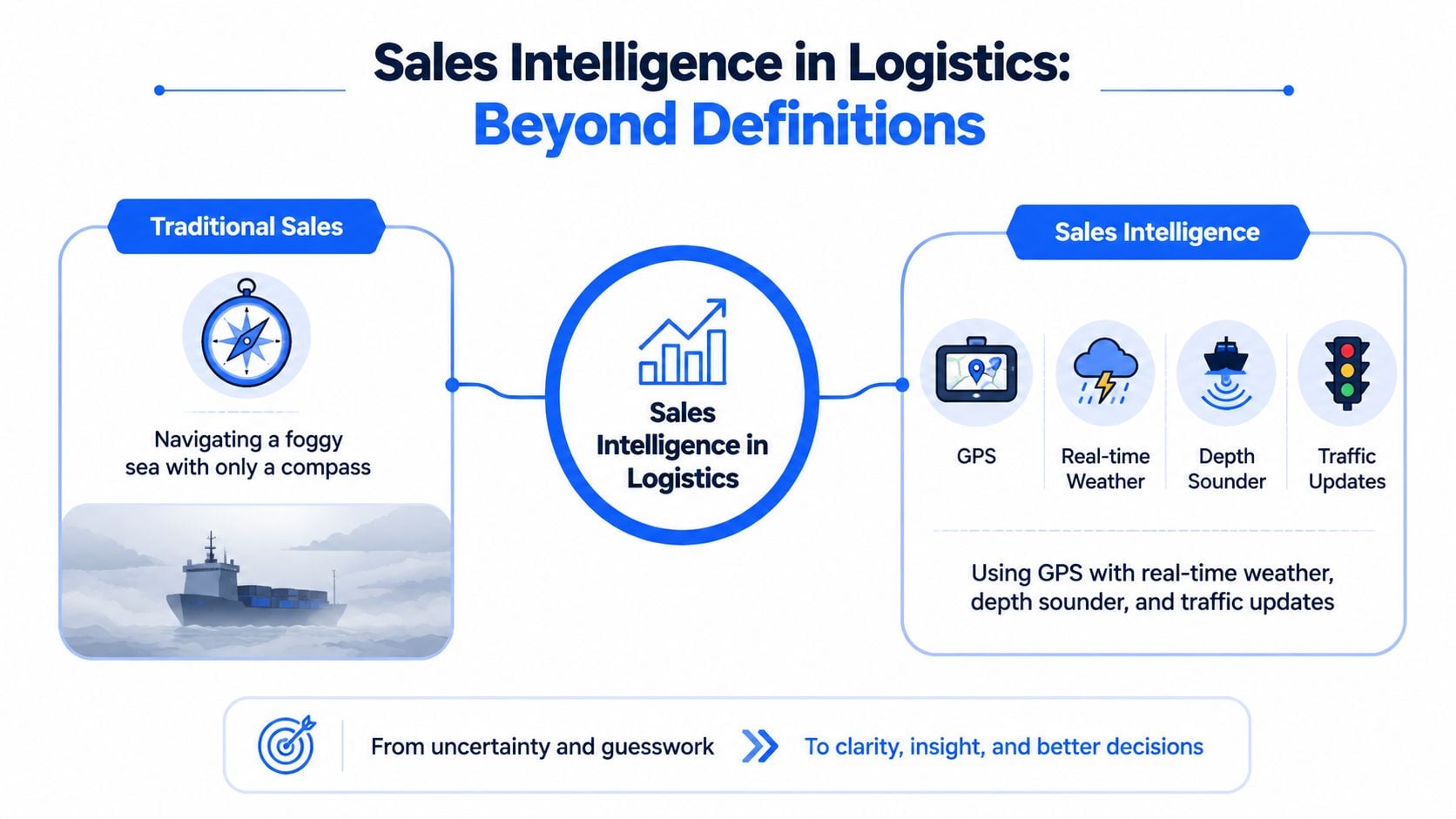
    A lot of reps skip that because it feels slower. It isn't. Blind outreach creates more wasted activity than research ever will. If you need a clean framework for that research stack, this guide on sales intelligence tools for prospecting workflows is a useful reference point.

    The account lens that changes the conversation

    For Winsome Trading Woodinville, the shift is simple:

    Weak approach Better approach
    “Furniture company in Washington” “Established manufacturer with likely recurring inbound and outbound freight needs”
    “Need a contact” “Need lane evidence, shipment signals, and the right owner”
    “Send capabilities deck” “Lead with a specific logistics observation”

    That's the difference between being ignored and sounding relevant.

    Profiling the Shipper What Matters for Logistics

    A shipper becomes interesting when the physical footprint starts telling you how freight probably moves.

    Winsome Trading Inc. operates a consolidated 200,000-square-foot facility in Woodinville, Washington that unifies its USA office, assembly operation, and distribution warehouse, according to its LinkedIn company profile. For a logistics seller, that single fact is more useful than ten generic company descriptions.
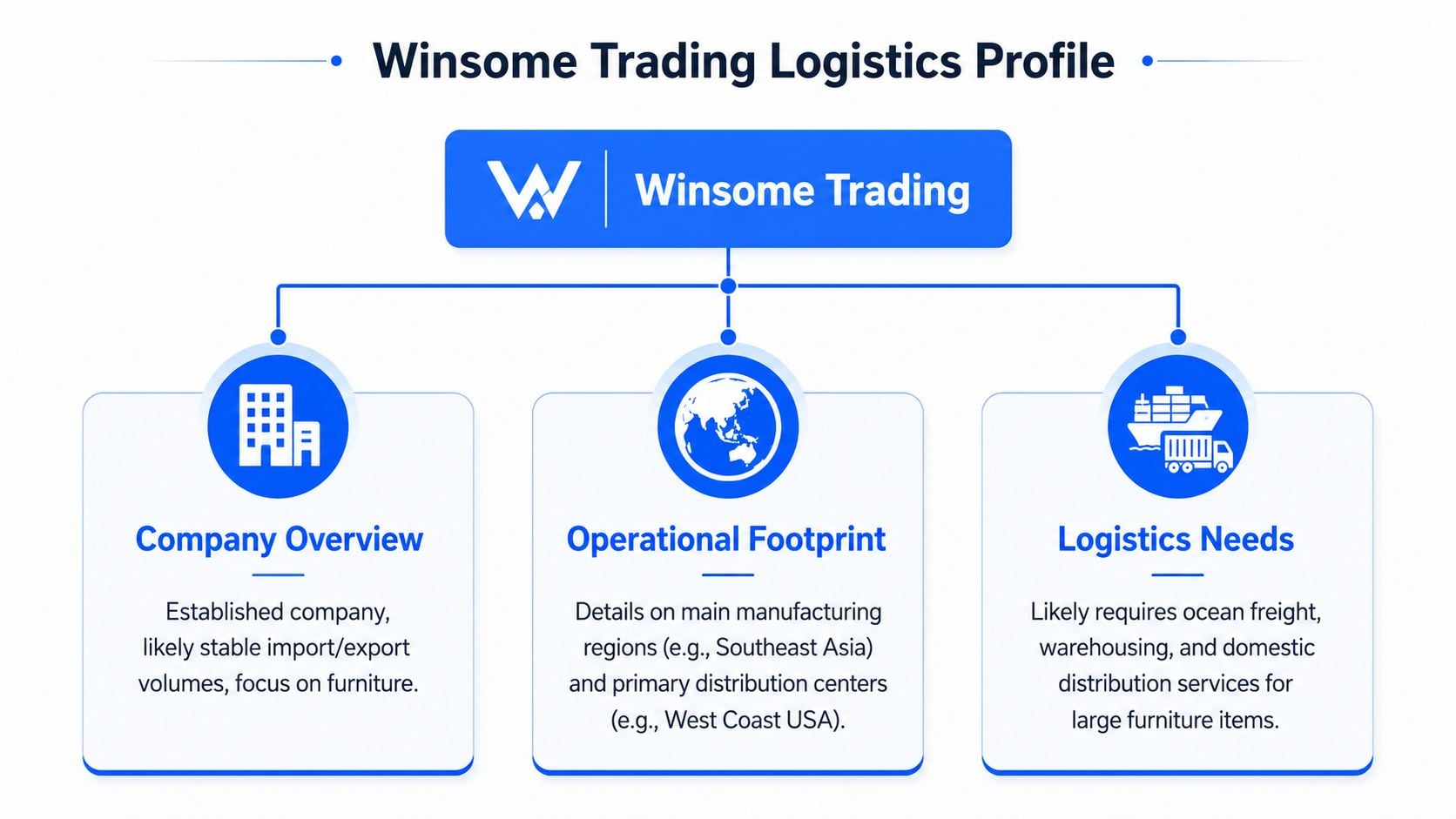
    A corporate profile infographic for Winsome Trading, detailing their furniture business operations, manufacturing regions, and logistics requirements.

    What a consolidated facility usually signals

    When office, assembly, and distribution sit together, a few practical implications follow:

    • Inbound scheduling matters more. Delays don't just affect receiving. They can disrupt assembly timing and outbound fulfillment.
    • Warehouse flow matters. If one site is handling multiple functions, congestion at receiving docks can spill into order release.
    • A forwarder can sell coordination, not just transport. The pitch becomes smoother handoffs, cleaner visibility, and fewer surprises across modes.

    That changes how you qualify the account. You're not asking only whether they import or export. You're asking whether their operation benefits from tighter alignment between customs, drayage, warehousing support, and domestic distribution.

    Product mix tells you where service risk lives

    The company's Better Business Bureau profile describes a product range that includes accent tables, bed trays, TV tables, occasion tables, stools, and shelving, with materials including wood, wrought iron, aluminum, steel, marble, and glass. That mix creates real trade-offs.

    Wood and finished furniture surfaces raise packaging and damage-prevention questions. Glass adds breakage exposure. Metal and stone components can change weight distribution, container loading plans, and final-mile handling. A rep who understands that won't lead with “best rates.” They'll ask better questions.

    If the shipment can be damaged by poor loading, poor packaging advice is a sales problem, not just an operations problem.

    How to rank this account internally

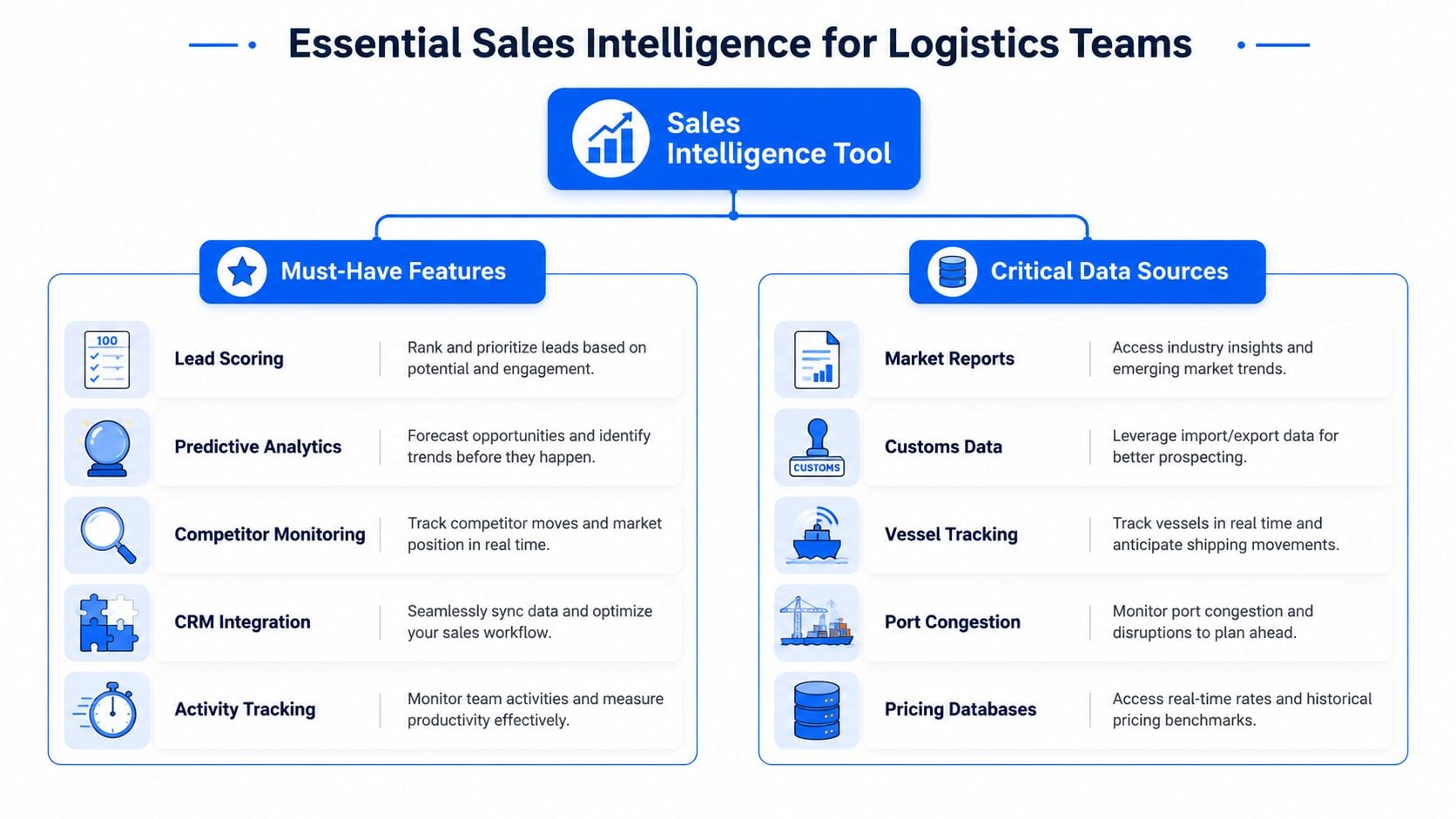
    New reps often treat every manufacturer the same. Don't. Build a short qualification view around operational fit. If you want a simple framework for building a lead scoring model, adapt it to logistics-specific variables like facility type, product fragility, cross-border indicators, and likely modal mix.

    A practical scorecard for Winsome Trading Woodinville would weigh:

    1. Facility structure
      Consolidated operations often create coordination pain points worth solving.

    2. Product handling demands
      Mixed materials usually increase the value of specialized execution.

    3. Operational maturity
      Long-standing manufacturers tend to have established processes, which means you need a sharper entry angle.

    For reps learning account breakdowns, I like comparing one target against another known manufacturer profile to sharpen pattern recognition. This review of Marathon Sales Inc and account qualification signals is useful for that exercise.

    Uncovering Potential Trade Lanes and Shipment Patterns

    The useful question isn't “Does Winsome ship?” It's “What route logic would make sense for this shipper, and how do we verify it fast?”

    Winsome Trading Inc. generates annual revenue of approximately $39,033,867 and maintains a secondary location at 8116 Alexander Rd, Delta, BC, Canada, according to its Manta company profile. The number matters because it suggests a meaningful operating scale. The Delta location matters because it gives you a real cross-border clue.
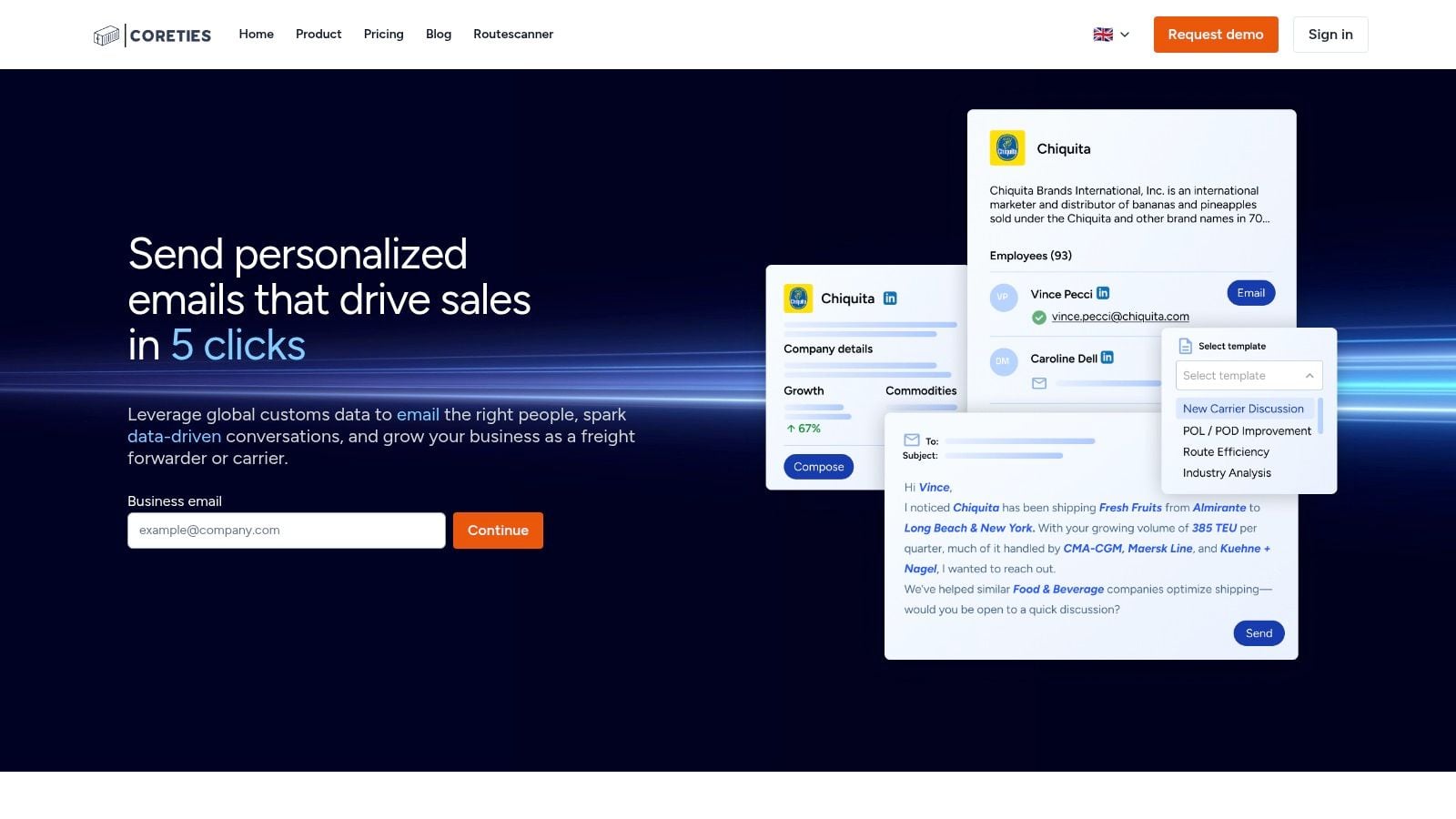
    Screenshot from https://coreties.com

    Start with hypotheses, not assumptions

    You don't need to invent facts to form a prospecting plan. You need disciplined hypotheses.

    For Winsome Trading Woodinville, I'd test these possibilities first:

    • Cross-border movement between Washington and British Columbia
      The Delta facility creates a plausible lane for inventory balancing, supplier coordination, or distribution support.

    • West Coast port dependency
      A Woodinville furniture operation with mixed-material products may rely on Pacific Northwest import flows, even if the exact port mix still needs verification.

    • Container-level handling complexity
      Furniture and pantryware often create cube, stacking, and breakage considerations that influence carrier and warehouse choices.

    None of those statements claims a shipment history. They tell you where to look first.

    What to pull from customs and commercial signals

    In this critical phase, new reps either become dangerous in a good way or stay stuck in list-building mode. You want records and signals that answer a narrow set of questions:

    Signal to verify Why it matters
    Port of entry patterns Tells you which gateway problems are worth discussing
    Carrier names Helps frame switch-risk and incumbent strength
    Commodity descriptions Reveals whether the lane fit matches your service strengths
    Consignee and shipper naming variants Prevents missing records due to entity mismatch
    Recurring origin locations Turns a one-off shipment into a lane strategy

    You should also widen the net beyond customs records alone. Teams that know how to integrate social data with scraping APIs can enrich lane research with job changes, facility mentions, hiring trends, and partner references. The point isn't to scrape for volume claims. It's to improve context before outreach.

    A short walkthrough helps when training reps to think in this sequence:

    The pattern you're trying to surface

    You're looking for a practical narrative, not a spreadsheet dump. For example:

    “This account appears to have a cross-border footprint, a consolidated warehouse operation, and products that likely require careful inbound planning and handling discipline.”

    That's enough to shape outreach. Once you verify specific shipments, you can narrow the message to one lane, one issue, and one likely stakeholder.

    How to Verify Shipping Data and Find Contacts

    An account doesn't become workable until you've confirmed two things. First, the freight pattern is real. Second, a specific person owns part of the problem.
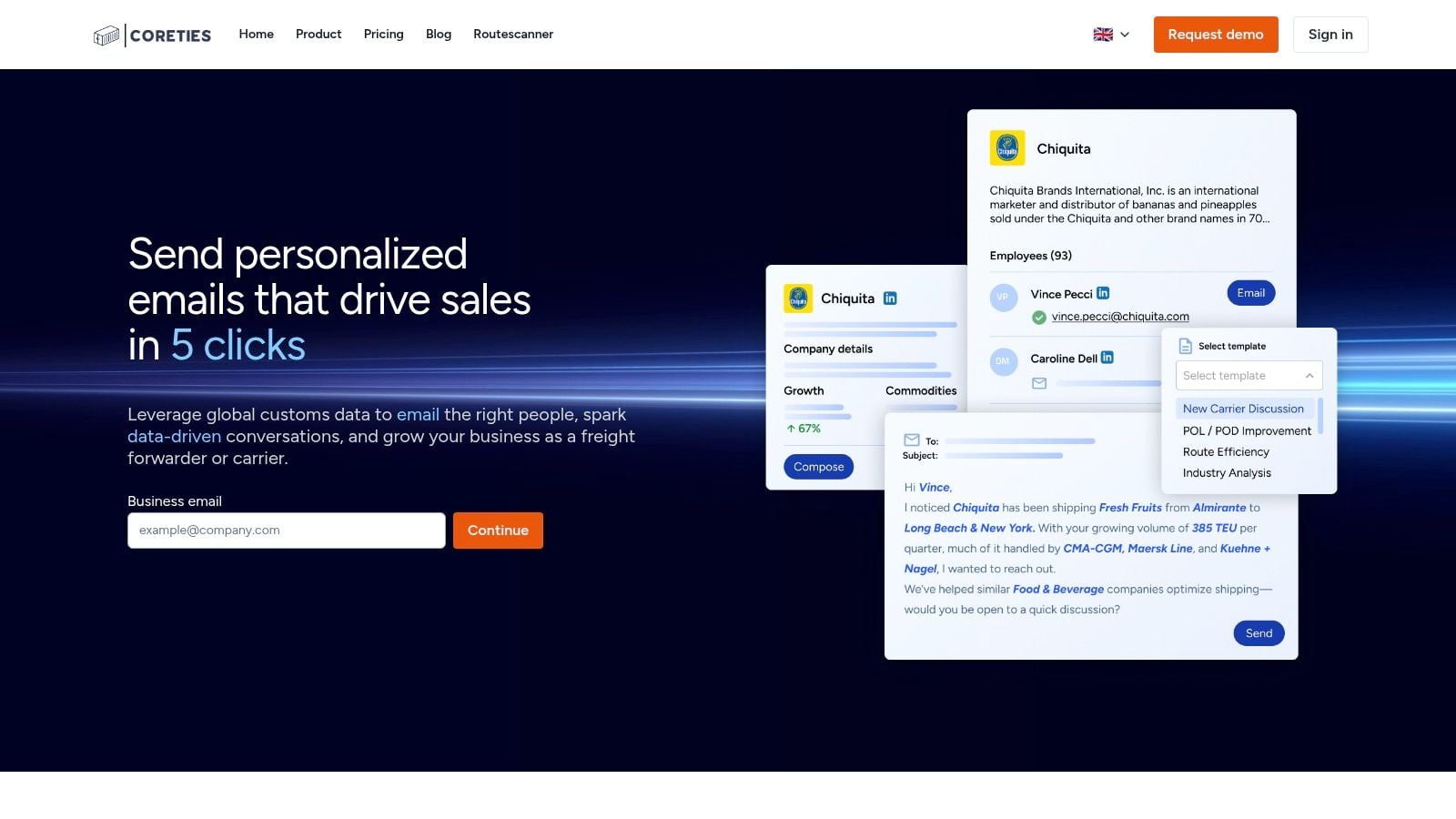
    Screenshot from https://coreties.com

    Verify the freight before you write

    Use shipment records, bills of lading, and consignee variations to test your lane hypotheses. Don't stop at a company-name search. Check likely abbreviations, entity suffixes, and address-linked records. A lot of reps miss good data because they search one exact legal name and assume the file is complete.

    What you're trying to confirm is straightforward:

    1. Recurring port activity
      One shipment is interesting. Repetition is what gives you a prospecting angle.

    2. Mode and routing clues
      You want to know whether the account looks like a fit for your strongest service lines.

    3. Operational friction points
      Late pickups, split handling requirements, customs complexity, or warehouse timing issues all create better opening messages than a broad capability statement.

    Verify first, personalize second. Reversing that order produces polished nonsense.

    Find the owner, not the mailbox

    Once the freight pattern is credible, move to role mapping. For a shipper like Winsome Trading Woodinville, the right contact usually isn't the generic corporate inbox. The useful targets are people tied to logistics execution, supply chain planning, operations leadership, or procurement.

    Build a contact slate by role, then prioritize by likely pain ownership:

    • Logistics or transportation manager for day-to-day lane execution
    • Supply chain director if the issue touches network design or vendor performance
    • Operations leader when warehousing and inbound flow affect fulfillment
    • Procurement stakeholder if the conversation is likely to turn into rate benchmarking

    You also need a clean process for decision-maker research. This guide on how to find decision-makers in B2B accounts is a good checklist for moving from company-level interest to person-level outreach.

    Keep your contact list tight

    Don't build a bloated list of every manager with a LinkedIn profile. For one target account, I'd rather have three well-matched contacts with clear role logic than fifteen names with no ownership theory behind them.

    That discipline improves message quality and follow-up quality. It also keeps you from sending the same half-relevant note across departments that don't share the same KPI.

    Crafting Your Data-Driven Outreach Message

    Most freight outreach fails in the first sentence. The rep talks about their company before proving they understand the shipper.

    That approach is especially weak with a long-standing manufacturer like Winsome Trading, which was established in 1977 and has maintained continuous operations for over 35 years, as noted earlier from the BBB profile. Stable companies tend to attract constant vendor outreach. They don't need another “just checking if you handle imports” email.

    Generic email versus account-specific email

    Here's the bad version:

    Hi, we're a global logistics provider that supports importers and exporters with competitive rates and reliable service. I'd love to schedule time to learn about your shipping needs.

    There's no account insight, no reason for timing, and no indication that the sender understands the operation.

    A stronger version sounds like this:

    Hi [Name], I'm reaching out because Winsome Trading's Woodinville operation appears to combine assembly and distribution, which usually makes inbound timing and warehouse flow more sensitive than standard receiving-only sites. If your team is reviewing any Pacific Northwest import or cross-border routing options, I can share a few ideas on where forwarders usually reduce handoff issues for furniture programs.

    That message doesn't overclaim. It shows enough understanding to earn a reply.

    Match the angle to the role

    Use the same account, but shift the message based on who's reading it.

    Target Role Key Concern Messaging Angle Example
    Logistics Manager Shipment execution “We help reduce missed handoffs and receiving friction on recurring inbound lanes.”
    Supply Chain Director Network reliability “We can review routing and vendor coordination where assembly and distribution sit in one operation.”
    Operations Leader Warehouse flow “Inbound timing issues often create downstream pressure on fulfillment. That's where we usually start.”
    Finance or Procurement Cost control “We can benchmark where avoidable accessorials and handling inefficiencies may be hiding.”

    Keep the message clean enough to land

    Don't bury the insight under a long intro. Don't attach a deck. Don't ask for half an hour. Ask for a short conversation tied to one practical issue.

    A few rules I use with new reps:

    • Lead with the account observation.
    • Mention one likely pain point, not five.
    • Ask for a brief call with a narrow purpose.
    • Use a domain that's set up correctly before sending. If your team needs a refresher on sender setup, this guide on How do I authenticate my email is worth reviewing before any outbound push.

    The best cold email sounds like it came from someone who already thinks in the prospect's workflow.

    That's the standard. Not clever. Not long. Relevant.

    Effective Follow-Up Tactics That Secure the Meeting

    Most meetings are booked in follow-up, not on the first email. The problem is that reps often follow up by repeating themselves.

    Don't send “just bumping this up” messages. Add something each time.
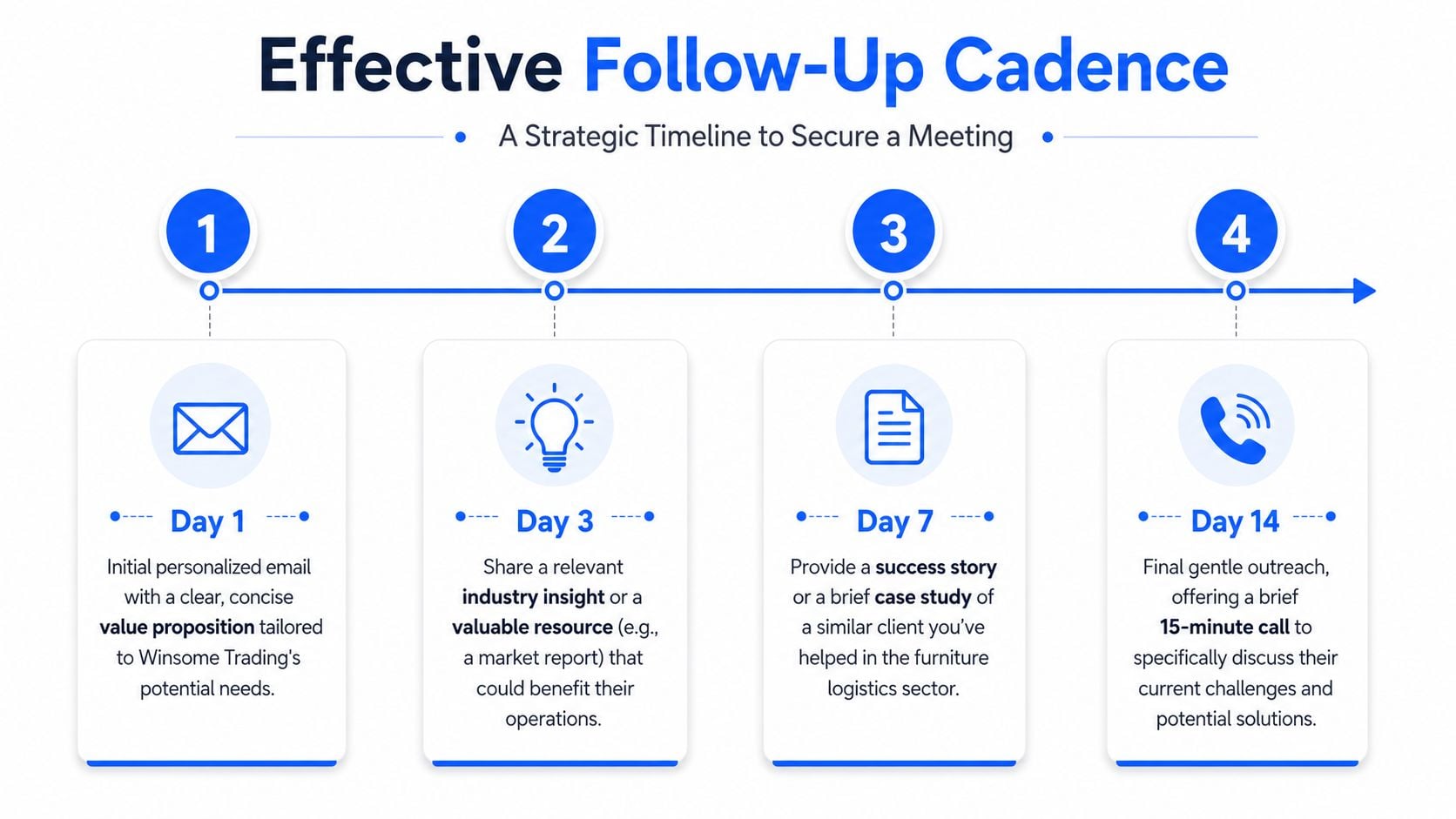
    A strategic four-step follow-up timeline to secure meetings with prospects, displayed as a business workflow graphic.

    A simple cadence that works

    • Day 1
      Send the personalized note tied to one operational observation.

    • Day 3
      Add a useful follow-up. This could be a short comment about a likely lane issue, a packaging concern common in furniture moves, or a question about cross-border coordination.

    • Day 7
      Narrow the ask. Offer a short discussion around one issue only, such as inbound scheduling, customs handoff, or warehouse flow.

    • Day 14
      Close politely. Let them know you'll step back if timing isn't right, but leave a specific reason to reconnect later.

    What not to do

    A few follow-up habits kill response rates:

    Avoid this Do this instead
    Repeating the same email Add one new observation or question
    Sending long reminders Keep each touch short and specific
    Pitching every service Focus on the one issue most likely to matter
    Chasing everyone at once Stay coordinated across a small contact group

    Persistence helps only when each touch gives the buyer a new reason to care.

    For Winsome Trading Woodinville, the meeting usually comes from disciplined relevance. You identify the account correctly, verify the freight pattern, pick the right owner, and follow up with context instead of noise. That's how booked meetings happen in logistics sales.


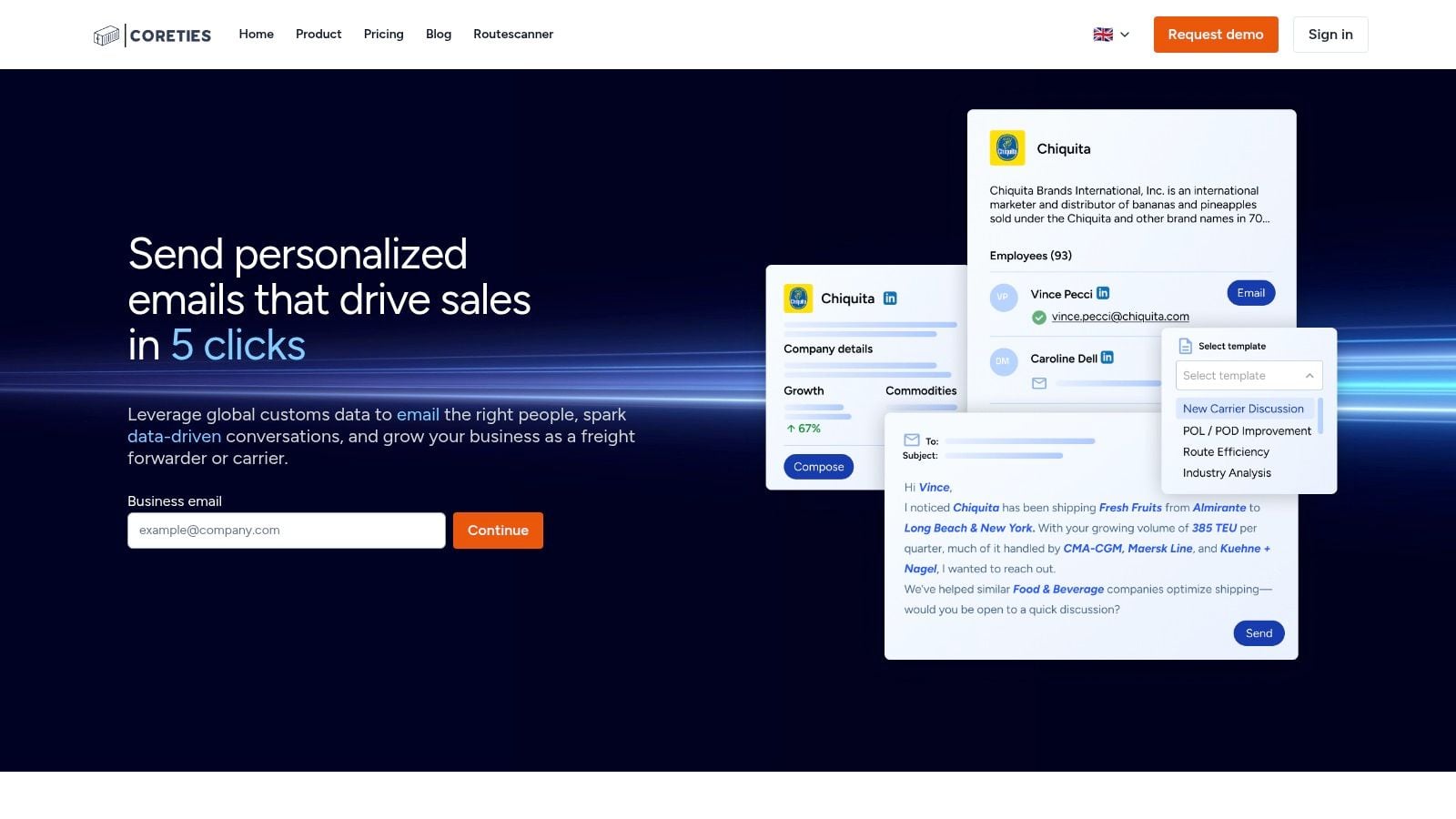
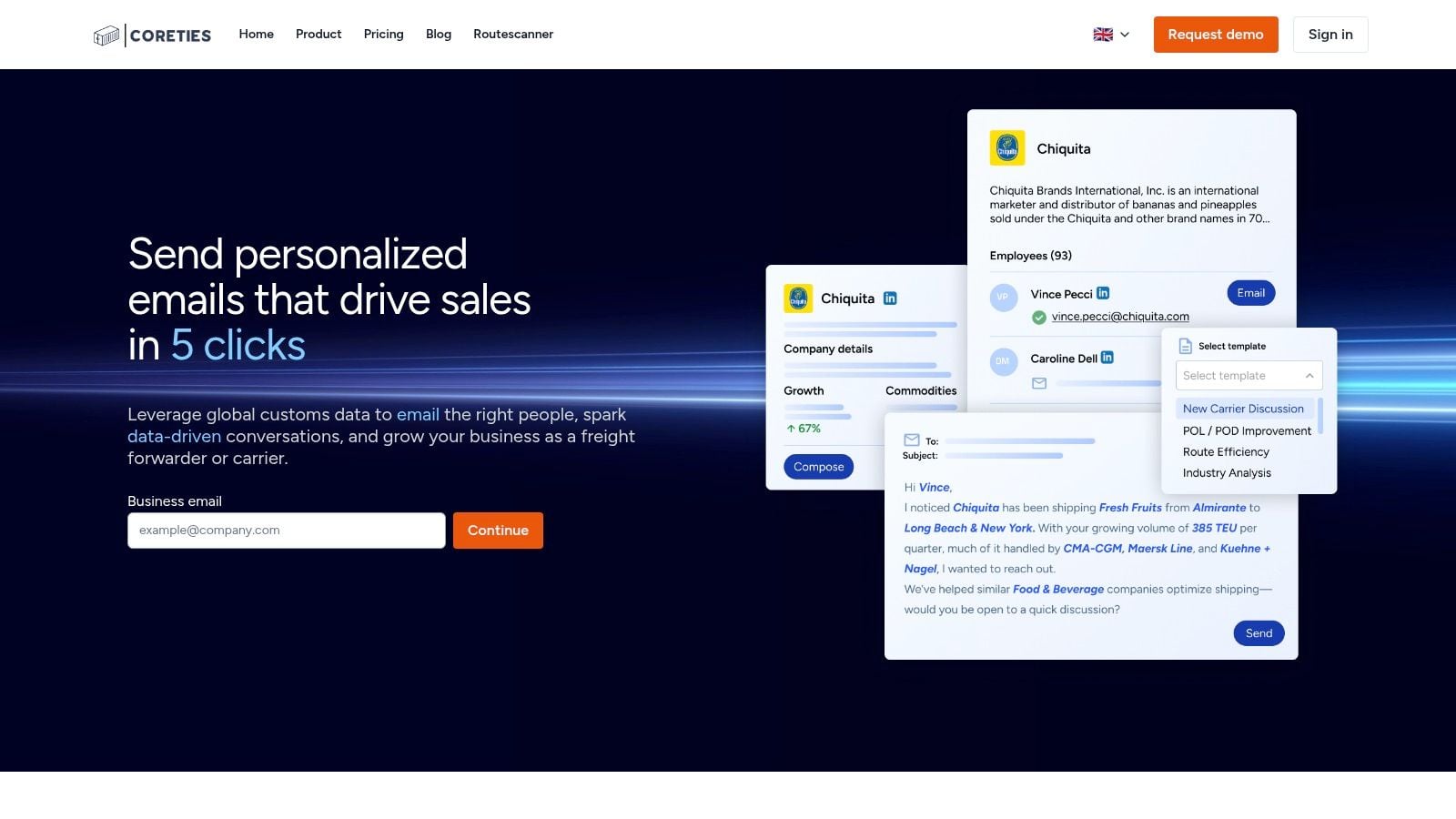
    If you want a faster way to turn customs signals into qualified shipper lists, find the right contacts, and launch account-specific outreach, Coreties is built for that workflow. It helps freight teams move from raw trade data to targeted conversations without wasting time on generic prospecting.
  • Boost Freight: Performance Benchmarking Guide

    Boost Freight: Performance Benchmarking Guide

    Your team is probably already benchmarking performance. You just may not be calling it that.

    A sales manager looks at reply rates from last month and says a lane campaign underperformed. An operations lead sees margin tightening on a port pair and assumes carrier costs are the reason. A commercial director compares one rep against another without checking account mix, shipment complexity, or timing. Those are performance checks, but they aren't yet performance benchmarking.

    The problem is that informal checks usually mix too many variables. They compare the wrong periods, use inconsistent data, and stop at surface-level numbers. In freight, that gets expensive fast. You can push budget into a lane that only looked strong because of a short-term spike, or judge a rep unfairly because one book of business had cleaner data and easier targets.

    Good benchmarking gives commercial and operations teams a shared way to answer one question: where are we underperforming, why, and what should we change next? In logistics, that means moving past one-off scorecards and building a rhythm of trend analysis, fair comparisons, and follow-through.

    Setting the Stage for Meaningful Benchmarks

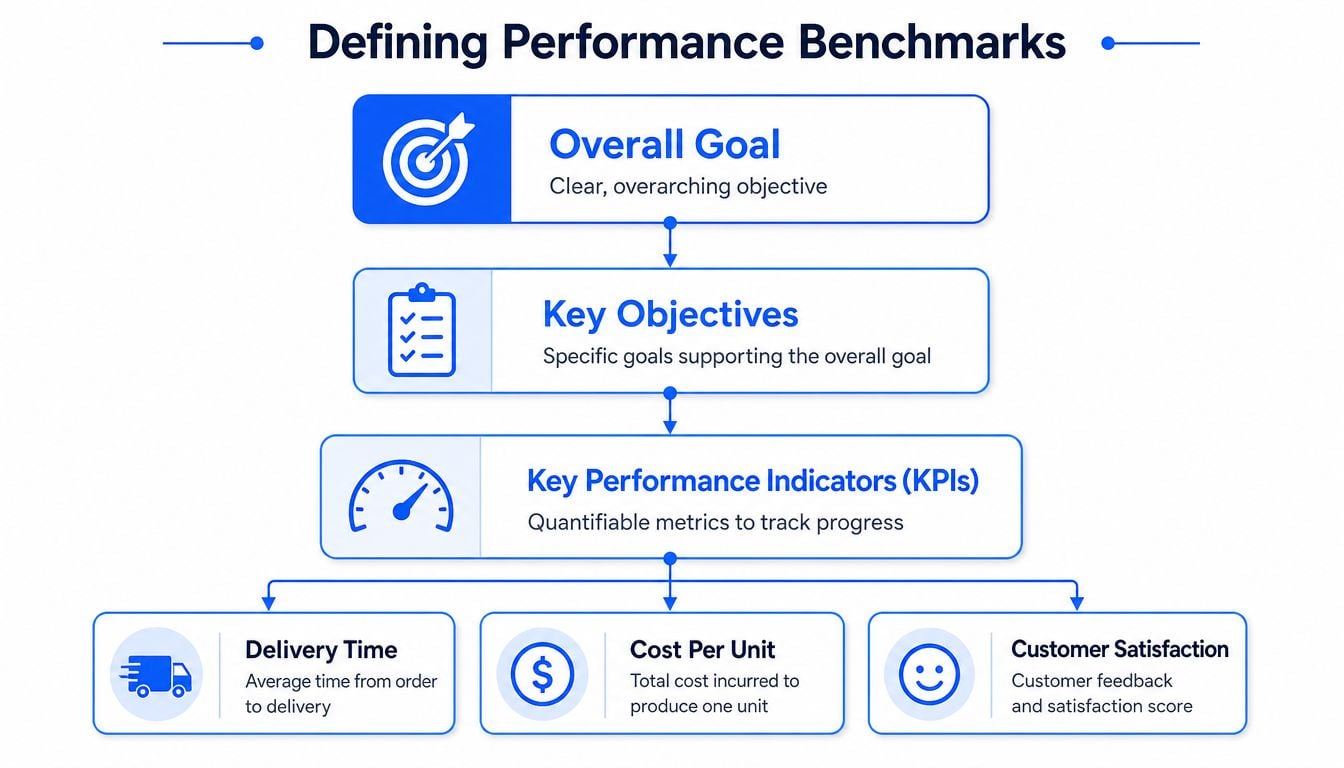
    Most failed benchmarking efforts start with a fuzzy target. “Improve sales productivity” sounds fine in a meeting, but nobody can benchmark against it. You need a definition of good performance that can survive contact with real freight data.

    Industry-standard benchmarking treats this as a structured process, not a casual review. Performance benchmarking is a systematic 5-step cycle: Plan, Set-Up, Collect, Analyze, and Act. Organizations that stick to the full cycle turn benchmarking into a repeatable improvement habit rather than a one-time report, as outlined by APQC's benchmarking framework.

    A hierarchical diagram explaining the process of defining performance benchmarks for business objectives and KPIs.

    Why informal performance checks break down

    In freight sales, teams often track whatever is easy to pull from the CRM. Email volume. Calls made. Meetings booked. Quotes sent. Those metrics aren't useless, but on their own they don't tell you whether the business is getting healthier.

    A rep can send a high volume of emails into the wrong accounts. A branch can book more meetings while winning lower-quality freight. A lane can show volume growth while margin weakens. If the KPI doesn't connect to commercial or operational outcomes, it becomes a vanity metric.

    Practical rule: If a KPI can't change a decision on pricing, account targeting, lane focus, or rep coaching, it shouldn't sit at the center of your benchmark.

    The five-step cycle fixes that by forcing discipline. Plan defines the business question. Set-Up chooses the measures. Collect builds a reliable dataset. Analyze explains the gap. Act turns the finding into a change with ownership.

    Skip Analyze and you only get scorekeeping. Skip Act and the dashboard becomes decoration.

    KPIs that matter in freight

    A useful benchmark set combines sales activity, commercial quality, and operational follow-through. That mix matters because logistics teams win business in sales conversations but keep it through execution.

    A practical starter set for freight forwarders, carriers, and 3PL teams usually includes:

    • Prospecting quality such as outreach-to-meeting conversion rate by shipper segment, lane, or territory
    • Pipeline quality such as quote-to-win rate, win reasons, and time from first contact to qualified opportunity
    • Lane economics such as lane profitability, yield consistency, and account concentration by trade lane
    • Customer retention signals such as repeat booking patterns, complaint themes, and service recovery cycles
    • Execution measures such as delivery time consistency, exception rates, and handoff speed between sales and operations

    A simple benchmark design

    Start with one commercial objective and one operational outcome tied to it.

    For example, if your goal is to grow import business on a port pair, your benchmark should not stop at outbound email response. It should connect prospecting activity to qualified meetings, quoted opportunities, won shipments, and lane performance after go-live. That creates a chain of evidence instead of a shallow snapshot.

    A simple setup often looks like this:

    1. Define the business goal such as improving performance on a target lane or shipper segment.
    2. Choose a small KPI set that reflects both selling and execution.
    3. Assign owners so sales, pricing, and operations agree on definitions.
    4. Decide the review rhythm weekly for activity, monthly or quarterly for outcome trends.
    5. Predefine action triggers so the team knows what happens when a metric moves off target.

    That's the difference between reporting and management. Reporting tells you what happened. Benchmarking tells you what to do next.

    Sourcing and Normalizing Your Logistics Data

    More data doesn't automatically produce better benchmarking. In freight, it often does the opposite.

    Teams pull customs records, CRM logs, TMS activity, quoting history, finance data, and rep notes into one spreadsheet and assume the size of the dataset makes it reliable. It doesn't. If company names vary, shipment records are duplicated, and one lane has deep history while another is brand new, your benchmark can look precise while being badly distorted.

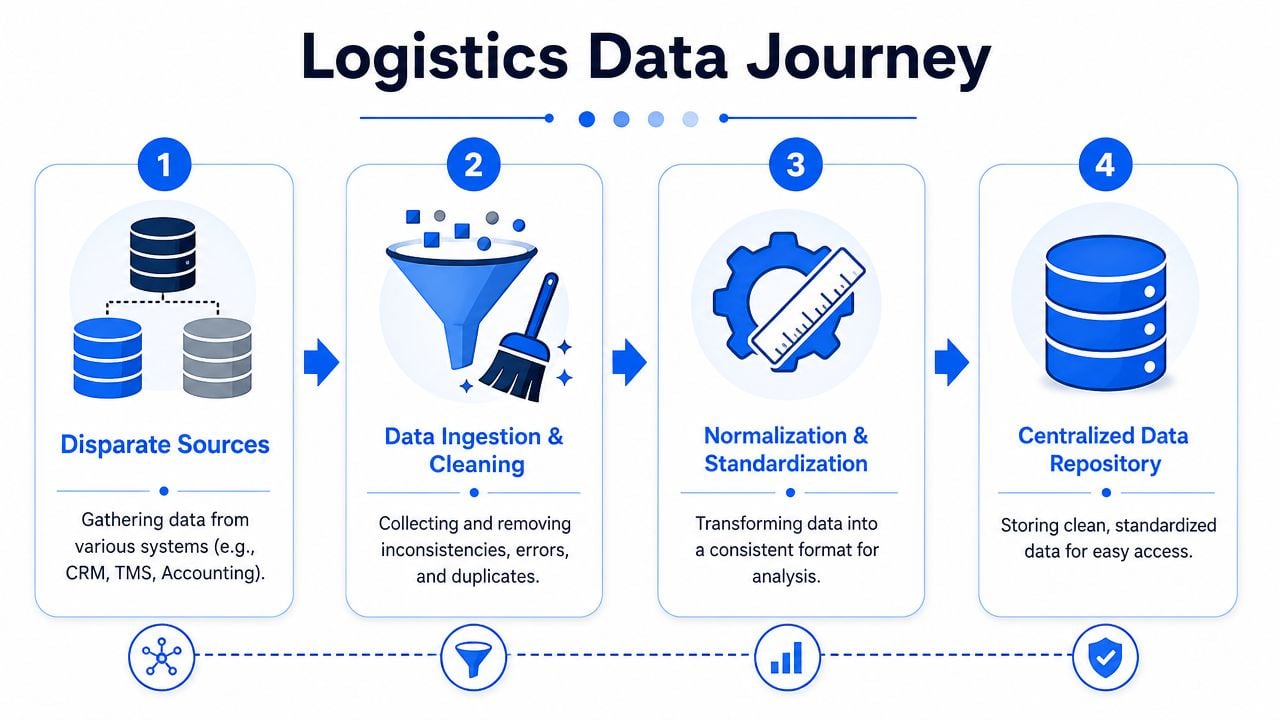
    A four-step infographic illustrating the logistics data journey from disparate sources to a centralized repository.

    Start with source discipline

    For logistics teams, the core source groups are usually straightforward:

    • Commercial systems including CRM stages, outreach logs, meeting outcomes, and account ownership
    • Operational systems including TMS milestones, routing choices, exceptions, and shipment completion data
    • Financial systems including quoted rates, invoiced revenue, and margin by customer or lane
    • Market intelligence sources including customs-derived shipment visibility and trade lane activity

    What trips teams up isn't access. It's consistency.

    One shipper may appear under multiple names across customs records and CRM entries. A lane may be tagged by port pair in one system and by country pair in another. A rep may log meetings carefully while another leaves half the activity in email. If you compare those records without cleaning them first, you aren't benchmarking performance. You're benchmarking documentation habits.

    Clean before you compare

    Use a standard cleaning pass before any benchmark review.

    • Resolve entity names by mapping parent companies, subsidiaries, spelling variations, and acquired brands into one record structure.
    • Standardize lane definitions so everyone means the same thing when they talk about a trade lane, corridor, or service scope.
    • Remove duplicate events especially where the same shipment or outreach touch appears across multiple tools.
    • Separate missing from zero because “no activity recorded” and “activity happened with zero outcome” are not the same operational reality.

    A strong primer on structuring supply chain data sources is this guide to supply chain databases, which is useful when you're combining commercial and operational records.

    Later in the workflow, route context matters too. If you're benchmarking drayage and container handoff performance around congested gateways, practical operational examples such as optimizing Felixstowe with Haulier.AI help teams understand why local conditions can distort raw comparisons.

    Normalize for fair comparisons

    This is the part many teams skip, and it's where weak benchmarking usually falls apart.

    Research on benchmarking performance indices warns that methods often fail when they “ignore sample size effects or use aggregate data”, which leads to misleading comparisons, especially in logistics where reporting standards and data volumes vary widely. That caution is highlighted in this analysis of benchmarking pitfalls.

    A lane with a long booking history and a lane you're just developing should not be judged by the same raw output logic.

    If one rep works a mature vertical with dense customs visibility and another works newer accounts with sparse records, raw response rates or win counts can mislead. You need normalization rules that account for uneven exposure and uneven data quality.

    Practical normalization options include:

    • Cohort-based comparison where you compare similar lanes, customer segments, or account maturity groups instead of the whole book at once
    • Rate-based metrics rather than raw counts, provided the denominator is clean and consistent
    • Minimum observation thresholds before you treat any pattern as benchmark-worthy
    • Weighted interpretation where results from thin datasets are treated more cautiously than results from well-established activity streams

    A short technical explainer can help teams visualize this data-handling step before they build dashboards.

    The main lesson is simple. Clean data beats big data. Fair comparison beats fast comparison.

    Building Your Comparison Cohorts and Dashboard

    Once the data is clean, the next job is grouping it properly. Most freight teams don't need a bigger dashboard. They need better comparison cohorts.

    A cohort is the peer group you use for comparison. If that group is wrong, every conclusion after it is shaky. Comparing a new trade lane against a mature one, or a specialist rep against a broad-market rep, usually creates noise disguised as insight.

    Cohorts that actually help decisions

    Use internal and external cohorts for different questions.

    Internal benchmarking works best when you're trying to improve execution consistency. Compare one period against another, one branch against another, or one rep's performance against peers handling similar account types. Such comparisons make quarter-over-quarter lane performance, response rate by segment, or quote turnaround by office especially useful.

    External benchmarking helps when the question is market position. That could mean comparing your activity and results against visible trade patterns in customs data, or against a competitor set operating in the same corridor and customer profile.

    Useful logistics cohorts often include:

    • Lane cohorts by port pair, country pair, or service mode
    • Customer cohorts by industry, shipment frequency, or import/export profile
    • Sales cohorts by territory, tenure, or account mix
    • Operational cohorts by branch, carrier partner set, or handoff model

    What the dashboard should show

    The dashboard's job is to shorten the time between signal and action. It should let a sales manager or commercial director answer three questions quickly: where are we off track, where are we improving, and where should we intervene first?

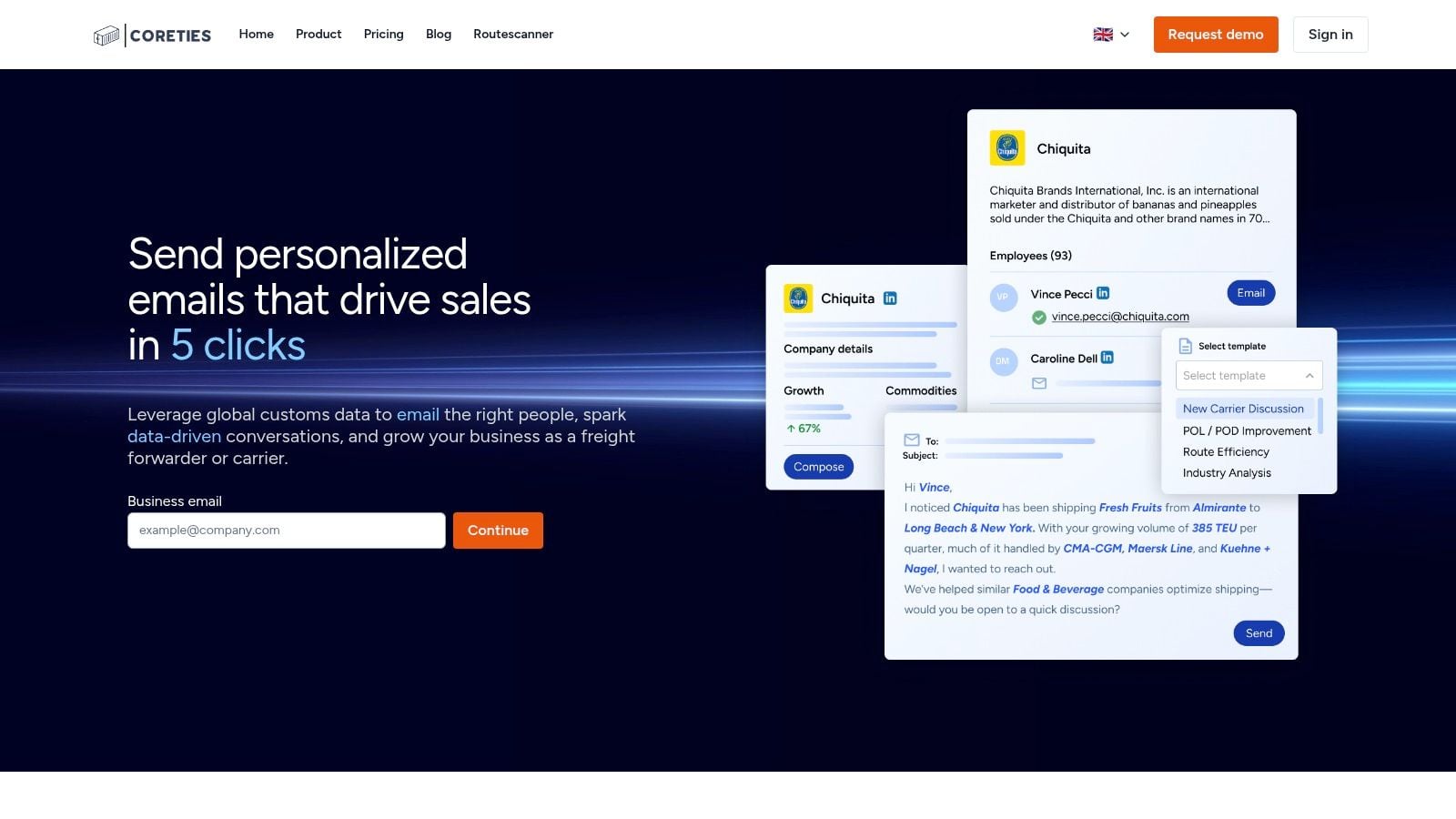
    Screenshot from https://coreties.com

    A useful logistics dashboard usually includes a mix of commercial and operational views, such as:

    • target lanes with increasing or weakening engagement
    • outreach response rate by rep or territory
    • quote conversion by shipper segment
    • new-customer shipment quality after onboarding
    • margin direction by lane or customer cohort

    Don't overload the screen. If every KPI is “critical,” nothing is.

    Category KPI What It Measures
    Sales Activity Outreach-to-meeting conversion How effectively outbound prospecting creates qualified conversations
    Pipeline Quality Quote-to-win rate How often pricing activity turns into booked business
    Lane Performance Lane profitability Commercial health of a specific trade lane or corridor
    Customer Health Repeat booking rate Whether new and existing customers continue to place freight
    Service Execution Delivery time consistency Reliability of shipment execution against expected transit performance
    Account Economics Customer acquisition cost The effort and spend required to win a new shipper account
    Team Performance Outreach response rate by sales rep Relative effectiveness of targeting, messaging, and follow-up

    Keep one source of truth

    Dashboards fail when teams export data into side spreadsheets and start redefining terms by department. A quote in sales shouldn't mean one thing to the rep and another thing to finance. A qualified opportunity shouldn't shift definition by branch.

    Operator's view: A benchmark only works when the room agrees on the denominator.

    If your team debates the meaning of the KPI every month, the dashboard isn't ready for management use.

    Analyzing Performance to Uncover Growth Opportunities

    A dashboard tells you where to look. Analysis tells you where money is leaking.

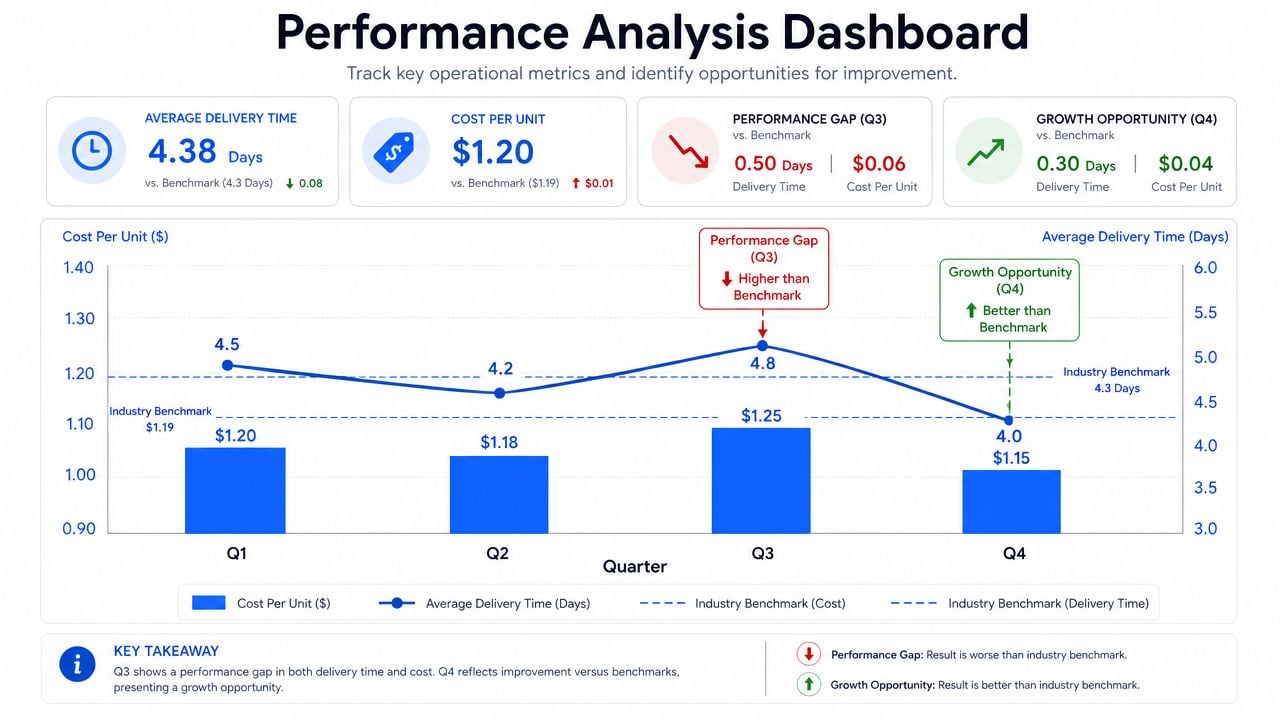
    That's why strong performance benchmarking focuses on the performance gap, which is the measurable difference between your current state and the best realistic benchmark for that process. Effective gap analysis also requires senior management involvement and a concrete action plan with responsibilities and deadlines, as described in this guidance on KPIs and benchmarking.

    A performance analysis dashboard showing quarterly operational metrics for cost per unit and average delivery time.

    When response rates differ by rep

    Say one rep gets more replies from importers on a target corridor than another. The weak analysis says the better rep writes stronger emails. Sometimes that's true. Often it isn't the full story.

    Check the comparison in layers:

    1. Account mix. Are both reps targeting the same shipper size, commodity type, and lane density?
    2. Data quality. Does one rep have cleaner contact coverage and better decision-maker matches?
    3. Follow-up rhythm. Are touches spread consistently, or does one rep stop too early?
    4. Offer quality. Is one rep using stronger operational proof points such as routing options, port alternatives, or service detail?

    That last point matters more than many teams admit. Logistics sales is not just copywriting. It's commercial relevance. If a rep can speak clearly to route options, handoff risks, or likely bottlenecks, the message usually lands better because it sounds operationally credible.

    A useful supporting read here is predictive analytics for sales, especially for teams trying to connect prospecting patterns with likely pipeline outcomes.

    When volume rises but profit softens

    This is a classic freight problem. A lane looks healthy on paper because shipment count is up, but margin quality starts slipping. If you only benchmark volume, you'll call that growth. If you benchmark commercial performance properly, you'll see deterioration early.

    Review the lane through multiple lenses:

    • Pricing behavior to see whether win rates improved because the team discounted too aggressively
    • Customer mix changes to identify whether lower-quality freight replaced better freight
    • Operational cost pressure such as extra handling, poor routing, or recurring exception management
    • Service promise mismatch where sales committed to a service pattern operations can't maintain profitably

    If finance is part of that review, ratio thinking helps. Teams that want a cleaner way to assess the financial side of operational performance often benefit from broader guides such as Understanding SME cash flow ratios, especially when margin discussions drift into working-capital strain and collection timing.

    Turn findings into action

    Analysis isn't complete until it changes behavior. If the gap is poor response quality on a lane, the action may be tighter account selection, better routing intelligence in outreach, or clearer rep playbooks. If the gap is profitable growth, the action may be pricing guardrails, customer-tier rules, or stricter lane qualification.

    Benchmarking earns trust when it identifies a gap, names the likely cause, and assigns the next move to a person, not a department.

    That last point matters. “Sales and ops should align better” is not an action. “Pricing manager reviews low-yield wins on the corridor every Friday and rep leads adjust targeting by shipper type” is an action.

    From Static Reports to Trend-Based Improvements

    The biggest mistake in performance benchmarking is treating the report as the finish line.

    One monthly scorecard can tell you whether a metric moved. It can't tell you whether the change is durable, seasonal, or misleading. In freight, that distinction matters because shipment flows rise and fall with tender cycles, port conditions, holidays, commodity timing, and customer buying patterns.

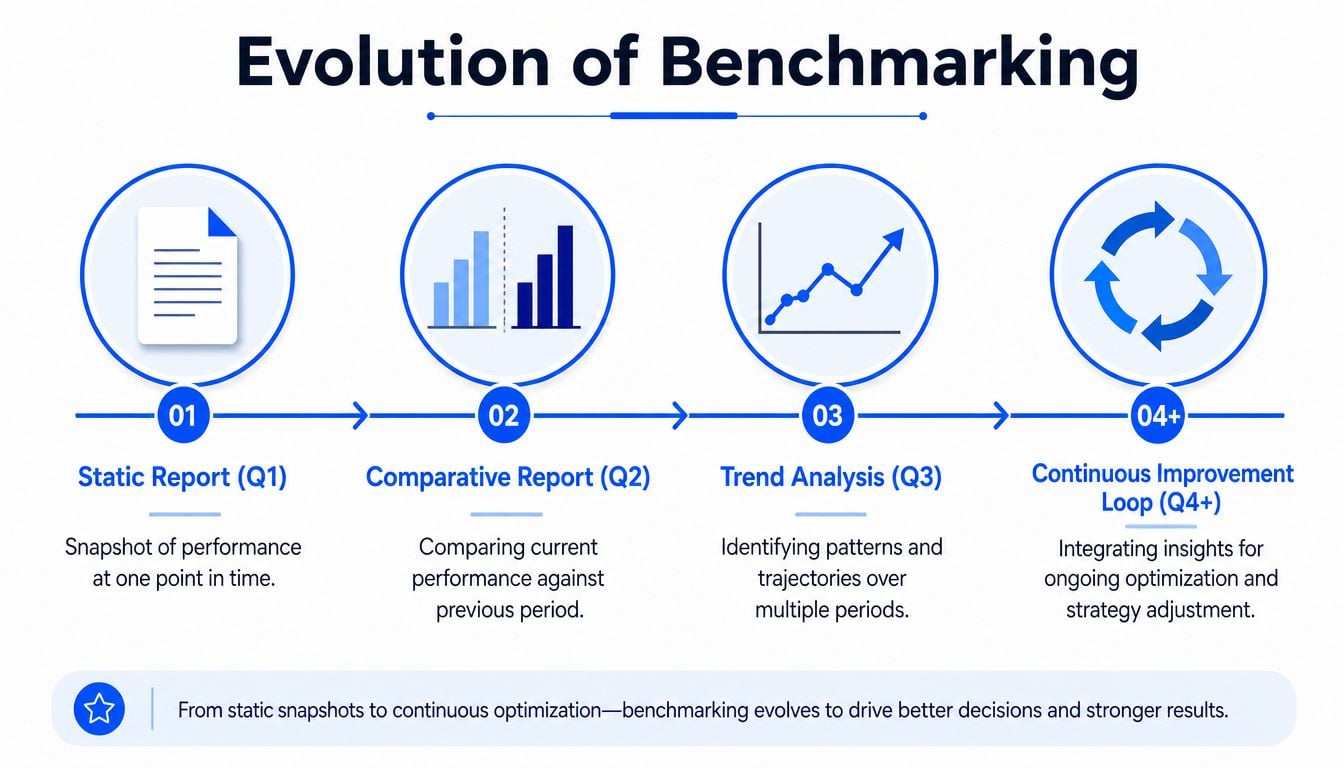
    Experts in benchmarking stress the need to “look at a trend rather than just episodical or instantaneous numbers”. They also emphasize that rigorous benchmarking includes implementing targeted improvements and then re-testing to confirm the issue is resolved, as discussed in this benchmarking discussion.

    A diagram illustrating the evolution of benchmarking, moving from static reports to continuous improvement loops over four stages.

    Why trend lines beat snapshots

    A rep's response rate can jump after a strong week of highly targeted outreach. A lane can look stronger in a short window because one large shipper moved unusual volume. A branch can appear more efficient because it handled fewer exceptions during that period.

    None of those signals are useless. But they need trend context.

    Use trend-based benchmarking to ask:

    • Is the improvement repeating across review periods?
    • Did performance improve in one cohort only, or across comparable groups?
    • Was the move tied to a specific intervention such as a new pitch, account filter, routing option, or pricing change?
    • Did the gain hold after conditions normalized?

    Don't reward a spike until it survives a second review cycle.

    That mindset saves teams from overreacting. It also keeps budget and leadership attention focused on changes that compound.

    Build the improvement loop

    A strong loop has four motions: measure, interpret, change, and verify. The verification step is where many commercial teams go quiet. They launch a new talk track, update a target list, or add route alternatives to outreach, but they don't isolate whether the change improved results.

    In logistics sales, one practical improvement might be giving reps stronger shipment visibility and route context before outreach. Another might be improving movement tracking so customer-facing teams can speak more confidently about service reliability. Broader operational visibility resources such as air and ground logistics tracking are useful when teams need better language and better evidence in customer conversations.

    Handle seasonality and lag like an operator

    Trend analysis in freight needs common-sense normalization. Compare like-for-like periods where possible. Treat short windows cautiously on low-volume lanes. Watch for lag between commercial activity and operational outcomes. A meeting booked now may not show up as a shipment pattern until later.

    That means your review rhythm should separate leading and lagging measures.

    A practical operating cadence often looks like this:

    • Weekly for outreach quality, meetings, and quote flow
    • Monthly for win quality, onboarding stability, and early margin behavior
    • Quarterly for lane development, customer retention patterns, and account quality trends

    When teams work this way, benchmarking stops being a reporting exercise. It becomes a management system.

    Key Takeaways and Common Benchmarking Pitfalls

    Performance benchmarking works when it helps your team make better decisions under real operating conditions. That's the standard. Not prettier reports. Not more tabs in a spreadsheet. Better decisions.

    The strongest freight teams treat benchmarking as a commercial discipline tied directly to account selection, pricing behavior, lane focus, and service execution. They define what good looks like, clean the data before comparing it, build fair cohorts, analyze the gap, and keep reviewing trends after they make changes.

    The weakest teams do the opposite. They compare raw totals across unequal books of business. They mix missing data with true zeroes. They celebrate activity that doesn't turn into profitable freight. Then they act surprised when the dashboard says one thing and the P&L says another.

    Common pitfalls show up fast:

    • Using vanity metrics like volume of outreach without checking whether it creates qualified, profitable opportunities
    • Comparing unmatched cohorts such as mature lanes against developing ones, or clean datasets against messy ones
    • Ignoring data quality especially entity matching, duplicate records, and inconsistent lane definitions
    • Stopping at the report instead of assigning actions and checking whether the intervention worked
    • Overreacting to short-term movement without enough trend context to separate signal from noise

    There's also a leadership pitfall. Teams often delegate benchmarking downward and then expect transformation upward. That rarely works. Commercial managers, operations leads, and senior decision-makers need to agree on definitions, priorities, and action thresholds. If they don't, the process turns political instead of practical.

    The payoff is simple. When you benchmark well, sales stops chasing the wrong accounts. Pricing spots weak wins sooner. Operations gets cleaner feedback on which promises are helping retention and which are hurting margin. The business learns faster.

    That is why benchmarking isn't an admin task. It's a growth system for logistics teams that want repeatable decisions instead of guesswork.


    If your team wants a faster way to turn customs data into qualified freight prospects, targeted outreach, and lane-specific commercial insight, take a look at Coreties. It helps freight forwarders, carriers, and logistics sales teams find the right accounts, reach the right decision-makers, and build more relevant conversations around real trade flows.

  • What Is a Cold Call in Sales: Guide for 3PLs & Freight

    What Is a Cold Call in Sales: Guide for 3PLs & Freight

    A cold call in sales is an unsolicited call to a potential customer who has had no prior contact with you, and the average meeting-booked rate still sits around 2% to 3%. In logistics, though, that first call no longer has to feel random. In 2026, better data turns it from a blind interruption into a strategic first touch with the right shipper, on the right lane, with a reason to listen.

    If you're in freight sales right now, you probably know the feeling. You have a list, half the contacts are stale, the companies are broad matches at best, and your team is expected to produce pipeline anyway. That old version of cold calling burns time and morale.

    The modern version is different. A good logistics rep doesn't call everyone who might move freight. They call the accounts that fit capacity, geography, service model, and timing. They call with context. They ask better questions. And they judge success by whether the call advances the deal, not whether someone says yes on the spot.

    The Modern Definition of a Cold Call in Sales

    A new logistics rep often starts with the wrong picture of cold calling. They think it means picking up the phone, dialing down a huge list, and hoping somebody has an urgent shipment problem that day. That's not a sales process. That's activity without control.

    What is a cold call in sales? It's a first phone conversation with a prospect who hasn't engaged with your company before. The prospect doesn't know you yet, but they should still fit your target account profile. In freight, that usually means the shipper matches the lanes you serve, the mode you sell, the shipment profile you handle well, or the industries where your operations team can win.

    What changed in practice

    The old stereotype was random dialing. The current reality is targeted outbound. A rep may still be making a cold call because there was no prior relationship, but the call shouldn't be uninformed.

    If a shipper imports consumer goods through specific ports, or regularly moves air freight into a market where your team has capacity, that call is still technically cold. It just isn't blind. That distinction matters, because relevance is what keeps the first 20 seconds alive.

    Teams that want tighter prospect discipline usually benefit from a stronger qualification process before outreach ever starts. A practical reference on that is this guide to B2B lead management, especially if your sales list keeps mixing real prospects with companies that will never buy.

    You can also see how this fits into broader freight prospecting workflows in this sales in logistics overview.

    Cold call, warm call, and cold email are not the same

    A lot of reps blur these together. They shouldn't.

    Outreach Method Comparison
    Method Prospect Awareness Typical Goal Key Advantage
    Cold calling No prior contact Start a live conversation and qualify fit Immediate feedback
    Warm calling Some prior awareness or interaction Re-engage and move toward a meeting Lower friction
    Cold emailing Usually no prior contact Earn a reply or create recognition before a call Scales personalization asynchronously

    Practical rule: If the account fits your freight offering but hasn't interacted with you yet, the call is cold. If the person recognizes your company from a referral, event, reply, or prior touch, it isn't.

    That sounds simple, but it changes how you coach a team. Cold calling isn't the same as "calling." It sits in a larger outbound cadence, and it does one job well. It creates a live opening where a shipper can confirm a problem, dismiss a fit, or point you to the decision-maker.

    For logistics sellers, that live feedback is the point. Email can be ignored. A call tells you whether the lane matters, whether the incumbent is vulnerable, and whether the contact owns transportation.

    Why Cold Calling Is a Superpower for Logistics Growth

    A rep calls a shipper on Tuesday morning with one useful piece of context. Imports from Southeast Asia are rising, the company just opened a new distribution point, and carriers on one of its likely inland lanes are tightening. That call feels very different from dialing down a generic list and asking who handles freight.

    In logistics, that difference is everything.

    A cold call still gives you information no database captures cleanly. A shipper may be testing a new vendor before bid season, shifting an origin, fighting rollover issues, or trying to fix service failures that procurement has not documented anywhere public.

    A professional man talks on the phone while working on his laptop in a warehouse office.

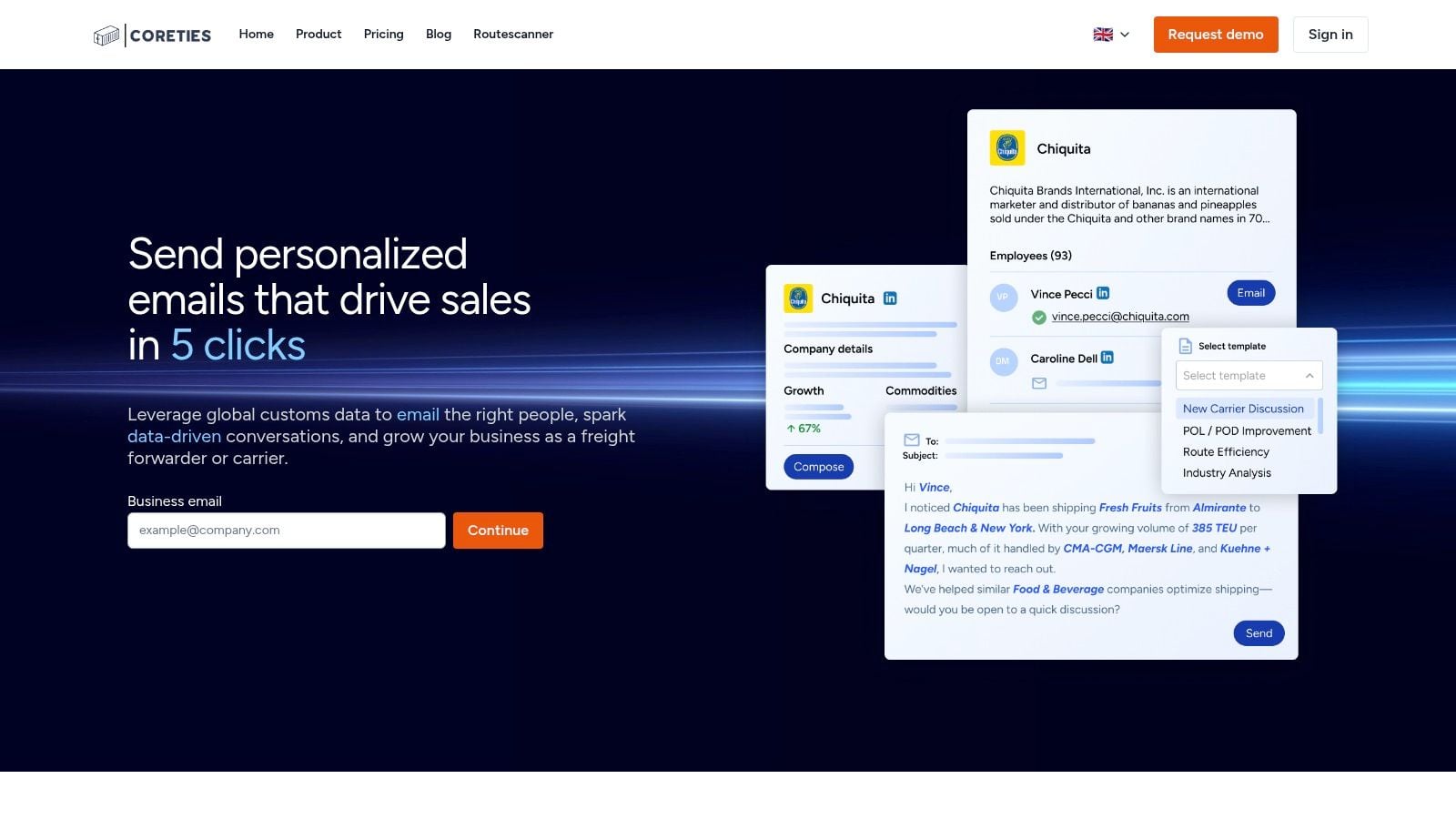
    The advantage now is that strong reps do not start fully cold. Tools like Coreties help teams narrow the field before they pick up the phone. You can prioritize accounts by shipment patterns, mode fit, geography, and likely buying triggers, then call with a reason that matches the account. The conversation starts warmer because the targeting is better.

    That is why cold calling keeps producing growth in freight. It creates access to live operating truth. You find out whether the lane matters, whether the incumbent is slipping, whether the prospect is adding volume, and whether you are even talking to the right person. If you are not, use a process for finding the right transportation decision-makers instead of burning more dials on the wrong contact.

    Where calls create real freight opportunities

    A strong freight call uncovers timing, constraints, and commercial fit.

    For a carrier sales rep, that can mean spotting backhaul freight that improves network balance and margin. For a forwarder, it can mean learning that a shipper is tired of poor milestone visibility, inconsistent transit times, or weak exception handling on a trade lane you know well. For a broker, it can mean hearing that a plant is adding volume next quarter and current coverage is already thin.

    Those openings rarely show up in a purchased list.

    Good outbound work in freight is less about reading a script and more about calling with a point of view. If you want a simple framework for structuring an opener, this outbound call script for founders is useful as a reference, but freight reps still need to adapt the message to lane pressure, mode needs, and service risk.

    Why persistence beats random volume

    Outbound in logistics rewards organized follow-up. Transportation managers are busy. Procurement teams screen aggressively. Operations leaders answer when the issue feels immediate.

    So the job is not to repeat the same pitch five times. The job is to vary the contact around a credible reason to talk.

    • Change the business angle: Lead with import congestion on one touch, capacity risk on another, and service failures or missed appointments on the next.
    • Use account-specific signals: If your data shows likely drayage exposure, port activity, regional expansion, or recurring lane fit, bring that into the conversation.
    • Redirect fast: If the contact does not own transportation, ask who handles routing guides, carrier selection, forwarding, or spot coverage.

    The best reps stay persistent without sounding repetitive.

    Cold calling works in logistics because freight buying is still operational and personal. Buyers trust people who understand detention, appointment failures, mode shifts, tender rejections, and the cost of a late delivery. Email helps. A live call gives you a chance to prove you understand the work.

    The Blueprint for a High-Converting Logistics Cold Call

    A rep calls a shipper at 10:07 a.m. and opens with, "Just checking if you handle freight." That call is dead on arrival. A logistics cold call converts when the rep already knows enough to make the conversation relevant in the first 15 seconds.

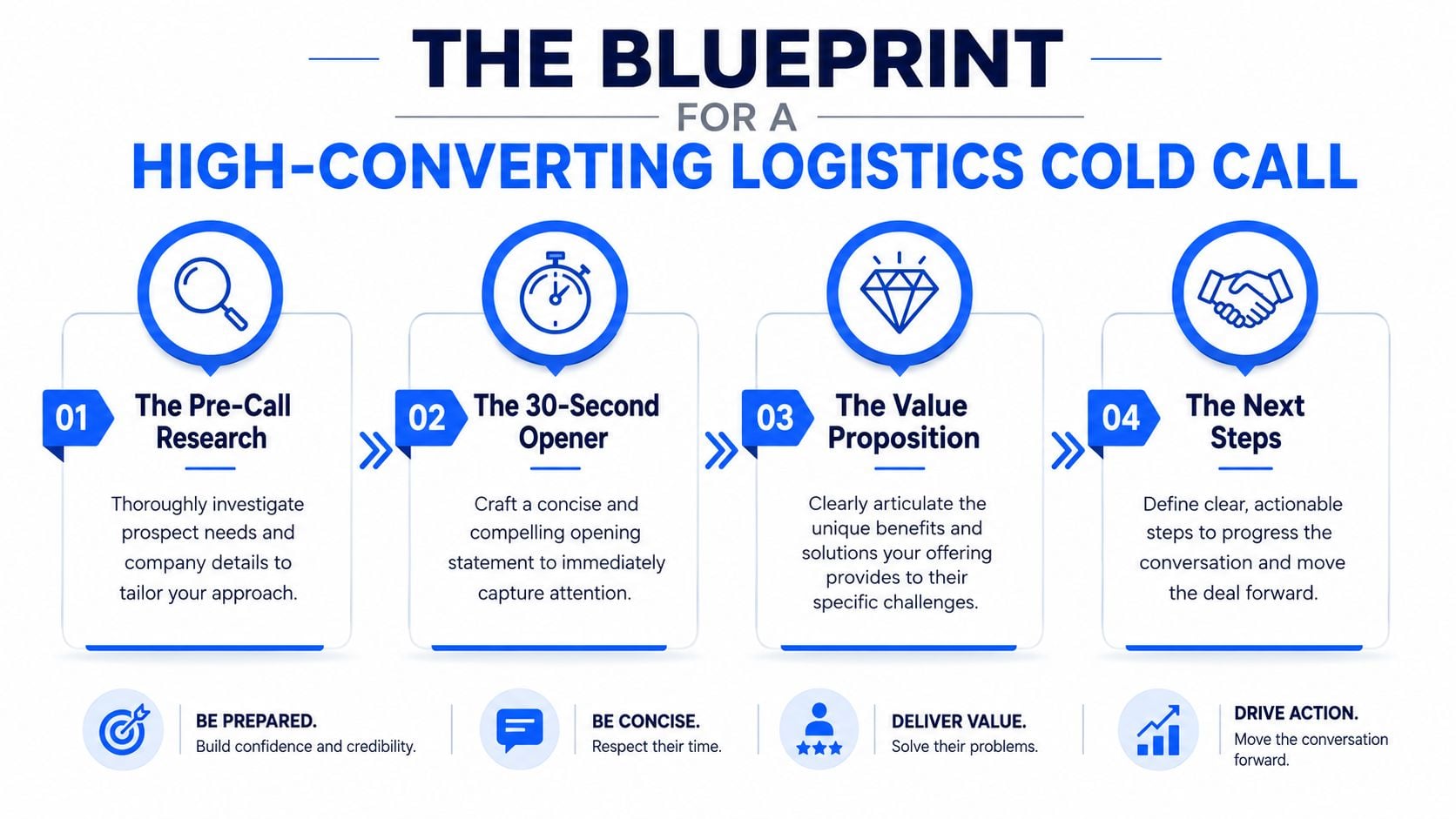
    A four-step infographic showing the blueprint for conducting a high-converting logistics sales cold call.

    Start with account context

    Freight buyers do not reward generic outreach. They respond when the caller sounds like someone who understands how transportation works inside their business.

    That means preparing around account facts, not memorizing a script. Know the likely mode mix, the shipping pattern, the pressure point, and who probably owns the decision. If your tools show import activity, port exposure, regional distribution, or a lane fit your team serves well, use that. Platforms like Coreties help reps turn a cold list into a prioritized call sheet with enough context to ask a smart question on the first attempt.

    The goal is simple. Reduce uncertainty for the prospect. If they can tell in one sentence why you called, resistance drops.

    Open with a reason, then ask one useful question

    A strong opener sounds specific and easy to answer. It does not sound polished for the sake of sounding polished.

    A practical freight opener sounds like this:

    "Hi Sarah, how are you doing? I'm calling because your team looks active on inbound container freight through Savannah, and I wanted to ask who reviews forwarding options when schedules slip or costs move."

    That opener works because it does three jobs fast:

    1. It sounds human: The rep talks like a person.
    2. It establishes relevance: The call references a real shipping context.
    3. It gives the prospect an easy path: They can confirm, redirect, or correct.

    For teams tightening language, this outbound call script for founders is a useful reference for structure. Freight teams still need to adapt the wording to mode, lane pressure, and service risk. If the rep is not sure who owns transportation decisions, this guide on how to find decision-makers at shipper accounts helps before the first dial.

    A short training clip can help reps hear pacing and delivery, not just read a script.

    Talk in operating terms

    Once the buyer engages, keep the conversation tied to work they already manage. Freight prospects do not need a broad capability speech. They need a clear reason to believe your team can improve part of their operation.

    Use language that matches the account:

    • For shippers: Focus on service consistency, appointment performance, lane coverage, and fewer exceptions.
    • For importers: Focus on routing options, trade lane familiarity, and response speed when plans change.
    • For carrier-side conversations: Focus on network fit, volume alignment, and where your capacity solves a known need.

    Specific beats broad. "We handle international freight" is forgettable. "We help importers with time-sensitive Asia to U.S. moves when schedule changes start affecting downstream appointments" gives the buyer something concrete to react to.

    Ask for the next meeting the call has earned

    Cold calls in freight rarely close business on the spot. They create the next serious conversation. That may be a lane review, a pricing discussion, an introduction to procurement, or a call with the transportation manager.

    Keep the close direct and low pressure:

    "If this lane is active for your team, would a short call next week make sense with whoever reviews forwarding options?"

    That works because it respects the buyer's process. It also gives your rep a clean outcome to track. In practice, the best cold calls do not feel cold at all. They feel like timely conversations backed by real account context.

    Supercharge Your Calls with Data Driven Insights

    The biggest mistake in freight outbound is calling with generic assumptions. "Do you ship internationally?" "Are you reviewing providers?" "Can I tell you about our services?" Those questions waste the small window you get on a live connect.

    Modern sales teams fix that by replacing guesswork with account intelligence.

    Screenshot from https://coreties.com

    What a smart call sounds like

    A generic call sounds cold because the rep doesn't know enough to be relevant. A smart call still reaches out first, but it opens with evidence the rep understands the account.

    That changes the conversation.

    Instead of asking whether a company imports, the rep references known trade activity. Instead of asking who handles logistics, the rep calls the most likely decision-maker. Instead of talking about broad capabilities, the rep speaks to the lane, mode, or routing pressure most likely to matter.

    Here is the difference in practice:

    Call Style Opening Approach Prospect Reaction
    Generic cold call Broad introduction and company pitch Low patience
    Data-informed call Specific business context and relevant question Higher credibility
    Warm follow-up call Builds on prior interaction or signal Easier progression

    What to prepare before the dial

    For logistics teams, useful call prep usually comes from a combination of shipment visibility, account fit, contact quality, and outreach workflow discipline.

    • Shipment context: Look for lane patterns, origin-destination relevance, and signs that your service model fits the account.
    • Contact precision: Call the person most likely to own transportation, procurement, forwarding, or supply chain decisions.
    • Message tailoring: Match your reason for calling to the account's likely shipping reality, not your internal product list.
    • Follow-up system: If a live conversation doesn't happen, queue an email and next touch while the details are fresh.

    Teams that want stronger process around sequencing and rep coordination can learn from examples of sales team outreach automation. For broader workflow planning, this guide to sales intelligence tools helps frame what data improves outreach quality.

    Better data doesn't replace selling skill. It gives selling skill something accurate to work with.

    Why this matters in freight

    Freight buyers hear the same claims all day. Good service. Competitive rates. End-to-end solutions. Those phrases are too broad to create trust.

    Specificity does. If the rep knows the account likely moves on a lane where their company has a real operational advantage, the conversation becomes useful faster. That's how a cold call starts to feel warm. Not because the prospect knows you, but because the call sounds informed enough to deserve a response.

    That shift also improves rep discipline. When each call starts with actual context, managers can coach quality. They can inspect whether the rep chose the right account, reached the right person, framed the lane correctly, and asked a real qualification question.

    Measuring Success and Ensuring Compliance

    Many freight teams still measure cold calling the wrong way. They celebrate dials, talk time, or how busy the rep sounded that day. Those numbers can describe effort, but they don't tell you whether outbound is creating pipeline.

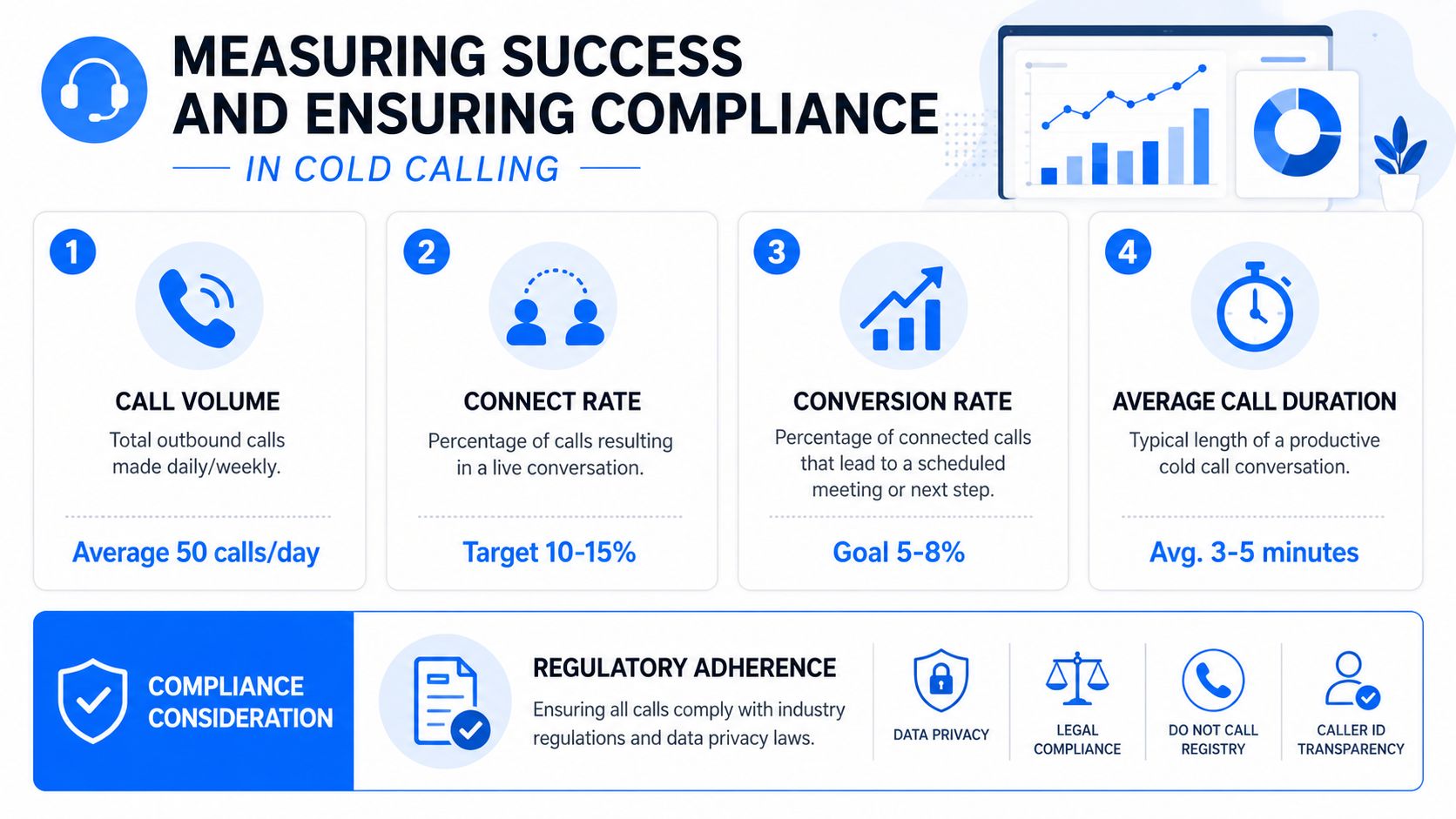
    An infographic detailing key performance metrics and regulatory compliance considerations for successful cold calling in sales teams.

    Track what moves the deal

    The cleanest way to measure cold calling is to treat it like a pipeline advancement system.

    According to RingCentral's definition of cold calling, calls must be made between 8 a.m. and 9 p.m. in the prospect's local time, callers must identify themselves and their organization, and the main success metric should be advancing the prospect to the next pipeline stage rather than trying to force an immediate sale.

    That standard fits freight sales well. A productive call might result in a follow-up meeting, a referral to the transportation lead, a lane review, or permission to quote. Those are real outcomes. They move the account forward.

    A practical scorecard should include:

    • Connect quality: Did the rep reach a real stakeholder or just complete a dial?
    • Conversation relevance: Did the call uncover lane, provider, timing, or ownership information?
    • Next-step rate: Did the rep earn a meeting, introduction, or agreed follow-up?
    • Data improvement: Did the rep leave the account record cleaner than they found it?

    Compliance is part of professionalism

    Compliance isn't separate from good sales. In outbound freight prospecting, it protects reputation and keeps your team disciplined.

    At minimum, reps should follow a few essential rules:

    • Call during allowed hours: Use the prospect's local time, not the rep's.
    • Identify yourself clearly: State your name and company early.
    • Avoid deception: Be direct about why you're calling and what your business does.
    • Document outcomes: Record requests, objections, next steps, and any opt-out signals accurately.

    Professional outbound teams don't just sound organized on the phone. They prove it in their records.

    One more management point matters here. If your team is chasing vanity metrics, they will take bad shortcuts. If they are measured on clean qualification and next-step creation, call quality improves and compliance gets easier to maintain.

    Conclusion From Cold Contact to Valued Partner

    A cold call continues to be what it always was. It's a first conversation with someone who hasn't engaged with you before. What changed is how good teams prepare for it.

    In logistics, the difference between a useless cold call and a productive one comes down to relevance. Random dialing produces random outcomes. Focused account selection, better contact targeting, and a clear lane-based reason for calling produce conversations worth having.

    The reps who win freight business don't rely on volume alone. They call the right accounts, ask sharp questions, and treat the phone as a tool for qualification and trust building. They don't try to close everything on the first touch. They move the deal forward one credible step at a time.

    That's the answer to what is a cold call in sales today. It's not a relic. It's a disciplined first move. When logistics teams use data to narrow who they call and why, the "cold" part starts disappearing. What remains is a direct, useful conversation that can turn a stranger into a qualified opportunity, and eventually into a long-term shipper relationship.


    Coreties helps freight teams make cold outreach far less cold. If you want to find qualified shippers, identify the right decision-makers, and start sales conversations with lane-specific context instead of generic guesswork, Coreties gives your team a practical way to do it.

  • Secure Business with Pacific Blends Ltd: 2026 Logistics

    Secure Business with Pacific Blends Ltd: 2026 Logistics

    You open a company record expecting another small regional food manufacturer. Then one detail changes the whole account. The shipper is relatively small by headcount, but it sits inside a supply chain that reaches the Bering Sea, Vancouver-area port infrastructure, and food manufacturers across North America and the Pacific Rim.

    That's the kind of prospect many logistics teams miss. They sort by size, not by position in the network.

    Pacific Blends Ltd deserves the opposite treatment. It's the kind of account where niche market control, product complexity, and acquisition-led expansion can create freight opportunities that are larger than the company's public profile suggests. If you sell forwarding, carrier capacity, customs-adjacent visibility, or multimodal planning, this isn't a company to file under “too small to matter.” It's one to study carefully and approach with a point of view.

    From Niche Player to High-Value Prospect

    Most sales teams spend too much time on obvious targets. They chase large food manufacturers with crowded vendor rosters and entrenched transportation partners. Meanwhile, a company like Pacific Blends can sit in plain sight.

    Publicly, it looks compact. Operationally, it's far more consequential. Pacific Blends is a family-owned custom-blending provider founded in 2002 and headquartered in Port Coquitlam, British Columbia, with over 40 years of experience noted through its industry background and membership references. It serves customers across North America and the Pacific Rim in seafood, meat, poultry, dairy, processed foods, and snack foods, while holding a particularly strong position in surimi cryoprotectants and custom dry ingredient blends, according to Pacific Blends company information.

    That combination matters for freight sales because network importance beats company size when the shipper handles products that are operationally sensitive and tied to industrial production schedules. Pacific Blends isn't just moving finished pouches. It's supporting manufacturers that use outsourced dry blending to remove blending steps from their own plants.

    Practical rule: When a shipper helps manufacturers remove production steps, transportation reliability becomes part of the shipper's value proposition.

    That's why this account is better understood through benchmarking logic than through standard prospect scoring. A useful lens comes from industry benchmarking methods for supply-chain prospecting. The right comparison set isn't “Canadian SME manufacturers.” It's “specialty ingredient suppliers with concentrated category influence, export exposure, and workflow-critical products.”
    For a logistics seller, that changes the playbook. You're not pitching generic capacity. You're diagnosing where a specialized ingredient producer may need tighter inbound coordination, cleaner outbound execution, and better support when new product lines are folded into the operation.

    Who Is Pacific Blends Ltd Really

    A standard company summary misses the point. Pacific Blends should be read like an internal account brief, where every business fact implies a logistics consequence.

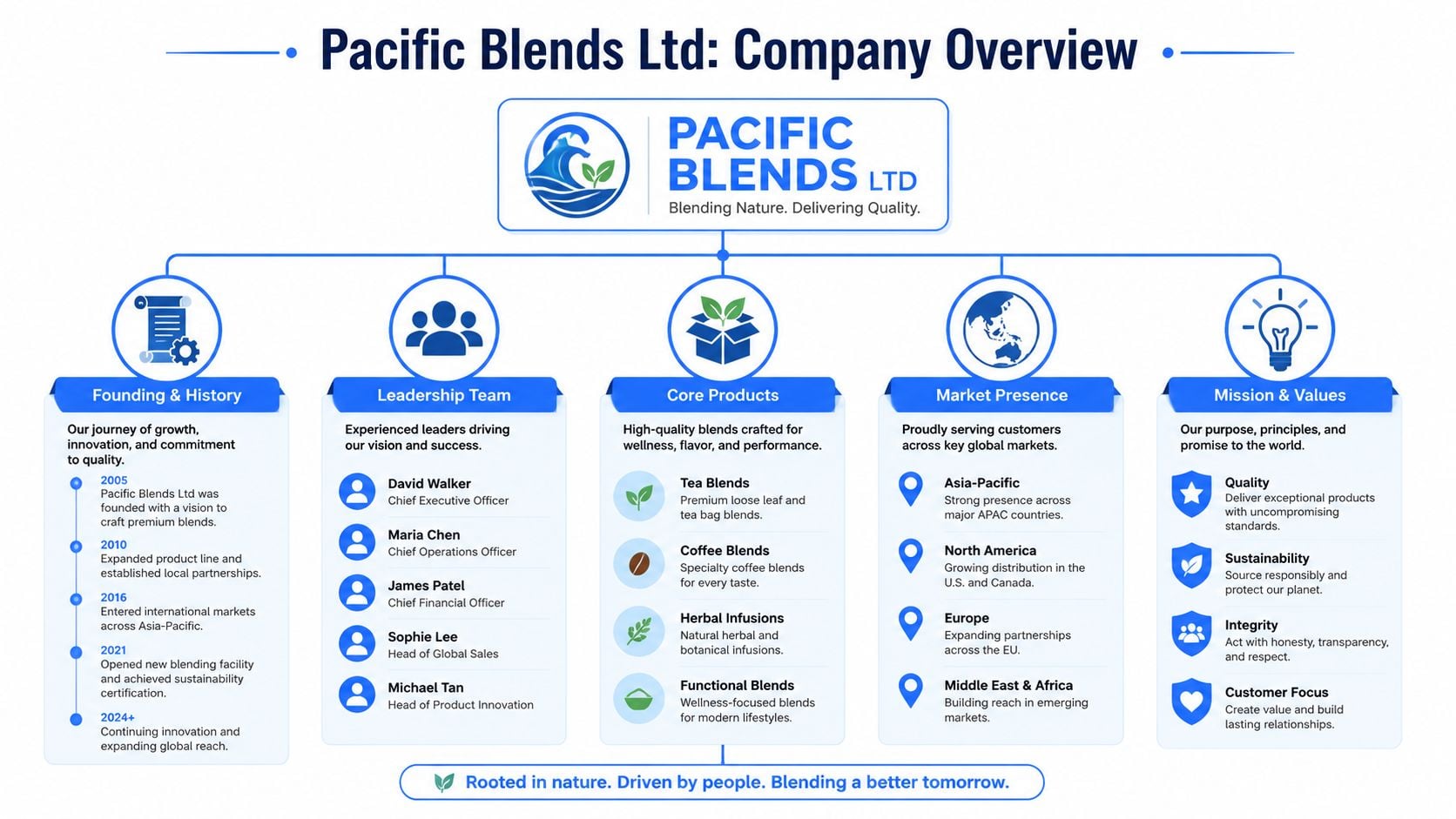
    An organizational infographic for Pacific Blends Ltd showing history, leadership, products, market presence, and company values.

    The company profile that matters to sales

    Pacific Blends Ltd was founded in 2002 and is headquartered in Port Coquitlam, British Columbia. Public importer data describes it as one of the world's largest producers of surimi cryoprotectants, supplying nearly all factory fishing vessels processing Alaskan Pollock in the Bering Sea. The same source reports revenue of under $5 million and an employee count of 11 to 50, which makes it a compact organization with outsized category relevance, as shown in this Pacific Blends importer profile.

    That's the first signal logistics teams should pay attention to. A company doesn't need a huge payroll to create meaningful freight demand if it occupies a bottleneck position in a specialized supply chain.

    Its core business is custom dry ingredient blending. Pacific Blends serves seafood, meat, poultry, dairy, processed food, and snack food customers. The commercial logic behind that offering is straightforward. Manufacturers can buy a single unitized blend rather than stage, measure, and combine multiple dry inputs in-house.

    Why the business model raises logistics stakes

    This isn't just a food ingredients company. It's a workflow simplifier for downstream manufacturers. When a supplier takes complexity out of a customer's production line, that supplier's own execution has to be tight.

    If Pacific Blends ships late, the customer doesn't just receive ingredients late. The customer loses the time savings and process simplification they outsourced to Pacific Blends in the first place. That creates a very different service expectation than standard commodity freight.

    Here's the account profile in a sales-friendly format:

    Attribute Detail
    Company Pacific Blends Ltd
    Ownership model Family-owned private manufacturer
    Founded 2002
    Headquarters Port Coquitlam, British Columbia
    Primary specialization Custom dry ingredient blends
    Notable market position One of the world's largest producers of surimi cryoprotectants
    Supply relevance Supplies nearly all factory fishing vessels processing Alaskan Pollock in the Bering Sea
    Reported scale Revenue under $5 million
    Reported workforce 11 to 50 employees
    Served sectors Seafood, meat, poultry, dairy, processed foods, snack foods
    Commercial value proposition Unitized custom blends that remove dry blending steps for manufacturers

    What their history suggests about account behavior

    Pacific Blends didn't stay static. The company expanded its presence through acquisitions, including the November 2011 acquisition of Renaissance Blends' business assets, which brought Renaissance's product line into the Pacific Blends brand. It later acquired the Vegelatum® brand, extending its position into cosmetic ingredients, according to Pacific Blends growth news.

    That history tells you something useful before you ever contact the company. This is a business that grows by adding lines, integrating products, and broadening the commercial footprint without abandoning its custom-blending core.

    A shipper that grows through acquisition usually inherits complexity faster than it redesigns transportation around it.

    For freight providers, that means the primary opportunity may not be “move current orders.” It may be “support integration.” New SKUs, altered sourcing needs, changed customer mixes, and fresh packaging or handling requirements often appear before transportation processes are fully harmonized.

    Mapping Their Global Supply Chain Footprint

    If you want to build a lane strategy around Pacific Blends, start with what the company makes, where it sits, and who it serves. That gives you a working map of its supply chain before you touch shipment data.

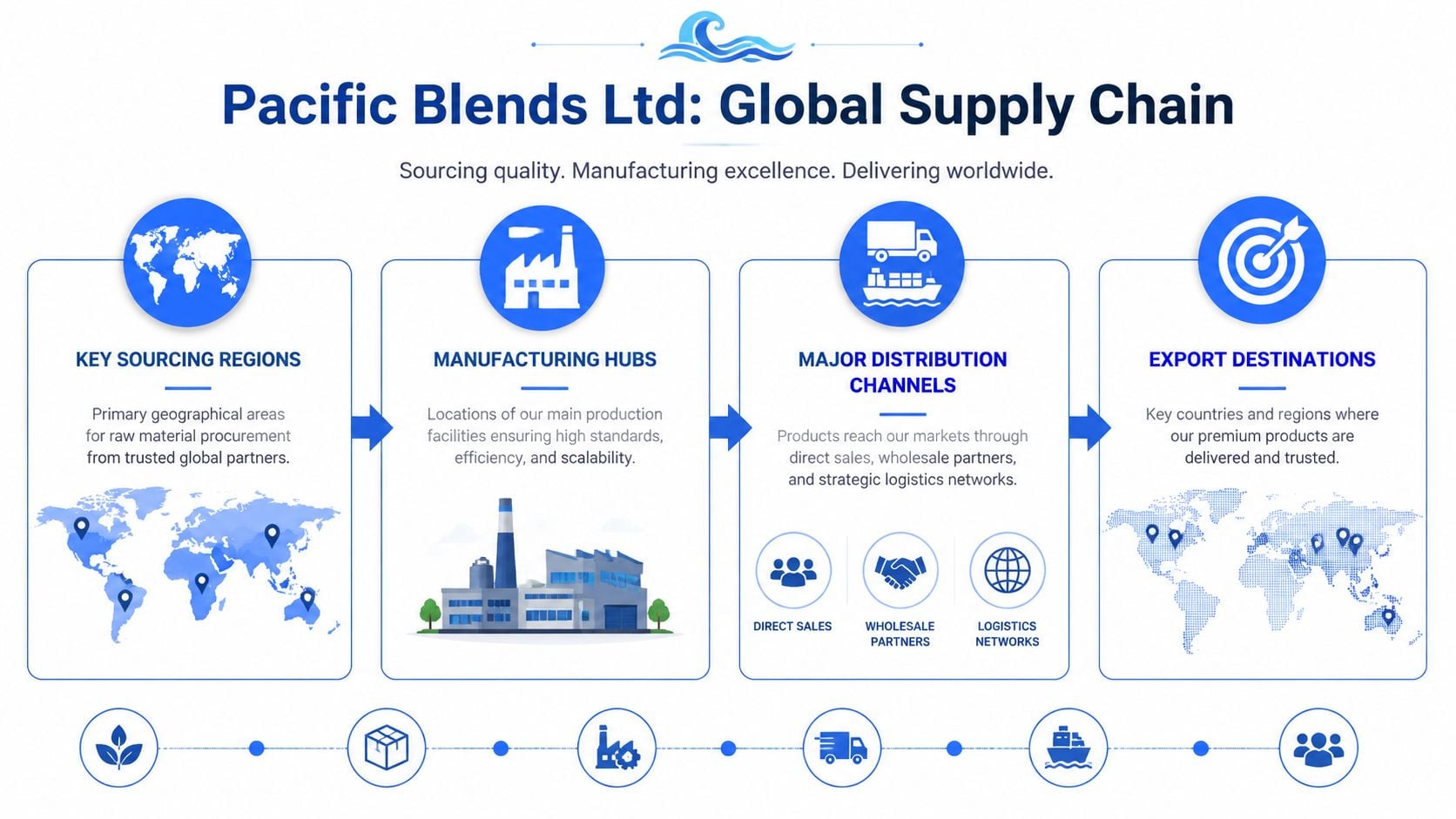
    An infographic showing the global supply chain process of Pacific Blends Ltd, from sourcing to export.

    Start with the product and work backward

    Pacific Blends' unitized custom blending technology consolidates multiple dry ingredients into a single pouch. The company says this reduces storage volumes and shortens storage time for customers, while its location near major Vancouver ports and a sugar refinery supports cost-effective delivery to North American and Pacific Rim clients through its company overview.

    That statement gives a logistics seller three immediate hypotheses.

    1. Inbound ingredient complexity is real. A company that combines multiple dry ingredients into one pouch needs coordinated inbound material availability.
    2. Outbound service is broader than local distribution. Pacific Rim and North American reach implies a mix of domestic and international flows.
    3. Facility location is strategic, not incidental. Port proximity usually means ocean connectivity matters to the operating model.

    Build the likely lane map

    A practical lane map for Pacific Blends probably includes several distinct flow types.

    • Inbound raw materials: Dry ingredients arriving for blending, potentially from domestic and international suppliers.
    • Marine-linked seafood ingredient support: Commercial relationships tied to the Alaskan Pollock and Bering Sea ecosystem.
    • Outbound finished blends to food manufacturers: Likely shipment patterns into production hubs where customers need ingredients on predictable schedules.
    • Pacific Rim export flows: Ocean-linked movement where transit planning and documentation discipline matter more than simple truck dispatch.

    If you work in forwarding or NVOCC sales, broader reading on mastering global supply chain strategies helps sharpen your pitch. The point isn't theory. It's knowing how port access, supplier concentration, and customer production timing interact inside a specialized ingredient business.

    What to look for operationally

    The key isn't just that Pacific Blends moves goods globally. It's that its product format shifts complexity from the customer to Pacific Blends.

    That means a logistics partner should examine:

    Supply chain question Why it matters for Pacific Blends
    Are ingredients sourced from multiple origins? Multi-origin inputs raise coordination risk before blending begins
    Are customer orders tied to plant schedules? Delays can interrupt manufacturing workflows downstream
    Do export orders move through Vancouver-area gateways? Port choice affects lead time, drayage planning, and carrier options
    Are there mixed product requirements across sectors? Food-sector diversity can produce different service expectations by customer type

    A useful companion lens is studying how to identify a company that imports. Even before you validate exact entries, the import-export logic around Pacific Blends is already visible from its product design, geography, and customer base.

    The best freight opportunities often sit where a shipper promises simplicity to its customers but carries hidden complexity inside its own operation.

    How to Verify Their Shipping Activity

    Smart prospecting starts with inference, but it can't end there. Before your team writes the first outreach email, it needs evidence that Pacific Blends is moving freight in the patterns you suspect.

    That verification step changes the conversation. Instead of saying, “We help food ingredient companies,” you can say, “We noticed your shipping pattern suggests recurring pressure around specific ports, handoffs, or lane structures.” That's a different level of credibility.

    What verification should actually answer

    For an account like Pacific Blends, shipment verification isn't about collecting trivia. It's about proving whether the commercial story matches the physical network.

    Use customs and trade-activity tools to answer questions such as:

    • Which ports appear repeatedly: Repetition usually points to habitual trade lanes rather than one-off transactions.
    • What shipment descriptions reveal: Product language can help separate ingredient inflows from blended outbound goods.
    • How frequently shipments occur: Consistency tells you whether to frame the account as project-based or recurring.
    • Which parties appear around the shipment: Related entities, consignees, or suppliers can reveal where decisions may be influenced.

    Here's the kind of workflow many sales teams benefit from seeing visually:

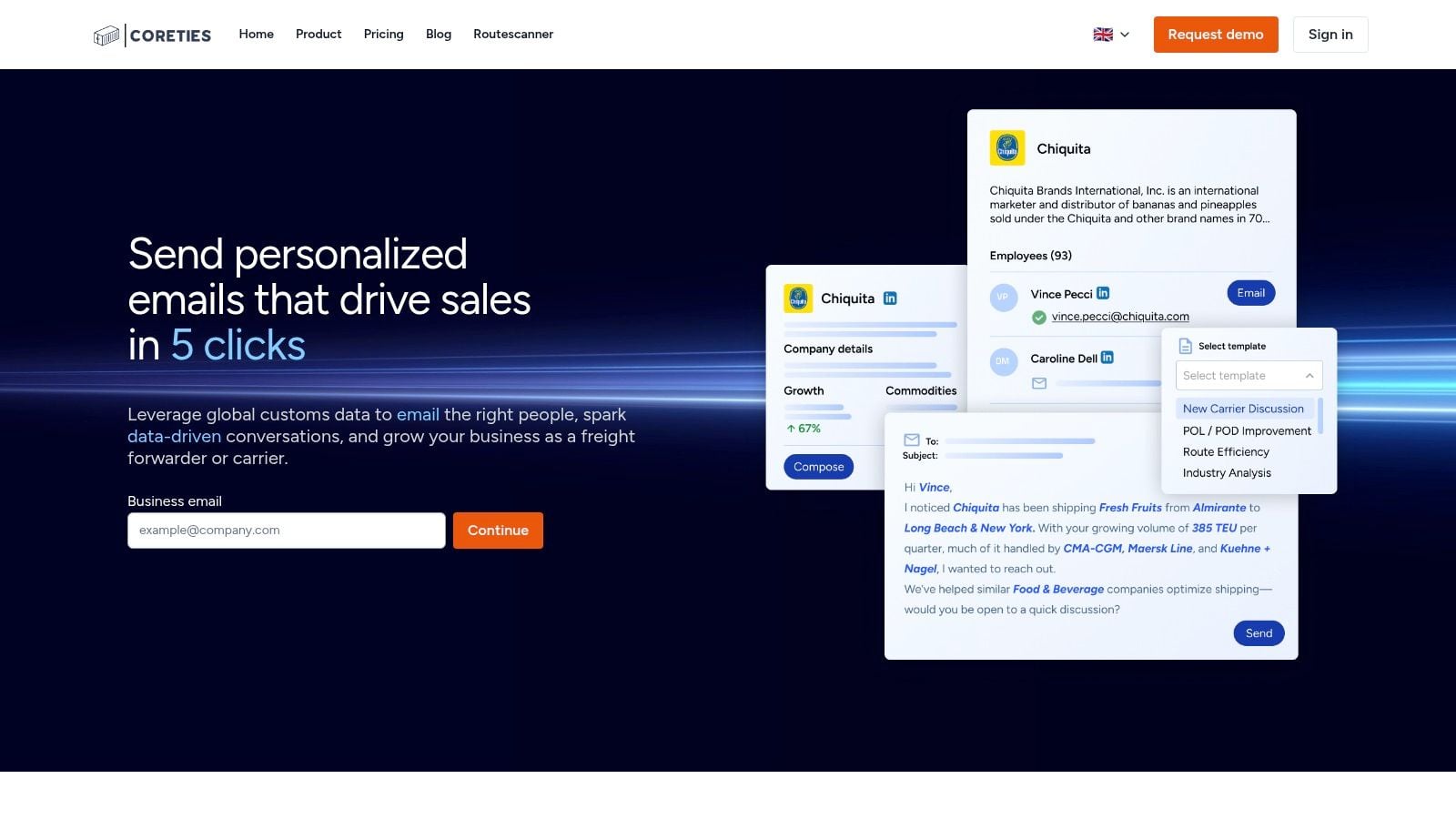
    Screenshot from https://coreties.com

    What to pull from the records

    For a company with Pacific Blends' profile, customs records and related shipment tools can help your team isolate:

    1. Port pairs that show likely core international lanes.
    2. Consistent routing patterns that may indicate incumbent forwarder relationships.
    3. Packaging and shipment format clues that suggest whether cargo moves as palletized dry ingredients, packaged blends, or broader industrial food components.
    4. Seasonality signals, if they exist, that might tie back to customer production cycles or seafood-related timing.

    This is also where shipment visibility language matters. If your prospect asks why your team is focused on operational transparency, it helps to ground that in practical tools rather than buzzwords. A concise explainer on what is a freight tracking system is useful background because specialized ingredient shippers often care less about flashy dashboards and more about dependable milestone visibility.

    Why verification changes the sales motion

    Without data, reps tend to send feature-based outreach. They promise good service, flexible capacity, or competitive pricing. Every carrier and forwarder says the same thing.

    With validated shipping activity, you can do something more specific:

    Don't lead with your network. Lead with what their shipment pattern suggests they need fixed, protected, or simplified.

    That's especially important for a company that supports customer manufacturing workflows. If you can confirm recurring gateways, likely import dependencies, or export routines, your message can focus on schedule protection, supplier coordination, and lane resilience instead of commodity transport language.

    Actionable Outreach Angles That Win Business

    Most logistics outreach to food manufacturers is forgettable because it's too broad. Pacific Blends won't respond to generic claims about “excellent service” or “global reach.” The account calls for a sharper angle tied to hidden commercial pressure.

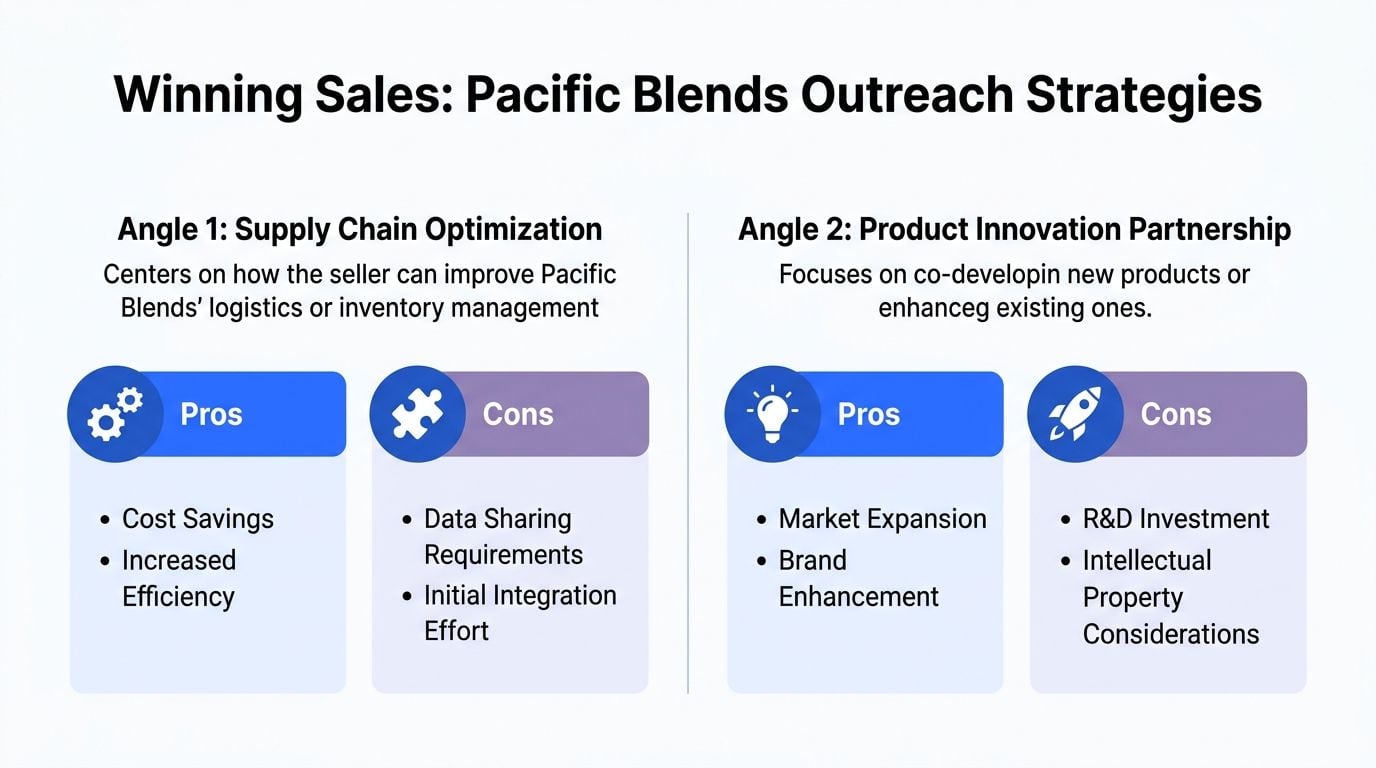
    A strategic business chart comparing supply chain optimization and product innovation partnership strategies for Pacific Blends.

    Angle one, position logistics as cost protection

    A frequently overlooked sales angle sits inside Pacific Blends' role in surimi. Public export-catalogue commentary notes that surimi prices rose 18% in 2024 due to supply constraints, while Pacific Blends' role as a top cryoprotectant manufacturer creates supply-chain stability that can buffer food manufacturers against inflation, according to the BC agrifood export catalogue entry on Pacific Blends.

    That matters because it reframes the logistics sale. You're not offering transportation as a back-end service. You're offering transportation as a support system for a supplier whose value includes helping customers manage instability.

    A weak outreach message says, “We can handle your imports and exports.”

    A stronger one says, “Your position in cryoprotectants makes continuity part of your customer promise. We help specialized suppliers protect inbound ingredient flow and outbound fulfillment when volatility hits upstream protein markets.”

    That's a very different conversation.

    How to frame the message

    Use language that connects transport execution to commercial protection:

    • Mention continuity: Pacific Blends supports a mission-critical product category.
    • Talk about inventory timing, not just rates: Ingredient businesses lose value when timing breaks.
    • Offer lane review: Propose a review of where disruptions could compromise customer delivery promises.

    Sales insight: When a supplier helps its buyers manage inflation pressure, transportation reliability becomes part of the buyer's cost-control story.

    Angle two, treat Vegelatum as a network expansion problem

    Pacific Blends' acquisition of the Vegelatum® brand opened a second strategic angle. The move expanded the company into cosmetic ingredients, as noted in the earlier acquisition coverage. Public commentary around that acquisition also points to a broader transparency trend in beauty products and states that 32% of global beauty consumers seek food-derived ingredients, according to the Vegelatum acquisition announcement.

    Don't oversell the statistic. Use it to support one simple conclusion. Pacific Blends now touches a category with a different buyer profile, potentially different packaging expectations, and potentially different distribution rhythms than its food-manufacturing base.

    That creates a freight discussion most providers won't raise. The issue isn't only “Can you ship cosmetic ingredients?” The issue is whether Pacific Blends now needs a transportation setup that can support two commercial motions at once.

    One side of the business serves industrial food manufacturing. The other may require a different cadence, different consignee base, or different compliance-adjacent handling expectations.

    Outreach idea by persona

    If you reach operations leadership, stress integration risk.

    If you reach commercial leadership, stress market expansion readiness.

    If you reach procurement or logistics, stress handoff clarity across mixed product lines.

    You can also tighten the writing itself by borrowing principles from guides on crafting effective cold emails. The best note to Pacific Blends won't be long. It will show that you understand the pressure created when a blending business adds a new brand and category.

    A practical internal prep step is identifying who owns these conversations. Teams that need help locating the right contacts can use guidance on how to find decision-makers before launching outreach.

    What not to say

    Avoid these common mistakes:

    Weak pitch Why it fails
    “We work with many food companies” Too broad. Pacific Blends isn't a generic food shipper
    “We offer cost savings” Unprovable without lane context
    “We can support your growth” Vague and interchangeable
    “We saw you acquired a brand” Observational, but not insightful

    Better language ties your service to one of two real issues: protecting a volatility-sensitive supply role or integrating a newly expanded product portfolio without creating logistics friction.

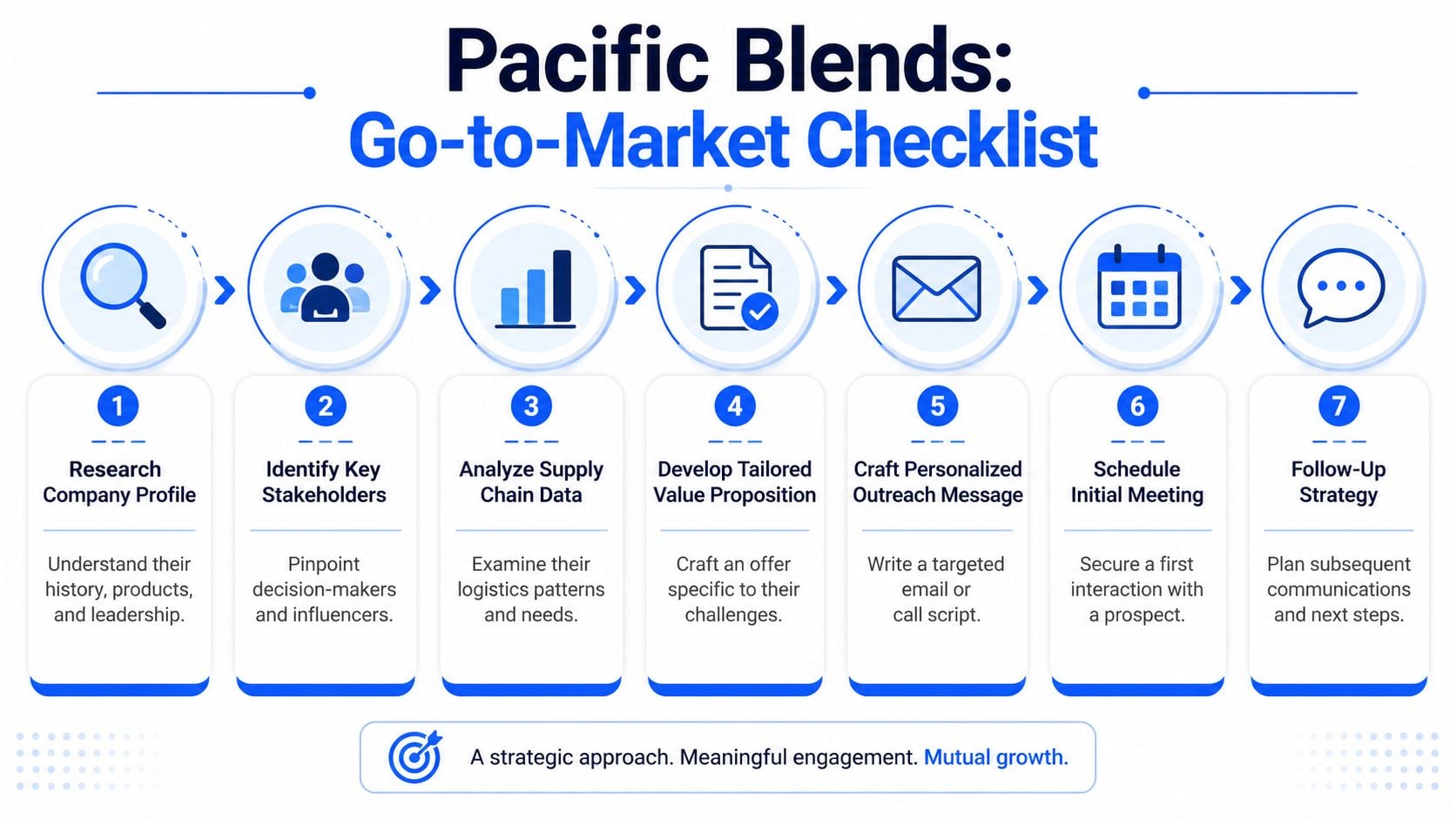
    Your Go-to-Market Checklist for Pacific Blends

    The account is attractive, but it won't close on interest alone. Your team needs a disciplined plan that turns company intelligence into a contact strategy, a lane hypothesis, and a first conversation worth taking.

    A Pacific Blends seven-step go-to-market checklist infographic illustrating a strategic sales and business outreach process.

    The working checklist

    1. Assign one account owner
      Pacific Blends is specialized enough that scattered outreach will dilute the effort. One owner should control research, messaging, and follow-up.

    2. Confirm live shipping patterns
      Validate whether your lane assumptions hold up in actual trade records. Don't brief sales leadership on theory alone.

    3. Segment the likely buying centers
      The relevant stakeholders may not sit in one department. Operations, logistics, procurement, and commercial leadership could all influence the decision.

    4. Choose one outreach angle first
      Don't stack both major narratives into the first email. Lead either with surimi-related continuity and cost protection or with post-acquisition network integration.

    5. Map likely objections in advance
      Expect some version of: “We already have providers,” “volumes are stable,” or “we only review partners when something changes.” Your answer should focus on resilience, integration, or lane-specific insight.

    6. Watch for acquisition-related freight openings
      Pacific Blends' 2011 Renaissance Blends acquisition and later Vegelatum® acquisition show a clear growth-by-acquisition pattern, creating recurring opportunities for logistics providers that can support product-line integration, according to Pacific Blends growth news.

    7. Build a follow-up sequence with a point of view
      Follow-up should add intelligence, not just ask for time again. Bring a routing idea, a handoff risk observation, or a category-specific operational question.

    The standard to hold your team to

    A good campaign against Pacific Blends should leave the prospect feeling understood, not processed.

    If your message could be sent unchanged to any food manufacturer in British Columbia, it's not ready for Pacific Blends.

    This account is strongest for logistics teams that can connect a niche ingredient position to real network demands. The company's public footprint is small enough to be overlooked and specialized enough to reward careful sellers. That's a favorable combination if your team is willing to do the homework.


    Coreties helps freight forwarders, carriers, and logistics sales teams turn trade data into real prospecting action. If you want to identify shippers like Pacific Blends, validate their likely lanes, surface decision-makers, and launch targeted outreach faster, explore Coreties.

  • Industry Benchmarking in Logistics: A Practical Guide

    Industry Benchmarking in Logistics: A Practical Guide

    A freight forwarder calls a prospect and leads with the usual line. We have strong carrier relationships. We can offer competitive rates. We'd love a chance to quote your business.

    The shipper ends the call in under a minute.

    That conversation fails because it gives the buyer nothing specific to react to. In logistics, generic claims sound interchangeable. Every forwarder says they have capacity. Every carrier says they have service. Every sales rep says they can save money. Without evidence tied to the shipper's lanes, suppliers, timing, or routing pain points, the pitch lands as noise.

    The calls that work sound different. They start with something concrete. You're importing this commodity through this gateway. Your current pattern suggests dependence on one carrier group or one origin cluster. Your lane mix creates avoidable exposure when schedules slip. We can see where routing flexibility or service design may matter more than a lower base rate. That changes the discussion from “give us a try” to “we understand your network.”

    That's where industry benchmarking becomes useful. Not as a slide for a quarterly strategy meeting. Not as a vague promise to be data-driven. It becomes a working tool for prospecting, routing, pricing conversations, account retention, and territory planning.

    For logistics teams, the practical question isn't whether benchmarking sounds smart. It's whether it helps a rep write a better email today, helps an operations manager defend a routing decision this week, or helps leadership decide which trade lanes deserve attention this quarter. Used well, it does all three.

    The End of Generic Sales Pitches

    Most logistics sales teams have lived through the same pattern. A rep gets a list of target shippers, opens a spreadsheet, and starts sending outreach based on broad claims. Better service. Better rates. Better coverage. The response rate is weak because the message could have gone to anyone.

    A shipper doesn't buy because a forwarder says the right adjectives. They buy when the seller shows a clear understanding of the shipper's operating reality. If a prospect imports regularly on a lane with recurring schedule friction, they care about routing resilience. If their inbound flow is concentrated with a small group of suppliers, they care about continuity and exceptions. If they're splitting freight across modes, they care about handoff reliability and response speed when something goes wrong.

    Why broad claims fail in freight

    Generic outreach breaks for three reasons.

    • It ignores lane context. A shipper moving ocean freight from one origin pattern has very different concerns than a shipper relying on mixed air and ocean replenishment.
    • It doesn't show commercial relevance. Buyers want to know why switching or adding a provider improves a real business outcome.
    • It treats all prospects the same. In logistics, the account list may look broad, but the selling motion should be narrow.

    Practical rule: If your first message could be copied into an email for fifty unrelated shippers, it probably won't open a serious conversation.

    The stronger alternative is to benchmark before outreach. Look at the prospect's shipping activity, the likely carrier mix, the commodity pattern, and the trade lanes that matter most. Then compare that picture against what you know about your own service strengths and the market's common service patterns. The result is a sharper point of view.

    What a useful pitch sounds like

    A useful sales conversation doesn't start with “we'd like an opportunity.” It starts with an observation.

    You might note that the shipper appears concentrated in a port pair where schedule variability has consequences for distribution planning. You might see that they depend on a narrow carrier set and could benefit from more optionality. You might find that your network aligns better with the shipper's origin geography than the providers they seem to use now.

    That's not theory. It's a better use of available logistics data.

    What Is Logistics Industry Benchmarking Really

    In logistics, industry benchmarking is the disciplined act of comparing your performance, network position, or account assumptions against a reliable point of reference. That reference might be your own historical performance, a competitor pattern, a lane-level market norm, or the practices of firms that operate especially well on a given trade.

    A sports analogy works here. Good teams don't watch game film to admire their own highlights. They study opponents, tendencies, spacing, and execution. They want to know where they're losing ground and where they can exploit an opening. Logistics teams should think the same way. Benchmark your transit patterns, carrier mix, quote responsiveness, lane density, and exception handling against a standard that means something.

    An infographic titled What Is Logistics Benchmarking showing five key benefits of the practice.

    It's more rigorous than most teams treat it

    A formal benchmark is not just a rough comparison. The U.S. Bureau of Labor Statistics describes benchmarking as using a standard or point of reference to compare performance, and notes that its Current Employment Statistics program benchmarks the March employment level to the first-quarter employment level from the Quarterly Census of Employment and Wages every year in an annual calibration process designed to align sample-based estimates with a broader universe estimate, as explained in the BLS overview of benchmarking.

    That example matters because it strips away the buzzword. Benchmarking is a correction discipline. It's a way to test whether your current read of the market, your sales narrative, or your operating assumptions match a broader reality.

    What that looks like in freight

    For a freight forwarder, benchmarking often means asking questions like these:

    • Lane position. Are we strong on the lanes we claim to target, or are we spreading sales effort too thin?
    • Service reliability. Are our actual operating results holding up against what the market expects on those routes?
    • Commercial fit. Are we pursuing shippers whose shipping patterns match our strengths?
    • Pricing posture. Are we discounting where service quality should carry the conversation?

    For a pricing or revenue team, the logic is similar to how teams use Market Edge's pricing platform to anchor pricing decisions against external signals rather than instinct alone. In logistics, the same mindset applies to lanes, routing options, and account targeting.

    Benchmarking only becomes useful when it changes a decision. Which account to pursue. Which lane to defend. Which routing option to put in front of the customer.

    The daily version of benchmarking

    A lot of people hear the term and think of annual planning decks. In reality, the daily version is simpler. A rep uses customs activity to compare a target shipper with similar importers. An operations manager compares scheduled versus actual lane performance. A branch leader reviews whether the team's strongest commodity flows match the accounts they're spending time on.

    That's logistics benchmarking in its most practical form. It turns broad market noise into a smaller set of decisions that can win business.

    The Most Valuable KPIs for Freight Forwarders

    The most useful freight KPIs are the ones that help a team answer a commercial or operating question fast. Which accounts fit our network. Which lanes are vulnerable. Which customers are drifting. Which service failures are hurting renewals. Good benchmarking starts with metrics that support action.

    A foundational rule matters here. Effective benchmarking requires consistent definitions, timeframes, and quantitative KPIs such as costs, margins, satisfaction scores, or response times, and benchmarks can come from internal historical data, competitor analysis, public reports, and survey data. That means a benchmark only has value when the numbers are comparable over the same period, as described in this benchmarking data guide.

    Customs and shipment intelligence KPIs

    For logistics sales teams, customs-derived signals are often the first layer because they reveal actual movement patterns, not survey opinions.

    KPI Data Source What It Reveals
    Shipper-carrier relationship pattern Customs filings Which providers appear to handle the shipper's freight and how concentrated those relationships look
    Shipment volume by lane Customs filings Where the shipper's trade activity is concentrated and which lanes deserve tailored outreach
    Origin and supplier concentration Customs filings Whether the account depends on a narrow supplier base or a wider sourcing mix
    Commodity movement trend Customs filings Which product categories matter most and whether your specialization is relevant
    Port and gateway pattern Customs filings Which entry points shape inland planning, congestion exposure, and drayage complexity

    These KPIs are especially valuable in prospecting because they help a rep stop guessing. Instead of saying “we serve Asia to North America,” the rep can focus on the actual origin clusters and gateway habits visible in the prospect's traffic pattern.

    Service and schedule KPIs

    Operations teams need another category. They need metrics tied to execution.

    • Scheduled versus actual transit time. This shows whether the marketed service profile matches lived experience on the lane.
    • On-time performance by route. Useful for account reviews and routing redesign.
    • Port dwell pattern. Helpful when a lane looks stable on paper but customers experience recurring delays.
    • Exception response speed. A quiet but important differentiator in account retention.

    If you're refining the service side of your benchmark stack, resources on tracking customer service metrics for 2025 can help teams think more clearly about response handling, resolution flow, and service consistency. Those ideas matter in logistics because service quality often determines whether a shipper tolerates a rate premium.

    Internal commercial KPIs

    Internal metrics matter just as much because external data alone won't tell you whether your team is converting opportunity into business.

    Consider these:

    • Quote-to-booking ratio. A weak ratio can mean poor qualification, weak follow-up, or a mismatch between target accounts and network strength.
    • Customer churn pattern. If customers leave on specific lanes or modes, the root cause may be structural rather than account-specific.
    • Gross margin by lane or account type. Useful when the sales team is winning business that operations can't serve profitably.
    • Sales response time. Often overlooked, but it shapes whether you're even in the deal.

    The KPI itself isn't the insight. The comparison is the insight. A response time means little until you compare it against your own standard, your team's historical pattern, or the expectation of the shipper you're trying to win.

    What not to benchmark

    Teams waste time when they benchmark numbers that aren't normalized. If one branch counts a quote one way and another branch counts it differently, the comparison won't help. If lane performance is measured across mismatched periods, you'll draw the wrong conclusion. In freight, bad definitions can look precise while hiding operational reality.

    The fix is simple. Pick fewer KPIs, define them tightly, and track them consistently.

    A Repeatable Benchmarking Methodology for Logistics

    Most benchmarking efforts break down because teams collect too much data before they decide what problem they're solving. A repeatable process keeps the work useful. In logistics, the strongest methodology is usually the one a sales manager, pricing analyst, and operations lead can all use without turning it into a research project.

    An infographic showing a four-step repeatable benchmarking methodology process for logistics management and continuous business improvement.

    Step 1 define the business objective

    Start with a real decision. Don't start with the data source.

    A good objective might be winning a specific importer account, improving service credibility on a trade lane, defending a vulnerable customer, or deciding whether to commit more sales effort to a geography. The objective determines what benchmark matters. If the goal is prospecting, shipment and lane intelligence take priority. If the goal is account retention, service and response metrics become more important.

    Write the objective in operational terms. “Increase visibility in retail imports” is too broad. “Build a targeted list of retail importers whose lane mix fits our network and whose current routing pattern appears exposed” is workable.

    Step 2 gather comparable data

    Teams tend to either overbuild or oversimplify. Pull from a small number of sources that fit the objective:

    • Internal systems such as TMS, CRM, and quote history for service and conversion data
    • Public and commercial shipment intelligence for shipper patterns, commodities, and trade lanes
    • Carrier schedules and route information for service design and routing alternatives
    • Account notes and exception records for context that raw movement data can't explain

    If your team needs more structured shipment visibility, services such as a port import export reporting service can help standardize how lane and account activity are reviewed before outreach or network decisions are made.

    Step 3 analyze and normalize before comparing

    This is the step that separates useful benchmarking from misleading dashboards. JANA notes that benchmarking compares business processes and performance metrics against industry bests, but it also stresses agreement on which metrics matter and a defined methodology for collection, aggregation, and distribution. Without normalization and common data definitions, cross-company comparisons can produce misleading conclusions instead of actionable gaps, as explained in JANA's discussion of technical information metrics and benchmarking methodology.

    In logistics terms, normalization means asking basic but essential questions.

    1. Are we comparing the same trade lane over the same period?
    2. Are transit times defined the same way across the data set?
    3. Are we mixing bookings, shipments, and quotes as if they were interchangeable?
    4. Are account categories broad enough to distort the result?

    A rep who compares a shipper's peak-season pattern to a quiet off-season period may think there's an opportunity where there isn't one. An operations leader who compares all Asia-origin freight as one bucket may miss a severe problem isolated to a specific gateway pair.

    Standardize first. Compare second. Any other order creates false confidence.

    Step 4 turn the gap into action

    The final step is practical. If the benchmark shows a gap, assign a move.

    • If a prospect appears overconcentrated with a provider set that doesn't match your strongest lane, craft outreach around network fit.
    • If your actual service underperforms on a lane you sell aggressively, fix the routing before increasing pipeline pressure.
    • If a branch wins a lot of quotes but books poorly, review qualification criteria and pricing discipline.
    • If a key customer's traffic pattern shifts, adjust account strategy before renewal pressure surfaces.

    The benchmark is not the output. The output is the decision memo, routing change, prospect list, pricing stance, or account review plan that comes from it.

    Practical Use Cases for Sales and Routing

    The easiest way to understand benchmarking is to watch it change a real conversation. In logistics, the value shows up when a rep stops sending broad outreach and when an operations manager stops defending a route because it's familiar.

    A professional man pointing at a logistics dashboard screen displaying real-time vehicle tracking and performance data.

    Use case one prospecting a shipper with a lane-specific point of view

    A sales development rep gets a target account in the consumer goods space. The old approach would be simple. Find the logistics manager, send a note about rate competitiveness, and ask for a quote opportunity.

    Instead, the rep reviews customs activity first. The shipper appears to import repeatedly on a narrow set of origin points. The movement pattern suggests dependence on one carrier mix and a small number of gateways. The rep also compares that pattern with the forwarder's own strengths and sees a better fit on an alternative routing design the prospect doesn't appear to be using much.

    Now the outreach changes. It doesn't claim universal superiority. It says, in effect, your inbound profile suggests heavy reliance on a limited lane structure, and there may be room to reduce exposure through a routing design that better matches your supplier geography. That's a much better reason to take a meeting.

    The rep can push this further by combining shipping intelligence with account research and predictive analytics for sales to prioritize the shippers most likely to respond to a lane-specific message rather than a broad introductory one.

    A shipper rarely replies because a forwarder asks for a chance. They reply when the forwarder shows they've already done part of the shipper's homework.

    What the rep is really benchmarking

    The rep is not benchmarking the prospect against an abstract “industry average.” The benchmark is more targeted.

    • Current shipper pattern versus your network fit
    • Observed routing concentration versus available alternatives
    • Prospect's likely provider setup versus your commercial opening

    That creates a usable sales narrative. The rep is no longer selling logistics in general. The rep is selling a more relevant option for that shipper's actual flow.

    A short demonstration helps teams visualize the shift from generic market data to practical selling.

    Use case two defending and improving a trade lane

    Now switch to operations. A carrier or forwarding operations manager is reviewing a key account on a competitive trade lane. The account isn't lost, but it feels unstable. Service complaints are increasing, and the customer has started asking more detailed questions during review calls.

    The manager benchmarks internal execution against the lane's market expectations and against what the company has been promising commercially. Scheduled transit looks acceptable, but actual handoffs and dwell points show friction. The lane isn't failing everywhere. It's failing at specific nodes where routing choices create avoidable delay and poor exception visibility.

    That matters because the response changes from defensive to constructive. Instead of saying “conditions are challenging for everyone,” the manager can say, “We identified where this lane is weakening for your shipments, and we're proposing a routing adjustment with clearer handoff control and better exception management.” The customer hears ownership rather than excuses.

    Why these use cases work

    Both examples use the same principle. Benchmarking works when it narrows action.

    The sales rep uses it to sharpen outreach around a shipper's real traffic pattern. The operations manager uses it to isolate a service gap instead of treating the lane as one undifferentiated problem. In both cases, the benchmark gives the team a specific basis for a decision.

    That's the difference between data as decoration and data for impact.

    Operationalizing Insights with the Right Tools

    Manual benchmarking works at small scale. A rep can study a handful of accounts. An operations manager can review one lane in detail. But once a team wants repeatability across branches, modes, territories, and account segments, manual work starts to break down.

    The bottlenecks are predictable.

    Where manual benchmarking stalls

    • Data aggregation slows down. Shipment intelligence, CRM records, schedules, and internal performance data sit in different places.
    • Definitions drift. One team's lane view doesn't match another team's reporting logic.
    • Action gets delayed. Even when the insight is clear, turning it into outreach lists or account plans takes too long.

    Here, automation proves its worth. A practical overview like this guide to business intelligence automation is useful because it shows why teams need systems that connect collection, interpretation, and action rather than stopping at dashboard creation.

    What a scalable workflow looks like

    A scalable benchmarking workflow should let a team do four things without excessive manual stitching:

    1. Aggregate external and internal logistics signals
    2. Filter by shipper, lane, commodity, geography, and mode
    3. Surface account-level opportunities or service risks quickly
    4. Push insights into outreach or review workflows

    For logistics-specific teams, Coreties fits that model by turning customs data into prospecting and account research workflows, helping users identify relevant companies, contacts, and lane patterns, while also supporting routing conversations through linked market and schedule context. If implementation discipline is the concern, a structured implementation timeline for logistics teams helps keep the rollout tied to clear sales and operations use cases instead of tool sprawl.

    Screenshot from https://coreties.com

    The point isn't to automate for its own sake. The point is to reduce the gap between noticing an opportunity and acting on it. In logistics, that gap matters. By the time a team manually assembles the shipper view, lane analysis, and outreach plan, the prospect may already be deep into a tender cycle or the account may already be speaking with competitors.

    Industry benchmarking stops being a buzzword once it enters the daily rhythm of sales calls, account reviews, and routing decisions. Teams that use it well don't just know more. They approach the market with a clearer argument, a tighter target list, and a stronger operational case.


    If your team wants to turn shipping data into practical prospecting, routing, and account intelligence, take a look at Coreties. It's built for logistics teams that need to move from raw customs activity to targeted outreach and sharper commercial decisions without relying on generic sales pitches.

  • Mastering Sales Intelligence Tools for Logistics

    Mastering Sales Intelligence Tools for Logistics

    You can feel the old logistics sales routine wearing your team down. A rep gets a spreadsheet of importers, searches LinkedIn, calls the main switchboard, reaches the wrong contact, leaves a voicemail, sends a generic email, and repeats it all afternoon. By Friday, there's activity everywhere and very little pipeline that deserves a forecast discussion.

    That approach breaks down fast in freight. Shippers don't buy because you called first. They buy because you understood their lane, recognized a service gap, reached the right person, and made a relevant offer before another forwarder did. In logistics, timing and context beat volume.

    That's why sales intelligence tools matter. Used well, they replace blind prospecting with a working view of who ships what, where they move it, who likely owns the decision, and when outreach has a real reason behind it.

    The End of Cold Calls in Logistics

    A freight rep once could get away with persistence alone. Buy a list, call through the front desk, ask for the transportation manager, and hope the account had a tender coming up. Today that method burns hours and creates noise. Most logistics teams already know the pain. The problem isn't effort. It's weak targeting.

    In freight forwarding and carrier sales, the bad version of prospecting looks familiar:

    • Wrong company fit: Reps chase businesses that don't move the modes, origins, or volumes the team serves well.
    • Wrong contact level: They find a CEO or founder when the conversation belongs with procurement, transportation, import operations, or supply chain.
    • Wrong timing: Outreach lands after a routing decision is already made, after a contract is locked, or during a period when the shipper isn't reviewing providers.
    • Wrong message: Emails talk about “end-to-end logistics solutions” instead of a concrete lane, customs pattern, or service issue the prospect already feels.

    That's why the old playbook produces motion, not momentum.

    A better workflow starts before the first email. Reps build a target list from actual shipping behavior, narrow by trade lane or product movement, identify decision-makers, and then tailor outreach around the account's logistics reality. If your team still struggles with contact discovery, this guide on how to find decision-makers in target accounts is a practical place to tighten the front end of the process.

    Practical rule: In logistics sales, a smaller list with real lane relevance usually beats a larger list built from generic industry filters.

    Cold calling isn't dead because calls stopped working. It's ending because random calls stopped working. The teams winning freight contracts aren't just working harder. They're entering conversations with better data.

    What Sales Intelligence Means for Freight and Shipping

    For logistics teams, sales intelligence is the difference between a paper road atlas and a live satellite navigation system. The atlas tells you where roads exist. The live system shows traffic, weather, detours, and which route still makes sense right now. Freight sales works the same way.

    Traditional prospecting gives you names and company records. Modern sales intelligence tools give you operating context.

    According to Outreach's explanation of what sales intelligence is, the category evolved from simple databases into platforms that combine contact data, firmographics, intent signals, and CRM integrations. IBM describes it as the systematic collection of data to improve sales. In practical terms, that means a logistics seller can stop treating prospecting as list building and start treating it as account selection.

    An infographic comparing traditional sales to modern sales intelligence in the logistics industry using navigation metaphors.

    From records to operating insight

    A generic contact database might tell you a company is an importer in the consumer goods space. That's not enough to win freight. A logistics-focused intelligence workflow should help your team answer better questions:

    • What does this shipper move?
    • Which origin-destination patterns matter most to them?
    • Who likely owns forwarding, carrier procurement, or customs coordination?
    • What changed recently that makes outreach relevant now?

    That last point is where average prospecting falls apart. Reps often know who the company is, but not why the account deserves attention this week.

    Why the definition matters in logistics

    In freight, relevance comes from operational context. If you know a shipper's likely lanes, mode preferences, geography, and internal buyer roles, you don't send a vague introduction. You lead with a useful point of view. That could be a consolidation opportunity, a service alternative, a routing idea, or a faster way to cover a problematic lane.

    Sales intelligence in logistics isn't about owning more records. It's about turning fragmented market information into a reason to contact a shipper.

    That's also why generic B2B advice often misses the mark for freight teams. Logistics sellers need more than titles and email addresses. They need a current view of trade flow, account fit, and buying context. Without that, prospecting stays reactive.

    Must-Have Features and Data Sources for Logistics Sales

    A logistics sales team shouldn't buy a general database and assume it becomes industry-specific because a vendor added “transportation” as a filter. Freight sales needs deeper operating data. If the platform can't help your reps understand lanes, shipment patterns, and supply chain ownership, it won't change performance in a meaningful way.

    The strongest sales intelligence tools work because they join multiple data layers. IBM's overview of sales intelligence notes that contact, firmographic, intent, and deal signals become more useful when fused into one view, and that machine learning can use historical sales data to rank accounts by fit and buying likelihood. For logistics teams, that matters because no single dataset explains whether an account is worth pursuing.

    A diagram illustrating essential sales intelligence features and critical data sources for logistics industry teams.

    What logistics teams actually need

    Here are the capabilities that move the needle in freight sales.

    • Customs and shipment visibility: This is the anchor dataset for many forwarding and carrier teams. Customs data helps reps identify who is importing, what categories they move, and which trade flows deserve attention. It's one of the clearest ways to move from abstract industry targeting to actual shipper discovery. If you want a broader view of how these datasets support prospecting, this overview of supply chain databases for sales teams is worth reviewing.

    • Lane-level filtering: “Retail” or “manufacturing” isn't precise enough. Reps need to isolate accounts by origin, destination, mode, region, and shipment pattern so they can build a service offer around actual movement.

    • Decision-maker coverage below the C-suite: In logistics, the useful contact is often the person managing transportation procurement, import operations, sourcing logistics, or distribution planning. A tool that only surfaces executive leadership will slow the sales cycle down.

    • CRM integration: If reps must export CSV files, manually enrich records, and copy activity back into the CRM, adoption drops. The tool needs to fit the daily sales motion, not sit beside it.

    Nice features versus useful features

    Some features look impressive in a demo but don't matter much in freight unless the underlying data is relevant.

    Feature type Useful in logistics when Weak in logistics when
    Lead scoring It reflects lane fit, shipment profile, and buyer role It scores generic industry fit only
    Predictive signals They help reps prioritize active accounts They produce rankings with no operational explanation
    Competitor monitoring It reveals service gaps or disruption opportunities It offers broad market alerts with no account tie-in
    Activity tracking It shows whether outreach is moving the account It becomes a dashboard of rep busyness

    Why customs data changes the conversation

    Customs data is a real differentiator because it grounds sales activity in trade behavior, not assumptions. If you can see who imports from a specific origin, or which companies appear active on a lane your team already serves well, you can build a prospecting strategy around actual freight movement.

    That's what many tools still miss. They tell you who fits your ideal customer profile in theory. Logistics teams need to know who resembles a customer in motion.

    From Data to Deals Logistics Use Cases

    The shift from research to revenue happens when reps use data to create a specific offer. In freight, that usually starts with a lane, a service problem, or a buyer already showing activity.

    One practical example is building a target list around a new trade lane push. Say your team wants more inbound business from Southeast Asia into the US Midwest. Instead of buying a broad importer list, you filter for shippers with relevant origin patterns, narrow by commodity or product group, and then route outreach to transportation or import contacts. The message is no longer “We're a global forwarder.” It becomes “We've identified your Vietnam-origin flow and have a stronger option for this lane.”

    Screenshot from https://coreties.com

    Three use cases that actually fit freight sales

    Use case one. Build an LCL or consolidation prospect list
    A forwarder launching a focused service can identify importers with shared origin markets and build outreach around consolidation, transit control, or destination handling support. This works best when the rep knows the traffic pattern before the first touch.

    Use case two. Target accounts during service disruption
    If a shipper's current provider is struggling with consistency on a lane, a rep can move quickly with a credible alternative. In freight, timing matters as much as price. A relevant message during disruption gets read. A generic capability deck usually doesn't.

    Use case three. Plan a territory visit around account quality
    A field seller heading into Chicago, Rotterdam, or Singapore shouldn't book meetings based on whichever accounts happen to be nearby. Geo-search and account mapping let the rep build a route around high-fit shippers, current opportunities, and adjacent targets worth dropping in on.

    When timing becomes the advantage

    Intent signals matter most when they help reps act faster. Crunchbase's guide to sales intelligence and intent-driven prospecting explains that intent systems track research behavior across large web footprints and can surface accounts actively evaluating a category. In logistics, that doesn't replace customs or lane data. It complements it.

    A shipper may match your lane strategy, but still not be ready for a conversation. Intent data adds a timing layer. If an account starts showing signs of active evaluation, reps can move from static prospecting to event-triggered outreach.

    If your team can explain both the shipper's freight pattern and the reason for reaching out now, the conversation feels informed instead of intrusive.

    That's where deals start. Not with more names. With better reasons.

    An Evaluation Checklist for Your Next Sales Tool

    Most sales intelligence tools look strong in a demo. Filters are smooth. Maps move fast. The dashboard is clean. None of that tells you whether the platform will help your team win freight contracts.

    A better evaluation process starts with one question. Does this tool improve a bottleneck your logistics team already feels?

    The market leaders have built serious data infrastructure. ZoomInfo says its platform is built on 500 million contacts, 100 million companies, and 1.5 billion+ data points processed daily in its GTM Context Graph, as noted in this review of top sales intelligence tools. That scale matters. But for a freight team, scale alone doesn't guarantee useful lane targeting, cleaner account selection, or better contact relevance.

    A checklist infographic titled Sales Tool Evaluation Checklist featuring seven key criteria for evaluating new software tools.

    A practical buying scorecard

    Use a simple red-yellow-green score across these areas:

    • Data fit: Does the platform understand logistics entities, shipper behavior, and trade-lane targeting well enough to support real prospecting?
    • Contact relevance: Can reps find supply chain, transportation, procurement, and import/export contacts, not just senior executives?
    • Workflow speed: Can the team go from account discovery to outreach without bouncing across multiple tools?
    • Territory usefulness: Does it support geographic planning, lane clustering, or field-sales routing in a way that reflects how your team sells?
    • Integration quality: Will it sync with your CRM and existing process without creating manual cleanup?
    • Signal trust: Can your reps tell why an account was prioritized, or does the system just produce opaque rankings?
    • Adoption risk: Will your team use it after the first month?

    Questions to ask in the demo

    Don't ask vendors for a generic walkthrough. Make them prove fit.

    Ask this Why it matters
    Show me how to find importers on a specific lane Reveals whether the product supports logistics targeting or just broad firmographics
    Show me the buyer roles available for an account Confirms contact depth where freight decisions really sit
    Show me how records stay current Exposes refresh discipline and practical usability
    Show me the CRM handoff Tells you whether the workflow will stick after launch

    A useful outside perspective can also help your team compare prospecting categories before you buy. This roundup from Fypion Marketing on best sales prospecting tools is a solid reference for framing the broader context.

    Buyer test: If a vendor can't demonstrate a real freight workflow in the demo, assume your reps will have to build that workflow themselves.

    That usually means slower adoption and a weaker return.

    Implementation and Measuring Your ROI

    Teams often lose the value of a good tool in the first month. Not because the software is bad. Because rollout is vague, ownership is unclear, and nobody defines what “working” means for the sales floor.

    The fastest path to ROI is to connect the tool to one concrete bottleneck. Avoma's guidance on how to evaluate sales intelligence tools makes this point well: the actual buying question isn't “which tool is best,” but whether the tool improves a specific constraint such as account prioritization or outreach personalization. In logistics, that usually means better lane targeting, faster account research, or more relevant outreach to shipper-side decision-makers.

    Start narrow or adoption will stall

    Don't launch with every mode, every region, and every rep at once. Start with one use case your team already understands.

    Examples that work well:

    • A lane-based pilot: Assign one trade lane or shipper segment to a small team and compare the quality of conversations against the old process.
    • A territory planning pilot: Give field reps a defined geography and require account selection through the new tool before trips are booked.
    • A contact-quality pilot: Focus only on improving access to the right buyer roles for a set of named accounts.

    If your team needs a planning model for rollout, this guide to an implementation timeline for sales adoption can help map ownership and sequencing.

    Measure business movement, not just rep activity

    A weak rollout measures emails sent. A strong rollout measures whether the team is producing better opportunities.

    Track outcomes such as:

    • Qualified accounts created: Are reps identifying more accounts that fit your service strengths?
    • Time to first meaningful meeting: Are sellers reaching a relevant buyer faster?
    • Message relevance: Are outreach notes and emails tied to lanes, origins, or supply chain context?
    • Pipeline quality: Are opportunities entering the CRM with a clear freight problem to solve?

    Coreties says customers report up to 30x gains in outreach efficiency, with teams spending about an hour to send 30+ customized emails versus a single message with traditional methods, according to the publisher information provided for this article. The number matters less than the lesson. Efficiency improves when the workflow reduces research time and makes personalization easier at the moment of outreach.

    Here's a useful way to pressure-test adoption internally.

    If the tool saves clicks but doesn't improve targeting, it won't last. If it improves targeting but creates extra admin, reps will route around it. The tool has to make the right action faster.

    Build Your Future-Proof Logistics Sales Engine

    The logistics teams that keep chasing generic lead lists will stay busy and frustrated. The teams that win consistently are building a sales engine around better account selection, sharper timing, and outreach grounded in actual freight movement.

    That's the fundamental shift behind sales intelligence tools. They move the job from contact hunting to opportunity design. A rep stops asking, “Who can I call today?” and starts asking, “Which shippers fit our network, where is the service gap, and who owns the decision?” That's a stronger commercial posture for any forwarder, carrier, NVOCC, or 3PL.

    What durable teams do differently

    • They target by lane, not just industry
    • They look for operational relevance before writing outreach
    • They build workflows that sales reps will use every day
    • They treat data quality and signal confidence as commercial issues, not just technical ones

    For leaders trying to improve output without forcing more activity onto already stretched teams, this startup guide on sales productivity offers a useful outside lens on productivity discipline and workflow design.

    The future-proof logistics sales organization won't be the one with the biggest list. It will be the one that can spot the right shipper sooner, understand the freight context faster, and start a better conversation before competitors do.


    Coreties helps freight forwarders, carriers, and logistics sales teams turn customs data into qualified prospect lists and personalized outreach. If you want a faster way to find shippers by lane, identify the right decision-makers, and contact them with messages tied to real shipping patterns, explore Coreties.

  • Master Territory Planning: Best Practices for 2026

    Master Territory Planning: Best Practices for 2026

    Two strong reps are calling into the same importer while a high-potential port market sits half-covered. At the same time, a low-yield lane keeps full rep attention because nobody has revisited the map since last planning season.

    That is a territory design problem, and logistics teams feel it fast. Pipeline quality drops, response times slip, and managers start blaming execution when the actual issue is account ownership and market fit.

    State lines and drive-time circles are easy to assign, but they rarely match how freight is bought. In this market, demand forms around trade lanes, port pairs, inland hubs, customs activity, industry clusters, and service requirements. A shipper moving reefer imports through one corridor has little in common with a domestic brokerage prospect three ZIP codes away, even if both sit inside the same geography.

    Strong territory planning accounts for that complexity. It uses CRM history, account potential, workload, travel reality, service mix, and lane concentration, then adjusts coverage as demand shifts. For logistics leaders, the added step is using freight-specific inputs such as customs activity and corridor volume. Teams that build territories around supply chain databases for lane visibility and shipper research usually get to a more practical design faster because they can see where opportunity is concentrated and which accounts fit their network.

    I have seen balanced-looking maps produce badly unbalanced books. One rep inherits scattered domestic accounts with small deal sizes and long sales cycles. Another gets a dense group of importers tied to a strong ocean lane and closes business faster with less windshield time. The headcount looks fair. The opportunity does not.

    The best logistics territory models solve for that mismatch in different ways. Some center on trade lanes. Some prioritize named accounts, vertical expertise, competitor pressure, or specific capabilities such as customs, drayage, transload, or cold chain. The eight approaches below work because they align coverage with how freight moves, how buyers evaluate providers, and where margin is earned.

    1. Data-Driven Market Segmentation by Trade Lanes

    A rep covering “the Southeast” is often less effective than a rep owning Southeast shippers moving cargo on a specific corridor. That's because logistics demand follows flows. Import programs, sourcing shifts, and route reliability all shape opportunity more than a political boundary ever will.

    I've seen this play out with teams that looked balanced by headcount but were badly mismatched by lane potential. One rep had mostly low-complexity domestic prospects. Another had dense import activity tied to a high-value ocean corridor. On paper, both had similar account counts. In practice, they were working different businesses.

    To support lane planning, start with customs data and freight movement patterns, then layer product fit and shipper type. Coreties users often begin by identifying the most relevant corridors, then assigning coverage around those lanes instead of broad geographies. This becomes much easier when your planning process uses supply chain databases for lane visibility and shipper research.

    Here's a useful visual when you're evaluating concentrated lane demand:

    How to make lane territories practical

    A lane model works when ownership rules are clear. “Asia to North America apparel importers” is a workable territory. “Anything around the West Coast” usually isn't.

    • Define by freight behavior: Group by origin-destination pattern, commodity family, and shipment profile.
    • Match expertise to lane: Put chemical specialists on chemical-heavy routes, perishables reps on temperature-sensitive flows, and teams with customs depth on more compliance-heavy corridors.
    • Build lane messaging: Create outreach templates that speak to transit reliability, routing options, capacity pressure, and documentation issues specific to that corridor.
    • Review customs patterns regularly: Freight shifts. A lane that was hot last quarter can cool fast if sourcing changes or service reliability slips.

    Practical rule: If a territory description doesn't tell a rep what freight they own, it's too vague.

    A major 3PL might assign a dedicated team to Asia-North America import lanes because the buying motion, service requirements, and shipper pain points are distinct. A carrier might prioritize Europe-Middle East corridors because the competitive set and routing conversation are different there. In both cases, the territory becomes easier to defend because the rep builds repetition, language, and lane-specific proof points.

    2. Account-Based Territory Planning

    Some logistics markets are too concentrated for broad territory logic. A small number of shippers drive most of the strategic value. When that's the case, account-based territory planning is the better move.

    This model works well when a shipper has multiple locations, multiple decision-makers, and freight moving across several lanes. Instead of assigning by region first, you assign ownership of the account or account cluster, then support it with coordinated outreach and executive coverage. That's closer to how large forwarding and carrier deals are won.

    The best version of this approach combines target-account selection with contact depth. Coreties helps teams surface decision-makers, verified contact details, and role-specific outreach paths. That becomes more powerful when paired with personalization at scale for logistics prospecting. If your team also runs account based marketing, your territory plan and campaign structure should mirror each other.

    A professional man and woman in business attire collaborating while looking at a laptop computer screen together.

    When ABTP beats geography

    An ocean carrier targeting large importers in automotive or apparel shouldn't leave those accounts inside a loose regional patch. Those shippers often buy through a network, not a single branch. A dedicated owner can coordinate lane proposals, pricing discussions, and multi-contact outreach more effectively than several regional reps trying not to collide.

    Use a simple account tiering logic based on freight relevance, complexity, and expansion potential. Then assign the top tier deliberately.

    • Confirm real activity first: Check customs data before declaring an account strategic.
    • Map the buying group: Logistics, procurement, supply chain, and operations often influence the decision together.
    • Coordinate touches: Combine rep outreach, manager follow-up, and executive contact for larger pursuits.
    • Protect ownership: Shared-account models fail when no one knows who leads the pursuit.

    Good account-based territory planning reduces internal conflict first. Better conversion comes after that.

    A forwarder pursuing a major pharmaceutical shipper may need one owner for the global relationship and supporting specialists for air, compliance, and cold chain. That structure won't feel as “clean” as a map split. It will win more often because it reflects how the customer buys.

    3. Vertical Market Specialization

    Logistics buyers respond faster when the rep understands their business model. Vertical specialization turns a general seller into a relevant one.

    A rep who knows fashion freight talks differently from a rep who knows industrial machinery. Fashion buyers care about seasonality, store launch timing, and SKU flow. Industrial buyers may care more about oversized cargo, lead times, and supplier coordination. Pharma teams expect compliance fluency and temperature-control confidence. Those differences matter during discovery and even more during objection handling.

    A professional warehouse supervisor inspecting inventory levels on a digital tablet within a large logistics facility.

    What vertical territories look like in logistics

    Airfreight teams often specialize around pharma, electronics, or perishables because service design and customer expectations are so different. NVOCCs may split ownership between automotive, apparel, and consumer goods. A 3PL may create dedicated e-commerce and manufacturing pods because fulfillment and transportation discussions diverge quickly.

    Vertical planning gets stronger when you combine industry tagging with freight behavior. Industry alone can be misleading. Two electronics importers may have very different urgency profiles, sourcing origins, and routing needs. Segment by vertical, then refine by lane and service type.

    • Build vertical playbooks: Give reps industry-specific opening questions, common pain points, and proof points.
    • Tailor outreach language: A generic “we can reduce shipping friction” email won't land. Use the buyer's vocabulary.
    • Track vertical-specific outcomes: Watch close speed, deal complexity, retention quality, and expansion paths by vertical.
    • Partner with specialists: Bring operations or compliance experts into calls where credibility matters.

    A freight forwarder with a dedicated pharma team tends to speak with more authority about handling requirements and service reliability than a generalist branch seller. The same pattern shows up in perishables and high-value electronics. Specialization narrows the top of funnel slightly, but it usually improves fit, trust, and sales efficiency.

    4. Geographic Density and Cluster-Based Territories

    A rep spends Tuesday driving three hours between low-fit accounts across a wide state. Another spends the same day within 20 miles of a port, visits four importers, meets a customs broker for coffee, and leaves with two follow-up opportunities tied to active inbound lanes. That is the difference between covering geography and covering freight activity.

    In logistics, geographic territories work best when they follow freight density. Port complexes, airport hubs, industrial parks, inland rail ramps, free trade zones, and warehouse corridors create concentrated buying activity. Reps in those clusters get more face time, shorter travel days, and better local intelligence on routing shifts, carrier issues, and competitor presence.

    Los Angeles and Long Beach are the obvious example, but the same logic applies in places like Memphis for air cargo, Frankfurt for European airfreight connections, or inland distribution belts near major DC concentrations. These markets behave like operating systems of their own. A state line rarely reflects how freight moves.

    An aerial view of a busy industrial port with many shipping containers and cargo cranes.

    Build around concentration, not map symmetry

    Equal land area is a poor planning standard in logistics sales. One territory may include port-adjacent importers, transload operators, customs brokers, and dense consignee networks. Another may look similar on a map but produce fewer quality meetings and much higher windshield time.

    Start with a simple question. Where can a rep create the most qualified conversations per week without sacrificing account coverage?

    Then map the territory around that answer:

    • Anchor the patch to freight nodes: Use ports, airports, inland ramps, major intermodal yards, and warehouse clusters as the center of the territory.
    • Layer in account quality: Dense geography only matters if the accounts fit your service model, margin targets, and lane strengths.
    • Measure travel time, not just mileage: Two accounts 40 miles apart can require very different effort depending on traffic patterns, site access, and appointment reality.
    • Use customs and shipment data to spot hidden clusters: Secondary importer pockets near major hubs often get ignored, even when they ship consistently on lanes your team already knows how to win.
    • Define overlap rules early: Cluster models can create channel conflict if field reps, vertical specialists, and national account teams all call on the same freight community.

    The trade-off is real. Dense clusters improve productivity, but they can also leave broad low-density areas undercovered. The fix is not to stretch one rep across both. Assign cluster territories where local activity supports frequent selling, then cover sparse regions with inside sales, channel partners, or a named-account overlay.

    A regional forwarder might group a port corridor with the nearby manufacturing belt that feeds it, instead of splitting ownership by state. That model usually gives reps a tighter call plan and better context for solution selling. It also fits logistics better than a generic zip-code split because the rep can connect local prospects to actual trade-lane patterns, drayage options, customs pain points, and warehouse capacity in the same conversation.

    Good cluster design reflects how freight is bought and moved in the market you serve. That is the standard.

    5. Tiered Territory Approach

    A rep starts the morning in a quarterly review with a national importer, spends lunch chasing a mid-market prospect with a live bid, and ends the day sifting through small accounts that need fast quotes but little strategy. That book looks full on paper. In practice, it produces shallow coverage everywhere.

    Tiered territory design fixes that by matching coverage to account value, buying complexity, and service cost. In logistics, that matters because a global shipper with customs exposure, multi-origin freight, and warehousing needs should not sit in the same operating model as a price-shopping SMB importer moving a few containers a month. The territory may still share a region or trade lane, but the sales motion should not.

    This model also makes capacity planning more honest. Teams that set coverage by segment can work backward from revenue goals and expected conversion. CaptivateIQ notes that many sales organizations plan around a 3x to 5x pipeline-to-quota ratio in territory planning. That benchmark is easier to manage when enterprise, mid-market, and SMB books are designed separately instead of piled onto one rep.

    Build tier rules around buying motion, not just revenue

    Revenue is a starting point, not the whole model. In freight and logistics, tiering should also reflect shipment complexity, lane count, decision-maker spread, modal mix, and implementation load. A $2 million account moving on one stable lane can be easier to cover than a smaller shipper with messy customs exposure, urgent mode shifts, and five stakeholders across procurement, operations, and finance.

    Set clear service levels for each tier. Enterprise accounts usually need named ownership, joint account plans, executive support, and coordination across forwarding, customs, warehousing, and final mile. Mid-market accounts often perform well with a hunter-farmer structure or a rep who owns a focused set of target accounts in a vertical or trade lane. SMB coverage should favor speed, packaged offers, and inside sales discipline.

    One rule I have found reliable is simple. If a rep is expected to run strategic account development and high-volume prospecting in the same book, one of those jobs gets neglected.

    Promotion and demotion rules matter just as much as initial assignment. An SMB importer that expands from one Asia-US lane into multiple origins, starts missing customs documents, and needs transload support has outgrown a low-touch model. The reverse is also true. If an enterprise label stays in place after volume drops, the rep keeps a protected account that no longer justifies the time. Review tier status on a fixed cadence and tie changes to observable triggers such as lane expansion, margin profile, solution mix, and stakeholder complexity.

    Done well, tiering gives logistics teams better control over where field time goes, where inside sales can win, and where specialists should step in. It is one of the few territory design choices that improves rep focus and customer experience at the same time.

    6. Dynamic Territory Rebalancing and Continuous Optimization

    A territory can look balanced at kickoff and be wrong 90 days later. One rep inherits a surge in Asia to US imports after a customer shifts factories. Another loses half a book when a key account moves freight under a global procurement contract. A new customs offering creates demand in markets that were quiet last quarter. If leadership waits for the annual planning cycle, coverage falls behind the market.

    In logistics, territory plans need a maintenance model. The goal is not constant change. The goal is controlled adjustment based on what is happening in lanes, accounts, and solution demand.

    Start with a review cadence that matches the speed of your business. Quarterly works for most freight teams because it gives enough time for pipeline patterns to show up without letting bad assignments sit for two or three quarters. Monthly reviews are still useful, but they should focus on early warning signals rather than territory surgery.

    Watch a small set of operating metrics by territory. Pipeline coverage matters, but it is not enough on its own. I would also review win rate by lane or service, average sales cycle, account touch coverage, specialist usage, and time to first meaningful opportunity for new assignments. In logistics, those indicators show whether a rep has a territory problem, an execution problem, or an offer fit problem.

    Adjust with rules, not impulse

    Rebalancing fails when every dip in performance triggers account shuffling. Sellers stop investing in account development if they think ownership can change every few weeks.

    Set clear triggers before you move anything:

    • Lane mix changed materially: Import flows, port routing, or origin concentration shifted enough that workload and opportunity no longer match plan.
    • Capacity changed: A rep exited, a new seller joined, or specialist support changed in a way that affects coverage.
    • Account complexity changed: A customer added customs brokerage, warehousing, or multi-country coordination and now needs a different ownership model.
    • Territory productivity diverged for more than one review cycle: One book is overloaded while another has room, and the gap shows up in activity quality and conversion, not just raw pipeline.

    The trade-off is straightforward. Rebalance too slowly and strong markets stay under-covered. Rebalance too often and reps treat territories like temporary rentals.

    A practical approach is to separate minor adjustments from full redesigns. Minor adjustments include moving a cluster of related accounts, shifting a trade lane overlay, or adding specialist support where solution demand has outgrown the original structure. Full redesigns make sense after network changes, major turnover, M&A activity, or a meaningful shift in service strategy.

    Documentation matters more than teams expect. If ownership rules live in Slack threads and forecast calls, overlap shows up fast. Put every change in the CRM, define effective dates, and spell out who owns the account, the lane strategy, and any specialist role. That protects customer experience during handoffs and reduces internal disputes.

    One more point gets missed in a lot of territory reviews. Equal account counts do not mean equal selling effort. A book of importers running one stable lane is not the same as a book of mid-market shippers buying freight, customs, and warehouse support across multiple origins. Continuous optimization works when leadership reweights territories based on actual service complexity, sales motion, and coverage load, not just account totals.

    7. Competitive Intelligence-Based Territory Planning

    A balanced territory can still be a bad territory if it's full of accounts your competitors have locked down and your team has no clear angle to disrupt. Competitive intelligence should shape territory design, not just battle cards.

    In logistics, competitor strength often varies by lane, service type, and branch footprint. One rival may dominate a port cluster because of local operations depth. Another may win on a specific airfreight corridor. A white-space market for one service can be saturated for another. Good territory planning accounts for that before assignments go live.

    Build around winnable ground

    This doesn't mean avoiding competition. It means being deliberate. If your team has a better customs-data story, stronger routing options, or better service consistency on a lane, put sellers where that edge matters. If a competitor has deep incumbent relationships in a segment you rarely displace, don't overload a rep with those accounts and call it “potential.”

    A practical model is to classify targets into three buckets: defendable white space, competitive but winnable, and low-priority entrenched. Then build territory expectations accordingly.

    • Map competitor presence by lane and hub: Incumbency often follows freight patterns, not just region.
    • Create territory-level messaging: Give each rep specific talk tracks based on the local competitive environment.
    • Use white space analysis: Untouched or lightly served accounts often outperform glamorous competitive pursuits.
    • Update when competitors shift: New service announcements, routing changes, and local hires can change a territory fast.

    A rep doesn't need a “big” territory. They need a territory with enough reachable buyers and a reason to win.

    A regional forwarder might find that an airport cluster looks attractive until competitor relationships make conversion slow and expensive. The better play may be nearby secondary markets where shipper density is lower but access is cleaner and your solution is easier to differentiate.

    8. Solution-Based or Capability-Driven Territory Organization

    Some of the best logistics teams don't organize primarily by geography, account list, or vertical. They organize around what they're best at selling.

    This works when a company has clear solution strengths such as LCL consolidation, time-definite air, project cargo, intermodal, cold chain, or perishable handling. In those cases, a solution specialist can create better conversations than a generalist because they know exactly what freight pattern to look for and how to position the offer.

    That's especially useful when you pair sales coverage with actual shipper behavior. A rep focused on LCL-heavy importers should own buyers whose customs patterns show fragmented shipments and frequent small moves. A cold-chain specialist should spend time where product sensitivity makes service quality and compliance central. Teams selling temperature-controlled freight can sharpen that targeting with market knowledge from global perishable services in logistics.

    Match capabilities to demand pockets

    A forwarder with strong LCL consolidation service might assign specialists to SMB importers with repeat mixed-volume patterns. A 3PL with intermodal depth may target shippers on corridors where rail can solve cost or capacity issues. An airfreight specialist for electronics should be in front of buyers with urgency, high-value cargo, and service sensitivity.

    This structure gets even stronger when routing intelligence enters the sales motion. Coreties, through its Routescanner partnership, helps teams bring competitive routing options into the conversation so sellers can lead with practical alternatives rather than broad promises.

    • Define the freight signature of each solution: Know what shipment profile, lane pattern, and buyer pain point signal fit.
    • Keep ownership rules tight: If solution specialists and geographic reps both chase the same account, conflict returns.
    • Train for diagnosis: Specialists need to recognize where their offer is a fit and where it isn't.
    • Use specialists where differentiation is real: If the solution isn't meaningfully distinct, a specialist overlay may just add complexity.

    A capability-led territory can feel less intuitive than a map, but it often fits logistics selling better. Buyers don't purchase “coverage.” They purchase a fix for a lane problem, service problem, cost problem, or reliability problem.

    Territory Planning: 8 Best Practices Compared

    Approach Implementation complexity Resource requirements Expected outcomes Ideal use cases Key advantages
    Data-Driven Market Segmentation by Trade Lanes Medium–High, data integration and analytics setup Customs/trade data access, analytics tools, data analyst time Higher conversion on active lanes, realistic quotas, targeted positioning Carriers/3PLs focused on specific trade corridors and commodity flows Aligns sales with actual freight movement, faster rep onboarding, lane-specific targeting
    Account-Based Territory Planning (ABTP) High, cross-functional coordination and bespoke workflows Robust CRM, account intelligence, senior sales skills, coordinated teams Higher revenue from top accounts, shorter cycles for complex deals, better forecasting Enterprise or strategic accounts with multi-stakeholder buy cycles Personalized multi-touch campaigns, organizational alignment, improved win rates
    Vertical Market Specialization Medium, training and vertical content development Industry experts, compliance knowledge, vertical marketing materials Higher close rates, stronger upsell, trusted-advisor positioning Industries with specific compliance/needs (pharma, automotive, e‑commerce) Deep credibility, differentiation vs generalists, better retention and upsell
    Geographic Density and Cluster-Based Territories Medium, geo-analysis and field routing design Geo-mapping tools, regional sales presence, travel planning More face-to-face meetings, efficient coverage, stronger local intelligence Field sales around ports, hubs, distribution centers, major metro clusters Reduced travel time, higher local engagement, efficient territory coverage
    Tiered Territory Approach (Enterprise, Mid-Market, SMB) Medium, account classification and process differentiation Data to tier accounts, varied staffing ratios, automation for SMB Optimal resource allocation, clearer quotas, scalable SMB outreach Organizations with diverse account sizes and service needs Matches service level to value, predictable forecasting, scalable SMB handling
    Dynamic Territory Rebalancing & Continuous Optimization High, analytics, change management, frequent updates Robust CRM/analytics, management time, rebalancing process Faster response to market shifts, fair opportunity distribution, revenue maximization Fast-moving lanes, seasonal markets, data-driven sales organizations Agility to market change, continuous performance improvement, prevents stagnation
    Competitive Intelligence-Based Territory Planning Medium–High, ongoing intel collection and analysis Competitive data sources, market analysts, training on positioning Improved win rates vs competitors, prioritized white-space capture Highly contested lanes/regions or where competitors dominate Focuses effort on winnable opportunities, targeted competitive strategies
    Solution-Based / Capability-Driven Territory Organization Medium, service specialization and playbook creation Technical specialists, solution training, service-specific collateral Higher margins, clearer differentiation, stronger service credibility Firms with distinct capabilities (LCL, intermodal, cold chain, time-definite air) Deep solution expertise, better margin capture, easier upsell of complementary services

    From Plan to Profit Activating Your Territory Strategy

    A territory design usually fails after the kickoff meeting, not during it. The map looks logical in a planning session, then the first month exposes the gaps. One rep is buried in complex RFQs across Asia to US lanes. Another has a wide patch full of low-probability accounts and too much windshield time. Sales leaders start refereeing overlap disputes instead of coaching pipeline.

    In freight, the territory plan only works if it matches how customers buy capacity, service, and expertise. That means translating the strategy into ownership rules, rep capacity limits, account priorities, and inspection points your managers can run every month. If trade-lane segmentation is the model, define which lane combinations trigger ownership. If the team is organized by vertical, decide when food and beverage overrides geography. If specialists cover cold chain or time-definite air, spell out when they lead, when they support, and how credit is split.

    A lot of teams stall at this point. They pick a smart design, then leave the field rules vague.

    A workable activation plan has four parts. First, assign accounts and prospects with clear logic, not manager-by-manager exceptions. Second, set service expectations by segment, including response times, meeting cadence, and coverage for dormant accounts. Third, build compensation and credit rules that support the model you chose. Fourth, review territory health on a fixed cadence using leading indicators such as response speed, opportunity aging, coverage by lane or vertical, and rep workload.

    The trade-offs are real. Tight ownership improves accountability but can block cross-sell if specialists are brought in too late. Shared coverage helps complex deals but creates confusion if account control is fuzzy. Quarterly adjustments keep territories current, but constant changes can damage rep confidence and customer continuity. Good operators choose a review rhythm that fits the market. A volatile import book may need frequent tuning. A mature named-account portfolio usually benefits from more stability.

    Customs data and shipment visibility make this process far more practical than it used to be. Sales leaders can see whether a rep's patch contains active importers in the target lane, whether a vertical specialist has enough real opportunity to justify dedicated coverage, and whether white space is genuine or just poorly researched. That matters because logistics territories should be built around freight patterns and buying triggers, not branch borders drawn years ago.

    The standard for success is simple. Reps should know who they own, why they own it, what kind of freight they are expected to win, and when to pull in another seller or specialist. Managers should be able to spot imbalance early and correct it before performance slips.

    When those rules are in place, territory planning stops being an annual spreadsheet exercise. It becomes an operating system for growth. The payoff shows up in faster follow-up, cleaner handoffs, better specialist use, and more pipeline in the lanes, industries, and solution areas that fit your network best. That is how a territory plan starts producing profit instead of internal debate.

  • Value Proposition Development: Win Shippers in 2026

    Value Proposition Development: Win Shippers in 2026

    You sent the emails. You customized the subject lines. You followed up. Then the replies come back and they all sound the same: “Send your best rate.”

    That's the trap in logistics sales. If your message sounds like every other forwarder, carrier, or 3PL, the buyer has only one clean way to compare you. Price. The problem usually isn't that the service is weak. The problem is that the value proposition is vague.

    Moving Beyond Price in a Crowded Market

    Most logistics teams don't lose deals because they have nothing to offer. They lose because they present the offer like a menu of services instead of a business case. “Reliable capacity.” “Great customer service.” “Global network.” Buyers hear those phrases all day. None of them tells a shipper why they should change behavior, switch providers, or take internal risk to approve a new partner.

    A tired businessman looking at a laptop screen while working in a modern office environment.

    That's why value proposition development matters so much in a commoditized market. A widely cited fact is that only 2.2% of companies have useful value propositions, which is one reason so many sales messages collapse into sameness instead of differentiation (Invesp on useful value propositions).

    What generic selling gets wrong

    A weak pitch usually makes one of three mistakes:

    • It describes the seller, not the buyer. “We are a full-service logistics provider” is company information, not customer value.
    • It sells capacity without context. Capacity matters only when it protects a shipment, route, margin, launch date, or inventory position.
    • It asks for attention before earning relevance. Buyers ignore broad claims because broad claims create work. They have to figure out whether you matter.

    Practical rule: If your prospect can swap your company name with a competitor's and the sentence still works, your value proposition isn't finished.

    Good value proposition development forces discipline. It makes a sales team decide who the buyer is, what problem is most painful, and why the offer is better for that exact situation. That logic is no different from a proven marketing strategy for SaaS. The companies that break through noise usually narrow the audience, sharpen the pain, and connect the message to a practical outcome.

    What works in logistics sales

    In freight, the winning conversation rarely starts with “we move cargo.” It starts with a problem the shipper already owns:

    • missed retail delivery windows
    • customs friction on a specific origin
    • poor visibility for internal stakeholders
    • carrier mix that doesn't match lane priorities
    • sales expansion into a geography the current provider doesn't cover well

    Teams that personalize this well usually outperform teams that blast generic outreach. If your team is trying to make that shift, this guide on personalization at scale for logistics outreach is useful because it connects relevance to actual sales workflow rather than theory.

    A strong value proposition doesn't remove price from the conversation. It changes the comparison. Instead of “Who is cheapest?” the buyer starts asking, “Who reduces the risk and friction that matter to us?”

    Understanding the Shipper's Real Job to Be Done

    A shipper doesn't wake up wanting freight forwarding. They want an outcome. That's the difference between selling a service and understanding the underlying job to be done.

    For one importer, the job is keeping a factory supplied so production doesn't stall. For another, it's protecting launch dates for seasonal inventory. For a food shipper, it may be maintaining product integrity and avoiding customs surprises. In each case, transport is only part of the story.

    Start with the job, not the product

    Many value proposition development efforts typically falter. Sales teams jump straight to mode, rate, transit, or network coverage. Those matter, but they matter only after you've identified the underlying job.

    A useful way to frame it is to ask three questions:

    1. What is the shipper trying to accomplish operationally?
    2. What internal pressure sits behind that goal?
    3. What personal risk does the buyer carry if the shipment goes wrong?

    That third question gets ignored far too often. Logistics is full of emotional and reputational pressure. Buyers may worry about explaining delays to procurement, sales, operations, or the executive team. They may care just as much about avoiding internal blame as they do about shaving time from a route.

    A diagram illustrating the shipper's core job through functional, emotional, and social needs using icons.

    Use the Value Proposition Canvas properly

    A foundational milestone in value proposition development was the formalization of the Value Proposition Canvas by Alexander Osterwalder, which turned the work from slogan writing into a structured method of mapping customer jobs, pains, and gains to a company's offer (B2B International on the Value Proposition Canvas).

    That matters in logistics because buyers rarely purchase on one variable alone. They evaluate a mix of service impact, disruption risk, internal coordination, and commercial fit.

    Here's how that looks in practice.

    Customer jobs

    • Functional jobs: Move goods on time, clear customs, maintain supply continuity, control exceptions.
    • Emotional jobs: Reduce stress, avoid surprise escalations, feel confident in the handoff.
    • Social jobs: Look dependable internally, keep commitments to downstream customers, preserve reputation.

    Pains

    • Lane-specific disruption: Recurring delays on a trade lane, unstable transit expectations, poor milestone visibility.
    • Process friction: Too many emails, unclear ownership, reactive exception handling.
    • Commercial frustration: Paying for premium service without seeing premium operational value.

    Gains

    • Control: Better predictability, cleaner communication, clearer status reporting.
    • Commercial upside: Better fit between service level and shipment priority.
    • Organizational relief: Fewer escalations from purchasing, production, customer service, or sales.

    The best logistics pitches don't promise everything. They show that you understand which pain matters most for that shipper right now.

    If a prospect imports consumer electronics, “fast and reliable service” is too broad. If the actual job is protecting launch inventory into a retail window, then your value proposition should speak directly to launch timing, exception visibility, and route reliability. If the shipper moves industrial inputs, the message might center on continuity and preventing production interruptions.

    That's the standard. Not a prettier sentence. A tighter match between the buyer's job and your offer.

    Using Data to Uncover High-Value Opportunities

    Gut instinct still matters in sales, but it's a poor substitute for trade-lane evidence. In logistics, the strongest value proposition usually comes from pattern recognition. What does the shipper move, from where, how often, through which partners, and with what operational implications?

    Screenshot from https://coreties.com

    If you can't answer those questions, you're guessing. And guessed value propositions sound generic because they are generic.

    Segment first, then inspect the lane

    A practical method for value proposition development is to define the customer segment, then the exact need subset, and then the acceptable relative price. That framework is especially useful in B2B markets because the same offer can be positioned differently depending on the segment (Harvard Institute for Strategy and Competitiveness on unique value proposition).

    In freight, that means you shouldn't build one master pitch for “importers.” That segment is far too broad. Start smaller:

    • apparel importers moving seasonal volume
    • industrial manufacturers buying critical inputs
    • food and beverage importers with timing sensitivity
    • electronics shippers balancing speed and damage risk
    • multi-origin importers that need coordination across suppliers

    Once the segment is clear, inspect the lane.

    A sales rep should know how to look at raw customs and market data and pull out commercial meaning. Shipment frequency can signal routine replenishment versus project freight. Port pairs can hint at exposure points. Repeated use of the same providers can reveal incumbent strength or dependency. Sudden shifts in origin patterns can suggest new sourcing moves, pressure, or expansion.

    Turn shipping patterns into sales hypotheses

    Raw data doesn't sell anything. Interpretation does.

    Use the research to build a hypothesis such as:

    • this shipper may need more resilient routing on one origin
    • this account likely values visibility because multiple stakeholders touch the shipment flow
    • this lane may support a premium if the shipper's internal cost of delay is high
    • this buyer probably won't care about broad network claims, but may have considerable interest in one recurring corridor

    That's the moment value proposition development becomes practical. You stop saying, “We offer air, ocean, and customs support,” and start saying, “You have a concentration of imports on a lane where disruption creates internal pressure. Here's how we'd reduce that pressure.”

    For teams building a more systematic research process, this article on predictive analytics for sales in logistics is useful because it shows how data patterns can shape account prioritization and message relevance.

    A short demo can help sales teams think more visually about this process:

    What to look for in the data

    Not every signal is equally valuable. Focus on the ones that can support a clear commercial message.

    Signal What it may indicate How it changes the pitch
    Repeated origin-destination pair Stable lane dependency Lead with lane expertise and operational fit
    High shipment cadence Ongoing operational exposure Emphasize process consistency and exception control
    Mixed provider footprint Potential fragmentation Position coordination and communication clarity
    New country of origin appearing Sourcing shift or expansion Lead with ramp-up support and route guidance
    Concentration in a few products or categories Business sensitivity tied to specific SKUs Speak to continuity, timing, and stakeholder impact

    The mistake is to dump data into the email. The better move is to use data to earn the right angle. Buyers don't need more facts. They need someone who can interpret facts into value.

    Crafting Your Pain Gain and Proof Message

    Once the research is done, the message itself should be simple. Not simplistic. Simple.

    The format I coach teams to use is Pain → Gain → Proof. It works because it forces discipline. You identify the business problem, connect it to an outcome the buyer cares about, and support it with something concrete. In a noisy market, that structure keeps reps from wandering into feature lists.

    The message formula that travels well

    Here's the base version:

    • Pain: Name the specific issue the shipper likely faces.
    • Gain: State the operational or commercial improvement you can create.
    • Proof: Back the claim with evidence, process detail, or a verifiable reason to believe.

    You don't need hype. You need specificity.

    If the buyer has to translate your message into their own business reality, you've made the pitch too hard to understand.

    Here are a few fill-in-the-blank versions that work well in freight sales:

    • Lane angle: “I noticed your team moves regular volume from [origin] to [destination]. When that lane gets disrupted, [specific consequence] usually follows. We help shippers on that corridor improve [desired outcome] by using [service or operational method].”
    • Coordination angle: “Your shipment profile suggests several parties are involved in handoff and visibility. That often creates delays in communication and slow exception response. Our approach is built to give teams clearer ownership and faster action when issues appear.”
    • Expansion angle: “It looks like your sourcing footprint is shifting into [country/region]. That usually adds complexity before the process is fully stabilized. We support that transition with routing guidance, customs coordination, and lane-specific execution.”

    Generic versus data-driven messaging

    The difference shows up quickly when you compare the two side by side.

    Component Generic Message Data-Driven Message
    Pain We know shipping can be challenging. You're moving recurring volume on a specific trade lane where timing and handoff consistency appear critical.
    Gain We provide reliable service and competitive rates. We focus on reducing disruption on that lane by tightening coordination, visibility, and route fit around the shipment profile.
    Proof We have years of experience and a strong global network. We're not leading with broad coverage. We're leading with a solution built around the trade pattern and operational pressure your team appears to manage.

    What proof should look like

    Many logistics pitches fall apart. Reps state pain and promise gain, then use weak proof such as “great service” or “experienced team.” That isn't proof. That's branding.

    Better proof includes:

    • a lane-specific operating approach
    • a routing rationale tied to the buyer's trade pattern
    • a process detail that shows control
    • a credible explanation of how the service model handles exceptions
    • a relevant reference to stakeholder impact, such as clearer communication or better qualification of opportunities

    The strongest proof in complex B2B environments often connects to measurable operational value, but the message itself should still stay short. Decision-makers need to understand it quickly, not decode a paragraph.

    A good final draft often lands in two or three sentences. If your value proposition takes half an email to explain, it isn't sharp enough yet.

    Testing and Validating Your Value Proposition

    A value proposition is a hypothesis until buyers respond to it. That's the standard. Not whether the sales team likes the wording. Not whether the marketing manager approves the phrasing. The market decides.

    A six-step infographic process for testing and refining a business value proposition for continuous improvement.

    Test for fit, not for applause

    A rigorous value proposition development process should validate three different fits: problem-solution fit, product-market fit, and business model fit. It can also include willingness-to-pay tests to verify real purchase intent rather than relying only on stated interest (Strategyzer on value proposition validation).

    That framework is useful in logistics because buyers often praise a pitch they'll never buy from. They may agree the message sounds relevant. They may even take a meeting. Neither response proves the value proposition is strong enough to move budget or change provider behavior.

    What you want to learn is narrower:

    • does the buyer agree that the pain is real?
    • do they connect your solution to that pain?
    • do they believe the commercial trade-off is acceptable?

    What to measure in outbound sales

    Open rates can tell you whether the subject line worked. They won't tell you whether the proposition worked. Sales leaders should focus on downstream signals that show actual traction.

    Use a feedback loop built around:

    • Positive replies: Did the message trigger relevance?
    • Meetings booked: Did it create enough confidence to continue?
    • Quality of meetings: Did the conversation stay on the problem you intended to solve?
    • Follow-up engagement: Did stakeholders ask for detail, examples, or process clarification?
    • Commercial progression: Did the discussion move toward lane review, qualification, or pricing context?

    Field advice: A message that gets polite replies but weak discovery calls usually has a proof problem, not a pain problem.

    Practical tests sales teams can run

    You don't need a massive program to test messaging. A disciplined weekly routine is enough.

    1. Run two value angles against the same segment. Keep the audience stable so the messaging variable is clear.
    2. Get live feedback from trusted customers. Ask what sounds credible, what sounds generic, and what sounds overstated.
    3. Review call notes for repeated language. If buyers keep describing the same issue, use their wording in the next version.
    4. Pressure-test price assumptions. If the proposition only works when you're the cheapest option, the value case isn't strong yet.
    5. Look for stakeholder spread. In complex accounts, note whether the buyer, user, and manager respond to the same promise or different ones.

    The biggest mistake is treating value proposition development like a workshop deliverable. It's not a deck. It's a repeated commercial test.

    Making Value Proposition Development a Team Habit

    Organizations often approach value proposition development as a one-time messaging exercise. They rewrite the website, update a few sales decks, and move on. That doesn't hold up in logistics. Lanes shift. Sourcing moves. Service expectations change. Buying committees pull in new stakeholders.

    The teams that keep winning don't rely on one polished pitch. They build a repeatable habit around research, message design, market feedback, and revision.

    A weekly operating rhythm that works

    A sales team doesn't need a big strategy offsite to do this well. It needs a cadence.

    • At the start of the week, review target accounts. Look for lane changes, shipment patterns, or account signals that may reshape your angle.
    • Midweek, compare live messaging. Bring two or three real outreach examples and evaluate which one names the pain more clearly.
    • After calls, capture buyer language. Use the exact phrasing buyers use to describe urgency, delays, visibility gaps, or internal pressure.
    • At week's end, tighten the proof. Remove claims that sound nice but don't help the next prospect believe the offer.

    That's how value proposition development becomes a sales discipline instead of a branding task.

    What managers should coach for

    Sales managers should inspect message quality with the same seriousness they inspect pipeline. A rep may be active, responsive, and hardworking, but still underperform because the proposition is too broad.

    Look for these signals:

    • Clarity of segment: Does the rep know exactly who the pitch is for?
    • Strength of pain statement: Is the problem specific enough to matter?
    • Commercial logic: Does the gain connect to a real business outcome?
    • Believability: Is there enough proof to earn a second conversation?

    A team that builds this muscle usually gets sharper across everything else. Prospecting improves because targeting improves. Discovery improves because reps enter the call with a stronger hypothesis. Follow-up improves because the message stays anchored to buyer value instead of generic service claims.

    For teams trying to connect market intelligence, targeting, and workflow more tightly, this perspective on logistics and sales alignment is worth a read.

    Value wins when it's specific, credible, and repeated consistently. That's true in every market. In logistics, where too many sellers sound interchangeable, it matters even more.


    If your team wants a faster way to turn customs and market data into targeted prospect lists, personalized outreach, and stronger shipper conversations, take a look at Coreties. It's built for freight forwarders, carriers, and logistics sales teams that need to find the right accounts, understand their trade patterns, and approach them with a sharper value-led message.

  • How to Find Decision Makers: Logistics Sales Guide 2026

    How to Find Decision Makers: Logistics Sales Guide 2026

    You already know the feeling. You've got a list of promising shippers, importers, or carriers. The lane fits your network. The cargo profile fits your service. The account looks active. Then the work stalls because you still don't know who owns the problem, who controls the budget, and who can move a freight conversation forward.

    That's where most logistics prospecting breaks down. Reps spend hours pulling company names, then default to a CEO search, a generic inbox, or the first operations contact they can find on LinkedIn. It feels productive, but it usually creates noise instead of pipeline.

    The better approach is narrower and more practical. Start with real shipping activity, use that to build a target list, then map the actual buying committee around the account. That's how to find decision makers in logistics without wasting half the week on dead ends.

    Beyond the C-Suite Who Really Decides in Logistics

    A lot of bad prospecting starts with one wrong assumption. The assumption is that every account has one clear decision maker and that person sits in the C-suite.

    That's rarely how logistics deals work.

    Complex-sales guidance makes this plain: buyers often need to map the full decision-making unit, recruit champions, and engage gatekeepers instead of hunting for one title-holder. In logistics, that matters because operations, procurement, finance, and regional teams may all influence the outcome, as noted in Outreach's explanation of decision-making units in complex sales.

    A diverse group of logistics managers discussing inventory documents and digital tablets in a busy warehouse.

    The logistics DMU is usually role-based, not title-based

    In freight sales, the person with the pain is often different from the person with signature authority. A logistics manager may feel the service failure first. A procurement lead may control the vendor process. A finance stakeholder may push back on terms. A regional operations head may have the final say for a lane or country.

    That's why new reps need to stop asking, “Who's the decision maker?” and start asking, “Who owns the lane, who owns the budget, and who can block the deal?”

    Use these role buckets when you map an account:

    • Operational owner. This is often the person dealing with capacity issues, customs friction, missed milestones, exception handling, or carrier performance.
    • Commercial approver. This person may sit in procurement, sourcing, or finance and shapes vendor selection and contract terms.
    • Executive sponsor. Usually a VP, director, or senior leader who cares about resilience, service consistency, or strategic lane coverage.
    • Internal champion. The contact who will answer, share context, and help your deal move internally.

    Practical rule: If your outreach only names one person, you probably haven't mapped the account well enough.

    Why generic LinkedIn prospecting falls short

    LinkedIn still matters. Company websites still matter. But if your method begins and ends there, you'll miss how buying power is distributed inside a logistics business.

    A rep finds “Head of Supply Chain,” sends a pitch, gets no reply, and assumes the account isn't interested. In reality, the trade compliance manager may own the problem, the procurement manager may shortlist vendors, and the regional distribution lead may influence the final call.

    That's why broad guidance like Salesmotion's guide is useful as a baseline. It helps frame the search, but logistics teams need one extra layer: account mapping tied to actual shipment behavior and lane ownership.

    What works better

    The fastest path isn't chasing prestige titles. It's identifying the people closest to the commercial and operational decision.

    Look for patterns like these:

    1. Import-heavy shippers often involve supply chain, trade compliance, and procurement.
    2. Multi-region exporters often involve regional operations or country-level logistics leadership.
    3. Carrier or forwarding reviews often draw in finance and senior operations leadership, even if the initial conversation starts lower.

    If a rep understands that structure, outreach gets sharper. The message changes from “Can I speak with the person in charge of logistics?” to something much more precise: a note to the likely budget owner, copied to the operational contact who lives with the day-to-day problem.

    Building Your Target List with Customs Data

    Most prospecting lists are built backward. Teams start with a broad industry list, then try to guess which companies might have freight pain.

    A better logistics workflow starts from behavior. If a company is actively moving freight on the lanes you serve, that signal is stronger than a generic industry tag.

    The big shift in decision-maker discovery has moved from manual directory hunting to data-driven prospecting using sales intelligence, intent signals, and enrichment, which lowers the risk of targeting the wrong contact and improves outreach precision, according to Cognism's breakdown of modern decision-maker discovery.

    A five-step infographic showing how to leverage customs data for prospecting and lead generation.

    Why customs data changes the starting point

    For logistics sales, customs records give you something static lists can't: evidence that a company is shipping.

    That matters because good prospecting is about relevance before contact discovery. If you know the company is moving a commodity you handle, on a trade lane you know, with enough frequency to justify outreach, your targeting improves before you ever open LinkedIn.

    Useful customs data signals include:

    • Shipper and consignee names so you know which companies are involved in the movement.
    • Commodity descriptions so you can judge service fit.
    • Trade lane visibility so you can focus on geographies your team can support.
    • Shipment recurrence so you can separate one-off activity from ongoing movement.

    A practical workflow for turning records into a prospect list

    Raw customs data can be messy. The value comes from filtering it into a workable account list.

    Use a process like this:

    1. Define the lane and cargo profile first
      Don't search everything. Start with the trade lanes and product categories your team can win.

    2. Filter for relevant shippers or consignees
      Keep the list tight. If you move reefer, chemicals, automotive, or time-critical airfreight, filter with that in mind.

    3. Check for repeat activity
      Frequent movement usually creates more urgency than occasional shipments. Even without assigning a hard score, repetition helps you prioritize.

    4. Remove poor-fit accounts early
      If the volume pattern, geography, or commodity doesn't match your service model, drop it now.

    5. Push only qualified accounts into contact research
      Don't waste rep time finding people inside companies you shouldn't target in the first place.

    A strong supporting resource on this part of the workflow is Coreties' article on using supply chain databases for prospecting, which shows how trade and logistics datasets can support account selection.

    Here's a short walkthrough that fits the same logic:

    What a high-intent logistics target list actually looks like

    A useful list isn't just a spreadsheet of company names. It should tell a rep why the account deserves attention.

    At minimum, each target account should carry these fields:

    • Company identity linked to recent shipping activity
    • Relevant lanes or origin-destination pattern
    • Commodity or shipment type
    • Operational fit with your service offering
    • Initial hypothesis on which department likely owns the issue

    Build your list so a rep can answer one question in seconds: “Why this company, right now?”

    This is also where a platform can save time. Coreties is one option built for logistics teams. It turns global customs data into filterable prospect lists and connects that trade data to contact discovery workflows, which is far more useful than starting from a generic industry database.

    Mapping Logistics Roles and Finding Key Contacts

    Once the account list is clean, contact research becomes much easier. You're no longer asking who might need freight support. You're asking who inside this specific shipping company likely owns this specific problem.

    That shift matters. It turns contact discovery from guesswork into role mapping.

    Match the title to the company size

    For logistics and freight businesses, authority is established best by combining firmographic signals with current role data. Company size changes who the decision maker is. In companies under 500 employees, C-level, VP, and director titles are usually the right targets. Above 500 employees, regional management and director roles become more relevant, as outlined in CoreSignal's guide to finding decision makers.

    That one point saves reps from a common mistake. They over-target C-level contacts in large organizations where authority sits closer to the business unit, region, or function.

    A practical title map looks like this:

    • Smaller shipper or importer

      • CEO
      • COO
      • VP Supply Chain
      • Director of Logistics
      • Director of Operations
    • Larger enterprise shipper

      • Regional Logistics Director
      • Director of Transportation
      • Procurement Director
      • Head of Distribution
      • Regional Supply Chain Manager
    • Trade-complex environment

      • Global Trade Compliance Manager
      • Customs Manager
      • Import Export Manager
      • International Logistics Manager

    Don't rely on one source

    The reps who find decision makers fastest usually cross-check multiple sources in one pass. LinkedIn helps with current role visibility. Company sites help with leadership structure. Press releases reveal new appointments. Department pages can expose who owns the actual function.

    Use this comparison when training reps:

    Data Source Pros Cons Best For
    LinkedIn Sales Navigator Strong for title search, seniority filtering, and identifying related stakeholders Can be slow if used manually for every account Initial role mapping and finding adjacent contacts
    Company website Good for leadership pages, department structure, and validating business focus Often incomplete below senior leadership Confirming reporting logic and department ownership
    Press releases Helpful for new hires, promotions, expansions, and strategic shifts Irregular coverage across companies Spotting organizational change
    Industry directories Useful in some verticals where company pages are sparse Can be outdated or shallow Backup research in fragmented markets
    CRM history Shows prior conversations and existing relationships Only useful if your data hygiene is strong Avoiding duplicate outreach and finding internal champions

    What to look for inside the org chart

    Titles alone don't tell the full story. You need the relationship between roles.

    When a rep opens an account, they should be able to sketch a simple map:

    • Who owns execution
    • Who likely controls vendor approval
    • Who can sponsor change
    • Who may block the process

    That map is often more valuable than one “perfect” contact.

    If you can name the approver but not the operator, your deal may stall in evaluation. If you can name the operator but not the approver, it may stall at procurement.

    A tighter search sequence

    A good contact search pass doesn't take forever. Use a short sequence:

    1. Search the account on LinkedIn and collect likely operations, supply chain, procurement, and regional roles.
    2. Verify seniority on the company site.
    3. Check recent announcements for new leaders, expansions, facility openings, or international growth.
    4. Pick a small working set of likely stakeholders instead of exporting every matching title.

    That's how to find decision makers without turning research into a full-time job.

    Verifying Contacts and Uncovering Direct Lines

    Finding the right person is only half the job. If the email is stale, the title changed last month, or the number routes to a switchboard, your outreach still misses.

    A lot of prospecting effort gets wasted. Reps proudly build lists that look complete, but the records aren't reliable enough to use.

    A professional comparing a digital client contact list on a laptop with a printed paper version.

    Static data creates false confidence

    A reliable prospecting approach combines recent trigger events with title, seniority, and company-change signals. The biggest trap is relying on static org charts or generic title searches, because they can miss newly promoted or recently hired decision makers with immediate budget authority, according to Fundraise Insider's guidance on finding decision makers.

    That issue shows up constantly in logistics. A company hires a new regional supply chain lead, reshuffles procurement ownership, or gives a country manager more buying authority. If your list was built from stale data, your outreach lands on yesterday's org chart.

    Manual verification versus integrated verification

    Manual verification still has a place, but it's slow. Reps usually do some version of this:

    • Cross-check title consistency across LinkedIn, company pages, and other databases
    • Test email patterns based on the company domain
    • Look for recency signals such as recent posts, press mentions, or leadership updates
    • Validate direct numbers through contact databases or prior CRM records

    That process works. It just doesn't scale well.

    An integrated workflow is cleaner because the rep stays in one motion: identify the person, verify the role, confirm the email, and move into outreach. That's one reason teams also explore adjacent workflows like using AI to qualify leads, especially when they need to filter large contact pools before the rep starts personalizing.

    What to verify before outreach

    Don't overcomplicate this. Every contact record should answer these questions:

    • Is this person still in role
    • Does the title match the buying motion
    • Is there a more relevant stakeholder nearby
    • Is the contact route direct enough to justify outreach
    • Is there a trigger event that makes the timing stronger

    A rep should also avoid defaulting to generic contact routes unless there's a reason. Department inboxes can be useful for broad inquiries, but they're rarely the first choice for targeted sales outreach. For example, if your team is researching operational entry points or broad contact structures, practical references like DHL international contact numbers and routing paths show how easily large organizations can funnel inquiries away from the actual stakeholder.

    Clean contact data doesn't just improve deliverability. It changes rep behavior. When people trust the record, they send better outreach and make better calls.

    The contact record a rep can actually use

    The best verified records are simple and actionable. They include the role, department, likely relevance to the freight problem, and a clean path for contact.

    That's enough. You don't need a bloated profile full of trivia. You need a short record that helps the rep send a message to the right person, with the right context, while the timing is still good.

    Prioritizing Outreach with a Data-Driven Scorecard

    Most sales teams don't have a targeting problem. They have a prioritization problem.

    Once the list is built and the contacts are verified, reps still ask the same question every morning: who gets the first call, first email, and first follow-up? If you don't answer that with a system, people default to recency, convenience, or gut feel.

    A higher-yield method is to map the buying committee first, then target 2–3 likely contacts inside the same organization. Belkins also recommends prioritizing industries and accounts with a simple scorecard before deciding who to approach first, as explained in Belkins' guide to finding decision makers.

    A six-point data-driven scorecard infographic for prioritizing business prospects with icons and descriptions.

    What belongs in a logistics scorecard

    Your scorecard doesn't need to be complicated. It just needs to reflect how logistics deals happen.

    I train reps to sort accounts using a compact set of signals:

    • Company fit
      Is this account the right size, complexity, and service match for what your team handles well?

    • Lane relevance
      Does the company move freight on lanes where your pricing, network, or service model is credible?

    • Operational need
      Is there a visible reason they might review providers, consolidate vendors, or fix a service issue?

    • Stakeholder quality
      Have you identified the right mix of operator, approver, and sponsor?

    • Contact confidence
      Are the records current enough to support outreach now?

    • Timing signal
      Has anything changed recently that makes a buying conversation more likely?

    Why this beats spray-and-pray outreach

    A flat list encourages lazy behavior. Reps email too many weak accounts, personalize too little, and then blame the market when response is poor.

    A scorecard forces trade-offs. It asks the rep to justify why this account deserves time before another one does. That usually improves both message quality and follow-up discipline.

    If your team needs a broader framework for weighting and refining qualification criteria, MakeAutomation's lead scoring tips are a useful companion read. The same logic applies in freight sales, even though the signals are more lane-specific and operations-heavy.

    A simple working model

    Use a three-tier stack instead of pretending every lead is equal.

    1. Tier one
      Strong fit, clear lane relevance, current contacts, and visible buying motion.

    2. Tier two
      Good fit, but one missing piece. Maybe contact confidence is weaker or the timing signal isn't clear yet.

    3. Tier three
      Plausible account, but not ready for active outreach. Keep it monitored instead of forcing activity.

    For teams that want to tighten this process further, Coreties' piece on predictive analytics for sales is useful for thinking about how signal-based prioritization can shape rep focus.

    A scorecard doesn't replace judgment. It gives judgment a structure so reps stop spending prime selling time on average accounts.

    Conclusion From Data to Deals

    The fastest way to waste logistics sales time is to separate account targeting from contact targeting. Reps find companies with no shipping relevance, then chase titles with no buying authority. That creates activity, not pipeline.

    A better workflow starts with actual freight behavior. Customs data helps you identify companies that are moving on lanes you can serve. From there, the work gets more specific. Map the buying committee, not just one executive. Match titles to company size and operating structure. Verify that the contact is current. Then rank accounts with a simple scorecard so reps spend their time where the odds are better.

    That's the practical answer to how to find decision makers in logistics. It isn't one trick. It's a sequence.

    When teams use that sequence consistently, outreach gets sharper. The message reaches people who can act on it. Follow-up gets easier because the account map is already in place. Reps stop filling the top of funnel with low-probability names and start building conversations around real shipping activity and real organizational context.


    If your team wants one workflow that starts with global customs data and moves all the way through target account selection, contact discovery, and personalized outreach, Coreties is built for that logistics use case. It helps freight forwarders, carriers, and logistics sales teams turn trade data into usable prospect lists, surface relevant decision-makers, and send customized outreach without stitching together a stack of disconnected tools.

  • Best Practices for Business Development: Logistics Guide

    Best Practices for Business Development: Logistics Guide

    Stop Guessing, Start Growing: The New Rules of Logistics Sales

    Logistics sales teams don't need more random prospect lists. They need better signals. In practice, the strongest business development programs start with focus: the right audience, measurable goals, and a repeatable process for moving good-fit accounts into the pipeline. That's consistent with the U.S. Chamber of Commerce guidance on business development strategy, which recommends defining high-potential segments, setting SMART goals, and tracking KPIs instead of relying on ad hoc outreach through channels like networking, referrals, advertising, cold calls, and content marketing (U.S. Chamber guidance on business development strategy).

    That matters even more in freight. Sales teams often waste time chasing companies that don't match their lanes, mode strengths, or operational footprint. The result is familiar: low reply rates, weak meetings, and pipelines filled with deals that never should've been opened.

    The better approach is tighter and more commercial. Build prospecting around trade lanes, locations, commodities, and operational fit. Set measurable goals around lead quality, conversion rate, and pipeline contribution. Then review the data often enough to change course while it still matters.

    That shift also requires alignment. Sales can't work in isolation from marketing, operations, pricing, or product. Teams that share market signals and use integrated data make faster, better business development decisions, especially in sectors with long sales cycles and lane-specific value propositions. If you're trying to boost revenue through alignment, logistics is one of the clearest examples of why that matters.

    1. Intent-Based Prospecting Using Trade Data

    The fastest way to improve prospect quality is to stop treating every shipper like a cold lead.

    Trade data changes the starting point. Instead of buying a generic list and hoping someone needs your service, you can look for companies already active in international freight. Shipment patterns, import and export activity, supplier changes, and commodity flows all create useful buying signals. In logistics, that's far more valuable than broad firmographic filtering alone.

    A logistics professional wearing a hard hat and safety vest checking a tablet in a shipping yard.

    A forwarder selling Asia-US ocean services, for example, shouldn't start with “manufacturers in the Midwest.” It should start with importers moving the commodities it handles well, through the ports and inland destinations it can serve competitively. That's the difference between volume prospecting and intent prospecting.

    What to look for

    The most useful signals usually come from movement, not static company profiles.

    • Lane changes: A shipper starts moving freight through a new port pair or inland destination.
    • Supplier shifts: Bills of lading suggest a new sourcing relationship.
    • Commodity fit: The shipper moves products that match your compliance, handling, or equipment strengths.
    • Volume direction: Activity appears to be expanding or becoming more frequent over time.

    Practical rule: If the data doesn't point to a current logistics need, it's probably a branding target, not a sales target.

    Customs data works best when you combine it with company context. Add industry, footprint, growth signals, and likely buying center contacts. That creates a fuller picture of urgency, fit, and timing. If you want a practical example of how teams identify active importers, this walkthrough on finding companies that import is useful.

    2. Personalized Outreach at Scale

    Personalization works when it proves you understand the account. It fails when it reads like a mail merge.

    In freight, buyers can spot lazy outreach immediately. Generic lines about “optimizing your supply chain” don't land because every rep says the same thing. A better message references something concrete: a recent shipment lane, a commodity, a sourcing region, or a decision-maker's actual remit.

    A professional woman in a blazer working on a laptop with the text Personalized Outreach visible.

    Coreties says customers report up to 30x gains in outreach efficiency, describing a workflow where teams spend about an hour to send 30+ customized emails instead of sending a single message with traditional methods. That's useful not because it makes outreach spam, but because it gives reps enough speed to personalize at account level without losing the day to manual research.

    What good personalization sounds like

    Short wins. Long introductions lose people.

    A strong first-touch email might mention that the prospect is importing a specific commodity from a specific region, note that your team supports that lane, and offer a relevant insight such as routing alternatives, service coverage, or port options. That's enough. You don't need a long company history or five paragraphs of credentials.

    A weak version sounds broad and self-focused. A strong version sounds observed and relevant.

    Mention the shipper's business details, not generic industry pain points. Buyers respond to relevance, not recycled freight language.

    For teams trying to operationalize that process, this guide on personalization at scale gets at the core workflow. Template the structure. Personalize the account insight. Keep the message human.

    3. Account-Based Development for Strategic Accounts

    Some accounts are too valuable to handle with standard prospecting sequences.

    That's where account-based development earns its keep. Instead of casting a wide net, you build a plan around a defined list of high-potential accounts and coordinate sales, marketing, operations, and leadership around them. In logistics, that usually means large importers, strategic exporters, key forwarder targets, or enterprise 3PL opportunities with real lane density.

    This approach lines up with broader business development guidance that treats BD as a cross-functional system, not a siloed sales activity. Hyper Island's 2026 guidance emphasizes collaboration across product, marketing, operations, and strategy, along with the use of AI tools to scout markets faster and personalize outreach based on behavior (Hyper Island on business development best practices for 2026).

    How strategic accounts should be worked

    A strategic account plan should answer basic commercial questions:

    • Why this account: Clear fit by lane, vertical, scale, or network value.
    • Who matters internally: Procurement, logistics, operations, finance, and local site stakeholders.
    • What value is specific: Better routing, stronger coverage, consolidation opportunities, service consistency, or customs expertise.
    • How the team coordinates: Which messages come from sales, which from leadership, and what operational proof backs the pitch.

    A practical example is a forwarder targeting a major shipper with fragmented Asia-Europe and transpacific flows. The rep shouldn't send one email and wait. The team should build account intelligence, map stakeholders, prepare lane-specific talking points, and align commercial support before outreach starts.

    ABD takes more time per target. That's the trade-off. But on the right accounts, it produces cleaner conversations and better internal follow-through.

    4. Verified Contact Discovery and LinkedIn Intelligence Integration

    A lot of business development waste happens before a prospect ever reads the message.

    Bad email data hurts deliverability. Wrong titles lead to irrelevant outreach. Missing context makes personalization thin. That's why verified contacts and LinkedIn context belong in the same workflow. One tells you the message can reach a real inbox. The other helps you decide whether the person should receive it.

    In logistics, this matters because decision-making is rarely centralized in one title. A procurement lead may control rate reviews, but operations may influence service provider choices. A regional logistics manager may own one lane while corporate sourcing owns another. If you only scrape a company name and blast a list, you'll miss the buying structure.

    A simple verification standard

    Treat contact quality as an operating discipline, not a list-building task.

    • Verify role relevance: Is this person tied to transportation, procurement, supply chain, imports, exports, or distribution?
    • Check professional context: Does the LinkedIn profile support the lane, region, or function you think they own?
    • Protect sender reputation: Use verified emails before launching any meaningful campaign.
    • Refresh often: Roles change. Lists decay. A contact set that was accurate a quarter ago may already be stale.

    I've found that reps write better emails when they can see the person behind the title. A verified email gets you to the inbox. LinkedIn helps you avoid sounding like you guessed.

    This is one of the quieter best practices for business development, but it has outsized impact. Better data upstream creates better conversations downstream.

    5. Consultative Selling with Data-Driven Insights

    If your first call sounds like a rate sheet, you've already compressed your value.

    Consultative selling works better in logistics because most buyers don't need another generic vendor pitch. They need someone who understands how their freight moves and where friction sits. That friction might be lane inconsistency, port choices, carrier mix, handoff complexity, visibility gaps, or supplier geography.

    The strongest sales conversations start with evidence. Before outreach or discovery, study the account's shipping profile. Look at likely trade lanes, products, shipment cadence, and operational footprint. Then bring an observation that matters. A shipper moving through congested handoff points may care about reliability. An importer with diversified sourcing may care about flexible routing and consolidation options.

    Lead with business value

    A consultative conversation should sound like this:

    • Observed reality: “You appear to be moving these products across these origins and destinations.”
    • Commercial implication: “That often creates avoidable complexity around routing, timing, and cost control.”
    • Relevant offer: “We support that lane and can show alternatives based on your network and service priorities.”

    The point isn't to overwhelm buyers with data. The point is to use data to earn the right to ask better questions.

    Simon-Kucher's guidance on business development strategy is useful here because it pushes beyond top-of-funnel volume and emphasizes customer behavior, pain points, sales-process optimization, cross-functional collaboration, and long-term value over simple lead generation (Simon-Kucher on building a stronger business development strategy).

    Buyers in freight don't reward the rep who talks first. They remember the rep who understood the lane before the meeting started.

    6. Territory Planning and Geo-Search Optimization

    Territories shouldn't be built around tradition, rep preference, or arbitrary maps.

    They should be built around opportunity density. In freight, that means where the right shippers are clustered, which ports or inland hubs matter, what commodities move through them, and whether your team can service those accounts well. Good territory planning reduces wasted coverage and helps managers set goals that reflect market reality.

    This ties back to a foundational business development principle: define the right audience, set measurable goals, and monitor performance regularly. The American Marketing Association's guidance on market analysis also reinforces the need to define target personas and accounts, track KPIs such as conversion rate and customer satisfaction, compare channels, and refine based on performance data (AMA guide to conducting market analysis).

    What strong territory planning looks like

    A geo-search workflow should help a rep answer practical questions fast.

    • Where are the highest-fit prospects: Not just most companies, but most relevant companies.
    • Which lanes matter locally: A port city, inland rail hub, airport cluster, or manufacturing corridor may justify dedicated focus.
    • How much can one rep cover: Overloaded territories create poor follow-up and shallow account knowledge.
    • What should success look like: Goals should reflect actual reachable opportunity, not rough estimates.

    A 3PL expanding in Texas, for instance, may segment by import-heavy distribution corridors rather than by state lines alone. A carrier may prioritize regions where commodity fit and drayage support are strongest. Geo-search speeds up that planning because it lets teams identify companies within a target footprint and then layer in trade activity.

    Territories become far more useful when they're treated as dynamic. Review them regularly. Freight flows change, and your coverage model should change with them.

    7. Multi-Touch, Multi-Channel Campaign Sequences

    One touch almost never tells you whether an account has no interest. It usually tells you your timing was wrong, your message wasn't specific enough, or you stopped too early.

    A disciplined sequence solves that. Not by increasing pressure, but by increasing the number of chances you have to be relevant. In logistics, buyers are busy, inboxes are crowded, and ownership of transportation decisions is often split across teams. If you rely on a single email, you'll mistake silence for disinterest.

    Build a sequence with progression

    Each touch should add a little value. Don't repeat the same pitch five times.

    A practical logistics sequence might start with an email tied to a lane or commodity insight. The next touch could be a LinkedIn message referencing the same account context in shorter form. A later touch could be a call or voicemail that uses the same business hypothesis. Then another email can share a routing idea, service angle, or operational observation.

    • Start with relevance: Use account-specific trade or lane context.
    • Change the angle: Shift from observation to education to offer.
    • Use channel variety: Email, LinkedIn, and phone each work differently.
    • Set exit rules: If the account isn't engaging, move it to a lower-frequency nurture path.

    Persistence works when each touch earns its place. Repetition without new value just trains buyers to ignore you.

    This is one of the simplest best practices for business development, and it's still underused. Teams often build one decent email and call it a campaign. A sequence is a system. It gives your message timing, context, and room to improve.

    8. Competitive Positioning and Differentiation Through Routing Analysis

    In freight, “great service” is too vague to differentiate anything. Routing analysis is more persuasive because it turns value into a concrete commercial discussion.

    If you can show a shipper multiple routing options, explain the logic behind them, and connect each option to cost, service profile, and operational trade-offs, the sales conversation changes. You're no longer asking for a chance. You're helping the buyer compare paths.

    Here's the visual context many teams use when discussing route choices internally and with prospects.

    A professional team discussing routing analysis strategies using a digital map displayed on a large screen.

    A forwarder selling into a shipper with complex import flows might present one route optimized for transit consistency, one for lower landed cost, and one for better inland handoff. That level of specificity gives the buyer something real to evaluate. It also shows that your team understands the account beyond the quote request.

    Show options, not just your preferred answer

    The strongest routing discussions do three things well:

    • Present alternatives: Buyers trust analysis more when they can compare options.
    • Explain assumptions clearly: Service, timing, modal mix, and handoffs all need plain-language explanation.
    • Connect routing to business outcomes: Inventory timing, reliability, network flexibility, and budget control all matter.

    Later in the process, a short demo or walkthrough can help buyers see how routing intelligence supports the commercial case.

    Routing analysis takes work. Sales reps need access to good data and enough operational understanding to explain recommendations properly. But when teams do it well, they stop sounding interchangeable.

    9. Sales Enablement and Continuous Skill Development

    Tools don't create consistent business development. Trained reps do.

    That sounds obvious, but many logistics teams still buy data, sequencing tools, and dashboards without changing rep behavior. The result is predictable. The software gets adopted unevenly, messaging quality varies by person, and the pipeline depends too heavily on a few experienced sellers.

    A stronger model treats enablement as ongoing operating support. Reps need to know how to interpret trade data, how to spot account signals, how to write lane-specific messaging, and how to run consultative conversations without drifting back into generic freight talk. Managers also need to coach against actual deal work, not abstract training modules.

    Where to focus training

    The most effective programs are role-specific.

    • SDRs or BDRs: Research quality, contact selection, first-touch messaging, sequence discipline.
    • Account executives: Discovery depth, routing conversations, stakeholder mapping, commercial framing.
    • Managers: Pipeline review, stage discipline, coaching on message quality and account strategy.

    Market analysis guidance also points to a useful standard here: validate demand before scaling by using customer feedback, surveys, pilot campaigns, and KPI tracking rather than assuming a market is ready (market research guidance for strategic business growth). That applies directly to enablement. If a team hasn't tested whether a new message, target segment, or lane play resonates, training everyone on it is premature.

    The reps who improve fastest usually work from real accounts. Give them live examples, actual emails, routing discussions, and post-call reviews. That's where logistics sales skill becomes practical.

    10. Pipeline Velocity Management and Deal Progression Discipline

    A full pipeline can still be a weak pipeline.

    If deals sit too long, stall between stages, or advance without clear buyer movement, the pipeline becomes a comfort metric. Managers see activity. Reps feel busy. Revenue stays uncertain. Pipeline velocity management fixes that by focusing on how deals move, where they stop, and what should happen next.

    For logistics teams, this matters because sales cycles often stretch across multiple stakeholders and operational reviews. Without discipline, reps hold onto vague opportunities long after the account has gone cold. That hurts forecasting and steals time from better-fit prospects.

    Manage movement, not just deal count

    Every stage should have an entrance rule and an exit rule. If a deal can't meet them, it doesn't move.

    A practical review asks questions like these:

    • What changed since last week: New stakeholder, new lane discussion, new requirement, or no movement at all?
    • What is blocking progression: Data request, pricing hesitation, operational concern, internal silence?
    • What evidence supports the stage: Discovery completed, qualified need confirmed, solution discussed, proposal reviewed?
    • What is the next buyer action: Not the rep task, but the buyer commitment.

    For teams building more structure around this, the connection between logistics and sales is central. Operational context affects progression. A deal often stalls not because the rep missed a follow-up, but because the value case wasn't strong enough for the lane, network, or service model being discussed.

    Pipeline reviews also become more useful when they tie back to team goals. If you're setting revenue-driven sales OKRs, velocity deserves a place alongside pipeline creation and closed business. It reveals whether the engine is functioning.

    Top 10 Business Development Practices Comparison

    Item Implementation complexity Resource requirements Expected outcomes Ideal use cases Key advantages
    Intent-Based Prospecting Using Trade Data Medium–High: data integration and signal modeling Quality customs/trade data, analytics tools, skilled analysts Higher conversion, shorter sales cycles, predictive pipeline Targeting active importers/exporters and lane-specific prospecting Identifies proven buying intent; reduces wasted outreach
    Personalized Outreach at Scale Medium: platform setup and template design Personalization platform, verified prospect data, templates 2–5x response lift; faster message creation High-volume outreach requiring tailored messaging (SDRs/BDRs) Authentic, company-specific outreach at scale
    Account-Based Development (ABD) for Strategic Accounts High: deep research and cross-team coordination Dedicated account teams, bespoke content, cross-functional alignment Larger deal sizes, improved retention, predictable enterprise wins Pursuing top-tier strategic or enterprise accounts High-touch, highly targeted engagement with bigger ROI
    Verified Contact Discovery & LinkedIn Intelligence Low–Medium: tooling + workflows Email verification tools, LinkedIn access, enrichment processes Lower bounce rates, improved deliverability and targeting accuracy Any outreach where contact quality and role accuracy matter Confident targeting and better personalization using verified profiles
    Consultative Selling with Data-Driven Insights Medium–High: research-heavy and skill-dependent Analyst time, data outputs, trained sellers Higher perceived value, premium pricing, stronger relationships Complex sales where value demonstration beats price Positions reps as advisors; reduces price-based objections
    Territory Planning & Geo-Search Optimization Medium: data analysis and mapping Geo-search tools, regional trade data, sales ops input Efficient coverage, realistic quotas, faster territory activation Regional expansion and territory realignment Data-driven territory allocation and opportunity prioritization
    Multi-Touch, Multi-Channel Campaign Sequences Medium: sequencing design and orchestration Automation platform, multi-channel content, tracking, compliance 20–40% higher response; better nurturing and engagement signals Nurture campaigns and accounts requiring sustained engagement Coordinated touches increase reach and conversion over time
    Competitive Positioning via Routing Analysis High: specialized tech and market data Routing/optimization tools, market data, trained sales support Ability to command premium pricing; tangible differentiation Competitive bids where cost/service tradeoffs matter Demonstrates concrete cost/service improvements; supports value pricing
    Sales Enablement & Continuous Skill Development Medium: content creation and program maintenance Training programs, LMS/content library, enablement team Faster ramp, consistent performance, higher confidence Scaling teams or improving capability for complex deals Sustains team expertise and reduces onboarding time
    Pipeline Velocity Management & Deal Progression Discipline Medium: process changes and CRM rigor CRM, analytics, regular pipeline reviews, disciplined data entry Improved forecast accuracy, reduced cycle times, fewer stalls Organizations needing predictable revenue and faster throughput Objective pipeline health metrics enabling targeted fixes

    From Best Practices to Best Performance

    The best practices for business development aren't separate hacks. They work as a system.

    Intent-based prospecting improves account quality at the top of the funnel. Better contact data and stronger personalization raise the odds that the first message gets read. Account-based development and consultative selling improve conversation quality once you're in. Territory planning, routing analysis, and multi-touch sequencing make coverage more efficient. Enablement and pipeline discipline keep the whole machine consistent instead of personality-driven.

    That systems view matters because logistics sales usually breaks in predictable places. Teams target too broadly. Reps write generic outreach. Managers accept fuzzy opportunities in the CRM. Sales and operations work from different assumptions. None of those issues gets solved by “more activity.” They get solved by tighter targeting, better data, clearer process, and regular review.

    The most practical way to implement this is to start small. Pick one or two changes that affect a large part of the workflow. For many teams, that means improving prospect selection first. If your list quality is weak, everything downstream gets harder. For others, the first move is outreach quality. If the team already has reasonable targets but poor messaging, better personalization and contact verification can improve results quickly.

    After that, tighten operating discipline. Define what counts as a qualified target account. Define what must happen before a deal enters each stage. Review conversion patterns and stalled opportunities often enough to see where the process is leaking. The goal isn't to make business development rigid. The goal is to make it repeatable.

    This is also where cross-functional alignment matters. Freight buyers don't experience your company in departments. They experience one commercial promise. If sales says one thing, operations supports another, and pricing reacts late, business development suffers. The teams that grow more consistently usually share market signals well and respond faster with a unified message.

    Coreties is one option that fits this operating model for logistics teams. Its platform is built around customs-data-driven lead discovery, contact discovery, personalized outreach, geo-search, and routing support for freight forwarders, carriers, and logistics sales teams. Used well, tools like that don't replace selling. They remove manual research and help reps spend more time in informed, high-value conversations.

    Done right, business development becomes less of a guessing game. You know who to target, why they fit, what to say, and how to measure whether the process is improving. That's what stronger pipeline quality looks like in practice.


    If your team wants a more targeted way to find active shippers, identify the right contacts, and run data-driven outreach in freight, explore Coreties. It's designed for logistics sales teams that want cleaner prospecting, more relevant conversations, and a business development process built around real trade activity.