Tag: logistics sales

  • Ups House Singapore: Boost Freight Leads with Customs Data (ups house singapore)

    Ups House Singapore: Boost Freight Leads with Customs Data (ups house singapore)

    When you hear the term ‘UPS House Singapore’ in local logistics circles, don't picture a retail storefront. Instead, think of it as a major consolidation hub—the engine room for UPS SCS (Singapore) Pte. Ltd. This is a strategic facility where countless individual shipments are expertly bundled together into larger consignments for their international journey.

    For savvy freight forwarders, this address is more than just a location; it's a treasure trove of potential business.

    Demystifying UPS House in Singapore

    The name ‘UPS House Singapore’ is less about a physical building and more of a powerful keyword for your sales strategy. When it pops up as the consignee on a Bill of Lading, it’s a massive clue. It tells you the shipment isn’t heading to a single end customer but is actually a consolidated load containing goods for many different companies.

    This process is really the bread and butter of modern freight forwarding. A consolidator like UPS will group smaller shipments from various businesses into one large container or air freight unit. It’s a classic economy-of-scale play—far more cost-effective than if each business sent its small cargo load on its own. And for sales teams, this is where the opportunity really opens up.

    What This Means for Your Sales Pipeline

    Think about it: every consolidated shipment bound for the UPS House Singapore facility is essentially a pre-qualified list of active importers. These aren't just names on a list; they are real businesses with proven shipping needs, established supply chains, and an existing budget for logistics services.

    They are precisely the kinds of clients every freight forwarder is looking for. The real challenge has always been figuring out how to identify these individual companies tucked away inside that one big consolidated shipment.

    By understanding the role of a consolidation hub, you can shift your focus. Instead of chasing single, obvious shipments, you start uncovering the dozens of hidden customers bundled within them. This is the first step toward a much smarter and more targeted way of developing business.

    For quick reference, here’s a summary of the key details for the facility.

    UPS House Singapore Key Information at a Glance

    This table provides a snapshot of the essential details for the UPS SCS (Singapore) Pte. Ltd. facility, a critical point in the regional supply chain.

    Attribute Detail
    Official Name UPS SCS (Singapore) Pte. Ltd.
    Address 22 Changi South Avenue 2 #06-00, Singapore 486064
    Incorporation Date 26 November 1984
    Primary Function Consolidation hub and registered office
    Strategic Location Near Changi Airport, a major air cargo hub
    Significance A key indicator of consolidated shipments

    This information helps frame the importance of the facility and its role in identifying active shippers in the Singapore market.

    The official facility at 22 Changi South Avenue 2 #06-00, Singapore 486064, is not just a warehouse but the registered office for a company that’s been a major player since its incorporation on 26 November 1984. Its prime location near Changi Airport, one of Asia’s premier air cargo hubs, underscores its vital role in the region's supply chain.

    Recognising the significance of this hub is the first step. The next is understanding how UPS SCS Singapore operates, which gives you the deeper context needed to turn this knowledge into actionable sales leads.

    Understanding House and Master Air Waybills

    If you want to unearth the valuable leads tucked away inside a consolidated shipment, you first need to get familiar with the documents that track its journey. It all boils down to two key pieces of paper: the House Air Waybill (HAWB) and the Master Air Waybill (MAWB). Understanding what each one does is absolutely crucial for making sense of customs data.

    Let's use a simple analogy. Think of a big consolidated air shipment as an apartment building.

    The Master Air Waybill (MAWB) is essentially the master key to the entire building. The airline (the building owner) issues this single document to the freight forwarder (the property manager). It covers the whole shipment from origin to destination, listing the freight forwarder—in this case, UPS—as both the shipper and the consignee. It’s the top-level view.

    The Power of the House Air Waybill

    Now, the House Air Waybill (HAWB) is like the key to an individual apartment. For every single customer whose cargo is part of that larger shipment, the freight forwarder issues a unique HAWB. This document gets into the specifics: it details what’s inside that one particular box and, most importantly, names the actual exporter and the final importer.

    This two-tier system is the magic that makes consolidation work. It lets a forwarder like UPS bundle dozens, sometimes hundreds, of smaller shipments together under one MAWB. This gives them bulk-buying power to get better rates from airlines, and they can pass those savings on. But for anyone in sales, the real value is the paper trail it creates.

    The MAWB tells you who is moving the freight (the forwarder), but the stack of HAWBs underneath it reveals whose freight it actually is. That's where you find the gold—the individual businesses actively importing products.

    This flowchart shows you exactly how it works. You have individual shipments flowing into a central point like UPS House Singapore, where they get consolidated. This process is what creates the opportunity to find new leads.

    A flowchart illustrating the UPS House Hierarchy: Hub, Consolidation, and Leads in sequence.

    As you can see, everything comes together at the hub. This consolidation step is precisely where the leads get hidden. So, when you're looking at customs data and see "UPS House" listed as the consignee, you're looking at the MAWB level—the apartment building.

    The real trick is to use that as your starting point to find all the individual importers listed on the HAWBs inside. This turns one single data point into a list of qualified prospects who are actively shipping. You’re no longer just looking at the property manager; you're finding all the tenants inside.

    Why UPS House Shipments Are a Goldmine for Forwarders

    This is where the rubber meets the road—where all that talk about waybills and consolidation turns into real, tangible business for your team. When you see "UPS House Singapore" pop up as the consignee in customs data, it’s more than just another data point. It’s a massive flashing sign that your sales team needs to pay attention to.

    You’re not just looking at a single box heading to one final destination. What you're actually seeing is the tip of an iceberg. It's the Master Air Waybill for a consolidated shipment packed with goods for dozens, maybe even hundreds, of different companies. And every single one of those companies is a potential new client.

    From Data Point to Red-Hot Lead

    Every business with cargo tucked inside a UPS House Singapore consolidation is an active, pre-qualified lead. Let's break down what this signal actually tells you:

    • They're Active Shippers: These companies are importing into Singapore right now. They have a proven, ongoing need for the exact services you provide.
    • They Have a Budget: They're already paying for freight forwarding, so you're not trying to convince them to spend money on something new.
    • They Have a Live Supply Chain: You can see their active trade lanes, giving you a chance to analyse their current setup and find ways to improve it.

    These aren't just names on a cold-call list; they are confirmed players in the market. They're already working with a competitor (UPS, in this case), which makes them the perfect target for a forwarder who can offer better service, sharper pricing, or a specialised solution for their particular cargo.

    Think of it this way: a single "UPS House" entry in customs data isn't one lead—it's a directory of leads. It’s a ready-made list of active importers, already vetted by the market, saving your sales team countless hours of chasing dead ends.

    Giving Your Sales Team a Strategic Edge

    Spotting these consolidated shipments lets your team flip the script, moving from a reactive sales model to a proactive one. Instead of sitting back and waiting for the phone to ring, you can build a highly targeted list of prospects who are already shipping on the very lanes you want to dominate.

    This completely changes the first conversation. You're no longer asking vague, low-value questions like, "Do you happen to ship internationally?"

    Instead, you can lead with something far more powerful: "I saw you're regularly bringing in electronic components from Frankfurt, and I think we have a more efficient routing option that could save you time and money."

    That kind of targeted insight immediately builds your credibility and shows you've done your homework. You instantly go from being "just another forwarder" to a potential strategic partner who understands their business. By zeroing in on UPS House Singapore shipments, you turn raw data into a pipeline of high-potential, actionable sales opportunities.

    How to Pinpoint High-Value Shipper Leads

    Laptop on a wooden desk displaying 'Find UPS Leads' and 'UPS SCS (Singapore) PTE. LTD.' with a map.

    Knowing the difference between a house and master bill is great, but turning that knowledge into actual revenue is what really counts. This is where you need the right tools to cut through the noise of raw customs data and pull out a clean list of actionable leads.

    The whole point is to give your sales team a clear, repeatable process for spotting high-potential shippers who are currently using a competitor’s consolidation service. By following proven sales prospecting best practices and using a targeted approach, you can turn a massive database into a strategic asset for growth.

    Step 1: Isolate the Consolidator Shipments

    First things first, you need to filter the entire ocean of shipment data to find only those where a consolidator is listed as the consignee. In a platform like Coreties, this is as simple as setting up a search filter for company names.

    Your team should look for all the known variations of the UPS House Singapore entity, including:

    • UPS SCS (Singapore) Pte. Ltd.
    • UPS Singapore Pte Ltd
    • United Parcel Service Singapore

    This initial search instantly pulls out all the Master Air Waybill (MAWB) shipments that UPS is handling. Think of each result as a container—inside are all the individual shippers who represent your future clients.

    Step 2: Refine by Your Specialised Trade Lanes

    A giant list of consolidated shipments is a starting point, but it's still way too broad to be useful. The next move is to layer on another filter that aligns with your company's unique strengths.

    Let's say your company has an incredible network and killer rates for freight coming out of Germany. You can simply add a filter to show only shipments with a Port of Lading in Frankfurt (FRA) or Hamburg (HAM). Just like that, you’ve narrowed the list down to prospects whose shipping patterns are a perfect match for what you do best.

    This moves you from a "spray and pray" approach to a highly targeted one.

    Step 3: Filter by Commodity for a Niche Approach

    Want to get even more specific? You can drill down one level deeper by filtering for particular commodities.

    If you have a ton of experience handling sensitive electronics, pharmaceuticals, or even oversized automotive parts, you can use HS Codes to find shippers moving those exact products. For a deeper dive, you can learn more about how to effectively use the HS Code filter in your search.

    This multi-layered filtering is what separates the pros from the amateurs. You’re turning an overwhelming amount of raw data into a highly curated list of ideal customer profiles. These are businesses actively shipping, on your key trade lanes, with the exact commodities you excel at handling. This isn't just lead generation; it's genuine, strategic market intelligence.

    Targeting the Lucrative Healthcare Logistics Niche

    Healthcare logistics warehouse scene showing medical vials, a scale, and stacks of wooden pallets.

    When you dig into customs data, you find more than just run-of-the-mill cargo leads. You can actually pinpoint highly specialised sectors that bring in better margins and demand real expertise. One of the most profitable examples is healthcare logistics, a niche where the UPS House Singapore facility has carved out a serious advantage.

    This isn’t about just moving boxes from A to B. We're talking about high-stakes cargo like biologics, pharmaceuticals, and vaccines that need sophisticated handling. These shipments are extremely sensitive to temperature and time, so shippers in this field can't afford to take risks. For freight forwarders, finding these companies means tapping into a market that's not only profitable but also incredibly resilient to economic downturns.

    Uncovering High-Stakes Opportunities

    The critical need for specialised logistics became impossible to ignore during recent global health crises. In response to the massive demand for vaccine distribution, UPS rolled out advanced, ultra-low temperature freezer farms at its Singapore hub, showcasing the kind of infrastructure healthcare shippers desperately need.

    To put it in perspective, during the COVID-19 pandemic, a single compact freezer at the facility could hold enough vaccine doses for over 148,000 people – that's roughly the entire population of Pasir Ris. This capability was a cornerstone of Singapore’s strategy to become a key vaccine distribution point for Southeast Asia. You can read more about how these freezer farms supported the region’s efforts.

    When you filter customs data for pharmaceutical HS Codes and see shipments clearing through UPS House, you’re not just finding another lead. You’re identifying companies with incredibly complex, high-value supply chains. These shippers aren't hunting for the lowest price; they need a logistics partner who has proven expertise and the right gear to protect their products.

    This is where the real opportunity lies. By zeroing in on these specific shippers, your sales team can stop sending generic pitches and start having meaningful conversations. You can showcase your own cold-chain capabilities or highlight your experience with sensitive cargo, immediately distinguishing your service from the crowd. It’s a smart way to turn a simple data search into a direct connection with some of the best clients in the logistics business.

    Turning Data Insights into Measurable Revenue

    Finding a high-potential shipper tucked away in a UPS House Singapore consolidation is a great start. But let's be honest, that’s only half the job. The real challenge is turning that piece of data into a real conversation, and then, into a signed contract. This is where the right tools can completely change your business development game.

    Instead of just handing you a company name and wishing you luck, platforms like Coreties are built to close the gap between finding a lead and actually reaching out. You can move from spotting a promising shipper to launching a focused sales campaign in minutes, not days. That speed is what really separates the fast-growing forwarders from everyone else.

    From Identification to Actionable Outreach

    Once you’ve pinpointed a shipper you want to work with, the old-school approach meant hours of painful, manual digging. You’d be scouring LinkedIn, guessing at email formats, and trying to figure out who the right person to talk to even is. Today, that whole process can be put on autopilot.

    An integrated platform gives you instant access to verified contact details for the key people inside that target company. Just think about how powerful it is to filter your search by:

    • Role: Get straight to the Logistics Manager or Head of Supply Chain.
    • Seniority: Aim for C-level executives for bigger, strategic deals.
    • Department: Focus your efforts on the procurement or operations teams.

    This level of precision means your pitch actually lands in the right inbox. If you're looking to simplify the analysis of complex customs data to pull out these kinds of details, you might also find tools like AI data chat solutions helpful.

    Crafting a Value-Led Proposition

    Let's face it: a generic sales email is dead on arrival. It's going straight to the trash folder. You win by showing your value from the very first sentence, and that’s where pulling in real-time routing data becomes your secret weapon. For a closer look at this tactic, have a read of our guide on finding company import export data.

    By using tools like Routescanner directly inside Coreties, you can see a prospect's current shipping lanes and come to them with a better option. Your outreach shifts from a weak, "Can we quote your next shipment?" to a powerful, "I noticed you ship from Frankfurt to Singapore. I've found a route that could cut your transit time by two days."

    This data-first approach immediately changes the conversation. You're no longer just another salesperson; you're a consultant offering a concrete solution based on their real-world shipping activity. This is how you turn insights from UPS House Singapore shipments into actual, measurable revenue.

    Got Questions? We've Got Answers

    You're not the first to wonder about the ins and outs of using customs data to find new clients. Here are some of the most common questions freight forwarders ask us, along with some straight-talking answers to help you get started.

    Does This Trick Only Work for UPS?

    Not at all. We’ve used UPS House Singapore as our main example because they're a massive player, but this exact strategy works for any consolidator you can think of—DHL, Kuehne + Nagel, DSV, you name it.

    The principle is the same across the board. Just search for the big consolidator's name as the consignee in a platform like Coreties. This will pull up their master bills, letting you peel back the curtain and see the real shippers—your future customers—hidden within.

    Is This Actually Legal?

    Yes, completely. It's a common misconception, but using customs data for prospecting is both legal and an accepted industry practice.

    The information you see on platforms like Coreties is sourced from public records, specifically the Bill of Lading. In many countries, this document is part of the public domain for sea and air freight. Think of it as business intelligence—you're simply using publicly available information to understand the market and find potential partners, which is a standard part of business development in logistics.

    How Do I Avoid Sounding Like Every Other Salesperson?

    This is the most important question. To cut through the noise, your outreach needs to be sharp, specific, and genuinely helpful. Forget generic pitches.

    Instead, lead with the data. Mention a specific trade lane they're active on or the type of product they're moving.

    With a tool like Coreties, which has Routescanner built-in, you can take it a step further. You could suggest a smarter, faster, or cheaper route for their shipments. That immediately shows you've done your homework and are thinking about their business, not just yours.

    When you start the conversation by offering a solution to a problem they might not even know they have, you're no longer just a salesperson. You're a potential partner, and that changes everything.


    Stop chasing cold leads and start engaging active shippers. With Coreties, you can turn customs data into a predictable revenue stream by identifying high-value prospects and reaching them with compelling, data-driven outreach. Discover qualified leads faster at https://coreties.com.

  • A Sales Playbook for Competing with Nippon Express Singapore

    A Sales Playbook for Competing with Nippon Express Singapore

    If you're a sales team trying to make headway in Southeast Asia's logistics scene, Nippon Express Singapore is more than just another competitor—it’s the benchmark. Really getting to grips with how this giant got to the top, and stays there, is your first step toward landing the same kind of high-value clients. Think of this guide as your playbook for breaking down their success and sharpening your own sales approach.

    Decoding a Logistics Titan in Southeast Asia

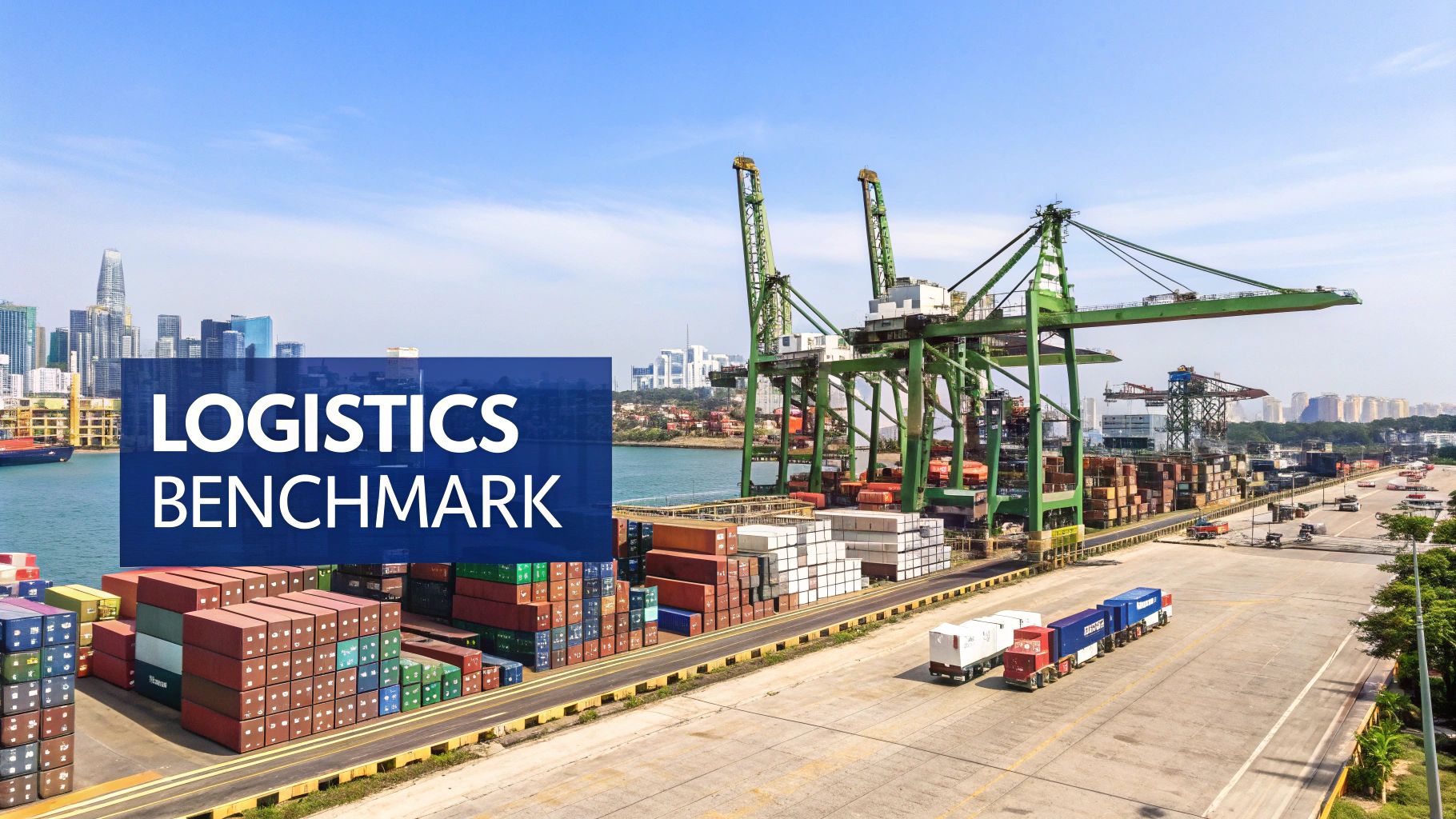
    A busy container port with large cranes, stacked containers, and the text 'LOGISTICS BENCHMARK'.

    To compete, you have to know the field. In Singapore's dynamic trade ecosystem, Nippon Express is a cornerstone, with a history that goes back fifty years. Their success wasn't a fluke; it's the result of smart positioning, deep integration into key industries, and a massive local footprint.

    When you pull apart their operations, you get a powerful lens to view the entire market. This isn't just about watching a rival from the sidelines; it's about spotting patterns you can actually use. Once you know the industries they focus on, the trade lanes they own, and the infrastructure they've built, you start to see exactly what their ideal customers need.

    The Foundation of Regional Dominance

    Nippon Express Singapore's story starts at a pivotal time for global trade. The company set up shop in 1973, catching the wave of Singapore's meteoric rise as a central trade hub. As the Port of Singapore’s throughput blew past 100 million tons and container traffic jumped by 15-20% annually in the late 1970s, Nippon Express was right there, building its foundation. For a deeper dive, you can explore the company's long history.

    For sales teams, this history is more than just a fun fact. It points to deep, long-standing relationships with multinational corporations and an innate grasp of regional supply chain challenges that newer competitors simply don't have.

    This entrenched presence is a roadmap for your own prospecting. By studying their client list and service menu, you can pinpoint shippers with similar needs who might just be looking for a more nimble or specialised logistics partner. This guide will walk you through turning that analysis into outreach that works. For more background, you might find our guide on navigating the import-export business helpful.

    Mapping Their Core Services and Key Trade Lanes

    To get under the hood of Nippon Express Singapore, you need to see them as more than just a list of services. Their real power comes from how they weave together air, ocean, and warehousing into a seamless, integrated machine, especially for high-value industries. This isn’t about just moving boxes from A to B; it's about engineering precise, reliable supply chains.

    For any sales team looking to compete, this integration is a blueprint. When you understand how they bundle these services, you start to see the exact pain points and priorities of their top clients. This insight is your opening to position your own offerings as a smarter alternative—maybe one with more flexibility, deeper specialisation, or a fresh approach.

    Where They Dominate: High-Value Verticals

    Nippon Express Singapore has staked its claim in sectors where there's zero room for error. Their entire operation is fine-tuned for industries with notoriously complex logistics—the kind that demand Fort Knox-level security, breakneck speed, and airtight compliance.

    You can see this focus baked into their infrastructure and service design. They don't just offer generic freight; they provide highly specialised solutions built for the unique headaches of specific cargo.

    To illustrate how Nippon Express Singapore has positioned itself, let's look at their core service offerings and the markets they're built to serve.

    Nippon Express Singapore Key Service Offerings

    Service Category Description Primary Industries Served Key Trade Lanes
    Air Freight Specialised handling for time-sensitive, high-value cargo, including temperature-controlled and secure transport options. Electronics & Semiconductors, Pharmaceuticals, Automotive Components Intra-Asia, Asia-Europe, Asia-North America
    Ocean Freight Full container load (FCL) and less-than-container load (LCL) services, with a focus on reliability and network reach. Retail & Consumer Goods, Industrial Manufacturing, Automotive Trans-Pacific, Asia-Europe
    Warehousing & Distribution Secure, compliant storage solutions, including bonded warehousing, climate-controlled facilities, and value-added services. Pharmaceuticals, High-Tech Electronics, Luxury Goods Domestic Singapore, Regional hub for Southeast Asia
    Cross-Border Trucking An extensive road network connecting Singapore with Malaysia, Thailand, and the broader ASEAN region for seamless land transport. Automotive, Electronics, Fast-Moving Consumer Goods (FMCG) Singapore-Malaysia, Singapore-Thailand
    Specialised Logistics Custom solutions for heavy-lift projects, fine art transportation, and supply chain consulting. Energy, Arts & Exhibitions, Project Cargo Global, project-specific

    This table shows a clear pattern: a deep focus on industries that can't afford mistakes and the infrastructure to back it up.

    The Power of Key Trade Corridors

    Since setting up shop here in 1973, Nippon Express Singapore has grown in lockstep with Singapore Changi Airport, which has since become one of the world's most critical cargo hubs. To put that in perspective, the airport handled a massive 2.01 million tonnes in 2022, a notable jump from pre-pandemic levels. Nippon Express's own global air cargo volume hit 870,000 tons that same year, with Singapore acting as a vital linchpin. You can dig into more details in their materiality report from Nippon Express Holdings.

    The airport is a powerhouse for high-value goods like electronics and pharmaceuticals, which make up a staggering 40% of its total throughput. It's on these critical trade lanes, particularly the intra-Asia and Asia-Europe routes, where Nippon Express’s network really flexes its muscle.

    For sales professionals, customs data from these specific corridors is a goldmine. It lets you find shippers moving the exact same types of goods along the same routes. Suddenly, you have a hyper-targeted prospect list whose logistics challenges are a mirror image of Nippon Express's current clients.

    This kind of data-driven approach turns a cold call into a warm, relevant conversation. By knowing the cargo and corridors they own, you can identify shippers with an identical logistics profile and present a solution that speaks directly to what they need.

    Taking a Closer Look at Their Local Infrastructure Advantage

    A spacious, modern warehouse facility featuring tall shelves filled with products and a parked forklift.

    The services you see from Nippon Express Singapore are all built on a massive physical foundation. Their real strength isn't just about having space; it's about having the right space in the right places. They’ve turned prime real estate into a serious strategic weapon.

    This network of advanced warehouses and logistics hubs is the engine driving their entire Singapore operation.

    Don't think of their facilities as simple storage sheds. They're highly specialised centres, deliberately placed within key economic zones to cut down on friction and boost speed. This gives them a clear competitive edge, paving the way for faster customs clearance and smoother handling for cargo where every minute counts.

    For any sales team trying to compete, getting a handle on this physical footprint is non-negotiable. It shows you exactly where the high-stakes logistics decisions are being made and gives you a map for smart prospecting.

    The Power of Being in the Right Place

    Nippon Express Singapore has poured serious money into facilities inside Singapore’s Free Trade Zones (FTZs). These secure areas are gold for transshipment, letting goods be stored, bundled, or processed without formal customs entry. That means fewer duties and far less administrative headache for their clients.

    Their spot at the Changi Airfreight Centre is another ace up their sleeve. Having direct airside access is absolutely essential for the high-value electronics and pharmaceutical industries they cater to.

    This strategic infrastructure isn't just concrete and steel; it's what makes their complex, value-added services possible. It gives them capabilities that smaller players simply can't replicate.

    Specialised Facilities for High-Stakes Cargo

    It’s not just where the facilities are, but what they can do that sets Nippon Express Singapore apart. Many of their warehouses are custom-built for very specific, demanding supply chains.

    • Temperature-Controlled Logistics: They run GDP-certified facilities for pharmaceuticals, maintaining strict temperature and humidity controls to protect drug integrity all the way to the final delivery.
    • Secure Storage: For the semiconductor and electronics crowd, they offer TAPA-certified warehouses with beefed-up security protocols to guard valuable components against theft or damage.
    • Value-Added Services: These aren't just holding bays. They act as hubs for kitting, light assembly, quality checks, and custom packaging, embedding themselves deep into their clients' production and distribution cycles.

    This infrastructure is a huge selling point for them. If you’re looking to win business from them, the challenge isn’t just about offering a lower price. It's about proving you have a credible alternative that can handle these complex requirements. By zeroing in on shippers located in these industrial hubs, you can focus your energy where the most valuable logistics contracts are up for grabs.

    Finding the Right People to Talk To

    Let's be honest, in logistics sales, a great service only gets you so far. The real challenge is getting that message to the right person at the right time. When you're going after clients like the ones Nippon Express Singapore serves, you're usually dealing with big, complex companies. Firing off a generic email to their main inbox is the quickest way to get deleted.

    To actually make an impression, you need to understand how these companies are structured. Think of their org chart less as a rigid ladder and more as a map of influence. Your mission is to find the people whose daily headaches and career goals line up perfectly with the solutions you're selling.

    Who Actually Makes the Logistics Decisions?

    Inside any large shipper, a few key roles pull the levers on logistics and supply chain decisions. The job titles might change from one company to another, but the responsibilities are pretty consistent. Nailing down who these players are is your first, most important step.

    These roles don't operate in a vacuum; they work together on the big calls. The Head of Procurement will be laser-focused on the cost, while the Supply Chain Director is thinking about resilience and keeping things moving on schedule.

    • Supply Chain Director or VP of Supply Chain: This is your strategic thinker. They’re obsessed with the big picture—making the supply chain more efficient, less risky, and a driver of business growth.
    • Logistics Manager: This person lives in the trenches. Their world is all about carrier performance, tracking shipments, clearing customs, and putting out fires when delays pop up.
    • Procurement Manager or Head of Procurement: Their job is all about the numbers. They negotiate contracts, manage suppliers, and are always looking for partners who deliver serious value for money. They live and breathe SLAs.
    • Operations Manager: Often coming from the manufacturing or production floor, their main worry is keeping the factory running. They need a smooth, predictable flow of raw materials coming in and finished goods going out. Any hiccup hits their KPIs directly.

    When you understand what makes each of these roles tick, you can shape your message to hit home. A pitch about cost savings will get a Procurement Manager’s attention, while a conversation about better supply chain visibility will have a Logistics Manager leaning in.

    How to Find and Connect With These Contacts

    Once you know the type of person you’re looking for, the hunt begins. This is where modern sales intelligence tools become your best friend. Platforms that crunch customs data can show you exactly which companies are shipping what, where—letting you build a list that mirrors the Nippon Express Singapore client profile.

    From there, you can jump onto professional networking sites and use data tools to pinpoint the actual people in those target roles. If you really want to get into the weeds on this, you can learn more about how to find the right contacts at EXIM and manufacturing enterprises in our detailed guide.

    When it's time to reach out, you have to do more than just sell. Your message needs to show you've done your homework. Mentioning their company's shipping routes or the specific products they move shows you get their business. This data-first approach proves you’re not just another salesperson—you’re a problem-solver with a relevant solution, which massively boosts your chances of starting a real conversation.

    Finding Your Edge in a Crowded Market

    Trying to take on a logistics powerhouse like Nippon Express Singapore with a better price list alone is a losing game. You need a sharper strategy, one that’s built on knowing what they do exceptionally well and, more importantly, spotting the gaps they leave behind. They’re a dominant force, for sure, but they’re not unbeatable.

    So, what’s their secret sauce? A couple of things, really. First, they have incredibly strong, long-standing ties with Japanese multinational corporations (MNCs). These relationships have been cultivated for decades and act as a powerful defensive wall. Second, their entire brand is built on precision and reliability, especially for high-value industries like pharmaceuticals and electronics where a single mistake can be catastrophic. This makes them the go-to provider for any shipper who can't afford to take risks.

    Pinpointing Your Competitive Angle

    The trick is to stop trying to be a smaller version of them. Instead of fighting on every front, pick your battles and focus on areas where you can offer something genuinely different and better. It’s all about finding your sweet spot and owning it.

    Your value proposition has to be crystal clear and solve a real problem for the shipper. Think about where smaller, more agile players often have the upper hand:

    • Real Flexibility: Big companies often mean rigid systems. You can offer more adaptable pricing, create bespoke service packages, or say "yes" to the kind of non-standard cargo that just doesn't fit into their highly optimised operations.
    • Deep Niche Expertise: While Nippon Express is strong in several major sectors, there are always emerging industries or highly specialised verticals. This is your chance to become the undisputed expert and provide a service that truly understands the nuances of that field.
    • A Human Touch: It’s easy to feel like just another account number when dealing with a global corporation. You can position yourself as a true partner, offering a dedicated contact person who actually picks up the phone and has the authority to solve problems quickly.

    The goal isn't to be cheaper than Nippon Express on every single lane. It's to find the customers who are quietly getting frustrated with inflexible contracts, generic service, or a 'one-size-fits-all' mindset and show them a better way.

    Crafting Your Value Proposition

    Once you know where you can win, you need to turn that advantage into a simple, compelling message. For instance, if you hear a shipper complaining about rigid pickup times from their current provider, your entire pitch should revolve around your customised scheduling. If they feel lost in a sea of compliance paperwork their provider doesn't understand, your outreach should lead with your specific industry certifications and success stories.

    By seeing the strengths of Nippon Express Singapore clearly, you can carve out your own space and become the obvious choice for shippers who are looking for a different kind of logistics partner.

    Crafting Your Data-Driven Outreach Playbook

    So, you've got all this great intel on Nippon Express. Now what? The real magic happens when you turn that market analysis into actual sales meetings. This isn't about firing off generic emails and hoping for the best; it’s about building a repeatable process that works.

    We're going to walk through how to use these insights on Nippon Express Singapore to build a concrete, data-driven strategy. The goal is simple: stop making cold calls and start having intelligent conversations that prove your value from the very first sentence.

    By understanding what a typical Nippon Express client looks like, you can approach similar companies with a message that speaks directly to their most pressing logistics challenges.

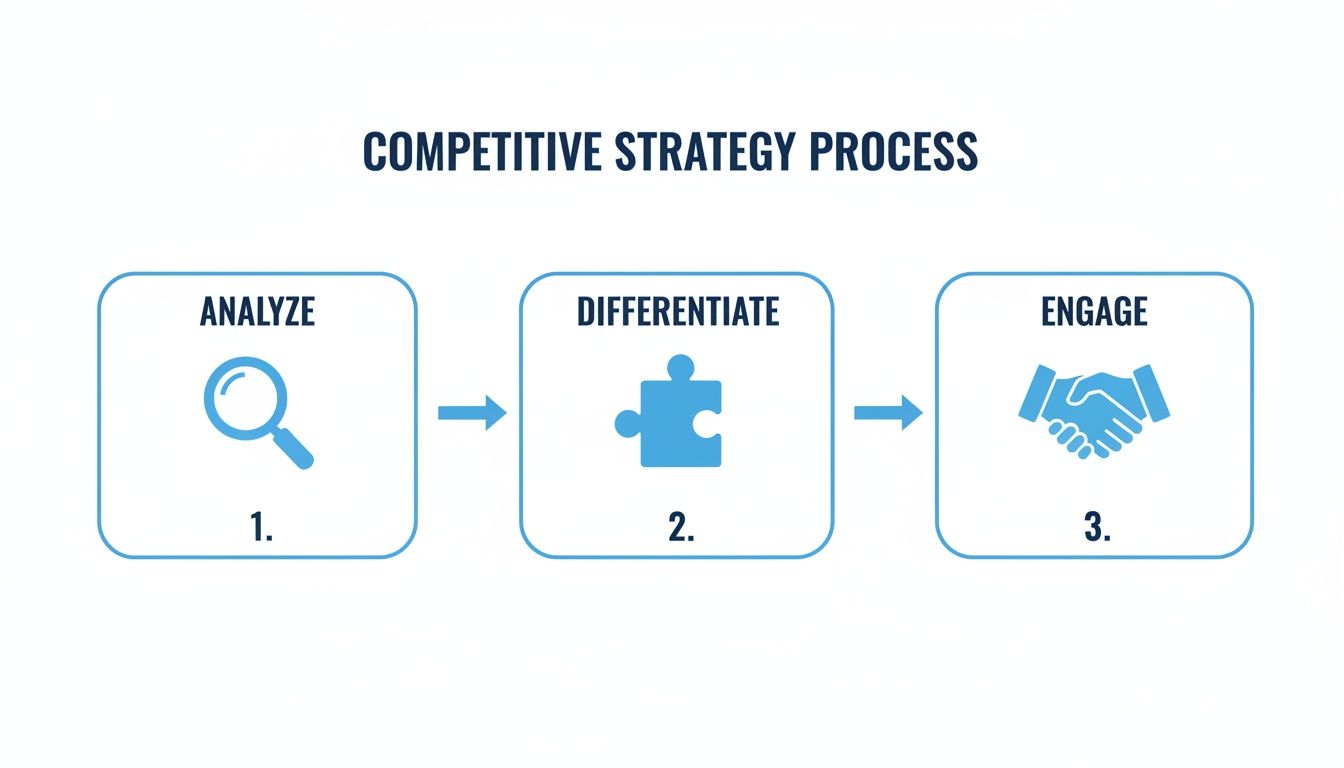
    Diagram showing a three-step competitive strategy process: Analyze, Differentiate, and Engage with icons.

    This simple flow—Analyse, Differentiate, and Engage—is your roadmap for turning competitor intelligence into real opportunities.

    Step 1: Pinpoint High-Potential Prospects

    First things first: you need a hit list. But not just any list. We're talking about a highly targeted group of prospects whose shipping behaviour looks a lot like that of Nippon Express's customers. Think specific commodities, key trade routes, and consistent volumes.

    The smart way to do this is with a logistics intelligence platform. You can filter the entire market based on the exact signals you uncovered in your analysis of Nippon Express.

    • Commodity Focus: Search for companies shipping electronics, pharmaceuticals, or automotive parts using specific HS codes.
    • Trade Lane Activity: Hone in on shippers who are frequently moving goods along the busy intra-Asia and Asia-Europe corridors.
    • Volume and Frequency: Identify businesses with steady, predictable shipping volumes. This is a dead giveaway that they need a reliable logistics partner.

    This approach cuts through the noise and makes sure you’re only talking to companies that are a natural fit. For a more detailed breakdown of this technique, take a look at our guide on finding company import-export data.

    Step 2: Uncover the Right People and Their Pain Points

    Once you have your target companies, you need to find the right person to talk to. Your targets are the Supply Chain Directors, Logistics Managers, and Procurement Heads—the people who lie awake at night worrying about logistics performance.

    Modern sales tools are brilliant for this. They can help you identify these key contacts and even give you a peek into their specific roles and recent company activities. A little digging here helps you understand what's on their mind. Are they under pressure to cut costs? Struggling with on-time delivery? Or are they searching for more flexible shipping solutions?

    The Key Shift: When you align your outreach with a decision-maker's actual pain points, you're no longer making a sales pitch. You're starting a problem-solving conversation. That’s how you get their attention.

    Step 3: Write an Outreach Message They Can’t Ignore

    This is where all your hard work pays off. It's time to put together a message so relevant that it's practically impossible to ignore. Instead of the usual "Hi, I'm from X company…" lead with a specific, data-backed insight.

    For instance, you could open with: "I noticed your company regularly ships electronic components from Singapore to Frankfurt. That's a lane where we specialise in secure, temperature-controlled air freight, often beating standard transit times."

    An opening like that does two things instantly: it proves you've done your homework and establishes your credibility. You're not just another vendor anymore; you're a potential strategic partner who genuinely understands their business. This data-informed approach is your ticket to higher response rates and a much more productive conversation about why you’re a better alternative to their current setup.

    Data-Driven Outreach Strategy Comparison

    The difference between the old way of doing sales and this new, data-driven approach is night and day. One is about volume and luck; the other is about precision and value.

    The table below illustrates this contrast clearly.

    Outreach Step Traditional Method Coreties-Powered Method
    1. Prospecting Buying generic lists or manually searching for companies in a target industry. Filtering for companies with specific shipping volumes, commodities, and trade lanes that match your ideal customer profile.
    2. Finding Contacts Guessing job titles (e.g., "[email protected]") or using broad LinkedIn searches. Pinpointing specific Supply Chain Directors or Procurement Heads using sales intelligence tools.
    3. Initial Outreach Sending a generic email or making a cold call with a standard company pitch. Leading with a highly specific insight about their shipping activity, instantly demonstrating relevance.
    4. Value Proposition "We offer great rates and service." "We can improve your on-time delivery on the Singapore-Frankfurt lane, where you ship frequently."
    5. Follow-Up "Just following up on my last email…" Sharing a relevant case study or market update related to their specific trade lanes or products.
    6. Overall Outcome Low response rates, conversations focused on price, and long sales cycles. Higher engagement, value-driven conversations, and a faster path to building trust and closing deals.

    As you can see, the Coreties-powered method transforms every step of the outreach process. It replaces guesswork with certainty, allowing your sales team to act as informed consultants rather than just another voice in a crowded inbox. This is how you win in a competitive market.

    Answering Your Key Questions

    When you're squaring up against a giant like Nippon Express Singapore, a few key questions always come to mind. Getting straight answers is the first step to building a sales strategy that actually has a chance of working. Let's tackle the big ones.

    Think of this as the strategic cheat sheet. It’s not just trivia; it’s a quick summary of the critical points you can use to find your opening and start making inroads.

    What Are the Main Industries Served by Nippon Express Singapore?

    Nippon Express Singapore doesn't try to be everything to everyone. They’ve zeroed in on high-value, high-stakes sectors. You’ll find their core client base is heavily concentrated in electronics, semiconductors, pharmaceuticals, and automotive parts.

    It’s no accident. Their whole setup—from secure, temperature-controlled warehouses to their compliance protocols—is built to handle the delicate, time-sensitive nature of these goods. This specialisation is where they really shine.

    How Can I Find Shippers with Similar Needs?

    This is where the data comes in. The best way to find companies with the same logistics DNA is to dive into global customs data using a solid intelligence platform. The trick is to filter your search using the same playbook they do.

    By looking for the specific commodity codes (HS codes) and trade routes that Nippon Express dominates, you can build an incredibly focused prospect list. This method lets you pinpoint shippers with identical needs and get right to the logistics contacts who make the decisions.

    What Is Their Strategic Advantage in Singapore?

    Their biggest trump card is their use of Singapore's port and airport as a strategic command centre for the entire South Asia and Oceania region. This isn't just about location; it's about integration.

    This position allows them to offer sophisticated multi-modal transport solutions, like seamless sea-to-air transhipments, that are a huge draw for customers with urgent, high-value cargo. They've turned Singapore into a powerful, flexible hub that smaller players find almost impossible to match.


    Ready to stop guessing and start targeting the right shippers? Coreties transforms global trade data into your next sales opportunity. Find qualified leads that match your ideal customer profile, identify key decision-makers, and craft data-driven outreach that gets results. Learn more at https://coreties.com.
  • Your Playbook for Company Import Export Lead Generation

    Your Playbook for Company Import Export Lead Generation

    Still spending your days sifting through stale email lists and making endless cold calls? The most successful freight forwarders I know have moved past that grind. They're using real intelligence to find their next big clients, turning prospecting from a numbers game into a strategic hunt. This isn't about ditching your sales skills; it's about fuelling them with the right data at the right time.

    Moving Beyond Spreadsheets to Find Shippers

    The logistics world waits for no one, and prospecting methods are no exception. Sticking to static lists and generic outreach is a surefire way to fall behind, especially when timing and precision are what close deals. The old way is a guessing game—you’re never quite sure who is actively shipping and who actually needs your services.

    This is where global customs data completely changes the playbook.

    When you can tap into real-time shipment information, you’re no longer guessing. Prospecting becomes a science. Suddenly, you can:

    • Pinpoint companies that are actively importing or exporting right now.
    • Get a clear picture of their trade lanes, shipment volumes, and how often they move cargo.
    • Figure out what they need before you even pick up the phone.

    This data-first strategy means you're only talking to qualified leads who are already in the market for freight solutions. It’s the classic "work smarter, not harder" mantra, but with the tools to actually make it happen.

    From Old School to New School Prospecting

    To really grasp this shift, let's look at how things have changed. We've gone from casting a wide net and hoping for the best to using a highly-targeted spear.

    Old School vs New School Prospecting

    Method Traditional Approach (Manual) Modern Approach (Data-Driven)
    Lead Source Purchased lists, trade show directories, cold calling. Real-time customs and shipment data.
    Targeting Broad, based on industry or company size. Hyper-specific, based on actual shipping behaviour.
    Timing Random, often contacting companies with no current need. Timely, engaging prospects when they are actively shipping.
    Outreach Generic, one-size-fits-all emails and scripts. Personalised, based on their known commodities and trade lanes.
    Efficiency Low. High volume of rejections and unqualified leads. High. Focussed efforts on pre-qualified, high-intent prospects.

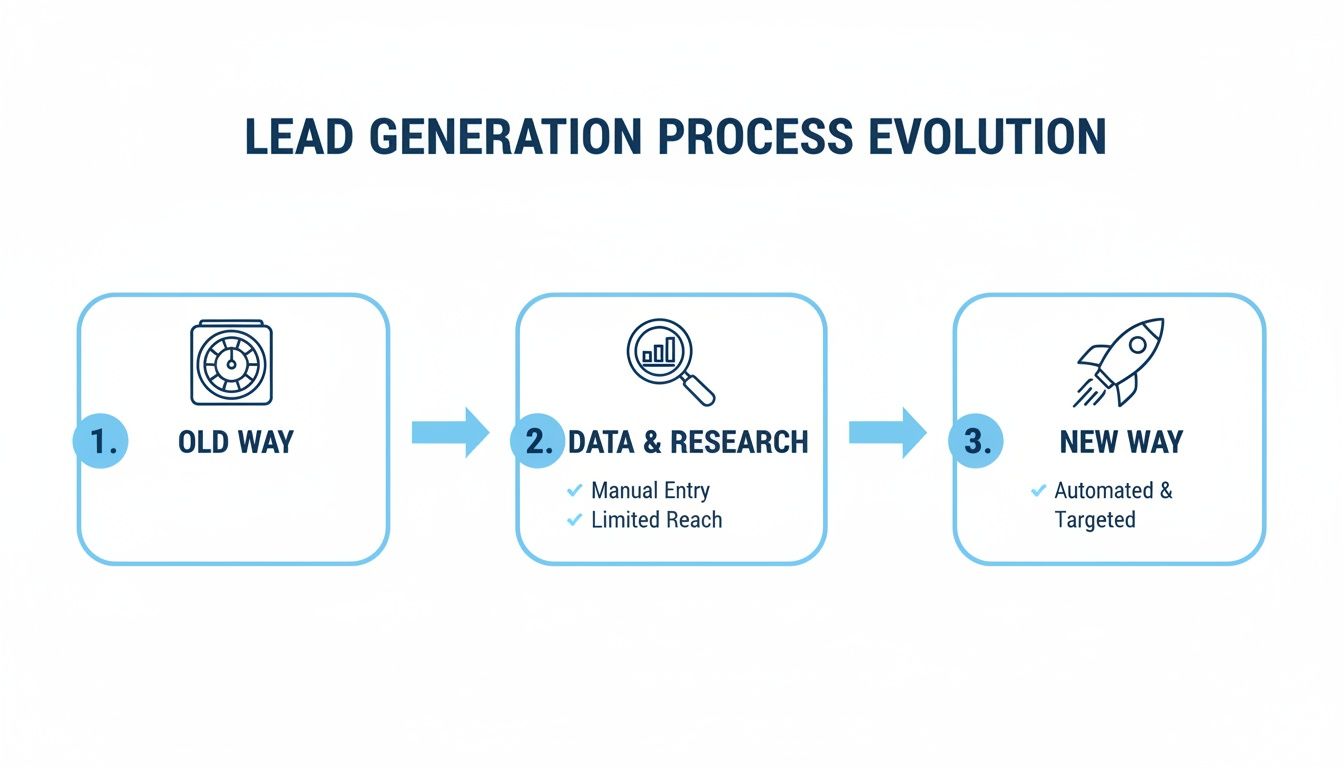
    The move from old-school tactics to a modern, data-driven strategy is more than just an upgrade—it's a complete evolution in how we find new business.

    This evolution is all about connecting the dots more effectively. Instead of chasing dead ends, you’re using data as a bridge to a more targeted and ultimately more successful sales process.

    Lead generation process evolution diagram from old manual ways to data & research, culminating in new automated and targeted methods.

    Adopting this strategy is especially crucial in a bustling trade hub. For example, by the full year 2025, Singapore's total exports hit an impressive S$739,441.7 million, marking a 9.6% growth. With total trade jumping 12.3% in December alone, the opportunities are massive—if you can find the right shippers in that sea of activity. You can see more on this from Statistics Singapore.

    The key takeaway is simple: intelligence drives efficiency. When you know who is shipping, what they are shipping, and where, your outreach immediately becomes more relevant and a lot more effective.

    Instead of throwing a wide, generic net, you can zero in on prospects with a proven, immediate need. A great starting point is filtering by commodity. For a deep dive on this, you might find our guide on using the HS code filter to be a real help. This ensures every conversation you have is built on a foundation of solid data, not just a hunch.

    How to Pinpoint Your Ideal Shippers

    Just searching for a "company import export" online is a recipe for disaster. You’ll get buried under thousands of irrelevant results. The real power of using customs data isn't just finding a list of companies; it's about finding the right companies with almost surgical precision. This is where we move beyond basic name lookups and start layering filters to build a list of high-value prospects.

    Think of yourself as a logistics detective. Instead of asking a vague question like "who ships things?", you need to get specific. You should be asking questions like:

    • Which companies in Singapore are consistently importing automotive parts (that's HS Code 87) from Germany?
    • Are there any new businesses that started exporting medical devices (HS Code 90) to the United States in the last quarter?
    • Who is my competitor’s top client on the Singapore-to-Vietnam trade lane?

    These are the kinds of questions that unearth qualified leads who are genuinely in the market for your services.

    A man works at a desk with two computer screens displaying data and 'Beyond Spreadsheets'.

    Combining Filters for Smarter Prospecting

    This is where the magic really happens—when you start combining filters. Start broad, then progressively narrow your focus. For example, you could pull a list of all companies exporting from Singapore and then apply specific criteria to whittle it down to your ideal customer profile.

    Let's walk through a real-world scenario. Say you specialise in handling electronics shipments. A smart filtering sequence would look something like this:

    1. Trade Lane: First, set the origin to Singapore and the destination to Vietnam.
    2. Commodity: Next, filter by HS Codes related to electronics. Chapter 85, which covers electrical machinery and equipment, is a great place to start.
    3. Shipment Frequency: Now, look for companies with at least five shipments per month. This helps you focus on businesses with consistent activity.
    4. Volume: Finally, target shippers moving a minimum of ten TEUs (twenty-foot equivalent units) monthly. This ensures they have a significant volume worth pursuing.

    This multi-layered approach takes a massive ocean of data and turns it into a manageable, actionable list of prospects who actually need your expertise on that specific lane. To go even deeper, you can explore the roles within these companies with our guide on the differences between an exporter and importer of record.

    Identifying Growth and Opportunity

    Trade data isn’t just a snapshot of the present; it's a crystal ball for spotting emerging trends and opportunities. You want to look for sudden spikes in activity. A company that suddenly doubles its import volume from a specific region over a few months is a prime target. They're likely expanding or diversifying their supply chain, and that often comes with logistical headaches.

    The trade relationship between Singapore and Vietnam, for instance, is absolutely booming. In 2025, trade between the two nations smashed records, hitting S$31 billion. A huge chunk of that growth was driven by machinery and electrical equipment. In fact, imports of these goods into Singapore from Vietnam soared by 112% from 2024, signalling a massive opportunity for forwarders who can service this lane. You can get more details on this Vietnam-Singapore trade surge.

    By monitoring these dynamic trade patterns, you can anticipate a company's needs before they even realise them. A sudden increase in shipments often signals growing pains or a need for more robust logistics support—creating the perfect opening for you to introduce your services as the solution.

    This kind of strategic analysis ensures your outreach is always timely and relevant. It positions you as a knowledgeable partner who's done their homework, not just another salesperson sending a cold email.

    Finding the Right People Inside Target Companies

    Spotting a company with a high volume of imports is a fantastic start, but let's be honest—it's only half the battle. Firing off a brilliant proposal to a generic 'info@' email address is like stuffing a message in a bottle and tossing it into the sea. You're just hoping the right person stumbles upon it. The real work starts now: turning that promising company name into a list of actual people you can have a conversation with.

    This is where you need to enrich your data. The goal is to drill down from the company level and uncover the key players in the logistics and supply chain departments. Your pitch will land with maximum impact when it reaches the person who is directly feeling the pain of inefficient shipping.

    A person's hand points at a digital map on a large screen displaying "PINPOINT SHIPPERS".

    Uncovering Key Logistics Contacts

    Modern data platforms can instantly cross-reference a company’s shipping activity with its employee directory. This is how you find verified contact details and professional profiles for the exact roles that matter.

    You’re not just looking for anyone. You’re looking for specific titles:

    • Logistics Manager or Director
    • Supply Chain Coordinator
    • Head of Procurement
    • VP of Operations
    • Import/Export Specialist

    A verified email is obviously critical, but don't underestimate the value of a LinkedIn profile. It’s a goldmine of context, giving you a peek into their professional background, their connections, and their career path. This information is invaluable for building rapport and personalising your outreach.

    The goal isn't just to find one contact. It's to map out the entire decision-making unit. A logistics manager might be your way in, but in many organisations, it’s the supply chain director or VP of operations who has the final say.

    Mapping the Decision-Making Unit

    Getting a clear picture of the internal hierarchy is crucial. A single shipment decision can touch multiple desks, and knowing who influences the process—and how—is the key to a successful pitch.

    Let’s say you’ve found a company that regularly imports electronics from Asia.

    The Logistics Manager is your person on the ground. They're consumed with the daily grind of carrier performance, customs clearance, and on-time delivery. They'll be your internal champion if you can make their life easier.

    But then there's the Head of Procurement, who lives and breathes spreadsheets. They’re laser-focused on cost savings and contract terms. To get their attention, you need to show them a clear financial benefit.

    And finally, you have the VP of Operations. They’re looking at the big picture: supply chain resilience, risk mitigation, and finding a partner who can support their long-term growth.

    By identifying each of these individuals, you can tailor your messaging. You might lead with operational improvements for the logistics manager, but shift to cost-effectiveness for the procurement head. This multi-threaded approach ensures your value proposition hits home with everyone involved. It dramatically increases your odds of starting a real conversation instead of just becoming another unread email.

    Prioritising Your Outreach for Maximum Impact

    So, you’ve enriched your prospect list and have the right names and numbers. What now? The biggest mistake I see teams make is just starting at the top of the list and dialling. That scattergun approach is a massive time-waster. The real secret to efficiency is prioritisation—figuring out which companies are most likely to convert right now and focusing all your energy there.

    Your time is your most valuable asset, and you need a smart way to separate a genuinely warm lead from a cold one. Sure, consistent shipment volume is a decent starting point, but the gold is in spotting change. A company with the same predictable, stagnant shipping patterns month after month is far less interesting than one showing sudden growth or making strategic shifts.

    Laptop displaying 'Right Contacts' with a professional man's profile and checklist on a wooden desk.

    Tuning into High-Priority Triggers

    Think of certain data points as buying signals—flashing green lights that tell you a company might be ready to talk. These are the prospects you want to bump to the very top of your list.

    Here are the critical signs I always look for:

    • Recent Spikes in Activity: Has their shipment volume or frequency suddenly jumped? This is a huge tell. It could signal a new product launch, expansion into a new market, or a surge in demand that their current forwarder is struggling to keep up with.
    • New Trade Lanes: When a company starts importing from a new country, it's a clear sign of supply chain diversification. This period is often filled with logistical trial and error, making it the perfect time for you to step in with a proven, reliable solution for that specific lane.
    • High-Value Commodities: Shippers moving expensive or specialised goods—think pharmaceuticals, sensitive electronics, or high-end machinery—aren’t just shopping on price. They need quality and reliability. This is where you can position your service as a premium, dependable partner.

    By focusing on these dynamic indicators, you move beyond simply finding any company import export business. You start identifying those with an immediate, pressing need for better logistics support.

    A Simple Scoring System to Rank Your Prospects

    Once you’ve identified these triggers in the data, it's time to rank your leads. This doesn't need to be some overly complicated algorithm. A straightforward scoring system can work wonders. Just assign points based on the criteria that matter most to your business.

    Here’s a quick example of how you could structure it:

    1. Volume Spike: If a prospect's TEU volume shot up by over 20% in the last quarter, give them +10 points.
    2. New Lane: If they’ve started shipping on a trade lane where you have a strong network, that's an easy +8 points.
    3. Competitor's Client: If customs data shows they're currently working with one of your key competitors, add +5 points. You know their pain points better than anyone.

    This kind of data-led approach means you're always talking to your most promising opportunities first. It turns your daily outreach from a reactive chore into a proactive, strategic game plan.

    In a market as dynamic as Singapore's, where total trade hit S$327 billion in just the first quarter of 2025, you have to be strategic. With imports climbing 6.4% in that period alone, the opportunities are everywhere, but only the most focused teams will actually capture them. You can dig into more of these stats in Enterprise Singapore's official trade review.

    Getting Your Foot in the Door: Outreach That Actually Gets a Reply

    All the data in the world means nothing if your message lands in the trash folder before it’s even read. This is the moment where all your hard work gathering intelligence pays off and starts turning into real revenue.

    Let's be honest, a generic, one-size-fits-all email has a lifespan of about three seconds. A sharp, personalised message, on the other hand, is what kicks off a genuine conversation.

    The secret is to stop sounding like every other salesperson flooding their inbox. Your prospects are buried under messages promising vague benefits. You need to prove you’ve done your homework from the very first sentence, and the insights you’ve pulled from customs data are your best way to do that.

    Shifting from a Cold Pitch to a Warm Introduction

    Think about the difference between these two opening lines. Which one would you actually reply to?

    • Generic: "Hi, I'm reaching out to introduce my freight forwarding services…"
    • Data-Driven: "Hi [Name], I noticed your company's recent spike in electronics imports from Ho Chi Minh City…"

    The second one grabs your attention immediately because it’s specific. It proves you understand their business, you see what they're doing right now, and you aren’t just blasting out a template. It instantly positions you as a knowledgeable partner, not just another vendor trying to sell something.

    This is the entire game. You have to reference the data you've found to make your message impossible to ignore. Mention specific trade lanes, shipment volumes, or commodities to show you’re not guessing.

    When your outreach is built on a foundation of facts, you’re no longer asking for a moment of their time—you’re offering tangible value based on their actual business needs. This simple shift changes the entire dynamic of the conversation.

    Building Your Data-Driven Outreach

    So, how do you put this into practice? Let’s break down the key elements of an email that gets a response. Your goal is to be concise, relevant, and laser-focused on solving a problem they're likely facing.

    Here’s a structure I've seen work time and again:

    1. The Hyper-Relevant Subject Line: Your subject line's only job is to stop the scroll. Be specific. Instead of "Freight Services," try something like, "Question about your Singapore-Vietnam shipments."

    2. The Data-Informed Opener: This is your hook. Lead with the insight you uncovered. For example, "I saw you shipped 15 TEUs of automotive parts from Germany last month."

    3. The Implied Challenge: Gently connect that data point to a potential pain point. "Managing a lane with that kind of consistent volume can bring unique challenges, especially with carrier availability and customs."

    4. Your Specific Solution: This is where you briefly introduce how you can help with that specific challenge. "We have a strong network in Hamburg that helps our clients secure capacity and streamline clearance for that exact commodity."

    5. The Clear Call to Action: End with a simple, low-friction next step. Don't ask for a meeting; ask for a conversation. "Would you be open to a brief call next week to discuss how we might be able to improve transit times on that lane?"

    This approach respects their intelligence and their time. You aren’t wasting their day with a generic pitch; you’re presenting a focused solution to a problem you already have good reason to believe they're dealing with. This is how you find a company import export lead and turn them into a long-term client.

    For a closer look at how enterprise-level businesses manage their complex import-export operations, you can learn more about the EXIM MFR enterprise in our detailed guide.

    Got Questions? We've Got Answers

    When it comes to using customs data to drum up new business, a few questions always pop up. Here are the most common ones we hear from freight forwarding teams, along with some straight-talking answers based on what we see in the field.

    How Reliable Is This Data, Really?

    It’s incredibly accurate. Reputable platforms pull their information directly from official sources like customs authorities and bill of lading records. This isn't just a list of names; it's verified data showing you who shipped what, and where.

    Of course, you might see the occasional blip from a typo in a filing, but that's the exception, not the rule. The best data providers are constantly refreshing their databases—often daily—so you're always working with the latest shipping movements.

    Think of it this way: you’re moving from educated guesswork to data-driven strategy. You can build out your prospect list with confidence because it's based on actual, recent shipping activity, not some dusty old directory.

    Can I Find the Right Person to Talk to, Like a Logistics Manager?

    The raw customs data usually just gives you the company name, but this is where a good platform earns its keep. They build in powerful data enrichment tools to solve this exact problem.

    Once you’ve flagged a promising company import export business based on its shipping patterns, the system helps you peel back the layers to find the people who actually make the decisions. With just a click or two, you can usually pull up:

    • Full names and up-to-date job titles.
    • Verified work email addresses.
    • Direct links to their LinkedIn profiles.

    This completely changes the game. You can go straight from spotting an opportunity to having a direct conversation with the right person, skipping the gatekeepers and the dreaded info@ email address.

    How Should I Approach Companies That Already Have a Forwarder?

    Let’s be honest—any company shipping regularly already has a freight forwarder. But that’s precisely why this data is so powerful. You can often see exactly who your prospects are working with right now.

    This insight is gold. Instead of sending another generic "we're great, use us" email, you can tailor your approach. Your outreach can zero in on your specific strengths for their trade lanes, maybe offer a more competitive rate, or highlight a service level their current partner can't match. You walk into the conversation armed with intelligence, making your pitch a strategic alternative rather than just another shot in the dark.

    Is This a Realistic Strategy for a Small Freight Forwarder?

    Absolutely. In fact, this approach is a huge equaliser, letting smaller outfits punch well above their weight. These platforms handle the grunt work of prospecting—all the manual research and lead-sifting that eats up so much time.

    This frees up smaller teams to focus their energy where it really counts: building relationships and closing deals with genuinely qualified leads. The time saved is massive. A single account manager can build and manage a pipeline that would have traditionally needed a whole team. It’s a smart, scalable way to grow your business, no matter your size.


    Ready to stop guessing and start targeting the right shippers? Coreties transforms global trade data into your next big client. Our platform helps you find qualified leads, enrich contacts, and craft data-driven outreach in a fraction of the time. See how Coreties can sharpen your prospecting workflow.

  • Exporter and Importer: Your Guide to the exporter and importer Landscape

    Exporter and Importer: Your Guide to the exporter and importer Landscape

    At its most basic level, an exporter is the party selling and sending goods out of a country, while an importer is the one buying and bringing those goods in. Think of it like a global handshake: the exporter extends their hand by shipping the product, and the importer completes the deal by receiving it.

    Understanding the World of Exporters and Importers

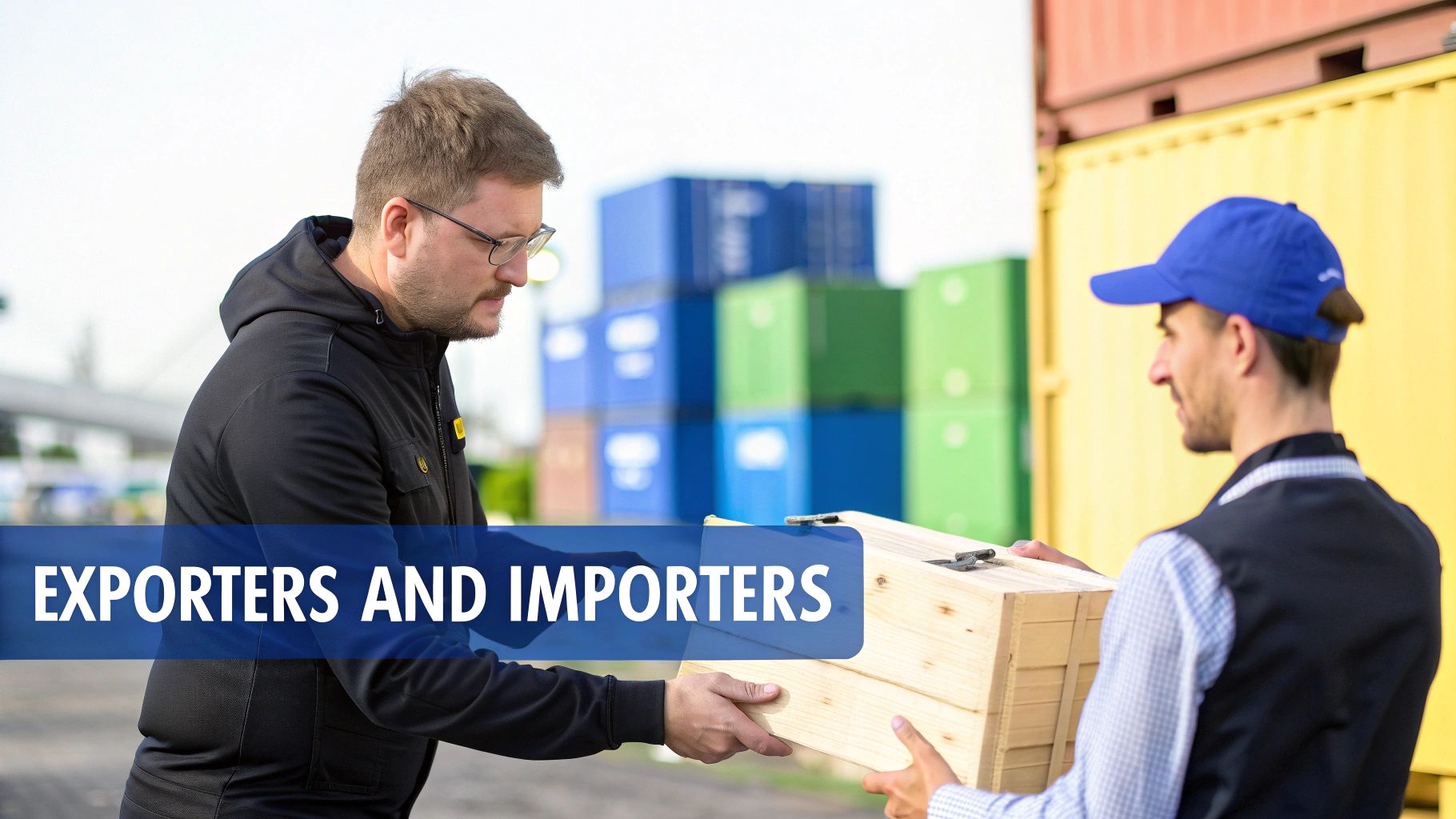
    Two men exchanging a wooden box at a shipping yard with many containers, representing import-export business.

    While the definitions seem simple, the roles of exporters and importers are packed with legal and financial responsibilities that can make or break a shipment. They're not just passive senders and receivers; they are the key players in any international trade transaction.

    For freight forwarders, who are the organisers and problem-solvers of global logistics, mastering the nuances of these roles is non-negotiable.

    The Role of the Exporter

    The exporter is the seller, producer, or shipper who kicks off the entire logistics journey. Their job is to prepare the goods for their international voyage and ensure every local regulation is met before the cargo even thinks about leaving the country.

    Their main duties typically include:

    • Packaging and Labelling: Properly packing goods to survive a long journey and labelling everything to meet international standards.
    • Export Documentation: Getting all the critical paperwork in order, from the commercial invoice and packing list to any special export licences.
    • Export Customs Clearance: Officially declaring the goods to their own country's customs authority and settling any export-related fees or taxes.

    Imagine a furniture maker in Malaysia sending a container of handcrafted tables to a buyer in Australia. That Malaysian company is the exporter. They're on the hook for everything from securely packing the tables to clearing them with Malaysian customs and getting them loaded onto the ship at Port Klang.

    The exporter’s fundamental task is to get the product packed, documented, and legally cleared to leave its home country. A single mistake here can create a bottleneck that delays the entire shipment from the very start.

    If you're thinking about starting your own trading operation, it pays to understand the full scope of what's involved in running a successful import-export business.

    The Role of the Importer

    On the other side of the transaction is the importer, the buyer who takes the baton once the goods arrive in the destination country. Their responsibility is to navigate all the local entry requirements to get the cargo released and delivered.

    The importer's key responsibilities usually are:

    • Import Customs Clearance: Filing the correct entry declarations with the customs agency in their country.
    • Paying Duties and Taxes: Handling all import duties, tariffs, and taxes (like VAT or GST) needed to clear the goods.
    • Final Delivery: Organising the final leg of the journey—transporting the goods from the port to their warehouse, distribution centre, or storefront.

    Exporter vs Importer Key Responsibilities at a Glance

    To make it even clearer, here's a simple breakdown of who typically does what in an international shipment.

    Responsibility Exporter Role Importer Role
    Origin Logistics Arranges transport from factory to the port/airport of departure. Not typically involved.
    Export Documentation Prepares commercial invoice, packing list, export licences. Receives and verifies copies of documents.
    Export Customs Files export declaration and pays any origin duties/fees. Not involved.
    Main Freight Arranges and pays for shipping (depending on Incoterms). Arranges and pays for shipping (depending on Incoterms).
    Import Customs Not involved. Files import declaration and works with a customs broker.
    Duties & Taxes Not involved. Pays all applicable import duties, tariffs, and taxes.
    Destination Logistics Not typically involved. Arranges transport from the arrival port/airport to the final destination.

    This table shows how the responsibilities are split, with the handover often happening somewhere in the middle of the journey. Understanding this division of labour is crucial for anticipating needs and providing value as a logistics partner.

    Decoding the Language of Global Trade and Compliance

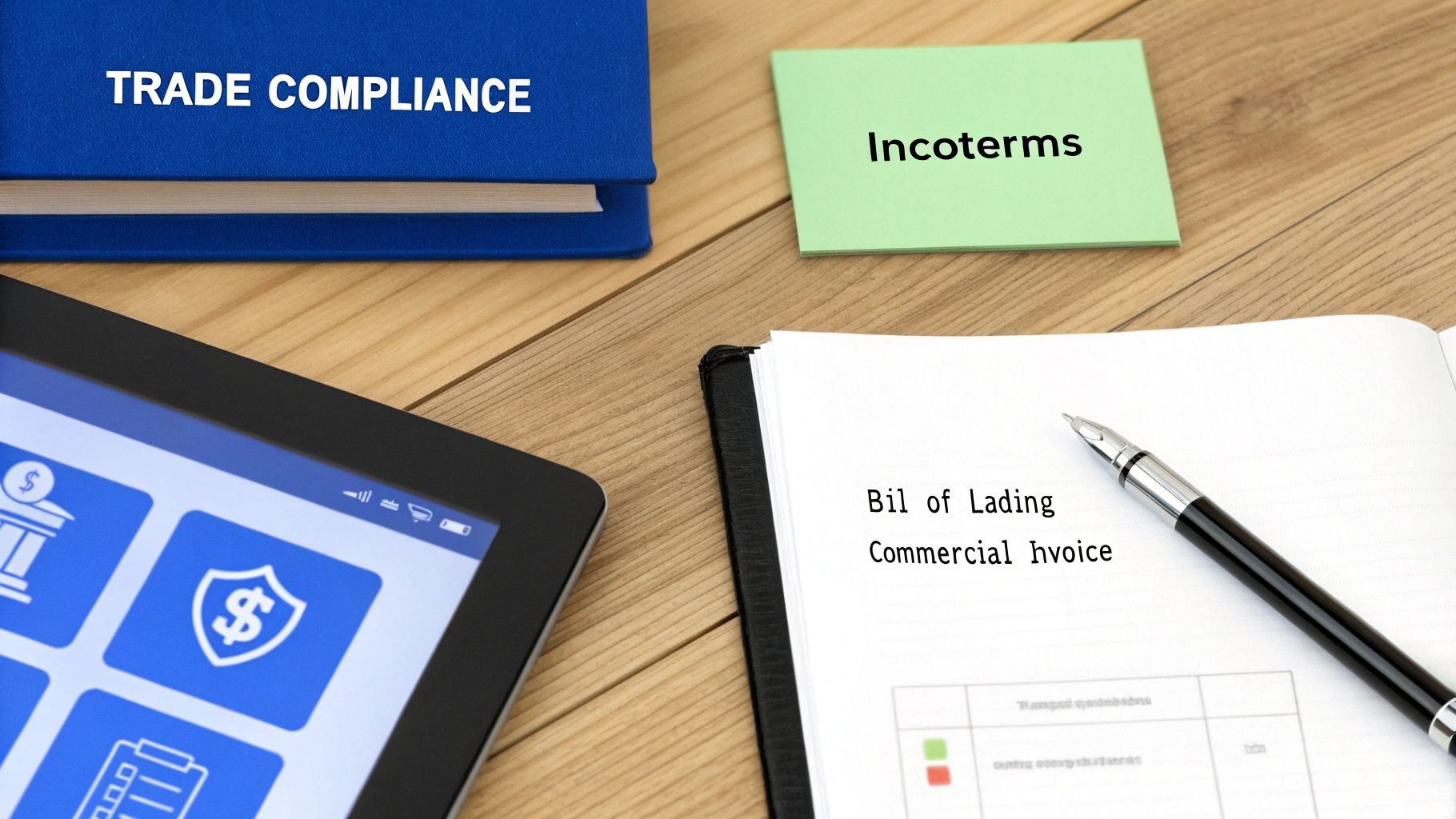
    Desk with trade compliance book, Incoterms note, tablet, pen, and shipping documents.

    For any exporter and importer, compliance isn't just about paperwork. It's the entire rulebook that keeps international trade moving. When a freight forwarder speaks this language fluently, they stop being just a service provider and become a strategic partner—one who can spot trouble before it starts and offer real guidance.

    This all comes down to mastering the documents and terms that are the bedrock of every shipment. Get it wrong, and you're looking at delays, fines, and very unhappy clients.

    The Essential Paper Trail

    Think of shipping documents as a passport for your cargo. Each piece of paper serves a critical purpose, proving ownership, value, and compliance from the moment it leaves the warehouse to the moment it arrives. Together, they tell a story that customs officials worldwide need to understand instantly.

    Two documents stand above the rest in importance:

    • Commercial Invoice: This is the core bill of sale between the exporter and the importer. It breaks down what's being sold, how much it's worth, and the payment terms. For customs, this is the go-to document for calculating duties and taxes, so any inaccuracy can cause major problems.
    • Bill of Lading (B/L): For sea freight, this is the holy grail. It’s a contract, a receipt for the goods, and, most importantly, a document of title. Whoever holds the original B/L physically owns the cargo and has the right to claim it at the destination.

    A simple typo on either of these can bring a shipment to a dead stop. An undervalued commercial invoice might trigger a customs audit and heavy fines. A lost Bill of Lading? That’s a logistical nightmare where the importer can't legally touch their own goods. You can learn more about the crucial legal role of the Importer of Record and their documentation duties in our detailed guide.

    Understanding Incoterms: The Rules of the Game

    Beyond the paper trail, you have Incoterms (International Commercial Terms). These are the universally accepted rules that spell out exactly who is responsible for what between the seller and the buyer. Published by the International Chamber of Commerce, they remove ambiguity by defining who pays for each step and, crucially, who bears the risk if something goes wrong.

    Let’s say an exporter in Singapore is selling electronics to an importer in Germany. The Incoterm they agree on will settle key questions upfront:

    • Who is paying for the main sea freight from Singapore to Hamburg?
    • When exactly does the risk of loss or damage transfer from the seller to the buyer?
    • Is the exporter on the hook for handling German import customs clearance?

    Think of Incoterms as the pre-nuptial agreement for an international sale. They set clear boundaries for cost, risk, and responsibility, preventing expensive arguments long before a container is even booked.

    Nailing these terms is fundamental. For instance, a common term like FOB (Free On Board) means the exporter's job is done once the goods are safely loaded onto the ship at the origin port. But under DDP (Delivered Duty Paid), the exporter handles almost everything—right up to paying import duties and arranging final delivery. For a freight forwarder, the Incoterm is a cheat sheet that instantly tells you who your client is for each part of the journey.

    Tuning into Your Prospect's Pain Points

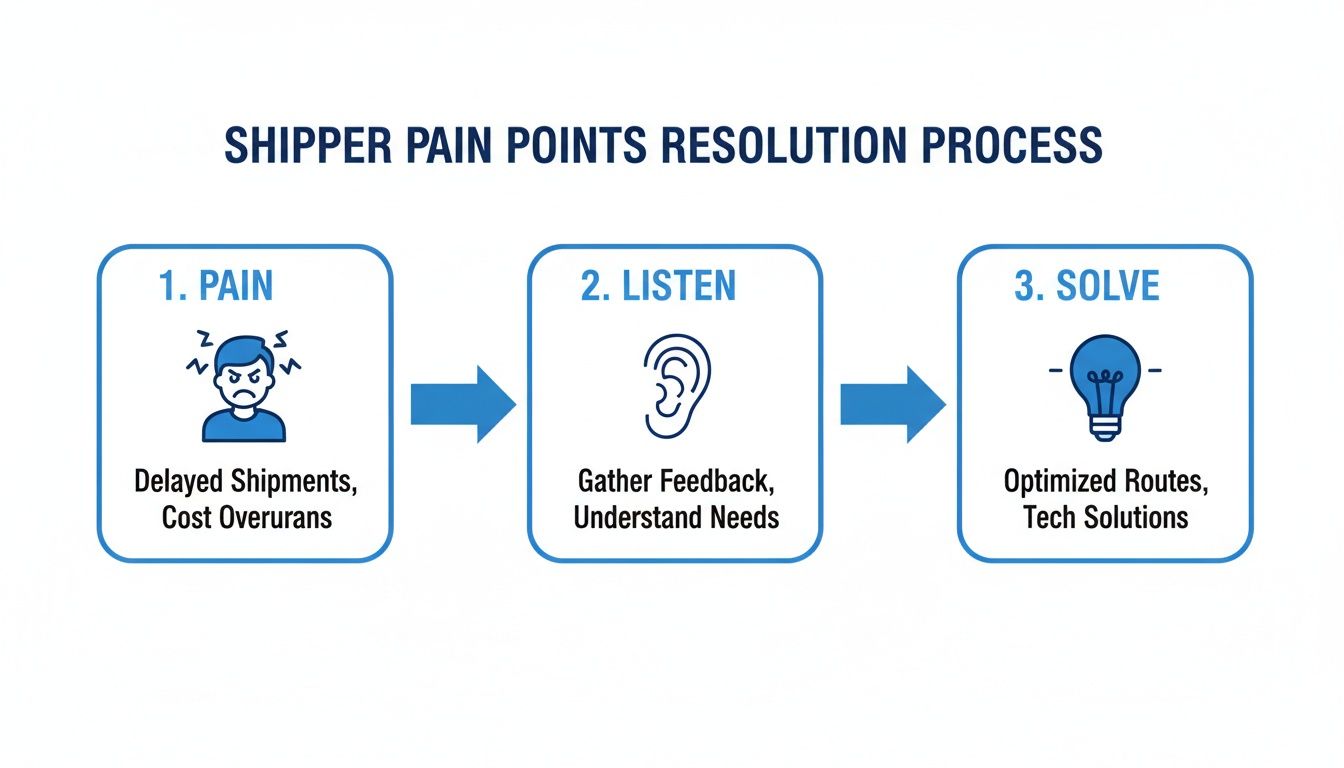
    Talk to any seasoned exporter or importer, and they'll have a catalogue of horror stories. They can tell you about the shipment that disappeared off the grid for three days, the surprise invoice that ate their entire profit margin, or the customs hold that torpedoed a critical deadline. As a freight forwarder, your superpower is learning how to listen for these stories.

    When you truly understand these frustrations, you stop selling freight services and start offering genuine solutions. The language of logistical pain is universal, and once you’re fluent, you can connect with potential clients on a level your competitors simply can't reach.

    These aren't just gripes; they are massive buying signals. A prospect who mentions constant documentation errors isn't just venting—they're practically shouting about a weakness in their current setup. That’s your cue to show them how your expertise prevents those exact mistakes from happening in the first place.

    Common Shipper Frustrations

    While every business has its own quirks, the core anxieties for an exporter and importer usually circle back to the same few problems. If you can spot these patterns, you can anticipate their needs and build a pitch that solves the problems keeping them up at night.

    When you hear these, you know you're onto something:

    • The Black Hole of Visibility: Shippers absolutely hate feeling powerless. Not knowing where their cargo is or if it’s cleared customs creates a huge amount of stress and makes it impossible to keep their own customers in the loop.
    • The Sting of Surprise Costs: Nothing kills trust faster than a bill full of hidden fees. Demurrage, detention, and random administrative charges can flip a profitable shipment into a loss, instantly souring them on their current provider.
    • Radio Silence: Having to wait hours, or even days, for a simple update is a major red flag for any shipper. Poor communication makes them feel unimportant and leaves them scrambling to manage their supply chain blind.

    A recent study found that 73% of shippers would jump to a new provider for better customer service alone. A massive part of that service is clear communication and transparency. When a prospect complains about their forwarder’s response times, they’re really asking for a partner they can actually rely on.

    Turning Pain into Opportunity

    Your job is to draw a straight line from their specific frustration to a tangible solution you offer. This isn’t about a hard sell; it's about active listening and a consultative approach. Don't lead with a price list. Lead with questions that get them talking about their operational headaches.

    Think of yourself as a doctor. You need to understand the symptoms before you can even think about prescribing a cure. For an exporter and importer, the symptoms are their day-to-day logistical nightmares.

    Here’s how to translate their complaints into real opportunities:

    Shipper Says… This Is a Signal Of… Your Solution Is…
    "My last shipment was stuck in customs for a week." Compliance & Documentation Issues: Their current partner is likely dropping the ball on paperwork, causing delays and risking fines. Your team's deep expertise in getting documentation right the first time, ensuring a smooth path through customs.
    "I never know where my container is." Poor Technology & Visibility: They’re stuck with a forwarder who either lacks a modern tracking platform or just doesn't bother providing updates. Your easy-to-use, real-time tracking portal that gives them end-to-end visibility and automated alerts. No more guessing games.
    "We got hammered with unexpected charges at the port." Lack of Transparency & Poor Planning: Their forwarder either gave them a fuzzy quote or completely failed to manage the shipment's timeline. Your commitment to clear, all-in pricing and meticulous planning that dodges costly demurrage and detention fees.

    When you frame your services this way, the conversation shifts from cost to value. You’re no longer just another option in a long list of forwarders. You become the specific solution to a costly, painful problem.

    Finding High-Value Shippers with Customs Data

    Let's be honest, old-school prospecting is a grind. For freight forwarders, it often feels like you're just throwing darts in the dark—endless cold calls to long company lists, hoping you eventually hit an exporter or importer who might actually need your services. It's a massive drain on time, energy, and resources.

    But what if you had a map? That’s exactly what global customs data is. It's a live, daily treasure map detailing who is shipping what, where they're shipping it, and how often. Instead of guessing, you get a crystal-clear look at the real-world shipping activities of thousands of companies.

    This data allows you to see the entire playing field. You can pinpoint businesses moving serious volume along the exact trade lanes you excel in, letting you instantly separate the high-value prospects from the tyre-kickers.

    Turning Raw Data into Sales Intelligence

    Raw customs data is incredibly powerful, but on its own, it’s just a sea of numbers. To make it work for you, you need a way to sift through it, make sense of it, and turn it into something you can act on. This is where a proper data platform becomes non-negotiable for a modern sales team.

    Tools like Coreties are built for this very purpose. They take that mountain of information and refine it into sharp, actionable sales intelligence. They don't just give you shipment records; they connect those records to the right companies and, crucially, to the decision-makers you need to talk to.

    Here’s what that looks like in practice:

    • Pinpoint Your Ideal Customer: You can filter companies by the specific commodities they move, their shipping volumes, and the trade lanes they frequent to build a laser-focused lead list.
    • Qualify Before You Call: You can see a prospect’s shipping history and their current partners, so you know they’re a solid fit before you even pick up the phone.
    • Know Their Business Inside-Out: Seeing what an exporter and importer ships lets you craft a pitch that speaks directly to their world, not yours.

    Just look at Singapore's trade data for a real-world example. In December 2025, the country's non-oil domestic exports (NODX) grew by 6.1%, and non-oil re-exports (NORX) shot up by a massive 15.0%. This kind of growth, particularly in sectors like electronics, signals a clear and growing demand for dependable logistics partners. You can dive deeper into Singapore's robust trade performance on enterprisesg.gov.sg.

    The process for turning this insight into a solution is actually quite simple.

    Diagram illustrating a 3-step shipper pain points resolution process: Pain, Listen, and Solve.

    It starts by using data to spot a shipper's pain point. From there, you listen to their challenges and present a tailored solution. This simple shift turns a generic sales pitch into a genuine, problem-solving conversation.

    From Identification to Outreach

    Okay, so you’ve found a promising exporter or importer. What's next? This is where a data platform really shows its value by linking those customs records directly to verified contact details for logistics and supply chain managers.

    The entire goal is to stop making generic sales pitches and start having relevant conversations. Instead of "Let me tell you about my freight company," you can open with, "I see you're regularly shipping automotive parts to Mexico." That's a completely different and far more powerful conversation.

    This targeted approach works because it's grounded in their actual, recent business activities. You're no longer just another salesperson. You're a well-informed expert who understands their needs and can offer a specific, valuable solution. Suddenly, every outreach email and every call has a much better chance of landing.

    Crafting Outreach That Actually Gets a Reply

    Having a list of high-value leads is a great start, but it's just that—a start. The real magic happens when you turn that raw data into a real conversation. The line between an email that gets deleted instantly and one that gets a thoughtful reply is razor-thin, and it all comes down to one thing: relevance.

    Let's be honest, we can all spot a generic, copy-pasted email from a mile away. An experienced exporter and importer certainly can. The secret is to show you've done your homework and actually understand their business, right from the first sentence.

    Forget the tired old "Let me introduce our freight services" opener. Instead, imagine leading with something that makes them stop and think: "I saw your company's recent shipments of electronic components from Vietnam to the EU, and I have an idea that could optimise that specific lane." Instantly, you've gone from being just another salesperson to a potential expert who understands their world.

    Moving From Generic to Data-Driven

    This is the big shift—from spraying and praying with mass emails to targeted, intelligent outreach. It shows you respect their time and signals that you're here to add genuine value to their supply chain, not just sell a service. Your entire message should be built on the foundation of their actual shipping activity.

    This approach works because it connects directly with their day-to-day reality. You can use concrete details from customs data to show you've put in the effort:

    • Trade Lanes: Mention the specific routes they're running cargo on.
    • Commodities: Refer to the exact types of goods they move.
    • Partners: Note their known trading partners or destinations.

    This kind of personalisation turns a cold call into a warm, consultative conversation starter. It tells them you’re prepared to talk specifics and solve their real-world logistical headaches. For more insights on how manufacturers and exporters can connect with the right business partners, check out our guide on connecting EXIM, MFR, and enterprise sectors.

    For many, this is a significant change from the old way of doing things. The difference in approach—and results—is stark.

    Traditional vs Data-Driven Outreach

    Element Traditional Approach Coreties' Data-Driven Approach
    Lead Source Purchased lists, industry directories, cold calls. Verified customs data, identifying active shippers.
    Opening Line "Hi, I'm from XYZ Logistics…" "I noticed your recent shipment of [Commodity] from [Origin]…"
    Value Proposition Generic: "We offer great rates and service." Specific: "We can help you navigate customs delays on the [Trade Lane] route."
    Follow-Up Standard "Just checking in…" emails. Value-add: "Here's an article on new regulations affecting [Commodity] imports."
    Success Metric Volume of calls/emails sent. Quality of conversations started.

    Ultimately, the data-driven method is about quality over quantity. It's a more strategic, respectful, and frankly, more effective way to build a pipeline of high-value clients.

    Finding Opportunities in Economic Trends

    The best outreach doesn't just happen in a vacuum; it uses context. By understanding the bigger economic picture, you can frame your solutions in a way that resonates deeply.

    Take Singapore's trade data, for example. In December 2025, the country posted a trade surplus of 2,205.64 SGD million, right after a massive 7,669.08 SGD million surplus in November. These aren't just numbers; they're a clear signal of booming export activity. This means more Singapore-based companies are actively seeking reliable, efficient shipping partners to handle their growing volume. You can dig into the specifics in this report on Singapore's balance of trade from tradingeconomics.com.

    When your outreach combines specific company data with wider market intelligence, you create a powerful narrative. You're not just offering a service; you're offering a timely solution perfectly aligned with their business needs and the current economic landscape.

    By connecting the dots between customs data and real-world trade flows, your message becomes almost impossible for the right exporter and importer to ignore. It positions you as a strategic partner from the very first email.

    Uncovering Opportunities Beyond Merchandise Trade

    When we think about global trade, it's easy to picture massive container ships filled with consumer goods. But that's only part of the story. Some of the most valuable opportunities for freight forwarders are hiding in plain sight, within the services sector.

    Take industries like tech, finance, or engineering. They aren't shipping t-shirts or toys, but their logistics needs are incredibly critical. Imagine a tech company setting up a new data centre overseas and needing to ship highly specialised servers. Or think about a renewable energy firm that has to transport fragile, multi-million dollar turbine components for a new wind farm.

    These are high-stakes, project-defining shipments. The companies acting as both the exporter and importer of this kind of equipment can't afford mistakes. They absolutely need a logistics partner they can trust, which is where a savvy forwarder comes in. It’s a call to look beyond the usual cargo and tap into these lucrative, and often less crowded, market segments.

    The numbers back this up, too. In the first quarter of 2025 alone, Singapore's trade in services shot up by 3.8% compared to the previous year, hitting a value of around SGD 249 billion. This isn't just abstract data; it represents a booming market that needs physical, high-value goods to make those services happen. You can dig deeper into Singapore's recent trade performance and its economic impact to see the trends for yourself.

    By homing in on companies in these growing service industries, you can get a real leg up on the competition. These clients are often looking for reliability and specialised care, not just the lowest price, making them perfect for building profitable, long-term partnerships.

    This is where a tool like Coreties becomes so powerful. It helps you follow these economic shifts and pinpoint the key players in these parallel sectors—the very ones your competitors are likely ignoring.

    Your Questions, Answered

    Let's dig into some of the common questions freight forwarders ask when they're on the hunt for a new exporter and importer to work with.

    How Can I Find High-Value Importers Instead of Low-Volume Shippers?

    This is the classic quality-over-quantity problem. The best way to solve it is by getting your hands on global customs data. A solid platform like Coreties lets you slice and dice that data, filtering leads by how much they ship, how often, the value of their goods, and the specific trade lanes they use.

    Instead of casting a wide, hopeful net, this lets you zero in on companies that perfectly match your ideal customer profile. You can spend your time on the big fish, not the small, one-off shippers.

    What's the Best Way to Start a Conversation with an Exporter Lead?

    Whatever you do, don't send a generic "Hello, we're a freight forwarder" email. That's a one-way ticket to the trash folder. You need to show them you've done your homework.

    Use the insights you've gathered from customs data to craft a message they can't ignore. For example, you could say something like, "I noticed you're regularly exporting electronic components to Germany. We've just secured a great rate on that air freight lane and I think we could save you a fair bit." See the difference? You're immediately showing value and proving you understand their specific business needs.

    What Information Is Crucial for Qualifying a Lead Besides Customs Data?

    Customs data is your foundation, but it’s just the start. You need to build on it by finding out more about the company and, crucially, who to talk to. Look for things like the company's size, what industry they're in, and any recent news that might signal a change in their shipping patterns.

    But the real game-changer is finding the right person. You need to get past the gatekeepers and connect with the Logistics Managers, Supply Chain Directors, or Heads of Procurement.

    A fantastic lead is worthless if you can't get your pitch in front of the person who actually makes the decisions. That's why platforms that combine verified contact details with customs data are so powerful—they connect you directly to the people who can say "yes".


    Ready to find your next high-value exporter and importer? Coreties turns raw customs data into real sales intelligence, helping you create outreach that actually gets replies and wins business. Discover qualified shippers today at coreties.com.

  • The Ultimate HS Code Book for Singapore Shippers

    The Ultimate HS Code Book for Singapore Shippers

    When you're moving goods in and out of Singapore, everything needs a label, a specific code that tells customs exactly what it is. That universal language is the Harmonized System (HS) code, and Singapore's specific version is laid out in the Singapore Trade Classification, Customs & Excise Duties (STCCED). Think of it as the definitive local guide for classifying every conceivable product.

    This isn't just bureaucratic box-ticking. Getting the HS code right is fundamental to smooth and cost-effective shipping. It's the key to calculating duties and the Goods and Services Tax (GST), which directly impacts your bottom line. A simple mistake here can spiral into expensive delays, hefty fines, or even having your shipment impounded. For anyone in logistics, mastering this system is non-negotiable.

    Understanding the 8-Digit Singapore HS Code

    So, how does Singapore's system work? It starts with the globally recognised 6-digit Harmonized System code set by the World Customs Organization. Singapore then adds two more digits, creating a more detailed 8-digit code. This expansion is based on the ASEAN Harmonised Tariff Nomenclature (AHTN), which helps standardise trade language across Southeast Asia.

    These extra two digits are crucial because they specify local requirements, like duty and GST rates or whether the item is controlled by a specific government body. This alignment with the AHTN means an 8-digit code used in Singapore is structurally understood by customs authorities throughout the region, creating a consistent framework for trade. For the most current classifications, the official Singapore Customs website is your primary source.

    To make it clearer, let's break down what each part of the code signifies.

    Breaking Down the 8-Digit Singapore HS Code

    The table below deconstructs the 8-digit Singapore HS code, showing how each component builds upon the last to create a highly specific product identifier.

    Digits Component Name What It Represents
    First 2 Chapter The broad category of the product. For example, Chapter 09 covers coffee, tea, and spices.
    First 4 Heading A more specific grouping within the chapter. For instance, 09.01 refers to coffee.
    First 6 Subheading A detailed product description under the heading. For example, 09.01.11 covers non-decaffeinated, unroasted coffee.
    Last 2 AHTN/National The local classification for ASEAN and Singapore-specific duty, tax, and control purposes.

    As you can see, the code becomes more granular with each pair of digits, moving from a general product category to a very specific item definition.

    Why Singapore HS Codes Matter

    These codes do more than just identify products; they are the operational backbone of customs procedures. Here are their primary functions:

    • Duty and Tax Calculation: The code is the direct input for determining the exact import duties and GST payable on any given shipment.
    • Regulatory Compliance: It flags goods that fall under the control of Competent Authorities (CAs), like the Health Sciences Authority (HSA) for medical devices or the Singapore Food Agency (SFA) for food products.
    • Trade Data Collection: The government relies on HS code data to compile precise statistics on Singapore's import and export volumes, which informs national trade policy.

    How to Interpret the HS Code Structure

    Getting a grip on the Harmonized System (HS) is a bit like learning the language of global trade. It’s not just a random string of numbers; it's a logical, hierarchical system where each digit drills down to a more specific product description. Think of it as a precise address for any product in a colossal global catalogue, ensuring everyone from Singapore to San Francisco classifies goods the same way.

    The entire framework is underpinned by a set of principles called the General Interpretative Rules (GIRs). These six rules are the legal backbone of classification, spelling out the exact process customs officials must follow. Getting these rules right is absolutely fundamental to avoiding expensive classification mistakes down the line.

    The Building Blocks of an HS Code

    Imagine an inverted pyramid. That’s an HS code. It starts broad at the top and gets progressively more specific as you go down. The first six digits are the international standard, set by the World Customs Organization (WCO) and used as a common language by over 200 countries.

    Here’s how it breaks down:

    • Chapter (First 2 digits): This is the highest, most general level. For instance, Chapter 85 covers "Electrical machinery and equipment and parts thereof."
    • Heading (First 4 digits): This narrows it down. Within Chapter 85, Heading 85.17 points specifically to "Telephone sets, including telephones for cellular networks or for other wireless networks."
    • Subheading (First 6 digits): This adds another layer of detail. Subheading 8517.12 pins it down to "Telephones for cellular networks or for other wireless networks."

    This chart neatly visualises how the system flows from the global WCO standard all the way down to Singapore's national level.

    Hierarchical structure of HS Codes showing WCO, ASEAN, and Singapore national levels.

    As you can see, Singapore doesn’t just adopt the global standard; it builds on it, adding layers for regional and local customs requirements.

    National and Regional Specificity

    While the first six digits provide a global baseline, countries often need more detail for their own purposes. This is where extra digits come into play.

    Here in Singapore, we use an eight-digit system based on the ASEAN Harmonised Tariff Nomenclature (AHTN). These last two digits are critically important. They determine local duties, GST, and flag whether a product needs a license from a Competent Authority (CA). For anyone involved in Singaporean trade, correctly interpreting the full eight-digit code isn't just good practice—it's essential for compliance.

    Your Searchable Guide to Major Commodity HS Codes

    For any professional in logistics, especially here in Singapore, having common HS codes at your fingertips is a game-changer. Think of this section as your quick-reference cheat sheet, organised by the major commodity groups that drive our trade. It's the digital equivalent of having a well-worn HS code book on your desk, perfect for those initial client calls or for quickly classifying a shipment.

    Instead of getting bogged down in dense tariff schedules, you can use the information here to zero in on the right Chapter and Heading for commonly shipped goods. This is all about speeding up the classification process, so you can deliver faster quotes and prepare more accurate paperwork right from the get-go.

    A tablet on a wooden desk displays a spreadsheet for data, next to office supplies and a 'QUICK CODE LOOKUP' banner.

    To make things even easier, here's a quick lookup table covering some of the most frequently moved commodities in and out of Singapore.

    Common HS Codes for Top Singapore Commodities

    Commodity Group HS Chapter Example Product Example HS Code (Heading)
    Electronics Chapter 85 Smartphone 8517
    Machinery Chapter 84 Laptop Computer 8471
    Pharmaceuticals Chapter 30 Packaged Medication 3004
    Chemicals Chapter 29 Organic Chemicals (e.g., Acetic Acid) 2915
    Mineral Fuels & Oils Chapter 27 Refined Petroleum Oils 2710

    This table is a great starting point, but let's dive into some of these key sectors for a more detailed look.

    Electronics and Electrical Machinery

    Singapore is a massive global hub for electronics, so it’s no surprise that goods under Chapter 85 are constantly moving through our ports. This chapter is incredibly broad, covering everything from tiny microchips to the latest consumer gadgets. You'll find yourself referencing it often.

    For example, a smartphone slots neatly under Heading 8517. But what about all the individual parts inside it? They each have their own specific codes. Integrated circuits, the brains of the device, are classified under Heading 8542, while the various insulated wires and cables are found in Heading 8544. If you need to get even more granular with wiring, you can learn more about finding the correct cable HS code in our detailed article.

    A crucial tip to remember: an item's main purpose is what usually determines its classification. Take a smartwatch—it does many things, but according to the General Interpretative Rules (GIRs), it must be classified based on its principal function.

    Industrial Machinery and Mechanical Appliances

    Another pillar of Singapore's trade is industrial machinery, which mostly falls under Chapter 84. This is a massive category, covering everything from nuclear reactors and printing presses to the computers we use every day.

    Here are a few common examples you’ll likely encounter:

    • Automatic Data Processing Machines (Laptops/Computers): Heading 8471
    • Pumps for Liquids: Heading 8413
    • Air Conditioning Machines: Heading 8415
    • Printing Machinery: Heading 8443

    Getting the classification right here is absolutely vital. Different machines can face very different duty rates, and some may require special import permits based on their technology or intended use.

    Chemicals and Pharmaceutical Products

    The chemical and pharmaceutical industries are also major players in Singapore's trade ecosystem. Goods from these sectors are mostly classified between Chapters 28 and 38.

    For instance, Chapter 29 is all about organic chemicals, while Chapter 30 is specifically for pharmaceutical products. A shipment of medication packaged for retail sale would be classified under Heading 3004. However, the bulk active ingredients used to make that medicine would be classified somewhere else, most likely back in Chapter 29. This distinction is a perfect example of why precision is so critical when working with the HS system.

    Finding Your Way Around the Official Singapore Customs HS Code Search

    While having a physical HS code book on your desk can be handy, the absolute gold standard for getting the most accurate and current classifications is the official Singapore Customs HS/CA Product Code Search engine. This free online tool is your definitive source for making sure a shipment’s code is fully compliant with Singapore’s regulations, including any specific rules from Competent Authorities (CAs).

    Getting comfortable with this portal turns the theoretical knowledge of classification into a practical, everyday skill. Forget flipping through pages; you can get a solid answer in seconds. This lets you confirm duties, GST, and any potential licensing needs well before a shipment is even on the water, which is crucial for sidestepping expensive customs delays.

    How to Use the HS Code Search Portal

    The search engine itself is quite user-friendly. You can search by a specific HS code if you already have one in mind, or you can search by a product description, which is what you'll likely be doing most of the time to classify a new item.

    Here’s a look at the main search interface on the TradeNet portal.

    The trick to getting good results is using clear and specific keywords in the "Product Description" field. This really helps to narrow down the possibilities and get you to the right code faster.

    Making Sense of Your Search Results

    Once you've entered your search term, the portal will show you a list of potential HS codes. Each result comes with a detailed description and notes on any associated CA controls. It's so important to read these descriptions carefully to find the one that most accurately describes your product.

    A search for "coffee," for instance, will bring up several results—roasted, unroasted, decaffeinated, even coffee substitutes. Picking the right one is everything. The results will also tell you if an authority like the Singapore Food Agency (SFA) controls the import, which is your cue that you’ll need additional permits.

    For a more detailed walkthrough, our guide to the Singapore Customs HS code digs deeper into this process.

    Avoiding Common HS Classification Mistakes

    Getting the HS classification right is absolutely critical. One small mistake can snowball into expensive delays, customs fines, and a serious dent in your client relationships. Even those of us who have been in the game for years can get tripped up by the complexities of the official hs code book. Knowing where the common traps lie is the best way to protect your shipments.

    One of the biggest trip-ups is getting a product's main function wrong. The General Interpretative Rules (GIRs) are clear on this: if a product does several things, you have to classify it based on its principal purpose. Think about a smartwatch. Sure, it tells time, but its primary job is processing data and connecting you to your network. That's why it belongs under Heading 8517 (telephones for cellular networks), not somewhere in Chapter 91 with traditional clocks and watches.

    Another classic headache is figuring out how to classify kits or sets.

    Correctly Classifying Sets and Kits

    When you're dealing with goods packaged together as a set for retail, it's a special case. A common mistake is to classify each item inside the box separately, but that’s not how it works. The entire set gets classified under a single HS code—the one that represents the item giving the set its essential character.

    Let's take a grooming kit as an example. Inside, you've got an electric razor, some shaving cream, and a brush.

    • Electric Razor: Heading 8510
    • Shaving Cream: Heading 3307
    • Brush: Heading 9603

    Here, the electric razor is obviously the main event. So, the whole kit and caboodle gets classified under Heading 8510. You don't need to list out three different codes. This approach keeps your customs declarations clean and compliant.

    If there's one piece of advice to take away, it's this: always, always read the Section and Chapter notes in the STCCED. These notes are legally binding and often contain specific rules—inclusions or exclusions—that will override what seems like the obvious general classification. Ignoring them is probably one of the most frequent causes of misclassification.

    Overlooking these finer points can lead to customs rejecting your declaration outright. That means major hold-ups and potential penalties for your client. By taking the time to pinpoint a product's true function, handle sets correctly, and comb through all the relevant notes, you'll steer clear of these common errors and prove your worth as a logistics pro.

    How to Use HS Codes for Strategic Lead Generation

    Most freight professionals see the hs code book as a necessary tool for customs and compliance. But if that's all you're using it for, you're missing out on a massive opportunity. For the savvy freight forwarder, HS codes are the key to unlocking a highly targeted pipeline of shipper leads. It's about speaking the language of commodities to turn broad trade data into real, actionable sales intelligence.

    Think of it this way: instead of casting a wide, generic net, you can zero in on specific markets. Platforms like Coreties are built for exactly this. You can filter the entire shipping landscape to find every company in Singapore that regularly exports electronics under HS Chapter 85 or machinery under Chapter 84. This lets you focus your sales team's energy where it counts most—on industries you already understand and where you have a competitive edge.

    A person's hand points at a laptop screen displaying business analytics charts and graphs with a 'Target Shippers' banner.

    Turning Data into Actionable Insights

    The real magic happens when you start layering HS code data with other business metrics. Just knowing what a company ships isn't enough; you need to know if they're a growing business or a shrinking one.

    A truly strategic approach means identifying companies whose shipment volumes for a specific HS code are on the rise, month after month. A steady increase is a clear signal of growing demand, which often means they'll soon need more sophisticated logistics support.

    This data-driven approach makes your outreach incredibly relevant. Your pitch transforms from a generic "we can ship your goods" to a compelling, value-packed opener like, "We noticed your export volume for laptops under HS 8471.30 has jumped by 20% this quarter. Our specialised solutions for handling sensitive electronics could really help optimise your supply chain." To dive deeper, check out our detailed guide on using an HS code filter to find your next best customer.

    Identifying High-Value Opportunities

    Because Singapore's HS code system is directly linked to customs pricing and controls, any shifts in tariffs or price indices have a direct financial impact on shippers. A prospecting tool that combines HS-based price trends with customs data can pinpoint shippers who are not just growing in volume but are also dealing with price index increases of 5–10 points. This often signals higher-value shipments and a bigger budget for premium logistics. You can learn more about how these indicators are calculated on the Singapore Department of Statistics website.

    With this level of insight, you're no longer just talking about shipping costs. You're having a strategic conversation about value and market dynamics, positioning yourself as a knowledgeable partner. By truly mastering the HS code book, you can transform a simple compliance task into your most powerful lead generation machine.

    Your Top Questions About HS Codes Answered

    Even for those of us who live and breathe logistics, navigating the finer points of Singapore's HS code system can throw up a few curveballs. Here are straightforward answers to some of the questions we hear most often, designed to give you clarity and confidence in any classification scenario.

    What Is Singapore's Official HS Code Book?

    The definitive guide is the Singapore Trade Classification, Customs & Excise Duties (STCCED). While you might still see physical copies around, the single source of truth is the digital HS/CA Product Code Search engine on the Singapore Customs website. This online tool is always current, reflecting the very latest tariff changes and regulatory tweaks. It's the one you should always rely on.

    How Often Does the HS Code System Change?

    The global Harmonized System, which is managed by the World Customs Organization (WCO), gets a major overhaul roughly every five years. This keeps the system in step with new technologies and product innovations. The last big update was in 2022.

    However, that's not the whole story. Singapore can and does make national-level adjustments to its 8-digit codes more frequently. These changes often align with new local policies or ASEAN trade agreements. That’s why you can't just rely on a saved list; you have to verify the codes on the official customs portal every time.

    It’s a common misconception that HS codes are static. In reality, the system is a living document that evolves with global trade, making continuous verification a non-negotiable part of the job for freight forwarders.

    How Do I Classify a Brand-New Product?

    When you're dealing with a product so new it doesn't have an obvious home in the tariff book, you need to turn to the General Interpretative Rules (GIRs). They provide a logical framework for classifying just about anything.

    Here's a practical approach:

    • Look for Close Relatives: Start by identifying headings for products that are similar in function, material, or construction.
    • Apply GIR 3: If your product could reasonably fit into more than one category, GIR 3 is your guide. It helps you pinpoint the product's "essential character" – the component or material that truly defines what it is.
    • Check the Fine Print: Don't skip the Section and Chapter Notes. They are full of specific inclusions and exclusions that can be the key to classifying a novel item correctly.
    • Get an Official Ruling: If you're still stuck and the stakes are high, the best move is to apply to Singapore Customs for an official classification ruling. This gives you certainty and protects you from future compliance issues.

    What if I Disagree with a Customs Classification?

    It happens. If a customs officer reclassifies your shipment and you're convinced your original code was correct, you have a right to appeal.

    The first step is to build your case. Prepare a detailed written justification explaining why you chose your HS code. You'll need to reference the specific GIRs, section notes, and product specifications that back up your argument. In these situations, solid documentation isn't just helpful—it's everything.


    Ready to turn compliance into a powerful sales tool? Coreties turns global customs data into a targeted lead-generation engine. Filter prospects by HS code, identify growing shippers, and craft data-driven outreach that closes deals faster. Discover your next best customer with Coreties.

  • Your Guide to Cable HS Code Classification and Leads

    Your Guide to Cable HS Code Classification and Leads

    Think of a cable HS code as a universal passport for any wire making its way across an international border. Just like a person needs the right travel documents, a shipment needs the right code. Without it, your goods get stuck in customs, racking up expensive delays and potential fines.

    This simple number is the key to keeping global trade flowing smoothly.

    What is the Harmonized System for Cables?

    At its heart, the Harmonized System (HS) is the world's trade language, managed by the World Customs Organization (WCO). Picture a gigantic, highly organised library where every product imaginable has its own unique shelf number. The HS code is that number, letting customs officials in Singapore, the United States, and over 200 other countries know exactly what they're looking at in an instant.

    This system is non-negotiable for a few big reasons:

    • It creates consistency. An insulated copper cable is identified as the same product whether it’s landing in Rotterdam or Rio de Janeiro, eliminating guesswork.
    • It ensures fair duty and tax collection. Governments use HS codes to apply the right tariffs. The wrong code can mean you either overpay or underpay, and neither is a good situation.
    • It powers global trade data. Nations use this data to track what's coming in and what's going out, which helps them analyse economic trends and form trade policies.

    When you're dealing with cables, your main focus will be on Chapter 85 of this "library," which covers all things related to electrical machinery and equipment. The specific "aisle" you'll spend most of your time in is Heading 8544, the home for insulated conductors.

    The first six digits of any HS code are the same worldwide. For example, 8544.70 will always point to optical fibre cables. But here’s where it gets a bit more complex: individual countries can add their own digits—two, four, or even six more—to get more specific for their own tariff and tracking purposes. This means a cable's full HS code might be eight, ten, or twelve digits long depending on where it's headed.

    For anyone in logistics, getting these codes right isn't just about filling out forms. It’s about making sure shipments move predictably and keeping clients happy. A simple classification error can bring a high-value shipment to a dead stop.

    While the shipper usually provides the code, the ultimate legal responsibility for its accuracy falls on the Importer of Record when the goods arrive. This one detail turns a seemingly small administrative task into a critical piece of the supply chain puzzle.

    To get a better handle on this crucial role, you can learn more about the Importer of Record's responsibilities here. Understanding this liability shows why mastering HS codes isn't just about avoiding problems—it's about creating a real competitive advantage.

    How to Classify Cables Accurately

    Figuring out the right HS code for a cable is a bit like identifying a specific model of a car. You can't just call it a 'vehicle' and expect to get the registration right. You need to know the engine size, fuel type, and body style. It's the same with cables—the HS code depends on specific technical details that give it a unique identity for customs.

    Trying to guess the cable HS code from a basic description is a surefire way to cause customs delays and rack up unexpected fees. To get it right, you have to look at what the product is actually made of and what it’s designed to do.

    This flowchart lays out the basic journey for shipping cables and shows just how essential an HS code is for any international shipment.

    A decision tree for cable shipping, illustrating steps for international and domestic shipments.

    As you can see, the moment a cable crosses a border, a correct HS code becomes non-negotiable. It's the key to a smooth customs process, which is why getting the classification right from the very start is so important.

    The Key Classification Factors

    For most cables falling under Heading 8544, the classification process comes down to four main technical questions. Think of these as the first things you need to confirm before you can even think about assigning a code.

    1. Conductor Material: What's at the core? Is it copper, or another material like aluminium? This is usually the first fork in the road when classifying a cable.

    2. Voltage Rating: Is the cable meant for a voltage not exceeding 1000 V, or is it a high-voltage cable rated for over 1000 V? This single detail will send you down completely different classification paths.

    3. Insulation Type: The material wrapped around the conductor—be it plastic, rubber, or something else—is another crucial piece of the puzzle that helps narrow down the final digits of the code.

    4. Fitted Connectors: Does the cable have connectors attached right out of the box? Cables that are ready to use, like an Ethernet or USB cable, are classified differently than a massive spool of bulk cable.

    Once you have the answers to these questions, you’ve built the foundation for finding the correct six-digit HS code. From there, you can dig deeper to find the specific national tariff codes for the destination country. For a closer look at how this works in our region, our guide on the Singapore customs HS code system is a great resource.

    Using the General Interpretative Rules

    But what about tricky situations? What if you're dealing with a hybrid cable that has multiple materials or functions? This is where the General Interpretative Rules (GIRs) become your best friend. The GIRs are the official "rulebook" for customs classification, giving everyone a consistent framework to work through ambiguities.

    The GIRs aren't just suggestions; they are the binding principles customs officials rely on to make their final decisions. For complex products, GIR 3 is often the most critical rule, as it helps determine the "essential character" of an item.

    Let's take a practical example: a cable assembly containing both copper wires for power and optical fibres for data. Where does it belong?

    • GIR 3(a) tells you to start with the most specific heading available.
    • GIR 3(b) guides you to classify the product based on the component that defines its essential character.
    • GIR 3(c) is the last resort: if all else fails, you classify it under the heading that appears last in numerical order.

    For our hybrid cable, you'd have to decide what its main purpose is. If it’s primarily a data cable that happens to carry a small amount of power, its essential character is data transmission. In that case, you'd likely classify it under the optical fibre heading (8544.70).

    By working through these factors and rules step-by-step, you create a logical and defensible argument for your chosen cable HS code. This systematic approach turns a confusing task into a clear, repeatable process, giving you the confidence to manage shipments and ensure total compliance.

    Common HS Codes for Different Cable Types

    Trying to memorise every HS code is a lost cause. The real trick is knowing where to look. For cables, nearly everything you'll encounter falls under a single master heading: 8544, which covers insulated wires and cables. Think of it as the main street for all things cable-related.

    From there, the specific "address" or code depends on the cable's construction and what it's built to do. Knowing these common groupings turns a frantic search into a simple process of elimination. It’s the difference between guessing and making an informed decision, which helps you spot errors and advise clients like a true expert.

    Close-up of various electrical and communication cables, some stripped, on a white background with a 'COMMON HS CODES' banner.

    Core Electrical and Insulated Conductors

    The bread and butter of the cable world are your standard insulated conductors for power and general wiring. These are the workhorses, and their classification hinges on two simple questions: What’s the voltage, and does it have connectors?

    Most of your day-to-day shipments will land in one of these subheadings:

    • HS Code 8544.42 is your go-to for insulated conductors rated for 1000V or less that are already fitted with connectors. We’re talking about everyday items like appliance power cords, USB cables, and ready-to-use Ethernet patch cords.
    • HS Code 8544.49 covers the exact same conductors (≤1000V) but without connectors. Picture big spools of electrical wire destined for building sites or manufacturing lines—that's where this code comes in.
    • HS Code 8544.60 is reserved for the heavy hitters: conductors built to handle voltages over 1000V. These are your high-voltage cables for power grids and serious industrial machinery.

    That tiny distinction between 8544.42 and 8544.49—the presence of a connector—is probably one of the most frequent mix-ups in cable classification. It's a small detail with big implications.

    Specialised Communication Cables

    Once we move beyond simple power, we get into cables designed for communication. Here, the technology used to send the signal becomes the deciding factor, not just the voltage or metal inside.

    A cable's function is often its defining characteristic in the eyes of customs. A coaxial cable and a fibre optic cable might both transmit data, but their fundamental construction is so different that they are placed in entirely separate subheadings.

    This is the neighbourhood for more high-tech cables:

    • HS Code 8544.20 Coaxial Cables: This is the specific home for coaxial cables. Their unique shielded design is critical for keeping signals clean in cable TV and internet applications, earning them their own distinct category.
    • HS Code 8544.70 Optical Fibre Cables: Cables that send data as pulses of light belong here. This code covers everything from single strands to massive bundles of individually sheathed fibres, whether they include electrical conductors or have connectors attached. Given their high value, getting this code right is especially important.

    Assembled and Automotive Wiring

    Finally, we have a major category for complex cable assemblies, particularly those designed for the automotive and aviation industries. These aren't just wires; they are intricate, purpose-built systems.

    • HS Code 8544.30 Ignition Wiring Sets: This subheading is reserved for wiring sets used in vehicles, aircraft, or ships. You'll often hear them called "wiring harnesses." They're pre-assembled bundles of various wires and connectors designed to distribute power and signals throughout an engine or electrical system.

    To make things even easier, here's a quick cheat sheet covering these common codes.

    Quick Reference Guide to Common Cable HS Codes

    This table breaks down the main HS code subheadings for the most frequently shipped cable types, highlighting the key details that determine their classification.

    Cable Type Primary HS Code Heading/Subheading Key Classification Factors
    Insulated Wire with Connectors 8544.42 Voltage (≤1000V), presence of connectors
    Insulated Wire without Connectors 8544.49 Voltage (≤1000V), absence of connectors
    High-Voltage Conductors 8544.60 Voltage exceeding 1000V
    Coaxial Cable 8544.20 Shielded coaxial construction for signal integrity
    Optical Fibre Cable 8544.70 Made of individually sheathed glass or plastic fibres
    Automotive Wiring Harness 8544.30 Pre-assembled sets for use in vehicles, aircraft, or ships

    Getting comfortable with these common cable HS code groups gives you a solid foundation. You'll be able to handle the majority of shipments you see with greater speed and far less risk of compliance headaches.

    A Simple Checklist to Nail Your Cable Classification

    Getting your cable's HS code right isn't about guesswork; it's about having a solid, repeatable process. Winging it can lead to expensive customs delays and frustrated clients, but a systematic approach makes sure you're accurate every single time.

    Think of these four steps as your pre-flight check before any shipment leaves the warehouse. Each step builds on the last, helping you narrow down the possibilities until you land on the one correct code. This framework takes the ambiguity out of classification and gives you a defensible reason for the code you've chosen.

    1. Start with the Technical Specs

    Before you even glance at a tariff schedule, you have to know exactly what you’re dealing with. A vague description like "electrical cable" won't cut it. You need to get your hands on the technical data sheet and dig into the nitty-gritty details.

    Your first job is to answer a few core questions:

    • What's the conductor made of? Copper? Aluminium? This is often the first major fork in the road within Heading 8544.
    • What's the voltage rating? Is it for use at 1,000V or less, or is it a high-voltage cable? This single detail can send you to completely different subheadings.
    • Does it have connectors? Is it a finished cable, ready to plug in, or is it just a bulk reel of wire? This seemingly small point is a massive differentiator in customs terms.
    • Is it a special type? Are you looking at a coaxial cable or one made of optical fibres? These specialised cables have their own dedicated HS codes.

    Trying to classify a cable without this information is like navigating blind. Always push for a detailed spec sheet from the manufacturer or shipper.

    2. Figure Out the Cable's End Use

    Once you know what the cable is, you need to understand what it does. The cable’s final application often provides the missing piece of the puzzle, especially when you’re dealing with complex or composite products. This is where you look beyond the raw specs to see its main purpose.

    For example, is the cable part of an ignition wiring set for a vehicle? If so, it falls squarely under subheading 8544.30, no matter what the individual wires are made of. In this case, its specific end-use as an automotive part overrides a more general classification.

    Think about a hybrid cable that has both copper conductors for power and optical fibres for data. The crucial question here is: what gives the cable its "essential character"? If its main job is high-speed data transmission with power as a secondary feature, its end-use points you toward classifying it as a fibre optic cable under 8544.70.

    Analysing the end-use stops you from making the mistake of classifying a product based on just one of its components.

    3. Dive into the Official Tariff Notes

    Okay, you've got your technical data and you understand the end-use. Now it's time to open up the official Harmonized Tariff Schedule (HTS). But don't just hunt for a code that looks right—you need to read the fine print. The Chapter and Section notes at the start of each section are legally binding and offer critical guidance.

    These notes are packed with definitions, exclusions, and rules that can completely change your final classification. For instance, the notes for Chapter 85 will tell you exactly what "fitted with connectors" means or clarify how to treat cable assemblies. Skipping these notes is one of the most common—and costly—mistakes you can make.

    4. Check for Country-Specific Nuances

    The first six digits of an HS code are the same worldwide, but that's only half the story. Most countries add their own digits to create more detailed national tariff lines. This final check is absolutely essential for staying compliant in the destination country. A six-digit code is almost never enough.

    Take the GCC nations, for instance. Their upcoming switch to 12-digit HS codes from 1 January 2025 is a huge deal for cable exporters. Getting it wrong could lead to massive duty hikes of 20-30%. For Singaporean exporters and regional suppliers, a simple documentation error can quickly become a major financial headache. You can learn more about how these HS code updates impact cable shipments from FreightAmigo.com. This just goes to show why you must always verify the full, country-specific HS code before you ship.

    Turning HS Code Knowledge into Shipper Leads

    Getting a handle on the technical side of cable HS codes is a fantastic skill for staying compliant. But what if you could spin that expertise into a goldmine of high-quality shipper leads? This is the point where customs data stops being a bureaucratic headache and becomes one of your sharpest sales tools.

    Forget casting a wide, inefficient net with generic business directories or cold calls. By using the specific cable HS code a company ships under, you can zero in on them as a perfect-fit prospect. This flips your sales process on its head—you’re no longer guessing who needs your services, you’re engaging potential clients you know are a match.

    This screenshot from Coreties gives you a glimpse of how a modern data platform can transform raw customs information into a clean, actionable list of potential clients.

    A person analyzes shipping data on a laptop, taking notes with 'Shipper Leads' text overlay.

    What you're seeing is the translation of complex bill of lading data into clear company profiles, making it incredibly easy to see who is shipping what, where they're sending it, and how often.

    Pinpointing Your Ideal Prospects with HS Code Searches

    Let's get practical. Say your company is an expert at handling insulated electrical wiring. You know everything about shipping spools of cable that fall under HS code 8544.49. Instead of vaguely searching for "electronics manufacturers," you can jump onto a customs data platform and search for every single company actively exporting or importing goods under that exact code.

    This simple step instantly weeds out all the irrelevant businesses, leaving you with a clean list of active shippers who desperately need your specific skills. The process is refreshingly straightforward:

    1. Plug in the Target HS Code: Start by typing in the precise cable HS code you're after, like 8544.49 for insulated wiring or 8544.70 for optical fibre cables.
    2. Filter by Geography: Next, narrow down the results. Are you looking for exporters based in Singapore or importers in Vietnam? You can target the specific trade lanes that matter most to your business.
    3. Analyse the Activity: Look at the shipment data to gauge volume and frequency. A company with consistent, high-volume shipments is a much hotter lead than one with a single, tiny transaction on its record.

    This focused approach means your sales team can stop wasting time and start talking directly to businesses that are already qualified. You know they ship the products you handle, operate in your target lanes, and have a genuine, ongoing need for logistics services.

    Building a Hyper-Targeted Prospect List

    Once you have a list of companies shipping under your target cable HS code, you can start building a truly powerful prospect list. Modern lead discovery platforms give you so much more than just a company name; they deliver a full-blown profile of the business and its key decision-makers.

    The real magic of this data isn't just finding names; it's about informing your entire approach. You can craft messages that reference a prospect's actual shipping activity, proving from the very first sentence that you've done your homework and understand their business.

    For example, Singapore’s cable manufacturing sector is a powerhouse in the region. One company, Singapore Cables Manufacturers (Pte) Ltd, exported USD 6.28 million under HS code 8544.49 alone—that's over half of its entire cable export portfolio. Knowing this nugget of information allows a sales team to immediately flag them as a high-value prospect and kick off a conversation focused on their biggest export category.

    Crafting Outreach That Actually Works

    Armed with this level of detail, cold calling becomes a relic of the past. Your outreach can be personal, relevant, and impossible to ignore. You can connect with the right person—whether it’s a logistics manager or the head of procurement—and start a conversation that delivers value from the get-go.

    Imagine sending an opening email this specific:

    "Hi [Name], I noticed your company's recent shipments of insulated wiring under HS code 8544.49 from Singapore to Australia. We specialise in this lane and have helped similar cable exporters reduce their transit times by up to two days."

    This data-driven approach immediately positions you as an informed expert who solves real-world logistics problems, not just another salesperson with a generic pitch. For logistics teams looking to make this strategy a core part of their growth engine, our guide on leveraging EXIM data for manufacturing enterprise leads offers a much deeper dive. By using cable HS code data, you can turn compliance know-how into a predictable stream of new business.

    Got Questions About Cable HS Codes? Let's Untangle Them.

    Even with the best process, you're bound to run into some tricky classification scenarios. It just comes with the territory. Knowing how to handle these common challenges is what separates the pros from the rest, helping you give solid advice and prevent those dreaded, costly delays at the border.

    Getting these details right isn't just about compliance; it's about building trust and proving you’re the reliable logistics partner your clients need. Let's dive into some of the most common classification headaches you’ll likely face.

    What if a Cable Assembly Has Different Connectors on Each End?

    This is a classic puzzle we see all the time. Picture a cable with a standard USB plug on one end and a unique, proprietary connector on the other, designed for a specific piece of industrial machinery. Where does it belong?

    The secret is in General Interpretative Rule 3(b). This rule tells us to classify the item based on what gives it its "essential character". You have to ask yourself: what is this cable really for? Is it just a generic data cable that happens to have a weird plug, or is it a purpose-built part for that specific machine? If its main job is to connect to that machine, then the proprietary end defines its essential character, not the common USB port.

    Why Does the Same Cable Seem to Have Different HS Codes?

    Ever notice that what looks like the exact same cable gets a different HS code in the US versus, say, a country in the GCC? Maybe it's a 10-digit code for one and a 12-digit code for another. This is perfectly normal, and it's a critical detail to understand.

    The World Customs Organisation (WCO) standardises the first six digits of an HS code globally. That part is the same everywhere. But individual countries can tack on extra digits to get more specific for their own national tariffs and data collection.

    The six-digit "root" code is for global consistency, but those extra country-specific digits are what actually determine the duties and taxes owed. Always check the full national tariff code for the destination country.

    This is exactly why you can't stop at the first six digits. A simple six-digit code is almost never enough for a customs declaration. You have to drill down to the specific code for the importing nation to avoid misclassification penalties.

    What’s the Single Biggest Mistake People Make?

    If there's one mistake we see over and over, it's mixing up HS Code 8544.42 (conductors fitted with connectors) and HS Code 8544.49 (conductors not fitted with connectors). It sounds so simple, but it trips people up constantly.

    Think of it this way: a simple power cord with plugs on the ends, ready to be used right out of the box, belongs in 8544.42. But a massive spool of bulk electrical wire meant for an electrician to cut and install falls under 8544.49.

    It might seem like a tiny detail, but it has a huge impact on duties and how smoothly a shipment clears customs. Forgetting to check for a connector is an easy slip-up that can cause incorrect declarations, shipment holds, and a very unhappy client dealing with unexpected costs.


    Stop guessing and start targeting the right shipper leads. Coreties transforms global trade data into an actionable prospecting tool, allowing you to find companies shipping specific cable types and reach out with compelling, data-driven insights. Discover your next high-value client with Coreties today.

  • Winning High-Value Exim & Mfr Enterprise Accounts in Singapore

    Winning High-Value Exim & Mfr Enterprise Accounts in Singapore

    In Singapore, an Exim & Mfr Enterprise is a specific type of business that handles both manufacturing its own products and managing its import and export logistics in-house. For logistics providers, these integrated companies are prime targets because their business models rely on consistent, high-volume shipping across complex global supply chains.

    Unlocking the Exim and Mfr Enterprise Opportunity

    Figuring out how to identify and connect with an Exim & Mfr Enterprise can give freight forwarders a real strategic edge. These businesses aren't just one-off customers; their entire operation depends on the steady flow of goods. Since they manage everything from production to distribution, their logistics needs are predictable and often quite large, making them excellent long-term partners.

    You'll find plenty of these opportunities in Singapore's high-growth sectors. Think about companies in electronics, pharmaceuticals, or precision machinery – they frequently use this integrated model. Their need for dependable, specialised freight services, like temperature-controlled transport or secure handling for sensitive parts, opens the door for logistics providers who can prove their expertise.

    A data-driven approach is key to cutting through the noise. When sales teams analyse shipment patterns and commodity flows, they can zero in on companies with active, high-volume shipping needs that are a perfect match for what they offer.

    This kind of targeted strategy makes your outreach far more effective. You can skip the generic sales pitches and approach potential clients with genuine insights about their operations. Getting the fundamentals right is the first step, and you can dive deeper into building a successful import-export business in our detailed guide. This focused approach makes sure you're putting your energy into the most promising prospects.

    Analysing Shipment Patterns and Key Trade Lanes

    To really get a foot in the door with an Exim & Mfr enterprise, you need to understand their logistics footprint. It's all about mapping their flow of goods by digging into customs and trade data. This reveals the crucial patterns in their air and ocean freight that point directly to high-value opportunities, taking you far beyond simple guesswork.

    You'll often find a heavy concentration of specific commodities moving along very particular routes. For example, Singapore’s top manufacturing exporters are constantly sending out high-value goods like advanced semiconductors, biomedical products, and precision machinery parts. When you can spot these patterns, you can perfectly align your logistics services with what they actually do day in and day out.

    This chart breaks down the opportunity scores for key sectors within the Exim & Mfr landscape, based on shipment volume and value.

    Flowchart showing Exim & Mfr opportunities with scores for Electronics (75%), Pharma (60%), and Machinery (45%).

    As you can see, electronics leads the pack, driven by consistent, high-value shipments, with pharmaceuticals and machinery following close behind.

    Core Trade Lanes and Commodities

    Pinpointing the most active trade lanes lets you focus your sales efforts where they'll have the biggest impact. Your analysis might uncover a manufacturer that consistently ships from Singapore to major hubs in Europe or North America. This is your opening.

    To give you a clearer picture, I've put together a table summarising the typical shipping profile for these enterprises. It covers everything from what they ship to how they ship it.

    Exim & Mfr Enterprise Shipment Profile

    A summary of typical shipping characteristics for manufacturing and export enterprises in Singapore's key growth sectors.

    Metric Description / Key Data Point
    Primary Exports Advanced electronics (semiconductors), pharmaceuticals, and specialised industrial machinery.
    Key Destination Hubs Major airports and seaports in the United States, Germany, and the Netherlands.
    Freight Mode Preference Air freight is heavily favoured for high-value, time-sensitive electronics and pharmaceuticals.
    Ocean Freight Usage Used for bulk machinery, raw materials, and less time-critical components.
    Shipment Frequency Tends to be high and consistent, especially for electronics and pharma sectors.

    This data provides a solid foundation for building a targeted sales strategy. For instance, knowing a prospect frequently sends temperature-sensitive biomedical products to Frankfurt means you can walk in and pitch your specialised cold-chain solutions for that exact lane. It’s a direct, relevant approach that shows you've done your homework.

    Lately, Singapore's manufacturing sector has seen major year-on-year growth, much of it fuelled by the boom in demand for AI-related semiconductors and strong pharmaceutical output. This surge is obvious in the export numbers, underlining a growing need for smart lead discovery and shipper outreach. You can get more details on Singapore's economic performance and how it affects these critical trade lanes.

    Identifying the Right Decision-Makers to Contact

    Getting your foot in the door at a company like Exim & Mfr Enterprise is all about talking to the right people. Sending a generic email to a general inbox just doesn't cut it anymore; it'll get deleted before it's even read. You need to connect with the specific individuals who actually make the decisions on logistics and freight.

    When your sales team understands who does what, they can speak directly to the challenges that keep these people up at night. That’s how you build real rapport and show you can solve their problems from day one.

    A modern office desk with 'Key Contacts' signs for supply chain, logistics, and procurement roles, plus a smartphone.

    Key Roles and Their Priorities

    Let's break down the main players in the decision-making process. If you want to move past a generic sales pitch, you have to tailor your message to what each of these roles actually cares about.

    • Supply Chain Manager
      This person is looking at the entire picture, from the factory floor to the final delivery. Their world revolves around end-to-end efficiency—things like optimising inventory levels, cutting down lead times, and making sure manufacturing and distribution are perfectly in sync. They’ll listen if you can offer better visibility and rock-solid reliability.

    • Logistics Director or Manager
      Here's your tactical expert. They're the ones in the trenches, responsible for the day-to-day execution of shipping. Their main focus? On-time performance, carrier dependability, and keeping freight costs under control. If you've got solid data on lane performance or a smart idea for mode optimisation, they're all ears.

    • Procurement or Sourcing Head
      This individual lives and breathes the bottom line. Their job is to negotiate contracts and find cost savings wherever possible. To get their attention, you need to talk about competitive pricing, clear value, and the benefits of a long-term partnership. Don’t forget compliance, either—it’s a huge part of their world. For a deeper dive into their legal responsibilities, check out our guide on understanding the Importer of Record.

    By understanding these roles, you can start to pinpoint their likely frustrations. A Logistics Director might be wrestling with constant customs delays on a key trade lane, while the Head of Procurement is under pressure to consolidate freight spend.

    When you bring up these specific operational headaches in your first conversation, it immediately shows you’ve done your homework. It proves you understand the real-world pressures of a business like Exim & Mfr Enterprise.

    Turning Trade Data into Your Secret Weapon for Sales

    Forget casting a wide net and hoping for the best. When you're trying to win business with an Exim & Mfr enterprise, the real power lies in turning raw customs data into a precision-guided prospecting tool. This isn't just about finding companies; it's about filtering them based on real, actionable criteria that perfectly match what you offer.

    Imagine building a list of every manufacturer in Singapore that ships high-value electronics to Germany by air. That’s the kind of hyper-targeting we're talking about. This data-first approach means you’re only reaching out to businesses with a proven, current need for your services.

    How to Sharpen Your Prospect List

    Modern data platforms go way beyond just giving you numbers. They layer this raw data with verified contacts and deep company intelligence, taking you from a vague company name to the actual Logistics Director or Supply Chain Manager who makes the decisions. You can see how to access this kind of global trade data over at Coreties Trade.

    Here are a few ways to start slicing the data to find your ideal clients:

    • Filter by Commodity: Focus your search on companies shipping the exact goods you handle best, whether that's pharmaceuticals, machinery, or perishable goods.
    • Analyse Trade Lanes: Pinpoint prospects who are active on the specific trade routes where your network and pricing give you a clear edge.
    • Assess Shipment Volume: Why chase small fish? Prioritise the high-volume shippers to make sure your team is spending their time on the biggest opportunities.

    The moment you adopt this strategy, your team's efficiency skyrockets. You stop wasting time and resources on leads that were never a good fit and, naturally, your win rate goes up.

    The latest trade data reveals a lot of resilience in Singapore's non-oil domestic exports. Even with some market jitters, the manufacturing sector is pushing export values up. This points to clear opportunities, especially in airfreight for niche categories like Animal & Vegetable Oils, all while the AI and pharma booms continue to gather steam. Digging into Singapore's recent export performance gives you the kind of timely insight that makes your first call or email incredibly relevant.

    Crafting Outreach That Gets a Response

    Let's be blunt: generic sales pitches are dead on arrival. If you want to connect with the key people at a busy Exim & Mfr enterprise, your message has to show you've done your homework. You need to provide immediate, specific value right from the first sentence.

    That means ditching the vague "we can save you money" promises. Instead, lead with a sharp, data-driven insight you've uncovered about their actual shipping operations. Mention a recent high-volume shipment, a specific trade lane they rely on, or a particular commodity they're moving. This instantly proves you understand their business and sets you apart from the flood of mass emails in their inbox.

    A desk with a laptop, notebook, and pen, featuring a blue banner with 'PERSONALIZED OUTREACH' text.

    This approach respects their time and, more importantly, positions you as a potential strategic partner, not just another vendor trying to make a sale. It’s the perfect way to open the door for a real conversation about solving their specific operational headaches.

    Structuring a Compelling Email

    A powerful outreach email follows a simple but effective framework. It's all about grabbing attention with relevance, backing it up with hard data, and making it incredibly easy for them to say yes to the next step.

    Here’s how to build it:

    1. A Truly Personalised Subject Line: Forget just using their name. Mention a specific trade route or product, like, "Question about your air freight to Frankfurt." That’s far more likely to get clicked than a generic sales headline.
    2. The Data-Driven Hook: Your opening line needs to land with impact. Get straight to the point with the insight you found. For example, "I noticed your company has been consistently shipping semiconductors by air from Singapore to the Netherlands."
    3. Propose a Relevant Solution: Immediately connect that observation to a direct benefit you can provide. Building on the previous example, you could say, "We have priority capacity on that lane and have helped similar electronics shippers cut their transit times by 15%."
    4. A Clear Call to Action: Don't leave things open-ended. Suggest a quick, specific next step. Something like, "Would you be open to a 10-minute call next Tuesday? I can share some data on how we're seeing that lane perform."

    This method turns your outreach from a shot in the dark into a targeted business proposal. You're not just asking for their time; you're offering them valuable, specific information that speaks directly to their supply chain challenges.

    When you follow this structure, you completely change the dynamic. You demonstrate a genuine understanding of what an Exim & Mfr enterprise deals with day-to-day, making a positive response far more likely.

    Your Quick-Reference Prospecting Playbook

    Before you pick up the phone or type that first email to an Exim & Mfr enterprise, spending just a few minutes on prep can make all the difference. Think of this as your go-to playbook for crafting a smart approach, making sure your pitch hits the mark with the right decision-maker.

    The key is to connect your solution to their specific, day-to-day problems. The matrix below will help you do just that.

    Decision-Maker Outreach Matrix

    I've put this table together to quickly map out who you're talking to, what they likely care about most, and how you can use trade data to grab their attention. It's a simple way to make sure your message is always relevant.

    Job Role Primary Concern Effective Outreach Angle (Using Data)
    Logistics Director Reliability & Performance "I noticed your consistent air shipments to Frankfurt; we offer priority capacity on that lane."
    Supply Chain Manager End-to-End Efficiency "Our data shows your average transit time to the US West Coast could be improved by 1-2 days."
    Procurement Head Cost & Value "We can offer a competitive rate for your typical ocean freight volume to Southeast Asia."

    Using a data point isn't just about sounding smart; it shows you've done your homework and aren't just sending another generic email. It proves you understand their business.

    So, before you reach out, run through a quick mental checklist: have you found the right person, spotted a relevant trade lane in their shipping data, and crafted a sharp, value-focused opening line?

    This simple, repeatable process is what separates a good sales pro from a great one. It makes every interaction feel informed and strategic, which is exactly what you need to get a positive response.

    Frequently Asked Questions

    What Exactly Is An Exim & Mfr Enterprise?

    An Exim & Mfr enterprise is a type of business you'll see a lot in Singapore's industrial parks. In simple terms, they're companies that both manufacture their own products and handle their own import-export operations.

    Think of it this way: instead of making a product and then hiring a separate company to ship it, these integrated businesses manage the entire supply chain themselves, from the factory floor right through to global distribution. This makes them really valuable, consistent shippers.

    Why Should I Focus My Sales Efforts On Them?

    For any logistics provider, targeting these enterprises is a smart move. Their entire business model is built on a constant, predictable movement of goods.

    This means they’re looking for reliable, long-term freight partnerships, not just a one-time deal. That stability can translate directly into more consistent revenue for you. Plus, their needs are often complex—from specialised goods like pharmaceuticals to tricky multi-modal shipments—creating perfect opportunities for an expert freight forwarder to step in and show their value.

    So, How Do I Actually Find These Companies?

    You'll have to look beyond standard company directories. The most reliable way to pinpoint a true Exim & Mfr enterprise is by digging into customs and trade data.

    Using a platform that provides this kind of data lets you filter for companies based on specific criteria like the commodities they ship, how often they ship, and the trade lanes they use. This method points you straight to businesses that are actively manufacturing and exporting.

    What's The Best Way To Approach Them?

    Your best bet is to lead with data and make it personal. Forget generic, copy-paste sales pitches; they get deleted instantly.

    Instead, craft an outreach message based on real insights you’ve gathered. For example, you could open an email by referencing their recent shipment volumes on a specific route you happen to service. This small detail immediately shows you’ve done your homework and understand their business, making it far more likely you'll start a real conversation about how you can help.


    Stop guessing and start winning. With Coreties, you can access verified contacts and real-time trade data to connect with the right decision-makers at every Exim & Mfr enterprise. Find your next high-value shipper today at https://coreties.com.