Tag: shipper prospecting

  • Marathon Sales Inc a Prospecting Guide for Forwarders

    Marathon Sales Inc a Prospecting Guide for Forwarders

    You're scanning a lead list, trying to separate real shipping opportunities from noise. Then Marathon Sales Inc. shows up.

    At first glance, the name looks like a dead end. It sounds like a sales coaching firm, a motivational blog, or another company built around the “sales is a marathon” cliché. For a freight forwarder or carrier rep, that kind of ambiguity usually means wasted research time.

    This one is different.

    If you qualify Marathon Sales Inc. like a logistics prospect instead of a branding puzzle, the opportunity gets clearer. This is an industrial distributor tied to spring supply, specialty components, and customer expectations that leave little room for shipping mistakes. That matters because the strongest leads often hide behind generic names. The reps who win them are the ones who dig past the surface and figure out what moves, what can go wrong in transit, and where a forwarding partner can reduce risk.

    Is Marathon Sales Inc a Good Freight Lead

    A name like Marathon Sales Inc. can send you in the wrong direction fast. Search results around “marathon sales” often drift into general selling advice, unrelated commerce commentary, or other uses of the word Marathon. That creates a basic prospecting problem. You can waste an hour chasing a company that isn't a shipper, or you can dismiss a legitimate industrial account because the name sounds too broad.
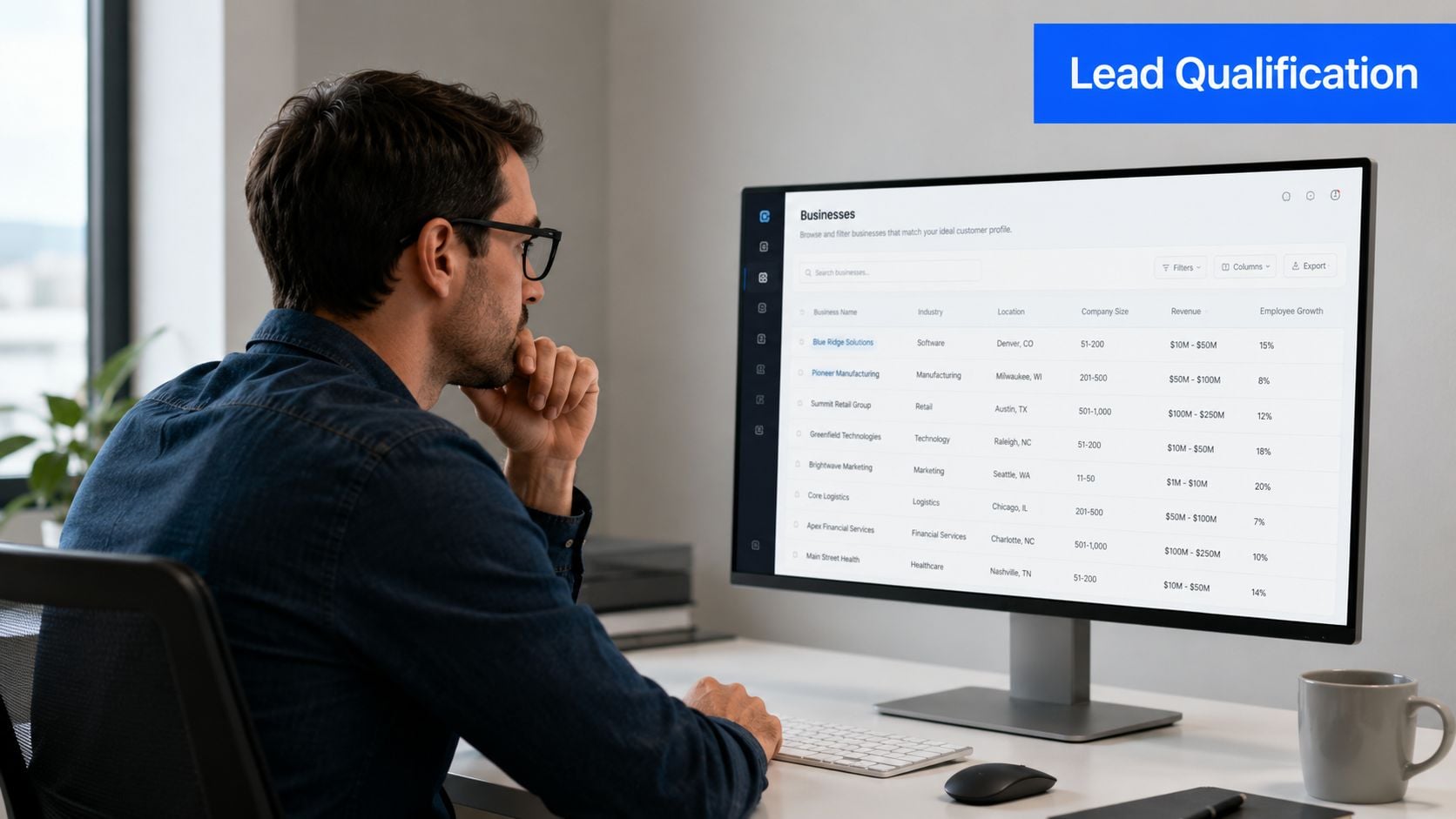
    A professional man sitting at a desk looking at a lead qualification dashboard on a computer monitor.

    Marathon Sales Inc. deserves the second look. Public content around the company often misses its actual role in reliable spring distribution within supply chains, even though that's the relevant lens for a freight seller. The same background also notes that supply chain disruptions cost the U.S. economy over $1.2 trillion in 2023 according to the company's industry framing on the Marathon Sales Inc. author page. For a forwarder, that's the point. You're not evaluating a slogan. You're evaluating a distributor whose customers may feel the cost of delay quickly.

    What makes it worth qualification

    A freight lead is good when three things line up:

    • The company moves real product that supports downstream operations.
    • Service failure hurts their customer, not just their shipment.
    • You can speak to the business model in plain terms instead of sending a generic capacity pitch.

    Marathon Sales Inc. fits that profile. If you build outbound around industrial distributors, this is the kind of account that can respond well to a message tied to continuity, replenishment, and exception handling.

    Practical rule: If the lead name is vague but the company sells niche industrial components, qualify the product risk before you judge the account.

    A lot of reps struggle here because they start with lane questions too early. Start with function. Then move to freight.

    If your team wants a cleaner process for sorting names like this out before outreach, this guide on how to generate leads in logistics is a useful reference point.

    Decoding What Marathon Sales Actually Does

    Marathon Sales Inc. is not a consulting brand built around sales advice. It operates in industrial component distribution, with a clear emphasis on precision die springs and related specialty products.

    That distinction changes the freight conversation immediately. You're not pitching a generic B2B office account. You're looking at a company connected to manufacturing support, replacement cycles, and customers who buy parts because equipment has to keep running.
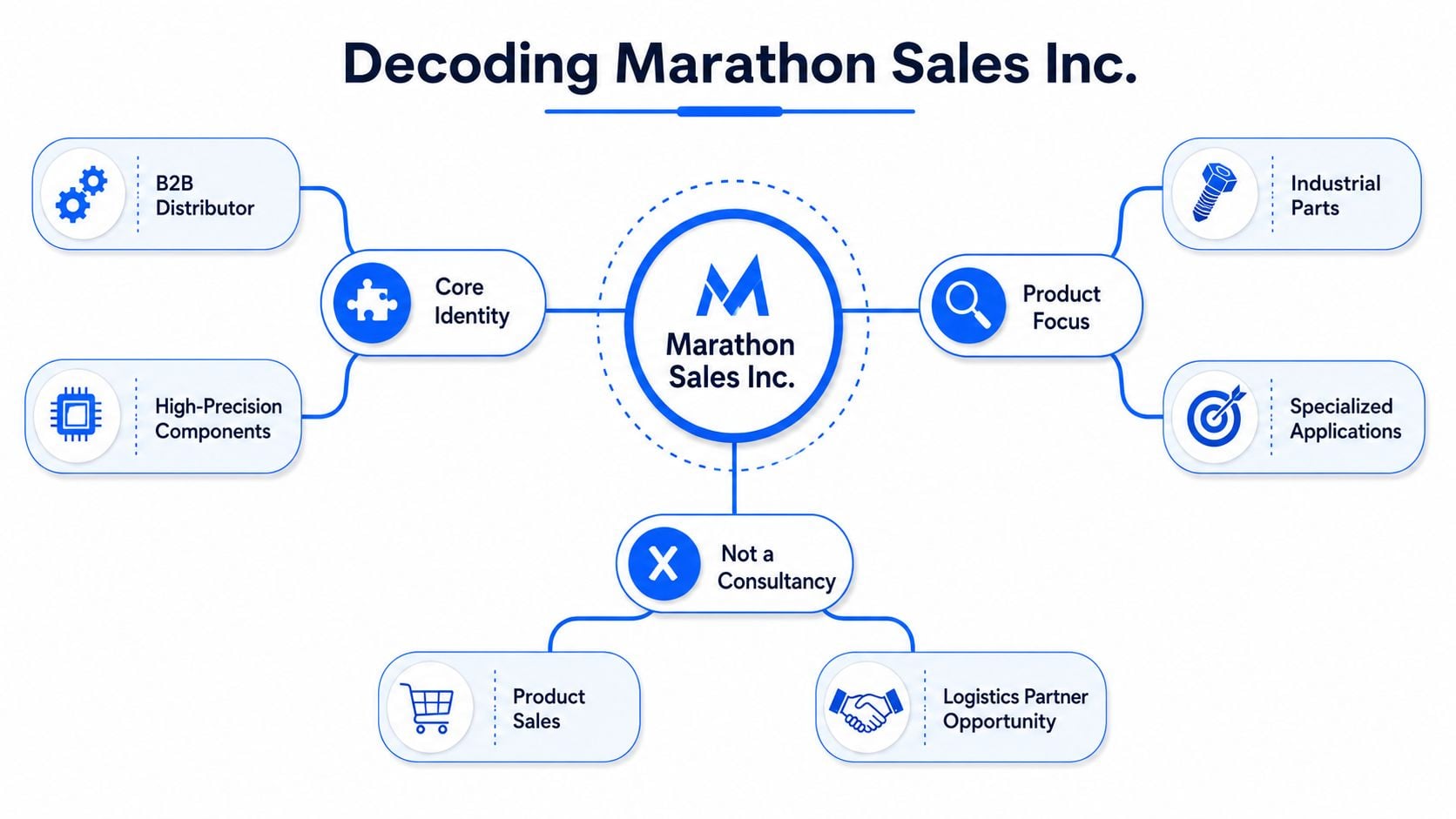
    A diagram titled Decoding Marathon Sales Inc. detailing their core identity, product focus, and business model.

    The product tells you the freight stakes

    One concrete example matters here. Marathon Sales Inc. offers die springs engineered for extended cycle life, and a listed product, the MHC53 Red Die Spring (Part No. 14716), is priced at $606.75 in the Raymond die spring catalog. That single fact does two things for a freight rep.

    First, it signals that this isn't low-concern commodity freight. Second, it suggests buyers may care more about getting the right part on time and in good condition than chasing the absolute cheapest transportation option.

    What that means in plain language

    Industrial spring distribution usually creates a different shipping profile than bulk consumer goods. The shipment may not be huge, but the operational importance can be. A delayed spring, incorrect SKU, or damaged package can create disproportionate pain if the receiving customer needs that component for toolroom, maintenance, or production support.

    Use that logic when you frame the account.

    Business reality Freight implication
    Specialized die springs Accuracy matters more than broad generic service promises
    Engineered industrial parts Packaging, labeling, and shipment integrity matter
    Buyers supporting equipment uptime Expedited recovery options can become part of the sale

    Don't sell trucks first. Sell protection against preventable downtime, mispicks, and ugly delivery surprises.

    What works and what doesn't

    What works is talking about shipment control. That includes shipment visibility, careful handling, and a plan for urgent replenishment.

    What doesn't work is treating Marathon Sales Inc. like a high-volume retail shipper. A message about “low-cost nationwide freight” is too broad. A message about moving high-value industrial parts with fewer exceptions is closer to the mark.

    For a freight forwarder, this is the opening. The product itself gives you the value proposition.

    Analyzing Their Likely Shipping Profile

    Once you strip away the misleading name, the shipping picture starts to form. Marathon Sales Inc. operates as a distributor under the Marathon Worldwide Inc. umbrella and offers products such as die springs, air tools, and abrasives through its catalog ecosystem. Their associated partner materials also reference ISO 9001:2000 quality standards, which points to a supply environment where consistency matters, as shown in the Marathon Sales Inc. catalogs page.
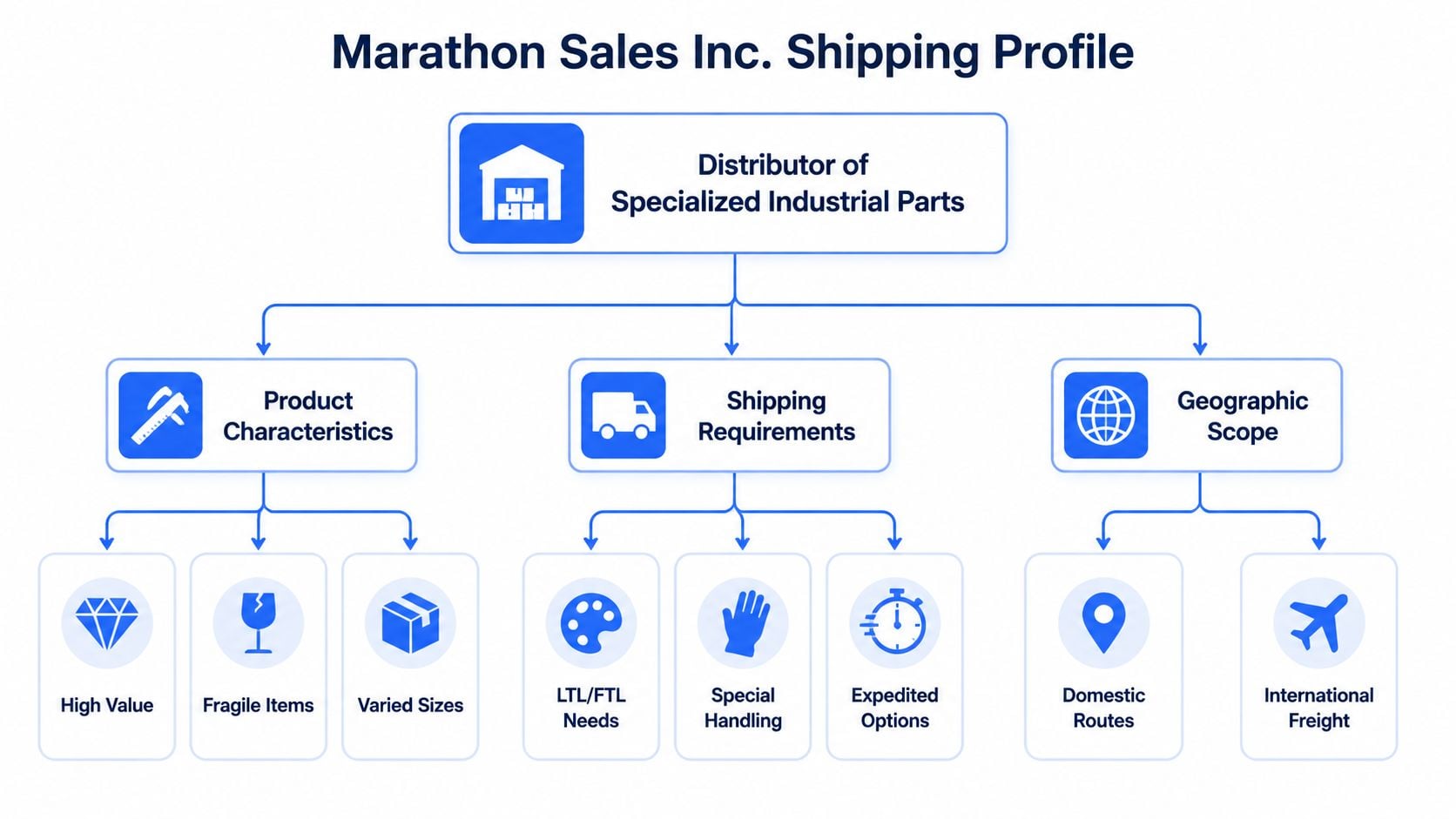
    A flow chart outlining the shipping profile for Marathon Sales Inc including product, shipping, and geographic details.

    A distributor in that position usually creates a mixed freight profile. Not flashy. Not random. Steady, exception-sensitive, and operationally important.

    The domestic profile a forwarder should expect

    For a company handling specialized industrial components, domestic shipping likely centers on dependable replenishment. That usually points toward:

    • LTL for routine outbound orders going to manufacturers, maintenance buyers, and industrial customers.
    • Small parcel or courier-style moves for urgent parts where speed beats consolidation.
    • FTL or dedicated moves when bundled orders, supplier transfers, or regional stock repositioning justify it.

    The important trade-off is simple. Cheap linehaul with poor exception management usually costs more when the consignee is waiting on a part tied to production.

    Here's the video context worth reviewing before you pitch service options:

    Where international support may matter

    A distributor tied to specialized product lines can also create import or cross-border opportunities, even when the visible business looks local. If product sourcing or supplier coordination extends beyond one domestic region, your offer should include more than pickup and delivery.

    Consider these likely needs:

    • Supplier-side coordination when origin readiness is uneven.
    • Customs and document support if components move internationally.
    • Airfreight fallback for line-down or short-notice replenishment.
    • Shipment segmentation so urgent parts aren't trapped inside slower consolidated moves.

    The shipper may not ask for “supply chain design.” They'll ask why a needed part still isn't on the dock.

    What to pitch first

    Lead with service architecture, not mode jargon. For Marathon Sales Inc., the strongest opening usually sounds like this:

    1. Reliable regional LTL execution
    2. Expedite options for urgent industrial orders
    3. Import and supplier coordination where product sourcing requires it
    4. Clear escalation when a shipment misses plan

    That's a better fit than a generic capacity blast. Industrial distributors don't need more emails about trucks. They need fewer freight problems.

    Verifying Credibility and Stability

    Some leads look interesting on paper but fall apart once you check the basics. Marathon Sales Inc. doesn't have that problem.

    The company was founded in August 1996 and has been continuously operated by its President and Owner, Joe Misiura, for exactly 30 years as of 2026, according to the available company profile information on Joe Misiura's LinkedIn reference. It also operates from a dedicated commercial facility at 9100 Louisiana Street, Merrillville, IN 46410, with stable weekday business hours listed there. For freight qualification, that's a strong set of signals.
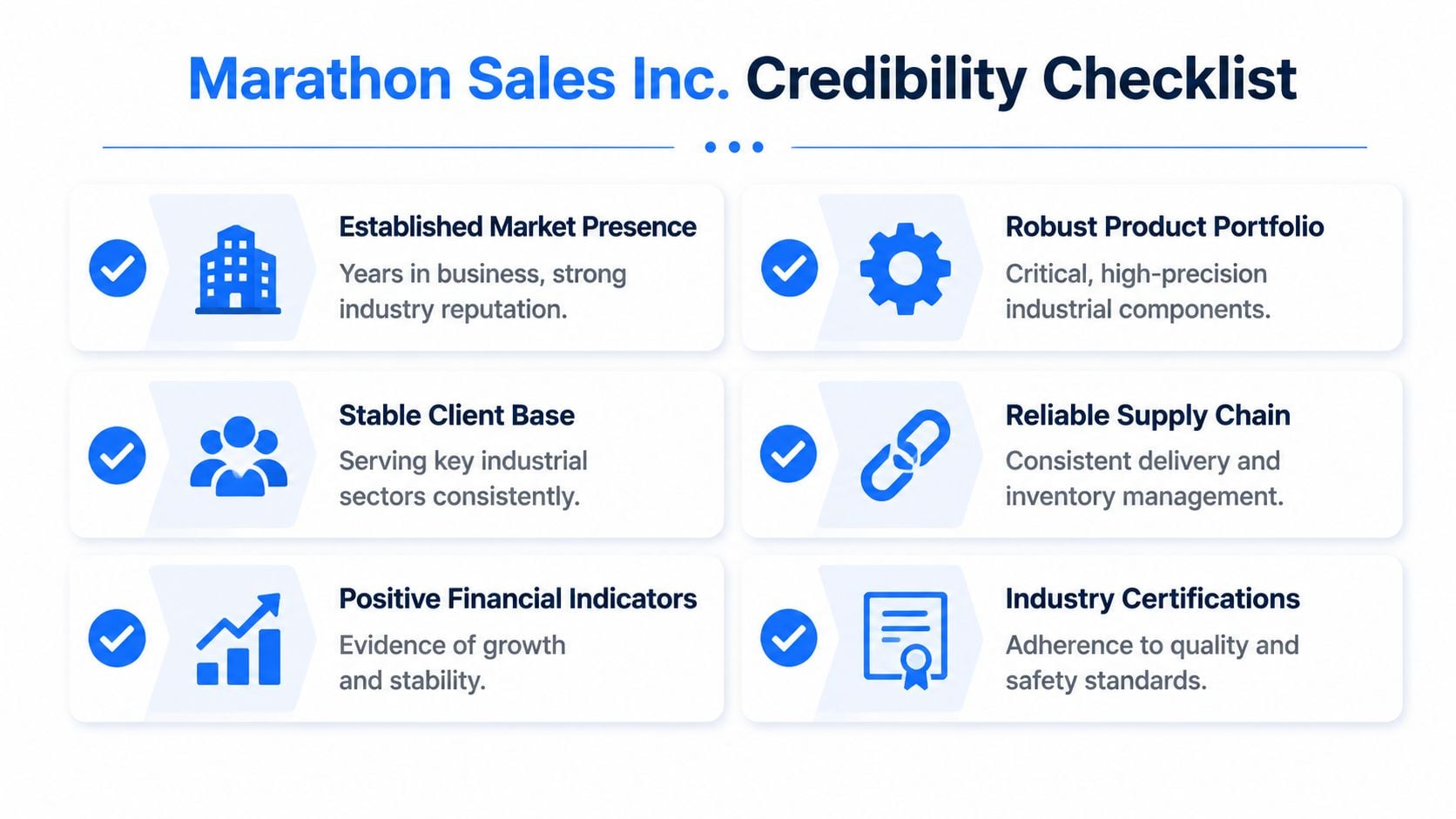
    A checklist graphic for Marathon Sales Inc. displaying six key indicators of business credibility and reliability.

    Why this matters to a sales rep

    Longevity under one owner usually changes the sales approach. You're not dealing with a brand-new operation still improvising suppliers and shipping habits. You're dealing with a business that has likely built routines, vendor preferences, and expectations around responsiveness.

    That creates two realities:

    • The account is more credible, so the effort to research and personalize outreach is justified.
    • The account may be harder to displace, because stable firms often stay with providers until someone shows a clear operational improvement.

    A practical qualification screen

    Use this quick screen before you reach out:

    Signal What it means for freight sales
    Long operating history Lower chance you're chasing a temporary or thin account
    Named owner leadership Easier to map decision influence
    Dedicated facility Real pickup and delivery relevance
    Stable business hours Better alignment for routine operations and follow-up

    If international sourcing or export support becomes part of the discussion, compliance readiness matters early. For non-EU companies shipping into Europe, this overview of an EORI application for non-EU businesses is a practical reference to keep in your toolkit.

    Stable companies rarely switch providers because of a cold pitch alone. They switch when a rep shows they understand the operational consequence of failure.

    One more useful frame is how reliability gets communicated. This article on reliable shipping services is relevant because it mirrors the kind of service language industrial distributors tend to respond to. They care less about broad marketing claims and more about whether you can execute under normal pressure.

    Actionable Prospecting Tactics and Messaging

    If you call Marathon Sales Inc. with a generic “we handle all your freight needs” pitch, you'll sound like everyone else. The better move is to speak to the account the way an operations-minded distributor would evaluate a forwarding partner.

    Start with the likely decision map. In a company with long-term ownership and a specialized catalog, primary influence may sit with the owner, a sales operations contact, or whoever manages order flow and vendor coordination. Don't overcomplicate that. Your first objective is to send a message that proves you understand what they sell and why delivery reliability matters.
    Screenshot from https://coreties.com

    Messaging that matches the business

    This is a better opening than the average freight intro:

    We work with industrial shippers that can't afford delivery errors on specialized components. If your team is shipping die springs, tools, or related parts to manufacturing customers, we can compare where tighter exception handling or expedited backup would reduce service risk.

    That works because it connects freight performance to customer outcomes. It also avoids pretending you know their full network before a conversation.

    A weak version sounds like this: “We offer competitive rates across all modes.” That doesn't separate you from anyone.

    Four angles that usually get traction

    • Protect the consignee experience
      Talk about on-time delivery, shipment accuracy, and escalation when an order goes off plan.

    • Support urgent replenishment
      Industrial distributors often need a fallback when standard transit won't do the job.

    • Reduce friction in mixed-mode shipping
      If some orders fit parcel, others need LTL, and a few need urgent air, say that plainly.

    • Bring structure to visibility
      If you use tools that improve execution discipline, mention the process, not the hype. This overview of the advantages of transport management systems is useful context for how TMS-driven workflows can help with shipment visibility, exception handling, and carrier coordination.

    Keep the first outreach tight

    Use short emails. Ask for a narrow conversation. Don't attach a rate sheet.

    A workable sequence looks like this:

    1. First email
      Reference their role in industrial component distribution and ask whether they review options for outbound LTL, expedites, or supplier-side freight coordination.

    2. Follow-up call
      Mention a specific shipping risk, such as urgent replacement orders or delivery exceptions to manufacturing customers.

    3. Second email
      Offer one operational idea, not a brochure. For example, propose a review of where standard routing is enough and where backup service should exist.

    If you need a framework for sharpening that message, this guide to value proposition development is a practical way to tighten your wording around customer risk instead of freight features.

    One tool-based option

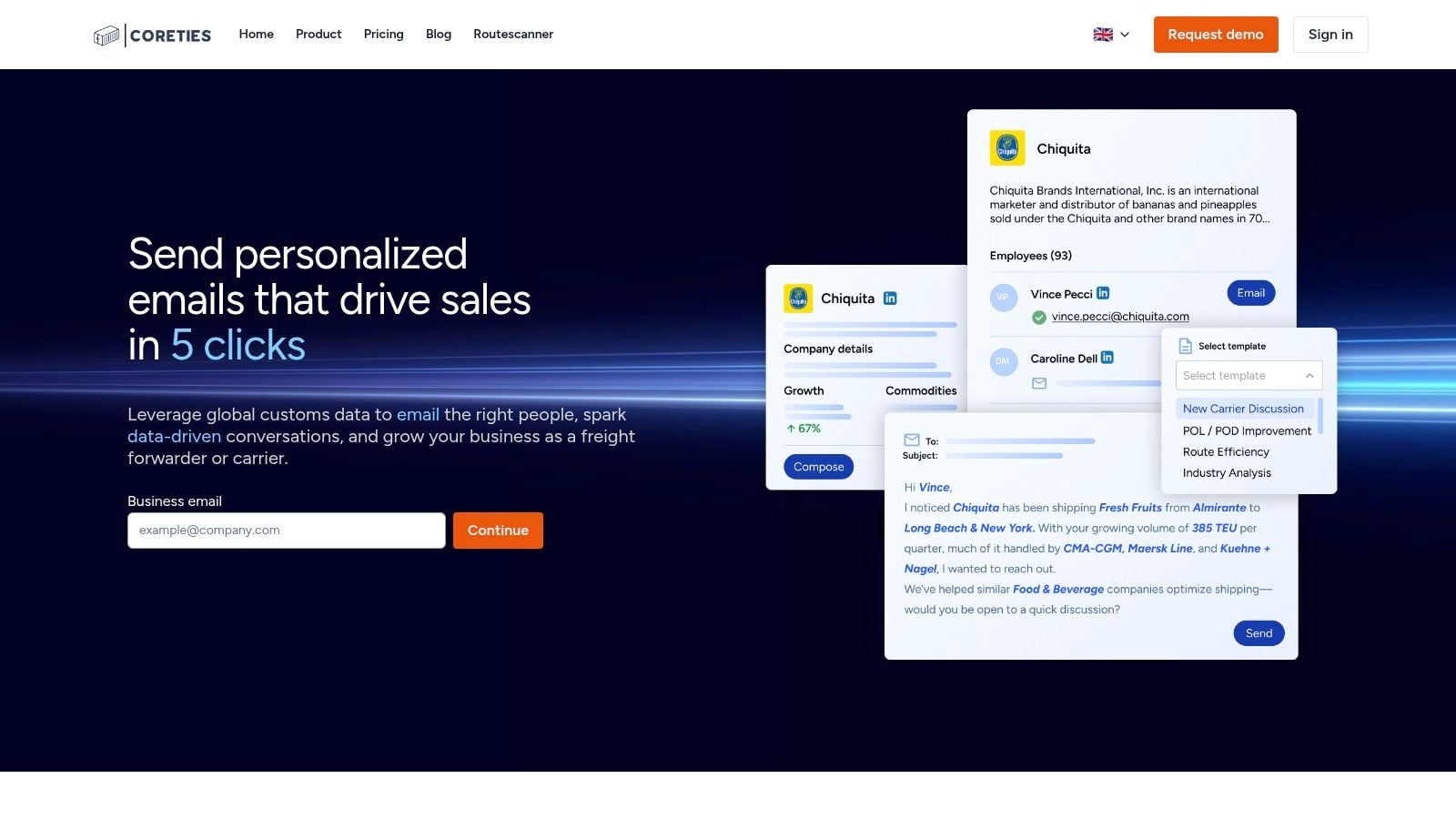
    For teams prospecting similar industrial accounts at scale, Coreties is one option because it uses customs data to help identify shipper activity, relevant contacts, and outreach angles tied to trade lanes and buyer-supplier relationships. Used correctly, that helps you avoid blasting the wrong message to the right company.

    The account doesn't need a flashy pitch. It needs a rep who can make freight sound useful.

    Turning Insight into Your Next Opportunity

    Marathon Sales Inc. is a good example of why surface-level prospecting fails. The name looks generic. The actual business is not. It points to industrial distribution, specialized components, and customers who likely care about reliability more than freight theater.

    For a forwarder, that changes the playbook. You don't chase this lead with broad promises about capacity. You qualify the product role, map the likely shipping pressure points, and lead with service control. That's the repeatable part.

    Use the same process on every ambiguous lead in your pipeline:

    • Check what the company really sells
    • Figure out what shipping failure would cost their customer
    • Look for stability signals before spending outreach effort
    • Write the message around risk reduction, not mode availability

    That approach gets better results because it matches how industrial shippers think. They don't buy freight in the abstract. They buy confidence that the right product will arrive without creating downstream problems.


    If you want to apply this prospecting method across more industrial shippers, Coreties helps freight teams turn customs data into qualified lead lists, find decision-makers, and build customized outreach around actual shipping activity instead of guesswork.

  • Find Coffee Buyers Online: A Logistics Sales Playbook

    Find Coffee Buyers Online: A Logistics Sales Playbook

    Online coffee demand has created a buyer segment that many freight sales teams still miss. The opportunity is not in broad “coffee importer” lists. It sits with online-first roasters, subscription brands, and growing importers whose shipping patterns already point to real revenue.

    These companies buy freight differently from legacy coffee importers. Purchase cycles are shorter. Shipment sizes can be smaller. The pressure on delivery timing, customs visibility, freshness risk, and landed margin is higher. A provider that can explain the lane, the handoff points, and the compliance exposure will get more traction than one more forwarder quoting a rate.

    This is significant because online coffee shippers rarely fit the old prospecting model. Many do not route tenders through a large procurement team. The decision often sits with a founder, an operations manager, or a sourcing lead who is balancing origin strategy with working capital and customer retention. If outreach starts without shipment evidence, it usually sounds generic and gets ignored.

    The playbook is different for logistics providers.

    Start with customs data and shipment activity, not search results. Use that data to confirm the lane, shipment rhythm, origin mix, and likely pain points. Then approach the person who owns the import problem with a routing and compliance angle tied to their current operation. That is how logistics teams get meetings in this market, and how they turn online coffee growth into closed freight business.

    The Untapped Goldmine in Your Trade Lanes

    Online coffee sales are growing fast enough to reshape who buys freight, how they buy it, and what they expect from a logistics partner. For freight teams, that matters less as a market headline and more as a lane-level revenue signal. If containers or airfreight tied to coffee already move through your network, there is a strong chance part of your next customer base is sitting inside trade lanes you already know well.

    That is the part many logistics sellers miss.

    The opportunity is concentrated in online-first roasters, subscription brands, and specialty importers that need tighter control over timing, customs, handoffs, and landed cost. These accounts may not look large on day one. They often produce better sales outcomes than bigger importers because the problem is immediate, the decision path is shorter, and the value of a strong routing plan is easier to prove.

    Why traditional prospecting misses them

    Freight sales teams usually miss this segment because they start with broad company research instead of shipment behavior. Exhibitor lists, generic importer databases, and keyword searches give you names. They do not tell you whether the company is still importing, which origins it buys from, how often it ships, or where service failures are likely to happen.

    That gap shows up in outreach quality.

    A rep who cannot speak to origin mix, transit risk, CFS handling, customs exposure, or replenishment timing sounds like another forwarder shopping a rate. A rep who can point to a recurring Colombia to East Coast pattern, a seasonal spike from Ethiopia, or a mismatch between shipment cadence and inventory pressure sounds useful. If your team needs a repeatable method for building lists from actual freight activity, this playbook for finding shippers for freight brokers is the right starting point.

    One practical rule has held up across coffee accounts I have sold into: a mid-sized importer with a clean recurring lane is usually a better target than a bigger account with scattered freight and no clear routing fit.

    What makes the segment valuable

    Online coffee shippers feel operational pain early. A customs hold, missed connection, or documentation error does not just delay freight. It can throw off roasting schedules, subscription orders, promo calendars, and cash tied up in inbound inventory. That gives logistics providers room to sell something more useful than port-to-port pricing.

    The value is specific. Better origin routing. Fewer handoff failures. More predictable clearance. Better visibility at the points where coffee shipments tend to stall.

    That is why this segment fits logistics providers so well. Roasters and ecommerce operators already have plenty of content written for them. Very little guidance shows freight teams how to connect customs data to a lane-specific value proposition and turn that into meetings. In coffee, that connection is the sales edge.

    If your network is already strong in Latin America, East Africa, Southeast Asia, or U.S. inbound specialty flows, the demand is probably not outside your business. It is already moving through lanes you cover. The missed opportunity is usually in how accounts are identified and how the first pitch is framed.

    Finding Buyers Beyond a Google Search

    If you want real coffee buyers online, start with shipment evidence, not search results. Google is useful for validation. It’s weak for discovery. Customs data, import records, marketplace activity, and product signals are what turn a vague sector into a workable list.

    A five-step infographic showing a data-driven process for identifying potential international coffee buyers for business.

    The strongest pocket of opportunity is specialty. In the U.S., 45% of American adults enjoyed specialty coffee in the past day, up 80% since 2011, and the segment was valued at $47.8 billion in 2024, according to specialty coffee ecommerce statistics. If you're building a target list, specialty importers should sit near the top because they’re more likely to care about origin-specific sourcing, timing, and route quality.

    Start with trade data, not company directories

    Bills of lading and import manifests tell you who is moving coffee. For a logistics seller, that’s the difference between guessing and selling.

    Use customs data to pull companies importing green coffee or related coffee products in your target market. Then sort those records by:

    • Origin country fit. Match importers to the origins your network serves well.
    • Shipment recurrence. Repeated import activity usually matters more than a single large movement.
    • Port pattern. A consistent port of discharge often reveals where routing alternatives can help.
    • Product focus. Specialty, single-origin, or green coffee importers usually have more sensitivity to delay and handling quality.

    If you need a broader framework for lane-based prospecting, this guide on finding shippers for freight brokers is useful because the same logic applies here. Start with shipment behavior, then build the human layer on top.

    Build your raw list in five passes

    Don’t try to perfect the list on day one. Build it in passes.

    1. Extract coffee importers from customs records
      Pull company names tied to coffee shipments in the countries and lanes you care about.

    2. Layer in marketplace visibility
      Check whether those companies appear on green coffee marketplaces, direct-trade sites, or specialty sourcing platforms.

    3. Confirm ecommerce intent
      Visit their sites. Look for subscriptions, direct-to-consumer sales, online checkout, or strong education content around origin and roast profile.

    4. Flag operational complexity
      Note whether they buy from multiple origins, mention traceability, or emphasize freshness and micro-lots.

    5. Segment by likely need
      Put each account into a simple bucket such as “stable recurring importer,” “growing specialty buyer,” or “digital-first roaster with likely compliance pain.”

    What to look for on the buyer’s website

    A lot of useful qualification starts before you ever touch LinkedIn.

    Use the site to answer practical questions:

    Signal What it often means for logistics
    Subscription offers Inventory continuity matters more
    Single-origin or rotating lots Sourcing changes may create routing complexity
    Traceability language Compliance and documentation will matter in the pitch
    Brewing guides and origin storytelling Product quality and timing are part of the brand promise
    Wholesale plus DTC They may need mixed logistics support, not one-size-fits-all forwarding

    A website won’t tell you everything, but it does tell you whether the company sells coffee like a commodity or like a differentiated product. That distinction changes your sales angle.

    The best coffee leads usually reveal themselves in two places at once. Their shipment records show movement, and their website shows why the movement matters.

    Don’t ignore smaller buyers

    A common mistake is discarding companies that aren’t moving huge visible volume. In coffee, smaller importers can still be strong accounts if their lane is regular and their operation is growing. They often have fewer internal logistics resources, which makes a data-backed forwarder more valuable.

    What doesn’t work is treating every importer the same. A high-volume commodity buyer and a specialty roaster buying online from multiple origins may both import coffee, but the sales motion is different. One buys on procurement discipline. The other buys on reliability, responsiveness, and control.

    That’s why discovery should capture behavior, not just names.

    Qualifying Prospects and Identifying Decision-Makers

    A raw prospect list looks productive. It isn’t. Effective work starts when you decide which companies deserve time, and which person inside each company owns the freight problem.

    A young person with braided hair working on a laptop displaying data charts at a desk.

    The coffee market creates a specific opening for logistics providers because small to medium roasters sourcing green coffee online often get access to marketplaces, but not enough guidance on customs, freight routing, and shipping delays, as noted in Bellwether Coffee’s marketplace overview. That means your qualification process should focus less on “does this company import?” and more on “does this company have enough complexity to need help?”

    Separate good prospects from interesting companies

    Not every importer is worth chasing. Some have stable incumbent forwarders, narrow lanes, and little appetite for change. Others are operationally exposed and easier to move.

    I’d qualify coffee buyers online with four filters:

    • Lane relevance
      If the company imports from origins where you already know the forwarders, transshipment points, inland options, and common choke points, keep it.

    • Shipment consistency
      Repeated activity is more valuable than sporadic imports. Consistency usually means budget, process, and a recurring problem to solve.

    • Product sensitivity
      Specialty, traceable, or origin-driven coffee tends to create a stronger case for route quality and shipment visibility.

    • Organizational simplicity
      Smaller brands often decide faster. You may be dealing directly with a founder, operations lead, or head of sourcing.

    A lot of general B2B advice on strategies for effective lead qualification applies here, but coffee freight adds a lane and compliance layer. A company can look attractive commercially and still be a bad fit if their routing need is too simple for your model.

    Score for pain, not just potential

    The best coffee account isn’t always the biggest. It’s the one where your service solves an expensive friction point.

    Use a simple scoring lens:

    Qualification lens High-fit sign
    Routing complexity Multiple origins or changing procurement patterns
    Documentation burden Strong traceability messaging or international sourcing emphasis
    Delay sensitivity Subscription, launch cycles, or rotating offerings
    Internal bandwidth Lean team, founder-led, or small ops function
    Lane match Existing strength in the same trade lane

    Many sales teams go wrong. They prioritize visible size over solvable pain. In coffee logistics, pain converts.

    Field note: If a prospect talks heavily about origin, transparency, and roast timing, they’re rarely buying freight on price alone.

    Find the person with authority

    Once a company qualifies, stop looking for a generic inbox. You want the person whose day gets worse when a shipment is late, held, or rerouted poorly.

    Typical decision-makers include:

    • Founder or co-founder at smaller roasters
    • Head of operations in growing ecommerce brands
    • Green coffee buyer when sourcing and logistics overlap
    • Procurement or supply chain lead at more mature importers
    • Logistics manager where freight is already centralized

    LinkedIn Sales Navigator, company websites, trade announcements, and contact data platforms can help. The key is matching title to likely pain. A founder cares about margin and customer experience. A green buyer cares about origin flow and reliability. An ops lead cares about execution.

    Read the org chart through the business model

    The title alone doesn’t tell you enough. Read it against how the company sells.

    If the brand is direct-to-consumer and education-heavy, the founder may still control sourcing decisions. If they run wholesale plus online subscriptions, operations may own the freight handoff. If they market around transparency, a sourcing lead may influence the final decision even if finance signs off.

    That’s why qualification and contact selection should happen together. The company might be right, but the wrong contact can make a strong account look cold.

    The Data-Driven First Contact Playbook

    A cold email to coffee buyers online only works if it sounds like you already understand their operation. Generic freight outreach dies fast. The buyer can tell in one glance whether you’re pitching everyone or speaking to them.

    A person in a green sweater types on a laptop next to a glass of iced coffee.

    There are useful benchmarks here. For email campaigns targeting online coffee buyers, aim for a 35% open rate and 4.42% CTR, and personalize around buyer preferences because 62% of buyers prefer local or independent roasters, according to this outreach data for online coffee sales. Those numbers matter less as bragging rights and more as guardrails. If your campaigns sit far below that, the message is probably too generic.

    Subject lines that earn the open

    The subject line should prove relevance without sounding automated. Don’t lead with “freight services” or “introducing our company.” Lead with something the buyer recognizes from their business.

    Good subject line patterns:

    • Question tied to a lane
      “Question on your Colombia imports”

    • Operational angle
      “Reducing delay risk on green coffee shipments”

    • Specific sourcing signal
      “Routing support for specialty coffee imports”

    • Margin-oriented framing
      “A landed-cost review for your coffee lanes”

    What usually fails:

    • “Reliable logistics partner”
    • “Streamline your supply chain”
    • “Quick introduction”
    • “Following up on my previous email”

    Those sound like mass outreach because they are.

    Use a three-part email structure

    The most effective first contact emails I’ve seen follow a simple structure.

    1. Observation
      Mention something factual from their business. A sourcing origin on their site. A recurring import lane. A direct-to-consumer subscription model.

    2. Problem framing
      Connect that fact to a logistics risk. Customs friction, route reliability, handoff visibility, or compliance burden.

    3. Low-pressure CTA
      Ask for a short conversation about one lane or one recurring challenge.

    Here’s a clean version:

    Hi [Name],
    I noticed your team emphasizes single-origin and traceable coffee offerings. Companies buying this way often run into avoidable friction around documentation, routing changes, and shipment timing, especially when imports come from more than one origin.

    I work with import-focused logistics conversations in this space and usually start by reviewing one active lane for routing options, customs exposure, and handoff risk.

    Would it be useful to compare your current setup on one coffee lane against a few alternative routing approaches?

    This works because it’s restrained. No long company intro. No attachment. No fake familiarity.

    Personalization that actually matters

    Most sales reps confuse personalization with token detail. Writing “I loved your website” is not personalization. Writing “You’re offering rotating single-origin releases, so a delayed inbound shipment can affect launch timing and customer experience” is.

    Use details that connect to cost or operational risk:

    • Origin-driven product pages
    • Traceability messaging
    • Subscription or recurring order structure
    • Seasonal releases
    • Multi-origin sourcing

    If you want a broader framework for message construction, this cold email guide for sales teams is worth reviewing. The strongest parts carry over well to freight: short openings, one clear problem, and a CTA that asks for a conversation instead of a commitment.

    A short video can also help your team tighten outreach habits before scaling.

    Calls to action that get replies

    Coffee buyers online are busy. Don’t ask them to “hop on a call to discuss synergies.” Ask something smaller and more concrete.

    Try these:

    • “Open to a quick review of one inbound lane?”
    • “Would it help if I mapped alternatives for one coffee origin you’re buying from?”
    • “Worth comparing your current route against a customs-plus-transit view?”

    The goal of first contact is not to close. It’s to earn a reply because the buyer sees a practical reason to engage.

    Keep the first email narrow. One lane, one problem, one next step.

    What to avoid in coffee outreach

    A few mistakes kill response rates:

    • Long brand stories. The buyer doesn’t care yet.
    • Rate-led selling. Price without context turns you into a commodity.
    • Attachment-heavy emails. They add friction.
    • False assumptions. Don’t claim you know their exact pain if you only suspect it.
    • Overpersonalization theater. If the detail doesn’t connect to a logistics issue, leave it out.

    The best first emails sound like they were written by someone who looked at the account, understood the lane, and knows where freight can break.

    Sell Solutions Not Just Shipping Routes

    If your pitch stops at transit and price, you’ll lose good coffee accounts to incumbency or indifference. Coffee importers already know dozens of providers can move cargo. What they need is someone who can reduce risk around sourcing, customs, route choice, and margin exposure.

    A young woman and man sitting at a desk having a professional discussion with coffee.

    One area is becoming especially important. Post-2025 EU Deforestation Regulation enforcement adds an estimated 10-20% to sourcing expenses for non-compliant coffee, which makes compliance and traceability support a direct margin issue, based on this summary of coffee sourcing impacts. If you can speak intelligently about that kind of exposure, you stop sounding like a rate sheet and start sounding like risk control.

    The winning conversation is about landed cost

    Coffee buyers online rarely think in isolated freight charges. They think in delivered product economics. That’s why your sales conversation should revolve around landed cost and disruption cost.

    Talk about:

    • Route choices and reliability
    • Customs readiness and document quality
    • Handoffs that create delay risk
    • Traceability support
    • Inventory timing against sales cycles

    A route that looks cheaper on paper can become more expensive if it creates holds, misses launch timing, or complicates compliance. That’s the frame. You’re not selling a movement. You’re selling a cleaner operating model.

    Show options, not just opinions

    The strongest sales meetings in this market include alternative route designs. Not vague statements. Actual options.

    That might include:

    Buyer concern Stronger logistics pitch
    “Our current setup works” Show one lane with a different routing structure and explain the operational trade-off
    “We already have a forwarder” Focus on overflow, benchmarking, or a high-friction origin
    “We buy small lots” Position visibility, coordination, and compliance support instead of pure scale
    “We need traceability” Tie documentation flow and shipment data to compliance readiness

    Providers who understand intermodal options have an edge. A useful reference point is this article on sales and logistics coordination, especially if your team needs a better way to connect commercial outreach with operational design.

    Buyers rarely switch forwarders because of a single promise. They switch when someone shows a better way to run one recurring lane.

    Position compliance as margin protection

    A lot of coffee importers still treat compliance as a paperwork issue. It isn’t. It’s a commercial issue. If non-compliance raises sourcing expense, weak logistics support becomes a profit problem.

    For coffee buyers, the pitch should sound like this:

    • You help preserve margin by reducing avoidable routing and document risk.
    • You support traceability expectations tied to origin-based sourcing.
    • You bring clearer visibility into how freight choices affect delivery reliability.
    • You reduce the chance that a sourcing strategy gets undermined by execution.

    That matters even more for smaller online coffee brands because many don’t have a deep internal trade compliance bench. They may have strong sourcing instincts and weak import infrastructure. A forwarder who can bridge that gap becomes sticky.

    Don’t oversell “freshness” if you can’t operationalize it

    A lot of logistics sellers tell coffee companies they understand freshness. Then they offer nothing specific. That hurts credibility.

    If you mention freshness or quality sensitivity, tie it to operational decisions:

    • Fewer risky handoffs
    • Better route consistency
    • Cleaner coordination around arrival windows
    • Faster issue escalation when something slips

    Coffee buyers online can tell when you’re using industry language as decoration. They respond when you connect that language to movement control.

    Building Your Scalable Prospecting Engine

    A manual process can win a few meetings. It won’t build a market. To make coffee buyers online a repeatable revenue channel, your team needs a weekly system that combines lane discovery, qualification, and outreach without rebuilding the workflow every time.

    Use a fixed weekly operating rhythm

    The easiest way to sustain output is to split prospecting into repeatable blocks.

    A workable rhythm looks like this:

    • Monday
      Pull new coffee-related importer activity in target lanes.

    • Tuesday
      Review websites, segment accounts, and assign a fit level.

    • Wednesday
      Enrich contact data and identify likely decision-makers.

    • Thursday
      Send a focused batch of personalized emails by lane or origin theme.

    • Friday
      Review replies, update account notes, and refine the next week’s targeting.

    This rhythm matters because it stops prospecting from becoming random. Your team starts building familiarity with recurring origins, common routing pain, and account types that convert.

    Standardize what gets captured

    Every qualified coffee prospect should go into your system with the same fields. Keep it simple, but make it usable.

    Minimum fields:

    • Company name
    • Coffee category focus
    • Origin countries observed
    • Trade lane relevance
    • Likely logistics pain
    • Decision-maker name and title
    • Outreach angle
    • Next action

    Without structure, a good discovery process falls apart at the handoff stage.

    Reduce research drag with the right tools

    Platforms are critical in this regard. A tool like Coreties’ supply chain database workflow is relevant because it combines customs-based company discovery with contact enrichment and lane context, which fits this exact sales motion. For a logistics team, that means less time stitching together manifests, LinkedIn, and email tools by hand.

    The important point isn’t automation for its own sake. It’s consistency. If one rep can identify importers, pull decision-makers, and draft context-aware outreach in a single session, the team can cover more lanes without losing relevance.

    Track messaging by problem type

    Don’t measure coffee outreach as one single campaign. Break it by operational pain:

    Outreach theme Best-fit account type
    Routing alternatives Multi-origin or delay-prone buyers
    Customs and documentation Traceability-focused importers
    Overflow support Incumbent-forwarder accounts
    Growth support Smaller online-first roasters

    That lets you see which angles generate actual conversations.

    The scalable version of this strategy isn’t “send more emails.” It’s “build the same good email faster because the underlying data is already organized.”

    Once the system is running, your team spends less time hunting and more time talking to companies that already fit your lanes.

    Frequently Asked Questions for Logistics Teams

    Should I target green coffee importers or roasted coffee sellers?

    Start with green coffee importers if your team is strongest in international freight. They usually have more obvious customs, documentation, and routing needs. Roasted coffee sellers can still matter, especially if they import finished product or manage mixed sourcing models, but the logistics pain is often clearer on the green coffee side.

    What if the prospect already has a freight forwarder?

    That’s normal. Don’t try to displace the incumbent across the whole account on the first conversation. Offer a benchmark on one lane, one origin, or one pain point. Overflow support, difficult origins, and compliance-heavy shipments are often the easiest entry points.

    Are smaller online coffee brands worth the effort?

    Yes, if the lane repeats and the business model creates sensitivity to delays or documentation errors. Smaller brands often move faster, have less internal logistics support, and care more about communication quality. They may not start as the largest account, but they can become durable customers.

    Who usually responds first inside the company?

    In smaller companies, founders and operations leads often respond faster than procurement-style roles. In more mature importers, supply chain or logistics contacts may be the better path. The right contact depends on who feels the operational pain most directly.

    How much should I mention compliance in the first outreach?

    Enough to show you understand the issue. Not so much that the email reads like a legal briefing. A brief reference to traceability, customs readiness, or margin risk is usually enough to earn interest if the account already fits.

    What’s the fastest way to improve results?

    Tighten your targeting before you increase volume. Better account selection beats more activity. When your outreach references a real lane, a visible sourcing model, and a plausible logistics issue, reply quality improves quickly.

    How do I know this market is worth building a process around?

    Because the demand is growing, the buyers are fragmented, and many still lack strong freight guidance. That combination creates space for logistics teams that can combine customs intelligence with practical route design and sharp outreach.


    If you want a cleaner way to turn customs data into coffee prospect lists, identify the right contacts, and send lane-specific outreach without stitching together multiple tools, take a look at Coreties. It’s built for logistics teams that need a practical system for finding and contacting shippers in markets like online coffee.

  • Find & Win PVC Pipe Buyers: A Logistics Sales Playbook

    Find & Win PVC Pipe Buyers: A Logistics Sales Playbook

    You’re probably staring at a list of “building materials” importers right now and already know what happens next. Half the companies don’t move pipe at all. A chunk buy through distributors. The rest may import once, disappear for months, and waste your sequence.

    That’s the trap with generic prospecting. It treats pvc pipe buyers like any other industrial lead, even though this category leaves a much clearer shipping trail than most freight targets.

    The opportunity is large and structured. The North American PVC pipes market reached 4.7 million tons in 2025 and is projected to reach 7.3 million tons by 2034, with the region accounting for 38.1% of global market share in 2026 according to IMARC’s North America PVC pipes market analysis. The United States accounts for the bulk of demand, tied to construction activity and pipeline infrastructure investment in that same analysis. For a logistics sales team, that matters because this isn’t random cargo. It’s repeatable, specification-driven freight tied to durable end markets.

    The reps who win pvc pipe buyers don’t start with company size or vague industry labels. They start with shipment evidence, lane behavior, product clues, and buyer pain. They know which accounts import repeatedly, which ones buy pressure-rated product, which ones are exposed to volatile sourcing, and which contacts own the forwarding decision.

    If your inbound capture is weak, even strong outbound work leaks revenue. Teams tightening that side of the funnel often pair prospecting with AI-powered lead capture tools so buyer conversations from chat and web forms reach the CRM with context instead of getting dumped into a generic inbox.

    Beyond Generic Leads in the PVC Market

    Most freight teams lose time before they ever send the first email. They pull importer lists by broad construction terms, maybe sort by container volume, then push the same pitch to everyone. That process creates activity, not pipeline.

    PVC is different because the buyer base is easier to separate if you work from trade behavior instead of category labels. Municipal supply, plumbing distribution, irrigation, industrial systems, and project cargo all buy pipe differently. Their shipment patterns, spec language, and lane needs aren’t the same. Treat them the same, and your message sounds generic from line one.

    What weak pvc pipe buyer lists look like

    A bad list usually has one of three problems:

    • The company isn’t really a pipe buyer. It may handle mixed construction imports with pipe buried inside a broad purchasing profile.
    • The volume is too thin to matter. One or two opportunistic shipments rarely justify a customized sales cycle.
    • The contact path is wrong. You reach a branch purchaser or office admin instead of the person who owns routing, tendering, or import planning.

    That’s why generic “top importers” lists underperform. They tell you who exists. They don’t tell you who buys repeatedly, by lane, with enough consistency to support a forwarding relationship.

    Practical rule: If a lead can’t be tied to repeat import behavior and a recognizable PVC product profile, it’s still research, not a sales target.

    Why this market deserves specialized attention

    The prize is worth the extra work because pvc pipe buyers often operate with recurring replenishment cycles, project-based surges, and product constraints that affect freight planning. That gives a good sales team more angles than price alone.

    A buyer moving municipal water pipe cares about damage prevention, fit, handling, and dependable scheduling. A distributor balancing imports across regions cares about stable routing and quick visibility when supply gets tight. A prospect who buys mixed fittings and pipe may care more about consolidation and documentation quality than transit speed.

    The playbook works when you stop asking, “Who imports construction products?” and start asking better questions:

    1. Which companies import under the right product code?
    2. Which ones move enough freight to justify focused pursuit?
    3. What pipe type are they buying?
    4. Who inside the account owns the freight decision?
    5. What operational risk can we solve better than the next forwarder?

    That shift is what turns pvc pipe buyers from a cold list into a targeted sales motion.

    Locating High-Volume Importers with Customs Data

    High-value pvc pipe prospecting starts with customs records, not directories. Directories tell you what a company says it does. Bills of lading show what it moved.

    The baseline workflow is straightforward. Parse customs data, filter for the right product family, remove low-signal importers, and then rank by recurring lane activity. The verified methodology for this niche uses HS code 3917, volume thresholds above 10 TEUs per month, and recurring orders on lanes such as Asia-EU. That process can reach an 85% match rate to verified buyers according to the methodology cited in this PVC pipe and fittings dimensions resource.

    An infographic outlining five strategic steps for identifying high-volume global importers of PVC pipe products.

    Start with the code, not the keyword

    Keywords help, but they’re messy. Importers describe pipe in different ways across shipments. Some list pressure pipe, conduit, fittings, or plastic tubing language that won’t show up in a simple search.

    HS code 3917 gives you a cleaner starting point because it covers tubes, pipes, and hoses of plastics. If your team needs a refresher on product code structure before building searches, this short guide to understanding HS code classification is useful.

    Once you pull 3917 traffic, narrow the field by shipment descriptions that suggest PVC rather than unrelated plastic tube products. Don’t rely on one field. Read product lines, suppliers, origins, consignee names, and repeated commodity wording together.

    The filtering sequence that saves time

    Reps often make the mistake of sorting by total shipment count first. That creates a bloated list full of importers with occasional or mixed cargo. A better sequence is to filter in layers.

    1. Product filter first
      Pull import activity under HS 3917, then keep records that reference PVC pipe, PVC fittings, sewer pipe, DWV, pressure pipe, conduit, or related wording.

    2. Consistency second
      Remove one-off importers. Recurring orders matter more than isolated spikes because they indicate a buyer with an established import habit.

    3. Volume third
      Apply the greater than 10 TEUs per month benchmark from the verified methodology. That won’t fit every target market, but it’s a strong screen for teams that want commercially meaningful accounts.

    4. Trade lane fourth
      Group prospects by active lanes. Asia-Europe may matter for one desk. Asia-US or Latin America-North America may matter for another. The lane should fit your network and carrier relationships, not just the buyer’s size.

    5. Supplier concentration last
      Accounts with very concentrated sourcing often have a different sales angle than buyers splitting purchases across multiple origins. One signals stability. The other may signal active risk management or supplier experimentation.

    Buyers with recurring imports are usually easier to convert than companies that look large on paper but move pipe sporadically.

    What to look for inside the shipment history

    Once a company survives your filters, inspect the shipment rhythm. Don’t just count bookings. Read them.

    Useful signs include:

    • Repeated supplier names that suggest a stable procurement channel
    • Regular seasonality tied to project schedules or inventory replenishment
    • Port pairs that align with your strong routing options
    • Mixed line items showing the buyer may also need fittings, valves, or bundled accessories
    • Consignee variations that reveal branch-level delivery patterns or regional distribution

    Those details shape the first message. “We help with PVC shipments” is forgettable. “I noticed your recurring imports on a specific lane and saw a pattern that may be creating avoidable routing exposure” gets attention because it sounds like you did real work.

    Build a target list that sales can actually use

    A prospect list should be short enough to work and rich enough to personalize. If the list is too broad, reps default to templates and lose the advantage customs data gave them.

    A practical target sheet for pvc pipe buyers should include:

    Field Why it matters
    Company name Basic account identification
    Import lane Tells you whether your network fits
    Shipment frequency Separates repeat buyers from noise
    Approximate volume band Helps prioritize effort
    Product wording Indicates likely pipe category
    Supplier country Supports routing and diversification angle
    Last shipment timing Helps sequence outreach
    Likely decision function Guides contact research

    That’s enough to drive action without burying the rep in analysis.

    Common mistakes when mining customs data

    The biggest issue isn’t lack of data. It’s sloppy interpretation.

    • Over-trusting broad descriptors
      “Plastic pipe” doesn’t always mean the buyer fits your lane or service model.

    • Ignoring recency
      A strong importer from an old period may not be active now.

    • Ranking only by size
      Large accounts can be harder to displace than mid-market buyers with changing sourcing patterns.

    • Skipping lane fit
      If your network isn’t competitive on the buyer’s active corridor, the lead isn’t ready no matter how attractive the shipment volume looks.

    The reps who find strong pvc pipe buyers don’t chase the largest spreadsheet. They build a ranked list of importers whose freight profile matches what their operation can win.

    Qualifying Prospects Beyond Shipment Volume

    Volume gets you a company. Technical context gets you a sales angle.

    A lot of reps stop once they’ve confirmed recurring imports. That’s where they flatten every pvc pipe buyer into the same message. The smarter move is to read the freight through the product itself. Pipe specifications tell you what kind of buyer you’re dealing with, what service risks matter, and how informed your outreach needs to be.

    A professional analyzing customer growth data on a digital tablet while sitting by white PVC pipes.

    The spec details that change the conversation

    Verified qualification guidance for this niche includes analyzing bill-of-lading data and technical references for specs such as tensile strength of 7,500 PSI and schedule ratings. It also highlights a common credibility point: Schedule 40 PVC is often underspecced for applications above 140°F. That comes from Spears manufacturing technical data, and it matters because it helps you speak to risk, not just freight.

    If your note to a prospect shows you understand the difference between basic pipe movement and spec-sensitive cargo, you sound like a logistics partner instead of a rate sender.

    Read the shipment like an operator

    When qualifying pvc pipe buyers, look for clues that separate commodity movement from higher-stakes freight:

    • Schedule references
      Sch 40 and Sch 80 signal different use cases and handling expectations.

    • Application terms
      Municipal water, sewer, DWV, irrigation, conduit, and chemical service all imply different buyer concerns.

    • Fittings compatibility language
      If shipments reference fittings or molded components, dimensional consistency and handling become more important.

    • Pressure or performance wording
      These buyers are usually less tolerant of substitutions, transit damage, and poor documentation.

    A buyer moving standard stock pipe for broad distribution may respond to reliability and inventory support. A buyer tied to engineered applications may respond better when you show awareness of specification risk and routing control.

    Field note: Technical fluency doesn’t mean pretending to be an engineer. It means knowing enough to ask the right freight questions and avoid saying the wrong thing.

    Segment the account before you contact it

    Don’t send one message to every importer on your list. Segment first.

    A simple segmentation model works well:

    Buyer segment Typical clue in trade data Stronger sales angle
    Distribution-focused buyer Repeated mixed SKUs, branch consignees Shipment consistency, consolidation, delivery coordination
    Municipal or infrastructure buyer Pressure-rated or project-specific wording Damage prevention, documentation discipline, lane stability
    Industrial or technical buyer High-spec references, fittings detail Spec awareness, controlled handling, exception management
    Price-sensitive sourcing team Supplier shifts across origins Routing options, sourcing diversification, volatility mitigation

    Many teams also sharpen their internal qualification process. If your reps need a framework for that discipline, this guide on how to qualify sales leads effectively is a practical companion.

    Find the person who can move the opportunity

    The right company with the wrong contact is still a stalled deal.

    In this niche, the decision-maker isn’t always the procurement head. Depending on the account, freight influence may sit with:

    • Procurement directors who own overseas vendor terms
    • Logistics managers who control forwarding relationships
    • Import managers who care about execution and visibility
    • Operations leaders who feel the cost of delays, claims, and poor delivery coordination

    Start with the function closest to the observed problem. If the account appears to have volatile sourcing and lane complexity, procurement may care most. If the buyer imports steadily but across several facilities, logistics or operations may be the better door.

    What doesn’t work in qualification

    Three mistakes show up constantly.

    First, reps confuse product category with customer need. Two buyers can both import PVC pipe and care about completely different outcomes.

    Second, they overuse technical terms without connecting them to freight consequences. Mentioning Schedule 40 means nothing unless you tie it to handling, application sensitivity, or credibility.

    Third, they skip contact verification and spray branch-level staff. That creates internal noise and makes the account harder to approach later with a serious point of view.

    A qualified pvc pipe buyer isn’t just a company that imports pipe. It’s a company whose product profile, routing pattern, and decision ownership line up with a specific service proposition you can defend.

    Crafting Your Value Proposition for PVC Shipments

    Most pitches to pvc pipe buyers sound interchangeable. Better transit times. Better rates. Better service. Every forwarder says some version of that, and buyers tune it out.

    The stronger pitch starts with the buyer’s real exposure. PVC pipe prices surged 500% after 2020 amid supply chain disruption and alleged price-fixing, leading to settlements for purchasers, according to coverage of the antitrust litigation involving PVC pipe buyers. Whether your prospect followed that litigation closely or just lived through the volatility, the takeaway is the same. Buyers in this market are highly sensitive to supply stability, sourcing options, and freight reliability.

    A young professional in a white shirt working on a laptop with industrial PVC pipe fittings behind him.

    Sell stability, not just transportation

    If your opening message leads with “Can we quote your next shipment,” you’ve already narrowed your value to price.

    A stronger value proposition sounds more like this:

    • You understand the buyer’s active origin and destination pattern.
    • You can discuss alternate routing if one supplier region gets tight.
    • You know rigid pipe shipments create fit, handling, and claim exposure.
    • You can support decisions with current trade and lane evidence, not broad promises.

    That turns the conversation from rates into risk control.

    Tie your message to specific buyer pain

    The most effective logistics pitch for pvc pipe buyers usually connects to one of four problems:

    Buyer concern Weak pitch Better pitch
    Supply volatility “We can move your cargo.” “We can help evaluate routing and sourcing flexibility when one origin becomes unstable.”
    Damage and handling “We’re careful with freight.” “We look at packaging, loading pattern, and handoff points because rigid pipe claims often start before final delivery.”
    Visibility gaps “We provide updates.” “We build the lane view around recurring shipments so your team sees delays early, not after a missed handoff.”
    Procurement pressure “We’re competitive on price.” “We support procurement with lane-specific alternatives so they’re not forced into one routing assumption.”

    That’s why logistics sales teams benefit from sales frameworks designed for freight instead of generic B2B scripts. This article on sales in logistics is useful if you’re tightening how your team positions operational knowledge during prospecting.

    The buyer doesn’t need another vendor claiming service quality. The buyer needs evidence that you understand where disruption hits their margin and schedule.

    Language that earns a reply

    A few examples of message angles that work better than broad capability statements:

    • For a recurring importer on one lane
      “I noticed repeated PVC movements on the same corridor. If that lane tightens, do you already have alternate routing options mapped?”

    • For a buyer shifting suppliers
      “Your recent import pattern suggests sourcing diversification. That usually creates routing and handoff friction before it creates savings.”

    • For a spec-sensitive account
      “When the product has stricter application requirements, the forwarding issue isn’t speed alone. It’s avoiding preventable handling and documentation mistakes.”

    What fails is generic confidence without proof. “We provide end-to-end solutions” says nothing. “We reviewed your lane pattern and saw an avoidable concentration point” says you did the homework.

    Position yourself as a decision aid

    The best value proposition in this category doesn’t try to outshout incumbents. It gives the buyer a sharper operating lens.

    That can mean helping the prospect think through alternate gateways, handoff risk, supplier concentration, loading implications, or the impact of project-tied delivery windows. Even if the first conversation doesn’t produce an immediate quote, it can reposition you from outsider to useful commercial contact.

    That’s a better long game with pvc pipe buyers because many don’t switch forwarders from one email. They switch when a buyer remembers who showed understanding before a lane problem became urgent.

    Executing a Data-Driven Outreach Sequence

    Once the account is found and qualified, outreach should feel like a continuation of the analysis. Too many reps do the hard work of research and then send a message that could have gone to any importer.

    The sequence should prove three things fast. You know the buyer’s freight pattern. You understand enough about the product to ask intelligent questions. You can tie both points to a commercial benefit.

    A useful reference point for this kind of targeting is the broader discipline of working from supply chain databases for sales prospecting, where the goal is to convert trade records into account-specific messaging rather than generic outreach.

    The sequence structure

    A short three-touch sequence works well for pvc pipe buyers because the product is operationally specific and buyers tend to respond better to concise, informed outreach than to long nurture campaigns.

    Touchpoint Channel Core Message & Personalization Hook
    Touch 1 Email Mention the observed import lane, recent PVC product wording, and one likely pain point tied to routing, sourcing concentration, or handling. Ask for a short discussion, not a broad capability review.
    Touch 2 Email follow-up Add a useful observation such as alternate routing logic, shipment pattern consistency, or a question tied to product type such as pressure-rated versus general distribution stock.
    Touch 3 LinkedIn Send a brief connection request referencing the account’s PVC import activity and the specific operational issue you raised by email. Keep it conversational and low pressure.

    First email template

    The first touch should sound like it came from someone who read the trade data.

    Subject: [Importer Company] PVC imports on [lane]

    Hi [First Name],
    I’ve been reviewing companies importing PVC pipe on the [observed lane], and [Importer Company] stood out because the shipment pattern looks consistent rather than project-only.

    I also noticed wording that suggests [specific PVC type or application]. That usually changes the freight conversation because routing stability and handling matter more than a generic lowest-cost move.

    If you’re reviewing options for that lane, I can share a few observations on where teams typically see friction across origin handoff, transit reliability, or final delivery coordination.

    Worth a short call next week?

    [Name]

    This works because it’s narrow. It doesn’t ask for a bid. It offers a point of view.

    Follow-up that adds value

    The second touch should not say “just bumping this up.” Add one new insight.

    Practical follow-up: Reference a specific issue that logically fits the account. For example, if the buyer appears concentrated in one sourcing region, mention the benefit of pressure-testing alternate routing before the next disruption forces a rushed decision.

    A simple version:

    Hi [First Name],
    One follow-up on my earlier note. For PVC buyers importing repeatedly on [lane], the biggest weakness is often dependency on one routing pattern until congestion or supplier changes expose it.

    If useful, I can share how I’d assess backup options for [origin] into [destination] without changing your whole procurement setup.

    Best,
    [Name]

    LinkedIn touch that supports the email

    The LinkedIn note should be short enough to read in the preview pane.

    Hi [First Name], I emailed because your team appears active in PVC pipe imports on [lane]. Reaching out with one idea around routing stability and handling for that flow. Thought it made sense to connect here as well.

    That’s enough. Don’t restate the full pitch.

    Personalization hooks that actually matter

    When reps hear “personalization,” they often add trivia. That doesn’t help. Personalization should come from operational relevance.

    Strong hooks include:

    • Observed lane dependence and whether that lane matches your network strength
    • Apparent supplier shifts, which may indicate sourcing diversification or instability
    • Product wording suggesting municipal, sewer, conduit, or pressure-rated applications
    • Consignee spread, which may point to branch distribution complexity
    • Recurring timing, which can hint at project cycles or inventory replenishment patterns

    Emerging use cases can also sharpen the note. PVC demand is tied to infrastructure modernization and adjacent applications such as water systems, conduit, and rural utility-related needs. You don’t need to force a trend story into every email, but if the shipment pattern aligns with those markets, it can help your message sound timely instead of generic.

    What to measure without overcomplicating it

    You don’t need a complex dashboard to improve this motion. Track a few practical signals:

    • Replies by segment
      Which buyer type engages most often?

    • Meetings by lane
      Where does your network support conversion?

    • Positive response by message angle
      Do buyers respond more to sourcing stability, handling knowledge, or lane alternatives?

    • Sales-cycle quality
      Are you getting quote requests, discovery calls, or dead-end “send rates” responses?

    These metrics matter because they tell you whether your positioning is landing with the right buyer profile. If one segment only asks for spot rates and never books serious discovery, the issue may be targeting, not rep performance.

    Sequence mistakes that kill momentum

    Three problems show up repeatedly:

    • Overwriting the first email
      If the prospect has to dig for the point, the email loses.

    • Using technical language as decoration
      Mention specs only when they support a freight or risk point.

    • Asking for too much too early
      Don’t request shipment files, lane awards, or a full network review in the opening exchange.

    Keep the first conversation narrow. A buyer is more likely to take a short call about one lane problem than a broad meeting about your entire service portfolio.

    With pvc pipe buyers, good outreach feels informed and restrained. It shows enough homework to earn a reply, then leaves room for the buyer to confirm where the actual issue sits.

    Building a Sustainable PVC Shipper Pipeline

    Winning pvc pipe buyers consistently isn’t about finding one great list. It’s about building a repeatable commercial system.

    The system is simple to describe and harder to execute with discipline. Start with customs evidence. Layer in technical product clues. Segment the account by likely need. Reach the right decision-maker with a lane-specific point of view. Then keep refining based on who replies, who takes meetings, and who moves into quoting and live opportunities.

    What the strongest teams repeat

    Teams that build durable pipeline tend to repeat the same habits:

    • They rank accounts by fit, not noise. A smaller importer with recurring shipments and a clear lane problem often deserves more focus than a famous name with locked-in forwarding.
    • They use product knowledge selectively. Enough detail to build credibility. Not so much that the outreach reads like an engineering memo.
    • They keep message discipline. One email, one issue, one reason to talk.
    • They review lost opportunities for pattern, not excuses. If buyers engage but stall, the handoff from prospecting to commercial development may be weak.

    Why this niche keeps getting more important

    The market backdrop supports long-term focus. The global PVC pipes market was valued at USD 79.1 billion in 2025 and is projected to reach USD 131.1 billion by 2034 at a 5.77% CAGR, while Asia Pacific is expected to hold 52% revenue share by 2035 according to this global PVC pipes market outlook. For logistics teams, that means pvc pipe buyers won’t remain a narrow side category. They’re part of a growing global trade flow with regional sourcing complexity and recurring project demand.

    If you’re building rep process around that kind of market, resources like Outrank's sales representative guide can help tighten execution discipline around targeting, messaging, and follow-through.

    The durable advantage isn’t access to more leads. It’s knowing which leads deserve a specialized conversation and having a workflow your team can repeat every week.

    The teams that dominate this niche won’t be the ones sending the most emails. They’ll be the ones that understand pvc pipe buyers well enough to sound relevant before the buyer has to explain the business.


    If you want to put this playbook into practice, Coreties gives logistics teams a way to turn customs data into targeted pvc pipe buyer lists, identify relevant contacts, and build outreach around real lanes and shipment history instead of guesswork. It’s a practical starting point if your team wants a repeatable system for finding and engaging pipe importers with more precision.

  • Connect with Top Exporters in Italy | 2026 Strategic Guide

    Connect with Top Exporters in Italy | 2026 Strategic Guide

    If you want to find and win business with exporters in Italy, you can't just pull a generic company list and start dialing. The real money is made by understanding the shifts happening on the ground—which industries are booming, where they're shipping, and what's driving their logistics decisions.

    Reading the Tea Leaves of Italy's Export Market

    Your sales strategy has to be plugged into the current market reality. A surface-level glance won't cut it. You need to dig into the forces shaping Italian trade and pinpoint where the most urgent logistics needs are popping up. This is about finding the right exporter at the right time.

    The Italian export scene is anything but a monolith. It’s a complex mix of traditional powerhouses like machinery and fashion, alongside new, fast-growing sectors that are ripe with opportunity for savvy logistics providers. By looking at real trade data, you can get past the headlines and zero in on the specific industries truly driving growth.

    The Big Picture: What the Numbers Tell Us

    The latest data paints a picture of a resilient and expanding export economy. Italy isn't just bouncing back; it's actively growing its global reach.

    Recent analysis shows Italian exports jumped by about 3.3% in value in 2025, hitting an estimated total between €590–€600 billion. That performance helped build a solid trade surplus of roughly €50.7 billion for the year, proving the country's growing competitive muscle. You can dive deeper into these export trends in recent government trade reports.

    But these high-level numbers only tell part of the story. The real action is in the details.

    Take the pharmaceutical industry. It has become an absolute standout, with exports rocketing up by an incredible 38.8% in just the first half of 2025. For a logistics team, that's a massive signal for high-value, specialized demand, including cold chain solutions and secure, compliant shipping.

    Pinpointing the Hottest Growth Sectors

    While pharma is a huge story, it's not the only one. Several key industries form the backbone of Italy's export machine, each with its own set of logistics challenges and needs.

    • Machinery and Equipment: Italy is a world leader here, producing everything from industrial packaging lines to advanced agricultural tools. These shipments are often high-value, oversized, and require real project cargo expertise.

    • Fashion and Luxury Goods: The "Made in Italy" tag is as strong as ever. Exporters of clothing, leather, and jewelry can't afford mistakes. They need partners who deliver on security, speed, and white-glove handling to protect their premium brand.

    • Food and Beverage: Italy is the world's largest exporter of pasta and a major player in processed tomatoes, wine, and cheese. This translates to consistent volume for freight forwarders who understand reefer containers, food-grade handling, and the specific customs hurdles for perishables.

    A great starting point for this top-level data is the official portal for the Italian National Institute of Statistics (ISTAT), which is the primary source for this kind of macroeconomic information.

    Getting comfortable with data from institutions like ISTAT gives you the 30,000-foot view of which sectors are fueling Italy's trade balance. This is your first filter. Combining this macro view with the more granular data we’ll cover next is how you start building a powerful, targeted list of the most promising exporters in Italy.

    How to Find High-Value Exporters Using Customs Data

    Alright, let's move past the big-picture economic reports and get our hands dirty. To build a killer prospect list, you have to stop guessing and start following the cargo. This is where customs data becomes your most valuable asset.

    Think of it as a live map of Italy's supply chain. Platforms that crunch this data show you exactly who is shipping what, where it's going, and how often. It’s not a static directory of companies; it’s a real-time feed of actual shipments.

    This data is especially powerful when you look at the recent trends in Italian exports. We're seeing major growth, a push into new markets, and a focus on high-value goods—all things that spell opportunity for savvy logistics teams.

    A process flow diagram illustrating Italian export growth to 595 billion, diversification into non-EU markets, and key sectors like pharmaceuticals and machinery.

    This shift towards non-EU markets and specialized products is exactly what we're looking for. It means new lanes are opening up and established shippers are looking for partners who can handle more complex logistics.

    Applying Strategic Filters to Uncover Opportunities

    Raw customs data can be a firehose of information. The real magic happens when you start applying smart filters to cut through the noise and find companies whose shipping patterns perfectly match your services.

    This is how you turn a massive dataset into a focused, high-potential prospect list. Start by zeroing in on these key details:

    • HS Codes: Don't just search for "machinery." Get granular. Are you a pro at shipping delicate textile machinery (HS Code 8448) or do you specialize in heavy-duty pumps for liquids (HS Code 8413)? Drilling down to the specific HS Code instantly isolates the most relevant shippers.
    • Trade Lanes: If your best rates and services are on the transatlantic route from Genoa to New York, then that’s your first filter. Look for every shipment on that lane. This ensures you're only talking to companies whose business you can directly support and improve.
    • Shipment Volume & Frequency: A company shipping ten containers a month has wildly different needs than one shipping two containers a year. Filter by TEU volume or bill of lading frequency to find prospects that fit your ideal customer profile, whether you're targeting high-volume accounts or smaller, growing businesses.

    When you take this approach, your first call is never truly "cold." You’re walking into a conversation already knowing who they are, what they ship, and where they ship it. We dive deeper into this methodology in our guide on using a https://www.coreties.com/blog/port-import-export-reporting-service.

    Ride the Wave of Italy's Export Momentum

    Right now is a fantastic time to be prospecting for Italian exporters. The market is hot, and Italian companies are actively looking for reliable logistics partners to support their growth.

    In fact, Italy hit a major milestone in 2025, even outperforming Japan in quarterly exports during Q3 with growth hitting a solid +4.5%. This wasn't just a fluke. It was driven by a smart diversification strategy, with the non-EU share of exports climbing past 55%. Data from December 2025 confirmed the trend, showing a 4.9% year-on-year surge, including a staggering +47.8% jump in shipments to ASEAN countries in that month alone.

    What this really means for your sales team is simple: Italian manufacturers are pushing hard into new, high-growth markets. This signals a fresh wave of demand for freight forwarding on routes to the Asia-Pacific region and other emerging economies.

    From Data Points to a Strategic Prospect List

    Let’s bring this all together. Once you’ve applied your filters, you’ll have a curated list of companies that are a perfect fit. But a company name is just the start.

    To help you get from a company to a contact, here's a quick look at the kind of information you can pull from different sources.

    Key Data Sources for Italian Exporter Research

    Data Source Information Provided How to Use for Prospecting
    Customs Data Platforms Shipper/Consignee names, HS codes, volume, frequency, ports of loading/discharge. The core of your search. Use it to identify active shippers on your key lanes with relevant cargo.
    Italian Business Registries Company vitals, registered address, VAT number (Partita IVA), key executives. Excellent for verifying company details and finding official corporate contacts.
    LinkedIn Sales Navigator Employee lists, job titles (e.g., Export Manager), company news, professional background. The best tool for finding the right person to talk to within a target company once you've identified it.
    Industry Association Directories Member lists, often categorized by product or specialty. A good supplementary source for discovering companies within a niche you're targeting.

    By cross-referencing these sources, you can build a rich profile for each prospect. Modern logistics sales platforms often automate much of this, pulling in contact details for roles like "Export Manager" or "Responsabile Logistica" right alongside the shipping data.

    If you're more of a DIY type and want to gather public data yourself, a practical guide to web scraping can show you the ropes.

    Ultimately, your goal isn't just a spreadsheet of names. It's a verified list of active exporters in Italy who are verifiably shipping products on lanes you serve. That list is the bedrock of an efficient and highly effective sales campaign.

    Turning a Company List into Qualified Leads

    A person reviews 'Qualified Leads' information on a laptop and blue documents on a wooden desk.

    So, you’ve put in the legwork, sifted through customs data, and now you have a list of Italian companies. That’s a great start, but let's be honest—a company name on a spreadsheet is just potential. It’s not a qualified lead.

    The real magic happens during enrichment. This is where you transform that raw data into a genuine sales opportunity by finding the right people and making sure the company is a good fit.

    Too many sales reps stumble here. They fire off a message to a generic "info@" address or a junior employee and wonder why they never hear back. To cut through the noise, you have to connect with the decision-makers who actually own the supply chain and control the logistics budget.

    From Company Name to Key Contact

    Your first mission is to identify the people who live and breathe logistics. We're talking about titles like Export Manager, Logistics Coordinator, Supply Chain Director, or the Italian equivalent, Responsabile Logistica. These are the professionals who feel the pain of a delayed shipment or an inefficient trade lane—the ones whose problems you can solve.

    This is where LinkedIn Sales Navigator becomes your most valuable tool. Think of it less as a social network and more as a high-powered prospecting engine. Start by plugging in the company names from your list. From there, you can zero in on your targets by filtering for location (like the "Milan Area") and those key job titles.

    For example, a quick search for contacts at a known Italian machinery exporter might look something like this on LinkedIn.

    A person reviews 'Qualified Leads' information on a laptop and blue documents on a wooden desk.

    Just like that, you've narrowed your focus from an entire organization down to a handful of relevant individuals. Now you can dig into their profiles to see if they’re truly the right people to talk to.

    This enrichment process is all about connecting the dots between a company's shipping activity and the person who manages it. If you want to go even deeper on this, check out our guide on company import and export analysis.

    Verifying Company Details and Spotting Red Flags

    As you hunt for contacts, you also need to do a little detective work on the company itself. Cross-reference what you found in the customs data with the company’s official website and Italian business directories like the Registro delle Imprese.

    This quick verification step helps you answer a few critical questions:

    • Is this company actively trading? A modern website and recent press releases are good signs. A site that looks like it was built in 2005 is a red flag.
    • Do their products match the HS codes? If customs data shows they ship wine but their website is all about olive oil, you need to figure out why before you reach out.
    • What's their real-world scale? The size of their facility, employee count, and global footprint help you qualify them against your ideal customer profile.

    This isn't just about finding an email. It's about building a mini-dossier on each prospect. When you finally reach out, your message will be packed with relevance. You're no longer just another salesperson—you're a well-informed expert who has done their homework.

    Understanding the Broader Economic Context

    Your qualification process gets a serious boost when you understand the economic currents shaping the market. The latest trade data for exporters in Italy paints a complex but promising picture. For instance, in the first half of 2025, Italian exports reached a massive €322.6 billion, marking 2.1% growth over the previous year. That momentum even picked up steam, with December 2025 showing 4.9% year-on-year growth.

    These aren't just numbers; they're signals. You can read the full ISTAT research on these foreign trade dynamics. They tell us that Italian businesses are actively expanding their global reach and likely need more robust logistics support.

    Knowing specific trends, like the 10.3% dip in capital goods imports while overall exports are climbing, helps you sharpen your pitch. It suggests companies are being cautious with some spending but are doubling down on their export operations—a perfect opening for a logistics provider who can deliver clear value and efficiency.

    Once you have a verified company profile and a short list of key decision-makers, you’ve officially turned a simple name into a high-quality lead. This enriched list is the fuel for the next stage: crafting outreach that actually gets a reply.

    Crafting Outreach That Actually Gets Replies

    Overhead view of a laptop showing emails, coffee, and a notebook on a desk, with 'GET REPLIES' text.

    You've done the hard work and built a solid list of qualified leads. Now for the moment of truth: making contact. Let's be honest, the inbox of an Export Manager at a successful Italian company is a war zone. It's overflowing with generic pitches that get deleted without a second thought.

    To stand out, your outreach needs to be more than just personalized; it must deliver genuine value from the very first line.

    Your real weapon here is the data you've already gathered. You know their commodities, their key trade lanes, and you have a good idea of their shipment volume. This isn't just background information—it’s the ammunition for a message that proves you understand their world better than the competition. You're not just another forwarder; you're a potential partner who's already done their homework.

    Moving Beyond "Hello, My Name Is"

    That first email is your one shot to make a great impression. It has to be sharp, concise, and immediately relevant. Forget the long-winded introductions about your company’s founding story. Lead with what you know about them.

    The goal is to instantly show you're not just spamming a generic template to hundreds of exporters in Italy. That immediate recognition of their business is what earns you their time.

    Here's a simple framework I've seen work time and again:

    1. A specific subject line that mentions their cargo or a trade lane.
    2. An opening line that drops a specific data point you uncovered.
    3. A clear value proposition that ties your service directly to their operation.
    4. A low-friction call to action that makes replying easy.

    The biggest mistake I see sales reps make is asking for a 15-minute call in the first email. Your initial goal isn't to book a meeting. It's to start a conversation. Ask a smart question or offer a piece of insight that invites a simple, one-line reply.

    Real-World Email Examples That Cut Through

    Let's see what this looks like in practice. Say you've found a producer of high-end ceramic tiles (HS Code 6907) in Sassuolo that ships from the Port of La Spezia to distributors across the United States.

    The Bad (Generic & Self-Centered)
    Subject: Logistics Services for Your Company

    Hi [Name],
    My name is Alex from a global freight forwarder. We help companies like yours ship products around the world and I'd love to schedule a 15-minute call to discuss your logistics needs.

    This email is all about the sender and gives the recipient zero reason to care. It's destined for the trash folder.

    The Good (Specific & Value-Led)
    Subject: Optimizing your ceramic tile shipments from La Spezia to the US

    Hi [Name],
    I saw your company is actively shipping ceramic tiles from La Spezia to US ports. Given the recent port congestion on the East Coast, have you explored routing through Gulf ports to speed up inland distribution?

    We have available capacity and solid rates on that lane right now. I have a feeling we could trim your transit time significantly. Worth a brief chat?

    The difference is night and day. It proves you understand their specific product and trade lane, touches on a real industry pain point (congestion), and proposes a concrete idea. For busy logistics professionals, this kind of insight-driven communication is a core part of building a successful career in logistics sales.

    A Multi-Touch Sequence for Italian Prospects

    A single email rarely does the trick. You need a persistent, value-driven sequence. And remember, business in Italy slows to a crawl in August because of the Ferragosto holiday period, so time your follow-ups with that in mind.

    Here’s a simple three-touch sequence that gets results:

    • Touch 1 (Day 1 – Email): Send the specific, value-led email we just crafted.
    • Touch 2 (Day 4 – LinkedIn): Send a connection request with a short, professional note. "Hi [Name], following up on my email about your US-bound tile shipments. Your company's work in the Sassuolo district is impressive. Would be great to connect."
    • Touch 3 (Day 7 – Phone Call): Pick up the phone for a brief, professional call. "Hi [Name], Alex here. I sent a quick email last week about your freight from La Spezia. Just wanted to follow up and see if optimizing that lane was on your radar at all."

    Don't be shy about picking up the phone; direct calls are often well-received in the Italian business world if done professionally. Having a practical guide on how to call Italy is a huge help for the team, making sure you get the country codes and dialing etiquette right. This multi-channel approach demonstrates professional persistence without being a pest, and it dramatically increases your chances of getting a response.

    Measuring What Matters in Your Sales Funnel

    Prospecting without a scorecard is just a guessing game. You might feel busy, but you have no real idea if your efforts are actually paying off. For sales teams trying to win business from exporters in Italy, you need to look past the easy-to-track vanity metrics and focus on what truly drives revenue.

    The whole point is to build a sales engine that's both predictable and repeatable. To do that, you have to know which parts of your process are firing on all cylinders and which ones are sputtering out. This is what separates the top-performing sales reps from everyone else—they know their numbers.

    It all boils down to tracking a few key performance indicators (KPIs) that paint an honest picture of your sales funnel's health. Think of these metrics as your diagnostic tools; they tell a story, helping you spot problems and fine-tune your strategy.

    Core Metrics for Logistics Prospecting

    Forget about drowning in a sea of data. When you’re focused on winning freight from Italian shippers, only a handful of numbers really move the needle. These are the KPIs that have a direct line to booking new business.

    I recommend focusing your energy on these three critical areas:

    • Email Reply Rate: This is infinitely more valuable than open rates. A reply—even a "no, thank you"—tells you your message was compelling enough to cut through the noise. It’s the first sign that your targeting and value proposition are on the right track.
    • Meetings Booked: This is where a cold prospect becomes a warm lead. It's the most reliable indicator that your outreach has genuinely sparked interest and created a real sales opportunity.
    • Quote-to-Close Ratio: Of all the proposals you send out, how many are actually turning into shipments? This number measures the effectiveness of everything from your pricing and solution design to your team's ability to seal the deal.

    Tracking these figures gives you a clear, objective view of your entire sales motion, from that first cold email to a signed contract.

    Don't get lost chasing "vanity metrics" like LinkedIn profile views or email opens. While they might feel good, they don't put money in the bank. A high open rate with a zero reply rate just means you wrote a great subject line for a bad email.

    Setting Realistic Benchmarks and Taking Action

    Knowing your numbers is step one. Knowing what to do with them is step two. While benchmarks can shift based on the specific trade lane or industry, you can set some solid starting targets for prospecting exporters in Italy. From there, it's all about analyzing your performance and making smart adjustments.

    This isn't just about tracking data for the sake of it; it's about turning those numbers into a concrete action plan.

    The table below provides some essential metrics to track, what good looks like, and what to do when your numbers are falling short.

    Key Performance Indicators for Logistics Prospecting

    Metric What It Measures Good Benchmark Optimization Tip
    Email Reply Rate The percentage of prospects who reply to your initial outreach sequence. 2-5% If your rate is low, rework your value proposition. Make your email less about you and more about a specific problem you can solve, like "congestion at Genoa" or "finding capacity on Milan-JFK routes."
    Meetings Booked The percentage of replied-to prospects who agree to a discovery call or meeting. 20-30% of replies Getting replies but no meetings? Your call to action is likely too big of an ask. Instead of requesting 30 minutes, try asking a simple, open-ended question to keep the conversation going first.
    Quote-to-Close Ratio The percentage of quotes or proposals that convert into won business. 15-25% A low close rate often points to a qualification problem. Make sure you're only quoting deals where you're a strong competitive fit and have a crystal-clear understanding of the client's decision-making process.

    Think of each metric as a checkpoint. A low reply rate points to a problem at the top of your funnel—your messaging isn't resonating. A low quote-to-close ratio, on the other hand, signals an issue at the bottom of the funnel, likely with your pricing, solution, or qualification.

    By isolating the weak link in the chain, you can focus your energy where it will have the biggest impact. This methodical process of tracking, analyzing, and optimizing is how you build a system that consistently delivers results and helps you win more freight from Italian exporters.

    Answering the Tough Questions About Italian Exporters

    Alright, let's get into the nitty-gritty. Once you start moving from theory to practice, you'll inevitably hit some real-world hurdles. Here are the common questions I hear from sales teams trying to crack the Italian market, along with some straight-ahead answers based on what actually works.

    How Good Is the Public Data, Really?

    Let’s be honest: publicly available customs data is a fantastic starting point, but it's never the full picture. Think of official sources like ISTAT as giving you a high-level map of the territory—great for spotting trends, but not for finding a specific address.

    The best strategy is to blend different sources. Start with a commercial data platform that cleans up the raw numbers, then double-check your most promising leads. I always cross-reference a company against the official Italian business registry (Registro delle Imprese) and, just as importantly, their own website. This simple, two-step verification process ensures you're chasing active exporters, not ghosts in a database.

    Where Are the Small and Medium-Sized Shippers Hiding?

    Finding the SMEs—the companies that aren't on everyone's radar but have huge growth potential—requires a bit of detective work. You have to go where they gather.

    Here are a few goldmines I've used to uncover these gems:

    • Industry Associations: In Italy, these are called associazioni di categoria. Groups for key sectors like furniture, food, or textiles are packed with ambitious companies. Their member lists are often your first and best stop.
    • Trade Fair Lists: Don't just attend the big trade fairs (fiere); study them. The exhibitor lists for events like Milan's 'Salone del Mobile' (furniture) or Parma's 'Cibus' (food) are a public directory of companies actively trying to sell abroad.
    • Smart LinkedIn Searches: This is where you can get really targeted. For example, Italy’s ceramic tile industry is clustered around a town called Sassuolo. A quick LinkedIn search for "Export Manager" with "Sassuolo" as the location will instantly give you a list of key people your competitors have probably never heard of.

    A critical point for 2026: new EU sanctions rules are a game-changer for Italian exporters. As of January, violations can lead to criminal charges and fines up to 5% of global turnover. This massive risk makes logistics compliance a top priority. Forwarders who can provide genuine expertise and a safe pair of hands have a powerful advantage right now.

    Is It Possible to Personalize Outreach at Scale?

    Absolutely. The key isn't to spend an hour handcrafting every single email. The real work is done before you even start writing. It's all about smart segmentation.

    Instead of a giant, generic list, break it down. For instance, pull a list of every company shipping pharmaceuticals from Milan to New York. Now you can write one fantastic, super-relevant email template for that entire group. By using fields for {{TradeLane}} and {{Commodity}}, you can mention their specific activity. This approach lets you send dozens of emails that feel personal in the time it would take to write one from scratch. You get both impact and efficiency.

    What Are the Hottest Trade Lanes to Watch in 2026?

    The classic routes to Germany, France, and the US are still the backbone of Italian exports, but the real excitement—and growth—is happening elsewhere. The latest data shows a huge surge in trade with non-EU partners.

    Keep a very close eye on lanes connecting Italy with the ASEAN bloc, especially Vietnam and Singapore. We're seeing explosive growth there. At the same time, high-value goods like pharmaceuticals and specialized machinery are finding strong new markets in the Middle East and East Asia. If you want to ride the next wave, focus your efforts on these high-growth lanes, not just the ones that were popular last year.


    Ready to stop guessing and start winning business? Coreties transforms global trade data into a verified list of high-potential exporters in just a few clicks. Find decision-makers, get verified contact info, and craft data-driven outreach that gets replies. Discover qualified leads faster at coreties.com.

  • A Freight Forwarder’s Guide to Avnet Asia Pte Ltd

    A Freight Forwarder’s Guide to Avnet Asia Pte Ltd

    Avnet Asia Pte Ltd serves as the Asia Pacific headquarters for Avnet, a global giant in technology distribution and solutions. Think of them as a crucial artery in the worldwide electronics supply chain, connecting the makers of tiny components with the world’s biggest technology and manufacturing brands.

    Understanding Avnet Asia’s Role In Global Electronics

    To really get a handle on Avnet Asia Pte Ltd, you need to see them as more than just a distributor. They are the central nervous system of the tech industry across the entire region. They expertly manage the intricate flow of electronic parts—from semiconductors and microchips all the way to finished goods—making sure the gears of technology manufacturing are always in motion.

    Let’s trace the journey of a single smartphone. Its internal components come from dozens of specialized suppliers in countries like Taiwan, South Korea, and Japan. Avnet is the one that orchestrates getting all those parts consolidated and delivered to massive assembly plants in places like Vietnam or China. This is a true "just-in-time" operation, where a delay of just a few hours could bring a multi-million-dollar production line to a grinding halt.

    A Pillar of The Asia Pacific Tech Scene

    This operational mastery isn't new; it's been built over decades. Since its establishment in 1995, Avnet Asia Pacific has solidified its place as a cornerstone of technology distribution in the region. With over 30 years of experience, they've forged deep connections with the world's most forward-thinking tech companies.

    They act as an essential middleman, helping customers minimize risks and slash costs through first-class supply chain and logistics management. This makes them a vital partner for any business trying to navigate Asia's notoriously complex markets, a point you can explore further on Avnet's APAC overview page.

    Modern global supply hub office with workers, packaged goods, and a large digital world map.

    This image captures the sheer scale and intricacy of Avnet's operations, painting a clear picture of their central role within a vast global network.

    The Scale of Their Logistical Needs

    The volume of high-value goods moving through Avnet’s network is simply staggering. This constant, high-stakes movement generates significant and highly specialized logistics needs that are a world away from standard shipping.

    At its core, Avnet’s business is all about managing the time-sensitive movement of expensive technology. For a freight forwarder, this is a prime opportunity to offer specialized services that directly address their biggest worries: security, speed, and absolute reliability.

    Their demands consistently include:

    • Time-Critical Air Freight: Essential for shipping lightweight, high-value components like processors and memory chips where every second counts.
    • Secure Warehousing: They require climate-controlled, high-security facilities to guard sensitive electronics against environmental damage and theft.
    • Expert Customs Brokerage: Getting through the diverse and often complicated customs rules of multiple Asian countries is a daily operational hurdle.

    Getting to know this operational DNA is the first, most important step for any logistics provider looking to work with Avnet Asia Pte Ltd. It shows you exactly where your services can solve their biggest headaches and provide real, measurable value.

    Here’s a look at how to map out Avnet’s logistics network across the Asia Pacific region. To really get a handle on Avnet Asia Pte Ltd, you have to see their supply chain for what it is: a highly coordinated ballet of high-value electronic components. This isn't just about moving parts; it's about fueling the entire tech manufacturing engine of Asia.

    For a sharp logistics provider, understanding this flow is like having a map to new business opportunities.

    Avnet’s entire operation is a classic hub-and-spoke model. Think of their massive distribution centers in places like Singapore and Hong Kong as the core hubs. From there, spokes reach out to every corner of the region, ensuring critical components land on factory floors precisely when they're needed.

    The Inbound Journey of Critical Components

    It all starts with the inbound flow of essential goods. Raw materials and tiny, powerful semiconductor components make their way from manufacturing hotspots into Avnet's main distribution hubs. These shipments are the absolute lifeblood of their business, dominated by high-value, time-sensitive products.

    You can trace the main arteries of their inbound logistics on a map:

    • Taiwan & South Korea to Singapore/Hong Kong: This is a major pipeline for semiconductors, processors, and memory chips. Given the high value and urgency, air freight is the only real option here.
    • Japan to Regional Hubs: Specialized sensors, precision components, and other high-grade parts often come from Japan. Again, the need for speed makes air freight the go-to service.
    • Mainland China to various APAC locations: While China is a huge end-market, it's also a powerhouse for producing a wide array of electronic components that feed Avnet's distribution network across Asia.

    For freight forwarders, these inbound lanes are where the action is. The key to winning this business is proving you can handle secure, time-critical air freight with zero drama. Flawless customs clearance is non-negotiable—any delay can throw a wrench into the "just-in-time" manufacturing schedules that rely on these deliveries.

    Outbound Distribution to Manufacturing Centers

    Once those components are sorted and stored at hubs like the one Avnet Asia Pte Ltd operates in Singapore, the outbound leg of the journey begins. This is all about getting the right parts to original equipment manufacturers (OEMs) and contract manufacturers (CMs) throughout the region.

    The major outbound lanes point directly toward Asia's manufacturing giants:

    • Singapore/Hong Kong to Vietnam & Malaysia: These routes feed the massive electronics assembly plants that build everything from our smartphones to industrial robotics.
    • Distribution Hubs to India: As India’s electronics manufacturing sector continues to explode, it’s become a crucial destination. You can see how embedded Avnet is there through initiatives like their collaboration with NITK Surathkal, which signals a deep commitment to the country’s tech growth.
    • Hubs to Japan & South Korea: It's a two-way street. While these countries are sources for inbound parts, they are also destinations for finished and semi-finished goods that Avnet distributes.

    If you're looking to dive deeper into the dynamics of the broader region, our guide to succeeding in the Pan-Asia logistics market offers some valuable wider context.

    To put it all together, here is a breakdown of Avnet's key trade lanes and what they require from a logistics standpoint.

    Avnet's Primary APAC Trade Lanes and Logistics Needs

    Trade Lane (Origin-Destination) Primary Commodity Type Dominant Freight Mode Key Logistics Service Needs
    Taiwan/South Korea → Singapore/Hong Kong Semiconductors, Memory Chips, Processors Air Freight Time-critical delivery, high-security transport, seamless customs brokerage, temperature/humidity control.
    Japan → Singapore/Hong Kong Specialized Sensors, Precision Components Air Freight Expedited services, careful handling for fragile components, real-time tracking, reliable customs clearance.
    Singapore/Hong Kong → Vietnam/Malaysia Assorted Electronic Components Air & Road Freight Just-in-time (JIT) delivery, cross-border trucking (where applicable), local warehousing, final-mile logistics.
    Singapore/Hong Kong → India Component Kits for Assembly, AI/IoT Modules Air Freight Strong local delivery network, compliance with Indian customs, support for a rapidly growing manufacturing base.
    Mainland China → Pan-Asia Network General Electronic Components, PCBs Air & Sea Freight Multi-modal flexibility, consolidation services, export compliance, managing diverse supplier pickups.

    This table clearly illustrates the intricate logistical demands Avnet Asia Pte Ltd juggles every single day. Each lane presents a unique set of challenges and, for the right logistics partner, a clear opportunity to provide measurable value.

    Pinpointing Critical Logistics and Freight Needs

    For a company like Avnet Asia Pte Ltd, logistics isn’t just a cost center—it’s the lifeblood of their entire operation. You have to appreciate the immense pressure on their supply chain managers. A single delayed pallet of microchips could halt a multi-million-dollar production line. In the high-stakes, "just-in-time" world of electronics manufacturing, speed and precision aren't just goals; they're the absolute minimum for survival.

    This pressure cooker environment creates a specific and incredibly demanding set of freight requirements. We're talking about shipments that are high-value, time-sensitive, and physically delicate. This is a far cry from standard cargo.

    Non-Negotiable Service Requirements

    To even get a foot in the door with Avnet, any logistics provider has to prove they’ve mastered a few key specialties. These aren't "value-adds"—they are the table stakes.

    • Secure Transport: Let's be blunt: a crate of semiconductors can be worth more than its weight in gold. Avnet needs partners who can guarantee high-security transport. This means vetted drivers, a rock-solid chain of custody, and proven theft-prevention measures from the factory floor to the final destination.
    • Climate-Controlled Environments: Electronic components are fragile. They need climate-controlled warehousing and transport to protect them from humidity, temperature swings, and electrostatic discharge. One slip-up here and an entire shipment can be rendered worthless.
    • Expert Customs Brokerage: Navigating the labyrinth of customs regulations across Asia is a massive headache. For Avnet, a delay at the border is just as costly as a delayed flight. This makes expert, proactive customs brokerage non-negotiable. Our guide on classifying items like a PCB board HS code gives you a sense of just how intricate this can get.

    This simple diagram shows the journey of components through Avnet's key trade lanes.

    Avnet Trade Lanes process flow diagram: 1. Origin, 2. Freight, 3. Destination, with icons.

    As you can see, every stage—origin, freight, and destination—demands specialized handling and perfect coordination to keep the supply chain moving without a hitch.

    Specialized Solutions That Capture Attention

    Just ticking the boxes won't be enough to win business here. The logistics partners who truly succeed with Avnet Asia Pte Ltd are the ones who can solve their biggest headaches with smart, targeted solutions.

    Think of it this way: their biggest fears are production stoppages and compromised inventory. If you can position your services as the ultimate insurance policy against those fears, you have their attention.

    This means you need to lead with services that directly address those pain points. Offering expedited air charters for when things go wrong and they need an urgent recovery shipment is a powerful move. Providing real-time visibility platforms that offer minute-by-minute tracking and predictive ETAs can be a complete game-changer for them.

    These kinds of solutions show you've done your homework. They prove you understand their world and are ready to be a problem-solver, not just another vendor.

    Finding the Right Decision Makers at Avnet

    Let's be blunt: even the most compelling, data-backed proposal is dead on arrival if it lands in the wrong inbox. When you’re trying to partner with a global heavyweight like Avnet Asia Pte Ltd, sending a message to a generic "contact us" address is a waste of time. Your pitch will simply get deleted or lost in the shuffle.

    The real challenge—and where most people fail—is bypassing the gatekeepers. You need to connect directly with the people who actually hold the purse strings for freight and logistics. Think of it less like blindly knocking on doors and more like a targeted strike. You need the exact coordinates of the person who can say "yes."

    Identifying Key Logistics and Procurement Roles

    Inside a massive organization like Avnet, logistics and freight responsibilities aren't siloed in one tidy department. They're spread across a few key areas. Your job is to find the people whose titles scream "supply chain."

    Start by zeroing in on roles like these, especially within major hubs like Singapore:

    • Supply Chain Director or VP of Supply Chain
    • Head of Logistics or Logistics Manager
    • Regional Procurement Manager
    • Global Freight Manager

    These are the professionals on the front lines. They’re the ones managing carrier relationships, planning shipping routes, and feeling the heat when a shipment of high-value electronics gets stuck in customs. Because they live and breathe these challenges, they’re the most likely to listen to a solution that can make their lives easier.

    Of course, once you’ve pinpointed a few potential decision-makers, you still need to reach them. Knowing how to find a business email address is the next practical step to opening a direct line of communication with your Avnet contacts.

    Using Modern Tools for Targeted Prospecting

    Not too long ago, this kind of detective work involved hours of manual searching and a lot of guesswork. Today, you can cut right through the noise. Modern prospecting platforms act like an organizational chart on steroids, mapping out who does what and where.

    The goal isn't just to find a name. It's to understand their specific role and responsibilities within the Avnet ecosystem. That context is what allows you to craft a message that proves you’ve done your homework.

    For instance, a good platform lets you slice and dice contact data by department, seniority, and location. This means you can build a laser-focused list of logistics leaders at Avnet Asia Pte Ltd in Singapore or another key APAC market.

    Take a look at how you can use a platform like Coreties to filter and pinpoint the right people inside a target company.

    By applying filters for "Logistics" or "Supply Chain," you instantly get a list of relevant contacts, often complete with verified emails and professional profiles. This shifts your prospecting from a shot in the dark to a precise, data-driven strategy, massively boosting your odds of starting a real conversation.

    Crafting Outreach That Actually Gets a Response

    A laptop displaying a map and information, with a notebook, pen, and 'Targeted Outreach' text on a desk.

    If you want to get your foot in the door with a global powerhouse like Avnet Asia Pte Ltd, you have to stop thinking like a salesperson. Your first email needs to position you as a strategic partner, not just another vendor with a price list. Let’s be honest, generic messages are dead on arrival.

    The only way to cut through the noise is with sharp, data-driven outreach that shows you’ve done your homework. A well-researched message proves you understand their world and can solve a real problem right now.

    Lead With Insight, Not a Sales Pitch

    Want to grab a busy logistics director's attention? Don't lead with what you sell. Lead with what you know about them. Instead of a generic line like, "We offer competitive air freight rates," you need to get specific.

    This is where your research pays off. Mentioning a specific, high-volume trade lane shows you're not just blasting out emails to a list. An opening like, "I was looking at your frequent shipments from Taiwan to Vietnam…" is worlds away from a generic "Hello." It immediately tells them this message is for them and only them.

    Once you have their attention, the next step is to offer a tangible insight. Maybe you've spotted a more efficient routing option, a multi-modal solution they could be using, or a potential cost-saving based on your market intelligence. Give them a reason to keep reading.

    A Framework for Your First Email

    Putting together this kind of email isn't as hard as it sounds. The goal is to be concise, respect their time, and focus on delivering immediate value.

    Here's a simple structure that works:

    1. A Specific Subject Line: Ditch the clickbait. Try something professional and direct, like: "An idea for Avnet's Taiwan-Vietnam logistics."
    2. An Informed Opening: Reference a specific data point about their operations right away. This proves you’ve done the work.
    3. A Clear Value Proposition: Offer a concrete suggestion. This could be an insight into port congestion or a new, more efficient service on that lane.
    4. A Low-Friction Ask: Don’t ask for a 30-minute call. Instead, offer to share a one-page summary of your idea. It’s an easy "yes" for a busy manager.

    The big idea here is simple: your outreach should feel more like a free consultation than a cold call. When you align your message with the known shipping patterns of Avnet Asia Pte Ltd, you instantly establish yourself as a credible expert who can solve problems.

    This level of preparation is what separates the pros from the amateurs. To really sharpen your approach, it’s worth exploring different email outreach strategies that can help you stand out. For a deeper dive into this process, check out our guide on improving sales in logistics.

    Why This Approach Works With Avnet

    A company like Avnet wasn't built on guesswork. Founded back in 1921 by Charles Avnet, the company has survived and thrived for over a century by constantly adapting and optimizing its operations.

    Especially in a complex theater like the Asia Pacific, their entire culture is built around finding smarter, more efficient ways of doing business. You can see how their model has proven resilient for over 105+ years in this detailed company history. When you approach them with a data-backed suggestion for improvement, you’re not just selling a service—you’re speaking their language and tapping into a core part of their philosophy.

    Your Top Prospecting Questions for Avnet, Answered

    Going after a massive global player like Avnet Asia Pte Ltd can feel like you're trying to find a needle in a haystack. It’s a huge organization, so where do you even start? Let's break it down and tackle the common questions that pop up when you're trying to land an enterprise-level logistics account. This is your playbook for getting your foot in the door.

    We'll skip the fluff and get right to the practical answers you need to approach Avnet with a solid, effective plan.

    What's the Smartest Way to Make First Contact?

    First, let's be clear: generic contact forms and templated cold emails are a waste of time. Your "we sell freight services" message will get deleted before the second sentence is even read.

    The only way to get a response is to show them you’ve already done the legwork. Use professional networking platforms to find a specific Logistics or Supply Chain Manager. Then, in your very first message, mention something tangible about their business. A simple line like, "I was looking at your shipments from South Korea to Singapore…" immediately proves you're not just guessing.
    Instead of asking for their business, offer them something of value right away. You could suggest a more direct routing option for that specific lane or point out a potential cost-saving you've identified. This small shift changes their perception of you from just another salesperson to a potential partner who solves problems.

    By leading with a helpful insight, you turn a cold pitch into a warm, strategic conversation. You're showing them you can improve their operations, not just ask for a quote.

    Who Actually Controls the Freight Budget?

    You can have the best pitch in the world, but it’s useless if you're talking to someone in marketing or sales. You need to focus your efforts exclusively on the people who manage and pay for the movement of products.

    At a company the size of Avnet Asia Pte Ltd, the budget holders will have titles that are all about operations and procurement. Your hit list should include people in these roles:

    • Logistics Manager: This person is in the trenches, dealing with carriers and day-to-day shipments.
    • Supply Chain Director: They're looking at the bigger picture—the overall strategy and efficiency of the entire supply chain.
    • Global Freight Manager: Their world revolves around international shipping contracts and carrier performance.
    • Procurement Specialist: This person is focused on sourcing and negotiating contracts with all vendors, including freight providers.

    These are the people who feel the direct impact of shipping delays and rising costs. They're the ones who will be most open to a solution that genuinely makes their lives easier and their operations smoother.

    How Can We Stand Out from the Crowd?

    In a market this crowded, just listing your services on a slide deck won't cut it. To really separate yourself from the competition, you have to bring data to the table and think like a consultant.

    Use market intelligence to get a clear picture of Avnet’s shipping patterns. Know their key trade lanes and start looking for potential weak spots or inefficiencies you could help them solve.

    Don't just say you offer sea-air service; propose it as a specific solution. For example, you could show them how a sea-air combo on one of their regular routes from China could give them a much better balance of cost and speed than they're getting now. When you present a well-researched idea, the conversation immediately shifts from "what's your rate?" to a strategic discussion about improving their business. That's how you become a valued partner, not just another name on a vendor list.


    At Coreties, we turn global customs data into your best prospecting asset. Our platform helps you pinpoint the right decision-makers at companies like Avnet, see their real shipping activity, and craft intelligent outreach that gets a response. Discover qualified shipper leads and grow your business faster with Coreties.

  • Your Freight Forwarder’s Guide to Winning Festo Pte Ltd

    Your Freight Forwarder’s Guide to Winning Festo Pte Ltd

    Festo Pte Ltd isn't just another name in the automation industry; it's the nerve center for Festo's massive Asia-Pacific operations. For any freight forwarder looking for a significant, high-value account, this German-based giant's Singapore hub represents a massive opportunity.

    But they're not just a manufacturer. Festo's business is built on precision, and their logistics demands are every bit as exacting as their engineering. This means they're constantly on the lookout for partners who can deliver reliability and global reach.

    Your Strategic Playbook for Festo Pte Ltd

    So, what does Festo actually do? They're a global leader in pneumatic and electronic automation technology. Think of the essential, high-tech components that keep assembly lines moving, from automotive plants to food processing facilities. Their products are the reason modern machinery runs so smoothly and efficiently.

    Festo Pte Ltd in Singapore is the crucial hub that feeds this technology into the entire Asia-Pacific region. This central role is exactly what makes them such a prime prospect for logistics providers. Their day-to-day isn't just about selling parts; it's about managing a complex global supply chain that moves high-value, often sensitive, components from Germany to Singapore and then out to the rest of Asia. Getting a handle on this flow is your first step to crafting an offer they can't ignore. For a deeper dive into this type of business, check out our guide to prospecting import-export firms.

    A High-Value Logistics Partner

    Festo Pte Ltd set up shop in Singapore on 31 August 1989, right as the island nation was cementing its status as a global logistics powerhouse. Fast forward to today, and the company supports a staggering 300,000+ customers across more than 40 different industries—including logistics itself.

    In fact, their own pneumatic controls are used to fine-tune conveyor systems and sorting machines in major hubs. It's been reported that implementing their tech has cut downtime by as much as 25% in sophisticated facilities like Singapore's Tuas Mega Port. They don't just supply industries; they improve them.

    A quick look inside one of their warehouses tells you everything you need to know about their standards.

    A man reviews documents on a clipboard in a warehouse with boxes and parts, next to a 'STRATEGIC PLAYBOOK' sign.

    This isn't your average storeroom. The level of organization and cleanliness shows a deep commitment to quality control. It's a clear signal that they expect the same high standards from any logistics partner handling their cargo.

    For sales teams that need the key takeaways fast, this table breaks down exactly why Festo is a prospect worth your time and effort.

    Festo Pte Ltd Prospecting Snapshot

    Attribute Details Implication for Freight Forwarders
    Core Business High-value pneumatic & electronic automation components. Requires careful handling, secure transport, and often time-sensitive delivery.
    Operational Scale APAC hub for a global leader serving 300,000+ customers. Consistent, high-volume shipping needs across multiple international trade lanes.
    Typical Cargo Sensitive machinery, industrial parts, and educational kits. Opportunity to showcase expertise in specialized freight and complex customs clearance.
    Market Position A key supplier to critical industries (automotive, electronics, logistics). Partnering with Festo offers stability and a prestigious client reference.

    Simply put, Festo represents an ideal long-term partner: they have consistent volume, require specialized handling where you can prove your value, and their brand adds significant prestige to your client roster.

    Decoding Festo's Global and Regional Operations

    To get on Festo's radar, you first need to get a handle on how their world is structured. Think of the parent company in Germany, Festo AG & Co. KG, as the central nervous system. This is where all the core R&D, product design, and high-level manufacturing strategies for their automation tech are born.

    From Germany, Festo's reach extends out to serve a massive base of over 300,000 customers worldwide. This is where Festo Pte Ltd in Singapore enters the picture. It's not just a sales office; it’s the strategic command center and the primary distribution hub for the entire Asia-Pacific (APAC) region.

    Established back in 1989, Festo Pte Ltd is a cornerstone of a global operation that now spans over 60 countries with roughly 20,600 employees. Given that Singapore is the world's second-busiest port, the local office plays a massive role in moving pneumatic and electric drive technologies to key markets. We're talking about a company where Asia accounts for 40% of sales, with Europe at 30% and North America at 25%. For more on their corporate structure, you can look into company records about Festo Private Limited.

    Singapore: The APAC Logistics Nexus

    The Singapore facility is the critical bridge connecting German manufacturing with the booming markets across Asia. It’s more than just a warehouse—it’s an operational powerhouse that handles both distribution and some local manufacturing and assembly.

    This dual role means Festo Pte Ltd is constantly juggling a complex flow of goods. High-value components are coming in from Europe, while finished products and locally assembled systems are heading out across Asia. This constant, high-stakes movement makes logistics performance a top-tier operational priority.

    This setup creates some very specific supply chain headaches. For instance, they have to balance large, planned shipments from Germany with urgent, just-in-time deliveries to customers in China, India, or Australia. A single delay, whether inbound or outbound, can cause a domino effect on their customers' production lines. The efficiency of this hub is non-negotiable for Festo's success in the region, which is precisely where opportunities for improvement lie. We’ve covered why the city-state is such a powerhouse in our guide to Singapore's logistics hub status.

    To really understand what makes them tick, it helps to be familiar with proven strategies to improve supply chain efficiency. Festo's operations are split into two main streams:

    • Industrial Automation: This is their bread and butter. It involves selling and distributing the pneumatic and electric components that go into assembly lines and manufacturing plants.
    • Festo Didactic: This is their educational division. They provide hands-on technical training equipment and complete learning systems to universities, vocational schools, and corporate training centers.

    Each of these business lines has very different logistics requirements. One minute you're dealing with sensitive, high-value electronics, and the next you're coordinating the timely delivery of bulky educational kits for a classroom.

    Mapping Festo's Key Shipping Patterns and Trade Lanes

    If you want to get Festo's attention, you have to do more than just send a generic sales pitch. The real key is showing them you've done your homework on their specific logistics needs. When you look closely at their shipping data, their supply chain really tells a story of two major, connected movements.

    First, there's the critical inbound flow from Germany. This is the main artery. Festo AG & Co. KG, their global HQ and manufacturing powerhouse, is constantly sending high-value components, sensitive equipment, and specialized automation parts to their Singapore hub. We’re not talking about simple cargo here; this is the high-tech lifeblood of their entire APAC operation. Predictable transit times and careful handling are absolutely essential.

    Then you have the second major flow: outbound distribution across the Asia-Pacific. From its base in Singapore, Festo Pte Ltd acts as the command center, sending finished products, complete automation systems, and educational kits out to a huge network of markets. This constant two-way traffic creates a complex puzzle where every bit of efficiency counts.

    This diagram shows just how central the Singapore hub is to their entire operation.

    Diagram illustrating Festo's global APAC network, showing Festo AG supplying components to the Singapore Hub, which distributes products to APAC Markets.

    As you can see, Singapore isn’t just a warehouse; it’s the critical bridge connecting Festo’s European manufacturing muscle with the diverse and demanding end-markets across Asia.

    Primary Trade Lanes and Cargo Types

    Knowing their business model helps us pinpoint the trade lanes that matter most to Festo. These routes are your best shot at showing them how you can add real value.

    • Germany to Singapore: This is their lifeline for inbound, high-value components and core technology. Reliability is everything on this lane. It’s a perfect scenario for a mix of premium air freight for the must-have-now parts and well-managed ocean freight for routine stock replenishment.
    • Singapore to China: As a manufacturing giant and a key market, China likely receives a huge volume of automation components. These shipments are often time-sensitive, feeding directly into local production lines that can’t afford to stop.
    • Singapore to India & Australia: These are major growth markets for Festo. A logistics partner who can navigate customs smoothly and guarantee reliable last-mile delivery in these regions will have a serious competitive edge.

    Don’t forget about the cargo itself. We’re talking about delicate electronic controls, precision pneumatic cylinders, and highly sensitive sensors. These parts aren't just expensive; one damaged shipment could bring a customer's entire production line to a halt. This makes secure, specialized handling a fundamental requirement, not a bonus.

    Air Freight vs. Ocean Freight Considerations

    For a company like Festo, the decision between air and ocean is a constant balancing act. They're always weighing urgency against cost, all while considering the specific type of cargo in each shipment.

    This is where you come in. Proposing a flexible, multi-modal strategy is the way to go. For more on navigating these complex regional routes, check out our guide to Pan-Asia logistics.

    Your ability to offer both dependable, cost-effective ocean routes for their planned inventory and fast, secure air freight for urgent or high-value parts will really get their attention. If you can spot recurring patterns in their shipping—like a rush on expedited parts at the end of every quarter—you can get ahead of the game and offer solutions before they even know they have a problem.

    Finding the Right Contacts Inside Festo

    Even the most compelling freight proposal will fall flat if it doesn't reach the right person. With a company as large as Festo, simply sending a cold email to a generic address is a waste of time. You need to know exactly who holds the keys to the logistics kingdom.

    Your most promising contacts are concentrated in a few specific departments. The real trick is understanding that each of these groups operates with a completely different playbook and set of priorities. Getting this right is how you craft a message that actually resonates.

    Key Departments and Decision-Makers

    You'll find the people who make shipping decisions within Supply Chain Management, Logistics, and Procurement. Job titles will vary, of course, but keep an eye out for roles like Supply Chain Director, Logistics Manager, or Procurement Specialist.

    • Supply Chain & Logistics: Think of these teams as the operational nerve center. They live and breathe on-time performance, inventory accuracy, and network efficiency. They're the ones feeling the heat when a critical shipment from Germany gets delayed or a container is stuck in customs down in Australia.

    • Procurement: This department looks at the world through a commercial lens. While cost is always a big piece of the puzzle, they're also judging you on reliability, risk mitigation, and the total value you bring to the table. A rock-bottom price is worthless if the service is unreliable.

    The crucial takeaway here is that these departments have different motivations. A Logistics Manager loses sleep over transit times and delivery exceptions. A Procurement Manager is measured on cost-savings and favorable contract terms. Your pitch has to speak to both of their worlds.

    Speaking Their Language

    Once you’ve identified a contact, a generic, one-size-fits-all message is a guaranteed trip to the trash folder. You have to connect your service directly to their world.

    Remember, Festo is a century-old giant that has evolved to serve over 300,000 customers across 61 countries. You can get a better sense of their massive footprint by reviewing Festo's global company profile. That kind of scale brings immense logistical complexity and an intense need for partners who can keep things moving flawlessly.

    This is a massive opportunity, especially for airfreight specialists. Festo’s own high-tech products, like their sensoric and cybernetic units, are built for extreme precision—enabling things like 40% faster parcel handling in their customers' automated warehouses. A logistics decision-maker at Festo will immediately respect a freight partner who understands and can match that same commitment to speed and accuracy.

    To help you target your outreach, the table below provides a quick overview of who to contact and what they care about most.

    Key Logistics Stakeholders at Festo Pte Ltd

    Department Potential Job Titles Primary Concerns & KPIs
    Supply Chain Supply Chain Director, SCM Manager On-time delivery, network optimization, inventory turnover, supplier performance.
    Logistics Logistics Manager, Warehouse Manager Transit times, freight damage rates, carrier reliability, customs clearance speed.
    Procurement Procurement Manager, Sourcing Specialist Freight costs, contract compliance, risk management, sustainability metrics.

    Use this breakdown as your map. When you reach out, lead with a solution that addresses one of their primary concerns, and you'll be much more likely to start a meaningful conversation.

    Crafting a Value Proposition That Wins Deals

    Professional writing in a notebook next to a laptop and industrial gears on a wooden desk.

    Let's be honest: generic sales pitches are dead on arrival. If you want to land a major account like Festo Pte Ltd, your message needs to be sharp, specific, and tied directly to their world. This is where all your research pays off—turning what you’ve learned about their shipping lanes and decision-makers into a value proposition they simply can't ignore.

    Think about it. You wouldn't walk into a room of specialized engineers and offer them a one-size-fits-all gadget. So why would you approach a precision-obsessed company like Festo with a vague promise of "good service"? You have to show them you get it.

    Aligning with Festo’s Core Priorities

    Your value proposition has to hit them where it counts, speaking directly to their known needs and strategic goals. Generic claims will get you nowhere, but a few well-placed, evidence-backed statements will grab their attention instantly. The trick is to draw a straight line from your services to their biggest challenges and business objectives.

    Here are three powerful angles you should build your pitch around:

    • Specialized Handling for High-Tech Cargo: Festo isn't shipping basic commodities. They move sensitive, high-value electronics and precision-engineered automation parts. Lead with your expertise in the secure transport of delicate, high-tech goods. Frame this as protecting their investment and guaranteeing product integrity from the factory floor to the final installation.

    • Trade Lane Expertise: Show them you already know their map. Don't just say you have a "strong global network." Instead, point to your proven track record on their critical Singapore-Germany or Singapore-China trade lanes. Mentioning a data-backed insight, like a recurring need for expedited air freight on a specific route, proves you’ve done your homework and gives you an immediate opening.

    • Sustainability and Efficiency: Festo has public net-zero ambitions, and logistics plays a huge role in that. A smart logistics partner can be an asset in achieving those goals. Talk about your fuel-efficient routing, carbon emissions reporting, or sustainable warehouse practices. This moves your proposal beyond cost and connects it to their larger corporate responsibility initiatives—a huge priority for global companies today.

    From Generic Pitch to Specific Solution

    Let's put this into practice. It’s time to see how a bland, generic statement can be transformed into a powerful, specific value proposition that speaks directly to a contact at Festo Pte Ltd.

    Generic Pitch Specific Value Proposition for Festo
    "We offer reliable global freight services." "We can reduce transit times on your Singapore-Germany lane by 15% with our prioritized air freight service, ensuring critical components meet your production deadlines."
    "We can handle all types of cargo." "Our climate-controlled, shock-monitored handling protocols are designed for sensitive electronics, guaranteeing the integrity of your automation controllers and sensors."
    "We help you save money." "By optimizing your container utilization on the Singapore-to-Australia route, we can lower your cost-per-unit, directly impacting your bottom line without sacrificing delivery speed."

    A successful value proposition isn't about what you do; it's about what you do for them. It proves you've done your homework, understand their challenges, and have already started thinking about solutions.

    This targeted approach immediately changes the dynamic of the conversation. You’re no longer just making a sales pitch; you're starting a strategic discussion. By leading with solutions that are clearly tailored to their operational reality and corporate goals, you position yourself as an indispensable partner, not just another vendor.

    Executing Your Outreach with Coreties

    All this research on Festo Pte Ltd is great, but it doesn't mean a thing until you act on it. This is where you put that intelligence to work using a platform like Coreties, turning what you’ve learned into a real conversation in just a few minutes.

    First things first, you need to find your target. A quick company search in Coreties will pull up Festo Pte Ltd from a database of millions of shippers. More importantly, it shows you exactly who you need to talk to—the key decision-makers in their logistics department—complete with verified email addresses and links to their LinkedIn profiles.

    From Identification to Engagement

    Once you have the Logistics Manager or Supply Chain Director in your sights, it's time to write an email that gets opened. Instead of staring at a blank screen, Coreties gives you a head start with data-driven email templates built specifically for logistics sales.

    These templates are a solid foundation, but the real magic happens when you weave in the customs data you’ve found. This is how you prove you've done your homework.
    Think about sending an email that starts with, "I noticed your recurring air freight shipments from Frankfurt to Singapore and wanted to introduce a solution that could reduce transit times by up to 20%." An opening like that immediately shows you understand their business and aren't just sending another generic sales pitch.

    This data-first approach is what makes you stand out. You're not just offering a service; you're presenting a specific, informed solution to a challenge they are likely facing right now at Festo Pte Ltd.

    Launching Your Campaign

    With your contacts lined up and your personalized message ready, you can set your outreach in motion right from the platform. Coreties lets you send targeted emails to multiple contacts, condensing what would normally take a full day of manual work into a quick, focused effort.

    Here’s how the process comes together for maximum impact:

    1. Pinpoint Targeting: Use the platform’s filters to zero in on Festo and the exact job titles you want to reach in their supply chain team.
    2. Data-Driven Messaging: Reference their specific trade lanes, like the Germany-to-Singapore route, to show you’ve done your homework.

    3. Efficient Deployment: Send your tailored messages to several decision-makers at once, seriously increasing your chances of starting a conversation.

    By connecting solid strategy with a powerful execution tool, you stop just reading about an opportunity and start actively pursuing it. For more modern approaches to making your sales process more efficient, check out these AI-powered lead generation strategies. Using Coreties helps you connect with high-value prospects like Festo Pte Ltd faster and with far more impact.

    Your Top Questions About Festo Pte Ltd, Answered

    When you're trying to land a major account like Festo, a few key pieces of information can be the difference between a warm reception and a dead end. Here are the answers to the questions we hear most often from freight forwarders sizing up this opportunity.

    What Kind of Cargo Are We Talking About?

    First off, Festo isn't moving basic commodities. Their primary shipments consist of high-value, often sensitive industrial automation products. Think pneumatic cylinders, complex valve systems, sensors, and electronic controls that are the brains and muscle of modern factories. They also ship specialized equipment for their Festo Didactic division, which provides hands-on technical training.

    This means your pitch needs to scream reliability. You should be talking about your experience with high-tech, fragile goods. Your ability to provide secure transport and lock in dependable, on-time delivery schedules isn't just a bonus—it's a core requirement.

    Which Trade Lanes Matter Most?

    As the Asia-Pacific hub, Festo Pte Ltd’s entire logistics operation hinges on a few critical trade lanes connecting Singapore to its global partners. The routes you absolutely need to have covered are:

    • Germany to Singapore: This is their lifeline. It's the main inbound route for core components coming directly from their global headquarters.
    • Singapore to China: A massive and crucial lane for supplying one of their biggest markets.
    • Singapore to India & Australia: These are key growth markets where efficient and reliable distribution can make or break their expansion plans.
    • Intra-ASEAN and North American Routes: These are also a significant part of their sales network, supporting both regional and global customers.

    If you can demonstrate rock-solid service and capacity on these specific routes, you’ll have their immediate attention.

    So, How Do I Actually Get Their Attention?

    Competitive pricing is the table stakes, not the winning hand. To truly stand out, you need to show you understand Festo’s identity as a technology leader and offer services that align with it.

    To make a real impact, you have to hit three key points: show proven reliability with hard data on your on-time performance, offer sustainable logistics solutions that speak to their net-zero ambitions, and provide advanced tracking capabilities. A company like Festo lives and breathes data, so showcasing top-tier visibility and tech-forward solutions will resonate deeply.

    This approach proves you’ve done your homework and see them as a strategic partner, not just another name on a spreadsheet. It shows you’re ready to support their complex, just-in-time supply chain.


    Ready to turn these insights into a real conversation? Coreties is designed to help you pinpoint the right decision-makers at Festo, find their verified contact details, and use data-driven templates to build a proposal that gets noticed. Stop guessing and start connecting by visiting https://coreties.com.

  • Greenfield Produce Imports: 2026 Playbook to win greenfield produce imports

    Greenfield Produce Imports: 2026 Playbook to win greenfield produce imports

    In the world of produce logistics, everyone wants to land the big, established accounts. But what if you could find the next big account before they even know they're big? That's the idea behind a greenfield produce import.

    Think of it like finding a patch of fertile, unplowed farmland in a valley where every other plot has been claimed for years. These are companies just starting to import produce, meaning their supply chains are brand new and their loyalties haven't been locked down yet.

    What is a Greenfield Produce Import?

    Two wooden crates of fresh avocados and tomatoes at a shipping port with blue and white containers.

    For a freight forwarder or carrier, spotting a greenfield importer is like getting a call from a client before they even realize they need your help. These businesses are building their logistics from scratch, making them incredibly open to new partners. They haven't signed any long-term contracts or settled into comfortable routines with the major players.

    This opens up a golden opportunity. You can get in on the ground floor and become their go-to logistics partner, helping to design a supply chain that will support their growth for years to come.

    Who Qualifies as a Greenfield Importer?

    The "greenfield" label isn't just for brand-new startups. It applies to several situations that all point to fresh business potential. If you know what to look for in customs data, you can cast a much wider net and find more of these valuable prospects.

    Greenfield produce importers generally fit into one of three profiles:

    • The New Venture: This is a classic startup—a new company formed specifically to import fresh produce. They have zero shipping history, so their first few bills of lading are a massive signal.

    • The Diversifying Business: Picture an established company, maybe one that has imported apparel or electronics for years, suddenly deciding to get into perishables. A large retailer that only ever handled dry goods might start importing fresh avocados to keep up with customer demand. That's a greenfield opportunity.

    • The New Lane Explorer: This is an experienced produce importer who decides to branch out. For example, a company that has exclusively imported limes from Mexico for a decade might suddenly start a new shipping lane for grapes from Peru. Their expertise is in produce, but their logistics for that new lane are brand new.

    The common thread with any greenfield opportunity is change. It's an importer whose shipping needs have just been born or have fundamentally shifted. This cracks their supply chain wide open for a proactive logistics partner to come in and prove their value.

    This isn't a niche market, either. It’s growing fast, fueled by consumer habits. Shoppers expect to find their favorite fruits and vegetables on the shelves year-round and are always curious to try exotic produce from across the globe. This pressure forces importers to constantly find new suppliers and build new shipping routes.

    By learning how to identify these up-and-coming players, you can stop fighting over the same saturated accounts. Instead, you can focus on building solid, lasting relationships with the next wave of major produce shippers. The next sections will show you exactly how to find them.

    Spotting Greenfield Importers in Customs Data

    A professional's hand points to a 'Data Detective' binder on a desk with a laptop displaying data visualization.

    Finding a greenfield produce importer in a sea of customs data is like being a detective at a crime scene. These high-potential prospects are hiding in plain sight, and you just need to know which clues to look for. Instead of cold-calling a random list, you can pinpoint companies that are just starting to dip their toes into the produce market.

    Think of it as tracking footprints. A big, established importer leaves deep, obvious tracks that everyone can see. A new, greenfield prospect leaves faint but fresh prints. Your job is to spot those early signs before your competitors even know there's a new path to follow.

    Signals of a New Importer

    The most obvious sign of a new player is a sudden, unexpected change in their shipping activity. You might see a company that has never touched produce before suddenly file a bill of lading with a produce-specific HS code. That's your "aha!" moment—a new importer is born.

    These first shipments are almost always small. We’re talking a few pallets or a single Less-than-Container Load (LCL) shipment. Don't mistake this for a low-value account; it's a test run. They're testing the waters, checking market demand, and figuring out the cold chain. This is the absolute best time to reach out. To effectively spot greenfield importers in customs data, some sales teams use methods similar to those in this practical guide to B2B lead scraping.

    A common mistake is writing off these low-volume shippers. A consistent pattern of small, regular shipments often means a serious business is methodically scaling up. These are the accounts that blossom into long-term, high-volume partnerships.

    Another tell-tale sign is the appearance of a new trade lane. Keep a close eye on shipments from countries famous for certain products, like avocados from Mexico or grapes from Chile. When a company with no shipping history from that region suddenly starts importing, it’s a massive flag that they're diversifying their product line.

    Greenfield Signals vs Established Importer Patterns

    To zero in on these opportunities, it helps to understand what makes a greenfield importer’s data footprint look different from a mature company’s. The table below breaks down the key contrasts you’ll see when analyzing shipment data.

    Data Indicator Greenfield Importer Signal Established Importer Signal
    Shipment History No prior shipments, or sudden appearance after a long gap. Long, consistent history of regular shipments.
    Volume & Frequency Low initial volume (pallets, LCL), infrequent but may become regular. High, predictable volume (multiple FCLs), frequent and seasonal.
    HS Code Usage New produce-related HS codes appear for the first time. Consistent use of the same set of produce HS codes.
    Trade Lanes A new, specific lane opens up (e.g., Peru to Miami). Established, diversified lanes from multiple origins.
    Supplier Mix Often a single, new supplier for the initial shipments. Multiple, long-term supplier relationships are visible.

    Seeing these greenfield signals is your cue to act. These companies are actively solving new logistics puzzles and are far more likely to be open to a new freight partner than an established importer with deeply entrenched relationships.

    Key Data Points to Monitor

    To turn a simple data alert into a qualified lead, you need to connect the dots. Looking at these data points together helps you build a story about a company's ambitions.

    • HS Code Activity: The sudden appearance of a new Harmonized System (HS) code is your number one clue. For instance, a company known for importing electronics (HS Chapter 85) that suddenly logs a shipment under Chapter 08 (Fruits and Nuts) is a can't-miss target. You can get more specific strategies for this in our guide on the HS code filter.

    • Shipment Volume and Frequency: Look for low but consistent initial volumes. One shipment could be an anomaly, but two or three over consecutive months points to a deliberate business plan taking shape.

    • Trade Lane Analysis: A US-based snack company that has only ever imported from Europe suddenly opening a lane from Peru is a huge greenfield signal. It tells you they’re launching a new product and have an untested supply chain that you can help them perfect.

    By piecing together these digital clues, you can see a company's strategy unfolding right in the data. This allows you to approach them with a relevant, timely offer long before they ever put out a public request for quotes.

    How to Turn Customs Data Into Qualified Leads

    Getting your hands on customs data is one thing, but knowing what to do with it is where the real money is made. A raw list of companies is just noise. The goal is to sift through that noise and pinpoint the businesses with a real, immediate need for your logistics services.

    Think of it like this: raw customs data is the ore, and your job is to refine it into pure gold. This isn't about guesswork; it's a methodical process that focuses your sales team on leads that are actually ready to talk. With a platform like Coreties, you can build a repeatable workflow instead of getting buried in manual searches.
    Applying Strategic Filters to Isolate Opportunities

    The first cut is all about smart filtering. You start by getting specific with produce HS codes. For instance, if you filter for shipments under code 080440 (avocados), you'll instantly see every company just starting to bring them into the country. It’s a direct signal of new business.

    Then, you can layer on another crucial filter: the trade lanes. Let's say your bread and butter is moving freight from Mexico to the USA. You can set up an alert that flags any new importer using that specific MEX-USA lane for produce. Combining the commodity with the route is a dead giveaway that a company is launching a new initiative that fits your services perfectly.

    This approach quickly cuts a massive, overwhelming list down to a handful of high-potential targets whose recent moves align exactly with what you offer.

    Qualifying Your Shortlist of Importers

    With a focused list in hand, it's time to separate the serious players from the tire-kickers. This is where you learn how to find sales leads that actually convert by looking at their behavior, not just a single data point.

    Here’s what that looks like in practice:

    • Analyze Shipment Frequency: One test shipment is interesting. But two or three shipments over a few months? That’s a real sign of commitment. You’re looking for a pattern of low but steady volume, which often signals a new importer is carefully ramping up their supply chain.
    • Cross-Reference Company Details: Do a quick background check. Does the company's website or LinkedIn profile back up what you're seeing in the data? If a snack company suddenly starts talking about "globally sourced ingredients" on their site, you've just validated your lead.
    • Identify Decision-Makers: The final piece is finding the right person. Forget blasting generic inboxes. You need to find titles like Logistics Manager, Supply Chain Director, or Head of Procurement. On a platform like Coreties, this information is often tied directly to the company profile, giving you verified emails and LinkedIn profiles to start a meaningful conversation.

    This detailed qualification is essential, especially with how fast the market is growing. U.S. agricultural imports are projected to climb to $220 billion by 2026, with suppliers like Mexico accounting for almost a third of all produce. Finding the right newcomers in such a massive field is everything.

    The screenshot below shows how a data platform can lay all this out for you, making the qualification process fast and almost intuitive.

    This view gives you an at-a-glance confirmation of whether you're looking at a legitimate greenfield produce imports prospect by showing their recent shipments, top products, and volumes.

    For more powerful strategies on lead generation, take a look at our complete guide on finding shippers for freight brokers.

    How to Craft an Outreach Email That Actually Gets a Reply

    A laptop on a desk displays a map of South America with location pins and contact profiles for targeted outreach.

    Okay, you’ve done the hard work of digging through customs data and found a promising greenfield importer. Now comes the moment of truth: the first contact. Let’s be honest, a generic "we move freight" email is a one-way ticket to their trash folder. To stand a chance with these new shippers, your outreach needs to be sharp, specific, and show your value right out of the gate.

    The secret is to lead with what the data told you. You’re not just another salesperson—you’re a logistics expert who has already spotted a way to improve their brand-new supply chain. This completely changes the conversation from a cold pitch into a genuine consultation.

    When you mention the exact trade lane, the specific commodity, and the shipment patterns you noticed, you prove you've done your homework. An email that starts with, "I noticed you recently began importing Hass avocados from Peru," immediately tells them you understand their world. It builds instant credibility and cuts through all the noise from your competitors.

    Lead With Real, Tangible Value

    Just showing them you've been paying attention is good, but it's not enough. The best approach is to offer them something genuinely useful in that very first message. And I'm not talking about vague promises of "better rates." I mean demonstrating your expertise in a way they can't ignore.

    If you’re using a platform that combines customs data with real-world routing tools, like the Coreties integration with Routescanner, you can do this brilliantly. You can actually map out a more efficient or faster route for their shipments before you even speak to them. This shows the prospect you aren’t just asking for their business—you’re already bringing ideas to the table to improve it.

    Think of it this way: You're not just showing up to a new restaurant and asking to be their produce supplier. You're showing up with a better recipe for their signature dish. By offering a solution before they’ve even asked, you position yourself as an essential partner from day one.

    Email Framework for a Brand-New Importing Company

    When you're reaching out to a company that's completely new to the import game, your job is to be their guide. They're likely feeling overwhelmed by this new, complex world and will welcome a partner who can make things simpler. Your tone should be supportive, insightful, and proactive.

    Subject: Your New Produce Imports from [Country of Origin]

    Body:
    Hi [Prospect Name],

    My name is [Your Name] from [Your Company]. I specialize in cold chain logistics for fresh produce importers.

    Our data shows you’ve recently started bringing in [Commodity, e.g., mangoes] from [Country of Origin] into [Port of Arrival]. Congratulations on getting this new lane up and running.

    As you start to scale, keeping your routes efficient and your product fresh is everything. We took a look at your current shipping lane and, using real-time carrier data, found a potential alternative that could cut your transit time by up to 2 days.

    I’ve attached a quick comparison. Would you be open to a 15-minute call next week to walk through it? My only goal is to show you how the right logistics partner can help you grow this new venture profitably, right from the start.

    Best,
    [Your Name]

    Why does this email work? It's not a template; it's a conversation starter. You're showing them their own business from a new angle, offering a concrete benefit (less transit time), and asking for a very small, low-pressure commitment to learn more.

    Email Framework for an Established Business Branching Into Produce

    Now, what if your prospect is an established business just diversifying into greenfield produce? They get logistics, but the cold chain might be a whole new beast. Here, your outreach needs to acknowledge their expertise while positioning yourself as the perishables specialist they now need.

    Subject: Question about your new [Commodity] shipments

    Body:
    Hi [Prospect Name],

    My name is [Your Name], and I head up the perishables team at [Your Company]. I saw that [Prospect's Company]—which I know for its work in [Their Established Industry, e.g., electronics]—has recently started importing [Commodity, e.g., berries].

    That's an exciting expansion. We know from experience that moving into a temperature-controlled supply chain brings a lot of new challenges, from agricultural customs compliance to maximizing shelf life on arrival.

    We've helped other companies make this exact shift, and I believe we can help you avoid some of the common, costly mistakes. For example, we helped a similar client optimize their packaging and routing out of [Country of Origin], which extended their product's shelf life by 3-4 days.

    Would you have a few minutes next week for me to share a couple of key insights specific to the [Country of Origin] to [Destination] lane?

    Regards,
    [Your Name]

    This approach connects because it’s built on respect. You’re acknowledging their success, focusing on the unique pain points of perishables, and using a short, powerful case study to prove you know what you’re talking about.

    By customizing your outreach like this, you’re not just sending another email. You’re starting a valuable relationship founded on expertise and real data.

    Why the Market for High-Value Produce Is Exploding

    Knowing how to find greenfield prospects is one thing, but understanding the sheer size of the prize is what makes this strategy so powerful. The global appetite for fresh, high-value produce isn't just growing—it's exploding. We're not talking about a minor market shift; this is a fundamental change in how the world eats, and it's creating a massive opening for logistics providers who know where to look.

    This boom is all about major consumer trends. Shoppers now expect to find their favorite fruits and vegetables on the shelves year-round, regardless of local seasons. At the same time, the push toward healthier eating has sent demand for fresh, exotic, and nutritious foods through the roof. People want Peruvian blueberries in December and Mexican avocados in April, which depends on complex, high-value supply chains that barely existed a decade ago.

    The Numbers Behind the Boom

    This isn't just a gut feeling; the data tells a clear story. While demand for staple crops like wheat and corn tends to fluctuate, the real action is in high-value horticultural products. These are the very items that demand sophisticated cold chain logistics—exactly the kind of specialized service freight forwarders excel at.

    This means the biggest growth opportunities aren't in bulk commodity shipping anymore. They're in the specialized, high-margin world of fresh produce, where reliability and speed are everything.

    And this trend is only getting stronger. In 2026, global food imports are projected to smash records, hitting $2.22 trillion—an 8% jump from the previous year. This growth is almost entirely driven by high-value fresh goods. While the costs for staple crops are expected to drop, categories like beverages and spices are forecast to climb by a staggering 34.5%, with dairy not far behind at 16.4%. You can dig into the specifics of this forecast in this detailed Tridge report.

    This data is the ultimate validation for focusing on greenfield produce imports. When you target these new and emerging players, you’re not just chasing small accounts; you’re planting your flag in the fastest-growing segment of global food trade.

    Your Role in a Growing Market

    For freight forwarders and carriers, this market explosion translates directly into opportunity. Every new importer bringing in exotic fruits or out-of-season vegetables is a brand-new supply chain waiting to be built. These companies are looking for partners who get the complexities of perishables, from tricky customs clearance to precise temperature control.

    Think about the forces at play:

    • Year-Round Demand: Consumers no longer accept seasonal limits, which forces retailers and their importers to source from all over the world.
    • Health and Wellness: The global focus on healthy living is a primary engine for fruit and vegetable consumption.
    • Exotic Tastes: A growing curiosity for new flavors is driving imports of items like dragon fruit, mangosteens, and specialty avocados.

    Each of these trends creates a direct need for expert logistics. By finding the greenfield importers who are tapping into these demands, you can lock in high-margin business before the competition even knows it exists. This is especially true in markets with strict import rules, a topic we explore in our guide to Singapore food imports. This proactive approach shifts your sales process from just quoting rates to building strategic partnerships, securing your place in a market that's set for incredible growth.

    Knowing the theory is one thing, but actually turning data into a repeatable sales process is what separates the top performers from the rest. This is where the right tools, like a dedicated platform such as Coreties, can make all the difference, moving your prospecting from a manual chore to a strategic advantage.

    Let's walk through a real-world scenario. Imagine your goal is to find new avocado importers moving product across the busy US-Mexico border. Instead of starting from scratch, you can zero in on this high-value lane with surgical precision.

    Step 1: Set Your Search Area

    First things first, you need to define your hunting ground. Using a geo-search function is like drawing a virtual fence around a critical area—say, the bustling border crossing at Laredo, Texas.

    This simple action immediately filters out all the noise. You’re no longer sifting through irrelevant shipments; your focus is now squarely on companies active in your key operational zone. This step alone can save you hours of work by cutting out companies and trade lanes that just aren't a fit for your services.

    Step 2: Filter by High-Value Produce

    With your territory defined, it's time to get specific. This is where you layer on a commodity filter. By plugging in the specific HS code for avocados, 080440, you're telling the system to show you only the companies importing that exact product.

    Suddenly, you're not just looking at produce in general. You're now targeting the greenfield produce imports market for one of the most popular items on the planet. This sharpens your focus down to a handful of highly relevant prospects.

    The numbers don't lie; this is a market you want to be in.

    Infographic showing global produce growth with 2.22 trillion in imports, 34.5% overall growth, and 16.4% in dairy.

    As the data shows, global demand is surging, with $2.22 trillion in imports and overall growth hitting 34.5%. High-value segments like produce and dairy (with 16.4% growth) are right at the heart of this expansion.

    Step 3: Pinpoint the Newest Importers

    Here’s the secret sauce. Instead of getting a list of every avocado importer under the sun, you sort the results by "First Shipment Date." Just like that, all the brand-new, greenfield prospects pop right to the top of your list.

    This gives you a powerful first-mover advantage. You can instantly see which companies just started their importing journey, meaning they are almost certainly in the process of building out their supply chains and looking for reliable partners right now. They haven't been locked in by your competitors for years.

    Step 4: Find the Decision-Makers

    Okay, you’ve found a promising new company. Now what? The next step is finding the right person to talk to.

    By clicking into the company’s profile, you can typically find a goldmine of information: a list of key employees, their job titles, and often, verified email addresses and links to their LinkedIn profiles. This lets you bypass the gatekeepers and connect directly with the Logistics Manager or Head of Procurement—the very people who make the decisions about freight partners.

    Step 5: Craft Your Data-Driven Outreach

    Now it's time to put it all together. With your target identified, you can use a customizable email framework. Good platforms can even auto-populate the email with the specific data you just uncovered.

    For example, the system can draft an email that starts with, "Hi [Prospect Name], I saw your company recently began importing avocados from Mexico into Laredo…"

    This personalized approach does more than just get their attention; it proves you’ve done your homework.

    To really seal the deal, you can add a competitive route option from a tool like Routescanner. By suggesting a faster or more cost-effective shipping solution in your very first email, you’re offering tangible value from the get-go. This entire workflow connects the dots, turning raw data into a qualified conversation and giving your sales team a powerful, repeatable engine for growth.

    Answering Your Questions About Greenfield Prospecting

    Jumping into a data-driven strategy like greenfield prospecting always brings up a few practical questions. Let's walk through some of the most common ones we hear from freight professionals.

    Is Customs Data Really Reliable for Finding New Importers?

    Yes, it’s one of the most solid sources you can get your hands on. Think about it: this data comes directly from official shipment manifests, the documents every company must file with government agencies to move goods across borders. It’s not speculation; it’s a record of what actually happened.

    For finding greenfield importers, this is where the magic happens. You’re not just seeing old, established patterns. You’re spotting the first blip on the radar—a company's first-ever shipment of avocados, for instance. That's a hard fact, a signal of a new opportunity before anyone else knows it exists.

    The key is to treat the data as the starting point for your investigation. A single data point is a clue; a pattern of data points is a qualified lead. It tells you exactly where to focus your sales efforts for maximum impact.

    What’s the Point of Chasing an Importer with Tiny Volumes?

    This is a common hang-up, but it’s where you have to shift your mindset. Those initial small volumes for greenfield produce imports are rarely the end goal for the importer. They're almost always test shipments to check product quality or dip a toe in the water to gauge market demand.

    Seeing small shipments isn't a red flag; it's an invitation. Your goal is to get in the door right then and there, build a relationship, and prove your value. When they're ready to scale from one pallet to multiple containers, you’ll already be their go-to logistics partner. A good data platform helps you watch this growth, turning a small, nurtured seed into a massive, long-term account.

    Can This Greenfield Strategy Work for Other Industries?

    Absolutely. The term 'greenfield' might have its roots in produce, but the core principle is universal. A greenfield prospect is simply any company that’s new to importing a specific product or shipping on a new trade lane.

    You can apply this exact same playbook to uncover new importers of just about anything:

    • Electronics
    • Apparel
    • Automotive parts
    • Medical supplies

    The strategy doesn't change. You just swap out the HS codes for the industry you're targeting, monitor for companies starting new lanes or diversifying their imports, and get in front of them early. It’s a powerful approach that works across the entire freight market.


    Ready to stop guessing and start targeting the most promising greenfield shippers with precision? Coreties transforms raw customs data into a list of qualified, high-potential leads, complete with decision-maker contacts and data-driven outreach tools. Discover how you can find and win your next big account by booking a demo.

  • Finding shippers for freight brokers: Win New Business in 2026

    Finding shippers for freight brokers: Win New Business in 2026

    Finding shippers isn't what it used to be. The old playbook of hammering the phones and refreshing load boards just doesn't cut it anymore. Today, the sharpest brokers and forwarders are using a much more surgical approach: they dig into customs and carrier data to find companies with real, active shipping needs.

    From there, it’s all about crafting outreach that speaks directly to a prospect’s specific trade lanes and logistics activity. This data-first mindset is the new gold standard for building a reliable sales pipeline.

    Rethinking Shipper Prospecting in 2026

    Man pointing at a large digital world map display in a modern operations center with computers.

    Let's be honest: the days of getting by on sheer volume of cold calls are over. Shippers are drowning in generic emails and calls from brokers all promising the same thing. To break through that noise, you have to show up with immediate, tangible value from the very first conversation.

    This is actually great news for anyone willing to adapt. The global freight brokerage market isn't just growing; it's getting smarter. The market was valued at USD 54.9 billion in 2024 and is on track to hit USD 100.2 billion by 2034.

    While North America holds a solid 33% market share, the real action is in the Asia-Pacific region. Its manufacturing sector alone accounted for a 30.2% market share in 2024, signaling a massive opportunity in cross-border trade.

    Adopting a Modern Freight Sales Mindset

    So, how do you capture a piece of that growth? It boils down to embracing two powerful trends: digitalization and the explosion in global trade. The most successful brokers I know have stopped acting like simple matchmakers and started behaving like strategic advisors armed with hard data.

    By focusing on data-driven insights, you transition from a commodity service provider to an indispensable partner. You're not just offering a rate; you're offering intelligence.

    A modern approach means you're no longer just looking for "a company that ships stuff." You're identifying the specific logistics manager at an e-commerce firm who's struggling with port delays or the purchasing director at a manufacturer who needs a better solution for their components coming out of Southeast Asia.

    As you rethink your strategy for 2026 and beyond, knowing how to properly build a sales pipeline gives you a proven framework for turning these insights into consistent revenue.

    A New vs. Old Look at Prospecting

    The difference between the old way and the new way is stark. One is about casting a wide, inefficient net, while the other is about precision targeting.

    Traditional vs Modern Shipper Prospecting Methods

    Method Traditional Approach Modern Approach Outcome
    Lead Source Buying generic lists, using load boards, cold calling directories. Mining customs data (BOLs), analyzing carrier networks, industry reports. Higher quality leads with verified shipping activity.
    Outreach "Can I give you a quote?" Generic, one-size-fits-all pitch. "I see you’re moving 10 containers a month from Vietnam to Long Beach…" A consultative, value-driven conversation from the start.
    Targeting Broad industries or geographic areas. Anyone who might ship. Specific companies in niche industries on exact trade lanes. Deeper expertise and a stronger reputation in a profitable vertical.
    Goal Find a load. Any load. Become a strategic partner for the shipper's entire supply chain. Long-term, high-value relationships and recurring revenue.

    Moving to a modern approach isn't just about using new tools; it’s a fundamental shift in strategy that positions you for long-term success, not just one-off wins.

    Where to Focus Your Efforts Now

    To build a pipeline of shippers who will actually stick around, you need to shift your attention to a few areas that deliver compounding returns. Stop trying to be everything to everyone and start getting specific.

    • Find Your Niche: Instead of being a generalist, become the go-to expert for a specific vertical. Think automotive parts, pharmaceuticals, or perishable foods. Deep knowledge in one area is far more valuable than shallow knowledge in many.
    • Master Key Trade Lanes: Dominate a few profitable routes. Whether it's transpacific eastbound or intra-Asia, developing deep carrier relationships and operational expertise on specific lanes makes you invaluable.
    • Let Data Lead the Conversation: Use global trade data to turn a cold call into a warm, consultative discussion. Starting with "I know you ship X from Y" is infinitely more powerful than "Do you have any freight for me?"

    Defining Your Ideal Shipper Profile

    Before you even think about picking up the phone or firing off an email, let's get one thing straight: chasing every possible lead is a surefire way to burn out and get nowhere. The most successful brokers I know don't play a numbers game; they play a strategy game. It all starts with creating a crystal-clear Ideal Shipper Profile (ISP).

    Think of your ISP as a hyper-detailed picture of the perfect customer. This isn't just about company size or location. It's about finding shippers whose freight is a perfect match for what your brokerage does best, leading to profitable, long-term relationships.

    Beyond Generic Company Details

    A truly effective ISP digs much deeper than basic company info. It's built on the logistical DNA of a shipper's business. To get the ball rolling, you can use a solid ideal customer profile template as a framework, but the real magic is in the details you fill in.

    Here’s what you should be zeroing in on:

    • Specific Trade Lanes: Don't just say you're looking for "importers." Get granular. Are you after shippers moving automotive parts from Germany into the U.S. Southeast? As we cover in our guide to finding importers in Germany, specificity is your greatest asset.
    • Niche Industries: Do you have a knack for handling delicate electronics or time-sensitive pharmaceuticals? Leaning into an industry where you have proven expertise immediately sets you apart from the generalists.
    • Shipment Volume & Frequency: Be realistic. Is your operation built to handle a customer moving 200 containers a month, or is five per month more your speed? Target shippers whose volume fits your operational sweet spot.
    • Unique Logistics Needs: What are the tough problems you solve? Maybe it’s providing reliable temperature-controlled capacity, navigating hazmat regulations, or managing complex drayage at gridlocked ports. Pinpoint shippers who desperately need that expertise.

    The point isn't to find just any shipper with freight. The goal is to find the right shipper. A well-defined ISP transforms your prospecting from a shot in the dark into a targeted, strategic mission.

    When you get this specific, you're no longer just another broker cold-calling. You're a specialist who understands a prospect's business before you even introduce yourself.

    Pinpointing Your Brokerage's Strengths

    Building your ISP is a two-way street. It’s just as much about a critical look in the mirror as it is about defining the customer. What is your brokerage’s unfair advantage?

    Maybe you have an iron-clad network of carriers running the I-5 corridor in the Pacific Northwest. Or perhaps your team has mastered the art of clearing customs for airfreight coming out of Vietnam.

    Get brutally honest about what you do better than anyone else. If you have deep-seated relationships with carriers on the transpacific eastbound lane, that’s your gold mine. Your ISP should then be laser-focused on companies that live and die by that lane. This is where you stop selling a rate and start offering a real solution to their biggest headaches.

    Using Data to Build Your Prospect List

    Alright, you've mapped out your ideal shipper. Now it’s time to stop theorizing and start building a real-world prospect list. Cold calling random businesses is a recipe for frustration. The real game-changer? Using publicly available global customs data to find companies that are a perfect fit for your brokerage.

    Think of it as a live feed of the shipping world. This isn't just a directory of company names; it's a window into who is actively shipping, what they’re moving, where it’s going, and how often. It’s the difference between guessing who needs your help and knowing who needs it right now.

    The trick is to start broad and then narrow your focus until you have a list of high-value targets. You're essentially filtering the entire market down to your sweet spot.

    A process flow diagram outlines defining a shipper profile: Industries, Lanes, and Needs.

    This simple flow—from industry to specific lanes and finally to their unique needs—is how you zero in on the best prospects. Every company that makes it to the end of this process isn't just a lead; they're a potential long-term partner.

    Turning Data Into Actionable Leads

    The raw data itself, usually in the form of millions of Bills of Lading (BOLs), can feel overwhelming. Trying to sort through that manually is a non-starter. This is where you need a good data platform to do the heavy lifting, surfacing the golden nuggets from all that noise.

    Let’s say you’re an expert in moving machinery parts from Asia to the US Midwest. With the right tool, you can instantly pull a list of every company that imported those specific goods on those exact lanes within the last 90 days.

    This isn't just a list; it's deep sales intelligence. You get:

    • Active Shippers: Companies with a current, proven need for your lanes.
    • Shipment Patterns: You can spot frequency, volume, and even seasonal trends.
    • Existing Partners: You can often see which carriers or forwarders they're using, giving you an immediate competitive angle.

    Your goal is to turn an ocean of data into a short, powerful list of companies that mirror your Ideal Shipper Profile. This stops the guesswork and puts all your sales energy where it counts.

    The digital freight brokerage space is growing fast—projected to jump from USD 5.87 billion in 2024 to USD 24.36 billion by 2030, according to Grand View Research. For sales teams, this means opportunity. Platforms that tap into daily customs data have been shown to boost outreach efficiency by up to 30x.

    From Company Name to Key Contact

    Finding the right company is a huge step, but it's only half the job. Now, you need to find the right person—the Logistics Manager or Supply Chain Director who actually makes the decisions. Firing off an email to a generic "info@" address is the fastest way to get ignored.

    This is where modern lead-sourcing tools really shine. They don't just give you the company name; they connect the dots to verified contact information. In a matter of clicks, you can go from seeing a prospect's recent shipment to having the LinkedIn profile and direct email of the person in charge. If you're new to this, our guide on using company import-export data is a great place to start.

    It's this final connection that makes a data-driven strategy so potent. You're no longer just guessing. You're armed with the who (the company), the what (their shipping activity), and the direct line you need to start a smart, relevant conversation.

    Crafting Outreach That Actually Gets a Reply

    A laptop and smartphone sit on a wooden desk, featuring a 'Smart Outreach' text overlay.

    You’ve done the heavy lifting and built a fantastic, data-backed prospect list. But now comes the real test: breaking through the wall of noise that is a logistics manager’s inbox. They get dozens of generic emails every single day, and most of them go straight to the trash.

    The secret isn’t a magic template. It's about changing your entire approach. Instead of a cold, self-serving pitch, you're starting a warm conversation based on specific details you already know about their freight. This simple shift from "asking" to "informing" makes all the difference.

    The Problem With Most Prospecting Emails

    Generic emails get deleted. It’s that simple. To get a response, every part of your message has to prove you’ve done your homework and aren't just blasting out a template you bought online.

    Think about it from the shipper’s perspective. Vague subject lines like "Freight Quote" or "Partnership Opportunity" scream "I don't know anything about you." They're lazy and they get ignored. Your message needs to show you understand their world from the very first line.

    The most effective outreach feels less like a sales pitch and more like a free consultation. You aren't just asking for their business; you're offering intelligence that can immediately improve it.

    Personalization Is More Than a First Name

    True personalization is about weaving the specific shipping details you’ve uncovered directly into your outreach. It’s the difference between saying "I see you ship things" and "I see you just moved a container of industrial machinery from Hamburg." One is generic, the other shows you’re a professional.

    Let’s put this into a real-world context. Your data shows a company is consistently importing machinery from Germany into Chicago.

    This is what most brokers send (and why they fail):

    Subject: Freight Services

    Hi Sarah,
    My name is John from ABC Brokerage. We offer competitive rates for FCL and LCL shipments. Do you have any freight you need a quote for?

    This is what an expert sends (and why it works):

    Subject: Your Recent Shipment from Hamburg

    Hi Sarah,
    I saw your company recently imported a container of industrial machinery from Hamburg to Chicago. With the current congestion at the port, have you explored routing options through the Great Lakes as an alternative to the East Coast rails? We've helped similar importers cut transit times by up to four days on that lane.

    The second email doesn't even ask for the business yet. It offers a valuable, specific insight that opens the door for a real conversation. When you lead with this kind of value, finding shippers for freight brokers becomes a much more strategic—and successful—process.

    To help you put this into practice, here’s a breakdown of what makes a high-converting email.

    Key Elements of a High-Converting Outreach Email

    Email Component Purpose Bad Example Good Example
    Subject Line Earn the click by being specific and intriguing. Freight Quote Question about your recent Dallas to LA shipment
    Opening Line Immediately prove you've done your research. I'm reaching out to see if you need help with your shipping... I noticed you're consistently moving produce out of Nogales...
    Value Prop Connect their activity to a problem you can solve. We have the best rates. With the current capacity crunch, have you considered using intermodal on that lane to lock in costs?
    Call to Action Make it easy and low-friction to respond. Let me know if you want a quote. Is this something you'd be open to discussing for 10 minutes next week?

    Following this structure shifts the dynamic entirely. You're no longer just another salesperson—you're a potential partner with valuable ideas.

    Propose Smarter Routes from Day One

    The ultimate power move is to offer a better logistics solution in your very first email. By analyzing a shipper's active lanes, you can often spot more efficient or cost-effective alternatives they might not have considered.

    This is where you can truly shine as an expert. Mentioning a specific routing alternative—like a different port, a cross-dock opportunity, or a shift to intermodal—instantly proves your value and sets you apart from the competition.

    Tools that merge customs data with real-time carrier and intermodal schedules are your best friend here, as they make finding these opportunities much faster. If you want to get deeper into the weeds on this, our post on using enterprise-level import-export data is a great resource. Presenting a smarter route is the single fastest way to turn a cold lead into a serious conversation.

    Turning a Warm Lead Into a Loyal Shipper

    Getting that positive reply to your outreach feels great, but don't pop the champagne just yet. That "yes" is just the beginning. Now the real work starts—the part where you go from being a name in an email to a genuine partner they can't imagine working without.

    This all hinges on your first real conversation, what we call a discovery call. This isn't the time for a hard sales pitch. Think of it more like a diagnostic session. Your main job here is to shut up and listen. You need to understand their world, their frustrations, and what keeps them up at night. A great call shifts the focus from a single load to a long-term, strategic relationship.

    Running an Effective Discovery Call

    The whole point of this call is to figure out if this shipper is actually a good fit for you. You used data to get your foot in the door; now you'll use your expertise and intuition to see if you should stay.

    I always tell my team to think of themselves as logistics doctors. You can't prescribe a solution until you've properly diagnosed the problem.

    So, what should you be asking? Focus on questions that peel back the layers and reveal their real pain points.

    • Current Pains: Get them talking with open-ended questions. I've had huge success with things like, "What's the most frustrating part of your shipping process right now?" or my personal favorite, "If you had a magic wand, what's the one thing you'd fix about your logistics?" Their answer is pure gold.
    • Service Expectations: You need to know what they truly value. Is it the absolute cheapest rate? Or is it perfect on-time performance and constant communication? A great way to frame this is, "In your eyes, what separates a good freight partner from a great one?"
    • The Decision-Making Process: It’s critical to know who actually controls the budget and gives the final green light. You can ask this directly without being pushy: "Besides yourself, who else is typically involved when you bring on a new logistics partner?"

    Remember, you're not just hunting for freight. You're uncovering problems that you are uniquely qualified to solve. When a shipper complains about poor communication from their current broker, that's a massive opportunity for someone who prides themselves on proactive updates.

    Finding shippers isn't about selling your services; it's about solving their problems.

    From First Call to Ongoing Partner

    Once you've talked and feel confident it's a good match, the real relationship-building begins. The goal is to stay top-of-mind without becoming a pest. Nobody likes the broker who calls every Tuesday asking, "Got anything for me?" That’s the fastest way to get your number blocked.

    Instead, every single time you reach out, provide some kind of value.

    Send a quick email with an industry article you think they'd find interesting. If you see a news flash about port congestion on a lane you know they run, forward it with a quick, "Saw this and thought of you—might cause some delays." This shows you're invested in their business, even when a commission isn't on the line.

    This slow-burn approach builds incredible trust and positions you as an expert resource, not just another salesperson. Then, when they have an emergency shipment or finally decide to kick their current provider to the curb, you’ll be the very first person they call. That consistent, value-first follow-up is what transforms a warm lead into a loyal, profitable shipper who’s in it with you for the long haul.

    Common Questions About Finding Shippers

    Even with a solid, data-backed strategy, a few questions always seem to pop up when you're on the hunt for new shippers. Getting straight answers to these common hurdles can give you the confidence to turn your prospecting grind into a steady stream of wins.

    Let's break down some of the most frequent questions I hear from brokers trying to build their book of business.

    What Is the Fastest Way to Find Active Shippers?

    Hands down, the quickest way to find shippers who are actively moving freight is by tapping into real-time customs data. It's like getting a peek behind the curtain.

    Platforms that provide this information show you exactly who is importing and exporting, on which lanes, and how often. You're no longer taking a shot in the dark; you're targeting businesses with a proven, immediate need for the exact services you offer. This lets you skip the generic cold calls and start a much warmer conversation based on their actual, recent shipping activity.

    How Can I Stand Out from Other Freight Brokers?

    Stop selling and start solving. The difference between you and the ten other brokers calling a prospect this week is the value you bring to that first conversation. This is where personalization, fueled by good data, becomes your secret weapon.

    Use what you've learned from customs or carrier data to craft a message that’s impossible to ignore.

    For instance, instead of a generic "Can I quote your next shipment?" email, try leading with an observation:

    "I was looking at your recent container volume from Shanghai to Los Angeles and had a thought…"

    This shows you’ve done your homework. Even better, if you can spot a potential inefficiency or suggest a better routing, you immediately position yourself as a strategic partner, not just another salesperson hungry for a quote.

    What Are Some Underutilized Sources for Shipper Leads?

    Everyone knows about customs data and load boards, but the real gems are often found where other brokers aren't looking. You have to think beyond the obvious channels.

    Here are a few goldmines that are surprisingly overlooked:

    • Niche LinkedIn Groups: Find the groups where logistics and supply chain managers hang out. Don't just spam them; listen to their discussions. You'll uncover real pain points and opportunities to offer genuine solutions.
    • Local Business Journals: These publications are a treasure trove. They're constantly announcing new manufacturing facilities, warehouse expansions, and major distribution deals—all of which are flashing neon signs for new or expanding shipping needs.
    • Your Best Carriers: Your carrier partners are on the front lines. They know which shippers are getting poor service from their current brokers. A warm referral from a carrier who trusts you is one of the most powerful introductions you can possibly get.

    How Many Times Should I Follow Up with a Lead?

    Persistence is key, but pestering is a death sentence. The sweet spot is a sequence of 5-7 touches spread out over a few weeks. Mix up your channels—use email, LinkedIn, maybe even a well-timed call—to stay on their radar without becoming an annoyance.

    The cardinal rule of following up? Every single touchpoint has to offer new value.

    That "just checking in" email is a waste of everyone's time. Instead, send them a relevant article, share an observation about their industry, or offer a quick insight you found about their shipping patterns. This keeps you top-of-mind as a helpful expert, not just another name in their inbox.


    Finding and connecting with the right shippers is faster and more effective with the right tools. Coreties transforms global customs data into verified prospect lists, helping you find and contact key decision-makers with personalized, data-driven outreach. See how you can build a stronger pipeline by visiting the Coreties website.

  • How to Find an Importer From India The Right Way

    How to Find an Importer From India The Right Way

    For logistics sales teams looking to break into the Indian market, finding the right importer from India isn't just another task on the to-do list. It’s the single most critical factor that separates the teams that thrive from those that just spin their wheels. The market is absolutely massive, but relying on old-school prospecting methods like cold calls and dusty directories is a recipe for frustration and failure. A modern, data-driven strategy isn't a nice-to-have anymore; it's the only way to build a sustainable pipeline.

    Why Finding the Right Importer From India Matters

    For freight forwarders and logistics providers, the Indian import market can feel like a gold rush. But without the right map, you're just digging in the dark. The real cost of outdated prospecting isn't just wasted time—it's the missed opportunities that leave your pipeline empty and your team discouraged. Think about it: how many days have your reps spent making calls only to hit gatekeeper after gatekeeper? It's a common, and deeply inefficient, reality.

    Now, imagine a different scenario. Instead of guessing, what if you could pinpoint high-value importers with incredible accuracy? You'd know exactly which companies are shipping specific products, their preferred trade lanes, how often they ship, and in what volumes. This isn't science fiction; it's what good data does. It transforms your sales pitch from a hopeful shot in the dark into a genuinely helpful conversation.

    Moving Beyond Outdated Prospecting

    Let's be honest, traditional methods are a massive time sink. Sales reps burn hours chasing leads that were never qualified to begin with, which inevitably leads to low morale and even lower conversion rates. The root of the problem is a glaring information gap. You might know a company imports something, but you don't know what they import, from where, or how often.

    Without that context, tailoring your pitch is impossible. A generic "we offer logistics services" email is just noise, destined to be deleted alongside dozens of others from your competitors. To actually get noticed, you have to deliver immediate, specific value that addresses an importer’s real-world business challenges.

    The goal isn't just to find an importer from India; it's to find your next long-term shipping partner. A data-first strategy helps you cut through the noise and focus your energy on companies whose shipping needs are a perfect match for your services.

    The Tangible Business Growth You're Missing

    By sticking to outdated methods, you are actively leaving money on the table. Every high-volume importer you fail to identify is a missed opportunity for significant, recurring revenue. The Indian market's growth is accelerating, especially in key sectors. For a quick snapshot, let's look at some of the hottest areas.

    Here is a quick overview of the sectors and source countries that are currently driving major import volumes into India. This should give your sales team a starting point for identifying lucrative markets.

    India's High-Growth Import Sectors at a Glance

    HS Code Category Key Products Primary Source Countries Recent Growth Trend
    Chapter 84 Industrial Machinery, Boilers, Nuclear Reactors China, Germany, USA Strong, driven by "Make in India" manufacturing push.
    Chapter 85 Electrical Machinery, Electronics, Telecom Equipment China, Vietnam, South Korea Very High, especially for consumer electronics and components.
    Chapter 27 Mineral Fuels, Oils (Crude & Refined) Iraq, Saudi Arabia, Russia Stable but high volume; sensitive to geopolitical shifts.
    Chapter 71 Precious Stones & Metals (Gold, Diamonds) Switzerland, UAE, Hong Kong Fluctuates with market prices but consistently high value.
    Chapter 39 Plastics and Plastic Articles China, South Korea, Saudi Arabia Growing steadily with increased use in packaging and manufacturing.

    This data shows clear pockets of opportunity. For instance, with recent global tariff shifts, including a 50% tariff on some Indian imports into the U.S., importers are more sensitive than ever to cost and efficiency. This creates a perfect opening for logistics providers who can offer smart, competitive solutions.

    This playbook is designed to help you capture that growth. We’ll walk you through how to:

    • Use customs data to zero in on high-potential importers.
    • Verify company details and find the right people to talk to.
    • Craft personalized outreach that actually gets replies.
    • Build a measurable follow-up process that turns conversations into contracts.

    This isn't about working harder; it's about working smarter. By the end of this guide, you’ll have a clear roadmap for winning in the competitive Indian logistics market of 2026.

    Using Global Customs Data to Build Your Prospect List

    Forget guessing. To find a quality importer from India, you need to stop flipping through outdated directories and start turning raw customs data into a powerhouse list of potential clients. This is all about working smarter, not just harder.

    The old way of prospecting is dead. This new approach completely flips the script, moving away from low-yield cold calling and toward high-precision data prospecting.

    A process flow chart outlining four steps for finding importers, from data prospecting to engagement.

    The takeaway here is simple but powerful: start with data-driven insights. It will dramatically boost the efficiency and success of your entire sales process.

    Scenario: A Freight Forwarder Targeting Electronics

    Let's walk through a real-world example. Imagine you’re a freight forwarder who specializes in the China-to-India lane, specifically handling electronics. Your mission is to find companies that consistently import these goods. Instead of blindly making hundreds of calls, you begin with data.

    This is where you can apply specific filters to slice through the noise and zero in on a manageable list of high-value prospects. It’s the heart of a solid strategy.

    • HS Code Filtering: You’re not just looking for any importer; you're looking for electronics importers. You can target specific product categories by focusing on codes within HS-84 (machinery) and HS-85 (electronics).
    • Trade Lane Targeting: Isolate the shipments that matter to you. For instance, filter for cargo moving from Shanghai to Mundra or Ningbo to Nhava Sheva.
    • Shipment Volume Analysis: Find the big fish. Focus on importers with the consistent, high-volume shipments that are a perfect fit for your capacity.

    By layering these filters, a massive list of thousands of companies shrinks to a focused roster of your most valuable potential partners. Now, every call you make and every email you send is laser-focused and relevant. For a deeper dive, check out our guide on how to use the HS code filter for maximum impact.

    From Raw Data to Actionable Leads

    The sheer scale of India's import market is mind-boggling. In 2024 alone, total imports skyrocketed to USD 718.16 billion—a jump of nearly 7% from the year before. For logistics pros, this boom means massive opportunities, especially in high-volume lanes like electronics from China, which is now worth over USD 103 billion.

    Trying to piece together prospect lists from this mountain of data by hand is impossible. That’s why many teams rely on Automated Data Extraction to turn messy bills of lading and shipping manifests into clean, structured information you can actually use.

    Once your data is organized, you can start spotting patterns. Is an importer suddenly increasing their shipment frequency? Are they sourcing from a new port where you have a killer rate? These are the golden nuggets that fuel personalized, high-impact outreach.

    The real power of customs data isn't just finding a company name; it's understanding their shipping behavior. This knowledge allows you to craft a pitch that speaks directly to their needs, positioning you as a problem-solver from the very first interaction.

    This data-first approach ensures that when you finally pick up the phone or send that first email, you're not just another vendor. You're a potential strategic partner who already understands their business.

    Validating Companies and Finding Key Decision Makers

    Pulling a list of potential importers from a customs database is a solid first step, but let's be honest—a company name on its own doesn't get you very far. The real work starts now. You need to turn that raw data point into a conversation with the right person, the one who actually holds the pen to sign a logistics contract.

    This is where you shift from simply prospecting to actively engaging. Your mission is to find the logistics managers, supply chain directors, and procurement heads who live and breathe shipping decisions every day. A company name on a bill of lading is just the first breadcrumb. Now you have to follow the trail to confirm the company is a legitimate, active business and pinpoint the exact person to talk to.

    A desk with a laptop, smartphone displaying a profile, a magnifying glass, and a blue 'VERIFIED CONTACTS' banner.

    From Company Name to Verified Contact

    So, how do you bridge that gap? The most reliable way I've found is to use professional networks, with LinkedIn being the undisputed king. Some of the more advanced data platforms will hand you direct links to employee profiles, but you can absolutely do this research manually. The goal is simple: cross-reference the company name from your customs data with its official online presence to make sure you're chasing a real opportunity.

    Once you have your list of potential importers, you can use tools like a LinkedIn company scraper to speed things up significantly. This automates the process of gathering company details, validating their operations, and identifying the key players, saving you hours of tedious manual searching.

    With the company verified, your focus narrows to finding the right individual. You're looking for employees with titles that scream "logistics" and "supply chain."

    • Logistics Manager: This person is in the trenches, dealing directly with shipping, carriers, and freight.
    • Supply Chain Director/VP: They’re looking at the bigger picture—the entire supply chain strategy, which includes procurement and logistics.
    • Procurement Manager: Their job is to buy goods and services, and that often includes freight.
    • Import/Export Manager: They are the specialists for international trade compliance and operations.

    Interpreting Job Titles to Bypass Gatekeepers

    A common mistake is aiming straight for the C-suite. While a high-level executive seems like a great contact, it's often the Director or Manager of Logistics who is feeling the daily pain of inefficient shipping. They are far more likely to be receptive to a solution that makes their job easier and their life less stressful.

    Remember, your goal is to start a conversation with the person who owns the problem you can solve. A well-placed email to a Logistics Manager who is dealing with port delays is far more effective than a generic message to a CEO who is disconnected from day-to-day operations.

    For instance, if you spot that a prospective importer from India just hired a new "Global Logistics Coordinator," that's a massive buying signal. It’s a clear sign they are likely reviewing their current processes and are open to new partnerships. You can then tailor your outreach to that specific context. If you want to dig deeper into how these companies are structured, our article on what defines a modern import-export firm provides some really useful insights.

    This kind of targeted, intelligent approach is what separates the pros from the amateurs. It dramatically improves your chances of getting a response and, more importantly, moving the conversation forward.

    Forget Templates: Here's How You Write Outreach That Actually Gets a Reply

    Let's be honest. If you’re still using generic sales templates in a market as competitive as Indian logistics, you’re wasting your time. An email that just says "we can help with your shipping" is destined for the trash folder.

    The only way to cut through the noise and get a response is by crafting outreach that shows you’ve actually done your homework. You need to prove you understand their specific business right from the get-go.

    A laptop displaying 'Shipping Lanes' on its screen, with a notebook, pen, and 'Personalized Outreach' logo on a wooden desk.

    That customs data you worked so hard to find? This is where it becomes your superpower. It lets you skip the cold, generic pitch and jump straight into a warm, consultative conversation. You're no longer guessing—you're speaking directly to an importer’s real-world challenges from your very first sentence.

    The Anatomy of a High-Impact Email

    Your outreach has one job: to demonstrate immediate value. The fastest way to do that is by referencing specific, concrete details you found in their shipping data. It’s a simple move that instantly shows you're not just blasting a random list. You’ve singled them out for a very good reason.

    A powerful opening line should be hyper-specific. I've found a simple formula works wonders:

    • Reference their product.
    • Mention the trade lane.
    • Note their import frequency.

    Think about it. An opener like, "I noticed your consistent shipments of automotive parts from Germany to Chennai," is a world away from, "I saw you're an importer." It proves you've done your research, grabs their attention, and positions you as a potential partner, not just another vendor.

    Offer Value Before You Ask for Anything

    Once you have their attention, your next move is to provide some tangible value. This is your chance to flex your industry expertise and suggest a better way of doing things. Pointing out competitive routing options is a fantastic way to do this.

    Let's imagine your data shows an importer from India is bringing in electronics from a port in Vietnam that you know is a bottleneck. Your email can subtly introduce a solution without being pushy.

    Subject: A question about your electronics shipments from Hai Phong

    Body:

    Hi [Contact Name],

    My name is [Your Name] with [Your Company]. I saw you're regularly importing electronics from Hai Phong into Mumbai.

    We've actually helped a few other electronics importers on that same lane cut their transit times by routing through a less congested port just a few hours away. With all the recent delays in that region, I thought this might be relevant for you.

    Would you be open to a quick call next week to see if this alternative could help your supply chain?

    This approach works because it's not a hard sell. You're spotting a potential problem and offering a concrete solution. You're acting like a consultant, which builds trust and makes them far more likely to reply. As you move these conversations forward, it’s also helpful to understand the unique challenges of engaging with a large-scale EXIM and manufacturing enterprise.

    Read the Room: Adapt Your Message to the Market

    Finally, always consider the bigger picture. With global trade constantly shifting—like the recent 50% tariff on certain Indian imports to the U.S.—importers are under enormous pressure to find efficiencies and save costs.

    Your outreach can and should acknowledge this reality. You could frame your value proposition around helping them navigate these new costs. An email might mention how your optimized routing or consolidated shipping can help offset the financial hit from tariffs, turning a global challenge into a new business opportunity for both of you.

    Building a Measurable Follow-Up Workflow

    Let's be realistic: a single, perfectly crafted email is a great start, but it rarely closes a deal on its own. The real secret to winning new clients in logistics sales is professional persistence. You need a smart follow-up sequence that keeps you on their radar without becoming just another annoying salesperson in their inbox. This is how you turn a one-time message into a real, value-driven conversation.

    Your first email just breaks the ice. The follow-up is where you actually start building the relationship. The goal isn't just to "check in"—that’s a complete waste of an email. Instead, every single touchpoint should offer something new and valuable. Your workflow should be a series of strategic interactions that prove your expertise and show you're serious about helping them.

    Structuring Your Follow-Up Sequence

    A solid follow-up strategy needs a clear rhythm. You want to stay top-of-mind without cluttering their inbox. Spacing your outreach over a few weeks is a good starting point, but always be ready to adjust based on how they engage—or don't engage—with your messages.

    Here’s a practical cadence I've seen work time and again. Feel free to adapt it to your own style:

    • Day 3: The Value-Add. Send a link to a relevant industry article, maybe about recent port congestion on their primary trade lane. Keep the message short and to the point: "Thought this might be useful for your shipments from [Port A] to [Port B]."
    • Day 7: The Alternative Solution. Suggest a different way to solve a potential problem. For instance: "Following up on my last email, have you ever considered routing through [Alternative Port]? We've seen it cut transit times for similar cargo."
    • Day 14: The Case Study. Share a quick, anonymous success story that hits close to home. Something like: "We recently helped another electronics importer from India cut their customs clearance times by 2-3 days. Happy to share a few details on how we did it."
    • Day 21: The Final Check-In. This is a simple, no-pressure email to gauge their interest one last time. "Is improving your logistics from [Country] still a priority right now? If not, I'll stop reaching out."

    Adding Timely Market Insights

    Your follow-up becomes incredibly powerful when you tie it to what’s happening in the market right now. For example, knowing that the United States is a premier market for goods from India can be a game-changer for your pitch. U.S. imports from India shot up to $103.8 billion in 2025, an 18.9% jump from the previous year, making it the fastest-growing major import source for the U.S.

    By referencing specific trends like the boom in pharmaceuticals or textiles on that lane, you show you're an informed partner, not just a salesperson reciting a script. You can dig into the specifics by checking out the latest U.S. trade reports about the India trade relationship.

    Your follow-up workflow shouldn't feel like a series of pings. It should feel like an ongoing, helpful conversation. Each message is a chance to prove you understand the prospect's world and can offer real solutions.

    Ultimately, the key is making this whole process measurable. Modern platforms like Coreties let you track email opens, clicks, and replies right inside your workflow. This data is pure gold. It tells you which messages are hitting the mark and which are falling flat, so you can continuously refine your approach. This not only helps you close more deals but also lets you prove your ROI to leadership, turning your follow-up process into a reliable engine for growth.

    Answering Common Questions About Prospecting in India

    As your sales team starts digging into customs data, they're going to have questions. It's a powerful approach, but it comes with its own learning curve. Here’s a quick-reference guide to address the most common hurdles, helping your team confidently target their next high-value importer from India.

    How Accurate Is This Data, Really?

    This is the big one. Customs data is an incredible asset, but it’s not flawless. You'll quickly notice that data from some countries is far more complete than others. A good rule of thumb is to think of it as being 85-90% accurate—it gives you a strong directional signal, but it always needs a final layer of human verification.

    For example, a bill of lading might list a company's headquarters address instead of the specific warehouse where the goods are actually delivered. The trick is to treat the data as your starting point for investigation, not the gospel truth. Always cross-reference company names with LinkedIn profiles and their official websites to confirm the real-world operational details.

    Don't get discouraged by small inconsistencies. The whole point of the data is to point you toward the right companies and their shipping patterns. It narrows your focus from thousands of businesses down to a handful of genuinely qualified leads.

    This initial filtering is what saves you countless hours, even if you have to do a little extra digging to button up the finer details.

    What If I Can't Find the Company Online?

    Sooner or later, you'll run into an importer that seems to have a minimal online footprint, making it tough to track down a contact person. This happens a lot with smaller, family-run businesses or niche trading companies.

    When a quick Google or LinkedIn search comes up empty, it's time to get a bit more creative. Try these tactics:

    • Dive into Indian Business Directories: Websites like Zauba Corp or IndiaMART are great resources. They can provide official company registration details, names of directors, and sometimes even direct contact numbers.
    • Look for Parent Companies: The importer you're targeting might be a subsidiary of a larger, more prominent parent company. A quick search for that parent organization can often unlock a treasure trove of contact information.
    • Analyze the Shipper: Go back to the customs data and look at the exporter on the other side of the deal. They might have a more established online presence, and investigating their known partners or distributors could lead you right back to your target importer.

    This kind of detective work can feel a little tedious, I know. But it’s exactly how you uncover high-potential leads your competitors have completely missed.

    How Do I Get Past the First "No"?

    You've done the work, found the right contact, and sent a well-crafted email. But what happens when the first reply is, "We're happy with our current provider"? This is just a standard brush-off, not a dead end.

    Your data is your secret weapon here. Instead of a generic follow-up, hit them back with a specific, value-driven insight you discovered.

    For instance, you could say: "I understand. I only reached out because I noticed your recent shipments from Vietnam have likely been affected by the congestion at Hai Phong port. We've helped other importers on that exact lane cut their transit times by using an alternative routing. Would you be open to seeing a quick comparison?"

    This instantly changes the conversation. You're no longer just another salesperson; you're a consultant who has clearly done their homework and is offering a solution to a real, tangible problem in their supply chain.


    Ready to stop guessing and start targeting the right importers with precision? Coreties transforms messy customs data into a clean, actionable list of prospects complete with verified contacts. Our platform helps you find high-value leads, personalize your outreach based on real shipping behavior, and build a predictable sales pipeline. Find your next long-term shipping partner at https://coreties.com.

  • A Guide to UPS SCS Singapore for Logistics Teams

    A Guide to UPS SCS Singapore for Logistics Teams

    When most people hear "UPS," they immediately think of the familiar brown trucks zipping around town delivering parcels. But for businesses in Singapore, the real story is UPS Supply Chain Solutions (SCS). This is a completely different beast, a division dedicated to the heavy lifting of global logistics, far beyond your average package delivery. Think of them as a major third-party logistics (3PL) player, orchestrating everything from international freight to massive warehousing operations for multinational corporations.

    Getting to Grips with UPS SCS in Singapore

    If you're in logistics sales or working for a competing freight forwarder, the first thing you need to do is get the image of those brown trucks out of your head. UPS SCS Singapore is the engine behind the company's entire Southeast Asia strategy, not just a local delivery office. It masterfully uses Singapore's position as a global trade hub to deliver incredibly complex, end-to-end supply chain management.

    Here’s a simple way to look at it: The regular UPS parcel service is like a taxi, designed to get one package from A to B efficiently. In contrast, UPS SCS is like the entire public transport system for a major city. It coordinates a vast, interconnected network of trucks, ocean liners, and cargo planes to move staggering amounts of goods for huge companies.

    Why Singapore is So Critical to Their Strategy

    UPS didn't just randomly set up shop here; their presence in Singapore is a calculated, strategic move. The country's top-tier port and airport, combined with its political stability and prime location, make it the perfect nerve centre for regional logistics. For companies based here, UPS SCS offers a single, powerful gateway to a global network, which is a tough pitch for smaller forwarders to beat.

    Their operations really stand on three core pillars:

    • Global Freight Forwarding: This is their bread and butter—managing intricate air and ocean freight shipments across the world's busiest trade routes.
    • Contract Logistics: They go beyond just moving goods. This involves providing dedicated warehousing, meticulous inventory management, and distribution services designed for specific industry needs.
    • Integrated Solutions: This is where they tie it all together, blending freight, customs brokerage, and ground transport into one smooth operation. The goal is to take the headache away from the shipper.

    By positioning itself as a one-stop-shop in one of the world's most vital trade hubs, UPS SCS Singapore is a serious competitor. To effectively compete, you have to understand their model inside and out. This guide will unpack their services, the industries they target, and where they stand in the market, giving you the insights needed to find the gaps where a more nimble or specialised provider can win.

    A Look Inside Their Core Logistics Services

    First things first, to really understand UPS SCS Singapore—whether you see them as a competitor or a potential partner—you need to get past the image of the iconic brown trucks. Their world isn't about dropping off parcels at your door. We're talking about a completely different beast: a sophisticated, large-scale logistics machine built for multinational corporations navigating seriously complex global supply chains.

    It’s less about selling individual services off a menu and more about providing interlocking building blocks. A client might come to them for a simple air freight shipment, but the real power play from UPS SCS is their ability to connect all these blocks—freight, customs, warehousing—into one seamless system that manages a product's entire journey from factory to final destination.

    This diagram really clarifies how UPS separates its business. You have the familiar express parcel side, and then you have the industrial-grade supply chain solutions arm.

    Diagram showing the UPS company structure, with UPS at the top, branching into UPS SCS and UPS Express.

    Seeing it laid out like this makes it obvious that UPS SCS is a distinct B2B entity. It's not chasing the same business as the parcel network, and that distinction is crucial for understanding who they target and how they operate in Singapore.

    Freight Forwarding: The Air and Ocean Powerhouse

    At its core, UPS SCS Singapore is a massive freight forwarder. They move a staggering volume of cargo through the air and across the seas, acting as the critical link between the companies shipping the goods and the asset owners—the airlines and shipping lines.

    For air freight, they lean heavily on Singapore Changi Airport's world-class status as a premier cargo hub. This is non-negotiable for their key clients in the high-tech and healthcare sectors, where goods are often extremely time-sensitive. This isn't just about finding space on a flight; it's a full-service operation that includes ground handling, consolidating shipments, and making sure every piece of cargo clears strict aviation security protocols.

    Their ocean freight game is just as strong, capitalising on the Port of Singapore's unmatched global connectivity. They've got the full playbook of services:

    • Full Container Load (FCL): For clients with enough cargo to fill an entire 20- or 40-foot container.
    • Less than Container Load (LCL): The solution for smaller shipments, where they cleverly consolidate freight from multiple customers into a single shared container.
    • Specialised Services: Think temperature-controlled "reefer" containers for sensitive pharmaceuticals or handling the logistics for massive, oversized industrial equipment.

    Customs Brokerage and Compliance

    One of the biggest weapons in the UPS SCS arsenal is their in-house customs brokerage. In the world of cross-border trade—a minefield of red tape and potential delays—this integrated service is a game-changer.

    By baking customs clearance directly into the freight forwarding process, UPS SCS delivers a truly seamless "port-to-door" experience. This is a massive weight off a shipper's shoulders. A single mistake on a customs form can bring an entire multi-million dollar shipment to a screeching halt, racking up painful delays and storage fees.

    Their expertise here is especially vital for industries like medical devices and electronics, which are saddled with complex import rules, specific documentation, and tricky duty calculations. For any competitor, offering a service this tightly integrated is a very high bar to clear.

    Contract Logistics and Warehousing

    UPS SCS doesn't just move boxes from Point A to Point B. They also manage them. Their extensive contract logistics services mean they operate entire warehousing and distribution centres for their clients. These aren't just dusty sheds for storage; they are high-activity hubs for managing inventory, fulfilling orders, and providing a whole host of value-added services.

    Imagine a global electronics brand. They could use a UPS SCS facility in Singapore to:

    1. Receive enormous bulk shipments from their factories across Asia.
    2. Store all that inventory securely in a climate-controlled warehouse right near Changi Airport.
    3. Have the UPS team perform quality checks or even add localised packaging and manuals.
    4. Distribute the finished products directly to retailers and distributors all over Southeast Asia.

    This is what turns them from a mere transport provider into a deeply embedded supply chain partner. It's a much stickier, more valuable relationship.

    The Hidden Connection to Uninterruptible Power Systems

    When you think about logistics, ships, planes, and warehouses probably come to mind first. But there’s a prospecting angle for UPS SCS Singapore that’s often missed, hiding in plain sight: the hardware that keeps modern commerce running—specifically, Uninterruptible Power Supply (UPS) systems. And no, this isn't just a clever play on the company's name. It's a direct link to one of Singapore’s most vital and rapidly growing sectors.

    A clean data center features rows of server racks, a blue UPS unit, and a 'Power Reliability' sign.

    Think about what truly powers Singapore’s economy. It’s a global hub for high-tech manufacturing, finance, and, crucially, data centres. The one thing all these industries absolutely cannot function without is clean, stable, uninterrupted electricity. Even a momentary power flicker in a data centre or an automated warehouse isn't a small problem—it's a potential catastrophe, leading to millions in lost data and operational downtime.

    Why Power Systems Are a Logistics Goldmine

    This absolute need for power reliability has created a huge market for UPS hardware and the tech that goes with it. These systems are the unsung heroes of the digital and automated economy, making sure servers, factory robots, and port machinery run 24/7. For a sharp logistics sales team, this dependency is a golden opportunity.

    It breaks down pretty simply:

    • Massive Demand: As Singapore's key industries expand, so does their need for new and replacement power systems.
    • Sensitive Freight: UPS units aren't just any cargo. They are heavy, delicate, and often contain hazardous materials like large batteries, which means they need specialised handling.
    • High-Value Shipments: These are expensive pieces of equipment. Shippers can't afford to take risks, making secure and reliable transport their number one priority.

    By grasping just how critical these power systems are, a freight forwarder can approach potential clients not just as another company offering a rate, but as a partner who gets it. A partner who understands the importance of their product. That's a much stronger sales conversation.

    Singapore's Uninterruptible Power Supply (UPS) market is booming, projected to grow at a robust CAGR of 6.2% from 2025 to 2031. This growth is driven by the nation's explosive data centre expansion, with over 60 facilities already hosting giants like Google and Alibaba who demand flawless power backups. Discover more insights on the Singapore UPS market.

    A Practical Prospecting Strategy

    This insight isn't just theory; it's an actionable sales strategy. Instead of sending out generic emails, your team can zero in on the manufacturers and distributors of UPS hardware. You can walk into a conversation already understanding their unique challenges, from navigating complex customs classifications to ensuring their sensitive electronics are handled with care. To get even more specific, check out our guide on the HS code for power supply units to build your expertise.

    When you speak their language and show you understand how crucial their products are, you elevate the conversation beyond a simple price quote. You start building a real partnership based on specialist knowledge, tapping into a high-value niche in the tech shipping market that a player like UPS SCS Singapore is almost certainly focused on.

    Mapping Their Key Industries and Trade Routes

    To go head-to-head with a global logistics giant like UPS, you first need to understand their playbook. It's not just about knowing what they do, but why they do it. By looking at where UPS SCS Singapore focuses its energy and resources, you can spot both their fortresses and the cracks where smaller, more agile players can find an opening.

    Their entire strategy is built around serving specific, high-value industries. These are sectors where rock-solid, integrated logistics aren't just a nice-to-have; they're an absolute necessity.

    A large container ship is docked at a busy port, with green cranes, city skyline, and a 'TRADE ROUTES' overlay.

    This sharp focus lets them develop deep, specialised knowledge and create solutions that a generalist forwarder just can't match. Think of it like this: if you have a complex heart problem, you don't go to your family doctor. You see a cardiologist. UPS SCS positions itself as that specialist for certain supply chain challenges.

    Their High-Value Industry Verticals

    UPS SCS Singapore isn't trying to be everything to everyone. That's not their game. Instead, they've doubled down on a handful of sectors that play to Singapore's economic strengths and their own powerful global network.

    • High-Tech and Electronics: This is their bread and butter. Singapore is a massive hub for electronics, and UPS is right in the middle of it, providing secure warehousing, specialised anti-static handling, and mission-critical air freight for everything from tiny components to finished laptops.
    • Healthcare and Pharmaceuticals: In this field, there's zero room for error. UPS provides sophisticated, temperature-controlled logistics (cold chain), navigates the maze of regulatory compliance, and even handles direct-to-hospital deliveries—services far beyond what most standard forwarders can offer.
    • Retail and E-commerce: For big-name brands, UPS is the engine behind the scenes. They manage vast inventory for regional distribution hubs and run the complex fulfilment operations that power a booming e-commerce market.
    • Industrial Manufacturing: This vertical involves the heavy lifting—moving machinery, critical spare parts, and raw materials for Singapore’s manufacturing base. It requires real expertise in handling oversized and project cargo.

    By zeroing in on these demanding industries, UPS SCS creates incredibly "sticky" client relationships. A med-tech firm that depends on their cold chain expertise isn't going to jump ship to save a few bucks. This makes these clients tough to win over, but incredibly valuable if you can.

    Major Trade Lanes and Strategic Routes

    Knowing who they serve is one thing, but knowing where the cargo is going is just as important. The main trade lanes UPS SCS Singapore operates are the lifeblood of their network, connecting this little red dot to the world’s economic powerhouses.

    Their key routes are all about connecting Singapore with three core regions:

    1. Intra-Asia: Massive cargo flows move back and forth between mainland China, Hong Kong, Japan, and South Korea. This traffic is the backbone of the regional electronics and manufacturing supply chains.
    2. Europe: You'll see consistent freight moving to and from major hubs like Frankfurt, Amsterdam, and London. This is typically high-value cargo like pharmaceuticals and advanced technology.
    3. North America: These are the critical air and ocean lanes to the United States and Canada, serving both import and export demands across all their key industry verticals.

    For a local forwarder or NVOCC, this map is a goldmine. It tells you which lanes are dominated by the big players and, more importantly, which ones might be underserved. For any sales team trying to win business, understanding the landscape of active exporters in Singapore is the essential starting point. This intelligence lets you build a smarter pitch—maybe you can offer a faster transit time on a specific route, a more aggressive price point, or the kind of personalised customer service that a global machine sometimes struggles to deliver.

    Sizing Up the Competition in Singapore

    To go head-to-head with a global powerhouse like UPS, you need to understand exactly how they fit into the local market. While UPS SCS Singapore has a massive global network and brand recognition that few can match, they are far from the only game in town. Singapore’s logistics scene is incredibly crowded and dynamic, and knowing their strengths and weaknesses is the first step to carving out your own space.

    Think of the logistics market like vehicles on a highway. UPS SCS is the massive, long-haul lorry. It’s powerful, dependable, and can haul a huge, varied load across continents using a standardised system. For a big multinational corporation that needs a consistent, predictable service to hundreds of destinations, it’s the perfect choice.

    Global Integrators vs. Local Specialists

    The most obvious competitors are the other global giants—think DHL Supply Chain and Kuehne + Nagel. They all battle on a similar field, offering integrated, end-to-end solutions backed by sprawling global infrastructure. For a shipper, the choice between them often boils down to which one has a stronger presence on a specific trade lane or whether a global contract is already in place.

    But the real opportunity for most local players lies in the contrast. Singaporean freight forwarders and agile Non-Vessel Owning Common Carriers (NVOCCs) are the nimble sports cars and delivery motorbikes of the logistics world. They may not have the sheer scale of the global lorry, but they have other critical advantages.

    A local forwarder, for example, might have deep, personal relationships at the port that can get a tricky customs issue sorted with a single phone call. That’s a level of hands-on service a global machine often struggles to replicate. To see how another major player positions themselves, you can check out our deep dive on Nippon Express Singapore.

    The Achilles' heel for global integrators is often their rigid, one-size-fits-all approach. Their pricing and service models are built for scale and standardisation, making them less flexible for shippers with unique or fluctuating needs.

    UPS SCS vs Local Forwarders: A Competitive Snapshot

    This table breaks down the core differences in how UPS SCS and a typical local forwarder operate and who they best serve.

    Attribute UPS SCS Singapore Typical Local Freight Forwarder
    Ideal Customer Large MNCs with global, standardised shipping needs. SMEs or companies with specialised, niche cargo requirements.
    Key Strength Global network, integrated technology, brand reliability. Personalised service, operational agility, deep local knowledge.
    Service Model Standardised, process-driven, end-to-end solutions. Customised, flexible solutions tailored to the client's needs.
    Pricing Often based on rigid, global rate structures. More flexible, can offer spot rates and creative pricing.
    Weakness Can be inflexible, bureaucratic, and less personal. Limited global reach without partners, smaller scale.

    Understanding this distinction is crucial. You aren't just selling against a competitor; you're selling a fundamentally different approach to logistics.

    Finding and Exploiting Your Edge

    This is precisely where your sales team can press its advantage. While UPS SCS sells the power of its global system, you can sell adaptability, specialised expertise, and direct access to decision-makers.

    • Personalised Service: Your clients get a dedicated contact who knows their business inside and out, not a rotating cast in a call centre.
    • Pricing Flexibility: Without the massive overheads of a global network, you can often put forward more competitive or creative pricing structures.
    • Niche Expertise: Double down on a specific industry or a challenging cargo type that requires specialised handling—the kind of business the big players might find too troublesome.

    Ultimately, competing against UPS SCS Singapore isn't about trying to match them feature for feature. It's about identifying the shippers who are a poor fit for the "long-haul lorry" model and showing them the value of a more customised, responsive, and personal logistics partner.

    Actionable Strategies for Winning New Business

    Knowing the competition is one thing, but actually using that insight to land new clients is where the real work begins. This is how your analysis becomes revenue. For any logistics sales team going head-to-head with UPS SCS Singapore, you need a smart, data-backed plan to find and connect with the right prospects.

    The aim isn't to just cast a wide net. It's about surgically targeting shippers who are a perfect match for what you do best. You're looking for businesses operating in the same high-value sectors and trade lanes that UPS SCS owns, but who might be getting frustrated with a rigid, one-size-fits-all approach.

    Pinpointing Prime Opportunities

    Your first step? Dive into customs data platforms. These tools are absolute goldmines, letting you sift through Singapore's import and export records to find companies shipping high-tech electronics, medical devices, or industrial parts along those key routes into Europe and North America.

    When you identify these shippers, you're armed with powerful intel before you even pick up the phone. You can see their shipping volumes, who they're trading with, and get a solid estimate of their logistics spend. This data lets you build a sharp, relevant message that speaks directly to their business.

    Imagine ditching the generic sales pitch. Instead, you can open with something like, "I noticed you're regularly moving electronics from Singapore to Frankfurt. We offer specialised handling for sensitive cargo on that exact lane, which could give you a more secure and reliable alternative."

    Crafting a Winning Pitch

    Once you've built your target list, your outreach has to be on point. Trying to out-muscle UPS on global scale is a fight you won't win. Your real advantage lies in being the more agile, focused, and hands-on partner.

    Here’s how to frame your pitch for maximum impact:

    • Lead with Flexibility: This is a major pain point for clients stuck with large integrators. Talk about how you create tailored solutions, offer more adaptable pricing, and can pivot quickly when their needs change.
    • Flaunt Your Niche Expertise: If you’re a specialist in a certain commodity, like temperature-controlled pharmaceuticals or oversized machinery, put that front and centre. It's your biggest differentiator.
    • Sell Superior Service: Emphasise the value of a single, dedicated point of contact who genuinely understands their business. Contrast that with the often anonymous, call-centre experience they might be getting from a global giant.

    By blending sharp data analysis with a pitch that highlights your unique value, your team can effectively challenge UPS SCS Singapore and win over high-value clients who are looking for a more responsive and specialised logistics partner.

    Got Questions About UPS SCS in Singapore? We've Got Answers.

    Here are a few common questions that pop up when logistics pros talk about UPS Supply Chain Solutions in Singapore. Let's clear the air and get straight to what sets them apart from the classic brown trucks.

    What's the Real Difference Between UPS and UPS SCS?

    Think of it this way: they’re part of the same family, but with completely different jobs. The regular UPS you know—the one with the iconic brown vans—is all about express parcel delivery. Their world revolves around getting individual packages from point A to point B, fast. It’s a machine built for speed and a massive volume of small shipments.

    UPS SCS Singapore, however, plays in a totally different league. They are a full-blown third-party logistics (3PL) provider. Instead of small parcels, they manage entire supply chains for big multinational companies. This includes everything from chartering air and ocean freight and navigating complex customs clearance to running massive warehouses.

    Which Industries Are Their Bread and Butter?

    In Singapore, UPS SCS doesn't try to be everything to everyone. They've strategically zeroed in on high-value, high-stakes sectors where things absolutely cannot go wrong. Their sweet spot is in:

    • High-Tech and Electronics: Think secure transport and specialised warehousing for delicate, high-value components.
    • Healthcare and Pharmaceuticals: This is where their expertise in temperature-controlled (cold chain) logistics and navigating strict regulations really shines.
    • Retail and E-commerce: They act as the engine behind regional distribution hubs and e-commerce fulfilment centres.
    • Industrial Manufacturing: They handle the big stuff, like oversized cargo and just-in-time machinery parts.

    By focusing so intently on these demanding industries, UPS SCS has built up a deep well of expertise. They become less of a vendor and more of an embedded partner in their clients' operations, which is a massive competitive advantage.

    How Do Their Prices Stack Up Against Local Forwarders?

    This is where you see the global giant versus the local expert play out. As a rule, UPS SCS Singapore works with a more structured, global pricing framework. Their rates tend to be most competitive for large multinational corporations that ship high volumes consistently and can benefit from a standardised, global contract.

    A local freight forwarder, on the other hand, is usually far more flexible and dynamic with their pricing. They’re the ones who can give you a sharp spot rate for a one-off shipment or build a completely custom pricing model for a small or medium-sized business with unique needs. While UPS SCS sells system-wide reliability, the local players often win on agility and cost.


    Ready to stop guessing and start targeting the right shippers? Coreties transforms global trade data into your next hot lead list. Our platform helps you find qualified prospects, get verified contact details, and craft data-driven outreach that wins business. See how much faster you can build your pipeline at https://coreties.com.