Tag: shipper prospecting

  • A Modern Playbook to Win Any Import Export Firm

    A Modern Playbook to Win Any Import Export Firm

    Let's be honest: the days of winning over an import export firm with cold calls and generic email blasts are long gone. In today's freight forwarding world, if you want to get ahead, you need a much smarter, data-backed strategy. This guide is all about that new approach—using global customs and shipment data to find and connect with the shippers who truly need your services.

    A New Playbook for Winning Import-Export Business

    A person's hands point at a laptop displaying a colorful data analytics world map, with a coffee cup.

    It’s time to stop prospecting blindly. The freight forwarders and carriers who are really succeeding have traded guesswork for certainty. The core idea is simple but powerful: shift your focus from who you can sell to, to how you can offer immediate, tangible value based on a company's real-world shipping patterns.

    This means you can finally stop pushing generic service packages. Instead, you can build proposals that directly address an import-export firm's day-to-day operations. When you analyse their shipment data, you can see their active trade lanes, the exact commodities they're moving, and how often they're shipping.

    Pinpointing Real, Actionable Opportunities

    The sheer amount of global trade data can feel like trying to drink from a firehose, but hidden within it are incredible opportunities. Just look at a major hub like Singapore. In 2022, its exports of goods and services were a massive 186.55% of its GDP, while imports came in at 150.31%. Think about that—it shows the colossal volume of shipments moving through its ports every single day, creating a goldmine for finding new partners. You can dig deeper into these kinds of trade dynamics over at globaledge.msu.edu.

    Adopting this data-first mindset completely changes your sales game. You're no longer asking a prospect what they need; you're approaching them with a solution for a need you've already identified.

    This strategic shift turns you from just another vendor into a proactive partner who brings valuable insights to their supply chain. It’s the difference between knocking on a door and being invited inside.

    The real strength here is precision. When you work with these insights, you can:

    • Zero in on high-value shippers: Spend your time on companies whose shipping volumes and routes are a perfect match for what you do best.
    • Grasp their specific needs: You'll know the HS codes, ports, and carriers they’re already using before you even pick up the phone.
    • Create hyper-personalised outreach: Your messages will actually connect because they mention real operational details, not just a vague sales pitch.

    This guide lays out a proven framework to turn that raw data into qualified leads and, ultimately, into loyal, long-term clients. For a broader overview, take a look at our guide on the intricacies of the import and export business.

    Pinpointing High-Value Shippers with Customs Data
    Close-up of a laptop displaying a world map with shipping locations, with 'HIGH-VALUE SHIPPERS' overlay.

    It's time to stop casting a wide, inefficient net and switch to precision targeting. With global trade data platforms, you can get a clear view into exactly how your ideal import export firm operates. This isn't about just finding any company that moves cargo; it's about identifying the ones whose needs are a perfect match for your specialised services.

    The trick is to learn the signals that flag a prospect as high-value. These aren't just hunches; they're hard data points pulled directly from customs records and bills of lading. Consistent, data-backed insights empower your sales team to stop chasing poor-fit leads and concentrate on companies they can truly help.

    Moving Beyond Basic Company Searches

    Generic searches will only ever give you generic results. If you want to build a list of A-tier prospects, you need to apply advanced filters that get into the real nitty-gritty of global logistics. This approach lets you slice through the noise and surface companies whose shipping behaviour tells a compelling story.

    Think about the detailed filters you can find in a platform like Coreties. You can layer multiple criteria to paint a super-specific picture of your ideal customer. For example, you could pinpoint a company that consistently ships automotive parts from Germany to Singapore. That single piece of data tells you they have a recurring need on a trade lane you specialise in.

    Here are the key data points to start with:

    • Shipment Frequency: Are they shipping daily, weekly, or just once a month? High frequency signals a steady, reliable revenue stream for any logistics partner lucky enough to win their business.
    • Commodity Types: What exactly are they moving? If you have expertise in perishables or hazardous materials, finding shippers of those goods makes you an instant, high-value match.
    • Trade Lane Consistency: Do they use the same routes over and over? A consistent lane suggests a stable supply chain and a fantastic long-term opportunity for partnership.

    By zeroing in on these signals, you shift from a reactive sales process to a proactive one. You're not just finding leads; you're uncovering strategic opportunities where your unique value is impossible to ignore.

    Using Filters to Build Your Target List

    Let's walk through a real-world scenario. Imagine your firm has a killer rate on the Vietnam-to-US lane, especially for electronics. Using a trade data platform, you could filter for every import export firm that has shipped goods with specific electronics HS codes from the Port of Hai Phong to the Port of Long Beach in the past six months.

    If you want to get deeper into this, our guide on the power of using an HS code filter is a great resource.

    That one search immediately generates a list of pre-qualified leads. You already know their product, their origin port, and their destination port. This is no longer a cold list. It’s a warm list of companies with a proven, ongoing need for the exact services you excel at. This data-driven precision makes your outreach relevant from the very first sentence, massively boosting your chances of starting a real conversation.

    Finding the Right Decision-Makers

    Spotting a promising import export firm in a pile of shipment data is a great first step, but it’s really only half the job. Let’s be honest, a perfectly tailored proposal sent to a generic info@ email address is going straight to the digital graveyard. If you actually want to close deals, you have to get in front of the right person—the one whose daily headache is solving the very logistics puzzles you're an expert in.

    This is where data enrichment becomes your secret weapon. The whole point is to turn a company name from a bill of lading into the verified email and phone number of a key decision-maker. Getting this step right means your message actually lands in the inbox of someone who has the authority to say "yes."

    From Company Name to Key Contact

    Once you've got a solid list of target shippers, the real detective work begins: finding the key players inside those companies. You need to connect with the people whose job titles scream "logistics."

    This used to be a manual, time-consuming slog, but a platform like Coreties can now do the heavy lifting for you, pulling up LinkedIn profiles and verified emails for contacts at your target company almost instantly. This lets you slice and dice the contact list to find the exact person you're looking for.

    Keep your eyes peeled for titles like these:

    • Logistics Manager or Director: This is your front-line pro, the person dealing with the day-to-day chaos of shipping.
    • Supply Chain Director or VP: Think bigger picture. This person is focused on the overall efficiency and strategy of the entire supply chain.
    • Procurement Manager: They're the ones holding the purse strings for services, including the freight contracts you want to win.
    • Operations Manager: This role often has a wide remit, and logistics is almost always a major piece of their operational puzzle.

    Targeting these specific roles means you sidestep the gatekeepers and get straight to the person who feels the pain of a missed delivery or a customs delay. You’re not just another cold email—you’re a potential solution arriving directly to the problem-solver.

    Refining Your Search for Maximum Impact

    To really stand out, you need to drill down even further. A massive import export firm isn't a monolith; it might have several logistics managers, each responsible for different regions or product lines. This is where getting granular with your filters for location and department makes all the difference, especially when you're exploring leads within enterprise-level exim organisations.

    Imagine you've found a shipper moving a lot of cargo into Singapore. It makes no sense to email their North American logistics head. Instead, you'd filter for contacts based right there in Singapore or, at the very least, in the wider APAC region. This simple move immediately shows you’ve done your homework and aren't just spamming a list. It signals that you have local knowledge and are a serious potential partner, not just another vendor blasting out emails.

    This level of detail helps you build a complete picture of your ideal contact. You can see their exact role, how senior they are, and even glance at their career history on LinkedIn. All of this is gold when it comes to personalising your outreach. You can reference their specific responsibilities or mention their company’s recent shipping patterns. This transforms your prospecting from a shot-in-the-dark numbers game into a targeted, strategic sales effort, massively boosting your odds of getting a reply and starting a real conversation.

    Crafting Outreach That Actually Gets a Response

    You’ve done the hard work. You have a solid list of ideal prospects and you know who the key decision-makers are. But here's the reality: that list is worthless if your outreach falls flat. A generic sales email to an import–export firm is a guaranteed one-way ticket to the trash folder.

    To actually start a conversation, your message needs to cut through the noise. It has to show, not just tell, that you've done your homework and have something genuinely valuable to offer. This is where you put all that rich shipment data to work, transforming it from a spreadsheet row into a conversation starter they can’t ignore. Forget vague claims like "we offer competitive freight services." It’s time to get specific.

    The Anatomy of a Hyper-Personalised Email

    A killer email isn't about flowery language; it's about razor-sharp relevance. Every single sentence should be built around what you know about the prospect's real-world operations. This immediately changes their perception of you. You're no longer just another salesperson; you're a potential partner who already gets it.

    Let's break down what makes these emails work.

    • The Data-Driven Subject Line: Your subject line is everything. It’s the gatekeeper. Ditch the generic stuff. Instead of "Freight Forwarding Solutions," try something that feels like an internal memo: "A question re your apparel shipments from Shanghai." It's specific, intriguing, and signals that this email is actually for them.

    • The Insightful Opening: Your first sentence has one job: prove you're not guessing. It needs to hook directly into their recent shipping activity, showing you've looked beyond their company name.

    A truly effective outreach starts by referencing a specific, verifiable detail from a prospect's recent shipping data. This simple act instantly elevates your message from a cold pitch to a relevant business inquiry.

    For example, you could open with: "I noticed your company’s recent TEU shipments of apparel (HS Code 6204.42) from Shanghai to Felixstowe." That one line does so much heavy lifting—it proves you understand their cargo, their volumes, and their lanes.

    From Insight to Actionable Value

    Okay, you've got their attention. Now, you need to pivot from observation to value. This is the crucial step where you connect their current shipping patterns to a tangible improvement you can provide. Your goal is to plant a seed—an idea for a better way of doing things they might not have considered.

    Let’s say the import–export firm you’re targeting has been running the same lane for years. Your own analysis, maybe pulled from a platform like Coreties, shows there’s a smarter route.

    Here’s how you could frame that insight:

    "While the Shanghai-Felixstowe lane is a classic, have you considered routing through Rotterdam to take advantage of the new rail connections into the UK? For a shipment of your size, this could potentially shave up to 48 hours off your inland transit times."

    See the difference? You’re not just pitching a service. You’re offering free, expert consultation that could directly benefit their supply chain.

    Structuring Your Call to Action

    The final piece is a clear and compelling call to action (CTA). Vague requests like, "Let me know if you're interested," put all the work on the prospect. You need to make it incredibly easy for them to say yes.

    Your CTA should propose a low-friction next step. Don't ask for a 30-minute demo right out of the gate. Try something much lighter:

    • "Would you be open to a brief 10-minute call next week to walk through what this alternative route could look like for your Q4 shipments?"
    • "If it's helpful, I can send over a one-page comparison of the transit times and cost estimates for both routes. What's the best email for that?"

    This approach feels less like a sales commitment and more like the start of a helpful discussion. When you ground every part of your outreach in the prospect’s real shipping data, you don't just increase your chance of getting a reply. You set the stage for turning a well-researched lead into a long-term client.

    Building a Repeatable Sales Workflow for Growth

    One-off wins feel great, but they don't build a business. Real, sustainable growth in logistics sales comes from having a scalable, repeatable process. Once you've got the tools to pinpoint a promising import export firm and its key decision-makers, the real work begins: turning that process into a well-oiled machine. This is how you create a steady flow of qualified opportunities, making business development a consistent, optimised activity instead of a mad scramble.

    The aim here is simple but powerful: create a system where a single sales rep can spend just one focused hour sending over 30 highly personalised, data-driven emails. That kind of efficiency is a game-changer. It frees your team from the drudgery of manual prospecting so they can focus on what they do best—building relationships and closing deals.

    This all boils down to a straightforward, three-part motion: gather the right data, use it to personalise your message, and then send it out.
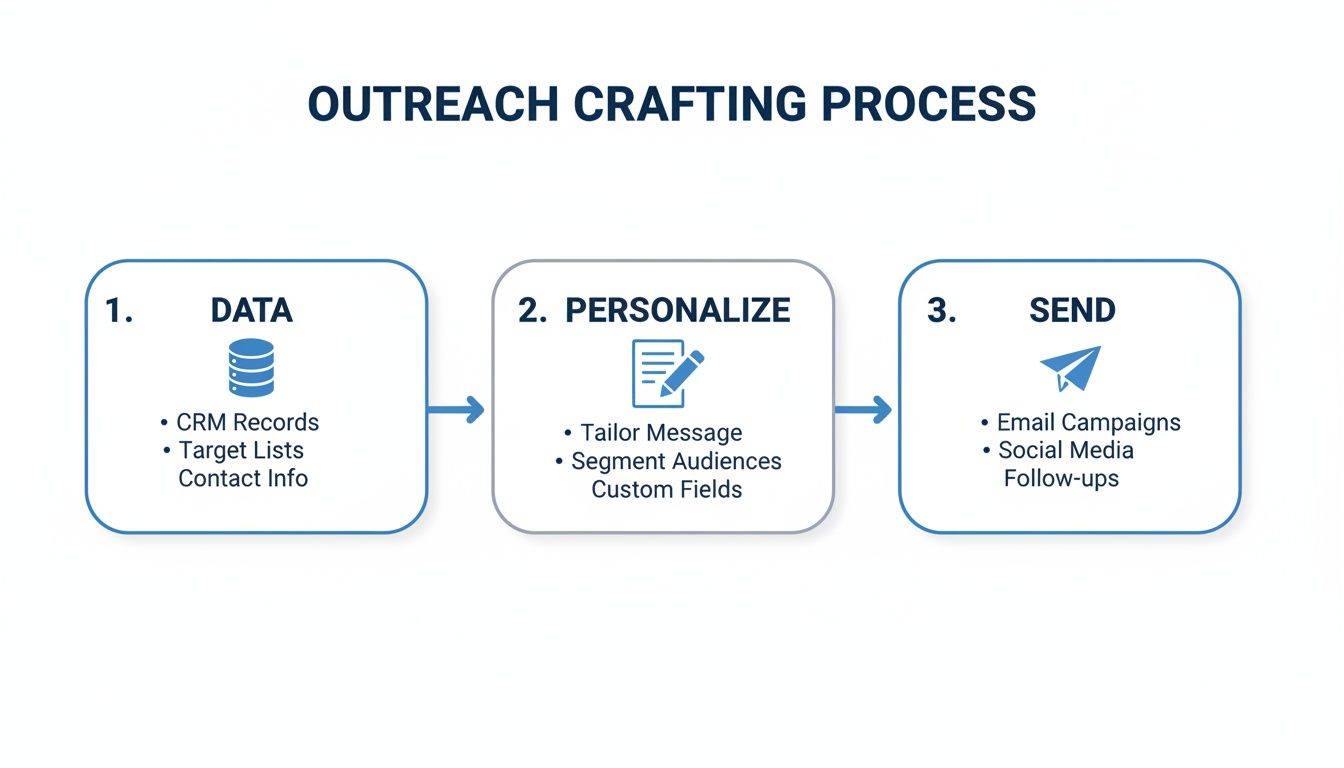
    A flow chart illustrating the three-step outreach crafting process: Data, Personalize, and Send.

    This is the foundation of a system that turns raw shipment data into actual, meaningful conversations.

    Structuring Your Daily Prospecting Hour

    To hit that level of productivity, you need structure. Forget starting from scratch every single day. The secret is to build your workflow around saved searches and meticulously organised lists. This transforms a daunting task into a simple, repeatable routine that just plain works.

    Here’s a practical workflow you can put into action right away:

    • Create and Save Your Go-To Searches: For every territory or trade lane you cover, build a specific search query in a platform like Coreties and save it. Think along the lines of "Shippers of automotive parts from Japan to Singapore" or "Companies importing consumer electronics into the UK." Running these saved searches daily takes mere seconds and immediately brings fresh, qualified leads to your screen.

    • Map Out Your Territory with Geo-Search: Get visual with your market. A geo-search tool lets you literally draw a circle on a map to see all the relevant shipper activity in that zone. It's incredibly useful for planning regional sales trips or uncovering clusters of high-potential clients you might have otherwise missed.

    • Sort Prospects into Actionable Lists: When you find a good lead, don't let it get lost in a massive search result. Move it into a dedicated list. Name them something useful, like "Q4 Singapore Follow-Up" or "High-Volume Vietnam Shippers." This kind of segmentation is what allows you to run truly targeted campaigns.

    Systematising the discovery phase removes the friction that slows down most sales teams. Your goal should be to spend less time hunting for information and more time acting on the insights it gives you.

    Activating Your Lists with Sequences

    With your prospects neatly organised, the final piece of the puzzle is engaging them at scale without sounding like a robot. This is where automated follow-up sequences shine.

    You can enrol an entire list of similar companies into a pre-written email sequence. By using data points you've already gathered—like their company name or a specific trade lane they use—each email feels personal.

    This approach lets you nurture dozens of potential relationships at once. A thoughtfully crafted sequence keeps you on their radar, delivering value over a series of touchpoints until that import export firm is ready to talk business. This repeatable system is the engine that drives sustainable growth and makes sure your pipeline never runs dry.

    Your Top Questions About Shipper Prospecting Answered

    Switching to data-driven prospecting is a big move. It’s a completely different way of finding clients, so it’s only natural to have questions about how it all works in practice. We've heard a lot of the same queries from freight forwarders and carriers making the jump, so let's tackle them head-on.

    Think of this as your practical guide to clearing up the common hurdles so you can start using tools like Coreties with total confidence.

    How Current Is the Shipment Data?

    This one comes up all the time, and for good reason—timing is everything in logistics. The great news is that global customs data is typically updated daily. You can often see a bill of lading online within 24 to 48 hours after it’s been filed.

    This isn’t about looking at what a company shipped six months ago; it’s about seeing what’s happening right now. Imagine spotting a new shipper moving cargo on a lane you specialise in. With this kind of speed, you can get in touch while their shipping needs are still fresh in their minds, giving you a huge leg up on competitors who are still working from old directories.

    The freshness of customs data is your edge. It turns prospecting from a historical review into a live, actionable intelligence operation, allowing you to engage with an import export firm at the perfect moment.

    Can I Find Contact Information for Small Businesses?

    Definitely. It's a common misconception that data tools only work for big corporations. Modern data enrichment platforms are surprisingly good at digging up the right contacts at small and medium-sized businesses (SMEs). They scan everything from public records and company websites to professional networks like LinkedIn to pinpoint the person in charge.

    The trick is to think about who wears the logistics hat in a smaller company. You might not find a "VP of Supply Chain," but you'll almost certainly find someone with a title like:

    • Owner or Founder
    • Operations Manager
    • General Manager

    Someone is responsible for getting those goods moving. Good data enrichment helps you figure out exactly who that person is, so your pitch lands in the right inbox instead of a generic "info@" address.

    What If My Target Company Uses a Freight Forwarder?

    Seeing a freight forwarder’s name on a bill of lading can feel like hitting a brick wall, but it's really a detour, not a dead end. In fact, it’s a very common scenario. The best data platforms are designed to see past this.

    They can often identify the actual shipper or consignee listed on the documentation, even when a forwarder is the primary name. This is a game-changer. It means you can go straight to the source—the business that owns the cargo. When you know who the end customer is, you can speak directly to their pain points, whether it’s shipping car parts or coffee beans, making your outreach far more relevant and powerful.


    Ready to stop prospecting with guesswork and start using a precise, data-driven system? Coreties provides the tools you need to find high-value shippers, connect with the right decision-makers, and send messages that actually get a response. Stop searching and start connecting by visiting https://coreties.com.

  • Exporters in singapore: A Quick Guide to Finding and Qualifying Top Partners

    Exporters in singapore: A Quick Guide to Finding and Qualifying Top Partners

    Singapore's export market is a goldmine of high-value goods, but you need the right map to find the treasure. It's dominated by advanced electronics, pharmaceuticals, and specialised machinery. For any logistics seller trying to break in or expand, knowing these core industries is just the starting point. The real game is about pinpointing the companies with consistent, high-volume shipping needs.

    Getting to Know the Singapore Export Scene

    To really make a dent and find the best exporters in singapore, you have to look past the obvious and dig into the trade data. This is where the true market dynamics reveal themselves. Yes, Singapore’s strategic location and business-friendly policies have built a robust export economy, but the golden opportunities are hidden within specific, fast-growing commodity groups and the trade lanes they frequent.

    Forget the scattergun approach of contacting every company you can find. A focused analysis lets you pour your energy into sectors that are actually shipping, meaning you're not just finding any exporters—you're finding the right ones.

    Where the Action Is: High-Growth Sectors and Key Commodities

    The engine room of Singapore's export economy is its high-tech and high-value manufacturing. While many industries play a part, a few consistently stand out for their sheer volume and upward trajectory.

    Here's a quick snapshot of the key export categories showing significant recent growth, which can help you identify high-potential industries.

    Singapore's High-Growth Export Sectors

    Export Sector Key Products Recent Growth Indicator
    Electronics & Electrical Machinery Semiconductors, integrated circuits, disk media, telecom equipment Accounts for over a third of total exports, with some sub-sectors growing over 80%.
    Pharmaceuticals & Chemicals Pharmaceutical products, organic chemicals, medical instruments Requires specialised, often temperature-controlled, logistics solutions.
    Specialised Machinery Industrial turbines, precision engineering components, manufacturing equipment Reflects Singapore's critical role in complex global supply chains.

    These are the sectors where logistics demand is proven and growing. By understanding what they ship and how they ship it, you can tailor your value proposition to solve their specific challenges.

    The electronics and electrical machinery sector is the undisputed champion, making up over a third of all exports. We're talking about a daily flood of semiconductors, integrated circuits, and telecom gear leaving the country.

    Then you have the biomedical sciences hub. Singapore pushes out a massive volume of pharmaceuticals, organic chemicals, and medical instruments—shipments that often demand specialised handling and cold-chain integrity. Finally, specialised machinery, from industrial turbines to precision parts, highlights Singapore’s position as an essential link in global manufacturing supply chains.

    The official numbers back this up. Singapore's non-oil domestic exports (NODX) recently posted a remarkable 4.8% growth, blowing past forecasts. What powered this surge? Electronics. Integrated circuits jumped 32.1%, disk media products climbed 53.5%, and telecommunications equipment shot up by an astounding 81.4%. You can read more about these export growth trends on The Straits Times.

    Drilling down into these specific products is crucial. To get a better handle on identifying them within customs data, check out our guide on how to navigate Singapore's customs HS codes.

    By zeroing in on these thriving areas, you align your sales efforts with the most active and valuable parts of the market. This data-first approach means your time is spent engaging prospects who have immediate and ongoing logistics needs, which naturally leads to better conversations and a much higher chance of winning their business.

    Using Customs Data to Find Qualified Shippers

    A bigger list isn't the answer to better prospecting; a smarter one is. For any logistics provider trying to win business with exporters in Singapore, the best tool in your arsenal is customs data. This raw information, once you know how to filter and analyse it, goes from being a sea of noise to a curated pipeline of genuinely qualified leads.

    Forget sifting through outdated business directories. Real trade data tells you exactly who is actively shipping, what they’re moving, and how often they're doing it. This methodical approach means your sales team spends their time on prospects with tangible, immediate logistics needs, which completely changes your prospecting ROI. It’s the difference between a shot-in-the-dark cold call and a warm, data-backed conversation.

    Pinpointing Active Exporters with Precision Filters

    The real magic of a platform like Coreties is its ability to slice through the clutter. You can move past basic company demographics and start filtering prospects based on their actual shipping behaviour. This is how you build hyper-targeted lists of companies whose needs are a perfect match for what you do best.

    Here are a few of the most powerful filters I always start with:

    • HS Codes: This lets you zero in on companies exporting specific commodities. If you specialise in handling electronics, you can filter for HS Code 85 to instantly find every company shipping semiconductors and telecommunications gear.
    • Trade Volume: Want to find the bigger fish? Set a filter for the total weight or declared value of shipments over a set period. This helps you prioritise exporters with more consistent, high-value freight.
    • Shipping Frequency: This is key for identifying businesses with regular, ongoing demand. A simple filter for companies shipping more than five times a month to a specific destination uncovers businesses with stable, predictable logistics needs.
    • Trade Lanes: Focus your energy on the routes where you have the strongest operational advantage. You can build a targeted list of every company exporting from Singapore to key markets like China, Malaysia, or the USA.

    By combining these filters, you can create an incredibly powerful search. For example, you could find all Singaporean companies that have shipped over 10,000 kg of pharmaceutical products (HS Code 30) to the United States in the last six months. That’s not a prospect; that’s a qualified lead ready for a call.

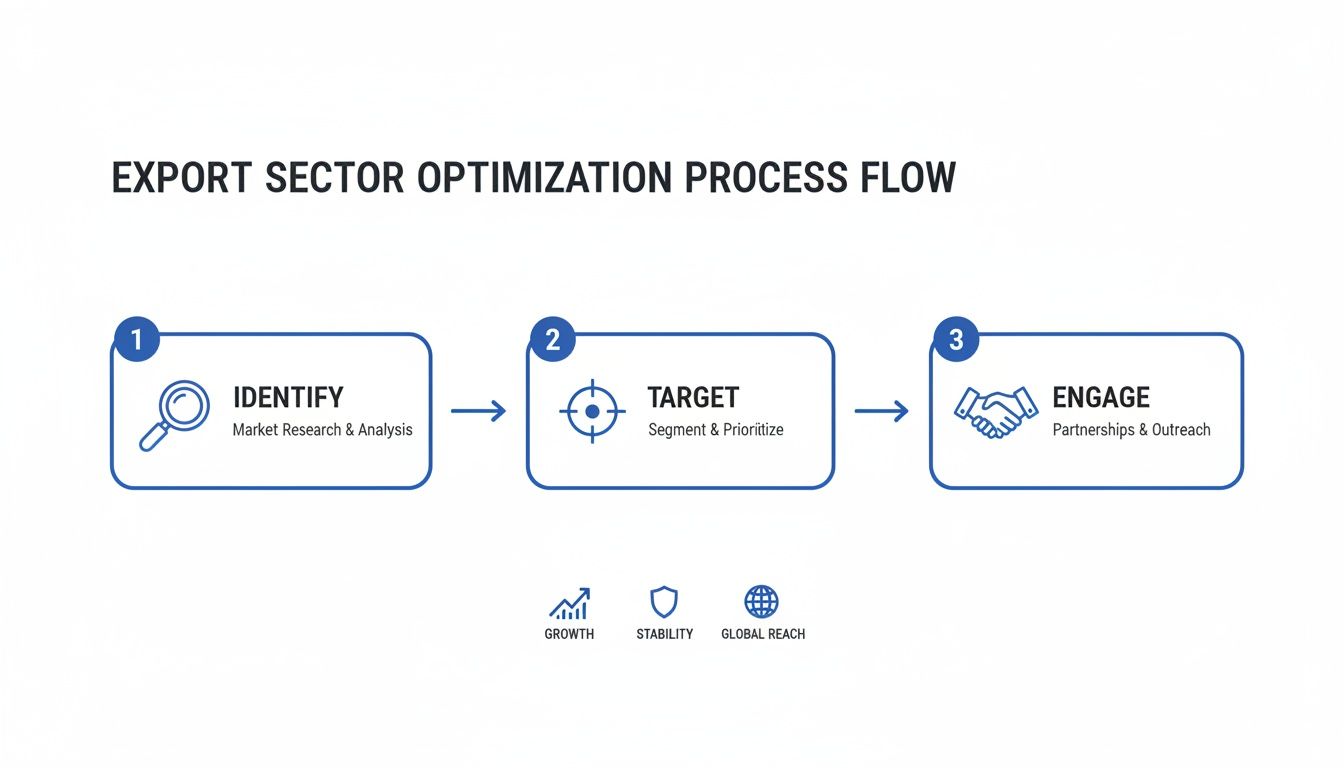
    The workflow below shows just how simple yet effective this process is for turning raw data into real conversations.

    Export sector optimization process flow with three steps: Identify, Target, Engage, aiming for Growth, Stability, Global Reach.

    This simple flow—Identify, Target, Engage—is the foundation of a data-driven sales strategy. It gets you from broad market awareness to specific, high-potential conversations, fast.

    From Data Points to Actionable Insights

    Once your initial filters are in place, the next step is to interpret what you’re seeing to qualify prospects even further. A company shipping a high volume of a single commodity to one destination has very different pain points from one sending smaller, mixed consignments to multiple countries. Your pitch has to reflect that reality.

    For instance, a company consistently exporting machinery parts to Taiwan could be a perfect fit for your consolidated LCL services on that lane. Another business moving high-value electronics to Europe might be much more interested in a proposal that highlights your premium air freight capacity and enhanced security measures. If you want to dive deeper into this, check out our guide on how to use an HS code filter for smarter prospecting.

    This level of insight is just impossible to get from standard prospecting tools. When you ground your strategy in real shipping data, you're not just finding potential customers—you're uncovering their specific logistics challenges before you even pick up the phone.

    Spotting High-Value Trade Lanes and Opportunities

    Let's be honest, not all trade lanes are created equal. If you want to succeed in prospecting exporters in Singapore, you need to get smart about identifying and chasing the most profitable shipping routes. Global trade is always in flux, and those shifts constantly carve out new opportunities for anyone paying close attention.

    The best way to do this? Ditch the guesswork and dive into real-world customs data. This is how you pinpoint lanes with surging volumes and tailor your services to match. Imagine knowing that exports to a specific country have shot up recently. You can get ahead of the curve, secure competitive capacity on that lane, and walk into a sales meeting with a powerful, relevant value proposition.

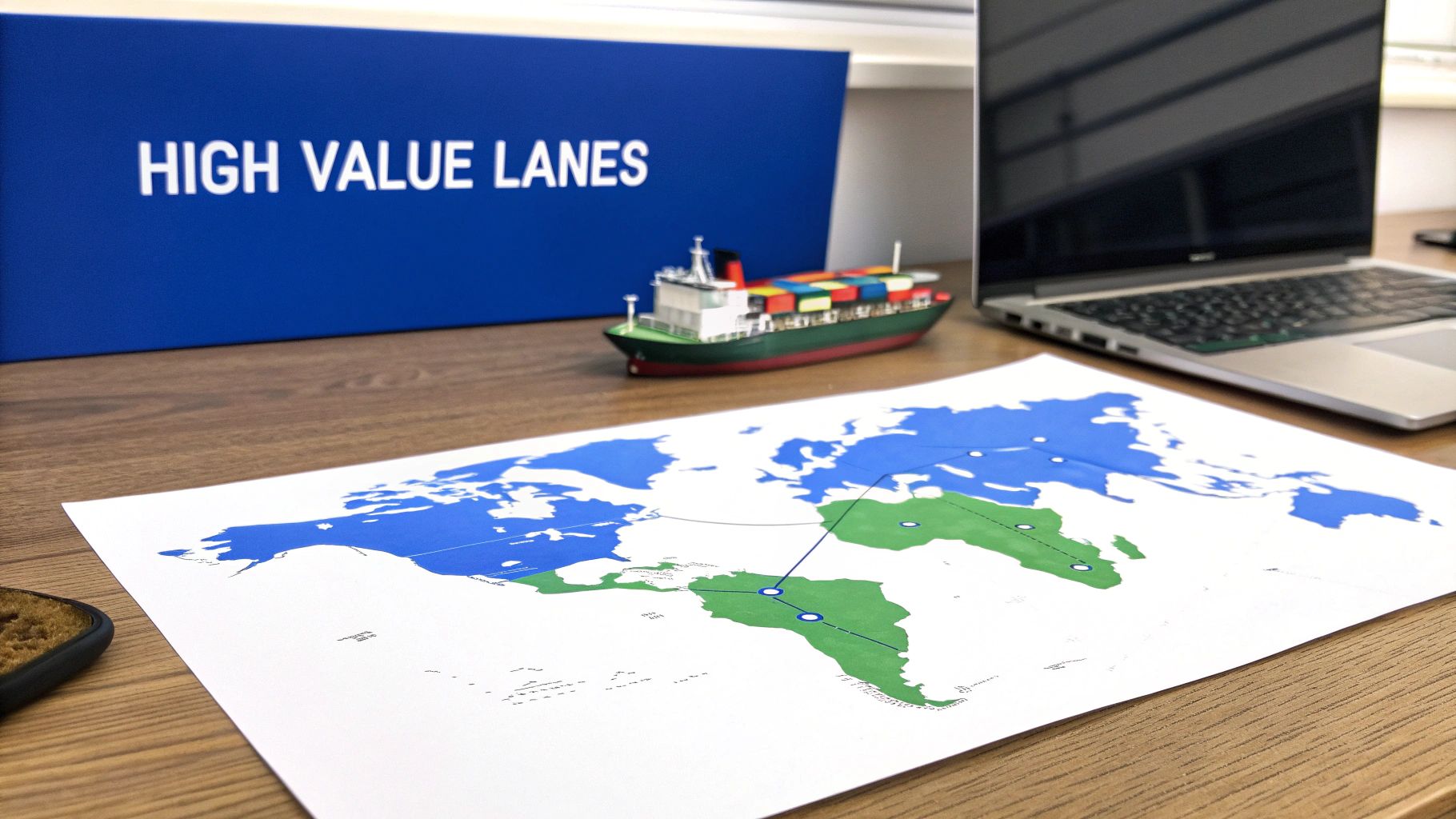
    Global logistics setup with a world map, container ship model, laptop, and 'HIGH VALUE LANES' sign.

    This image nails the concept of finding those golden lanes. The real trick, though, is turning that big-picture idea into hard data that fuels your sales strategy.

    Analysing Recent Trade Shifts

    Looking at the latest data, we can see some pretty significant shifts in where Singapore's exports are headed. Recent figures for non-oil domestic exports (NODX) show a 17.9% jump in shipments to China. Even more impressive, exports to Taiwan climbed 24.3%, and Malaysia saw a solid 13.3% increase.

    On the flip side, the United States market took a hit, with exports dropping a sharp 36.3%. You can dig into these recent export figures from Morningstar for a closer look.

    This isn't just random noise; it's a clear signal. Singapore's export focus is pivoting towards key Asian markets. For freight forwarders, these numbers are gold. They tell you exactly where to point your sales team—towards lanes with proven, growing demand and away from those hitting a rough patch.

    Turning Lane Data into a Sales Advantage

    Knowing the trends is one thing; using them to win business is another. This is where you can really separate yourself from the competition. Forget the generic sales pitch and start segmenting your prospect list based on where they actually ship their goods.

    Here's how this plays out in the real world:

    • For Exporters to China and Taiwan: Your outreach should be all about your strong capacity, competitive transit times, and local know-how in these booming markets. You're speaking their language.
    • For Exporters to Malaysia: You can lead with efficient cross-border trucking or smart intermodal solutions that balance speed with cost. It’s a practical, valuable suggestion.
    • For Exporters to the US: The conversation changes. With volumes down, your focus should shift to value-add services. Talk about optimising their supply chain, suggest alternative routing, or offer warehousing solutions to help them navigate the downturn.

    By aligning your service offerings with real-time trade lane dynamics, you transform from a simple service provider into a strategic partner. You are no longer just selling freight; you are offering data-backed solutions to a prospect’s most current and pressing logistics challenges.

    This level of insight is what makes top performers stand out. It ensures your team is always zeroed in on the most promising parts of the market, armed with a message that actually resonates. When you can engage the right exporters in Singapore with solutions that solve their immediate operational headaches, your chances of winning their business go way up.

    Connecting With the Right Decision-Makers

    You've got a solid list of high-potential exporters in Singapore. Great. But that's only half the battle, isn't it? A list of company names doesn't sign deals. Real people do. This is where we shift from crunching customs data to taking targeted action, getting your pitch past the gatekeepers and onto the screen of the person who actually makes the decisions.

    Let's be honest: firing off a brilliant proposal to a generic info@ email address is a complete waste of your time and effort. Our goal is to pinpoint the exact individuals whose job it is to solve the shipping headaches you're built to fix.

    A person's hand touches a tablet displaying 'Reach DECISION MAKERS' and a business profile picture.

    Identifying Key Logistics Contacts

    First things first, you need to know who you’re looking for. Aiming for the "CEO" at a major enterprise is usually a rookie mistake; they're often too far removed from the day-to-day grit of logistics. You need to get more granular.

    Your best bet is to find people with titles that scream logistics, supply chain, or operations. Think along these lines:

    • Head of Logistics
    • Supply Chain Manager
    • Global Operations Director
    • Procurement Manager (especially those with a logistics focus)
    • Export/Import Manager

    This is where a tool like LinkedIn Sales Navigator becomes your best friend. You can zero in on a target company and filter its employee list by these keywords. It’s a quick and dirty way to build a highly relevant contact list, ensuring your message lands with someone who genuinely cares about freight rates and on-time deliveries. If you're looking to understand how these roles fit into different company structures, it helps to know the differences between EXIM, MFR, and enterprise setups.

    A common pitfall I see is aiming too high or too low in the org chart. A junior coordinator probably doesn’t have the authority to sign off on a new freight partner. A C-level exec is focused on the 30,000-foot view, not specific shipping lanes. Your sweet spot is the mid-to-senior level manager who feels the direct pain of logistics problems.

    Crafting Data-Driven Outreach

    Once you’ve identified the right person, your outreach has to show you’ve done your homework. A generic "we can save you money" email gets deleted in a heartbeat. This is your chance to weave in the valuable data you've already gathered.

    Your opening line is everything. It needs to instantly signal that this isn't some mass-blasted spam. Reference a specific commodity they ship or a high-volume trade lane they operate on, and you’ll immediately establish credibility.

    Here’s a practical example for a prospect shipping electronics to Taiwan:

    Subject: A thought on your electronics shipments to Taiwan

    Body: "Hi [Prospect Name], I saw that your company is a significant exporter of integrated circuits to Taiwan. With volumes on that lane growing, I thought you might be interested in our consolidated air freight options that have been helping similar electronics shippers reduce transit times by up to 20%."

    See the difference? This approach is powerful because it’s not about you—it’s about them. It shows you understand their business, their specific market, and their potential challenges.

    The scale of opportunity here is massive. In a recent peak month, Singapore's total export value hit 70,121.84 SGD million, with forecasts trending around 64,000 SGD million for the coming months. With that much volume moving, a personalised, data-informed message isn't just a good idea; it's the only way to cut through the noise. You can discover more insights about Singapore’s export trends on Trading Economics.

    Crafting Proposals That Win Business

    Getting that first "yes" from a decision-maker is a great feeling, but it’s really just the starting whistle. The real game is turning that initial interest into a solid, long-term partnership. This is where you bring all your data-driven insights to the table and build a proposal that doesn't just quote prices—it solves their specific shipping challenges.

    Your whole mindset needs to shift from just selling freight to offering genuine strategic value. You’ve already done the hard work of figuring out what an exporter ships and where. Now, it’s time to use that intel to frame a proposal that speaks directly to their world, proving you get their supply chain inside and out.

    Moving Beyond Price-Led Conversations

    The quickest way to get lost in the noise is to make it all about price. Competing on cost is a race to the bottom, turning your valuable service into a commodity. The good news is, the customs data you've gathered on exporters in Singapore gives you the perfect opening to talk about value, efficiency, and reliability—the things that really impact a shipper's bottom line.

    Think about it this way: you’re not just offering a rate for shipping electronics to Europe. You’re proposing a smarter routing option through a key partner hub that could shave a day off transit time. Or maybe you're suggesting a clever intermodal solution that perfectly balances cost and speed for their chemical shipments to the US.

    It’s these kinds of specific, thoughtful recommendations that show you’re thinking like a partner, not just another vendor quoting a lane.

    Tailoring Solutions with Trade Data

    Your proposal should feel like a direct answer to the prospect's needs, using their actual shipping patterns as the foundation. Let's walk through a couple of practical examples.

    • The High-Volume Electronics Exporter: You’ve found a company sending thousands of kilograms of semiconductors (HS Code 85) to Taiwan every month. A generic air freight quote won’t cut it. Instead, your proposal could lead by highlighting your priority booking access with certain airlines on that specific lane, guaranteeing their high-value, time-sensitive goods are always wheels-up on schedule.

    • The Specialised Chemical Shipper: Your data shows a prospect exports organic chemicals (HS Code 29) to several spots in Southeast Asia. Here, you can lead with your proven expertise in handling hazardous materials. Outline your specific safety protocols and compliance measures that take the risk off their plate for this sensitive cargo.

    The trick is to turn data points into direct, tangible benefits. Don't just say, "I see you ship to Germany." Instead, explain how your consolidated service to Hamburg will improve their operations, reduce their risk, or even save them money in ways they hadn't considered.

    This consultative approach completely changes the sales dynamic. You’re no longer just one of many bidders in their inbox; you become a trusted advisor. By proving you’ve invested the time to understand their business before you even ask for it, you’re not just more likely to win the deal—you're laying the groundwork for a profitable, long-lasting relationship.

    Got Questions About Finding Singaporean Exporters?

    Even with the best data in hand, hitting the ground running to find new exporters in Singapore can feel tricky. You're not alone. Let's walk through some of the most common questions and sticking points I see sales professionals run into.

    Think of this as your quick-reference playbook for getting past those hurdles that can really stall your momentum.

    What's the Best Way to Actually Get a List of Exporters?

    Honestly, forget generic business directories. The real game-changer is getting your hands on a platform that taps directly into customs and bill of lading data. This is where the gold is.

    Why? Because it’s not about finding a list of companies; it's about finding proof of their shipping activity. This kind of data lets you get incredibly specific.

    • Commodities: You can use HS codes to pinpoint companies that export the exact goods you're best at handling. No more guessing.
    • Shipping Volume: Want to chase the big fish? Filter for high-volume shippers and focus your energy where it counts.
    • Trade Lanes: Target businesses shipping to destinations where you know you have a competitive edge.
    • Frequency: Zero in on companies with steady, reliable shipping schedules—the bread and butter of our business.

    When you start with real trade data, you’re no longer prospecting blind. You’re building a qualified list of active exporters who have a clear, current need for what you’re selling.

    Which Industries Are Shipping the Most Volume Right Now?

    No surprise here: electronics are king. This sector is a juggernaut, pushing out massive volumes of integrated circuits (HS Code 85), telecom gear, and computer parts. We're talking about over a third of Singapore’s total exports.

    But don't stop there. Pharmaceuticals, chemicals, and specialised machinery are also huge players. The key is to look deeper. Use the data to see which specific products are heading to destinations that match your strongest trade lanes.

    The real secret isn't just knowing the top industries; it's finding the perfect overlap between a niche's needs and your unique value. For instance, if you're a pro at cold-chain, targeting pharmaceutical exporters shipping to Europe is a far smarter play than just spamming every manufacturer out there.

    How Do I Make My Outreach Email Not Sound Like Everyone Else's?

    Data-driven personalisation is your secret weapon. Generic emails get deleted in seconds. Your first message has to prove you’ve done your homework.

    Try opening with something specific you found. For example: "I noticed your company is consistently shipping electronic components to Taiwan. That’s a key lane for us, and we've been able to secure priority air freight space that could cut your transit times."

    This kind of opener works because it immediately shows you get their business. You're not just another forwarder—you're a potential partner who understands their specific routes and commodities. That's how you cut through the noise and get a reply.

    What Are Some Common Prospecting Mistakes I Should Avoid?

    One of the biggest pitfalls is chasing only the massive, household-name exporters. They’re constantly bombarded by your competitors and are usually locked into rigid, long-term contracts. The smarter move? Use data to find those fast-growing small and medium-sized enterprises (SMEs). Their logistics needs are changing, and they're often more open to new partners.

    Another classic mistake is leading with price. Your first email should scream "value," not "discount." Show you understand their supply chain. Finally, make sure you're talking to the right person. Don't just email a generic info@ address. Use tools like LinkedIn Sales Navigator to find the Head of Logistics or Supply Chain Manager—the person who can actually say yes.


    Ready to stop guessing and start connecting with qualified exporters in Singapore? Coreties transforms raw customs data into an actionable pipeline of high-value leads. Filter by commodity, lane, and volume, then connect with verified decision-makers using data-driven outreach. Discover how much faster you can build your sales pipeline.

  • Your Guide to Finding the Right Importer in Singapore

    Your Guide to Finding the Right Importer in Singapore

    Finding the right importer in Singapore means digging deeper than surface-level trade numbers. Your success depends on zeroing in on the high-value sectors that are the real engine of this global trade hub.

    Understanding the Singapore Import Ecosystem

    Singapore's standing as a trade giant is no accident. It's built on a bedrock of high-value, high-demand industries. While the total trade figures are staggering, the real gold for freight forwarders is knowing which specific commodities are constantly moving through its ports. This insight is what separates generic prospecting from a targeted, effective sales strategy.

    Think of the market as a bustling ecosystem, not a single entity. A few key sectors drive the vast majority of import value. Your first job is to identify the companies operating in these specific verticals to build a lead list that’s actually worth pursuing.

    Key Import Sectors to Target

    If you want to find a truly valuable importer in Singapore, you need to go where the volume is. The most significant opportunities for logistics partnerships are found in the industries that are the lifeblood of the nation's economy.

    • Electronics: This is the big one. The electronics sector is massive, covering everything from tiny semiconductors and integrated circuits to finished consumer goods. Global supply chains for the biggest tech names in the world run directly through Singapore, meaning importers here are always busy.

    • Machinery and Equipment: A strong second, this category includes heavy-hitters like industrial machinery, power generation equipment, and specialised mechanical parts. These goods fuel Singapore's world-class manufacturing and construction sectors.

    • Energy and Petroleum Products: Singapore is a major refining and distribution hub, so it's no surprise that it imports enormous quantities of crude oil and other mineral fuels. Companies in this space deal in massive volumes and require logistics partners with serious expertise.

    • Pharmaceuticals and Chemicals: This is a rapidly growing, high-value sector. Pharmaceuticals and specialised chemical products need incredibly strict handling and airtight supply chains, opening the door for forwarders who can offer that specialised service.

    It really boils down to this: follow the money. When you focus on these high-value trade lanes, you're putting your services in front of the most active and profitable importers. It dramatically increases your odds of landing valuable, long-term partnerships right from the start.

    Strategic Trade Lane Focus

    Knowing what is being imported is only half the battle. You also need to know where it's coming from. Singapore’s top trading partners are consistently the world’s economic powerhouses—think China, Malaysia, the United States, and nations across the European Union. An importer’s main trade lanes tell you a lot about their operational needs.

    For instance, a company bringing in container loads of electronics from South Korea has a completely different set of logistical headaches than one sourcing heavy machinery from Germany. Once you analyse these patterns, you can shape your pitch to solve their specific problems and show them why you're the perfect fit.

    If you’re just starting out, getting a solid handle on the fundamentals of the import-export business is crucial. Doing this homework is what turns a wide, hopeful search into a sharp, strategic campaign.

    Using Trade Data to Pinpoint High-Value Importers

    Forget casting a wide net with generic prospect lists and cold calls that go nowhere. If you want to find a quality importer in Singapore, you need to stop guessing and start following the data. The real story is in the trade data—specifically, customs declarations. This gives you a detailed map of who is importing what, from where, and how often.

    Instead of trying to sell to everyone, this approach lets you build a hyper-targeted list of companies that are already buying the exact services you offer. Imagine knowing precisely which businesses are consistently receiving shipments of electronics from South Korea or heavy machinery from the United States. This kind of intelligence turns your sales process from a shot in the dark into a data-backed strategy.

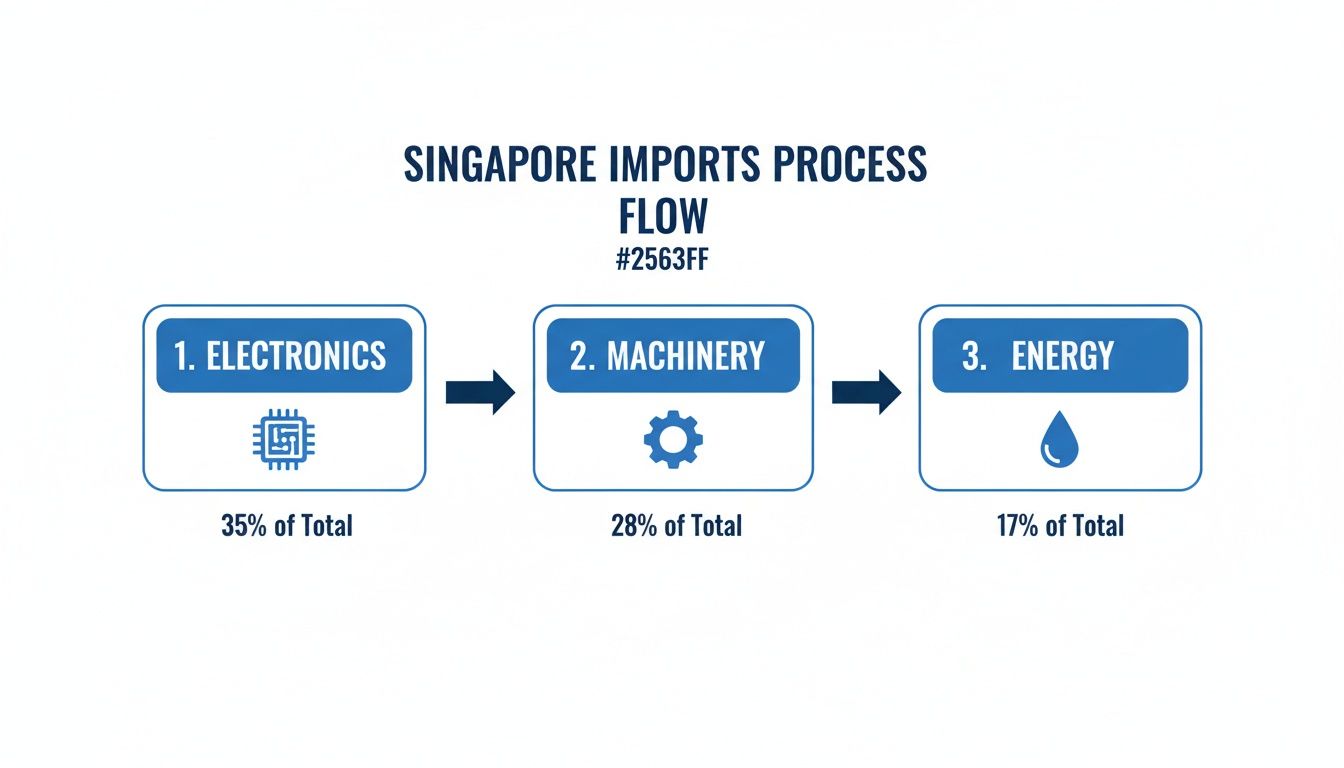
    The major import categories flowing into Singapore paint a clear picture of where the biggest opportunities lie.

    Infographic showing Singapore's top imports process flow: Electronics (35%), Machinery (28%), and Energy (17%).

    As you can see, electronics, machinery, and energy products are the heavyweights. These sectors represent the most significant and consistent import volumes, making them prime targets for logistics providers.

    Decoding Customs Data

    At the core of all this trade data are Harmonised System (HS) codes. These are the standardised numerical codes that customs authorities around the globe use to classify every product imaginable. By filtering your search for specific HS codes, you can instantly see every company in Singapore that has recently imported the exact products you specialise in handling.

    Let's say your firm excels at shipping automotive parts. You could run a search for importers bringing in goods under HS code chapter 87. Just like that, you've cut through the noise and are looking at a list of relevant, high-potential leads.

    Refining Your Search with Strategic Filters

    A basic HS code search is a great start, but the real power comes from layering on additional filters. This is how you separate the high-value, long-term partners from the occasional shippers.

    Here are a few filtering strategies I've seen work wonders:

    • Country of Origin: Focus on importers sourcing goods from specific countries. This is perfect for targeting companies active on the trade lanes where you have the strongest network and most competitive rates.
    • Shipment Frequency: Isolate companies with consistent import volumes. An importer receiving multiple containers every month is a far more valuable prospect than one who only imports once a year.
    • Shipment Value: Zero in on importers dealing in high-value goods. This often points to a more mature and stable business that understands the importance of a reliable logistics partnership.

    By combining these filters, you can get incredibly specific. For instance, you could identify all companies that imported more than $500,000 worth of electronic components from China at least five times in the last quarter. Now that's a qualified lead.

    The goal here is to shift from a broad list of "potential importers" to a curated list of "ideal partners." Data allows you to define exactly what your ideal partner looks like and then find them with surgical precision, saving you countless hours of wasted effort.

    To give you a better idea of the landscape, we've compiled a table highlighting Singapore's key import partners and the types of goods they supply.

    Top Import Sources and Key Commodities for Singapore

    This table highlights Singapore's main import partners and the corresponding high-value product categories, helping logistics professionals target specific trade lanes.

    Origin Country Share of Imports Primary Commodities
    China 13.5% Electronics, Machinery, Consumer Goods
    Malaysia 12.1% Refined Petroleum, Integrated Circuits
    United States 10.3% Aircraft Parts, Medical Instruments, Oil
    Taiwan 8.9% Semiconductors, Electronic Equipment
    South Korea 6.2% Petroleum Products, Telecommunications

    This data provides a strategic starting point, showing you where to focus your business development efforts based on current trade flows.

    Understanding this landscape is critical. Singapore's total imports recently hit a staggering 45.9 USD billion in a single month—a massive 20.3% year-over-year jump. With machinery and equipment making up 43% of this total, the opportunity for forwarders who can effectively target the right players is immense.

    This data-driven method ensures that every company you reach out to is already qualified. For freight forwarders, platforms providing this level of detailed information are indispensable, turning raw data into actionable leads. They help you understand the specific needs of each importer in Singapore before you even pick up the phone. To dig deeper, you can learn more about how to use EXIM data for manufacturers and enterprises and build a powerful prospecting pipeline.

    How to Qualify and Vet Potential Import Partners

    You’ve got a list of potential importers. That’s a great start, but it's just that—a start. The real work begins now, separating the high-volume, consistent players from the one-off shippers. This qualification step is non-negotiable. It’s how you make sure every bit of effort you put into outreach is aimed at a company that actually fits your business.

    Vetting an importer in Singapore goes way beyond a simple existence check. You need to get into the rhythm of their business. Think shipment volume, frequency, and the specific trade lanes they use over and over. This kind of data-driven digging lets you weed out the low-potential leads and concentrate on building genuinely profitable, long-term relationships.

    Hands review partner qualifications on a tablet and paper with a magnifying glass.

    Assessing Shipment Patterns and Consistency

    The first thing I always look at is an importer’s shipping history. It tells you almost everything you need to know. A business that brings in a single container twice a year has completely different needs from one juggling multiple shipments every week. What you’re looking for is consistency.

    • Volume and Frequency: Look for importers with regular, predictable shipping schedules. That steady activity is a massive green flag, signalling a stable business with a constant need for the kind of logistics services you offer.

    • Trade Lane Stability: Does the importer stick to the same routes? Someone consistently shipping from hubs like China or the US has a stable supply chain. That makes them a far more reliable—and valuable—target for your services.

    These patterns reveal a company's operational maturity. They tell a story that raw numbers can't, showing you who has a genuine need for the sophisticated solutions you provide.

    A partner's legitimacy and operational scale are two sides of the same coin. Verifying their official registration builds trust, while analysing their trade history confirms their commercial viability. Skip one, and you risk wasting time on a dead end.

    Verifying Company Legitimacy and Reputation

    Once you’ve found importers with promising shipping patterns, it’s time to confirm they are who they say they are. This is basic risk management and ensures you’re partnering with a trustworthy organisation.

    Your first stop should always be Singapore's Accounting and Corporate Regulatory Authority (ACRA). A quick search on the ACRA portal will confirm a company’s registration, address, and other official details. Consider this the absolute baseline for your due diligence.

    But don’t stop there. Look beyond the official records to get a feel for their market reputation. Do they have a professional online presence? What are people saying about them in industry reviews or trade publications? This qualitative check gives you context that data alone can't. It's also worth getting clear on the responsibilities involved, which you can learn about by understanding the importer of record in our guide.

    Understanding the Broader Economic Context

    No importer operates in a vacuum. Their performance is directly linked to Singapore's overall trade health. The nation’s annual merchandise imports recently hit around US$567.3 billion.

    Even with a slight dip from the previous year, the recovery has been impressive, with trade jumping 19.0% month-over-month in December. Much of this growth came from increased imports from key partners like China and Malaysia. Keeping an eye on these macroeconomic trends in Singapore's main imports helps you gauge a potential partner’s stability and future growth prospects.

    Finding the Right Decision-Makers

    Pinpointing a high-value importer in Singapore is a great start, but it's only half the battle. The real work begins when you need to get your pitch in front of the right person. This is where most outreach campaigns fall flat.

    A brilliant email sent to a generic inbox or a junior staff member is an email wasted. To get any traction, you have to connect directly with the individual who actually feels the pressure of logistics problems and has the authority to do something about it. Your mission is to find the people whose performance hinges on how smoothly their supply chain runs.

    Decoding Job Titles and Hierarchies

    In logistics, job titles are your roadmap. They tell you who sets the strategy and who handles the day-to-day grind. If you want your message to land with someone who can actually sign a deal, you need to be precise in your targeting.

    Keep an eye out for titles like these:

    • Supply Chain Director or VP of Supply Chain: These are the big-picture thinkers. They're focused on high-level strategy—things like cost optimisation, managing risk, and building long-term partner relationships.
    • Logistics Manager or Head of Logistics: This is your person on the ground. They're wrestling with carriers, customs, and delivery schedules every single day, so they’re often very open to solutions that can simplify their workload.
    • Procurement Manager or Sourcing Manager: These are the negotiators. Their world revolves around contracts and managing the company's relationships with suppliers, including freight and logistics partners.
    • Operations Manager: Especially in smaller companies, this role is a catch-all. The Operations Manager frequently oversees the entire import and export process from start to finish.

    Getting a handle on this hierarchy is key. You might start a conversation with the Logistics Manager about operational details, but it's the Supply Chain Director you'll ultimately need to win over for a major partnership.

    Your outreach success rate will skyrocket once you stop sending messages to generic "info@" email addresses and start engaging directly with the people whose job titles scream "I manage freight."

    Using Professional Networks and Sales Tools

    Alright, so how do you actually track these people down? This is where your digital toolkit comes into play. Professional networks and sales intelligence platforms are essential here.

    LinkedIn is the natural first stop, and it's an incredibly potent tool for this. Just search for the company you're targeting and click on their "People" tab. You can then filter their entire employee list by job title using keywords like "logistics" or "procurement," and narrow it down by location to Singapore. In minutes, you can map out their whole supply chain team.

    If you need direct contact details, dedicated sales intelligence tools can give you verified email addresses and phone numbers. Yes, these platforms have a subscription fee, but the return on investment can be huge. Skipping the gatekeeper and landing your pitch directly in a decision-maker's inbox turns a hopeful shot in the dark into a targeted, meaningful conversation with the right importer in Singapore.

    Crafting Outreach That Actually Gets a Response

    So you've done the legwork. You’ve sifted through the data, identified a promising importer in Singapore, and vetted their business. This next step—the first point of contact—is where most sales efforts fall flat.

    Let's be honest, generic, copy-pasted emails are dead on arrival. They get deleted in seconds. If you want to even get a reply, your message has to prove from the very first line that you’ve done your homework and have something genuinely valuable to offer.

    This is where all that research you did pays off. Instead of a weak opening like, "we can help with your logistics," you can lead with something specific and impossible to ignore. This data-driven approach turns your outreach from a speculative shot in the dark into a targeted, relevant conversation that busy decision-makers will actually read.

    Close-up of a laptop and smartphone on a wooden desk with "TARGETED OUTREACH" overlay.

    From Data to Dialogue

    That trade data you analysed? It's your golden ticket to a good opening line. Mentioning a specific shipping lane they use or a recent shipment pattern immediately shows you understand their world. This isn't about being creepy or intrusive; it's about showing you're a professional who has already invested time in understanding their operational reality.

    For instance, instead of a generic intro, you could try something grounded in their actual activity:

    • "I noticed your company has consistent shipments of electronic components arriving from South Korea…"
    • "We specialise in the Germany-to-Singapore trade lane and saw your recent activity with heavy machinery imports…"

    See the difference? This simple tweak proves your relevance before you even pitch your services. You're no longer just another salesperson begging for a meeting; you're a potential partner who has already pinpointed a key part of their supply chain.

    The most effective outreach feels less like a sales pitch and more like the start of a strategic consultation. When you open with an observation about their business, you invite a conversation about their challenges and goals, not just your services.

    Framing Your Value Proposition

    Once you've got their attention, the next move is to connect their likely problems to your solutions. Importers are in a constant battle with freight costs, transit times, and supply chain reliability. Your job is to frame what you do as the direct answer to those headaches.

    The current economic climate makes this more crucial than ever. Singapore's Import Price Index, for example, has been all over the place, recently falling 0.7% one month only to jump 1.1% the next. You can dig into the specifics of these price index trends from SingStat.

    This kind of volatility puts immense pressure on an importer's margins. They are actively looking for ways to control costs and improve efficiency. This context is your secret weapon. You can position your freight forwarding partnership as a way to stay competitive, even when input costs are unpredictable.

    Real-World Outreach Examples

    Let's see what this looks like in the real world. Here’s a side-by-side comparison of a typical, ineffective email versus a sharp, data-informed one.

    The Generic Approach (Headed for the Bin):

    Subject: Logistics Services for Your Company

    "Hi [Prospect Name],

    My name is [Your Name] from [Your Company]. We offer competitive freight forwarding services and would love to discuss how we can help your business. Are you free for a call next week?"

    This is a one-way ticket to the trash folder. It’s all about the sender and offers precisely zero value to the person reading it.

    The Data-Informed Approach (Gets a Reply):

    Subject: Question about your shipments from Vietnam

    "Hi [Prospect Name],

    I noticed your company consistently imports furniture from Ho Chi Minh City. We manage significant volume on that lane and have helped clients reduce their average transit time by 15%.

    Given the port congestion we've seen recently, I imagine maintaining a reliable delivery schedule is a key priority. Would you be open to a brief chat about how we could potentially offer a more streamlined solution for your Vietnam-Singapore shipments?"

    This version just works. It's specific, it's relevant, and it’s focused entirely on solving a likely problem for the importer in Singapore. You immediately come across as an expert, not just another salesperson in their inbox.

    Common Questions About Finding Importers in Singapore

    When you're looking to break into the Singaporean market, a lot of questions come up. It's a busy, competitive hub, so getting straight answers from the get-go can save you a ton of time and prevent you from chasing dead ends. Let's tackle some of the most common queries we hear from freight forwarders.

    Where Do I Find the Best Data on Singapore Importers?

    Honestly, the most reliable and actionable information comes from specialised trade intelligence platforms and official customs databases. These aren't your average business directories; they pull together real shipping data and make it searchable for your sales team.

    What sets these tools apart is the ability to get granular. You can filter by specific HS codes, see where shipments are coming from, and spot actual shipping patterns. This is how you find an active importer in Singapore whose logistics needs are a perfect match for what you offer, rather than just a company that happens to be based there.

    The real trick is to look past static company lists. You need live shipping manifests and historical trade data. That's what tells you what an importer actually does and needs, long before you even pick up the phone.

    How Can I Be Sure a Singaporean Importer Is Legitimate?

    Verification is a crucial step before you invest any time in outreach. Your first port of call should always be the Accounting and Corporate Regulatory Authority (ACRA). A quick search in their business registry will confirm if the company is officially registered and give you their basic details.

    But that's just step one. To get the full picture, you need to dig into their trade history, check out their reputation in the industry, and get a sense of their financial stability. This due diligence is what separates a one-time shipment from a reliable, long-term partnership.

    What Are the Hottest Industries for Imports Right Now?

    If you're looking to target the biggest slice of the pie, current trade volumes point to a few key sectors. These are where the real opportunities lie for logistics providers:

    • Electronics: This is the largest and most consistent category by a long shot.
    • Machinery: A massive sector, covering everything from heavy industrial equipment to tiny specialised parts.
    • Mineral Fuels: We're talking high-volume oil and gas, a cornerstone of Singapore's trade.
    • Pharmaceuticals & Chemicals: These are high-value goods that often need specialised handling and care.

    By focusing your efforts here, you’re aligning your business with the most significant import flows into Singapore, which naturally creates more opportunities.


    Finding and qualifying the right partners is so much faster when you have the right tools. Coreties turns raw global trade data into highly targeted lead lists, putting you in touch with verified decision-makers in just a few clicks. See how you can build a powerful sales pipeline by visiting https://coreties.com.
  • Winning High-Value Exim & Mfr Enterprise Accounts in Singapore

    Winning High-Value Exim & Mfr Enterprise Accounts in Singapore

    In Singapore, an Exim & Mfr Enterprise is a specific type of business that handles both manufacturing its own products and managing its import and export logistics in-house. For logistics providers, these integrated companies are prime targets because their business models rely on consistent, high-volume shipping across complex global supply chains.

    Unlocking the Exim and Mfr Enterprise Opportunity

    Figuring out how to identify and connect with an Exim & Mfr Enterprise can give freight forwarders a real strategic edge. These businesses aren't just one-off customers; their entire operation depends on the steady flow of goods. Since they manage everything from production to distribution, their logistics needs are predictable and often quite large, making them excellent long-term partners.

    You'll find plenty of these opportunities in Singapore's high-growth sectors. Think about companies in electronics, pharmaceuticals, or precision machinery – they frequently use this integrated model. Their need for dependable, specialised freight services, like temperature-controlled transport or secure handling for sensitive parts, opens the door for logistics providers who can prove their expertise.

    A data-driven approach is key to cutting through the noise. When sales teams analyse shipment patterns and commodity flows, they can zero in on companies with active, high-volume shipping needs that are a perfect match for what they offer.

    This kind of targeted strategy makes your outreach far more effective. You can skip the generic sales pitches and approach potential clients with genuine insights about their operations. Getting the fundamentals right is the first step, and you can dive deeper into building a successful import-export business in our detailed guide. This focused approach makes sure you're putting your energy into the most promising prospects.

    Analysing Shipment Patterns and Key Trade Lanes

    To really get a foot in the door with an Exim & Mfr enterprise, you need to understand their logistics footprint. It's all about mapping their flow of goods by digging into customs and trade data. This reveals the crucial patterns in their air and ocean freight that point directly to high-value opportunities, taking you far beyond simple guesswork.

    You'll often find a heavy concentration of specific commodities moving along very particular routes. For example, Singapore’s top manufacturing exporters are constantly sending out high-value goods like advanced semiconductors, biomedical products, and precision machinery parts. When you can spot these patterns, you can perfectly align your logistics services with what they actually do day in and day out.

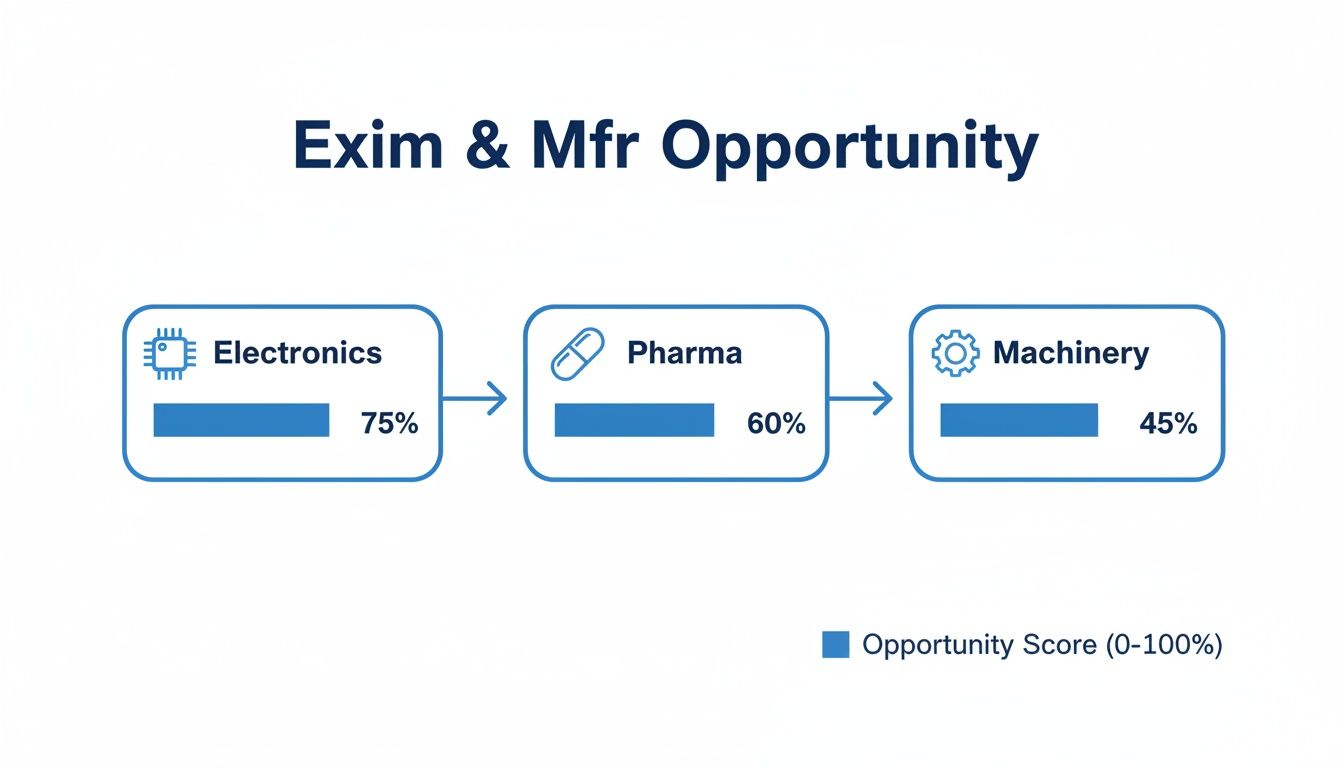
    This chart breaks down the opportunity scores for key sectors within the Exim & Mfr landscape, based on shipment volume and value.

    Flowchart showing Exim & Mfr opportunities with scores for Electronics (75%), Pharma (60%), and Machinery (45%).

    As you can see, electronics leads the pack, driven by consistent, high-value shipments, with pharmaceuticals and machinery following close behind.

    Core Trade Lanes and Commodities

    Pinpointing the most active trade lanes lets you focus your sales efforts where they'll have the biggest impact. Your analysis might uncover a manufacturer that consistently ships from Singapore to major hubs in Europe or North America. This is your opening.

    To give you a clearer picture, I've put together a table summarising the typical shipping profile for these enterprises. It covers everything from what they ship to how they ship it.

    Exim & Mfr Enterprise Shipment Profile

    A summary of typical shipping characteristics for manufacturing and export enterprises in Singapore's key growth sectors.

    Metric Description / Key Data Point
    Primary Exports Advanced electronics (semiconductors), pharmaceuticals, and specialised industrial machinery.
    Key Destination Hubs Major airports and seaports in the United States, Germany, and the Netherlands.
    Freight Mode Preference Air freight is heavily favoured for high-value, time-sensitive electronics and pharmaceuticals.
    Ocean Freight Usage Used for bulk machinery, raw materials, and less time-critical components.
    Shipment Frequency Tends to be high and consistent, especially for electronics and pharma sectors.

    This data provides a solid foundation for building a targeted sales strategy. For instance, knowing a prospect frequently sends temperature-sensitive biomedical products to Frankfurt means you can walk in and pitch your specialised cold-chain solutions for that exact lane. It’s a direct, relevant approach that shows you've done your homework.

    Lately, Singapore's manufacturing sector has seen major year-on-year growth, much of it fuelled by the boom in demand for AI-related semiconductors and strong pharmaceutical output. This surge is obvious in the export numbers, underlining a growing need for smart lead discovery and shipper outreach. You can get more details on Singapore's economic performance and how it affects these critical trade lanes.

    Identifying the Right Decision-Makers to Contact

    Getting your foot in the door at a company like Exim & Mfr Enterprise is all about talking to the right people. Sending a generic email to a general inbox just doesn't cut it anymore; it'll get deleted before it's even read. You need to connect with the specific individuals who actually make the decisions on logistics and freight.

    When your sales team understands who does what, they can speak directly to the challenges that keep these people up at night. That’s how you build real rapport and show you can solve their problems from day one.

    A modern office desk with 'Key Contacts' signs for supply chain, logistics, and procurement roles, plus a smartphone.

    Key Roles and Their Priorities

    Let's break down the main players in the decision-making process. If you want to move past a generic sales pitch, you have to tailor your message to what each of these roles actually cares about.

    • Supply Chain Manager
      This person is looking at the entire picture, from the factory floor to the final delivery. Their world revolves around end-to-end efficiency—things like optimising inventory levels, cutting down lead times, and making sure manufacturing and distribution are perfectly in sync. They’ll listen if you can offer better visibility and rock-solid reliability.

    • Logistics Director or Manager
      Here's your tactical expert. They're the ones in the trenches, responsible for the day-to-day execution of shipping. Their main focus? On-time performance, carrier dependability, and keeping freight costs under control. If you've got solid data on lane performance or a smart idea for mode optimisation, they're all ears.

    • Procurement or Sourcing Head
      This individual lives and breathes the bottom line. Their job is to negotiate contracts and find cost savings wherever possible. To get their attention, you need to talk about competitive pricing, clear value, and the benefits of a long-term partnership. Don’t forget compliance, either—it’s a huge part of their world. For a deeper dive into their legal responsibilities, check out our guide on understanding the Importer of Record.

    By understanding these roles, you can start to pinpoint their likely frustrations. A Logistics Director might be wrestling with constant customs delays on a key trade lane, while the Head of Procurement is under pressure to consolidate freight spend.

    When you bring up these specific operational headaches in your first conversation, it immediately shows you’ve done your homework. It proves you understand the real-world pressures of a business like Exim & Mfr Enterprise.

    Turning Trade Data into Your Secret Weapon for Sales

    Forget casting a wide net and hoping for the best. When you're trying to win business with an Exim & Mfr enterprise, the real power lies in turning raw customs data into a precision-guided prospecting tool. This isn't just about finding companies; it's about filtering them based on real, actionable criteria that perfectly match what you offer.

    Imagine building a list of every manufacturer in Singapore that ships high-value electronics to Germany by air. That’s the kind of hyper-targeting we're talking about. This data-first approach means you’re only reaching out to businesses with a proven, current need for your services.

    How to Sharpen Your Prospect List

    Modern data platforms go way beyond just giving you numbers. They layer this raw data with verified contacts and deep company intelligence, taking you from a vague company name to the actual Logistics Director or Supply Chain Manager who makes the decisions. You can see how to access this kind of global trade data over at Coreties Trade.

    Here are a few ways to start slicing the data to find your ideal clients:

    • Filter by Commodity: Focus your search on companies shipping the exact goods you handle best, whether that's pharmaceuticals, machinery, or perishable goods.
    • Analyse Trade Lanes: Pinpoint prospects who are active on the specific trade routes where your network and pricing give you a clear edge.
    • Assess Shipment Volume: Why chase small fish? Prioritise the high-volume shippers to make sure your team is spending their time on the biggest opportunities.

    The moment you adopt this strategy, your team's efficiency skyrockets. You stop wasting time and resources on leads that were never a good fit and, naturally, your win rate goes up.

    The latest trade data reveals a lot of resilience in Singapore's non-oil domestic exports. Even with some market jitters, the manufacturing sector is pushing export values up. This points to clear opportunities, especially in airfreight for niche categories like Animal & Vegetable Oils, all while the AI and pharma booms continue to gather steam. Digging into Singapore's recent export performance gives you the kind of timely insight that makes your first call or email incredibly relevant.

    Crafting Outreach That Gets a Response

    Let's be blunt: generic sales pitches are dead on arrival. If you want to connect with the key people at a busy Exim & Mfr enterprise, your message has to show you've done your homework. You need to provide immediate, specific value right from the first sentence.

    That means ditching the vague "we can save you money" promises. Instead, lead with a sharp, data-driven insight you've uncovered about their actual shipping operations. Mention a recent high-volume shipment, a specific trade lane they rely on, or a particular commodity they're moving. This instantly proves you understand their business and sets you apart from the flood of mass emails in their inbox.

    A desk with a laptop, notebook, and pen, featuring a blue banner with 'PERSONALIZED OUTREACH' text.

    This approach respects their time and, more importantly, positions you as a potential strategic partner, not just another vendor trying to make a sale. It’s the perfect way to open the door for a real conversation about solving their specific operational headaches.

    Structuring a Compelling Email

    A powerful outreach email follows a simple but effective framework. It's all about grabbing attention with relevance, backing it up with hard data, and making it incredibly easy for them to say yes to the next step.

    Here’s how to build it:

    1. A Truly Personalised Subject Line: Forget just using their name. Mention a specific trade route or product, like, "Question about your air freight to Frankfurt." That’s far more likely to get clicked than a generic sales headline.
    2. The Data-Driven Hook: Your opening line needs to land with impact. Get straight to the point with the insight you found. For example, "I noticed your company has been consistently shipping semiconductors by air from Singapore to the Netherlands."
    3. Propose a Relevant Solution: Immediately connect that observation to a direct benefit you can provide. Building on the previous example, you could say, "We have priority capacity on that lane and have helped similar electronics shippers cut their transit times by 15%."
    4. A Clear Call to Action: Don't leave things open-ended. Suggest a quick, specific next step. Something like, "Would you be open to a 10-minute call next Tuesday? I can share some data on how we're seeing that lane perform."

    This method turns your outreach from a shot in the dark into a targeted business proposal. You're not just asking for their time; you're offering them valuable, specific information that speaks directly to their supply chain challenges.

    When you follow this structure, you completely change the dynamic. You demonstrate a genuine understanding of what an Exim & Mfr enterprise deals with day-to-day, making a positive response far more likely.

    Your Quick-Reference Prospecting Playbook

    Before you pick up the phone or type that first email to an Exim & Mfr enterprise, spending just a few minutes on prep can make all the difference. Think of this as your go-to playbook for crafting a smart approach, making sure your pitch hits the mark with the right decision-maker.

    The key is to connect your solution to their specific, day-to-day problems. The matrix below will help you do just that.

    Decision-Maker Outreach Matrix

    I've put this table together to quickly map out who you're talking to, what they likely care about most, and how you can use trade data to grab their attention. It's a simple way to make sure your message is always relevant.

    Job Role Primary Concern Effective Outreach Angle (Using Data)
    Logistics Director Reliability & Performance "I noticed your consistent air shipments to Frankfurt; we offer priority capacity on that lane."
    Supply Chain Manager End-to-End Efficiency "Our data shows your average transit time to the US West Coast could be improved by 1-2 days."
    Procurement Head Cost & Value "We can offer a competitive rate for your typical ocean freight volume to Southeast Asia."

    Using a data point isn't just about sounding smart; it shows you've done your homework and aren't just sending another generic email. It proves you understand their business.

    So, before you reach out, run through a quick mental checklist: have you found the right person, spotted a relevant trade lane in their shipping data, and crafted a sharp, value-focused opening line?

    This simple, repeatable process is what separates a good sales pro from a great one. It makes every interaction feel informed and strategic, which is exactly what you need to get a positive response.

    Frequently Asked Questions

    What Exactly Is An Exim & Mfr Enterprise?

    An Exim & Mfr enterprise is a type of business you'll see a lot in Singapore's industrial parks. In simple terms, they're companies that both manufacture their own products and handle their own import-export operations.

    Think of it this way: instead of making a product and then hiring a separate company to ship it, these integrated businesses manage the entire supply chain themselves, from the factory floor right through to global distribution. This makes them really valuable, consistent shippers.

    Why Should I Focus My Sales Efforts On Them?

    For any logistics provider, targeting these enterprises is a smart move. Their entire business model is built on a constant, predictable movement of goods.

    This means they’re looking for reliable, long-term freight partnerships, not just a one-time deal. That stability can translate directly into more consistent revenue for you. Plus, their needs are often complex—from specialised goods like pharmaceuticals to tricky multi-modal shipments—creating perfect opportunities for an expert freight forwarder to step in and show their value.

    So, How Do I Actually Find These Companies?

    You'll have to look beyond standard company directories. The most reliable way to pinpoint a true Exim & Mfr enterprise is by digging into customs and trade data.

    Using a platform that provides this kind of data lets you filter for companies based on specific criteria like the commodities they ship, how often they ship, and the trade lanes they use. This method points you straight to businesses that are actively manufacturing and exporting.

    What's The Best Way To Approach Them?

    Your best bet is to lead with data and make it personal. Forget generic, copy-paste sales pitches; they get deleted instantly.

    Instead, craft an outreach message based on real insights you’ve gathered. For example, you could open an email by referencing their recent shipment volumes on a specific route you happen to service. This small detail immediately shows you’ve done your homework and understand their business, making it far more likely you'll start a real conversation about how you can help.


    Stop guessing and start winning. With Coreties, you can access verified contacts and real-time trade data to connect with the right decision-makers at every Exim & Mfr enterprise. Find your next high-value shipper today at https://coreties.com.