
Singapore's position as a global trade nexus makes it a critical market for logistics providers, carriers, and international businesses. Yet, identifying and qualifying the right partners within this competitive landscape can be a significant challenge. The sheer volume of trade activity means that generic lists of importers in Singapore often lead to wasted time and resources on unqualified leads. A data-driven, targeted approach is essential to cut through the noise and connect with companies whose shipping needs align with your services.
This guide moves beyond basic directories to provide a strategic roadmap for finding and engaging high-value importers. We have curated a list of the most effective platforms and resources, from official government registries like ACRA BizFile+ to specialised trade intelligence tools such as Panjiva and ImportGenius. Each entry is designed for action, offering a clear snapshot of its strengths, verifiable contact signals, and practical criteria for prioritising your sales outreach.
You will learn not just where to find potential partners, but how to convert these lists into concrete business opportunities. We will provide actionable workflows, sample outreach templates, and strategies for leveraging customs data to build a robust prospecting pipeline. This comprehensive resource is built to help your logistics sales and business development teams effectively penetrate the Singaporean market, optimising your efforts and maximising your return on investment. Let's explore the tools that will connect you with your next key client.
1. ACRA BizFile+ (Official Singapore Companies Registry)
While not a conventional "importers list" platform, ACRA’s BizFile+ is the foundational starting point for any serious prospecting effort targeting importers in Singapore. It serves as the official government registry for all business entities, making it the most authoritative source for verifying a company’s existence, legal status, and core operational details. Think of it as the bedrock of your due diligence process.
The platform’s primary function is to provide access to official Business Profiles. For a nominal fee of S$5.50, you can instantly purchase a PDF document containing legally verified information. This isn't just a directory listing; it's a government-certified record that confirms a company is active and compliant. This is crucial for building a high-quality, reliable prospecting list and avoiding inactive or shell companies.
How to Use BizFile+ for Prospecting
BizFile+ is most effective when used strategically to build a custom list from the ground up. The key is leveraging the Singapore Standard Industrial Classification (SSIC) codes, which detail a company's principal activities.
- Identify Relevant SSIC Codes: Start by identifying SSIC codes related to wholesale trade, distribution, and specific commodity imports. For example, code
46900("General wholesale trade (including general importers and exporters)") is a broad starting point. More specific codes, like46311("Wholesale of fresh fruits and vegetables"), allow for highly targeted searches. - Search and Filter: Use the free entity search to look for companies. While you can't filter directly by SSIC code in the free search, you can search by keywords (e.g., "trading," "imports") and then purchase profiles of promising companies to verify their primary SSIC.
- Extract Key Data: Once you purchase a profile, you gain access to critical data points for your CRM:
- Company Name & UEN: The official registered name and Unique Entity Number.
- Registered Address: Essential for verifying physical presence and for direct mail campaigns.
- Principal Activities (SSIC): Confirms if their primary business is relevant to importing.
- Director/Shareholder Information: Identifies key decision-makers for targeted outreach.
- Paid-up Capital: Provides a signal of the company's size and operational capacity.
Key Insight: Building your list from BizFile+ ensures 100% data accuracy from the source. This reduces bounce rates and time wasted on defunct leads, giving you a significant advantage over those using outdated, third-party directories.
Platform Snapshot
| Feature | Details |
|---|---|
| Primary Use Case | Verifying company legitimacy and building a foundational prospecting list. |
| Key Data Points | Registered Address, SSIC Code, Officers, UEN, Paid-up Capital. |
| Pricing | S$5.50 per Business Profile purchase. |
| Pros | Official government data; low cost; instant delivery of profiles. |
| Cons | Requires manual list building; no built-in CRM or outreach tools. |
| Best For | Sales teams prioritising data accuracy and compliance from the start. |
While BizFile+ requires more manual effort, the quality of the data is unparalleled. It’s the essential first step before layering on trade data or other signals. For those new to the intricacies of this market, understanding the foundational steps of setting up an import and export business can provide valuable context for your outreach.
Website: https://www.bizfile.gov.sg
2. SFA (Singapore Food Agency) Resources and Registers
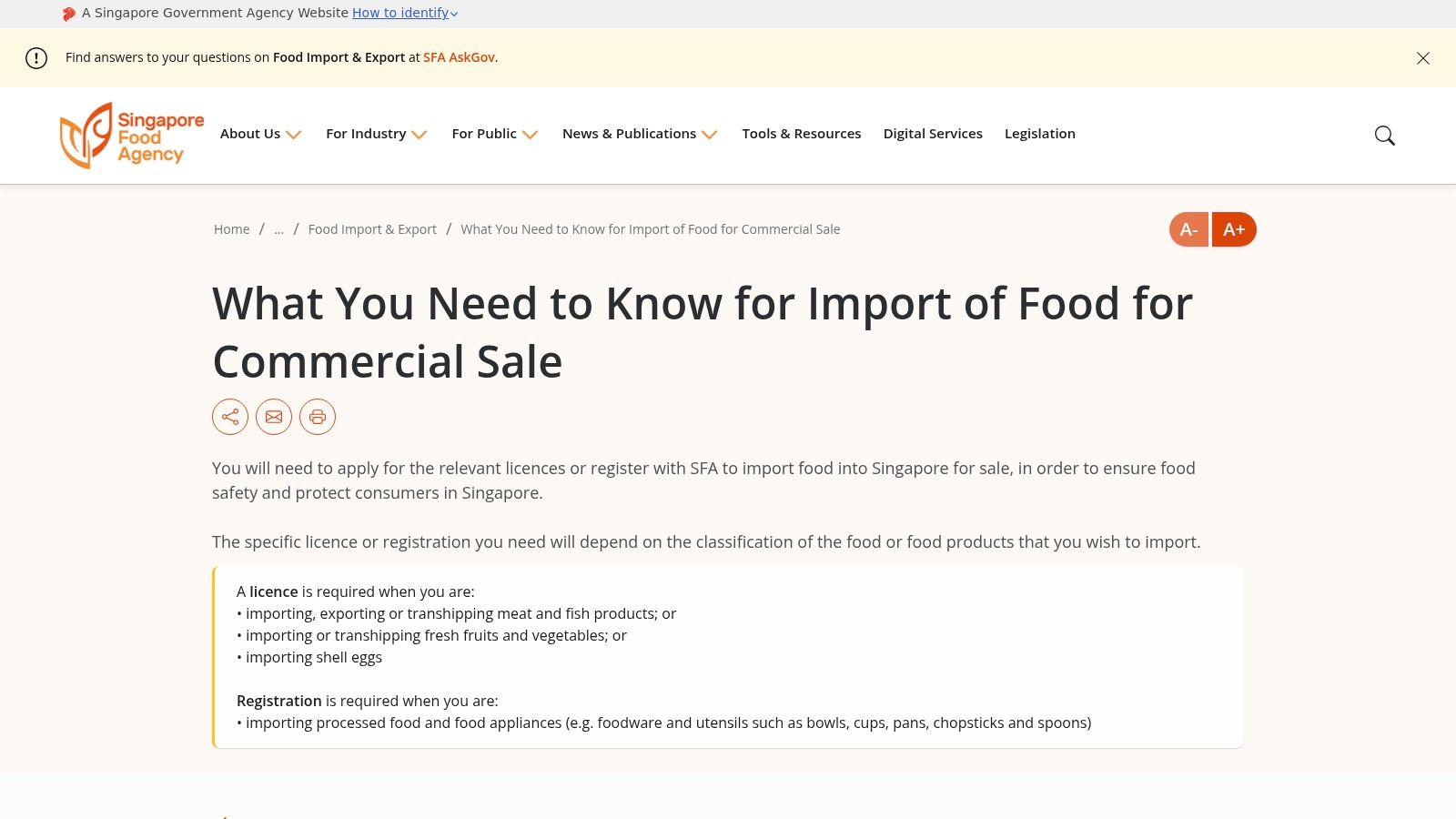
For businesses targeting the highly regulated food and beverage sector, the Singapore Food Agency (SFA) website is the authoritative source for identifying and qualifying legitimate importers in Singapore. While it’s not a straightforward directory, it functions as a crucial compliance and validation gateway. Using SFA’s resources allows you to understand the specific licensing and registration requirements for different food categories, ensuring you target companies that are legally permitted to import.
This platform is indispensable for validating prospects in the food supply chain. It details the mandatory licences, registrations, and permits required for traders. By understanding these regulatory frameworks, you can filter your prospecting list to include only compliant, active importers, thereby increasing the quality of your leads and ensuring your outreach is relevant to their specific operational needs.
How to Use SFA Resources for Prospecting
The SFA website is best used as a vertical-specific qualification tool after you have an initial list of potential companies (perhaps from BizFile+). It helps you segment and prioritise importers based on the products they are legally authorised to handle.
- Understand Licensing Requirements: Navigate to the "Food Import & Export" section to understand the difference between a "Licence to Import/Transship" for specific products (like fresh meat) and a simple "Registration" for traders of processed foods. This knowledge helps you tailor your sales pitch.
- Target by Product Category: Use the SFA's detailed guidance for specific categories like "Processed Food," "Meat & Fish Products," or "Fresh Fruits & Vegetables." This allows you to identify the compliance hurdles importers in these niches face, giving you valuable talking points.
- Validate Potential Leads: If a company claims to import a specific food product, you can use the SFA guidelines to understand the licence they must hold. While you cannot search a public database of licensees, knowing the requirements allows you to ask more intelligent qualifying questions during outreach.
Key Insight: Approaching a food importer with an understanding of their specific SFA licensing obligations (e.g., "I see you handle processed foods, which requires trader registration…") demonstrates industry expertise and builds immediate credibility, setting you apart from generic sales pitches.
Platform Snapshot
| Feature | Details |
|---|---|
| Primary Use Case | Qualifying and validating food importers based on regulatory compliance. |
| Key Data Points | Licensing requirements by food category, import procedures, fee structures. |
| Pricing | Free to access all informational resources. |
| Pros | Authoritative government source; helps in vertical-specific targeting; provides crucial compliance context. |
| Cons | No direct, searchable database of importers; serves as a resource hub, not a lead list. |
| Best For | Logistics providers and sales teams specialising in the food and beverage industry. |
Using the SFA's resources is a strategic move that shifts your prospecting from a numbers game to a targeted, value-driven approach. It equips you with the necessary regulatory knowledge to engage Singaporean food importers on a deeper, more professional level.
Website: https://www.sfa.gov.sg/food-import-export/licensing-registration-of-traders
3. HSA Infosearch (Health Sciences Authority)
For businesses targeting niche, high-value verticals, HSA Infosearch is an indispensable and specialised resource. It serves as the official public register for all companies licensed by the Health Sciences Authority to import, wholesale, or manufacture health products in Singapore. This platform is the definitive source for identifying legitimate players in the tightly regulated pharmaceutical, medical device, and active ingredient sectors.
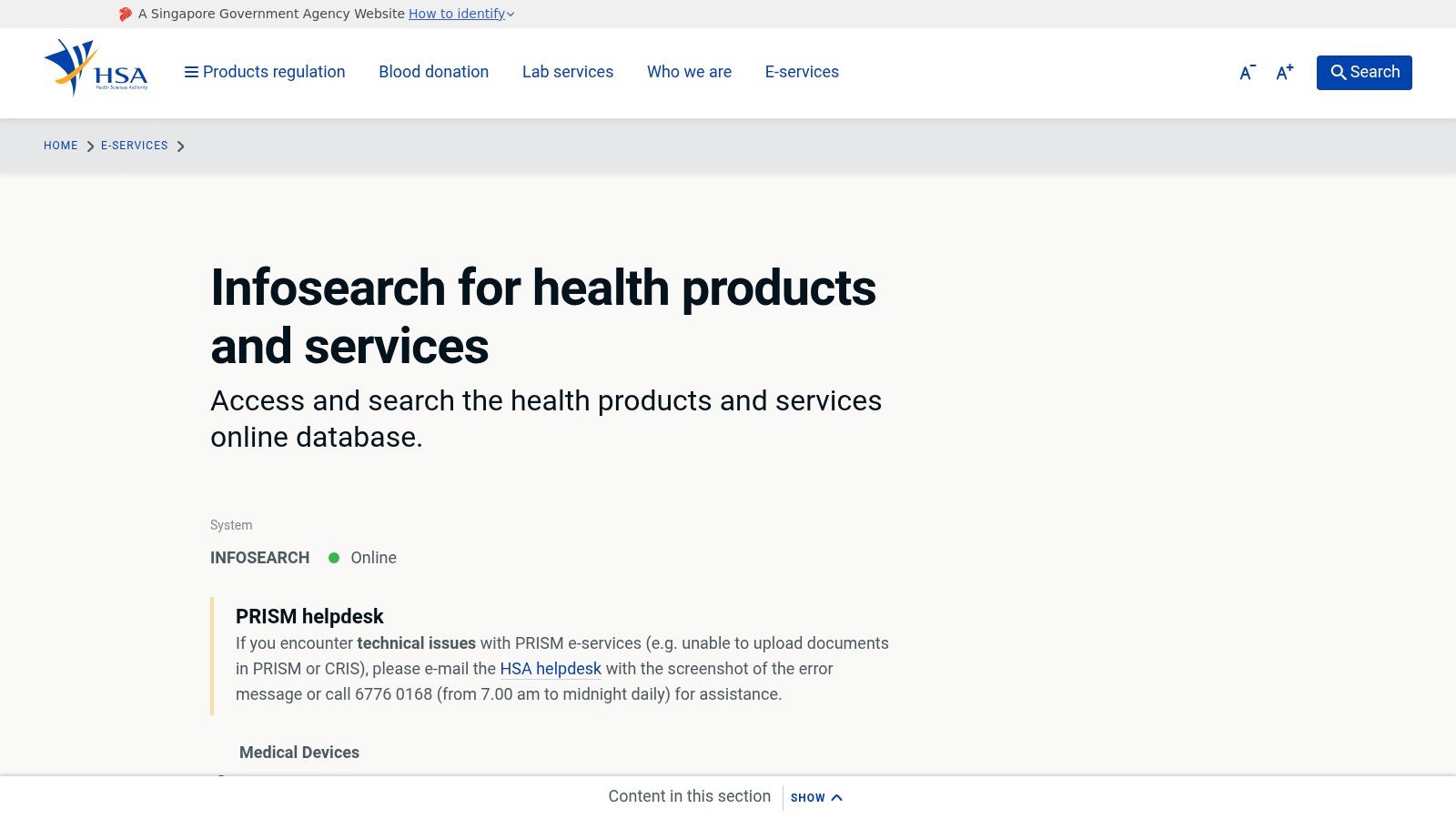
Unlike broad business directories, HSA Infosearch provides a pre-qualified list of importers in Singapore operating within a compliance-heavy industry. The platform allows you to search its "Register of Dealers' Licences" to verify a company's authority to handle specific health products. This is critical not only for prospecting but also for ensuring your own compliance when dealing with partners in this space.
How to Use HSA Infosearch for Prospecting
HSA Infosearch is a powerful tool for building a highly targeted list of importers in the healthcare and life sciences industries. It moves beyond generic company data to provide industry-specific licensing information.
- Search the Dealer's Licence Register: The core feature is the database of licensed importers, wholesalers, and manufacturers. You can search by company name or licence number to instantly validate a potential partner's credentials.
- Filter by Activity Type: The registry clearly states the authorised activities for each company, such as "Import," "Wholesale," or "Manufacture." This allows you to filter your list to include only companies actively importing products.
- Verify Product Categories: The licence details often specify the categories of products a company is permitted to handle (e.g., medical devices, therapeutic products, active pharmaceutical ingredients). This enables precise targeting based on your specific product or service.
- Cross-Reference with Other Registers: Use the platform to access related registers, like the Singapore Medical Device Register, to understand the specific products a company is importing, providing valuable context for your outreach.
Key Insight: Using HSA Infosearch gives you a direct list of active, licensed, and compliant importers in a lucrative sector. Outreach to these companies is more effective as it can be tailored to their specific, regulated operational needs and product portfolios.
Platform Snapshot
| Feature | Details |
|---|---|
| Primary Use Case | Identifying and verifying licensed importers of medical and health products. |
| Key Data Points | Company Name, Licence Number, Authorised Activities (Import/Wholesale). |
| Pricing | Free to access and search. |
| Pros | Official government data for a niche sector; free access; pre-qualifies leads. |
| Cons | Limited only to health and medical product importers; no financial or director data. |
| Best For | Logistics providers and sales teams specialising in pharmaceuticals and medical devices. |
This platform is essential for anyone needing to engage with the health sciences supply chain, as it provides the foundational compliance data required. Understanding the role of an Importer of Record is particularly crucial in this regulated field, where liability and compliance are paramount.
Website: https://www.hsa.gov.sg/e-services/infosearch
4. Kompass Singapore – Importers list
Kompass is a longstanding B2B directory that provides a more direct, pre-filtered approach to finding importers in Singapore. Unlike foundational registries, its main advantage is speed and convenience, offering a ready-made list of companies that self-identify or are categorised as importers. This makes it an excellent tool for rapid market scanning and initial outreach campaigns.
The platform functions as a sophisticated business directory, where companies are profiled with details on their activities, key personnel, and contact information. For sales teams looking to quickly build a call list or an email campaign, Kompass’s pre-sorted "Importers" section is a valuable shortcut. It bypasses the need to manually cross-reference SSIC codes, presenting a list of potential targets from the outset.
How to Use Kompass for Prospecting
Kompass is most effective for high-volume prospecting and initial lead qualification. Its structure is designed to help you quickly identify and connect with potential partners across various industries.
- Utilise the Pre-filtered List: Navigate directly to the Singapore "Importer" category. This immediately gives you a list of hundreds of companies, which can then be further refined by industry, size, or other available filters.
- Review Company Profiles: Click into individual profiles to access key information. Profiles often include a business description, product/service keywords, phone numbers, and sometimes, names of key contacts. This helps you prioritise companies that align with your services.
- Purchase Targeted Lists: For more serious outbound efforts, Kompass offers the option to purchase customised and detailed prospecting lists. These paid lists often contain more direct contact information, such as email addresses, saving significant research time.
- Automate Data Extraction: For direct access to importer data from sources like Kompass, you can learn how to scrape leads directories without any code. This allows your team to efficiently pull public-facing information into a structured format for your CRM or sales pipeline.
Key Insight: Kompass excels at providing breadth and speed. While the data may require verification against an official source like ACRA, it's an unparalleled tool for quickly mapping out the market and building a large initial pool of potential importer leads.
Platform Snapshot
| Feature | Details |
|---|---|
| Primary Use Case | Rapidly discovering and building lists of potential importers for outreach. |
| Key Data Points | Company Activities, Phone Numbers, Contact Forms, Key Personnel (paid). |
| Pricing | Free for basic search and viewing; paid plans for advanced data and list exports. |
| Pros | Fast discovery with pre-filtered lists; good breadth across many industries. |
| Cons | Data depth and recency can vary; most valuable data requires paid access. |
| Best For | Sales teams needing to build a large volume of leads for cold calling and email campaigns. |
Kompass serves as an excellent mid-funnel tool. It helps you move from the broad, verified data of ACRA to a more targeted list of companies actively engaged in importing, priming them for your initial sales outreach.
Website: https://sg.kompass.com/y/importer/
5. Panjiva (S&P Global) – Trade Intelligence
Where official registries like ACRA confirm a company's existence, platforms like Panjiva reveal their real-world activities. Owned by S&P Global, Panjiva is an enterprise-grade trade intelligence tool that aggregates global customs and shipping data. It moves beyond static company profiles to show you the dynamic flow of goods, making it invaluable for identifying and prioritising active importers in Singapore based on their actual shipment history.
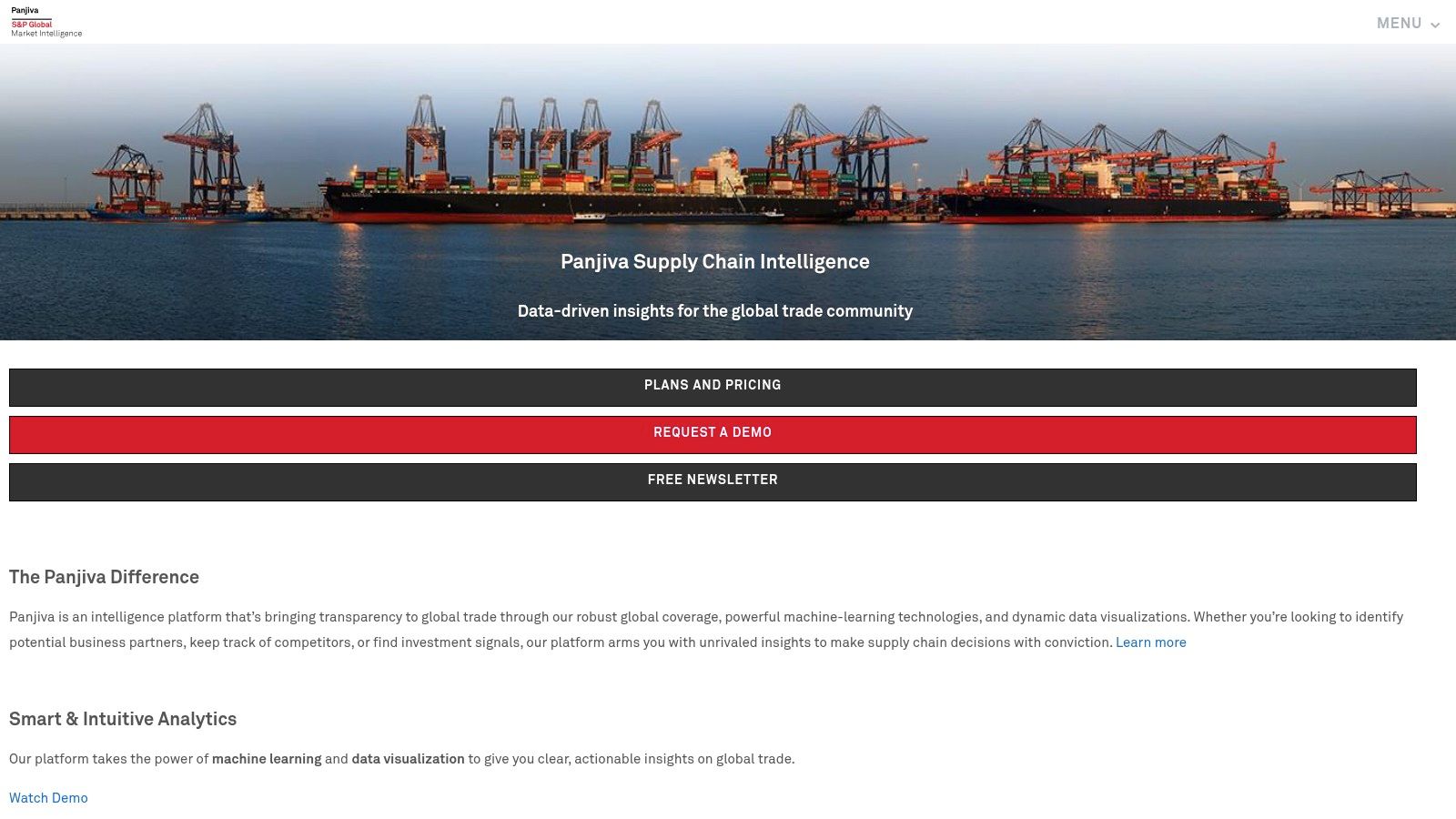
Panjiva allows you to see company-level import and export connections. For sales teams, this means you can uncover who is importing specific products, from which countries, and in what volumes. This granular data helps you tailor your outreach with highly relevant information, referencing a prospect's known supply chain needs rather than sending a generic sales pitch.
How to Use Panjiva for Prospecting
Panjiva is designed for deep-dive analysis to find high-value leads that competitors might miss. Its strength lies in its ability to filter and search through vast amounts of trade data to find specific, actionable opportunities.
- Identify Active Importers by Commodity: Use the platform to search for specific products being shipped into Singapore. The key is to use accurate product descriptions or, even better, Harmonised System (HS) codes. This instantly generates a list of companies that are verifiably active in your target market.
- Analyse Trade Relationships: Once you find a potential importer, you can explore their profile to see their key suppliers, trading partners, and the frequency of their shipments. This insight helps you understand their procurement patterns and identify potential pain points or opportunities for your services.
- Prioritise by Volume and Frequency: Not all importers are created equal. Panjiva's data allows you to rank potential leads based on their shipment volume or frequency, ensuring your sales team focuses its efforts on the most lucrative and consistent prospects.
Key Insight: Panjiva gives you a competitive edge by revealing a company's actual trading behaviour. You can approach a prospect not just knowing that they import, but knowing what they import, from whom, and how often, allowing for an incredibly informed initial conversation.
Platform Snapshot
| Feature | Details |
|---|---|
| Primary Use Case | Identifying and qualifying active importers through real shipment data. |
| Key Data Points | Bill of Lading Data, Supplier/Buyer Relationships, Shipment Volumes, Commodity Details. |
| Pricing | Enterprise subscription-based, with pricing available upon request. Limited free browsing. |
| Pros | Rich, actionable shipment data; strong brand credibility; excellent for market analysis. |
| Cons | High cost (enterprise pricing); requires a subscription for full access and data export. |
| Best For | Sales and business development teams needing data-driven lead prioritisation. |
While Panjiva is a premium tool, the depth of its data can significantly shorten sales cycles and increase conversion rates. To make the most of its commodity search features, a solid understanding of product classification is beneficial; for more context, you can learn about the role of the HS code in Singapore and how it structures global trade data.
Website: https://panjiva.com
6. ImportGenius – Global Trade Data Platform
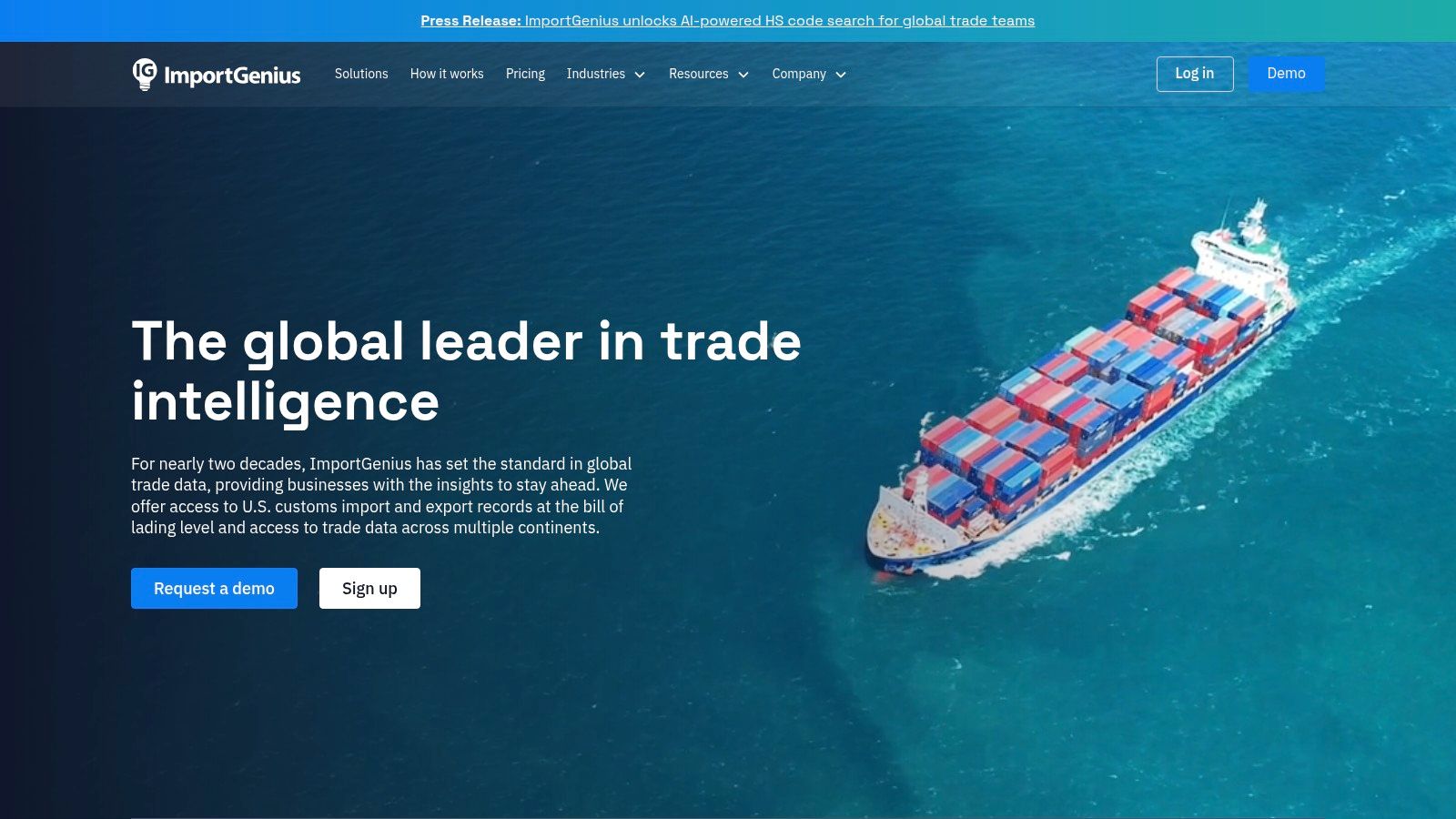
ImportGenius shifts the focus from company registration data to actual, verifiable shipment activity. This platform provides access to a massive database of global import/export records, allowing sales teams to see precisely which companies are moving goods, what they are shipping, and who their trading partners are. For those looking for active importers in Singapore, this is a powerful tool to uncover qualified leads based on real-world logistics behaviour.
Rather than relying on static company profiles, ImportGenius gives you a dynamic view of a company's supply chain. You can identify Singapore-based companies by searching for shipments where Singapore is the port of destination or by analysing the trading partners of global suppliers. This approach validates a company's import activity and reveals valuable details like shipment frequency, volume, and product types.
How to Use ImportGenius for Prospecting
The platform is purpose-built for sales and logistics professionals to find and qualify leads based on trade data. It helps answer critical questions like "Who is importing this specific product into Singapore?" and "Which of my competitor's customers could I target?"
- Search by Product or HS Code: The most direct method is to search for specific products or Harmonized System (HS) codes being shipped to Singaporean ports. This immediately generates a list of consignees (importers) involved in that trade.
- Analyse Trade Lanes: You can research trade lanes to find companies importing from specific countries into Singapore. This is ideal for freight forwarders specialising in particular routes, such as China-to-Singapore or Europe-to-Singapore.
- Monitor Competitor Activity: Track the shipment activities of known importers or even your competitors' clients. The platform's alert system can notify you of new shipments, providing timely opportunities for outreach.
- Vet Potential Leads: Use the company profiler to view a company’s complete shipment history. This helps you gauge their import volume and consistency, allowing you to prioritise high-value prospects and tailor your sales pitch with specific insights about their supply chain.
Key Insight: ImportGenius allows you to move beyond who might import to who is currently importing. Leading your outreach with specific knowledge of a prospect’s recent shipment activity ("I saw you just received a container of electronic components from Shenzhen…") dramatically increases credibility and engagement.
Platform Snapshot
| Feature | Details |
|---|---|
| Primary Use Case | Discovering active importers and exporters based on actual shipment records. |
| Key Data Points | Consignee/Shipper Names, Product Descriptions, HS Codes, Shipment Dates, Volume. |
| Pricing | Subscription-based; requires a demo and custom quote. Full features are behind the paywall. |
| Pros | Based on real trade data; actionable prospecting features; useful for competitor analysis. |
| Cons | High-value data comes with a premium price; no public pricing information. |
| Best For | Logistics sales teams, freight forwarders, and NVOCCs needing data-driven leads. |
ImportGenius provides the trade intelligence layer on top of foundational company data. It’s an essential tool for sales teams who want to build a highly targeted pipeline of importers in Singapore that are demonstrably active in the market.
Website: https://www.importgenius.com
7. SBF Members’ Directory (Singapore Business Federation)
The Singapore Business Federation (SBF) is the apex business chamber, and its Members’ Directory is a high-trust resource for identifying established and active importers in Singapore. While not a customs data platform, it offers a curated list of tens of thousands of member companies, providing a powerful starting point for building relationships within a credible, Singapore-centric network. Think of it as a gateway to companies that are invested in the local business ecosystem.
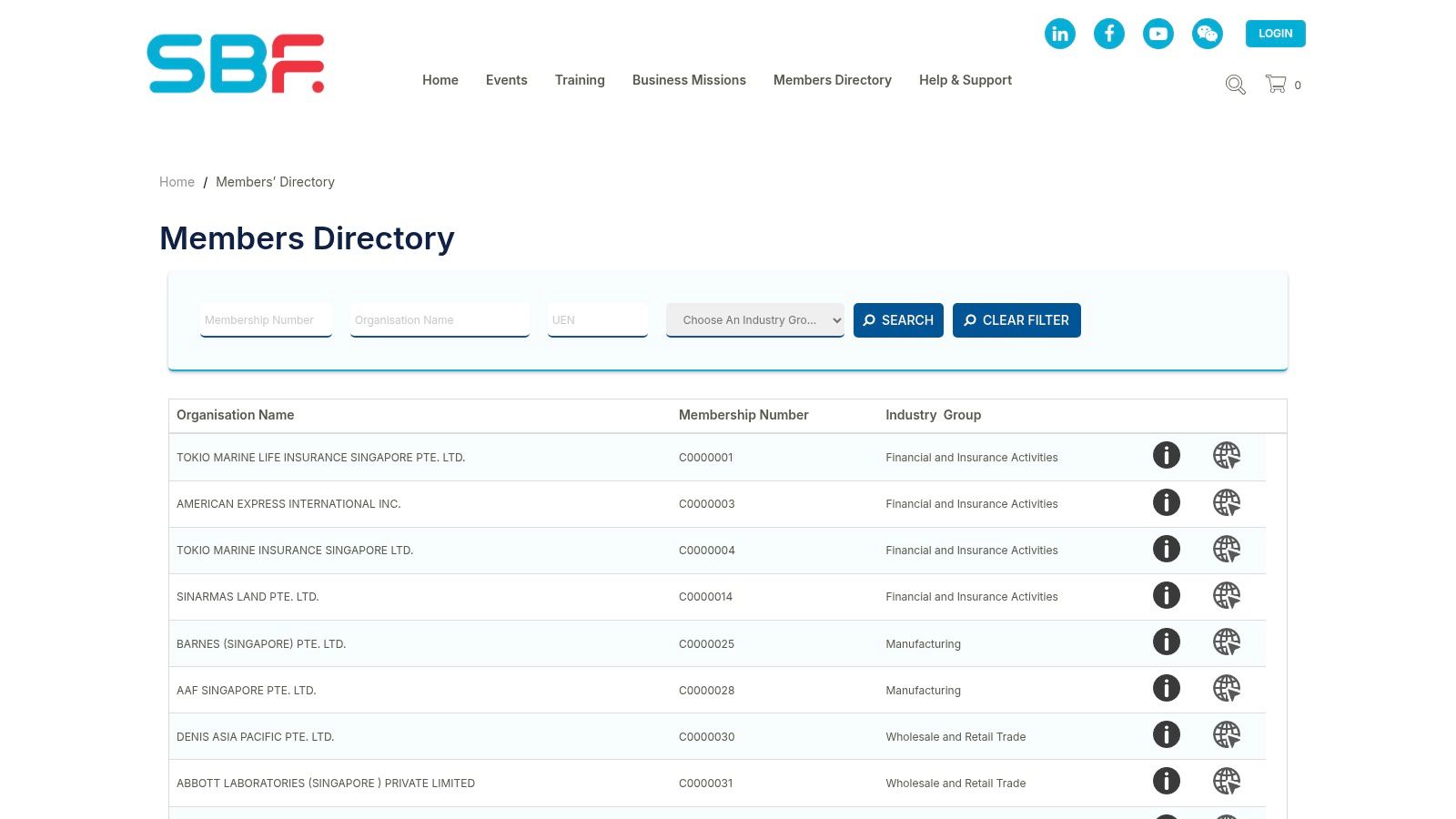
This directory is less about raw trade data and more about corporate discovery and network-based prospecting. Inclusion in the SBF directory signals that a company is an active participant in the wider Singaporean business community. This can be a strong qualifying factor, especially when targeting larger, more established enterprises for high-value logistics contracts or strategic partnerships.
How to Use the SBF Directory for Prospecting
The SBF Directory is most effective for initial discovery and leveraging the chamber network for warmer outreach. Its value lies in the credibility of its members.
- Industry-Based Discovery: Use the search function to filter by industry categories like "Wholesale Trade," "Logistics & Transportation," or specific manufacturing sectors that rely on imports. This allows you to quickly generate a list of potential targets within your ideal customer profile.
- Qualify and Verify: Once you identify a promising company name, use it as a keyword to cross-reference on platforms like ACRA BizFile+ to confirm their SSIC code and official details. This two-step process combines the credibility of SBF membership with the legal accuracy of government records.
- Leverage the Network: Note companies of interest and monitor SBF-hosted events, seminars, or trade missions. These events provide prime opportunities for warm introductions and face-to-face networking, turning a cold lead into a valuable connection.
- Partnership Building: Beyond direct sales, the directory is a goldmine for finding potential partners, agents, or distributors in Singapore. Membership implies a certain level of stability and commitment to the local market.
Key Insight: A lead sourced from the SBF Directory is more than just a name; it’s a pre-qualified entity active in the Singapore business community. This context is invaluable for crafting outreach that references shared industry affiliations, immediately setting you apart from generic cold calls.
Platform Snapshot
| Feature | Details |
|---|---|
| Primary Use Case | Discovering credible, established companies and enabling network-based outreach. |
| Key Data Points | Company Names, Industry Groupings, Basic Contact Information (varies). |
| Pricing | The public directory is free to search. Full membership benefits are separate. |
| Pros | High-trust, Singapore-specific pool of companies; excellent for warm introductions and partnership building. |
| Cons | Public data is limited and requires cross-verification; not a trade data tool. |
| Best For | Business development teams focusing on relationship-driven sales and targeting established enterprises. |
While the SBF Directory requires a more nuanced approach than a pure data platform, its ability to surface reputable importers in Singapore and provide avenues for warm engagement makes it a strategic tool for any serious sales team.
Website: https://members.sbf.org.sg/membershipdirectory
7-Source Comparison of Singapore Importer Resources
| Source | Implementation complexity | Resource requirements | Expected outcomes | Ideal use cases | Key advantages |
|---|---|---|---|---|---|
| ACRA BizFile+ (Official Singapore companies registry) | Low — web search and PDF purchase; manual filtering | Minimal monetary cost per profile (S$5.50); some manual effort to build lists | Authoritative company records (UEN, address, officers, filing history) | Legal due diligence, compliance verification, capturing legal identifiers | Official, government-verified data; low cost and fast delivery |
| SFA (Singapore Food Agency) resources and registers | Low — guidance navigation and category lookup | Time to interpret regulations; coordination with TradeNet/HS code tools | Clear licence/registration requirements by food product category | Qualifying food importers by product; regulatory compliance planning | Authoritative regulatory guidance; product-specific compliance rules |
| HSA Infosearch (Health Sciences Authority) | Low — searchable public license register | Small time investment; free access | Lists of licensed importers/wholesalers/manufacturers for health products | Compliance-sensitive outreach in pharmaceuticals, medical devices | Direct, category-specific licensed importer lists; official verification |
| Kompass Singapore – Importers list | Low — directory search and filtering | Free basic access; paid options for targeted lists | Broad roster of importer profiles with contact details (varied depth) | Rapid discovery and outbound prospecting across industries | Pre-filtered importer listings and purchasable prospect lists |
| Panjiva (S&P Global) – Trade intelligence | Medium–High — platform onboarding and data analysis | Subscription-based (enterprise pricing); analyst time to interpret trade data | Trade-level insights: counterparties, shipment patterns, product flows | Prioritizing active importers by product/volume; supply-chain research | Rich shipment context and enterprise-grade analytics |
| ImportGenius – Global trade data platform | Medium–High — query design and data triage | Paid subscription (quote/demo); time to set alerts and filters | Historical shipment records, alerts, company trade profiles | Logistics/freight sales, competitor monitoring, HS-code prospecting | Actionable prospecting features and shipment alerting |
| SBF Members’ Directory (Singapore Business Federation) | Low — searchable member listings | May require chamber access/membership for full features; outreach effort | Credible pool of Singapore companies, industry groupings | Partnership development, warm introductions, event-driven outreach | High-trust, Singapore-centric network and chamber contacts |
From Lists to Leads: Activating Your Importer Prospecting Strategy
Navigating the bustling trade landscape of Singapore requires more than just a list of names; it demands a strategic, data-driven approach to identify and engage high-potential partners. Throughout this guide, we have explored a diverse toolkit, moving from foundational government registries like ACRA BizFile+ and specialised databases from the SFA and HSA, to comprehensive global trade intelligence platforms such as Panjiva and ImportGenius. Each tool offers a unique lens through which to view the market of importers in Singapore, providing the raw material for a powerful sales pipeline.
The key takeaway is that no single platform holds all the answers. A truly effective prospecting strategy layers data from multiple sources. You might start with the broad SBF Members’ Directory to understand the landscape, then use Panjiva to analyse the shipping volumes of a promising company, and finally cross-reference with ACRA to verify their operational status and corporate structure. This multi-pronged validation process is what transforms a generic list into a high-value, actionable prospecting database.
Synthesising Data for Smarter Outreach
The true power of these resources is unlocked when you synthesise their data to build a complete picture of your ideal prospect. An importer isn't just a name; it's a business with specific needs, established trade lanes, and measurable shipping volumes.
- For High-Volume Targeting: If your business thrives on securing large, consistent accounts, platforms like Panjiva or ImportGenius are indispensable. Focus on importers with high shipment counts, frequent activity, and established relationships with your target trade lanes. Your outreach should reflect this knowledge, referencing their scale and offering solutions that address the complexities of high-volume logistics.
- For Niche Specialisation: If you specialise in perishables, pharmaceuticals, or other regulated goods, the SFA and HSA databases are your starting point. These directories give you a pre-qualified list of companies operating within strict regulatory frameworks. Your outreach here should emphasise your expertise in compliance, cold chain logistics, or specialised handling procedures.
- For Broader Market Entry: For those looking to build a wide-ranging pipeline, directories from Kompass and the Singapore Business Federation provide the necessary breadth. Segment these lists by industry or company size to create targeted campaigns. You can further enrich these initial lists by exploring some of the best B2B data providers to append detailed contact information and firmographic data, ensuring your message reaches the right decision-maker.
Key Insight: The most successful sales teams don't just collect names; they build detailed client profiles. They understand an importer's shipping frequency, key trade partners, and product types before making the first call. This transforms a cold outreach into a relevant, value-driven conversation.
Implementing Your Go-to-Market Strategy
As you move from data collection to active outreach, remember the principles we discussed. Your first impression is critical. The sample outreach templates provided are designed to be adapted, not copied verbatim. Personalise each message with a specific data point you uncovered, whether it’s a recent shipment from a particular port or their known specialisation in a certain commodity. This demonstrates genuine research and immediately sets you apart from generic sales pitches.
Ultimately, finding importers in Singapore is only the first step. The real work lies in converting that information into meaningful business relationships. By strategically combining the tools at your disposal, tailoring your communication, and consistently delivering value, you can turn this comprehensive directory into a dynamic engine for growth. The opportunity within Singapore's vibrant import sector is immense; with the right strategy and tools, you are now well-equipped to capture it.
Ready to turn your meticulously researched lists of importers in Singapore into an automated, high-performing outreach campaign? Coreties integrates seamlessly with your data, allowing you to launch personalised, multi-channel prospecting sequences that engage decision-makers and book meetings at scale. Transform your prospecting efforts from manual research to measurable results by visiting Coreties today.
Leave a Reply