
When you're trying to find the right HS code for a power supply, your starting point is almost always heading 8504. More specifically, you'll be looking at subheading 8504.40, which covers static converters.
But it's not quite that simple. The exact 8-digit code hinges on the power supply's specific function. Is it an Uninterruptible Power Supply (UPS) designed for backup power, or is it a standard unit built for an Automatic Data Processing (ADP) machine like a computer? These distinctions are critical for accurate customs declarations.
Quick Reference HS Codes for Power Supplies
For anyone in freight forwarding and logistics, getting the classification right the first time is non-negotiable. A misclassified shipment can snowball into expensive delays, customs fines, and frustrating inspections, ultimately straining client relationships. This reference is designed to bring immediate clarity to the most common HS codes used for power supply units moving through Singapore.
It's important to understand the code's structure. The Harmonized System (HS) starts with a 6-digit code that is standardised globally by the World Customs Organisation (WCO). From there, individual countries or economic blocs add further digits for more detailed classification.
In Singapore, the system is extended to an 8-digit code under the Singapore Trade Classification, Customs and Excise Duties (STCCED), which is aligned with the ASEAN Harmonised Tariff Nomenclature (AHTN). The table below breaks down this progression, showing how the international 6-digit code expands into the specific 8-digit code you need for declarations in Singapore. Using the correct code from the start is the key to ensuring compliance and keeping cargo moving.
Common HS Codes for Power Supply Units (Singapore AHTN/STCCED)
| Power Supply Type | WCO HS Code (6-Digit) | Singapore HS Code (8-Digit) | Classification Notes |
|---|---|---|---|
| Uninterruptible Power Supply (UPS) | 8504.40 | 8504.40.11 | This code is strictly for units designed to supply backup power during an outage. Think of mission-critical systems in data centres or hospitals. |
| Power Supply for ADP Machines | 8504.40 | 8504.40.12 | This is a high-volume category covering power supplies built exclusively for computers and their peripherals (e.g., printers, monitors). |
| Other AC-DC Static Converters | 8504.40 | 8504.40.19 | A "catch-all" or residual code for other converters that don't fit the UPS or ADP categories, such as those for specialised industrial machinery. |
This table serves as a solid foundation for classifying the most frequently shipped types of power supplies. Always double-check the product's technical specifications to ensure it aligns perfectly with the chosen HS code's description.
Why HS Code 8504 Is a Goldmine for Logistics
For many in logistics sales, the commercial value of a specific HS code for power supplies can seem a bit abstract. But here’s a secret from the inside: getting a handle on HS heading 8504 isn't just a matter of compliance. It’s a direct line to some of the most valuable, high-volume shippers out there, especially in a major trade hub like Singapore.
The reason is simple. Power supplies belong to the enormous HS Chapter 85, which covers all electrical machinery and equipment. In Singapore's trade landscape, this single chapter has been the top-traded goods category for years, making up a huge piece of the country's economic pie.
The Scale of the Opportunity
Let’s put some numbers on it. In 2021, Singapore's total exports under Chapter 85 hit roughly US$166.99 billion, while imports came in at around US$137.87 billion. Together, that's well over a quarter of the nation's entire merchandise trade. You can dig into Singapore's trade statistics to see the full scale of this massive market for yourself.
This sheer volume is critical because the vast majority of commercial power supplies—from basic AC-DC converters to complex UPS systems—are classified under HS heading 8504. For instance, power units for automatic data-processing (ADP) machines are typically found under subheadings like 8504.40. This concentration means a seemingly small commodity plays a material role in Chapter 85's huge trade flows.
For freight forwarders, this is the key takeaway: a shipper regularly moving goods under HS 8504 isn’t just a one-off electronics trader. They are a consistent, active player in Singapore’s most valuable trade category. These are precisely the kinds of qualified leads every sales team is looking for.
Turning Codes into Customers
Since Singapore operates on an 8-digit system based on the ASEAN Harmonised Tariff Nomenclature (AHTN), logistics teams need to get granular for both accurate customs declarations and effective sales prospecting. A single 8-digit code can unlock a view into thousands of annual shipments and dozens of high-value accounts that are prime for engagement.
This is where platforms built on customs data, like Coreties, turn raw information into a real sales advantage. They give you the power to:
- Filter shipment records by specific 8-digit HS codes, such as 8504.40.12 (Power Supply for ADP Machines).
- Pinpoint the companies that are consistently importing or exporting these exact products.
- Analyse their trade lanes, shipment frequency, and estimate their potential logistics spend.
So, by focusing on the hs code for power supply, you're not just looking at a number. You’re unlocking a strategic map to a lucrative and remarkably predictable slice of the logistics market.
A Closer Look at Singapore's 8-Digit HS Code System
When you’re dealing with customs declarations in Singapore, you need to get familiar with its unique hierarchical structure for HS codes. While the global standard set by the World Customs Organisation (WCO) stops at six digits, Singapore takes it a step further with a more granular, 8-digit system. This extra detail is crucial for accurately classifying goods like power supplies.
This national system is officially known as the Singapore Trade Classification, Customs & Excise Duties (STCCED). It’s built to be fully compatible with the ASEAN Harmonised Tariff Nomenclature (AHTN), which helps create a more predictable and consistent customs framework across Southeast Asia. In practice, this means a general 6-digit code like 8504.40 for static converters gets broken down into much more specific 8-digit codes.
What does that look like on the ground? Well, this structure lets customs officers and traders clearly distinguish between different types of power supplies. For instance:
- 8504.40.11 is used specifically for Uninterruptible Power Supplies (UPS).
- 8504.40.12 is designated for power supplies meant for Automatic Data Processing (ADP) machines, like computers.
This hierarchy is powerful. It allows you to drill down from the massive trade value of Chapter 85 (electrical machinery) right down to the specific consignments under HS 8504. For a freight forwarder, that’s where you can start identifying individual shippers and their cargo patterns.
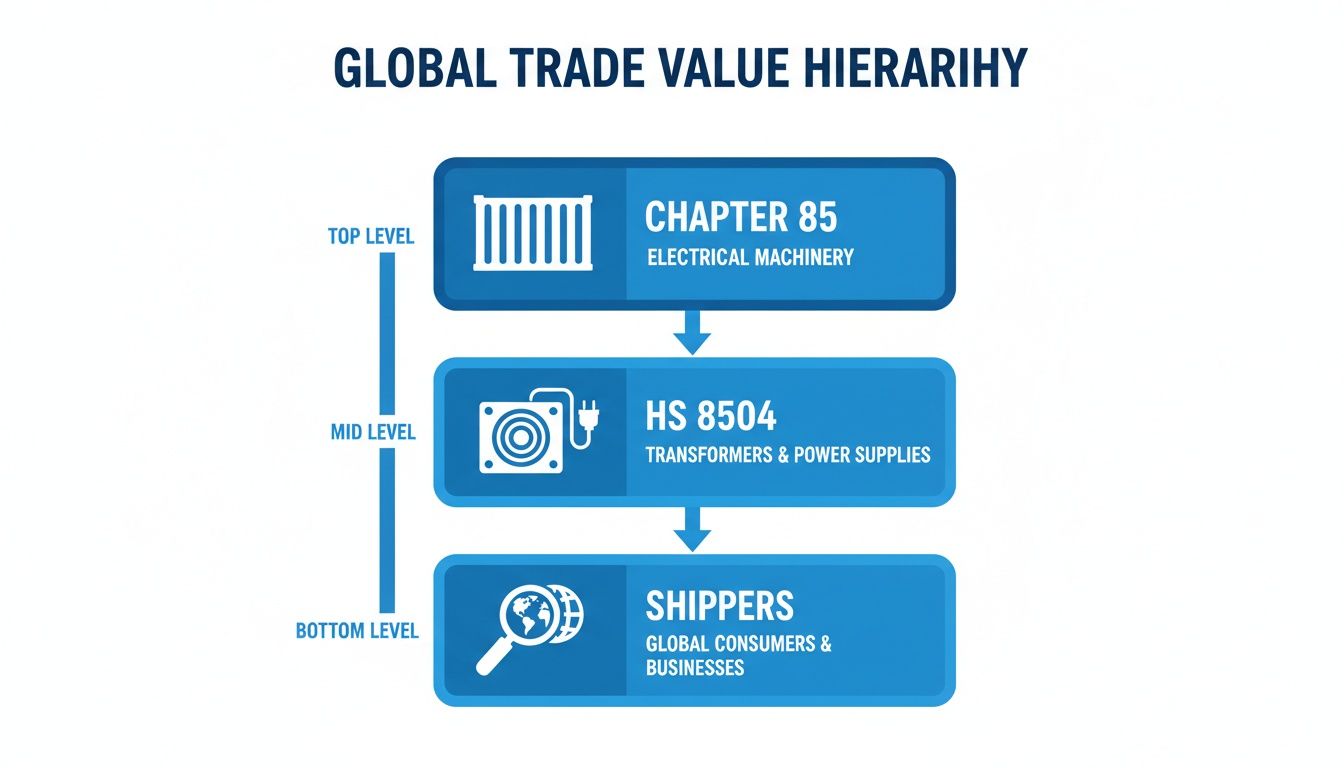
As the diagram shows, there’s a direct line from broad market data to very specific, actionable leads within the power supply sector.
Getting it Right with Singapore's Official HS Code Search
To keep shipments moving and avoid frustrating clearance delays, it’s absolutely critical to verify the correct HS code for a power supply before it leaves the warehouse. Singapore Customs provides an official HS/CA Product Code Search Engine precisely for this task. For any logistics team, getting comfortable with this national system is the key to qualifying leads and ensuring smooth operations. You can dive deeper into finding the right Singapore Customs HS code in our comprehensive guide.
This structure isn't just about compliance; it offers a real commercial edge. For forwarders, spotting a company that consistently uses a specific 8-digit code across multiple shipments is a tell-tale sign of a high-volume, specialised trade lane. Considering Singapore's imports under Chapter 85 hit a staggering US$137.87 billion in 2021, even the niche for power supplies represents billions in trade value—all neatly organised by these specific 8-digit codes.
A Case Study in Finding Leads with HS Code 85044011
Theory is useful, but nothing beats seeing how a single HS code for a power supply can build a real sales pipeline. Let's walk through a practical example using a specific code for Uninterruptible Power Supplies (UPS) in Singapore. This case study will show you precisely how to convert raw customs data into qualified leads.
We'll focus on HS code 85044011, the designation for UPS units under Singapore's AHTN-aligned tariff system. This isn't just an abstract number. It represents a high-value, often time-sensitive commodity vital for data centres, hospitals, and other critical infrastructure. Knowing who ships these items, and how frequently, is the key to building a smart, targeted sales strategy.
Analysing the UPS Market in Singapore
A quick look at the trade data for this one commodity reveals a surprisingly active and fragmented market. In a single month, export records for HS code 85044011 totalled roughly US$10 million. This value was spread across 808 individual shipments originating from 121 different exporters. You can dig deeper into these Singapore export statistics on MarketInsideData.com.
These figures tell an interesting story for any forwarder. The average shipment value is around US$12,300, which is a healthy number. But the real insight is the high number of unique exporters. This points to a diverse market filled with manufacturers and distributors, not just a few dominant players. It's exactly this kind of environment where a freight forwarder can compete and win business, one lane at a time.
For a sales team, this is a goldmine. Seeing 121 different exporters for a niche product like a UPS in just one month is a clear signal. It means no single company owns the market, opening up plenty of opportunities to forge new logistics partnerships.
Turning Data into Actionable Leads
The real value, of course, comes from putting this information to work. Using a prospecting platform like Coreties, you can run this exact search in seconds. Simply filter the customs data for HS code 85044011 in Singapore, and you’ll get a concentrated list of companies shipping this product frequently.
These aren't just random company names. They are active businesses moving valuable, often fragile electronics that demand reliable airfreight or LCL services. With 808 shipments in one month, the annual volume for this single HS code could easily top 5,000–10,000 consignments. That’s a steady, sustainable pipeline of qualified leads ready for your sales team to engage with.
Common Classification Mistakes and How to Avoid Them
Even the most experienced logistics professionals can hit a snag when classifying the HS code for a power supply. These missteps often lead to costly shipment delays, surprise penalties, and friction with clients. Getting to grips with the most common mistakes is the best way to avoid them and keep cargo moving smoothly.
A classic error is misclassifying a device that does more than just supply power. For instance, if a unit also has data logging or communication features, it probably doesn't belong under the straightforward static converter heading 8504.40. The golden rule in customs is that a product’s primary function dictates its classification, so you have to dig into the technical specs to get it right.
Another frequent slip-up is failing to see the difference between a simple AC adapter and a more sophisticated static converter. Both might turn AC into DC, but their intended use and technical complexity are worlds apart. A basic wall charger for a phone is not the same as a high-precision power supply unit built for heavy industrial machinery, and they won't share the same HS code.
Distinguishing Between Specific Power Supply Types
One of the most crucial distinctions to make is between power supplies designed for different kinds of equipment. Applying the code for a computer power supply to one meant for telecom hardware is a surefire way to attract unwanted attention from customs.
-
Mistake 1: Confusing ADP and Telecom Power Supplies. A power supply unit (PSU) built specifically for an Automatic Data Processing (ADP) machine, like a desktop computer, is correctly classified under a code like 8504.40.12 in Singapore. However, a PSU for a telecommunications switch or router serves a completely different purpose. It may need to be classified under a residual code like 8504.40.19, or potentially a different heading entirely if it's considered an integral part of the telecom apparatus.
-
Mistake 2: Incorrectly Classifying Integrated Units. Power supplies are often built directly into a larger device. If a PSU is an inseparable part of the main unit—say, a printed circuit board assembly that handles power regulation—it might need to be classified as a part of that primary machine, not as a standalone power supply. To get a better handle on this, it's worth understanding the nuances of the printed circuit board HS code and its specific classification rules.
To help illustrate these points, let's look at a few common scenarios and how to get them right.
Troubleshooting Common Power Supply Classification Errors
This table breaks down some of the most frequent errors we see in the field, showing where declarations go wrong and how to correct them based on official classification rules.
| Common Error Scenario | Incorrect HS Code Applied | Correct HS Code | Key Classification Rule |
|---|---|---|---|
| A power supply with an integrated LED driver for a lighting fixture. | 8504.40 (Static converter) | 8539.90 (Parts of lamps) | The item's primary function is as a part of a lamp, not just a generic power converter. It's classified with the "parent" product. |
| A basic USB wall charger (5V, 1A) for a mobile phone. | 8504.40.19 (Other static converters) | 8504.40.11 (AC adapter) | Specificity is key. There's a dedicated subheading for simple AC adapters, which should be used over a general "other" category. |
| A complex PC power supply unit (PSU) for a desktop computer. | 8504.40.19 (Other) | 8504.40.12 (For ADP machines) | The end-use is critical. Since it's exclusively for an Automatic Data Processing (ADP) machine, it must go under the specific ADP code. |
| An Uninterruptible Power Supply (UPS) with a battery. | 8504.40 (Static converter) | 8507.80 (As a complete UPS unit) | A UPS is more than a converter; it's an energy storage and supply system. It has its own distinct heading under 85.07. |
Getting these classifications right from the start prevents a world of trouble down the line.
The key takeaway is to always classify based on the product's principal function and its intended application, as defined by customs regulations. When there’s any doubt, attaching technical datasheets to your shipping documents is a smart move. It gives customs officials the information they need to verify your classification and helps avoid unnecessary disputes.
Documentation Best Practices for Power Supply Shipments
Nailing the right hs code for power supply shipments is a huge step, but it’s only half the battle. Your documentation has to be just as precise. If there’s any mismatch between your paperwork and the declared code, you’re practically inviting customs inspections, which can lead to frustrating delays and even penalties for your clients.
Every international shipment relies on a core set of documents: the commercial invoice, a comprehensive packing list, and the bill of lading or air waybill. Think of these as the foundation of your customs declaration—everything needs to line up perfectly.
Aligning Product Descriptions with HS Codes
Pay close attention to how you describe the power supply on the commercial invoice. This description is your first and best chance to justify the HS code you’ve chosen. Vague terms like "electronic parts" are a major red flag for customs officials and almost guarantee a second look.
You need to be specific and use language that leaves no room for doubt.
Here’s what that looks like in practice:
- For HS Code 8504.40.12: Instead of something generic, describe the item as a "Switching Power Supply Unit for Automatic Data Processing Machine, 250W."
- For HS Code 8504.40.11: A clear and accurate description would be "Uninterruptible Power Supply (UPS), 1500VA/900W, for network server backup."
This level of detail answers customs' questions before they even have to ask them. For more complex or multi-function units, it's an excellent idea to include a technical datasheet with the rest of your shipping documents. This simple, proactive step gives officers all the evidence they need to verify your classification on the spot.
Solid documentation is also essential for the Importer of Record, who carries the ultimate responsibility for the shipment. You can learn more about their crucial role in our guide on IOR responsibilities.
Common Questions on Power Supply HS Codes
When dealing with the HS code for a power supply, the same questions tend to pop up time and again among logistics professionals. Here, we'll tackle the most common queries we see, helping you get your classifications right and keep shipments moving smoothly.
A big point of confusion is how to handle a power supply that’s sold as part of a larger machine or a complete system. The General Interpretative Rules (GIR) are your guide here. If the power supply is essential for the main device to work and is shipped along with it, you’ll almost always classify it under the HS code for that main device, not separately under 8504.
Key Classification Distinctions
Another frequent question is what separates a power supply for an Automatic Data Processing (ADP) machine from other static converters. It all comes down to its intended end-use.
- ADP Power Supplies (e.g., Singapore HS 8504.40.12): These are specifically designed and sold for computers, servers, and related peripherals. Your shipping documents should clearly state this is what they're for.
- Other Static Converters (e.g., Singapore HS 8504.40.19): This is the catch-all category for everything else. Think power supplies for industrial machines, specialised electronics, or any unit that doesn't fit a more specific description.
Finally, people often ask if they need special permits for high-capacity units in Singapore. For the most part, standard power supplies don't require any special import permits. However, certain high-power Uninterruptible Power Supplies (UPS) or those containing specific battery types might be regulated by authorities like the Energy Market Authority (EMA).
The best practice is to always double-check. Before shipping, run the code through Singapore Customs' official HS/CA Product Code Search Engine to see if it's a controlled item. This quick step can save you from major headaches and delays at the port, which is a crucial part of the service any good freight forwarder provides.
Finding the shippers who trade under these HS codes is the next logical step. Coreties turns raw customs data into valuable sales leads, allowing you to identify high-volume traders of power supplies and get in touch with the right people in just a few clicks. Find your next customer at https://coreties.com.
Leave a Reply