Tag: customs data

  • Industry Benchmarking in Logistics: A Practical Guide

    Industry Benchmarking in Logistics: A Practical Guide

    A freight forwarder calls a prospect and leads with the usual line. We have strong carrier relationships. We can offer competitive rates. We'd love a chance to quote your business.

    The shipper ends the call in under a minute.

    That conversation fails because it gives the buyer nothing specific to react to. In logistics, generic claims sound interchangeable. Every forwarder says they have capacity. Every carrier says they have service. Every sales rep says they can save money. Without evidence tied to the shipper's lanes, suppliers, timing, or routing pain points, the pitch lands as noise.

    The calls that work sound different. They start with something concrete. You're importing this commodity through this gateway. Your current pattern suggests dependence on one carrier group or one origin cluster. Your lane mix creates avoidable exposure when schedules slip. We can see where routing flexibility or service design may matter more than a lower base rate. That changes the discussion from “give us a try” to “we understand your network.”

    That's where industry benchmarking becomes useful. Not as a slide for a quarterly strategy meeting. Not as a vague promise to be data-driven. It becomes a working tool for prospecting, routing, pricing conversations, account retention, and territory planning.

    For logistics teams, the practical question isn't whether benchmarking sounds smart. It's whether it helps a rep write a better email today, helps an operations manager defend a routing decision this week, or helps leadership decide which trade lanes deserve attention this quarter. Used well, it does all three.

    The End of Generic Sales Pitches

    Most logistics sales teams have lived through the same pattern. A rep gets a list of target shippers, opens a spreadsheet, and starts sending outreach based on broad claims. Better service. Better rates. Better coverage. The response rate is weak because the message could have gone to anyone.

    A shipper doesn't buy because a forwarder says the right adjectives. They buy when the seller shows a clear understanding of the shipper's operating reality. If a prospect imports regularly on a lane with recurring schedule friction, they care about routing resilience. If their inbound flow is concentrated with a small group of suppliers, they care about continuity and exceptions. If they're splitting freight across modes, they care about handoff reliability and response speed when something goes wrong.

    Why broad claims fail in freight

    Generic outreach breaks for three reasons.

    • It ignores lane context. A shipper moving ocean freight from one origin pattern has very different concerns than a shipper relying on mixed air and ocean replenishment.
    • It doesn't show commercial relevance. Buyers want to know why switching or adding a provider improves a real business outcome.
    • It treats all prospects the same. In logistics, the account list may look broad, but the selling motion should be narrow.

    Practical rule: If your first message could be copied into an email for fifty unrelated shippers, it probably won't open a serious conversation.

    The stronger alternative is to benchmark before outreach. Look at the prospect's shipping activity, the likely carrier mix, the commodity pattern, and the trade lanes that matter most. Then compare that picture against what you know about your own service strengths and the market's common service patterns. The result is a sharper point of view.

    What a useful pitch sounds like

    A useful sales conversation doesn't start with “we'd like an opportunity.” It starts with an observation.

    You might note that the shipper appears concentrated in a port pair where schedule variability has consequences for distribution planning. You might see that they depend on a narrow carrier set and could benefit from more optionality. You might find that your network aligns better with the shipper's origin geography than the providers they seem to use now.

    That's not theory. It's a better use of available logistics data.

    What Is Logistics Industry Benchmarking Really

    In logistics, industry benchmarking is the disciplined act of comparing your performance, network position, or account assumptions against a reliable point of reference. That reference might be your own historical performance, a competitor pattern, a lane-level market norm, or the practices of firms that operate especially well on a given trade.

    A sports analogy works here. Good teams don't watch game film to admire their own highlights. They study opponents, tendencies, spacing, and execution. They want to know where they're losing ground and where they can exploit an opening. Logistics teams should think the same way. Benchmark your transit patterns, carrier mix, quote responsiveness, lane density, and exception handling against a standard that means something.
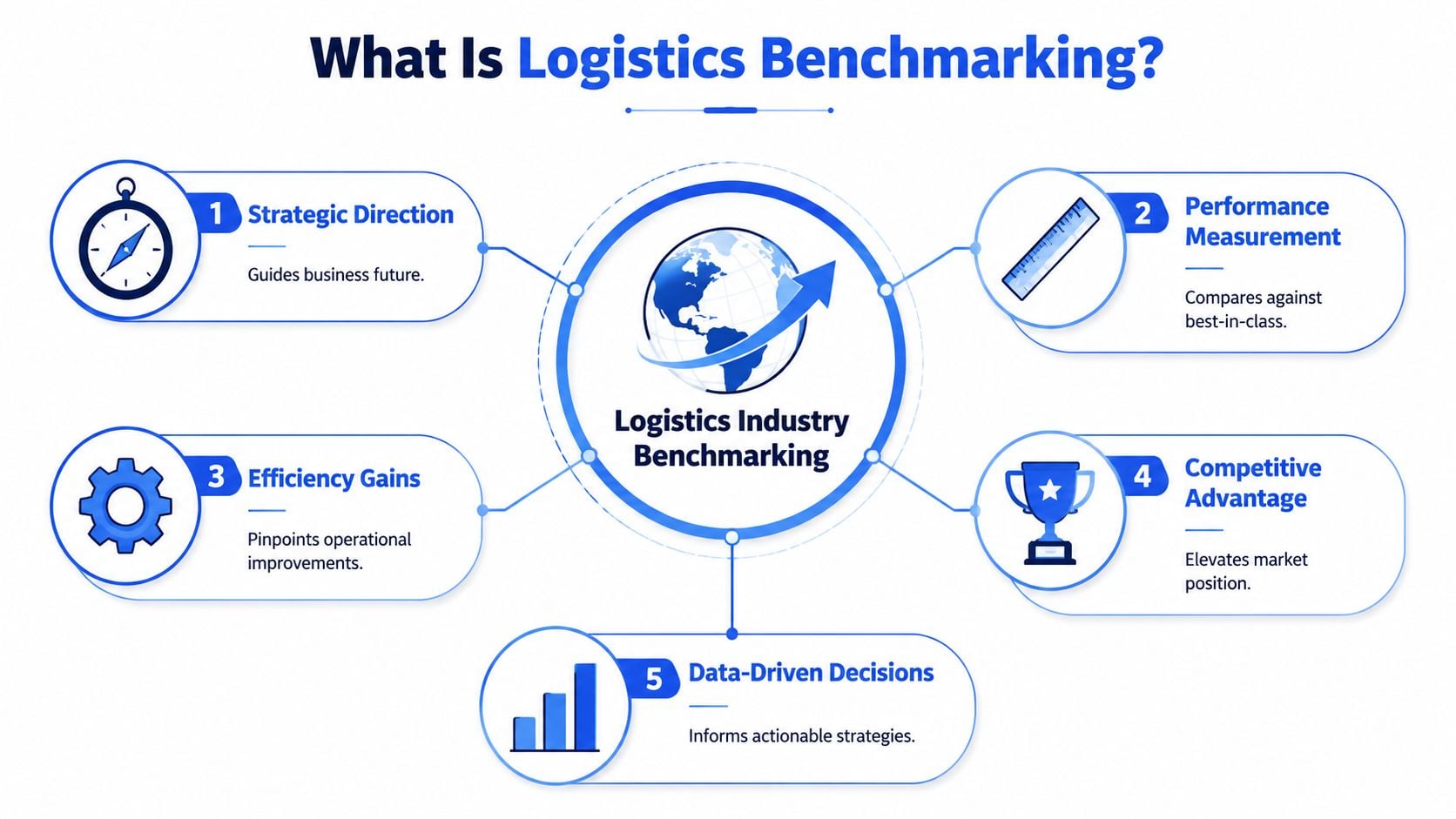
    An infographic titled What Is Logistics Benchmarking showing five key benefits of the practice.

    It's more rigorous than most teams treat it

    A formal benchmark is not just a rough comparison. The U.S. Bureau of Labor Statistics describes benchmarking as using a standard or point of reference to compare performance, and notes that its Current Employment Statistics program benchmarks the March employment level to the first-quarter employment level from the Quarterly Census of Employment and Wages every year in an annual calibration process designed to align sample-based estimates with a broader universe estimate, as explained in the BLS overview of benchmarking.

    That example matters because it strips away the buzzword. Benchmarking is a correction discipline. It's a way to test whether your current read of the market, your sales narrative, or your operating assumptions match a broader reality.

    What that looks like in freight

    For a freight forwarder, benchmarking often means asking questions like these:

    • Lane position. Are we strong on the lanes we claim to target, or are we spreading sales effort too thin?
    • Service reliability. Are our actual operating results holding up against what the market expects on those routes?
    • Commercial fit. Are we pursuing shippers whose shipping patterns match our strengths?
    • Pricing posture. Are we discounting where service quality should carry the conversation?

    For a pricing or revenue team, the logic is similar to how teams use Market Edge's pricing platform to anchor pricing decisions against external signals rather than instinct alone. In logistics, the same mindset applies to lanes, routing options, and account targeting.

    Benchmarking only becomes useful when it changes a decision. Which account to pursue. Which lane to defend. Which routing option to put in front of the customer.

    The daily version of benchmarking

    A lot of people hear the term and think of annual planning decks. In reality, the daily version is simpler. A rep uses customs activity to compare a target shipper with similar importers. An operations manager compares scheduled versus actual lane performance. A branch leader reviews whether the team's strongest commodity flows match the accounts they're spending time on.

    That's logistics benchmarking in its most practical form. It turns broad market noise into a smaller set of decisions that can win business.

    The Most Valuable KPIs for Freight Forwarders

    The most useful freight KPIs are the ones that help a team answer a commercial or operating question fast. Which accounts fit our network. Which lanes are vulnerable. Which customers are drifting. Which service failures are hurting renewals. Good benchmarking starts with metrics that support action.

    A foundational rule matters here. Effective benchmarking requires consistent definitions, timeframes, and quantitative KPIs such as costs, margins, satisfaction scores, or response times, and benchmarks can come from internal historical data, competitor analysis, public reports, and survey data. That means a benchmark only has value when the numbers are comparable over the same period, as described in this benchmarking data guide.

    Customs and shipment intelligence KPIs

    For logistics sales teams, customs-derived signals are often the first layer because they reveal actual movement patterns, not survey opinions.

    KPI Data Source What It Reveals
    Shipper-carrier relationship pattern Customs filings Which providers appear to handle the shipper's freight and how concentrated those relationships look
    Shipment volume by lane Customs filings Where the shipper's trade activity is concentrated and which lanes deserve tailored outreach
    Origin and supplier concentration Customs filings Whether the account depends on a narrow supplier base or a wider sourcing mix
    Commodity movement trend Customs filings Which product categories matter most and whether your specialization is relevant
    Port and gateway pattern Customs filings Which entry points shape inland planning, congestion exposure, and drayage complexity

    These KPIs are especially valuable in prospecting because they help a rep stop guessing. Instead of saying “we serve Asia to North America,” the rep can focus on the actual origin clusters and gateway habits visible in the prospect's traffic pattern.

    Service and schedule KPIs

    Operations teams need another category. They need metrics tied to execution.

    • Scheduled versus actual transit time. This shows whether the marketed service profile matches lived experience on the lane.
    • On-time performance by route. Useful for account reviews and routing redesign.
    • Port dwell pattern. Helpful when a lane looks stable on paper but customers experience recurring delays.
    • Exception response speed. A quiet but important differentiator in account retention.

    If you're refining the service side of your benchmark stack, resources on tracking customer service metrics for 2025 can help teams think more clearly about response handling, resolution flow, and service consistency. Those ideas matter in logistics because service quality often determines whether a shipper tolerates a rate premium.

    Internal commercial KPIs

    Internal metrics matter just as much because external data alone won't tell you whether your team is converting opportunity into business.

    Consider these:

    • Quote-to-booking ratio. A weak ratio can mean poor qualification, weak follow-up, or a mismatch between target accounts and network strength.
    • Customer churn pattern. If customers leave on specific lanes or modes, the root cause may be structural rather than account-specific.
    • Gross margin by lane or account type. Useful when the sales team is winning business that operations can't serve profitably.
    • Sales response time. Often overlooked, but it shapes whether you're even in the deal.

    The KPI itself isn't the insight. The comparison is the insight. A response time means little until you compare it against your own standard, your team's historical pattern, or the expectation of the shipper you're trying to win.

    What not to benchmark

    Teams waste time when they benchmark numbers that aren't normalized. If one branch counts a quote one way and another branch counts it differently, the comparison won't help. If lane performance is measured across mismatched periods, you'll draw the wrong conclusion. In freight, bad definitions can look precise while hiding operational reality.

    The fix is simple. Pick fewer KPIs, define them tightly, and track them consistently.

    A Repeatable Benchmarking Methodology for Logistics

    Most benchmarking efforts break down because teams collect too much data before they decide what problem they're solving. A repeatable process keeps the work useful. In logistics, the strongest methodology is usually the one a sales manager, pricing analyst, and operations lead can all use without turning it into a research project.
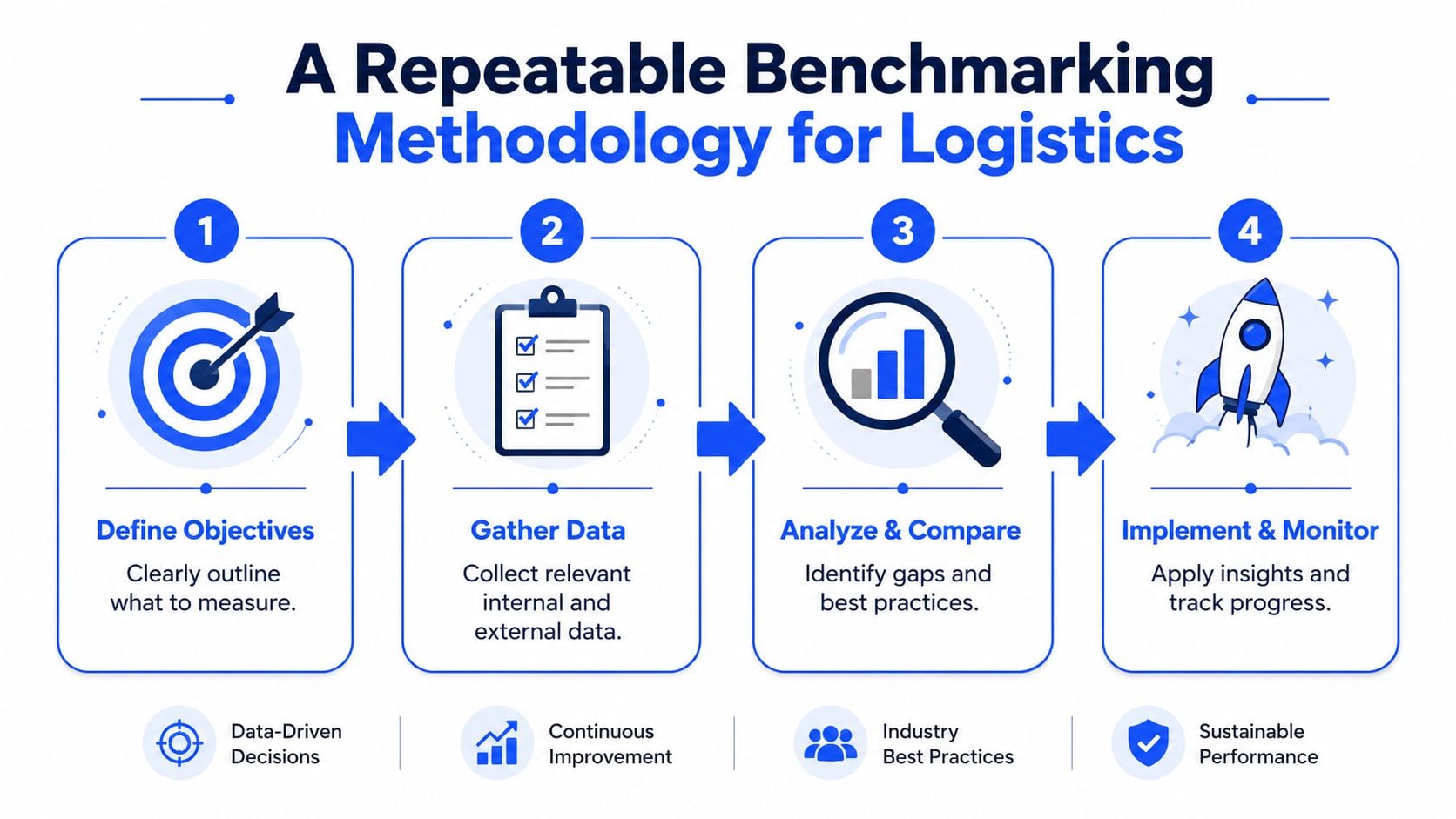
    An infographic showing a four-step repeatable benchmarking methodology process for logistics management and continuous business improvement.

    Step 1 define the business objective

    Start with a real decision. Don't start with the data source.

    A good objective might be winning a specific importer account, improving service credibility on a trade lane, defending a vulnerable customer, or deciding whether to commit more sales effort to a geography. The objective determines what benchmark matters. If the goal is prospecting, shipment and lane intelligence take priority. If the goal is account retention, service and response metrics become more important.

    Write the objective in operational terms. “Increase visibility in retail imports” is too broad. “Build a targeted list of retail importers whose lane mix fits our network and whose current routing pattern appears exposed” is workable.

    Step 2 gather comparable data

    Teams tend to either overbuild or oversimplify. Pull from a small number of sources that fit the objective:

    • Internal systems such as TMS, CRM, and quote history for service and conversion data
    • Public and commercial shipment intelligence for shipper patterns, commodities, and trade lanes
    • Carrier schedules and route information for service design and routing alternatives
    • Account notes and exception records for context that raw movement data can't explain

    If your team needs more structured shipment visibility, services such as a port import export reporting service can help standardize how lane and account activity are reviewed before outreach or network decisions are made.

    Step 3 analyze and normalize before comparing

    This is the step that separates useful benchmarking from misleading dashboards. JANA notes that benchmarking compares business processes and performance metrics against industry bests, but it also stresses agreement on which metrics matter and a defined methodology for collection, aggregation, and distribution. Without normalization and common data definitions, cross-company comparisons can produce misleading conclusions instead of actionable gaps, as explained in JANA's discussion of technical information metrics and benchmarking methodology.

    In logistics terms, normalization means asking basic but essential questions.

    1. Are we comparing the same trade lane over the same period?
    2. Are transit times defined the same way across the data set?
    3. Are we mixing bookings, shipments, and quotes as if they were interchangeable?
    4. Are account categories broad enough to distort the result?

    A rep who compares a shipper's peak-season pattern to a quiet off-season period may think there's an opportunity where there isn't one. An operations leader who compares all Asia-origin freight as one bucket may miss a severe problem isolated to a specific gateway pair.

    Standardize first. Compare second. Any other order creates false confidence.

    Step 4 turn the gap into action

    The final step is practical. If the benchmark shows a gap, assign a move.

    • If a prospect appears overconcentrated with a provider set that doesn't match your strongest lane, craft outreach around network fit.
    • If your actual service underperforms on a lane you sell aggressively, fix the routing before increasing pipeline pressure.
    • If a branch wins a lot of quotes but books poorly, review qualification criteria and pricing discipline.
    • If a key customer's traffic pattern shifts, adjust account strategy before renewal pressure surfaces.

    The benchmark is not the output. The output is the decision memo, routing change, prospect list, pricing stance, or account review plan that comes from it.

    Practical Use Cases for Sales and Routing

    The easiest way to understand benchmarking is to watch it change a real conversation. In logistics, the value shows up when a rep stops sending broad outreach and when an operations manager stops defending a route because it's familiar.

    A professional man pointing at a logistics dashboard screen displaying real-time vehicle tracking and performance data.

    Use case one prospecting a shipper with a lane-specific point of view

    A sales development rep gets a target account in the consumer goods space. The old approach would be simple. Find the logistics manager, send a note about rate competitiveness, and ask for a quote opportunity.

    Instead, the rep reviews customs activity first. The shipper appears to import repeatedly on a narrow set of origin points. The movement pattern suggests dependence on one carrier mix and a small number of gateways. The rep also compares that pattern with the forwarder's own strengths and sees a better fit on an alternative routing design the prospect doesn't appear to be using much.

    Now the outreach changes. It doesn't claim universal superiority. It says, in effect, your inbound profile suggests heavy reliance on a limited lane structure, and there may be room to reduce exposure through a routing design that better matches your supplier geography. That's a much better reason to take a meeting.

    The rep can push this further by combining shipping intelligence with account research and predictive analytics for sales to prioritize the shippers most likely to respond to a lane-specific message rather than a broad introductory one.

    A shipper rarely replies because a forwarder asks for a chance. They reply when the forwarder shows they've already done part of the shipper's homework.

    What the rep is really benchmarking

    The rep is not benchmarking the prospect against an abstract “industry average.” The benchmark is more targeted.

    • Current shipper pattern versus your network fit
    • Observed routing concentration versus available alternatives
    • Prospect's likely provider setup versus your commercial opening

    That creates a usable sales narrative. The rep is no longer selling logistics in general. The rep is selling a more relevant option for that shipper's actual flow.

    A short demonstration helps teams visualize the shift from generic market data to practical selling.

    Use case two defending and improving a trade lane

    Now switch to operations. A carrier or forwarding operations manager is reviewing a key account on a competitive trade lane. The account isn't lost, but it feels unstable. Service complaints are increasing, and the customer has started asking more detailed questions during review calls.

    The manager benchmarks internal execution against the lane's market expectations and against what the company has been promising commercially. Scheduled transit looks acceptable, but actual handoffs and dwell points show friction. The lane isn't failing everywhere. It's failing at specific nodes where routing choices create avoidable delay and poor exception visibility.

    That matters because the response changes from defensive to constructive. Instead of saying “conditions are challenging for everyone,” the manager can say, “We identified where this lane is weakening for your shipments, and we're proposing a routing adjustment with clearer handoff control and better exception management.” The customer hears ownership rather than excuses.

    Why these use cases work

    Both examples use the same principle. Benchmarking works when it narrows action.

    The sales rep uses it to sharpen outreach around a shipper's real traffic pattern. The operations manager uses it to isolate a service gap instead of treating the lane as one undifferentiated problem. In both cases, the benchmark gives the team a specific basis for a decision.

    That's the difference between data as decoration and data for impact.

    Operationalizing Insights with the Right Tools

    Manual benchmarking works at small scale. A rep can study a handful of accounts. An operations manager can review one lane in detail. But once a team wants repeatability across branches, modes, territories, and account segments, manual work starts to break down.

    The bottlenecks are predictable.

    Where manual benchmarking stalls

    • Data aggregation slows down. Shipment intelligence, CRM records, schedules, and internal performance data sit in different places.
    • Definitions drift. One team's lane view doesn't match another team's reporting logic.
    • Action gets delayed. Even when the insight is clear, turning it into outreach lists or account plans takes too long.

    Here, automation proves its worth. A practical overview like this guide to business intelligence automation is useful because it shows why teams need systems that connect collection, interpretation, and action rather than stopping at dashboard creation.

    What a scalable workflow looks like

    A scalable benchmarking workflow should let a team do four things without excessive manual stitching:

    1. Aggregate external and internal logistics signals
    2. Filter by shipper, lane, commodity, geography, and mode
    3. Surface account-level opportunities or service risks quickly
    4. Push insights into outreach or review workflows

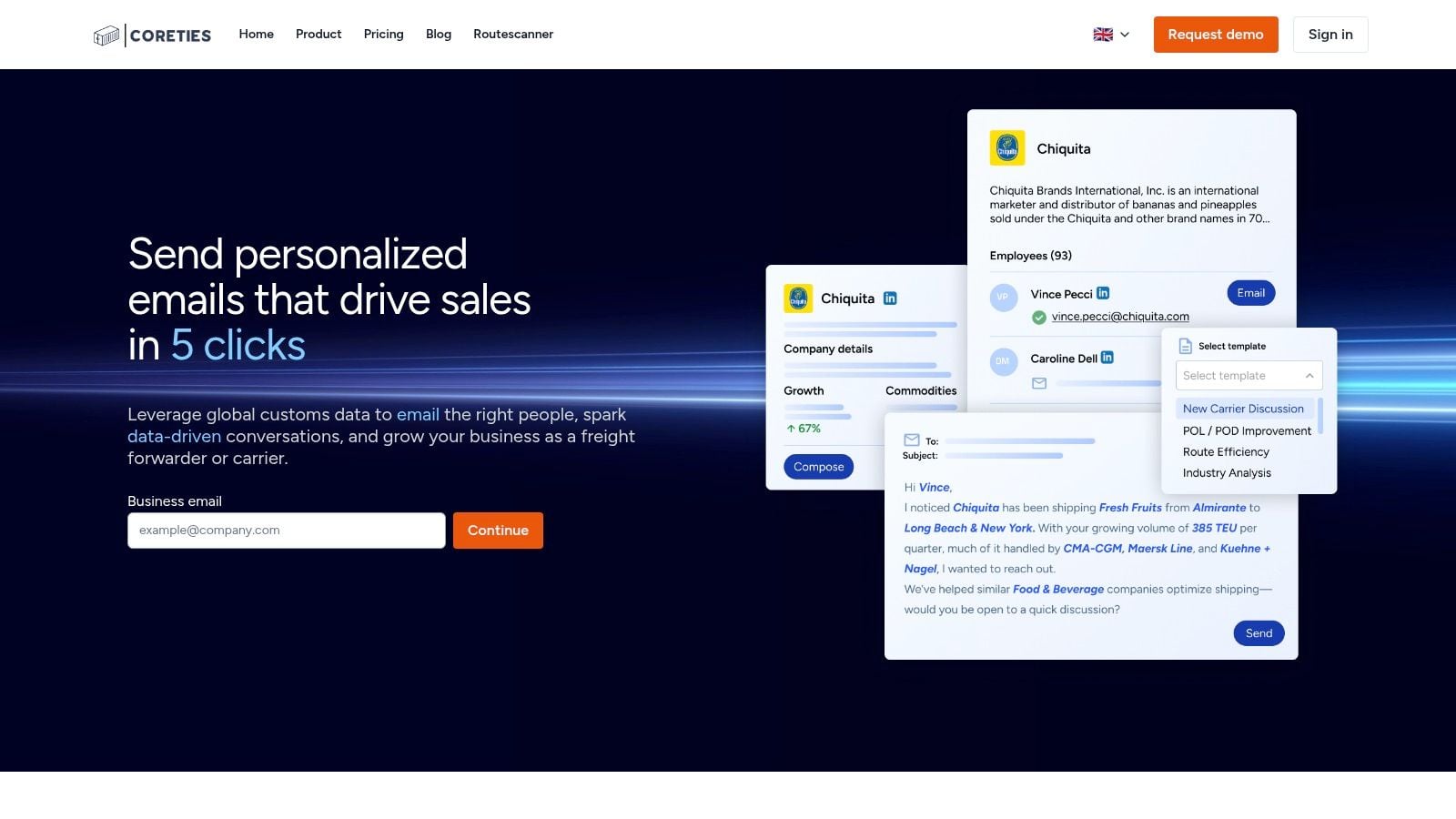
    For logistics-specific teams, Coreties fits that model by turning customs data into prospecting and account research workflows, helping users identify relevant companies, contacts, and lane patterns, while also supporting routing conversations through linked market and schedule context. If implementation discipline is the concern, a structured implementation timeline for logistics teams helps keep the rollout tied to clear sales and operations use cases instead of tool sprawl.
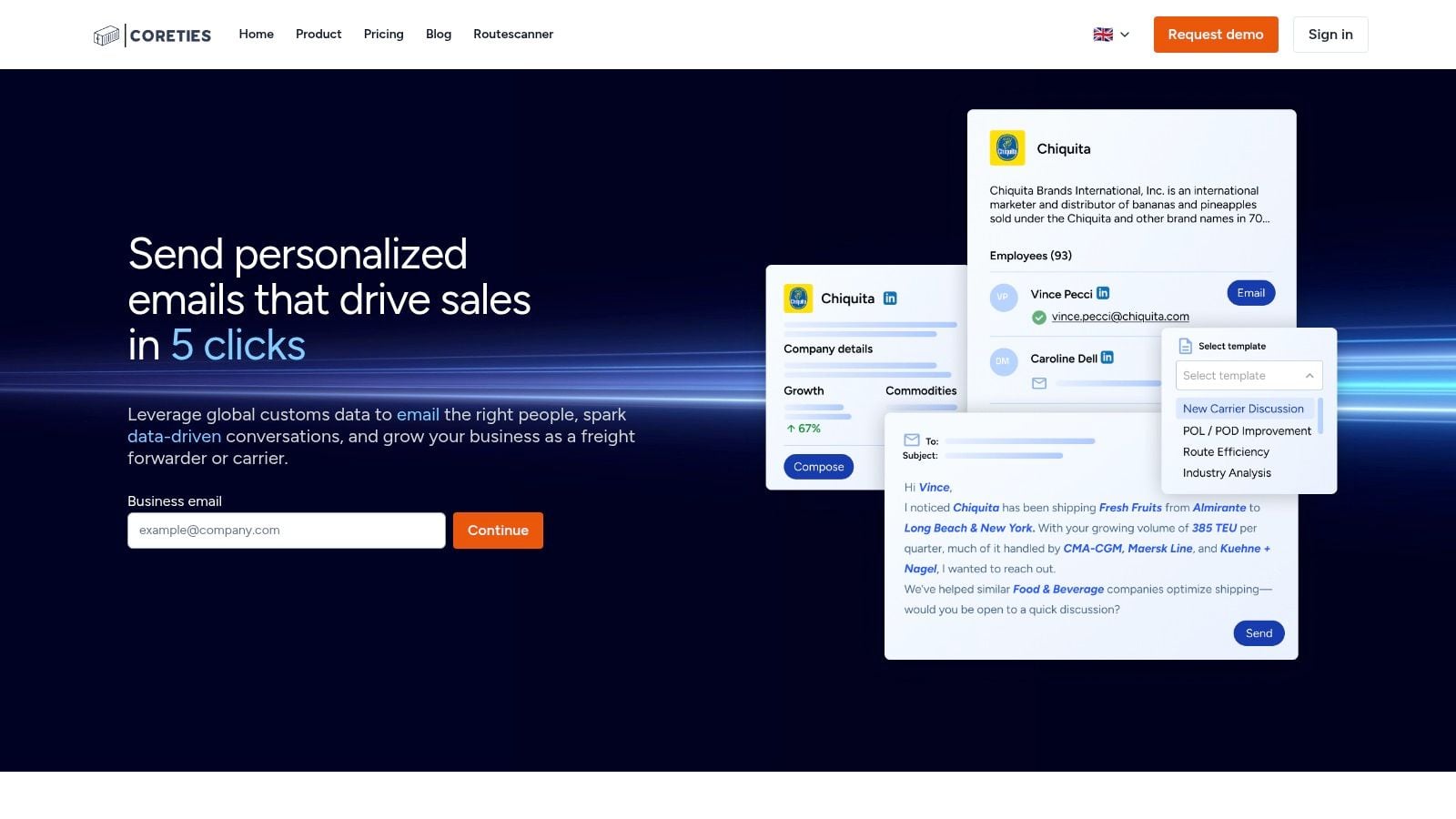
    Screenshot from https://coreties.com

    The point isn't to automate for its own sake. The point is to reduce the gap between noticing an opportunity and acting on it. In logistics, that gap matters. By the time a team manually assembles the shipper view, lane analysis, and outreach plan, the prospect may already be deep into a tender cycle or the account may already be speaking with competitors.

    Industry benchmarking stops being a buzzword once it enters the daily rhythm of sales calls, account reviews, and routing decisions. Teams that use it well don't just know more. They approach the market with a clearer argument, a tighter target list, and a stronger operational case.


    If your team wants to turn shipping data into practical prospecting, routing, and account intelligence, take a look at Coreties. It's built for logistics teams that need to move from raw customs activity to targeted outreach and sharper commercial decisions without relying on generic sales pitches.

  • Mastering Sales Intelligence Tools for Logistics

    Mastering Sales Intelligence Tools for Logistics

    You can feel the old logistics sales routine wearing your team down. A rep gets a spreadsheet of importers, searches LinkedIn, calls the main switchboard, reaches the wrong contact, leaves a voicemail, sends a generic email, and repeats it all afternoon. By Friday, there's activity everywhere and very little pipeline that deserves a forecast discussion.

    That approach breaks down fast in freight. Shippers don't buy because you called first. They buy because you understood their lane, recognized a service gap, reached the right person, and made a relevant offer before another forwarder did. In logistics, timing and context beat volume.

    That's why sales intelligence tools matter. Used well, they replace blind prospecting with a working view of who ships what, where they move it, who likely owns the decision, and when outreach has a real reason behind it.

    The End of Cold Calls in Logistics

    A freight rep once could get away with persistence alone. Buy a list, call through the front desk, ask for the transportation manager, and hope the account had a tender coming up. Today that method burns hours and creates noise. Most logistics teams already know the pain. The problem isn't effort. It's weak targeting.

    In freight forwarding and carrier sales, the bad version of prospecting looks familiar:

    • Wrong company fit: Reps chase businesses that don't move the modes, origins, or volumes the team serves well.
    • Wrong contact level: They find a CEO or founder when the conversation belongs with procurement, transportation, import operations, or supply chain.
    • Wrong timing: Outreach lands after a routing decision is already made, after a contract is locked, or during a period when the shipper isn't reviewing providers.
    • Wrong message: Emails talk about “end-to-end logistics solutions” instead of a concrete lane, customs pattern, or service issue the prospect already feels.

    That's why the old playbook produces motion, not momentum.

    A better workflow starts before the first email. Reps build a target list from actual shipping behavior, narrow by trade lane or product movement, identify decision-makers, and then tailor outreach around the account's logistics reality. If your team still struggles with contact discovery, this guide on how to find decision-makers in target accounts is a practical place to tighten the front end of the process.

    Practical rule: In logistics sales, a smaller list with real lane relevance usually beats a larger list built from generic industry filters.

    Cold calling isn't dead because calls stopped working. It's ending because random calls stopped working. The teams winning freight contracts aren't just working harder. They're entering conversations with better data.

    What Sales Intelligence Means for Freight and Shipping

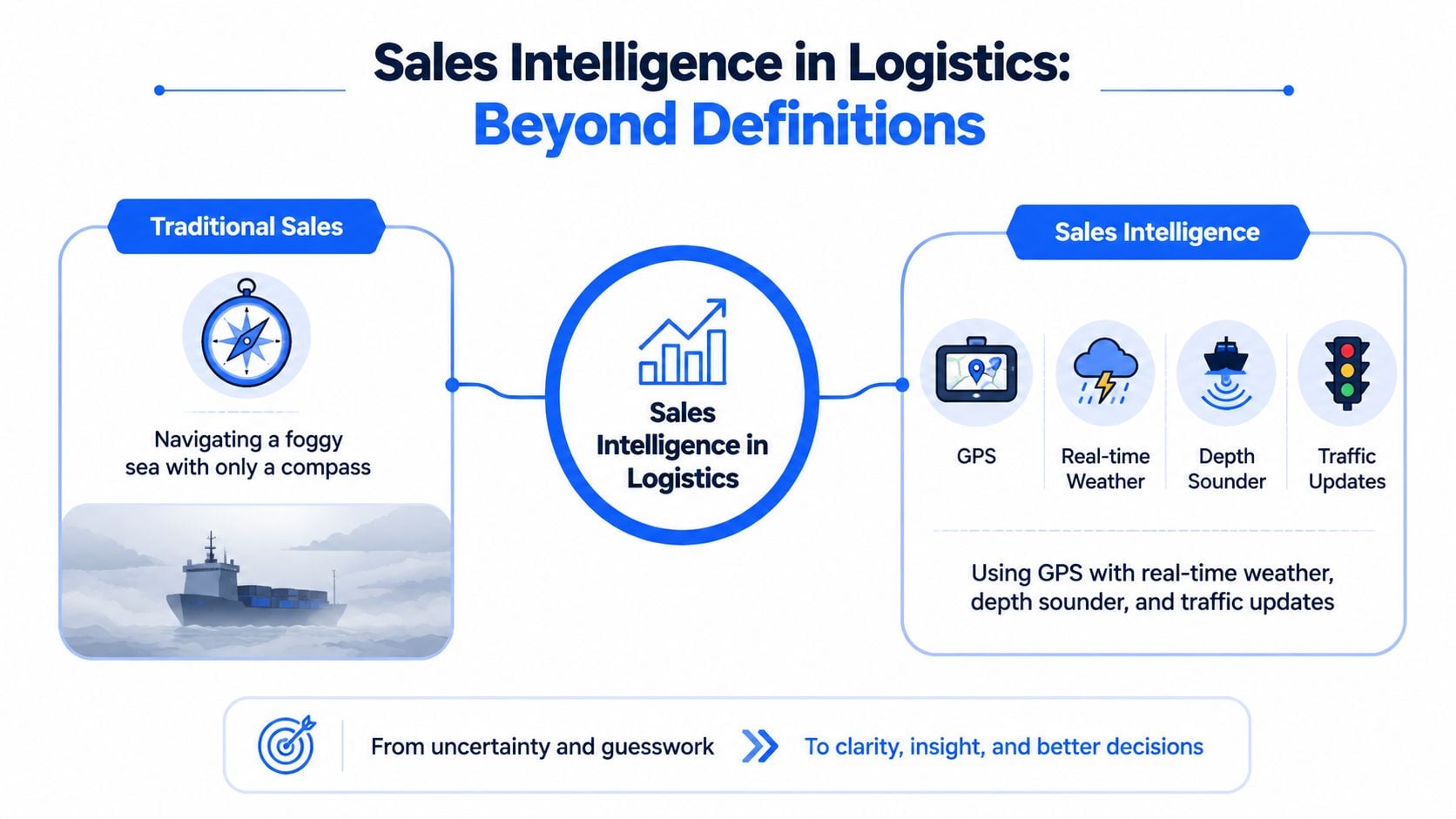
    For logistics teams, sales intelligence is the difference between a paper road atlas and a live satellite navigation system. The atlas tells you where roads exist. The live system shows traffic, weather, detours, and which route still makes sense right now. Freight sales works the same way.

    Traditional prospecting gives you names and company records. Modern sales intelligence tools give you operating context.

    According to Outreach's explanation of what sales intelligence is, the category evolved from simple databases into platforms that combine contact data, firmographics, intent signals, and CRM integrations. IBM describes it as the systematic collection of data to improve sales. In practical terms, that means a logistics seller can stop treating prospecting as list building and start treating it as account selection.

    An infographic comparing traditional sales to modern sales intelligence in the logistics industry using navigation metaphors.

    From records to operating insight

    A generic contact database might tell you a company is an importer in the consumer goods space. That's not enough to win freight. A logistics-focused intelligence workflow should help your team answer better questions:

    • What does this shipper move?
    • Which origin-destination patterns matter most to them?
    • Who likely owns forwarding, carrier procurement, or customs coordination?
    • What changed recently that makes outreach relevant now?

    That last point is where average prospecting falls apart. Reps often know who the company is, but not why the account deserves attention this week.

    Why the definition matters in logistics

    In freight, relevance comes from operational context. If you know a shipper's likely lanes, mode preferences, geography, and internal buyer roles, you don't send a vague introduction. You lead with a useful point of view. That could be a consolidation opportunity, a service alternative, a routing idea, or a faster way to cover a problematic lane.

    Sales intelligence in logistics isn't about owning more records. It's about turning fragmented market information into a reason to contact a shipper.

    That's also why generic B2B advice often misses the mark for freight teams. Logistics sellers need more than titles and email addresses. They need a current view of trade flow, account fit, and buying context. Without that, prospecting stays reactive.

    Must-Have Features and Data Sources for Logistics Sales

    A logistics sales team shouldn't buy a general database and assume it becomes industry-specific because a vendor added “transportation” as a filter. Freight sales needs deeper operating data. If the platform can't help your reps understand lanes, shipment patterns, and supply chain ownership, it won't change performance in a meaningful way.

    The strongest sales intelligence tools work because they join multiple data layers. IBM's overview of sales intelligence notes that contact, firmographic, intent, and deal signals become more useful when fused into one view, and that machine learning can use historical sales data to rank accounts by fit and buying likelihood. For logistics teams, that matters because no single dataset explains whether an account is worth pursuing.

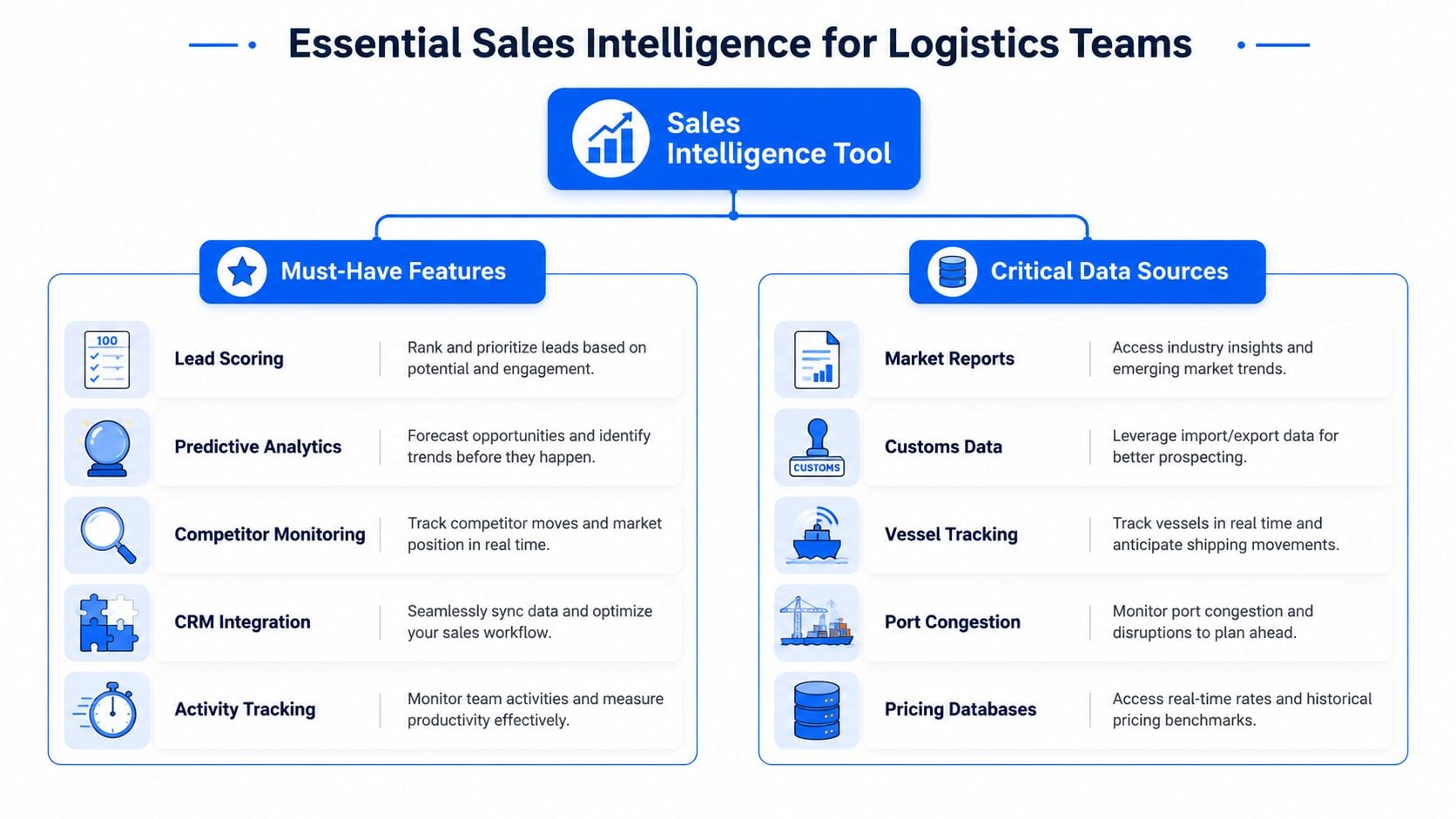
    A diagram illustrating essential sales intelligence features and critical data sources for logistics industry teams.

    What logistics teams actually need

    Here are the capabilities that move the needle in freight sales.

    • Customs and shipment visibility: This is the anchor dataset for many forwarding and carrier teams. Customs data helps reps identify who is importing, what categories they move, and which trade flows deserve attention. It's one of the clearest ways to move from abstract industry targeting to actual shipper discovery. If you want a broader view of how these datasets support prospecting, this overview of supply chain databases for sales teams is worth reviewing.

    • Lane-level filtering: “Retail” or “manufacturing” isn't precise enough. Reps need to isolate accounts by origin, destination, mode, region, and shipment pattern so they can build a service offer around actual movement.

    • Decision-maker coverage below the C-suite: In logistics, the useful contact is often the person managing transportation procurement, import operations, sourcing logistics, or distribution planning. A tool that only surfaces executive leadership will slow the sales cycle down.

    • CRM integration: If reps must export CSV files, manually enrich records, and copy activity back into the CRM, adoption drops. The tool needs to fit the daily sales motion, not sit beside it.

    Nice features versus useful features

    Some features look impressive in a demo but don't matter much in freight unless the underlying data is relevant.

    Feature type Useful in logistics when Weak in logistics when
    Lead scoring It reflects lane fit, shipment profile, and buyer role It scores generic industry fit only
    Predictive signals They help reps prioritize active accounts They produce rankings with no operational explanation
    Competitor monitoring It reveals service gaps or disruption opportunities It offers broad market alerts with no account tie-in
    Activity tracking It shows whether outreach is moving the account It becomes a dashboard of rep busyness

    Why customs data changes the conversation

    Customs data is a real differentiator because it grounds sales activity in trade behavior, not assumptions. If you can see who imports from a specific origin, or which companies appear active on a lane your team already serves well, you can build a prospecting strategy around actual freight movement.

    That's what many tools still miss. They tell you who fits your ideal customer profile in theory. Logistics teams need to know who resembles a customer in motion.

    From Data to Deals Logistics Use Cases

    The shift from research to revenue happens when reps use data to create a specific offer. In freight, that usually starts with a lane, a service problem, or a buyer already showing activity.

    One practical example is building a target list around a new trade lane push. Say your team wants more inbound business from Southeast Asia into the US Midwest. Instead of buying a broad importer list, you filter for shippers with relevant origin patterns, narrow by commodity or product group, and then route outreach to transportation or import contacts. The message is no longer “We're a global forwarder.” It becomes “We've identified your Vietnam-origin flow and have a stronger option for this lane.”

    Screenshot from https://coreties.com

    Three use cases that actually fit freight sales

    Use case one. Build an LCL or consolidation prospect list
    A forwarder launching a focused service can identify importers with shared origin markets and build outreach around consolidation, transit control, or destination handling support. This works best when the rep knows the traffic pattern before the first touch.

    Use case two. Target accounts during service disruption
    If a shipper's current provider is struggling with consistency on a lane, a rep can move quickly with a credible alternative. In freight, timing matters as much as price. A relevant message during disruption gets read. A generic capability deck usually doesn't.

    Use case three. Plan a territory visit around account quality
    A field seller heading into Chicago, Rotterdam, or Singapore shouldn't book meetings based on whichever accounts happen to be nearby. Geo-search and account mapping let the rep build a route around high-fit shippers, current opportunities, and adjacent targets worth dropping in on.

    When timing becomes the advantage

    Intent signals matter most when they help reps act faster. Crunchbase's guide to sales intelligence and intent-driven prospecting explains that intent systems track research behavior across large web footprints and can surface accounts actively evaluating a category. In logistics, that doesn't replace customs or lane data. It complements it.

    A shipper may match your lane strategy, but still not be ready for a conversation. Intent data adds a timing layer. If an account starts showing signs of active evaluation, reps can move from static prospecting to event-triggered outreach.

    If your team can explain both the shipper's freight pattern and the reason for reaching out now, the conversation feels informed instead of intrusive.

    That's where deals start. Not with more names. With better reasons.

    An Evaluation Checklist for Your Next Sales Tool

    Most sales intelligence tools look strong in a demo. Filters are smooth. Maps move fast. The dashboard is clean. None of that tells you whether the platform will help your team win freight contracts.

    A better evaluation process starts with one question. Does this tool improve a bottleneck your logistics team already feels?

    The market leaders have built serious data infrastructure. ZoomInfo says its platform is built on 500 million contacts, 100 million companies, and 1.5 billion+ data points processed daily in its GTM Context Graph, as noted in this review of top sales intelligence tools. That scale matters. But for a freight team, scale alone doesn't guarantee useful lane targeting, cleaner account selection, or better contact relevance.

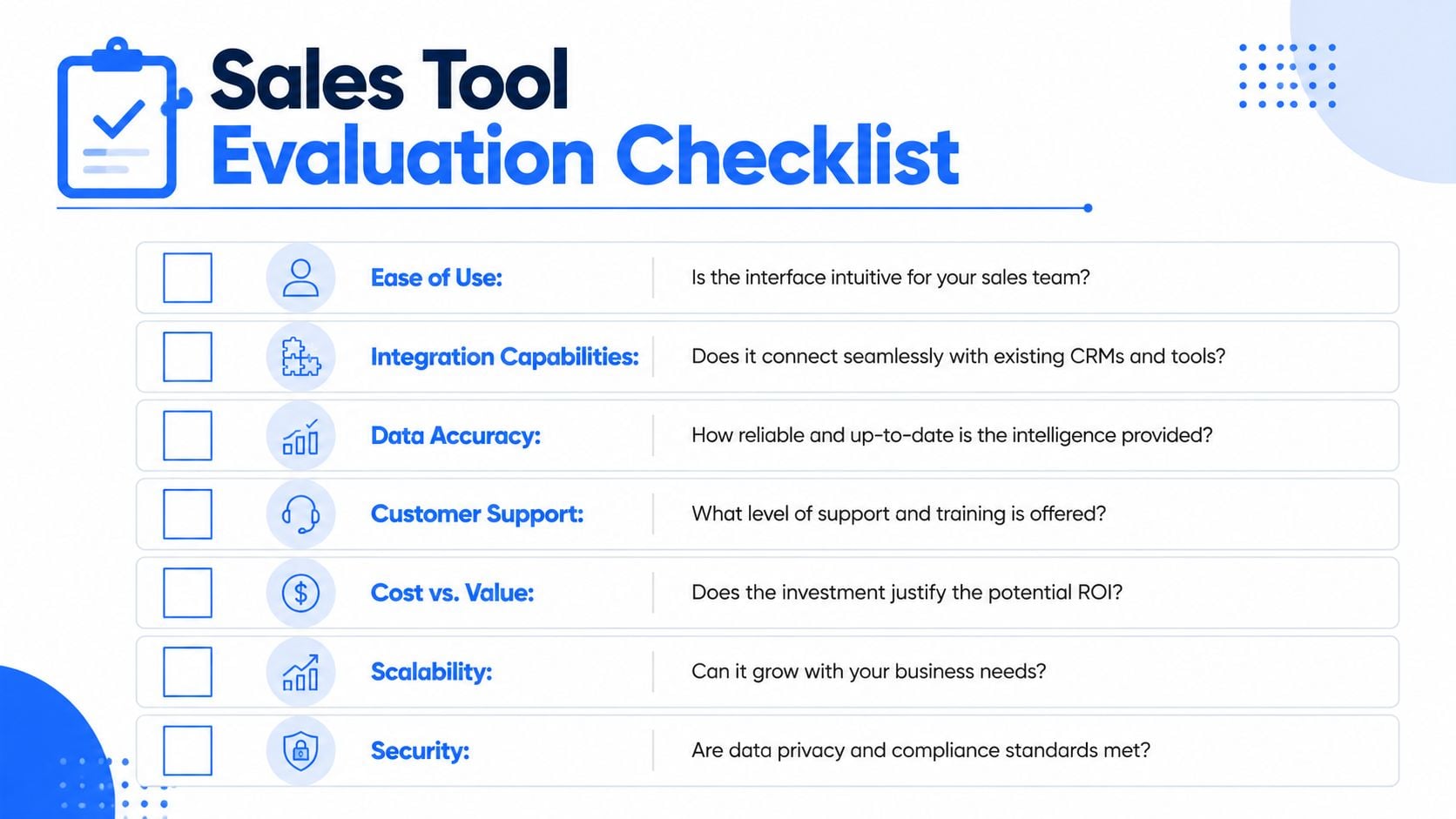
    A checklist infographic titled Sales Tool Evaluation Checklist featuring seven key criteria for evaluating new software tools.

    A practical buying scorecard

    Use a simple red-yellow-green score across these areas:

    • Data fit: Does the platform understand logistics entities, shipper behavior, and trade-lane targeting well enough to support real prospecting?
    • Contact relevance: Can reps find supply chain, transportation, procurement, and import/export contacts, not just senior executives?
    • Workflow speed: Can the team go from account discovery to outreach without bouncing across multiple tools?
    • Territory usefulness: Does it support geographic planning, lane clustering, or field-sales routing in a way that reflects how your team sells?
    • Integration quality: Will it sync with your CRM and existing process without creating manual cleanup?
    • Signal trust: Can your reps tell why an account was prioritized, or does the system just produce opaque rankings?
    • Adoption risk: Will your team use it after the first month?

    Questions to ask in the demo

    Don't ask vendors for a generic walkthrough. Make them prove fit.

    Ask this Why it matters
    Show me how to find importers on a specific lane Reveals whether the product supports logistics targeting or just broad firmographics
    Show me the buyer roles available for an account Confirms contact depth where freight decisions really sit
    Show me how records stay current Exposes refresh discipline and practical usability
    Show me the CRM handoff Tells you whether the workflow will stick after launch

    A useful outside perspective can also help your team compare prospecting categories before you buy. This roundup from Fypion Marketing on best sales prospecting tools is a solid reference for framing the broader context.

    Buyer test: If a vendor can't demonstrate a real freight workflow in the demo, assume your reps will have to build that workflow themselves.

    That usually means slower adoption and a weaker return.

    Implementation and Measuring Your ROI

    Teams often lose the value of a good tool in the first month. Not because the software is bad. Because rollout is vague, ownership is unclear, and nobody defines what “working” means for the sales floor.

    The fastest path to ROI is to connect the tool to one concrete bottleneck. Avoma's guidance on how to evaluate sales intelligence tools makes this point well: the actual buying question isn't “which tool is best,” but whether the tool improves a specific constraint such as account prioritization or outreach personalization. In logistics, that usually means better lane targeting, faster account research, or more relevant outreach to shipper-side decision-makers.

    Start narrow or adoption will stall

    Don't launch with every mode, every region, and every rep at once. Start with one use case your team already understands.

    Examples that work well:

    • A lane-based pilot: Assign one trade lane or shipper segment to a small team and compare the quality of conversations against the old process.
    • A territory planning pilot: Give field reps a defined geography and require account selection through the new tool before trips are booked.
    • A contact-quality pilot: Focus only on improving access to the right buyer roles for a set of named accounts.

    If your team needs a planning model for rollout, this guide to an implementation timeline for sales adoption can help map ownership and sequencing.

    Measure business movement, not just rep activity

    A weak rollout measures emails sent. A strong rollout measures whether the team is producing better opportunities.

    Track outcomes such as:

    • Qualified accounts created: Are reps identifying more accounts that fit your service strengths?
    • Time to first meaningful meeting: Are sellers reaching a relevant buyer faster?
    • Message relevance: Are outreach notes and emails tied to lanes, origins, or supply chain context?
    • Pipeline quality: Are opportunities entering the CRM with a clear freight problem to solve?

    Coreties says customers report up to 30x gains in outreach efficiency, with teams spending about an hour to send 30+ customized emails versus a single message with traditional methods, according to the publisher information provided for this article. The number matters less than the lesson. Efficiency improves when the workflow reduces research time and makes personalization easier at the moment of outreach.

    Here's a useful way to pressure-test adoption internally.

    If the tool saves clicks but doesn't improve targeting, it won't last. If it improves targeting but creates extra admin, reps will route around it. The tool has to make the right action faster.

    Build Your Future-Proof Logistics Sales Engine

    The logistics teams that keep chasing generic lead lists will stay busy and frustrated. The teams that win consistently are building a sales engine around better account selection, sharper timing, and outreach grounded in actual freight movement.

    That's the fundamental shift behind sales intelligence tools. They move the job from contact hunting to opportunity design. A rep stops asking, “Who can I call today?” and starts asking, “Which shippers fit our network, where is the service gap, and who owns the decision?” That's a stronger commercial posture for any forwarder, carrier, NVOCC, or 3PL.

    What durable teams do differently

    • They target by lane, not just industry
    • They look for operational relevance before writing outreach
    • They build workflows that sales reps will use every day
    • They treat data quality and signal confidence as commercial issues, not just technical ones

    For leaders trying to improve output without forcing more activity onto already stretched teams, this startup guide on sales productivity offers a useful outside lens on productivity discipline and workflow design.

    The future-proof logistics sales organization won't be the one with the biggest list. It will be the one that can spot the right shipper sooner, understand the freight context faster, and start a better conversation before competitors do.


    Coreties helps freight forwarders, carriers, and logistics sales teams turn customs data into qualified prospect lists and personalized outreach. If you want a faster way to find shippers by lane, identify the right decision-makers, and contact them with messages tied to real shipping patterns, explore Coreties.

  • How to Find Any Company That Imports

    How to Find Any Company That Imports

    Your CRM is full, but your pipeline is thin. That's the daily problem for most freight sales teams.

    You call a prospect that looked promising on paper. They don't import anymore. Or they import on a lane you don't serve well. Or you reached the wrong department. By noon, you've burned through a list and learned nothing useful except that bad data wastes selling time fast.

    The fix isn't finding more companies. It's learning how to identify a company that imports in a way that tells you whether the account is winnable. The reps who book meetings consistently don't just hunt for importer names. They read customs activity, route behavior, port choices, and contact signals, then use that intelligence to start a conversation the shipper cares about.

    The End of Bad Leads Starts with Better Data

    Most bad leads aren't bad companies. They're bad assumptions.

    A rep sees a manufacturer, distributor, or retailer and assumes they move international freight. That used to be enough to justify a call list. It isn't anymore. If you can't tell what they import, where it comes from, how often it moves, and whether the lane fits your network, you're guessing.

    A person looking stressed while working with data management and business analytics on their computer screens.

    Scale matters

    Importing isn't a niche corner of the economy. In 2023, the U.S. imported roughly $3.2 trillion in goods and services overall, and Mexico became the largest import source at about $480.05 billion, equal to 15.1% of total U.S. imports according to U.S. foreign trade data from the Census Bureau. That tells you two things right away.

    First, there are more potential importer accounts than a typical sales team can work properly. Second, trade lanes are concentrated enough that shifts in sourcing create immediate openings for freight providers that understand what changed.

    A company that imports isn't just buying overseas product. It's managing supplier reliability, booking capacity, customs exposure, drayage timing, inland routing, and landed cost. If your prospecting method doesn't reflect that complexity, your outreach sounds generic because it is generic.

    What good data changes

    The old model was list building. Buy a database, sort by industry, and start dialing.

    The better model is signal building. You start with shipment activity, then layer company fit, lane fit, and contact fit. That's how a sales team stops treating every importer like the same account type.

    A practical workflow usually includes:

    • Trade activity first: Confirm the company is importing and identify the lane.
    • Routing context next: Look at origin, destination, and likely pressure points.
    • Contact enrichment after that: Match the account to the person who owns freight, sourcing, or compliance.
    • Message last: Write only after you know what problem you're calling about.

    If your records are incomplete before outreach starts, it helps to enhance B2B customer data so your team isn't chasing switchboard numbers, stale titles, and generic inboxes.

    Practical rule: A prospect list should answer “why now?” before a rep sends the first email.

    That's the shift. You're no longer asking, “Who might need freight?” You're asking, “Which importer is showing a lane-specific reason to talk right now?”

    How to Uncover Importers with Customs Data

    Customs data is where modern freight prospecting starts because it shows behavior, not just firmographics.

    A static company list can tell you the business exists. Customs records can tell you whether that business is active in import trade, what it's bringing in, which ports are involved, and whether volume looks steady or opportunistic. That difference matters because reliable freight opportunities usually sit inside repeat behavior.

    What to look for in the record

    When reps first start using customs data, they often focus only on the company name. That's too shallow. The true value sits in the fields around the shipment.

    Look closely at:

    • Consignee and shipper names: This helps confirm who is buying and who is supplying.
    • Product descriptions and HS-related clues: You don't need perfect classification detail to understand the category and whether it fits your vertical.
    • Ports of loading and discharge: This gives you the lane, and the lane tells you where your service story might matter.
    • Shipment pattern: Repetition is usually more useful than one-off activity.
    • Timing: Recent movement creates a much better reason to call than old activity.

    The point isn't to become a customs broker overnight. The point is to know enough to spot commercial relevance.

    Why visibility changes the sales motion

    Importer activity can reach serious scale. A ranking of U.S. importers reported that Walmart, Target, The Home Depot, Lowe's, and Ashley Furniture collectively imported over 2.47 million TEU in a single year, showing how visible company-level importing can be in trade data according to the Top 100 U.S. importer rankings for 2019.

    You're probably not starting with accounts that size. But the lesson still applies. If large importers leave a visible trail, mid-market importers do too. That gives a rep something better than a purchased list: it gives context.

    For teams learning how these datasets are structured and used in day-to-day prospecting, this guide to supply chain databases is a useful reference point.

    Don't buy names when you can study movement.

    Old list logic versus current search logic

    Here's the comparison that matters in practice:

    Approach What you get What goes wrong
    Static lead list Company names, broad industry tags No clear lane, no urgency, weak personalization
    Customs-driven search Real shipment behavior, routing clues, supplier links Requires analysis, but produces far stronger outreach
    Combined workflow Import activity plus contact research Best fit for teams that want meeting quality, not just volume

    The reps who improve fastest stop asking, “Can I find any company that imports?” They start asking better operational questions. Which accounts import repeatedly? Which lanes line up with our carrier relationships? Which port patterns suggest inefficiency? That's when prospecting becomes useful to the shipper instead of interruptive.

    Filtering for High-Value Importing Companies

    A raw importer list is noise. The job is to reduce it until only commercial fit remains.

    Many teams fail here because they confuse abundance with pipeline quality. If your search returns thousands of importers, you haven't found opportunity yet. You've found workload. The value appears when you narrow the pool to accounts that fit your network, your margin profile, and your team's ability to win.

    A funnel diagram illustrating the process of narrowing 10,000 potential importing companies down to 50 targeted prospects.

    Start with lane fit

    The strongest buying signal isn't merely that a company imports. It's import behavior by lane and product. The sharper question is not “which company imports?” but “which company is importing more on this specific lane right now?” That's the useful distinction highlighted in this piece on import behavior by lane and product.

    Sales teams develop greater discipline. If your strength is Southeast Asia to the U.S. East Coast, don't fill the funnel with transatlantic importers just because they look active. If your inland solution is strongest through a certain port pair, rank accounts that use those gateways or nearby alternatives.

    A practical filter set often includes:

    • Lane relevance: Prioritize origin and destination combinations your operation can support cleanly.
    • Product relevance: Focus on cargo categories your team already understands.
    • Frequency: Repeated importers usually give you a more stable path to recurring business.
    • Port behavior: Port changes can indicate service issues, cost pressure, or network redesign.

    Then look for change

    Stable volume is useful. Change is better.

    If an importer adds a new origin country, starts using a different discharge port, or appears to split shipments differently than before, that's often where the sales opening lives. Those moves can reflect supplier diversification, service issues, transit concerns, or a push to control landed cost more tightly.

    The best leads usually come from movement, not size.

    This is also why generic “top importer” lists have limited value in day-to-day sales. They show who is active. They rarely show who is in transition. For prospecting, transition is usually the more valuable signal.

    Build a short list that sales can actually work

    A rep doesn't need a giant market map to book meetings this month. They need a shortlist that supports direct outreach with a clear point of view.

    Use a qualification lens like this:

    Filter question Why it matters
    Does the account import on a lane we can serve well? Prevents wasted outreach to poor operational fits
    Is the import pattern recurring? Suggests repeat freight potential
    Has the network changed recently? Creates a timely reason to contact
    Do the products align with our experience? Improves credibility in first conversations
    Can we explain a likely pain point? Turns outreach into a value-led message

    For teams trying to tighten this workflow, this article on how to generate leads in logistics offers a useful framework for turning broad market data into workable prospect lists.

    The practical target isn't “more names.” It's fewer names with better reasons to call.

    Verifying Contacts and Qualifying Decision-Makers

    A company can be perfectly qualified and still go nowhere if you aim at the wrong person.

    Newer reps often lose momentum. They do the hard work of identifying a real importer, then send outreach to info@, call the main line, or guess at titles. That creates delay, weakens the message, and usually hands control to a gatekeeper who has no reason to help.

    A professional person interacting with a digital network visualization of business contacts on a touchscreen interface.

    Match the contact to the problem

    The right contact depends on the issue you're raising.

    If the signal is route inefficiency, the buyer may sit in logistics, transportation, or import operations. If the signal is supplier movement or country-of-origin change, sourcing or procurement may have more influence. If the pain point involves exams, document quality, or entry risk, trade compliance or customs management may matter more than transportation.

    Start with role logic, not title vanity. A junior transportation manager with lane ownership is often a better first conversation than a VP with no daily control over bookings.

    Useful contact targets often include:

    • Logistics or transportation managers: Good fit when your angle is service, routing, or carrier performance.
    • Supply chain directors: Strong option when the account appears to be redesigning part of its network.
    • Global sourcing or procurement leaders: Relevant when supplier change is part of the story.
    • Trade compliance specialists: Important when customs friction is visible or likely.

    Use compliance risk carefully

    Compliance is one of the few outreach angles that can open a serious business conversation fast, but only if you handle it professionally.

    Guidance for evaluating importers notes that compliant importers average CBP examination rates of 2–3%, while companies with violation histories average 15–20% according to this manual on evaluating importers and compliance risk. That gap matters because exams create cost, delay, and internal pressure.

    The mistake is turning that into a scare tactic. Don't email someone and imply they're noncompliant because you saw import activity. Instead, use it as an intelligent conversation opener if there are signs that documentation quality, supplier vetting, or process discipline may be a concern.

    A useful supporting topic here is denied party screening, especially when your outreach touches compliance readiness and supplier controls.

    Field note: Decision-maker quality matters more than list size. Ten verified contacts with role clarity will outperform a hundred guessed names.

    A simple qualification test for the person

    Before outreach, answer three questions:

    1. Do they influence the lane or problem you identified?
    2. Can they act on a forwarding, carrier, or routing change?
    3. Will your message make sense in the context of their job?

    If you can't answer yes to all three, keep researching. The right company that imports still won't convert if the message lands with the wrong owner.

    Crafting Data-Driven Outreach That Gets a Reply

    Most freight outreach fails for one reason. It asks for time before it creates value.

    A generic message tells the shipper who you are, what your company offers, and that you'd like a meeting. None of that gives the buyer a reason to respond. A useful message starts with something the shipper is already dealing with, then points to a practical next step.

    A person using a laptop to draft smart outreach emails for business communication and professional marketing outreach.

    What bad outreach sounds like

    You've seen versions of this:

    We're a global freight forwarder supporting ocean, air, and customs solutions. I'd love to set up a quick call to discuss your shipping needs.

    There's nothing offensive about that message. It's just empty. It doesn't prove you understand the account, and it forces the buyer to do the work of figuring out relevance.

    What useful outreach sounds like

    A stronger message connects customs visibility to a likely operational problem:

    • You noticed a lane change: mention the shift and ask if capacity, cost, or reliability drove it.
    • You noticed a new discharge port: suggest there may be a routing or inland planning issue worth reviewing.
    • You noticed fragmented shipment behavior: raise consolidation or schedule design as a possible lever.

    A key signal is whether an importer is actively reworking its network. Customs data can reveal changes in origin countries or discharge ports, which creates an evidence-based reason to start a transportation conversation, as noted in this article on network changes as a shipper signal.

    That's the point where cold outreach starts sounding like account intelligence.

    A practical message framework

    Use this sequence:

    1. Observation
      State the shipment or routing pattern you noticed.

    2. Implication
      Tie that pattern to a plausible business issue such as service stability, inland cost, transit consistency, or compliance pressure.

    3. Specific offer
      Suggest one concrete way to review or improve the move.

    4. Low-friction ask
      Ask for a short conversation around that issue, not a generic intro call.

    Here's a basic contrast:

    Generic email Data-led email
    “We handle international shipping. Can we talk?” “I noticed your import flow appears to be using a different discharge pattern. If that change was driven by reliability or inland cost, I can share routing options worth comparing.”
    Focuses on seller Focuses on shipper
    No timing signal Has a reason now
    Easy to ignore Harder to dismiss because it's specific

    For teams that want to see how routing context strengthens the message, this walkthrough is worth a look:

    Why routing intelligence changes the conversation

    Many sales representatives leave money on the table right here. They stop at “I saw you import.” That's only half the job.

    The stronger move is to pair customs data with routing intelligence so your outreach includes a transportation hypothesis. Not a pitch deck. A hypothesis. If the importer changed origin points, discharge ports, or shipment structure, there may be a route design issue underneath it. That gives you something commercial to discuss on the first call.

    One option logistics teams use for this is Coreties, which combines customs-based prospecting with contact discovery and routing suggestions through its Routescanner partnership. In practice, that means a rep can move from identifying an importer to proposing a more relevant lane conversation without jumping between disconnected tools.

    “Good outreach doesn't ask a shipper to imagine value. It points to where value might already be leaking.”

    The best replies usually come from messages that feel informed, restrained, and operationally credible. Not flashy. Not overwritten. Just specific enough that the buyer thinks, “They may have looked at our network.”

    From Prospecting to Strategic Partnership

    Freight sales gets easier when you stop acting like a list manager and start acting like an operator.

    The workflow is straightforward when done well. Identify a company that imports through customs activity. Narrow the field by lane, product, and recent change. Find the person tied to that issue. Then reach out with a real point of view about the movement, not a generic request for time.

    What this approach changes

    It changes the first conversation.

    Instead of saying, “We'd love to support your freight,” you're saying, “We noticed a shift in how this freight is moving, and there may be a better way to handle it.” That creates credibility fast because you're speaking to a live operating reality.

    It also changes how sales leaders manage the team. Reps stop measuring progress only by dials and sends. They start measuring whether each target account has a valid signal, a route hypothesis, and a reachable decision-maker. If your team is working on streamlining pipeline inefficiencies for sales leaders, that mindset shift matters because cleaner qualification upstream usually improves everything downstream.

    What actually works over time

    The best freight relationships rarely start with a broad capability pitch. They start with one useful observation handled well.

    Use lane intelligence to earn the meeting. Use routing insight to earn the second call. Use execution to earn the business. That's how a cold prospect becomes an account, and how an account becomes a partner.

    A modern sales team doesn't need more noise. It needs better reasons to talk to the right importers at the right moment.


    If you want a practical way to turn customs data into targeted importer lists, verified contacts, and personalized outreach, take a look at Coreties. It's built for logistics teams that need to find the right shippers faster and start better sales conversations around real lane activity.

  • Export from Italy A Freight Forwarder’s Guide

    Export from Italy A Freight Forwarder’s Guide

    You're probably seeing the same pattern many forwarders see right now. The easy Italian shipper leads are already in everyone's CRM, rate pressure is getting worse, and sales teams keep talking about “Made in Italy” as if that alone is a lane strategy.

    It isn't.

    If you want a profitable export from italy business, you need two things at the same time. First, operational fluency: documentation, customs value, VAT proof, port selection, carrier fit. Second, a sharper prospecting model: knowing which Italian exporters are moving the right cargo on the right lanes, and which overlooked clusters produce repeatable freight instead of one-off spot business.

    That is where many organizations miss the market. They either understand the paperwork but pursue unsuitable accounts, or they build lead lists without understanding what makes Italian export flows work in practice.

    Why Italy Is Your Next High-Growth Market

    Italy isn't just a prestige origin. It's a working logistics market with enough export depth to justify dedicated sales focus.

    The headline that matters is straightforward. In the first eleven months of 2025, Italy's total exports reached €591.3 billion, up 3.1% year over year, with growth supported by non-EU markets and sectors such as pharmaceuticals (+30.9%) and transport equipment (+10.7%), according to the Italian Ministry of Foreign Affairs release on 2025 export growth.

    That matters for forwarders because broad export growth is one thing, but sector mix is what creates margin. High-value cargo, regulated cargo, and cargo with tighter service requirements usually creates better sales conversations than commodity freight where everyone competes on rate alone.

    Where the logistics opportunity sits

    A lot of teams still approach Italy as a lifestyle brand economy. Fashion, food, design, and some machinery. That view is incomplete and commercially weak.

    A wider opportunity sits in a wider mix:

    • Pharmaceutical and chemical shippers need tighter documentation discipline, specialized handling, and stronger exception management.
    • Transport equipment exporters often create project-like forwarding needs, irregular dimensions, or more complex booking coordination.
    • Non-EU trade lanes open more room for advisory selling because customs, origin, duty treatment, and routing decisions matter more.

    If you're an NVOCC, carrier sales team, or 3PL trying to build a durable Italian book, those are better hunting grounds than generic “Italian exporters” lists.

    Practical rule: Don't qualify Italy by country first. Qualify it by sector, lane, and compliance burden.

    What works for sales teams

    The teams that win in Italy usually do three things well:

    1. They segment by export behavior, not company fame
      A well-known brand may move little freight directly, outsource control to a procurement group, or split tenders across incumbents. A less visible industrial exporter can be a far better account.

    2. They focus on lanes where advisory value is real
      When customs treatment, route design, or handling standards affect landed cost, sales gets easier.

    3. They align operations and prospecting early
      There's no point opening accounts your branch can't support properly from an Italian origin.

    A strong export from italy strategy isn't about chasing every shipper in Lombardy or every food exporter in Emilia-Romagna. It's about identifying the cargo profiles where your team can quote accurately, execute consistently, and defend margin.

    Navigating Italian Export Documentation and Customs

    A shipment out of Italy can look clean at booking and still fail at filing. The sales rep has a rate approved, the shipper sends an invoice, the warehouse confirms cargo readiness, and customs stops the move because the file does not line up. That is a preventable loss of time, margin, and credibility.

    For forwarders building Italian export business, documentation is not just an ops task. It is part of account qualification. Shippers that regularly struggle with document accuracy, classification discipline, or permit screening often need more support and create more stickiness if your team can handle the work cleanly.

    A six-step infographic guide detailing the essential process for navigating Italian export documentation and customs regulations.

    Start with the commercial terms

    Document control starts with the sale, not with the declaration. If the shipper and buyer are loose on Incoterms, your operations team ends up guessing who owns carriage, who supplies customs data, and who is responsible when destination charges or export proof become disputed.

    Check four points before cargo cutoff:

    • Who controls main carriage
    • Who supplies customs data and product details
    • Who carries destination-side duty and clearance risk
    • Who needs proof of export retained for tax and audit purposes

    That sounds basic. It is also where weak files start.

    Build a document pack that agrees internally

    For a standard export from italy movement, the base file usually includes the commercial invoice, packing list, and any origin support needed for the shipment. Sector-specific licenses, certificates, or controls sit on top of that base depending on product and destination.

    The common failure is not a missing document. It is a file where each document says something slightly different.

    Review the pack against the declaration line by line:

    • Seller and buyer details
      Legal names, addresses, and tax identifiers should match the customs data.

    • Commodity description
      Generic wording like "parts" or "equipment" creates avoidable customs questions. Use a commercially real description.

    • Weights and package counts
      Errors here create problems far beyond customs. They affect bookings, terminal handling, and claims exposure.

    • Tariff classification
      Weak HS or TARIC coding creates risk on admissibility, controls, and duty treatment.

    Teams that need a quick refresher can use this guide to HS code booklet basics for freight and customs teams.

    Italian export files usually break on reconciliation, not on document creation.

    Treat customs value as an operations issue

    Customs value is one of the first places margin leaks. If the file treats invoice value as the full customs basis without checking freight, insurance, commissions, or other charge elements, someone later has to correct the declaration or defend the figure.

    That matters commercially as well as operationally. A shipper that regularly misstates customs value often has wider process gaps in quoting, order handling, and export admin. For a sales team using customs data to find stronger prospects, that is useful signal. Companies with consistent, believable declaration patterns usually make better long-term accounts than exporters whose filings show chronic inconsistency.

    What experienced teams verify before filing

    A practical pre-filing check should cover the points that cause the most friction:

    1. Classification is specific enough to file with confidence
      Do not accept vague product language for technical, regulated, or duty-sensitive cargo.

    2. Charge elements are reflected correctly in the customs basis
      This matters on LCL shipments, special packing, commissions, and other add-on costs that get missed in a rush.

    3. Origin support exists before sales promises any duty advantage
      Sales often moves faster than compliance, which can lead to disputes.

    4. Permit and control risk is screened early
      Technical goods, dual-use concerns, and sector-specific controls need checking before cutoff day.

    5. Proof of export can be retrieved after departure
      Finance teams care about this long after the truck leaves the shipper.

    If the customer needs a finance-side explanation of why export evidence matters, this plain-English accounting advice for export VAT is a useful reference to share internally.

    Forwarders that run this discipline well do more than file declarations. They become the team commercial exporters trust when the cargo is high value, time sensitive, or documentation heavy.

    Managing VAT Duties and Preferential Origin

    A shipper closes a sale to a buyer outside the EU, prices the order on the assumption of duty relief, and books pickup. Two days later, finance asks for export evidence and origin support. If the file is weak, the margin disappears fast. That is why this part of export from italy matters commercially, not just administratively.

    Forwarders who handle VAT evidence and origin discipline well become more useful to both operations and sales. They also get a clearer view of which Italian exporters understand their landed-cost position, and those companies usually make better prospects when you start building lead lists from customs data.

    VAT proof affects cash, audits, and client trust

    For extra-EU shipments, the question is simple. Can the exporter prove the goods left under the right references and within a clean document trail?

    If that proof is missing, finance teams can face VAT exposure long after delivery. The root cause is often operational. Missing MRN references, late exit confirmation, inconsistent consignee details, or poor archiving create tax risk that the shipper only sees months later.

    For finance teams that need a plain-English reference, this guide on accounting advice for export VAT is useful because it explains the evidence mindset clearly.

    A practical rule helps here. Treat proof of export as part of shipment completion, not as a document someone can chase later if accounting asks.

    Preferential origin changes the buyer's true landed cost

    Preferential origin can reduce duty, but only when the product qualifies under the relevant trade agreement and the supporting statement is in place. Italian dispatch alone proves almost nothing on that point.

    Sales teams often blur three separate ideas: shipped from Italy, made in Italy, and qualifying EU preferential origin. Customs authorities do not. Forwarders should not either.

    The operational trade-off is real. Pushing an origin claim too early can help win the quote, but it can also create a dispute when the exporter cannot support it. Holding the point back protects compliance, but it may leave savings on the table if nobody asks the right questions soon enough.

    The better approach is to test origin early and speak carefully until the documents are checked.

    What experienced teams check before promising duty savings

    Use a short origin screen before confirming landed-cost assumptions:

    • Whether the goods are wholly obtained or sufficiently processed in the EU
      Supplier location is not enough. Component sourcing and processing steps matter.

    • Whether the exporter can support the claim with the right statement or certificate
      Last-minute origin requests often produce incomplete backup.

    • Whether the buyer's market recognizes the preference being discussed
      A valid EU-origin story still depends on the destination country's agreement and import setup.

    • Whether commercial teams are quoting duty relief as confirmed or as potential
      That wording matters when the customer compares suppliers.

    This is also where lane planning and origin planning start to overlap. Teams moving cargo on Mediterranean services often need both pieces lined up before booking cutoffs get tight. A working knowledge of Mediterranean Shipping Line services and coverage helps when the shipment plan and the customs position need to stay aligned.

    Why this matters for prospecting Italian shippers

    Origin discipline and VAT discipline are good sales signals. Exporters who maintain clean evidence, use preference correctly, and present consistent declarations usually understand margin at a product and market level. Those are high-value accounts for forwarders because they buy on reliability and landed-cost control, not just on a low headline rate.

    That makes this section more than a compliance note. It is part of shipper qualification. When customs data shows steady extra-EU flows from an Italian exporter, the next question is not only where they ship. It is whether they are likely managing VAT proof and origin well enough to support larger, more profitable international programs.

    Optimizing Italian Freight Routes and Carriers

    Route design in Italy is where local knowledge starts paying for itself. A weak forwarder picks the most familiar port or airport. A stronger one picks the gateway that fits the cargo, destination, inland setup, and service promise.

    That's a big difference in export from italy business because Italy gives you real geographic choices.

    Stack of colorful shipping containers at a busy commercial port under a clear blue sky

    Southern ports versus northern gateways

    Italy's southern ports matter more than many non-Italian sales teams realize. According to Forto's guide to logistics to and from Italy, southern ports handle nearly 50% of Italy's total maritime traffic, and the Port of Gioia Tauro ranks as Europe's ninth-largest container port. The same source notes that routing through these southern ports can offer a 2 to 5 day transit time advantage for Asia- or Middle East-bound cargo compared with northern European gateways.

    That doesn't mean every shipment should move south. It means you should stop defaulting north without testing the lane logic.

    Key Italian Export Hubs At a Glance

    Hub Type Primary Lanes Key Strengths
    Gioia Tauro Seaport Middle East, Asia, transshipment-heavy flows Strong southern positioning, useful for time-sensitive ocean routings to eastern lanes
    Genoa Seaport Europe-connected export flows, global ocean services Good access to northern industrial regions and established port ecosystem
    La Spezia Seaport Containerized exports on major deep-sea lanes Practical for exporters needing northern Italy port access
    Milan Malpensa Airport High-value and time-sensitive air cargo Strong air cargo relevance for industrial and premium freight
    Rome Fiumicino Airport Broad international air connections Useful alternative depending on airline network and shipper location

    A related lane-planning reference for carrier coverage is this overview of Mediterranean Shipping Line services and network considerations.

    How to choose the right gateway

    Use a routing filter based on four factors.

    Cargo profile

    Pharma, aerospace-related cargo, urgent components, and premium consumer goods often justify different routing logic than standard palletized exports. The more sensitive the cargo, the less useful a generic “cheapest port” mindset becomes.

    Inland origin point

    A beautiful ocean schedule doesn't help if pre-carriage becomes messy, expensive, or unreliable. Northern exporters may still fit a northern port better, especially if warehouse cutoffs or drayage constraints are tight.

    Service promise

    If the shipper sells on reliability, route conservatively. If the shipper sells on landed cost and can absorb some variability, you may have more room to optimize.

    Port-specific execution risk

    Italian ports don't operate as interchangeable boxes. Documentation handling, terminal habits, and customs execution can vary. The best routing plan is the one your team can effectively control.

    Route planning in Italy should start with the shipper's promise to its customer, not with your branch's favorite gateway.

    What doesn't work

    Three habits usually damage service and margin:

    • Defaulting every export to the nearest famous hub
    • Ignoring southern-port advantages for Middle East and Asia lanes
    • Selling a route your operations team hasn't executed cleanly before

    A forwarder wins Italian routing decisions by combining geography with discipline. Not by quoting the same pattern on every account.

    Find Untapped Italian Shippers With Customs Data

    The most profitable Italian prospects are often the ones your competitors don't talk about. Not because they're small. Because they're embedded in industrial ecosystems that generalist sales teams don't map well.

    That's the hidden edge in export from italy prospecting.

    A professional analyzing data charts on a tablet while sitting at a desk with a coffee.

    The real opportunity is in the districts

    According to Keystone Procurement's analysis of Italy's export renaissance and industrial districts, Italy's export performance is supported by around 160 hyper-specialized industrial clusters that include around 26,000 small and medium exporters. The same source describes them as “invisible pillars” and notes that Marche exported over 10 billion euros in 2023.

    That's the kind of market structure freight sales teams should care about. These districts produce repeat freight patterns because companies within them often share suppliers, buyers, lane preferences, and cargo characteristics.

    A district-based shipper is rarely a random lead. It usually sits inside a freight ecosystem.

    Why most prospecting misses them

    Most sales databases push teams toward the obvious names. Large brands. Famous manufacturers. Companies already visible in trade media.

    That approach creates three problems:

    • You compete where everyone else is competing
    • You miss smaller but steadier exporters
    • You ignore cluster behavior that can lead to account grouping

    A ceramics district, machine tools cluster, luxury component corridor, or specialist manufacturing pocket can be far more useful than a broad list of “Italian exporters.”

    The better question isn't “Who exports from Italy?” It's “Which concentrated groups of exporters create repeatable lane density?”

    How to turn customs data into a prospect list

    Customs data becomes operationally useful for sales in this context instead of just interesting.

    Start with a district or region. Then build outward.

    Step one: map the cluster

    Don't begin with company names. Begin with geography and product concentration. If a region is known for a narrow set of products, that gives you a first filter for likely cargo type, service needs, and destination markets.

    Step two: isolate export behavior

    Look for exporters with recurring outbound activity, not just one shipment or one season. Consistency matters more than visibility.

    Step three: match lane to your strength

    If your network is strong on U.S. airfreight, district shippers with higher-value goods may fit. If your team has reliable Middle East ocean solutions, target the clusters whose cargo suits those lanes.

    Step four: contact the right decision-maker

    A customs-data lead is only useful if your outreach reaches the person handling logistics, procurement, or export operations. Generic inboxes slow everything down.

    One way teams handle this is by using platforms that combine customs data with contact discovery and lane filtering. For example, Italian exporter data for freight prospecting can help narrow outreach based on actual exporter activity rather than broad directory listings.

    What a better Italian lead looks like

    A better lead usually has most of these traits:

    • The shipper exports regularly
    • The cargo fits your modal strength
    • The destination aligns with your service network
    • The company sits in a sector or district with adjacent opportunities
    • Your team can speak to a concrete operational problem

    That last point matters. Outreach works better when you lead with a lane issue, customs issue, routing alternative, or handling concern the shipper is likely to face.

    For example, a district exporter sending specialist products outside the EU may care about documentation quality and buyer-side duty treatment. A high-value manufacturer may care more about route reliability and exception handling. A shipper using fragmented providers may care about consolidation and visibility.

    What sales teams should stop doing

    Stop building Italian target lists from broad company databases alone. Stop assuming famous exporters are the highest-value accounts. Stop treating all SMEs as low-yield prospects.

    Italy's industrial base doesn't reward lazy segmentation. It rewards teams that can read trade patterns and identify the exporters hidden behind district logic.

    When you approach export from italy this way, prospecting gets tighter. Your first call is more relevant. Your qualification improves. And your account list starts to reflect real freight potential, not just recognizable names.

    A Forwarders Checklist for Profitable Italian Exports

    A profitable export from italy file usually looks calm from the outside. That calm is built before the cargo moves.

    Use this as a working checklist for both sales qualification and shipment execution.

    A digital export checklist on a paper with checked boxes displayed on a workspace with coffee mugs.

    Commercial qualification

    • Confirm the shipper's actual export profile
      Don't rely on branding. Verify what they move, where it goes, and whether the volumes are recurring.

    • Check whether the lane fits your network
      If your branch can't support the route, don't force the account into your pipeline.

    • Ask early about buyer requirements
      Some shipments are operationally simple but commercially sensitive because the consignee expects strict timing, paperwork accuracy, or specialized handling.

    File readiness

    • Validate the document set for consistency
      Invoice, packing list, and customs data need to agree before filing starts.

    • Review customs value inputs carefully
      If transport, insurance, or ancillary costs are handled loosely, your quote and your compliance position can both suffer.

    • Screen for origin opportunity without overpromising
      Preferential origin can help the shipper, but only if the basis and documents are solid.

    Routing and execution

    • Choose gateway by lane logic, not habit
      Italy gives you multiple route options. Use them deliberately.

    • Align operations before sales commits
      A strong rate with weak execution is still a weak account opening.

    • Protect proof of export and post-shipment records
      Missing evidence creates avoidable problems later.

    Daily prospecting priorities

    The U.S. lane is a good example of why blanket targeting doesn't work. In 2025, pharmaceutical exports from Italy to the U.S. rose 54% to €15.7 billion, while exports outside pharma on that lane declined 1.7%, according to the IACCSE review of uneven Italian exports to the United States in 2025. The same source notes standout growth in ships (+111%) and aircraft/components (+290%).

    That's the lesson. Don't chase “Italy to U.S.” as one market. Break it into the niches that are growing and fit your service model.

    Good forwarders move cargo. Profitable forwarders qualify the right cargo before they ever quote it.

    Frequently Asked Questions

    What should I watch for on EXW shipments from Italy

    EXW often looks simple and turns messy fast. If the shipper expects the buyer's forwarder to handle everything, document control can become fragmented. Clarify who controls export customs filing, who provides the data, and who retrieves proof of export. If those points are fuzzy, service failures follow.

    How should forwarders handle regulated or controlled goods

    Treat these as compliance-led files, not normal shipments with extra paperwork. Screen permit and licensing requirements early, confirm classification carefully, and avoid making assumptions based on the product's trade name. Controlled goods punish last-minute handling.

    Are Italian SME exporters worth targeting for freight sales

    Yes, if they export consistently and fit your modal and lane strengths. Many smaller exporters are embedded in industrial districts and create repeat business that larger headline accounts don't. The key is filtering by behavior, not company size alone.

    What's the biggest pricing mistake on Italian export files

    Ignoring the full customs value logic. If teams treat the invoice amount as the only relevant value point, they can underprice, misread duty exposure, or create downstream compliance issues. That problem shows up most often when ancillary costs are handled casually.

    When should I recommend a southern Italian port

    Recommend it when the destination lane and service profile justify it, especially for cargo moving toward Asia or the Middle East. Don't recommend it as a rule for every shipment. The right choice depends on inland origin, carrier fit, customs execution, and how much transit advantage the shipper can utilize.


    If your team wants a more targeted way to build export from italy business, Coreties helps freight forwarders and carriers turn customs data into usable prospect lists, identify the right shipper contacts, and tailor outreach around real lanes instead of generic company directories. That's useful when you want to move from broad market research to a workable Italian sales plan.

  • Find Top Importers in UK: 2026 Sales Playbook

    Find Top Importers in UK: 2026 Sales Playbook

    You can feel the wasted motion in most freight sales teams. Someone exports a directory list, someone else cleans company names in a spreadsheet, and then reps start emailing businesses that may not have imported anything in months, or ever on the lanes you serve.

    That approach breaks because the market doesn't sit still. Buyers change suppliers, shift origin countries, test new commodities, and react to customs friction faster than most sales teams update their CRM. If you're still prospecting from generic databases, you're working from a picture of the past.

    The better question isn't "who are importers in uk?" It's "which UK companies are actively importing the products, from the origins, with the customs complexity that match our network right now?" Once you work from that question, customs data stops being a research exercise and becomes your sales operating system.

    Beyond Directories Finding UK Importers with Real Intent

    Most directories tell you what a company says it does. Customs data tells you what it moves.

    That's the shift. Sales teams don't need more names. They need evidence of buying behavior. A company tagged as "wholesale" or "manufacturing" might look relevant in Companies House or a broad B2B database, but that doesn't tell you whether it's importing on your target lane, whether it's active this quarter, or whether its shipment profile fits your service model.

    The UK import market is active enough that guessing is expensive. UK goods imports peaked at £81.3 billion in December 2025 and then rebounded to £80.9 billion in February 2026, according to UK overseas trade in goods statistics. That kind of movement matters because importers don't experience volatility as an abstract chart. Their teams feel it in stock planning, routing changes, supplier switches, and customs pressure.

    A businesswoman observing digital holographic trade data and an interactive map showing UK import export statistics.

    Why directories underperform

    A generic list usually fails in three ways:

    • It misses timing: A company may fit your ICP on paper but have no recent import activity.
    • It hides lane relevance: "Importer" isn't enough if your margins depend on a specific origin, mode, or commodity.
    • It creates weak outreach: Reps end up sending broad emails because they don't know what the prospect is moving.

    That last point is the killer. Weak data produces vague messaging, and vague messaging gets ignored.

    Practical rule: If your first email could be sent to any shipper, it shouldn't be sent to this one.

    What real intent looks like

    In logistics sales, intent isn't a form fill or a webinar signup. It's customs-declared activity. A business importing from non-EU origins has already shown budget, operational need, and exposure to compliance. That's far more useful than a directory category.

    The teams that consistently win don't start with "all UK importers." They start narrower:

    Prospecting approach What you know What you still have to guess
    Generic directory Industry, size, website Active importer status, lane, commodity, customs complexity
    Customs-led targeting Recent import activity, likely lane focus, commodity patterns Current provider, internal decision-maker, contract timing

    That difference changes your whole pipeline. Instead of chasing a giant list, you build a smaller one with higher sales relevance.

    A lot of reps still think more volume solves poor targeting. It doesn't. If the list is stale, all you've done is automate waste. For importers in uk, shipping activity is the filter that separates curiosity from commercial reality.

    Unlocking a Goldmine of UK Importer Data

    The raw material for better prospecting is already out there. The problem isn't access. It's knowing which sources tell you something useful for sales and which ones only help with background checks.

    In 2025, the number of UK businesses actively importing grew to 334,294, with 236,963 classified as import-only, and firms sourcing exclusively from non-EU countries rose by 12%, according to HMRC customs importer and exporter population data. For a freight sales team, that means the opportunity isn't hidden. It's dispersed, and you need a better way to isolate the right slice of it.

    An infographic showing five key sources for finding UK importer data, including government records and databases.

    What each source is good for

    Some sources help you verify a company. Others help you decide whether it's worth contacting at all.

    • HMRC and UK trade datasets: These are the foundation for market direction. They show where importer growth is happening and which trade patterns deserve attention.
    • Companies House: Useful for legal entity checks, directors, filing history, and whether a business looks operationally healthy.
    • LinkedIn and company websites: Good for finding people, departments, and signs of supply chain maturity.
    • Industry associations: Helpful when you need sector context, especially in regulated or niche verticals.
    • Commercial trade databases: These save time by aggregating, cleaning, and structuring customs-related signals into something reps can act on.

    Raw data versus usable sales data

    A lot of teams confuse access to data with readiness for outreach. They're not the same thing.

    Raw data is messy. Entity names vary. Subsidiaries create duplicates. Product descriptions can be inconsistent. If a rep has to clean the data manually before every campaign, the team won't stay disciplined. That's when people drift back to cheap list buys.

    A better stack combines trade signals with contact enrichment. Tools such as the DMpro platform for qualified leads can help with lead finding workflows once you've defined your target criteria. For teams that want customs activity stitched directly into logistics prospecting, Coreties' guide to supply chain databases is useful reading because it frames the difference between broad company data and shipment-driven filtering.

    The winning workflow isn't "find companies, then hope they're relevant." It's "find import activity, then attach the right company and person."

    What to pull into your prospect record

    Before a company enters outreach, your record should answer a few practical questions:

    1. Is this business actively importing?
    2. Does its apparent lane profile match where we have carrier strength or routing options?
    3. Does the commodity suggest customs, documentation, or service complexity we can solve?
    4. Can we identify the trading entity clearly enough to avoid bad data and bounced outreach?

    If you can't answer those, the record isn't sales-ready.

    A customs-led list is smaller than a bought database, but that's the point. Your reps should spend time on evidence-backed opportunities, not on companies that merely look import-adjacent.

    Filtering Your Data to Find Ideal Importers

    A big importer dataset is still just noise until you force it through a commercial lens. Filtering is where targeting starts.

    The mistake I see most often is reps applying only one filter. They search by country, or by commodity, or by company type, and then call it a target list. That produces a lot of names and very little fit. The better method is layered filtering.

    A hand interacting with a digital interface that transforms chaotic scribbles into organized, structured data rows.

    Start with the lane, not the logo

    If your team is strongest on South Asia to the UK, or North America to the UK, begin there. Don't begin with famous brands. Begin with flows you can serve profitably.

    The lane filter matters because it sharpens every conversation after it. A shipper importing from a region where you already know transit options, cut-off realities, and customs pinch points is easier to qualify and easier to pitch with confidence.

    A practical filter stack often looks like this:

    • Trade lane first: Origin country or region tied to your buying power or routing strength.
    • Commodity second: Focus on goods your ops team handles cleanly and your sales team understands.
    • Importer profile third: Separate likely one-off buyers from repeat importers and structured procurement teams.
    • Complexity flag fourth: Highlight shipments where documentation, valuation, or compliance create real pain.

    Use policy shifts as a targeting filter

    The best targeting lists aren't just operational. They're contextual.

    With the 2025 Developing Countries Trading Scheme upgrades, importers can gain tariff-free access for goods from countries such as Nigeria and Bangladesh. The same government update notes potential 30%+ cost savings in sectors like garments or electronics, alongside an £1.2bn drop in EU imports, which creates a strong filter for lane-diversification outreach through the UK government DCTS announcement.

    That gives you a useful sales angle. If you already serve emerging non-EU lanes, look for UK importers whose current sourcing pattern suggests they may be evaluating alternatives to EU-heavy procurement.

    What works: contacting a shipper with a lane hypothesis tied to its sourcing category.
    What doesn't: sending "we offer global freight solutions" to every importer in a vertical.

    For importers managing cross-border responsibility questions, Snappycrate's IOR compliance resources are a practical reference because importer-of-record issues often sit close to expansion into unfamiliar lanes.

    Build a shortlist, not a monument

    Your filtered list should become uncomfortable in a good way. Small enough that every account feels chosen. Specific enough that a rep can explain in one sentence why it's on the list.

    Ask your team to document each account using this quick grid:

    Filter Example of a useful note
    Lane fit Imports appear aligned with a region where we already quote competitively
    Commodity fit Product category matches our customs and handling experience
    Service angle Potential need for consolidation, brokerage coordination, or routing support
    Trigger Shift in sourcing geography or entry into a new lane

    A short explainer can help reps visualize the difference between broad search and tactical filtering:

    When a rep finishes filtering, the outcome shouldn't be "I found hundreds of companies." It should be "I found a focused set of importers in uk that match our lane, our service model, and a timely commercial angle."

    Connecting Data to People Who Make Decisions

    Company-level targeting gets you to the right account. Revenue only moves when you reach the right person inside it.

    Misdirected outreach often causes many solid prospecting efforts to stall. The team identifies a valid importer, then sends outreach to a generic inbox or the wrong department. Operations might care about freight execution, but procurement may own the provider relationship. In another business, the supply chain manager runs the review and finance signs off later. You need a workflow, not guesswork.

    Job titles worth chasing

    Titles vary, but the pattern is consistent. You're looking for people with responsibility over inbound movement, supplier coordination, customs friction, or logistics spend.

    Start with titles like these:

    • Logistics Manager when the company seems execution-heavy.
    • Head of Supply Chain when the business has broader planning maturity.
    • Procurement Manager if sourcing and transport decisions appear linked.
    • Import Manager or Customs Manager in firms with heavier compliance exposure.
    • Operations Director in smaller companies where one person owns multiple functions.

    Don't assume the highest-ranking person is the best first contact. In many mid-sized import businesses, a practical manager with a budget problem is more responsive than a director with a crowded inbox.

    A repeatable contact workflow

    This process is simple and it works when reps stick to it.

    1. Confirm the legal entity so you don't map contacts to the wrong subsidiary.
    2. Review LinkedIn company headcount and department structure to see whether logistics is centralized or shared.
    3. Pull two to three likely contacts, not one. A primary, a secondary, and a fallback.
    4. Verify email before launch so your campaign quality doesn't degrade.
    5. Write to the person closest to the pain, then copy seniority into follow-up only if needed.

    The useful thing about shipment-led targeting is that it makes people research easier. Once you know why the account matters, finding the right contact becomes purposeful. You're not hunting names blindly. You're matching a trade pattern to an accountable role.

    For teams building this bridge between shipment data and contact discovery, Coreties' article on logistics and sales is a practical reference because it ties commercial research to who should receive the message.

    A customs record tells you where the company acts. LinkedIn tells you who inside the company has to live with that decision.

    What reps should log before first contact

    A rep should be able to answer these points without opening six browser tabs during a call:

    • Why this company now
    • Which person is most likely to care
    • What operational issue or lane shift we believe exists
    • What we can discuss that isn't generic

    That last point matters. "Can we quote your freight?" is weak. "We noticed a likely sourcing pattern that may need a different routing and customs setup" is a conversation starter.

    The handoff between targeting and outreach is where discipline shows. If your SDR or sales rep can't explain why a specific contact was chosen, the account wasn't qualified enough.

    Strategic Prioritization of Your Importer Pipeline

    Once you have a good list, don't work it top to bottom. That's a warehouse picking method, not a sales strategy.

    A first-in, first-out pipeline treats every importer as equal. They aren't. Some accounts fit your network cleanly and can move fast. Others are real opportunities but come with slower timelines, harder compliance needs, or weak internal ownership. Prioritization is where you stop acting busy and start allocating effort.

    Score for fit and speed

    You already have the ingredients for a simple lead score. You don't need a complicated model. You need a commercial one.

    A practical score can combine:

    Scoring factor Why it matters
    Lane alignment Accounts on lanes where you can quote credibly should move first
    Commodity suitability Familiar cargo types reduce sales friction and onboarding pain
    Contact quality A verified decision-maker beats a generic inbox every time
    Operational complexity Some complexity creates urgency, too much can slow early wins
    Likely buying readiness Clear activity and change signals deserve faster follow-up

    This gives the team a common language. Instead of saying "this feels like a good account," reps can say "high lane fit, strong contact, moderate complexity."

    Use compliance posture as a prioritization signal

    Risk profile matters more than many sales teams admit. Under the UK's Border Target Operating Model, low-risk importers can clear in 24-48 hours, while high-risk categories can take 5-7 business days. The same source notes that forwarders can prioritize low-risk prospects because they tend to represent 60-70% faster revenue cycles, based on the UK customs and importing guide.

    That doesn't mean you ignore high-risk importers. It means you classify them differently.

    • Low-risk prospects: Good candidates for fast outbound, standard discovery calls, and quicker quoting.
    • Higher-risk prospects: Better suited for consultative outreach where brokerage support or compliance advisory is part of the sale.
    • Unclear-risk prospects: Hold until you learn enough to avoid dragging the team into long, unqualified cycles.

    Watch for trigger events, not just fit

    The best accounts are rarely just a good match. They also have a reason to engage now.

    A useful trigger might be a visible shift in sourcing geography, a change in the type of goods being imported, or signs that the importer is entering a lane where you already know the routing and documentation pitfalls. You don't need to overstate what you know. You just need a credible hypothesis.

    Field note: Priority goes to the importer where you can explain both fit and timing. Fit without timing goes cold. Timing without fit wastes margin.

    Sales managers earn their keep. They should force reps to rank accounts before outreach begins. If every target is marked high priority, the scoring model is decorative. The list should tighten, and some accounts should wait.

    A lean, prioritized pipeline also improves follow-up quality. Reps spend more time preparing account-specific messaging and less time spraying generic emails across a bloated queue.

    Sample Outreach Sequences That Cut Through the Noise

    Most cold outreach to importers fails because it sounds like it was written before the sender knew anything about the account.

    Bad message:

    Hi, we are a global freight forwarding company offering competitive rates for sea and air freight. We would love to support your shipping needs. Are you available for a quick call this week?

    Nothing in that email proves relevance. It asks for time before earning interest.

    A prominent blue and yellow envelope icon stands out against a blurred background of various pastel envelopes.

    A better first email

    A stronger email uses one trade signal, one operational angle, and one narrow ask.

    Subject: Question on your inbound lane setup

    Hi [Name],

    Reaching out because your team appears active on inbound trade that may involve a non-EU sourcing pattern. We work with UK import teams when a lane starts creating pressure around routing choices, customs coordination, or consolidation.

    If that lane is currently under review, I can share a short view on routing options and where forwarders usually see friction first.

    Worth a brief exchange next week?

    Best,
    [Sender]

    That email works better because it doesn't pretend you know everything. It shows enough context to sound informed and gives the buyer a reason to respond.

    A simple three-touch sequence

    Use restraint. The goal is to start a conversation, not perform a sequence.

    1. Email one
      Lead with the lane or sourcing pattern and a likely pain point.

    2. LinkedIn connection request
      Keep it short. Mention that you sent a note tied to their inbound shipping setup.

    3. Follow-up email
      Add one useful angle. For example, a customs documentation issue, a lane diversification question, or a routing consideration relevant to their profile.

    For teams refining tone and structure, Truelist.io's email writing guide is worth reviewing because it helps tighten weak cold email habits without pushing templates that sound robotic. If you want examples specific to freight sales, Coreties' guide on how to generate leads in logistics gives a useful commercial frame for turning research into outreach.

    What good follow-up sounds like

    The second message should add value, not guilt.

    Try this:

    Hi [Name],

    Following up on my earlier note. The reason I reached out is simple. When UK importers adjust sourcing or expand on less familiar lanes, the first issues usually show up in routing consistency, document quality, and handoffs between suppliers and customs-facing teams.

    If that's relevant, happy to send a few observations tailored to your inbound setup.

    Best,
    [Sender]

    That's enough. Short, specific, and easy to answer.


    If your team is still building importer lists from directories and broad company databases, it's leaving too much to chance. Coreties helps freight forwarders and logistics sales teams turn customs data into targeted prospect lists, identify the right decision-makers, and send relevant outreach built around actual trade activity instead of guesswork.

  • Top 10 Exporters of Handicrafts for 2026 Sales Teams

    Top 10 Exporters of Handicrafts for 2026 Sales Teams

    Your team already knows the obvious shipper lists. Those accounts get hammered by every forwarder with a rate sheet and a generic intro email. The harder wins sit in narrower categories, and exporters of handicrafts are one of the best examples. They move repeat volumes, they care about packaging, timing, compliance, and destination handling, and they often stay with the logistics partner that understands the product.

    That’s the gap. Most sales teams see handicrafts as “small artisan cargo” and move on. In practice, this sector spans mixed LCL cartons, fragile airfreight jewelry, woven home décor, brassware, woodcraft, and full container programs. India alone exported ₹33,122.79 crore in handicrafts in fiscal year 2024-25, up from ₹20,082.53 crore in 2014-15, according to the Press Information Bureau release on India’s handicraft exports. That’s not a hobby market. It’s a serious origin ecosystem with real lane density.

    The practical problem is prospecting. Handicraft shippers often don’t rank for the obvious search terms, and broad customs searches pull in too much noise. So the play is to start with known exporters, verify shipment activity by product family and lane, then approach with something more useful than “we handle global freight.”

    If you're working importer-side sourcing as well, this guide to sourcing handmade jewelry for businesses is a useful companion read because it shows how buyers think about craftsmanship, assortment, and supplier fit.

    Below is the shortlist I’d hand to a logistics sales team. These are companies worth checking, and each one comes with a different sales angle.

    1. Viet Trang Handicraft

    Viet Trang Handicraft (Vietnam)

    Viet Trang Handicraft is the kind of exporter that fits neatly into a forwarder’s book if you understand woven cargo. Their catalog centers on natural-fiber baskets, rugs, lampshades, and home décor. That matters because these shipments usually aren’t difficult from a customs standpoint, but they do create cube, packaging, and damage-prevention conversations early.

    This is a solid target when your team wants repeatable North America and Europe outreach without jumping straight into highly fragmented cottage suppliers. Viet Trang presents itself as export-oriented, private-label capable, and familiar with overseas buyer requirements. That usually means cleaner communication, more predictable booking patterns, and less education needed on the shipper side.

    Why this account is worth calling

    The product mix gives you immediate lane and service talking points. Woven baskets and seagrass décor often suit both FCL and LCL, depending on seasonality and buyer concentration. If you’re validating them in customs records, start with the assigned product family and use a clean HS code lookup workflow before you build outreach.

    • Best fit service: LCL consolidation for smaller wholesale programs, plus FCL once a buyer lineup stabilizes.
    • Useful conversation opener: Packaging density, carton optimization, and destination delivery reliability.
    • What works: Leading with buyer-facing concerns such as crush risk, moisture protection, and arrival condition.

    Practical rule: Don’t pitch woven-goods exporters on “lowest ocean rate.” Pitch them on how you reduce avoidable damage and stop awkward retailer claims.

    The trade-off is focus. Viet Trang is attractive because it’s specialized, but that same specialization means a narrower product range. If your office only wins by cross-selling broad multimaterial programs, this isn’t the first account I’d prioritize. If you’re good at home décor and natural-material shippers, it’s a very workable lead.

    2. Ha Linh Rattan & Bamboo Co., Ltd.

    Ha Linh Rattan & Bamboo Co., Ltd. sits in a category that logistics sales teams often underrate until they see the shipment pattern. Rattan and bamboo exporters can become very steady accounts because buyers reorder proven SKUs, and replenishment tends to follow seasonal retail calendars rather than one-off project freight.

    This supplier is a fit for teams selling capacity and consistency, not just spot quotes. The catalog concentration is useful because it lets your reps build a sharper message around a narrow commodity set. That’s usually more persuasive than a generic “we move all kinds of cargo” email.

    Where the sales angle is strongest

    Rattan and bamboo products create a simple but effective prospecting approach. Check shipment recurrence, port of loading, consignee names, and whether volume clusters around a few importers or is spread across many. If the importer base is concentrated, account-based selling works better. If it’s dispersed, your opening should focus on consolidation and schedule discipline.

    A few practical notes stand out:

    • Good fit for: Forwarders with Asia to EU and Asia to US home décor experience.
    • Likely need: Booking reliability during peak retail cycles.
    • Watch-out: Lead times can stretch when woven-goods production bottlenecks hit.

    The downside is the same one you’ll see with many specialist exporters of handicrafts. Category concentration can make them more vulnerable to demand swings inside one retail segment. That doesn’t make them a weak target. It just means your rep should verify whether shipments are steady across seasons or heavily concentrated.

    If customs data shows repeated consignee names on similar products, don’t open with rates. Open with schedule control and exception handling.

    3. Allpa Perú

    Allpa Perú (Peru)

    Allpa Perú is a different conversation entirely. This isn’t bulky natural-fiber décor. It’s a fair-trade exporter with alpaca textiles, jewelry, and home accents that need more care, tighter handoff control, and better communication around value and presentation.

    For a forwarder, that matters because high-value handcrafted cargo creates room for service differentiation. You can talk about airfreight for urgent launches, secure handling for jewelry lines, and mixed-mode planning for buyers carrying both textile and accessory assortments. A shipper like this usually doesn’t want the cheapest vendor. They want the one that won’t create claims, stockouts, or ugly retailer conversations.

    Best play for outreach

    I’d segment Allpa by product family before doing anything else. Alpaca garments and jewelry shouldn’t be approached with the same logistics message. If your team offers both ocean and air, then a blended export and import service strategy becomes useful in the pitch.

    Use the practical strengths of the exporter in your messaging:

    • Strong opener: Reliable handling for premium textiles and accessories.
    • Why they reply: Ethical retail buyers care about presentation, timing, and consistency.
    • Where you can stand out: Shipment visibility, exception escalation, and destination coordination.

    The trade-off is margin pressure from the shipper side. Fair-trade and premium alpaca goods can come with tighter sourcing economics and seasonal availability. That means reps should avoid making the sale about pure freight cost. Position around product integrity and retailer readiness instead.

    I also like this account for airfreight teams because it bridges artisan products and premium retail expectations. That combination usually creates better conversations than commodity freight does.

    4. Kazuri Beads

    Kazuri Beads is one of those accounts that looks small from a distance and gets more interesting the closer you get. Hand-shaped ceramic beads and finished jewelry don’t generate the same profile as furniture or brassware, but they can create repeatable export flows with very clear logistics pain points.

    The biggest one is fragility. The second is product value relative to shipment size. That pushes the conversation away from generic forwarding and toward packaging discipline, airport handling, and delivery reliability. If your team handles airfreight from East Africa or specializes in delicate cargo, this is a strong prospect.

    What to sell here

    A lot of reps make the mistake of pitching jewelry and bead exporters as if they were simple parcel accounts. That misses the operational reality. Ceramic beads can break, cartons can shift, and small-value shipments can still become expensive if a retail replenishment cycle gets disrupted.

    Here’s the better angle:

    • Lead with: Protective packing review, airport-to-door visibility, and escalation ownership.
    • Position your value around: Fragile-product handling, not just transit.
    • Keep the email sharp: One sentence on product type, one on likely lane, one on the issue you solve.

    This exporter also has a strong ethical and social-enterprise identity, which often means the buyer side is sensitive to supplier reliability and reputation. That can work in your favor. Shippers serving ethical retail channels usually appreciate partners who communicate clearly and don’t create avoidable surprises.

    The limitation is obvious. It’s a narrow category account. If your branch only pursues larger ocean volumes, Kazuri may not fit the quota math. But for an airfreight desk or a team building a niche book of handcrafted accessories, it’s exactly the kind of shipper competitors skip too quickly.

    5. Sana Hastakala

    Sana Hastakala (Nepal)

    A buyer places a mixed handicraft order from Nepal. The shipment includes felt items, ceramics, textiles, and paper goods. That kind of booking creates work fast. Packing specs shift by product, carton labeling gets tighter, and one documentation mistake can hold up the whole lot.

    Sana Hastakala is the kind of exporter I would keep on a handicraft prospect list because it sits in that mixed-cargo category. It works well for sales teams that know how to sell consolidation discipline, not just freight rates. A single-material shipper is easier to quote. A multi-category exporter is often better for building repeat business if your operation can handle the complexity.

    That is the trade-off.

    With Sana, the opportunity is broader SKU coverage under one account. The challenge is coordination across product types, production timelines, and packaging needs. For an LCL team, that can be profitable. For a forwarder with weak origin control, it can turn into rework, short shipments, and preventable exceptions.

    Customs data earns its place in the sales process. Before outreach, use shipment intelligence tools such as Coreties to verify whether Sana is shipping in regular cycles or around seasonal peaks, and which destination countries show up most often. If your team sells regional routing support, a Pan-Asia logistics strategy for mixed-origin freight helps frame the conversation around lane control and consolidation planning, not a generic introduction.

    How to sell to this account

    Sana fits teams that can speak clearly about execution.

    • Best fit: LCL providers, NVOCCs, and forwarders that handle mixed cartons, buyer-specific marks, and export document accuracy.
    • Best message: Better control over multi-product bookings, fewer packing and handoff errors, and clearer milestone visibility.
    • What to verify first: Shipment frequency, main export lanes, and whether orders move as replenishment freight or seasonal project cargo.

    The outreach should stay specific. Reference the product mix. Mention the lane you believe matters based on shipment records. Then offer one operational fix, such as carton planning, consolidation scheduling, or tighter origin document checks.

    That approach gets more replies because it reflects how this exporter ships.

    6. Asha Handicrafts Association

    Asha Handicrafts Association (India)

    Asha Handicrafts Association belongs on a logistics prospect list for a practical reason. It appears built for repeat export work across multiple handcrafted categories, not a single narrow product line. That usually creates steady quoting opportunities for teams that know how to manage assortment complexity without letting execution slip.

    The sales opportunity is clear, but this account needs qualification before outreach. Use customs data platforms such as Coreties to check whether Asha ships in regular monthly patterns or around collection launches, which ports and destination countries appear most often, and whether volumes support direct bookings or fit better in consolidation programs. That step turns a generic target into a workable sales plan.

    Asha is a better fit for forwarders that can coordinate across Indian sourcing points and still keep buyer instructions clean at shipment level. If your network covers inland handoffs, export documentation, and carton-level controls, say that plainly. If it does not, this account will expose the gap fast.

    A useful way to frame the offer is through regional routing and consolidation planning across Asia, especially if your team already handles mixed-origin freight and buyer-specific booking windows.

    How to sell to this account

    Start with lane research, not a broad introduction. Verify the trade lanes first, then write to the lane. Mention the destination market, likely shipment pattern, and one operating issue you can improve, such as origin coordination, packing accuracy, or fewer document revisions.

    • Best fit: Forwarders, NVOCCs, and consolidators with strong India origin control.
    • Best message: Better coordination across craft clusters, tighter document handling, and more reliable consolidation planning.
    • What to verify first: Shipment cadence, top destination countries, booking size, and whether orders move as replenishment stock or seasonal collections.

    The trade-off is straightforward. A broad artisan catalog gives sales teams more entry points, but it also means more SKU variation, more exceptions, and more room for costly details to go wrong. Reps who understand that tend to get replies. Reps who pitch only transit time and rate usually do not.

    7. Sasha Association for Craft Producers

    Sasha Association for Craft Producers (India)

    Sasha Association for Craft Producers sits in a part of the market many large forwarders overlook. Smaller production runs, design-led assortments, and fair-trade retail channels don’t always produce giant shipment volumes, but they often produce better sales conversations because the shipper requires flexibility.

    That’s the key here. If your team is strong at boutique logistics, LCL planning, and attentive account handling, Sasha is the better fit than a mass-volume exporter. The company’s profile suggests contemporary product development supported by traditional craft techniques, which usually means more SKU variation and more buyer-specific requirements.

    The right fit for a more consultative sale

    This is a good account for reps who know how to ask smart questions. Are they shipping fixed collections or rolling assortments? Are they using air for launch windows and LCL for replenishment? Do they need support on small-to-mid MOQ flows to multiple retail customers?

    Smaller craft exporters reply when the email sounds like you’ve handled their exact shipping headache before.

    The upside is clear. Exporters like Sasha value responsiveness and clarity more than a rock-bottom market rate. The downside is also clear. If your branch depends on large, repeat FCLs to justify acquisition time, this won’t be your first target.

    Still, for sales teams building a book around design retailers and ethical importers, Sasha is one of the more realistic and winnable exporters of handicrafts on this list.

    8. Tara Projects

    Tara Projects (India)

    A rep gets one shot at a fair-trade exporter like Tara Projects. Open with a generic rate pitch and you sound like every other forwarder. Open with evidence on shipment cadence, likely lanes, and product mix, and the conversation changes fast.

    Tara is a strong prospect because the catalog spans jewelry, textiles, and home décor. That usually creates multiple shipping profiles inside one account. Small accessory orders may move differently from textile replenishment or home décor programs, which gives your team room to sell consolidation planning, buyer-specific routing discipline, and exception handling instead of a commodity price sheet.

    The broader export base is why India-linked artisan exporters deserve real sales attention. India’s handicraft exports reached over 149 billion Indian rupees in FY2025, up from 135 billion rupees in FY2024, according to Statista’s series on India’s handicraft export value.

    What to verify before outreach

    I would not send a long introduction until customs data confirms movement. Use a platform like Coreties to check whether Tara is shipping consistently, which ports show up most often, and whether the account behaves like a steady exporter or a catalog-heavy supplier with irregular dispatches.

    Start with three checks:

    • Lane priority: Confirm whether the freight is moving mainly to Europe, North America, or a narrower buyer base.
    • Shipment pattern: Look for recurring monthly or quarterly movement instead of isolated bookings.
    • Product-driven service fit: Separate jewelry, textiles, and décor flows if the records suggest different buyers or transport modes.

    That prep work matters because Tara is not a simple factory sale. The trade-off is attractive but real. A diversified artisan exporter can produce better-margin, stickier business for a forwarder that manages detail well, but the cargo may involve variable packing profiles, tighter coordination with buying cycles, and more hands-on communication than a standardized manufacturing account.

    For a logistics sales team, this is the play. Verify the volume first, identify the lane second, then write outreach that reflects the shipper’s actual movement, not the website catalog. That is how this kind of account starts replying.

    9. Nature’s Legacy

    Nature’s Legacy (Philippines)

    A buyer asks for sustainable home décor from the Philippines, but the shipment profile looks closer to a structured manufacturing account than a small artisan program. That is the reason Nature’s Legacy belongs on a logistics prospect list.

    Nature’s Legacy sells home and garden products built around proprietary natural materials and export-ready design. For a sales team, that changes the conversation. The account can fit handcrafted and sustainability-focused portfolios, but the operating model is closer to a disciplined décor exporter with repeatable production, broader assortments, and clearer container planning potential than many cooperative-style suppliers on this list.

    That distinction matters in prospecting. A catalog full of sustainable products can attract attention, but I would not pitch this shipper as a fair-trade story first. I would verify whether the business is moving as a steady replenishment account.

    How to qualify the account before outreach

    Use customs data before writing the email. In Coreties or a similar shipment-intelligence platform, check whether Nature’s Legacy is showing recurring export activity, which destination markets appear most often, and whether the cargo pattern supports regular ocean programs instead of occasional project freight.

    Three checks usually tell you enough:

    • Shipment cadence: Look for repeat departures that suggest replenishment business, not one-off seasonal bookings.
    • Lane concentration: Identify whether volume clusters into the US, Europe, or a narrower distributor network.
    • Cargo profile: Review packaging clues and shipment descriptions for lightweight natural materials, mixed SKUs, or home décor assortments that may need tighter load planning.

    The sales angle is practical. If the records show consistency, pitch origin coordination, packaging discipline, and FCL planning for buyers that reorder. If the records look sporadic, shorten the ask and focus on handling irregular export programs without overcommitting capacity.

    The trade-off is clear. Nature’s Legacy can be a better target for teams selling structured container business in the sustainable décor segment, but it may be less responsive to messaging built around artisan narrative alone. Treat it like a manufacturer-exporter with a handcrafted product identity, verify the lanes first, and write outreach around the movement you can prove.

    10. Noah’s Ark International Exports

    Noah’s Ark International Exports (India)

    A buyer books two containers of decorative assortments out of Moradabad. One lot is metalware, one is mixed wood and glass, and the packing list looks clean until the shipment starts getting built. That is the kind of account Noah’s Ark International Exports can turn into for a forwarder that knows how to sell origin control.

    Noah’s Ark International Exports stands out because the product mix creates real operational work. Metal, wood, and glass do not move like a single-category commodity program. They need tighter carton planning, better inner-pack discipline, and realistic booking windows if the buyer expects retail-ready arrivals instead of claims and rework.

    The commercial case is strong too. As noted earlier, Indian handicraft demand remains concentrated in categories such as woodwares and metal articles. Noah’s Ark fits that sourcing pattern, which makes it a practical name for sales teams building a handicraft prospect list with actual shipment potential instead of artisan branding alone.

    How to work the account

    Do the qualification work before outreach. In Coreties or a similar customs data platform, check whether Noah’s Ark shows repeat export activity, which ports appear most often, and whether the consignee mix points to steady retail programs or scattered distributor orders.

    Three angles usually matter most here:

    • Shipment structure: Look for recurring mixed-SKU exports that suggest container planning problems you can solve.
    • Lane visibility: Confirm whether volumes cluster into the US, Europe, or a smaller set of buyer markets.
    • Handling risk: Review descriptions for glass décor, metal handicrafts, or wooden home accessories that may need stricter packing and loading controls.

    The outreach should sound operational, not generic. Reference the lane you can verify. Mention carton mix, breakage exposure, and booking coordination between factory readiness and vessel cutoffs. That gets more replies than broad claims about India coverage.

    One caution. This kind of exporter can be attractive on paper but harder to convert if purchase orders are irregular or buyer forecasting is weak. The upside is clear if customs records show steady movement. If the records are thin, keep the first ask narrow and sell problem-solving at origin rather than long-term rate commitments.

    Top 10 Handicraft Exporters Comparison

    Supplier Location & Typical Lanes Product Focus & HS Codes Best Logistics Solution Unique Selling Points Challenges / Considerations
    Viet Trang Handicraft (Vietnam) Haiphong → Long Beach, Rotterdam Natural-fiber baskets, rugs, lampshades, HS 4601, 4602 FCL / LCL to North America & Europe SMETA audit; private-label & custom dev; export-experienced Narrow product focus; B2B MOQs
    Ha Linh Rattan & Bamboo (Vietnam) Haiphong / Hanoi → EU, US Rattan & bamboo goods, HS 4602, 9403 High-volume FCL capacity; bulk exports Factory transparency; scalable OEM/ODM Category concentration; peak-season lead times
    Allpa Perú (Peru) Callao (Lima) → North America & Europe Alpaca textiles, jewelry, HS 6110, 7117 Air freight & secure LCL for high-value goods Fair-trade positioning; high craftsmanship Premium pricing; seasonal supply limits
    Kazuri Beads (Kenya) Nairobi (NBO) → JFK & major airports Ceramic beads & jewelry, HS 7117, 6913 Air / small parcel solutions; fragile handling Strong ethical brand; repeatable SKUs Fragility; narrow product category
    Sana Hastakala (Nepal) Kolkata (India) consolidation → global Felt, textiles, paper goods, HS 5602, 4823 LCL / mixed-container consolidation WFTO fair-trade; one-stop mixed assortments Variable co-op lead times; traditional designs
    Asha Handicrafts Association (India) Nhava Sheva (Mumbai) → 40+ countries Diverse crafts (brass, wood, etc.), HS 7419, 4420 FCL consolidation for retail importers Large artisan base; export maturity & compliance Long custom timelines; catalog requires curation
    Sasha Association for Craft Producers (India) Kolkata → EU & US design retailers Textiles, festive articles, HS 6304, 9505 LCL & air for small-to-mid runs; boutique logistics Small/mid MOQs; design-led sourcing Limited scale for big programs; artisan lead times
    Tara Projects (India) Delhi ICD / Nhava Sheva → Western markets Jewelry, textiles, home décor, HS 7117, 6302 Multi-origin consolidation; FCL/LCL with export compliance Regional coordination; fair-trade credentials Slower development cycles; artisan variability
    Nature’s Legacy (Philippines) Cebu → global distributors Engineered composite décor & components, HS 3926, 6810 High-volume FCL; weight-optimized shipments B‑Corp; materials innovation reduces damage & weight Higher MOQs; less cottage-scale focus
    Noah’s Ark International Exports (India) Moradabad → Nhava Sheva → US & EU Metalware, wood, glass, HS 7419, 7013, 4421 FCL consolidation; bulk container shipping Brass-cluster expertise; end-to-end export readiness Peak-season metal cluster bottlenecks; needs forecasted POs

    Secure Your Niche in Handicraft Logistics

    A rep pulls a customs record for a handicraft exporter and assumes it is a small artisan account with occasional LCL freight. Two minutes later, the shipment history shows repeated loads on a core lane, a narrow buyer set, and enough consistency to justify a focused sales plan. That is how this niche usually works. The opportunity goes to teams that verify first and pitch second.

    Handicraft exporters do not move freight in one standard pattern. Some buy across artisan groups and consolidate mixed containers. Some run repeat programs in décor, furniture accents, or tableware. Others ship lighter, faster categories such as jewelry and textiles that can justify air at the right margin point. A sales team that treats all of them the same will miss the account or win low-value spot work.

    The list above is useful only if it becomes a prospecting system. Start with the company name, then use customs data to confirm whether the exporter is active, which HS codes show up most often, which ports they favor, and whether volume is tied to one buyer or spread across several consignees. Coreties is built for that kind of account work. It helps reps verify shipment activity, isolate the main lanes, and write outreach around actual movement instead of generic promises about rates and service.

    That changes the sales conversation. If Viet Trang is moving woven home décor on a steady cadence, the pitch should center on consolidation discipline, packaging protection, and destination handling for retail programs. If Noah’s Ark is shipping metalware out of Moradabad, the better angle is forecast discipline before peak periods, container planning, and customs accuracy on product mix. If Allpa Perú shows smaller but consistent exports, the account may call for a different service model with tighter coordination and more buyer-specific execution.

    Geography still matters. As noted earlier, Asia Pacific remains the center of gravity for handicraft production and export activity, and Western demand markets continue to absorb a large share of that flow. For a logistics team, that supports a practical strategy. Pick a lane where your network is already strong, then go deep on one product family and one exporter type.

    India deserves special attention because it gives sales teams both scale and lane focus. The exporter base is broad, but the buying markets are concentrated enough to support targeted outreach by corridor. That makes it easier to build a repeatable book if the team can speak credibly about booking windows, packaging variation, customs classification, and consignee requirements. Teams selling into Canada should also understand importer setup options. This expert guide for foreign businesses is a useful reference when a prospect asks about cross-border structuring.

    There are trade-offs. Handicraft accounts can be attractive, but they are rarely simple. Lead times shift with artisan production. Product dimensions vary. Packaging may need work before cargo is ready for predictable handling. Seasonal retail deadlines leave little room for avoidable mistakes. Reps who win here usually sound more like operators than marketers.

    That homework still gives a sales team an edge.

    Use this list as the top of funnel, not the finish line. Verify each exporter in customs data. Check shipment rhythm over time, not just one recent move. Identify the buyers that matter. Then write emails that prove you understand the account, the lane, and the likely pain points before you ask for a meeting.

    If your team wants to turn handicraft exporters into qualified sales conversations, Coreties gives you a practical way to do it. You can filter customs data by product, geography, and lane, surface the right contacts, and build outreach that references real shipment patterns instead of generic freight claims.

  • Everbright Trading Inc: Master Logistics Outreach Now

    Everbright Trading Inc: Master Logistics Outreach Now

    You’re scanning customs records, looking for the next importer worth a personalized pitch. Most names blur together. Then one account stands out because the data is specific enough to act on.

    everbright trading inc is that kind of account.

    It’s not just a wholesale importer in Brooklyn. It’s a prospect with a visible operating model, a clearly defined product niche, a concentrated port strategy, and a documented compliance history that changes how a freight forwarder should approach the sale. That combination matters because generic outreach won’t land well here. A strong first message has to show that you understand what they move, where their freight flows, and where friction is likely to appear.

    Your Next Prospect Everbright Trading Inc

    A lot of freight sales reps find a target the same way. They pull a customs record, see repeat activity, and ask one question: is this shipper active enough to justify account research?

    With everbright trading inc, the answer is yes. The company shows the traits that make a small importer commercially interesting. It has a defined commodity focus, a long enough import footprint to analyze, and enough public operating data to build a sharp outreach angle instead of sending another vague “can we quote your shipments” email.

    That’s the difference between list building and account strategy. A customs entry tells you a company imports. A good seller turns that into a point of view about how the company buys logistics, where delays hurt them, and which internal stakeholder is most likely to care.

    If you’re building a prospecting process from shipment intelligence rather than from purchased lead lists, this guide on finding shippers for freight brokers is useful background. The practical lesson applies here. Start with observed trade activity, then narrow toward message-market fit.

    Practical rule: If a prospect’s shipping pattern is visible, your outreach should reflect that visibility. Don’t ask broad questions when public data already shows the lane, commodity type, and operating constraints.

    Everbright is a strong case study because it sits in a category where logistics service quality matters more than many sellers realize. Toys, dolls, gifts, and novelty products sound simple until you factor in seasonal buying, import timing, inspection risk, and the pressure to keep landed cost under control for price-sensitive downstream buyers.

    That makes this account worth more than a name in a spreadsheet. It’s a target you can qualify, prioritize, and approach with intent.

    Decoding Everbright's Business Model and Market Niche

    A Brooklyn wholesaler selling low-to-mid-ticket discretionary goods behaves very differently from a branded consumer company or a large retail importer. That distinction matters before a freight forwarder writes a single email.

    A woman in a bright green shirt looking at a computer screen displaying market data charts.

    Everbright sits in the imported gift, toy, and novelty category. Public business records place the company at 1177B Flushing Ave, Brooklyn, New York 11237. The commercial profile matters more than the office address. This is the kind of account where landed cost, reorder timing, and shipment exception handling can directly affect resale margin on a broad catalog of relatively low-value items.

    That product mix creates a specific operating model. A wholesaler in dolls, toys, gifts, and fantasy-themed merchandise usually wins on assortment, availability, and price discipline rather than on deep brand loyalty. If inbound freight costs jump, if customs exams hold a container, or if replenishment slips into the wrong selling window, the pain shows up quickly in inventory turns and customer fill rates.

    For a logistics seller, the practical takeaway is simple. Everbright is more likely to buy logistics as an operating safeguard than as a strategic transformation project.

    Public company information also points to a broad merchandise range and an import-oriented sourcing model, which fits the shipment patterns discussed later in this article. That combination often means demand is uneven across SKUs. Some items move steadily. Others are seasonal, trend-driven, or promotion-sensitive. Sellers who use supply chain databases to qualify importer behavior can turn that pattern into sharper messaging than a generic rate pitch.

    What this niche suggests about buying behavior

    Small and midsize import distributors usually have compressed decision paths. The person reviewing freight invoices may also care about stock availability, customs delays, and warehouse timing. In practice, that changes who should receive the message and what the message should promise.

    A strong pitch to this kind of account should focus on concrete outcomes:

    • Fewer arrival surprises on replenishment orders
    • Tighter control of accessorial and drayage-related cost creep
    • Faster response when customs or port issues interrupt sellable inventory
    • Clear visibility for a team that likely does not have specialized logistics staff in every function

    There is also a customer-mix implication here. Wholesalers serving smaller retailers, discount channels, and independent resellers often face fragmented ordering behavior. Orders are smaller, timing can be less predictable, and inventory availability matters more than polished enterprise reporting. That makes service reliability and exception handling commercially relevant, even if total spend is modest.

    Why Everbright is a workable target account

    Everbright does not need a seller to explain freight forwarding in abstract terms. It needs a provider that can reduce friction in an import-dependent resale business. That is a better sales position than many prospect lists offer.

    The non-obvious opportunity is that smaller import wholesalers often generate faster sales cycles than larger accounts because operational authority is concentrated. The constraint is trust. A forwarder has to show familiarity with the account’s business model, not just its import activity. Referencing category-specific risk, such as timing sensitivity in toys and giftables or margin pressure on mixed-SKU shipments, is more persuasive than broad claims about service.

    For teams refining that account-based approach, Fame's supply chain shows are a useful example of how operators discuss sourcing risk, inventory timing, and logistics decisions in commercial terms rather than carrier jargon.

    Analyzing Their Core Supply Chain and Trade Lanes

    The most actionable data point in this account is simple. Everbright’s import pattern is heavily concentrated through one gateway.

    An infographic showing Everbright Trading Inc. supply chain data including import ports, origin countries, and shipping trends.

    Bills of lading analysis shows Newark, New Jersey handled 891 of 995 shipments, or 89.6%, between October 2012 and March 2026, with the most recent shipment recorded on March 5, 2026, according to ImportInfo’s shipment profile. For a sales strategist, that isn’t just historical trivia. It’s the operating center of gravity.

    What Newark concentration tells you

    A prospect with this level of port concentration is usually optimized around a familiar lane. It may have stable customs routines, established drayage habits, and internal expectations built around one main route into the Northeast. That makes the account easier to model than a shipper spreading freight across many gateways.

    It also creates exposure. If Newark gets congested, if a labor issue emerges, or if local handling conditions change, this importer has less natural flexibility than a more diversified account. A forwarder who understands that can speak to resilience without sounding theoretical.

    Here’s the direct sales value of that insight:

    • Lane-specific outreach works better: Reference Asia to U.S. East Coast coordination, not broad “global shipping support.”
    • Contingency planning is relevant: A conversation about backup routing is grounded in observed behavior.
    • Carrier and drayage performance matter more: Local execution around Newark likely shapes Everbright’s experience of freight quality.

    For reps trying to sharpen this type of lane analysis across more accounts, a good companion resource is this overview of supply chain databases. The key habit is learning to turn shipment records into selling hypotheses, not just lead lists.

    Where the opportunity sits for forwarders

    A concentrated importer is often more winnable than a scattered one because the service conversation is narrower. You don’t need to prove strength everywhere. You need to prove that you can support the lane they already trust, while reducing friction when that lane is under pressure.

    That could mean better coordination at the port, stronger communication around arrival exceptions, or a more credible alternative routing discussion when needed. The opportunity isn’t to re-educate the shipper on its business. It’s to show that you understand the lane well enough to improve outcomes inside the business it already runs.

    A lot of logistics operators get better at this kind of pattern recognition by listening to specialized industry conversations. Fame's supply chain shows are useful because they surface how operators think about bottlenecks, timing, and network choices across real supply chains, even outside the toy category.

    Later in the sales process, that kind of context helps you ask smarter follow-up questions. Not “Do you import from Asia?” The data already answers that. Ask what service gap they’re still tolerating on their primary lane.

    A short explainer adds context before the next point.

    Reading the Signals from Customs and Historical Data

    A sales rep pulls Everbright into a prospecting queue and sees a familiar trap. The company is easy to label as a generic small importer. Customs history is what separates a low-value lead from an account with a usable sales plan.

    A person holding a digital tablet displaying stock market trading charts and technical analysis graphs.

    Public shipment intelligence points to supplier relationships with Yiwu Juliang Daily Necessities Co., Ltd. and Qibao Toys Co., Ltd. Those names fit Everbright’s toy and novelty assortment. More important, they suggest repeat procurement rather than opportunistic buying. For a forwarder, that changes the account strategy. Repeat suppliers usually mean repeat booking patterns, recurring documentation habits, and a buyer that already feels the cost of delays in a very practical way.

    The useful signal is continuity.

    If the same importer appears across multiple shipment periods with product categories that stay close to its wholesale profile, the account is usually still operating in a defined sourcing model. That matters more than broad company-description copy on a directory page. A shipper with stable vendor ties often has entrenched operating routines, but it may still be dissatisfied with response speed, booking visibility, document accuracy, or port-side exception handling.

    That gives outbound teams a sharper way to qualify the opportunity. Instead of opening with price, lead with control points inside the current workflow.

    A practical screen looks like this:

    1. Check for recurring suppliers and origin clusters. That indicates a lane the buyer likely depends on.
    2. Review shipment recency. Recent customs activity makes the account more relevant than a stale importer record.
    3. Compare declared product types with likely clearance friction. Toys and children’s goods can create tighter documentation and inspection expectations than low-scrutiny general merchandise.
    4. Use shipment history to frame one operational hypothesis. For Everbright, that hypothesis could be: “You already have China bookings covered, but exception handling and release coordination may still be inconsistent.”

    For teams building account lists from shipment activity, a practical guide to port import export reporting service workflows can help standardize that research. The value is not the report alone. The value is turning raw import visibility into a message tied to a specific operating risk.

    There is also a prospecting discipline point here. The name “Everbright” can easily push a seller toward the wrong mental model if they rely on brand association instead of account evidence. Public business records and shipment patterns support a much narrower conclusion. This is a Brooklyn-based wholesale importer with visible China sourcing activity, not a large institutional buying organization.

    That distinction affects outreach quality. A forwarder selling into this account should assume a smaller decision circle, limited tolerance for vague claims, and a stronger response to concrete fixes tied to current import routines. Customs history does more than confirm that Everbright buys overseas. It shows where a logistics seller can enter the conversation with a credible point of view.

    Assessing Critical Trust and Compliance Risks

    The biggest non-commercial signal in this account is its regulatory history. That history matters because it shapes how customs friction, inspection exposure, and service expectations may show up in the relationship.

    A magnifying glass inspecting a regulatory compliance checklist focused on data privacy on a wooden desk.

    According to FreightWaves’ report on CPSC enforcement, Everbright Trading Inc. had 97 non-compliant product samples collected since March 2013, received 41 letters of advice, and was subject to an injunction against the company, owner Yuan Xiang Gao, and manager Rong Qing Xu for federal standard violations in children’s product categories, as detailed in the enforcement coverage.

    Why this matters in a sales conversation

    A lot of reps avoid compliance history because they think it’s too sensitive for outreach. Usually, they’re right if they handle it bluntly. But ignoring it is also a mistake. For an importer in toys and children’s products, compliance isn’t separate from logistics. It affects release timing, document discipline, broker communication, and how quickly problems escalate.

    That creates a real opening for the right logistics partner. Not because you can solve product compliance for the shipper, but because you can reduce avoidable operational chaos around compliance-heavy freight.

    A forwarder can credibly discuss:

    • Shipment preparation discipline: Clean documentation and pre-arrival coordination matter more when regulators pay close attention.
    • Broker alignment: Importers under scrutiny need providers who won’t treat entries as routine.
    • Exception handling: When a hold, exam, or documentation question appears, the speed and clarity of communication matter.

    How to address risk without sounding accusatory

    Don’t build your opening email around the injunction. That turns a useful insight into a confrontational message. Instead, position yourself around import control and predictability.

    For example, a strong conversation starter is that you work with importers whose freight needs tighter coordination because product categories attract more oversight. That’s factual, respectful, and commercially relevant.

    Sellers win trust when they speak to the operating burden, not when they recite the prospect’s problems back to them.

    This account’s compliance history should change your qualification standard, too. If your team doesn’t handle customs-sensitive freight well, this isn’t the right target. If you do, the risk profile becomes part of your differentiation.

    Identifying and Reaching Key Logistics Decision Makers

    Small companies rarely buy logistics the way large enterprises do. The org chart is flatter, titles overlap, and the person answering strategic questions may also be dealing with supplier communication, payment approvals, or warehouse issues that same day.

    That’s likely true for everbright trading inc given its small headcount profile discussed earlier. In a company of that size, don’t assume there’s a dedicated transportation director waiting for your pitch. The most relevant contacts are probably ownership or general management.

    Who to target first

    Public records tied to the CPSC matter identify Yuan Xiang Gao as owner and Rong Qing Xu as manager. Those names matter because they give you a realistic starting point for contact research and title matching. In a compact importer, those roles are often close to operational decisions even if they don’t carry classic logistics titles.

    Use a simple priority model:

    • Start with owner-level leadership: Owners in small import businesses often care directly about landed cost and shipment disruption.
    • Include manager-level contacts: Managers may be closer to day-to-day vendor or import coordination.
    • Avoid over-filtering for logistics titles: You may miss the key decision-maker if you search only for “supply chain manager” or “director of transportation.”

    How to verify before outreach

    Don’t rely on one source. Build a contact file by checking business directories, LinkedIn, company website details, and any public references that connect names to roles. Your goal is not volume. It’s confidence.

    A good workflow looks like this:

    1. Confirm the company website and headquarters details.
    2. Search LinkedIn for company name variants and likely title combinations.
    3. Match known public names against current professional profiles where possible.
    4. Prepare one message for an owner and a slightly more operational version for a manager.

    What your email should reflect

    If you’re emailing a likely owner, talk about reliability, landed cost control, and avoiding avoidable disruption. If you’re emailing a manager, make the message more operational. Mention visibility, handoff quality, and issue resolution speed.

    Don’t overcomplicate the personalization. A small importer will spot fake familiarity instantly. Keep it grounded in what a real operator would care about: inbound timing, port friction, and whether their current partners create more work than they remove.

    The Outreach Playbook Three Angles to Win Their Business

    The best outreach to everbright trading inc should feel narrow, specific, and useful. Don’t stack every insight into one message. Pick one angle and develop it well.

    If your team is refining prospecting process more broadly, this piece on strategies to fill your B2B pipeline is worth a read because it reinforces the same principle. Focused outreach beats generic activity.

    Comparison of winning angles

    Outreach Angle Key Data Signal Your Value Proposition
    Newark resilience Heavy reliance on Newark as primary import gateway Better support for the existing lane, plus contingency planning when local conditions tighten
    Compliance-sensitive handling Public CPSC enforcement history in regulated product categories More disciplined shipment coordination, broker communication, and exception response
    China-to-NYC operating fit Repeat sourcing from Chinese suppliers for a Brooklyn wholesale model Tighter coordination from supplier origin to Northeast delivery for recurring inbound freight

    Angle one: Newark resilience

    This angle works because it speaks to the importer’s likely daily reality, not a hypothetical future state.

    Subject line: Support for your Newark inbound lane

    Message core:

    • You understand they appear to move repeat imports through the New York and New Jersey gateway.
    • Your team helps importers maintain flow when their main port experiences pressure.
    • You’d like to compare how they currently handle visibility, drayage coordination, and backup routing.

    This angle is strongest for a forwarder with real East Coast execution strength. If you can’t support that with substance, skip it.

    Angle two: Compliance-sensitive freight support

    This approach should be calm and professional. Don’t mention enforcement in the subject line. Keep the value proposition centered on control.

    Subject line: Tighter coordination for inspection-sensitive imports

    Suggested body direction:

    You work with importers in product categories where customs and agency scrutiny can create more operational touchpoints. Your team focuses on clean handoffs, proactive communication, and faster exception escalation when issues arise. If Everbright is reviewing any forwarding or brokerage support for children’s product imports, you’d welcome a conversation.

    Short, credible, and tied to a burden they likely understand from experience.

    Angle three: Origin-to-Brooklyn coordination

    This is the most commercial of the three. It leans into the company’s role as a wholesaler serving a varied customer base.

    Subject line: Support from China suppliers into Brooklyn distribution

    Keep this one practical. Reference your experience coordinating supplier-origin freight into Northeast import programs and ask whether they’re satisfied with current transit visibility and delivery coordination after arrival.

    This message works well when the contact seems closer to operations than to ownership.

    The common rule across all three angles is simple. Lead with what the data suggests they already care about. Don’t introduce a service menu. Introduce a relevant fix.


    If you want to turn customs records into shipper-specific outreach like this at scale, Coreties is built for that job. It helps freight forwarders and logistics teams identify active importers, find the right decision-makers, and send personalized outreach grounded in real trade data instead of guesswork.

  • Uncover High-Volume Moringa Leaves Buyers

    Uncover High-Volume Moringa Leaves Buyers

    You already know the feeling. A niche commodity starts showing up in conversations, on importer lists, and in customer requests, but when you try to build a target account list, you hit the same wall every time. Directory sites give you anonymous inquiries, marketplace postings go stale, and the “buyers” you find often have no visible shipping pattern behind them.

    That’s where moringa leaves buyers become a useful test case for disciplined logistics prospecting. This isn’t a fringe product moving in tiny pockets. The global moringa products market was valued at about USD 8.15 billion in 2023-2024 and is projected to reach as much as USD 17.07 billion by 2030-2034, with North America holding about 45% of global share according to Custom Market Insights on the moringa products market. If you sell freight, customs support, or lane-specific forwarding, that should change how you look at the category.

    The mistake junior reps make is treating moringa like a wellness keyword. Experienced logistics sellers treat it like a repeat-import commodity with identifiable lanes, recurring buyers, and qualification signals hidden inside customs data. That shift matters. Once you stop searching for “companies that might buy moringa” and start searching for “companies that are already importing it,” the sales process gets faster and cleaner.

    The Untapped Opportunity in the Moringa Market

    Most freight sales teams ignore moringa because the product sounds small, specialized, or too fragmented to matter. That’s usually a sign they’re looking at the wrong layer of the market. The useful lens isn’t consumer branding. It’s shipment behavior.

    The trade opportunity sits inside the leaf segment, especially in processed forms that move into supplement, food, and wellness supply chains. Buyers aren’t only health-food boutiques. They can be ingredient importers, private-label packers, nutraceutical blenders, tea companies, and distributors serving multiple downstream brands.

    Why moringa matters to logistics sellers

    The first practical point is scale. This category already has enough demand to support organized import activity. A multi-billion-dollar market with strong demand in large importing regions gives you a better chance of finding repeat buyers with stable procurement patterns than one-off specialty trades.

    The second point is lane clarity. When a product is tied to routine imports, documentation, supplier relationships, and port habits start to become visible. That’s exactly what a forwarder needs to build a useful sales angle.

    Practical rule: Don’t judge a commodity by how consumer-facing it looks. Judge it by whether importers buy it repeatedly, through traceable lanes, with enough consistency to justify account-based outreach.

    What junior reps usually get wrong

    They search broad terms, collect names from marketplaces, and pitch everyone the same way. That creates three problems:

    • Weak targeting: You end up mixing actual importers with brokers, content sites, and opportunistic traders.
    • No proof of movement: A company may appear interested in moringa without importing enough to justify your time.
    • Poor outreach relevance: If you can’t reference a lane, origin, or shipment pattern, your message sounds like every other generic sales email.

    A better approach starts with the assumption that moringa leaves buyers already leave a paper trail. The job isn’t to guess who they are. The job is to identify active importers, verify that they ship repeatedly, and approach them with something concrete.

    That’s why moringa is a strong niche for a sales strategist teaching someone new. It forces good habits. You have to think in terms of import ecosystems, not website lists. You have to separate curiosity from actual buying behavior. And you have to qualify buyers before you spend time chasing them.

    Pinpointing High-Value Moringa Import Markets

    A rep can waste two weeks chasing moringa leads across ten countries and still come back with nothing usable. A better start is tighter. Pick the markets where import activity is concentrated, consignee data is visible, and buyers are likely to reorder on a schedule.

    A globe showing the eastern United States highlighted in green representing target markets for business expansion.

    That sounds obvious, but junior reps usually sort markets by surface demand alone. For freight sales, that is incomplete. The better filter is demand plus traceability. If a country buys moringa leaves but gives you poor visibility into actual importers, you end up back in directory hunting, guessing who really moves cargo.

    Start with import markets where three conditions line up. The buyer base is active enough to support account-based outreach. The compliance environment is formal enough that forwarding problems hurt the importer. Customs records are detailed enough to help you verify who is shipping, from where, and how often. That combination is what makes a market commercially useful.

    Choose markets that are easy to validate

    The United States usually ranks near the top for a practical reason. It is large, structured, and easier to research than many smaller markets with fragmented trade patterns. If I am teaching a new seller how to build a niche book, I would rather have them work one visible import market well than spread across five low-visibility markets and call it coverage.

    That same logic often applies to parts of Western Europe. Buyers there tend to care about documentation discipline, product specifications, and supplier consistency. Those are good conditions for a forwarder because service failures are expensive, and buyers notice the difference between a rate sender and a partner who can handle recurring imports cleanly.

    If you need a framework for comparing countries, use one built around sales utility, not just macro demand. A good primer on the underlying data sources is this guide to supply chain databases for importer and shipment research.

    How to rank countries inside a target region

    Use a simple scoring model. It keeps reps from chasing the loudest market instead of the most workable one.

    Market filter What to check Why it matters for sales
    Import visibility Can you identify consignees, origins, and ports from trade data? You can qualify before outreach
    Reorder potential Does the market support repeat buying for wellness, food ingredient, tea, or nutraceutical use? Repeat importers are worth prospecting
    Compliance pressure Are documentation, labeling, or product standards taken seriously? Buyers have stronger reasons to value execution
    Lane consistency Do shipments appear to move through repeat origins and predictable ports? Patterned lanes are easier to pitch against
    Account density Are there enough likely buyers in one market to justify focused coverage? More qualified prospects per research hour

    A market can have healthy consumer interest in moringa and still be a poor target for outbound logistics sales. If consignee names are hard to verify, shipment activity is sporadic, or volumes look too thin, the market belongs lower on the list.

    What a strong target market looks like in practice

    The best markets produce names you can validate quickly. You should be able to see repeat consignee activity, common supplier countries, and a small set of ports that show how the trade moves. That gives you a lane-based sales angle.

    For example, if moringa imports into a country cluster through a few ports and arrive from the same origin countries, your outreach gets sharper. You can speak to transit risk, paperwork issues, booking reliability, consolidation options, and supplier coordination with specifics. That is a stronger starting point than emailing every company that mentions moringa on its website.

    Keep the first market narrow

    New reps often want broad coverage because it feels productive. In commodity prospecting, broad coverage usually means weak qualification. A narrow first market gives you a repeatable process. You learn which buyer types import regularly, which ports matter, which shipment sizes are worth pursuing, and which lane problems show up often enough to build a real pitch around.

    That discipline matters more than chasing geographic breadth. Once one market produces verified buyers and useful outreach patterns, expansion gets much easier.

    Using Customs Data to Uncover Real Buyers

    Once you’ve chosen the right import market, stop searching the open web for “moringa leaves buyers.” That route produces a lot of names and not much proof. Customs data is different because it starts from shipment activity.

    A five-step infographic showing how to find real moringa leaves buyers using customs data platforms.

    The core advantage is verification by movement. If a company appears in import manifests tied to moringa leaves, that company has done more than post interest online. It has participated in actual trade.

    US import records are especially useful here. Seair’s US moringa leaves import data shows detailed manifests that include importer names, suppliers, shipment quantities, and ports of entry. That matters because North America commands 45% of the global moringa market share, which makes the US a practical place to mine active buyer signals.

    What customs data gives you that directories don’t

    Online directories mostly tell you who wants to be found. Customs data tells you who is moving cargo.

    That distinction is everything in niche commodity sales.

    A marketplace listing can be old, inflated, or purely exploratory. A customs record gives you harder signals:

    • Consignee identity: Who received the cargo.
    • Supplier relationship: Who shipped it.
    • Port behavior: Where it entered.
    • Shipment pattern: Whether this is recurring or isolated.
    • Commodity context: Whether the product aligns with moringa leaves, powder, or adjacent forms.

    If you’re still building target lists from generic directories, read this guide to supply chain databases for a clearer view of how structured trade data differs from surface-level prospecting.

    The practical workflow

    Here’s the method I’d hand to a new sales rep.

    1. Search by product terms and likely classification paths

    Start broad enough to catch variation. Commodity names can appear differently across manifests. Some records will list “moringa leaves,” others may use wording tied to botanical ingredients or dried plant material.

    At this stage, your goal isn’t perfection. It’s collecting a first pass of importers tied to the commodity.

    2. Pull consignee names, not just suppliers

    Many beginners focus on exporters because exporters are easier to spot in trade chatter. But if you sell forwarding into the import side, the buyer account is usually the more useful sales target.

    Build your first list around the consignee or importer of record. That gives you a better starting point for account mapping and decision-maker research.

    3. Check frequency before you check fit

    One shipment doesn’t make a good account.

    A buyer importing moringa leaves repeatedly is more attractive than a company with a single visible movement. Frequency signals process maturity. It often means they already have internal stakeholders, replenishment rhythm, and enough operational complexity to care about service levels.

    If an importer shows repeat behavior, you’re not creating demand. You’re trying to win a slice of an existing logistics process.

    4. Map origins and entry ports

    At this stage, your sales message gets teeth. If a buyer tends to source from a particular exporting country and enters through the same few ports, you can start thinking like an operator, not just a prospector.

    Look for patterns such as:

    • Stable origin country pairs that suggest long-term supplier relationships
    • Repeated port usage that may reveal preferred routing habits
    • Mixed-origin purchasing that could signal room for consolidation or service redesign
    • Seasonal clustering that can shape outreach timing

    5. Separate high-volume-looking names from noise

    Not every importer on the list deserves immediate outreach. Some will be too sporadic. Some may be tiny. Some may import multiple niche ingredients and have little strategic value for your current coverage.

    Tag accounts by confidence level. A simple system works:

    Tier Signal Action
    A Repeat imports, clear lane pattern, defined ports Immediate account research and tailored outreach
    B Visible imports, but limited history or mixed commodity profile Monitor and qualify further
    C One-off or unclear activity Hold for later review

    A short product walkthrough can help if your team is new to customs-led prospecting:

    What works and what doesn’t

    What works is using customs data to establish a factual reason to contact a company. What doesn’t work is assuming every company that mentions moringa is a qualified shipper lead.

    I’ve seen teams burn weeks building pretty spreadsheets from search results that had no trade reality behind them. Customs-led research is less glamorous, but it produces a better first call. You can say, in substance, “You already import this commodity and I understand the lane,” instead of “I noticed your website might be relevant.”

    That difference is why customs data is the backbone of serious niche commodity prospecting.

    Building Your Verified Prospect List

    A raw importer list isn’t a pipeline. It’s only a starting point. The list becomes valuable when you remove the accounts that are risky, inactive, too small to matter, or structurally difficult to win.

    A hand holds a magnifying glass over a tablet screen showing a list of verified names.

    This step matters even more in moringa because supplier-side risk is real. Research on moringa growers in southern Kenya highlights a hard truth: unvetted buyers can fail to follow through, creating financial losses for producers. For logistics sellers, the lesson is direct. Don’t confuse “appears in trade chatter” with “reliable account.”

    Verification beats list size

    A junior rep often feels productive after collecting a hundred names. That usually hides a deeper problem. If the names aren’t validated, assigned, and enriched with contact intelligence, most of them won’t turn into meetings.

    I’d take a short list of verified moringa leaves buyers over a giant sheet of speculative leads every time.

    Your verification process should answer four questions:

    • Is this company actively importing the product category?
    • Is the import behavior repeatable enough to justify outreach?
    • Can you identify the people responsible for logistics, procurement, or supply chain?
    • Does the account show signs of operational seriousness rather than opportunistic buying?

    How to enrich the list properly

    Research discipline is critical. After confirming shipment activity, you need to turn company names into reachable accounts.

    Use a layered approach:

    1. Find the right function first
      Don’t default to the CEO. For moringa imports, better entry points are often logistics managers, procurement leads, supply chain managers, or operations heads.

    2. Cross-check the business model
      Is the importer a brand owner, ingredient distributor, wholesaler, contract packer, or trading house? That changes your message.

    3. Look for evidence of continuity
      Stable websites, clear product pages, current staff profiles, and coherent company positioning all help. You’re looking for signals that the business is real, operating, and organized.

    4. Prioritize outreach readiness
      A verified company without a usable contact path still isn’t ready for sales action.

    If your team is building a repeatable outbound engine, predictable B2B lead generation principles prove helpful. Not because moringa is special, but because niche commodity selling still depends on accurate persona targeting, message sequencing, and contact reliability.

    Field note: The fastest way to ruin a niche campaign is to treat account identification and contact identification as the same job. They’re not.

    A practical qualification scorecard

    Use a lightweight scorecard so reps don’t qualify by gut feel alone.

    Qualification area What good looks like Warning sign
    Trade activity Clear evidence of recent or recurring imports One isolated movement
    Account type Buyer profile matches your service offering Unclear role in the chain
    Contact path Relevant logistics or procurement contact exists Only generic inboxes
    Commercial fit Routing, compliance, or service complexity is visible Pure rate-shopping behavior

    A related example outside moringa is worth studying. This article on finding coffee buyers online shows the same broader principle. Commodity prospecting gets much stronger when you verify who buys and who is only visible online.

    What to remove from the list

    Cut hard. Remove accounts when:

    • The import activity looks one-off
    • The company role in the chain is too unclear
    • No credible decision-maker can be found
    • The firm appears to exist mainly as a marketplace presence
    • The buyer profile doesn’t match your lane or service strengths

    This discipline feels slower at first. It isn’t. It saves your best sales time for accounts that can move.

    Crafting Outreach That Converts

    Most outreach to moringa leaves buyers fails for one reason. It sounds interchangeable.

    Two 3D stone envelope icons representing business communication and growth strategies on a modern blue background.

    A generic message usually reads like this in spirit: “We offer competitive freight rates and end-to-end logistics support for importers. Let us know if you’d like a quote.” That email tells the buyer nothing. It doesn’t show lane knowledge, commodity familiarity, or a reason you chose them.

    The better version uses what you learned during research. It proves relevance without sounding creepy or over-scripted.

    The bad email

    A junior rep sends:

    Hi, we support importers with ocean and air freight solutions for agricultural products. We’d love to discuss how we can help your moringa business with better rates and service.

    This misses on every level. It’s broad, self-focused, and easy to ignore. The buyer has no reason to think the sender understands their actual operation.

    The strong email

    A better message sounds more like this:

    Hi [Name],
    I’m reaching out because your company appears active in moringa leaf imports into the US market. We work with import-focused teams that need tighter coordination across origin handling, documentation, and final routing. If you’re reviewing options on that lane, I can share a few practical ideas based on how buyers typically structure these shipments.

    Notice what changed. The message is narrower. It respects what’s known and avoids inventing details. It speaks to operational issues the buyer likely recognizes.

    Why this approach works

    It does three things generic outreach doesn’t do.

    • It shows selection logic
      The buyer can tell you didn’t scrape a random list.

    • It signals lane awareness
      Even without overloading the email with data, your wording implies that you understand import behavior.

    • It opens a business conversation instead of a rate request
      That matters because pure pricing discussions are easier to ignore and harder to win.

    Buyers reply when the message sounds like it came from someone who understands their cargo, not someone running a sequence against a keyword list.

    A useful outreach structure

    Keep the email tight. Four parts are enough.

    1. Reason for reaching out
      Tie it to observed import relevance.

    2. Operational angle
      Mention the type of challenge you solve, such as origin coordination, routing stability, or paperwork friction.

    3. Specific offer
      Offer a short exchange, not a giant pitch deck.

    4. Easy reply path
      Ask a simple question the buyer can answer quickly.

    Here’s a compact format:

    • Opening line: You appear active in moringa leaf imports, so I thought it made sense to reach out directly.
    • Middle line: We help import teams reduce friction around supplier coordination, routing decisions, and shipment execution.
    • Close: If moringa is still an active lane for you, would it be useful to compare notes on where delays or handoff issues tend to show up?

    Follow-up without becoming noise

    Most qualified buyers won’t reply to the first message. That doesn’t mean the account is bad. It usually means timing, inbox load, or internal priorities.

    Use a short follow-up pattern:

    Touch Focus Example angle
    First email Relevance Why you selected them
    Follow-up one Operational value A common pain point in the lane
    Follow-up two Simplicity Offer a brief call or email exchange
    Final touch Low-pressure exit Ask whether the lane is still active

    Keep each follow-up fresh. Don’t resend the same email with “just checking in.” Add a reason to respond.

    What not to do

    Avoid these common mistakes:

    • Don’t overstate what you know
    • Don’t cite shipment details you can’t verify cleanly
    • Don’t make the first email a brochure
    • Don’t pitch every service you offer
    • Don’t ask for a long meeting right away

    The best outreach to moringa leaves buyers feels informed, restrained, and operationally literate. That’s the standard.

    Navigating Moringa Logistics and Compliance

    Once a buyer replies, your role changes. You’re no longer just prospecting. You’re proving you can handle the cargo responsibly.

    Moringa leaves and leaf-derived products sit in a category where handling quality, documentation discipline, and routing choices all affect the buyer’s risk. If you want to win these accounts, you need to speak clearly about execution.

    The operational issues buyers care about

    Start with product protection. Moringa leaves and powders can be sensitive to moisture, odor transfer, and poor storage conditions. Buyers usually want confidence that the product will arrive in saleable condition, not just that it will arrive.

    That shapes the forwarding conversation. Packaging quality, loading discipline, transit exposure, and handoff control all matter. If you can’t discuss those details, you’ll sound like a booking agent instead of a logistics partner.

    A practical checklist for moringa shipments

    Use this checklist when reviewing a shipment setup with a prospect or customer:

    • Packaging integrity: Ask whether the product is packed in moisture-resistant, well-sealed inner and outer layers suitable for the transit environment.
    • Commodity description accuracy: Make sure the shipping and customs paperwork describes the goods consistently across documents.
    • Origin paperwork: Confirm that required origin-side documents are available before departure, especially where plant-based goods need formal certification.
    • Phytosanitary readiness: Check early whether the destination requires phytosanitary documentation or related plant health paperwork.
    • Storage and transit conditions: Review whether the route and handoffs expose the cargo to humidity, contamination, or unnecessary delay.
    • Receiving expectations: Ask how the buyer checks incoming quality, because that can affect packing, labeling, and document requirements.

    A moringa buyer doesn’t just buy transport. They buy confidence that the cargo will clear, arrive cleanly, and match the documents.

    HS code discipline matters

    Commodity confusion creates avoidable problems. Moringa can move in different forms, and the right classification depends on the product presentation and jurisdiction. If your team gets lazy here, you can undermine trust quickly.

    For a useful refresher on classification workflow, review this explanation of the booklet HS code and product classification process. The product example is different, but the discipline carries over. Identify the form of the goods correctly, confirm how the customer and broker classify them, and align documentation before cargo moves.

    How to add value beyond freight

    The stronger forwarders in this niche don’t stop at quoting transport. They help the buyer think through execution.

    That can include:

    1. Pre-shipment document checks so problems surface before handoff.
    2. Routing comparisons when transit stability matters more than the lowest rate.
    3. Supplier coordination if the exporter needs help meeting cutoffs or packing standards.
    4. Port and handoff planning to reduce avoidable dwell and confusion at arrival.

    You win deals that aren’t purely price-driven when buyers remember the provider who spotted a documentation gap before sailing. They remember the team that understood the cargo’s handling risks. And they remember who made the lane feel controlled.

    Frequently Asked Questions About Moringa Buyers

    How do I find moringa leaves buyers without relying on directory sites?

    Start with customs records and import manifests, then validate the consignee as an operating company. Directories can still help with enrichment, but they shouldn’t be your first source of truth. Shipment activity is a stronger signal than a company listing.

    What kind of companies usually buy moringa leaves?

    You’ll usually find a mix of ingredient importers, supplement companies, tea businesses, food distributors, wellness brands, and traders. The exact buyer type matters because each one cares about different things. A distributor may care most about continuity and paperwork. A consumer brand may care more about packaging consistency and supplier coordination.

    Are moringa leaves buyers the same as moringa powder buyers?

    Sometimes yes, often no. Some companies import both raw leaves and processed forms. Others specialize in one format because their production process or customer base is specific. Don’t assume a powder importer automatically buys leaf shipments in the same way.

    How should I think about HS codes for moringa products?

    Treat HS coding as a classification task tied to the product form, not a keyword shortcut. The same “moringa” category can include leaves, powders, oils, or extracts, and those forms may be classified differently depending on the jurisdiction and product description.

    Here’s a simple working table you can use during account research.

    Product Typical HS Code Description
    Moringa leaves Varies by jurisdiction Dried or plant-based moringa leaf product, classified based on form and customs treatment
    Moringa powder Varies by jurisdiction Ground or processed moringa leaf product, often treated differently from whole leaves
    Moringa oil Varies by jurisdiction Oil-based moringa product, usually classified separately from leaf products
    Moringa extract Varies by jurisdiction Extract or concentrate form used in specialized applications

    What makes a moringa buyer worth pursuing?

    Look for recurring import activity, a clear operating role, reachable logistics or procurement contacts, and enough execution complexity that your service matters. A buyer who imports repeatedly through visible lanes is almost always more attractive than one with a vague marketplace footprint.

    Should I lead with price when contacting moringa leaves buyers?

    Usually no. Lead with relevance and operational understanding. Price matters later, but the first hurdle is convincing the buyer that you understand the commodity and the lane well enough to be taken seriously.


    If you want a faster way to turn customs data into qualified moringa leaves buyers, Coreties is built for that job. It helps logistics teams find active shippers, surface the right decision-makers, and send personalized outreach based on real trade activity instead of guesswork.

  • Find Coffee Buyers Online: A Logistics Sales Playbook

    Find Coffee Buyers Online: A Logistics Sales Playbook

    Online coffee demand has created a buyer segment that many freight sales teams still miss. The opportunity is not in broad “coffee importer” lists. It sits with online-first roasters, subscription brands, and growing importers whose shipping patterns already point to real revenue.

    These companies buy freight differently from legacy coffee importers. Purchase cycles are shorter. Shipment sizes can be smaller. The pressure on delivery timing, customs visibility, freshness risk, and landed margin is higher. A provider that can explain the lane, the handoff points, and the compliance exposure will get more traction than one more forwarder quoting a rate.

    This is significant because online coffee shippers rarely fit the old prospecting model. Many do not route tenders through a large procurement team. The decision often sits with a founder, an operations manager, or a sourcing lead who is balancing origin strategy with working capital and customer retention. If outreach starts without shipment evidence, it usually sounds generic and gets ignored.

    The playbook is different for logistics providers.

    Start with customs data and shipment activity, not search results. Use that data to confirm the lane, shipment rhythm, origin mix, and likely pain points. Then approach the person who owns the import problem with a routing and compliance angle tied to their current operation. That is how logistics teams get meetings in this market, and how they turn online coffee growth into closed freight business.

    The Untapped Goldmine in Your Trade Lanes

    Online coffee sales are growing fast enough to reshape who buys freight, how they buy it, and what they expect from a logistics partner. For freight teams, that matters less as a market headline and more as a lane-level revenue signal. If containers or airfreight tied to coffee already move through your network, there is a strong chance part of your next customer base is sitting inside trade lanes you already know well.

    That is the part many logistics sellers miss.

    The opportunity is concentrated in online-first roasters, subscription brands, and specialty importers that need tighter control over timing, customs, handoffs, and landed cost. These accounts may not look large on day one. They often produce better sales outcomes than bigger importers because the problem is immediate, the decision path is shorter, and the value of a strong routing plan is easier to prove.

    Why traditional prospecting misses them

    Freight sales teams usually miss this segment because they start with broad company research instead of shipment behavior. Exhibitor lists, generic importer databases, and keyword searches give you names. They do not tell you whether the company is still importing, which origins it buys from, how often it ships, or where service failures are likely to happen.

    That gap shows up in outreach quality.

    A rep who cannot speak to origin mix, transit risk, CFS handling, customs exposure, or replenishment timing sounds like another forwarder shopping a rate. A rep who can point to a recurring Colombia to East Coast pattern, a seasonal spike from Ethiopia, or a mismatch between shipment cadence and inventory pressure sounds useful. If your team needs a repeatable method for building lists from actual freight activity, this playbook for finding shippers for freight brokers is the right starting point.

    One practical rule has held up across coffee accounts I have sold into: a mid-sized importer with a clean recurring lane is usually a better target than a bigger account with scattered freight and no clear routing fit.

    What makes the segment valuable

    Online coffee shippers feel operational pain early. A customs hold, missed connection, or documentation error does not just delay freight. It can throw off roasting schedules, subscription orders, promo calendars, and cash tied up in inbound inventory. That gives logistics providers room to sell something more useful than port-to-port pricing.

    The value is specific. Better origin routing. Fewer handoff failures. More predictable clearance. Better visibility at the points where coffee shipments tend to stall.

    That is why this segment fits logistics providers so well. Roasters and ecommerce operators already have plenty of content written for them. Very little guidance shows freight teams how to connect customs data to a lane-specific value proposition and turn that into meetings. In coffee, that connection is the sales edge.

    If your network is already strong in Latin America, East Africa, Southeast Asia, or U.S. inbound specialty flows, the demand is probably not outside your business. It is already moving through lanes you cover. The missed opportunity is usually in how accounts are identified and how the first pitch is framed.

    Finding Buyers Beyond a Google Search

    If you want real coffee buyers online, start with shipment evidence, not search results. Google is useful for validation. It’s weak for discovery. Customs data, import records, marketplace activity, and product signals are what turn a vague sector into a workable list.

    A five-step infographic showing a data-driven process for identifying potential international coffee buyers for business.

    The strongest pocket of opportunity is specialty. In the U.S., 45% of American adults enjoyed specialty coffee in the past day, up 80% since 2011, and the segment was valued at $47.8 billion in 2024, according to specialty coffee ecommerce statistics. If you're building a target list, specialty importers should sit near the top because they’re more likely to care about origin-specific sourcing, timing, and route quality.

    Start with trade data, not company directories

    Bills of lading and import manifests tell you who is moving coffee. For a logistics seller, that’s the difference between guessing and selling.

    Use customs data to pull companies importing green coffee or related coffee products in your target market. Then sort those records by:

    • Origin country fit. Match importers to the origins your network serves well.
    • Shipment recurrence. Repeated import activity usually matters more than a single large movement.
    • Port pattern. A consistent port of discharge often reveals where routing alternatives can help.
    • Product focus. Specialty, single-origin, or green coffee importers usually have more sensitivity to delay and handling quality.

    If you need a broader framework for lane-based prospecting, this guide on finding shippers for freight brokers is useful because the same logic applies here. Start with shipment behavior, then build the human layer on top.

    Build your raw list in five passes

    Don’t try to perfect the list on day one. Build it in passes.

    1. Extract coffee importers from customs records
      Pull company names tied to coffee shipments in the countries and lanes you care about.

    2. Layer in marketplace visibility
      Check whether those companies appear on green coffee marketplaces, direct-trade sites, or specialty sourcing platforms.

    3. Confirm ecommerce intent
      Visit their sites. Look for subscriptions, direct-to-consumer sales, online checkout, or strong education content around origin and roast profile.

    4. Flag operational complexity
      Note whether they buy from multiple origins, mention traceability, or emphasize freshness and micro-lots.

    5. Segment by likely need
      Put each account into a simple bucket such as “stable recurring importer,” “growing specialty buyer,” or “digital-first roaster with likely compliance pain.”

    What to look for on the buyer’s website

    A lot of useful qualification starts before you ever touch LinkedIn.

    Use the site to answer practical questions:

    Signal What it often means for logistics
    Subscription offers Inventory continuity matters more
    Single-origin or rotating lots Sourcing changes may create routing complexity
    Traceability language Compliance and documentation will matter in the pitch
    Brewing guides and origin storytelling Product quality and timing are part of the brand promise
    Wholesale plus DTC They may need mixed logistics support, not one-size-fits-all forwarding

    A website won’t tell you everything, but it does tell you whether the company sells coffee like a commodity or like a differentiated product. That distinction changes your sales angle.

    The best coffee leads usually reveal themselves in two places at once. Their shipment records show movement, and their website shows why the movement matters.

    Don’t ignore smaller buyers

    A common mistake is discarding companies that aren’t moving huge visible volume. In coffee, smaller importers can still be strong accounts if their lane is regular and their operation is growing. They often have fewer internal logistics resources, which makes a data-backed forwarder more valuable.

    What doesn’t work is treating every importer the same. A high-volume commodity buyer and a specialty roaster buying online from multiple origins may both import coffee, but the sales motion is different. One buys on procurement discipline. The other buys on reliability, responsiveness, and control.

    That’s why discovery should capture behavior, not just names.

    Qualifying Prospects and Identifying Decision-Makers

    A raw prospect list looks productive. It isn’t. Effective work starts when you decide which companies deserve time, and which person inside each company owns the freight problem.

    A young person with braided hair working on a laptop displaying data charts at a desk.

    The coffee market creates a specific opening for logistics providers because small to medium roasters sourcing green coffee online often get access to marketplaces, but not enough guidance on customs, freight routing, and shipping delays, as noted in Bellwether Coffee’s marketplace overview. That means your qualification process should focus less on “does this company import?” and more on “does this company have enough complexity to need help?”

    Separate good prospects from interesting companies

    Not every importer is worth chasing. Some have stable incumbent forwarders, narrow lanes, and little appetite for change. Others are operationally exposed and easier to move.

    I’d qualify coffee buyers online with four filters:

    • Lane relevance
      If the company imports from origins where you already know the forwarders, transshipment points, inland options, and common choke points, keep it.

    • Shipment consistency
      Repeated activity is more valuable than sporadic imports. Consistency usually means budget, process, and a recurring problem to solve.

    • Product sensitivity
      Specialty, traceable, or origin-driven coffee tends to create a stronger case for route quality and shipment visibility.

    • Organizational simplicity
      Smaller brands often decide faster. You may be dealing directly with a founder, operations lead, or head of sourcing.

    A lot of general B2B advice on strategies for effective lead qualification applies here, but coffee freight adds a lane and compliance layer. A company can look attractive commercially and still be a bad fit if their routing need is too simple for your model.

    Score for pain, not just potential

    The best coffee account isn’t always the biggest. It’s the one where your service solves an expensive friction point.

    Use a simple scoring lens:

    Qualification lens High-fit sign
    Routing complexity Multiple origins or changing procurement patterns
    Documentation burden Strong traceability messaging or international sourcing emphasis
    Delay sensitivity Subscription, launch cycles, or rotating offerings
    Internal bandwidth Lean team, founder-led, or small ops function
    Lane match Existing strength in the same trade lane

    Many sales teams go wrong. They prioritize visible size over solvable pain. In coffee logistics, pain converts.

    Field note: If a prospect talks heavily about origin, transparency, and roast timing, they’re rarely buying freight on price alone.

    Find the person with authority

    Once a company qualifies, stop looking for a generic inbox. You want the person whose day gets worse when a shipment is late, held, or rerouted poorly.

    Typical decision-makers include:

    • Founder or co-founder at smaller roasters
    • Head of operations in growing ecommerce brands
    • Green coffee buyer when sourcing and logistics overlap
    • Procurement or supply chain lead at more mature importers
    • Logistics manager where freight is already centralized

    LinkedIn Sales Navigator, company websites, trade announcements, and contact data platforms can help. The key is matching title to likely pain. A founder cares about margin and customer experience. A green buyer cares about origin flow and reliability. An ops lead cares about execution.

    Read the org chart through the business model

    The title alone doesn’t tell you enough. Read it against how the company sells.

    If the brand is direct-to-consumer and education-heavy, the founder may still control sourcing decisions. If they run wholesale plus online subscriptions, operations may own the freight handoff. If they market around transparency, a sourcing lead may influence the final decision even if finance signs off.

    That’s why qualification and contact selection should happen together. The company might be right, but the wrong contact can make a strong account look cold.

    The Data-Driven First Contact Playbook

    A cold email to coffee buyers online only works if it sounds like you already understand their operation. Generic freight outreach dies fast. The buyer can tell in one glance whether you’re pitching everyone or speaking to them.

    A person in a green sweater types on a laptop next to a glass of iced coffee.

    There are useful benchmarks here. For email campaigns targeting online coffee buyers, aim for a 35% open rate and 4.42% CTR, and personalize around buyer preferences because 62% of buyers prefer local or independent roasters, according to this outreach data for online coffee sales. Those numbers matter less as bragging rights and more as guardrails. If your campaigns sit far below that, the message is probably too generic.

    Subject lines that earn the open

    The subject line should prove relevance without sounding automated. Don’t lead with “freight services” or “introducing our company.” Lead with something the buyer recognizes from their business.

    Good subject line patterns:

    • Question tied to a lane
      “Question on your Colombia imports”

    • Operational angle
      “Reducing delay risk on green coffee shipments”

    • Specific sourcing signal
      “Routing support for specialty coffee imports”

    • Margin-oriented framing
      “A landed-cost review for your coffee lanes”

    What usually fails:

    • “Reliable logistics partner”
    • “Streamline your supply chain”
    • “Quick introduction”
    • “Following up on my previous email”

    Those sound like mass outreach because they are.

    Use a three-part email structure

    The most effective first contact emails I’ve seen follow a simple structure.

    1. Observation
      Mention something factual from their business. A sourcing origin on their site. A recurring import lane. A direct-to-consumer subscription model.

    2. Problem framing
      Connect that fact to a logistics risk. Customs friction, route reliability, handoff visibility, or compliance burden.

    3. Low-pressure CTA
      Ask for a short conversation about one lane or one recurring challenge.

    Here’s a clean version:

    Hi [Name],
    I noticed your team emphasizes single-origin and traceable coffee offerings. Companies buying this way often run into avoidable friction around documentation, routing changes, and shipment timing, especially when imports come from more than one origin.

    I work with import-focused logistics conversations in this space and usually start by reviewing one active lane for routing options, customs exposure, and handoff risk.

    Would it be useful to compare your current setup on one coffee lane against a few alternative routing approaches?

    This works because it’s restrained. No long company intro. No attachment. No fake familiarity.

    Personalization that actually matters

    Most sales reps confuse personalization with token detail. Writing “I loved your website” is not personalization. Writing “You’re offering rotating single-origin releases, so a delayed inbound shipment can affect launch timing and customer experience” is.

    Use details that connect to cost or operational risk:

    • Origin-driven product pages
    • Traceability messaging
    • Subscription or recurring order structure
    • Seasonal releases
    • Multi-origin sourcing

    If you want a broader framework for message construction, this cold email guide for sales teams is worth reviewing. The strongest parts carry over well to freight: short openings, one clear problem, and a CTA that asks for a conversation instead of a commitment.

    A short video can also help your team tighten outreach habits before scaling.

    Calls to action that get replies

    Coffee buyers online are busy. Don’t ask them to “hop on a call to discuss synergies.” Ask something smaller and more concrete.

    Try these:

    • “Open to a quick review of one inbound lane?”
    • “Would it help if I mapped alternatives for one coffee origin you’re buying from?”
    • “Worth comparing your current route against a customs-plus-transit view?”

    The goal of first contact is not to close. It’s to earn a reply because the buyer sees a practical reason to engage.

    Keep the first email narrow. One lane, one problem, one next step.

    What to avoid in coffee outreach

    A few mistakes kill response rates:

    • Long brand stories. The buyer doesn’t care yet.
    • Rate-led selling. Price without context turns you into a commodity.
    • Attachment-heavy emails. They add friction.
    • False assumptions. Don’t claim you know their exact pain if you only suspect it.
    • Overpersonalization theater. If the detail doesn’t connect to a logistics issue, leave it out.

    The best first emails sound like they were written by someone who looked at the account, understood the lane, and knows where freight can break.

    Sell Solutions Not Just Shipping Routes

    If your pitch stops at transit and price, you’ll lose good coffee accounts to incumbency or indifference. Coffee importers already know dozens of providers can move cargo. What they need is someone who can reduce risk around sourcing, customs, route choice, and margin exposure.

    A young woman and man sitting at a desk having a professional discussion with coffee.

    One area is becoming especially important. Post-2025 EU Deforestation Regulation enforcement adds an estimated 10-20% to sourcing expenses for non-compliant coffee, which makes compliance and traceability support a direct margin issue, based on this summary of coffee sourcing impacts. If you can speak intelligently about that kind of exposure, you stop sounding like a rate sheet and start sounding like risk control.

    The winning conversation is about landed cost

    Coffee buyers online rarely think in isolated freight charges. They think in delivered product economics. That’s why your sales conversation should revolve around landed cost and disruption cost.

    Talk about:

    • Route choices and reliability
    • Customs readiness and document quality
    • Handoffs that create delay risk
    • Traceability support
    • Inventory timing against sales cycles

    A route that looks cheaper on paper can become more expensive if it creates holds, misses launch timing, or complicates compliance. That’s the frame. You’re not selling a movement. You’re selling a cleaner operating model.

    Show options, not just opinions

    The strongest sales meetings in this market include alternative route designs. Not vague statements. Actual options.

    That might include:

    Buyer concern Stronger logistics pitch
    “Our current setup works” Show one lane with a different routing structure and explain the operational trade-off
    “We already have a forwarder” Focus on overflow, benchmarking, or a high-friction origin
    “We buy small lots” Position visibility, coordination, and compliance support instead of pure scale
    “We need traceability” Tie documentation flow and shipment data to compliance readiness

    Providers who understand intermodal options have an edge. A useful reference point is this article on sales and logistics coordination, especially if your team needs a better way to connect commercial outreach with operational design.

    Buyers rarely switch forwarders because of a single promise. They switch when someone shows a better way to run one recurring lane.

    Position compliance as margin protection

    A lot of coffee importers still treat compliance as a paperwork issue. It isn’t. It’s a commercial issue. If non-compliance raises sourcing expense, weak logistics support becomes a profit problem.

    For coffee buyers, the pitch should sound like this:

    • You help preserve margin by reducing avoidable routing and document risk.
    • You support traceability expectations tied to origin-based sourcing.
    • You bring clearer visibility into how freight choices affect delivery reliability.
    • You reduce the chance that a sourcing strategy gets undermined by execution.

    That matters even more for smaller online coffee brands because many don’t have a deep internal trade compliance bench. They may have strong sourcing instincts and weak import infrastructure. A forwarder who can bridge that gap becomes sticky.

    Don’t oversell “freshness” if you can’t operationalize it

    A lot of logistics sellers tell coffee companies they understand freshness. Then they offer nothing specific. That hurts credibility.

    If you mention freshness or quality sensitivity, tie it to operational decisions:

    • Fewer risky handoffs
    • Better route consistency
    • Cleaner coordination around arrival windows
    • Faster issue escalation when something slips

    Coffee buyers online can tell when you’re using industry language as decoration. They respond when you connect that language to movement control.

    Building Your Scalable Prospecting Engine

    A manual process can win a few meetings. It won’t build a market. To make coffee buyers online a repeatable revenue channel, your team needs a weekly system that combines lane discovery, qualification, and outreach without rebuilding the workflow every time.

    Use a fixed weekly operating rhythm

    The easiest way to sustain output is to split prospecting into repeatable blocks.

    A workable rhythm looks like this:

    • Monday
      Pull new coffee-related importer activity in target lanes.

    • Tuesday
      Review websites, segment accounts, and assign a fit level.

    • Wednesday
      Enrich contact data and identify likely decision-makers.

    • Thursday
      Send a focused batch of personalized emails by lane or origin theme.

    • Friday
      Review replies, update account notes, and refine the next week’s targeting.

    This rhythm matters because it stops prospecting from becoming random. Your team starts building familiarity with recurring origins, common routing pain, and account types that convert.

    Standardize what gets captured

    Every qualified coffee prospect should go into your system with the same fields. Keep it simple, but make it usable.

    Minimum fields:

    • Company name
    • Coffee category focus
    • Origin countries observed
    • Trade lane relevance
    • Likely logistics pain
    • Decision-maker name and title
    • Outreach angle
    • Next action

    Without structure, a good discovery process falls apart at the handoff stage.

    Reduce research drag with the right tools

    Platforms are critical in this regard. A tool like Coreties’ supply chain database workflow is relevant because it combines customs-based company discovery with contact enrichment and lane context, which fits this exact sales motion. For a logistics team, that means less time stitching together manifests, LinkedIn, and email tools by hand.

    The important point isn’t automation for its own sake. It’s consistency. If one rep can identify importers, pull decision-makers, and draft context-aware outreach in a single session, the team can cover more lanes without losing relevance.

    Track messaging by problem type

    Don’t measure coffee outreach as one single campaign. Break it by operational pain:

    Outreach theme Best-fit account type
    Routing alternatives Multi-origin or delay-prone buyers
    Customs and documentation Traceability-focused importers
    Overflow support Incumbent-forwarder accounts
    Growth support Smaller online-first roasters

    That lets you see which angles generate actual conversations.

    The scalable version of this strategy isn’t “send more emails.” It’s “build the same good email faster because the underlying data is already organized.”

    Once the system is running, your team spends less time hunting and more time talking to companies that already fit your lanes.

    Frequently Asked Questions for Logistics Teams

    Should I target green coffee importers or roasted coffee sellers?

    Start with green coffee importers if your team is strongest in international freight. They usually have more obvious customs, documentation, and routing needs. Roasted coffee sellers can still matter, especially if they import finished product or manage mixed sourcing models, but the logistics pain is often clearer on the green coffee side.

    What if the prospect already has a freight forwarder?

    That’s normal. Don’t try to displace the incumbent across the whole account on the first conversation. Offer a benchmark on one lane, one origin, or one pain point. Overflow support, difficult origins, and compliance-heavy shipments are often the easiest entry points.

    Are smaller online coffee brands worth the effort?

    Yes, if the lane repeats and the business model creates sensitivity to delays or documentation errors. Smaller brands often move faster, have less internal logistics support, and care more about communication quality. They may not start as the largest account, but they can become durable customers.

    Who usually responds first inside the company?

    In smaller companies, founders and operations leads often respond faster than procurement-style roles. In more mature importers, supply chain or logistics contacts may be the better path. The right contact depends on who feels the operational pain most directly.

    How much should I mention compliance in the first outreach?

    Enough to show you understand the issue. Not so much that the email reads like a legal briefing. A brief reference to traceability, customs readiness, or margin risk is usually enough to earn interest if the account already fits.

    What’s the fastest way to improve results?

    Tighten your targeting before you increase volume. Better account selection beats more activity. When your outreach references a real lane, a visible sourcing model, and a plausible logistics issue, reply quality improves quickly.

    How do I know this market is worth building a process around?

    Because the demand is growing, the buyers are fragmented, and many still lack strong freight guidance. That combination creates space for logistics teams that can combine customs intelligence with practical route design and sharp outreach.


    If you want a cleaner way to turn customs data into coffee prospect lists, identify the right contacts, and send lane-specific outreach without stitching together multiple tools, take a look at Coreties. It’s built for logistics teams that need a practical system for finding and contacting shippers in markets like online coffee.

  • Find & Win PVC Pipe Buyers: A Logistics Sales Playbook

    Find & Win PVC Pipe Buyers: A Logistics Sales Playbook

    You’re probably staring at a list of “building materials” importers right now and already know what happens next. Half the companies don’t move pipe at all. A chunk buy through distributors. The rest may import once, disappear for months, and waste your sequence.

    That’s the trap with generic prospecting. It treats pvc pipe buyers like any other industrial lead, even though this category leaves a much clearer shipping trail than most freight targets.

    The opportunity is large and structured. The North American PVC pipes market reached 4.7 million tons in 2025 and is projected to reach 7.3 million tons by 2034, with the region accounting for 38.1% of global market share in 2026 according to IMARC’s North America PVC pipes market analysis. The United States accounts for the bulk of demand, tied to construction activity and pipeline infrastructure investment in that same analysis. For a logistics sales team, that matters because this isn’t random cargo. It’s repeatable, specification-driven freight tied to durable end markets.

    The reps who win pvc pipe buyers don’t start with company size or vague industry labels. They start with shipment evidence, lane behavior, product clues, and buyer pain. They know which accounts import repeatedly, which ones buy pressure-rated product, which ones are exposed to volatile sourcing, and which contacts own the forwarding decision.

    If your inbound capture is weak, even strong outbound work leaks revenue. Teams tightening that side of the funnel often pair prospecting with AI-powered lead capture tools so buyer conversations from chat and web forms reach the CRM with context instead of getting dumped into a generic inbox.

    Beyond Generic Leads in the PVC Market

    Most freight teams lose time before they ever send the first email. They pull importer lists by broad construction terms, maybe sort by container volume, then push the same pitch to everyone. That process creates activity, not pipeline.

    PVC is different because the buyer base is easier to separate if you work from trade behavior instead of category labels. Municipal supply, plumbing distribution, irrigation, industrial systems, and project cargo all buy pipe differently. Their shipment patterns, spec language, and lane needs aren’t the same. Treat them the same, and your message sounds generic from line one.

    What weak pvc pipe buyer lists look like

    A bad list usually has one of three problems:

    • The company isn’t really a pipe buyer. It may handle mixed construction imports with pipe buried inside a broad purchasing profile.
    • The volume is too thin to matter. One or two opportunistic shipments rarely justify a customized sales cycle.
    • The contact path is wrong. You reach a branch purchaser or office admin instead of the person who owns routing, tendering, or import planning.

    That’s why generic “top importers” lists underperform. They tell you who exists. They don’t tell you who buys repeatedly, by lane, with enough consistency to support a forwarding relationship.

    Practical rule: If a lead can’t be tied to repeat import behavior and a recognizable PVC product profile, it’s still research, not a sales target.

    Why this market deserves specialized attention

    The prize is worth the extra work because pvc pipe buyers often operate with recurring replenishment cycles, project-based surges, and product constraints that affect freight planning. That gives a good sales team more angles than price alone.

    A buyer moving municipal water pipe cares about damage prevention, fit, handling, and dependable scheduling. A distributor balancing imports across regions cares about stable routing and quick visibility when supply gets tight. A prospect who buys mixed fittings and pipe may care more about consolidation and documentation quality than transit speed.

    The playbook works when you stop asking, “Who imports construction products?” and start asking better questions:

    1. Which companies import under the right product code?
    2. Which ones move enough freight to justify focused pursuit?
    3. What pipe type are they buying?
    4. Who inside the account owns the freight decision?
    5. What operational risk can we solve better than the next forwarder?

    That shift is what turns pvc pipe buyers from a cold list into a targeted sales motion.

    Locating High-Volume Importers with Customs Data

    High-value pvc pipe prospecting starts with customs records, not directories. Directories tell you what a company says it does. Bills of lading show what it moved.

    The baseline workflow is straightforward. Parse customs data, filter for the right product family, remove low-signal importers, and then rank by recurring lane activity. The verified methodology for this niche uses HS code 3917, volume thresholds above 10 TEUs per month, and recurring orders on lanes such as Asia-EU. That process can reach an 85% match rate to verified buyers according to the methodology cited in this PVC pipe and fittings dimensions resource.

    An infographic outlining five strategic steps for identifying high-volume global importers of PVC pipe products.

    Start with the code, not the keyword

    Keywords help, but they’re messy. Importers describe pipe in different ways across shipments. Some list pressure pipe, conduit, fittings, or plastic tubing language that won’t show up in a simple search.

    HS code 3917 gives you a cleaner starting point because it covers tubes, pipes, and hoses of plastics. If your team needs a refresher on product code structure before building searches, this short guide to understanding HS code classification is useful.

    Once you pull 3917 traffic, narrow the field by shipment descriptions that suggest PVC rather than unrelated plastic tube products. Don’t rely on one field. Read product lines, suppliers, origins, consignee names, and repeated commodity wording together.

    The filtering sequence that saves time

    Reps often make the mistake of sorting by total shipment count first. That creates a bloated list full of importers with occasional or mixed cargo. A better sequence is to filter in layers.

    1. Product filter first
      Pull import activity under HS 3917, then keep records that reference PVC pipe, PVC fittings, sewer pipe, DWV, pressure pipe, conduit, or related wording.

    2. Consistency second
      Remove one-off importers. Recurring orders matter more than isolated spikes because they indicate a buyer with an established import habit.

    3. Volume third
      Apply the greater than 10 TEUs per month benchmark from the verified methodology. That won’t fit every target market, but it’s a strong screen for teams that want commercially meaningful accounts.

    4. Trade lane fourth
      Group prospects by active lanes. Asia-Europe may matter for one desk. Asia-US or Latin America-North America may matter for another. The lane should fit your network and carrier relationships, not just the buyer’s size.

    5. Supplier concentration last
      Accounts with very concentrated sourcing often have a different sales angle than buyers splitting purchases across multiple origins. One signals stability. The other may signal active risk management or supplier experimentation.

    Buyers with recurring imports are usually easier to convert than companies that look large on paper but move pipe sporadically.

    What to look for inside the shipment history

    Once a company survives your filters, inspect the shipment rhythm. Don’t just count bookings. Read them.

    Useful signs include:

    • Repeated supplier names that suggest a stable procurement channel
    • Regular seasonality tied to project schedules or inventory replenishment
    • Port pairs that align with your strong routing options
    • Mixed line items showing the buyer may also need fittings, valves, or bundled accessories
    • Consignee variations that reveal branch-level delivery patterns or regional distribution

    Those details shape the first message. “We help with PVC shipments” is forgettable. “I noticed your recurring imports on a specific lane and saw a pattern that may be creating avoidable routing exposure” gets attention because it sounds like you did real work.

    Build a target list that sales can actually use

    A prospect list should be short enough to work and rich enough to personalize. If the list is too broad, reps default to templates and lose the advantage customs data gave them.

    A practical target sheet for pvc pipe buyers should include:

    Field Why it matters
    Company name Basic account identification
    Import lane Tells you whether your network fits
    Shipment frequency Separates repeat buyers from noise
    Approximate volume band Helps prioritize effort
    Product wording Indicates likely pipe category
    Supplier country Supports routing and diversification angle
    Last shipment timing Helps sequence outreach
    Likely decision function Guides contact research

    That’s enough to drive action without burying the rep in analysis.

    Common mistakes when mining customs data

    The biggest issue isn’t lack of data. It’s sloppy interpretation.

    • Over-trusting broad descriptors
      “Plastic pipe” doesn’t always mean the buyer fits your lane or service model.

    • Ignoring recency
      A strong importer from an old period may not be active now.

    • Ranking only by size
      Large accounts can be harder to displace than mid-market buyers with changing sourcing patterns.

    • Skipping lane fit
      If your network isn’t competitive on the buyer’s active corridor, the lead isn’t ready no matter how attractive the shipment volume looks.

    The reps who find strong pvc pipe buyers don’t chase the largest spreadsheet. They build a ranked list of importers whose freight profile matches what their operation can win.

    Qualifying Prospects Beyond Shipment Volume

    Volume gets you a company. Technical context gets you a sales angle.

    A lot of reps stop once they’ve confirmed recurring imports. That’s where they flatten every pvc pipe buyer into the same message. The smarter move is to read the freight through the product itself. Pipe specifications tell you what kind of buyer you’re dealing with, what service risks matter, and how informed your outreach needs to be.

    A professional analyzing customer growth data on a digital tablet while sitting by white PVC pipes.

    The spec details that change the conversation

    Verified qualification guidance for this niche includes analyzing bill-of-lading data and technical references for specs such as tensile strength of 7,500 PSI and schedule ratings. It also highlights a common credibility point: Schedule 40 PVC is often underspecced for applications above 140°F. That comes from Spears manufacturing technical data, and it matters because it helps you speak to risk, not just freight.

    If your note to a prospect shows you understand the difference between basic pipe movement and spec-sensitive cargo, you sound like a logistics partner instead of a rate sender.

    Read the shipment like an operator

    When qualifying pvc pipe buyers, look for clues that separate commodity movement from higher-stakes freight:

    • Schedule references
      Sch 40 and Sch 80 signal different use cases and handling expectations.

    • Application terms
      Municipal water, sewer, DWV, irrigation, conduit, and chemical service all imply different buyer concerns.

    • Fittings compatibility language
      If shipments reference fittings or molded components, dimensional consistency and handling become more important.

    • Pressure or performance wording
      These buyers are usually less tolerant of substitutions, transit damage, and poor documentation.

    A buyer moving standard stock pipe for broad distribution may respond to reliability and inventory support. A buyer tied to engineered applications may respond better when you show awareness of specification risk and routing control.

    Field note: Technical fluency doesn’t mean pretending to be an engineer. It means knowing enough to ask the right freight questions and avoid saying the wrong thing.

    Segment the account before you contact it

    Don’t send one message to every importer on your list. Segment first.

    A simple segmentation model works well:

    Buyer segment Typical clue in trade data Stronger sales angle
    Distribution-focused buyer Repeated mixed SKUs, branch consignees Shipment consistency, consolidation, delivery coordination
    Municipal or infrastructure buyer Pressure-rated or project-specific wording Damage prevention, documentation discipline, lane stability
    Industrial or technical buyer High-spec references, fittings detail Spec awareness, controlled handling, exception management
    Price-sensitive sourcing team Supplier shifts across origins Routing options, sourcing diversification, volatility mitigation

    Many teams also sharpen their internal qualification process. If your reps need a framework for that discipline, this guide on how to qualify sales leads effectively is a practical companion.

    Find the person who can move the opportunity

    The right company with the wrong contact is still a stalled deal.

    In this niche, the decision-maker isn’t always the procurement head. Depending on the account, freight influence may sit with:

    • Procurement directors who own overseas vendor terms
    • Logistics managers who control forwarding relationships
    • Import managers who care about execution and visibility
    • Operations leaders who feel the cost of delays, claims, and poor delivery coordination

    Start with the function closest to the observed problem. If the account appears to have volatile sourcing and lane complexity, procurement may care most. If the buyer imports steadily but across several facilities, logistics or operations may be the better door.

    What doesn’t work in qualification

    Three mistakes show up constantly.

    First, reps confuse product category with customer need. Two buyers can both import PVC pipe and care about completely different outcomes.

    Second, they overuse technical terms without connecting them to freight consequences. Mentioning Schedule 40 means nothing unless you tie it to handling, application sensitivity, or credibility.

    Third, they skip contact verification and spray branch-level staff. That creates internal noise and makes the account harder to approach later with a serious point of view.

    A qualified pvc pipe buyer isn’t just a company that imports pipe. It’s a company whose product profile, routing pattern, and decision ownership line up with a specific service proposition you can defend.

    Crafting Your Value Proposition for PVC Shipments

    Most pitches to pvc pipe buyers sound interchangeable. Better transit times. Better rates. Better service. Every forwarder says some version of that, and buyers tune it out.

    The stronger pitch starts with the buyer’s real exposure. PVC pipe prices surged 500% after 2020 amid supply chain disruption and alleged price-fixing, leading to settlements for purchasers, according to coverage of the antitrust litigation involving PVC pipe buyers. Whether your prospect followed that litigation closely or just lived through the volatility, the takeaway is the same. Buyers in this market are highly sensitive to supply stability, sourcing options, and freight reliability.

    A young professional in a white shirt working on a laptop with industrial PVC pipe fittings behind him.

    Sell stability, not just transportation

    If your opening message leads with “Can we quote your next shipment,” you’ve already narrowed your value to price.

    A stronger value proposition sounds more like this:

    • You understand the buyer’s active origin and destination pattern.
    • You can discuss alternate routing if one supplier region gets tight.
    • You know rigid pipe shipments create fit, handling, and claim exposure.
    • You can support decisions with current trade and lane evidence, not broad promises.

    That turns the conversation from rates into risk control.

    Tie your message to specific buyer pain

    The most effective logistics pitch for pvc pipe buyers usually connects to one of four problems:

    Buyer concern Weak pitch Better pitch
    Supply volatility “We can move your cargo.” “We can help evaluate routing and sourcing flexibility when one origin becomes unstable.”
    Damage and handling “We’re careful with freight.” “We look at packaging, loading pattern, and handoff points because rigid pipe claims often start before final delivery.”
    Visibility gaps “We provide updates.” “We build the lane view around recurring shipments so your team sees delays early, not after a missed handoff.”
    Procurement pressure “We’re competitive on price.” “We support procurement with lane-specific alternatives so they’re not forced into one routing assumption.”

    That’s why logistics sales teams benefit from sales frameworks designed for freight instead of generic B2B scripts. This article on sales in logistics is useful if you’re tightening how your team positions operational knowledge during prospecting.

    The buyer doesn’t need another vendor claiming service quality. The buyer needs evidence that you understand where disruption hits their margin and schedule.

    Language that earns a reply

    A few examples of message angles that work better than broad capability statements:

    • For a recurring importer on one lane
      “I noticed repeated PVC movements on the same corridor. If that lane tightens, do you already have alternate routing options mapped?”

    • For a buyer shifting suppliers
      “Your recent import pattern suggests sourcing diversification. That usually creates routing and handoff friction before it creates savings.”

    • For a spec-sensitive account
      “When the product has stricter application requirements, the forwarding issue isn’t speed alone. It’s avoiding preventable handling and documentation mistakes.”

    What fails is generic confidence without proof. “We provide end-to-end solutions” says nothing. “We reviewed your lane pattern and saw an avoidable concentration point” says you did the homework.

    Position yourself as a decision aid

    The best value proposition in this category doesn’t try to outshout incumbents. It gives the buyer a sharper operating lens.

    That can mean helping the prospect think through alternate gateways, handoff risk, supplier concentration, loading implications, or the impact of project-tied delivery windows. Even if the first conversation doesn’t produce an immediate quote, it can reposition you from outsider to useful commercial contact.

    That’s a better long game with pvc pipe buyers because many don’t switch forwarders from one email. They switch when a buyer remembers who showed understanding before a lane problem became urgent.

    Executing a Data-Driven Outreach Sequence

    Once the account is found and qualified, outreach should feel like a continuation of the analysis. Too many reps do the hard work of research and then send a message that could have gone to any importer.

    The sequence should prove three things fast. You know the buyer’s freight pattern. You understand enough about the product to ask intelligent questions. You can tie both points to a commercial benefit.

    A useful reference point for this kind of targeting is the broader discipline of working from supply chain databases for sales prospecting, where the goal is to convert trade records into account-specific messaging rather than generic outreach.

    The sequence structure

    A short three-touch sequence works well for pvc pipe buyers because the product is operationally specific and buyers tend to respond better to concise, informed outreach than to long nurture campaigns.

    Touchpoint Channel Core Message & Personalization Hook
    Touch 1 Email Mention the observed import lane, recent PVC product wording, and one likely pain point tied to routing, sourcing concentration, or handling. Ask for a short discussion, not a broad capability review.
    Touch 2 Email follow-up Add a useful observation such as alternate routing logic, shipment pattern consistency, or a question tied to product type such as pressure-rated versus general distribution stock.
    Touch 3 LinkedIn Send a brief connection request referencing the account’s PVC import activity and the specific operational issue you raised by email. Keep it conversational and low pressure.

    First email template

    The first touch should sound like it came from someone who read the trade data.

    Subject: [Importer Company] PVC imports on [lane]

    Hi [First Name],
    I’ve been reviewing companies importing PVC pipe on the [observed lane], and [Importer Company] stood out because the shipment pattern looks consistent rather than project-only.

    I also noticed wording that suggests [specific PVC type or application]. That usually changes the freight conversation because routing stability and handling matter more than a generic lowest-cost move.

    If you’re reviewing options for that lane, I can share a few observations on where teams typically see friction across origin handoff, transit reliability, or final delivery coordination.

    Worth a short call next week?

    [Name]

    This works because it’s narrow. It doesn’t ask for a bid. It offers a point of view.

    Follow-up that adds value

    The second touch should not say “just bumping this up.” Add one new insight.

    Practical follow-up: Reference a specific issue that logically fits the account. For example, if the buyer appears concentrated in one sourcing region, mention the benefit of pressure-testing alternate routing before the next disruption forces a rushed decision.

    A simple version:

    Hi [First Name],
    One follow-up on my earlier note. For PVC buyers importing repeatedly on [lane], the biggest weakness is often dependency on one routing pattern until congestion or supplier changes expose it.

    If useful, I can share how I’d assess backup options for [origin] into [destination] without changing your whole procurement setup.

    Best,
    [Name]

    LinkedIn touch that supports the email

    The LinkedIn note should be short enough to read in the preview pane.

    Hi [First Name], I emailed because your team appears active in PVC pipe imports on [lane]. Reaching out with one idea around routing stability and handling for that flow. Thought it made sense to connect here as well.

    That’s enough. Don’t restate the full pitch.

    Personalization hooks that actually matter

    When reps hear “personalization,” they often add trivia. That doesn’t help. Personalization should come from operational relevance.

    Strong hooks include:

    • Observed lane dependence and whether that lane matches your network strength
    • Apparent supplier shifts, which may indicate sourcing diversification or instability
    • Product wording suggesting municipal, sewer, conduit, or pressure-rated applications
    • Consignee spread, which may point to branch distribution complexity
    • Recurring timing, which can hint at project cycles or inventory replenishment patterns

    Emerging use cases can also sharpen the note. PVC demand is tied to infrastructure modernization and adjacent applications such as water systems, conduit, and rural utility-related needs. You don’t need to force a trend story into every email, but if the shipment pattern aligns with those markets, it can help your message sound timely instead of generic.

    What to measure without overcomplicating it

    You don’t need a complex dashboard to improve this motion. Track a few practical signals:

    • Replies by segment
      Which buyer type engages most often?

    • Meetings by lane
      Where does your network support conversion?

    • Positive response by message angle
      Do buyers respond more to sourcing stability, handling knowledge, or lane alternatives?

    • Sales-cycle quality
      Are you getting quote requests, discovery calls, or dead-end “send rates” responses?

    These metrics matter because they tell you whether your positioning is landing with the right buyer profile. If one segment only asks for spot rates and never books serious discovery, the issue may be targeting, not rep performance.

    Sequence mistakes that kill momentum

    Three problems show up repeatedly:

    • Overwriting the first email
      If the prospect has to dig for the point, the email loses.

    • Using technical language as decoration
      Mention specs only when they support a freight or risk point.

    • Asking for too much too early
      Don’t request shipment files, lane awards, or a full network review in the opening exchange.

    Keep the first conversation narrow. A buyer is more likely to take a short call about one lane problem than a broad meeting about your entire service portfolio.

    With pvc pipe buyers, good outreach feels informed and restrained. It shows enough homework to earn a reply, then leaves room for the buyer to confirm where the actual issue sits.

    Building a Sustainable PVC Shipper Pipeline

    Winning pvc pipe buyers consistently isn’t about finding one great list. It’s about building a repeatable commercial system.

    The system is simple to describe and harder to execute with discipline. Start with customs evidence. Layer in technical product clues. Segment the account by likely need. Reach the right decision-maker with a lane-specific point of view. Then keep refining based on who replies, who takes meetings, and who moves into quoting and live opportunities.

    What the strongest teams repeat

    Teams that build durable pipeline tend to repeat the same habits:

    • They rank accounts by fit, not noise. A smaller importer with recurring shipments and a clear lane problem often deserves more focus than a famous name with locked-in forwarding.
    • They use product knowledge selectively. Enough detail to build credibility. Not so much that the outreach reads like an engineering memo.
    • They keep message discipline. One email, one issue, one reason to talk.
    • They review lost opportunities for pattern, not excuses. If buyers engage but stall, the handoff from prospecting to commercial development may be weak.

    Why this niche keeps getting more important

    The market backdrop supports long-term focus. The global PVC pipes market was valued at USD 79.1 billion in 2025 and is projected to reach USD 131.1 billion by 2034 at a 5.77% CAGR, while Asia Pacific is expected to hold 52% revenue share by 2035 according to this global PVC pipes market outlook. For logistics teams, that means pvc pipe buyers won’t remain a narrow side category. They’re part of a growing global trade flow with regional sourcing complexity and recurring project demand.

    If you’re building rep process around that kind of market, resources like Outrank's sales representative guide can help tighten execution discipline around targeting, messaging, and follow-through.

    The durable advantage isn’t access to more leads. It’s knowing which leads deserve a specialized conversation and having a workflow your team can repeat every week.

    The teams that dominate this niche won’t be the ones sending the most emails. They’ll be the ones that understand pvc pipe buyers well enough to sound relevant before the buyer has to explain the business.


    If you want to put this playbook into practice, Coreties gives logistics teams a way to turn customs data into targeted pvc pipe buyer lists, identify relevant contacts, and build outreach around real lanes and shipment history instead of guesswork. It’s a practical starting point if your team wants a repeatable system for finding and engaging pipe importers with more precision.