Tag: customs data

  • Unlock the hs code filter to refine searches and boost qualified leads

    Unlock the hs code filter to refine searches and boost qualified leads

    If you're in logistics sales, you know the grind of sifting through endless company lists, making cold calls, and hoping for a lucky break. It's a numbers game, but it's often inefficient. What if you could skip the guesswork and go straight to shippers who definitely need your specific services?

    That’s where an HS code filter comes in. Think of it as your secret weapon. This search function, found in good trade intelligence platforms, lets you pinpoint companies based on the exact goods they're importing or exporting. It turns a compliance headache—those standardized commodity codes—into a goldmine of pre-qualified leads.

    Why an HS Code Filter Is Your Secret Weapon for Logistics Sales

    A woman points at a large digital screen showing a world map with business icons and 'Precision Prospecting'.

    In this business, timing and relevance are everything. The old way of prospecting just doesn't cut it anymore. An HS code filter flips the script entirely. It takes raw customs data and turns it into a strategic roadmap, showing you exactly who your ideal customers are. You stop guessing and start building hyper-targeted lists based on the real products companies are moving right now.

    Moving from Broad Searches to Precision Targeting

    Let's get practical. Say your specialty is temperature-controlled logistics for pharmaceuticals. A generic search for "healthcare companies" is a waste of time—it's far too broad.

    But what if you filter for shippers who actively move goods under HS Chapter 30 (Pharmaceutical products)? Suddenly, you have a list of pre-qualified prospects. You know, without a doubt, that they handle sensitive cargo. You can confidently assume they need specialised handling, cold chain integrity, and someone who understands compliance.

    This level of precision is a game-changer. It lets you:

    • Pinpoint Lucrative Niches: Uncover shippers dealing in high-value or highly regulated goods, like electronics (HS Chapter 85) or specialised chemicals (HS Chapter 29).
    • Align with Your Expertise: Stop chasing every lead and focus only on companies whose freight profile is a perfect match for your core services, whether that's oversized machinery, perishable foods, or hazardous materials.
    • Get Ahead of Market Trends: By analysing shipment volumes for specific HS codes, you can spot emerging trends and identify companies whose logistics needs are growing.

    The real power here is the context. You're not just finding a company name. You're getting a snapshot of their supply chain before you even pick up the phone.

    A Practical Advantage in a Global Hub

    This strategy is especially powerful in major trading hubs like Singapore. Here, HS code filtering is the backbone of how savvy sales teams identify profitable trade lanes. Singapore uses 8-digit HS codes under the ASEAN Harmonised Tariff Nomenclature (AHTN), adding a layer of national-level detail to the global 6-digit standard.

    Those extra two digits are crucial. They distinguish subtle product variations that can have massive duty implications, which is vital for qualifying leads in verticals like electronics or medical devices. If you want to dive deeper, it's worth checking out the specifics of Singapore's HS classification system.

    By making this shift, you stop throwing everything at the wall to see what sticks. Instead, you focus your time and energy on high-potential shippers who are already moving the exact type of cargo you were born to handle. It's smarter, not harder.

    Choosing the Right HS Code Granularity for Your Search

    A hand uses a magnifying glass to examine a document with data, on a blue folder labeled "HS Granularity".

    Using an HS code filter effectively is a lot like using a microscope. You can pull back for a wide, general overview or zoom right in for a super-detailed look. It's not just about plugging in a number; it's about strategically choosing the right level of detail.

    Each layer of the Harmonized System—Chapter, Heading, and Subheading—serves a different purpose. Go too broad, and you'll be swimming in irrelevant leads. Go too narrow, and you might miss a golden opportunity sitting just next door. The trick is to match the code’s precision to what you’re trying to achieve.

    The Wide-Angle View With 2-Digit Chapters

    The broadest search you can run is at the 2-digit HS Chapter level. Think of this as your 30,000-foot view of an entire industry.

    For instance, searching for Chapter 39 (Plastics and articles thereof) will pull up a massive list of companies. You'll see everyone from raw material suppliers shipping polymer pellets to manufacturers of finished plastic toys.

    This high-level approach is fantastic for:

    • Market Analysis: Getting a quick read on the major players and trade volumes in a sector.
    • Finding the Big Fish: Identifying large corporations that ship a diverse range of products within that category.
    • Initial Territory Planning: Understanding the dominant industries in a specific region or trade lane.

    For day-to-day lead generation, though, a Chapter-level search is usually just the first step. It shows you who’s in the game, but not what specific game they’re playing.

    Gaining Focus With 4-Digit Headings

    Ready to zoom in a bit? The 4-digit Heading level gives you a much clearer picture. This is where you start separating distinct product types within that broad chapter.

    Let's stick with our plastics example. Inside Chapter 39, you could refine your search to Heading 39.26 (Other articles of plastics). This simple move instantly cuts out the bulk polymer suppliers and sharpens your focus on companies dealing in finished plastic goods—a far more relevant list for a forwarder not equipped to handle bulk raw materials.

    A 4-digit search often hits the sweet spot. It’s specific enough to cut through the noise but broad enough to give you a healthy list of prospects without getting bogged down in tiny details.

    Pinpoint Precision With 6-Digit Subheadings

    When you need to be surgical with your prospecting, the 6-digit Subheading is the tool for the job. This is the most detailed level recognised worldwide, letting you zero in on highly specific products. If you specialise in a particular niche, this is where your HS code filter truly shines.

    Imagine you're a freight forwarder who has expertise in handling delicate, high-value electronics. A search for Chapter 85 (Electrical machinery and equipment) is way too general. But targeting Subheading 8507.60 (Lithium-ion accumulators)? Now you’re talking.

    This search instantly flags companies importing or exporting high-value, regulated batteries—a perfect match for your specialised services.

    It’s also worth remembering that many countries, including Singapore, add their own layers of detail with 8 or 10-digit codes for national customs purposes. Getting familiar with these local variations is crucial. For more on this, our guide on the Singapore Customs HS Code is a great resource.

    Mastering these different levels turns a simple search into a powerful business development strategy.

    How to Build Smart Queries That Uncover Hidden Opportunities

    A person types on a laptop, with the screen displaying an HS code query: 'HS: 85: OR 8507.60'.

    Once you’ve got a handle on HS code granularity, the real fun starts. This is where you graduate from basic lookups and start building smart queries that turn your search tool into a proper lead-generation engine.

    The goal is to construct searches that answer specific business questions, revealing pockets of opportunity you’d otherwise never find. Think of it like giving the database more intelligent instructions—you're not just asking for one file, you're telling it to bring you all the files in a certain category that also meet your specific criteria.

    Expanding Your Reach With Wildcards

    Your best friend for capturing an entire product category without typing out dozens of codes is the wildcard—usually an asterisk (*). It’s a simple placeholder that tells your hs code filter to find anything beginning with the numbers you’ve entered.

    For example, a query for HS: 85* is incredibly powerful. This one search will pull up every shipper dealing in goods from Chapter 85 (Electrical machinery and equipment). In a single click, you get a bird's-eye view of the entire electronics sector, from microchips to industrial generators.

    Combining Forces With Boolean Operators

    This is where you can start to pinpoint really niche shipper profiles. Boolean operators—mainly AND, OR, and NOT—let you layer multiple criteria into a single, highly specific search.

    • OR is for when you want to broaden your net. A search like (HS: 2905*) OR (HS: 3824*) will find companies shipping either alcohols and their derivatives or prepared binders and chemical products. It’s perfect for targeting a wider segment of the chemical industry.
    • AND is for narrowing your focus. You'll typically use this with other filters like geography, but it's also great for finding shippers who deal in complementary products.

    This kind of tactical search is vital in a diverse trading hub like Singapore. As one of the world’s most diversified trading centres, using HS-code filtering directly influences where freight forwarders can find the densest clusters of potential customers. Singapore is a high-variety trader, a status measured by the huge number of products imported at the HS 6-digit level.

    This data integration means a sales rep can now ask, "Which HS codes saw the biggest import growth into Singapore recently?" Insights like these help you identify not just individual companies but entire booming verticals—essential knowledge for any modern EXIM enterprise focused on strategic growth.

    Complex Query Breakdown: Finding Footwear Exporters

    Let's build a query to answer a real business question: 'Show me all companies in Vietnam exporting footwear to the United States.'

    The Query: (HS: 64*) AND (Origin: Vietnam) AND (Destination: USA)

    • HS: 64* targets all products in Chapter 64 (Footwear).
    • AND (Origin: Vietnam) layers on the first geographic filter.
    • AND (Destination: USA) adds the final layer, creating a precise, actionable list.

    Layering Filters to Create Hyper-Targeted Lead Lists

    Using an HS code filter by itself is a great start, but the real magic happens when you start layering it with other data points. It’s the difference between looking at a flat photograph and having a detailed, 3D model of your ideal customer. When you combine product data with specific logistics information, a broad list of potential shippers suddenly becomes a curated group of perfect-fit leads.

    This approach goes way beyond just knowing what a company ships. It gives you the full story of their supply chain—where their goods come from, where they’re headed, and who they’re working with right now. That kind of insight is exactly what you need to build a sales pitch that isn’t just personalised, but genuinely relevant to their day-to-day operations.

    Building a Precise Lead Profile

    Let's walk through a practical example to see how this works. Say you’re looking for German coffee importers who frequently ship with a major carrier.

    Here’s how you’d build your search:

    • Start with the Product: First, you’d filter by the HS code for coffee, 0901*. This immediately isolates all companies trading coffee from the entire global database.
    • Add the Origin: Next, you layer on an origin filter for Brazil. Now your list only contains companies bringing coffee in from one of the world's biggest producers.
    • Pinpoint the Destination: Then, apply a destination filter for Germany to focus squarely on your target market.
    • Identify the Carrier: Lastly, you filter by a specific carrier, for instance, Maersk.

    What you’re left with is an incredibly specific list: German companies that import coffee from Brazil and already use Maersk. You know their exact product, their key trade lane, and one of their current logistics providers.

    This isn't just another lead; it's a strategic opening. Your first email can now be laser-focused, referencing their Brazil-to-Germany lane and showing you’ve done your homework on their supply chain.

    Sample Filter Layering for Prospecting Scenarios

    Combining filters allows you to build highly specific lead lists tailored to your team's sales goals. Whether you're focusing on a new trade lane, a specific commodity, or trying to win business from a competitor, the right filter combination is key.

    Here’s a table showing a few different scenarios to give you an idea of how this plays out in the real world.

    Sales Goal HS Code Filter Layered Filter 1 Layered Filter 2 Resulting Lead Profile
    Expand Perishables Air Freight 0804* (Dates, figs, avocados) Origin: Mexico Mode: Air US food importers flying fresh produce from Mexico.
    Target Competitor Accounts 8517* (Smartphones) Destination: Vietnam Carrier: [Competitor Name] Tech companies shipping phones to Vietnam using your competitor's service.
    Promote New Reefer Capacity 0303* (Frozen fish) Origin: Norway Destination: Japan Japanese seafood distributors importing frozen fish on the Norway-Japan lane.
    Win LCL E-commerce Business 9503* (Toys) Origin: China Shipment Size: < 10 tonnes Small to medium-sized toy importers with frequent, smaller LCL shipments from China.

    As you can see, a few simple layers can take you from a massive, generic dataset to a small, actionable list of high-potential prospects who fit your exact service offering.

    Using Regional Data to Sharpen Your Focus

    This technique is especially powerful when you apply it to a major trade hub like Singapore. For sales and routing teams, layering HS-code filters on top of Singapore’s detailed merchandise trade data is a game-changer. The country's official statistics report annual import and export flows for every HS chapter. This historical data lets you build filtered lead lists around high-growth commodities—like electronics or pharmaceuticals—and then add destination markets and routing options to create hyper-targeted, lane-specific outreach campaigns. You can dig into these datasets yourself over at ASEANStats trade data.

    By layering filters, you build a compelling story. You're no longer approaching a prospect with a generic, "We can ship your goods." Instead, you can lead with a confident, value-packed proposition: "We see you're moving significant volumes of coffee from Brazil to Germany and can offer a competitive solution for that specific lane." That kind of specific insight shows real expertise and immediately makes you stand out.

    Turning Search Results into Actionable Daily Outreach

    Finding that perfect-fit shipper with an HS code filter feels like a win, but it's really just the starting whistle. A list of names is just raw data. The real magic happens when you turn those results into actual conversations. This is where you pivot from researcher to relationship-builder, creating a daily outreach habit that actually moves the needle.

    Before you even think about picking up the phone or typing an email, you need to validate your findings. Take a quick look at the company’s recent shipment data. Are their shipping patterns, volumes, and preferred trade lanes consistent? This sanity check confirms you're looking at their current reality, not just old, dusty data.

    From Company Name to Decision-Maker

    Once you've confirmed a company is a solid prospect, the next puzzle is finding the right person. This used to be a huge time-sink, but modern tools with integrated LinkedIn profiles and verified emails make it much easier. You can often filter contacts by department—like “Logistics” or “Supply Chain”—to zero in on the exact decision-maker responsible for freight.

    This step is critical. It takes the guesswork out of the equation and makes sure your well-researched message doesn't just get lost in a general info@ inbox.

    This entire filtering process can be visualised as a funnel, narrowing down from a broad market to a specific, high-value lead.
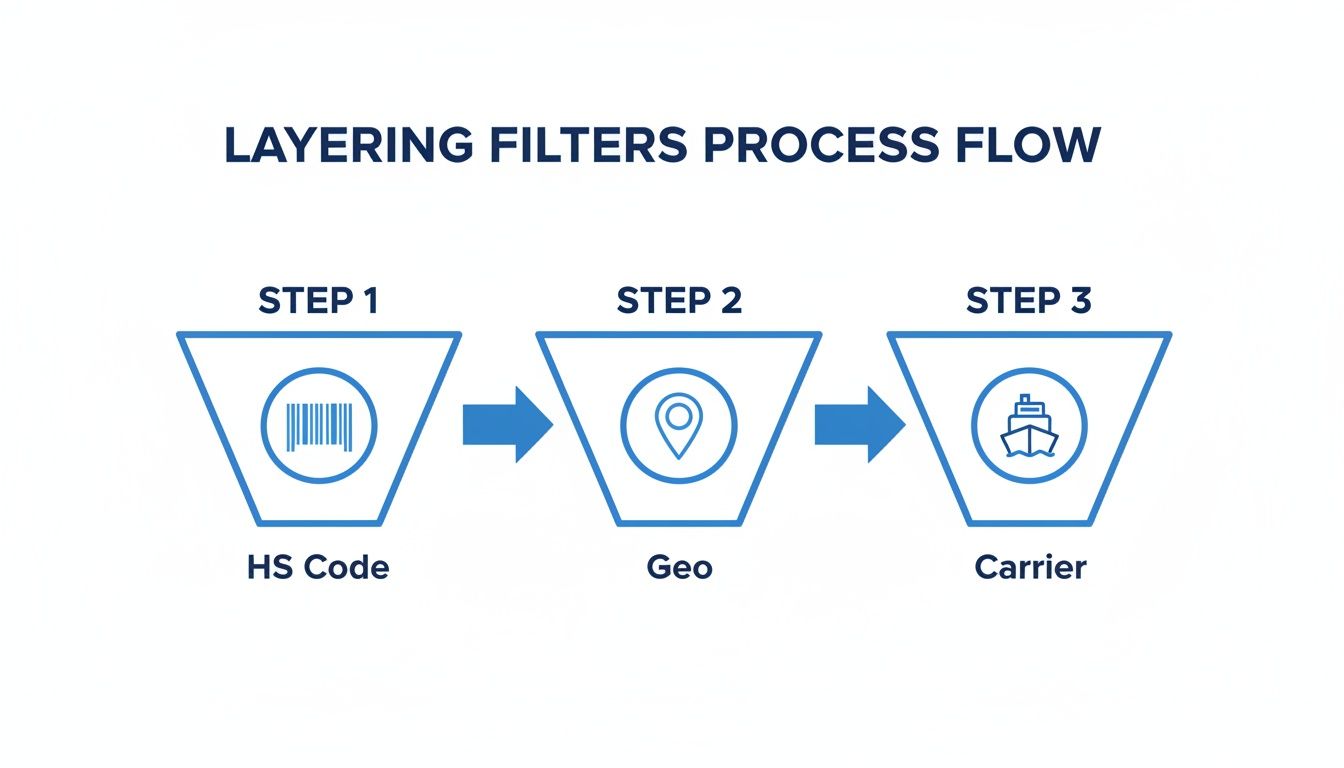
    A process flow diagram illustrating layering filters for data, including HS Code, Geo, and Carrier.

    Starting with the product, then layering on geography and carrier details, is the foundation for creating a hyper-targeted list that powers your personalised outreach efforts.

    Crafting Outreach That Actually Gets a Reply

    Okay, time for the outreach. Let's be honest: generic sales emails are dead on arrival. The powerful advantage you have is the specific data you’ve uncovered. When you reference the exact commodity and trade lane, you instantly prove you've done your homework.

    The goal is to show you understand their business, not just that you want their business. A quick mention of their specific shipments demonstrates you’ve found a real pain point you can help solve.

    Here’s a simple, effective framework you can adapt:

    • Subject: Question about your automotive parts (HS: 8708*) shipments from Germany
    • Body: "Hi [Contact Name], I noticed your company regularly imports automotive components from Germany to Singapore. We specialise in this lane and have helped similar importers optimise their transit times. Would you be open to a brief chat next week to discuss how we might be able to support your supply chain?"

    This approach is direct, respectful, and loaded with relevance. It’s worlds apart from the lazy "Can I introduce my company?" emails that flood everyone's inbox. You're leading with value and showing your expertise from the very first sentence.

    Taking the time to understand who is ultimately responsible for the shipment, such as the importer of record, can sharpen your targeting even further. By consistently turning raw data into these kinds of sharp insights, you build a repeatable daily process that fills your pipeline with genuinely qualified leads.

    Here’s the rewritten section, crafted to sound human-written and natural, following all your requirements.


    Common Pitfalls to Avoid When Using an HS Code Filter

    Using an HS code filter can be a game-changer for finding leads, but it's easy to get tripped up. I've seen a few common mistakes derail even the most well-intentioned prospecting efforts, leading to messy lead lists and a lot of wasted time. If you can steer clear of these traps, you'll build a much more reliable and efficient process.

    The biggest mistake people make is not accounting for country-specific code variations. While the first six digits of an HS code are standardised globally, individual countries often tack on extra digits for more granular detail. For instance, Singapore uses an 8-digit system, but the United States uses a 10-digit Harmonized Tariff Schedule (HTS).

    If you're just searching with a 6-digit code when targeting a country that uses a more detailed system, you're absolutely going to miss out on some of your best, most specific leads. Always take a moment to adapt your search to the destination country's code structure.

    Misinterpreting Broad Chapter-Level Data

    Another classic pitfall is running a search at the 2-digit Chapter level and thinking you've struck gold. Sure, filtering for Chapter 84 (Machinery) will pull up thousands of companies. The problem? It won’t tell you if you're looking at an exporter of massive industrial boilers or an importer of small household coffee makers.

    This kind of broad search is fantastic for getting a high-level view of a market, but it’s completely useless for targeted outreach. You’ll just end up spamming companies that have zero interest in what you offer.

    • The Problem: Your outreach will feel irrelevant, leading to terrible response rates.
    • The Fix: Always go deeper. Drill down to at least the 4-digit Heading, but I'd strongly recommend getting to the 6-digit Subheading to make sure you're hitting the right targets.

    Finally, don't ever take the code at face value. You have to cross-reference the HS code with the actual product descriptions in the shipment data. A simple typo by a shipper or a lazy, overly broad classification can stick a product under a completely misleading code. A quick scan of the description is all it takes to confirm you’re actually looking at the cargo you think you are, ensuring your entire prospecting campaign is built on a solid foundation of clean data.

    Common Questions Answered

    How Often Is HS Code Shipment Data Updated?

    It's a common misconception that since the official Harmonized System codes are updated globally by the WCO only every five years, the data is stale. Nothing could be further from the truth.

    The codes themselves are stable, but the actual shipment data—the bills of lading tied to those codes—is incredibly dynamic. Depending on the trade intelligence platform you're using, this data can be refreshed as often as daily or weekly. This is crucial because it ensures your HS code filter searches reflect what shippers are doing right now.

    Can I Use This Filter for Both Importers and Exporters?

    Yes, absolutely. Any robust trade data platform will let you segment your search by the direction of trade. You can easily specify whether you're hunting for companies importing goods under a specific HS code or those on the other side, exporting them.

    This feature is fundamental for targeting the right players in the supply chain for whatever you're selling.

    What if a Company Ships Under Multiple HS Codes?

    This is the norm, not the exception, especially for larger or more diversified shippers. Don't let it throw you off.

    The best strategy is to start by filtering for the HS codes that represent your ideal type of cargo. Once you've identified a promising lead, dive deeper. A good platform will let you analyse their complete shipping profile to see the full spectrum of commodities they're moving. This holistic view often reveals their broader operational needs and can uncover entirely new sales opportunities you hadn't even considered.


    Ready to stop guessing and start targeting the right shippers? Coreties transforms global trade data into your next customer list. Find, verify, and contact decision-makers in minutes, not days. Discover your next lead at https://coreties.com.
  • Mastering the Import Export Business in Singapore

    Mastering the Import Export Business in Singapore

    At its core, an import-export business is all about moving goods between countries. It’s the critical link that connects manufacturers, suppliers, and consumers across the globe. The entire process involves buying products from one nation (imports) and selling them to another (exports), all orchestrated by logistics experts like you—the freight forwarders and carriers who make it all happen.

    Understanding the Modern Import Export Business

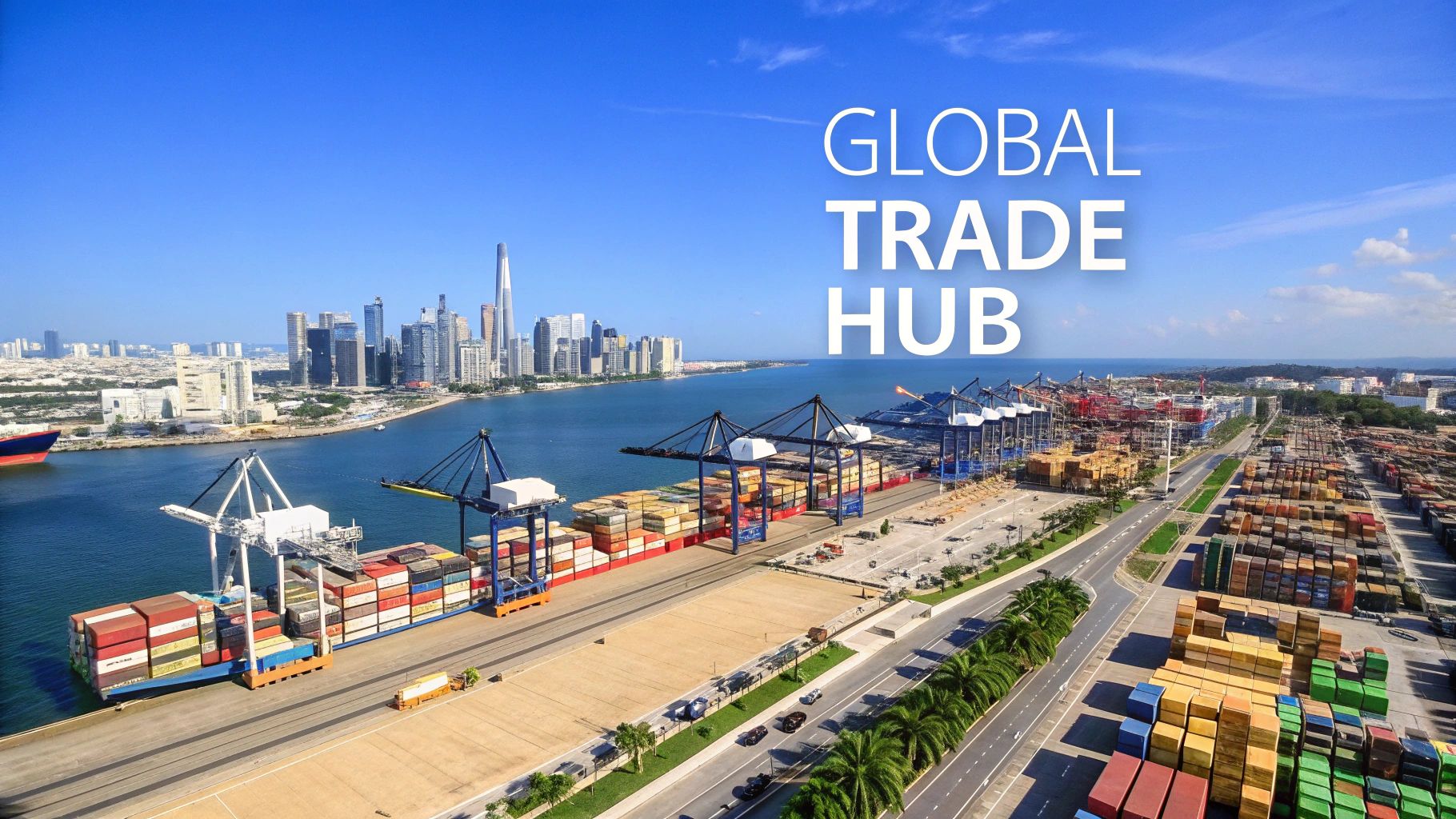
    Aerial view of a bustling container port with cranes, ships, stacked containers, and a city skyline.

    Think of the global economy as a massive, intricate machine. The import-export business is its engine, constantly humming as it moves parts, raw materials, and finished goods exactly where they need to be.

    This is what allows a smartphone designed in California, built in China with parts from South Korea, to land on a shelf in a Singaporean electronics shop.

    At the heart of this complex dance are freight forwarders and carriers. You’re the architects who organise and execute the physical journey of goods across oceans and continents. Without your expertise in logistics, documentation, and customs clearance, global trade would simply grind to a halt.

    Singapore: The Global Trade Hub

    For professionals in this game, location is everything. Singapore stands out as a premier global hub, not just because it’s strategically located, but because its infrastructure is world-class and the environment is built for business. The Port of Singapore is one of the world’s busiest, connecting to over 600 ports in more than 120 countries.

    This creates a massive field of opportunity for anyone in the freight industry. The sheer volume and variety of goods flowing through Singapore means there’s a constant demand for skilled:

    • Ocean Freight Managers who can find the best shipping routes and juggle complex cargo movements.
    • Account Executives who know how to build solid relationships with importers and exporters.
    • General Managers of freight forwarding firms who steer the ship, overseeing operations and driving growth.

    The numbers back it up. In the first quarter of 2025, Singapore’s total merchandise trade jumped by 4.9% compared to the previous year. This was driven by a 6.4% rise in total imports, a clear sign of strong demand fuelling the country’s huge re-export market. You can dig into the complete trade performance review for a closer look at these trends.

    In this competitive arena, success is no longer just about moving boxes from Point A to Point B. It’s about leveraging information to make smarter, faster, and more profitable decisions.

    Ultimately, a deep, practical understanding of this ecosystem is what separates the best from the rest. It’s about looking past the container ships and customs forms to see the underlying patterns of supply and demand. By harnessing the power of global shipping and customs data, you can gain a real edge, spot new opportunities, and serve your clients more effectively in a market that never stops moving.

    Understanding the Building Blocks of Global Trade

    Any solid import-export business is built on a few fundamental pillars. For those of us in the freight world, getting a grip on these isn’t just some textbook exercise—it’s how you anticipate what a client needs, spot potential disasters before they happen, and offer real value that goes way beyond just booking a container.

    When you master these basics, you stop being just another vendor. You become a strategic partner.

    It all kicks off with thorough market research. Think of it as the intel-gathering phase before the main event. Before a client even thinks about sourcing a product, they have to know if there’s a market for it. This means getting clear answers to some tough questions: Does anyone in the target country actually want this product? Who’s already selling it? And what’s the sweet spot for pricing?

    As an account executive, when you see a client has this groundwork covered, it’s a green light. It tells you they’re serious, they’ve done their homework, and they’re worth your best logistical effort.

    Finding and Vetting Suppliers

    Once a viable market is locked in, the next pillar is sourcing the product and vetting the supplier. Anyone can find a manufacturer online; finding one you can actually trust is the real challenge. The whole game is about building confidence from thousands of miles away.

    A solid vetting process usually involves a few non-negotiables:

    • Getting samples to check the product quality with your own hands.
    • Checking business licences and certifications to make sure they’re legitimate.
    • Doing a site visit or hiring a third-party inspector, especially for big-ticket orders.
    • Digging into their trade history to see their real shipping volumes and who they work with.

    This is the stage where a lot of deals simply fall apart, often due to bad communication or mismatched expectations. From a forwarder’s perspective, the clients who nail this part are almost always the most organised and reliable to work with.

    Making Sense of Customs and Trade Deals

    The third pillar, and easily the most tangled, is navigating the maze of customs regulations, tariffs, and trade agreements. This is where your expertise as a logistics pro truly comes into its own. Every country has its own set of rules dictating what can come in, how it needs to be declared, and what duties are due.

    Think of customs as a series of locked gates, each requiring a different key. Your paperwork—the Commercial Invoice, Bill of Lading, or Certificate of Origin—these are your keys. A tiny mistake, like a single wrong digit in an HS code, can leave a shipment worth millions sitting at the port for weeks. It’s a massive headache your clients are desperate to avoid.

    This is where a great freight forwarder becomes a guide. You help your clients find the right keys for the right gates, making sure their cargo glides through smoothly instead of getting tangled up in red tape.

    On top of that, trade agreements like the Comprehensive and Progressive Agreement for Trans-Pacific Partnership (CPTPP) can slash or even wipe out tariffs on certain goods. Being able to advise a client on how to properly document their cargo to take advantage of a deal like that is a game-changer. It’s a high-value service that builds incredible loyalty.

    The constant ebb and flow of trade volumes highlight just how critical it is to stay on top of things. Just look at Singapore, where external trade shot up by 14.9% in September 2025, powered by a huge rebound in electronics like integrated circuits and PCs. That kind of surge is a clear signal of growing demand and a golden opportunity for forward-thinking freight forwarders to grab more ocean cargo business. You can dive deeper into Singapore’s recent trade performance to see the numbers for yourself.

    By truly understanding these pillars—market viability, supplier reliability, and regulatory compliance—you can size up opportunities and serve your clients on a whole new level. And when you also know which business model your prospect is running, you get an even deeper layer of insight, letting you craft logistics solutions that fit their specific needs and operational headaches perfectly.

    Mastering Logistics and Critical Documentation

    Hands filling out shipping paperwork on a clipboard, with a laptop, files, and a package on a white desk.

    Once the deal is signed, the theory ends and the real work begins: moving the actual goods. This is the operational heart of global trade, a complex dance of physical movements and digital handshakes where getting it right isn’t just important—it’s everything. Honestly, this is the stage that separates the pros from the amateurs.

    The very first strategic decision is a classic one: ocean freight or air freight? Each has its place, and as a freight professional, your job is to guide clients to the right choice for their specific needs.

    • Ocean Freight is the reliable workhorse of global trade. It’s perfect for large, heavy, or non-urgent shipments and offers unbeatable cost-effectiveness. The obvious trade-off? Time.
    • Air Freight is the express courier service for the world. It’s the only real option for high-value, perishable, or time-critical goods. You slash transit times, but your client pays a premium for the speed.

    For any account executive, this conversation is about more than just quoting prices. It’s about digging into your client’s inventory cycles, production schedules, and market pressures to find the genuinely optimal path.

    The Paperwork That Powers Global Trade

    Logistics might seem like it’s all about trucks, ships, and cranes, but it truly runs on a river of precise documentation. In the import-export business, paperwork isn’t a tedious formality; it’s the legal and financial backbone of every single shipment. A tiny error here can trigger delays costing thousands, torching both your client’s budget and your hard-won reputation.

    Think of these documents as the cargo’s passport. Each one serves a critical purpose, telling a specific part of the shipment’s story to customs officials, banks, and buyers along the way.

    A shipment with flawed paperwork is like a traveller showing up at the border without a visa—it’s going absolutely nowhere. Nailing the documentation is non-negotiable for smooth customs clearance.

    Let’s break down the essential trio of documents that you’ll see on nearly every shipment. Understanding these inside and out is fundamental to demonstrating true supply chain expertise.

    Unpacking the Critical Document Trio

    These three documents work together as a system of checks and balances. They ensure everyone—the seller, the buyer, and the carrier—is perfectly aligned.

    1. Commercial Invoice: This is much more than a simple bill. It’s the detailed record of the transaction, giving customs the core information they need to assess duties and taxes. Common mistakes like an incorrect value or a vague product description are massive red flags for customs and a fast track to getting your shipment stuck.
    2. Bill of Lading (B/L) or Air Waybill (AWB): This is arguably the most powerful piece of paper in the entire shipping process. It wears three hats: it’s a receipt for the goods, a contract between the shipper and the carrier, and—most importantly—a document of title. The person holding the original B/L can claim the cargo, which makes its accuracy absolutely critical.
    3. Packing List: This document gives a granular breakdown of what’s inside each package—weights, dimensions, and item counts. It works hand-in-hand with the commercial invoice and allows customs to verify the cargo without having to physically rip open every single box.

    Beyond these big three, you’ll often need a Certificate of Origin to prove where the goods were made. This is essential for qualifying for preferential tariffs under free trade agreements. Getting comfortable with this paperwork is a core skill, and if you want to go deeper, our guide on how to ship your cargo overseas is a fantastic place to start.

    Ultimately, navigating logistics and documentation comes down to proactive management. When you understand the why behind each step and each document, you can spot problems before they happen, advise clients with real confidence, and keep their cargo flowing seamlessly across borders. That’s how you become an indispensable partner.

    Managing Financial Transactions and Mitigating Risks

    In the import-export game, logistics gets the cargo moving, but it’s finance that really makes the world go ‘round. As a freight forwarder, getting a handle on the financial pressures your clients are under is more than just good service—it’s how you become a strategic partner. It’s how you go from being just another service provider to someone who actively protects their bottom line.

    How money changes hands across borders is a massive point of stress for both importers and exporters. The seller wants to know they’ll get paid, and the buyer wants to be damn sure they’ll get the goods they ordered. The payment method your client chooses says a lot about their appetite for risk and their cash flow strategy.

    Navigating International Payment Methods

    Two main methods really dominate international trade finance, and each one strikes a different balance between security and cost.

    1. Telegraphic Transfer (TT): This is basically a wire transfer, sending money directly from the buyer’s bank to the seller’s. It’s quick and clean, but it offers almost zero security. A seller might push for a TT in advance, which is fantastic for them but leaves the buyer completely exposed until the shipment shows up.
    2. Letter of Credit (LC): Think of an LC as a guarantee from the buyer’s bank. It promises the seller they’ll get their money, but only after they provide specific, compliant shipping documents. It’s like putting the payment in a secure escrow, offering solid protection for both sides. The catch? LCs are notoriously complex, slow, and expensive to set up.

    Here’s a simple way to look at it: A Telegraphic Transfer is like paying with cash—it’s fast, but risky. A Letter of Credit is like using a lawyer-managed escrow account—it’s way safer for everyone involved, but it comes with a mountain of paperwork and higher fees.

    Knowing which method a client prefers gives you a real window into their business. A client who always uses LCs is probably risk-averse or dealing with new, unproven suppliers. On the other hand, a client who’s comfortable with TT payments likely has solid, long-standing relationships with their partners.

    Proactive Risk Management Strategies

    Beyond just getting paid, a successful import-export operation needs a sharp focus on managing the countless risks baked into global trade. And these risks go way beyond a simple late payment.

    First up, currency volatility is a constant headache. A sudden swing in exchange rates can wipe out profit margins literally overnight. Smart traders often use financial tools like forward contracts to lock in an exchange rate, which brings some much-needed predictability to their costs.

    Second, cargo insurance is absolutely non-negotiable. From a fire in the warehouse to a storm on the high seas, the potential for loss or damage is always there. As a freight professional, advising clients on the right level of insurance coverage is a massive value-add. It shows you know your stuff and genuinely care about protecting their investment.

    Finally, you’ve got geopolitical flare-ups and market swings that can throw a wrench in even the most carefully laid plans. This is where staying informed isn’t just a good idea—it’s a competitive advantage. For instance, recent data shows Singapore’s imports dipped to 58,268.79 SGD million in November 2025 after a hectic October. This highlights the constant flux that keeps us on our toes. You can dig into the details on Singapore’s import trends and forecasts to get a better feel for these market dynamics.

    Juggling all these financial and operational variables is a serious challenge. To go deeper, check out our guide on how to save costs and manage risks during market volatility. By truly understanding these pressures, you can anticipate your clients’ needs and position your services as a crucial part of their risk strategy, building much stronger, more resilient business relationships.

    Using Customs Data to Find and Win New Business

    Theory is one thing, but action is what closes deals.

    The sharpest people in the import-export business don’t just react to the market; they use data to find opportunities before their competitors even know they exist. This is where raw customs and shipping data becomes your most powerful tool for hunting down leads and growing your business.

    For freight forwarders, carriers, and their sales teams, this isn’t about becoming a data scientist. It’s about becoming a data detective—sifting through clues hidden in global trade flows to pinpoint prospects with serious potential. It means ditching the cold calls and generic emails for a highly targeted, insight-driven approach that actually gets a response.

    This whole process is about turning raw numbers into real-world intelligence. When you know who is shipping what, where they’re shipping it from, and how often, you’ve got a massive advantage. You can craft a pitch that speaks directly to a prospect’s current, real-life shipping needs.

    From Raw Data to High-Potential Leads

    First things first, you need to know what you’re looking for. Customs data is a goldmine, but without a map, it’s easy to get lost. As an Ocean Freight Manager or Account Executive, your job is to cut through the noise and isolate the signals that say, “this company might need my services.”

    You’re looking for patterns and, more importantly, changes. A sudden jump in shipment volume, a new trade lane opening up, or a switch in commodity type—these are all flashing green lights.

    Here are the key data points to zoom in on:

    • Company Name: Obvious, but essential. Find the active importers and exporters.
    • Shipment Volume & Frequency: See who the big players are and, more importantly, spot the up-and-comers with growing trade activity.
    • Commodity Type (HS Codes): Understand exactly what a company is moving. This allows you to tailor your pitch around your specific expertise.
    • Trade Lanes: Map out their main shipping routes (e.g., Shanghai to Singapore) to see if they match up with your strongest service areas.
    • Current Carrier/Forwarder: Know who you’re up against. This gives you a clear picture of the competition.

    Think of customs data as a live X-ray of the global supply chain. It lets you see beneath the surface, revealing the operational heartbeat of potential clients. It shows you exactly where you can step in with a better, faster, or more cost-effective solution.

    Platforms like Coreties are built to make this detective work easier. They organise mountains of information with filters that let you quickly zero in on the most promising leads based on what you’re looking for.

    Finding the Right Person to Contact

    Okay, so you’ve identified a target company. The next—and absolutely critical—step is finding the right person to talk to.

    Sending a brilliant, data-driven pitch to a generic “info@” email address is like shouting into the void. You need to connect with the decision-maker who actually controls the logistics budget.

    This is where you need to enrich your data. After finding a company through its shipping activity, you need to dig up the contact details for people in roles like:

    • Logistics Manager
    • Supply Chain Director
    • Procurement Manager
    • VP of Operations

    This is how you turn a company name into a real conversation. Without this step, even the best data is just trivia.

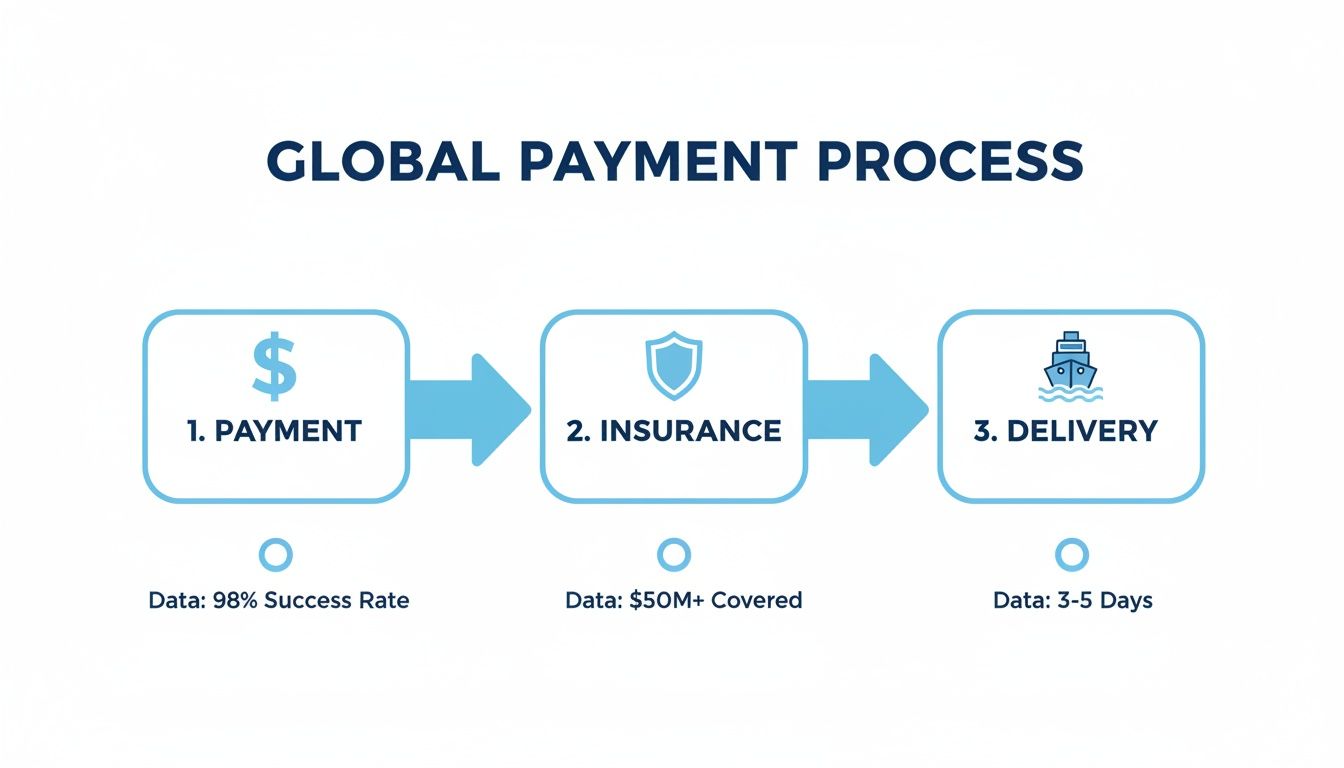
    This diagram breaks down the essential parts of a global trade transaction, from payment all the way to delivery.

    Diagram illustrating a global payment process with steps: Payment (98% success), Insurance ($50M+ covered), and Delivery (3-5 days).

    Each step is a point where efficiency and trust are everything, showing why having reliable partners is so important.

    Crafting a Data-Driven Outreach That Works

    You have your target company. You have the right contact. Now it’s time to craft a message that actually gets read.

    Generic sales emails are deleted in seconds. Your message has to show, right from the first line, that you’ve done your homework and you understand their business. The trick is to lead with a specific insight you found in the data.

    Let’s walk through how to build an email that gets opened, read, and—most importantly—replied to.

    Data-Driven Outreach Email Template

    Here’s a practical template for turning a data point into a compelling conversation starter.

    Email Section Content Example Why It Works
    Specific Subject Line “Question about your recent electronics shipments from Vietnam” It’s immediately relevant and proves you’ve done your research. This isn’t just another sales blast.
    Opening Hook “Hi [Name], I noticed your company has increased its container volume of electronic components from Ho Chi Minh City by 35% over the last quarter.” You’re leading with a precise data point, showing you understand their specific business activity.
    Value Proposition “We specialise in the HCMC to Singapore lane and have helped similar electronics importers reduce their average transit time by 2 days.” This connects their activity directly to your solution and offers a concrete, measurable benefit.
    Call to Action “Would you be open to a brief 15-minute call next week to discuss how we might offer a more efficient solution for your growing volume?” It’s clear, low-commitment, and focuses on providing value, not just on making a sale.

    This approach completely flips the script. You’re no longer just another salesperson asking for their business; you’re a knowledgeable consultant offering a specific solution to a challenge they’re facing right now.

    This data-informed strategy is the future of sales in the import-export world. It empowers Account Executives and Freight Forwarder GMs to work smarter, not harder. By focusing your efforts on prospects who have a clear and present need for your services, you dramatically increase your conversion rates, build a healthier pipeline, and drive sustainable growth.

    It’s about turning global trade data into your own competitive advantage.

    Future-Proofing Your Import-Export Operations

    Look, anyone can close today’s deals. But real success in this business isn’t just about the here and now—it’s about setting yourself up to win tomorrow’s game. The world of global trade is always in motion, and if you’re a freight leader worth your salt, you know you need to be ready for what’s next. It’s time to stop just reacting to problems and start building a business that’s designed to grow, no matter what the market throws at it.

    The first move? Building a resilient operation. That means stop putting all your eggs in one basket. Diversify your network of partners so you’re not overly dependent on a single carrier or a single trade lane. When the inevitable disruption hits—whether it’s geopolitical drama, a weather disaster, or an economic slump—a flexible network is your lifeline. It lets you reroute cargo and keep your promises to clients without breaking a sweat.

    Riding the Waves of Change

    Beyond just having a solid network, you’ve got to keep your eyes on the horizon. There are some massive shifts happening right now that are completely changing how goods move around the planet. Getting ahead of these trends isn’t just smart; it’s essential for survival.

    Right now, three big transformations are rewriting the rulebook:

    1. Greener Supply Chains: The pressure for sustainable logistics is mounting. It’s not just a nice-to-have anymore. Clients and regulators are demanding lower carbon emissions, which opens up a huge opportunity for forwarders who can deliver eco-friendly shipping options and prove it with clear data.
    2. The E-commerce Juggernaut: The explosion of online shopping has turned traditional shipping models on their head. This isn’t about massive bulk shipments anymore; it’s about handling a flood of smaller, direct-to-consumer parcels that need to get there fast. It’s a whole new logistics puzzle.
    3. The Digital Takeover: From automated documents to instant digital payments, technology is sinking its teeth into every part of the trade process. If you’re not adopting these tools, you’re already falling behind. This isn’t a choice anymore—it’s a necessity to stay efficient and competitive.

    Here’s the bottom line for any freight forwarding leader: being able to adapt isn’t just a skill, it’s the competitive advantage. The companies that don’t just react to these trends but weave them into their very fabric are the ones that will own the market in the years ahead.

    Using Tech to Get Smarter, Not Just Busier

    Technology is the engine powering all of this change. Take Artificial Intelligence (AI). It’s finally moving beyond a buzzword and becoming a genuinely practical tool for us. AI systems can chew through historical shipping data, weather forecasts, and real-time port congestion reports to actually predict delays before they happen. Imagine being able to offer smarter routes and delivery times you can actually stand by.

    This is the kind of forward-thinking, grounded in smart tech and a bit of foresight, that separates the good from the great in the import-export world. By building a tough, resilient network and embracing the big shifts remaking our industry, you’re not just preparing to survive the future—you’re setting yourself up to profit from it.

    Frequently Asked Questions

    Even the most experienced pros have questions about the finer points of the import-export game. Here are some straight answers to the most common queries we hear from leaders in freight forwarding.

    What Is the Most Important Document in Shipping?

    This is a classic question. While every piece of paper matters, the Bill of Lading (B/L) or its air freight equivalent, the Air Waybill (AWB), is the undisputed heavyweight champion. Think of it as a receipt for the goods, a contract for their journey, and the title deed all rolled into one. The person holding it can claim the cargo. A single mistake on the B/L can bring an entire shipment to a screeching halt.

    How Do I Choose Between a Freight Forwarder and a Customs Broker?

    It’s a common point of confusion, but the distinction is actually quite simple.

    A freight forwarder is like a travel agent for your cargo. They map out and manage the entire journey, from the factory door to the final destination. A customs broker, on the other hand, is the specialised immigration lawyer for your goods, focusing entirely on getting them legally cleared through customs.

    The easiest way to remember it: forwarders manage the movement (logistics), while brokers manage the legal entry (compliance). Any successful import-export business needs to master both.

    What Is the Biggest Mistake New Importers Make?

    We see this one all the time, and it’s a costly one. The most frequent error is failing to classify their goods correctly using the proper Harmonized System (HS) code. This one slip-up can cascade into a whole world of pain: paying the wrong duties, facing massive delays at the border, and even getting hit with hefty fines. It completely torpedoes the financial planning for a shipment.

    Can I Start an Import-Export Business with Little Money?

    Absolutely. You just have to start with a lower-risk business model. Becoming an export agent or a sourcing agent is a fantastic way to get your foot in the door without needing a lot of capital. You aren’t buying the goods yourself; you’re just the matchmaker, connecting a buyer and a seller and taking a commission. It’s one of the most accessible entry points into this business.


    Stop guessing and start winning. Coreties uses global customs data to find your ideal clients and drafts personalised, data-driven emails that get responses. Get 5 targeted leads delivered to you daily—all you have to do is press send. Learn more at https://coreties.com.