When you're dealing with garments, the Harmonized System (HS) code will almost always land in one of two places: Chapter 61 for knitted or crocheted apparel, or Chapter 62 for woven apparel. The final, specific code depends on the type of clothing, what it’s made of, and who it’s for, but these two chapters are your non-negotiable starting point.
What Are HS Codes for Garments
Think of an HS code as a universal language for customs officials. It’s a standardised numerical system that classifies every product traded internationally. For anyone in freight forwarding who handles apparel, getting the HS code right isn't just about paperwork; it's a critical step for calculating tariffs, clearing customs smoothly, and avoiding expensive hold-ups at the border.
Every single item of clothing, whether it's a basic cotton tee or a structured wool blazer, has a unique code. This code tells customs officers exactly what's inside the box without them ever having to open it.
The entire system is logically structured, and for clothing, the first and most important decision you'll make is based on how the fabric was made. This one distinction splits everything into two distinct chapters.
Chapter 61: Knitted or Crocheted Apparel
This chapter is your home for any garment or accessory made from knitted or crocheted fabric. These textiles are created with a single yarn (or set of yarns) looped together, which gives the final material its characteristic stretch.
- Common Examples: T-shirts, jumpers, sweatshirts, leggings, and most types of sportswear.
- Key Feature: Natural elasticity and a looped fabric structure.
Chapter 62: Woven Apparel
Conversely, Chapter 62 covers all clothing made from woven fabrics. Woven materials are constructed by interlacing two separate sets of yarn (the warp and the weft) at right angles. This creates a more rigid and stable fabric.
- Common Examples: Denim jeans, button-down dress shirts, tailored suits, and formal trousers.
- Key Feature: A grid-like structure with limited natural stretch.
Getting this initial choice right—Chapter 61 vs. Chapter 62—is the foundation of accurate garment classification. It directly influences the duties owed and how quickly your shipment will clear customs.
To make this even clearer, here's a quick reference table to help you distinguish between the two.
Quick Reference Knitted vs Woven Garments
| Garment Type | Fabric Characteristic | Primary HS Chapter |
|---|---|---|
| T-Shirts & Polos | Stretchy, made of interlocking loops | Chapter 61 |
| Dress Shirts & Blouses | Rigid, grid-like weave, crisper feel | Chapter 62 |
| Jumpers & Sweatshirts | Knitted for warmth and flexibility | Chapter 61 |
| Blazers & Suits | Structured, woven for shape retention | Chapter 62 |
| Leggings & Hosiery | Highly elastic, knit construction | Chapter 61 |
| Denim Jeans | Woven twill fabric, durable & firm | Chapter 62 |
This table serves as a handy starting point. Always physically examine the fabric if you're unsure—the difference between a knit and a weave is usually clear once you know what you're looking for.
Understanding the Harmonized System for Apparel
The Harmonized System (HS) isn't just a list of numbers; it's a logical, structured language for classifying goods. When it comes to the HS code for garments, this precision is everything. Think of each code as a product's passport, where every pair of digits tells a crucial part of its story. Getting this story right is fundamental to clearing every apparel shipment without a hitch.
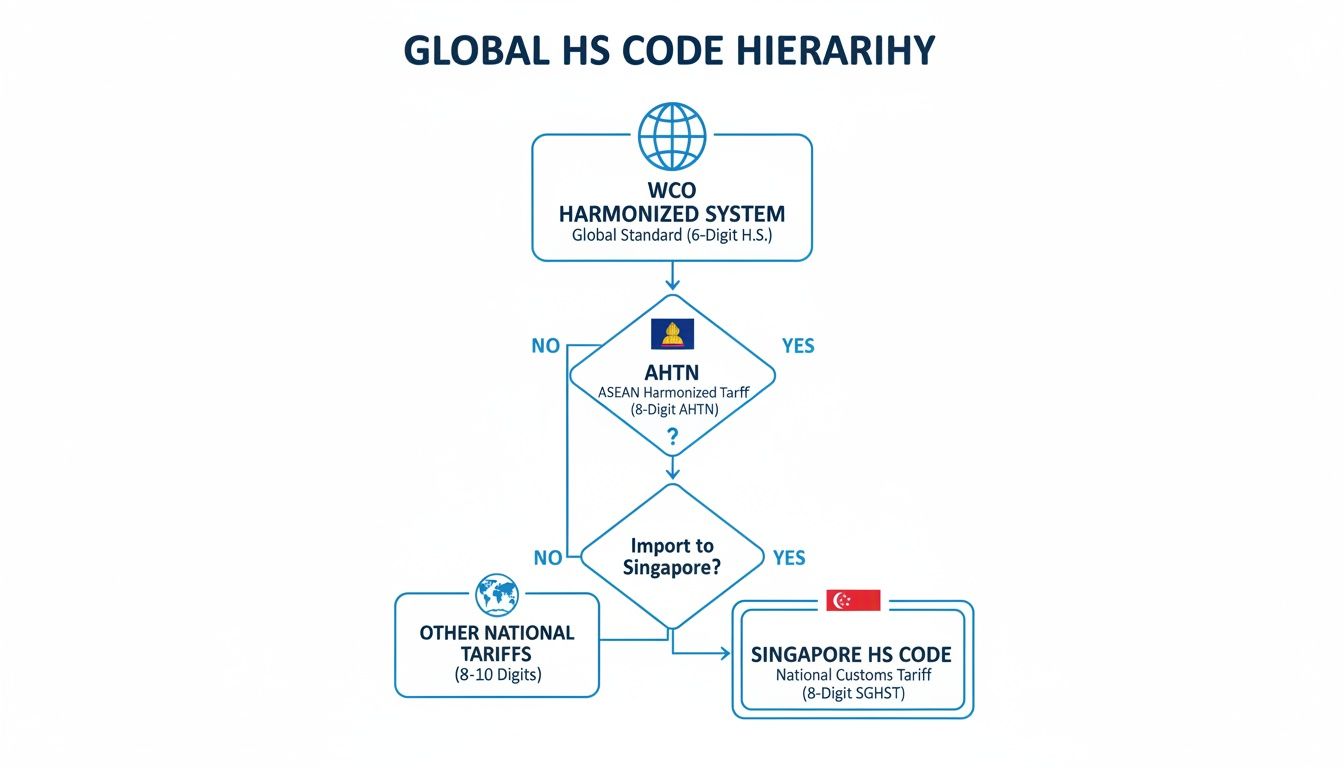
Globally, the first six digits of an HS code are standardised. But for local customs, like in Singapore, things get more detailed. We use the eight-digit ASEAN Harmonised Tariff Nomenclature (AHTN), which adds extra layers for better accuracy in regional trade.
Breaking Down the Code Structure
To classify garments correctly, you first have to understand the anatomy of the code. It’s a funnel, moving from the very general to the highly specific with each set of numbers.
- Digits 1-2 (Chapter): For apparel, this is the first and most critical fork in the road. It all comes down to the fabric. Is it knitted or crocheted? That’s Chapter 61. Is it made from woven fabric? That’s Chapter 62.
- Digits 3-4 (Heading): These two digits identify the actual garment type. For example, within Chapter 61, the heading
09points directly to "T-shirts, singlets and other vests." - Digits 5-6 (Subheading): This level refines the description, usually by the material. Sticking with our example, subheading
10under6109specifies that the T-shirts are made "of cotton."
Put it all together, and you get the universal six-digit code 6109.10 for cotton T-shirts. In Singapore, we then add two more digits for our own tariff and statistical tracking.
For those of us in freight forwarding, getting this system right isn't just part of the job—it's essential. A wrong code is more than a simple mistake; it triggers a domino effect of customs queries, delays, and unhappy clients. On the flip side, if you know how to read HS data, you can spot high-volume importers for specific garments, turning customs knowledge into real shipping leads.
Even a tiny difference in a code can mean a big change in duties and regulations. It’s the same level of precision needed for classifying complex electronics; you can see how these principles work in other industries by looking at the details of a PCB HS code. For any logistics professional, being able to navigate this system fluently is a core skill.
Decoding Chapter 61 for Knitted and Crocheted Garments
When you're classifying apparel, Chapter 61 of the Harmonized System is your go-to for anything made from knitted or crocheted fabrics. This chapter covers a huge slice of the global clothing market, from everyday casual wear to high-performance sportswear, so getting it right is crucial for freight forwarders.
The defining characteristic here is how the fabric is made. Think of interlocking loops of yarn—this construction gives the material its natural stretch and flexibility. It’s this inherent elasticity that separates these garments from the woven goods found in Chapter 62. Mistaking one for the other is one of the most common classification errors, frequently causing shipment delays and incorrect duty payments.
Primary Classification Criteria in Chapter 61
To find the right code within this chapter, you need to work through a clear hierarchy of characteristics. This methodical process ensures your classifications are accurate and can stand up to scrutiny during customs checks.
The main factors you'll consider are:
- Garment Type: The first four digits, known as the heading, identify the item. For example, 6105 is for men's or boys' shirts, while 6110 covers jumpers and pullovers.
- Material Composition: The next two digits, the subheading, get more specific by identifying the dominant fibre, like cotton, wool, or man-made fibres.
- Intended Wearer: Many codes also make a distinction between garments for men/boys and those for women/girls.
Let's take a man's cotton polo shirt as an example. It would start under heading 6105 (Shirts, knitted or crocheted). The subheading would then specify "of cotton," leading you to the correct six-digit international code.
Getting a handle on this chapter means you've effectively mastered the classification for a massive portion of the world's apparel trade. For freight forwarders, this isn't just about compliance; it's a valuable tool for spotting trade trends and identifying high-volume importers of specific goods like T-shirts or athletic wear.
A Closer Look at Common Headings
Within Chapter 61, some headings see more action than others. The most frequently used include 6109 (T-shirts, singlets, and other vests) and 6110 (Jerseys, pullovers, cardigans, and waistcoats). These two categories alone represent an enormous volume of global garment shipments.
Take Singapore's busy port, for instance. The HS code 610910 is the standard identifier for cotton T-shirts, singlets, and vests. Following the ASEAN Harmonised Tariff Nomenclature (AHTN) that Singapore uses, this code is broken down even further: 61091010 for men's or boys' items and 61091020 for women's or girls' items. You can dive deeper into these specific Singapore HS codes on Trademo.com.
Understanding this level of detail helps logistics professionals do more than just ensure compliance. It allows you to analyse specific market data, offering strategic insights for business development.
Right then, let's get into the specifics of Chapter 62. If Chapter 61 is all about the stretch and comfort of knitwear, Chapter 62 is its more structured, formal cousin. This chapter is exclusively for garments made from woven fabrics, and for any freight forwarder, it's the home of everything from sharp business suits and formal wear to the everyday workhorses like denim jeans.
Woven fabrics are pretty easy to spot once you know what you're looking for. They're created by interlacing two sets of yarn at right angles, which results in a stable, grid-like structure with very little give. This inherent lack of stretch is your best clue when trying to decide between Chapter 61 and 62. A woven dress shirt feels crisp and holds its shape, whereas a knitted t-shirt is all about flexibility. It might seem like a small detail, but getting it wrong—like classifying a woven shirt under Chapter 61—is a rookie mistake that almost guarantees a second look from customs, leading to frustrating and expensive delays.
Nailing this fundamental difference is half the battle.
Key Classification Factors in Chapter 62
Just like with knitwear, there’s a clear hierarchy to follow when classifying items in Chapter 62. To pinpoint the correct HS code for garments here, you need to break down the product's main features.
The process always starts with the big picture and drills down to the details:
- Garment Type: The heading, which is the first four digits of the HS code, tells you what the item is. For instance, 6203 is the heading for men's or boys' suits and ensembles, while 6204 covers the same items for women or girls.
- Fabric Composition: After the heading, the subheading gets specific about the material. A pair of men's trousers made from cotton will have a different code than an identical pair made from wool or a synthetic blend.
- Intended Wearer: As you can see from the examples above, the distinction between men's/boys' and women's/girls' clothing is a crucial factor right from the heading level.
Let’s take a simple example. A man’s woven cotton dress shirt falls under heading 6205, which is for "Men's or boys' shirts." From there, the subheading specifies the material, landing you at 6205.20 for shirts "of cotton." It’s a logical flow from general to specific.
A Look at Common Chapter 62 Headings
To help you get comfortable with this chapter, here’s a quick-reference table of some of the most common headings you'll be dealing with. These cover the bulk of formal and durable clothing shipments.
Common HS Headings for Garments Chapters 61 & 62
This table provides a side-by-side look at some of the most frequently used headings for both knitted (Chapter 61) and woven (Chapter 62) garments, making it easier to see the parallels and distinctions.
| HS Heading | Description (Knitted/Crocheted – Chapter 61) | HS Heading | Description (Woven – Chapter 62) |
|---|---|---|---|
| 6103 | Men's/Boys' Suits, Ensembles, Jackets, Trousers | 6203 | Men's/Boys' Suits, Ensembles, Jackets, Trousers |
| 6104 | Women's/Girls' Suits, Ensembles, Jackets, Dresses | 6204 | Women's/Girls' Suits, Ensembles, Jackets, Dresses |
| 6105 | Men's/Boys' Shirts | 6205 | Men's/Boys' Shirts |
| 6106 | Women's/Girls' Blouses, Shirts | 6206 | Women's/Girls' Blouses, Shirts |
| 6109 | T-shirts, Singlets, and other Vests | N/A | Woven equivalents are classified as shirts (6205/6206) |
| 6110 | Sweaters, Pullovers, Sweatshirts, Waistcoats | N/A | Woven equivalents are typically jackets or vests (6203/6204/6211) |
Getting a firm grasp of these headings is essential for any forwarder managing apparel. When you can confidently classify a container of business suits just as easily as a shipment of casual blouses, you ensure accurate duty calculations, minimise delays, and ultimately build a reputation for reliability with your clients and with customs authorities.
Applying Interpretative Rules for Accurate Classification
Just knowing that garments fall into Chapters 61 and 62 won't get you through every shipment. What about a jacket made from multiple fabrics, or a two-piece suit sold as a set? This is where the General Interpretative Rules (GIRs) come into play. They are the official framework for tackling tricky classifications, turning what could be a guess into a logical, defensible process.
The GIRs aren't just suggestions; they provide a strict, step-by-step hierarchy for classifying any product. For apparel, this means you can't just pick the HS code that seems right. You have to follow a structured path to land on the single correct code, which is your best defence against customs disputes and painful penalties.
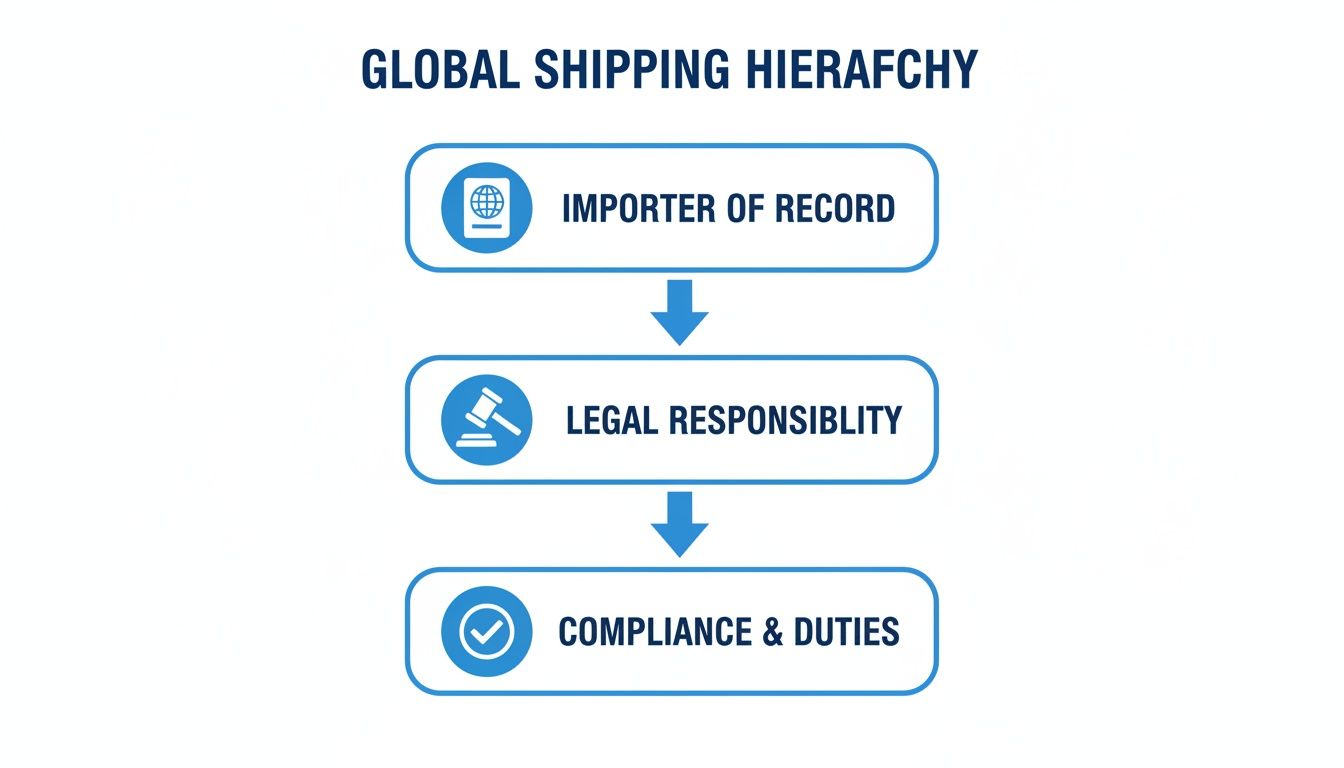
This decision tree shows the very first, most critical question you need to answer for any garment.
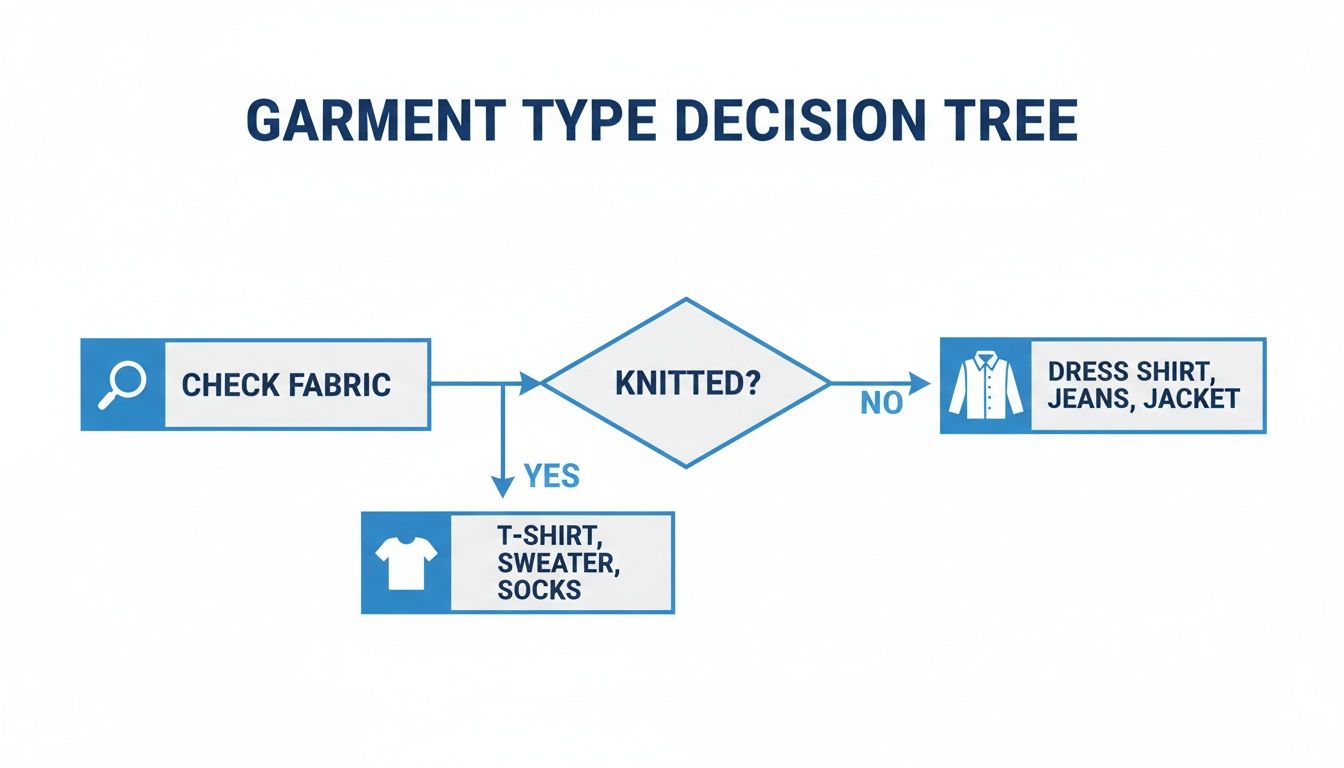
As the chart makes clear, the fundamental split between knitted fabric (leading to Chapter 61) and woven fabric (leading to Chapter 62) is the non-negotiable starting point for every single garment classification.
Applying Key Rules to Garments
When it comes to clothing, a few of the GIRs pop up again and again. Getting a firm grip on them will help you solve the most common classification puzzles you'll see in your day-to-day work.
-
GIR 2a (Incomplete or Unfinished Articles): This rule is straightforward. An unfinished jacket that's just missing its buttons is still classified as a finished jacket, provided it has the "essential character" of one. This stops importers from trying to ship nearly-finished goods under a lower-duty code for "parts."
-
GIR 3a (Specificity): If a code provides a very specific description, it wins over a more general one. A decorated cotton t-shirt, for example, must be classified under the specific heading for "T-shirts," not a vague, catch-all category like "other cotton garments."
-
GIR 3b (Essential Character): This is crucial for items made of mixed materials or sold in sets. The product is classified according to the material or component that gives it its essential character. With a man's suit set, for instance, the jacket is almost always the component that dictates the final HS code.
By systematically applying these rules, you're not just finding a code; you're building a clear audit trail for your decision. This ensures accuracy and gives you solid justification if customs authorities ever challenge your chosen hs code for garments.
Ultimately, the responsibility for correct classification rests with the party legally handling the import. To learn more about this role, see our guide on the Importer of Record. Following the GIRs is a fundamental part of that duty.
How to Verify HS Codes with Singapore Customs

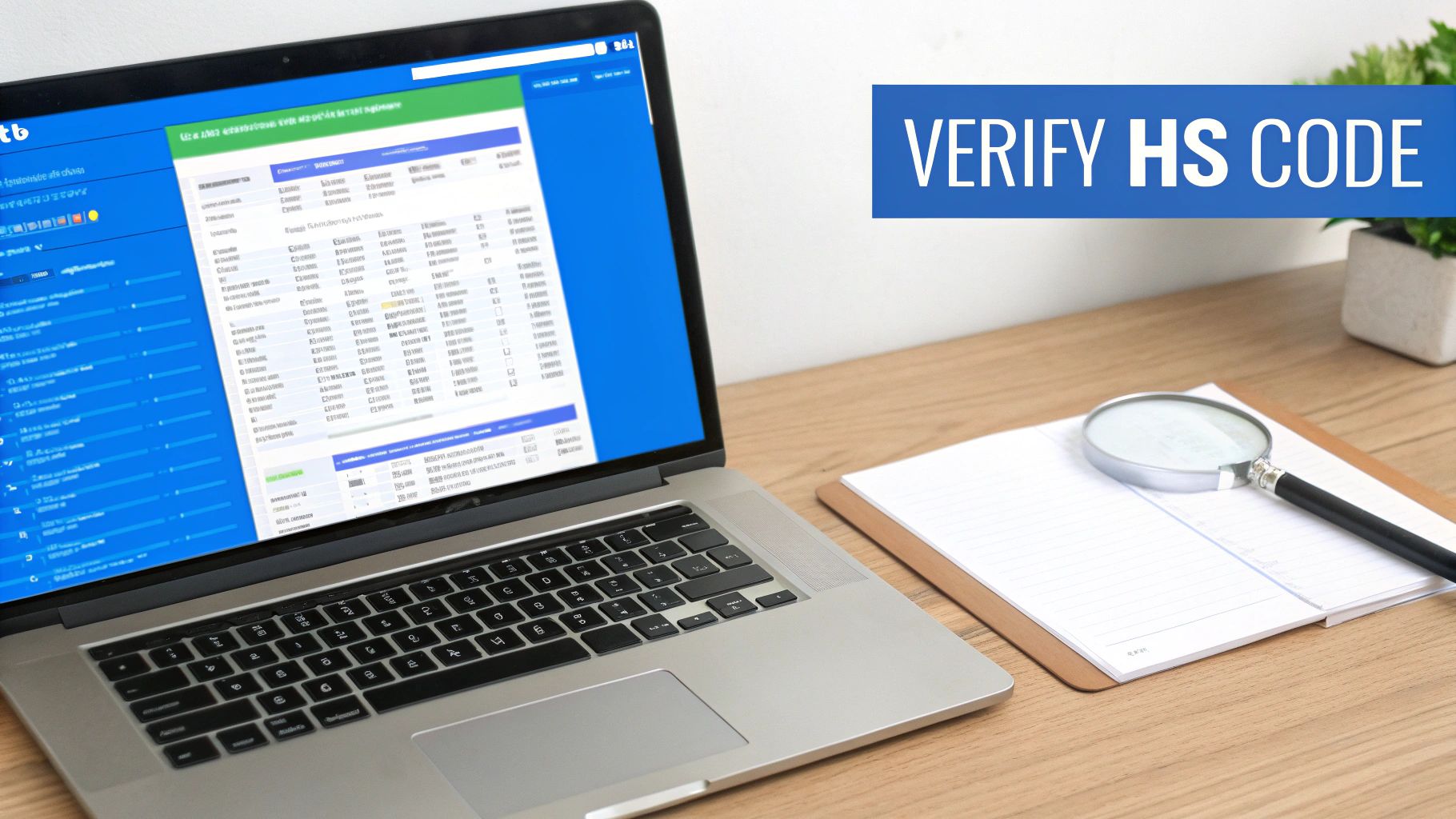
Once you've worked through the classification rules and landed on what you believe is the correct HS code for garments, there's one last crucial check. You need to validate it against the official national tariff schedule. For any goods coming into Singapore, your single source of truth is the Singapore Customs’ HS/CA Product Code Search Engine.
This free online tool is an absolute must-use for anyone handling local imports. It does more than just confirm if a code is valid; it gives you the full picture. You'll see the exact duties, the applicable Goods and Services Tax (GST), and any special permits or controls tied to that specific garment. Think of it as the final, non-negotiable step that connects your classification work to real-world, compliant customs clearance. Skipping it is a recipe for delays and penalties.
Using the Official Search Tool
The Singapore Customs database is refreshingly straightforward. You can search either by a keyword, like "cotton t-shirt," or by an HS code you already have to see how it’s applied locally. This takes all the guesswork out of the equation, ensuring your declarations are based on the most current and accurate data.
Let's take a common example. The trade data for garments under Chapters 61 and 62 shows a very active sector in Singapore. A staple item like a cotton T-shirt falls under HS 610910. A quick search in the HS/CA Product Code Search Engine will confirm it's duty-free but subject to GST, and it will list any other controls. This is the kind of practical detail that ensures a smooth clearance.
The search results will give you the complete 8-digit ASEAN Harmonised Tariff Nomenclature (AHTN) code, along with duty rates and other specific import requirements for Singapore. For a deeper dive into the local system, have a look at our detailed guide on the Singapore Customs HS code system. This final check is your guarantee that the shipment's paperwork is perfectly aligned with local customs requirements, paving the way for a hassle-free import.
Your Top Questions About Garment HS Codes Answered
When you're dealing with HS codes for garments, the same questions pop up time and time again. Shippers and forwarders often get stuck on the small details that make a big difference between a smooth clearance and a costly delay. Let's tackle some of the most common sticking points to clear up any confusion.
Getting these classifications right from the start is non-negotiable for keeping shipments moving.
What’s the Real Difference Between Chapter 61 and Chapter 62?
This is easily the most frequent question, and the answer lies in how the fabric is made. It’s all about knit versus woven.
Chapter 61 is exclusively for garments made from ‘knitted or crocheted’ fabrics. Think of the interlocking loops of yarn that give T-shirts, jumpers, and most activewear their signature stretch. This construction method creates a naturally flexible material.
On the other hand, Chapter 62 covers garments made from ‘woven’ fabrics. Here, two sets of yarn are interlaced at right angles, creating a more structured and stable material. This is the fabric you’ll find in classic dress shirts, denim jeans, and tailored suits.
Still not sure? Just do a quick stretch test. Knitted fabrics have a noticeable give in multiple directions. Woven fabrics? They’ll have very little stretch, if any, unless it's on the diagonal (the bias). That physical test is often your most reliable first clue.
How Do I Classify a Garment Made from a Fabric Blend?
It's rare to find a garment made from a single fibre anymore. So what do you do with a shirt that's 60% cotton and 40% polyester? The rules point you to whatever gives the item its 'essential character'.
Under General Interpretative Rule 3b, this almost always comes down to weight. For that 60/40 blend, cotton is the dominant fibre by weight, so the garment gets classified as a cotton item. Simple enough.
But what if no single fibre makes up the majority? Then you have to dig a bit deeper and consider other factors like the value of the materials or which fibre plays the most critical role in the garment’s function.
A word of caution: always double-check the specific section and chapter notes. In some cases, a particular fibre is given priority regardless of its weight. Don't skip this step when dealing with blended fabrics; it's your safety net.
This rule exists to create a uniform standard, ensuring that a cotton-poly blend is treated the same way by customs officials everywhere.
What Happens If I Use the Wrong HS Code?
Using an incorrect HS code isn't just a minor clerical error—it can cause a cascade of serious problems. These aren't just administrative headaches; they have very real financial and operational impacts that can snarl up a supply chain.
Here's what you're typically up against:
- Customs Delays: Your shipment will be flagged and held for inspection and re-classification. Suddenly, your entire delivery schedule is thrown off.
- Financial Penalties: If the correct code carries a higher tariff, you'll be on the hook for back-duties. On top of that, expect fines for non-compliance.
- Increased Scrutiny: Make the same mistake too many times, and customs will flag you or your client as high-risk. That means more frequent, time-consuming inspections on all future shipments.
For a freight forwarder, these issues can do serious damage to your reputation and erode the trust you've built with your shippers. Meticulous verification of every garment HS code isn’t just good practice—it's essential for protecting your business and your clients.
Finding and reaching out to qualified shippers shouldn't be a guessing game. Coreties transforms global customs data into actionable prospect lists, helping you connect with the right decision-makers in just a few clicks. Discover how our platform can help you find leads faster and grow your business.