Tag: freight forwarding

  • Exporters in singapore: A Quick Guide to Finding and Qualifying Top Partners

    Exporters in singapore: A Quick Guide to Finding and Qualifying Top Partners

    Singapore's export market is a goldmine of high-value goods, but you need the right map to find the treasure. It's dominated by advanced electronics, pharmaceuticals, and specialised machinery. For any logistics seller trying to break in or expand, knowing these core industries is just the starting point. The real game is about pinpointing the companies with consistent, high-volume shipping needs.

    Getting to Know the Singapore Export Scene

    To really make a dent and find the best exporters in singapore, you have to look past the obvious and dig into the trade data. This is where the true market dynamics reveal themselves. Yes, Singapore’s strategic location and business-friendly policies have built a robust export economy, but the golden opportunities are hidden within specific, fast-growing commodity groups and the trade lanes they frequent.

    Forget the scattergun approach of contacting every company you can find. A focused analysis lets you pour your energy into sectors that are actually shipping, meaning you're not just finding any exporters—you're finding the right ones.

    Where the Action Is: High-Growth Sectors and Key Commodities

    The engine room of Singapore's export economy is its high-tech and high-value manufacturing. While many industries play a part, a few consistently stand out for their sheer volume and upward trajectory.

    Here's a quick snapshot of the key export categories showing significant recent growth, which can help you identify high-potential industries.

    Singapore's High-Growth Export Sectors

    Export Sector Key Products Recent Growth Indicator
    Electronics & Electrical Machinery Semiconductors, integrated circuits, disk media, telecom equipment Accounts for over a third of total exports, with some sub-sectors growing over 80%.
    Pharmaceuticals & Chemicals Pharmaceutical products, organic chemicals, medical instruments Requires specialised, often temperature-controlled, logistics solutions.
    Specialised Machinery Industrial turbines, precision engineering components, manufacturing equipment Reflects Singapore's critical role in complex global supply chains.

    These are the sectors where logistics demand is proven and growing. By understanding what they ship and how they ship it, you can tailor your value proposition to solve their specific challenges.

    The electronics and electrical machinery sector is the undisputed champion, making up over a third of all exports. We're talking about a daily flood of semiconductors, integrated circuits, and telecom gear leaving the country.

    Then you have the biomedical sciences hub. Singapore pushes out a massive volume of pharmaceuticals, organic chemicals, and medical instruments—shipments that often demand specialised handling and cold-chain integrity. Finally, specialised machinery, from industrial turbines to precision parts, highlights Singapore’s position as an essential link in global manufacturing supply chains.

    The official numbers back this up. Singapore's non-oil domestic exports (NODX) recently posted a remarkable 4.8% growth, blowing past forecasts. What powered this surge? Electronics. Integrated circuits jumped 32.1%, disk media products climbed 53.5%, and telecommunications equipment shot up by an astounding 81.4%. You can read more about these export growth trends on The Straits Times.

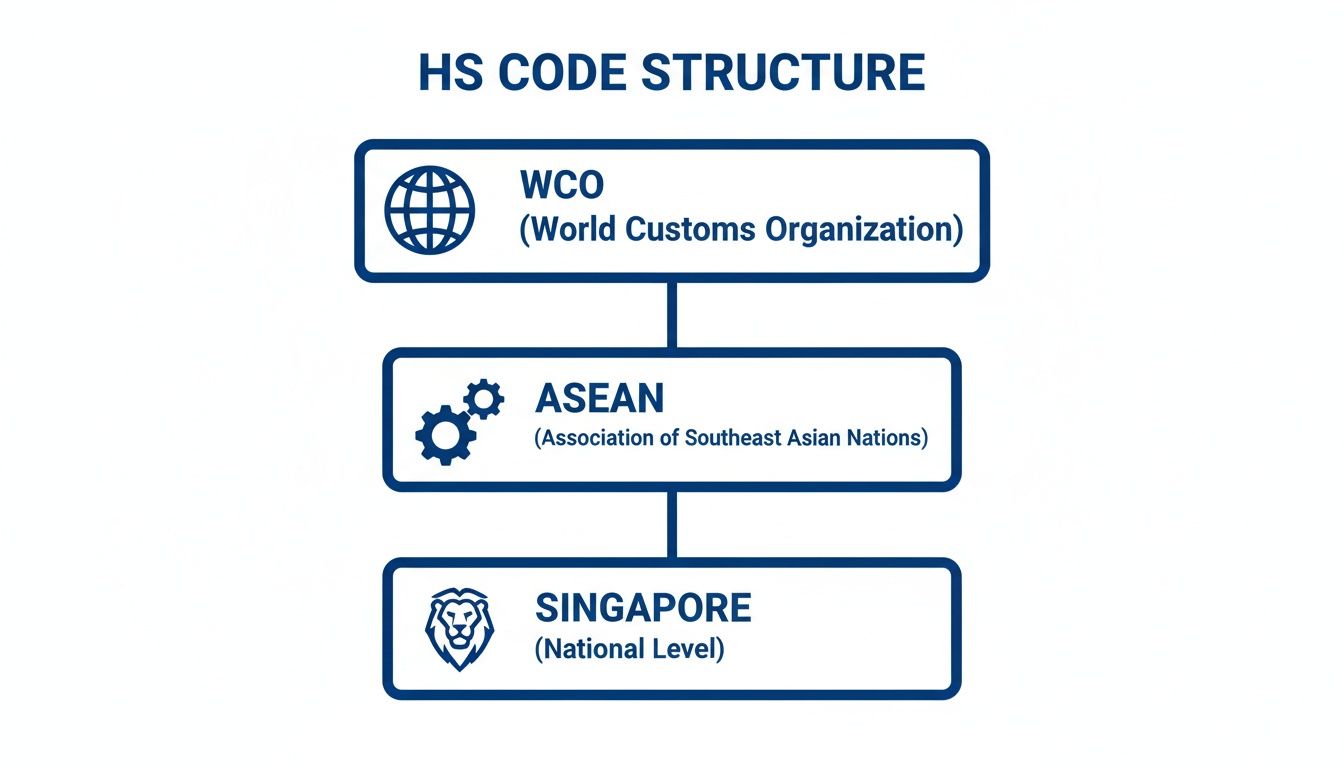
    Drilling down into these specific products is crucial. To get a better handle on identifying them within customs data, check out our guide on how to navigate Singapore's customs HS codes.

    By zeroing in on these thriving areas, you align your sales efforts with the most active and valuable parts of the market. This data-first approach means your time is spent engaging prospects who have immediate and ongoing logistics needs, which naturally leads to better conversations and a much higher chance of winning their business.

    Using Customs Data to Find Qualified Shippers

    A bigger list isn't the answer to better prospecting; a smarter one is. For any logistics provider trying to win business with exporters in Singapore, the best tool in your arsenal is customs data. This raw information, once you know how to filter and analyse it, goes from being a sea of noise to a curated pipeline of genuinely qualified leads.

    Forget sifting through outdated business directories. Real trade data tells you exactly who is actively shipping, what they’re moving, and how often they're doing it. This methodical approach means your sales team spends their time on prospects with tangible, immediate logistics needs, which completely changes your prospecting ROI. It’s the difference between a shot-in-the-dark cold call and a warm, data-backed conversation.

    Pinpointing Active Exporters with Precision Filters

    The real magic of a platform like Coreties is its ability to slice through the clutter. You can move past basic company demographics and start filtering prospects based on their actual shipping behaviour. This is how you build hyper-targeted lists of companies whose needs are a perfect match for what you do best.

    Here are a few of the most powerful filters I always start with:

    • HS Codes: This lets you zero in on companies exporting specific commodities. If you specialise in handling electronics, you can filter for HS Code 85 to instantly find every company shipping semiconductors and telecommunications gear.
    • Trade Volume: Want to find the bigger fish? Set a filter for the total weight or declared value of shipments over a set period. This helps you prioritise exporters with more consistent, high-value freight.
    • Shipping Frequency: This is key for identifying businesses with regular, ongoing demand. A simple filter for companies shipping more than five times a month to a specific destination uncovers businesses with stable, predictable logistics needs.
    • Trade Lanes: Focus your energy on the routes where you have the strongest operational advantage. You can build a targeted list of every company exporting from Singapore to key markets like China, Malaysia, or the USA.

    By combining these filters, you can create an incredibly powerful search. For example, you could find all Singaporean companies that have shipped over 10,000 kg of pharmaceutical products (HS Code 30) to the United States in the last six months. That’s not a prospect; that’s a qualified lead ready for a call.

    The workflow below shows just how simple yet effective this process is for turning raw data into real conversations.
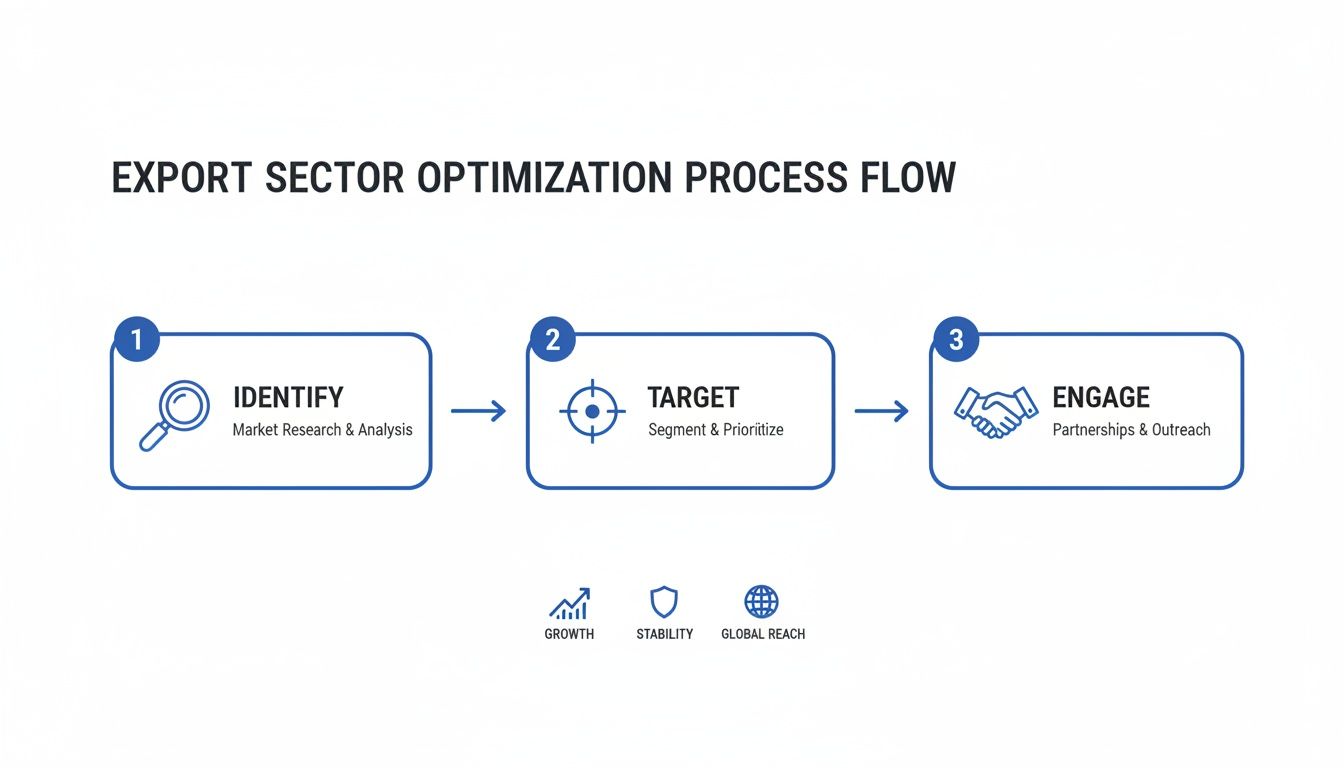
    Export sector optimization process flow with three steps: Identify, Target, Engage, aiming for Growth, Stability, Global Reach.

    This simple flow—Identify, Target, Engage—is the foundation of a data-driven sales strategy. It gets you from broad market awareness to specific, high-potential conversations, fast.

    From Data Points to Actionable Insights

    Once your initial filters are in place, the next step is to interpret what you’re seeing to qualify prospects even further. A company shipping a high volume of a single commodity to one destination has very different pain points from one sending smaller, mixed consignments to multiple countries. Your pitch has to reflect that reality.

    For instance, a company consistently exporting machinery parts to Taiwan could be a perfect fit for your consolidated LCL services on that lane. Another business moving high-value electronics to Europe might be much more interested in a proposal that highlights your premium air freight capacity and enhanced security measures. If you want to dive deeper into this, check out our guide on how to use an HS code filter for smarter prospecting.

    This level of insight is just impossible to get from standard prospecting tools. When you ground your strategy in real shipping data, you're not just finding potential customers—you're uncovering their specific logistics challenges before you even pick up the phone.

    Spotting High-Value Trade Lanes and Opportunities

    Let's be honest, not all trade lanes are created equal. If you want to succeed in prospecting exporters in Singapore, you need to get smart about identifying and chasing the most profitable shipping routes. Global trade is always in flux, and those shifts constantly carve out new opportunities for anyone paying close attention.

    The best way to do this? Ditch the guesswork and dive into real-world customs data. This is how you pinpoint lanes with surging volumes and tailor your services to match. Imagine knowing that exports to a specific country have shot up recently. You can get ahead of the curve, secure competitive capacity on that lane, and walk into a sales meeting with a powerful, relevant value proposition.
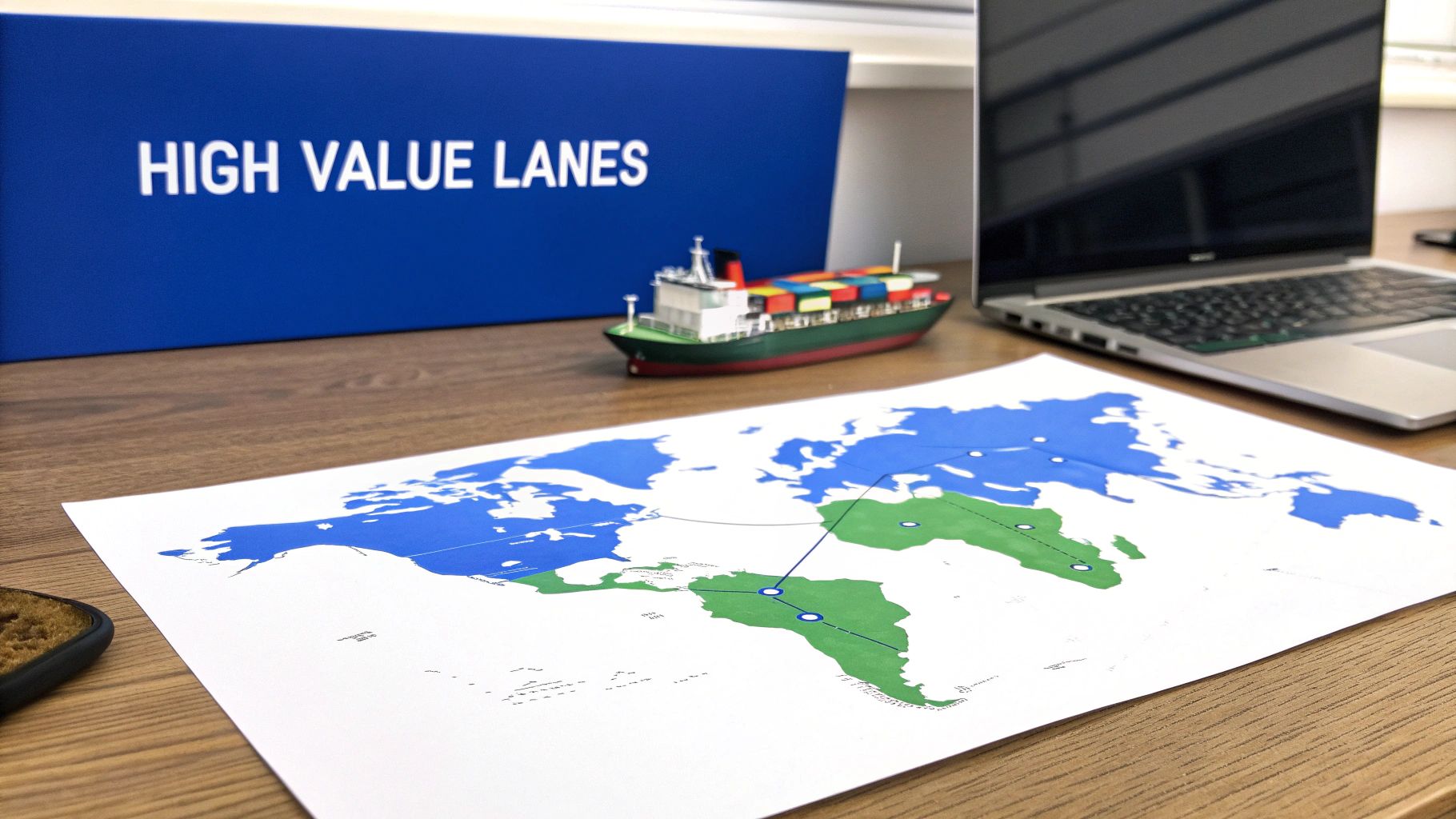
    Global logistics setup with a world map, container ship model, laptop, and 'HIGH VALUE LANES' sign.

    This image nails the concept of finding those golden lanes. The real trick, though, is turning that big-picture idea into hard data that fuels your sales strategy.

    Analysing Recent Trade Shifts

    Looking at the latest data, we can see some pretty significant shifts in where Singapore's exports are headed. Recent figures for non-oil domestic exports (NODX) show a 17.9% jump in shipments to China. Even more impressive, exports to Taiwan climbed 24.3%, and Malaysia saw a solid 13.3% increase.

    On the flip side, the United States market took a hit, with exports dropping a sharp 36.3%. You can dig into these recent export figures from Morningstar for a closer look.

    This isn't just random noise; it's a clear signal. Singapore's export focus is pivoting towards key Asian markets. For freight forwarders, these numbers are gold. They tell you exactly where to point your sales team—towards lanes with proven, growing demand and away from those hitting a rough patch.

    Turning Lane Data into a Sales Advantage

    Knowing the trends is one thing; using them to win business is another. This is where you can really separate yourself from the competition. Forget the generic sales pitch and start segmenting your prospect list based on where they actually ship their goods.

    Here's how this plays out in the real world:

    • For Exporters to China and Taiwan: Your outreach should be all about your strong capacity, competitive transit times, and local know-how in these booming markets. You're speaking their language.
    • For Exporters to Malaysia: You can lead with efficient cross-border trucking or smart intermodal solutions that balance speed with cost. It’s a practical, valuable suggestion.
    • For Exporters to the US: The conversation changes. With volumes down, your focus should shift to value-add services. Talk about optimising their supply chain, suggest alternative routing, or offer warehousing solutions to help them navigate the downturn.

    By aligning your service offerings with real-time trade lane dynamics, you transform from a simple service provider into a strategic partner. You are no longer just selling freight; you are offering data-backed solutions to a prospect’s most current and pressing logistics challenges.

    This level of insight is what makes top performers stand out. It ensures your team is always zeroed in on the most promising parts of the market, armed with a message that actually resonates. When you can engage the right exporters in Singapore with solutions that solve their immediate operational headaches, your chances of winning their business go way up.

    Connecting With the Right Decision-Makers

    You've got a solid list of high-potential exporters in Singapore. Great. But that's only half the battle, isn't it? A list of company names doesn't sign deals. Real people do. This is where we shift from crunching customs data to taking targeted action, getting your pitch past the gatekeepers and onto the screen of the person who actually makes the decisions.

    Let's be honest: firing off a brilliant proposal to a generic info@ email address is a complete waste of your time and effort. Our goal is to pinpoint the exact individuals whose job it is to solve the shipping headaches you're built to fix.

    A person's hand touches a tablet displaying 'Reach DECISION MAKERS' and a business profile picture.

    Identifying Key Logistics Contacts

    First things first, you need to know who you’re looking for. Aiming for the "CEO" at a major enterprise is usually a rookie mistake; they're often too far removed from the day-to-day grit of logistics. You need to get more granular.

    Your best bet is to find people with titles that scream logistics, supply chain, or operations. Think along these lines:

    • Head of Logistics
    • Supply Chain Manager
    • Global Operations Director
    • Procurement Manager (especially those with a logistics focus)
    • Export/Import Manager

    This is where a tool like LinkedIn Sales Navigator becomes your best friend. You can zero in on a target company and filter its employee list by these keywords. It’s a quick and dirty way to build a highly relevant contact list, ensuring your message lands with someone who genuinely cares about freight rates and on-time deliveries. If you're looking to understand how these roles fit into different company structures, it helps to know the differences between EXIM, MFR, and enterprise setups.

    A common pitfall I see is aiming too high or too low in the org chart. A junior coordinator probably doesn’t have the authority to sign off on a new freight partner. A C-level exec is focused on the 30,000-foot view, not specific shipping lanes. Your sweet spot is the mid-to-senior level manager who feels the direct pain of logistics problems.

    Crafting Data-Driven Outreach

    Once you’ve identified the right person, your outreach has to show you’ve done your homework. A generic "we can save you money" email gets deleted in a heartbeat. This is your chance to weave in the valuable data you've already gathered.

    Your opening line is everything. It needs to instantly signal that this isn't some mass-blasted spam. Reference a specific commodity they ship or a high-volume trade lane they operate on, and you’ll immediately establish credibility.

    Here’s a practical example for a prospect shipping electronics to Taiwan:

    Subject: A thought on your electronics shipments to Taiwan

    Body: "Hi [Prospect Name], I saw that your company is a significant exporter of integrated circuits to Taiwan. With volumes on that lane growing, I thought you might be interested in our consolidated air freight options that have been helping similar electronics shippers reduce transit times by up to 20%."

    See the difference? This approach is powerful because it’s not about you—it’s about them. It shows you understand their business, their specific market, and their potential challenges.

    The scale of opportunity here is massive. In a recent peak month, Singapore's total export value hit 70,121.84 SGD million, with forecasts trending around 64,000 SGD million for the coming months. With that much volume moving, a personalised, data-informed message isn't just a good idea; it's the only way to cut through the noise. You can discover more insights about Singapore’s export trends on Trading Economics.

    Crafting Proposals That Win Business

    Getting that first "yes" from a decision-maker is a great feeling, but it’s really just the starting whistle. The real game is turning that initial interest into a solid, long-term partnership. This is where you bring all your data-driven insights to the table and build a proposal that doesn't just quote prices—it solves their specific shipping challenges.

    Your whole mindset needs to shift from just selling freight to offering genuine strategic value. You’ve already done the hard work of figuring out what an exporter ships and where. Now, it’s time to use that intel to frame a proposal that speaks directly to their world, proving you get their supply chain inside and out.

    Moving Beyond Price-Led Conversations

    The quickest way to get lost in the noise is to make it all about price. Competing on cost is a race to the bottom, turning your valuable service into a commodity. The good news is, the customs data you've gathered on exporters in Singapore gives you the perfect opening to talk about value, efficiency, and reliability—the things that really impact a shipper's bottom line.

    Think about it this way: you’re not just offering a rate for shipping electronics to Europe. You’re proposing a smarter routing option through a key partner hub that could shave a day off transit time. Or maybe you're suggesting a clever intermodal solution that perfectly balances cost and speed for their chemical shipments to the US.

    It’s these kinds of specific, thoughtful recommendations that show you’re thinking like a partner, not just another vendor quoting a lane.

    Tailoring Solutions with Trade Data

    Your proposal should feel like a direct answer to the prospect's needs, using their actual shipping patterns as the foundation. Let's walk through a couple of practical examples.

    • The High-Volume Electronics Exporter: You’ve found a company sending thousands of kilograms of semiconductors (HS Code 85) to Taiwan every month. A generic air freight quote won’t cut it. Instead, your proposal could lead by highlighting your priority booking access with certain airlines on that specific lane, guaranteeing their high-value, time-sensitive goods are always wheels-up on schedule.

    • The Specialised Chemical Shipper: Your data shows a prospect exports organic chemicals (HS Code 29) to several spots in Southeast Asia. Here, you can lead with your proven expertise in handling hazardous materials. Outline your specific safety protocols and compliance measures that take the risk off their plate for this sensitive cargo.

    The trick is to turn data points into direct, tangible benefits. Don't just say, "I see you ship to Germany." Instead, explain how your consolidated service to Hamburg will improve their operations, reduce their risk, or even save them money in ways they hadn't considered.

    This consultative approach completely changes the sales dynamic. You’re no longer just one of many bidders in their inbox; you become a trusted advisor. By proving you’ve invested the time to understand their business before you even ask for it, you’re not just more likely to win the deal—you're laying the groundwork for a profitable, long-lasting relationship.

    Got Questions About Finding Singaporean Exporters?

    Even with the best data in hand, hitting the ground running to find new exporters in Singapore can feel tricky. You're not alone. Let's walk through some of the most common questions and sticking points I see sales professionals run into.

    Think of this as your quick-reference playbook for getting past those hurdles that can really stall your momentum.

    What's the Best Way to Actually Get a List of Exporters?

    Honestly, forget generic business directories. The real game-changer is getting your hands on a platform that taps directly into customs and bill of lading data. This is where the gold is.

    Why? Because it’s not about finding a list of companies; it's about finding proof of their shipping activity. This kind of data lets you get incredibly specific.

    • Commodities: You can use HS codes to pinpoint companies that export the exact goods you're best at handling. No more guessing.
    • Shipping Volume: Want to chase the big fish? Filter for high-volume shippers and focus your energy where it counts.
    • Trade Lanes: Target businesses shipping to destinations where you know you have a competitive edge.
    • Frequency: Zero in on companies with steady, reliable shipping schedules—the bread and butter of our business.

    When you start with real trade data, you’re no longer prospecting blind. You’re building a qualified list of active exporters who have a clear, current need for what you’re selling.

    Which Industries Are Shipping the Most Volume Right Now?

    No surprise here: electronics are king. This sector is a juggernaut, pushing out massive volumes of integrated circuits (HS Code 85), telecom gear, and computer parts. We're talking about over a third of Singapore’s total exports.

    But don't stop there. Pharmaceuticals, chemicals, and specialised machinery are also huge players. The key is to look deeper. Use the data to see which specific products are heading to destinations that match your strongest trade lanes.

    The real secret isn't just knowing the top industries; it's finding the perfect overlap between a niche's needs and your unique value. For instance, if you're a pro at cold-chain, targeting pharmaceutical exporters shipping to Europe is a far smarter play than just spamming every manufacturer out there.

    How Do I Make My Outreach Email Not Sound Like Everyone Else's?

    Data-driven personalisation is your secret weapon. Generic emails get deleted in seconds. Your first message has to prove you’ve done your homework.

    Try opening with something specific you found. For example: "I noticed your company is consistently shipping electronic components to Taiwan. That’s a key lane for us, and we've been able to secure priority air freight space that could cut your transit times."

    This kind of opener works because it immediately shows you get their business. You're not just another forwarder—you're a potential partner who understands their specific routes and commodities. That's how you cut through the noise and get a reply.

    What Are Some Common Prospecting Mistakes I Should Avoid?

    One of the biggest pitfalls is chasing only the massive, household-name exporters. They’re constantly bombarded by your competitors and are usually locked into rigid, long-term contracts. The smarter move? Use data to find those fast-growing small and medium-sized enterprises (SMEs). Their logistics needs are changing, and they're often more open to new partners.

    Another classic mistake is leading with price. Your first email should scream "value," not "discount." Show you understand their supply chain. Finally, make sure you're talking to the right person. Don't just email a generic info@ address. Use tools like LinkedIn Sales Navigator to find the Head of Logistics or Supply Chain Manager—the person who can actually say yes.


    Ready to stop guessing and start connecting with qualified exporters in Singapore? Coreties transforms raw customs data into an actionable pipeline of high-value leads. Filter by commodity, lane, and volume, then connect with verified decision-makers using data-driven outreach. Discover how much faster you can build your sales pipeline.
  • HS Code for Clothing A Guide to Accurate Classification

    HS Code for Clothing A Guide to Accurate Classification

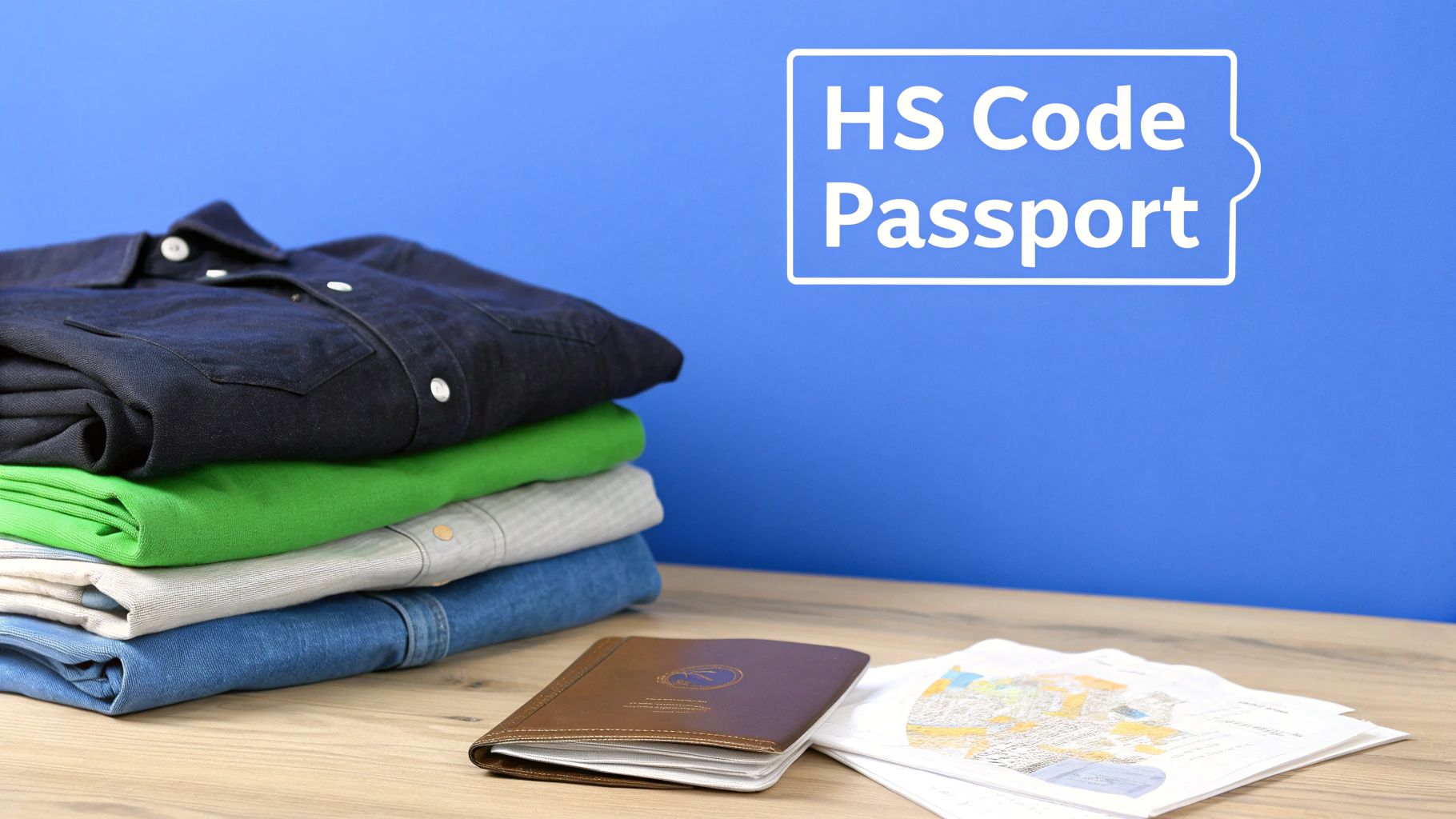
    Think of the HS code for clothing as a universal passport for every garment crossing a border. This simple six-to-ten-digit number tells customs officers worldwide exactly what's in the box—what an item is, what it's made of, and who it's for—making sure it gets classified correctly for duties and taxes.

    Decoding the Language of Global Apparel Trade

    A stack of folded clothes, a brown passport booklet, and papers on a table with 'HS Code Passport' text.

    For anyone in freight forwarding, getting a handle on the Harmonized System (HS) code isn't just about ticking a compliance box; it's a real strategic advantage. The right code paves a smooth path from the factory floor to the customer's hands, sidestepping costly delays, surprise fines, and the kind of friction that can sour a client relationship. Get one digit wrong, and a profitable shipment can quickly become a logistical nightmare.

    It helps to think of the HS code as a highly specific GPS coordinate for your apparel shipment. Each pair of digits zooms in, refining the product's identity until there's a clear, universal description that leaves no room for guesswork at customs.

    The Building Blocks of a Clothing HS Code

    The whole system is built on a simple, logical hierarchy. It starts broad and gets more specific with each number, allowing customs officials to pinpoint a garment's exact nature in seconds. This structure is absolutely essential for applying the correct tariffs and trade rules.

    Here's a quick look at how it works:

    • Chapter: The first two digits sort the item into a general category. For clothing, you'll almost always be in Chapter 61 (knitted or crocheted apparel) or Chapter 62 (woven apparel).
    • Heading: The next two digits define the type of product, like "jerseys and pullovers" or "trousers and shorts."
    • Subheading: The final two digits of the international code add the crucial details, such as the material (e.g., cotton, synthetic fibres) or the intended wearer (men's, women's, etc.).

    In global trade, the HS code is the single source of truth for product classification. Getting it right from the start eliminates downstream complications, ensuring that tariffs are calculated correctly and shipments clear customs without friction.

    This six-digit foundation is the bedrock of international apparel shipping. Take Singapore, for example. The local HS code framework, which centres on Chapters 61 and 62, is crucial for accurate trade analytics. A simple misclassification can lead to serious hold-ups, which is why Singapore Customs provides tools like their ruling database to help businesses stay compliant. You can see just how much these classifications matter to the economy in official trade publications.

    Ultimately, understanding this system is your key to navigating the complex world of global logistics. It turns the daunting task of classification into a manageable process, giving you the confidence to handle any apparel shipment that comes your way.

    How HS Codes for Clothing Are Structured

    Think of an HS code for clothing like a postcode. It tells customs officials exactly what's in the box, starting from a broad region and zooming right down to a specific street address. Getting this code right isn't just a technicality—it's what determines how quickly your shipment clears and how much duty you'll pay.

    The entire universe of clothing is split into two massive categories, known as Chapters. These first two digits are the most important decision you'll make when classifying a garment. The distinction is simple but absolutely fundamental.

    The First Big Decision: Knitted or Woven?

    Right at the start, the path splits based on how the fabric was made. Every single piece of clothing falls into one of two Chapters:

    • Chapter 61 is for all apparel that is knitted or crocheted.
    • Chapter 62 is for all apparel that is woven.

    What's the difference in real life? A classic cotton t-shirt has that familiar stretch because its fabric is made from a single thread looped over and over—that's knitted (Chapter 61). On the other hand, a formal dress shirt feels crisp and holds its shape because its fabric is made by weaving threads over and under each other, like a basket. That's woven (Chapter 62).

    This isn't a minor detail; it's the foundation of the entire code. A knitted garment's HS code must start with "61". A woven one must start with "62". No exceptions.

    An incorrect Chapter is one of the most common and costly mistakes in apparel shipping. It instantly invalidates the rest of the code, leading to customs rejections, surprise duties, and major delays for your clients.

    Narrowing It Down with Headings

    Once you've picked the right Chapter, the next two digits—the Heading—get more specific about the type of garment. This is where you go from a broad category like "knitted apparel" to identifying the actual item.

    For instance, within Chapter 61 (Knitted), you'll find different Headings for different products:

    • 6105: Men's or boys' shirts, knitted or crocheted.
    • 6109: T-shirts, singlets, and other vests, knitted or crocheted.
    • 6110: Jerseys, pullovers, and cardigans, knitted or crocheted.

    Chapter 62 (Woven) works the same way, with Headings like 6203 for men's suits or 6205 for men's shirts. The Heading adds that second layer of detail, confirming what the product is. While the global standard is six digits, many countries, including Singapore, add extra digits for more local detail. You can dive deeper into this in our guide on the HS code system in Singapore.

    Adding Critical Details with Subheadings

    The last two digits of the international HS code are the Subheading. This is where things get really granular—and it's often where classification disputes happen. The Subheading locks in the final details that determine the exact tariff rate.

    These crucial details almost always include:

    • Material Composition: Is it cotton, wool, silk, or a synthetic fibre like polyester? A cotton t-shirt has a different code from a polyester one.
    • Intended Wearer: Is it for men, women, boys, girls, or infants? This distinction is non-negotiable and can completely change the code.

    Let's walk through an example: a men's cotton t-shirt.

    1. Chapter: It’s a t-shirt, so it's knitted. We start with 61.
    2. Heading: It’s a t-shirt, so we use Heading 09.
    3. Subheading: It’s made of cotton, which is assigned Subheading 10.

    Put it all together, and the correct 6-digit HS code for a men's cotton t-shirt is 6109.10. This logical, step-by-step process is designed to remove guesswork, so customs officials anywhere in the world can understand exactly what they're looking at.

    Key Classification Rules You Need to Know

    Once you’ve got a handle on the basic structure of an HS code, the real work begins. Getting the classification right is what separates a smooth customs clearance from a shipment stuck in limbo. It’s all about a process of elimination—you start with the most critical distinction and work your way down through the details until only one correct code remains.

    The whole system essentially asks you a series of questions. The first one is the big one: is the garment knitted or woven? This single detail decides whether you start in Chapter 61 or Chapter 62, and getting it wrong from the get-go throws off everything else.

    The Critical Knitted Versus Woven Divide

    Think of a garment’s fabric construction as its fundamental DNA. Knitted fabric is made from a single, continuous thread looped together, kind of like a chain-link fence. This structure gives it natural stretch, which is why your t-shirts, jumpers, and gym wear are almost always knitted. These items all belong in Chapter 61.

    Woven fabric, on the other hand, is created by interlacing two or more threads at right angles, much like a basket weave. This grid-like structure makes the material more rigid and durable—perfect for things like formal shirts, denim jeans, and structured blazers. These garments fall under Chapter 62.

    A word of warning: Getting the knitted vs. woven distinction right is non-negotiable. An experienced customs inspector can tell the difference in seconds, and classifying under the wrong Chapter is an immediate red flag that often triggers inspections and costly re-classifications.

    To make it easier to tell them apart at a glance, here’s a quick reference table.

    Knitted (Chapter 61) vs Woven (Chapter 62) At a Glance

    Characteristic Knitted Apparel (Chapter 61) Woven Apparel (Chapter 62)
    Fabric Construction Made from a single, continuous yarn looped together. Made by interlacing two or more sets of yarn at right angles.
    Feel & Stretch Stretchy, flexible, and comfortable. Returns to shape easily. More rigid, structured, and holds its shape. Limited stretch.
    Look Up Close You'll see tiny, braided loops, similar to knitting. You'll see a distinct grid-like or criss-cross pattern.
    Common Garments T-shirts, jumpers, polo shirts, hoodies, leggings, underwear. Dress shirts, blouses, trousers, jeans, suits, blazers, jackets.

    Remembering these key differences is the first and most important step in correctly classifying any piece of clothing.

    What About Blended Fabrics?

    It’s rare to find clothing made from just one material. So what happens when you have a t-shirt that’s 60% cotton and 40% polyester? This is where the "principal character" rule comes into play. You classify the garment based on the material that gives it its primary identity.

    For blended fabrics, the rule is thankfully straightforward: you classify the garment based on the material with the highest percentage by weight. In our example, since cotton makes up 60% of the fabric, you’d classify the t-shirt under the subheading for cotton, not polyester.

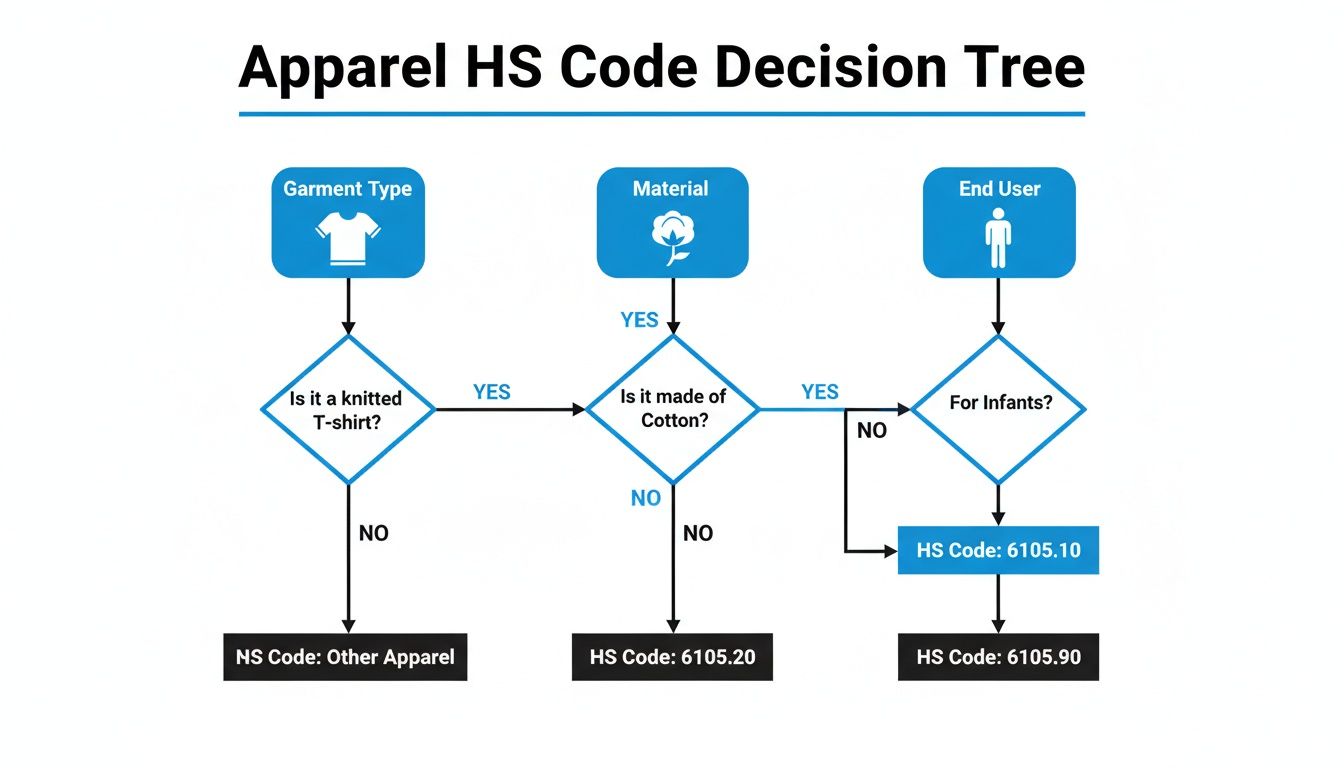
    This simple decision tree shows the logical flow for classifying a garment, starting from its type and drilling down to the end-user.

    Apparel HS Code decision tree flowchart for classifying garments by type, material, and end user.

    As you can see, each decision you make narrows down the possibilities, guiding you systematically to the right HS code.

    The Importance of Gender and Age

    After fabric and material, the next hurdle is the intended wearer. The HS code system makes very clear distinctions between apparel for different demographics, and this isn’t a suggestion—it’s a hard-and-fast rule with separate codes for each group.

    You absolutely must classify garments into one of these categories:

    • Men's or boys'
    • Women's or girls'
    • Infants'

    A men’s cotton shirt will have a different HS code than a women’s cotton shirt, even if they look practically identical. The "infants" category is also very specific, usually covering clothing for babies up to a certain size (for instance, up to size 86 cm in many regions). Mistaking a unisex-style hoodie as "men's" when the shipment is for a women's retailer is a classic mistake that can cause major compliance headaches.

    When Small Details Change Everything

    Finally, never underestimate the power of design features. Seemingly minor details can completely change an HS code because the system is designed to be incredibly specific. A simple collar, a pocket, or a particular type of fastening can easily bump a garment from one heading to another.

    For example, a knitted pullover with no pockets or openings might fall under heading 6110. But add a partial opening at the neck with a few buttons, and it could suddenly be classified as a shirt under an entirely different heading. Always examine the garment’s physical traits closely—the smallest details often hold the key to an accurate classification.

    Common HS Codes for Major Clothing Categories

    Now that we’ve got the ground rules down, let's put theory into practice. Knowing the right HS code for clothing is only useful when you can apply it quickly to the garments you handle every single day.

    Think of this section as your classification cheat sheet. We're going to walk through some of the most common apparel categories—from t-shirts to jeans—and show you exactly how the logic of Chapter, Heading, and Subheading comes together to form the correct 6-digit code.

    T-Shirts, Singlets, and Other Vests

    This category is easily one of the most frequently shipped worldwide, and a standard t-shirt is a perfect, clear-cut example of how the HS system works.

    Let’s classify a basic men's 100% cotton t-shirt:

    • Chapter: T-shirts are almost always made from that familiar stretchy, looped fabric, which means they are knitted. This puts them squarely in Chapter 61.
    • Heading: Within Chapter 61, the specific heading for "T-shirts, singlets and other vests" is 09.
    • Subheading: The material is cotton, which corresponds to subheading 10.

    Put it all together, and you get the 6-digit HS code: 6109.10.

    In Singapore, the HS code 6109.10 covers these exact items. For customs declarations, this is often broken down even further for men/boys (6109.10.10) or women/girls (6109.10.20). While duties are generally zero under Singapore’s trade-friendly policies, getting the code right is non-negotiable for smooth clearance. A quick look at trade data shows that basic crew necks, V-necks, and graphic tees make up the bulk of shipments under this code.

    Trousers and Jeans

    Trousers and jeans are another massive category in global apparel, but their classification takes a different path because they are usually made from woven fabric.

    Picture a pair of classic men's blue denim jeans. Here’s how you'd classify them:

    • Chapter: Denim is a tough, woven twill fabric, which immediately sends us over to Chapter 62.
    • Heading: The heading for "Trousers, bib and brace overalls, breeches and shorts" for men or boys is 03.
    • Subheading: There's a specific subheading just for denim, which is 42.

    The result is the HS code 6203.42. If those same trousers were made from synthetic fibres instead of denim, the subheading would change (to .43), but the Chapter and Heading would stay the same.

    The same principles of material and construction apply across all apparel. If you’re curious about how this works for accessories, you can dive into our guide on the HS code for shoes.

    Jumpers, Pullovers, and Cardigans

    When we start talking about colder-weather clothing, we usually find ourselves back in the world of knitted goods. Jumpers, pullovers, and cardigans are all about that comfortable, stretchy construction.

    Let's break down a women's jumper made from a 55% wool, 45% acrylic blend.

    • Chapter: Its construction is knitted, so we begin again in Chapter 61.
    • Heading: The correct heading for "Jerseys, pullovers, cardigans, waistcoats and similar articles" is 10.
    • Subheading: This is where the material blend rule is crucial. Since wool is the dominant fibre by weight (55%), we use the subheading for wool, which is 11.

    The final HS code is 6110.11. If the blend had been flipped and acrylic was the dominant material, the code would have shifted to reflect that.

    A common pitfall is classifying a hoodie under heading 6110. Hoodies often have features like pockets, linings, or a full-zip front that can push them into a completely different classification. Always examine the garment’s specific features, not just its general description.

    Example HS Codes for Popular Apparel Items

    To help you get a feel for the patterns, here’s a quick-reference table for some of the most common clothing items you'll run into.

    Apparel Item Example Description Key Classification Factors HS Code (6-Digit)
    Polo Shirt Men's, 100% cotton, knitted Knitted, Men's, Cotton 6105.10
    Dress Shirt Men's, 100% cotton, woven Woven, Men's, Cotton 6205.20
    Women's Blouse 100% silk, woven Woven, Women's, Silk 6206.10
    Jacket / Blazer Men's, woven wool Woven, Men's, Wool 6203.31
    Women's Skirt 100% polyester, woven Woven, Women's, Synthetic 6204.53
    Underwear Men's cotton briefs, knitted Knitted, Men's, Cotton 6107.11

    By using these examples as a guide, you can start building the confidence needed to classify any garment accurately. Getting this right from the start is the key to ensuring your shipments move across borders efficiently and without any costly compliance headaches.

    How to Avoid Costly Classification Mistakes

    Getting an HS code for clothing wrong by even a single digit can set off a chain reaction of problems. A shipment gets flagged, customs officials start asking questions, and suddenly you're facing unexpected fines, storage fees, and an unhappy client. Shifting from guesswork to confident verification isn’t just about ticking a compliance box; it’s about protecting your profit margin and your reputation.

    The key is to treat classification as a systematic process, not an assumption. It's tempting to rely on a supplier's code or reuse one from a similar-looking shipment, but that's a risky shortcut. At the end of the day, the responsibility for accuracy falls on the importer and, by extension, the forwarder guiding them.

    A solid verification process is your best defence against these expensive errors. It’s all about cross-referencing information and never taking a single source as gospel.

    Your Three-Step Verification Process

    To nail the classification every time, it helps to have a simple but effective checklist. This methodical approach cuts through the ambiguity and creates a defensible record for every shipment you handle.

    1. Start with the Source Document: Always begin with the commercial invoice and packing list. Really scrutinise the product descriptions. Are they detailed enough? A description like "women's tops" is far too vague. You need specifics, like "women's 100% cotton woven long-sleeve blouse."

    2. Consult Official Tariff Databases: Armed with a detailed description, look up the code in an official government database. For shipments into Singapore, the Singapore Customs HS/CA Product Code Search is your ultimate source of truth. This step is crucial for validating your initial assessment against the country's specific legal framework.

    3. Cross-Reference with WCO Resources: When you're dealing with a tricky case, turn to the World Customs Organization (WCO) Explanatory Notes. These documents provide the official interpretation of HS headings, offering detailed guidance on what is—and isn't—included in a particular category.

    Following these steps turns classification from a quick guess into a documented, evidence-based decision. It's the kind of diligence that protects both you and your client from potential disputes down the line.

    Common Classification Pitfalls to Sidestep

    Even with a good process, some common mistakes still trip up seasoned forwarders. Just being aware of these traps is half the battle.

    One of the biggest errors is misidentifying fabric blends. The rule is simple but often missed: classify the garment based on the material with the highest percentage by weight. So, a shirt that's 55% polyester and 45% cotton is classified as a polyester shirt, period.

    Never assume a garment's material just by its look or feel. Always insist on a detailed material composition breakdown from the shipper. This single piece of data is one of the most critical factors in finding the correct HS code.

    Another frequent slip-up is overlooking small but significant design details. A simple drawstring, a hood, or even the type of waistband can be enough to shift a garment from one HS code to a completely different one.

    Finally, watch out for outdated codes. The WCO updates the Harmonized System every five years to keep up with new products and technologies. Using a code from 2021 for a shipment today might mean you're using a classification that doesn't even exist anymore. Always, always confirm you're working with the most current version of the tariff schedule.

    Find New Business Using HS Code Data

    A laptop on a wooden desk displays an e-commerce website showing various clothing items for selection.

    So far, we've treated the HS code for clothing as a necessary tool for compliance. But what if these codes could do more than just get your shipments cleared? What if they could actually point you directly to your next big client? The truth is, the data tied to every single shipment—all neatly organised by HS code—is a goldmine for business development.

    Think about it. Every time a container of apparel crosses a border, it leaves a data trail. This customs record shows exactly who is shipping what, how much they’re shipping, and where it’s all going. This isn't just logistical noise; it’s a detailed map of your entire potential client base.

    By tapping into this trade data, you can finally ditch the cold calls and start having conversations based on real, relevant insights. Your sales approach transforms from a shot in the dark to a data-backed strategy.

    Turning Data into Qualified Leads

    Let's say you're a specialist in shipping knitted apparel. Instead of guessing which companies might need your services, you could simply search customs data for businesses importing goods under Chapter 61. Right away, you've filtered out all the noise and are left with a targeted list of active importers.

    You can even drill down further. A quick filter for HS code 6109.10, for example, will show you every company in Singapore that’s importing cotton t-shirts. This kind of detail helps you zero in on high-potential clients whose shipping needs are a perfect match for your expertise.

    This method gives you some incredibly powerful market intelligence:

    • Pinpoint Active Importers: You'll find companies currently shipping the exact types of clothing you handle.
    • Gauge Shipping Volumes: See which businesses are importing at a scale that makes them a valuable partner for you.
    • Map Out Trade Routes: Discover the specific lanes your prospects are using, which allows you to pitch more competitive alternatives.

    By using customs data, you aren’t just finding leads; you’re uncovering a company’s entire supply chain story. This lets you craft an outreach that speaks directly to their real-world operational needs and challenges.

    Crafting a Winning Outreach Strategy

    Once you have your list of high-potential companies, the next step is reaching the right person. Modern trade intelligence platforms can help you find contact details for the key decision-makers, like logistics managers or supply chain directors, within these target businesses.

    Armed with this information, you can finally stop sending those generic "hope you're well" emails. Instead, you can build a personalised message based on actual data. Imagine mentioning their recent shipment volumes from Vietnam or highlighting how your services on a particular trade lane could offer them a better deal. To see exactly how to set up these searches, our guide on using an HS code filter offers a detailed walkthrough.

    This data-driven approach immediately shows you've done your homework. It proves to prospects that you understand their business and can offer genuine value, which dramatically increases your chances of getting a response and starting a real conversation. It’s the key to building a robust and sustainable sales pipeline.
    Frequently Asked Questions

    When you're dealing with apparel shipments day in and day out, a few questions tend to pop up again and again. Let's tackle some of the most common ones that freight forwarders and shippers run into with the HS code for clothing.

    What Is the Difference Between an HS Code and an HTS Code?

    Think of the HS code as the global "first name" for a product. It’s a six-digit code that’s the same pretty much everywhere, from Singapore to Spain, thanks to the World Customs Organization (WCO). It’s the universal standard.

    An HTS (Harmonized Tariff Schedule) code is more like a product's full name, specific to the country it's entering. The United States, for instance, tacks on four extra digits to that base HS code. This creates a 10-digit HTS code that lets them get super specific for calculating duties and gathering trade data.

    The bottom line: The first six digits are your universal key. Anything after that is country-specific. Always, always use the full HTS code required by the destination country for your customs paperwork.

    Do All Countries Use the Same HS Codes for Clothing?

    Yes, but also no. It's a bit of a trick question. The core six-digit HS code is used by over 200 countries, which is fantastic because it creates a common language for global trade. The code for a men's woven cotton shirt (6205.20) is recognised worldwide.

    The "no" part comes in after those first six digits. Many countries add their own numbers to get more detailed. This is why a shipment heading to the US needs a 10-digit code, while another going to Japan might only require a 9-digit one.

    How Often Do HS Codes Change?

    The Harmonized System isn't set in stone. The WCO gives it a major review about every five years to keep up with new products and technology. The last big update was in 2022, and the next one is already on the calendar for 2027.

    Staying on top of these changes is non-negotiable. Using an old, deleted code is one of the fastest ways to get a shipment stuck in customs, creating delays and potential fines for your clients.


    Ready to turn all this customs data into your next big client? With a tool like Coreties, you can filter through active shippers using specific clothing HS codes, pinpoint the right decision-makers, and build a targeted outreach list that actually converts. Discover qualified leads faster with Coreties.

  • Your Guide to the Books HS Code for Global Shipping

    Your Guide to the Books HS Code for Global Shipping

    When it comes to shipping books internationally, the most important number you'll ever need to know is tucked away in Chapter 49 of the Harmonized System (HS) tariff schedule. For most standard printed books, you'll be looking at HS 4901, but if you're shipping children's picture books, that changes to HS 4903. Nailing the right code from the start is the difference between a smooth delivery and a shipment stuck in customs.

    Your Quick Guide to Books HS Codes

    Woman working on a laptop with an open binder, books, and a 'BOOKS HS Codes' sign.

    Think of a book's HS code as its universal product passport. This multi-digit number tells customs officers across the globe exactly what’s inside the box, no questions asked. For anyone working in logistics, getting these codes right isn't just a box-ticking exercise; it’s fundamental to avoiding costly delays, frustrating fines, and compliance headaches.

    The entire world of printed materials, from best-selling novels to daily newspapers, is neatly organised under one roof: Chapter 49 of the Harmonized System. This chapter works like a library, with each heading acting as a specific shelf for a different type of publication. Once you understand its layout, you can classify any shipment with confidence.

    Navigating the Basics of Chapter 49

    While Chapter 49 covers a huge range of printed goods, a handful of key headings pop up time and time again for book-related shipments. For freight forwarders and logistics sales teams, knowing these core codes off the top of your head is a game-changer. It means you can give quick, accurate answers to clients and build trust right from the first conversation.

    An HS code is more than just a number. It’s a shared language between exporters, importers, and customs authorities that keeps global trade moving efficiently. Misclassifying an item is like giving your cargo the wrong travel documents—it's bound to get stopped at the border.

    Printed books under HS 4901 are a massive category, but it’s fascinating to see the sheer diversity of other items within Chapter 49. For instance, a look at Singapore's imports from September 2019 to September 2020 revealed that printed books made up 18% ($1.56 million) of the chapter's total trade value.

    But what was the top import? Surprisingly, it was unused postage stamps under HS 4907, which clocked in at $2.8 million. You can dig into more of Singapore's import trends at Export Genius. This data just goes to show why precision is everything—every single item has its own specific code.

    Navigating Chapter 49: The Library of Book Classification

    Think of Chapter 49 of the Harmonized System as a massive, perfectly organised library. Each heading represents a specific aisle, and every subheading is a shelf dedicated to a particular type of printed material. For anyone in logistics, getting the layout of this "library" right is the key to declaring goods correctly and keeping shipments moving.

    This system isn’t just a random collection of numbers; there’s a clear logic behind it. The main distinction often boils down to the item's core purpose and format. It’s why a hefty university textbook and a colourful children’s picture book, while both technically "books," end up on completely different shelves.

    The Core Principle: Text Versus Pictures

    When classifying a book, the first and most critical question you need to ask is: what tells the story? Is it the words, or is it the pictures? This single distinction is the dividing line between two of the most common headings you'll ever use.

    If the text is the star of the show and any illustrations are just playing a supporting role, the item will almost always fall under HS Heading 4901. This is your go-to "aisle" for the vast majority of printed books, from paperback novels and technical manuals to corporate brochures.

    But, if the pictures are the main attraction and the text is minimal or just there to add a little context, the classification shifts. This is where HS Heading 4903 comes in, a heading specifically for children's picture, drawing, or colouring books. A good rule of thumb: if a child can follow the story just by looking at the images, it belongs in 4903.

    For customs purposes, a book isn't just a book. Its classification hinges on its "essential character." Getting the difference between HS Code 4901 (text-driven) and 4903 (picture-driven) wrong can change duty rates and jam up clearance, so this is one detail you absolutely have to get right.

    Exploring Other Aisles in the Library

    While 4901 and 4903 will cover the bulk of book shipments you see, Chapter 49 has plenty of other important classifications that freight forwarders run into all the time. Knowing these other "aisles" is crucial for avoiding misclassification, especially when you’re dealing with mixed shipments.

    Here are a few other key headings to keep on your radar:

    • HS Heading 4904: This one is exclusively for music, whether it's printed or in manuscript form. It doesn't matter if it's bound or illustrated; if it's sheet music, it goes here.
    • HS Heading 4905: This covers all maps and hydrographic charts. Think atlases, wall maps, and even printed globes.
    • HS Heading 4911: This is a broad but vital category for other printed items. It acts as a catch-all for things like trade advertising materials, commercial catalogues, and calendars.

    Picture a single shipment that contains educational textbooks (4901), a case of colouring books for a school (4903), and a stack of promotional flyers for a book fair (4911). Each of these items needs its own specific HS code on the commercial invoice. Trying to group them all under one generic code is a surefire way to trigger customs delays and maybe even fines. When it comes to customs, precision is everything.

    How to Classify Every Type of Book

    Getting the HS code right means going beyond the general 4-digit heading and drilling down to the specific 6, 8, or 10-digit code that customs authorities demand. Think of it this way: the 4-digit heading tells you it's a "car," but the full code specifies it's a "2024 Toyota Camry XSE in Supersonic Red." That level of detail is exactly what's needed to avoid delays at the border.

    Let's walk through a few real-world examples. Your standard paperback or hardcover novel, where the text is the star of the show, fits neatly under HS Heading 4901. Depending on the country-specific rules, its full code might end up as 4901.99.00, which basically means it's an "other" type of printed book in that category.

    But what about a children’s colouring book? That’s a different story. Since the illustrations for colouring in are the main attraction, it jumps over to a completely different category: HS Heading 4903. The full code is typically 4903.00.00. Simple, right?

    Navigating Tricky Classifications

    It gets interesting when products start to blur the lines. What do you do with an activity book that’s shrink-wrapped with a small packet of crayons? Is it a book from Chapter 49 or a toy from Chapter 95? This is where customs officials rely on a key principle called "essential character."

    You have to ask: what gives the product its primary purpose? If the book itself is the main item and the crayons are just a little extra, it stays a book under Chapter 49. But if the whole package is really about the activity and the crayons are just as important, it could easily be classified as a toy set.

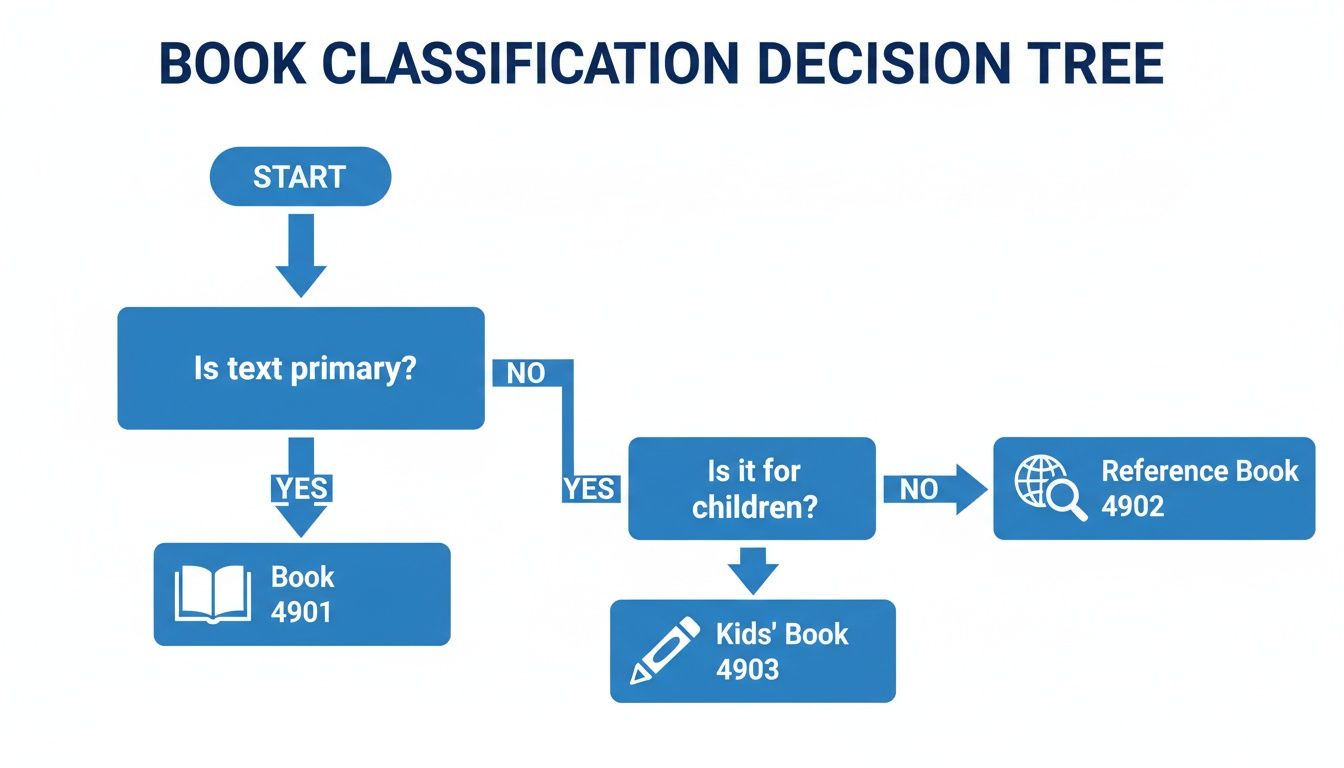
    This simple decision tree can help you visualise how to approach the most common types of books you'll encounter.

    Flowchart illustrating a book classification decision tree for categorizing books into types with HS codes.

    As the flowchart shows, the first question is always the same: is the book primarily about the text, or do pictures tell the main story?

    A Note on Digital Products

    One of the biggest tripwires in modern logistics is how to classify digital publications. The rule here is simple but absolutely critical: e-books, PDFs, and any other digital files are not covered by Chapter 49.

    Chapter 49 is for physical, printed goods only. Digital products are classified completely differently, usually as software or electronic services. Confusing a PDF with a paperback is a fundamental mistake that will get your shipment flagged immediately.

    Understanding these details has real financial implications. In Singapore, for instance, the trade in physical printed materials is substantial. Imports under HS Code 4901.10 (printed books and brochures in single sheets) were valued at roughly $15.2 million USD, primarily sourced from China, Indonesia, and Malaysia. You can dig into more of these trade flows on the World Bank WITS platform.

    Having this hands-on knowledge is what separates an average forwarder from a great one. For a more comprehensive look, check out our complete guide to the HS code for books. When you get the classification right every time, you build trust and make sure your clients' shipments glide through customs without a problem.

    Common Classification Mistakes and How to Avoid Them

    Even the sharpest logistics pros can get tripped up on HS codes. When it comes to books, what seems like a minor slip-up can quickly snowball into customs delays, surprise fees, and unhappy clients. Knowing where others go wrong is the best way to make sure you get it right every time.

    One of the most common stumbles is with children’s books. The mistake usually happens when someone classifies a book based on its story rather than its physical makeup. A novel written for a ten-year-old might feel like a children's book, but if it's mostly text, it still falls under HS Heading 4901. The rule of thumb is simple: if pictures are the star of the show and dominate the pages, it’s a 4903. If text does the heavy lifting, it's a 4901.

    Another classic mix-up is between books and promotional material. That glossy, beautifully bound catalogue might look and feel like a book, but if its main job is to sell something, it belongs under HS Heading 4911, not 4901. Getting this wrong can lead to serious miscalculations on duties and taxes.

    Overlooking National-Level Codes

    A huge and potentially costly mistake is stopping at the 6-digit HS code. While those first six digits are the universal language of global trade, many countries—especially major hubs—use more specific 8 or 10-digit codes for their own national tariffs.

    Trying to clear customs with a 6-digit code when the destination country demands a 10-digit one is a surefire way to get your shipment flagged and rejected. This oversight often happens because we assume the system is uniform all the way down. It isn't.

    The Solution: Always, always check the full HS code against the destination country’s official customs tariff schedule. Never assume the 6-digit code is enough. Taking this one extra step can save you from hours of headaches and steep non-compliance penalties.

    This level of detail is crucial for keeping things moving. Take Singapore, for example. In 2023, the country exported $954,000 USD in school and exercise books, all classified under a very specific national code derived from HS Heading 4901. You can dig deeper into Singapore's export data on the OEC website.

    Common Pitfalls Checklist

    To keep your shipments sailing smoothly, keep an eye out for these frequent errors:

    • Content vs. Format: Don't classify a children's book based on the story. Focus on the picture-to-text ratio.
    • Promotional vs. Informational: Is it a sales catalogue (4911) or a general printed book (4901)? The purpose matters.
    • The 6-Digit Trap: Always find the full 8 or 10-digit code required by the destination country. Don't stop short.
    • Ignoring 'Essential Character': For sets (like a book with a toy), you have to correctly identify the main item that gives the set its character. Don't just default to the book.

    By getting ahead of these issues, you can ensure every declaration is spot-on. That's how you build a reputation for reliability and expertise that clients truly value.

    Documentation and Customs Procedures for Shipping Books

    A pen rests on a document titled 'Shipping Documents' on a wooden desk, with other papers and a box.

    Getting the right HS code for a book shipment is a massive first step, but it’s really only half the battle. If your paperwork isn’t spot-on to back that code up, you’re setting yourself up for a customs headache. This is where theory meets reality, and where a smooth clearance process is won or lost.

    At the heart of any international book shipment are three core documents. They each have a different job to do, but they must all tell the same, consistent story to customs agents.

    Core Shipping Documents

    Think of your shipping paperwork like a three-legged stool. If one leg is wobbly or missing entirely, the whole thing comes crashing down.

    • Commercial Invoice: This is the master document of the sale. It spells out who sold what to whom, for how much. Crucially, it must list the precise books HS code for every type of book in the shipment.
    • Packing List: This document details the physical contents of the shipment—how many books, their weights, and box dimensions. It’s the proof that what’s on the commercial invoice is actually what’s packed in the cartons.
    • Bill of Lading (B/L) or Air Waybill (AWB): This is your contract with the shipping company. It’s the receipt for your goods and it, too, needs to reference the correct HS codes.

    There's absolutely no room for error here. If the HS code on the invoice doesn't match the one on the bill of lading, alarm bells will ring at customs. That kind of mistake almost guarantees an inspection, leading to frustrating and expensive delays.

    The golden rule of customs clearance is simple: your paperwork must be a perfect mirror of your cargo. Any discrepancy, no matter how small, creates doubt and invites scrutiny.

    Navigating Duties and Taxes

    There's a common misconception that all books are exempt from duties and taxes. While it’s true that many countries grant preferential treatment to educational materials, it's by no means a universal rule. The final duties and taxes owed always come down to the specific HS code and the import country's local laws.

    For instance, a container of novels classified under HS 4901 might sail through customs duty-free. But a shipment of glossy advertising brochures under HS 4911 could easily be hit with import duties. On top of that, Value Added Tax (VAT) or Goods and Services Tax (GST) often applies even when an item is duty-free. For a closer look at these local details, our guide on the HS code in Singapore offers some great regional examples.

    This is precisely where a good freight forwarder proves their worth. By providing your clients with an accurate, all-in cost estimate—including duties and local taxes—you prevent nasty surprises when the shipment arrives. This kind of transparency doesn't just prevent disputes; it builds trust and cements your reputation as a knowledgeable logistics partner.

    Turn HS Code Knowledge Into Shipper Leads

    Knowing the ins and outs of HS codes for books isn't just about smooth customs clearance—it's a seriously effective tool for winning new business. For any logistics sales team, this technical expertise can be your secret weapon, turning a cold outreach process into a warm, data-driven conversation.

    Forget guessing which companies might be importing books. You can use actual customs data to find out for sure. This completely shifts your approach from prospecting in the dark to surgically targeting ideal customers with information they genuinely care about.

    A Practical Lead Generation Scenario

    Let's walk through a real-world example of how this works. Say your goal is to find new clients who regularly import children's books into the United States. You already know from our discussion that the specific code for these products is HS Code 4903.

    With just that one piece of information, you can tap into a trade data platform and pull up a list of every company that has recently declared a shipment under that exact code.

    This strategy transforms your sales pitch. You're no longer just another forwarder asking for a chance to quote; you're a specialist who understands a prospect's specific supply chain needs before you even pick up the phone.

    The process itself is surprisingly straightforward:

    1. Identify the Niche: You decide to focus on importers of children's picture books. Simple enough.
    2. Pinpoint the Code: You know their shipments fall under HS Code 4903.
    3. Search Trade Data: Using a platform with an HS code filter, you run a search for all U.S. import records matching that code. Instantly, you have a list of active importers.
    4. Analyse and Qualify: The data doesn't just give you names. You can see their shipping volumes, their main trade lanes, and maybe even who their current forwarders are.
    5. Find the Decision-Maker: The last step is to connect the dots and find the right person—the supply chain or logistics manager—at these target companies.

    This method lets you craft a pitch that is incredibly relevant. You're not just another service provider; you're positioning yourself as an expert partner who's already done their homework. You can learn more about how to apply a powerful HS code filter for lead generation in our detailed guide.

    Your Top Questions About Book HS Codes, Answered

    Even when you feel you've got a handle on the basics, the world of customs classification always has a few curveballs. Let's tackle some of the most common questions that pop up when classifying books, so you can handle these shipments with complete confidence.

    What’s the Real Difference Between HS Code 4901 and 4903?

    This is a classic one, and it all boils down to what makes the book a book. Is it the words or the pictures?

    HS Code 4901 is your go-to for most printed material where the text does the heavy lifting. We’re talking about novels, non-fiction, textbooks, and even technical manuals. The words are the main event.

    On the other hand, HS Code 4903 is specifically carved out for children's picture, drawing, or colouring books. Here, the illustrations are the star of the show. If a child can follow the story or the main idea just by flipping through the pictures, it almost certainly belongs under 4903. The text is just there for support.

    Do E-books and Digital Downloads Use Chapter 49?

    Absolutely not. This is a critical distinction that can cause major headaches if you get it wrong. Chapter 49 is strictly for tangible, physical, printed goods.

    Digital products are a completely different beast. E-books, audiobooks, and downloadable PDFs aren't considered "goods" in the same way. They are typically classified as software or digital services, which often fall under different chapters (like Chapter 85) or are sometimes treated as intangible services with no HS code required at all.

    How Do I Find the Full 8 or 10-Digit HS Code?

    The first six digits of an HS code are the universal standard set by the World Customs Organisation. But for actual customs clearance, you need the full story. Countries add their own two to four digits to get more specific for their own tariff and statistical needs.

    To lock in the correct, full-length code, you have to check the official tariff database for the country of import. For instance, you'd use the Harmonized Tariff Schedule (HTS) for shipments to the USA or the TARIC system for the European Union. Never just stop at the 6-digit code; it’s rarely enough for the final declaration.


    Finding and reaching out to shippers in specific niches like children's books is easier with the right tools. Coreties uses customs data to help you identify active importers by their exact HS code, find their decision-makers, and craft data-driven outreach that gets results. Discover your next lead at https://coreties.com.

  • Your Complete Guide to Shipping with Aramex to Singapore

    Your Complete Guide to Shipping with Aramex to Singapore

    Shipping to Singapore with Aramex is a popular choice for a reason. It plugs you right into one of Southeast Asia's most important commercial centres, offering a solid mix of speed and value. Whether you're an e-commerce store, a B2B supplier, or just sending a personal parcel, Aramex provides a well-trodden path into this bustling market.

    Your Roadmap to Shipping with Aramex to Singapore

    Getting your head around international logistics can feel like trying to untangle a knot. You've got service options, customs forms, tracking numbers—each piece has to be in the right place at the right time. This guide is here to straighten all that out, giving you a clear, step-by-step roadmap for every Aramex shipment heading to Singapore. We'll break it all down so you can manage your shipping with confidence.

    Think of it as building your knowledge from the ground up. We'll start with the basics, like figuring out which Aramex service is right for you, and then move on to the finer details. You won't just learn what to do, but also why it's important for a smooth delivery.

    This guide is built for two different groups, with specific advice for each:

    • For Individuals and Businesses: We'll walk you through the entire shipping journey. You'll get clear guidance on choosing the best service, getting your paperwork in order to prevent customs headaches, and keeping an eye on your shipment until it reaches its destination.
    • For Freight Forwarders and Logistics Teams: We'll go a step further. We'll show you how to use powerful trade data tools, like Coreties, to spot companies already using Aramex to ship to Singapore. This is about turning raw data into real business leads.

    By the time you're done here, you'll have a practical, complete picture of how Aramex works for Singapore-bound freight. Whether you're just sending one box or trying to win a new slice of the market, you'll have the know-how to make it happen. Let's start by looking at the different shipping services Aramex has on offer.

    Choosing the Right Aramex Shipping Service to Singapore

    Figuring out the best way to ship your goods to Singapore with Aramex shouldn't be a headache. It really comes down to balancing three things: how fast you need it there, what you're willing to spend, and the size and type of your shipment.

    Think of it like planning a trip. You could take a private jet, a commercial flight, or a cross-country bus. Each has its place, and your choice depends on whether your priority is speed, budget, or something in between. Aramex’s services work in much the same way.

    Once you get a feel for how speed, cost, and your shipment’s needs play off each other, picking the right service becomes second nature.

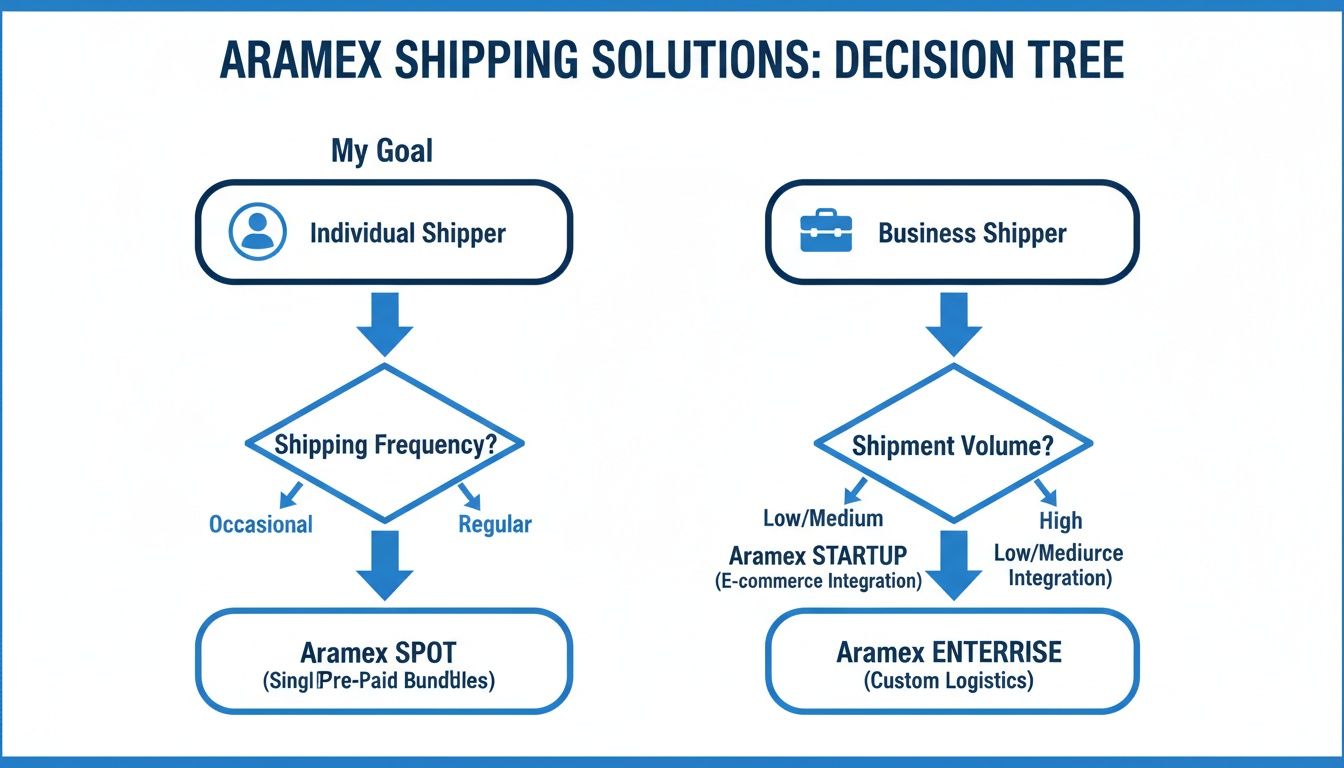
    This quick decision tree lays out the options clearly, helping you see the best path forward whether you're sending a personal package or managing business logistics.

    Aramex shipping solutions decision tree illustrating options for individual and business shippers based on needs.

    As you can see, it all starts with a simple question: are you an individual or a business? From there, your urgency and budget will point you to the most logical service.

    Aramex Express: The Fastest Route

    When time is money, Aramex Express is your go-to. This is the "private jet" option, built for speed and perfect for urgent documents, high-value items, or time-critical parcels. If it absolutely, positively has to get to Singapore tomorrow, this is the service you want.

    We see it used all the time for things like:

    • Urgent Business Documents: Last-minute contracts or legal papers that can’t wait.
    • High-Value E-commerce Orders: When a customer has paid a premium for next-day delivery on luxury goods or electronics.
    • Critical Replacement Parts: A vital machine component needed to keep a factory in Singapore from shutting down.

    Of course, this level of speed comes at a price. Express is the premium option because your shipment gets top priority, often using direct flights and a fast-tracked customs process. You're paying for peace of mind.

    Aramex Air Freight: A Balanced Approach

    Aramex Air Freight is the workhorse of international shipping—the reliable commercial flight. It strikes an excellent balance between speed and cost, making it the most popular choice for a huge range of commercial goods. It's significantly faster than sending by sea but much more affordable than the all-out speed of Express.

    This is the sweet spot for larger commercial shipments that need to arrive in a timely manner but don't quite justify the express price tag. Think of a retailer stocking up on popular products before a big sale, or a food importer moving perishable goods that need to hit the shelves quickly.

    Aramex is a major player here. The company, Aramex PJSC, pulls in about AED 6.35 billion in annual revenue, and its Freight Forwarding division is a core part of that success. Their expertise in air, land, and ocean transport is especially strong on routes into Singapore, a market where B2B last-mile delivery holds a commanding 51% share. You can dig deeper into Aramex's financial performance for more context.

    Key Takeaway: For most businesses, Air Freight is the default choice. It’s dependable and reasonably quick without breaking the bank, making it a cornerstone of efficient B2B logistics.

    Aramex Ocean Freight: The Most Economical Option

    Finally, we have Aramex Ocean Freight. This is your powerful, steady cargo ship. It’s built for large, heavy, or non-urgent shipments where keeping costs down is the number one priority. If you can plan ahead and are moving serious volume, nothing beats the value of ocean freight.

    It’s the only practical option for:

    • Bulk Raw Materials: Moving huge quantities of materials for manufacturing plants in Singapore.
    • Large Stock Orders: Shipping full container loads of inventory to a distribution centre.
    • Heavy Machinery or Equipment: Transporting items that are simply too big or heavy to fly.

    The trade-off is time. A sea journey can take weeks, so it requires smart inventory management and long-term planning. But for businesses that can build that lead time into their supply chain, the cost savings are enormous and can dramatically lower the per-unit shipping cost. It’s the backbone of global trade for a reason.

    Getting Through Singapore Customs Without a Hitch

    Let’s be honest, international shipping can feel like navigating a maze. One wrong turn—usually a missing document—and your shipment is stuck. When you're sending a parcel with Aramex to Singapore, getting your paperwork in order isn't just a good idea; it's the only way to ensure a smooth, headache-free journey through customs.

    Think of Aramex as your expert guide. They’ll act as your customs broker, taking all your documents and presenting them to the officials at Singapore Customs. All you need to do is make sure everything you give them is accurate and complete. That’s the foundation for a quick release.

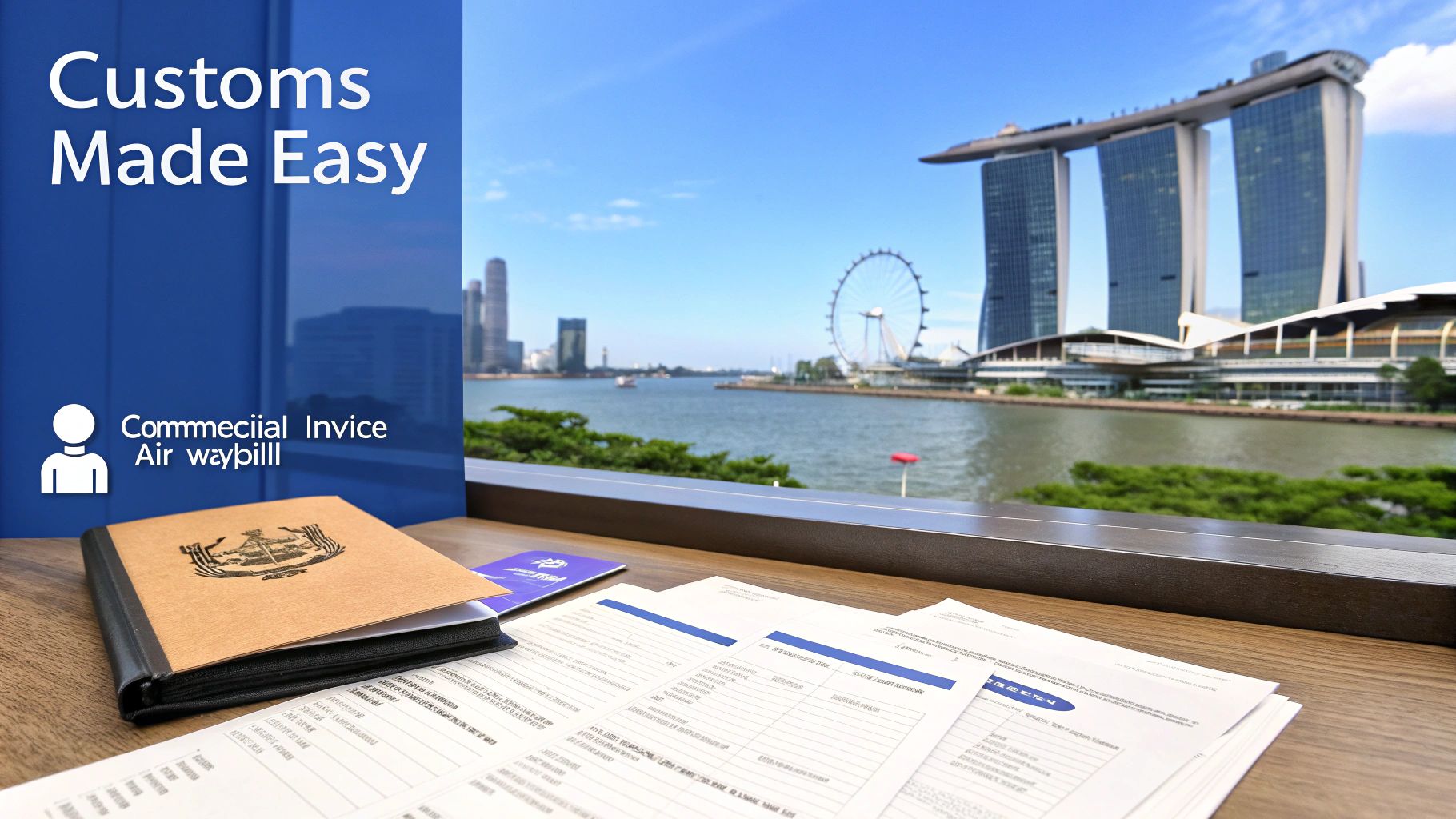
    Documents and a book on a desk overlooking Singapore's Marina Bay Sands skyline, with text about customs.

    The Absolute Must-Have Paperwork

    Before your shipment can even think about leaving the ground, there are a couple of documents you absolutely must have ready. These are the non-negotiables. They act as your shipment's passport, telling customs everything they need to know at a glance.

    To get started, here's a quick look at the documents you'll almost always need for a smooth customs process in Singapore.

    Document Purpose Required For
    Commercial Invoice Details the contents, value, and parties involved. This is what customs uses to assess duties and GST. All commercial shipments.
    Air Waybill (AWB) The contract and "ticket" for your shipment. It contains tracking info and transport details. All air freight and express shipments.
    Packing List Provides a detailed breakdown of the package contents, weights, and dimensions. Recommended for all shipments, especially multi-item consignments.
    Import Permit/Licence Special permission needed to import controlled or restricted goods (e.g., specific electronics, food items). Only for controlled goods.

    Having these documents ready and filled out correctly from the start is the best way to avoid unnecessary hold-ups at the border.

    Understanding Singapore's Import Rules: GST and De Minimis

    Beyond the basics, you've got to know Singapore's specific import rules, especially when it comes to taxes. The big one to remember is the Goods and Services Tax (GST).

    Singapore levies a 9% GST on the value of most goods coming into the country. But here’s the good news: there's a key threshold you should know about called the de minimis value.

    What's the De Minimis Value? Put simply, if the total value of your shipment (that's the item cost plus shipping and insurance) is S$400 or less, it’s typically exempt from GST. This is a huge plus for anyone sending small e-commerce orders or personal gifts, as it means faster clearance and no surprise charges.

    If your shipment's value tips over that S$400 mark, GST will be due before the goods can be released. Don't worry, Aramex usually handles the payment for you and then includes the cost in your final invoice, which keeps things simple.

    The Critical Role of HS Codes

    Every single product, from a pair of sneakers to a circuit board, has a unique classification number called a Harmonised System (HS) code. This universal code tells customs officers exactly what's inside your box.

    Why does this matter so much? Because using the right HS code is essential for calculating the correct taxes and flagging any potential import restrictions.

    Get the code wrong, and you could face:

    • Wrong Tax Bills: You might end up overpaying or, worse, underpaying, which creates a whole new set of problems.
    • Customs Delays: Officials will put your shipment on hold while they figure out what it actually is, adding days to the delivery time.
    • Possible Fines: Make the same mistake too many times, and you could be looking at financial penalties.

    Nailing down the correct HS codes is a step many newcomers miss, but it's a game-changer. For a deeper look, check out our guide on how to find the right Singapore customs HS codes. Taking a few extra minutes to get this right will make your entire Aramex to Singapore experience go that much more smoothly.

    Keeping Tabs on Your Shipment and Handling Hiccups

    Once your package is on its way to Singapore with Aramex, you’ll naturally want to know where it is. Thankfully, keeping an eye on your shipment’s journey is straightforward. Aramex’s tracking system is designed to give you clear, real-time updates, taking the guesswork out of the delivery process.

    It all starts the moment Aramex picks up your parcel. You'll get a unique tracking number—this is your golden ticket to following its progress. Just pop that number into the Aramex website or their mobile app to see exactly where your shipment is at any given moment.

    Making Sense of Tracking Updates

    As your package makes its way across the globe, you'll see its status change. Most of the updates are pretty obvious, but a few can be a bit cryptic. Knowing what they mean helps you manage expectations and keep your customer in the loop.

    Here’s a quick rundown of the most common statuses you'll encounter:

    • Shipment Information Received: This just means the digital paperwork is in. Aramex knows a shipment is coming, but they haven't physically got their hands on your package yet.
    • In Transit: Your parcel is officially on the move. It could be on a flight or in a truck, making its way between Aramex facilities.
    • Arrived at Sort Facility: The package has landed at a major hub, like the one at Changi Airport. Here, it gets sorted and prepped for the next leg of its journey.
    • Customs Clearance in Progress: This is a big one. Singapore Customs is currently reviewing your shipment and its paperwork. If everything is in order, this part is usually a breeze.
    • Out for Delivery: The final countdown! Your package is loaded onto a local delivery van and is en route to its final address in Singapore.

    Expert Tip: The "Customs Clearance in Progress" stage is where things can get held up. The single best way to avoid delays here is to double-check that your commercial invoice is flawless and the HS codes are spot on before you ship.

    What to Do When a Shipment Goes Sideways

    Let's be realistic—sometimes things don't go as planned. A package might get damaged in transit, or in very rare cases, go missing. It's frustrating, but knowing how to handle it can make a world of difference.

    If you find yourself in this situation, the key is to act fast. Aramex has a clear process for filing claims, and having all your ducks in a row will make it much smoother.

    Here’s what you need to do to file a claim:

    1. Contact Aramex Right Away: The moment you notice a problem, get in touch with Aramex customer service. There are usually tight deadlines for filing a claim, so don't wait.
    2. Collect Your Paperwork: You'll need the original Air Waybill (AWB), the commercial invoice (which proves the item's value), and the tracking number.
    3. Take Pictures (For Damage): If the item is damaged, photos are non-negotiable. Take clear pictures of the damaged product and the packaging from every angle. This is your strongest piece of evidence.
    4. Complete the Claim Form: Fill out the official Aramex claim form with as much detail as possible. Be precise about the damage or loss.

    By following these steps, you’re building a solid case. An organised, well-documented claim helps the Aramex team process it quickly, which means a faster resolution for you.

    Tapping Into Singapore's Red-Hot E-commerce Scene

    Singapore is far more than just a global logistics hub—it's an absolute goldmine for e-commerce sellers. To really succeed here, you need to understand what makes this market tick. With its incredibly high digital adoption, strong consumer spending power, and a real hunger for international goods, Singapore is the perfect storm for cross-border trade. For any business shipping with Aramex to Singapore, this isn't just another delivery point; it's a strategic growth opportunity waiting to be seized.

    The demand is explosive because the population is one of the most connected and tech-savvy on the planet. When almost everyone is online and comfortable buying from overseas, the usual barriers for international brands practically disappear. This opens a direct channel to customers actively searching for unique products they can't find on their local high street.

    A smiling delivery person hands a package to a customer confirming delivery on a smartphone in Singapore.

    Why Singaporean Shoppers Look Abroad

    Let's be clear: Singaporean consumers are sharp. They're on the hunt for quality, variety, and good value, and they have no hesitation about shopping globally to get it. This mindset is a huge advantage for international sellers offering products that stand out from the local crowd.

    A few key factors are driving this trend:

    • A World of Choice: Shoppers can get their hands on products, styles, and brands simply not available in local brick-and-mortar shops.
    • The Quality Perception: Many consumers link international brands with higher quality, particularly in popular categories like electronics, fashion, and beauty products.
    • Smart Pricing: Even after factoring in shipping, direct-to-consumer models can often beat the prices found at local retailers.

    In this environment, fast and reliable shipping isn't just a nice-to-have; it's a critical competitive edge.

    How Aramex Delivers for E-commerce

    This is where a solid logistics partner like Aramex becomes absolutely indispensable. The modern Singaporean online shopper has high expectations—they want their orders fast, they want to track them every step of the way, and they expect zero drama. A single bad delivery experience can completely undo all the hard work you put into a great product.

    Aramex's service offerings are well-tuned to meet these very demands. Their Express option is perfect for businesses that want to offer premium, next-day delivery—a surefire way to build serious customer loyalty. For more routine shipments, their standard services provide a dependable solution that won't break the bank.

    Beyond speed, Aramex’s detailed tracking and efficient last-mile delivery network keep customers in the loop and ensure their packages arrive without a hitch. That seamless final step is vital for building the trust that leads to repeat business. It's no wonder that many of the top import and export companies in Singapore make strong logistics partnerships a top priority.

    Singapore is a major strategic hotspot for Aramex. It ranks as its 6th largest export destination from London Heathrow alone, a clear sign of the immense volume flowing through this cross-border freight lane.

    This focus is right on the money. With 87% of Singapore's population being active digital users and over half of them buying goods from abroad, the consumer shift online is massive and undeniable. Anchored by Singapore, the broader Southeast Asia e-commerce market is now worth over USD 4.9 billion, pulling in merchants from high-demand sectors like apparel, electronics, and beauty. You can dig deeper into this trend on Aramex's official blog. This powerful combination of consumer demand and established logistics channels makes the Aramex to Singapore route a vital artery for modern e-commerce.

    How Freight Teams Can Find and Win Aramex Shippers

    Okay, so we've covered the ins and outs of shipping with Aramex to Singapore. But for freight forwarders and logistics sales teams, the real question is: how do you tap into this busy trade lane and find new clients?

    The old way of cold calling is a grind. A better approach is to use trade data to find companies already using the Aramex to Singapore route. It's about working smarter, not harder.

    This is where a tool like Coreties really shines. It helps you shift from throwing darts in the dark to a focused, data-backed sales strategy. You can pinpoint high-value shippers and craft an outreach that actually resonates because it's based on what they're already doing.

    Zeroing In on the Right Leads

    Hunting for new business can feel like searching for a needle in a haystack. Coreties completely changes the game by giving you the tools to filter global customs data. You can instantly pull up a list of companies that are actively shipping goods into Singapore, giving you a warm, pre-qualified list to work from.

    Think about how much time you'd save by narrowing your search to prospects that are a perfect fit. This lets you focus your energy where it's most likely to pay off.

    Here’s how you can slice and dice the data to find your ideal clients:

    • By Carrier: Filter for companies that have recently used Aramex for their shipments to Singapore. Simple.
    • By Geography: Target shippers in a specific city, state, or country that matches your company's key service areas.
    • By Commodity: Focus on businesses shipping specific types of goods, letting you lead with your team's unique expertise.

    The screenshot below from the Coreties platform shows just how easy it is to apply these filters and get a targeted list of potential customers.

    This visual approach makes it a breeze to layer different filters, quickly building a list of qualified companies that fit your ideal customer profile.

    Turning Data Into Meaningful Conversations

    Finding a company name is just the start. The real challenge is getting in touch with the right person and having a conversation that adds real value. Coreties helps here too, giving you much more than just a list of names.

    The platform links directly with professional networks like LinkedIn, so you can easily find the contact details for logistics managers, supply chain directors, or heads of procurement. This ensures your pitch actually lands in the right inbox. Plus, knowing exactly what a company ships is a huge advantage. You can learn more about how to do this by reading our guide on using the HS code filter for super-targeted prospecting.

    The Coreties Advantage: When you combine customs data with verified contact info, your outreach becomes incredibly personal. Instead of a generic "Can we ship for you?" email, you can open with something like, "I saw you recently shipped product X to Singapore with Aramex, and I think we can offer you a more competitive solution."

    This data-first approach immediately positions you as a knowledgeable partner, not just another salesperson. It builds trust from the first touchpoint and dramatically increases your odds of starting a real conversation.

    This kind of precise targeting is especially powerful in a market like Singapore, a true logistics powerhouse in Southeast Asia. The local last-mile delivery market is expected to hit a staggering USD 23.07 billion by 2030, growing at a rapid 12.19% clip.

    This boom highlights Singapore's vital role as a logistics hub, where platforms like Coreties help forwarders connect with high-volume importers on key routes. For freight teams, this isn't just a number—it's a clear signal of massive opportunity waiting to be seized.

    Your Top Questions Answered

    Shipping internationally always comes with a few questions. To make things easier, we've put together some quick, straightforward answers to the most common queries we see about sending parcels to Singapore with Aramex.

    Think of this as your go-to cheat sheet for everything from delivery times and costs to customs and tracking.

    How Long Does Aramex Shipping to Singapore Take?

    This is probably the first question on everyone's mind. The short answer is: it really depends on which Aramex service you pick.

    • Aramex Express: If you need it there yesterday, this is your best bet. It's built for speed, with parcels typically arriving in just 1-3 business days.
    • Aramex Air Freight: This option strikes a great balance between speed and cost. You’re usually looking at a delivery window of about 3-7 business days.
    • Aramex Ocean Freight: For bigger, less urgent shipments, ocean freight is the most cost-effective route. Patience is key here, as it can take anywhere from 20-30 days, sometimes more, depending on where it’s coming from.

    Keep in mind, these are solid estimates, but things like customs processing or the specific country of origin can always add a day or two.

    How Are Aramex Shipping Costs Calculated?

    Aramex calculates your shipping cost based on what they call "chargeable weight." This isn't just about how heavy your box is; it's also about how much space it takes up.

    They look at two things: the actual, physical weight and the volumetric weight. Whichever is higher becomes the chargeable weight.

    So, What's Volumetric Weight?
    It’s a way of measuring a parcel’s density. Light, bulky items take up more space on a plane than small, heavy ones. The formula is usually (Length x Width x Height in cm) / 5000. It ensures the price fairly reflects the space your package occupies.

    Besides chargeable weight, the final price tag is also influenced by:

    • The service you choose (Express will always cost more than standard freight).
    • The distance it’s travelling (origin and destination).
    • Any extras you add on, like insurance or special handling for fragile goods.

    What Items Are Restricted for Import into Singapore?

    Every country has its own set of rules, and Singapore is no different. They have a list of items that are either completely prohibited or restricted, meaning they need a special permit to enter.

    While Aramex has its own list of things they won't carry, you also need to be mindful of Singapore's specific regulations.

    Some common restricted items include:

    • Chewing gum (the only exception is for oral dental or medicated types).
    • Certain types of telecommunication equipment.
    • Specific publications, videos, and software.
    • Controlled drugs and psychotropic substances.

    The golden rule is to always double-check the official Singapore Customs website before you even pack your box. It can save you a world of trouble down the line.

    How Are Duties and Taxes Handled for My Shipment?

    In Singapore, if the value of your shipment is over the S$400 threshold (known as the de minimis value), it will be subject to a Goods and Services Tax (GST) of 9%.

    The good news is that Aramex usually handles this for you. They’ll calculate the GST based on the value you declared on the commercial invoice and pay it upfront to Singapore Customs. This is a huge help because it prevents your parcel from getting stuck in customs limbo. They simply bill the tax amount back to you later.


    Ready to turn global trade data into your next big client? With Coreties, you can instantly find companies shipping on the Aramex to Singapore lane, access key decision-maker contacts, and craft data-driven outreach that gets results. Stop cold calling and start having smarter conversations. Discover your next customer at https://coreties.com.

  • Explore hs code singapore: A Guide to Classification, Duties & Compliance

    Explore hs code singapore: A Guide to Classification, Duties & Compliance

    When you're moving goods in or out of Singapore, think of the Harmonized System (HS) code as your product's universal passport. This string of numbers is the first thing Singapore Customs looks at to understand exactly what you're shipping – from its material to its purpose.

    Getting the HS code Singapore right isn't just a box-ticking exercise; it's fundamental to keeping your logistics smooth, compliant, and cost-effective.

    Why HS Codes Are Your Most Important Tool in Singapore Trade

    An HS code is like a product's unique fingerprint. It’s a shorthand that gives Singapore Customs all the crucial details they need to process a shipment. This single code determines everything: import duties, taxes, and even whether your goods need special permits or a physical inspection.

    Nailing the classification is about more than just filling out forms correctly. It's about speed, cost, and your reputation.

    In a hyper-efficient hub like the Port of Singapore, even small delays can cause big problems. A wrong HS code is an instant red flag for customs officials. It can trigger detailed inspections, holds on your shipment, and expensive demurrage fees while everything gets sorted out. For any freight forwarder, that means unhappy clients and a damaged professional relationship.

    The Bedrock of Compliance and Efficiency

    Correct classification is the absolute foundation of trade compliance. Singapore uses an eight-digit system called the ASEAN Harmonised Tariff Nomenclature (AHTN). It starts with the international six-digit HS standard set by the World Customs Organisation and adds two more digits for specifics relevant to trade within Southeast Asia.

    Getting to grips with this system helps you:

    • Avoid Expensive Delays: The right code means your shipment breezes through customs checkpoints without unnecessary friction.
    • Stay Compliant: Using the correct AHTN code shows you've done your homework and helps you steer clear of some pretty hefty penalties.
    • Calculate Costs Accurately: Your HS code is directly tied to the Goods and Services Tax (GST) and any duties owed, which is key for working out a precise landed cost for your client.

    In the end, mastering the HS code Singapore framework isn't just a compliance chore—it's a real competitive edge. It allows you to give clients reliable timelines, transparent pricing, and peace of mind. You’re turning a complex customs requirement into a way to build trust and grow your business.

    Decoding the 8-Digit Singapore HS Code

    At first glance, an 8-digit Singapore HS code can look like just another string of numbers on a customs form. But it’s far from random. Think of it as a product’s universal passport, telling customs officers exactly what it is, what it’s made of, and its function in a language they all understand.

    Every digit in this code adds a layer of detail, starting broad and getting progressively more specific. Getting this structure right is the foundation of smooth customs clearance.

    The Global Standard: The First Six Digits

    The first six digits of any HS code are the global standard, set by the World Customs Organisation (WCO). This means that whether you're shipping a smartphone to Singapore, Germany, or Brazil, the initial classification is the same everywhere. It creates a common language for global trade.

    These six digits are broken down into three pairs, each one narrowing down the product's identity:

    • Chapter (Digits 1-2): This is the highest-level category. It groups products into broad sectors, like "Machinery and mechanical appliances" (Chapter 84).
    • Heading (Digits 3-4): This gets more specific. Within Chapter 84, we might find "Telephone sets, including smartphones" (Heading 8517).
    • Subheading (Digits 5-6): This adds another layer of detail, distinguishing between different types of products within the heading. For a smartphone, this might be Subheading 8517.13, specifying "Smartphones".

    This hierarchical system flows from the global HS code framework down to the regional AHTN standard, and finally into Singapore's own trade regulations.

    A hierarchical diagram illustrating trade tools, starting from HS Code, then AHTN, and concluding with Singapore Trade.

    As the diagram shows, the system is designed like a funnel. It starts with a universal standard and refines it for regional and national needs, making trade across ASEAN much more consistent.

    The Regional Touch: The Final Two Digits

    So what about the last two digits? This is where Singaporean (and ASEAN) specificity comes in. These final digits are determined by the ASEAN Harmonised Tariff Nomenclature (AHTN), a system used across the 10 ASEAN member states.

    This AHTN code provides the final, crucial details that Singapore Customs needs to apply the correct duties, Goods and Services Tax (GST), and determine if the product qualifies for preferential treatment under any free trade agreements.

    Let’s put it all together. The table below breaks down the anatomy of a full 8-digit Singapore HS code for a smartphone.

    Anatomy of an 8-Digit Singapore HS Code

    Code Digits Level of Classification Example (e.g., for a Smartphone)
    85 Chapter Machinery and electrical equipment.
    8517 Heading Telephone sets, including smartphones.
    8517.13 Subheading Smartphones.
    8517.13.00 AHTN Suffix The specific code for smartphones under the ASEAN standard.

    This breakdown shows how the code builds a detailed product identity, from a broad industrial category right down to the specific item being shipped. It’s this level of precision that keeps the wheels of international trade turning smoothly.

    Singapore's move to the 8-digit AHTN framework has been a game-changer for its logistics sector. Managed by Singapore Customs, this system allows for the precise classification of over 10,000 product categories. For freight forwarders navigating the nation's $1 trillion+ annual merchandise trade, mastering these codes isn't just about compliance—it's about efficiency and competitiveness.

    How to Reliably Find the Correct HS Code

    Finding the right HS code in Singapore isn't a guessing game. It’s a methodical process that demands precision and the right tools. Your go-to, non-negotiable resource should always be the Singapore Customs' HS/CA Product Code Search engine, which you can find on the GoBusiness portal. This is the definitive source for all classifications.

    It's tempting to take a shortcut, maybe by using a code your supplier gave you or one you found on an unofficial website. But that’s a risky move. These sources can easily be outdated or just plain wrong, setting you up for a compliance headache down the road. The GoBusiness portal, on the other hand, is directly updated by Singapore Customs, so you know the information is current and legally sound.

    Using the Official GoBusiness Portal

    When you're using the search tool, accuracy is everything. Throwing in a vague term like "computer" will spit back hundreds of potential codes, leaving you to sort through the mess. You need to be specific. Think about what makes your product unique—its primary function, what it’s made of, and any distinct features.

    So, instead of just searching for "laptop," try something like "portable laptop computer with 14-inch screen." The more detail you provide, the closer you'll get to the correct code on the first try.

    A person types on a laptop screen displaying 'FIND HS CODE' for product classification.

    The search results will give you the 8-digit AHTN code you need, along with a detailed product description. It will also flag any controlled goods status (CA), which is crucial—it tells you if the item needs a special permit from a Competent Authority before it can be imported or exported.

    Advanced Classification Strategies

    What about those tricky products? The innovative gadgets or multi-component items where a simple keyword search just doesn't cut it. For these, you need to dig a little deeper.

    Here's how seasoned pros tackle it:

    • Consult the Explanatory Notes: Singapore Customs publishes extensive explanatory notes that act as the official guide to interpreting the HS code system. These documents are invaluable for understanding the scope and boundaries of each classification.
    • Check the Customs Ruling Database: If you’re dealing with a product that's new to the market, chances are someone has been in your shoes before. Search Singapore Customs' database of past classification rulings to see if a precedent has already been set for similar goods.
    • Apply for a Formal Ruling: When you need absolute certainty, this is the way to go. You can formally apply to Singapore Customs for an official classification ruling on your product. The decision they provide is legally binding, giving you complete peace of mind and protection from future disputes.

    Think of classification like building a legal case. You start with a detailed description of your product (your evidence), use the search tool to identify potential matches, and then back up your choice with the explanatory notes or past rulings. This turns a confusing task into a reliable, repeatable workflow.

    For a comprehensive look at the classification process, the official HS Code book and its guiding principles are an excellent resource. Getting comfortable with these official tools is the best way to guarantee every shipment is declared correctly, helping you avoid costly delays and build a solid reputation with clients and customs officials alike.

    Avoiding Common HS Code Mistakes and Costly Penalties

    It’s easy to think of an HS code as just another number on a form, but a simple mistake here can spiral into a massive headache, both financially and operationally. Misclassifying a product isn't just a clerical error; it’s a fast track to your shipment getting stuck at the port, attracting customs audits, and landing you with some pretty hefty fines.

    So, let's move past the theory and look at what actually goes wrong. The most common mistakes are often the simplest. Maybe you relied on an old code from a supplier, or the product description was too vague, or you just weren't sure how to classify an item that does multiple things. These small slip-ups can snowball, eating into your profits and damaging your reputation with clients.

    Close-up of a magnifying glass, clipboard, pen, and 'Avoid Penalties' document for thorough review.

    The High Cost of an Error

    Let’s be clear: the penalties for getting an HS code Singapore declaration wrong are no joke. Singapore Customs can hit you with a fine of up to S$10,000 for each incorrect entry. Think about a shipment with ten different products, all misclassified. That financial risk adds up incredibly fast, turning what should have been a profitable deal into a serious loss.

    And the direct fines are just the beginning. An incorrect HS code often brings a whole host of other problems:

    • Costly Delays: Your goods can be held for inspection, racking up demurrage and detention charges that nobody wants to pay.
    • Increased Scrutiny: One mistake can put your business on customs' radar. That means more of your future shipments are likely to be pulled aside for a closer look.
    • Incorrect GST Payments: Getting the code wrong might mean you've underpaid the Goods and Services Tax (GST). You'll be on the hook for back-payments plus interest, which can really mess with your landed cost calculations.

    The world of HS codes is always changing, which makes staying compliant a continuous effort. Just look at the Singapore Customs' HS/CA Search Engine on GoBusiness – it now features over 12,000 codes. What's more, about 15% of those are flagged for specific controls, like strategic goods under HS 98. This just goes to show how critical it is to get your classification right every single time.

    Anonymised Case Study: Advanced Batteries

    Let me give you a real-world example. A freight forwarder was handling a shipment of advanced lithium-ion batteries. The shipper's paperwork was a bit lazy, just describing them as "power units." The forwarder went with a general code for electrical machinery, which seemed reasonable enough.

    The problem? These specific batteries fell under a much more precise HS code, one that classifies them as regulated dangerous goods.

    The misclassification triggered an immediate customs hold. The shipment sat at the port for two weeks, the importer was slapped with an S$8,000 penalty for the wrong declaration, and the forwarder's relationship with a very important client was left in tatters.

    This story is a perfect illustration of how one small oversight can explode into a full-blown compliance disaster. It also highlights why having clear legal responsibility, which often falls on the Importer of Record, is so critical. It’s a painful but powerful lesson in doing your homework on every single shipment.

    Using HS Code Data to Drive Logistics Sales

    For most logistics professionals, dealing with HS codes is just part of the job—a compliance hurdle you need to clear to get goods through customs. But what if that data could do more? For a sharp sales team, it's a treasure map.

    Instead of casting a wide, hopeful net, you can use customs data to see exactly who is moving the kind of freight you specialise in. It transforms a tedious regulatory detail into a powerful tool for finding your next big client. By digging into this data, you can uncover which companies are importing or exporting specific goods in high volumes, revealing their main trade lanes and what they really do.

    Pinpointing High-Value Opportunities

    Let’s get practical. Imagine your company excels at temperature-controlled air freight for life sciences. Instead of guessing, you can zero in on companies declaring shipments under HS Chapter 30 (Pharmaceutical Products). Suddenly, you know not just who is in your target market, but also the potential scale of their business.

    This simple shift means you stop wasting time and focus your energy where it counts. The same logic works across any sector. A freight forwarder focusing on electronics can build a target list of businesses shipping under HS Chapter 85 (Electrical machinery and equipment), a massive market in Singapore.

    It’s about replacing guesswork with real intelligence. You're building a pipeline of pre-qualified leads who have already shown they need exactly what you offer.

    Crafting Data-Driven Outreach

    Once you’ve identified a company that looks like a perfect fit, you need to find the right person to talk to. This is where a good sales intelligence platform comes in handy. You can take the company's name and quickly find the Logistics Manager or Supply Chain Director, complete with their verified contact details.

    Now for the best part: your outreach can be incredibly specific. Forget generic emails. Try something like this:

    • For a Tech Importer: "I noticed your company regularly imports integrated circuits under HS Code 8542.31. We specialise in secure air freight for high-value electronics on the Taipei-Singapore lane and know how to get those components here safely and on schedule."
    • For a Medical Exporter: "Our data shows you're a key exporter of diagnostic reagents under HS Code 3822.19. We have deep expertise in cold-chain logistics to Europe, ensuring your products maintain full integrity right up to the distributor's door."

    Think about the sheer scale. Singapore imported $515 billion in goods. Within that, HS 71 (pearls, precious stones) shot up 45% to $18.5 billion. On the other side, exports under HS 84 (machinery) hit $168 billion, making up 38% of the total—a huge signal for any airfreight forwarder chasing the tech sector. You can explore more of these trade statistics on ASEAN's official data portal.

    This level of detail immediately sets you apart. It shows you’ve done your homework and understand their world, positioning you as a problem-solver, not just another salesperson with a pitch.

    Platforms with an HS Code filter are built for this kind of targeted prospecting. By understanding a potential client’s actual shipping patterns, you can start conversations that matter, leading to far better response rates and, ultimately, more business.

    Nailing HS Codes in Your Daily Workflow

    Knowing the theory behind HS codes is one thing, but making it part of your team's muscle memory is what really sets you apart. For freight forwarders and carriers in Singapore, getting the HS code Singapore right every time isn't just about dodging fines; it’s about building a rock-solid reputation for getting things done without a hitch.

    A simple yet powerful habit is to build your own internal database of HS codes for the products you handle most often. Think of it as your team's cheat sheet. This little library of verified codes cuts down the research time for repeat shipments, ensures everyone on your team is on the same page, and slashes the risk of simple human error.

    Dealing with Vague Descriptions and Missing Details

    Let's be honest, not every client sends over perfectly detailed shipping documents. You'll often get product descriptions that are vague, incomplete, or just plain confusing. When that happens, guessing is the worst thing you can do.

    Your team needs a clear game plan:

    • Create a Standard Operating Procedure (SOP): Make it a hard-and-fast rule: if the description is unclear, you stop. The next step is always to go back to the shipper and ask for more detail. No exceptions.
    • Know When to Escalate: Sometimes a product is so new or complex that even with more information, it's a tough call. Your SOP should define this trigger point, where the best advice for your client is to get an official, legally-binding classification ruling directly from Singapore Customs.

    For carriers, the HS code is more than just a piece of customs data; it’s a vital part of risk management.

    Imagine you're transporting a shipment of chemicals. The HS code tells you instantly if you're dealing with hazardous materials and what special handling is required. This isn't just about compliance—it's about safety, smart resource planning, and ensuring a smooth journey from A to B.

    Putting these habits into practice turns HS code classification from a tedious, reactive task into a proactive part of your operation. By having clear rules for tricky situations like vague descriptions, you create a more resilient and efficient workflow. At the end of the day, it's this commitment to getting the details right that clients notice and trust.

    Your Top HS Code Questions Answered

    Even after you get the hang of HS codes, practical questions always come up in the day-to-day grind. Let's tackle some of the most common ones that logistics pros in Singapore run into. Think of this as your quick-reference guide.

    What’s the Difference Between a 6-Digit and an 8-Digit HS Code?

    It all comes down to global standards versus regional specifics. The first 6 digits of any HS code are universal. They’re set by the World Customs Organisation (WCO) and mean the same thing whether you’re shipping to New York or Nairobi. It's a global language for product categories.

    But Singapore, being part of ASEAN, takes it a step further. We use the ASEAN Harmonised Tariff Nomenclature (AHTN), which adds two more digits to create a more specific 8-digit code. Those last two digits are crucial for our region, helping to pinpoint products for trade policies and tariff calculations right here in Southeast Asia.

    Where’s the Official Place to Look Up Singapore HS Codes?

    There's only one place you should ever go for this: the Singapore Customs' HS/CA Product Code Search engine. You can find this free tool on the GoBusiness portal, and it's always the most up-to-date and legally recognised source.

    Let me be crystal clear here: You must use the official GoBusiness portal. Relying on codes from a supplier or a third-party website is a huge gamble. Those sources are often outdated, and a wrong code can land you in serious trouble. Stick to the single source of truth.

    What Happens If I Mess Up and Use the Wrong HS Code?

    Using the wrong HS code isn't a minor slip-up; it's a costly mistake that can send ripples through your entire supply chain.

    The consequences are real and can hit you hard:

    • Gridlock at the Port: The first thing you'll notice is your shipment getting stuck. Customs clearance delays can throw your entire delivery schedule into chaos.
    • Unexpected Bills: You could be looking at audits, which often lead to back-paying Goods and Services Tax (GST) and other duties. Suddenly, your carefully calculated landed costs are out the window.
    • Serious Fines: Don't forget the legal bite. Singapore Customs can slap you with penalties of up to S$10,000 for every single incorrect declaration. This makes getting the code right less of a 'best practice' and more of a critical risk management task.

    Ready to stop prospecting blindly and start engaging high-value shippers? Coreties transforms customs data into your next big client. Find qualified leads and craft data-driven outreach in just a few clicks at https://coreties.com.

  • Indonesia hs code: A Simple Guide to Seamless Customs (indonesia hs code)

    Indonesia hs code: A Simple Guide to Seamless Customs (indonesia hs code)

    Welcome to your practical guide for mastering Indonesia's Harmonized System (HS) codes. In global trade, getting a single digit wrong can trigger costly delays, fines, or even the seizure of a shipment. This guide is built for freight forwarders and logistics professionals who need to navigate Indonesian customs with confidence and precision.

    Why Mastering the Indonesian HS Code System Matters

    In the world of international shipping, the Indonesian HS code is far more than just a number you plug into a customs form—it's the universal language of trade. Getting this code right is the absolute foundation of a smooth, predictable, and profitable supply chain.

    A correct code ensures you pay the right duties and taxes. Simple as that. An incorrect one? That can lead to a cascade of problems, from steep penalties to damaged client relationships.

    For freight forwarders and their teams, mastering this system isn't just about ticking a compliance box. It's a real strategic advantage. It means you can provide accurate landed-cost estimates, advise clients on regulatory hurdles before they become problems, and build a reputation for flawless execution in one of Southeast Asia's most dynamic—and complex—markets.

    A person reviewing HS codes on a laptop and documents at a port with shipping containers.

    The BTKI and Its Global Connection

    At the heart of Indonesia's system is the Buku Tarif Kepabeanan Indonesia (BTKI), which is the country's official customs tariff book. This isn't some isolated, homegrown system. It builds directly upon globally recognised standards, which is good news for anyone familiar with international trade.

    Here’s a quick breakdown of how an Indonesian HS code is structured:

    • Global Standard (First 6 Digits): The first six digits are set by the World Customs Organisation's (WCO) Harmonized System. This is the international gold standard used by over 200 countries, ensuring a baseline consistency for classifying goods no matter where they're from.

    • ASEAN Standard (Digits 7-8): The next two digits come from the ASEAN Harmonised Tariff Nomenclature (AHTN). This layer harmonises classification among the ten ASEAN member states, which is crucial for simplifying regional trade.

    • National Specifics (Digits 9-10): Finally, Indonesia can add two more digits for its own needs, like granular statistical tracking or specific regulatory controls on certain goods.

    Understanding this layered structure is key. It shows that while the final 10-digit code is specific to Indonesia, its foundation is rooted in international agreements. This makes the classification process logical and, most importantly, traceable.

    The economic implications of getting this right are immense. For instance, Singaporean freight forwarders often use their deep expertise with the AHTN to manage trade intelligence for Indonesia-bound shipments. A huge portion of this trade flows through key entry points like the Port of Tanjung Priok in Jakarta, which single-handedly processes a massive 39% of all Indonesian imports.

    The BTKI provides a clear map of the country's economic demands, categorising everything from Chapter 88 aircraft parts to Chapter 72 iron and steel. The data reveals a healthy trade surplus, underscoring the opportunities for those who can navigate its customs framework effectively. If you're interested in a deeper dive, you can explore more insights on Indonesia's import-export data.

    Indonesia's Top Imported Product Chapters by HS Code

    To give you a clearer picture of what's moving into the country, here’s a look at the top imported product categories based on their HS code chapters. This data offers a snapshot of Indonesia's key industrial and consumer demands.

    HS Chapter Product Category Share of Total Imports
    Chapter 27 Mineral Fuels, Oils, Distillation Products 18.2%
    Chapter 85 Electrical Machinery and Equipment 11.9%
    Chapter 84 Machinery, Mechanical Appliances, Reactors 11.5%
    Chapter 72 Iron and Steel 4.6%
    Chapter 39 Plastics and Articles Thereof 4.4%

    This table highlights the dominance of industrial inputs—machinery, fuel, and raw materials—which are essential for powering Indonesia's manufacturing and infrastructure sectors. For logistics professionals, understanding these major trade flows is vital for identifying potential clients and market opportunities.

    How to Find and Verify Any Indonesia HS Code

    Finding the right HS code for your shipment to Indonesia isn’t a guessing game. It's a methodical process where precision is everything. Get it wrong, even by a single digit, and you're looking at frustrating customs delays, unexpected fines, and a damaged relationship with your client. The goal here is to move from a simple product description to a specific, legally sound 8- or 10-digit code.

    This all starts with knowing your product inside and out. Forget the marketing jargon. What is its primary function? What materials is it made from? Is it a raw material, a component, or a finished good? These fundamental details are your map for navigating Indonesia's official tariff system.

    Your Primary Tool: The INSW Portal

    Your first and most reliable stop should always be the official Indonesia National Single Window (INSW) portal. This government website is the single source of truth for HS codes and all related import regulations. Think of it as the central nervous system for Indonesian customs.

    Here’s what you’ll see when you land on the portal. It’s the gateway to classifying your products correctly.

    The search bar on the homepage is where the work begins.

    To use the portal effectively, you need to think like a customs officer. Don't search for a long, complicated product name like "lithium-ion battery pack for a handheld drill." Instead, start with a broad, simple term. In this case, just "battery" will do.

    The portal will then show you a list of chapters and headings related to batteries. Now, the real work starts. You'll need to apply the General Interpretative Rules (GIR)—the official guidelines for classification—to narrow down the options based on your product’s specific traits.

    Navigating the BTKI for Precise Classification

    Working alongside the INSW portal is the Buku Tarif Kepabeanan Indonesia (BTKI). If the INSW portal is your interactive search engine, the BTKI is the master encyclopaedia. It’s the complete, detailed directory of HS codes, their corresponding duties, and any special import rules or restrictions.

    Here’s a practical workflow I use that combines both resources:

    1. Start Broad on INSW: Kick off your search with a general term. Think "leather shoes," "plastic toy," or "coffee beans."
    2. Identify the Chapter: The results will guide you to the right 2-digit chapter. For example, coffee beans belong in Chapter 09 ("Coffee, Tea, Maté and Spices").
    3. Drill Down to the Heading: From there, find the 4-digit heading that best describes your product. Heading 09.01 covers coffee, whether it's roasted or not.
    4. Refine to the Subheading: Next, you’ll narrow it down to the 6-digit subheading. Subheading 0901.21 specifically covers "Coffee, roasted, not decaffeinated." This 6-digit code is the international standard.
    5. Pinpoint the AHTN Code: Finally, you arrive at the 8-digit ASEAN Harmonised Tariff Nomenclature (AHTN) code. This is absolutely crucial for regional trade, especially for goods moving between ASEAN countries like Singapore and Indonesia.

    That 8-digit AHTN code is the common language that ensures customs on both sides are aligned. To learn how you can leverage these codes for more than just customs clearance, check out our guide on using an HS Code filter to find new business opportunities.

    Cross-Verification and Final Checks

    You should never, ever rely on a single search result. Once you think you’ve found the right HS code, the final and most critical step is verification. One of the best ways to do this is to check historical shipping data. See what codes other companies have successfully used for similar products imported into Indonesia.

    Pro Tip: Always document your classification process. Keep a record of which GIR rules you applied and a short note explaining why you chose one subheading over another. If Indonesian customs ever questions your classification, this documentation will be your best defence.

    The scale of trade into Indonesia is immense. The country imported $221,886 million USD worth of goods from 215 partners, covering 4,023 distinct product categories. With so much at stake, there's no room for error. Major ports like Tanjung Priok, which handles 39% of all imports, see a massive flow of goods under HS 84 (machinery), HS 27 (oils), and HS 39 (plastics)—all categories that demand precise classification. You can dig deeper into this trade data in this comprehensive overview.

    Common HS Code Mistakes and How to Avoid Them

    Getting HS codes wrong for Indonesian shipments can cause serious headaches. I've seen simple mistakes lead to costly delays, surprise duties, and seriously unhappy clients. It's not just about finding a code; it's about finding the right one and being able to defend your choice.

    Let's walk through the most common pitfalls I see time and time again, and more importantly, how you can sidestep them.

    One of the easiest traps to fall into is using an outdated code. The Indonesian Harmonized System Tariff Book, or BTKI, isn't a "set it and forget it" document. It gets updated to reflect new trade policies and global standards. Pulling a code from last year's schedule is a surefire way to get your shipment flagged by Indonesian customs (Bea Cukai).

    Another frequent slip-up happens with multi-function products. Take a high-tech printer that also scans, copies, and faxes. Is it a printer (HS 8443.31) or a photocopier (HS 8443.39)? The General Interpretative Rules (GIR) say you must classify it by its principal function. This can be a judgement call, so if you can't back up your reasoning with solid documentation, you're inviting a dispute.

    Overlooking Product Composition and Form

    The physical state and makeup of your product are details you absolutely cannot ignore. This is where a small oversight can completely blow up your profit margin.

    Think about the difference between raw materials and finished goods. Plastic pellets intended for manufacturing fall under Chapter 39. But a finished plastic chair made from those very pellets? That’s in Chapter 94. The duty rates between the two can be worlds apart. A mistake here isn't just about a penalty; it completely changes your landed cost calculations.

    To keep things straight, many experienced forwarders think of the process in three distinct stages: identify, search, and verify.

    A clear process flow diagram detailing the three steps for finding HS codes: identify, search, and verify.

    This simple flow is a great reminder that classification is a careful procedure, not a quick keyword search. That final verification step is your last line of defence against expensive errors.

    Electronics are a notoriously tricky area. For instance, misclassifying individual printed circuit boards versus a fully assembled device can result in huge duty differences. If you're dealing with components like these, our guide on the printed circuit board HS code breaks down the specific logic and examples you'll need.

    The Challenge of Kits and Goods in Sets

    Goods sold together as a kit are another classic classification headache. When you have multiple items packaged for retail sale, each with its own potential HS code, which one do you choose?

    The official guidance comes from GIR, specifically Rule 3(b). It says you should classify the set based on the component that gives it its essential character.

    Here’s how that plays out in the real world:

    • A pasta-making kit: It might have flour (Chapter 11), a wooden rolling pin (Chapter 44), and a jar of tomato sauce (Chapter 21). Since the whole point is making pasta, you’d classify it under the heading for pasta itself, which is 19.02.
    • A bicycle repair kit: This could contain a wrench (HS 8204), patches (HS 4016), and rubber cement (HS 3506). The essential function is bike repair, so it's typically classified under parts and accessories for bicycles, 87.14.

    Key Takeaway: Always ask yourself, "What is the main purpose of this set?" The answer is your guide to the right HS code. And be sure to document your reasoning—you'll be glad you did if customs ever asks for justification.

    By getting ahead of these common mistakes, you can build a much smoother customs process. This proactive thinking doesn't just save you from penalties; it solidifies your reputation as a sharp, reliable partner for anyone doing business in Indonesia.

    Using HS Code Data to Win High-Value Shipper Leads

    For years, many in the logistics world have viewed the Indonesia HS code as just another box to tick—a tedious bit of compliance paperwork. But looking at it that way misses the forest for the trees. Customs data, which is built entirely around these codes, is a goldmine of market intelligence. It's a live-action map showing you exactly what’s being shipped, where it’s going, and who’s moving it.

    If you can shift your mindset from pure compliance to strategic intelligence, you can completely overhaul your business development. Forget about cold calls and generic email blasts. Instead, you can dive into real-world shipping data to pinpoint high-value prospects who are actively moving the exact kind of freight you specialise in. This isn't just a theory; it's a practical, data-driven sales strategy that cuts straight through the noise.

    Transforming Data into Actionable Insights

    It all starts with getting your hands on Indonesian import data, which is all neatly organised by HS code. Let's say your expertise is in handling heavy machinery. Instead of just guessing which companies in Jakarta might need your services, you can run a targeted search for imports under HS Chapter 84 (Machinery and Mechanical Appliances).

    That simple filter instantly produces a list of every company that has recently imported those goods. Suddenly, you can see their shipment frequency, the volumes they're dealing with, and even the specific ports they favour. For a sales team, this is pure gold.

    This is how you can break down the data to spot prime opportunities:

    • High-Volume Shippers: Look for companies that consistently import large quantities of goods under specific HS codes. These are your ideal long-term clients.
    • Growing Industries: See a sudden surge in imports under a particular HS chapter? That’s a clear signal of a booming sector in Indonesia, telling you exactly where to focus your sales efforts.
    • Specific Trade Lanes: Filter by the country of origin to uncover active shipping routes. If your network is particularly strong in a certain region, you can zero in on Indonesian companies importing from there.

    In a major trade hub like Singapore, freight forwarders who lean on HS code data have seen incredible efficiency gains when targeting Indonesian import lanes, especially under the ASEAN Harmonized Tariff Nomenclature (AHTN). For logistics pros, filtering customs data by AHTN codes reveals high-volume Indonesian imports that route through Singapore, often destined for key hubs like Tanjung Priok, which alone handles 39% of Indonesia's imports.

    Back in 2022, Indonesia’s Ministry of Finance rolled out Regulation No. 26/PMK.010/2022, which adjusted tariffs and improved AHTN compliance. This move smoothed out Singapore-Indonesia trade flows, cutting clearance times by up to 20% for compliant shipments. One freight forwarder even reported a 30x boost in their outreach effectiveness by targeting AHTN-filtered leads, turning raw customs stats into highly relevant pitches. You can learn more about the basics of HS codes for international shipping.

    Crafting a Hyper-Personalised Outreach

    Once you have this data in hand, your outreach becomes infinitely more powerful. The days of sending a generic "We offer freight services" email are over. Now, you can approach a potential client with a message that is specific, timely, and genuinely compelling.

    Instead of a cold introduction, you're starting a conversation based on their actual business activity. This immediately positions you as a knowledgeable consultant, not just another salesperson.

    Your outreach can sound more like this: "Good morning, [Prospect Name]. I noticed your company has been consistently importing industrial pumps under HS code 8413.70 through the Port of Surabaya. We have a specialised routing solution for this specific commodity from Germany that could reduce your transit time. Would you be open to a brief chat about it next week?"

    This kind of data-driven approach proves you’ve done your homework. It shows you understand their business and have a concrete value proposition that speaks directly to their needs. It’s a world away from a generic sales pitch and dramatically increases your chances of getting a positive response. To see how this data can fuel your growth, you might be interested in our guide on how Exim data helps manufacturing enterprises.

    From Data to Deal: A Sample Outreach Workflow

    Of course, translating raw data into actual business requires a clear process. The table below lays out a practical workflow for turning customs intelligence into a successful client outreach campaign, showing exactly how a sales team can put these steps into action.

    Step Action Tool/Resource Example Outcome
    1. Identify Target Market Define the ideal commodity you want to handle (e.g., electronic components). Internal business strategy, market research reports. Focus on companies importing goods under HS Chapter 85.
    2. Filter Customs Data Use a trade intelligence platform to filter Indonesian import data for HS Chapter 85. Customs data platform (like Coreties), INSW portal. A list of 50 companies in the Jakarta area is generated.
    3. Qualify Leads Analyse the list to identify companies with consistent, high-volume shipments. Platform analytics, company websites, LinkedIn. Shortlist of 10 high-potential leads is created.
    4. Personalise Outreach Craft a specific email referencing their import activity and offering a targeted solution. Email outreach tool, CRM with data integration. A custom email is sent to the logistics manager of each lead.

    By following a structured workflow like this, you transform the Indonesia HS code from a simple number into a powerful engine for business growth. You move your sales process from guesswork to strategic, informed consultation.

    Connecting HS Codes to Tariffs and Regulations

    Finding the right Indonesian HS code is a huge step, but it’s really only half the job. Think of the code as a key. On its own, it’s just a string of numbers. But when you use that key to unlock the Indonesian customs system, you suddenly see the full financial and regulatory picture for your shipment. This is where we move from basic classification to figuring out the true landed cost.

    A verified HS code is your direct line to the specific import duties, taxes, and rules that will hit your goods on arrival. Without it, you're shipping blind. You can't give clients accurate quotes or see potential roadblocks coming. Getting this part right is what separates a reliable logistics partner from one who’s always apologising for costly surprises at the border.

    Desk with calculator, documents, and cardboard boxes, next to a window displaying 'TARIFFS RULES'.

    Unpacking the Financial Implications

    Once you have your 8- or 10-digit HS code in hand, your next move is to check the Buku Tarif Kepabeanan Indonesia (BTKI). This is the official tariff book, and it lays out exactly what you’ll need to pay.

    The costs usually break down into three main buckets:

    1. Import Duty (Bea Masuk): This is the main tariff, typically a percentage of your goods' value (ad valorem). The rate can be all over the place. For example, essential raw materials might get a 0% duty, while some finished consumer goods could get slapped with a tariff of 15% or more.

    2. Value Added Tax (PPN): Most goods coming into Indonesia are hit with a standard VAT, which is currently 11%. This is calculated on the total value of the goods plus the import duty you just paid.

    3. Luxury Goods Sales Tax (PPnBM): For certain categories of goods that are considered "luxurious," there's an extra tax. This can be anything from 10% to over 100% for things like high-end cars, yachts, and premium electronics. This tax is tied directly to specific HS codes, so getting the classification right is absolutely critical.

    Let’s put this into perspective. Importing a batch of standard cotton t-shirts (HS Code 6109.10) will mean paying a specific import duty plus the standard VAT. But if you’re importing a luxury sports car (HS Chapter 87), you’re looking at a much higher import duty, the same VAT, and a massive PPnBM on top of it all. It’s a perfect example of how the HS code directly drives the final cost.

    Beyond Tariffs: Navigating Non-Tariff Barriers

    The money side of things is just one piece of the puzzle. Many HS codes in Indonesia are also tied to non-tariff barriers—basically, regulatory hoops you have to jump through before your goods can be cleared. If you ignore these, your shipment can get seized just as easily as if you hadn't paid your duties.

    In Indonesia, these non-tariff measures are known as peraturan larangan dan pembatasan, or "prohibitions and restrictions." They're enforced by different government agencies, but they all link back to the product's HS code.

    Common Regulatory Hurdles to Check For

    When you look up an HS code in the BTKI or on the INSW portal, keep a sharp eye out for any regulatory flags attached to it. These often include:

    • Import Licences: Certain goods, like steel products or specific electronics, might require the importer to have a special import licence (Persetujuan Impor) from the Ministry of Trade. No licence, no entry.
    • Pre-Shipment Inspection: Some commodities, especially things like scrap metal or certain used goods, have to be inspected by a surveyor in the country of origin before they even get on the boat.
    • Product Registration and Standards (SNI): A huge range of consumer products, from toys to tyres, must be tested and certified to meet Indonesian National Standards (Standar Nasional Indonesia). If you don't have that SNI certificate, the goods will be rejected flat out.
    • Health and Quarantine Permits: If you're dealing with agricultural products, food items, or live animals, you'll need health certificates and will be subject to a thorough inspection by the quarantine agency.

    Imagine you’re bringing in a container of children's toys classified under HS Chapter 95. You'll have to budget for the import duty and VAT, sure, but you also must confirm that the manufacturer has a valid SNI certificate for every single toy model in that container.

    This regulatory check is just as crucial as the financial one. Building this step into your standard verification process is how you prevent devastating delays and show your clients that you're a thorough, trustworthy partner.

    Your Top Questions on Indonesian HS Codes, Answered

    Working with Indonesian HS codes will inevitably throw up some tricky questions. It happens to everyone, from seasoned freight forwarders to those just getting to grips with the ASEAN Harmonised Tariff Nomenclature (AHTN). Getting the right answers is the key to keeping your shipments moving smoothly.

    Here, we'll tackle some of the most common queries we see from logistics professionals day in and day out. Think of this as your go-to reference for navigating those grey areas and making your classification decisions with more confidence.

    How Often Does the Indonesia HS Code System Change?

    The Indonesian HS code system, officially the Buku Tarif Kepabeanan Indonesia (BTKI), isn't something you can just learn once and forget. It's constantly evolving. The World Customs Organisation (WCO) overhauls the global Harmonized System every five years, and those changes trickle down to a national level.

    Indonesia then takes these updates and folds them into the BTKI, often adding its own adjustments based on ASEAN agreements or national policy shifts. This means that a code you used successfully last year could be wrong today. It's a classic, and entirely preventable, mistake that we see lead to customs rejections all the time.

    A Pro's Tip: Get your team into the habit of checking the official Indonesia National Single Window (INSW) portal or the Bea Cukai website before every single new shipment. It’s a simple five-minute check that ensures you’re always working with the most current tariff rates and regulations.

    What If My Product Isn't Clearly Listed?

    This is probably the most common challenge, especially with new, innovative, or hybrid products. You've scoured the BTKI, and your item just doesn't seem to have a perfect home. When this happens, you need to turn to the General Interpretative Rules (GIR). These are the official tie-breaker rules for classifying goods that don’t fit neatly into a single category.

    Here’s how to approach it in the real world:

    • Find the "Essential Character": If you're shipping a kit or a product with multiple components, what gives it its primary identity? For example, a first-aid kit is classified under medical supplies, not as individual bandages or antiseptics.
    • Go for the "Most Specific Description": The GIRs are clear on this: a specific heading always beats a general one. A specialised camera designed for medical imaging belongs under medical instruments, not with general-purpose cameras.
    • When in Doubt, Use the "Last in Numerical Order" Rule: This is your last resort. If a product could genuinely fall under two or more headings and you've exhausted all other rules, the GIR tells you to classify it under the heading that comes last numerically. It provides a definitive answer when a product is truly ambiguous.

    Can I Just Use the HS Code My Supplier Gave Me?

    While your supplier's HS code is a decent starting point, never, ever take it as gospel. The crucial thing to remember is that the legal responsibility for the correct classification falls on the importer of record in Indonesia. A supplier in China or Germany might provide a code that’s perfectly fine for their export laws, but it might not be specific enough for Indonesian customs.

    Different countries can interpret classifications differently, especially once you get past the first six universal digits. You absolutely have to do your own due diligence using official Indonesian sources. This simple verification step protects you and your client from the fines and delays that a third-party error can cause.

    What's the Difference Between a 6-Digit and an 8-Digit Code?

    Getting this right is fundamental. The HS code system is layered, with each pair of digits adding a new level of detail.

    • The first 6 digits are the universal standard. This is the HS code recognised by all WCO member countries, identifying a product's general category.
    • Digits 7 and 8 are the ASEAN layer, known as the AHTN. All ten ASEAN member states use this 8-digit system to harmonise trade within the region. It ensures a product is classified the same way whether it's entering Indonesia, Singapore, or Thailand.

    For any shipment into or within ASEAN, the 8-digit code is the absolute minimum you need for your customs declaration. Simply using the international 6-digit code won't cut it and will definitely cause clearance problems.


    At Coreties, we know that customs data is more than a compliance headache—it's a goldmine for business development. Our platform is built to help freight forwarders and logistics teams transform complex trade information into qualified, high-value leads. Find out how you can connect with your ideal shippers faster and more effectively by visiting https://coreties.com.

  • The Ultimate HS Code Book for Singapore Shippers

    The Ultimate HS Code Book for Singapore Shippers

    When you're moving goods in and out of Singapore, everything needs a label, a specific code that tells customs exactly what it is. That universal language is the Harmonized System (HS) code, and Singapore's specific version is laid out in the Singapore Trade Classification, Customs & Excise Duties (STCCED). Think of it as the definitive local guide for classifying every conceivable product.

    This isn't just bureaucratic box-ticking. Getting the HS code right is fundamental to smooth and cost-effective shipping. It's the key to calculating duties and the Goods and Services Tax (GST), which directly impacts your bottom line. A simple mistake here can spiral into expensive delays, hefty fines, or even having your shipment impounded. For anyone in logistics, mastering this system is non-negotiable.

    Understanding the 8-Digit Singapore HS Code

    So, how does Singapore's system work? It starts with the globally recognised 6-digit Harmonized System code set by the World Customs Organization. Singapore then adds two more digits, creating a more detailed 8-digit code. This expansion is based on the ASEAN Harmonised Tariff Nomenclature (AHTN), which helps standardise trade language across Southeast Asia.

    These extra two digits are crucial because they specify local requirements, like duty and GST rates or whether the item is controlled by a specific government body. This alignment with the AHTN means an 8-digit code used in Singapore is structurally understood by customs authorities throughout the region, creating a consistent framework for trade. For the most current classifications, the official Singapore Customs website is your primary source.

    To make it clearer, let's break down what each part of the code signifies.

    Breaking Down the 8-Digit Singapore HS Code

    The table below deconstructs the 8-digit Singapore HS code, showing how each component builds upon the last to create a highly specific product identifier.

    Digits Component Name What It Represents
    First 2 Chapter The broad category of the product. For example, Chapter 09 covers coffee, tea, and spices.
    First 4 Heading A more specific grouping within the chapter. For instance, 09.01 refers to coffee.
    First 6 Subheading A detailed product description under the heading. For example, 09.01.11 covers non-decaffeinated, unroasted coffee.
    Last 2 AHTN/National The local classification for ASEAN and Singapore-specific duty, tax, and control purposes.

    As you can see, the code becomes more granular with each pair of digits, moving from a general product category to a very specific item definition.

    Why Singapore HS Codes Matter

    These codes do more than just identify products; they are the operational backbone of customs procedures. Here are their primary functions:

    • Duty and Tax Calculation: The code is the direct input for determining the exact import duties and GST payable on any given shipment.
    • Regulatory Compliance: It flags goods that fall under the control of Competent Authorities (CAs), like the Health Sciences Authority (HSA) for medical devices or the Singapore Food Agency (SFA) for food products.
    • Trade Data Collection: The government relies on HS code data to compile precise statistics on Singapore's import and export volumes, which informs national trade policy.

    How to Interpret the HS Code Structure

    Getting a grip on the Harmonized System (HS) is a bit like learning the language of global trade. It’s not just a random string of numbers; it's a logical, hierarchical system where each digit drills down to a more specific product description. Think of it as a precise address for any product in a colossal global catalogue, ensuring everyone from Singapore to San Francisco classifies goods the same way.

    The entire framework is underpinned by a set of principles called the General Interpretative Rules (GIRs). These six rules are the legal backbone of classification, spelling out the exact process customs officials must follow. Getting these rules right is absolutely fundamental to avoiding expensive classification mistakes down the line.

    The Building Blocks of an HS Code

    Imagine an inverted pyramid. That’s an HS code. It starts broad at the top and gets progressively more specific as you go down. The first six digits are the international standard, set by the World Customs Organization (WCO) and used as a common language by over 200 countries.

    Here’s how it breaks down:

    • Chapter (First 2 digits): This is the highest, most general level. For instance, Chapter 85 covers "Electrical machinery and equipment and parts thereof."
    • Heading (First 4 digits): This narrows it down. Within Chapter 85, Heading 85.17 points specifically to "Telephone sets, including telephones for cellular networks or for other wireless networks."
    • Subheading (First 6 digits): This adds another layer of detail. Subheading 8517.12 pins it down to "Telephones for cellular networks or for other wireless networks."

    This chart neatly visualises how the system flows from the global WCO standard all the way down to Singapore's national level.

    Hierarchical structure of HS Codes showing WCO, ASEAN, and Singapore national levels.

    As you can see, Singapore doesn’t just adopt the global standard; it builds on it, adding layers for regional and local customs requirements.

    National and Regional Specificity

    While the first six digits provide a global baseline, countries often need more detail for their own purposes. This is where extra digits come into play.

    Here in Singapore, we use an eight-digit system based on the ASEAN Harmonised Tariff Nomenclature (AHTN). These last two digits are critically important. They determine local duties, GST, and flag whether a product needs a license from a Competent Authority (CA). For anyone involved in Singaporean trade, correctly interpreting the full eight-digit code isn't just good practice—it's essential for compliance.

    Your Searchable Guide to Major Commodity HS Codes

    For any professional in logistics, especially here in Singapore, having common HS codes at your fingertips is a game-changer. Think of this section as your quick-reference cheat sheet, organised by the major commodity groups that drive our trade. It's the digital equivalent of having a well-worn HS code book on your desk, perfect for those initial client calls or for quickly classifying a shipment.

    Instead of getting bogged down in dense tariff schedules, you can use the information here to zero in on the right Chapter and Heading for commonly shipped goods. This is all about speeding up the classification process, so you can deliver faster quotes and prepare more accurate paperwork right from the get-go.

    A tablet on a wooden desk displays a spreadsheet for data, next to office supplies and a 'QUICK CODE LOOKUP' banner.

    To make things even easier, here's a quick lookup table covering some of the most frequently moved commodities in and out of Singapore.

    Common HS Codes for Top Singapore Commodities

    Commodity Group HS Chapter Example Product Example HS Code (Heading)
    Electronics Chapter 85 Smartphone 8517
    Machinery Chapter 84 Laptop Computer 8471
    Pharmaceuticals Chapter 30 Packaged Medication 3004
    Chemicals Chapter 29 Organic Chemicals (e.g., Acetic Acid) 2915
    Mineral Fuels & Oils Chapter 27 Refined Petroleum Oils 2710

    This table is a great starting point, but let's dive into some of these key sectors for a more detailed look.

    Electronics and Electrical Machinery

    Singapore is a massive global hub for electronics, so it’s no surprise that goods under Chapter 85 are constantly moving through our ports. This chapter is incredibly broad, covering everything from tiny microchips to the latest consumer gadgets. You'll find yourself referencing it often.

    For example, a smartphone slots neatly under Heading 8517. But what about all the individual parts inside it? They each have their own specific codes. Integrated circuits, the brains of the device, are classified under Heading 8542, while the various insulated wires and cables are found in Heading 8544. If you need to get even more granular with wiring, you can learn more about finding the correct cable HS code in our detailed article.

    A crucial tip to remember: an item's main purpose is what usually determines its classification. Take a smartwatch—it does many things, but according to the General Interpretative Rules (GIRs), it must be classified based on its principal function.

    Industrial Machinery and Mechanical Appliances

    Another pillar of Singapore's trade is industrial machinery, which mostly falls under Chapter 84. This is a massive category, covering everything from nuclear reactors and printing presses to the computers we use every day.

    Here are a few common examples you’ll likely encounter:

    • Automatic Data Processing Machines (Laptops/Computers): Heading 8471
    • Pumps for Liquids: Heading 8413
    • Air Conditioning Machines: Heading 8415
    • Printing Machinery: Heading 8443

    Getting the classification right here is absolutely vital. Different machines can face very different duty rates, and some may require special import permits based on their technology or intended use.

    Chemicals and Pharmaceutical Products

    The chemical and pharmaceutical industries are also major players in Singapore's trade ecosystem. Goods from these sectors are mostly classified between Chapters 28 and 38.

    For instance, Chapter 29 is all about organic chemicals, while Chapter 30 is specifically for pharmaceutical products. A shipment of medication packaged for retail sale would be classified under Heading 3004. However, the bulk active ingredients used to make that medicine would be classified somewhere else, most likely back in Chapter 29. This distinction is a perfect example of why precision is so critical when working with the HS system.

    Finding Your Way Around the Official Singapore Customs HS Code Search

    While having a physical HS code book on your desk can be handy, the absolute gold standard for getting the most accurate and current classifications is the official Singapore Customs HS/CA Product Code Search engine. This free online tool is your definitive source for making sure a shipment’s code is fully compliant with Singapore’s regulations, including any specific rules from Competent Authorities (CAs).

    Getting comfortable with this portal turns the theoretical knowledge of classification into a practical, everyday skill. Forget flipping through pages; you can get a solid answer in seconds. This lets you confirm duties, GST, and any potential licensing needs well before a shipment is even on the water, which is crucial for sidestepping expensive customs delays.

    How to Use the HS Code Search Portal

    The search engine itself is quite user-friendly. You can search by a specific HS code if you already have one in mind, or you can search by a product description, which is what you'll likely be doing most of the time to classify a new item.

    Here’s a look at the main search interface on the TradeNet portal.

    The trick to getting good results is using clear and specific keywords in the "Product Description" field. This really helps to narrow down the possibilities and get you to the right code faster.

    Making Sense of Your Search Results

    Once you've entered your search term, the portal will show you a list of potential HS codes. Each result comes with a detailed description and notes on any associated CA controls. It's so important to read these descriptions carefully to find the one that most accurately describes your product.

    A search for "coffee," for instance, will bring up several results—roasted, unroasted, decaffeinated, even coffee substitutes. Picking the right one is everything. The results will also tell you if an authority like the Singapore Food Agency (SFA) controls the import, which is your cue that you’ll need additional permits.

    For a more detailed walkthrough, our guide to the Singapore Customs HS code digs deeper into this process.

    Avoiding Common HS Classification Mistakes

    Getting the HS classification right is absolutely critical. One small mistake can snowball into expensive delays, customs fines, and a serious dent in your client relationships. Even those of us who have been in the game for years can get tripped up by the complexities of the official hs code book. Knowing where the common traps lie is the best way to protect your shipments.

    One of the biggest trip-ups is getting a product's main function wrong. The General Interpretative Rules (GIRs) are clear on this: if a product does several things, you have to classify it based on its principal purpose. Think about a smartwatch. Sure, it tells time, but its primary job is processing data and connecting you to your network. That's why it belongs under Heading 8517 (telephones for cellular networks), not somewhere in Chapter 91 with traditional clocks and watches.

    Another classic headache is figuring out how to classify kits or sets.

    Correctly Classifying Sets and Kits

    When you're dealing with goods packaged together as a set for retail, it's a special case. A common mistake is to classify each item inside the box separately, but that’s not how it works. The entire set gets classified under a single HS code—the one that represents the item giving the set its essential character.

    Let's take a grooming kit as an example. Inside, you've got an electric razor, some shaving cream, and a brush.

    • Electric Razor: Heading 8510
    • Shaving Cream: Heading 3307
    • Brush: Heading 9603

    Here, the electric razor is obviously the main event. So, the whole kit and caboodle gets classified under Heading 8510. You don't need to list out three different codes. This approach keeps your customs declarations clean and compliant.

    If there's one piece of advice to take away, it's this: always, always read the Section and Chapter notes in the STCCED. These notes are legally binding and often contain specific rules—inclusions or exclusions—that will override what seems like the obvious general classification. Ignoring them is probably one of the most frequent causes of misclassification.

    Overlooking these finer points can lead to customs rejecting your declaration outright. That means major hold-ups and potential penalties for your client. By taking the time to pinpoint a product's true function, handle sets correctly, and comb through all the relevant notes, you'll steer clear of these common errors and prove your worth as a logistics pro.

    How to Use HS Codes for Strategic Lead Generation

    Most freight professionals see the hs code book as a necessary tool for customs and compliance. But if that's all you're using it for, you're missing out on a massive opportunity. For the savvy freight forwarder, HS codes are the key to unlocking a highly targeted pipeline of shipper leads. It's about speaking the language of commodities to turn broad trade data into real, actionable sales intelligence.

    Think of it this way: instead of casting a wide, generic net, you can zero in on specific markets. Platforms like Coreties are built for exactly this. You can filter the entire shipping landscape to find every company in Singapore that regularly exports electronics under HS Chapter 85 or machinery under Chapter 84. This lets you focus your sales team's energy where it counts most—on industries you already understand and where you have a competitive edge.

    A person's hand points at a laptop screen displaying business analytics charts and graphs with a 'Target Shippers' banner.

    Turning Data into Actionable Insights

    The real magic happens when you start layering HS code data with other business metrics. Just knowing what a company ships isn't enough; you need to know if they're a growing business or a shrinking one.

    A truly strategic approach means identifying companies whose shipment volumes for a specific HS code are on the rise, month after month. A steady increase is a clear signal of growing demand, which often means they'll soon need more sophisticated logistics support.

    This data-driven approach makes your outreach incredibly relevant. Your pitch transforms from a generic "we can ship your goods" to a compelling, value-packed opener like, "We noticed your export volume for laptops under HS 8471.30 has jumped by 20% this quarter. Our specialised solutions for handling sensitive electronics could really help optimise your supply chain." To dive deeper, check out our detailed guide on using an HS code filter to find your next best customer.

    Identifying High-Value Opportunities

    Because Singapore's HS code system is directly linked to customs pricing and controls, any shifts in tariffs or price indices have a direct financial impact on shippers. A prospecting tool that combines HS-based price trends with customs data can pinpoint shippers who are not just growing in volume but are also dealing with price index increases of 5–10 points. This often signals higher-value shipments and a bigger budget for premium logistics. You can learn more about how these indicators are calculated on the Singapore Department of Statistics website.

    With this level of insight, you're no longer just talking about shipping costs. You're having a strategic conversation about value and market dynamics, positioning yourself as a knowledgeable partner. By truly mastering the HS code book, you can transform a simple compliance task into your most powerful lead generation machine.

    Your Top Questions About HS Codes Answered

    Even for those of us who live and breathe logistics, navigating the finer points of Singapore's HS code system can throw up a few curveballs. Here are straightforward answers to some of the questions we hear most often, designed to give you clarity and confidence in any classification scenario.

    What Is Singapore's Official HS Code Book?

    The definitive guide is the Singapore Trade Classification, Customs & Excise Duties (STCCED). While you might still see physical copies around, the single source of truth is the digital HS/CA Product Code Search engine on the Singapore Customs website. This online tool is always current, reflecting the very latest tariff changes and regulatory tweaks. It's the one you should always rely on.

    How Often Does the HS Code System Change?

    The global Harmonized System, which is managed by the World Customs Organization (WCO), gets a major overhaul roughly every five years. This keeps the system in step with new technologies and product innovations. The last big update was in 2022.

    However, that's not the whole story. Singapore can and does make national-level adjustments to its 8-digit codes more frequently. These changes often align with new local policies or ASEAN trade agreements. That’s why you can't just rely on a saved list; you have to verify the codes on the official customs portal every time.

    It’s a common misconception that HS codes are static. In reality, the system is a living document that evolves with global trade, making continuous verification a non-negotiable part of the job for freight forwarders.

    How Do I Classify a Brand-New Product?

    When you're dealing with a product so new it doesn't have an obvious home in the tariff book, you need to turn to the General Interpretative Rules (GIRs). They provide a logical framework for classifying just about anything.

    Here's a practical approach:

    • Look for Close Relatives: Start by identifying headings for products that are similar in function, material, or construction.
    • Apply GIR 3: If your product could reasonably fit into more than one category, GIR 3 is your guide. It helps you pinpoint the product's "essential character" – the component or material that truly defines what it is.
    • Check the Fine Print: Don't skip the Section and Chapter Notes. They are full of specific inclusions and exclusions that can be the key to classifying a novel item correctly.
    • Get an Official Ruling: If you're still stuck and the stakes are high, the best move is to apply to Singapore Customs for an official classification ruling. This gives you certainty and protects you from future compliance issues.

    What if I Disagree with a Customs Classification?

    It happens. If a customs officer reclassifies your shipment and you're convinced your original code was correct, you have a right to appeal.

    The first step is to build your case. Prepare a detailed written justification explaining why you chose your HS code. You'll need to reference the specific GIRs, section notes, and product specifications that back up your argument. In these situations, solid documentation isn't just helpful—it's everything.


    Ready to turn compliance into a powerful sales tool? Coreties turns global customs data into a targeted lead-generation engine. Filter prospects by HS code, identify growing shippers, and craft data-driven outreach that closes deals faster. Discover your next best customer with Coreties.

  • A Complete Guide to the HS Code for Power Supply Shipments

    A Complete Guide to the HS Code for Power Supply Shipments

    When you're trying to find the right HS code for a power supply, your starting point is almost always heading 8504. More specifically, you'll be looking at subheading 8504.40, which covers static converters.

    But it's not quite that simple. The exact 8-digit code hinges on the power supply's specific function. Is it an Uninterruptible Power Supply (UPS) designed for backup power, or is it a standard unit built for an Automatic Data Processing (ADP) machine like a computer? These distinctions are critical for accurate customs declarations.

    Quick Reference HS Codes for Power Supplies

    A desk with a laptop, barcode scanner, and a document labeled 'HS Codes Quick Reference'.

    For anyone in freight forwarding and logistics, getting the classification right the first time is non-negotiable. A misclassified shipment can snowball into expensive delays, customs fines, and frustrating inspections, ultimately straining client relationships. This reference is designed to bring immediate clarity to the most common HS codes used for power supply units moving through Singapore.

    It's important to understand the code's structure. The Harmonized System (HS) starts with a 6-digit code that is standardised globally by the World Customs Organisation (WCO). From there, individual countries or economic blocs add further digits for more detailed classification.

    In Singapore, the system is extended to an 8-digit code under the Singapore Trade Classification, Customs and Excise Duties (STCCED), which is aligned with the ASEAN Harmonised Tariff Nomenclature (AHTN). The table below breaks down this progression, showing how the international 6-digit code expands into the specific 8-digit code you need for declarations in Singapore. Using the correct code from the start is the key to ensuring compliance and keeping cargo moving.

    Common HS Codes for Power Supply Units (Singapore AHTN/STCCED)

    Power Supply Type WCO HS Code (6-Digit) Singapore HS Code (8-Digit) Classification Notes
    Uninterruptible Power Supply (UPS) 8504.40 8504.40.11 This code is strictly for units designed to supply backup power during an outage. Think of mission-critical systems in data centres or hospitals.
    Power Supply for ADP Machines 8504.40 8504.40.12 This is a high-volume category covering power supplies built exclusively for computers and their peripherals (e.g., printers, monitors).
    Other AC-DC Static Converters 8504.40 8504.40.19 A "catch-all" or residual code for other converters that don't fit the UPS or ADP categories, such as those for specialised industrial machinery.

    This table serves as a solid foundation for classifying the most frequently shipped types of power supplies. Always double-check the product's technical specifications to ensure it aligns perfectly with the chosen HS code's description.

    Why HS Code 8504 Is a Goldmine for Logistics

    For many in logistics sales, the commercial value of a specific HS code for power supplies can seem a bit abstract. But here’s a secret from the inside: getting a handle on HS heading 8504 isn't just a matter of compliance. It’s a direct line to some of the most valuable, high-volume shippers out there, especially in a major trade hub like Singapore.

    The reason is simple. Power supplies belong to the enormous HS Chapter 85, which covers all electrical machinery and equipment. In Singapore's trade landscape, this single chapter has been the top-traded goods category for years, making up a huge piece of the country's economic pie.

    The Scale of the Opportunity

    Let’s put some numbers on it. In 2021, Singapore's total exports under Chapter 85 hit roughly US$166.99 billion, while imports came in at around US$137.87 billion. Together, that's well over a quarter of the nation's entire merchandise trade. You can dig into Singapore's trade statistics to see the full scale of this massive market for yourself.

    This sheer volume is critical because the vast majority of commercial power supplies—from basic AC-DC converters to complex UPS systems—are classified under HS heading 8504. For instance, power units for automatic data-processing (ADP) machines are typically found under subheadings like 8504.40. This concentration means a seemingly small commodity plays a material role in Chapter 85's huge trade flows.

    For freight forwarders, this is the key takeaway: a shipper regularly moving goods under HS 8504 isn’t just a one-off electronics trader. They are a consistent, active player in Singapore’s most valuable trade category. These are precisely the kinds of qualified leads every sales team is looking for.

    Turning Codes into Customers

    Since Singapore operates on an 8-digit system based on the ASEAN Harmonised Tariff Nomenclature (AHTN), logistics teams need to get granular for both accurate customs declarations and effective sales prospecting. A single 8-digit code can unlock a view into thousands of annual shipments and dozens of high-value accounts that are prime for engagement.

    This is where platforms built on customs data, like Coreties, turn raw information into a real sales advantage. They give you the power to:

    • Filter shipment records by specific 8-digit HS codes, such as 8504.40.12 (Power Supply for ADP Machines).
    • Pinpoint the companies that are consistently importing or exporting these exact products.
    • Analyse their trade lanes, shipment frequency, and estimate their potential logistics spend.

    So, by focusing on the hs code for power supply, you're not just looking at a number. You’re unlocking a strategic map to a lucrative and remarkably predictable slice of the logistics market.

    A Closer Look at Singapore's 8-Digit HS Code System

    When you’re dealing with customs declarations in Singapore, you need to get familiar with its unique hierarchical structure for HS codes. While the global standard set by the World Customs Organisation (WCO) stops at six digits, Singapore takes it a step further with a more granular, 8-digit system. This extra detail is crucial for accurately classifying goods like power supplies.

    This national system is officially known as the Singapore Trade Classification, Customs & Excise Duties (STCCED). It’s built to be fully compatible with the ASEAN Harmonised Tariff Nomenclature (AHTN), which helps create a more predictable and consistent customs framework across Southeast Asia. In practice, this means a general 6-digit code like 8504.40 for static converters gets broken down into much more specific 8-digit codes.

    What does that look like on the ground? Well, this structure lets customs officers and traders clearly distinguish between different types of power supplies. For instance:

    • 8504.40.11 is used specifically for Uninterruptible Power Supplies (UPS).
    • 8504.40.12 is designated for power supplies meant for Automatic Data Processing (ADP) machines, like computers.

    This hierarchy is powerful. It allows you to drill down from the massive trade value of Chapter 85 (electrical machinery) right down to the specific consignments under HS 8504. For a freight forwarder, that’s where you can start identifying individual shippers and their cargo patterns.

    Hierarchy of global trade value, showing Chapter 85 electrical machinery to HS 8504 power supplies.

    As the diagram shows, there’s a direct line from broad market data to very specific, actionable leads within the power supply sector.

    Getting it Right with Singapore's Official HS Code Search

    To keep shipments moving and avoid frustrating clearance delays, it’s absolutely critical to verify the correct HS code for a power supply before it leaves the warehouse. Singapore Customs provides an official HS/CA Product Code Search Engine precisely for this task. For any logistics team, getting comfortable with this national system is the key to qualifying leads and ensuring smooth operations. You can dive deeper into finding the right Singapore Customs HS code in our comprehensive guide.

    This structure isn't just about compliance; it offers a real commercial edge. For forwarders, spotting a company that consistently uses a specific 8-digit code across multiple shipments is a tell-tale sign of a high-volume, specialised trade lane. Considering Singapore's imports under Chapter 85 hit a staggering US$137.87 billion in 2021, even the niche for power supplies represents billions in trade value—all neatly organised by these specific 8-digit codes.

    A Case Study in Finding Leads with HS Code 85044011

    Theory is useful, but nothing beats seeing how a single HS code for a power supply can build a real sales pipeline. Let's walk through a practical example using a specific code for Uninterruptible Power Supplies (UPS) in Singapore. This case study will show you precisely how to convert raw customs data into qualified leads.

    We'll focus on HS code 85044011, the designation for UPS units under Singapore's AHTN-aligned tariff system. This isn't just an abstract number. It represents a high-value, often time-sensitive commodity vital for data centres, hospitals, and other critical infrastructure. Knowing who ships these items, and how frequently, is the key to building a smart, targeted sales strategy.

    Analysing the UPS Market in Singapore

    A quick look at the trade data for this one commodity reveals a surprisingly active and fragmented market. In a single month, export records for HS code 85044011 totalled roughly US$10 million. This value was spread across 808 individual shipments originating from 121 different exporters. You can dig deeper into these Singapore export statistics on MarketInsideData.com.

    These figures tell an interesting story for any forwarder. The average shipment value is around US$12,300, which is a healthy number. But the real insight is the high number of unique exporters. This points to a diverse market filled with manufacturers and distributors, not just a few dominant players. It's exactly this kind of environment where a freight forwarder can compete and win business, one lane at a time.

    For a sales team, this is a goldmine. Seeing 121 different exporters for a niche product like a UPS in just one month is a clear signal. It means no single company owns the market, opening up plenty of opportunities to forge new logistics partnerships.

    Turning Data into Actionable Leads

    The real value, of course, comes from putting this information to work. Using a prospecting platform like Coreties, you can run this exact search in seconds. Simply filter the customs data for HS code 85044011 in Singapore, and you’ll get a concentrated list of companies shipping this product frequently.

    These aren't just random company names. They are active businesses moving valuable, often fragile electronics that demand reliable airfreight or LCL services. With 808 shipments in one month, the annual volume for this single HS code could easily top 5,000–10,000 consignments. That’s a steady, sustainable pipeline of qualified leads ready for your sales team to engage with.

    Common Classification Mistakes and How to Avoid Them

    Even the most experienced logistics professionals can hit a snag when classifying the HS code for a power supply. These missteps often lead to costly shipment delays, surprise penalties, and friction with clients. Getting to grips with the most common mistakes is the best way to avoid them and keep cargo moving smoothly.

    A classic error is misclassifying a device that does more than just supply power. For instance, if a unit also has data logging or communication features, it probably doesn't belong under the straightforward static converter heading 8504.40. The golden rule in customs is that a product’s primary function dictates its classification, so you have to dig into the technical specs to get it right.

    Another frequent slip-up is failing to see the difference between a simple AC adapter and a more sophisticated static converter. Both might turn AC into DC, but their intended use and technical complexity are worlds apart. A basic wall charger for a phone is not the same as a high-precision power supply unit built for heavy industrial machinery, and they won't share the same HS code.

    Distinguishing Between Specific Power Supply Types

    One of the most crucial distinctions to make is between power supplies designed for different kinds of equipment. Applying the code for a computer power supply to one meant for telecom hardware is a surefire way to attract unwanted attention from customs.

    • Mistake 1: Confusing ADP and Telecom Power Supplies. A power supply unit (PSU) built specifically for an Automatic Data Processing (ADP) machine, like a desktop computer, is correctly classified under a code like 8504.40.12 in Singapore. However, a PSU for a telecommunications switch or router serves a completely different purpose. It may need to be classified under a residual code like 8504.40.19, or potentially a different heading entirely if it's considered an integral part of the telecom apparatus.

    • Mistake 2: Incorrectly Classifying Integrated Units. Power supplies are often built directly into a larger device. If a PSU is an inseparable part of the main unit—say, a printed circuit board assembly that handles power regulation—it might need to be classified as a part of that primary machine, not as a standalone power supply. To get a better handle on this, it's worth understanding the nuances of the printed circuit board HS code and its specific classification rules.

    To help illustrate these points, let's look at a few common scenarios and how to get them right.

    Troubleshooting Common Power Supply Classification Errors

    This table breaks down some of the most frequent errors we see in the field, showing where declarations go wrong and how to correct them based on official classification rules.

    Common Error Scenario Incorrect HS Code Applied Correct HS Code Key Classification Rule
    A power supply with an integrated LED driver for a lighting fixture. 8504.40 (Static converter) 8539.90 (Parts of lamps) The item's primary function is as a part of a lamp, not just a generic power converter. It's classified with the "parent" product.
    A basic USB wall charger (5V, 1A) for a mobile phone. 8504.40.19 (Other static converters) 8504.40.11 (AC adapter) Specificity is key. There's a dedicated subheading for simple AC adapters, which should be used over a general "other" category.
    A complex PC power supply unit (PSU) for a desktop computer. 8504.40.19 (Other) 8504.40.12 (For ADP machines) The end-use is critical. Since it's exclusively for an Automatic Data Processing (ADP) machine, it must go under the specific ADP code.
    An Uninterruptible Power Supply (UPS) with a battery. 8504.40 (Static converter) 8507.80 (As a complete UPS unit) A UPS is more than a converter; it's an energy storage and supply system. It has its own distinct heading under 85.07.

    Getting these classifications right from the start prevents a world of trouble down the line.
    The key takeaway is to always classify based on the product's principal function and its intended application, as defined by customs regulations. When there’s any doubt, attaching technical datasheets to your shipping documents is a smart move. It gives customs officials the information they need to verify your classification and helps avoid unnecessary disputes.

    Documentation Best Practices for Power Supply Shipments

    An open blue binder displaying various shipping documents, with a pen, on a wooden desk.

    Nailing the right hs code for power supply shipments is a huge step, but it’s only half the battle. Your documentation has to be just as precise. If there’s any mismatch between your paperwork and the declared code, you’re practically inviting customs inspections, which can lead to frustrating delays and even penalties for your clients.

    Every international shipment relies on a core set of documents: the commercial invoice, a comprehensive packing list, and the bill of lading or air waybill. Think of these as the foundation of your customs declaration—everything needs to line up perfectly.

    Aligning Product Descriptions with HS Codes

    Pay close attention to how you describe the power supply on the commercial invoice. This description is your first and best chance to justify the HS code you’ve chosen. Vague terms like "electronic parts" are a major red flag for customs officials and almost guarantee a second look.

    You need to be specific and use language that leaves no room for doubt.

    Here’s what that looks like in practice:

    • For HS Code 8504.40.12: Instead of something generic, describe the item as a "Switching Power Supply Unit for Automatic Data Processing Machine, 250W."
    • For HS Code 8504.40.11: A clear and accurate description would be "Uninterruptible Power Supply (UPS), 1500VA/900W, for network server backup."

    This level of detail answers customs' questions before they even have to ask them. For more complex or multi-function units, it's an excellent idea to include a technical datasheet with the rest of your shipping documents. This simple, proactive step gives officers all the evidence they need to verify your classification on the spot.

    Solid documentation is also essential for the Importer of Record, who carries the ultimate responsibility for the shipment. You can learn more about their crucial role in our guide on IOR responsibilities.

    Common Questions on Power Supply HS Codes

    When dealing with the HS code for a power supply, the same questions tend to pop up time and again among logistics professionals. Here, we'll tackle the most common queries we see, helping you get your classifications right and keep shipments moving smoothly.

    A big point of confusion is how to handle a power supply that’s sold as part of a larger machine or a complete system. The General Interpretative Rules (GIR) are your guide here. If the power supply is essential for the main device to work and is shipped along with it, you’ll almost always classify it under the HS code for that main device, not separately under 8504.

    Key Classification Distinctions

    Another frequent question is what separates a power supply for an Automatic Data Processing (ADP) machine from other static converters. It all comes down to its intended end-use.

    • ADP Power Supplies (e.g., Singapore HS 8504.40.12): These are specifically designed and sold for computers, servers, and related peripherals. Your shipping documents should clearly state this is what they're for.
    • Other Static Converters (e.g., Singapore HS 8504.40.19): This is the catch-all category for everything else. Think power supplies for industrial machines, specialised electronics, or any unit that doesn't fit a more specific description.

    Finally, people often ask if they need special permits for high-capacity units in Singapore. For the most part, standard power supplies don't require any special import permits. However, certain high-power Uninterruptible Power Supplies (UPS) or those containing specific battery types might be regulated by authorities like the Energy Market Authority (EMA).

    The best practice is to always double-check. Before shipping, run the code through Singapore Customs' official HS/CA Product Code Search Engine to see if it's a controlled item. This quick step can save you from major headaches and delays at the port, which is a crucial part of the service any good freight forwarder provides.


    Finding the shippers who trade under these HS codes is the next logical step. Coreties turns raw customs data into valuable sales leads, allowing you to identify high-volume traders of power supplies and get in touch with the right people in just a few clicks. Find your next customer at https://coreties.com.

  • A Guide to Auto Parts HS Code Classification

    A Guide to Auto Parts HS Code Classification

    Think of an auto parts HS code as a universal passport for car components. It's a specific number used by customs authorities everywhere to identify and categorise automotive parts when they cross borders. This simple code is what tells them if they're looking at a shipment of engines, brake pads, or wing mirrors, ensuring everything gets taxed and processed correctly.

    The Universal Language of Automotive Shipping

    Warehouse worker inspecting auto parts and paperwork, with a clear sign advising to avoid customs delays.

    Picture a shipping container packed with thousands of different auto parts pulling into port. Without a common system, customs officials would be completely overwhelmed. The result? Gridlock, incorrect duty payments, and seriously unhappy importers. This is exactly why the Harmonized System (HS) code is so critical. It’s the shared language that keeps the global automotive supply chain running smoothly.

    For anyone in freight forwarding, getting a handle on the auto parts HS code system isn't just about ticking a box. It's a genuine competitive edge. When you can classify a client's shipment with confidence—be it a pallet of spark plugs or an entire transmission—you're preventing a logistical nightmare before it even begins.

    Turning Compliance into Opportunity

    Getting the classification wrong is one of the most common pitfalls in international shipping. A tiny mistake can snowball into big problems.

    • Costly Delays: A shipment can get stuck in customs for weeks while officials inspect and re-classify it, throwing a major spanner in just-in-time production schedules.
    • Unexpected Fines: Customs agencies don't take kindly to inaccurate declarations. They hit you with hefty penalties that eat into profits for everyone involved.
    • Damaged Client Trust: Nothing kills a business relationship faster than a surprise customs bill or a production line grinding to a halt because a container is held up. The forwarder is expected to get this right. To dig deeper, you can learn about the crucial role of the Importer of Record and how it shapes these responsibilities.

    When you truly understand the logic behind HS codes, you stop being just a paper-pusher and become a strategic advisor. You're the expert who guides clients through the regulatory maze, making their supply chain reliable and predictable.

    A Strategic Tool for Growth

    It's not just about avoiding trouble, either. A solid grasp of the auto parts HS code system is a powerful tool for growing your business. The automotive industry is a huge, valuable market, but it’s notoriously complex. Freight forwarders who can prove they know this niche inside and out are the ones who land the best accounts.

    By looking at customs data, you can see which companies are moving specific auto components and map out their trade flows. This gives you the intel to approach potential clients with solutions that actually solve their problems, demonstrating your value before you even talk about a contract. In a crowded market, that’s the kind of insight that separates a basic logistics provider from a true supply chain partner.

    How an Auto Parts HS Code Is Structured

    Man examining auto parts HS Code structure on a tablet, with '8708-40' and '87 8708' displayed.

    An auto parts HS code isn't just a string of random numbers. It’s more like a product's postal code, guiding it through the global trade system. Each pair of digits adds another layer of detail, starting broad and getting more specific. This clever system is what allows customs officers in Singapore, the United States, and over 200 other countries to understand exactly what’s inside a shipment.

    The foundation of the entire system is a globally standardised six-digit code. This ensures that a set of brake pads is identified as brake pads, no matter where it's coming from or going to. Many countries, including Singapore, then append extra digits—creating an eight, ten, or even twelve-digit code—to get more granular data for their own tariff and statistical needs.

    Breaking Down the Code Anatomy

    Think of an HS code as a top-down hierarchy. You start with a huge category and progressively narrow it down until you pinpoint the exact product. It’s a logical flow from the general to the very specific.

    • The First Two Digits (Chapter): This is the broadest category. For almost any vehicle or part you can think of, you'll start with Chapter 87: "Vehicles other than railway or tramway rolling-stock, and parts and accessories thereof."
    • The Next Two Digits (Heading): These digits zoom in on a specific group within that chapter. For instance, Heading 87.08 is designated for "Parts and accessories of the motor vehicles of headings 87.01 to 87.05."
    • The Final Two Digits (Subheading): This is where we get the most specific detail recognised internationally. Subheading 8708.40, for example, clearly identifies "Gear boxes and parts thereof."

    So, the code 8708.40 is the universal language for gearboxes. Any digits that follow are country-specific modifications for local customs and tax purposes.

    The Guiding Principles of Classification

    This whole structure is held together by a crucial set of rules that ensure everyone applies the codes consistently. These are the General Interpretative Rules (GIRs), and they are the ultimate referee when a product could potentially fit into more than one category.

    The General Interpretative Rules (GIRs) are the legal backbone of the Harmonized System. They provide a clear, step-by-step process for classifying goods, making sure the HS code is applied uniformly everywhere. This consistency is vital for preventing customs disputes and keeping global trade moving smoothly.

    Getting to grips with the GIRs is non-negotiable for anyone serious about customs compliance. They provide the "why" behind every classification, explaining how to handle everything from a simple gasket to a sophisticated electronic control unit.

    The World Customs Organization (WCO) is the international body that maintains and updates the Harmonized System. Their work ensures the system stays relevant, adapting to new technologies and changes in global trade patterns.

    A Practical Example: Brake Pads

    Let's see how this works in practice with a common part: a set of brake pads.

    1. Chapter: We know brake pads are for vehicles, so we start at the broadest level: Chapter 87.
    2. Heading: We then look for the right group, which is parts and accessories. That leads us to 87.08.
    3. Subheading: Finally, we drill down to the specific entry for braking systems. Subheading 8708.30 covers "Brakes and servo-brakes; and parts thereof."

    And there you have it. The universal HS code for brake pads is 8708.30. This simple, logical progression is what makes classifying any auto parts HS code a straightforward process once you understand the structure.

    A Practical Guide to Common HS Codes for Auto Parts

    Trying to make sense of the giant Harmonized System catalogue can feel like a losing battle. But here's a secret from the pros: for most car part shipments, you'll be using the same core set of codes over and over again.

    The trick isn't to memorise a long, random list. Instead, think like an engineer and group parts by their vehicle system. This simple mental shift helps you anticipate the right classification and find the correct auto parts HS code much faster. When you start categorising parts by powertrain, chassis, or electrical systems, you’ll begin to see the underlying logic of the HS system.

    Engine and Powertrain Components

    The engine is the heart of the vehicle, and these valuable components have very specific HS headings. It's absolutely crucial to know the difference between the engine itself and the parts that help it deliver power, as customs authorities classify them in completely different chapters.

    For instance, a complete spark-ignition (petrol) engine is classified under heading 8407. A compression-ignition (diesel) engine? That goes under heading 8408. Notice these are in Chapter 84, which is for machinery, not Chapter 87 for vehicles. This is a classic stumbling block that catches a lot of people out.

    Once you move to the parts that transmit power from the engine to the wheels, you're generally back in Chapter 87. Here are the heavy hitters for powertrain systems:

    • 8708.40: This is your go-to for gearboxes (transmissions) and all their internal bits.
    • 8708.50: Covers drive-axles with differentials, the components that actually make the wheels turn.
    • 8708.93: A specific code just for clutches and their related parts.

    Getting this split right—Chapter 84 for the engine, Chapter 87 for the drivetrain—is one of the most fundamental rules for accurate auto part classification.

    Chassis and Suspension Systems

    The chassis and suspension are the vehicle's skeleton, giving it structure, steering, and a smooth ride. Almost all of these parts live under the main heading 8708, but they are broken down into very specific subheadings based on what they do.

    Road wheels, whether they're fancy alloy rims or basic steelies, are classified under subheading 8708.70. The suspension system, which includes vital parts like shock absorbers and struts, gets its own dedicated code: 8708.80.

    One of the most common and easily identified categories is the braking system. Brake pads, callipers, rotors, and servo-brakes all fall neatly under a single, specific subheading: 8708.30. If you're in the auto logistics game, you'll be seeing this number a lot.

    Pinpointing the correct code here is vital. A simple mix-up between a steering part and a suspension part could lead to paying the wrong duties and flagging your shipment for a customs inspection.

    Body and Exterior Parts

    This category is for everything that gives a car its distinctive shape and protects the people inside, from large body panels down to the smallest fittings. Unsurprisingly, most of these parts are also found within the broad heading 8708.

    The specific code you use often depends on the part's function and where it sits on the vehicle.

    • 8708.10: Reserved specifically for bumpers and their parts.
    • 8708.29: This is a broader category for other body parts and accessories, covering things like doors, bonnets (hoods), and mudguards.
    • 7007.11 / 7007.21: Here’s a major exception. Windscreens and other safety glass are classified under Chapter 70 (glassware), not Chapter 87.

    This last point drives home a critical rule in HS classification: sometimes, what a part is made of is more important than what it's used for. Always double-check the chapter notes to be sure.

    Electrical Systems and Lighting

    Modern cars are rolling computers, packed with complex electronics. This is an area where you have to be precise with your classification. The HS system draws a clear line between lighting, ignition systems, and other electronic bits.

    Lighting and visual signalling equipment, like headlamps, tail lights, and indicators, fall under subheading 8708.91.

    However, electrical ignition and starting equipment—think alternators, starter motors, spark plugs, and ignition coils—are classified under heading 8511. Just like engines, these parts belong to a different chapter (Chapter 85 for electrical machinery) because their primary identity is electrical, not just automotive.

    To help you keep track, here is a quick reference table summarising some of the most common classifications.

    HS Code Quick Reference for Common Auto Parts

    This table provides a snapshot of key HS headings and subheadings for frequently shipped automotive components, organised by the vehicle system they belong to.

    Vehicle System Component Example HS Heading/Subheading Description
    Powertrain Petrol Engine 8407 Spark-ignition reciprocating or rotary internal combustion piston engines.
    Powertrain Diesel Engine 8408 Compression-ignition internal combustion piston engines (diesel or semi-diesel engines).
    Powertrain Gearbox / Transmission 8708.40 Gearboxes and parts thereof.
    Chassis Brakes 8708.30 Brakes and servo-brakes and parts thereof.
    Chassis Wheels & Rims 8708.70 Road wheels and parts and accessories thereof.
    Chassis Suspension 8708.80 Suspension systems and parts thereof (including shock absorbers).
    Body/Exterior Bumpers 8708.10 Bumpers and parts thereof.
    Body/Exterior Doors, Bonnets 8708.29 Other parts and accessories of bodies (including cabs).
    Electrical Headlamps, Tail Lights 8708.91 Radiators and parts thereof.
    Electrical Alternators, Starter Motors 8511 Electrical ignition or starting equipment, generators (dynamos, alternators).
    Miscellaneous Exhaust Pipes, Brackets 8708.99 Other parts and accessories of the motor vehicles of headings 8701 to 8705.

    Think of this table as a starting point, not a substitute for proper research. It’s a great way to familiarise yourself with the key codes you'll encounter day-to-day.

    The Critical Catch-All Code: 8708.99

    So, what happens when you have a part that doesn't seem to fit anywhere? This is where the infamous "other" category comes in: 8708.99. It's easily one of the most widely used—and misused—codes in the entire auto parts sector.

    This code is the designated home for a huge range of miscellaneous parts that don't have their own specific subheading. This could be anything from exhaust pipes to simple mounting brackets that are clearly for automotive use.

    While it’s a necessary code, leaning on 8708.99 too often is a major red flag for customs. It can look like the classifier didn't bother to find the correct, more specific code. Before you ever settle on this catch-all number, make absolutely sure you’ve ruled out every other possibility, and be ready to show detailed product information to defend your choice.

    A Step-by-Step Method for Classifying Auto Parts

    Knowing the common codes is a great start, but real expertise comes from mastering the classification process itself. This isn't just about looking up a number in a book; it's about methodically building a defensible case for your chosen auto parts HS code. When you have a logical, repeatable process, what seems like a confusing task becomes a straightforward quality check.

    The whole journey begins long before you even glance at a tariff schedule. First, you need to become an expert on the specific part in front of you. This means gathering much more than just a name or a part number.

    Gather Your Essential Product Intel

    Think like a detective. Your first job is to build a complete file on the auto part. This documentation is your evidence, proving why a specific HS code is the right one. Without it, you’re essentially just guessing.

    You'll need to lock down a few key pieces of information:

    • Primary Function: What does the part actually do in the vehicle? Is it for braking, steering, or maybe engine timing? Its core purpose is a massive clue.
    • Material Composition: Is it made of steel, aluminium, rubber, or a specialised composite? Sometimes, the material can be the deciding factor, even over its function.
    • Technical Specifications: Get your hands on datasheets, blueprints, or engineering diagrams. These documents often hold the granular details that customs officials need to see.

    This decision tree gives you a bird's-eye view of where to start, helping you narrow down your search from the major vehicle system.

    A decision tree flowchart for diagnosing auto part systems, covering powertrain, chassis, and body issues.

    Think of this as a way to filter your options. By starting at the broadest level—like Powertrain or Chassis—you can quickly drill down into specific components and streamline your initial research.

    The Classification Journey: A Real-World Example

    Let's walk through the process with a common item: a set of four 18-inch aluminium alloy road wheels for a passenger car.

    1. Identify the Correct Chapter: We know the wheels are for a vehicle, so our immediate starting point is Chapter 87, which covers vehicles and their parts. Simple enough.
    2. Select the Right Heading: Within Chapter 87, we need to find the specific heading for parts and accessories. A quick scan leads us directly to Heading 87.08, which is for "Parts and accessories of the motor vehicles…"
    3. Narrow to the Precise Subheading: Now for the final detail. We skim the subheadings under 87.08 until we find 8708.70, which is explicitly for "Road wheels and parts and accessories thereof." It’s a perfect match.

    The final six-digit international HS code is 8708.70. This logical progression, backed by what we know about the product's function (a road wheel) and material (alloy), gives us a high degree of confidence.

    Of course, this was a straightforward example. More complex components, especially in electrical systems, often require a much deeper analysis. You can see a similar detailed breakdown in our guide to classifying the cable HS code.

    The most important habit you can build is documenting your rationale. Write down why you chose Chapter 87, then Heading 87.08, and finally Subheading 8708.70. This "classification justification" is invaluable if a customs authority ever questions your decision.

    Leveraging Online Tools and Databases

    Thankfully, you don't have to do this with a dusty, printed manual anymore. Modern classification relies on powerful online tools that speed up the process and boost accuracy.

    National customs websites, like those from Singapore Customs, offer searchable tariff databases. These are your ultimate source of truth for country-specific codes and duty rates.

    Using these tools effectively is key. Start by searching with broad terms ("wheel," "brake pad") and then use the technical details you gathered earlier to refine your search. This data-driven approach not only helps find the right code but also prepares you for validation. This is particularly relevant in major trade hubs; for instance, Singapore's motor vehicle parts exports hit S$400 million in 2023, with a huge portion classified under the general HS code 8708.99 for non-specified parts. This shows just how critical precise classification is to avoid falling back on generic codes.

    Documenting your choices clearly is the best way to ensure compliance and avoid costly shipping delays.

    Using Shipment Data to Find and Validate HS Codes

    Getting the theory right is one thing, but the best freight forwarders I know always back up their classifications with real-world data. Digging into global customs and shipment records is what takes you from simply following the rules to making truly confident, data-driven decisions about the right auto parts HS code.

    This is your ultimate reality check. Instead of relying solely on your own interpretation of the tariff book, you can see exactly which HS codes major car manufacturers and their top suppliers are using for the same components, day in and day out. It’s an incredibly powerful way to build confidence in your own work.

    Turning Data into Commercial Intelligence

    This goes way beyond just checking your work. Shipment data is a goldmine for business development. It can transform a routine compliance task into a powerful source of real, actionable intelligence. By slicing and dicing trade data, you can instantly see who’s exporting or importing the specific auto parts you handle.

    For instance, you could run a quick search for shipments under HS code 8708.40 (gearboxes) or 8511 (electrical starting equipment). In minutes, you’ll have a targeted list of high-potential leads. Your sales team can stop making cold calls and start having meaningful conversations with companies that are already moving the exact products you specialise in.

    Think of it as a strategic map of the automotive supply chain. By tracking the flow of goods under specific HS codes, you can identify key players, understand trade lane volumes, and pinpoint exactly where your logistics services are most needed.

    This method gives you a serious competitive edge. You can walk into a conversation with a potential client already knowing what they ship, where they ship it, and how often they do it. For a closer look at the local rules that govern this data, check out our complete guide on Singapore customs HS codes.

    A Practical Example of Data-Driven Prospecting

    You can see how powerful this gets when you look at actual market trends. Singapore's auto parts exports, for example, have seen incredible growth, expanding by 51% in a recent 12-month period with over 3,100 recorded shipments. This boom underscores the city-state's role as a key automotive hub, with major shipments heading to Peru, Indonesia, and the United States. You can see more on this booming trade on cypherexim.com.

    So, what does a smart freight forwarder do with that information?

    1. Isolate the Data: Filter Singapore’s export records to focus on high-demand parts like batteries and electronics, which have their own specific HS codes.
    2. Identify Key Shippers: Pull a list of the top companies exporting these components out of Singapore.
    3. Craft a Targeted Pitch: Reach out with a compelling offer, referencing their specific trade lanes and highlighting your expertise in handling sensitive, high-value electronics.

    This data-driven approach completely changes the conversation. It’s no longer, "Can we ship for you?" It becomes, "We see you're moving a lot of electronics to the US, and we have a specialised solution that could make that process a lot smoother for you."

    How to Leverage Data Tools Effectively

    To put this all into practice, you'll need access to a good trade intelligence platform. These tools pull together millions of customs records from around the world into a single, searchable database.

    When you’re using one of these platforms, here are a few practical steps to find and validate any auto parts HS code:

    • Search by Product Description: This is the most straightforward method. Type in a component like "shock absorber" or "alternator" and see which HS codes are most commonly used by other shippers.
    • Analyse a Specific Company: Pick a major automotive brand you trust and pull up their bill of lading records. See how they classify their parts—it’s a great way to benchmark your own decisions.
    • Prospect by HS Code: Flip the process around. Search for a specific HS code to generate a prospect list of companies that are actively trading those goods.

    By weaving shipment data into your everyday workflow, you build a classification process that is not only more accurate but also commercially valuable. It's the difference between guessing and knowing.

    How to Avoid Common Classification Mistakes

    Even the most experienced logistics pros can get tangled up in the finer points of the auto parts HS code system. What seems like a tiny oversight can quickly snowball into hefty customs fines, infuriating shipping delays, and unhappy clients. Getting a handle on the most common slip-ups is the first real step toward building a supply chain that's both efficient and compliant.

    These aren’t just obscure technicalities; they're everyday mistakes that happen because modern vehicles are just so complex. By learning to spot these potential problems ahead of time, you can guide your clients and help them sidestep expensive disruptions before they even start.

    Misclassifying Kits and Sets

    One of the most common mistakes I see is lumping a 'kit' of parts into one classification. Think of a standard maintenance kit that comes with an oil filter, an air filter, and a few spark plugs. It's not a single item in the eyes of customs. Each of those components has its own specific HS code and needs to be declared individually.

    As a rule of thumb, if the parts can be sold and used on their own, they almost always need their own HS code. Trying to bundle them under one generic code is a huge red flag for customs officials and often leads to re-classification and penalties.

    The only real exception is a true 'set put up for retail sale', which has a very strict definition under the General Interpretative Rules. If you're ever in doubt, it’s always safer to break the kit down and classify each part separately.

    Confusing General Use vs. Specific Use

    Another easy trap to fall into is mixing up a general-use part with one made specifically for a vehicle. Take a standard M8 bolt. Even if it's headed straight for a car engine assembly line, it's still just a bolt. It gets classified under Chapter 73 (Articles of Iron or Steel) as a generic fastener.

    Its primary identity, according to the Harmonized System, is simply as a bolt, not an automotive part. The classification only shifts if the part has been designed, moulded, or engineered in a way that it can only be used on a motor vehicle. It's a subtle difference, but a critical one that often requires technical drawings to prove.

    • General Use: A standard-issue bolt that happens to be used in a car. It’s classified as a bolt.
    • Specific Use: A custom-moulded engine bracket that only fits one specific car model. It’s classified as an auto part.

    This distinction really drives home why you need to understand a part’s design and function—not just its name—to nail down the correct auto parts HS code.

    Frequently Asked Questions

    When you're dealing with auto parts HS codes day in and day out, a lot of practical questions pop up. Getting the right answers can be the difference between a shipment that sails through customs and one that gets stuck in a costly delay. Let’s tackle some of the most common questions we hear.

    How Often Do Auto Parts HS Codes Change?

    Think of the Harmonized System as a living document. The World Customs Organization (WCO) does a major overhaul every five years to keep up with new technologies and global trade shifts. That's the big one.

    But here’s the tricky part: individual countries can tweak their own tariff schedules much more often. To avoid getting caught out, you need to keep a close eye on the official customs websites for your destination countries. A good practice is to subscribe to their updates or use a solid trade intelligence platform that automatically keeps its code database current.

    What Should I Do If Customs Disputes My HS Code?

    It happens. If a customs agent flags your chosen auto parts HS code, don't panic. Your first move is to back up your classification with solid proof. Pull together everything you have: product spec sheets, technical diagrams, and a clear, written explanation of how you arrived at that code using the General Interpretative Rules (GIRs).

    If they still don't agree, you can file a formal appeal. For a more permanent solution, consider applying for a binding ruling from the importing country's customs authority. This gives you a legally-backed confirmation of the correct code for that specific part, which is invaluable for future shipments.

    A binding ruling is the ultimate safety net. It provides legal assurance from customs that your classification is correct, effectively ending any potential for future disputes on that specific item.

    How Do I Classify a Used or Remanufactured Auto Part?

    This is a common point of confusion, but the rule is actually quite simple. Used and remanufactured parts are almost always classified under the same HS code as the brand-new version. The code is based on what the part is and what it does, not its age or condition.

    That said, you must be transparent about the part's condition and value on your commercial invoice and other documents. This is critical for customs to assess the right duties and taxes. Always double-check the rules for your destination country, as some have specific import regulations or licensing requirements for used goods.


    Finding and reaching out to qualified shippers is simpler with the right tools. Coreties transforms global trade data into targeted lead lists, helping you connect with the right decision-makers in just a few clicks. Discover your next customer.

  • Your Guide to Cable HS Code Classification and Leads

    Your Guide to Cable HS Code Classification and Leads

    Think of a cable HS code as a universal passport for any wire making its way across an international border. Just like a person needs the right travel documents, a shipment needs the right code. Without it, your goods get stuck in customs, racking up expensive delays and potential fines.

    This simple number is the key to keeping global trade flowing smoothly.

    What is the Harmonized System for Cables?

    At its heart, the Harmonized System (HS) is the world's trade language, managed by the World Customs Organization (WCO). Picture a gigantic, highly organised library where every product imaginable has its own unique shelf number. The HS code is that number, letting customs officials in Singapore, the United States, and over 200 other countries know exactly what they're looking at in an instant.

    This system is non-negotiable for a few big reasons:

    • It creates consistency. An insulated copper cable is identified as the same product whether it’s landing in Rotterdam or Rio de Janeiro, eliminating guesswork.
    • It ensures fair duty and tax collection. Governments use HS codes to apply the right tariffs. The wrong code can mean you either overpay or underpay, and neither is a good situation.
    • It powers global trade data. Nations use this data to track what's coming in and what's going out, which helps them analyse economic trends and form trade policies.

    When you're dealing with cables, your main focus will be on Chapter 85 of this "library," which covers all things related to electrical machinery and equipment. The specific "aisle" you'll spend most of your time in is Heading 8544, the home for insulated conductors.

    The first six digits of any HS code are the same worldwide. For example, 8544.70 will always point to optical fibre cables. But here’s where it gets a bit more complex: individual countries can add their own digits—two, four, or even six more—to get more specific for their own tariff and tracking purposes. This means a cable's full HS code might be eight, ten, or twelve digits long depending on where it's headed.

    For anyone in logistics, getting these codes right isn't just about filling out forms. It’s about making sure shipments move predictably and keeping clients happy. A simple classification error can bring a high-value shipment to a dead stop.

    While the shipper usually provides the code, the ultimate legal responsibility for its accuracy falls on the Importer of Record when the goods arrive. This one detail turns a seemingly small administrative task into a critical piece of the supply chain puzzle.

    To get a better handle on this crucial role, you can learn more about the Importer of Record's responsibilities here. Understanding this liability shows why mastering HS codes isn't just about avoiding problems—it's about creating a real competitive advantage.

    How to Classify Cables Accurately

    Figuring out the right HS code for a cable is a bit like identifying a specific model of a car. You can't just call it a 'vehicle' and expect to get the registration right. You need to know the engine size, fuel type, and body style. It's the same with cables—the HS code depends on specific technical details that give it a unique identity for customs.

    Trying to guess the cable HS code from a basic description is a surefire way to cause customs delays and rack up unexpected fees. To get it right, you have to look at what the product is actually made of and what it’s designed to do.

    This flowchart lays out the basic journey for shipping cables and shows just how essential an HS code is for any international shipment.

    A decision tree for cable shipping, illustrating steps for international and domestic shipments.

    As you can see, the moment a cable crosses a border, a correct HS code becomes non-negotiable. It's the key to a smooth customs process, which is why getting the classification right from the very start is so important.

    The Key Classification Factors

    For most cables falling under Heading 8544, the classification process comes down to four main technical questions. Think of these as the first things you need to confirm before you can even think about assigning a code.

    1. Conductor Material: What's at the core? Is it copper, or another material like aluminium? This is usually the first fork in the road when classifying a cable.

    2. Voltage Rating: Is the cable meant for a voltage not exceeding 1000 V, or is it a high-voltage cable rated for over 1000 V? This single detail will send you down completely different classification paths.

    3. Insulation Type: The material wrapped around the conductor—be it plastic, rubber, or something else—is another crucial piece of the puzzle that helps narrow down the final digits of the code.

    4. Fitted Connectors: Does the cable have connectors attached right out of the box? Cables that are ready to use, like an Ethernet or USB cable, are classified differently than a massive spool of bulk cable.

    Once you have the answers to these questions, you’ve built the foundation for finding the correct six-digit HS code. From there, you can dig deeper to find the specific national tariff codes for the destination country. For a closer look at how this works in our region, our guide on the Singapore customs HS code system is a great resource.

    Using the General Interpretative Rules

    But what about tricky situations? What if you're dealing with a hybrid cable that has multiple materials or functions? This is where the General Interpretative Rules (GIRs) become your best friend. The GIRs are the official "rulebook" for customs classification, giving everyone a consistent framework to work through ambiguities.

    The GIRs aren't just suggestions; they are the binding principles customs officials rely on to make their final decisions. For complex products, GIR 3 is often the most critical rule, as it helps determine the "essential character" of an item.

    Let's take a practical example: a cable assembly containing both copper wires for power and optical fibres for data. Where does it belong?

    • GIR 3(a) tells you to start with the most specific heading available.
    • GIR 3(b) guides you to classify the product based on the component that defines its essential character.
    • GIR 3(c) is the last resort: if all else fails, you classify it under the heading that appears last in numerical order.

    For our hybrid cable, you'd have to decide what its main purpose is. If it’s primarily a data cable that happens to carry a small amount of power, its essential character is data transmission. In that case, you'd likely classify it under the optical fibre heading (8544.70).

    By working through these factors and rules step-by-step, you create a logical and defensible argument for your chosen cable HS code. This systematic approach turns a confusing task into a clear, repeatable process, giving you the confidence to manage shipments and ensure total compliance.

    Common HS Codes for Different Cable Types

    Trying to memorise every HS code is a lost cause. The real trick is knowing where to look. For cables, nearly everything you'll encounter falls under a single master heading: 8544, which covers insulated wires and cables. Think of it as the main street for all things cable-related.

    From there, the specific "address" or code depends on the cable's construction and what it's built to do. Knowing these common groupings turns a frantic search into a simple process of elimination. It’s the difference between guessing and making an informed decision, which helps you spot errors and advise clients like a true expert.

    Close-up of various electrical and communication cables, some stripped, on a white background with a 'COMMON HS CODES' banner.

    Core Electrical and Insulated Conductors

    The bread and butter of the cable world are your standard insulated conductors for power and general wiring. These are the workhorses, and their classification hinges on two simple questions: What’s the voltage, and does it have connectors?

    Most of your day-to-day shipments will land in one of these subheadings:

    • HS Code 8544.42 is your go-to for insulated conductors rated for 1000V or less that are already fitted with connectors. We’re talking about everyday items like appliance power cords, USB cables, and ready-to-use Ethernet patch cords.
    • HS Code 8544.49 covers the exact same conductors (≤1000V) but without connectors. Picture big spools of electrical wire destined for building sites or manufacturing lines—that's where this code comes in.
    • HS Code 8544.60 is reserved for the heavy hitters: conductors built to handle voltages over 1000V. These are your high-voltage cables for power grids and serious industrial machinery.

    That tiny distinction between 8544.42 and 8544.49—the presence of a connector—is probably one of the most frequent mix-ups in cable classification. It's a small detail with big implications.

    Specialised Communication Cables

    Once we move beyond simple power, we get into cables designed for communication. Here, the technology used to send the signal becomes the deciding factor, not just the voltage or metal inside.

    A cable's function is often its defining characteristic in the eyes of customs. A coaxial cable and a fibre optic cable might both transmit data, but their fundamental construction is so different that they are placed in entirely separate subheadings.

    This is the neighbourhood for more high-tech cables:

    • HS Code 8544.20 Coaxial Cables: This is the specific home for coaxial cables. Their unique shielded design is critical for keeping signals clean in cable TV and internet applications, earning them their own distinct category.
    • HS Code 8544.70 Optical Fibre Cables: Cables that send data as pulses of light belong here. This code covers everything from single strands to massive bundles of individually sheathed fibres, whether they include electrical conductors or have connectors attached. Given their high value, getting this code right is especially important.

    Assembled and Automotive Wiring

    Finally, we have a major category for complex cable assemblies, particularly those designed for the automotive and aviation industries. These aren't just wires; they are intricate, purpose-built systems.

    • HS Code 8544.30 Ignition Wiring Sets: This subheading is reserved for wiring sets used in vehicles, aircraft, or ships. You'll often hear them called "wiring harnesses." They're pre-assembled bundles of various wires and connectors designed to distribute power and signals throughout an engine or electrical system.

    To make things even easier, here's a quick cheat sheet covering these common codes.

    Quick Reference Guide to Common Cable HS Codes

    This table breaks down the main HS code subheadings for the most frequently shipped cable types, highlighting the key details that determine their classification.

    Cable Type Primary HS Code Heading/Subheading Key Classification Factors
    Insulated Wire with Connectors 8544.42 Voltage (≤1000V), presence of connectors
    Insulated Wire without Connectors 8544.49 Voltage (≤1000V), absence of connectors
    High-Voltage Conductors 8544.60 Voltage exceeding 1000V
    Coaxial Cable 8544.20 Shielded coaxial construction for signal integrity
    Optical Fibre Cable 8544.70 Made of individually sheathed glass or plastic fibres
    Automotive Wiring Harness 8544.30 Pre-assembled sets for use in vehicles, aircraft, or ships

    Getting comfortable with these common cable HS code groups gives you a solid foundation. You'll be able to handle the majority of shipments you see with greater speed and far less risk of compliance headaches.

    A Simple Checklist to Nail Your Cable Classification

    Getting your cable's HS code right isn't about guesswork; it's about having a solid, repeatable process. Winging it can lead to expensive customs delays and frustrated clients, but a systematic approach makes sure you're accurate every single time.

    Think of these four steps as your pre-flight check before any shipment leaves the warehouse. Each step builds on the last, helping you narrow down the possibilities until you land on the one correct code. This framework takes the ambiguity out of classification and gives you a defensible reason for the code you've chosen.

    1. Start with the Technical Specs

    Before you even glance at a tariff schedule, you have to know exactly what you’re dealing with. A vague description like "electrical cable" won't cut it. You need to get your hands on the technical data sheet and dig into the nitty-gritty details.

    Your first job is to answer a few core questions:

    • What's the conductor made of? Copper? Aluminium? This is often the first major fork in the road within Heading 8544.
    • What's the voltage rating? Is it for use at 1,000V or less, or is it a high-voltage cable? This single detail can send you to completely different subheadings.
    • Does it have connectors? Is it a finished cable, ready to plug in, or is it just a bulk reel of wire? This seemingly small point is a massive differentiator in customs terms.
    • Is it a special type? Are you looking at a coaxial cable or one made of optical fibres? These specialised cables have their own dedicated HS codes.

    Trying to classify a cable without this information is like navigating blind. Always push for a detailed spec sheet from the manufacturer or shipper.

    2. Figure Out the Cable's End Use

    Once you know what the cable is, you need to understand what it does. The cable’s final application often provides the missing piece of the puzzle, especially when you’re dealing with complex or composite products. This is where you look beyond the raw specs to see its main purpose.

    For example, is the cable part of an ignition wiring set for a vehicle? If so, it falls squarely under subheading 8544.30, no matter what the individual wires are made of. In this case, its specific end-use as an automotive part overrides a more general classification.

    Think about a hybrid cable that has both copper conductors for power and optical fibres for data. The crucial question here is: what gives the cable its "essential character"? If its main job is high-speed data transmission with power as a secondary feature, its end-use points you toward classifying it as a fibre optic cable under 8544.70.

    Analysing the end-use stops you from making the mistake of classifying a product based on just one of its components.

    3. Dive into the Official Tariff Notes

    Okay, you've got your technical data and you understand the end-use. Now it's time to open up the official Harmonized Tariff Schedule (HTS). But don't just hunt for a code that looks right—you need to read the fine print. The Chapter and Section notes at the start of each section are legally binding and offer critical guidance.

    These notes are packed with definitions, exclusions, and rules that can completely change your final classification. For instance, the notes for Chapter 85 will tell you exactly what "fitted with connectors" means or clarify how to treat cable assemblies. Skipping these notes is one of the most common—and costly—mistakes you can make.

    4. Check for Country-Specific Nuances

    The first six digits of an HS code are the same worldwide, but that's only half the story. Most countries add their own digits to create more detailed national tariff lines. This final check is absolutely essential for staying compliant in the destination country. A six-digit code is almost never enough.

    Take the GCC nations, for instance. Their upcoming switch to 12-digit HS codes from 1 January 2025 is a huge deal for cable exporters. Getting it wrong could lead to massive duty hikes of 20-30%. For Singaporean exporters and regional suppliers, a simple documentation error can quickly become a major financial headache. You can learn more about how these HS code updates impact cable shipments from FreightAmigo.com. This just goes to show why you must always verify the full, country-specific HS code before you ship.

    Turning HS Code Knowledge into Shipper Leads

    Getting a handle on the technical side of cable HS codes is a fantastic skill for staying compliant. But what if you could spin that expertise into a goldmine of high-quality shipper leads? This is the point where customs data stops being a bureaucratic headache and becomes one of your sharpest sales tools.

    Forget casting a wide, inefficient net with generic business directories or cold calls. By using the specific cable HS code a company ships under, you can zero in on them as a perfect-fit prospect. This flips your sales process on its head—you’re no longer guessing who needs your services, you’re engaging potential clients you know are a match.

    This screenshot from Coreties gives you a glimpse of how a modern data platform can transform raw customs information into a clean, actionable list of potential clients.

    A person analyzes shipping data on a laptop, taking notes with 'Shipper Leads' text overlay.

    What you're seeing is the translation of complex bill of lading data into clear company profiles, making it incredibly easy to see who is shipping what, where they're sending it, and how often.

    Pinpointing Your Ideal Prospects with HS Code Searches

    Let's get practical. Say your company is an expert at handling insulated electrical wiring. You know everything about shipping spools of cable that fall under HS code 8544.49. Instead of vaguely searching for "electronics manufacturers," you can jump onto a customs data platform and search for every single company actively exporting or importing goods under that exact code.

    This simple step instantly weeds out all the irrelevant businesses, leaving you with a clean list of active shippers who desperately need your specific skills. The process is refreshingly straightforward:

    1. Plug in the Target HS Code: Start by typing in the precise cable HS code you're after, like 8544.49 for insulated wiring or 8544.70 for optical fibre cables.
    2. Filter by Geography: Next, narrow down the results. Are you looking for exporters based in Singapore or importers in Vietnam? You can target the specific trade lanes that matter most to your business.
    3. Analyse the Activity: Look at the shipment data to gauge volume and frequency. A company with consistent, high-volume shipments is a much hotter lead than one with a single, tiny transaction on its record.

    This focused approach means your sales team can stop wasting time and start talking directly to businesses that are already qualified. You know they ship the products you handle, operate in your target lanes, and have a genuine, ongoing need for logistics services.

    Building a Hyper-Targeted Prospect List

    Once you have a list of companies shipping under your target cable HS code, you can start building a truly powerful prospect list. Modern lead discovery platforms give you so much more than just a company name; they deliver a full-blown profile of the business and its key decision-makers.

    The real magic of this data isn't just finding names; it's about informing your entire approach. You can craft messages that reference a prospect's actual shipping activity, proving from the very first sentence that you've done your homework and understand their business.

    For example, Singapore’s cable manufacturing sector is a powerhouse in the region. One company, Singapore Cables Manufacturers (Pte) Ltd, exported USD 6.28 million under HS code 8544.49 alone—that's over half of its entire cable export portfolio. Knowing this nugget of information allows a sales team to immediately flag them as a high-value prospect and kick off a conversation focused on their biggest export category.

    Crafting Outreach That Actually Works

    Armed with this level of detail, cold calling becomes a relic of the past. Your outreach can be personal, relevant, and impossible to ignore. You can connect with the right person—whether it’s a logistics manager or the head of procurement—and start a conversation that delivers value from the get-go.

    Imagine sending an opening email this specific:

    "Hi [Name], I noticed your company's recent shipments of insulated wiring under HS code 8544.49 from Singapore to Australia. We specialise in this lane and have helped similar cable exporters reduce their transit times by up to two days."

    This data-driven approach immediately positions you as an informed expert who solves real-world logistics problems, not just another salesperson with a generic pitch. For logistics teams looking to make this strategy a core part of their growth engine, our guide on leveraging EXIM data for manufacturing enterprise leads offers a much deeper dive. By using cable HS code data, you can turn compliance know-how into a predictable stream of new business.

    Got Questions About Cable HS Codes? Let's Untangle Them.

    Even with the best process, you're bound to run into some tricky classification scenarios. It just comes with the territory. Knowing how to handle these common challenges is what separates the pros from the rest, helping you give solid advice and prevent those dreaded, costly delays at the border.

    Getting these details right isn't just about compliance; it's about building trust and proving you’re the reliable logistics partner your clients need. Let's dive into some of the most common classification headaches you’ll likely face.

    What if a Cable Assembly Has Different Connectors on Each End?

    This is a classic puzzle we see all the time. Picture a cable with a standard USB plug on one end and a unique, proprietary connector on the other, designed for a specific piece of industrial machinery. Where does it belong?

    The secret is in General Interpretative Rule 3(b). This rule tells us to classify the item based on what gives it its "essential character". You have to ask yourself: what is this cable really for? Is it just a generic data cable that happens to have a weird plug, or is it a purpose-built part for that specific machine? If its main job is to connect to that machine, then the proprietary end defines its essential character, not the common USB port.

    Why Does the Same Cable Seem to Have Different HS Codes?

    Ever notice that what looks like the exact same cable gets a different HS code in the US versus, say, a country in the GCC? Maybe it's a 10-digit code for one and a 12-digit code for another. This is perfectly normal, and it's a critical detail to understand.

    The World Customs Organisation (WCO) standardises the first six digits of an HS code globally. That part is the same everywhere. But individual countries can tack on extra digits to get more specific for their own national tariffs and data collection.

    The six-digit "root" code is for global consistency, but those extra country-specific digits are what actually determine the duties and taxes owed. Always check the full national tariff code for the destination country.

    This is exactly why you can't stop at the first six digits. A simple six-digit code is almost never enough for a customs declaration. You have to drill down to the specific code for the importing nation to avoid misclassification penalties.

    What’s the Single Biggest Mistake People Make?

    If there's one mistake we see over and over, it's mixing up HS Code 8544.42 (conductors fitted with connectors) and HS Code 8544.49 (conductors not fitted with connectors). It sounds so simple, but it trips people up constantly.

    Think of it this way: a simple power cord with plugs on the ends, ready to be used right out of the box, belongs in 8544.42. But a massive spool of bulk electrical wire meant for an electrician to cut and install falls under 8544.49.

    It might seem like a tiny detail, but it has a huge impact on duties and how smoothly a shipment clears customs. Forgetting to check for a connector is an easy slip-up that can cause incorrect declarations, shipment holds, and a very unhappy client dealing with unexpected costs.


    Stop guessing and start targeting the right shipper leads. Coreties transforms global trade data into an actionable prospecting tool, allowing you to find companies shipping specific cable types and reach out with compelling, data-driven insights. Discover your next high-value client with Coreties today.