Tag: hs code lookup

  • Your Guide to Harmonization Code FedEx Shipments

    Your Guide to Harmonization Code FedEx Shipments

    When you're shipping a package internationally with FedEx, one small string of numbers holds a surprising amount of power: the harmonization code. Think of it as the global passport for your product. It’s a universal language that tells customs authorities exactly what’s inside your box without them ever needing to open it.

    Getting this code right is non-negotiable for smooth cross-border shipping. Getting it wrong? That can lead to costly delays, unexpected fines, and a very unhappy customer on the other end.

    The Global Passport for Your FedEx Shipment

    A cardboard box with "PRODUCT PASSPORT" label on a desk with a laptop showing a world map.

    Let's stick with that passport analogy. Every product you ship is like a traveler trying to enter a foreign country. Just as a person needs a passport to get through immigration, your product needs a Harmonized System (HS) code to clear customs and enter another country's stream of commerce. It's the absolute backbone of modern logistics.

    Without this "passport," customs officials are left guessing. Is that a simple cotton t-shirt, a regulated lithium-ion battery, or a treated wooden chair? Each of those items has vastly different rules, taxes, and safety protocols. The HS code cuts through the noise and communicates all that critical information instantly.

    A Universal Language for Trade

    The Harmonized System isn't just a good idea—it's a global standard. Maintained by the World Customs Organization (WCO), it’s been adopted by over 200 countries and territories, covering more than 98% of all goods in world trade. This is what makes it possible for a shipper in one country and a customs agent halfway around the world to understand each other perfectly. You can see a great overview of HS Codes on FedEx.com to get their perspective.

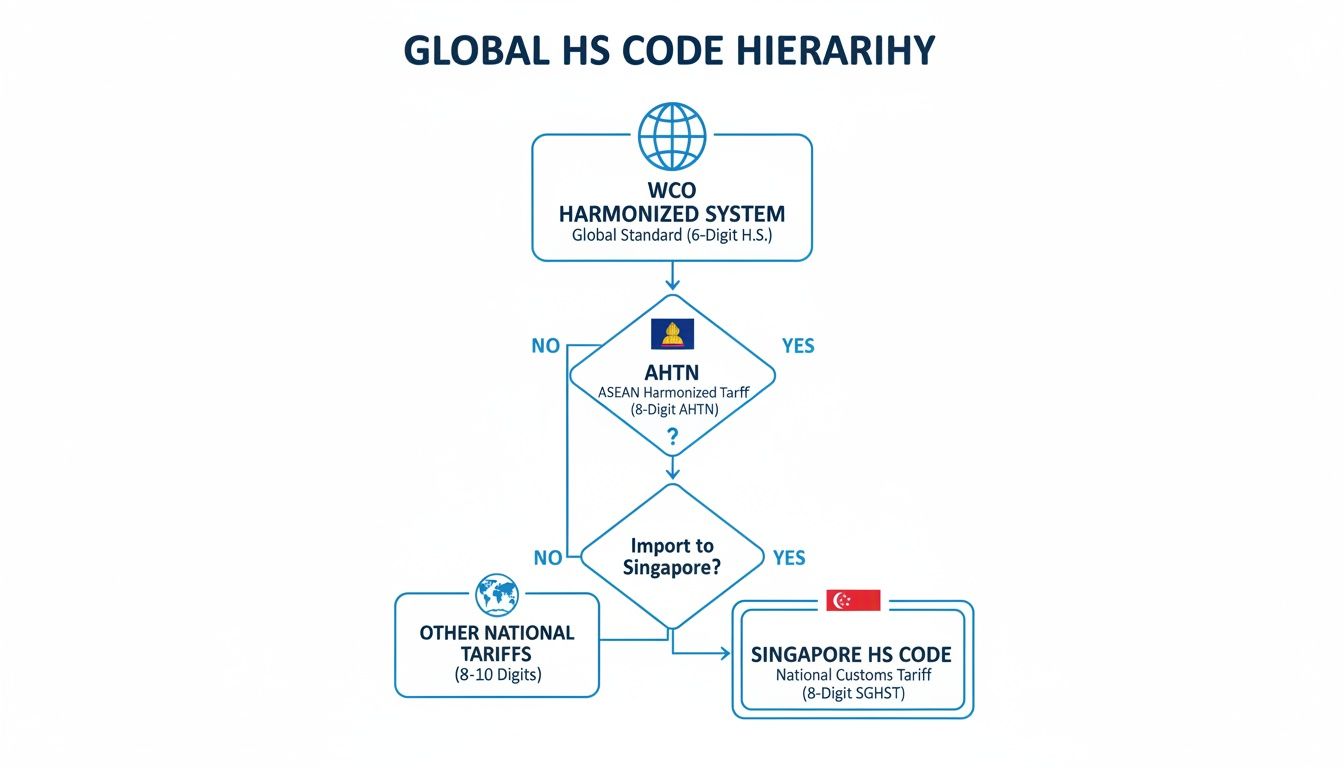
    The system is built like a family tree. The first six digits of an HS code are universal worldwide. Beyond that, countries can add more digits to get even more specific for their own import and tax purposes, often requiring 10 or 12 digits in total. If you're just starting out, you can learn more about the structure of harmonized code books to get a feel for how they work.

    Don't mistake the HS code for just another box to fill on a form. It's the central piece of data that dictates the speed, cost, and legality of your entire shipment. The wrong code can invalidate all your shipping documents and bring your supply chain to a screeching halt.

    To really see how important this is, let's trace how the code impacts every step of your package's journey with FedEx.

    The table below breaks down exactly how a single number can make or break your shipment's progress from start to finish.

    How HS Codes Impact Your FedEx Shipment Journey

    Shipment Stage Role of the Harmonization Code Potential Risk of an Incorrect Code
    Label Creation Determines if the item is restricted or prohibited in the destination country. Shipment gets rejected at the origin before it even leaves your facility.
    Customs Filing Calculates the precise duties and taxes owed upon import into the destination country. An incorrect tax assessment, leading to overpayment or underpayment fines.
    Customs Clearance Enables automated clearance systems to process the shipment quickly without manual review. Your package gets flagged for manual inspection, causing significant delays or seizure.
    Final Delivery Confirms all regulations have been met, allowing FedEx to complete the last-mile delivery. The shipment is returned to you at your expense, creating a terrible customer experience.

    As you can see, a correct harmonization code isn't just a customs formality; it's a critical component for ensuring a fast, cost-effective, and compliant delivery every single time.

    Why FedEx Requires Accurate Harmonization Codes

    If you've noticed FedEx getting stricter about harmonization codes, it’s not just an internal policy change. This shift is happening because customs agencies around the world, especially in the US and the European Union, are cracking down. Carriers like FedEx are now on the front lines, responsible for making sure every shipment is compliant before it even takes off.

    For FedEx, requiring an accurate harmonization code isn't about adding another administrative hurdle. It’s about getting your package through customs faster by eliminating any guesswork.

    Think of it like a digital passport for your product. When you provide the correct HS code, FedEx can send detailed electronic data to customs authorities long before the plane lands. This pre-arrival information allows their automated systems to green-light compliant shipments almost instantly. The alternative? Your package gets flagged for a manual inspection, a process that can add days—or even weeks—to the delivery time.

    For freight forwarders and their clients, getting the HS code right is no longer just about ticking a box. It's now a clear competitive advantage that translates to faster, more predictable service.

    From Chore to Strategic Asset

    Instead of seeing HS codes as a tedious chore, the most successful shippers have learned to treat them as a powerful strategic tool. Providing the correct code from the start effectively de-risks the entire journey for your shipment. This proactive approach not only builds trust with FedEx but also reinforces your reputation for reliability with your customers.

    The data speaks for itself. On March 1, 2023, FedEx made HS codes mandatory for all international shipments. In the months that followed, shipment rejections and clearance holds dropped by an incredible 35%. This proves that getting the details right at the beginning directly prevents major headaches down the line. You can learn more about FedEx's requirements for international shipping and their impact.

    The message from global customs is simple: "Tell us exactly what this is, or it's not coming in." FedEx's policy just enforces that reality at the source, protecting the entire logistics network from the gridlock caused by vague or incorrect data.

    This new standard changes the game. Compliance is no longer just a cost of doing business; it’s a way to win and keep high-value clients who simply can't afford the financial and reputational fallout from customs delays. It’s about turning a regulatory necessity into a clear business advantage.

    How to Find and Validate the Right HS Code

    Pinning down the correct harmonization code for a FedEx shipment can feel like looking for a needle in a global haystack. But it doesn't have to be that complicated. With a structured approach, you can eliminate the guesswork and, more importantly, protect yourself from costly delays and fines.

    Let's walk through three reliable methods for finding and validating the perfect HS code, every single time.

    Your first and often best stop should be the tools FedEx provides. After all, they have a vested interest in your compliance—it makes their entire network run smoother.

    The process is pretty straightforward: when you align with global rules and FedEx's own mandates, you get faster clearance. It’s that simple.

    FedEx Compliance Process Flow diagram outlining global rules, FedEx mandate, and faster clearance.

    This flow really just highlights a fundamental truth in logistics: working within the standardized system is always the fastest path to a successful delivery.

    Use FedEx Shipping Assist

    FedEx offers its own set of tools designed to make this whole process easier. The FedEx International Shipping Assist Lite tool is an excellent starting point for any shipper. It’s built to guide you toward the right code based on nothing more than your product description.

    Using these integrated tools can dramatically cut down on research time and boost your accuracy. In fact, we've seen that leaning on FedEx’s tools can reduce code lookup time by as much as 70%. That’s a huge efficiency gain, especially when you consider that incorrect HS codes are a primary trigger for customs penalties.

    Consult Official Government Databases

    For absolute, unquestionable accuracy, you have to go directly to the source. Every country or economic bloc maintains its own official tariff database. These are the same definitive guides that customs officials themselves consult.

    • For U.S. Imports: Use the Harmonized Tariff Schedule (HTS) of the United States.
    • For E.U. Imports: The TARIC database is your go-to resource.
    • For Canadian Imports: Look up the Customs Tariff on the Canada Border Services Agency (CBSA) website.

    A word of warning: while these sites are incredibly detailed, they can be dense and difficult to navigate. Start your search with broad terms and then narrow it down based on the product’s material, function, and other key characteristics.

    Pro Tip: Always classify based on what the product is, not what it's used for. A "yoga mat" isn't a classification, but a "mat made of vulcanized rubber" is. This distinction is critical.

    Leverage Third-Party Platforms

    If you find the official government sites too cumbersome, specialized third-party platforms offer a more user-friendly way to navigate customs data. While government databases are free, these tools are built for commercial users, offering clearer search functions and valuable business intelligence.

    These platforms essentially translate raw customs data into searchable, actionable insights. Think of it as a crucial part of your data validation process for international trade—ensuring your HS codes are clean and reliable from the start.

    For those who need to classify products regularly, our own guide on how to find a harmonized code offers an even deeper dive into advanced search strategies. By combining these methods, you can confidently find and validate the right harmonization code fedex requires for any shipment you send.

    Common HS Code Mistakes and How to Avoid Them

    Getting a harmonization code wrong is one of the easiest—and most costly—mistakes you can make in shipping. The frustrating part? These errors happen all the time, but they are almost entirely preventable once you know what to look for.

    Think of this as a field guide to the most common pitfalls I've seen trip up even seasoned shippers. Recognizing these patterns before you file is the key to protecting your bottom line, keeping your FedEx shipments on schedule, and building a reputation for rock-solid reliability.

    The Dangers of Vague Descriptions

    This is hands-down the number one mistake. Labeling a shipment with a generic description like "electronics" or "auto parts" is the fastest way to get it flagged for a manual inspection. Customs officials need specifics. Period.

    A vague description forces them to guess, and they won't. They’ll simply hold the package. Instead of "electronics," your description should read something like, "lithium-ion battery-powered smartwatches with silicone bands." "Auto parts" becomes "steel brake pads for passenger vehicles." This level of detail isn't just helpful; it's a non-negotiable requirement that directly leads to the correct HS code.

    Using Incomplete or Incorrect Code Structures

    Another classic error is getting the length of the code wrong. While the first six digits of an HS code are the global standard, that’s just the beginning of the story. Most countries, including the U.S. and all E.U. member states, require additional digits—often up to 10—to add national-level detail for taxes and regulations.

    • The Mistake: You’re shipping to the United States but only use the universal 6-digit HS code on your FedEx documents.
    • The Consequence: The customs system will likely reject the filing automatically. Best case, you're scrambling to find the right 10-digit HTSUS code while your shipment sits in a warehouse. Worst case, it triggers fines for non-compliance.

    An incorrect harmonization code isn't a simple typo. It's a misdeclaration to a government agency. The fallout can range from frustrating delays and re-classification fees to seizure of your goods and serious financial penalties.

    Misclassifying Kits and Sets

    Here’s a common head-scratcher: how do you classify a gift basket with wine, cheese, and crackers? What about a toolkit that includes a hammer, a screwdriver, and a wrench?

    Products sold together as a kit or set have a specific rule. You must classify the entire package based on the component that gives the set its essential character. For a grooming kit containing a razor, shaving cream, and a brush, the "essential character" comes from the razor. You'd use the HS code for the razor, not the shaving cream. Just picking the code for the cheapest item is a surefire way to get your shipment stopped.

    To see how these seemingly small errors can spiral into major issues, have a look at this quick-reference matrix.

    HS Code Error and Consequence Matrix

    This table highlights just how directly a simple classification error connects to real-world delays and costs.

    Common Error Example Scenario Likely Consequence
    Vague Product Description Labeling a box "Apparel" instead of "Men's 100% Cotton T-Shirts". Shipment is flagged for manual inspection, causing days or even weeks of delay.
    Incorrect Code Length Using a 6-digit HS code for a shipment to Germany (which requires a 10-digit TARIC code). Automated system rejection, returned shipment, or a customs fine for incorrect filing.
    Material Misclassification Classifying a leather-covered wooden chair under the HS code for a "wooden chair." Incorrect duty/tax calculation. This leads to underpayment, which customs may treat as attempted tax evasion, resulting in back-payment and penalties.

    As you can see, the details matter immensely. A proactive, detail-oriented approach is your best defense against these common but completely avoidable problems.

    How to Fill Out Your FedEx Paperwork Correctly

    So, you’ve done the hard work and found the right harmonization code. Great! But that’s only half the job. Now, you have to get that code onto your FedEx paperwork, and getting it right is what keeps your shipment moving smoothly through customs.

    This is where the rubber really meets the road. A simple mistake here can wipe out all your careful research, leading to frustrating delays that were completely avoidable. It’s not just about filling a blank space; it’s about making sure every piece of paper (and every digital file) tells the exact same story.

    The product description and harmonization code you put on your Commercial Invoice must perfectly match what goes into the FedEx Ship Manager™ platform. Even a minor difference can trigger a manual review by a customs agent, and that’s a headache you don’t need.

    A blue strip of paper on a clipboard with a pen, showing 'Enter HS Code' text.

    Pinpointing the HS Code Fields

    Whether you’re working with physical documents or filling things out online, the spot for your harmonization code is pretty standard. Here’s where you’ll find it:

    • On the Commercial Invoice: This is the big one. Your invoice will have a column labeled "Harmonized Code," "HS Code," or maybe "Tariff Code." You need to enter the full, country-specific code for each separate item in your shipment on its own line.
    • In FedEx Ship Manager™: As you create your shipment online, you'll hit a "Commodities" or "Item Description" section. There's a dedicated field just for the HS code right there. For U.S.-bound shipments, FedEx’s newer tools can even suggest codes based on your item description, which is a handy feature.

    Accurately filling out your FedEx paperwork, including the correct harmonization code fedex requires, is vital for smooth international shipping. This process is particularly complex when dealing with cross-border restricted goods documentation, where precision is even more critical.

    A Step-by-Step Example

    Let's walk through what this looks like in the real world. Say you're shipping 10 "men's 100% cotton T-shirts" to a customer in the United States.

    • Step 1: First, you’d find the correct 10-digit HTSUS code for the item. In this case, it’s 6109.10.0004.
    • Step 2: Next, you prepare the Commercial Invoice. On the line for the T-shirts, you’d write "Men's 100% Cotton T-shirts" in the description column and then enter "6109.10.0004" into the Harmonized Code column.
    • Step 3: Finally, you create the shipment in FedEx Ship Manager™. Here, you’ll enter the exact same description and 10-digit code into the commodity details.

    Consistency is everything. Ensuring every detail matches turns what feels like a chore into a powerful tool for guaranteeing your packages arrive on time. For other documents that might be involved, like a Bill of Lading, our guide on what a Bill of Lading is can offer some helpful context.

    So far, we've talked about HS codes as a tool for compliance—something you have to get right to keep your FedEx shipments moving smoothly. But that's just playing defense. What if those same codes could become your best offensive strategy for winning new business?

    Think about it. Every product that crosses a border is tagged with an HS code. This creates a massive, searchable database of global trade activity. Specialized data platforms tap into this customs information, revealing exactly who is shipping what, where, and in what volumes. For freight forwarders and carriers, this is a game-changer.

    From Cold Calls to Data-Driven Deals

    Let's say your sales team wants to find new clients who ship electronics. The old way involved a lot of guesswork and generic cold calls. The new way is far more precise. Using a trade data platform, your team can instantly pull a list of every company importing goods under HS Chapter 85 (electrical machinery and equipment).

    Suddenly, you have a pre-qualified list of active shippers in your target market. You're no longer guessing who might need your services—you know they do. This completely transforms the sales conversation.

    Instead of a weak opening like, "Do you ship internationally?" your team can lead with confidence: "I saw you're regularly importing electronic components from Vietnam into the Port of Los Angeles. We run a competitive air freight service on that lane that could cut your transit time by two days."

    That’s how you turn raw data into a closed deal. Your outreach goes from a shot in the dark to a highly targeted conversation that shows you’ve already done your homework.

    Uncovering Market Opportunities

    The strategic value of harmonization code data goes well beyond just generating leads. It offers a bird's-eye view of the entire market, letting you make smarter business decisions.

    You can now:

    • Pinpoint High-Volume Trade Lanes: See which routes have the most traffic for specific commodities. This helps you focus your pricing and capacity on the most profitable lanes.
    • Spot Emerging Trends: Notice a sudden spike in imports for a particular HS code? That could be an early signal of a new product taking off or a shift in sourcing you can capitalize on.
    • Analyze Your Competition: Find out which carriers and forwarders are currently handling the accounts you want. This intelligence is crucial for crafting a proposal that undercuts their weaknesses and highlights your strengths.

    By digging into HS code data, you move from the day-to-day tactics of shipping to the high-level strategy of real business development.

    Common Questions About FedEx Harmonization Codes

    When you're dealing with international shipments for FedEx, a few common questions about harmonization codes always pop up. Let's clear the air on some of the most frequent points of confusion.

    HS vs. HTS vs. Schedule B Codes: What's the Real Difference?

    This is where a lot of shippers get tripped up, but the distinction is actually pretty straightforward once you see how they relate. Think of it like this:

    • The HS Code is the foundation. It's a universal six-digit classification recognized by customs authorities worldwide. This is the global "passport" for your product.

    • The HTS Code is for imports. This is a ten-digit code used specifically for goods coming into the United States. It takes the international six-digit HS code and adds four more digits that determine the exact duty and tax rates you'll pay.

    • The Schedule B Code is for exports. This is a ten-digit code used when shipping goods from the United States to another country. Its main purpose is for trade statistics and export control.

    So, while they all start with the same six-digit HS base, the final four digits change depending on whether you're importing or exporting from the U.S.

    What If I Can't Find a Code for My Product?

    First, don't guess. Seriously. Pulling a code out of thin air is the fastest way to get your shipment delayed, fined, or even seized by customs.

    If you’re truly stuck, your best bet is to consult a licensed customs broker. They live and breathe tariff classifications. Another route is to request an official ruling from the customs agency of the destination country, which gives you a legally binding classification for your product.

    How Often Do These Codes Actually Change?

    The Harmonized System isn't static. The World Customs Organization (WCO) formally updates the entire system every five years to account for new technologies and products. Think about it—things like drones and smartwatches didn't have clear classifications a decade ago.

    On top of that, individual countries can adjust their specific ten-digit tariff lines (like the HTS codes) much more often. It's crucial to stay on top of updates from FedEx and customs agencies to make sure you're always using the most current codes.


    Ready to turn compliance data into your next big deal? Coreties transforms global customs information into targeted, pre-qualified lead lists. Stop guessing and start connecting with the right decision-makers today. Discover your next customer at Coreties.com.

  • Find Harmonized Code Numbers Quickly and Accurately

    Find Harmonized Code Numbers Quickly and Accurately

    Finding the right harmonized code starts long before you touch a search bar. The real work begins with understanding your product inside and out. You need to break it down by its core attributes: what it does, what it's made of, and its physical form. Once you have that detailed picture, you can start querying official databases like the U.S. Harmonized Tariff Schedule (HTS) with keywords that truly describe your item.

    More Than Just a Number: Why Harmonized Codes Are the Bedrock of Global Trade

    Before you can find the right code, you need to appreciate what it represents. Think of the Harmonized System (HS) code as the universal language for physical goods moving across borders. For anyone in logistics—whether you’re a freight forwarder, carrier, or NVOCC—getting this right isn't just about ticking a box for compliance. It's a fundamental skill that underpins your entire operation.

    The HS code system is what brings a shared logic to the otherwise chaotic world of global commerce. For those of us in the trenches of logistics, this system is everything because it dictates:

    • Universal Standardization: It ensures a "leather office chair" means the exact same thing to customs agents in Tokyo, Hamburg, and Los Angeles. No ambiguity, no confusion.
    • Duty and Tax Collection: This is how governments determine the specific tariffs, taxes, and fees owed on every single item that crosses their borders.
    • Trade Data and Statistics: These codes are the source of truth for the data that governments use to track trade volume, shape economic policy, and analyze market trends.
    • Regulatory Compliance: HS codes are directly linked to enforcing safety standards, import quotas, and other critical regulations tied to specific products.

    Why Accuracy Is Non-Negotiable

    Getting the code wrong isn't a small mistake—it's a costly one. An incorrect classification can trigger frustrating shipment delays, painful customs audits, and steep financial penalties.

    Consider this: over 98% of all merchandise in international trade is classified using the Harmonized System. This global framework is managed by the World Customs Organization (WCO) and used by more than 200 countries. A misclassification in a major market can lead to fines up to 100% of the shipment's value, instantly turning a profitable job into a significant financial loss. To get a better feel for the official classification structure, you can start with our guide on the HS code book.

    The legal responsibility for an accurate HS code almost always rests with the importer of record. You can't just blindly trust a code from a supplier. If customs flags an error, you're the one on the hook.

    Ultimately, mastering HS codes gives you a serious competitive edge. It slashes risks, ensures smooth customs clearance, and builds a reputation for reliability with clients and regulators alike. Understanding how to standardize your product information through effective data harmonization is another key piece of this puzzle, helping to create a seamless flow for your global operations.

    Finding the right HS code isn't guesswork—it's a systematic process. If you want to get it right every time and avoid customs headaches, you need a reliable method that starts long before you even touch a tariff schedule. Think of it like building a case file for your product. The more evidence you gather upfront, the stronger your classification will be.

    This infographic lays out the fundamentals of the Harmonized System, showing what it is, why it's the backbone of global trade, and how it impacts everyone in the supply chain.

    An infographic explaining the Harmonized System Basics: its definition, importance for trade, and global users.

    With that big picture in mind, let's get into the nitty-gritty of how you can turn these concepts into a practical, repeatable workflow.

    Break Down Your Product with the 4-Step Method

    You can't classify a product you don't fully understand. The first and most critical part of the process is to deconstruct your item into its most basic, objective attributes. Vague descriptions are the fast track to incorrect classifications and costly delays.

    To do this effectively, I use a simple 4-step method to create a detailed "product profile." This structured approach ensures I never miss a critical detail that could change the classification entirely.

    The 4-Step Product Breakdown Method

    Step Action Required Example (For a leather office chair with steel frame) Why It Matters
    1. Identify Primary Function What is the one thing this product is designed to do? Be specific. Primary Function: Seating for an office environment. This almost always points you to the correct HS Chapter (e.g., Chapter 94 for Furniture).
    2. List All Materials Document every component material, from the main body to the smallest screw. Materials: Bovine leather (upholstery), polyurethane foam (padding), steel (frame/base), plastic (casters). The "essential character" of the product is often determined by its material composition, which is a key factor in GRI 3.
    3. Define Form & Condition How is it presented at the time of import? Assembled, unassembled, kit? Form: Unassembled. All parts are included in a single box for final assembly by the customer. This directly impacts which General Rule of Interpretation applies (e.g., GRI 2a for unassembled goods).
    4. State Intended Use How will the end-user actually use the product? Think about the context. Intended Use: For use in a commercial or home office setting. Not for vehicles or medical facilities. End-use can be a deciding factor between two similar headings. An "office chair" is classified differently than an "aircraft seat."

    By following this breakdown, you create a solid foundation for your search. For instance, just calling something a "promotional kit" is a recipe for trouble. A proper breakdown would be: "a cardboard box containing one 100% cotton t-shirt, one plastic ballpoint pen, and three paper marketing brochures." That level of detail is exactly what customs officials need.

    Follow the Rules: Navigating the GRIs

    With your detailed product profile in hand, it's time to apply the General Rules of Interpretation (GRIs). These six rules are the legal framework for HS classification. They can look intimidating, but they’re just a logical decision-making process.

    Think of the GRIs as a waterfall. You always start at GRI 1 and only move to the next rule if the one before it doesn't resolve the classification. In my experience, over 80% of products are classified using GRI 1 alone.

    GRI 1 is simple: classification is determined by the text of the headings and any related section or chapter notes. Your first move is always to find the heading that most specifically describes your product. If that doesn't work, you move down the list. GRI 2a, for example, tells us to classify an incomplete or unassembled product as if it were complete. GRI 3 helps us classify goods made of multiple materials by finding the one that provides the "essential character."

    Let's Walk Through a Real-World Example

    Here’s a common scenario we see in freight forwarding: importing an unassembled leather office chair with a steel frame.

    • Product Breakdown: We already did this. Function is seating. Materials are leather and steel. Condition is unassembled.

    • Applying GRI 1: We start by looking for a heading. Chapter 94 covers "Furniture." Within that, heading 9401 covers "Seats." This looks like a direct hit.

    • Applying GRI 2a: Since our chair is unassembled, this rule confirms we should classify it as a complete chair, not as a pile of parts. This is a critical step that prevents misclassification.

    • Applying GRI 3b: The chair is a mix of materials (leather and steel). Which one defines its "essential character?" The purpose of the product is to be a comfortable seat. The leather upholstery is central to that function, more so than the steel frame that supports it. Therefore, we'll look for a subheading under 9401 that specifies upholstered seats.

    This structured method takes the art of classification and turns it into a repeatable science. When you meticulously document your product's attributes and follow the GRI framework, you're not just finding a code—you're building a logical, defensible case for your classification every single time.

    Getting Your Hands Dirty with Tariff Tools and Databases

    Alright, you've got your product's DNA mapped out. Now it's time to take that detailed breakdown and dive into the official databases that govern global trade. This is where the real detective work begins, and while these tools are incredibly powerful, they can feel a bit clunky and intimidating at first.

    Your go-to resources will be the official tariff schedules for the countries you’re shipping to and from. If you're importing into the U.S., your bible is the Harmonized Tariff Schedule of the United States (HTSUS), which is run by the U.S. International Trade Commission. For exports out of the U.S., you'll be living in the Schedule B search tool from the U.S. Census Bureau. And for anything heading into the European Union, the TARIC database is your port of call.

    Here's a classic mistake I see all the time: assuming an HS code that works for one country is good for another. The first six digits are the universal "Harmonized System" part, but the final digits—the ones that actually dictate duty rates and specific rules—are country-specific. Always, always use the destination country’s official database.

    How to Think Like a Tariff Search Engine

    The trick to these databases is learning how to "speak their language." Your search success comes down to your technique. You need to start broad and then methodically drill down using the product attributes you've already identified.

    Let's say you're trying to classify a "pine wood dining table." Punching that whole phrase into the search bar will likely get you nowhere fast. It's just too specific for the way these systems are structured.

    Instead, think in layers. Here’s how I’d approach it:

    • Start with the general category: My first search would just be "furniture" or maybe "table." Simple.
    • Add the material: Next, I'd refine that to something like "wooden table" or "wood furniture."
    • Use your chapter knowledge: Once you get the hang of it, you’ll know that most furniture lives in Chapter 94. You can often skip the keyword search and go straight to the chapter, then browse the headings until you find the one for "Tables" (which is 9403).

    This step-by-step process keeps you from getting bogged down in thousands of irrelevant results. It’s a much more efficient way to zero in on the right classification. For those dealing with specific Asian trade lanes, we've also put together a more targeted guide on HS code search for Singapore that you might find helpful.

    A laptop on a wooden desk displays a map for tariff search, with a coffee cup and smartphone.

    This is the kind of interface you'll be working with. That search bar is your gateway, so learning what to feed it is half the battle.

    Making Sense of the Results

    Finding a potential code is one thing; understanding what it all means is another. The tariff schedule gives you a wealth of information, and it's all critical for a smooth customs clearance.

    When you land on a promising HTS code, here’s what you need to scrutinize:

    • Article Description: Read this carefully. Does the official description precisely match your product? The difference between "Of wood" and "Of metal" is obvious, but it can get much more granular. Every word matters.
    • Unit of Quantity (UoQ): This tells you how to declare your goods. Is it by the piece (No.), by weight (kg), or by the dozen (doz)? Getting this wrong is a common cause of customs delays.
    • Rates of Duty: You’ll see a few columns for duties. The "General" rate applies to goods from most countries. The "Special" rate is where you find preferential, lower duties for countries that have a free trade agreement with the import country.

    Let’s circle back to that leather office chair. I'd navigate to Chapter 94, find heading 9401 ("Seats"), and then start looking through the subheadings. I might land on something like 9401.30.80, which could have a description like "Other swivel seats with variable height adjustment." By cross-referencing that description and the chapter notes with my product specs, I can confirm it's a match.

    This final verification step is what separates a guess from a compliant classification. It ensures you've not only found a number but also understand all the obligations that come with it.

    Verification and Avoiding Common Classification Pitfalls

    Finding a potential HS code in a tariff schedule is a great start, but it's not the end of the road. Let's be clear: simply trusting a code you found—or one your supplier gave you—is a major gamble. As the importer or exporter, the legal responsibility for getting that code right rests squarely on your shoulders.

    So, how do you move from a "best guess" to a classification you can stand behind? You need to see how customs has ruled on similar products in the past.

    For any goods heading to the U.S., the Customs Rulings Online Search System (CROSS) is your best friend. This is a massive, searchable database of legally binding decisions made by U.S. Customs and Border Protection (CBP). It shows you exactly how they've classified specific products, and more importantly, why.

    Searching CROSS with a few keywords for your product can instantly show you how officials interpret the nuances of classification. When you find a ruling that perfectly describes your item, you've found a powerful piece of evidence to support your choice.

    Cross-Referencing with Customs Rulings

    Think about a product like a "smartwatch" that tracks fitness and shows phone notifications. You could make a case for it being a watch under Chapter 91, but it also feels like a data processing machine from Chapter 84. It’s a classic classification dilemma.

    This is where a quick search in CROSS for "smartwatch" becomes a lifesaver. You’ll find multiple rulings where you can read the logic CBP applied. They often focus on the "principal function" of the device, and seeing their thought process helps you build a much more defensible case for your own classification.

    Your goal is to build a "classification file" for every single product. This file should tell the whole story: your product breakdown, which GRIs you used, your tariff schedule research, and any CROSS rulings you found. If customs ever comes knocking with an audit, this documentation is your best defense.

    Sidestepping Common Classification Traps

    Even with the best tools, it's surprisingly easy to fall into a few common traps. I’ve seen these same mistakes trip up logistics teams for years, often leading to delays, fines, and a lot of headaches.

    Here are the top pitfalls to watch out for:

    • Relying on Supplier Codes: A supplier's HS code is a helpful starting point, nothing more. They might not understand the specific rules for your country of import, or they could have just made a mistake. You must always verify it yourself.
    • Misinterpreting "Parts and Accessories": This one gets people all the time. An item is only a "part" or "accessory" if it meets very strict definitions in the chapter notes. A car engine is clearly a part of a car, but a generic electric motor that could be used in hundreds of different machines is not.
    • Classifying Kits or Sets Incorrectly: When you have goods packaged together for retail, like a gift set, you don't classify each item individually. You classify the whole set under the one item that gives it its "essential character," per GRI 3b.
    • Using Outdated Information: Tariff schedules change. There are updates all the time, with major revisions happening every five years. The code that was correct last year might be wrong today. Always, always use the most current version of the official tariff schedule.

    By actively checking your work and keeping these common errors in mind, you shift from just finding a harmonized code to confidently defending it. That diligence is what separates smooth, compliant shippers from those who are constantly putting out fires at the border.

    Using HS Codes to Fuel Your Sales Pipeline

    Two people collaborating at a table with a laptop showing charts and 'HS CODE LEADS' text.

    For the sharpest logistics companies, knowing how to find a harmonized code goes way beyond simple compliance. It's about turning what most see as a customs formality into a powerful source of business intelligence. When your sales team stops seeing HS codes as just a number and starts seeing them as a direct link to market insights, you create a real engine for growth.

    This data is what lets you graduate from cold calling to having truly informed, value-driven conversations. You no longer have to guess who might need your freight services; you can see exactly which companies are importing or exporting specific products.

    Turn Compliance Data Into Qualified Leads

    Let's get practical. Imagine your company is fantastic at handling high-value electronics. By digging into customs data, you can build a list of every business importing goods under HS code 8507.60—that’s lithium-ion batteries. Suddenly, you don't just have a list of names. You have a qualified pipeline of ideal customers who are verifiably shipping the exact cargo you specialize in.

    You can get even more granular by layering on trade lane specifics. Looking to build up your EU-US airfreight business? Filter the data to find who is shipping pharmaceuticals (HS Chapter 30) from Frankfurt to Chicago. This kind of hyper-targeted approach means your sales team can craft an outreach message that speaks directly to a prospect’s actual shipping activity.

    HS codes aren't just numbers—they're the backbone of trade intelligence for logistics sales teams worldwide. For importers and exporters, pinpointing HS codes unlocks duties and statistics for partner scouting. Platforms like Coreties can transform HS-rich customs data into actionable lead lists with LinkedIn profiles and email intelligence, plus geo-filters for high-growth lanes like EU-US pharma (HS 3004), which has seen 12% growth. Users report sending over 30 personalized emails hourly, a massive efficiency gain compared to manual methods. Discover more about how the system works at the World Customs Organization.

    Uncover New Markets and Spot Opportunities

    Diving into HS code trends is also a fantastic way to spot emerging markets and new customer segments you might have otherwise completely missed. A sudden spike in import volumes for a specific code can be a huge signal of a growing industry or a major shift in consumer demand.

    For instance, a steady climb in imports of solar panel components could be your cue to develop specialized logistics services for renewable energy companies. This data-first strategy allows you to get ahead of market needs and position your business for what's next. By using an HS code filter, you turn raw trade data into a strategic asset, making sure your sales team is always chasing the most promising opportunities.

    Clearing Up Common Questions About Harmonized Codes

    Even the most seasoned logistics pros run into questions when classifying freight. Let's tackle a few of the most common ones we hear from teams on the ground, so you can classify with more confidence.

    HS, HTS, and Schedule B—What's the Difference?

    This alphabet soup trips up a lot of people, but the distinction is pretty straightforward once you get the hang of it.

    Think of the HS (Harmonized System) code as the universal foundation. It's a 6-digit number recognized globally, the common language of trade classification.

    From there, countries add their own digits for more detail.

    • An HTS (Harmonized Tariff Schedule) code is what a country uses for imports. The U.S. uses a 10-digit HTS code—the first six are the base HS code, and the last four are specific to the U.S. for duty and statistical purposes.
    • A Schedule B code is also a 10-digit number used in the U.S., but it's exclusively for classifying goods for export.

    What Happens If I Use the Wrong Harmonized Code?

    Getting the HS code wrong can throw a serious wrench in your operations. You’re not just looking at shipment delays at customs; the fallout can include surprise audits, steep financial penalties, and even demands for retroactive duty payments on past shipments. It's a costly mistake.

    A wrong code also damages your company's reputation with customs authorities. This can lead to increased scrutiny and more frequent inspections of your future shipments, creating a cycle of delays and operational headaches.

    How Often Do Harmonized Codes Change?

    The global Harmonized System gets a major overhaul from the World Customs Organization (WCO) every five years to keep pace with technology and trade. The last big update was in 2022.

    But don't get too comfortable. Individual countries can and do update their own tariff schedules—like the HTSUS—much more frequently. It is absolutely essential to check the official tariff websites for your origin and destination countries regularly. Assume nothing; always verify.

    Can I Just Use the HS Code My Supplier Gave Me?

    This is a big one, and the short answer is no. While your supplier's code is a decent starting point, never, ever rely on it blindly.

    As the importer of record, you are the one legally on the hook for the classification's accuracy, not your supplier. They might not know the destination country's specific rules, or they could have just made a mistake. Always do your own due diligence. Your name is on the paperwork, so the responsibility is yours.


    Ready to turn customs data into your best source of qualified leads? Coreties transforms global trade information into actionable prospect lists, helping logistics sales teams find and connect with ideal shippers faster. Discover how Coreties can grow your business.

  • Your Complete Guide to the Sticker HS Code in Singapore

    Your Complete Guide to the Sticker HS Code in Singapore

    Finding the right HS code for stickers might seem like a small detail, but when you're shipping to Singapore, it's one of those things that can make or break your timeline and budget. Getting it wrong can lead to customs delays and unexpected fines, all because the code hinges on one primary factor: what the sticker is made of.

    Why Your Sticker's HS Code Is So Important for Singapore Shipments

    Think of the Harmonized System (HS) code as a universal passport for your products. It's a standardised numerical code that tells customs officials everywhere exactly what you're shipping without them ever needing to open the box. For an item as common as a sticker, you'd be surprised how much nuance there is—and how much that little number matters.

    A professional man reviewing paperwork near cardboard boxes with a "Correct HS Code" sign, related to international shipping.

    Nailing the sticker HS code is your ticket to a smooth clearance process with Singapore Customs. A wrong code can stop your shipment in its tracks, triggering a cascade of frustrating and costly problems.

    The Real Risks of Getting It Wrong

    Classifying a sticker incorrectly isn’t just a simple typo; it's a formal declaration that can have serious repercussions. The main things that determine a sticker's classification are its material—is it paper or plastic?—and whether it's self-adhesive. This distinction is critical because paper and plastic fall into completely different chapters of the HS tariff, each with its own set of rules for duties and taxes.

    Here’s what can happen if you make a mistake:

    • Painful Delays: Customs will flag a shipment with a mismatched HS code for inspection. This doesn't just hold up your stickers; it can stall an entire container's worth of goods.
    • Surprise Fines: Singapore Customs doesn't take inaccurate declarations lightly and can impose penalties that eat into your profit margins.
    • Paying Too Much in Duties: You could easily classify a duty-free sticker under a code that attracts tax, meaning you’re paying more than you need to.
    • Unhappy Clients: If you're a freight forwarder, these kinds of delays and unexpected costs are a fast way to lose a client's trust and damage your reputation.

    A correct HS code is more than just a number on a form. It’s a signal to customs that you know your products and are serious about complying with trade regulations.

    In the end, taking the time to understand the logic behind sticker HS codes gives you a real operational edge. It means your shipments move predictably, your costs are kept in check, and your clients remain happy. For a broader look at how these codes work for all sorts of products, our general guide on using the HS code in Singapore is a great place to build your foundational knowledge and avoid common mistakes.

    Paper or Plastic? Your First Big Decision

    When you’re staring at a box of stickers and need to find its HS code, the first question you have to ask is surprisingly simple: what’s it made of? Is it paper or plastic?

    This single detail is the most critical factor in your entire classification process. It’s the fork in the road that sends your shipment down one of two completely different paths in the Harmonized System. Get it right, and you’re on your way to a smooth clearance. Get it wrong, and you’re setting yourself up for customs headaches.

    Think of it this way: paper stickers are handled under HS Chapter 48, while their plastic or vinyl counterparts belong in HS Chapter 39. These two chapters have entirely separate rules and headings, so mixing them up is a recipe for delays.

    The Paper Trail: Classifying Under Chapter 48

    Let’s start with the most common type: paper-based stickers. We’re talking about everyday items like shipping labels, basic branding stickers for packaging, or the price tags you see in a retail store. They’re functional but not built to last against the elements.

    Because their soul is paper, they fall squarely within Chapter 48. The primary heading you’ll be looking at is 4821, which covers “Paper or paperboard labels of all kinds, whether or not printed.” This heading acts as a broad umbrella for most standard paper stickers.

    • A roll of printed address labels for an e-commerce business.
    • Sheets of discount price stickers for a supermarket.
    • Simple, non-laminated logo stickers stuck on cardboard boxes.

    The Plastic Path: Navigating Chapter 39

    Now, let’s talk about the tough stuff. Plastic stickers are all about durability. This is where you’ll find vinyl decals for cars, weatherproof warning labels for industrial equipment, or glossy, decorative stickers for laptops. Their defining feature is the plastic material, which is often a form of polyvinyl chloride (PVC).

    These resilient products are classified under HS Chapter 39, the chapter for plastics. The heading you’ll almost always land on is 3919, which covers “Self-adhesive plates, sheets, film, foil, tape, strip and other flat shapes, of plastics.” If the sticker is designed to withstand sun, rain, or general wear and tear, it’s a Chapter 39 item.

    The difference is all about purpose and resilience. A paper label is just printed matter, but a vinyl decal is a durable plastic article.

    In the eyes of customs, the material isn't just a physical trait—it's the sticker's entire identity. This distinction directly affects duties, taxes, and any other regulations that might apply.

    To give you a clearer picture, here’s a simple breakdown of where different stickers typically land.

    Common HS Codes for Paper and Plastic Stickers

    Sticker Type Governing HS Chapter Common HS Heading (6-Digit) Typical Products
    Paper Stickers Chapter 48 (Paper and Paperboard) 4821.10 or 4821.90 Shipping labels, address labels, price tags, simple product stickers for indoor use.
    Plastic/Vinyl Stickers Chapter 39 (Plastics and articles thereof) 3919.10 or 3919.90 Car decals, bumper stickers, weatherproof industrial labels, durable branding decals.

    In Singapore, these classifications are drilled down to an 8-digit level. For example, self-adhesive plastic shapes often fall under 3919.10.00, while many paper labels are classified under a code like 4821.90.90. You can always verify the exact national tariff by using official resources like the Singapore Customs HS classification portal.

    By starting with this simple paper-versus-plastic question, you lay the groundwork for an accurate declaration. It’s the first and most important step to getting your classification right.

    Refining Your HS Code with Secondary Factors

    Once you’ve settled on the primary material—paper or plastic—you're not quite at the finish line. Think of it like this: you've found the right neighbourhood (Chapter 48 or 39), but now you need to find the exact street address. Several secondary factors come into play to help you pinpoint the most precise HS code for your stickers.

    Customs officials look at these finer details to understand the sticker's specific form and function. It's their way of making sure products with different commercial uses end up in the right categories. Getting this next layer right is crucial, especially when you're dealing with shipments that are a bit more complex than just a simple label.

    Printed vs. Unprinted

    A big fork in the road is whether your stickers are printed or blank. This distinction is all about separating raw materials from finished goods. After all, a roll of blank thermal labels waiting to be used in a warehouse printer serves a very different purpose than a sheet of colourful, branded logo stickers ready to be slapped on a product.

    For instance, within HS heading 3919 (plastic stickers), you'll often find that national tariffs have specific subheadings for printed versus unprinted rolls or sheets. A blank roll might be classified as a base material, while a printed one is clearly a finished article.

    This decision guide is a great starting point for that first, most important sorting factor: the material.

    A flowchart decision guide for selecting sticker material, differentiating between paper and plastic based on use cases.

    As the flowchart shows, you always have to start by identifying the core material. That single decision determines which chapter of the HS tariff you’ll be digging into.

    Rolls vs. Sheets

    The format of the stickers—how they're supplied—also makes a difference. Are they wound onto a massive roll for a labelling machine, or are they cut into individual sheets for someone to peel off by hand? This detail is often a strong clue about the sticker's intended market, whether it's industrial or consumer.

    • Rolls: Usually point to a commercial or industrial application. Picture a 5,000-count roll of barcode labels destined for a factory floor. These often have their own subheadings for goods supplied "in rolls."
    • Sheets: Tend to suggest consumer or office use. Think of decorative sticker sheets for a scrapbook or A4-sized labels you can run through a desktop printer.

    Even if the stickers are made from the exact same material, this simple difference in format can push them into different 8-digit or 10-digit national HS codes.

    The Harmonized System is built on the idea of classifying goods by their "essential character." Secondary factors like printing and format help define this character. They move beyond just what the product is made of to what it is and how it's used in trade.

    By taking a closer look at these extra details—whether it’s printed, how it’s formatted, or even the type of adhesive—you can classify with much greater accuracy. This careful approach ensures your customs declaration is a true reflection of the product, which means fewer questions from customs and a smoother shipping process.

    How to Verify Your Sticker HS Code for Singapore

    So, you’ve done your homework. You’ve analysed the sticker’s material, considered its use, and landed on what you believe is the right HS code. But in the world of customs, a good guess isn't good enough. You need to be sure.

    Verifying your code is the last, and arguably most important, step. It's what separates a smooth clearance from a costly delay. Thankfully, Singapore Customs offers some excellent, user-friendly tools to help you cross the finish line with confidence. Taking a few minutes to confirm your code proactively can save you a world of headaches later on.

    Using the Singapore Customs Search Engine

    Your first port of call should always be the official HS/CA Product Code Search Engine on the Singapore Customs website. This is the definitive source for confirming the 8-digit code you’ll need for your declaration. It's a simple-to-use database where you can search by keyword or browse the tariff chapters yourself.

    Here’s what the search portal looks like:

    This is where theory meets practice. You can plug in terms like "self-adhesive paper label" or "vinyl decal" to see how Singapore Customs officially categorises these items.

    A few tips for getting the best results:

    1. Start broad. Use general keywords like "self-adhesive plastic" or "paper label" first.
    2. Read the descriptions carefully. Sift through the results and find the heading that truly matches your product's specifics.
    3. Focus on the full 8-digit codes. These are the ones required for Singapore, so don't stop at the 6-digit international heading.

    Getting comfortable with this tool is a key skill for anyone in logistics. If you're just starting out, our detailed guide on how to perform an HS code search in Singapore offers more in-depth, step-by-step advice.

    Applying for an Official Classification Ruling

    What if your stickers are unusual, part of a massive shipment, or you just can’t shake the feeling of uncertainty? For those high-stakes situations, you can seek absolute legal certainty by applying for a Classification Ruling from Singapore Customs.

    Think of it as the ultimate safety net. A Classification Ruling is a formal, legally binding decision on the HS code for your specific product.

    A Classification Ruling removes every bit of guesswork. It’s a definitive answer straight from the authorities, protecting you from any future disputes over that product's classification.

    Of course, this is a more formal process. It takes time and requires you to submit a detailed application with product specs, samples, and your own proposed HS code. But when you get that ruling back, you have a rock-solid foundation for every future shipment of that item, guaranteeing consistency and compliance every single time.

    Find More Leads with HS Code Data

    Knowing your way around sticker HS codes isn't just for clearing customs. For smart freight forwarders, it's a powerful tool for finding your next best customers. Most see HS codes as just another compliance headache, but they’re actually a map that can lead you directly to new business.

    Think about it. When you organise this data correctly, it becomes a pipeline of qualified leads.

    A person in a blue shirt pointing at a laptop screen displaying data, with 'HS Code Leads' banner.

    What if you could pull a list of every single company in Singapore that consistently imports goods under HS code 4821 (paper labels) or 3919 (plastic stickers)? That’s not just a random contact list. It’s a pre-vetted roster of businesses you know have a regular need for the exact shipping services you offer.

    Turning Data into Deals

    Modern data platforms can take raw customs information and turn it into real sales intelligence. Instead of your team making endless cold calls, they can filter potential clients by the specific sticker HS codes they already handle. This allows for a much more personalised—and effective—first contact.

    Let's say you find a company bringing in large quantities of vinyl decals from Vietnam under HS code 3919. Armed with that knowledge, you can craft a targeted email that speaks their language, offering a specialised shipping solution for their specific Vietnam-to-Singapore route. You're immediately showing them you understand their business and have a direct solution for their needs.

    This completely flips the script on traditional sales. You stop selling a generic service and start presenting a solution to a problem you already know the prospect has, all backed by solid data.

    Of course, to get started, you'll often need to gather a good amount of data from various online sources. Learning how to scrape data from websites into Excel can give you the raw material you need for a deeper analysis.

    The Scale of the Opportunity

    The potential market here is massive. For logistics teams focused on packaging material importers, commodities under HS 39 and 48 make up about 5-7% of Singapore’s total imports. In recent years, that's translated to a value of roughly S$15-20 billion annually.

    This level of detail allows sales teams to zero in on high-value trade lanes, like specific Southeast Asian packaging routes. The right platforms can supercharge this process, using HS-specific customs insights to help you craft dozens of targeted, personalised emails every hour. It’s a huge efficiency gain.

    If you want to dive deeper into this strategy, check out our guide on how to use an HS code filter to find qualified leads.

    This entire approach connects a technical detail—the humble sticker HS code—to a very real business outcome: faster sales growth. It’s how you move your business development from a game of chance to a data-driven science.

    Common Questions About Sticker HS Codes

    Even after you've got the basics down, classifying stickers can throw some real curveballs. We often see experienced shippers and freight forwarders get tripped up by the same tricky scenarios. Let's walk through some of the most common questions that pop up, so you can handle those grey areas and finalise your customs declarations with confidence.

    What Happens If I Use the Wrong HS Code?

    Using the wrong sticker HS code for a shipment heading to Singapore is more than just a paperwork mistake—it can trigger a cascade of expensive problems. The most immediate issue is that Singapore Customs will likely flag your shipment for inspection. That means serious delays at the port, which throws a wrench in your supply chain and can hurt your reputation for being a reliable partner.

    But the headaches don't stop at logistics. The financial sting can be sharp, too. Customs authorities will hit you with penalties for incorrect declarations. If the wrong code led to you underpaying the Goods and Services Tax (GST), you're on the hook for the difference, plus any fines they tack on. Make this mistake too often, and you can expect much closer scrutiny on all your future shipments, turning every import into a potential hassle.

    Are Samples of Stickers Classified Differently?

    This is a classic point of confusion. The short answer is no; the core classification doesn't change. A sample of a vinyl decal is still a vinyl decal, so it belongs under Chapter 39. A paper label sample still falls under Chapter 48. The material is what drives the HS code, not whether it's a sample or a full commercial order.

    Where things get different is in the declaration process and the potential tax relief. If you clearly declare them as "trade samples" and assign a nominal value (or "no commercial value") on your invoice, you might be eligible for GST relief or duty exemption under certain schemes.

    The core HS code for a sample stays the same. What changes is how you declare it and whether you can get tax relief. Always check the latest Singapore Customs guidelines on importing trade samples to make sure you qualify for any breaks.

    Getting this right is key. It helps you avoid unexpected tax bills while staying fully compliant with the fundamental classification rules.

    How Do I Classify a Sticker Pack with Both Paper and Vinyl?

    What happens when you’re importing a retail pack that mixes different materials, like a set with both paper and vinyl sticker sheets? This is where the customs rulebook gives us a specific guideline: General Interpretative Rule (GIR) 3(b), which covers "goods put up in sets for retail sale."

    The rule says the entire set should be classified under the single material or component that gives it its essential character. So, you have to figure out which sticker type is the star of the show. Ask yourself:

    • What’s it worth? Are the vinyl stickers significantly more expensive to produce than the paper ones?
    • How much is there? Is there a much larger quantity or weight of one material compared to the other?
    • What’s the main point? Which sticker type is the main attraction or the primary reason someone would buy the pack?

    If the vinyl stickers are clearly the main event, you’d classify the whole pack under the right heading in Chapter 39.

    What If the Essential Character Is Unclear?

    Once in a while, you’ll come across a sticker pack that’s perfectly balanced. Maybe it's a 50/50 split in value and quantity, with no obvious "main" component. When you can't determine the essential character, you move on to the next rule in the playbook, GIR 3(c).

    This rule is a straightforward tie-breaker: classify the entire set under the heading that appears last in numerical order among those you're considering.

    Since plastic (Chapter 39) comes before paper (Chapter 48) in the Harmonized System, a mixed pack with no clear essential character would be classified under the relevant heading in Chapter 48.


    Finding and engaging with businesses that import stickers shouldn't be a game of chance. With Coreties, you can transform customs data into a powerful lead generation engine. Our platform helps you filter companies by specific HS codes, identify key decision-makers, and craft personalised outreach that speaks directly to their shipping needs. Stop guessing and start connecting with qualified prospects today. Discover your next best customer at Coreties.

  • A Practical Guide to the Harmonized Code for Clothing

    A Practical Guide to the Harmonized Code for Clothing

    When you're shipping apparel internationally, every garment needs a passport. This isn't a paper booklet, but a universal numerical code that tells customs officials everywhere exactly what's in the box. This is the harmonized code for clothing, and it allows a T-shirt made in Vietnam to be instantly understood and classified in Singapore, Europe, or anywhere else, cutting through any language barriers.

    Why Harmonized Codes Are Make-or-Break for Apparel Shipments

    Getting this code right isn't just a bit of administrative box-ticking. It’s the absolute bedrock of your entire customs process. The harmonized code dictates the duties, taxes, and regulations that apply to your shipment. One wrong digit can snowball into serious financial headaches and logistical nightmares.

    Think of the Harmonized System (HS) like a giant, globally recognised library for every product imaginable. Just as a library uses a system to organise books by subject, the HS organises goods into precise categories. This shared language ensures everyone is on the same page, creating a predictable and efficient framework for global trade.

    The Foundation of Customs Duties

    The most immediate impact of the harmonized code is on your bottom line. The specific number assigned to a garment directly determines the tariff rate the importing country will charge.

    A seemingly minor difference—say, classifying a shirt as 100% cotton versus a cotton-polyester blend—can shift it into a completely different category with a higher or lower duty. This is why nailing the classification is mission-critical for managing your costs and protecting your profit margins.

    For example, Singapore uses the 8-digit ASEAN Harmonised Tariff Nomenclature (AHTN), which builds on the global 6-digit standard. These digits break down the classification, starting with the chapter (like Chapter 61 for knitted apparel) and getting more specific with the heading and subheading for material and style. Accurate classification isn't optional; it's a legal requirement for every single trade declaration. You can learn more about Singapore's HS classification requirements on the official customs site.

    Avoiding Costly Delays and Penalties

    Beyond just the cost of duties, getting the code right is your ticket to a smooth customs clearance process. A wrong code is an immediate red flag for customs officials, and it often triggers a cascade of problems:

    • Shipment Inspections: Customs might decide to pull your container aside for a full physical inspection, leaving your goods stuck at the port for days or even weeks.
    • Fines and Penalties: Misdeclaration is seen as a compliance failure, and authorities won't hesitate to issue financial penalties.
    • Seizure of Goods: If the mistake is serious enough or happens repeatedly, officials have the authority to seize your entire shipment.

    Breaking Down the Structure of a Harmonized Code

    At first glance, a harmonized code can look like a random jumble of numbers. But it’s actually a meticulously organised system, with a clear logic behind it. The best way to think of it is like a postal address for your product. Just as an address narrows down from a country to a city, then to a specific street number, an HS code starts broad and gets more detailed with each pair of digits.

    This tiered structure is precisely why it works so well globally. Every country that's part of the Harmonized System—and that includes Singapore—agrees on the first six digits. This common ground creates a universal language for customs officials, ensuring a men's cotton shirt is classified the same way whether it’s landing at Changi Airport or the Port of Hamburg.

    The First Six Digits: A Global Language

    The World Customs Organisation (WCO) governs the first six digits of any harmonized code for clothing. This part of the code is built in three distinct layers, each one adding more specific detail about the product.

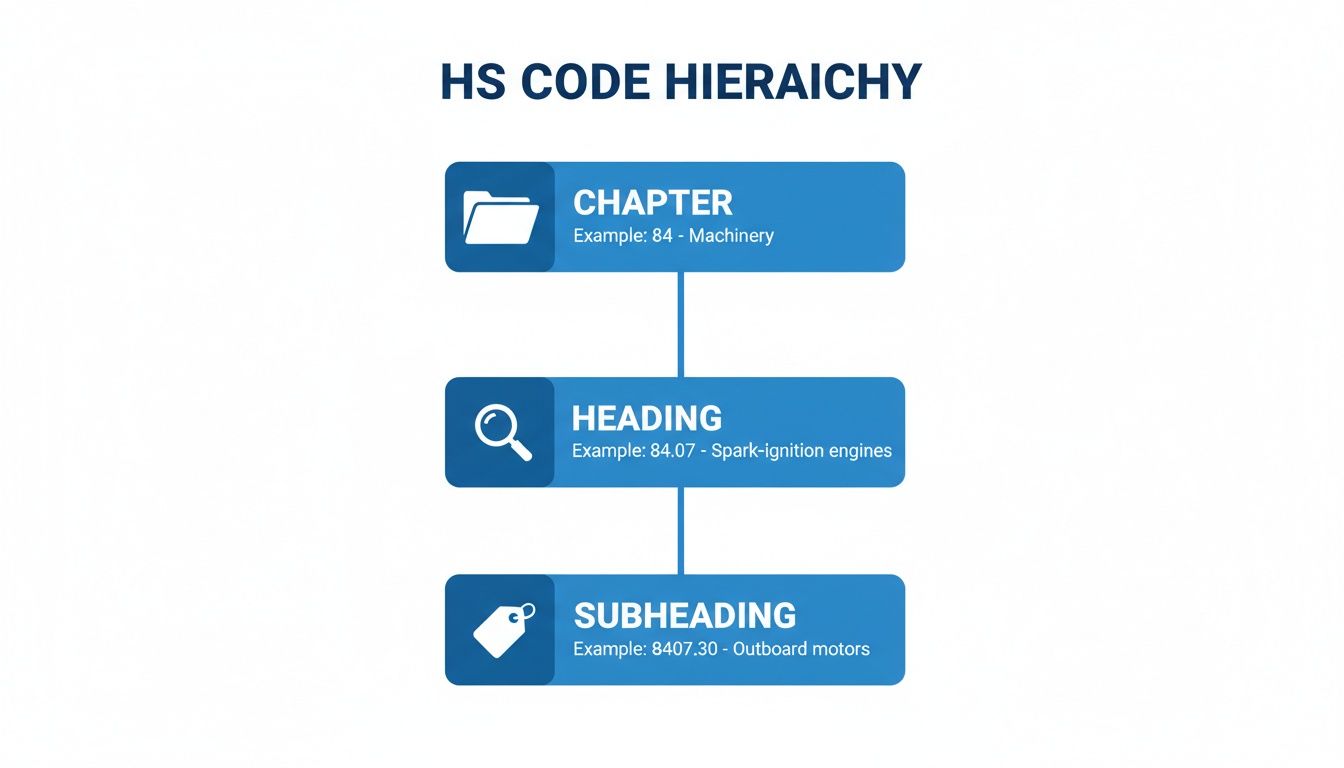
    This diagram shows how the system funnels down from the very general Chapter level to the much more specific Subheading.

    HS Code Hierarchy diagram showing Chapter, Heading, and Subheading levels with examples.

    As you can see, each level drills down further into the product's identity, making sure the classification is spot on.

    Let’s walk through the classification of a simple men's knitted cotton T-shirt to see how this plays out in the real world:

    1. Chapter (First 2 Digits): The code always starts with the most general category. For clothing, the two chapters you’ll see most often are Chapter 61 (for knitted or crocheted apparel) and Chapter 62 (for woven apparel). Since our T-shirt is knitted, it belongs in Chapter 61.

    2. Heading (Next 2 Digits): This level gets more specific, identifying the type of garment. Inside Chapter 61, Heading 09 is designated for "T-shirts, singlets and other vests, knitted or crocheted." So now, our code is 6109.

    3. Subheading (Final 2 Global Digits): These last two digits of the internationally recognised code specify the material. Subheading 10 is for items "of cotton." That gives us the complete, universal 6-digit code: 6109.10.

    At this 6-digit level, customs authorities in over 200 countries can instantly identify the product as a knitted, cotton T-shirt. It’s a remarkably effective system for standardising global trade and making cross-border communication much smoother.

    Beyond the Global Standard: Country-Specific Digits

    While the first six digits are set in stone internationally, individual countries can add more numbers for their own tariff and statistical needs. This is why you'll often see 8-digit or even 10-digit codes.

    For example, Singapore uses the 8-digit ASEAN Harmonised Tariff Nomenclature (AHTN). These extra digits add another layer of detail, which is often crucial for calculating the precise duty rates. It’s vital to get the full code right, a topic you can explore in our comprehensive https://www.coreties.com/blog/hs-code-book. After all, it's this complete number that ends up on your final customs declaration.

    Finding Common Harmonised Codes for Apparel

    Diving into the world of Harmonised Codes can feel like learning a new language. The good news? For most apparel shippers, a small handful of codes will cover the bulk of your inventory. The single most important thing to get right from the start is the difference between knitted and woven fabrics.

    This one detail determines whether your garment belongs in Chapter 61 or Chapter 62, and it's the first major fork in the road for classification.

    Think of it this way: a knitted garment, like your favourite T-shirt, is made from a single, continuous yarn that’s looped together. This gives it that natural stretch and comfort. On the other hand, a woven garment, like a crisp dress shirt, is made by interlacing multiple yarns at right angles, creating a more structured and rigid fabric.

    Knitted Garments: Chapter 61

    Chapter 61 is the designated home for all apparel that is knitted or crocheted. These items are what we typically associate with casual, comfortable wear because of their inherent flexibility.

    Let's take a standard cotton T-shirt, one of the most shipped clothing items on the planet. Its classification is quite straightforward:

    • Chapter: 61 (Knitted apparel and clothing accessories)
    • Heading: 09 (T-shirts, singlets, and other vests)
    • Subheading: .10 (Of cotton)

    Put it all together, and you get the 6-digit HS code: 6109.10.

    Woven Garments: Chapter 62

    Following the same logic, Chapter 62 covers all apparel made from woven fabrics. These garments, like formal trousers or structured blouses, tend to hold their shape and have less give.

    Consider a pair of women's denim jeans. Denim feels tough and sturdy, but it's fundamentally a woven fabric (a classic twill weave, to be specific). Here's how it breaks down:

    • Chapter: 62 (Woven apparel and clothing accessories)
    • Heading: 04 (Women's or girls' suits, ensembles… trousers)
    • Subheading: .62 (Of cotton, since denim is made from cotton)

    This gives us the 6-digit code 6204.62. Notice how that one detail—knitted vs. woven—completely changes the chapter and the final code.

    In a major trading hub like Singapore, the Harmonised Code system for clothing reflects sophisticated standards that directly affect customs duties and how efficiently your supply chain runs. This material-specific coding is critical. For instance, HS code 6109.10 identifies cotton knitted T-shirts, while 6104.63 is used for synthetic knitted items like yoga leggings.

    Woven clothing is categorised separately. A cotton button-up shirt falls under 6205.20, and women's cotton trousers are specified by 6204.62. Getting these details right influences everything from duty calculations to logistics. You can find more practical insights on how HS codes impact apparel importers on commenda.io.

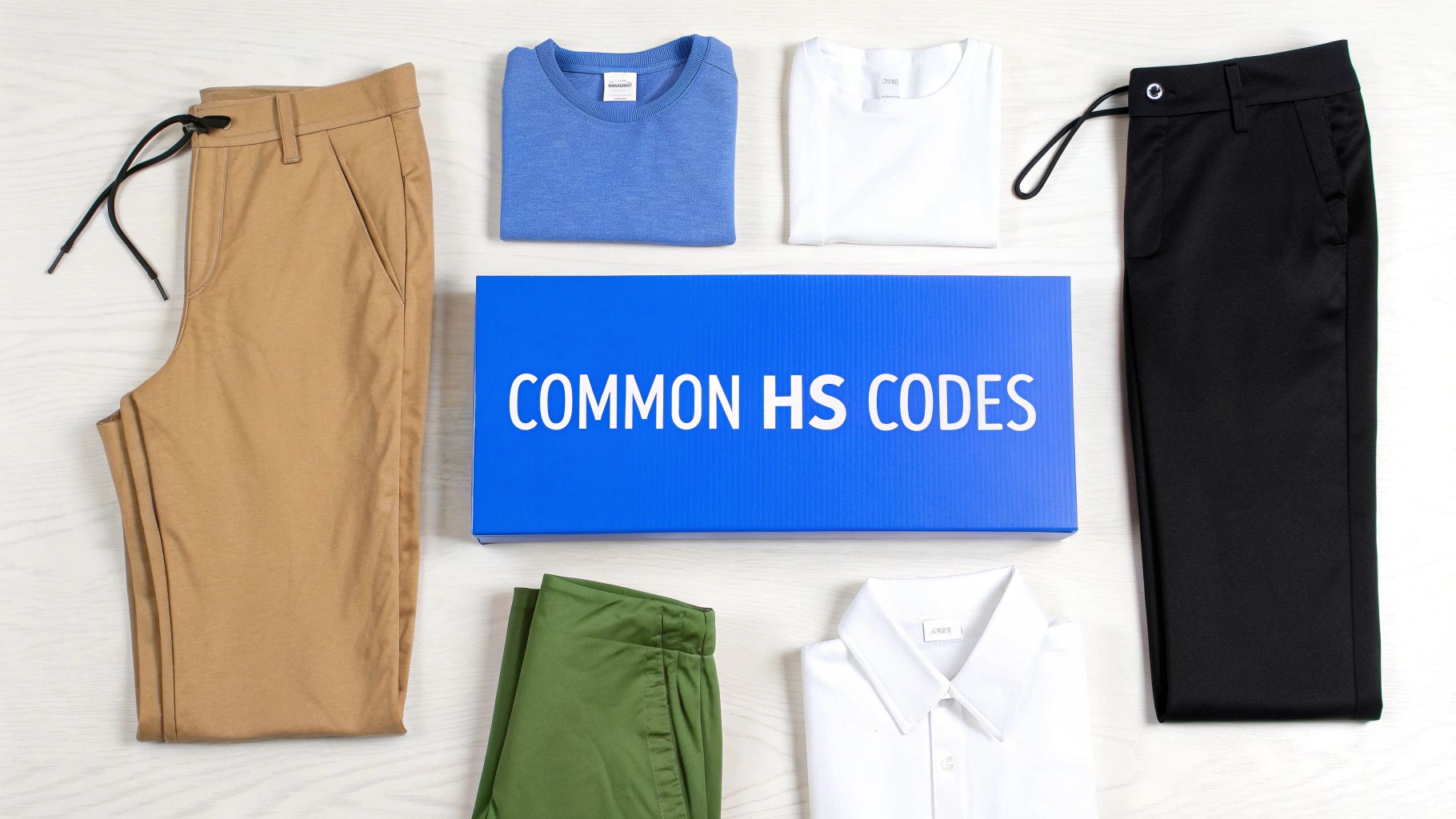
    A flat lay of various clothing items, including pants and shirts, surrounding a blue box labeled 'COMMON HS CODES'.

    To help bring this all together, here is a quick reference guide for some of the most common clothing items you're likely to ship.

    Quick Reference Guide for Common Clothing HS Codes

    This table provides a snapshot of HS codes for frequently imported apparel, showing how they change based on material and construction.

    Clothing Item Material Construction Harmonised Code (Example)
    T-Shirt Cotton Knitted 6109.10
    Yoga Leggings Synthetic Knitted 6104.63
    Men's Dress Shirt Cotton Woven 6205.20
    Women's Trousers Cotton Woven 6204.62
    Sweater/Pullover Man-made Fibres Knitted 6110.30
    Women's Blouse Silk Woven 6206.10

    As you can see, the details matter immensely. While this table is a great starting point, always verify the full code based on your product's specific characteristics.

    Key Takeaway: Always start your classification by asking two simple questions. First, is it knitted or woven? Second, what is the primary material by weight? Answering these two questions correctly will guide you to the right chapter and subheading more than 90% of the time.

    How to Classify Complex and Mixed Garments

    Not every piece of clothing fits neatly into one box. What do you do with a jacket that has a detachable fleece liner? Or a gift set with a shirt and a matching tie? This is where you have to get into the official rulebook for HS codes, the General Rules of Interpretation (GRIs).

    These rules give you a clear, step-by-step method for classifying tricky items, whether they're made of mixed materials, sold as a set, or even incomplete. The official text can be a bit dry, but the logic behind it is pretty simple once you get the hang of it. The main goal is always to find the single HS code that best describes the item as a whole.

    Identifying the Essential Character

    For mixed garments, the most important idea to grasp is the "essential character." This principle helps you decide which component truly defines the product when it’s made from multiple materials or includes several different items packaged together.

    GRI 3(b) is the key here. It says that composite goods should be classified based on the material or component that gives them their essential character. For clothing, this often comes down to the material with the greatest weight, but it could also be about value, bulk, or the component's role in how the item is used.

    Let's take a practical example: a winter coat with a nylon outer shell and a removable wool liner. To classify it, you have to ask what really makes it a "coat." Is it the weather-resistant shell or the warm liner inside? In this case, the nylon outer shell gives the garment its primary function and structure. It's what makes it a coat. So, you'd classify it as a nylon coat, not a wool one.

    Classifying Sets and Unfinished Goods

    The GRIs also have clear instructions for items sold together as a set or for garments that aren't quite finished yet. This prevents goods from being misclassified just because of their packaging or their stage in the production line. If you want to dive deeper into how different materials are classified, our guide on the fabric HS code is a great resource.

    Here’s a quick rundown of how to handle these common situations:

    • Goods Put Up in Sets: Picture a gift box with a woven men's shirt and a matching silk tie. According to GRI 3(b), if these items are packaged together to meet a specific need (like formal wear), you classify the whole set under the HS code for the item that gives it its essential character. The shirt is clearly the main component here, so the entire set takes the HS code for the shirt.

    • Unfinished Garments: What about importing a shipment of suit jackets that are fully stitched but don't have their buttons sewn on yet? GRI 2(a) makes this clear. An item that's incomplete should be classified as the finished product, as long as it has the "essential character" of the complete item. Since it's unmistakably a jacket, you'd use the HS code for a finished suit jacket.

    A Practical Workflow for Verifying HS Codes

    A laptop on a wooden desk displaying an HS verification interface, with a notebook and pen.

    When your shipment’s integrity and bottom line are on the line, misclassifying a harmonised code for clothing just isn't an option. Having a reliable verification process is your best defence against expensive mistakes. This simple workflow takes you from basic product knowledge all the way to official confirmation, ensuring you get it right every time.

    The journey to the correct HS code always starts with the product itself. You simply can't find the right code without knowing the garment inside and out. So, before you even think about looking up a number, your first job is to gather all the essential facts about the apparel.

    Think of this first step as laying the foundation – get it right, and the rest of the process becomes much simpler.

    Step 1: Gather Comprehensive Product Details

    Picture yourself as a detective building a case for a specific HS code. The more evidence you collect, the stronger and more defensible your classification will be. Your goal here is to create a complete profile of your product before you even glance at a tariff schedule.

    Here are the key details you need to have on hand:

    • Primary Material Composition: What’s the exact fabric blend by weight (e.g., 60% cotton, 40% polyester)? This is often the single most critical detail.
    • Construction Method: Is the garment knitted (Chapter 61) or woven (Chapter 62)?
    • Garment Type: What is it, exactly? A T-shirt, a pair of trousers, a jacket, or a blouse?
    • Intended Wearer: Is the item designed for men/boys, women/girls, or infants?

    Once you have this information clearly documented, you’re ready to navigate the official tariff tools with confidence.

    Step 2: Use Official Classification Tools

    With your detailed product profile in hand, it's time to consult the official sources. It's crucial to avoid relying on unofficial charts or outdated lists you might find online. Always go directly to the customs authorities for the most accurate and current information.

    For businesses in Singapore, the go-to resource is the Singapore Customs' HS/CA Product Code Search Engine. This tool lets you search the national tariff schedule to pinpoint the precise 8-digit AHTN code. If you’re verifying codes for international shipments, the WCO Trade Tools platform is an excellent resource for the global 6-digit standard.

    When you absolutely need to be certain—especially for a new or unusual product—consider applying for a Binding Tariff Information (BTI) ruling. This is a legally binding decision from customs that confirms the correct HS code for your specific product. It gives you complete peace of mind and protects you from future classification disputes.

    Following this systematic approach—starting with detailed product analysis, using official databases, and seeking formal rulings when needed—turns what can be a complex task into a straightforward and repeatable process for staying compliant.

    Turn Customs Data into Business Opportunities

    That string of numbers—the harmonised code for clothing—is so much more than a box to tick for compliance. Think of it as a key, one that unlocks a massive, hidden vault of business intelligence. Every single time a container of apparel crosses a border, its HS code gets logged in public customs data. For freight forwarders and logistics pros, this isn't just noise; it's a goldmine for finding highly qualified leads.

    Suddenly, a regulatory headache becomes your secret sales weapon. By zeroing in on specific apparel codes, your team can ditch the generic cold calls and start having conversations with surgical precision. It’s a data-driven way to know a potential client's business inside and out before you even pick up the phone.

    Pinpoint Prospects with Surgical Accuracy

    Let's make this real. Imagine your sales team wants to land new clients who import women's blouses. Instead of casting a wide, hopeful net, they can filter customs data for a specific harmonised code like 6206.10 (women's or girls' blouses of silk). Instantly, they have a list of companies actively bringing that exact product into the country.

    This is the kind of detail that gives you a serious competitive edge. You're no longer guessing—you can see:

    • Who is importing: Get the actual names of companies buying specific types of clothing.
    • What they import: Understand their niche, whether it’s cotton T-shirts or high-end synthetic activewear.
    • Where they source from: See their key trade lanes and the countries they rely on for supply.

    This information transforms your sales pitch. The conversation shifts from a generic, "Do you ship apparel?" to a highly targeted, "I noticed you're bringing in woven trousers from Vietnam, and we happen to run a strong lane consolidation service out of Ho Chi Minh City."

    Customs data isn't just about finding names; it's about understanding needs. It reveals shipping volumes, trade lane frequency, and sourcing patterns, giving you the context to position your services as the perfect solution to their specific logistical challenges.

    Get a Competitive Edge with Trade Data

    Digging into import data also shines a light on the most lucrative trade corridors for your sales team to focus on. Take Singapore's apparel import market in 2023 as an example. The data shows clear, concentrated activity from specific regions. The nation imported apparel and accessories valued at $4,311.43K, with China dominating as the top supplier at $999.66K. This kind of intelligence tells you exactly which trade lanes are hot. You can explore more about Singapore's import statistics on wits.worldbank.org.

    When you build this data into your workflow, you create a prospecting machine that consistently surfaces warm leads. Platforms built for freight forwarders are designed to help you slice and dice this information effectively. You can learn more about how to use an HS code filter to find qualified shipper leads in our detailed guide. It's how a simple harmonised code can lead you straight to your next big client.

    Common Questions About Clothing HS Codes

    Even with the system laid out, you're bound to run into some tricky situations when classifying clothing. It happens to everyone. Let's tackle some of the most common questions that pop up for shippers and forwarders day in and day out.

    What Happens If I Use the Wrong Harmonised Code?

    Getting the code wrong can create a real mess, fast. At best, your shipment gets stuck at the border, leading to delays, unhappy customers, and extra storage fees you hadn't budgeted for.

    But the bigger problem is the money. An incorrect code means you're paying the wrong amount of duty and tax. If you underpay, you can expect penalties from customs. If you overpay, you're just giving money away. Repeated mistakes can also get you flagged, meaning customs will scrutinise all your future shipments much more closely.

    How Do I Classify an Item Made from Blended Materials?

    Ah, the classic blend question. This is where the General Rules of Interpretation (GRIs) come into play. The guiding principle here is to classify the garment based on the material that gives it its "essential character."

    For most clothing, this simply comes down to weight. If you have a shirt that's 60% cotton and 40% polyester, it’s classified as a cotton shirt. The cotton dictates its character.

    Do Children's Clothes Need a Different Code Than Adult Clothes?

    They certainly do. The HS system carves out specific categories for men's or boys' wear versus women's or girls' apparel. You'll also find dedicated codes just for infants' clothing. It’s absolutely vital to dig into the descriptions within Chapters 61 and 62 to make sure you're matching the code to the right age and gender.


    Trying to find and double-check these codes in global trade data can feel like a huge task, but this is exactly where Coreties can help. Our platform lets freight forwarders search customs data using specific HS codes to find qualified shipper leads. We turn what looks like a compliance headache into a genuine business opportunity. Find your next client at https://coreties.com.

  • A Guide to Auto Parts HS Code Classification

    A Guide to Auto Parts HS Code Classification

    Think of an auto parts HS code as a universal passport for car components. It's a specific number used by customs authorities everywhere to identify and categorise automotive parts when they cross borders. This simple code is what tells them if they're looking at a shipment of engines, brake pads, or wing mirrors, ensuring everything gets taxed and processed correctly.

    The Universal Language of Automotive Shipping

    Warehouse worker inspecting auto parts and paperwork, with a clear sign advising to avoid customs delays.

    Picture a shipping container packed with thousands of different auto parts pulling into port. Without a common system, customs officials would be completely overwhelmed. The result? Gridlock, incorrect duty payments, and seriously unhappy importers. This is exactly why the Harmonized System (HS) code is so critical. It’s the shared language that keeps the global automotive supply chain running smoothly.

    For anyone in freight forwarding, getting a handle on the auto parts HS code system isn't just about ticking a box. It's a genuine competitive edge. When you can classify a client's shipment with confidence—be it a pallet of spark plugs or an entire transmission—you're preventing a logistical nightmare before it even begins.

    Turning Compliance into Opportunity

    Getting the classification wrong is one of the most common pitfalls in international shipping. A tiny mistake can snowball into big problems.

    • Costly Delays: A shipment can get stuck in customs for weeks while officials inspect and re-classify it, throwing a major spanner in just-in-time production schedules.
    • Unexpected Fines: Customs agencies don't take kindly to inaccurate declarations. They hit you with hefty penalties that eat into profits for everyone involved.
    • Damaged Client Trust: Nothing kills a business relationship faster than a surprise customs bill or a production line grinding to a halt because a container is held up. The forwarder is expected to get this right. To dig deeper, you can learn about the crucial role of the Importer of Record and how it shapes these responsibilities.

    When you truly understand the logic behind HS codes, you stop being just a paper-pusher and become a strategic advisor. You're the expert who guides clients through the regulatory maze, making their supply chain reliable and predictable.

    A Strategic Tool for Growth

    It's not just about avoiding trouble, either. A solid grasp of the auto parts HS code system is a powerful tool for growing your business. The automotive industry is a huge, valuable market, but it’s notoriously complex. Freight forwarders who can prove they know this niche inside and out are the ones who land the best accounts.

    By looking at customs data, you can see which companies are moving specific auto components and map out their trade flows. This gives you the intel to approach potential clients with solutions that actually solve their problems, demonstrating your value before you even talk about a contract. In a crowded market, that’s the kind of insight that separates a basic logistics provider from a true supply chain partner.

    How an Auto Parts HS Code Is Structured

    Man examining auto parts HS Code structure on a tablet, with '8708-40' and '87 8708' displayed.

    An auto parts HS code isn't just a string of random numbers. It’s more like a product's postal code, guiding it through the global trade system. Each pair of digits adds another layer of detail, starting broad and getting more specific. This clever system is what allows customs officers in Singapore, the United States, and over 200 other countries to understand exactly what’s inside a shipment.

    The foundation of the entire system is a globally standardised six-digit code. This ensures that a set of brake pads is identified as brake pads, no matter where it's coming from or going to. Many countries, including Singapore, then append extra digits—creating an eight, ten, or even twelve-digit code—to get more granular data for their own tariff and statistical needs.

    Breaking Down the Code Anatomy

    Think of an HS code as a top-down hierarchy. You start with a huge category and progressively narrow it down until you pinpoint the exact product. It’s a logical flow from the general to the very specific.

    • The First Two Digits (Chapter): This is the broadest category. For almost any vehicle or part you can think of, you'll start with Chapter 87: "Vehicles other than railway or tramway rolling-stock, and parts and accessories thereof."
    • The Next Two Digits (Heading): These digits zoom in on a specific group within that chapter. For instance, Heading 87.08 is designated for "Parts and accessories of the motor vehicles of headings 87.01 to 87.05."
    • The Final Two Digits (Subheading): This is where we get the most specific detail recognised internationally. Subheading 8708.40, for example, clearly identifies "Gear boxes and parts thereof."

    So, the code 8708.40 is the universal language for gearboxes. Any digits that follow are country-specific modifications for local customs and tax purposes.

    The Guiding Principles of Classification

    This whole structure is held together by a crucial set of rules that ensure everyone applies the codes consistently. These are the General Interpretative Rules (GIRs), and they are the ultimate referee when a product could potentially fit into more than one category.

    The General Interpretative Rules (GIRs) are the legal backbone of the Harmonized System. They provide a clear, step-by-step process for classifying goods, making sure the HS code is applied uniformly everywhere. This consistency is vital for preventing customs disputes and keeping global trade moving smoothly.

    Getting to grips with the GIRs is non-negotiable for anyone serious about customs compliance. They provide the "why" behind every classification, explaining how to handle everything from a simple gasket to a sophisticated electronic control unit.

    The World Customs Organization (WCO) is the international body that maintains and updates the Harmonized System. Their work ensures the system stays relevant, adapting to new technologies and changes in global trade patterns.

    A Practical Example: Brake Pads

    Let's see how this works in practice with a common part: a set of brake pads.

    1. Chapter: We know brake pads are for vehicles, so we start at the broadest level: Chapter 87.
    2. Heading: We then look for the right group, which is parts and accessories. That leads us to 87.08.
    3. Subheading: Finally, we drill down to the specific entry for braking systems. Subheading 8708.30 covers "Brakes and servo-brakes; and parts thereof."

    And there you have it. The universal HS code for brake pads is 8708.30. This simple, logical progression is what makes classifying any auto parts HS code a straightforward process once you understand the structure.

    A Practical Guide to Common HS Codes for Auto Parts

    Trying to make sense of the giant Harmonized System catalogue can feel like a losing battle. But here's a secret from the pros: for most car part shipments, you'll be using the same core set of codes over and over again.

    The trick isn't to memorise a long, random list. Instead, think like an engineer and group parts by their vehicle system. This simple mental shift helps you anticipate the right classification and find the correct auto parts HS code much faster. When you start categorising parts by powertrain, chassis, or electrical systems, you’ll begin to see the underlying logic of the HS system.

    Engine and Powertrain Components

    The engine is the heart of the vehicle, and these valuable components have very specific HS headings. It's absolutely crucial to know the difference between the engine itself and the parts that help it deliver power, as customs authorities classify them in completely different chapters.

    For instance, a complete spark-ignition (petrol) engine is classified under heading 8407. A compression-ignition (diesel) engine? That goes under heading 8408. Notice these are in Chapter 84, which is for machinery, not Chapter 87 for vehicles. This is a classic stumbling block that catches a lot of people out.

    Once you move to the parts that transmit power from the engine to the wheels, you're generally back in Chapter 87. Here are the heavy hitters for powertrain systems:

    • 8708.40: This is your go-to for gearboxes (transmissions) and all their internal bits.
    • 8708.50: Covers drive-axles with differentials, the components that actually make the wheels turn.
    • 8708.93: A specific code just for clutches and their related parts.

    Getting this split right—Chapter 84 for the engine, Chapter 87 for the drivetrain—is one of the most fundamental rules for accurate auto part classification.

    Chassis and Suspension Systems

    The chassis and suspension are the vehicle's skeleton, giving it structure, steering, and a smooth ride. Almost all of these parts live under the main heading 8708, but they are broken down into very specific subheadings based on what they do.

    Road wheels, whether they're fancy alloy rims or basic steelies, are classified under subheading 8708.70. The suspension system, which includes vital parts like shock absorbers and struts, gets its own dedicated code: 8708.80.

    One of the most common and easily identified categories is the braking system. Brake pads, callipers, rotors, and servo-brakes all fall neatly under a single, specific subheading: 8708.30. If you're in the auto logistics game, you'll be seeing this number a lot.

    Pinpointing the correct code here is vital. A simple mix-up between a steering part and a suspension part could lead to paying the wrong duties and flagging your shipment for a customs inspection.

    Body and Exterior Parts

    This category is for everything that gives a car its distinctive shape and protects the people inside, from large body panels down to the smallest fittings. Unsurprisingly, most of these parts are also found within the broad heading 8708.

    The specific code you use often depends on the part's function and where it sits on the vehicle.

    • 8708.10: Reserved specifically for bumpers and their parts.
    • 8708.29: This is a broader category for other body parts and accessories, covering things like doors, bonnets (hoods), and mudguards.
    • 7007.11 / 7007.21: Here’s a major exception. Windscreens and other safety glass are classified under Chapter 70 (glassware), not Chapter 87.

    This last point drives home a critical rule in HS classification: sometimes, what a part is made of is more important than what it's used for. Always double-check the chapter notes to be sure.

    Electrical Systems and Lighting

    Modern cars are rolling computers, packed with complex electronics. This is an area where you have to be precise with your classification. The HS system draws a clear line between lighting, ignition systems, and other electronic bits.

    Lighting and visual signalling equipment, like headlamps, tail lights, and indicators, fall under subheading 8708.91.

    However, electrical ignition and starting equipment—think alternators, starter motors, spark plugs, and ignition coils—are classified under heading 8511. Just like engines, these parts belong to a different chapter (Chapter 85 for electrical machinery) because their primary identity is electrical, not just automotive.

    To help you keep track, here is a quick reference table summarising some of the most common classifications.

    HS Code Quick Reference for Common Auto Parts

    This table provides a snapshot of key HS headings and subheadings for frequently shipped automotive components, organised by the vehicle system they belong to.

    Vehicle System Component Example HS Heading/Subheading Description
    Powertrain Petrol Engine 8407 Spark-ignition reciprocating or rotary internal combustion piston engines.
    Powertrain Diesel Engine 8408 Compression-ignition internal combustion piston engines (diesel or semi-diesel engines).
    Powertrain Gearbox / Transmission 8708.40 Gearboxes and parts thereof.
    Chassis Brakes 8708.30 Brakes and servo-brakes and parts thereof.
    Chassis Wheels & Rims 8708.70 Road wheels and parts and accessories thereof.
    Chassis Suspension 8708.80 Suspension systems and parts thereof (including shock absorbers).
    Body/Exterior Bumpers 8708.10 Bumpers and parts thereof.
    Body/Exterior Doors, Bonnets 8708.29 Other parts and accessories of bodies (including cabs).
    Electrical Headlamps, Tail Lights 8708.91 Radiators and parts thereof.
    Electrical Alternators, Starter Motors 8511 Electrical ignition or starting equipment, generators (dynamos, alternators).
    Miscellaneous Exhaust Pipes, Brackets 8708.99 Other parts and accessories of the motor vehicles of headings 8701 to 8705.

    Think of this table as a starting point, not a substitute for proper research. It’s a great way to familiarise yourself with the key codes you'll encounter day-to-day.

    The Critical Catch-All Code: 8708.99

    So, what happens when you have a part that doesn't seem to fit anywhere? This is where the infamous "other" category comes in: 8708.99. It's easily one of the most widely used—and misused—codes in the entire auto parts sector.

    This code is the designated home for a huge range of miscellaneous parts that don't have their own specific subheading. This could be anything from exhaust pipes to simple mounting brackets that are clearly for automotive use.

    While it’s a necessary code, leaning on 8708.99 too often is a major red flag for customs. It can look like the classifier didn't bother to find the correct, more specific code. Before you ever settle on this catch-all number, make absolutely sure you’ve ruled out every other possibility, and be ready to show detailed product information to defend your choice.

    A Step-by-Step Method for Classifying Auto Parts

    Knowing the common codes is a great start, but real expertise comes from mastering the classification process itself. This isn't just about looking up a number in a book; it's about methodically building a defensible case for your chosen auto parts HS code. When you have a logical, repeatable process, what seems like a confusing task becomes a straightforward quality check.

    The whole journey begins long before you even glance at a tariff schedule. First, you need to become an expert on the specific part in front of you. This means gathering much more than just a name or a part number.

    Gather Your Essential Product Intel

    Think like a detective. Your first job is to build a complete file on the auto part. This documentation is your evidence, proving why a specific HS code is the right one. Without it, you’re essentially just guessing.

    You'll need to lock down a few key pieces of information:

    • Primary Function: What does the part actually do in the vehicle? Is it for braking, steering, or maybe engine timing? Its core purpose is a massive clue.
    • Material Composition: Is it made of steel, aluminium, rubber, or a specialised composite? Sometimes, the material can be the deciding factor, even over its function.
    • Technical Specifications: Get your hands on datasheets, blueprints, or engineering diagrams. These documents often hold the granular details that customs officials need to see.

    This decision tree gives you a bird's-eye view of where to start, helping you narrow down your search from the major vehicle system.

    A decision tree flowchart for diagnosing auto part systems, covering powertrain, chassis, and body issues.

    Think of this as a way to filter your options. By starting at the broadest level—like Powertrain or Chassis—you can quickly drill down into specific components and streamline your initial research.

    The Classification Journey: A Real-World Example

    Let's walk through the process with a common item: a set of four 18-inch aluminium alloy road wheels for a passenger car.

    1. Identify the Correct Chapter: We know the wheels are for a vehicle, so our immediate starting point is Chapter 87, which covers vehicles and their parts. Simple enough.
    2. Select the Right Heading: Within Chapter 87, we need to find the specific heading for parts and accessories. A quick scan leads us directly to Heading 87.08, which is for "Parts and accessories of the motor vehicles…"
    3. Narrow to the Precise Subheading: Now for the final detail. We skim the subheadings under 87.08 until we find 8708.70, which is explicitly for "Road wheels and parts and accessories thereof." It’s a perfect match.

    The final six-digit international HS code is 8708.70. This logical progression, backed by what we know about the product's function (a road wheel) and material (alloy), gives us a high degree of confidence.

    Of course, this was a straightforward example. More complex components, especially in electrical systems, often require a much deeper analysis. You can see a similar detailed breakdown in our guide to classifying the cable HS code.

    The most important habit you can build is documenting your rationale. Write down why you chose Chapter 87, then Heading 87.08, and finally Subheading 8708.70. This "classification justification" is invaluable if a customs authority ever questions your decision.

    Leveraging Online Tools and Databases

    Thankfully, you don't have to do this with a dusty, printed manual anymore. Modern classification relies on powerful online tools that speed up the process and boost accuracy.

    National customs websites, like those from Singapore Customs, offer searchable tariff databases. These are your ultimate source of truth for country-specific codes and duty rates.

    Using these tools effectively is key. Start by searching with broad terms ("wheel," "brake pad") and then use the technical details you gathered earlier to refine your search. This data-driven approach not only helps find the right code but also prepares you for validation. This is particularly relevant in major trade hubs; for instance, Singapore's motor vehicle parts exports hit S$400 million in 2023, with a huge portion classified under the general HS code 8708.99 for non-specified parts. This shows just how critical precise classification is to avoid falling back on generic codes.

    Documenting your choices clearly is the best way to ensure compliance and avoid costly shipping delays.

    Using Shipment Data to Find and Validate HS Codes

    Getting the theory right is one thing, but the best freight forwarders I know always back up their classifications with real-world data. Digging into global customs and shipment records is what takes you from simply following the rules to making truly confident, data-driven decisions about the right auto parts HS code.

    This is your ultimate reality check. Instead of relying solely on your own interpretation of the tariff book, you can see exactly which HS codes major car manufacturers and their top suppliers are using for the same components, day in and day out. It’s an incredibly powerful way to build confidence in your own work.

    Turning Data into Commercial Intelligence

    This goes way beyond just checking your work. Shipment data is a goldmine for business development. It can transform a routine compliance task into a powerful source of real, actionable intelligence. By slicing and dicing trade data, you can instantly see who’s exporting or importing the specific auto parts you handle.

    For instance, you could run a quick search for shipments under HS code 8708.40 (gearboxes) or 8511 (electrical starting equipment). In minutes, you’ll have a targeted list of high-potential leads. Your sales team can stop making cold calls and start having meaningful conversations with companies that are already moving the exact products you specialise in.

    Think of it as a strategic map of the automotive supply chain. By tracking the flow of goods under specific HS codes, you can identify key players, understand trade lane volumes, and pinpoint exactly where your logistics services are most needed.

    This method gives you a serious competitive edge. You can walk into a conversation with a potential client already knowing what they ship, where they ship it, and how often they do it. For a closer look at the local rules that govern this data, check out our complete guide on Singapore customs HS codes.

    A Practical Example of Data-Driven Prospecting

    You can see how powerful this gets when you look at actual market trends. Singapore's auto parts exports, for example, have seen incredible growth, expanding by 51% in a recent 12-month period with over 3,100 recorded shipments. This boom underscores the city-state's role as a key automotive hub, with major shipments heading to Peru, Indonesia, and the United States. You can see more on this booming trade on cypherexim.com.

    So, what does a smart freight forwarder do with that information?

    1. Isolate the Data: Filter Singapore’s export records to focus on high-demand parts like batteries and electronics, which have their own specific HS codes.
    2. Identify Key Shippers: Pull a list of the top companies exporting these components out of Singapore.
    3. Craft a Targeted Pitch: Reach out with a compelling offer, referencing their specific trade lanes and highlighting your expertise in handling sensitive, high-value electronics.

    This data-driven approach completely changes the conversation. It’s no longer, "Can we ship for you?" It becomes, "We see you're moving a lot of electronics to the US, and we have a specialised solution that could make that process a lot smoother for you."

    How to Leverage Data Tools Effectively

    To put this all into practice, you'll need access to a good trade intelligence platform. These tools pull together millions of customs records from around the world into a single, searchable database.

    When you’re using one of these platforms, here are a few practical steps to find and validate any auto parts HS code:

    • Search by Product Description: This is the most straightforward method. Type in a component like "shock absorber" or "alternator" and see which HS codes are most commonly used by other shippers.
    • Analyse a Specific Company: Pick a major automotive brand you trust and pull up their bill of lading records. See how they classify their parts—it’s a great way to benchmark your own decisions.
    • Prospect by HS Code: Flip the process around. Search for a specific HS code to generate a prospect list of companies that are actively trading those goods.

    By weaving shipment data into your everyday workflow, you build a classification process that is not only more accurate but also commercially valuable. It's the difference between guessing and knowing.

    How to Avoid Common Classification Mistakes

    Even the most experienced logistics pros can get tangled up in the finer points of the auto parts HS code system. What seems like a tiny oversight can quickly snowball into hefty customs fines, infuriating shipping delays, and unhappy clients. Getting a handle on the most common slip-ups is the first real step toward building a supply chain that's both efficient and compliant.

    These aren’t just obscure technicalities; they're everyday mistakes that happen because modern vehicles are just so complex. By learning to spot these potential problems ahead of time, you can guide your clients and help them sidestep expensive disruptions before they even start.

    Misclassifying Kits and Sets

    One of the most common mistakes I see is lumping a 'kit' of parts into one classification. Think of a standard maintenance kit that comes with an oil filter, an air filter, and a few spark plugs. It's not a single item in the eyes of customs. Each of those components has its own specific HS code and needs to be declared individually.

    As a rule of thumb, if the parts can be sold and used on their own, they almost always need their own HS code. Trying to bundle them under one generic code is a huge red flag for customs officials and often leads to re-classification and penalties.

    The only real exception is a true 'set put up for retail sale', which has a very strict definition under the General Interpretative Rules. If you're ever in doubt, it’s always safer to break the kit down and classify each part separately.

    Confusing General Use vs. Specific Use

    Another easy trap to fall into is mixing up a general-use part with one made specifically for a vehicle. Take a standard M8 bolt. Even if it's headed straight for a car engine assembly line, it's still just a bolt. It gets classified under Chapter 73 (Articles of Iron or Steel) as a generic fastener.

    Its primary identity, according to the Harmonized System, is simply as a bolt, not an automotive part. The classification only shifts if the part has been designed, moulded, or engineered in a way that it can only be used on a motor vehicle. It's a subtle difference, but a critical one that often requires technical drawings to prove.

    • General Use: A standard-issue bolt that happens to be used in a car. It’s classified as a bolt.
    • Specific Use: A custom-moulded engine bracket that only fits one specific car model. It’s classified as an auto part.

    This distinction really drives home why you need to understand a part’s design and function—not just its name—to nail down the correct auto parts HS code.

    Frequently Asked Questions

    When you're dealing with auto parts HS codes day in and day out, a lot of practical questions pop up. Getting the right answers can be the difference between a shipment that sails through customs and one that gets stuck in a costly delay. Let’s tackle some of the most common questions we hear.

    How Often Do Auto Parts HS Codes Change?

    Think of the Harmonized System as a living document. The World Customs Organization (WCO) does a major overhaul every five years to keep up with new technologies and global trade shifts. That's the big one.

    But here’s the tricky part: individual countries can tweak their own tariff schedules much more often. To avoid getting caught out, you need to keep a close eye on the official customs websites for your destination countries. A good practice is to subscribe to their updates or use a solid trade intelligence platform that automatically keeps its code database current.

    What Should I Do If Customs Disputes My HS Code?

    It happens. If a customs agent flags your chosen auto parts HS code, don't panic. Your first move is to back up your classification with solid proof. Pull together everything you have: product spec sheets, technical diagrams, and a clear, written explanation of how you arrived at that code using the General Interpretative Rules (GIRs).

    If they still don't agree, you can file a formal appeal. For a more permanent solution, consider applying for a binding ruling from the importing country's customs authority. This gives you a legally-backed confirmation of the correct code for that specific part, which is invaluable for future shipments.

    A binding ruling is the ultimate safety net. It provides legal assurance from customs that your classification is correct, effectively ending any potential for future disputes on that specific item.

    How Do I Classify a Used or Remanufactured Auto Part?

    This is a common point of confusion, but the rule is actually quite simple. Used and remanufactured parts are almost always classified under the same HS code as the brand-new version. The code is based on what the part is and what it does, not its age or condition.

    That said, you must be transparent about the part's condition and value on your commercial invoice and other documents. This is critical for customs to assess the right duties and taxes. Always double-check the rules for your destination country, as some have specific import regulations or licensing requirements for used goods.


    Finding and reaching out to qualified shippers is simpler with the right tools. Coreties transforms global trade data into targeted lead lists, helping you connect with the right decision-makers in just a few clicks. Discover your next customer.

  • A Logistics Pro’s Guide to the Singapore Customs HS Code

    A Logistics Pro’s Guide to the Singapore Customs HS Code

    For any freight forwarder in Singapore, a single 8-digit number can make or break a shipment. That number is the Singapore Customs HS code, and it governs everything from import duties to how quickly your cargo clears customs. Getting this right isn't just about ticking a compliance box; it's a strategic move that turns customs know-how into a real advantage for your business.

    Getting to Grips with the Singapore HS Code System

    If you're moving goods in and out of Southeast Asia, the Singapore Harmonized System (HS) code is your starting point for every single shipment. Think of it less as a random string of numbers and more as a universal language for classifying products. It’s what ensures a pallet of running shoes is identified the same way in Singapore as it is in Spain or South Africa. It’s the logistics world’s equivalent of the Dewey Decimal System—a logical framework for the chaos of global trade.

    While it’s built on a global standard, Singapore adds its own layer of detail, which is something every forwarder needs to master.

    The Code's Layered Structure

    The HS code is built like a pyramid, starting broad at the top and getting much more specific as you go down. Singapore Customs uses an 8-digit framework known as the ASEAN Harmonised Tariff Nomenclature (AHTN). The first six digits are the global standard set by the World Customs Organization, but Singapore adds two more to provide greater detail for regional trade.

    This 8-digit system is what you’ll use for all trade declarations through TradeNet. Nailing the correct code is what helps Singapore process an incredible 99% of permits within just 10 minutes.

    Let's break down what those numbers actually mean.

    Breaking Down the Singapore HS Code Structure

    This table shows how each part of the 8-digit code adds another layer of detail, using a motor car as an example.

    Code Digits Level of Specificity Example (Motor Car)
    87 Chapter: Vehicles other than railway or tramway rolling-stock Vehicles
    8703 Heading: Motor cars and other motor vehicles Motor Cars
    8703.23 Subheading: Of a cylinder capacity exceeding 1,500 cc but not exceeding 3,000 cc Car > 1,500 cc
    8703.23.90 AHTN Code: Other Other cars > 1,500 cc

    As you can see, the code drills down from a general category (vehicles) to a very specific classification.

    A classic rookie mistake is just using the 6-digit code a supplier sends over from overseas. For any shipment coming into Singapore, you absolutely must use the full 8-digit AHTN code. Anything less is a surefire way to get your shipment flagged for inspection.

    Why Freight Forwarders Must Master This

    For a freight forwarder, fluency in the Singapore Customs HS code isn't optional—it's central to your job. It directly impacts your bottom line and your client relationships, shifting your role from a simple carrier to a strategic partner.

    Here’s where it makes a tangible difference:

    • Spot-On Costing: The right code lets you calculate the exact duties and Goods and Services Tax (GST). This means you can give clients airtight quotes without any nasty surprises when the invoice arrives.
    • Quicker Clearances: When your declarations are accurate from the start, shipments fly through customs. This keeps your delivery schedules on track and your clients happy.
    • Avoiding Penalties: Let’s be blunt: misclassification can lead to hefty fines, seized goods, and a damaged reputation. Getting the code right protects your business and your client from serious financial and operational headaches.

    Ultimately, becoming an expert in the Singapore Customs HS code is what separates a good freight forwarder from a great one. This skill doesn't just keep operations running smoothly; it gives you valuable insights into trade patterns that can help you find new customers. If you want to learn more, you can dive deeper into the strategies for growing your import-export business with our detailed guide.

    How to Find and Verify the Correct HS Code

    Nailing the right Singapore Customs HS code from the get-go is non-negotiable. Get it wrong, and you’re looking at costly delays, surprise inspections, and fines—a conversation no freight forwarder wants to have with a client. Luckily, Singapore Customs gives you some solid tools to find and double-check the right 8-digit code for just about any product.

    Your first stop should always be the official Singapore Customs HS/CA Product Code Search Engine. This free portal is the single source of truth for classifying goods in Singapore. Getting comfortable with this tool is the difference between guesswork and confident declarations.

    Navigating the TradeNet Search Portal

    The search engine lets you hunt for codes using keywords or by drilling down through the tariff schedule. The trick is to think like a customs officer. Use precise, technical terms, not brand names or marketing fluff.

    For example, searching for "smartphone" is okay, but you'll get much closer to the official terminology with "mobile telephone." Always consider the product's main function and what it's made of.

    This is what the TradeNet portal looks like—it’s built for speed, letting you plug in keywords or browse by chapter to zero in on the right classification.

    Flowchart illustrating the global HS code hierarchy and its application for Singapore customs tariffs.

    As you can see, the HS code structure is hierarchical. It starts with the global WCO standard and gets more specific for Singapore's AHTN code, with each digit adding another layer of detail.

    Tips for an Effective Search

    What happens when a product could plausibly fit into a few different categories? It’s a common problem. Here’s how to cut through the confusion and find the correct HS code.

    • Get Specific: Instead of a generic term like "plastic bottle," try "polyethylene bottle for cosmetics." Adding details about the material and its intended use makes a huge difference.
    • Read the Chapter Notes: Every HS chapter comes with legal notes that define terms and lay out classification rules. These notes are your best friend when you're stuck.
    • Think Function First: The General Interpretative Rules (GIRs) are clear: a product's main purpose or "essential character" is what usually determines its classification. What does the item do?

    A classic pitfall is classifying product 'sets' or 'kits'. Take a grooming kit with scissors, a comb, and electric clippers. You don't classify each item separately. Instead, you have to decide which item gives the kit its essential character. In this case, customs rules would almost certainly point to the electric clippers (HS 8510).

    Verifying Your Code with Classification Rulings

    Once you think you've found the right HS code, your job isn't done. The next step is verification. Never assume the first code you land on is correct, especially for complex or new-to-market products.

    This is where you turn to Singapore Customs’ Classification Rulings database. It’s a public library of legally binding decisions that customs has already made on specific products. If someone has imported something similar before, a search here can give you a definitive answer.

    The TradeNet HS/CA Search Engine is a workhorse, processing over 2 million lookups a year and flagging controls for roughly 15% of goods. To back this up, the Classification Rulings database is growing by 20% annually and is on track to exceed 10,000 entries, making it an indispensable tool for tricky classifications.

    Still not 100% sure after checking the search engine and the rulings database? Your safest move is to apply for an official Classification Ruling from Singapore Customs. This gives you a legally binding HS code for your product, offering total certainty and protecting you from compliance headaches. It takes time, but for high-value or unusual shipments, it's the smartest way to manage risk.

    For an extra layer of research, you can also explore our extensive database of Singapore HS codes to cross-reference what you've found.

    Calculating Tariffs, Duties and GST

    Once you’ve locked in the correct 8-digit Singapore Customs HS code, you can finally translate that string of numbers into its real-world financial impact. This code is the key to figuring out the exact tariffs, customs duties, and Goods and Services Tax (GST) your shipment will attract when it lands.

    Getting this calculation right is non-negotiable for freight forwarders. It’s the foundation for providing accurate quotes and, frankly, for building trust with your clients.

    A calculator, cardboard box, and laptop on a desk with a 'LANDED COST' sign, illustrating cost calculation for goods.

    The very first question to answer is whether the goods are dutiable. Singapore is famous for its pro-trade policies, which means the vast majority of imported goods aren't subject to customs duties at all. Only four very specific categories are.

    Identifying Dutiable Goods

    In Singapore, duties are only charged on a small, select group of products, mostly for social or environmental reasons. The list is short and sweet:

    • Intoxicating liquors (like beer, wine, and spirits)
    • Tobacco products (cigarettes, cigars, etc.)
    • Motor vehicles (including cars and motorcycles)
    • Petroleum products and biodiesel blends

    For literally everything else—from electronics and apparel to heavy machinery—you only need to worry about GST. This simplifies things for most shipments, but it also raises the stakes for getting it right when you are handling one of these dutiable items.

    Calculating the Total Landed Cost

    To give a client a quote they can count on, you need to calculate the total landed cost. This isn’t just the price of the goods; it’s everything combined—logistics fees, insurance, and taxes. The two main components from Singapore Customs are customs duty (if it applies) and GST.

    As of 1 January 2024, the GST is set at 9%. It’s a broad-based tax that applies to nearly every single thing imported into Singapore.

    Here's the detail that trips people up: GST is calculated on the CIF value (Cost, Insurance, and Freight) plus any customs duty you’ve already paid. You don't just take 9% of the invoice value; you have to add the duty to the base amount first.

    Let's walk through a real-world example. Imagine you're importing a consignment of French wine.

    Scenario A: Dutiable Goods (Wine)

    • CIF Value of Goods: S$15,000
    • Customs Duty Rate (Example): S$88 per litre of alcohol
    • GST Rate: 9%

    The Calculation Breakdown

    1. Calculate Customs Duty: Let’s say the shipment has 100 litres of alcohol. The duty is 100 L x S$88/L = S$8,800.
    2. Calculate GST: Now, you add the duty to the CIF value before calculating GST. (S$15,000 + S$8,800) x 0.09 = S$2,142.
    3. Total Taxes Payable: S$8,800 (Duty) + S$2,142 (GST) = S$10,942.

    Now, let's look at a much more common scenario: importing non-dutiable goods like laptops.

    Scenario B: Non-Dutiable Goods (Laptops)

    • CIF Value of Goods: S$15,000
    • Customs Duty Rate: 0%
    • GST Rate: 9%

    The Calculation Breakdown

    1. Calculate Customs Duty: Simple—it’s S$0.
    2. Calculate GST: With no duty to add, the GST is calculated on the CIF value alone. S$15,000 x 0.09 = S$1,350.
    3. Total Taxes Payable: S$1,350.

    The huge difference between these two outcomes shows exactly why correctly identifying a product's dutiable status with the right HS code is the first, and most critical, step. It's also worth remembering that someone has to be responsible for these payments; for a closer look at that role, check out our guide on the Importer of Record and their responsibilities.

    The Role of Free Trade Agreements

    Don’t forget about Free Trade Agreements (FTAs). These agreements can seriously reduce or even completely eliminate customs duties on certain goods. Singapore has an impressive network of FTAs with major trading partners around the world.

    To get the benefit of an FTA, the shipment needs a Certificate of Origin (CO) to prove the goods were made in a partner country and meet specific "Rules of Origin." Always check if an FTA might apply to your shipment—it can be a massive competitive advantage for your client.

    Avoiding Common HS Code Classification Mistakes

    Getting the Singapore Customs HS code wrong is an expensive lesson. I've seen even seasoned logistics pros make small mistakes that spiral into hefty fines, seized shipments, and seriously strained client relationships. A simple oversight in classification can quickly become a major operational headache, with penalties climbing as high as S$10,000.

    The truth is, product classification is rarely a straightforward lookup. It’s an art that demands careful interpretation of complex rules, especially for modern goods that don't fit neatly into old categories. Knowing where others trip up is the first step to building a bulletproof compliance process for your team.

    Man in a warehouse checking inventory on a clipboard near boxes, with an 'Avoid Mistakes' sign.

    So many errors start with vague or incomplete product details from the shipper. A customs officer has to make a judgement call based on the paperwork, and ambiguity is your enemy. This is why a painfully detailed product description is always your best defence.

    The Tricky Business of Product Sets and Kits

    One of the most common classification traps involves goods sold together as a set. Picture a DIY electronics kit with a circuit board, wires, sensors, and a plastic casing. Do you classify each tiny piece separately? Absolutely not.

    The Harmonized System's General Interpretative Rules (GIRs) are clear on this: you must classify the entire set under the single HS code that represents the item giving the kit its "essential character." In our example, the circuit board is the heart of the kit, so its HS code applies to the whole package. Getting this wrong can lead to huge duty discrepancies if the individual components have wildly different tariff rates.

    A lazy description like "tech repair kit" is a huge red flag for customs. Be specific. Something like "Smartphone Repair Kit, comprising miniature screwdrivers, prying tools, and suction cup (essential character: hand tools under HS heading 8205)" is what they want to see.

    The Fine Line Between Parts and Accessories

    Another classic mix-up is the distinction between a "part" and an "accessory." It’s a crucial difference because they often fall under completely different HS chapters, which means different duty rates. A part is essential for the main product to function. An accessory, on the other hand, just makes it better or more convenient.

    Let's use a professional camera as an example:

    • A replacement lens mount is a part. The camera is useless without it.
    • A camera bag is an accessory. It protects the camera, but you can still take a picture without it.

    Trying to classify a non-essential accessory as a "part" to lump it in with the main item's HS code is a surprisingly common mistake. We see this all the time with things like phone cases or laptop stands. It’s an easy error to avoid with a bit of diligence.

    Classifying New and Emerging Technology

    Let's be honest, the global trade system moves much slower than technological innovation. New gadgets—from advanced wearables to highly specialised drones—often don't have a perfect, ready-made HS code waiting for them. This ambiguity is a massive compliance risk.

    When you're faced with a brand-new piece of tech, you have to classify it under the code for the product it is most like in function and materials. This means digging deep into the chapter notes and truly understanding the GIRs. For instance, a smart ring that tracks health metrics could potentially fall under heading 8517 (telecommunications apparatus) or 9029 (measuring instruments), all depending on what you argue its primary function is.

    In these grey areas, never just trust the overseas supplier's classification. The safest bet is to seek a formal Classification Ruling from Singapore Customs. This gives you a definitive, legally binding decision before the goods even ship, eliminating the guesswork and saving your business from a world of trouble.


    To keep your team sharp, it helps to see these common issues and their solutions side-by-side.

    Common HS Code Errors and Proactive Solutions

    Common Pitfall Potential Consequence Proactive Solution
    Vague Product Descriptions Delays, inspections, incorrect duties, and potential fines. Always request and provide detailed descriptions, including material composition, function, and intended use.
    Misclassifying "Sets" Incorrect duty calculation based on the wrong "essential character" component. Identify the main component that defines the set's purpose and use its HS code. Document your reasoning clearly.
    Confusing "Parts" vs. "Accessories" Applying the wrong HS code and duty rate, leading to compliance penalties. Determine if the item is essential for the main product's function (part) or just enhances it (accessory). Classify separately.
    Classifying New Tech High risk of misclassification due to no specific code existing. Research codes for similar products. When in doubt, apply for an official Classification Ruling from Singapore Customs for certainty.

    Ultimately, being proactive is the key. By training your team to spot these red flags, you turn a potential liability into a smooth, compliant shipping process.

    Using HS Codes to Drive Business Growth

    So far, we’ve mostly talked about the Singapore Customs HS code as a compliance hurdle—a detail you have to get right for smooth clearances and accurate costing. But what if that same 8-digit code could be your best business development tool? It’s time to flip the script from defence to offence.

    Your team's expertise in HS codes is a serious strategic asset. When you pair that knowledge with the right data, you can stop prospecting blindly and start targeting high-value shippers with surgical precision. This is where customs data platforms, like Coreties, completely change the game for freight forwarders and logistics sales teams.

    Instead of just waiting for the phone to ring, you can proactively find the exact companies that need your specific skills.

    Pinpoint High-Value Shippers by Product Niche

    Let’s say your company is brilliant at handling sensitive electronics. You know the ins and outs of packaging, handling, and customs for goods under HS Chapter 85 (Electrical machinery and equipment). With the old way of doing things, finding companies that import these specific products is a slow, painful grind.

    This is where a data-driven approach makes all the difference. Using a tool like Coreties, you can filter the entire market by the exact HS codes companies are trading. You can build a targeted list of every single business in Singapore importing semiconductors (HS 8542), exporting lithium-ion batteries (HS 8507), or dealing in industrial robots (HS 8543).

    This lets you focus your sales team's energy where you already have a massive competitive edge. Your outreach is no longer a generic pitch; it’s a specific, value-packed conversation about their products.

    By focusing on specific HS codes, you move from "We're a great freight forwarder" to "We are the experts in shipping the exact high-value electronic components your business depends on." That simple shift in messaging will dramatically boost your credibility and get you more replies.

    Uncover Growth Opportunities in Trade Lanes

    HS code data doesn't just tell you what companies are shipping—it shows you where they're shipping to and from. Think of it like this: analysing trade lane data tied to specific products is like getting a map of untapped market potential.

    Imagine you notice a big spike in the volume of medical devices (HS Chapter 90) being imported into Singapore from Germany. This isn’t just an interesting fact for a report; it’s a green light for your business development team.

    You can use this insight to:

    • Target German exporters who are already shipping to Singapore but might be unhappy with their current logistics partner.
    • Develop specialised services for this trade lane, like temperature-controlled logistics or expedited customs clearance for medical gear.
    • Craft data-backed outreach that proves you understand their specific market and its unique supply chain headaches.

    This kind of insight allows your team to get ahead of the curve, spotting trends and positioning your company as the perfect partner before your competitors even know what’s happening.

    Crafting Data-Driven Outreach That Actually Converts

    The final piece of the puzzle is turning these insights into real conversations that lead to new business. Knowing a prospect's HS codes is the ultimate icebreaker because it instantly proves you've done your homework.

    Let's walk through a quick scenario. Your team uses Coreties to find a company that regularly imports machinery parts under HS Chapter 84 from Vietnam. Your first email or call can now be incredibly personalised.

    Traditional Outreach (Generic and forgettable):
    "Hi, I'm with ABC Logistics. We offer competitive rates for shipping from Asia. Can we talk about your freight needs?"

    Data-Driven Outreach (Specific and compelling):
    "Hi, I saw your company is a key importer of machinery parts under HS 8479 from Vietnam. We have deep experience clearing this exact commodity at Jurong Port and recently helped similar importers cut their landed costs by optimising duty calculations. Do you have 15 minutes to see if we could do the same for you?"

    The second approach is on a completely different level. It immediately establishes your expertise, shows you understand their business, and leads with a clear, tangible benefit. By using the Singapore Customs HS code as a strategic intelligence tool, you turn your sales process from a numbers game into a targeted, high-conversion strategy. This is how modern forwarders build lasting revenue and become true partners to their clients.

    Got Questions About Singapore HS Codes? We've Got Answers.

    When you're dealing with shipments day in and day out, you run into the same practical questions about Singapore Customs HS codes over and over. Getting straight answers is crucial for keeping everything on track. Here’s a rundown of the most common queries we hear, with the kind of direct advice you can actually use.

    What’s the Deal with 6-Digit vs. 8-Digit HS Codes?

    This one trips a lot of people up, but it's pretty simple once you break it down. Think of it like a global standard with a local twist.

    The first six digits of any HS code are universal. They're set by the World Customs Organization (WCO), so a product like a smartphone has the same initial six digits whether it's headed for Singapore, Spain, or South Africa. It's a common language for global trade.

    But Singapore, being part of ASEAN, takes it a step further using the ASEAN Harmonised Tariff Nomenclature (AHTN). This system tacks on two extra digits, creating a more detailed 8-digit code. Those last two digits give a much more specific, regional classification that's unique to ASEAN countries.

    Bottom line: For any import or export declaration you file in Singapore via the TradeNet system, you absolutely must use the full 8-digit HS code. A 6-digit code is an incomplete declaration and will get your shipment stuck in customs.

    How Often Do Singapore HS Codes Actually Change?

    The global HS system—the foundation for Singapore's codes—gets a major refresh every five years. The WCO does this to keep pace with new technology and evolving trade patterns. The last big overhaul was in 2022.

    Singapore Customs aligns its 8-digit AHTN codes with these global updates. But don't get too comfortable—smaller, specific amendments can happen far more frequently. A new type of electronic device might get its own code, or the description for an existing one could be tweaked for clarity.

    Your only safe bet is to treat the official Singapore Customs HS/CA Product Code Search Engine on TradeNet as your single source of truth. Relying on an old list or a saved spreadsheet is just asking for compliance trouble.

    My Product Fits Two Different HS Codes. Now What?

    This is easily one of the most common headaches in customs classification. When your product seems to fall into two different categories, just picking one and hoping for the best is a terrible idea.

    The right way to solve this is by using the General Interpretative Rules (GIRs). These are the official, legally-backed principles that govern classification worldwide. They provide a clear pecking order for making a decision:

    • Be specific. A code that describes your product precisely will always trump a general, catch-all "other" category.
    • Find the "essential character." If you're shipping a kit or a composite item, you classify it based on the component that gives the whole thing its primary purpose. Think of a first-aid kit; you'd classify it under medical supplies, not as a plastic box.

    If you’ve gone through the GIRs and you're still scratching your head, the smartest move is to apply for an official Classification Ruling from Singapore Customs. This gives you a legally binding decision for your product, offering total peace of mind and protecting you from future penalties.

    Can I Just Use the HS Code My Supplier Gave Me?

    Using your supplier’s HS code is a fine place to start, but never accept it as final without checking it yourself. In Singapore, the legal responsibility for the correct HS code declaration rests squarely on the importer of record—that’s you, not your supplier.

    A supplier's code can be wrong for a few key reasons:

    • They often only provide the universal 6-digit code, which won’t cut it for Singapore's 8-digit requirement.
    • Their country might interpret the classification rules differently for that specific product.
    • The code they're using could simply be outdated and no longer valid.

    Always take the information from your supplier and run it through the Singapore Customs HS/CA Product Code Search Engine. It’s a quick verification step that confirms the code is accurate, current, and meets the 8-digit requirement needed for a smooth customs clearance. It's five minutes of work that can save you days of delay.


    Ready to turn customs data into your most powerful sales tool? With Coreties, you can stop prospecting in the dark and start targeting high-value shippers based on the exact HS codes they trade. Find qualified leads, craft data-driven outreach, and build your pipeline faster than ever before. Discover your next best customer on Coreties today.