
If you're in freight forwarding sales, you've definitely come across the name CWT Globelink. They're a massive player in Asian logistics, specifically as a Non-Vessel Operating Common Carrier (NVOCC). Getting a handle on how they dominate the small shipment game is key to figuring out where you fit in—whether that’s partnering with them or competing against them.
What Is CWT Globelink and Why Does It Matter?
The easiest way to think of CWT Globelink is as a major hub airport, but for ocean freight. An airline gathers passengers from smaller cities at a central hub to fill up huge international jets. CWT Globelink does the exact same thing, but with cargo. They use their strategic network to collect countless smaller shipments and consolidate them into full containers.
This core business is called Less than Container Load (LCL) consolidation, and it’s why they’re such a critical piece of the global supply chain puzzle.
A Master Consolidator in Asian Logistics
Imagine you're a small business that needs to ship a few pallets of goods overseas. You don't have nearly enough cargo to fill a whole container, and booking one would be a massive waste of money. This is the exact problem CWT Globelink Pte Ltd was built to solve.
As an NVOCC, they essentially act as a "carrier to shippers." They buy container space in bulk from the big shipping lines and then sell that space off in smaller chunks to multiple customers.
This model is a game-changer for many businesses because it:
- Slashes Costs: You only pay for the space your cargo takes up, not for an empty container.
- Boosts Flexibility: Companies can ship goods as soon as they're ready instead of waiting to have enough stock for a full container.
- Opens Up Markets: It gives smaller businesses a ticket to the global trade lanes they couldn't otherwise afford.
An Established Industry Pillar
CWT Globelink isn’t some new start-up; they're a cornerstone of Singapore's logistics scene. The company was officially incorporated way back on 23 February 1984. By 2025, they’ll have been operating for 41 years right in the heart of one of the world's busiest trade hubs. You can find more on their corporate history and registration through official records.
By mastering LCL consolidation, CWT Globelink has become an indispensable partner for freight forwarders and a vital enabler for SME exporters across Asia. Their network transforms complex, fragmented shipping needs into streamlined, efficient global transport.
For any logistics professional, understanding their function is simply non-negotiable. Whether you view them as a competitor, a potential partner, or a go-to service provider, their influence on cargo moving through Asia is impossible to ignore.
Mapping The CWT Globelink Network And Services

To really get a handle on CWT Globelink Pte Ltd, you have to look at the two things that give them their edge: their specialised services and their sprawling physical network. The two are deeply intertwined, creating a powerhouse in the logistics world. At its core, the company is a neutral Non-Vessel Operating Common Carrier, or NVOCC.
So, what’s an NVOCC? Think of it like a cargo wholesaler. CWT Globelink doesn't own the massive container ships crisscrossing the oceans. Instead, they buy up space on those ships in bulk and then sell that space to freight forwarders and businesses who only need to ship smaller amounts of cargo. This is the foundation of their main specialisation: Less than Container Load (LCL) consolidation.
By bundling dozens of small shipments from different customers into a single, full container, they create an incredibly cost-effective and flexible option for anyone who can't justify paying for a whole container on their own. This service isn't just a part of their business; it's the engine that drives everything else.
A Closer Look At Their Core Services
While LCL consolidation is their bread and butter, CWT Globelink offers a much wider menu of logistics solutions to handle the entire shipping journey. Understanding these other services is key to figuring out how you can either partner with them or compete more effectively.
Let's break down what they bring to the table. The table below summarises their main offerings and shows who benefits most from each one.
CWT Globelink Core Service Offerings
| Service | Description | Ideal Customer |
|---|---|---|
| Ocean Freight (LCL & FCL) | Their primary business, offering both Less than Container Load (LCL) for small shipments and Full Container Load (FCL) for larger ones. | Small to medium-sized forwarders, SMBs with inconsistent shipping volumes, or large enterprises needing flexible options. |
| Multi-modal Transport | Seamlessly connects ocean shipping with road, rail, or air transport to provide a true door-to-door delivery solution. | Businesses that require end-to-end logistics management and can't afford delays or hand-off issues between transport modes. |
| Warehousing & Distribution | Operates storage facilities in key hubs for services like inventory management, cross-docking, and last-mile distribution. | Companies needing more than just transport, such as those in e-commerce, retail, or manufacturing who require a supply chain partner. |
This integrated service model allows them to manage cargo right from the factory floor to the final customer's doorstep, which is a massive advantage in today's complex supply chains. It's a structure you'll see with other major players, and you can see how a company like UPS SCS Singapore structures its services for a useful comparison.
The real secret sauce for CWT Globelink isn’t just offering these services individually. It's their proven ability to execute them flawlessly across an enormous, strategically built global network. That footprint is their competitive moat.
The Strategic Global Footprint
The company’s physical presence is massive, boasting a network of over 92 offices in 30 countries. But this isn't just about having dots on a map; it's about owning the key trade arteries, especially within Asia.
Their network is particularly dense throughout Southeast Asia, forming a powerful web that connects major hubs like Singapore, Malaysia, Vietnam, and Thailand to the rest of the world. For other freight forwarders, this is a golden opportunity. You can tap into their established routes to offer your clients services on trade lanes where you don't have a strong presence, essentially using their network as an extension of your own.
By digging into their key trade lanes, you can quickly spot where your services align for a smart, profitable partnership.
Understanding the Corporate Structure and Key Players
To really get anywhere with CWT Globelink Pte Ltd, you first need to see where they fit in the grand scheme of things. They aren't just a standalone company; they're a key piece of a much larger, multi-layered organisation. This setup gives them serious stability and deep pockets, making them a fixture in the logistics world you can count on for the long haul.
At the very top sits CWT International Limited, a public company listed on the Hong Kong Stock Exchange (HKEX: 521). This is the parent company overseeing a whole portfolio of businesses—everything from logistics and commodity marketing to financial services. Because they're publicly traded, you can easily look up their financial health, which gives partners and customers a solid sense of predictability.
One level down, you'll find CWT Pte. Limited, the integrated supply chain solutions provider that’s been around since 1970. This is the entity that actually owns CWT Globelink, along with other specialised divisions like CWT Commodity Logistics. This direct link gives CWT Globelink access to an enormous network and a wealth of resources, cementing its powerful position in the market. For any sales team, this backing means stability. They’re a low credit risk and have the capital to pour back into their technology and global network.
Identifying The Decision-Makers
Knowing the corporate family tree is one thing, but connecting with the right people is what actually gets deals done. Firing off generic emails to a general inbox is a fast track to nowhere. You have to aim your message at the specific individuals who hold the power and actually need what you're offering.
In a big NVOCC like CWT Globelink, decisions are often made at the trade lane or regional level. You'll get much further targeting the person who actually manages the specific route you're selling than you will by aiming for a top-level executive in a corner office.
To make sure your message hits the mark, focus on these key roles within their organisation:
- Trade Lane Managers: These are your bread and butter. The manager handling the Trans-Pacific eastbound lane, for example, has direct say over carrier choices, rates, and capacity on that route. They are the ones in the trenches.
- Regional Procurement or Capacity Managers: These folks are responsible for sourcing and negotiating rates with ocean carriers and other providers across an entire region, like Southeast Asia or Europe. They look at the bigger picture for their territory.
- Country or General Managers: If you're pitching a broader partnership—like a new tech integration or last-mile delivery services for an entire country—this is the person you need to talk to.
- Heads of Ocean Freight (LCL/FCL): These are the strategic leaders overseeing the entire ocean freight product. They're focused on high-level goals like overall profitability, network growth, and major vendor relationships.
Strategic Outreach and Messaging
Once you've found the right person, your message needs to be sharp and packed with value. A Trade Lane Manager for the Asia-Europe route couldn't care less about a great new service you have in South America. It's just not their problem.
Your pitch needs to speak directly to their specific duties. Offer them a competitive rate on their main lane, promise guaranteed capacity when things get crazy during peak season, or show them a faster transit option that shaves time off their current schedule.
When you align your pitch with their day-to-day operational goals, you stop being just another vendor and start looking like a potential strategic partner. That shift is what dramatically boosts your odds of getting a response.
Who Exactly is the CWT Globelink Customer?
To get anywhere with CWT Globelink Pte Ltd, you first need to get a really clear picture of who they're built to serve. Their whole operation, especially their heavy focus on Less than Container Load (LCL) consolidation, is designed to fix very specific problems for a particular kind of shipper.
The heart and soul of their client list isn't the massive multinational shipping thousands of boxes. Instead, it's the small and medium-sized enterprise (SME). These are the businesses that are the true engine of global trade, but they often hit a wall with logistics. Think manufacturers, boutique retailers, or specialised distributors who need to get their goods across oceans but just don't have the volume to justify a whole container. This is their biggest headache, and it's the exact problem CWT Globelink was created to solve.
A Closer Look at Their Typical Client
Let's paint a picture. Imagine a small, family-run furniture workshop in Vietnam. They've just landed their first big break—a retail partner in Europe. They need to ship ten dining sets, which is nowhere near enough to fill a Full Container Load (FCL). This is your textbook CWT Globelink customer.
This workshop is juggling a few major challenges:
- Sky-High Costs: Booking a full container would be a financial disaster. They’d be paying for a massive amount of empty steel.
- Complex Paperwork: For a small team without a dedicated logistics person, managing customs, port handling, and final delivery for a small shipment is an absolute nightmare.
- No Wiggle Room: They can't afford to sit on stock for months, waiting to build up enough orders to fill a container. They need to ship products as they're made to keep cash flowing and their new retail partner happy.
This is where CWT Globelink comes in. They act as the perfect middleman. By combining the furniture workshop’s ten dining sets with other small shipments from dozens of other customers, they bring the per-unit shipping cost down to a manageable, predictable level. They take on all the complicated paperwork, turning a daunting process into a single, straightforward transaction for the SME.
At its core, CWT Globelink's value proposition is incredibly simple: they make ocean freight accessible to everyone. They give SMEs a ticket to the global stage—markets that would otherwise be completely out of reach because of high costs and complexity.
The Pain Points That Fuel Their Business
Knowing what keeps these customers up at night is gold for any sales team trying to work with, or compete against, CWT Globelink. Every service they offer is a direct answer to these pressures. If you're curious to learn more about the documentation side of things, our guide on a company's import-export needs is a great place to start.
Here are the key struggles that send SMEs straight to a consolidator like CWT Globelink:
- Tight Cash Flow: SMEs live and die by their cash flow. Shipping smaller amounts more often helps them manage inventory and get paid quicker.
- Not Enough In-House Know-How: Most small businesses don't have a logistics expert on the payroll. They have to lean on reliable partners to help them navigate the maze of international shipping regulations.
- The Drive to Grow: These businesses are hungry. They're actively looking for partners who can help them scale up and tap into new international markets without needing to sink a fortune into their own logistics setup.
Once your team truly gets this customer profile, you can start positioning your own services much more effectively—whether as a better alternative, a valuable add-on, or a clever strategic partner.
Your Game Plan for Partnering with CWT Globelink
Turning what you know about CWT Globelink into a solid business relationship takes more than just a good pitch; it requires a real strategy. If you're in sales and looking to get on their radar, a generic email just won't cut it. You have to lead with value, showing them exactly how what you offer solves a specific problem within their massive network.
Think about it from their perspective. Whether you're a carrier with a killer rate on one of their key trade lanes or a 3PL with a specialised last-mile service they're missing, your first contact needs to feel like a genuine business proposition. This isn't about just selling; it's about presenting a data-backed solution that makes them stop and think. You need to show you get their business model and the headaches their customers face.
Finding the Right Person and the Right Angle
Before you even think about writing an email, you have to know who you're writing to. Firing off a message to a general inbox is the fastest way to get ignored. Success hinges on connecting with the one person whose job your solution makes easier.
Once you have your target, your message needs to speak their language.
- Trade Lane Managers: These folks live and breathe operations. Talk to them about better transit times, guaranteed space during the chaos of peak season, or—even better—lower rates on their high-volume routes, like the ones linking Southeast Asia to Europe.
- Regional Procurement Heads: They're focused on the bigger picture. Frame your pitch around strategic value. Show them the numbers on how you can drive down their total costs across a region or make their network run smoother, helping them hit their major KPIs.
- Country Managers: Think partnership. If you’ve got a great local warehouse, slick customs brokerage, or a unique last-mile delivery network, show them how plugging it into their system can open up a new revenue stream or seriously beef up their local service offerings.
This decision tree gives you a peek into the exact customer problems CWT Globelink is set up to solve.
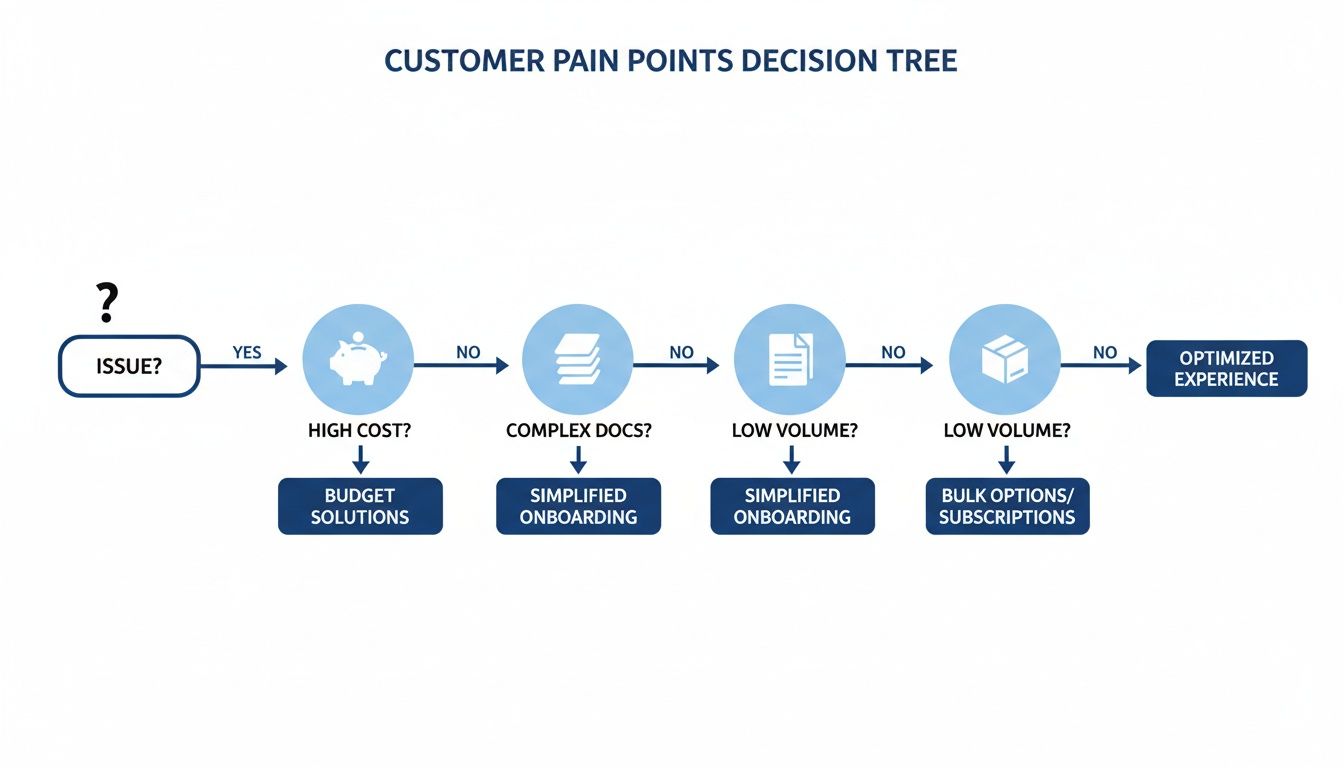
When you understand this flow, you can position your service perfectly. You're either making their existing value proposition even stronger or filling a critical gap their SME customers desperately need filled.
How to Write an Email They'll Actually Read
Your first message needs to be short, sharp, and all about them. An email promising "great services" is destined for the trash folder. Instead, lead with a concrete benefit that tackles a challenge you know they’re facing.
The Secret Sauce: The best outreach proves you've done your homework. Mentioning a specific trade lane you know they're big on, or referencing a common industry pain point, instantly shows your email isn't just another automated blast.
Here's a simple, four-step structure that works:
- Acknowledge Their World: Start by showing you know who they are (e.g., "As the Trade Lane Manager overseeing Intra-Asia routes…").
- Hit Them with a Hard Number: Lead with a specific data point they can't ignore (e.g., "…we're currently offering 15% below market rate on the SIN-HKG LCL lane.").
- Connect the Dots for Them: Spell out the "what's in it for me" (e.g., "This could directly boost the margin performance on one of your most important corridors.").
- Make the Next Step Easy: Suggest a quick, low-commitment action (e.g., "Are you free for a 10-minute call next week to run through the numbers?").
This approach respects their time and instantly positions you as a sharp problem-solver, not just another salesperson.
To help you get started, here are a few different messaging hooks you can adapt based on who you are and who you're trying to reach.
Outreach Messaging Angles for CWT Globelink
| Your Role (e.g., Carrier, 3PL) | Target Contact Role | Effective Messaging Hook |
|---|---|---|
| Ocean Carrier | Trade Lane Manager | "We have immediate, guaranteed capacity and a rate 10% lower than average on your key Shanghai to Rotterdam lane for the next quarter." |
| Regional Trucking Firm | Country Manager (e.g., Malaysia) | "Our last-mile network can cut your delivery times in the Klang Valley by 24 hours, giving your clients a premium service option." |
| Customs Brokerage Specialist | Head of Operations | "Our automated clearance process for Indonesian imports can reduce your average customs holds by 48 hours, a common pain point for SME shippers." |
| Tech/SaaS Provider | Head of Digital Transformation | "Our tracking API provides real-time container-level visibility, which can reduce customer service queries by 30% for your LCL clients." |
Choosing the right angle makes all the difference. For more practical advice on streamlining logistics paperwork—a constant headache in this industry—check out our guide on what every import-export firm needs to know. By using this playbook, you're not just sending another cold email; you're starting a strategic conversation.
Your CWT Globelink Questions, Answered
Alright, let's wrap things up by tackling some of the most common questions freight forwarders and sales teams have when looking at CWT Globelink Pte Ltd. These are the quick-fire answers you need to understand where they really fit in the market.
What Is CWT Globelink's Main Gig?
At its heart, CWT Globelink is a master of Less than Container Load (LCL) consolidation. They're a Non-Vessel Operating Common Carrier (NVOCC), which is a fancy way of saying they're experts at bundling smaller shipments. Think of them as the ultimate cargo carpool service.
They take partial shipments from a bunch of different customers and cleverly pack them into one full container. This is a game-changer for small and medium-sized businesses that don't have enough freight to justify a whole container, letting them tap into global ocean routes without breaking the bank.
How Does a Freight Forwarder Work With CWT Globelink?
Freight forwarders typically team up with CWT Globelink to use their neutral LCL services. Let's say your client needs to ship a few pallets on a lane where CWT Globelink is a major player. You simply book that space with them and manage the rest for your customer.
It's a smart way to instantly expand your own service map without the headache and massive cost of setting up your own consolidation network. You get to tap into their established routes and frequent sailings, all while keeping the focus on your own client relationships.
For a freight forwarder, CWT Globelink isn't just another vendor—they're a network multiplier. Working with them means you can say "yes" to more LCL quotes, instantly widening your service area with virtually no risk.
This kind of collaboration is standard practice in logistics. It's all about leveraging partnerships to compete more effectively and serve your clients better.
Which Trade Lanes Are Their Stronghold?
With their home base in Singapore and a network spanning over 92 offices, there's no question: intra-Asia trade lanes are their bread and butter. These routes are the core of their entire operation.
The major arteries connect hubs like Singapore, Malaysia, Thailand, and Vietnam with mainland China. Beyond that, they have very solid, high-frequency services linking the rest of Asia to:
- The Middle East
- The Indian Subcontinent
- Europe
If you're planning a sales pitch or doing a competitive analysis, zero in on these lanes. That's where they have the most volume, the best rates, and the tightest control.
Is It Only Ocean Freight, or Is There More?
While LCL ocean freight is what they're famous for, CWT Globelink is part of a much larger logistics group. That means they have the capability to offer more comprehensive, end-to-end solutions.
Often, this includes multi-modal services that blend their core ocean product with airfreight or trucking for a full door-to-door delivery. But make no mistake, their identity and deepest expertise is as an NVOCC.
When you reach out, showing that you get this distinction is crucial. It proves you've done your homework and helps you frame a conversation that's actually relevant to their team.
Knowing who to talk to at a company like CWT Globelink is half the battle for any logistics sales pro. Coreties is designed to solve that exact problem. Our platform digs into customs data to hand you a ready-made list of qualified prospects, complete with the verified contact info you need to get the conversation started. See how Coreties can help you connect with the right people and close deals faster.
Leave a Reply