Think of the Importer of Record (IOR) as the legal guardian for goods crossing a border. This is the person or company that officially takes responsibility for a shipment, making sure it legally enters the country. They are the ones who vouch for the cargo, ensuring all duties, taxes, and import laws are followed to the letter.
What Is an Importer of Record in Global Shipping?
At its heart, the Importer of Record is the most crucial player in any import deal. This isn’t just a name on a document; it’s a role that carries serious legal and financial weight. The IOR is the entity ultimately on the hook for making sure a shipment complies with every single one of the destination country’s customs regulations.
This accountability covers a lot of ground, including:
- Accurate Classification: Making sure every product is categorised with the correct Harmonised System (HS) code.
- Correct Valuation: Declaring the true value of the goods, which is what customs uses to calculate duties and taxes.
- Duty and Tax Payment: Handling the timely payment of all tariffs, duties, and fees owed to customs authorities.
- Regulatory Compliance: Getting all the necessary permits, licences, and certificates needed for the specific products being imported.
For freight forwarders and carriers, figuring out who the real IOR is can make or break a shipment. It’s not always the consignee or the final buyer. The IOR is the one calling the shots, controlling the freight, and shouldering the risk. Getting this right is the first step in avoiding compliance nightmares and, just as importantly, spotting valuable sales opportunities.
The Importer of Record is the legally recognised party responsible for ensuring that imported goods meet all customs and legal requirements of the destination country. Any slip-ups can lead to hefty fines, seized shipments, and major supply chain headaches.
The IOR in a Major Trade Hub
In a major trade hub like Singapore, the IOR’s role becomes even more critical. With total imports reaching a record $45.9 billion USD and growing by 20.3% year-over-year, the IOR acts as the gatekeeper for this enormous volume of goods.
These entities are tasked with navigating compliance and duties for an eye-watering $567.3 billion USD in annual trade, making them ideal prospects for any logistics provider. You can dig deeper into Singapore’s import growth trends on CEICdata.com.
This legal responsibility makes the IOR a central figure in international logistics. Identifying these key shippers and their specific trade lanes gives you a direct line to the people who make the most important logistics decisions.
IOR vs Consignee vs Customs Broker: Unpacking Each Role
In the complex world of global trade, it’s easy to get the players confused. The lines between the Importer of Record, the consignee, and the customs broker can seem blurry, but mixing them up can lead to some seriously expensive compliance headaches. Knowing who’s responsible for what isn’t just good practice—it’s essential for getting goods through customs smoothly and for figuring out who holds the real power in a supply chain.
Let’s break it down using a simple analogy: think of an international shipment as a major theatre production. Each role is distinct, and if one person messes up their lines, the whole show can grind to a halt.
The Producer: The Importer of Record (IOR)
The Importer of Record (IOR) is the show’s Producer. This is the person or company putting up the money and taking all the risk. They are the ultimate financial and legal backstop for the entire venture. If the production breaks any laws or fails to pay its bills, the producer is the one on the hook.
In shipping terms, the IOR is the entity legally responsible for making sure the imported goods meet all local laws and regulations. They’re in charge of paying the correct import duties and taxes and ensuring every piece of paperwork is filed accurately. When the goods arrive at the border, customs authorities see the IOR as the official owner at that exact moment.
The Star Actor: The Consignee
The Consignee is the Star Actor of our play. This is the party whose name is on the ticket—they’re the one who will physically receive the goods when they arrive at their final destination. They’re a crucial player and the public face of the delivery, but they don’t automatically carry the legal or financial burden for the import process itself.
Now, it’s common for the consignee to also be the IOR, but it’s a mistake to assume they are always one and the same. For example, a third-party logistics (3PL) warehouse might be listed as the consignee, but the actual brand that owns the inventory is the IOR. Understanding this distinction is critical. For a deeper dive into this, check out our guide on how to identify consignees in global shipping data.
The hierarchy is crystal clear, with the IOR sitting at the very top of the responsibility pyramid.
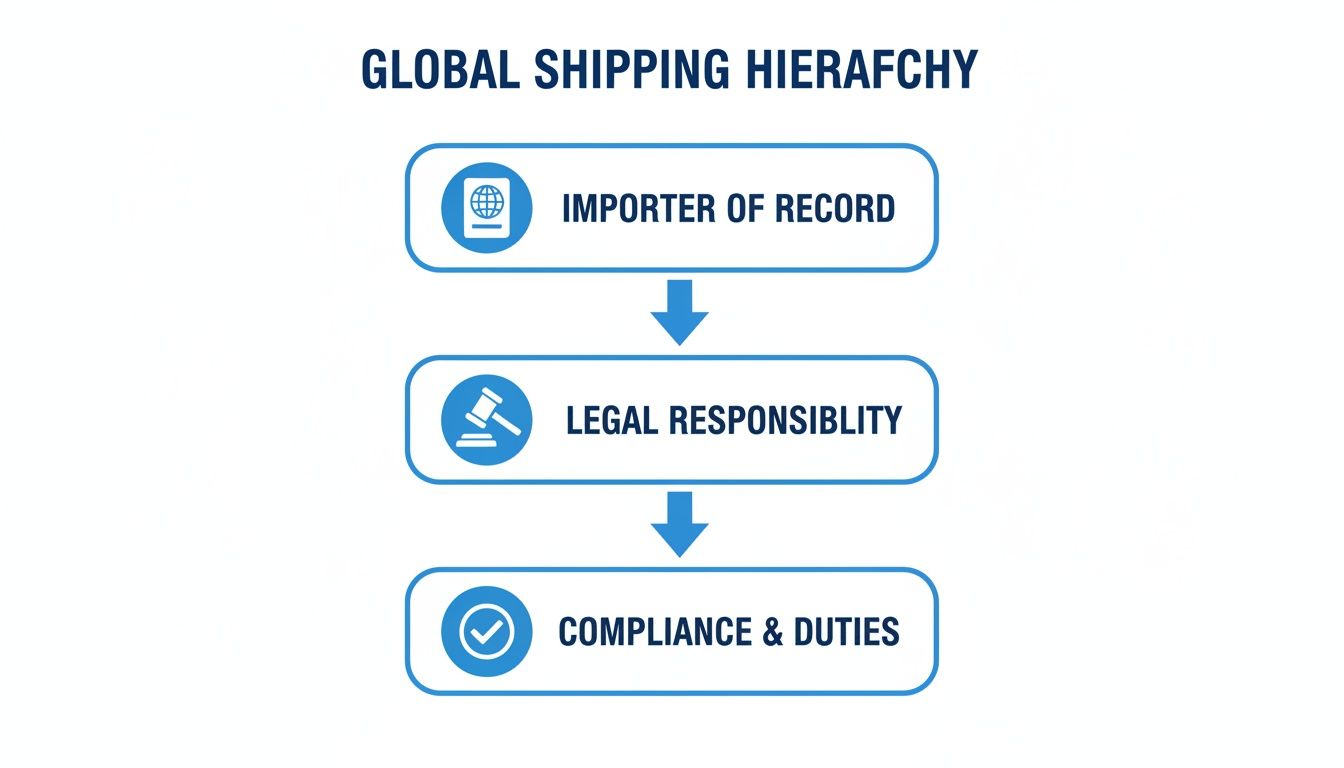
As you can see, the IOR’s role is foundational. They bear the full weight of both legal responsibility and the obligation for all compliance and duties.
The Talent Agent: The Customs Broker
Finally, we have the Customs Broker, who acts as the expert Talent Agent. They’re brought in for their specialised knowledge and industry connections. The agent is the one who navigates the complex paperwork, manages the schedules, and handles the nitty-gritty details to ensure the star actor gets to the stage without a hitch.
But here’s the key part: the agent doesn’t finance the show or take legal responsibility if it flops. In the same way, a customs broker is a licensed specialist hired to manage the customs clearance process on behalf of the IOR. They prepare and submit all the necessary documentation, but they never take on the IOR’s core legal liability.
A customs broker might handle the technical filings, but the Importer of Record always retains the ultimate legal and financial responsibility for the shipment’s compliance. In the eyes of customs agencies, this distinction is absolute.
To make these differences even clearer, here’s a side-by-side comparison of what each party is—and isn’t—responsible for.
IOR vs Consignee vs Customs Broker Role Comparison
| Responsibility | Importer of Record (IOR) | Consignee | Customs Broker |
|---|---|---|---|
| Legal & Financial Liability | Yes. Ultimate responsibility for all compliance, duties, taxes, and penalties. | No. Not legally liable unless they are also the IOR. | No. Acts as an agent; liability rests with the IOR. |
| Ownership at Import | Yes. Considered the official owner by customs at the time of entry. | Sometimes. Becomes the owner upon delivery, but not necessarily at import. | No. Never takes ownership of the goods. |
| Customs Documentation | Yes. Ultimately responsible for the accuracy of all declarations. | No. May provide information, but not legally responsible for the filing. | Yes. Prepares and submits documentation on behalf of the IOR. |
| Payment of Duties & Taxes | Yes. Legally obligated to pay all assessed import duties and taxes. | No. Typically does not pay these directly, unless also serving as the IOR. | No. Facilitates payment but uses the IOR’s funds or line of credit. |
| Physical Receipt of Goods | Sometimes. May or may not be the final destination for the goods. | Yes. The designated recipient of the shipment at the destination. | No. Does not physically handle or receive the cargo. |
This table shows just how distinct these roles are. The IOR is the undisputed lynchpin, holding all the legal and financial cards for a successful import.
The Legal Weight: Understanding an IOR’s Duties and Liabilities
Taking on the role of an Importer of Record (IOR) is a lot more than just putting a name on a shipping form. It’s a serious legal commitment, one that comes with heavy financial and regulatory weight. Think of the IOR as the single point of contact customs authorities hold accountable for everything related to an import.
That responsibility is absolute. When a shipment hits the border, the IOR is legally guaranteeing that it meets every single local law and regulation. It doesn’t matter who packed the boxes or filled out the initial paperwork; if something is wrong, the buck stops with the IOR.
What Does an Importer of Record Actually Do?
The IOR’s to-do list is long and demands a sharp eye for detail. Getting any of these core duties wrong can bring on some painful penalties.
Here’s what the role boils down to:
- Accurate Product Classification: Every single item must be classified with the right Harmonised System (HS) code. A simple mistake here can mean you pay the wrong duty rate—either overpaying and losing money, or worse, underpaying and getting hit with fines.
- Correct Valuation: You have to declare the exact commercial value of the goods. There’s no room for negotiation on this. Customs agencies use this number to figure out duties and taxes, and undervaluing a shipment is a massive red flag for them.
- Payment of All Duties and Taxes: The IOR is on the hook for paying all tariffs, duties, and taxes. This is a direct financial liability, and it has to be paid on time and in full.
- Securing Permits and Licences: A huge range of products—from food and electronics to medical devices—needs special import permits or licences. The IOR is responsible for making sure all of this is sorted before the goods even reach the port.
These aren’t just items on a checklist; they’re legally binding obligations. A good importer of record is the backbone of a compliant and efficient supply chain.
The High Cost of Getting It Wrong
When an IOR drops the ball, the consequences come fast and they hit hard. Customs authorities have a lot of power to enforce trade laws, and the penalties are designed to make you think twice about cutting corners.
A simple mistake, like using the wrong HS code, might not seem like a big deal. But to a customs officer, it can look like you’re trying to dodge higher tariffs. That can trigger financial penalties that dwarf the original amount of duty you owed.
The liabilities of an Importer of Record aren’t just financial. Repeated compliance failures can get your importing privileges suspended, essentially blacklisting your company from international trade.
The potential fallout is serious:
- Hefty Fines and Penalties: These can range from a percentage of the shipment’s value to massive fixed fines for every single violation.
- Shipment Seizures: Customs can hold your goods indefinitely while they investigate, racking up huge delays and storage fees.
- Audits and Investigations: One mistake can put your company’s entire import history under a microscope, creating a huge administrative headache.
- Criminal Charges: In clear cases of fraud—like deliberately lying about what’s in a container to evade duties—the people responsible can even face criminal prosecution.
All these risks underscore why you can’t afford to be casual about the legal side of importing. For a deeper dive into navigating this world, check out our guide on running a successful import-export business. Choosing a knowledgeable and reliable IOR is easily one of the most important decisions you’ll make in global logistics.
How to Pinpoint the Importer of Record in Shipment Data
Shipment data is a goldmine, but only if you know how to read it. Finding the true Importer of Record (IOR) isn’t as straightforward as looking for the “Consignee” on a Bill of Lading. The consignee is often just the delivery address—a warehouse or a third-party logistics (3PL) facility. The IOR, on the other hand, is the real power player holding all the legal and financial cards.
Learning to cut through this noise is what separates good sales teams from great ones. By understanding the tell-tale signs in air and ocean freight documents, you can spot the actual decision-maker who controls the logistics, carries the risk, and ultimately signs the freight contracts. It’s a game-changer for effective sales outreach and smart risk management.
Key Clues in Customs Data
Think of it like being a detective. You’re looking for clues in the paperwork that point you to the real IOR, helping you see past the obvious but often misleading details.
Here are the signals you should be watching for:
- DDP vs. Other Incoterms: If you see Delivered Duty Paid (DDP) on the documents, it’s a strong hint that the seller is acting as the IOR. On the flip side, terms like Ex Works (EXW) or Free on Board (FOB) almost always shift that responsibility onto the buyer.
- The “Notify Party” Field: This little box can be a dead giveaway. If the Notify Party is a different entity from the Consignee—especially if it’s a major corporation or a known logistics player—they are very likely the true IOR or at least a major influencer in the decision.
- Consistent Shipper-Consignee Pairs: Ever notice the same company importing goods over and over again, but the consignee address keeps changing between different 3PLs or warehouses? That importing company is almost certainly the IOR. They’re the ones orchestrating the entire logistics network from behind the curtain.
At the end of the day, the most reliable clue is figuring out who has a direct financial stake in the goods. Follow the money. The one paying the duties and guaranteeing compliance is the one calling the shots.
Using Modern Platforms to Find the IOR
Let’s be realistic—nobody has time to manually sift through thousands of shipping records. That’s where modern data platforms come in. They do the heavy lifting for you, automating the discovery process and delivering verified IOR contacts right to your screen.
These tools are built to connect the dots. They analyse massive volumes of trade data to spot the patterns that unmask the true IOR, linking corporate parents to their import activities, no matter what consignee name is on the paperwork. For a sales team, this is a massive head start.
Take Singapore’s massive import market, for example. The country’s top 10 import partners account for a staggering 94.95% of its total import value, with China leading the pack at $70.7 billion USD. This puts immense pressure on the importer of record to manage compliance on these incredibly busy trade lanes, making them high-value targets for any freight forwarder. The right data platform can pinpoint exactly who these IORs are. You can get a sense of these trends by exploring Singapore’s import trade data on Volza.com.
Your Actionable Checklist for Vetting an IOR
Choosing an Importer of Record is a high-stakes decision. Get it right, and you get smooth customs clearance. Get it wrong, and you’re staring down the barrel of costly delays, seized goods, and some serious legal headaches.
Think of it like a background check before you hand over the keys to a very valuable asset—because that’s precisely what’s happening.
For freight forwarders and carriers, this vetting process isn’t just a suggestion; it’s fundamental risk management. A weak IOR doesn’t just put one shipment at risk; it can poison client relationships and tarnish your company’s reputation. This checklist gives you a solid framework for doing your due diligence and making sure your partner is up to the task.
Foundational Legal and Tax Verification
First things first: you have to confirm the company actually exists and is recognised by the government in the destination country. This part is completely non-negotiable.
- Legal Business Registration: Is the proposed importer of record a legitimate, active business? You need to verify they are properly registered with the relevant government authorities in the country of import.
- Tax Identification Number: They must have a valid tax ID. This could be an Employer Identification Number (EIN) in the United States or an EORI number in the European Union. Without this, they can’t legally pay duties or clear goods. Simple as that.
Licensing and Commodity Expertise
Not all cargo is the same, and customs authorities know it. Different products demand specific permits and expertise, so you have to be sure the IOR is equipped to handle your specific goods.
An IOR that’s a pro at importing textiles likely doesn’t have the permits or know-how to handle sensitive electronics or perishable foods. This kind of mismatch is a classic, and easily avoidable, reason for customs holds.
Make sure they hold the right commodity-specific licences. Better yet, ask for proof they’ve successfully imported similar goods before. Case studies or references from your industry are a great way to confirm their experience and sidestep predictable problems at the border.
Financial Stability and Formal Agreements
Finally, you need to check their financial health and get everything down in writing with the proper legal documents.
- Financial Solvency: The IOR needs the cash or credit to cover all duties, taxes, and any unexpected fees that might pop up. Customs authorities often require a customs bond, which acts like an insurance policy for them. You’ll want to confirm this bond is in place and sufficient for the value of the goods.
- Power of Attorney (POA): This is the critical piece of paper. A formal, legally binding POA must be signed. This document is what officially gives the IOR (or their customs broker) the authority to act on the importer’s behalf. Without it, none of their actions have any legal weight.
Turning IOR Data Into a Powerful Sales Advantage
Figuring out the true importer of record from shipment data isn’t just about ticking a compliance box. It’s a game-changer for sales, giving you the key to unlock genuinely productive conversations. We all know that generic, cold outreach is a dead end. What really works are discussions built on value, the kind that open doors and forge lasting partnerships.
When you know exactly who the IOR is and what they’re moving, you can skip the tired old “can I get you a quote?” routine. Instead, you can lead with insights that immediately prove you understand their world and have real expertise on their specific trade lanes.
From Cold Calls to Strategic Conversations
Using IOR data completely flips your sales pitch on its head. You’re no longer just pushing a generic service; you’re offering a specific, targeted solution. That means your email actually gets read because it speaks directly to the recipient’s business and their day-to-day challenges.
This data-first approach lets you zero in on genuinely qualified leads with incredible accuracy. You can filter for companies importing specific goods from particular regions, making sure every prospect you contact is a solid match for what you do best. It’s about focusing on quality, not just blasting out a high volume of emails.
Think about the difference between asking, “Can I quote your next shipment?” versus a hook backed by data: “I noticed you’re the Importer of Record for electronics coming in from Malaysia. On that lane, we’ve helped similar importers cut their customs clearance times by 20%.”
See the difference? That second approach immediately positions you as a strategic partner who’s done their homework, not just another salesperson. You’re showing them you get their supply chain and have concrete solutions for the problems they’re likely facing.
Crafting the Perfect Outreach
Armed with insights from customs data, you can build a story that hits on specific pain points. Here’s a simple but effective way to structure your outreach:
- Show You Know Them: Start by referencing their role as an importer of record and mention a specific trade lane or commodity they handle. It instantly proves your message isn’t a random blast.
- Offer a Relevant Solution: Connect their import activity directly to your value proposition. If they’re sourcing from a notoriously congested region, talk about your expertise in navigating those specific delays.
- Use Social Proof: Casually mention how you’ve helped similar importers get real results, whether it’s reducing transit times or cutting down on painful demurrage costs.
- End with a Clear Next Step: Don’t be vague. Suggest a brief, specific chat to explore how you could bring that same value to their business.
This approach changes the entire conversation. You stop selling freight and start selling intelligence, efficiency, and a supply chain that just works better.
FAQs: Clearing Up Common IOR Confusion
To wrap things up, let’s tackle some of the most frequent questions we hear about the importer of record (IOR). These are the common sticking points where a simple misunderstanding can lead to some very expensive problems.
Can a Freight Forwarder Be the Importer of Record?
In most cases, the answer is a hard no. Freight forwarders and NVOCCs almost always steer clear of acting as the IOR, and for a good reason: they have no direct ownership or financial interest in the actual goods.
Taking on the IOR role means accepting full legal and financial liability for everything in that container. That’s a massive risk most logistics providers simply won’t take on. Their job is to arrange the transport, not to own the compliance headache that comes with the cargo.
What Happens If You Name the Wrong IOR?
Listing the wrong party as the importer of record on your customs entry is a major compliance foul-up. The fallout isn’t just a slap on the wrist; it can halt your entire supply chain.
The most immediate consequence is that your shipment gets seized. Customs will impound the goods until the correct, legally registered IOR is sorted out and all the paperwork is redone. This means racking up painful delays and even more painful demurrage charges.
But the trouble doesn’t stop there. This kind of mistake can also lead to:
- Serious Fines: Customs agencies will often levy penalties against whoever filed the incorrect declaration.
- Deeper Scrutiny: One slip-up can flag your company for intensive audits, putting all your past and future shipments under a microscope.
How Does DDP Change the IOR Game?
When you’re dealing with Delivered Duty Paid (DDP) shipments, especially in e-commerce, the whole IOR responsibility gets flipped on its head. Under DDP Incoterms, the seller takes on the full burden.
This means the seller must act as the importer of record in the destination country. They are on the hook for handling the entire customs clearance process and paying all duties and taxes before the package ever reaches the customer’s door.
Ready to turn IOR data into your strongest sales tool? Coreties transforms complex customs data into verified lead lists, complete with direct contact information and LinkedIn profiles. Find qualified shippers, understand their specific needs, and craft outreach that gets replies. Discover your next customer at https://coreties.com.
Leave a Reply