You typed a company name into search, opened a few tabs, and got nothing useful. That usually means one of two things. The company is tiny and private, or the company doesn't exist in the form you think it does.
With Northern Central Distributing, the second explanation is the right one.
That's frustrating when you're a rep trying to build territory, qualify an inbound mention, or prep for outreach. You're not failing at research. You're chasing a name that doesn't resolve cleanly to a real freight player. The fix isn't to search harder. The fix is to stop treating the name as the target and start treating it as a clue.
The Search for Northern Central Distributing
If you've been hunting for Northern Central Distributing and coming up empty, trust your instincts. The search results don't point to a clear, verified logistics company with a meaningful freight footprint. They point to noise.
Most new reps make the same mistake here. They assume the answer is buried one page deeper in Google, one directory farther down, one old listing away. It usually isn't. When a company matters in freight, it leaves tracks. Customs records, carrier mentions, trade lane patterns, routing clues, importer activity, supplier overlap. Real businesses create operational residue.
Northern Central Distributing doesn't show up that way.
Practical rule: If a lead name produces confusion across listings, directories, and unrelated industries, stop researching the name and start researching the likely geography, commodity, and lane behind it.
That shift matters. A dead-end lead can still reveal a real opportunity if you decode what the searcher probably meant. In this case, the better read is that someone is mixing up a regional concept, a similar company name, or a North Central U.S. shipping corridor with a specific business entity.
Use this approach when a lead goes fuzzy:
- Test the exact name first. If it doesn't align across freight data and business listings, assume ambiguity.
- Check for near-match companies. Separate local distributors from actual logistics operators.
- Translate the name into a market. Region beats rumor.
- Build your plan from trade activity, not keyword guesswork.
That's how experienced sales teams recover wasted prospecting time. They don't cling to a phantom account. They pivot fast and build a pipeline around verified shippers.
Solving the Name Game and Common Mix-Ups
The clean answer is simple. There is no verifiable entity known as Northern Central Distributing in global freight data, customs databases, or major logistics market references. The search trail leads to unrelated businesses and naming confusion, not a single freight company.
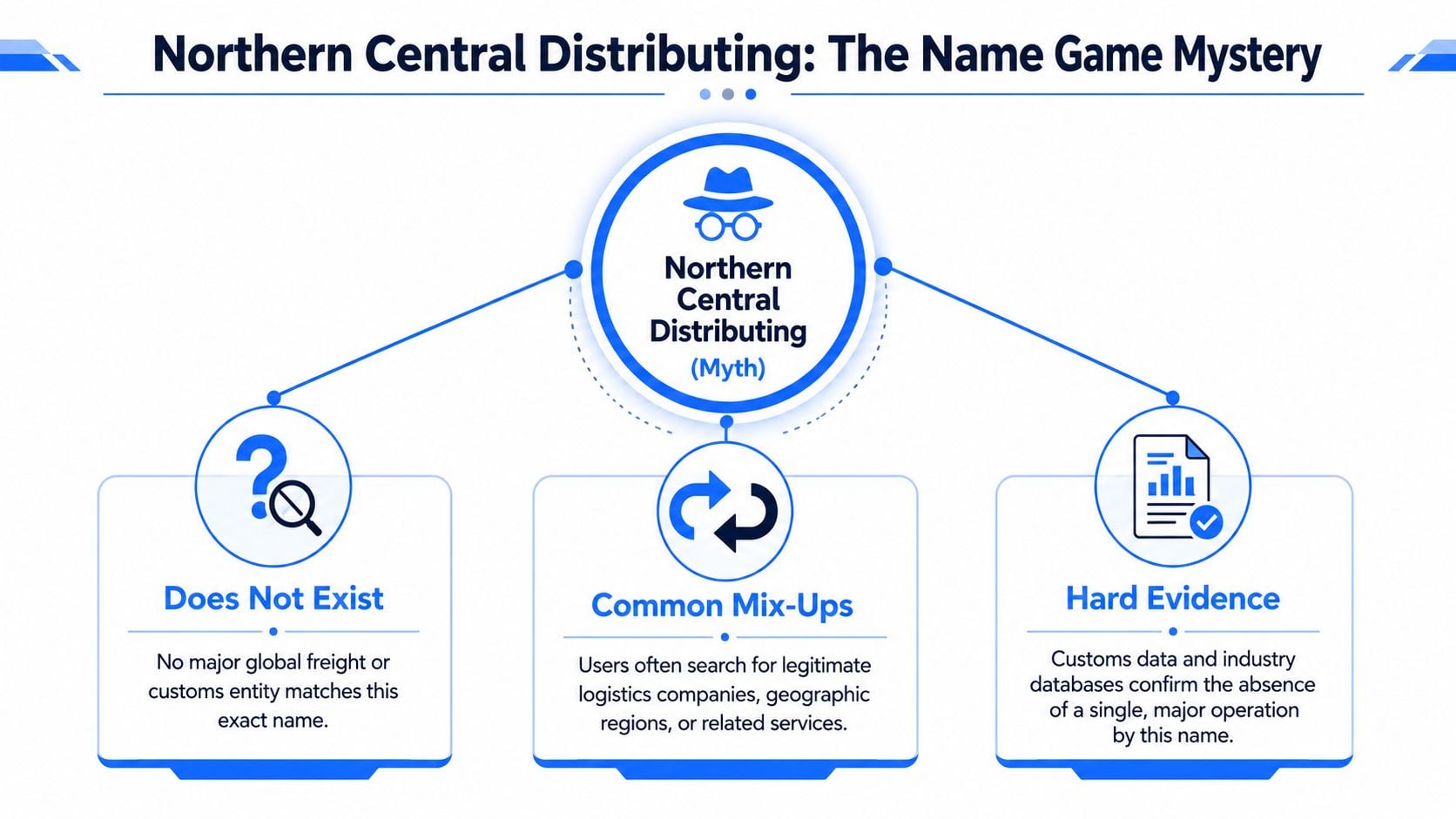
What search results actually show
Those seeking this phrase tend to collide with businesses that sound similar but have nothing to do with one another.
| Search result | What it is | Why it creates confusion |
|---|---|---|
| North Central Distributing | A business listed at 575 15th Ave. N.E., St. Joseph, Minnesota 56374, with phone (320) 363-8285 on The AAM Group distributor listing | Similar wording, different name |
| Central Distributing | A BBB-accredited major appliance dealer at 4250 W Shaw Ave, Fresno, CA 93722, with principal contact Mr. Farshid Assemi as President on BBB's Central Distributing profile | Contains “distributing” but isn't a freight lead for this query |
| North Central Industries Inc | A wholesale distributor of games, toys, and hobby goods | Similar regional wording, unrelated business category |
None of those validate the exact company name you were trying to find. None give you a strong basis for freight prospecting.
The historical red herring
One similar name does have real history. It's just not a distributor.
The Northern Central Railway was a Class I railroad connecting Baltimore, Maryland to Sunbury, Pennsylvania. It was completed in 1858 and acquired by the Pennsylvania Railroad in 1861, then largely lost operational significance after Hurricane Agnes in 1972, as documented in this Northern Central Railway history. Useful history lesson. Useless sales lead.
That's why chasing this phrase as an account name burns time.
The absence of a clean company record is the signal. Don't work around it. Use it.
What a disciplined rep should do instead
A good rep doesn't let naming ambiguity pollute the territory plan. Build your account framework around verified characteristics:
- Region first. Map the North Central U.S. corridor you want to own.
- Industry second. Focus on importers, exporters, and domestic shippers by commodity flow.
- Buyer profile third. Use a simple qualification model like this B2B ICP template to define who belongs in your pipeline.
- Operational clues last. Carrier references can help, but only if they support a real account strategy. If you need to understand identifiers used in freight workflows, this breakdown of the CH Robinson SCAC code is worth reading.
The lesson is blunt. If the name isn't real, don't build a sales motion around the name.
The Real Target North Central US Trade Lanes
The smarter interpretation of Northern Central Distributing is that the searcher probably meant a North Central U.S. shipping territory, not a specific logistics company. That's the opportunity.
Industry content often fails here. It doesn't explain the naming confusion, and it doesn't redirect reps toward a corrected list of real regional targets. That gap is exactly why people keep searching vague phrases instead of building lane-based prospect lists, as noted in this PrivCo reference to the naming confusion.
Think corridor, not company
When I coach a new rep, I tell them to stop asking, “Who is Northern Central Distributing?” and start asking, “Which shippers in the North Central corridor fit my service model?”
That changes everything.
Instead of one ghost account, you now have a territory built around real freight behavior across states often associated with the North Central region, such as Minnesota, Wisconsin, Illinois, and the Dakotas. Those markets matter because they connect domestic truckload networks, rail-served industrial zones, inland distribution centers, and import-driven manufacturing demand.
What this territory usually includes
A practical North Central plan should account for a mix like this:
- Manufacturing shippers with inbound components and outbound finished goods
- Agricultural and food-related cargo moving through regional processing and distribution networks
- Industrial suppliers tied to recurring replenishment freight
- Importers near major inland hubs who need drayage, transload, truck, rail, or final-mile coordination
Some reps get hung up on whether a shipper is “coastal enough” to matter for ocean or air. That's rookie thinking. Inland doesn't mean inactive. It means the freight path includes more handoffs, more routing choices, and often more room for a consultative seller to win.
How to frame the territory
Break the corridor into operational slices instead of state lines alone.
| Territory lens | What to look for |
|---|---|
| Inland hubs | Companies near major warehouse clusters, rail ramps, and highway intersections |
| Import dependence | Shippers that rely on overseas suppliers but receive inland |
| Mode complexity | Accounts with truck, rail, intermodal, or time-sensitive air needs |
| Sales fit | Companies where your team's service model actually solves a problem |
A rep who owns a lane beats a rep who owns a vague list of names.
Treat Chicago and Minneapolis as gravitational centers if they fit your network. Treat surrounding states as feeder markets. Treat every account as part of a flow, not an address book entry. That's how you build a territory that survives bad lead names and still produces real meetings.
Find Real Shippers with Customs Data
Still chasing “Northern Central Distributing” and getting nowhere? Good. That frustration is useful if it pushes you to stop hunting names and start hunting freight behavior.
A dead-end company search does not give you a territory. Customs data does. If a name is fuzzy, duplicated, outdated, or tied to the wrong business type, drop it fast and move to shipment records, importer activity, and lane patterns. That is how you find companies moving freight through the North Central corridor.
Use three filters before you build a list
Start with a market slice you can sell into, not a vague company label.
Geography
Set the territory by freight flow. Use metro clusters, inland hubs, warehouse belts, rail-served markets, or cross-state operating zones in the North Central U.S. If a random town surfaced in your original search, treat it as a clue, not a prospect.Commodity
Pick product categories that fit your network and your team's operating strengths. Industrial components, food ingredients, consumer goods, packaging inputs, replacement parts. Be specific enough that your outreach can sound informed.Trade lane
Define how the freight moves. Overseas inbound to an inland consignee. Port-to-DC replenishment. Supplier freight feeding a plant. Multi-stop regional distribution. A real lane gives you a reason to call.
That structure fixes the core problem. You stop asking, “Does this company name look right?” and start asking, “Who is shipping freight on lanes we can win?”
Build a prospect list that sales can use
Good customs-data prospecting is simple, but it requires discipline.
- Pull verified shippers with shipment history, consignee records, or repeat import patterns.
- Sort accounts by lane behavior so each group shares similar origins, cargo types, or inland delivery paths.
- Match contacts to the buying motion. Logistics, transportation, procurement, supply chain, and operations usually matter more than a generic office line.
- Cut weak-fit accounts early if the volume, mode, commodity, or geography does not line up with your service model.
If your team needs a tighter process for identifying importer targets, use this practical guide on how to find a company that imports.
Field advice: Bad names waste rep hours. Good filters produce call lists with a reason behind every account.
Use web data carefully
New reps often react to a bad lead by scraping search results, maps listings, old directories, and contact databases until they have a spreadsheet full of noise. That is not prospecting. That is clerical work with a confidence problem.
Public web data can still help with enrichment. Use it to confirm locations, operating details, contacts, and related entities after you identify the shipper. If your team handles collection at scale, this guide for solving web scraping captchas covers the technical barriers that block automated workflows.
The standard is straightforward. Every account on your list should answer four questions:
- Does this company move freight that fits our network?
- Can we identify a likely buyer or internal stakeholder?
- Do we understand the lane well enough to make a relevant recommendation?
- Is there evidence of ongoing shipping activity instead of a stale listing?
If you cannot answer yes to those questions, the account is not ready for outreach.
Here's a practical walkthrough to keep the process grounded:
The rule is simple. Search terms can start the investigation. Verified freight activity decides whether the lead belongs in your pipeline.
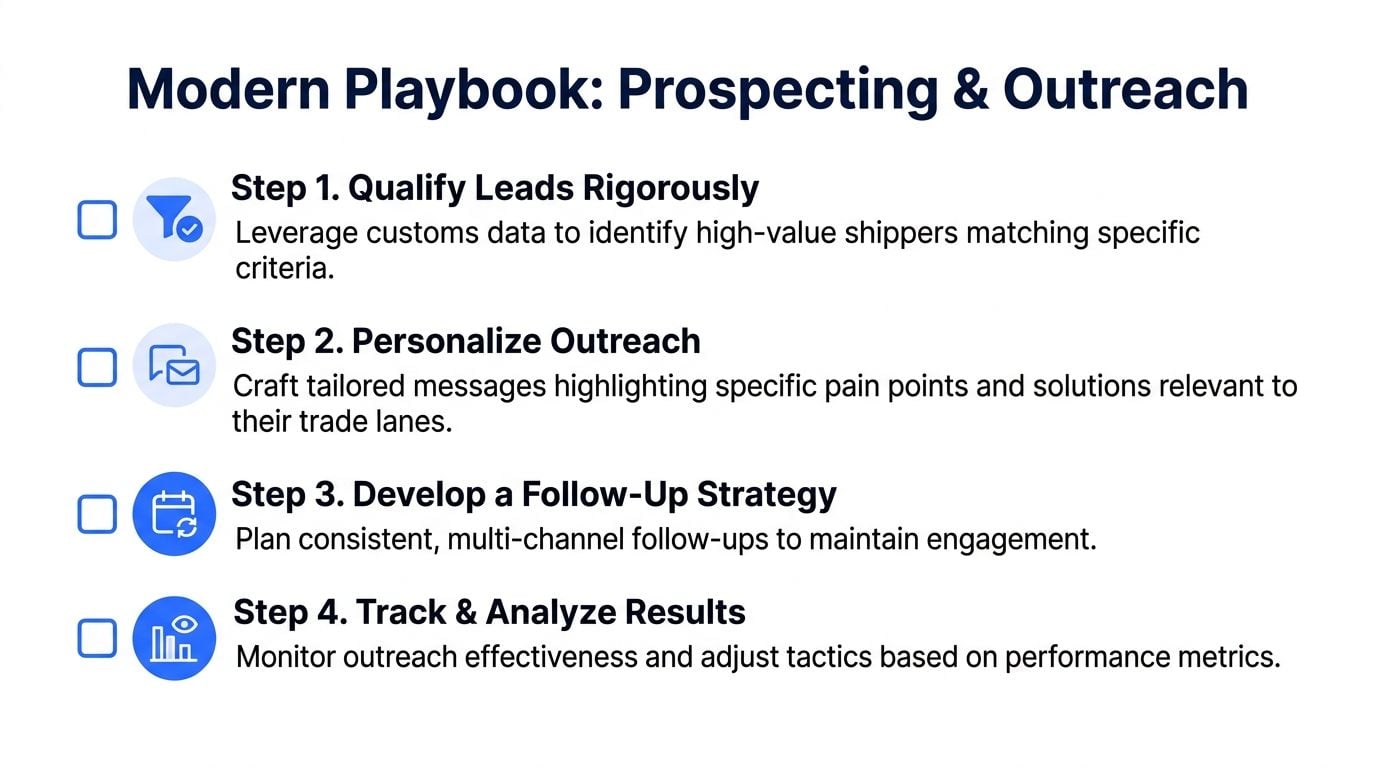
A Modern Playbook for Prospecting and Outreach
Once you've got a list of real shippers, the next mistake to avoid is sending generic outreach. Data-driven prospecting only works if the message sounds like you looked at the account.
Most logistics emails fail because they read like they were written before the rep knew who the shipper was. That kills response quality. Buyers can tell when you're guessing.
What good outreach actually sounds like
A strong first touch references the shipper's world in plain language. Not fake personalization. Real relevance.
Compare these two approaches:
| Weak outreach | Strong outreach |
|---|---|
| “We provide end-to-end logistics solutions and would love to connect.” | “I work with shippers managing inbound supplier freight into the North Central U.S. and noticed your lane profile aligns with the type of volume where routing flexibility usually matters.” |
| “Can we schedule a call to discuss opportunities?” | “If your team is balancing inland delivery timing, carrier consistency, and cost pressure on these lanes, I can share a few options that similar shippers usually evaluate.” |
The second version works better because it speaks to operations, not marketing language.
A practical sequence
Use a simple, disciplined sequence instead of spraying messages everywhere.
- Email one: Lead with lane relevance and one operational issue you can help solve.
- Follow-up call: Reference the same issue. Don't restart from zero.
- Email two: Add a sharper angle such as routing flexibility, capacity coordination, or supplier-side friction.
- LinkedIn touch: Short note. No pitch deck. No brochure dump.
“Your message should prove you understand the movement, not just the company name.”
Message templates you can adapt
Cold email opener
Hi [Name], I'm reaching out because your team appears to operate freight flows that fit the North Central U.S. corridor where my team spends most of its time. When shippers in that profile review providers, they're usually trying to tighten visibility, improve routing options, or reduce friction between origin and inland delivery. If that's on your side of the table right now, I'm happy to compare notes.
Call opener
Hi [Name], I'm calling because I work with shippers moving freight through the North Central region, and I had a reason to believe your team may be managing similar lane challenges. I'm not calling blind. I wanted to ask whether provider flexibility or inland execution is a priority this quarter.
Use research without getting sloppy
Some reps still rely on broad search engine scraping for account research. That can help with enrichment, but only if you do it ethically and carefully. This WebscrapingHQ guide to scraping Google results for B2B growth is a solid reference for understanding the boundaries.
For personalization workflows, keep the standard high. If you want a better way to think about repeatable message customization, this article on personalization at scale is worth your time.
What matters most is judgment. Don't mention every detail you found. Mention the one detail that proves relevance. Then ask a question a buyer can answer without needing a committee meeting.
Stop Chasing Ghosts and Build a Real Pipeline
A rep who keeps digging for Northern Central Distributing is working backward. They're trying to force certainty out of a bad input. That's how pipelines stall.
A stronger sales motion starts with a different assumption. If the name is fuzzy, the opportunity probably lives in the market behind the name. Territory planning should follow freight activity, operating fit, and buyer relevance. Not a search query that never resolves.
Here's the practical reset:
- Drop the phantom account. It won't become real because you spent another hour on it.
- Define the corridor. Own a region with clear freight logic.
- Use shipment evidence. Verified activity beats directory presence.
- Tailor outreach to lane reality. Relevance wins meetings.
That's the habit experienced logistics sellers build early. They don't let ambiguity waste a week. They convert it into a better prospecting question, then they move.
Bottom line: Bad lead names are common. Bad sales discipline is optional.
If you're mentoring a newer rep, this is the lesson to drive home. The internet is full of business names that sound promising and go nowhere. The market is still full of real shippers who need help. Your job is to tell the difference quickly.
That's why a modern pipeline isn't built from broad web searches and guesswork. It's built from verified companies, useful segmentation, and outreach that shows you understand how freight moves. Do that consistently, and dead-end searches stop feeling like losses. They become filters that push you toward better accounts.
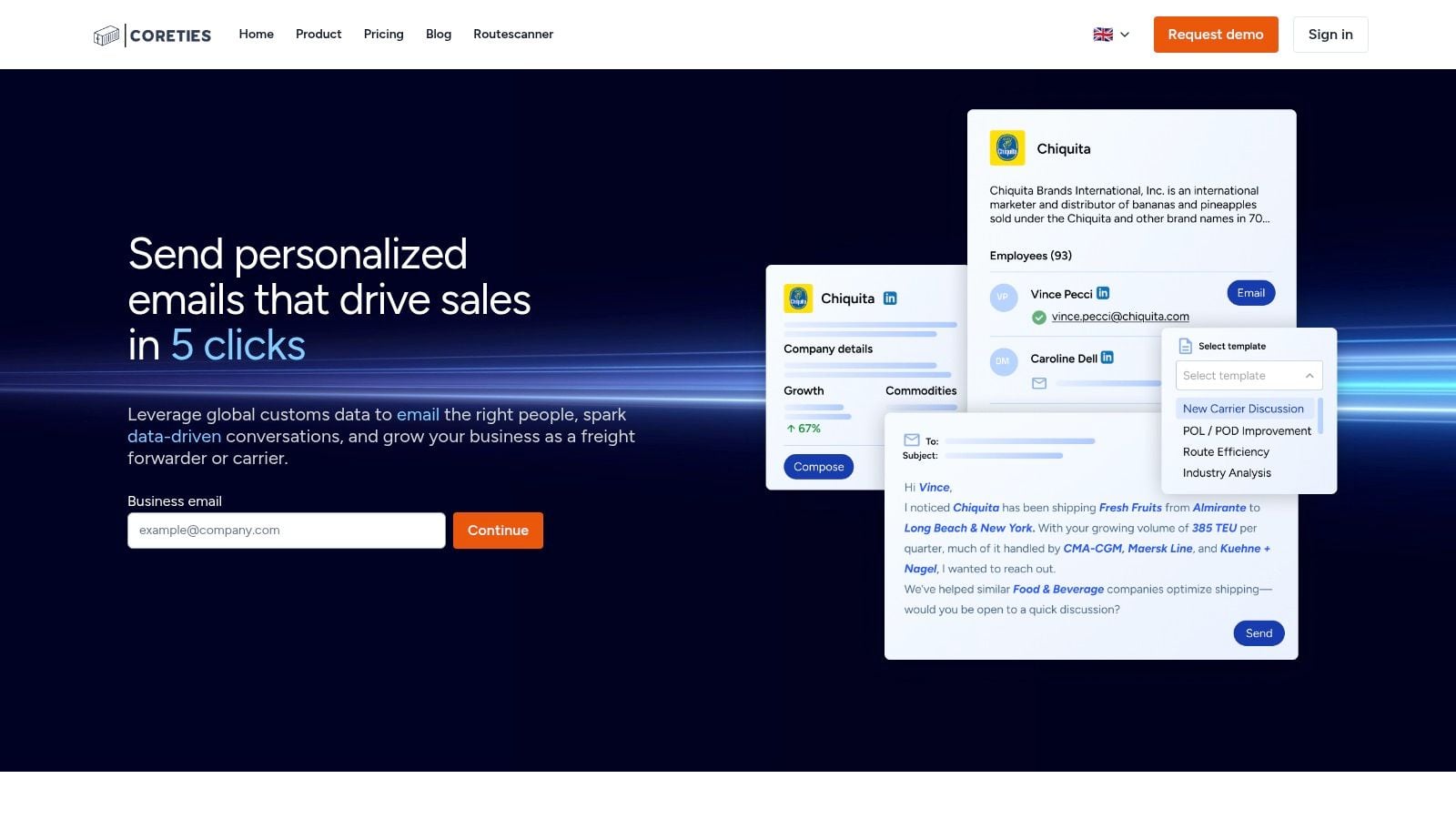
If you're done wasting time on phantom leads and want a faster way to find real shippers, Coreties is built for exactly that. It helps freight teams turn customs data into qualified prospect lists, identify the right contacts, and send personalized outreach based on actual lane and shipment context instead of vague company-name searches.
Leave a Reply